Statistics

Sampling and populations

6 past-paper questions, easiest first. Try each one, then reveal the answer.

Foundation & Higher2 of 6 from Foundation papers

Revision guide by The Full Marks

Sampling and populations: what you need to know

A sample is a smaller group chosen to represent a whole population. You use it to estimate facts about the population, and you need to know why an estimate might be wrong.

Both tiers scale up from a sample and discuss bias; capture–recapture questions appear mainly on Higher papers.

Key facts

  • Population: everyone or everything you are interested in. Sample: the part you actually collect data from.
  • In a random sample, every member of the population has an equal chance of being chosen, which helps avoid bias.
  • A bigger sample usually gives a more reliable estimate.
  • To scale up: estimate =number in sample with the featuresample size×population= \frac{\text{number in sample with the feature}}{\text{sample size}} \times \text{population}.
  • Capture–recapture: population ≈first catch×second catchnumber marked in second catch\approx \frac{\text{first catch} \times \text{second catch}}{\text{number marked in second catch}}. It assumes the fraction marked in the second catch matches the fraction marked in the whole population.
  • Sense check: the estimate can never be smaller than the number of different animals you have actually caught.

Capture–recapture

  1. Write down how many were caught and marked the first time (M).
  2. Write down how many were caught the second time (C) and how many of those were marked (R).
  3. Estimate the population N=M×CRN = \frac{M \times C}{R}. (This comes from RC=MN\frac{R}{C} = \frac{M}{N}: the fraction marked in the sample equals the fraction marked overall.)
  4. If asked what happens when marks rub off (or marked animals hide), fewer marked ones are recaptured, RR is too small, so the estimate is too big.

Worked examples

Example 1 Foundation · grade 4

A school has 600 students. In a random sample of 40, 14 walk to school. (a) Estimate how many students in the school walk. (b) State one assumption you have made.

Show the solution

(a) 1440×600=210\frac{14}{40} \times 600 = 210 students
(b) The sample is representative of the whole school (for example, walkers are not more or less likely to be picked). If it is not, 210 could be too high or too low.

Example 2 Higher · grade 6

Ryan catches 50 fish from a lake, marks them and puts them back. A week later he catches 60 fish, and 8 of them are marked. Estimate the number of fish in the lake, and give one assumption.

Show the solution

N=50×608=30008=375N = \frac{50 \times 60}{8} = \frac{3000}{8} = 375 fish
Assumption: the marked fish have mixed back in evenly (and no fish have been born, died or left the lake).

Common mistakes

  • Setting the capture–recapture sum up wrongly. The number of marked ones in the second catch always goes on the bottom.
  • Giving 'I rounded my answer' as an assumption. An assumption is about the sample or population, such as it being random or representative.
  • Saying a sample is biased without explaining who is more or less likely to be chosen.
  • Getting the direction wrong when an assumption fails. Work it through: fewer marked animals recaptured means a smaller denominator, so a bigger (over)estimate.

Exam tips

  • Assumption marks need a sensible assumption linked to the context (e.g. the sample is random or representative, no animals joined or left, marks did not rub off), and some questions also want its effect on the estimate.
  • If the estimate works out as a decimal, round to a sensible whole number of people or animals.

Questions people ask

What is the capture-recapture method?

You mark some animals, release them, then take a second sample. The fraction marked in the second sample is assumed to match the fraction marked in the whole population.

Why do we use samples instead of the whole population?

Asking everyone takes too long and costs too much. A well-chosen random sample gives a good estimate much more quickly.

Exam questions: Sampling and populations (6, easiest first)

Sampling and populations3 marksGrade 4CalculatorOn both tiers
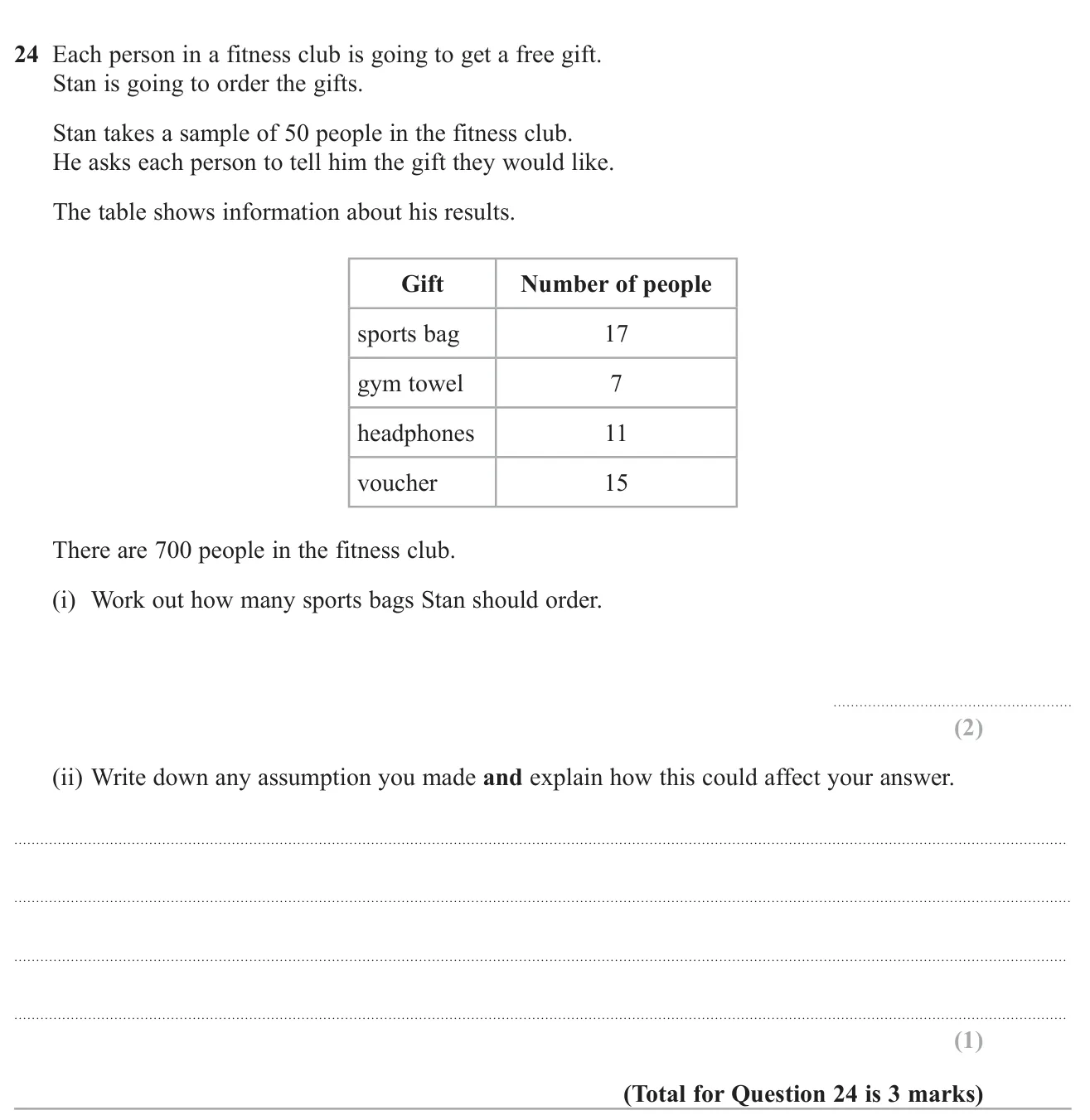
November 2019 · Paper 2 Foundation · Q24
Scale up a sample result to a whole club and state an assumption made.

© Pearson Education Ltd. November 2019 Paper 2 (Foundation, calculator), question 24.

Show answer
(i)2382 marks
(ii)e.g. The sample is representative of the whole club, otherwise the number could be wrong1 mark

Worked solution Checked against the mark scheme

(i) 1750×700=238\frac{17}{50} \times 700 = 238 sports bags

(ii) I assumed the 50 people are representative of all 700. If they are not, 238 could be too many or too few.

Watch out: In (ii), just repeating the calculation instead of stating an assumption.
Sampling and populations3 marksGrade 4CalculatorOn both tiers
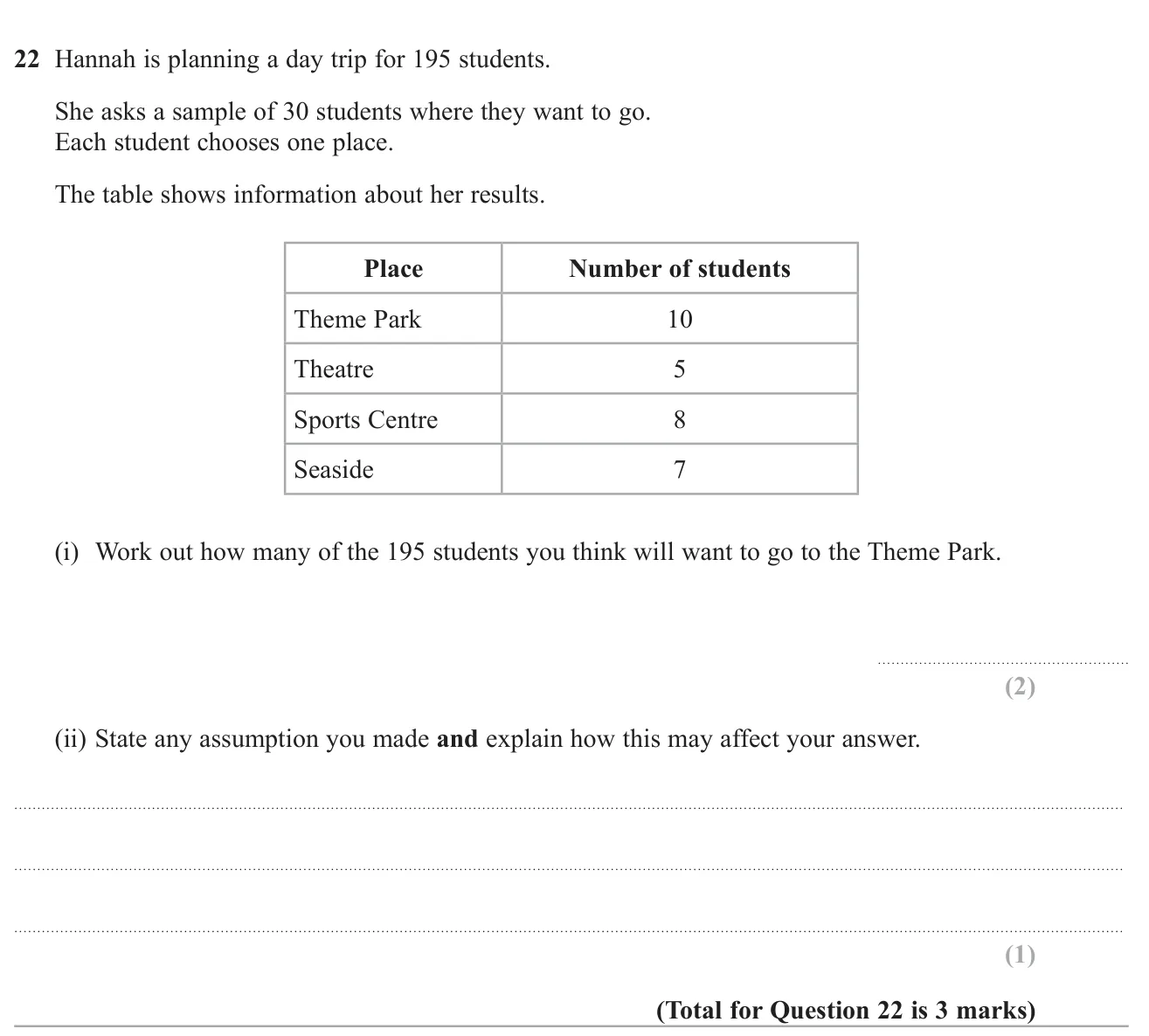
June 2019 · Paper 2 Foundation · Q22
Use a sample of 30 students to estimate how many of 195 will choose the theme park, and state an assumption behind the estimate.

© Pearson Education Ltd. June 2019 Paper 2 (Foundation, calculator), question 22.

Show answer
((i))65652 marks
((ii))e.g. The sample is representative of all 195 students; if not, the estimate could be wrong1 mark

Worked solution Checked against the mark scheme

(i) 1030=13\frac{10}{30} = \frac{1}{3} of the sample chose the theme park.

13×195=65\frac{1}{3} \times 195 = 65

(ii) Assume the 30 students represent the whole group fairly. If they do not, the true number could be quite different from 65.

Watch out: Saying only 'I rounded my answer' as the assumption.

Sampling and populations4 marksGrade 5CalculatorHigher
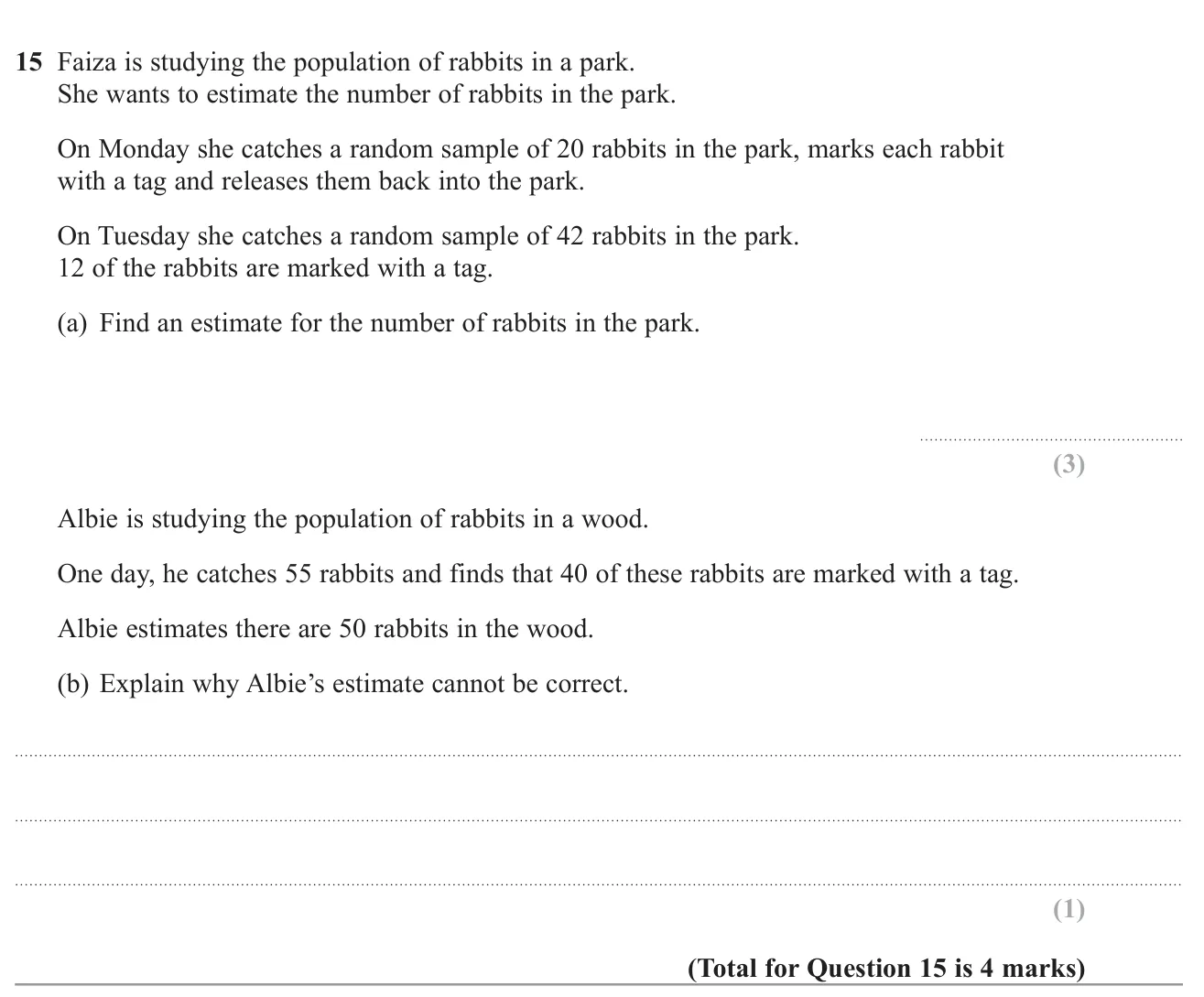
November 2022 · Paper 2 Higher · Q15
Use capture–recapture to estimate a rabbit population, then explain why another estimate is impossible.

© Pearson Education Ltd. November 2022 Paper 2 (Higher, calculator), question 15.

Show answer
(a)703 marks
(b)He caught 55 rabbits, so there must be more than 501 mark

Worked solution Checked against the mark scheme

(a) 1242\frac{12}{42} of the second sample were tagged, so 20N=1242\frac{20}{N} = \frac{12}{42}

N=20×4212=70N = \frac{20 \times 42}{12} = 70

(b) He caught 55 different rabbits in one day, so the wood must hold at least 55. An estimate of 50 is too small.

Watch out: Working out 20 × 12 ÷ 42 instead.

Sampling and populations4 marksGrade 6CalculatorHigher
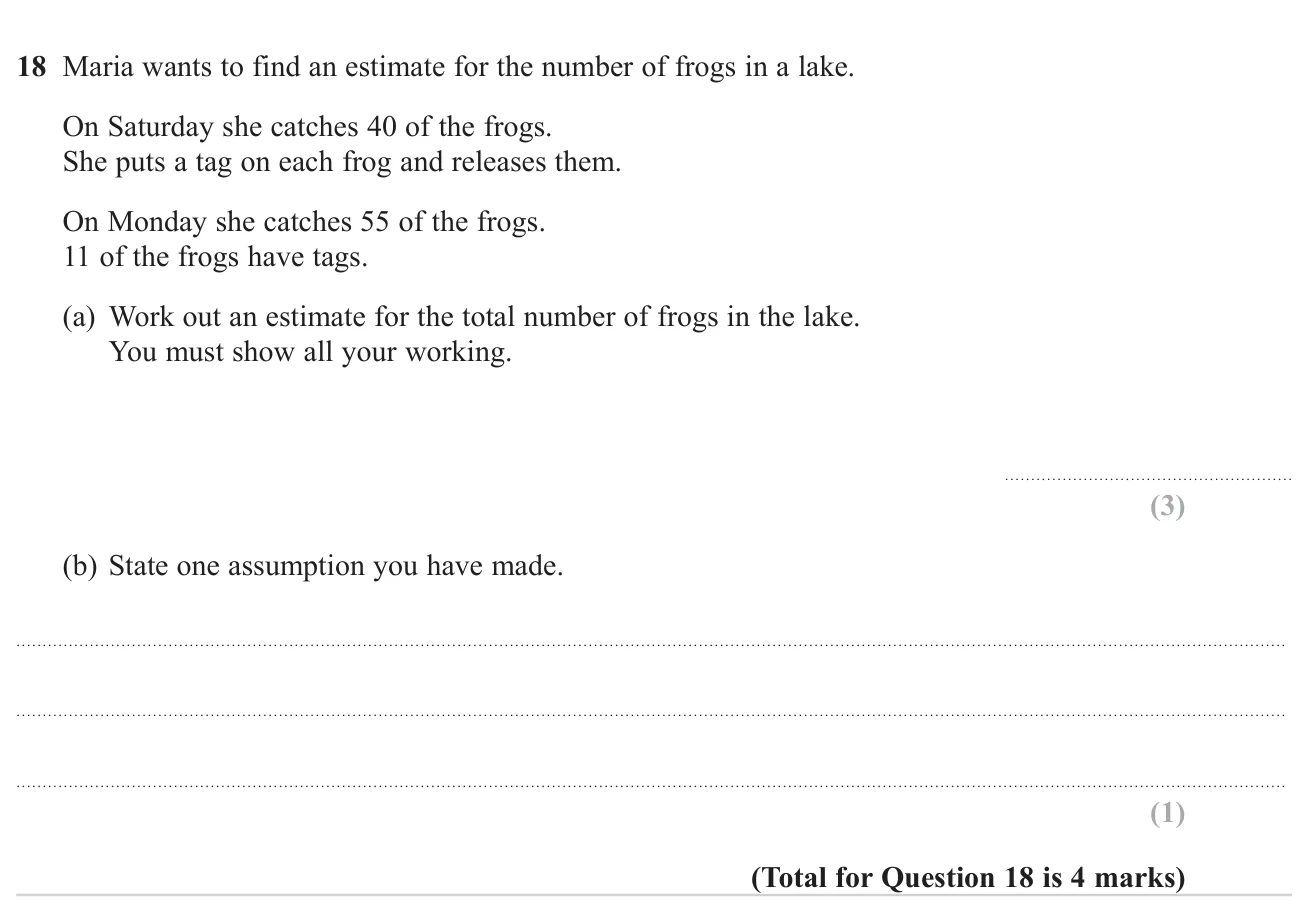
November 2024 · Paper 3 Higher · Q18
Estimate a population using capture-recapture data and state an assumption behind the estimate.

© Pearson Education Ltd. November 2024 Paper 3 (Higher, calculator), question 18.

Show answer
(a)2002003 marks
(b)e.g. No frogs joined or left the lake between Saturday and Monday1 mark

Worked solution Checked against the mark scheme

(a) In the second sample 1155=15\frac{11}{55} = \frac{1}{5} are tagged.

So the 40 tagged frogs are about 15\frac{1}{5} of all frogs:

N=40×5511=200N = \frac{40 \times 55}{11} = 200

(b) For example: the number of frogs stayed the same (none born, died, arrived or left).

Watch out: Working out 55 × 11 ÷ 40 by mixing up which numbers go where.

Sampling and populations3 marksGrade 6CalculatorHigher
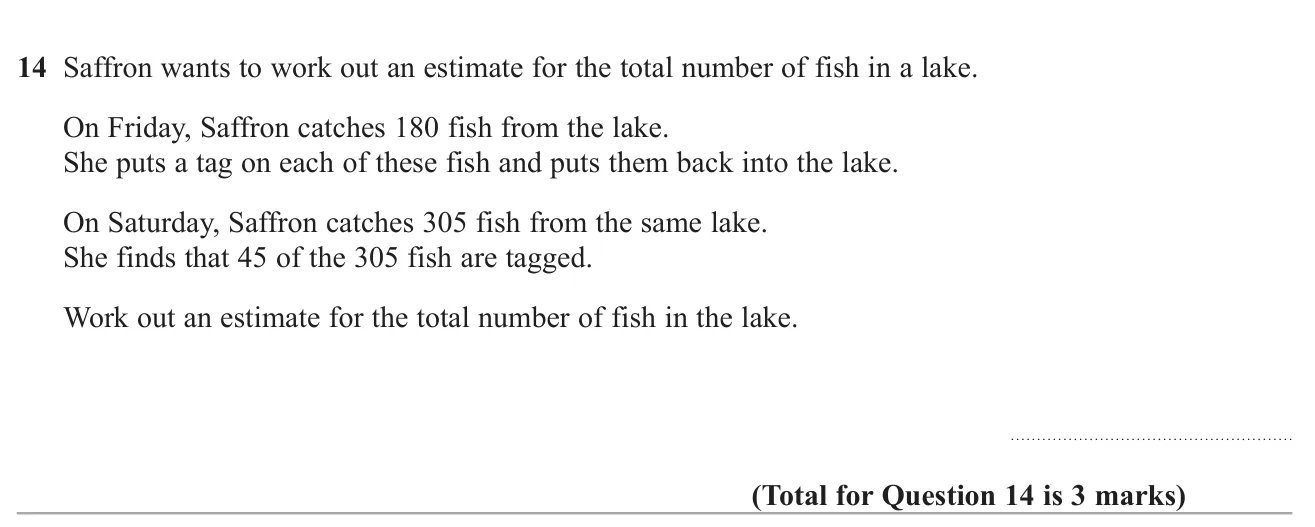
June 2022 · Paper 2 Higher · Q14
Estimate a fish population using a capture-recapture method.

© Pearson Education Ltd. June 2022 Paper 2 (Higher, calculator), question 14.

Show answer
Answer12203 marks

Worked solution Checked against the mark scheme

The fraction tagged in the second catch should match the fraction tagged in the whole lake:

45305=180N\frac{45}{305} = \frac{180}{N}

N=180×30545=1220N = \frac{180 \times 305}{45} = 1220

Watch out: Setting up the proportion upside down, e.g. 45×305÷18045 \times 305 \div 180.

Sampling and populations4 marksGrade 6No calculatorHigher
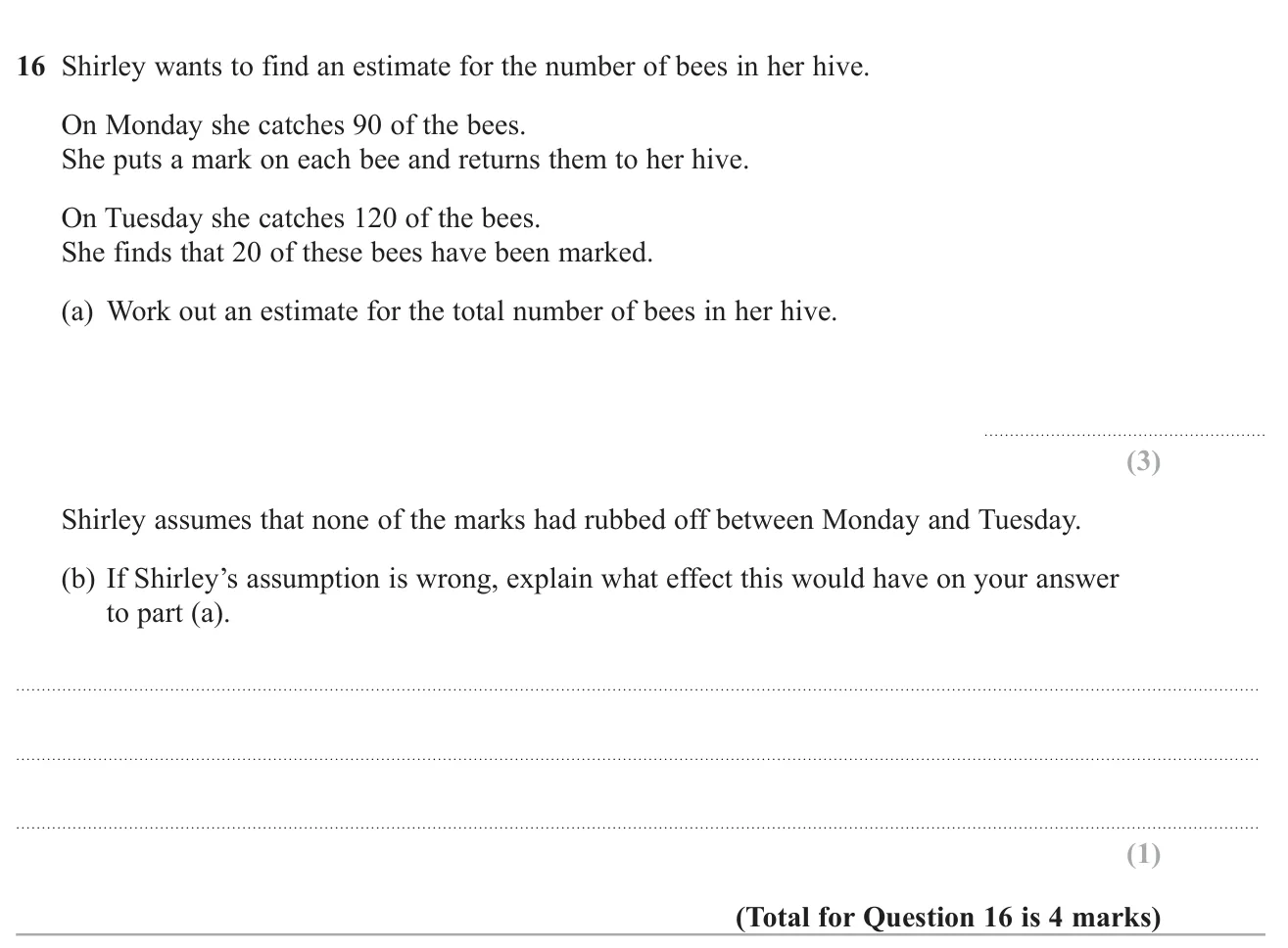
November 2020 · Paper 1 Higher · Q16
Use capture–recapture to estimate the number of bees in a hive, then explain the effect of marks rubbing off.

© Pearson Education Ltd. November 2020 Paper 1 (Higher, non-calculator), question 16.

Show answer
(a)5403 marks
(b)The estimate would be too big: fewer marked bees would be caught, so the real number is smaller1 mark

Worked solution Checked against the mark scheme

(a) In the second sample 20120=16\frac{20}{120} = \frac{1}{6} are marked.

So the 90 marked bees are about 16\frac{1}{6} of the hive: 90×6=54090 \times 6 = 540

(b) If marks rubbed off, fewer marked bees would be counted, which makes the estimate bigger than it should be. So 540 would be an overestimate.

Watch out: In (b), saying the estimate would be too small.