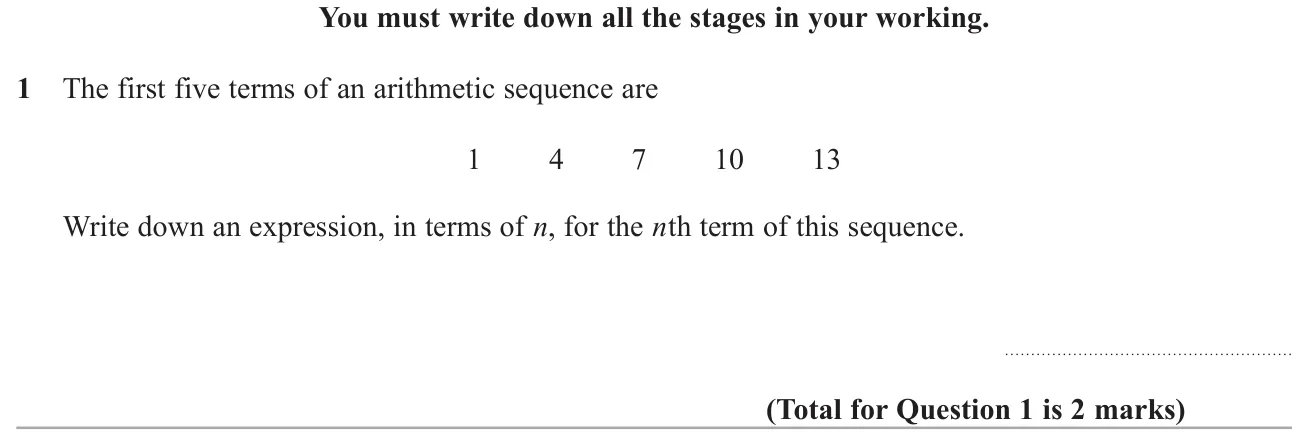
© Pearson Education Ltd. November 2020 Paper 1 (Higher, non-calculator), question 1.
Show answer
| Answer | 3n−2 | 2 marks |
|---|
Worked solution Checked against the mark scheme
The terms go up by 3, so start with 3n: 3, 6, 9, ...
Each term is 2 less than that, so the nth term is 3n−2.
Watch out: Writing n+3.
Question 2
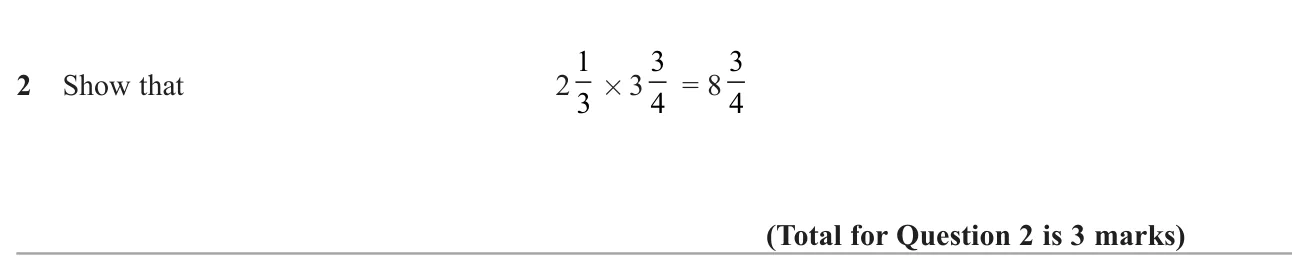
Fractions3 marksGrade 4No calculatorOn both tiers © Pearson Education Ltd. November 2020 Paper 1 (Higher, non-calculator), question 2.
Show answer
| Answer | 37×415=12105=435=843 | 3 marks |
|---|
Worked solution Checked against the mark scheme
Change to improper fractions: 231=37 and 343=415.
Multiply: 3×47×15=12105=435.
35÷4=8 remainder 3, so 435=843.
Watch out: Multiplying whole numbers and fractions separately: 2×3+31×43.
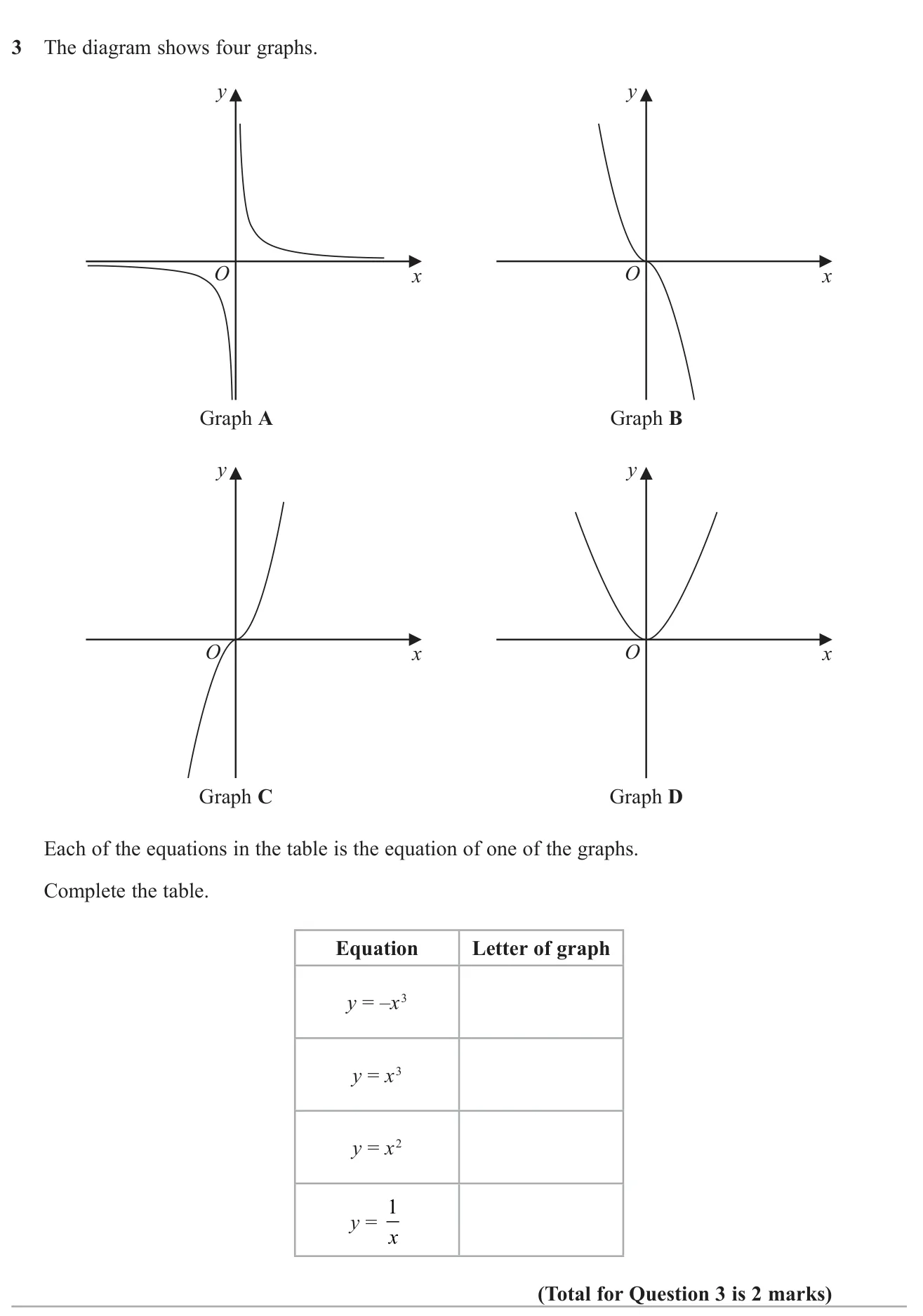
© Pearson Education Ltd. November 2020 Paper 1 (Higher, non-calculator), question 3.
Show answer
| Answer | y=−x3: B; y=x3: C; y=x2: D; y=x1: A | 2 marks |
|---|
Worked solution Checked against the mark scheme
y=x2 is the U shape: D.
y=x1 has two separate branches and never touches the axes: A.
y=x3 rises from bottom left to top right: C.
y=−x3 is its reflection, falling from top left: B.
Watch out: Mixing up y=x3 and y=−x3.
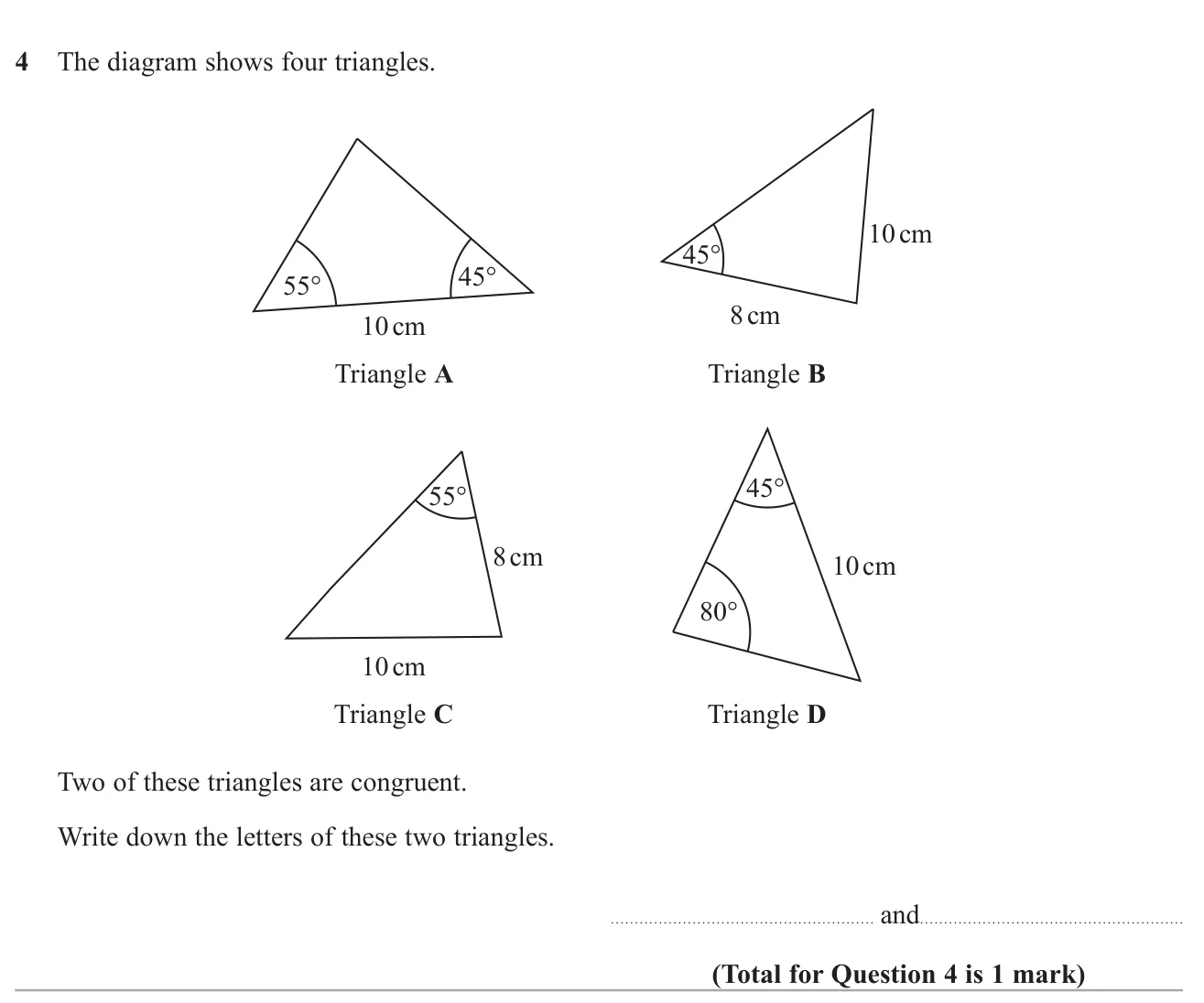
© Pearson Education Ltd. November 2020 Paper 1 (Higher, non-calculator), question 4.
Show answer
Worked solution Checked against the mark scheme
Triangle A: the 10 cm side lies between angles of 55° and 45°.
Triangle D: the third angle is 180−80−45=55°, and its 10 cm side joins the 45° corner to that 55° corner.
So both have a 10 cm side between angles of 55° and 45° (ASA), and A and D are congruent.
Watch out: Choosing B and C because they both have 8 cm and 10 cm sides, without checking the angle is in the same position.
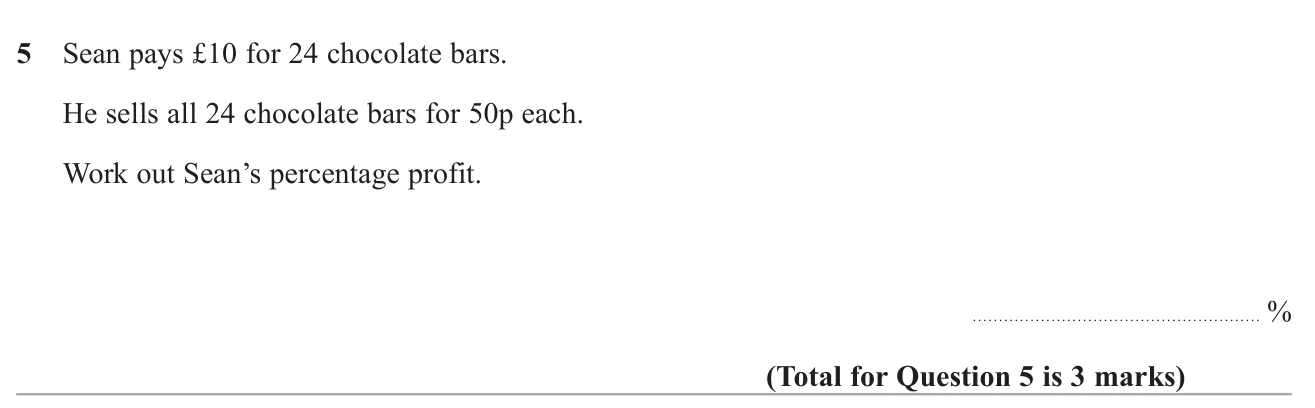
© Pearson Education Ltd. November 2020 Paper 1 (Higher, non-calculator), question 5.
Show answer
Worked solution Checked against the mark scheme
Selling price: 24×50p =1200p =£12.
Profit: 12−10=£2.
Percentage profit: 102×100=20%.
Watch out: Dividing the profit by the selling price to get about 16.7%.
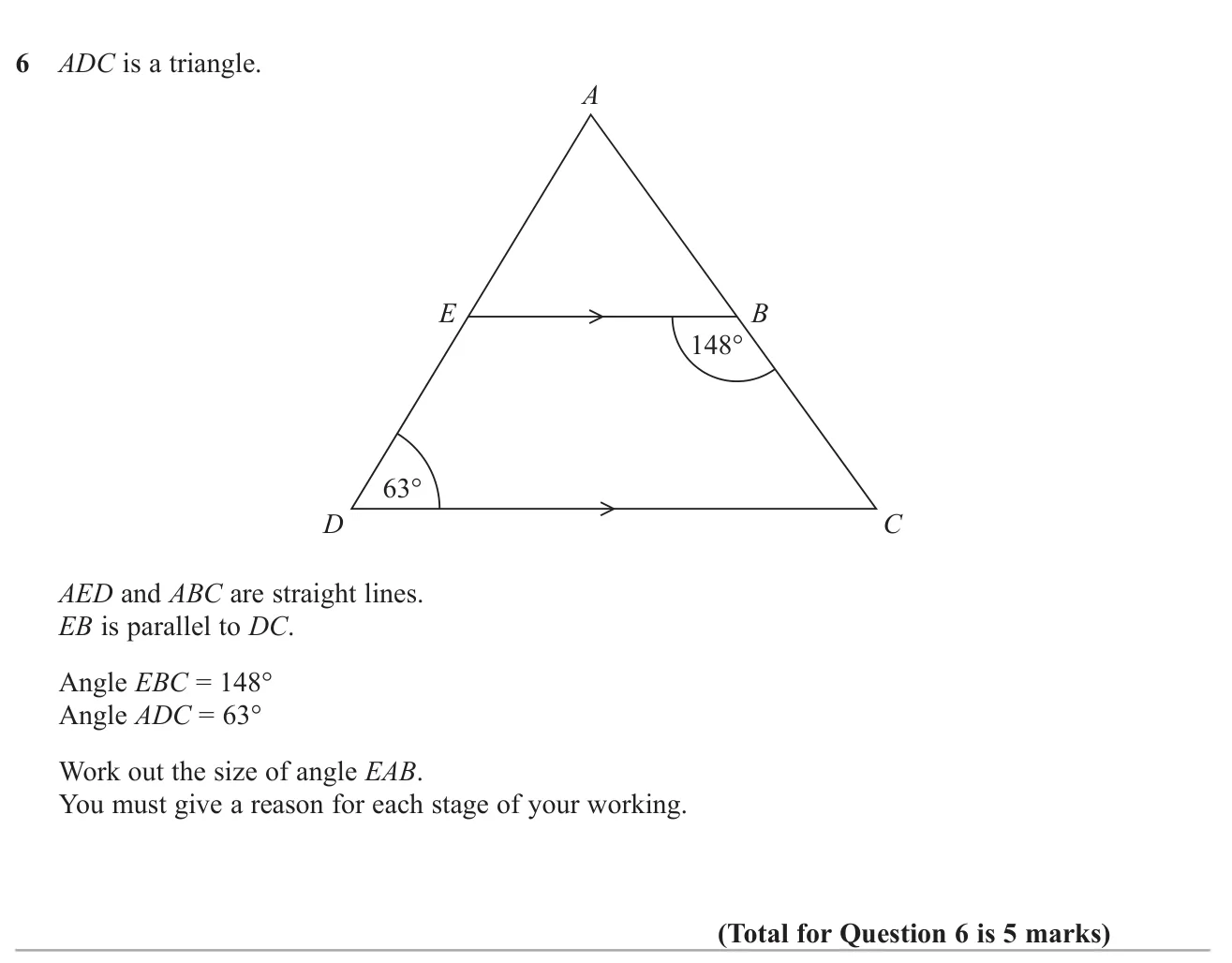
© Pearson Education Ltd. November 2020 Paper 1 (Higher, non-calculator), question 6.
Show answer
| Answer | 85° with reasons | 5 marks |
|---|
Worked solution Checked against the mark scheme
Angle AEB=63° (corresponding angles are equal).
Angle ABE=180−148=32° (angles on a straight line add up to 180°).
Angle EAB=180−63−32=85° (angles in a triangle add up to 180°).
Watch out: Writing 'F angles' or 'Z angles' instead of the proper names of the reasons.
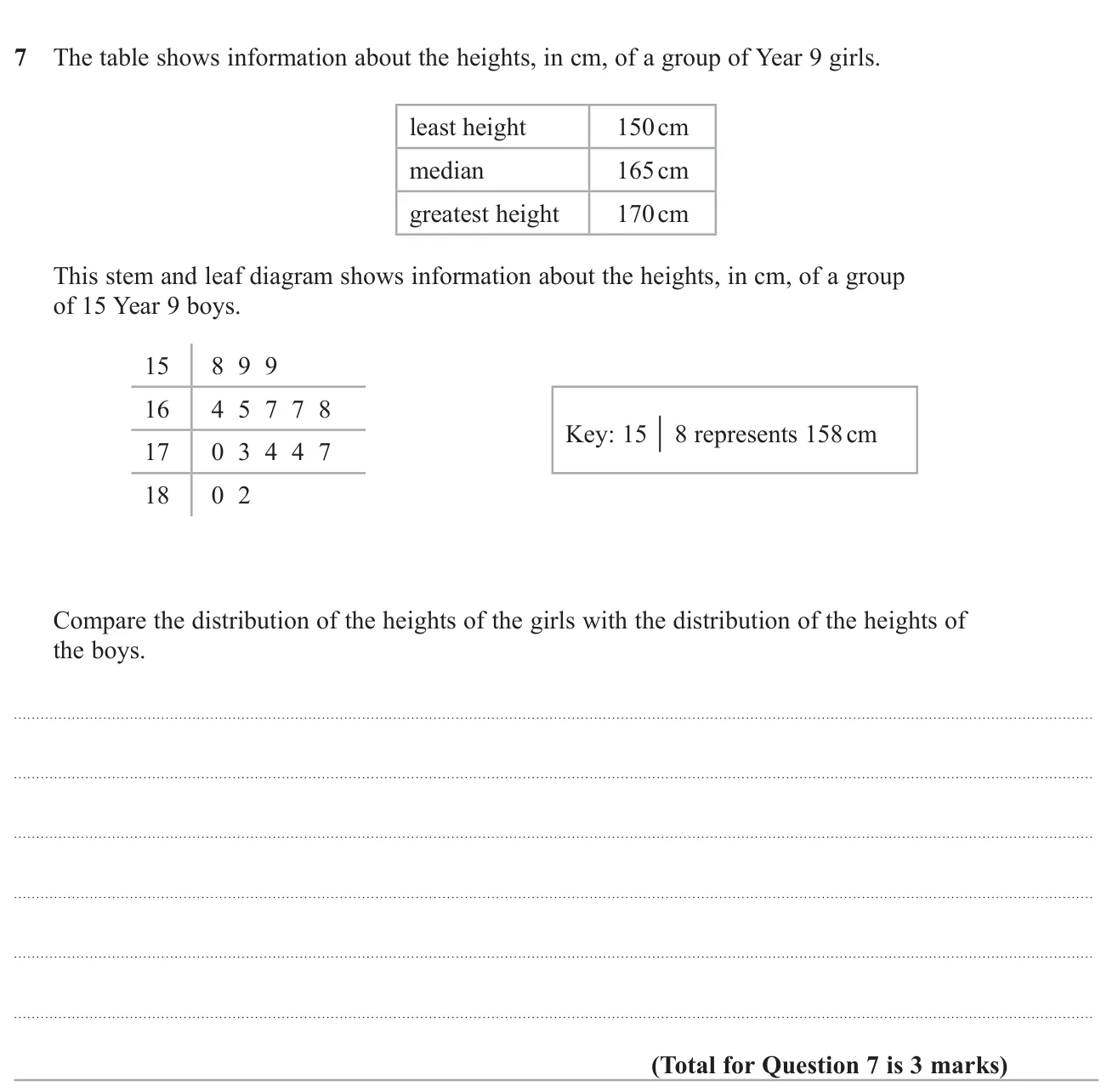
© Pearson Education Ltd. November 2020 Paper 1 (Higher, non-calculator), question 7.
Show answer
| Answer | Boys' median (168 cm) is higher than girls' (165 cm); boys' range (24 cm) is larger than girls' (20 cm) | 3 marks |
|---|
Worked solution Checked against the mark scheme
Girls: median 165 cm, range 170−150=20 cm.
Boys: 15 values, so the median is the 8th: 168 cm. Range 182−158=24 cm.
On average the boys are taller (168 > 165), and their heights are more spread out (24 > 20).
Watch out: Quoting the figures without actually comparing them.
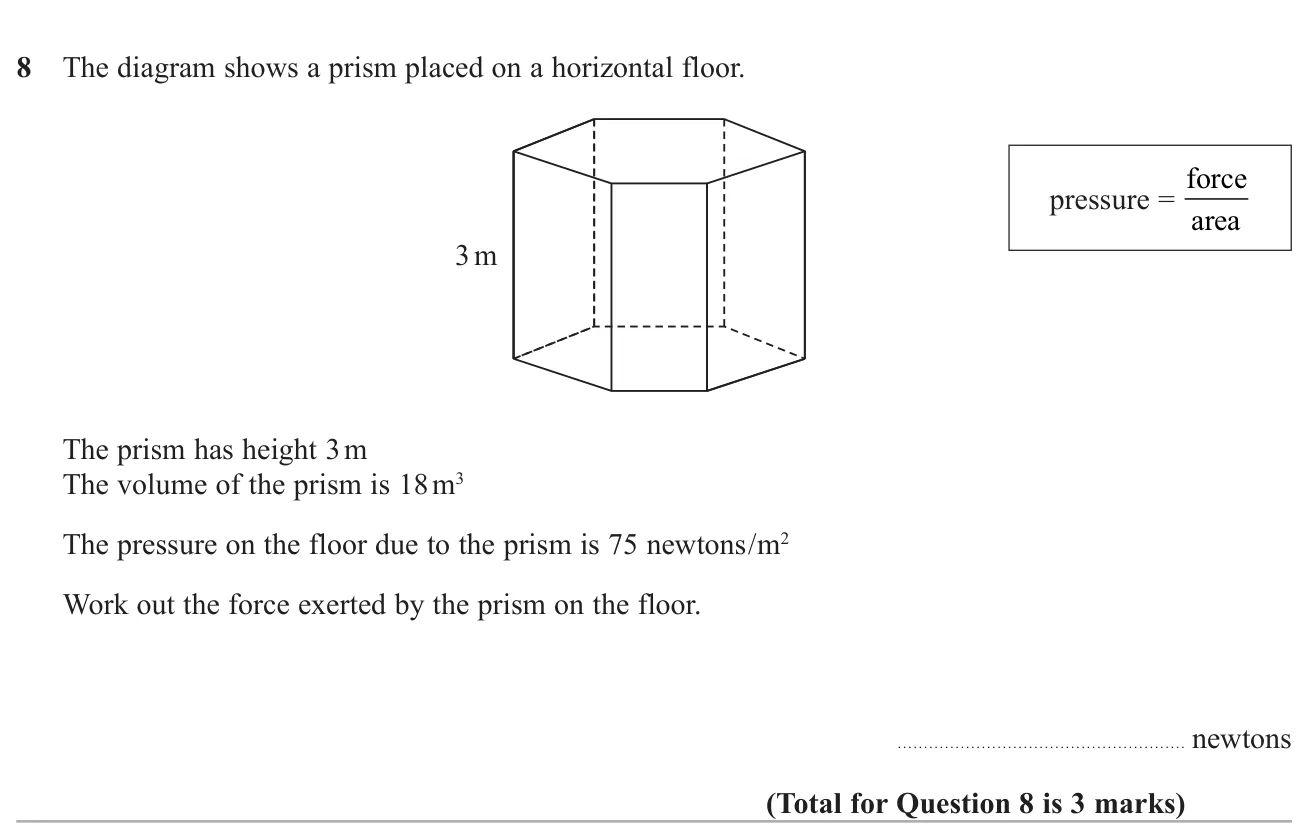
© Pearson Education Ltd. November 2020 Paper 1 (Higher, non-calculator), question 8.
Show answer
Worked solution Checked against the mark scheme
Base area =318=6 m2.
Force = pressure × area =75×6=450 N.
Watch out: Using the volume in place of the area: 75×18.
© Pearson Education Ltd. November 2020 Paper 1 (Higher, non-calculator), question 9.
Show answer
| Answer | 0.000672, 67.2×10⁻⁴, 6.72×10⁵, 672×104 | 2 marks |
|---|
Worked solution Checked against the mark scheme
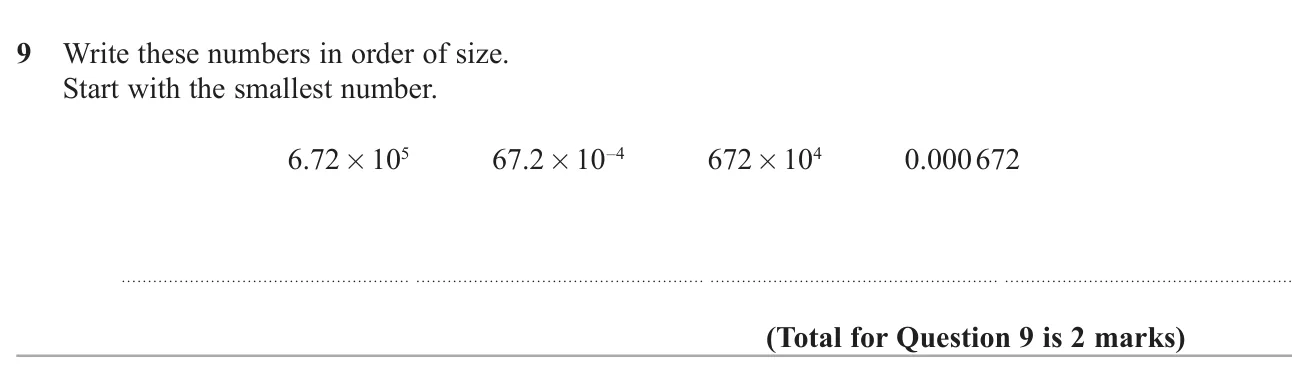
Write each as an ordinary number:
67.2×10−4=0.00672, 6.72×105=672000, 672×104=6720000.
So: 0.000672, 67.2×10⁻⁴, 6.72×10⁵, 672×104.
Watch out: Ordering by the powers of 10 alone and ignoring that 67.2 and 672 are not in standard form.
Question 10
Ratio3 marksGrade 5No calculatorOn both tiers © Pearson Education Ltd. November 2020 Paper 1 (Higher, non-calculator), question 10.
Show answer
| Answer | 6:15:20 | 3 marks |
|---|
Worked solution Checked against the mark scheme
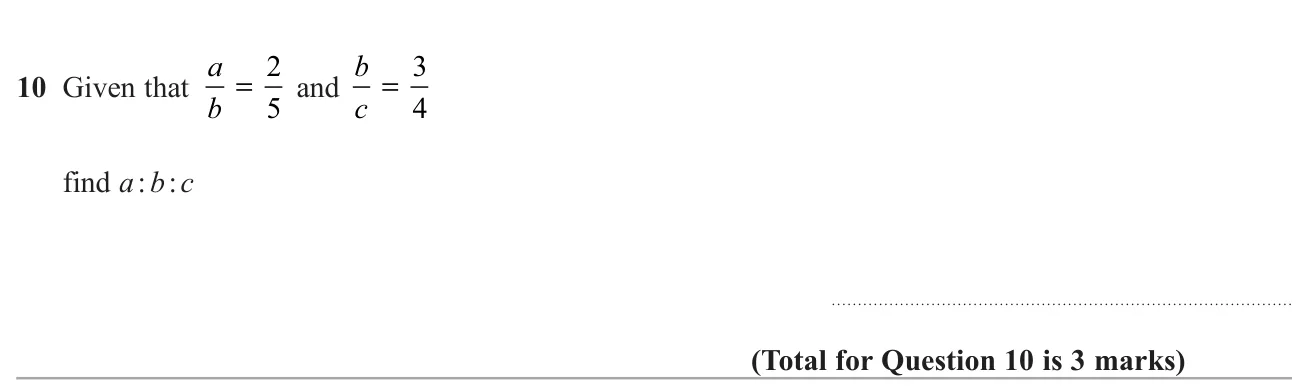
ba=52 gives a:b=2:5, and cb=43 gives b:c=3:4.
Make b the same in both (15): a:b=6:15 and b:c=15:20.
So a:b:c=6:15:20.
Watch out: Joining them directly as 2:5:4 without matching b.
© Pearson Education Ltd. November 2020 Paper 1 (Higher, non-calculator), question 11.
Show answer
| (a) | 300 | 2 marks |
|---|
| (b) | 81 | 2 marks |
|---|
| (c) | 32−n | 2 marks |
|---|
Worked solution Checked against the mark scheme
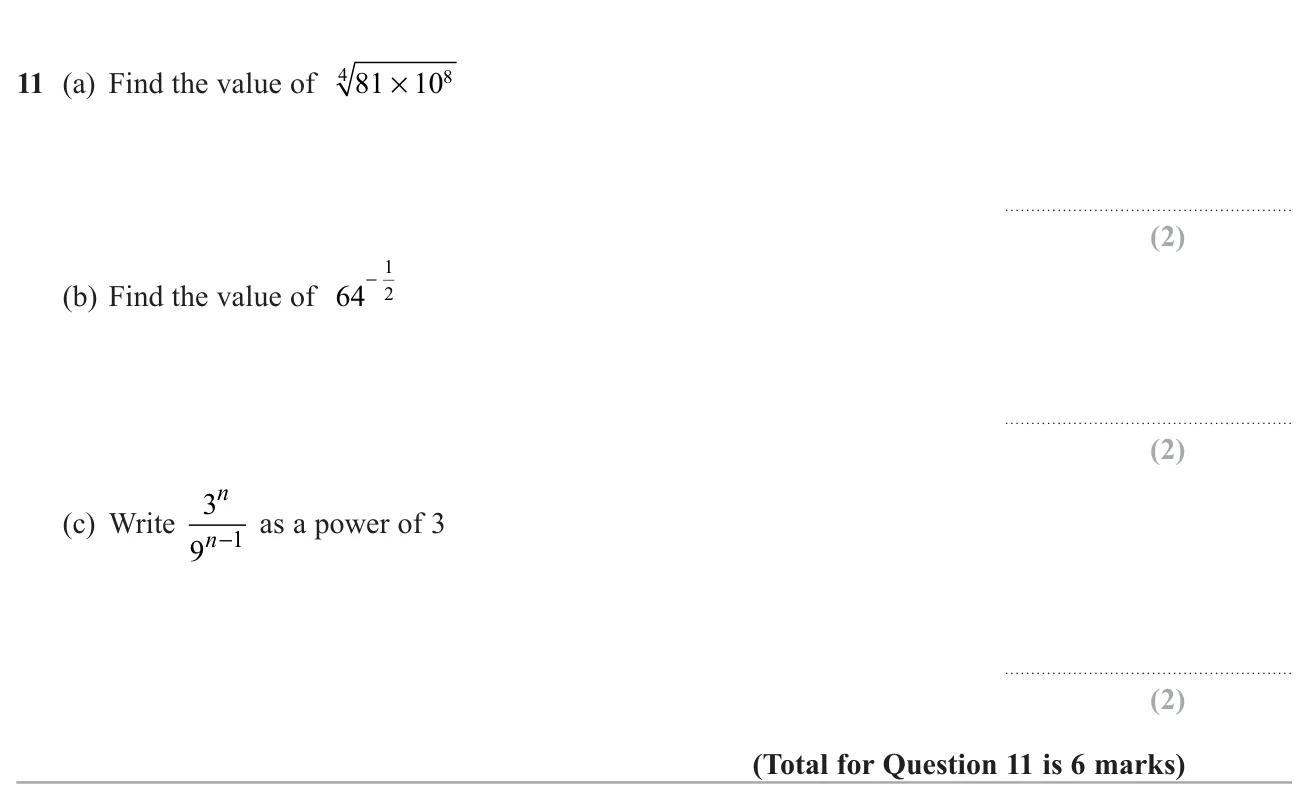
(a) 481=3 and 4108=102, so the answer is 3×100=300
(b) 6421=8, and the negative power means the reciprocal: 81
(c) 9n−1=32(n−1)=32n−2, so 32n−23n=3n−(2n−2)=32−n
Watch out: In (b), treating the negative power as a negative number and answering −8.
© Pearson Education Ltd. November 2020 Paper 1 (Higher, non-calculator), question 12.
Show answer
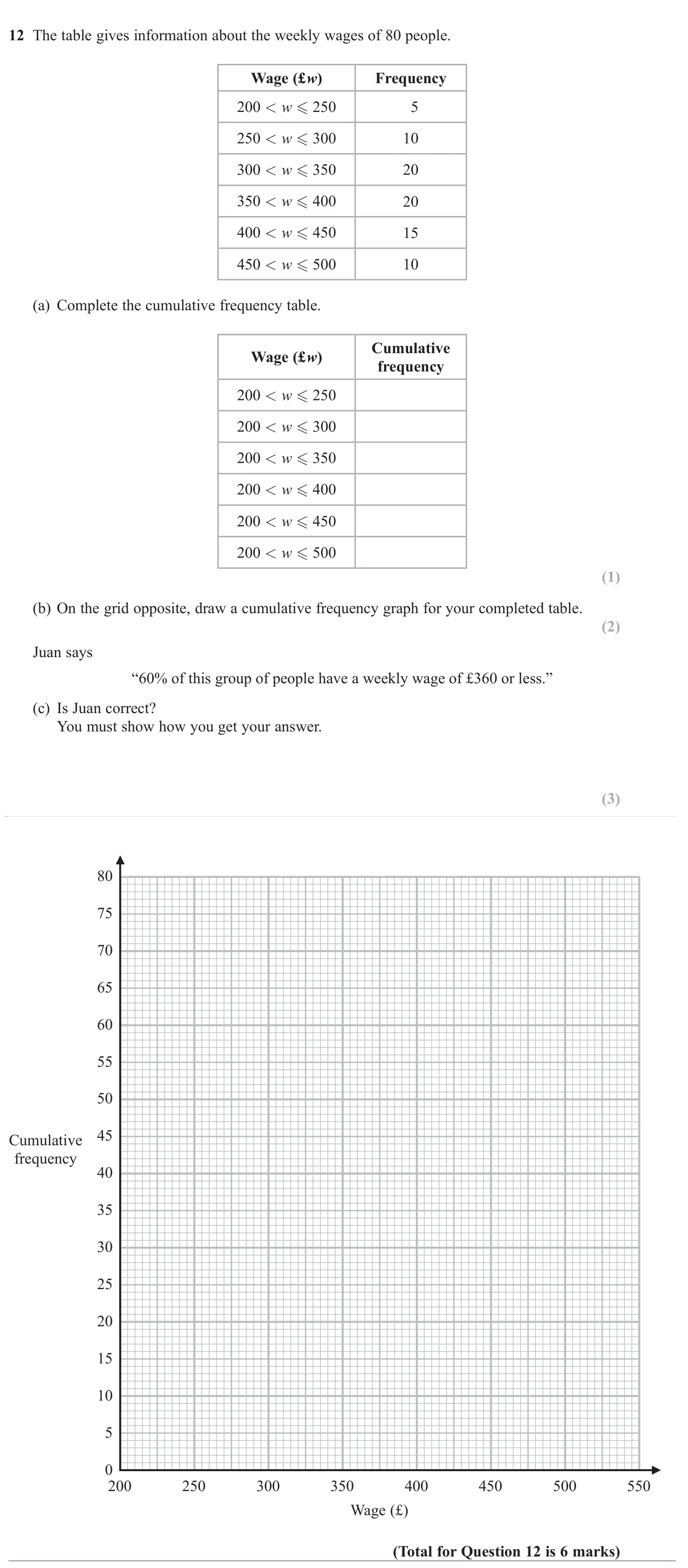
| (a) | 5, 15, 35, 55, 70, 80 | 1 mark |
|---|
| (b) | Points plotted at (250, 5), (300, 15), (350, 35), (400, 55), (450, 70), (500, 80), joined with a smooth curve or straight segments | 2 marks |
|---|
| (c) | No: 60% is 48 people, but only about 40 people earn £360 or less (about 50%) | 3 marks |
|---|
Worked solution Checked against the mark scheme
(a) Add the frequencies as you go: 5, 15, 35, 55, 70, 80
(b) Plot each total at the top of its class (250, 300, ..., 500) and join the points.
(c) 60% of 80 =0.6×80=48 people.
Reading the graph at £360 gives about 40 people, which is 8040=50%.
So Juan is wrong: only about 50% earn £360 or less.
Watch out: Plotting the points at the midpoints of the classes instead of the upper boundaries.
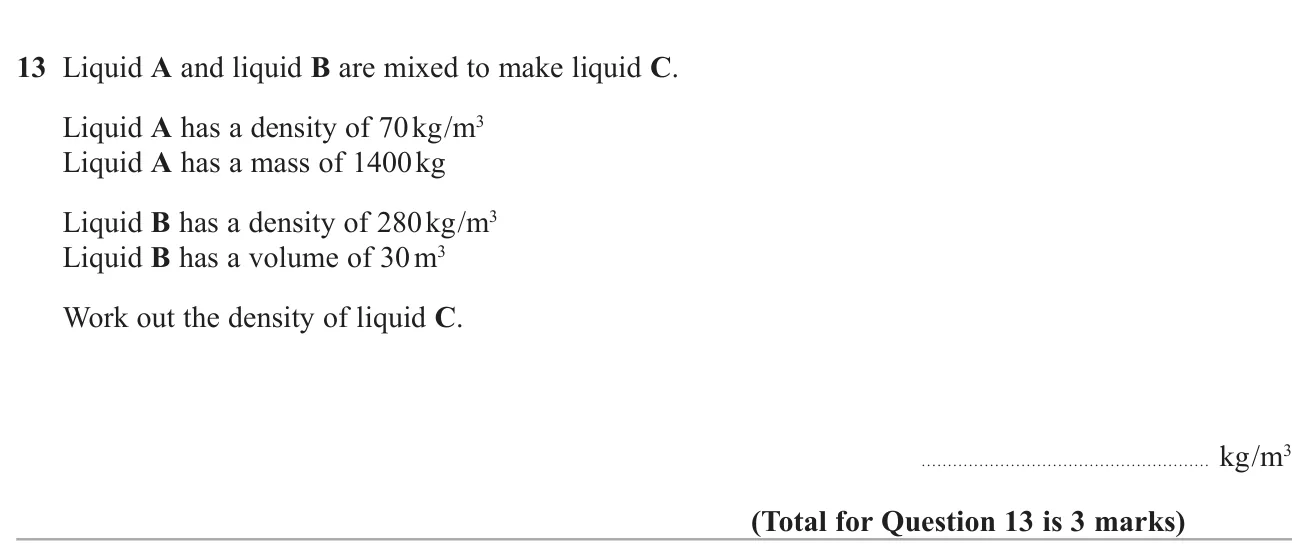
© Pearson Education Ltd. November 2020 Paper 1 (Higher, non-calculator), question 13.
Show answer
Worked solution Checked against the mark scheme
Volume of A =701400=20 m3
Mass of B =280×30=8400 kg
Density of C =20+301400+8400=509800=196 kg/m3
Watch out: Adding the two densities, or averaging them to get 175.
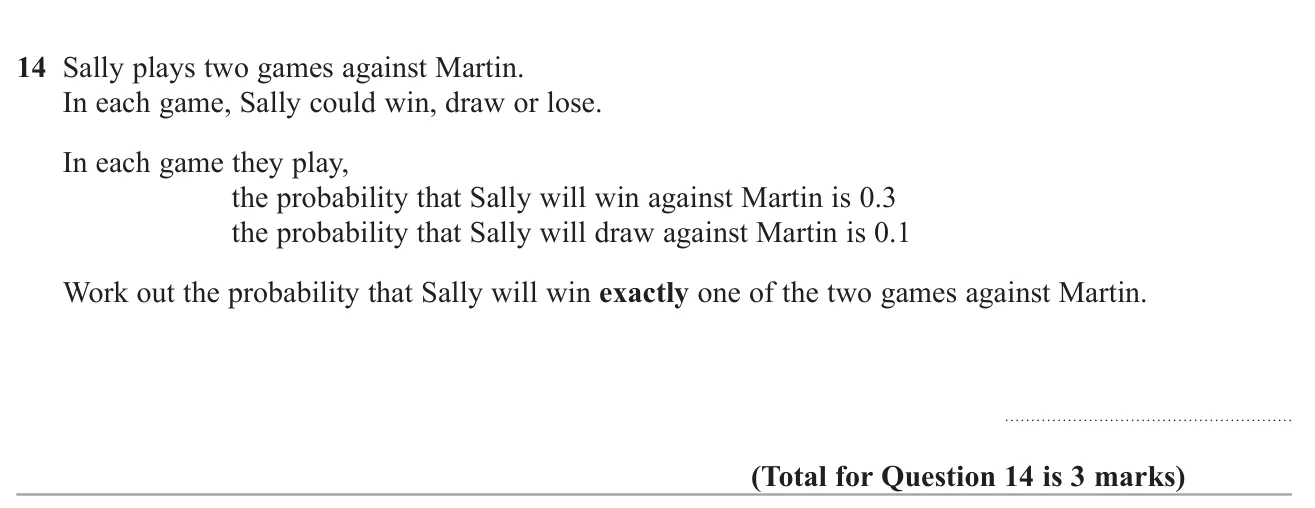
© Pearson Education Ltd. November 2020 Paper 1 (Higher, non-calculator), question 14.
Show answer
Worked solution Checked against the mark scheme
P(not win) =1−0.3=0.7
Win then not win: 0.3×0.7=0.21
Not win then win: 0.7×0.3=0.21
Total: 0.21+0.21=0.42
Watch out: Only counting one order and answering 0.21.
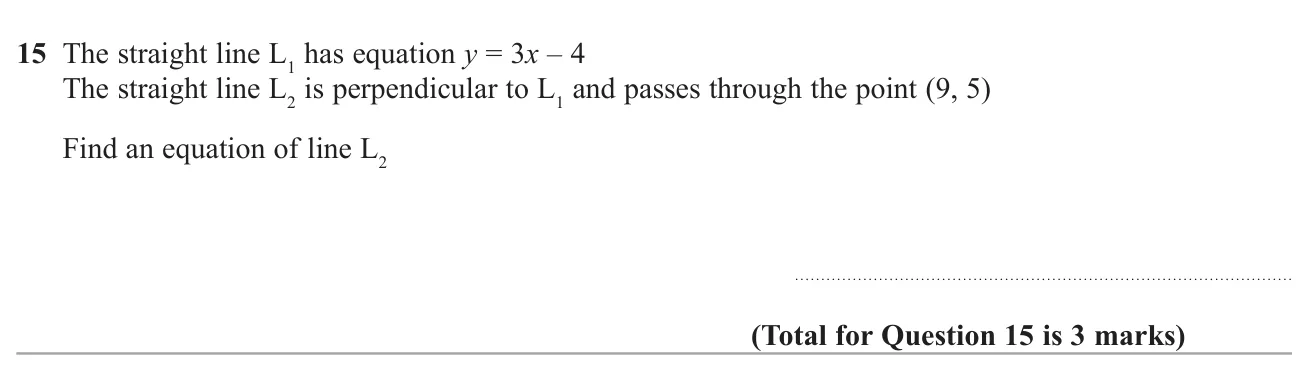
© Pearson Education Ltd. November 2020 Paper 1 (Higher, non-calculator), question 15.
Show answer
| Answer | y=−31x+8 | 3 marks |
|---|
Worked solution Checked against the mark scheme
Gradient of L1 is 3, so the perpendicular gradient is −31.
y=−31x+c through (9,5): 5=−3+c, so c=8.
L2: y=−31x+8
Watch out: Using −3 or 31 as the perpendicular gradient.
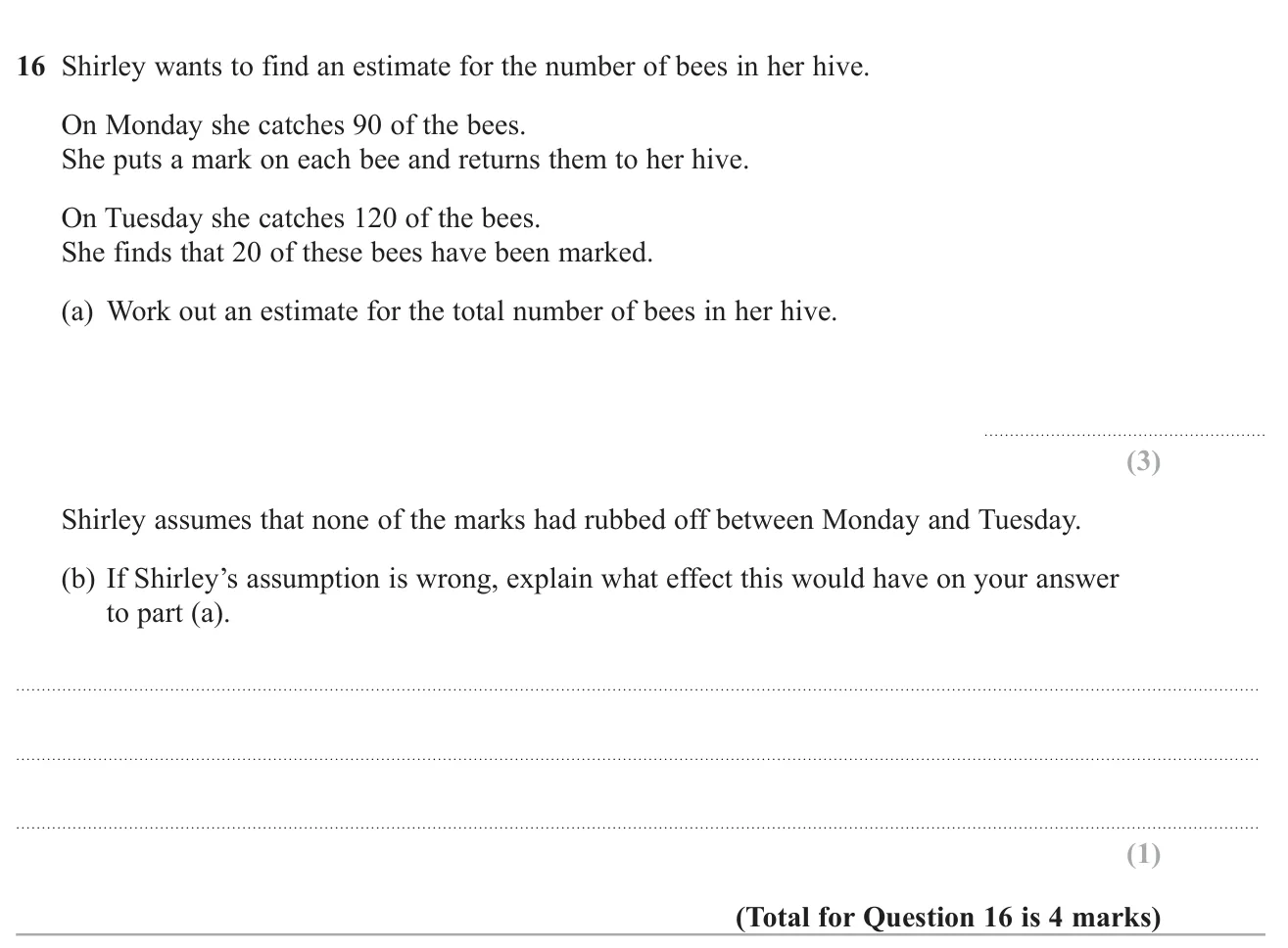
© Pearson Education Ltd. November 2020 Paper 1 (Higher, non-calculator), question 16.
Show answer
| (a) | 540 | 3 marks |
|---|
| (b) | The estimate would be too big: fewer marked bees would be caught, so the real number is smaller | 1 mark |
|---|
Worked solution Checked against the mark scheme
(a) In the second sample 12020=61 are marked.
So the 90 marked bees are about 61 of the hive: 90×6=540
(b) If marks rubbed off, fewer marked bees would be counted, which makes the estimate bigger than it should be. So 540 would be an overestimate.
Watch out: In (b), saying the estimate would be too small.
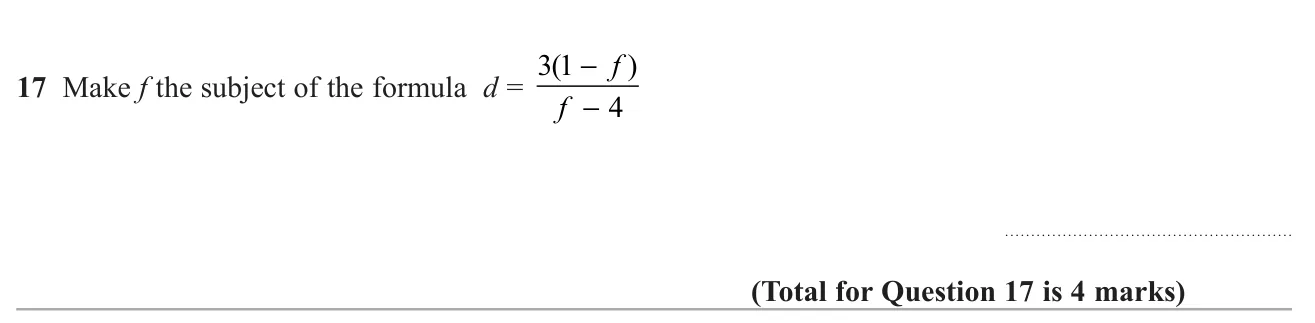
© Pearson Education Ltd. November 2020 Paper 1 (Higher, non-calculator), question 17.
Show answer
| Answer | f=d+33+4d | 4 marks |
|---|
Worked solution Checked against the mark scheme
Multiply both sides by (f−4): d(f−4)=3(1−f)
Expand: df−4d=3−3f
Collect the f terms: df+3f=3+4d
Factorise: f(d+3)=3+4d
Divide: f=d+33+4d
Watch out: Getting a sign wrong when expanding 3(1−f).
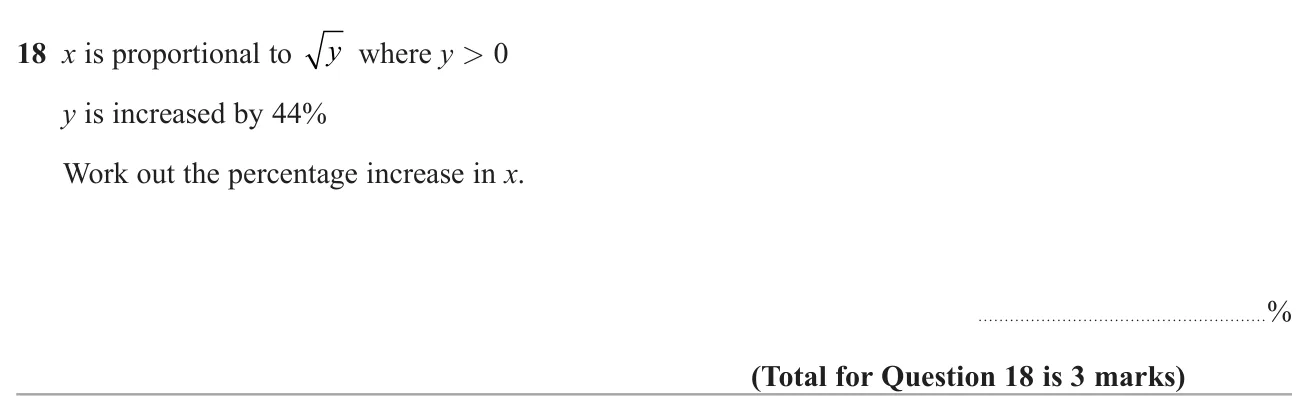
© Pearson Education Ltd. November 2020 Paper 1 (Higher, non-calculator), question 18.
Show answer
Worked solution Checked against the mark scheme
x=ky
New y is 1.44y, so new x=k1.44y=1.2ky=1.2x
So x rises by 20%.
Watch out: Halving 44% to get 22%.
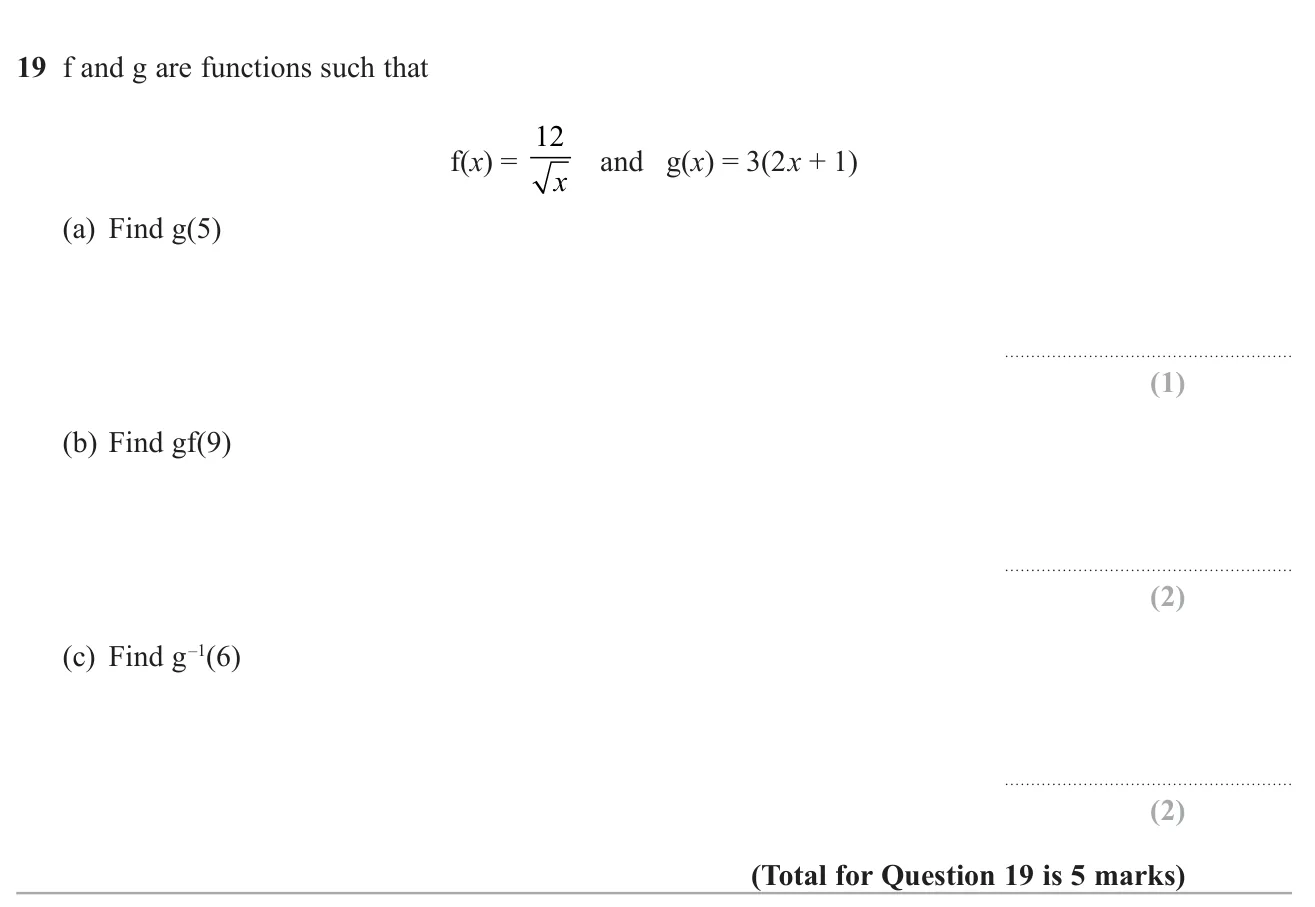
© Pearson Education Ltd. November 2020 Paper 1 (Higher, non-calculator), question 19.
Show answer
| (a) | 33 | 1 mark |
|---|
| (b) | 27 | 2 marks |
|---|
| (c) | 21 | 2 marks |
|---|
Worked solution Checked against the mark scheme
(a) g(5)=3(2×5+1)=3×11=33
(b) f(9)=912=4, then g(4)=3(9)=27
(c) Solve 3(2x+1)=6: 2x+1=2, so x=21
Watch out: In (b), working out f(g(9)) instead of g(f(9)).
Question 20
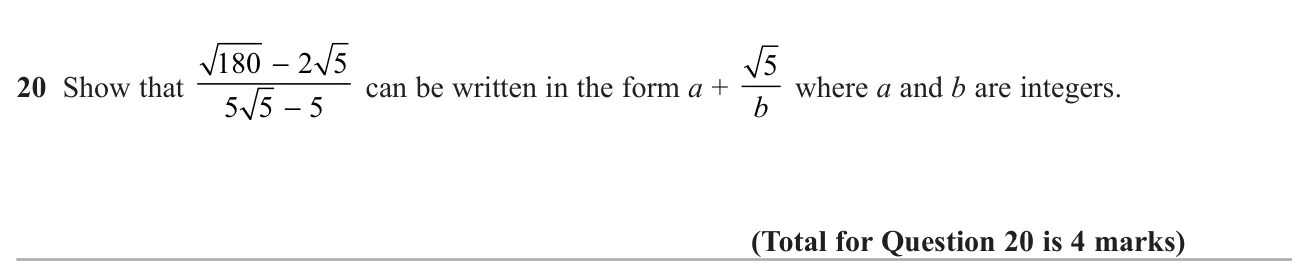
Surds4 marksGrade 8No calculator © Pearson Education Ltd. November 2020 Paper 1 (Higher, non-calculator), question 20.
Show answer
| Answer | 1+55 (a = 1, b = 5) | 4 marks |
|---|
Worked solution Checked against the mark scheme
180=65, so the top is 65−25=45
Multiply top and bottom by 55+5:
Top: 45(55+5)=100+205
Bottom: (55)2−52=125−25=100
So the fraction is 100100+205=1+55
Watch out: Forgetting to simplify 180 first, which makes the expansion much harder.
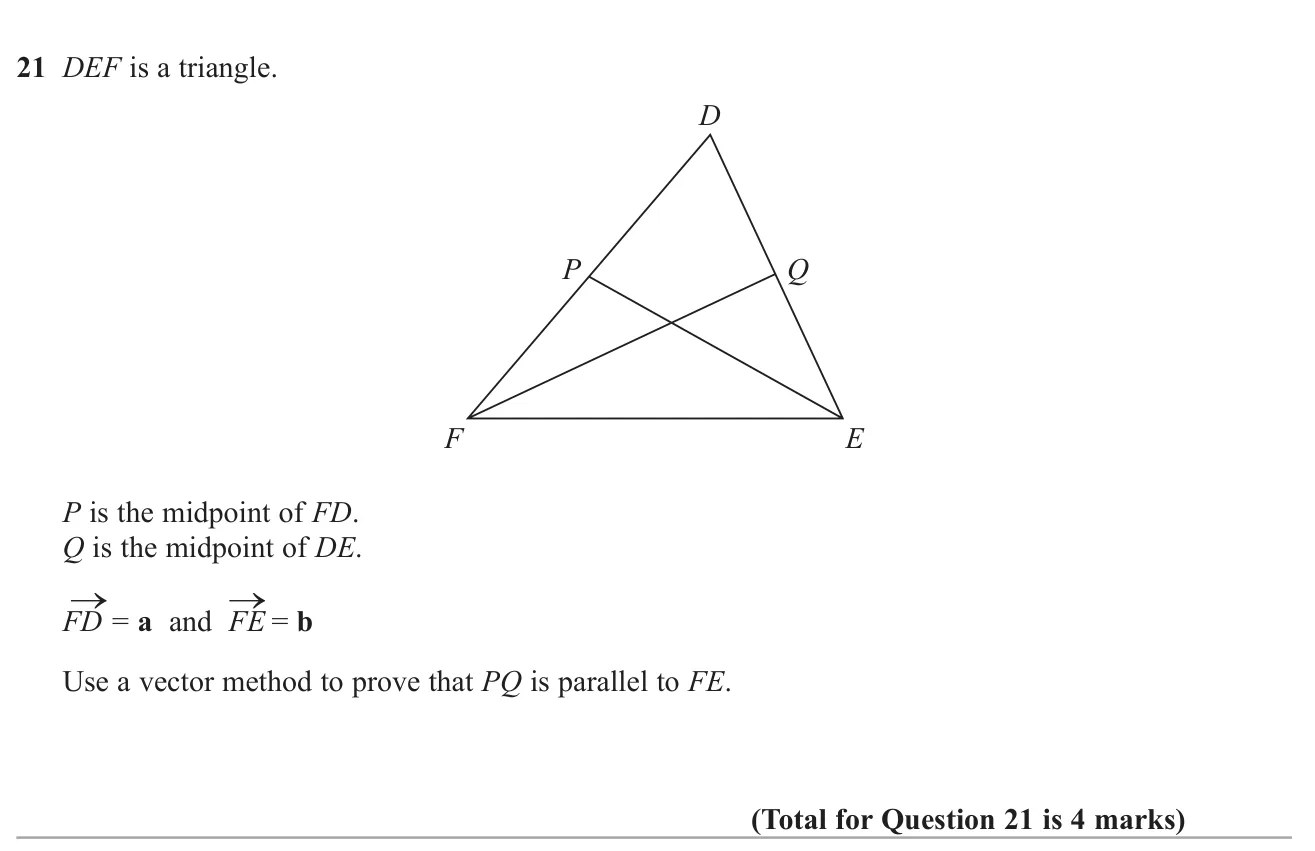
© Pearson Education Ltd. November 2020 Paper 1 (Higher, non-calculator), question 21.
Show answer
| Answer | PQ=21b, a multiple of FE=b, so PQ is parallel to FE | 4 marks |
|---|
Worked solution Checked against the mark scheme
DE=−a+b, so DQ=21(b−a)
PD=21a
PQ=21a+21(b−a)=21b
FE=b=2PQ, so PQ is parallel to FE.
Watch out: Finding PQ = ½b but not stating that it is a multiple of FE.
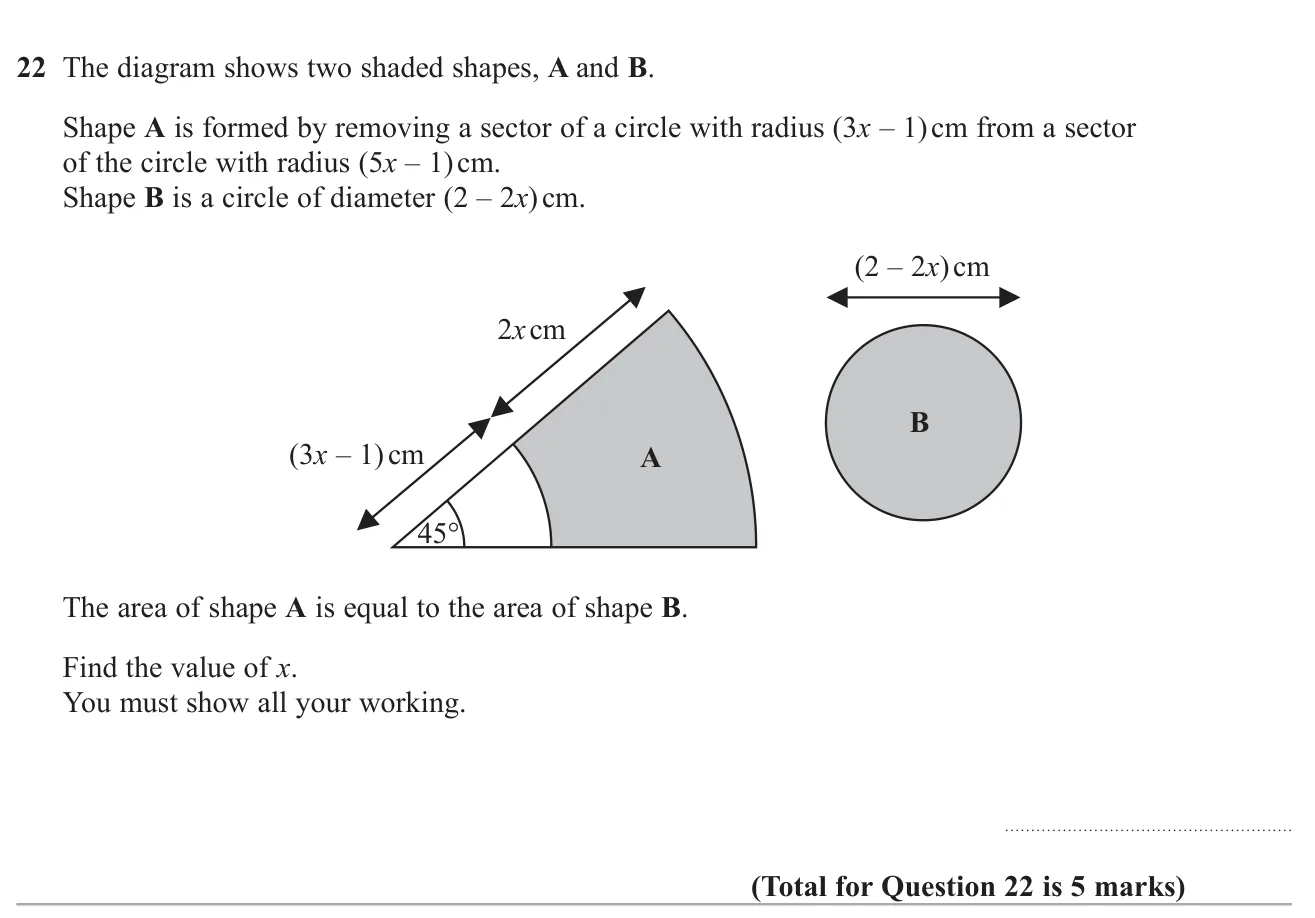
© Pearson Education Ltd. November 2020 Paper 1 (Higher, non-calculator), question 22.
Show answer
| Answer | x=0.5 | 5 marks |
|---|
Worked solution Checked against the mark scheme
Outer radius =(3x−1)+2x=5x−1
Area A =36045π[(5x−1)2−(3x−1)2]=8π(16x2−4x)
Area B =π(1−x)2=π(x2−2x+1)
Equate and cancel π: 2x2−2x=x2−2x+1, so 2x2+3x−2=0
(2x−1)(x+2)=0, so x=0.5 or x=−2
x=−2 gives negative lengths, so x=0.5
Watch out: Using the diameter (2−2x) as the radius of circle B.
Question 23
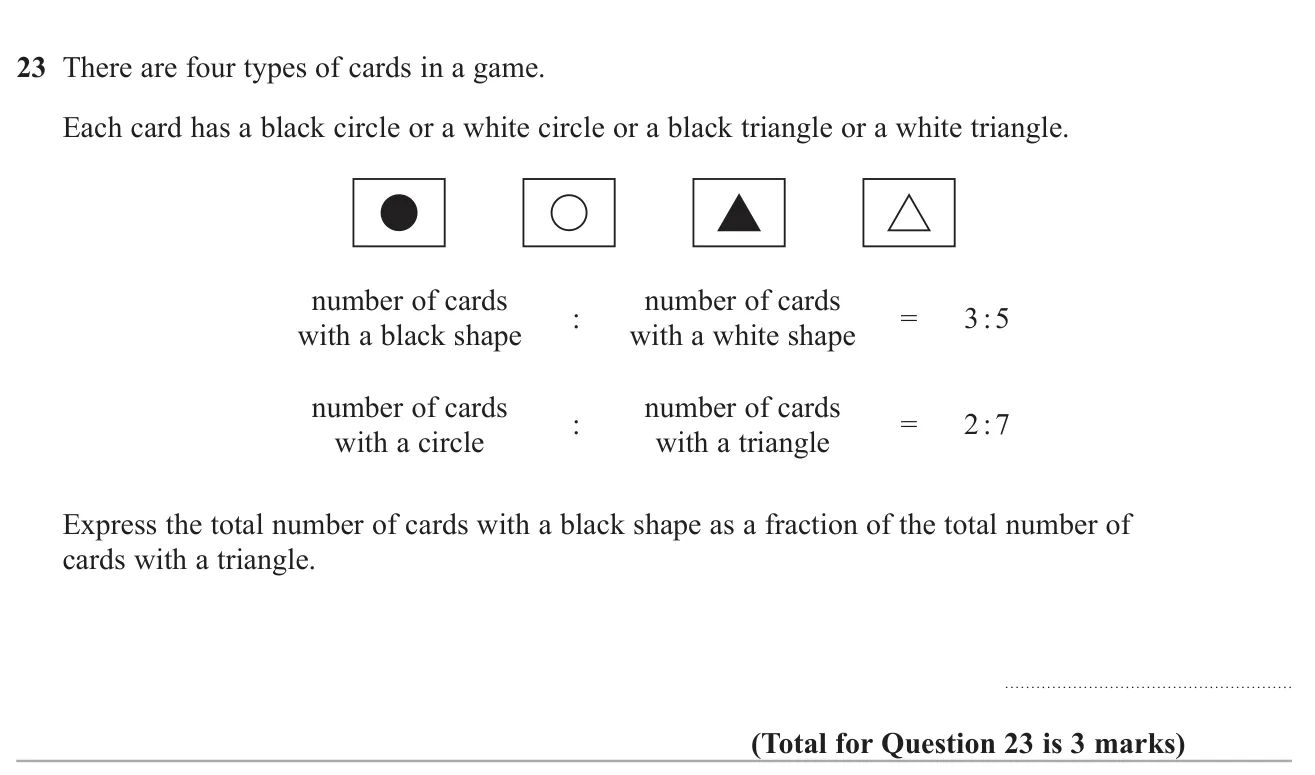
Ratio3 marksGrade 8No calculator © Pearson Education Ltd. November 2020 Paper 1 (Higher, non-calculator), question 23.
Show answer
| Answer | 5627 | 3 marks |
|---|
Worked solution Checked against the mark scheme
Black cards are 83 of all cards; triangles are 97 of all cards.
Use a total of 72 (LCM of 8 and 9): black =27, triangles =56
So black as a fraction of triangles =5627
Watch out: Giving the ratio 27 : 56 instead of a fraction.
Finished the paper?
Add up your marks for all three papers and see what grade that would have been.