© Pearson Education Ltd. June 2022 Paper 2 (Higher, calculator), question 1.
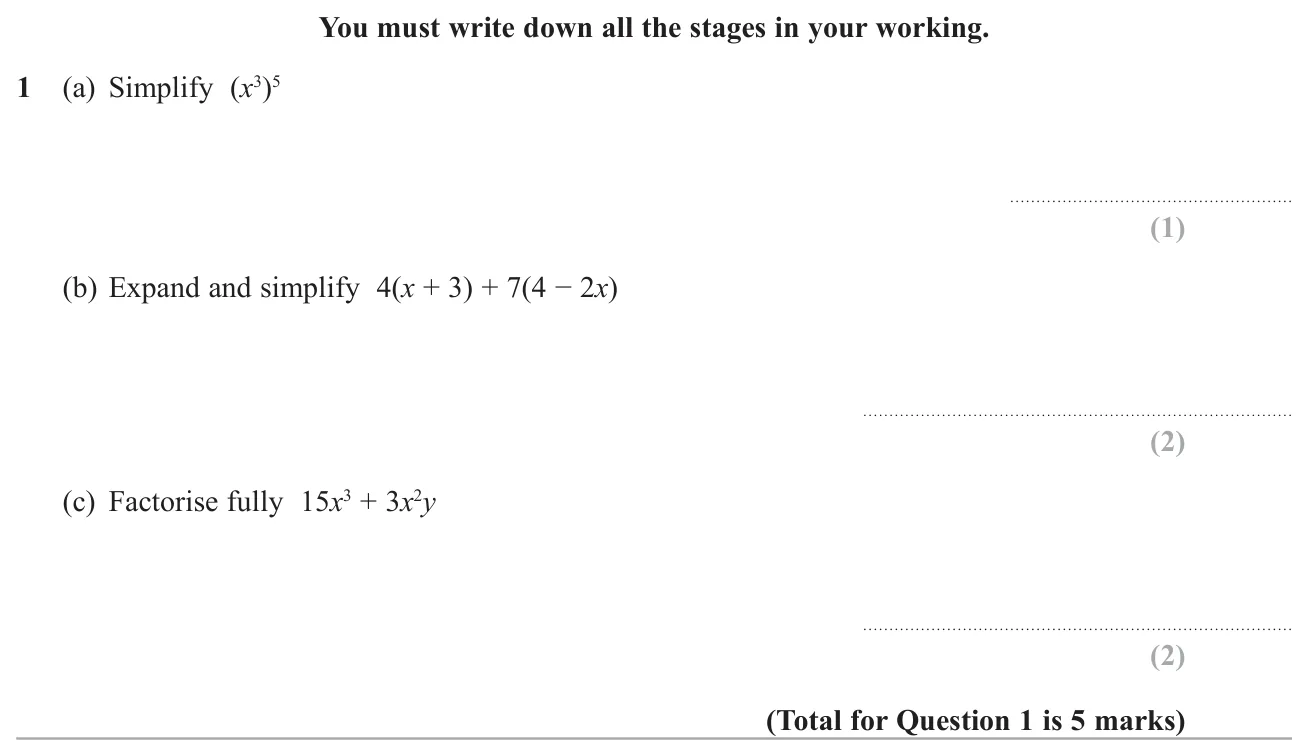
(a) x 15 x^{15} x 15 1 mark (b) 40 − 10 x 40 - 10x 40 − 10 x 2 marks (c) 3 x 2 ( 5 x + y ) 3x^2(5x + y) 3 x 2 ( 5 x + y ) 2 marks
Worked solution Checked against the mark scheme
(a) Multiply the powers: ( x 3 ) 5 = x 15 (x^3)^5 = x^{15} ( x 3 ) 5 = x 15
(b) 4 x + 12 + 28 − 14 x = 40 − 10 x 4x + 12 + 28 - 14x = 40 - 10x 4 x + 12 + 28 − 14 x = 40 − 10 x
(c) The HCF of 15 x 3 15x^3 15 x 3 3 x 2 y 3x^2y 3 x 2 y 3 x 2 3x^2 3 x 2
15 x 3 + 3 x 2 y = 3 x 2 ( 5 x + y ) 15x^3 + 3x^2y = 3x^2(5x + y) 15 x 3 + 3 x 2 y = 3 x 2 ( 5 x + y )
Watch out: In (a), adding the powers to get x 8 x^8 x 8
© Pearson Education Ltd. June 2022 Paper 2 (Higher, calculator), question 2.
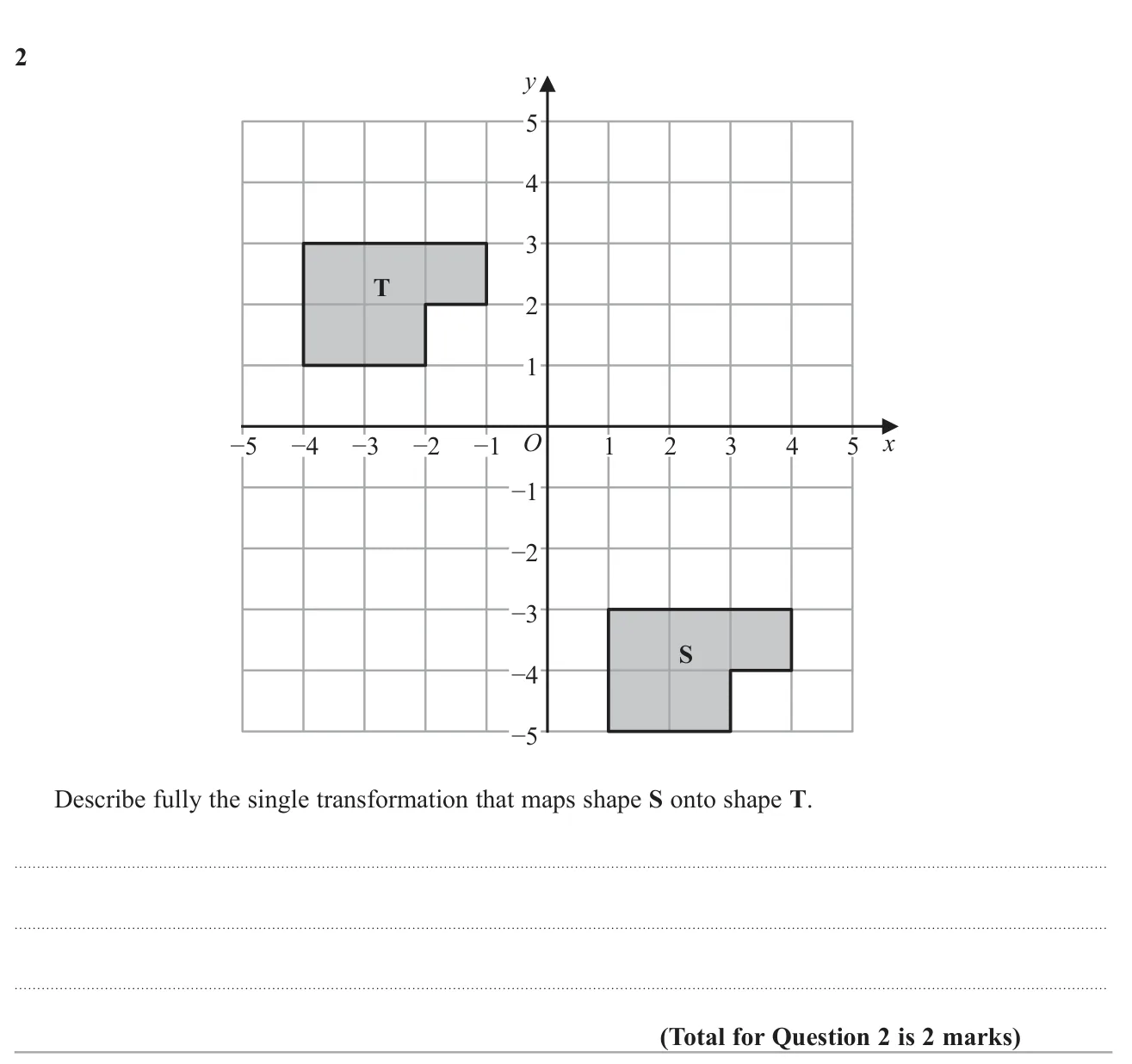
Answer Translation by ( − 5 6 ) \begin{pmatrix}-5\\6\end{pmatrix} ( − 5 6 ) 2 marks
Worked solution Checked against the mark scheme
The shape is the same size and way round, so it is a translation.
Pick a corner: ( 1 , − 5 ) (1, -5) ( 1 , − 5 ) ( − 4 , 1 ) (-4, 1) ( − 4 , 1 )
That is 5 left and 6 up: translation by ( − 5 6 ) \begin{pmatrix}-5\\6\end{pmatrix} ( − 5 6 )
Watch out: Writing the vector as a coordinate (−5, 6), or giving two transformations.
© Pearson Education Ltd. June 2022 Paper 2 (Higher, calculator), question 3.
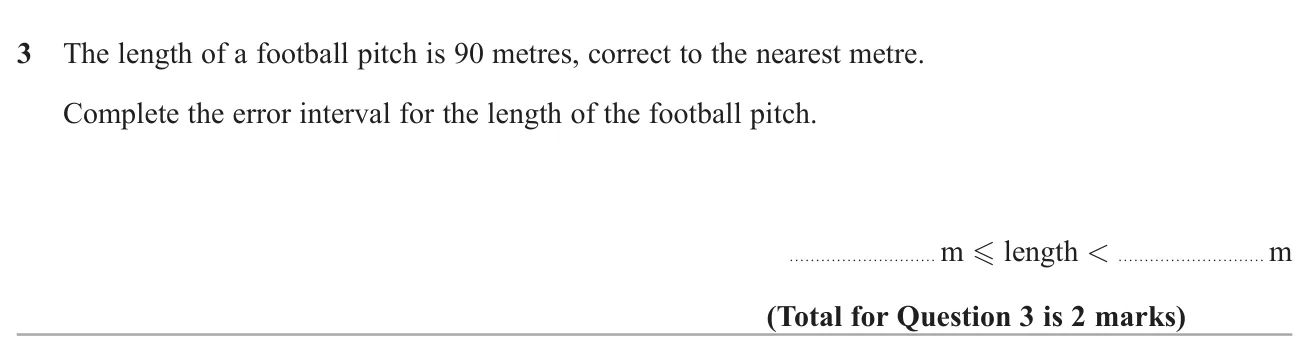
Answer 89.5 ≤ length < 90.5 89.5 \le \text{length} < 90.5 89.5 ≤ length < 90.5 2 marks
Worked solution Checked against the mark scheme
Rounded to the nearest metre, so go half a metre either side.
Lower bound: 90 − 0.5 = 89.5 90 - 0.5 = 89.5 90 − 0.5 = 89.5
Upper bound: 90 + 0.5 = 90.5 90 + 0.5 = 90.5 90 + 0.5 = 90.5
89.5 ≤ length < 90.5 89.5 \le \text{length} < 90.5 89.5 ≤ length < 90.5
Watch out: Using 89 and 91, or 89.9 and 90.9.
© Pearson Education Ltd. June 2022 Paper 2 (Higher, calculator), question 4.
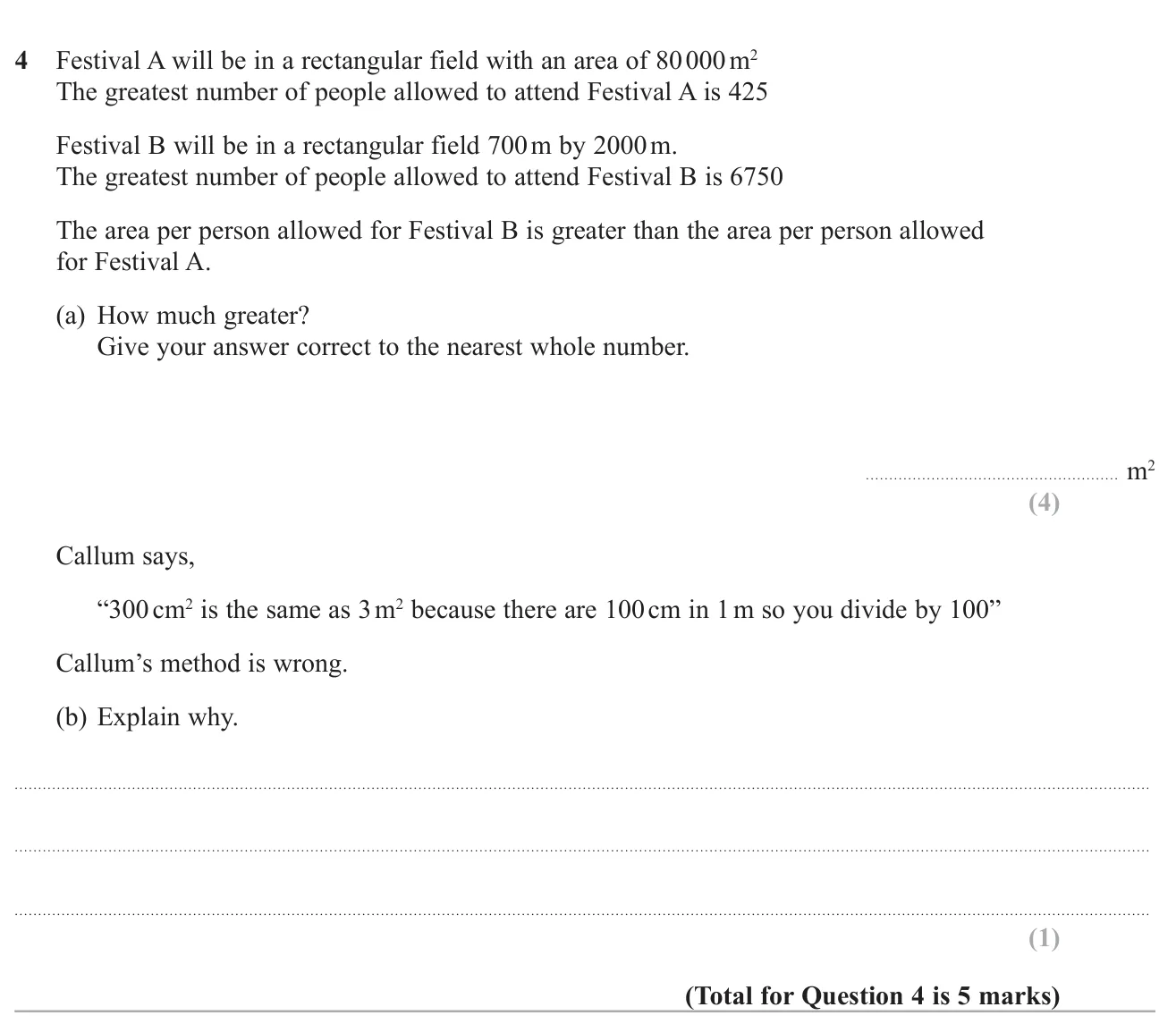
(a) 19 m 2 19\text{ m}^2 19 m 2 4 marks (b) 1 m² is 100 × 100 = 10 000 cm², so he should divide by 10 000, not 100 1 mark
Worked solution Checked against the mark scheme
(a) Field B: 700 × 2000 = 1 400 000 m 2 700 \times 2000 = 1\,400\,000\text{ m}^2 700 × 2000 = 1 400 000 m 2
B per person: 1 400 000 ÷ 6750 = 207.4... 1\,400\,000 \div 6750 = 207.4... 1 400 000 ÷ 6750 = 207.4...
A per person: 80 000 ÷ 425 = 188.2... 80\,000 \div 425 = 188.2... 80 000 ÷ 425 = 188.2...
Difference: 207.4 − 188.2 = 19.17... ≈ 19 m 2 207.4 - 188.2 = 19.17... \approx 19\text{ m}^2 207.4 − 188.2 = 19.17... ≈ 19 m 2
(b) A square metre is 100 cm × 100 cm = 10 000 cm 2 100\text{ cm} \times 100\text{ cm} = 10\,000\text{ cm}^2 100 cm × 100 cm = 10 000 cm 2 300 cm 2 = 0.03 m 2 300\text{ cm}^2 = 0.03\text{ m}^2 300 cm 2 = 0.03 m 2
Watch out: Dividing people by area instead of area by people.
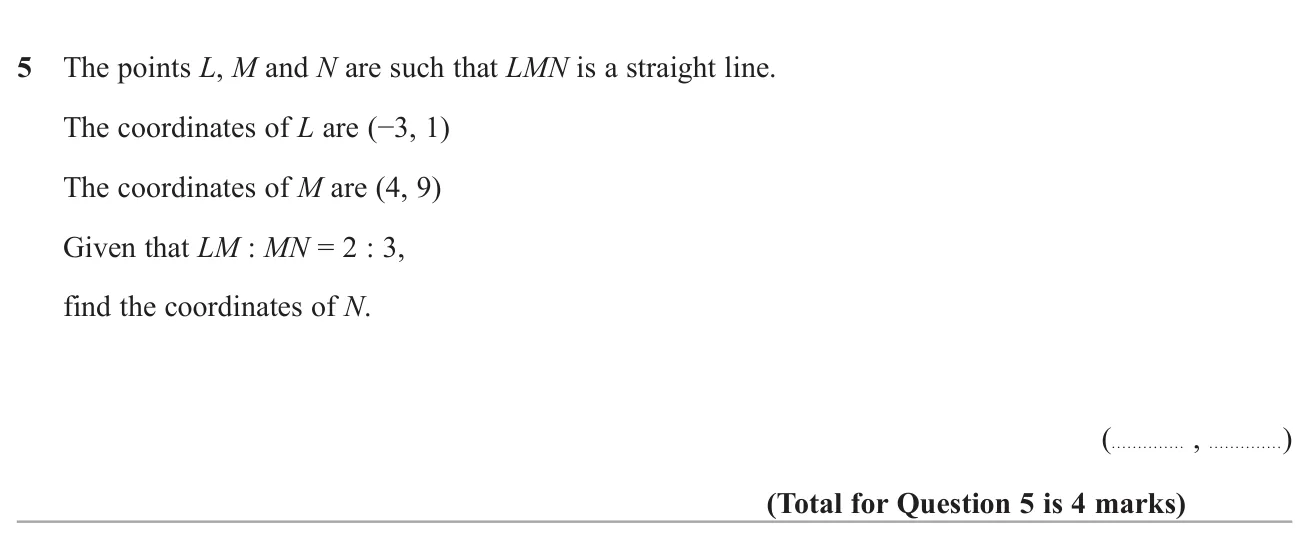
Question 5 Ratio 4 marks Grade 5 Calculator On both tiers © Pearson Education Ltd. June 2022 Paper 2 (Higher, calculator), question 5.
Answer ( 14.5 , 21 ) (14.5, 21) ( 14.5 , 21 ) 4 marks
Worked solution Checked against the mark scheme
From L to M: x x x 4 − ( − 3 ) = 7 4 - (-3) = 7 4 − ( − 3 ) = 7 y y y 9 − 1 = 8 9 - 1 = 8 9 − 1 = 8
One part: x x x y y y
MN is 3 parts: x x x y y y
N = ( 4 + 10.5 , 9 + 12 ) = ( 14.5 , 21 ) N = (4 + 10.5,\ 9 + 12) = (14.5, 21) N = ( 4 + 10.5 , 9 + 12 ) = ( 14.5 , 21 )
Watch out: Adding the three-part distance to L instead of to M.
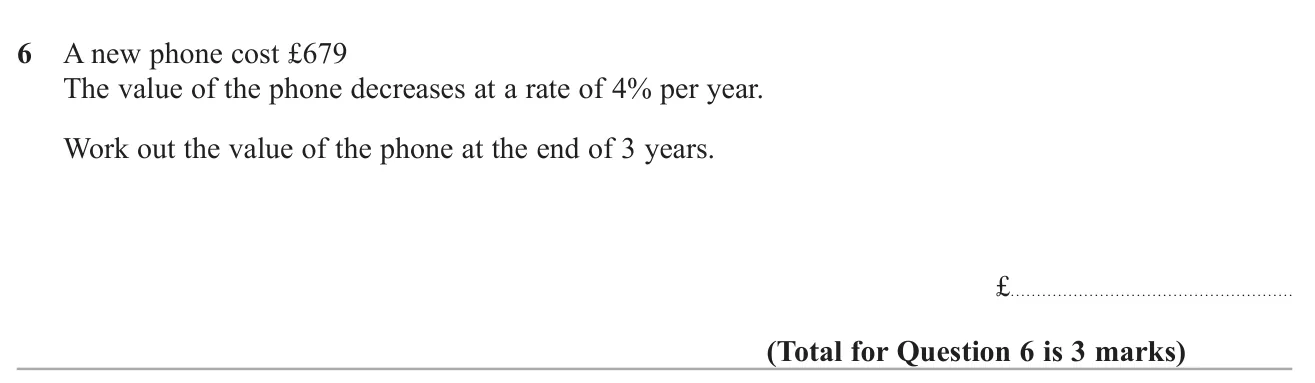
© Pearson Education Ltd. June 2022 Paper 2 (Higher, calculator), question 6.
Worked solution Checked against the mark scheme
The multiplier for a 4% decrease is 0.96 0.96 0.96
679 × 0.96 3 = 600.7357... 679 \times 0.96^3 = 600.7357... 679 × 0.9 6 3 = 600.7357...
Value after 3 years: £600.74
Watch out: Using simple depreciation: 679 − 3 × 27.16 = 597.52 679 - 3 \times 27.16 = 597.52 679 − 3 × 27.16 = 597.52
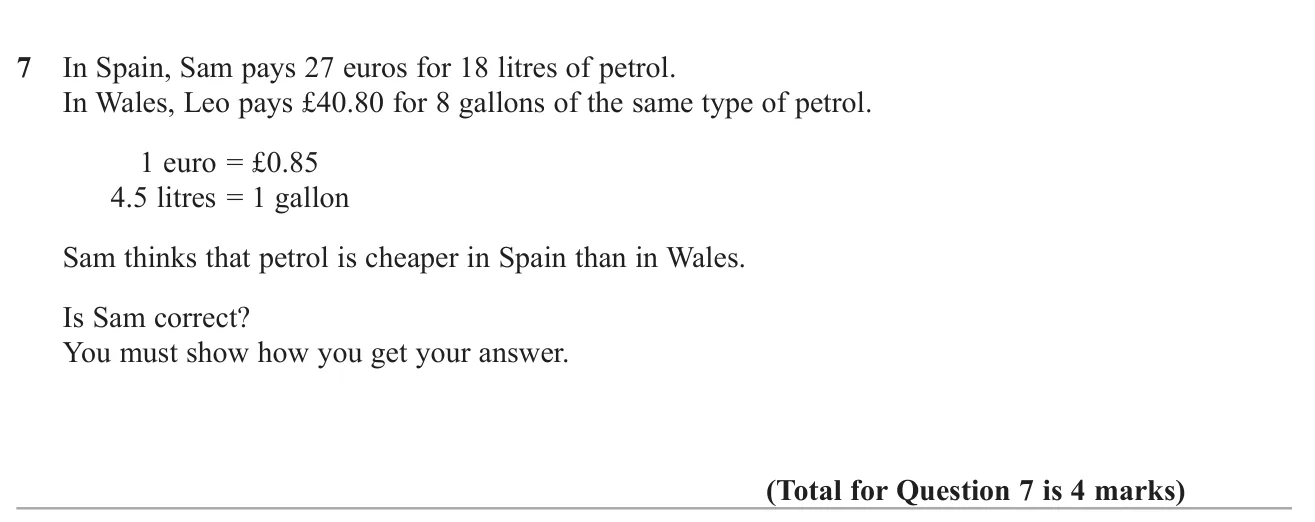
© Pearson Education Ltd. June 2022 Paper 2 (Higher, calculator), question 7.
Answer No: Spain £1.275 per litre, Wales about £1.13 per litre 4 marks
Worked solution Checked against the mark scheme
Spain in £: 27 × 0.85 = 22.95 27 \times 0.85 = 22.95 27 × 0.85 = 22.95 22.95 ÷ 18 = 1.275 22.95 \div 18 = 1.275 22.95 ÷ 18 = 1.275
Wales: 8 × 4.5 = 36 8 \times 4.5 = 36 8 × 4.5 = 36 40.80 ÷ 36 = 1.133... 40.80 \div 36 = 1.133... 40.80 ÷ 36 = 1.133...
£1.13 < £1.275, so petrol is cheaper in Wales. Sam is not correct.
Watch out: Converting euros to pounds by dividing by 0.85 instead of multiplying.
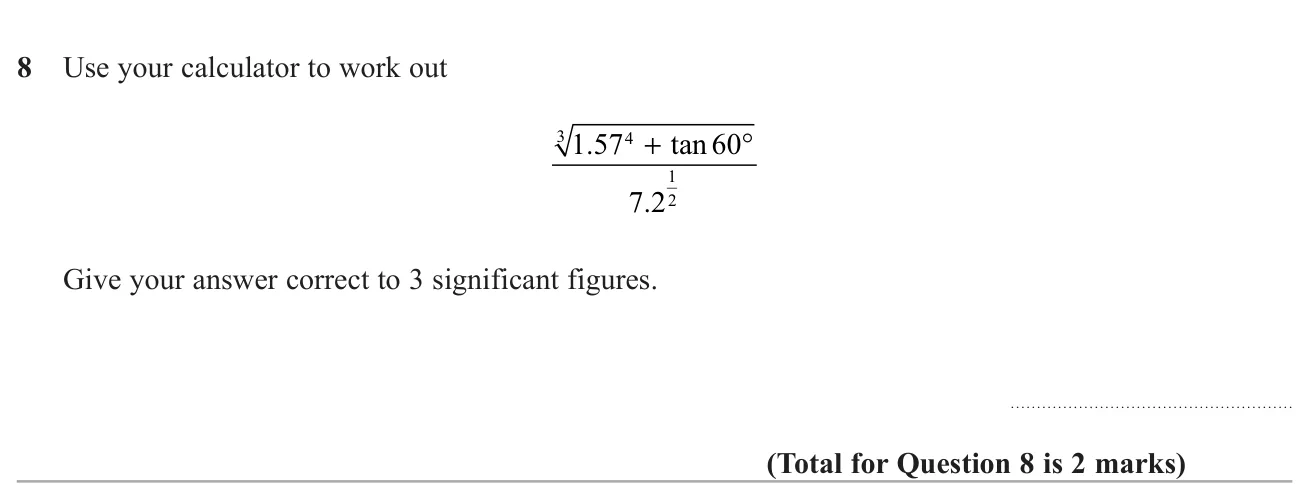
© Pearson Education Ltd. June 2022 Paper 2 (Higher, calculator), question 8.
Answer 0.739 0.739 0.739 2 marks
Worked solution Checked against the mark scheme
Top: 1.57 4 + tan 60 ∘ = 6.0757... + 1.7320... = 7.8077... 1.57^4 + \tan 60^\circ = 6.0757... + 1.7320... = 7.8077... 1.5 7 4 + tan 6 0 ∘ = 6.0757... + 1.7320... = 7.8077... 7.8077... 3 = 1.9838... \sqrt[3]{7.8077...} = 1.9838... 3 7.8077... = 1.9838...
Bottom: 7.2 1 2 = 7.2 = 2.6832... 7.2^{\frac{1}{2}} = \sqrt{7.2} = 2.6832... 7. 2 2 1 = 7.2 = 2.6832...
1.9838... ÷ 2.6832... = 0.73933... 1.9838... \div 2.6832... = 0.73933... 1.9838... ÷ 2.6832... = 0.73933... 0.739 0.739 0.739
Watch out: Calculator in radians mode, giving the wrong value of tan 60.
© Pearson Education Ltd. June 2022 Paper 2 (Higher, calculator), question 9.
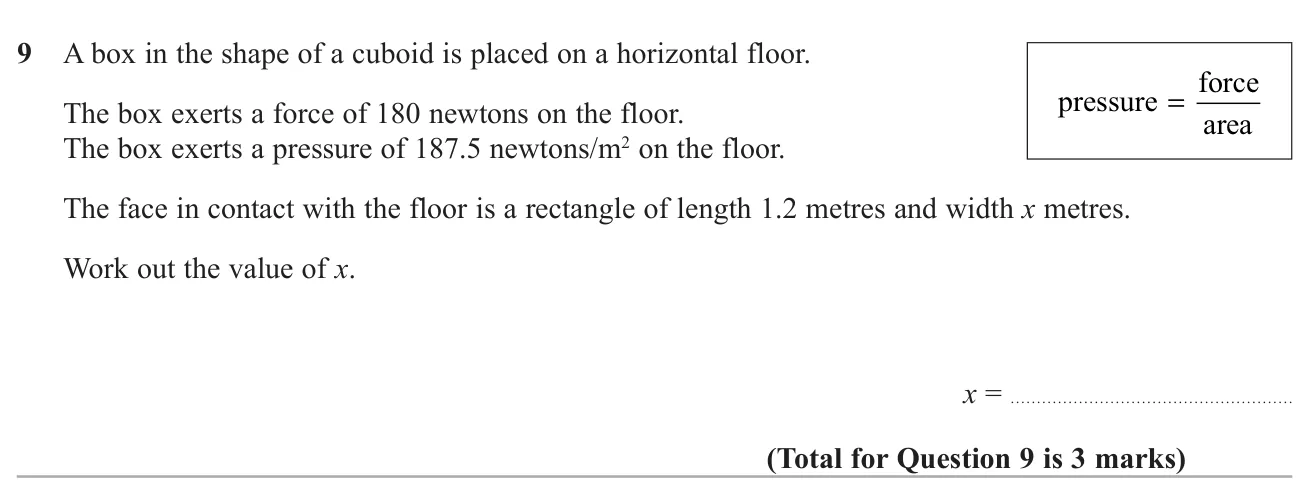
Answer x = 0.8 x = 0.8 x = 0.8 3 marks
Worked solution Checked against the mark scheme
Area = force ÷ pressure = 180 ÷ 187.5 = 0.96 m 2 = \text{force} \div \text{pressure} = 180 \div 187.5 = 0.96\text{ m}^2 = force ÷ pressure = 180 ÷ 187.5 = 0.96 m 2
Area = 1.2 × x = 1.2 \times x = 1.2 × x x = 0.96 ÷ 1.2 = 0.8 x = 0.96 \div 1.2 = 0.8 x = 0.96 ÷ 1.2 = 0.8
Watch out: Multiplying force by pressure instead of dividing.
© Pearson Education Ltd. June 2022 Paper 2 (Higher, calculator), question 10.
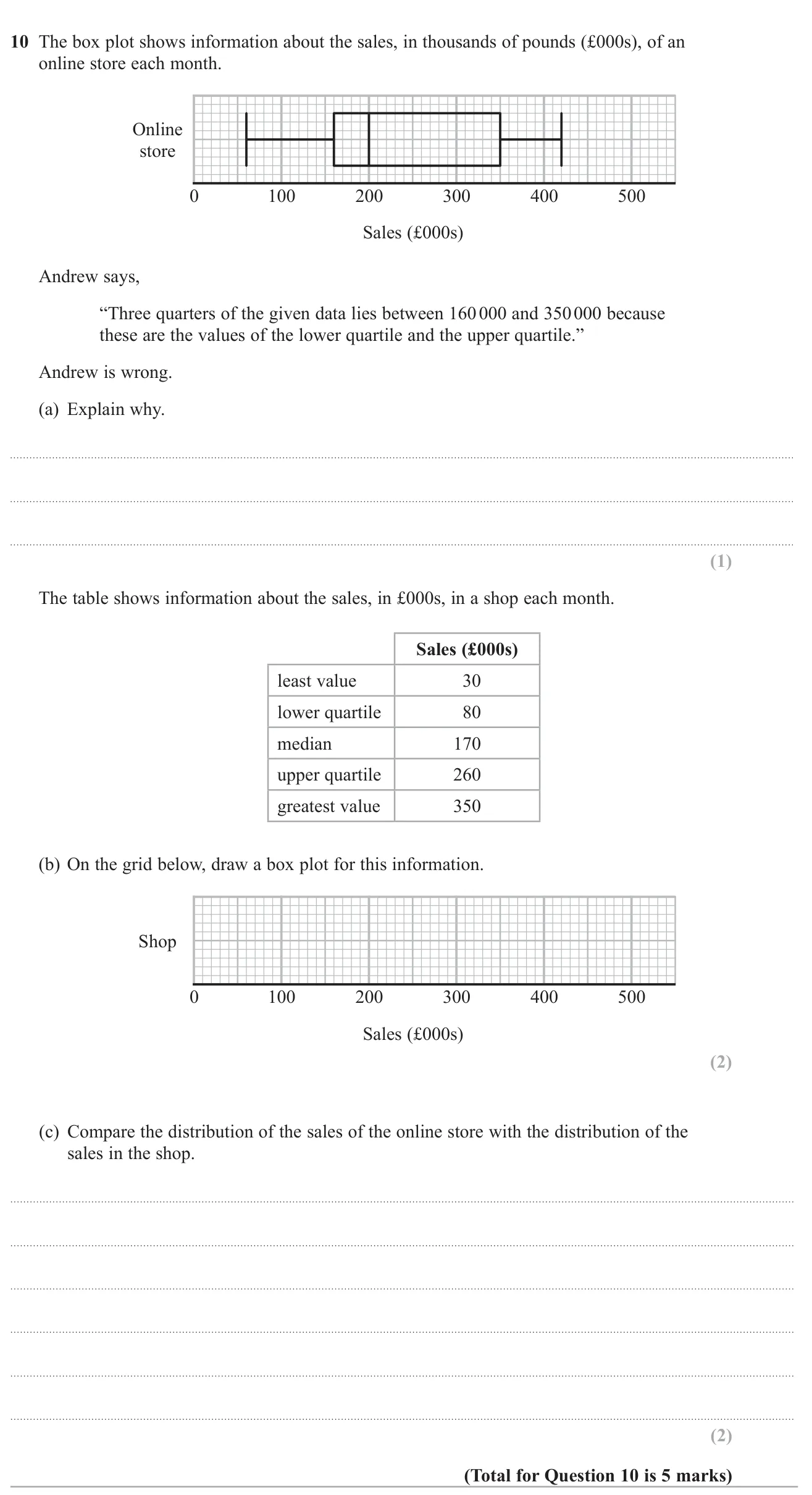
(a) Between the quartiles lies only half of the data, not three quarters 1 mark (b) Box plot with whiskers from 30 to 350, box from 80 to 260, median line at 170 2 marks (c) The online store has a higher median (200 vs 170), so sales are generally higher online; the online store's IQR (190 vs 180) and range (360 vs 320) are larger, so its sales are more varied 2 marks
Worked solution Checked against the mark scheme
(a) The lower quartile is at 25% and the upper quartile at 75%, so only 75 % − 25 % = 50 % 75\% - 25\% = 50\% 75% − 25% = 50%
(b) Draw whiskers from 30 to 80 and from 260 to 350, a box from 80 to 260 and a line at 170.
(c) Online: median 200, IQR 350 − 160 = 190 350 - 160 = 190 350 − 160 = 190 260 − 80 = 180 260 - 80 = 180 260 − 80 = 180
The online median is higher, so it typically sells more each month. The online IQR is bigger, so its monthly sales are less consistent.
Watch out: In (c), stating the medians and IQRs without actually comparing them or saying what they mean.
© Pearson Education Ltd. June 2022 Paper 2 (Higher, calculator), question 11.
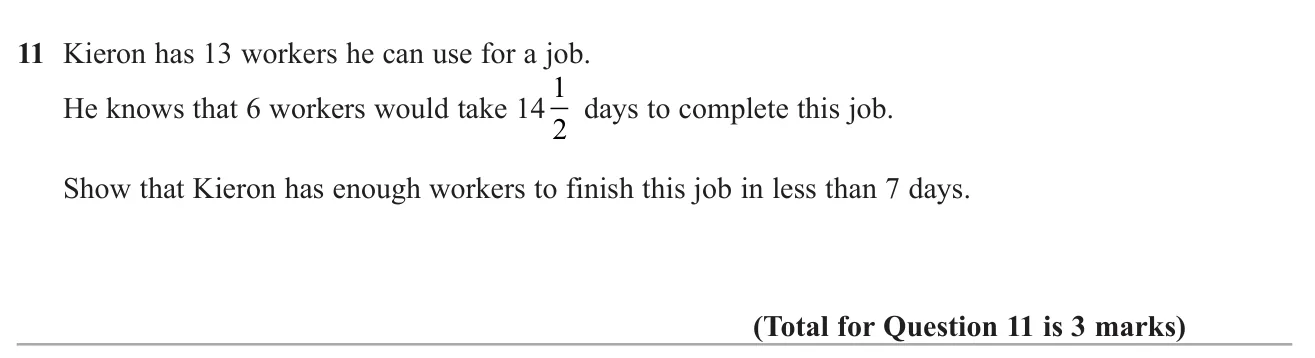
Answer 13 workers take about 6.69 days, which is less than 7 3 marks
Worked solution Checked against the mark scheme
Total work = 6 × 14.5 = 87 = 6 \times 14.5 = 87 = 6 × 14.5 = 87
With 13 workers: 87 ÷ 13 = 6.69... 87 \div 13 = 6.69... 87 ÷ 13 = 6.69...
6.69 < 7 6.69 < 7 6.69 < 7
Watch out: Treating it as direct proportion, so more workers give more days.
© Pearson Education Ltd. June 2022 Paper 2 (Higher, calculator), question 12.
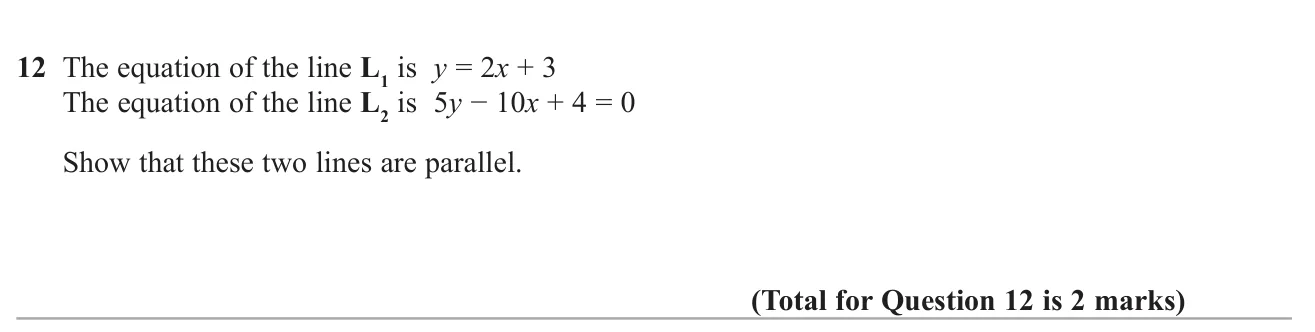
Answer L 2 L_2 L 2 y = 2 x − 4 5 y = 2x - \frac{4}{5} y = 2 x − 5 4 2 marks
Worked solution Checked against the mark scheme
Rearrange L 2 L_2 L 2 5 y = 10 x − 4 5y = 10x - 4 5 y = 10 x − 4 y = 2 x − 4 5 y = 2x - \frac{4}{5} y = 2 x − 5 4
L 1 L_1 L 1 y = 2 x + 3 y = 2x + 3 y = 2 x + 3 L 2 L_2 L 2
Equal gradients, so the lines are parallel.
Watch out: Forgetting to divide every term by 5 and saying the gradient is 10.
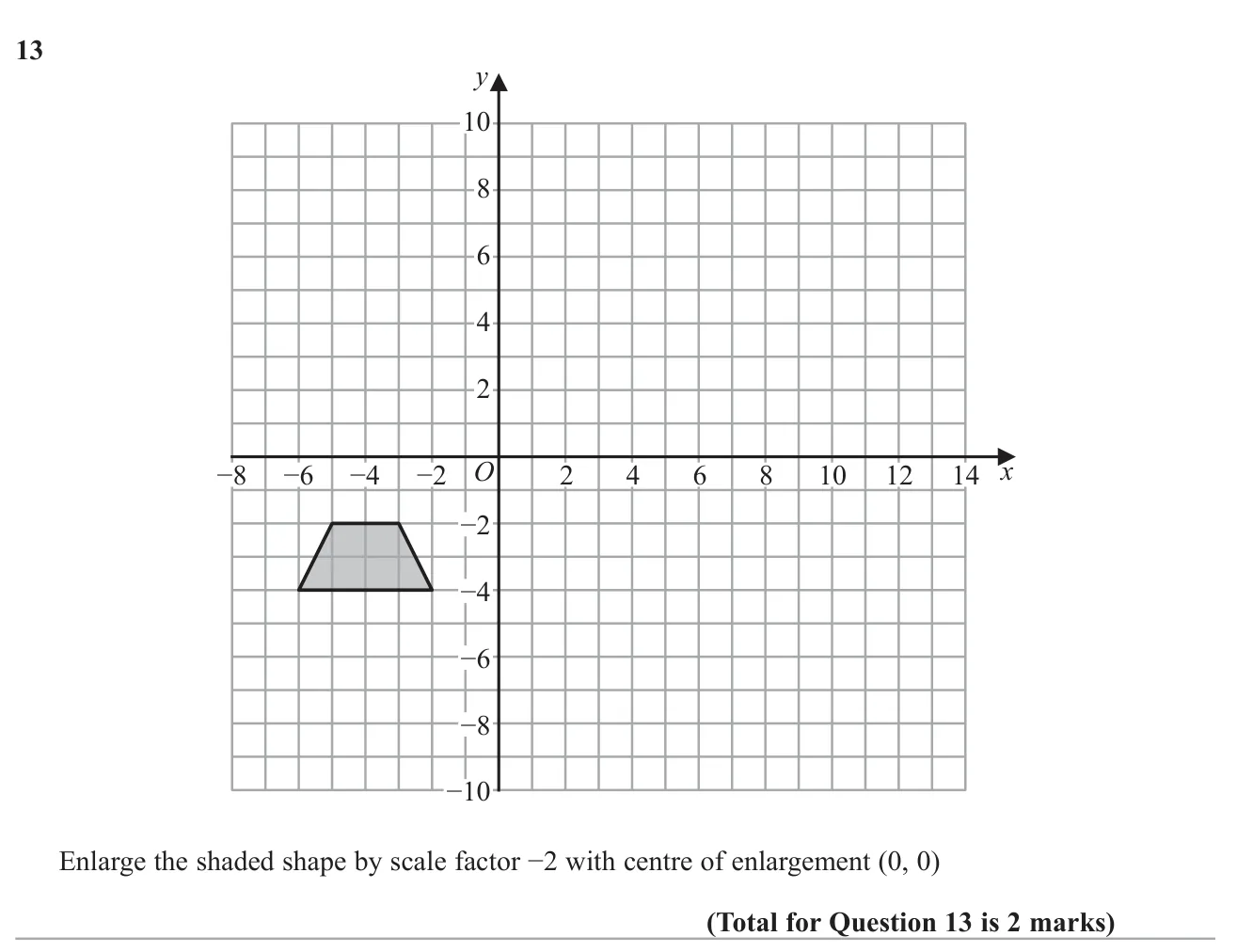
© Pearson Education Ltd. June 2022 Paper 2 (Higher, calculator), question 13.
Answer Trapezium with vertices ( 4 , 8 ) (4, 8) ( 4 , 8 ) ( 6 , 4 ) (6, 4) ( 6 , 4 ) ( 10 , 4 ) (10, 4) ( 10 , 4 ) ( 12 , 8 ) (12, 8) ( 12 , 8 ) 2 marks
Worked solution Checked against the mark scheme
The shape's vertices are ( − 6 , − 4 ) (-6, -4) ( − 6 , − 4 ) ( − 5 , − 2 ) (-5, -2) ( − 5 , − 2 ) ( − 3 , − 2 ) (-3, -2) ( − 3 , − 2 ) ( − 2 , − 4 ) (-2, -4) ( − 2 , − 4 )
Multiply each coordinate by − 2 -2 − 2 ( 12 , 8 ) (12, 8) ( 12 , 8 ) ( 10 , 4 ) (10, 4) ( 10 , 4 ) ( 6 , 4 ) (6, 4) ( 6 , 4 ) ( 4 , 8 ) (4, 8) ( 4 , 8 )
The image is twice as big, upside down, on the opposite side of the origin.
Watch out: Enlarging by scale factor 2 without turning the shape through the centre.
© Pearson Education Ltd. June 2022 Paper 2 (Higher, calculator), question 14.
Worked solution Checked against the mark scheme
The fraction tagged in the second catch should match the fraction tagged in the whole lake:
45 305 = 180 N \frac{45}{305} = \frac{180}{N} 305 45 = N 180
N = 180 × 305 45 = 1220 N = \frac{180 \times 305}{45} = 1220 N = 45 180 × 305 = 1220
Watch out: Setting up the proportion upside down, e.g. 45 × 305 ÷ 180 45 \times 305 \div 180 45 × 305 ÷ 180
Question 15 Ratio 4 marks Grade 7 Calculator © Pearson Education Ltd. June 2022 Paper 2 (Higher, calculator), question 15.
Answer Marta £18, Khalid £15 4 marks
Worked solution Checked against the mark scheme
Let the pay be 6 x 6x 6 x 5 x 5x 5 x 6 x + 1.5 5 x + 1.5 = 13 11 \frac{6x + 1.5}{5x + 1.5} = \frac{13}{11} 5 x + 1.5 6 x + 1.5 = 11 13
11 ( 6 x + 1.5 ) = 13 ( 5 x + 1.5 ) 11(6x + 1.5) = 13(5x + 1.5) 11 ( 6 x + 1.5 ) = 13 ( 5 x + 1.5 )
66 x + 16.5 = 65 x + 19.5 66x + 16.5 = 65x + 19.5 66 x + 16.5 = 65 x + 19.5 x = 3 x = 3 x = 3
Marta: 6 × 3 = £ 18 6 \times 3 = £18 6 × 3 = £18 5 × 3 = £ 15 5 \times 3 = £15 5 × 3 = £15
Watch out: Adding 1.5 to the ratio numbers themselves rather than to the amounts.
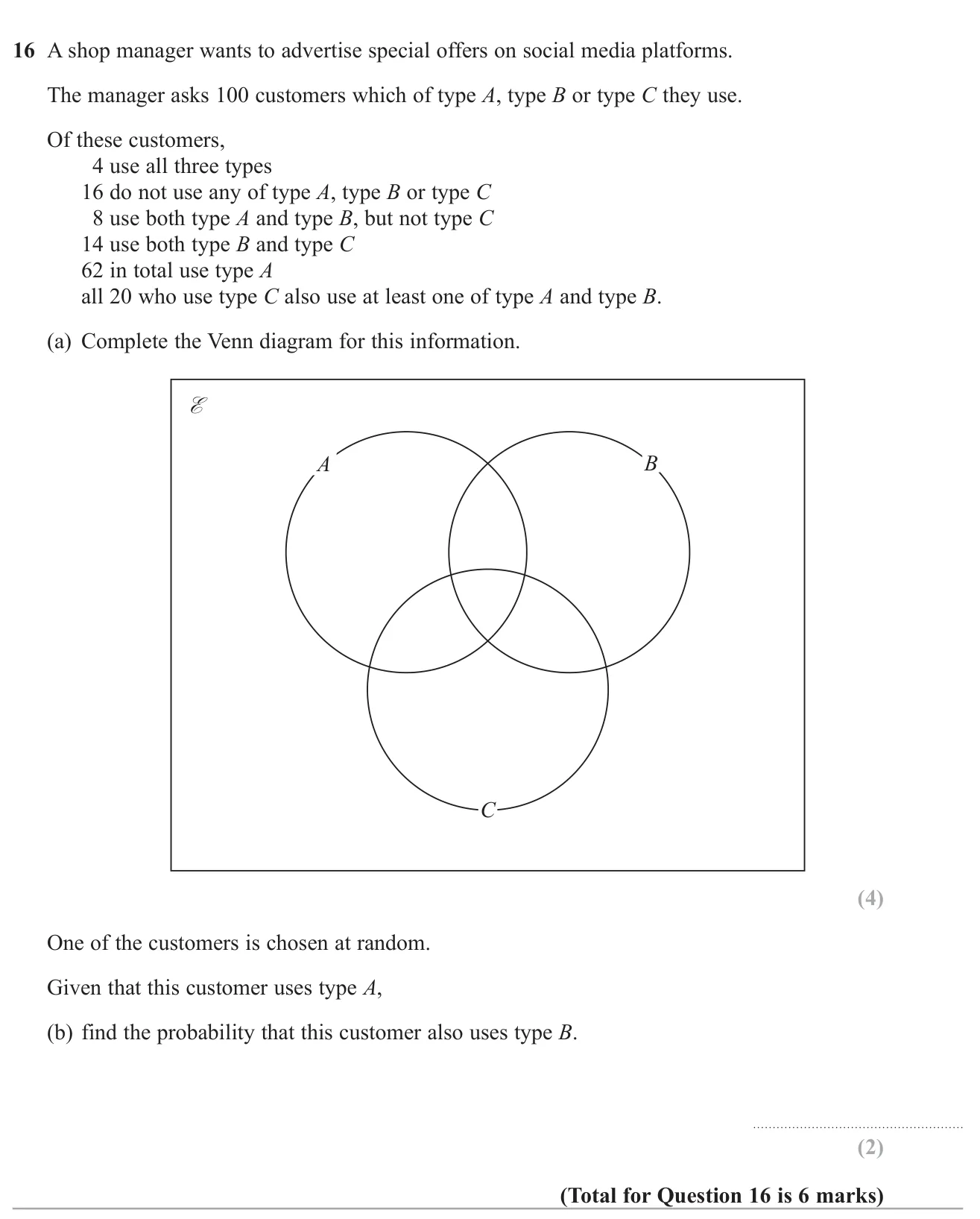
© Pearson Education Ltd. June 2022 Paper 2 (Higher, calculator), question 16.
(a) A only 44, A∩B only 8, A∩C only 6, all three 4, B only 12, B∩C only 10, C only 0, outside 16 4 marks (b) 12 62 \frac{12}{62} 62 12 2 marks
Worked solution Checked against the mark scheme
(a) All three: 4. A and B only: 8. B and C total 14, so B and C only = 14 − 4 = 10 = 14 - 4 = 10 = 14 − 4 = 10
Nobody uses C alone, so A and C only = 20 − 4 − 10 − 0 = 6 = 20 - 4 - 10 - 0 = 6 = 20 − 4 − 10 − 0 = 6
A only = 62 − 8 − 4 − 6 = 44 = 62 - 8 - 4 - 6 = 44 = 62 − 8 − 4 − 6 = 44
B only = 100 − 16 − 44 − 8 − 4 − 6 − 10 = 12 = 100 - 16 - 44 - 8 - 4 - 6 - 10 = 12 = 100 − 16 − 44 − 8 − 4 − 6 − 10 = 12
(b) Among the 62 A users, 8 + 4 = 12 8 + 4 = 12 8 + 4 = 12 P = 12 62 = 6 31 P = \frac{12}{62} = \frac{6}{31} P = 62 12 = 31 6
Watch out: In (b), dividing by 100 instead of the 62 people who use A.
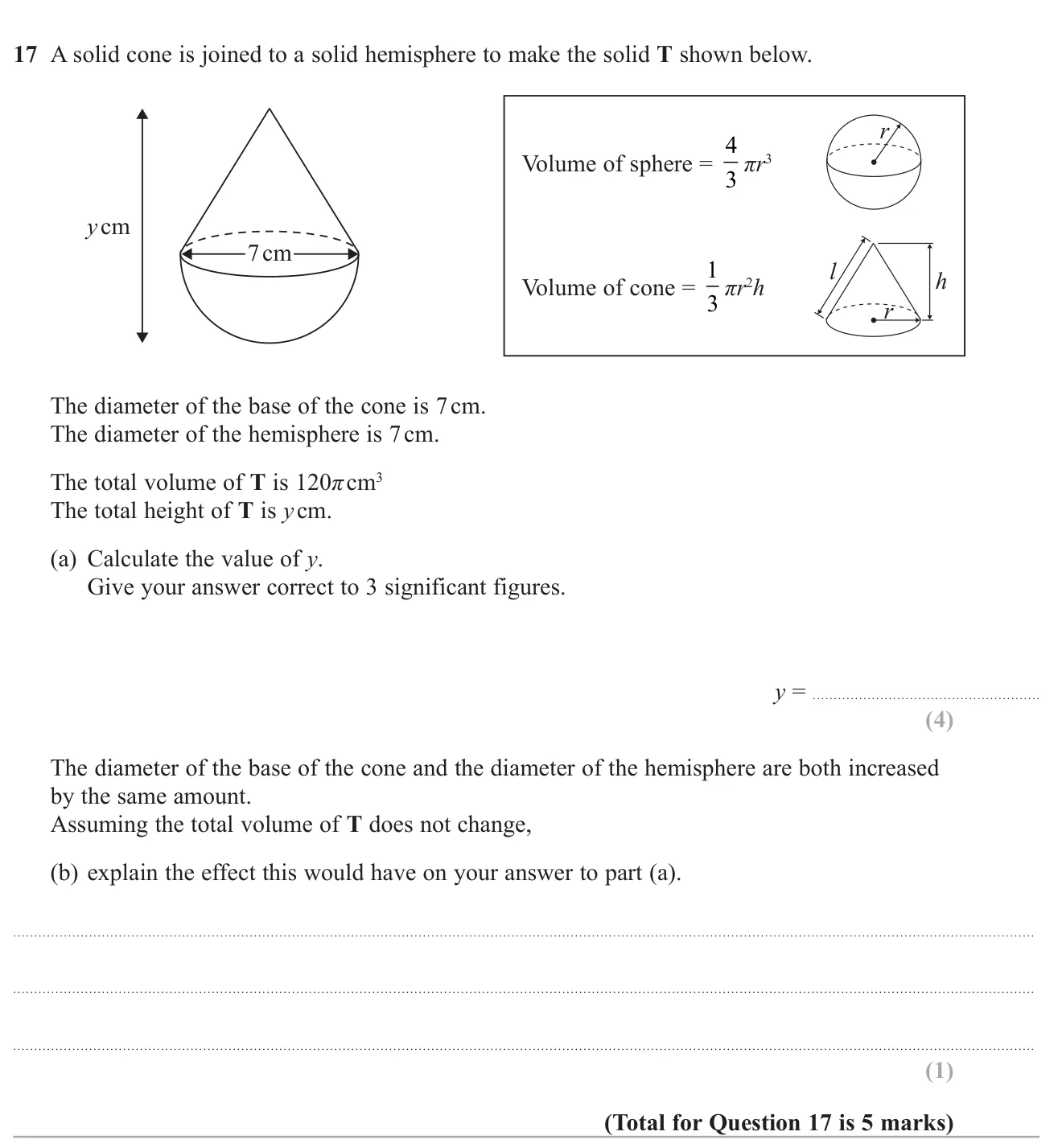
© Pearson Education Ltd. June 2022 Paper 2 (Higher, calculator), question 17.
(a) y = 25.9 y = 25.9 y = 25.9 4 marks (b) The height y y y 1 mark
Worked solution Checked against the mark scheme
(a) Radius = 3.5 = 3.5 = 3.5 2 3 π ( 3.5 ) 3 = 28.583... π \frac{2}{3}\pi(3.5)^3 = 28.583...\pi 3 2 π ( 3.5 ) 3 = 28.583... π
Cone volume = 120 π − 28.583... π = 91.416... π = 120\pi - 28.583...\pi = 91.416...\pi = 120 π − 28.583... π = 91.416... π
1 3 π ( 3.5 ) 2 h = 91.416... π \frac{1}{3}\pi(3.5)^2 h = 91.416...\pi 3 1 π ( 3.5 ) 2 h = 91.416... π h = 91.416... ÷ 4.0833... = 22.387... h = 91.416... \div 4.0833... = 22.387... h = 91.416... ÷ 4.0833... = 22.387...
y = h + 3.5 = 25.887... y = h + 3.5 = 25.887... y = h + 3.5 = 25.887... y = 25.9 y = 25.9 y = 25.9
(b) With a wider base the same volume needs less height, so y y y
Watch out: Forgetting to add the hemisphere's radius, giving 22.4 (the mark scheme gives a special case of 3 marks for this).
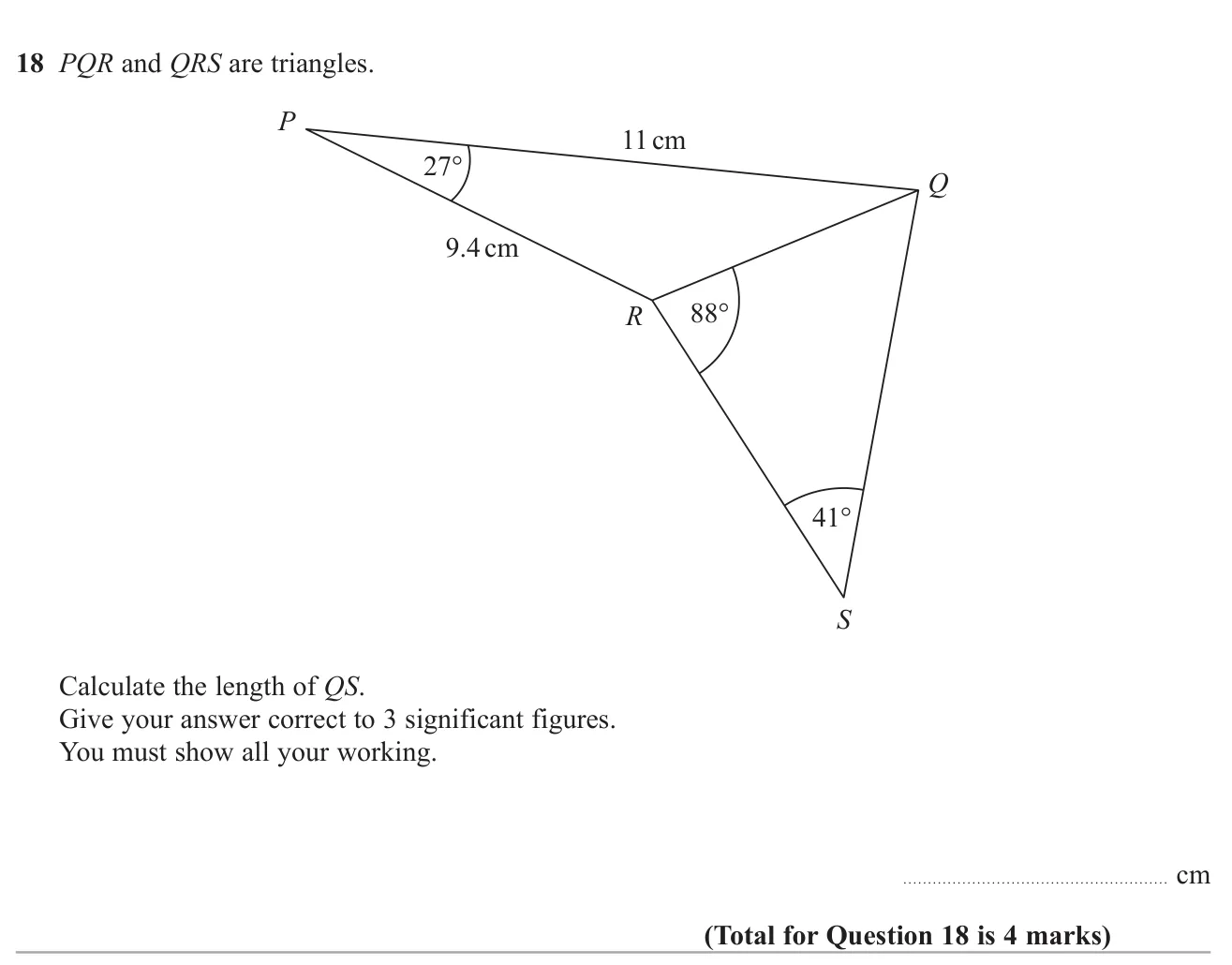
© Pearson Education Ltd. June 2022 Paper 2 (Higher, calculator), question 18.
Answer 7.63 cm 7.63\text{ cm} 7.63 cm 4 marks
Worked solution Checked against the mark scheme
Triangle PQR: Q R 2 = 11 2 + 9.4 2 − 2 × 11 × 9.4 cos 27 ∘ = 25.09... QR^2 = 11^2 + 9.4^2 - 2 \times 11 \times 9.4 \cos 27^\circ = 25.09... Q R 2 = 1 1 2 + 9. 4 2 − 2 × 11 × 9.4 cos 2 7 ∘ = 25.09... Q R = 5.0099... QR = 5.0099... QR = 5.0099...
Triangle QRS: Q S sin 88 ∘ = Q R sin 41 ∘ \frac{QS}{\sin 88^\circ} = \frac{QR}{\sin 41^\circ} s i n 8 8 ∘ QS = s i n 4 1 ∘ QR
Q S = 5.0099... × sin 88 ∘ sin 41 ∘ = 7.6318... QS = \frac{5.0099... \times \sin 88^\circ}{\sin 41^\circ} = 7.6318... QS = s i n 4 1 ∘ 5.0099... × s i n 8 8 ∘ = 7.6318... Q S = 7.63 QS = 7.63 QS = 7.63
Watch out: Pairing QS with the wrong angle in the sine rule (it is opposite the 88° angle).
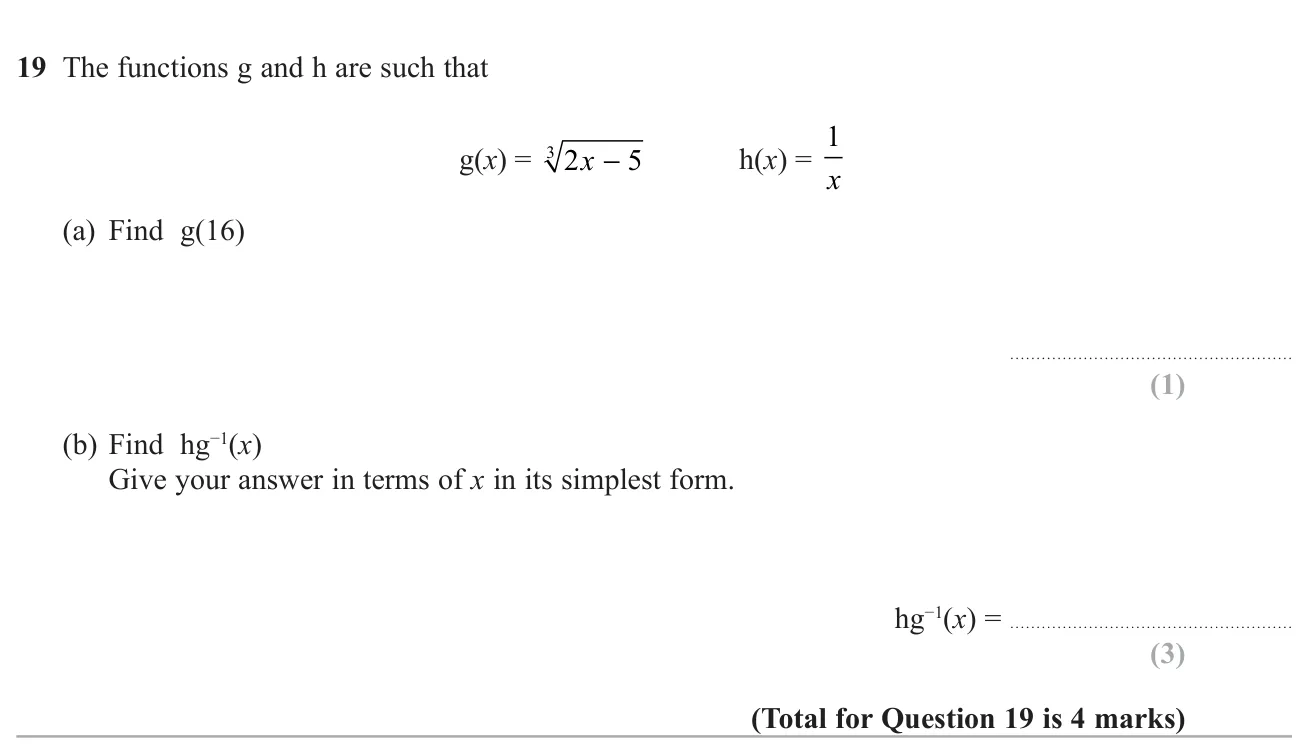
© Pearson Education Ltd. June 2022 Paper 2 (Higher, calculator), question 19.
(a) 3 3 3 1 mark (b) 2 x 3 + 5 \frac{2}{x^3 + 5} x 3 + 5 2 3 marks
Worked solution Checked against the mark scheme
(a) g ( 16 ) = 32 − 5 3 = 27 3 = 3 g(16) = \sqrt[3]{32 - 5} = \sqrt[3]{27} = 3 g ( 16 ) = 3 32 − 5 = 3 27 = 3
(b) Let y = 2 x − 5 3 y = \sqrt[3]{2x - 5} y = 3 2 x − 5 y 3 = 2 x − 5 y^3 = 2x - 5 y 3 = 2 x − 5 x = y 3 + 5 2 x = \frac{y^3 + 5}{2} x = 2 y 3 + 5
g − 1 ( x ) = x 3 + 5 2 g^{-1}(x) = \frac{x^3 + 5}{2} g − 1 ( x ) = 2 x 3 + 5
h g − 1 ( x ) = 1 x 3 + 5 2 = 2 x 3 + 5 hg^{-1}(x) = \frac{1}{\frac{x^3 + 5}{2}} = \frac{2}{x^3 + 5} h g − 1 ( x ) = 2 x 3 + 5 1 = x 3 + 5 2
Watch out: Doing g⁻¹ of h instead of h of g⁻¹.
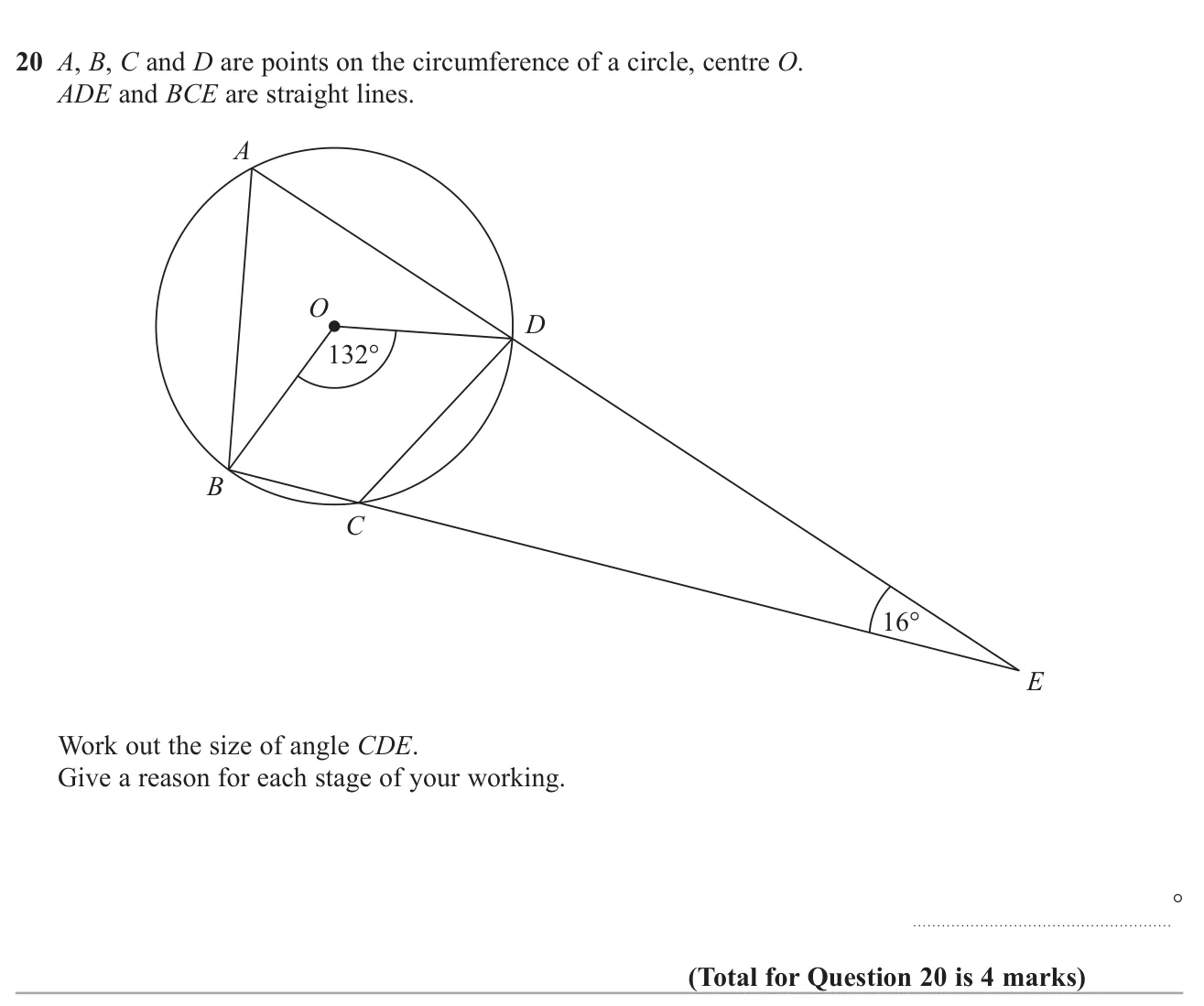
© Pearson Education Ltd. June 2022 Paper 2 (Higher, calculator), question 20.
Answer 98 ∘ 98^\circ 9 8 ∘ 4 marks
Worked solution Checked against the mark scheme
Angle B A D = 132 ÷ 2 = 66 ∘ BAD = 132 \div 2 = 66^\circ B A D = 132 ÷ 2 = 6 6 ∘
Angle B C D = 180 − 66 = 114 ∘ BCD = 180 - 66 = 114^\circ B C D = 180 − 66 = 11 4 ∘
Angle D C E = 180 − 114 = 66 ∘ DCE = 180 - 114 = 66^\circ D C E = 180 − 114 = 6 6 ∘
Angle C D E = 180 − 66 − 16 = 98 ∘ CDE = 180 - 66 - 16 = 98^\circ C D E = 180 − 66 − 16 = 9 8 ∘
Watch out: Taking angle BCD as half of 132°, i.e. using the minor arc instead of the reflex angle at the centre.
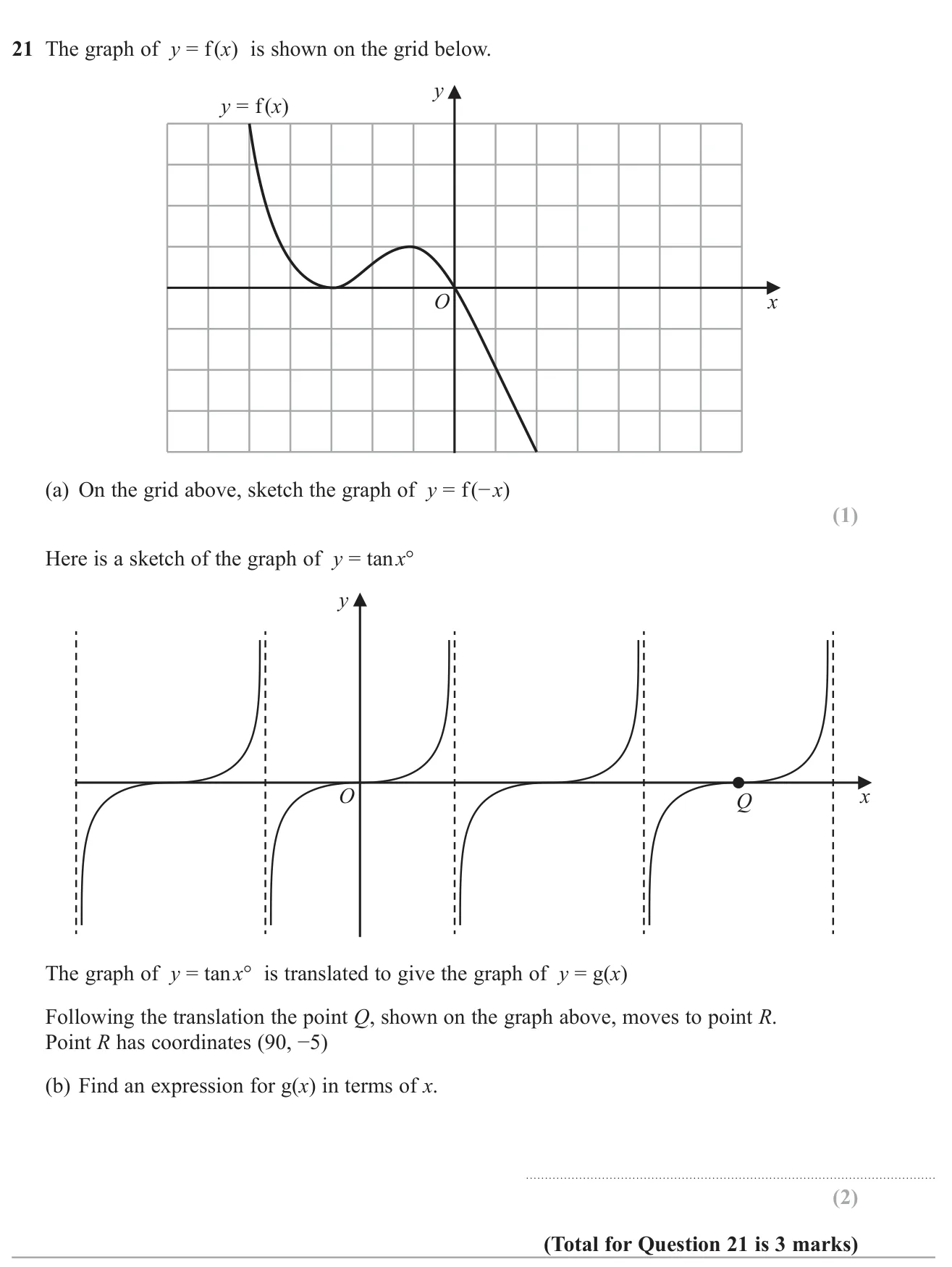
© Pearson Education Ltd. June 2022 Paper 2 (Higher, calculator), question 21.
(a) The curve reflected in the y y y 1 mark (b) g ( x ) = tan ( x + 270 ) ∘ − 5 g(x) = \tan(x + 270)^\circ - 5 g ( x ) = tan ( x + 270 ) ∘ − 5 2 marks
Worked solution Checked against the mark scheme
(a) f ( − x ) f(-x) f ( − x ) y y y
(b) Q is at ( 360 , 0 ) (360, 0) ( 360 , 0 ) ( 90 , − 5 ) (90, -5) ( 90 , − 5 )
The graph moves 270 left and 5 down, i.e. by ( − 270 − 5 ) \begin{pmatrix}-270\\-5\end{pmatrix} ( − 270 − 5 )
Moving left by 270 means replacing x x x x + 270 x + 270 x + 270
g ( x ) = tan ( x + 270 ) ∘ − 5 g(x) = \tan(x + 270)^\circ - 5 g ( x ) = tan ( x + 270 ) ∘ − 5
Watch out: Writing tan(x − 270) because the graph moves to the left.
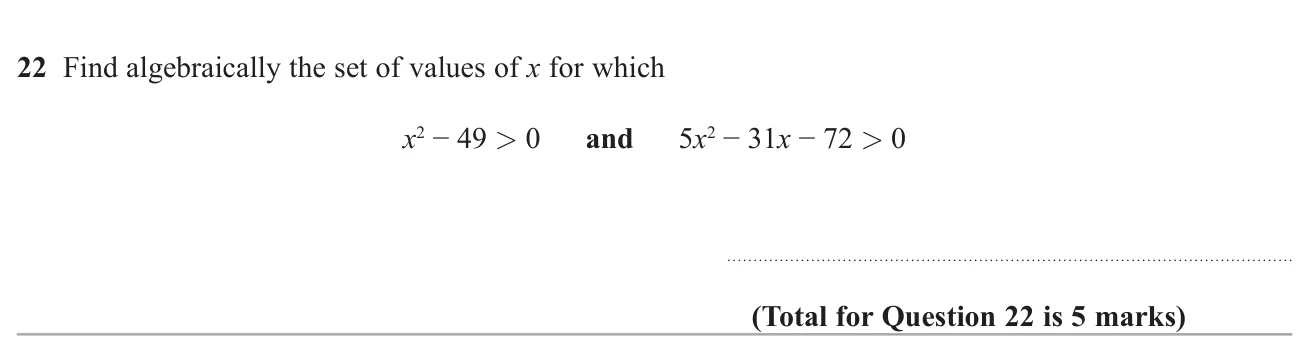
© Pearson Education Ltd. June 2022 Paper 2 (Higher, calculator), question 22.
Answer x < − 7 x < -7 x < − 7 x > 8 x > 8 x > 8 5 marks
Worked solution Checked against the mark scheme
x 2 − 49 > 0 x^2 - 49 > 0 x 2 − 49 > 0 ( x + 7 ) ( x − 7 ) > 0 (x + 7)(x - 7) > 0 ( x + 7 ) ( x − 7 ) > 0 x < − 7 x < -7 x < − 7 x > 7 x > 7 x > 7
5 x 2 − 31 x − 72 > 0 5x^2 - 31x - 72 > 0 5 x 2 − 31 x − 72 > 0 ( 5 x + 9 ) ( x − 8 ) > 0 (5x + 9)(x - 8) > 0 ( 5 x + 9 ) ( x − 8 ) > 0 x < − 1.8 x < -1.8 x < − 1.8 x > 8 x > 8 x > 8
Both true: x < − 7 x < -7 x < − 7 x > 8 x > 8 x > 8
Watch out: Giving − 7 < x < 7 -7 < x < 7 − 7 < x < 7
Finished the paper? Add up your marks for all three papers and see what grade that would have been.