© Pearson Education Ltd. November 2024 Paper 3 (Higher, calculator), question 1.
Show answer
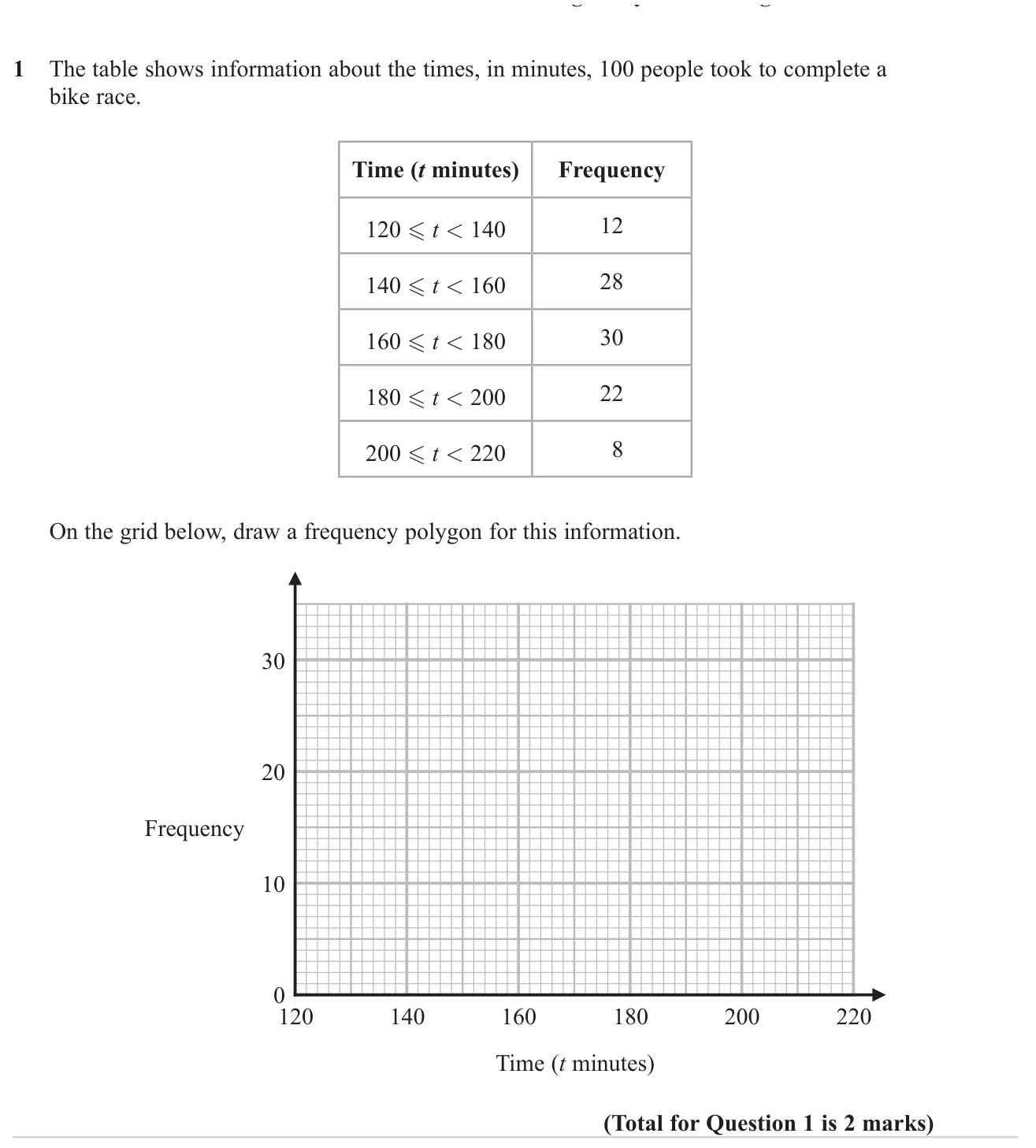
| Answer | Points at (130, 12), (150, 28), (170, 30), (190, 22), (210, 8) joined with straight lines | 2 marks |
|---|
Worked solution Checked against the mark scheme
Midpoints: 130, 150, 170, 190, 210
Plot (130, 12), (150, 28), (170, 30), (190, 22), (210, 8).
Join neighbouring points with straight lines. Do not join the last point back to the first.
Watch out: Plotting at the ends of the intervals instead of the midpoints.
© Pearson Education Ltd. November 2024 Paper 3 (Higher, calculator), question 2.
Show answer
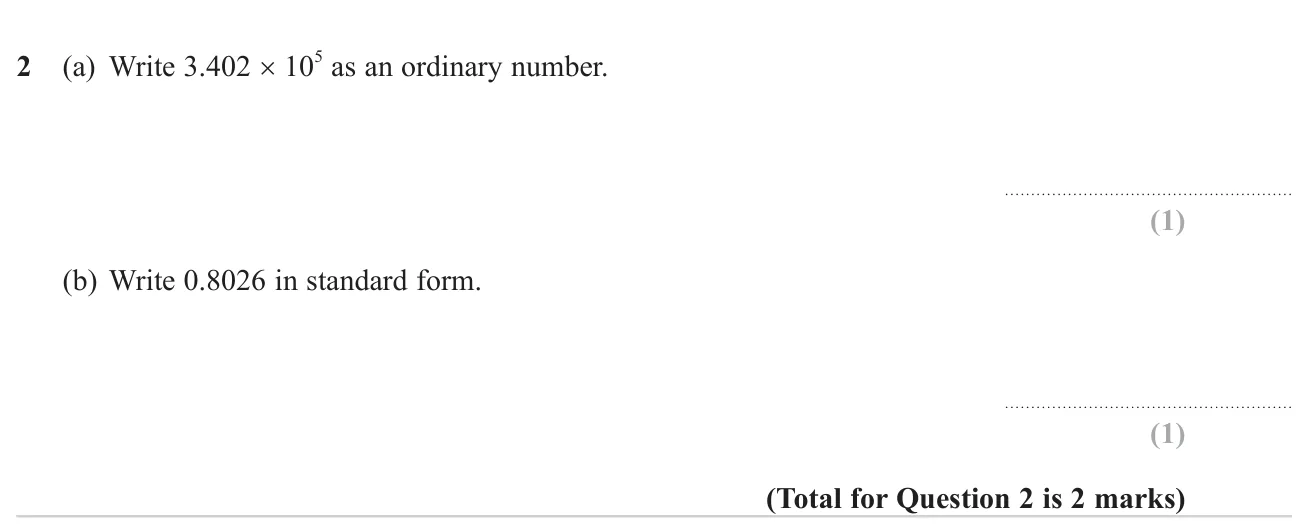
| (a) | 340200 | 1 mark |
|---|
| (b) | 8.026×10⁻¹ | 1 mark |
|---|
Worked solution Checked against the mark scheme
(a) Move the decimal point 5 places right: 3.402×105=340200
(b) Move the point 1 place right to get 8.026, so the power is −1: 8.026×10⁻¹
Watch out: In (b), writing 0.8026×100 or using a positive power.
© Pearson Education Ltd. November 2024 Paper 3 (Higher, calculator), question 3.
Show answer
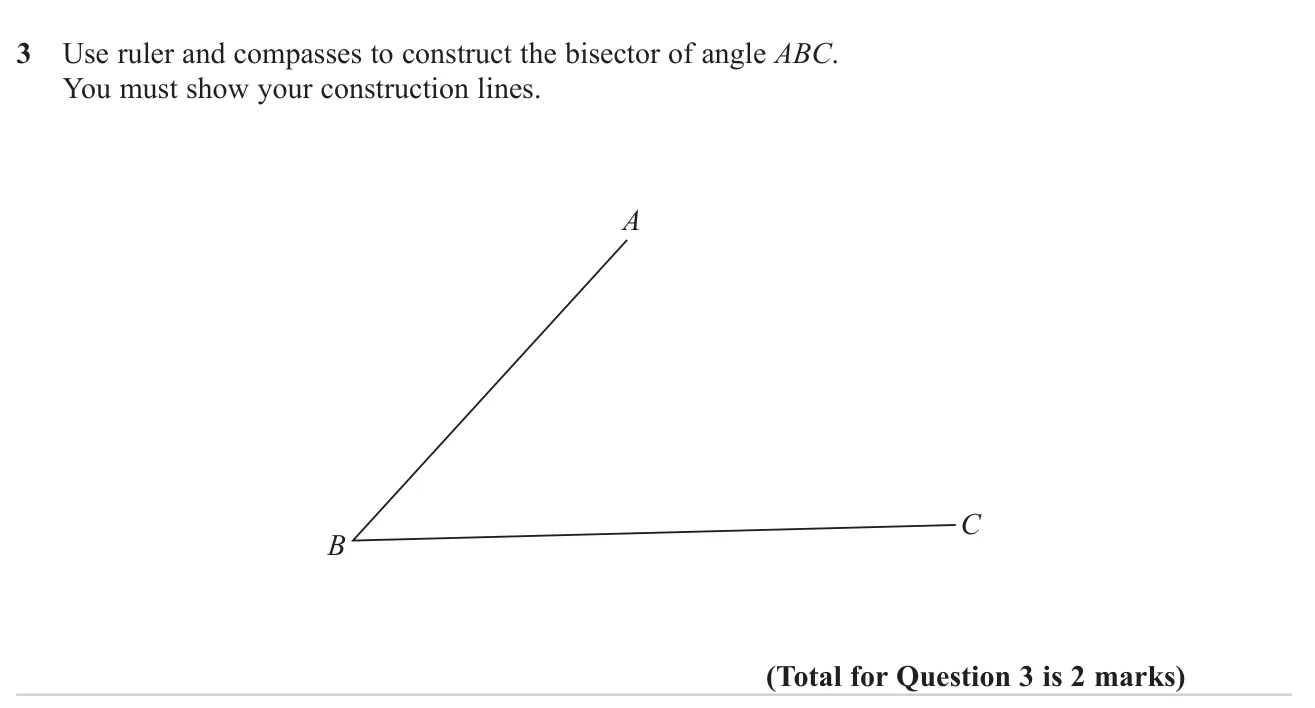
| Answer | Correct bisector with construction arcs shown | 2 marks |
|---|
Worked solution Checked against the mark scheme
Put the compass point on B and draw an arc crossing BA and BC.
From each crossing point, draw equal arcs that meet inside the angle.
Rule a line from B through where the arcs meet. Leave all arcs visible.
Watch out: Measuring with a protractor and not showing arcs.
© Pearson Education Ltd. November 2024 Paper 3 (Higher, calculator), question 4.
Show answer
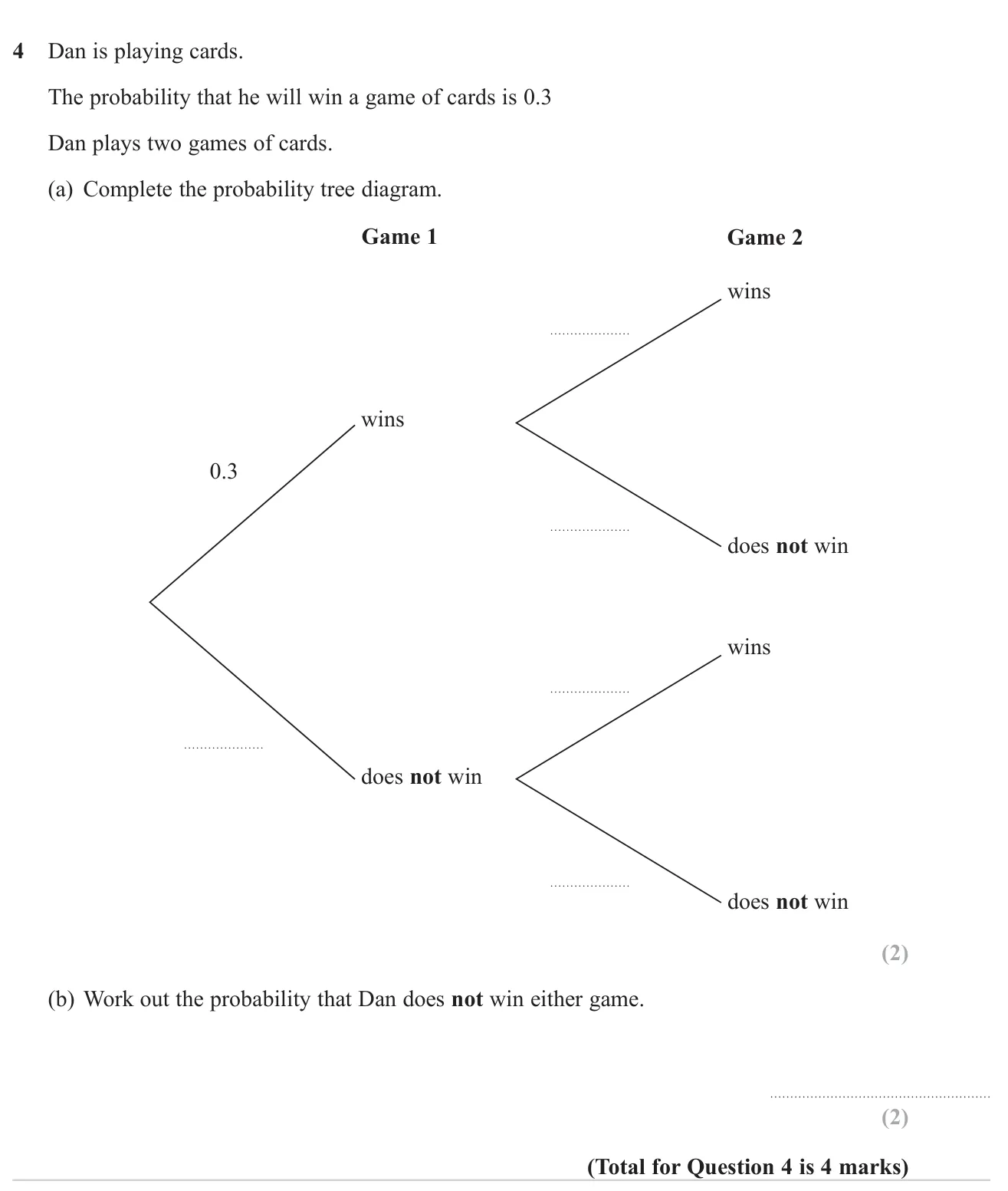
| (a) | Game 1: 0.3, 0.7; Game 2: 0.3, 0.7 on each pair of branches | 2 marks |
|---|
| (b) | 0.49 | 2 marks |
|---|
Worked solution Checked against the mark scheme
(a) Not winning: 1−0.3=0.7. Each pair of branches is 0.3 (wins) and 0.7 (does not win).
(b) 0.7×0.7=0.49
Watch out: Adding 0.7 + 0.7 instead of multiplying.
© Pearson Education Ltd. November 2024 Paper 3 (Higher, calculator), question 5.
Show answer
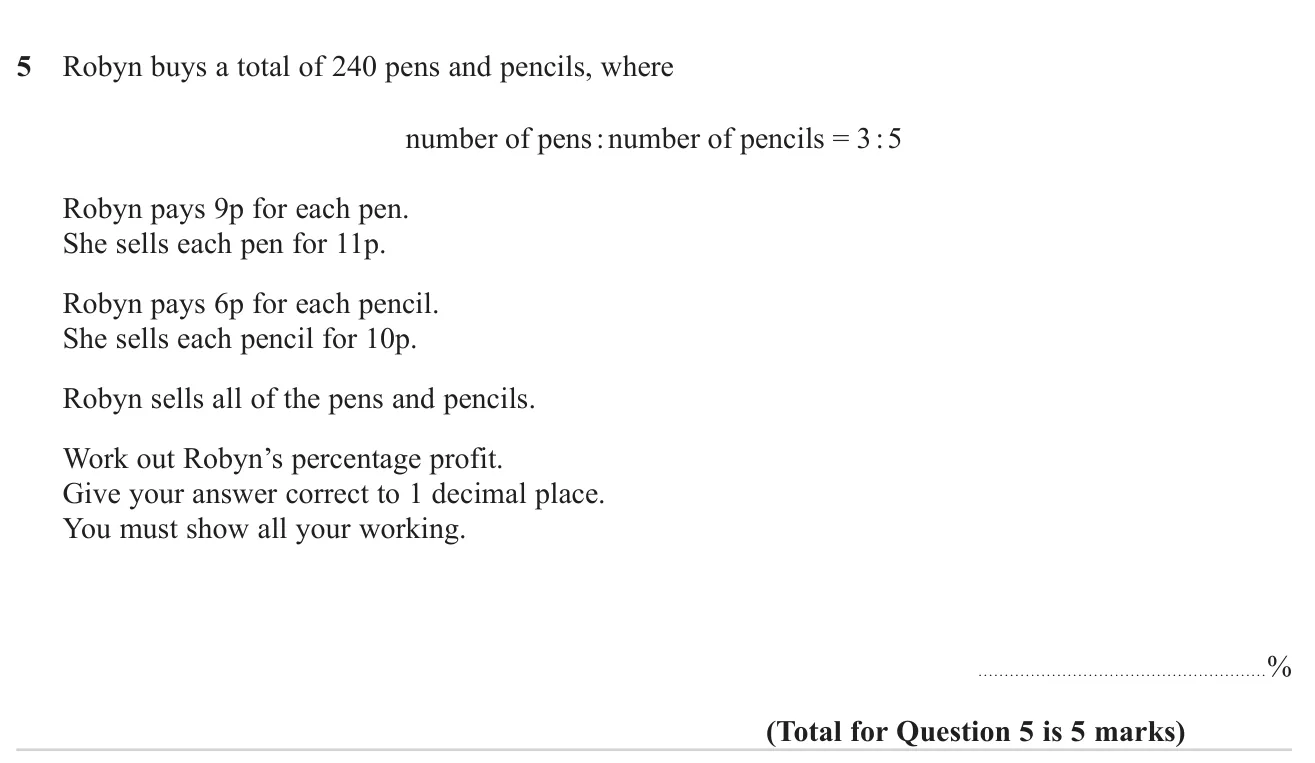
| Answer | 45.6% | 5 marks |
|---|
Worked solution Checked against the mark scheme
One part: 240÷8=30, so 90 pens and 150 pencils.
Cost: 90×9+150×6=1710p
Income: 90×11+150×10=2490p
Profit: 2490−1710=780p
1710780×100=45.6%
Watch out: Dividing the profit by the selling total instead of the cost.
© Pearson Education Ltd. November 2024 Paper 3 (Higher, calculator), question 6.
Show answer
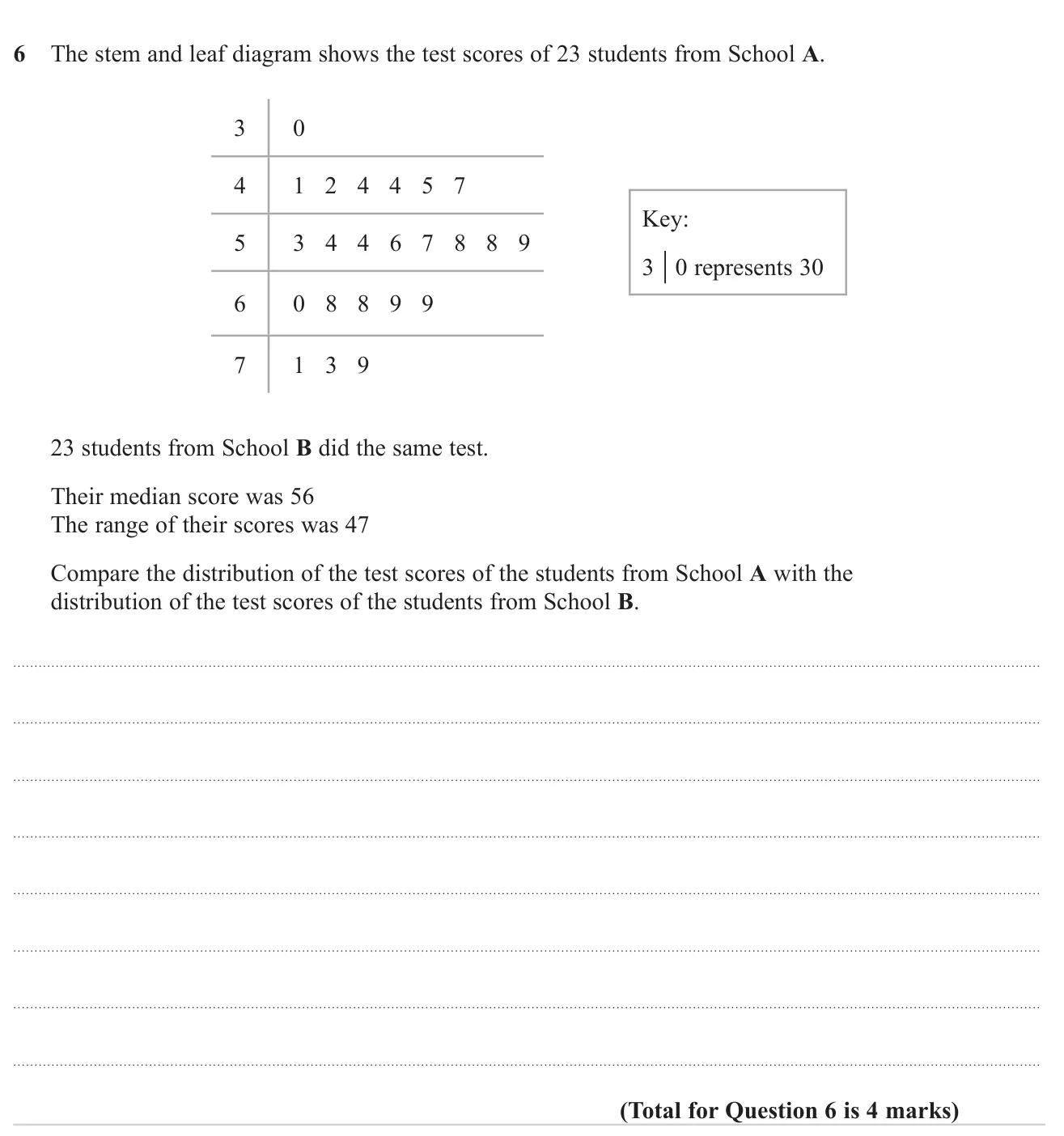
| Answer | School A median 57 is higher than B's 56; School A range 49 is higher than B's 47, so A's scores are more spread out | 4 marks |
|---|
Worked solution Checked against the mark scheme
School A has 23 scores, so the median is the 12th: 57.
Range: 79−30=49
Median: A (57) is higher than B (56), so A did slightly better on average.
Range: A (49) is higher than B (47), so A's scores were more spread out.
Watch out: Only quoting the numbers without saying which school is higher.
© Pearson Education Ltd. November 2024 Paper 3 (Higher, calculator), question 7.
Show answer
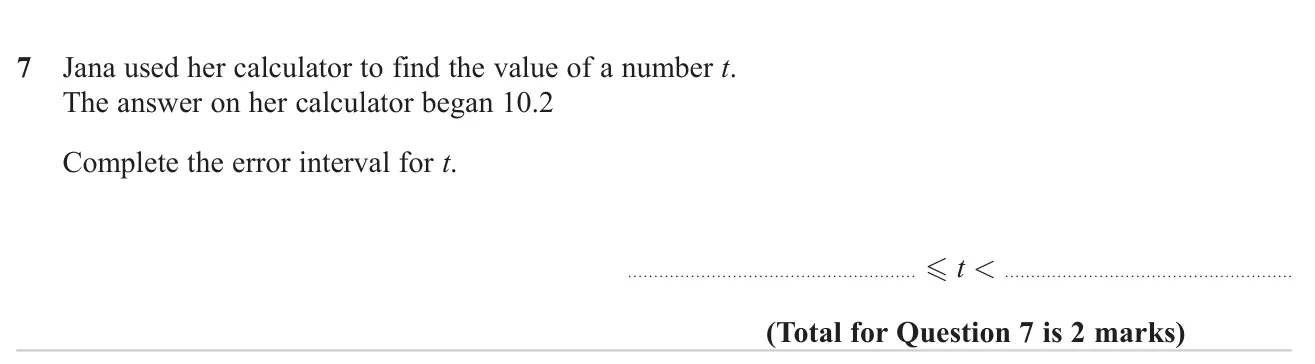
| Answer | 10.2≤t<10.3 | 2 marks |
|---|
Worked solution Checked against the mark scheme
The calculator display began 10.2, so the number was cut off (truncated), not rounded.
It could be anything from 10.2 up to but not including 10.3:
10.2≤t<10.3
Watch out: Treating it as rounding and writing 10.15≤t<10.25.
© Pearson Education Ltd. November 2024 Paper 3 (Higher, calculator), question 8.
Show answer
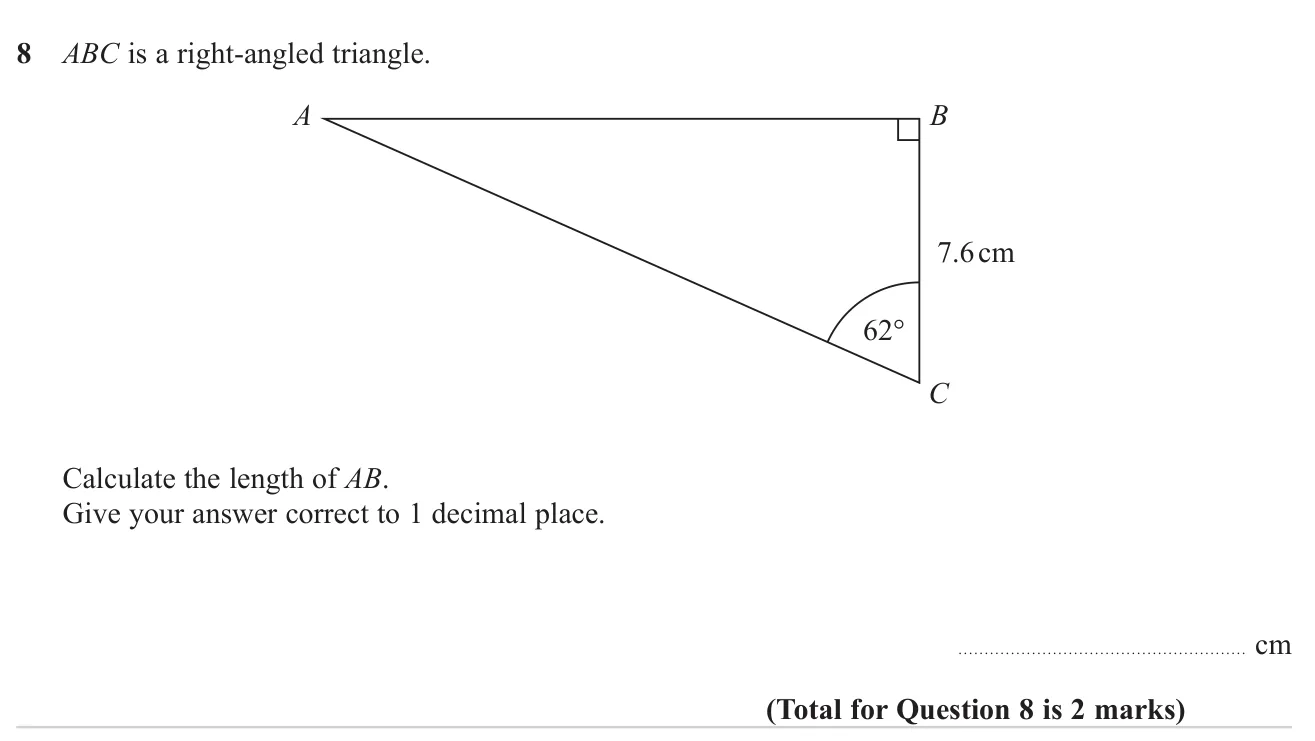
| Answer | 14.3 cm | 2 marks |
|---|
Worked solution Checked against the mark scheme
AB is opposite the 62° angle and BC (7.6 cm) is adjacent.
tan62°=7.6AB
AB=7.6×tan62°=14.29...≈14.3 cm
Watch out: Using sin or cos instead of tan.
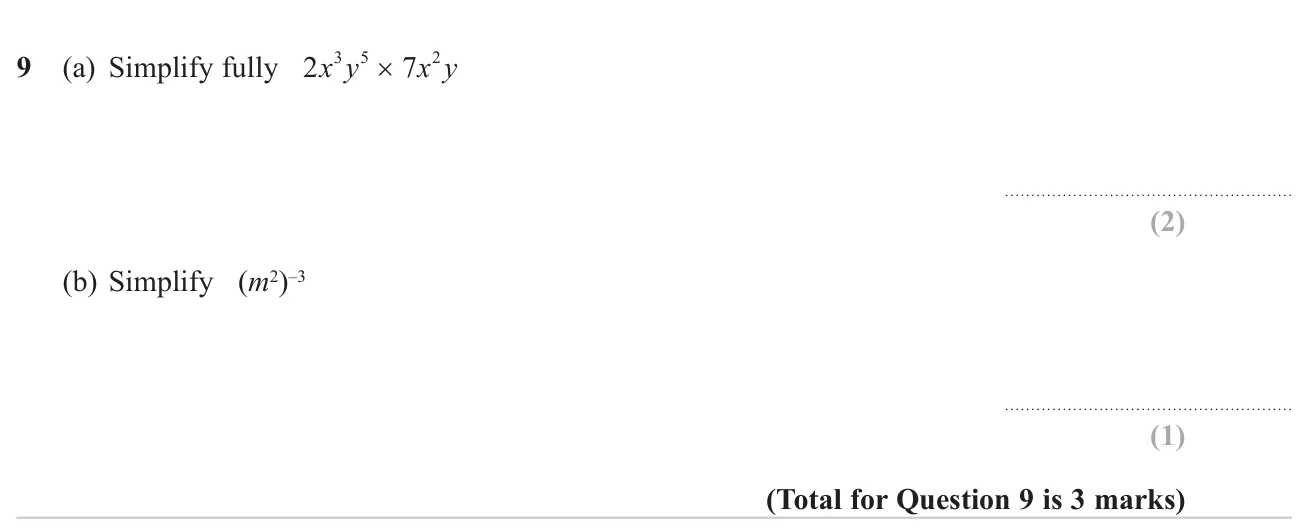
© Pearson Education Ltd. November 2024 Paper 3 (Higher, calculator), question 9.
Show answer
| (a) | 14x5y6 | 2 marks |
|---|
| (b) | m−6 | 1 mark |
|---|
Worked solution Checked against the mark scheme
(a) Multiply the numbers: 2×7=14. Add the powers: x3+2=x5, y5+1=y6.
So 14x5y6
(b) Multiply the powers: 2×−3=−6, so m−6
Watch out: Multiplying the powers in (a) to get x6.
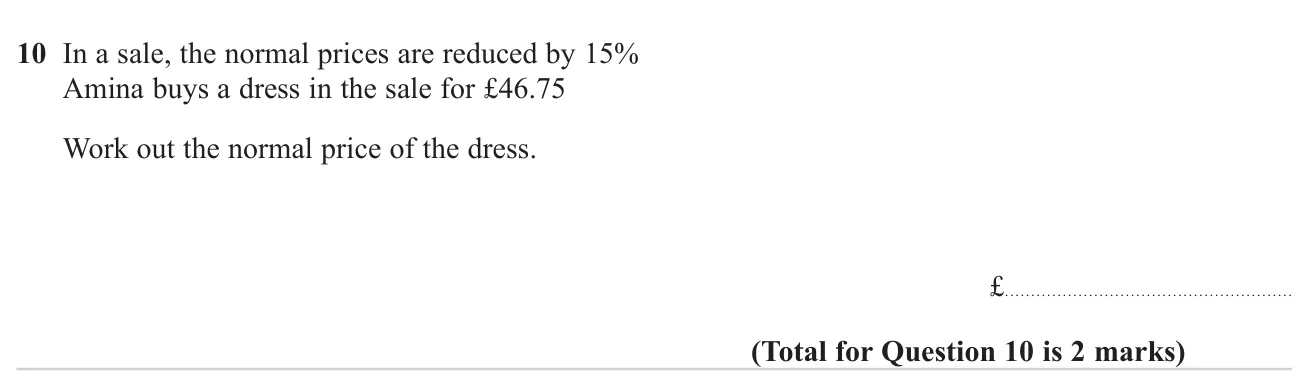
© Pearson Education Ltd. November 2024 Paper 3 (Higher, calculator), question 10.
Show answer
Worked solution Checked against the mark scheme
After a 15% reduction the sale price is 85% of the normal price.
Normal price =46.75÷0.85=£55
Watch out: Adding 15% to £46.75 to get £53.76.
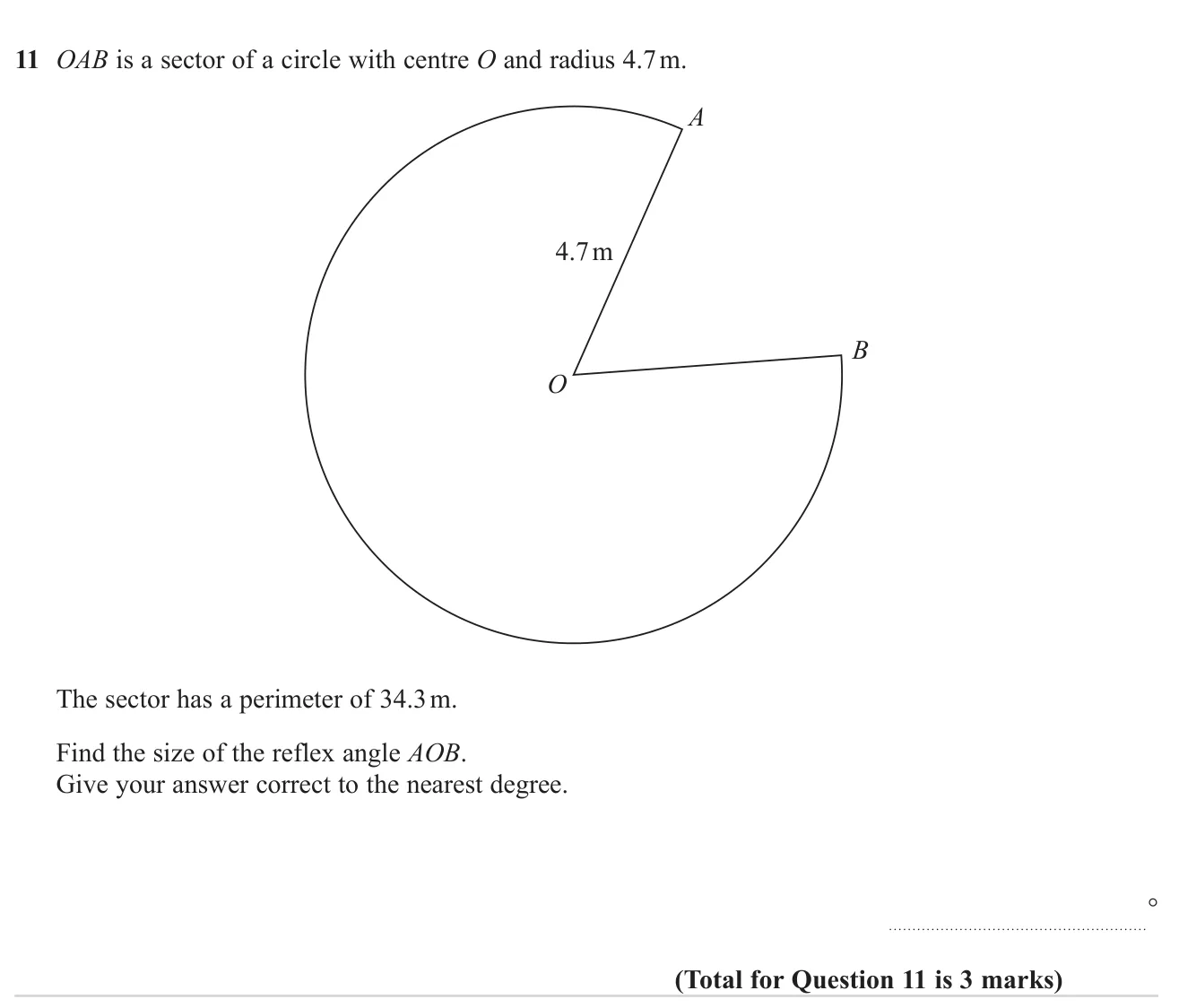
© Pearson Education Ltd. November 2024 Paper 3 (Higher, calculator), question 11.
Show answer
| Answer | 304∘ | 3 marks |
|---|
Worked solution Checked against the mark scheme
Arc length =34.3−2×4.7=24.9 m
Arc =360θ×2πr, so
θ=2π×4.724.9×360=303.5...≈304∘
Watch out: Forgetting to subtract the two radii from the perimeter.
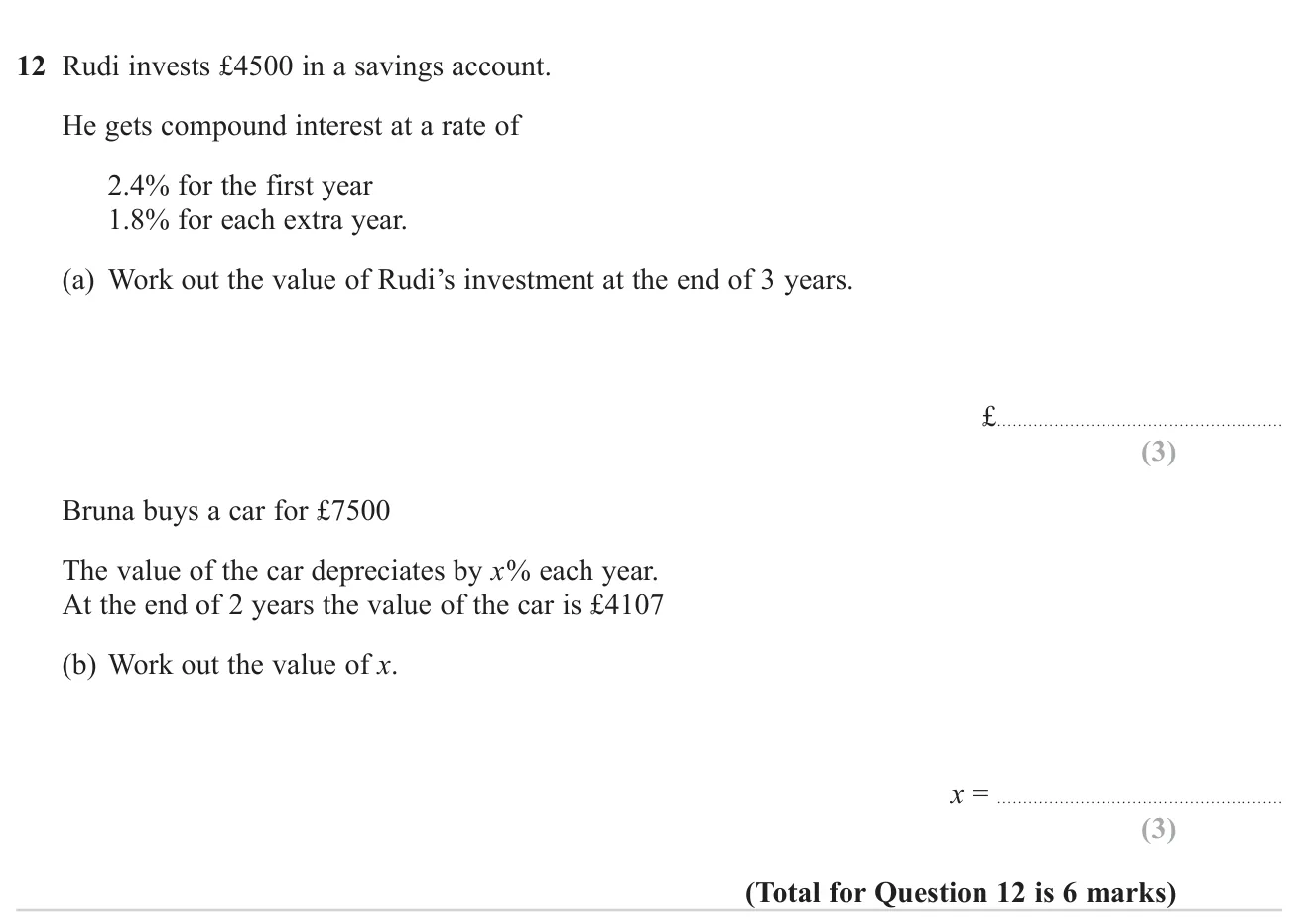
© Pearson Education Ltd. November 2024 Paper 3 (Higher, calculator), question 12.
Show answer
| (a) | £4775.38 | 3 marks |
|---|
| (b) | x=26 | 3 marks |
|---|
Worked solution Checked against the mark scheme
(a) 4500×1.024=4608
4608×1.0182=4775.38..., so £4775.38
(b) Multiplier over 2 years =4107÷7500=0.5476
Yearly multiplier =0.5476=0.74
1−0.74=0.26, so x=26
Watch out: In (b), halving the total percentage loss instead of square-rooting the multiplier.
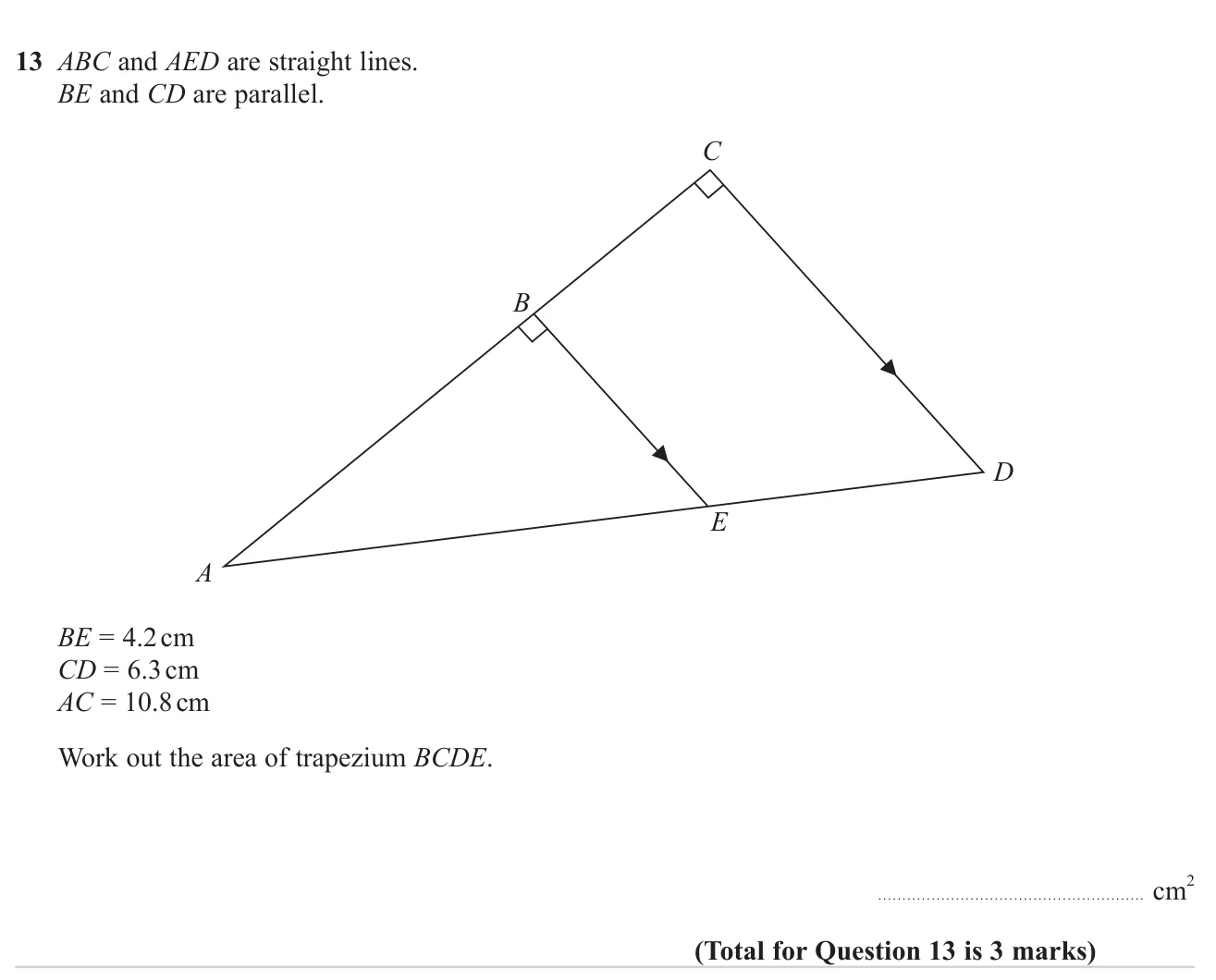
© Pearson Education Ltd. November 2024 Paper 3 (Higher, calculator), question 13.
Show answer
| Answer | 18.9 cm² | 3 marks |
|---|
Worked solution Checked against the mark scheme
Triangles ABE and ACD are similar with scale factor 6.34.2=32.
AB=32×10.8=7.2, so BC=10.8−7.2=3.6 cm
Area =24.2+6.3×3.6=18.9 cm²
Watch out: Using AC (10.8) as the height of the trapezium instead of BC.
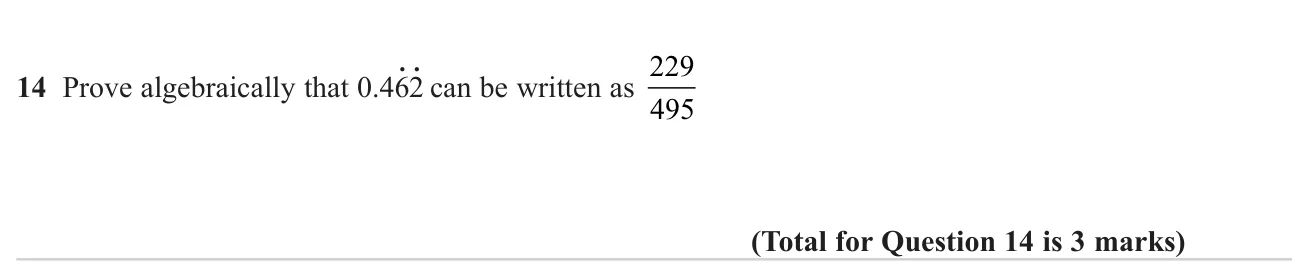
© Pearson Education Ltd. November 2024 Paper 3 (Higher, calculator), question 14.
Show answer
| Answer | x=0.46˙2˙, 1000x−10x=458, so x=990458=495229 | 3 marks |
|---|
Worked solution Checked against the mark scheme
Let x=0.4626262...
1000x=462.626262...
10x=4.626262...
Subtract: 990x=458
x=990458=495229
Watch out: Using 100x − x, which does not cancel the recurring part because the 4 does not repeat.
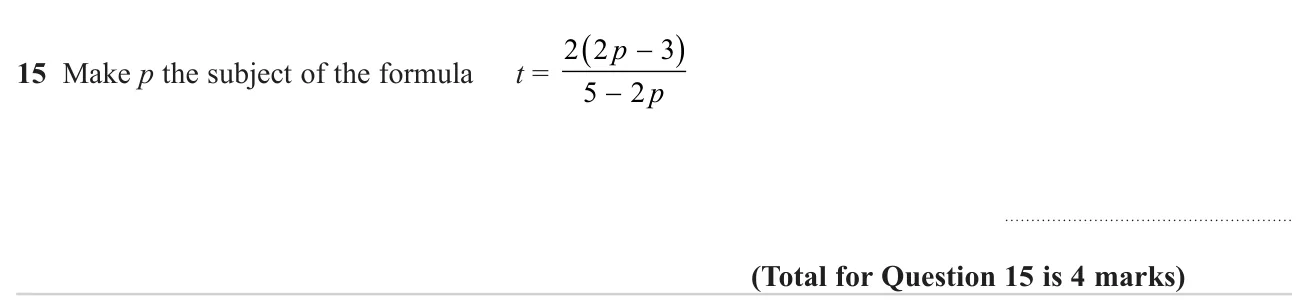
© Pearson Education Ltd. November 2024 Paper 3 (Higher, calculator), question 15.
Show answer
| Answer | p=4+2t5t+6 | 4 marks |
|---|
Worked solution Checked against the mark scheme
t(5−2p)=2(2p−3)
5t−2pt=4p−6
5t+6=4p+2pt
5t+6=p(4+2t)
p=4+2t5t+6
Watch out: Not factorising, so p is left on both sides.
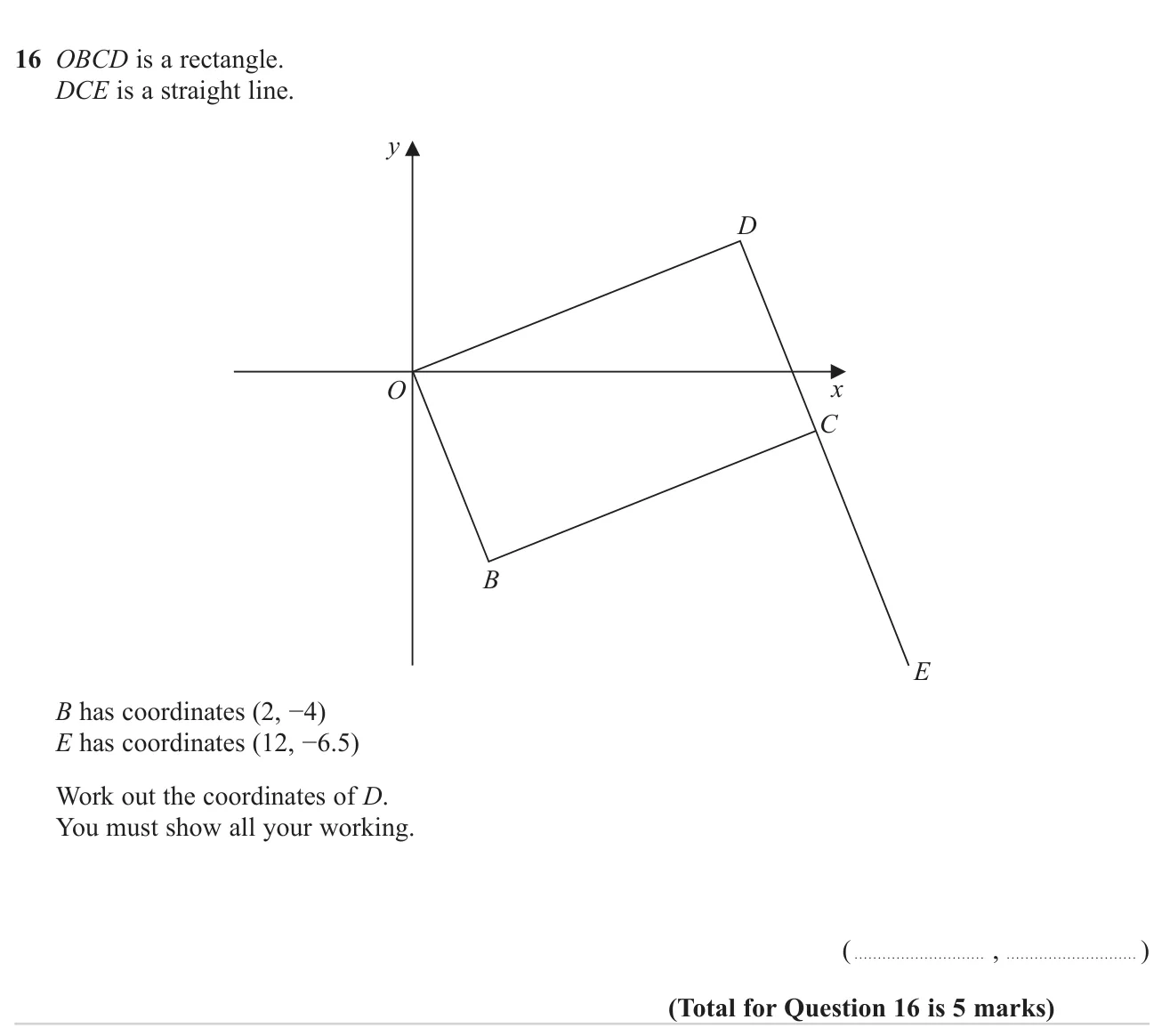
© Pearson Education Ltd. November 2024 Paper 3 (Higher, calculator), question 16.
Show answer
| Answer | (7, 3.5) | 5 marks |
|---|
Worked solution Checked against the mark scheme
Gradient of OB =2−4=−2
DE is parallel to OB through (12,−6.5): y=−2x+c, −6.5=−24+c, so y=−2x+17.5
OD is perpendicular to OB through O: gradient 21, so y=21x
21x=−2x+17.5⇒2.5x=17.5⇒x=7, y=3.5
D=(7,3.5)
Watch out: Using gradient −½ (the negative, not the negative reciprocal) for the perpendicular line.
© Pearson Education Ltd. November 2024 Paper 3 (Higher, calculator), question 17.
Show answer
| Answer | 56.0 cm² | 4 marks |
|---|
Worked solution Checked against the mark scheme
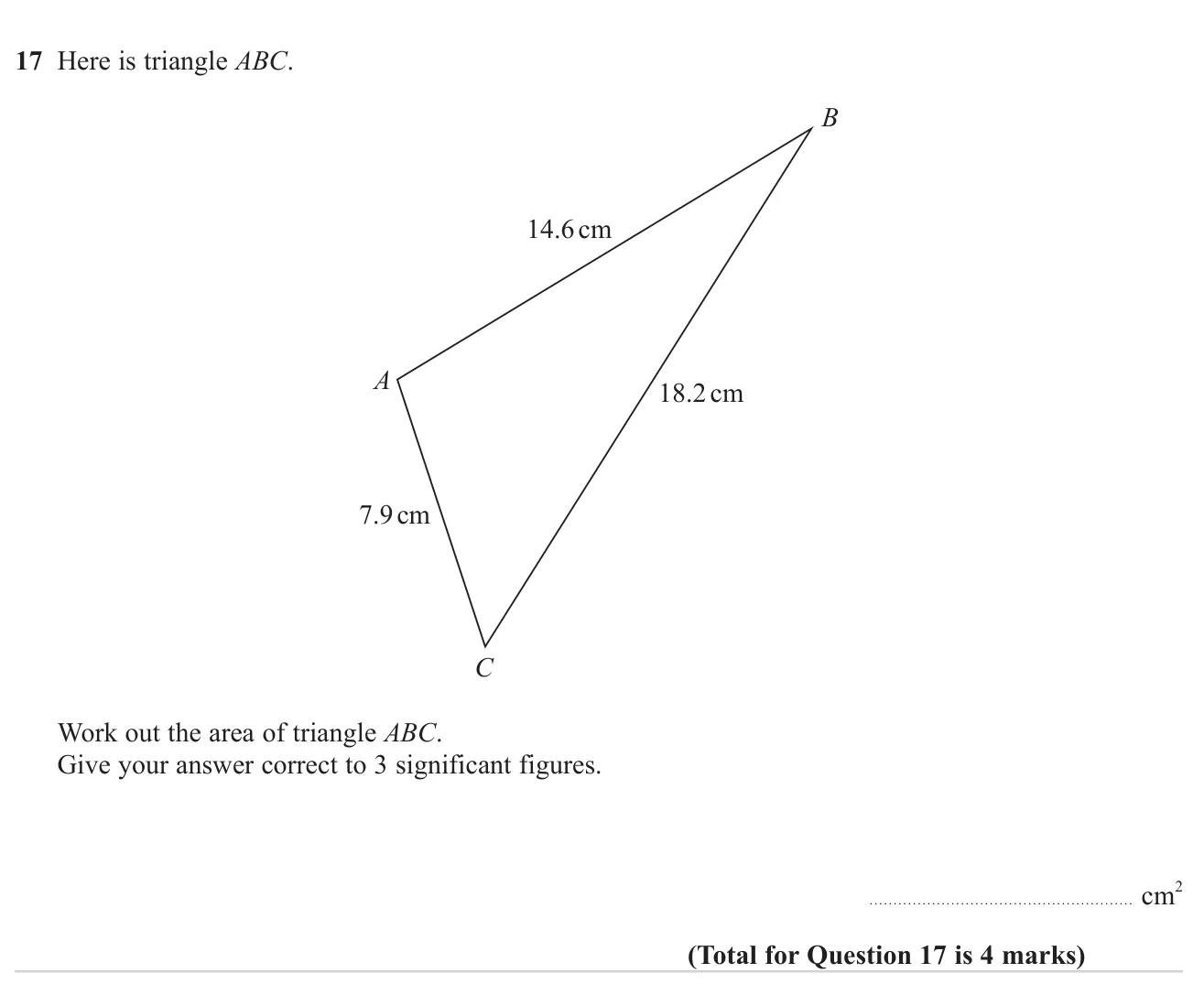
Angle A is between 14.6 and 7.9 cm:
cosA=2×14.6×7.914.62+7.92−18.22=−0.2413..., so A=103.97∘
Area =21×14.6×7.9×sin103.97∘=55.97≈56.0 cm²
Watch out: Pairing an angle with the wrong two sides in the area formula.
© Pearson Education Ltd. November 2024 Paper 3 (Higher, calculator), question 18.
Show answer
| (a) | 200 | 3 marks |
|---|
| (b) | e.g. No frogs joined or left the lake between Saturday and Monday | 1 mark |
|---|
Worked solution Checked against the mark scheme
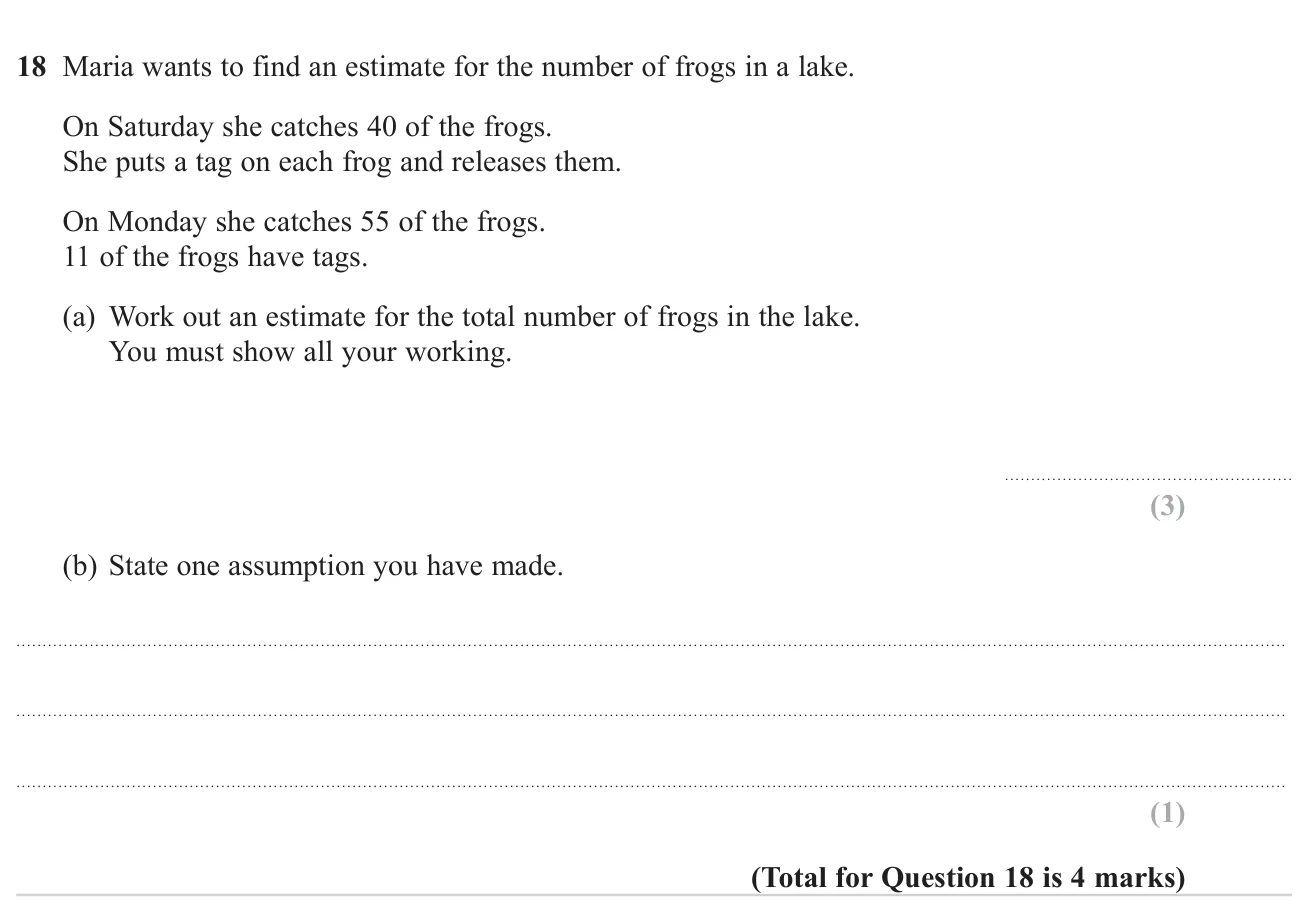
(a) In the second sample 5511=51 are tagged.
So the 40 tagged frogs are about 51 of all frogs:
N=1140×55=200
(b) For example: the number of frogs stayed the same (none born, died, arrived or left).
Watch out: Working out 55 × 11 ÷ 40 by mixing up which numbers go where.
© Pearson Education Ltd. November 2024 Paper 3 (Higher, calculator), question 19.
Show answer
Worked solution Checked against the mark scheme
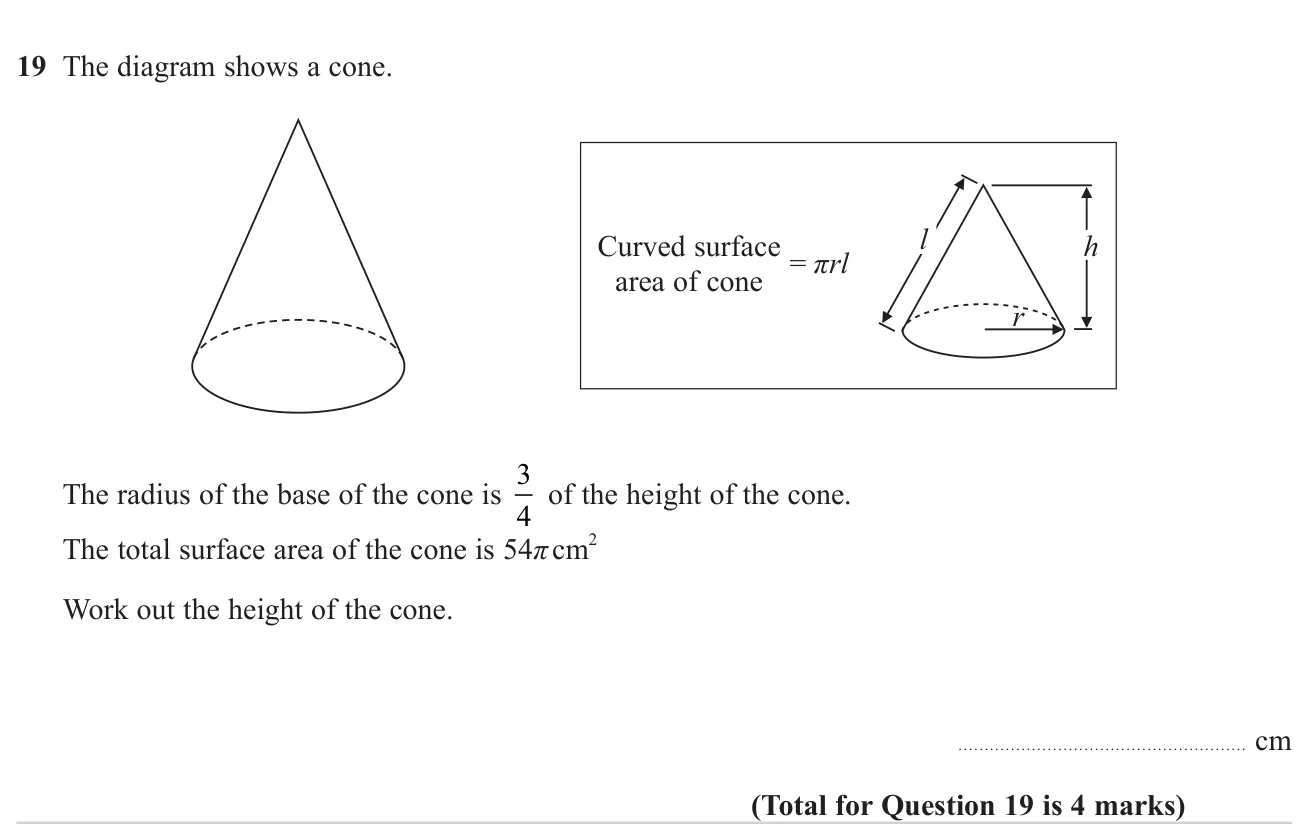
Let height =h, so r=43h.
l=h2+169h2=45h
Total area =πrl+πr2=π(1615h2+169h2)=1624πh2
23h2=54⇒h2=36⇒h=6 cm
Watch out: Leaving out the circular base when finding the total surface area.
© Pearson Education Ltd. November 2024 Paper 3 (Higher, calculator), question 20.
Show answer
| Answer | x=26.3, y=−45.6 and x=1.71, y=3.58 (3.57 also accepted) | 4 marks |
|---|
Worked solution Checked against the mark scheme
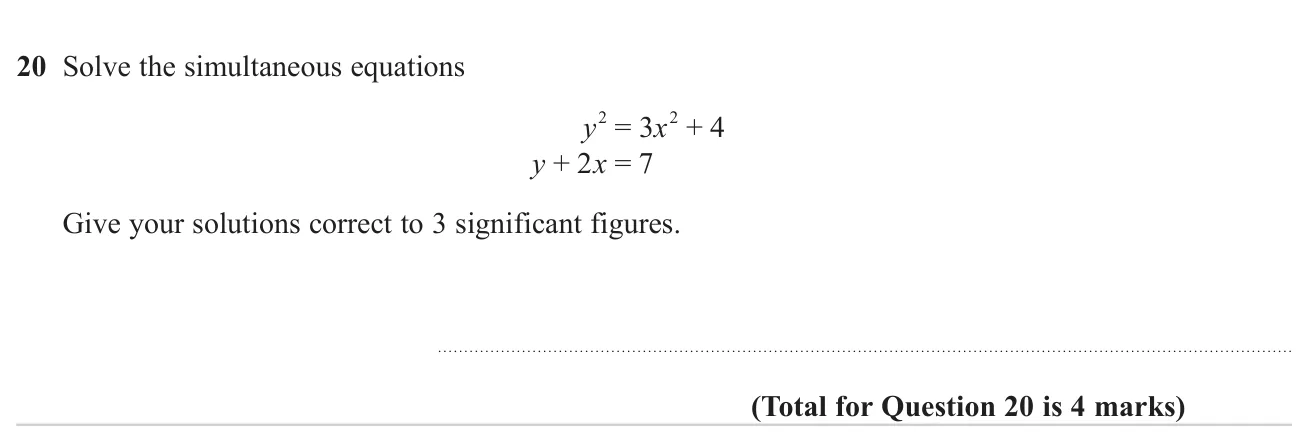
y=7−2x, so (7−2x)2=3x2+4
49−28x+4x2=3x2+4
x2−28x+45=0
x=14±151, so x=26.3 or x=1.71
Then y=7−2x: y=−45.6 or y=3.58
Watch out: Expanding (7 − 2x)² as 49 + 4x² without the middle term.
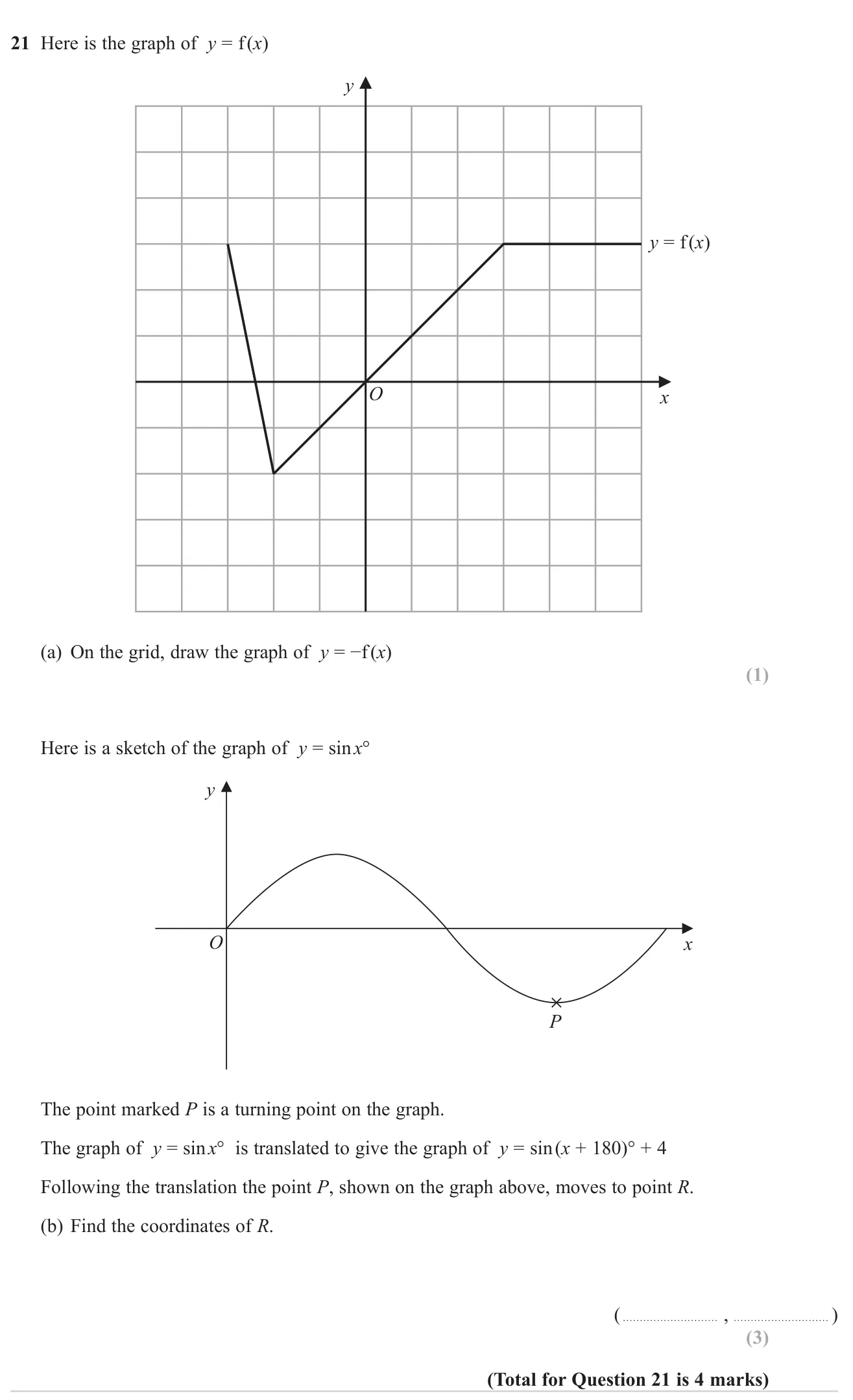
© Pearson Education Ltd. November 2024 Paper 3 (Higher, calculator), question 21.
Show answer
| (a) | Graph of y=−f(x): the given graph reflected in the x-axis | 1 mark |
|---|
| (b) | (90, 3) | 3 marks |
|---|
Worked solution Checked against the mark scheme
(a) Each point (x,y) moves to (x,−y): reflect the graph in the x-axis.
(b) P is the minimum of sinx at (270,−1).
sin(x+180)+4 moves the graph 180 left and 4 up.
R=(270−180, −1+4)=(90,3)
Watch out: Moving the graph 180 to the right instead of the left.
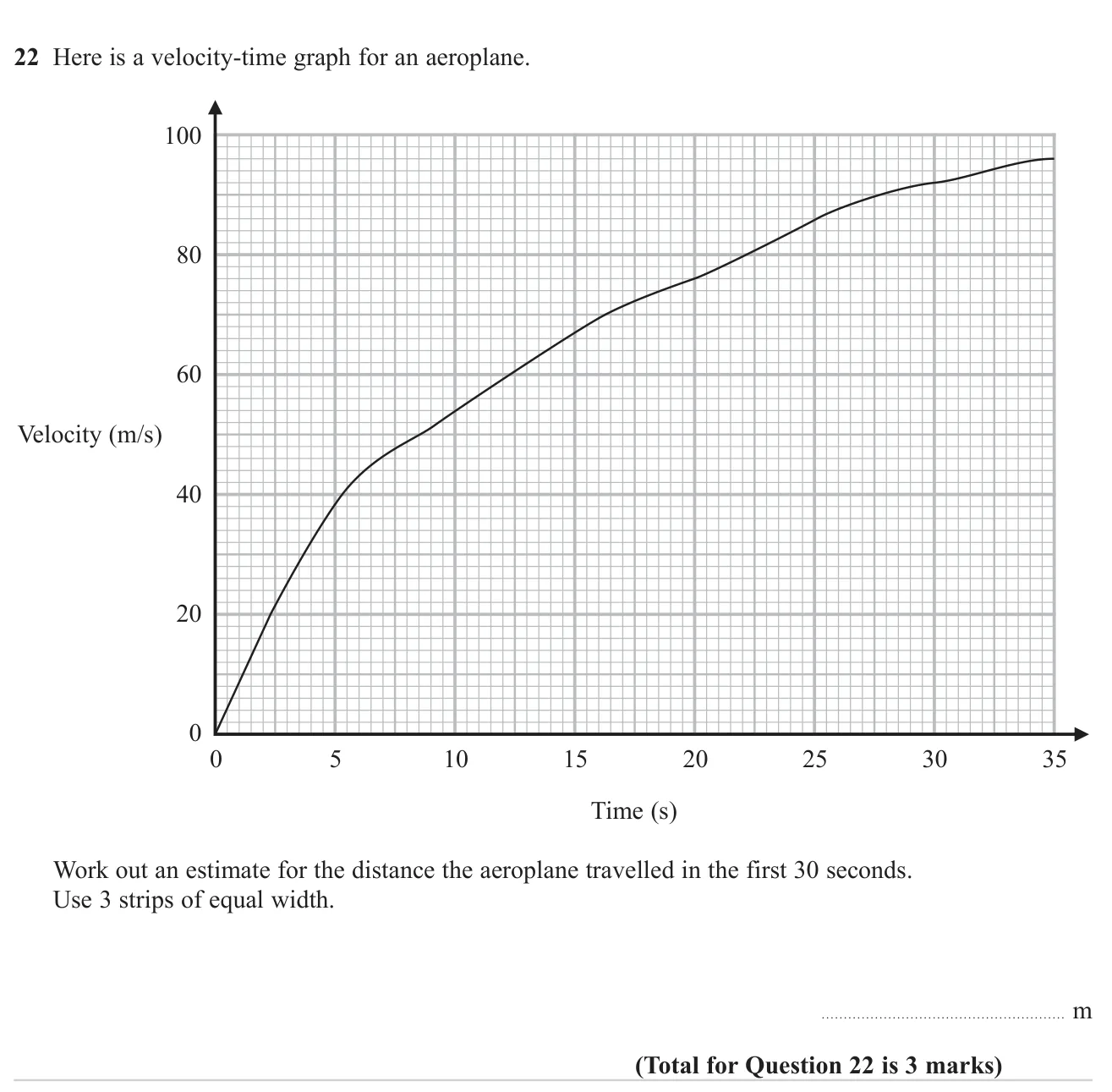
© Pearson Education Ltd. November 2024 Paper 3 (Higher, calculator), question 22.
Show answer
| Answer | 1760 m | 3 marks |
|---|
Worked solution Checked against the mark scheme
Split 0–30 s into strips of width 10. Read velocities: 0, 54, 76, 92 m/s.
Triangle: 21×10×54=270
Trapezium: 21×10×(54+76)=650
Trapezium: 21×10×(76+92)=840
Distance ≈270+650+840=1760 m
Watch out: Using strips of width 5 or reading the graph at the wrong times.
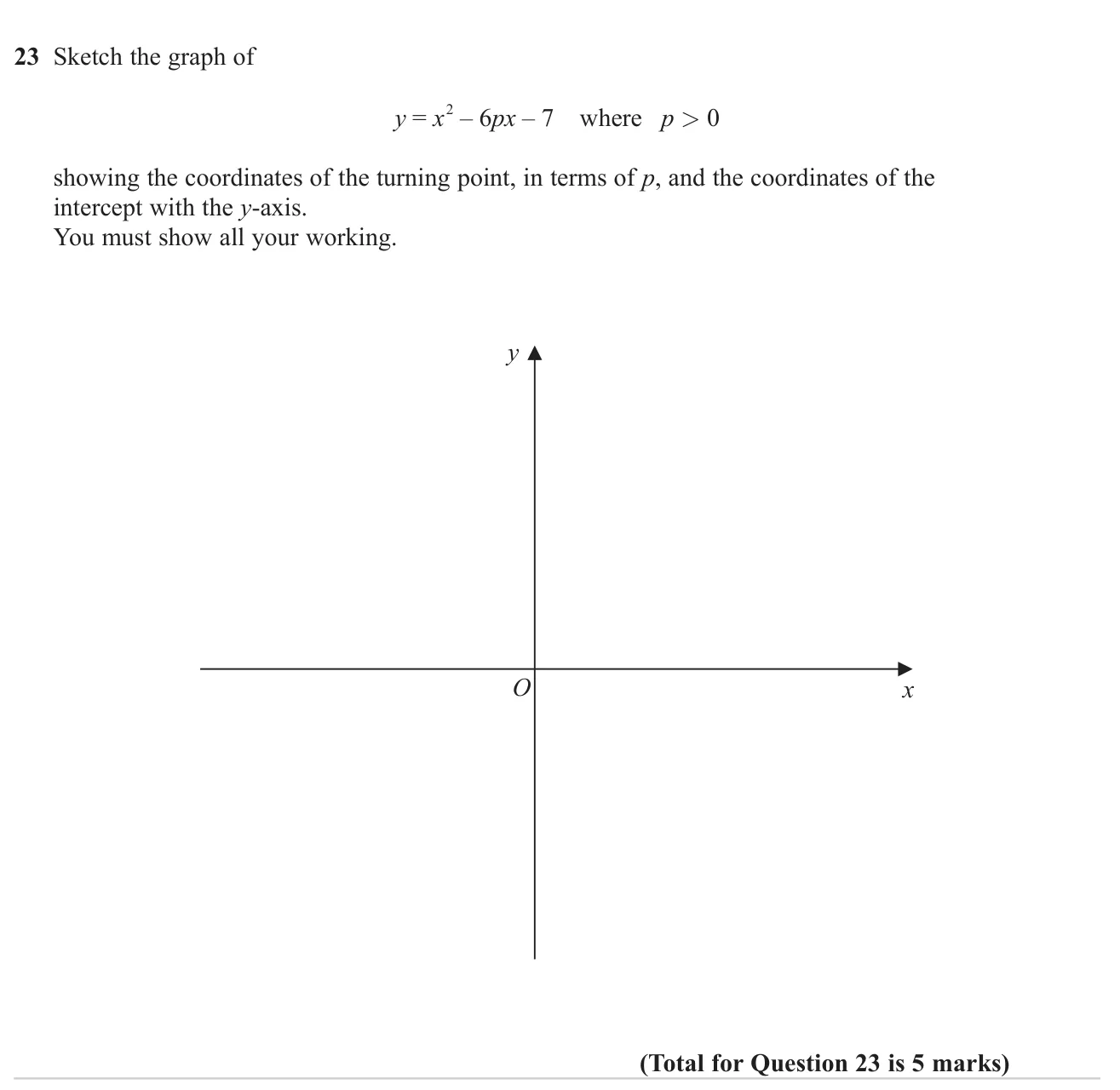
© Pearson Education Ltd. November 2024 Paper 3 (Higher, calculator), question 23.
Show answer
| Answer | U-shaped curve with minimum at (3p, −9p2−7) in the fourth quadrant and y-intercept (0,−7) | 5 marks |
|---|
Worked solution Checked against the mark scheme
y=x2−6px−7=(x−3p)2−9p2−7
Turning point (minimum): (3p, −9p2−7)
When x=0, y=−7, so the y-intercept is (0,−7).
Since p>0, 3p>0 and −9p2−7<0: the minimum is in the fourth quadrant. Sketch a U-shape through (0,−7) with its lowest point there.
Watch out: Writing the turning point as (−3p, ...) by getting the sign in the bracket wrong.
Finished the paper?
Add up your marks for all three papers and see what grade that would have been.