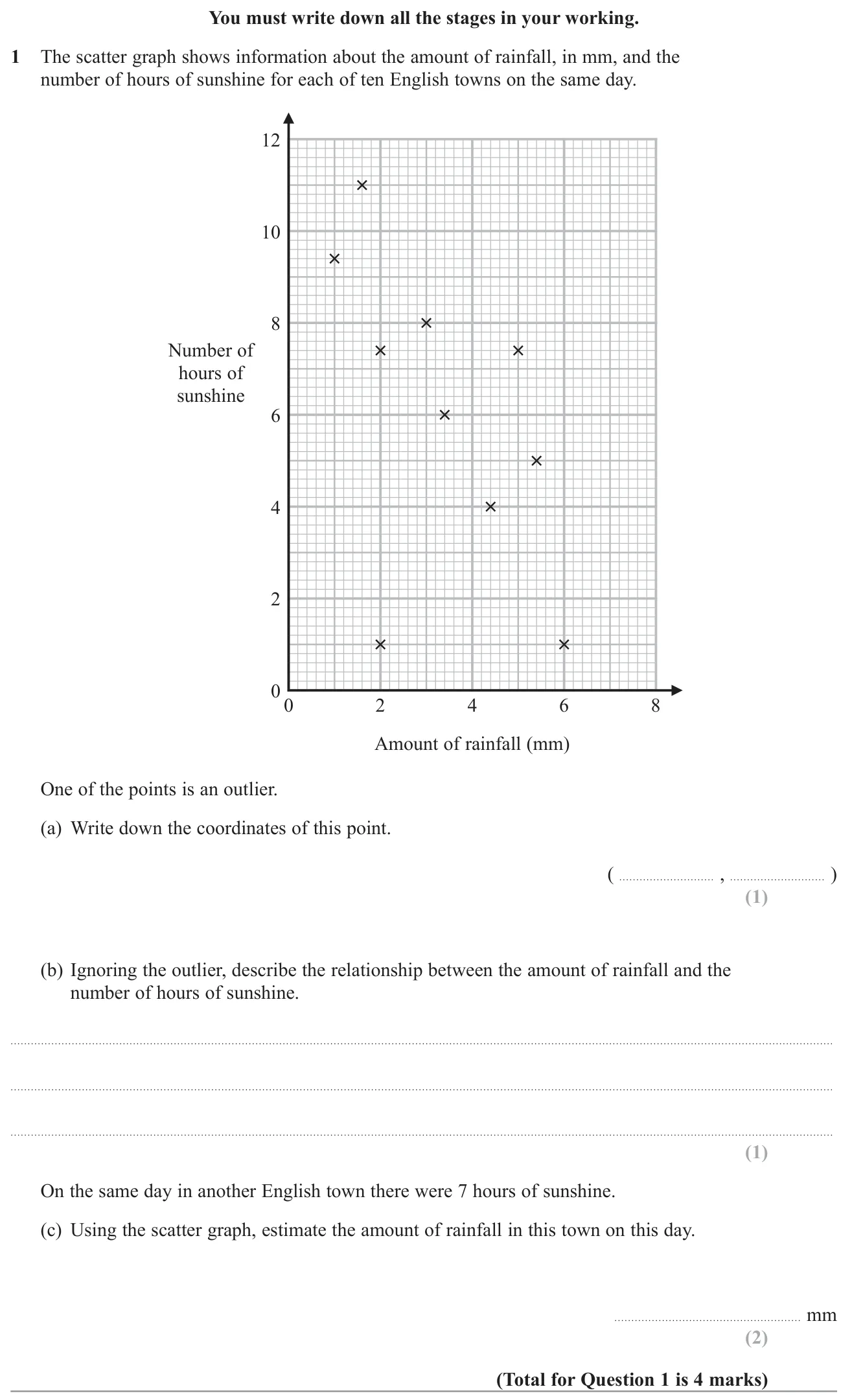
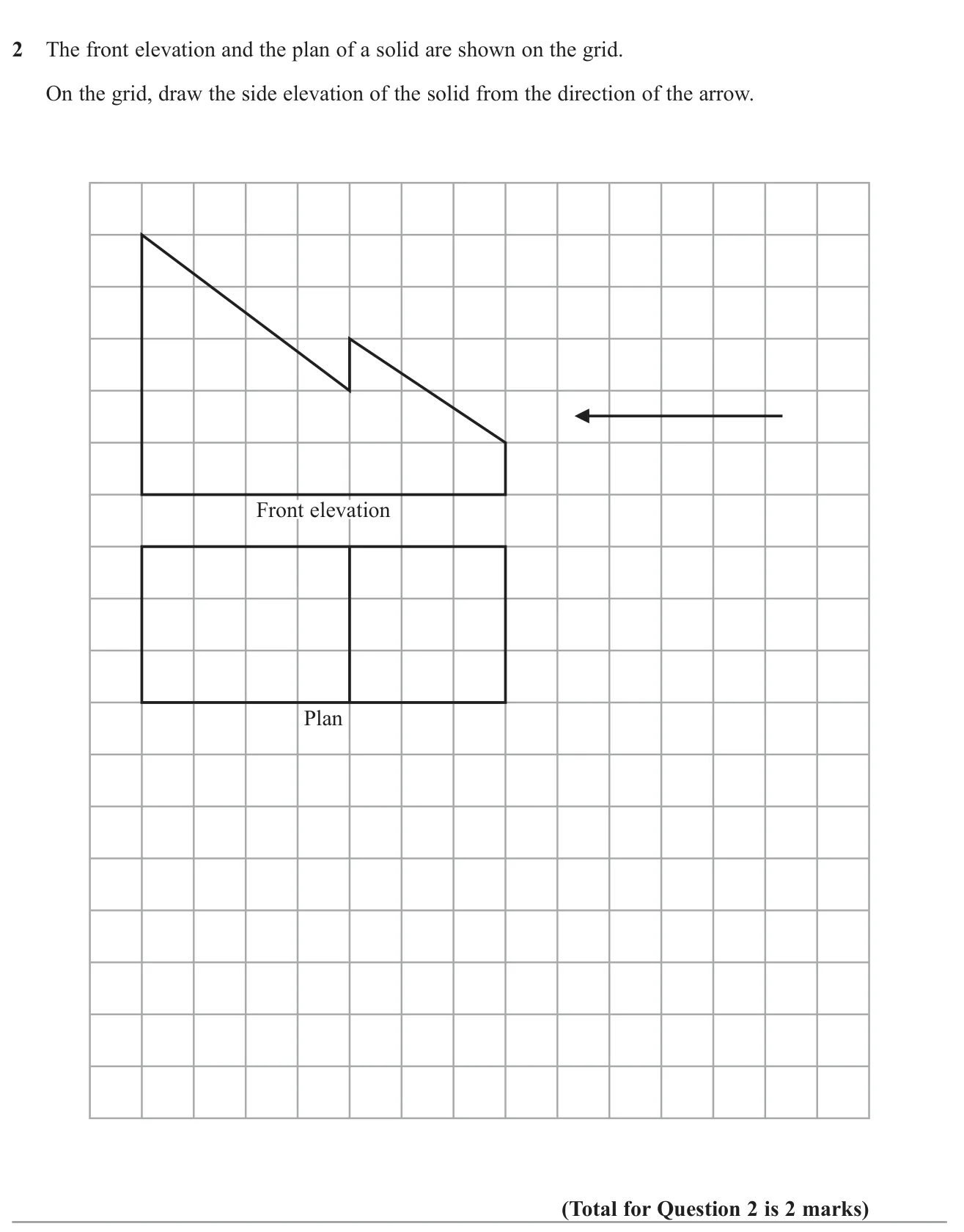
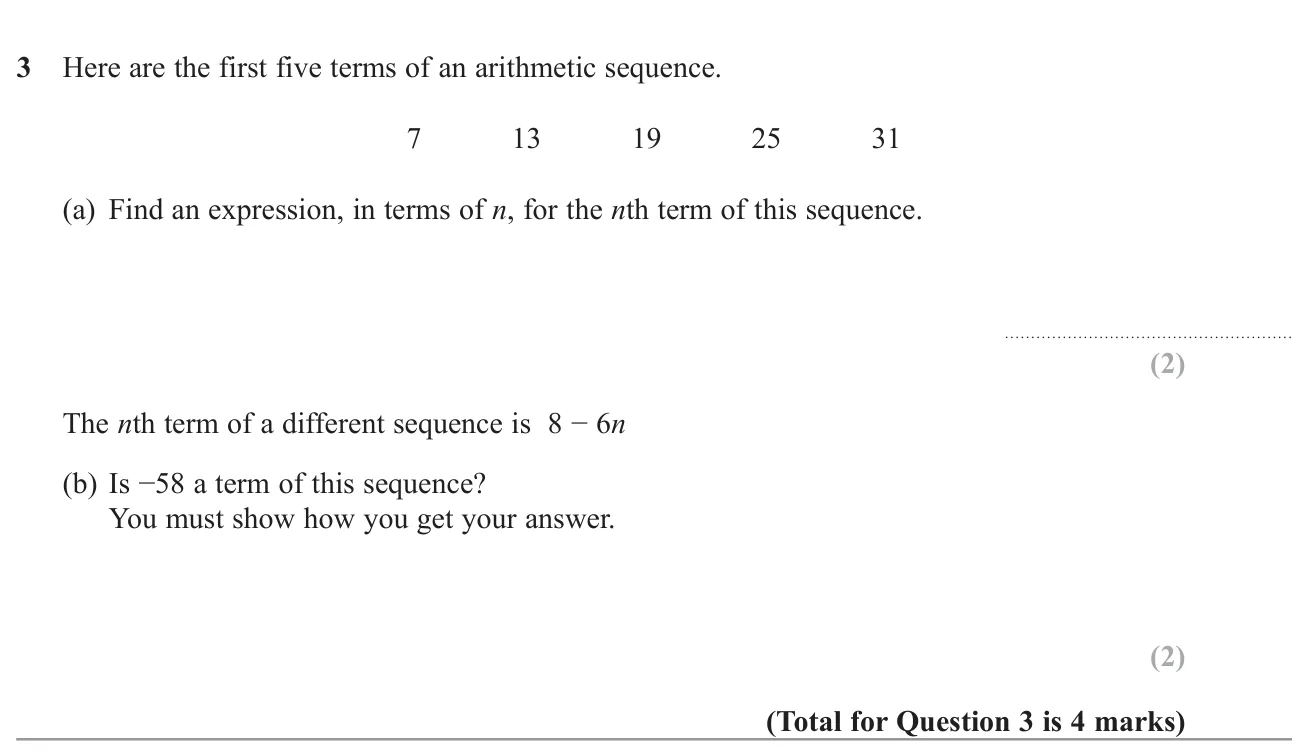
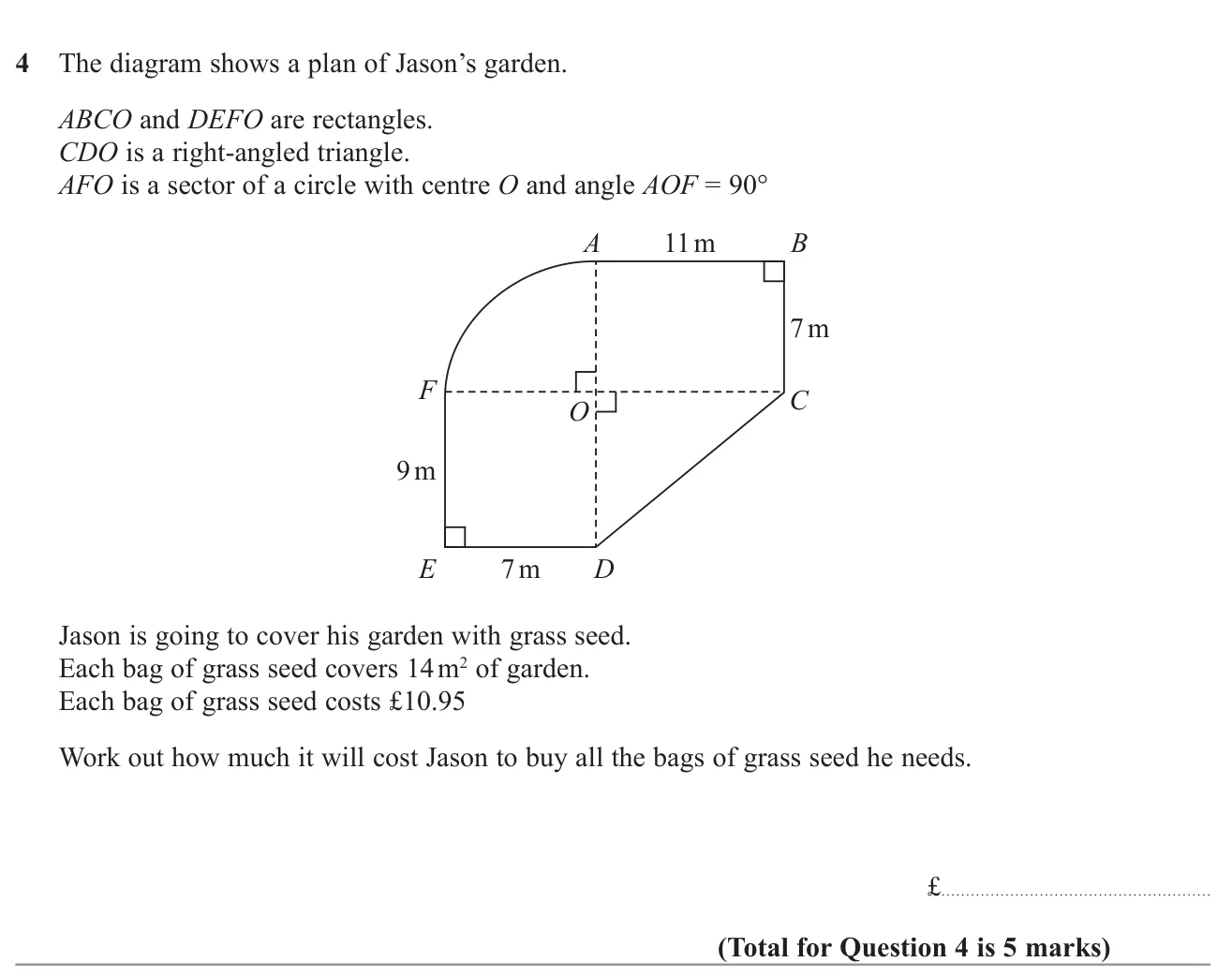
© Pearson Education Ltd. November 2022 Paper 2 (Higher, calculator), question 1.
(a) ( 2 , 1 ) (2, 1) ( 2 , 1 ) 1 mark (b) Negative correlation: more rainfall goes with fewer hours of sunshine 1 mark (c) 3 to 4 mm 2 marks
Worked solution Checked against the mark scheme
(a) The point at ( 2 , 1 ) (2, 1) ( 2 , 1 )
(b) As rainfall goes up, sunshine goes down: negative correlation .
(c) Draw a line of best fit, go across from 7 hours to the line and down: about 3.5 mm .
Watch out: Choosing (6, 1) as the outlier; it fits the downward trend.
© Pearson Education Ltd. November 2022 Paper 2 (Higher, calculator), question 2.
Answer A rectangle 3 squares wide and 5 squares high 2 marks
Worked solution Checked against the mark scheme
Viewed from the right, the width comes from the depth of the plan (3 squares) and the height from the tallest point of the front elevation (5 squares).
Draw a rectangle 3 wide and 5 high. Visible edges where the sloping faces meet appear as horizontal lines across it.
Watch out: Drawing the front elevation again instead of the side view.
© Pearson Education Ltd. November 2022 Paper 2 (Higher, calculator), question 3.
(a) 6 n + 1 6n + 1 6 n + 1 2 marks (b) Yes: 8 − 6 n = − 58 8 - 6n = -58 8 − 6 n = − 58 n = 11 n = 11 n = 11 2 marks
Worked solution Checked against the mark scheme
(a) The terms go up by 6, so start with 6 n 6n 6 n 6 n + 1 6n + 1 6 n + 1
(b) 8 − 6 n = − 58 8 - 6n = -58 8 − 6 n = − 58
6 n = 66 6n = 66 6 n = 66 n = 11 n = 11 n = 11
11 is a whole number, so yes , − 58 -58 − 58
Watch out: Writing n + 6 n + 6 n + 6
© Pearson Education Ltd. November 2022 Paper 2 (Higher, calculator), question 4.
Worked solution Checked against the mark scheme
Rectangle ABCO: 11 × 7 = 77 11 \times 7 = 77 11 × 7 = 77
Rectangle DEFO: 7 × 9 = 63 7 \times 9 = 63 7 × 9 = 63
Triangle CDO: 1 2 × 11 × 9 = 49.5 \frac12 \times 11 \times 9 = 49.5 2 1 × 11 × 9 = 49.5
Quarter circle: 1 4 × π × 7 2 = 38.48... \frac14 \times \pi \times 7^2 = 38.48... 4 1 × π × 7 2 = 38.48...
Total = 227.98... m 2 = 227.98...\text{ m}^2 = 227.98... m 2 227.98 ÷ 14 = 16.28... 227.98 \div 14 = 16.28... 227.98 ÷ 14 = 16.28...
17 × 10.95 = £ 186.15 17 \times 10.95 = £186.15 17 × 10.95 = £186.15
Watch out: Rounding 16.28 bags down to 16.
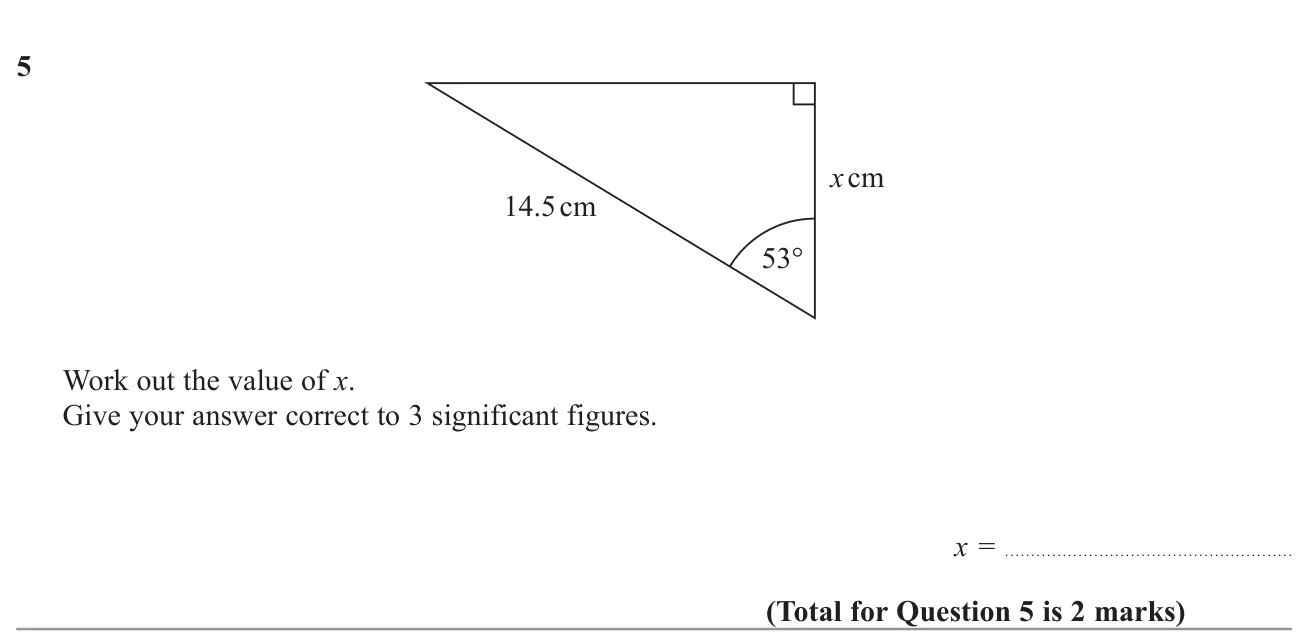
© Pearson Education Ltd. November 2022 Paper 2 (Higher, calculator), question 5.
Worked solution Checked against the mark scheme
x x x 53 ° 53° 53°
x = 14.5 cos 53 ° = 8.726... x = 14.5 \cos 53° = 8.726... x = 14.5 cos 53° = 8.726...
x = 8.73 x = 8.73 x = 8.73
Watch out: Using sine instead of cosine.
© Pearson Education Ltd. November 2022 Paper 2 (Higher, calculator), question 6.
Worked solution Checked against the mark scheme
After year 1: 7000 × 1.03 = 7210 7000 \times 1.03 = 7210 7000 × 1.03 = 7210
After year 2: 7210 × 1.015 = £ 7318.15 7210 \times 1.015 = £7318.15 7210 × 1.015 = £7318.15
Watch out: Adding 4.5% simple interest to get £7315.
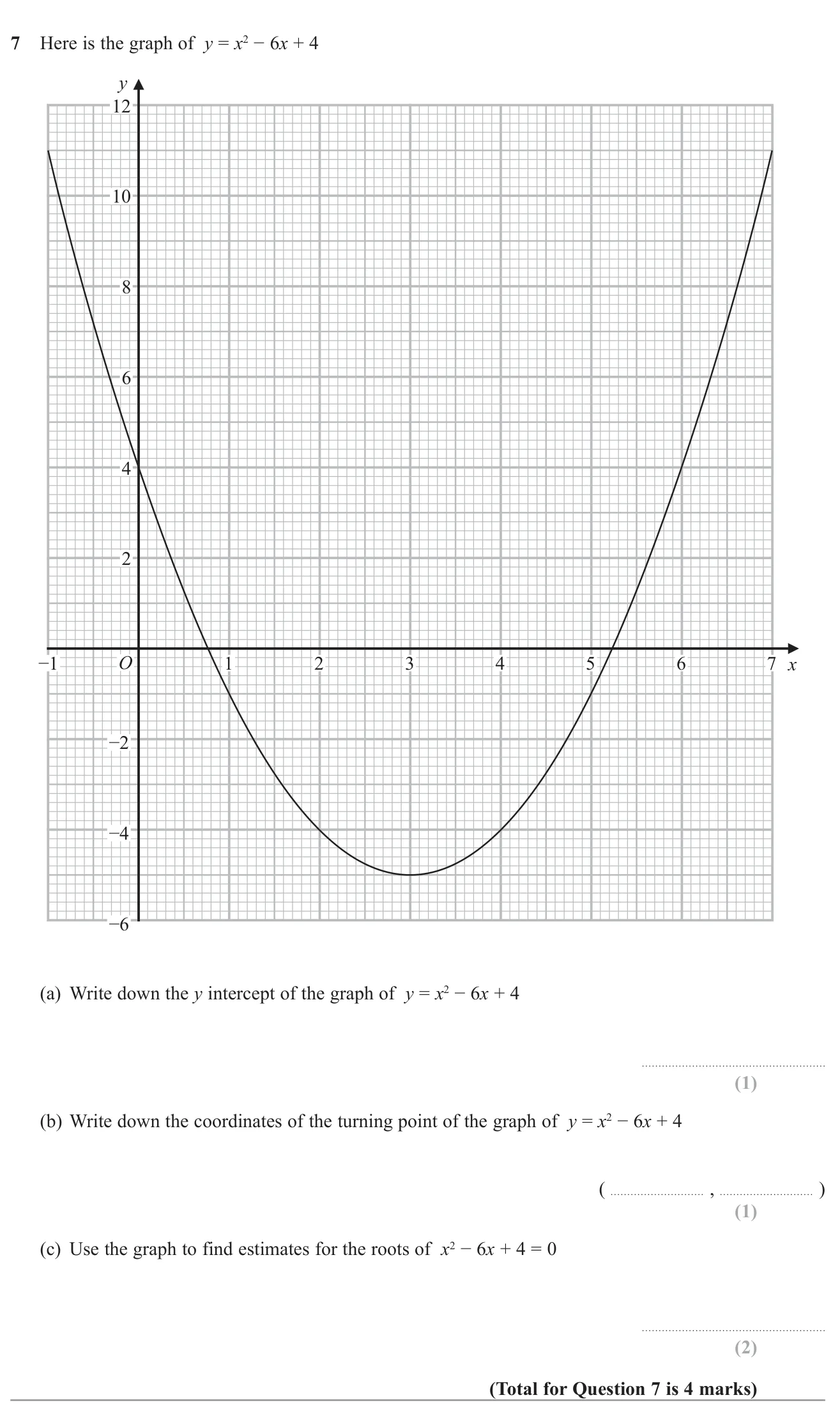
© Pearson Education Ltd. November 2022 Paper 2 (Higher, calculator), question 7.
(a) 4 1 mark (b) ( 3 , − 5 ) (3, -5) ( 3 , − 5 ) 1 mark (c) x ≈ 0.8 x \approx 0.8 x ≈ 0.8 x ≈ 5.2 x \approx 5.2 x ≈ 5.2 2 marks
Worked solution Checked against the mark scheme
(a) The curve crosses the y-axis where x = 0 x = 0 x = 0 y = 4 y = 4 y = 4
(b) The lowest point is at ( 3 , − 5 ) (3, -5) ( 3 , − 5 )
(c) Read where the curve crosses the x-axis: about x = 0.8 x = 0.8 x = 0.8 x = 5.2 x = 5.2 x = 5.2
Watch out: Giving the roots as coordinates on the y-axis.
© Pearson Education Ltd. November 2022 Paper 2 (Higher, calculator), question 8.
Answer 12.5 % 12.5\% 12.5% 3 marks
Worked solution Checked against the mark scheme
Profit = 135 − 120 = £ 15 = 135 - 120 = £15 = 135 − 120 = £15
Percentage profit = 15 120 × 100 = 12.5 % = \frac{15}{120} \times 100 = 12.5\% = 120 15 × 100 = 12.5%
Watch out: Dividing by the selling price, 15 ÷ 135, giving 11.1%.
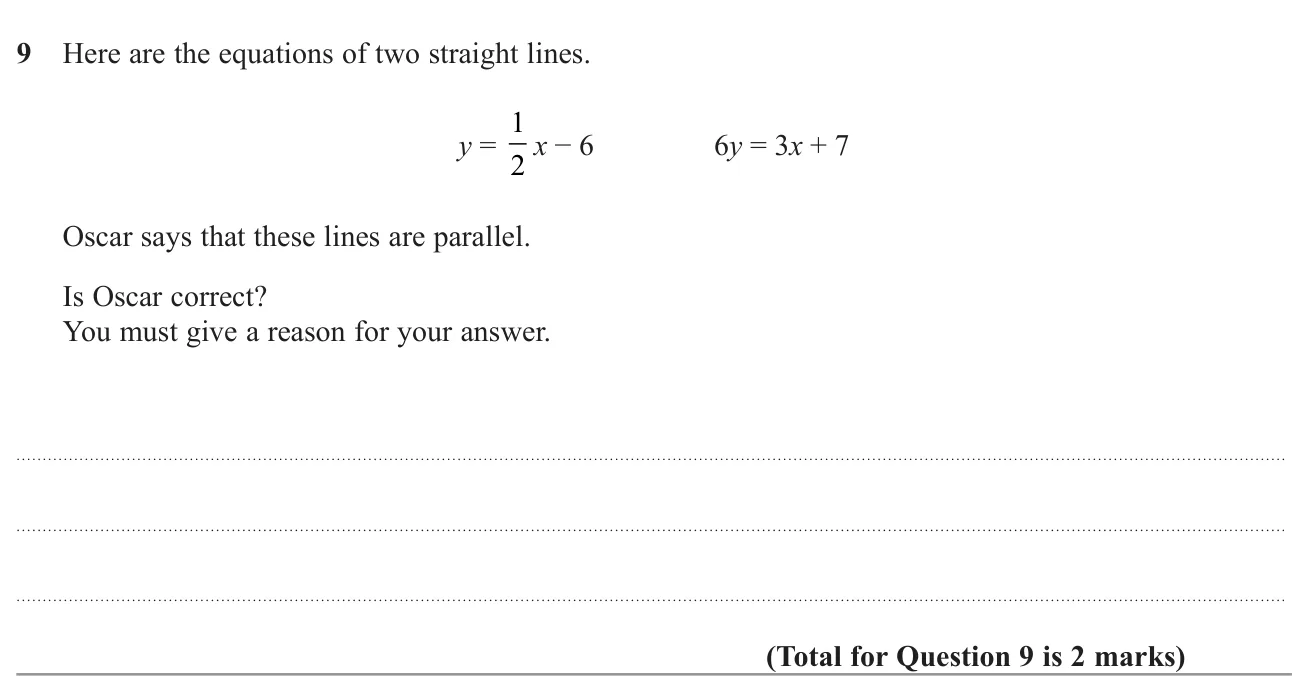
© Pearson Education Ltd. November 2022 Paper 2 (Higher, calculator), question 9.
Answer Yes: both lines have gradient 1 2 \frac{1}{2} 2 1 2 marks
Worked solution Checked against the mark scheme
Divide 6 y = 3 x + 7 6y = 3x + 7 6 y = 3 x + 7 y = 1 2 x + 7 6 y = \frac{1}{2}x + \frac{7}{6} y = 2 1 x + 6 7
The first line is y = 1 2 x − 6 y = \frac{1}{2}x - 6 y = 2 1 x − 6
Both gradients are 1 2 \frac{1}{2} 2 1
Watch out: Reading the gradient of the second line as 3 without dividing by 6.
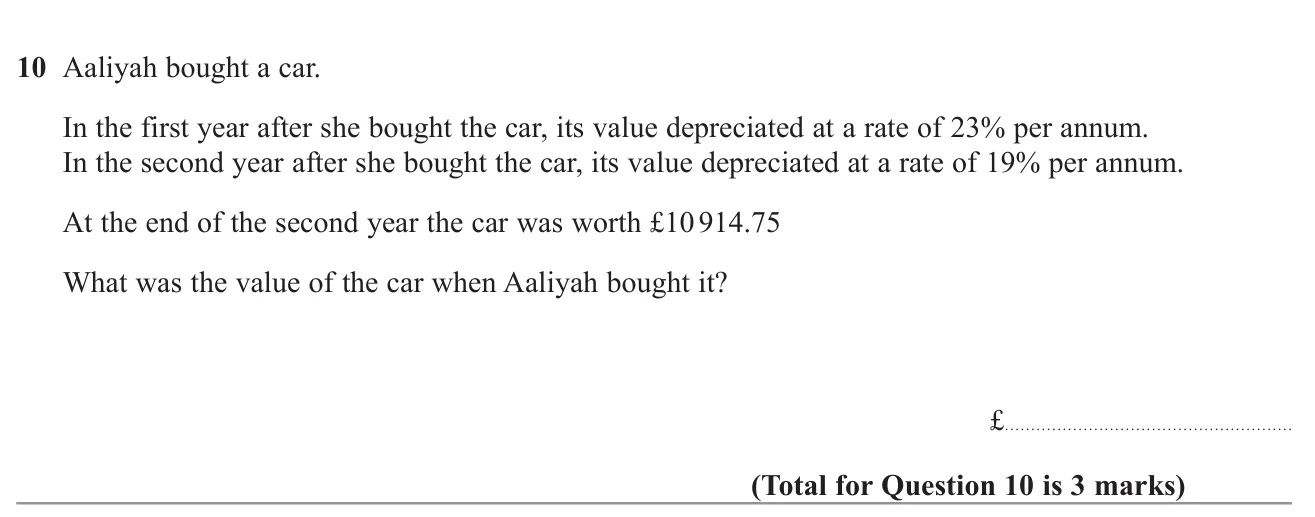
© Pearson Education Ltd. November 2022 Paper 2 (Higher, calculator), question 10.
Worked solution Checked against the mark scheme
Multipliers: 1 − 0.23 = 0.77 1 - 0.23 = 0.77 1 − 0.23 = 0.77 1 − 0.19 = 0.81 1 - 0.19 = 0.81 1 − 0.19 = 0.81
Original × 0.77 × 0.81 = 10 914.75 \times 0.77 \times 0.81 = 10\,914.75 × 0.77 × 0.81 = 10 914.75
Original = 10 914.75 ÷ 0.6237 = £ 17 500 = 10\,914.75 \div 0.6237 = £17\,500 = 10 914.75 ÷ 0.6237 = £17 500
Watch out: Adding 42% back on to £10 914.75.
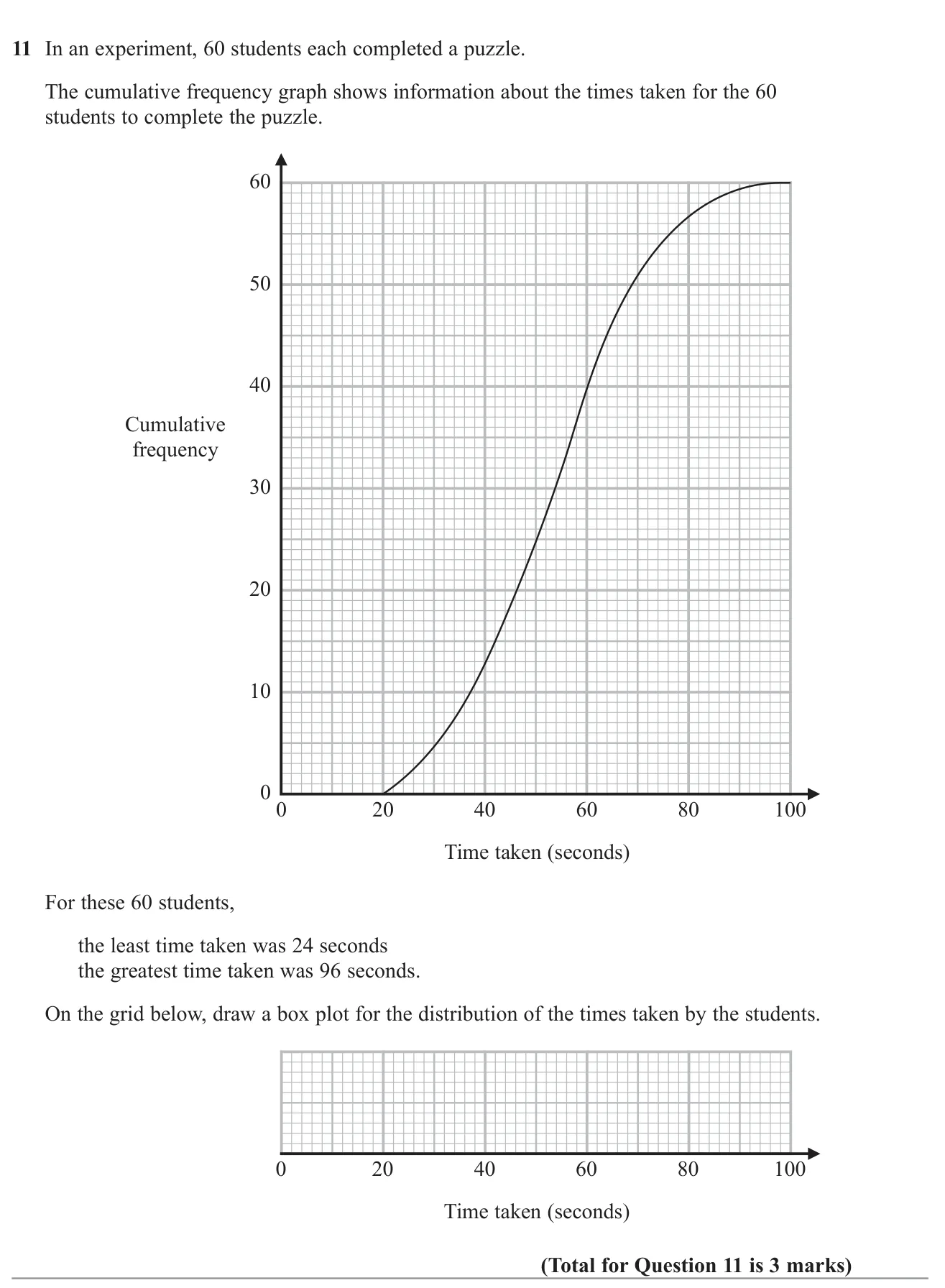
© Pearson Education Ltd. November 2022 Paper 2 (Higher, calculator), question 11.
Answer Box plot with minimum 24, lower quartile 42, median 54, upper quartile 64, maximum 96 3 marks
Worked solution Checked against the mark scheme
There are 60 students.
Lower quartile: read across from 15 → 42 s
Median: read across from 30 → 54 s
Upper quartile: read across from 45 → 64 s
Draw the box from 42 to 64 with a line at 54, and whiskers to 24 and 96.
Watch out: Reading the quartiles at cumulative frequencies of 25, 50 and 75 instead of a quarter, half and three quarters of 60.
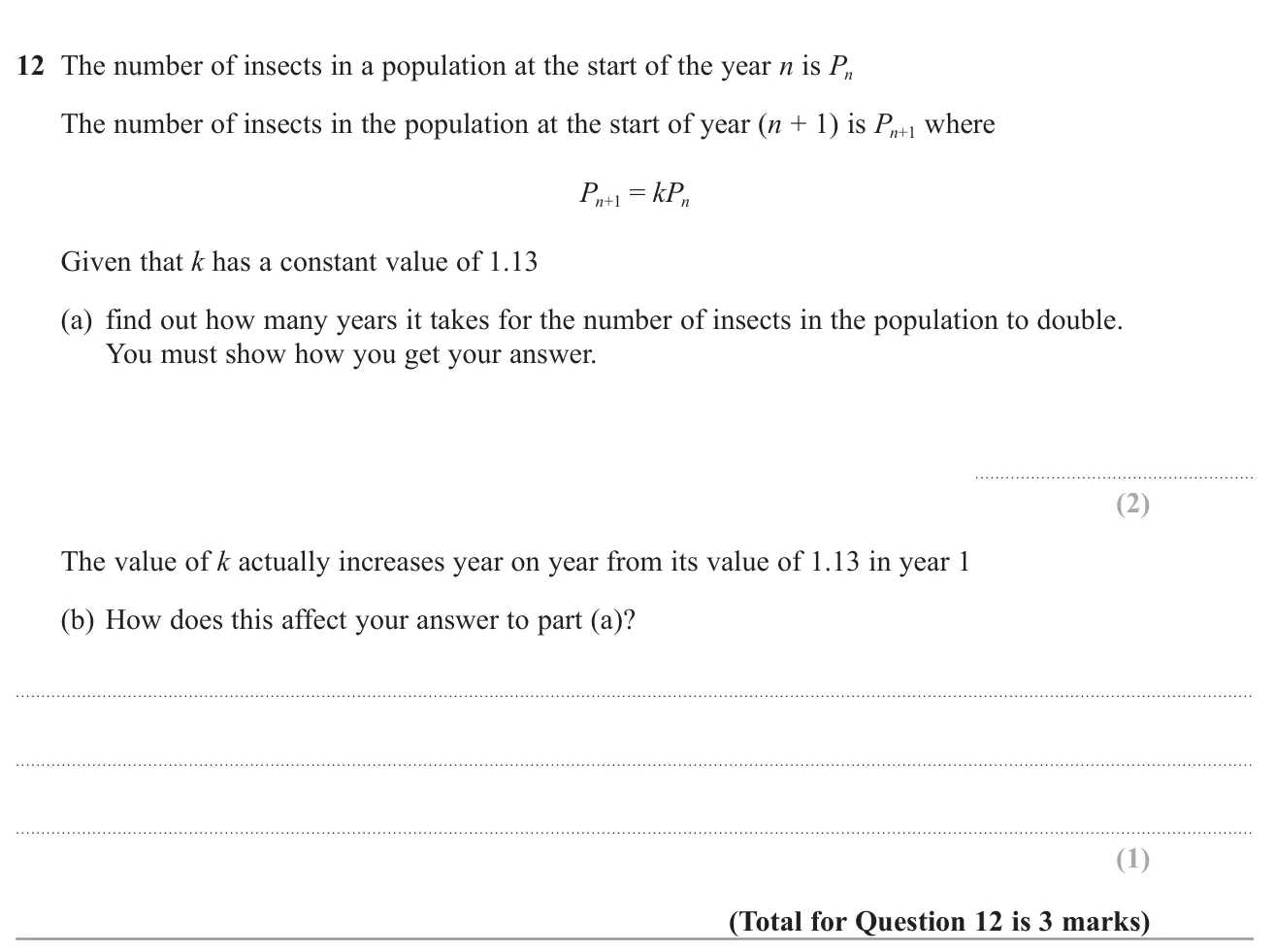
© Pearson Education Ltd. November 2022 Paper 2 (Higher, calculator), question 12.
(a) 6 years 2 marks (b) It would take fewer years (or it can't be known exactly) 1 mark
Worked solution Checked against the mark scheme
(a) Try powers of 1.13:
1.13 5 = 1.84... 1.13^5 = 1.84... 1.1 3 5 = 1.84...
1.13 6 = 2.08... 1.13^6 = 2.08... 1.1 3 6 = 2.08...
So it takes 6 years.
(b) If k k k
Watch out: In (b), saying it would take longer.
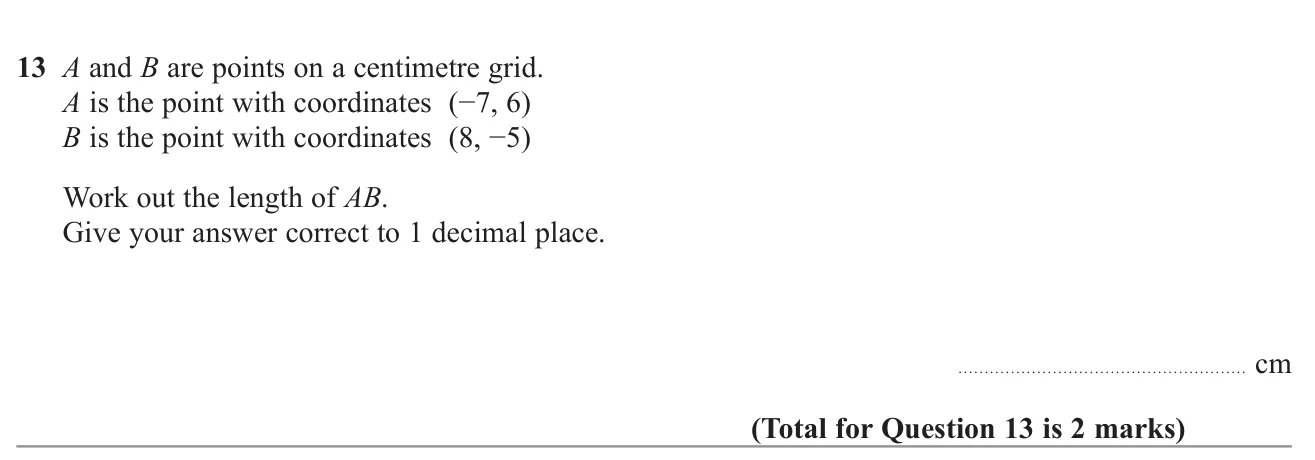
© Pearson Education Ltd. November 2022 Paper 2 (Higher, calculator), question 13.
Answer 18.6 18.6 18.6 2 marks
Worked solution Checked against the mark scheme
Horizontal difference: 8 − ( − 7 ) = 15 8 - (-7) = 15 8 − ( − 7 ) = 15
Vertical difference: 6 − ( − 5 ) = 11 6 - (-5) = 11 6 − ( − 5 ) = 11
A B = 15 2 + 11 2 = 346 = 18.60... AB = \sqrt{15^2 + 11^2} = \sqrt{346} = 18.60... A B = 1 5 2 + 1 1 2 = 346 = 18.60...
A B = 18.6 AB = 18.6 A B = 18.6
Watch out: Mixing up the signs, e.g. using 8 − 7 = 1.
© Pearson Education Ltd. November 2022 Paper 2 (Higher, calculator), question 14.
Answer Shown: 1.06 2 ˙ = 956 900 = 239 225 = 1 14 225 1.06\dot{2} = \frac{956}{900} = \frac{239}{225} = 1\frac{14}{225} 1.06 2 ˙ = 900 956 = 225 239 = 1 225 14 3 marks
Worked solution Checked against the mark scheme
Let x = 1.06222... x = 1.06222... x = 1.06222...
1000 x = 1062.222... 1000x = 1062.222... 1000 x = 1062.222...
100 x = 106.222... 100x = 106.222... 100 x = 106.222...
Subtract: 900 x = 956 900x = 956 900 x = 956
x = 956 900 = 239 225 = 1 14 225 x = \frac{956}{900} = \frac{239}{225} = 1\frac{14}{225} x = 900 956 = 225 239 = 1 225 14
Watch out: Using 10x and x, which does not remove the recurring part.
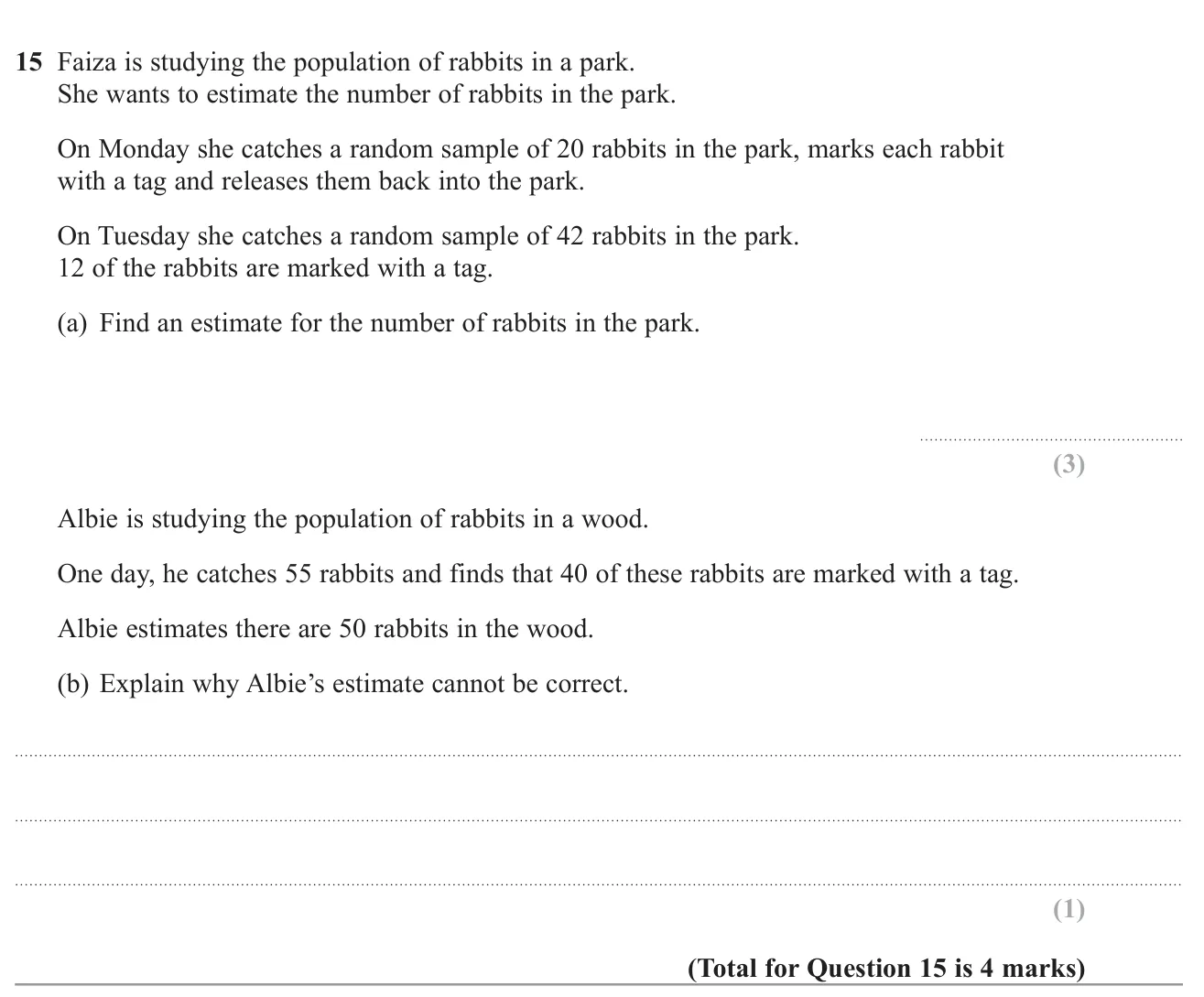
© Pearson Education Ltd. November 2022 Paper 2 (Higher, calculator), question 15.
(a) 70 3 marks (b) He caught 55 rabbits, so there must be more than 50 1 mark
Worked solution Checked against the mark scheme
(a) 12 42 \frac{12}{42} 42 12 20 N = 12 42 \frac{20}{N} = \frac{12}{42} N 20 = 42 12
N = 20 × 42 12 = 70 N = \frac{20 \times 42}{12} = 70 N = 12 20 × 42 = 70
(b) He caught 55 different rabbits in one day, so the wood must hold at least 55. An estimate of 50 is too small.
Watch out: Working out 20 × 12 ÷ 42 instead.
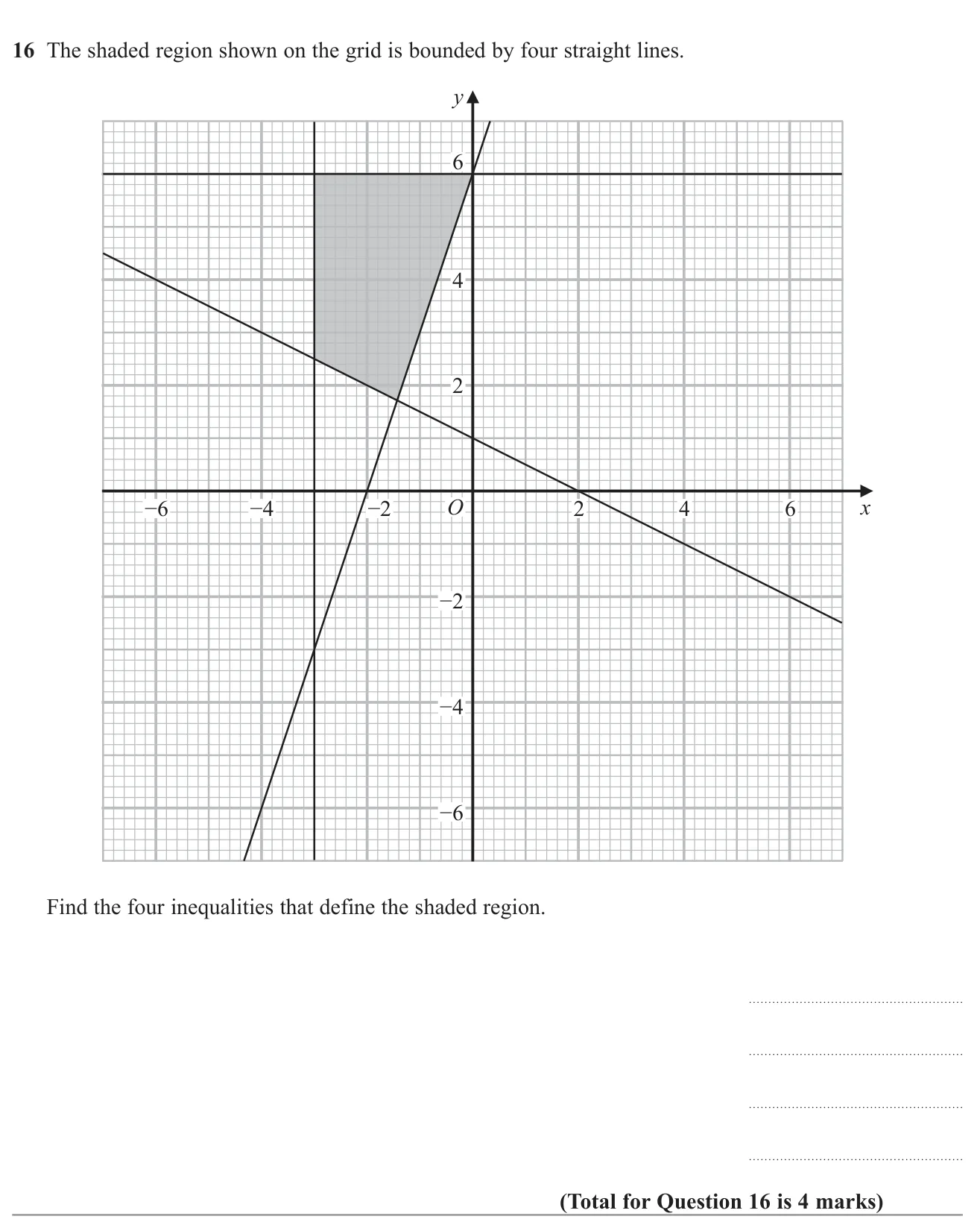
© Pearson Education Ltd. November 2022 Paper 2 (Higher, calculator), question 16.
Answer y ≤ 6 y \le 6 y ≤ 6 x ≥ − 3 x \ge -3 x ≥ − 3 y ≥ 3 x + 6 y \ge 3x + 6 y ≥ 3 x + 6 y ≥ − 1 2 x + 1 y \ge -\frac{1}{2}x + 1 y ≥ − 2 1 x + 1 4 marks
Worked solution Checked against the mark scheme
Horizontal line: y = 6 y = 6 y = 6 y ≤ 6 y \le 6 y ≤ 6
Vertical line: x = − 3 x = -3 x = − 3 x ≥ − 3 x \ge -3 x ≥ − 3
Steep line through ( 0 , 6 ) (0, 6) ( 0 , 6 ) ( − 2 , 0 ) (-2, 0) ( − 2 , 0 ) y = 3 x + 6 y = 3x + 6 y = 3 x + 6 y ≥ 3 x + 6 y \ge 3x + 6 y ≥ 3 x + 6
Shallow line through ( 0 , 1 ) (0, 1) ( 0 , 1 ) ( 2 , 0 ) (2, 0) ( 2 , 0 ) − 1 2 -\frac{1}{2} − 2 1 y ≥ − 1 2 x + 1 y \ge -\frac{1}{2}x + 1 y ≥ − 2 1 x + 1
Watch out: Getting the inequality sign the wrong way round for the sloping lines.
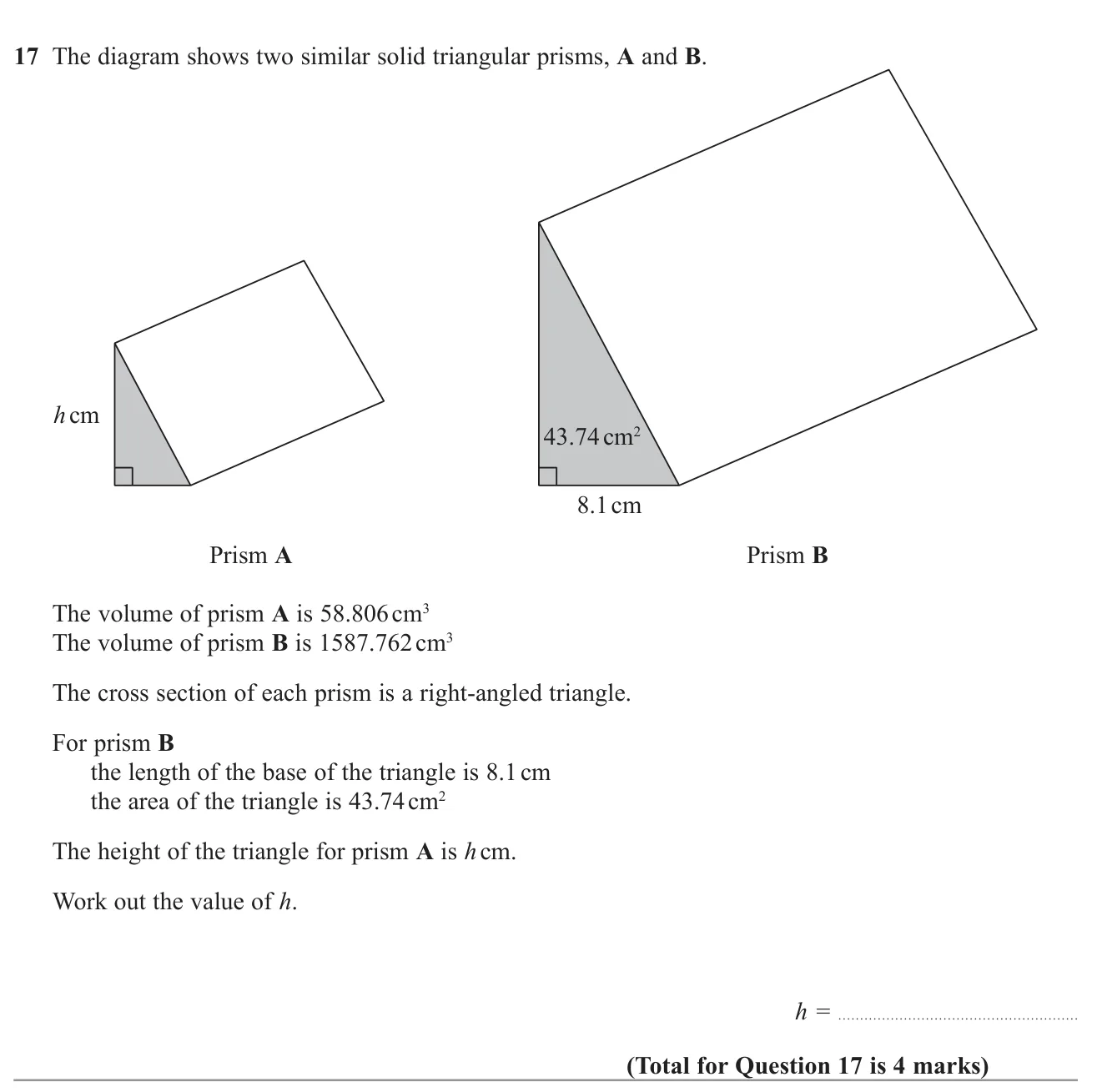
© Pearson Education Ltd. November 2022 Paper 2 (Higher, calculator), question 17.
Answer h = 3.6 h = 3.6 h = 3.6 4 marks
Worked solution Checked against the mark scheme
Volume scale factor = 1587.762 ÷ 58.806 = 27 = 1587.762 \div 58.806 = 27 = 1587.762 ÷ 58.806 = 27
Length scale factor = 27 3 = 3 = \sqrt[3]{27} = 3 = 3 27 = 3
Height of B's triangle: 2 × 43.74 8.1 = 10.8 \frac{2 \times 43.74}{8.1} = 10.8 8.1 2 × 43.74 = 10.8
h = 10.8 ÷ 3 = 3.6 h = 10.8 \div 3 = 3.6 h = 10.8 ÷ 3 = 3.6
Watch out: Dividing by the volume scale factor 27 instead of its cube root.
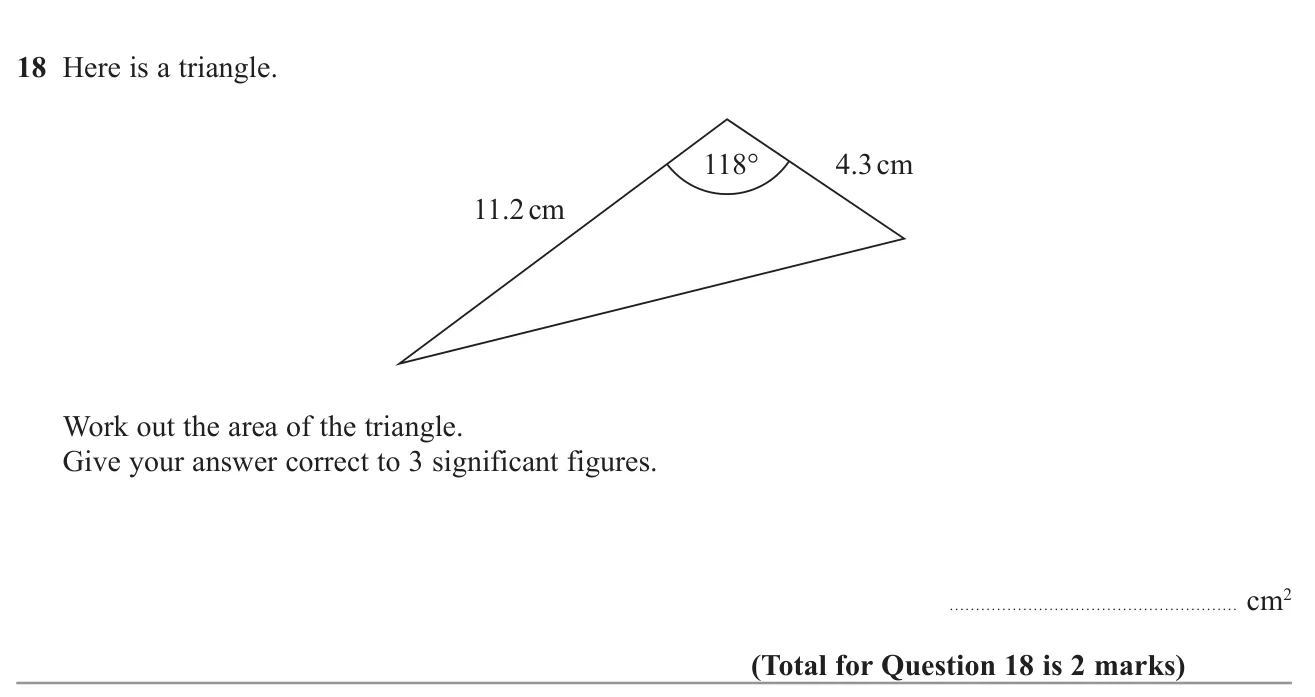
© Pearson Education Ltd. November 2022 Paper 2 (Higher, calculator), question 18.
Answer 21.3 cm 2 21.3\text{ cm}^2 21.3 cm 2 2 marks
Worked solution Checked against the mark scheme
Area = 1 2 a b sin C = \frac{1}{2}ab\sin C = 2 1 ab sin C
= 1 2 × 11.2 × 4.3 × sin 118 ° = 21.26... = \frac{1}{2} \times 11.2 \times 4.3 \times \sin 118° = 21.26... = 2 1 × 11.2 × 4.3 × sin 118° = 21.26...
Area = 21.3 cm 2 = 21.3\text{ cm}^2 = 21.3 cm 2
Watch out: Using ½ × base × height with the two given sides.
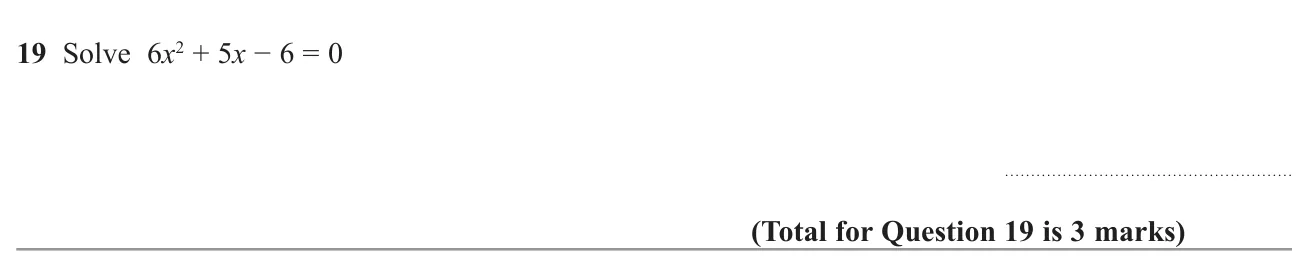
© Pearson Education Ltd. November 2022 Paper 2 (Higher, calculator), question 19.
Answer x = − 3 2 x = -\frac{3}{2} x = − 2 3 x = 2 3 x = \frac{2}{3} x = 3 2 3 marks
Worked solution Checked against the mark scheme
Factorise: 6 x 2 + 5 x − 6 = ( 2 x + 3 ) ( 3 x − 2 ) 6x^2 + 5x - 6 = (2x + 3)(3x - 2) 6 x 2 + 5 x − 6 = ( 2 x + 3 ) ( 3 x − 2 )
2 x + 3 = 0 ⇒ x = − 3 2 2x + 3 = 0 \Rightarrow x = -\frac{3}{2} 2 x + 3 = 0 ⇒ x = − 2 3
3 x − 2 = 0 ⇒ x = 2 3 3x - 2 = 0 \Rightarrow x = \frac{2}{3} 3 x − 2 = 0 ⇒ x = 3 2
Watch out: Sign errors when solving each bracket, e.g. giving 3/2 and −2/3.
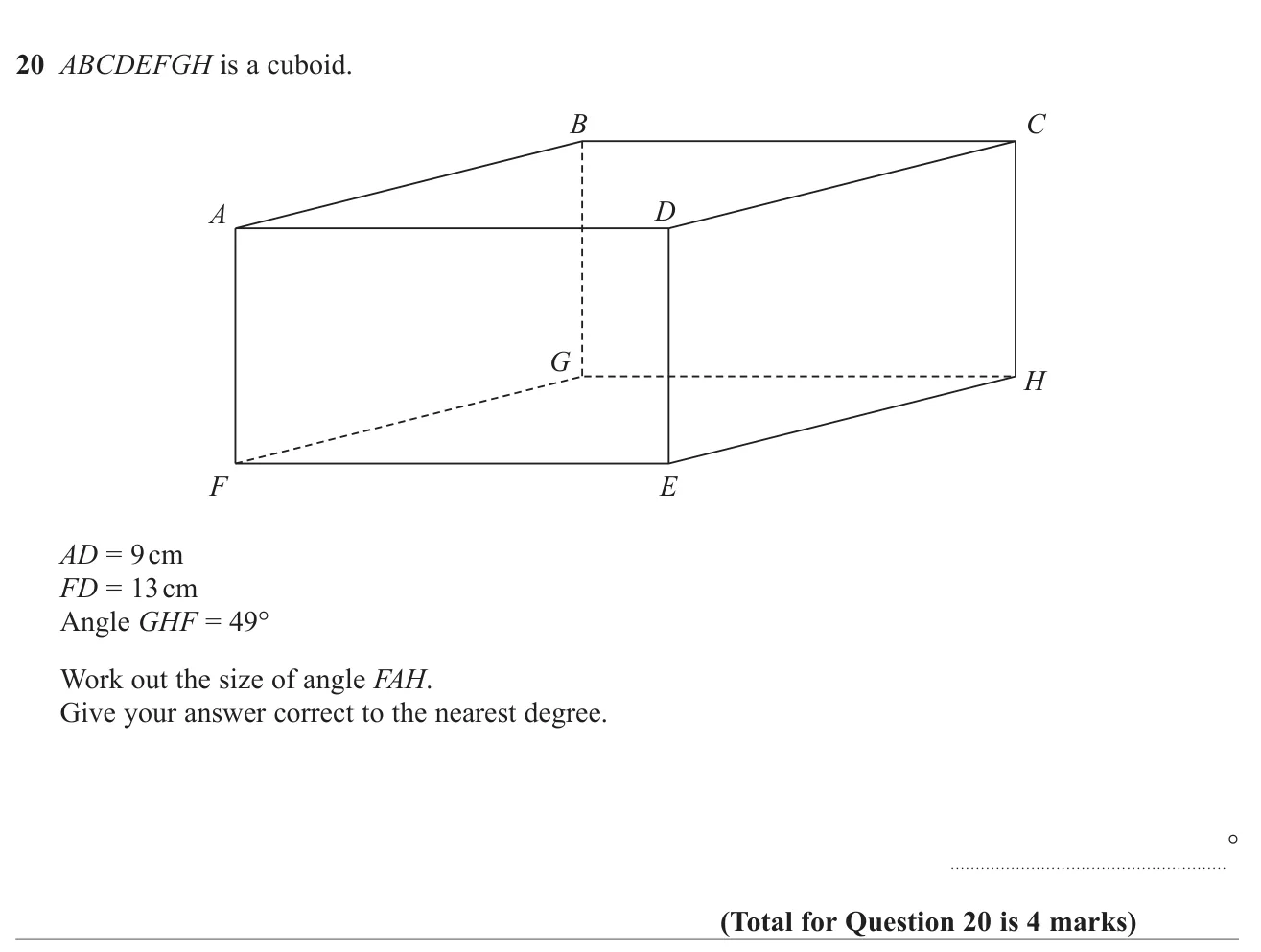
© Pearson Education Ltd. November 2022 Paper 2 (Higher, calculator), question 20.
Worked solution Checked against the mark scheme
Front face: A F = 13 2 − 9 2 = 88 = 9.380... AF = \sqrt{13^2 - 9^2} = \sqrt{88} = 9.380... A F = 1 3 2 − 9 2 = 88 = 9.380...
Base: G H = 9 GH = 9 G H = 9 F H = 9 cos 49 ° = 13.71... FH = \frac{9}{\cos 49°} = 13.71... F H = c o s 49° 9 = 13.71...
Triangle F A H FAH F A H F F F tan F A H = 13.71... 9.380... \tan FAH = \frac{13.71...}{9.380...} tan F A H = 9.380... 13.71...
Angle F A H = 55.6... ≈ 56 ° FAH = 55.6... \approx 56° F A H = 55.6... ≈ 56°
Watch out: Assuming FH is the same as FD (13 cm).
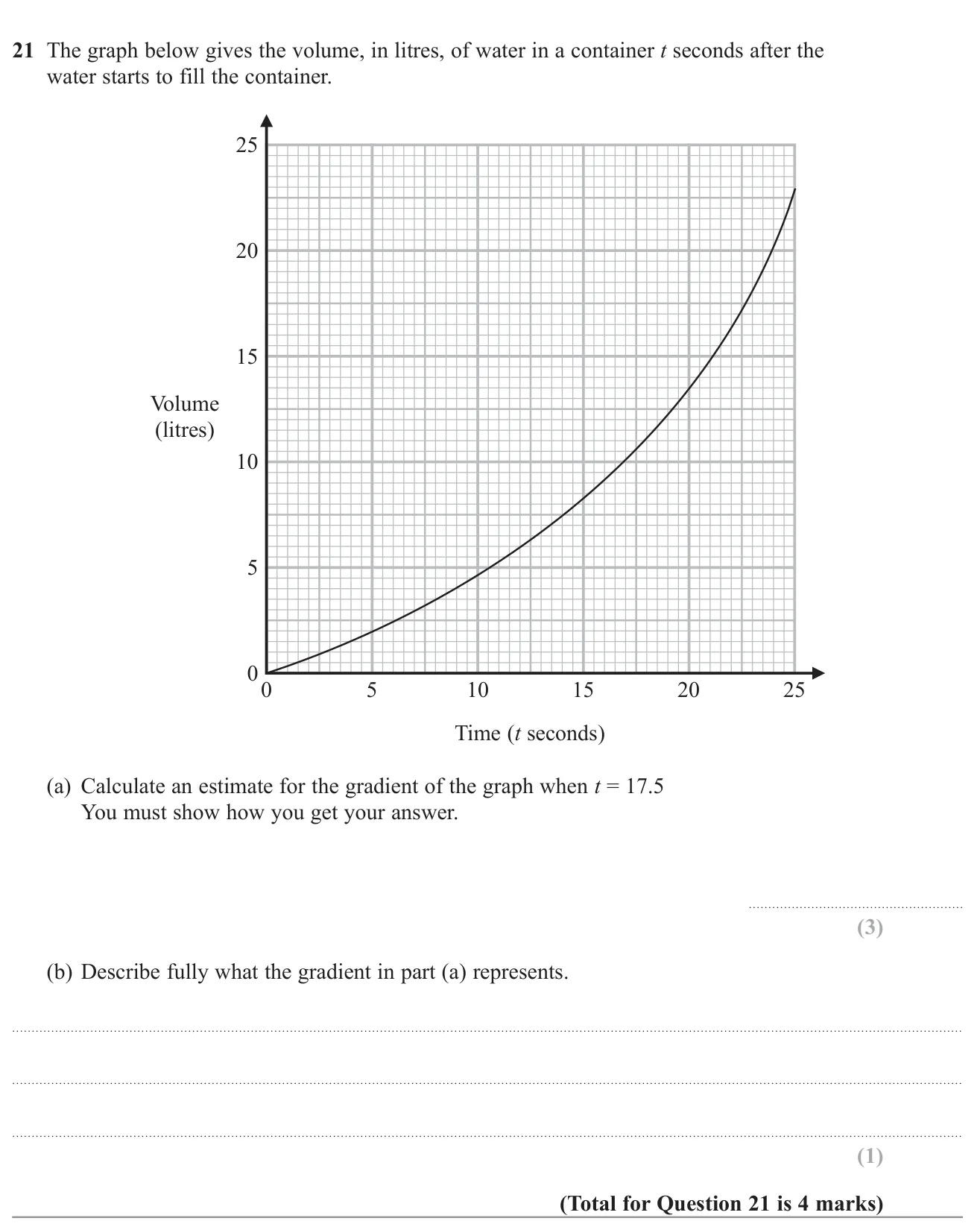
© Pearson Education Ltd. November 2022 Paper 2 (Higher, calculator), question 21.
(a) About 1.06 1.06 1.06 3 marks (b) The rate at which the volume of water increases, in litres per second, at 17.5 seconds 1 mark
Worked solution Checked against the mark scheme
(a) Draw a tangent touching the curve at t = 17.5 t = 17.5 t = 17.5
Pick two points on it far apart and work out rise ÷ run, e.g. 18.5 17.5 ≈ 1.06 \frac{18.5}{17.5} \approx 1.06 17.5 18.5 ≈ 1.06
(b) It is the rate the container fills: about 1.06 litres per second at t = 17.5 t = 17.5 t = 17.5
Watch out: Using a chord from the origin, 10.5 ÷ 17.5, which scores nothing.
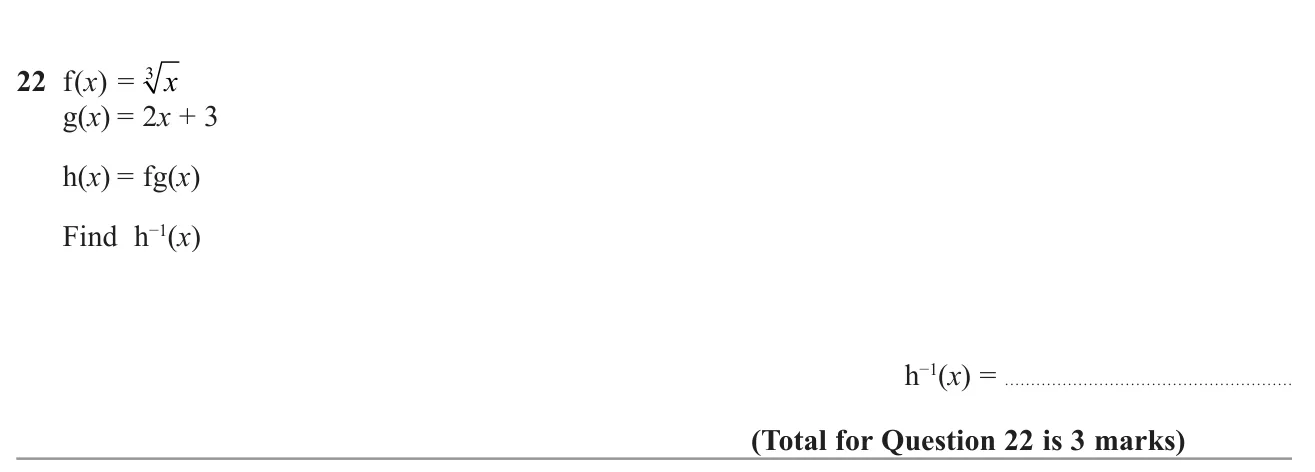
© Pearson Education Ltd. November 2022 Paper 2 (Higher, calculator), question 22.
Answer h − 1 ( x ) = x 3 − 3 2 h^{-1}(x) = \frac{x^3 - 3}{2} h − 1 ( x ) = 2 x 3 − 3 3 marks
Worked solution Checked against the mark scheme
h ( x ) = f ( g ( x ) ) = 2 x + 3 3 h(x) = f(g(x)) = \sqrt[3]{2x + 3} h ( x ) = f ( g ( x )) = 3 2 x + 3
Let y = 2 x + 3 3 y = \sqrt[3]{2x + 3} y = 3 2 x + 3 y 3 = 2 x + 3 y^3 = 2x + 3 y 3 = 2 x + 3 x = y 3 − 3 2 x = \frac{y^3 - 3}{2} x = 2 y 3 − 3
h − 1 ( x ) = x 3 − 3 2 h^{-1}(x) = \frac{x^3 - 3}{2} h − 1 ( x ) = 2 x 3 − 3
Watch out: Doing g first and f second the wrong way, i.e. finding g(f(x)).
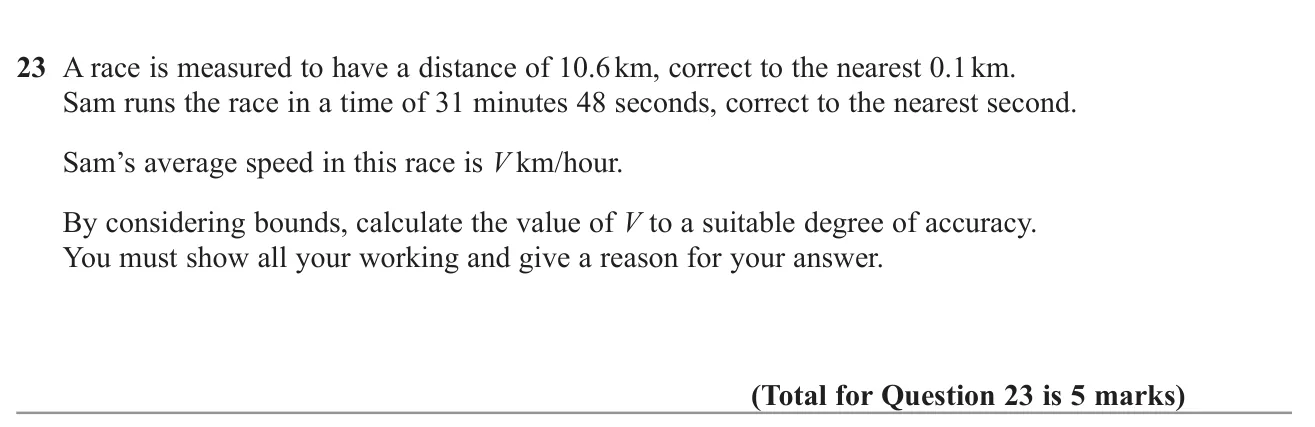
© Pearson Education Ltd. November 2022 Paper 2 (Higher, calculator), question 23.
Worked solution Checked against the mark scheme
Distance: 10.55 ≤ d < 10.65 10.55 \le d < 10.65 10.55 ≤ d < 10.65
Time: 1907.5 ≤ t < 1908.5 1907.5 \le t < 1908.5 1907.5 ≤ t < 1908.5
Upper bound = 10.65 ÷ 1907.5 3600 = 20.099... = 10.65 \div \frac{1907.5}{3600} = 20.099... = 10.65 ÷ 3600 1907.5 = 20.099...
Lower bound = 10.55 ÷ 1908.5 3600 = 19.900... = 10.55 \div \frac{1908.5}{3600} = 19.900... = 10.55 ÷ 3600 1908.5 = 19.900...
Both round to 20 (2 s.f.), so V = 20 V = 20 V = 20
Watch out: Dividing the upper distance by the upper time for the upper bound.
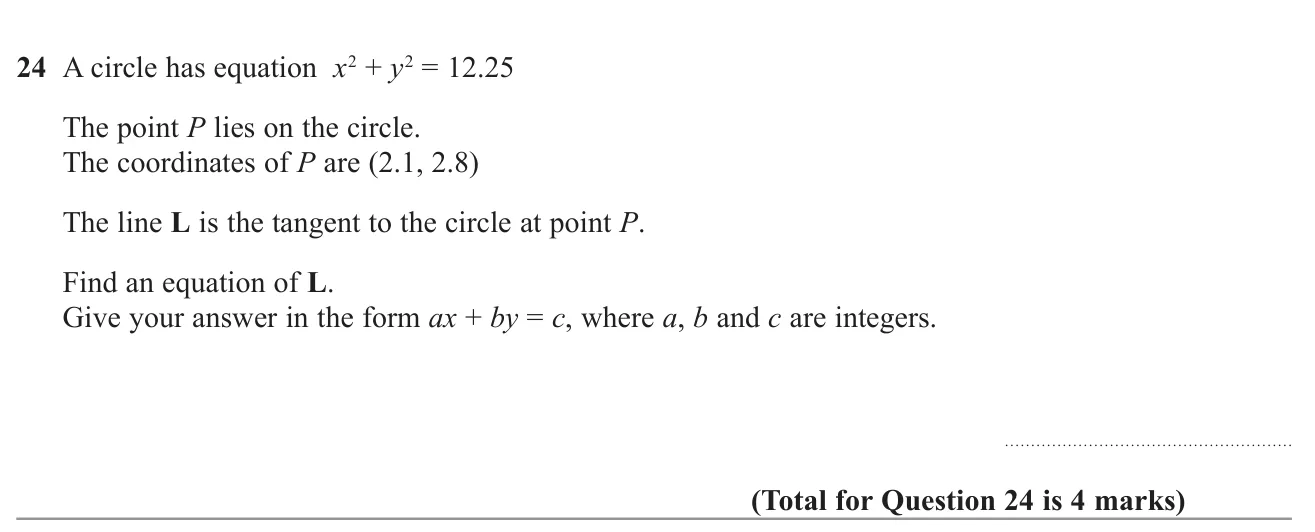
© Pearson Education Ltd. November 2022 Paper 2 (Higher, calculator), question 24.
Answer 6 x + 8 y = 35 6x + 8y = 35 6 x + 8 y = 35 4 marks
Worked solution Checked against the mark scheme
Gradient of radius O P = 2.8 2.1 = 4 3 OP = \frac{2.8}{2.1} = \frac{4}{3} O P = 2.1 2.8 = 3 4
Tangent gradient = − 3 4 = -\frac{3}{4} = − 4 3
y − 2.8 = − 3 4 ( x − 2.1 ) y - 2.8 = -\frac{3}{4}(x - 2.1) y − 2.8 = − 4 3 ( x − 2.1 )
Multiply by 4: 4 y − 11.2 = − 3 x + 6.3 4y - 11.2 = -3x + 6.3 4 y − 11.2 = − 3 x + 6.3 3 x + 4 y = 17.5 3x + 4y = 17.5 3 x + 4 y = 17.5
Double for integers: 6 x + 8 y = 35 6x + 8y = 35 6 x + 8 y = 35
Watch out: Using the radius gradient 4/3 as the tangent gradient.
Finished the paper? Add up your marks for all three papers and see what grade that would have been.