Algebra

Iteration

7 past-paper questions, easiest first. Try each one, then reveal the answer.

Higher only

Revision guide by The Full Marks

Iteration: what you need to know

Iteration is a way to get closer and closer to the solution of an equation you can't solve exactly. You feed each answer back into a formula, and the values settle down towards the root.

Key facts

  • An iteration formula looks like xn+1=…xn…x_{n+1} = \ldots x_n \ldots: put x0x_0 in to get x1x_1, then x1x_1 to get x2x_2, and so on.
  • A sign change of f(x)f(x) between two values shows a root lies between them (for a continuous graph). For an equation like f(x)=7f(x) = 7, show f(x)f(x) goes from below 7 to above 7.
  • Rearranging the equation to x=…x = \ldots gives the iteration formula.
  • On a calculator, type the formula using ANS and press = repeatedly.
  • The values x1,x2,x3,…x_1, x_2, x_3, \ldots are estimates of a solution of the original equation.
  • Real-life rules such as Pn+1=0.9Pn+20P_{n+1} = 0.9P_n + 20 work the same way: apply the rule once for each time step.

Showing a root lies in an interval

  1. Substitute both ends of the interval into f(x)f(x).
  2. Show one answer is negative and one is positive.
  3. Write a conclusion: 'There is a sign change, so there is a solution between … and …'.

Using an iteration formula

  1. Type the starting value and press =.
  2. Type the formula with ANS in place of xnx_n.
  3. Press = once for each iteration and write each value down (at least 4 decimal places).

Worked examples

Example 1 Higher · grade 6

Use xn+1=3+2xnx_{n+1} = 3 + \frac{2}{x_n} with x0=2x_0 = 2 to find x1x_1, x2x_2 and x3x_3.

Show the solution

x1=3+22=4x_1 = 3 + \frac{2}{2} = 4
x2=3+24=3.5x_2 = 3 + \frac{2}{4} = 3.5
x3=3+23.5=3.5714…x_3 = 3 + \frac{2}{3.5} = 3.5714\ldots

Example 2 Higher · grade 7

(a) Show that x3−4x−2=0x^3 - 4x - 2 = 0 has a solution between 2 and 3. (b) Use xn+1=4xn+23x_{n+1} = \sqrt[3]{4x_n + 2} with x0=2x_0 = 2 to find x3x_3 to 4 decimal places.

Show the solution

(a) x=2x = 2: 8−8−2=−28 - 8 - 2 = -2
x=3x = 3: 27−12−2=1327 - 12 - 2 = 13
There is a sign change, so there is a solution between 2 and 3.
(b) x1=103=2.1544…x_1 = \sqrt[3]{10} = 2.1544\ldots
x2=2.1979…x_2 = 2.1979\ldots
x3=2.2098x_3 = 2.2098 (4 d.p.)

Example 3 Higher · grade 7

(a) Show that x3−2x2−5=0x^3 - 2x^2 - 5 = 0 can be rearranged to give x=2+5x2x = 2 + \frac{5}{x^2}. (b) Starting with x0=2.7x_0 = 2.7, use xn+1=2+5xn2x_{n+1} = 2 + \frac{5}{x_n^2} to find x3x_3 to 4 decimal places. (c) What does your answer represent?

Show the solution

(a) x3−2x2−5=0x^3 - 2x^2 - 5 = 0
x3=2x2+5x^3 = 2x^2 + 5
Divide every term by x2x^2: x=2+5x2x = 2 + \frac{5}{x^2}
(b) x1=2.6858…x_1 = 2.6858\ldots
x2=2.6931…x_2 = 2.6931\ldots
x3=2.6894x_3 = 2.6894 (4 d.p.)
(c) An estimate of a solution of x3−2x2−5=0x^3 - 2x^2 - 5 = 0.

Common mistakes

  • Substituting values but not writing the conclusion about the sign change.
  • Rounding each value heavily before feeding it back in, so later values drift. Use ANS.
  • Doing one iteration too many or too few: x3x_3 means three steps from x0x_0.

Exam tips

  • To show an equation rearranges to a formula, write every step of the rearranging. You can't just state it.

Questions people ask

What is iteration in GCSE Maths?

Repeatedly putting the answer back into a formula to get closer to the solution of an equation.

How do you do iteration on a calculator?

Enter the starting value and press =, then type the formula using ANS for xnx_n. Each press of = gives the next value.

Exam questions: Iteration (7, easiest first)

Iteration3 marksGrade 6CalculatorHigher
June 2024 · Paper 3 Higher · Q17
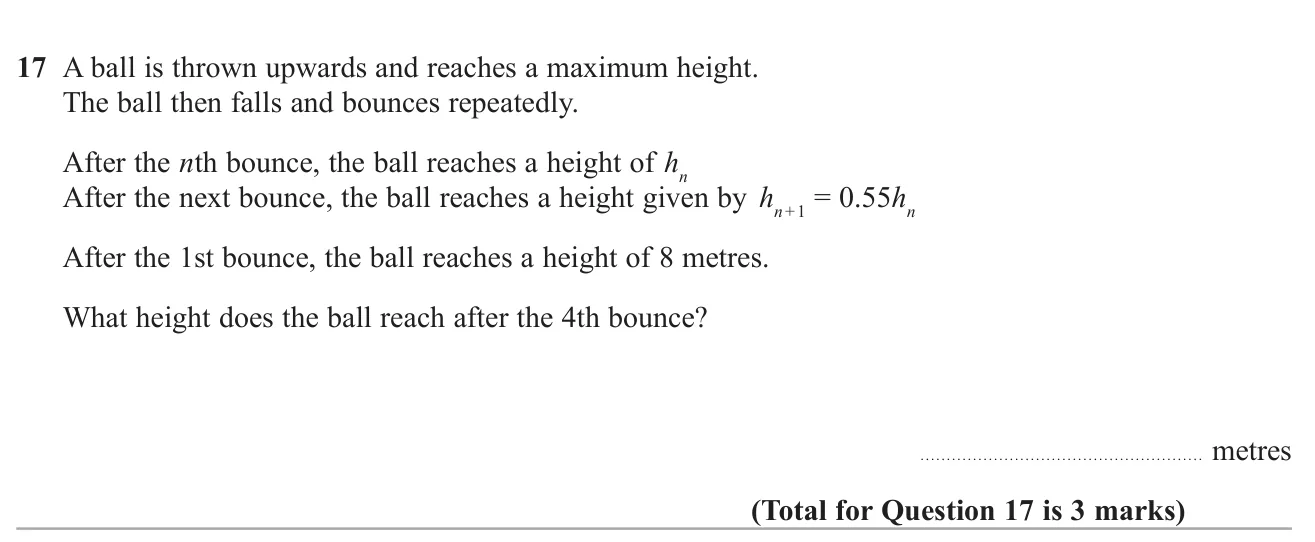
Use an iterative formula to find the height of a bouncing ball after a given bounce.

© Pearson Education Ltd. June 2024 Paper 3 (Higher, calculator), question 17.

Show answer
Answer1.3311.331 m (accept 1.33 or 1.3)3 marks

Worked solution Checked against the mark scheme

h1=8h_1 = 8

h2=0.55×8=4.4h_2 = 0.55 \times 8 = 4.4

h3=0.55×4.4=2.42h_3 = 0.55 \times 4.4 = 2.42

h4=0.55×2.42=1.331h_4 = 0.55 \times 2.42 = 1.331 m

Watch out: Applying the multiplier four times (0.554×8=0.7320.55^4 \times 8 = 0.732) instead of three.

Iteration4 marksGrade 7CalculatorHigher
June 2023 · Paper 2 Higher · Q17
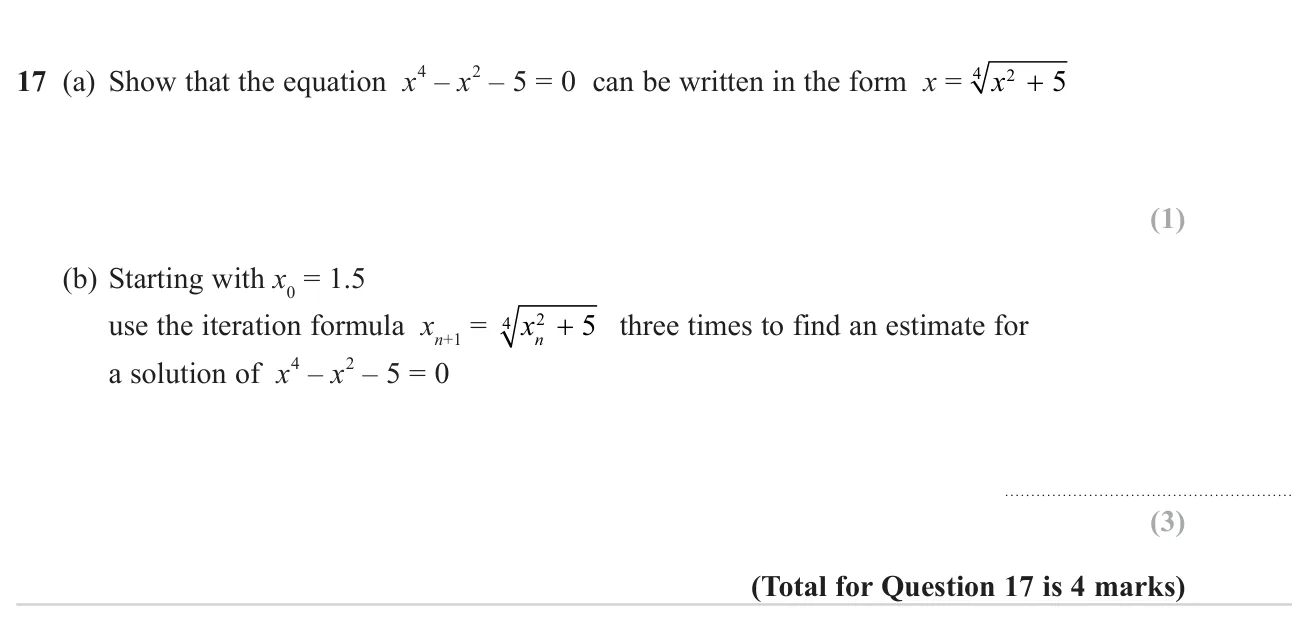
Rearrange a quartic equation into an iteration formula, then apply the formula three times from a starting value.

© Pearson Education Ltd. June 2023 Paper 2 (Higher, calculator), question 17.

Show answer
(a)x4=x2+5⇒x=x2+54x^4 = x^2 + 5 \Rightarrow x = \sqrt[4]{x^2 + 5}1 mark
(b)1.669763...1.669763...3 marks

Worked solution Checked against the mark scheme

(a) x4−x2−5=0⇒x4=x2+5⇒x=x2+54x^4 - x^2 - 5 = 0 \Rightarrow x^4 = x^2 + 5 \Rightarrow x = \sqrt[4]{x^2 + 5}

(b) x1=1.52+54=1.6409...x_1 = \sqrt[4]{1.5^2 + 5} = 1.6409...

x2=1.6409...2+54=1.6653...x_2 = \sqrt[4]{1.6409...^2 + 5} = 1.6653...

x3=1.6653...2+54=1.6697...x_3 = \sqrt[4]{1.6653...^2 + 5} = 1.6697...

Watch out: Using a square root instead of a fourth root on the calculator.
Iteration6 marksGrade 7CalculatorHigher
November 2023 · Paper 2 Higher · Q17
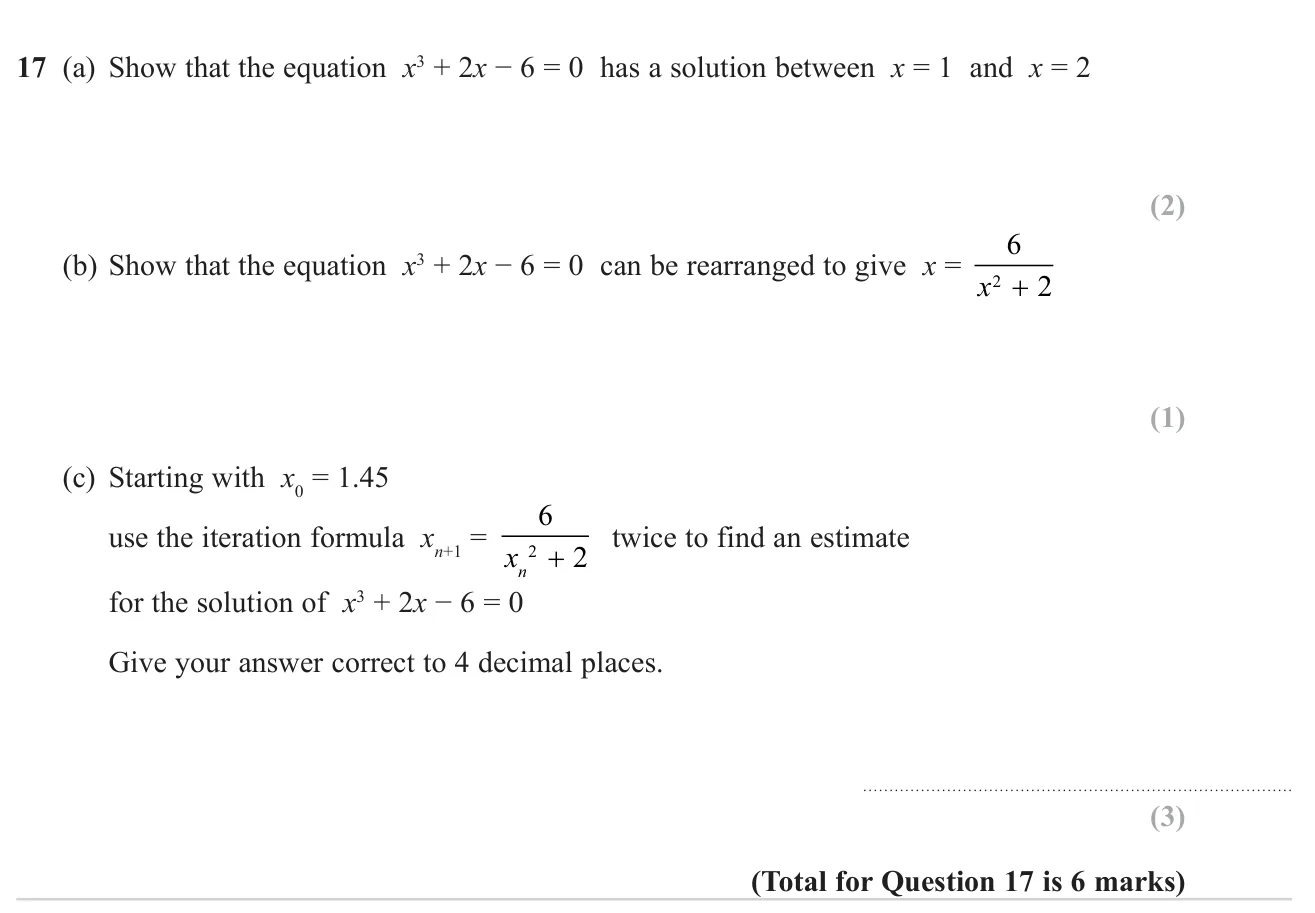
Show a cubic has a root between 1 and 2, rearrange it into an iterative form, and use the iteration twice.

© Pearson Education Ltd. November 2023 Paper 2 (Higher, calculator), question 17.

Show answer
(a)f(1)=−3f(1) = -3 and f(2)=6f(2) = 6; sign change, so a root lies between 1 and 22 marks
(b)x3+2x=6⇒x(x2+2)=6⇒x=6x2+2x^3 + 2x = 6 \Rightarrow x(x^2 + 2) = 6 \Rightarrow x = \frac{6}{x^2 + 2}1 mark
(c)1.44961.44963 marks

Worked solution Checked against the mark scheme

(a) 13+2(1)−6=−31^3 + 2(1) - 6 = -3 and 23+2(2)−6=62^3 + 2(2) - 6 = 6. The sign changes, so there is a solution between 1 and 2.

(b) x3+2x=6x^3 + 2x = 6, so x(x2+2)=6x(x^2 + 2) = 6, giving x=6x2+2x = \frac{6}{x^2 + 2}.

(c) x1=61.452+2=1.46252...x_1 = \frac{6}{1.45^2 + 2} = 1.46252...

x2=61.46252...2+2=1.44963...≈1.4496x_2 = \frac{6}{1.46252...^2 + 2} = 1.44963... \approx 1.4496

Watch out: In (a), working out the values but not stating that the sign changes.
Iteration4 marksGrade 7CalculatorHigher
November 2021 · Paper 2 Higher · Q16
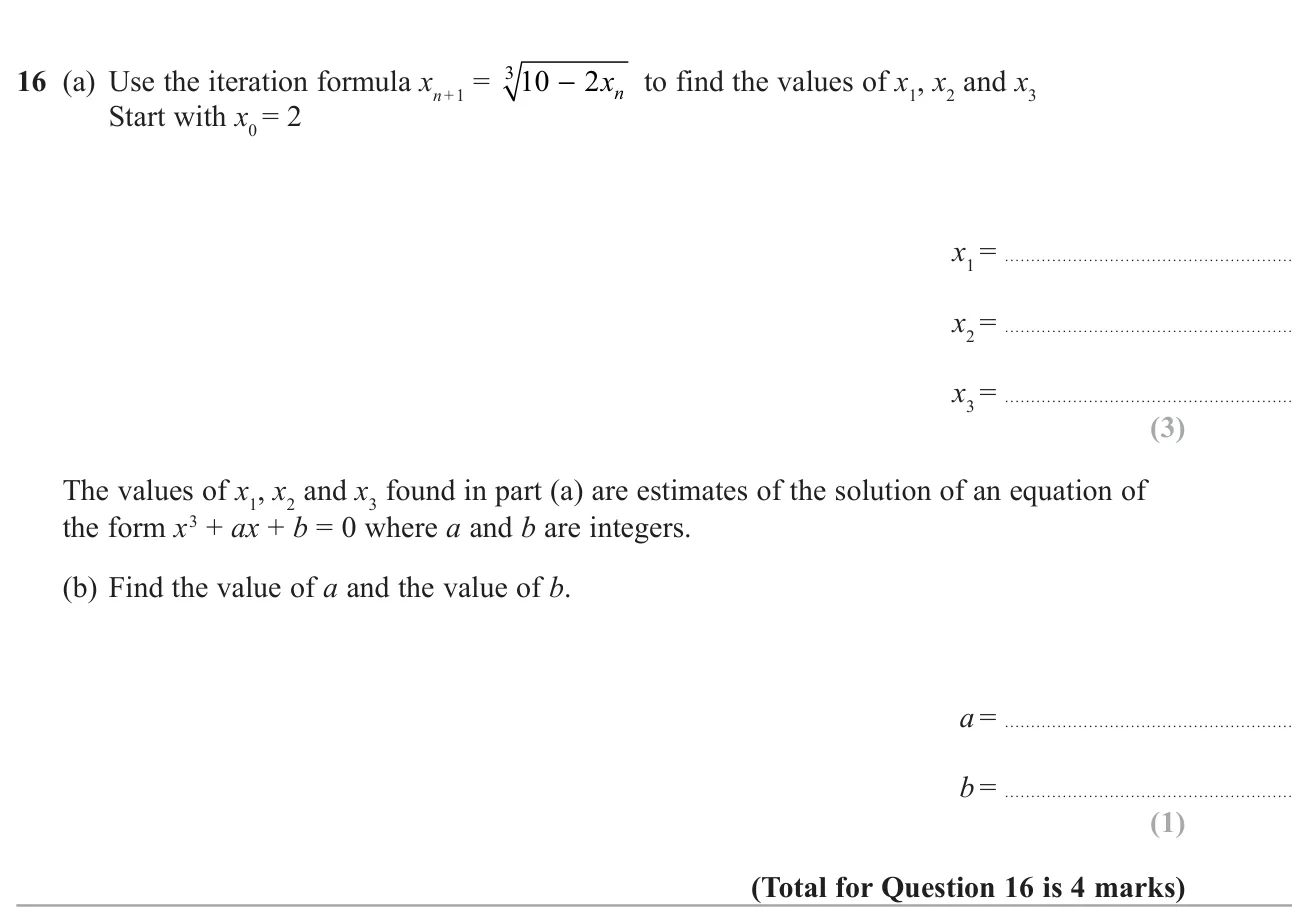
Run an iteration formula three times from a starting value, then find the cubic equation it solves.

© Pearson Education Ltd. November 2021 Paper 2 (Higher, calculator), question 16.

Show answer
(a)x1=1.817x_1 = 1.817, x2=1.853x_2 = 1.853, x3=1.846x_3 = 1.8463 marks
(b)a=2a = 2, b=−10b = -101 mark

Worked solution Checked against the mark scheme

(a) x1=10−2×23=63=1.817...x_1 = \sqrt[3]{10 - 2 \times 2} = \sqrt[3]{6} = 1.817...

x2=10−2×1.817...3=1.853...x_2 = \sqrt[3]{10 - 2 \times 1.817...} = 1.853...

x3=10−2×1.853...3=1.846...x_3 = \sqrt[3]{10 - 2 \times 1.853...} = 1.846...

(b) x=10−2x3x = \sqrt[3]{10 - 2x} gives x3=10−2xx^3 = 10 - 2x, so x3+2x−10=0x^3 + 2x - 10 = 0: a=2a = 2, b=−10b = -10.

Watch out: Rounding each value heavily before putting it back in, so later values drift.
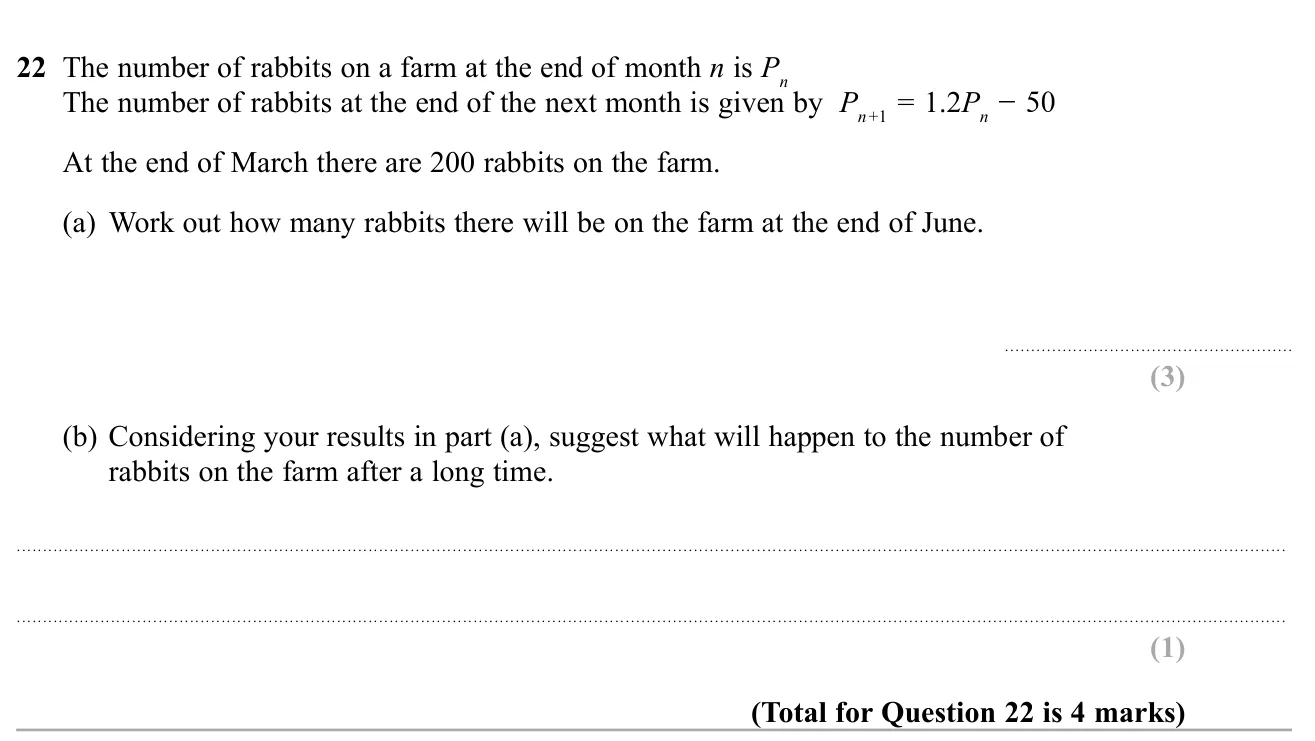
Iteration4 marksGrade 7CalculatorHigher
November 2019 · Paper 2 Higher · Q22
Apply a recurrence relation month by month to predict a rabbit population, then describe the long-term trend.

© Pearson Education Ltd. November 2019 Paper 2 (Higher, calculator), question 22.

Show answer
(a)163 (or 164)3 marks
(b)The number keeps falling, so eventually there will be no rabbits1 mark

Worked solution Checked against the mark scheme

(a) April: 1.2×200−50=1901.2 \times 200 - 50 = 190

May: 1.2×190−50=1781.2 \times 190 - 50 = 178

June: 1.2×178−50=163.61.2 \times 178 - 50 = 163.6, so about 163 or 164 rabbits.

(b) The population drops each month, so over time it will keep decreasing until there are no rabbits left.

Watch out: Starting from March as n = 1 and doing only two steps, or one step too many.
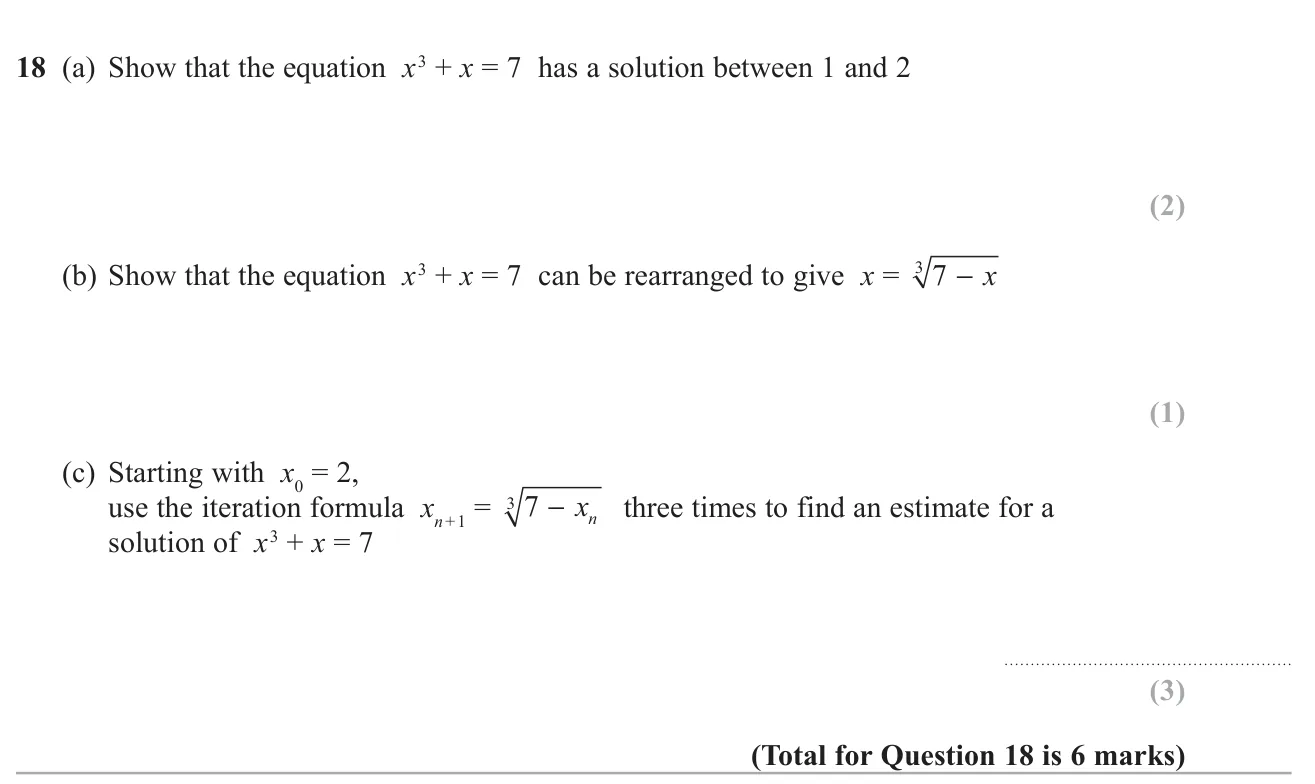
Iteration6 marksGrade 7CalculatorHigher
June 2018 · Paper 3 Higher · Q18
Show a cubic equation has a root between 1 and 2, rearrange it into an iteration formula, and iterate three times from 2.

© Pearson Education Ltd. June 2018 Paper 3 (Higher, calculator), question 18.

Show answer
(a)x=1x = 1 gives 22 (below 7), x=2x = 2 gives 1010 (above 7), so a solution lies between them2 marks
(b)x3=7−xx^3 = 7 - x, so x=7−x3x = \sqrt[3]{7 - x}1 mark
(c)1.741.743 marks

Worked solution Checked against the mark scheme

(a) 13+1=2<71^3 + 1 = 2 < 7 and 23+2=10>72^3 + 2 = 10 > 7. Since 7 is between 2 and 10, a solution lies between 1 and 2.

(b) x3+x=7⇒x3=7−x⇒x=7−x3x^3 + x = 7 \Rightarrow x^3 = 7 - x \Rightarrow x = \sqrt[3]{7 - x}

(c) x1=53=1.70998x_1 = \sqrt[3]{5} = 1.70998

x2=5.290023=1.74242x_2 = \sqrt[3]{5.29002} = 1.74242

x3=5.257583=1.73885≈1.74x_3 = \sqrt[3]{5.25758} = 1.73885 \approx 1.74

Watch out: In (a), substituting the values but not saying why that shows a solution.
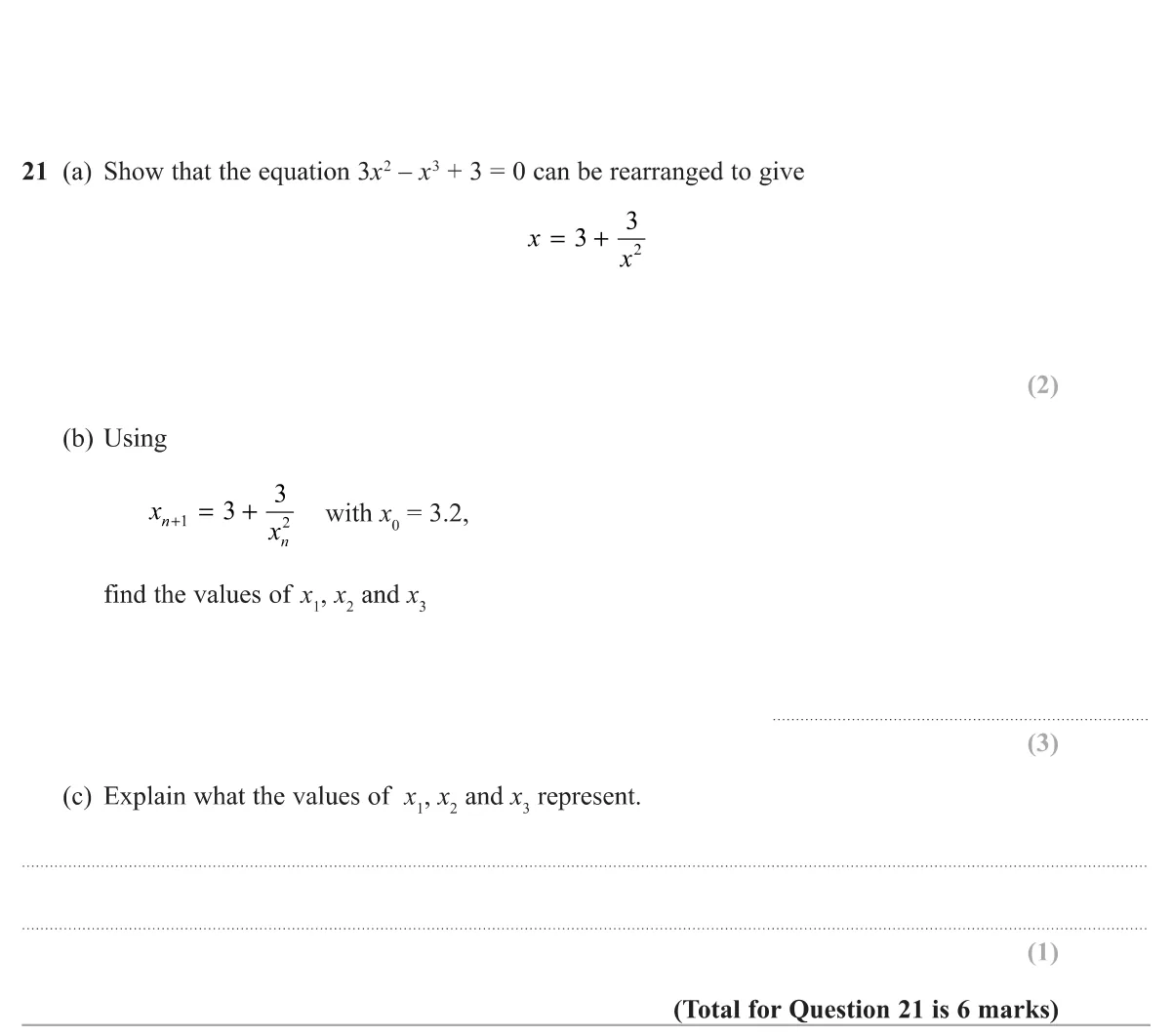
Iteration6 marksGrade 7CalculatorHigher
Specimen · Paper 3 Higher · Q21
Rearrange a cubic equation into an iterative formula, carry out three iterations from a given start value, and say what the results mean.

© Pearson Education Ltd. Specimen Paper 3 (Higher, calculator), question 21.

Show answer
(a)Divide x3=3x2+3x^3 = 3x^2 + 3 by x2x^2 to get x=3+3x2x = 3 + \frac{3}{x^2}2 marks
(b)x1=3.2930x_1 = 3.2930, x2=3.2767x_2 = 3.2767, x3=3.2794x_3 = 3.27943 marks
(c)They are estimates (approximations) of a solution of 3x2−x3+3=03x^2 - x^3 + 3 = 01 mark

Worked solution Checked against the mark scheme

(a) 3x2−x3+3=0⇒x3=3x2+33x^2 - x^3 + 3 = 0 \Rightarrow x^3 = 3x^2 + 3. Divide every term by x2x^2: x=3+3x2x = 3 + \frac{3}{x^2}

(b) x1=3+33.22=3.29296...x_1 = 3 + \frac{3}{3.2^2} = 3.29296...

x2=3+33.29296...2=3.27666...x_2 = 3 + \frac{3}{3.29296...^2} = 3.27666...

x3=3+33.27666...2=3.27942...x_3 = 3 + \frac{3}{3.27666...^2} = 3.27942...

(c) Each value is a closer estimate of a solution of 3x2−x3+3=03x^2 - x^3 + 3 = 0.

Watch out: Rounding each value before feeding it back in, which drifts the later answers.