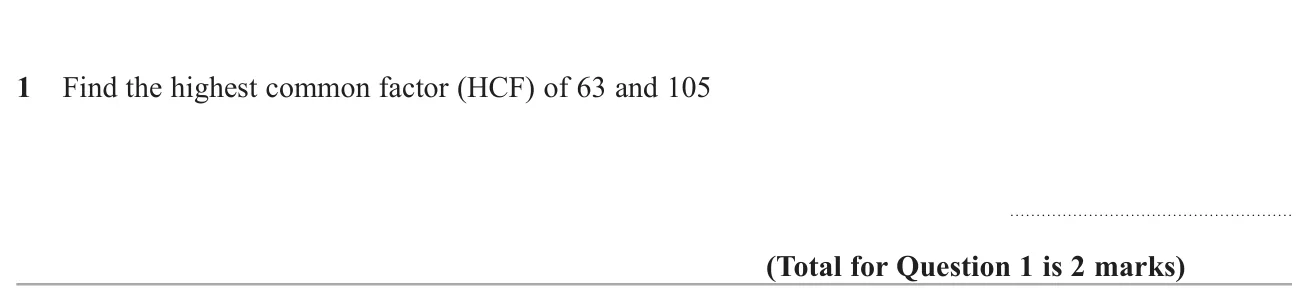
© Pearson Education Ltd. June 2024 Paper 3 (Higher, calculator), question 1.
Worked solution Checked against the mark scheme
63 = 3 × 3 × 7 63 = 3 \times 3 \times 7 63 = 3 × 3 × 7
105 = 3 × 5 × 7 105 = 3 \times 5 \times 7 105 = 3 × 5 × 7
Common prime factors: 3 × 7 = 21 3 \times 7 = 21 3 × 7 = 21
Watch out: Giving just one common prime factor (3 or 7), or finding the LCM.
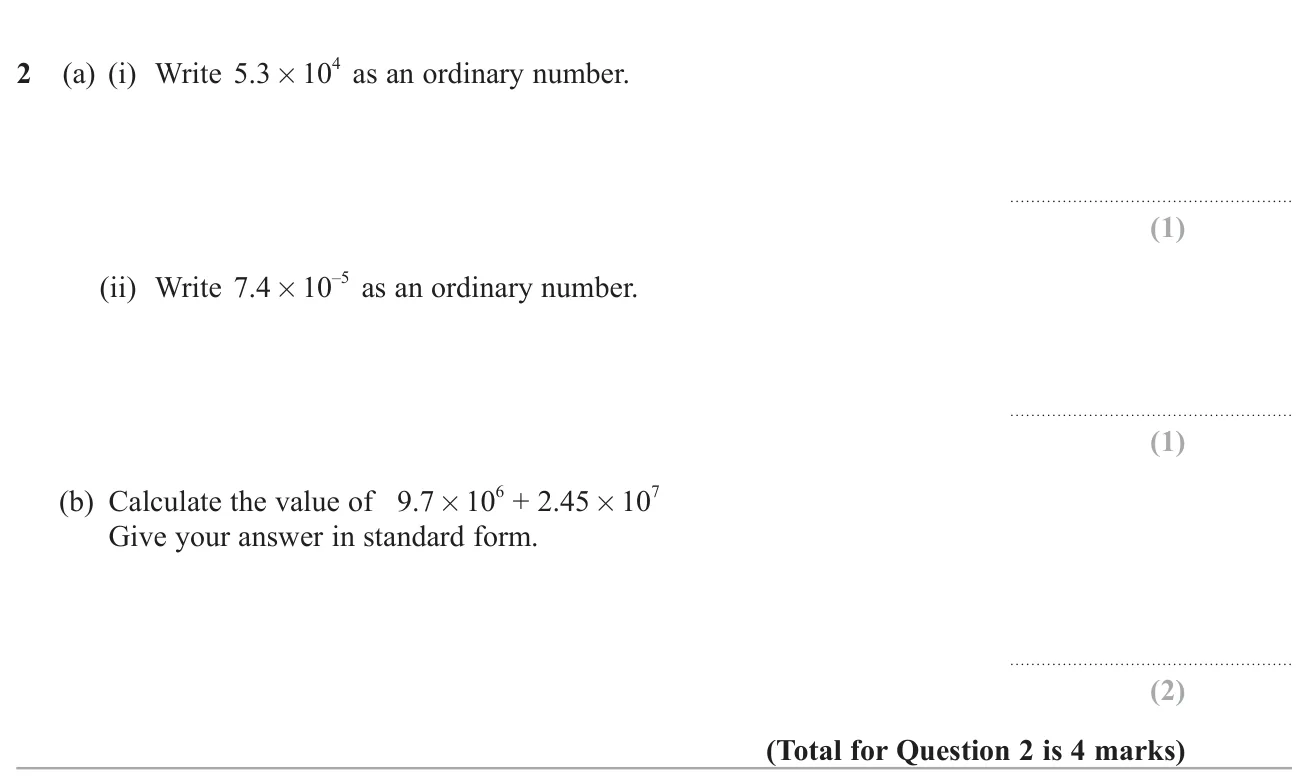
© Pearson Education Ltd. June 2024 Paper 3 (Higher, calculator), question 2.
(a(i)) 53 000 53\,000 53 000 1 mark (a(ii)) 0.000 074 0.000\,074 0.000 074 1 mark (b) 3.42 × 10 7 3.42 \times 10^7 3.42 × 1 0 7 2 marks
Worked solution Checked against the mark scheme
(a)(i) Move the decimal point 4 places right: 53 000 53\,000 53 000
(a)(ii) Move the decimal point 5 places left: 0.000 074 0.000\,074 0.000 074
(b) 9 700 000 + 24 500 000 = 34 200 000 = 3.42 × 10 7 9\,700\,000 + 24\,500\,000 = 34\,200\,000 = 3.42 \times 10^7 9 700 000 + 24 500 000 = 34 200 000 = 3.42 × 1 0 7
Watch out: Adding the numbers in front and the powers separately, e.g. 12.15 × 10 13 12.15 \times 10^{13} 12.15 × 1 0 13
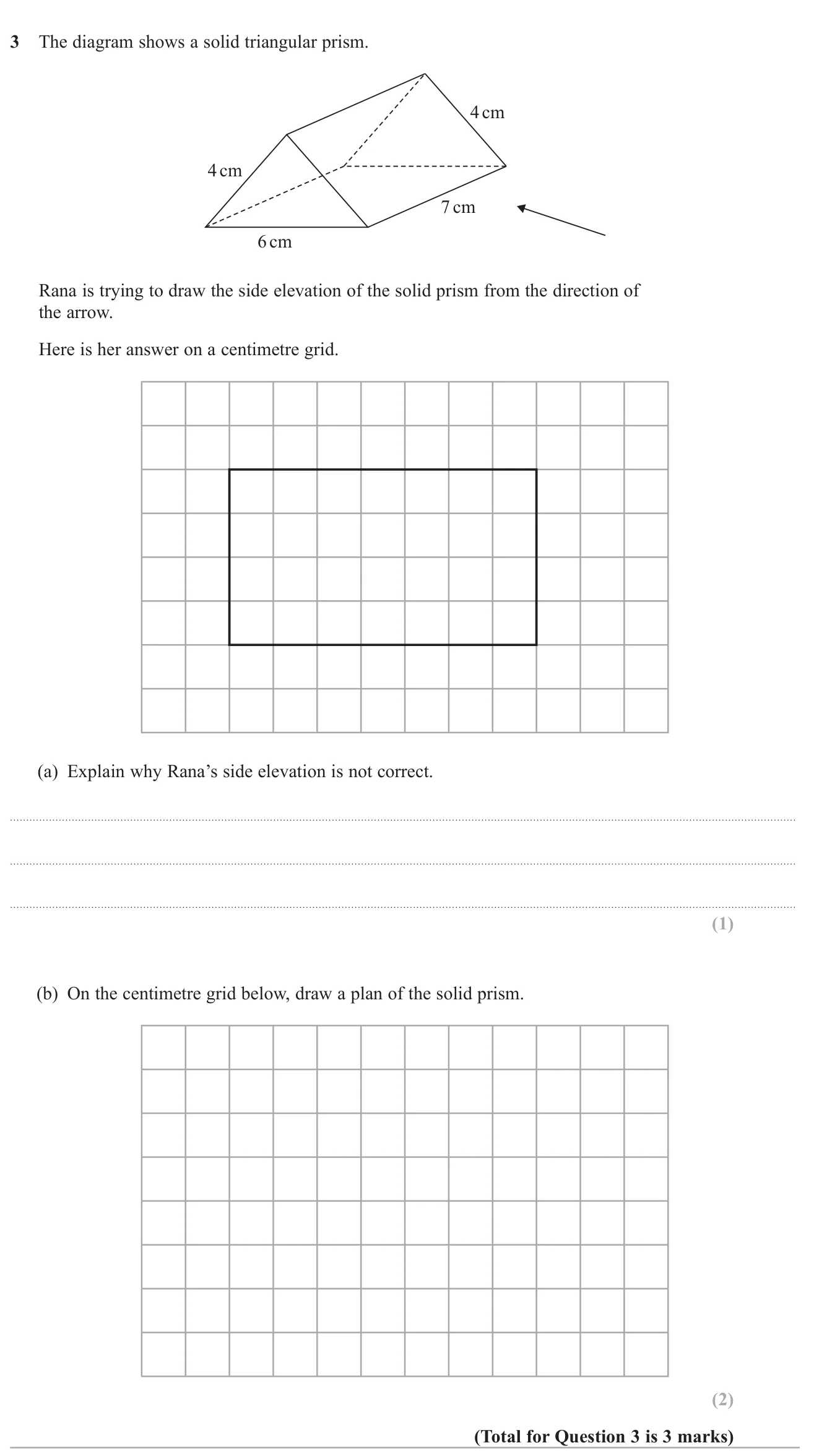
© Pearson Education Ltd. June 2024 Paper 3 (Higher, calculator), question 3.
(a) The height should be less than 4 cm (the perpendicular height, 7 ≈ 2.6 \sqrt7 \approx 2.6 7 ≈ 2.6 1 mark (b) A 7 cm by 6 cm rectangle with a line parallel to the 7 cm sides through the middle (3 cm from each side) 2 marks
Worked solution Checked against the mark scheme
(a) Rana drew a 7 cm by 4 cm rectangle. The 4 cm sides of the triangle slope, so the prism is not 4 cm tall. Its height is 4 2 − 3 2 = 7 ≈ 2.6 \sqrt{4^2 - 3^2} = \sqrt7 \approx 2.6 4 2 − 3 2 = 7 ≈ 2.6
(b) From above you see the 6 cm by 7 cm base. The top edge (ridge) is above the middle of the 6 cm side, so draw a 7 cm by 6 cm rectangle with a line along its length 3 cm from each long side.
Watch out: Leaving out the ridge line in the plan.
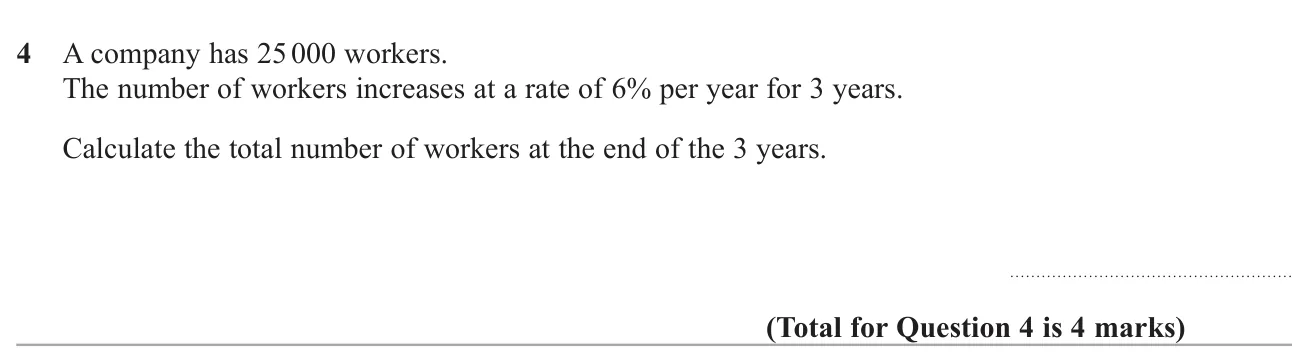
© Pearson Education Ltd. June 2024 Paper 3 (Higher, calculator), question 4.
Answer 29 775 29\,775 29 775 29 776 29\,776 29 776 29 780 29\,780 29 780 29 800 29\,800 29 800 4 marks
Worked solution Checked against the mark scheme
Multiplier for a 6% increase: 1.06 1.06 1.06
25 000 × 1.06 3 = 29 775.4 25\,000 \times 1.06^3 = 29\,775.4 25 000 × 1.0 6 3 = 29 775.4
So about 29 775 29\,775 29 775
Watch out: Using simple interest: 25 000 + 3 × 1500 = 29 500 25\,000 + 3 \times 1500 = 29\,500 25 000 + 3 × 1500 = 29 500
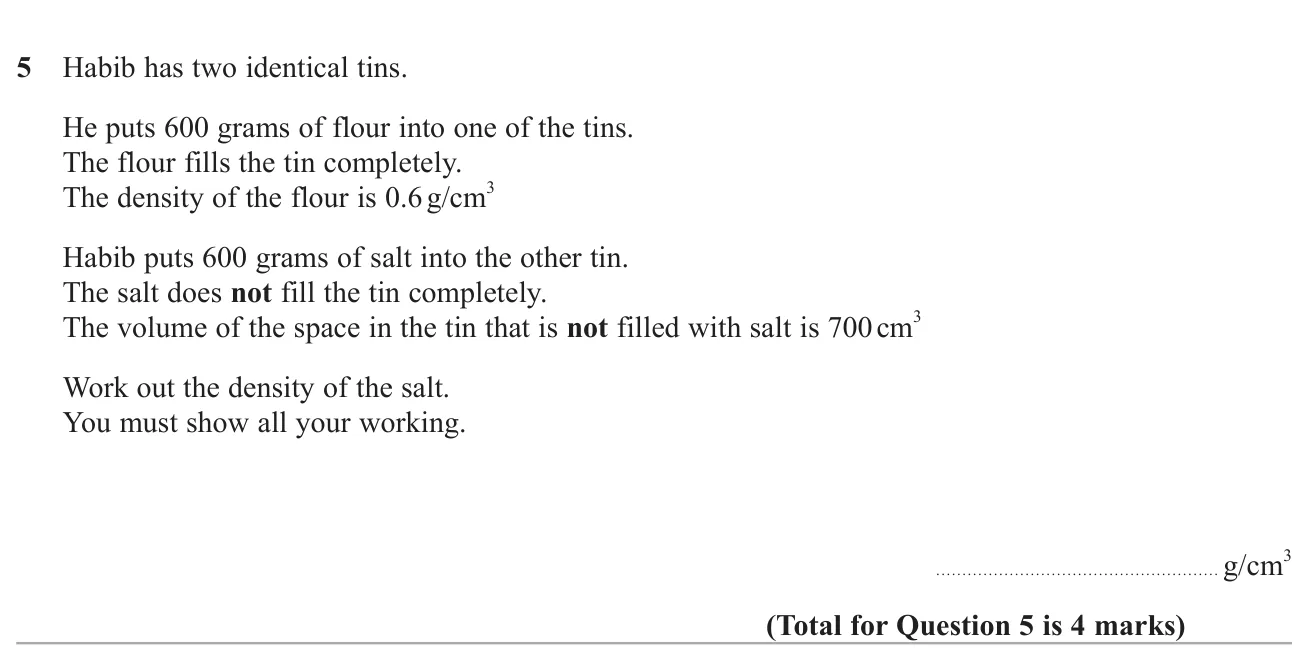
© Pearson Education Ltd. June 2024 Paper 3 (Higher, calculator), question 5.
Worked solution Checked against the mark scheme
Volume of tin = mass density = 600 ÷ 0.6 = 1000 = \frac{\text{mass}}{\text{density}} = 600 \div 0.6 = 1000 = density mass = 600 ÷ 0.6 = 1000
Volume of salt = 1000 − 700 = 300 = 1000 - 700 = 300 = 1000 − 700 = 300
Density of salt = 600 ÷ 300 = 2 = 600 \div 300 = 2 = 600 ÷ 300 = 2
Watch out: Using 700 cm³ as the volume of salt.
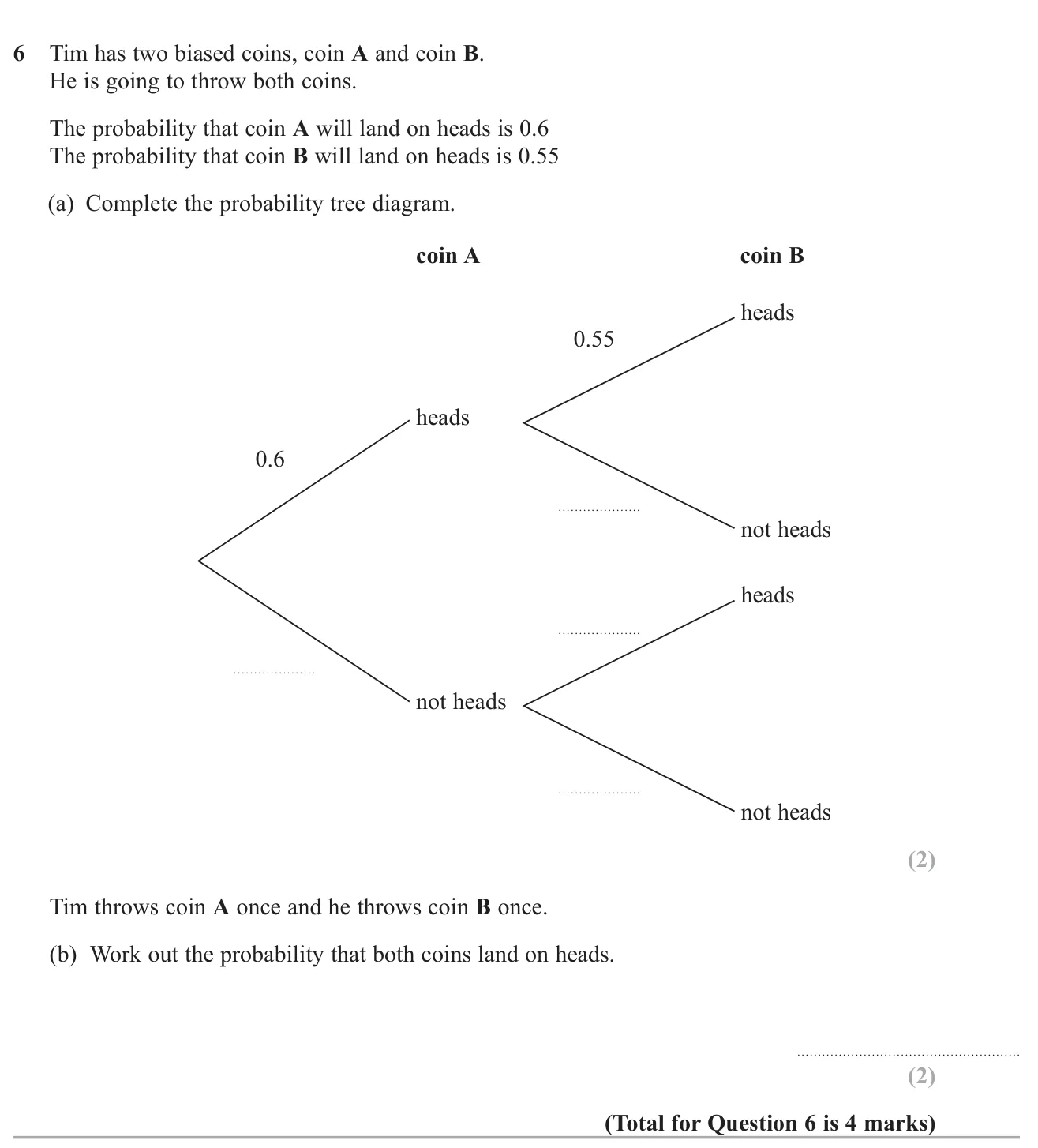
© Pearson Education Ltd. June 2024 Paper 3 (Higher, calculator), question 6.
(a) Coin A not heads 0.4 0.4 0.4 0.45 0.45 0.45 0.55 0.55 0.55 0.45 0.45 0.45 2 marks (b) 0.33 0.33 0.33 2 marks
Worked solution Checked against the mark scheme
(a) 1 − 0.6 = 0.4 1 - 0.6 = 0.4 1 − 0.6 = 0.4 1 − 0.55 = 0.45 1 - 0.55 = 0.45 1 − 0.55 = 0.45 0.55 0.55 0.55 0.45 0.45 0.45
(b) P ( both heads ) = 0.6 × 0.55 = 0.33 P(\text{both heads}) = 0.6 \times 0.55 = 0.33 P ( both heads ) = 0.6 × 0.55 = 0.33
Watch out: Adding the probabilities (0.6 + 0.55 0.6 + 0.55 0.6 + 0.55
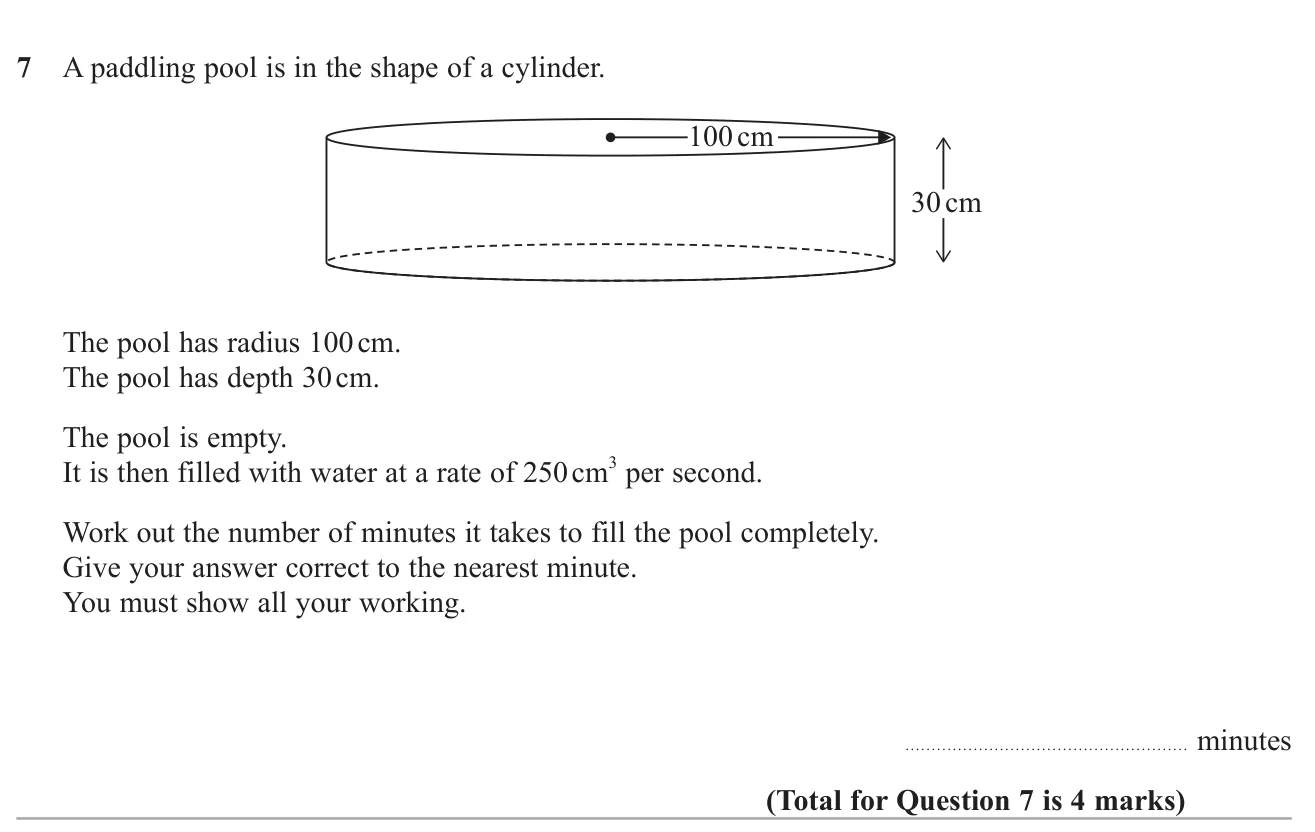
© Pearson Education Ltd. June 2024 Paper 3 (Higher, calculator), question 7.
Answer 63 63 63 4 marks
Worked solution Checked against the mark scheme
Volume = π r 2 h = π × 100 2 × 30 = 942 478 = \pi r^2 h = \pi \times 100^2 \times 30 = 942\,478 = π r 2 h = π × 10 0 2 × 30 = 942 478
Time = 942 478 ÷ 250 = 3769.9 = 942\,478 \div 250 = 3769.9 = 942 478 ÷ 250 = 3769.9
3769.9 ÷ 60 = 62.8 3769.9 \div 60 = 62.8 3769.9 ÷ 60 = 62.8 63 63 63
Watch out: Using the diameter or forgetting to square the radius; or giving the time in seconds.
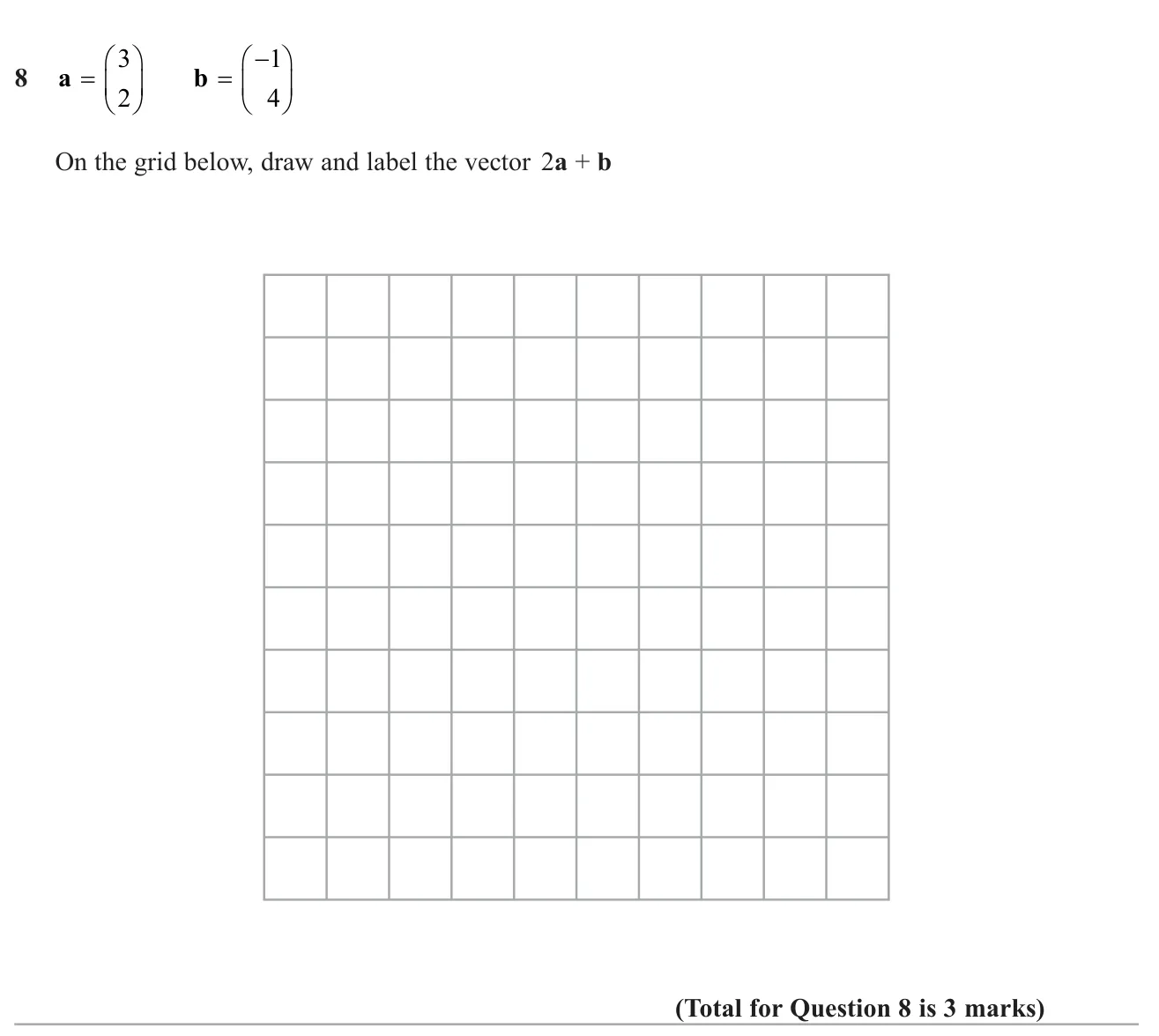
© Pearson Education Ltd. June 2024 Paper 3 (Higher, calculator), question 8.
Answer Vector ( 5 8 ) \begin{pmatrix}5\\8\end{pmatrix} ( 5 8 ) 3 marks
Worked solution Checked against the mark scheme
2 a = ( 6 4 ) 2\mathbf{a} = \begin{pmatrix}6\\4\end{pmatrix} 2 a = ( 6 4 )
2 a + b = ( 6 + ( − 1 ) 4 + 4 ) = ( 5 8 ) 2\mathbf{a} + \mathbf{b} = \begin{pmatrix}6 + (-1)\\4 + 4\end{pmatrix} = \begin{pmatrix}5\\8\end{pmatrix} 2 a + b = ( 6 + ( − 1 ) 4 + 4 ) = ( 5 8 )
Draw a line 5 squares right and 8 squares up, with an arrow at the end, and label it 2 a + b 2\mathbf{a} + \mathbf{b} 2 a + b
Watch out: Forgetting to double both components of a, or leaving off the arrow.
© Pearson Education Ltd. June 2024 Paper 3 (Higher, calculator), question 9.
Answer 10.125 10.125 10.125 3 marks
Worked solution Checked against the mark scheme
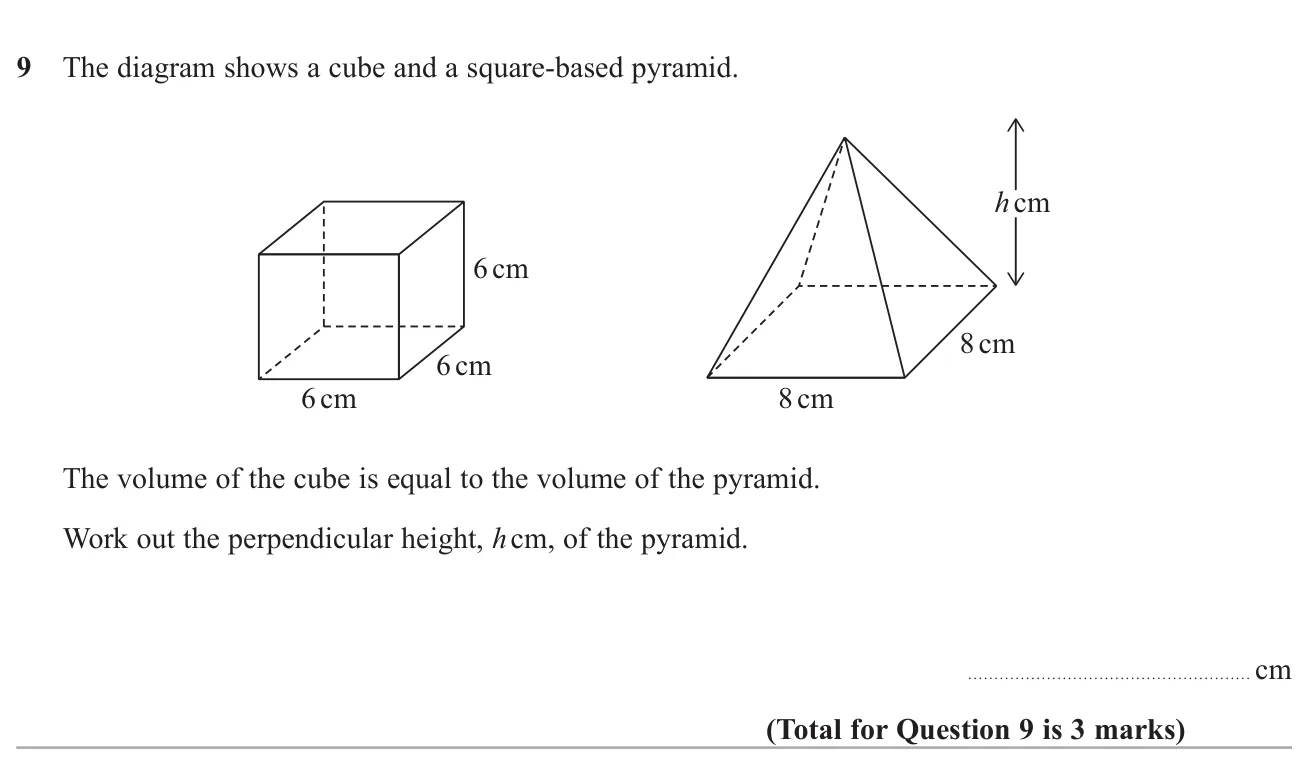
Cube: 6 3 = 216 6^3 = 216 6 3 = 216
Pyramid: 1 3 × 8 × 8 × h = 64 3 h \frac13 \times 8 \times 8 \times h = \frac{64}{3}h 3 1 × 8 × 8 × h = 3 64 h
64 3 h = 216 ⇒ h = 216 × 3 64 = 10.125 \frac{64}{3}h = 216 \Rightarrow h = \dfrac{216 \times 3}{64} = 10.125 3 64 h = 216 ⇒ h = 64 216 × 3 = 10.125
Watch out: Forgetting the 1 3 \frac13 3 1 h = 3.375 h = 3.375 h = 3.375
Question 10 Ratio 3 marks Grade 6 Calculator © Pearson Education Ltd. June 2024 Paper 3 (Higher, calculator), question 10.
Answer Shown: total = 8 x 3 + 4 x 3 = 4 x = \frac{8x}{3} + \frac{4x}{3} = 4x = 3 8 x + 3 4 x = 4 x 3 marks
Worked solution Checked against the mark scheme
Red : yellow = 3 : 5 = 3 : 5 = 3 : 5 = 5 3 x = \frac{5}{3}x = 3 5 x
Bag A = x + 5 3 x = 8 3 x = x + \frac{5}{3}x = \frac{8}{3}x = x + 3 5 x = 3 8 x
Bag B = 1 2 × 8 3 x = 4 3 x = \frac12 \times \frac{8}{3}x = \frac{4}{3}x = 2 1 × 3 8 x = 3 4 x
Total = 8 3 x + 4 3 x = 12 3 x = 4 x = \frac{8}{3}x + \frac{4}{3}x = \frac{12}{3}x = 4x = 3 8 x + 3 4 x = 3 12 x = 4 x
Watch out: Taking yellow as 5 x 5x 5 x
© Pearson Education Ltd. June 2024 Paper 3 (Higher, calculator), question 11.
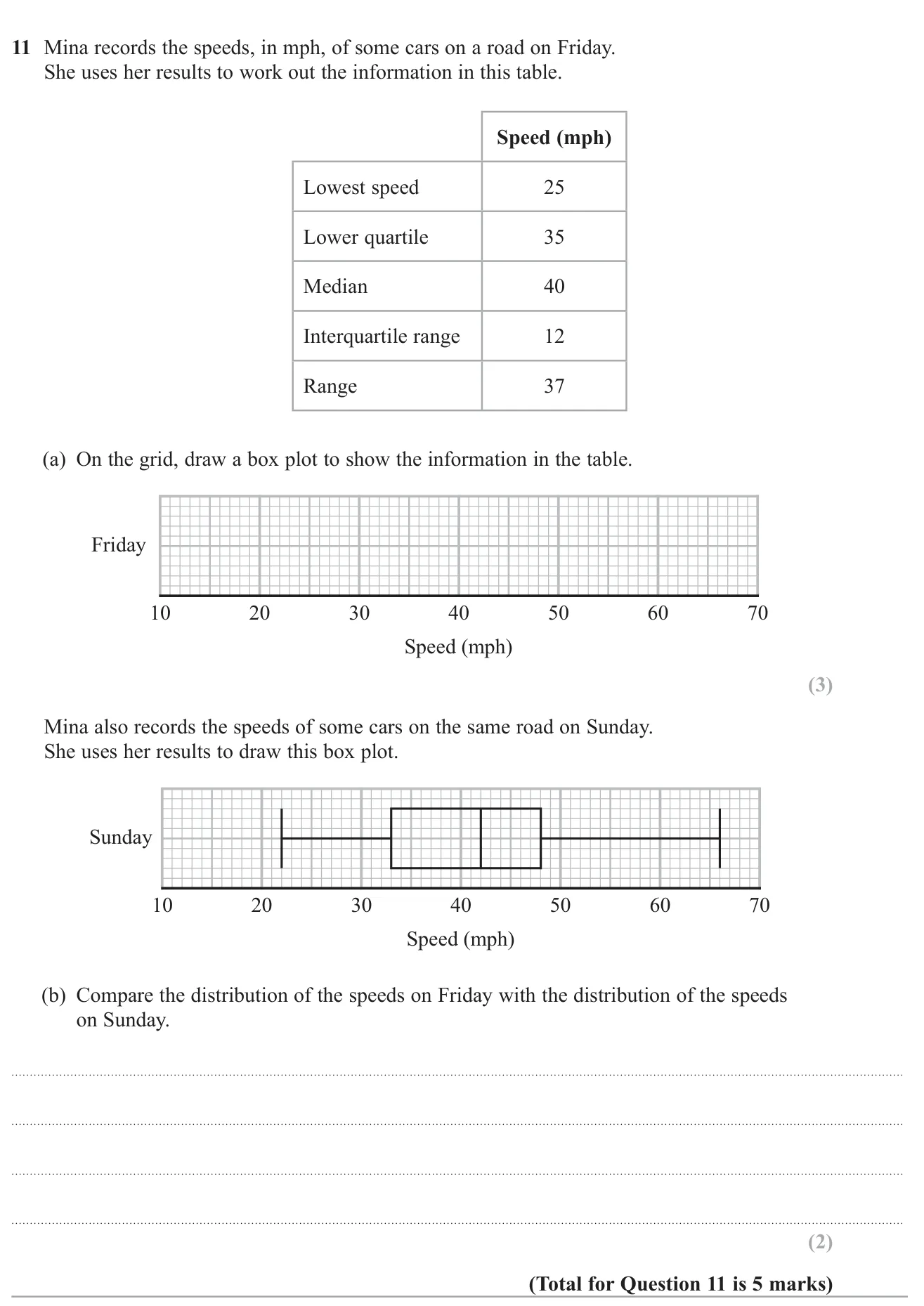
(a) Box plot with minimum 25, LQ 35, median 40, UQ 47, maximum 62 3 marks (b) e.g. The median speed on Sunday (42 mph) was higher than on Friday (40 mph); the speeds on Sunday were more spread out (IQR 15 v 12, range 44 v 37) 2 marks
Worked solution Checked against the mark scheme
(a) UQ = 35 + 12 = 47 = 35 + 12 = 47 = 35 + 12 = 47 = 25 + 37 = 62 = 25 + 37 = 62 = 25 + 37 = 62
(b) Sunday: median 42, IQR 48 − 33 = 15 48 - 33 = 15 48 − 33 = 15 66 − 22 = 44 66 - 22 = 44 66 − 22 = 44
The median speed was higher on Sunday, so cars were generally faster. The IQR was larger on Sunday, so speeds were more varied.
Watch out: Just quoting values for each day without actually comparing them, or not referring to speed.
© Pearson Education Ltd. June 2024 Paper 3 (Higher, calculator), question 12.
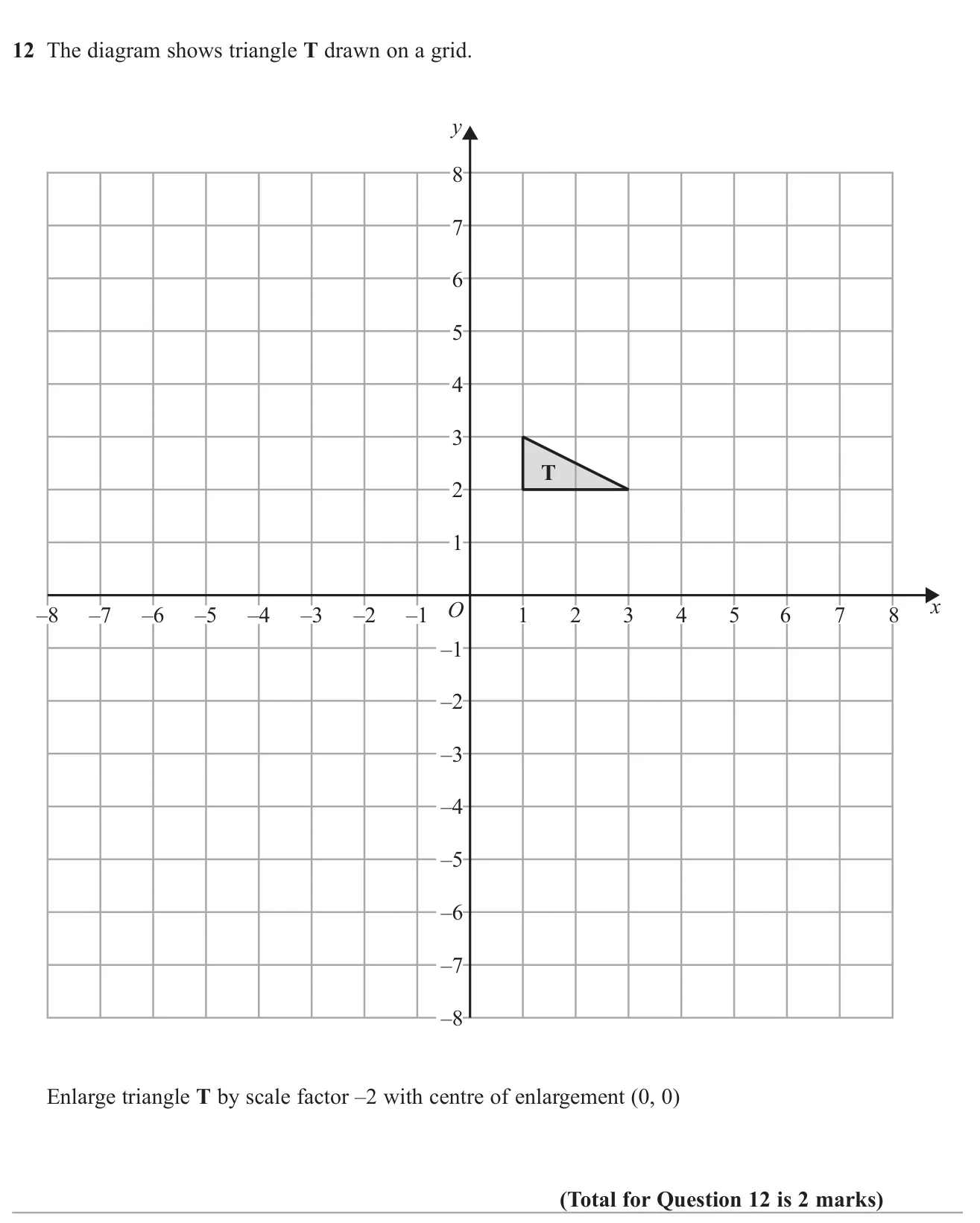
Answer Triangle with vertices ( − 2 , − 4 ) (-2,-4) ( − 2 , − 4 ) ( − 2 , − 6 ) (-2,-6) ( − 2 , − 6 ) ( − 6 , − 4 ) (-6,-4) ( − 6 , − 4 ) 2 marks
Worked solution Checked against the mark scheme
T has vertices ( 1 , 2 ) (1, 2) ( 1 , 2 ) ( 1 , 3 ) (1, 3) ( 1 , 3 ) ( 3 , 2 ) (3, 2) ( 3 , 2 )
Multiply each coordinate by − 2 -2 − 2 ( − 2 , − 4 ) (-2, -4) ( − 2 , − 4 ) ( − 2 , − 6 ) (-2, -6) ( − 2 , − 6 ) ( − 6 , − 4 ) (-6, -4) ( − 6 , − 4 )
Plot and join these points.
Watch out: Using scale factor 2 and forgetting the image must be on the opposite side of the centre (rotated through 180°).
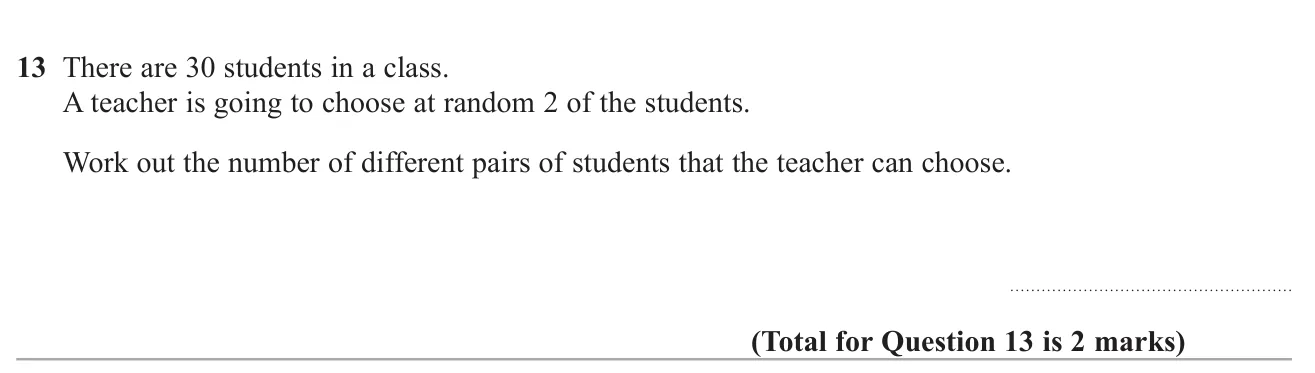
© Pearson Education Ltd. June 2024 Paper 3 (Higher, calculator), question 13.
Worked solution Checked against the mark scheme
The first student can be chosen in 30 ways and the second in 29 ways: 30 × 29 = 870 30 \times 29 = 870 30 × 29 = 870
Each pair has been counted twice (AB and BA), so 870 ÷ 2 = 435 870 \div 2 = 435 870 ÷ 2 = 435
Watch out: Giving 870 without dividing by 2.
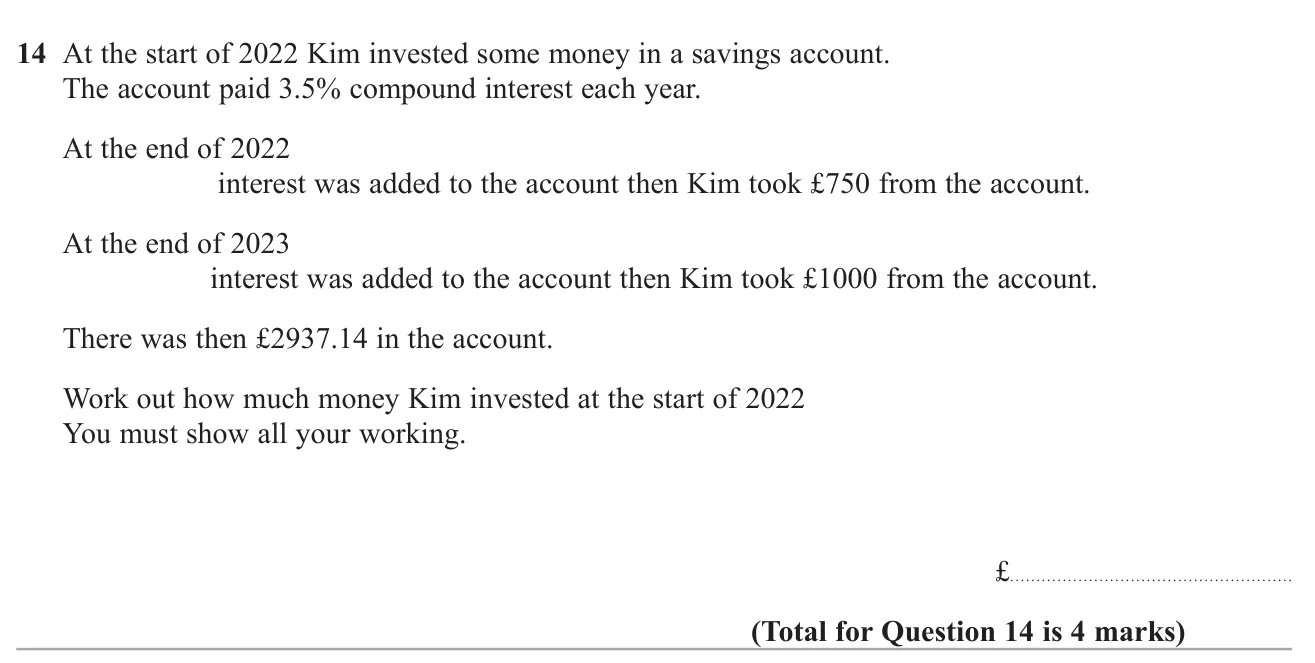
© Pearson Education Ltd. June 2024 Paper 3 (Higher, calculator), question 14.
Answer £4400 4400 4400 4 marks
Worked solution Checked against the mark scheme
Before the 2023 withdrawal: 2937.14 + 1000 = 3937.14 2937.14 + 1000 = 3937.14 2937.14 + 1000 = 3937.14
Start of 2023: 3937.14 ÷ 1.035 = 3804 3937.14 \div 1.035 = 3804 3937.14 ÷ 1.035 = 3804
Before the 2022 withdrawal: 3804 + 750 = 4554 3804 + 750 = 4554 3804 + 750 = 4554
Start of 2022: 4554 ÷ 1.035 = £ 4400 4554 \div 1.035 = £4400 4554 ÷ 1.035 = £4400
Watch out: Subtracting the withdrawals instead of adding them back, or multiplying by 0.965 instead of dividing by 1.035.
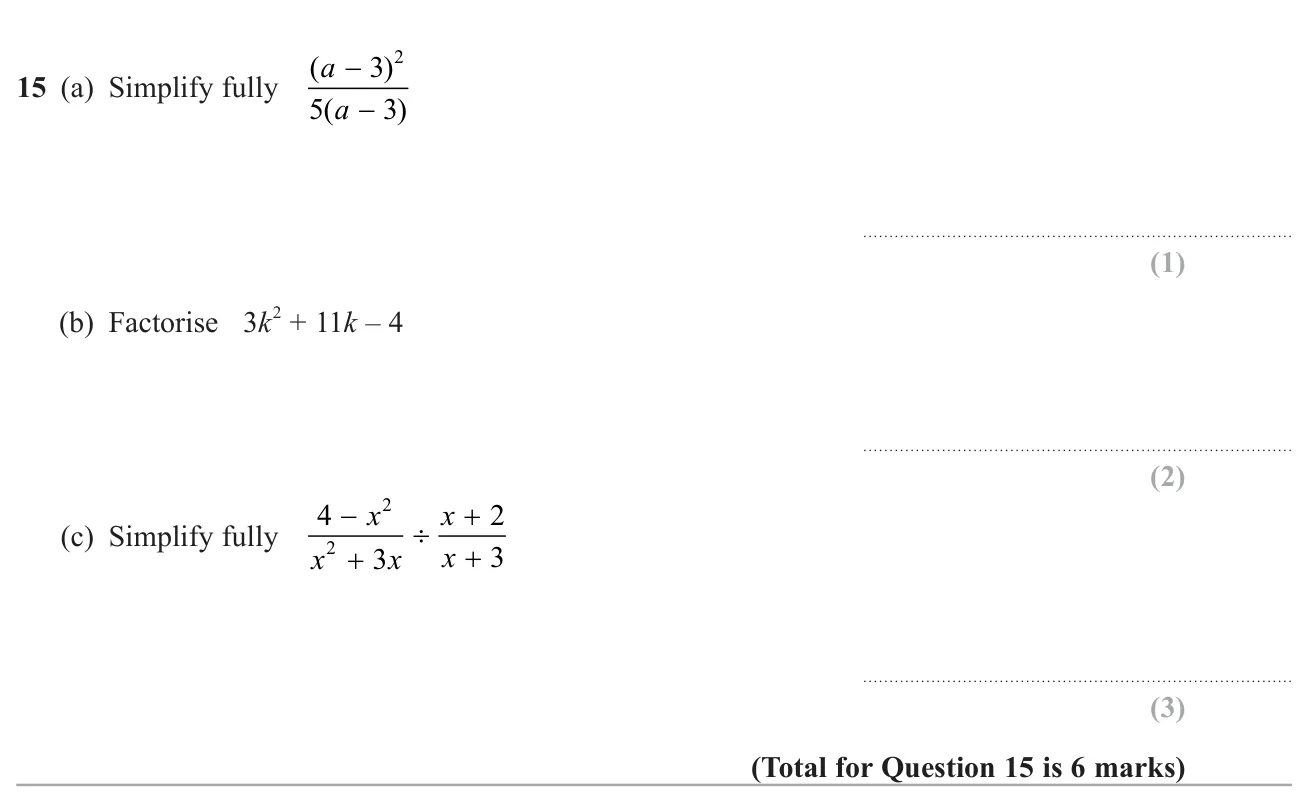
© Pearson Education Ltd. June 2024 Paper 3 (Higher, calculator), question 15.
(a) a − 3 5 \dfrac{a-3}{5} 5 a − 3 1 mark (b) ( 3 k − 1 ) ( k + 4 ) (3k-1)(k+4) ( 3 k − 1 ) ( k + 4 ) 2 marks (c) 2 − x x \dfrac{2-x}{x} x 2 − x 3 marks
Worked solution Checked against the mark scheme
(a) Cancel one factor of ( a − 3 ) (a-3) ( a − 3 ) a − 3 5 \dfrac{a-3}{5} 5 a − 3
(b) 3 k 2 + 11 k − 4 = ( 3 k − 1 ) ( k + 4 ) 3k^2 + 11k - 4 = (3k - 1)(k + 4) 3 k 2 + 11 k − 4 = ( 3 k − 1 ) ( k + 4 ) 3 k 2 + 12 k − k − 4 3k^2 + 12k - k - 4 3 k 2 + 12 k − k − 4
(c) ( 2 − x ) ( 2 + x ) x ( x + 3 ) × x + 3 x + 2 = 2 − x x \dfrac{(2-x)(2+x)}{x(x+3)} \times \dfrac{x+3}{x+2} = \dfrac{2-x}{x} x ( x + 3 ) ( 2 − x ) ( 2 + x ) × x + 2 x + 3 = x 2 − x
Watch out: In (c), not recognising 4 − x 2 4 - x^2 4 − x 2
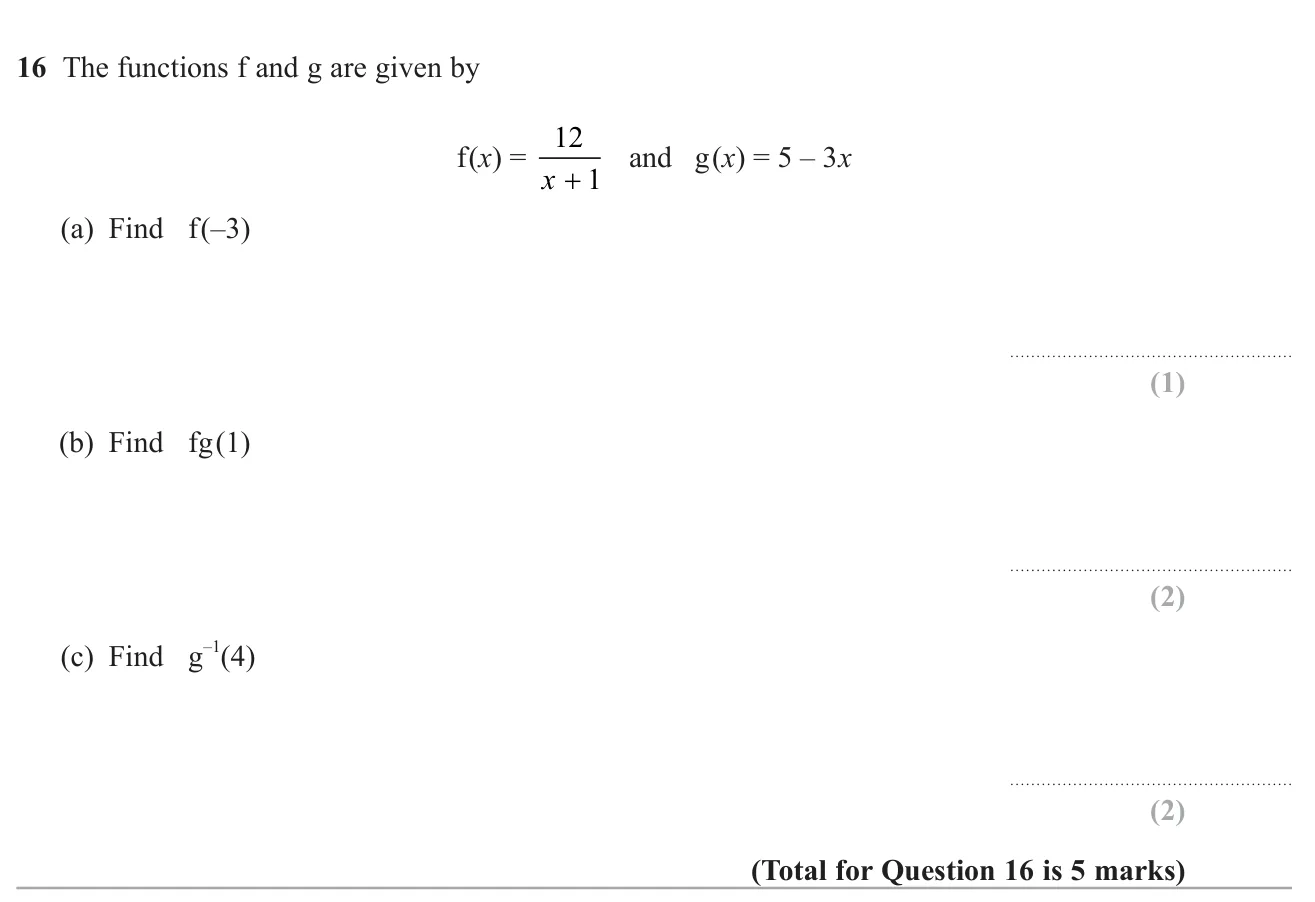
© Pearson Education Ltd. June 2024 Paper 3 (Higher, calculator), question 16.
(a) − 6 -6 − 6 1 mark (b) 4 4 4 2 marks (c) 1 3 \frac13 3 1 2 marks
Worked solution Checked against the mark scheme
f ( x ) = 12 x + 1 f(x) = \dfrac{12}{x+1} f ( x ) = x + 1 12 g ( x ) = 5 − 3 x g(x) = 5 - 3x g ( x ) = 5 − 3 x
(a) f ( − 3 ) = 12 − 2 = − 6 f(-3) = \dfrac{12}{-2} = -6 f ( − 3 ) = − 2 12 = − 6
(b) g ( 1 ) = 2 g(1) = 2 g ( 1 ) = 2 f g ( 1 ) = f ( 2 ) = 12 3 = 4 fg(1) = f(2) = \dfrac{12}{3} = 4 f g ( 1 ) = f ( 2 ) = 3 12 = 4
(c) Solve 5 − 3 x = 4 5 - 3x = 4 5 − 3 x = 4 x = 1 3 x = \frac13 x = 3 1
Watch out: In (b), working out f first then g (i.e. gf(1)).
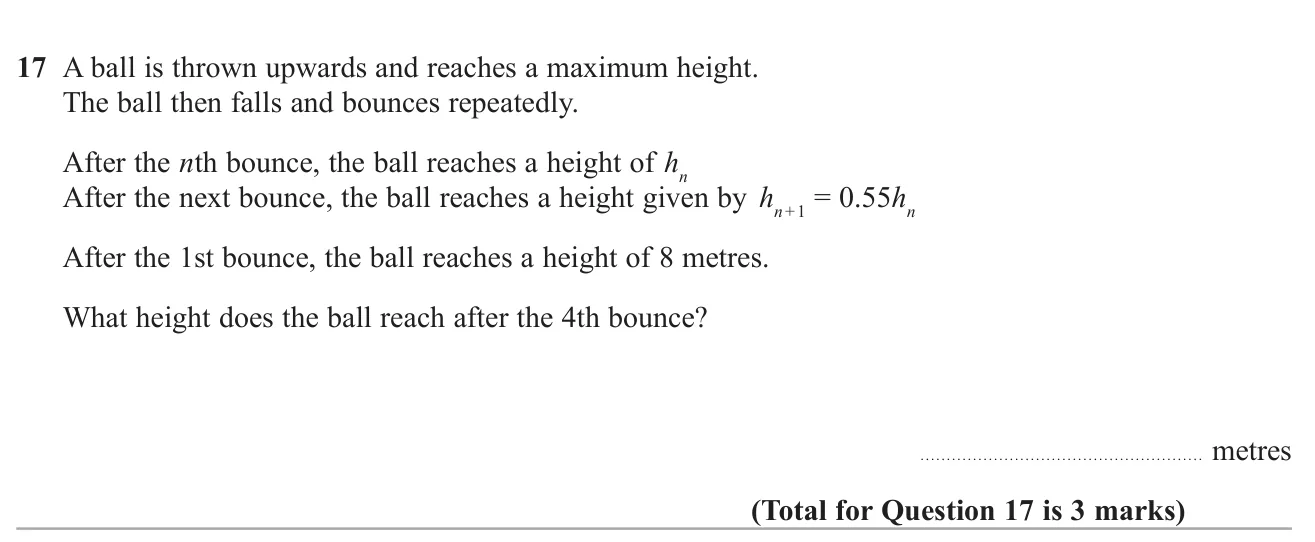
© Pearson Education Ltd. June 2024 Paper 3 (Higher, calculator), question 17.
Answer 1.331 1.331 1.331 3 marks
Worked solution Checked against the mark scheme
h 1 = 8 h_1 = 8 h 1 = 8
h 2 = 0.55 × 8 = 4.4 h_2 = 0.55 \times 8 = 4.4 h 2 = 0.55 × 8 = 4.4
h 3 = 0.55 × 4.4 = 2.42 h_3 = 0.55 \times 4.4 = 2.42 h 3 = 0.55 × 4.4 = 2.42
h 4 = 0.55 × 2.42 = 1.331 h_4 = 0.55 \times 2.42 = 1.331 h 4 = 0.55 × 2.42 = 1.331
Watch out: Applying the multiplier four times (0.55 4 × 8 = 0.732 0.55^4 \times 8 = 0.732 0.5 5 4 × 8 = 0.732
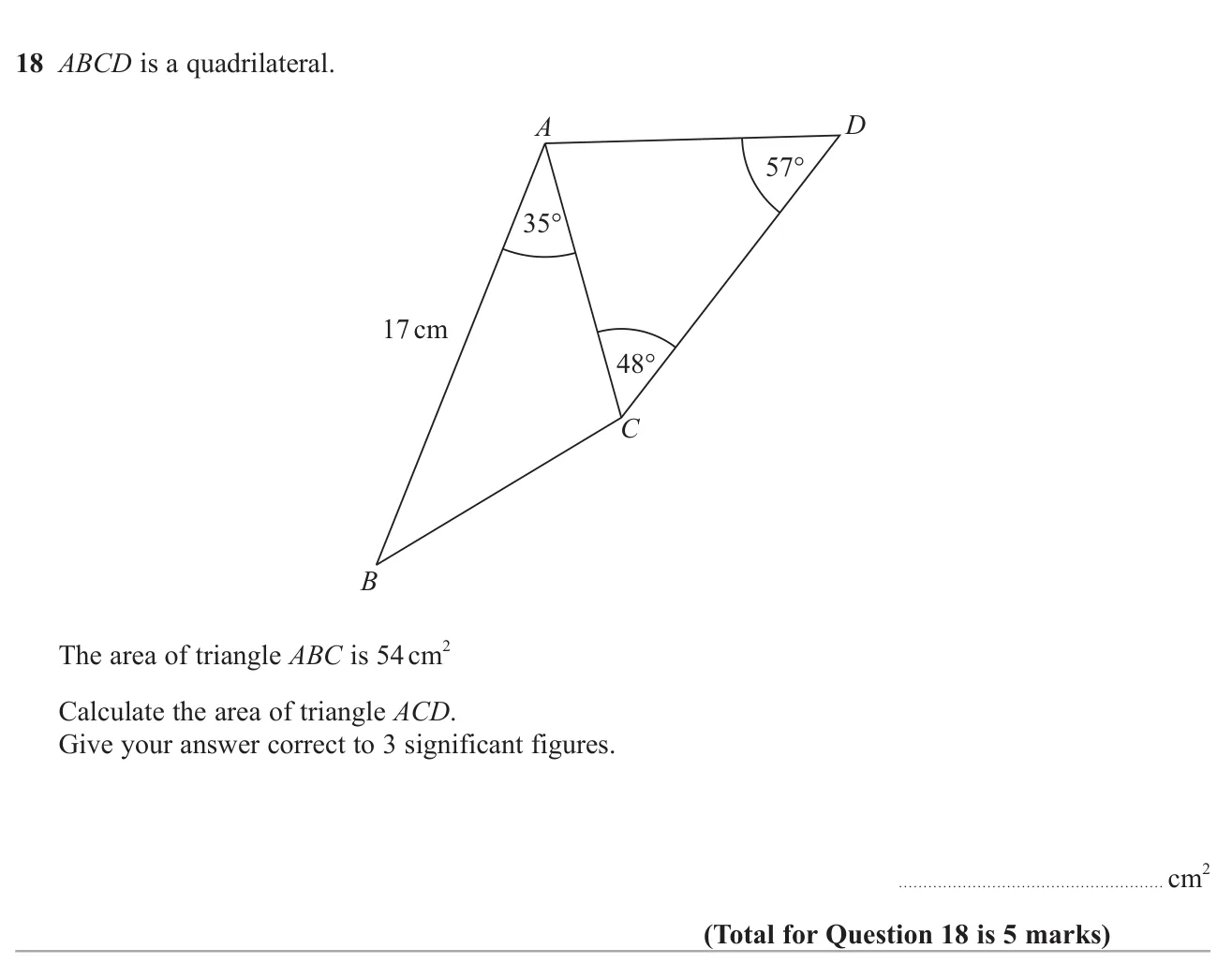
© Pearson Education Ltd. June 2024 Paper 3 (Higher, calculator), question 18.
Answer 52.5 52.5 52.5 5 marks
Worked solution Checked against the mark scheme
1 2 × 17 × A C × sin 35 ° = 54 ⇒ A C = 11.076 \frac12 \times 17 \times AC \times \sin 35° = 54 \Rightarrow AC = 11.076 2 1 × 17 × A C × sin 35° = 54 ⇒ A C = 11.076
Angle C A D = 180 ° − 48 ° − 57 ° = 75 ° CAD = 180° - 48° - 57° = 75° C A D = 180° − 48° − 57° = 75°
C D = 11.076 sin 75 ° sin 57 ° = 12.757 CD = \dfrac{11.076 \sin 75°}{\sin 57°} = 12.757 C D = sin 57° 11.076 sin 75° = 12.757
Area = 1 2 × 11.076 × 12.757 × sin 48 ° = 52.5 = \frac12 \times 11.076 \times 12.757 \times \sin 48° = 52.5 = 2 1 × 11.076 × 12.757 × sin 48° = 52.5
Watch out: Using 17 cm as a side of triangle ACD, or rounding AC too early.
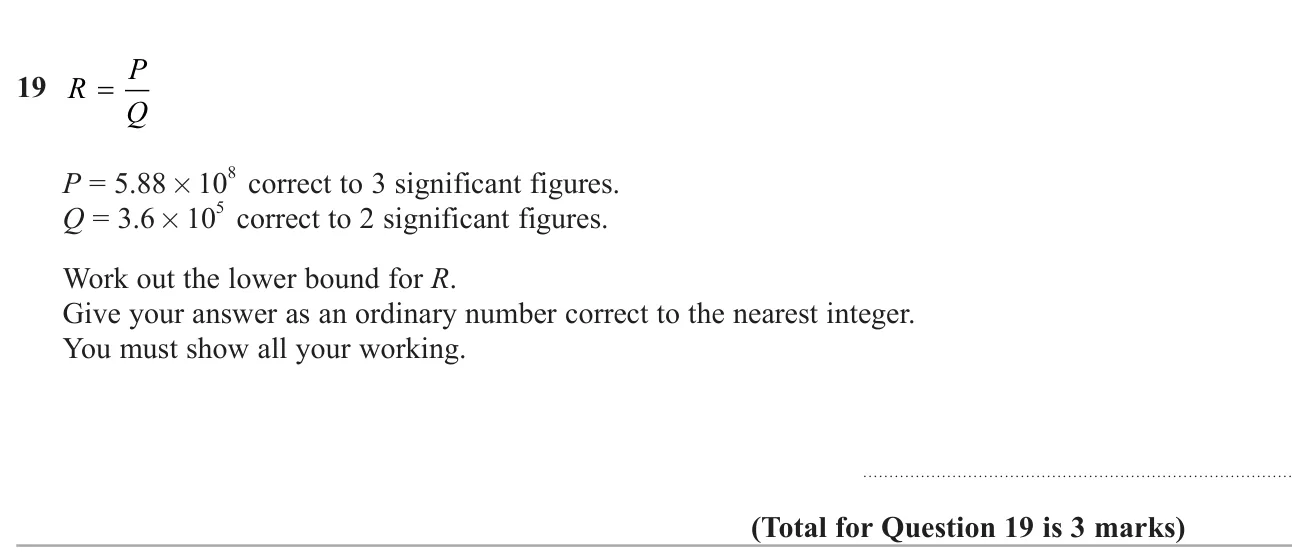
© Pearson Education Ltd. June 2024 Paper 3 (Higher, calculator), question 19.
Answer 1610 1610 1610 3 marks
Worked solution Checked against the mark scheme
P P P = 5.875 × 10 8 = 5.875 \times 10^8 = 5.875 × 1 0 8
Q Q Q = 3.65 × 10 5 = 3.65 \times 10^5 = 3.65 × 1 0 5
Lower bound of R = 5.875 × 10 8 3.65 × 10 5 = 1609.6 ≈ 1610 R = \dfrac{5.875 \times 10^8}{3.65 \times 10^5} = 1609.6 \approx 1610 R = 3.65 × 1 0 5 5.875 × 1 0 8 = 1609.6 ≈ 1610
Watch out: Dividing lower bound by lower bound.
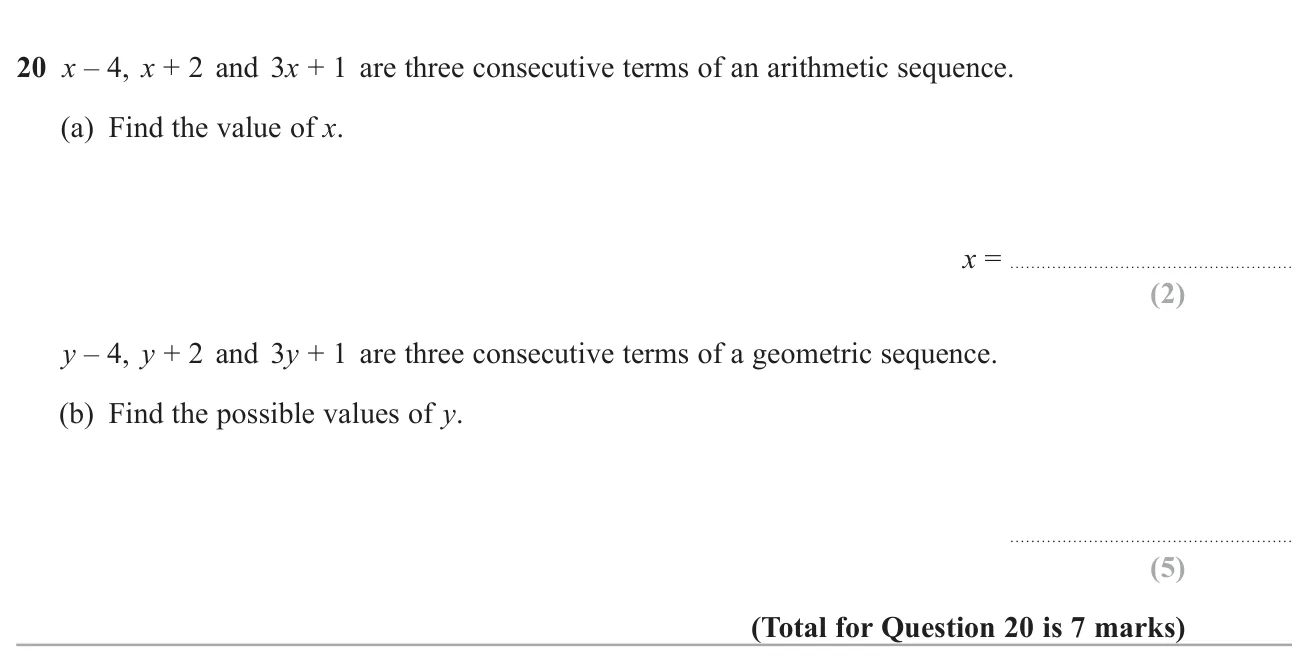
© Pearson Education Ltd. June 2024 Paper 3 (Higher, calculator), question 20.
(a) x = 3.5 x = 3.5 x = 3.5 2 marks (b) y = − 0.5 y = -0.5 y = − 0.5 y = 8 y = 8 y = 8 5 marks
Worked solution Checked against the mark scheme
(a) ( x + 2 ) − ( x − 4 ) = 6 (x+2)-(x-4) = 6 ( x + 2 ) − ( x − 4 ) = 6 ( 3 x + 1 ) − ( x + 2 ) = 2 x − 1 (3x+1)-(x+2) = 2x-1 ( 3 x + 1 ) − ( x + 2 ) = 2 x − 1 2 x − 1 = 6 2x - 1 = 6 2 x − 1 = 6 x = 3.5 x = 3.5 x = 3.5
(b) y + 2 y − 4 = 3 y + 1 y + 2 \dfrac{y+2}{y-4} = \dfrac{3y+1}{y+2} y − 4 y + 2 = y + 2 3 y + 1
( y + 2 ) 2 = ( 3 y + 1 ) ( y − 4 ) ⇒ y 2 + 4 y + 4 = 3 y 2 − 11 y − 4 (y+2)^2 = (3y+1)(y-4) \Rightarrow y^2 + 4y + 4 = 3y^2 - 11y - 4 ( y + 2 ) 2 = ( 3 y + 1 ) ( y − 4 ) ⇒ y 2 + 4 y + 4 = 3 y 2 − 11 y − 4
2 y 2 − 15 y − 8 = 0 ⇒ ( 2 y + 1 ) ( y − 8 ) = 0 2y^2 - 15y - 8 = 0 \Rightarrow (2y+1)(y-8) = 0 2 y 2 − 15 y − 8 = 0 ⇒ ( 2 y + 1 ) ( y − 8 ) = 0 y = − 0.5 y = -0.5 y = − 0.5 y = 8 y = 8 y = 8
Watch out: In (b), using equal differences instead of equal ratios.
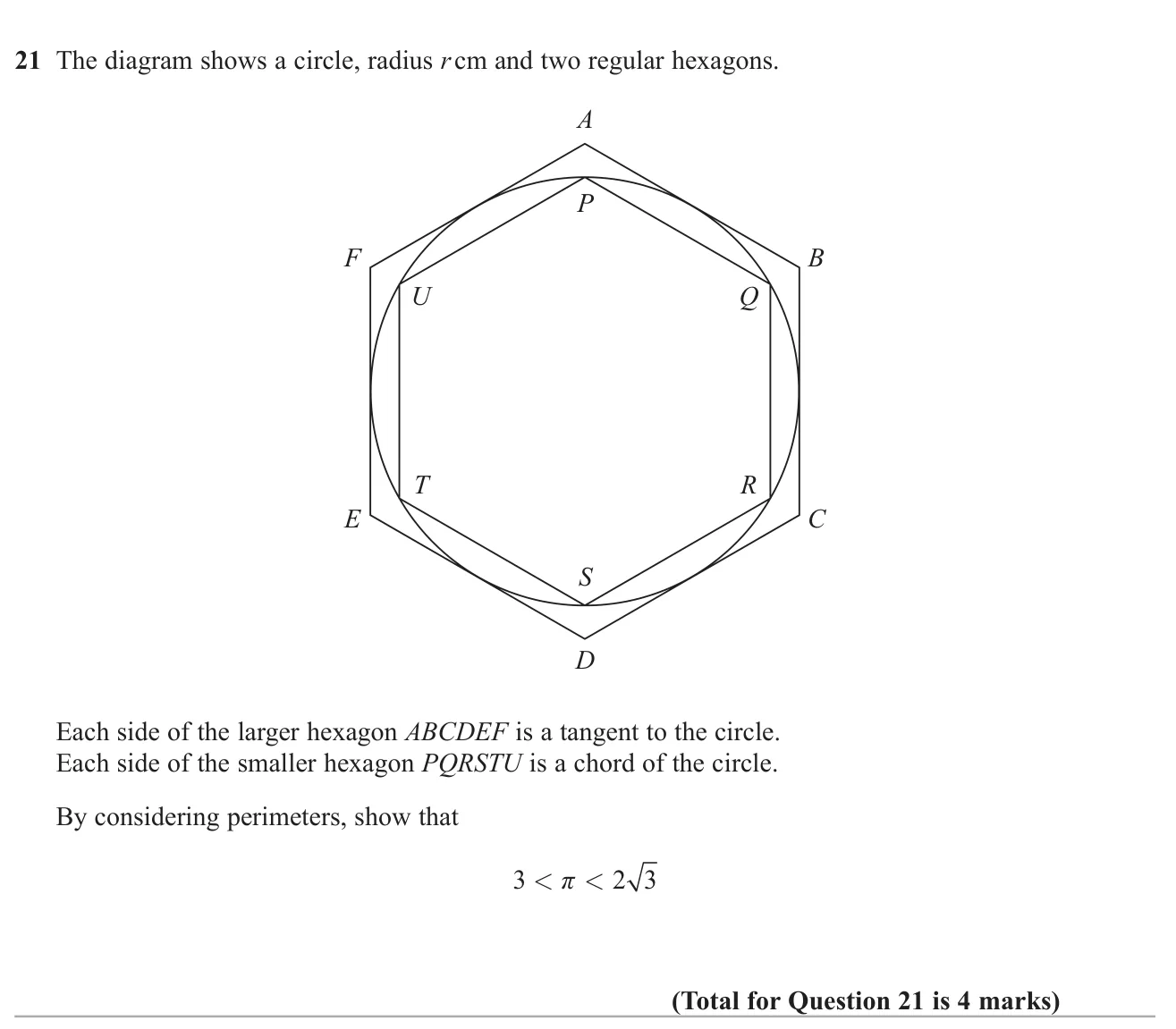
© Pearson Education Ltd. June 2024 Paper 3 (Higher, calculator), question 21.
Answer Shown: 6 r < 2 π r < 4 3 r 6r < 2\pi r < 4\sqrt3\,r 6 r < 2 π r < 4 3 r 3 < π < 2 3 3 < \pi < 2\sqrt3 3 < π < 2 3 4 marks
Worked solution Checked against the mark scheme
Smaller hexagon: made of 6 equilateral triangles of side r r r = 6 r = 6r = 6 r
Larger hexagon: the circle's radius is the height of each equilateral triangle, so half a side = r tan 30 ° = r 3 = r\tan 30° = \frac{r}{\sqrt3} = r tan 30° = 3 r = 2 r 3 = \frac{2r}{\sqrt3} = 3 2 r = 12 r 3 = 4 3 r = \frac{12r}{\sqrt3} = 4\sqrt3\,r = 3 12 r = 4 3 r
The circle lies between them: 6 r < 2 π r < 4 3 r 6r < 2\pi r < 4\sqrt3\,r 6 r < 2 π r < 4 3 r
Divide by 2 r 2r 2 r 3 < π < 2 3 3 < \pi < 2\sqrt3 3 < π < 2 3
Watch out: Assuming the larger hexagon also has side length r r r
Finished the paper? Add up your marks for all three papers and see what grade that would have been.