© Pearson Education Ltd. November 2021 Paper 2 (Higher, calculator), question 1.
Show answer
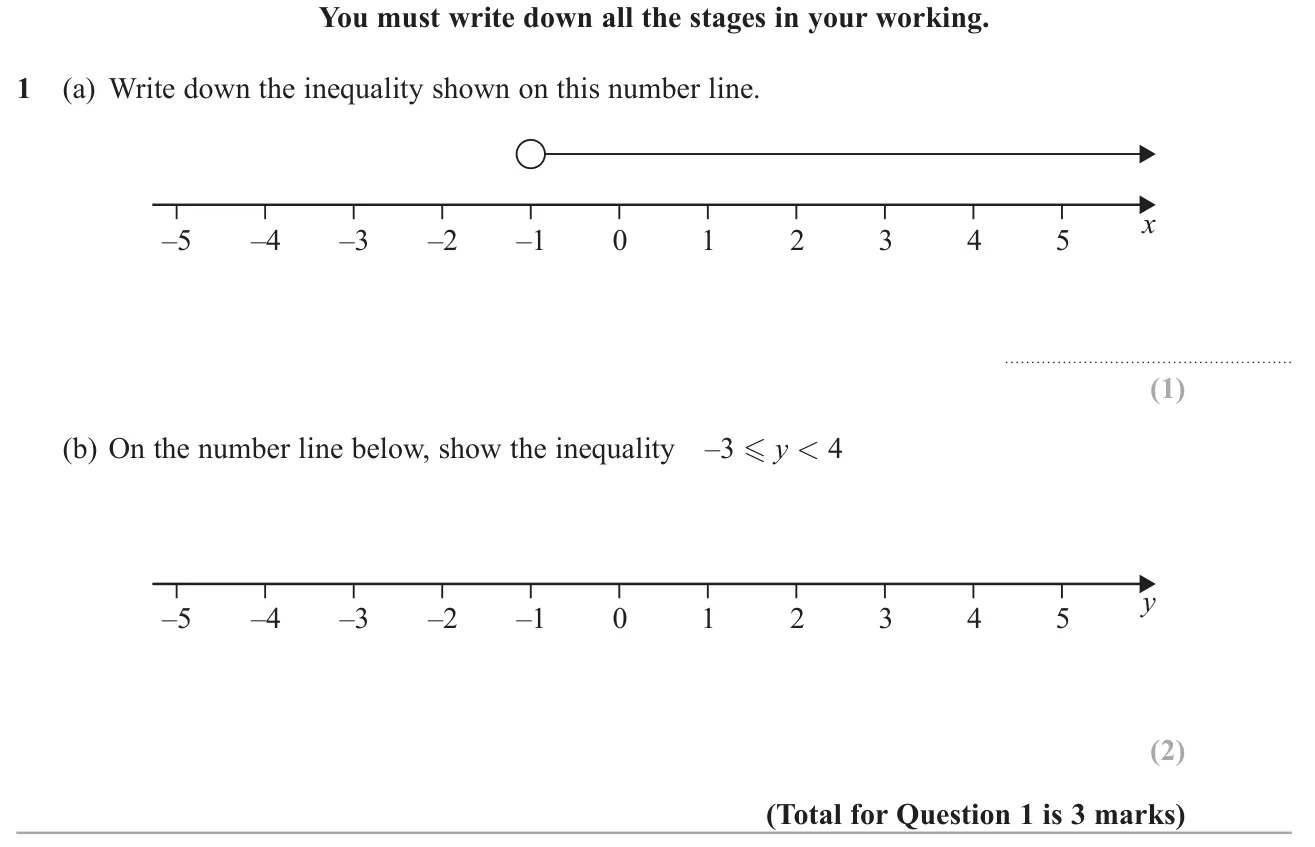
| (a) | x>−1 | 1 mark |
|---|
| (b) | Closed circle at −3, open circle at 4, joined by a line | 2 marks |
|---|
Worked solution Checked against the mark scheme
(a) The open circle at −1 means −1 is not included, and the arrow points right: x>−1.
(b) Filled circle at −3 (included) and open circle at 4 (not included), with a line joining them.
Watch out: Using the wrong type of circle at an end point.
© Pearson Education Ltd. November 2021 Paper 2 (Higher, calculator), question 2.
Show answer
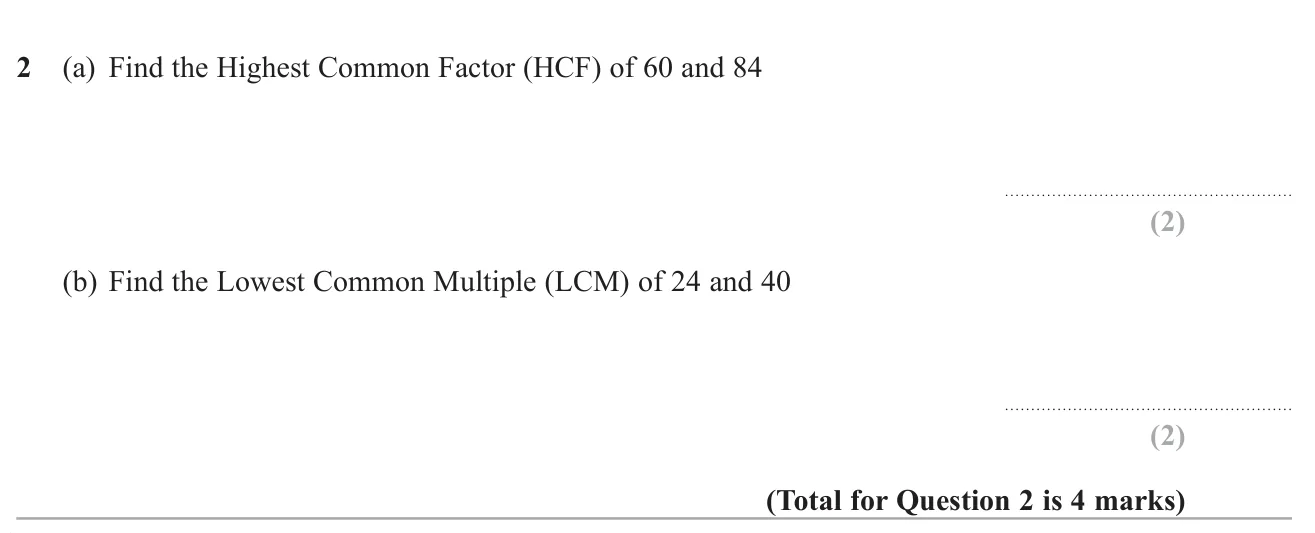
| (a) | 12 | 2 marks |
|---|
| (b) | 120 | 2 marks |
|---|
Worked solution Checked against the mark scheme
(a) 60=22×3×5 and 84=22×3×7.
HCF =22×3=12.
(b) 24=23×3 and 40=23×5.
LCM =23×3×5=120.
Watch out: Mixing up HCF and LCM.
© Pearson Education Ltd. November 2021 Paper 2 (Higher, calculator), question 3.
Show answer
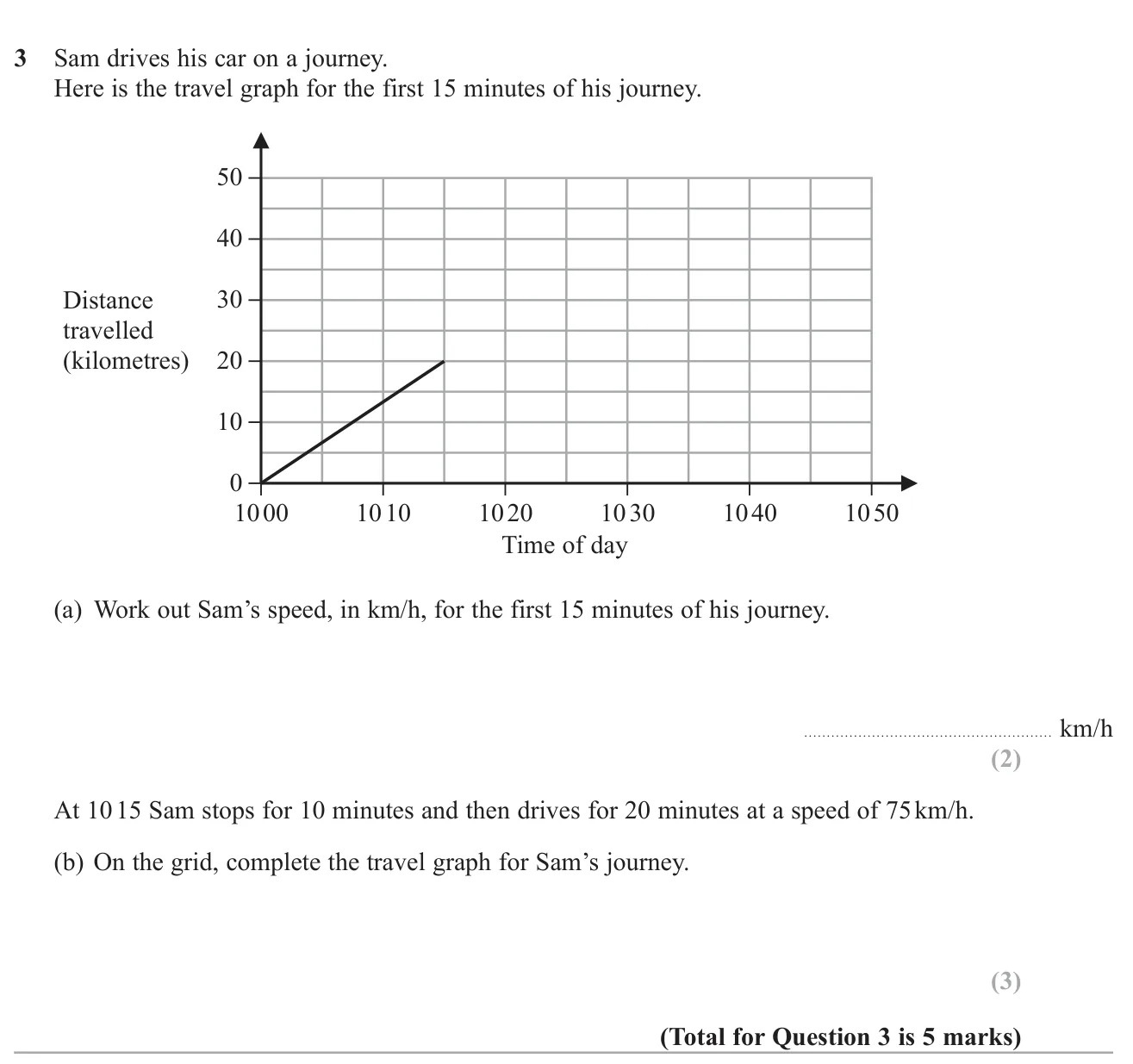
| (a) | 80 | 2 marks |
|---|
| (b) | Horizontal line from (10 15, 20) to (10 25, 20), then a straight line to (10 45, 45) | 3 marks |
|---|
Worked solution Checked against the mark scheme
(a) 20 km in 15 minutes. There are four lots of 15 minutes in an hour, so 20×4=80 km/h.
(b) Stop: flat line at 20 km from 10 15 to 10 25.
In 20 minutes at 75 km/h: 75×6020=25 km.
Draw a line from (10 25, 20) to (10 45, 45).
Watch out: Using 20 minutes as 0.2 hours.
© Pearson Education Ltd. November 2021 Paper 2 (Higher, calculator), question 4.
Show answer
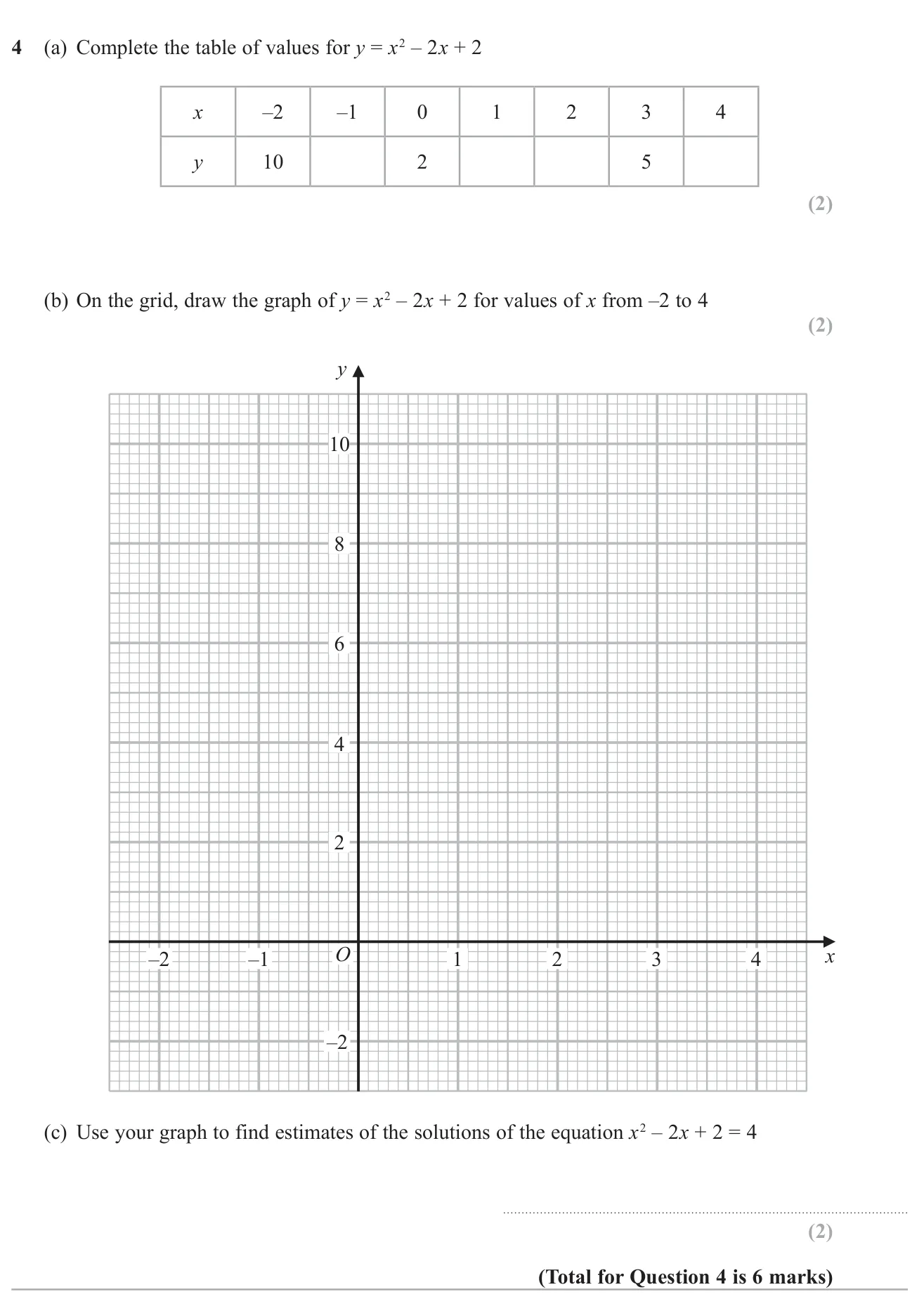
| (a) | 5, 1, 2, 10 | 2 marks |
|---|
| (b) | A smooth curve through the plotted points | 2 marks |
|---|
| (c) | x≈−0.7 and x≈2.7 | 2 marks |
|---|
Worked solution Checked against the mark scheme
(a) x=−1: 1+2+2=5. x=1: 1−2+2=1. x=2: 4−4+2=2. x=4: 16−8+2=10.
(b) Plot (−2,10),(−1,5),(0,2),(1,1),(2,2),(3,5),(4,10) and join with a smooth curve.
(c) Draw the line y=4. It crosses the curve at about x=−0.7 and x=2.7.
Watch out: Working out (−1)2 as −1.
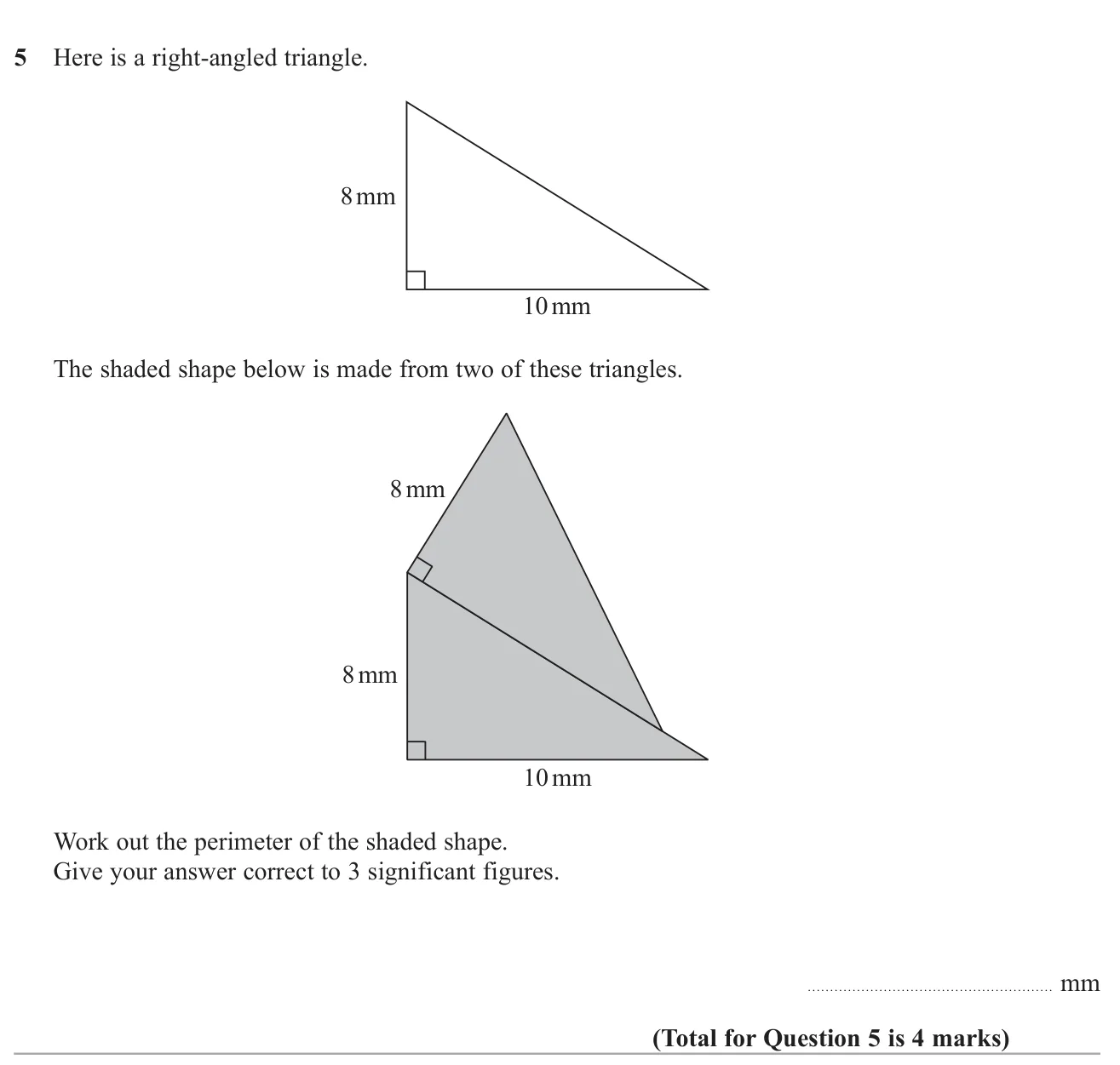
© Pearson Education Ltd. November 2021 Paper 2 (Higher, calculator), question 5.
Show answer
Worked solution Checked against the mark scheme
Hypotenuse: 82+102=164=12.806… mm.
Outer edges: 8, 10, part of the first hypotenuse (12.806−10=2.806), the second hypotenuse 12.806, and 8.
Perimeter =8+10+2.806+12.806+8=41.6 mm (3 s.f.)
Watch out: Including the full length of the inner hypotenuse, which is not on the outside of the shape.
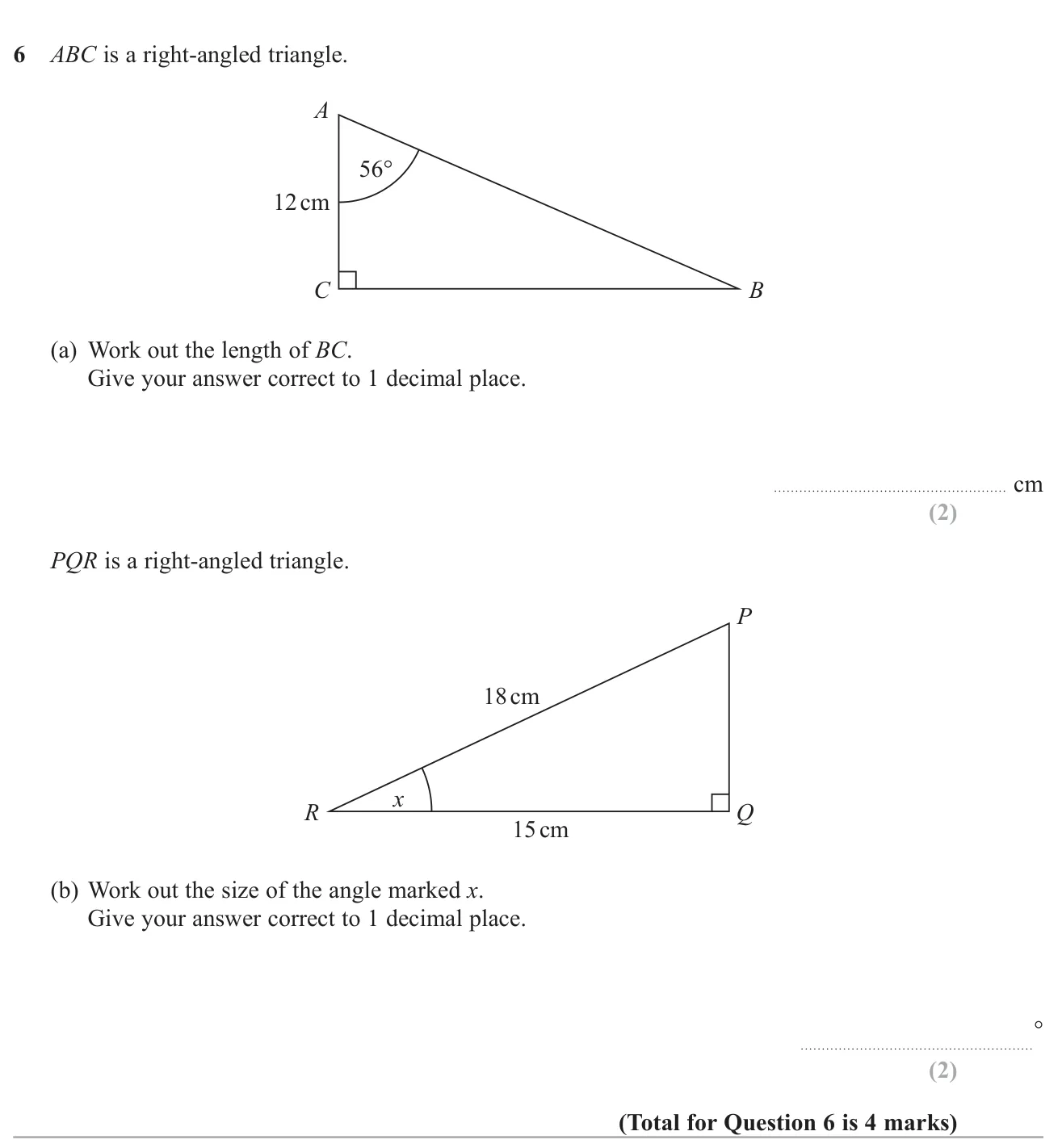
© Pearson Education Ltd. November 2021 Paper 2 (Higher, calculator), question 6.
Show answer
| (a) | 17.8 | 2 marks |
|---|
| (b) | 33.6 | 2 marks |
|---|
Worked solution Checked against the mark scheme
(a) BC is opposite 56∘ and 12 is adjacent, so use tan.
BC=12tan56∘=17.79…=17.8 cm
(b) 15 is adjacent and 18 is the hypotenuse, so use cos.
x=cos−1(1815)=33.557…=33.6∘
Watch out: Choosing the wrong ratio, for example sin instead of tan.
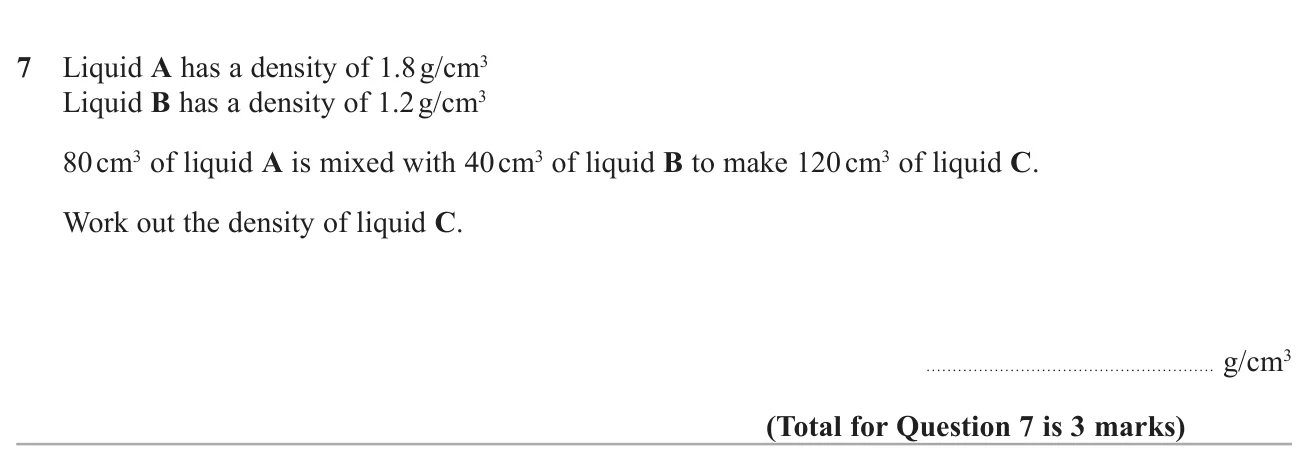
© Pearson Education Ltd. November 2021 Paper 2 (Higher, calculator), question 7.
Show answer
| Answer | 1.6 g/cm³ | 3 marks |
|---|
Worked solution Checked against the mark scheme
Mass of A =1.8×80=144 g. Mass of B =1.2×40=48 g.
Total mass =192 g, total volume =120 cm³.
Density =192÷120=1.6 g/cm³.
Watch out: Averaging the two densities to get 1.5, ignoring the different volumes.
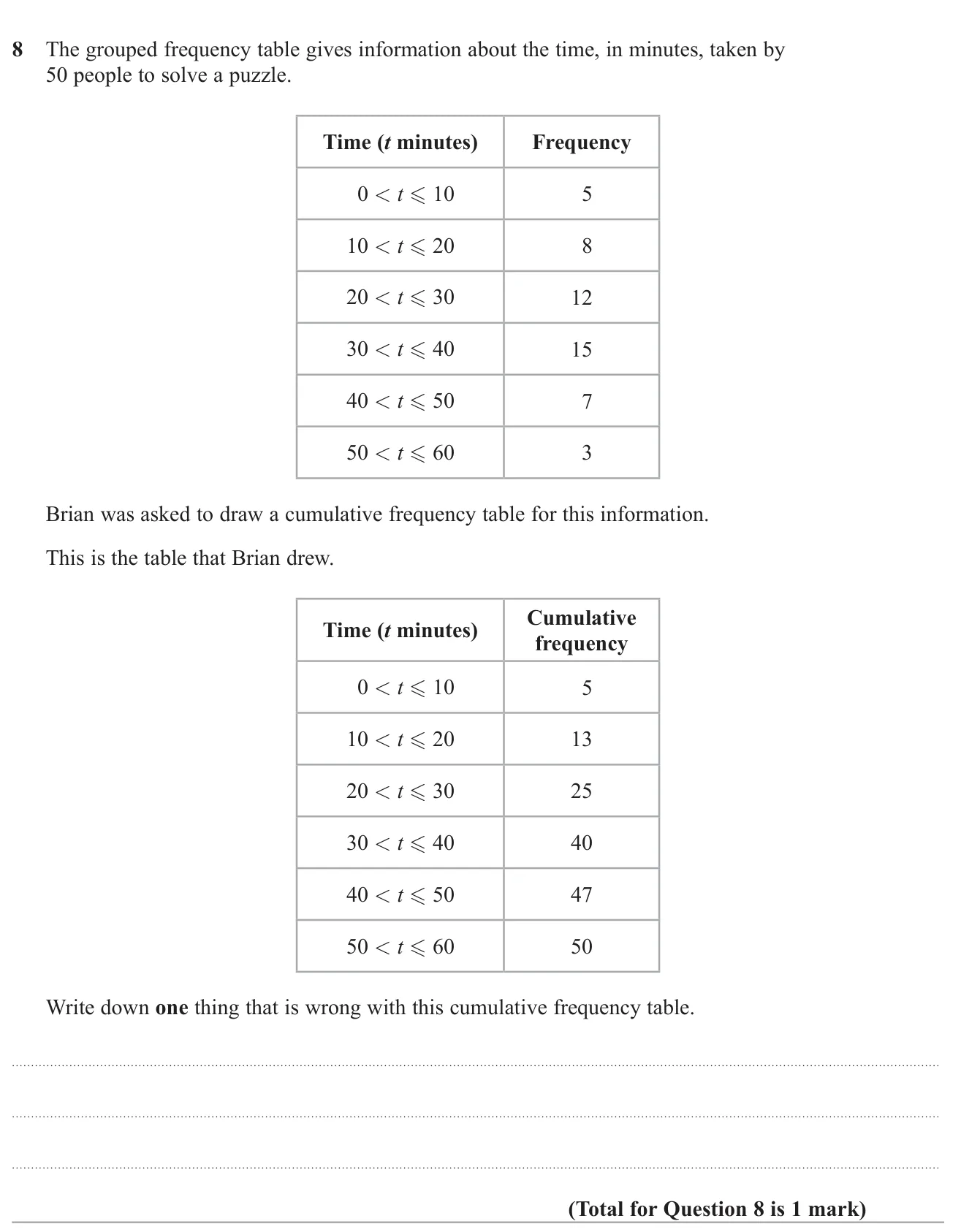
© Pearson Education Ltd. November 2021 Paper 2 (Higher, calculator), question 8.
Show answer
| Answer | The class intervals are wrong: each should start at 0, e.g. 0<t≤20 not 10<t≤20 | 1 mark |
|---|
Worked solution Checked against the mark scheme
Cumulative frequency counts everyone up to the end of each class.
So 13 is the number with t≤20, which covers 0<t≤20, not just 10<t≤20.
The running totals are right, but every interval after the first should start at 0.
Watch out: Saying the totals have been added wrongly, when the totals are correct.
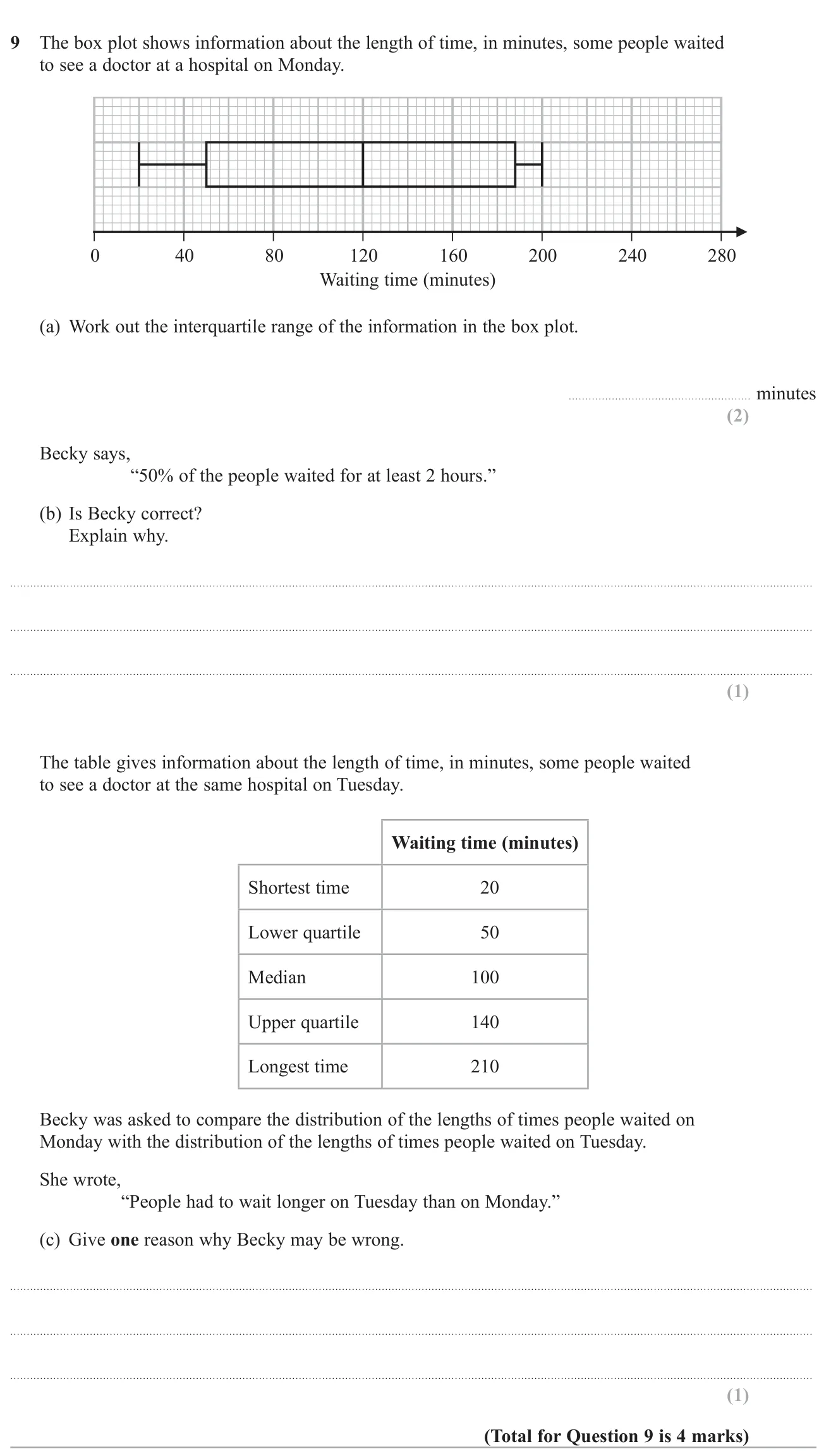
© Pearson Education Ltd. November 2021 Paper 2 (Higher, calculator), question 9.
Show answer
| (a) | 138 minutes | 2 marks |
|---|
| (b) | Yes, because the median is 120 minutes (2 hours) | 1 mark |
|---|
| (c) | Tuesday's median (100) is lower than Monday's (120), so typical waits were shorter | 1 mark |
|---|
Worked solution Checked against the mark scheme
(a) Upper quartile =188, lower quartile =50.
IQR =188−50=138 minutes.
(b) The median is at 120 minutes, which is 2 hours, so half the people waited at least that long. Becky is right.
(c) The median on Tuesday is 100 minutes, lower than 120 on Monday, so on average people waited less on Tuesday.
Watch out: Comparing only the longest times (210 vs 200) and agreeing with Becky.
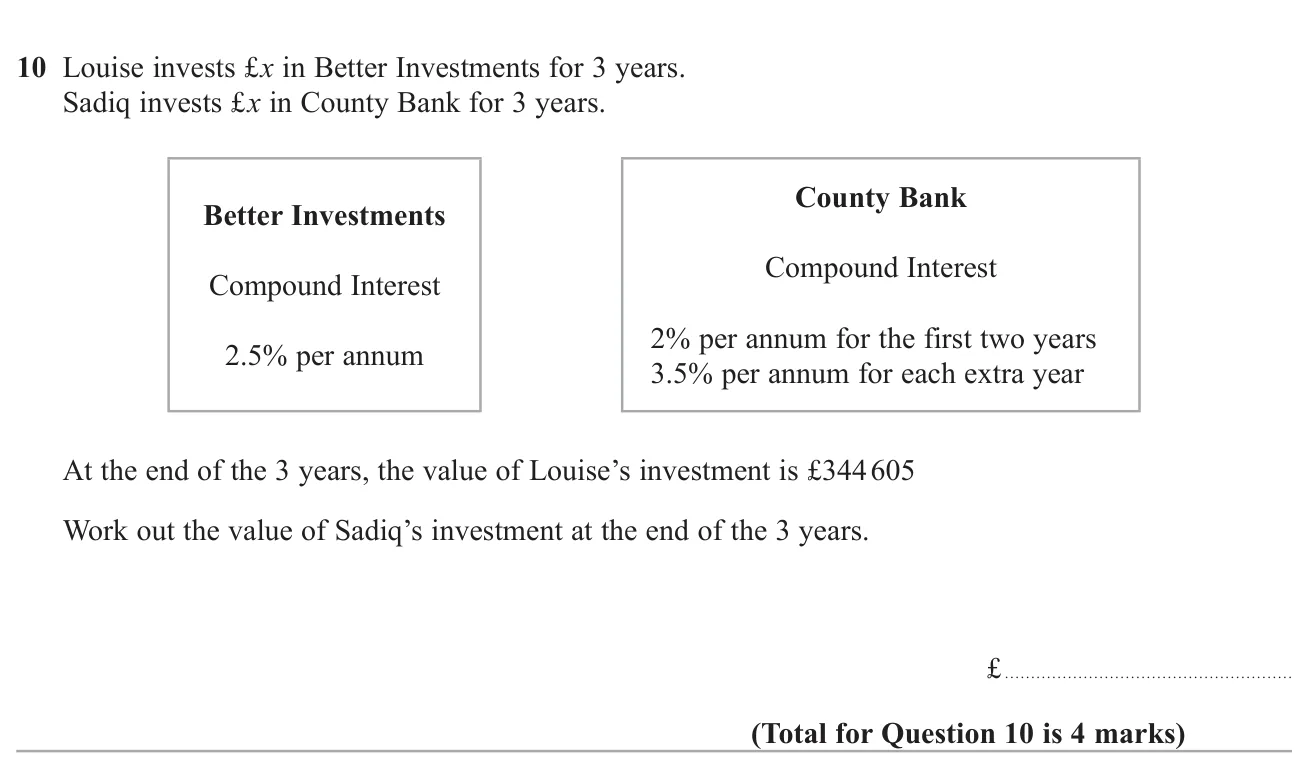
© Pearson Education Ltd. November 2021 Paper 2 (Higher, calculator), question 10.
Show answer
Worked solution Checked against the mark scheme
Louise: x×1.0253=344605, so x=344605÷1.0253=320000.
Sadiq: 320000×1.022×1.035=344580.48.
Sadiq's investment is worth £344 580.48.
Watch out: Using simple interest, or dividing by 1.075 instead of 1.025³.
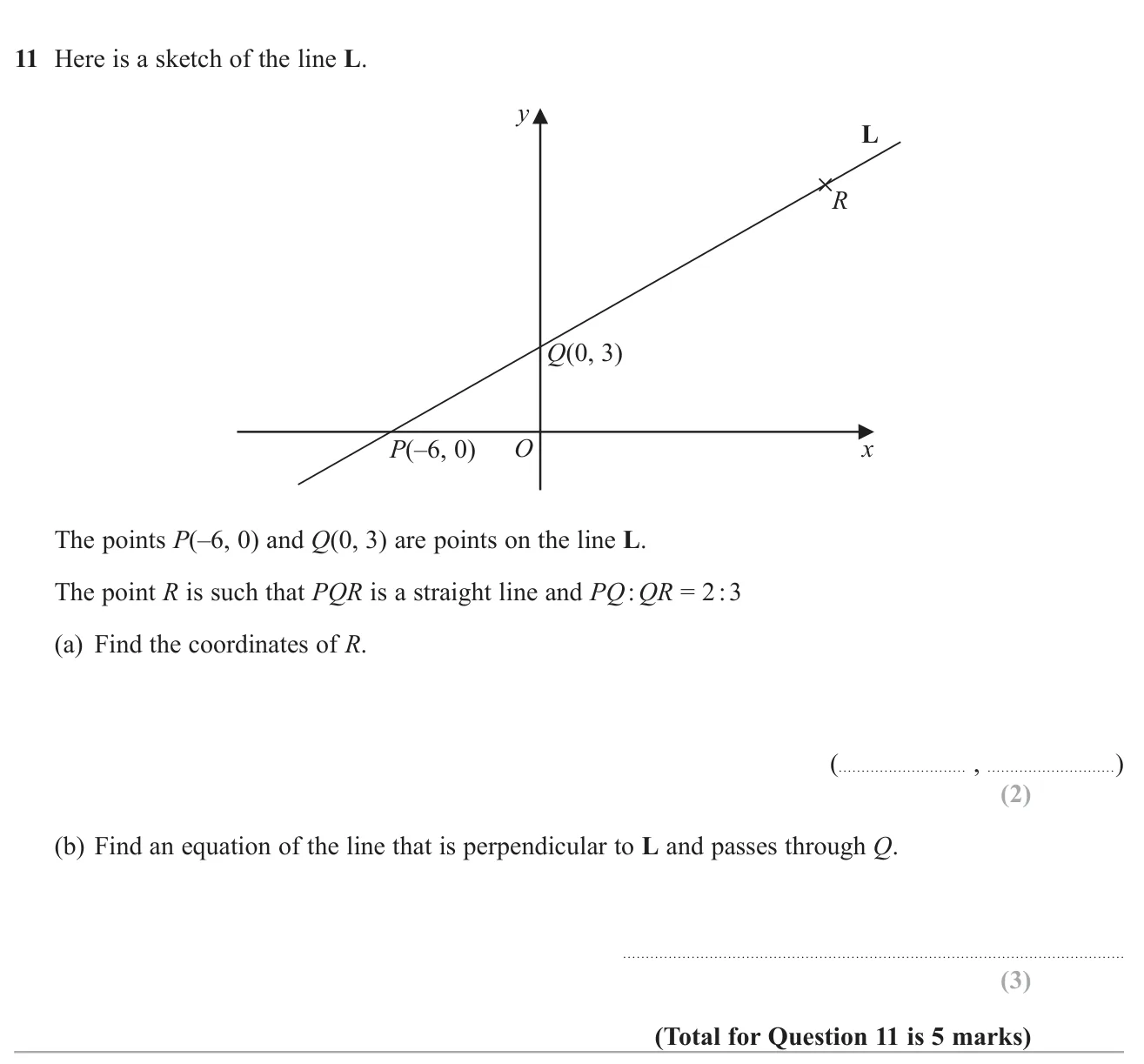
© Pearson Education Ltd. November 2021 Paper 2 (Higher, calculator), question 11.
Show answer
| (a) | (9,7.5) | 2 marks |
|---|
| (b) | y=−2x+3 | 3 marks |
|---|
Worked solution Checked against the mark scheme
(a) From P to Q you go 6 right and 3 up. QR is 23 of PQ, so from Q go 9 right and 4.5 up.
R=(0+9,3+4.5)=(9,7.5).
(b) Gradient of L =63=21. Perpendicular gradient =−2.
The line passes through (0,3), so y=−2x+3.
Watch out: Using the ratio 2 : 3 to split PQ itself rather than extending beyond Q.
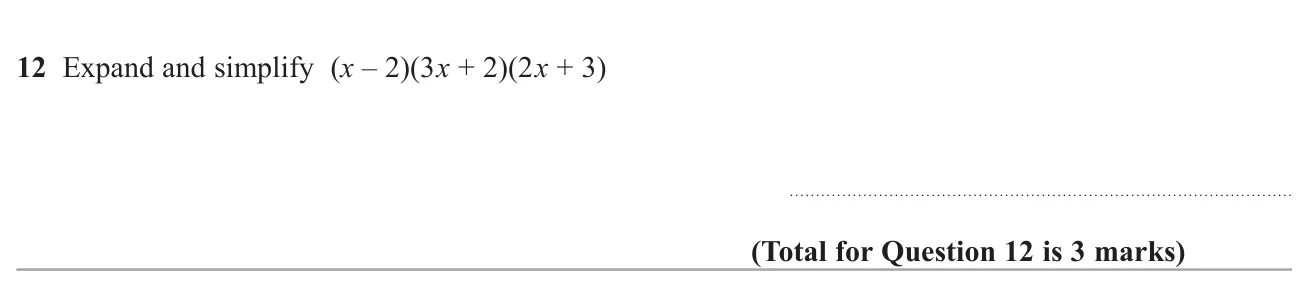
© Pearson Education Ltd. November 2021 Paper 2 (Higher, calculator), question 12.
Show answer
| Answer | 6x3+x2−20x−12 | 3 marks |
|---|
Worked solution Checked against the mark scheme
(x−2)(3x+2)=3x2+2x−6x−4=3x2−4x−4
(3x2−4x−4)(2x+3)=6x3+9x2−8x2−12x−8x−12
=6x3+x2−20x−12
Watch out: Sign errors when multiplying the negative terms.
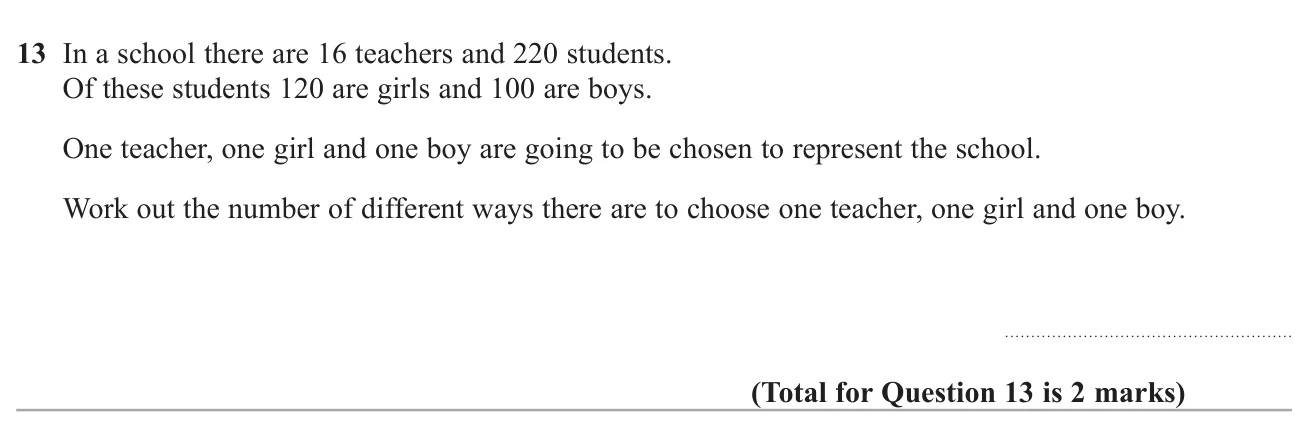
© Pearson Education Ltd. November 2021 Paper 2 (Higher, calculator), question 13.
Show answer
| Answer | 192000 | 2 marks |
|---|
Worked solution Checked against the mark scheme
Use the product rule: multiply the number of choices for each role.
16×120×100=192000
Watch out: Adding the numbers (236) or using 16 × 220.
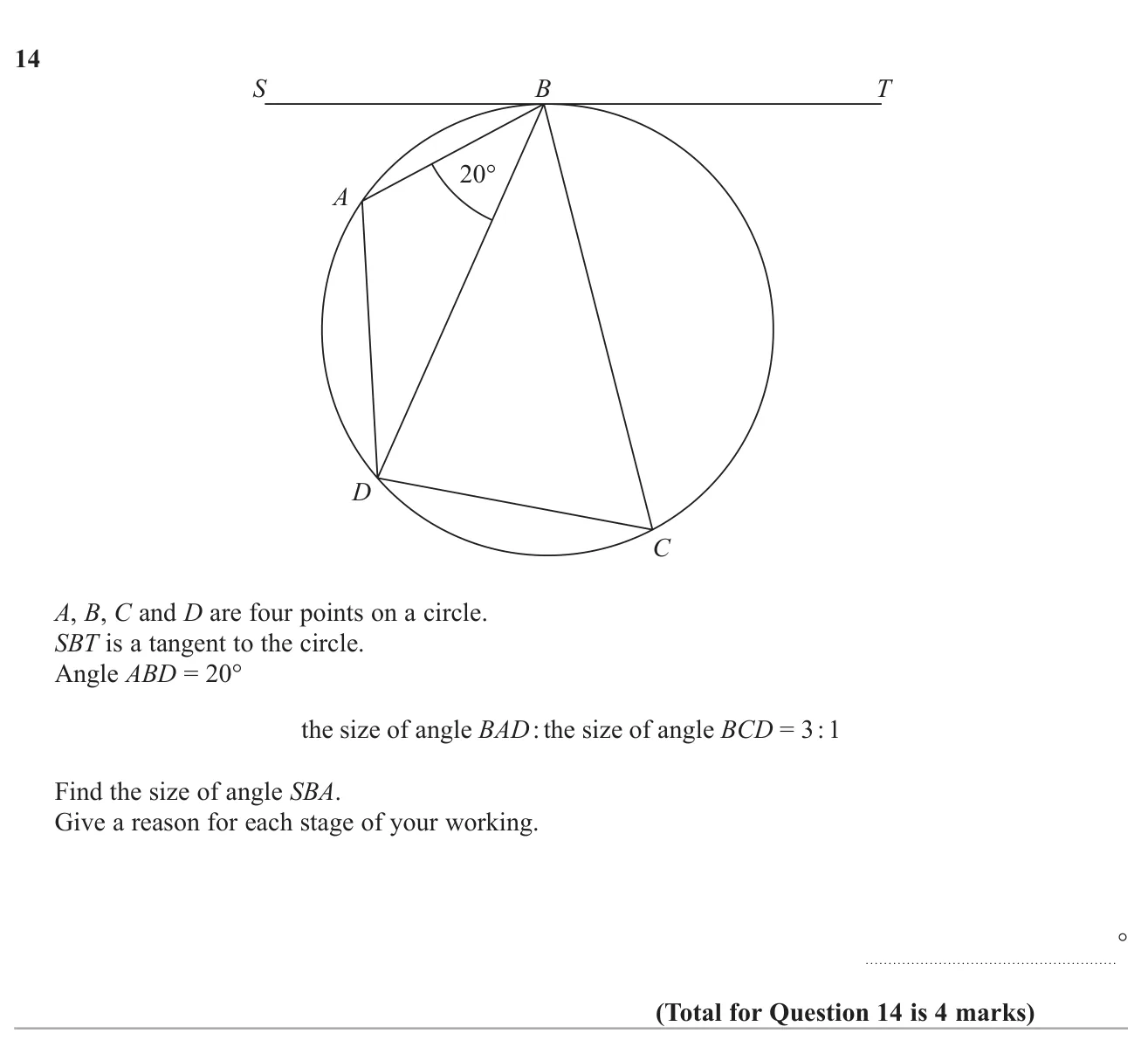
© Pearson Education Ltd. November 2021 Paper 2 (Higher, calculator), question 14.
Show answer
Worked solution Checked against the mark scheme
Opposite angles of a cyclic quadrilateral add to 180°, so BCD=180÷4=45° and BAD=135°.
Alternate segment theorem: angle SBD=BCD=45°.
SBA=SBD−ABD=45−20=25°.
Watch out: Stating angles without the reasons (cyclic quadrilateral and alternate segment theorem), which loses the C marks.
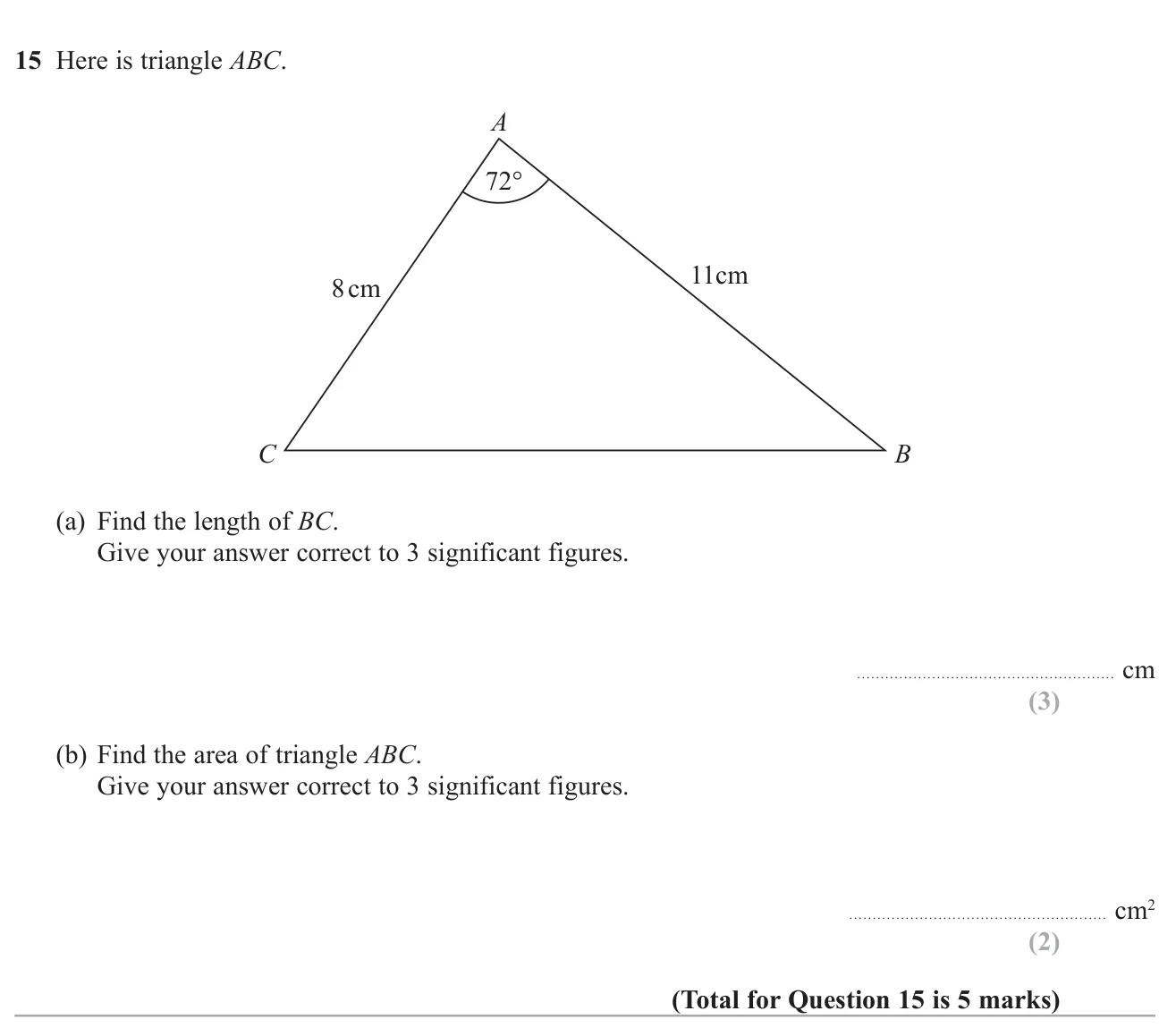
© Pearson Education Ltd. November 2021 Paper 2 (Higher, calculator), question 15.
Show answer
| (a) | 11.4 cm | 3 marks |
|---|
| (b) | 41.8 cm² | 2 marks |
|---|
Worked solution Checked against the mark scheme
(a) BC2=82+112−2×8×11cos72°=185−54.38=130.61...
BC=130.61...=11.4 cm.
(b) Area =21×8×11×sin72°=41.8 cm².
Watch out: Working out 185−176 first and then multiplying by cos 72.
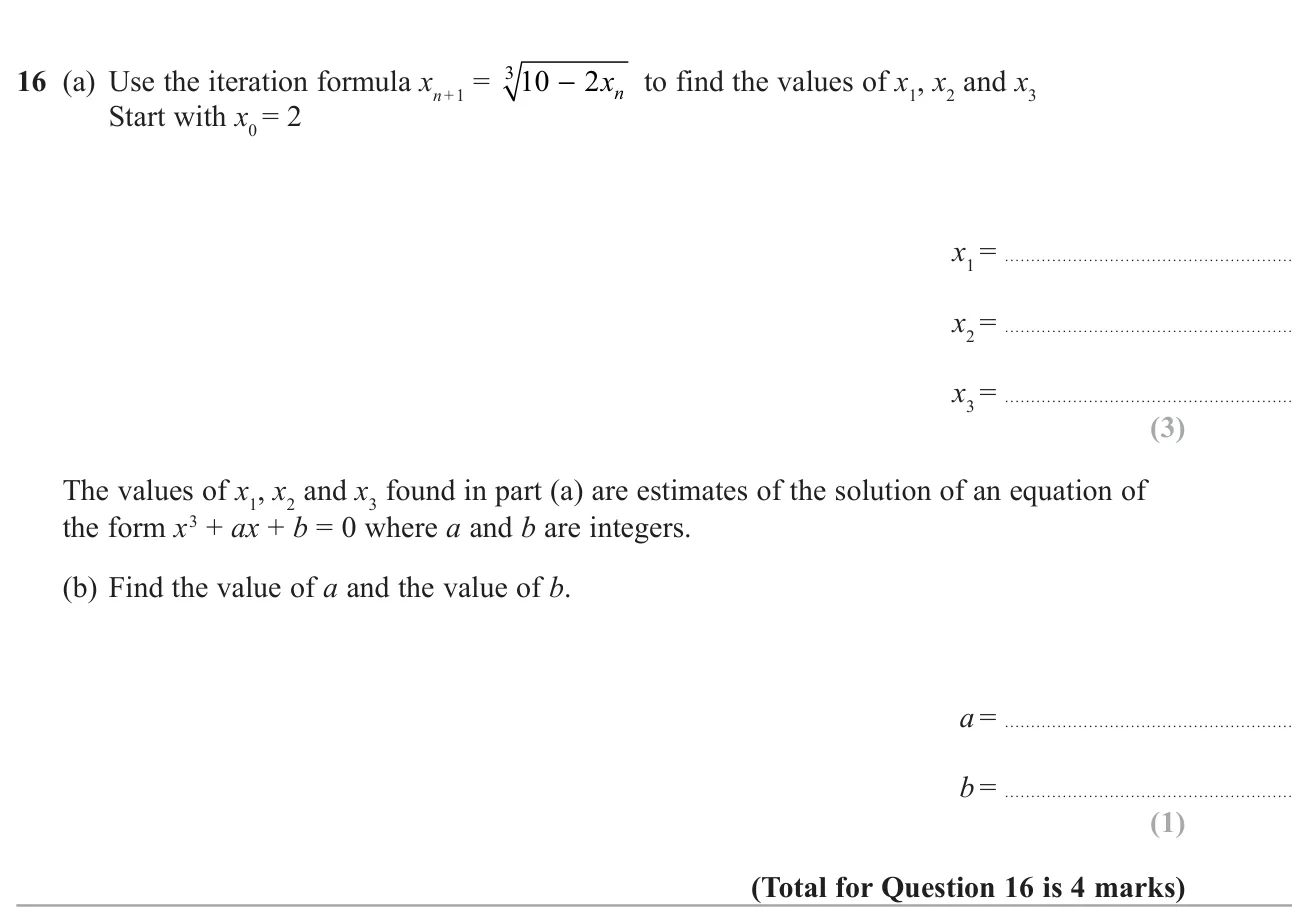
© Pearson Education Ltd. November 2021 Paper 2 (Higher, calculator), question 16.
Show answer
| (a) | x1=1.817, x2=1.853, x3=1.846 | 3 marks |
|---|
| (b) | a=2, b=−10 | 1 mark |
|---|
Worked solution Checked against the mark scheme
(a) x1=310−2×2=36=1.817...
x2=310−2×1.817...=1.853...
x3=310−2×1.853...=1.846...
(b) x=310−2x gives x3=10−2x, so x3+2x−10=0: a=2, b=−10.
Watch out: Rounding each value heavily before putting it back in, so later values drift.
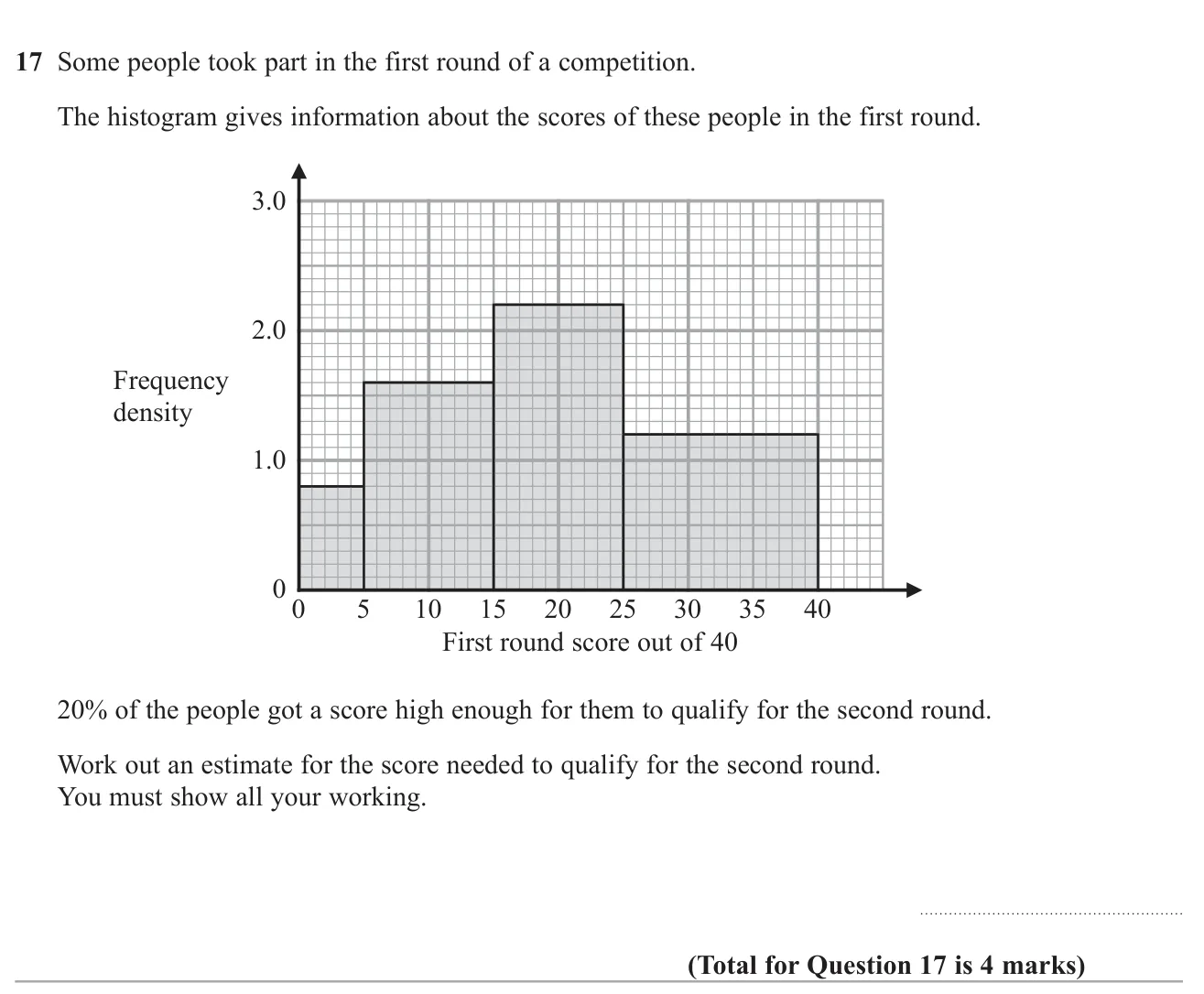
© Pearson Education Ltd. November 2021 Paper 2 (Higher, calculator), question 17.
Show answer
Worked solution Checked against the mark scheme
Frequency = frequency density × class width:
0.8×5=4, 1.6×10=16, 2.2×10=22, 1.2×15=18. Total =60.
20% of 60 =12 people.
In the top class, 12 people cover 12÷1.2=10 marks, so the score is 40−10=30.
Watch out: Reading frequency density as frequency, or counting 12 people up from 0 instead of down from 40.
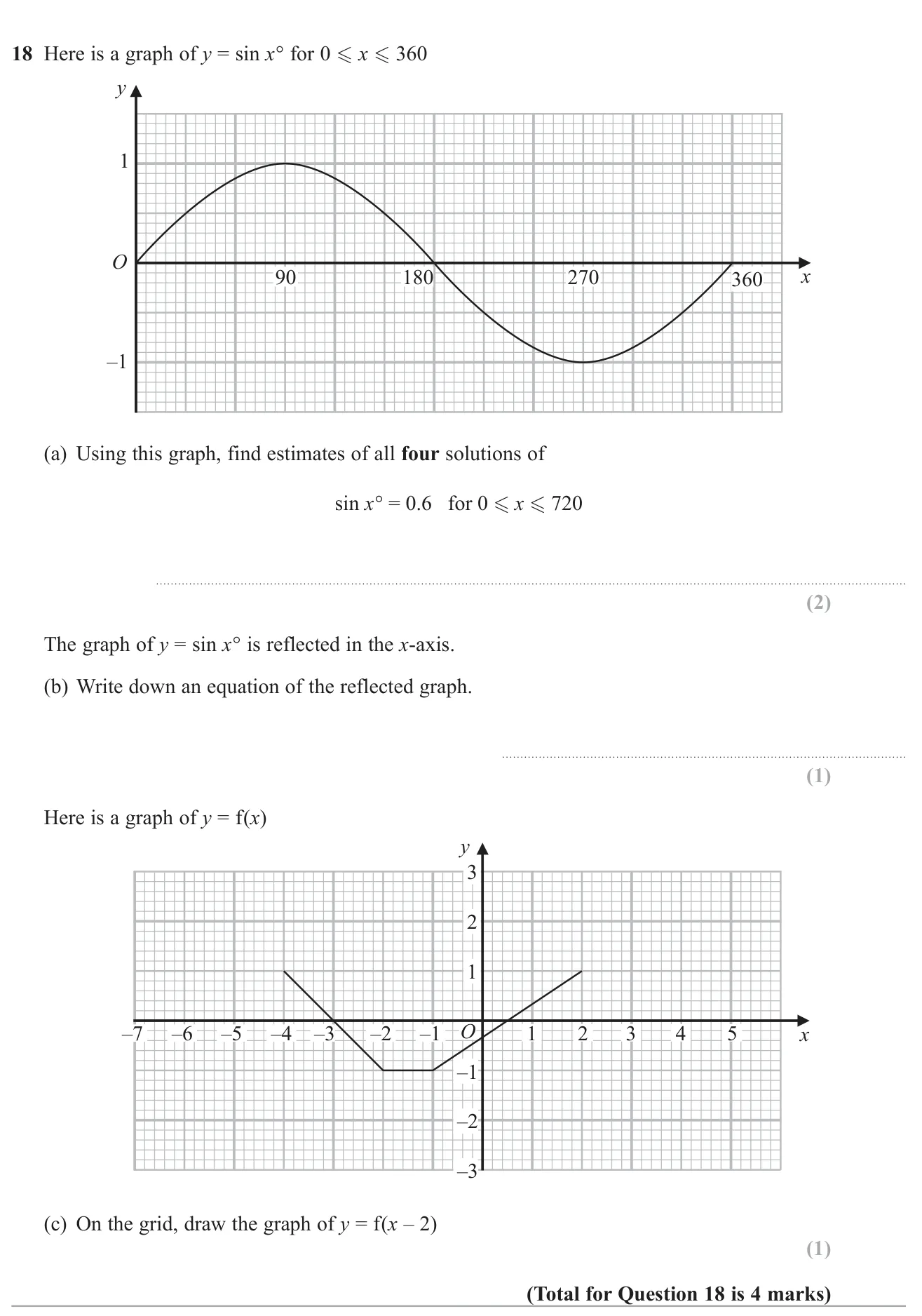
© Pearson Education Ltd. November 2021 Paper 2 (Higher, calculator), question 18.
Show answer
| (a) | 37°,143°,397°,503° | 2 marks |
|---|
| (b) | y=−sinx° | 1 mark |
|---|
| (c) | The curve moved 2 units to the right | 1 mark |
|---|
Worked solution Checked against the mark scheme
(a) Draw y=0.6 across the graph: it meets the curve at about 37° and 180−37=143°.
The graph repeats every 360°, so also 37+360=397° and 143+360=503°.
(b) Reflecting in the x-axis makes every y negative: y=−sinx°.
(c) f(x−2) shifts every point 2 to the right, e.g. a point at x=1 moves to x=3.
Watch out: Moving the graph 2 to the left for f(x − 2).
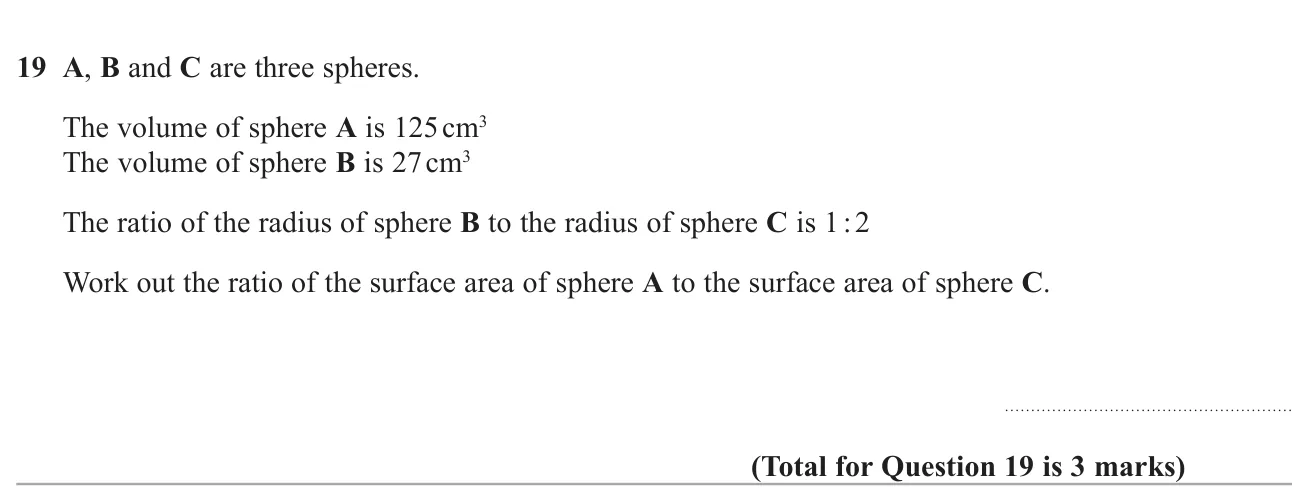
© Pearson Education Ltd. November 2021 Paper 2 (Higher, calculator), question 19.
Show answer
| Answer | 25:36 | 3 marks |
|---|
Worked solution Checked against the mark scheme
Volume ratio A : B =125:27, so radius ratio =3125:327=5:3.
B : C =1:2=3:6, so A : C radii =5:6.
Surface areas go with the square: 25:36.
Watch out: Squaring the volume ratio instead of cube-rooting it first.
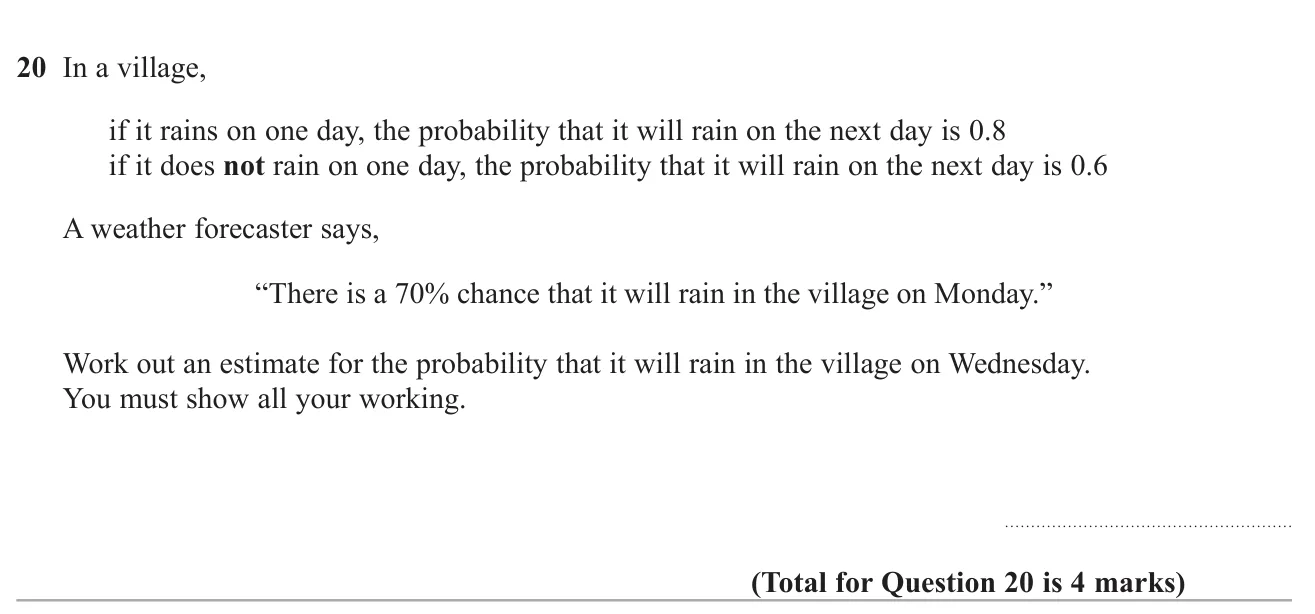
© Pearson Education Ltd. November 2021 Paper 2 (Higher, calculator), question 20.
Show answer
| Answer | 0.748 | 4 marks |
|---|
Worked solution Checked against the mark scheme
Paths that end with rain on Wednesday (R = rain, N = no rain):
RRR: 0.7×0.8×0.8=0.448
RNR: 0.7×0.2×0.6=0.084
NRR: 0.3×0.6×0.8=0.144
NNR: 0.3×0.4×0.6=0.072
Total =0.748
Watch out: Only counting the path where it rains every day.
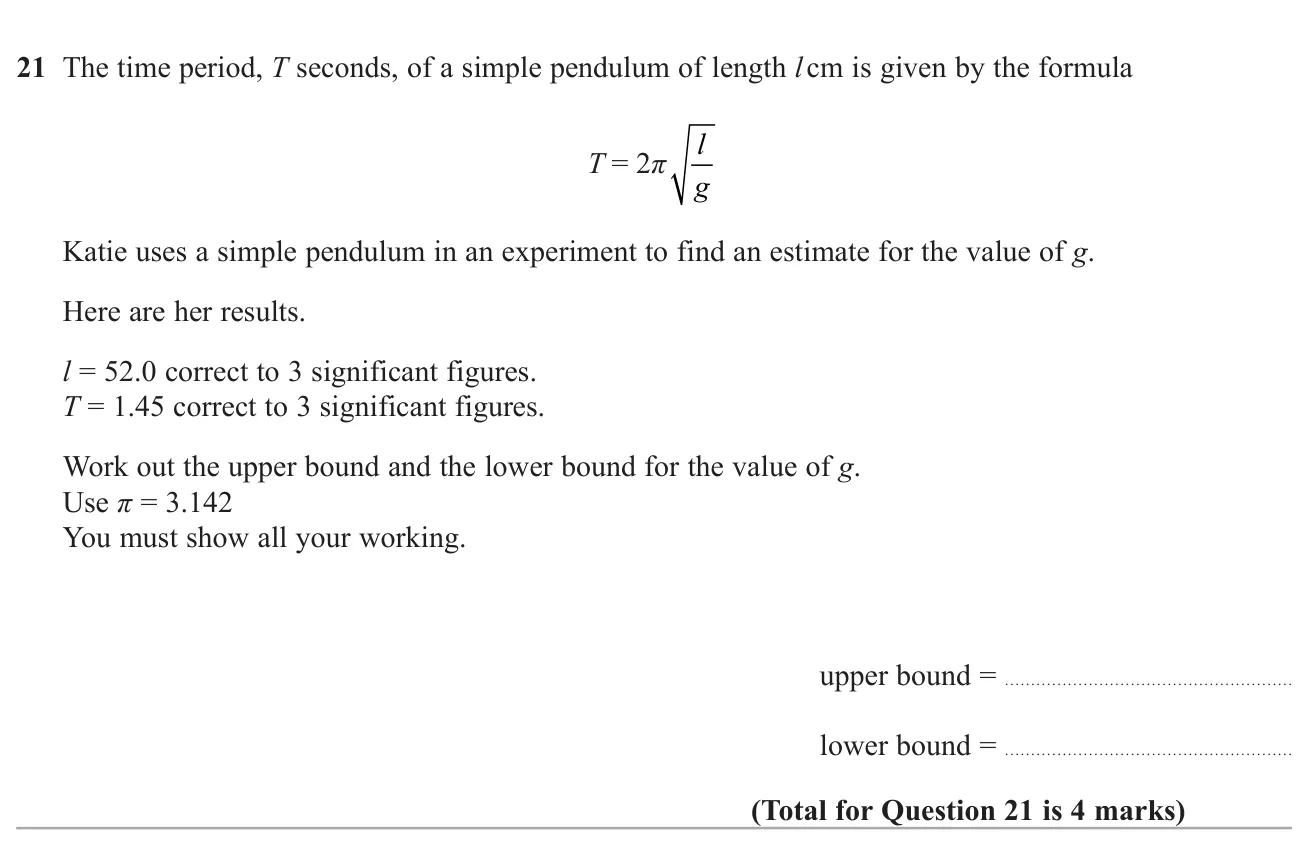
© Pearson Education Ltd. November 2021 Paper 2 (Higher, calculator), question 21.
Show answer
| Answer | Upper bound 984.4, lower bound 969.0 | 4 marks |
|---|
Worked solution Checked against the mark scheme
Rearranging: g=T24π2l.
Bounds: 51.95≤l<52.05 and 1.445≤T<1.455.
Upper bound: g=1.44524×3.1422×52.05=984.4 (to 1 d.p.).
Lower bound: g=1.45524×3.1422×51.95=969.0 (to 1 d.p.).
Watch out: Using the upper bound of T to get the upper bound of g; T is in the denominator, so it needs the lower bound.
Finished the paper?
Add up your marks for all three papers and see what grade that would have been.