© Pearson Education Ltd. Specimen Paper 3 (Higher, calculator), question 1.
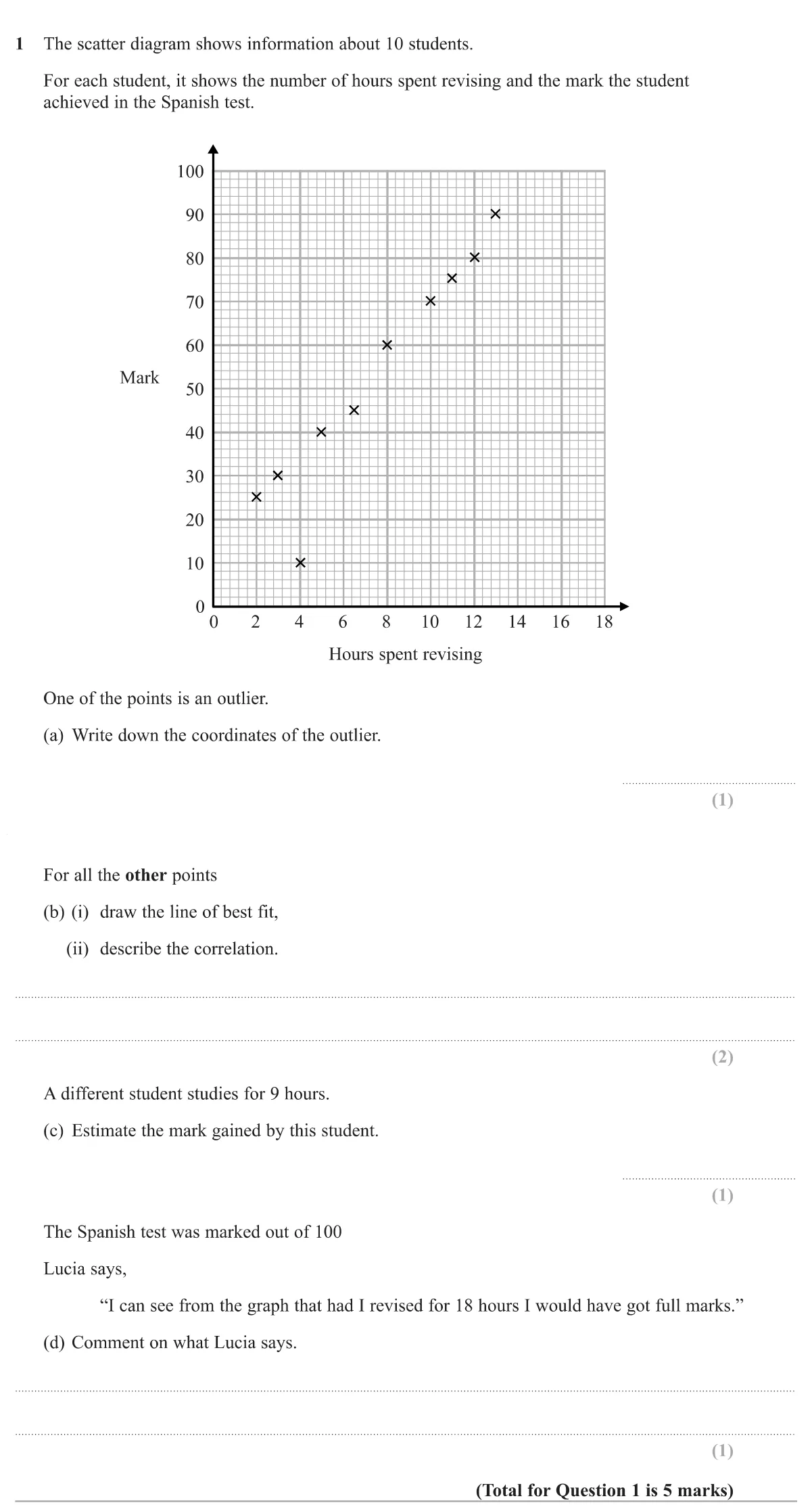
(a) ( 4 , 10 ) (4, 10) ( 4 , 10 ) 1 mark (b(i)) A straight line of best fit through the other nine points 1 mark (b(ii)) Positive correlation 1 mark (c) A value from 60 to 70 1 mark (d) She cannot be sure: 18 hours is outside the range of the data, so the line should not be extended that far 1 mark
Worked solution Checked against the mark scheme
(a) The point at 4 hours with a mark of 10 is far below the pattern of the rest: ( 4 , 10 ) (4, 10) ( 4 , 10 )
(b) Ignore the outlier and draw one straight line through the middle of the other points, e.g. from about ( 2 , 22 ) (2, 22) ( 2 , 22 ) ( 13 , 86 ) (13, 86) ( 13 , 86 ) positive correlation.
(c) Go up from 9 hours to your line and across: about 65 .
(d) The data only goes up to about 13 hours. Extending the line to 18 hours is extrapolation, so the prediction is unreliable (and marks can't keep rising past 100).
Watch out: Including the outlier when drawing the line of best fit, which drags it down.
© Pearson Education Ltd. Specimen Paper 3 (Higher, calculator), question 2.
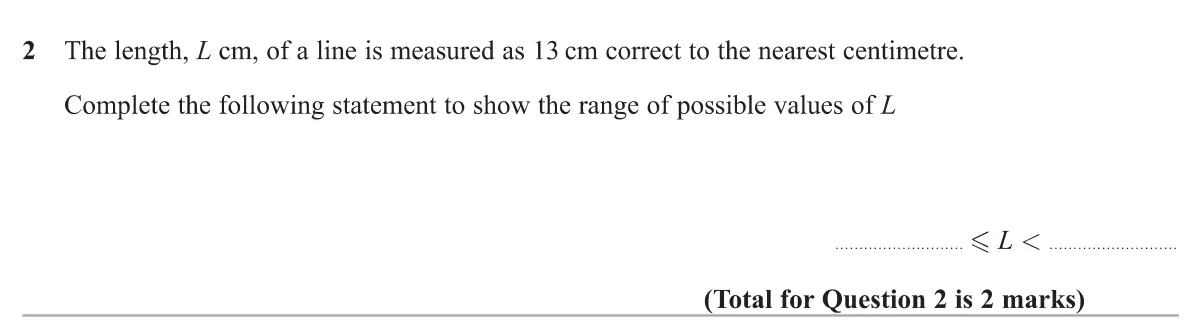
Answer 12.5 ≤ L < 13.5 12.5 \le L < 13.5 12.5 ≤ L < 13.5 2 marks
Worked solution Checked against the mark scheme
To the nearest cm, the true length is within half a centimetre either side of 13.
13 − 0.5 = 12.5 13 - 0.5 = 12.5 13 − 0.5 = 12.5 13 + 0.5 = 13.5 13 + 0.5 = 13.5 13 + 0.5 = 13.5
So 12.5 ≤ L < 13.5 12.5 \le L < 13.5 12.5 ≤ L < 13.5
Watch out: Writing 12 and 14, or using 13.4 or 13.49 for the upper bound.
© Pearson Education Ltd. Specimen Paper 3 (Higher, calculator), question 3.
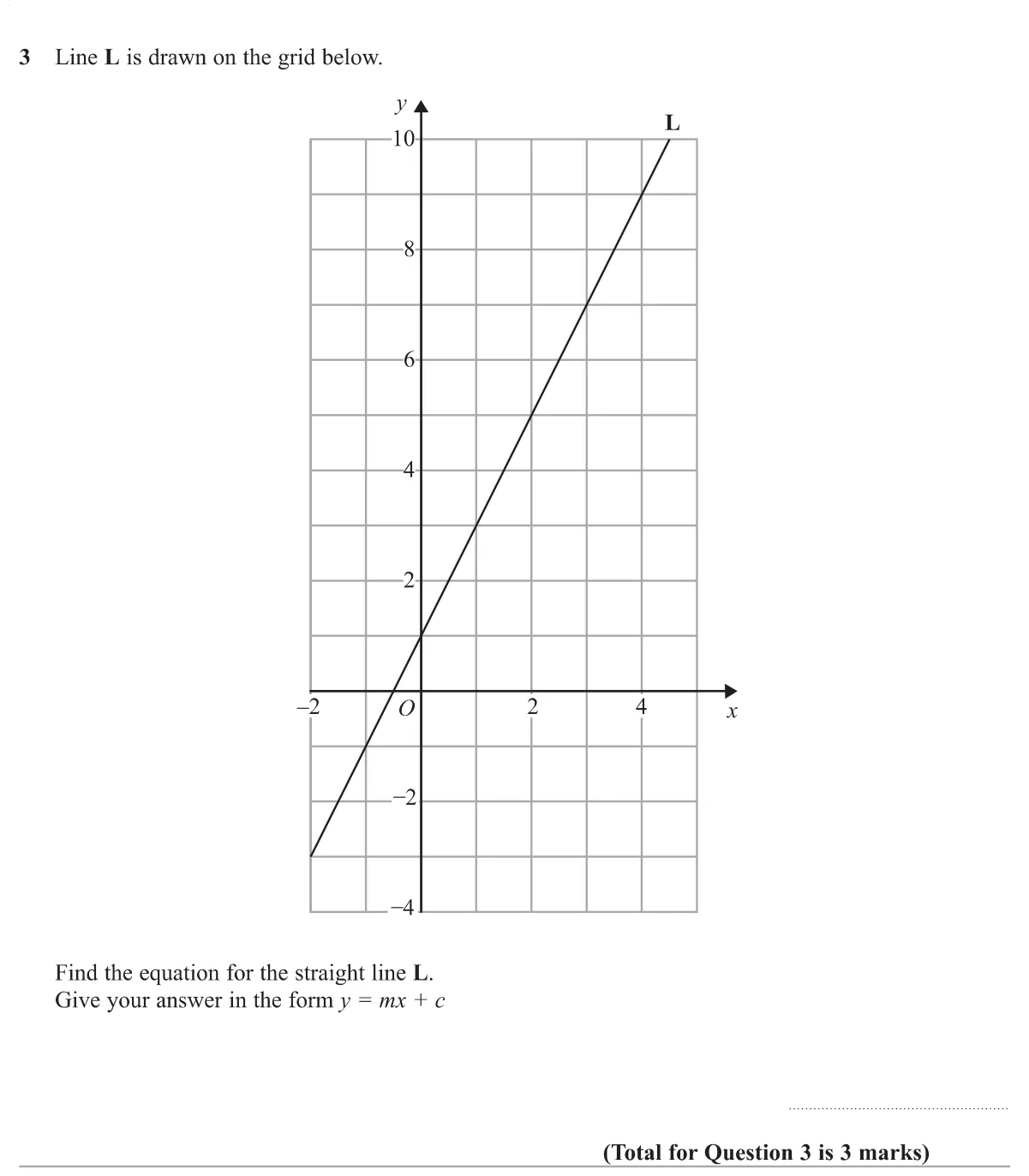
Answer y = 2 x + 1 y = 2x + 1 y = 2 x + 1 3 marks
Worked solution Checked against the mark scheme
The line crosses the y y y ( 0 , 1 ) (0, 1) ( 0 , 1 ) c = 1 c = 1 c = 1
It also passes through ( 2 , 5 ) (2, 5) ( 2 , 5 ) = 5 − 1 2 − 0 = 2 = \frac{5 - 1}{2 - 0} = 2 = 2 − 0 5 − 1 = 2
So y = 2 x + 1 y = 2x + 1 y = 2 x + 1
Watch out: Working out the gradient as run over rise, giving 1/2.
© Pearson Education Ltd. Specimen Paper 3 (Higher, calculator), question 4.
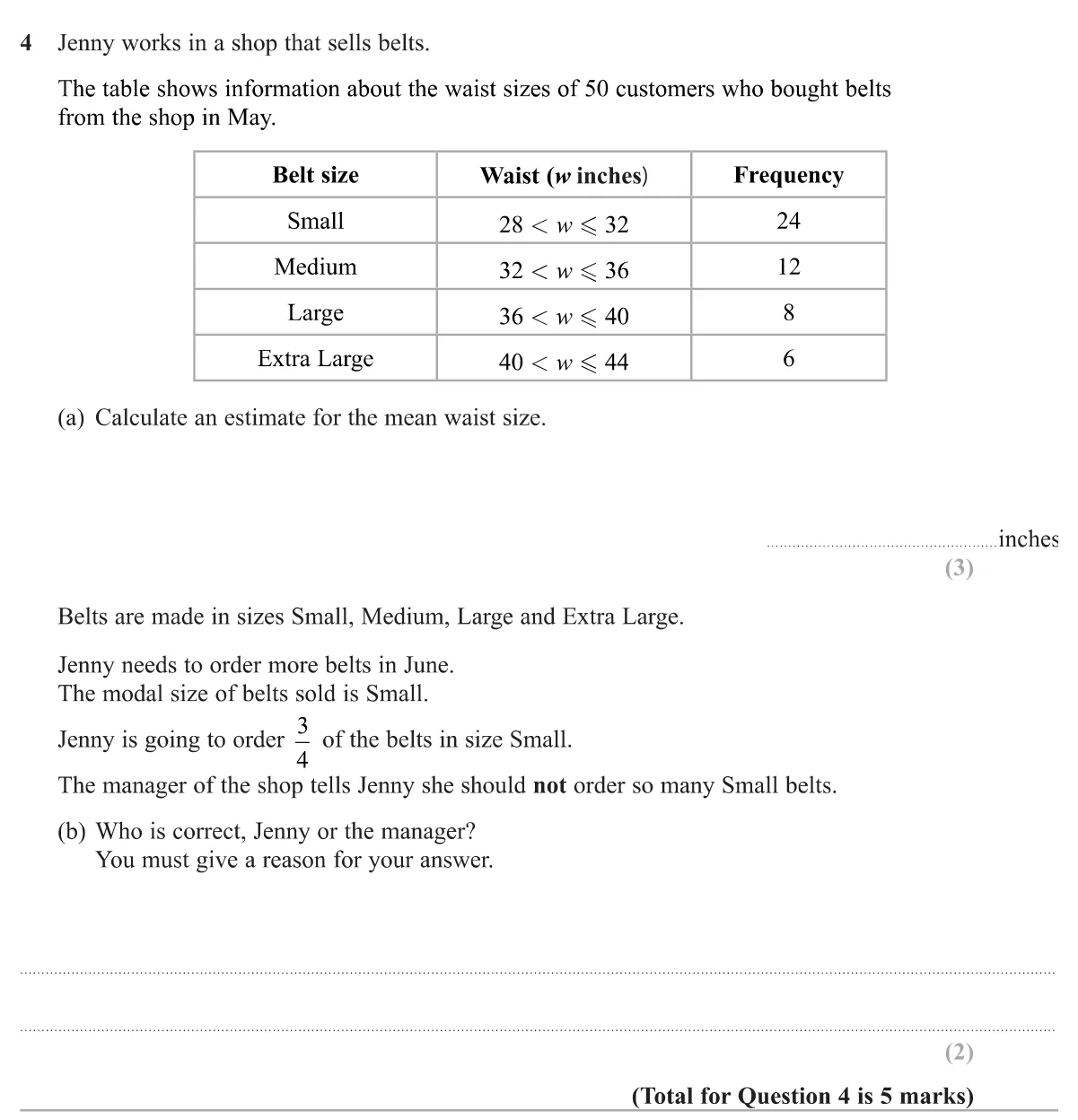
(a) 33.68 inches 3 marks (b) The manager: only 24 out of 50 (under half) bought Small, not three quarters 2 marks
Worked solution Checked against the mark scheme
(a) Midpoints: 30, 34, 38, 42.
30 × 24 + 34 × 12 + 38 × 8 + 42 × 6 = 720 + 408 + 304 + 252 = 1684 30 \times 24 + 34 \times 12 + 38 \times 8 + 42 \times 6 = 720 + 408 + 304 + 252 = 1684 30 × 24 + 34 × 12 + 38 × 8 + 42 × 6 = 720 + 408 + 304 + 252 = 1684
1684 ÷ 50 = 33.68 1684 \div 50 = 33.68 1684 ÷ 50 = 33.68
(b) 24 50 = 0.48 \frac{24}{50} = 0.48 50 24 = 0.48 manager is correct.
Watch out: In (a), dividing by 4 (the number of groups) instead of 50.
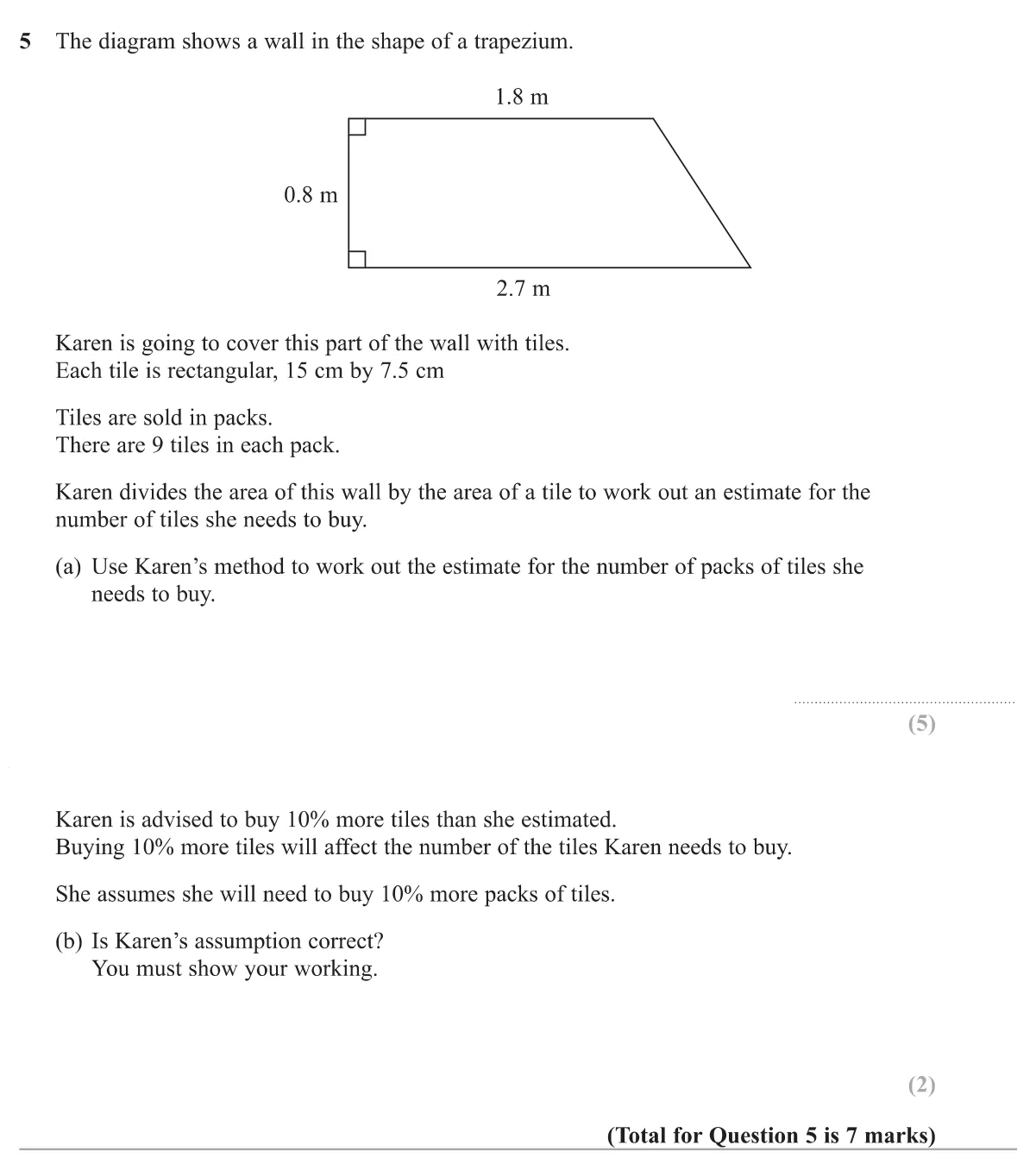
© Pearson Education Ltd. Specimen Paper 3 (Higher, calculator), question 5.
(a) 18 packs 5 marks (b) No: 176 tiles need 20 packs, which is 2 more packs (about 11% more), not 10% more 2 marks
Worked solution Checked against the mark scheme
(a) Area of wall = 1.8 + 2.7 2 × 0.8 = 1.8 m 2 = 18 000 cm 2 = \frac{1.8 + 2.7}{2} \times 0.8 = 1.8\text{ m}^2 = 18\,000\text{ cm}^2 = 2 1.8 + 2.7 × 0.8 = 1.8 m 2 = 18 000 cm 2
Area of a tile = 15 × 7.5 = 112.5 cm 2 = 15 \times 7.5 = 112.5\text{ cm}^2 = 15 × 7.5 = 112.5 cm 2
Tiles = 18 000 ÷ 112.5 = 160 = 18\,000 \div 112.5 = 160 = 18 000 ÷ 112.5 = 160 = 160 ÷ 9 = 17.8 = 160 \div 9 = 17.8 = 160 ÷ 9 = 17.8 18 packs .
(b) 160 × 1.1 = 176 160 \times 1.1 = 176 160 × 1.1 = 176 176 ÷ 9 = 19.6 176 \div 9 = 19.6 176 ÷ 9 = 19.6
10% more packs would be 18 × 1.1 = 19.8 18 \times 1.1 = 19.8 18 × 1.1 = 19.8
Watch out: Converting 1.8 m² to 180 cm² instead of 18 000 cm².
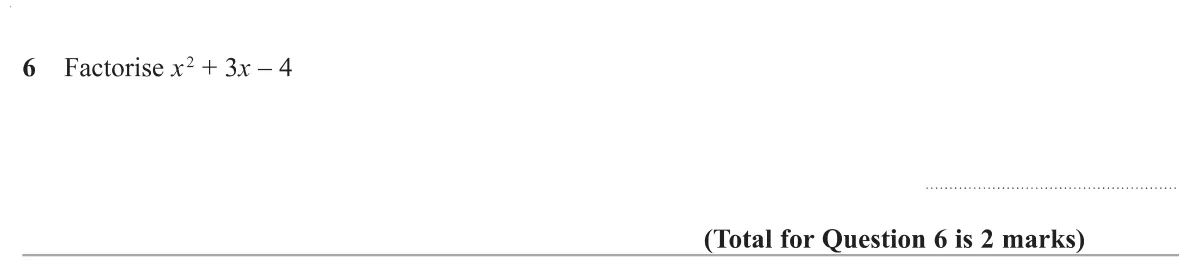
© Pearson Education Ltd. Specimen Paper 3 (Higher, calculator), question 6.
Answer ( x + 4 ) ( x − 1 ) (x + 4)(x - 1) ( x + 4 ) ( x − 1 ) 2 marks
Worked solution Checked against the mark scheme
Find two numbers that multiply to − 4 -4 − 4 3 3 3 4 4 4 − 1 -1 − 1
x 2 + 3 x − 4 = ( x + 4 ) ( x − 1 ) x^2 + 3x - 4 = (x + 4)(x - 1) x 2 + 3 x − 4 = ( x + 4 ) ( x − 1 )
Watch out: Getting the signs the wrong way round: (x − 4)(x + 1).
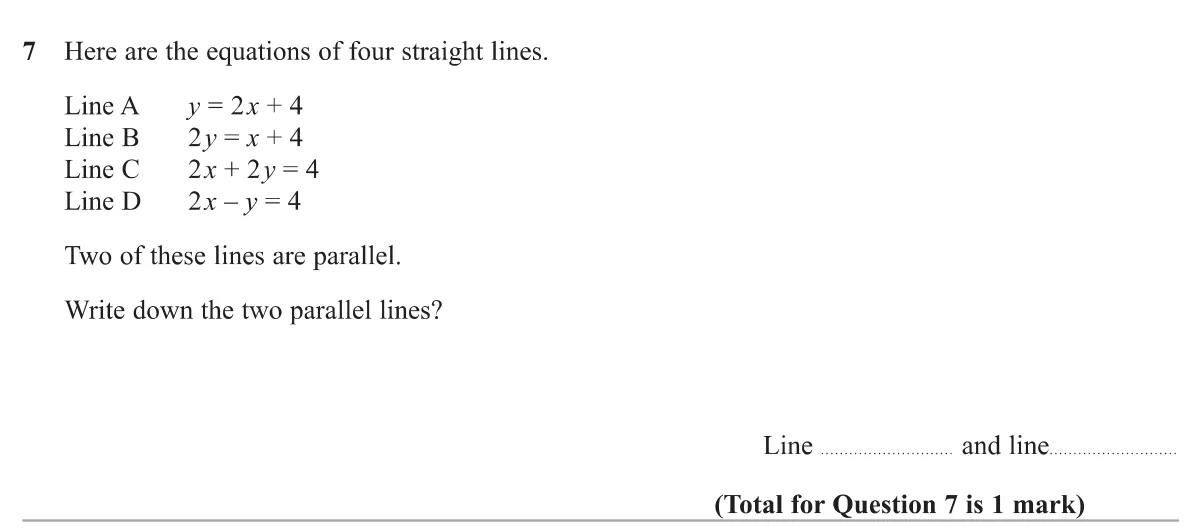
© Pearson Education Ltd. Specimen Paper 3 (Higher, calculator), question 7.
Answer Line A and line D 1 mark
Worked solution Checked against the mark scheme
Rewrite each line as y = m x + c y = mx + c y = m x + c
A: y = 2 x + 4 y = 2x + 4 y = 2 x + 4
B: y = 1 2 x + 2 y = \frac{1}{2}x + 2 y = 2 1 x + 2 1 2 \frac{1}{2} 2 1
C: y = − x + 2 y = -x + 2 y = − x + 2 − 1 -1 − 1
D: y = 2 x − 4 y = 2x - 4 y = 2 x − 4
Parallel lines have equal gradients, so A and D .
Watch out: Reading the gradient of 2x − y = 4 as −2 without rearranging.
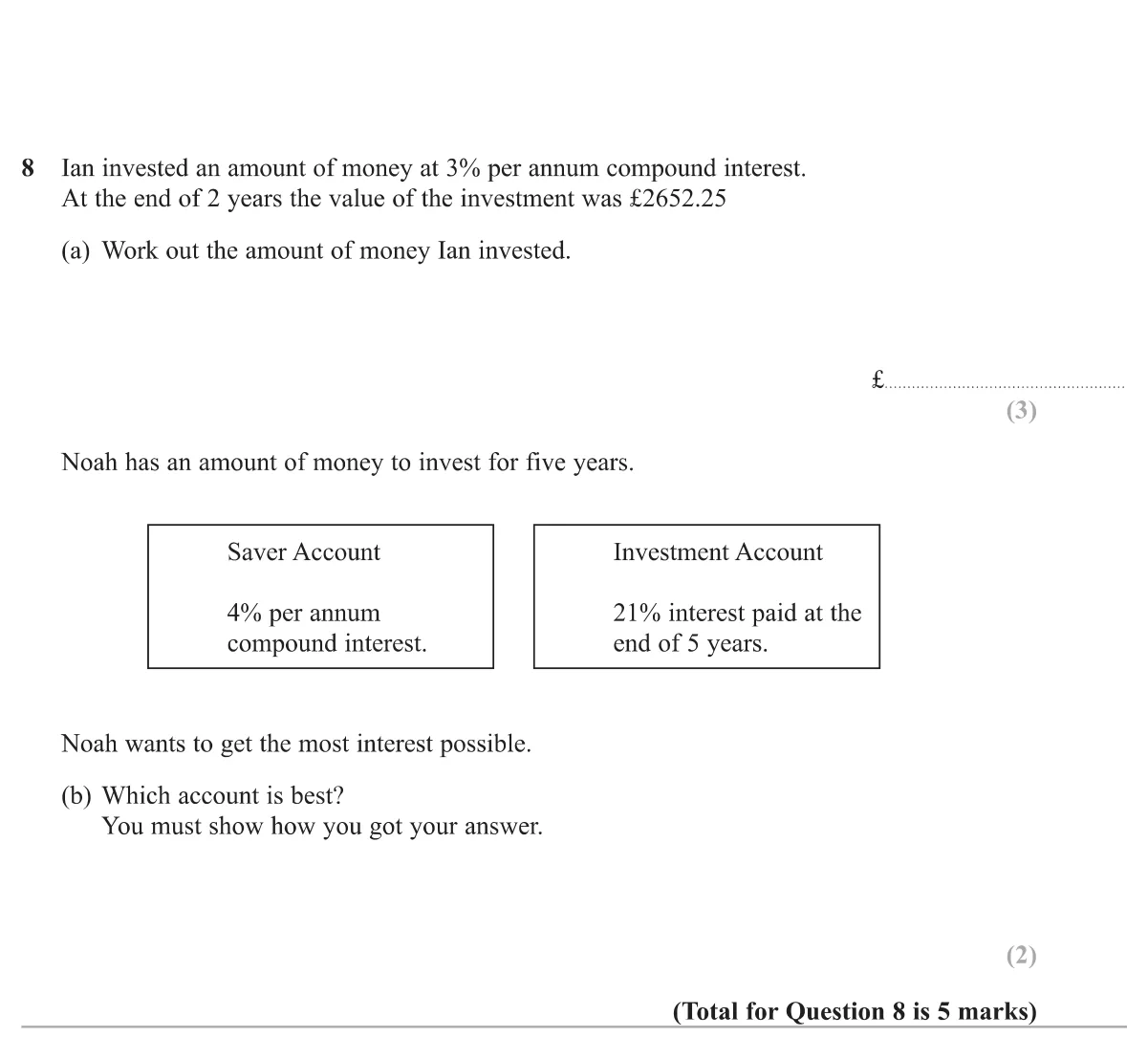
© Pearson Education Ltd. Specimen Paper 3 (Higher, calculator), question 8.
(a) £2500 3 marks (b) The Saver Account: 4% compound for 5 years gives about 21.67% interest, which is more than 21% 2 marks
Worked solution Checked against the mark scheme
(a) Each year multiplies the amount by 1.03 1.03 1.03 1.03 2 = 1.0609 1.03^2 = 1.0609 1.0 3 2 = 1.0609
Original = 2652.25 ÷ 1.0609 = £ 2500 = 2652.25 \div 1.0609 = £2500 = 2652.25 ÷ 1.0609 = £2500
(b) Saver Account: 1.04 5 = 1.2167 1.04^5 = 1.2167 1.0 4 5 = 1.2167 21.67 % 21.67\% 21.67%
Investment Account: 21 % 21\% 21%
21.67 % > 21 % 21.67\% > 21\% 21.67% > 21% Saver Account is best.
Watch out: Taking off 6% (or dividing by 1.06) instead of dividing by 1.03².
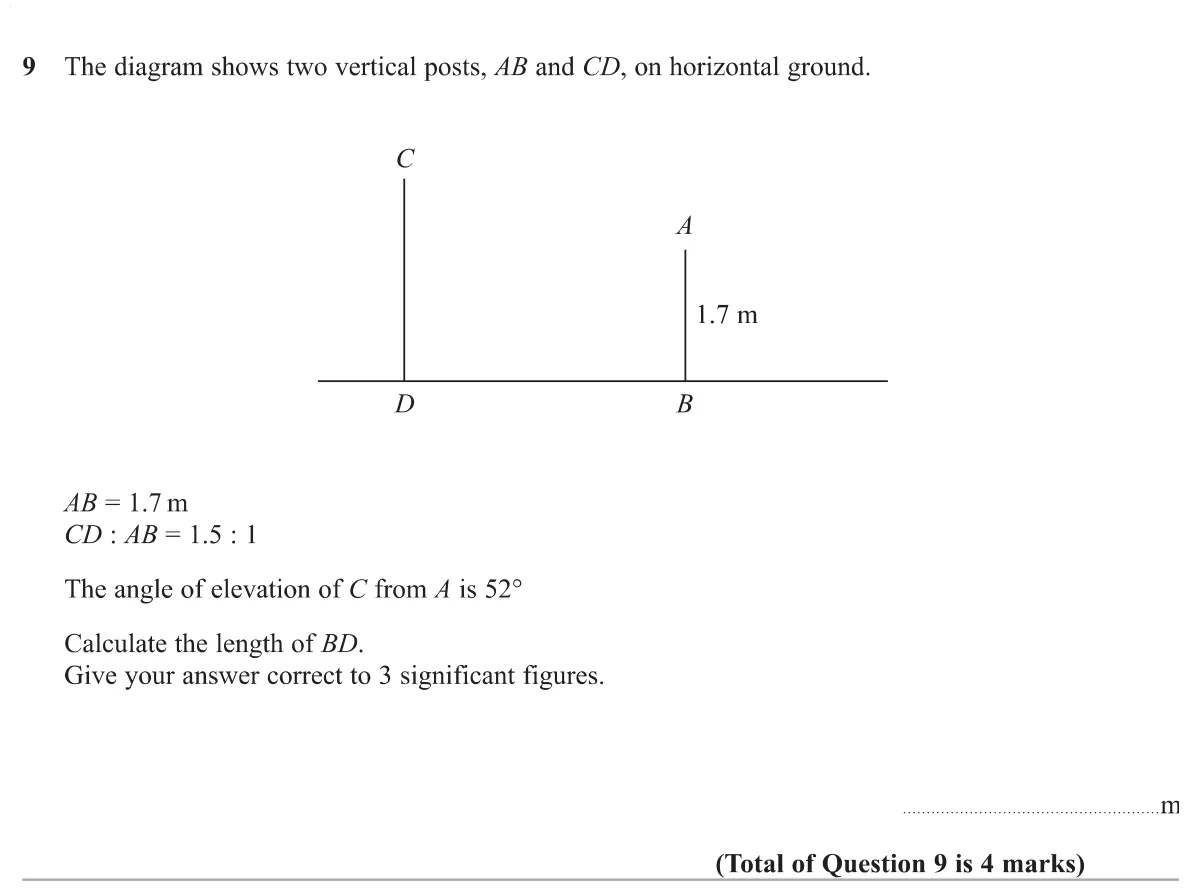
© Pearson Education Ltd. Specimen Paper 3 (Higher, calculator), question 9.
Answer 0.664 0.664 0.664 4 marks
Worked solution Checked against the mark scheme
C D = 1.5 × 1.7 = 2.55 CD = 1.5 \times 1.7 = 2.55 C D = 1.5 × 1.7 = 2.55 C C C 2.55 − 1.7 = 0.85 2.55 - 1.7 = 0.85 2.55 − 1.7 = 0.85 A A A
In the right-angled triangle from A A A C C C tan 52 ∘ = 0.85 B D \tan 52^\circ = \frac{0.85}{BD} tan 5 2 ∘ = B D 0.85
B D = 0.85 tan 52 ∘ = 0.6640... = 0.664 BD = \frac{0.85}{\tan 52^\circ} = 0.6640... = 0.664 B D = t a n 5 2 ∘ 0.85 = 0.6640... = 0.664
Watch out: Using the full height 2.55 m instead of the difference 0.85 m.
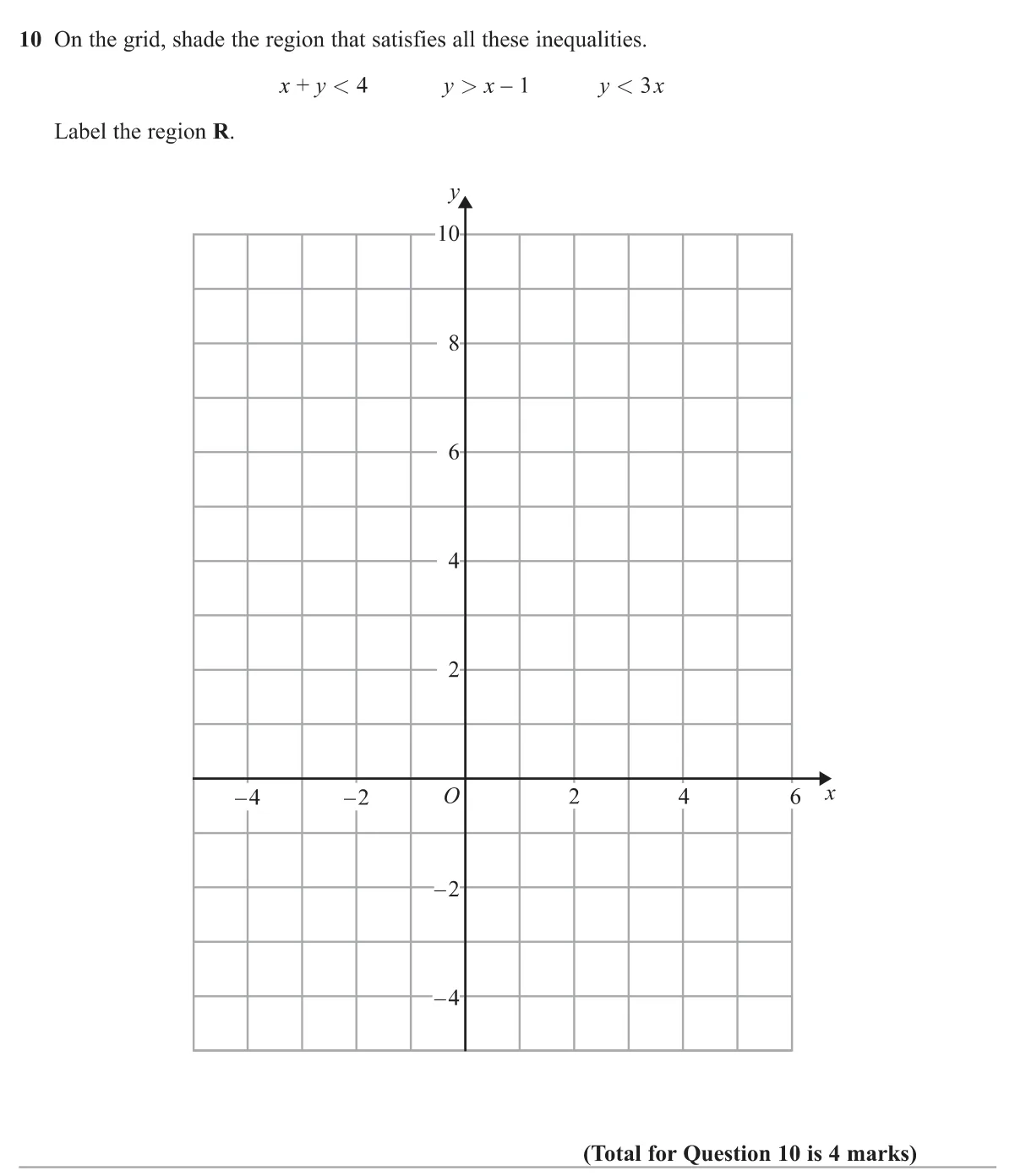
© Pearson Education Ltd. Specimen Paper 3 (Higher, calculator), question 10.
Answer The triangle with corners ( 1 , 3 ) (1, 3) ( 1 , 3 ) ( 2.5 , 1.5 ) (2.5, 1.5) ( 2.5 , 1.5 ) ( − 0.5 , − 1.5 ) (-0.5, -1.5) ( − 0.5 , − 1.5 ) 4 marks
Worked solution Checked against the mark scheme
Draw x + y = 4 x + y = 4 x + y = 4 ( 0 , 4 ) (0, 4) ( 0 , 4 ) ( 4 , 0 ) (4, 0) ( 4 , 0 ) y = x − 1 y = x - 1 y = x − 1 ( 0 , − 1 ) (0, -1) ( 0 , − 1 ) ( 1 , 0 ) (1, 0) ( 1 , 0 ) y = 3 x y = 3x y = 3 x ( 0 , 0 ) (0, 0) ( 0 , 0 ) ( 1 , 3 ) (1, 3) ( 1 , 3 )
Test ( 1 , 1 ) (1, 1) ( 1 , 1 ) 2 < 4 2 < 4 2 < 4 1 > 0 1 > 0 1 > 0 1 < 3 1 < 3 1 < 3 ( 1 , 1 ) (1, 1) ( 1 , 1 )
R is the triangle with corners ( 1 , 3 ) (1, 3) ( 1 , 3 ) ( 2.5 , 1.5 ) (2.5, 1.5) ( 2.5 , 1.5 ) ( − 0.5 , − 1.5 ) (-0.5, -1.5) ( − 0.5 , − 1.5 )
Watch out: Shading the wrong side of y = 3x.
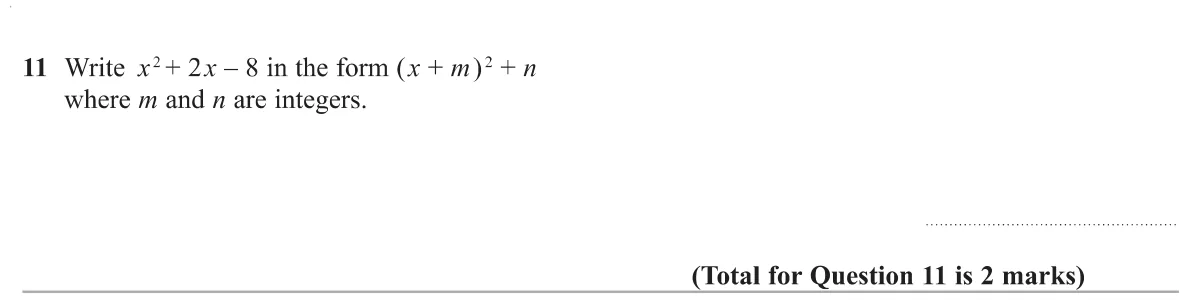
© Pearson Education Ltd. Specimen Paper 3 (Higher, calculator), question 11.
Answer ( x + 1 ) 2 − 9 (x + 1)^2 - 9 ( x + 1 ) 2 − 9 2 marks
Worked solution Checked against the mark scheme
Halve the x x x x 2 + 2 x = ( x + 1 ) 2 − 1 x^2 + 2x = (x + 1)^2 - 1 x 2 + 2 x = ( x + 1 ) 2 − 1
So x 2 + 2 x − 8 = ( x + 1 ) 2 − 1 − 8 = ( x + 1 ) 2 − 9 x^2 + 2x - 8 = (x + 1)^2 - 1 - 8 = (x + 1)^2 - 9 x 2 + 2 x − 8 = ( x + 1 ) 2 − 1 − 8 = ( x + 1 ) 2 − 9
m = 1 m = 1 m = 1 n = − 9 n = -9 n = − 9
Watch out: Writing (x + 1)² − 8, forgetting to subtract the 1.
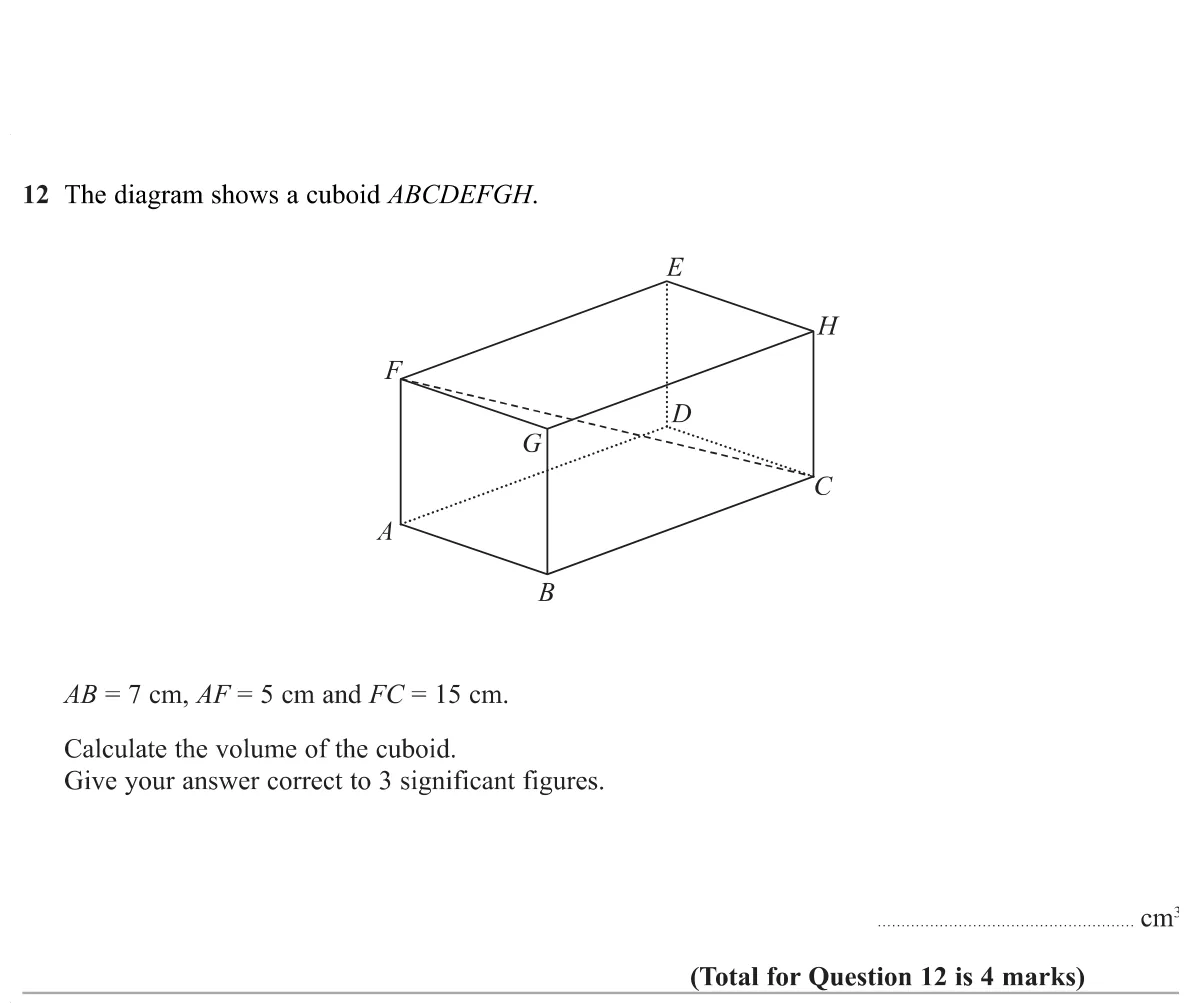
© Pearson Education Ltd. Specimen Paper 3 (Higher, calculator), question 12.
Answer 430 cm 3 430\text{ cm}^3 430 cm 3 4 marks
Worked solution Checked against the mark scheme
Let the unknown edge be d d d 7 2 + 5 2 + d 2 = 15 2 7^2 + 5^2 + d^2 = 15^2 7 2 + 5 2 + d 2 = 1 5 2
d 2 = 225 − 49 − 25 = 151 d^2 = 225 - 49 - 25 = 151 d 2 = 225 − 49 − 25 = 151 d = 151 = 12.288... d = \sqrt{151} = 12.288... d = 151 = 12.288...
Volume = 7 × 5 × 12.288... = 430.09... = 430 cm 3 = 7 \times 5 \times 12.288... = 430.09... = 430\text{ cm}^3 = 7 × 5 × 12.288... = 430.09... = 430 cm 3
Watch out: Treating FC as the diagonal of one face and using only two lengths in Pythagoras.
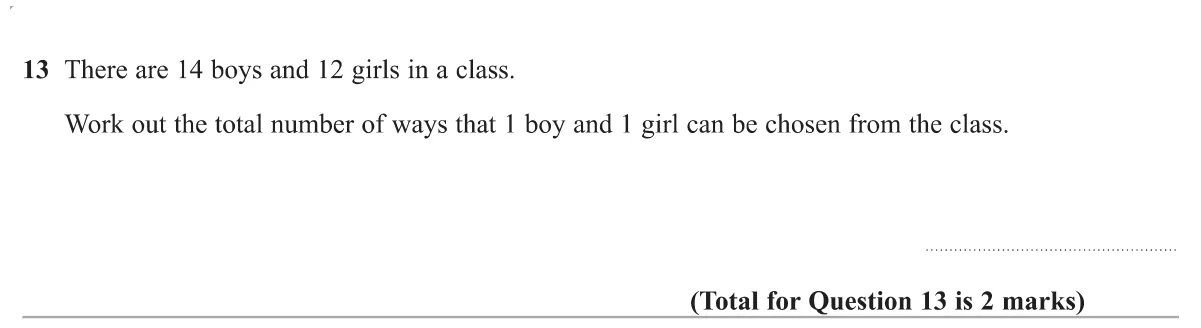
© Pearson Education Ltd. Specimen Paper 3 (Higher, calculator), question 13.
Worked solution Checked against the mark scheme
Each of the 14 boys can be paired with any of the 12 girls.
14 × 12 = 168 14 \times 12 = 168 14 × 12 = 168
Watch out: Adding instead of multiplying to get 26.
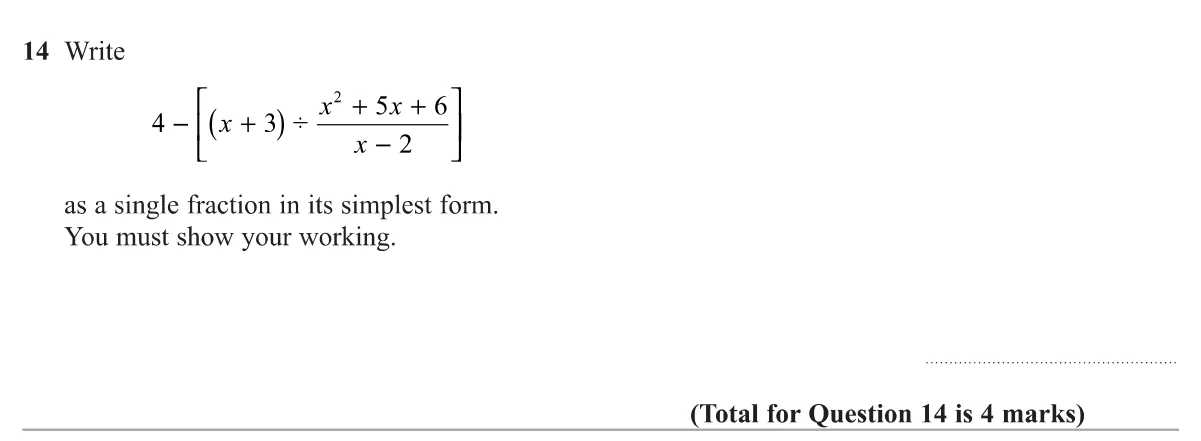
© Pearson Education Ltd. Specimen Paper 3 (Higher, calculator), question 14.
Answer 3 x + 10 x + 2 \frac{3x + 10}{x + 2} x + 2 3 x + 10 4 marks
Worked solution Checked against the mark scheme
x 2 + 5 x + 6 = ( x + 2 ) ( x + 3 ) x^2 + 5x + 6 = (x + 2)(x + 3) x 2 + 5 x + 6 = ( x + 2 ) ( x + 3 )
( x + 3 ) ÷ ( x + 2 ) ( x + 3 ) x − 2 = ( x + 3 ) × x − 2 ( x + 2 ) ( x + 3 ) = x − 2 x + 2 (x + 3) \div \frac{(x + 2)(x + 3)}{x - 2} = (x + 3) \times \frac{x - 2}{(x + 2)(x + 3)} = \frac{x - 2}{x + 2} ( x + 3 ) ÷ x − 2 ( x + 2 ) ( x + 3 ) = ( x + 3 ) × ( x + 2 ) ( x + 3 ) x − 2 = x + 2 x − 2
4 − x − 2 x + 2 = 4 ( x + 2 ) − ( x − 2 ) x + 2 = 4 x + 8 − x + 2 x + 2 = 3 x + 10 x + 2 4 - \frac{x - 2}{x + 2} = \frac{4(x + 2) - (x - 2)}{x + 2} = \frac{4x + 8 - x + 2}{x + 2} = \frac{3x + 10}{x + 2} 4 − x + 2 x − 2 = x + 2 4 ( x + 2 ) − ( x − 2 ) = x + 2 4 x + 8 − x + 2 = x + 2 3 x + 10
Watch out: Subtracting only the x from the numerator, giving 3x + 6 instead of 3x + 10.
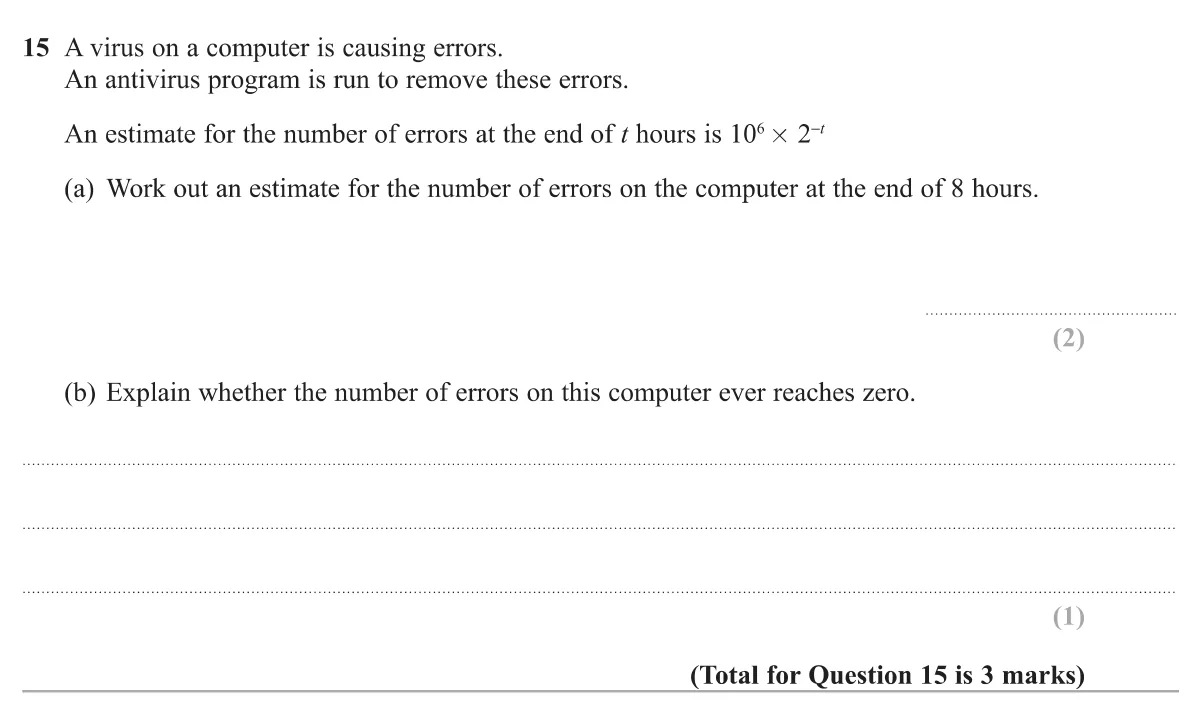
© Pearson Education Ltd. Specimen Paper 3 (Higher, calculator), question 15.
(a) 3906 (3906 or 3907 accepted; 3900, 3910 or 4000 from correct working) 2 marks (b) Either: no, the model halves each hour so it never reaches 0; or yes, in practice, since you can't have part of an error 1 mark
Worked solution Checked against the mark scheme
(a) 10 6 × 2 − 8 = 1 000 000 256 = 3906.25 10^6 \times 2^{-8} = \frac{1\,000\,000}{256} = 3906.25 1 0 6 × 2 − 8 = 256 1 000 000 = 3906.25 3906 errors.
(b) In the model the number halves every hour, and halving a positive number never gives 0, so the model never reaches zero. (You could also argue that in reality the count must eventually drop below 1, and there can't be a fraction of an error.)
Watch out: Treating 2⁻⁸ as −16 or as −256.
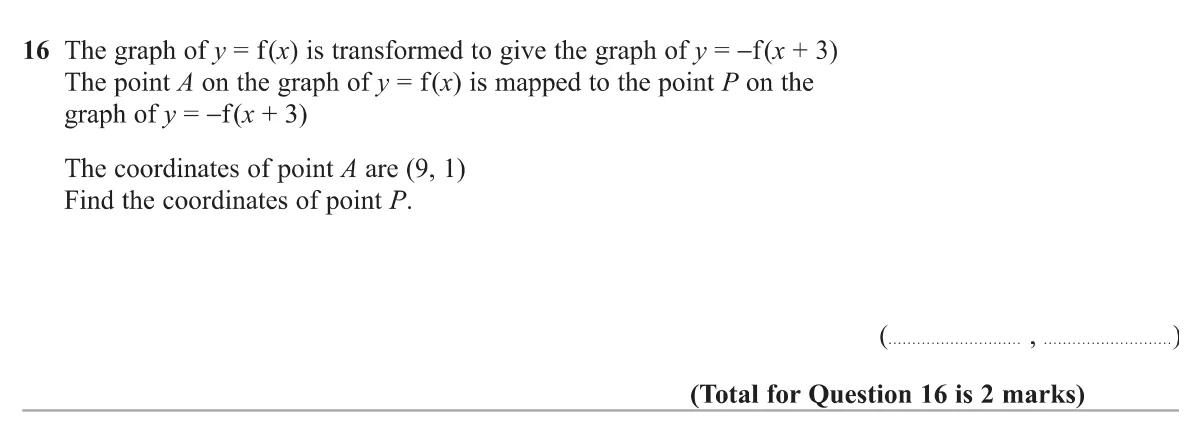
© Pearson Education Ltd. Specimen Paper 3 (Higher, calculator), question 16.
Answer ( 6 , − 1 ) (6, -1) ( 6 , − 1 ) 2 marks
Worked solution Checked against the mark scheme
f ( x + 3 ) f(x + 3) f ( x + 3 ) left : ( 9 , 1 ) → ( 6 , 1 ) (9, 1) \to (6, 1) ( 9 , 1 ) → ( 6 , 1 )
− f ( … ) -f(\ldots) − f ( … ) x x x ( 6 , 1 ) → ( 6 , − 1 ) (6, 1) \to (6, -1) ( 6 , 1 ) → ( 6 , − 1 )
So P = ( 6 , − 1 ) P = (6, -1) P = ( 6 , − 1 )
Watch out: Moving the point 3 units right instead of left, giving (12, −1).
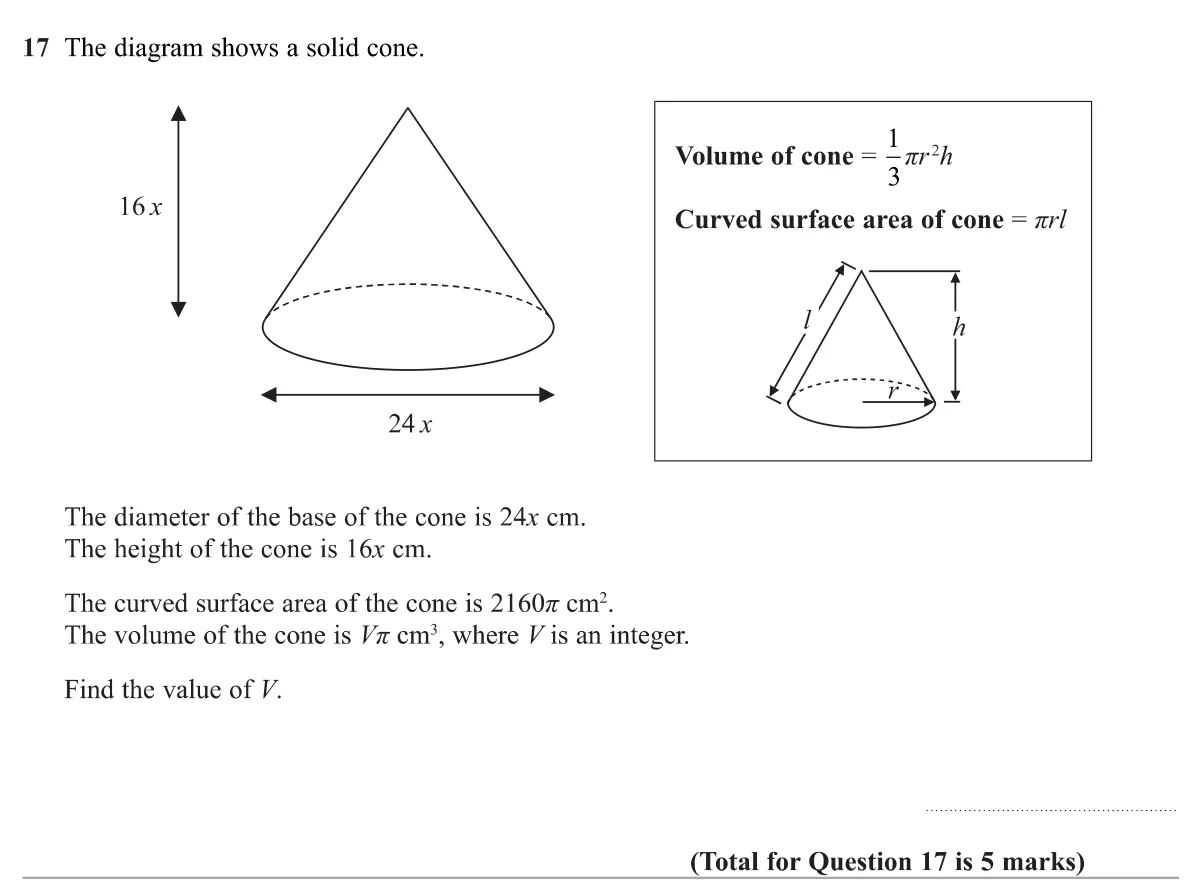
© Pearson Education Ltd. Specimen Paper 3 (Higher, calculator), question 17.
Answer V = 20 736 V = 20\,736 V = 20 736 5 marks
Worked solution Checked against the mark scheme
Radius = 12 x = 12x = 12 x = 16 x = 16x = 16 x l = ( 12 x ) 2 + ( 16 x ) 2 = 20 x l = \sqrt{(12x)^2 + (16x)^2} = 20x l = ( 12 x ) 2 + ( 16 x ) 2 = 20 x
Curved surface area: π × 12 x × 20 x = 240 x 2 π = 2160 π \pi \times 12x \times 20x = 240x^2\pi = 2160\pi π × 12 x × 20 x = 240 x 2 π = 2160 π x 2 = 9 x^2 = 9 x 2 = 9 x = 3 x = 3 x = 3
So r = 36 r = 36 r = 36 h = 48 h = 48 h = 48
Volume = 1 3 π × 36 2 × 48 = 20 736 π = \frac{1}{3}\pi \times 36^2 \times 48 = 20\,736\pi = 3 1 π × 3 6 2 × 48 = 20 736 π V = 20 736 V = 20\,736 V = 20 736
Watch out: Using the diameter 24x as the radius.
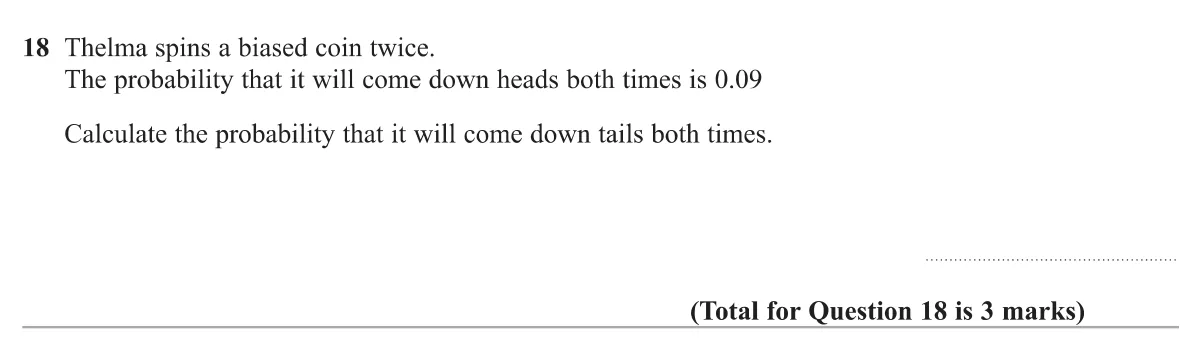
© Pearson Education Ltd. Specimen Paper 3 (Higher, calculator), question 18.
Answer 0.49 0.49 0.49 3 marks
Worked solution Checked against the mark scheme
P ( H ) 2 = 0.09 P(\text{H})^2 = 0.09 P ( H ) 2 = 0.09 P ( H ) = 0.09 = 0.3 P(\text{H}) = \sqrt{0.09} = 0.3 P ( H ) = 0.09 = 0.3
P ( T ) = 1 − 0.3 = 0.7 P(\text{T}) = 1 - 0.3 = 0.7 P ( T ) = 1 − 0.3 = 0.7
P ( TT ) = 0.7 2 = 0.49 P(\text{TT}) = 0.7^2 = 0.49 P ( TT ) = 0. 7 2 = 0.49
Watch out: Working out 1 − 0.09 = 0.91, which is the probability of not getting two heads.
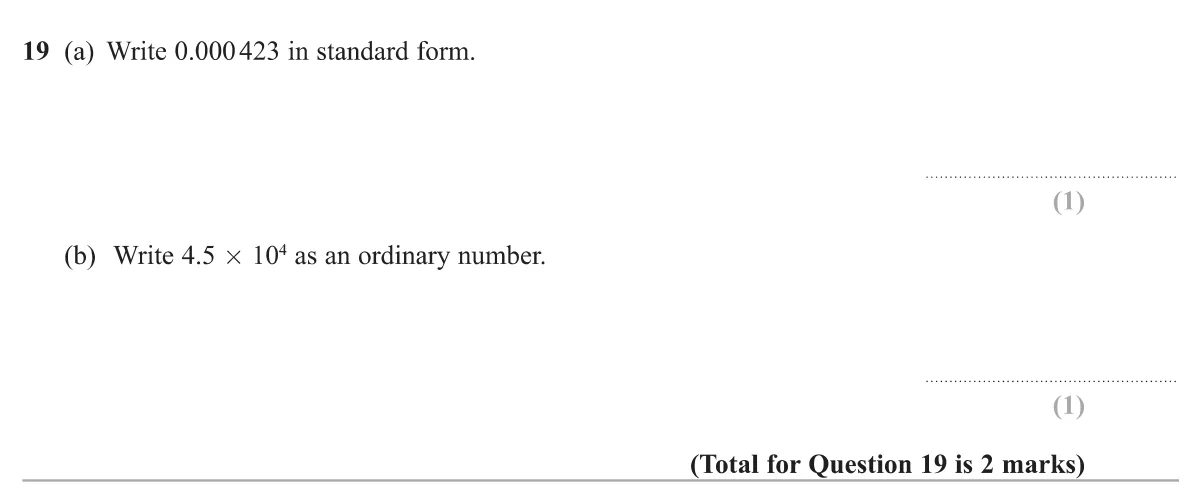
© Pearson Education Ltd. Specimen Paper 3 (Higher, calculator), question 19.
(a) 4.23 × 10 − 4 4.23 \times 10^{-4} 4.23 × 1 0 − 4 1 mark (b) 45 000 1 mark
Worked solution Checked against the mark scheme
(a) Move the decimal point 4 places right to get 4.23, so 0.000423 = 4.23 × 10 − 4 0.000423 = 4.23 \times 10^{-4} 0.000423 = 4.23 × 1 0 − 4
(b) 4.5 × 10 4 = 4.5 × 10 000 = 45 000 4.5 \times 10^4 = 4.5 \times 10\,000 = 45\,000 4.5 × 1 0 4 = 4.5 × 10 000 = 45 000
Watch out: Using a positive power in (a): 4.23 × 10⁴.
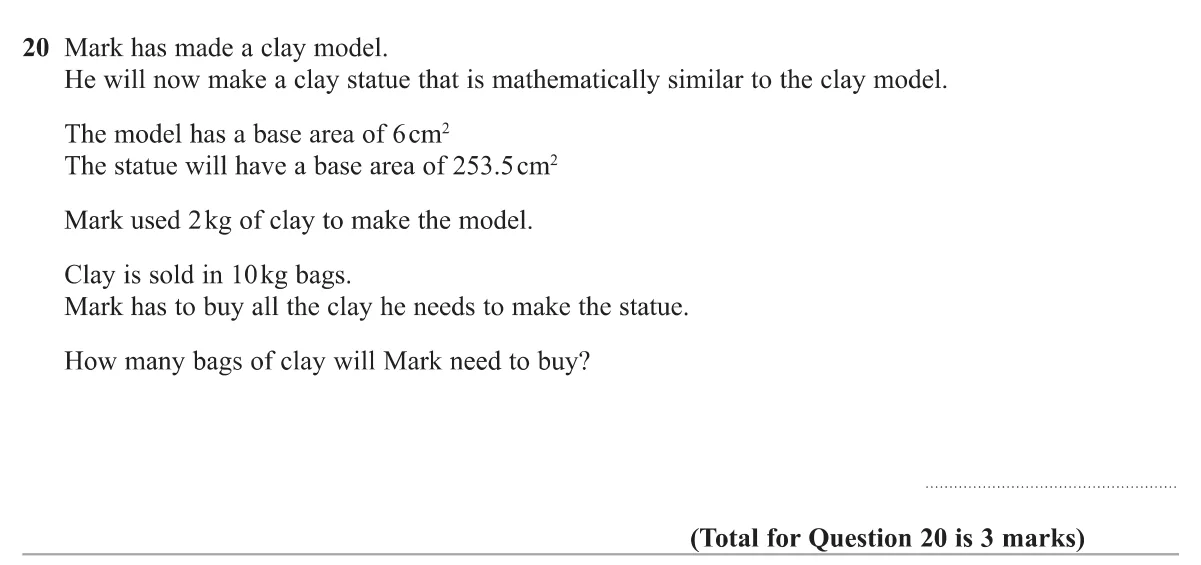
© Pearson Education Ltd. Specimen Paper 3 (Higher, calculator), question 20.
Worked solution Checked against the mark scheme
Area scale factor = 253.5 ÷ 6 = 42.25 = 253.5 \div 6 = 42.25 = 253.5 ÷ 6 = 42.25
Length scale factor = 42.25 = 6.5 = \sqrt{42.25} = 6.5 = 42.25 = 6.5
Volume scale factor = 6.5 3 = 274.625 = 6.5^3 = 274.625 = 6. 5 3 = 274.625
Clay needed = 2 × 274.625 = 549.25 = 2 \times 274.625 = 549.25 = 2 × 274.625 = 549.25
549.25 ÷ 10 = 54.925 549.25 \div 10 = 54.925 549.25 ÷ 10 = 54.925 55 bags .
Watch out: Multiplying the clay by the area scale factor (42.25) instead of the volume scale factor.
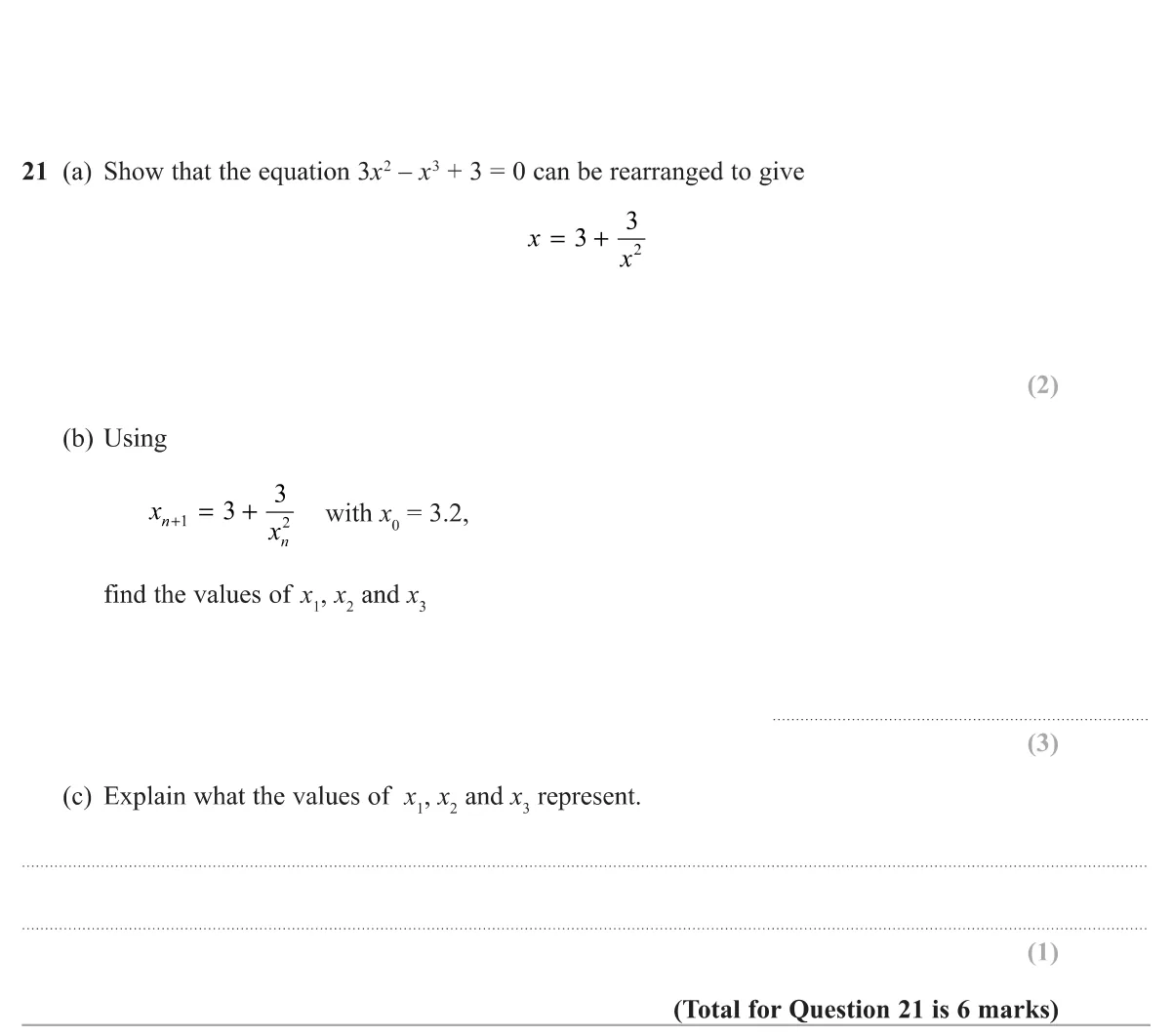
© Pearson Education Ltd. Specimen Paper 3 (Higher, calculator), question 21.
(a) Divide x 3 = 3 x 2 + 3 x^3 = 3x^2 + 3 x 3 = 3 x 2 + 3 x 2 x^2 x 2 x = 3 + 3 x 2 x = 3 + \frac{3}{x^2} x = 3 + x 2 3 2 marks (b) x 1 = 3.2930 x_1 = 3.2930 x 1 = 3.2930 x 2 = 3.2767 x_2 = 3.2767 x 2 = 3.2767 x 3 = 3.2794 x_3 = 3.2794 x 3 = 3.2794 3 marks (c) They are estimates (approximations) of a solution of 3 x 2 − x 3 + 3 = 0 3x^2 - x^3 + 3 = 0 3 x 2 − x 3 + 3 = 0 1 mark
Worked solution Checked against the mark scheme
(a) 3 x 2 − x 3 + 3 = 0 ⇒ x 3 = 3 x 2 + 3 3x^2 - x^3 + 3 = 0 \Rightarrow x^3 = 3x^2 + 3 3 x 2 − x 3 + 3 = 0 ⇒ x 3 = 3 x 2 + 3 x 2 x^2 x 2 x = 3 + 3 x 2 x = 3 + \frac{3}{x^2} x = 3 + x 2 3
(b) x 1 = 3 + 3 3.2 2 = 3.29296... x_1 = 3 + \frac{3}{3.2^2} = 3.29296... x 1 = 3 + 3. 2 2 3 = 3.29296...
x 2 = 3 + 3 3.29296.. . 2 = 3.27666... x_2 = 3 + \frac{3}{3.29296...^2} = 3.27666... x 2 = 3 + 3.29296.. . 2 3 = 3.27666...
x 3 = 3 + 3 3.27666.. . 2 = 3.27942... x_3 = 3 + \frac{3}{3.27666...^2} = 3.27942... x 3 = 3 + 3.27666.. . 2 3 = 3.27942...
(c) Each value is a closer estimate of a solution of 3 x 2 − x 3 + 3 = 0 3x^2 - x^3 + 3 = 0 3 x 2 − x 3 + 3 = 0
Watch out: Rounding each value before feeding it back in, which drifts the later answers.
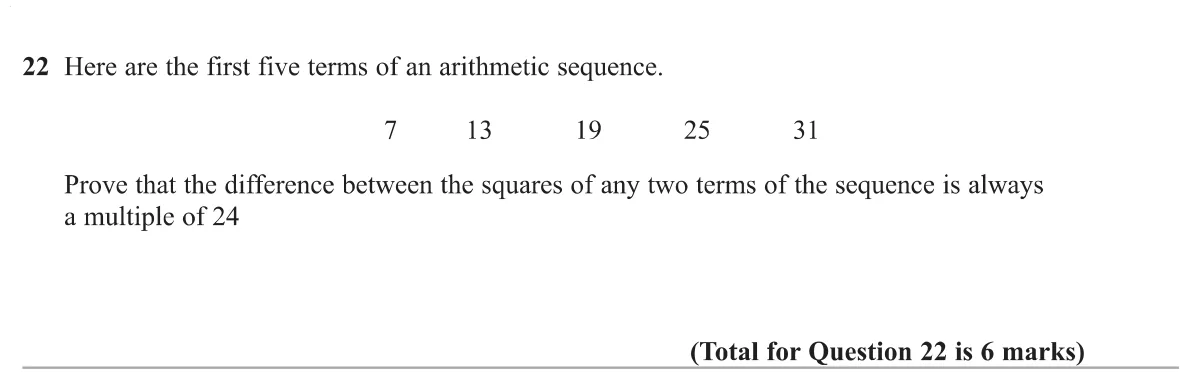
© Pearson Education Ltd. Specimen Paper 3 (Higher, calculator), question 22.
Answer Terms are 6 n + 1 6n + 1 6 n + 1 ( 6 a + 1 ) 2 − ( 6 b + 1 ) 2 = 12 ( a − b ) ( 3 ( a + b ) + 1 ) (6a+1)^2 - (6b+1)^2 = 12(a - b)(3(a + b) + 1) ( 6 a + 1 ) 2 − ( 6 b + 1 ) 2 = 12 ( a − b ) ( 3 ( a + b ) + 1 ) ( a − b ) ( 3 ( a + b ) + 1 ) (a - b)(3(a + b) + 1) ( a − b ) ( 3 ( a + b ) + 1 ) 6 marks
Worked solution Checked against the mark scheme
The n n n 6 n + 1 6n + 1 6 n + 1 6 a + 1 6a + 1 6 a + 1 6 b + 1 6b + 1 6 b + 1
( 6 a + 1 ) 2 − ( 6 b + 1 ) 2 = 36 a 2 + 12 a − 36 b 2 − 12 b (6a + 1)^2 - (6b + 1)^2 = 36a^2 + 12a - 36b^2 - 12b ( 6 a + 1 ) 2 − ( 6 b + 1 ) 2 = 36 a 2 + 12 a − 36 b 2 − 12 b
= 12 ( 3 a 2 − 3 b 2 + a − b ) = 12 ( a − b ) ( 3 a + 3 b + 1 ) = 12(3a^2 - 3b^2 + a - b) = 12(a - b)(3a + 3b + 1) = 12 ( 3 a 2 − 3 b 2 + a − b ) = 12 ( a − b ) ( 3 a + 3 b + 1 )
If a a a b b b a − b a - b a − b
If one is odd and one even, a + b a + b a + b 3 ( a + b ) 3(a + b) 3 ( a + b ) 3 ( a + b ) + 1 3(a + b) + 1 3 ( a + b ) + 1
Either way ( a − b ) ( 3 a + 3 b + 1 ) (a - b)(3a + 3b + 1) ( a − b ) ( 3 a + 3 b + 1 ) 12 × 12 \times 12 × = 24 k = 24k = 24 k
Watch out: Stopping at a multiple of 12 without showing the other factor is even.
Finished the paper? Add up your marks for all three papers. Specimen papers were never sat, so they have no grade boundaries of their own, but the grade calculator shows what the same total earned in recent real exams, as a rough guide.