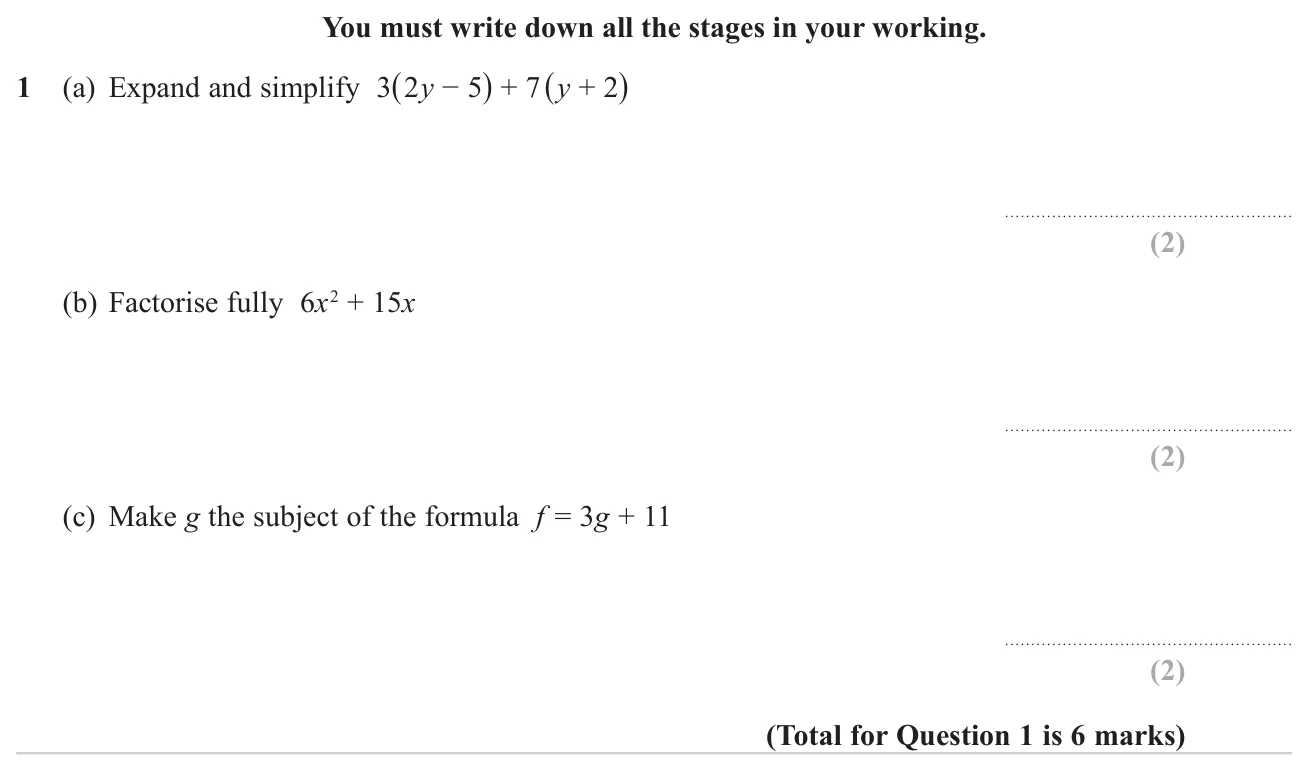
© Pearson Education Ltd. November 2023 Paper 2 (Higher, calculator), question 1.
(a) 13 y − 1 13y - 1 13 y − 1 2 marks (b) 3 x ( 2 x + 5 ) 3x(2x + 5) 3 x ( 2 x + 5 ) 2 marks (c) g = f − 11 3 g = \frac{f - 11}{3} g = 3 f − 11 2 marks
Worked solution Checked against the mark scheme
(a) 6 y − 15 + 7 y + 14 = 13 y − 1 6y - 15 + 7y + 14 = 13y - 1 6 y − 15 + 7 y + 14 = 13 y − 1
(b) The highest common factor of 6 x 2 6x^2 6 x 2 15 x 15x 15 x 3 x 3x 3 x 6 x 2 + 15 x = 3 x ( 2 x + 5 ) 6x^2 + 15x = 3x(2x + 5) 6 x 2 + 15 x = 3 x ( 2 x + 5 )
(c) f − 11 = 3 g f - 11 = 3g f − 11 = 3 g g = f − 11 3 g = \frac{f - 11}{3} g = 3 f − 11
Watch out: In (b), taking out only 3 or only x, so the answer is not fully factorised.
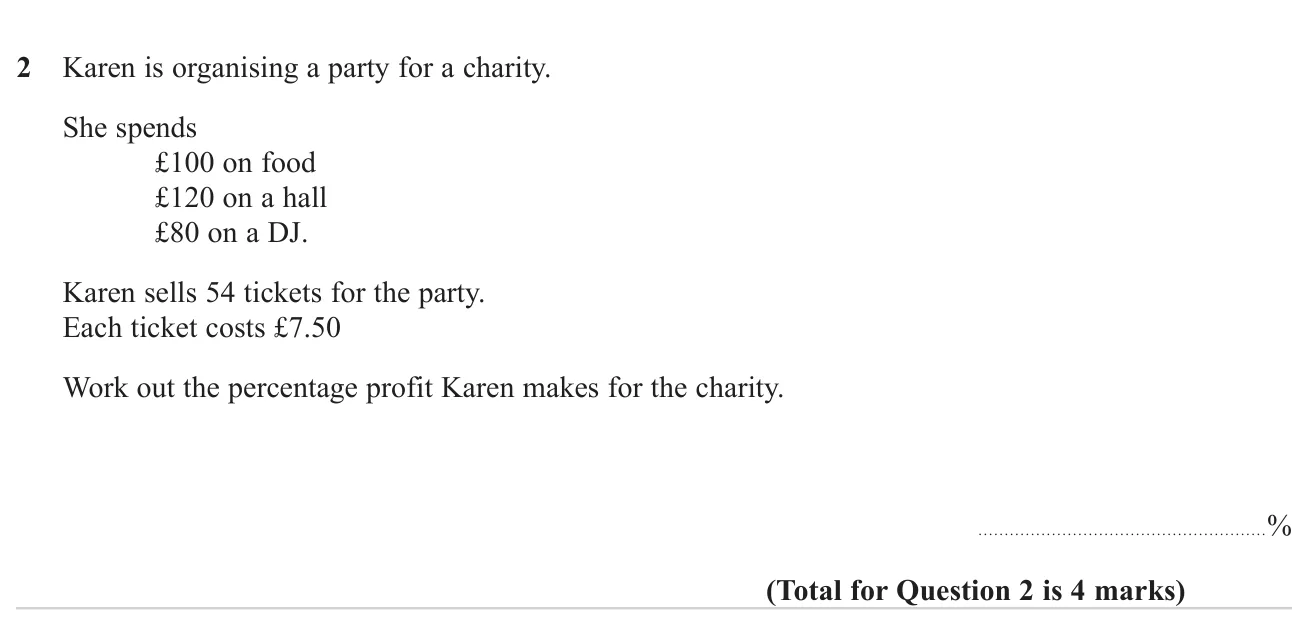
© Pearson Education Ltd. November 2023 Paper 2 (Higher, calculator), question 2.
Worked solution Checked against the mark scheme
Income: 54 × 7.50 = £ 405 54 \times 7.50 = £405 54 × 7.50 = £405
Costs: 100 + 120 + 80 = £ 300 100 + 120 + 80 = £300 100 + 120 + 80 = £300
Profit: 405 − 300 = £ 105 405 - 300 = £105 405 − 300 = £105
Percentage profit = 105 300 × 100 = 35 % = \frac{105}{300} \times 100 = 35\% = 300 105 × 100 = 35%
Watch out: Dividing the profit by the income (405) instead of the costs.
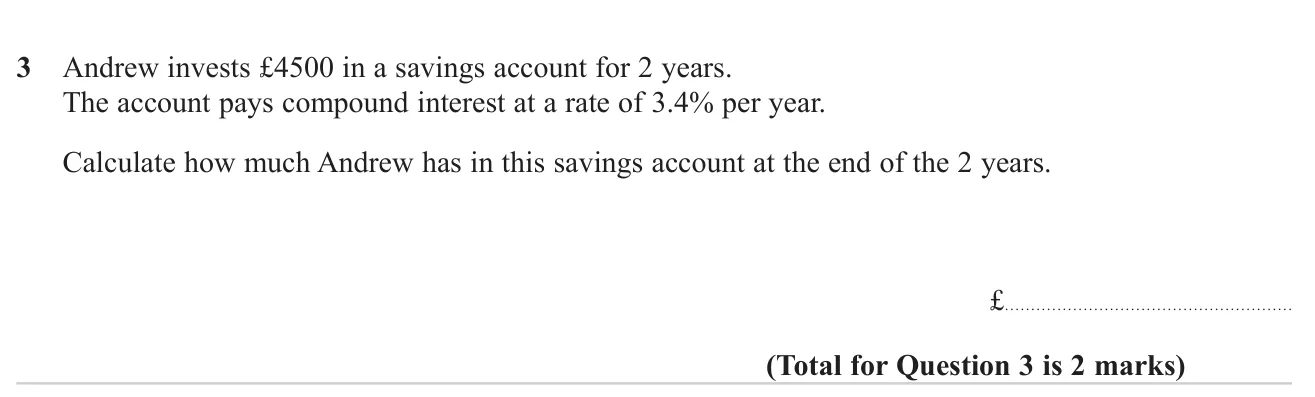
© Pearson Education Ltd. November 2023 Paper 2 (Higher, calculator), question 3.
Worked solution Checked against the mark scheme
Multiplier for 3.4% interest: 1.034 1.034 1.034
4500 × 1.034 2 = 4811.202 4500 \times 1.034^2 = 4811.202 4500 × 1.03 4 2 = 4811.202 £4811.20
Watch out: Using simple interest to get £4806.
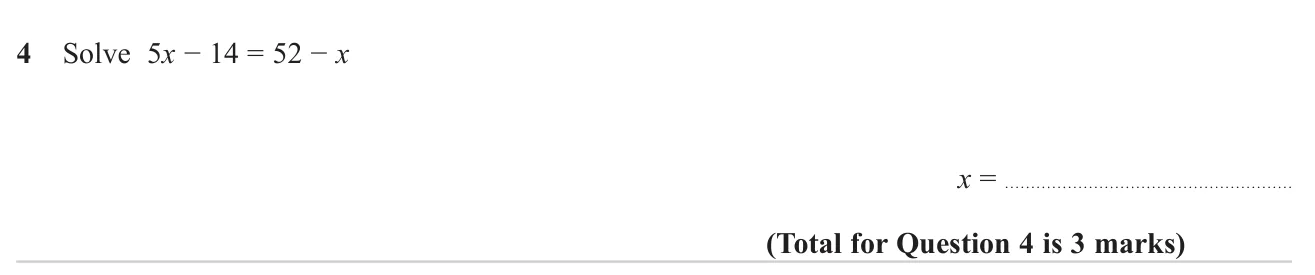
© Pearson Education Ltd. November 2023 Paper 2 (Higher, calculator), question 4.
Answer x = 11 x = 11 x = 11 3 marks
Worked solution Checked against the mark scheme
Add x x x 6 x − 14 = 52 6x - 14 = 52 6 x − 14 = 52
Add 14 to both sides: 6 x = 66 6x = 66 6 x = 66
x = 11 x = 11 x = 11
Watch out: Subtracting x instead of adding it, giving 4x.
© Pearson Education Ltd. November 2023 Paper 2 (Higher, calculator), question 5.
Worked solution Checked against the mark scheme
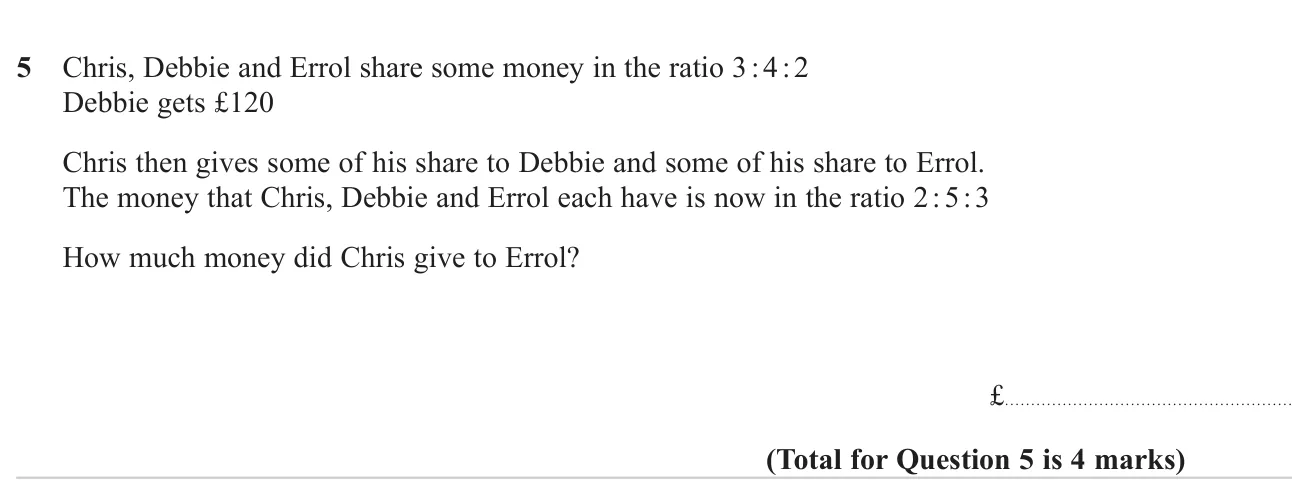
Debbie has 4 parts = 120 = 120 = 120 = 30 = 30 = 30 9 × 30 = 270 9 \times 30 = 270 9 × 30 = 270
At first Errol has 2 × 30 = 60 2 \times 30 = 60 2 × 30 = 60
New ratio has 2 + 5 + 3 = 10 2 + 5 + 3 = 10 2 + 5 + 3 = 10 = 27 = 27 = 27 3 × 27 = 81 3 \times 27 = 81 3 × 27 = 81
Chris gave Errol 81 − 60 = £ 21 81 - 60 = £21 81 − 60 = £21
Watch out: Assuming Debbie still has £120 after the change.
© Pearson Education Ltd. November 2023 Paper 2 (Higher, calculator), question 6.
Worked solution Checked against the mark scheme
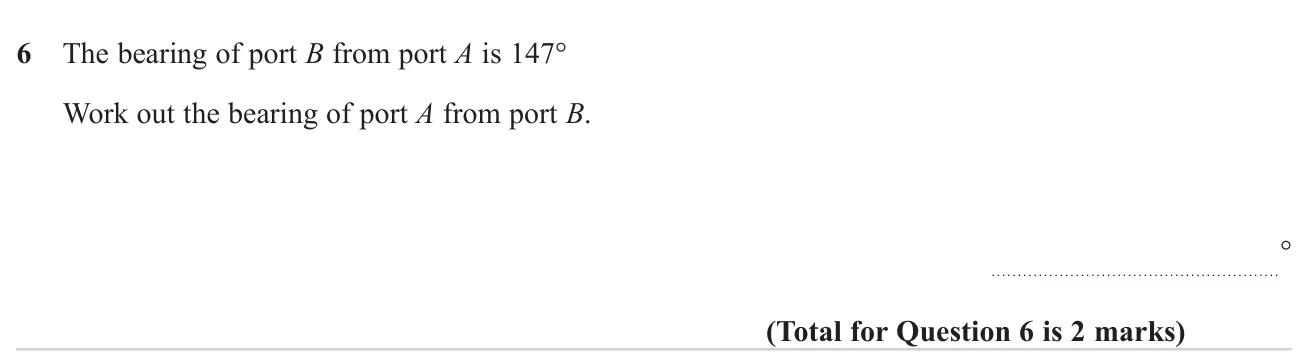
The return bearing differs by 180 ° 180° 180°
147 + 180 = 327 ° 147 + 180 = 327° 147 + 180 = 327°
Watch out: Subtracting from 360 to give 213°.
© Pearson Education Ltd. November 2023 Paper 2 (Higher, calculator), question 7.
Worked solution Checked against the mark scheme
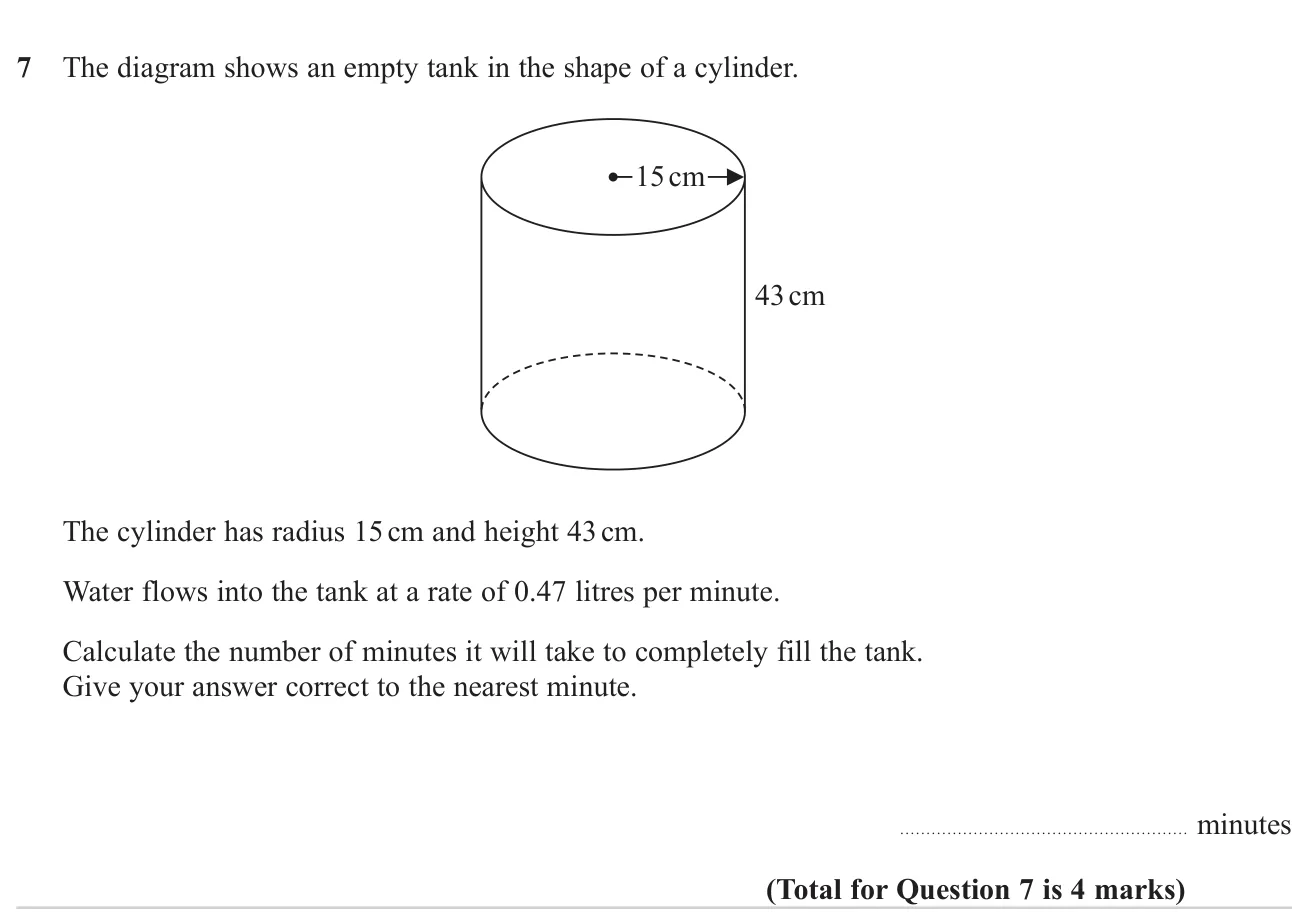
Volume = π × 15 2 × 43 = 30 394.9 … cm 3 = \pi \times 15^2 \times 43 = 30\,394.9\ldots\text{ cm}^3 = π × 1 5 2 × 43 = 30 394.9 … cm 3
1000 cm 3 = 1 1000\text{ cm}^3 = 1 1000 cm 3 = 1 30.3949 … 30.3949\ldots 30.3949 …
Time = 30.3949 ÷ 0.47 = 64.67 … = 30.3949 \div 0.47 = 64.67\ldots = 30.3949 ÷ 0.47 = 64.67 … 65 minutes
Watch out: Forgetting to convert cm³ to litres.
© Pearson Education Ltd. November 2023 Paper 2 (Higher, calculator), question 8.
Answer 1.85 ≤ x < 1.95 1.85 \le x < 1.95 1.85 ≤ x < 1.95 2 marks
Worked solution Checked against the mark scheme
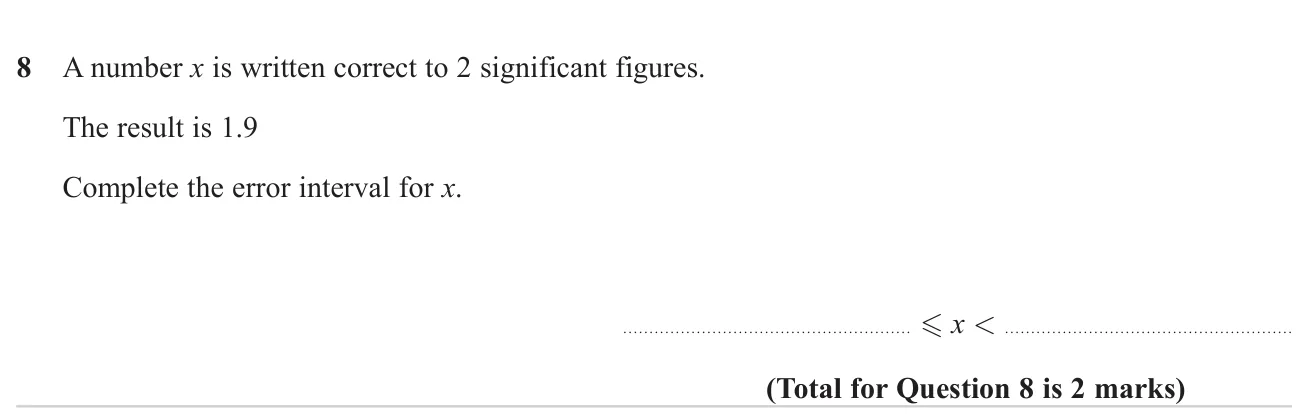
Rounding to 2 significant figures here means to the nearest 0.1, so half of that is 0.05.
Lower bound: 1.9 − 0.05 = 1.85 1.9 - 0.05 = 1.85 1.9 − 0.05 = 1.85
Upper bound: 1.9 + 0.05 = 1.95 1.9 + 0.05 = 1.95 1.9 + 0.05 = 1.95
1.85 ≤ x < 1.95 1.85 \le x < 1.95 1.85 ≤ x < 1.95
Watch out: Using 1.94 or 1.949 as the upper bound with ≤.
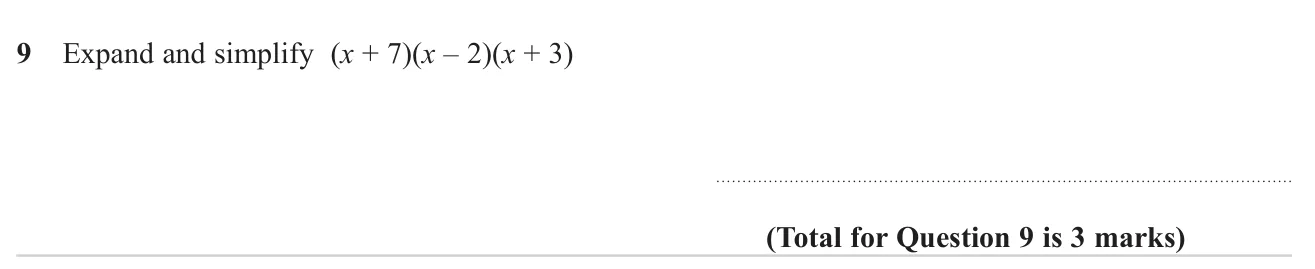
© Pearson Education Ltd. November 2023 Paper 2 (Higher, calculator), question 9.
Answer x 3 + 8 x 2 + x − 42 x^3 + 8x^2 + x - 42 x 3 + 8 x 2 + x − 42 3 marks
Worked solution Checked against the mark scheme
( x + 7 ) ( x − 2 ) = x 2 + 5 x − 14 (x + 7)(x - 2) = x^2 + 5x - 14 ( x + 7 ) ( x − 2 ) = x 2 + 5 x − 14
( x 2 + 5 x − 14 ) ( x + 3 ) = x 3 + 3 x 2 + 5 x 2 + 15 x − 14 x − 42 (x^2 + 5x - 14)(x + 3) = x^3 + 3x^2 + 5x^2 + 15x - 14x - 42 ( x 2 + 5 x − 14 ) ( x + 3 ) = x 3 + 3 x 2 + 5 x 2 + 15 x − 14 x − 42
= x 3 + 8 x 2 + x − 42 = x^3 + 8x^2 + x - 42 = x 3 + 8 x 2 + x − 42
Watch out: Sign errors with the −2 and −14 terms.
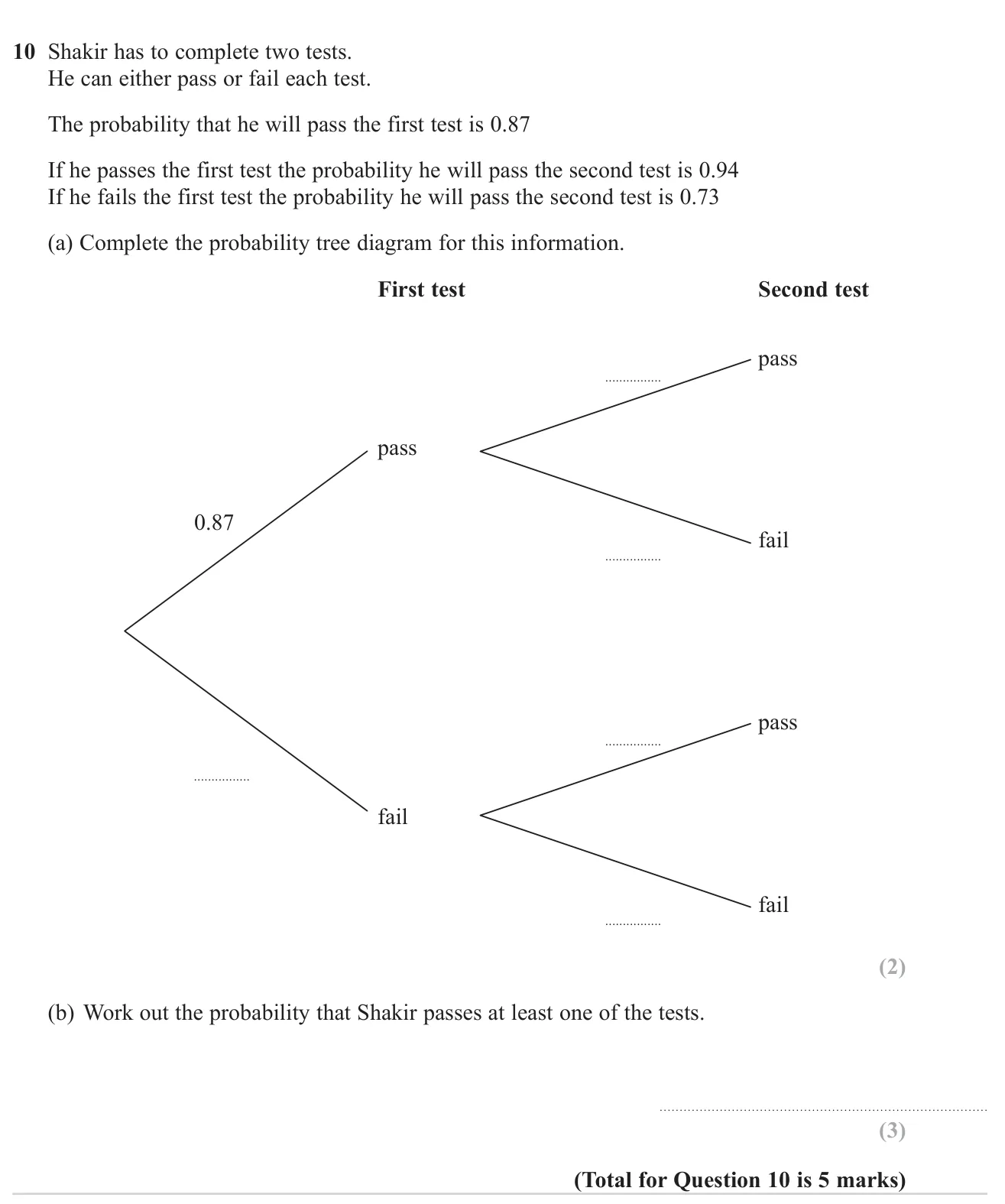
© Pearson Education Ltd. November 2023 Paper 2 (Higher, calculator), question 10.
(a) First test: fail 0.13. After a pass: pass 0.94, fail 0.06. After a fail: pass 0.73, fail 0.27 2 marks (b) 0.9649 0.9649 0.9649 3 marks
Worked solution Checked against the mark scheme
(a) Each pair of branches adds up to 1: 1 − 0.87 = 0.13 1 - 0.87 = 0.13 1 − 0.87 = 0.13 1 − 0.94 = 0.06 1 - 0.94 = 0.06 1 − 0.94 = 0.06 1 − 0.73 = 0.27 1 - 0.73 = 0.27 1 − 0.73 = 0.27
(b) The only way to pass neither is fail, fail: 0.13 × 0.27 = 0.0351 0.13 \times 0.27 = 0.0351 0.13 × 0.27 = 0.0351
P ( at least one ) = 1 − 0.0351 = 0.9649 P(\text{at least one}) = 1 - 0.0351 = 0.9649 P ( at least one ) = 1 − 0.0351 = 0.9649
Watch out: Using 0.94 and 0.73 on the wrong branches.
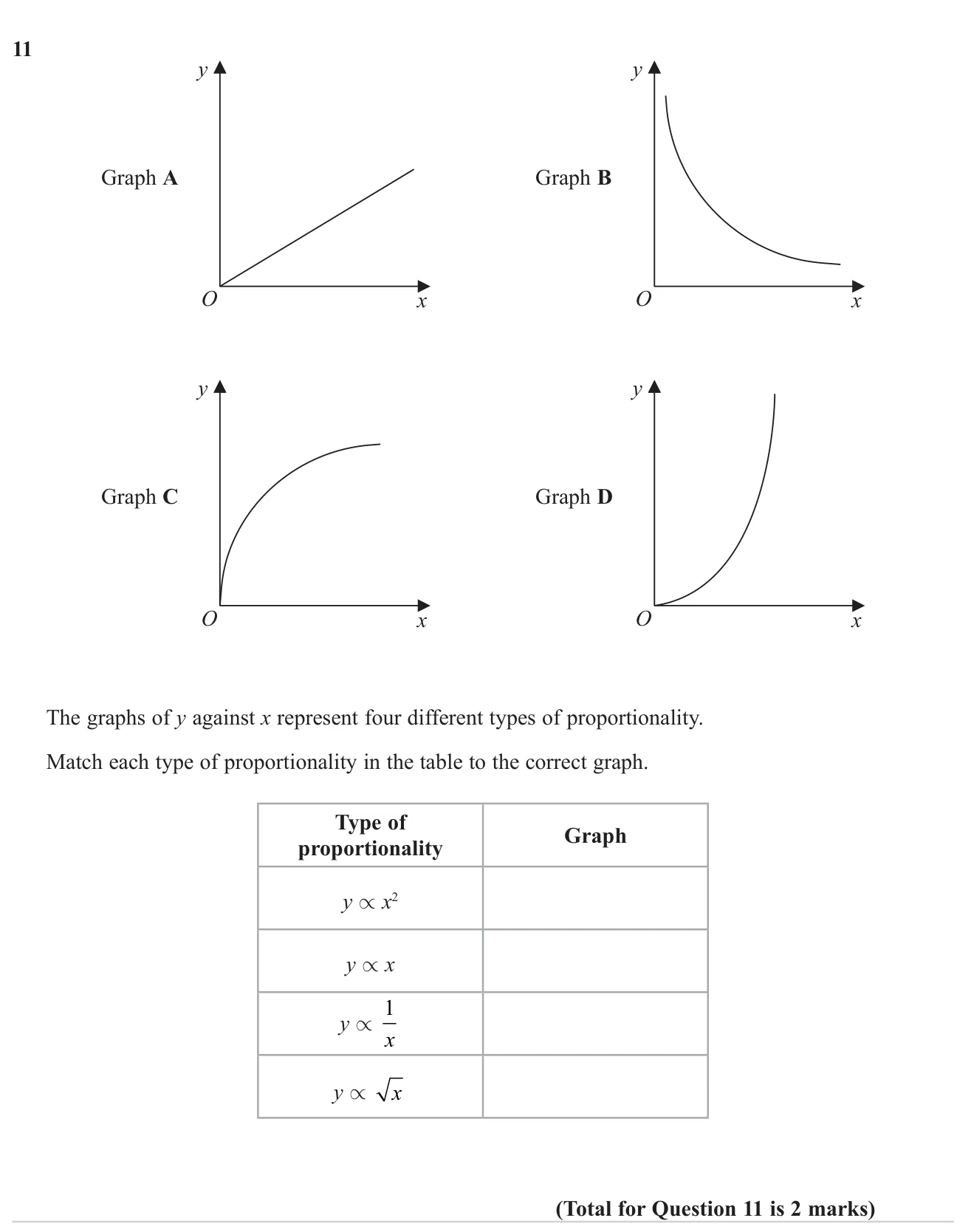
© Pearson Education Ltd. November 2023 Paper 2 (Higher, calculator), question 11.
Answer y ∝ x 2 y \propto x^2 y ∝ x 2 y ∝ x y \propto x y ∝ x y ∝ 1 x y \propto \frac{1}{x} y ∝ x 1 y ∝ x y \propto \sqrt{x} y ∝ x 2 marks
Worked solution Checked against the mark scheme
y ∝ x y \propto x y ∝ x
y ∝ x 2 y \propto x^2 y ∝ x 2
y ∝ 1 x y \propto \frac{1}{x} y ∝ x 1 x x x
y ∝ x y \propto \sqrt{x} y ∝ x
Watch out: Mixing up the square and square-root graphs (C and D).
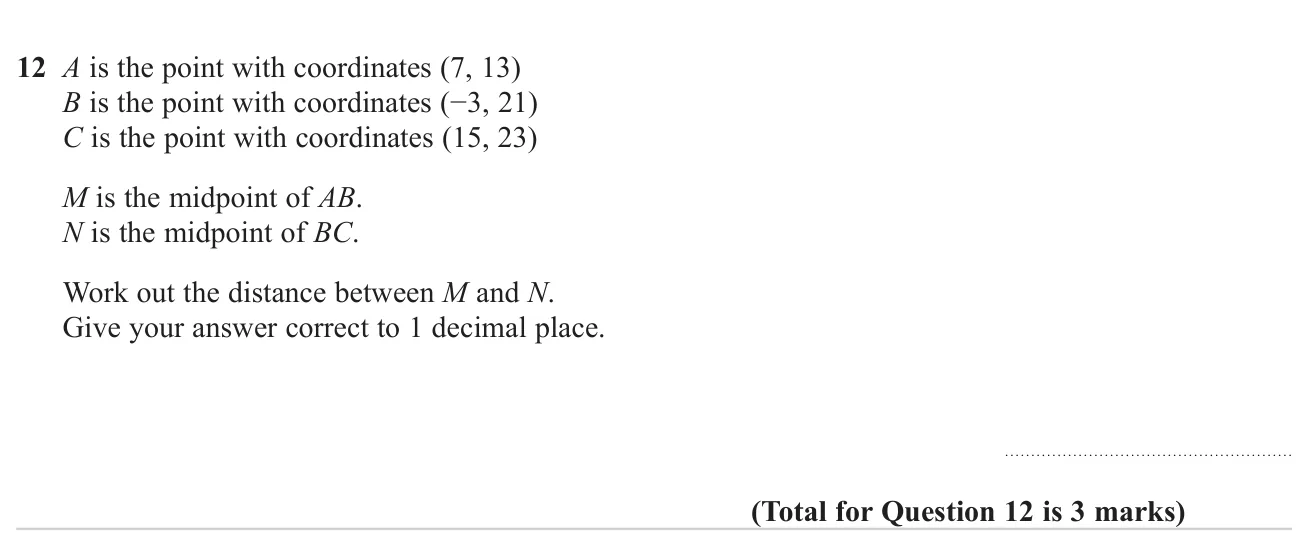
© Pearson Education Ltd. November 2023 Paper 2 (Higher, calculator), question 12.
Worked solution Checked against the mark scheme
M = ( 7 + ( − 3 ) 2 , 13 + 21 2 ) = ( 2 , 17 ) M = \left(\frac{7 + (-3)}{2}, \frac{13 + 21}{2}\right) = (2, 17) M = ( 2 7 + ( − 3 ) , 2 13 + 21 ) = ( 2 , 17 )
N = ( − 3 + 15 2 , 21 + 23 2 ) = ( 6 , 22 ) N = \left(\frac{-3 + 15}{2}, \frac{21 + 23}{2}\right) = (6, 22) N = ( 2 − 3 + 15 , 2 21 + 23 ) = ( 6 , 22 )
M N = 4 2 + 5 2 = 41 = 6.403... ≈ 6.4 MN = \sqrt{4^2 + 5^2} = \sqrt{41} = 6.403... \approx 6.4 M N = 4 2 + 5 2 = 41 = 6.403... ≈ 6.4
Watch out: Subtracting coordinates instead of adding them when finding a midpoint.
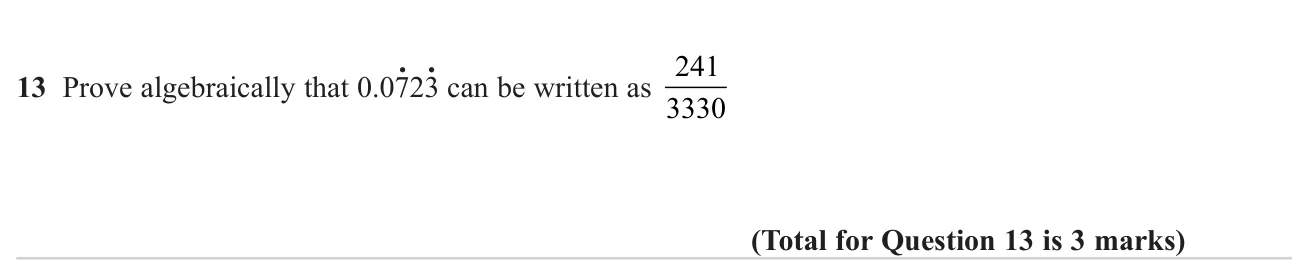
© Pearson Education Ltd. November 2023 Paper 2 (Higher, calculator), question 13.
Answer Proof that 0.0 7 ˙ 2 3 ˙ = 241 3330 0.0\dot{7}2\dot{3} = \frac{241}{3330} 0.0 7 ˙ 2 3 ˙ = 3330 241 3 marks
Worked solution Checked against the mark scheme
Let x = 0.0723723... x = 0.0723723... x = 0.0723723...
Then 10 x = 0.723723... 10x = 0.723723... 10 x = 0.723723... 10 000 x = 723.723723... 10\,000x = 723.723723... 10 000 x = 723.723723...
Subtract: 9990 x = 723 9990x = 723 9990 x = 723
x = 723 9990 = 241 3330 x = \frac{723}{9990} = \frac{241}{3330} x = 9990 723 = 3330 241
Watch out: Subtracting multiples whose recurring parts do not line up, so the decimals do not cancel.
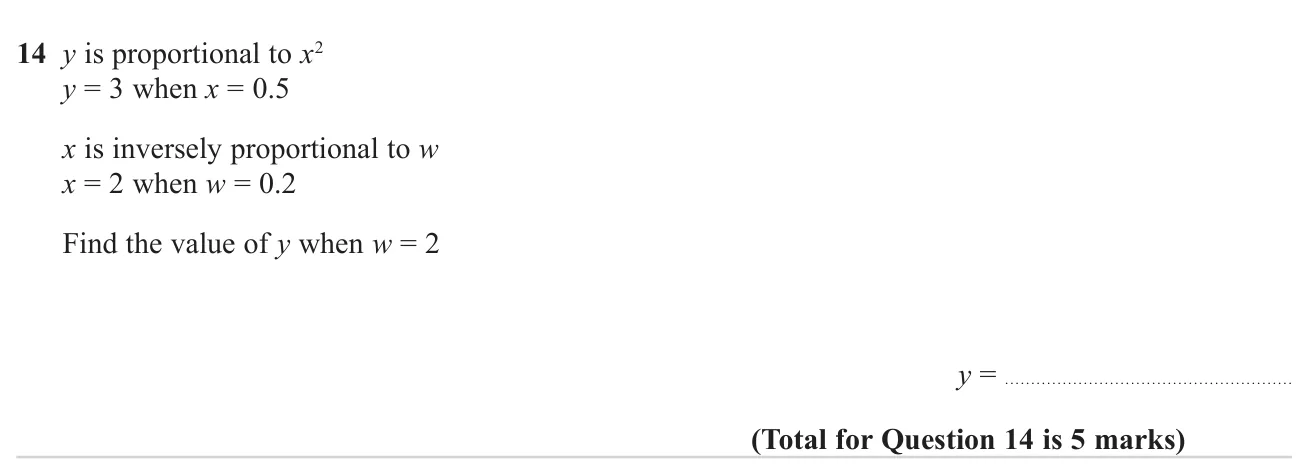
© Pearson Education Ltd. November 2023 Paper 2 (Higher, calculator), question 14.
Answer y = 0.48 y = 0.48 y = 0.48 5 marks
Worked solution Checked against the mark scheme
y = k x 2 y = kx^2 y = k x 2 3 = k × 0.5 2 3 = k \times 0.5^2 3 = k × 0. 5 2 k = 12 k = 12 k = 12
x = j w x = \frac{j}{w} x = w j 2 = j 0.2 2 = \frac{j}{0.2} 2 = 0.2 j j = 0.4 j = 0.4 j = 0.4
When w = 2 w = 2 w = 2 x = 0.4 2 = 0.2 x = \frac{0.4}{2} = 0.2 x = 2 0.4 = 0.2
y = 12 × 0.2 2 = 0.48 y = 12 \times 0.2^2 = 0.48 y = 12 × 0. 2 2 = 0.48
Watch out: Treating the inverse proportion as x = jw.
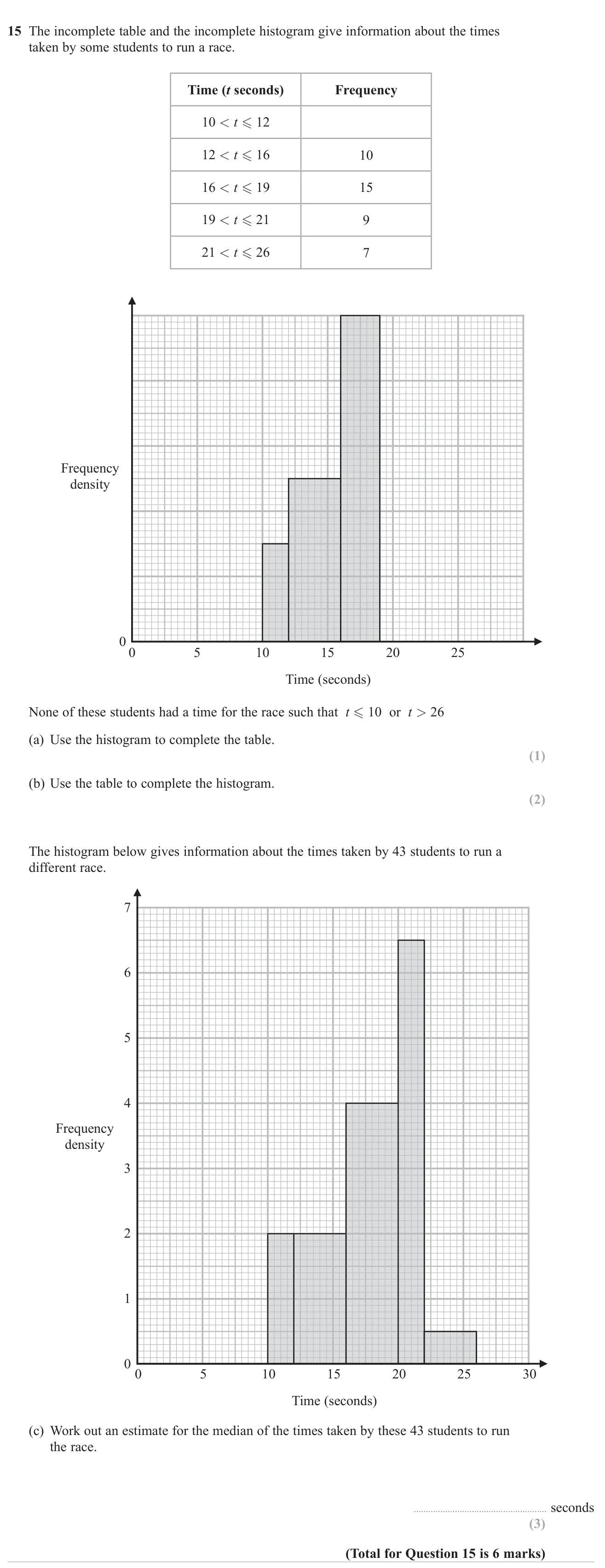
© Pearson Education Ltd. November 2023 Paper 2 (Higher, calculator), question 15.
(a) 3 3 3 1 mark (b) Bars of frequency density 4.5 for 19 < t ≤ 21 19 < t \le 21 19 < t ≤ 21 21 < t ≤ 26 21 < t \le 26 21 < t ≤ 26 2 marks (c) 18.5 18.5 18.5 3 marks
Worked solution Checked against the mark scheme
(a) The 12–16 bar has frequency 10 and width 4, so its frequency density is 2.5. The 10–12 bar is 1.5 high, so its frequency is 1.5 × 2 = 3 1.5 \times 2 = 3 1.5 × 2 = 3
(b) 9 ÷ 2 = 4.5 9 \div 2 = 4.5 9 ÷ 2 = 4.5 7 ÷ 5 = 1.4 7 \div 5 = 1.4 7 ÷ 5 = 1.4
(c) Frequencies: 4 , 8 , 16 , 13 , 2 4, 8, 16, 13, 2 4 , 8 , 16 , 13 , 2 16 + 10 16 × 4 = 18.5 16 + \frac{10}{16} \times 4 = 18.5 16 + 16 10 × 4 = 18.5
Watch out: Using bar heights as frequencies instead of frequency density × class width.
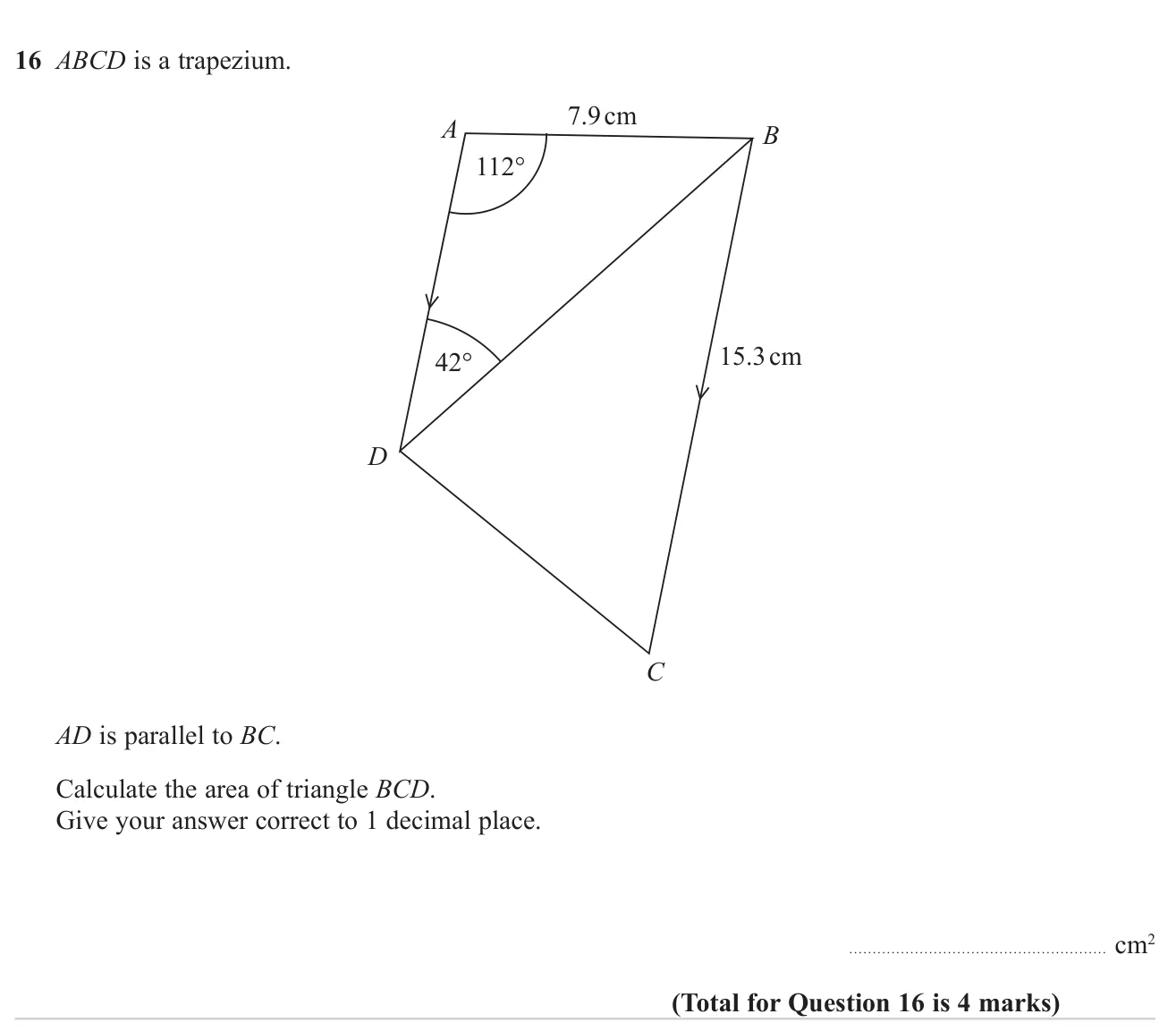
© Pearson Education Ltd. November 2023 Paper 2 (Higher, calculator), question 16.
Answer 56.0 56.0 56.0 4 marks
Worked solution Checked against the mark scheme
In triangle A B D ABD A B D B D sin 112 ° = 7.9 sin 42 ° \frac{BD}{\sin 112°} = \frac{7.9}{\sin 42°} s i n 112° B D = s i n 42° 7.9 B D = 10.946... BD = 10.946... B D = 10.946...
AD is parallel to BC, so angle D B C = 42 ° DBC = 42° D B C = 42°
Area of B C D = 1 2 × 10.946... × 15.3 × sin 42 ° = 56.03... ≈ 56.0 BCD = \frac{1}{2} \times 10.946... \times 15.3 \times \sin 42° = 56.03... \approx 56.0 B C D = 2 1 × 10.946... × 15.3 × sin 42° = 56.03... ≈ 56.0
Watch out: Not spotting that angle DBC equals 42° by alternate angles.
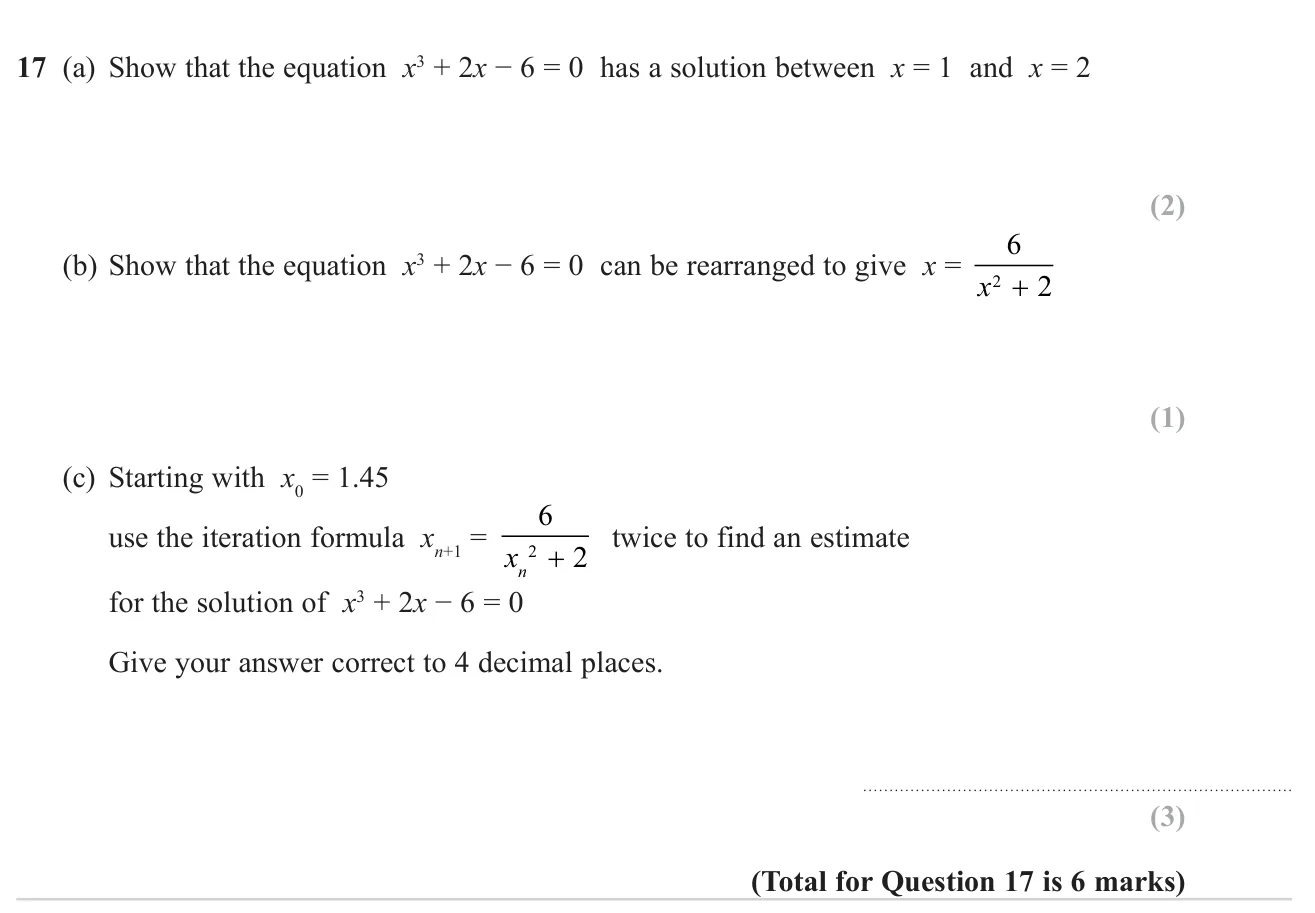
© Pearson Education Ltd. November 2023 Paper 2 (Higher, calculator), question 17.
(a) f ( 1 ) = − 3 f(1) = -3 f ( 1 ) = − 3 f ( 2 ) = 6 f(2) = 6 f ( 2 ) = 6 2 marks (b) x 3 + 2 x = 6 ⇒ x ( x 2 + 2 ) = 6 ⇒ x = 6 x 2 + 2 x^3 + 2x = 6 \Rightarrow x(x^2 + 2) = 6 \Rightarrow x = \frac{6}{x^2 + 2} x 3 + 2 x = 6 ⇒ x ( x 2 + 2 ) = 6 ⇒ x = x 2 + 2 6 1 mark (c) 1.4496 1.4496 1.4496 3 marks
Worked solution Checked against the mark scheme
(a) 1 3 + 2 ( 1 ) − 6 = − 3 1^3 + 2(1) - 6 = -3 1 3 + 2 ( 1 ) − 6 = − 3 2 3 + 2 ( 2 ) − 6 = 6 2^3 + 2(2) - 6 = 6 2 3 + 2 ( 2 ) − 6 = 6
(b) x 3 + 2 x = 6 x^3 + 2x = 6 x 3 + 2 x = 6 x ( x 2 + 2 ) = 6 x(x^2 + 2) = 6 x ( x 2 + 2 ) = 6 x = 6 x 2 + 2 x = \frac{6}{x^2 + 2} x = x 2 + 2 6
(c) x 1 = 6 1.45 2 + 2 = 1.46252... x_1 = \frac{6}{1.45^2 + 2} = 1.46252... x 1 = 1.4 5 2 + 2 6 = 1.46252...
x 2 = 6 1.46252.. . 2 + 2 = 1.44963... ≈ 1.4496 x_2 = \frac{6}{1.46252...^2 + 2} = 1.44963... \approx 1.4496 x 2 = 1.46252.. . 2 + 2 6 = 1.44963... ≈ 1.4496
Watch out: In (a), working out the values but not stating that the sign changes.
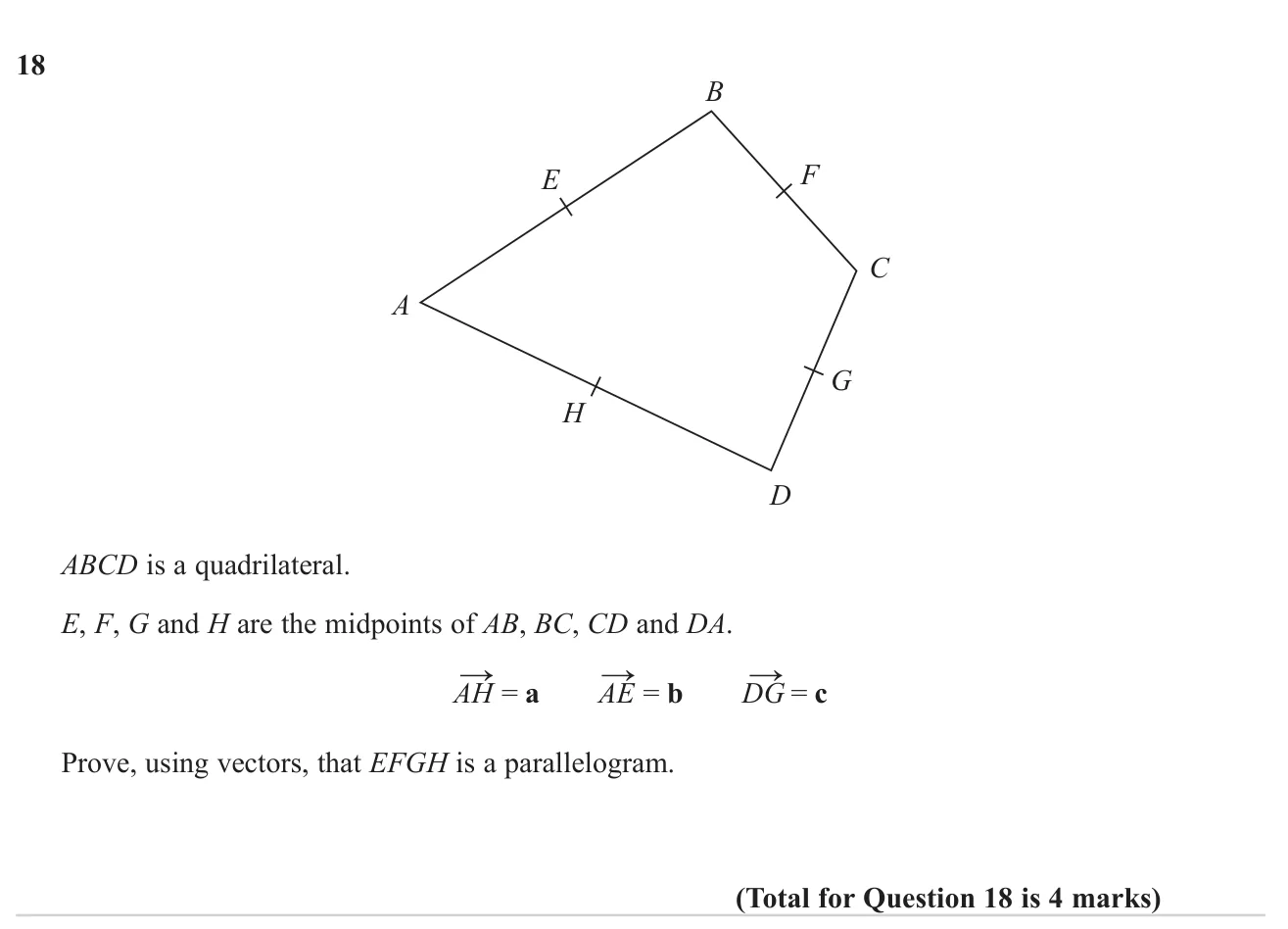
© Pearson Education Ltd. November 2023 Paper 2 (Higher, calculator), question 18.
Answer Proof: E H → = F G → = a − b \overrightarrow{EH} = \overrightarrow{FG} = \mathbf{a} - \mathbf{b} E H = F G = a − b 4 marks
Worked solution Checked against the mark scheme
E H → = − b + a \overrightarrow{EH} = -\mathbf{b} + \mathbf{a} E H = − b + a
B C → = B A → + A D → + D C → = − 2 b + 2 a + 2 c \overrightarrow{BC} = \overrightarrow{BA} + \overrightarrow{AD} + \overrightarrow{DC} = -2\mathbf{b} + 2\mathbf{a} + 2\mathbf{c} B C = B A + A D + D C = − 2 b + 2 a + 2 c
F G → = 1 2 B C → + C G → = ( − b + a + c ) − c = a − b \overrightarrow{FG} = \frac{1}{2}\overrightarrow{BC} + \overrightarrow{CG} = (-\mathbf{b} + \mathbf{a} + \mathbf{c}) - \mathbf{c} = \mathbf{a} - \mathbf{b} F G = 2 1 B C + C G = ( − b + a + c ) − c = a − b
E H → = F G → \overrightarrow{EH} = \overrightarrow{FG} E H = F G
Watch out: Forgetting that the full side vectors are twice a, b and c.
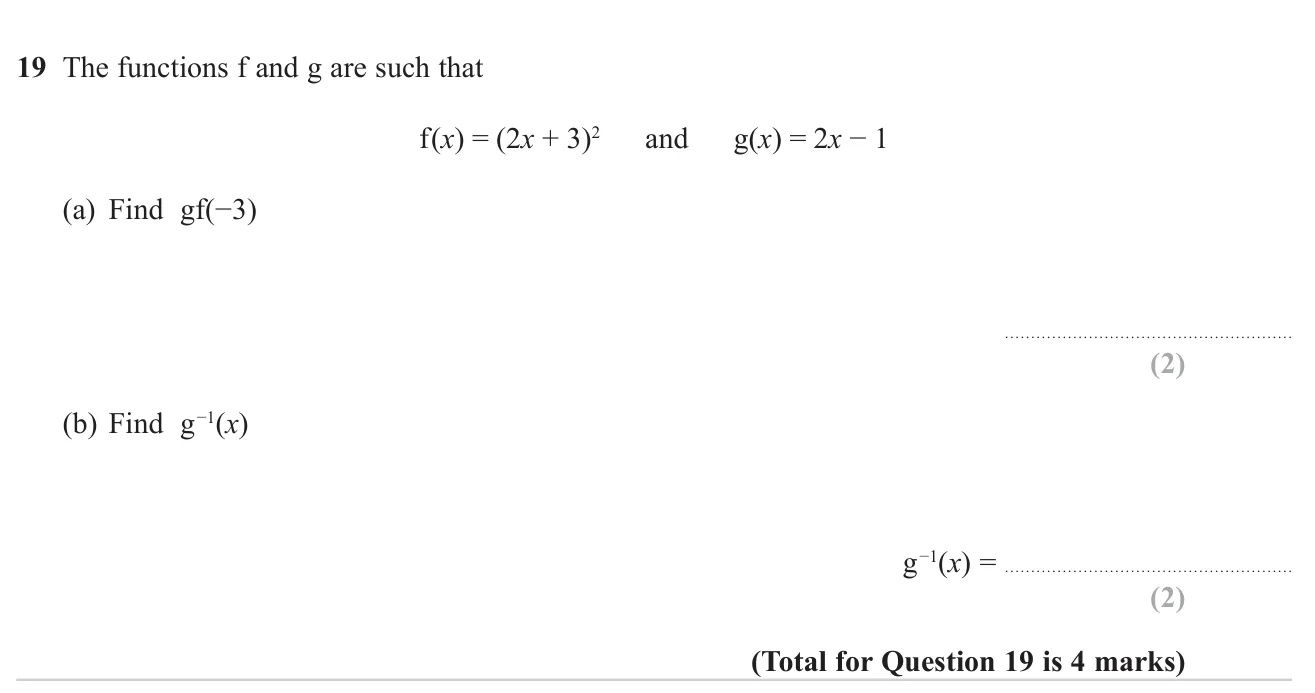
© Pearson Education Ltd. November 2023 Paper 2 (Higher, calculator), question 19.
(a) 17 17 17 2 marks (b) x + 1 2 \frac{x + 1}{2} 2 x + 1 2 marks
Worked solution Checked against the mark scheme
(a) f ( − 3 ) = ( 2 ( − 3 ) + 3 ) 2 = ( − 3 ) 2 = 9 f(-3) = (2(-3) + 3)^2 = (-3)^2 = 9 f ( − 3 ) = ( 2 ( − 3 ) + 3 ) 2 = ( − 3 ) 2 = 9 g ( 9 ) = 2 × 9 − 1 = 17 g(9) = 2 \times 9 - 1 = 17 g ( 9 ) = 2 × 9 − 1 = 17
(b) Let y = 2 x − 1 y = 2x - 1 y = 2 x − 1 y + 1 = 2 x y + 1 = 2x y + 1 = 2 x x = y + 1 2 x = \frac{y + 1}{2} x = 2 y + 1
g − 1 ( x ) = x + 1 2 g^{-1}(x) = \frac{x + 1}{2} g − 1 ( x ) = 2 x + 1
Watch out: In (a), working out fg(−3) instead of gf(−3).
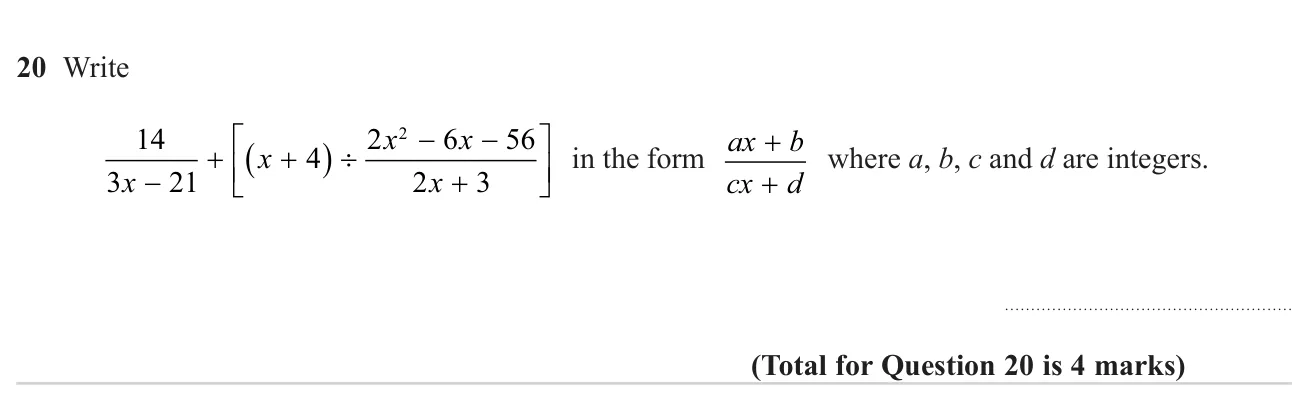
© Pearson Education Ltd. November 2023 Paper 2 (Higher, calculator), question 20.
Answer 6 x + 37 6 x − 42 \frac{6x + 37}{6x - 42} 6 x − 42 6 x + 37 4 marks
Worked solution Checked against the mark scheme
2 x 2 − 6 x − 56 = 2 ( x + 4 ) ( x − 7 ) 2x^2 - 6x - 56 = 2(x + 4)(x - 7) 2 x 2 − 6 x − 56 = 2 ( x + 4 ) ( x − 7 ) 3 x − 21 = 3 ( x − 7 ) 3x - 21 = 3(x - 7) 3 x − 21 = 3 ( x − 7 )
( x + 4 ) × 2 x + 3 2 ( x + 4 ) ( x − 7 ) = 2 x + 3 2 ( x − 7 ) (x + 4) \times \frac{2x + 3}{2(x + 4)(x - 7)} = \frac{2x + 3}{2(x - 7)} ( x + 4 ) × 2 ( x + 4 ) ( x − 7 ) 2 x + 3 = 2 ( x − 7 ) 2 x + 3
14 3 ( x − 7 ) + 2 x + 3 2 ( x − 7 ) = 28 + 3 ( 2 x + 3 ) 6 ( x − 7 ) = 6 x + 37 6 x − 42 \frac{14}{3(x - 7)} + \frac{2x + 3}{2(x - 7)} = \frac{28 + 3(2x + 3)}{6(x - 7)} = \frac{6x + 37}{6x - 42} 3 ( x − 7 ) 14 + 2 ( x − 7 ) 2 x + 3 = 6 ( x − 7 ) 28 + 3 ( 2 x + 3 ) = 6 x − 42 6 x + 37
Watch out: Multiplying by the divisor instead of its reciprocal.
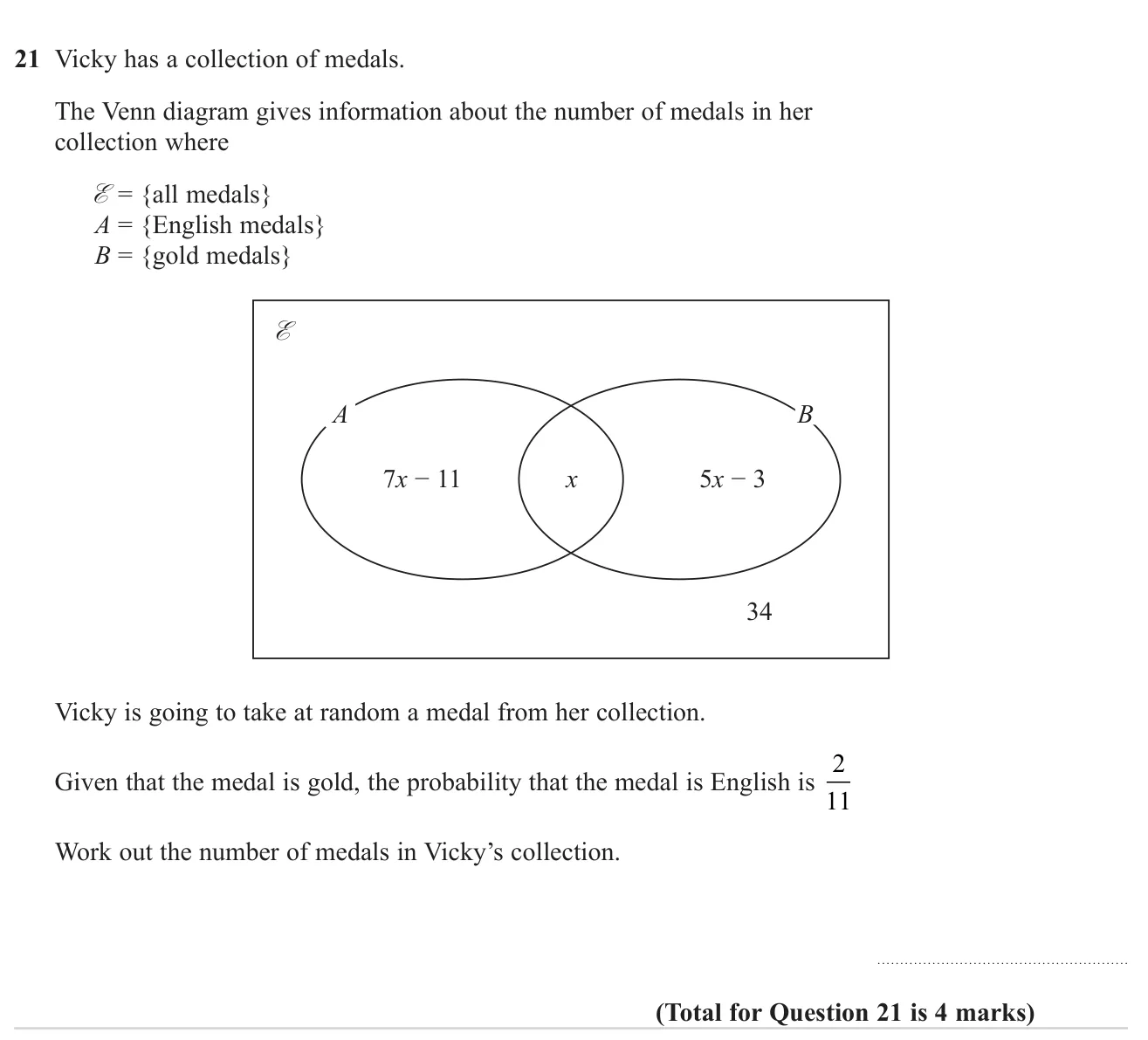
© Pearson Education Ltd. November 2023 Paper 2 (Higher, calculator), question 21.
Worked solution Checked against the mark scheme
Gold medals: x + ( 5 x − 3 ) = 6 x − 3 x + (5x - 3) = 6x - 3 x + ( 5 x − 3 ) = 6 x − 3
x 6 x − 3 = 2 11 \frac{x}{6x - 3} = \frac{2}{11} 6 x − 3 x = 11 2 11 x = 12 x − 6 11x = 12x - 6 11 x = 12 x − 6 x = 6 x = 6 x = 6
Total: ( 7 × 6 − 11 ) + 6 + ( 5 × 6 − 3 ) + 34 = 31 + 6 + 27 + 34 = 98 (7 \times 6 - 11) + 6 + (5 \times 6 - 3) + 34 = 31 + 6 + 27 + 34 = 98 ( 7 × 6 − 11 ) + 6 + ( 5 × 6 − 3 ) + 34 = 31 + 6 + 27 + 34 = 98
Watch out: Dividing by the total number of medals instead of the number of gold medals.
Finished the paper? Add up your marks for all three papers and see what grade that would have been.