© Pearson Education Ltd. June 2018 Paper 3 (Higher, calculator), question 1.
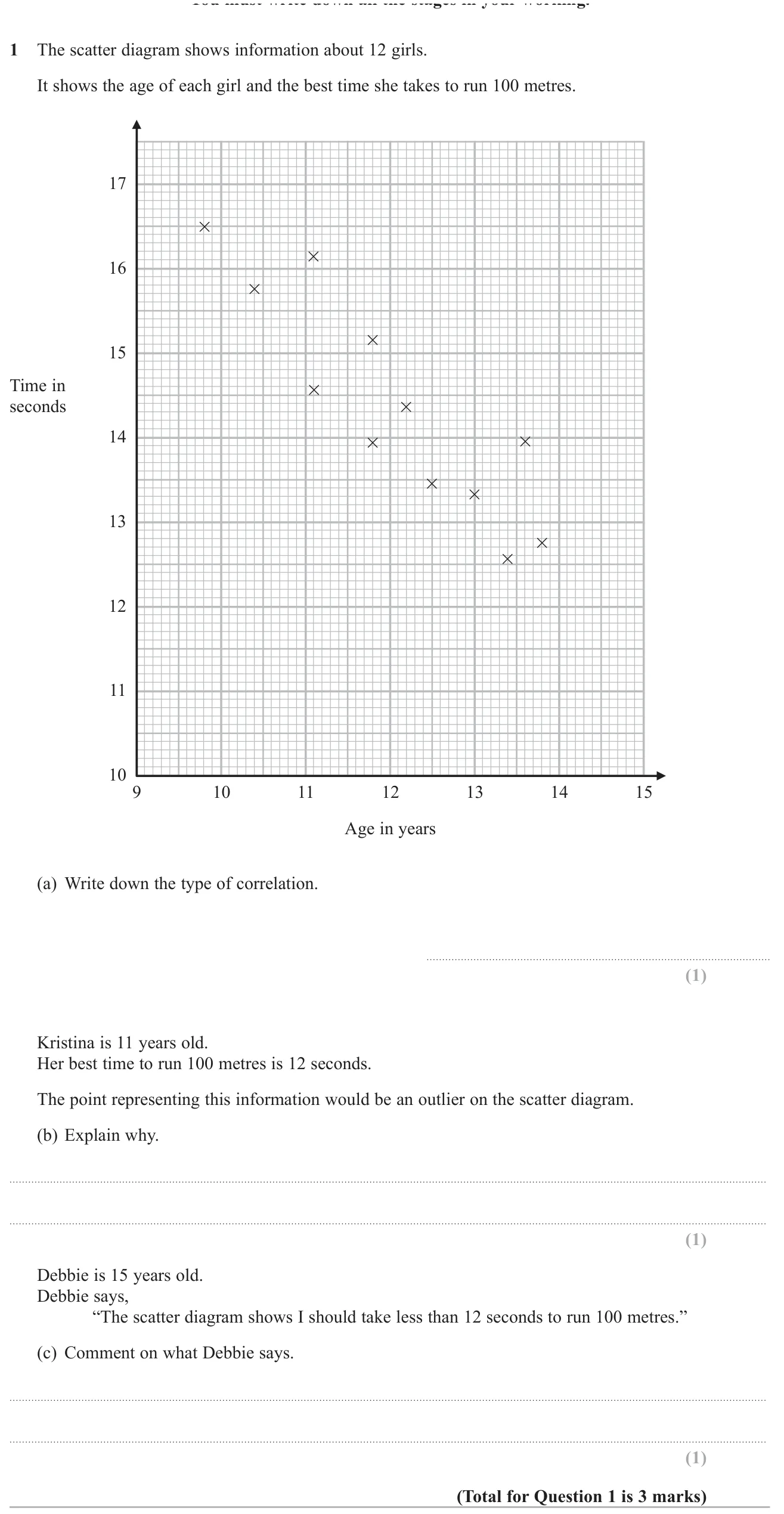
(a) Negative 1 mark (b) It does not follow the trend; it is far from the other points 1 mark (c) Age 15 is outside the range of the data, so the graph cannot be used to predict her time 1 mark
Worked solution Checked against the mark scheme
(a) As age increases, time decreases, so the correlation is negative.
(b) An 11-year-old's times on the graph are about 14.5 to 16 seconds; 12 seconds is far faster than the trend suggests.
(c) The oldest girl on the graph is under 14, so predicting for 15 means going beyond the data, which is unreliable.
Watch out: Saying 'positive' because the numbers on both axes go up.
© Pearson Education Ltd. June 2018 Paper 3 (Higher, calculator), question 2.
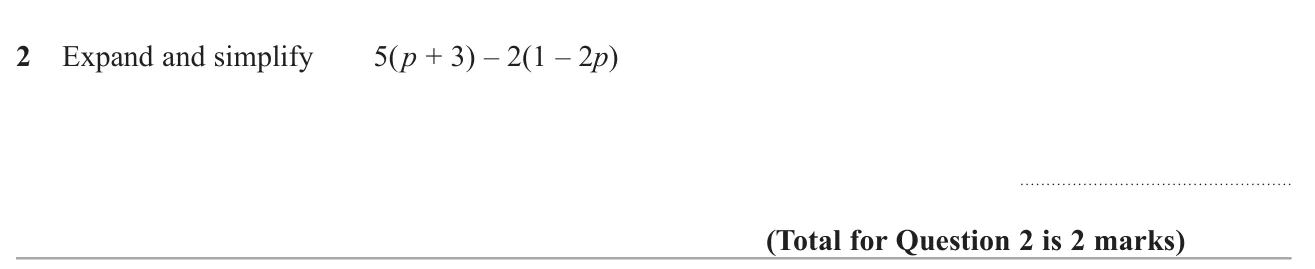
Answer 9 p + 13 9p + 13 9 p + 13 2 marks
Worked solution Checked against the mark scheme
5 ( p + 3 ) = 5 p + 15 5(p + 3) = 5p + 15 5 ( p + 3 ) = 5 p + 15
− 2 ( 1 − 2 p ) = − 2 + 4 p -2(1 - 2p) = -2 + 4p − 2 ( 1 − 2 p ) = − 2 + 4 p
5 p + 15 − 2 + 4 p = 9 p + 13 5p + 15 - 2 + 4p = 9p + 13 5 p + 15 − 2 + 4 p = 9 p + 13
Watch out: Writing −2 × −2p as −4p, giving p + 13.
© Pearson Education Ltd. June 2018 Paper 3 (Higher, calculator), question 3.
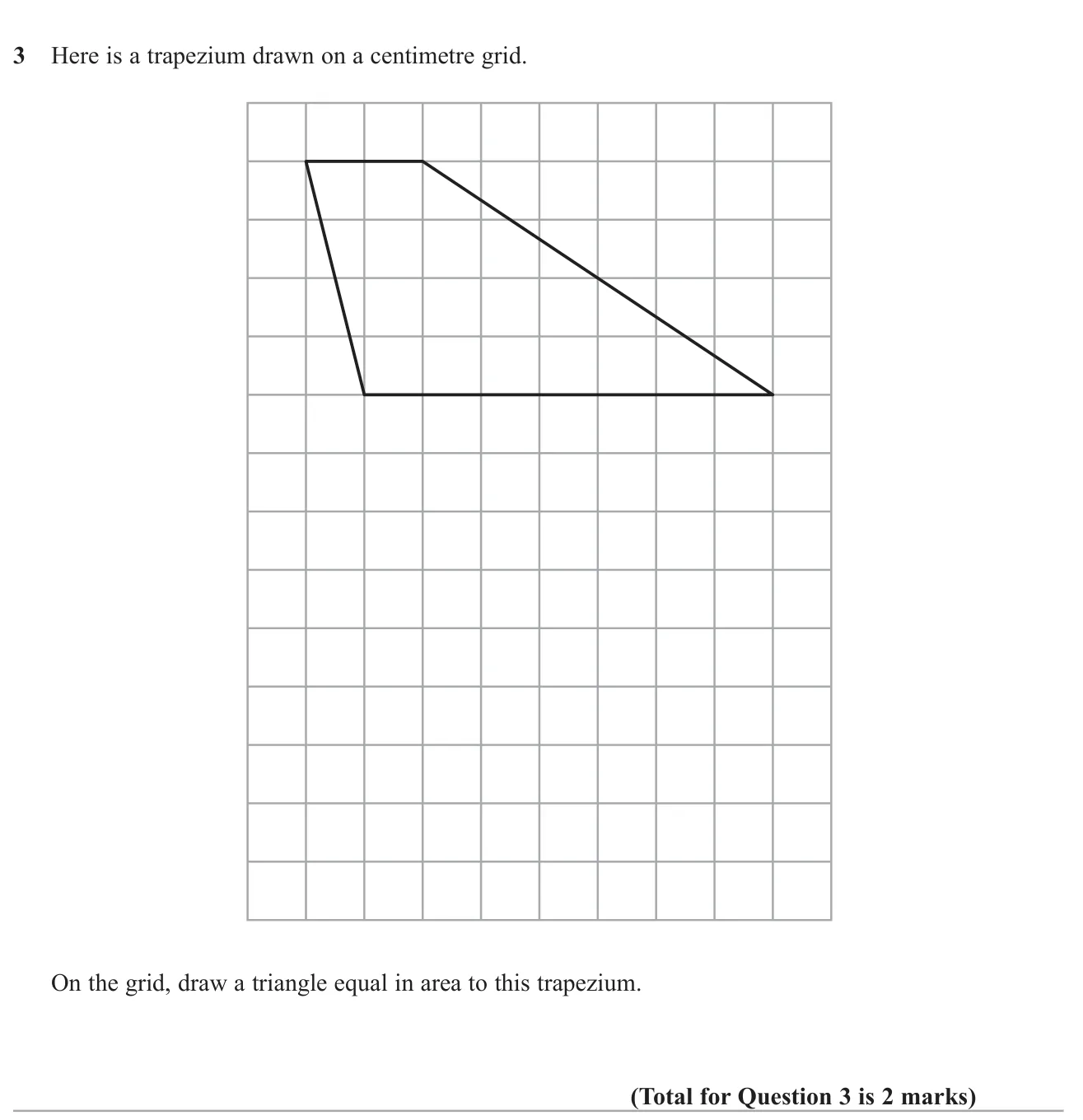
Answer Any triangle of area 18 cm², e.g. base 6 cm and height 6 cm, or base 9 cm and height 4 cm 2 marks
Worked solution Checked against the mark scheme
The parallel sides are 2 cm and 7 cm, and the height is 4 cm.
Area = 1 2 ( 2 + 7 ) × 4 = 18 = \frac{1}{2}(2 + 7) \times 4 = 18 = 2 1 ( 2 + 7 ) × 4 = 18
A triangle needs 1 2 × b × h = 18 \frac{1}{2} \times b \times h = 18 2 1 × b × h = 18 b × h = 36 b \times h = 36 b × h = 36
Watch out: Drawing a triangle with base × height = 18, giving area 9.
© Pearson Education Ltd. June 2018 Paper 3 (Higher, calculator), question 4.
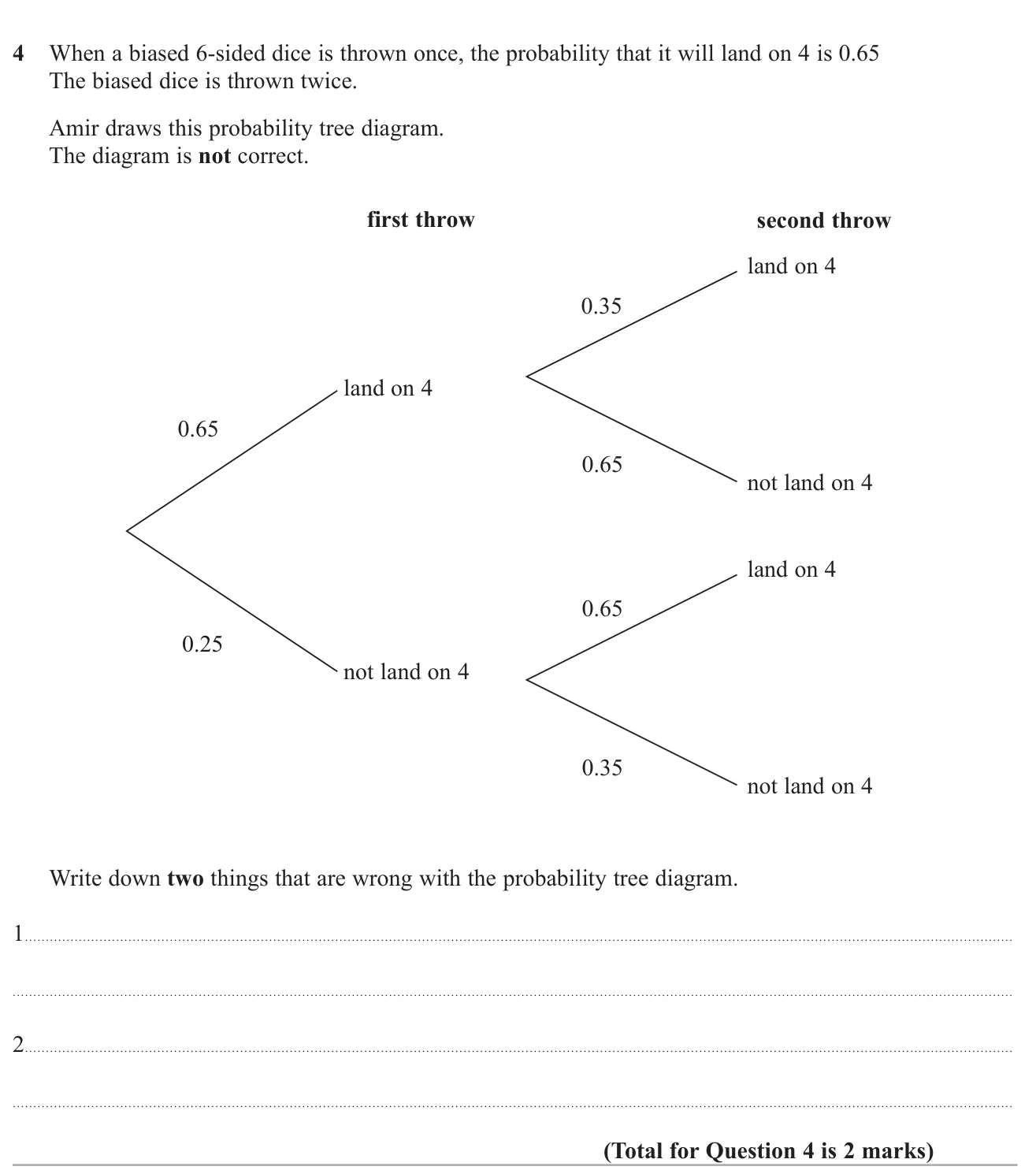
Answer The pair 0.65 and 0.25 does not add to 1 (0.25 should be 0.35); on the upper second-throw branches, 0.35 and 0.65 are the wrong way round 2 marks
Worked solution Checked against the mark scheme
The probability of landing on 4 is 0.65 on every throw, so the probability of not landing on 4 is 1 − 0.65 = 0.35 1 - 0.65 = 0.35 1 − 0.65 = 0.35
1. On the first throw, 0.65 + 0.25 ≠ 1 0.65 + 0.25 \ne 1 0.65 + 0.25 = 1
2. On the second throw after landing on 4, 'land on 4' is labelled 0.35 and 'not land on 4' 0.65; these are the wrong way round.
Watch out: Thinking the second throw should have different probabilities from the first.
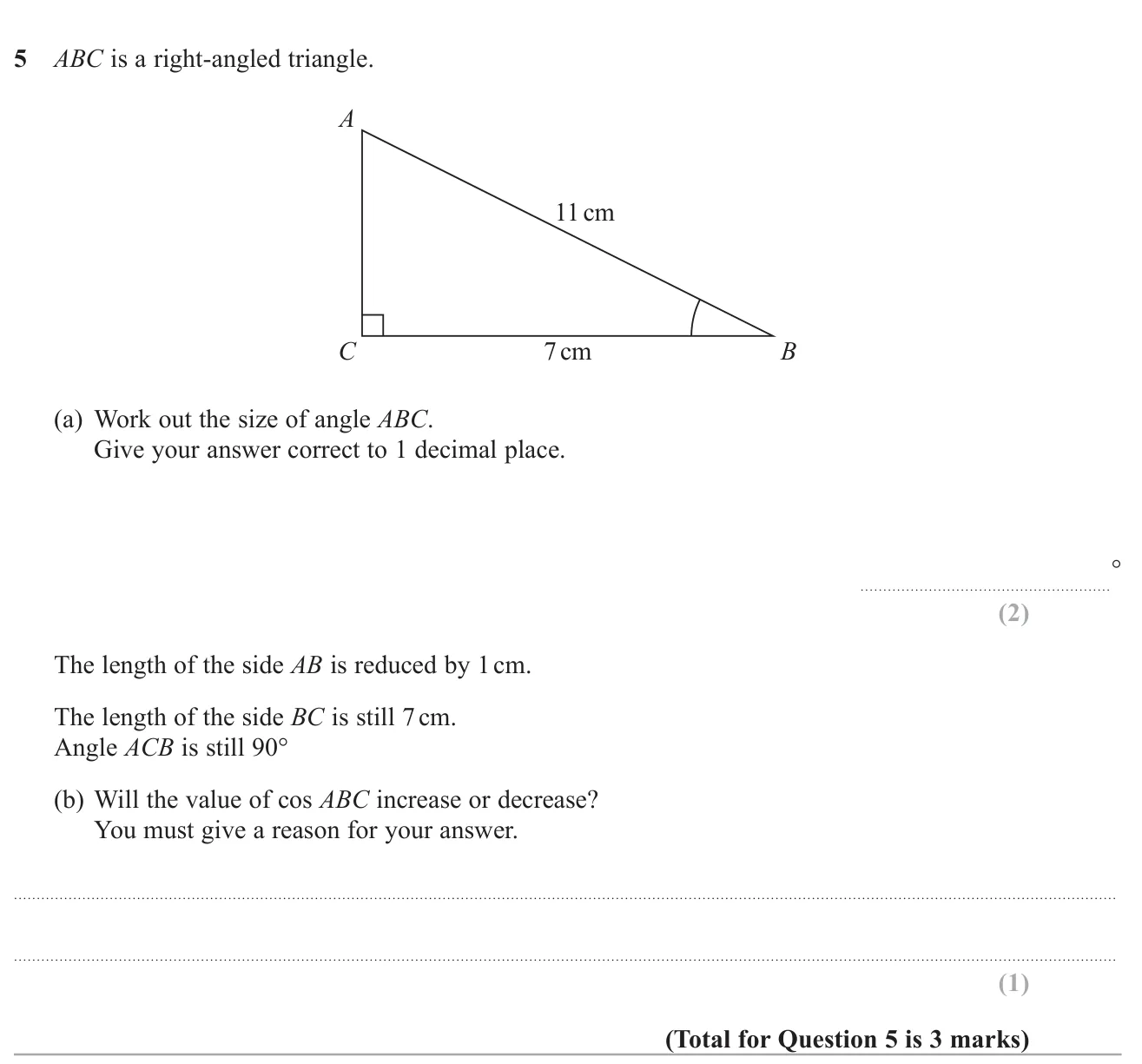
© Pearson Education Ltd. June 2018 Paper 3 (Higher, calculator), question 5.
(a) 50.5 ∘ 50.5^\circ 50. 5 ∘ 2 marks (b) Increase, because 7 10 > 7 11 \frac{7}{10} > \frac{7}{11} 10 7 > 11 7 1 mark
Worked solution Checked against the mark scheme
(a) A B AB A B B C BC B C A B C ABC A B C
cos A B C = 7 11 \cos ABC = \frac{7}{11} cos A B C = 11 7 A B C = cos − 1 ( 7 11 ) = 50.5 ∘ ABC = \cos^{-1}(\frac{7}{11}) = 50.5^\circ A B C = cos − 1 ( 11 7 ) = 50. 5 ∘
(b) New cos A B C = 7 10 = 0.7 \cos ABC = \frac{7}{10} = 0.7 cos A B C = 10 7 = 0.7 7 11 ≈ 0.636 \frac{7}{11} \approx 0.636 11 7 ≈ 0.636
Watch out: Using sin or tan instead of cos.
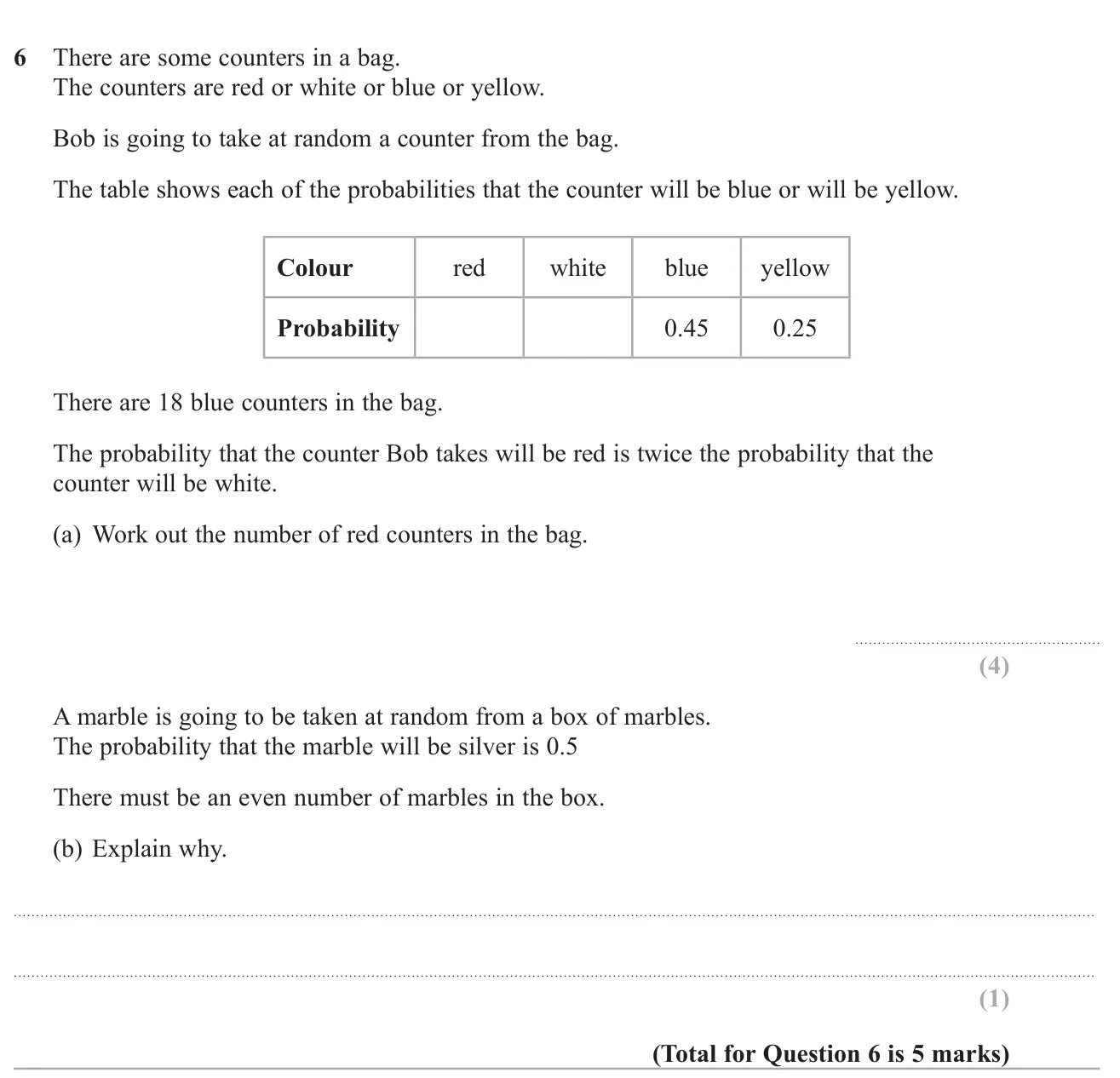
© Pearson Education Ltd. June 2018 Paper 3 (Higher, calculator), question 6.
(a) 8 8 8 4 marks (b) Half the marbles are silver, and half of an odd number is not a whole number 1 mark
Worked solution Checked against the mark scheme
(a) Total counters: 18 ÷ 0.45 = 40 18 \div 0.45 = 40 18 ÷ 0.45 = 40
Red and white together: 1 − 0.45 − 0.25 = 0.3 1 - 0.45 - 0.25 = 0.3 1 − 0.45 − 0.25 = 0.3
Red is twice white, so P ( white ) = 0.1 P(\text{white}) = 0.1 P ( white ) = 0.1 P ( red ) = 0.2 P(\text{red}) = 0.2 P ( red ) = 0.2
Red counters: 0.2 × 40 = 8 0.2 \times 40 = 8 0.2 × 40 = 8
(b) The number of silver marbles is 0.5 × 0.5 \times 0.5 ×
Watch out: Splitting 0.3 equally between red and white.
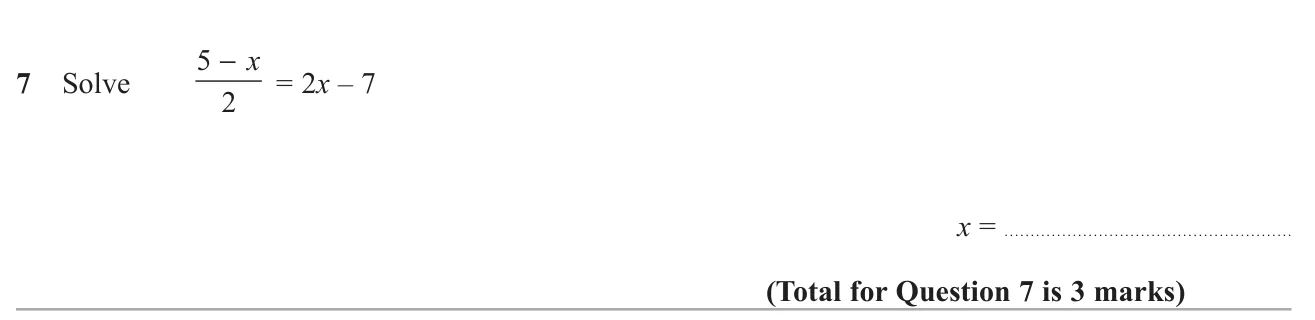
© Pearson Education Ltd. June 2018 Paper 3 (Higher, calculator), question 7.
Answer x = 3.8 x = 3.8 x = 3.8 3 marks
Worked solution Checked against the mark scheme
Multiply both sides by 2: 5 − x = 4 x − 14 5 - x = 4x - 14 5 − x = 4 x − 14
Add x x x 19 = 5 x 19 = 5x 19 = 5 x
x = 19 5 = 3.8 x = \frac{19}{5} = 3.8 x = 5 19 = 3.8
Watch out: Multiplying only 2x by 2, not the −7.
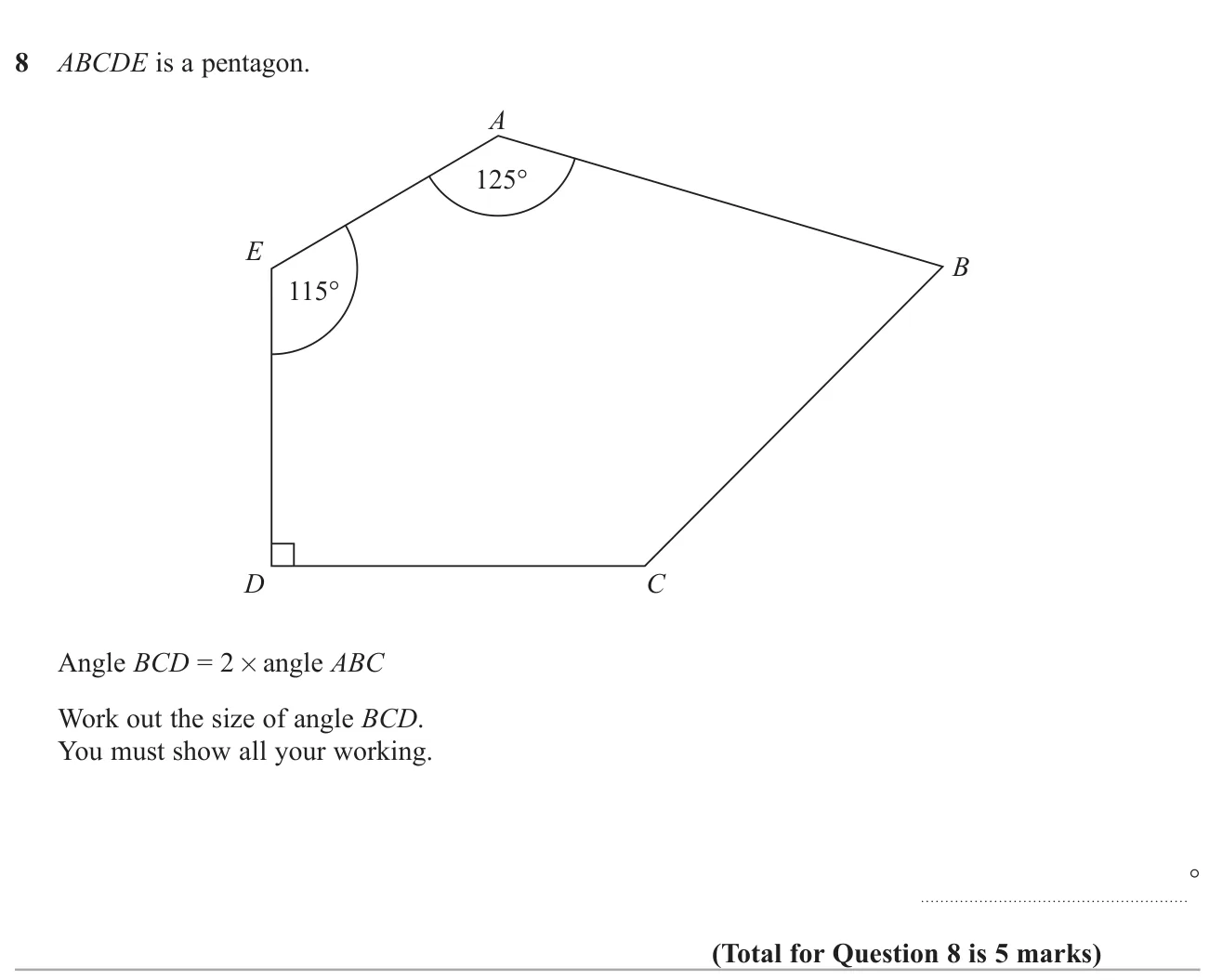
© Pearson Education Ltd. June 2018 Paper 3 (Higher, calculator), question 8.
Answer 140 ∘ 140^\circ 14 0 ∘ 5 marks
Worked solution Checked against the mark scheme
Angle sum of a pentagon: ( 5 − 2 ) × 180 = 540 ∘ (5 - 2) \times 180 = 540^\circ ( 5 − 2 ) × 180 = 54 0 ∘
Known angles: 125 + 115 + 90 = 330 125 + 115 + 90 = 330 125 + 115 + 90 = 330 540 − 330 = 210 ∘ 540 - 330 = 210^\circ 540 − 330 = 21 0 ∘
If A B C = x ABC = x A B C = x x + 2 x = 210 x + 2x = 210 x + 2 x = 210 x = 70 x = 70 x = 70
B C D = 2 × 70 = 140 ∘ BCD = 2 \times 70 = 140^\circ B C D = 2 × 70 = 14 0 ∘
Watch out: Forgetting the right angle at D.
© Pearson Education Ltd. June 2018 Paper 3 (Higher, calculator), question 9.
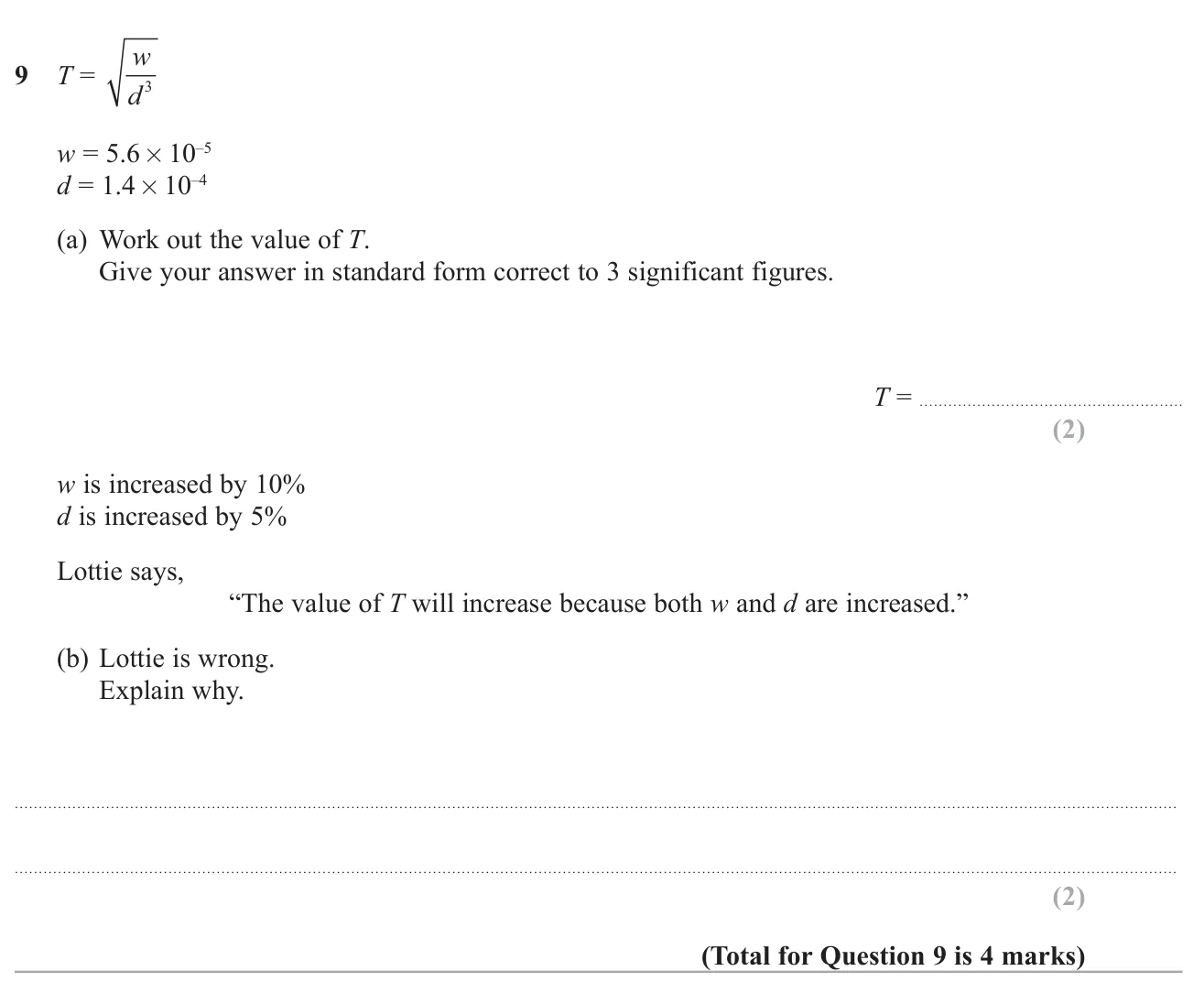
(a) 4.52 × 10 3 4.52 \times 10^3 4.52 × 1 0 3 2 marks (b) The multiplier for T T T 1.1 ÷ 1.05 3 = 0.975 < 1 \sqrt{1.1 \div 1.05^3} = 0.975 < 1 1.1 ÷ 1.0 5 3 = 0.975 < 1 T T T 2 marks
Worked solution Checked against the mark scheme
(a) d 3 = ( 1.4 × 10 − 4 ) 3 = 2.744 × 10 − 12 d^3 = (1.4 \times 10^{-4})^3 = 2.744 \times 10^{-12} d 3 = ( 1.4 × 1 0 − 4 ) 3 = 2.744 × 1 0 − 12
w d 3 = 5.6 × 10 − 5 2.744 × 10 − 12 = 2.0408 × 10 7 \frac{w}{d^3} = \frac{5.6 \times 10^{-5}}{2.744 \times 10^{-12}} = 2.0408 \times 10^{7} d 3 w = 2.744 × 1 0 − 12 5.6 × 1 0 − 5 = 2.0408 × 1 0 7
T = 2.0408 × 10 7 = 4517.5... = 4.52 × 10 3 T = \sqrt{2.0408 \times 10^7} = 4517.5... = 4.52 \times 10^3 T = 2.0408 × 1 0 7 = 4517.5... = 4.52 × 1 0 3
(b) w w w d 3 d^3 d 3 1.05 3 = 1.1576 1.05^3 = 1.1576 1.0 5 3 = 1.1576 T T T 1.1 ÷ 1.1576 = 0.975 \sqrt{1.1 \div 1.1576} = 0.975 1.1 ÷ 1.1576 = 0.975 T T T 4.40 × 10 3 4.40 \times 10^3 4.40 × 1 0 3
Watch out: Forgetting that d d d w w w
© Pearson Education Ltd. June 2018 Paper 3 (Higher, calculator), question 10.
Worked solution Checked against the mark scheme
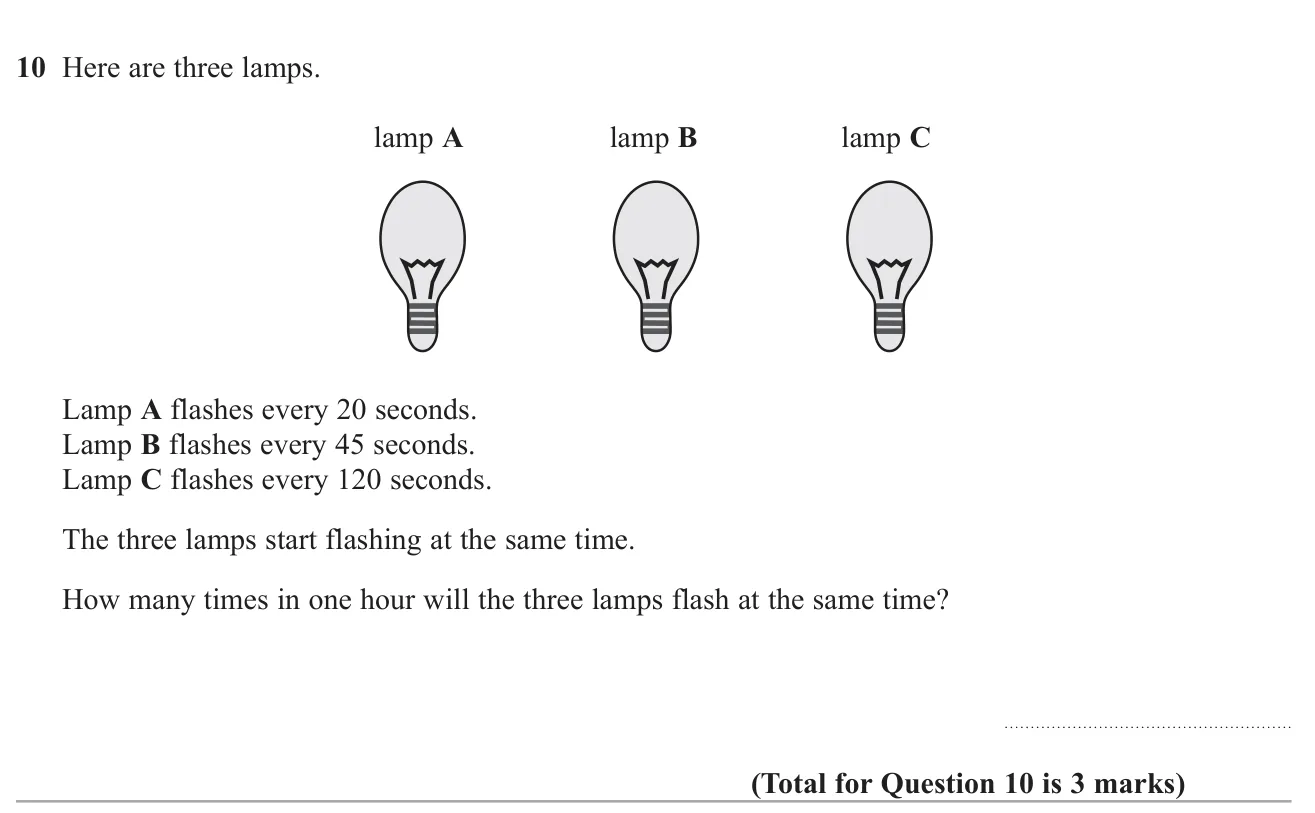
20 = 2 2 × 5 20 = 2^2 \times 5 20 = 2 2 × 5 45 = 3 2 × 5 45 = 3^2 \times 5 45 = 3 2 × 5 120 = 2 3 × 3 × 5 120 = 2^3 \times 3 \times 5 120 = 2 3 × 3 × 5
LCM = 2 3 × 3 2 × 5 = 360 = 2^3 \times 3^2 \times 5 = 360 = 2 3 × 3 2 × 5 = 360
One hour = 3600 = 3600 = 3600 3600 ÷ 360 = 10 3600 \div 360 = 10 3600 ÷ 360 = 10
So they flash together 10 times (11 if you count the start as well).
Watch out: Using the highest common factor, or multiplying all three numbers together.
© Pearson Education Ltd. June 2018 Paper 3 (Higher, calculator), question 11.
Worked solution Checked against the mark scheme
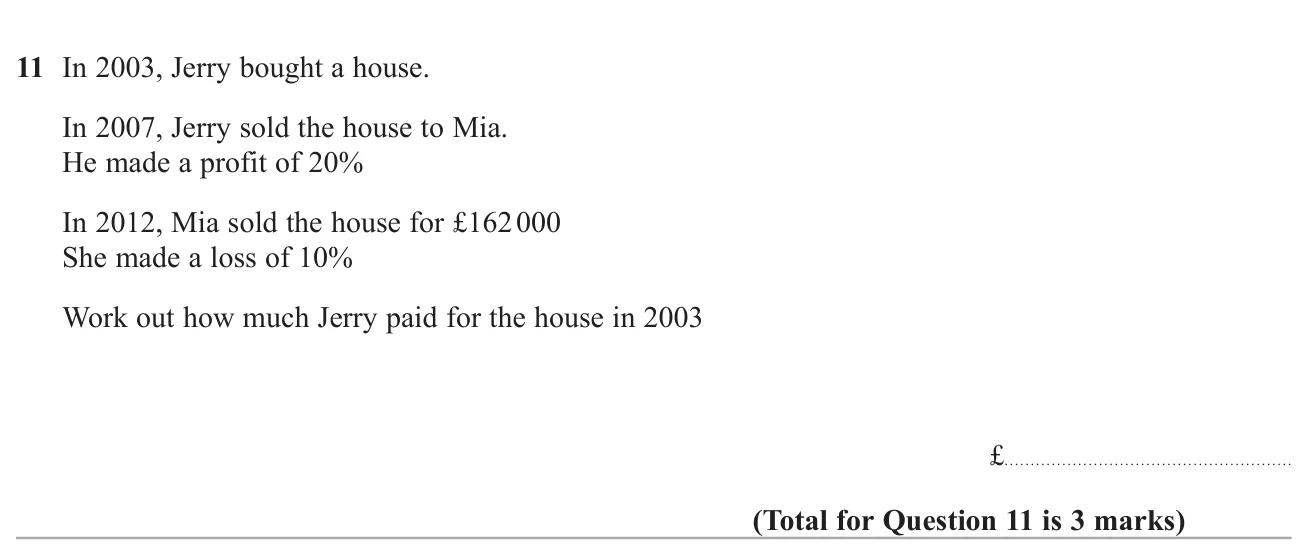
Mia's sale was 90% of her price: 162 000 ÷ 0.9 = 180 000 162\,000 \div 0.9 = 180\,000 162 000 ÷ 0.9 = 180 000
Jerry's sale was 120% of his price: 180 000 ÷ 1.2 = 150 000 180\,000 \div 1.2 = 150\,000 180 000 ÷ 1.2 = 150 000
Jerry paid £150 000 .
Watch out: Adding 10% then subtracting 20% instead of dividing by the multipliers.
© Pearson Education Ltd. June 2018 Paper 3 (Higher, calculator), question 12.
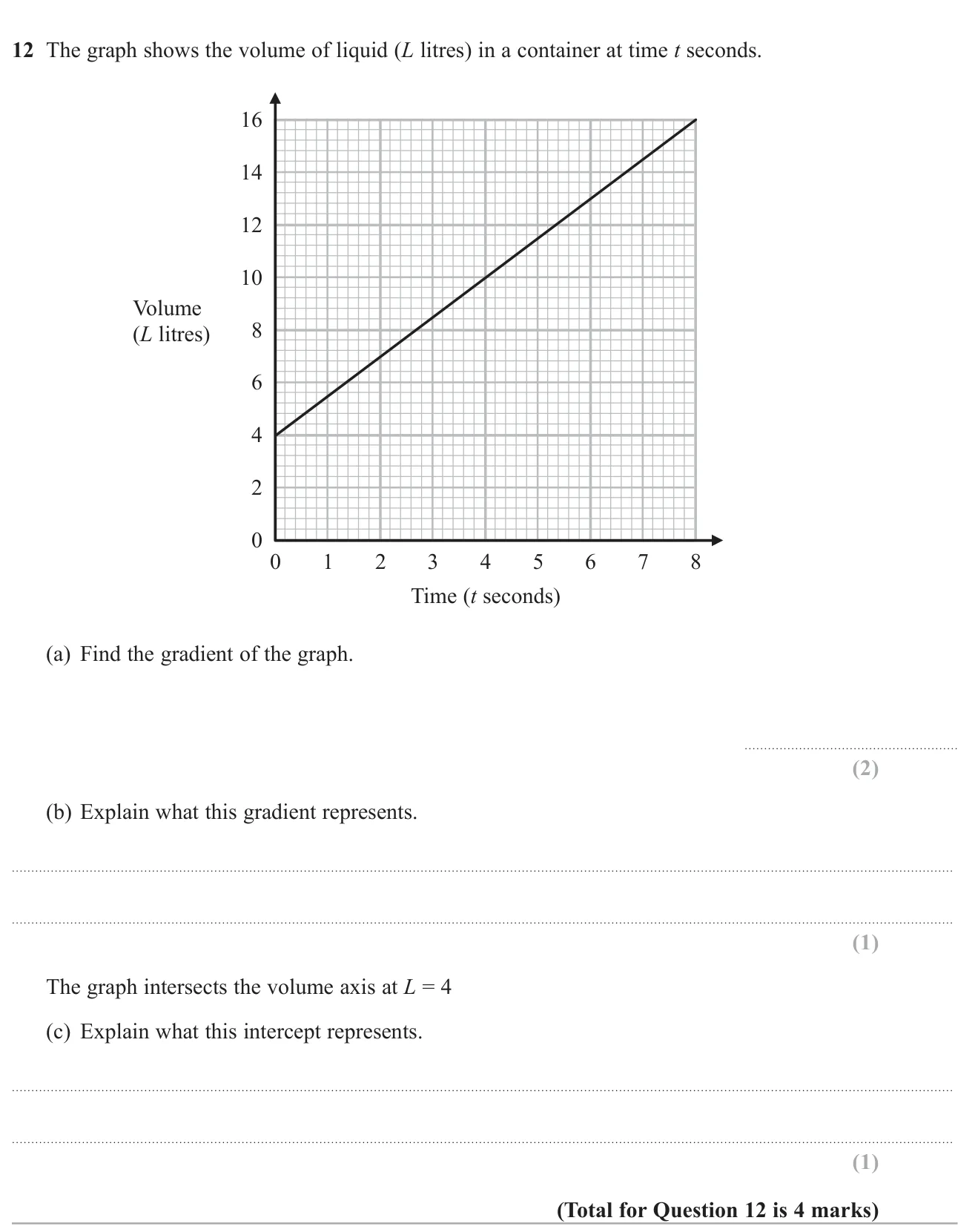
(a) 1.5 2 marks (b) The rate at which liquid goes into the container (litres per second) 1 mark (c) The volume of liquid in the container at the start (t = 0 t = 0 t = 0 1 mark
Worked solution Checked against the mark scheme
(a) From ( 0 , 4 ) (0, 4) ( 0 , 4 ) ( 8 , 16 ) (8, 16) ( 8 , 16 ) = 16 − 4 8 − 0 = 12 8 = 1.5 = \frac{16-4}{8-0} = \frac{12}{8} = 1.5 = 8 − 0 16 − 4 = 8 12 = 1.5
(b) The volume rises 1.5 litres every second, so the gradient is the rate the container fills, in litres per second.
(c) At t = 0 t = 0 t = 0
Watch out: Counting grid squares instead of using the axis scales.
© Pearson Education Ltd. June 2018 Paper 3 (Higher, calculator), question 13.
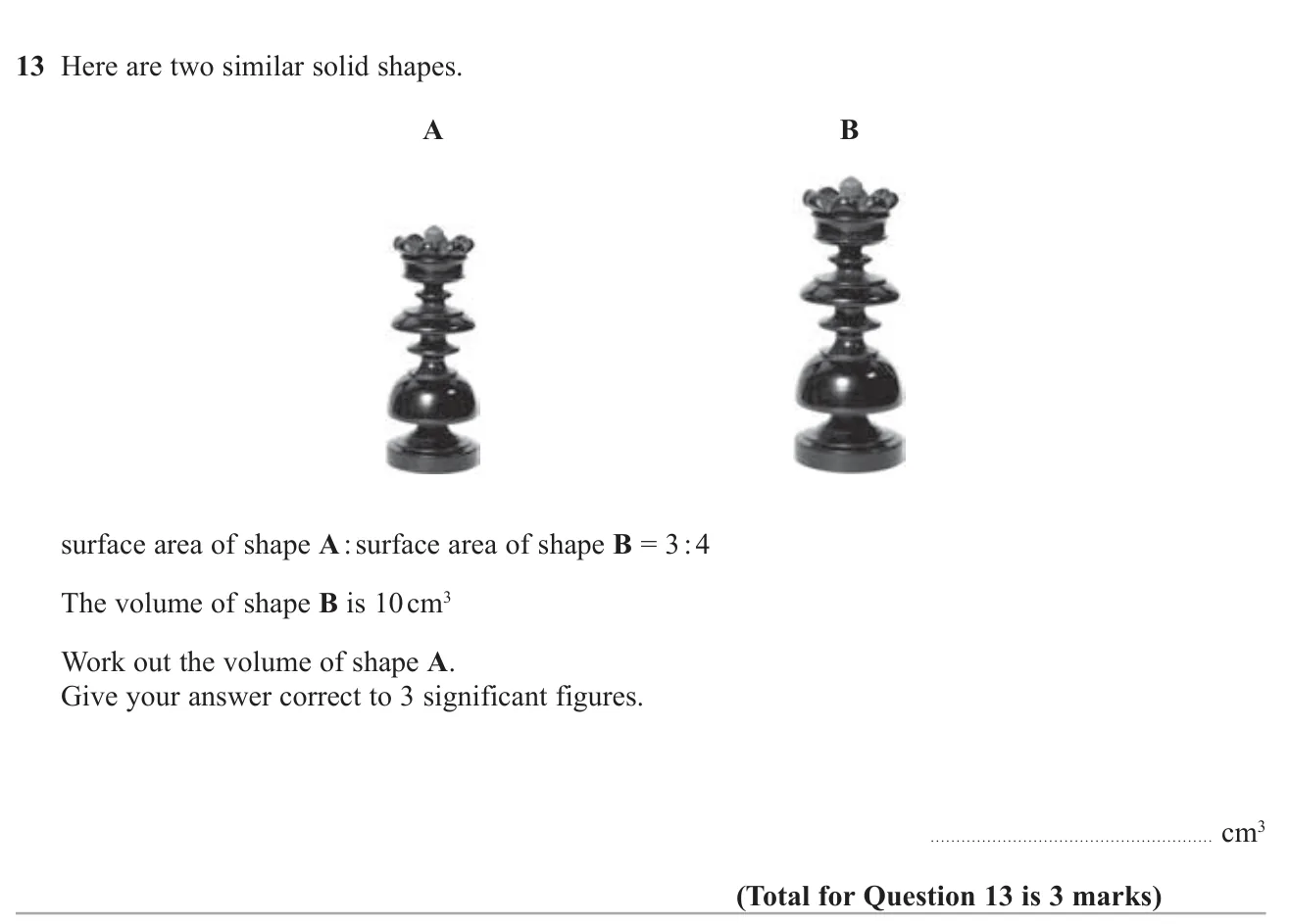
Answer 6.50 6.50 6.50 3 marks
Worked solution Checked against the mark scheme
Area ratio 3 : 4 3 : 4 3 : 4 3 : 4 = 3 : 2 \sqrt{3} : \sqrt{4} = \sqrt{3} : 2 3 : 4 = 3 : 2
Length scale factor from B to A: 3 2 = 0.8660 \frac{\sqrt{3}}{2} = 0.8660 2 3 = 0.8660
Volume scale factor: 0.8660 3 = 0.6495 0.8660^3 = 0.6495 0.866 0 3 = 0.6495
Volume of A = 10 × 0.6495 = 6.50 = 10 \times 0.6495 = 6.50 = 10 × 0.6495 = 6.50
Watch out: Using the area ratio directly on the volume: 10 × 3 4 = 7.5 10 \times \frac{3}{4} = 7.5 10 × 4 3 = 7.5
© Pearson Education Ltd. June 2018 Paper 3 (Higher, calculator), question 14.
Worked solution Checked against the mark scheme
Each of the 16 teams plays the other 15 teams twice (once as each of the two sides), so every ordered pair of teams is one match.
Number of ordered pairs: 16 × 15 = 240 16 \times 15 = 240 16 × 15 = 240
(Check: 16 × 15 2 = 120 \frac{16 \times 15}{2} = 120 2 16 × 15 = 120
Watch out: Doubling 16 × 15 16 \times 15 16 × 15
© Pearson Education Ltd. June 2018 Paper 3 (Higher, calculator), question 15.
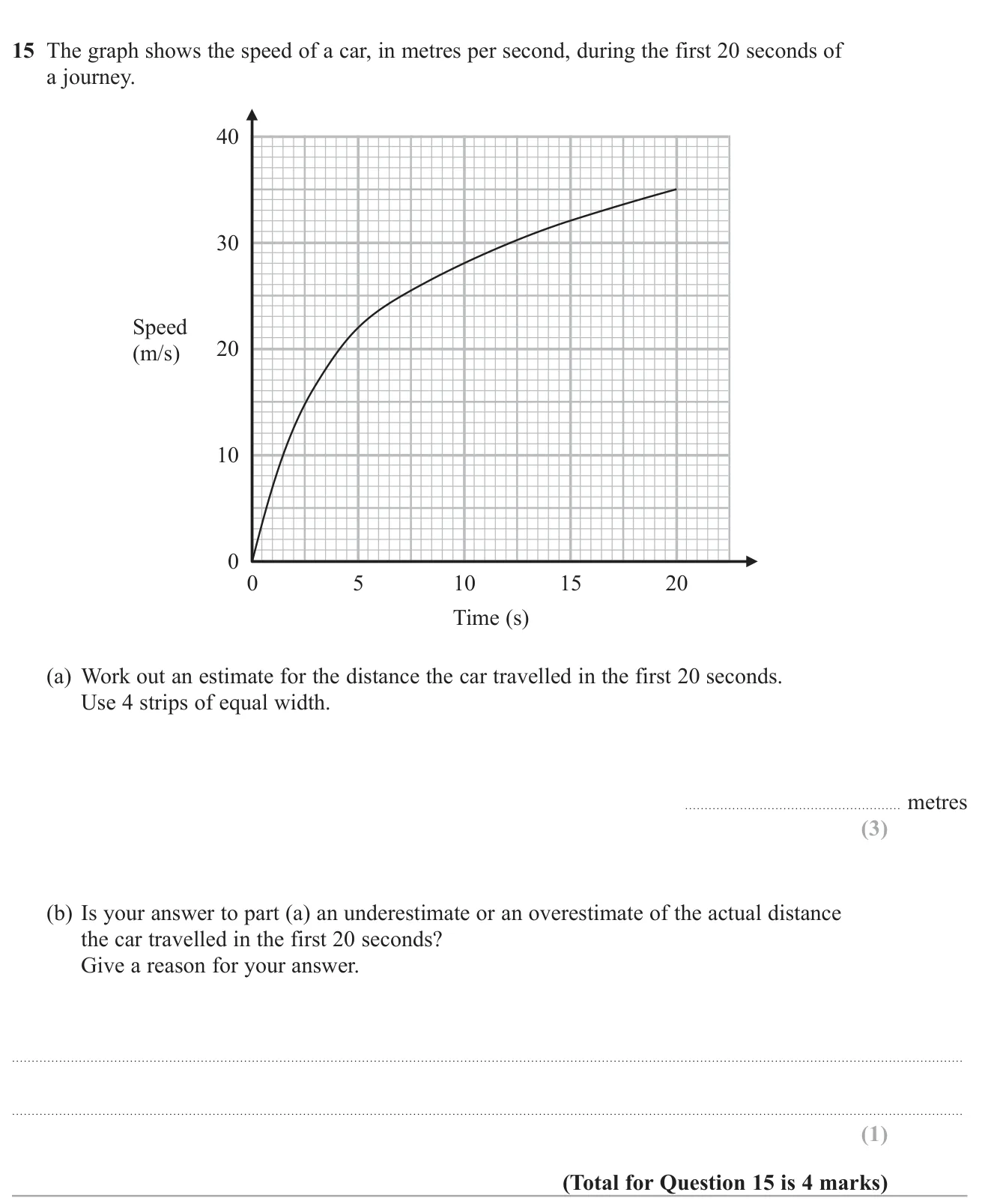
(a) About 498 m (488 to 507) 3 marks (b) Underestimate: the curve bends above the straight tops of the trapezia, so area under the curve is missed 1 mark
Worked solution Checked against the mark scheme
(a) Read speeds at 0, 5, 10, 15, 20 s: 0, 22, 28, 32, 35 m/s.
Each strip is a trapezium of width 5:
2.5 ( 0 + 22 ) + 2.5 ( 22 + 28 ) + 2.5 ( 28 + 32 ) + 2.5 ( 32 + 35 ) 2.5(0+22) + 2.5(22+28) + 2.5(28+32) + 2.5(32+35) 2.5 ( 0 + 22 ) + 2.5 ( 22 + 28 ) + 2.5 ( 28 + 32 ) + 2.5 ( 32 + 35 )
= 55 + 125 + 150 + 167.5 = 497.5 = 55 + 125 + 150 + 167.5 = 497.5 = 55 + 125 + 150 + 167.5 = 497.5
(b) The curve bulges above the straight lines joining the points, so the trapezia leave out some area. It is an underestimate .
Watch out: Forgetting that the first strip starts at a speed of 0, or using a strip width of 4 instead of 5.
© Pearson Education Ltd. June 2018 Paper 3 (Higher, calculator), question 16.
(a) 42 4 marks (b) n 2 − n n^2 - n n 2 − n 2 marks
Worked solution Checked against the mark scheme
(a) n = 2 n = 2 n = 2 4 a + 2 b = − 2 4a + 2b = -2 4 a + 2 b = − 2
n = 4 n = 4 n = 4 16 a + 4 b = 12 16a + 4b = 12 16 a + 4 b = 12
Double the first: 8 a + 4 b = − 4 8a + 4b = -4 8 a + 4 b = − 4 8 a = 16 8a = 16 8 a = 16 a = 2 a = 2 a = 2 b = − 5 b = -5 b = − 5
6th term: 2 ( 36 ) − 5 ( 6 ) = 72 − 30 = 42 2(36) - 5(6) = 72 - 30 = 42 2 ( 36 ) − 5 ( 6 ) = 72 − 30 = 42
(b) Second differences are 2, so start with n 2 n^2 n 2
Sequence minus n 2 n^2 n 2 − 1 , − 2 , − 3 , − 4 , − 5 -1, -2, -3, -4, -5 − 1 , − 2 , − 3 , − 4 , − 5 − n -n − n
nth term = n 2 − n = n^2 - n = n 2 − n
Watch out: In (b), using 2 n 2 2n^2 2 n 2
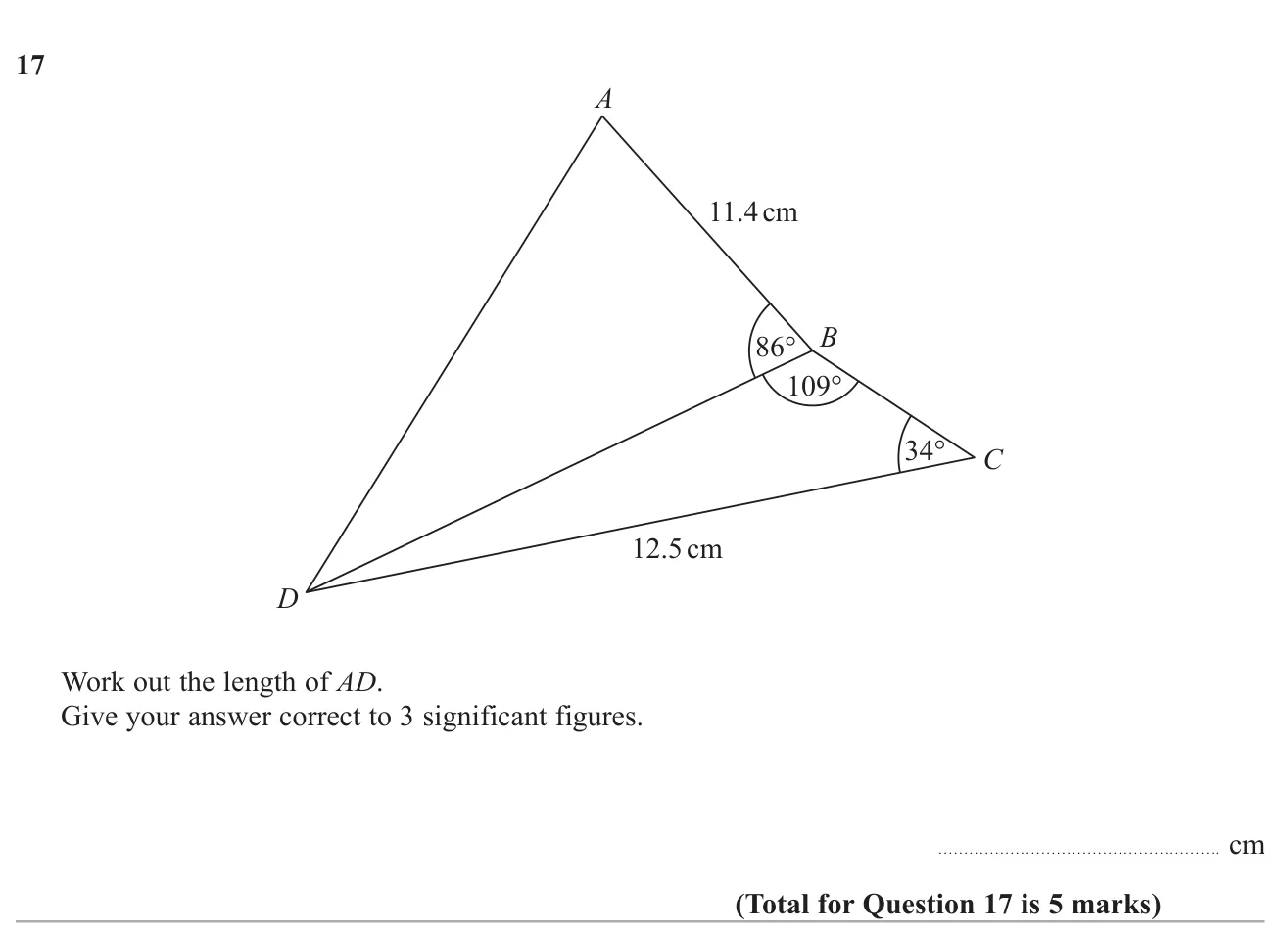
© Pearson Education Ltd. June 2018 Paper 3 (Higher, calculator), question 17.
Answer 13.1 13.1 13.1 5 marks
Worked solution Checked against the mark scheme
In triangle B C D BCD B C D B D sin 34 ° = 12.5 sin 109 ° \frac{BD}{\sin 34°} = \frac{12.5}{\sin 109°} s i n 34° B D = s i n 109° 12.5
B D = 12.5 sin 34 ° sin 109 ° = 7.393 BD = \frac{12.5 \sin 34°}{\sin 109°} = 7.393 B D = s i n 109° 12.5 s i n 34° = 7.393
In triangle A B D ABD A B D A D 2 = 11.4 2 + 7.393 2 − 2 ( 11.4 ) ( 7.393 ) cos 86 ° AD^2 = 11.4^2 + 7.393^2 - 2(11.4)(7.393)\cos 86° A D 2 = 11. 4 2 + 7.39 3 2 − 2 ( 11.4 ) ( 7.393 ) cos 86°
A D 2 = 129.96 + 54.65 − 11.76 = 172.85 AD^2 = 129.96 + 54.65 - 11.76 = 172.85 A D 2 = 129.96 + 54.65 − 11.76 = 172.85
A D = 13.1 AD = 13.1 A D = 13.1
Watch out: Working out ( 129.96 + 54.65 − 2 × 11.4 × 7.393 ) × cos 86 ° (129.96 + 54.65 - 2 \times 11.4 \times 7.393) \times \cos 86° ( 129.96 + 54.65 − 2 × 11.4 × 7.393 ) × cos 86°
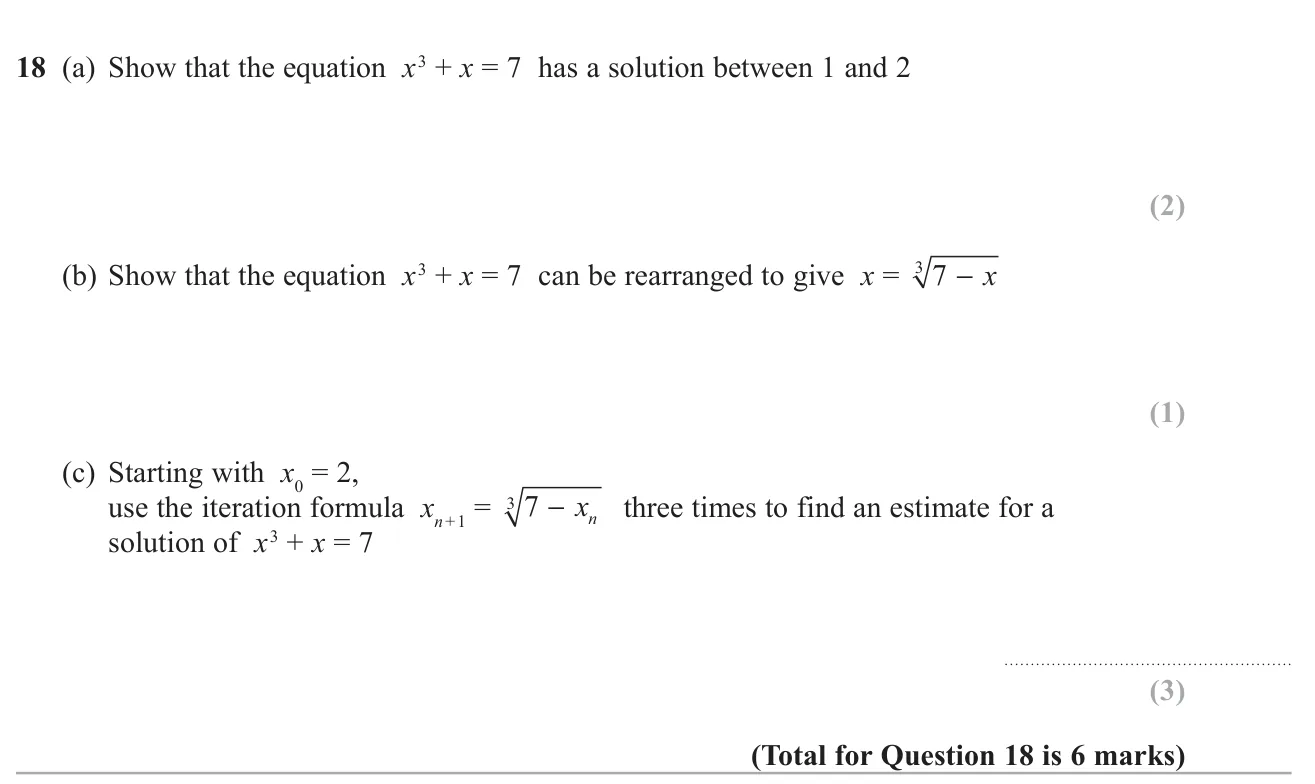
© Pearson Education Ltd. June 2018 Paper 3 (Higher, calculator), question 18.
(a) x = 1 x = 1 x = 1 2 2 2 x = 2 x = 2 x = 2 10 10 10 2 marks (b) x 3 = 7 − x x^3 = 7 - x x 3 = 7 − x x = 7 − x 3 x = \sqrt[3]{7 - x} x = 3 7 − x 1 mark (c) 1.74 1.74 1.74 3 marks
Worked solution Checked against the mark scheme
(a) 1 3 + 1 = 2 < 7 1^3 + 1 = 2 < 7 1 3 + 1 = 2 < 7 2 3 + 2 = 10 > 7 2^3 + 2 = 10 > 7 2 3 + 2 = 10 > 7
(b) x 3 + x = 7 ⇒ x 3 = 7 − x ⇒ x = 7 − x 3 x^3 + x = 7 \Rightarrow x^3 = 7 - x \Rightarrow x = \sqrt[3]{7 - x} x 3 + x = 7 ⇒ x 3 = 7 − x ⇒ x = 3 7 − x
(c) x 1 = 5 3 = 1.70998 x_1 = \sqrt[3]{5} = 1.70998 x 1 = 3 5 = 1.70998
x 2 = 5.29002 3 = 1.74242 x_2 = \sqrt[3]{5.29002} = 1.74242 x 2 = 3 5.29002 = 1.74242
x 3 = 5.25758 3 = 1.73885 ≈ 1.74 x_3 = \sqrt[3]{5.25758} = 1.73885 \approx 1.74 x 3 = 3 5.25758 = 1.73885 ≈ 1.74
Watch out: In (a), substituting the values but not saying why that shows a solution.
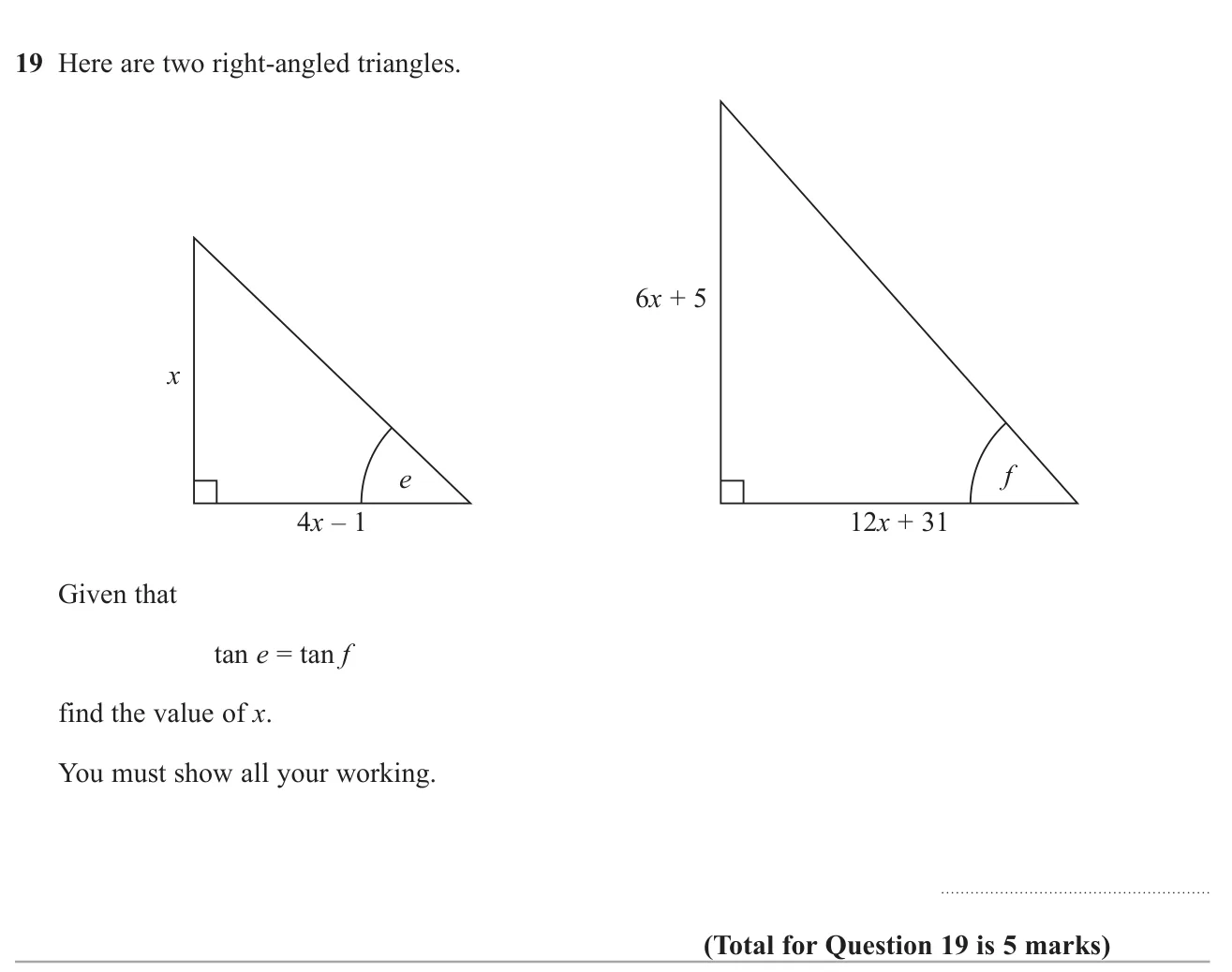
© Pearson Education Ltd. June 2018 Paper 3 (Higher, calculator), question 19.
Answer x = 5 3 x = \frac{5}{3} x = 3 5 5 marks
Worked solution Checked against the mark scheme
tan e = x 4 x − 1 \tan e = \frac{x}{4x-1} tan e = 4 x − 1 x tan f = 6 x + 5 12 x + 31 \tan f = \frac{6x+5}{12x+31} tan f = 12 x + 31 6 x + 5
x ( 12 x + 31 ) = ( 6 x + 5 ) ( 4 x − 1 ) x(12x+31) = (6x+5)(4x-1) x ( 12 x + 31 ) = ( 6 x + 5 ) ( 4 x − 1 )
12 x 2 + 31 x = 24 x 2 + 14 x − 5 12x^2 + 31x = 24x^2 + 14x - 5 12 x 2 + 31 x = 24 x 2 + 14 x − 5
12 x 2 − 17 x − 5 = 0 ⇒ ( 3 x − 5 ) ( 4 x + 1 ) = 0 12x^2 - 17x - 5 = 0 \Rightarrow (3x-5)(4x+1) = 0 12 x 2 − 17 x − 5 = 0 ⇒ ( 3 x − 5 ) ( 4 x + 1 ) = 0
x = 5 3 x = \frac{5}{3} x = 3 5 x = − 1 4 x = -\frac{1}{4} x = − 4 1 x x x
Watch out: Giving both roots without rejecting the negative one.
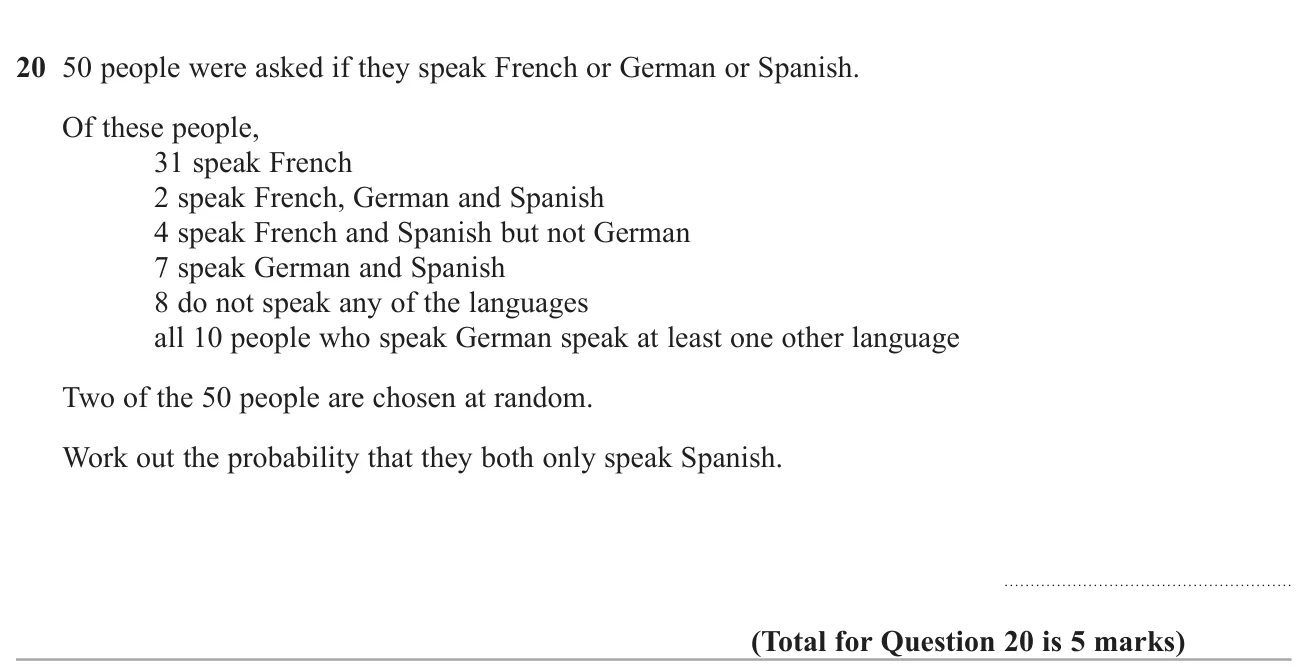
© Pearson Education Ltd. June 2018 Paper 3 (Higher, calculator), question 20.
Answer 6 490 \frac{6}{490} 490 6 5 marks
Worked solution Checked against the mark scheme
Fill the Venn diagram from the centre out:
All three: 2. French and Spanish only: 4. German and Spanish only: 7 − 2 = 5 7 - 2 = 5 7 − 2 = 5
German only: 0 (all German speakers speak another). French and German only: 10 − 2 − 5 = 3 10 - 2 - 5 = 3 10 − 2 − 5 = 3 31 − 2 − 4 − 3 = 22 31 - 2 - 4 - 3 = 22 31 − 2 − 4 − 3 = 22
Spanish only: 50 − 8 − 22 − 3 − 2 − 4 − 5 = 6 50 - 8 - 22 - 3 - 2 - 4 - 5 = 6 50 − 8 − 22 − 3 − 2 − 4 − 5 = 6
P(both) = 6 50 × 5 49 = 30 2450 = 6 490 = \frac{6}{50} \times \frac{5}{49} = \frac{30}{2450} = \frac{6}{490} = 50 6 × 49 5 = 2450 30 = 490 6
Watch out: Treating the choices as with replacement (6 50 × 6 50 \frac{6}{50} \times \frac{6}{50} 50 6 × 50 6
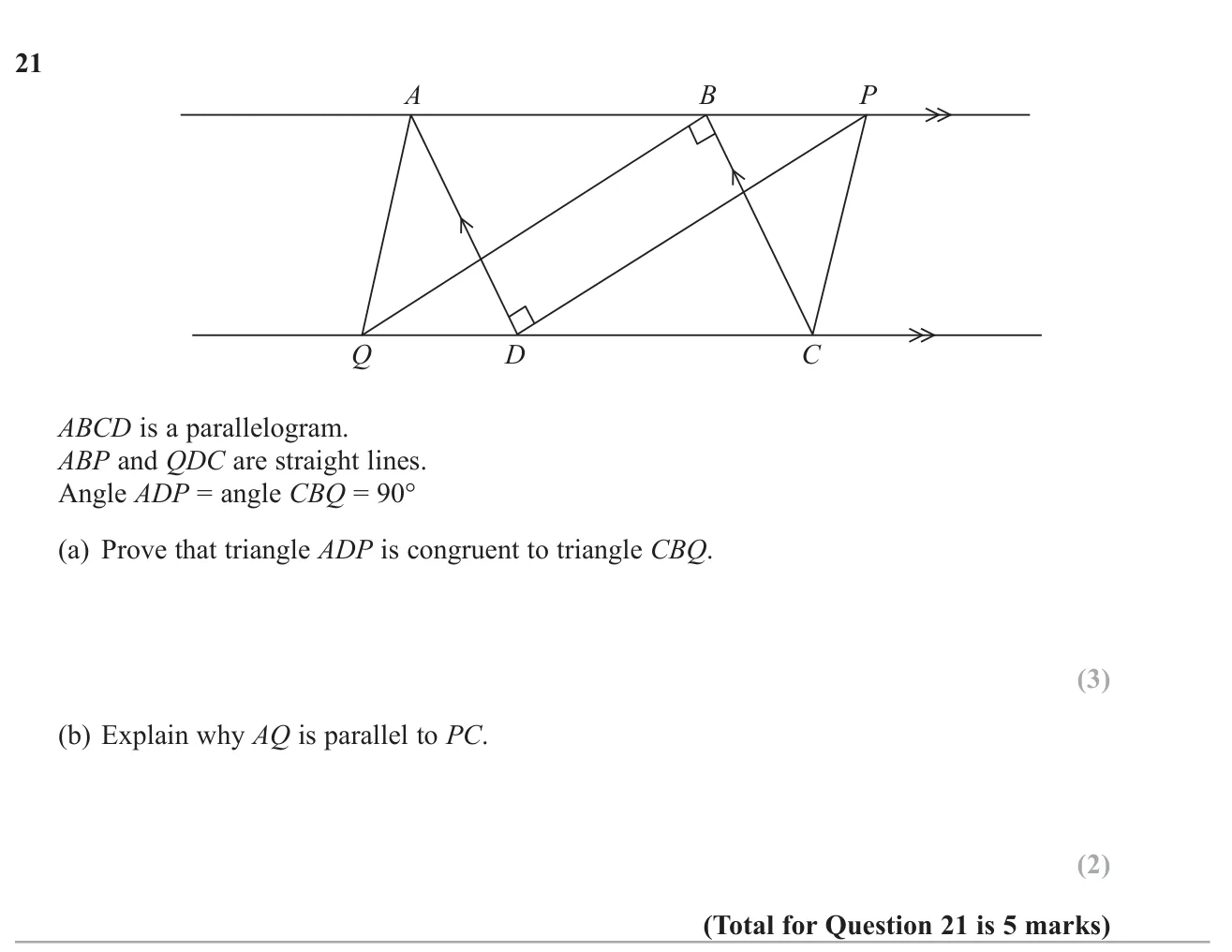
© Pearson Education Ltd. June 2018 Paper 3 (Higher, calculator), question 21.
(a) A D = B C AD = BC A D = B C D A P DAP D A P B C Q BCQ B C Q A D P ADP A D P C B Q = 90 ° CBQ = 90° C B Q = 90° 3 marks (b) A P = Q C AP = QC A P = QC A P AP A P Q C QC QC A P C Q APCQ A P C Q A Q AQ A Q P C PC P C 2 marks
Worked solution Checked against the mark scheme
(a) A D = C B AD = CB A D = C B
Angle D A P DAP D A P B C Q BCQ B C Q
Angle A D P ADP A D P C B Q = 90 ° CBQ = 90° C B Q = 90°
So triangles A D P ADP A D P C B Q CBQ C B Q
(b) From (a), A P = C Q AP = CQ A P = C Q A P AP A P A B AB A B C Q CQ C Q D C DC D C A P C Q APCQ A P C Q A Q AQ A Q P C PC P C
Watch out: Stating the triangles are congruent without giving a reason for each pair, or quoting SAS/RHS wrongly.
Finished the paper? Add up your marks for all three papers and see what grade that would have been.