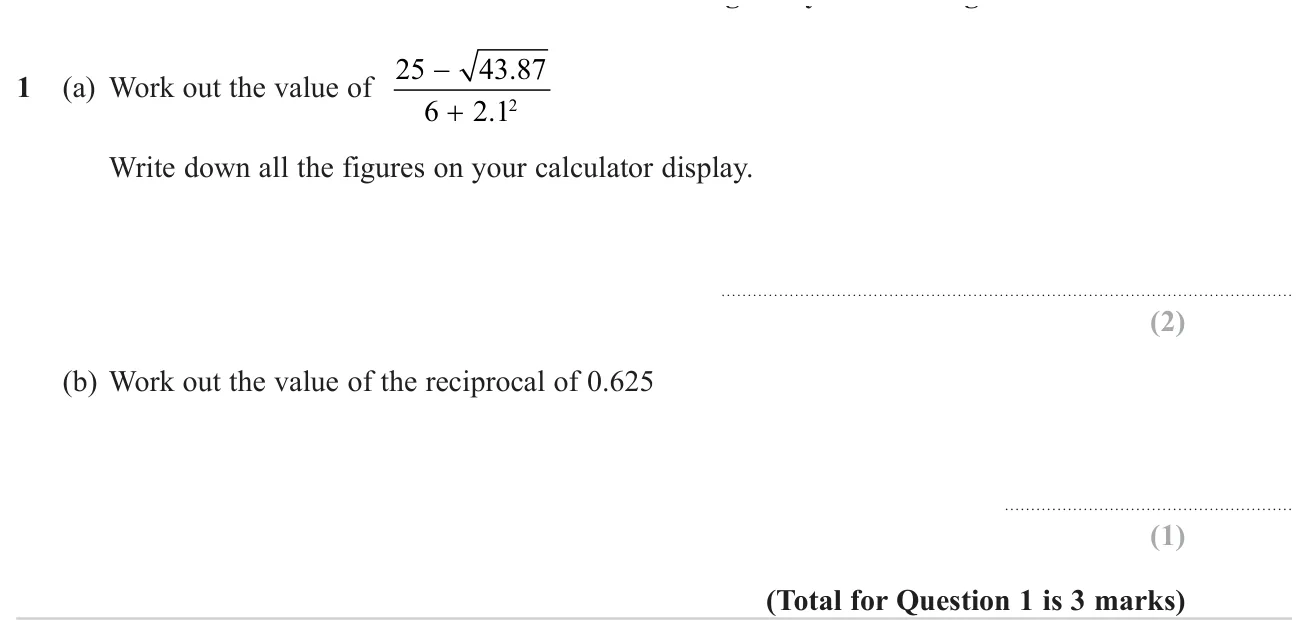
© Pearson Education Ltd. June 2023 Paper 2 (Higher, calculator), question 1.
(a) 1.765279230... 2 marks (b) 1.6 1 mark
Worked solution Checked against the mark scheme
(a) Top: 25 − 43.87 = 18.3765... 25 - \sqrt{43.87} = 18.3765... 25 − 43.87 = 18.3765...
Bottom: 6 + 2.1 2 = 10.41 6 + 2.1^2 = 10.41 6 + 2. 1 2 = 10.41
18.3765... ÷ 10.41 = 1.765279230... 18.3765... \div 10.41 = 1.765279230... 18.3765... ÷ 10.41 = 1.765279230...
(b) Reciprocal = 1 ÷ 0.625 = 1.6 = 1 \div 0.625 = 1.6 = 1 ÷ 0.625 = 1.6
Watch out: Typing it without brackets so only part of the top is divided.
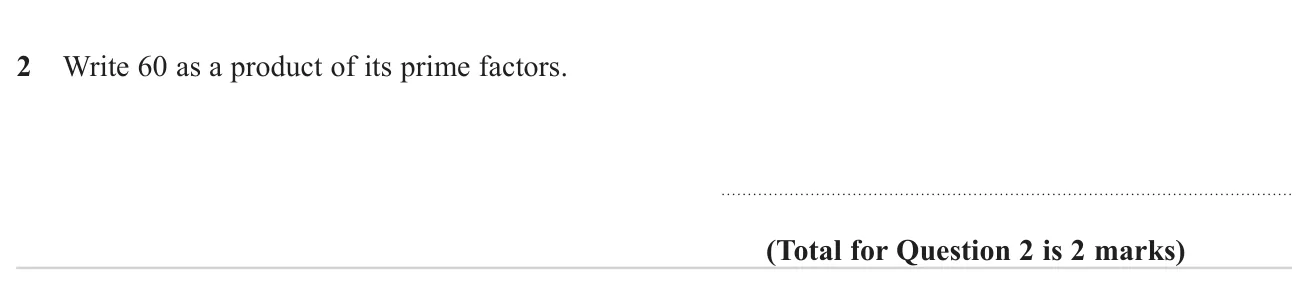
© Pearson Education Ltd. June 2023 Paper 2 (Higher, calculator), question 2.
Answer 2 × 2 × 3 × 5 2 \times 2 \times 3 \times 5 2 × 2 × 3 × 5 2 marks
Worked solution Checked against the mark scheme
60 = 2 × 30 = 2 × 2 × 15 = 2 × 2 × 3 × 5 60 = 2 \times 30 = 2 \times 2 \times 15 = 2 \times 2 \times 3 \times 5 60 = 2 × 30 = 2 × 2 × 15 = 2 × 2 × 3 × 5
So 60 = 2 2 × 3 × 5 60 = 2^2 \times 3 \times 5 60 = 2 2 × 3 × 5
Watch out: Listing the factors 2, 2, 3, 5 without multiplication signs, or including 1.
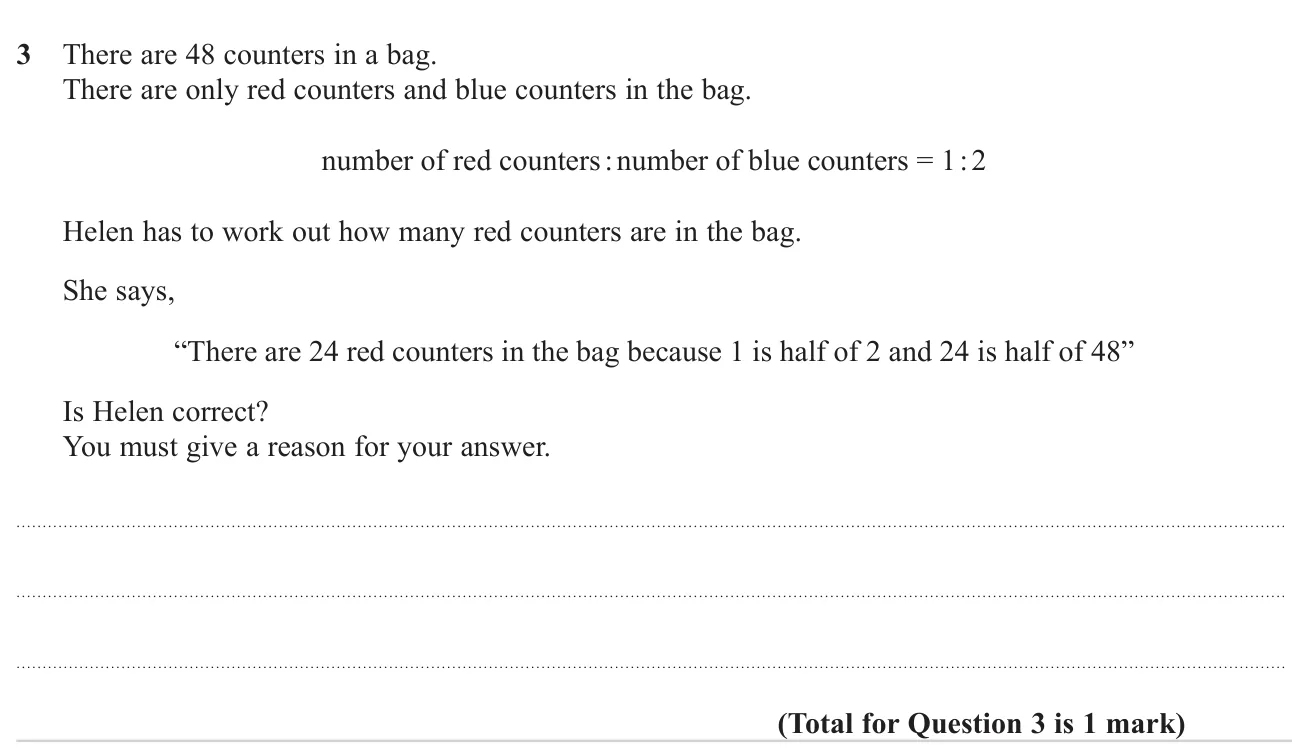
© Pearson Education Ltd. June 2023 Paper 2 (Higher, calculator), question 3.
Answer No: red is 1 3 \frac{1}{3} 3 1 1 mark
Worked solution Checked against the mark scheme
The ratio 1 : 2 1 : 2 1 : 2 1 + 2 = 3 1 + 2 = 3 1 + 2 = 3
48 ÷ 3 = 16 48 \div 3 = 16 48 ÷ 3 = 16
Helen is wrong: 24 red would be half, which is a 1 : 1 1 : 1 1 : 1
Watch out: Agreeing with Helen because 1 is half of 2.
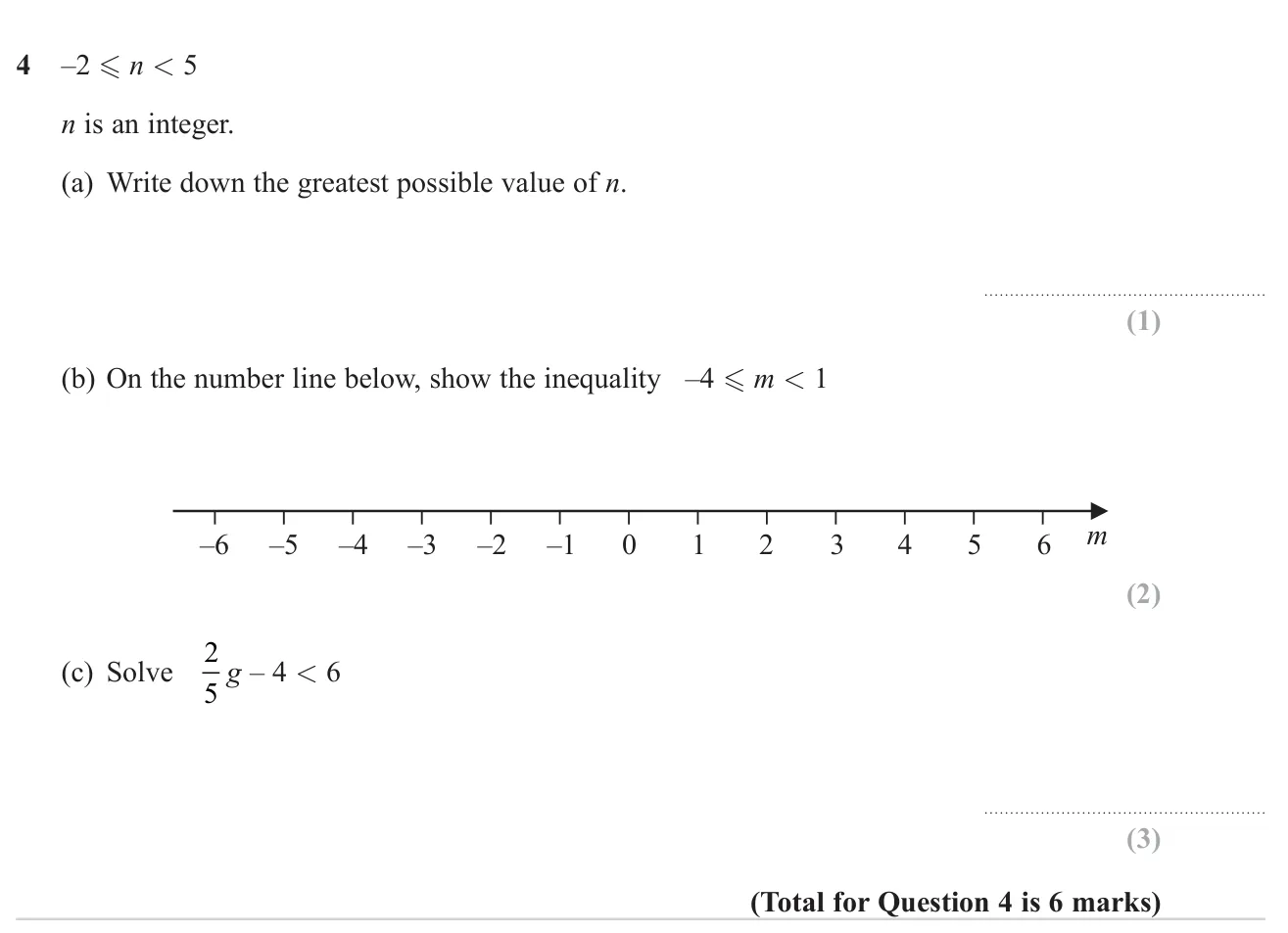
© Pearson Education Ltd. June 2023 Paper 2 (Higher, calculator), question 4.
(a) 4 1 mark (b) Closed circle at − 4 -4 − 4 1 1 1 2 marks (c) g < 25 g < 25 g < 25 3 marks
Worked solution Checked against the mark scheme
(a) n n n 4 4 4
(b) Filled circle at − 4 -4 − 4 1 1 1
(c) 2 5 g − 4 < 6 \frac{2}{5}g - 4 < 6 5 2 g − 4 < 6
2 5 g < 10 \frac{2}{5}g < 10 5 2 g < 10
2 g < 50 2g < 50 2 g < 50
g < 25 g < 25 g < 25
Watch out: In (a), giving 5 even though the sign is strict.
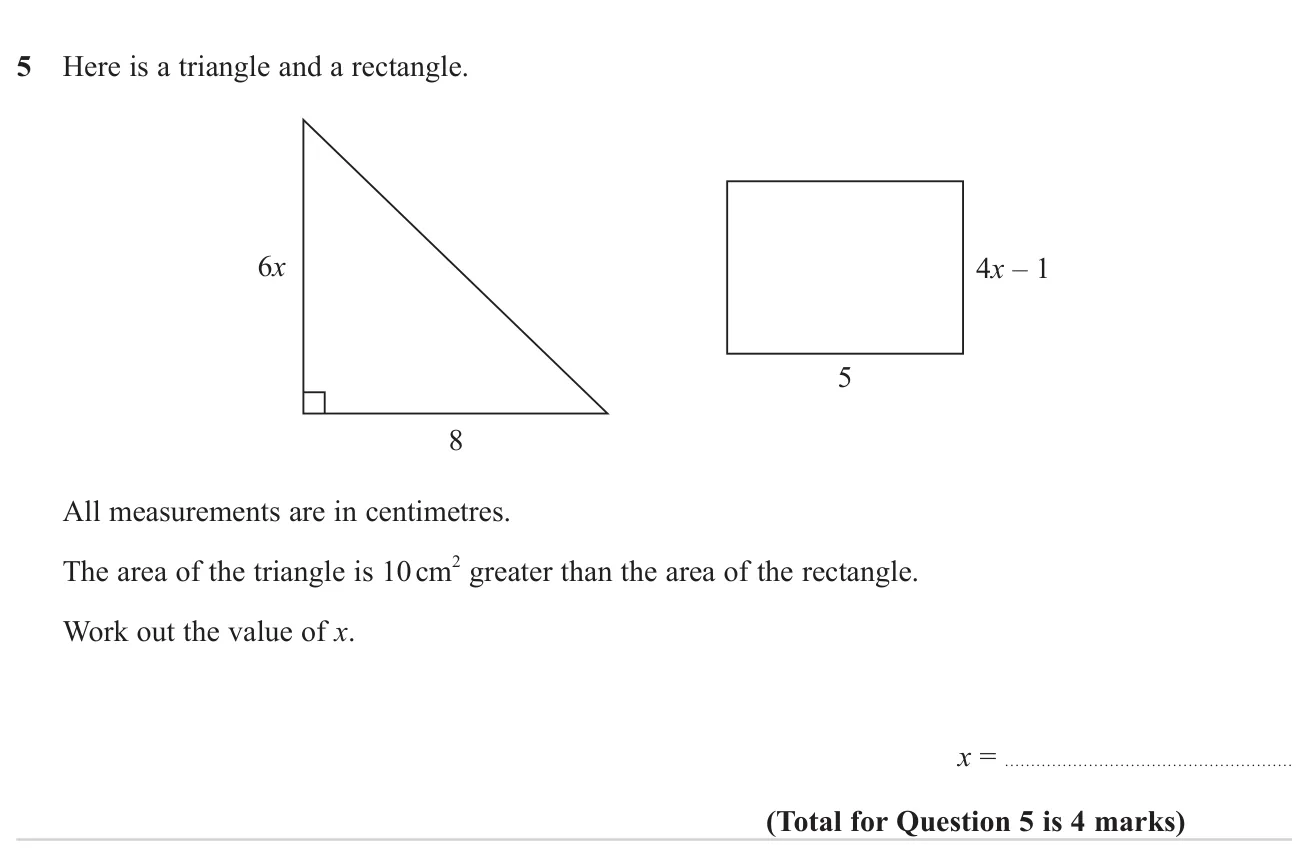
© Pearson Education Ltd. June 2023 Paper 2 (Higher, calculator), question 5.
Answer x = 1.25 x = 1.25 x = 1.25 4 marks
Worked solution Checked against the mark scheme
Triangle: 1 2 × 8 × 6 x = 24 x \frac{1}{2} \times 8 \times 6x = 24x 2 1 × 8 × 6 x = 24 x
Rectangle: 5 ( 4 x − 1 ) = 20 x − 5 5(4x - 1) = 20x - 5 5 ( 4 x − 1 ) = 20 x − 5
24 x = 20 x − 5 + 10 24x = 20x - 5 + 10 24 x = 20 x − 5 + 10
4 x = 5 4x = 5 4 x = 5 x = 1.25 x = 1.25 x = 1.25
(Check: triangle 30, rectangle 20.)
Watch out: Forgetting to halve for the triangle, or adding the 10 to the wrong side.
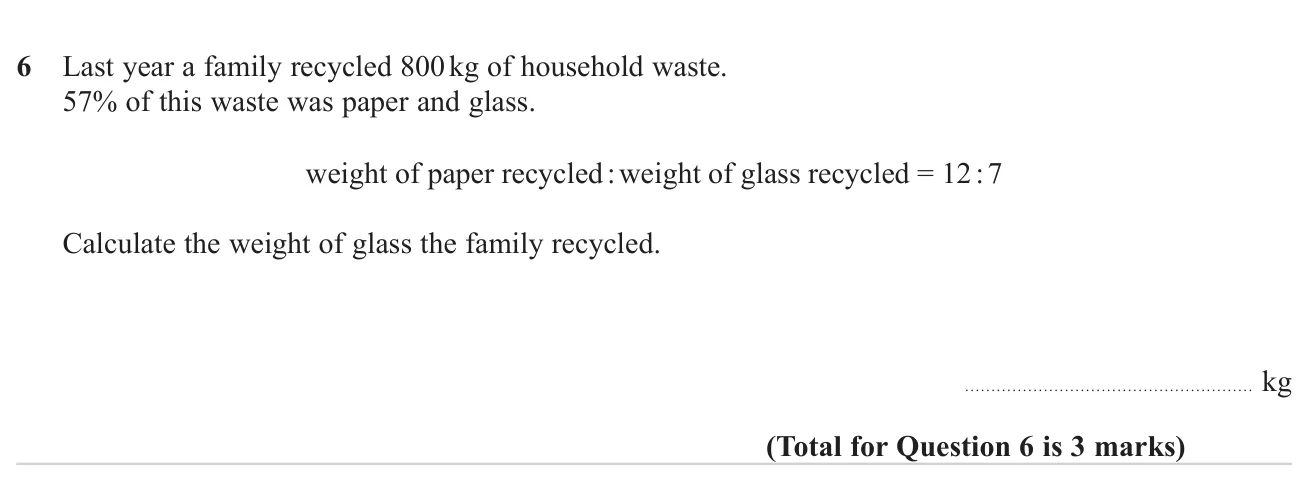
© Pearson Education Ltd. June 2023 Paper 2 (Higher, calculator), question 6.
Worked solution Checked against the mark scheme
Paper and glass: 0.57 × 800 = 456 0.57 \times 800 = 456 0.57 × 800 = 456
Ratio 12 : 7 12 : 7 12 : 7 456 ÷ 19 = 24 456 \div 19 = 24 456 ÷ 19 = 24
Glass: 7 × 24 = 168 7 \times 24 = 168 7 × 24 = 168
Watch out: Sharing all 800 kg in the ratio instead of the 57%.
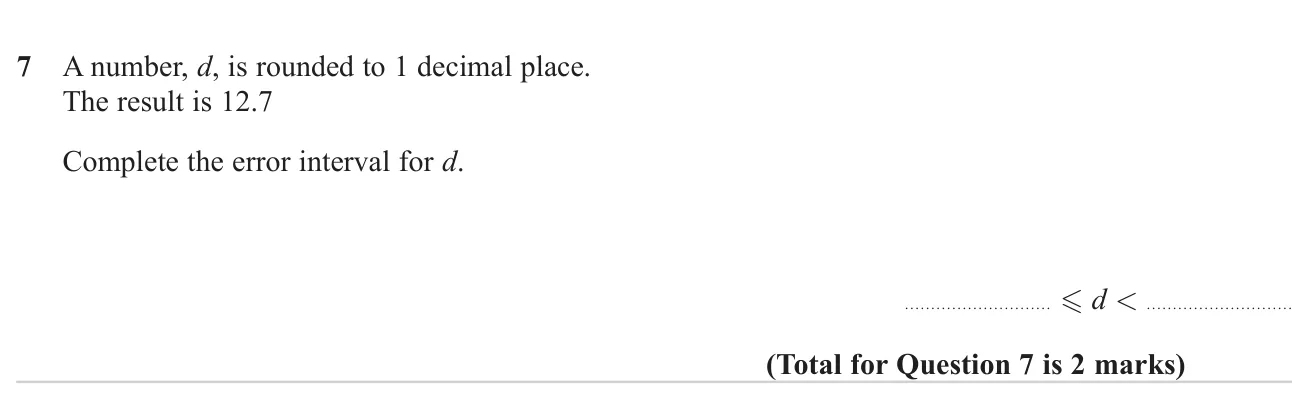
© Pearson Education Ltd. June 2023 Paper 2 (Higher, calculator), question 7.
Answer 12.65 ≤ d < 12.75 12.65 \le d < 12.75 12.65 ≤ d < 12.75 2 marks
Worked solution Checked against the mark scheme
Rounding to 1 d.p. means the value is within 0.05 0.05 0.05 12.7 12.7 12.7
Lower bound: 12.7 − 0.05 = 12.65 12.7 - 0.05 = 12.65 12.7 − 0.05 = 12.65
Upper bound: 12.7 + 0.05 = 12.75 12.7 + 0.05 = 12.75 12.7 + 0.05 = 12.75
12.65 ≤ d < 12.75 12.65 \le d < 12.75 12.65 ≤ d < 12.75
Watch out: Using 12.6 and 12.8, or 12.749 as the upper bound.
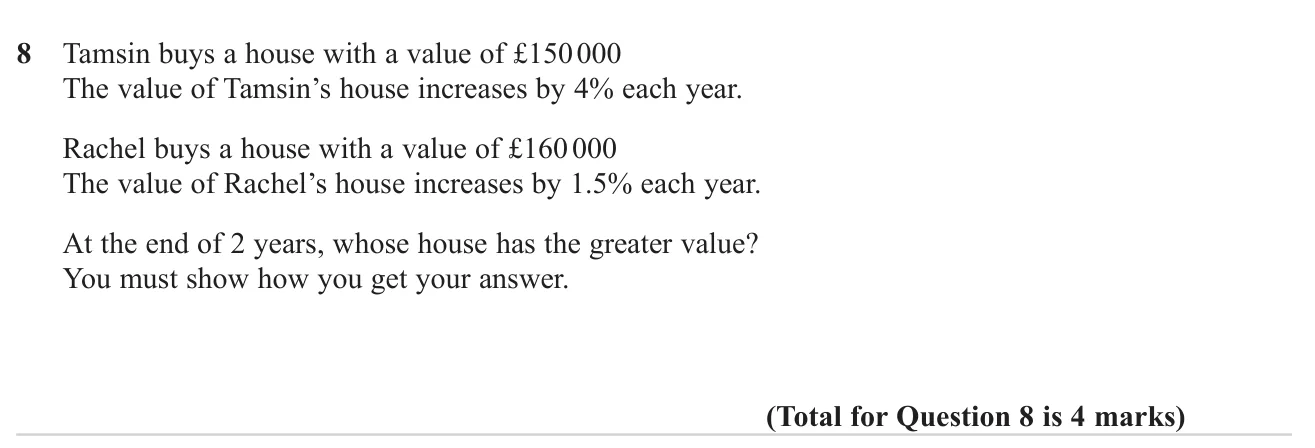
© Pearson Education Ltd. June 2023 Paper 2 (Higher, calculator), question 8.
Answer Rachel's: £164 836 compared with Tamsin's £162 240 4 marks
Worked solution Checked against the mark scheme
Tamsin: 150 000 × 1.04 2 = £ 162 240 150\,000 \times 1.04^2 = £162\,240 150 000 × 1.0 4 2 = £162 240
Rachel: 160 000 × 1.015 2 = £ 164 836 160\,000 \times 1.015^2 = £164\,836 160 000 × 1.01 5 2 = £164 836
164 836 > 162 240 164\,836 > 162\,240 164 836 > 162 240
Watch out: Using simple interest (adding the same increase twice).
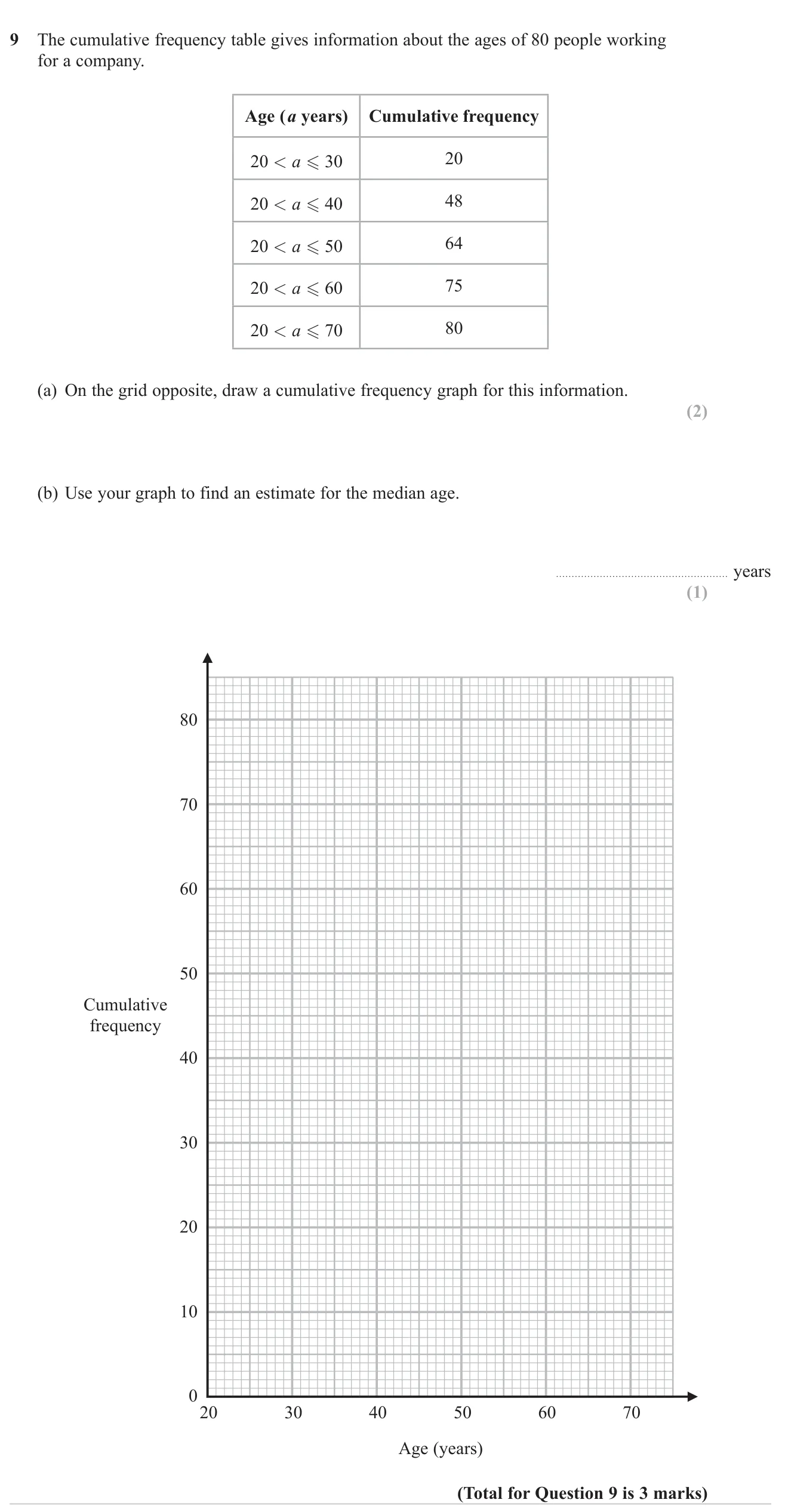
© Pearson Education Ltd. June 2023 Paper 2 (Higher, calculator), question 9.
(a) Curve through ( 20 , 0 ) (20, 0) ( 20 , 0 ) ( 30 , 20 ) (30, 20) ( 30 , 20 ) ( 40 , 48 ) (40, 48) ( 40 , 48 ) ( 50 , 64 ) (50, 64) ( 50 , 64 ) ( 60 , 75 ) (60, 75) ( 60 , 75 ) ( 70 , 80 ) (70, 80) ( 70 , 80 ) 2 marks (b) About 37 37 37 1 mark
Worked solution Checked against the mark scheme
(a) Plot each cumulative frequency at the upper end of its class: ( 30 , 20 ) (30, 20) ( 30 , 20 ) ( 40 , 48 ) (40, 48) ( 40 , 48 ) ( 50 , 64 ) (50, 64) ( 50 , 64 ) ( 60 , 75 ) (60, 75) ( 60 , 75 ) ( 70 , 80 ) (70, 80) ( 70 , 80 ) ( 20 , 0 ) (20, 0) ( 20 , 0 )
(b) Median is at 80 ÷ 2 = 40 80 \div 2 = 40 80 ÷ 2 = 40 37 37 37
Watch out: Plotting the points at the middle of each class instead of the upper end.
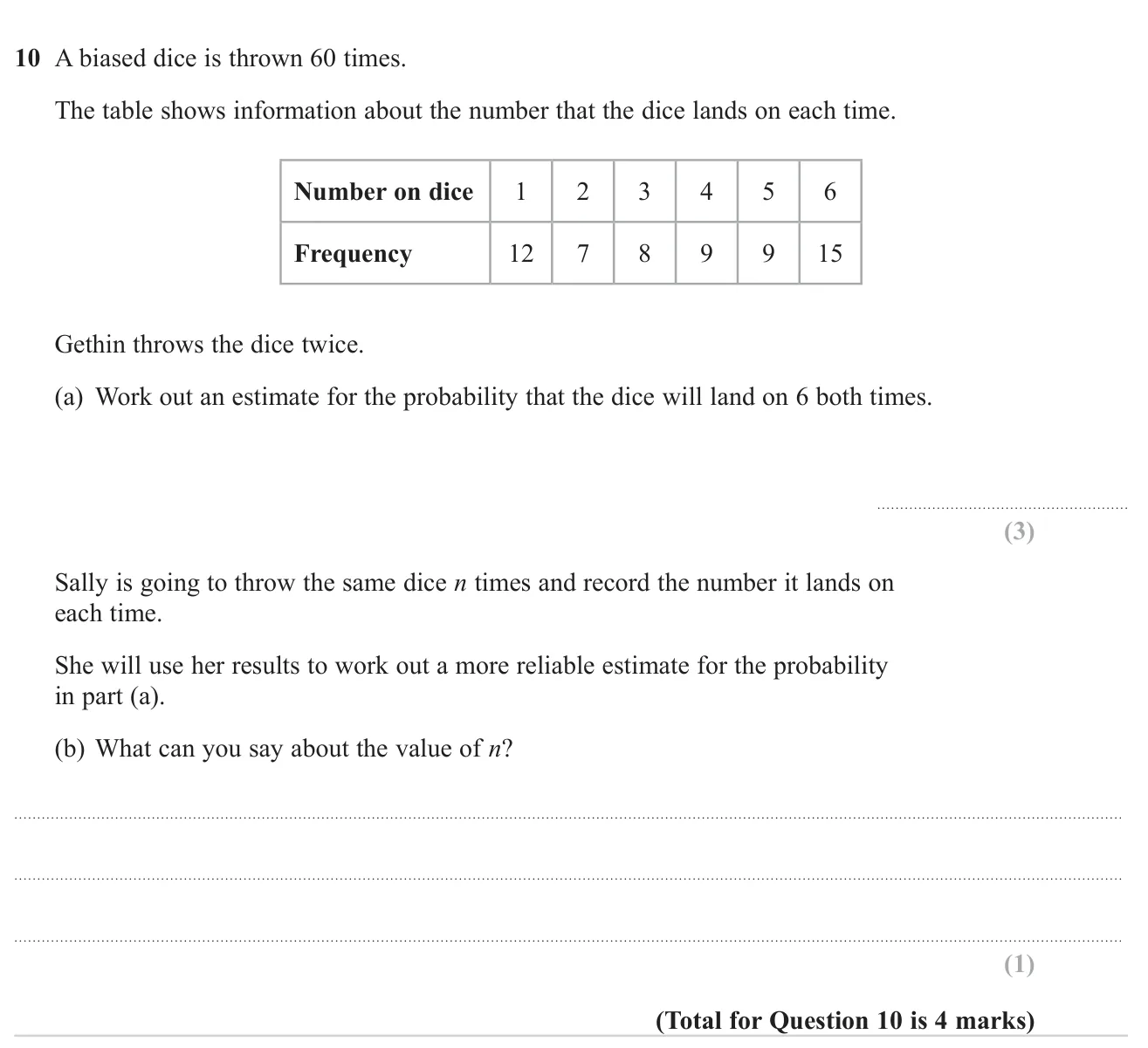
© Pearson Education Ltd. June 2023 Paper 2 (Higher, calculator), question 10.
(a) 225 3600 = 1 16 \frac{225}{3600} = \frac{1}{16} 3600 225 = 16 1 3 marks (b) n n n 1 mark
Worked solution Checked against the mark scheme
(a) P(6) ≈ 15 60 = 1 4 \approx \frac{15}{60} = \frac{1}{4} ≈ 60 15 = 4 1
P(6 both times) = 1 4 × 1 4 = 1 16 = 0.0625 = \frac{1}{4} \times \frac{1}{4} = \frac{1}{16} = 0.0625 = 4 1 × 4 1 = 16 1 = 0.0625
(b) More throws give a more reliable estimate, so n n n
Watch out: In (b), just saying 'n must be bigger' without comparing it to 60.
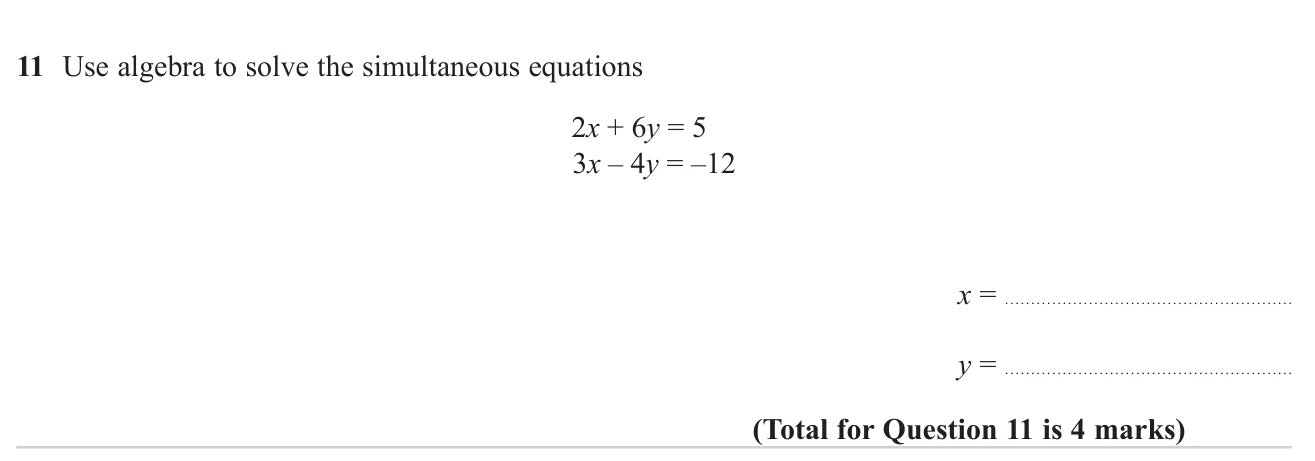
© Pearson Education Ltd. June 2023 Paper 2 (Higher, calculator), question 11.
Answer x = − 2 x = -2 x = − 2 y = 1.5 y = 1.5 y = 1.5 4 marks
Worked solution Checked against the mark scheme
Multiply the first by 2: 4 x + 12 y = 10 4x + 12y = 10 4 x + 12 y = 10
Multiply the second by 3: 9 x − 12 y = − 36 9x - 12y = -36 9 x − 12 y = − 36
Add: 13 x = − 26 13x = -26 13 x = − 26 x = − 2 x = -2 x = − 2
2 ( − 2 ) + 6 y = 5 ⇒ 6 y = 9 ⇒ y = 1.5 2(-2) + 6y = 5 \Rightarrow 6y = 9 \Rightarrow y = 1.5 2 ( − 2 ) + 6 y = 5 ⇒ 6 y = 9 ⇒ y = 1.5
Watch out: Subtracting the equations when the signs mean they should be added, giving a wrong x.
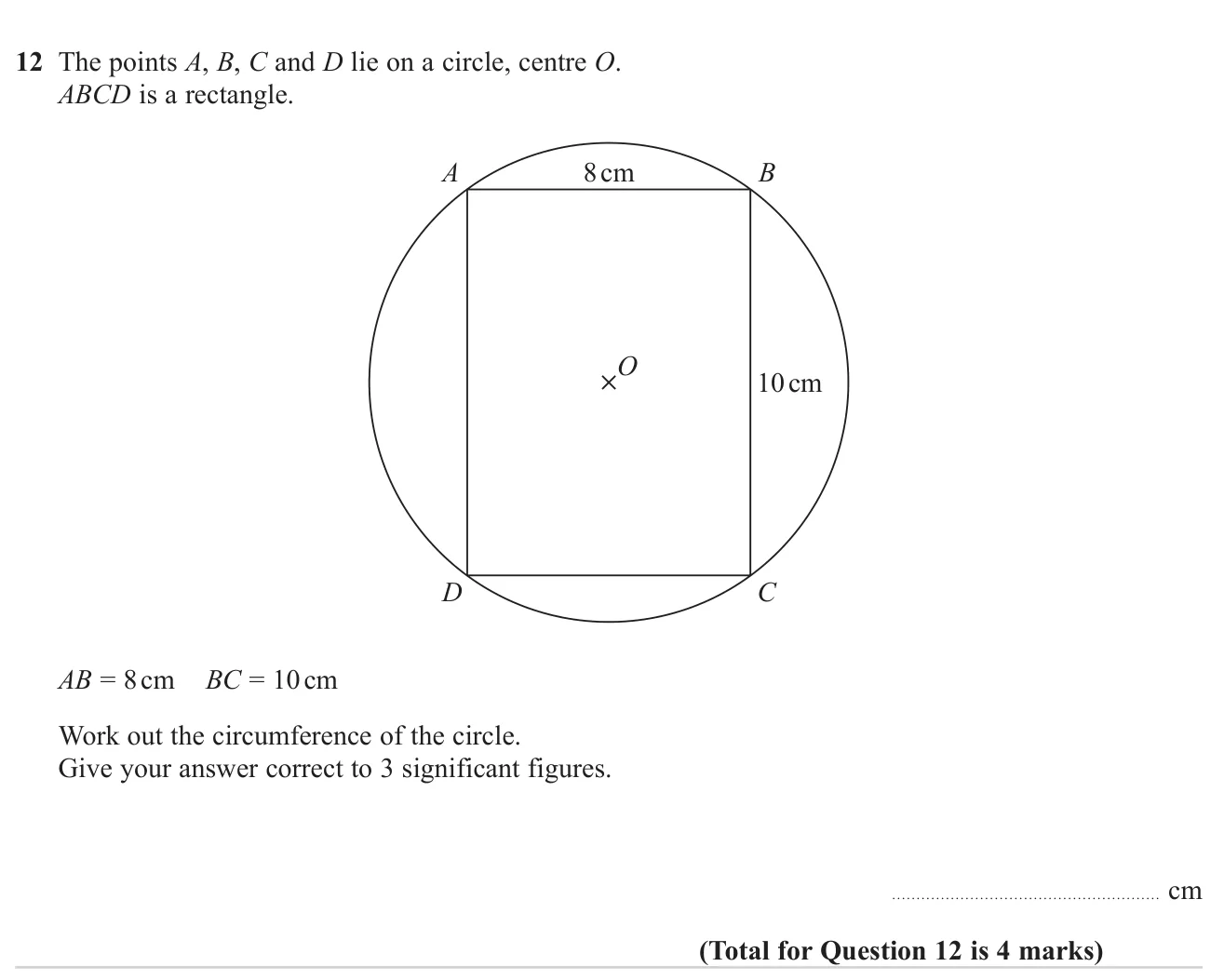
© Pearson Education Ltd. June 2023 Paper 2 (Higher, calculator), question 12.
Answer 40.2 40.2 40.2 4 marks
Worked solution Checked against the mark scheme
The diagonal of the rectangle is a diameter.
d = 8 2 + 10 2 = 164 = 12.806... d = \sqrt{8^2 + 10^2} = \sqrt{164} = 12.806... d = 8 2 + 1 0 2 = 164 = 12.806...
Circumference = π d = π × 12.806... = 40.23... = \pi d = \pi \times 12.806... = 40.23... = π d = π × 12.806... = 40.23...
= 40.2 = 40.2 = 40.2
Watch out: Using 10 cm as the diameter, or using the formula for area.
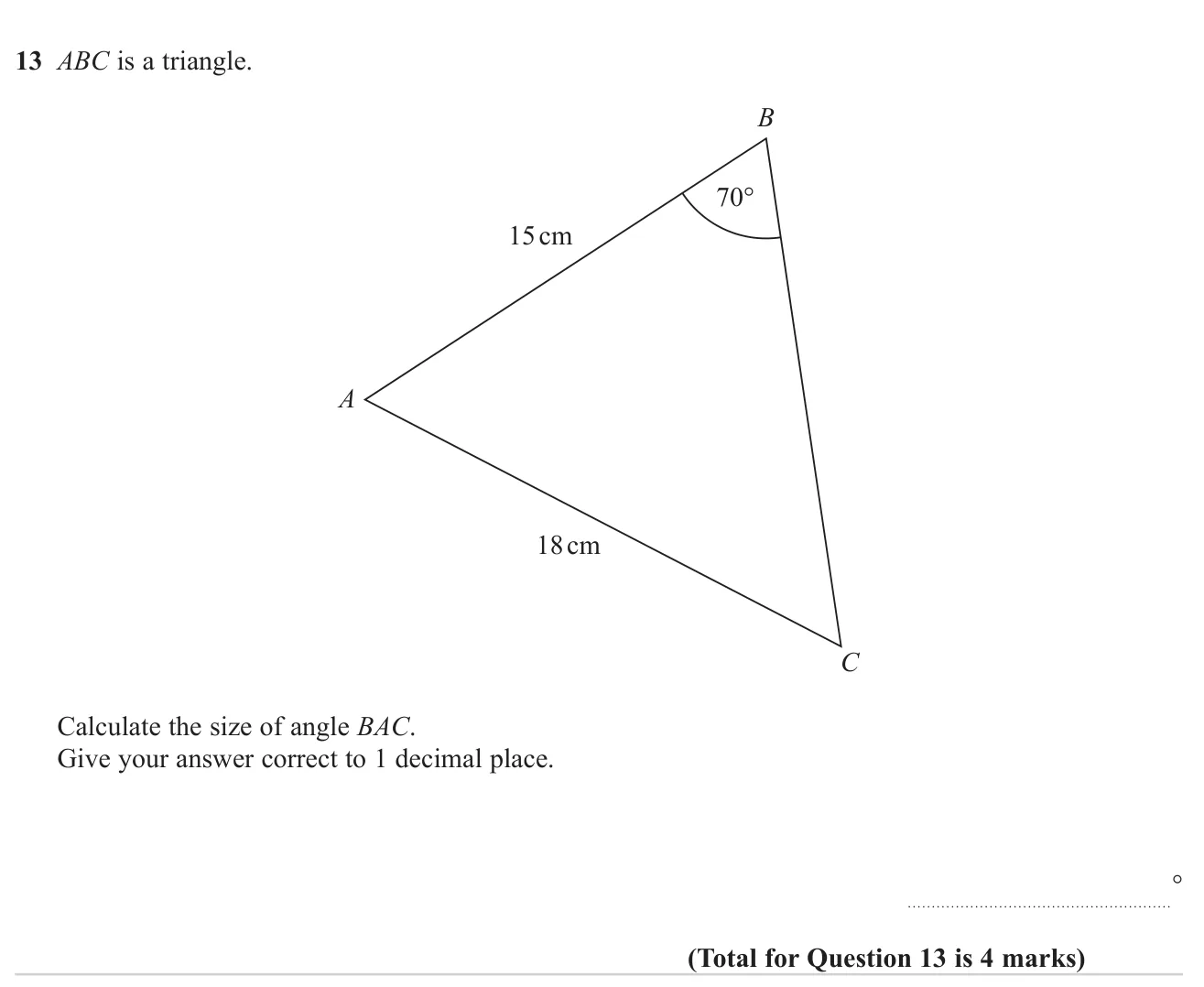
© Pearson Education Ltd. June 2023 Paper 2 (Higher, calculator), question 13.
Answer 58.5 ° 58.5° 58.5° 4 marks
Worked solution Checked against the mark scheme
Angle C C C A B = 15 AB = 15 A B = 15 B = 70 ° B = 70° B = 70° A C = 18 AC = 18 A C = 18
sin C 15 = sin 70 ° 18 \frac{\sin C}{15} = \frac{\sin 70°}{18} 15 s i n C = 18 s i n 70° sin C = 15 sin 70 ° 18 = 0.7830... \sin C = \frac{15 \sin 70°}{18} = 0.7830... sin C = 18 15 s i n 70° = 0.7830...
C = 51.54... ° C = 51.54...° C = 51.54...°
B A C = 180 − 70 − 51.54... = 58.5 ° BAC = 180 - 70 - 51.54... = 58.5° B A C = 180 − 70 − 51.54... = 58.5°
Watch out: Stopping at angle C (51.5°) instead of going on to find angle A.
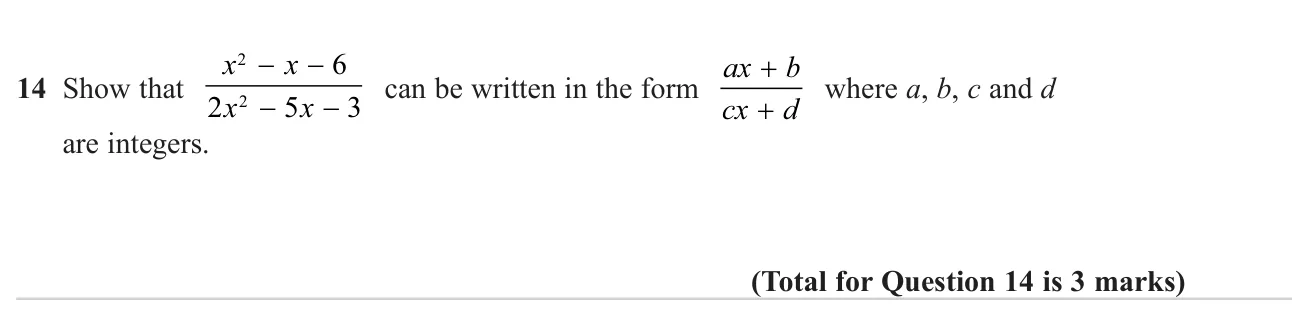
© Pearson Education Ltd. June 2023 Paper 2 (Higher, calculator), question 14.
Answer x + 2 2 x + 1 \frac{x + 2}{2x + 1} 2 x + 1 x + 2 3 marks
Worked solution Checked against the mark scheme
Top: x 2 − x − 6 = ( x − 3 ) ( x + 2 ) x^2 - x - 6 = (x - 3)(x + 2) x 2 − x − 6 = ( x − 3 ) ( x + 2 )
Bottom: 2 x 2 − 5 x − 3 = ( x − 3 ) ( 2 x + 1 ) 2x^2 - 5x - 3 = (x - 3)(2x + 1) 2 x 2 − 5 x − 3 = ( x − 3 ) ( 2 x + 1 )
Cancel ( x − 3 ) (x - 3) ( x − 3 ) x + 2 2 x + 1 \frac{x + 2}{2x + 1} 2 x + 1 x + 2 a = 1 , b = 2 , c = 2 , d = 1 a = 1, b = 2, c = 2, d = 1 a = 1 , b = 2 , c = 2 , d = 1
Watch out: Factorising 2 x 2 − 5 x − 3 2x^2 - 5x - 3 2 x 2 − 5 x − 3 ( 2 x − 3 ) ( x + 1 ) (2x - 3)(x + 1) ( 2 x − 3 ) ( x + 1 )
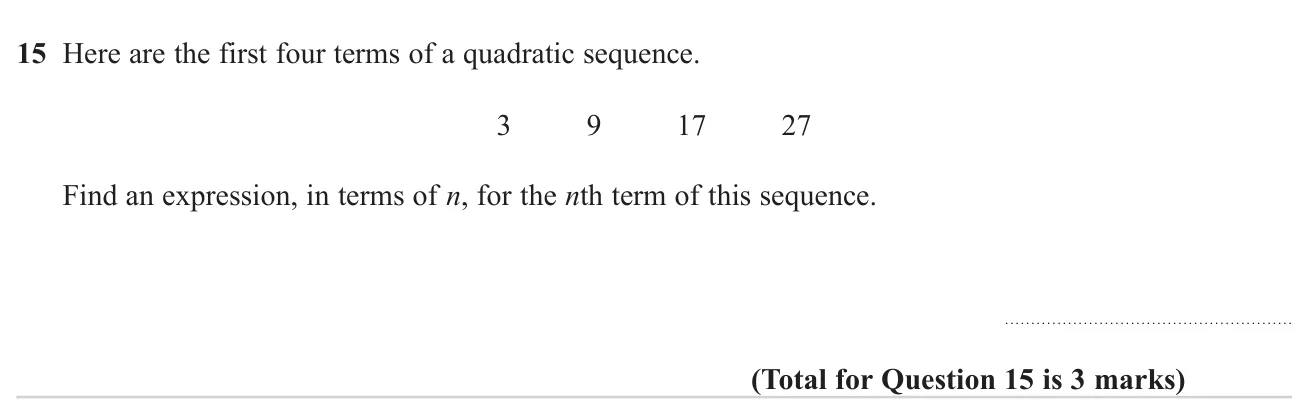
© Pearson Education Ltd. June 2023 Paper 2 (Higher, calculator), question 15.
Answer n 2 + 3 n − 1 n^2 + 3n - 1 n 2 + 3 n − 1 3 marks
Worked solution Checked against the mark scheme
Differences: 6, 8, 10; second difference 2, so start with n 2 n^2 n 2
Subtract n 2 n^2 n 2 3 n − 1 3n - 1 3 n − 1
nth term = n 2 + 3 n − 1 = n^2 + 3n - 1 = n 2 + 3 n − 1
Watch out: Using 2 n 2 2n^2 2 n 2
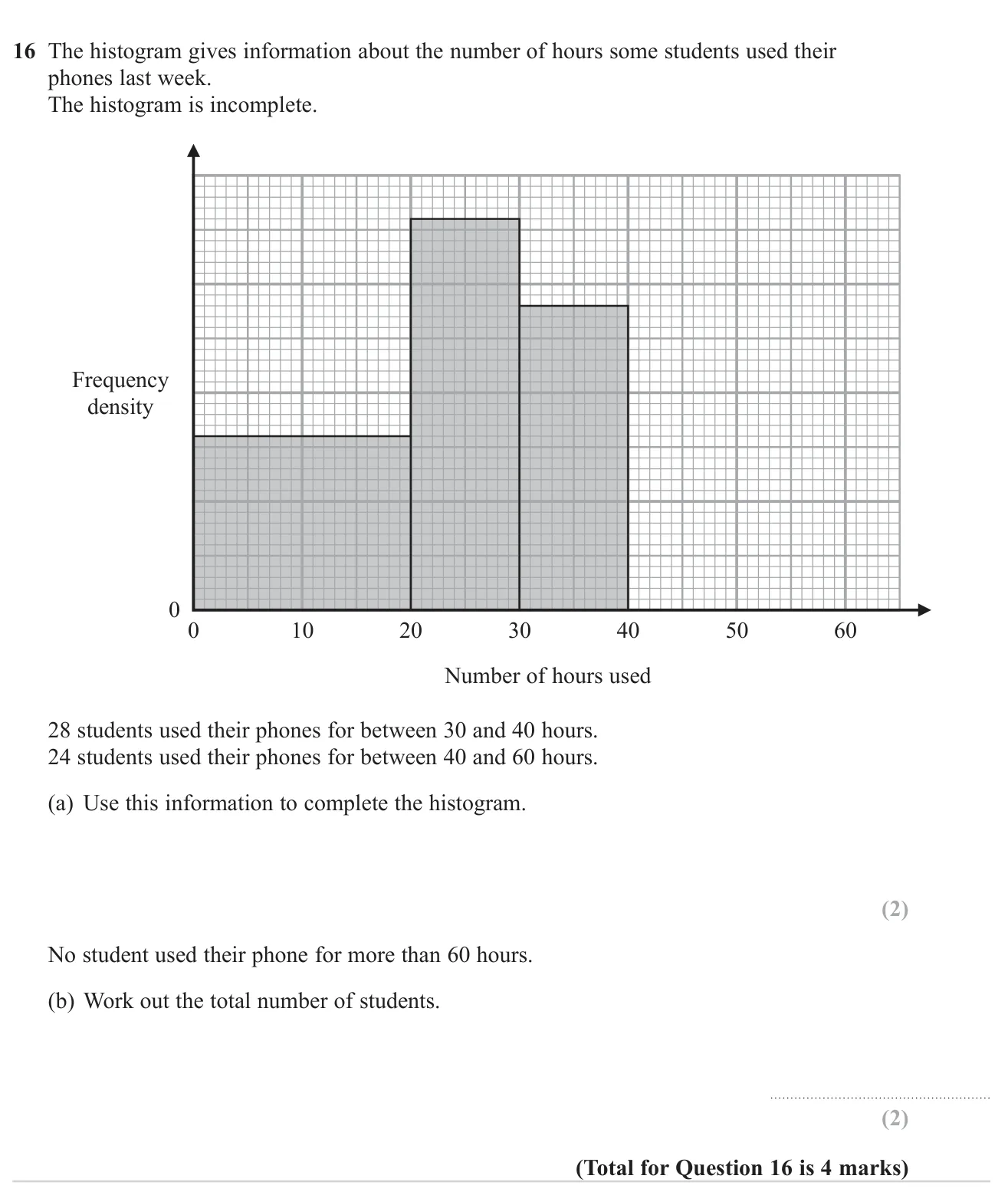
© Pearson Education Ltd. June 2023 Paper 2 (Higher, calculator), question 16.
(a) Bar from 40 to 60 at frequency density 1.2 1.2 1.2 2 marks (b) 120 120 120 2 marks
Worked solution Checked against the mark scheme
(a) The 30–40 bar holds 28 students, so its fd is 28 ÷ 10 = 2.8 28 \div 10 = 2.8 28 ÷ 10 = 2.8
For 40–60: fd = 24 ÷ 20 = 1.2 = 24 \div 20 = 1.2 = 24 ÷ 20 = 1.2
(b) 0–20: fd 1.6, so 1.6 × 20 = 32 1.6 \times 20 = 32 1.6 × 20 = 32 3.6 × 10 = 36 3.6 \times 10 = 36 3.6 × 10 = 36
Total = 32 + 36 + 28 + 24 = 120 = 32 + 36 + 28 + 24 = 120 = 32 + 36 + 28 + 24 = 120
Watch out: Drawing the 40–60 bar with height 24 instead of dividing by the class width.
© Pearson Education Ltd. June 2023 Paper 2 (Higher, calculator), question 17.
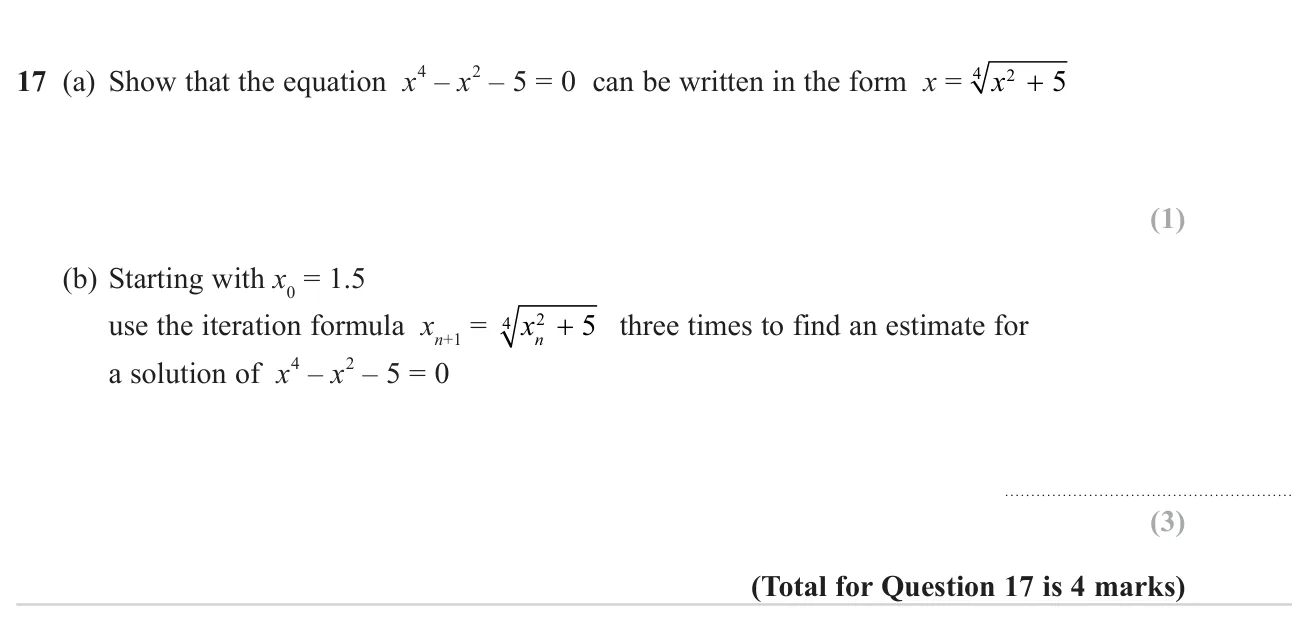
(a) x 4 = x 2 + 5 ⇒ x = x 2 + 5 4 x^4 = x^2 + 5 \Rightarrow x = \sqrt[4]{x^2 + 5} x 4 = x 2 + 5 ⇒ x = 4 x 2 + 5 1 mark (b) 1.669763... 1.669763... 1.669763... 3 marks
Worked solution Checked against the mark scheme
(a) x 4 − x 2 − 5 = 0 ⇒ x 4 = x 2 + 5 ⇒ x = x 2 + 5 4 x^4 - x^2 - 5 = 0 \Rightarrow x^4 = x^2 + 5 \Rightarrow x = \sqrt[4]{x^2 + 5} x 4 − x 2 − 5 = 0 ⇒ x 4 = x 2 + 5 ⇒ x = 4 x 2 + 5
(b) x 1 = 1.5 2 + 5 4 = 1.6409... x_1 = \sqrt[4]{1.5^2 + 5} = 1.6409... x 1 = 4 1. 5 2 + 5 = 1.6409...
x 2 = 1.6409.. . 2 + 5 4 = 1.6653... x_2 = \sqrt[4]{1.6409...^2 + 5} = 1.6653... x 2 = 4 1.6409.. . 2 + 5 = 1.6653...
x 3 = 1.6653.. . 2 + 5 4 = 1.6697... x_3 = \sqrt[4]{1.6653...^2 + 5} = 1.6697... x 3 = 4 1.6653.. . 2 + 5 = 1.6697...
Watch out: Using a square root instead of a fourth root on the calculator.
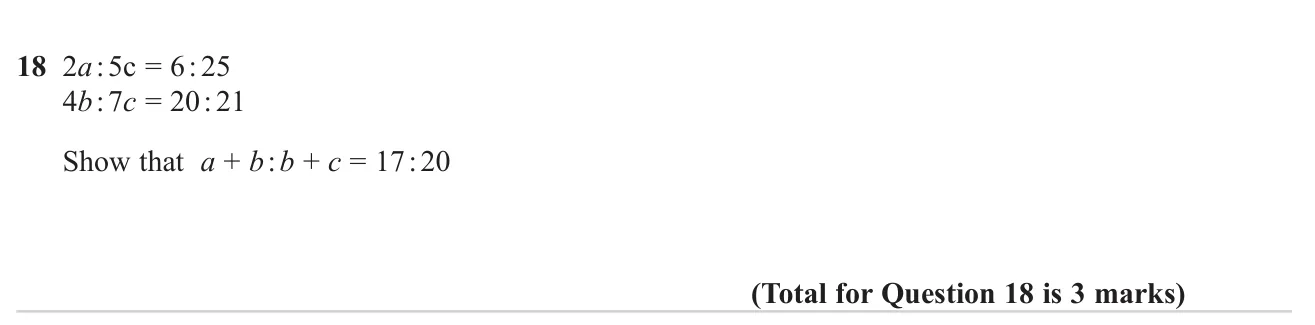
Question 18 Ratio 3 marks Grade 8 Calculator © Pearson Education Ltd. June 2023 Paper 2 (Higher, calculator), question 18.
Answer a : b : c = 9 : 25 : 15 a : b : c = 9 : 25 : 15 a : b : c = 9 : 25 : 15 a + b : b + c = 34 : 40 = 17 : 20 a + b : b + c = 34 : 40 = 17 : 20 a + b : b + c = 34 : 40 = 17 : 20 3 marks
Worked solution Checked against the mark scheme
2 a : 5 c = 6 : 25 ⇒ 50 a = 30 c ⇒ a = 3 c 5 2a : 5c = 6 : 25 \Rightarrow 50a = 30c \Rightarrow a = \frac{3c}{5} 2 a : 5 c = 6 : 25 ⇒ 50 a = 30 c ⇒ a = 5 3 c
4 b : 7 c = 20 : 21 ⇒ 84 b = 140 c ⇒ b = 5 c 3 4b : 7c = 20 : 21 \Rightarrow 84b = 140c \Rightarrow b = \frac{5c}{3} 4 b : 7 c = 20 : 21 ⇒ 84 b = 140 c ⇒ b = 3 5 c
Take c = 15 c = 15 c = 15 a = 9 a = 9 a = 9 b = 25 b = 25 b = 25
a + b : b + c = 34 : 40 = 17 : 20 a + b : b + c = 34 : 40 = 17 : 20 a + b : b + c = 34 : 40 = 17 : 20
Watch out: Reading 2a : 5c = 6 : 25 as a : c = 6 : 25.
© Pearson Education Ltd. June 2023 Paper 2 (Higher, calculator), question 19.
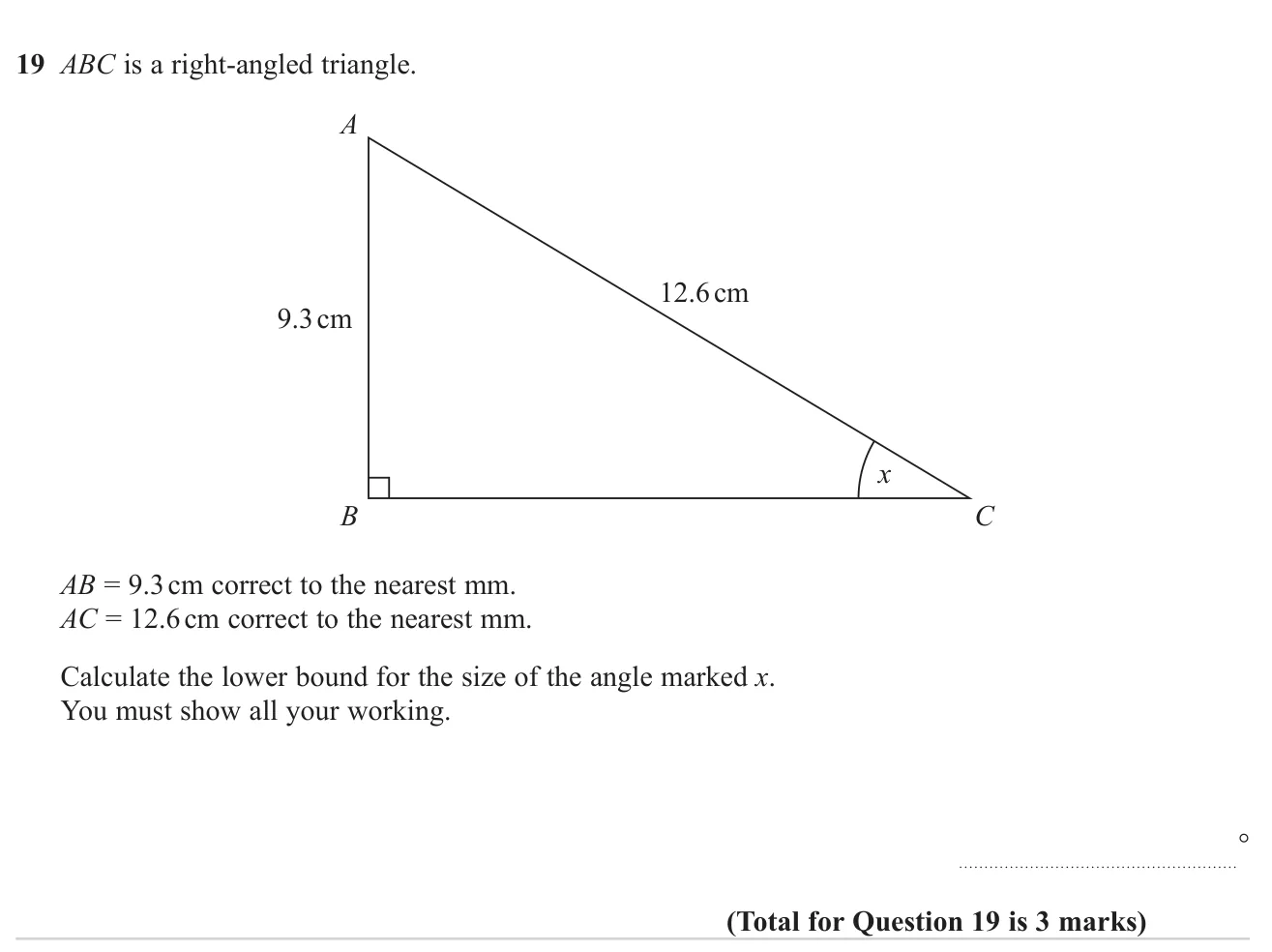
Answer 46.98... ° 46.98...° 46.98...° 3 marks
Worked solution Checked against the mark scheme
Bounds: A B AB A B A C AC A C
sin x = A B A C \sin x = \frac{AB}{AC} sin x = A C A B A B AB A B A C AC A C
sin x = 9.25 12.65 = 0.7312... \sin x = \frac{9.25}{12.65} = 0.7312... sin x = 12.65 9.25 = 0.7312...
x = 46.989... ° x = 46.989...° x = 46.989...°
Watch out: Using both lower bounds, which does not give the smallest angle.
© Pearson Education Ltd. June 2023 Paper 2 (Higher, calculator), question 20.
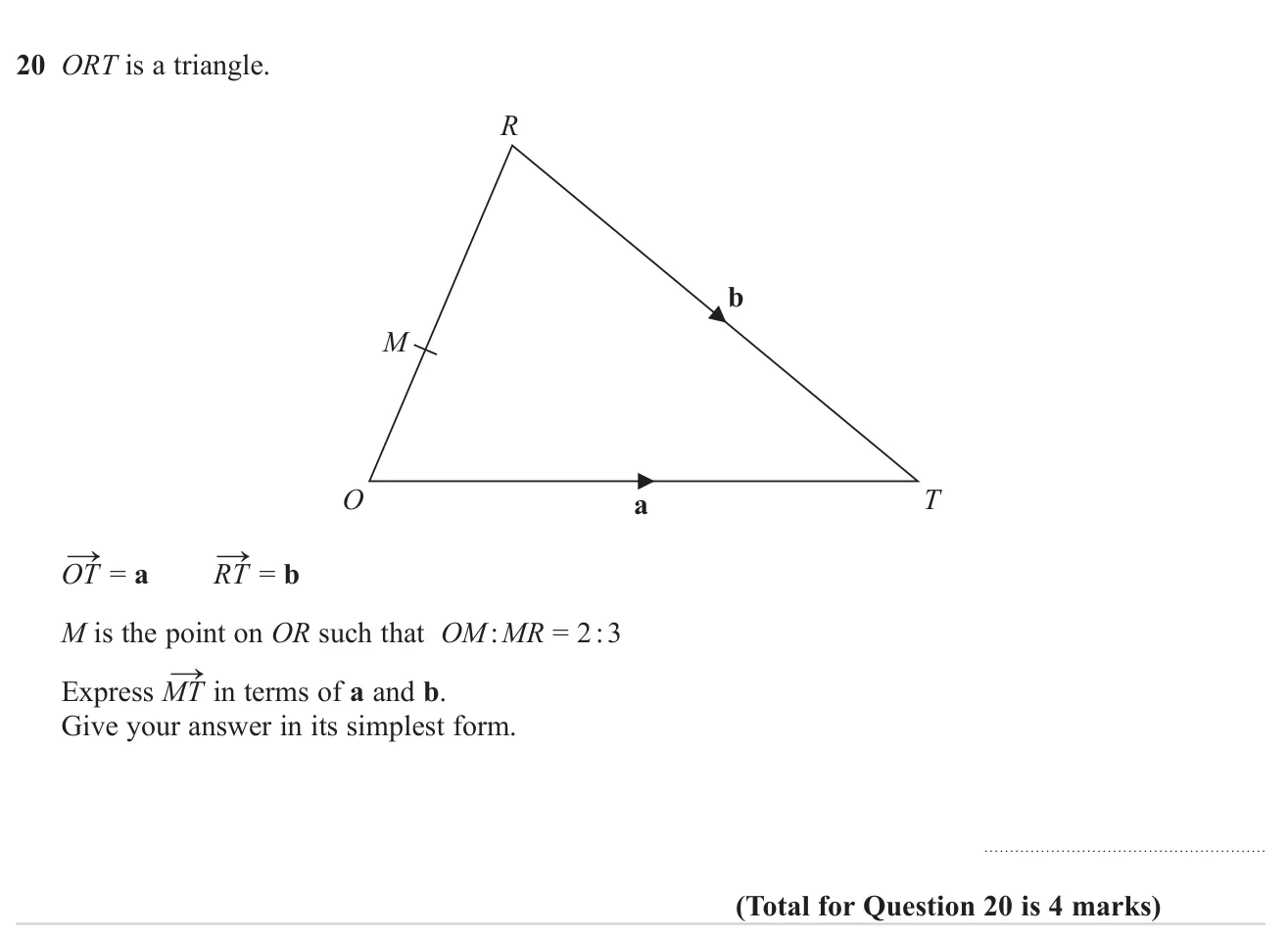
Answer 3 5 a + 2 5 b \frac{3}{5}\mathbf{a} + \frac{2}{5}\mathbf{b} 5 3 a + 5 2 b 4 marks
Worked solution Checked against the mark scheme
O R ⃗ = O T ⃗ + T R ⃗ = a − b \vec{OR} = \vec{OT} + \vec{TR} = \mathbf{a} - \mathbf{b} O R = O T + T R = a − b
O M ⃗ = 2 5 ( a − b ) \vec{OM} = \frac{2}{5}(\mathbf{a} - \mathbf{b}) O M = 5 2 ( a − b )
M T ⃗ = − O M ⃗ + O T ⃗ = − 2 5 a + 2 5 b + a = 3 5 a + 2 5 b \vec{MT} = -\vec{OM} + \vec{OT} = -\frac{2}{5}\mathbf{a} + \frac{2}{5}\mathbf{b} + \mathbf{a} = \frac{3}{5}\mathbf{a} + \frac{2}{5}\mathbf{b} M T = − O M + O T = − 5 2 a + 5 2 b + a = 5 3 a + 5 2 b
Watch out: Taking T R ⃗ \vec{TR} T R b \mathbf{b} b R T ⃗ = b \vec{RT} = \mathbf{b} R T = b
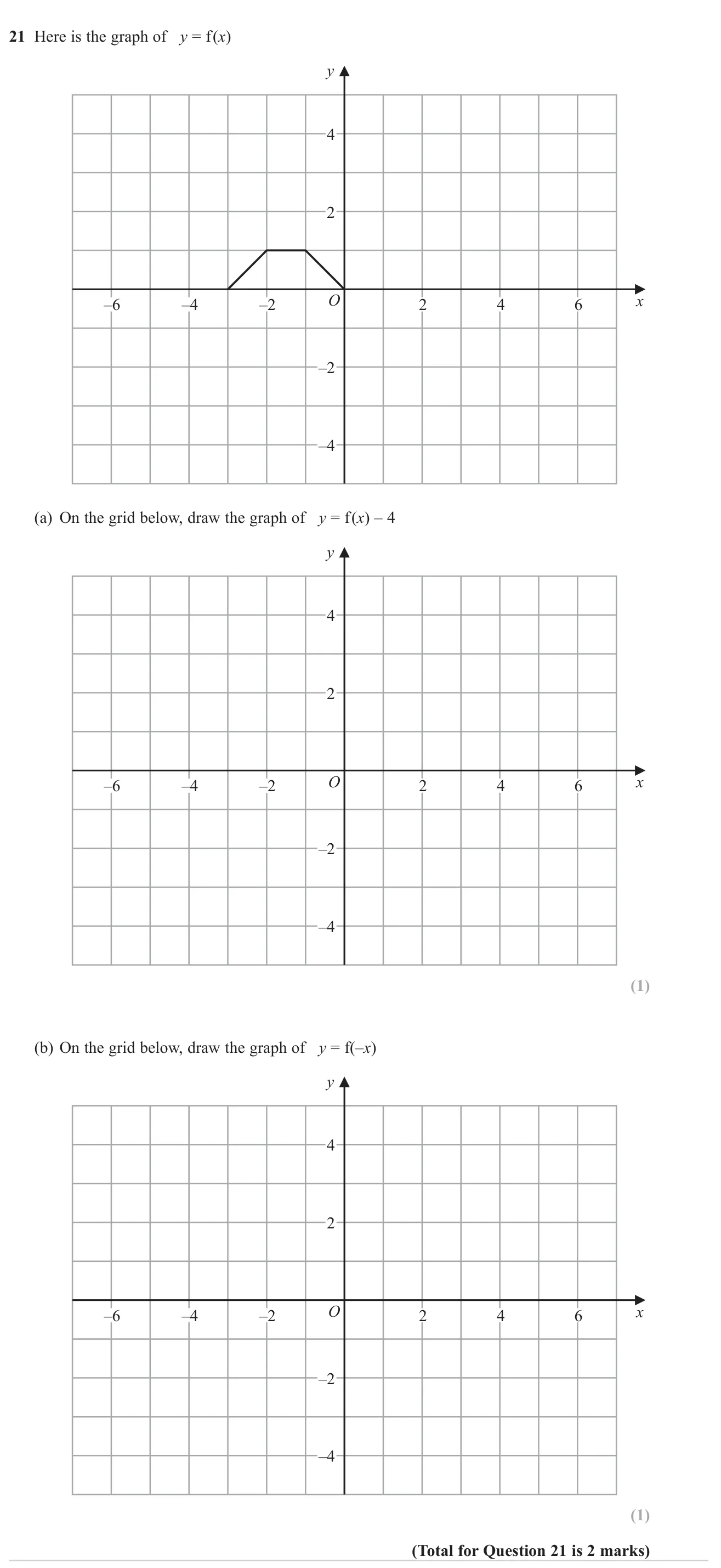
© Pearson Education Ltd. June 2023 Paper 2 (Higher, calculator), question 21.
(a) Shape moved down 4: through ( − 3 , − 4 ) (-3,-4) ( − 3 , − 4 ) ( − 2 , − 3 ) (-2,-3) ( − 2 , − 3 ) ( − 1 , − 3 ) (-1,-3) ( − 1 , − 3 ) ( 0 , − 4 ) (0,-4) ( 0 , − 4 ) 1 mark (b) Shape reflected in the y y y ( 0 , 0 ) (0,0) ( 0 , 0 ) ( 1 , 1 ) (1,1) ( 1 , 1 ) ( 2 , 1 ) (2,1) ( 2 , 1 ) ( 3 , 0 ) (3,0) ( 3 , 0 ) 1 mark
Worked solution Checked against the mark scheme
(a) f ( x ) − 4 f(x) - 4 f ( x ) − 4 ( − 3 , 0 ) → ( − 3 , − 4 ) (-3,0) \to (-3,-4) ( − 3 , 0 ) → ( − 3 , − 4 ) ( − 2 , 1 ) → ( − 2 , − 3 ) (-2,1) \to (-2,-3) ( − 2 , 1 ) → ( − 2 , − 3 ) ( − 1 , 1 ) → ( − 1 , − 3 ) (-1,1) \to (-1,-3) ( − 1 , 1 ) → ( − 1 , − 3 ) ( 0 , 0 ) → ( 0 , − 4 ) (0,0) \to (0,-4) ( 0 , 0 ) → ( 0 , − 4 )
(b) f ( − x ) f(-x) f ( − x ) y y y x x x ( 3 , 0 ) (3,0) ( 3 , 0 ) ( 2 , 1 ) (2,1) ( 2 , 1 ) ( 1 , 1 ) (1,1) ( 1 , 1 ) ( 0 , 0 ) (0,0) ( 0 , 0 )
Watch out: Reflecting in the x-axis for f(−x), which is the rule for −f(x).
© Pearson Education Ltd. June 2023 Paper 2 (Higher, calculator), question 22.
Answer 1 − ( 4 5 ) n − ( 1 5 ) n 1 - \left(\frac{4}{5}\right)^n - \left(\frac{1}{5}\right)^n 1 − ( 5 4 ) n − ( 5 1 ) n 2 marks
Worked solution Checked against the mark scheme
Blue : red = 4 : 1, so P(blue) = 4 5 = \frac{4}{5} = 5 4 = 1 5 = \frac{1}{5} = 5 1
The only ways to fail are all blue or all red.
P(both colours) = 1 − ( 4 5 ) n − ( 1 5 ) n = 1 - \left(\frac{4}{5}\right)^n - \left(\frac{1}{5}\right)^n = 1 − ( 5 4 ) n − ( 5 1 ) n
Watch out: Subtracting only one of the two failing cases, e.g. 1 − ( 4 5 ) n 1 - \left(\frac{4}{5}\right)^n 1 − ( 5 4 ) n
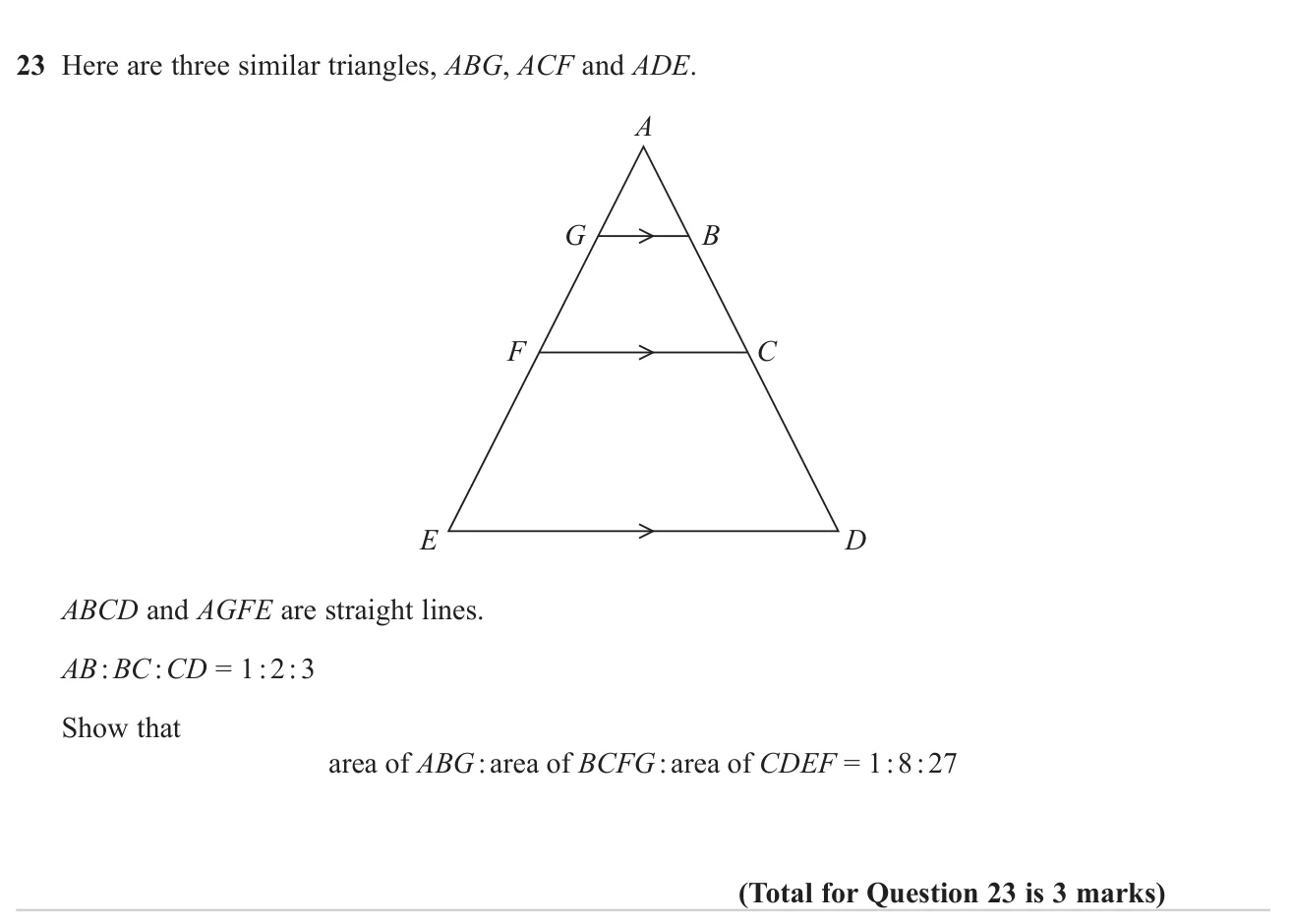
© Pearson Education Ltd. June 2023 Paper 2 (Higher, calculator), question 23.
Answer Lengths 1 : 3 : 6 1 : 3 : 6 1 : 3 : 6 1 : 9 : 36 1 : 9 : 36 1 : 9 : 36 1 : 8 : 27 1 : 8 : 27 1 : 8 : 27 3 marks
Worked solution Checked against the mark scheme
A B : A C : A D = 1 : ( 1 + 2 ) : ( 1 + 2 + 3 ) = 1 : 3 : 6 AB : AC : AD = 1 : (1+2) : (1+2+3) = 1 : 3 : 6 A B : A C : A D = 1 : ( 1 + 2 ) : ( 1 + 2 + 3 ) = 1 : 3 : 6
Similar triangles, so areas are in the ratio of the squares: 1 : 9 : 36 1 : 9 : 36 1 : 9 : 36
BCFG = 9 − 1 = 8 = 9 - 1 = 8 = 9 − 1 = 8 = 36 − 9 = 27 = 36 - 9 = 27 = 36 − 9 = 27
So the ratio is 1 : 8 : 27 1 : 8 : 27 1 : 8 : 27
Watch out: Using 1 : 2 : 3 as the lengths of the whole triangles instead of adding them up.
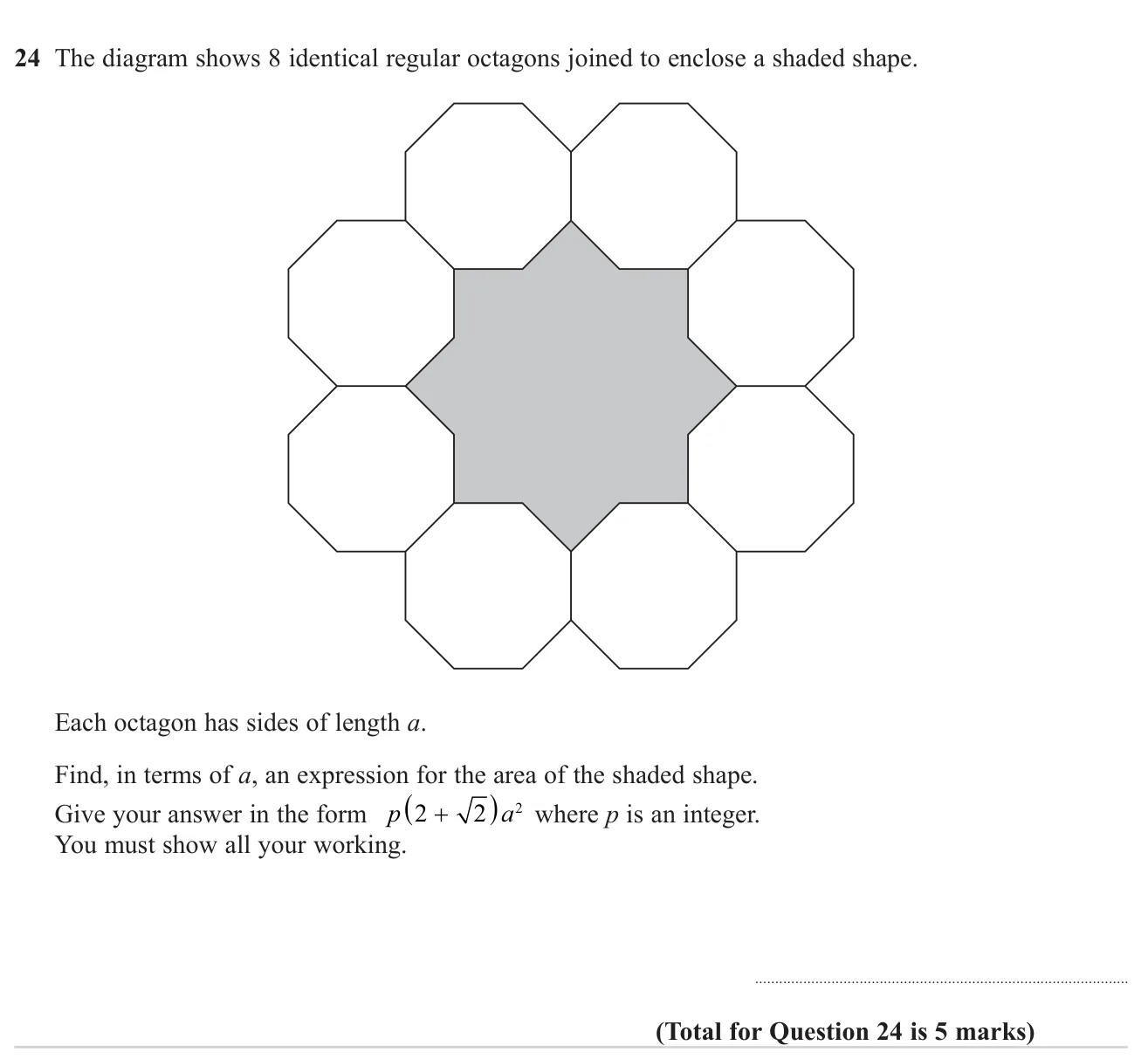
© Pearson Education Ltd. June 2023 Paper 2 (Higher, calculator), question 24.
Answer 4 ( 2 + 2 ) a 2 4(2 + \sqrt{2})a^2 4 ( 2 + 2 ) a 2 5 marks
Worked solution Checked against the mark scheme
Each octagon angle is 135°, so where two octagons meet at a point the gap is 360 − 2 × 135 = 90 ° 360 - 2 \times 135 = 90° 360 − 2 × 135 = 90°
Each point of the star is a right-angled triangle with legs a a a 1 2 a 2 \frac{1}{2}a^2 2 1 a 2 a 2 a\sqrt{2} a 2
Each side of the central square is an octagon side, a triangle base and another octagon side: a + a 2 + a = ( 2 + 2 ) a a + a\sqrt{2} + a = (2 + \sqrt{2})a a + a 2 + a = ( 2 + 2 ) a
Area = ( 2 + 2 ) 2 a 2 + 4 × 1 2 a 2 = ( 6 + 4 2 ) a 2 + 2 a 2 = ( 8 + 4 2 ) a 2 = 4 ( 2 + 2 ) a 2 = (2+\sqrt{2})^2a^2 + 4 \times \frac{1}{2}a^2 = (6 + 4\sqrt{2})a^2 + 2a^2 = (8 + 4\sqrt{2})a^2 = 4(2+\sqrt{2})a^2 = ( 2 + 2 ) 2 a 2 + 4 × 2 1 a 2 = ( 6 + 4 2 ) a 2 + 2 a 2 = ( 8 + 4 2 ) a 2 = 4 ( 2 + 2 ) a 2
Watch out: Using the exterior angle 45° where the interior angle 135° is needed.
Finished the paper? Add up your marks for all three papers and see what grade that would have been.