Revision guide by The Full Marks
Inequalities: what you need to know An inequality says one side is bigger or smaller than the other, so the answer is a range of values instead of one number. You solve them almost like equations and show the answer on a number line, as a list of integers or on a graph.
Foundation solves linear inequalities and uses number lines; inequalities in two variables, regions on graphs, quadratic inequalities and set notation are Higher.
Key facts < < < ≤ \le ≤ > > > ≥ \ge ≥ Number lines: open circle for < < < > > > ≤ \le ≤ ≥ \ge ≥ If you multiply or divide by a negative number, flip the inequality sign. Higher: set notation, e.g. { x : − 3 < x < 4 } \{x : -3 < x < 4\} { x : − 3 < x < 4 } { x : x < − 3 } ∪ { x : x > 4 } \{x : x < -3\} \cup \{x : x > 4\} { x : x < − 3 } ∪ { x : x > 4 } Higher: x 2 < 9 x^2 < 9 x 2 < 9 − 3 < x < 3 -3 < x < 3 − 3 < x < 3 x 2 > 9 x^2 > 9 x 2 > 9 x < − 3 x < -3 x < − 3 x > 3 x > 3 x > 3 Higher: on a graph, use a dashed line for < < < > > > ≤ \le ≤ ≥ \ge ≥ Solving a linear inequality Solve as if it were an equation, keeping the inequality sign. Flip the sign only if you multiply or divide by a negative. Give the answer as an inequality, e.g. x < 5 x < 5 x < 5 x = 5 x = 5 x = 5 Higher: solving a quadratic inequality Rearrange to … < 0 \ldots < 0 … < 0 … > 0 \ldots > 0 … > 0 Sketch the U-shaped curve through those values. < 0 < 0 < 0 > 0 > 0 > 0 Higher: showing a region on a graph Draw each boundary line, e.g. y = 2 x − 1 y = 2x - 1 y = 2 x − 1 y > 2 x − 1 y > 2x - 1 y > 2 x − 1 < < < > > > ≤ \le ≤ ≥ \ge ≥ Test a point that is not on the line, such as ( 0 , 0 ) (0, 0) ( 0 , 0 ) Find the region that fits every inequality and label it R if the question asks. Worked examples Example 1 Foundation · grade 4
Solve 5 x + 3 ≥ 2 x − 9 5x + 3 \ge 2x - 9 5 x + 3 ≥ 2 x − 9
Show the solution Subtract 2 x 2x 2 x 3 x + 3 ≥ − 9 3x + 3 \ge -9 3 x + 3 ≥ − 9 3 x ≥ − 12 3x \ge -12 3 x ≥ − 12 x ≥ − 4 x \ge -4 x ≥ − 4
Example 2 Foundation · grade 4
n n n − 3 < 2 n ≤ 6 -3 < 2n \le 6 − 3 < 2 n ≤ 6 n n n
Show the solution Divide all three parts by 2: − 1.5 < n ≤ 3 -1.5 < n \le 3 − 1.5 < n ≤ 3 − 1.5 -1.5 − 1.5 n = − 1 , 0 , 1 , 2 , 3 n = -1, 0, 1, 2, 3 n = − 1 , 0 , 1 , 2 , 3
Example 3 Higher · grade 7
Solve x 2 − x − 12 < 0 x^2 - x - 12 < 0 x 2 − x − 12 < 0
Show the solution x 2 − x − 12 = 0 x^2 - x - 12 = 0 x 2 − x − 12 = 0 ( x − 4 ) ( x + 3 ) = 0 (x - 4)(x + 3) = 0 ( x − 4 ) ( x + 3 ) = 0 x = 4 x = 4 x = 4 x = − 3 x = -3 x = − 3 x x x { x : − 3 < x < 4 } \{x : -3 < x < 4\} { x : − 3 < x < 4 }
Common mistakes Writing the answer as an equation, e.g. x = 5 x = 5 x = 5 x < 5 x < 5 x < 5 Including an end value that isn't allowed: with < < < Giving the outside region for a quadratic inequality when it should be between the roots, or forgetting the negative range in something like x 2 > 9 x^2 > 9 x 2 > 9 Shading the wrong side of a line when showing a region on a graph. Exam tips For 'list the integers' questions, check each end: is it included or not? Questions people ask When do you flip the inequality sign? Only when you multiply or divide both sides by a negative number.
How do you show an inequality on a number line? Draw a circle at the end value: open for < < < > > > ≤ \le ≤ ≥ \ge ≥
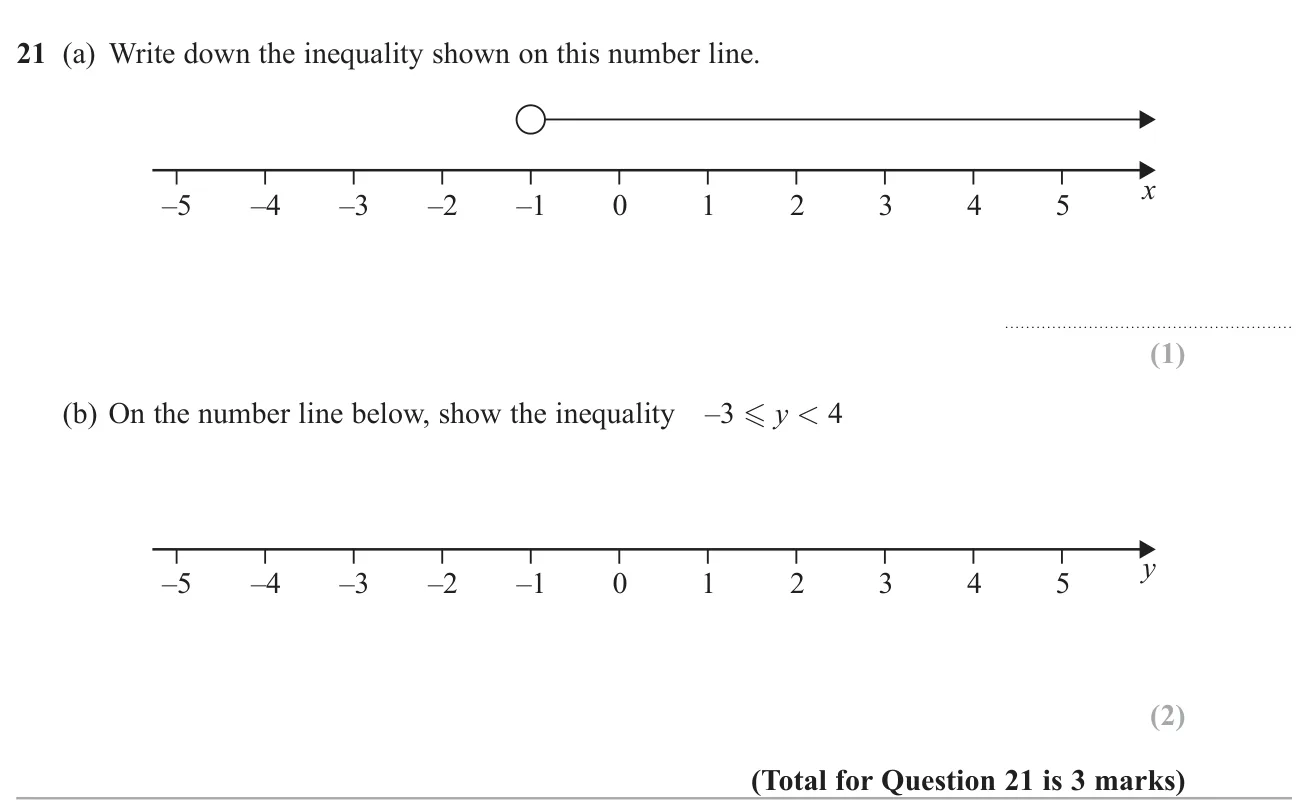
Exam questions: Inequalities (22, easiest first) © Pearson Education Ltd. November 2021 Paper 2 (Foundation, calculator), question 21.
(a) x > − 1 x > -1 x > − 1 1 mark (b) Closed circle at −3, open circle at 4, joined by a line 2 marks
Worked solution Checked against the mark scheme
(a) The open circle at − 1 -1 − 1 − 1 -1 − 1 x > − 1 x > -1 x > − 1
(b) Filled circle at − 3 -3 − 3
Watch out: Using the wrong type of circle at an end point.
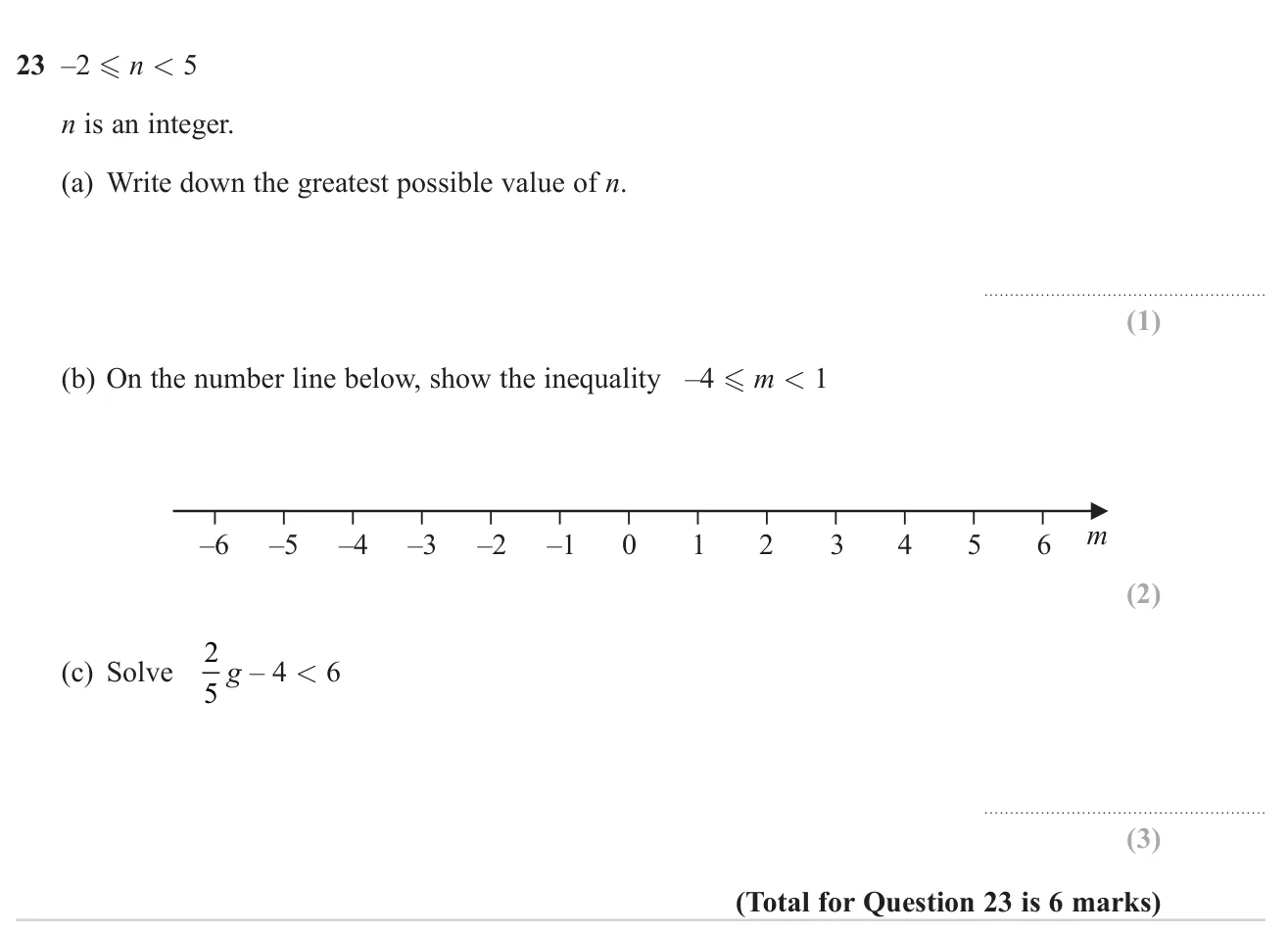
© Pearson Education Ltd. June 2023 Paper 2 (Foundation, calculator), question 23.
(a) 4 1 mark (b) Closed circle at − 4 -4 − 4 1 1 1 2 marks (c) g < 25 g < 25 g < 25 3 marks
Worked solution Checked against the mark scheme
(a) n n n 4 4 4
(b) Filled circle at − 4 -4 − 4 1 1 1
(c) 2 5 g − 4 < 6 \frac{2}{5}g - 4 < 6 5 2 g − 4 < 6
2 5 g < 10 \frac{2}{5}g < 10 5 2 g < 10
2 g < 50 2g < 50 2 g < 50
g < 25 g < 25 g < 25
Watch out: In (a), giving 5 even though the sign is strict.
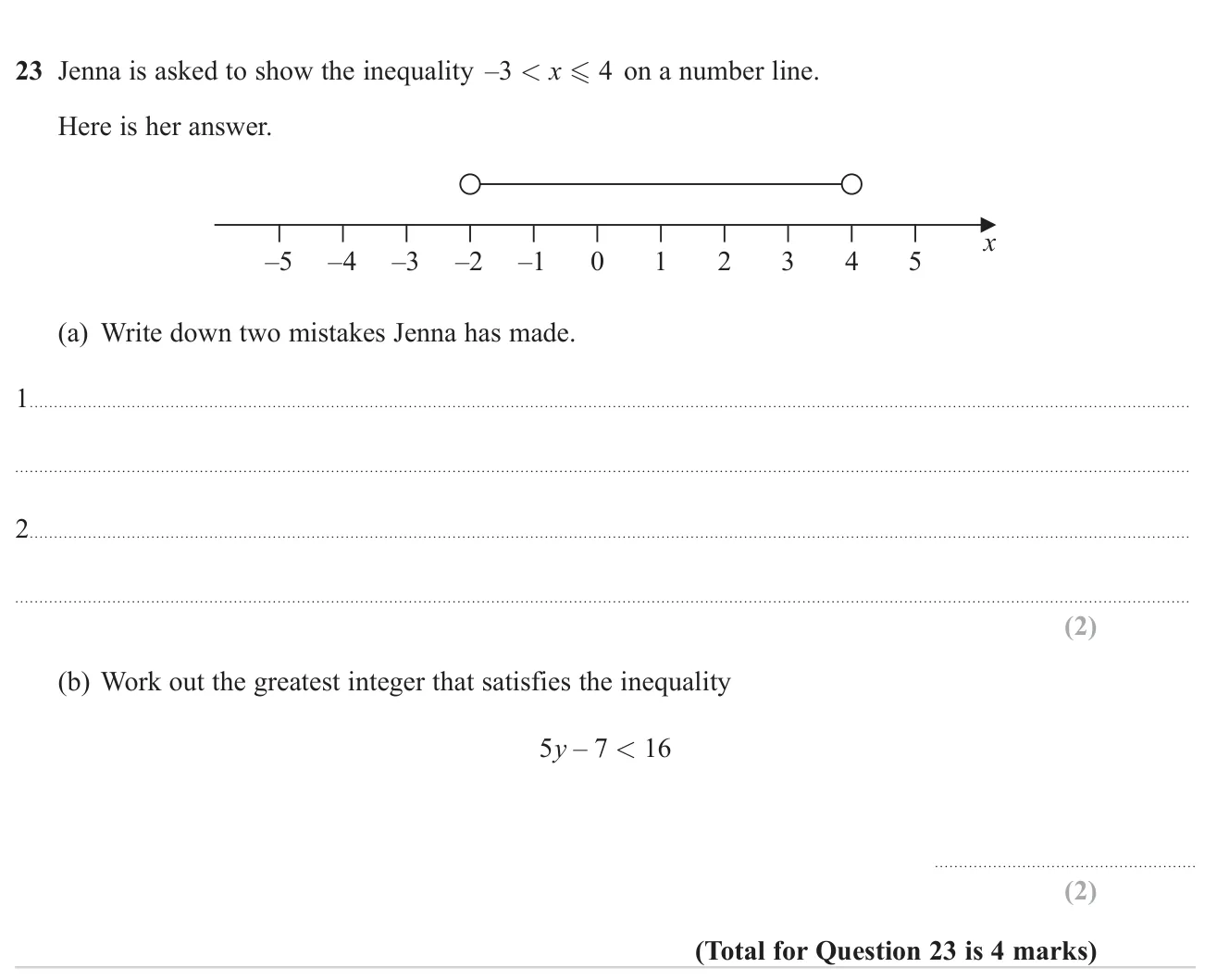
© Pearson Education Ltd. November 2023 Paper 3 (Foundation, calculator), question 23.
(a) The circle at 4 should be filled in; the open circle should be at −3, not −2 2 marks (b) 4 2 marks
Worked solution Checked against the mark scheme
(a) ≤ 4 \le 4 ≤ 4 − 3 -3 − 3 − 2 -2 − 2
(b) 5 y − 7 < 16 5y - 7 < 16 5 y − 7 < 16 5 y < 23 5y < 23 5 y < 23 y < 4.6 y < 4.6 y < 4.6
The greatest integer is 4 .
Watch out: In (b), giving 5 by rounding 4.6 up.
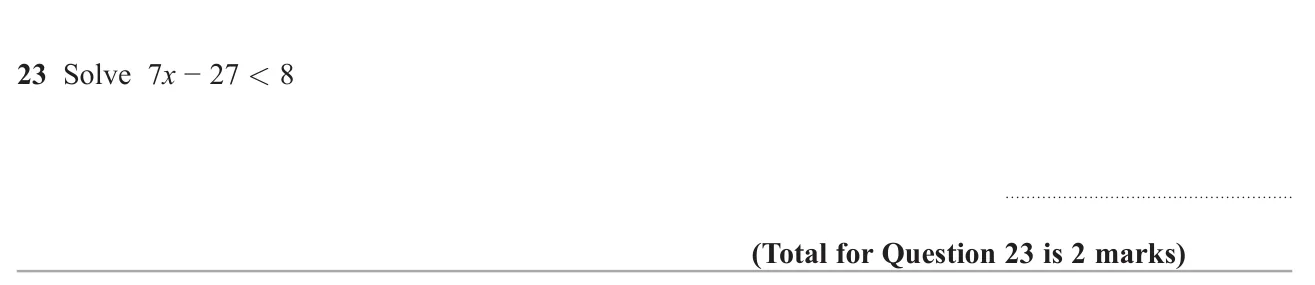
© Pearson Education Ltd. June 2022 Paper 1 (Foundation, non-calculator), question 23.
Worked solution Checked against the mark scheme
7 x − 27 < 8 7x - 27 < 8 7 x − 27 < 8
Add 27: 7 x < 35 7x < 35 7 x < 35
Divide by 7: x < 5 x < 5 x < 5
Watch out: Writing x = 5 instead of an inequality.
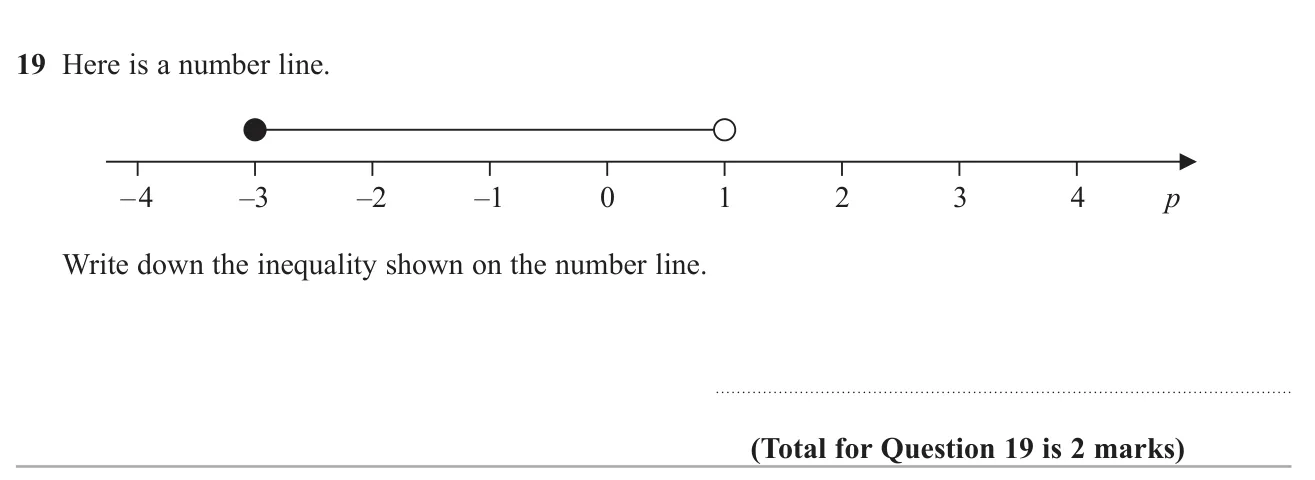
© Pearson Education Ltd. November 2019 Paper 1 (Foundation, non-calculator), question 19.
Answer − 3 ≤ p < 1 -3 \le p < 1 − 3 ≤ p < 1 2 marks
Worked solution Checked against the mark scheme
The filled circle at − 3 -3 − 3 − 3 -3 − 3 p ≥ − 3 p \ge -3 p ≥ − 3
The open circle at 1 1 1 1 1 1 p < 1 p < 1 p < 1
Together: − 3 ≤ p < 1 -3 \le p < 1 − 3 ≤ p < 1
Watch out: Mixing up which end uses ≤ and which uses <.
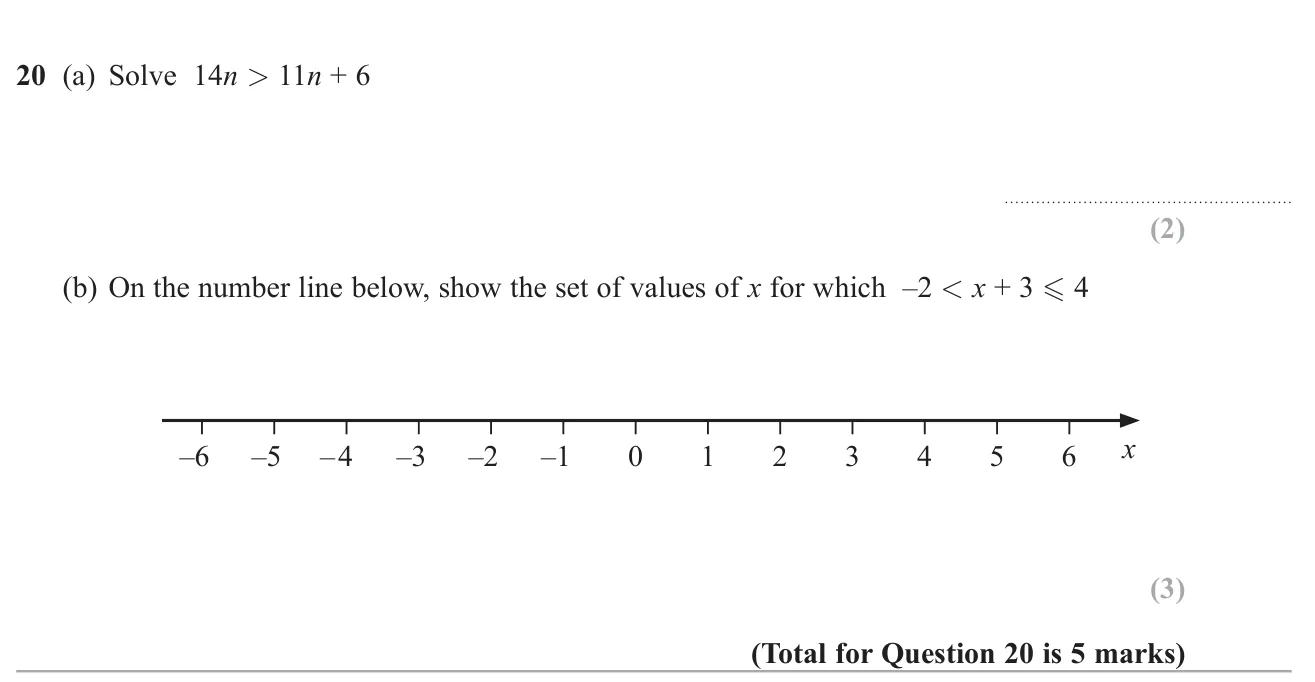
© Pearson Education Ltd. June 2019 Paper 2 (Foundation, calculator), question 20.
(a) n > 2 n > 2 n > 2 2 marks (b) − 5 < x ≤ 1 -5 < x \le 1 − 5 < x ≤ 1 − 5 -5 − 5 1 1 1 3 marks
Worked solution Checked against the mark scheme
(a) 14 n − 11 n > 6 14n - 11n > 6 14 n − 11 n > 6 3 n > 6 3n > 6 3 n > 6 n > 2 n > 2 n > 2
(b) Subtract 3 from every part: − 2 − 3 < x ≤ 4 − 3 -2 - 3 < x \le 4 - 3 − 2 − 3 < x ≤ 4 − 3 − 5 < x ≤ 1 -5 < x \le 1 − 5 < x ≤ 1
Draw an open circle at − 5 -5 − 5 1 1 1
Watch out: Using a filled circle at −5 for a strict inequality.
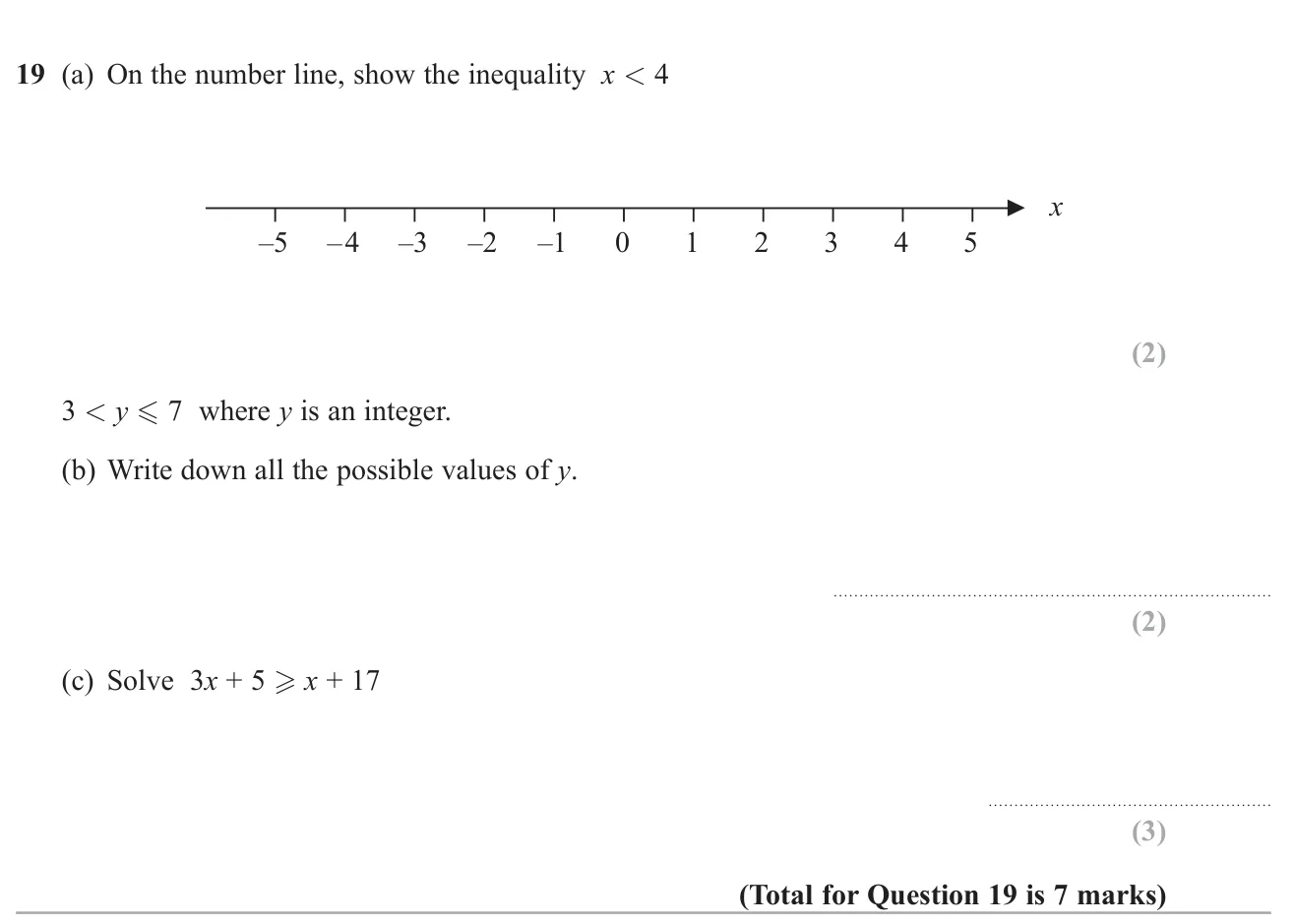
© Pearson Education Ltd. November 2018 Paper 3 (Foundation, calculator), question 19.
(a) Open circle at 4 with an arrow to the left 2 marks (b) 4 , 5 , 6 , 7 4, 5, 6, 7 4 , 5 , 6 , 7 2 marks (c) x ⩾ 6 x \geqslant 6 x ⩾ 6 3 marks
Worked solution Checked against the mark scheme
(a) x < 4 x < 4 x < 4
(b) y y y 4 , 5 , 6 , 7 4, 5, 6, 7 4 , 5 , 6 , 7
(c) 3 x + 5 ⩾ x + 17 3x + 5 \geqslant x + 17 3 x + 5 ⩾ x + 17
2 x + 5 ⩾ 17 2x + 5 \geqslant 17 2 x + 5 ⩾ 17
2 x ⩾ 12 2x \geqslant 12 2 x ⩾ 12 x ⩾ 6 x \geqslant 6 x ⩾ 6
Watch out: In (b), including 3 or leaving out 7.
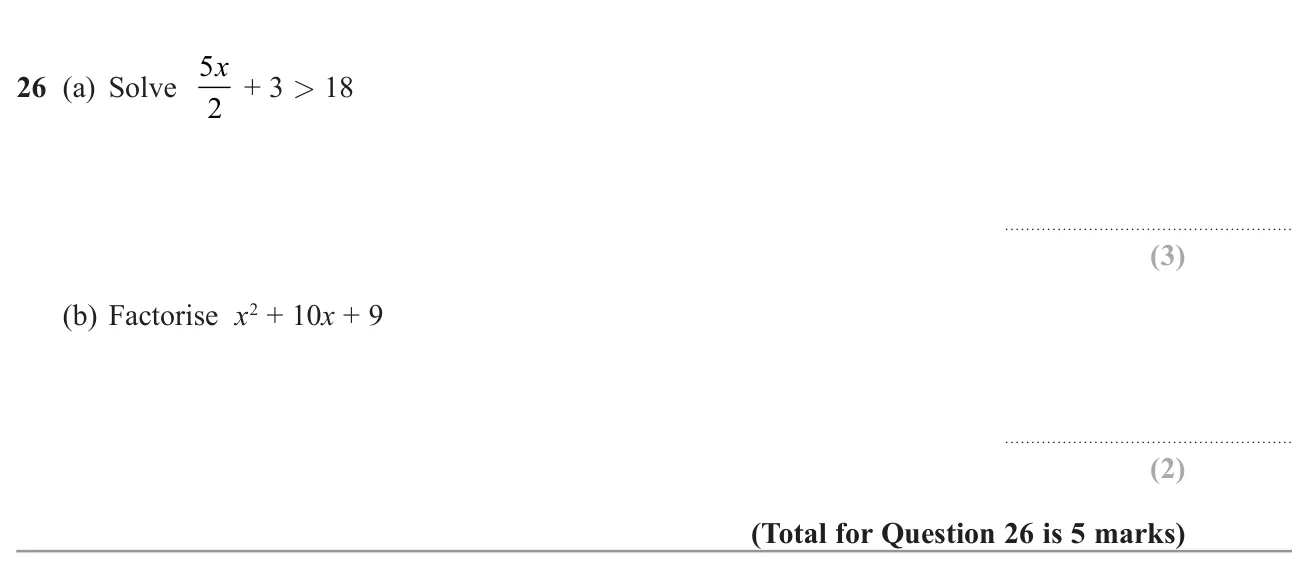
© Pearson Education Ltd. November 2022 Paper 1 (Foundation, non-calculator), question 26.
(a) x > 6 x > 6 x > 6 3 marks (b) ( x + 9 ) ( x + 1 ) (x + 9)(x + 1) ( x + 9 ) ( x + 1 ) 2 marks
Worked solution Checked against the mark scheme
(a) 5 x 2 + 3 > 18 \frac{5x}{2} + 3 > 18 2 5 x + 3 > 18
5 x 2 > 15 \frac{5x}{2} > 15 2 5 x > 15 5 x > 30 5x > 30 5 x > 30 x > 6 x > 6 x > 6
(b) Need two numbers that multiply to 9 and add to 10: 9 and 1.
( x + 9 ) ( x + 1 ) (x + 9)(x + 1) ( x + 9 ) ( x + 1 )
Watch out: In (a), giving x = 6 x = 6 x = 6
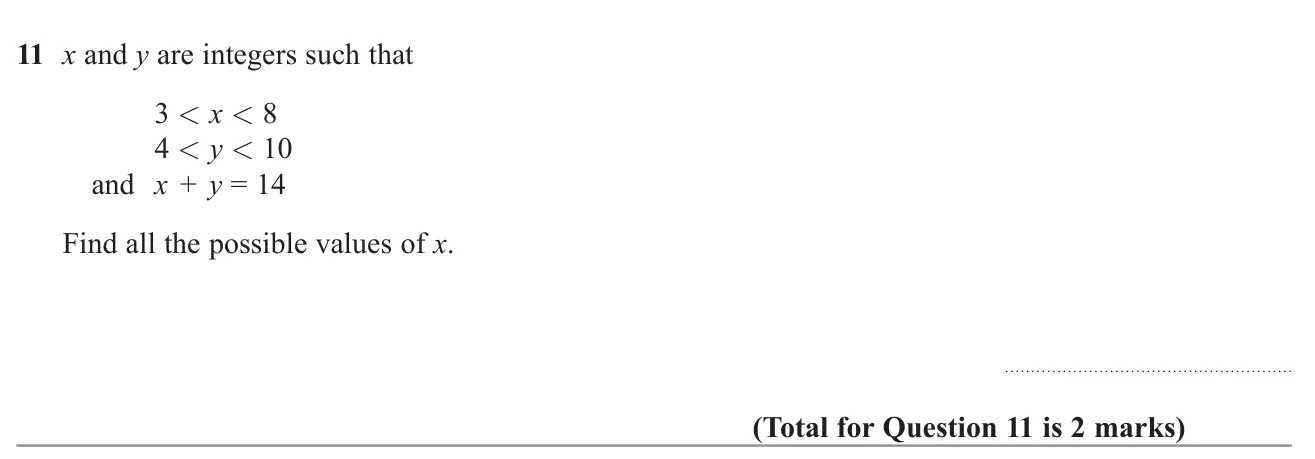
© Pearson Education Ltd. November 2022 Paper 3 (Higher, calculator), question 11.
Worked solution Checked against the mark scheme
Possible x: 4, 5, 6, 7. Possible y: 5, 6, 7, 8, 9
y = 14 − x y = 14 - x y = 14 − x
So x = 5, 6 or 7
Watch out: Including 4, or including the endpoints 3 and 8 from the strict inequalities.
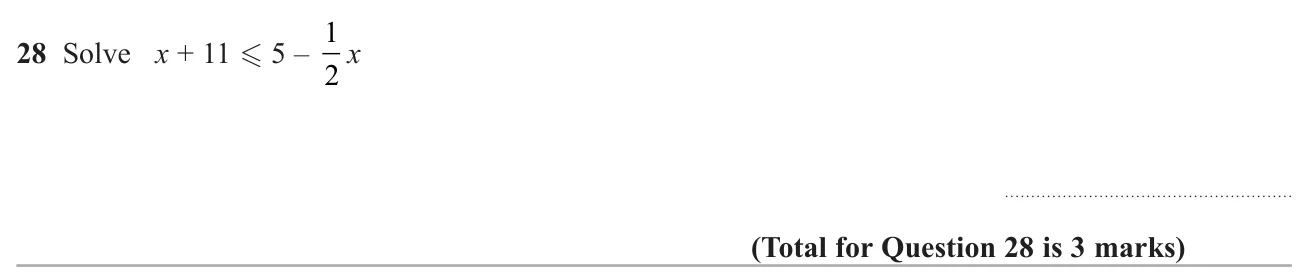
© Pearson Education Ltd. June 2024 Paper 1 (Foundation, non-calculator), question 28.
Answer x ≤ − 4 x \le -4 x ≤ − 4 3 marks
Worked solution Checked against the mark scheme
x + 11 ≤ 5 − 1 2 x x + 11 \le 5 - \frac{1}{2}x x + 11 ≤ 5 − 2 1 x
3 2 x ≤ − 6 \frac{3}{2}x \le -6 2 3 x ≤ − 6
x ≤ − 4 x \le -4 x ≤ − 4
Watch out: Giving just −4 or x = −4 without the inequality sign.
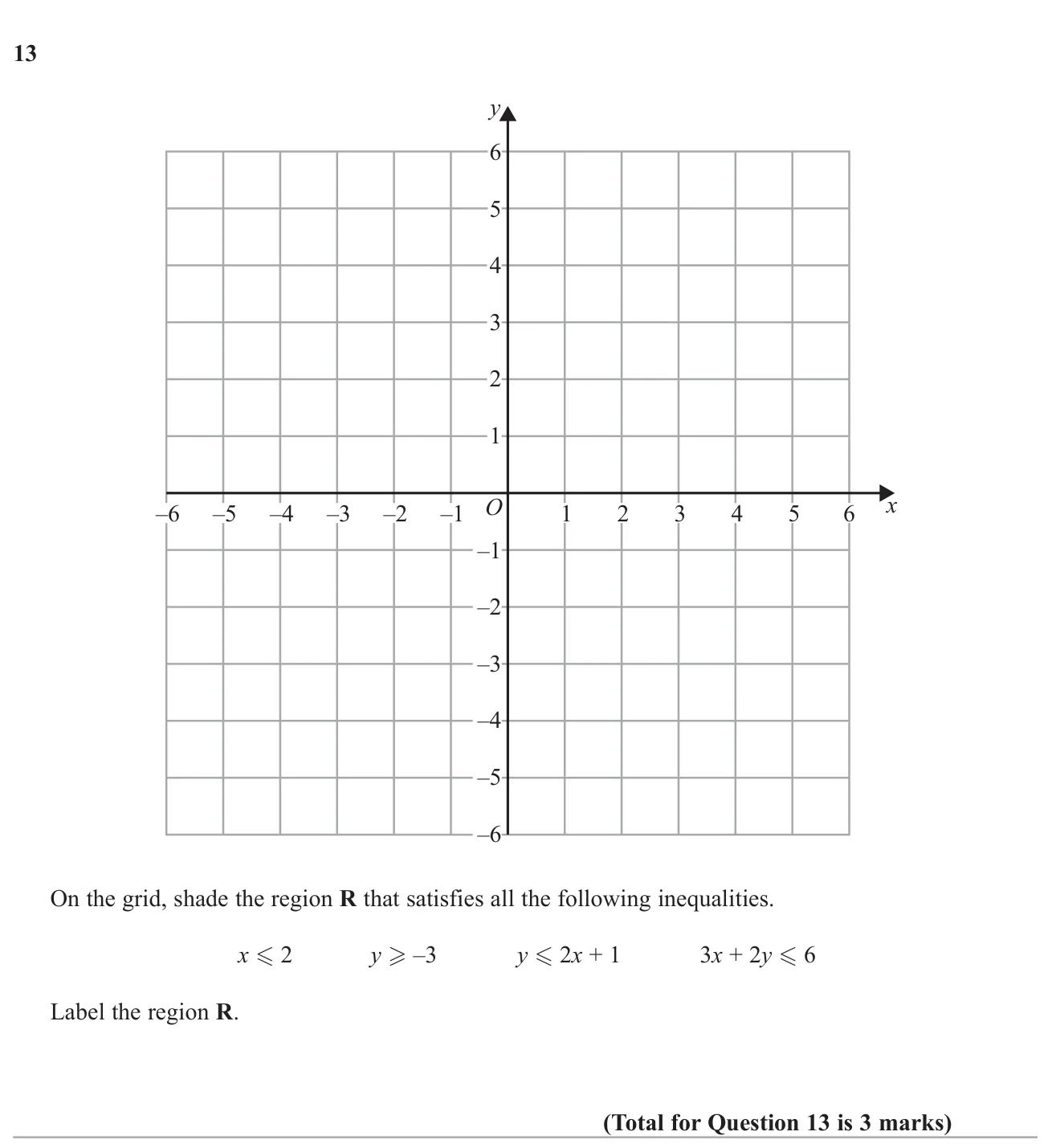
© Pearson Education Ltd. June 2024 Paper 2 (Higher, calculator), question 13.
Answer Region bounded by x = 2 x = 2 x = 2 y = − 3 y = -3 y = − 3 y = 2 x + 1 y = 2x + 1 y = 2 x + 1 3 x + 2 y = 6 3x + 2y = 6 3 x + 2 y = 6 3 marks
Worked solution Checked against the mark scheme
Draw the four lines: x = 2 x = 2 x = 2 y = − 3 y = -3 y = − 3 y = 2 x + 1 y = 2x + 1 y = 2 x + 1 ( 0 , 1 ) (0,1) ( 0 , 1 ) 3 x + 2 y = 6 3x + 2y = 6 3 x + 2 y = 6 ( 0 , 3 ) (0,3) ( 0 , 3 ) ( 2 , 0 ) (2,0) ( 2 , 0 )
The region is left of x = 2 x=2 x = 2 y = − 3 y=-3 y = − 3 y = 2 x + 1 y=2x+1 y = 2 x + 1 3 x + 2 y = 6 3x+2y=6 3 x + 2 y = 6
The region is a quadrilateral with corners ( − 2 , − 3 ) (-2,-3) ( − 2 , − 3 ) ( 4 7 , 15 7 ) (\tfrac47, \tfrac{15}{7}) ( 7 4 , 7 15 ) ( 2 , 0 ) (2, 0) ( 2 , 0 ) ( 2 , − 3 ) (2,-3) ( 2 , − 3 )
Watch out: Shading the wrong side of y = 2 x + 1 y = 2x + 1 y = 2 x + 1 3 x + 2 y = 6 3x + 2y = 6 3 x + 2 y = 6
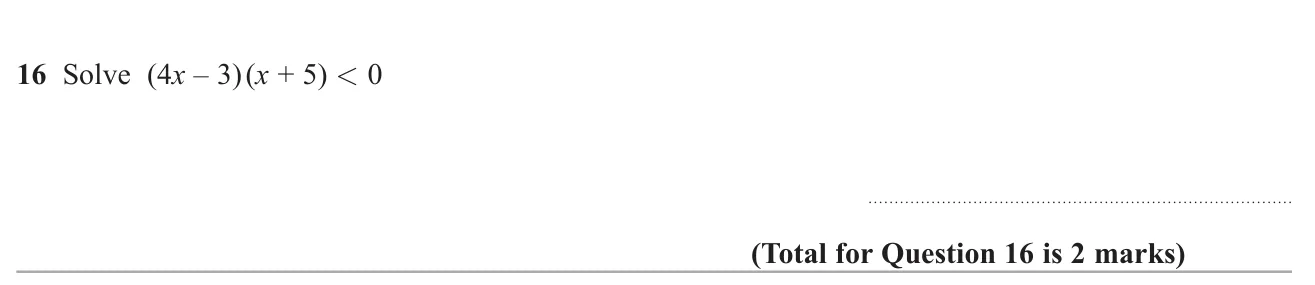
© Pearson Education Ltd. June 2024 Paper 2 (Higher, calculator), question 16.
Answer − 5 < x < 3 4 -5 < x < \tfrac34 − 5 < x < 4 3 2 marks
Worked solution Checked against the mark scheme
Critical values: 4 x − 3 = 0 ⇒ x = 3 4 4x - 3 = 0 \Rightarrow x = \frac34 4 x − 3 = 0 ⇒ x = 4 3 x + 5 = 0 ⇒ x = − 5 x + 5 = 0 \Rightarrow x = -5 x + 5 = 0 ⇒ x = − 5
The product is negative between the roots (the graph is a U shape below the axis there).
So − 5 < x < 3 4 -5 < x < \frac34 − 5 < x < 4 3
Watch out: Giving the outside region (x < − 5 x < -5 x < − 5 x > 3 4 x > \frac34 x > 4 3 x < 3 4 x < \frac34 x < 4 3
© Pearson Education Ltd. November 2023 Paper 1 (Higher, non-calculator), question 17.
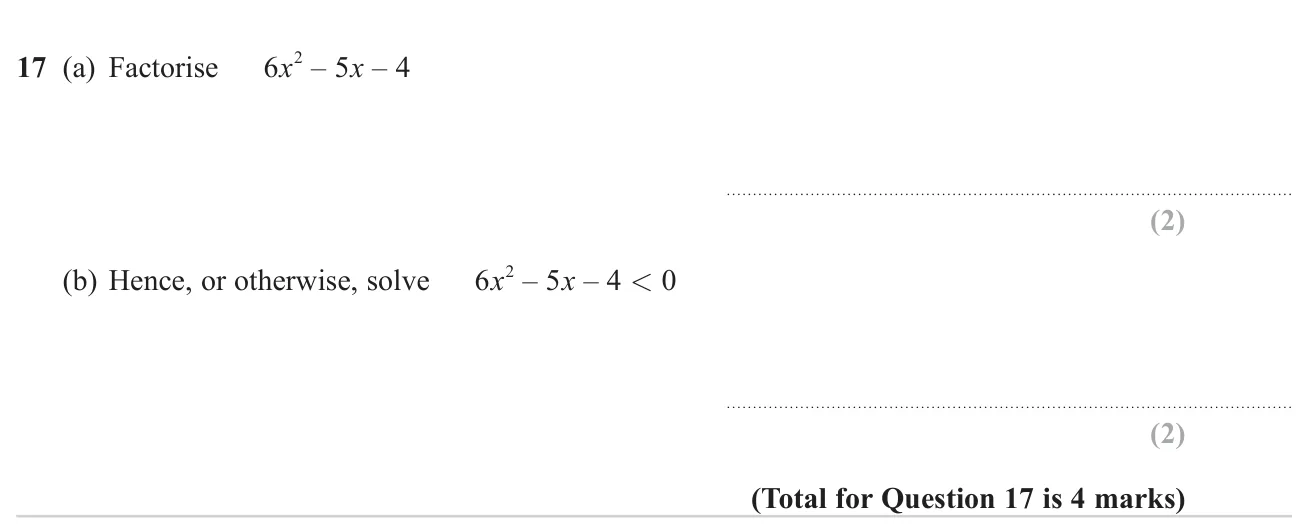
(a) ( 2 x + 1 ) ( 3 x − 4 ) (2x + 1)(3x - 4) ( 2 x + 1 ) ( 3 x − 4 ) 2 marks (b) − 1 2 < x < 4 3 -\frac{1}{2} < x < \frac{4}{3} − 2 1 < x < 3 4 2 marks
Worked solution Checked against the mark scheme
(a) 6 × ( − 4 ) = − 24 6 \times (-4) = -24 6 × ( − 4 ) = − 24 − 8 -8 − 8 3 3 3 6 x 2 − 8 x + 3 x − 4 = 2 x ( 3 x − 4 ) + ( 3 x − 4 ) = ( 2 x + 1 ) ( 3 x − 4 ) 6x^2 - 8x + 3x - 4 = 2x(3x - 4) + (3x - 4) = (2x + 1)(3x - 4) 6 x 2 − 8 x + 3 x − 4 = 2 x ( 3 x − 4 ) + ( 3 x − 4 ) = ( 2 x + 1 ) ( 3 x − 4 )
(b) Critical values: x = − 1 2 x = -\frac{1}{2} x = − 2 1 x = 4 3 x = \frac{4}{3} x = 3 4
The graph is a U shape, so it is below zero between the roots: − 1 2 < x < 4 3 -\frac{1}{2} < x < \frac{4}{3} − 2 1 < x < 3 4
Watch out: Giving the outside region (x < −1/2 or x > 4/3) for a 'less than 0' inequality.
© Pearson Education Ltd. November 2022 Paper 2 (Higher, calculator), question 16.
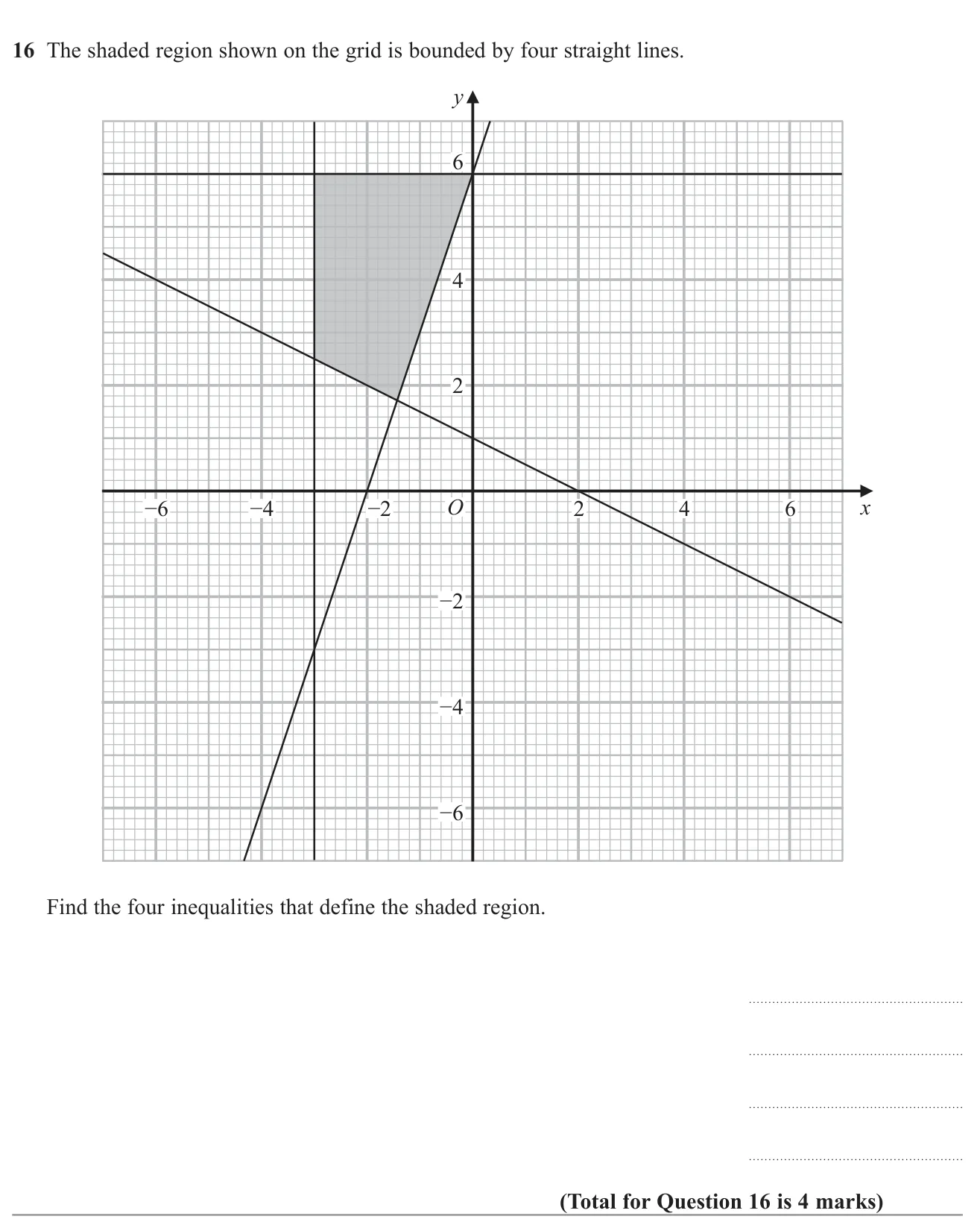
Answer y ≤ 6 y \le 6 y ≤ 6 x ≥ − 3 x \ge -3 x ≥ − 3 y ≥ 3 x + 6 y \ge 3x + 6 y ≥ 3 x + 6 y ≥ − 1 2 x + 1 y \ge -\frac{1}{2}x + 1 y ≥ − 2 1 x + 1 4 marks
Worked solution Checked against the mark scheme
Horizontal line: y = 6 y = 6 y = 6 y ≤ 6 y \le 6 y ≤ 6
Vertical line: x = − 3 x = -3 x = − 3 x ≥ − 3 x \ge -3 x ≥ − 3
Steep line through ( 0 , 6 ) (0, 6) ( 0 , 6 ) ( − 2 , 0 ) (-2, 0) ( − 2 , 0 ) y = 3 x + 6 y = 3x + 6 y = 3 x + 6 y ≥ 3 x + 6 y \ge 3x + 6 y ≥ 3 x + 6
Shallow line through ( 0 , 1 ) (0, 1) ( 0 , 1 ) ( 2 , 0 ) (2, 0) ( 2 , 0 ) − 1 2 -\frac{1}{2} − 2 1 y ≥ − 1 2 x + 1 y \ge -\frac{1}{2}x + 1 y ≥ − 2 1 x + 1
Watch out: Getting the inequality sign the wrong way round for the sloping lines.
© Pearson Education Ltd. November 2021 Paper 1 (Higher, non-calculator), question 17.
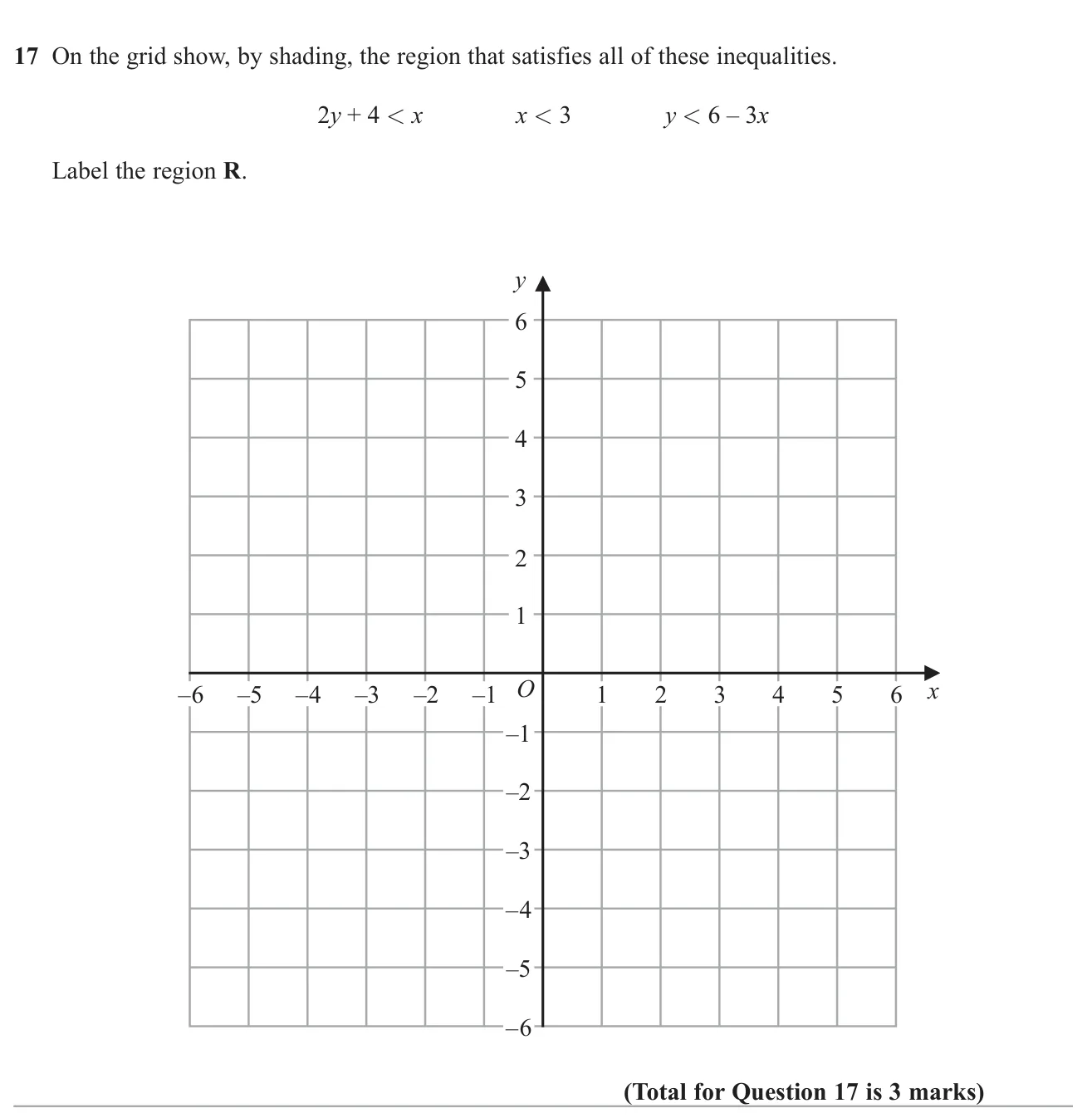
Answer Region labelled R that lies below y = 1 2 x − 2 y = \frac{1}{2}x - 2 y = 2 1 x − 2 y = 6 − 3 x y = 6 - 3x y = 6 − 3 x x = 3 x = 3 x = 3 3 marks
Worked solution Checked against the mark scheme
Draw x = 2 y + 4 x = 2y + 4 x = 2 y + 4 y = 1 2 x − 2 y = \frac{1}{2}x - 2 y = 2 1 x − 2
Draw x = 3 x = 3 x = 3 y = 6 − 3 x y = 6 - 3x y = 6 − 3 x
2 y + 4 < x 2y + 4 < x 2 y + 4 < x x < 3 x < 3 x < 3 x = 3 x = 3 x = 3 y < 6 − 3 x y < 6 - 3x y < 6 − 3 x
The two sloping lines cross at about ( 2.3 , − 0.9 ) (2.3, -0.9) ( 2.3 , − 0.9 ) y = 6 − 3 x y = 6 - 3x y = 6 − 3 x x = 3 x = 3 x = 3 ( 3 , − 3 ) (3, -3) ( 3 , − 3 ) x = 3 x = 3 x = 3
Watch out: Shading the wrong side of 2 y + 4 < x 2y + 4 < x 2 y + 4 < x y < . . . y < ... y < ...
© Pearson Education Ltd. November 2020 Paper 3 (Higher, calculator), question 13.
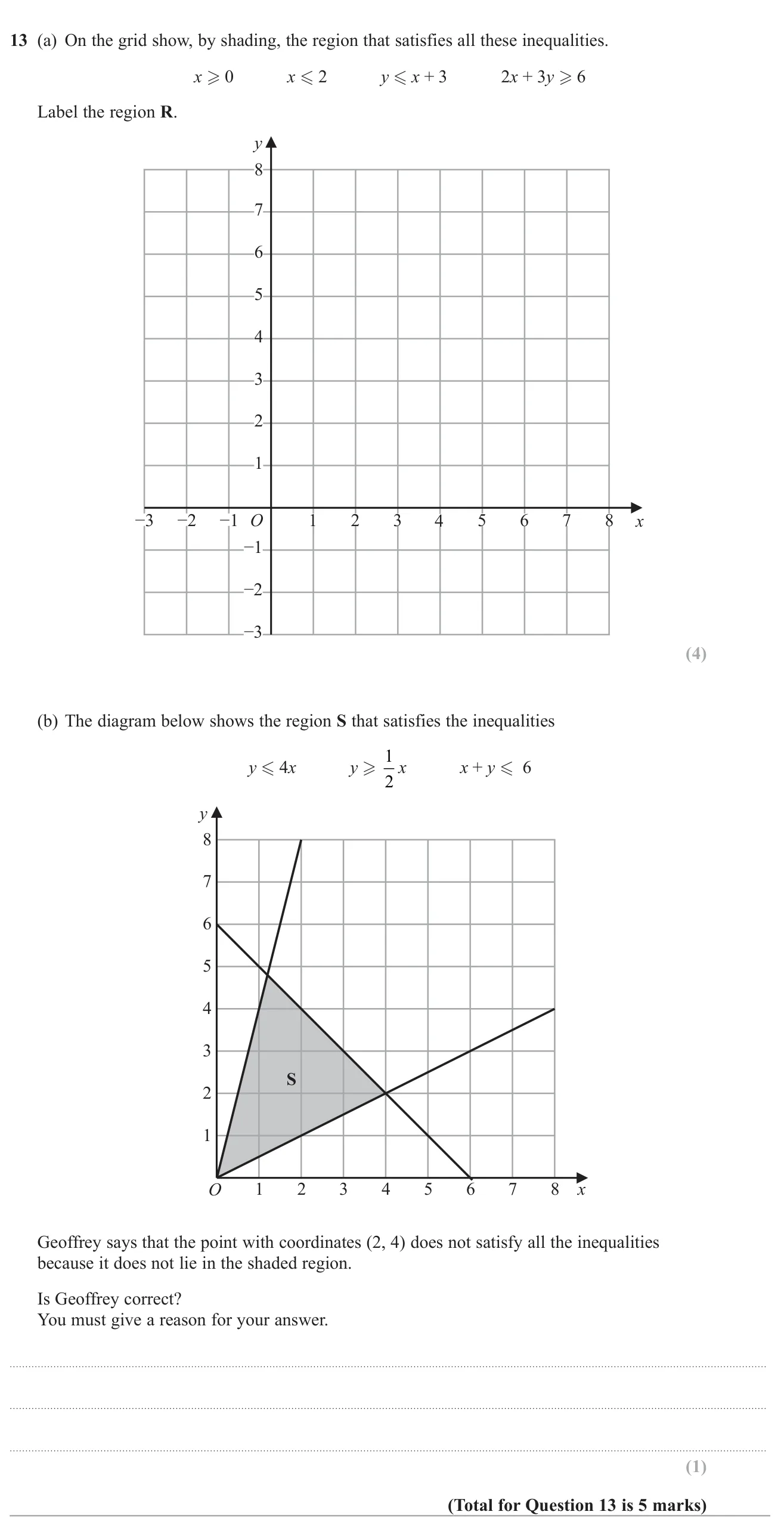
(a) Region R bounded by x = 0 x = 0 x = 0 x = 2 x = 2 x = 2 y = x + 3 y = x + 3 y = x + 3 2 x + 3 y = 6 2x + 3y = 6 2 x + 3 y = 6 4 marks (b) No: ( 2 , 4 ) (2, 4) ( 2 , 4 ) x + y = 6 x + y = 6 x + y = 6 1 mark
Worked solution Checked against the mark scheme
(a) Draw x = 2 x = 2 x = 2 y = x + 3 y = x + 3 y = x + 3 ( 0 , 3 ) (0,3) ( 0 , 3 ) ( 2 , 5 ) (2,5) ( 2 , 5 ) 2 x + 3 y = 6 2x + 3y = 6 2 x + 3 y = 6 ( 0 , 2 ) (0,2) ( 0 , 2 ) ( 3 , 0 ) (3,0) ( 3 , 0 )
The region is between x = 0 x = 0 x = 0 x = 2 x = 2 x = 2 y = x + 3 y = x + 3 y = x + 3 2 x + 3 y = 6 2x + 3y = 6 2 x + 3 y = 6
(b) At ( 2 , 4 ) (2, 4) ( 2 , 4 ) y = 4 ≤ 4 x = 8 y = 4 \le 4x = 8 y = 4 ≤ 4 x = 8 y = 4 ≥ 1 2 x = 1 y = 4 \ge \frac{1}{2}x = 1 y = 4 ≥ 2 1 x = 1 x + y = 6 ≤ 6 x + y = 6 \le 6 x + y = 6 ≤ 6 wrong .
Watch out: Forgetting that ≤ and ≥ include points on the boundary line.
© Pearson Education Ltd. Specimen Paper 3 (Higher, calculator), question 10.
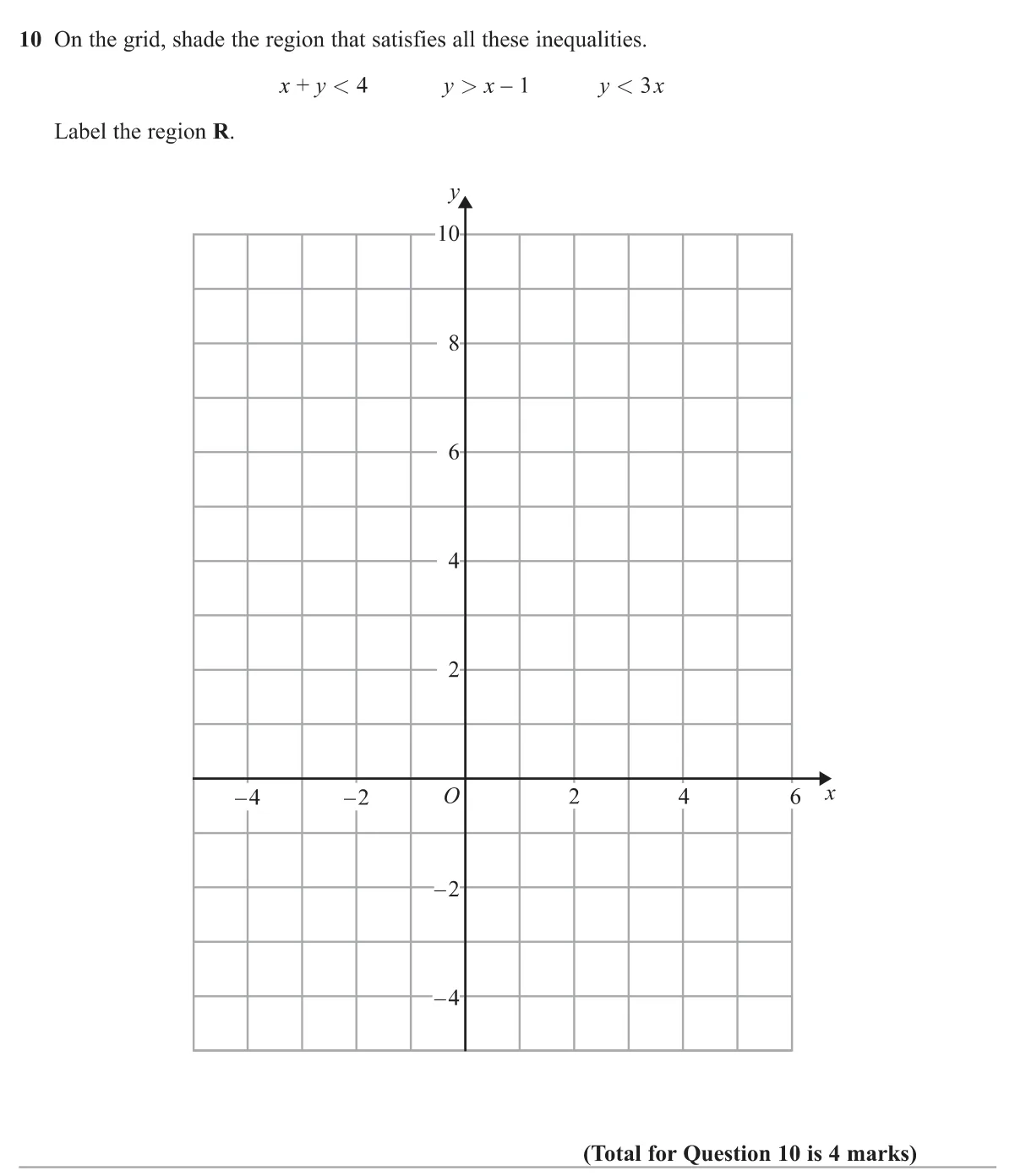
Answer The triangle with corners ( 1 , 3 ) (1, 3) ( 1 , 3 ) ( 2.5 , 1.5 ) (2.5, 1.5) ( 2.5 , 1.5 ) ( − 0.5 , − 1.5 ) (-0.5, -1.5) ( − 0.5 , − 1.5 ) 4 marks
Worked solution Checked against the mark scheme
Draw x + y = 4 x + y = 4 x + y = 4 ( 0 , 4 ) (0, 4) ( 0 , 4 ) ( 4 , 0 ) (4, 0) ( 4 , 0 ) y = x − 1 y = x - 1 y = x − 1 ( 0 , − 1 ) (0, -1) ( 0 , − 1 ) ( 1 , 0 ) (1, 0) ( 1 , 0 ) y = 3 x y = 3x y = 3 x ( 0 , 0 ) (0, 0) ( 0 , 0 ) ( 1 , 3 ) (1, 3) ( 1 , 3 )
Test ( 1 , 1 ) (1, 1) ( 1 , 1 ) 2 < 4 2 < 4 2 < 4 1 > 0 1 > 0 1 > 0 1 < 3 1 < 3 1 < 3 ( 1 , 1 ) (1, 1) ( 1 , 1 )
R is the triangle with corners ( 1 , 3 ) (1, 3) ( 1 , 3 ) ( 2.5 , 1.5 ) (2.5, 1.5) ( 2.5 , 1.5 ) ( − 0.5 , − 1.5 ) (-0.5, -1.5) ( − 0.5 , − 1.5 )
Watch out: Shading the wrong side of y = 3x.
© Pearson Education Ltd. June 2022 Paper 2 (Higher, calculator), question 22.
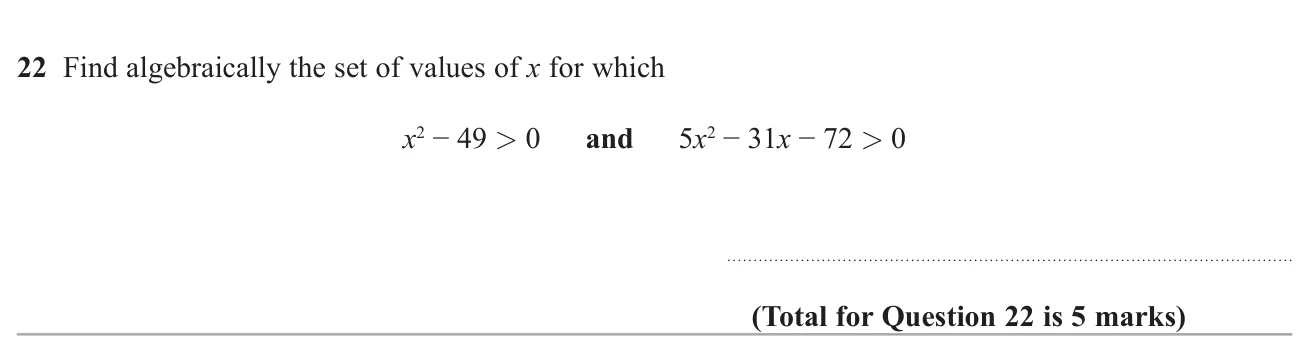
Answer x < − 7 x < -7 x < − 7 x > 8 x > 8 x > 8 5 marks
Worked solution Checked against the mark scheme
x 2 − 49 > 0 x^2 - 49 > 0 x 2 − 49 > 0 ( x + 7 ) ( x − 7 ) > 0 (x + 7)(x - 7) > 0 ( x + 7 ) ( x − 7 ) > 0 x < − 7 x < -7 x < − 7 x > 7 x > 7 x > 7
5 x 2 − 31 x − 72 > 0 5x^2 - 31x - 72 > 0 5 x 2 − 31 x − 72 > 0 ( 5 x + 9 ) ( x − 8 ) > 0 (5x + 9)(x - 8) > 0 ( 5 x + 9 ) ( x − 8 ) > 0 x < − 1.8 x < -1.8 x < − 1.8 x > 8 x > 8 x > 8
Both true: x < − 7 x < -7 x < − 7 x > 8 x > 8 x > 8
Watch out: Giving − 7 < x < 7 -7 < x < 7 − 7 < x < 7
© Pearson Education Ltd. November 2019 Paper 2 (Higher, calculator), question 23.
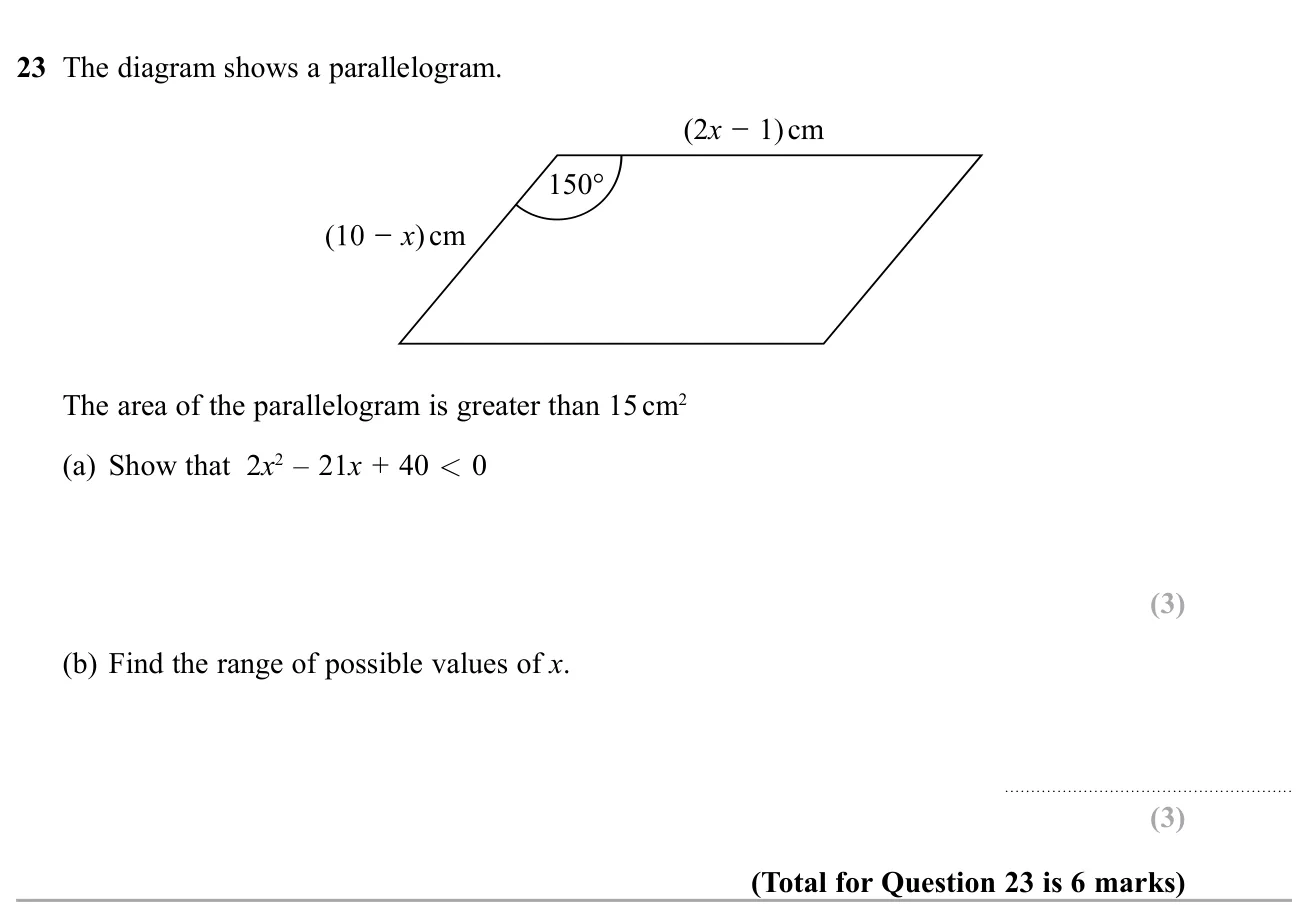
(a) Area = ( 2 x − 1 ) ( 10 − x ) sin 150 ° > 15 = (2x-1)(10-x)\sin 150° > 15 = ( 2 x − 1 ) ( 10 − x ) sin 150° > 15 2 x 2 − 21 x + 40 < 0 2x^2 - 21x + 40 < 0 2 x 2 − 21 x + 40 < 0 3 marks (b) 2.5 < x < 8 2.5 < x < 8 2.5 < x < 8 3 marks
Worked solution Checked against the mark scheme
(a) Area = a b sin C = ( 2 x − 1 ) ( 10 − x ) × sin 150 ° = 1 2 ( 2 x − 1 ) ( 10 − x ) = ab\sin C = (2x - 1)(10 - x) \times \sin 150° = \frac{1}{2}(2x - 1)(10 - x) = ab sin C = ( 2 x − 1 ) ( 10 − x ) × sin 150° = 2 1 ( 2 x − 1 ) ( 10 − x )
= 1 2 ( − 2 x 2 + 21 x − 10 ) = \frac{1}{2}(-2x^2 + 21x - 10) = 2 1 ( − 2 x 2 + 21 x − 10 )
So 1 2 ( − 2 x 2 + 21 x − 10 ) > 15 ⇒ − 2 x 2 + 21 x − 10 > 30 ⇒ 2 x 2 − 21 x + 40 < 0 \frac{1}{2}(-2x^2 + 21x - 10) > 15 \Rightarrow -2x^2 + 21x - 10 > 30 \Rightarrow 2x^2 - 21x + 40 < 0 2 1 ( − 2 x 2 + 21 x − 10 ) > 15 ⇒ − 2 x 2 + 21 x − 10 > 30 ⇒ 2 x 2 − 21 x + 40 < 0
(b) ( 2 x − 5 ) ( x − 8 ) < 0 (2x - 5)(x - 8) < 0 ( 2 x − 5 ) ( x − 8 ) < 0 x = 2.5 x = 2.5 x = 2.5 x = 8 x = 8 x = 8
The U-shaped graph is below zero between the roots, so 2.5 < x < 8 2.5 < x < 8 2.5 < x < 8
Watch out: Using the parallelogram area as 1 2 a b sin C \frac{1}{2}ab\sin C 2 1 ab sin C x < 2.5 x < 2.5 x < 2.5 x > 8 x > 8 x > 8
© Pearson Education Ltd. November 2018 Paper 2 (Higher, calculator), question 19.
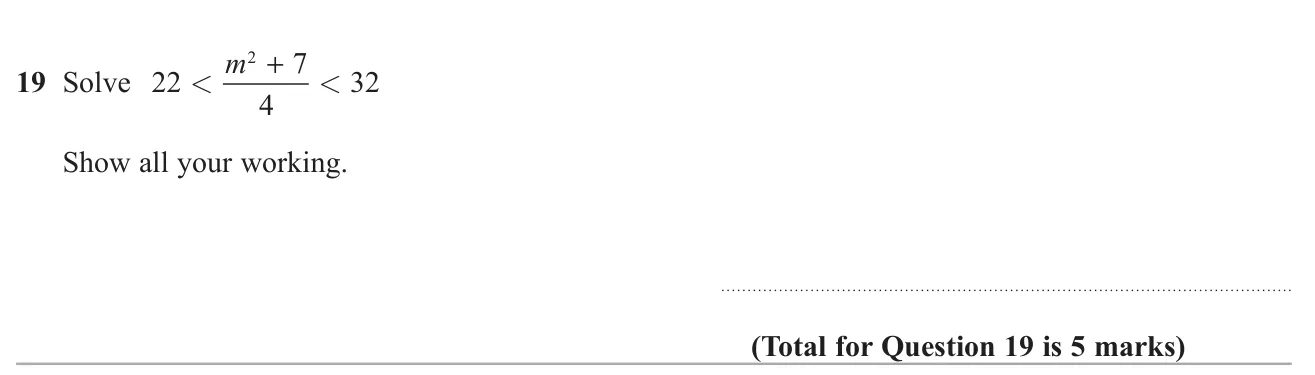
Answer 9 < m < 11 9 < m < 11 9 < m < 11 − 11 < m < − 9 -11 < m < -9 − 11 < m < − 9 5 marks
Worked solution Checked against the mark scheme
Multiply by 4: 88 < m 2 + 7 < 128 88 < m^2 + 7 < 128 88 < m 2 + 7 < 128
Subtract 7: 81 < m 2 < 121 81 < m^2 < 121 81 < m 2 < 121
So 9 < ∣ m ∣ < 11 9 < |m| < 11 9 < ∣ m ∣ < 11
9 < m < 11 9 < m < 11 9 < m < 11 − 11 < m < − 9 -11 < m < -9 − 11 < m < − 9
Watch out: Forgetting the negative range.
© Pearson Education Ltd. June 2023 Paper 1 (Higher, non-calculator), question 24.
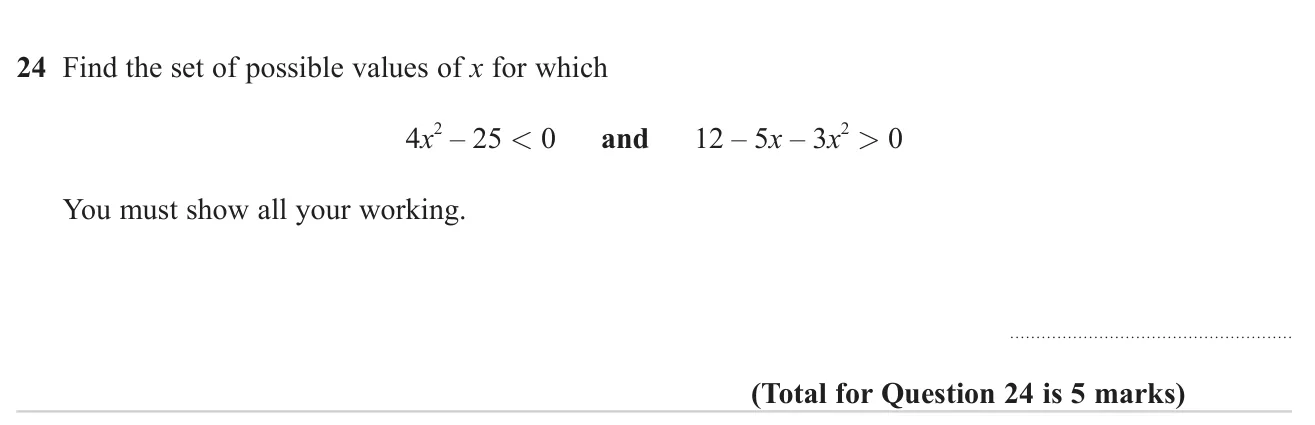
Answer − 2.5 < x < 4 3 -2.5 < x < \frac{4}{3} − 2.5 < x < 3 4 5 marks
Worked solution Checked against the mark scheme
4 x 2 − 25 = ( 2 x + 5 ) ( 2 x − 5 ) < 0 4x^2 - 25 = (2x + 5)(2x - 5) < 0 4 x 2 − 25 = ( 2 x + 5 ) ( 2 x − 5 ) < 0 − 2.5 < x < 2.5 -2.5 < x < 2.5 − 2.5 < x < 2.5
12 − 5 x − 3 x 2 > 0 12 - 5x - 3x^2 > 0 12 − 5 x − 3 x 2 > 0 3 x 2 + 5 x − 12 < 0 3x^2 + 5x - 12 < 0 3 x 2 + 5 x − 12 < 0 ( 3 x − 4 ) ( x + 3 ) < 0 (3x - 4)(x + 3) < 0 ( 3 x − 4 ) ( x + 3 ) < 0 − 3 < x < 4 3 -3 < x < \frac{4}{3} − 3 < x < 3 4
Both must hold, so − 2.5 < x < 4 3 -2.5 < x < \frac{4}{3} − 2.5 < x < 3 4
Watch out: Taking the outside region (x < a or x > b) instead of the region between the critical values.
© Pearson Education Ltd. June 2018 Paper 1 (Higher, non-calculator), question 20.
Worked solution Checked against the mark scheme
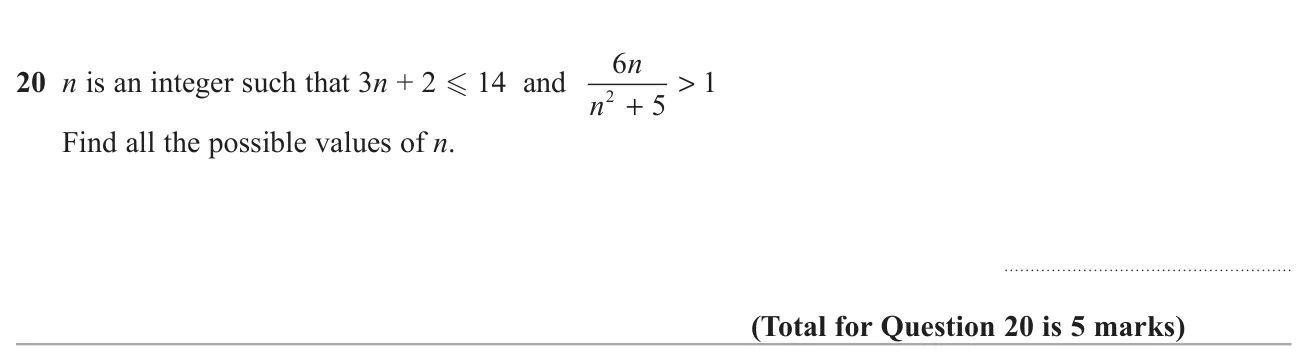
3 n + 2 ≤ 14 ⇒ 3 n ≤ 12 ⇒ n ≤ 4 3n + 2 \le 14 \Rightarrow 3n \le 12 \Rightarrow n \le 4 3 n + 2 ≤ 14 ⇒ 3 n ≤ 12 ⇒ n ≤ 4
n 2 + 5 n^2 + 5 n 2 + 5 6 n n 2 + 5 > 1 ⇒ 6 n > n 2 + 5 ⇒ n 2 − 6 n + 5 < 0 \frac{6n}{n^2 + 5} > 1 \Rightarrow 6n > n^2 + 5 \Rightarrow n^2 - 6n + 5 < 0 n 2 + 5 6 n > 1 ⇒ 6 n > n 2 + 5 ⇒ n 2 − 6 n + 5 < 0
( n − 1 ) ( n − 5 ) < 0 ⇒ 1 < n < 5 (n - 1)(n - 5) < 0 \Rightarrow 1 < n < 5 ( n − 1 ) ( n − 5 ) < 0 ⇒ 1 < n < 5
Both together: 1 < n ≤ 4 1 < n \le 4 1 < n ≤ 4 n = 2 , 3 , 4 n = 2, 3, 4 n = 2 , 3 , 4
Watch out: Including n = 1 n = 1 n = 1
Also tested in these questions Their main topic is different, but part of each one tests this topic.