Revision guide by The Full Marks
Simultaneous equations: what you need to know Simultaneous equations are two equations with two unknowns that are both true at once. You find the pair of values that works for both, either algebraically or from where two graphs cross.
Foundation needs two linear equations; a linear equation with a quadratic is Higher only.
Key facts Elimination: make the coefficients of one letter match, then add (different signs) or subtract (same signs). Substitution: rearrange one equation for a letter and put it into the other. On a graph, the solution is the point where the lines cross. Higher: a line and a curve can meet at 2 points, 1 point (a tangent) or not at all. Linear pair by elimination Multiply one or both equations so one letter has the same number in front. Same signs: subtract. Different signs: add. Solve for the remaining letter, substitute back, then check in the other equation. Word problems Choose a letter for each unknown, e.g. t t t c c c Write two equations from the information, solve them, then answer the question actually asked. Higher: linear and quadratic by substitution Rearrange the linear equation to y = … y = \ldots y = … x = … x = \ldots x = … Substitute into the quadratic, expand and rearrange to = 0 = 0 = 0 Solve the quadratic, then find the matching value of the other letter for each answer. Worked examples Example 1 Foundation · grade 5
Solve 3 x + 2 y = 4 3x + 2y = 4 3 x + 2 y = 4 4 x + 5 y = 17 4x + 5y = 17 4 x + 5 y = 17
Show the solution Make the y y y 15 x + 10 y = 20 15x + 10y = 20 15 x + 10 y = 20 8 x + 10 y = 34 8x + 10y = 34 8 x + 10 y = 34 7 x = − 14 7x = -14 7 x = − 14 x = − 2 x = -2 x = − 2 3 ( − 2 ) + 2 y = 4 3(-2) + 2y = 4 3 ( − 2 ) + 2 y = 4 2 y = 10 2y = 10 2 y = 10 y = 5 y = 5 y = 5 4 ( − 2 ) + 5 ( 5 ) = − 8 + 25 = 17 4(-2) + 5(5) = -8 + 25 = 17 4 ( − 2 ) + 5 ( 5 ) = − 8 + 25 = 17
Example 2 Higher · grade 8
Solve y = x + 1 y = x + 1 y = x + 1 x 2 + y 2 = 13 x^2 + y^2 = 13 x 2 + y 2 = 13
Show the solution x 2 + ( x + 1 ) 2 = 13 x^2 + (x + 1)^2 = 13 x 2 + ( x + 1 ) 2 = 13 x 2 + x 2 + 2 x + 1 = 13 x^2 + x^2 + 2x + 1 = 13 x 2 + x 2 + 2 x + 1 = 13 2 x 2 + 2 x − 12 = 0 2x^2 + 2x - 12 = 0 2 x 2 + 2 x − 12 = 0 x 2 + x − 6 = 0 x^2 + x - 6 = 0 x 2 + x − 6 = 0 ( x + 3 ) ( x − 2 ) = 0 (x + 3)(x - 2) = 0 ( x + 3 ) ( x − 2 ) = 0 x = 2 x = 2 x = 2 y = 3 y = 3 y = 3 x = − 3 x = -3 x = − 3 y = − 2 y = -2 y = − 2
Common mistakes Subtracting when the signs are different (or adding when they are the same). Multiplying only some terms of an equation, e.g. the x x x Squaring a bracket wrongly: ( x + 1 ) 2 = x 2 + 2 x + 1 (x + 1)^2 = x^2 + 2x + 1 ( x + 1 ) 2 = x 2 + 2 x + 1 x 2 + 1 x^2 + 1 x 2 + 1 Giving the x x x y y y Reading a solution off a graph the wrong way round: give the x x x y y y Exam tips Answers with no working often get no marks: show the elimination or substitution step clearly. For "show that the line and curve meet at only one point", end with a sentence: the quadratic has only one (repeated) solution, so there is only one point of intersection. Questions people ask How do you solve simultaneous equations? Make the number in front of one letter the same in both equations, add or subtract to get rid of it, solve for the other letter, then substitute back.
What do simultaneous equations look like on a graph? Each equation is a line or curve. The solutions are the coordinates where they cross.
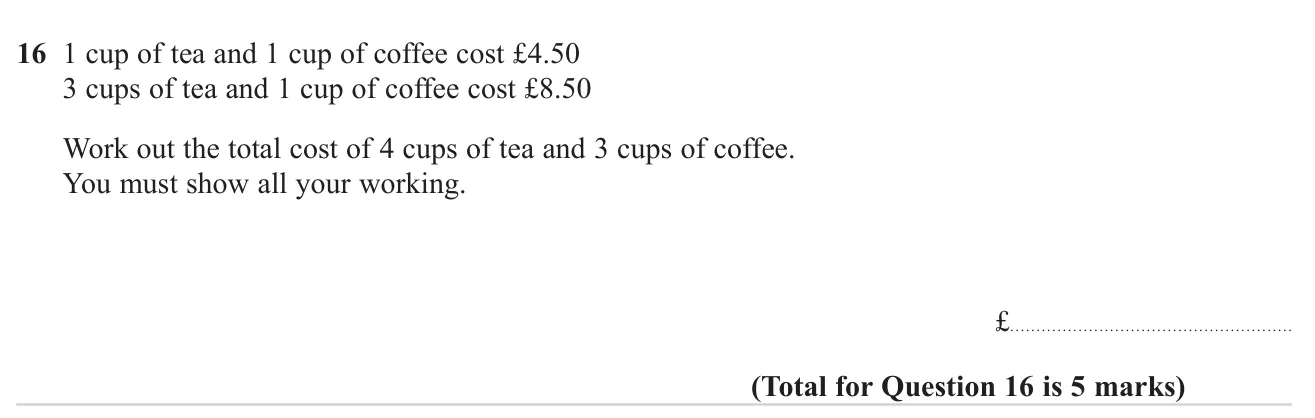
Exam questions: Simultaneous equations (21, easiest first) © Pearson Education Ltd. November 2024 Paper 1 (Foundation, non-calculator), question 16.
Answer £ 15.50 £15.50 £15.50 5 marks
Worked solution Checked against the mark scheme
The difference is 2 teas: 8.50 − 4.50 = £ 4 8.50 - 4.50 = £4 8.50 − 4.50 = £4 £ 2 £2 £2
1 coffee = 4.50 − 2 = £ 2.50 = 4.50 - 2 = £2.50 = 4.50 − 2 = £2.50
4 × 2 + 3 × 2.50 = 8 + 7.50 = £ 15.50 4 \times 2 + 3 \times 2.50 = 8 + 7.50 = £15.50 4 × 2 + 3 × 2.50 = 8 + 7.50 = £15.50
Watch out: Dividing £4.50 equally between tea and coffee.
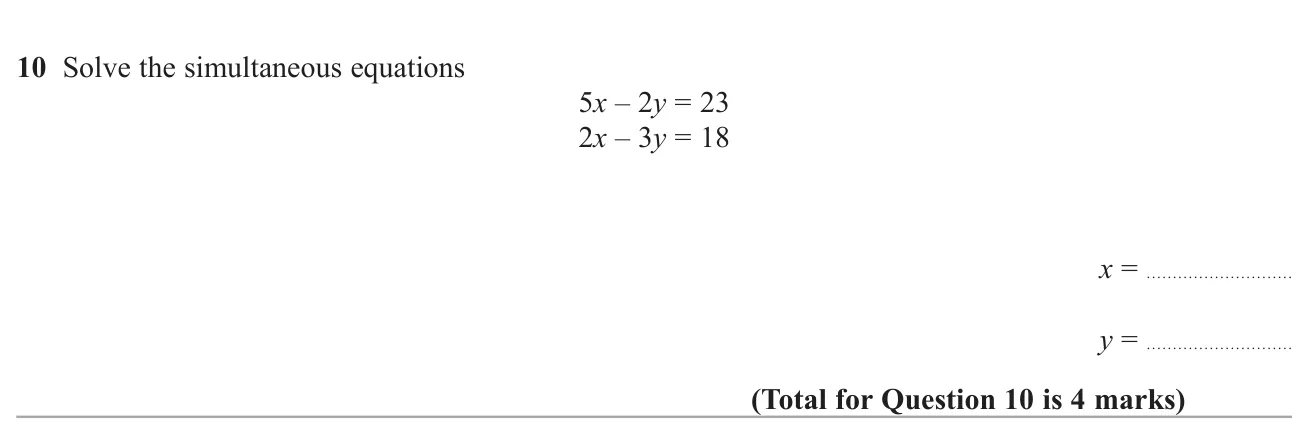
© Pearson Education Ltd. June 2024 Paper 1 (Higher, non-calculator), question 10.
Answer x = 3 , y = − 4 x = 3,\ y = -4 x = 3 , y = − 4 4 marks
Worked solution Checked against the mark scheme
Multiply the first equation by 3 and the second by 2:
15 x − 6 y = 69 15x - 6y = 69 15 x − 6 y = 69 4 x − 6 y = 36 4x - 6y = 36 4 x − 6 y = 36
Subtract: 11 x = 33 11x = 33 11 x = 33 x = 3 x = 3 x = 3
Substitute: 5 ( 3 ) − 2 y = 23 ⇒ − 2 y = 8 ⇒ y = − 4 5(3) - 2y = 23 \Rightarrow -2y = 8 \Rightarrow y = -4 5 ( 3 ) − 2 y = 23 ⇒ − 2 y = 8 ⇒ y = − 4
Watch out: Adding instead of subtracting when the y y y
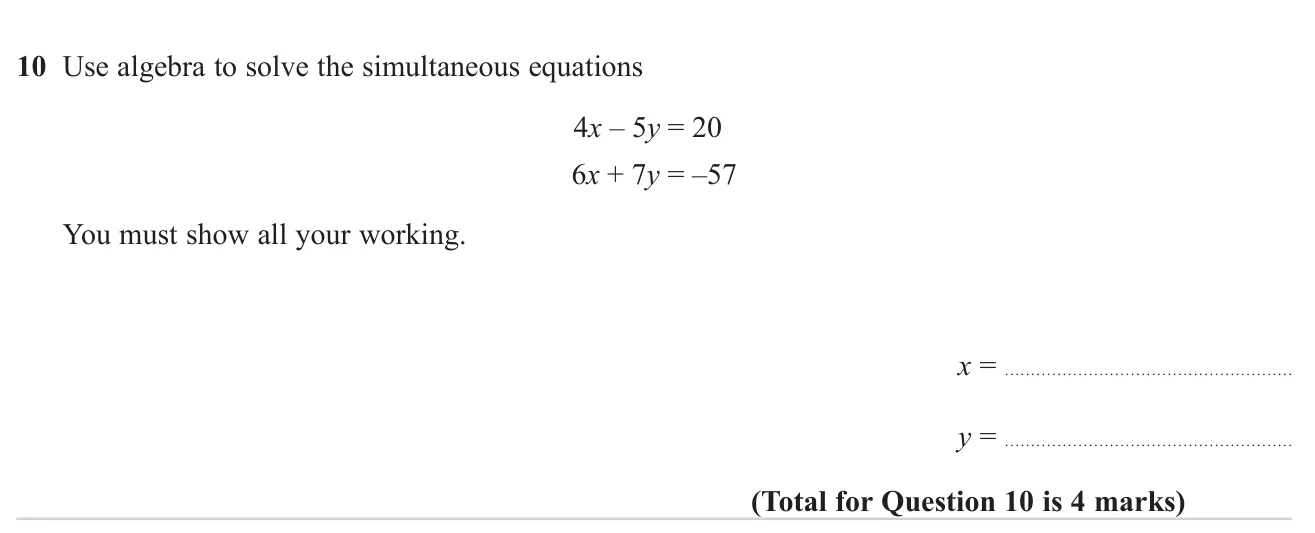
© Pearson Education Ltd. November 2024 Paper 2 (Higher, calculator), question 10.
Answer x = − 2.5 x = -2.5 x = − 2.5 y = − 6 y = -6 y = − 6 4 marks
Worked solution Checked against the mark scheme
Multiply the first by 7 and the second by 5:
28 x − 35 y = 140 28x - 35y = 140 28 x − 35 y = 140 30 x + 35 y = − 285 30x + 35y = -285 30 x + 35 y = − 285
Add: 58 x = − 145 58x = -145 58 x = − 145 x = − 2.5 x = -2.5 x = − 2.5
4 ( − 2.5 ) − 5 y = 20 ⇒ − 5 y = 30 ⇒ y = − 6 4(-2.5) - 5y = 20 \Rightarrow -5y = 30 \Rightarrow y = -6 4 ( − 2.5 ) − 5 y = 20 ⇒ − 5 y = 30 ⇒ y = − 6
Watch out: Adding when the signs mean you should subtract, or a sign slip with the negatives.
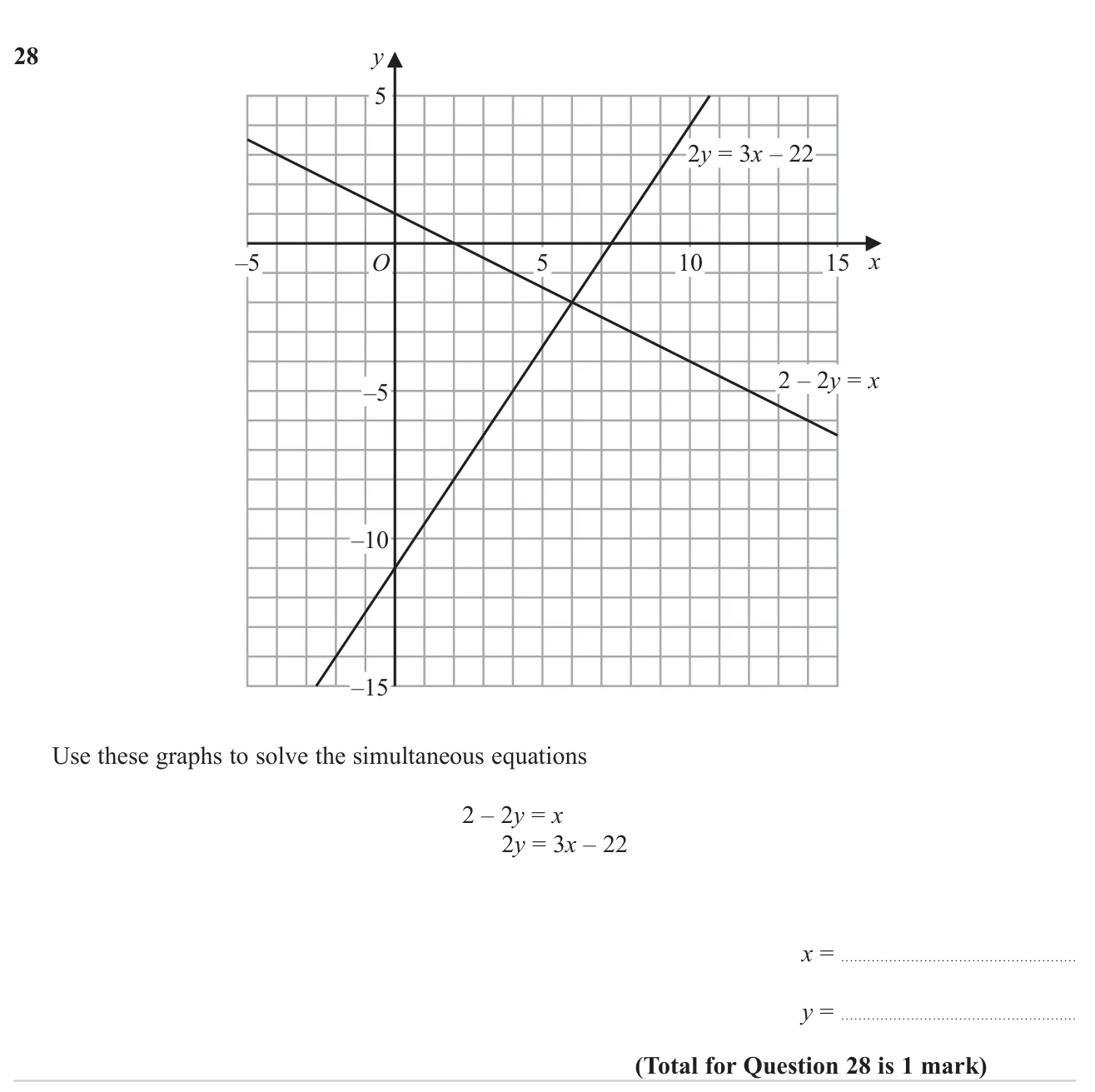
© Pearson Education Ltd. June 2023 Paper 1 (Foundation, non-calculator), question 28.
Answer x = 6 , y = − 2 x = 6,\ y = -2 x = 6 , y = − 2 1 mark
Worked solution Checked against the mark scheme
The solution is where the two lines meet, at ( 6 , − 2 ) (6, -2) ( 6 , − 2 )
Check: 2 − 2 ( − 2 ) = 6 2 - 2(-2) = 6 2 − 2 ( − 2 ) = 6 2 ( − 2 ) = − 4 = 3 ( 6 ) − 22 2(-2) = -4 = 3(6) - 22 2 ( − 2 ) = − 4 = 3 ( 6 ) − 22
So x = 6 x = 6 x = 6 y = − 2 y = -2 y = − 2
Watch out: Swapping x and y.
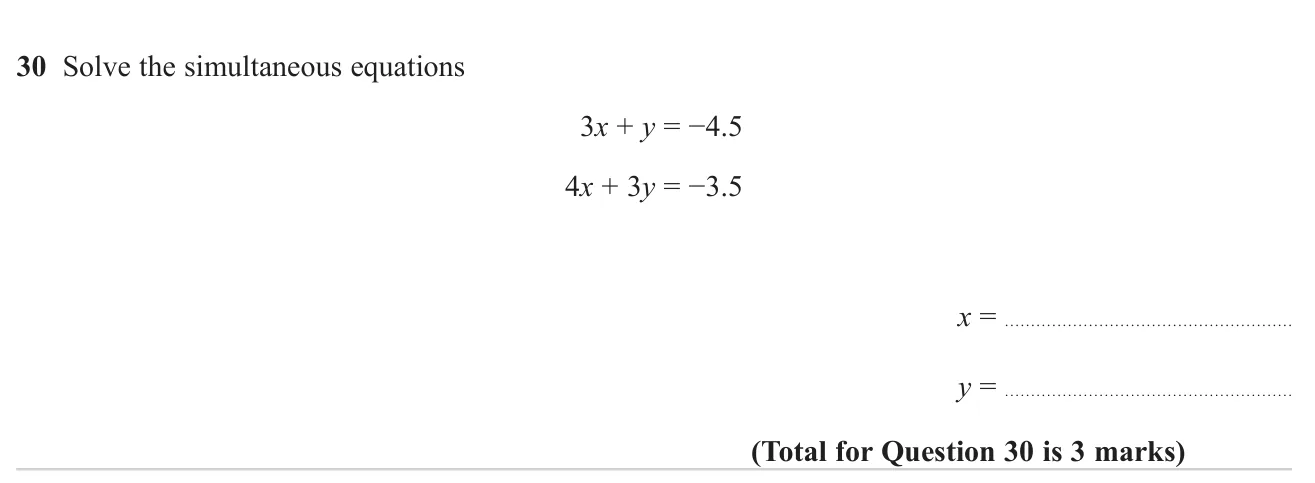
© Pearson Education Ltd. November 2023 Paper 2 (Foundation, calculator), question 30.
Answer x = − 2 , y = 1.5 x = -2,\ y = 1.5 x = − 2 , y = 1.5 3 marks
Worked solution Checked against the mark scheme
Multiply the first equation by 3: 9 x + 3 y = − 13.5 9x + 3y = -13.5 9 x + 3 y = − 13.5
Subtract the second: 5 x = − 10 5x = -10 5 x = − 10 x = − 2 x = -2 x = − 2
Substitute: 3 ( − 2 ) + y = − 4.5 3(-2) + y = -4.5 3 ( − 2 ) + y = − 4.5 y = 1.5 y = 1.5 y = 1.5
Watch out: Getting the sign wrong when subtracting negative numbers.
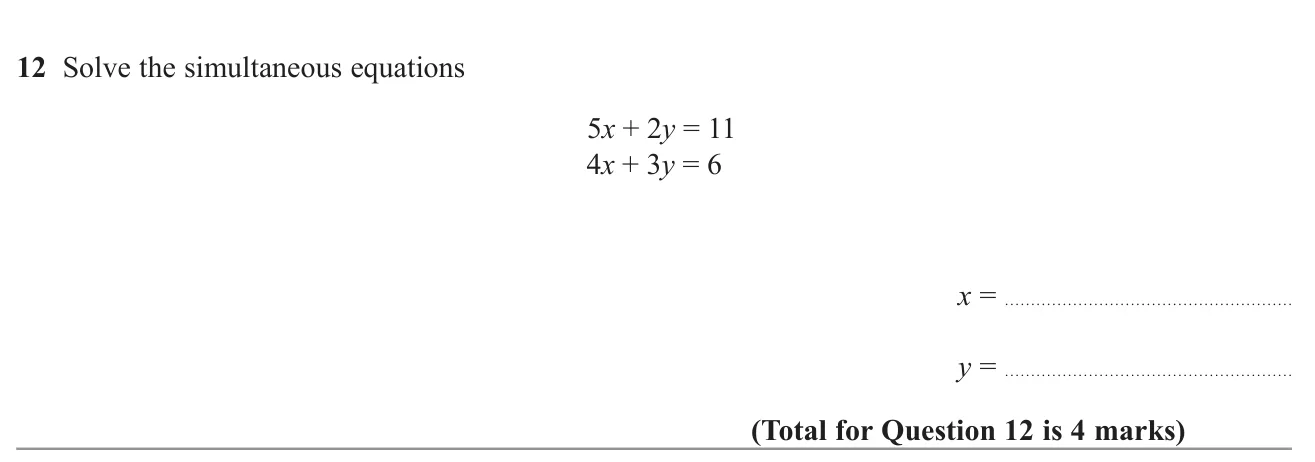
© Pearson Education Ltd. November 2022 Paper 1 (Higher, non-calculator), question 12.
Answer x = 3 x = 3 x = 3 y = − 2 y = -2 y = − 2 4 marks
Worked solution Checked against the mark scheme
Multiply the first by 3 and the second by 2:
15 x + 6 y = 33 15x + 6y = 33 15 x + 6 y = 33 8 x + 6 y = 12 8x + 6y = 12 8 x + 6 y = 12
Subtract: 7 x = 21 7x = 21 7 x = 21 x = 3 x = 3 x = 3
5 ( 3 ) + 2 y = 11 ⇒ 2 y = − 4 ⇒ y = − 2 5(3) + 2y = 11 \Rightarrow 2y = -4 \Rightarrow y = -2 5 ( 3 ) + 2 y = 11 ⇒ 2 y = − 4 ⇒ y = − 2
Watch out: Adding the equations instead of subtracting after matching the y terms.
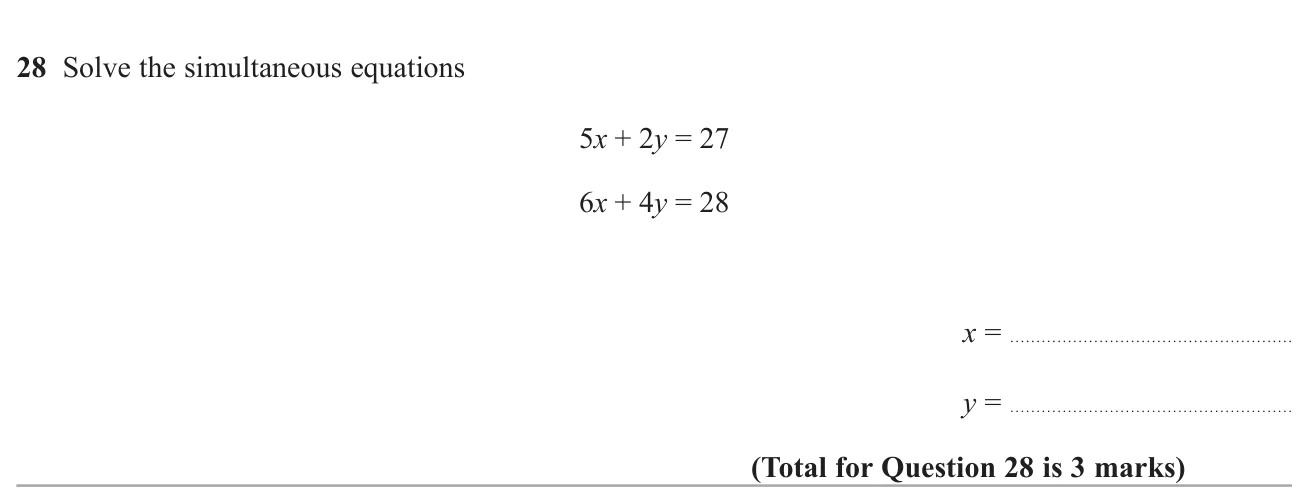
© Pearson Education Ltd. June 2022 Paper 2 (Foundation, calculator), question 28.
Answer x = 6.5 , y = − 2.75 x = 6.5,\ y = -2.75 x = 6.5 , y = − 2.75 3 marks
Worked solution Checked against the mark scheme
Double the first equation: 10 x + 4 y = 54 10x + 4y = 54 10 x + 4 y = 54
Subtract the second: ( 10 x + 4 y ) − ( 6 x + 4 y ) = 54 − 28 (10x + 4y) - (6x + 4y) = 54 - 28 ( 10 x + 4 y ) − ( 6 x + 4 y ) = 54 − 28 4 x = 26 4x = 26 4 x = 26 x = 6.5 x = 6.5 x = 6.5
Substitute: 5 ( 6.5 ) + 2 y = 27 5(6.5) + 2y = 27 5 ( 6.5 ) + 2 y = 27 2 y = − 5.5 2y = -5.5 2 y = − 5.5 y = − 2.75 y = -2.75 y = − 2.75
Watch out: Adding the equations instead of subtracting when the signs are the same.
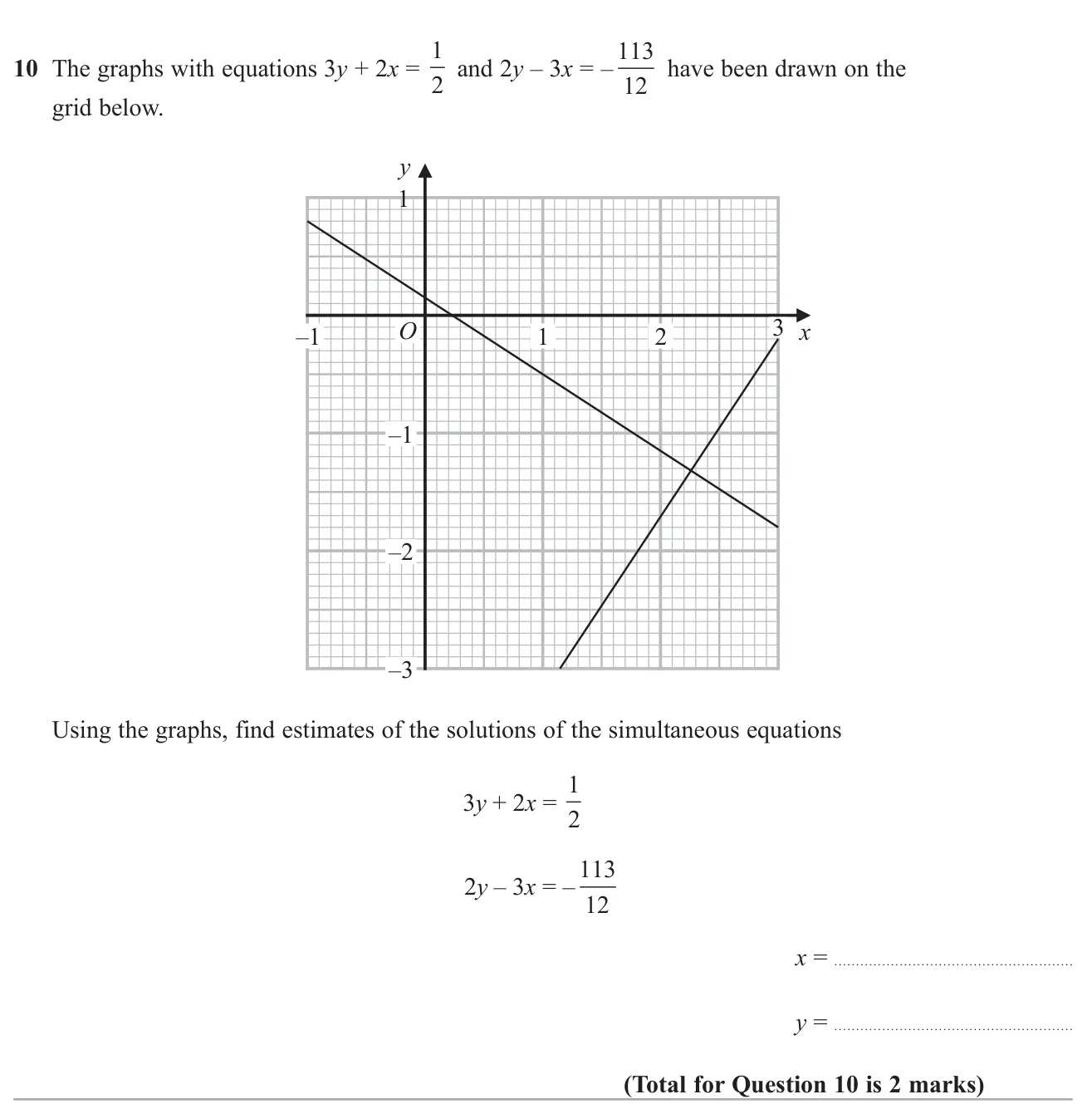
© Pearson Education Ltd. June 2019 Paper 1 (Higher, non-calculator), question 10.
Answer x ≈ 2.25 , y ≈ − 1.35 x \approx 2.25,\ y \approx -1.35 x ≈ 2.25 , y ≈ − 1.35 2 marks
Worked solution Checked against the mark scheme
The solution is where the two lines cross.
Reading the grid, they cross at about x = 2.25 x = 2.25 x = 2.25 y = − 1.35 y = -1.35 y = − 1.35
(Solving exactly gives x = 9 4 x = \frac{9}{4} x = 4 9 y = − 4 3 y = -\frac{4}{3} y = − 3 4
Watch out: Swapping the x and y values, or reading where a line meets an axis.
© Pearson Education Ltd. June 2019 Paper 3 (Foundation, calculator), question 30.
Answer x = 1 x = 1 x = 1 y = − 2 y = -2 y = − 2 3 marks
Worked solution Checked against the mark scheme
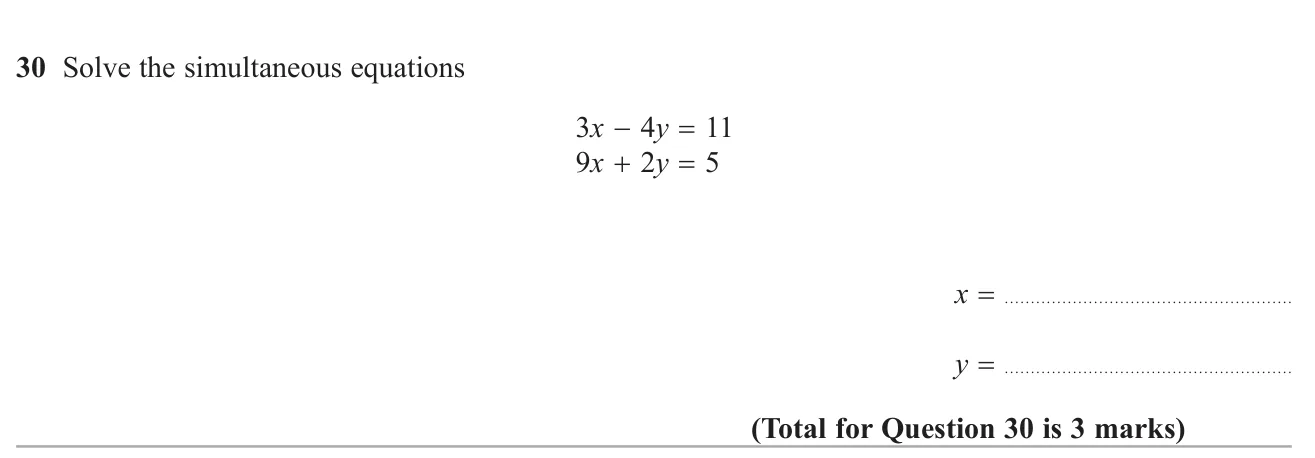
3 x − 4 y = 11 3x - 4y = 11 3 x − 4 y = 11 9 x + 2 y = 5 9x + 2y = 5 9 x + 2 y = 5
Double the second: 18 x + 4 y = 10 18x + 4y = 10 18 x + 4 y = 10
Add to the first: 21 x = 21 21x = 21 21 x = 21 x = 1 x = 1 x = 1
9 ( 1 ) + 2 y = 5 9(1) + 2y = 5 9 ( 1 ) + 2 y = 5 2 y = − 4 2y = -4 2 y = − 4 y = − 2 y = -2 y = − 2
Watch out: Sign errors when eliminating, e.g. subtracting instead of adding.
© Pearson Education Ltd. November 2018 Paper 1 (Foundation, non-calculator), question 25.
Answer x = 4.5 x = 4.5 x = 4.5 y = − 1.5 y = -1.5 y = − 1.5 3 marks
Worked solution Checked against the mark scheme
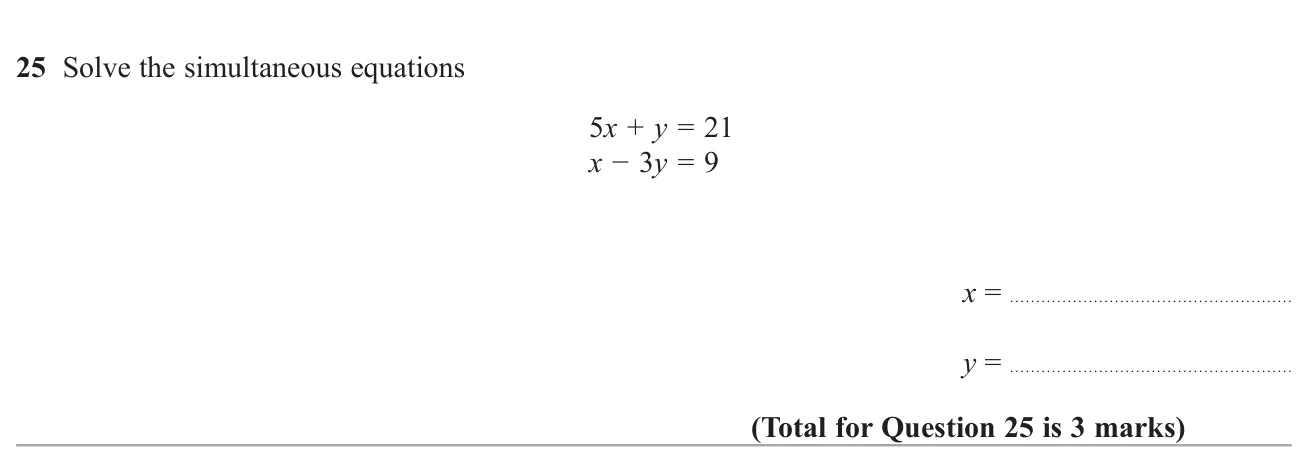
Multiply the first equation by 3: 15 x + 3 y = 63 15x + 3y = 63 15 x + 3 y = 63
Add x − 3 y = 9 x - 3y = 9 x − 3 y = 9 16 x = 72 16x = 72 16 x = 72 x = 4.5 x = 4.5 x = 4.5
5 ( 4.5 ) + y = 21 ⇒ y = 21 − 22.5 = − 1.5 5(4.5) + y = 21 \Rightarrow y = 21 - 22.5 = -1.5 5 ( 4.5 ) + y = 21 ⇒ y = 21 − 22.5 = − 1.5
Check: 4.5 − 3 ( − 1.5 ) = 9 4.5 - 3(-1.5) = 9 4.5 − 3 ( − 1.5 ) = 9
Watch out: Sign error when eliminating y, e.g. subtracting instead of adding.
© Pearson Education Ltd. Specimen Paper 1 (Foundation, non-calculator), question 29.
Answer x = 7 x = 7 x = 7 y = − 3 y = -3 y = − 3 3 marks
Worked solution Checked against the mark scheme
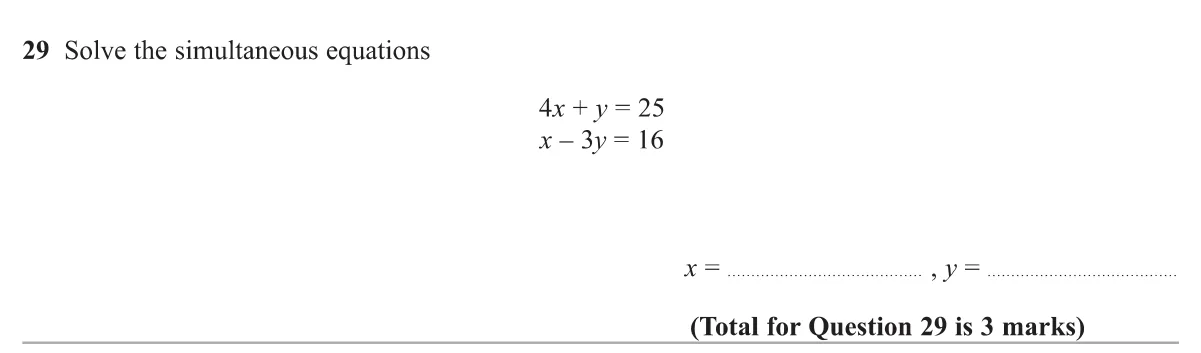
Multiply the first equation by 3: 12 x + 3 y = 75 12x + 3y = 75 12 x + 3 y = 75
Add the second: 12 x + 3 y + x − 3 y = 75 + 16 12x + 3y + x - 3y = 75 + 16 12 x + 3 y + x − 3 y = 75 + 16 13 x = 91 13x = 91 13 x = 91 x = 7 x = 7 x = 7
Substitute: 4 ( 7 ) + y = 25 4(7) + y = 25 4 ( 7 ) + y = 25 y = − 3 y = -3 y = − 3
Check: 7 − 3 ( − 3 ) = 16 7 - 3(-3) = 16 7 − 3 ( − 3 ) = 16
Watch out: Subtracting the equations when the y terms have opposite signs.
© Pearson Education Ltd. June 2023 Paper 2 (Higher, calculator), question 11.
Answer x = − 2 x = -2 x = − 2 y = 1.5 y = 1.5 y = 1.5 4 marks
Worked solution Checked against the mark scheme
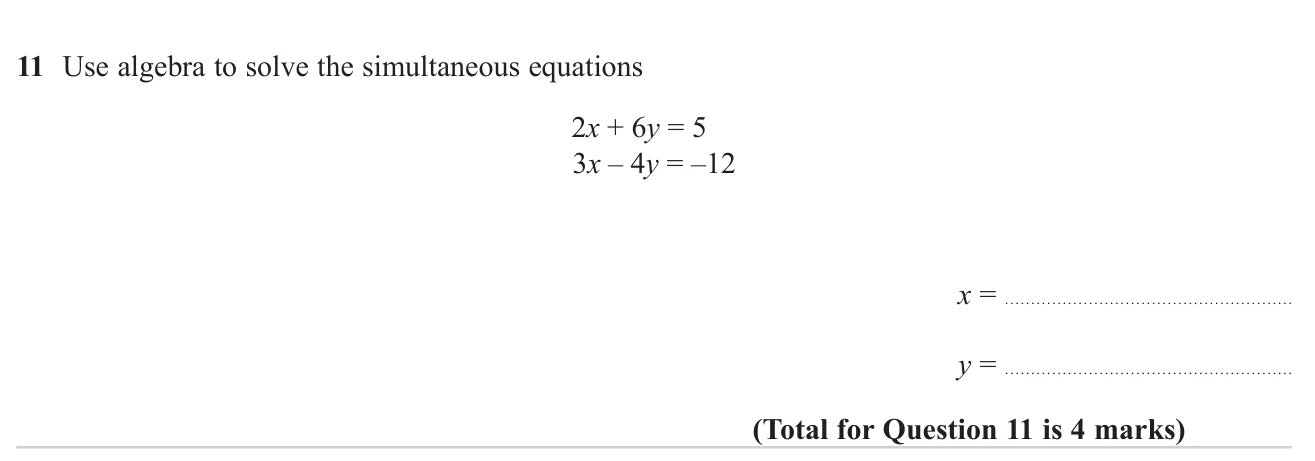
Multiply the first by 2: 4 x + 12 y = 10 4x + 12y = 10 4 x + 12 y = 10
Multiply the second by 3: 9 x − 12 y = − 36 9x - 12y = -36 9 x − 12 y = − 36
Add: 13 x = − 26 13x = -26 13 x = − 26 x = − 2 x = -2 x = − 2
2 ( − 2 ) + 6 y = 5 ⇒ 6 y = 9 ⇒ y = 1.5 2(-2) + 6y = 5 \Rightarrow 6y = 9 \Rightarrow y = 1.5 2 ( − 2 ) + 6 y = 5 ⇒ 6 y = 9 ⇒ y = 1.5
Watch out: Subtracting the equations when the signs mean they should be added, giving a wrong x.
© Pearson Education Ltd. November 2021 Paper 1 (Higher, non-calculator), question 20.
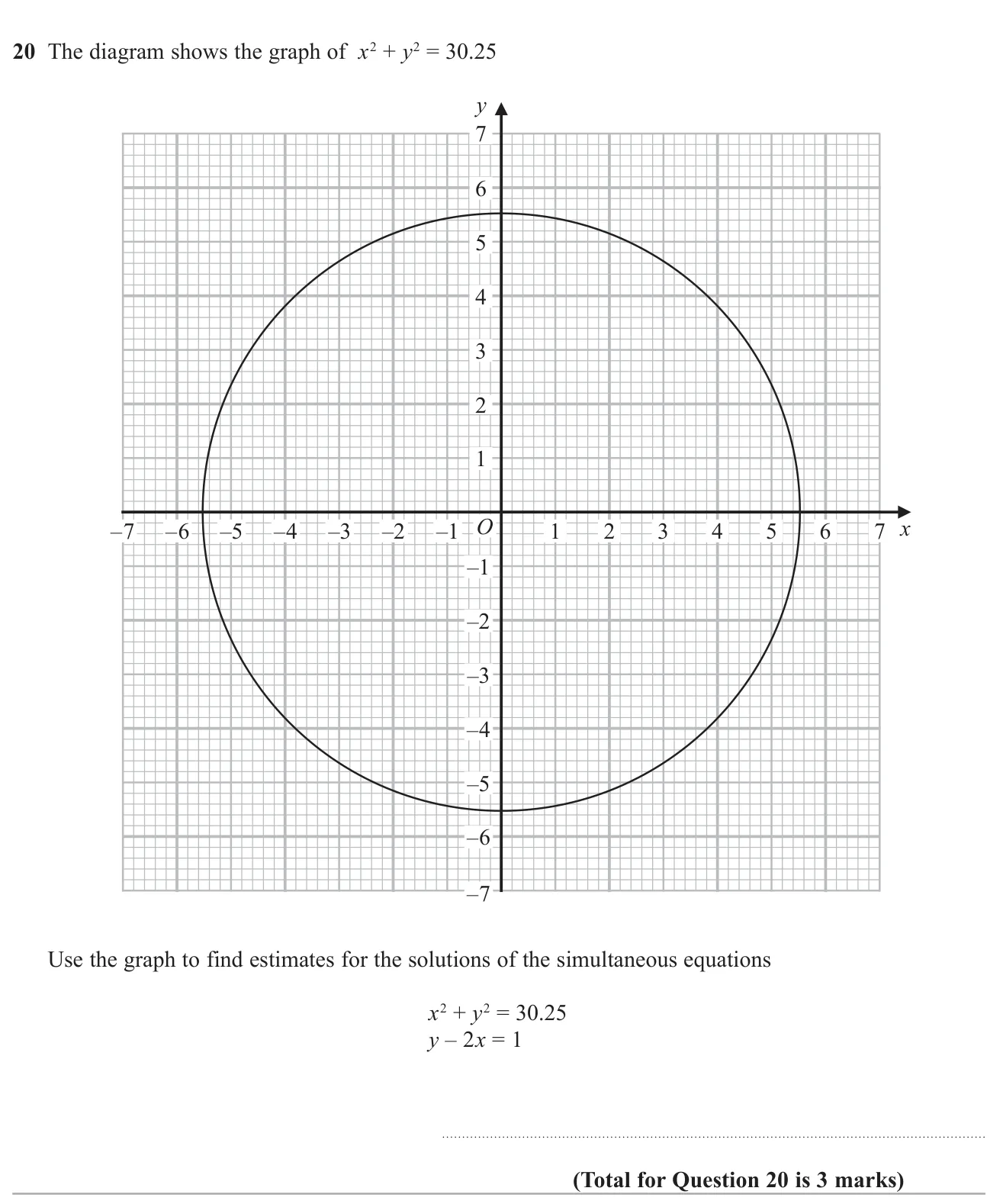
Answer x ≈ 2.1 , y ≈ 5.1 x \approx 2.1, y \approx 5.1 x ≈ 2.1 , y ≈ 5.1 x ≈ − 2.9 , y ≈ − 4.7 x \approx -2.9, y \approx -4.7 x ≈ − 2.9 , y ≈ − 4.7 3 marks
Worked solution Checked against the mark scheme
Rearrange: y = 2 x + 1 y = 2x + 1 y = 2 x + 1
Read off where it crosses the circle:
x ≈ 2.1 , y ≈ 5.1 x \approx 2.1, y \approx 5.1 x ≈ 2.1 , y ≈ 5.1
x ≈ − 2.9 , y ≈ − 4.7 x \approx -2.9, y \approx -4.7 x ≈ − 2.9 , y ≈ − 4.7
Watch out: Drawing y = x + 1 y = x + 1 y = x + 1
© Pearson Education Ltd. November 2021 Paper 3 (Higher, calculator), question 13.
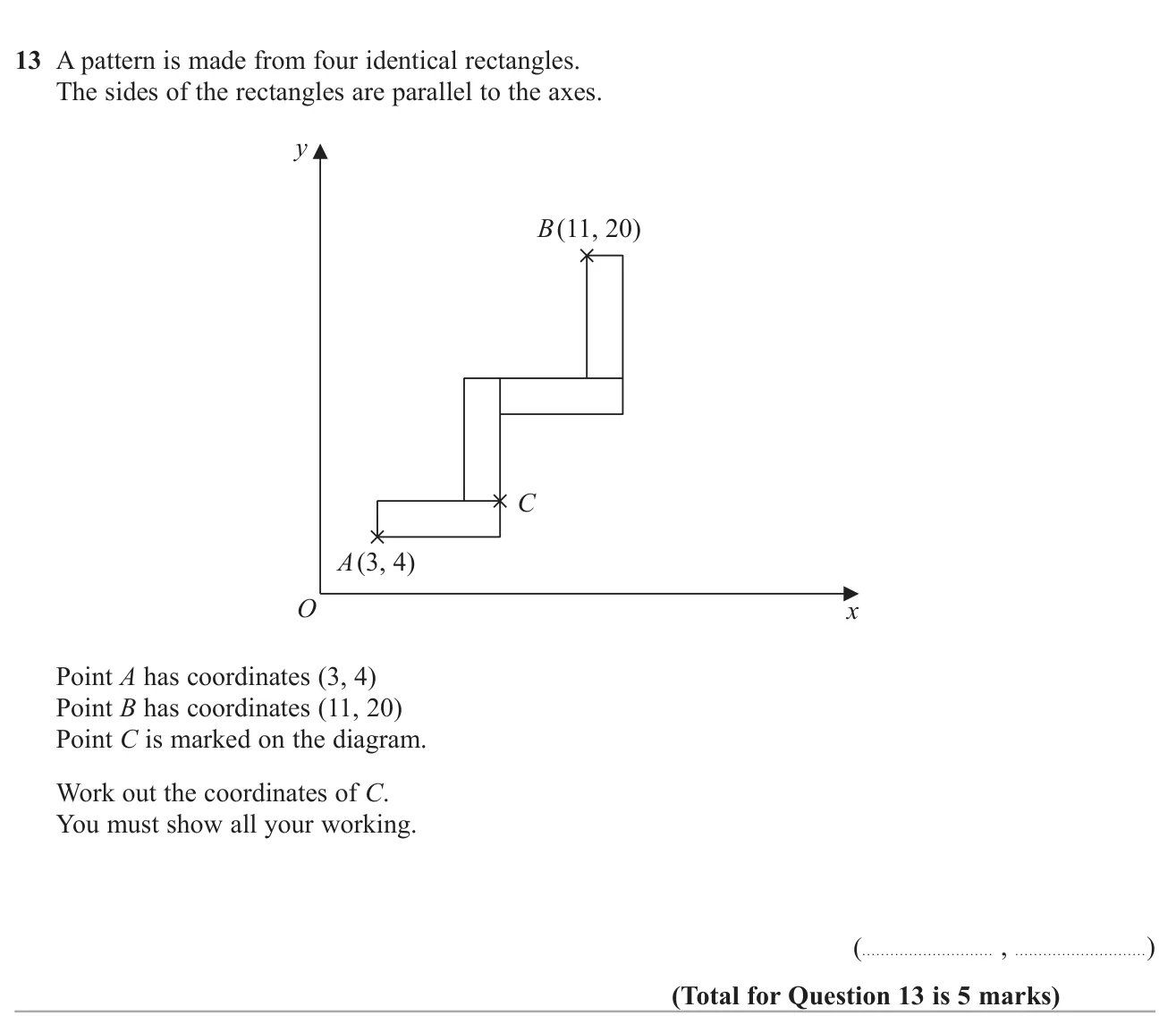
Answer ( 9 , 8 ) (9, 8) ( 9 , 8 ) 5 marks
Worked solution Checked against the mark scheme
Let each rectangle be l l l w w w
Across from A to B: 11 − 3 = 8 11 - 3 = 8 11 − 3 = 8 2 l − w = 8 2l - w = 8 2 l − w = 8
Up from A to B: 20 − 4 = 16 20 - 4 = 16 20 − 4 = 16 2 l + w = 16 2l + w = 16 2 l + w = 16
Adding: 4 l = 24 4l = 24 4 l = 24 l = 6 l = 6 l = 6 w = 4 w = 4 w = 4
C is one length right and one width up from A: ( 3 + 6 , 4 + 4 ) = ( 9 , 8 ) (3 + 6, 4 + 4) = (9, 8) ( 3 + 6 , 4 + 4 ) = ( 9 , 8 )
Watch out: Assuming the rectangles are twice as long as they are wide without checking.
© Pearson Education Ltd. November 2021 Paper 3 (Higher, calculator), question 16.
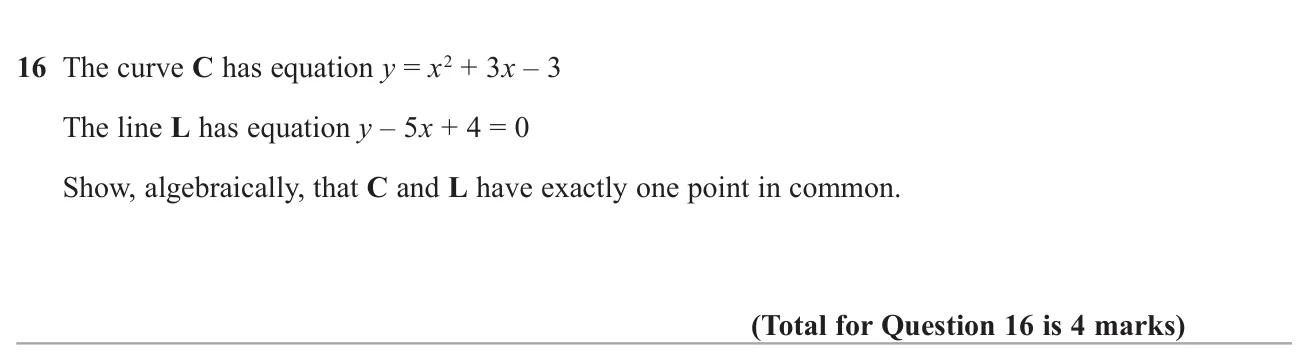
Answer x 2 − 2 x + 1 = 0 x^2 - 2x + 1 = 0 x 2 − 2 x + 1 = 0 ( x − 1 ) 2 = 0 (x - 1)^2 = 0 ( x − 1 ) 2 = 0 4 marks
Worked solution Checked against the mark scheme
From the line: y = 5 x − 4 y = 5x - 4 y = 5 x − 4
Set equal: x 2 + 3 x − 3 = 5 x − 4 x^2 + 3x - 3 = 5x - 4 x 2 + 3 x − 3 = 5 x − 4
x 2 − 2 x + 1 = 0 x^2 - 2x + 1 = 0 x 2 − 2 x + 1 = 0
( x − 1 ) 2 = 0 (x - 1)^2 = 0 ( x − 1 ) 2 = 0 x = 1 x = 1 x = 1
One value of x x x ( 1 , 1 ) (1, 1) ( 1 , 1 )
Watch out: Solving correctly but not writing a statement explaining why this means one point.
© Pearson Education Ltd. November 2024 Paper 3 (Higher, calculator), question 20.
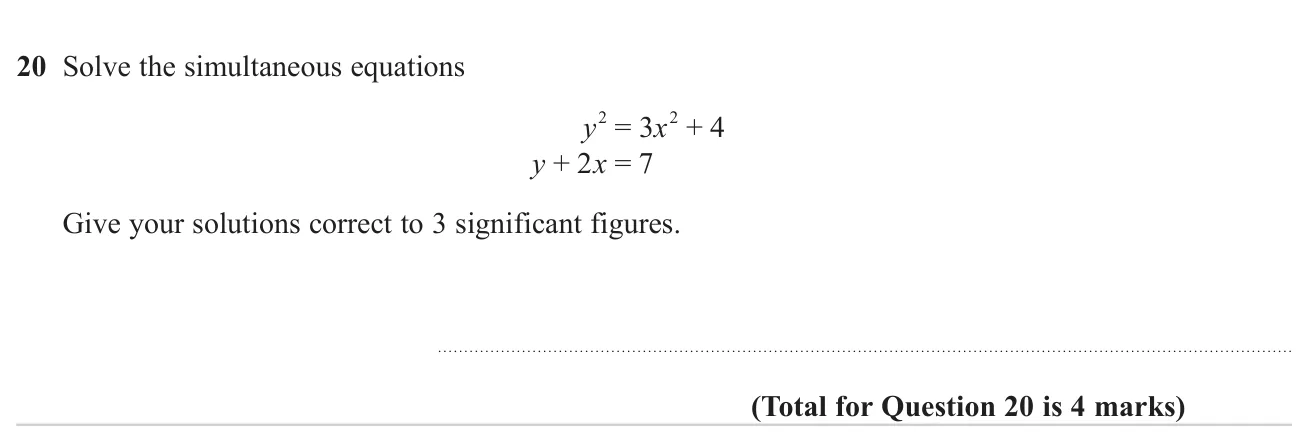
Answer x = 26.3 , y = − 45.6 x = 26.3,\ y = -45.6 x = 26.3 , y = − 45.6 x = 1.71 , y = 3.58 x = 1.71,\ y = 3.58 x = 1.71 , y = 3.58 4 marks
Worked solution Checked against the mark scheme
y = 7 − 2 x y = 7 - 2x y = 7 − 2 x ( 7 − 2 x ) 2 = 3 x 2 + 4 (7 - 2x)^2 = 3x^2 + 4 ( 7 − 2 x ) 2 = 3 x 2 + 4
49 − 28 x + 4 x 2 = 3 x 2 + 4 49 - 28x + 4x^2 = 3x^2 + 4 49 − 28 x + 4 x 2 = 3 x 2 + 4
x 2 − 28 x + 45 = 0 x^2 - 28x + 45 = 0 x 2 − 28 x + 45 = 0
x = 14 ± 151 x = 14 \pm \sqrt{151} x = 14 ± 151 x = 26.3 x = 26.3 x = 26.3 x = 1.71 x = 1.71 x = 1.71
Then y = 7 − 2 x y = 7 - 2x y = 7 − 2 x y = − 45.6 y = -45.6 y = − 45.6 y = 3.58 y = 3.58 y = 3.58
Watch out: Expanding (7 − 2x)² as 49 + 4x² without the middle term.
© Pearson Education Ltd. June 2022 Paper 3 (Higher, calculator), question 22.
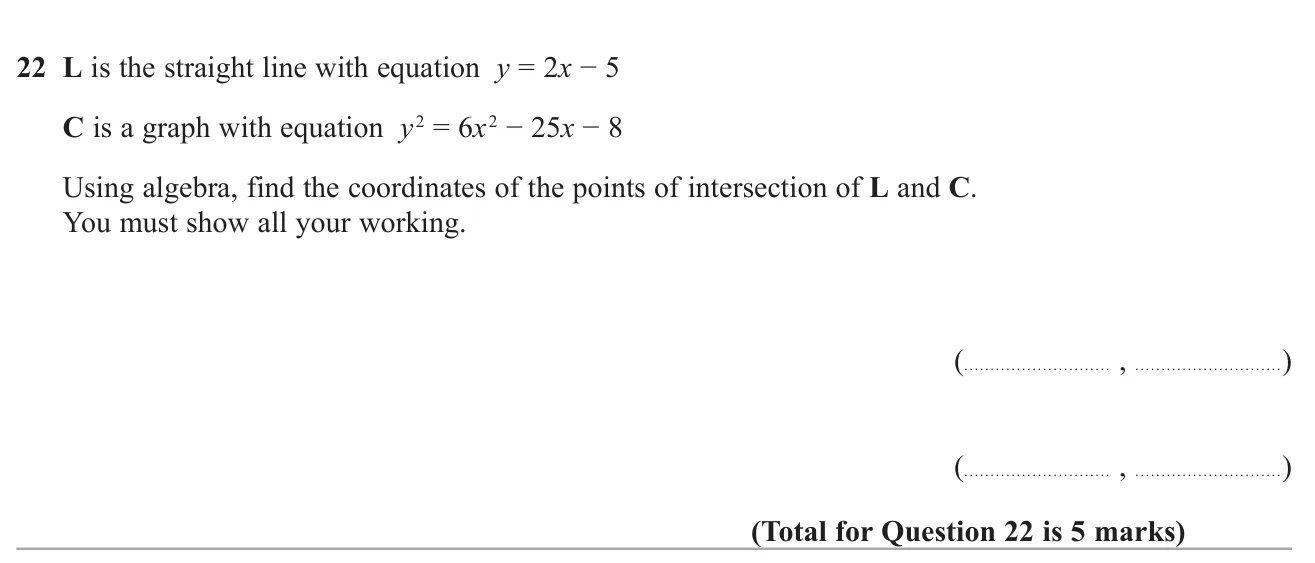
Answer ( − 3 , − 11 ) (-3, -11) ( − 3 , − 11 ) ( 5.5 , 6 ) (5.5, 6) ( 5.5 , 6 ) 5 marks
Worked solution Checked against the mark scheme
Substitute y = 2 x − 5 y = 2x - 5 y = 2 x − 5 ( 2 x − 5 ) 2 = 6 x 2 − 25 x − 8 (2x - 5)^2 = 6x^2 - 25x - 8 ( 2 x − 5 ) 2 = 6 x 2 − 25 x − 8
4 x 2 − 20 x + 25 = 6 x 2 − 25 x − 8 4x^2 - 20x + 25 = 6x^2 - 25x - 8 4 x 2 − 20 x + 25 = 6 x 2 − 25 x − 8
2 x 2 − 5 x − 33 = 0 ⇒ ( 2 x − 11 ) ( x + 3 ) = 0 2x^2 - 5x - 33 = 0 \Rightarrow (2x - 11)(x + 3) = 0 2 x 2 − 5 x − 33 = 0 ⇒ ( 2 x − 11 ) ( x + 3 ) = 0
x = 5.5 ⇒ y = 6 x = 5.5 \Rightarrow y = 6 x = 5.5 ⇒ y = 6 x = − 3 ⇒ y = − 11 x = -3 \Rightarrow y = -11 x = − 3 ⇒ y = − 11
Watch out: Expanding ( 2 x − 5 ) 2 (2x - 5)^2 ( 2 x − 5 ) 2 4 x 2 + 25 4x^2 + 25 4 x 2 + 25
© Pearson Education Ltd. June 2019 Paper 1 (Higher, non-calculator), question 22.
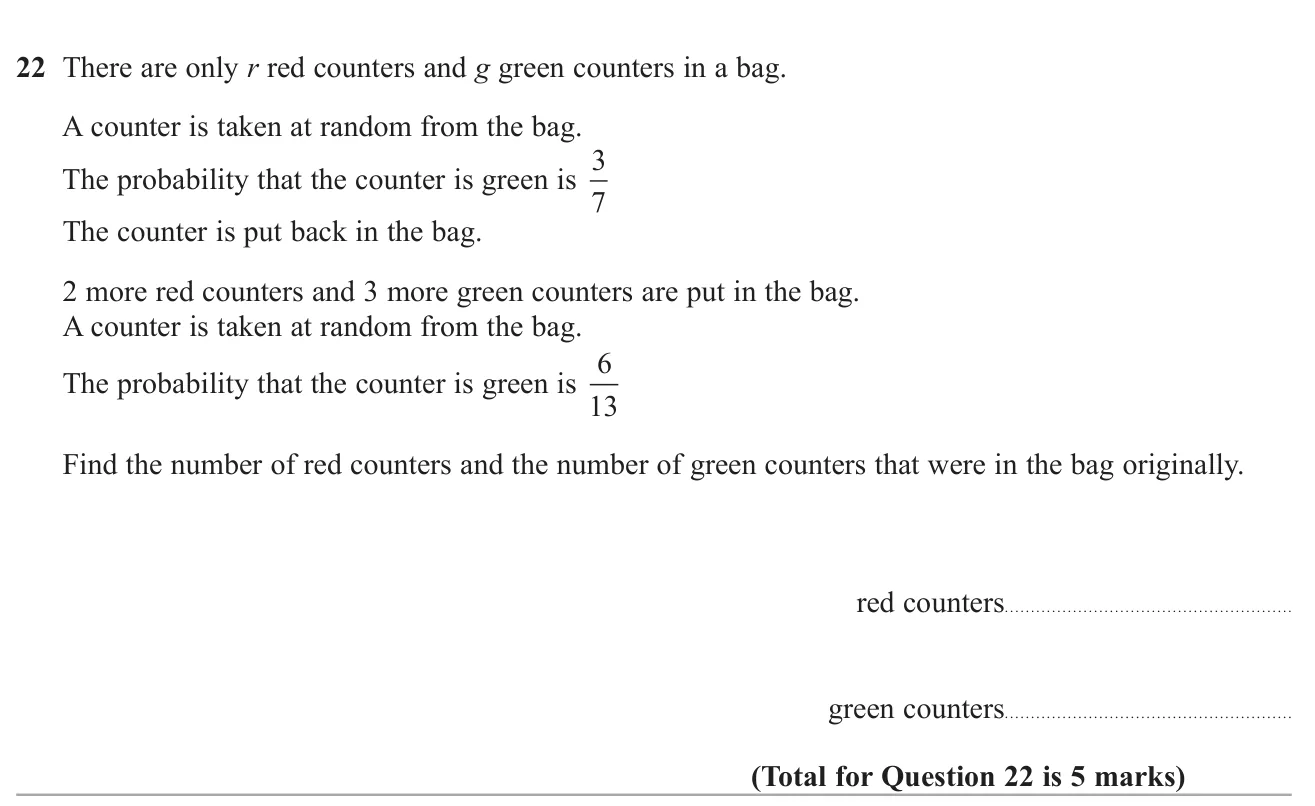
Answer 12 12 12 9 9 9 5 marks
Worked solution Checked against the mark scheme
Green is 3 7 \frac{3}{7} 7 3 g = 3 x g = 3x g = 3 x r = 4 x r = 4x r = 4 x x x x
After adding: 3 x + 3 7 x + 5 = 6 13 \frac{3x + 3}{7x + 5} = \frac{6}{13} 7 x + 5 3 x + 3 = 13 6
39 x + 39 = 42 x + 30 39x + 39 = 42x + 30 39 x + 39 = 42 x + 30 3 x = 9 3x = 9 3 x = 9 x = 3 x = 3 x = 3
Red = 4 × 3 = 12 = 4 \times 3 = 12 = 4 × 3 = 12 = 3 × 3 = 9 = 3 \times 3 = 9 = 3 × 3 = 9
Watch out: Adding 2 to the denominator only, forgetting the 3 extra green counters also increase the total.
© Pearson Education Ltd. June 2019 Paper 3 (Higher, calculator), question 20.
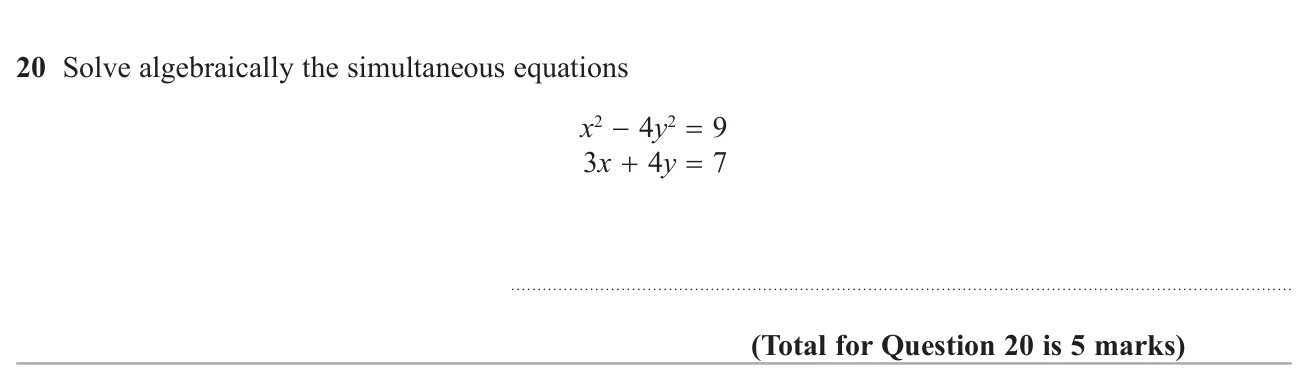
Answer x = 5 , y = − 2 x = 5, y = -2 x = 5 , y = − 2 x = 17 5 , y = − 4 5 x = \frac{17}{5}, y = -\frac{4}{5} x = 5 17 , y = − 5 4 5 marks
Worked solution Checked against the mark scheme
From 3 x + 4 y = 7 3x + 4y = 7 3 x + 4 y = 7 4 y = 7 − 3 x 4y = 7 - 3x 4 y = 7 − 3 x 4 y 2 = ( 7 − 3 x ) 2 4 4y^2 = \frac{(7-3x)^2}{4} 4 y 2 = 4 ( 7 − 3 x ) 2
x 2 − 49 − 42 x + 9 x 2 4 = 9 ⇒ 4 x 2 − 49 + 42 x − 9 x 2 = 36 x^2 - \frac{49 - 42x + 9x^2}{4} = 9 \Rightarrow 4x^2 - 49 + 42x - 9x^2 = 36 x 2 − 4 49 − 42 x + 9 x 2 = 9 ⇒ 4 x 2 − 49 + 42 x − 9 x 2 = 36
5 x 2 − 42 x + 85 = 0 ⇒ ( 5 x − 17 ) ( x − 5 ) = 0 5x^2 - 42x + 85 = 0 \Rightarrow (5x - 17)(x - 5) = 0 5 x 2 − 42 x + 85 = 0 ⇒ ( 5 x − 17 ) ( x − 5 ) = 0
x = 5 ⇒ y = 7 − 15 4 = − 2 x = 5 \Rightarrow y = \frac{7 - 15}{4} = -2 x = 5 ⇒ y = 4 7 − 15 = − 2
x = 17 5 ⇒ y = 7 − 10.2 4 = − 4 5 x = \frac{17}{5} \Rightarrow y = \frac{7 - 10.2}{4} = -\frac{4}{5} x = 5 17 ⇒ y = 4 7 − 10.2 = − 5 4
Watch out: Squaring 4y as 4y² instead of 16y² when substituting.
© Pearson Education Ltd. June 2018 Paper 2 (Higher, calculator), question 16.
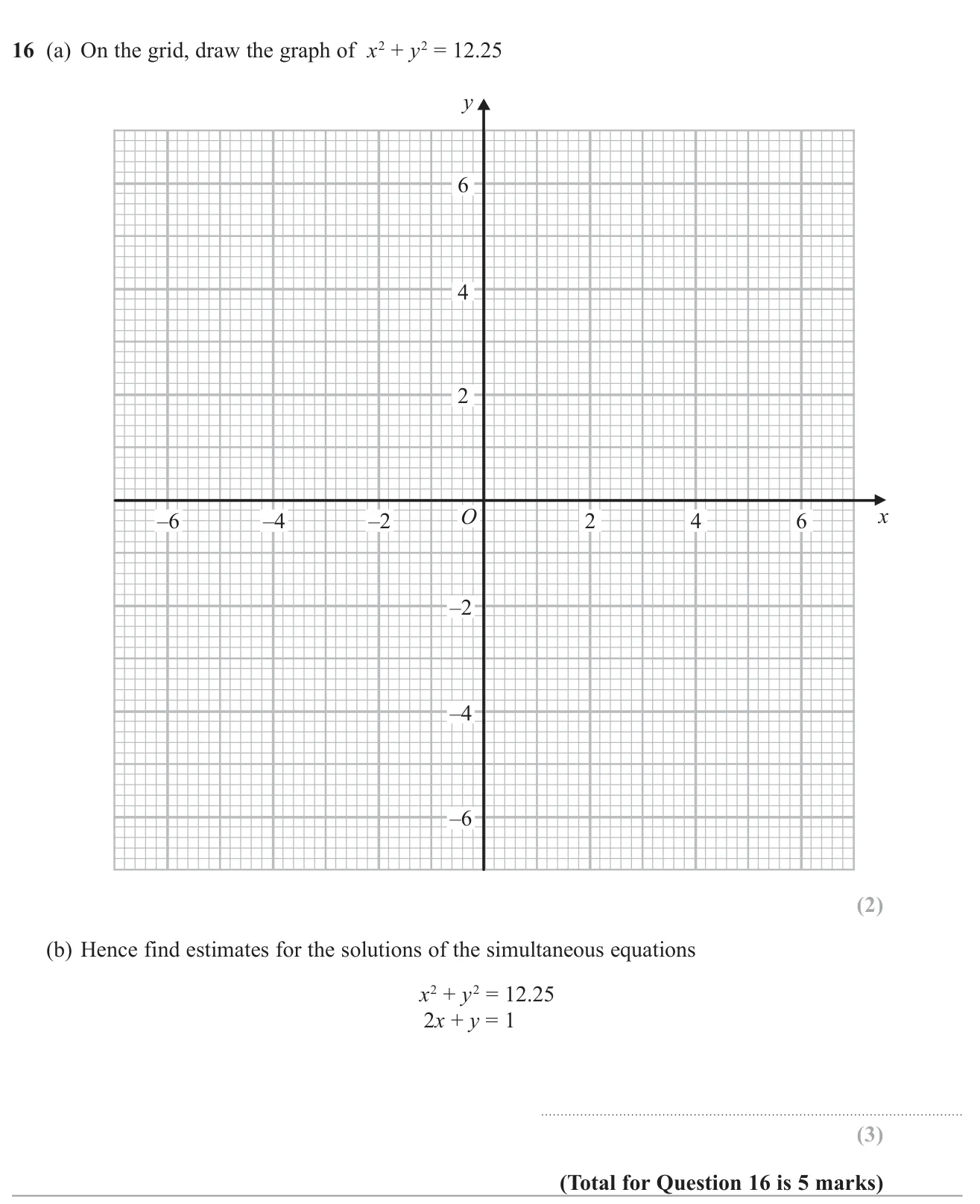
(a) Circle centre ( 0 , 0 ) (0, 0) ( 0 , 0 ) 3.5 3.5 3.5 2 marks (b) x = 2.0 , y = − 2.9 x = 2.0, y = -2.9 x = 2.0 , y = − 2.9 x = − 1.2 , y = 3.3 x = -1.2, y = 3.3 x = − 1.2 , y = 3.3 3 marks
Worked solution Checked against the mark scheme
(a) x 2 + y 2 = 12.25 x^2 + y^2 = 12.25 x 2 + y 2 = 12.25 O O O 12.25 = 3.5 \sqrt{12.25} = 3.5 12.25 = 3.5
(b) Draw y = 1 − 2 x y = 1 - 2x y = 1 − 2 x ( 0 , 1 ) (0, 1) ( 0 , 1 ) ( 2 , − 3 ) (2, -3) ( 2 , − 3 )
Read off the crossing points: about ( 2.0 , − 2.9 ) (2.0, -2.9) ( 2.0 , − 2.9 ) ( − 1.2 , 3.3 ) (-1.2, 3.3) ( − 1.2 , 3.3 )
(Check: 5 x 2 − 4 x − 11.25 = 0 5x^2 - 4x - 11.25 = 0 5 x 2 − 4 x − 11.25 = 0 x = 1.95 x = 1.95 x = 1.95 − 1.15 -1.15 − 1.15
Watch out: Using 12.25 as the radius instead of its square root.
© Pearson Education Ltd. November 2018 Paper 3 (Higher, calculator), question 19.
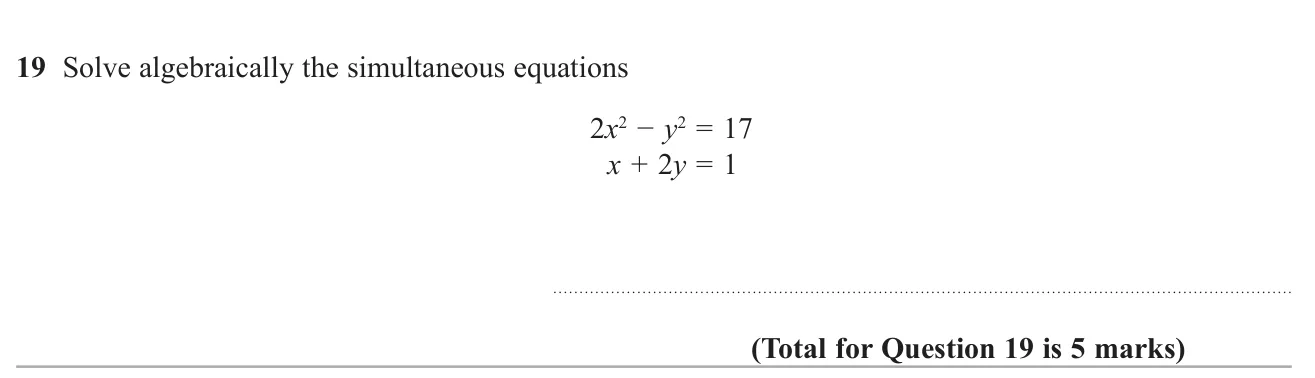
Answer x = 3 , y = − 1 x = 3, y = -1 x = 3 , y = − 1 x = − 23 7 , y = 15 7 x = -\frac{23}{7}, y = \frac{15}{7} x = − 7 23 , y = 7 15 5 marks
Worked solution Checked against the mark scheme
From the linear equation: x = 1 − 2 y x = 1 - 2y x = 1 − 2 y
2 ( 1 − 2 y ) 2 − y 2 = 17 2(1 - 2y)^2 - y^2 = 17 2 ( 1 − 2 y ) 2 − y 2 = 17
2 − 8 y + 8 y 2 − y 2 = 17 ⇒ 7 y 2 − 8 y − 15 = 0 2 - 8y + 8y^2 - y^2 = 17 \Rightarrow 7y^2 - 8y - 15 = 0 2 − 8 y + 8 y 2 − y 2 = 17 ⇒ 7 y 2 − 8 y − 15 = 0
( 7 y − 15 ) ( y + 1 ) = 0 (7y - 15)(y + 1) = 0 ( 7 y − 15 ) ( y + 1 ) = 0 y = 15 7 y = \frac{15}{7} y = 7 15 y = − 1 y = -1 y = − 1
y = − 1 y = -1 y = − 1 x = 3 x = 3 x = 3 y = 15 7 \quad y = \frac{15}{7} y = 7 15 x = 1 − 30 7 = − 23 7 x = 1 - \frac{30}{7} = -\frac{23}{7} x = 1 − 7 30 = − 7 23
Watch out: Expanding ( 1 − 2 y ) 2 (1 - 2y)^2 ( 1 − 2 y ) 2 1 + 4 y 2 1 + 4y^2 1 + 4 y 2
Also tested in these questions Their main topic is different, but part of each one tests this topic.