© Pearson Education Ltd. November 2019 Paper 2 (Higher, calculator), question 1.
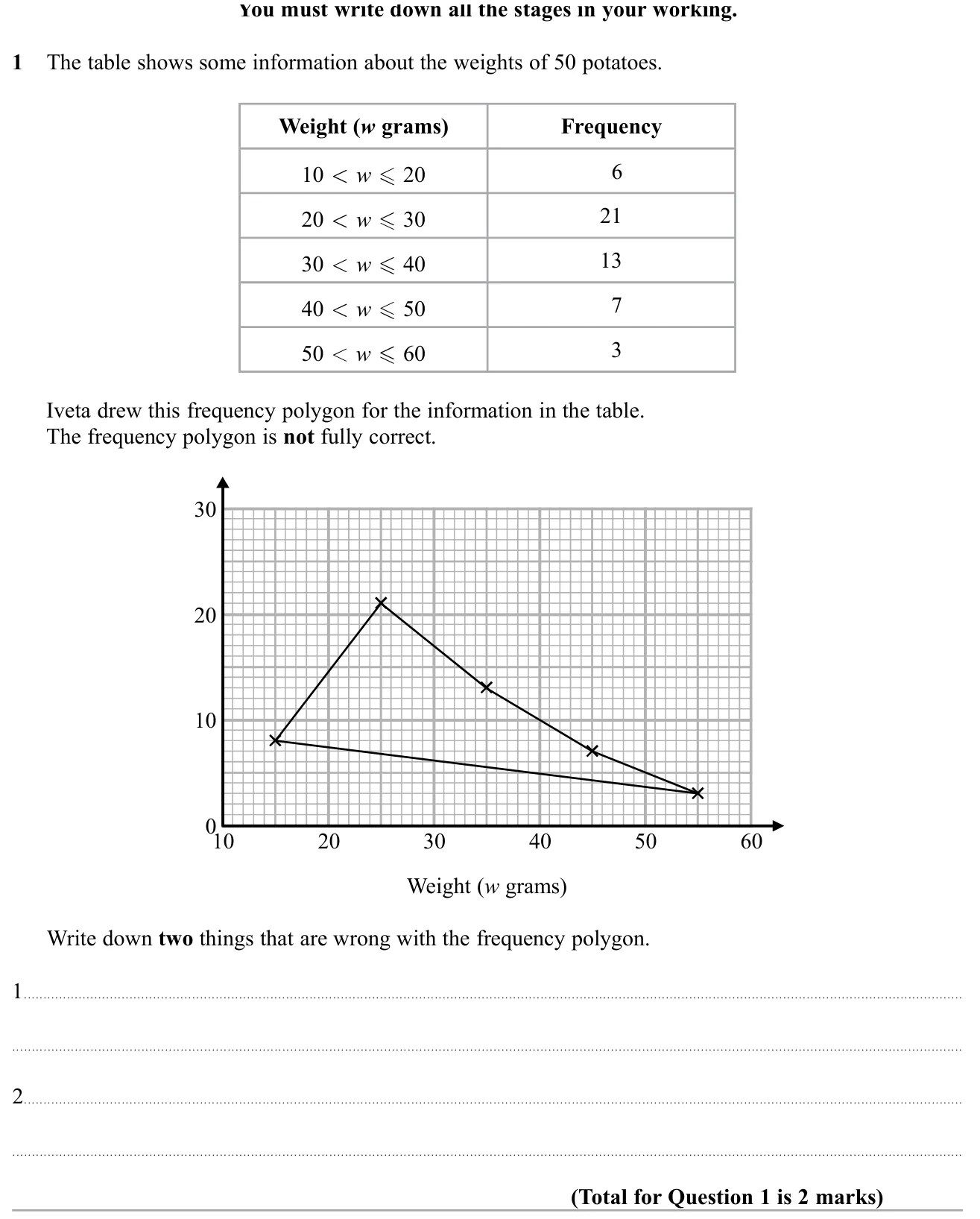
Answer Any two of: first point plotted at 8 not 6; the polygon should not be closed (first and last points joined); the frequency axis has no label 2 marks
Worked solution Checked against the mark scheme
Check each point against the table at the class midpoints.
The point at 15 is plotted at 8, but the frequency is 6.
The first and last points are joined; a frequency polygon should not be closed.
The vertical axis also has no 'Frequency' label.
Watch out: Saying the midpoints are wrong: plotting at midpoints is correct.
© Pearson Education Ltd. November 2019 Paper 2 (Higher, calculator), question 2.
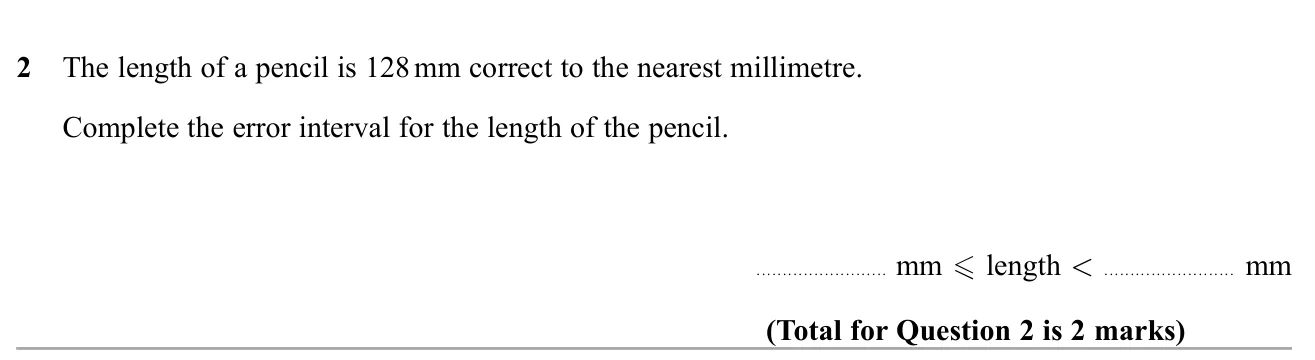
Answer 127.5 ≤ length < 128.5 127.5 \le \text{length} < 128.5 127.5 ≤ length < 128.5 2 marks
Worked solution Checked against the mark scheme
Nearest millimetre means half a millimetre either side.
Lower bound: 128 − 0.5 = 127.5 128 - 0.5 = 127.5 128 − 0.5 = 127.5
Upper bound: 128 + 0.5 = 128.5 128 + 0.5 = 128.5 128 + 0.5 = 128.5
127.5 ≤ length < 128.5 127.5 \le \text{length} < 128.5 127.5 ≤ length < 128.5
Watch out: Using 127 and 129.
© Pearson Education Ltd. November 2019 Paper 2 (Higher, calculator), question 3.
Worked solution Checked against the mark scheme
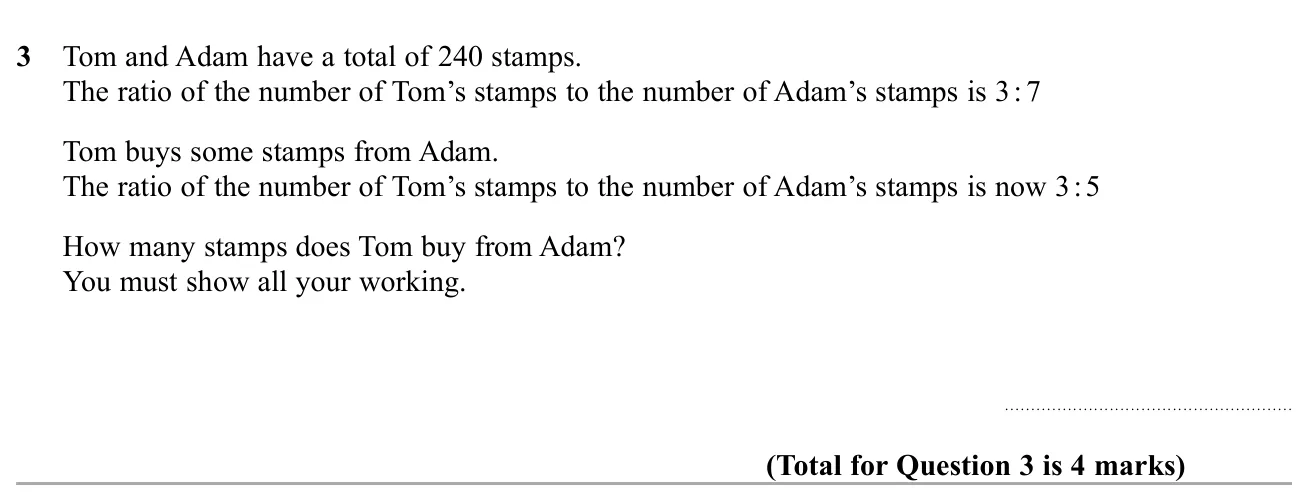
Before: 240 ÷ 10 = 24 240 \div 10 = 24 240 ÷ 10 = 24 3 × 24 = 72 3 \times 24 = 72 3 × 24 = 72
After: 240 ÷ 8 = 30 240 \div 8 = 30 240 ÷ 8 = 30 3 × 30 = 90 3 \times 30 = 90 3 × 30 = 90
Tom buys 90 − 72 = 18 90 - 72 = 18 90 − 72 = 18
Watch out: Dividing 240 by 3 or 7 instead of by the total number of parts.
© Pearson Education Ltd. November 2019 Paper 2 (Higher, calculator), question 4.
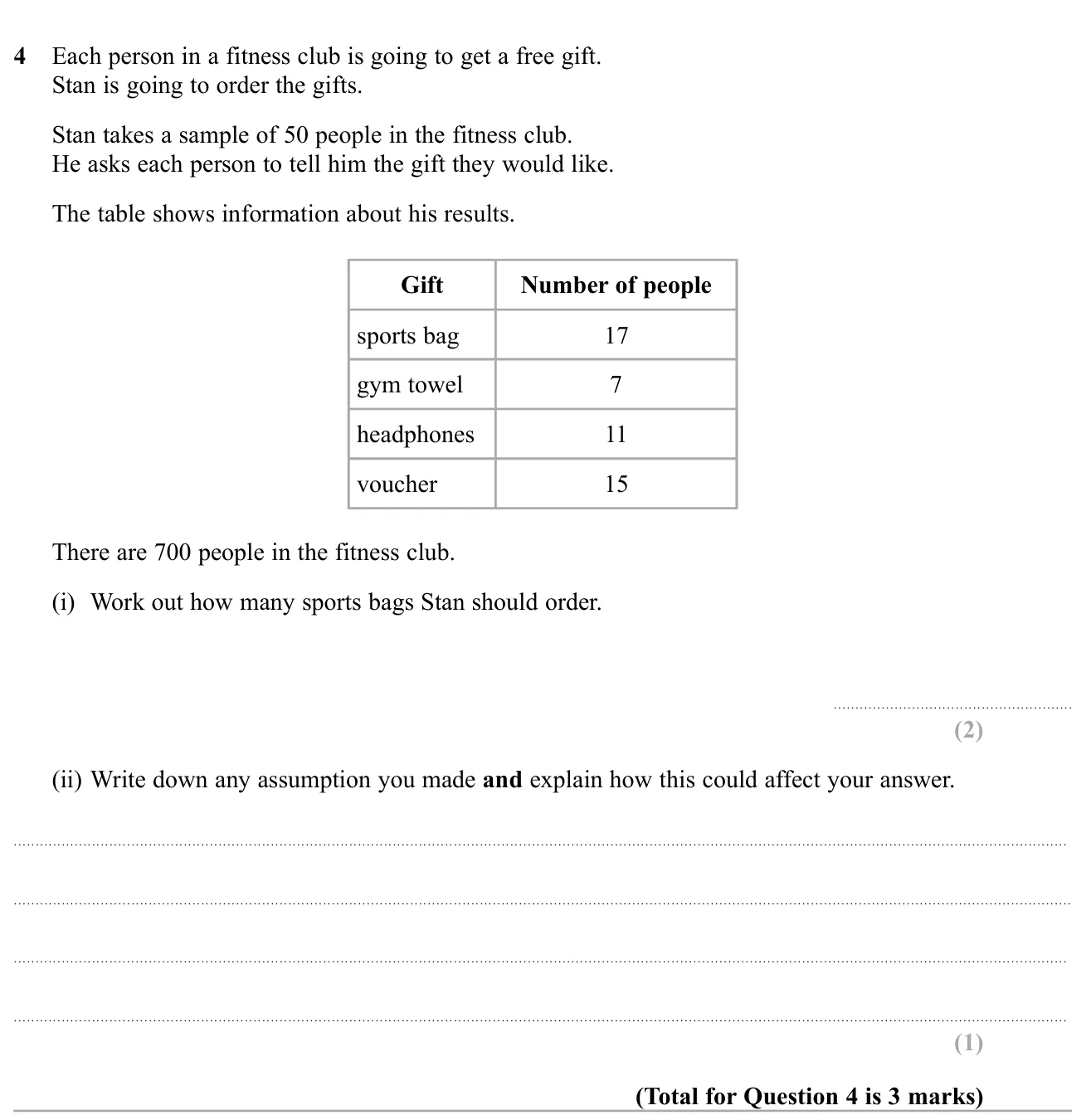
(i) 238 2 marks (ii) e.g. The sample is representative of the whole club, otherwise the number could be wrong 1 mark
Worked solution Checked against the mark scheme
(i) 17 50 × 700 = 238 \frac{17}{50} \times 700 = 238 50 17 × 700 = 238
(ii) I assumed the 50 people are representative of all 700. If they are not, 238 could be too many or too few.
Watch out: In (ii), just repeating the calculation instead of stating an assumption.
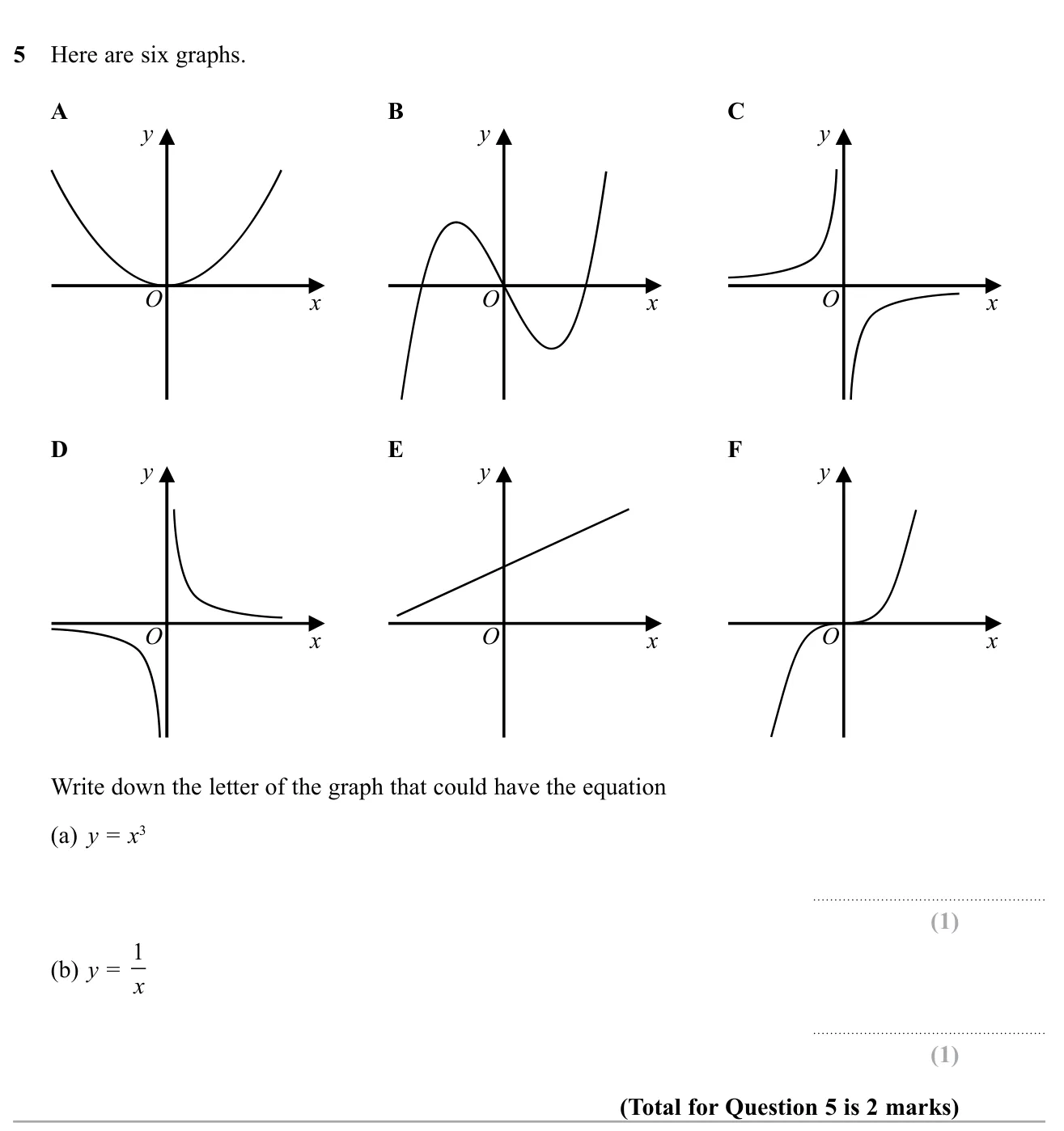
© Pearson Education Ltd. November 2019 Paper 2 (Higher, calculator), question 5.
Worked solution Checked against the mark scheme
(a) y = x 3 y = x^3 y = x 3 x x x F .
(b) y = 1 x y = \frac{1}{x} y = x 1 D .
Watch out: Choosing B for y = x 3 y = x^3 y = x 3 x 3 − k x x^3 - kx x 3 − k x 1 / x 1/x 1/ x − 1 / x -1/x − 1/ x
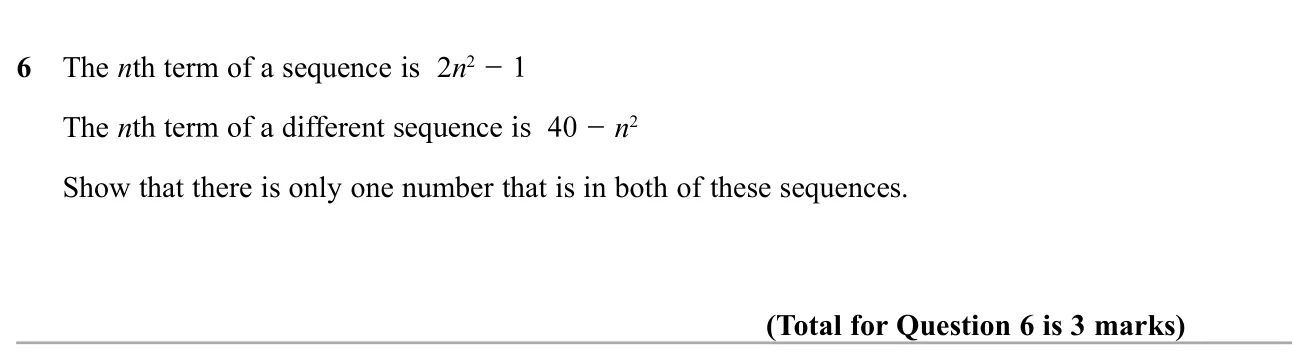
© Pearson Education Ltd. November 2019 Paper 2 (Higher, calculator), question 6.
Answer 31 is the only common term 3 marks
Worked solution Checked against the mark scheme
First sequence 2 n 2 − 1 2n^2 - 1 2 n 2 − 1
Second sequence 40 − n 2 40 - n^2 40 − n 2
31 appears in both. After that the first sequence keeps rising above 31 and the second keeps falling below it, so no other number can be in both.
Watch out: Stopping at 31 without explaining why no later terms can match.
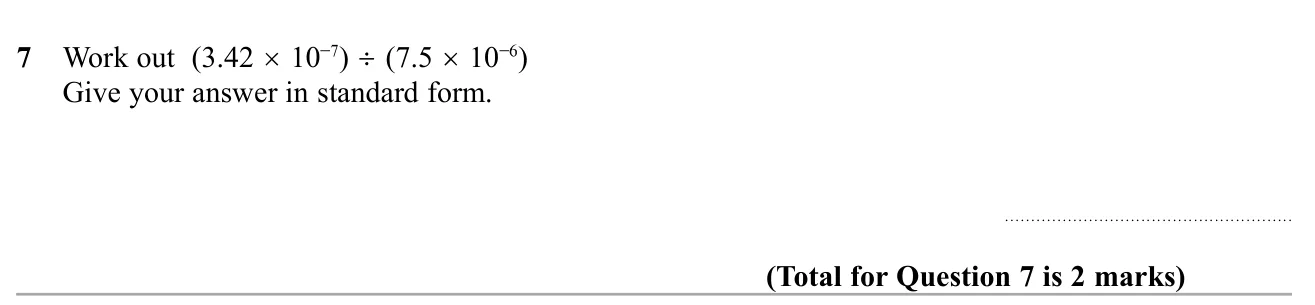
© Pearson Education Ltd. November 2019 Paper 2 (Higher, calculator), question 7.
Answer 4.56 × 10 − 2 4.56 \times 10^{-2} 4.56 × 1 0 − 2 2 marks
Worked solution Checked against the mark scheme
3.42 ÷ 7.5 = 0.456 3.42 \div 7.5 = 0.456 3.42 ÷ 7.5 = 0.456
10 − 7 ÷ 10 − 6 = 10 − 1 10^{-7} \div 10^{-6} = 10^{-1} 1 0 − 7 ÷ 1 0 − 6 = 1 0 − 1
0.456 × 10 − 1 = 0.0456 = 4.56 × 10 − 2 0.456 \times 10^{-1} = 0.0456 = 4.56 \times 10^{-2} 0.456 × 1 0 − 1 = 0.0456 = 4.56 × 1 0 − 2
Watch out: Leaving the answer as 0.456 × 10 − 1 0.456 \times 10^{-1} 0.456 × 1 0 − 1
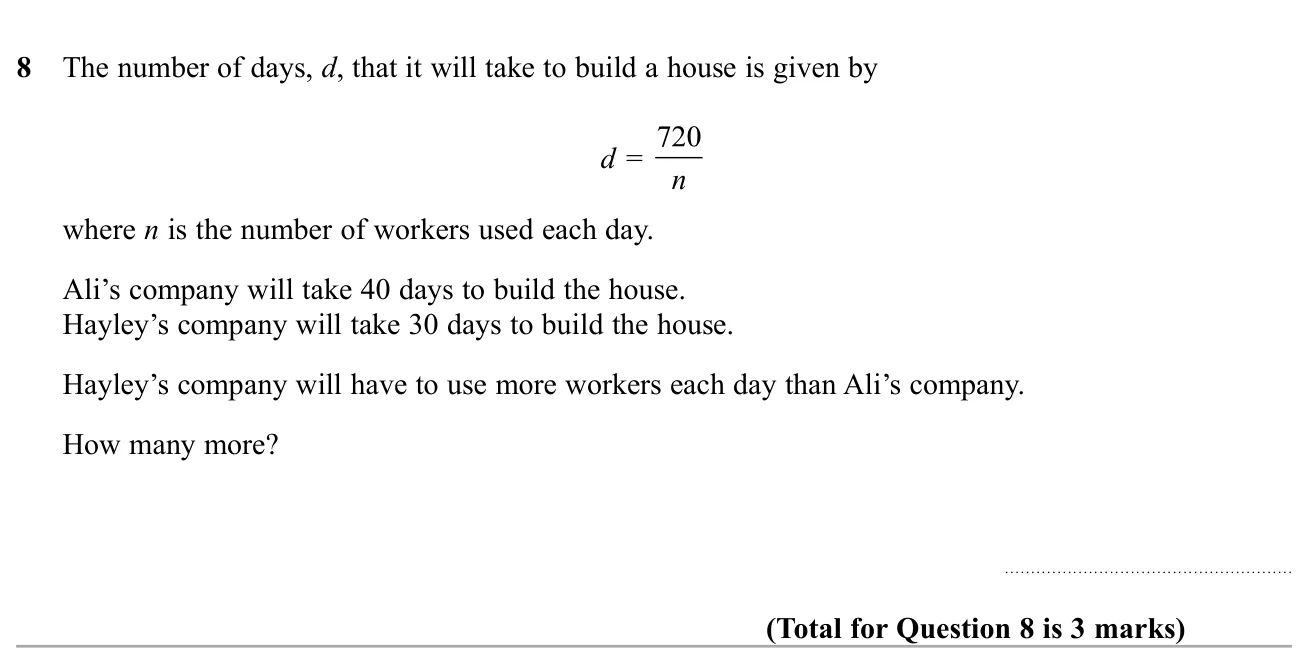
© Pearson Education Ltd. November 2019 Paper 2 (Higher, calculator), question 8.
Worked solution Checked against the mark scheme
Rearrange: n = 720 d n = \frac{720}{d} n = d 720
Ali: 720 ÷ 40 = 18 720 \div 40 = 18 720 ÷ 40 = 18
Hayley: 720 ÷ 30 = 24 720 \div 30 = 24 720 ÷ 30 = 24
Difference: 24 − 18 = 6 24 - 18 = 6 24 − 18 = 6
Watch out: Working out 720 ÷ 10 720 \div 10 720 ÷ 10
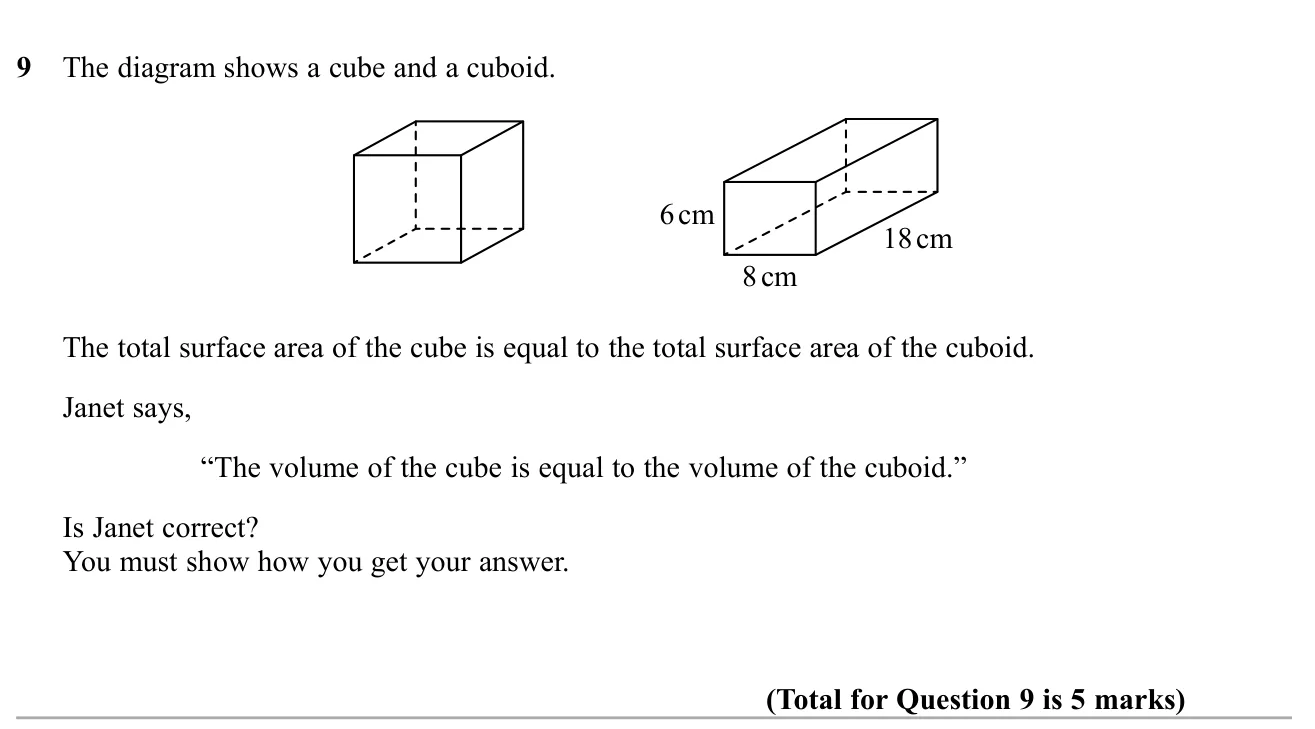
© Pearson Education Ltd. November 2019 Paper 2 (Higher, calculator), question 9.
Answer No: cube volume 1000 cm³, cuboid volume 864 cm³ 5 marks
Worked solution Checked against the mark scheme
Cuboid surface area: 2 ( 6 × 8 + 6 × 18 + 8 × 18 ) = 2 ( 48 + 108 + 144 ) = 600 cm 2 2(6\times8 + 6\times18 + 8\times18) = 2(48+108+144) = 600\text{ cm}^2 2 ( 6 × 8 + 6 × 18 + 8 × 18 ) = 2 ( 48 + 108 + 144 ) = 600 cm 2
Each cube face: 600 ÷ 6 = 100 600 \div 6 = 100 600 ÷ 6 = 100 100 = 10 \sqrt{100} = 10 100 = 10
Cube volume = 10 3 = 1000 cm 3 = 10^3 = 1000\text{ cm}^3 = 1 0 3 = 1000 cm 3 = 6 × 8 × 18 = 864 cm 3 = 6 \times 8 \times 18 = 864\text{ cm}^3 = 6 × 8 × 18 = 864 cm 3
1000 ≠ 864 1000 \ne 864 1000 = 864 not correct.
Watch out: Only adding three faces of the cuboid (300) instead of all six.
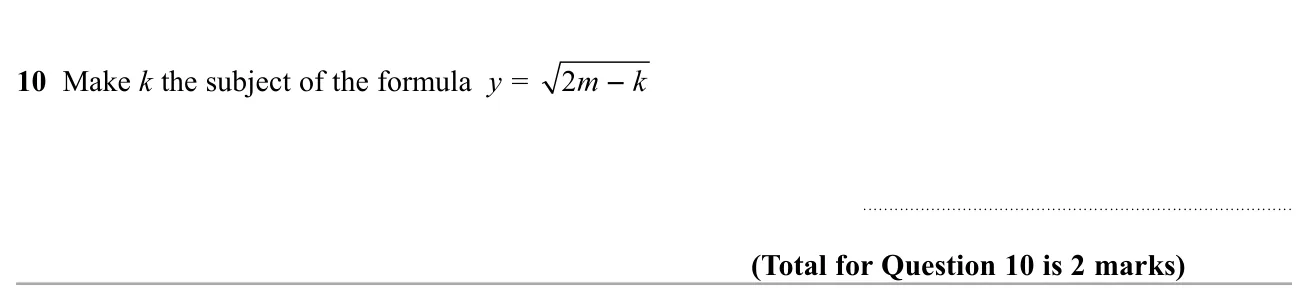
© Pearson Education Ltd. November 2019 Paper 2 (Higher, calculator), question 10.
Answer k = 2 m − y 2 k = 2m - y^2 k = 2 m − y 2 2 marks
Worked solution Checked against the mark scheme
y = 2 m − k y = \sqrt{2m - k} y = 2 m − k
Square both sides: y 2 = 2 m − k y^2 = 2m - k y 2 = 2 m − k
Add k k k y 2 y^2 y 2 k = 2 m − y 2 k = 2m - y^2 k = 2 m − y 2
Watch out: Squaring only one term, e.g. writing y 2 = 2 m − k 2 y^2 = 2m - k^2 y 2 = 2 m − k 2
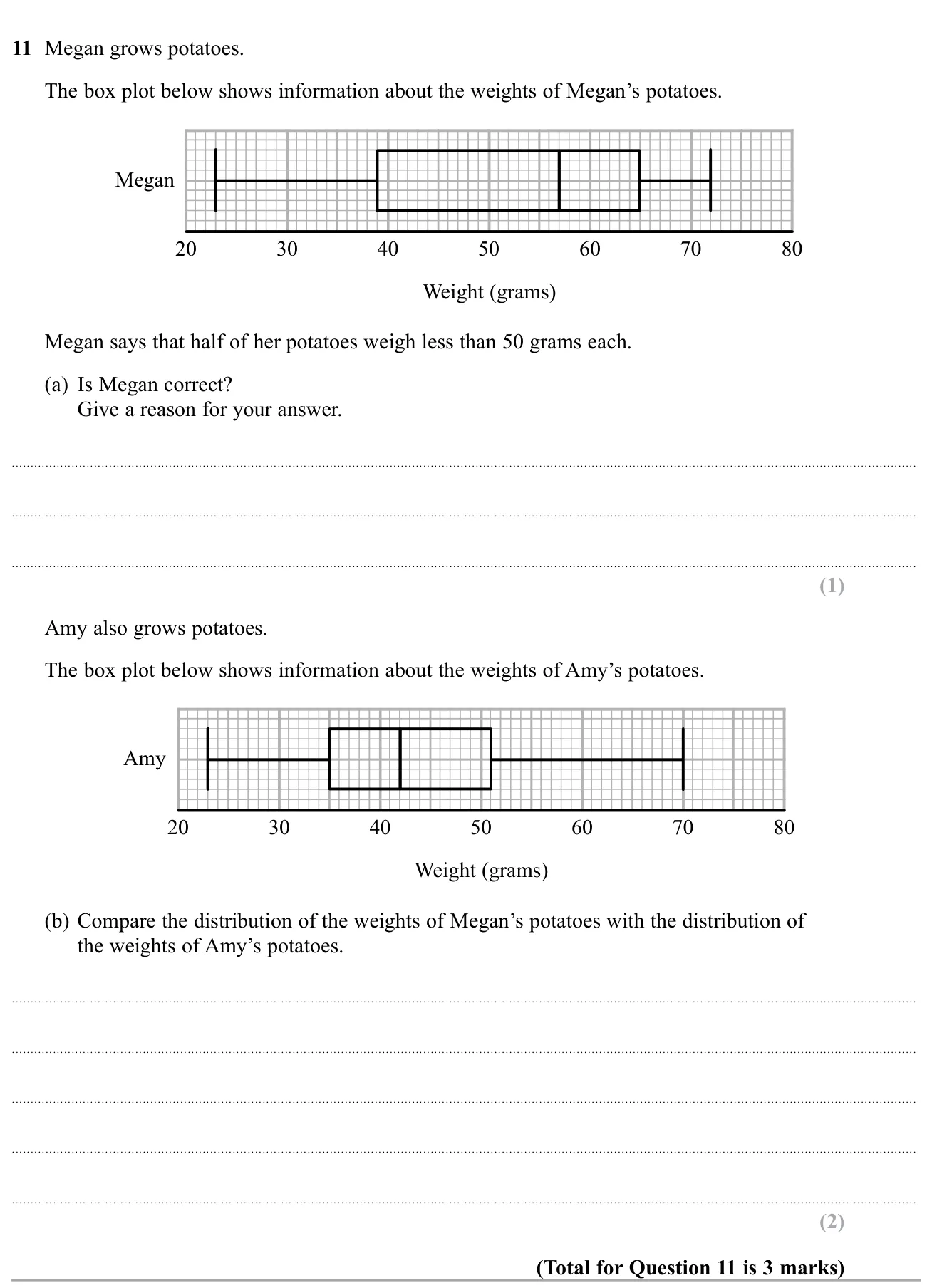
© Pearson Education Ltd. November 2019 Paper 2 (Higher, calculator), question 11.
(a) No: the median is 57 g, so half weigh less than 57 g, not 50 g 1 mark (b) Megan's median (57 g) is higher than Amy's (42 g), so her potatoes are heavier on average; Megan's IQR (26 g) is larger than Amy's (16 g), so her weights are more spread out 2 marks
Worked solution Checked against the mark scheme
(a) The line inside Megan's box is at 57 g. This is the median, so half her potatoes weigh less than 57 g, not 50 g. She is wrong.
(b) Medians: Megan 57 g, Amy 42 g, so Megan's potatoes are generally heavier.
IQRs: Megan 65 − 39 = 26 65 - 39 = 26 65 − 39 = 26 51 − 35 = 16 51 - 35 = 16 51 − 35 = 16
Watch out: Quoting the values without actually comparing them.
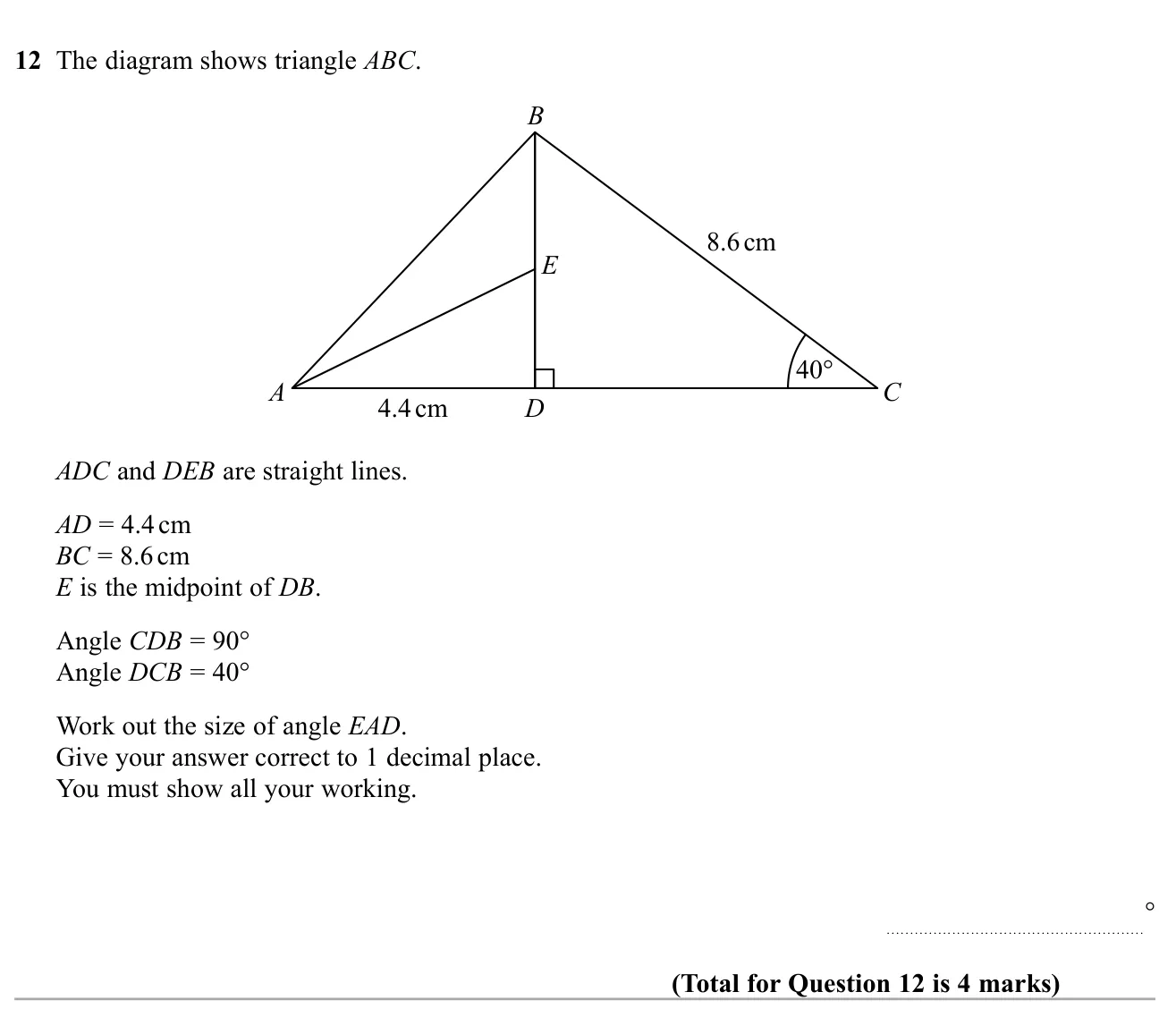
© Pearson Education Ltd. November 2019 Paper 2 (Higher, calculator), question 12.
Answer 32.1 ° 32.1° 32.1° 4 marks
Worked solution Checked against the mark scheme
In triangle BDC: B D = 8.6 sin 40 ° = 5.528 BD = 8.6 \sin 40° = 5.528 B D = 8.6 sin 40° = 5.528
E is the midpoint, so E D = 5.528 ÷ 2 = 2.764 ED = 5.528 \div 2 = 2.764 E D = 5.528 ÷ 2 = 2.764
In triangle EAD: tan ( E A D ) = 2.764 4.4 \tan(EAD) = \frac{2.764}{4.4} tan ( E A D ) = 4.4 2.764
E A D = tan − 1 ( 0.6282 ) = 32.1 ° EAD = \tan^{-1}(0.6282) = 32.1° E A D = tan − 1 ( 0.6282 ) = 32.1°
Watch out: Using cos 40 instead of sin 40 to find BD.
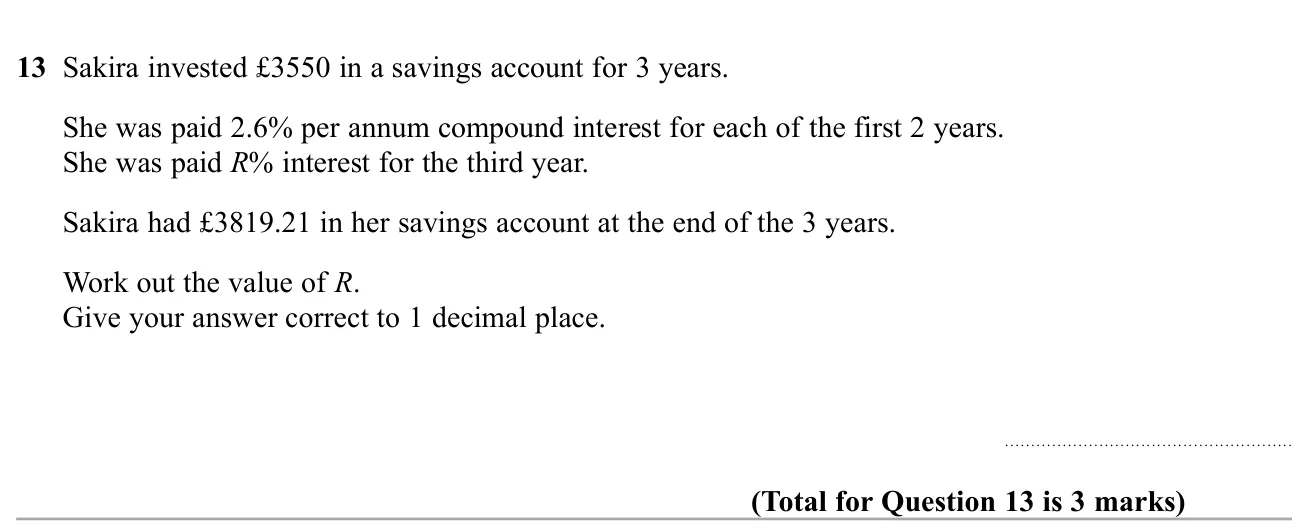
© Pearson Education Ltd. November 2019 Paper 2 (Higher, calculator), question 13.
Worked solution Checked against the mark scheme
After 2 years: 3550 × 1.026 2 = £ 3736.9998 3550 \times 1.026^2 = £3736.9998 3550 × 1.02 6 2 = £3736.9998
Multiplier for year 3: 3819.21 ÷ 3736.9998 = 1.02199... 3819.21 \div 3736.9998 = 1.02199... 3819.21 ÷ 3736.9998 = 1.02199...
So R = 2.199... ≈ 2.2 R = 2.199... \approx 2.2 R = 2.199... ≈ 2.2
Watch out: Using simple interest for the first two years.
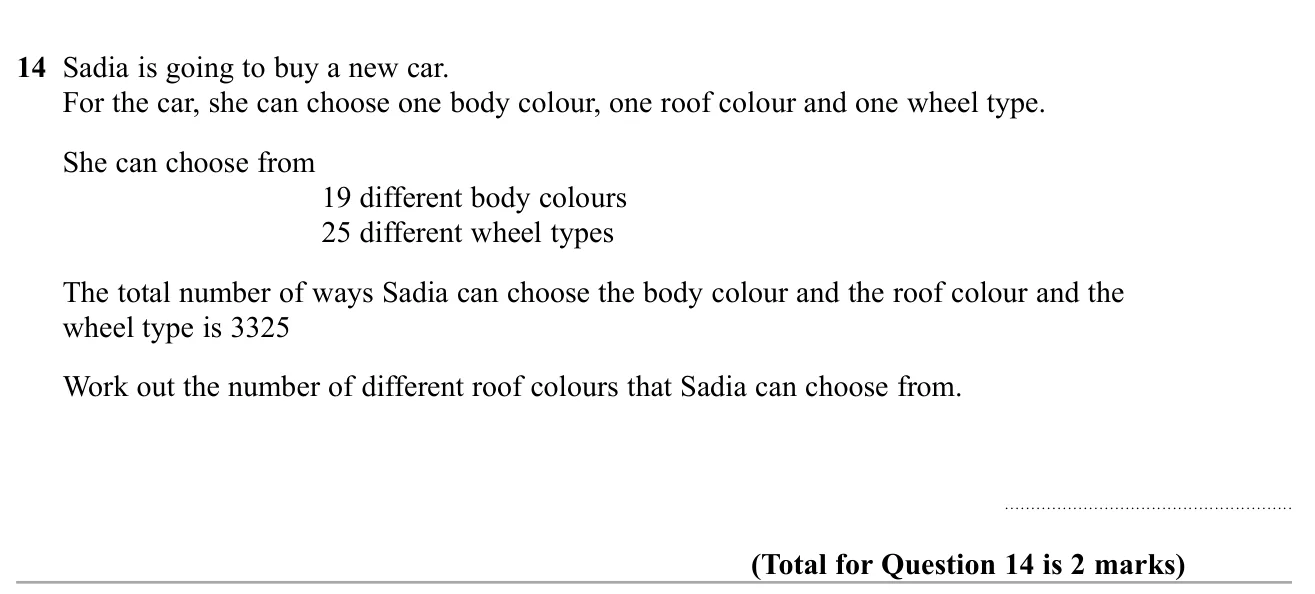
© Pearson Education Ltd. November 2019 Paper 2 (Higher, calculator), question 14.
Worked solution Checked against the mark scheme
Total choices = 19 × r × 25 = 19 \times r \times 25 = 19 × r × 25
19 × 25 = 475 19 \times 25 = 475 19 × 25 = 475
r = 3325 ÷ 475 = 7 r = 3325 \div 475 = 7 r = 3325 ÷ 475 = 7
Watch out: Subtracting 19 and 25 from 3325 instead of dividing.
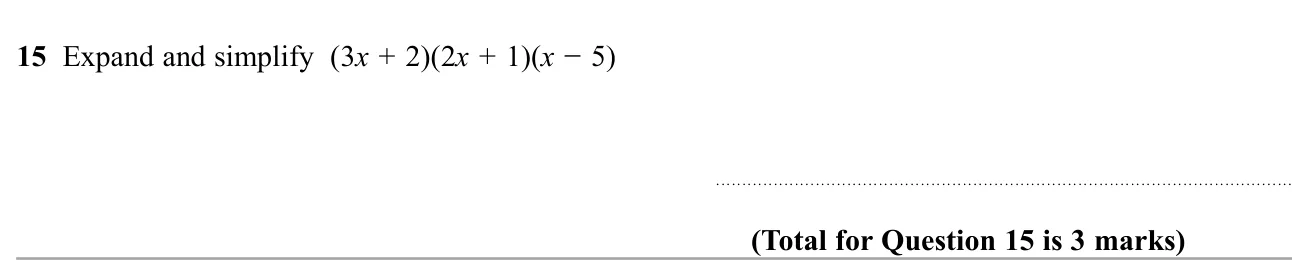
© Pearson Education Ltd. November 2019 Paper 2 (Higher, calculator), question 15.
Answer 6 x 3 − 23 x 2 − 33 x − 10 6x^3 - 23x^2 - 33x - 10 6 x 3 − 23 x 2 − 33 x − 10 3 marks
Worked solution Checked against the mark scheme
( 3 x + 2 ) ( 2 x + 1 ) = 6 x 2 + 7 x + 2 (3x + 2)(2x + 1) = 6x^2 + 7x + 2 ( 3 x + 2 ) ( 2 x + 1 ) = 6 x 2 + 7 x + 2
( 6 x 2 + 7 x + 2 ) ( x − 5 ) = 6 x 3 − 30 x 2 + 7 x 2 − 35 x + 2 x − 10 (6x^2 + 7x + 2)(x - 5) = 6x^3 - 30x^2 + 7x^2 - 35x + 2x - 10 ( 6 x 2 + 7 x + 2 ) ( x − 5 ) = 6 x 3 − 30 x 2 + 7 x 2 − 35 x + 2 x − 10
= 6 x 3 − 23 x 2 − 33 x − 10 = 6x^3 - 23x^2 - 33x - 10 = 6 x 3 − 23 x 2 − 33 x − 10
Watch out: Sign errors when multiplying by −5.
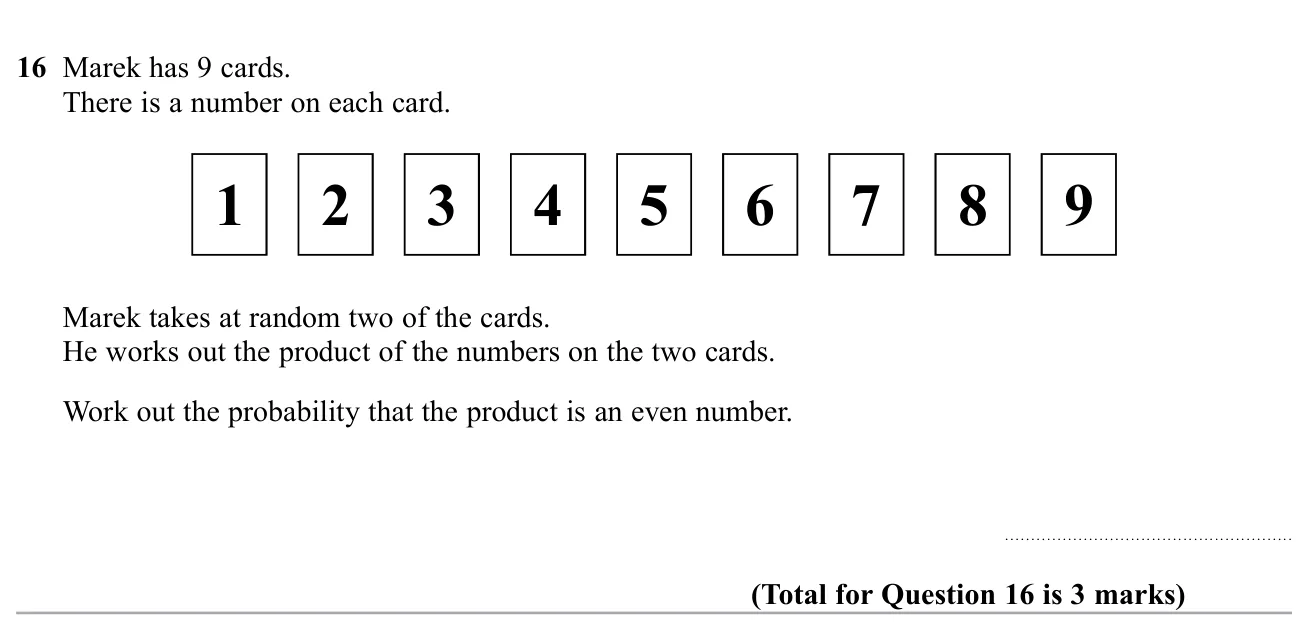
© Pearson Education Ltd. November 2019 Paper 2 (Higher, calculator), question 16.
Answer 13 18 \frac{13}{18} 18 13 3 marks
Worked solution Checked against the mark scheme
The product is odd only if both cards are odd. There are 5 odd cards out of 9.
P ( both odd ) = 5 9 × 4 8 = 20 72 P(\text{both odd}) = \frac{5}{9} \times \frac{4}{8} = \frac{20}{72} P ( both odd ) = 9 5 × 8 4 = 72 20
P ( even ) = 1 − 20 72 = 52 72 = 13 18 P(\text{even}) = 1 - \frac{20}{72} = \frac{52}{72} = \frac{13}{18} P ( even ) = 1 − 72 20 = 72 52 = 18 13
Watch out: Treating it as with replacement, giving 56 81 \frac{56}{81} 81 56
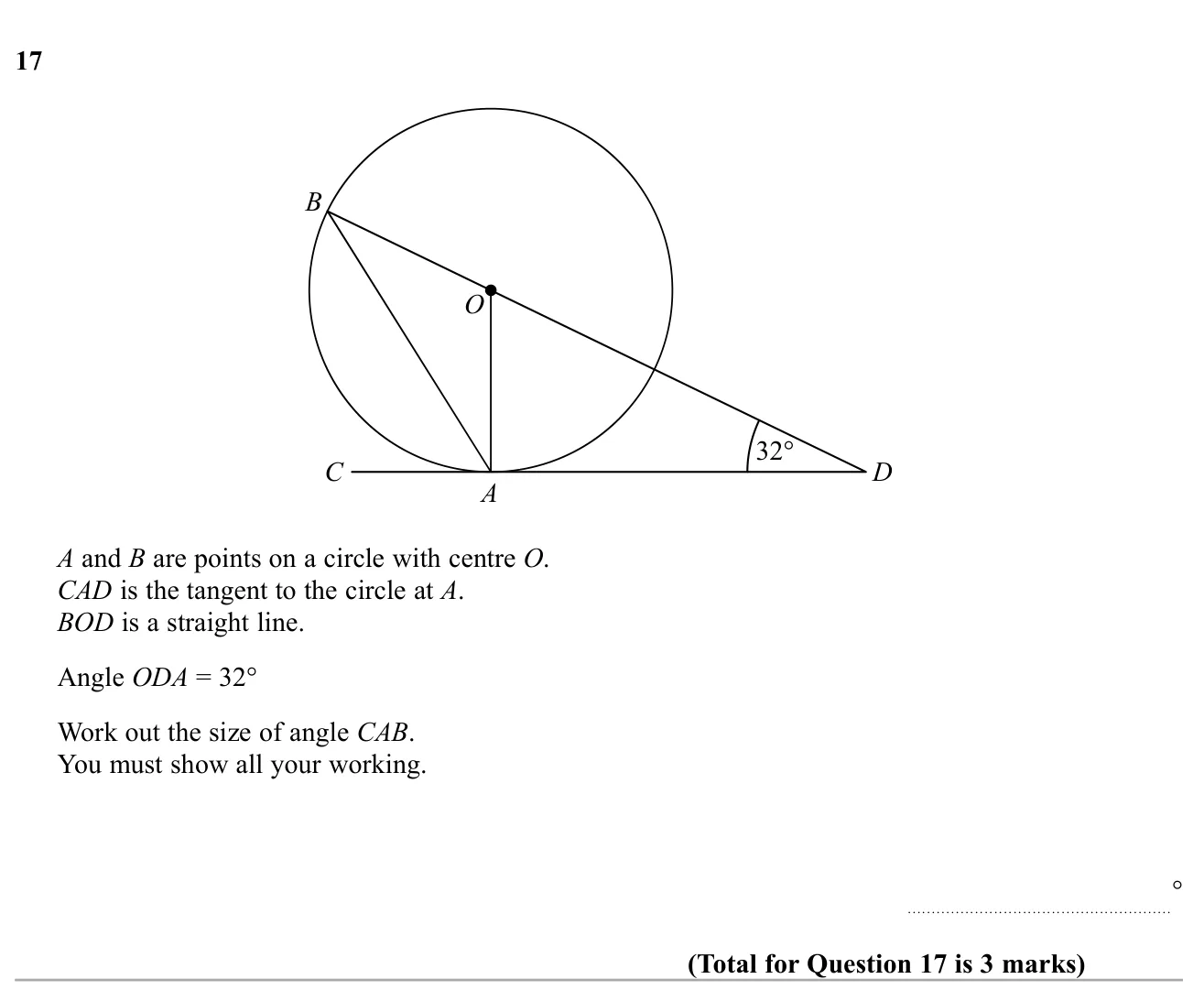
© Pearson Education Ltd. November 2019 Paper 2 (Higher, calculator), question 17.
Worked solution Checked against the mark scheme
The radius meets the tangent at 90°, so angle O A D = 90 ° OAD = 90° O A D = 90°
Angle A O D = 180 − 90 − 32 = 58 ° AOD = 180 - 90 - 32 = 58° A O D = 180 − 90 − 32 = 58° A O B = 180 − 58 = 122 ° AOB = 180 - 58 = 122° A O B = 180 − 58 = 122°
O A = O B OA = OB O A = O B O A B = ( 180 − 122 ) ÷ 2 = 29 ° OAB = (180 - 122) \div 2 = 29° O A B = ( 180 − 122 ) ÷ 2 = 29°
Angle C A B = 90 − 29 = 61 ° CAB = 90 - 29 = 61° C A B = 90 − 29 = 61°
Watch out: Assuming triangle OAB is equilateral or forgetting the 90° at the tangent.
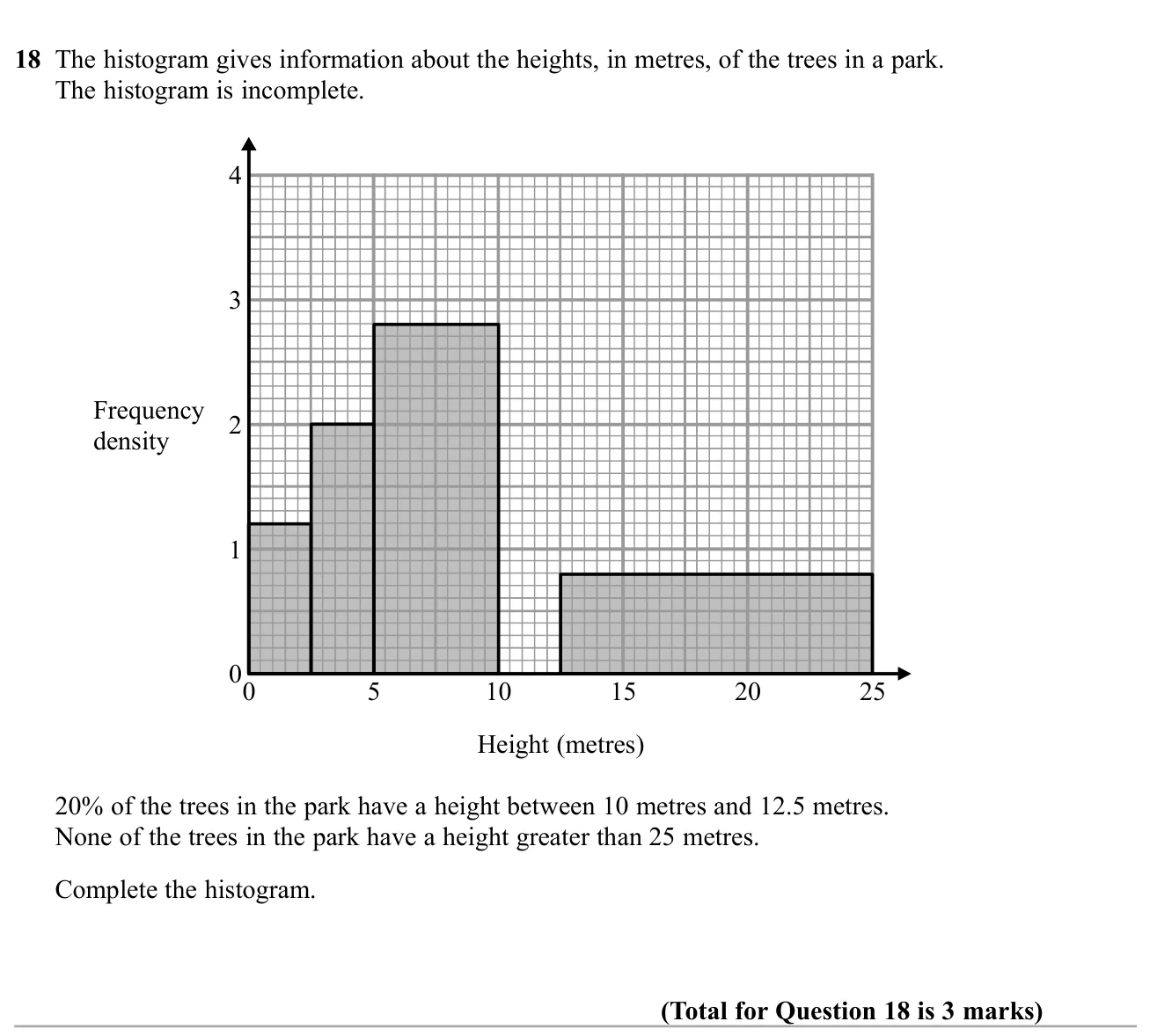
© Pearson Education Ltd. November 2019 Paper 2 (Higher, calculator), question 18.
Answer A bar from 10 to 12.5 m with frequency density 3.2 3 marks
Worked solution Checked against the mark scheme
Frequencies from the bars (width × height): 2.5 × 1.2 = 3 2.5 \times 1.2 = 3 2.5 × 1.2 = 3 2.5 × 2 = 5 2.5 \times 2 = 5 2.5 × 2 = 5 5 × 2.8 = 14 5 \times 2.8 = 14 5 × 2.8 = 14 12.5 × 0.8 = 10 12.5 \times 0.8 = 10 12.5 × 0.8 = 10
Known total = 32 = 32 = 32 32 ÷ 0.8 = 40 32 \div 0.8 = 40 32 ÷ 0.8 = 40
Missing class: 20% of 40 = 8 = 8 = 8
Frequency density = 8 ÷ 2.5 = 3.2 = 8 \div 2.5 = 3.2 = 8 ÷ 2.5 = 3.2
Watch out: Drawing the bar height as the frequency (8) instead of the frequency density.
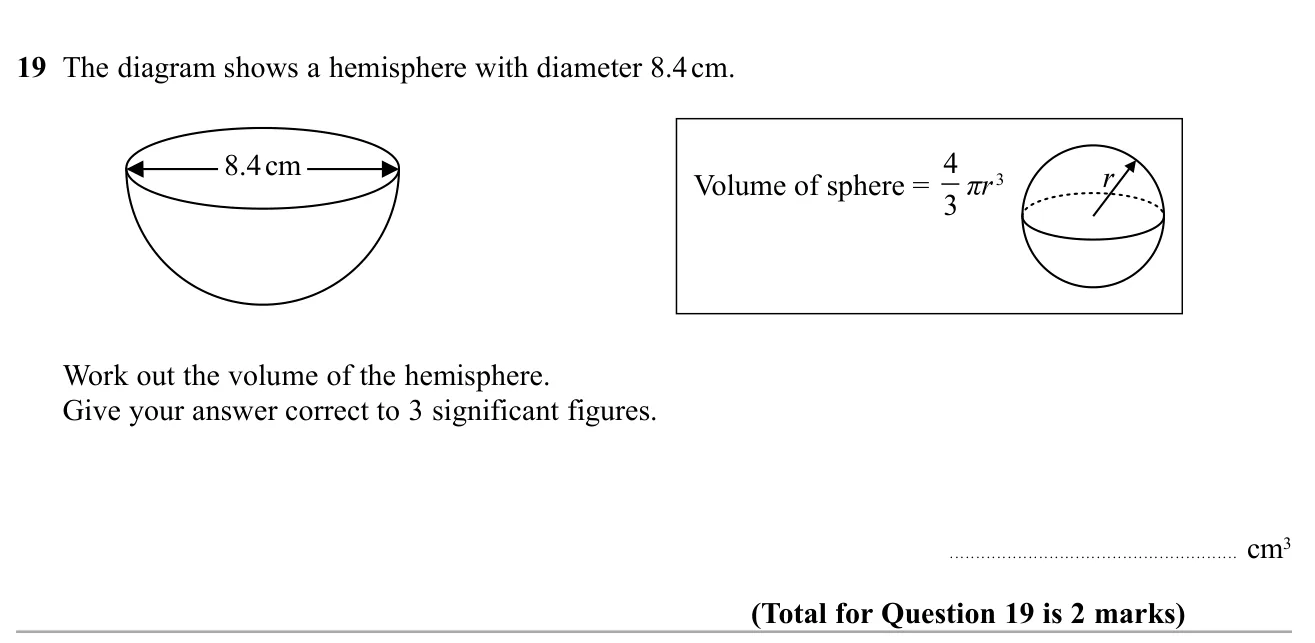
© Pearson Education Ltd. November 2019 Paper 2 (Higher, calculator), question 19.
Answer 155 cm 3 155\text{ cm}^3 155 cm 3 2 marks
Worked solution Checked against the mark scheme
Radius = 8.4 ÷ 2 = 4.2 = 8.4 \div 2 = 4.2 = 8.4 ÷ 2 = 4.2
Volume = 1 2 × 4 3 π × 4.2 3 = 155.17... = \frac{1}{2} \times \frac{4}{3}\pi \times 4.2^3 = 155.17... = 2 1 × 3 4 π × 4. 2 3 = 155.17...
= 155 cm 3 = 155\text{ cm}^3 = 155 cm 3
Watch out: Using the diameter 8.4 as the radius.
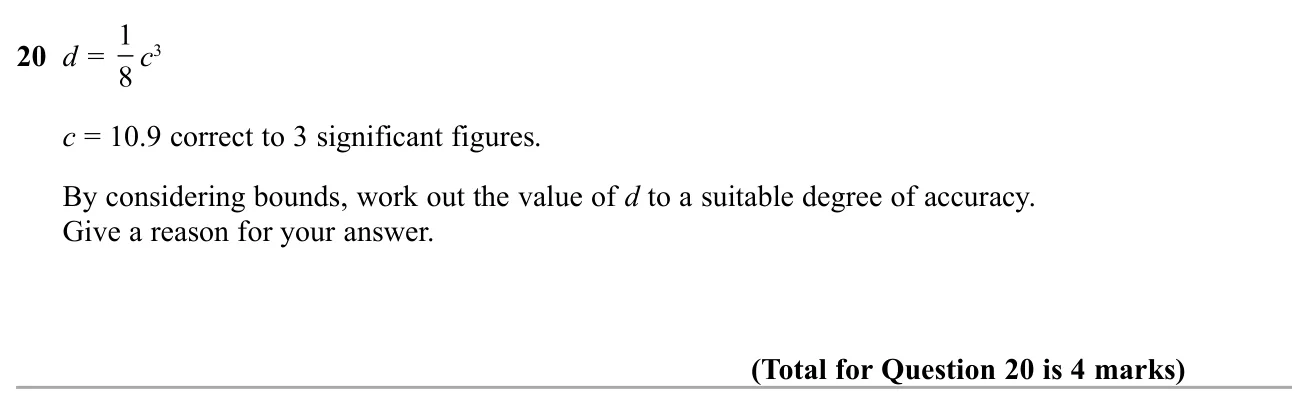
© Pearson Education Ltd. November 2019 Paper 2 (Higher, calculator), question 20.
Answer d = 160 d = 160 d = 160 4 marks
Worked solution Checked against the mark scheme
Bounds of c c c 10.85 ≤ c < 10.95 10.85 \le c < 10.95 10.85 ≤ c < 10.95
Lower bound of d = 1 8 × 10.85 3 = 159.66... d = \frac{1}{8} \times 10.85^3 = 159.66... d = 8 1 × 10.8 5 3 = 159.66...
Upper bound of d = 1 8 × 10.95 3 = 164.11... d = \frac{1}{8} \times 10.95^3 = 164.11... d = 8 1 × 10.9 5 3 = 164.11...
Both round to 160 to 2 significant figures, so d = 160 d = 160 d = 160
Watch out: Giving 162 (3 s.f.) even though the bounds disagree at that accuracy.
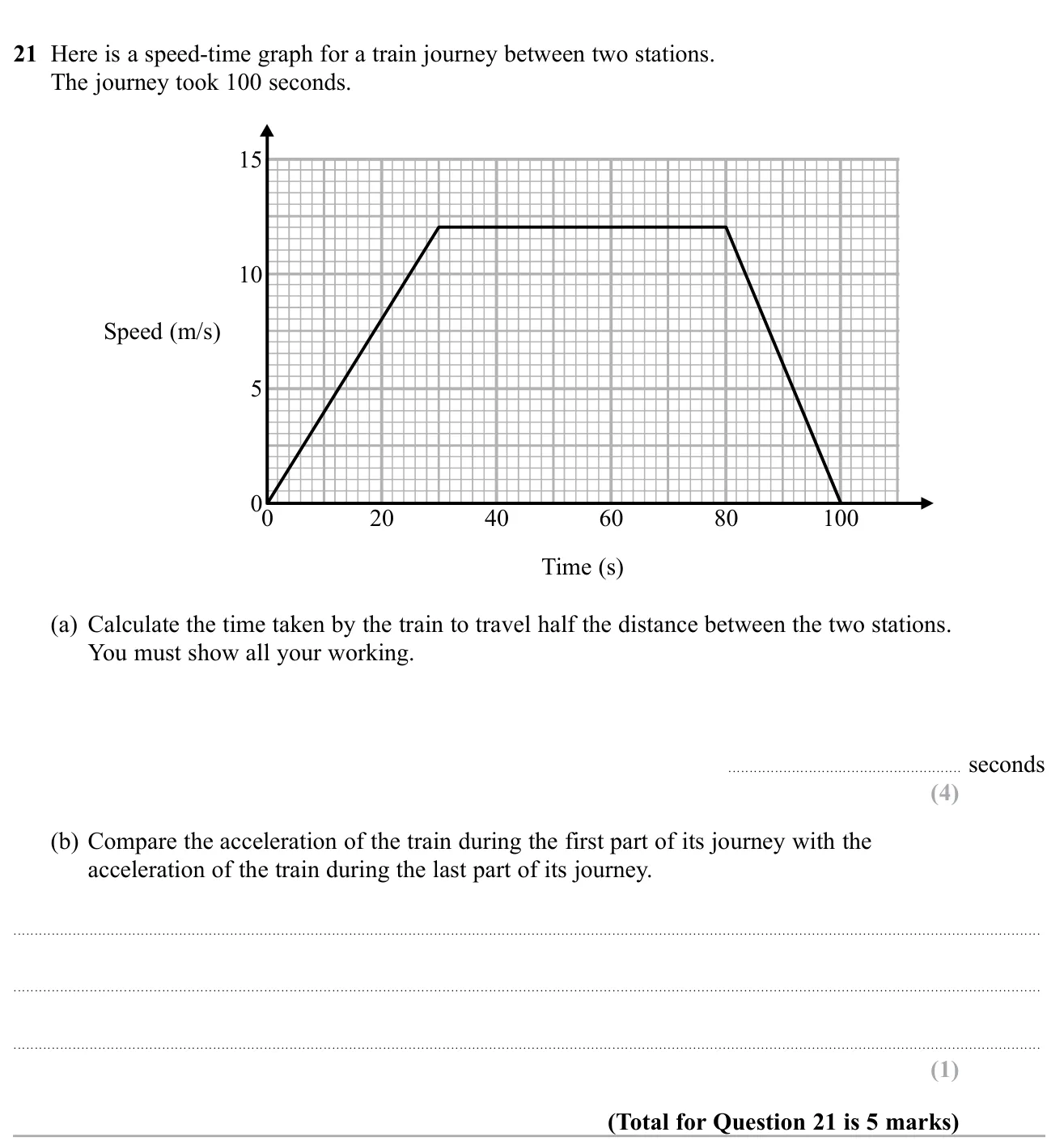
© Pearson Education Ltd. November 2019 Paper 2 (Higher, calculator), question 21.
(a) 52.5 seconds 4 marks (b) The train speeds up at 0.4 m/s² but slows down at 0.6 m/s², so the deceleration at the end is greater (steeper) 1 mark
Worked solution Checked against the mark scheme
(a) Distance = area: 1 2 ( 30 ) ( 12 ) + 50 ( 12 ) + 1 2 ( 20 ) ( 12 ) = 180 + 600 + 120 = 900 \frac{1}{2}(30)(12) + 50(12) + \frac{1}{2}(20)(12) = 180 + 600 + 120 = 900 2 1 ( 30 ) ( 12 ) + 50 ( 12 ) + 2 1 ( 20 ) ( 12 ) = 180 + 600 + 120 = 900
Half distance = 450 = 450 = 450 270 270 270 270 ÷ 12 = 22.5 270 \div 12 = 22.5 270 ÷ 12 = 22.5
Time = 30 + 22.5 = 52.5 = 30 + 22.5 = 52.5 = 30 + 22.5 = 52.5
(b) First part: 12 ÷ 30 = 0.4 m/s 2 12 \div 30 = 0.4\text{ m/s}^2 12 ÷ 30 = 0.4 m/s 2 − 12 ÷ 20 = − 0.6 m/s 2 -12 \div 20 = -0.6\text{ m/s}^2 − 12 ÷ 20 = − 0.6 m/s 2
Watch out: Answering 50 s (half the time) instead of the time for half the distance.
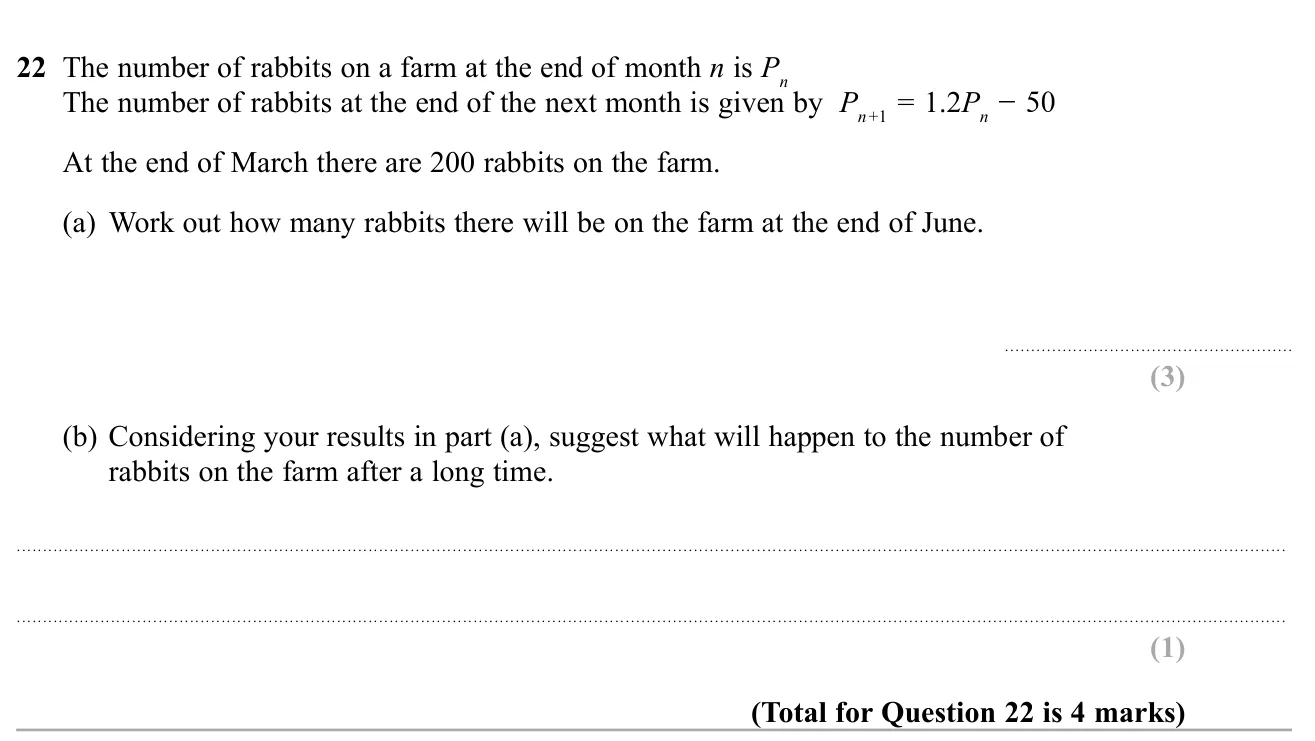
© Pearson Education Ltd. November 2019 Paper 2 (Higher, calculator), question 22.
(a) 163 (or 164) 3 marks (b) The number keeps falling, so eventually there will be no rabbits 1 mark
Worked solution Checked against the mark scheme
(a) April: 1.2 × 200 − 50 = 190 1.2 \times 200 - 50 = 190 1.2 × 200 − 50 = 190
May: 1.2 × 190 − 50 = 178 1.2 \times 190 - 50 = 178 1.2 × 190 − 50 = 178
June: 1.2 × 178 − 50 = 163.6 1.2 \times 178 - 50 = 163.6 1.2 × 178 − 50 = 163.6
(b) The population drops each month, so over time it will keep decreasing until there are no rabbits left.
Watch out: Starting from March as n = 1 and doing only two steps, or one step too many.
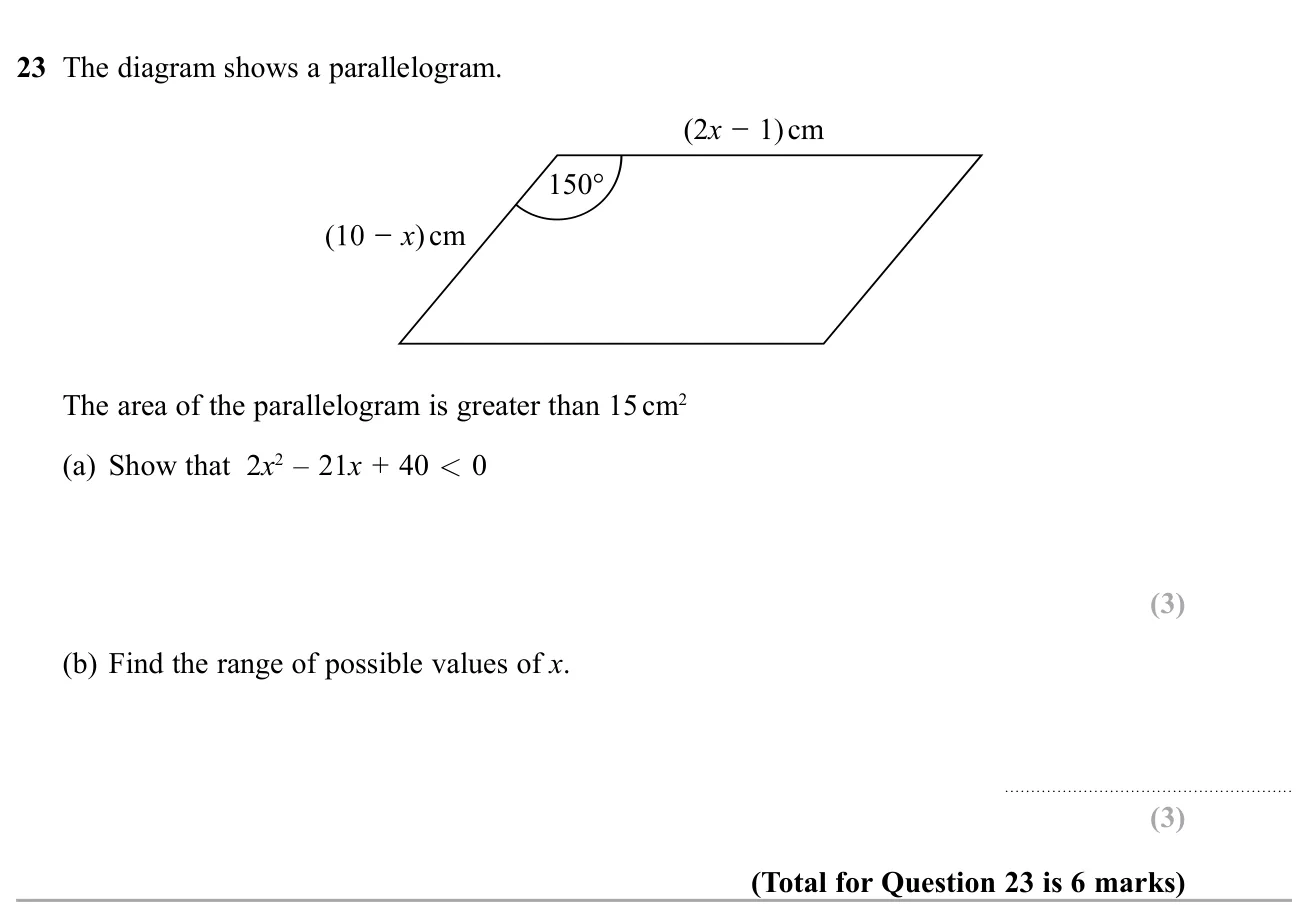
© Pearson Education Ltd. November 2019 Paper 2 (Higher, calculator), question 23.
(a) Area = ( 2 x − 1 ) ( 10 − x ) sin 150 ° > 15 = (2x-1)(10-x)\sin 150° > 15 = ( 2 x − 1 ) ( 10 − x ) sin 150° > 15 2 x 2 − 21 x + 40 < 0 2x^2 - 21x + 40 < 0 2 x 2 − 21 x + 40 < 0 3 marks (b) 2.5 < x < 8 2.5 < x < 8 2.5 < x < 8 3 marks
Worked solution Checked against the mark scheme
(a) Area = a b sin C = ( 2 x − 1 ) ( 10 − x ) × sin 150 ° = 1 2 ( 2 x − 1 ) ( 10 − x ) = ab\sin C = (2x - 1)(10 - x) \times \sin 150° = \frac{1}{2}(2x - 1)(10 - x) = ab sin C = ( 2 x − 1 ) ( 10 − x ) × sin 150° = 2 1 ( 2 x − 1 ) ( 10 − x )
= 1 2 ( − 2 x 2 + 21 x − 10 ) = \frac{1}{2}(-2x^2 + 21x - 10) = 2 1 ( − 2 x 2 + 21 x − 10 )
So 1 2 ( − 2 x 2 + 21 x − 10 ) > 15 ⇒ − 2 x 2 + 21 x − 10 > 30 ⇒ 2 x 2 − 21 x + 40 < 0 \frac{1}{2}(-2x^2 + 21x - 10) > 15 \Rightarrow -2x^2 + 21x - 10 > 30 \Rightarrow 2x^2 - 21x + 40 < 0 2 1 ( − 2 x 2 + 21 x − 10 ) > 15 ⇒ − 2 x 2 + 21 x − 10 > 30 ⇒ 2 x 2 − 21 x + 40 < 0
(b) ( 2 x − 5 ) ( x − 8 ) < 0 (2x - 5)(x - 8) < 0 ( 2 x − 5 ) ( x − 8 ) < 0 x = 2.5 x = 2.5 x = 2.5 x = 8 x = 8 x = 8
The U-shaped graph is below zero between the roots, so 2.5 < x < 8 2.5 < x < 8 2.5 < x < 8
Watch out: Using the parallelogram area as 1 2 a b sin C \frac{1}{2}ab\sin C 2 1 ab sin C x < 2.5 x < 2.5 x < 2.5 x > 8 x > 8 x > 8
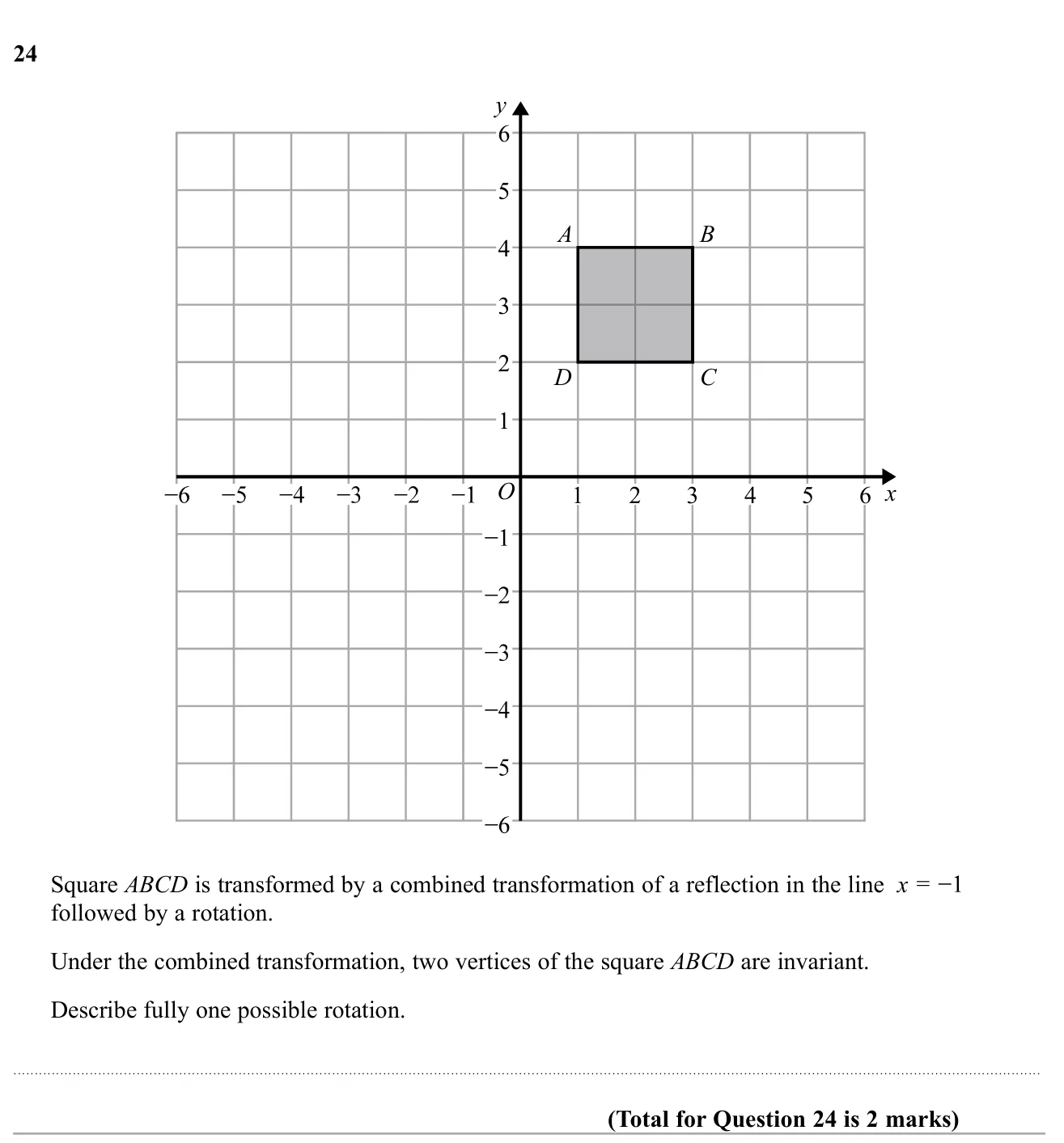
© Pearson Education Ltd. November 2019 Paper 2 (Higher, calculator), question 24.
Answer Rotation 90° clockwise about ( − 1 , 0 ) (-1, 0) ( − 1 , 0 ) ( − 1 , 6 ) (-1, 6) ( − 1 , 6 ) ( − 1 , 2 ) (-1, 2) ( − 1 , 2 ) ( − 1 , 4 ) (-1, 4) ( − 1 , 4 ) 2 marks
Worked solution Checked against the mark scheme
Reflecting in x = − 1 x = -1 x = − 1 A ( 1 , 4 ) → ( − 3 , 4 ) A(1, 4) \to (-3, 4) A ( 1 , 4 ) → ( − 3 , 4 ) B ( 3 , 4 ) → ( − 5 , 4 ) B(3, 4) \to (-5, 4) B ( 3 , 4 ) → ( − 5 , 4 ) C ( 3 , 2 ) → ( − 5 , 2 ) C(3, 2) \to (-5, 2) C ( 3 , 2 ) → ( − 5 , 2 ) D ( 1 , 2 ) → ( − 3 , 2 ) D(1, 2) \to (-3, 2) D ( 1 , 2 ) → ( − 3 , 2 )
To bring B B B D D D ( − 1 , 0 ) (-1, 0) ( − 1 , 0 ) ( − 5 , 4 ) → ( 3 , 4 ) (-5, 4) \to (3, 4) ( − 5 , 4 ) → ( 3 , 4 ) ( − 3 , 2 ) → ( 1 , 2 ) (-3, 2) \to (1, 2) ( − 3 , 2 ) → ( 1 , 2 )
So B and D are invariant.
Watch out: Leaving out the centre or the direction of rotation.
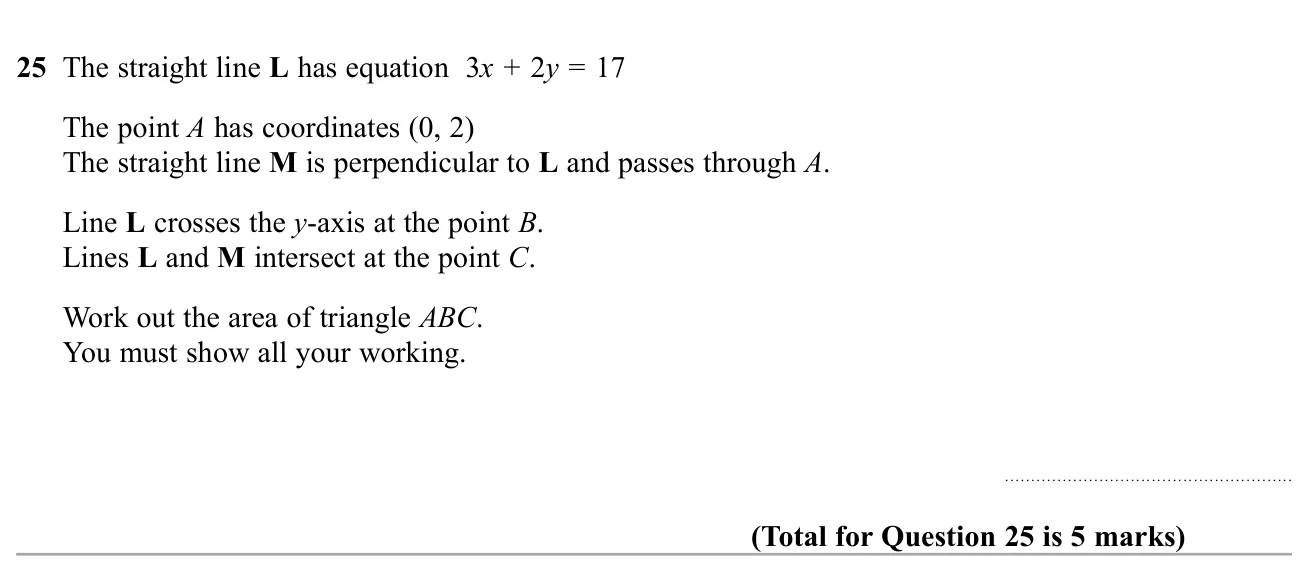
© Pearson Education Ltd. November 2019 Paper 2 (Higher, calculator), question 25.
Worked solution Checked against the mark scheme
L: 2 y = 17 − 3 x 2y = 17 - 3x 2 y = 17 − 3 x y = 8.5 − 1.5 x y = 8.5 - 1.5x y = 8.5 − 1.5 x − 3 2 -\frac{3}{2} − 2 3 B = ( 0 , 8.5 ) B = (0, 8.5) B = ( 0 , 8.5 )
M has gradient 2 3 \frac{2}{3} 3 2 ( 0 , 2 ) (0, 2) ( 0 , 2 ) y = 2 3 x + 2 y = \frac{2}{3}x + 2 y = 3 2 x + 2
Solve: 2 3 x + 2 = 8.5 − 1.5 x ⇒ 13 6 x = 6.5 ⇒ x = 3 \frac{2}{3}x + 2 = 8.5 - 1.5x \Rightarrow \frac{13}{6}x = 6.5 \Rightarrow x = 3 3 2 x + 2 = 8.5 − 1.5 x ⇒ 6 13 x = 6.5 ⇒ x = 3 C = ( 3 , 4 ) C = (3, 4) C = ( 3 , 4 )
Base A B = 8.5 − 2 = 6.5 AB = 8.5 - 2 = 6.5 A B = 8.5 − 2 = 6.5
Area = 1 2 × 6.5 × 3 = 9.75 = \frac{1}{2} \times 6.5 \times 3 = 9.75 = 2 1 × 6.5 × 3 = 9.75
Watch out: Using gradient 3 2 \frac{3}{2} 2 3
Finished the paper? Add up your marks for all three papers and see what grade that would have been.