Geometry and measures

Constructions and loci

7 past-paper questions, easiest first. Try each one, then reveal the answer.

Foundation & HigherAll 7 from Foundation papers

Revision guide by The Full Marks

Constructions and loci: what you need to know

Constructions are accurate drawings made with a ruler and compasses. A locus is the set of points that follow a rule, such as 'exactly 3 m from the tree'. Examiners look for your arcs, so leave them on the page.

Key facts

  • Points a fixed distance from a point form a circle.
  • Points equidistant from two points lie on the perpendicular bisector of the line joining them.
  • Points equidistant from two lines lie on the bisector of the angle between them.
  • Points a fixed distance from a line segment form two parallel lines joined by semicircles at the ends (a 'racetrack' shape).
  • The shortest distance from a point to a line is the perpendicular distance.

Perpendicular bisector of ABAB

  1. Open the compasses to more than half of ABAB.
  2. Draw arcs above and below the line from AA, then from BB with the same setting.
  3. Join the two points where the arcs cross.

Bisecting angle ABCABC

  1. With the point on BB, draw an arc crossing both arms of the angle.
  2. From each crossing point, draw arcs (same setting) that meet inside the angle.
  3. Draw a line from BB through where these arcs meet.

Perpendicular from a point PP to a line

  1. Draw an arc centred on PP that cuts the line twice.
  2. From those two points, draw arcs that cross on the far side of the line, then join PP to that crossing.

Perpendicular at a point PP on a line

  1. With the point on PP, draw two arcs cutting the line either side of PP.
  2. Open the compasses wider and, from those two points, draw arcs that cross above PP. Join PP to that crossing.

Triangle from three sides

  1. Draw one side accurately with a ruler.
  2. Set the compasses to the second length and draw an arc from one end; set them to the third length and draw an arc from the other end.
  3. Join the point where the arcs cross to both ends. Leave the arcs showing.

Worked examples

Example 1 Foundation · grade 4

Two lamp posts, AA and BB, are 8 cm apart on a map. Leah wants a bench the same distance from both posts. Describe the locus of possible positions.

Show the solution

Equal distance from two points means the perpendicular bisector of ABAB.
Set the compasses to more than 4 cm and draw arcs from AA and BB, above and below the line.
Join the crossing points. Every point on this line is the same distance from AA and BB.

Example 2 Foundation · grade 5

A garden is a rectangle PQRSPQRS, 10 m by 6 m, drawn with scale 1 cm to 2 m. A pond must be less than 4 m from PP and nearer to PQPQ than to PSPS. Show where it can go.

Show the solution

4 m on the plan is 4÷2=24 \div 2 = 2 cm, so draw an arc of radius 2 cm centred on PP.
'Nearer to PQPQ than PSPS': construct the bisector of angle QPSQPS.
Shade the part inside the arc on the PQPQ side of the bisector.

Common mistakes

  • Using a protractor or drawing by eye. Without visible arcs you lose the marks.
  • Bisecting the angle when the question is about two points (or the reverse). Points need a perpendicular bisector; lines need an angle bisector.
  • Forgetting to use the scale before drawing.

Exam tips

  • Keep your arcs and make them clear. Accuracy is usually checked to within 2 mm or 2∘2^\circ.
  • In region questions, shade the final region clearly and check 'less than' or 'more than'.

Questions people ask

What is a locus in GCSE Maths?

A locus is a set of points that all follow a rule, like being 5 cm from a point (a circle) or the same distance from two points (a perpendicular bisector).

Can I use a protractor for constructions?

No. When a question says 'use ruler and compasses', you must show construction arcs, or the method marks are lost.

Exam questions: Constructions and loci (7, easiest first)

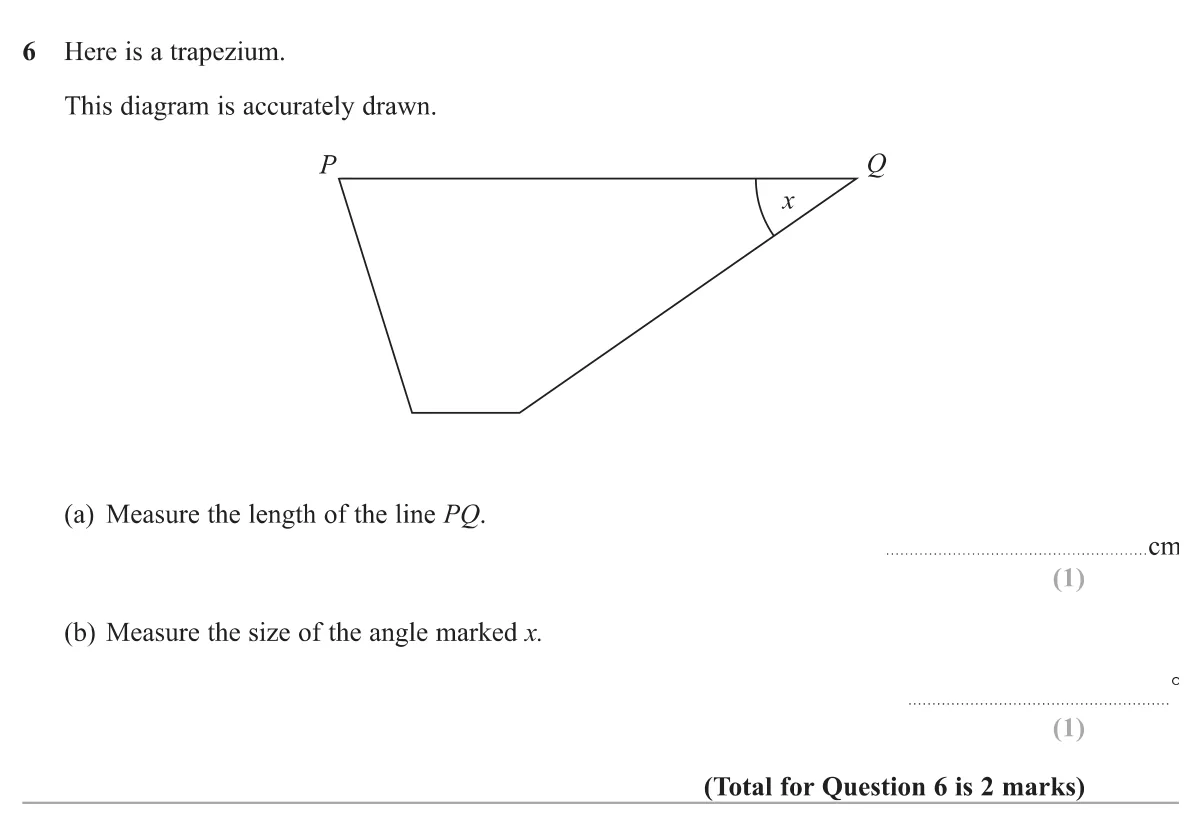
Constructions and loci2 marksGrade 1CalculatorFoundation
Specimen · Paper 3 Foundation · Q6
Measure a side and an angle on an accurately drawn trapezium.

© Pearson Education Ltd. Specimen Paper 3 (Foundation, calculator), question 6.

Show answer
(a)8 cm1 mark
(b)35∘35^\circ1 mark

Worked solution Checked against the mark scheme

(a) Put the 0 of the ruler on P and read the mark at Q: about 8 cm.

(b) Place the protractor centre on Q with the base line along QP and count up from 0: about **35∘35^\circ**.

Watch out: Reading the wrong scale on the protractor and getting 145°.
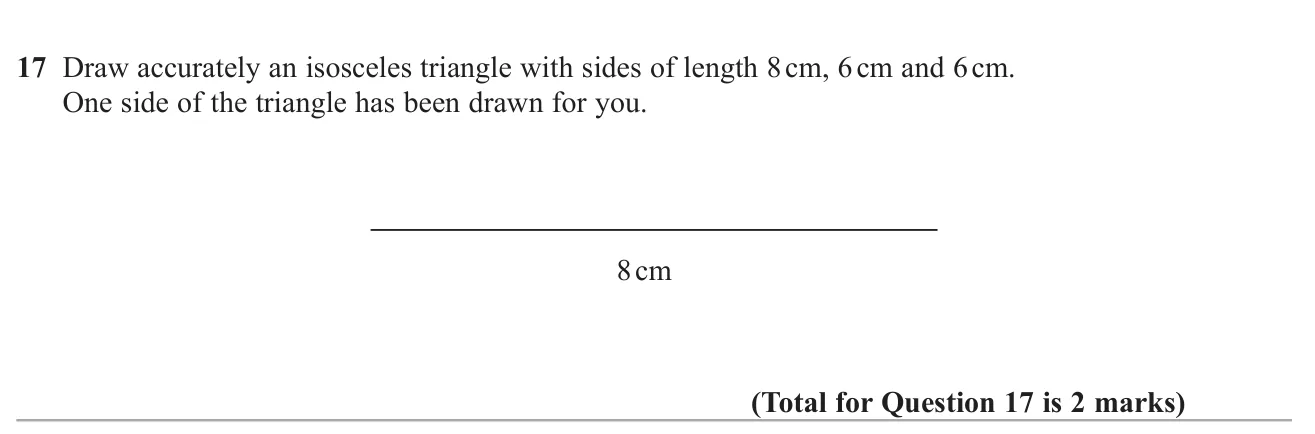
Constructions and loci2 marksGrade 3CalculatorFoundation
November 2020 · Paper 3 Foundation · Q17
Construct an isosceles triangle accurately from its three side lengths using compasses.

© Pearson Education Ltd. November 2020 Paper 3 (Foundation, calculator), question 17.

Show answer
AnswerAccurate triangle with sides 8 cm, 6 cm, 6 cm2 marks

Worked solution Checked against the mark scheme

Set compasses to 6 cm. Draw an arc from each end of the 8 cm line.

Join both ends to the point where the arcs cross.

Watch out: Drawing the equal sides by eye with a ruler so they are not exactly 6 cm.

Constructions and loci3 marksGrade 4CalculatorFoundation
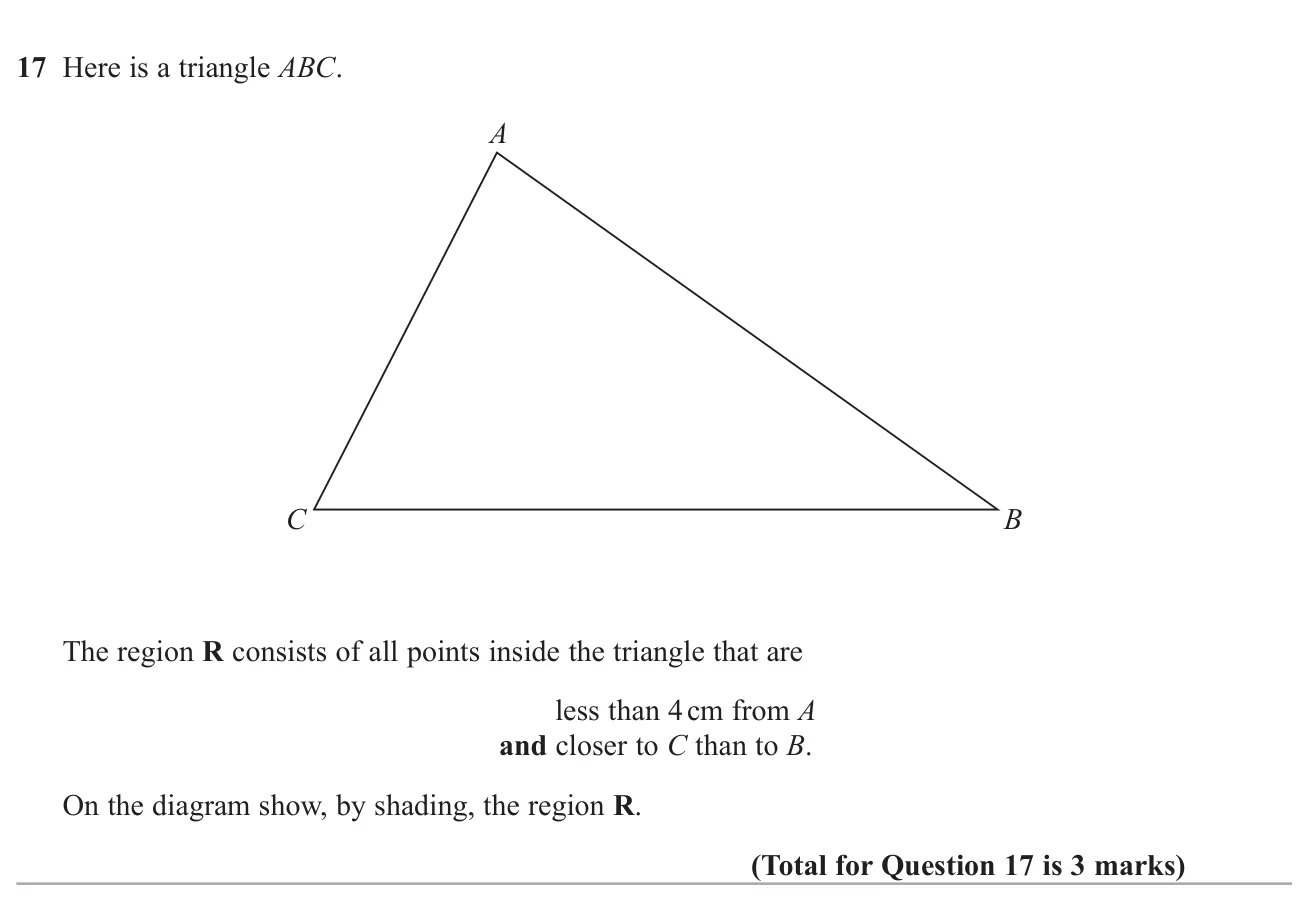
June 2024 · Paper 2 Foundation · Q17
Shade the region inside a triangle that is within a given distance of one vertex and nearer to one vertex than another.

© Pearson Education Ltd. June 2024 Paper 2 (Foundation, calculator), question 17.

Show answer
AnswerRegion inside the triangle, inside a 4 cm arc centred at A and on the C side of the perpendicular bisector of CB3 marks

Worked solution Checked against the mark scheme

1. Set compasses to 4 cm and draw an arc centred at AA. Points inside it are less than 4 cm from AA.

2. Construct the perpendicular bisector of CBCB. Points on the CC side are closer to CC than to BB.

3. Shade the part of the triangle that is inside the arc and on the CC side of the bisector.

Watch out: Bisecting the angle at A instead of drawing the perpendicular bisector of CB.

Constructions and loci2 marksGrade 4CalculatorOn both tiers
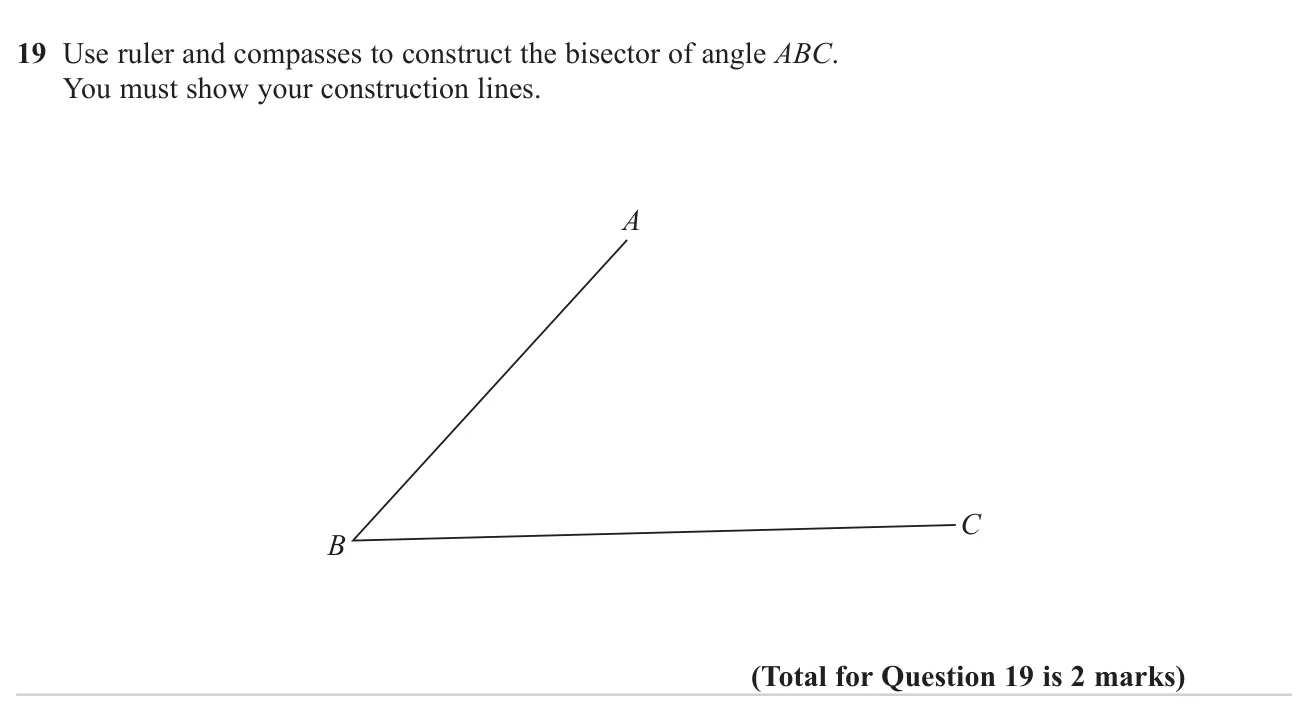
November 2024 · Paper 3 Foundation · Q19
Construct an angle bisector with ruler and compasses.

© Pearson Education Ltd. November 2024 Paper 3 (Foundation, calculator), question 19.

Show answer
AnswerCorrect bisector with construction arcs shown2 marks

Worked solution Checked against the mark scheme

Put the compass point on B and draw an arc crossing BA and BC.

From each crossing point, draw equal arcs that meet inside the angle.

Rule a line from B through where the arcs meet. Leave all arcs visible.

Watch out: Measuring with a protractor and not showing arcs.

Constructions and loci2 marksGrade 5No calculatorOn both tiers
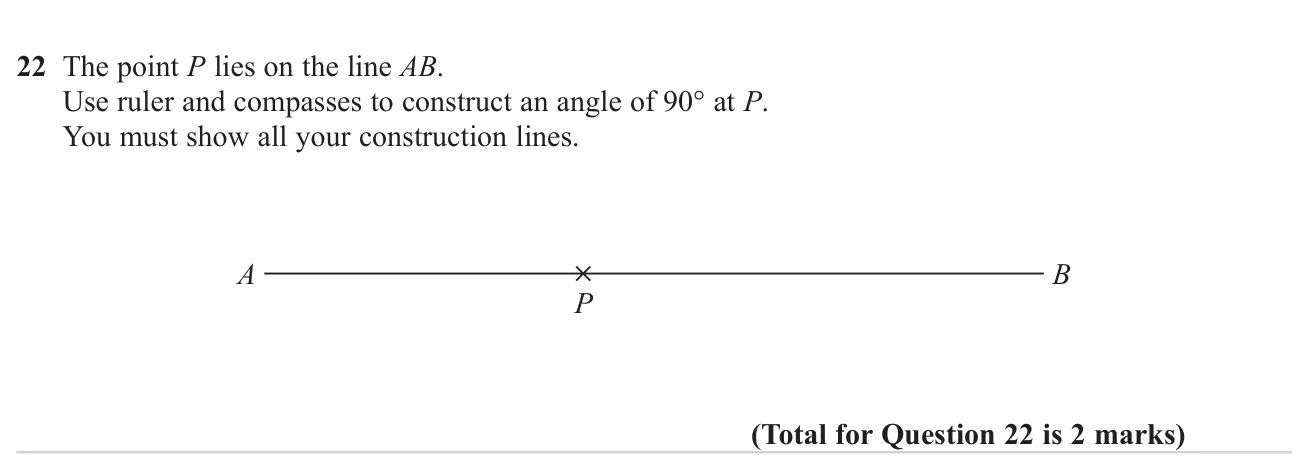
November 2023 · Paper 1 Foundation · Q22
Construct a right angle at a point on a line using ruler and compasses.

© Pearson Education Ltd. November 2023 Paper 1 (Foundation, non-calculator), question 22.

Show answer
AnswerPerpendicular to AB through P, with construction arcs shown2 marks

Worked solution Checked against the mark scheme

With compasses centred on P, mark two points on AB the same distance either side of P.

Widen the compasses. From each of those two points draw arcs above the line that cross.

Join P to the crossing point with a ruler. This line meets AB at 90∘90^\circ. Leave all arcs showing.

Watch out: Drawing the right angle with a protractor and no arcs.

Constructions and loci2 marksGrade 5No calculatorOn both tiers
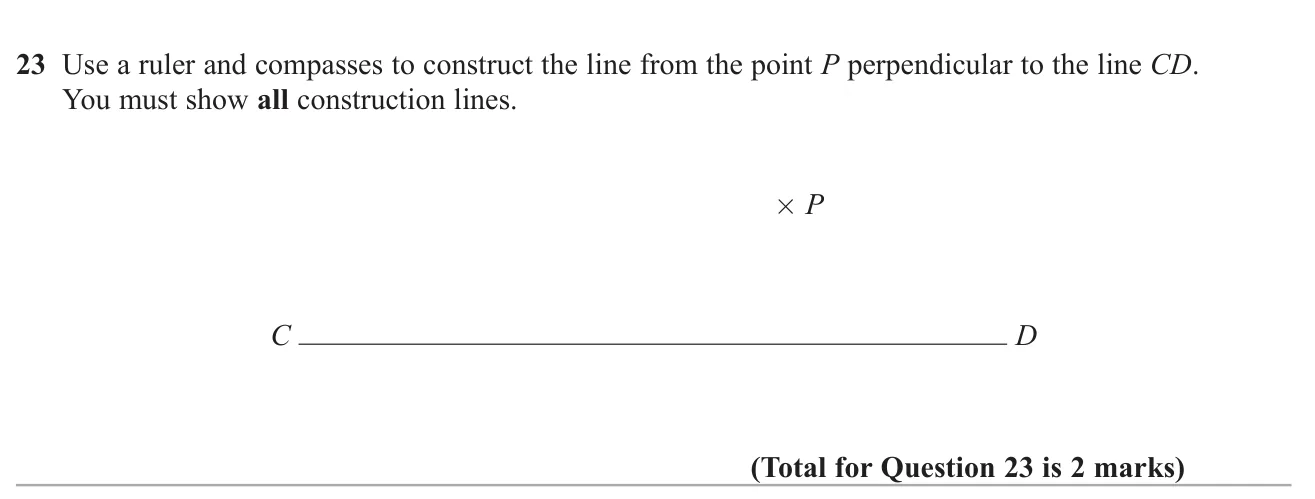
November 2019 · Paper 1 Foundation · Q23
Use a ruler and compasses to draw the perpendicular from a point to a line.

© Pearson Education Ltd. November 2019 Paper 1 (Foundation, non-calculator), question 23.

Show answer
AnswerPerpendicular from PP to CDCD with construction arcs shown2 marks

Worked solution Checked against the mark scheme

1. With centre PP, draw an arc cutting CDCD at two points.
2. From each of these points, draw arcs of equal radius that cross on the other side of CDCD.
3. Join PP to where the arcs cross. This line meets CDCD at right angles.

Leave all arcs showing.

Watch out: Drawing the line by eye with a protractor and no arcs.

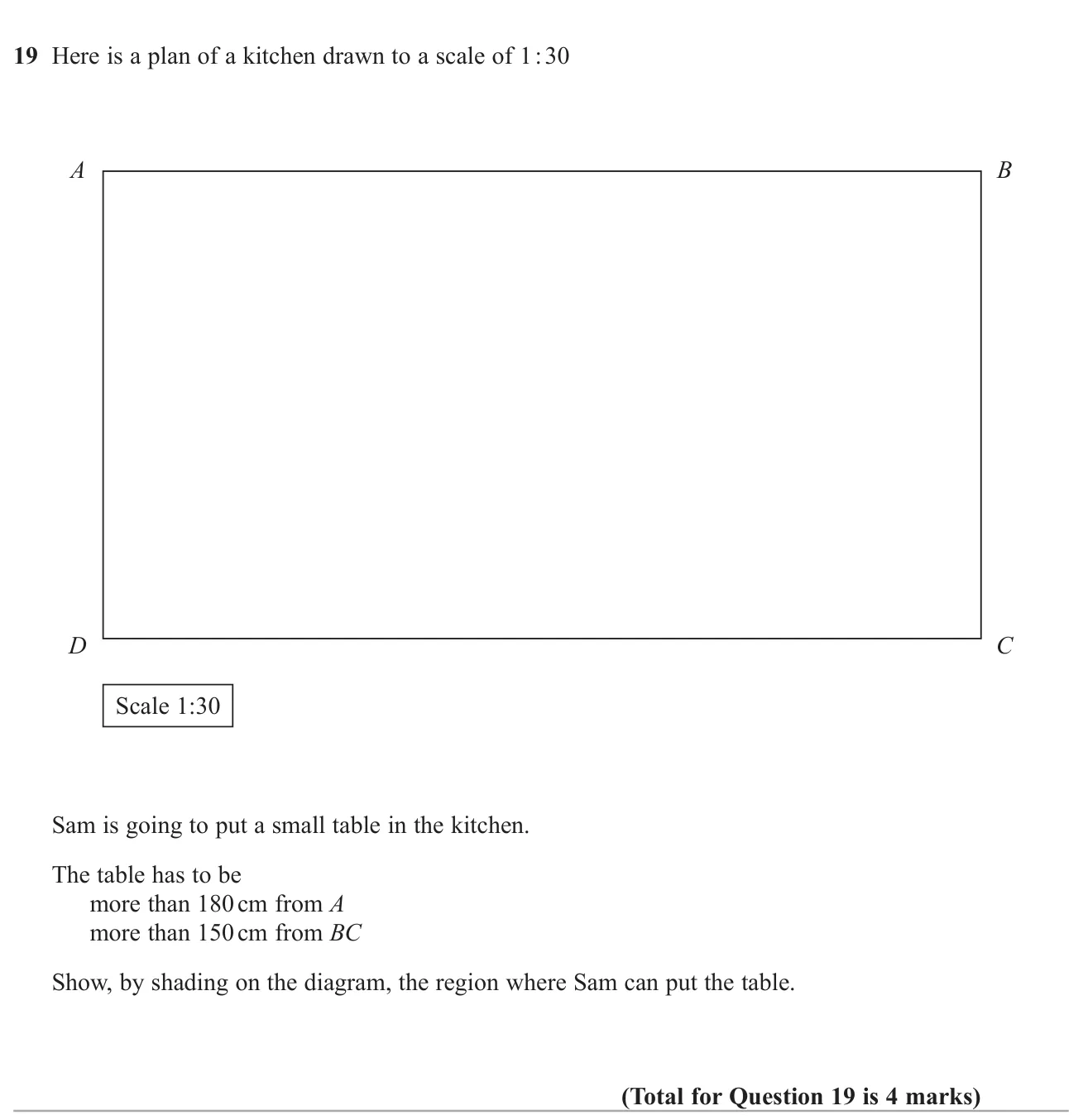
Constructions and loci4 marksGrade 5CalculatorFoundation
June 2019 · Paper 2 Foundation · Q19
Shade the region on a scale plan of a kitchen that is more than a set distance from a corner and from a wall.

© Pearson Education Ltd. June 2019 Paper 2 (Foundation, calculator), question 19.

Show answer
AnswerRegion inside the rectangle, outside the arc of radius 6 cm centred on A and more than 5 cm from BC, shaded4 marks

Worked solution Checked against the mark scheme

Scale 1 : 30, so divide real lengths by 30.

180÷30=6180 \div 30 = 6 cm and 150÷30=5150 \div 30 = 5 cm

With compasses set to 6 cm, draw an arc centred on A. The table must be outside this arc.

Draw a line parallel to BC, 5 cm in from it. The table must be on the A side of this line.

Shade the part of the kitchen that is outside the arc and beyond the line from BC.

Watch out: Using the real distances (180 and 150) as centimetres on the plan instead of dividing by 30, or measuring from AD instead of BC.