Geometry and measures

Properties of 2D shapes and symmetry

10 past-paper questions, easiest first. Try each one, then reveal the answer.

Foundation & HigherAll 10 from Foundation papers

Revision guide by The Full Marks

Properties of 2D shapes and symmetry: what you need to know

This topic is about naming shapes and knowing their properties: sides, angles, diagonals and symmetry. These marks are some of the easiest on a paper, and the same facts unlock harder angle questions later on.

Key facts

  • Parallel lines never meet (marked with arrows); perpendicular lines meet at 90∘90^\circ.
  • Square: 4 equal sides, 4 right angles, 4 lines of symmetry, rotational symmetry order 4. Rectangle: 2 lines, order 2.
  • Parallelogram: opposite sides equal and parallel, opposite angles equal, no lines of symmetry, order 2. Rhombus: a parallelogram with 4 equal sides, 2 lines, order 2.
  • Trapezium: exactly one pair of parallel sides. Kite: two pairs of equal adjacent sides, one line of symmetry, one pair of equal opposite angles.
  • Isosceles triangle: 2 equal sides and 2 equal base angles. Equilateral: 3 equal sides, every angle 60∘60^\circ. Scalene: no equal sides. Right-angled: one angle of 90∘90^\circ.
  • Diagonals: they cross at right angles in a square, rhombus and kite, and are equal in length in a square and rectangle. A regular polygon has all sides equal and all angles equal.
  • Angle ABCABC means the angle at BB, between lines BABA and BCBC.

Identifying a shape from its properties

  1. Count the sides: 5 pentagon, 6 hexagon, 7 heptagon, 8 octagon, 9 nonagon, 10 decagon.
  2. For a quadrilateral, check parallel sides first, then equal sides, then right angles.
  3. For symmetry, count mirror lines (lines of symmetry) and how many times it fits onto itself in one full turn (order of rotational symmetry).

Worked examples

Example 1 Foundation · grade 3

ABCDABCD is a kite with AB=ADAB = AD and CB=CDCB = CD. Angle BAD=40∘BAD = 40^\circ and angle BCD=100∘BCD = 100^\circ. Find angle ABCABC.

Show the solution

Angles in a quadrilateral add up to 360∘360^\circ.
360−40−100=220360 - 40 - 100 = 220
A kite has one pair of equal opposite angles, so angle ABCABC = angle ADCADC.
220÷2=110220 \div 2 = 110
Angle ABC=110∘ABC = 110^\circ.

Example 2 Foundation · grade 4

ABCDABCD is a rhombus. Angle ABC=64∘ABC = 64^\circ. Find angle BACBAC.

Show the solution

In a rhombus all sides are equal, so AB=BCAB = BC and triangle ABCABC is isosceles.
Base angles of an isosceles triangle are equal, so angle BACBAC = angle BCABCA.
Angles in a triangle add up to 180∘180^\circ.
180−64=116180 - 64 = 116
116÷2=58116 \div 2 = 58
Angle BAC=58∘BAC = 58^\circ.

Common mistakes

  • Calling a rhombus or parallelogram a rectangle, or a trapezium a parallelogram. Check for right angles and count the pairs of parallel sides before you use the name.
  • Saying a rectangle or parallelogram has diagonal lines of symmetry. Fold it in your head: the halves do not match.
  • Mixing up parallel (same direction, never meet) and perpendicular (meet at a right angle).
  • Reading the wrong scale on a protractor. Decide first whether the angle is acute or obtuse, then check your reading matches.

Exam tips

  • Use the proper mathematical name, for example rhombus, not 'diamond'.
  • When asked to draw a shape with given symmetry, check both conditions: the number of mirror lines and the order of rotation.

Questions people ask

What is the difference between a rhombus and a parallelogram?

A rhombus is a special parallelogram with all four sides the same length. Both have opposite sides parallel and opposite angles equal.

How many lines of symmetry does a regular polygon have?

The same number as its sides. A regular hexagon has 6 lines of symmetry and rotational symmetry of order 6.

Exam questions: Properties of 2D shapes and symmetry (10, easiest first)

Properties of 2D shapes and symmetry1 markGrade 1CalculatorFoundation
November 2024 · Paper 2 Foundation · Q4
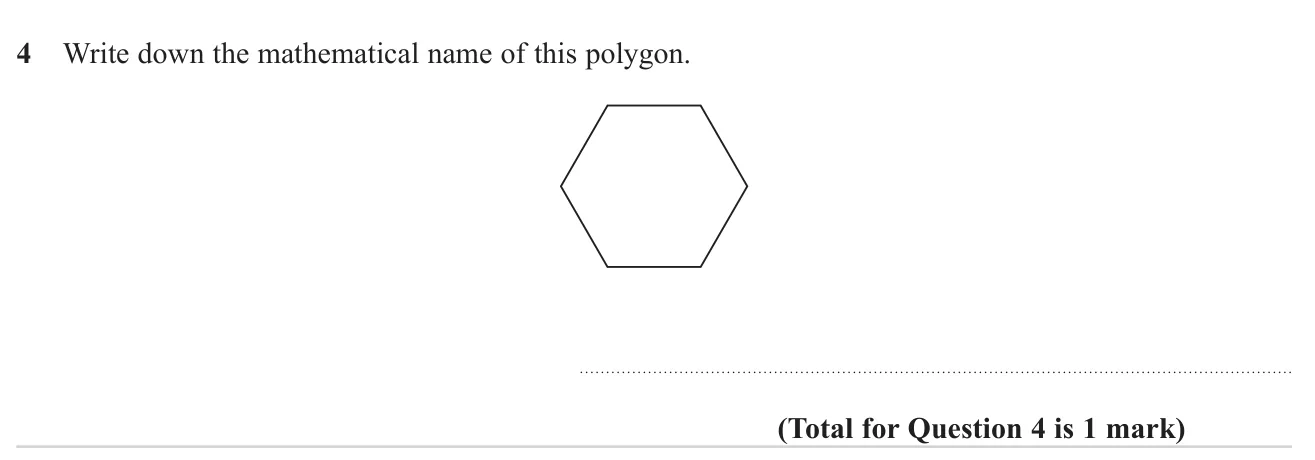
Name the polygon shown in the diagram.

© Pearson Education Ltd. November 2024 Paper 2 (Foundation, calculator), question 4.

Show answer
Answerhexagon1 mark

Worked solution Checked against the mark scheme

Count the sides: there are 6.

A polygon with 6 sides is a hexagon.

Watch out: Confusing hexagon (6 sides) with pentagon or octagon.
Properties of 2D shapes and symmetry3 marksGrade 1CalculatorFoundation
June 2024 · Paper 2 Foundation · Q7
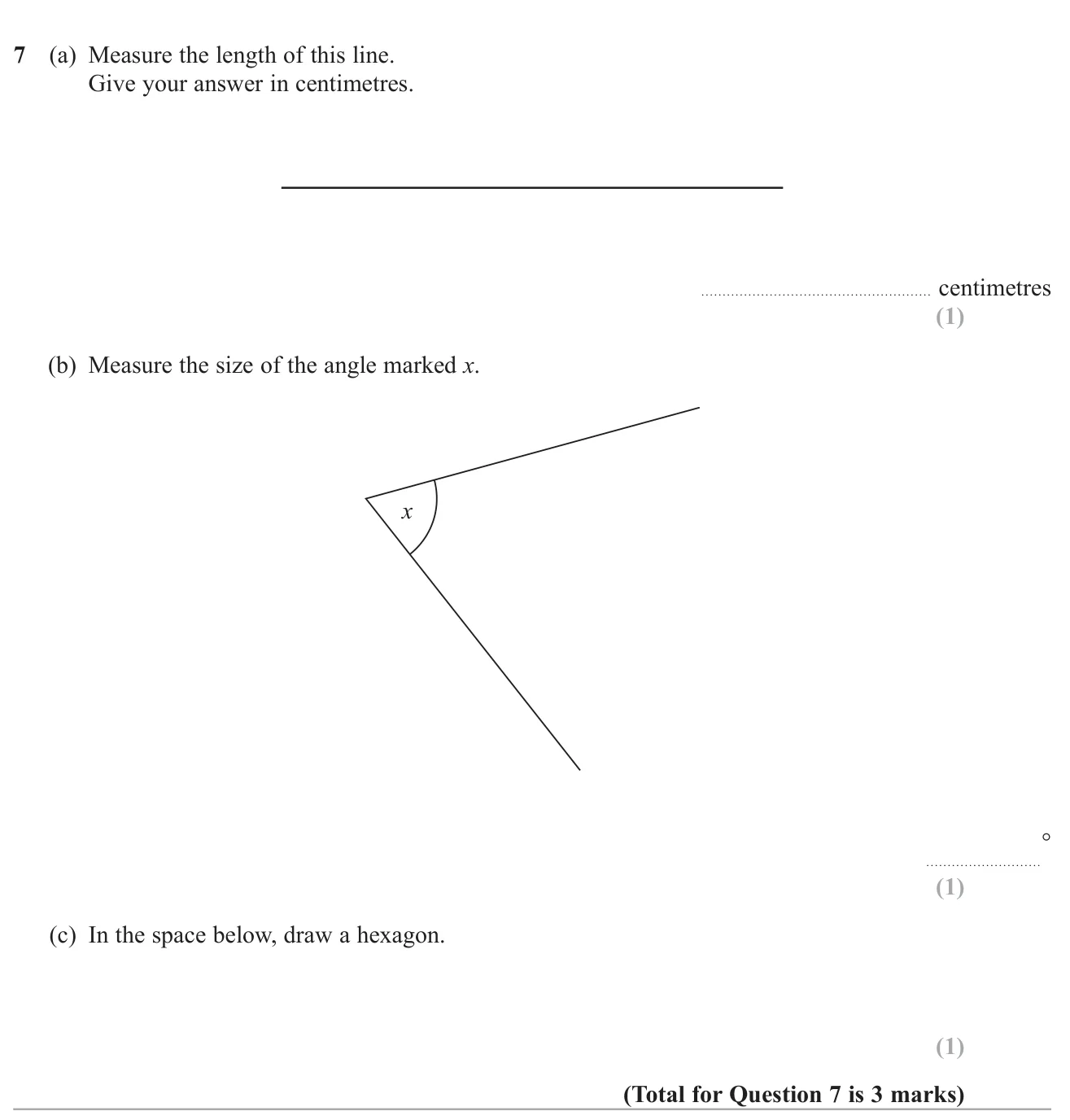
Measure a line and an angle, and draw a six-sided shape.

© Pearson Education Ltd. June 2024 Paper 2 (Foundation, calculator), question 7.

Show answer
(a)8.78.7 cm (accept 8.5 to 8.9)1 mark
(b)67∘67^\circ (accept 65 to 69)1 mark
(c)Any 6-sided polygon1 mark

Worked solution Checked against the mark scheme

(a) Line up the ruler's zero with one end of the line and read the other end: about 8.78.7 cm.

(b) Put the protractor's centre on the vertex and a zero line along one arm. The angle is acute, so read the smaller scale: about 67∘67^\circ.

(c) A hexagon is any shape with 6 straight sides.

Watch out: Reading the wrong protractor scale and getting 113°.

Properties of 2D shapes and symmetry2 marksGrade 1CalculatorFoundation
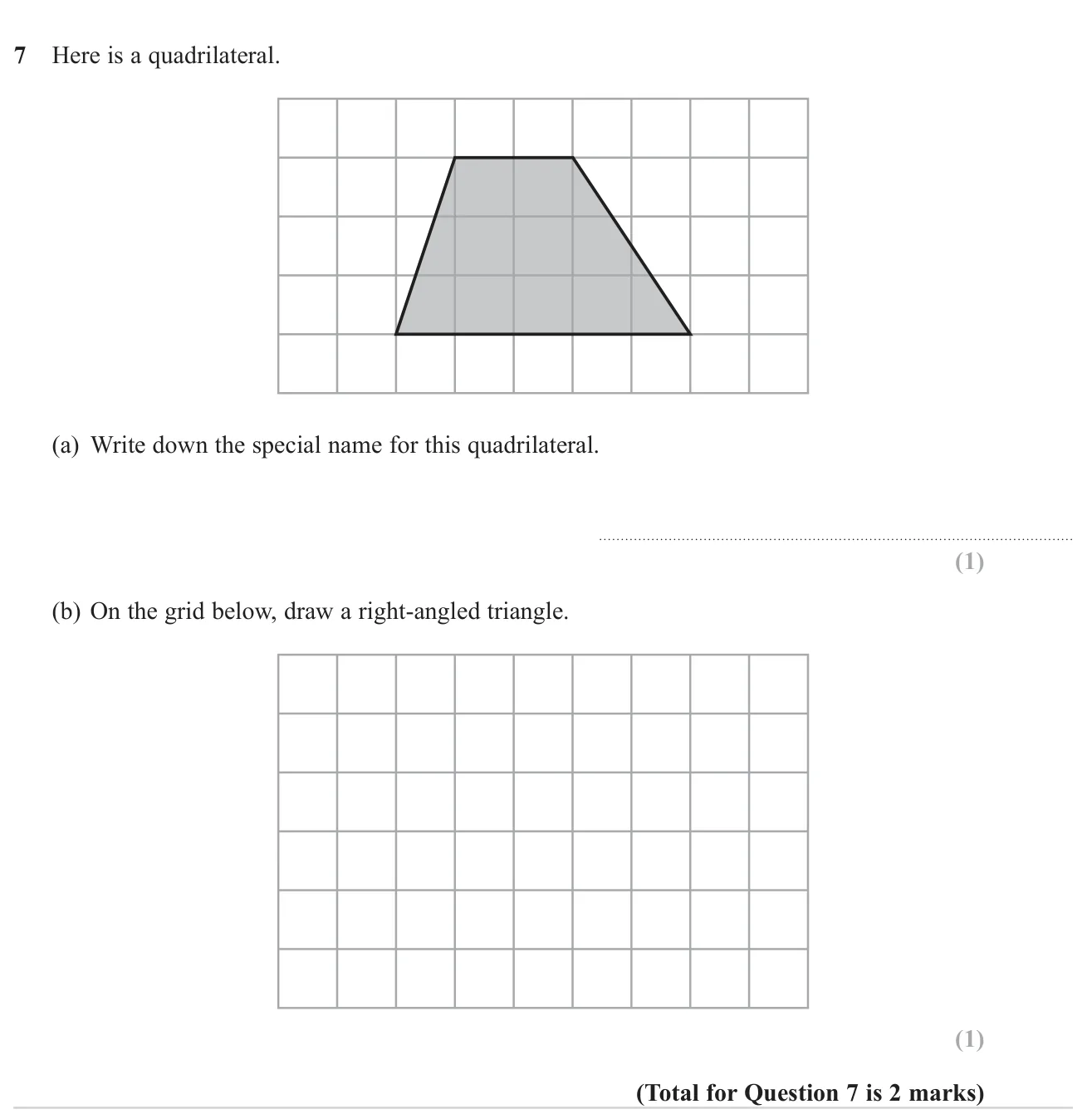
November 2024 · Paper 3 Foundation · Q7
Name a four-sided shape on a grid and draw a triangle containing a right angle.

© Pearson Education Ltd. November 2024 Paper 3 (Foundation, calculator), question 7.

Show answer
(a)Trapezium1 mark
(b)Any right-angled triangle drawn on the grid1 mark

Worked solution Checked against the mark scheme

(a) The shape has exactly one pair of parallel sides (top and bottom), so it is a trapezium.

(b) Draw along one horizontal grid line and one vertical grid line from the same point, then join their ends. The grid lines meet at 90°90°.

Watch out: Calling the shape a parallelogram.

Properties of 2D shapes and symmetry2 marksGrade 1CalculatorFoundation
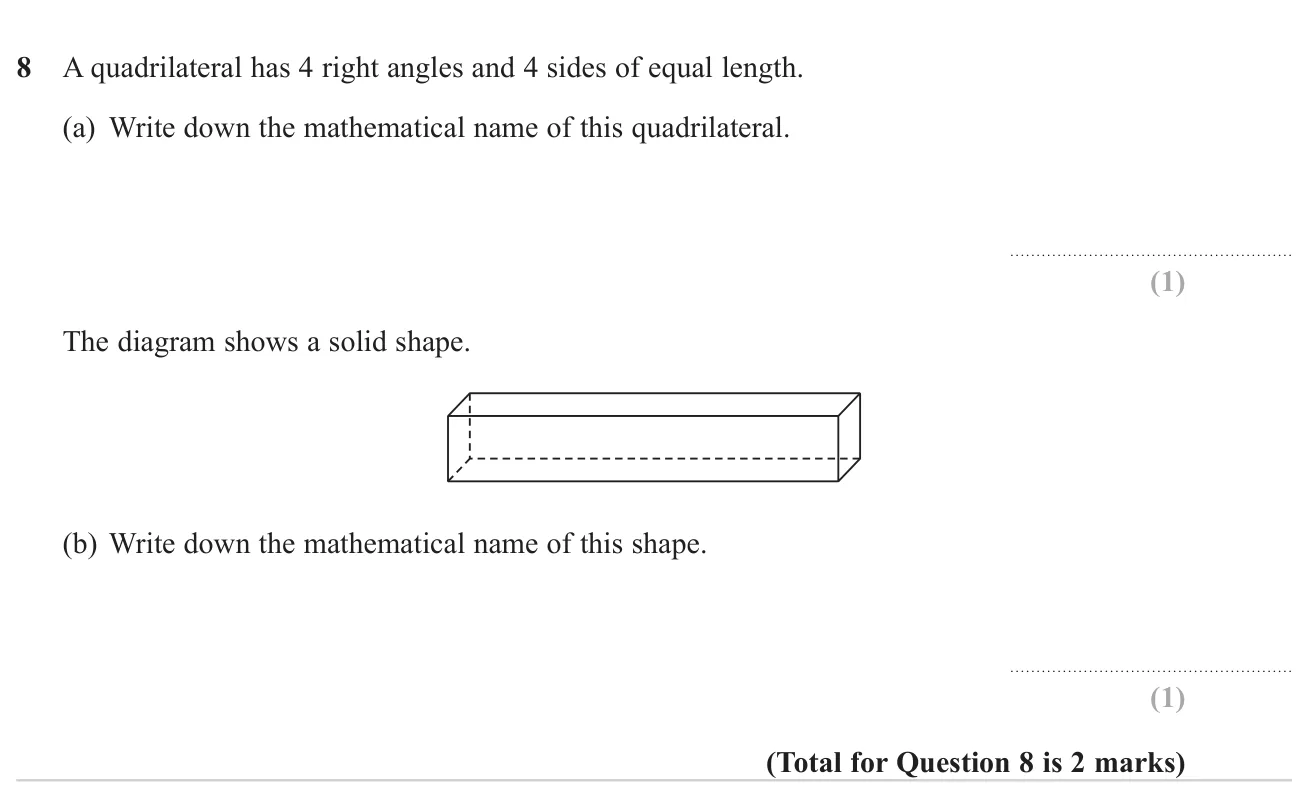
June 2023 · Paper 3 Foundation · Q8
Name a quadrilateral from its properties and name a drawn 3D solid.

© Pearson Education Ltd. June 2023 Paper 3 (Foundation, calculator), question 8.

Show answer
(a)square1 mark
(b)cuboid1 mark

Worked solution Checked against the mark scheme

(a) Four right angles and four equal sides make a square.

(b) The solid has six rectangular faces, so it is a cuboid.

Watch out: Calling the shape in (a) a rectangle, or the solid a cube.

Properties of 2D shapes and symmetry2 marksGrade 1No calculatorFoundation
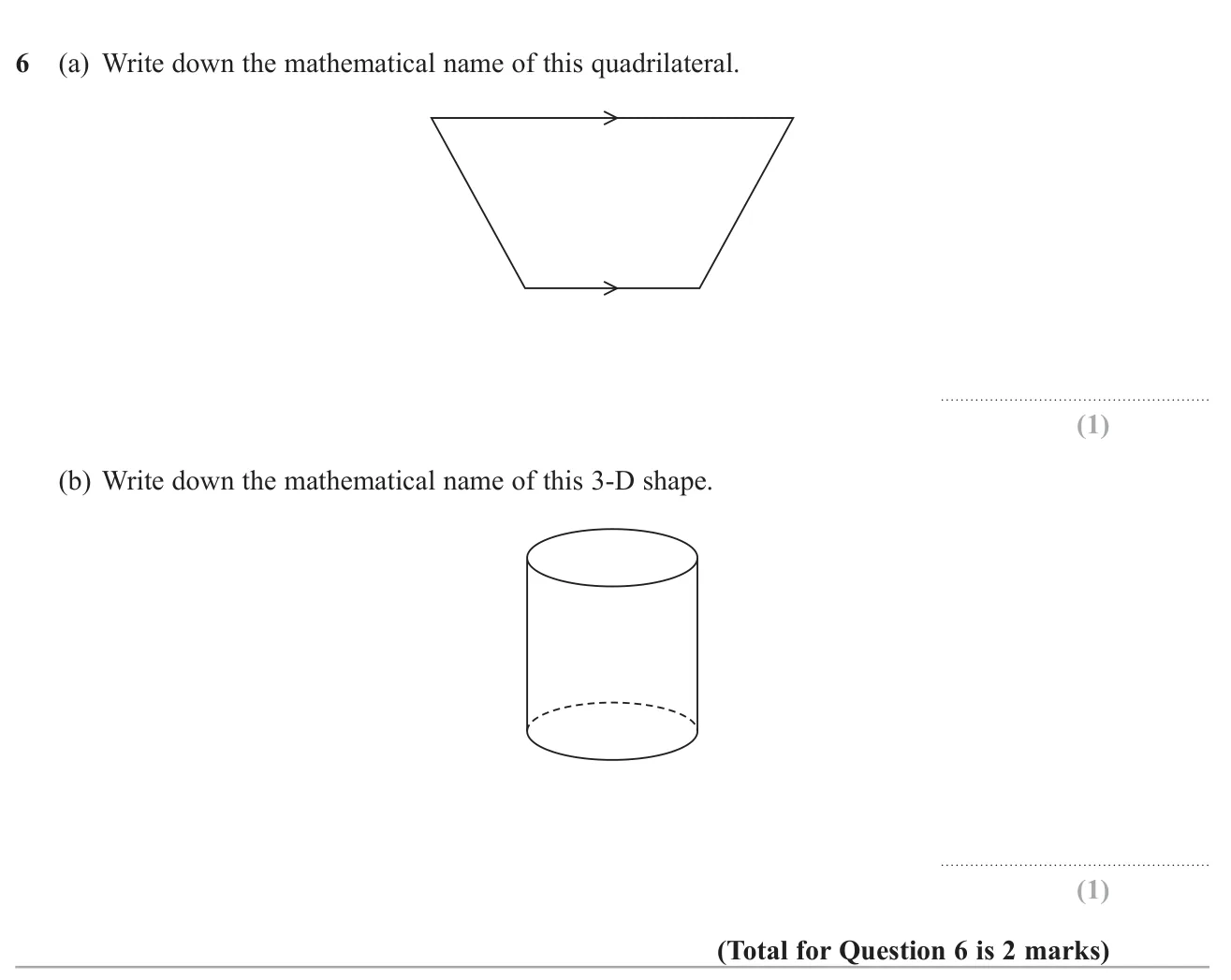
November 2021 · Paper 1 Foundation · Q6
Name a quadrilateral with one pair of parallel sides and name a 3-D solid with two circular ends.

© Pearson Education Ltd. November 2021 Paper 1 (Foundation, non-calculator), question 6.

Show answer
(a)Trapezium1 mark
(b)Cylinder1 mark

Worked solution Checked against the mark scheme

(a) The arrows show exactly one pair of parallel sides, so it is a trapezium.

(b) A solid with two equal circular faces joined by a curved surface is a cylinder.

Watch out: Calling the trapezium a parallelogram.

Properties of 2D shapes and symmetry3 marksGrade 2CalculatorFoundation
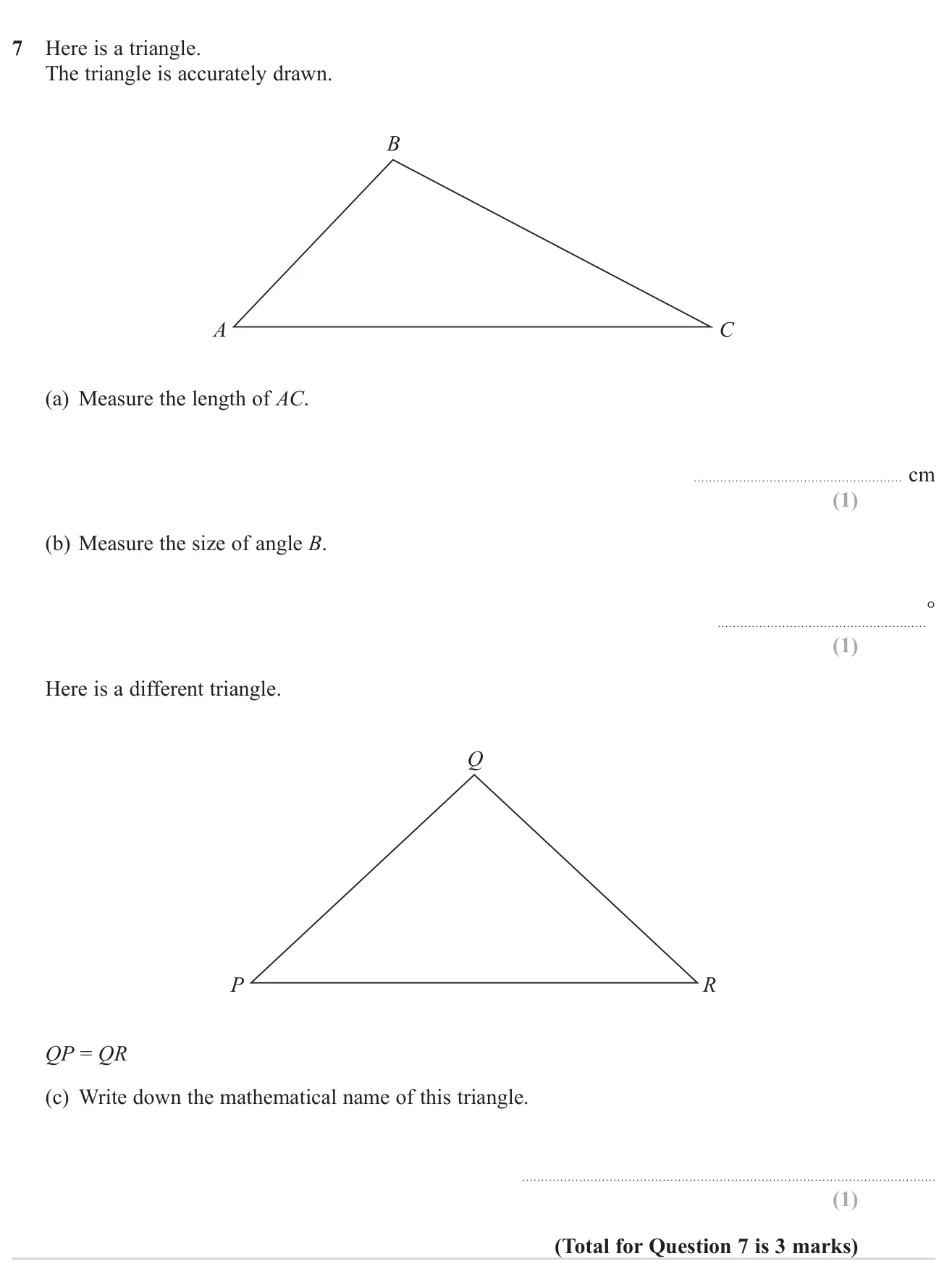
June 2023 · Paper 2 Foundation · Q7
Measure a side and an angle of a drawn triangle, then name a triangle with two equal sides.

© Pearson Education Ltd. June 2023 Paper 2 (Foundation, calculator), question 7.

Show answer
(a)9.3 cm (9.1 to 9.5 accepted)1 mark
(b)106∘106^\circ (104 to 108 accepted)1 mark
(c)Isosceles1 mark

Worked solution Checked against the mark scheme

(a) Put the ruler's 0 on A and read off at C: about 9.39.3 cm.

(b) Place the protractor's centre on B, line up one side with 0 and read the scale that starts at 0: about 106∘106^\circ. It is obtuse, so the answer must be over 90∘90^\circ.

(c) Two equal sides (QP=QRQP = QR) means the triangle is isosceles.

Watch out: Reading the wrong protractor scale and giving about 74∘74^\circ.

Properties of 2D shapes and symmetry3 marksGrade 2CalculatorFoundation
June 2022 · Paper 2 Foundation · Q7
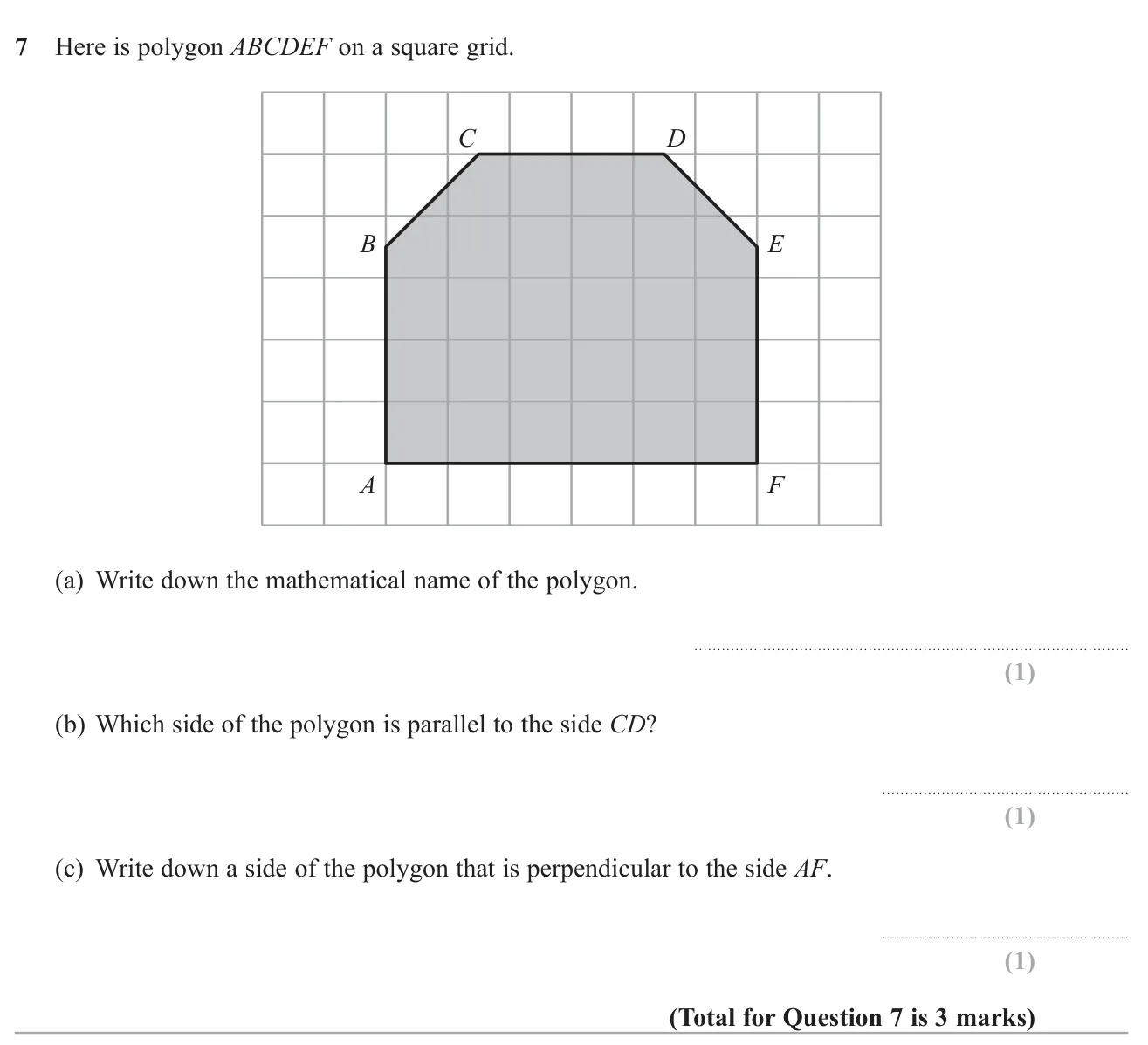
Name a six-sided polygon drawn on a grid and identify parallel and perpendicular sides.

© Pearson Education Ltd. June 2022 Paper 2 (Foundation, calculator), question 7.

Show answer
(a)Hexagon1 mark
(b)AFAF1 mark
(c)ABAB or EFEF1 mark

Worked solution Checked against the mark scheme

(a) The shape has 6 sides, so it is a hexagon.

(b) CDCD is horizontal. The other horizontal side is AFAF.

(c) AFAF is horizontal, so a perpendicular side is vertical: ABAB or EFEF.

Watch out: Mixing up parallel and perpendicular.

Properties of 2D shapes and symmetry2 marksGrade 3CalculatorFoundation
June 2022 · Paper 3 Foundation · Q6
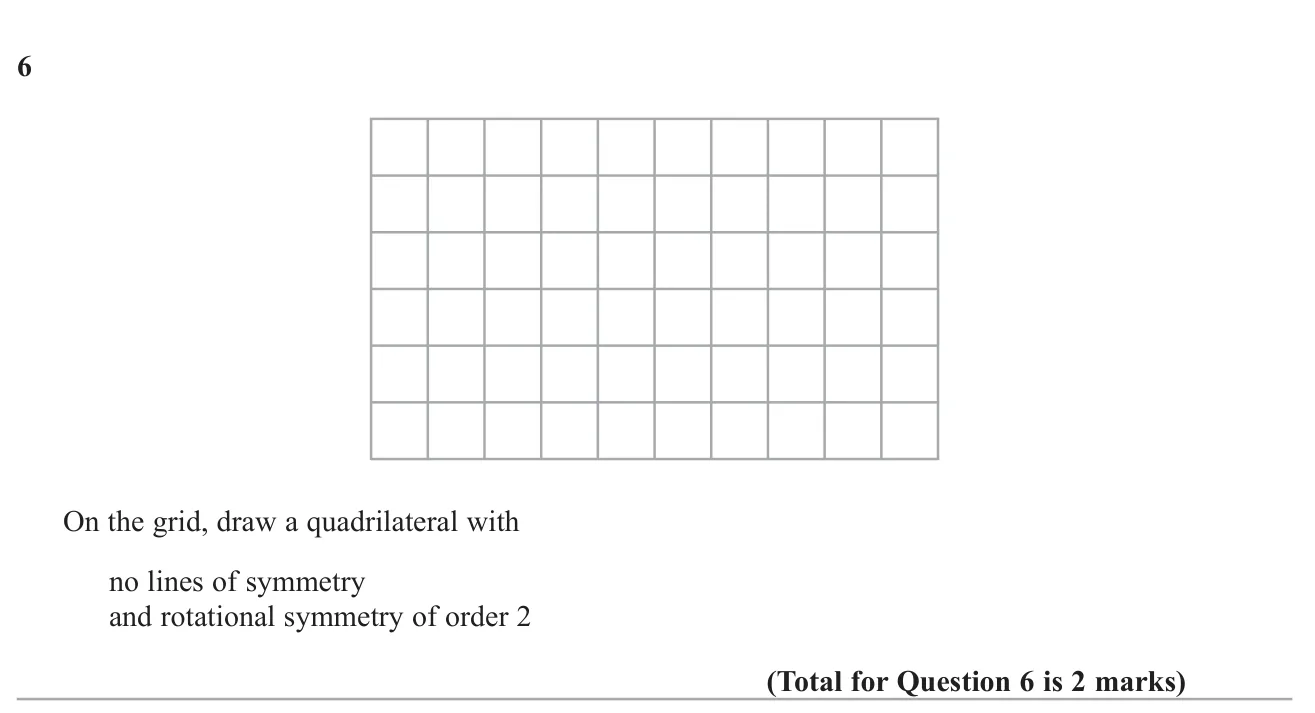
Draw on a grid a four-sided shape that has rotational symmetry of order 2 but no lines of symmetry.

© Pearson Education Ltd. June 2022 Paper 3 (Foundation, calculator), question 6.

Show answer
AnswerA parallelogram that is not a rectangle or rhombus2 marks

Worked solution Checked against the mark scheme

A rectangle and a rhombus have order 2 but also have lines of symmetry, so avoid them.

A general parallelogram (slanted, with unequal adjacent sides) has order 2 and no lines of symmetry. Draw one on the grid.

Watch out: Drawing a rectangle, which has two lines of symmetry.

Properties of 2D shapes and symmetry3 marksGrade 3CalculatorFoundation
June 2019 · Paper 2 Foundation · Q13
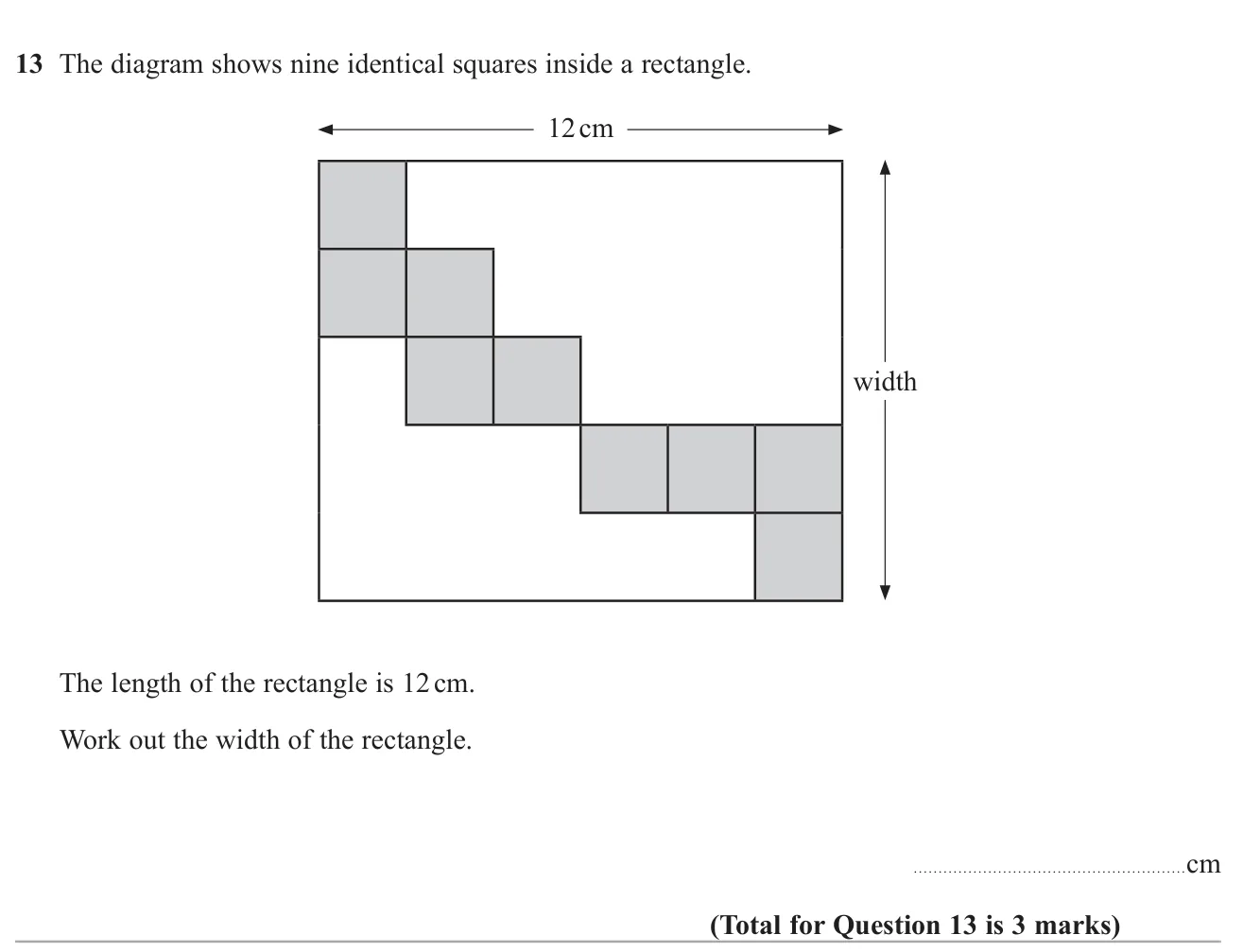
Find the width of a rectangle that contains a staircase of identical squares, given its length.

© Pearson Education Ltd. June 2019 Paper 2 (Foundation, calculator), question 13.

Show answer
Answer10 cm3 marks

Worked solution Checked against the mark scheme

Across the length there are 6 squares side by side, so each side is 12÷6=212 \div 6 = 2 cm.

Down the width there are 5 squares, so the width is 5×2=105 \times 2 = 10 cm.

Watch out: Dividing 12 by 9 because there are nine squares.

Properties of 2D shapes and symmetry2 marksGrade 4CalculatorFoundation
June 2019 · Paper 3 Foundation · Q20
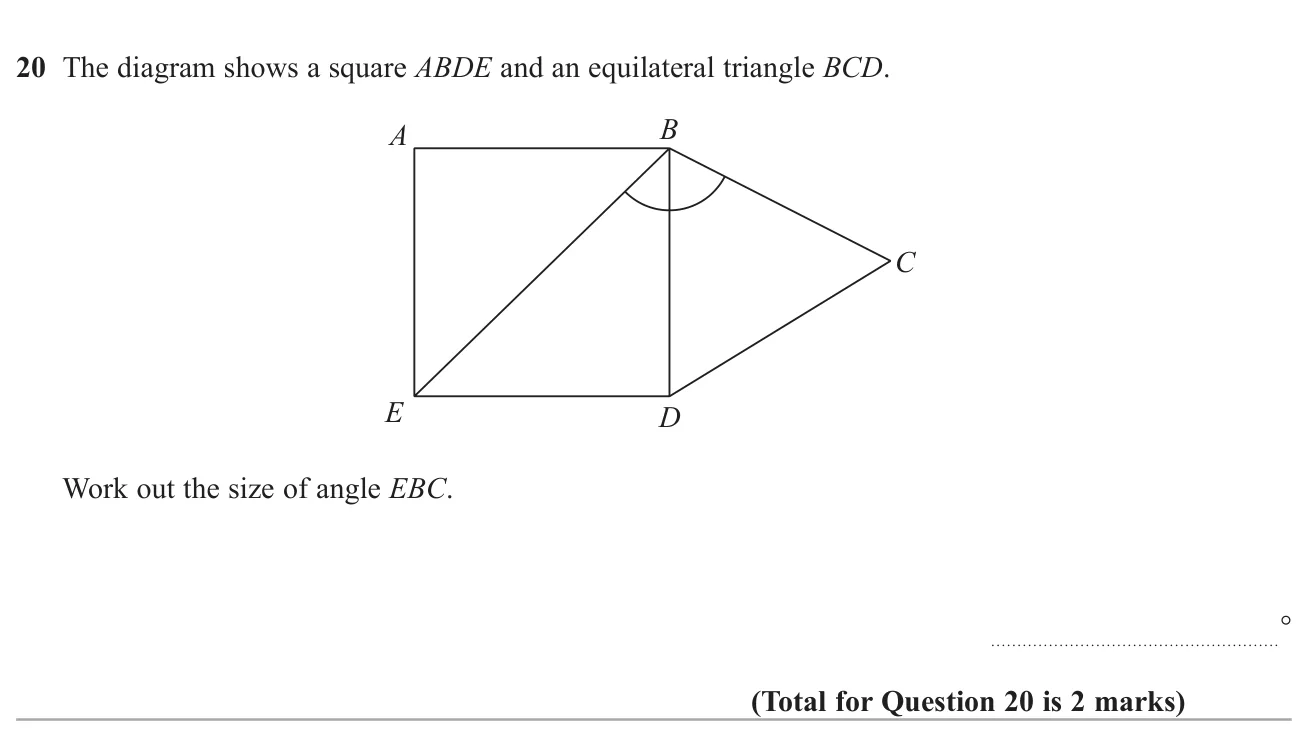
Find an angle made by a square and an equilateral triangle sharing a side.

© Pearson Education Ltd. June 2019 Paper 3 (Foundation, calculator), question 20.

Show answer
Answer1052 marks

Worked solution Checked against the mark scheme

EB is a diagonal of the square, so it cuts the right angle at B in half: angle EBD=45∘EBD = 45^\circ.

The triangle is equilateral, so angle DBC=60∘DBC = 60^\circ.

Angle EBC=45+60=105∘EBC = 45 + 60 = 105^\circ

Watch out: Using 90° for angle EBD.

Also tested in these questions

Their main topic is different, but part of each one tests this topic.