Revision guide by The Full Marks
Angle facts and parallel lines: what you need to know Angle facts let you work out missing angles without measuring. They come up often, usually with 'give reasons', where the reasons are worth as much as the numbers.
Key facts Angles on a straight line add up to 180 ∘ 180^\circ 18 0 ∘ 360 ∘ 360^\circ 36 0 ∘ Vertically opposite angles are equal. Angles in a triangle add up to 180 ∘ 180^\circ 18 0 ∘ 360 ∘ 360^\circ 36 0 ∘ An isosceles triangle has two equal sides, and the base angles opposite those sides are equal. On parallel lines: alternate angles are equal, corresponding angles are equal, co-interior angles add up to 180 ∘ 180^\circ 18 0 ∘ Acute is less than 90 ∘ 90^\circ 9 0 ∘ 90 ∘ 90^\circ 9 0 ∘ 180 ∘ 180^\circ 18 0 ∘ 180 ∘ 180^\circ 18 0 ∘ Finding an angle with reasons Mark every angle you know on the diagram. Find one new angle at a time, writing the fact you used next to it. Keep going until you reach the angle asked for. Write the answer with its units. Worked examples Example 1 Foundation · grade 2
Three angles meet at a point. Two of them are 125 ∘ 125^\circ 12 5 ∘ 90 ∘ 90^\circ 9 0 ∘
Show the solution Angles around a point add up to 360 ∘ 360^\circ 36 0 ∘ 125 + 90 = 215 125 + 90 = 215 125 + 90 = 215 360 − 215 = 145 360 - 215 = 145 360 − 215 = 145 145 ∘ 145^\circ 14 5 ∘
Example 2 Foundation · grade 5
P Q PQ P Q R S RS R S P P P R R R Q Q Q S S S T T T P Q PQ P Q U U U V V V R S RS R S U U U R R R V V V T U = T V TU = TV T U = T V P T U = 52 ∘ PTU = 52^\circ P T U = 5 2 ∘ U T V UTV U T V
Show the solution Angle T U V = 52 ∘ TUV = 52^\circ T U V = 5 2 ∘ T V U = 52 ∘ TVU = 52^\circ T V U = 5 2 ∘ U T V = 180 − 52 − 52 = 76 ∘ UTV = 180 - 52 - 52 = 76^\circ U T V = 180 − 52 − 52 = 7 6 ∘ 180 ∘ 180^\circ 18 0 ∘
Common mistakes Writing 'Z angles' or 'F angles'. Use 'alternate angles' and 'corresponding angles'. Assuming lines are parallel, or a triangle isosceles, when the diagram does not say so. Using 180 ∘ 180^\circ 18 0 ∘ 360 ∘ 360^\circ 36 0 ∘ 360 ∘ 360^\circ 36 0 ∘ In algebra questions, stopping at the value of x x x Exam tips When a question says 'give reasons', each step needs the full angle fact written in words. Diagrams are not accurately drawn, so never measure. Work it out. To show two lines are parallel, find a pair of alternate or corresponding angles that are equal, or co-interior angles that add up to 180 ∘ 180^\circ 18 0 ∘ Questions people ask What are alternate angles? When a line crosses two parallel lines, alternate angles sit on opposite sides of the crossing line, between the parallel lines. They are equal.
What reasons do I need to write for angles questions? Name the fact you used, for example 'angles on a straight line add up to 180°' or 'corresponding angles are equal'. Short, exact wording is best.
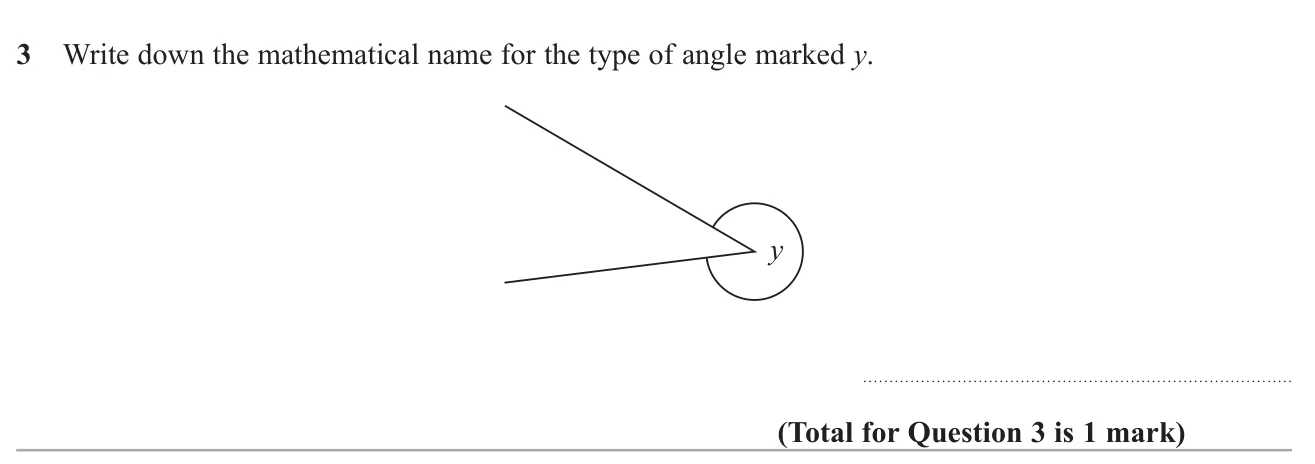
Exam questions: Angle facts and parallel lines (29, easiest first) © Pearson Education Ltd. June 2024 Paper 1 (Foundation, non-calculator), question 3.
Worked solution Checked against the mark scheme
The marked angle is bigger than 180 ∘ 180^\circ 18 0 ∘ 360 ∘ 360^\circ 36 0 ∘ reflex angle.
Watch out: Calling it obtuse.
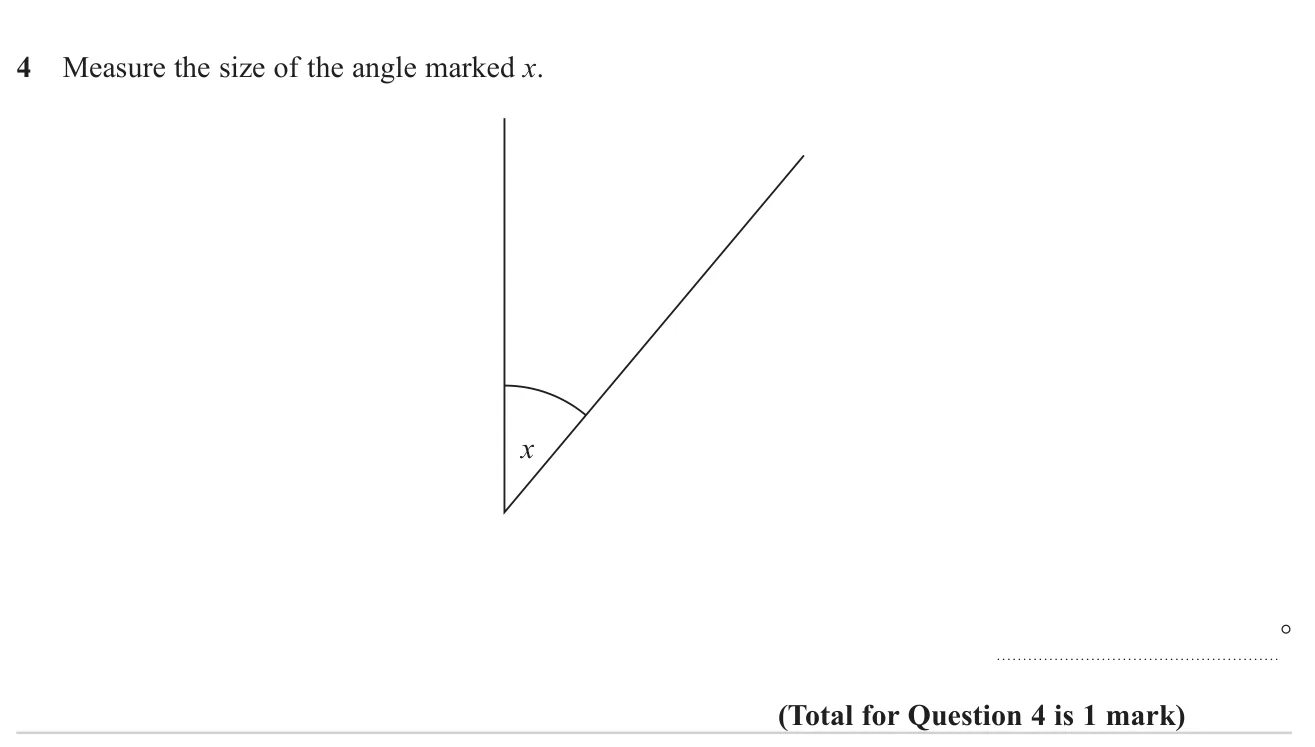
© Pearson Education Ltd. November 2023 Paper 1 (Foundation, non-calculator), question 4.
Answer 40 ∘ 40^\circ 4 0 ∘ 1 mark
Worked solution Checked against the mark scheme
Place the centre of the protractor on the vertex and line zero up with the vertical arm.
Read from the scale that starts at 0 on that arm: about 40 ∘ 40^\circ 4 0 ∘
Watch out: Reading the wrong scale and giving about 140°.
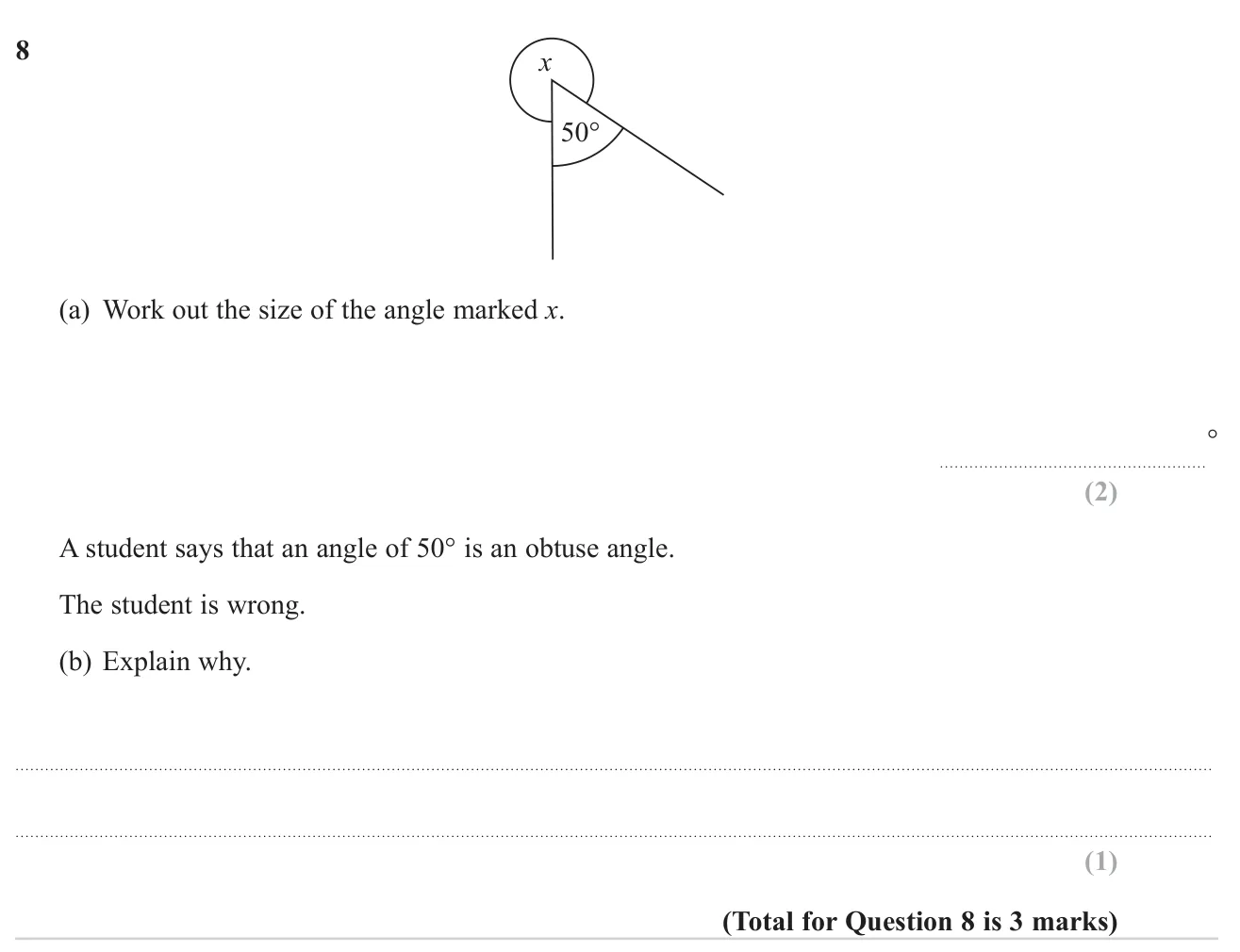
© Pearson Education Ltd. June 2023 Paper 1 (Foundation, non-calculator), question 8.
(a) 310 ∘ 310^\circ 31 0 ∘ 2 marks (b) 50 ∘ 50^\circ 5 0 ∘ 90 ∘ 90^\circ 9 0 ∘ 1 mark
Worked solution Checked against the mark scheme
(a) Angles around a point add up to 360 ∘ 360^\circ 36 0 ∘
x = 360 − 50 = 310 ∘ x = 360 - 50 = 310^\circ x = 360 − 50 = 31 0 ∘
(b) An obtuse angle is between 90 ∘ 90^\circ 9 0 ∘ 180 ∘ 180^\circ 18 0 ∘ 50 ∘ 50^\circ 5 0 ∘ 90 ∘ 90^\circ 9 0 ∘
Watch out: Using 180 instead of 360 in (a), giving 130.
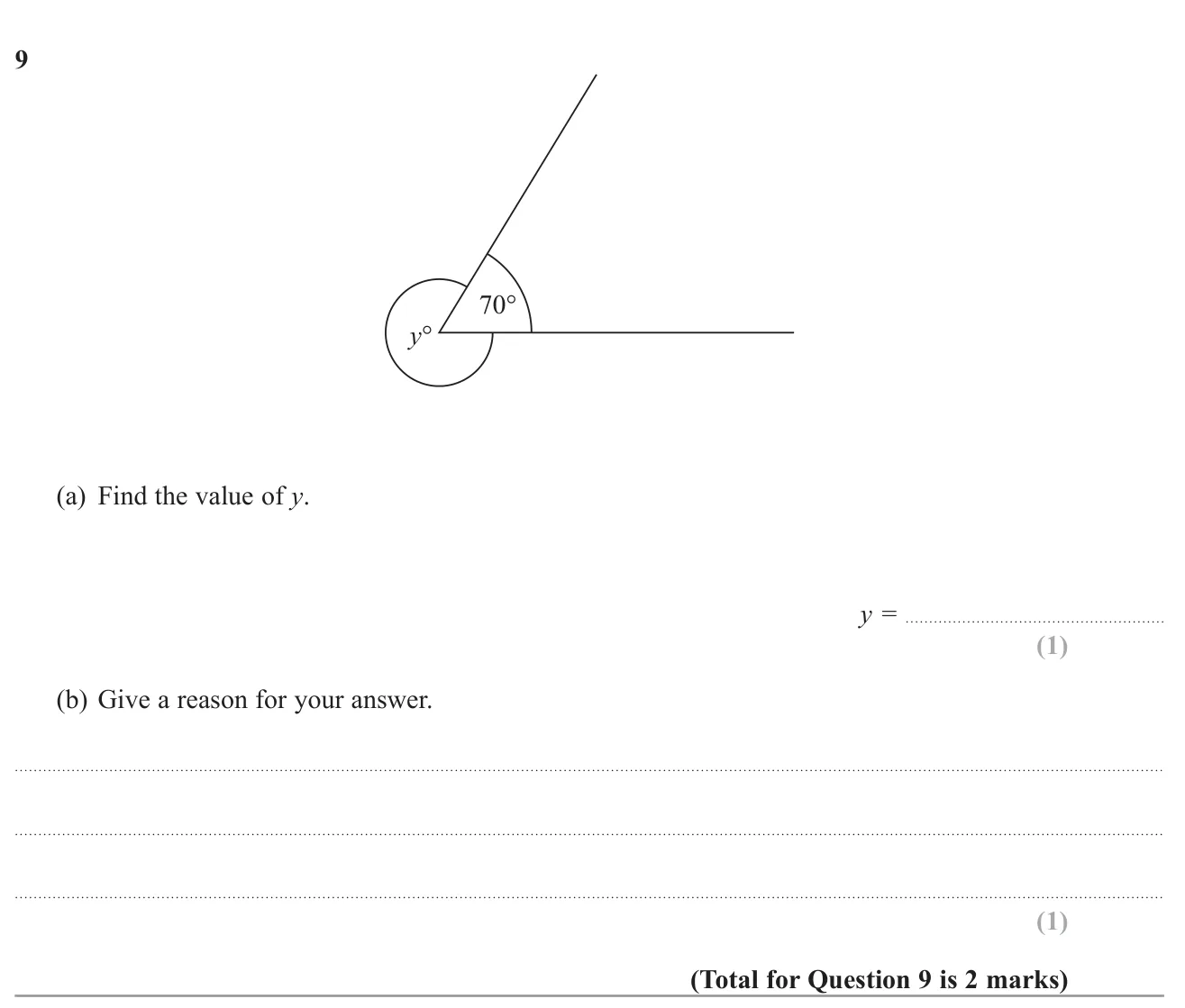
© Pearson Education Ltd. November 2022 Paper 1 (Foundation, non-calculator), question 9.
(a) 290 290 290 1 mark (b) Angles at a point add up to 360 ° 360° 360° 1 mark
Worked solution Checked against the mark scheme
(a) The two angles go all the way round the point.
y = 360 − 70 = 290 y = 360 - 70 = 290 y = 360 − 70 = 290
(b) Angles at a point add up to 360 ° 360° 360°
Watch out: Using 180 (angles on a straight line) to get 110.
© Pearson Education Ltd. November 2021 Paper 2 (Foundation, calculator), question 13.
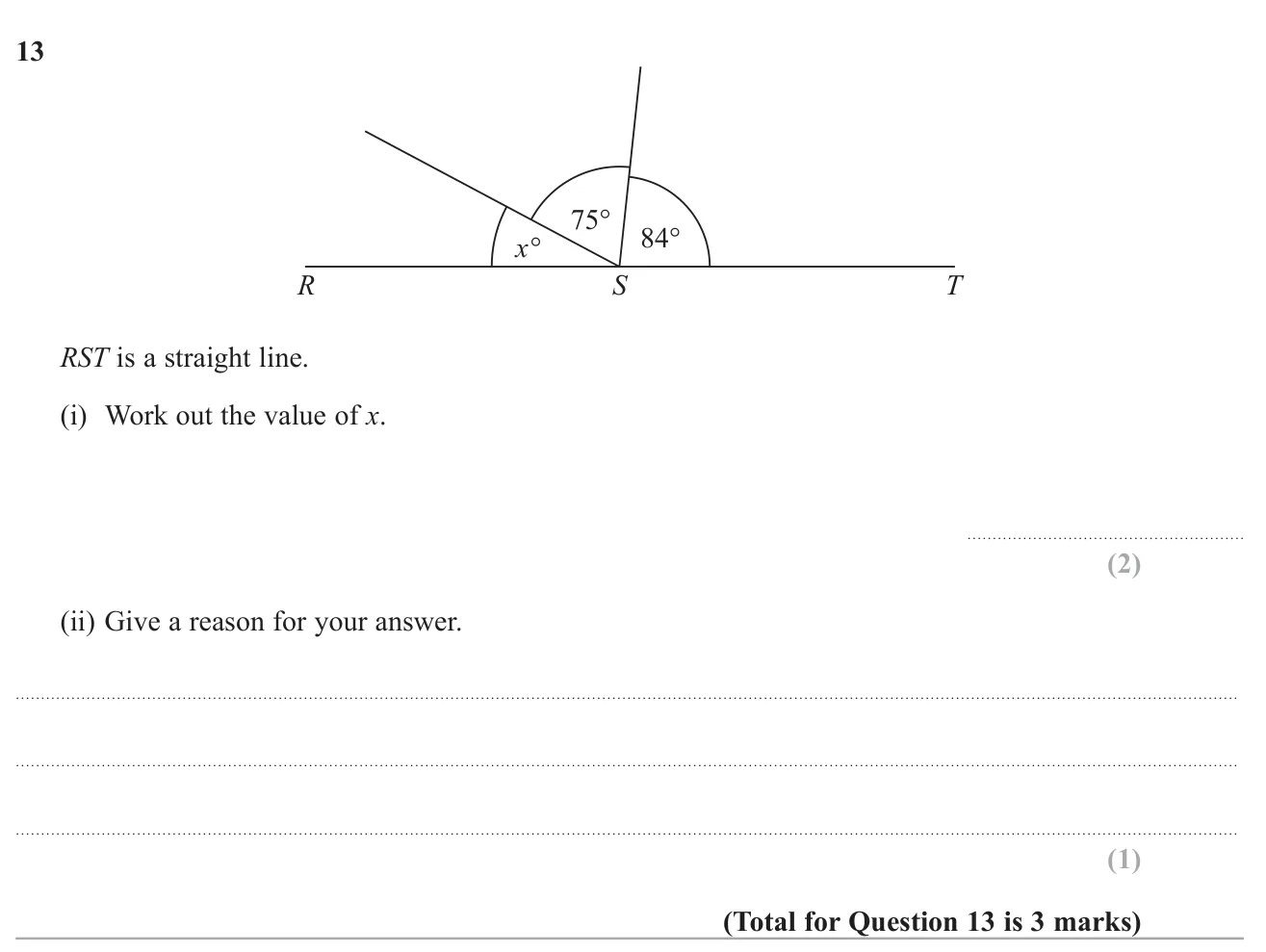
(i) 21 2 marks (ii) Angles on a straight line add up to 180 ∘ 180^\circ 18 0 ∘ 1 mark
Worked solution Checked against the mark scheme
(i) Angles on a straight line total 180 ∘ 180^\circ 18 0 ∘
x = 180 − 75 − 84 = 21 x = 180 - 75 - 84 = 21 x = 180 − 75 − 84 = 21
(ii) Angles on a straight line add up to 180 ∘ 180^\circ 18 0 ∘
Watch out: Using 360 instead of 180.
© Pearson Education Ltd. November 2021 Paper 3 (Foundation, calculator), question 15.
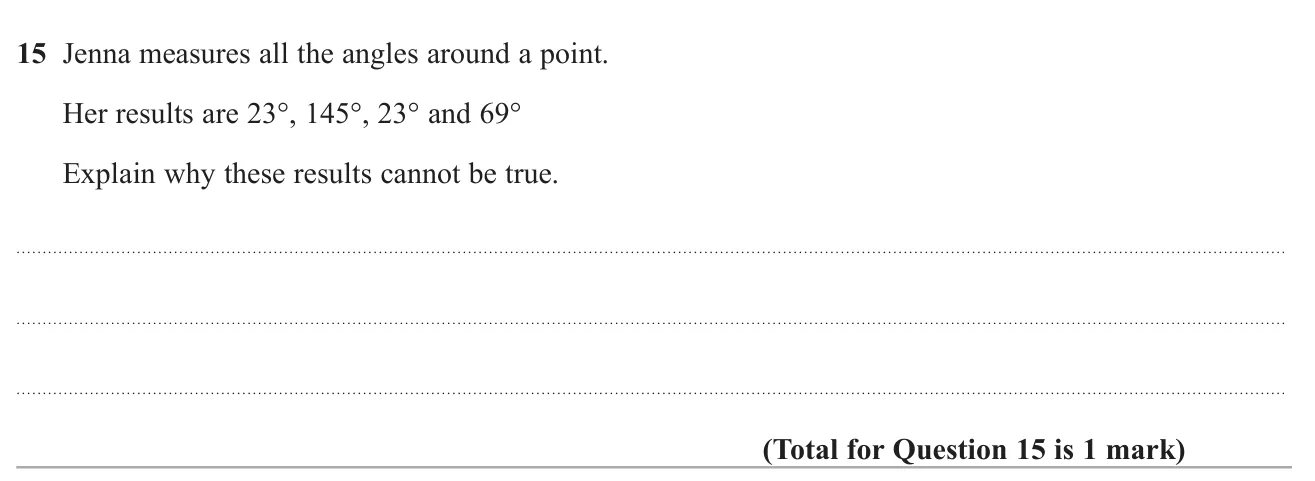
Answer The angles only add up to 260°, but angles around a point add up to 360° 1 mark
Worked solution Checked against the mark scheme
Add the angles: 23 + 145 + 23 + 69 = 260 ° 23 + 145 + 23 + 69 = 260° 23 + 145 + 23 + 69 = 260°
Angles around a point must add up to 360 ° 360° 360°
Watch out: Just stating the total (260°) without saying it should be 360°.
© Pearson Education Ltd. November 2020 Paper 2 (Foundation, calculator), question 8.
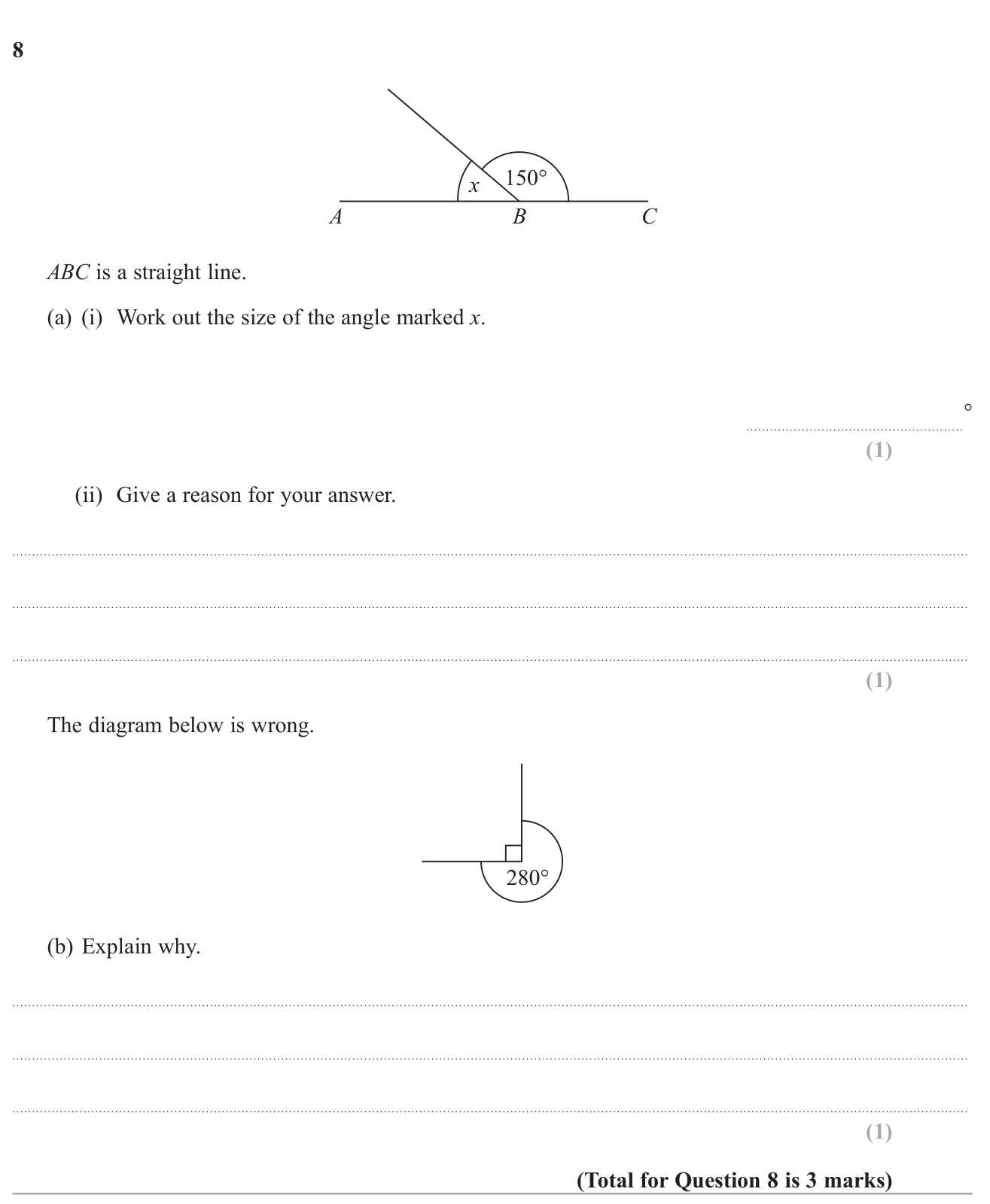
(a(i)) 30 1 mark (a(ii)) Angles on a straight line add up to 180 ∘ 180^\circ 18 0 ∘ 1 mark (b) 90 + 280 = 370 90 + 280 = 370 90 + 280 = 370 360 ∘ 360^\circ 36 0 ∘ 1 mark
Worked solution Checked against the mark scheme
(a) Angles on a straight line add up to 180 ∘ 180^\circ 18 0 ∘ x = 180 − 150 = 30 ∘ x = 180 - 150 = 30^\circ x = 180 − 150 = 3 0 ∘
(b) Angles around a point make 360 ∘ 360^\circ 36 0 ∘ 90 + 280 = 370 ∘ 90 + 280 = 370^\circ 90 + 280 = 37 0 ∘ 270 ∘ 270^\circ 27 0 ∘
Watch out: In (b), saying the angles should add up to 180°.
© Pearson Education Ltd. November 2019 Paper 1 (Foundation, non-calculator), question 9.
Worked solution Checked against the mark scheme
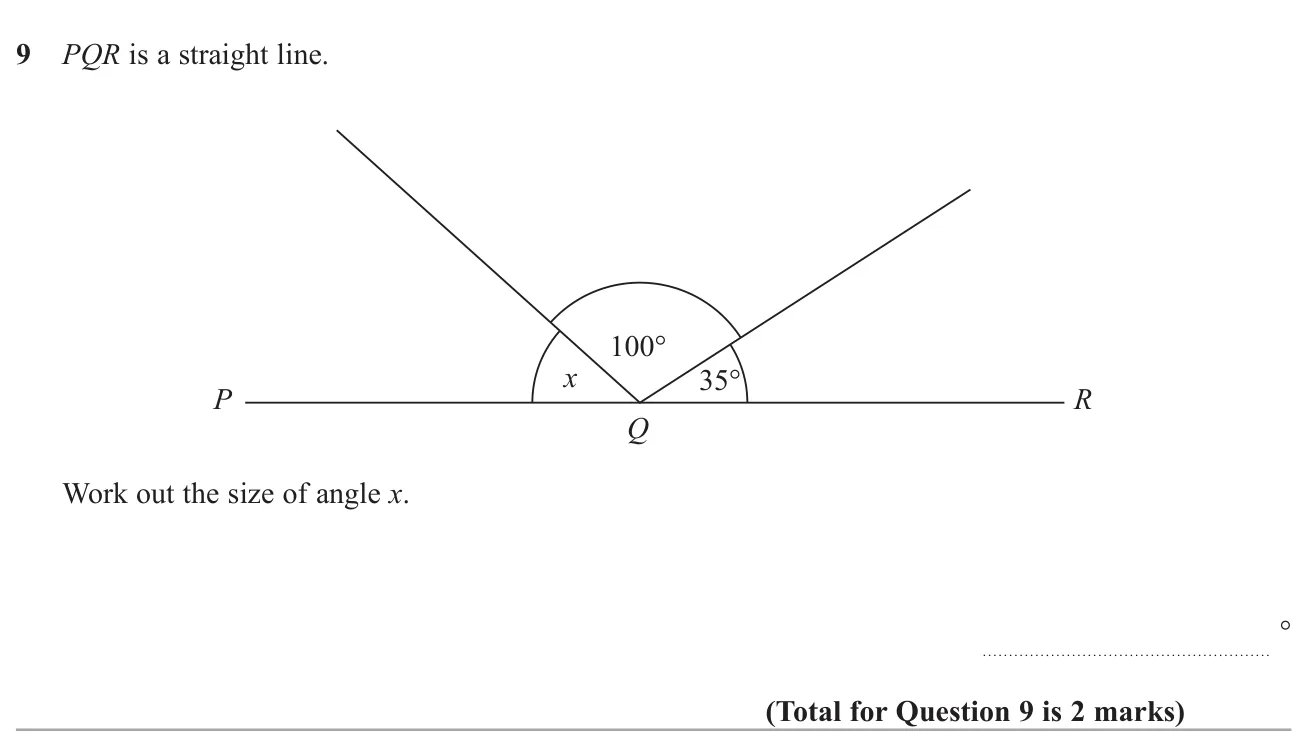
Angles on a straight line add up to 180 ° 180° 180°
x = 180 − 100 − 35 = 45 ° x = 180 - 100 - 35 = 45° x = 180 − 100 − 35 = 45°
Watch out: Subtracting from 360 instead of 180.
© Pearson Education Ltd. June 2024 Paper 1 (Foundation, non-calculator), question 8.
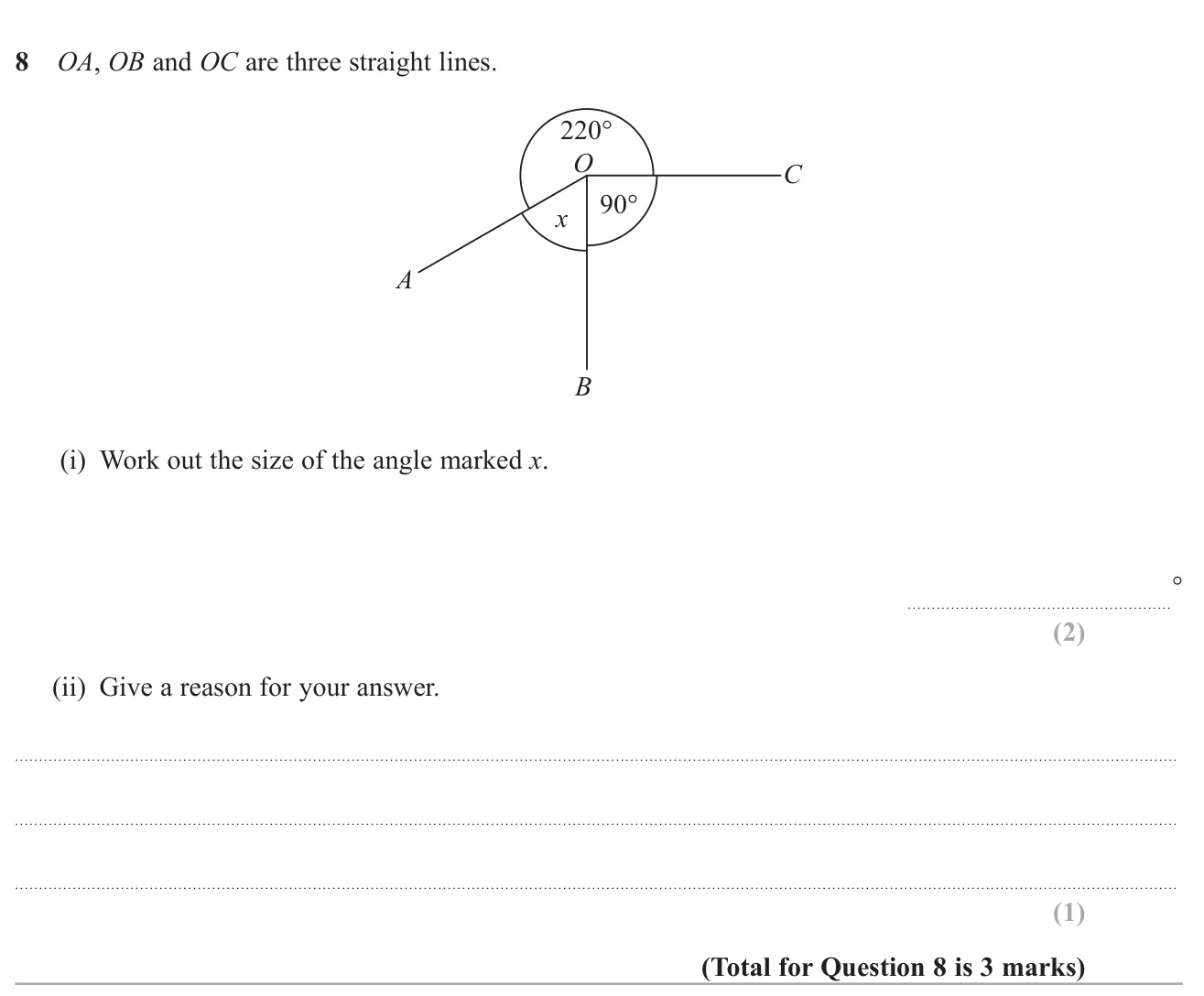
(i) 50 ∘ 50^\circ 5 0 ∘ 2 marks (ii) Angles at a point add up to 360 ∘ 360^\circ 36 0 ∘ 1 mark
Worked solution Checked against the mark scheme
Angles at a point add up to 360 ∘ 360^\circ 36 0 ∘
x = 360 − 220 − 90 = 50 ∘ x = 360 - 220 - 90 = 50^\circ x = 360 − 220 − 90 = 5 0 ∘
Watch out: Saying 'angles in a circle add to 360', which is not accepted.
© Pearson Education Ltd. June 2022 Paper 2 (Foundation, calculator), question 11.
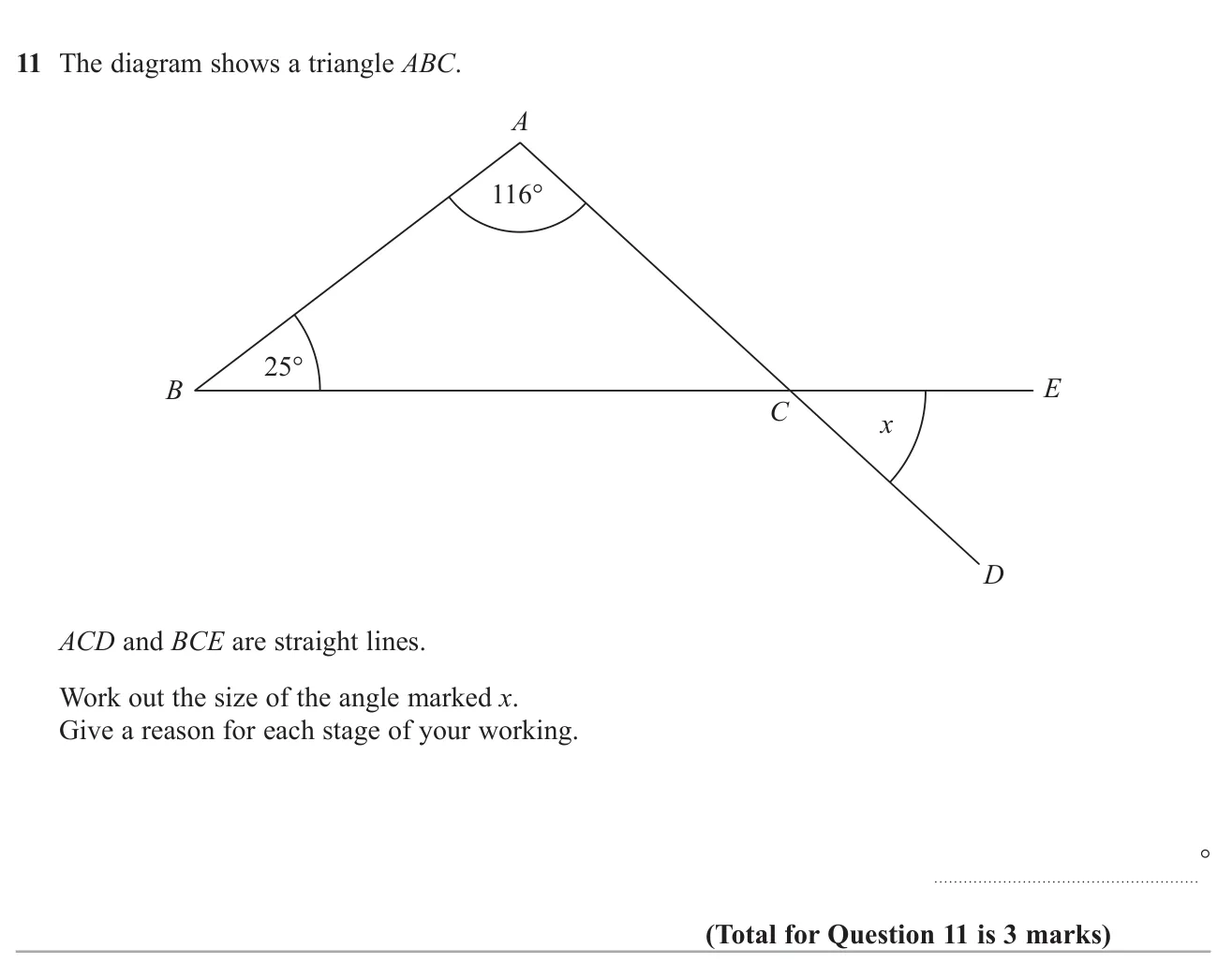
Answer x = 39 ∘ x = 39^\circ x = 3 9 ∘ 3 marks
Worked solution Checked against the mark scheme
Angle A C B = 180 − 116 − 25 = 39 ∘ ACB = 180 - 116 - 25 = 39^\circ A C B = 180 − 116 − 25 = 3 9 ∘ 180 ∘ 180^\circ 18 0 ∘
x x x A C B ACB A C B x = 39 ∘ x = 39^\circ x = 3 9 ∘
Watch out: Getting 39 but leaving out the reasons, or naming the wrong angle fact.
© Pearson Education Ltd. June 2019 Paper 1 (Foundation, non-calculator), question 12.
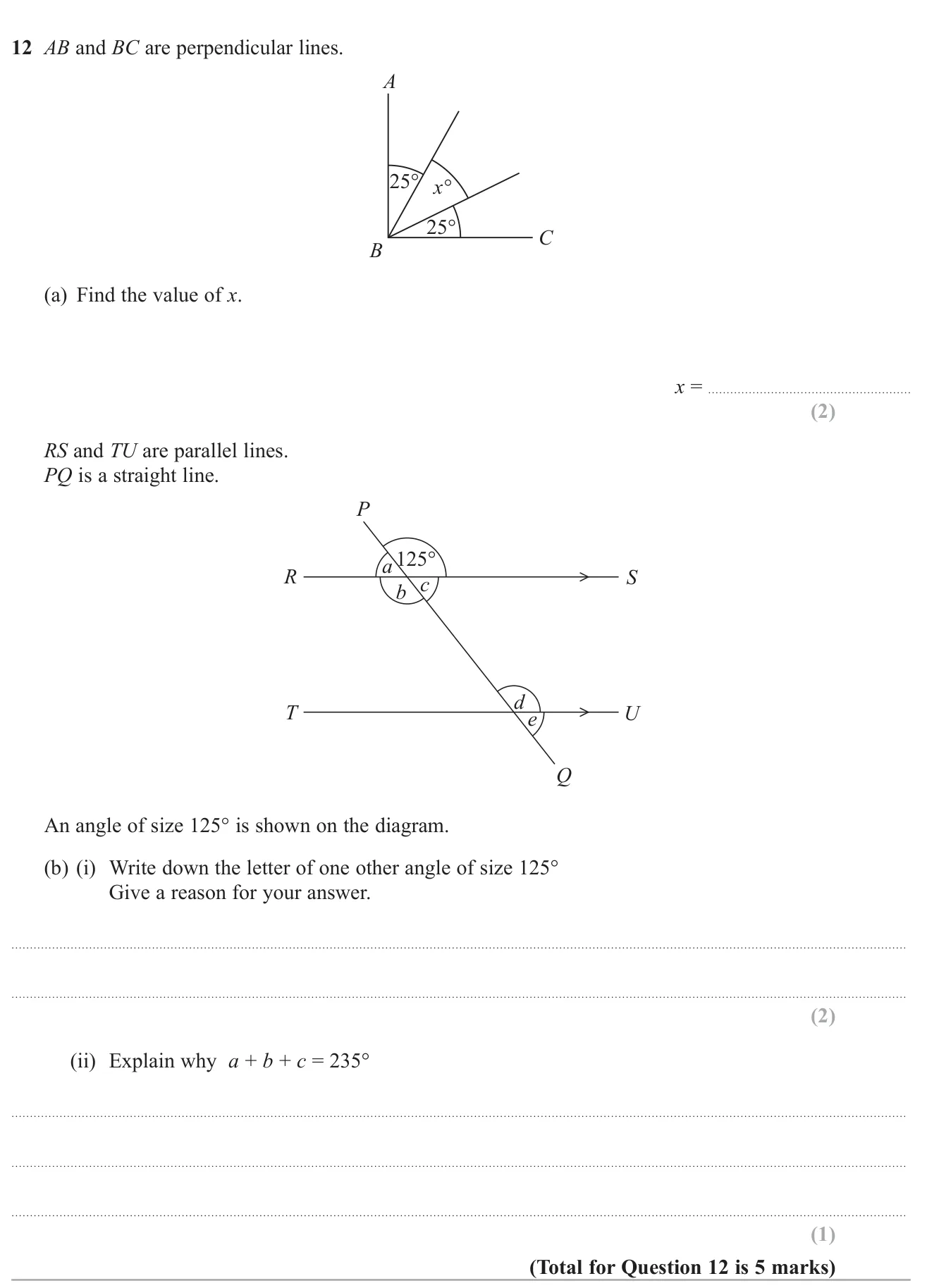
(a) x = 40 x = 40 x = 40 2 marks (b(i)) b b b d d d 2 marks (b(ii)) a a a b b b c c c a + b + c = 360 − 125 = 235 ° a + b + c = 360 - 125 = 235° a + b + c = 360 − 125 = 235° 1 mark
Worked solution Checked against the mark scheme
(a) The angle at B is a right angle, so x = 90 − 25 − 25 = 40 x = 90 - 25 - 25 = 40 x = 90 − 25 − 25 = 40
(b)(i) b = 125 ° b = 125° b = 125° d = 125 ° d = 125° d = 125°
(ii) Angles around a point add up to 360 ° 360° 360° a + b + c = 360 − 125 = 235 ° a + b + c = 360 - 125 = 235° a + b + c = 360 − 125 = 235°
Watch out: Giving a reason with the wrong angle fact, e.g. calling corresponding angles alternate.
© Pearson Education Ltd. November 2024 Paper 2 (Foundation, calculator), question 13.
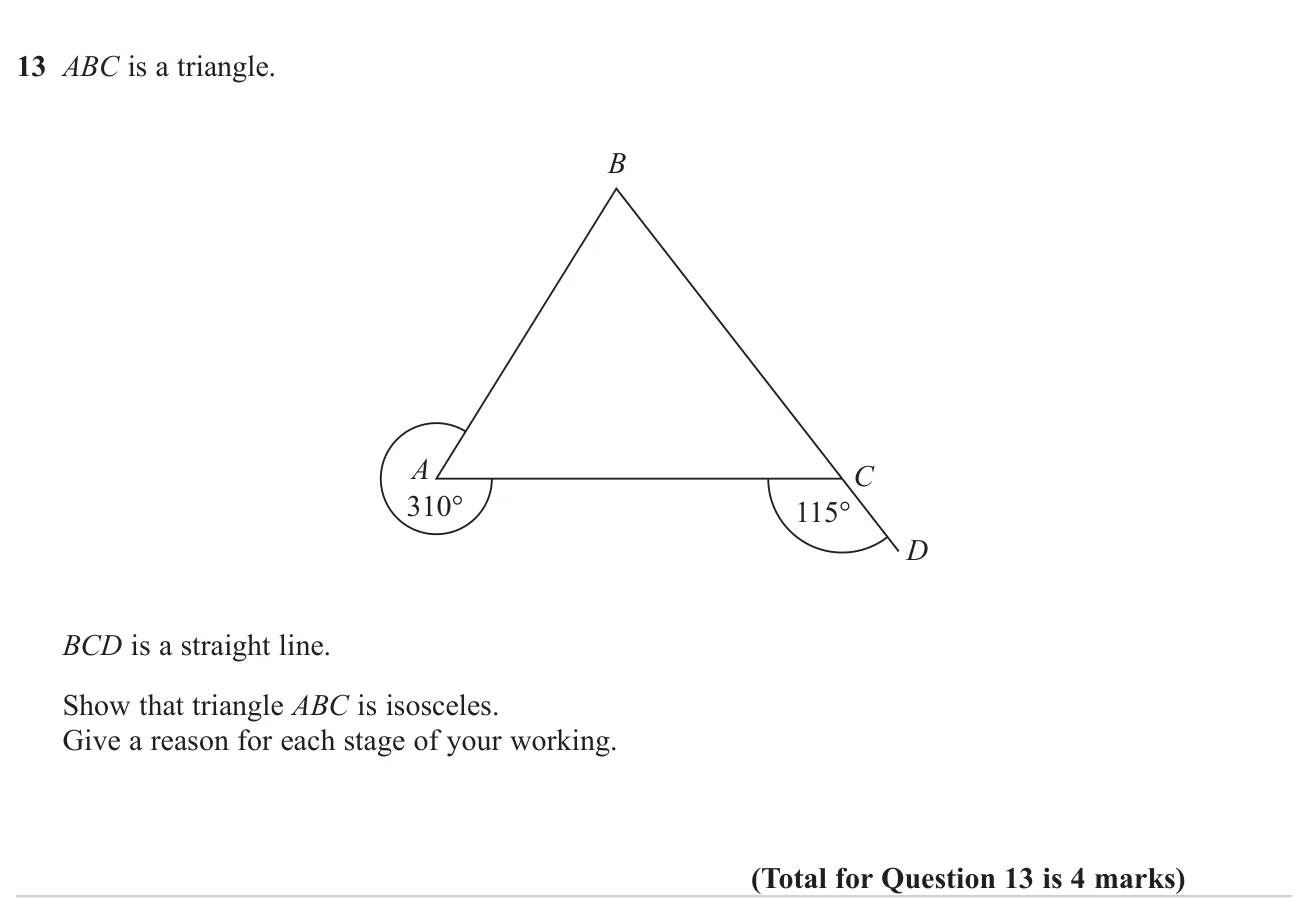
Answer Angles are 50 ∘ 50^\circ 5 0 ∘ 65 ∘ 65^\circ 6 5 ∘ 65 ∘ 65^\circ 6 5 ∘ 4 marks
Worked solution Checked against the mark scheme
Angle B A C = 360 − 310 = 50 ∘ BAC = 360 - 310 = 50^\circ B A C = 360 − 310 = 5 0 ∘ 360 ∘ 360^\circ 36 0 ∘
Angle A C B = 180 − 115 = 65 ∘ ACB = 180 - 115 = 65^\circ A C B = 180 − 115 = 6 5 ∘ 180 ∘ 180^\circ 18 0 ∘
Angle A B C = 180 − 50 − 65 = 65 ∘ ABC = 180 - 50 - 65 = 65^\circ A B C = 180 − 50 − 65 = 6 5 ∘ 180 ∘ 180^\circ 18 0 ∘
Angles A C B ACB A C B A B C ABC A B C 65 ∘ 65^\circ 6 5 ∘
Watch out: Leaving out the reasons, or not stating that two angles are equal.
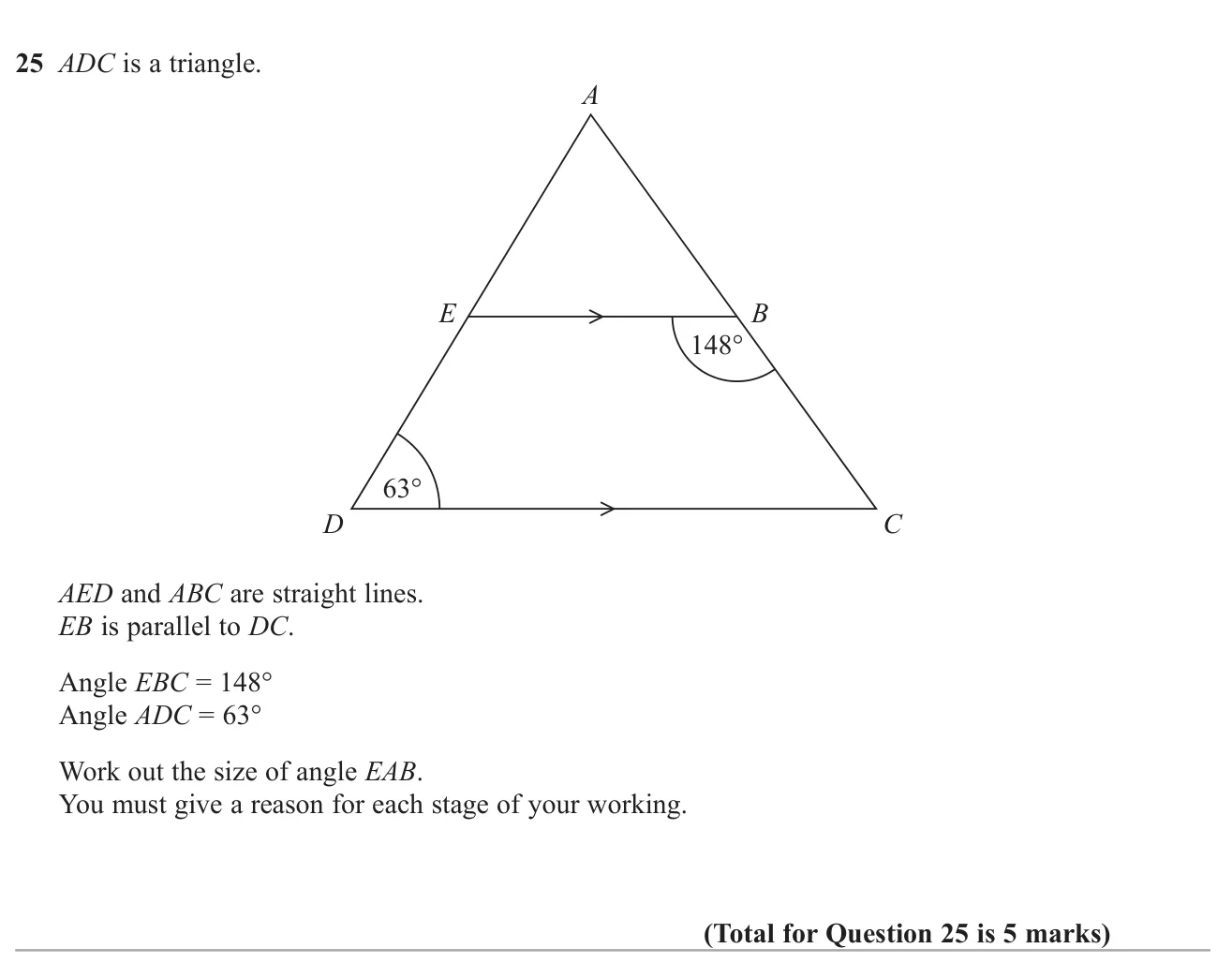
© Pearson Education Ltd. November 2020 Paper 1 (Foundation, non-calculator), question 25.
Answer 85 ° 85° 85° 5 marks
Worked solution Checked against the mark scheme
Angle A E B = 63 ° AEB = 63° A E B = 63°
Angle A B E = 180 − 148 = 32 ° ABE = 180 - 148 = 32° A B E = 180 − 148 = 32° 180 ° 180° 180°
Angle E A B = 180 − 63 − 32 = 85 ° EAB = 180 - 63 - 32 = 85° E A B = 180 − 63 − 32 = 85° 180 ° 180° 180°
Watch out: Writing 'F angles' or 'Z angles' instead of the proper names of the reasons.
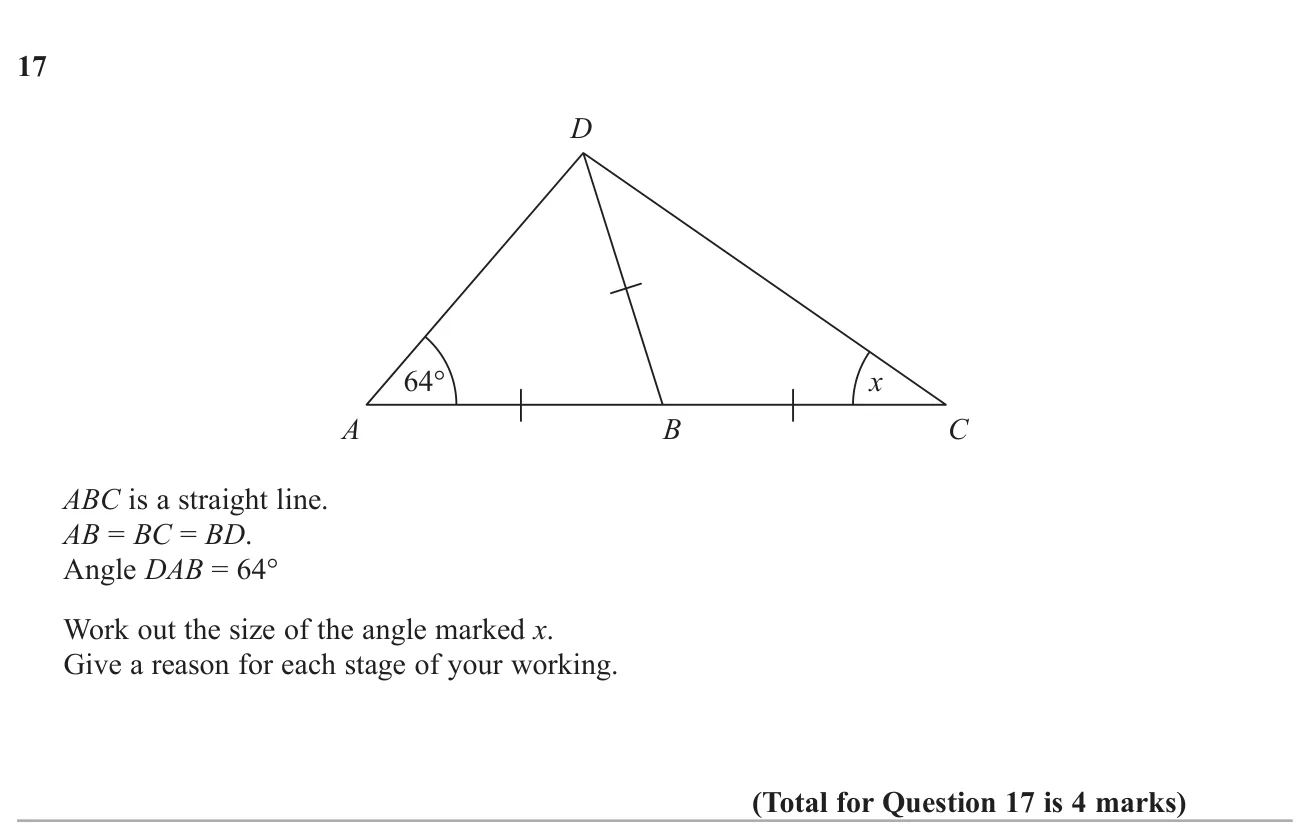
© Pearson Education Ltd. November 2019 Paper 2 (Foundation, calculator), question 17.
Answer x = 26 ° x = 26° x = 26° 4 marks
Worked solution Checked against the mark scheme
Triangle ABD is isosceles (A B = B D AB = BD A B = B D ∠ A D B = 64 ° \angle ADB = 64° ∠ A D B = 64°
∠ A B D = 180 − 64 − 64 = 52 ° \angle ABD = 180 - 64 - 64 = 52° ∠ A B D = 180 − 64 − 64 = 52° 180 ° 180° 180°
∠ D B C = 180 − 52 = 128 ° \angle DBC = 180 - 52 = 128° ∠ D B C = 180 − 52 = 128° 180 ° 180° 180°
Triangle DBC is isosceles (B D = B C BD = BC B D = B C x = 180 − 128 2 = 26 ° x = \frac{180 - 128}{2} = 26° x = 2 180 − 128 = 26°
Watch out: Giving the angle without any reasons, which loses the communication mark.
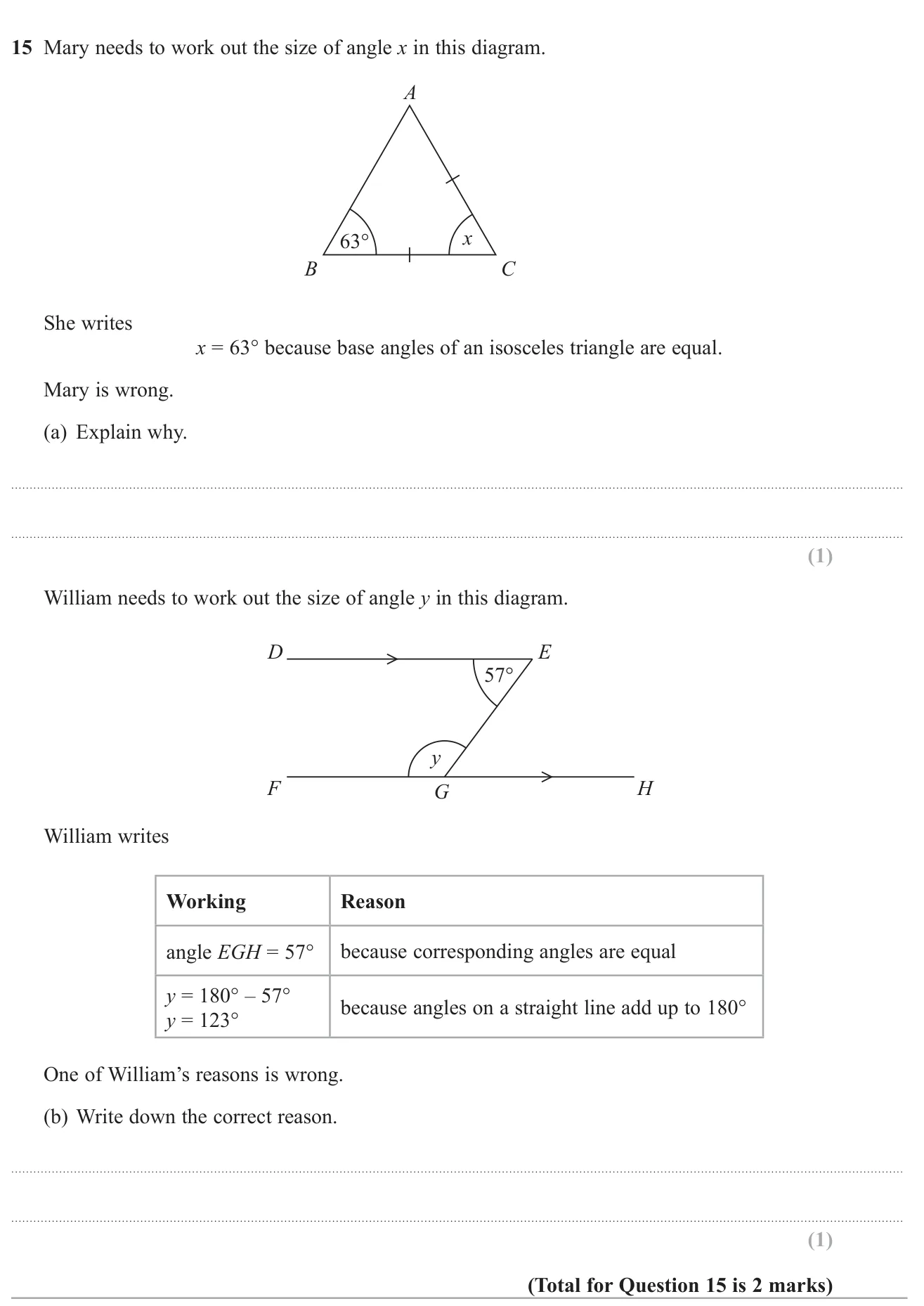
© Pearson Education Ltd. June 2018 Paper 2 (Foundation, calculator), question 15.
(a) The equal sides are AC and BC, so the equal angles are at A and B, not C; x = 54 ° x = 54° x = 54° 1 mark (b) Angle EGH = 57° because alternate angles are equal 1 mark
Worked solution Checked against the mark scheme
(a) The marked equal sides meet at C, so the base angles are at A and B. Angle A = 63 ° = 63° = 63° x = 180 − 63 − 63 = 54 ° x = 180 - 63 - 63 = 54° x = 180 − 63 − 63 = 54°
(b) The 57° angle and angle EGH lie on opposite sides of the line EG, between the parallel lines. That makes them alternate angles, not corresponding.
Watch out: Assuming the two bottom angles are always the base angles.
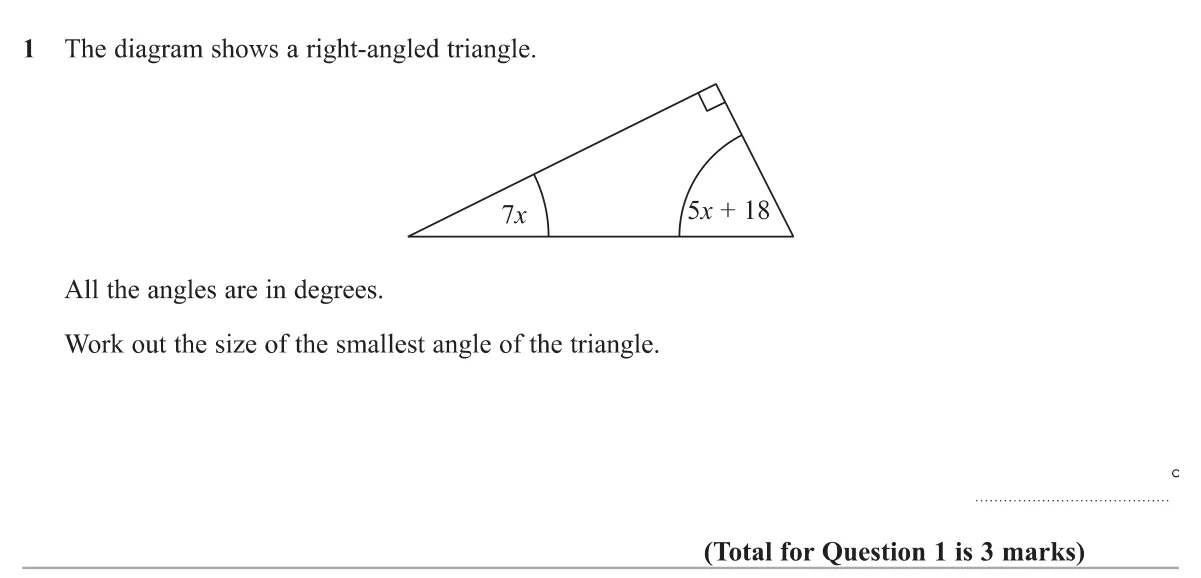
© Pearson Education Ltd. Specimen Paper 1 (Higher, non-calculator), question 1.
Worked solution Checked against the mark scheme
The two marked angles add up to 90 ° 90° 90°
7 x + 5 x + 18 = 90 7x + 5x + 18 = 90 7 x + 5 x + 18 = 90 12 x = 72 12x = 72 12 x = 72 x = 6 x = 6 x = 6
The angles are 7 × 6 = 42 ° 7 \times 6 = 42° 7 × 6 = 42° 5 × 6 + 18 = 48 ° 5 \times 6 + 18 = 48° 5 × 6 + 18 = 48° 90 ° 90° 90° 42 ° 42° 42°
Watch out: Setting the angles equal to 180 and forgetting the right angle, or giving x = 6 x = 6 x = 6
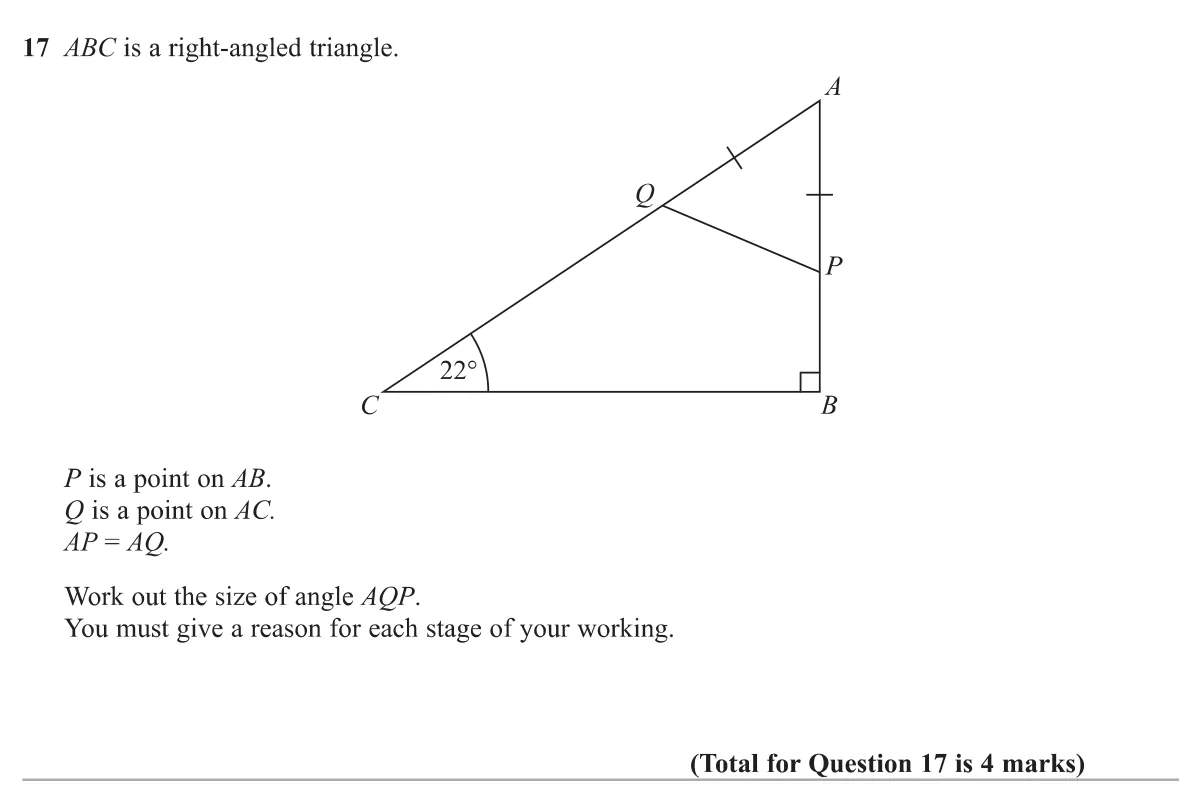
© Pearson Education Ltd. Specimen Paper 2 (Foundation, calculator), question 17.
Answer 56 ° 56° 56° 4 marks
Worked solution Checked against the mark scheme
Angle A = 180 − 90 − 22 = 68 ° A = 180 - 90 - 22 = 68° A = 180 − 90 − 22 = 68° 180 ° 180° 180°
Triangle APQ is isosceles since AP = AQ, so angles AQP and APQ are equal (base angles of an isosceles triangle).
Angle A Q P = ( 180 − 68 ) ÷ 2 = 56 ° AQP = (180 - 68) \div 2 = 56° A QP = ( 180 − 68 ) ÷ 2 = 56°
Watch out: Assuming angle AQP equals angle A.
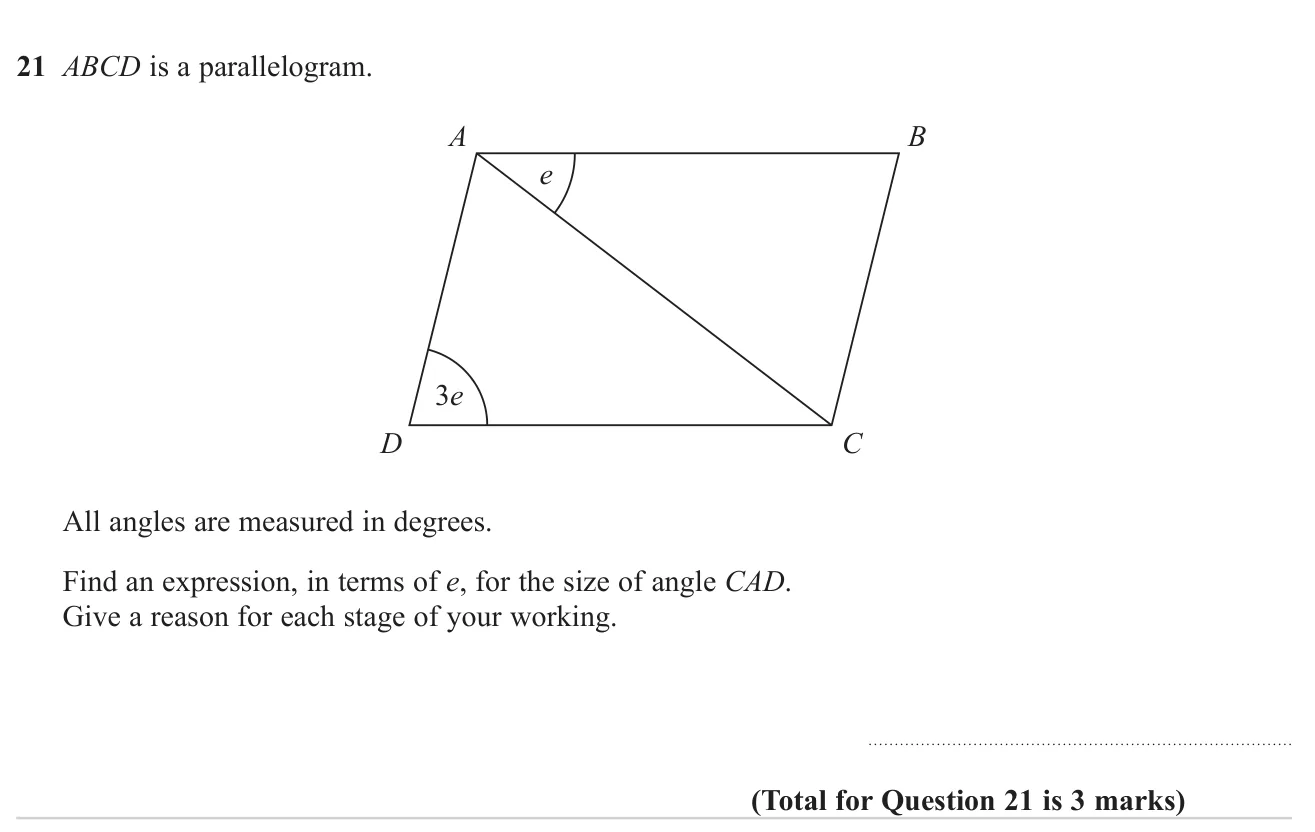
© Pearson Education Ltd. November 2024 Paper 1 (Foundation, non-calculator), question 21.
Answer 180 − 4 e 180 - 4e 180 − 4 e 3 marks
Worked solution Checked against the mark scheme
AB is parallel to DC, so angle A C D = e ACD = e A C D = e
Angles in triangle A C D ACD A C D 180 ° 180° 180°
angle C A D = 180 − 3 e − e = 180 − 4 e CAD = 180 - 3e - e = 180 - 4e C A D = 180 − 3 e − e = 180 − 4 e
Watch out: Giving the reason as 'Z angles' instead of alternate angles.
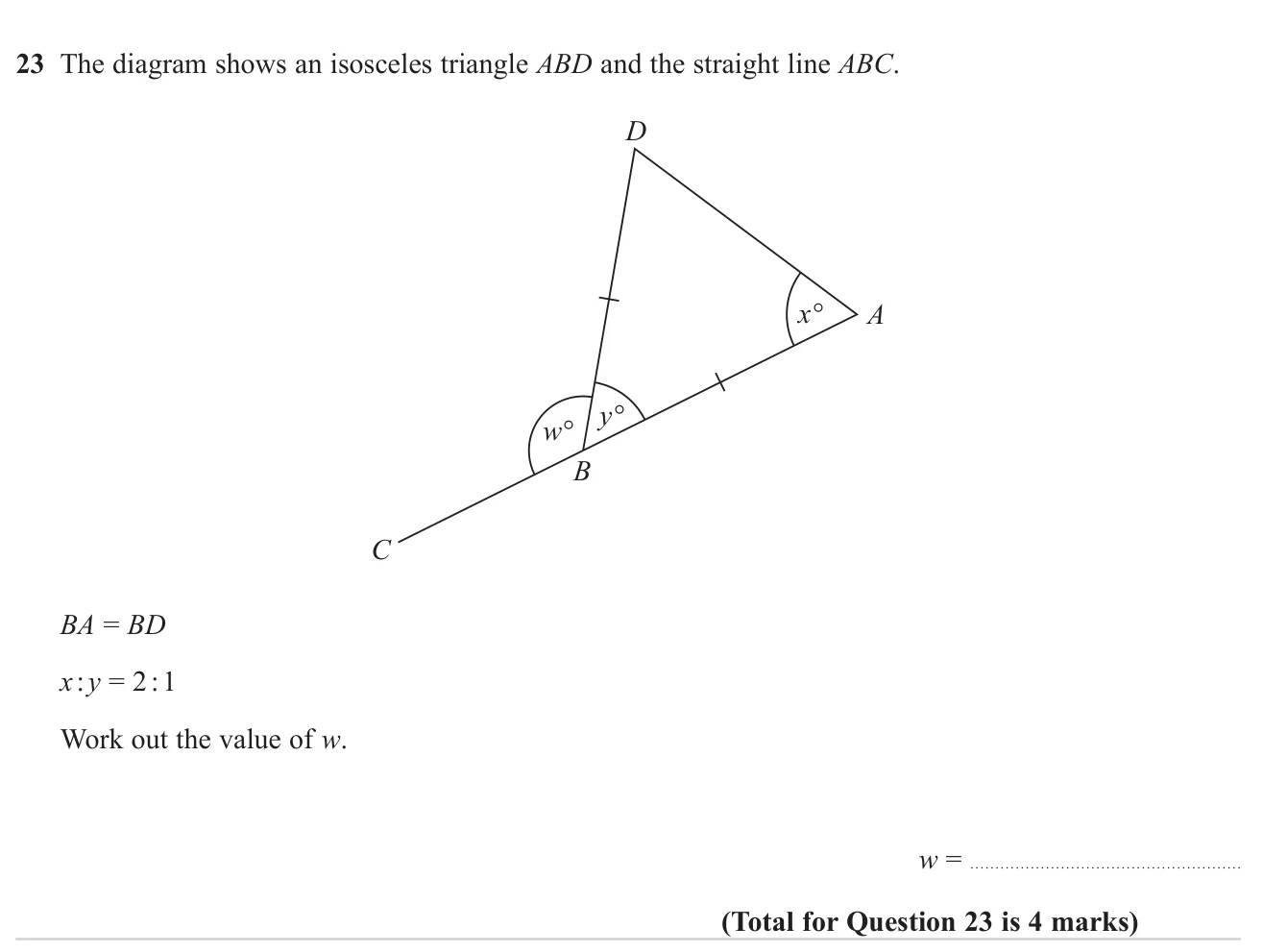
© Pearson Education Ltd. November 2023 Paper 1 (Foundation, non-calculator), question 23.
Worked solution Checked against the mark scheme
BA = BD, so the angles at A and D are equal: both are x x x
Angles in the triangle: x + x + y = 180 x + x + y = 180 x + x + y = 180 x = 2 y x = 2y x = 2 y 5 y = 180 5y = 180 5 y = 180 y = 36 y = 36 y = 36
Angles on a straight line: w = 180 − 36 = 144 w = 180 - 36 = 144 w = 180 − 36 = 144
Watch out: Treating x as the angle at B and the apex angle as x.
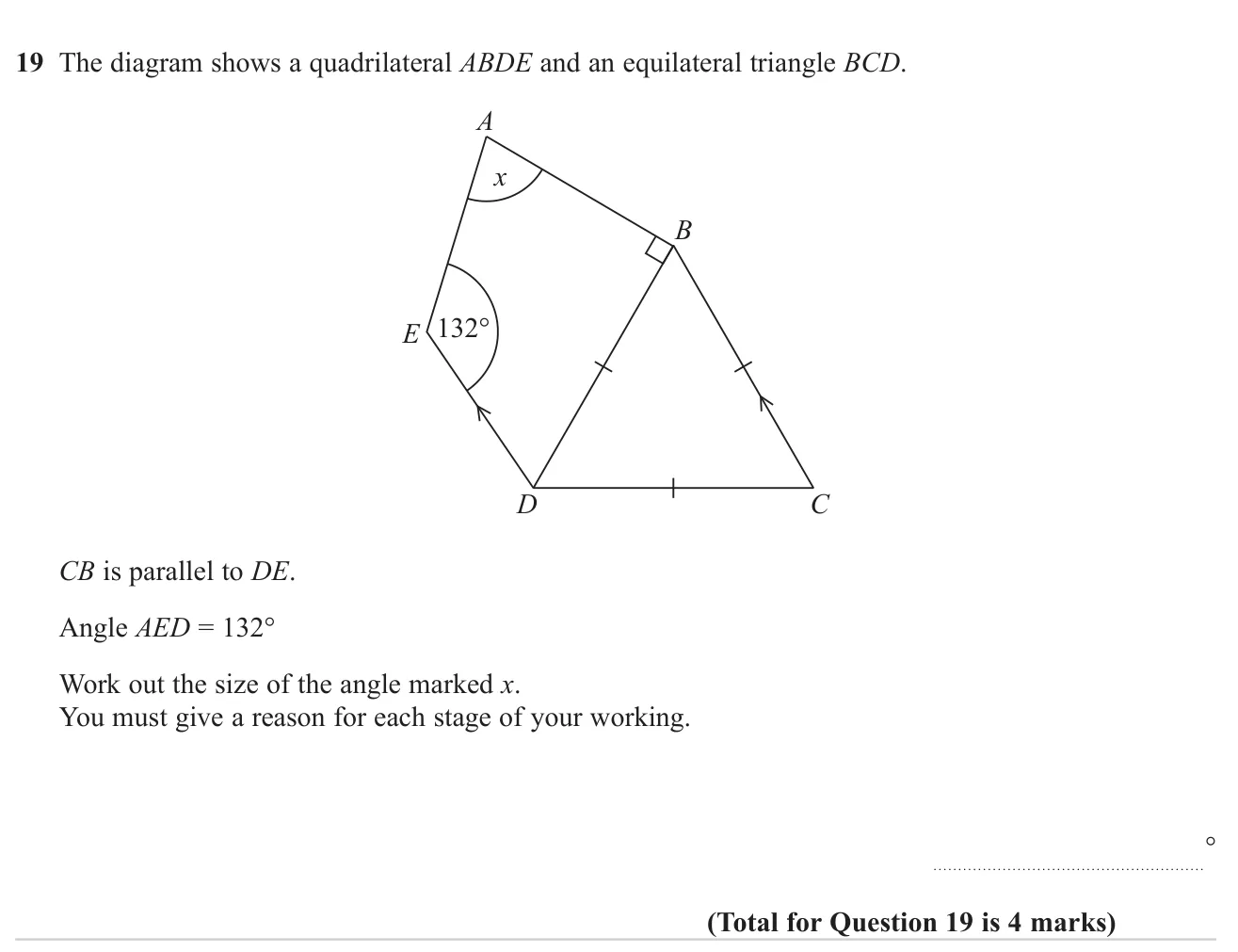
© Pearson Education Ltd. November 2023 Paper 2 (Foundation, calculator), question 19.
Answer x = 78 ° x = 78° x = 78° 4 marks
Worked solution Checked against the mark scheme
Triangle BCD is equilateral, so angle D B C = 60 ° DBC = 60° D B C = 60°
Angle B D E = 60 ° BDE = 60° B D E = 60°
Angle A B D = 90 ° ABD = 90° A B D = 90°
Angles in a quadrilateral add up to 360 ° 360° 360° x = 360 − 90 − 60 − 132 = 78 ° x = 360 - 90 - 60 - 132 = 78° x = 360 − 90 − 60 − 132 = 78°
Watch out: Giving reasons like 'Z angles' instead of 'alternate angles are equal'.
© Pearson Education Ltd. June 2023 Paper 3 (Foundation, calculator), question 22.
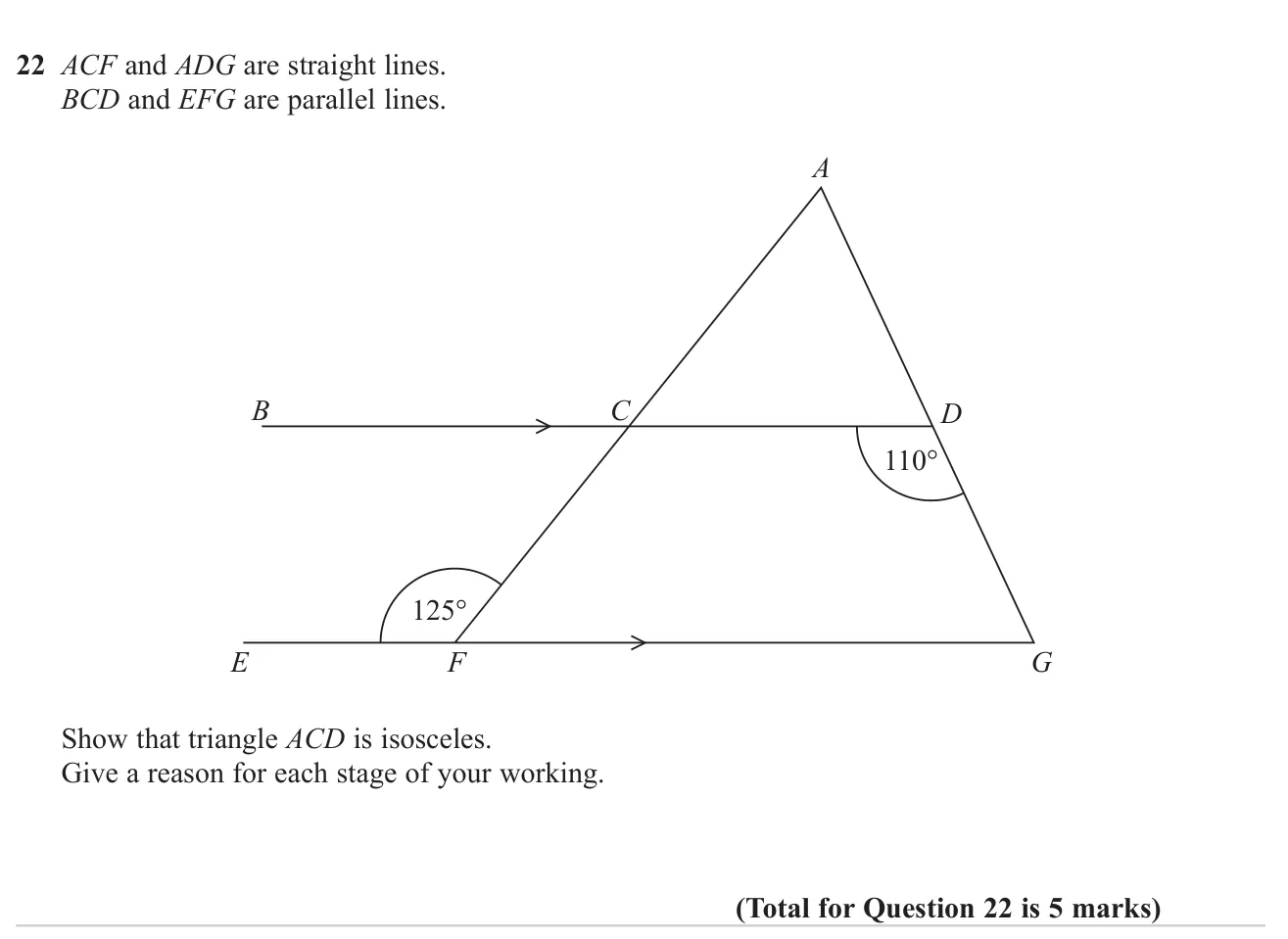
Answer Angle A C D = 55 ° ACD = 55° A C D = 55° C A D = 55 ° CAD = 55° C A D = 55° 5 marks
Worked solution Checked against the mark scheme
Angle C F G = 180 − 125 = 55 ° CFG = 180 - 125 = 55° C F G = 180 − 125 = 55°
Angle A C D = 55 ° ACD = 55° A C D = 55°
Angle A D C = 180 − 110 = 70 ° ADC = 180 - 110 = 70° A D C = 180 − 110 = 70°
Angle C A D = 180 − 55 − 70 = 55 ° CAD = 180 - 55 - 70 = 55° C A D = 180 − 55 − 70 = 55°
Two angles are equal, so triangle A C D ACD A C D
Watch out: Giving correct angles but no reasons, or saying 'Z angles' instead of alternate angles.
© Pearson Education Ltd. June 2022 Paper 3 (Foundation, calculator), question 20.
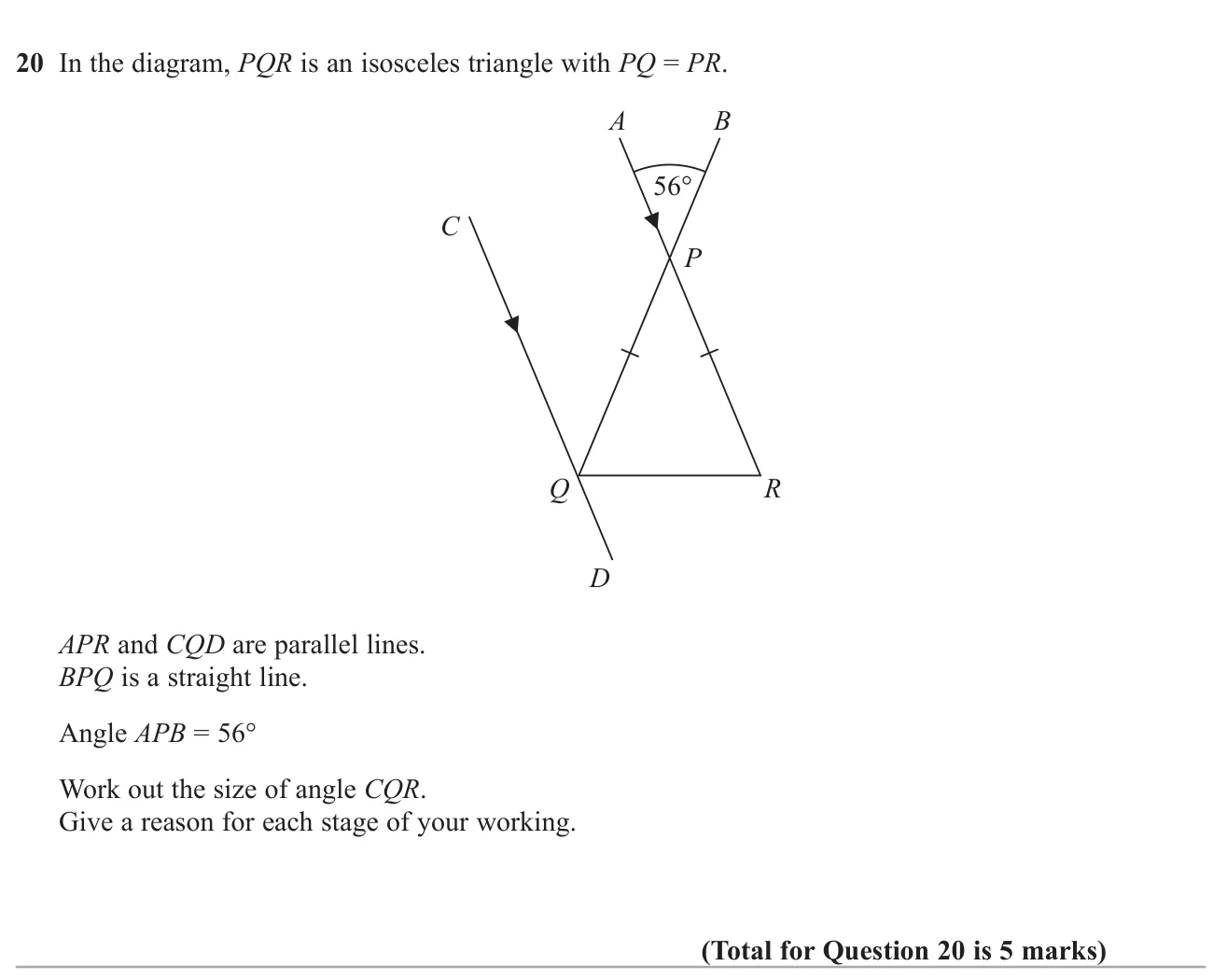
Answer 118 ° 118° 118° 5 marks
Worked solution Checked against the mark scheme
Angle Q P R = 56 ° QPR = 56° QP R = 56°
Angle P Q R = ( 180 − 56 ) ÷ 2 = 62 ° PQR = (180 - 56) \div 2 = 62° P QR = ( 180 − 56 ) ÷ 2 = 62°
Angle P R Q = 62 ° PRQ = 62° P R Q = 62° C Q D ∥ A P R CQD \parallel APR C Q D ∥ A P R C Q R = 180 − 62 = 118 ° CQR = 180 - 62 = 118° C QR = 180 − 62 = 118°
Watch out: Leaving out reasons, or naming a reason (e.g. 'Z angles') without the correct words.
© Pearson Education Ltd. November 2019 Paper 1 (Foundation, non-calculator), question 24.
Worked solution Checked against the mark scheme
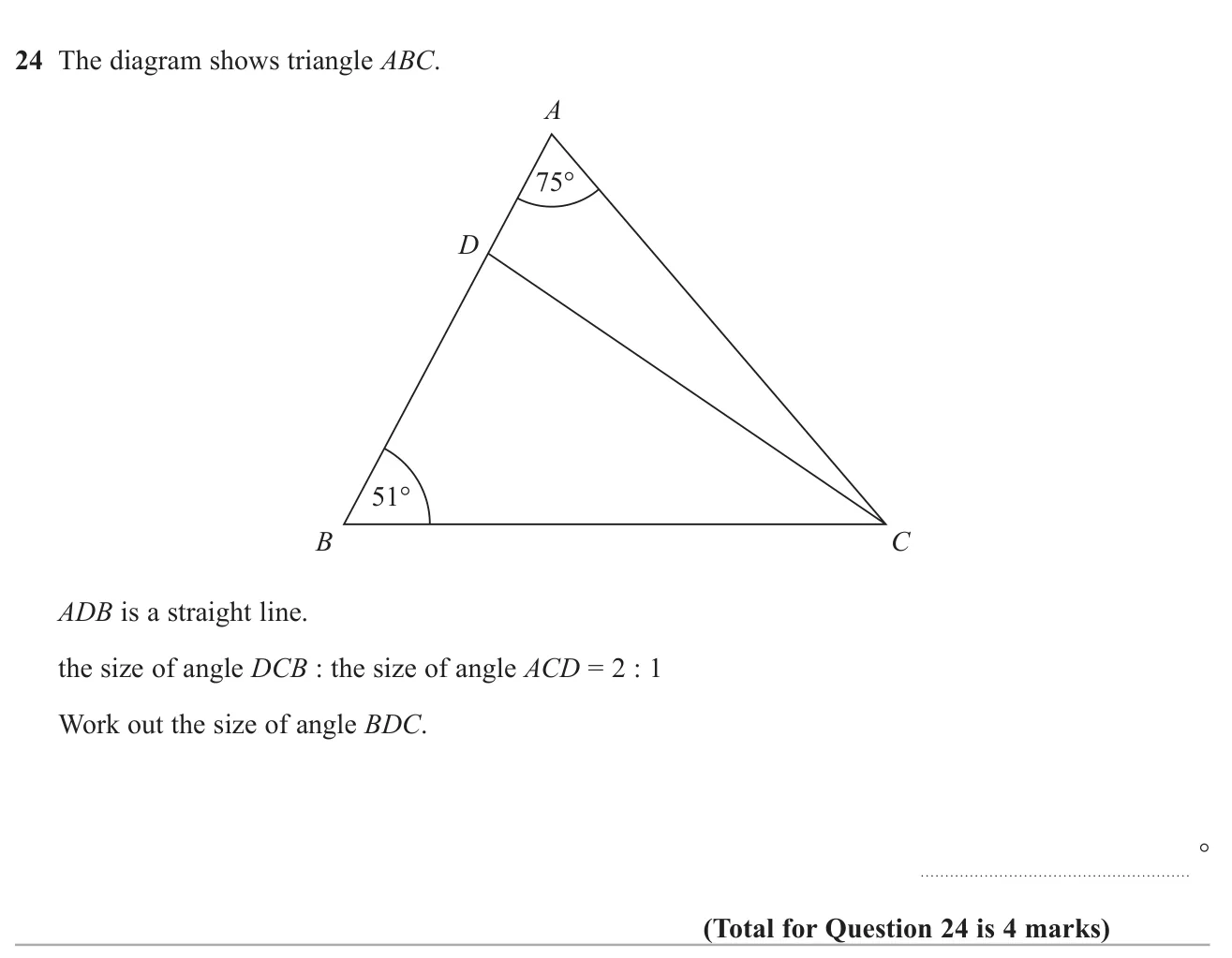
Angle A C B = 180 − 75 − 51 = 54 ° ACB = 180 - 75 - 51 = 54° A C B = 180 − 75 − 51 = 54°
Split 54 in the ratio 2 : 1: one part = 54 ÷ 3 = 18 ° = 54 \div 3 = 18° = 54 ÷ 3 = 18°
So A C D = 18 ° ACD = 18° A C D = 18° D C B = 36 ° DCB = 36° D C B = 36°
In triangle B D C BDC B D C B D C = 180 − 51 − 36 = 93 ° BDC = 180 - 51 - 36 = 93° B D C = 180 − 51 − 36 = 93°
Watch out: Giving angle ADC (87°) instead of angle BDC.
© Pearson Education Ltd. November 2019 Paper 1 (Foundation, non-calculator), question 28.
Worked solution Checked against the mark scheme
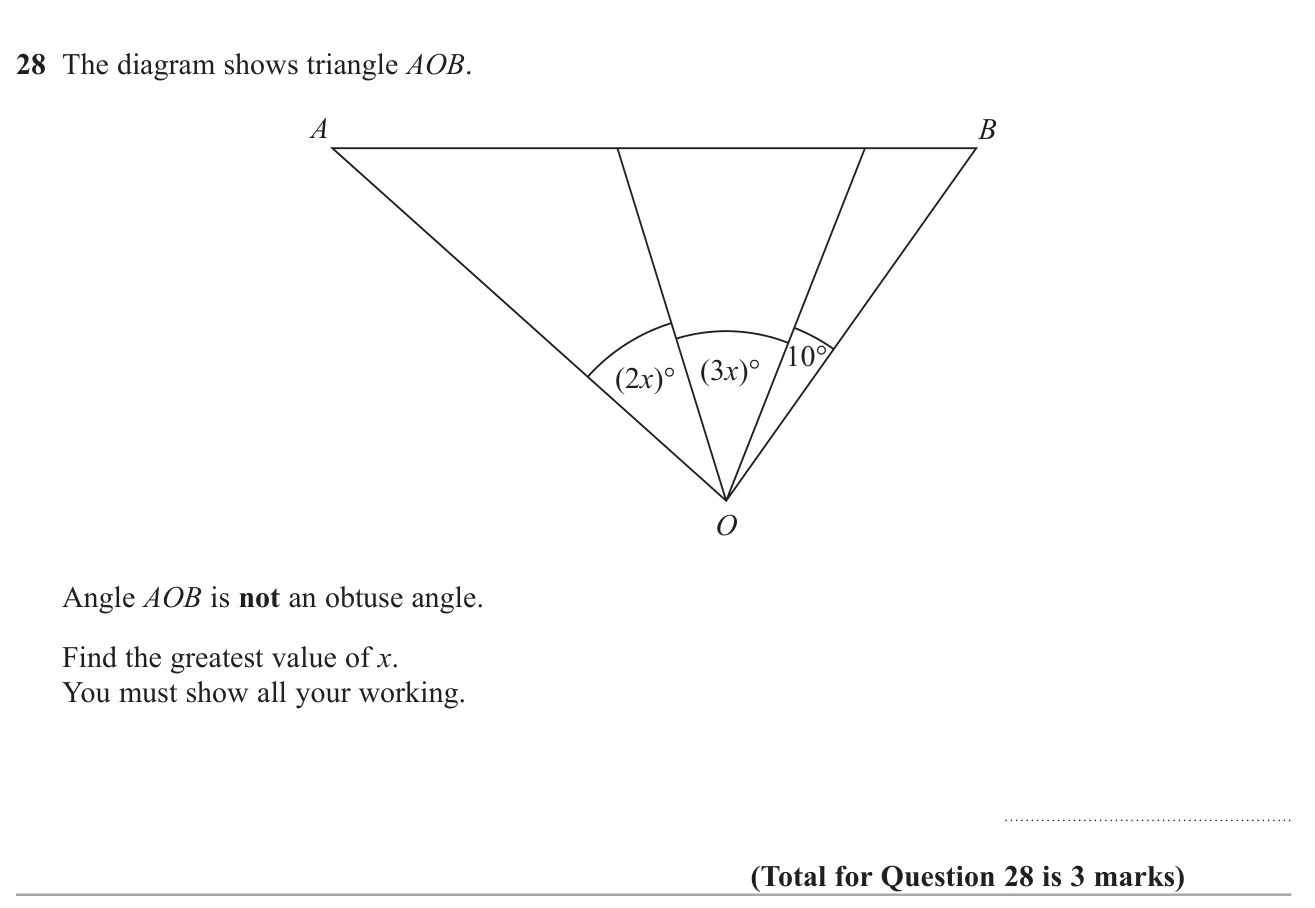
Angle A O B AOB A O B 2 x + 3 x + 10 ≤ 90 2x + 3x + 10 \le 90 2 x + 3 x + 10 ≤ 90
5 x ≤ 80 5x \le 80 5 x ≤ 80
x ≤ 16 x \le 16 x ≤ 16 x = 16 x = 16 x = 16
Watch out: Using 180 instead of 90, giving x = 34.
© Pearson Education Ltd. November 2018 Paper 1 (Foundation, non-calculator), question 14.
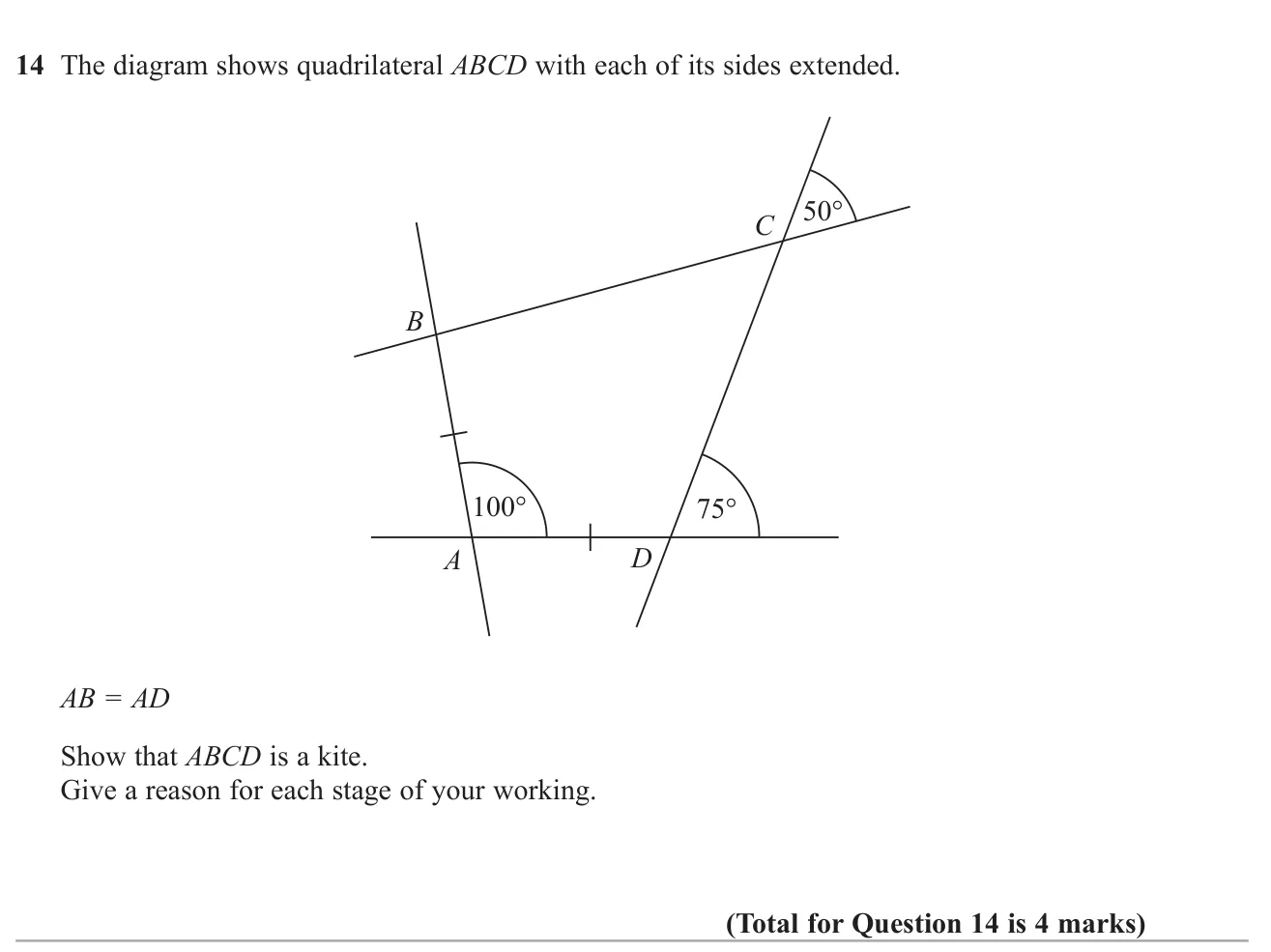
Answer Angle A D C = 105 ° ADC = 105° A D C = 105° A B C = 105 ° ABC = 105° A B C = 105° A B = A D AB = AD A B = A D A B C D ABCD A B C D 4 marks
Worked solution Checked against the mark scheme
Angle B A D = 100 ° BAD = 100° B A D = 100°
Angle A D C = 180 − 75 = 105 ° ADC = 180 - 75 = 105° A D C = 180 − 75 = 105°
Angle B C D = 50 ° BCD = 50° B C D = 50°
Angle A B C = 360 − 100 − 50 − 105 = 105 ° ABC = 360 - 100 - 50 - 105 = 105° A B C = 360 − 100 − 50 − 105 = 105°
A B = A D AB = AD A B = A D A B D ABD A B D A B D ABD A B D A D B ADB A D B A B C ABC A B C A D C ADC A D C C B D CBD C B D C D B CDB C D B C B = C D CB = CD C B = C D
Two pairs of equal adjacent sides, so A B C D ABCD A B C D
Watch out: Finding the angles but not giving a reason for each step.
© Pearson Education Ltd. November 2018 Paper 2 (Foundation, calculator), question 22.
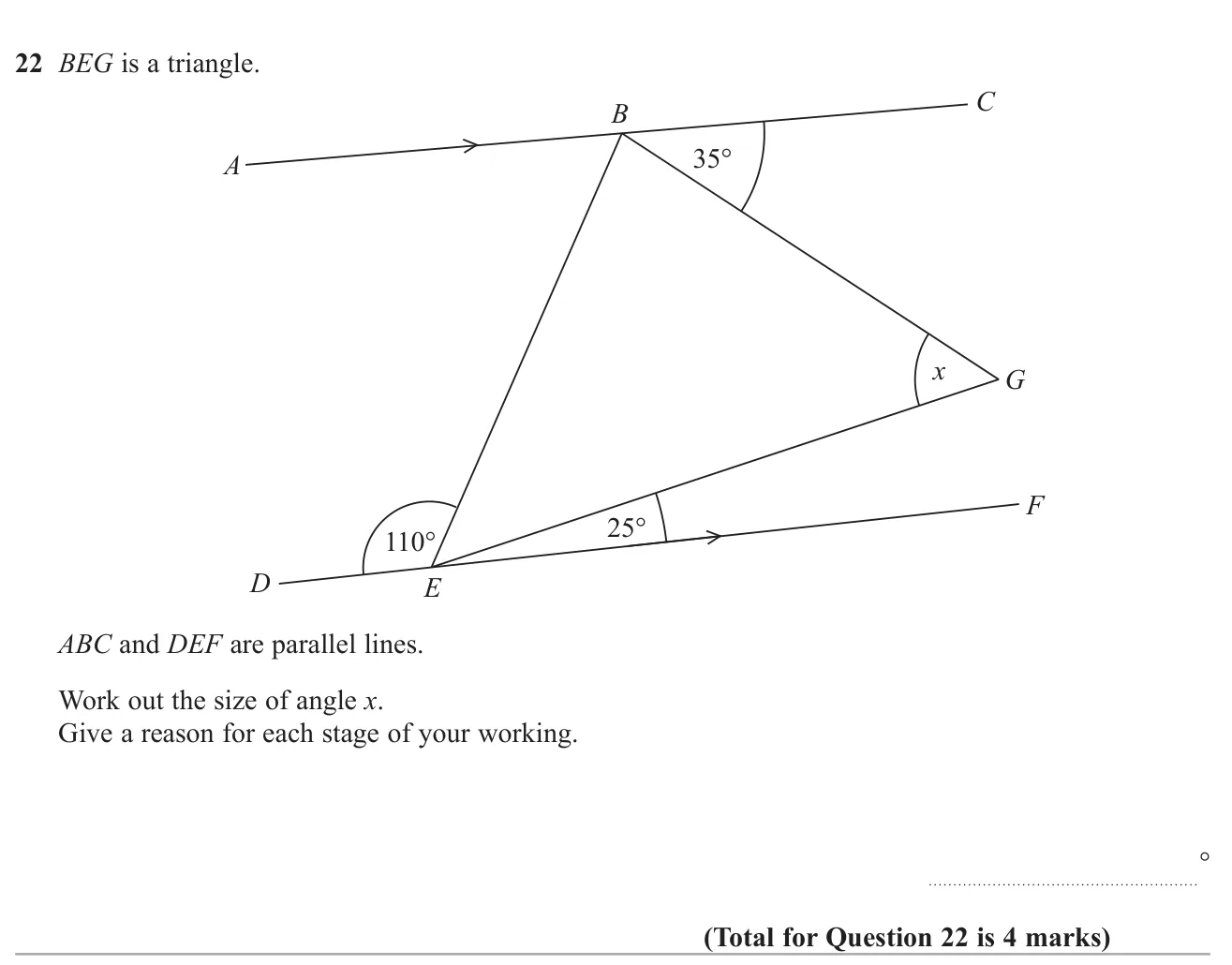
Worked solution Checked against the mark scheme
Angle A B E = 180 − 110 = 70 ° ABE = 180 - 110 = 70° A B E = 180 − 110 = 70°
Angle E B G = 180 − 70 − 35 = 75 ° EBG = 180 - 70 - 35 = 75° E B G = 180 − 70 − 35 = 75°
Angle B E G = 180 − 110 − 25 = 45 ° BEG = 180 - 110 - 25 = 45° B E G = 180 − 110 − 25 = 45°
x = 180 − 75 − 45 = 60 ° x = 180 - 75 - 45 = 60° x = 180 − 75 − 45 = 60°
Watch out: Giving no reasons, or naming corresponding angles when they are alternate.
© Pearson Education Ltd. Specimen Paper 3 (Foundation, calculator), question 17.
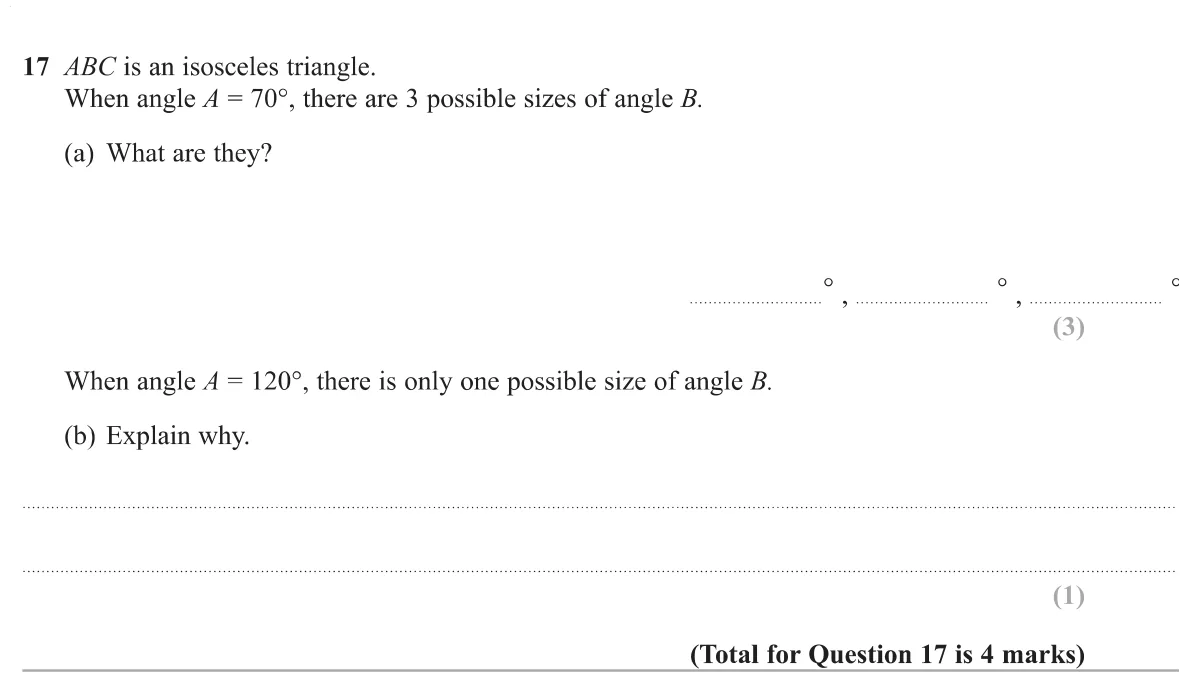
(a) 70 ∘ 70^\circ 7 0 ∘ 40 ∘ 40^\circ 4 0 ∘ 55 ∘ 55^\circ 5 5 ∘ 3 marks (b) A triangle cannot have two obtuse angles, so the 120° angle must be the unequal one and B must be 30° 1 mark
Worked solution Checked against the mark scheme
(a) If A is one of the two equal angles and B is the other: B = 70 ∘ B = 70^\circ B = 7 0 ∘
If A and C are equal: B = 180 − 70 − 70 = 40 ∘ B = 180 - 70 - 70 = 40^\circ B = 180 − 70 − 70 = 4 0 ∘
If A is the odd angle: B = ( 180 − 70 ) ÷ 2 = 55 ∘ B = (180 - 70) \div 2 = 55^\circ B = ( 180 − 70 ) ÷ 2 = 5 5 ∘
(b) Two angles of 120 ∘ 120^\circ 12 0 ∘ 180 ∘ 180^\circ 18 0 ∘ B = ( 180 − 120 ) ÷ 2 = 30 ∘ B = (180 - 120) \div 2 = 30^\circ B = ( 180 − 120 ) ÷ 2 = 3 0 ∘
Watch out: Finding only one or two of the three angles in (a).
© Pearson Education Ltd. June 2024 Paper 2 (Foundation, calculator), question 26.
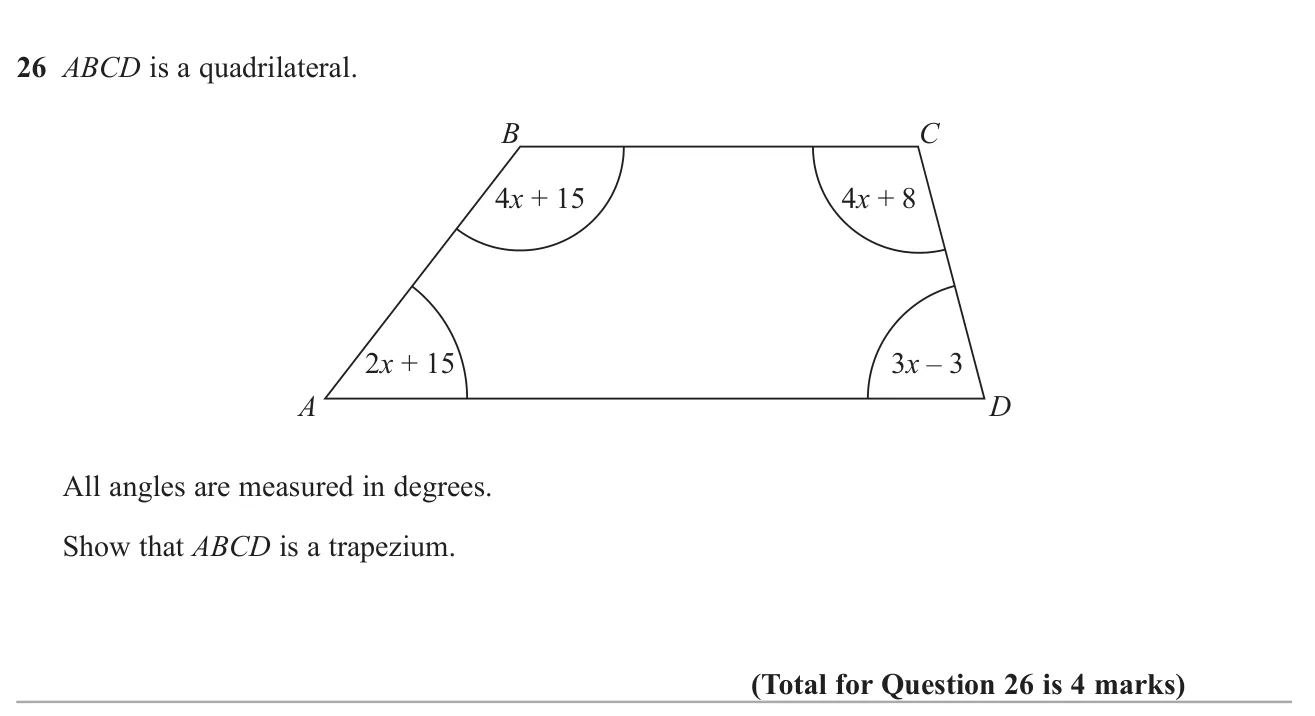
Answer x = 25 x = 25 x = 25 A + B = 65 ∘ + 115 ∘ = 180 ∘ A + B = 65^\circ + 115^\circ = 180^\circ A + B = 6 5 ∘ + 11 5 ∘ = 18 0 ∘ A D AD A D B C BC B C 4 marks
Worked solution Checked against the mark scheme
Angles in a quadrilateral add to 360 ∘ 360^\circ 36 0 ∘
( 2 x + 15 ) + ( 4 x + 15 ) + ( 4 x + 8 ) + ( 3 x − 3 ) = 360 (2x+15) + (4x+15) + (4x+8) + (3x-3) = 360 ( 2 x + 15 ) + ( 4 x + 15 ) + ( 4 x + 8 ) + ( 3 x − 3 ) = 360
13 x + 35 = 360 ⇒ x = 25 13x + 35 = 360 \Rightarrow x = 25 13 x + 35 = 360 ⇒ x = 25
A = 65 ∘ A = 65^\circ A = 6 5 ∘ B = 115 ∘ B = 115^\circ B = 11 5 ∘ A + B = 180 ∘ A + B = 180^\circ A + B = 18 0 ∘
Co-interior angles add to 180 ∘ 180^\circ 18 0 ∘ A D AD A D B C BC B C A B C D ABCD A B C D
Watch out: Finding x x x
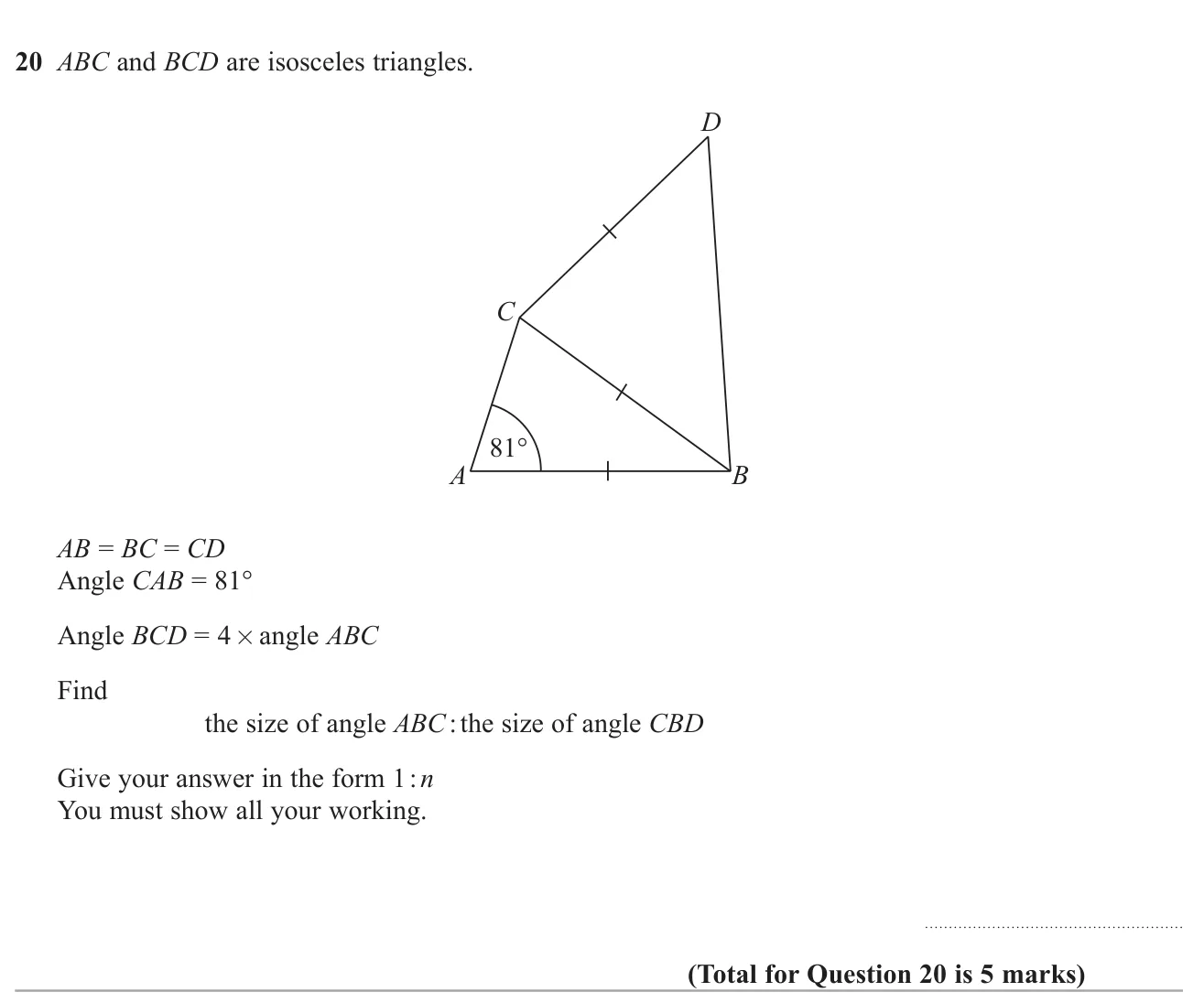
© Pearson Education Ltd. June 2024 Paper 3 (Foundation, calculator), question 20.
Worked solution Checked against the mark scheme
In triangle ABC, A B = B C AB = BC A B = B C 81 ° 81° 81°
Angle ABC = 180 − 2 × 81 = 18 ° = 180 - 2 \times 81 = 18° = 180 − 2 × 81 = 18°
Angle BCD = 4 × 18 = 72 ° = 4 \times 18 = 72° = 4 × 18 = 72°
In triangle BCD, B C = C D BC = CD B C = C D = ( 180 − 72 ) ÷ 2 = 54 ° = (180 - 72) \div 2 = 54° = ( 180 − 72 ) ÷ 2 = 54°
18 : 54 = 1 : 3 18 : 54 = 1 : 3 18 : 54 = 1 : 3
Watch out: Putting the equal angles in the wrong place in triangle BCD (they are opposite the equal sides BC and CD).
Also tested in these questions Their main topic is different, but part of each one tests this topic.