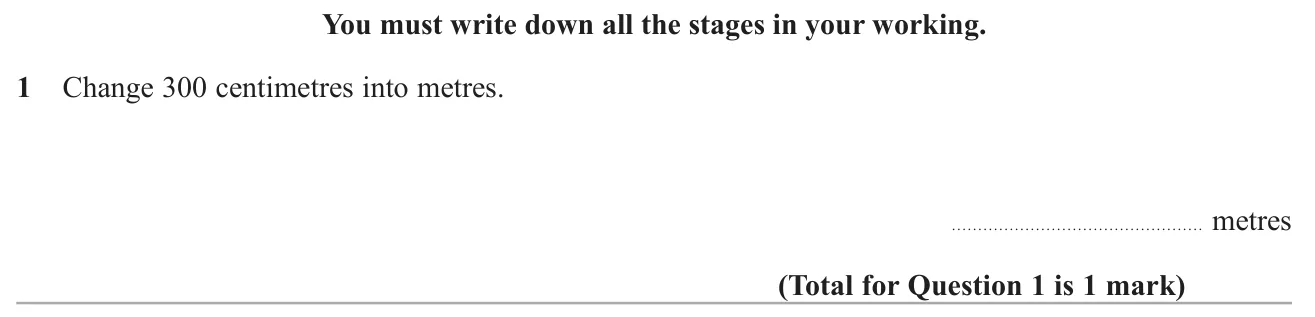
© Pearson Education Ltd. November 2020 Paper 3 (Foundation, calculator), question 1.
Show answer
Worked solution Checked against the mark scheme
There are 100 cm in 1 m, so divide by 100.
300÷100=3 metres
Watch out: Multiplying by 100 instead of dividing.
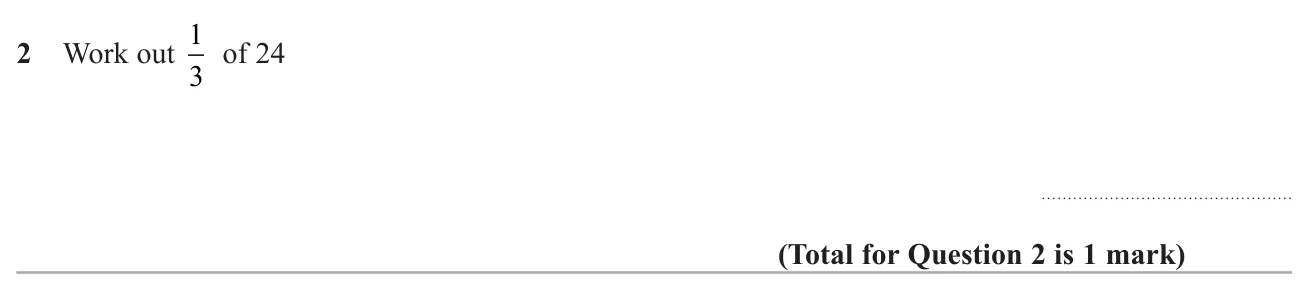
© Pearson Education Ltd. November 2020 Paper 3 (Foundation, calculator), question 2.
Show answer
Worked solution Checked against the mark scheme
One third means divide by 3.
24÷3=8
Watch out: Dividing by the wrong number or multiplying by 3.
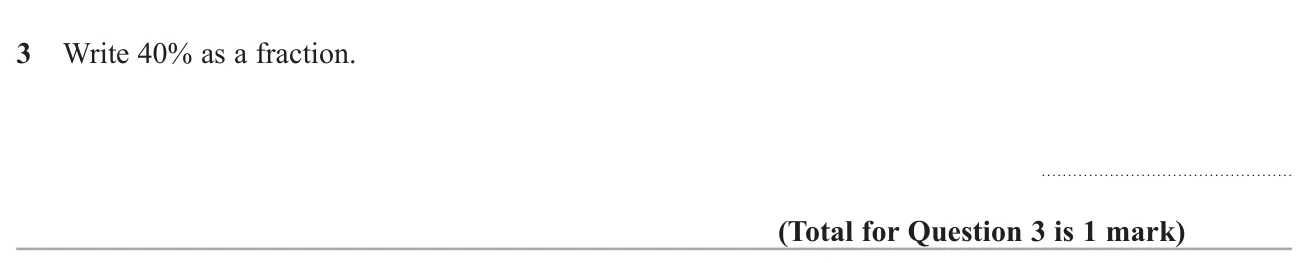
© Pearson Education Ltd. November 2020 Paper 3 (Foundation, calculator), question 3.
Show answer
| Answer | 10040 or any equivalent, e.g. 52 | 1 mark |
|---|
Worked solution Checked against the mark scheme
Per cent means out of 100.
40%=10040=52
Watch out: Writing 40/10 or 4/100 instead of 40/100.
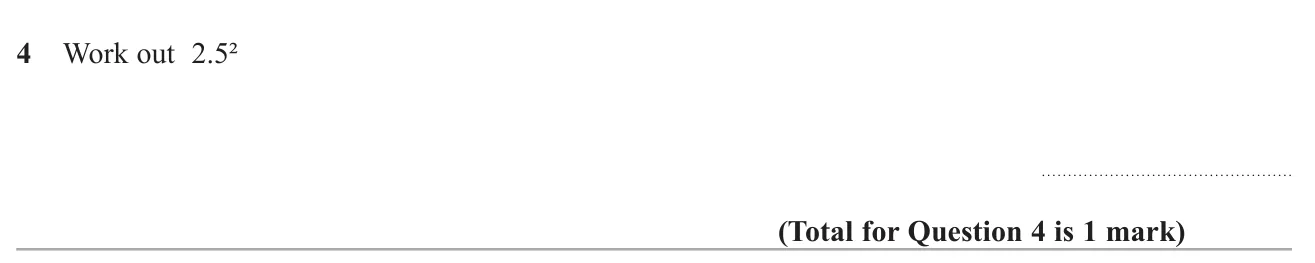
© Pearson Education Ltd. November 2020 Paper 3 (Foundation, calculator), question 4.
Show answer
Worked solution Checked against the mark scheme
Squaring means multiplying the number by itself.
2.5×2.5=6.25
Watch out: Doubling instead of squaring, giving 5.
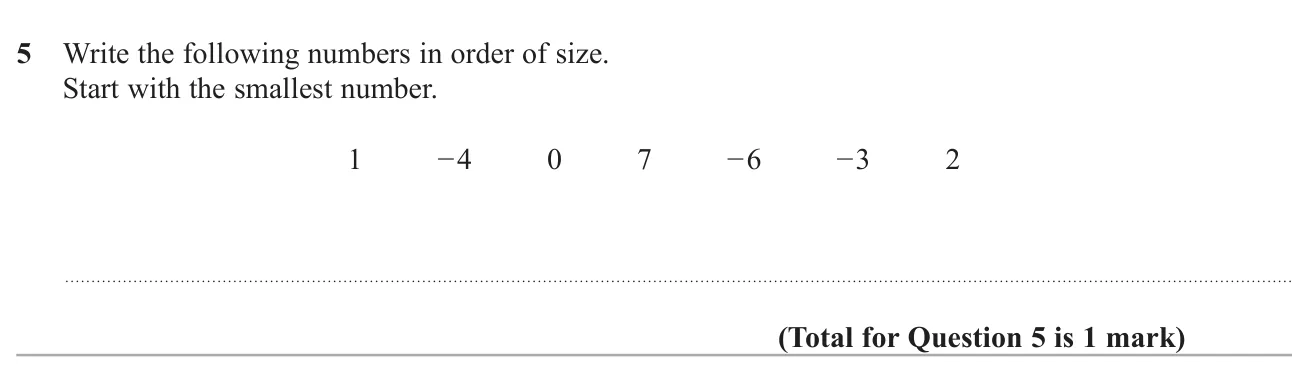
© Pearson Education Ltd. November 2020 Paper 3 (Foundation, calculator), question 5.
Show answer
| Answer | −6,−4,−3,0,1,2,7 | 1 mark |
|---|
Worked solution Checked against the mark scheme
The negative number furthest from zero is smallest.
−6,−4,−3,0,1,2,7
Watch out: Putting −3 before −6 because 3 is smaller than 6.
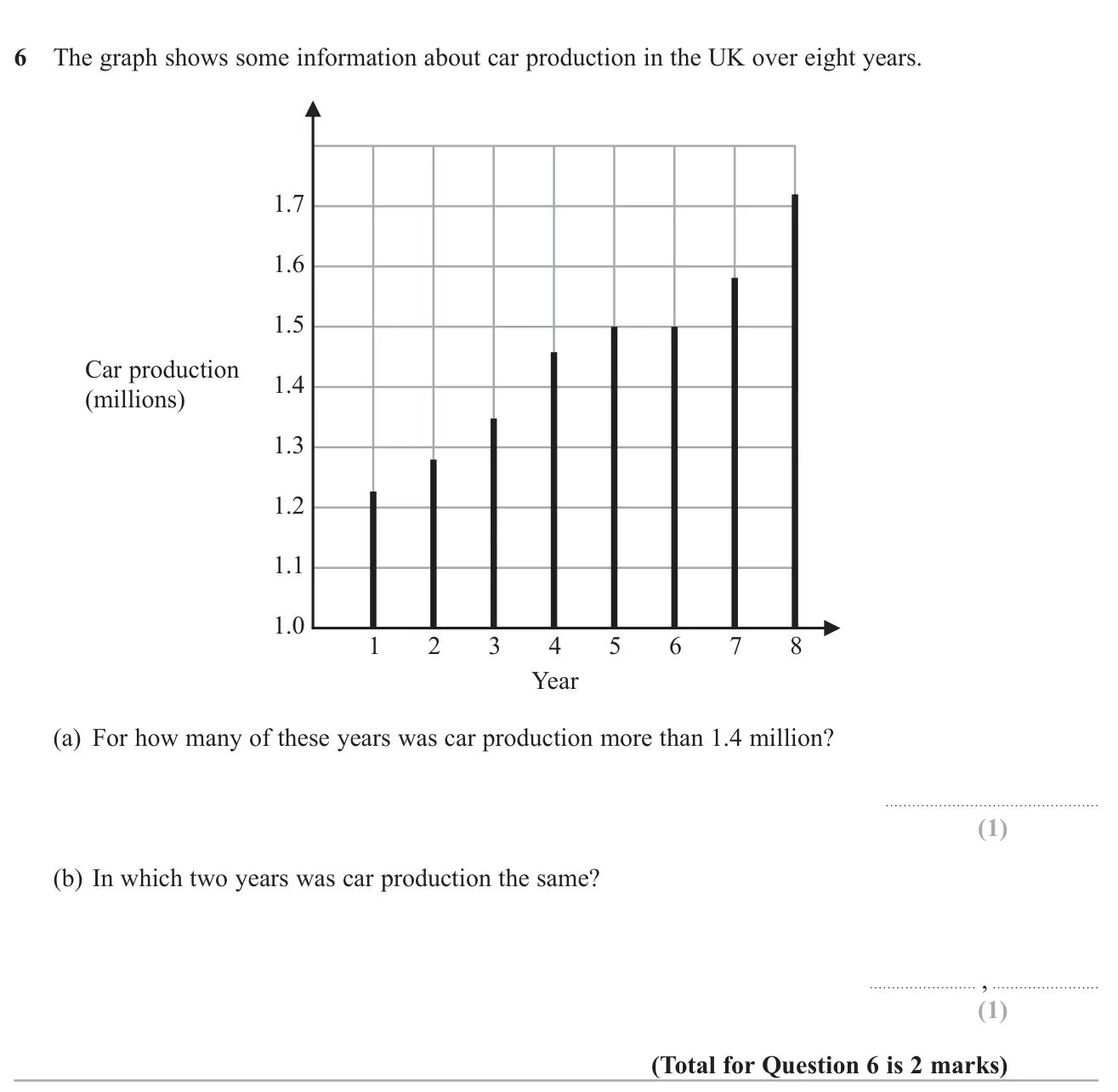
© Pearson Education Ltd. November 2020 Paper 3 (Foundation, calculator), question 6.
Show answer
| (a) | 5 | 1 mark |
|---|
| (b) | Years 5 and 6 | 1 mark |
|---|
Worked solution Checked against the mark scheme
(a) Bars above the 1.4 line: years 4, 5, 6, 7 and 8, so 5 years.
(b) Years 5 and 6 both reach exactly 1.5 million.
Watch out: Missing year 4, which is only just above 1.4.
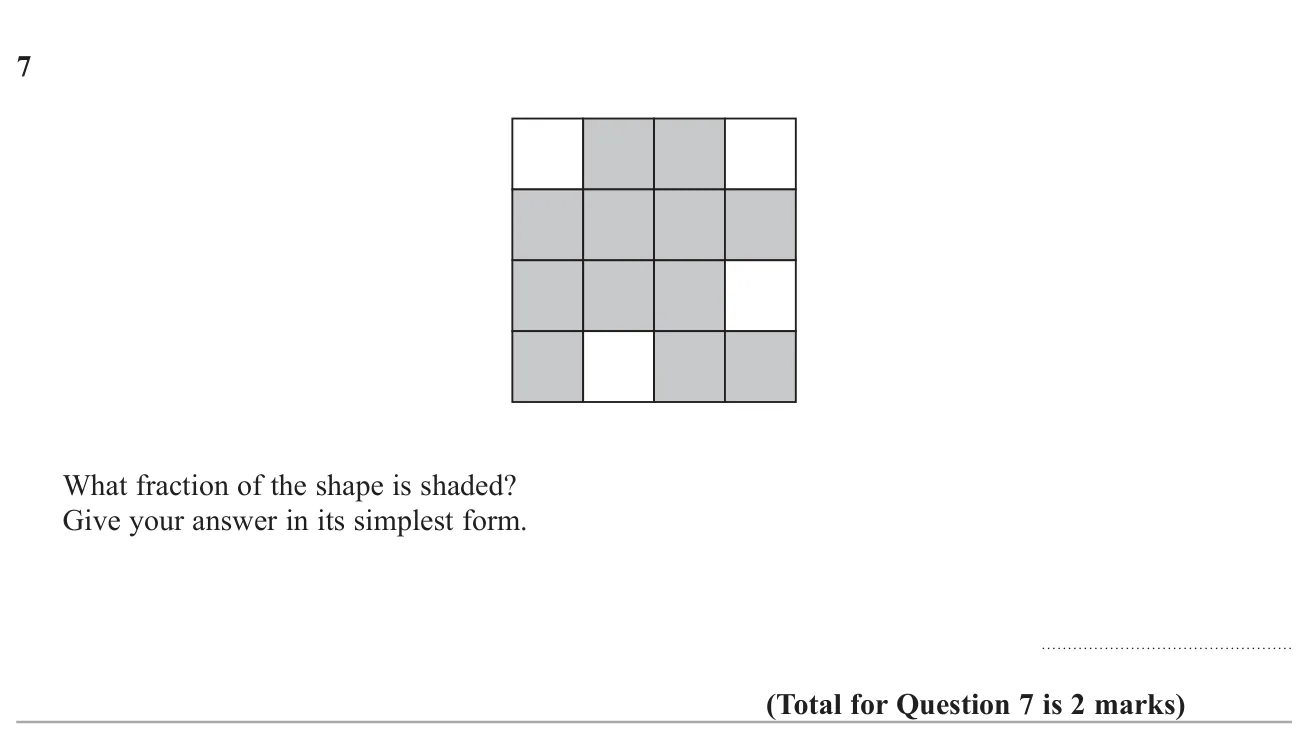
© Pearson Education Ltd. November 2020 Paper 3 (Foundation, calculator), question 7.
Show answer
| Answer | 43 | 2 marks |
|---|
Worked solution Checked against the mark scheme
Count the squares: 16 in total, 4 unshaded, so 12 shaded.
1612=43
Watch out: Giving 41, the unshaded fraction.
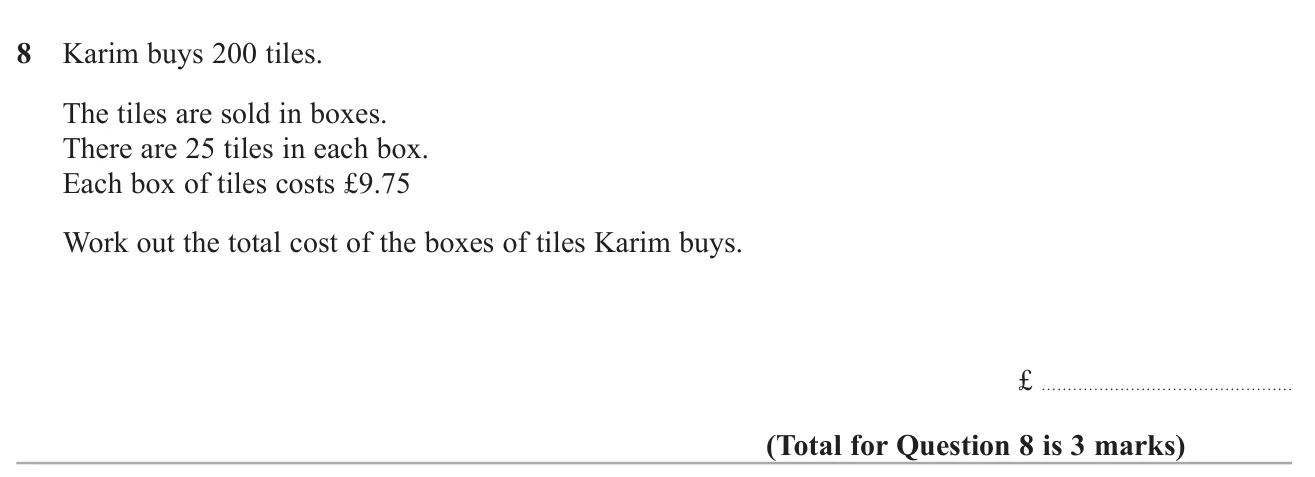
© Pearson Education Ltd. November 2020 Paper 3 (Foundation, calculator), question 8.
Show answer
Worked solution Checked against the mark scheme
Boxes needed: 200÷25=8
Cost: 8×£9.75=£78
Watch out: Multiplying 200 by £9.75.
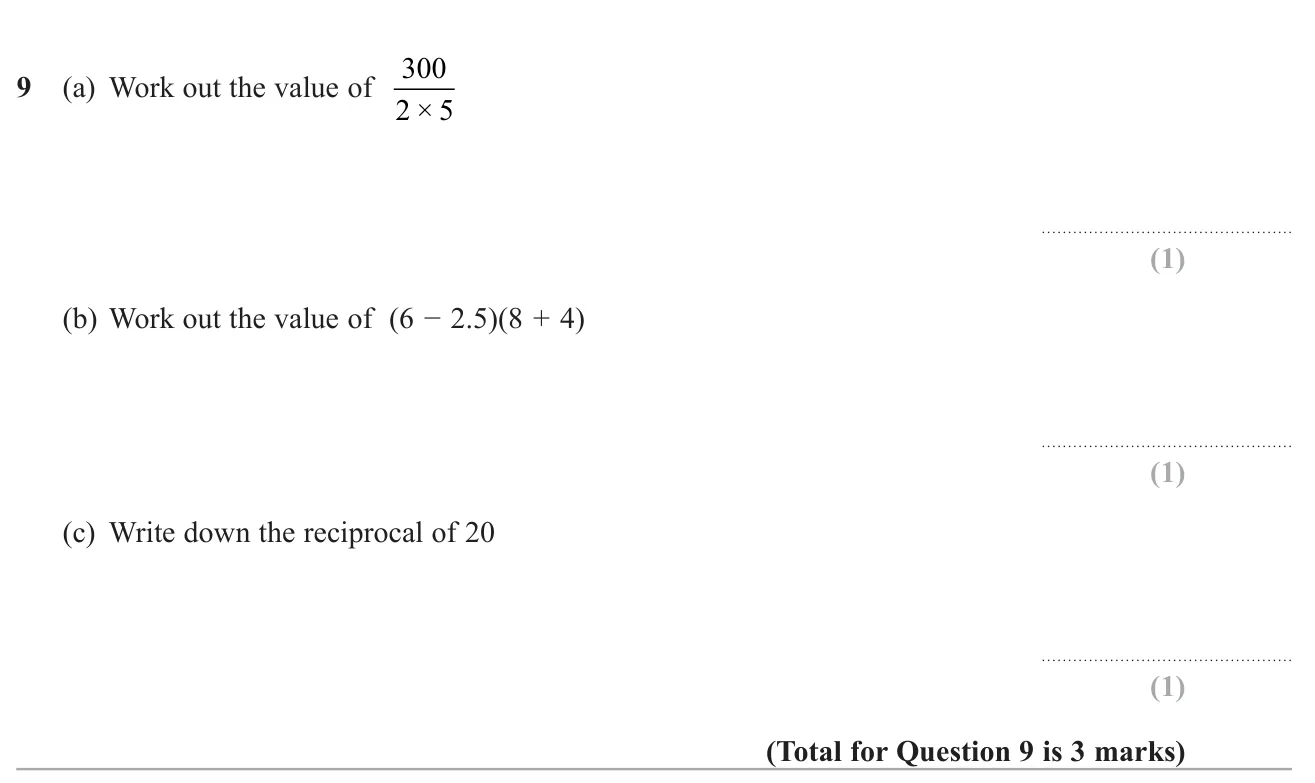
© Pearson Education Ltd. November 2020 Paper 3 (Foundation, calculator), question 9.
Show answer
| (a) | 30 | 1 mark |
|---|
| (b) | 42 | 1 mark |
|---|
| (c) | 201 or 0.05 | 1 mark |
|---|
Worked solution Checked against the mark scheme
(a) 2×5=10, and 300÷10=30
(b) 3.5×12=42
(c) The reciprocal of 20 is 201=0.05
Watch out: In (a), working out 300÷2×5=750.
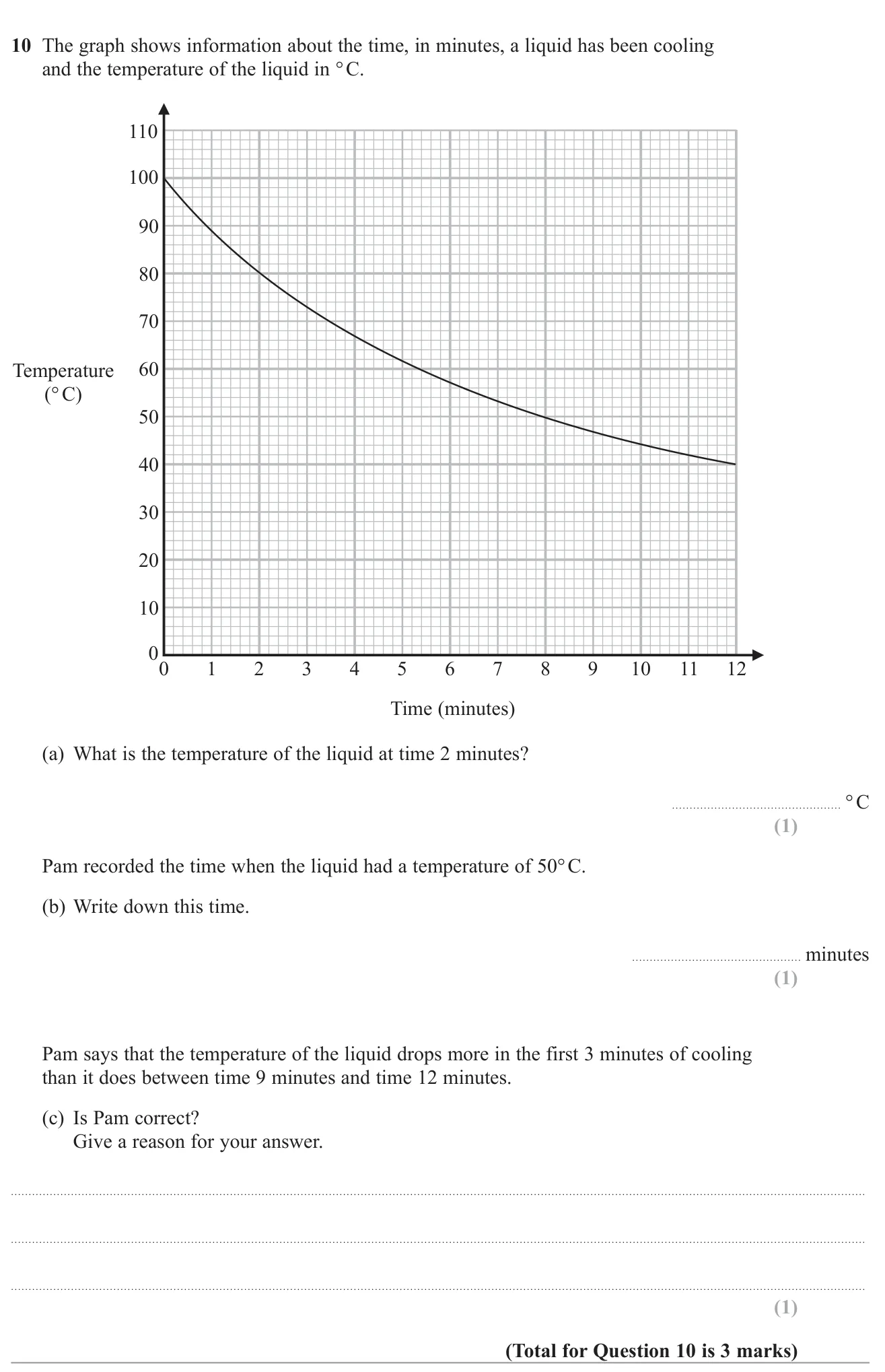
© Pearson Education Ltd. November 2020 Paper 3 (Foundation, calculator), question 10.
Show answer
| (a) | 80 °C | 1 mark |
|---|
| (b) | 8 minutes | 1 mark |
|---|
| (c) | Yes: it falls about 27 °C in the first 3 minutes but only about 7 °C from 9 to 12 minutes | 1 mark |
|---|
Worked solution Checked against the mark scheme
(a) Up from 2 minutes to the curve, across: 80 °C.
(b) Across from 50 °C to the curve, down: 8 minutes.
(c) From 100 to about 73 is a drop of about 27. From about 47 to 40 is a drop of about 7. So yes, Pam is right.
Watch out: In (c), comparing temperatures instead of the size of the drops.
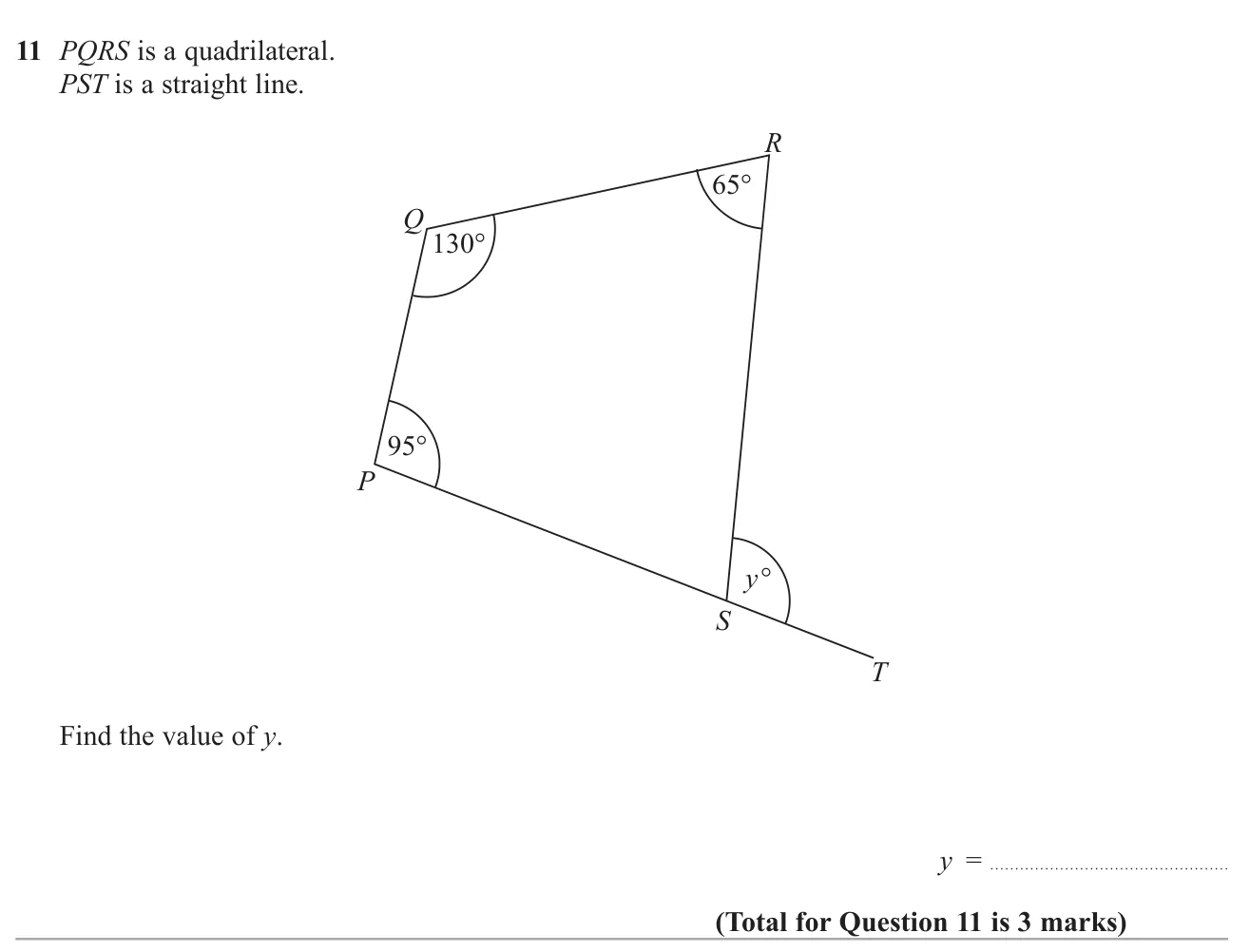
© Pearson Education Ltd. November 2020 Paper 3 (Foundation, calculator), question 11.
Show answer
Worked solution Checked against the mark scheme
Angles in a quadrilateral add to 360°:
360−130−95−65=70°
Angles on a straight line add to 180°:
y=180−70=110
Watch out: Stopping at 70, the interior angle.
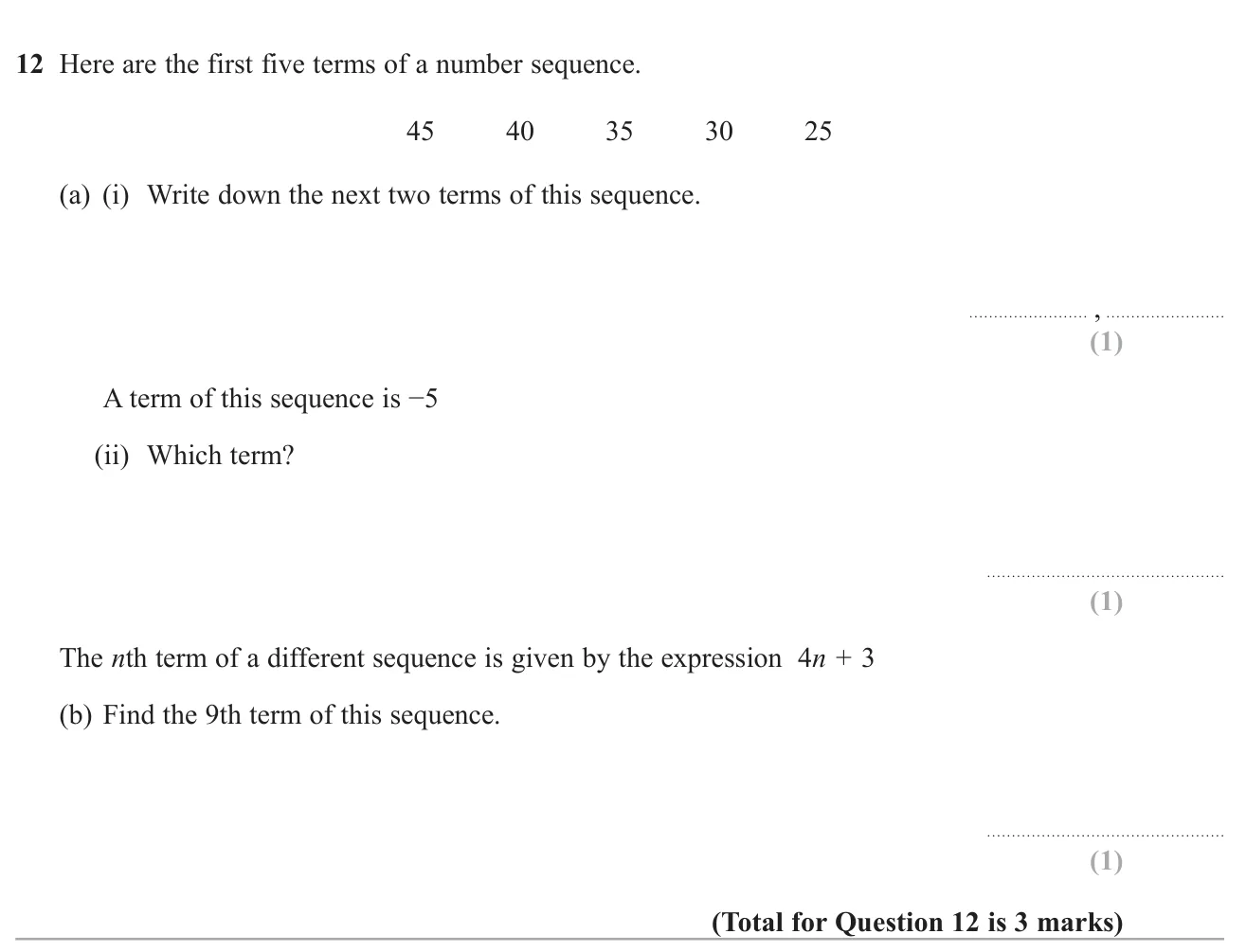
© Pearson Education Ltd. November 2020 Paper 3 (Foundation, calculator), question 12.
Show answer
| (a(i)) | 20, 15 | 1 mark |
|---|
| (a(ii)) | 11th term | 1 mark |
|---|
| (b) | 39 | 1 mark |
|---|
Worked solution Checked against the mark scheme
(a)(i) Subtract 5 each time: 20, 15
(ii) Keep going: 10, 5, 0, −5 are terms 8 to 11, so −5 is the 11th term.
(b) 4×9+3=39
Watch out: In (b), writing 49 by treating 4n as 4 followed by 9.
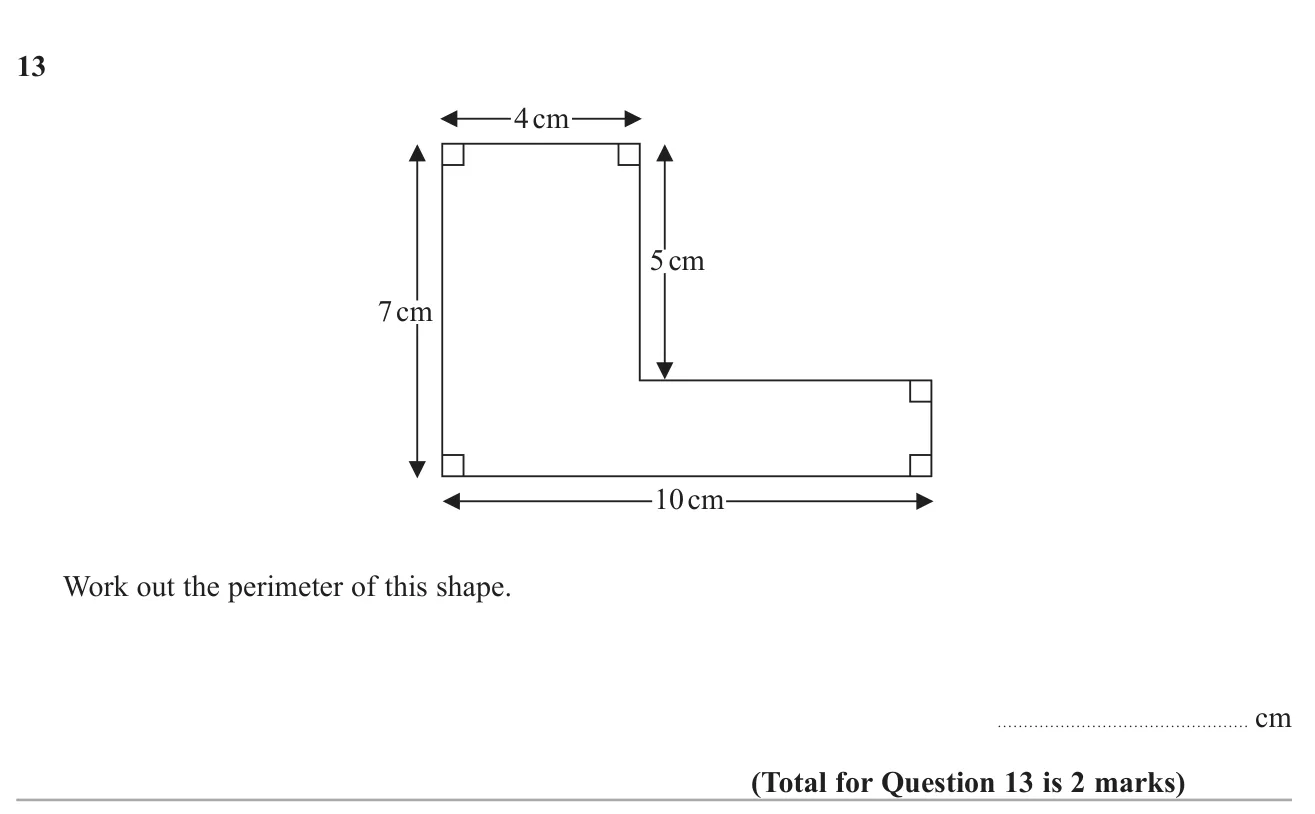
© Pearson Education Ltd. November 2020 Paper 3 (Foundation, calculator), question 13.
Show answer
Worked solution Checked against the mark scheme
Missing sides: 10−4=6 cm and 7−5=2 cm.
Perimeter: 4+5+6+2+10+7=34 cm
Watch out: Adding only the four labelled sides to get 26.
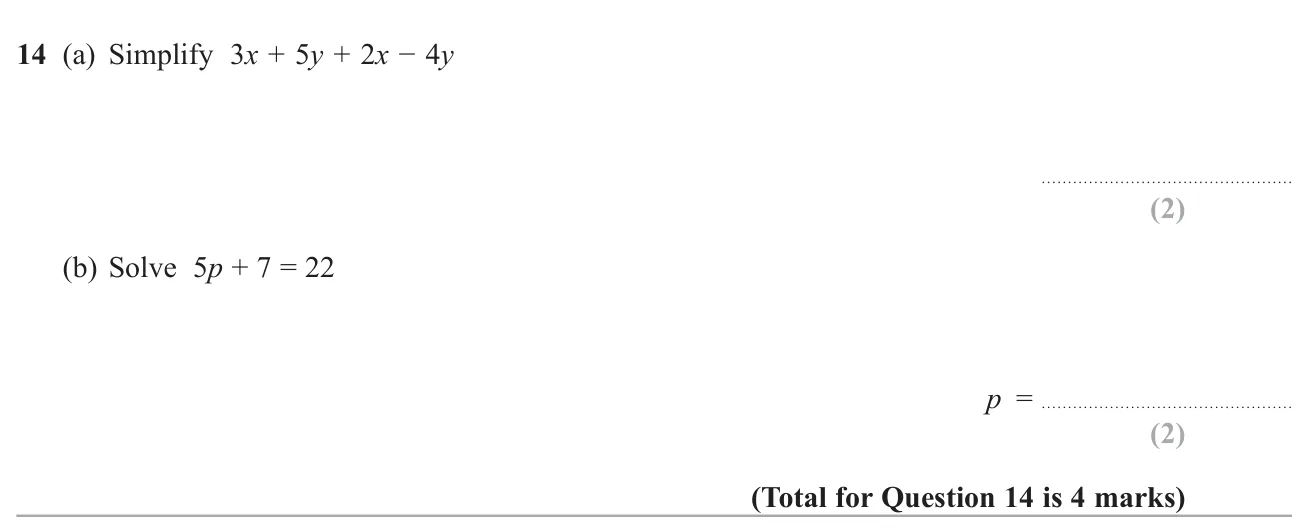
© Pearson Education Ltd. November 2020 Paper 3 (Foundation, calculator), question 14.
Show answer
| (a) | 5x+y | 2 marks |
|---|
| (b) | p=3 | 2 marks |
|---|
Worked solution Checked against the mark scheme
(a) 3x+2x=5x and 5y−4y=y, giving 5x+y
(b) 5p=22−7=15, so p=15÷5=3
Watch out: In (b), adding 7 to 22 instead of subtracting.
Question 15
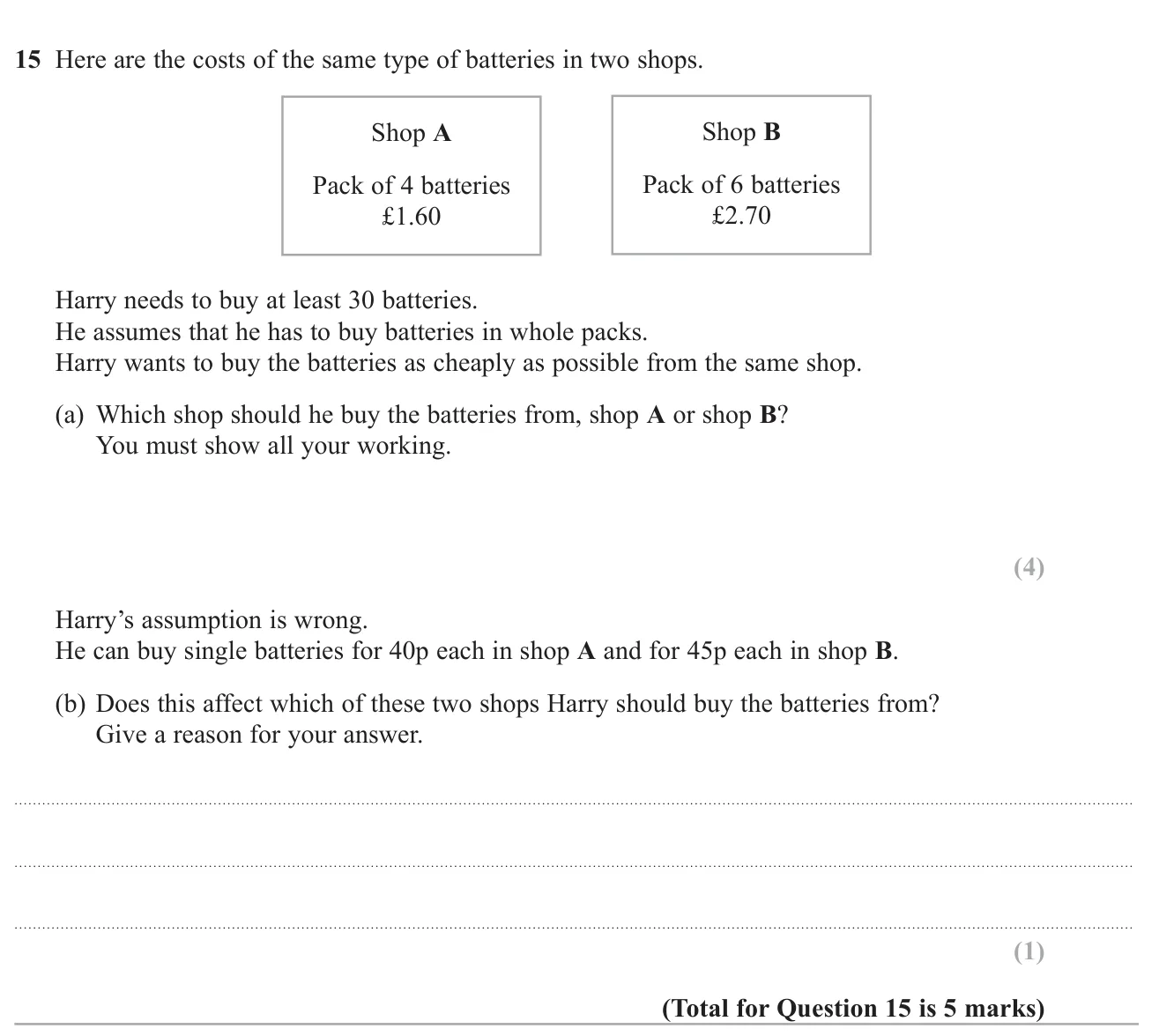
Ratio5 marksGrade 3Calculator © Pearson Education Ltd. November 2020 Paper 3 (Foundation, calculator), question 15.
Show answer
| (a) | Shop A (£12.80 compared with £13.50) | 4 marks |
|---|
| (b) | No: shop A is still cheaper (e.g. 7 packs and 2 singles cost £12, shop B still £13.50) | 1 mark |
|---|
Worked solution Checked against the mark scheme
(a) Shop A: 30÷4=7.5, so 8 packs: 8×£1.60=£12.80
Shop B: 30÷6=5 packs: 5×£2.70=£13.50
Shop A is cheaper.
(b) Shop A: 7 packs + 2 singles =£11.20+£0.80=£12. Shop B is still £13.50, so no change: shop A.
Watch out: Using 7.5 packs instead of rounding up to 8.
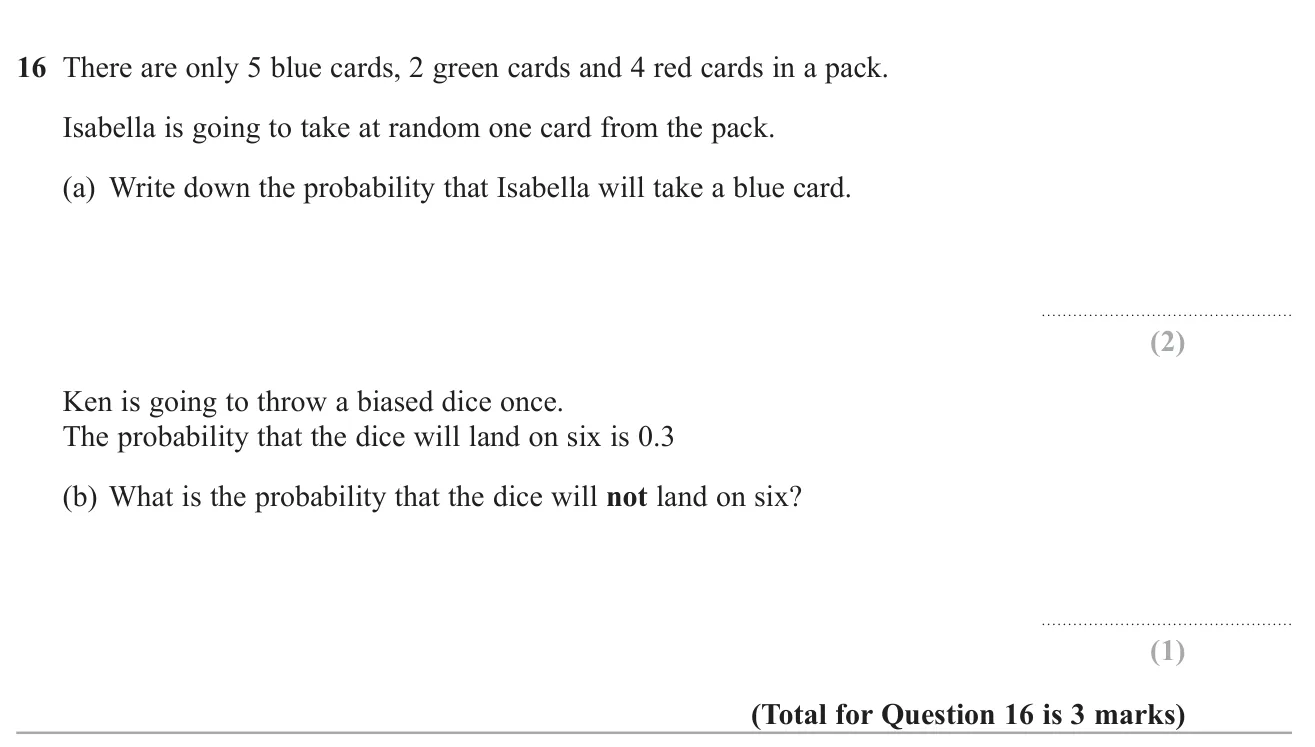
© Pearson Education Ltd. November 2020 Paper 3 (Foundation, calculator), question 16.
Show answer
| (a) | 115 | 2 marks |
|---|
| (b) | 0.7 | 1 mark |
|---|
Worked solution Checked against the mark scheme
(a) Total cards: 5+2+4=11, so P(blue)=115
(b) 1−0.3=0.7
Watch out: Writing the answer as a ratio 5:11 or using 5/6.
© Pearson Education Ltd. November 2020 Paper 3 (Foundation, calculator), question 17.
Show answer
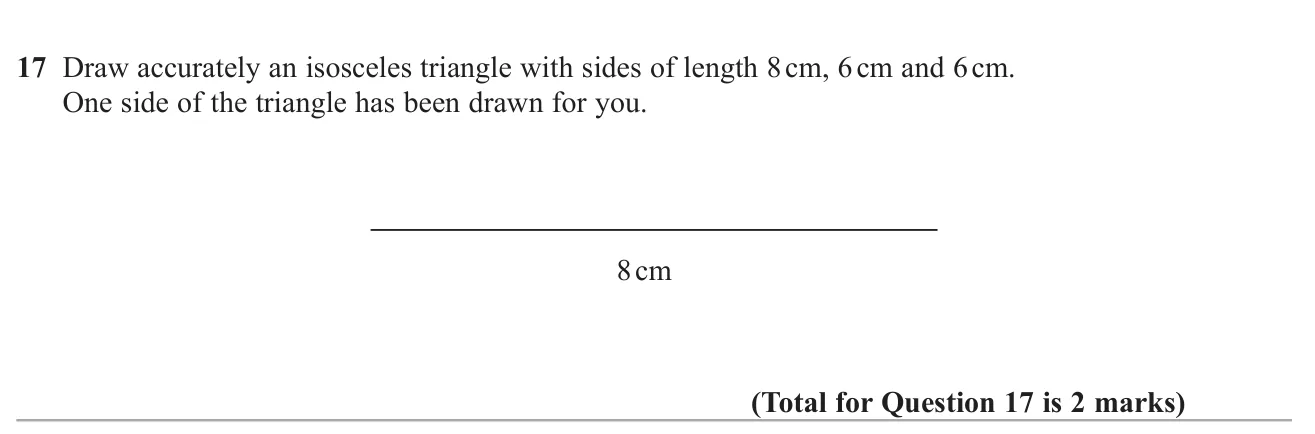
| Answer | Accurate triangle with sides 8 cm, 6 cm, 6 cm | 2 marks |
|---|
Worked solution Checked against the mark scheme
Set compasses to 6 cm. Draw an arc from each end of the 8 cm line.
Join both ends to the point where the arcs cross.
Watch out: Drawing the equal sides by eye with a ruler so they are not exactly 6 cm.
© Pearson Education Ltd. November 2020 Paper 3 (Foundation, calculator), question 18.
Show answer
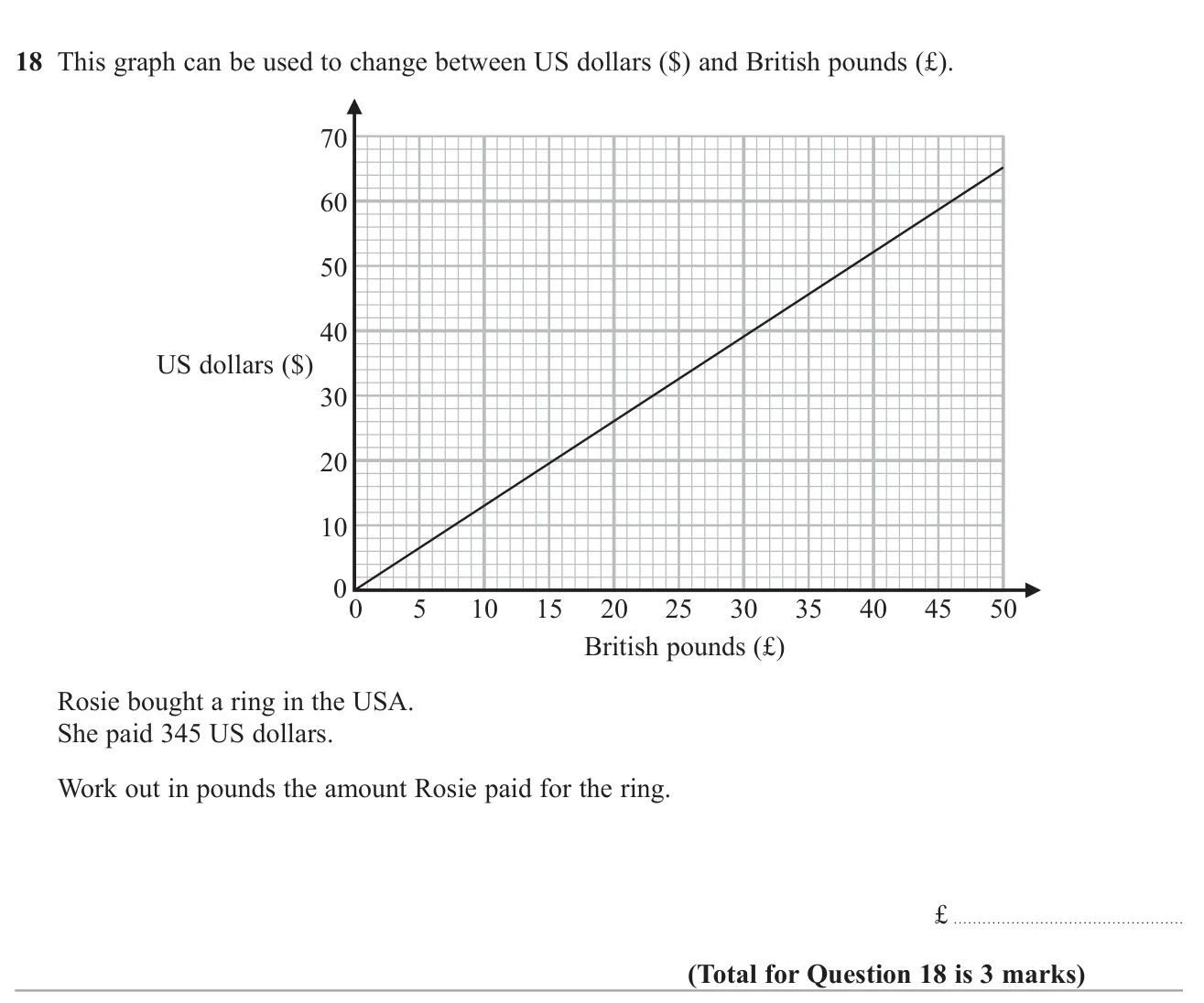
| Answer | About £265 (accept 258 to 275) | 3 marks |
|---|
Worked solution Checked against the mark scheme
The graph shows £50 = 65 dollars.
345÷65=5.307...
5.307...×50≈£265
Watch out: Reading the graph the wrong way round, converting pounds to dollars.
© Pearson Education Ltd. November 2020 Paper 3 (Foundation, calculator), question 19.
Show answer
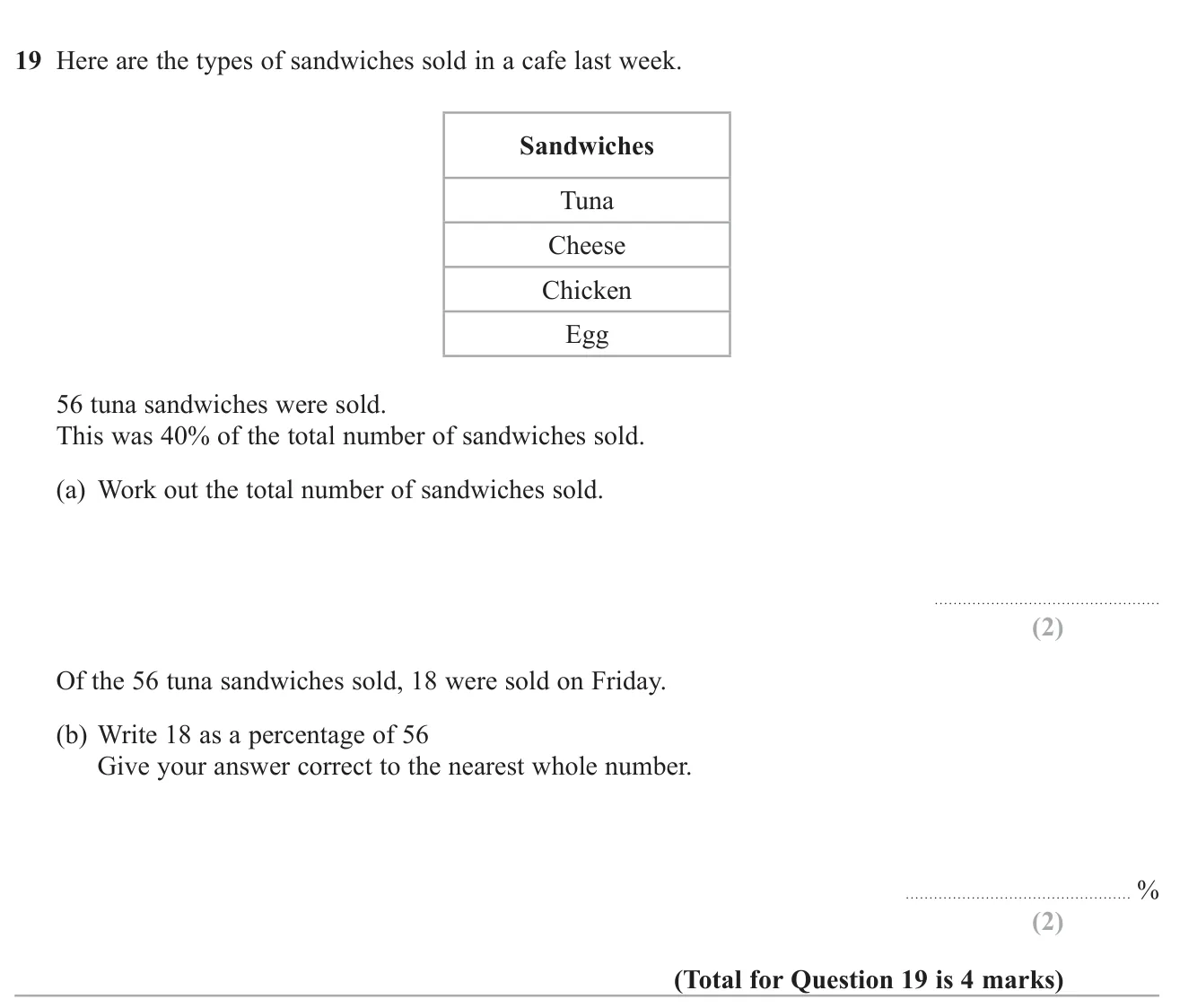
| (a) | 140 | 2 marks |
|---|
| (b) | 32% | 2 marks |
|---|
Worked solution Checked against the mark scheme
(a) 40%=56, so 1%=1.4 and 100%=140
(b) 5618×100=32.14...≈32%
Watch out: In (a), working out 40% of 56.
© Pearson Education Ltd. November 2020 Paper 3 (Foundation, calculator), question 20.
Show answer
Worked solution Checked against the mark scheme
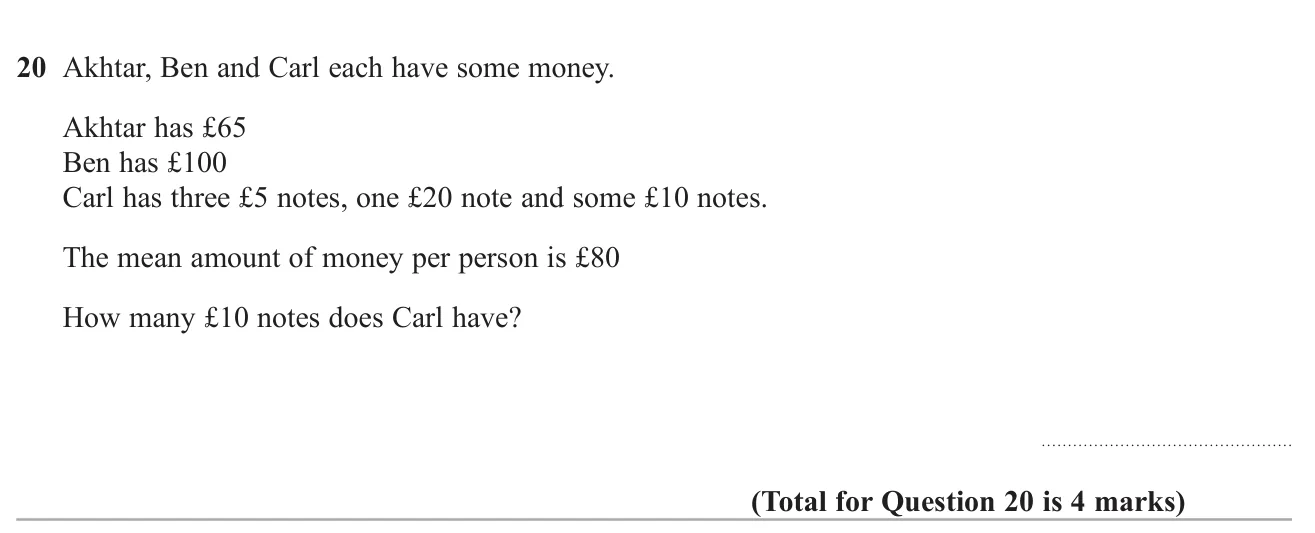
Total for all three: 3×80=£240
Carl has 240−65−100=£75
Known notes: 3×5+20=£35
75−35=£40, so 40÷10=4 notes
Watch out: Doing 80 − 35 = 45 using the mean as Carl's amount.
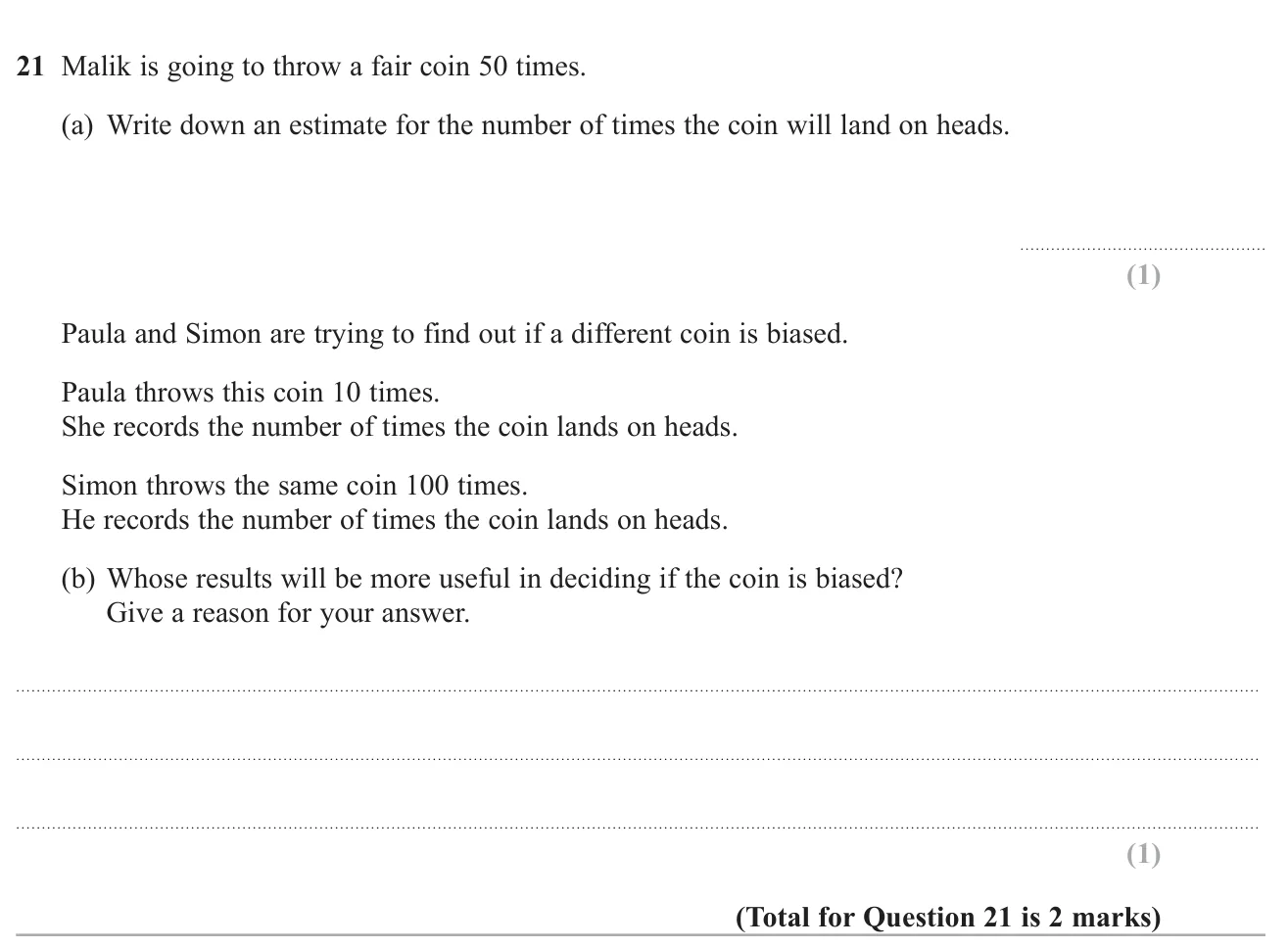
© Pearson Education Ltd. November 2020 Paper 3 (Foundation, calculator), question 21.
Show answer
| (a) | 25 | 1 mark |
|---|
| (b) | Simon, because he made more throws | 1 mark |
|---|
Worked solution Checked against the mark scheme
(a) P(heads)=21, so 21×50=25
(b) Simon: more trials give a more reliable estimate of the probability.
Watch out: In (b), just stating the number 100 without explaining why more throws helps.
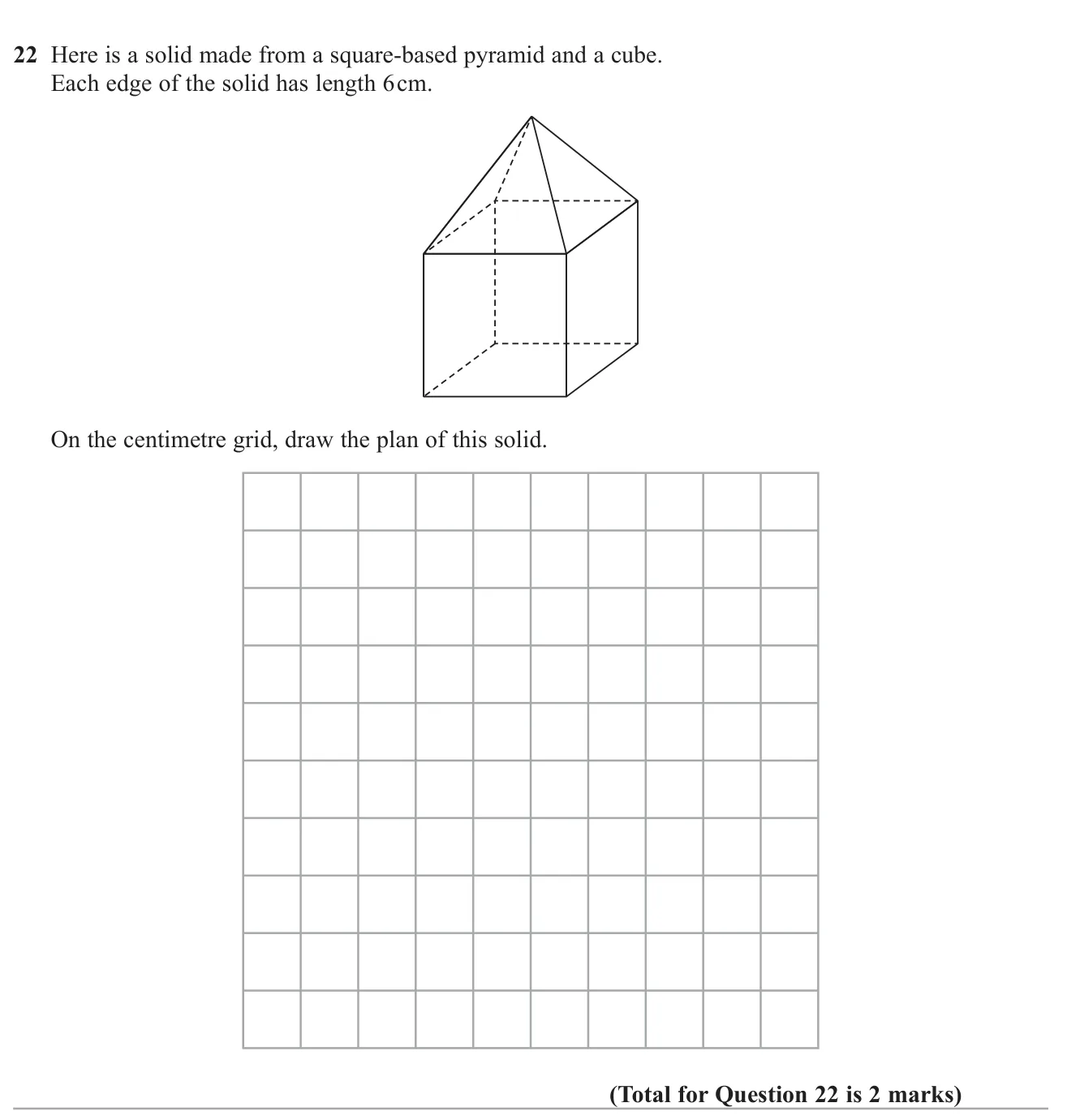
© Pearson Education Ltd. November 2020 Paper 3 (Foundation, calculator), question 22.
Show answer
| Answer | A 6 cm square with both diagonals drawn | 2 marks |
|---|
Worked solution Checked against the mark scheme
From above you see the square top of the cube, 6 cm by 6 cm.
The pyramid's sloping edges meet at the centre, so draw both diagonals of the square.
Watch out: Drawing a front elevation (a triangle on a square).
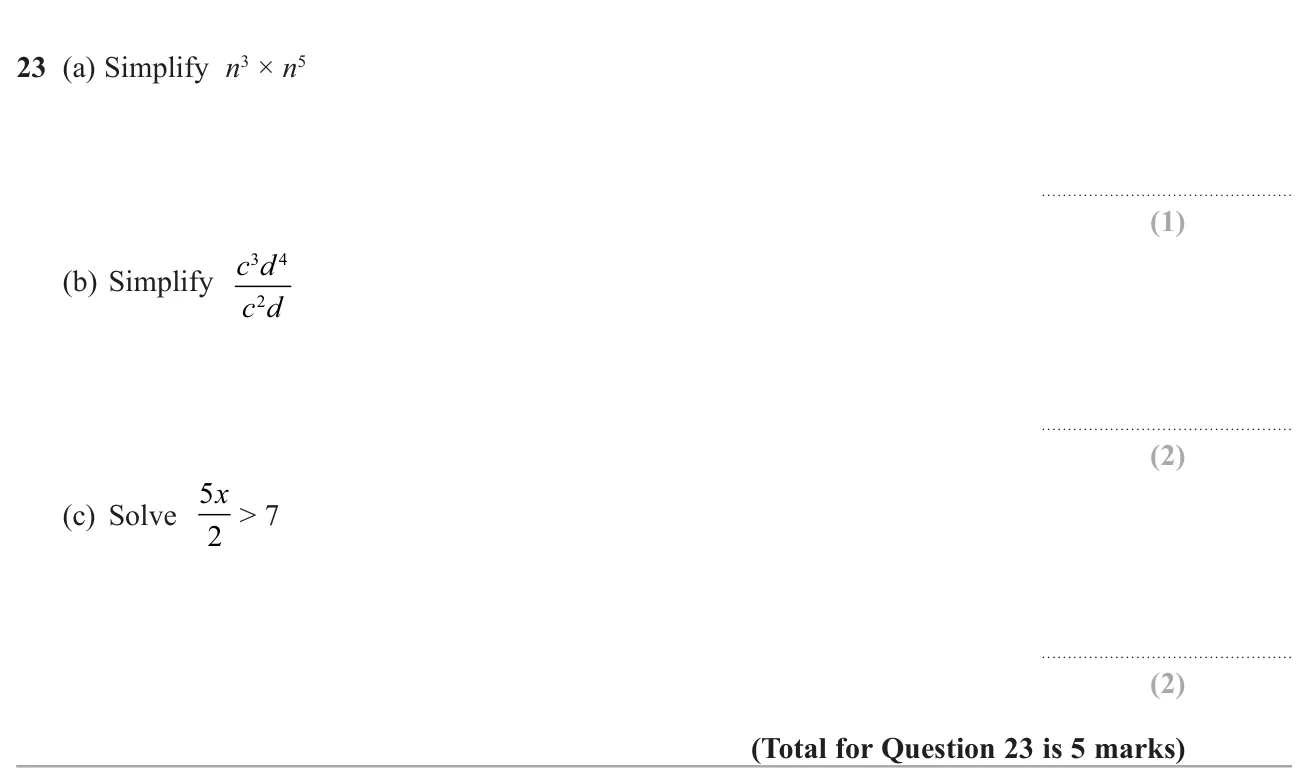
© Pearson Education Ltd. November 2020 Paper 3 (Foundation, calculator), question 23.
Show answer
| (a) | n8 | 1 mark |
|---|
| (b) | cd3 | 2 marks |
|---|
| (c) | x>514 | 2 marks |
|---|
Worked solution Checked against the mark scheme
(a) Add the powers: n3+5=n8
(b) Subtract the powers: c3−2d4−1=cd3
(c) 5x>14, so x>514=2.8
Watch out: In (a), multiplying powers to get n15.
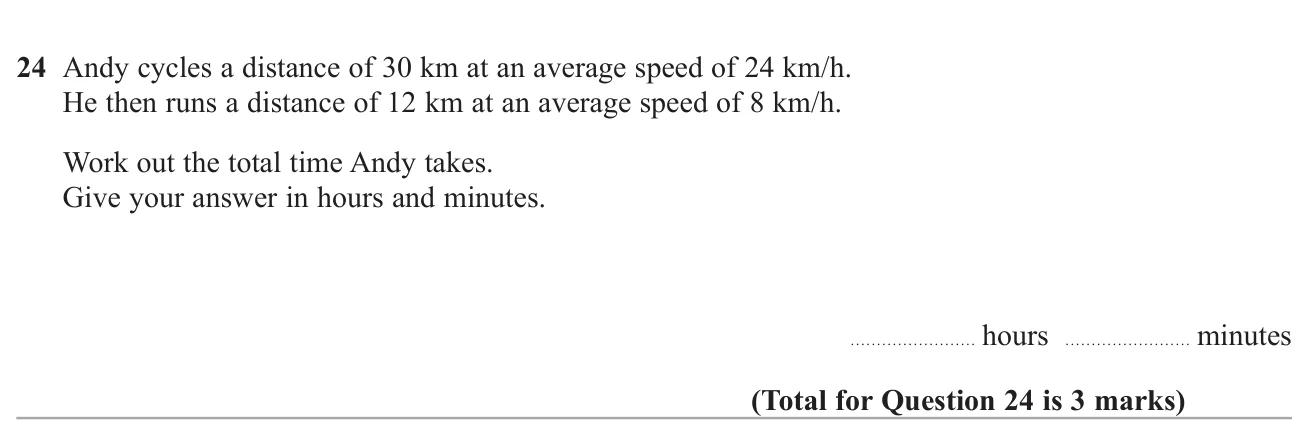
© Pearson Education Ltd. November 2020 Paper 3 (Foundation, calculator), question 24.
Show answer
| Answer | 2 hours 45 minutes | 3 marks |
|---|
Worked solution Checked against the mark scheme
Cycling: 30÷24=1.25 h
Running: 12÷8=1.5 h
Total: 2.75 h =2 hours 45 minutes
Watch out: Writing 2.75 hours as 2 hours 75 minutes.
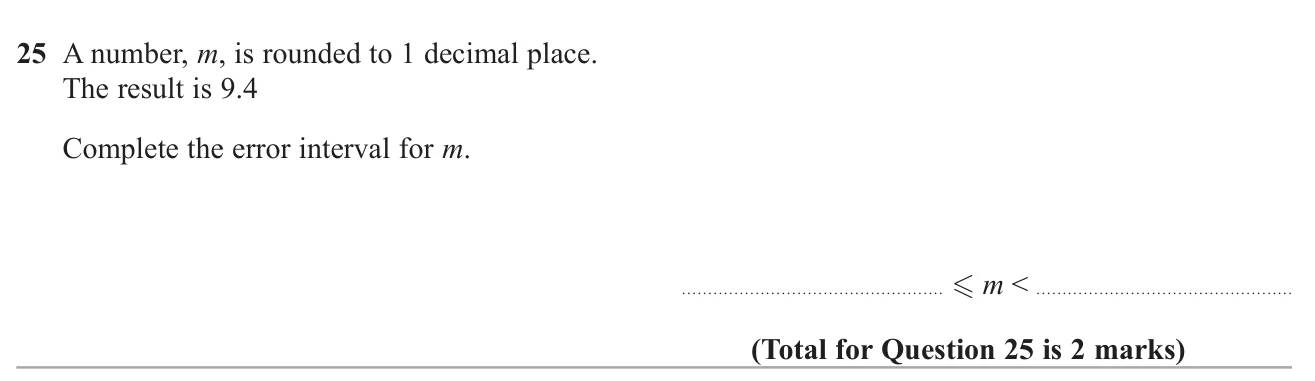
© Pearson Education Ltd. November 2020 Paper 3 (Foundation, calculator), question 25.
Show answer
| Answer | 9.35≤m<9.45 | 2 marks |
|---|
Worked solution Checked against the mark scheme
Half of 0.1 is 0.05.
Lower bound 9.4−0.05=9.35, upper bound 9.4+0.05=9.45
9.35≤m<9.45
Watch out: Using 9.3 and 9.5 as the limits.
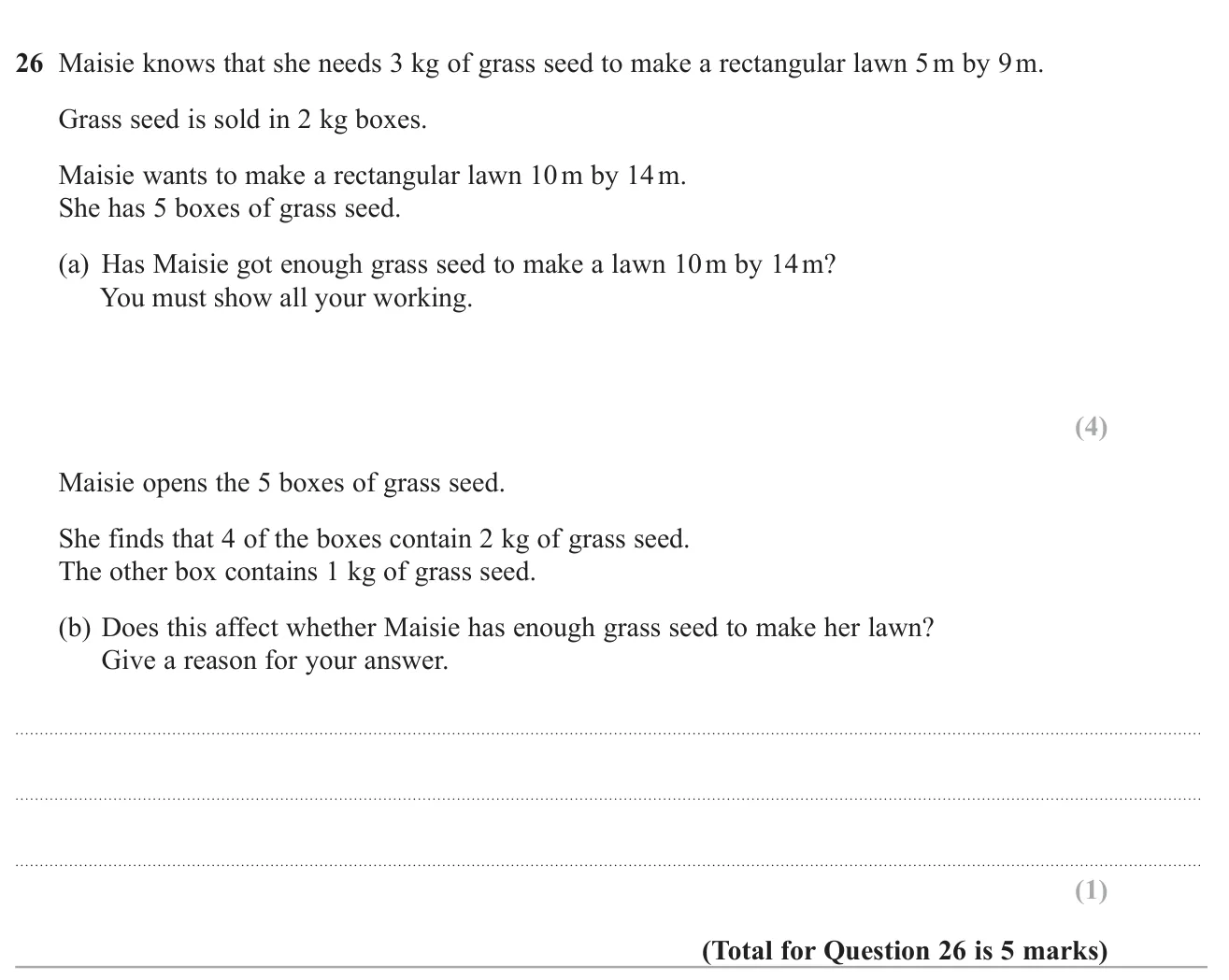
© Pearson Education Ltd. November 2020 Paper 3 (Foundation, calculator), question 26.
Show answer
| (a) | Yes: she needs about 9.3 kg and has 10 kg | 4 marks |
|---|
| (b) | Yes, it now matters: she has 9 kg but needs about 9.3 kg | 1 mark |
|---|
Worked solution Checked against the mark scheme
(a) 3 kg covers 5×9=45 m², so 1 kg covers 15 m².
New lawn: 10×14=140 m² needs 140÷15=9.33 kg.
She has 5×2=10 kg, so yes.
(b) Now she has 4×2+1=9 kg, less than 9.33 kg, so she does not have enough.
Watch out: Doubling the seed because the lengths roughly double, ignoring that area scales differently.
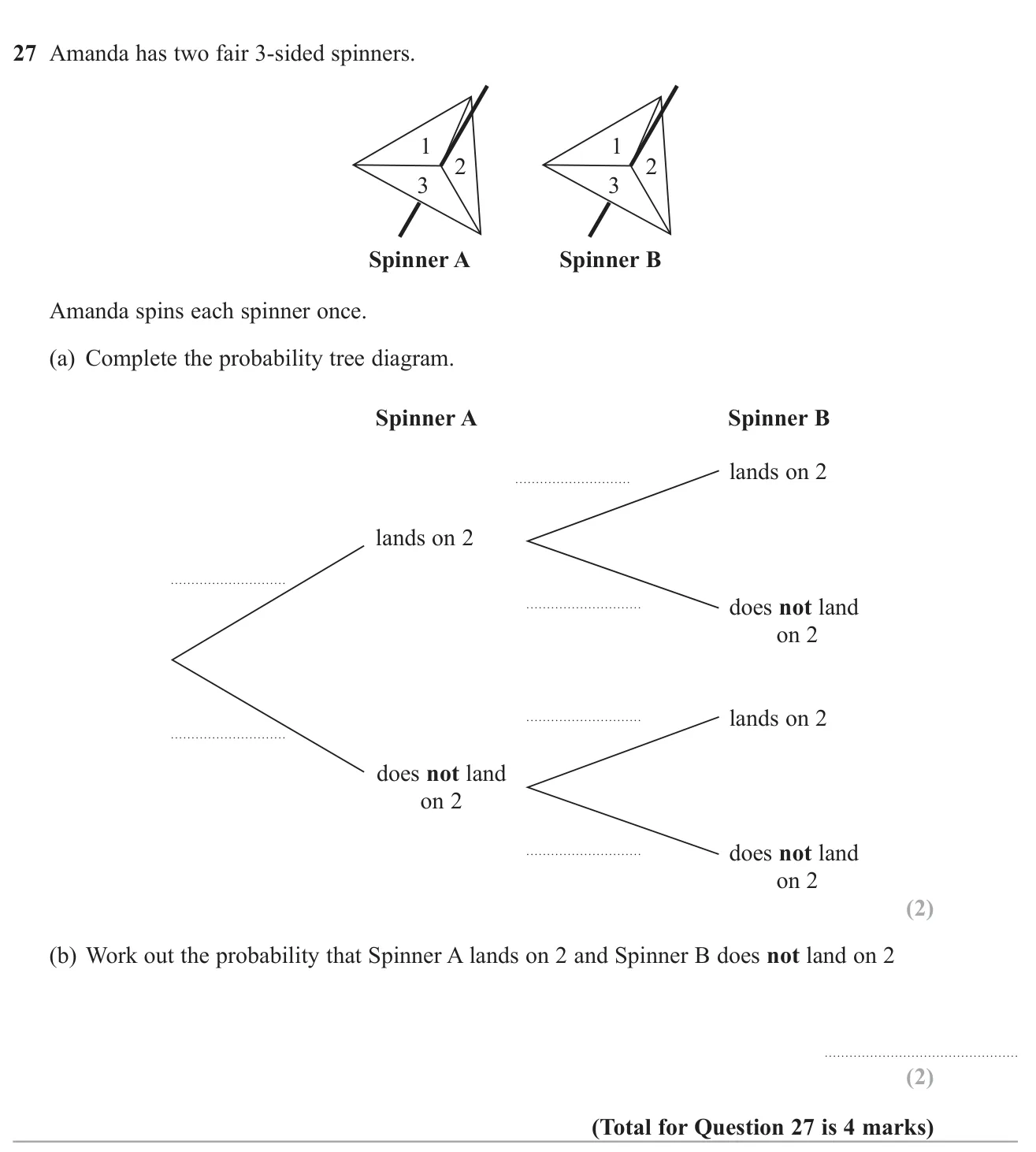
© Pearson Education Ltd. November 2020 Paper 3 (Foundation, calculator), question 27.
Show answer
| (a) | 31 for each 'lands on 2' branch and 32 for each 'does not land on 2' branch | 2 marks |
|---|
| (b) | 92 | 2 marks |
|---|
Worked solution Checked against the mark scheme
(a) Each spinner has 3 equal sections, one of which is 2: P(2)=31, P(not 2)=32
(b) 31×32=92
Watch out: In (b), adding the probabilities instead of multiplying.
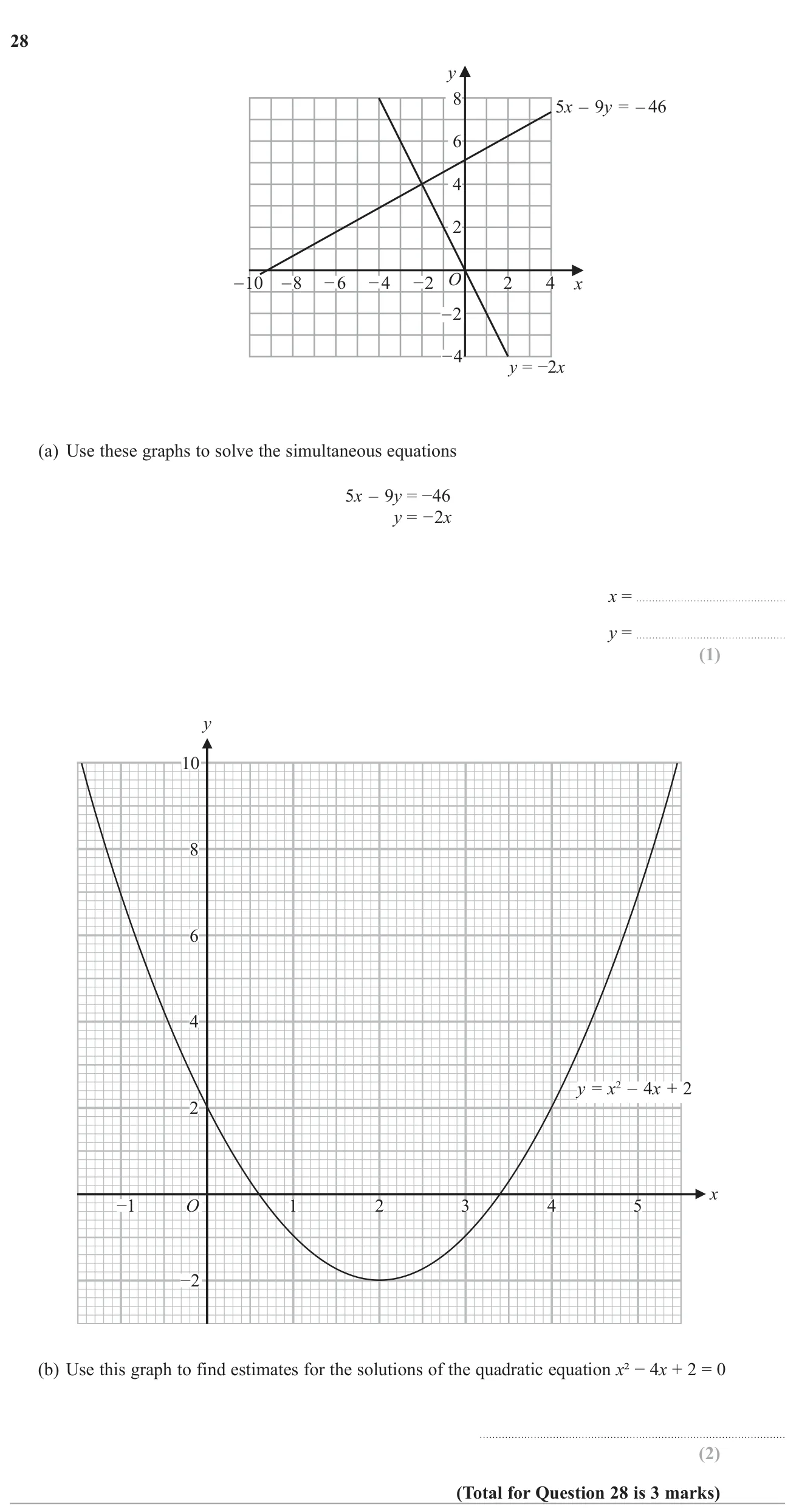
© Pearson Education Ltd. November 2020 Paper 3 (Foundation, calculator), question 28.
Show answer
| (a) | x=−2, y=4 | 1 mark |
|---|
| (b) | x≈0.6 and x≈3.4 (accept 0.55 to 0.65 and 3.35 to 3.45) | 2 marks |
|---|
Worked solution Checked against the mark scheme
(a) The lines cross at (−2,4), so x=−2, y=4.
Check: 5(−2)−9(4)=−46 ✓
(b) Read where the curve meets the x-axis: x≈0.6 and x≈3.4
Watch out: In (b), reading where the curve crosses the y-axis (2).
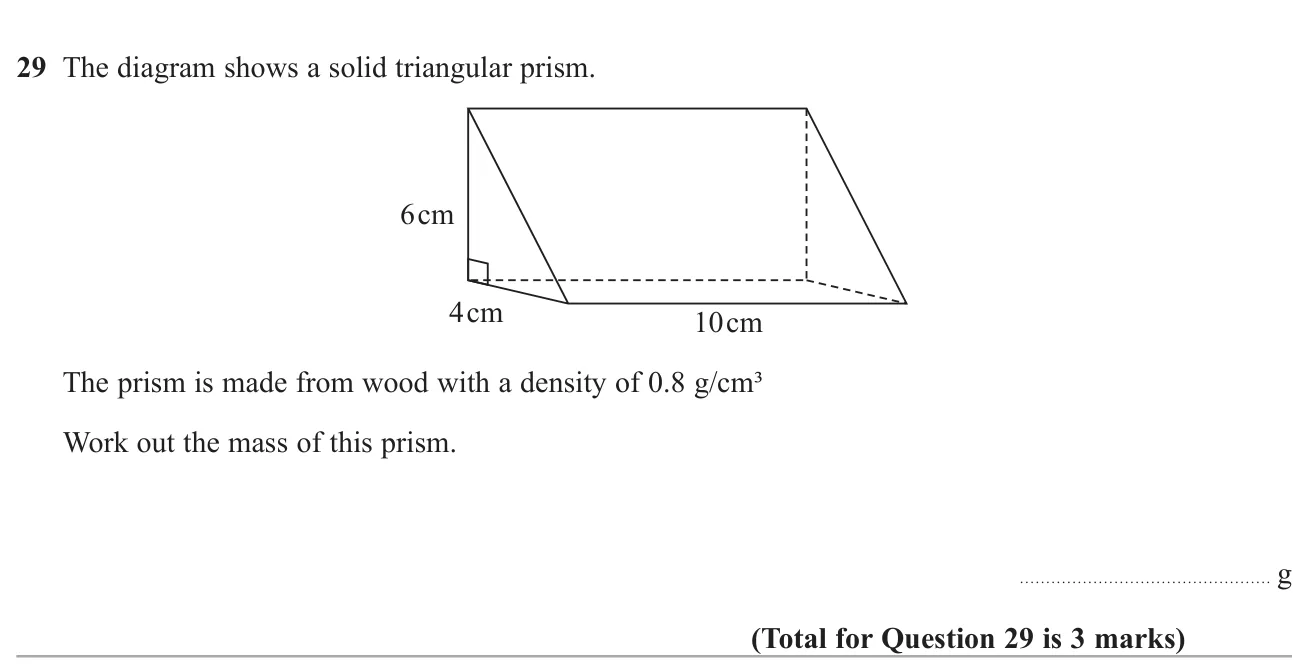
© Pearson Education Ltd. November 2020 Paper 3 (Foundation, calculator), question 29.
Show answer
Worked solution Checked against the mark scheme
Triangle area: 21×4×6=12 cm²
Volume: 12×10=120 cm³
Mass: 120×0.8=96 g
Watch out: Forgetting to halve for the triangle, giving 192 g.
Finished the paper?
Add up your marks for all three papers and see what grade that would have been.