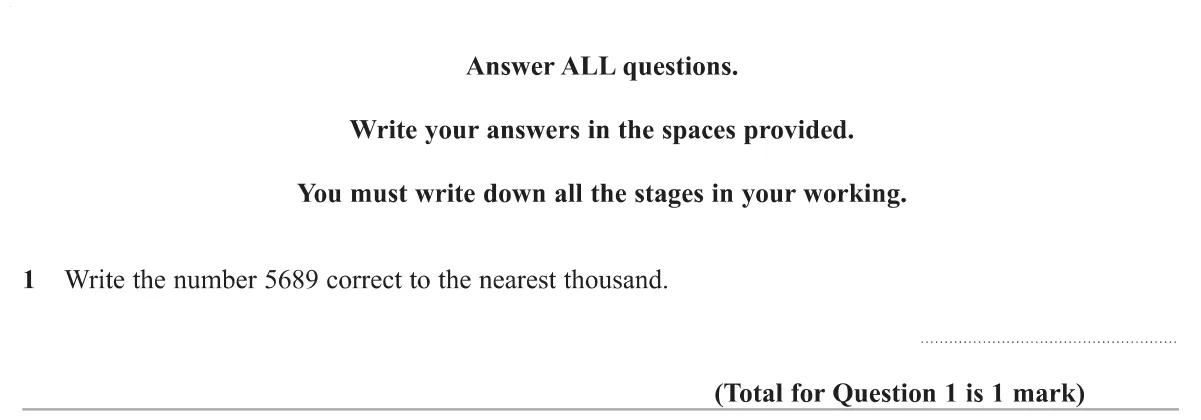
© Pearson Education Ltd. Specimen Paper 3 (Foundation, calculator), question 1.
Worked solution Checked against the mark scheme
The thousands either side are 5000 and 6000.
5689 is past the halfway point of 5500, so it rounds up to 6000 .
Watch out: Writing 5700 (rounding to the nearest hundred) or 5000.
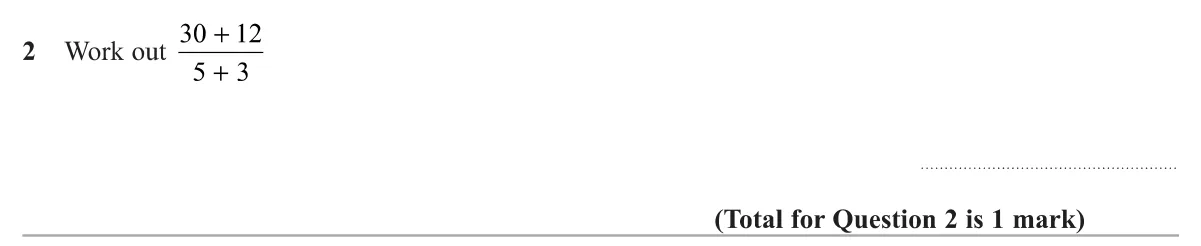
© Pearson Education Ltd. Specimen Paper 3 (Foundation, calculator), question 2.
Worked solution Checked against the mark scheme
Work out the top and bottom first: 30 + 12 = 42 30 + 12 = 42 30 + 12 = 42 5 + 3 = 8 5 + 3 = 8 5 + 3 = 8
42 ÷ 8 = 5.25 42 \div 8 = 5.25 42 ÷ 8 = 5.25
Watch out: Typing 30 + 12 ÷ 5 + 3 into the calculator without brackets.
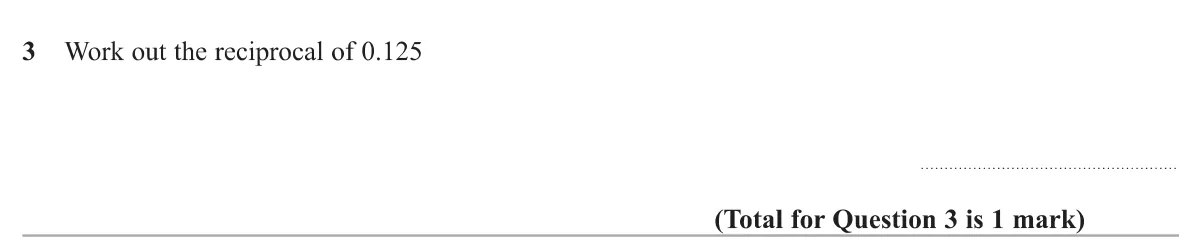
© Pearson Education Ltd. Specimen Paper 3 (Foundation, calculator), question 3.
Worked solution Checked against the mark scheme
The reciprocal of a number is 1 divided by it.
1 ÷ 0.125 = 8 1 \div 0.125 = 8 1 ÷ 0.125 = 8 0.125 = 1 8 0.125 = \frac{1}{8} 0.125 = 8 1
Watch out: Giving 0.125 as a fraction or writing −0.125.
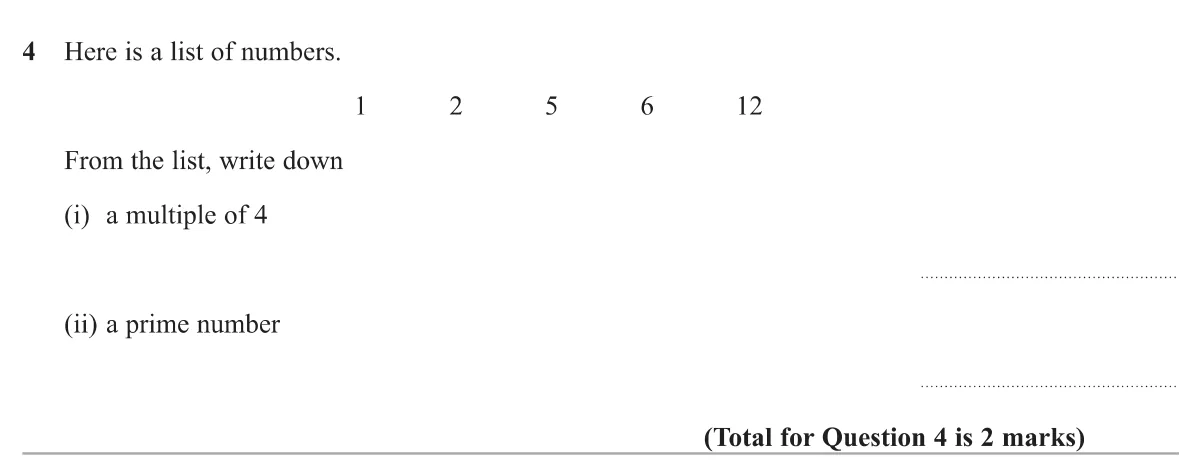
© Pearson Education Ltd. Specimen Paper 3 (Foundation, calculator), question 4.
((i)) 12 1 mark ((ii)) 2 or 5 1 mark
Worked solution Checked against the mark scheme
(i) 12 = 4 × 3 12 = 4 \times 3 12 = 4 × 3
(ii) 2 and 5 each have exactly two factors, so either is prime. (1 is not prime.)
Watch out: Choosing 1 as a prime number.
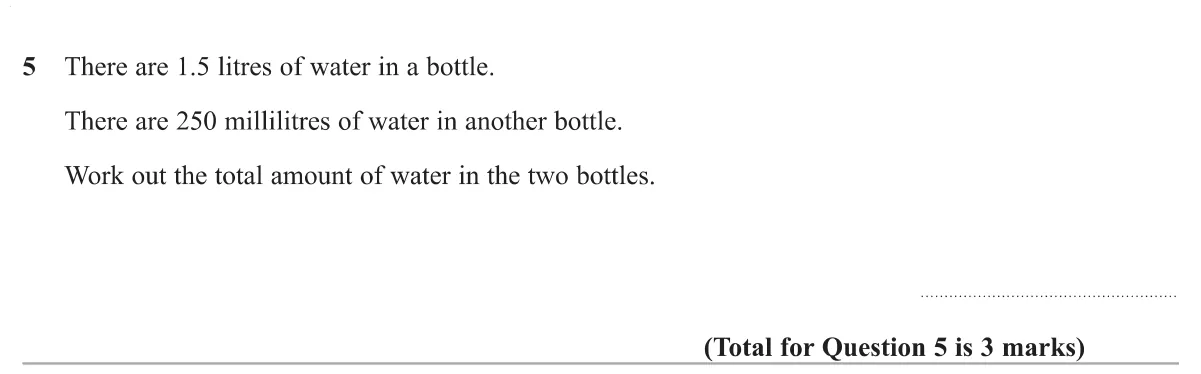
© Pearson Education Ltd. Specimen Paper 3 (Foundation, calculator), question 5.
Answer 1.75 litres or 1750 ml 3 marks
Worked solution Checked against the mark scheme
1 litre = 1000 ml, so 1.5 litres = 1500 ml.
1500 + 250 = 1750 1500 + 250 = 1750 1500 + 250 = 1750 1750 ml (or 1.75 litres).
Watch out: Adding 1.5 + 250 without converting, or leaving out the units.
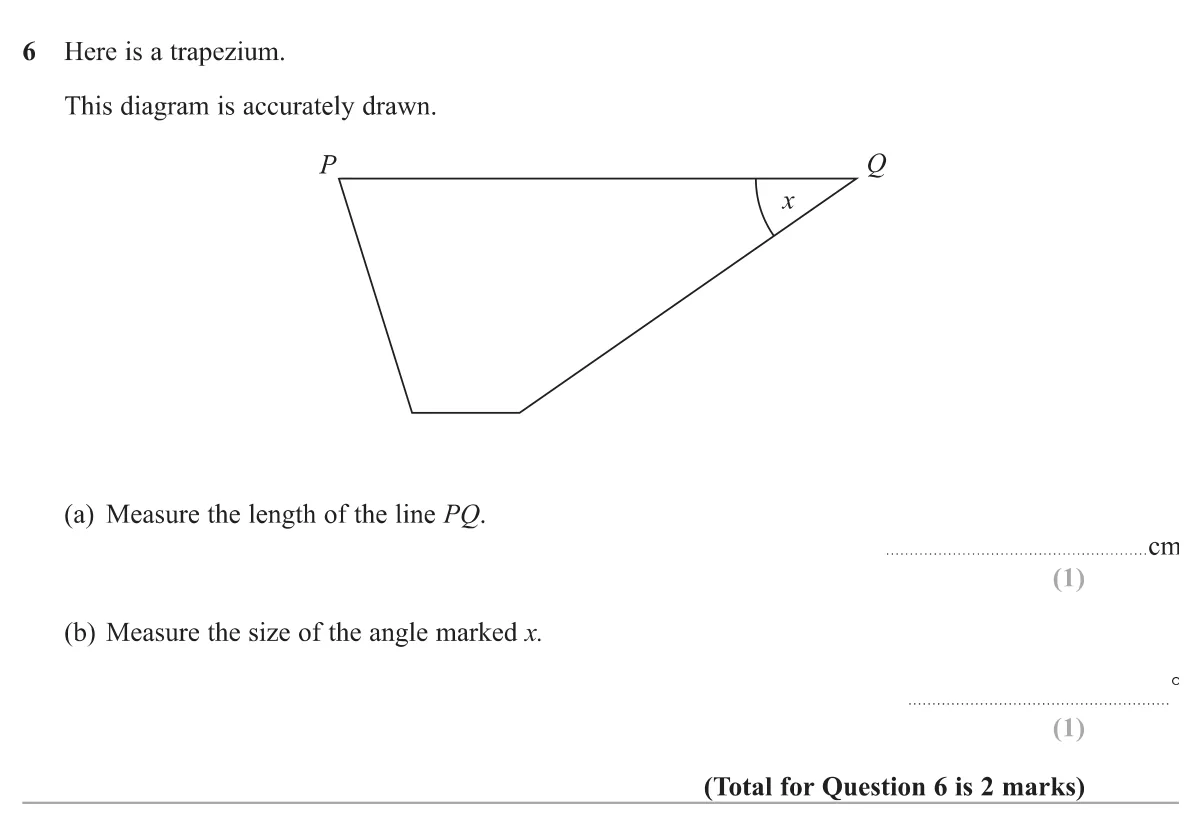
© Pearson Education Ltd. Specimen Paper 3 (Foundation, calculator), question 6.
(a) 8 cm 1 mark (b) 35 ∘ 35^\circ 3 5 ∘ 1 mark
Worked solution Checked against the mark scheme
(a) Put the 0 of the ruler on P and read the mark at Q: about 8 cm .
(b) Place the protractor centre on Q with the base line along QP and count up from 0: about **35 ∘ 35^\circ 3 5 ∘
Watch out: Reading the wrong scale on the protractor and getting 145°.
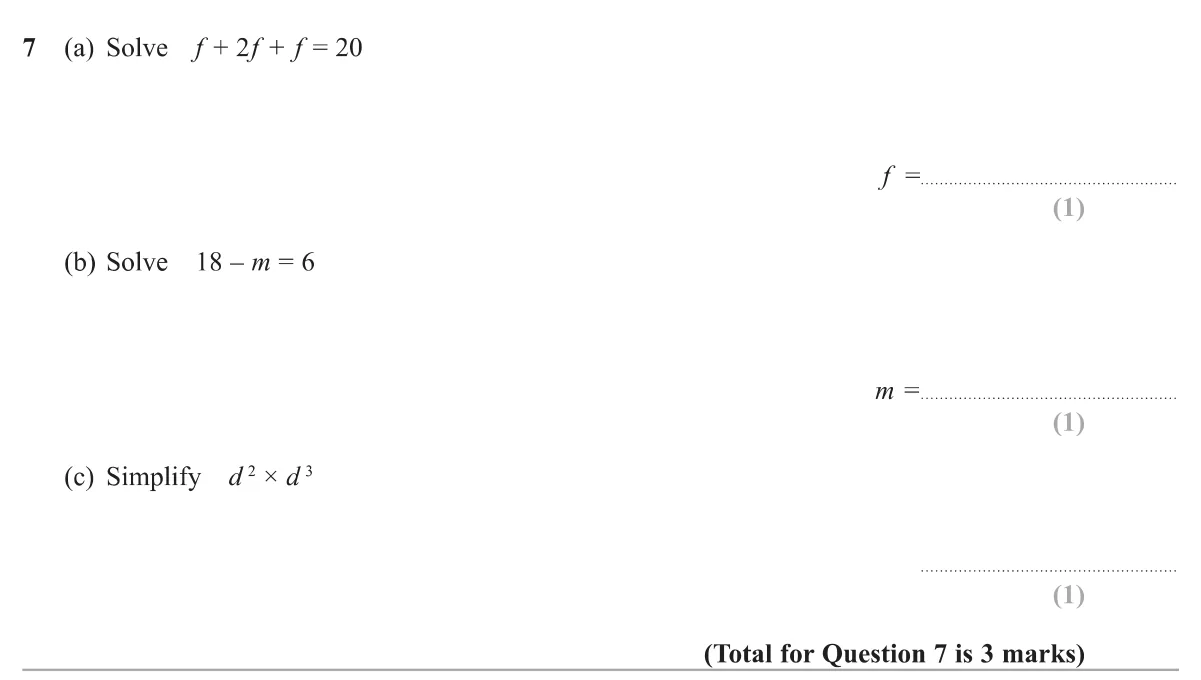
© Pearson Education Ltd. Specimen Paper 3 (Foundation, calculator), question 7.
(a) f = 5 f = 5 f = 5 1 mark (b) m = 12 m = 12 m = 12 1 mark (c) d 5 d^5 d 5 1 mark
Worked solution Checked against the mark scheme
(a) f + 2 f + f = 4 f f + 2f + f = 4f f + 2 f + f = 4 f 4 f = 20 4f = 20 4 f = 20 f = 5 f = 5 f = 5
(b) 18 − m = 6 18 - m = 6 18 − m = 6 m = 18 − 6 = 12 m = 18 - 6 = 12 m = 18 − 6 = 12
(c) Add the powers: d 2 × d 3 = d 2 + 3 = d 5 d^2 \times d^3 = d^{2+3} = d^5 d 2 × d 3 = d 2 + 3 = d 5
Watch out: In (c), multiplying the powers to get d 6 d^6 d 6
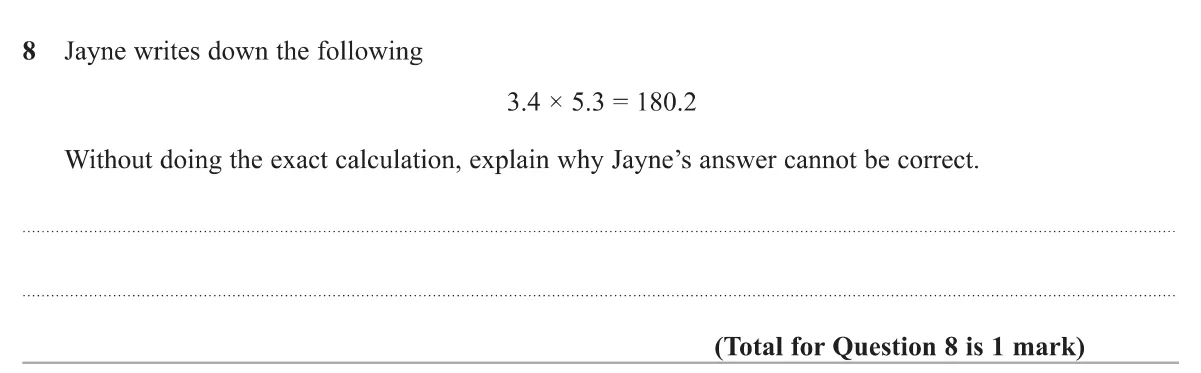
© Pearson Education Ltd. Specimen Paper 3 (Foundation, calculator), question 8.
Answer Estimate 3 × 5 = 15 3 \times 5 = 15 3 × 5 = 15 4 × 6 = 24 4 \times 6 = 24 4 × 6 = 24 1 mark
Worked solution Checked against the mark scheme
Round each number: 3.4 ≈ 3 3.4 \approx 3 3.4 ≈ 3 5.3 ≈ 5 5.3 \approx 5 5.3 ≈ 5
3 × 5 = 15 3 \times 5 = 15 3 × 5 = 15 4 × 6 = 24 4 \times 6 = 24 4 × 6 = 24
Watch out: Just saying 'it is too big' without an estimate to back it up.
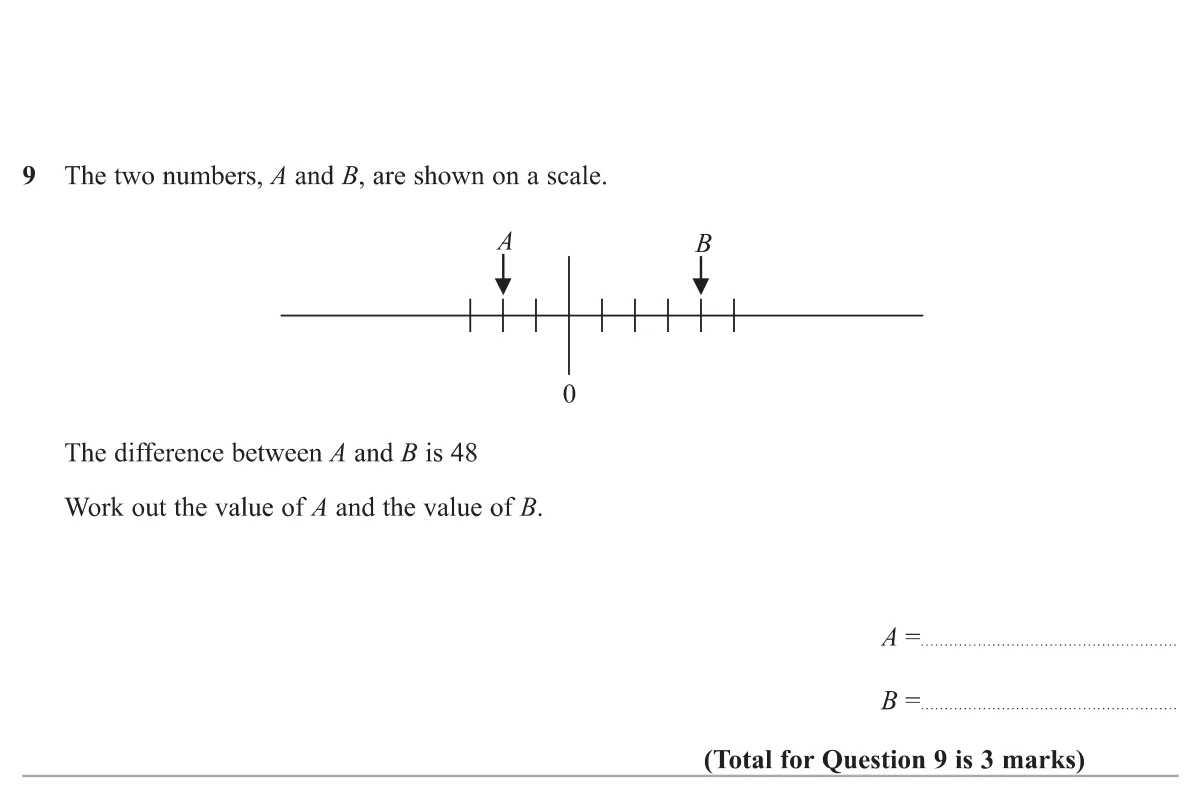
© Pearson Education Ltd. Specimen Paper 3 (Foundation, calculator), question 9.
Answer A = − 16 A = -16 A = − 16 B = 32 B = 32 B = 32 3 marks
Worked solution Checked against the mark scheme
From A to B there are 6 equal gaps, so each gap is 48 ÷ 6 = 8 48 \div 6 = 8 48 ÷ 6 = 8
A is 2 gaps left of 0: A = − 2 × 8 = − 16 A = -2 \times 8 = -16 A = − 2 × 8 = − 16
B is 4 gaps right of 0: B = 4 × 8 = 32 B = 4 \times 8 = 32 B = 4 × 8 = 32
Watch out: Forgetting that A is negative, or counting tick marks instead of gaps.
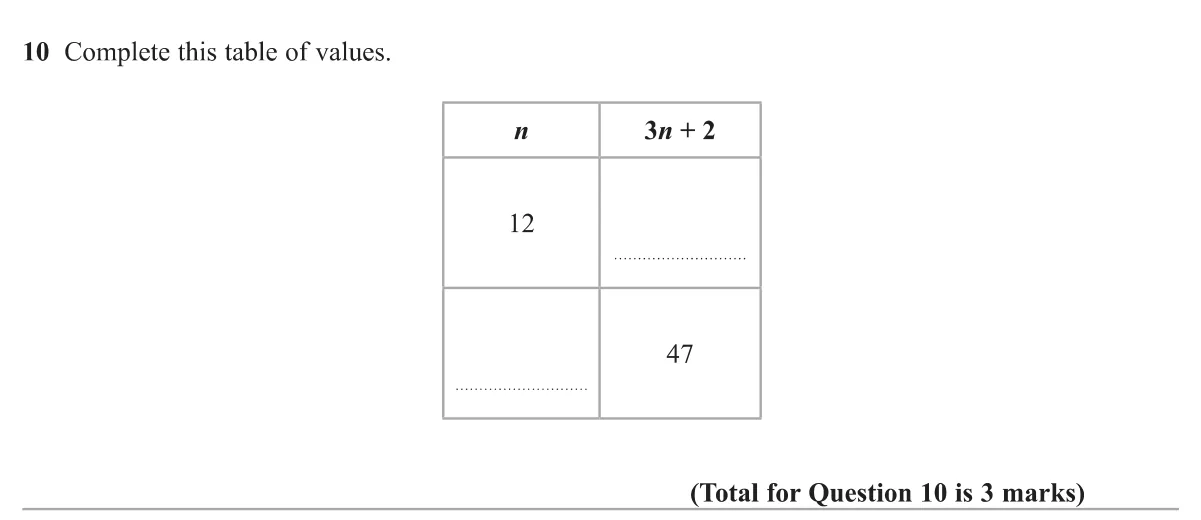
© Pearson Education Ltd. Specimen Paper 3 (Foundation, calculator), question 10.
Answer 38 (when n = 12 n = 12 n = 12 3 n + 2 = 47 3n + 2 = 47 3 n + 2 = 47 3 marks
Worked solution Checked against the mark scheme
Top row: 3 × 12 + 2 = 36 + 2 = 38 3 \times 12 + 2 = 36 + 2 = 38 3 × 12 + 2 = 36 + 2 = 38
Bottom row: 3 n + 2 = 47 3n + 2 = 47 3 n + 2 = 47 3 n = 45 3n = 45 3 n = 45 n = 15 n = 15 n = 15
Watch out: Working out 47 ÷ 3 − 2 instead of undoing the steps in reverse order.
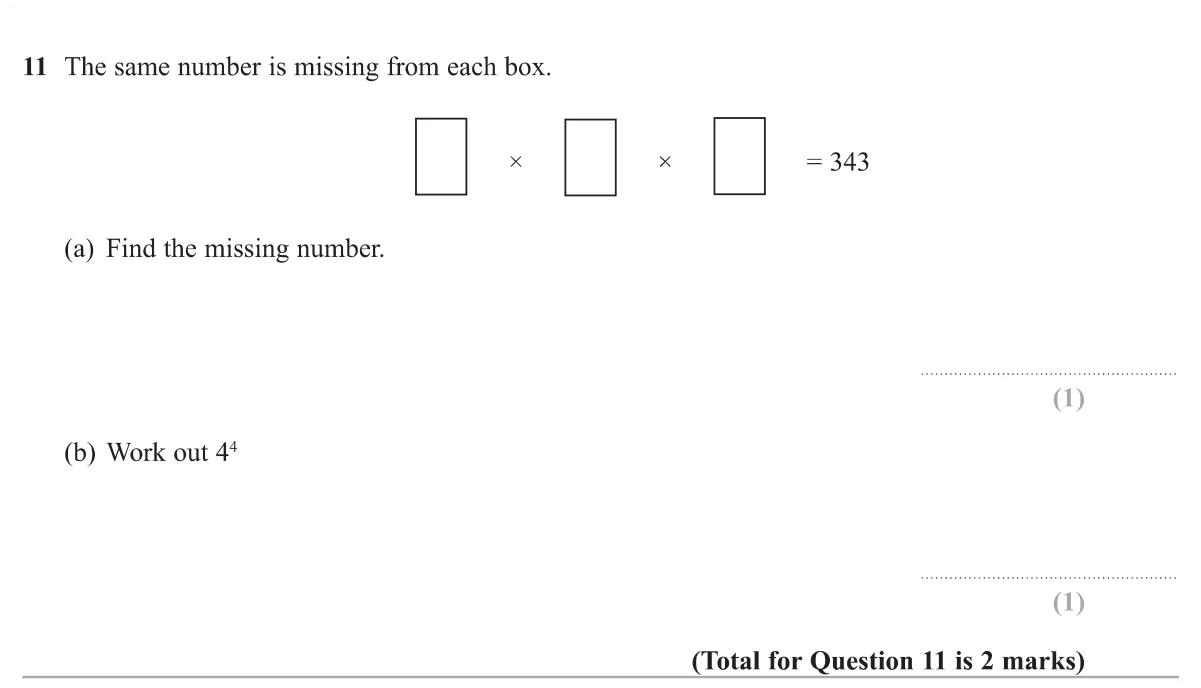
© Pearson Education Ltd. Specimen Paper 3 (Foundation, calculator), question 11.
Worked solution Checked against the mark scheme
(a) We need the cube root of 343: 7 × 7 × 7 = 343 7 \times 7 \times 7 = 343 7 × 7 × 7 = 343 7 .
(b) 4 4 = 4 × 4 × 4 × 4 = 256 4^4 = 4 \times 4 \times 4 \times 4 = 256 4 4 = 4 × 4 × 4 × 4 = 256
Watch out: In (b), working out 4 × 4 = 16 4 \times 4 = 16 4 × 4 = 16
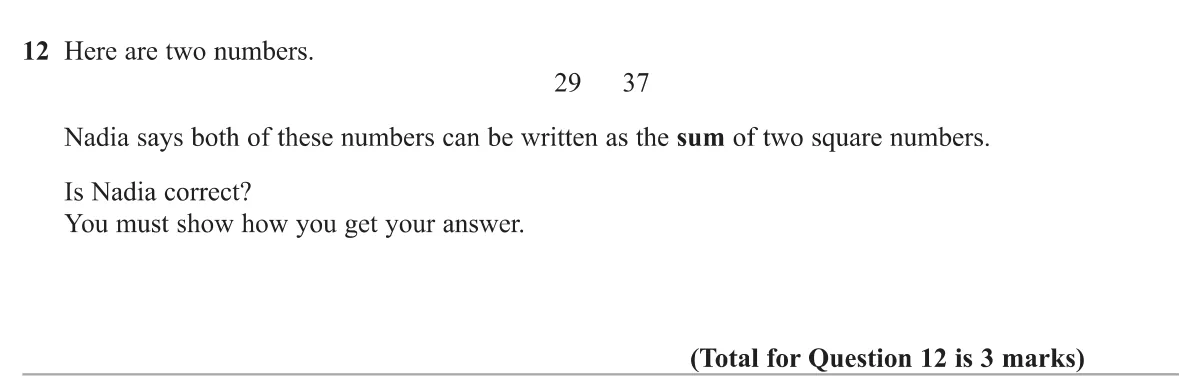
© Pearson Education Ltd. Specimen Paper 3 (Foundation, calculator), question 12.
Answer Yes: 29 = 25 + 4 29 = 25 + 4 29 = 25 + 4 37 = 36 + 1 37 = 36 + 1 37 = 36 + 1 3 marks
Worked solution Checked against the mark scheme
Square numbers: 1, 4, 9, 16, 25, 36.
29 = 25 + 4 = 5 2 + 2 2 29 = 25 + 4 = 5^2 + 2^2 29 = 25 + 4 = 5 2 + 2 2
37 = 36 + 1 = 6 2 + 1 2 37 = 36 + 1 = 6^2 + 1^2 37 = 36 + 1 = 6 2 + 1 2
So yes , Nadia is correct.
Watch out: Using doubles (e.g. 2 × 5 2 \times 5 2 × 5
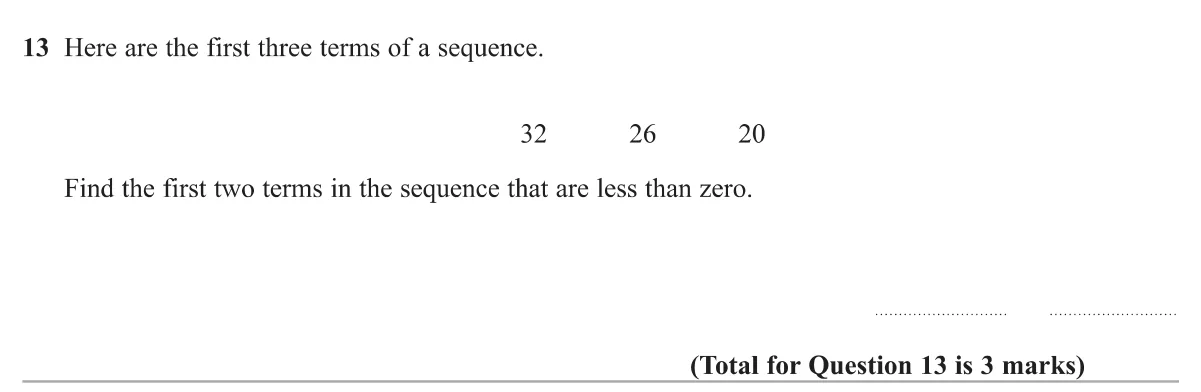
© Pearson Education Ltd. Specimen Paper 3 (Foundation, calculator), question 13.
Worked solution Checked against the mark scheme
The terms go down by 6 each time.
32, 26, 20, 14, 8, 2, −4, −10
The first two terms below zero are −4 and −10 .
Watch out: Stopping at 2 or 0, or getting −2 by miscounting.
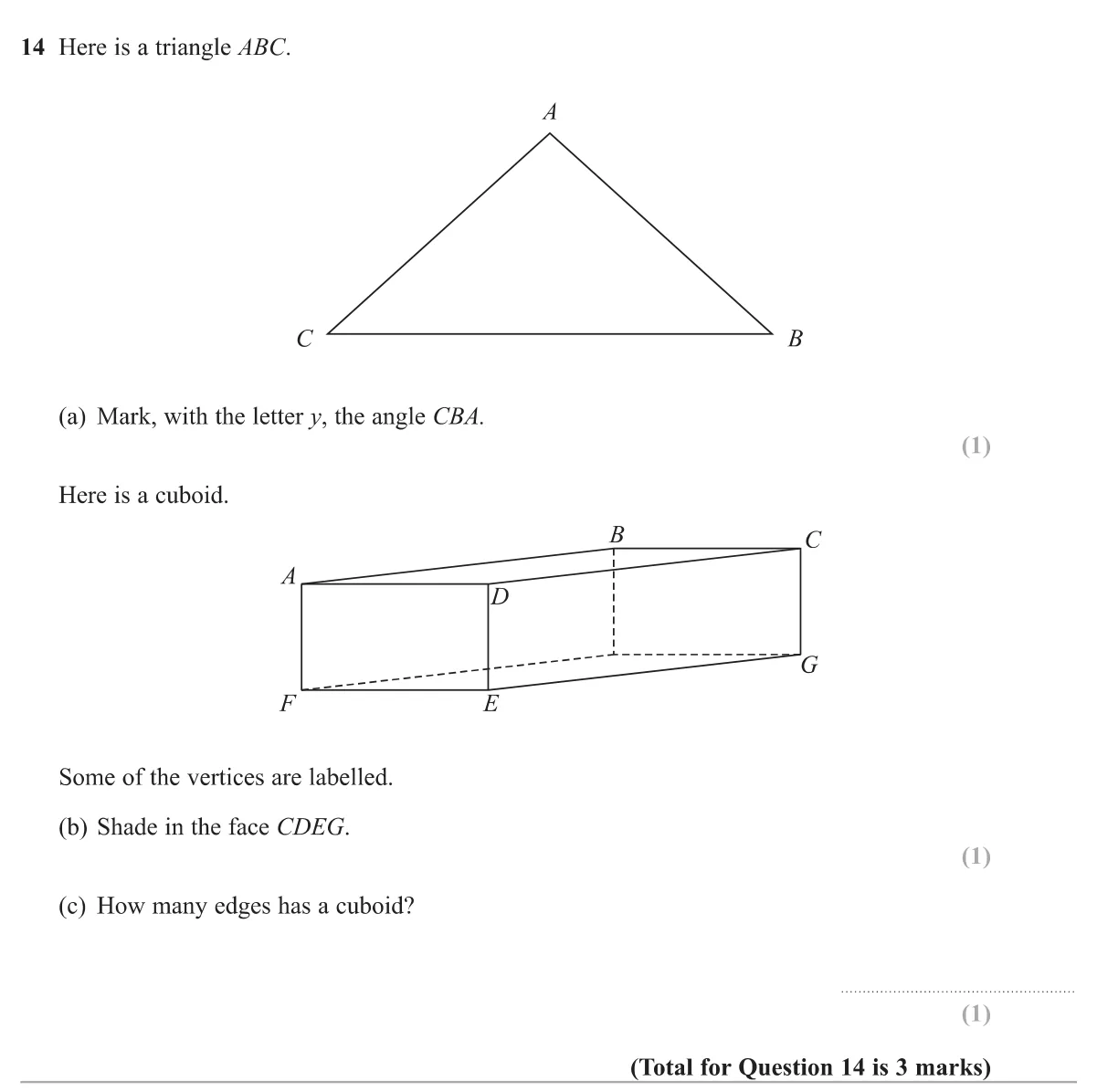
© Pearson Education Ltd. Specimen Paper 3 (Foundation, calculator), question 14.
(a) The angle at B, between BC and BA, marked y 1 mark (b) Face CDEG shaded: the long face on the right, between edge DE and edge CG 1 mark (c) 12 1 mark
Worked solution Checked against the mark scheme
(a) In angle CBA the middle letter, B, is where the angle is. Mark y inside the triangle at B.
(b) Find the four corners C, D, E and G and shade the face they enclose.
(c) A cuboid has 4 edges on top, 4 on the bottom and 4 upright: 4 + 4 + 4 = 12 4 + 4 + 4 = 12 4 + 4 + 4 = 12
Watch out: In (a), marking the angle at C or A instead of the middle letter B.
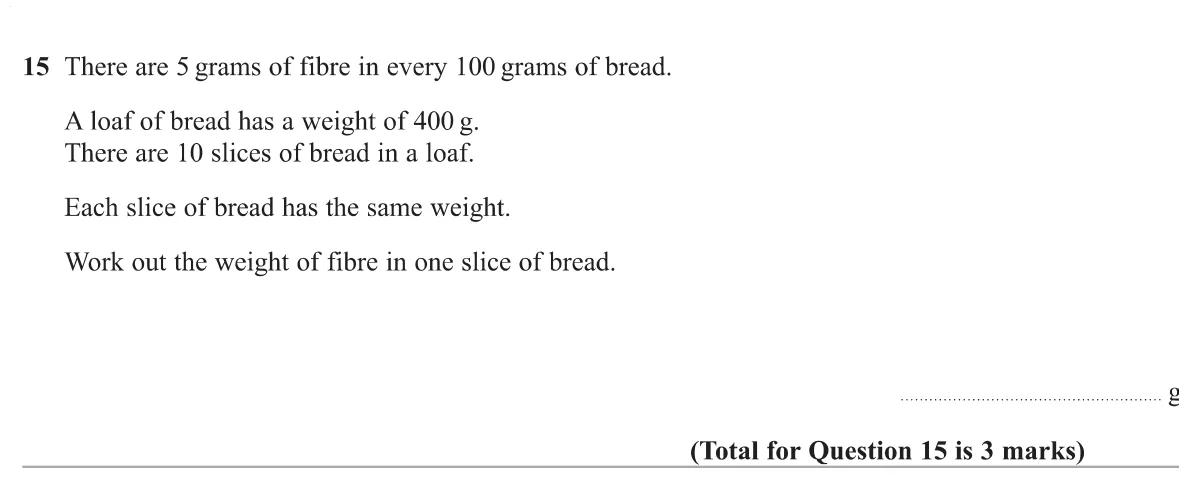
© Pearson Education Ltd. Specimen Paper 3 (Foundation, calculator), question 15.
Worked solution Checked against the mark scheme
One slice weighs 400 ÷ 10 = 40 400 \div 10 = 40 400 ÷ 10 = 40
Fibre is 5 g per 100 g, so in 40 g: 5 × 40 100 = 2 5 \times \frac{40}{100} = 2 5 × 100 40 = 2
Watch out: Working out fibre for the whole loaf (20 g) and stopping there.
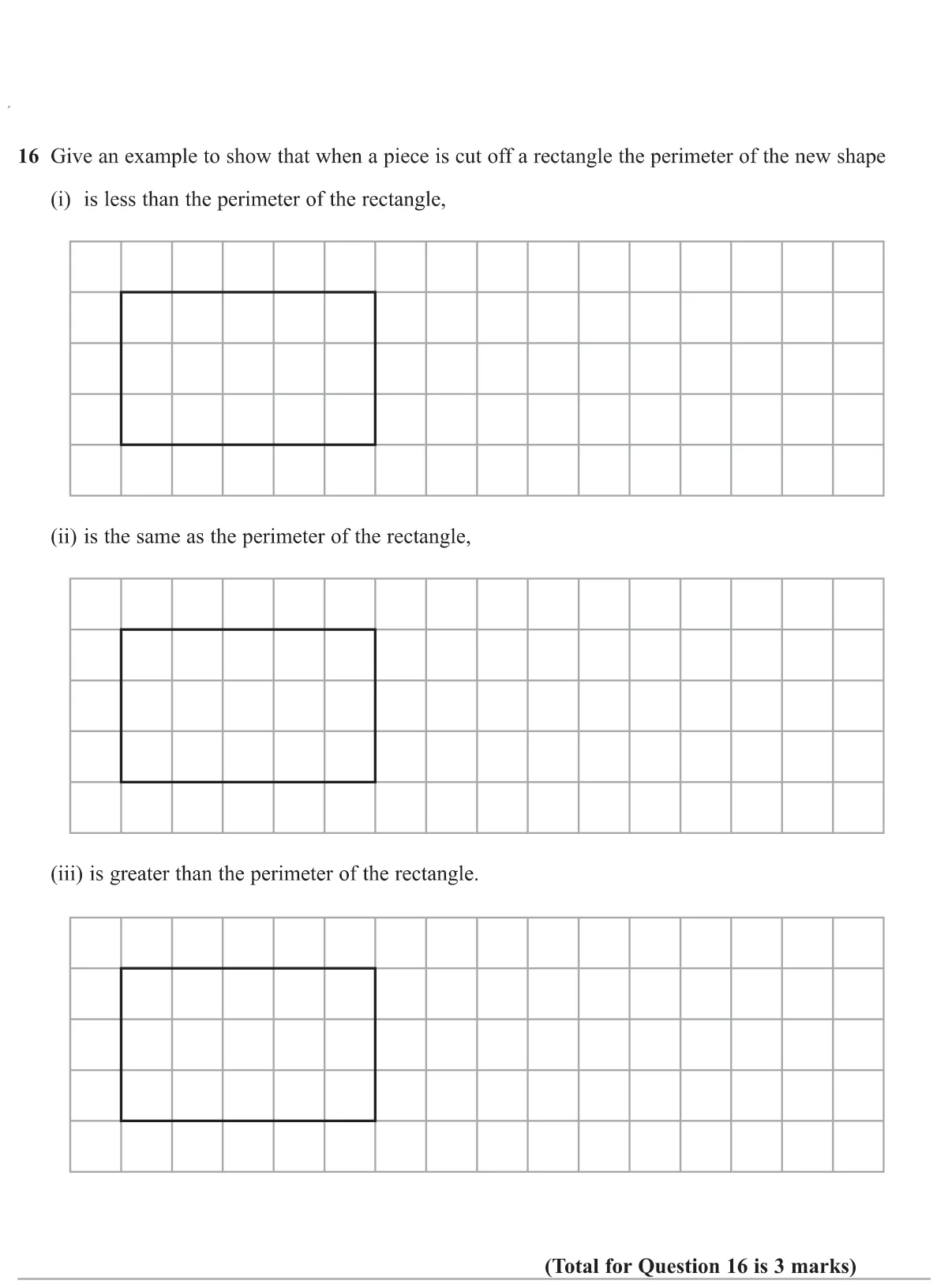
© Pearson Education Ltd. Specimen Paper 3 (Foundation, calculator), question 16.
((i)) e.g. cut a triangle off one corner 1 mark ((ii)) e.g. cut a square out of one corner 1 mark ((iii)) e.g. cut a notch out of the middle of one side 1 mark
Worked solution Checked against the mark scheme
The rectangle is 5 by 3, so its perimeter is 16.
(i) Cut a triangle off a corner: the slanted cut is shorter than the two edges it replaces, so the perimeter drops.
(ii) Cut a 1 by 1 square from a corner: two edges of 1 are removed and two new edges of 1 appear, so the perimeter stays 16.
(iii) Cut a 1 by 1 notch from the middle of a side: 1 unit of edge goes but 3 units appear, so the perimeter becomes 18.
Watch out: Thinking that removing area must always reduce the perimeter.
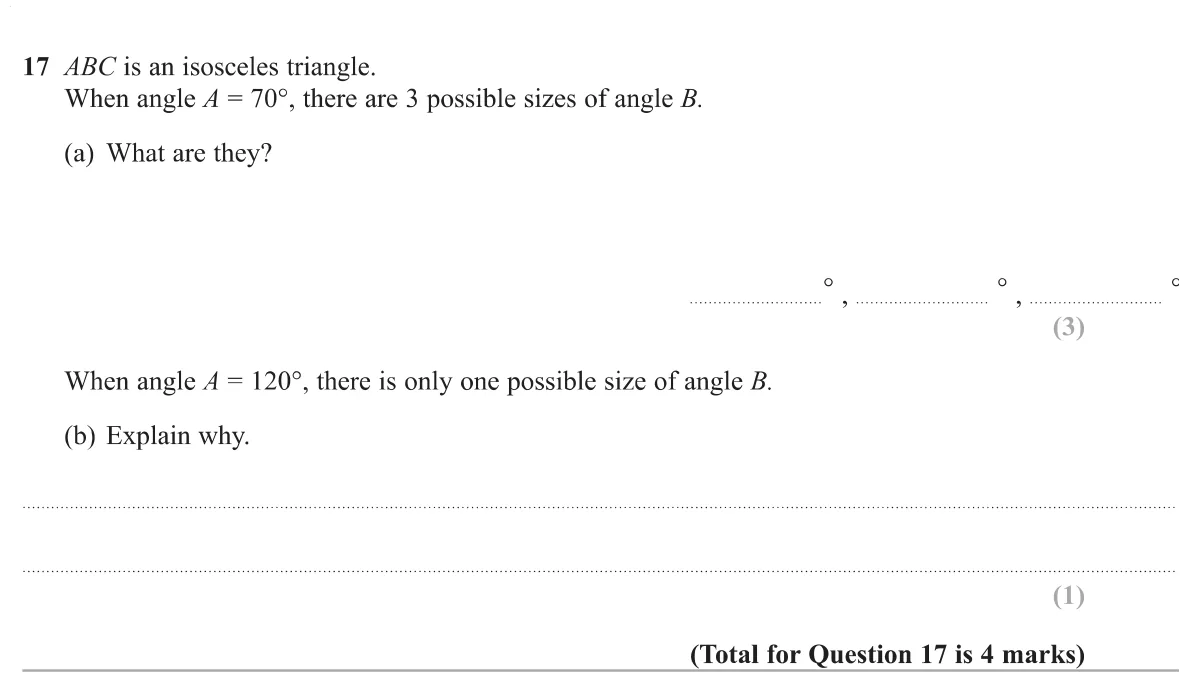
© Pearson Education Ltd. Specimen Paper 3 (Foundation, calculator), question 17.
(a) 70 ∘ 70^\circ 7 0 ∘ 40 ∘ 40^\circ 4 0 ∘ 55 ∘ 55^\circ 5 5 ∘ 3 marks (b) A triangle cannot have two obtuse angles, so the 120° angle must be the unequal one and B must be 30° 1 mark
Worked solution Checked against the mark scheme
(a) If A is one of the two equal angles and B is the other: B = 70 ∘ B = 70^\circ B = 7 0 ∘
If A and C are equal: B = 180 − 70 − 70 = 40 ∘ B = 180 - 70 - 70 = 40^\circ B = 180 − 70 − 70 = 4 0 ∘
If A is the odd angle: B = ( 180 − 70 ) ÷ 2 = 55 ∘ B = (180 - 70) \div 2 = 55^\circ B = ( 180 − 70 ) ÷ 2 = 5 5 ∘
(b) Two angles of 120 ∘ 120^\circ 12 0 ∘ 180 ∘ 180^\circ 18 0 ∘ B = ( 180 − 120 ) ÷ 2 = 30 ∘ B = (180 - 120) \div 2 = 30^\circ B = ( 180 − 120 ) ÷ 2 = 3 0 ∘
Watch out: Finding only one or two of the three angles in (a).
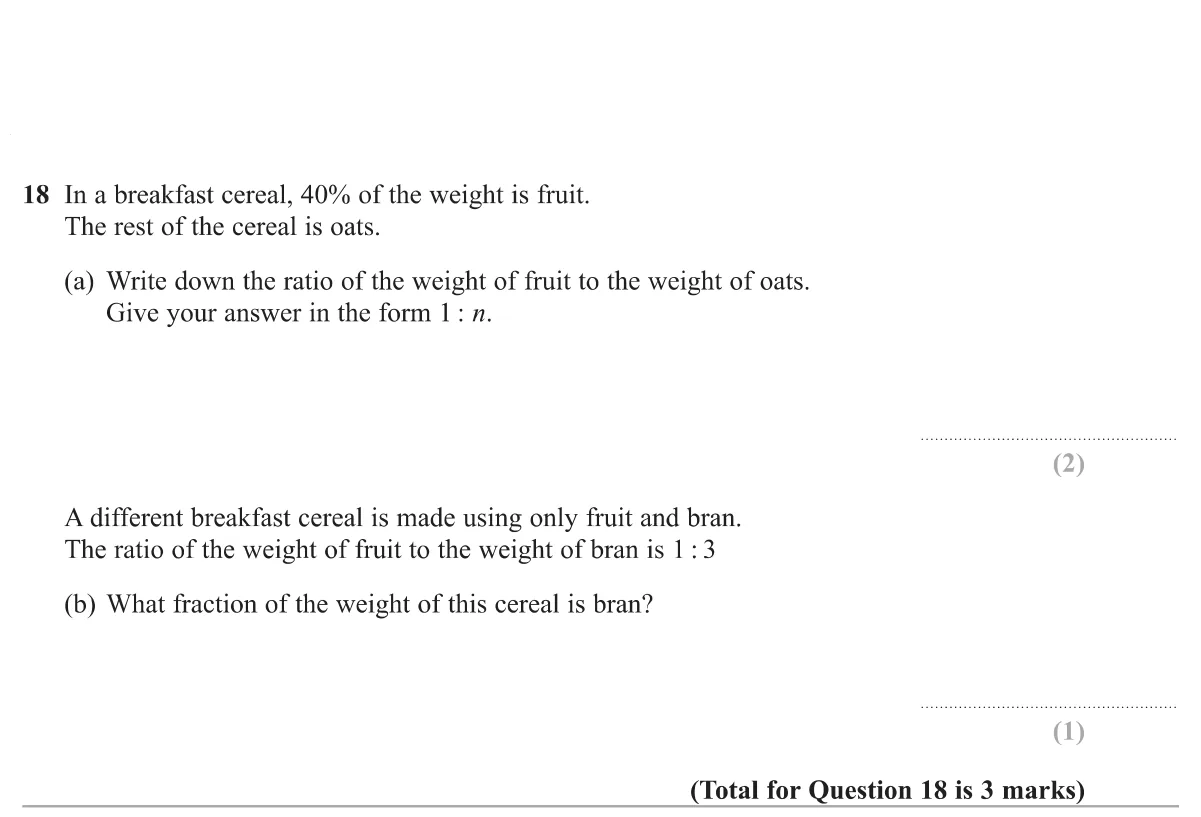
Question 18 Ratio 3 marks Grade 4 Calculator © Pearson Education Ltd. Specimen Paper 3 (Foundation, calculator), question 18.
(a) 1 : 1.5 2 marks (b) 3 4 \frac{3}{4} 4 3 1 mark
Worked solution Checked against the mark scheme
(a) Fruit is 40%, so oats are 100 − 40 = 60 % 100 - 40 = 60\% 100 − 40 = 60%
40 : 60 40 : 60 40 : 60 1 : 1.5 1 : 1.5 1 : 1.5
(b) 1 + 3 = 4 1 + 3 = 4 1 + 3 = 4 3 4 \frac{3}{4} 4 3
Watch out: In (b), giving 1 3 \frac{1}{3} 3 1 3 1 \frac{3}{1} 1 3
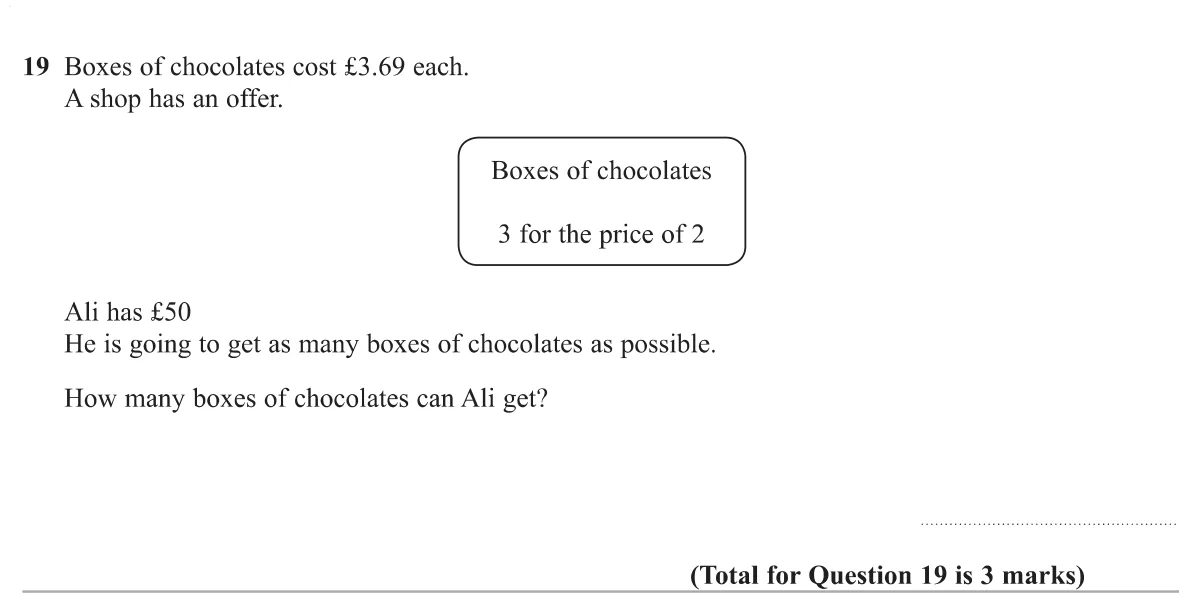
© Pearson Education Ltd. Specimen Paper 3 (Foundation, calculator), question 19.
Worked solution Checked against the mark scheme
Each deal of 3 boxes costs 2 × 3.69 = £ 7.38 2 \times 3.69 = £7.38 2 × 3.69 = £7.38
50 ÷ 7.38 = 6.77... 50 \div 7.38 = 6.77... 50 ÷ 7.38 = 6.77... 6 × 7.38 = £ 44.28 6 \times 7.38 = £44.28 6 × 7.38 = £44.28
Left over: 50 − 44.28 = £ 5.72 50 - 44.28 = £5.72 50 − 44.28 = £5.72
Total: 18 + 1 = 19 18 + 1 = 19 18 + 1 = 19
Watch out: Stopping at 18 and forgetting the leftover money buys one more box.
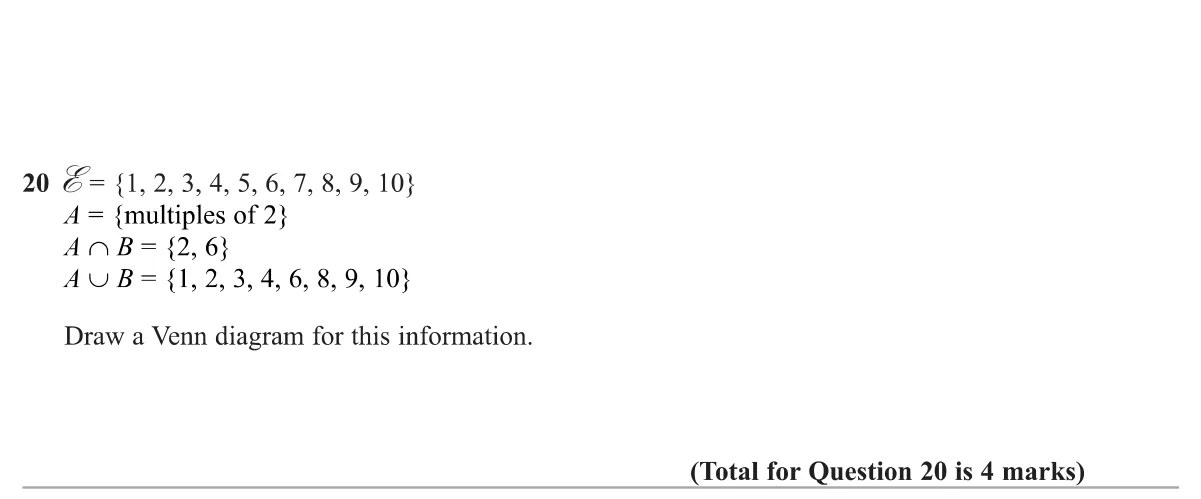
© Pearson Education Ltd. Specimen Paper 3 (Foundation, calculator), question 20.
Answer A only: 4, 8, 10; A ∩ B: 2, 6; B only: 1, 3, 9; outside both: 5, 7 4 marks
Worked solution Checked against the mark scheme
A (even numbers) = {2, 4, 6, 8, 10}.
Overlap: 2 and 6. So A only: 4, 8, 10.
A ∪ B A \cup B A ∪ B
Numbers in neither set: 5 and 7, written outside the ovals but inside the rectangle.
Watch out: Leaving 5 and 7 off the diagram, or putting 2 and 6 in A only as well.
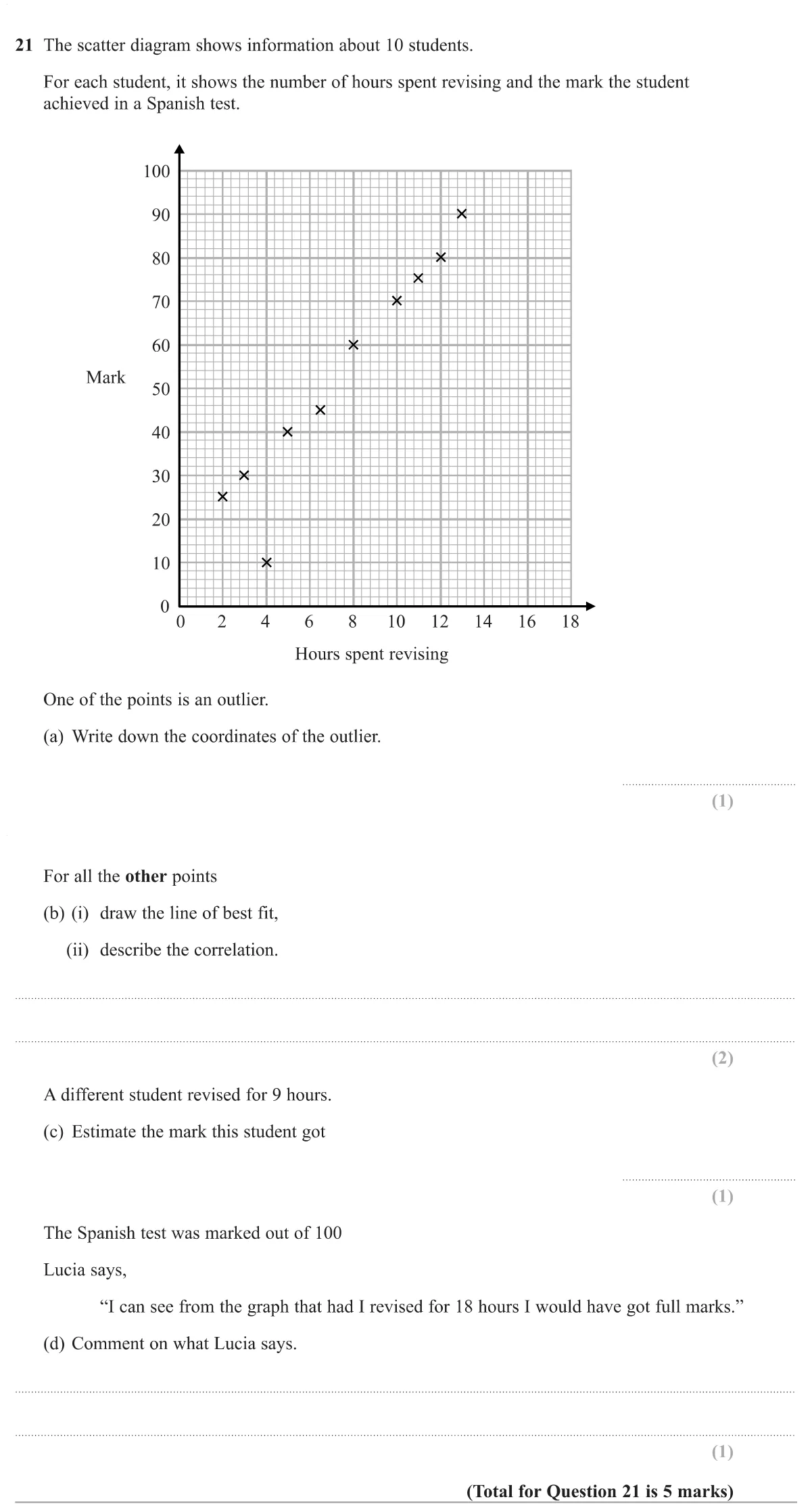
© Pearson Education Ltd. Specimen Paper 3 (Foundation, calculator), question 21.
(a) (4, 10) 1 mark (b(i)) A straight line through the middle of the other points 1 mark (b(ii)) Positive 1 mark (c) Between 60 and 70 1 mark (d) She is extrapolating: 18 hours is outside the data, so the trend may not continue 1 mark
Worked solution Checked against the mark scheme
(a) The point (4, 10) sits well below the pattern of the others.
(b) Draw a straight ruler line through the middle of the other nine points, roughly from (2, 22) to (13, 86). As hours go up, marks go up: positive correlation.
(c) Go up from 9 hours to the line and across: about 65 .
(d) The data only go up to 13 hours. Using the line at 18 hours is extrapolation, so we cannot be sure she would get full marks.
Watch out: In (b)(i), forcing the line through the outlier or through the origin.
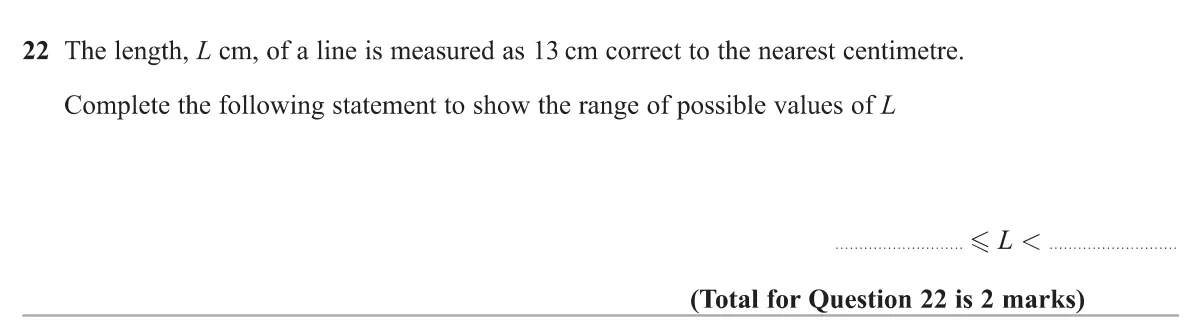
© Pearson Education Ltd. Specimen Paper 3 (Foundation, calculator), question 22.
Answer 12.5 ≤ L < 13.5 12.5 \le L < 13.5 12.5 ≤ L < 13.5 2 marks
Worked solution Checked against the mark scheme
To the nearest cm, the true length is within half a centimetre either side of 13.
13 − 0.5 = 12.5 13 - 0.5 = 12.5 13 − 0.5 = 12.5 13 + 0.5 = 13.5 13 + 0.5 = 13.5 13 + 0.5 = 13.5
So 12.5 ≤ L < 13.5 12.5 \le L < 13.5 12.5 ≤ L < 13.5
Watch out: Writing 12 and 14, or using 13.4 or 13.49 for the upper bound.
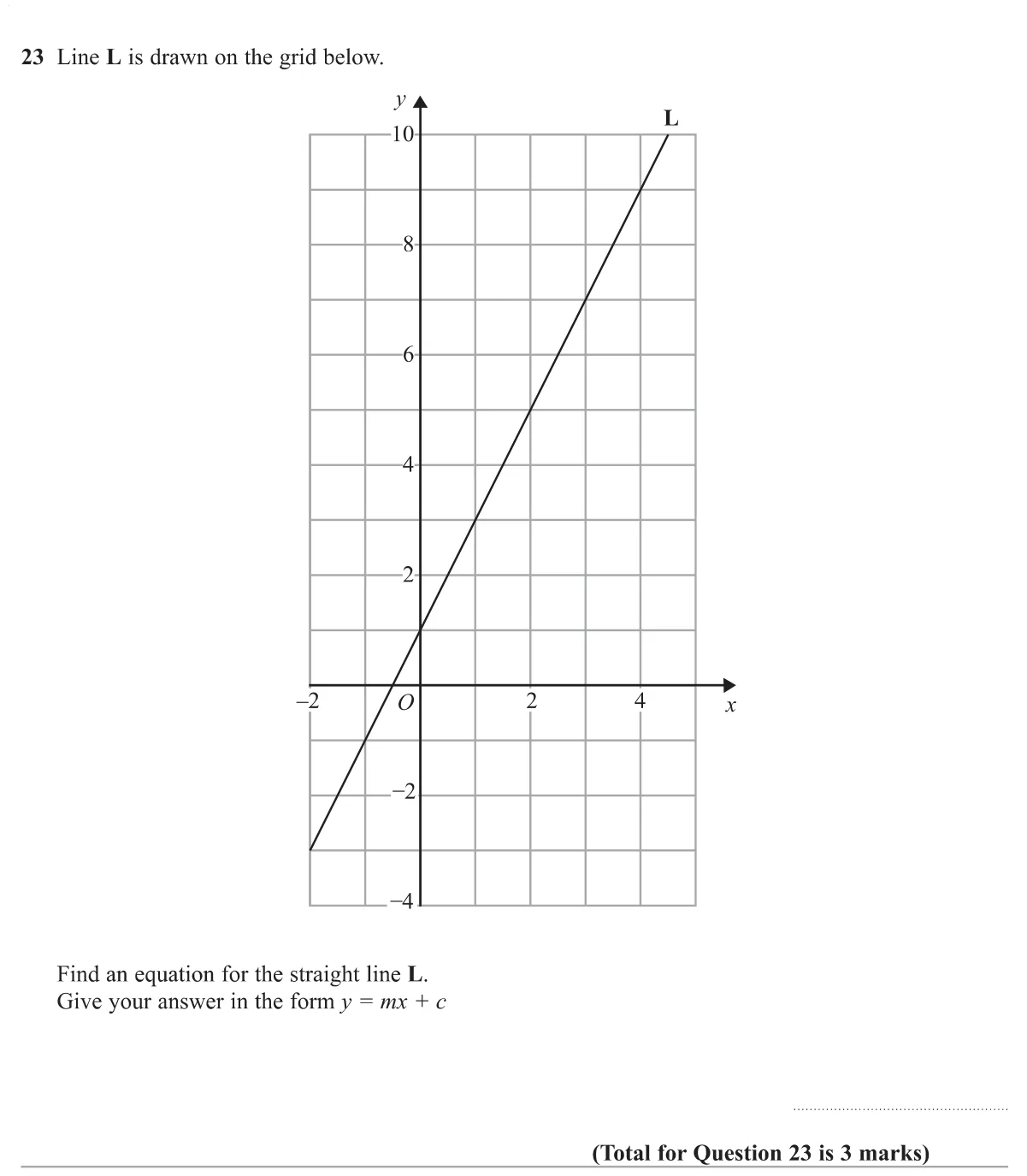
© Pearson Education Ltd. Specimen Paper 3 (Foundation, calculator), question 23.
Answer y = 2 x + 1 y = 2x + 1 y = 2 x + 1 3 marks
Worked solution Checked against the mark scheme
The line crosses the y-axis at 1, so c = 1 c = 1 c = 1
It passes through (0, 1) and (2, 5): up 4 for 2 across, so the gradient is 4 ÷ 2 = 2 4 \div 2 = 2 4 ÷ 2 = 2
y = 2 x + 1 y = 2x + 1 y = 2 x + 1
Watch out: Getting the gradient upside down (1 2 \frac{1}{2} 2 1
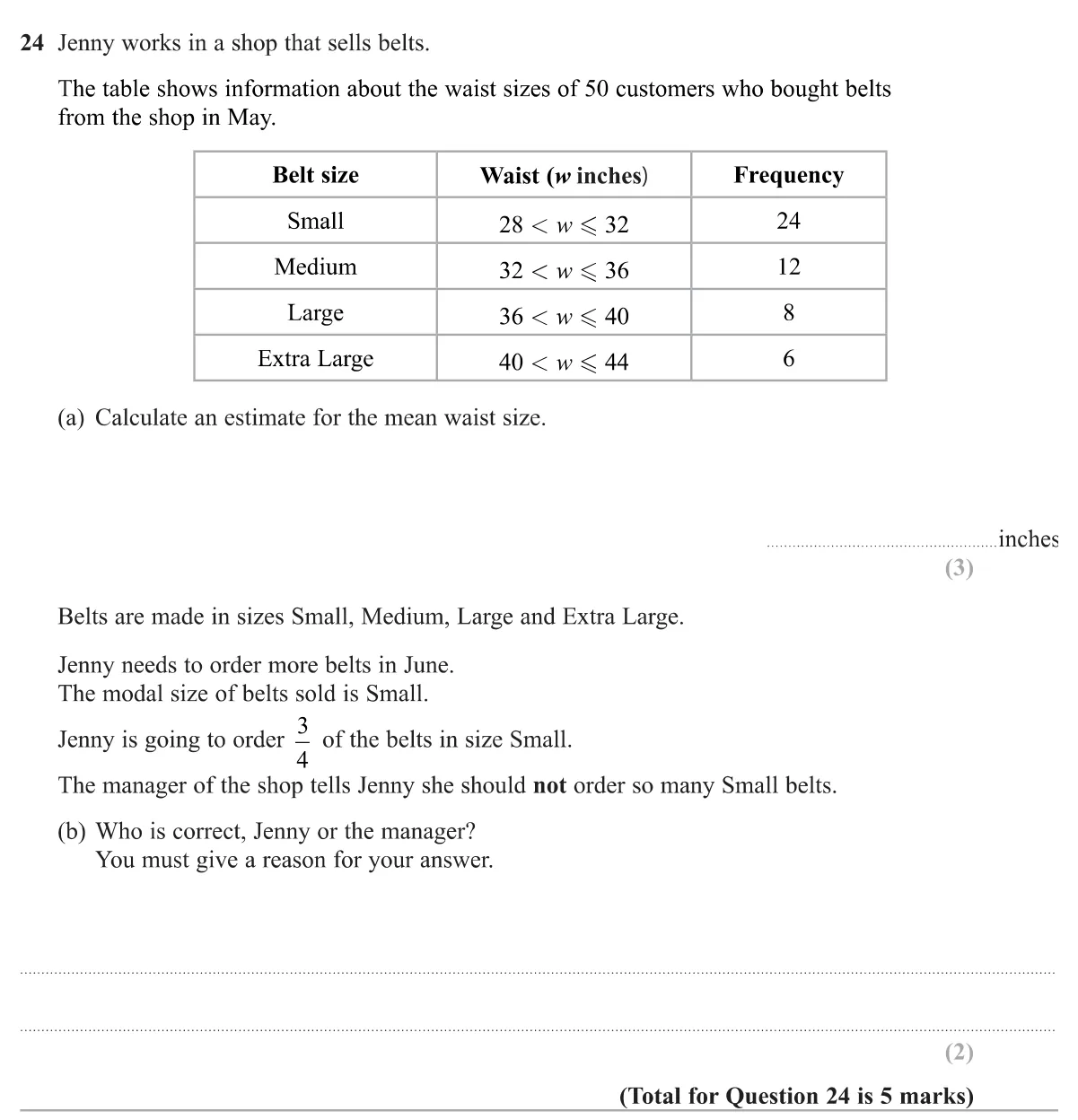
© Pearson Education Ltd. Specimen Paper 3 (Foundation, calculator), question 24.
(a) 33.68 inches 3 marks (b) The manager: only 24 out of 50 (under half) bought Small, not three quarters 2 marks
Worked solution Checked against the mark scheme
(a) Midpoints: 30, 34, 38, 42.
30 × 24 + 34 × 12 + 38 × 8 + 42 × 6 = 720 + 408 + 304 + 252 = 1684 30 \times 24 + 34 \times 12 + 38 \times 8 + 42 \times 6 = 720 + 408 + 304 + 252 = 1684 30 × 24 + 34 × 12 + 38 × 8 + 42 × 6 = 720 + 408 + 304 + 252 = 1684
1684 ÷ 50 = 33.68 1684 \div 50 = 33.68 1684 ÷ 50 = 33.68
(b) 24 50 = 0.48 \frac{24}{50} = 0.48 50 24 = 0.48 manager is correct.
Watch out: In (a), dividing by 4 (the number of groups) instead of 50.
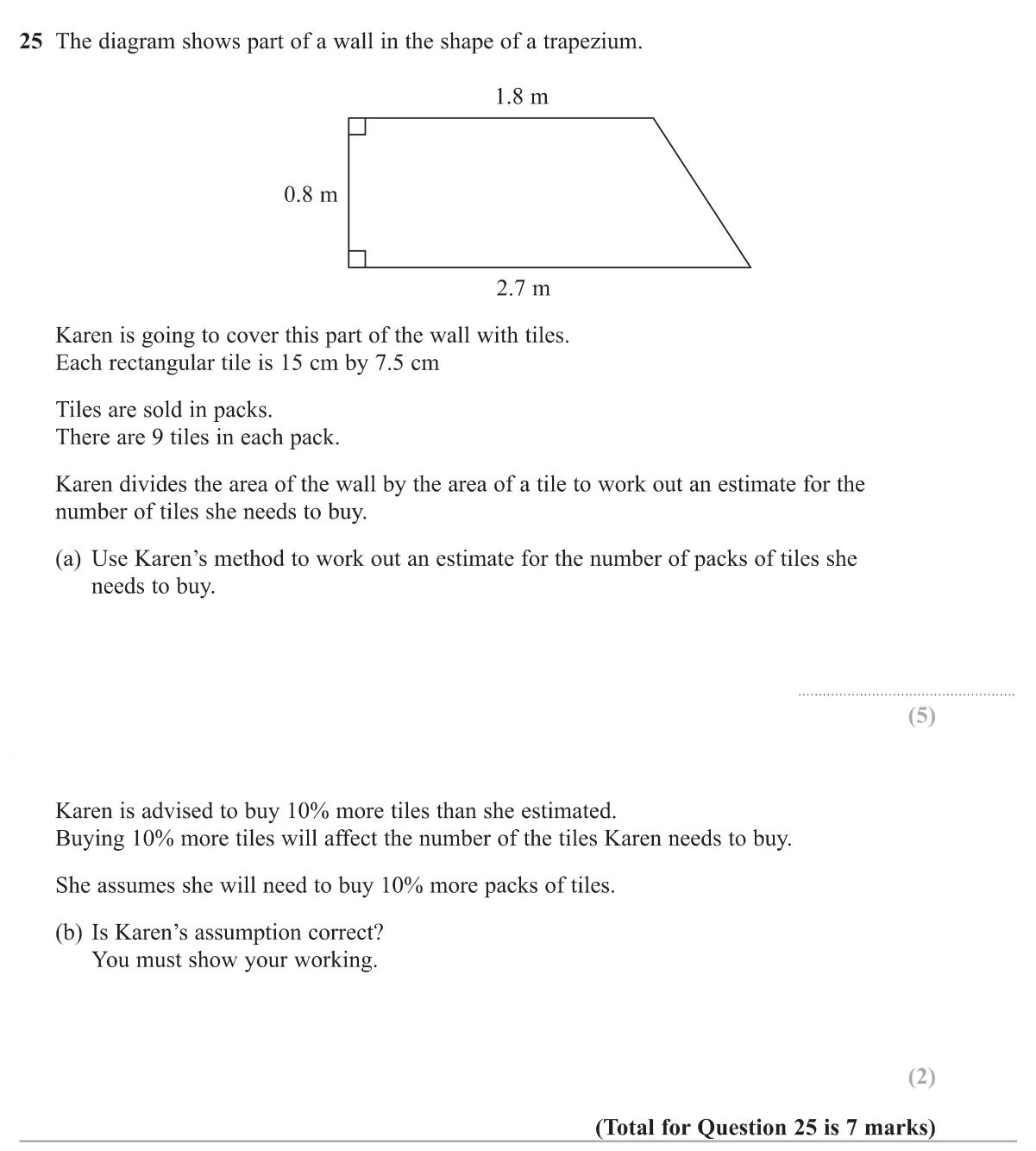
© Pearson Education Ltd. Specimen Paper 3 (Foundation, calculator), question 25.
(a) 18 packs 5 marks (b) No: 10% more tiles is 176 tiles, needing 20 packs, which is 2 more packs (more than 10% of 18) 2 marks
Worked solution Checked against the mark scheme
(a) Wall area = 1.8 + 2.7 2 × 0.8 = 1.8 m 2 = 18000 cm 2 = \frac{1.8 + 2.7}{2} \times 0.8 = 1.8\text{ m}^2 = 18000\text{ cm}^2 = 2 1.8 + 2.7 × 0.8 = 1.8 m 2 = 18000 cm 2
Tile area = 15 × 7.5 = 112.5 cm 2 = 15 \times 7.5 = 112.5\text{ cm}^2 = 15 × 7.5 = 112.5 cm 2
Tiles: 18000 ÷ 112.5 = 160 18000 \div 112.5 = 160 18000 ÷ 112.5 = 160 160 ÷ 9 = 17.8 160 \div 9 = 17.8 160 ÷ 9 = 17.8 18 .
(b) 160 × 1.1 = 176 160 \times 1.1 = 176 160 × 1.1 = 176 176 ÷ 9 = 19.6 176 \div 9 = 19.6 176 ÷ 9 = 19.6
That is 2 more packs, but 10% of 18 is only 1.8, so the assumption is not correct.
Watch out: Using 1 m² = 100 cm² when converting, or rounding 17.8 packs down.
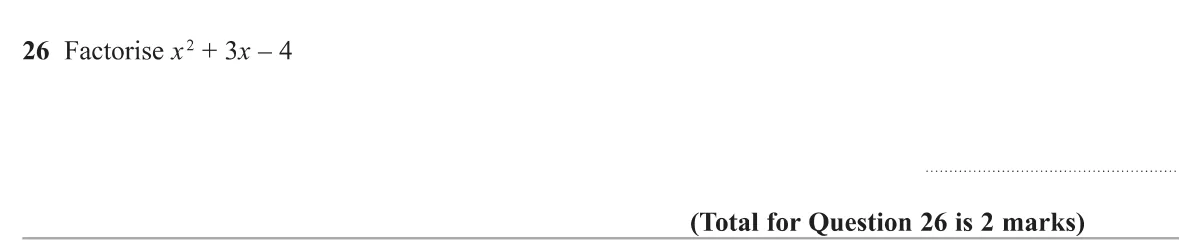
© Pearson Education Ltd. Specimen Paper 3 (Foundation, calculator), question 26.
Answer ( x − 1 ) ( x + 4 ) (x - 1)(x + 4) ( x − 1 ) ( x + 4 ) 2 marks
Worked solution Checked against the mark scheme
Find two numbers that multiply to −4 and add to 3: 4 4 4 − 1 -1 − 1
x 2 + 3 x − 4 = ( x + 4 ) ( x − 1 ) x^2 + 3x - 4 = (x + 4)(x - 1) x 2 + 3 x − 4 = ( x + 4 ) ( x − 1 )
Watch out: Getting the signs the wrong way round: ( x + 1 ) ( x − 4 ) (x + 1)(x - 4) ( x + 1 ) ( x − 4 )
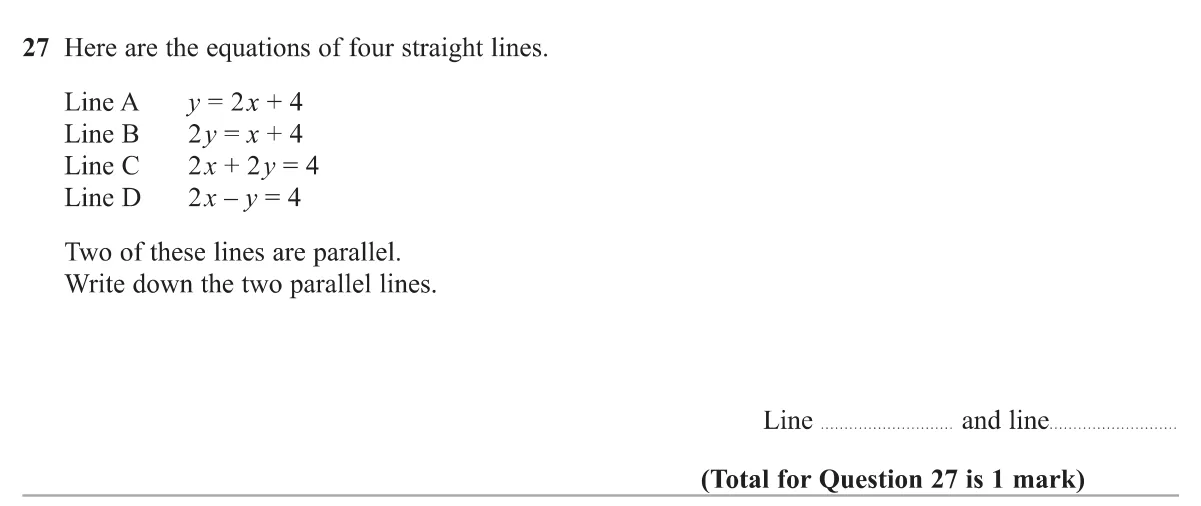
© Pearson Education Ltd. Specimen Paper 3 (Foundation, calculator), question 27.
Answer Lines A and D 1 mark
Worked solution Checked against the mark scheme
Rearrange each into y = m x + c y = mx + c y = m x + c
A: y = 2 x + 4 y = 2x + 4 y = 2 x + 4
B: y = 1 2 x + 2 y = \frac{1}{2}x + 2 y = 2 1 x + 2 1 2 \frac{1}{2} 2 1
C: y = − x + 2 y = -x + 2 y = − x + 2
D: y = 2 x − 4 y = 2x - 4 y = 2 x − 4
A and D have the same gradient, so they are parallel.
Watch out: Reading the coefficient of x without first making y the subject.
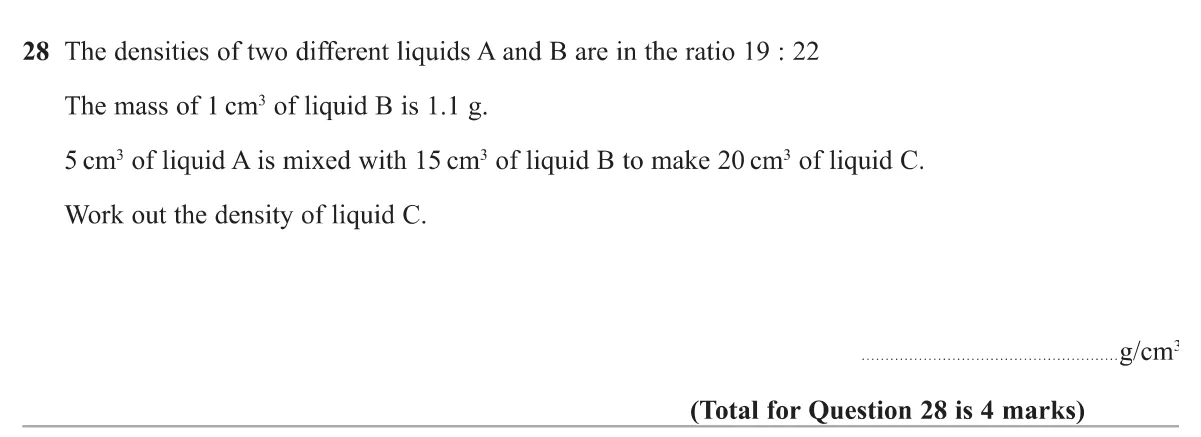
© Pearson Education Ltd. Specimen Paper 3 (Foundation, calculator), question 28.
Answer 1.0625 g/cm³ 4 marks
Worked solution Checked against the mark scheme
Density of B is 1.1 g/cm³, so density of A = 19 22 × 1.1 = 0.95 = \frac{19}{22} \times 1.1 = 0.95 = 22 19 × 1.1 = 0.95
Mass of C = 5 × 0.95 + 15 × 1.1 = 4.75 + 16.5 = 21.25 = 5 \times 0.95 + 15 \times 1.1 = 4.75 + 16.5 = 21.25 = 5 × 0.95 + 15 × 1.1 = 4.75 + 16.5 = 21.25
Density of C = 21.25 ÷ 20 = 1.0625 = 21.25 \div 20 = 1.0625 = 21.25 ÷ 20 = 1.0625
Watch out: Averaging the two densities (1.025) without weighting by volume.
Finished the paper? Add up your marks for all three papers. Specimen papers were never sat, so they have no grade boundaries of their own, but the grade calculator shows what the same total earned in recent real exams, as a rough guide.