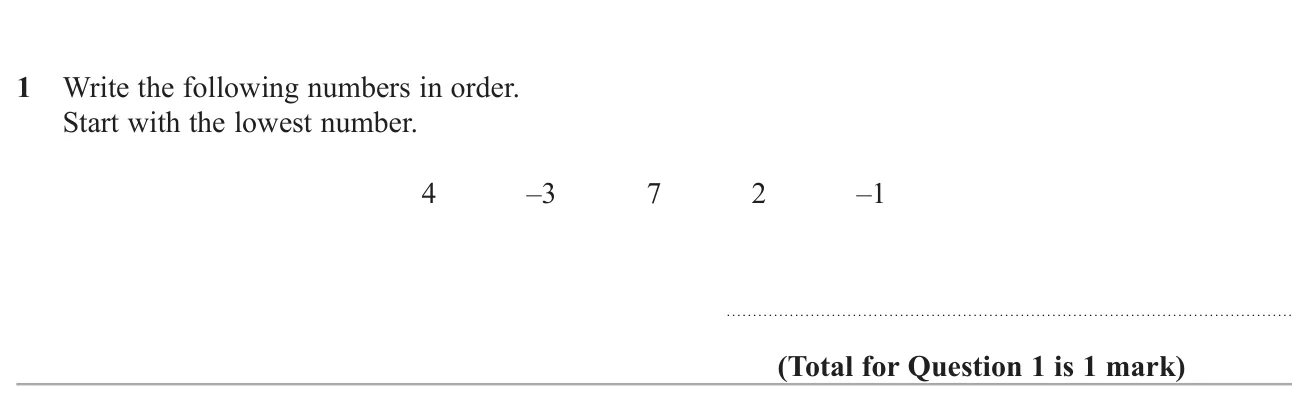
© Pearson Education Ltd. June 2024 Paper 2 (Foundation, calculator), question 1.
Show answer
| Answer | −3, −1, 2, 4, 7 (the reverse order is also accepted) | 1 mark |
|---|
Worked solution Checked against the mark scheme
Negative numbers are smaller than positive ones, and −3 is further below zero than −1.
So the order is −3, −1, 2, 4, 7.
Watch out: Putting −1 before −3 because 1 is smaller than 3.
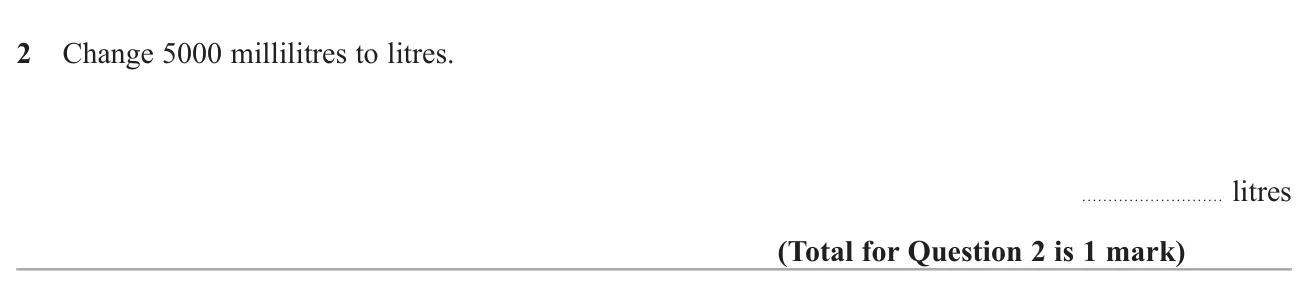
© Pearson Education Ltd. June 2024 Paper 2 (Foundation, calculator), question 2.
Show answer
Worked solution Checked against the mark scheme
There are 1000 ml in a litre.
5000÷1000=5 litres.
Watch out: Multiplying by 1000 instead of dividing.
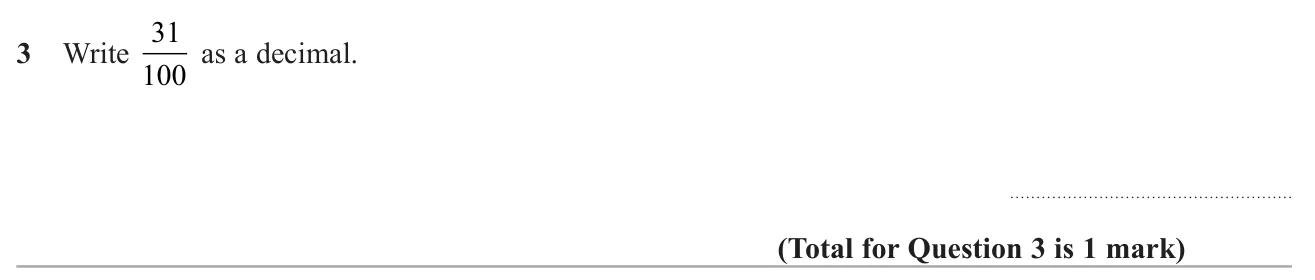
© Pearson Education Ltd. June 2024 Paper 2 (Foundation, calculator), question 3.
Show answer
Worked solution Checked against the mark scheme
10031 means 31 hundredths.
10031=0.31
Watch out: Writing 3.1 or 0.031.
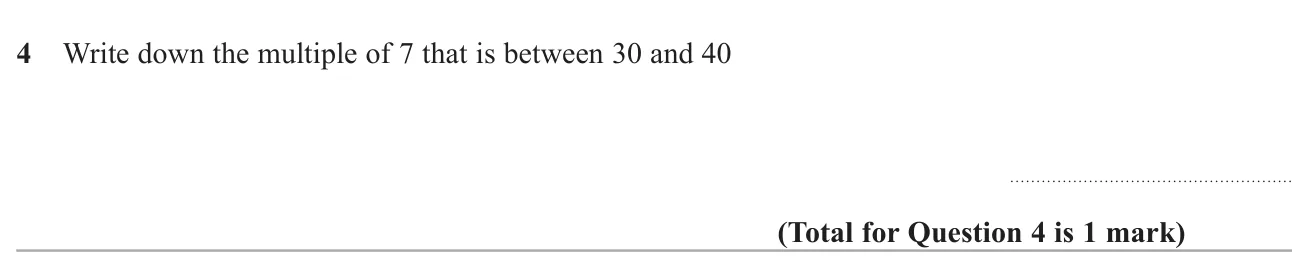
© Pearson Education Ltd. June 2024 Paper 2 (Foundation, calculator), question 4.
Show answer
Worked solution Checked against the mark scheme
Multiples of 7: 28,35,42,…
The only one between 30 and 40 is 35.
Watch out: Giving a factor rather than a multiple.
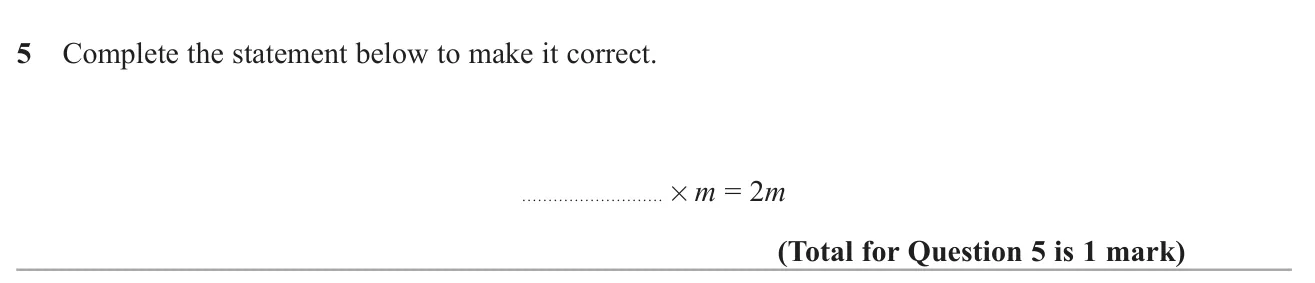
© Pearson Education Ltd. June 2024 Paper 2 (Foundation, calculator), question 5.
Show answer
Worked solution Checked against the mark scheme
2m means 2×m.
So the missing number is 2.
Watch out: Writing m or 1 in the gap.
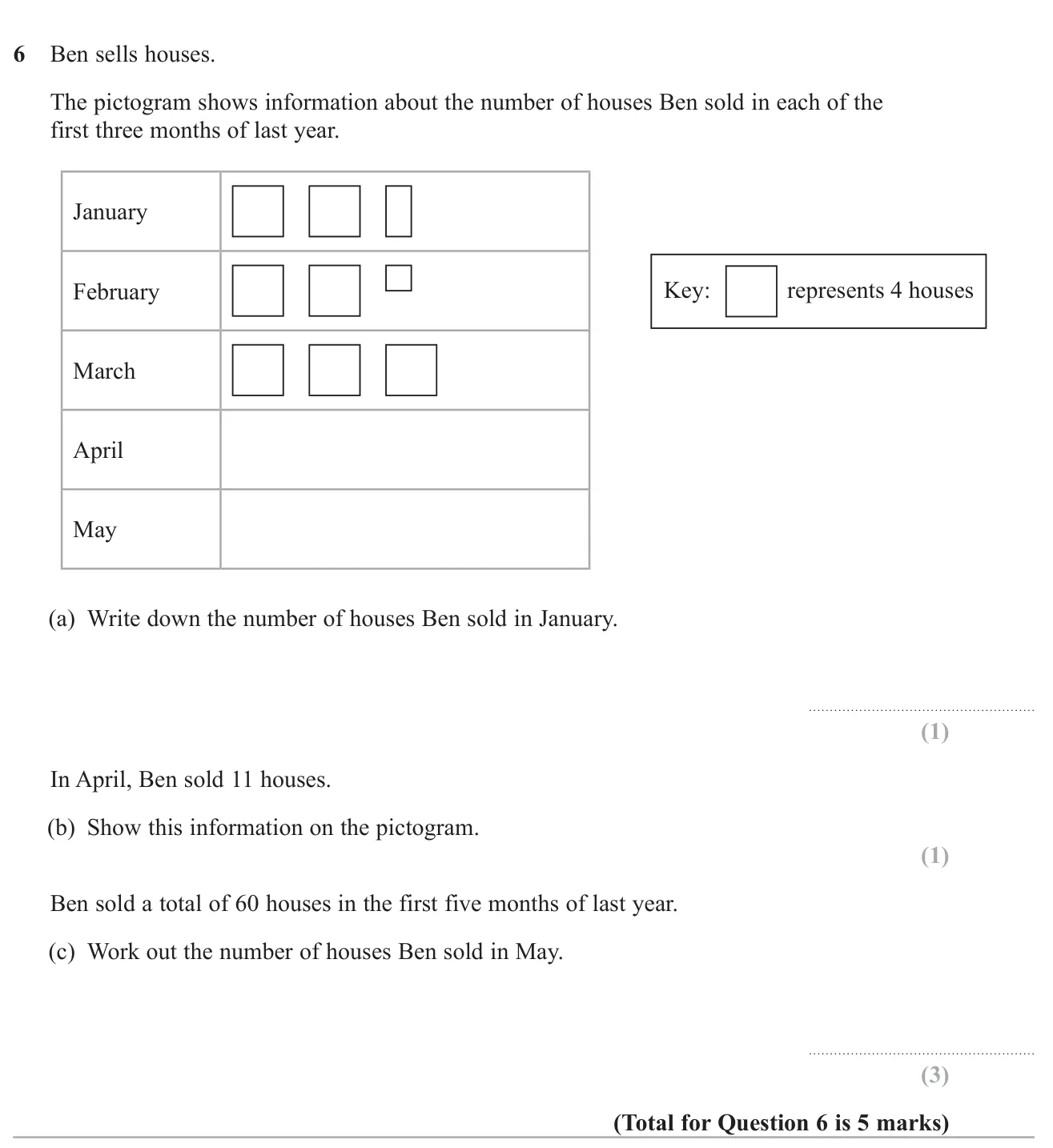
© Pearson Education Ltd. June 2024 Paper 2 (Foundation, calculator), question 6.
Show answer
| (a) | 10 | 1 mark |
|---|
| (b) | 2 full squares and three-quarters of a square | 1 mark |
|---|
| (c) | 18 | 3 marks |
|---|
Worked solution Checked against the mark scheme
(a) Key: one square = 4 houses. January = 4+4+2=10 (half a square is 2).
(b) 11=4+4+3, so draw 2 full squares and 43 of a square.
(c) February =4+4+1=9, March =12, April =11.
May =60−(10+9+12+11)=60−42=18
Watch out: Counting each symbol as 1 house instead of using the key.
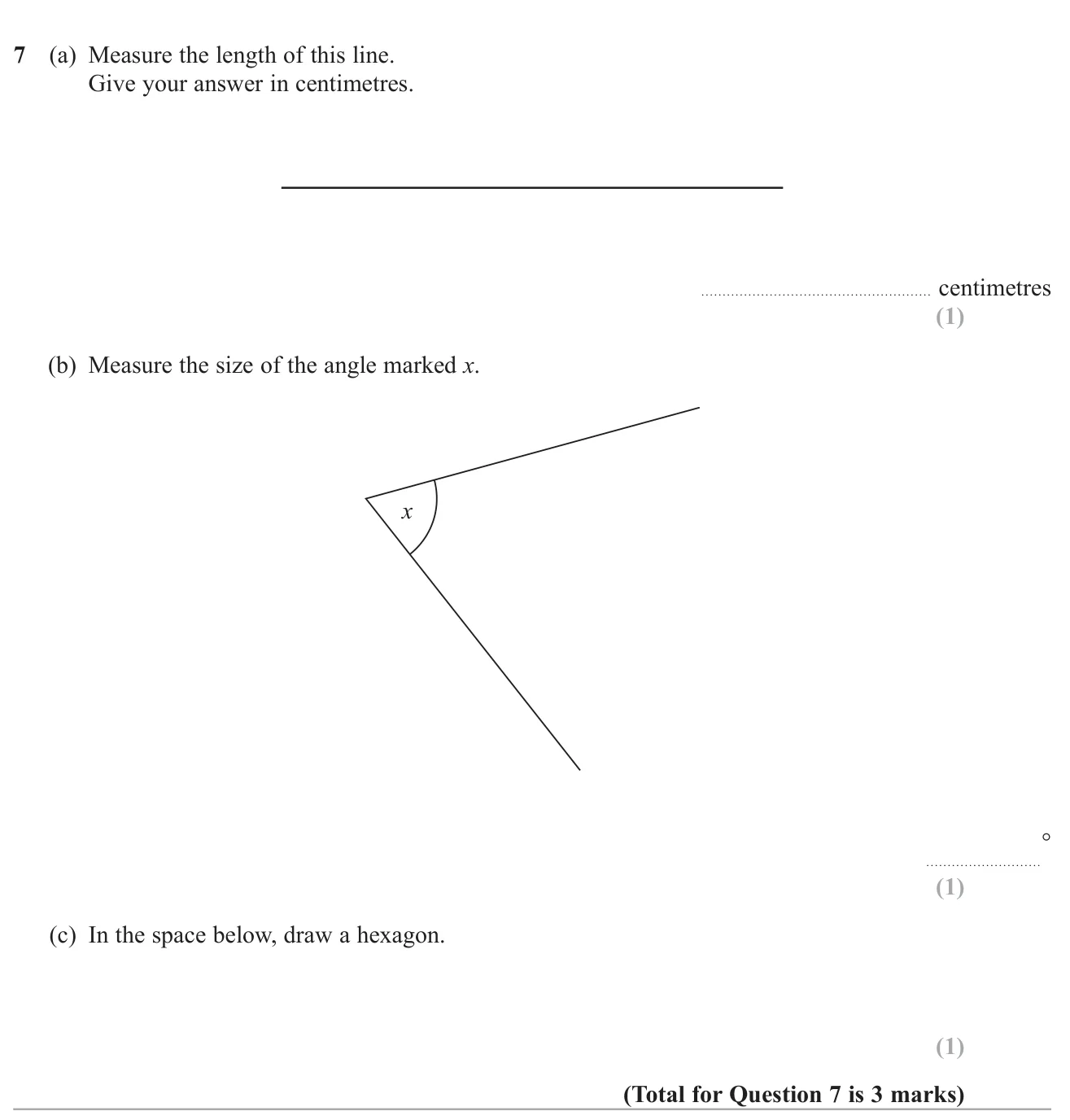
© Pearson Education Ltd. June 2024 Paper 2 (Foundation, calculator), question 7.
Show answer
| (a) | 8.7 cm (accept 8.5 to 8.9) | 1 mark |
|---|
| (b) | 67∘ (accept 65 to 69) | 1 mark |
|---|
| (c) | Any 6-sided polygon | 1 mark |
|---|
Worked solution Checked against the mark scheme
(a) Line up the ruler's zero with one end of the line and read the other end: about 8.7 cm.
(b) Put the protractor's centre on the vertex and a zero line along one arm. The angle is acute, so read the smaller scale: about 67∘.
(c) A hexagon is any shape with 6 straight sides.
Watch out: Reading the wrong protractor scale and getting 113°.
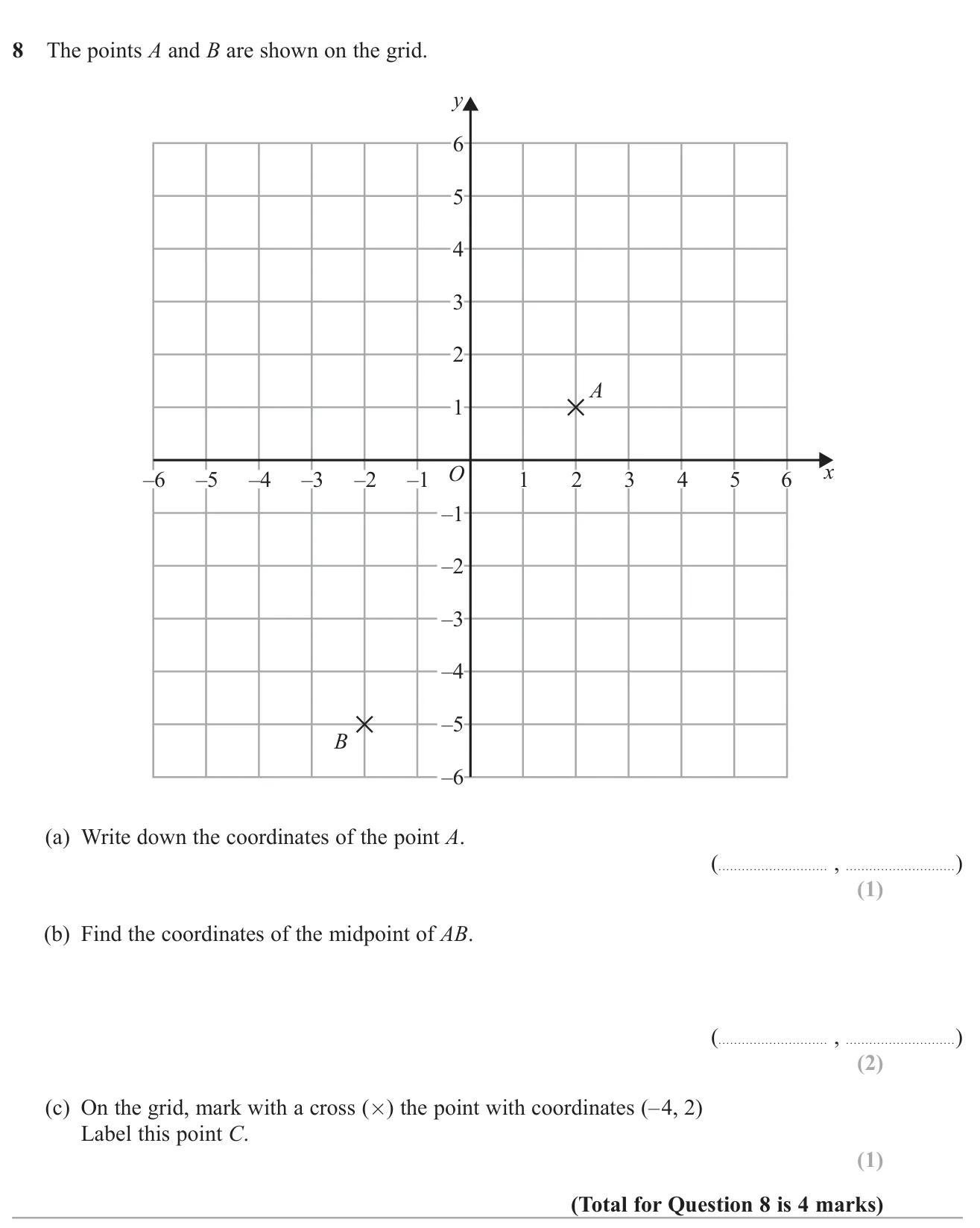
© Pearson Education Ltd. June 2024 Paper 2 (Foundation, calculator), question 8.
Show answer
| (a) | (2, 1) | 1 mark |
|---|
| (b) | (0, −2) | 2 marks |
|---|
| (c) | Cross at (−4, 2) labelled C | 1 mark |
|---|
Worked solution Checked against the mark scheme
(a) A is 2 across and 1 up: (2,1).
(b) B is (−2,−5). Midpoint =(22+(−2),21+(−5))=(0,−2)
(c) Go 4 left from O, then 2 up, and mark a cross labelled C.
Watch out: Writing coordinates the wrong way round, e.g. (1, 2).
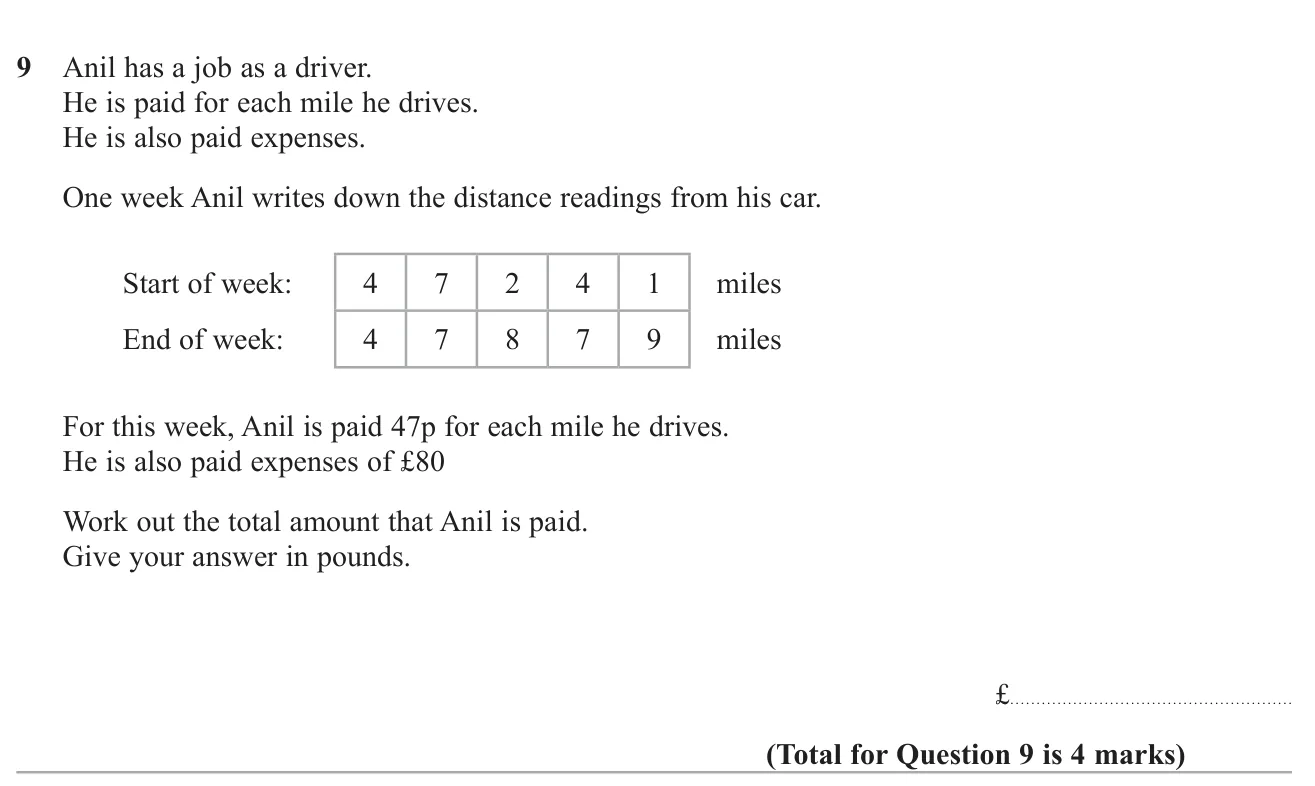
© Pearson Education Ltd. June 2024 Paper 2 (Foundation, calculator), question 9.
Show answer
| Answer | £379.86 | 4 marks |
|---|
Worked solution Checked against the mark scheme
Miles driven =47879−47241=638
Mileage pay =638×0.47=£299.86
Total =299.86+80=£379.86
Watch out: Adding £80 to a pence value, or forgetting to convert 47p to £0.47.
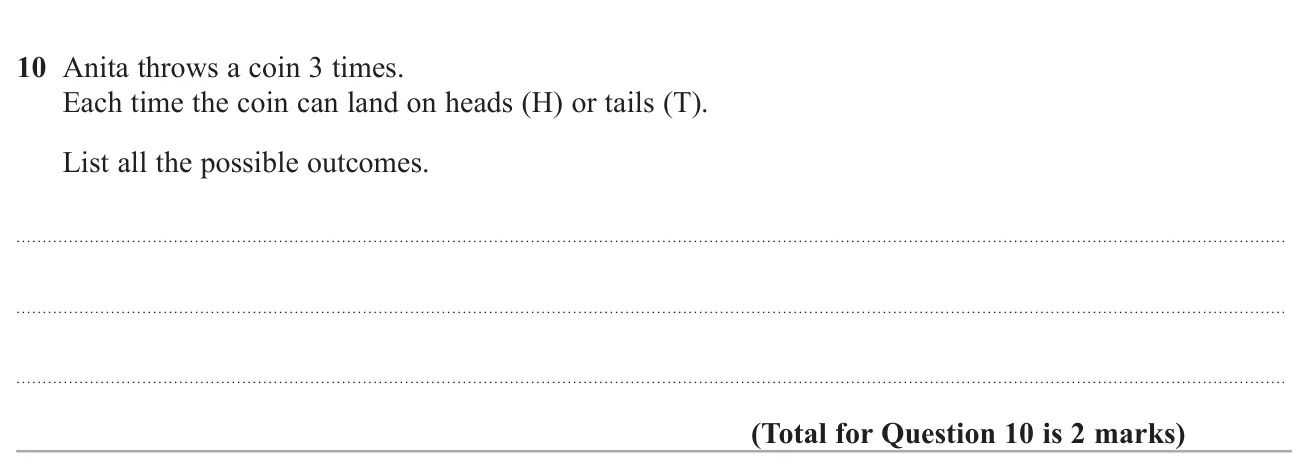
© Pearson Education Ltd. June 2024 Paper 2 (Foundation, calculator), question 10.
Show answer
| Answer | HHH, HHT, HTH, HTT, THH, THT, TTH, TTT | 2 marks |
|---|
Worked solution Checked against the mark scheme
Work systematically, fixing the first throw then the second:
HHH, HHT, HTH, HTT
THH, THT, TTH, TTT
There are 2×2×2=8 outcomes.
Watch out: Missing outcomes such as HTH, or repeating ones.
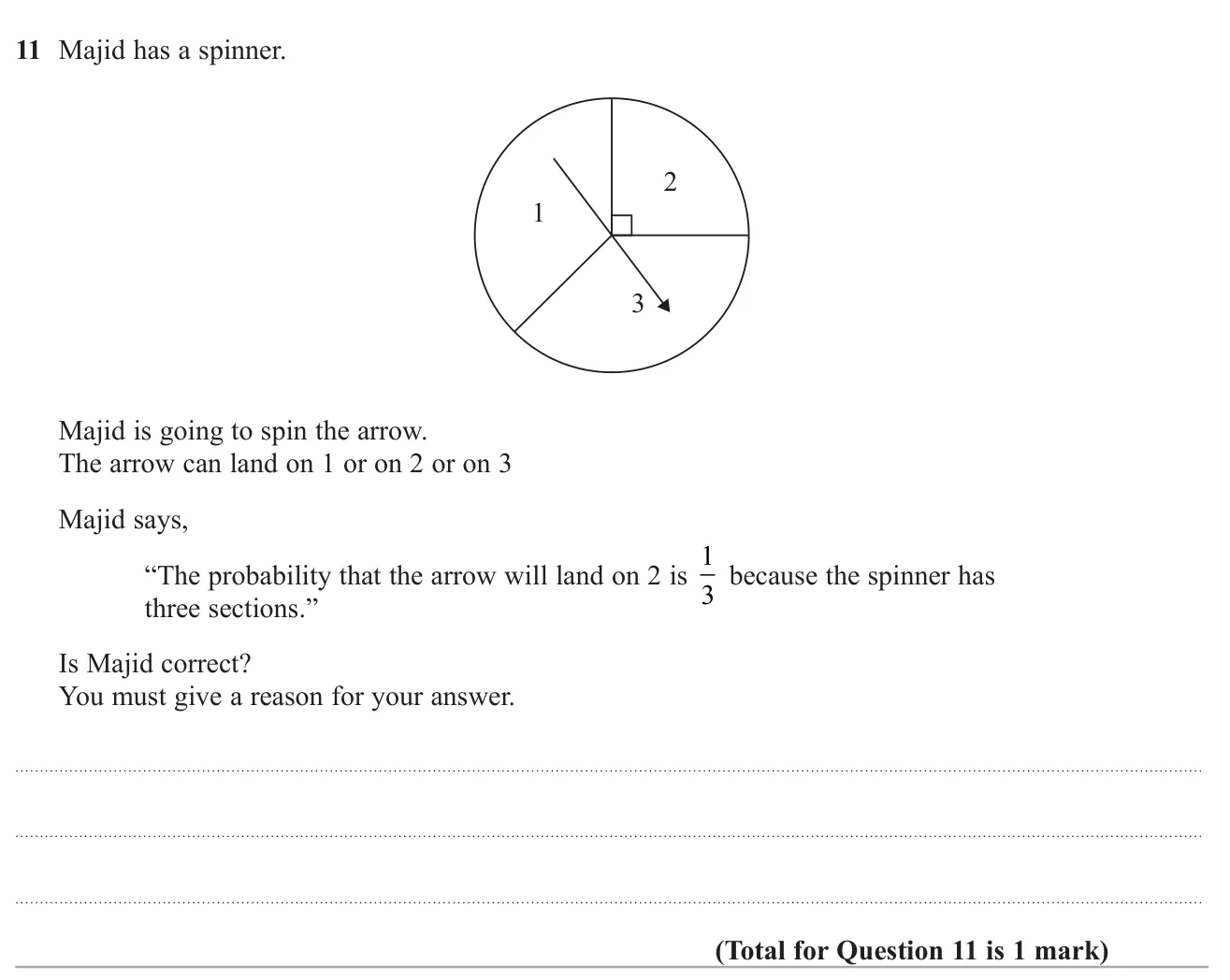
© Pearson Education Ltd. June 2024 Paper 2 (Foundation, calculator), question 11.
Show answer
| Answer | No, because the sections are not the same size (2 is a 90° section, so its probability is 41) | 1 mark |
|---|
Worked solution Checked against the mark scheme
The three sections are not equal: section 2 is a right angle (90∘) and the others are larger.
So the outcomes are not equally likely.
Majid is not correct: P(2)=36090=41, not 31.
Watch out: Saying 'No' with no reason, or saying 'Yes, there are 3 numbers'.
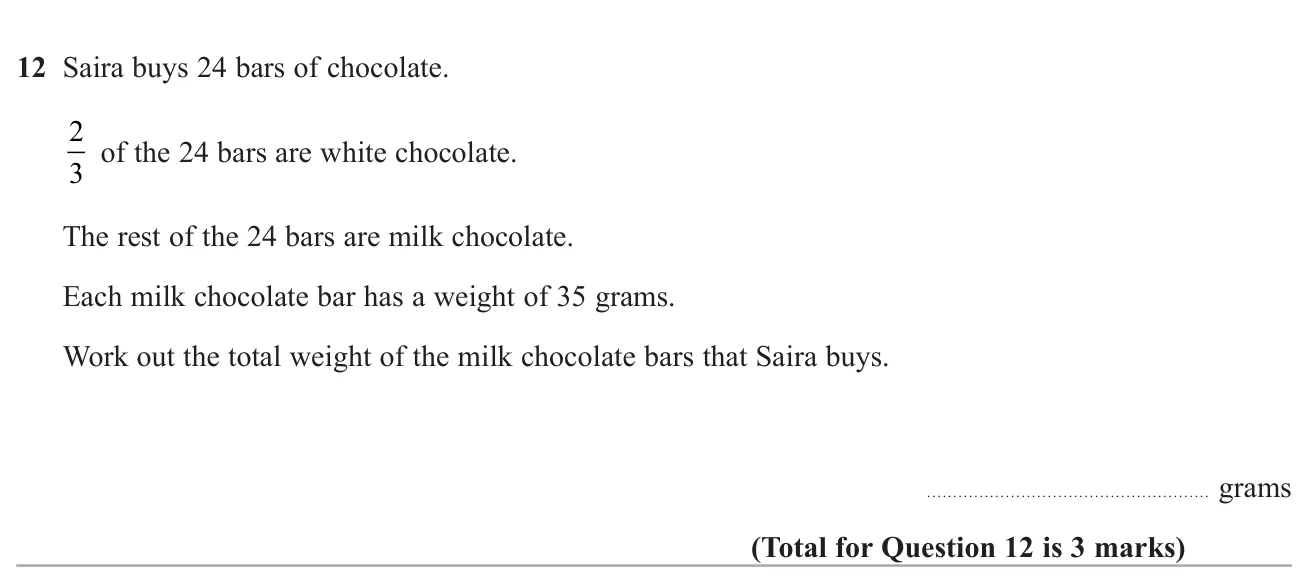
© Pearson Education Ltd. June 2024 Paper 2 (Foundation, calculator), question 12.
Show answer
| Answer | 280 grams | 3 marks |
|---|
Worked solution Checked against the mark scheme
White bars =32×24=16
Milk bars =24−16=8
Weight =8×35=280 g
Watch out: Using the white chocolate bars and getting 16×35=560.
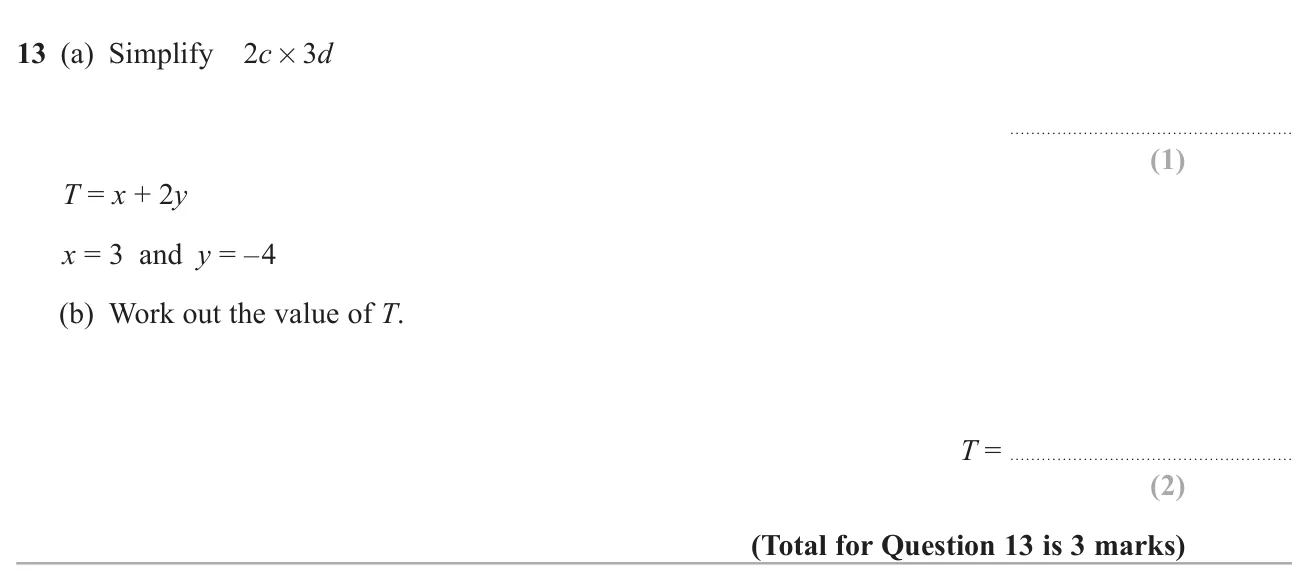
© Pearson Education Ltd. June 2024 Paper 2 (Foundation, calculator), question 13.
Show answer
| (a) | 6cd | 1 mark |
|---|
| (b) | T=−5 | 2 marks |
|---|
Worked solution Checked against the mark scheme
(a) 2c×3d=2×3×c×d=6cd
(b) T=3+2×(−4)=3−8=−5
Watch out: In (b), working out 3+2=5 first and then multiplying by −4.
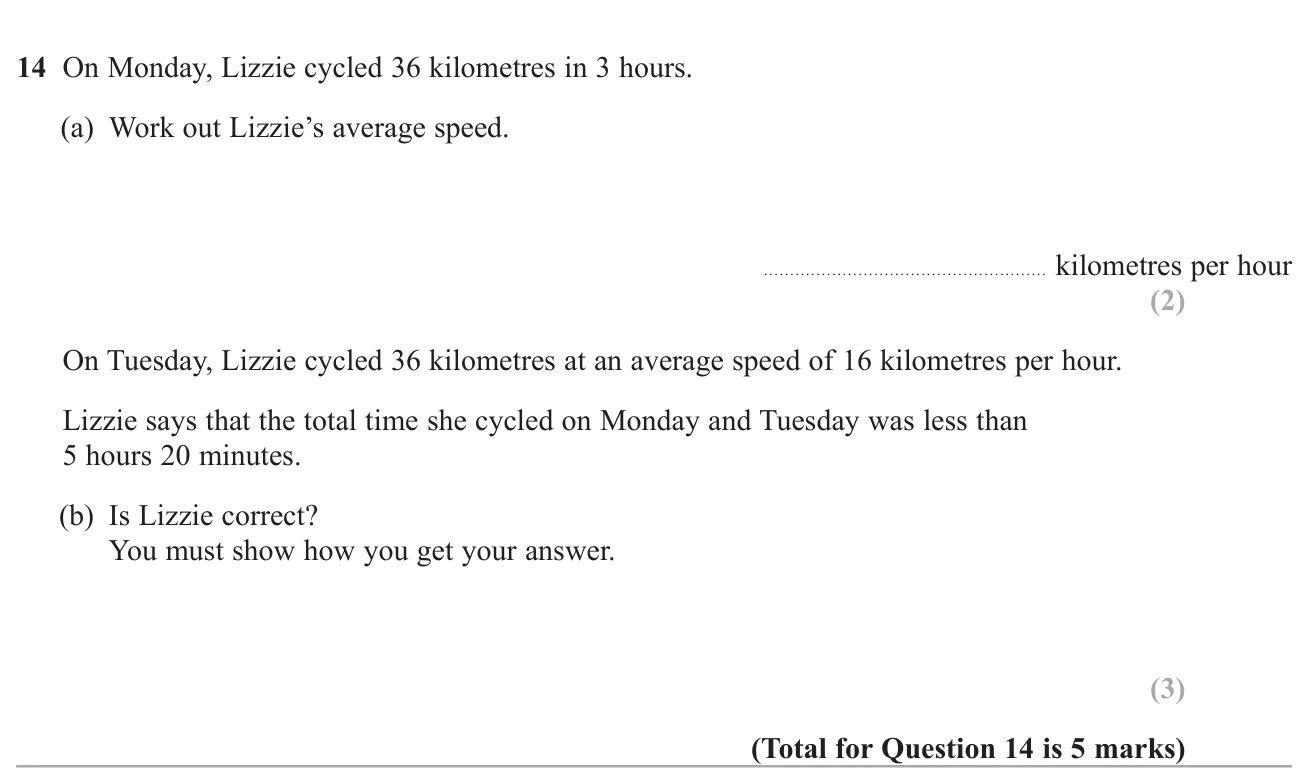
© Pearson Education Ltd. June 2024 Paper 2 (Foundation, calculator), question 14.
Show answer
| (a) | 12 km/h | 2 marks |
|---|
| (b) | Yes: total time is 5 hours 15 minutes, which is less than 5 hours 20 minutes | 3 marks |
|---|
Worked solution Checked against the mark scheme
(a) Speed =36÷3=12 km/h
(b) Tuesday time =36÷16=2.25 hours =2 h 15 min
Total =3 h +2 h 15 min =5 h 15 min
5 h 15 min <5 h 20 min, so Lizzie is correct.
Watch out: Treating 2.25 hours as 2 hours 25 minutes.
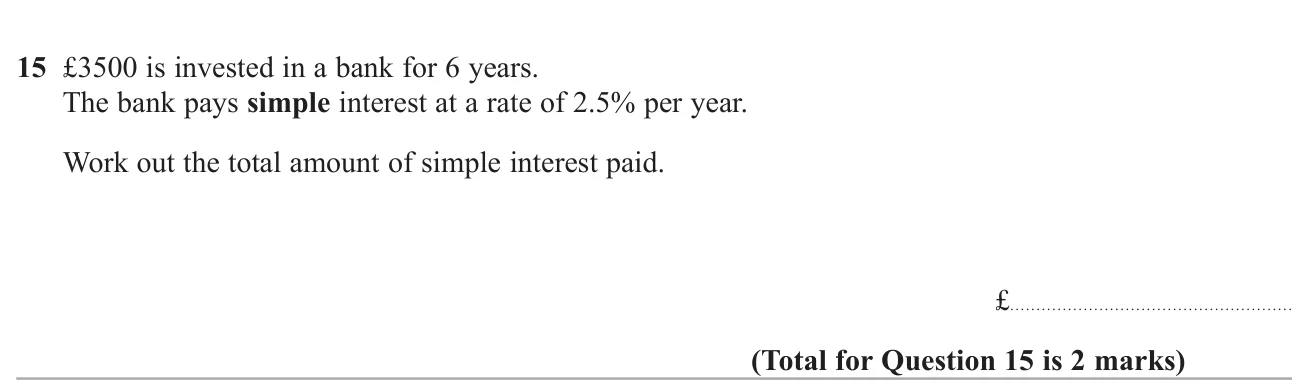
© Pearson Education Ltd. June 2024 Paper 2 (Foundation, calculator), question 15.
Show answer
| Answer | £525 | 2 marks |
|---|
Worked solution Checked against the mark scheme
Interest per year =2.5% of 3500=0.025×3500=£87.50
Total interest =87.50×6=£525
Watch out: Using compound interest, or giving the final amount £4025 instead of the interest.
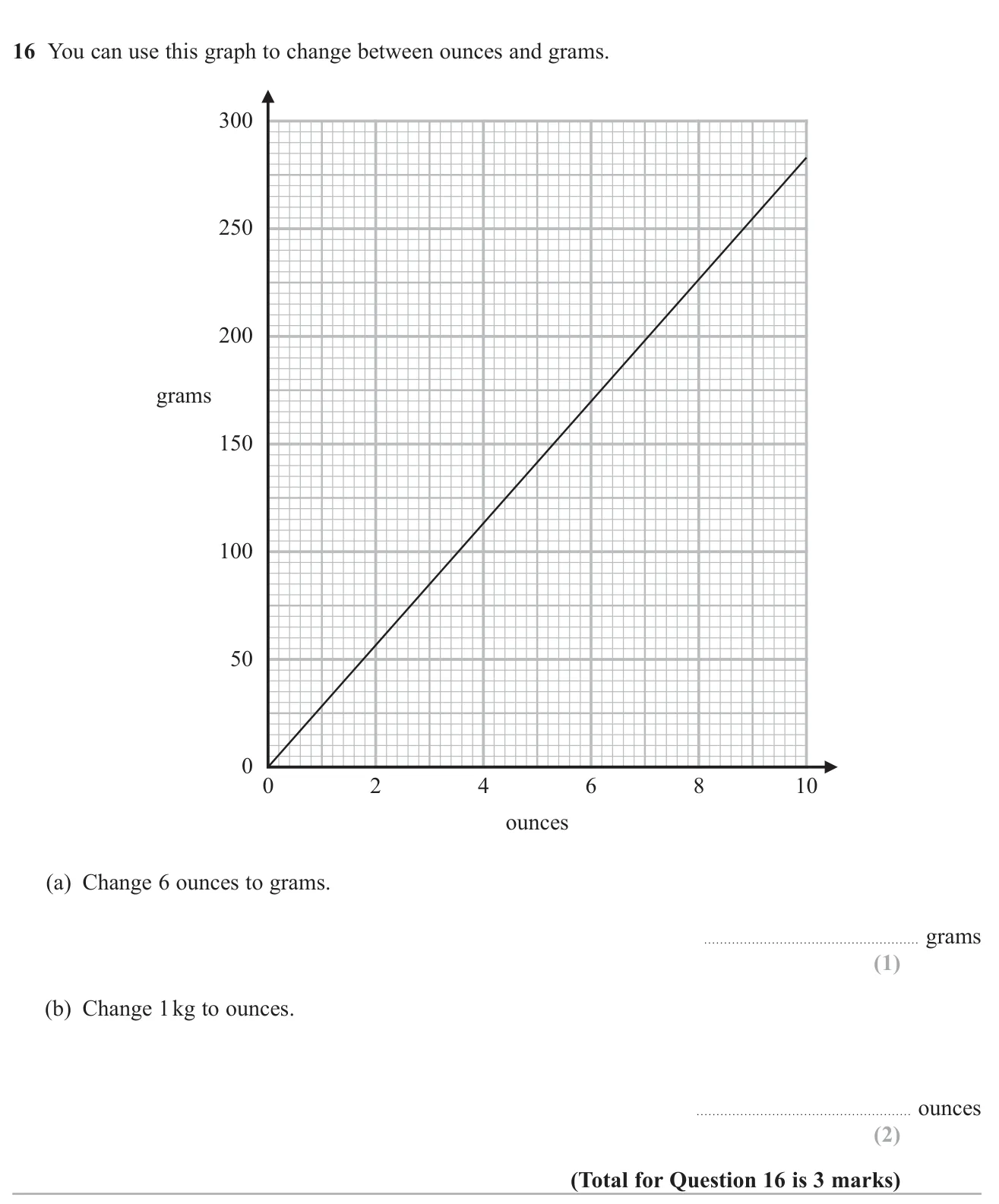
© Pearson Education Ltd. June 2024 Paper 2 (Foundation, calculator), question 16.
Show answer
| (a) | 170 grams (accept 167 to 173) | 1 mark |
|---|
| (b) | 35 ounces (accept 34 to 36) | 2 marks |
|---|
Worked solution Checked against the mark scheme
(a) Go up from 6 ounces to the line and across: about 170 g.
(b) 1 kg =1000 g, which is off the graph. Read 200 g ≈7 ounces.
1000=5×200, so 1000 g ≈5×7=35 ounces.
Watch out: Reading 1000 g as 1 on the grams axis, or forgetting to convert kg to g.
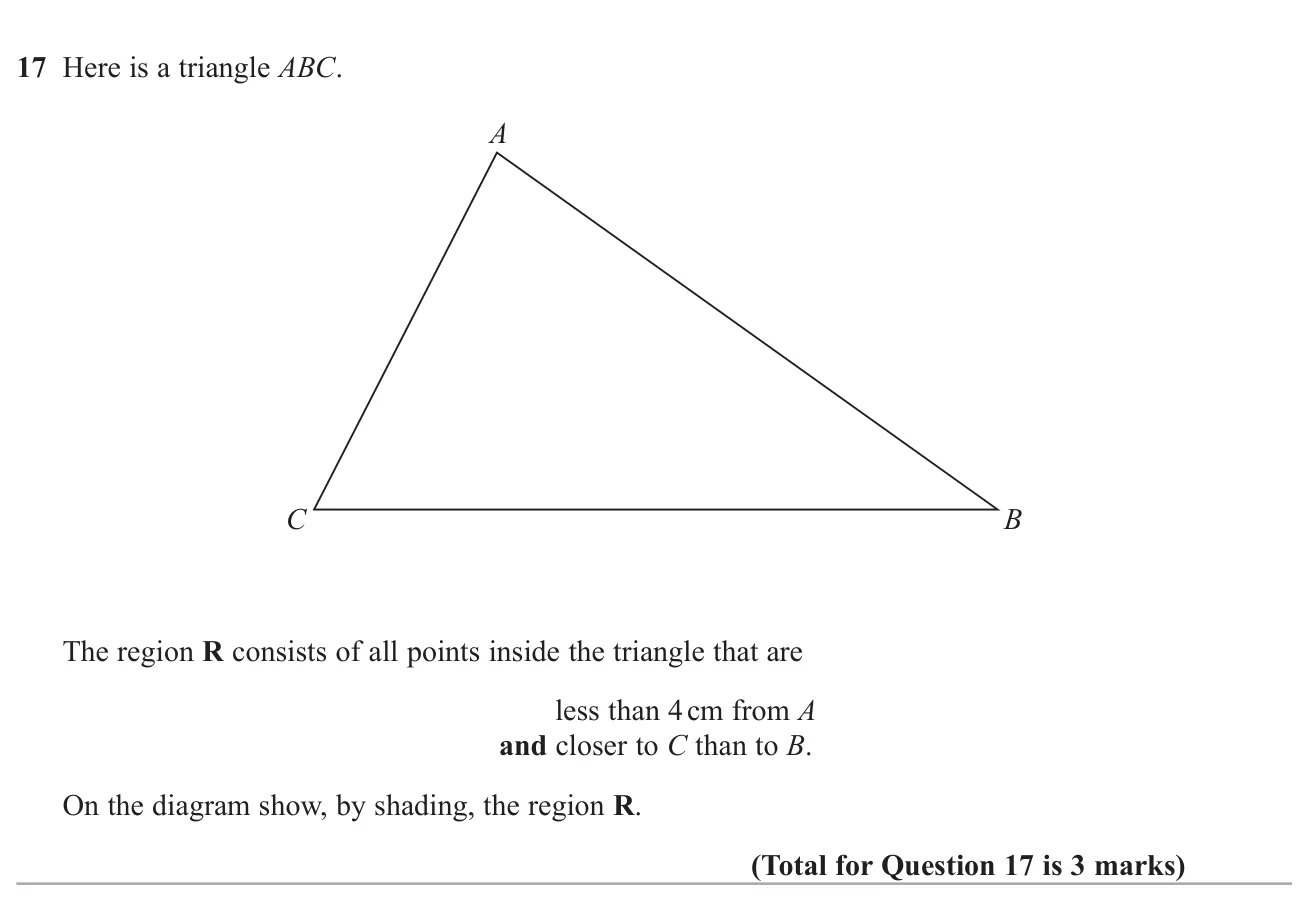
© Pearson Education Ltd. June 2024 Paper 2 (Foundation, calculator), question 17.
Show answer
| Answer | Region inside the triangle, inside a 4 cm arc centred at A and on the C side of the perpendicular bisector of CB | 3 marks |
|---|
Worked solution Checked against the mark scheme
1. Set compasses to 4 cm and draw an arc centred at A. Points inside it are less than 4 cm from A.
2. Construct the perpendicular bisector of CB. Points on the C side are closer to C than to B.
3. Shade the part of the triangle that is inside the arc and on the C side of the bisector.
Watch out: Bisecting the angle at A instead of drawing the perpendicular bisector of CB.
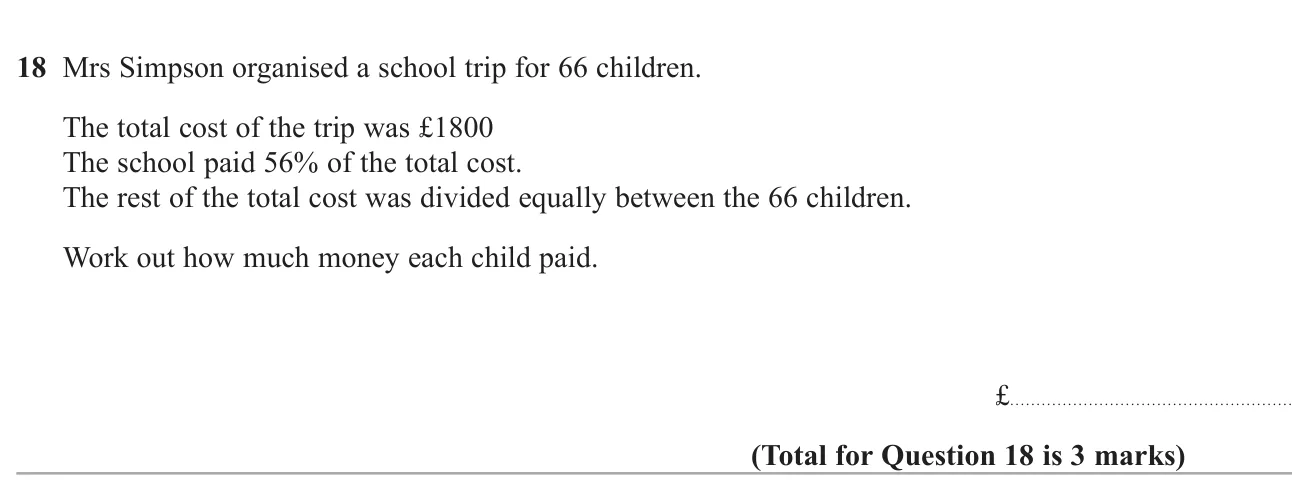
© Pearson Education Ltd. June 2024 Paper 2 (Foundation, calculator), question 18.
Show answer
Worked solution Checked against the mark scheme
Children pay 100%−56%=44%
0.44×1800=£792
Each child pays 792÷66=£12
Watch out: Dividing the school's share (£1008) by 66 instead.
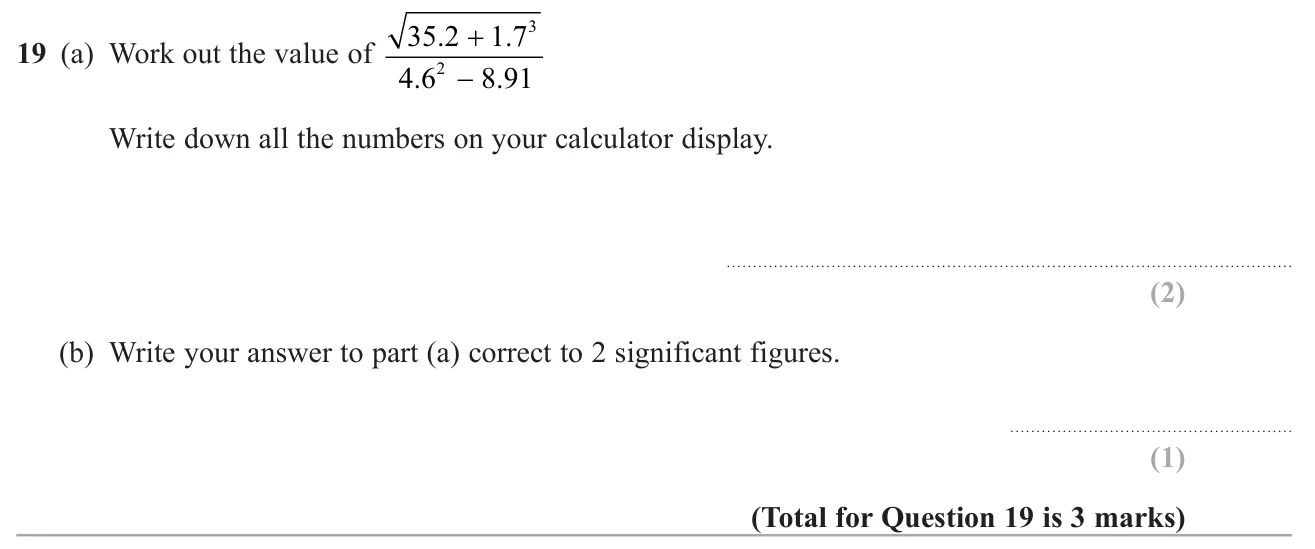
© Pearson Education Ltd. June 2024 Paper 2 (Foundation, calculator), question 19.
Show answer
| (a) | 0.5170189759… | 2 marks |
|---|
| (b) | 0.52 | 1 mark |
|---|
Worked solution Checked against the mark scheme
The expression is 4.62−8.9135.2+1.73 (the square root covers the whole numerator).
Numerator: 35.2+4.913=40.113=6.33348…
Denominator: 21.16−8.91=12.25
(a) 6.33348…÷12.25=0.5170189759…
(b) 0.52 (2 s.f.)
Watch out: Not using brackets on the calculator, so only 35.2 goes under the root or only part of the denominator is used.
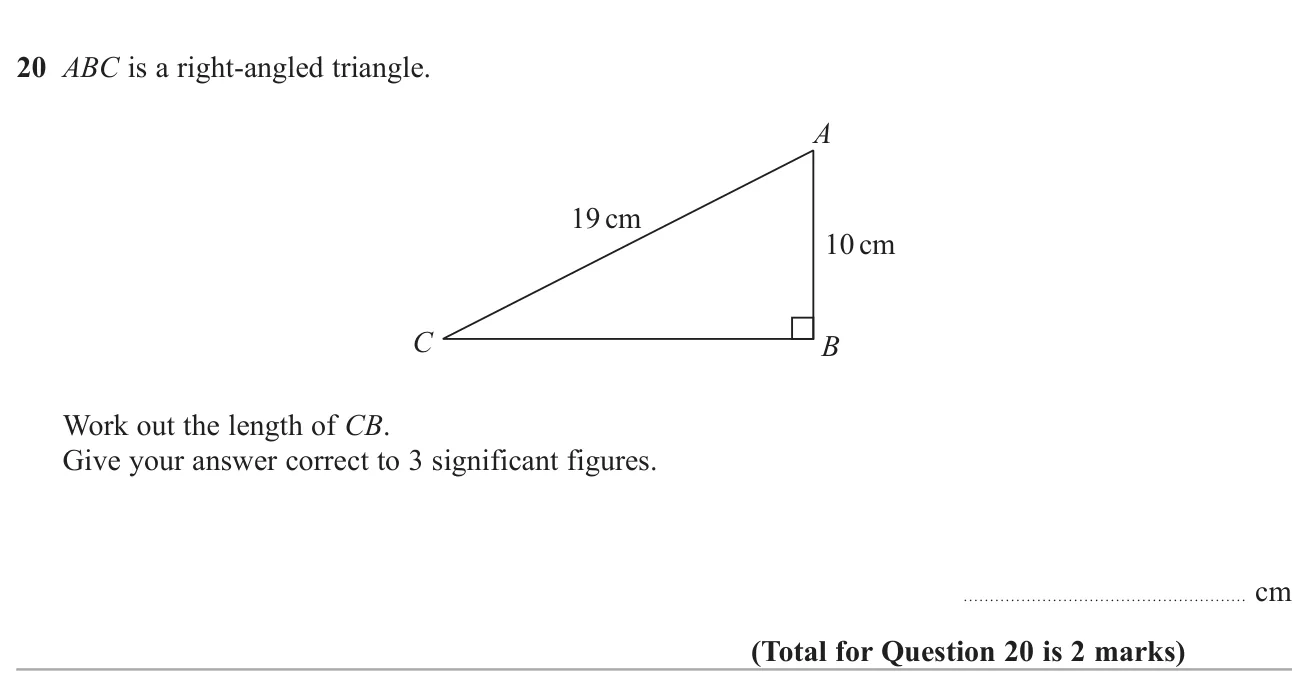
© Pearson Education Ltd. June 2024 Paper 2 (Foundation, calculator), question 20.
Show answer
| Answer | 16.2 cm (accept 16.1 to 16.2) | 2 marks |
|---|
Worked solution Checked against the mark scheme
19 cm is the hypotenuse.
CB2=192−102=361−100=261
CB=261=16.155…≈16.2 cm
Watch out: Adding the squares (461=21.5) instead of subtracting.
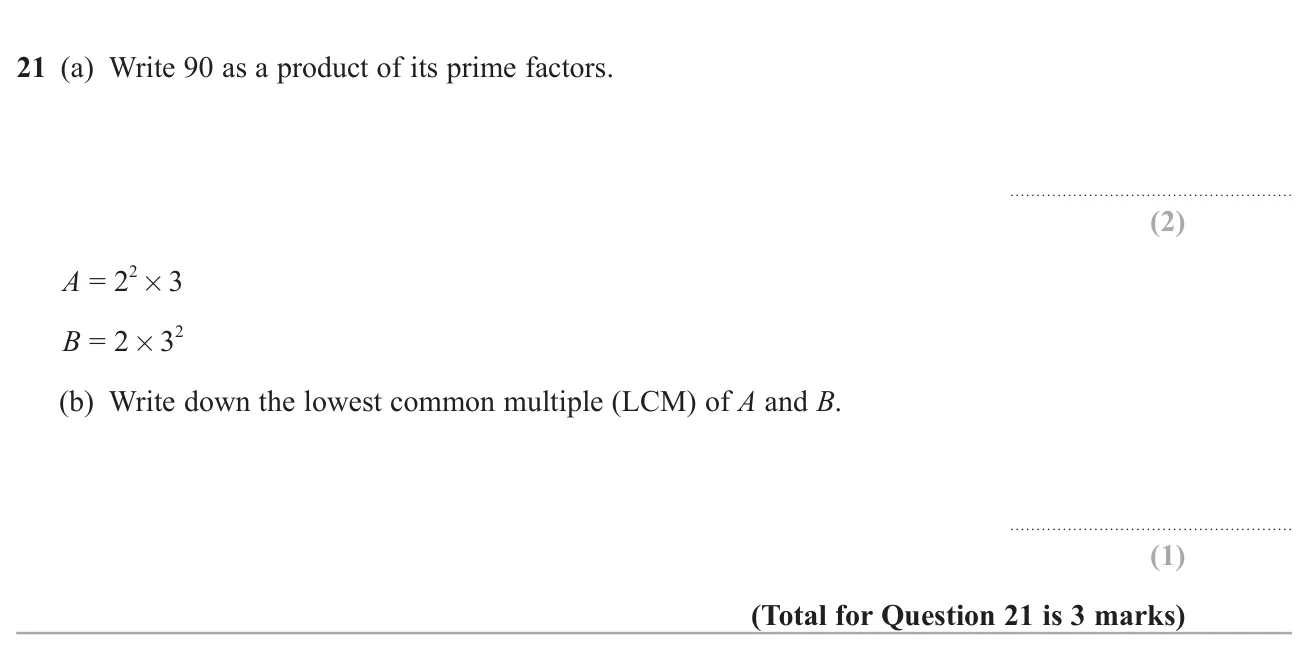
© Pearson Education Ltd. June 2024 Paper 2 (Foundation, calculator), question 21.
Show answer
| (a) | 2×32×5 | 2 marks |
|---|
| (b) | 36 | 1 mark |
|---|
Worked solution Checked against the mark scheme
(a) 90=2×45=2×3×15=2×3×3×5=2×32×5
(b) A=22×3=12, B=2×32=18.
LCM uses the highest power of each prime: 22×32=36
Watch out: Listing the primes 2, 3, 5 without repeats, or giving the HCF (6) in part (b).
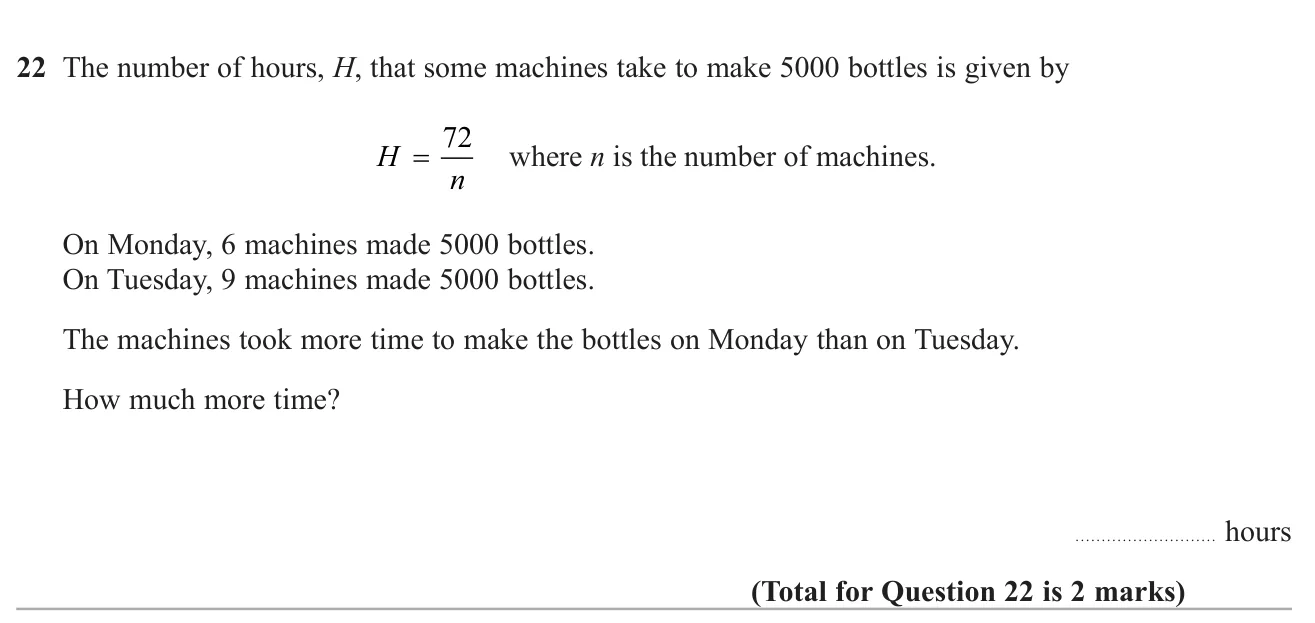
© Pearson Education Ltd. June 2024 Paper 2 (Foundation, calculator), question 22.
Show answer
Worked solution Checked against the mark scheme
The formula is H=n72.
Monday: 72÷6=12 hours
Tuesday: 72÷9=8 hours
Difference =12−8=4 hours
Watch out: Working out 72÷(9−6)=24.
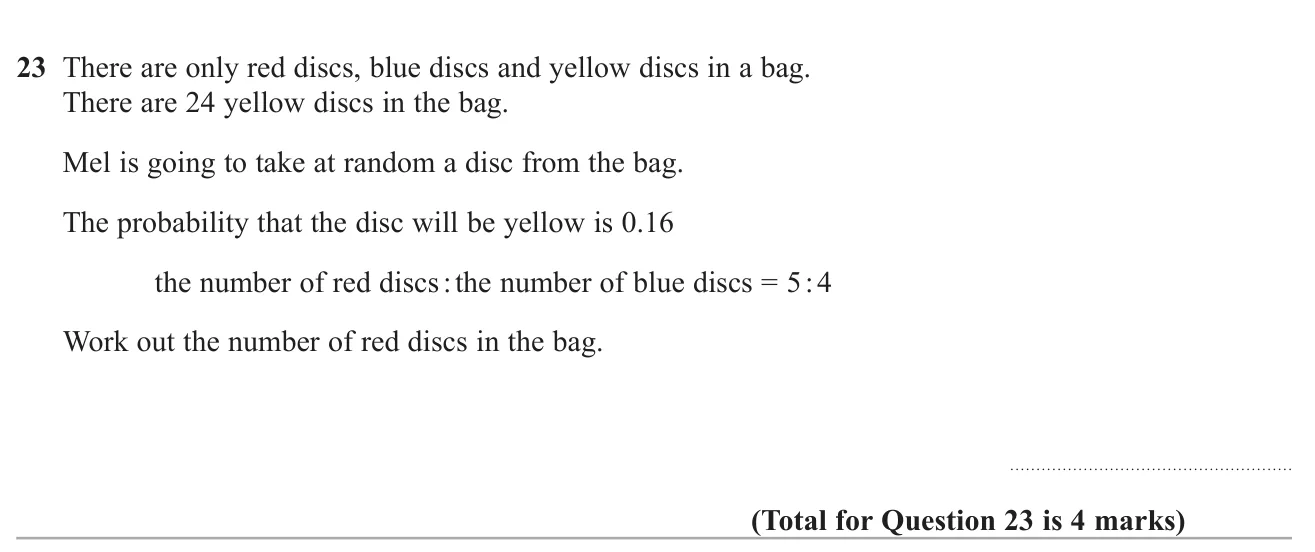
© Pearson Education Ltd. June 2024 Paper 2 (Foundation, calculator), question 23.
Show answer
Worked solution Checked against the mark scheme
Total discs =24÷0.16=150
Red and blue =150−24=126
One part =126÷(5+4)=14
Red =5×14=70
Watch out: Sharing 150 (instead of 126) in the ratio 5 : 4.
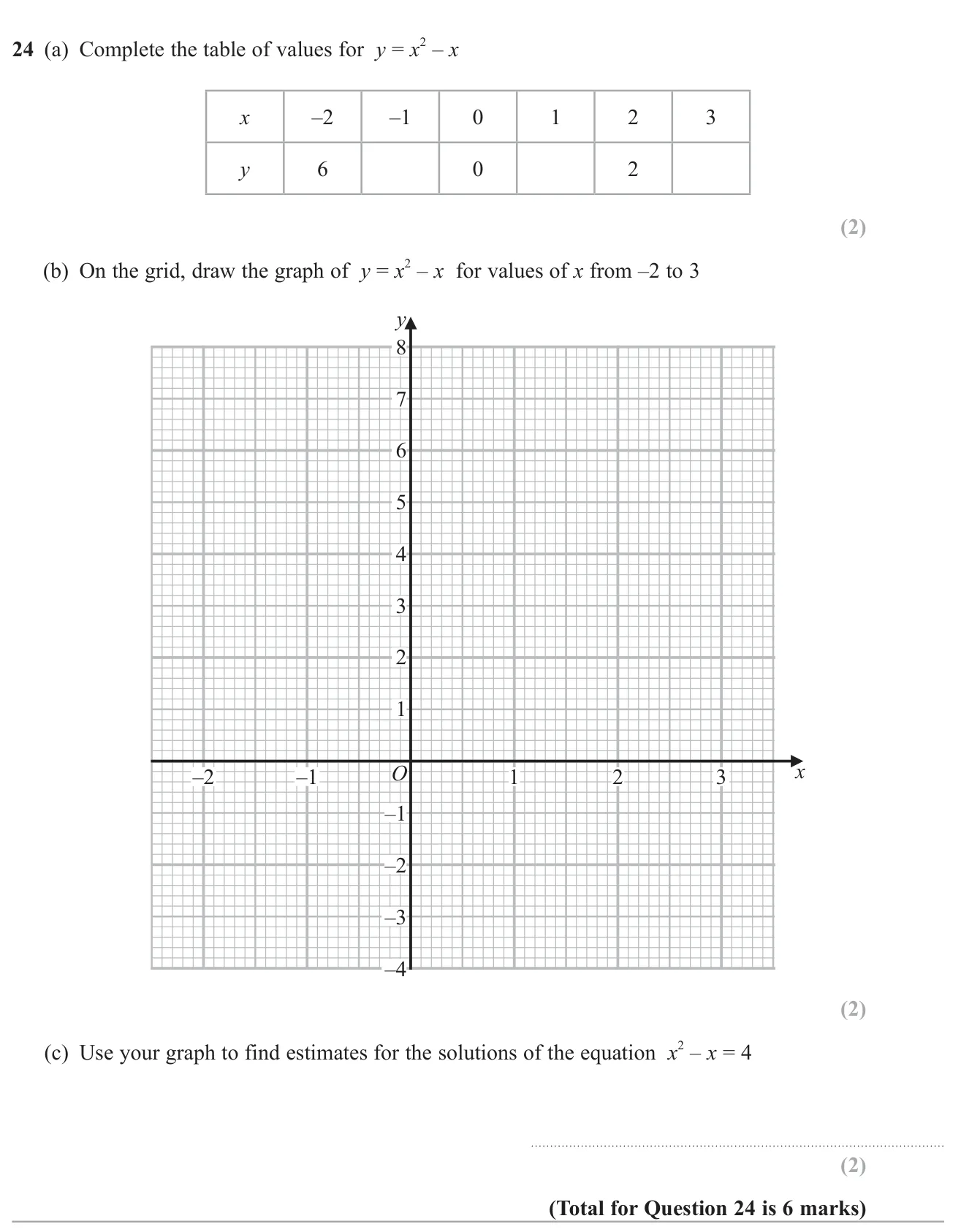
© Pearson Education Ltd. June 2024 Paper 2 (Foundation, calculator), question 24.
Show answer
| (a) | y values: 6, 2, 0, 0, 2, 6 (missing: 2 at x=−1, 0 at x=1, 6 at x=3) | 2 marks |
|---|
| (b) | Smooth U-shaped curve through the points | 2 marks |
|---|
| (c) | x≈−1.6 and x≈2.6 (accept −1.7 to −1.5 and 2.5 to 2.7) | 2 marks |
|---|
Worked solution Checked against the mark scheme
(a) x=−1: 1+1=2. x=1: 1−1=0. x=3: 9−3=6.
(b) Plot (−2,6),(−1,2),(0,0),(1,0),(2,2),(3,6) and join with a smooth curve.
(c) Draw y=4 and read where it crosses the curve: x≈−1.6 and x≈2.6.
Watch out: Working out (−1)2−(−1) as 0 instead of 2.
© Pearson Education Ltd. June 2024 Paper 2 (Foundation, calculator), question 25.
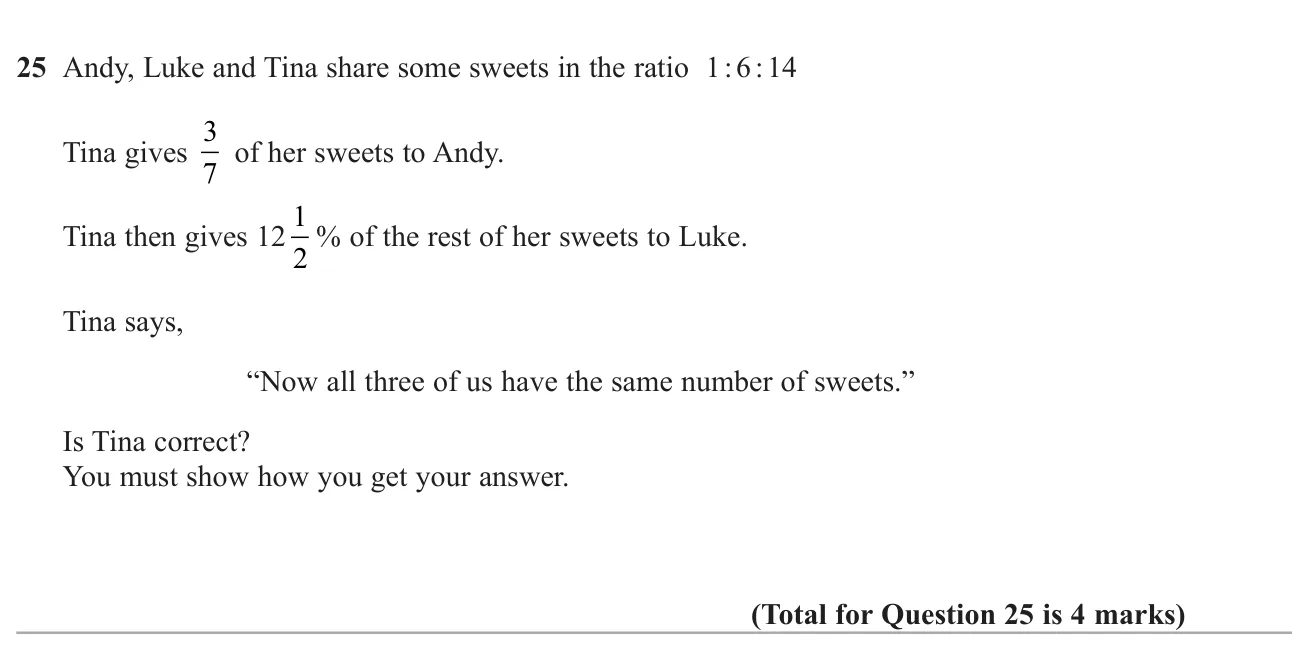
Show answer
| Answer | Yes: each person ends with the same amount (e.g. 7 : 7 : 7 per 21 parts, or 147 each out of 441) | 4 marks |
|---|
Worked solution Checked against the mark scheme
Take the shares as 1:6:14 parts (21 parts).
Tina gives Andy 73×14=6. Now Andy =7, Tina =8.
Tina gives Luke 12.5% of 8=1. Now Luke =7, Tina =7.
Final: Andy 7, Luke 7, Tina 7 parts, so Tina is correct.
Watch out: Taking 12.5% of Tina's original share instead of what remains.
© Pearson Education Ltd. June 2024 Paper 2 (Foundation, calculator), question 26.
Show answer
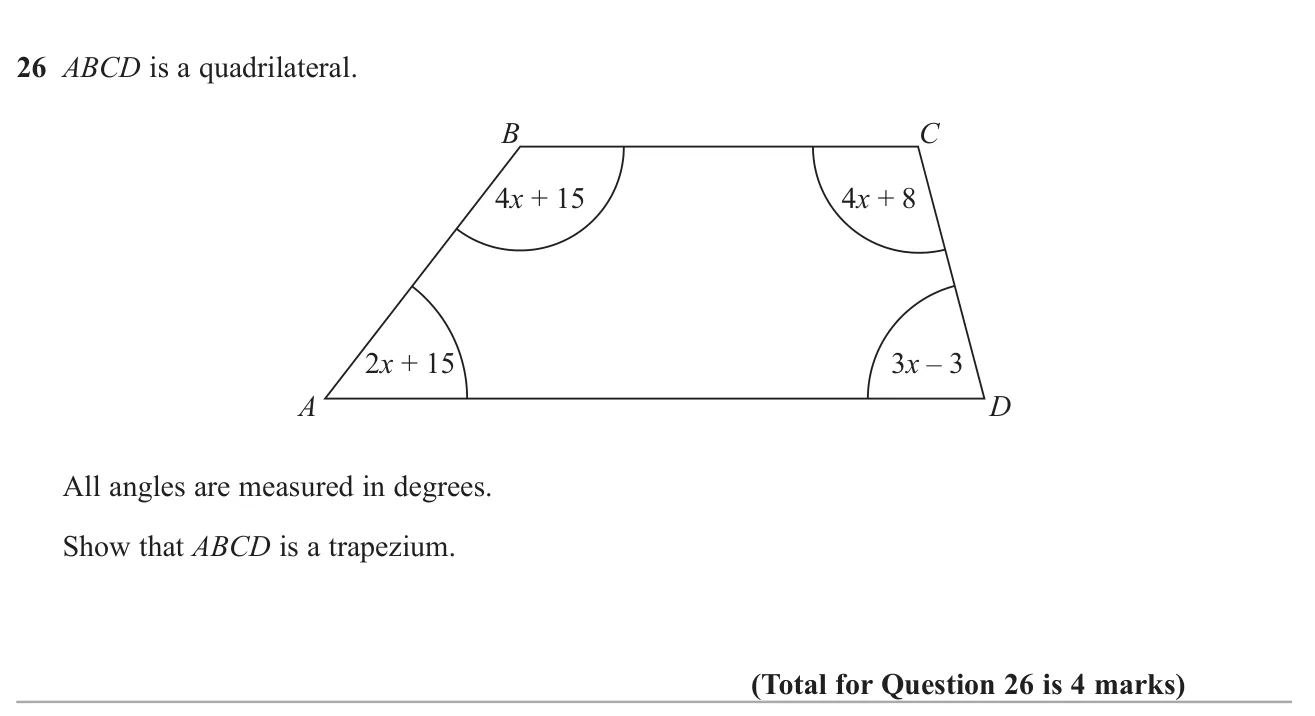
| Answer | x=25, giving A+B=65∘+115∘=180∘ so AD is parallel to BC (co-interior angles) | 4 marks |
|---|
Worked solution Checked against the mark scheme
Angles in a quadrilateral add to 360∘:
(2x+15)+(4x+15)+(4x+8)+(3x−3)=360
13x+35=360⇒x=25
A=65∘, B=115∘, so A+B=180∘.
Co-interior angles add to 180∘, so AD is parallel to BC and ABCD is a trapezium.
Watch out: Finding x but not showing a pair of angles adds to 180° with a reason.
© Pearson Education Ltd. June 2024 Paper 2 (Foundation, calculator), question 27.
Show answer
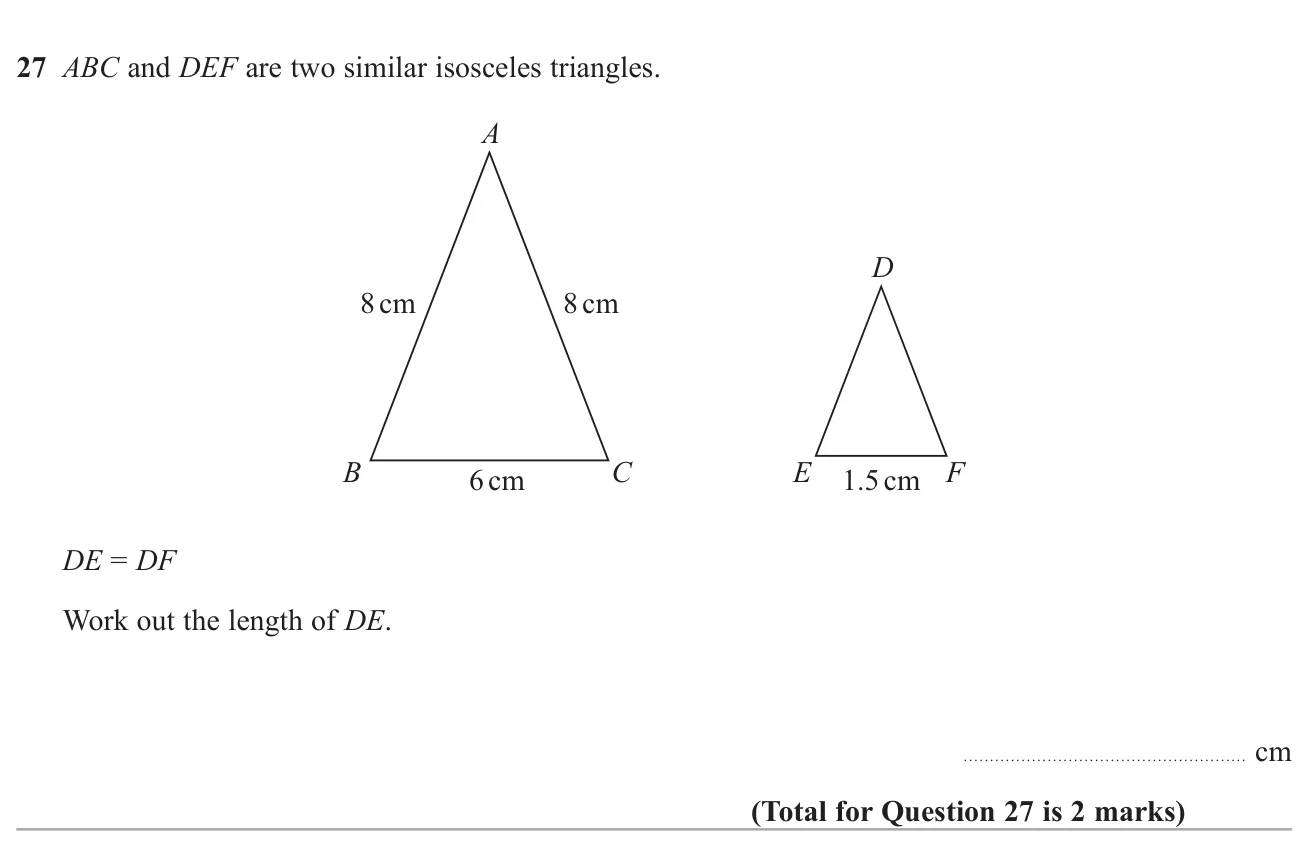
Worked solution Checked against the mark scheme
The bases are BC=6 and EF=1.5, so the scale factor is 1.5÷6=41.
DE=8×41=2 cm
Watch out: Subtracting (8−4.5=3.5) instead of using a multiplier.
© Pearson Education Ltd. June 2024 Paper 2 (Foundation, calculator), question 28.
Show answer
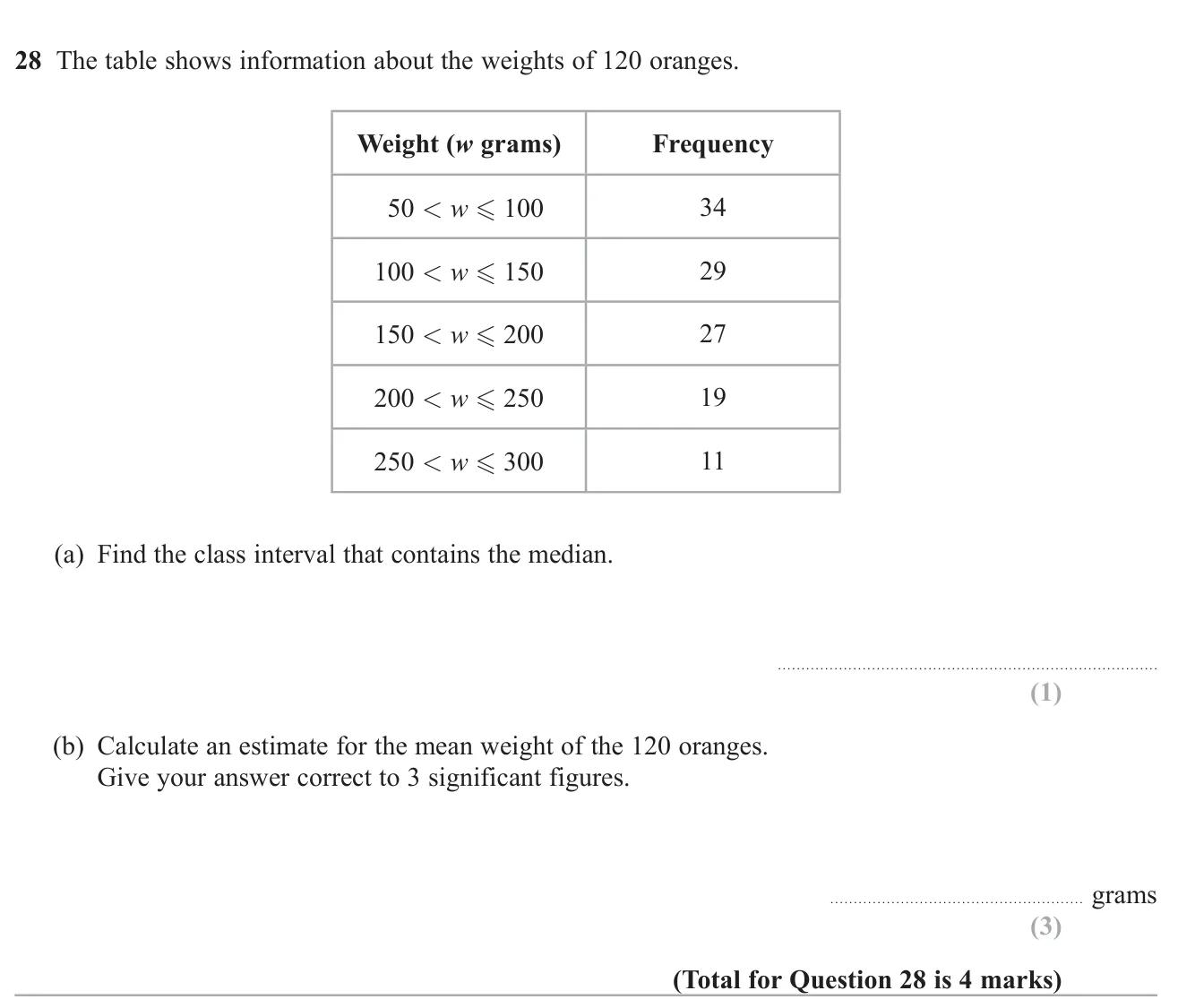
| (a) | 100<w≤150 | 1 mark |
|---|
| (b) | 152 grams | 3 marks |
|---|
Worked solution Checked against the mark scheme
(a) The median is about the 60th/61st value. 34<60≤34+29=63, so it is in 100<w≤150.
(b) Midpoints: 75, 125, 175, 225, 275.
∑fx=2550+3625+4725+4275+3025=18200
Mean ≈18200÷120=151.67≈152 g
Watch out: Dividing by 5 (number of classes) instead of 120.
Finished the paper?
Add up your marks for all three papers and see what grade that would have been.