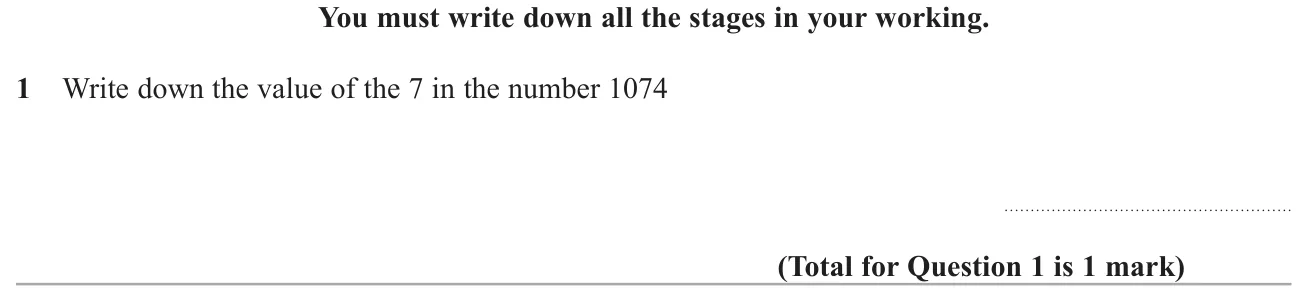
© Pearson Education Ltd. November 2019 Paper 1 (Foundation, non-calculator), question 1.
Answer 70 70 70 1 mark
Worked solution Checked against the mark scheme
The digits of 1074 are thousands, hundreds, tens, ones: 1, 0, 7, 4.
The 7 is in the tens column, so it is worth 7 × 10 = 70 7 \times 10 = 70 7 × 10 = 70
Watch out: Writing 7 instead of its value 70.
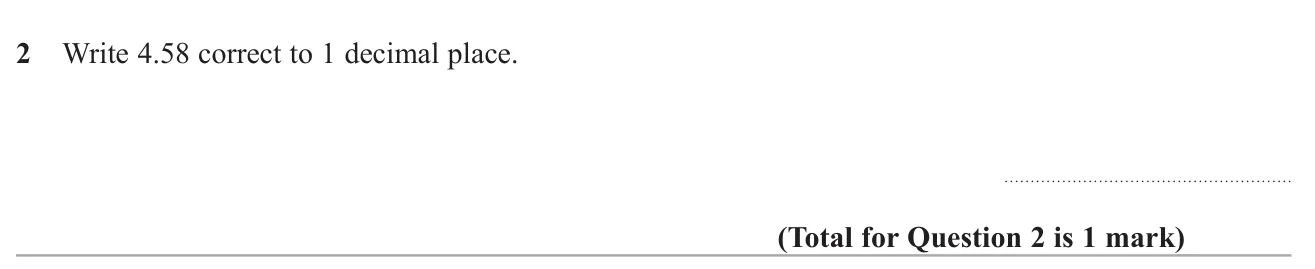
© Pearson Education Ltd. November 2019 Paper 1 (Foundation, non-calculator), question 2.
Worked solution Checked against the mark scheme
Look at the second decimal place: it is 8.
8 is 5 or more, so round the 5 up: 4.58 ≈ 4.6 4.58 \approx 4.6 4.58 ≈ 4.6
Watch out: Truncating to 4.5.
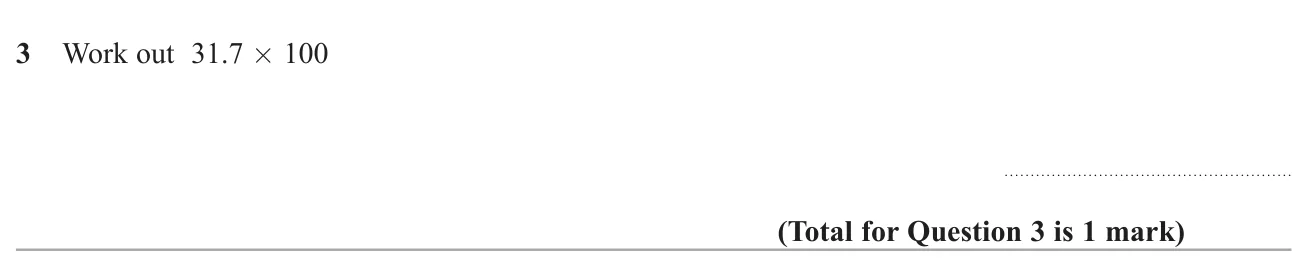
© Pearson Education Ltd. November 2019 Paper 1 (Foundation, non-calculator), question 3.
Worked solution Checked against the mark scheme
Multiplying by 100 moves every digit two places to the left.
31.7 × 100 = 3170 31.7 \times 100 = 3170 31.7 × 100 = 3170
Watch out: Writing 317 or 31.700.
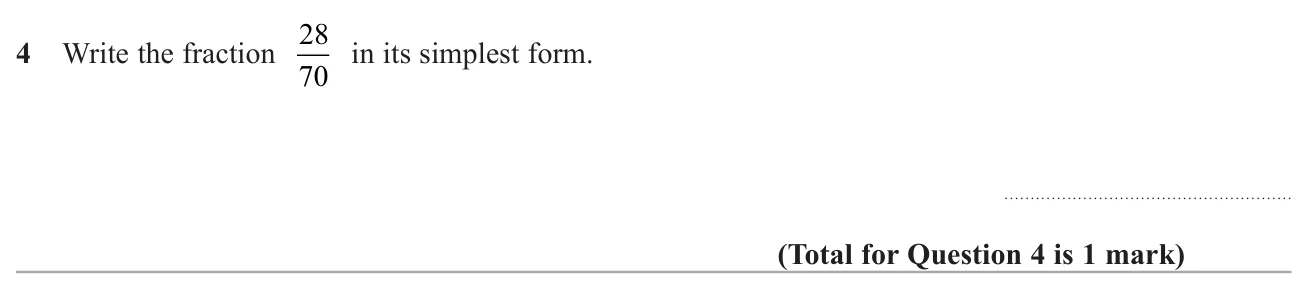
© Pearson Education Ltd. November 2019 Paper 1 (Foundation, non-calculator), question 4.
Answer 2 5 \frac{2}{5} 5 2 1 mark
Worked solution Checked against the mark scheme
The highest common factor of 28 and 70 is 14.
28 70 = 28 ÷ 14 70 ÷ 14 = 2 5 \frac{28}{70} = \frac{28 \div 14}{70 \div 14} = \frac{2}{5} 70 28 = 70 ÷ 14 28 ÷ 14 = 5 2
Watch out: Stopping at a partly simplified fraction such as 14/35.
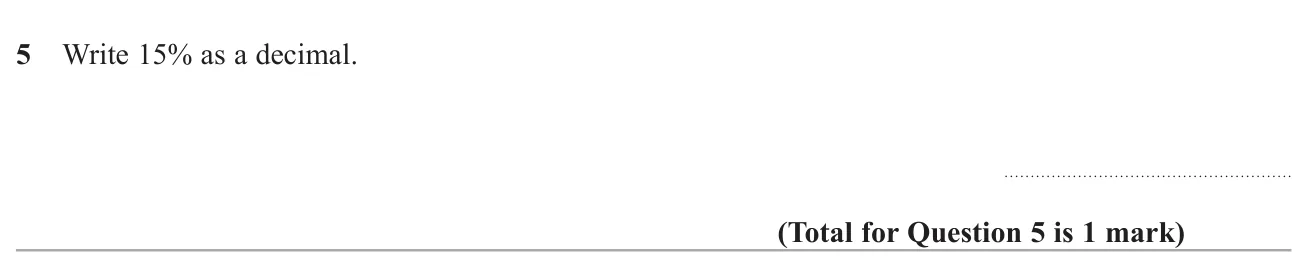
© Pearson Education Ltd. November 2019 Paper 1 (Foundation, non-calculator), question 5.
Worked solution Checked against the mark scheme
Per cent means out of 100, so divide by 100.
15 % = 15 ÷ 100 = 0.15 15\% = 15 \div 100 = 0.15 15% = 15 ÷ 100 = 0.15
Watch out: Writing 1.5 or 0.015.
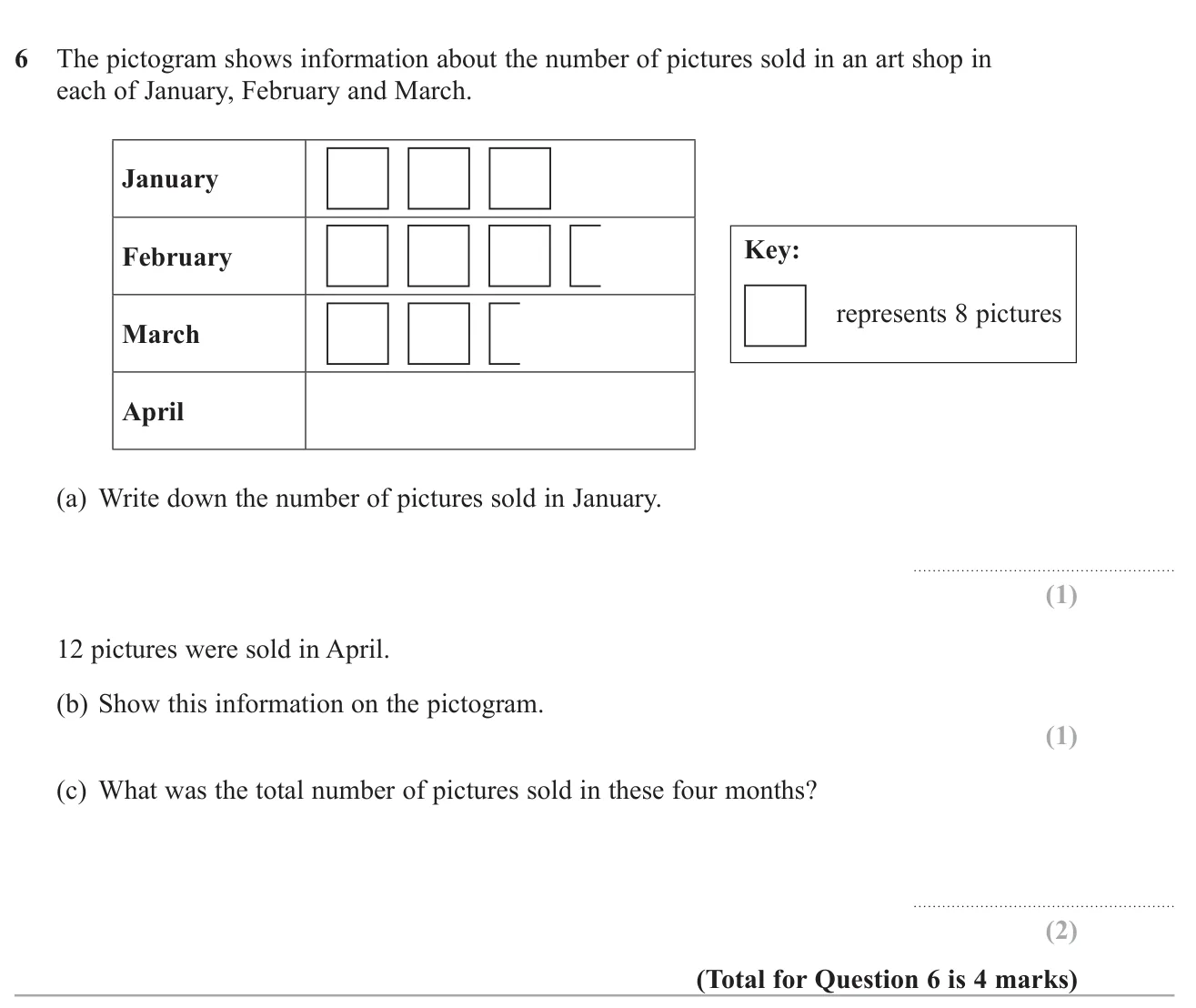
© Pearson Education Ltd. November 2019 Paper 1 (Foundation, non-calculator), question 6.
(a) 24 24 24 1 mark (b) One and a half symbols in the April row 1 mark (c) 84 84 84 2 marks
Worked solution Checked against the mark scheme
(a) January has 3 whole squares: 3 × 8 = 24 3 \times 8 = 24 3 × 8 = 24
(b) 12 = 8 + 4 12 = 8 + 4 12 = 8 + 4
(c) February 3.5 × 8 = 28 3.5 \times 8 = 28 3.5 × 8 = 28 2.5 × 8 = 20 2.5 \times 8 = 20 2.5 × 8 = 20
Total = 24 + 28 + 20 + 12 = 84 = 24 + 28 + 20 + 12 = 84 = 24 + 28 + 20 + 12 = 84
Watch out: Treating a half symbol as 1 picture or forgetting to include April.
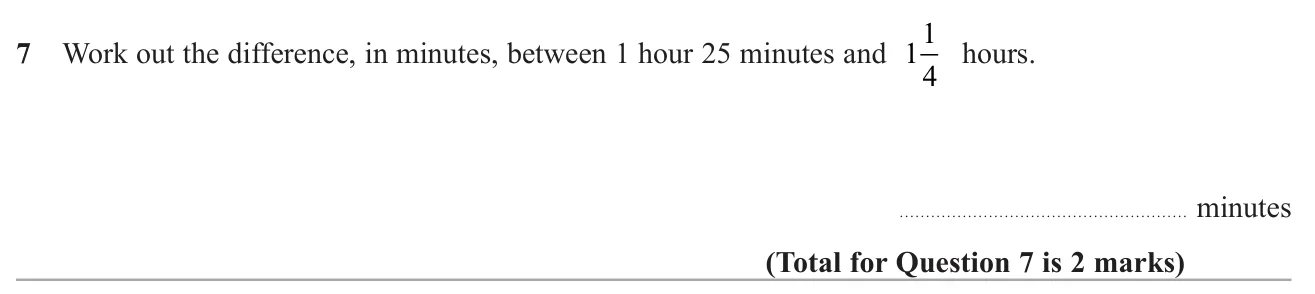
© Pearson Education Ltd. November 2019 Paper 1 (Foundation, non-calculator), question 7.
Answer 10 10 10 2 marks
Worked solution Checked against the mark scheme
1 1 4 1\frac{1}{4} 1 4 1 = 60 + 15 = 75 = 60 + 15 = 75 = 60 + 15 = 75
1 hour 25 minutes = 60 + 25 = 85 = 60 + 25 = 85 = 60 + 25 = 85
Difference = 85 − 75 = 10 = 85 - 75 = 10 = 85 − 75 = 10
Watch out: Thinking a quarter of an hour is 25 minutes.
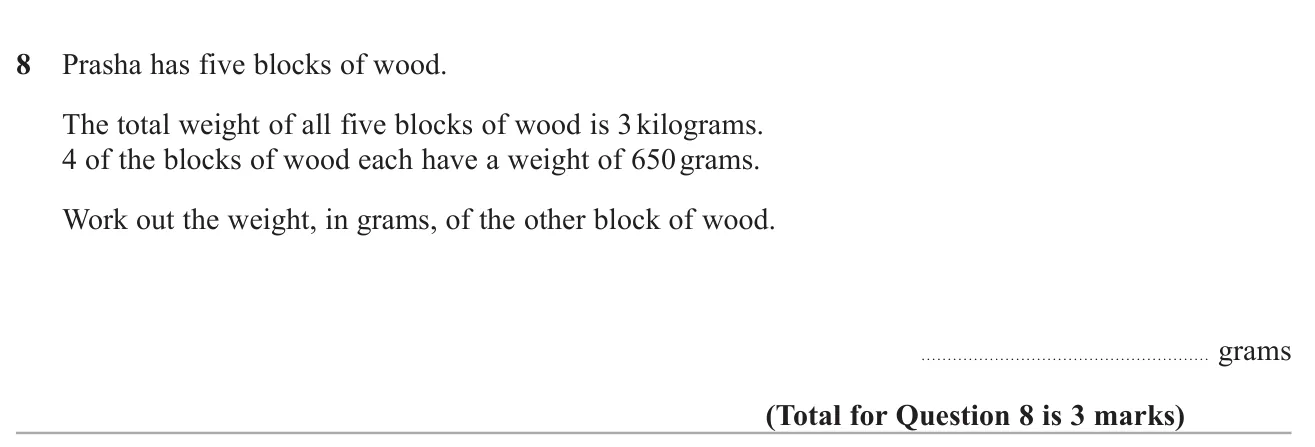
© Pearson Education Ltd. November 2019 Paper 1 (Foundation, non-calculator), question 8.
Answer 400 400 400 3 marks
Worked solution Checked against the mark scheme
Four blocks: 4 × 650 = 2600 4 \times 650 = 2600 4 × 650 = 2600
Total: 3 3 3 = 3000 = 3000 = 3000
Last block: 3000 − 2600 = 400 3000 - 2600 = 400 3000 − 2600 = 400
Watch out: Forgetting to convert kilograms to grams.
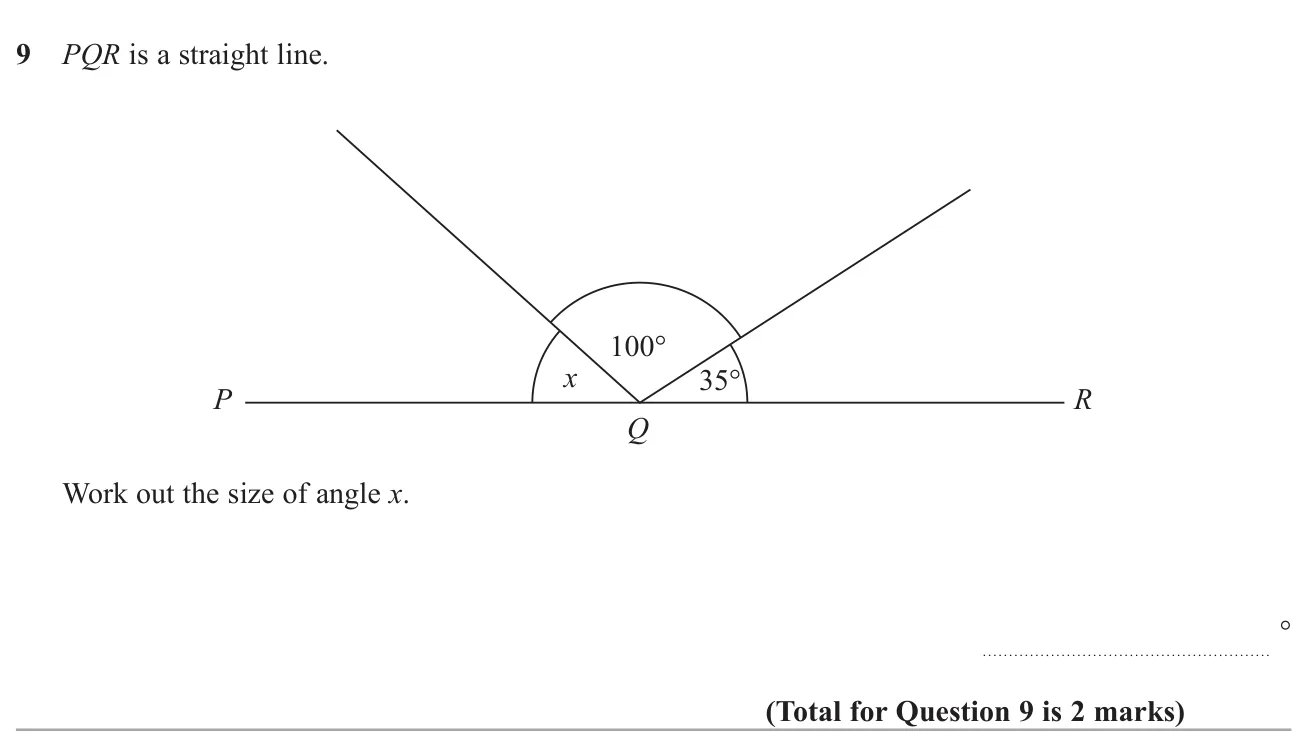
© Pearson Education Ltd. November 2019 Paper 1 (Foundation, non-calculator), question 9.
Worked solution Checked against the mark scheme
Angles on a straight line add up to 180 ° 180° 180°
x = 180 − 100 − 35 = 45 ° x = 180 - 100 - 35 = 45° x = 180 − 100 − 35 = 45°
Watch out: Subtracting from 360 instead of 180.
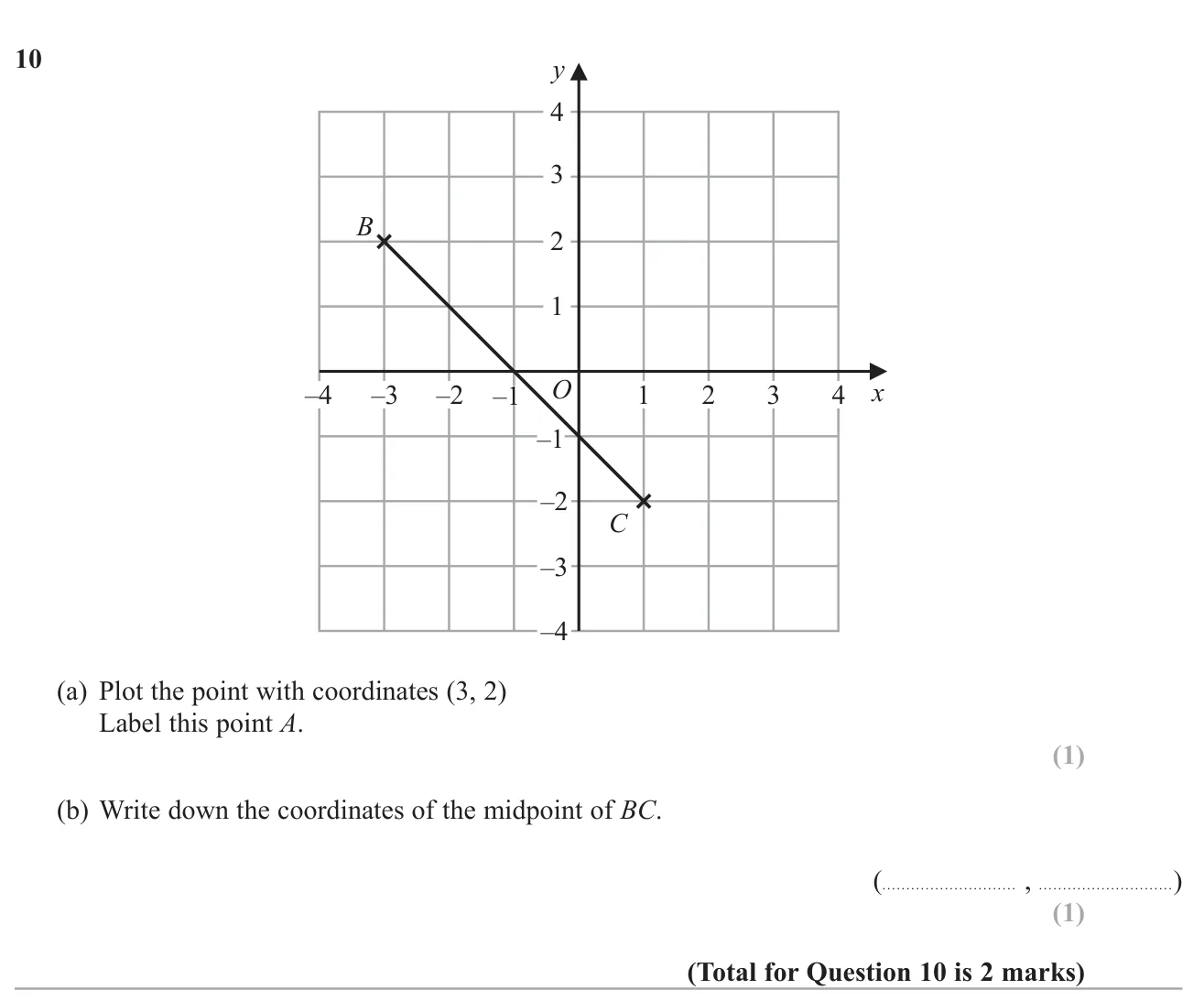
© Pearson Education Ltd. November 2019 Paper 1 (Foundation, non-calculator), question 10.
(a) Point A A A ( 3 , 2 ) (3, 2) ( 3 , 2 ) 1 mark (b) ( − 1 , 0 ) (-1, 0) ( − 1 , 0 ) 1 mark
Worked solution Checked against the mark scheme
(a) Go 3 right from O O O A A A
(b) B = ( − 3 , 2 ) B = (-3, 2) B = ( − 3 , 2 ) C = ( 1 , − 2 ) C = (1, -2) C = ( 1 , − 2 )
Midpoint = ( − 3 + 1 2 , 2 + ( − 2 ) 2 ) = ( − 1 , 0 ) = \left(\frac{-3 + 1}{2}, \frac{2 + (-2)}{2}\right) = (-1, 0) = ( 2 − 3 + 1 , 2 2 + ( − 2 ) ) = ( − 1 , 0 )
Watch out: Plotting (2, 3) instead of (3, 2).
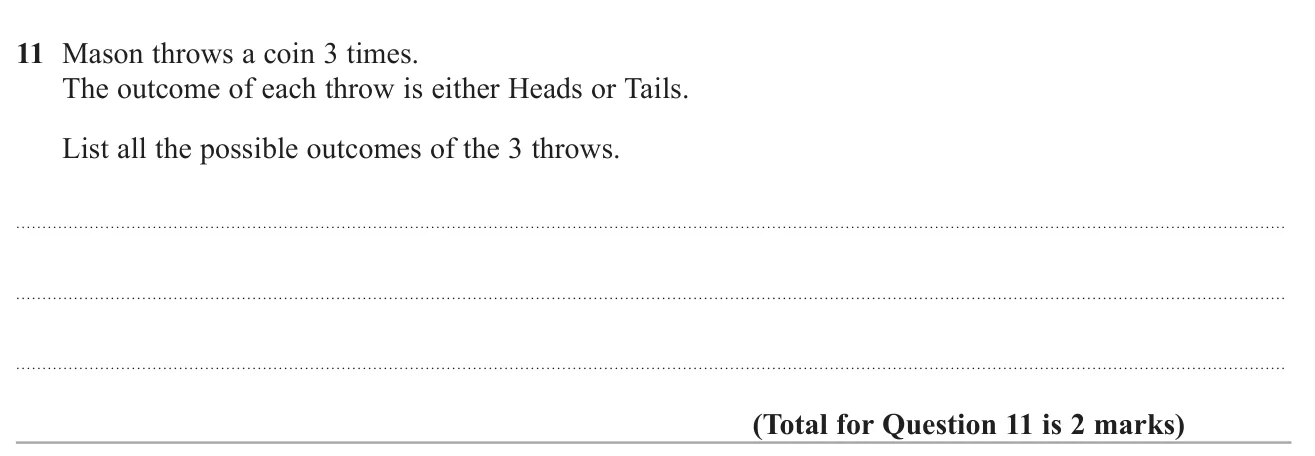
© Pearson Education Ltd. November 2019 Paper 1 (Foundation, non-calculator), question 11.
Answer HHH, HHT, HTH, HTT, THH, THT, TTH, TTT 2 marks
Worked solution Checked against the mark scheme
Work systematically. Fix the first throw as H, then list the four ways for the other two:
HHH, HHT, HTH, HTT
Then repeat with T first:
THH, THT, TTH, TTT
There are 2 × 2 × 2 = 8 2 \times 2 \times 2 = 8 2 × 2 × 2 = 8
Watch out: Missing outcomes or listing some twice.
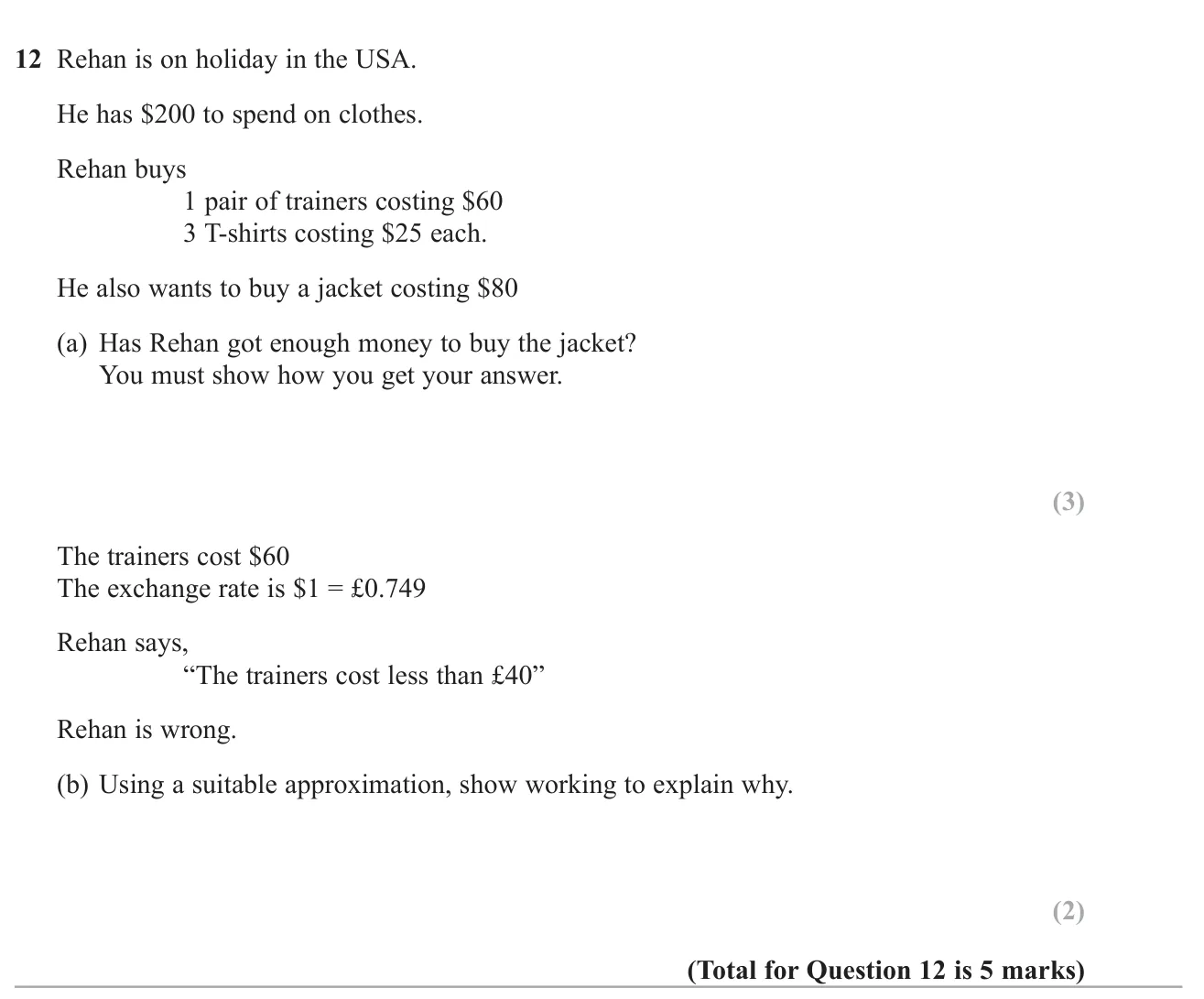
© Pearson Education Ltd. November 2019 Paper 1 (Foundation, non-calculator), question 12.
(a) No: the items cost 215 dollars but he only has 200 dollars 3 marks (b) 0.7 × 60 = 42 0.7 \times 60 = 42 0.7 × 60 = 42 2 marks
Worked solution Checked against the mark scheme
(a) T-shirts: 3 × 25 = 75 3 \times 25 = 75 3 × 25 = 75
Total with the jacket: 60 + 75 + 80 = 215 60 + 75 + 80 = 215 60 + 75 + 80 = 215
215 > 200 215 > 200 215 > 200 no , he is 15 dollars short.
(b) Round the rate down: 0.749 ≈ 0.7 0.749 \approx 0.7 0.749 ≈ 0.7
60 × 0.7 = £ 42 60 \times 0.7 = £42 60 × 0.7 = £42
Watch out: In (b), rounding up to 0.75 or 0.8: an overestimate cannot prove the price is more than £40.
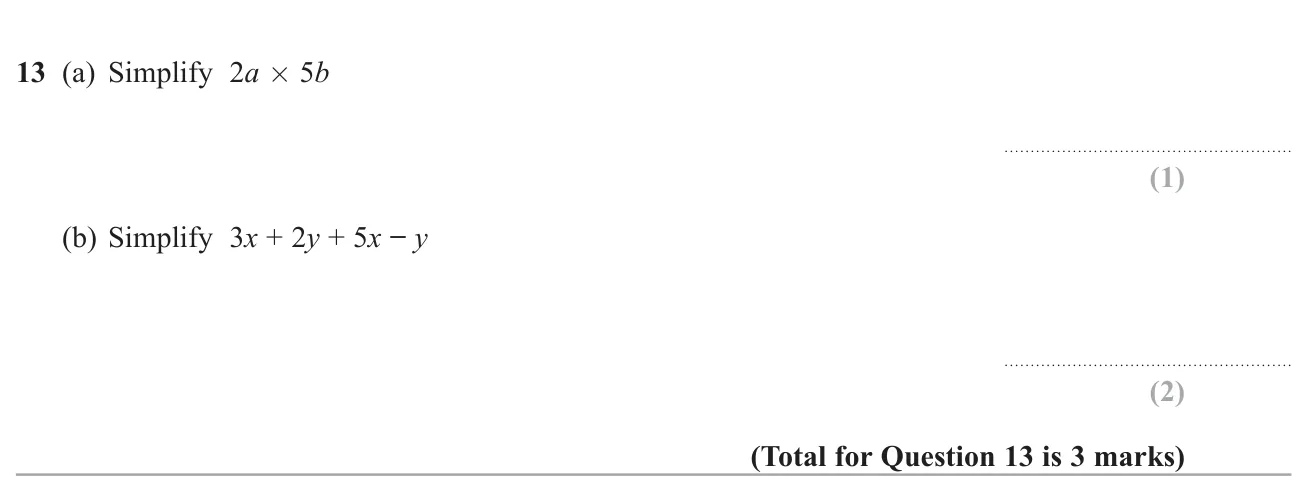
© Pearson Education Ltd. November 2019 Paper 1 (Foundation, non-calculator), question 13.
(a) 10 a b 10ab 10 ab 1 mark (b) 8 x + y 8x + y 8 x + y 2 marks
Worked solution Checked against the mark scheme
(a) Multiply the numbers and write the letters together: 2 × 5 = 10 2 \times 5 = 10 2 × 5 = 10 10 a b 10ab 10 ab
(b) x x x 3 x + 5 x = 8 x 3x + 5x = 8x 3 x + 5 x = 8 x
y y y 2 y − y = y 2y - y = y 2 y − y = y
Answer: 8 x + y 8x + y 8 x + y
Watch out: Writing 7ab in (a) by adding the numbers.
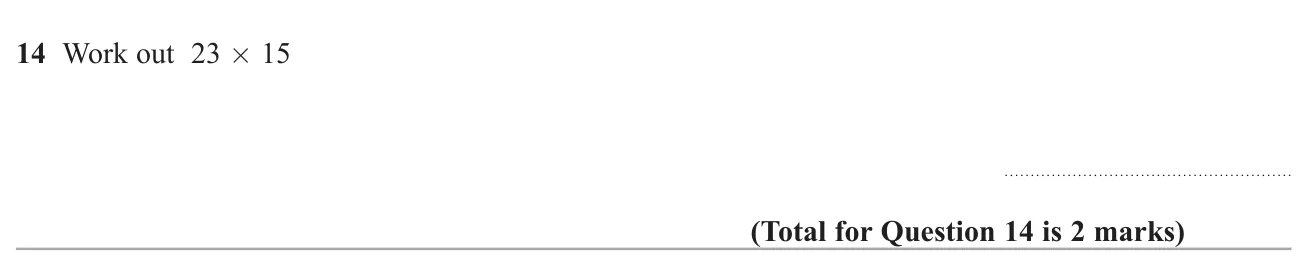
© Pearson Education Ltd. November 2019 Paper 1 (Foundation, non-calculator), question 14.
Worked solution Checked against the mark scheme
Split 15 into 10 and 5:
23 × 10 = 230 23 \times 10 = 230 23 × 10 = 230
23 × 5 = 115 23 \times 5 = 115 23 × 5 = 115
230 + 115 = 345 230 + 115 = 345 230 + 115 = 345
Watch out: Forgetting the place-value zero when multiplying by the tens digit.
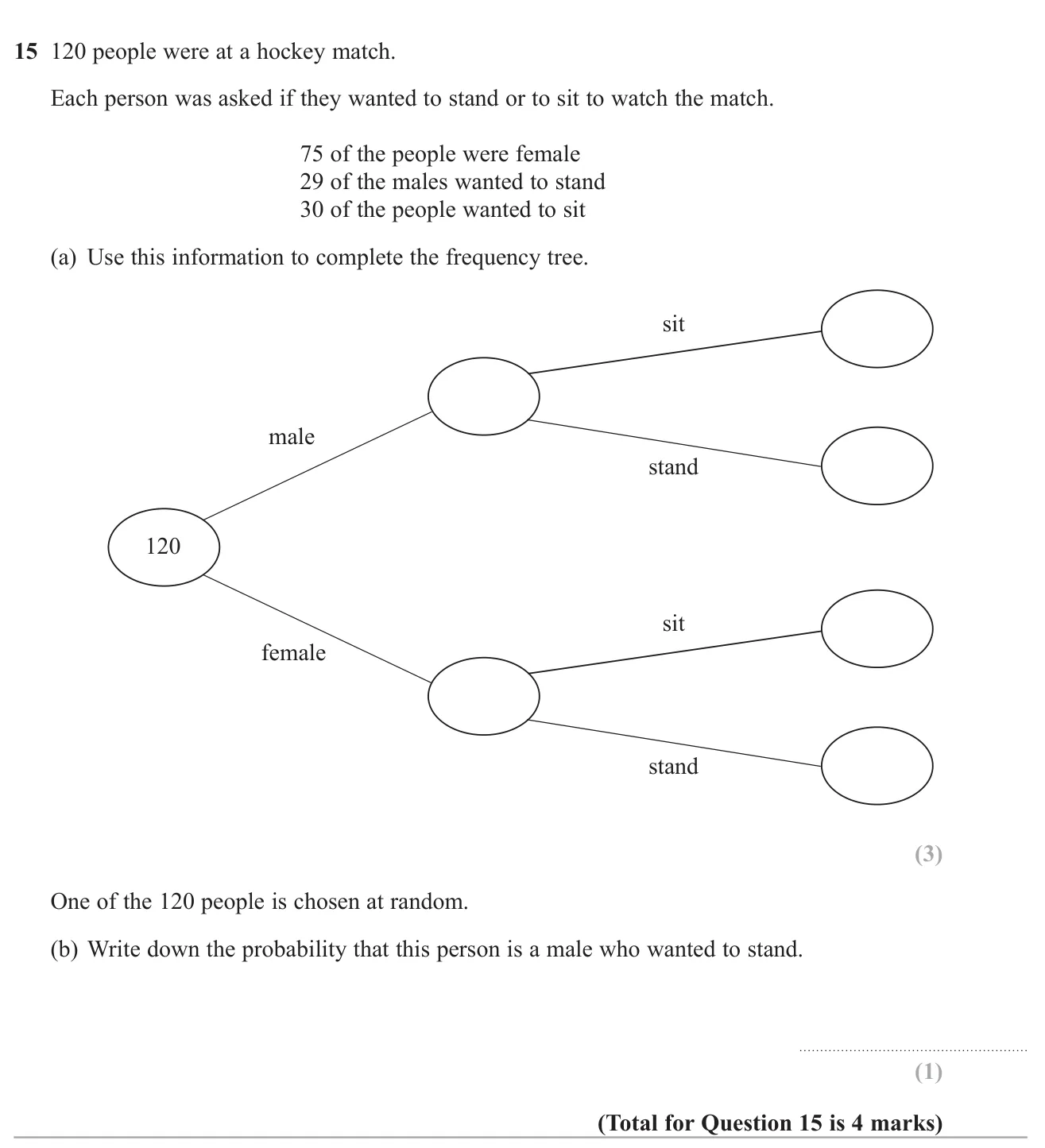
© Pearson Education Ltd. November 2019 Paper 1 (Foundation, non-calculator), question 15.
(a) Male 45 (sit 16, stand 29); female 75 (sit 14, stand 61) 3 marks (b) 29 120 \frac{29}{120} 120 29 1 mark
Worked solution Checked against the mark scheme
(a) Males: 120 − 75 = 45 120 - 75 = 45 120 − 75 = 45
Males sitting: 45 − 29 = 16 45 - 29 = 16 45 − 29 = 16
Females sitting: 30 − 16 = 14 30 - 16 = 14 30 − 16 = 14
Females standing: 75 − 14 = 61 75 - 14 = 61 75 − 14 = 61
(b) 29 of the 120 people are males who stand, so the probability is 29 120 \frac{29}{120} 120 29
Watch out: Putting all 30 sitters on the female branch.
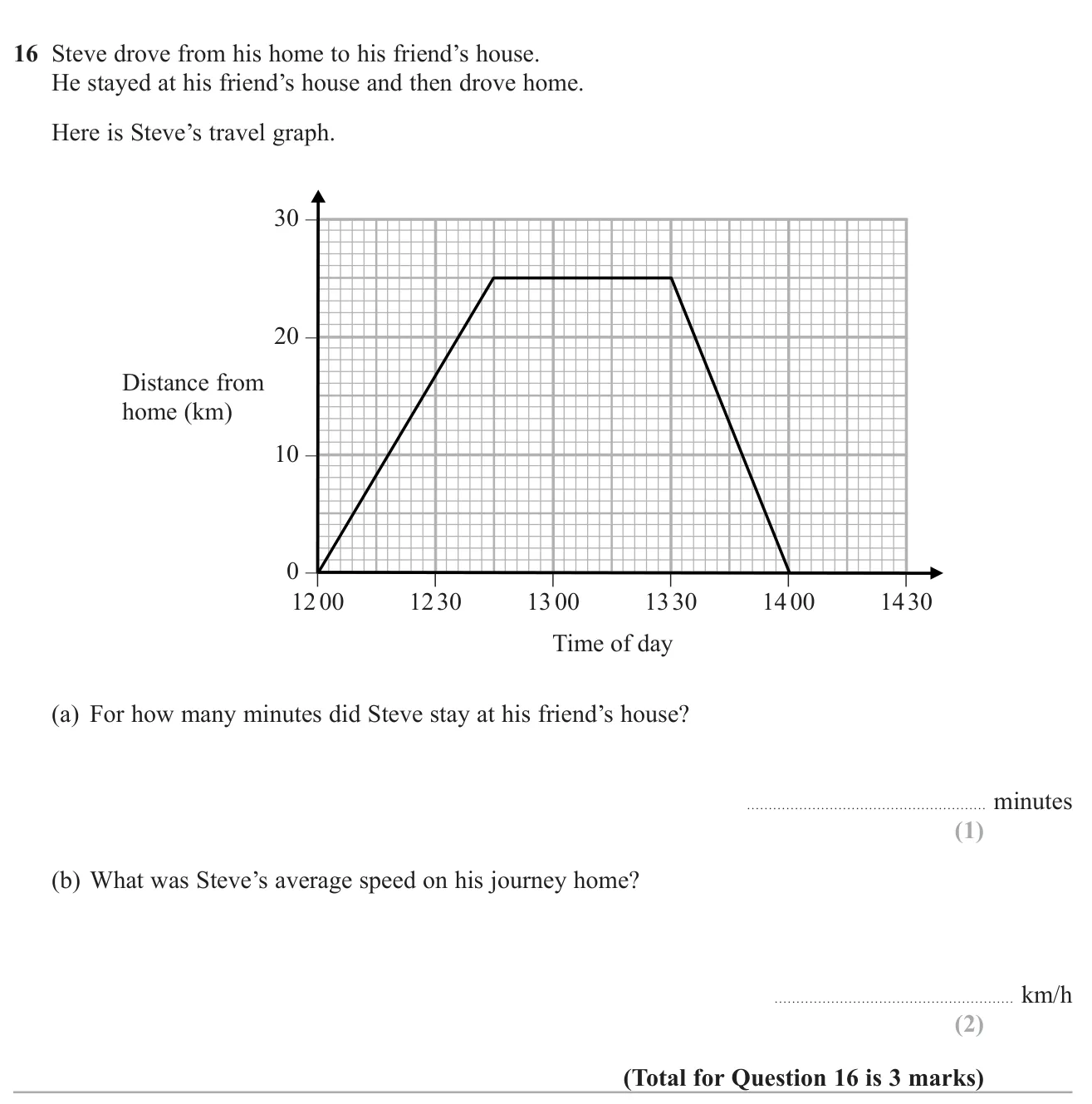
© Pearson Education Ltd. November 2019 Paper 1 (Foundation, non-calculator), question 16.
(a) 45 45 45 1 mark (b) 50 50 50 2 marks
Worked solution Checked against the mark scheme
(a) The flat part runs from 12:45 to 13:30, which is 45 minutes.
(b) He drives 25 km home between 13:30 and 14:00, which is half an hour.
Speed = 25 ÷ 0.5 = 50 = 25 \div 0.5 = 50 = 25 ÷ 0.5 = 50
Watch out: Dividing 25 by 30 (minutes) instead of by 0.5 hours.
© Pearson Education Ltd. November 2019 Paper 1 (Foundation, non-calculator), question 17.
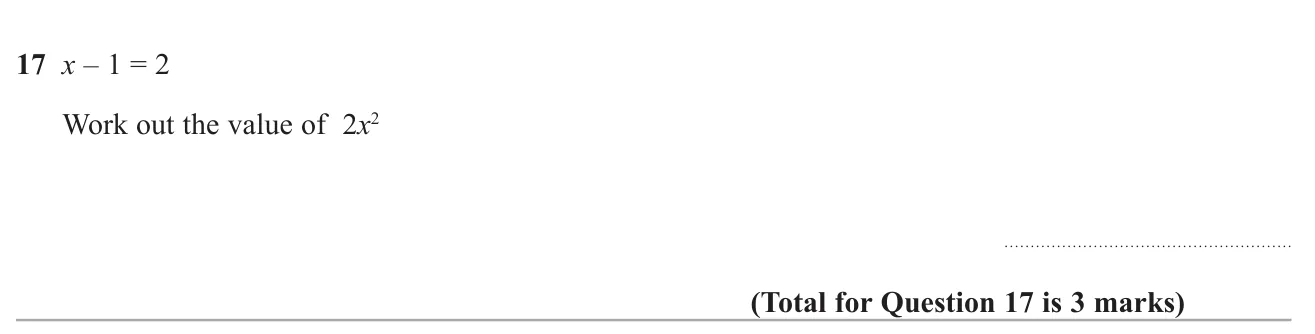
Worked solution Checked against the mark scheme
x − 1 = 2 x - 1 = 2 x − 1 = 2 x = 3 x = 3 x = 3
2 x 2 = 2 × 3 2 = 2 × 9 = 18 2x^2 = 2 \times 3^2 = 2 \times 9 = 18 2 x 2 = 2 × 3 2 = 2 × 9 = 18
Watch out: Working out ( 2 x ) 2 = 36 (2x)^2 = 36 ( 2 x ) 2 = 36 2 x 2 2x^2 2 x 2
© Pearson Education Ltd. November 2019 Paper 1 (Foundation, non-calculator), question 18.
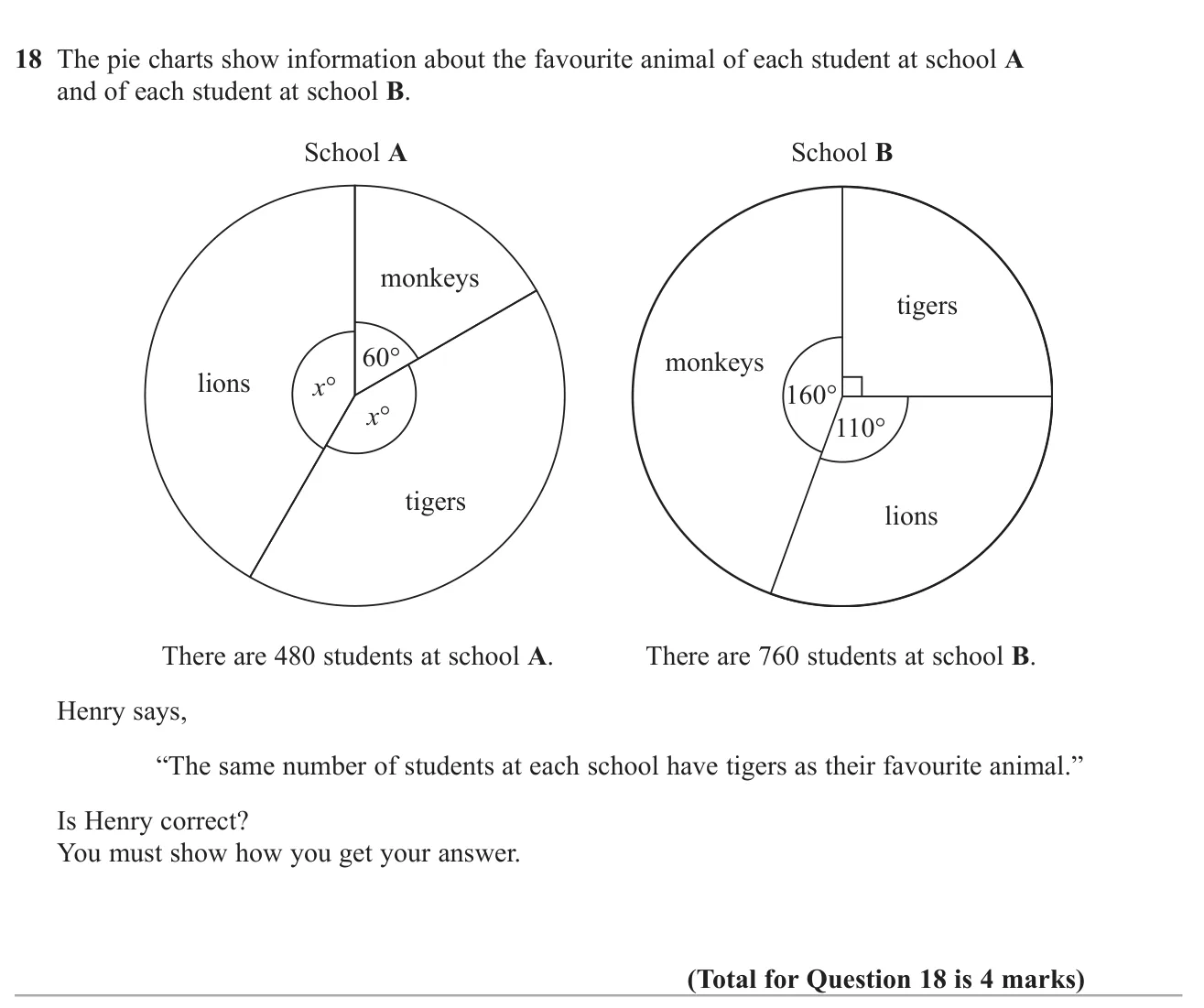
Answer No: 200 at school A but 190 at school B 4 marks
Worked solution Checked against the mark scheme
School A: x = ( 360 − 60 ) ÷ 2 = 150 ° x = (360 - 60) \div 2 = 150° x = ( 360 − 60 ) ÷ 2 = 150°
Tigers at A = 150 360 × 480 = 200 = \frac{150}{360} \times 480 = 200 = 360 150 × 480 = 200
School B: tigers angle = 360 − 160 − 110 = 90 ° = 360 - 160 - 110 = 90° = 360 − 160 − 110 = 90°
Tigers at B = 90 360 × 760 = 190 = \frac{90}{360} \times 760 = 190 = 360 90 × 760 = 190
200 ≠ 190 200 \ne 190 200 = 190 not correct.
Watch out: Comparing the angles instead of the numbers of students.
© Pearson Education Ltd. November 2019 Paper 1 (Foundation, non-calculator), question 19.
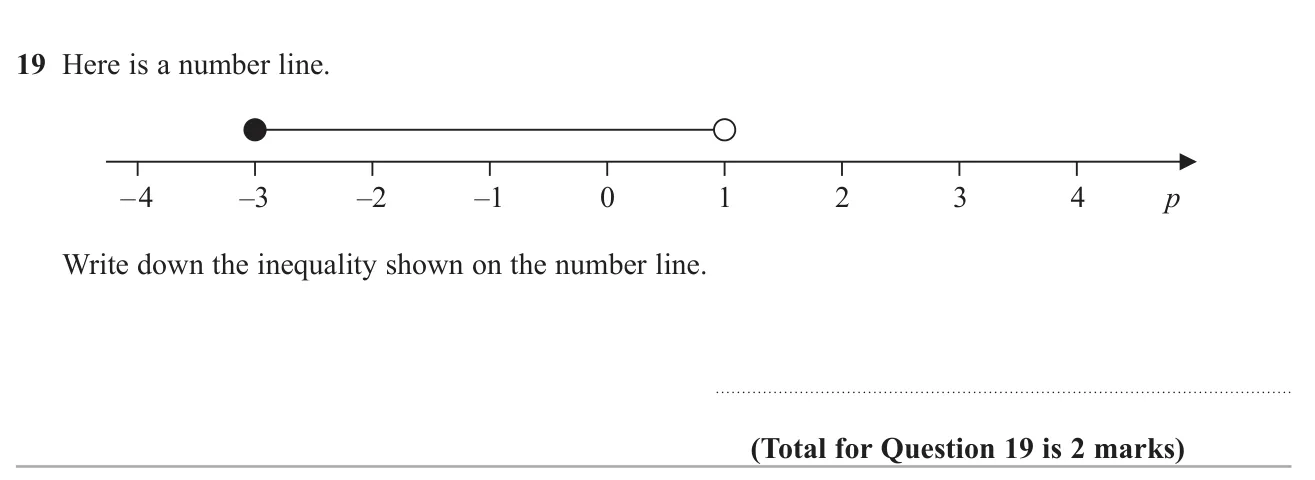
Answer − 3 ≤ p < 1 -3 \le p < 1 − 3 ≤ p < 1 2 marks
Worked solution Checked against the mark scheme
The filled circle at − 3 -3 − 3 − 3 -3 − 3 p ≥ − 3 p \ge -3 p ≥ − 3
The open circle at 1 1 1 1 1 1 p < 1 p < 1 p < 1
Together: − 3 ≤ p < 1 -3 \le p < 1 − 3 ≤ p < 1
Watch out: Mixing up which end uses ≤ and which uses <.
© Pearson Education Ltd. November 2019 Paper 1 (Foundation, non-calculator), question 20.
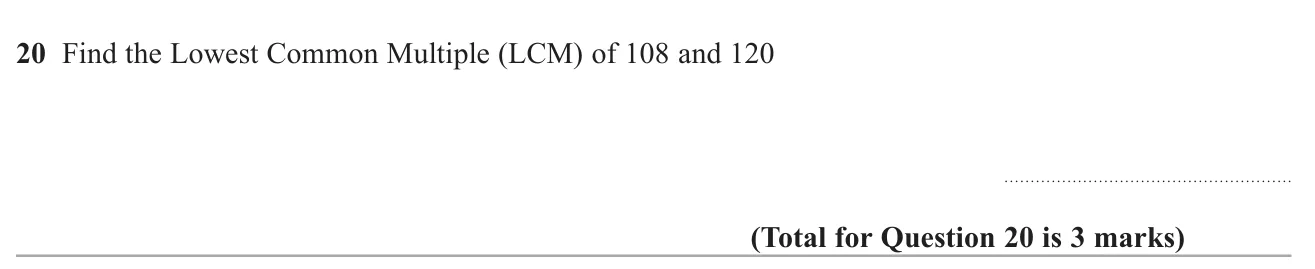
Answer 1080 1080 1080 3 marks
Worked solution Checked against the mark scheme
108 = 2 2 × 3 3 108 = 2^2 \times 3^3 108 = 2 2 × 3 3
120 = 2 3 × 3 × 5 120 = 2^3 \times 3 \times 5 120 = 2 3 × 3 × 5
Take the highest power of each prime:
LCM = 2 3 × 3 3 × 5 = 8 × 27 × 5 = 1080 = 2^3 \times 3^3 \times 5 = 8 \times 27 \times 5 = 1080 = 2 3 × 3 3 × 5 = 8 × 27 × 5 = 1080
Watch out: Multiplying the numbers (12960), which is a common multiple but not the lowest.
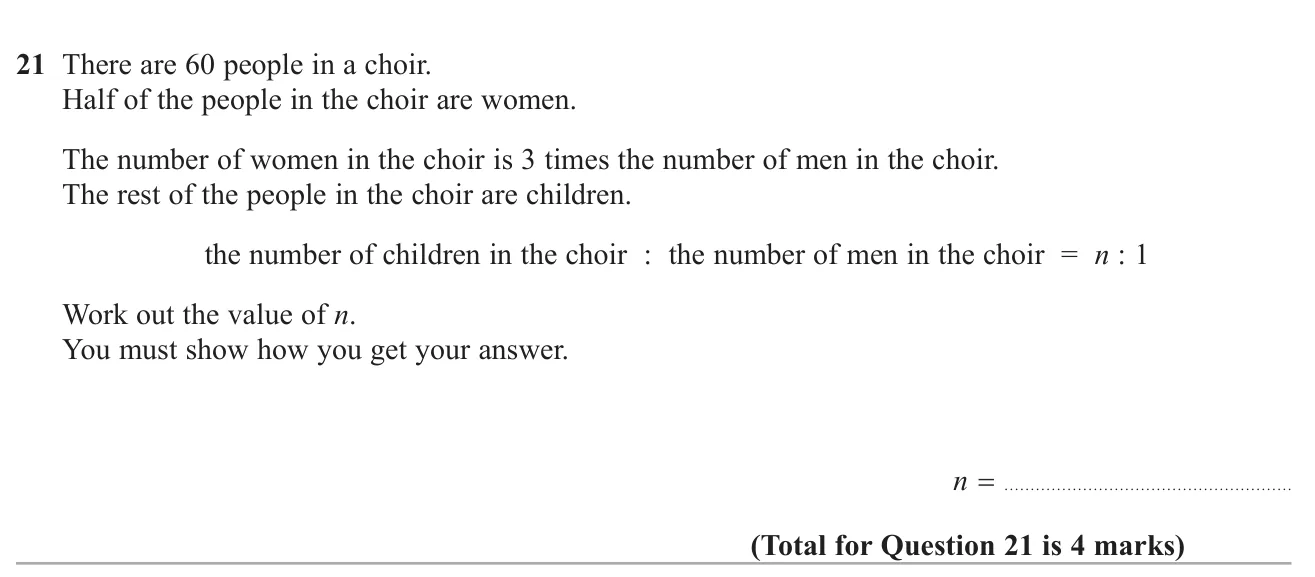
Question 21 Ratio 4 marks Grade 5 No calculator On both tiers © Pearson Education Ltd. November 2019 Paper 1 (Foundation, non-calculator), question 21.
Worked solution Checked against the mark scheme
Women: 60 ÷ 2 = 30 60 \div 2 = 30 60 ÷ 2 = 30
Men: 30 ÷ 3 = 10 30 \div 3 = 10 30 ÷ 3 = 10
Children: 60 − 30 − 10 = 20 60 - 30 - 10 = 20 60 − 30 − 10 = 20
Children : men = 20 : 10 = 2 : 1 = 20 : 10 = 2 : 1 = 20 : 10 = 2 : 1 n = 2 n = 2 n = 2
Watch out: Taking children as a third of 60 without working out the men first.
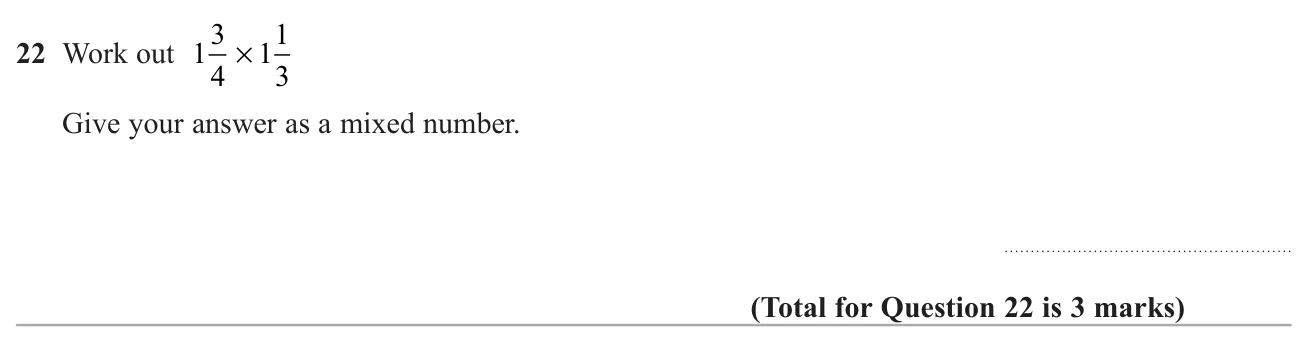
Question 22 Fractions 3 marks Grade 5 No calculator On both tiers © Pearson Education Ltd. November 2019 Paper 1 (Foundation, non-calculator), question 22.
Answer 2 1 3 2\frac{1}{3} 2 3 1 3 marks
Worked solution Checked against the mark scheme
1 3 4 = 7 4 1\frac{3}{4} = \frac{7}{4} 1 4 3 = 4 7 1 1 3 = 4 3 1\frac{1}{3} = \frac{4}{3} 1 3 1 = 3 4
7 4 × 4 3 = 28 12 = 7 3 = 2 1 3 \frac{7}{4} \times \frac{4}{3} = \frac{28}{12} = \frac{7}{3} = 2\frac{1}{3} 4 7 × 3 4 = 12 28 = 3 7 = 2 3 1
Watch out: Multiplying the whole numbers and fractions separately to get 1 1/4.
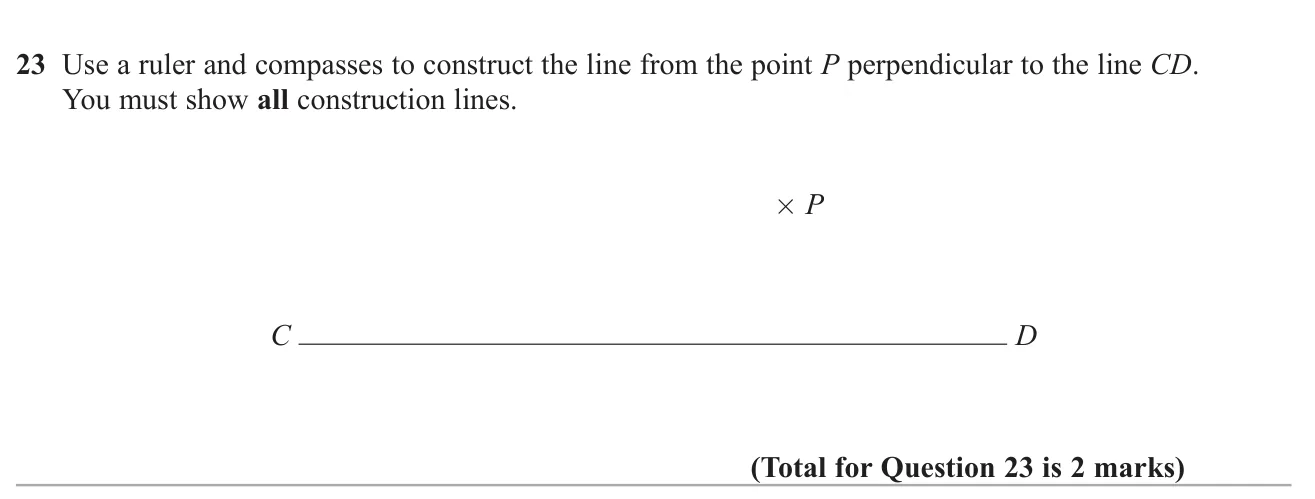
© Pearson Education Ltd. November 2019 Paper 1 (Foundation, non-calculator), question 23.
Answer Perpendicular from P P P C D CD C D 2 marks
Worked solution Checked against the mark scheme
1. With centre P P P C D CD C D C D CD C D P P P C D CD C D
Leave all arcs showing.
Watch out: Drawing the line by eye with a protractor and no arcs.
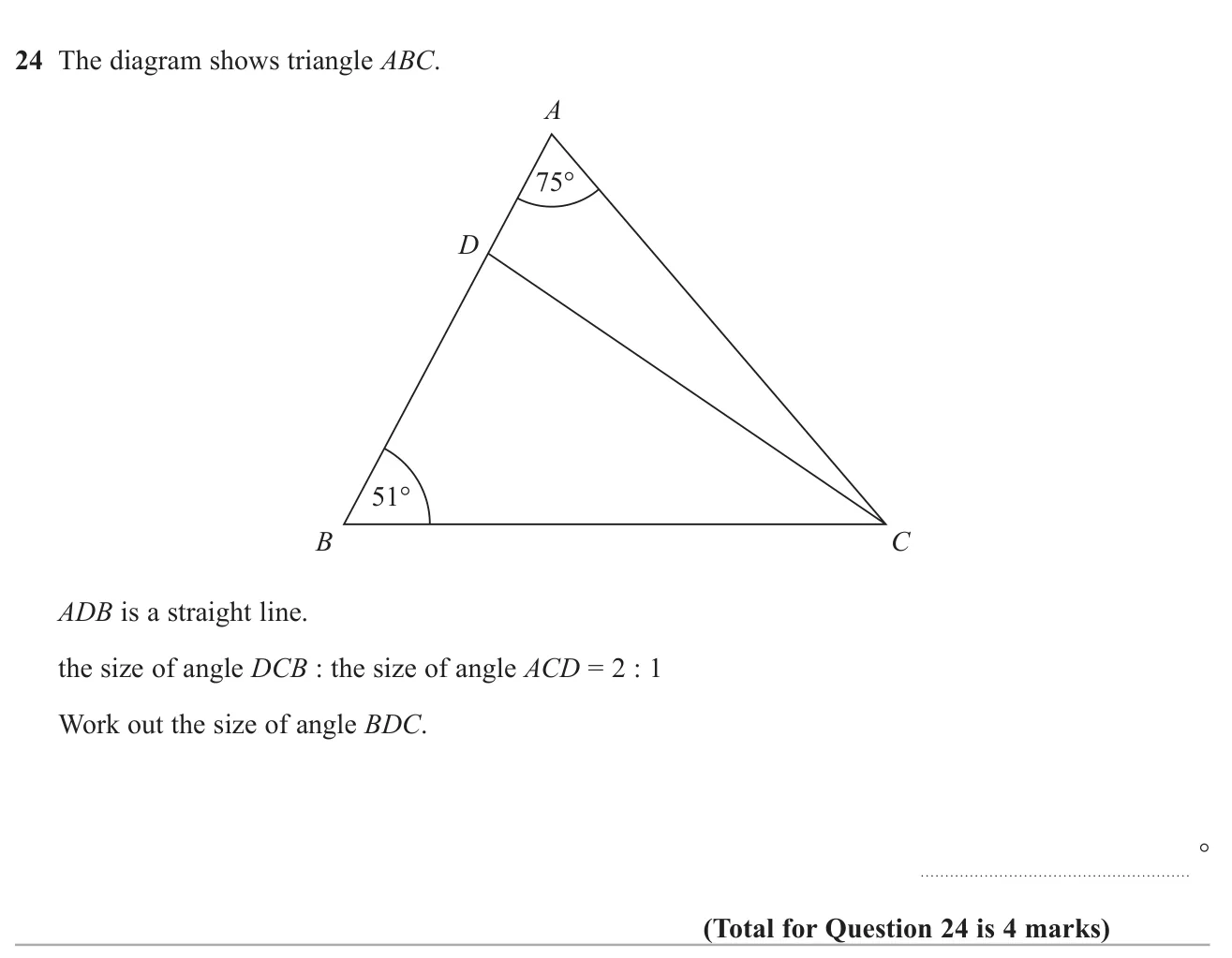
© Pearson Education Ltd. November 2019 Paper 1 (Foundation, non-calculator), question 24.
Worked solution Checked against the mark scheme
Angle A C B = 180 − 75 − 51 = 54 ° ACB = 180 - 75 - 51 = 54° A C B = 180 − 75 − 51 = 54°
Split 54 in the ratio 2 : 1: one part = 54 ÷ 3 = 18 ° = 54 \div 3 = 18° = 54 ÷ 3 = 18°
So A C D = 18 ° ACD = 18° A C D = 18° D C B = 36 ° DCB = 36° D C B = 36°
In triangle B D C BDC B D C B D C = 180 − 51 − 36 = 93 ° BDC = 180 - 51 - 36 = 93° B D C = 180 − 51 − 36 = 93°
Watch out: Giving angle ADC (87°) instead of angle BDC.
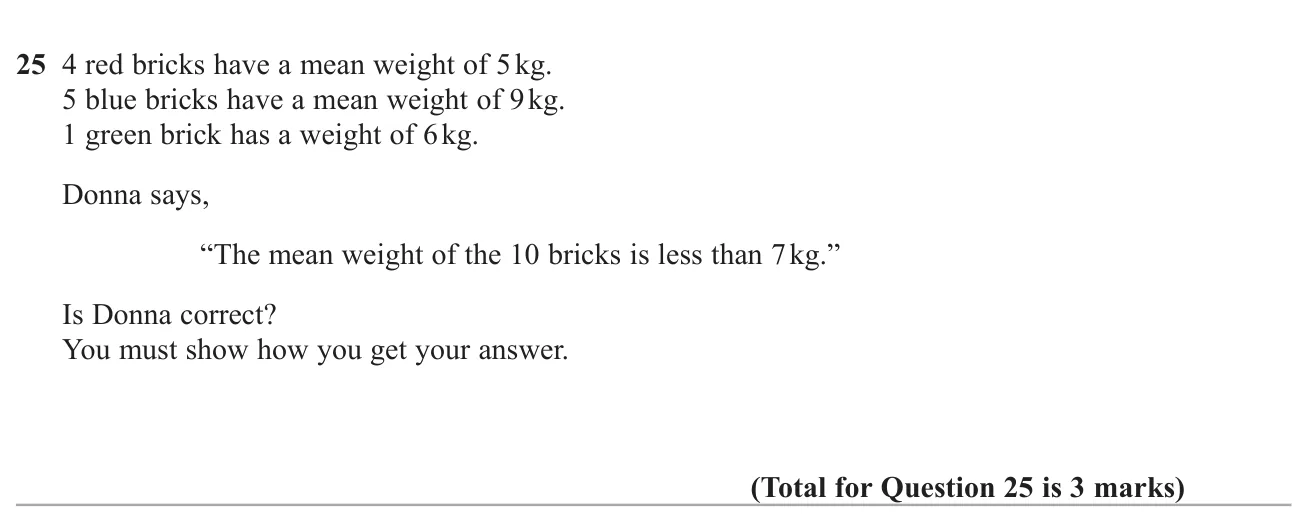
© Pearson Education Ltd. November 2019 Paper 1 (Foundation, non-calculator), question 25.
Answer No: the mean is 7.1 kg 3 marks
Worked solution Checked against the mark scheme
Red: 4 × 5 = 20 4 \times 5 = 20 4 × 5 = 20
Blue: 5 × 9 = 45 5 \times 9 = 45 5 × 9 = 45
Total = 20 + 45 + 6 = 71 = 20 + 45 + 6 = 71 = 20 + 45 + 6 = 71
Mean = 71 ÷ 10 = 7.1 = 71 \div 10 = 7.1 = 71 ÷ 10 = 7.1
7.1 > 7 7.1 > 7 7.1 > 7 not correct.
Watch out: Averaging the three means (5, 9 and 6) instead of using totals.
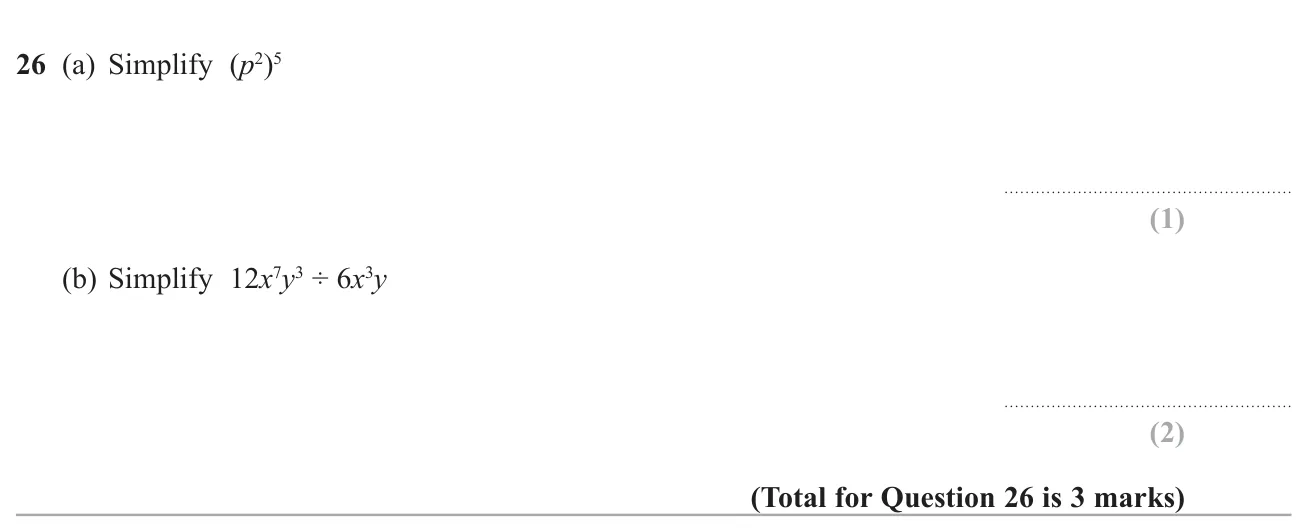
© Pearson Education Ltd. November 2019 Paper 1 (Foundation, non-calculator), question 26.
(a) p 10 p^{10} p 10 1 mark (b) 2 x 4 y 2 2x^4y^2 2 x 4 y 2 2 marks
Worked solution Checked against the mark scheme
(a) Multiply the powers: ( p 2 ) 5 = p 2 × 5 = p 10 (p^2)^5 = p^{2 \times 5} = p^{10} ( p 2 ) 5 = p 2 × 5 = p 10
(b) Divide the numbers and subtract the powers:
12 ÷ 6 = 2 12 \div 6 = 2 12 ÷ 6 = 2 x 7 − 3 = x 4 x^{7-3} = x^4 x 7 − 3 = x 4 y 3 − 1 = y 2 y^{3-1} = y^2 y 3 − 1 = y 2
Answer: 2 x 4 y 2 2x^4y^2 2 x 4 y 2
Watch out: Adding the powers in (a) to get p 7 p^7 p 7
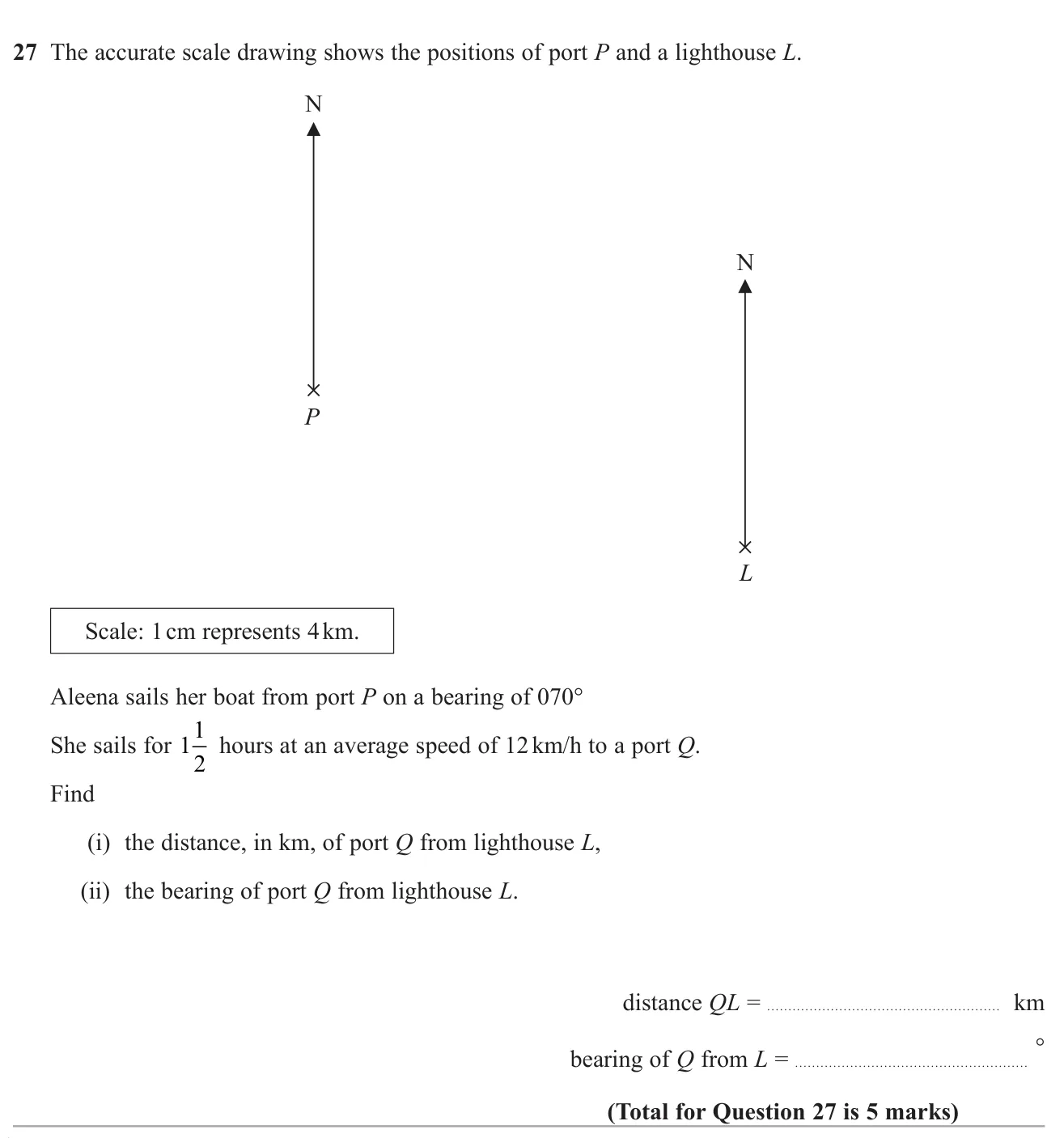
© Pearson Education Ltd. November 2019 Paper 1 (Foundation, non-calculator), question 27.
((i)) Distance in the range 20 20 20 23 23 23 4 marks ((ii)) Bearing in the range 317 ° 317° 317° 330 ° 330° 330° 1 mark
Worked solution Checked against the mark scheme
Distance P Q = 12 × 1.5 = 18 PQ = 12 \times 1.5 = 18 P Q = 12 × 1.5 = 18
On the drawing: 18 ÷ 4 = 4.5 18 \div 4 = 4.5 18 ÷ 4 = 4.5
From P P P 70 ° 70° 70° Q Q Q
(i) Measure Q L QL Q L
(ii) At L L L Q Q Q 317 ° 317° 317° 330 ° 330° 330°
Watch out: Measuring the bearing anticlockwise from north.
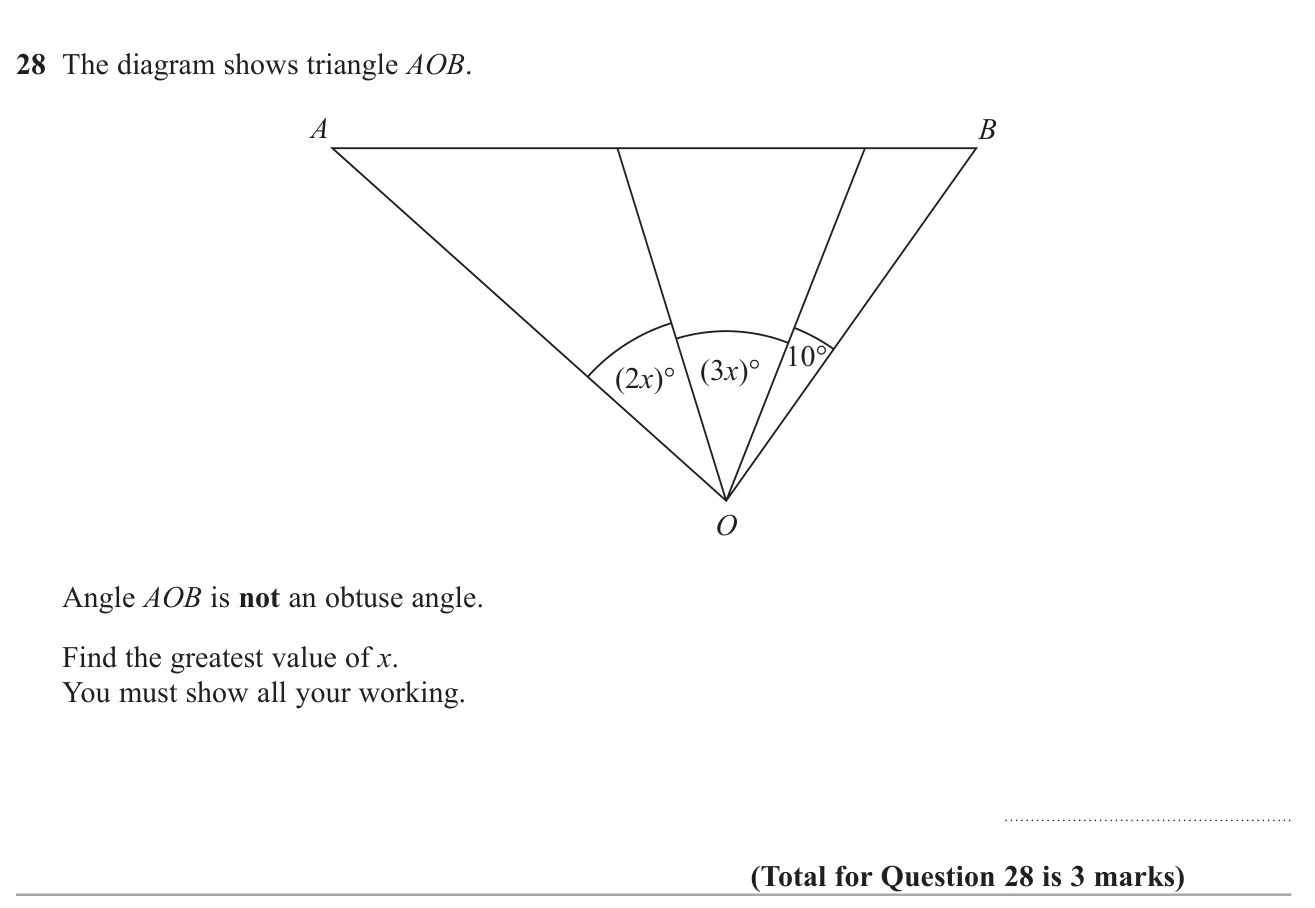
© Pearson Education Ltd. November 2019 Paper 1 (Foundation, non-calculator), question 28.
Worked solution Checked against the mark scheme
Angle A O B AOB A O B 2 x + 3 x + 10 ≤ 90 2x + 3x + 10 \le 90 2 x + 3 x + 10 ≤ 90
5 x ≤ 80 5x \le 80 5 x ≤ 80
x ≤ 16 x \le 16 x ≤ 16 x = 16 x = 16 x = 16
Watch out: Using 180 instead of 90, giving x = 34.
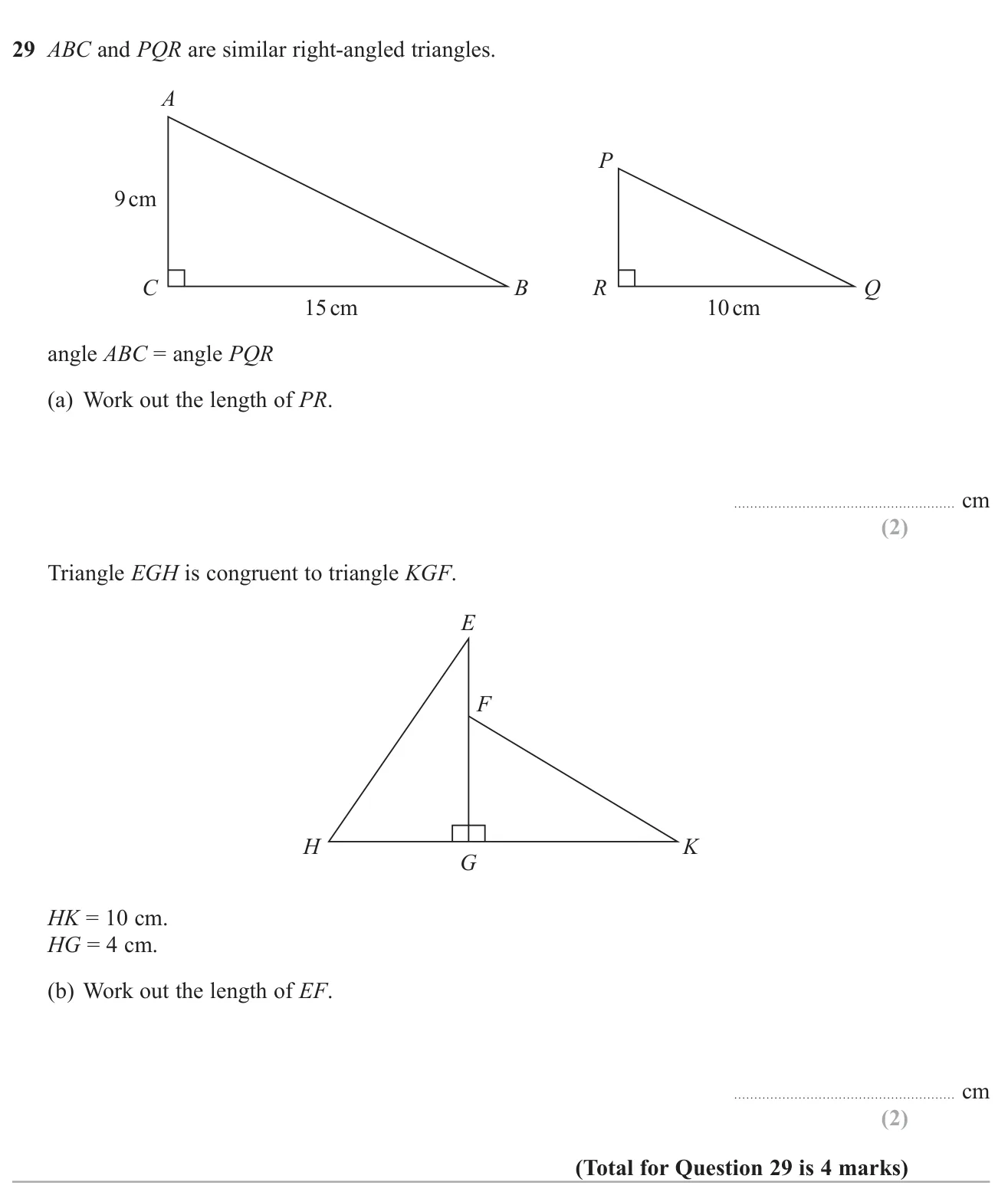
© Pearson Education Ltd. November 2019 Paper 1 (Foundation, non-calculator), question 29.
(a) 6 6 6 2 marks (b) 2 2 2 2 marks
Worked solution Checked against the mark scheme
(a) B C = 15 BC = 15 B C = 15 Q R = 10 QR = 10 QR = 10 10 15 = 2 3 \frac{10}{15} = \frac{2}{3} 15 10 = 3 2
P R = 9 × 2 3 = 6 PR = 9 \times \frac{2}{3} = 6 P R = 9 × 3 2 = 6
(b) G K = 10 − 4 = 6 GK = 10 - 4 = 6 G K = 10 − 4 = 6
The triangles are congruent, so E G = G K = 6 EG = GK = 6 E G = G K = 6 G F = H G = 4 GF = HG = 4 GF = H G = 4
E F = 6 − 4 = 2 EF = 6 - 4 = 2 E F = 6 − 4 = 2
Watch out: In (a), subtracting 5 from 9 instead of scaling, giving 4.
Finished the paper? Add up your marks for all three papers and see what grade that would have been.