Probability

Conditional probability

2 past-paper questions, easiest first. Try each one, then reveal the answer.

Higher only

Revision guide by The Full Marks

Conditional probability: what you need to know

Conditional probability is the chance of something happening given that you already know something else has happened. This is Higher-only and often appears as the last, hardest part of a probability question.

Key facts

  • 'Given that' means you only look at the group you already know about: that group becomes your denominator.
  • P(A given B)=number in both A and Bnumber in BP(A \text{ given } B) = \dfrac{\text{number in both } A \text{ and } B}{\text{number in } B}, or with probabilities P(A and B)P(B)\dfrac{P(A \text{ and } B)}{P(B)}.
  • On a tree diagram, the second set of branches are conditional probabilities: they depend on what happened first.
  • Without replacement problems are conditional: the second pick depends on the first.

From a table or Venn diagram

  1. Find the group named after 'given that' and use its total as the denominator.
  2. Count how many in that group also have the other feature: that is the numerator.

From a tree diagram (Higher)

  1. Multiply along each route and add the routes that give the 'given' event: that is the denominator.
  2. Add only the routes that give both events: that is the numerator.
  3. Divide. Expected frequencies (e.g. out of 100 people) give the same answer and can be easier.

Forming an equation (Higher)

  1. Let the unknown number of items be nn.
  2. Write the probability along the route, reducing the denominator for the second pick.
  3. Set it equal to the given probability and solve, often as a quadratic.

Worked examples

Example 1 Higher · grade 6

80 students were asked how they travel to school.
Year 10: 18 walk, 22 bus. Year 11: 25 walk, 15 bus.
(a) A Year 11 student is chosen. Find the probability they take the bus.
(b) A student who takes the bus is chosen. Find the probability they are in Year 10.

Show the solution

(a) Year 11 total = 25 + 15 = 40, of whom 15 take the bus.
P=1540=38P = \frac{15}{40} = \frac{3}{8}
(b) Bus total = 22 + 15 = 37, of whom 22 are in Year 10.
P=2237P = \frac{22}{37}

Example 2 Higher · grade 8

A bag contains nn sweets, 6 of which are orange. Two sweets are taken without replacement. The probability both are orange is 13\frac{1}{3}. Find nn.

Show the solution

6n×5n−1=13\frac{6}{n} \times \frac{5}{n - 1} = \frac{1}{3}
30n(n−1)=13\frac{30}{n(n - 1)} = \frac{1}{3}
n(n−1)=90n(n - 1) = 90
n2−n−90=0n^2 - n - 90 = 0
(n−10)(n+9)=0(n - 10)(n + 9) = 0
n=10n = 10 (it cannot be negative)

Common mistakes

  • Dividing by the overall total instead of the total of the 'given' group.
  • Treating picks as with replacement, so the second fraction keeps the same denominator.
  • Forgetting to reject the negative solution of the quadratic.

Exam tips

  • In 'show that' questions, write every line of algebra: the marks are for the working, not the final equation.
  • Underline the words after 'given that' so you pick the right denominator.

Questions people ask

What is conditional probability in GCSE Maths?

It is a probability worked out when you already know something has happened, like the chance a student takes the bus given they are in Year 11. You divide by the size of that known group.

Is conditional probability on the Foundation paper?

No. Conditional probability is Higher tier only, though Foundation students still use two-way tables and tree diagrams.

Exam questions: Conditional probability (2, easiest first)

Conditional probability4 marksGrade 8CalculatorHigher
November 2023 · Paper 2 Higher · Q21
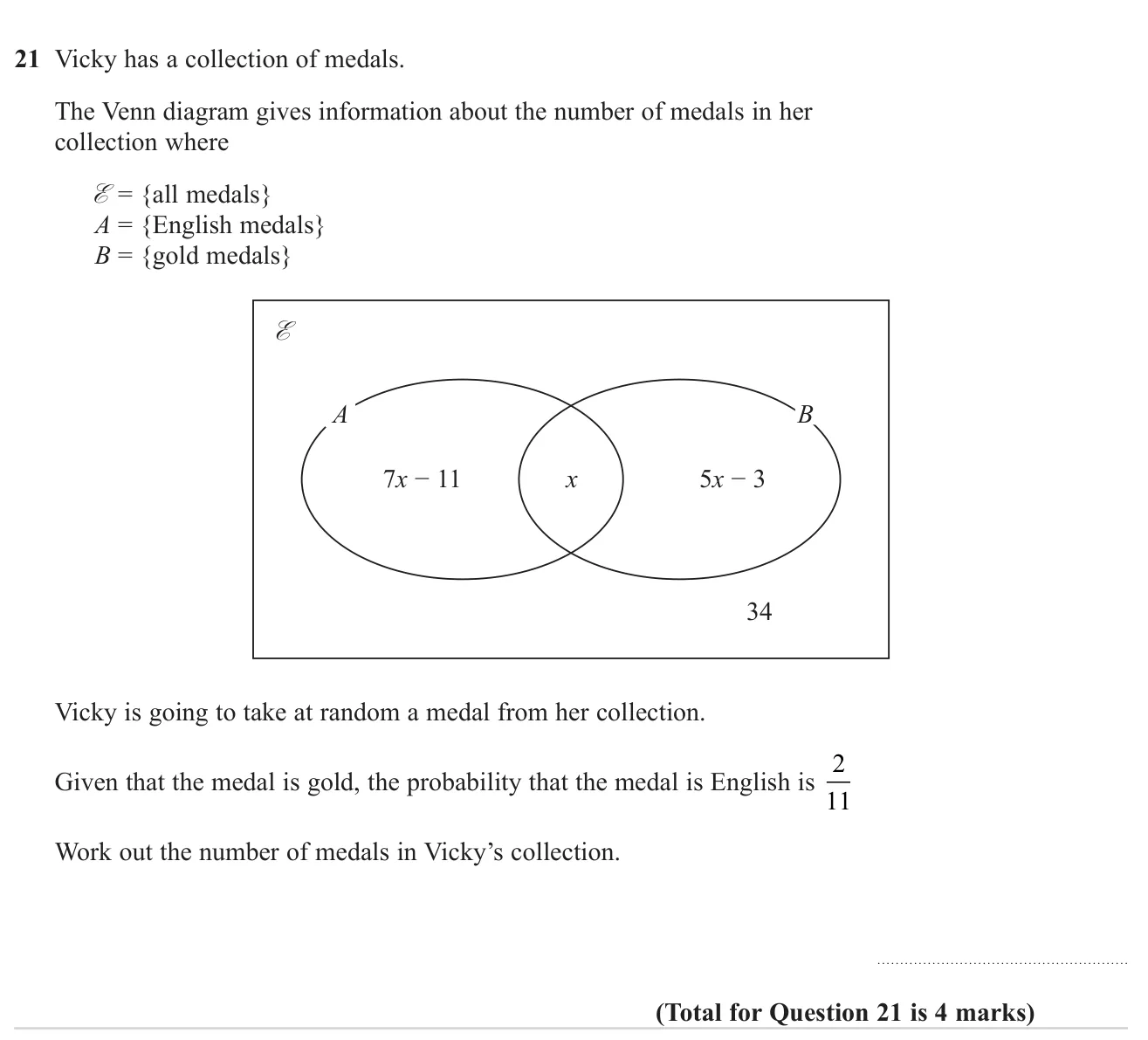
Use a conditional probability from a Venn diagram to form an equation and find the total number of items.

© Pearson Education Ltd. November 2023 Paper 2 (Higher, calculator), question 21.

Show answer
Answer98984 marks

Worked solution Checked against the mark scheme

Gold medals: x+(5x−3)=6x−3x + (5x - 3) = 6x - 3

x6x−3=211\frac{x}{6x - 3} = \frac{2}{11}, so 11x=12x−611x = 12x - 6 and x=6x = 6.

Total: (7×6−11)+6+(5×6−3)+34=31+6+27+34=98(7 \times 6 - 11) + 6 + (5 \times 6 - 3) + 34 = 31 + 6 + 27 + 34 = 98

Watch out: Dividing by the total number of medals instead of the number of gold medals.

Conditional probability6 marksGrade 9No calculatorHigher
November 2018 · Paper 1 Higher · Q22
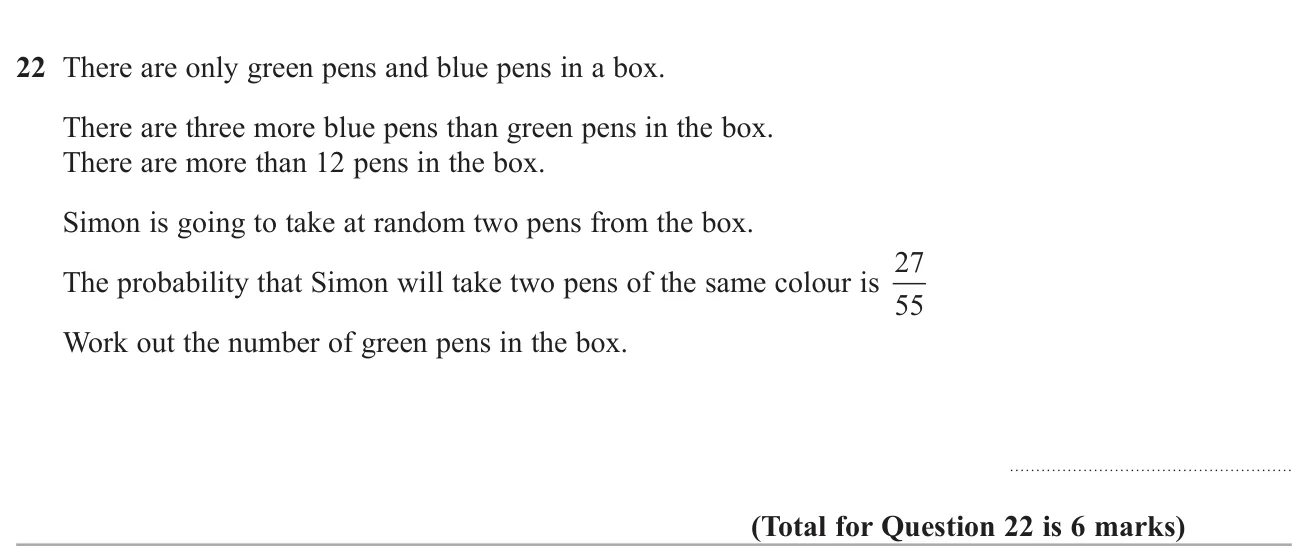
Form and solve a quadratic equation from a probability of picking two pens of the same colour without replacement.

© Pearson Education Ltd. November 2018 Paper 1 (Higher, non-calculator), question 22.

Show answer
Answer21216 marks

Worked solution Checked against the mark scheme

Let xx = green pens, so there are x+3x + 3 blue and 2x+32x + 3 in total.

x(x−1)+(x+3)(x+2)(2x+3)(2x+2)=2755\dfrac{x(x-1) + (x+3)(x+2)}{(2x+3)(2x+2)} = \dfrac{27}{55}

55(2x2+4x+6)=27(4x2+10x+6)55(2x^2 + 4x + 6) = 27(4x^2 + 10x + 6)

2x2−50x+168=02x^2 - 50x + 168 = 0, i.e. x2−25x+84=0x^2 - 25x + 84 = 0

(x−21)(x−4)=0(x - 21)(x - 4) = 0, so x=21x = 21 or x=4x = 4

There are more than 12 pens, so x=4x = 4 (11 pens) is rejected: 21 green pens.

Watch out: Treating the picks as with replacement, or forgetting to add the two-blue case.
Also tested in these questions

Their main topic is different, but part of each one tests this topic.