Question 1
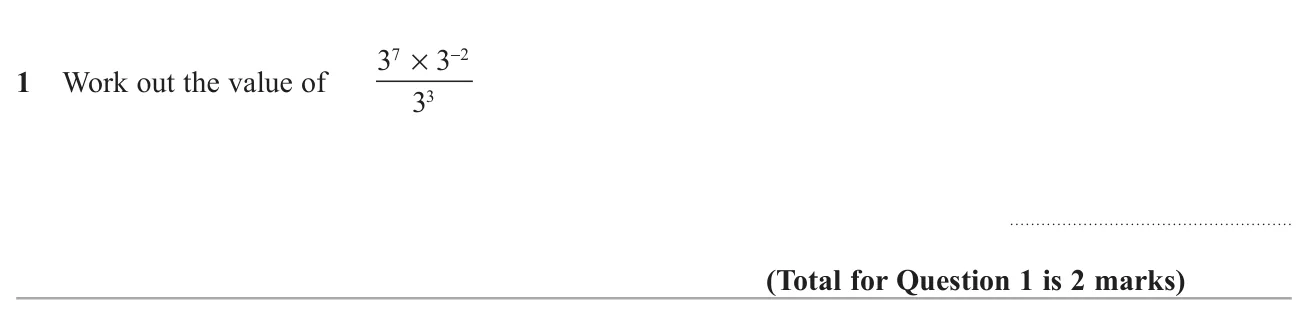
© Pearson Education Ltd. November 2018 Paper 1 (Higher, non-calculator), question 1.
Show answer
| Answer | 9 | 2 marks |
|---|
Worked solution Checked against the mark scheme
Watch out: Stopping at , or multiplying indices instead of adding.
Edexcel GCSE Maths · 1MA1
Non-calculator · 22 questions · 80 marks · 1 hour 30 minutes. Try each question on paper, then press "Show answer".
© Pearson Education Ltd. November 2018 Paper 1 (Higher, non-calculator), question 1.
| Answer | 9 | 2 marks |
|---|
Worked solution Checked against the mark scheme
Watch out: Stopping at , or multiplying indices instead of adding.
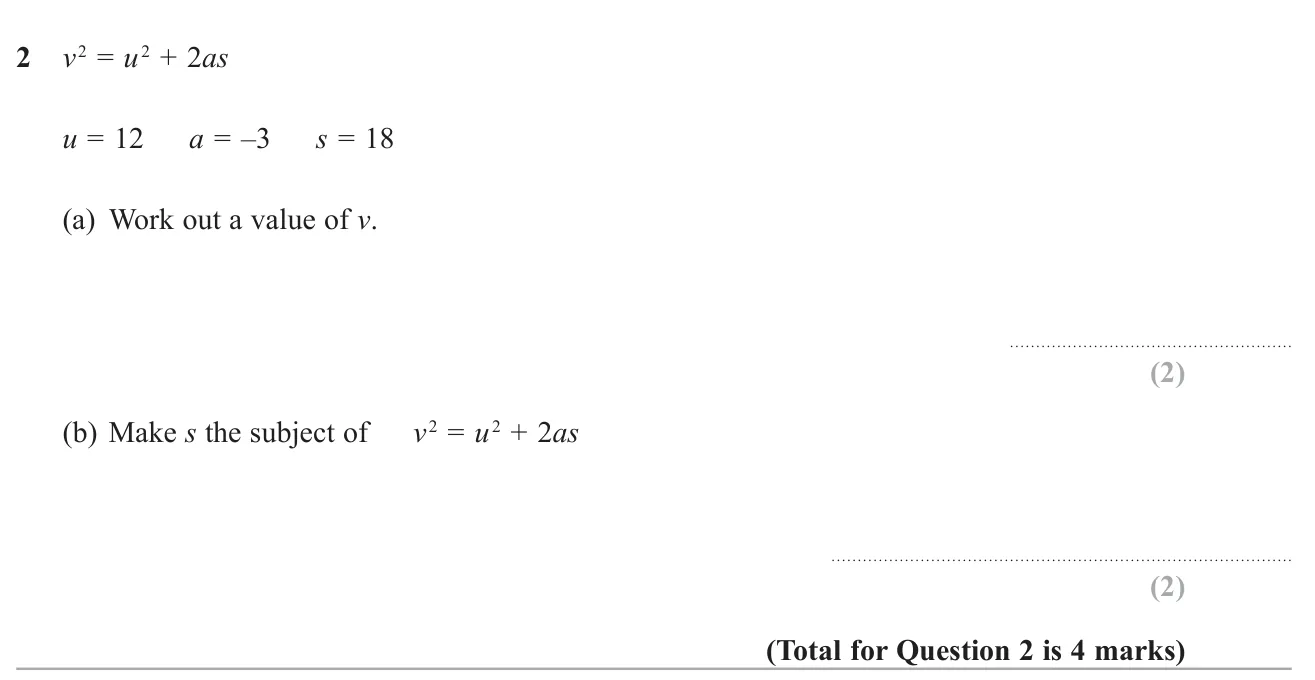
© Pearson Education Ltd. November 2018 Paper 1 (Higher, non-calculator), question 2.
| (a) | 6 (or ) | 2 marks |
|---|---|---|
| (b) | 2 marks |
Worked solution Checked against the mark scheme
(a)
(b)
Watch out: In (a), forgetting the negative sign on and getting .
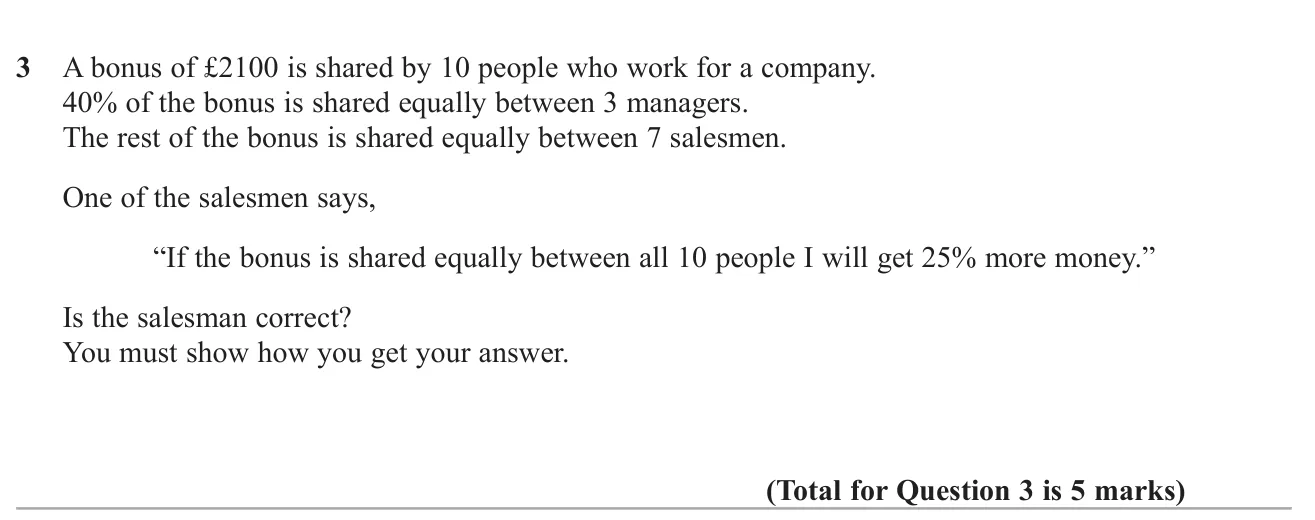
© Pearson Education Ltd. November 2018 Paper 1 (Higher, non-calculator), question 3.
| Answer | No: he would get £210 instead of £180, only about 16.7% more (25% more would be £225) | 5 marks |
|---|
Worked solution Checked against the mark scheme
Managers get , so salesmen get .
Each salesman: .
Shared equally: .
25% more than £180 is .
, so the salesman is wrong (it is only about 16.7% more).
Watch out: Working out 25% of the whole bonus rather than of one salesman's share.
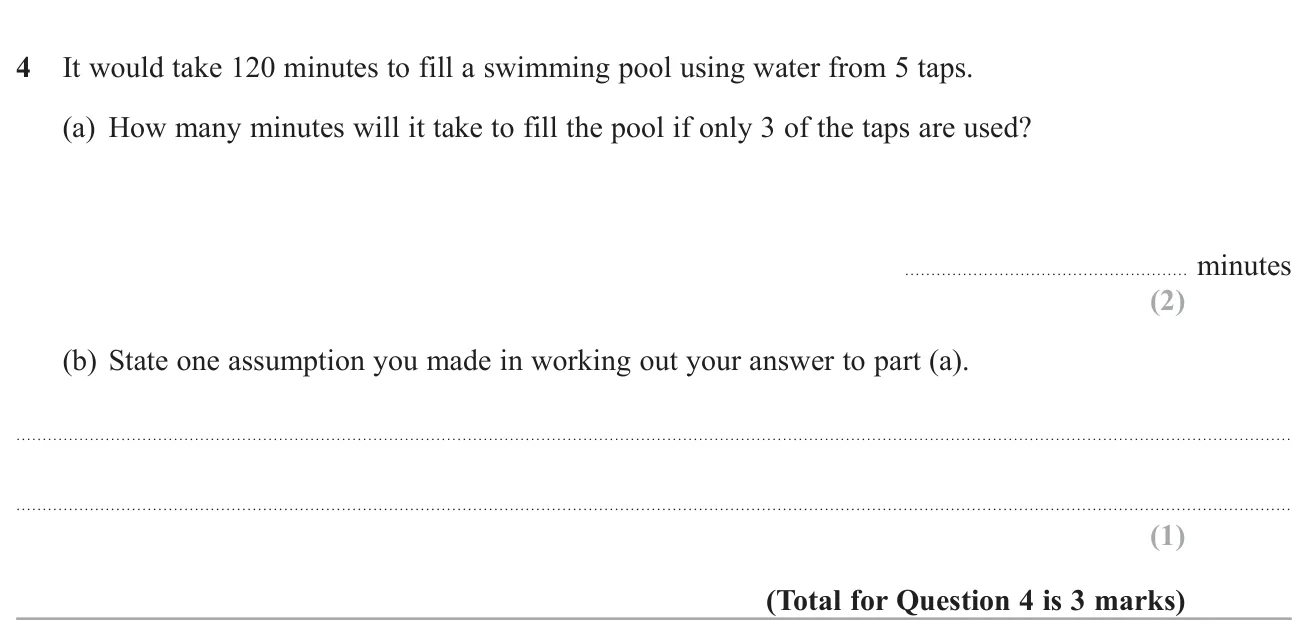
© Pearson Education Ltd. November 2018 Paper 1 (Higher, non-calculator), question 4.
| (a) | 200 minutes | 2 marks |
|---|---|---|
| (b) | Every tap lets water out at the same, constant rate | 1 mark |
Worked solution Checked against the mark scheme
(a) One tap alone would take minutes.
Three taps: minutes.
(b) Assume each tap gives water at the same rate, and that rate stays constant.
Watch out: Treating it as direct proportion and getting 72 minutes.
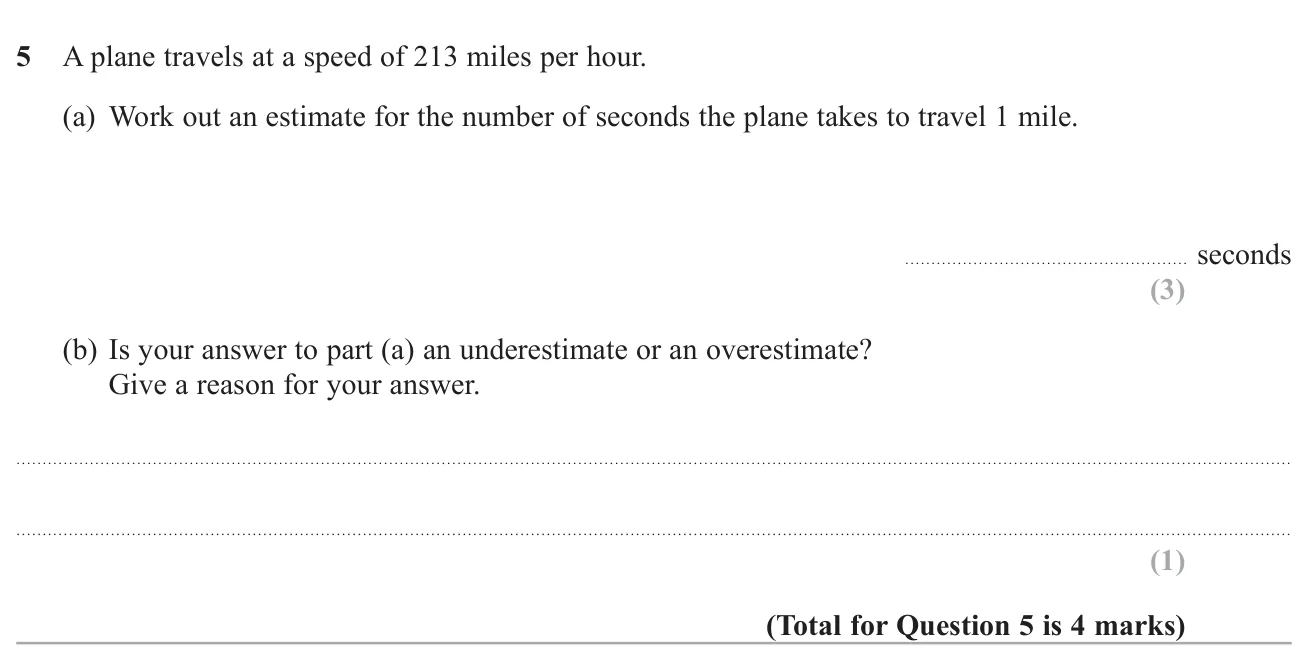
© Pearson Education Ltd. November 2018 Paper 1 (Higher, non-calculator), question 5.
| (a) | 18 seconds (accept 16 to 20) | 3 marks |
|---|---|---|
| (b) | Overestimate: the speed was rounded down, so the time comes out longer | 1 mark |
Worked solution Checked against the mark scheme
(a) Round 213 to 200 mph.
1 hour seconds.
Time for 1 mile seconds.
(b) Overestimate: 200 is slower than the real speed, so the real time is shorter.
Watch out: Dividing 200 by 3600 instead of 3600 by 200.
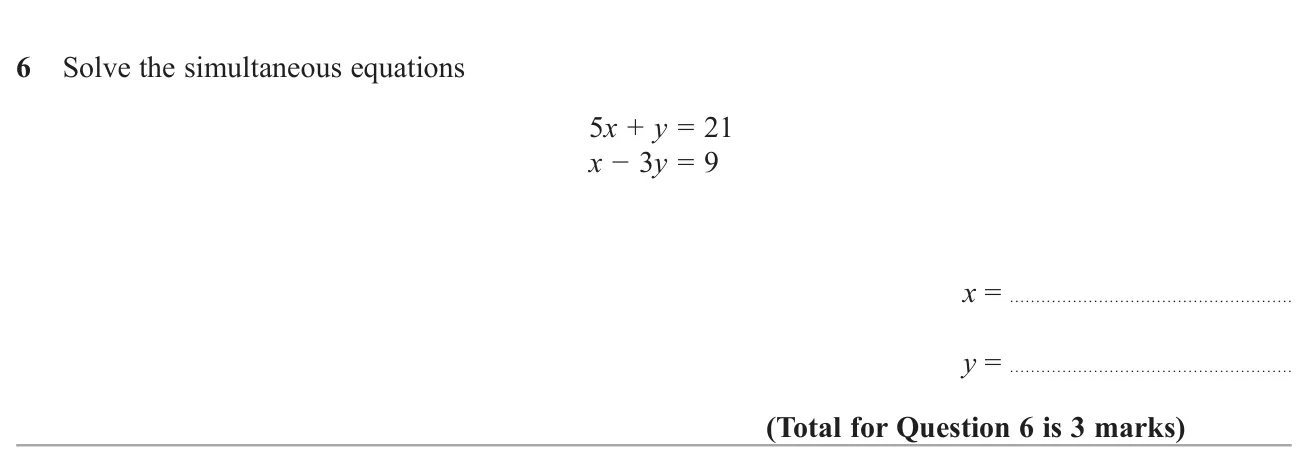
© Pearson Education Ltd. November 2018 Paper 1 (Higher, non-calculator), question 6.
| Answer | , | 3 marks |
|---|
Worked solution Checked against the mark scheme
Multiply the first equation by 3:
Add : , so
Check: ✓
Watch out: Sign error when eliminating y, e.g. subtracting instead of adding.
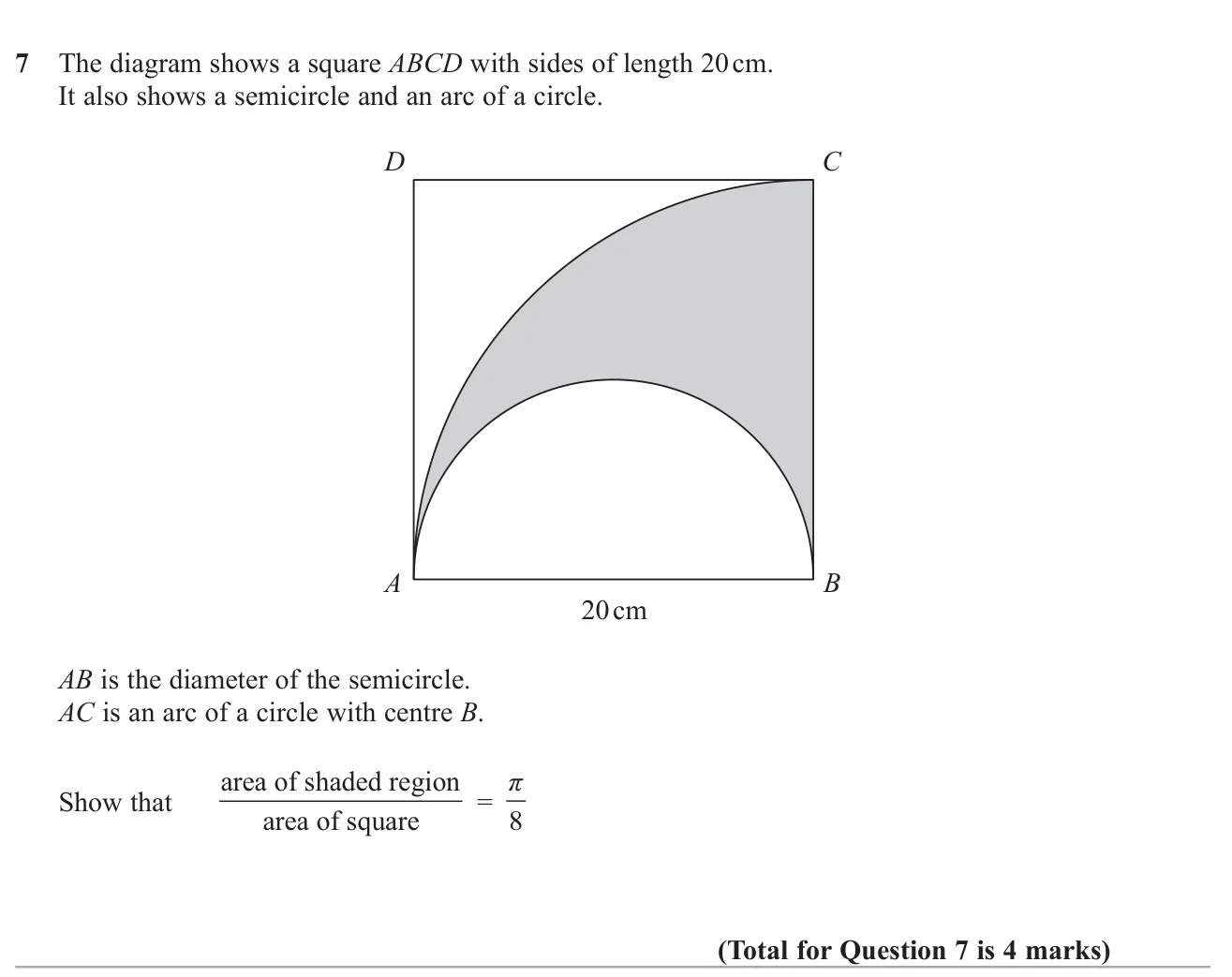
© Pearson Education Ltd. November 2018 Paper 1 (Higher, non-calculator), question 7.
| Answer | 4 marks |
|---|
Worked solution Checked against the mark scheme
Quarter circle, radius 20:
Semicircle, radius 10:
Shaded
Square
Watch out: Using 20 as the radius of the semicircle.
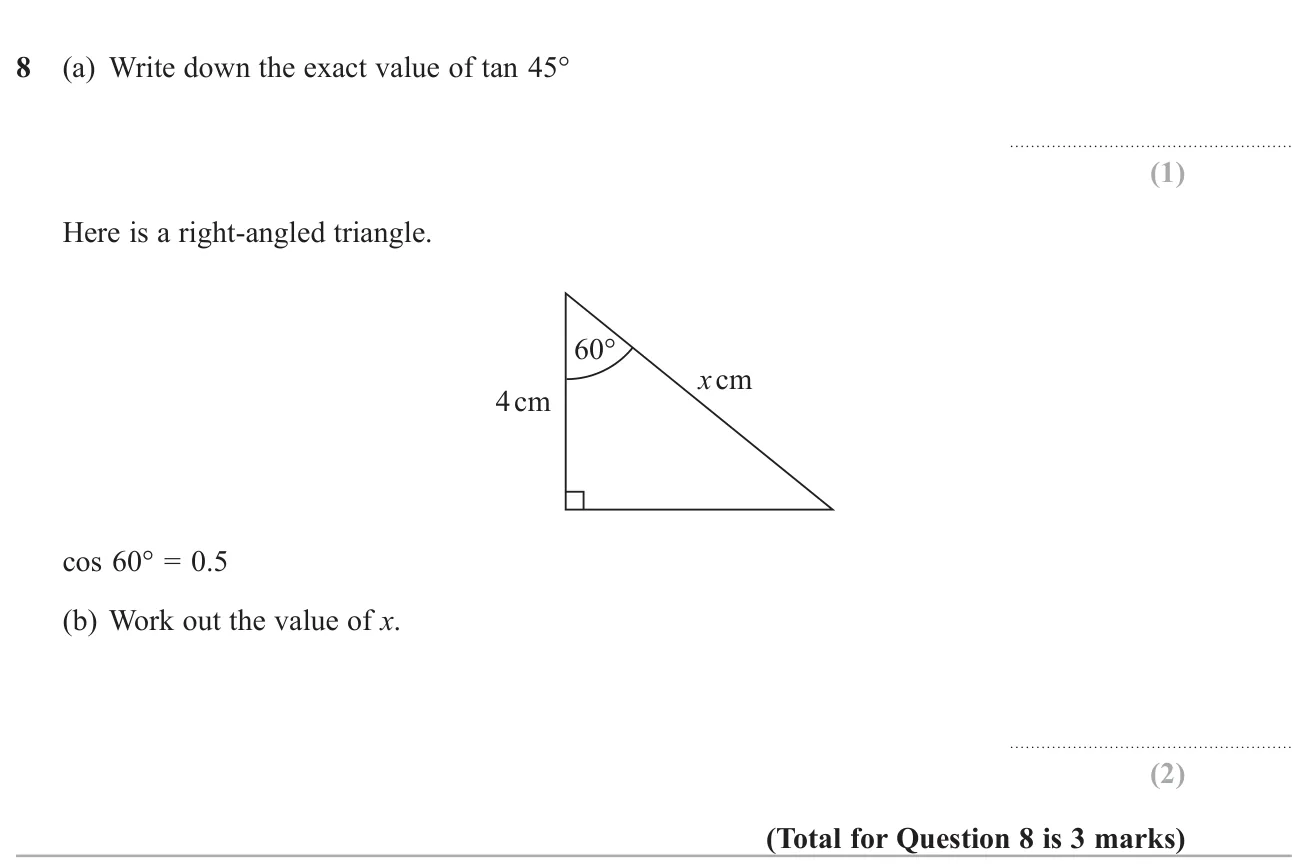
© Pearson Education Ltd. November 2018 Paper 1 (Higher, non-calculator), question 8.
| (a) | 1 mark | |
|---|---|---|
| (b) | 2 marks |
Worked solution Checked against the mark scheme
(a)
(b) The 4 cm side is next to the 60° angle and is the hypotenuse.
, so
Watch out: Writing and getting 2.
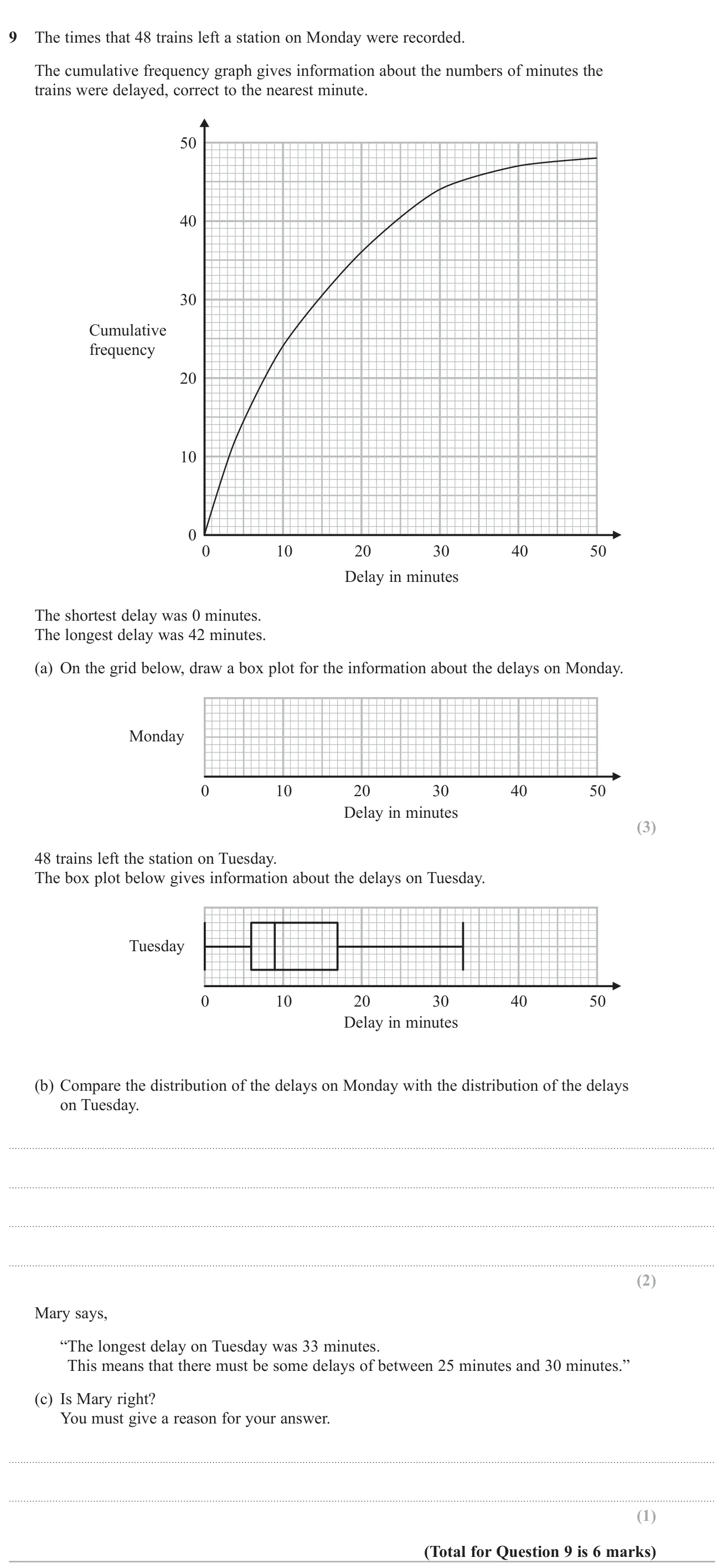
© Pearson Education Ltd. November 2018 Paper 1 (Higher, non-calculator), question 9.
| (a) | Box plot with whiskers at 0 and 42, box from 4 to 20, median at 10 | 3 marks |
|---|---|---|
| (b) | Monday's median (10) is higher than Tuesday's (9), so delays were typically longer on Monday; Monday's IQR (16) is bigger than Tuesday's (11), so Monday's delays were more varied | 2 marks |
| (c) | No: the top quarter of Tuesday's delays could all lie between 17 and 25 or between 30 and 33 minutes | 1 mark |
Worked solution Checked against the mark scheme
(a) There are 48 trains. Read across at 12, 24 and 36: LQ = 4, median = 10, UQ = 20. Draw the box from 4 to 20 with a line at 10 and whiskers to 0 and 42.
(b) From Tuesday's box plot: median 9, LQ 6, UQ 17 (IQR 11). Monday: median 10, IQR 16. Monday's delays were longer on average and more spread out.
(c) A box plot only tells us that 12 delays lie between 17 and 33. They could all avoid 25–30, so Mary is not right.
Watch out: Reading the median at 25 on the delay axis instead of at cumulative frequency 24.
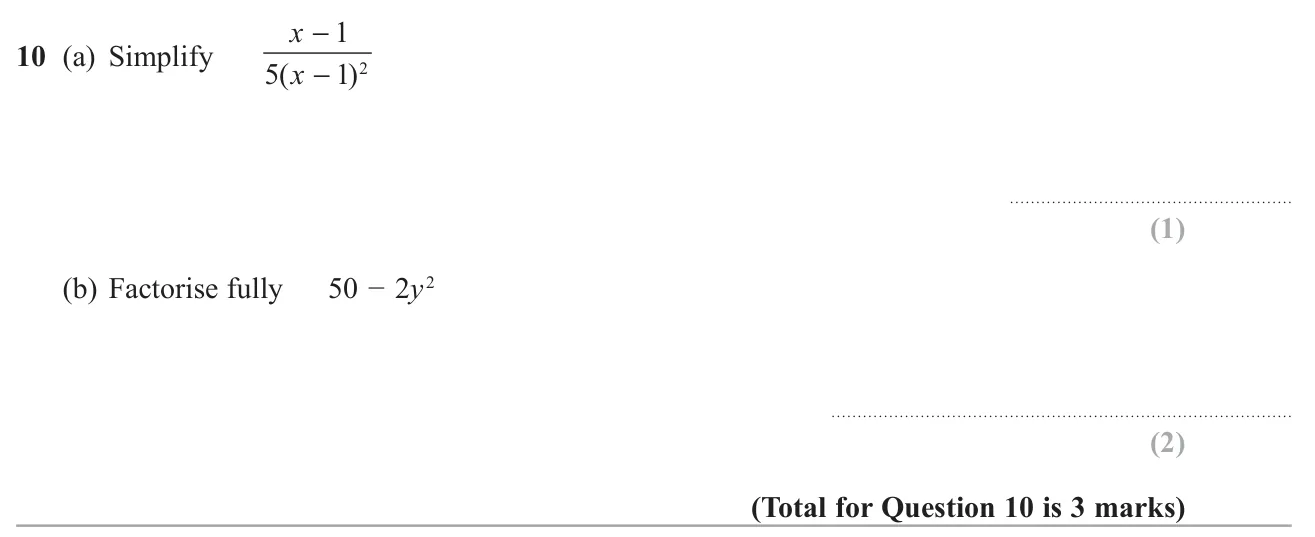
© Pearson Education Ltd. November 2018 Paper 1 (Higher, non-calculator), question 10.
| (a) | 1 mark | |
|---|---|---|
| (b) | 2 marks |
Worked solution Checked against the mark scheme
(a) Cancel one factor of from top and bottom:
(b) Take out the common factor 2:
is a difference of two squares:
Watch out: Stopping at without factorising fully.
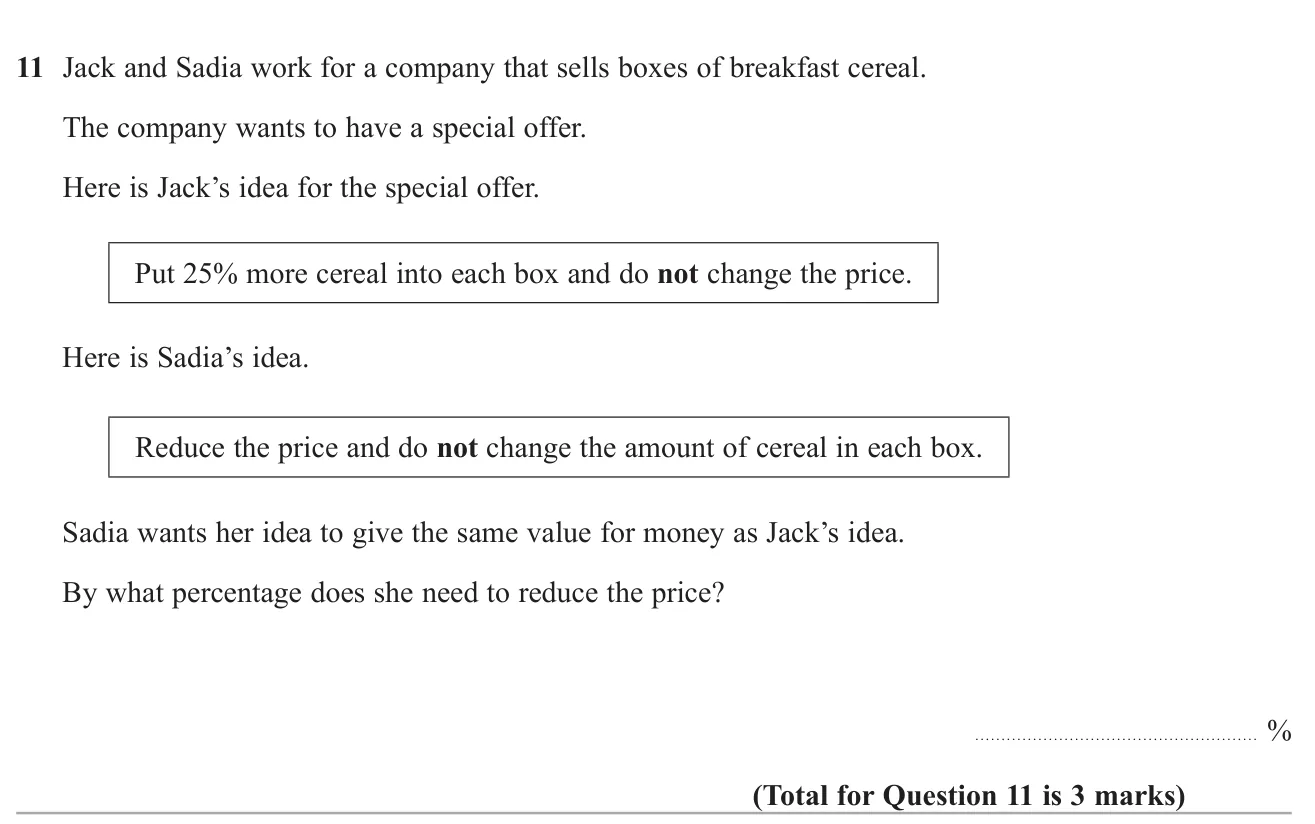
© Pearson Education Ltd. November 2018 Paper 1 (Higher, non-calculator), question 11.
| Answer | % | 3 marks |
|---|
Worked solution Checked against the mark scheme
Jack: 125 g for the price of 100 g, so 1 g costs of the old price.
Sadia needs the price of the normal box to be 80% of the original.
Reduction
Watch out: Answering 25%.
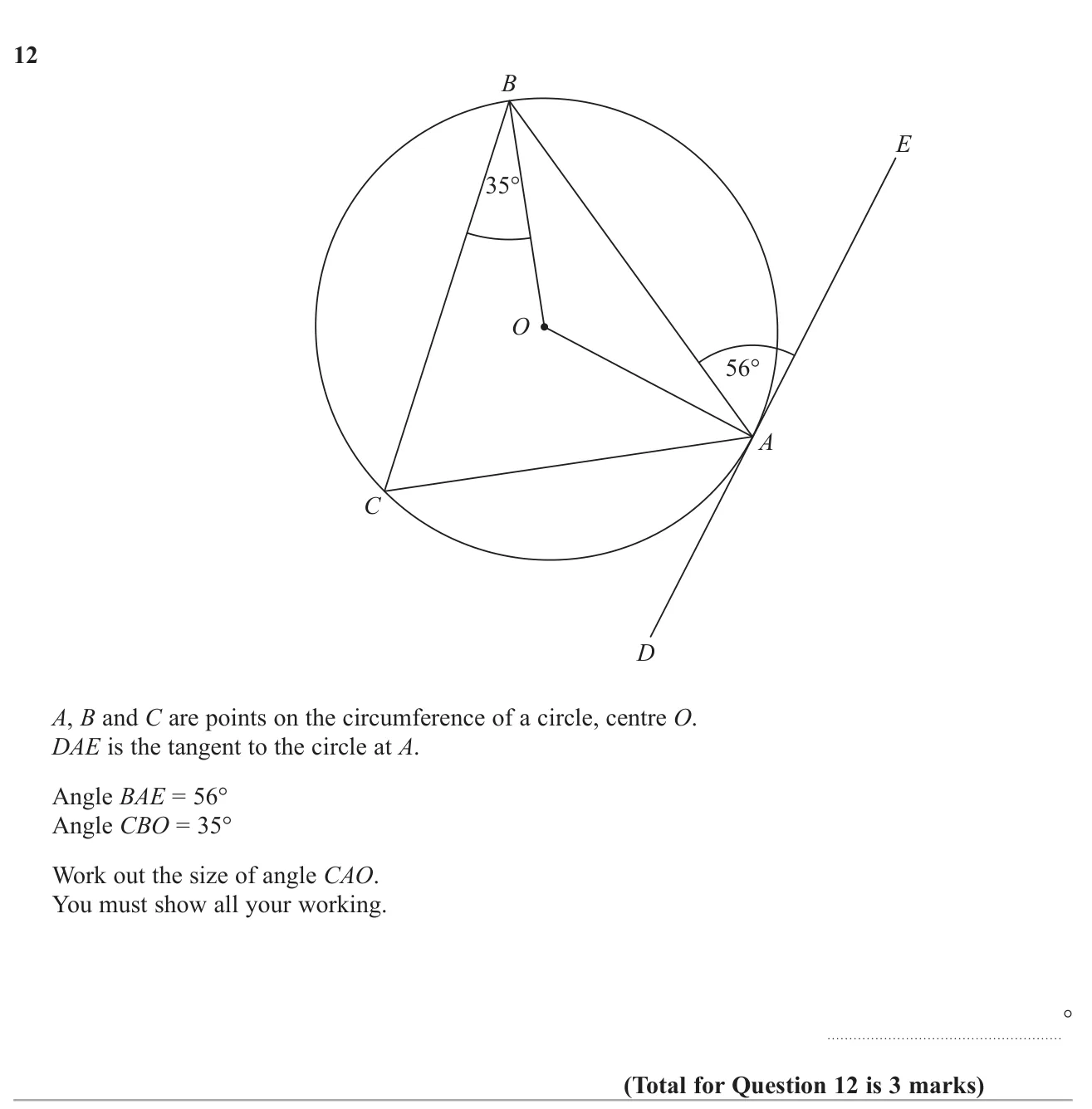
© Pearson Education Ltd. November 2018 Paper 1 (Higher, non-calculator), question 12.
| Answer | 3 marks |
|---|
Worked solution Checked against the mark scheme
Tangent meets radius at 90°, so angle OAB .
OA = OB, so angle OBA and angle ABC .
Alternate segment theorem: angle ACB .
Angle CAB
Angle CAO
Watch out: Missing that triangle OAB is isosceles.
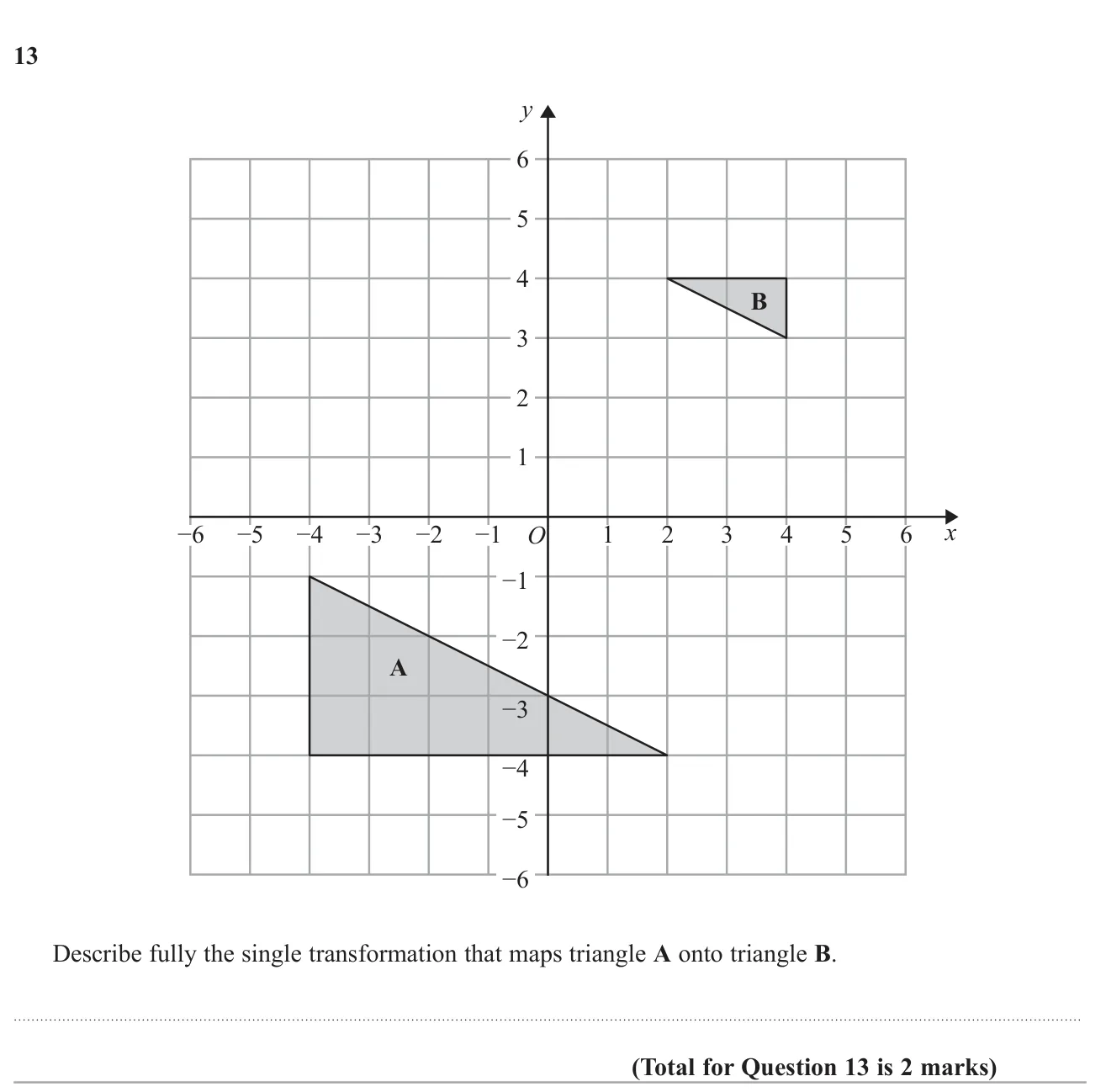
© Pearson Education Ltd. November 2018 Paper 1 (Higher, non-calculator), question 13.
| Answer | Enlargement, scale factor , centre | 2 marks |
|---|
Worked solution Checked against the mark scheme
B is smaller and upside down compared with A, so it is an enlargement with a negative scale factor.
A's side of length 6 becomes 2, so the scale factor is .
Join matching corners, e.g. to and to : the lines cross at .
Enlargement, scale factor , centre .
Watch out: Giving a scale factor of and missing that the image is inverted, or describing it as a rotation plus enlargement.
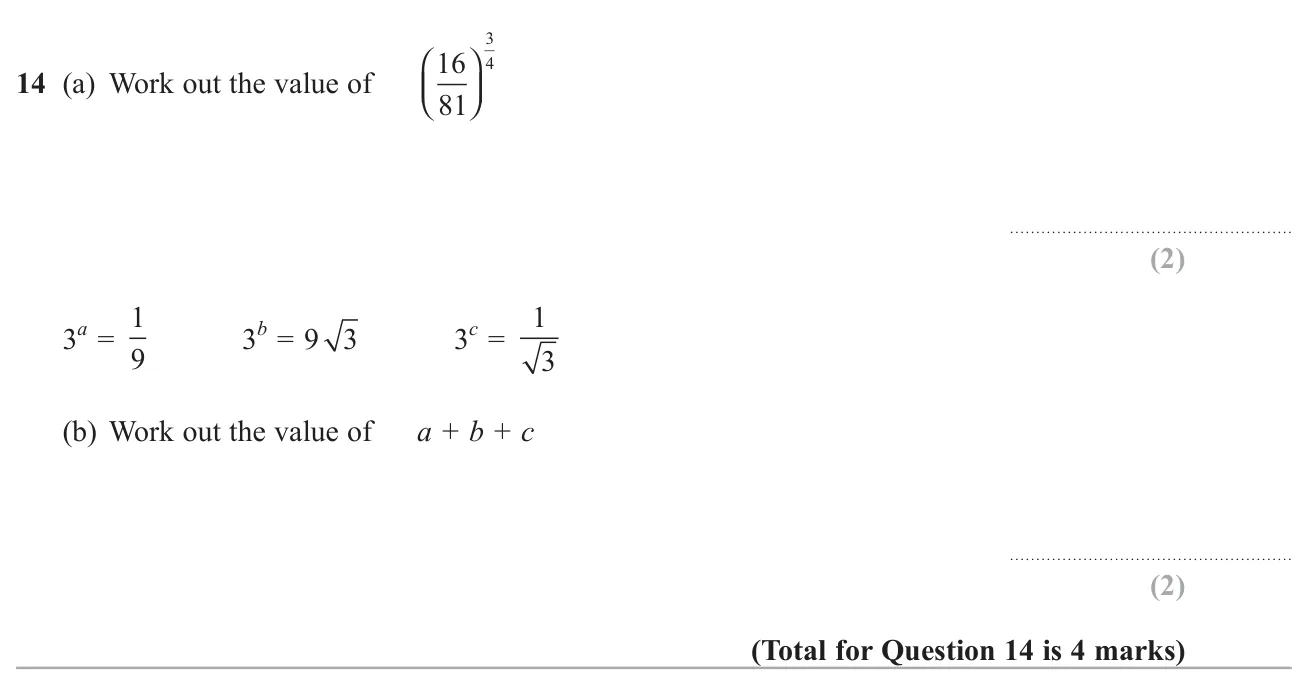
© Pearson Education Ltd. November 2018 Paper 1 (Higher, non-calculator), question 14.
| (a) | 2 marks | |
|---|---|---|
| (b) | 2 marks |
Worked solution Checked against the mark scheme
(a) : fourth root first gives , then cube:
(b) , so
, so
, so
Watch out: Cubing before taking the fourth root and getting stuck with large numbers, or treating the power as 4.
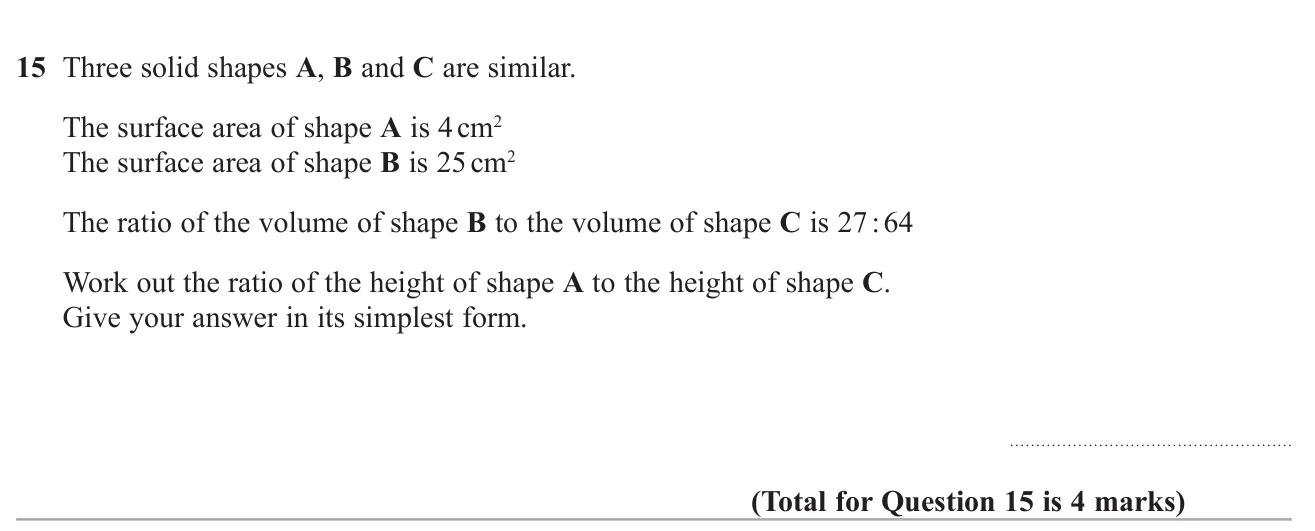
© Pearson Education Ltd. November 2018 Paper 1 (Higher, non-calculator), question 15.
| Answer | 4 marks |
|---|
Worked solution Checked against the mark scheme
Area ratio A:B = 4:25, so length ratio A:B
Volume ratio B:C = 27:64, so length ratio B:C
Make B match: A:B = 6:15 and B:C = 15:20, so A:B:C = 6:15:20
A:C = 6:20 = 3:10
Watch out: Using the area or volume ratios directly as length ratios.

© Pearson Education Ltd. November 2018 Paper 1 (Higher, non-calculator), question 16.
| Answer | Let ; , so | 3 marks |
|---|
Worked solution Checked against the mark scheme
Let
and
Subtract:
Watch out: Multiplying by 100 and subtracting , which does not cancel the recurring part because the repeat starts after the 2.
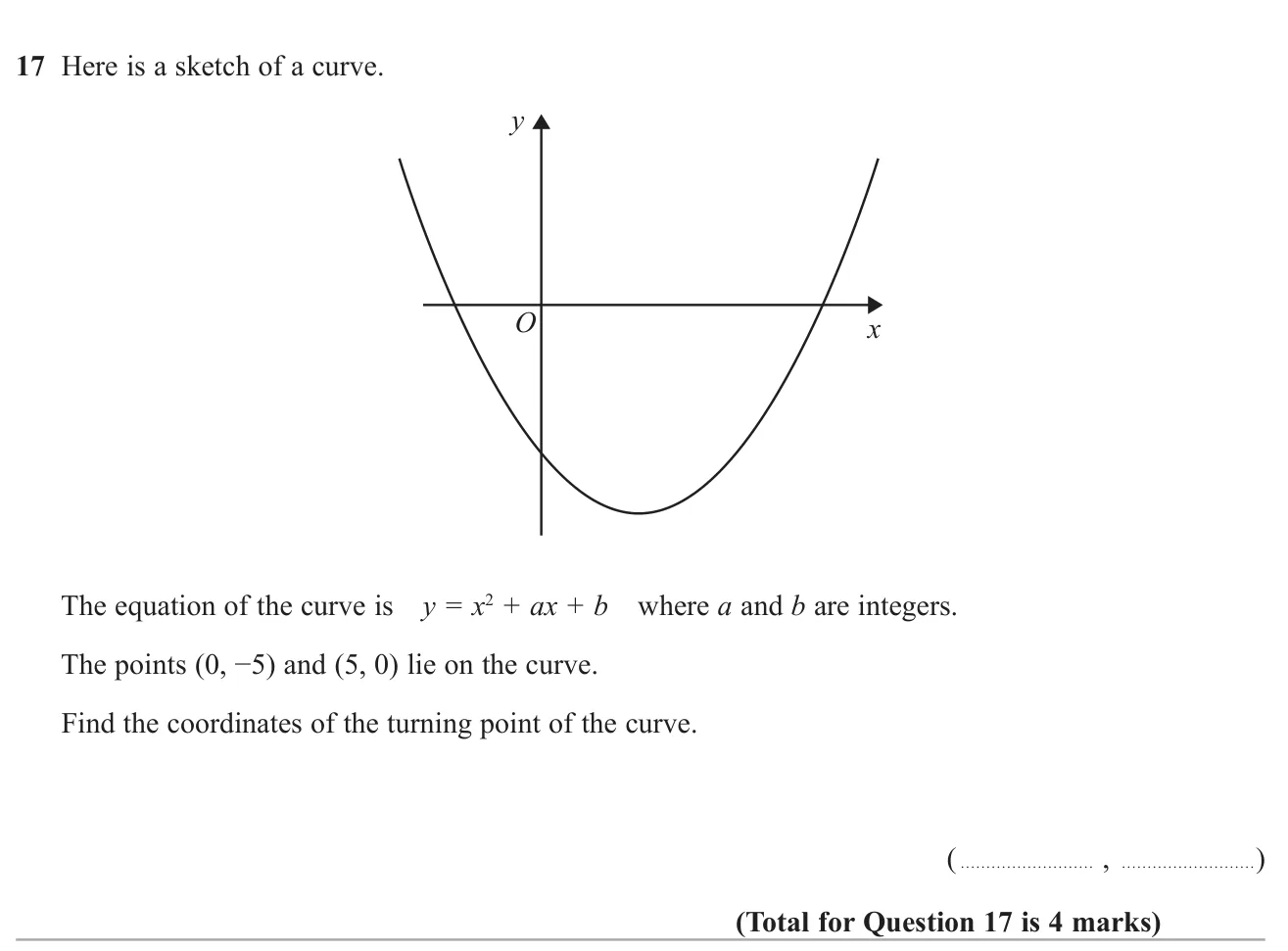
© Pearson Education Ltd. November 2018 Paper 1 (Higher, non-calculator), question 17.
| Answer | 4 marks |
|---|
Worked solution Checked against the mark scheme
At :
At : , so
Turning point:
Watch out: Getting the sign of the x-coordinate wrong when completing the square.
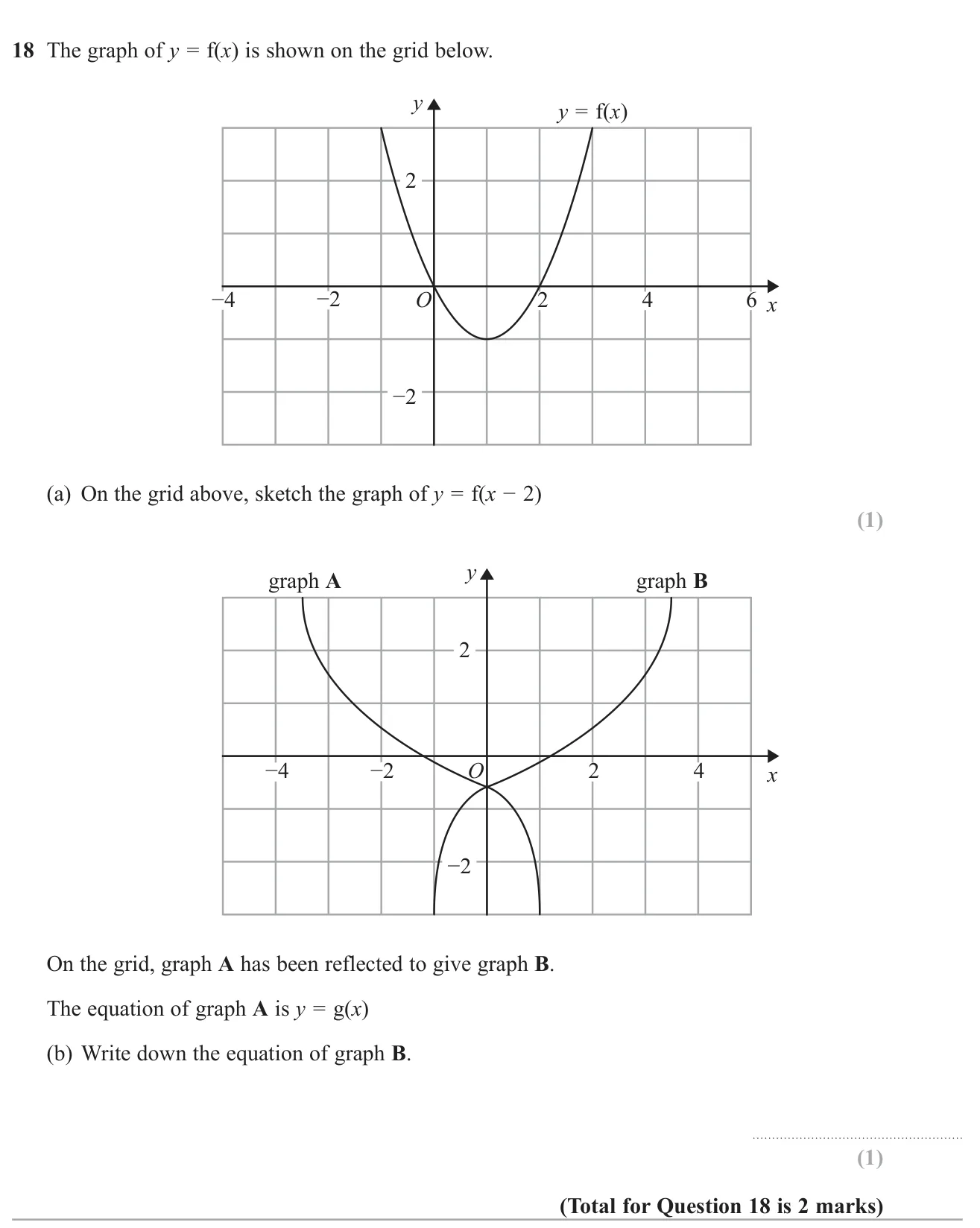
© Pearson Education Ltd. November 2018 Paper 1 (Higher, non-calculator), question 18.
| (a) | The curve moved 2 units right: crosses the x-axis at (2, 0) and (4, 0), minimum at (3, −1) | 1 mark |
|---|---|---|
| (b) | 1 mark |
Worked solution Checked against the mark scheme
(a) moves the graph 2 units to the right. The roots 0 and 2 become 2 and 4, and the minimum becomes .
(b) Graph B is graph A reflected in the y-axis, so its equation is .
Watch out: Moving the graph 2 units left for .
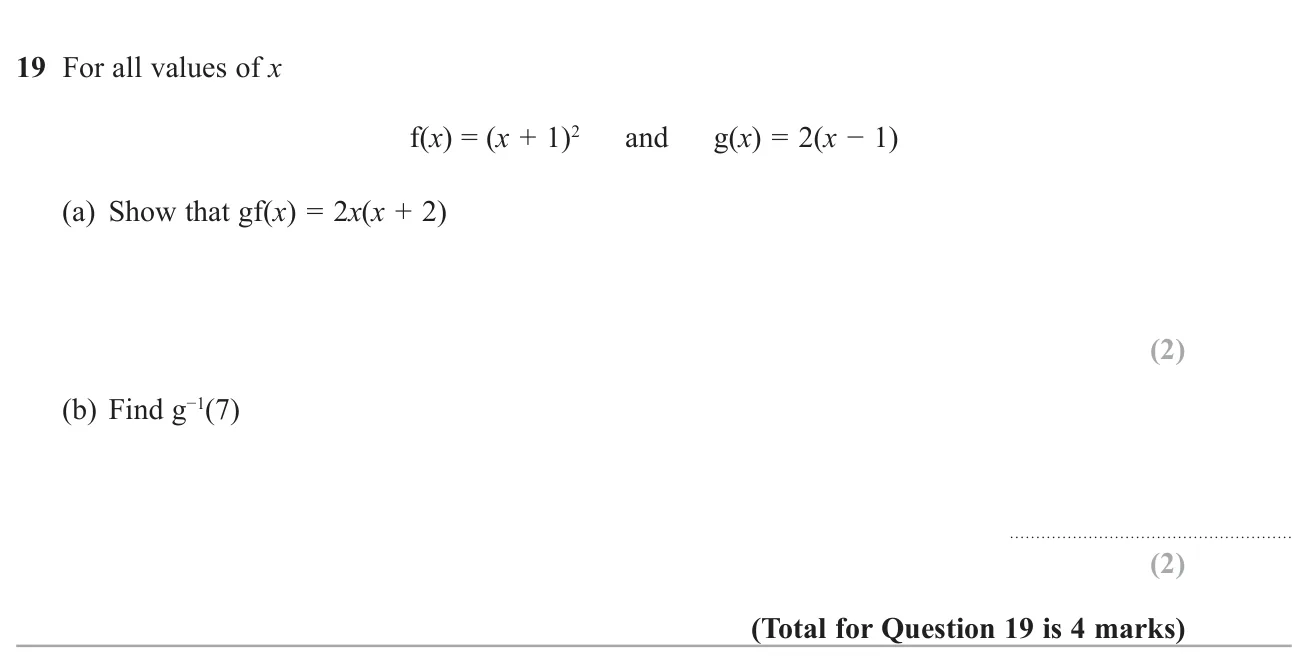
© Pearson Education Ltd. November 2018 Paper 1 (Higher, non-calculator), question 19.
| (a) | 2 marks | |
|---|---|---|
| (b) | 2 marks |
Worked solution Checked against the mark scheme
(a)
(b) Solve : , so and
Watch out: Working out instead of .
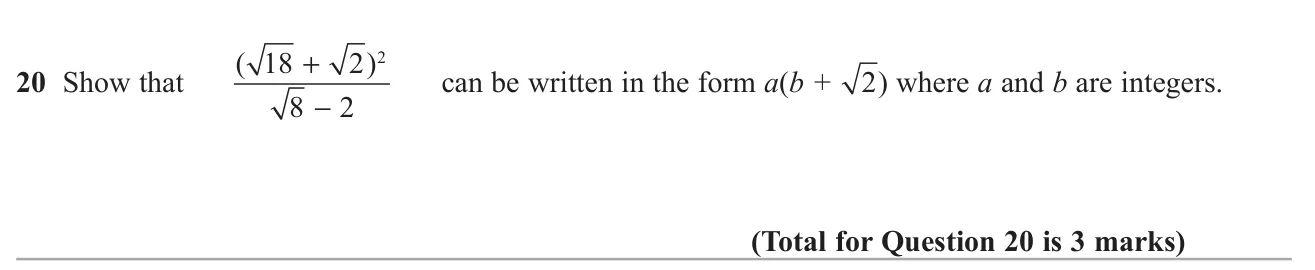
© Pearson Education Ltd. November 2018 Paper 1 (Higher, non-calculator), question 20.
| Answer | , so , | 3 marks |
|---|
Worked solution Checked against the mark scheme
, so the numerator is
Watch out: Squaring the numerator as and forgetting the middle terms.
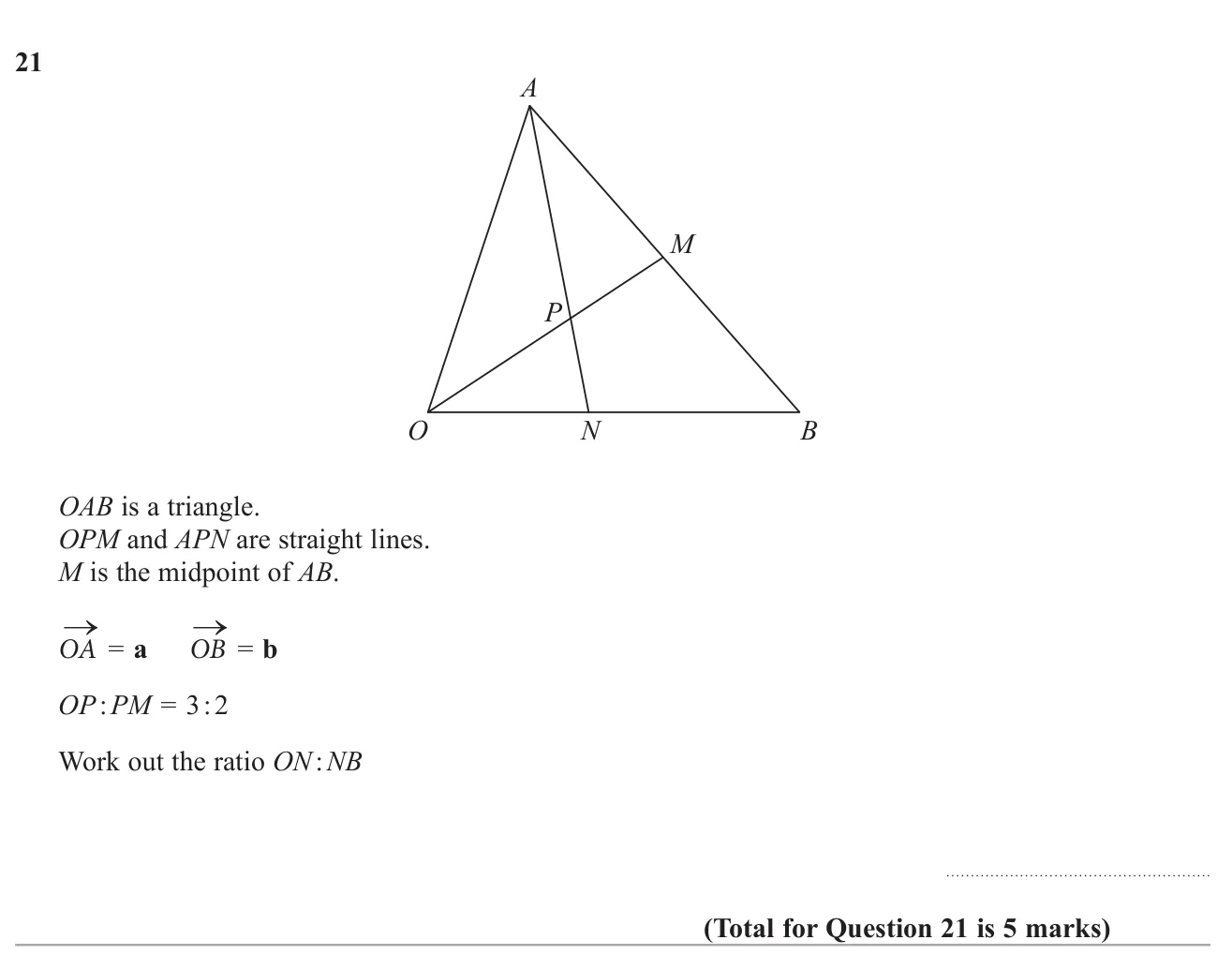
© Pearson Education Ltd. November 2018 Paper 1 (Higher, non-calculator), question 21.
| Answer | 5 marks |
|---|
Worked solution Checked against the mark scheme
, so
N is on OB, so must be a multiple of :
, so
Watch out: Taking as by misreading the ratio.
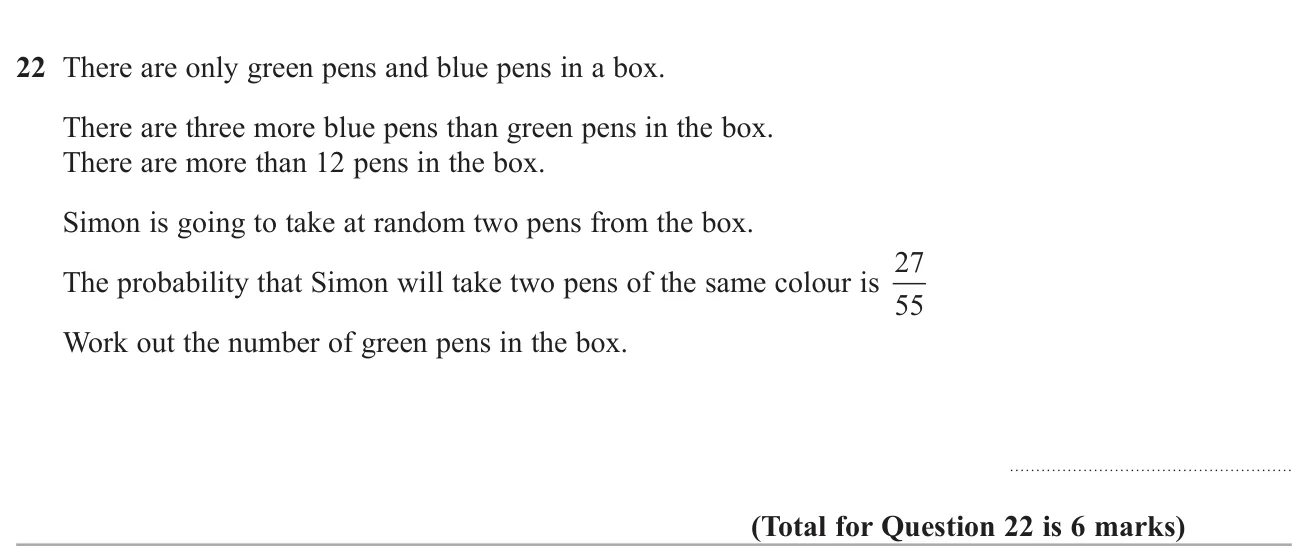
© Pearson Education Ltd. November 2018 Paper 1 (Higher, non-calculator), question 22.
| Answer | 6 marks |
|---|
Worked solution Checked against the mark scheme
Let = green pens, so there are blue and in total.
, i.e.
, so or
There are more than 12 pens, so (11 pens) is rejected: 21 green pens.
Watch out: Treating the picks as with replacement, or forgetting to add the two-blue case.
Add up your marks for all three papers and see what grade that would have been.