Revision guide by The Full Marks
Tree diagrams and combined events: what you need to know Tree diagrams show two or more events one after another, with a probability on each branch. They are a reliable way to find the probability of combined events, and they come up regularly on both tiers.
Both tiers use tree diagrams for independent and dependent events, including picks without replacement; Higher questions can also involve algebra, such as forming and solving an equation for an unknown number of items.
Key facts Multiply along the branches to find the probability of one route (AND). Add the results of different routes when more than one route works (OR). The branches from any one point add up to 1. Independent events: the second probabilities are the same as the first (for example, with replacement). Dependent events: the second probabilities change. Without replacement, the denominator goes down by 1, and the numerator also goes down by 1 if the first item was the same type. A frequency tree shows numbers of people or things, not probabilities: the two numbers at the end of each pair of branches add up to the number they came from. Using a tree diagram Draw a set of branches for the first event and write the probabilities on them. From the end of each branch, draw branches for the second event. Change the fractions if it is without replacement. Multiply along each route you need. Add those answers together. Three picks, and algebra (Higher) With three picks, list every order that works: exactly one red from red and blue means RBB, BRB and BBR. Multiply along each order (changing the fractions each time without replacement), then add. If the number of items is unknown, use n n n n n n = 6 n × 5 n − 1 = \frac{6}{n} \times \frac{5}{n - 1} = n 6 × n − 1 5 Worked examples Example 1 Foundation · grade 4
The probability it rains on any day is 0.3, independently of other days. Find the probability that over two days it rains (a) on both days (b) on exactly one day.
Show the solution P(no rain) = 1 − 0.3 = 0.70.3 × 0.3 = 0.09 0.3 \times 0.3 = 0.09 0.3 × 0.3 = 0.09 0.3 × 0.7 = 0.21 0.3 \times 0.7 = 0.21 0.3 × 0.7 = 0.21 0.7 × 0.3 = 0.21 0.7 \times 0.3 = 0.21 0.7 × 0.3 = 0.21
Example 2 Higher · grade 6
A bag contains 5 red and 4 blue sweets. Olivia takes one at random and eats it, then takes another. Find the probability both sweets are the same colour.
Show the solution Without replacement, so the second fractions change.5 9 × 4 8 = 20 72 \frac{5}{9} \times \frac{4}{8} = \frac{20}{72} 9 5 × 8 4 = 72 20 4 9 × 3 8 = 12 72 \frac{4}{9} \times \frac{3}{8} = \frac{12}{72} 9 4 × 8 3 = 72 12 20 72 + 12 72 = 32 72 = 4 9 \frac{20}{72} + \frac{12}{72} = \frac{32}{72} = \frac{4}{9} 72 20 + 72 12 = 72 32 = 9 4
Common mistakes Adding along the branches instead of multiplying. Only working out one route for 'exactly one' or 'different colours'. There are usually two. Keeping the same denominator on the second branches when the first item is not replaced. Changing the second-stage probabilities for independent events, such as two throws of the same dice. They only change when the first outcome affects the second. Exam tips Marks are often given for correct branch probabilities, so fill in the whole tree even if only part is asked. 'At least one' is usually quickest as 1 − P(none). Give probabilities as fractions, decimals or percentages, never as a ratio like 2 : 5 2 : 5 2 : 5 Questions people ask Do you add or multiply on a tree diagram? Multiply along a route (this AND that), then add the answers for different routes (this route OR that one).
What does 'without replacement' mean in probability? The first item is not put back, so there is one fewer item for the second pick. Both the numerator (if it is the same type) and the denominator go down by 1.
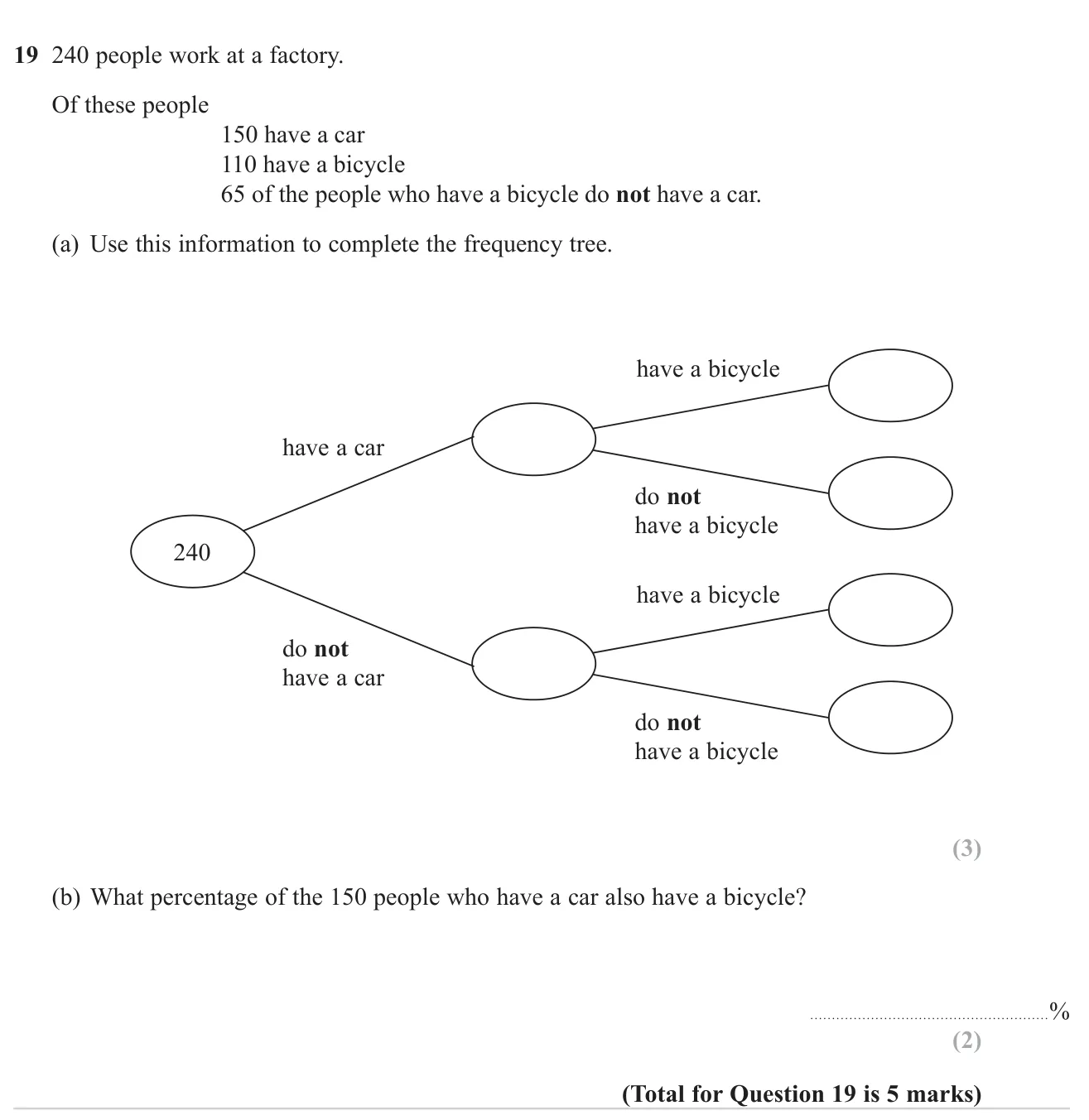
Exam questions: Tree diagrams and combined events (33, easiest first) © Pearson Education Ltd. June 2023 Paper 2 (Foundation, calculator), question 19.
(a) Car 150 (bicycle 45, no bicycle 105); no car 90 (bicycle 65, no bicycle 25) 3 marks (b) 30% 2 marks
Worked solution Checked against the mark scheme
(a) No car: 240 − 150 = 90 240 - 150 = 90 240 − 150 = 90 90 − 65 = 25 90 - 65 = 25 90 − 65 = 25
Car owners with a bicycle: 110 − 65 = 45 110 - 65 = 45 110 − 65 = 45 150 − 45 = 105 150 - 45 = 105 150 − 45 = 105
(b) 45 150 × 100 = 30 % \frac{45}{150} \times 100 = 30\% 150 45 × 100 = 30%
Watch out: Putting 110 on the 'car and bicycle' branch.
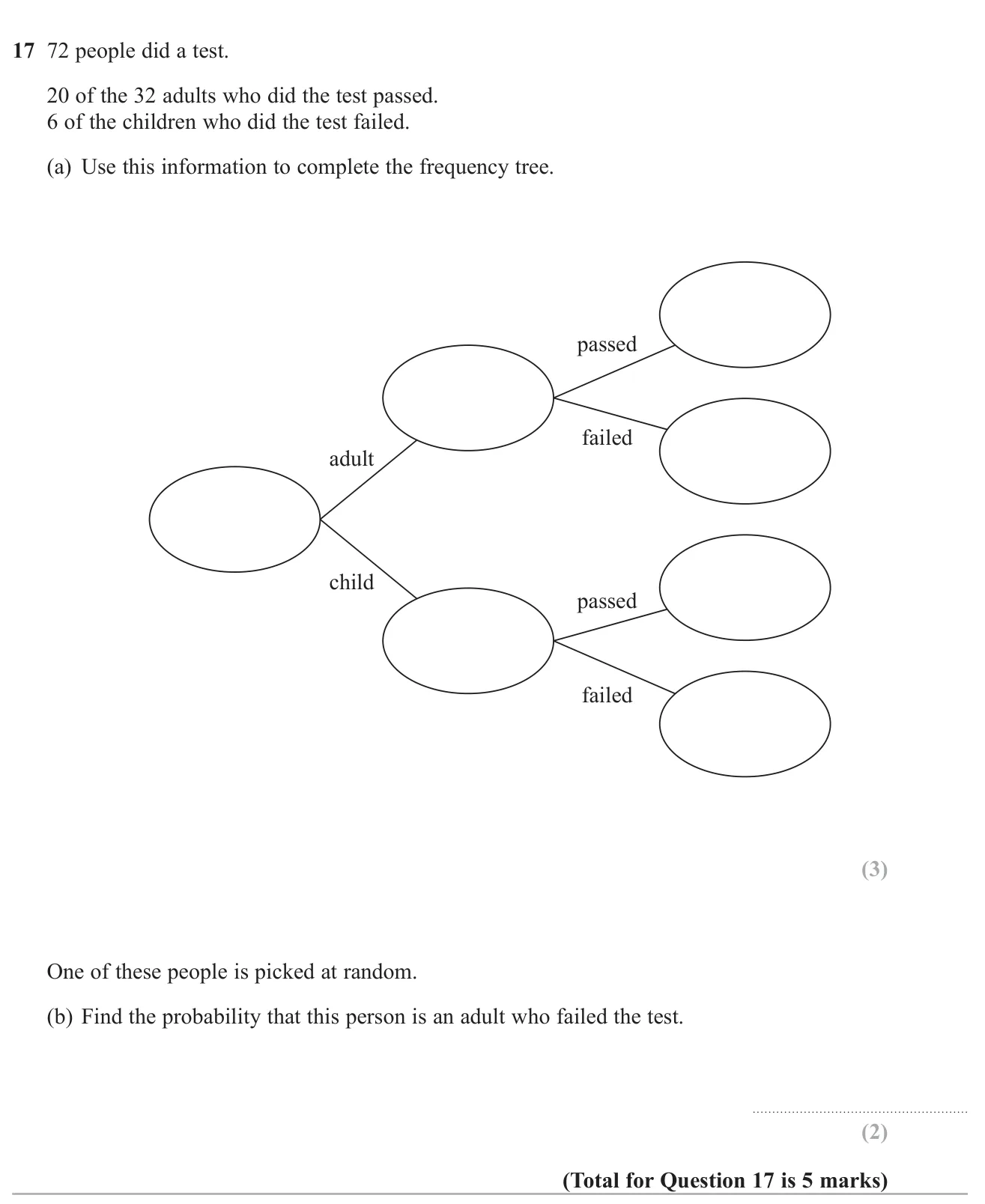
© Pearson Education Ltd. June 2022 Paper 1 (Foundation, non-calculator), question 17.
(a) Adult 32 (passed 20, failed 12); child 40 (passed 34, failed 6) 3 marks (b) 12 72 \frac{12}{72} 72 12 2 marks
Worked solution Checked against the mark scheme
(a) Adults: 32, so children: 72 − 32 = 40 72 - 32 = 40 72 − 32 = 40
Adults failed: 32 − 20 = 12 32 - 20 = 12 32 − 20 = 12
Children passed: 40 − 6 = 34 40 - 6 = 34 40 − 6 = 34
(b) 12 adults failed out of 72 people: 12 72 = 1 6 \frac{12}{72} = \frac{1}{6} 72 12 = 6 1
Watch out: Giving 12/32 by using only the adults as the total.
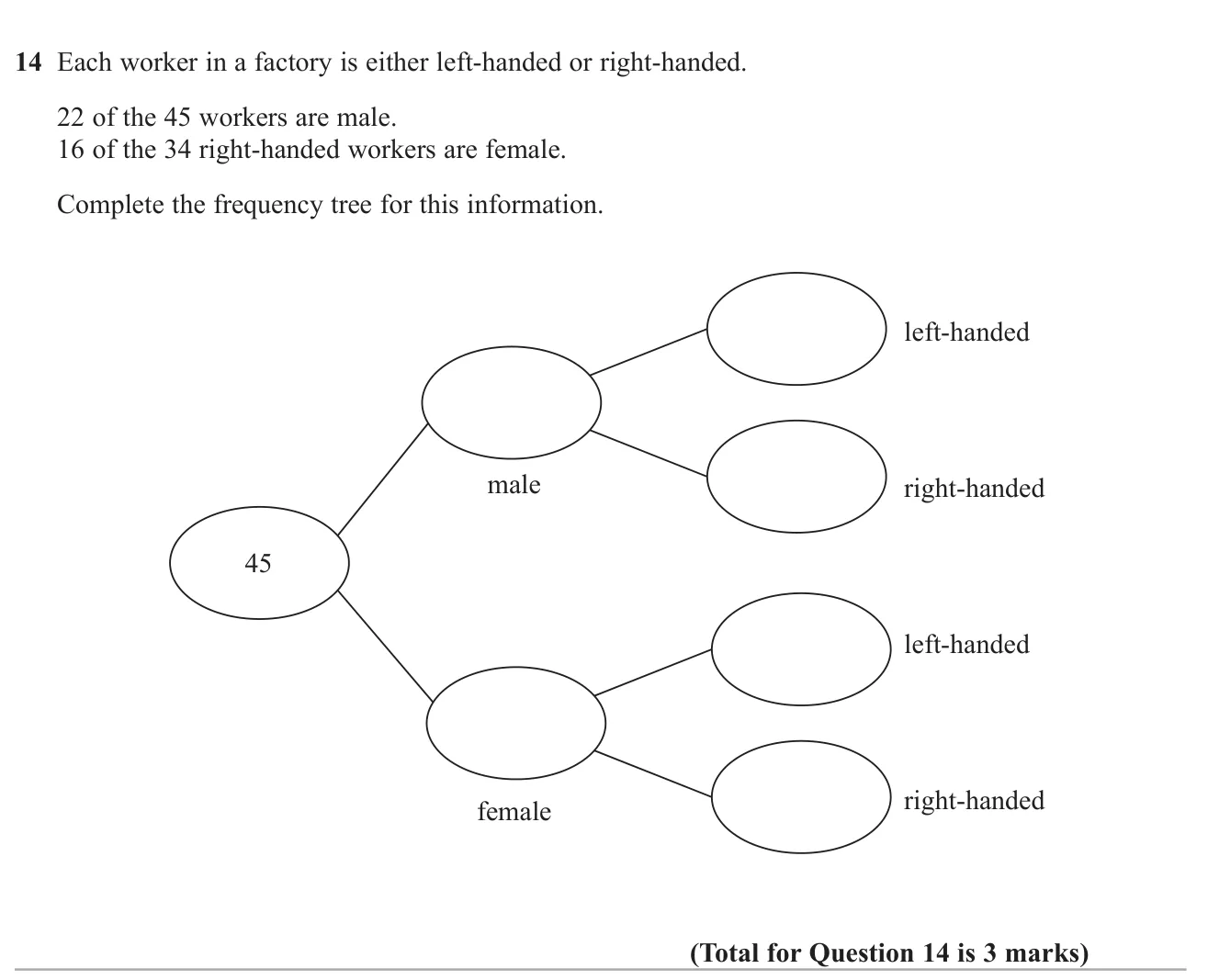
© Pearson Education Ltd. June 2018 Paper 2 (Foundation, calculator), question 14.
Answer Male 22 (left 4, right 18); female 23 (left 7, right 16) 3 marks
Worked solution Checked against the mark scheme
Female: 45 − 22 = 23 45 - 22 = 23 45 − 22 = 23
Male right-handed: 34 − 16 = 18 34 - 16 = 18 34 − 16 = 18
Male left-handed: 22 − 18 = 4 22 - 18 = 4 22 − 18 = 4
Female left-handed: 23 − 16 = 7 23 - 16 = 7 23 − 16 = 7
Check: left-handed total 4 + 7 = 11 = 45 − 34 4 + 7 = 11 = 45 - 34 4 + 7 = 11 = 45 − 34
Watch out: Putting 16 on the male branch.
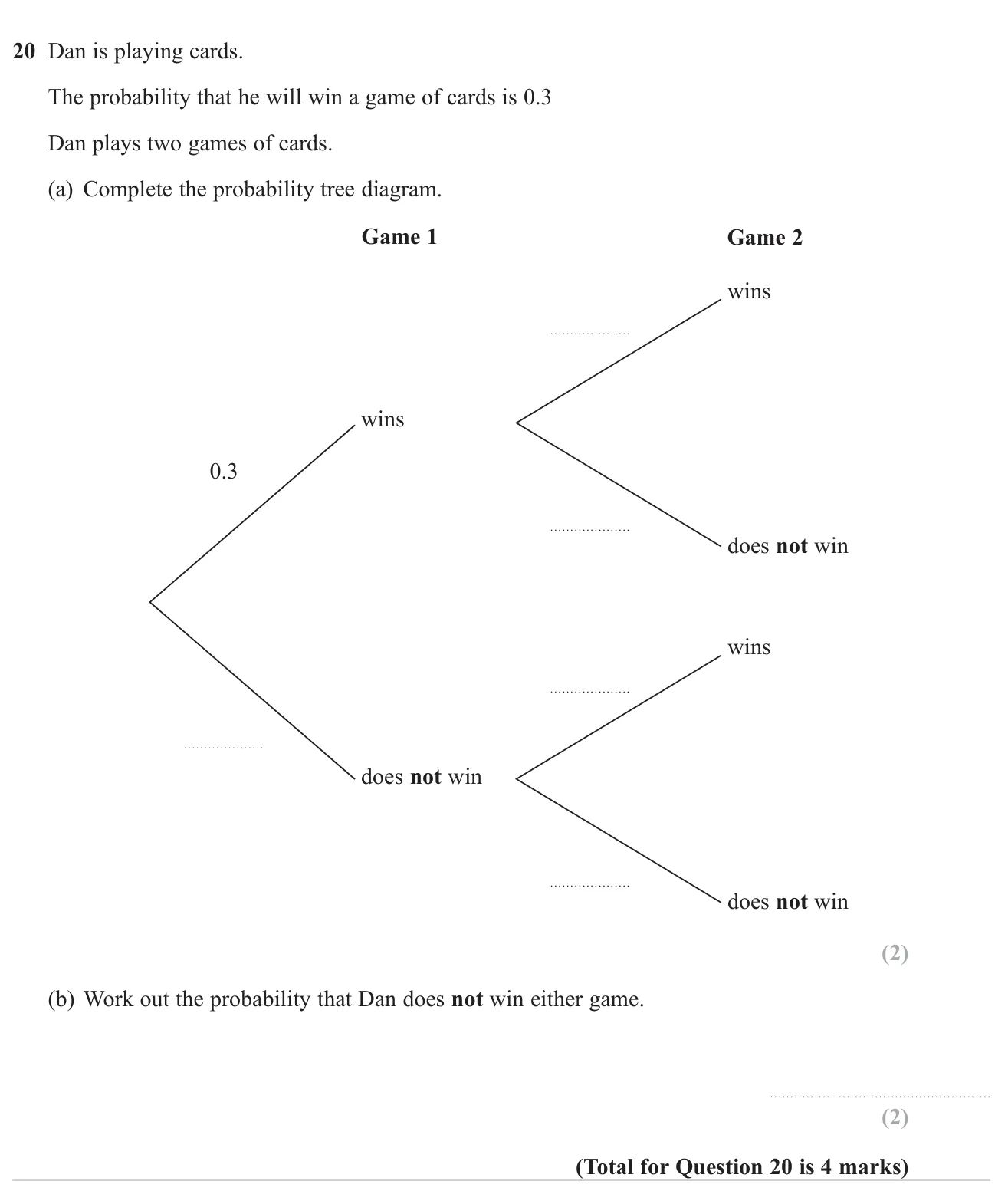
© Pearson Education Ltd. November 2024 Paper 3 (Foundation, calculator), question 20.
(a) Game 1: 0.3, 0.7; Game 2: 0.3, 0.7 on each pair of branches 2 marks (b) 0.49 0.49 0.49 2 marks
Worked solution Checked against the mark scheme
(a) Not winning: 1 − 0.3 = 0.7 1 - 0.3 = 0.7 1 − 0.3 = 0.7
(b) 0.7 × 0.7 = 0.49 0.7 \times 0.7 = 0.49 0.7 × 0.7 = 0.49
Watch out: Adding 0.7 + 0.7 instead of multiplying.
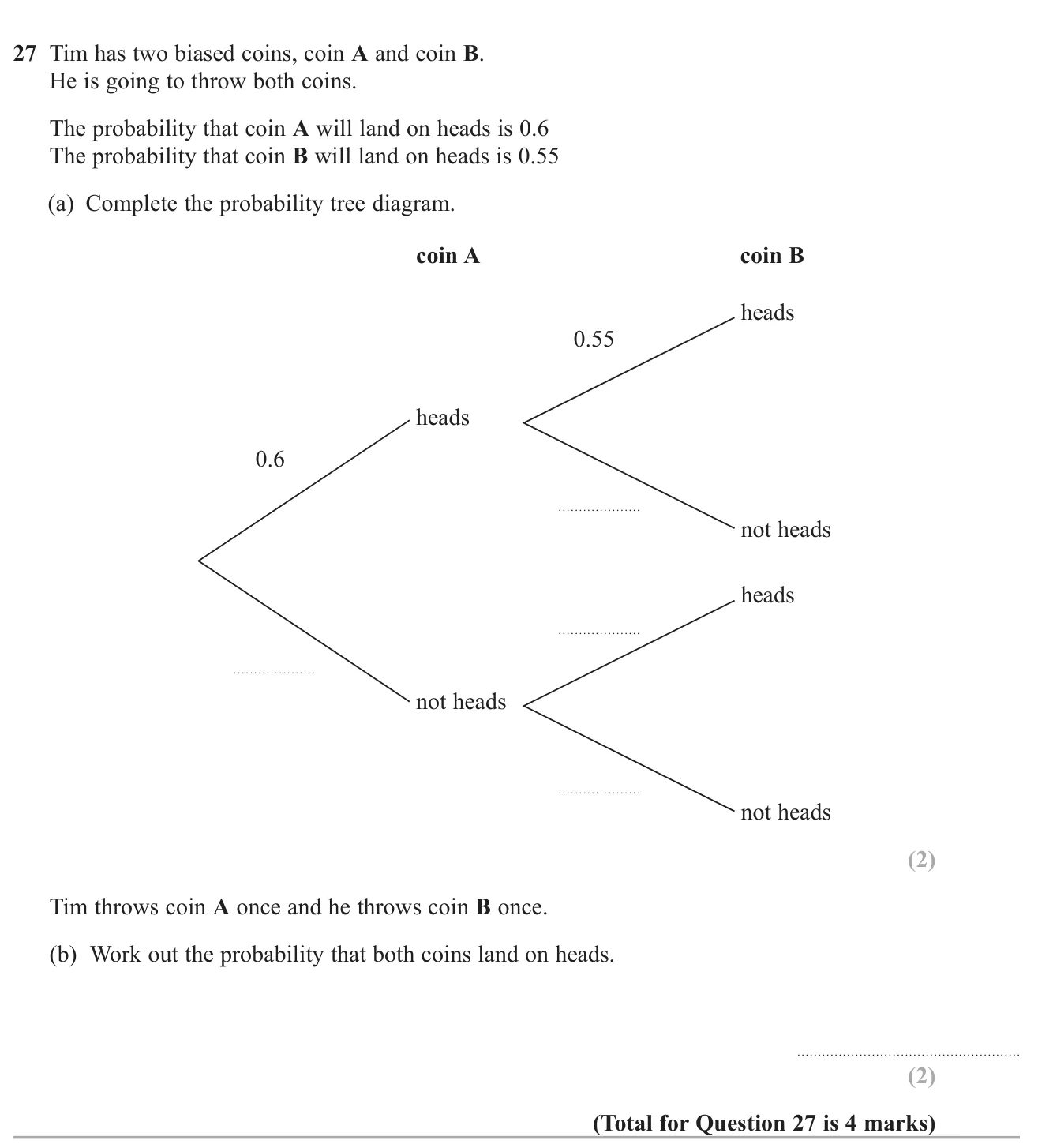
© Pearson Education Ltd. June 2024 Paper 3 (Foundation, calculator), question 27.
(a) Coin A not heads 0.4 0.4 0.4 0.45 0.45 0.45 0.55 0.55 0.55 0.45 0.45 0.45 2 marks (b) 0.33 0.33 0.33 2 marks
Worked solution Checked against the mark scheme
(a) 1 − 0.6 = 0.4 1 - 0.6 = 0.4 1 − 0.6 = 0.4 1 − 0.55 = 0.45 1 - 0.55 = 0.45 1 − 0.55 = 0.45 0.55 0.55 0.55 0.45 0.45 0.45
(b) P ( both heads ) = 0.6 × 0.55 = 0.33 P(\text{both heads}) = 0.6 \times 0.55 = 0.33 P ( both heads ) = 0.6 × 0.55 = 0.33
Watch out: Adding the probabilities (0.6 + 0.55 0.6 + 0.55 0.6 + 0.55
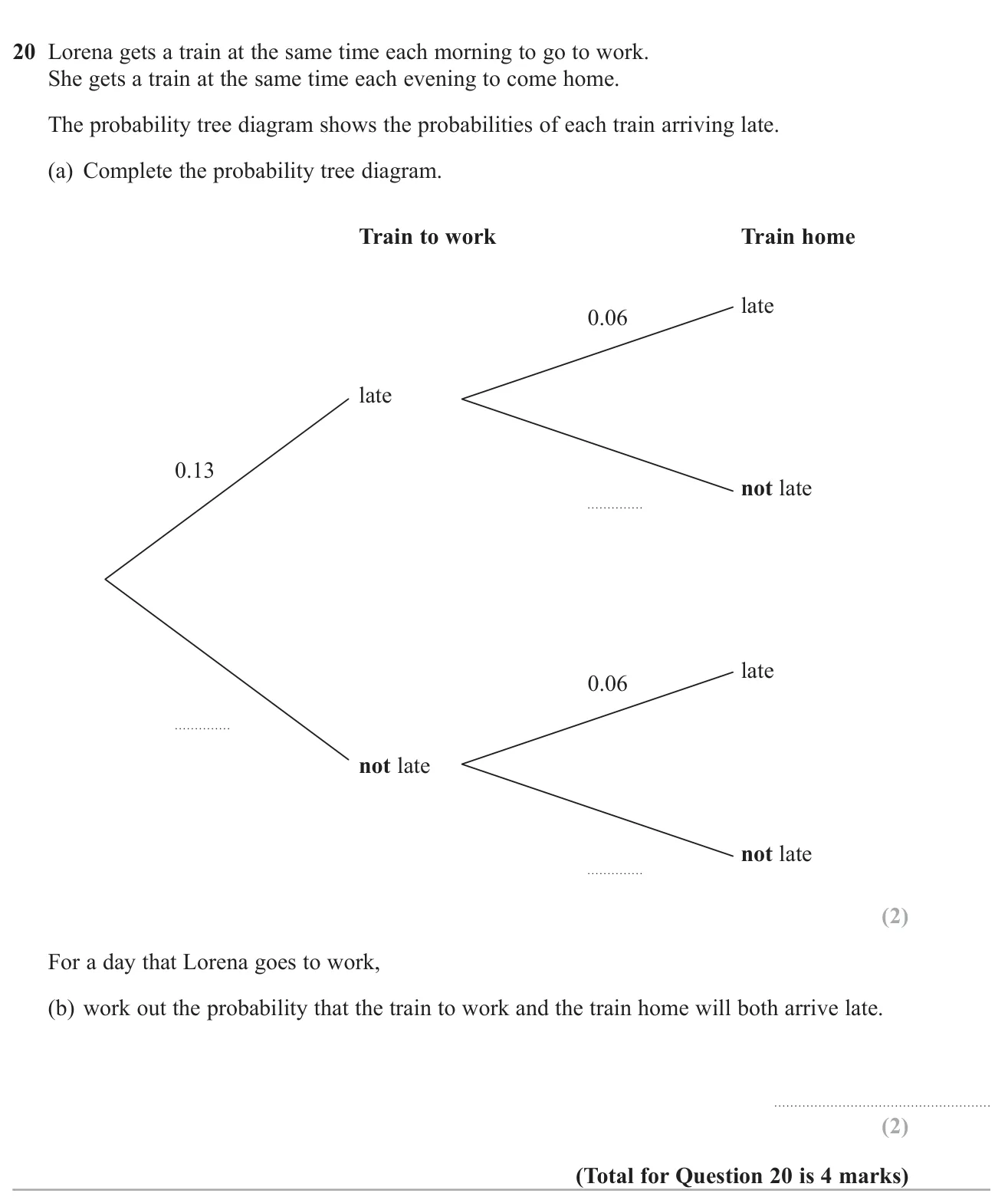
© Pearson Education Ltd. June 2022 Paper 2 (Foundation, calculator), question 20.
(a) 0.87 0.87 0.87 0.94 0.94 0.94 2 marks (b) 0.0078 0.0078 0.0078 2 marks
Worked solution Checked against the mark scheme
(a) Each pair of branches adds to 1.
Work not late: 1 − 0.13 = 0.87 1 - 0.13 = 0.87 1 − 0.13 = 0.87 1 − 0.06 = 0.94 1 - 0.06 = 0.94 1 − 0.06 = 0.94
(b) Late and late: multiply along the branches.
0.13 × 0.06 = 0.0078 0.13 \times 0.06 = 0.0078 0.13 × 0.06 = 0.0078
Watch out: Adding the probabilities (0.19) instead of multiplying.
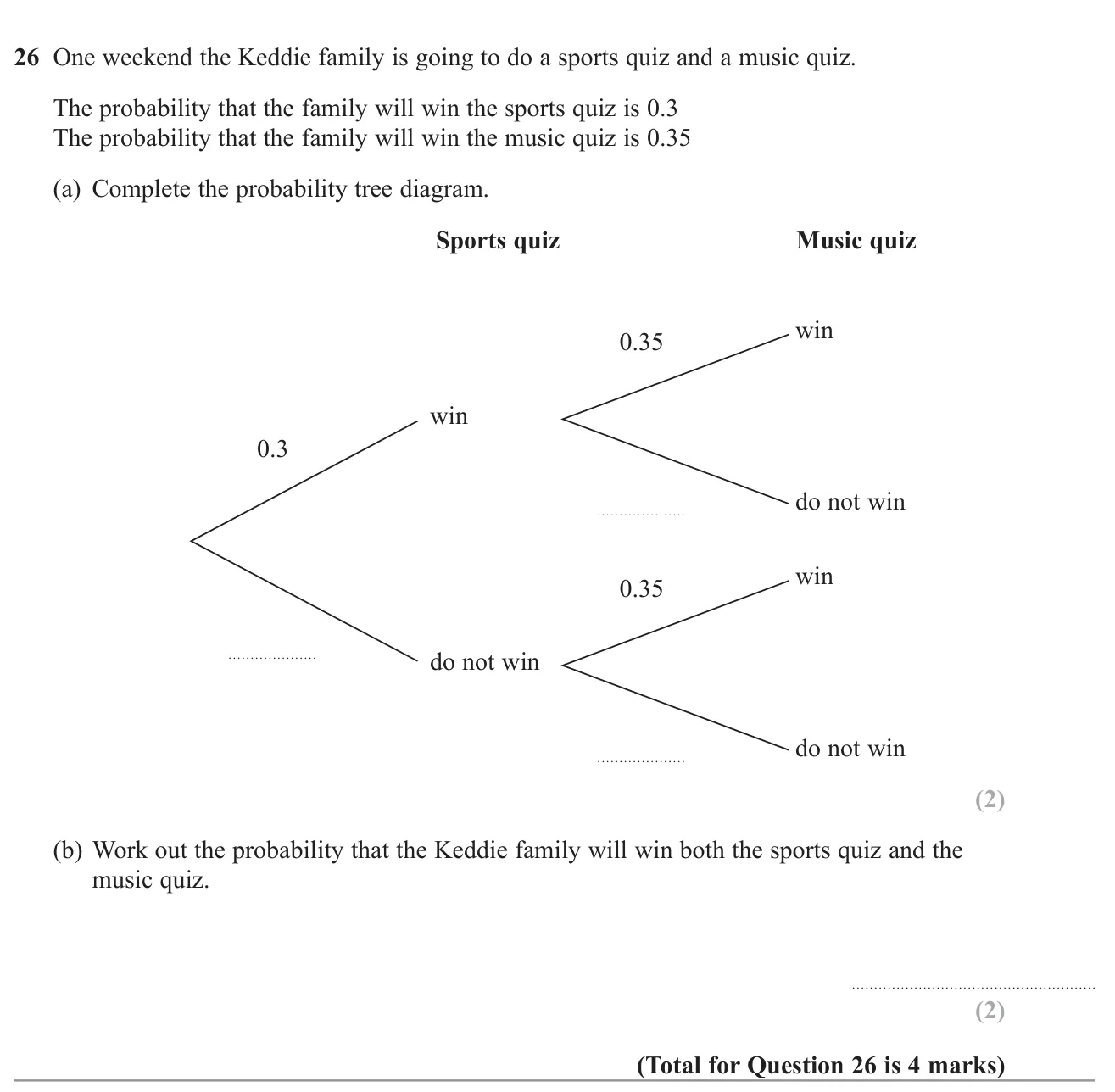
© Pearson Education Ltd. November 2022 Paper 3 (Foundation, calculator), question 26.
(a) 0.7 on the first branch; 0.65 on both second 'do not win' branches 2 marks (b) 0.105 2 marks
Worked solution Checked against the mark scheme
(a) Not winning the sports quiz: 1 − 0.3 = 0.7 1 - 0.3 = 0.7 1 − 0.3 = 0.7 1 − 0.35 = 0.65 1 - 0.35 = 0.65 1 − 0.35 = 0.65
(b) P ( both ) = 0.3 × 0.35 = 0.105 P(\text{both}) = 0.3 \times 0.35 = 0.105 P ( both ) = 0.3 × 0.35 = 0.105
Watch out: Adding the probabilities (0.65) instead of multiplying.
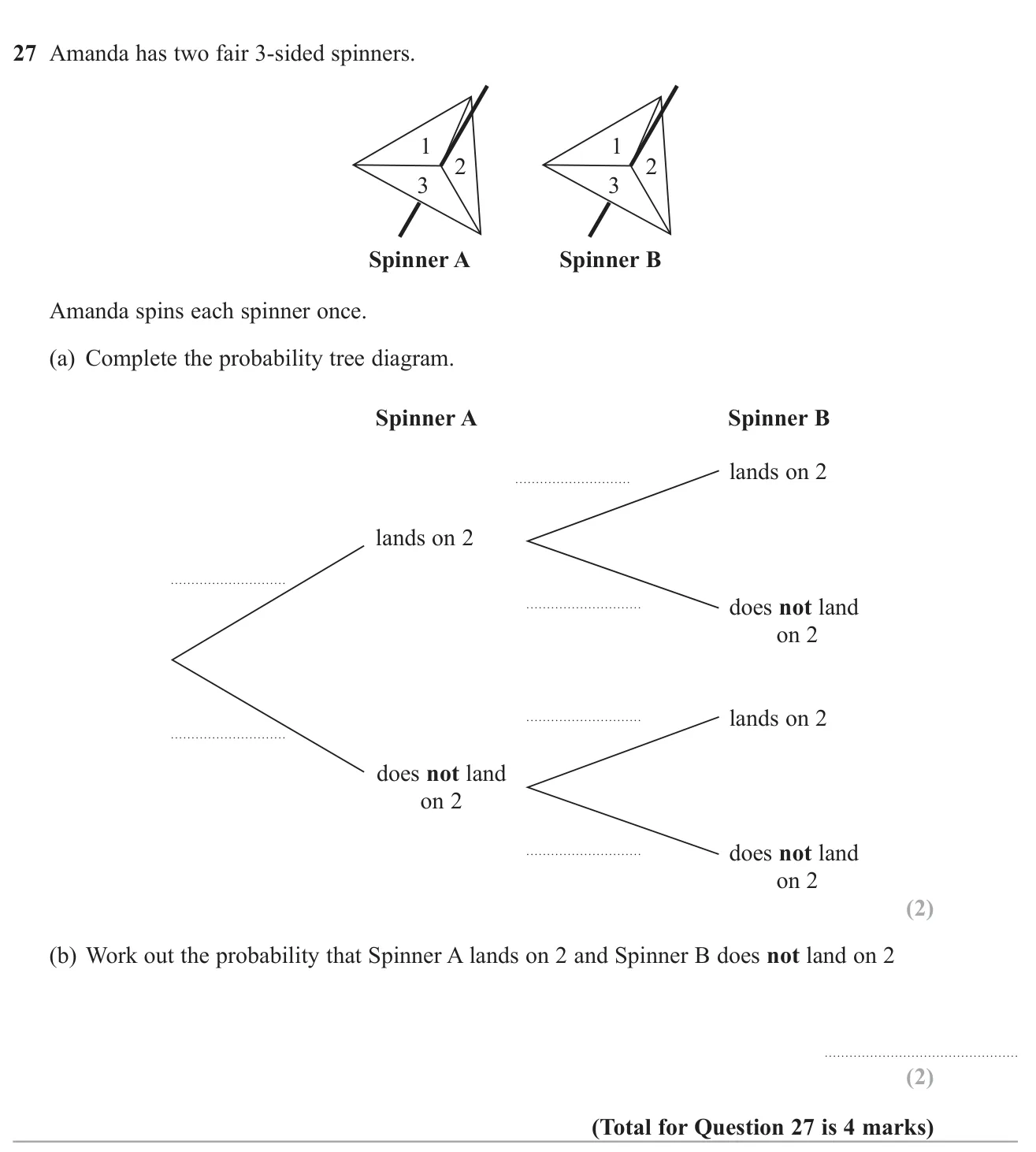
© Pearson Education Ltd. November 2020 Paper 3 (Foundation, calculator), question 27.
(a) 1 3 \frac{1}{3} 3 1 2 3 \frac{2}{3} 3 2 2 marks (b) 2 9 \frac{2}{9} 9 2 2 marks
Worked solution Checked against the mark scheme
(a) Each spinner has 3 equal sections, one of which is 2: P ( 2 ) = 1 3 P(2) = \frac{1}{3} P ( 2 ) = 3 1 P ( not 2 ) = 2 3 P(\text{not } 2) = \frac{2}{3} P ( not 2 ) = 3 2
(b) 1 3 × 2 3 = 2 9 \frac{1}{3} \times \frac{2}{3} = \frac{2}{9} 3 1 × 3 2 = 9 2
Watch out: In (b), adding the probabilities instead of multiplying.
© Pearson Education Ltd. June 2018 Paper 3 (Foundation, calculator), question 22.
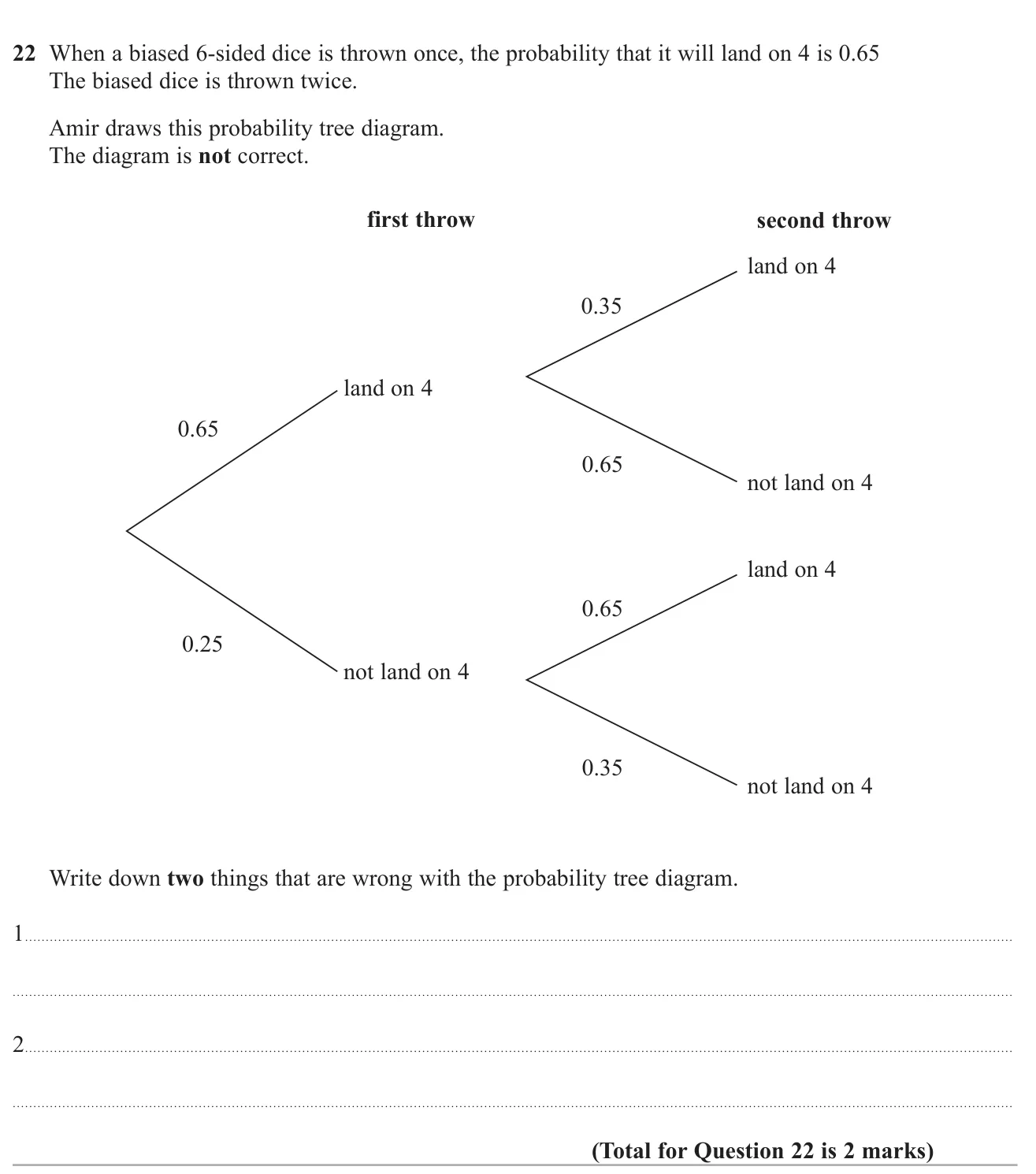
Answer The pair 0.65 and 0.25 does not add to 1 (0.25 should be 0.35); on the upper second-throw branches, 0.35 and 0.65 are the wrong way round 2 marks
Worked solution Checked against the mark scheme
The probability of landing on 4 is 0.65 on every throw, so the probability of not landing on 4 is 1 − 0.65 = 0.35 1 - 0.65 = 0.35 1 − 0.65 = 0.35
1. On the first throw, 0.65 + 0.25 ≠ 1 0.65 + 0.25 \ne 1 0.65 + 0.25 = 1
2. On the second throw after landing on 4, 'land on 4' is labelled 0.35 and 'not land on 4' 0.65; these are the wrong way round.
Watch out: Thinking the second throw should have different probabilities from the first.
© Pearson Education Ltd. June 2023 Paper 1 (Foundation, non-calculator), question 31.
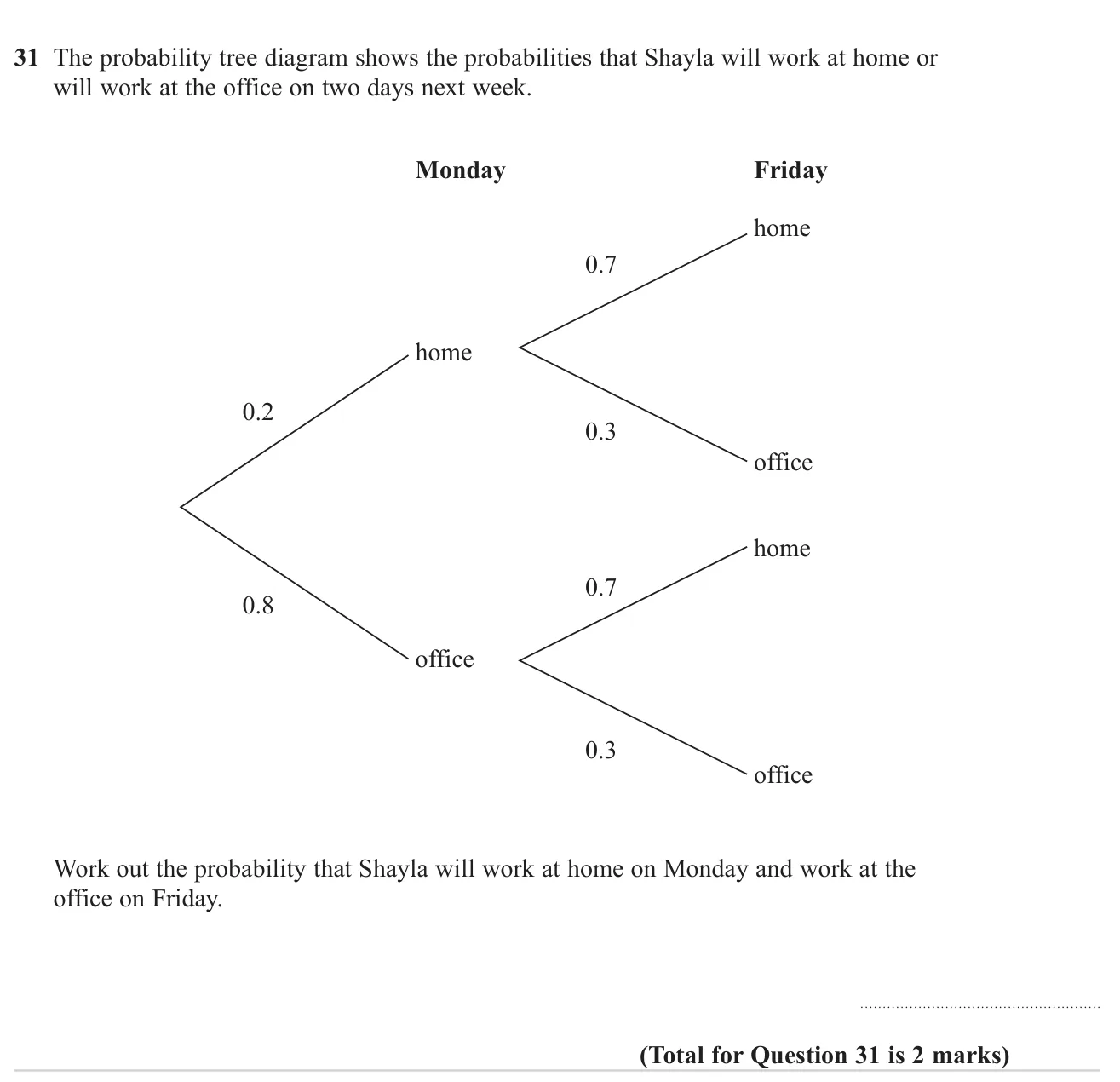
Answer 0.06 0.06 0.06 2 marks
Worked solution Checked against the mark scheme
Follow the branches: home on Monday (0.2), then office on Friday (0.3).
Multiply along the branches: 0.2 × 0.3 = 0.06 0.2 \times 0.3 = 0.06 0.2 × 0.3 = 0.06
Watch out: Adding the probabilities to get 0.5.
© Pearson Education Ltd. November 2023 Paper 2 (Higher, calculator), question 10.
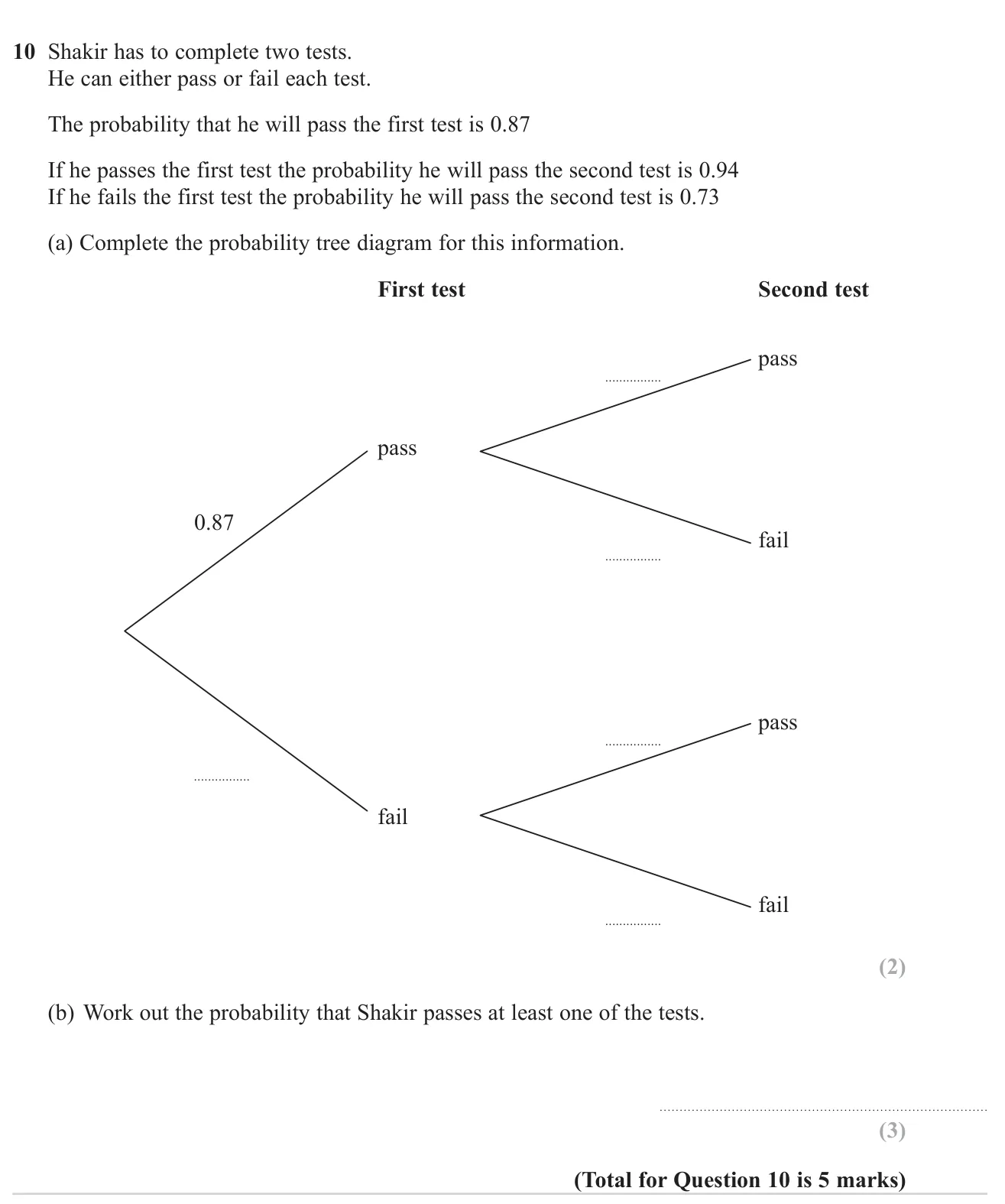
(a) First test: fail 0.13. After a pass: pass 0.94, fail 0.06. After a fail: pass 0.73, fail 0.27 2 marks (b) 0.9649 0.9649 0.9649 3 marks
Worked solution Checked against the mark scheme
(a) Each pair of branches adds up to 1: 1 − 0.87 = 0.13 1 - 0.87 = 0.13 1 − 0.87 = 0.13 1 − 0.94 = 0.06 1 - 0.94 = 0.06 1 − 0.94 = 0.06 1 − 0.73 = 0.27 1 - 0.73 = 0.27 1 − 0.73 = 0.27
(b) The only way to pass neither is fail, fail: 0.13 × 0.27 = 0.0351 0.13 \times 0.27 = 0.0351 0.13 × 0.27 = 0.0351
P ( at least one ) = 1 − 0.0351 = 0.9649 P(\text{at least one}) = 1 - 0.0351 = 0.9649 P ( at least one ) = 1 − 0.0351 = 0.9649
Watch out: Using 0.94 and 0.73 on the wrong branches.
© Pearson Education Ltd. June 2019 Paper 2 (Higher, calculator), question 10.
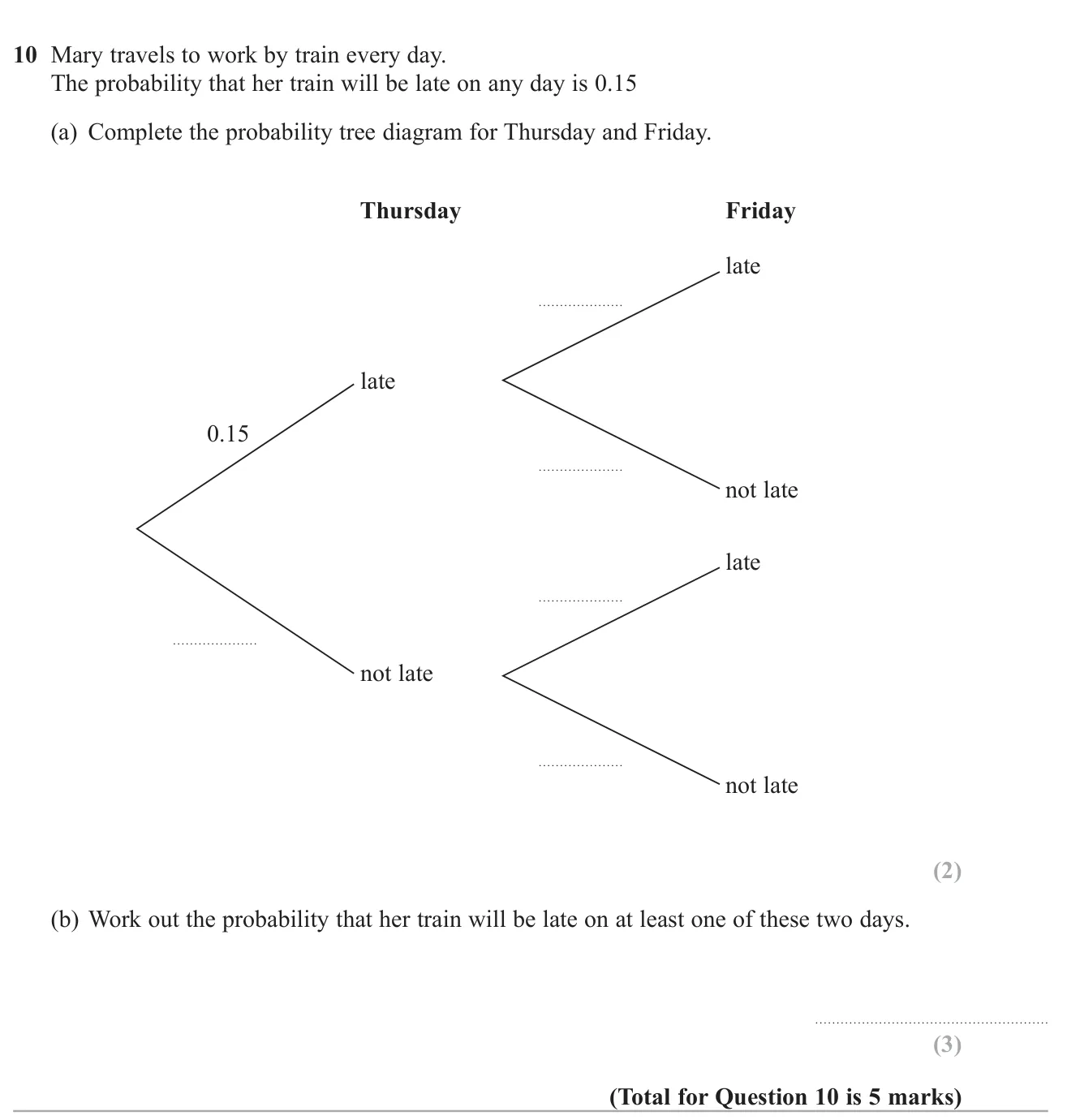
(a) Not late: 0.85 0.85 0.85 0.15 , 0.85 , 0.15 , 0.85 0.15, 0.85, 0.15, 0.85 0.15 , 0.85 , 0.15 , 0.85 2 marks (b) 0.2775 0.2775 0.2775 3 marks
Worked solution Checked against the mark scheme
(a) Not late = 1 − 0.15 = 0.85 = 1 - 0.15 = 0.85 = 1 − 0.15 = 0.85
(b) P(not late on both days) = 0.85 × 0.85 = 0.7225 = 0.85 \times 0.85 = 0.7225 = 0.85 × 0.85 = 0.7225
P(late at least once) = 1 − 0.7225 = 0.2775 = 1 - 0.7225 = 0.2775 = 1 − 0.7225 = 0.2775
Watch out: Adding 0.15 + 0.15 instead of using the complement.
© Pearson Education Ltd. November 2018 Paper 1 (Foundation, non-calculator), question 27.
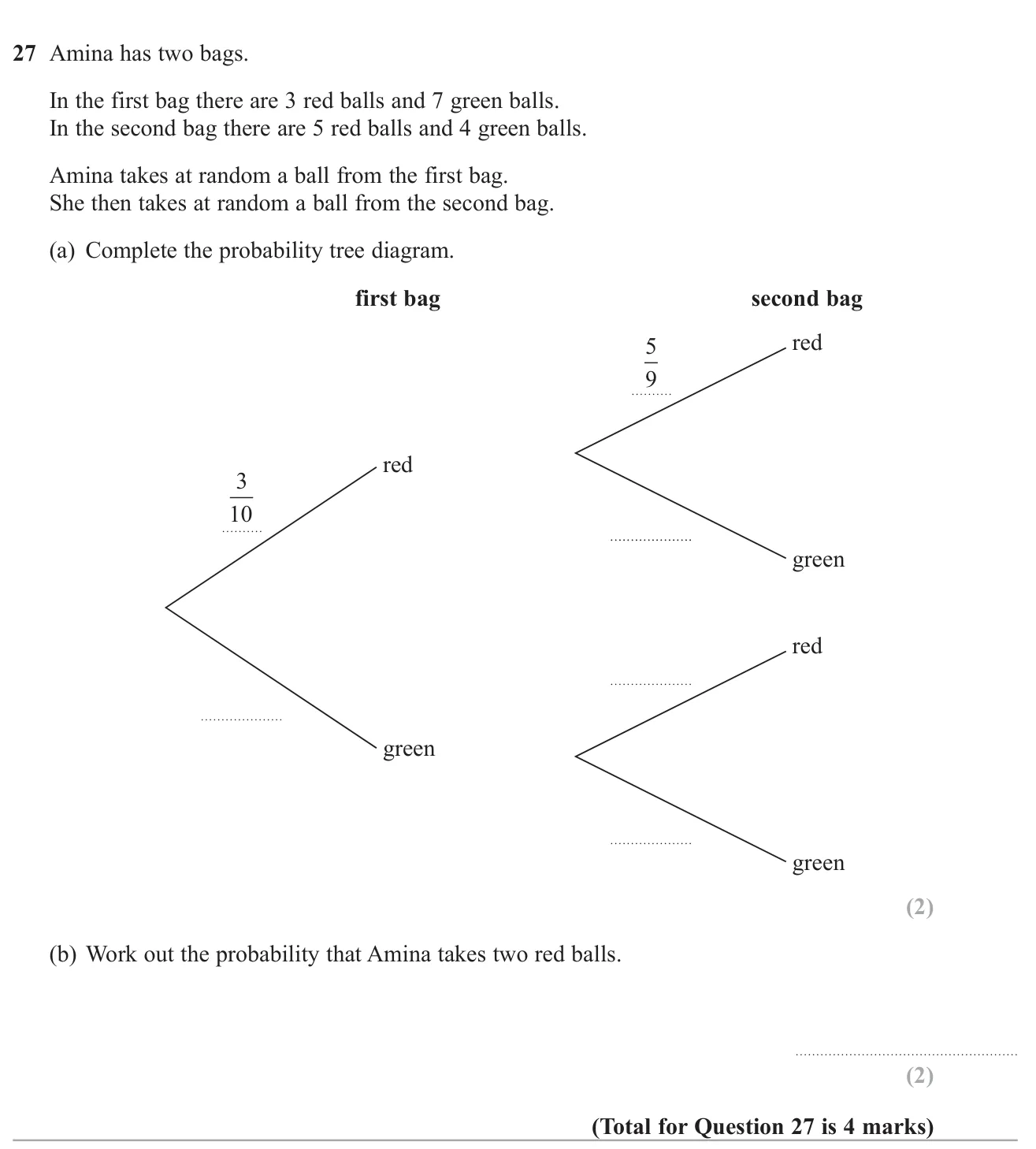
(a) First bag green 7 10 \frac{7}{10} 10 7 4 9 \frac{4}{9} 9 4 5 9 \frac{5}{9} 9 5 2 marks (b) 15 90 \frac{15}{90} 90 15 2 marks
Worked solution Checked against the mark scheme
(a) First bag: green = 1 − 3 10 = 7 10 = 1 - \frac{3}{10} = \frac{7}{10} = 1 − 10 3 = 10 7
Second bag (independent of the first): red 5 9 \frac{5}{9} 9 5 4 9 \frac{4}{9} 9 4
(b) 3 10 × 5 9 = 15 90 = 1 6 \frac{3}{10} \times \frac{5}{9} = \frac{15}{90} = \frac{1}{6} 10 3 × 9 5 = 90 15 = 6 1
Watch out: Adding the probabilities instead of multiplying along the branches.
© Pearson Education Ltd. June 2018 Paper 2 (Higher, calculator), question 15.
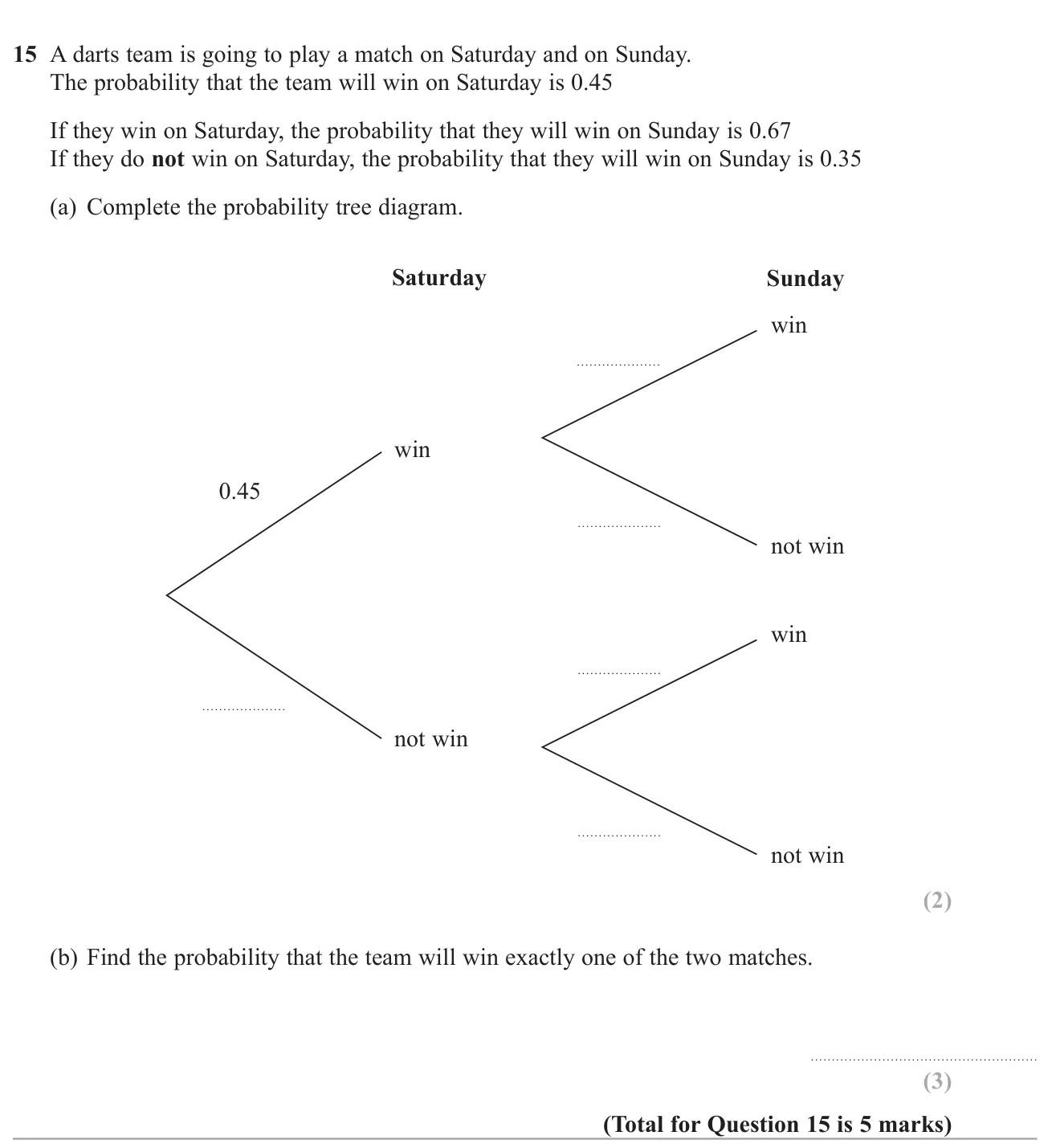
(a) Saturday not win 0.55 0.55 0.55 0.67 0.67 0.67 0.33 0.33 0.33 0.35 0.35 0.35 0.65 0.65 0.65 2 marks (b) 0.341 0.341 0.341 3 marks
Worked solution Checked against the mark scheme
(a) 1 − 0.45 = 0.55 1 - 0.45 = 0.55 1 − 0.45 = 0.55 1 − 0.67 = 0.33 1 - 0.67 = 0.33 1 − 0.67 = 0.33 1 − 0.35 = 0.65 1 - 0.35 = 0.65 1 − 0.35 = 0.65
(b) Win then lose: 0.45 × 0.33 = 0.1485 0.45 \times 0.33 = 0.1485 0.45 × 0.33 = 0.1485
Lose then win: 0.55 × 0.35 = 0.1925 0.55 \times 0.35 = 0.1925 0.55 × 0.35 = 0.1925
Total: 0.1485 + 0.1925 = 0.341 0.1485 + 0.1925 = 0.341 0.1485 + 0.1925 = 0.341
Watch out: Only including one of the two ways to win exactly one match.
© Pearson Education Ltd. Specimen Paper 2 (Higher, calculator), question 11.
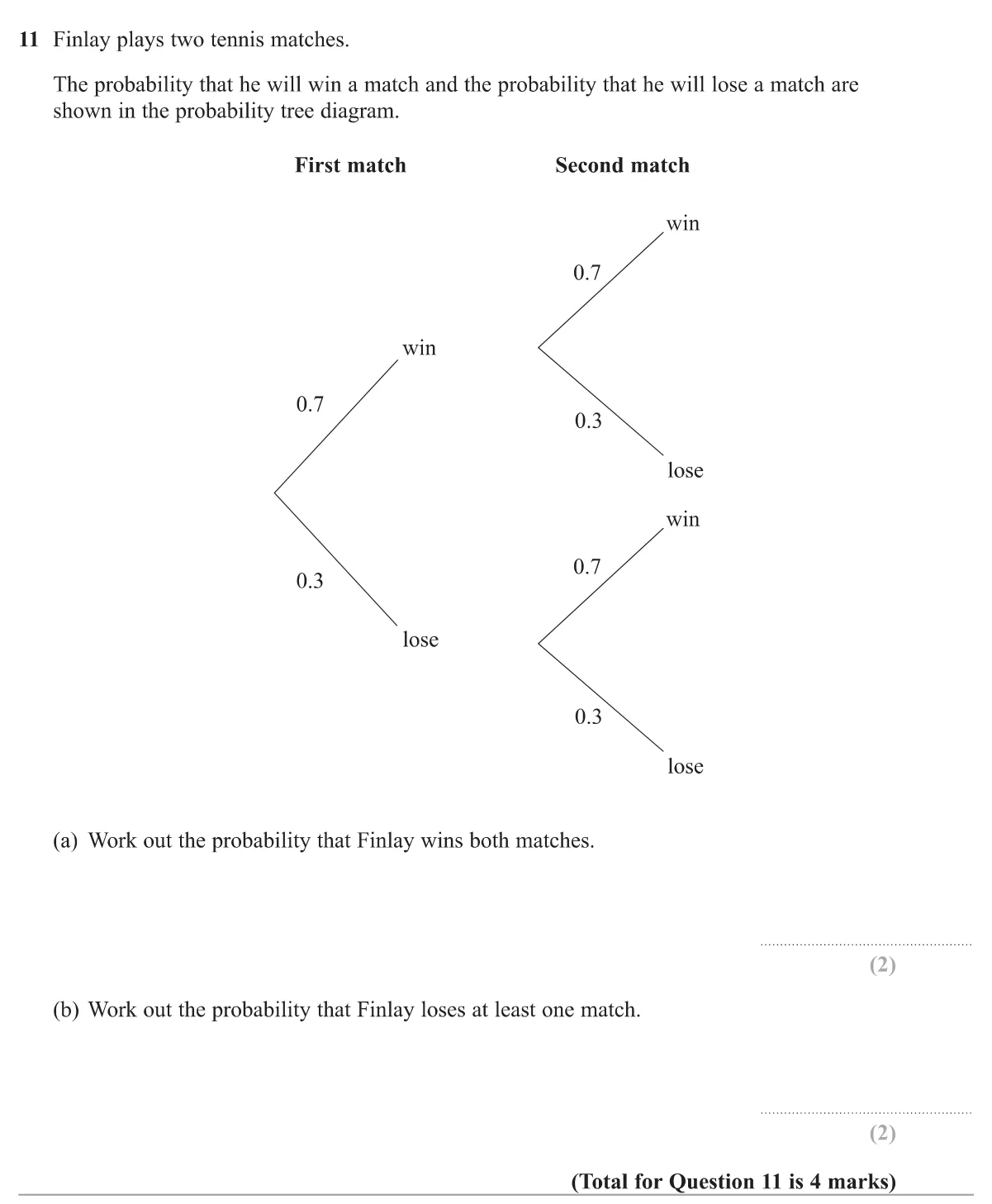
(a) 0.49 2 marks (b) 0.51 2 marks
Worked solution Checked against the mark scheme
(a) 0.7 × 0.7 = 0.49 0.7 \times 0.7 = 0.49 0.7 × 0.7 = 0.49
(b) Losing at least one is everything except winning both.
1 − 0.49 = 0.51 1 - 0.49 = 0.51 1 − 0.49 = 0.51
Watch out: In (a), adding 0.7 + 0.7 instead of multiplying.
© Pearson Education Ltd. June 2023 Paper 1 (Higher, non-calculator), question 12.
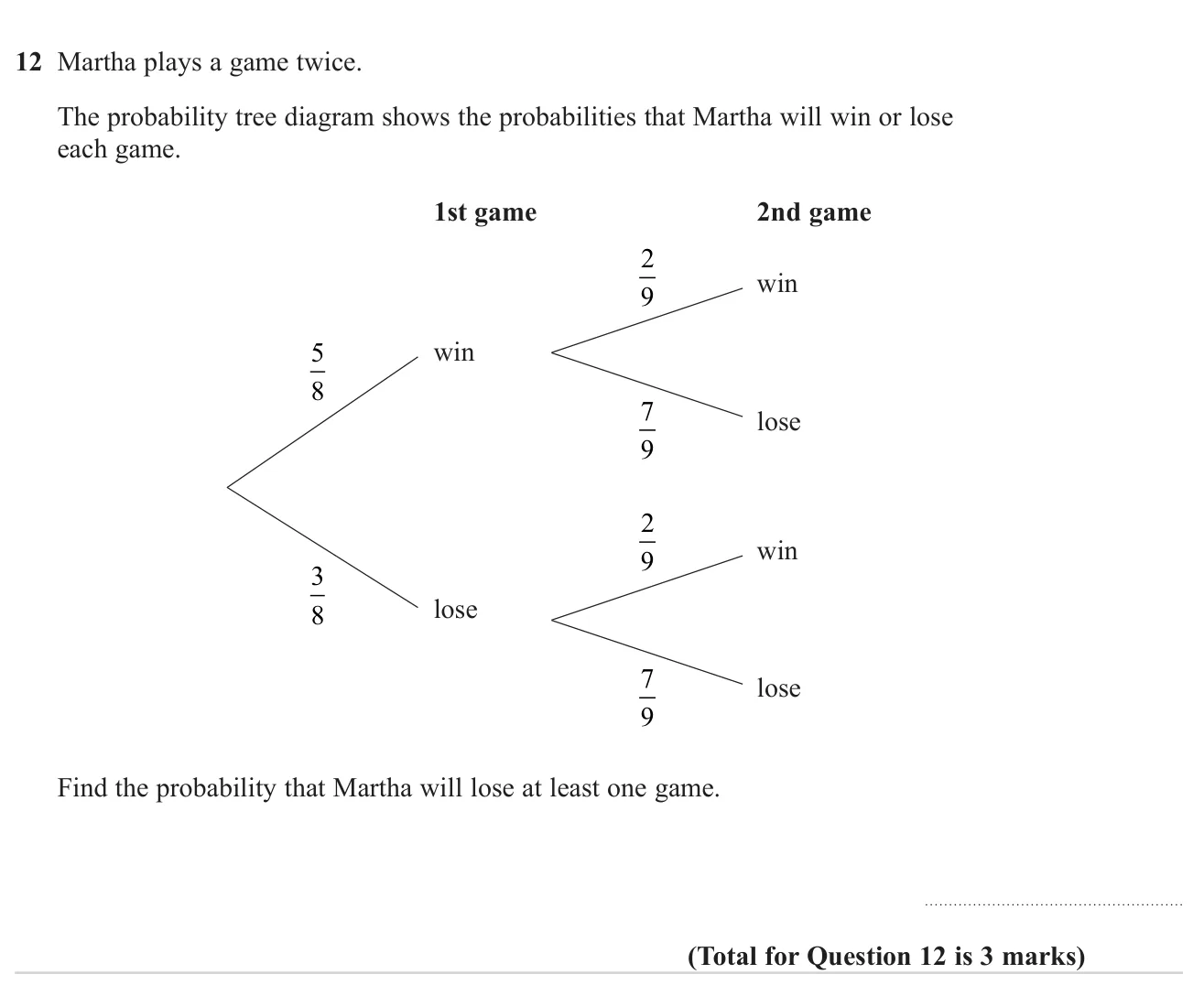
Answer 31 36 \frac{31}{36} 36 31 3 marks
Worked solution Checked against the mark scheme
The only outcome without a loss is win then win: 5 8 × 2 9 = 10 72 \frac{5}{8} \times \frac{2}{9} = \frac{10}{72} 8 5 × 9 2 = 72 10
So P(at least one loss) = 1 − 10 72 = 62 72 = 31 36 = 1 - \frac{10}{72} = \frac{62}{72} = \frac{31}{36} = 1 − 72 10 = 72 62 = 36 31
Watch out: Adding the branch probabilities along a path instead of multiplying.
© Pearson Education Ltd. November 2020 Paper 1 (Higher, non-calculator), question 14.
Worked solution Checked against the mark scheme
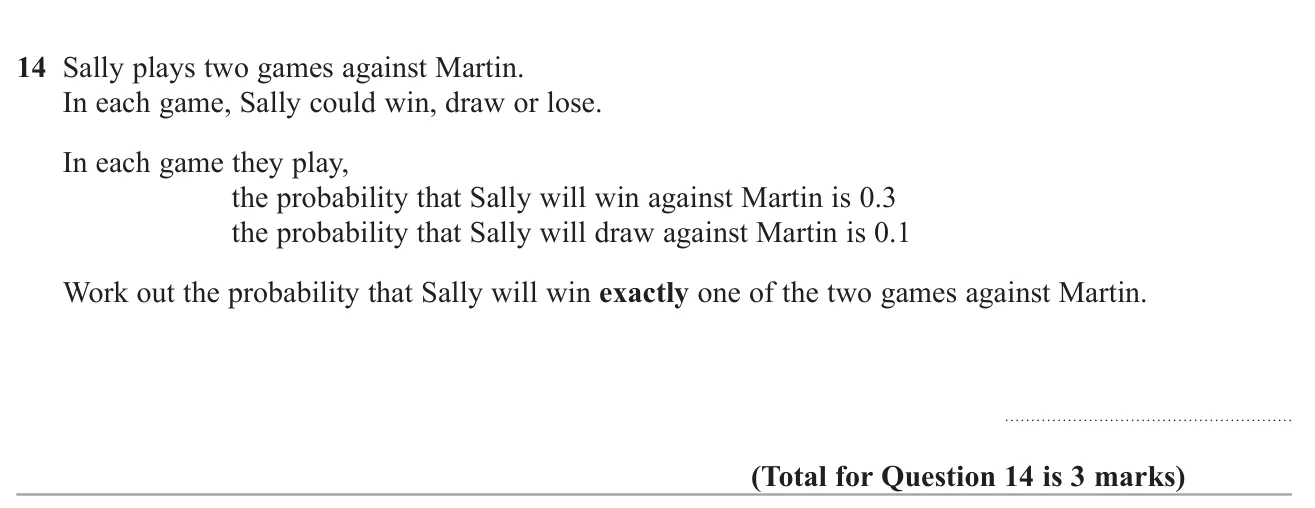
P(not win) = 1 − 0.3 = 0.7 = 1 - 0.3 = 0.7 = 1 − 0.3 = 0.7
Win then not win: 0.3 × 0.7 = 0.21 0.3 \times 0.7 = 0.21 0.3 × 0.7 = 0.21
Not win then win: 0.7 × 0.3 = 0.21 0.7 \times 0.3 = 0.21 0.7 × 0.3 = 0.21
Total: 0.21 + 0.21 = 0.42 0.21 + 0.21 = 0.42 0.21 + 0.21 = 0.42
Watch out: Only counting one order and answering 0.21.
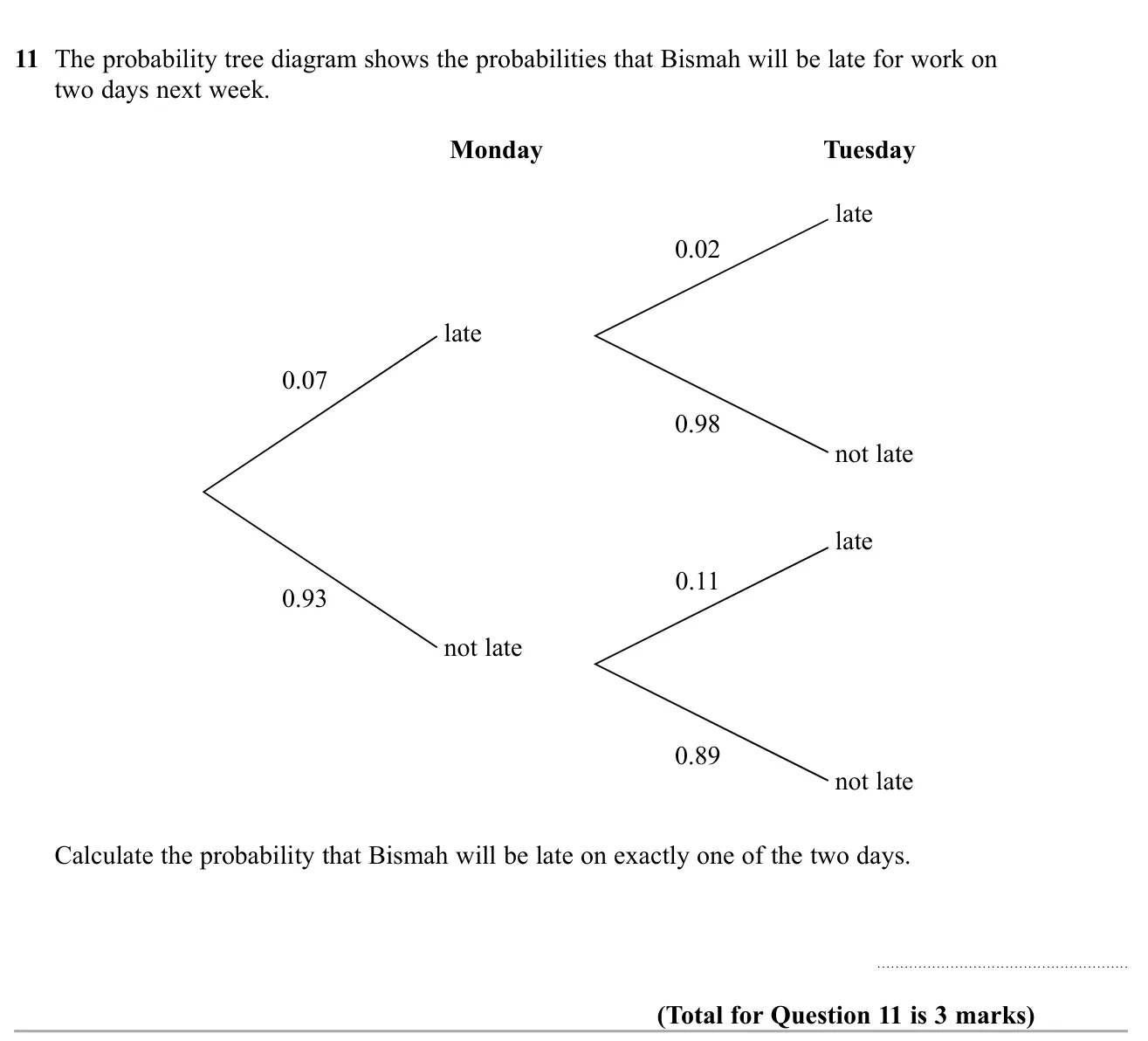
© Pearson Education Ltd. November 2019 Paper 3 (Higher, calculator), question 11.
Answer 0.1709 0.1709 0.1709 3 marks
Worked solution Checked against the mark scheme
Late Monday, not Tuesday: 0.07 × 0.98 = 0.0686 0.07 \times 0.98 = 0.0686 0.07 × 0.98 = 0.0686
Not late Monday, late Tuesday: 0.93 × 0.11 = 0.1023 0.93 \times 0.11 = 0.1023 0.93 × 0.11 = 0.1023
0.0686 + 0.1023 = 0.1709 0.0686 + 0.1023 = 0.1709 0.0686 + 0.1023 = 0.1709
Watch out: Only working out one of the two routes.
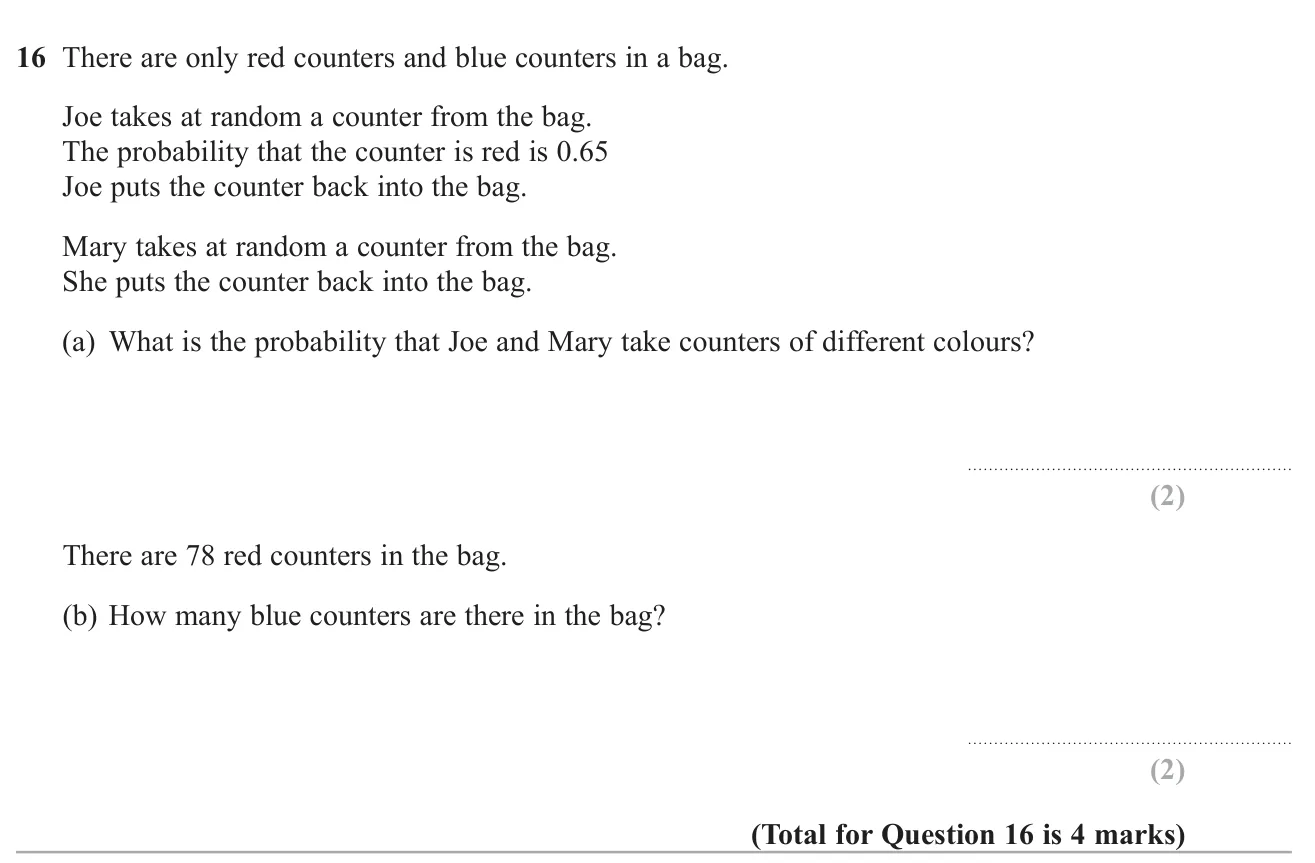
© Pearson Education Ltd. November 2018 Paper 2 (Higher, calculator), question 16.
(a) 0.455 0.455 0.455 2 marks (b) 42 42 42 2 marks
Worked solution Checked against the mark scheme
(a) P ( blue ) = 1 − 0.65 = 0.35 P(\text{blue}) = 1 - 0.65 = 0.35 P ( blue ) = 1 − 0.65 = 0.35
P ( different ) = 0.65 × 0.35 + 0.35 × 0.65 = 0.455 P(\text{different}) = 0.65 \times 0.35 + 0.35 \times 0.65 = 0.455 P ( different ) = 0.65 × 0.35 + 0.35 × 0.65 = 0.455
(b) Total = 78 ÷ 0.65 = 120 = 78 \div 0.65 = 120 = 78 ÷ 0.65 = 120 = 120 − 78 = 42 = 120 - 78 = 42 = 120 − 78 = 42
Watch out: Only counting red then blue, giving 0.2275.
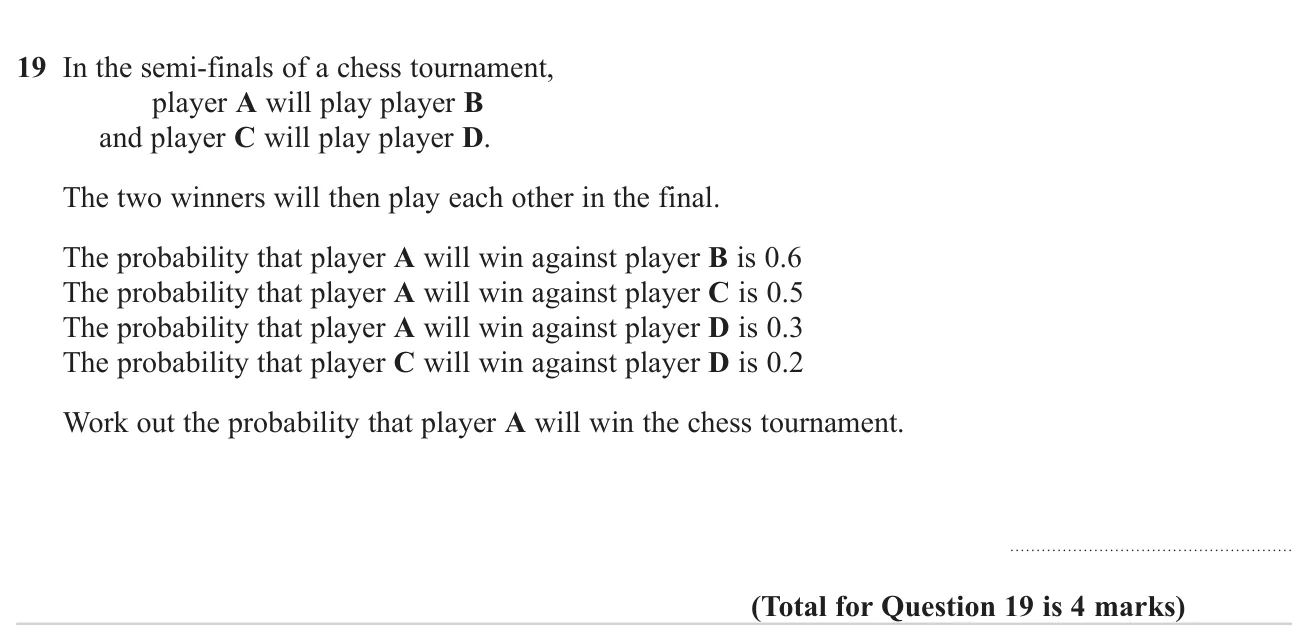
© Pearson Education Ltd. November 2024 Paper 1 (Higher, non-calculator), question 19.
Answer 0.204 0.204 0.204 4 marks
Worked solution Checked against the mark scheme
A must beat B: 0.6 0.6 0.6
Route 1: C reaches the final (0.2 0.2 0.2 0.5 0.5 0.5 0.6 × 0.2 × 0.5 = 0.06 0.6 \times 0.2 \times 0.5 = 0.06 0.6 × 0.2 × 0.5 = 0.06
Route 2: D reaches the final (0.8 0.8 0.8 0.3 0.3 0.3 0.6 × 0.8 × 0.3 = 0.144 0.6 \times 0.8 \times 0.3 = 0.144 0.6 × 0.8 × 0.3 = 0.144
Total: 0.06 + 0.144 = 0.204 0.06 + 0.144 = 0.204 0.06 + 0.144 = 0.204
Watch out: Ignoring who wins the other semi-final and multiplying all the probabilities together.
© Pearson Education Ltd. November 2023 Paper 1 (Higher, non-calculator), question 18.
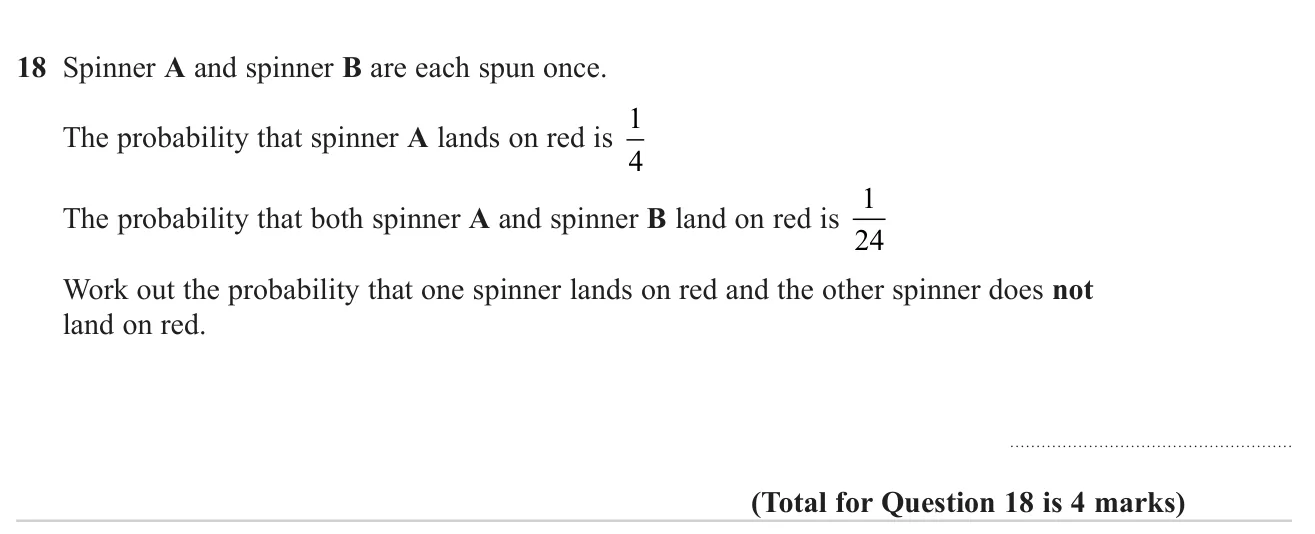
Answer 1 3 \frac{1}{3} 3 1 4 marks
Worked solution Checked against the mark scheme
1 4 × P ( B ) = 1 24 \frac{1}{4} \times P(B) = \frac{1}{24} 4 1 × P ( B ) = 24 1 P ( B ) = 1 6 P(B) = \frac{1}{6} P ( B ) = 6 1
A red, B not: 1 4 × 5 6 = 5 24 \frac{1}{4} \times \frac{5}{6} = \frac{5}{24} 4 1 × 6 5 = 24 5
A not, B red: 3 4 × 1 6 = 3 24 \frac{3}{4} \times \frac{1}{6} = \frac{3}{24} 4 3 × 6 1 = 24 3
Total: 5 24 + 3 24 = 8 24 = 1 3 \frac{5}{24} + \frac{3}{24} = \frac{8}{24} = \frac{1}{3} 24 5 + 24 3 = 24 8 = 3 1
Watch out: Including only one of the two ways of getting exactly one red.
© Pearson Education Ltd. November 2022 Paper 1 (Higher, non-calculator), question 20.
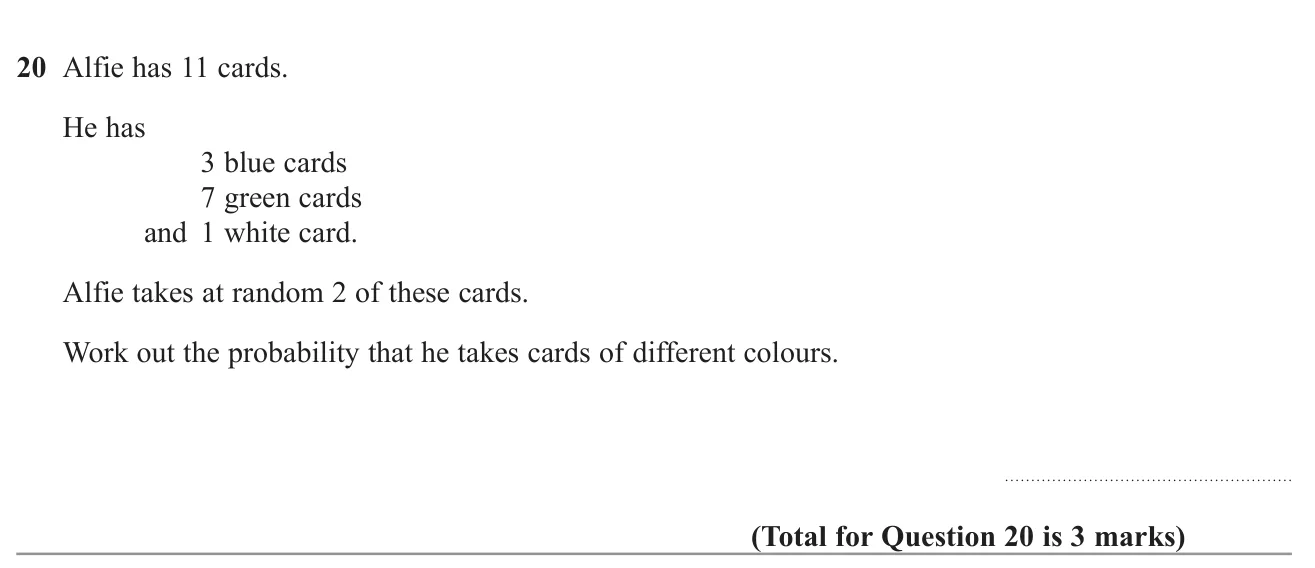
Answer 62 110 \frac{62}{110} 110 62 3 marks
Worked solution Checked against the mark scheme
Same colour: 3 11 × 2 10 + 7 11 × 6 10 + 1 11 × 0 = 6 + 42 110 = 48 110 \frac{3}{11} \times \frac{2}{10} + \frac{7}{11} \times \frac{6}{10} + \frac{1}{11} \times 0 = \frac{6 + 42}{110} = \frac{48}{110} 11 3 × 10 2 + 11 7 × 10 6 + 11 1 × 0 = 110 6 + 42 = 110 48
Different colours: 1 − 48 110 = 62 110 = 31 55 1 - \frac{48}{110} = \frac{62}{110} = \frac{31}{55} 1 − 110 48 = 110 62 = 55 31
Watch out: Replacing the first card, giving 62 121 \frac{62}{121} 121 62
© Pearson Education Ltd. November 2021 Paper 1 (Higher, non-calculator), question 16.
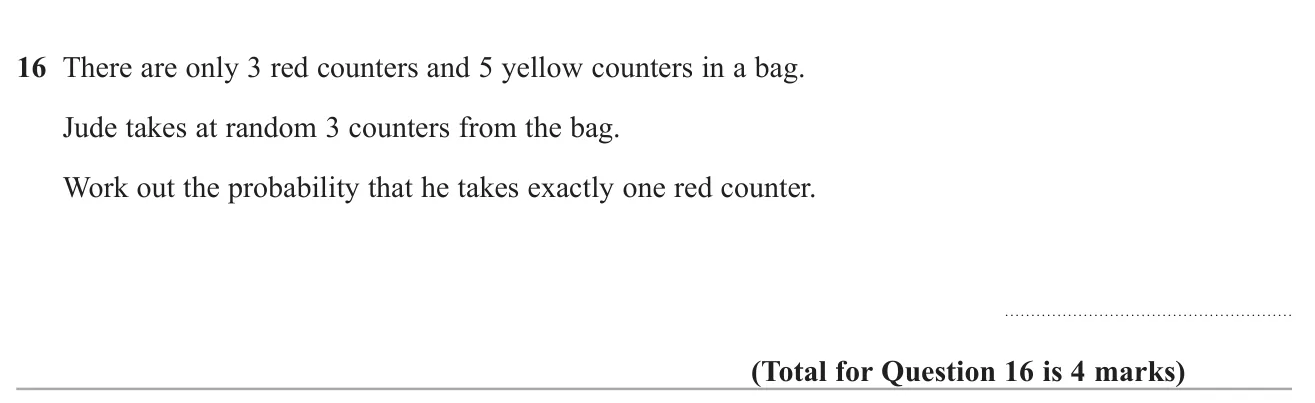
Answer 15 28 \frac{15}{28} 28 15 4 marks
Worked solution Checked against the mark scheme
One order (red, yellow, yellow): 3 8 × 5 7 × 4 6 = 60 336 \frac{3}{8} \times \frac{5}{7} \times \frac{4}{6} = \frac{60}{336} 8 3 × 7 5 × 6 4 = 336 60
The red can come first, second or third, and each order gives the same product.
3 × 60 336 = 180 336 = 15 28 3 \times \frac{60}{336} = \frac{180}{336} = \frac{15}{28} 3 × 336 60 = 336 180 = 28 15
Watch out: Replacing the counters (using eighths each time), which gives 225 512 \frac{225}{512} 512 225
© Pearson Education Ltd. November 2019 Paper 2 (Higher, calculator), question 16.
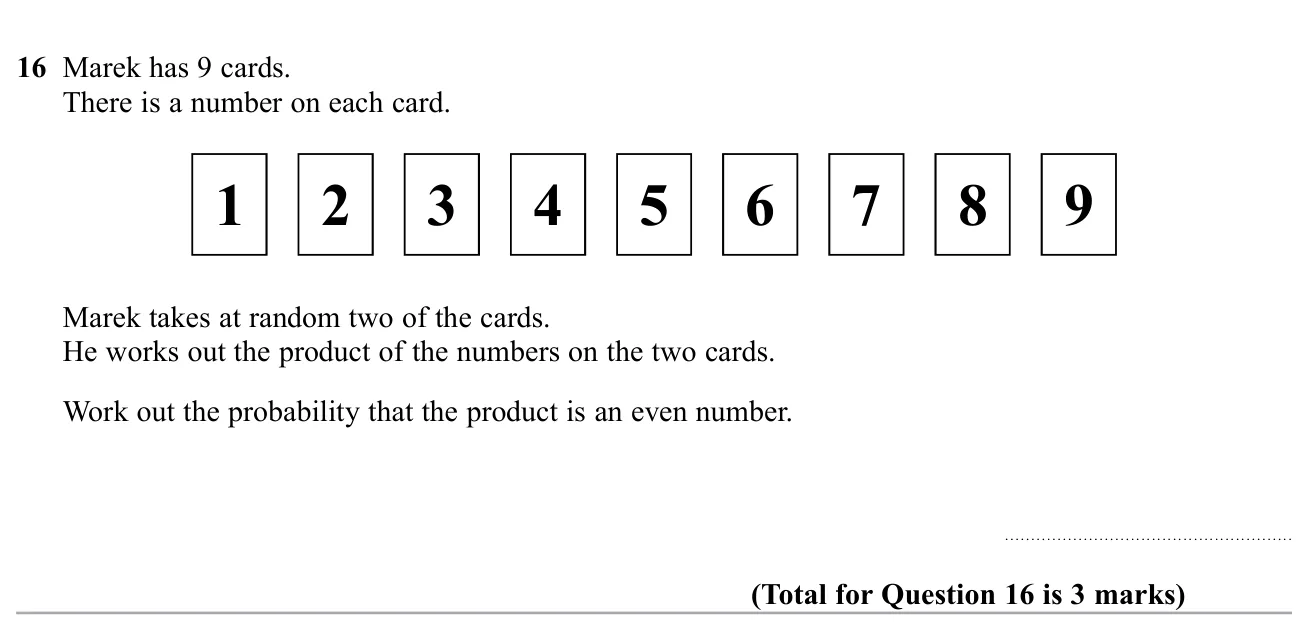
Answer 13 18 \frac{13}{18} 18 13 3 marks
Worked solution Checked against the mark scheme
The product is odd only if both cards are odd. There are 5 odd cards out of 9.
P ( both odd ) = 5 9 × 4 8 = 20 72 P(\text{both odd}) = \frac{5}{9} \times \frac{4}{8} = \frac{20}{72} P ( both odd ) = 9 5 × 8 4 = 72 20
P ( even ) = 1 − 20 72 = 52 72 = 13 18 P(\text{even}) = 1 - \frac{20}{72} = \frac{52}{72} = \frac{13}{18} P ( even ) = 1 − 72 20 = 72 52 = 18 13
Watch out: Treating it as with replacement, giving 56 81 \frac{56}{81} 81 56
© Pearson Education Ltd. Specimen Paper 3 (Higher, calculator), question 18.
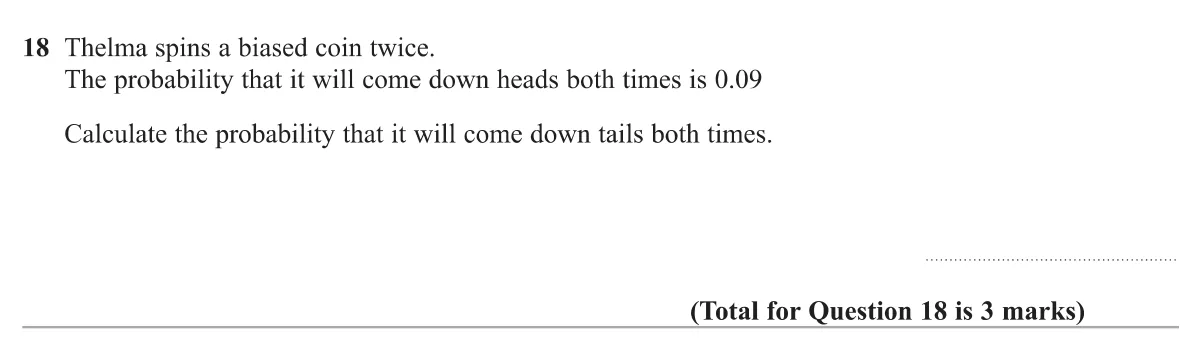
Answer 0.49 0.49 0.49 3 marks
Worked solution Checked against the mark scheme
P ( H ) 2 = 0.09 P(\text{H})^2 = 0.09 P ( H ) 2 = 0.09 P ( H ) = 0.09 = 0.3 P(\text{H}) = \sqrt{0.09} = 0.3 P ( H ) = 0.09 = 0.3
P ( T ) = 1 − 0.3 = 0.7 P(\text{T}) = 1 - 0.3 = 0.7 P ( T ) = 1 − 0.3 = 0.7
P ( TT ) = 0.7 2 = 0.49 P(\text{TT}) = 0.7^2 = 0.49 P ( TT ) = 0. 7 2 = 0.49
Watch out: Working out 1 − 0.09 = 0.91, which is the probability of not getting two heads.
© Pearson Education Ltd. June 2024 Paper 2 (Higher, calculator), question 18.
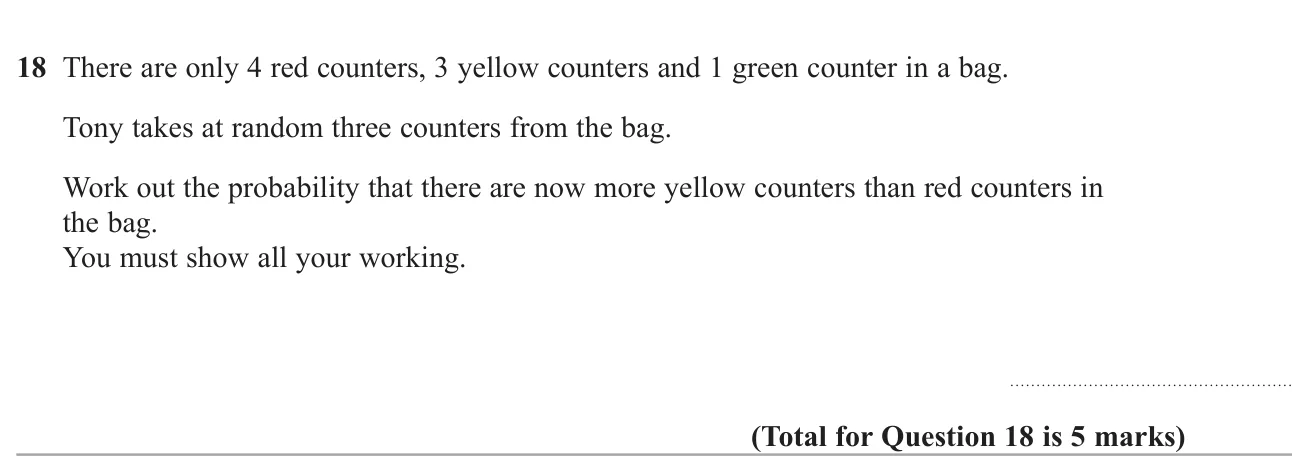
Answer 5 28 \dfrac{5}{28} 28 5 5 marks
Worked solution Checked against the mark scheme
Start: 4 red, 3 yellow, 1 green. More yellow than red remain only if Tony takes 3 red, or 2 red and the green.
P ( R R R ) = 4 8 × 3 7 × 2 6 = 24 336 P(RRR) = \frac48 \times \frac37 \times \frac26 = \frac{24}{336} P ( R R R ) = 8 4 × 7 3 × 6 2 = 336 24
P ( 2 red, 1 green ) = 3 × 4 8 × 3 7 × 1 6 = 36 336 P(\text{2 red, 1 green}) = 3 \times \frac48 \times \frac37 \times \frac16 = \frac{36}{336} P ( 2 red, 1 green ) = 3 × 8 4 × 7 3 × 6 1 = 336 36
Total = 60 336 = 5 28 = \frac{60}{336} = \frac{5}{28} = 336 60 = 28 5
Watch out: Only counting one order of red, red, green instead of all three orders, or missing the RRR case.
© Pearson Education Ltd. November 2024 Paper 2 (Higher, calculator), question 22.
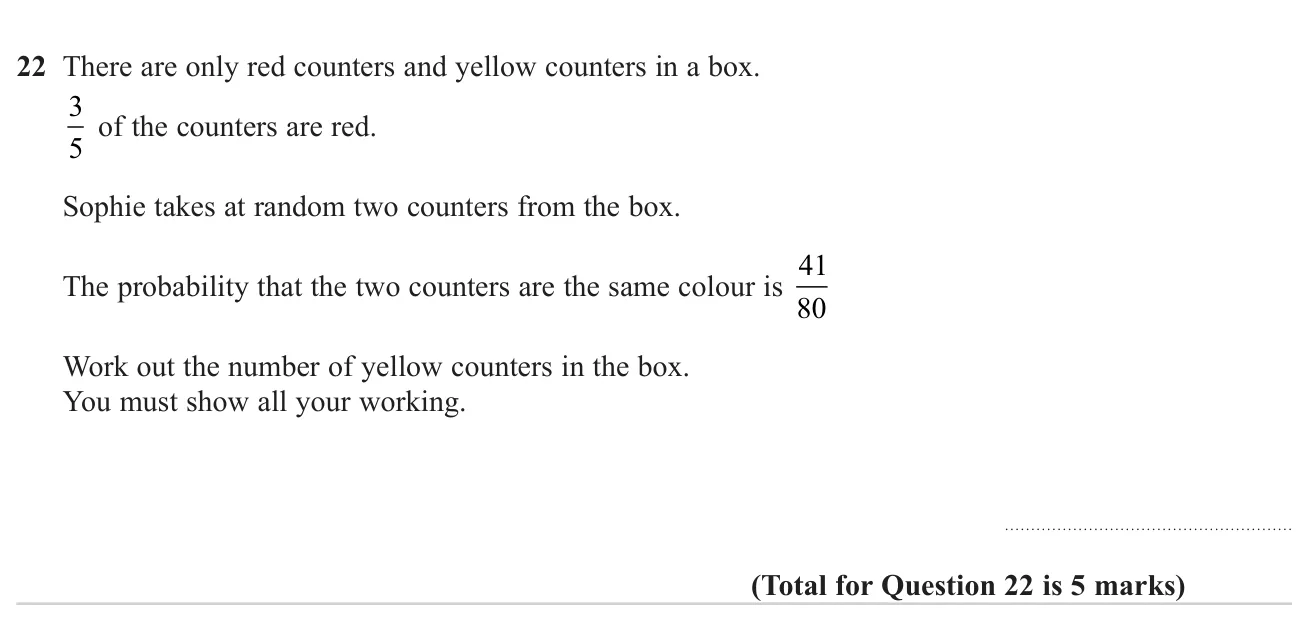
Worked solution Checked against the mark scheme
Let there be 5 x 5x 5 x 3 x 3x 3 x 2 x 2x 2 x
3 x 5 x × 3 x − 1 5 x − 1 + 2 x 5 x × 2 x − 1 5 x − 1 = 41 80 \frac{3x}{5x} \times \frac{3x-1}{5x-1} + \frac{2x}{5x} \times \frac{2x-1}{5x-1} = \frac{41}{80} 5 x 3 x × 5 x − 1 3 x − 1 + 5 x 2 x × 5 x − 1 2 x − 1 = 80 41
13 x − 5 5 ( 5 x − 1 ) = 41 80 ⇒ 1040 x − 400 = 1025 x − 205 \frac{13x - 5}{5(5x-1)} = \frac{41}{80} \Rightarrow 1040x - 400 = 1025x - 205 5 ( 5 x − 1 ) 13 x − 5 = 80 41 ⇒ 1040 x − 400 = 1025 x − 205
15 x = 195 15x = 195 15 x = 195 x = 13 x = 13 x = 13 = 2 × 13 = 26 = 2 \times 13 = 26 = 2 × 13 = 26
Watch out: Treating the picks as with replacement, so the equation has no solution.
© Pearson Education Ltd. June 2022 Paper 1 (Higher, non-calculator), question 16.
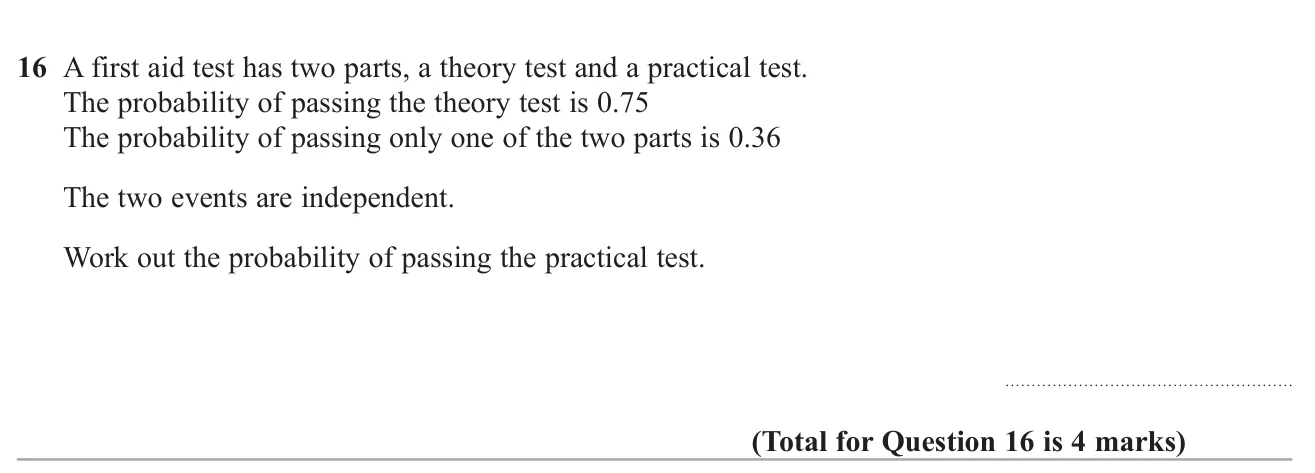
Worked solution Checked against the mark scheme
Let p p p
Only one passed: 0.75 ( 1 − p ) + 0.25 p = 0.36 0.75(1 - p) + 0.25p = 0.36 0.75 ( 1 − p ) + 0.25 p = 0.36
0.75 − 0.5 p = 0.36 0.75 - 0.5p = 0.36 0.75 − 0.5 p = 0.36
0.5 p = 0.39 0.5p = 0.39 0.5 p = 0.39 p = 0.78 p = 0.78 p = 0.78
Watch out: Only counting pass theory and fail practical, giving 0.75 ( 1 − p ) = 0.36 0.75(1-p) = 0.36 0.75 ( 1 − p ) = 0.36
© Pearson Education Ltd. June 2022 Paper 3 (Higher, calculator), question 21.
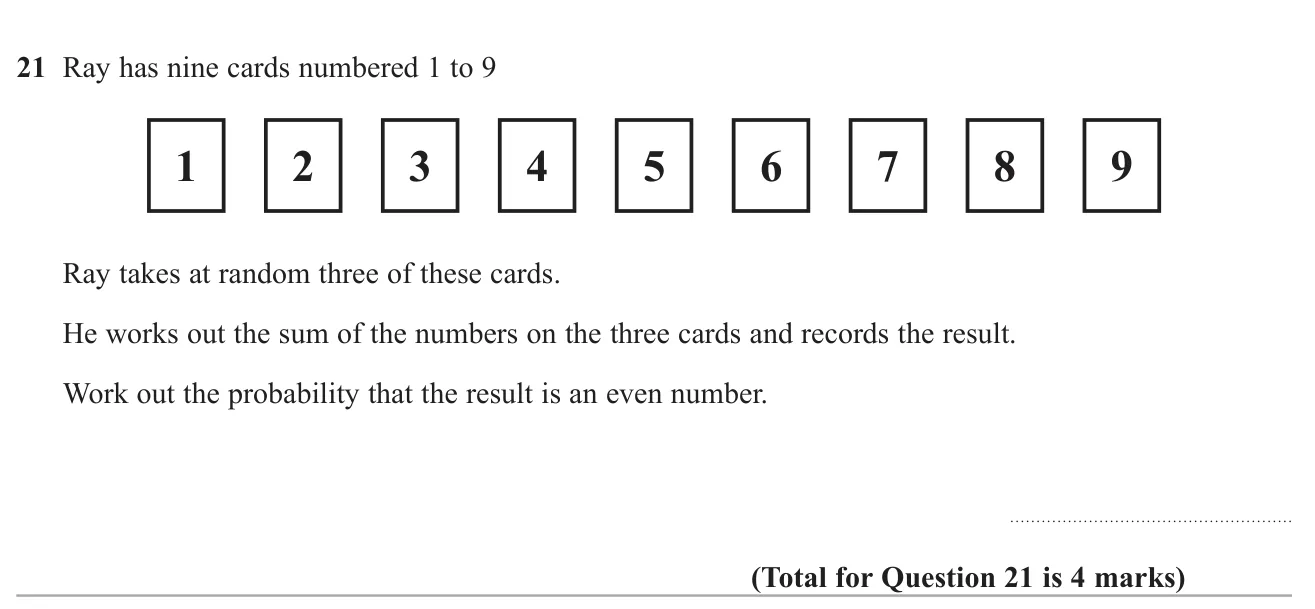
Answer 11 21 \frac{11}{21} 21 11 4 marks
Worked solution Checked against the mark scheme
There are 4 even and 5 odd cards. The sum is even for EEE or one even and two odd.
EEE: 4 9 × 3 8 × 2 7 = 24 504 \frac{4}{9}\times\frac{3}{8}\times\frac{2}{7} = \frac{24}{504} 9 4 × 8 3 × 7 2 = 504 24
One even, two odd (3 orders): 3 × 4 9 × 5 8 × 4 7 = 240 504 3\times\frac{4}{9}\times\frac{5}{8}\times\frac{4}{7} = \frac{240}{504} 3 × 9 4 × 8 5 × 7 4 = 504 240
Total = 264 504 = 11 21 = \frac{264}{504} = \frac{11}{21} = 504 264 = 21 11
Watch out: Treating the draws as with replacement, giving 364/729.
© Pearson Education Ltd. November 2021 Paper 2 (Higher, calculator), question 20.
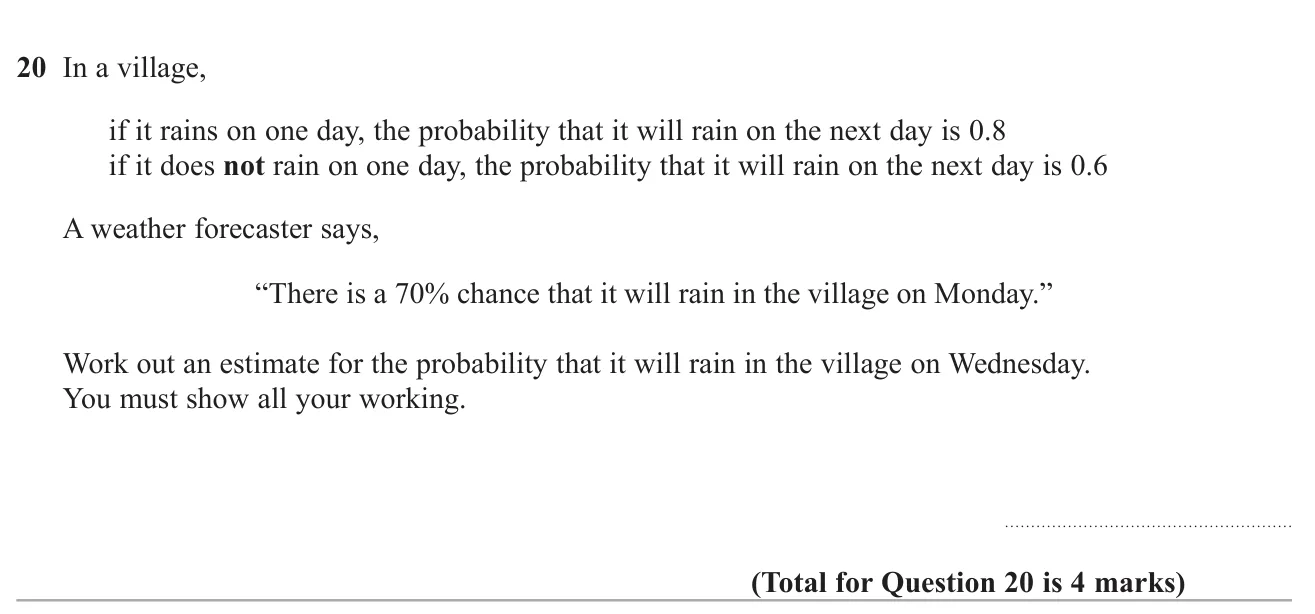
Answer 0.748 0.748 0.748 4 marks
Worked solution Checked against the mark scheme
Paths that end with rain on Wednesday (R = rain, N = no rain):
RRR: 0.7 × 0.8 × 0.8 = 0.448 0.7 \times 0.8 \times 0.8 = 0.448 0.7 × 0.8 × 0.8 = 0.448
RNR: 0.7 × 0.2 × 0.6 = 0.084 0.7 \times 0.2 \times 0.6 = 0.084 0.7 × 0.2 × 0.6 = 0.084
NRR: 0.3 × 0.6 × 0.8 = 0.144 0.3 \times 0.6 \times 0.8 = 0.144 0.3 × 0.6 × 0.8 = 0.144
NNR: 0.3 × 0.4 × 0.6 = 0.072 0.3 \times 0.4 \times 0.6 = 0.072 0.3 × 0.4 × 0.6 = 0.072
Total = 0.748 = 0.748 = 0.748
Watch out: Only counting the path where it rains every day.
© Pearson Education Ltd. November 2020 Paper 2 (Higher, calculator), question 20.
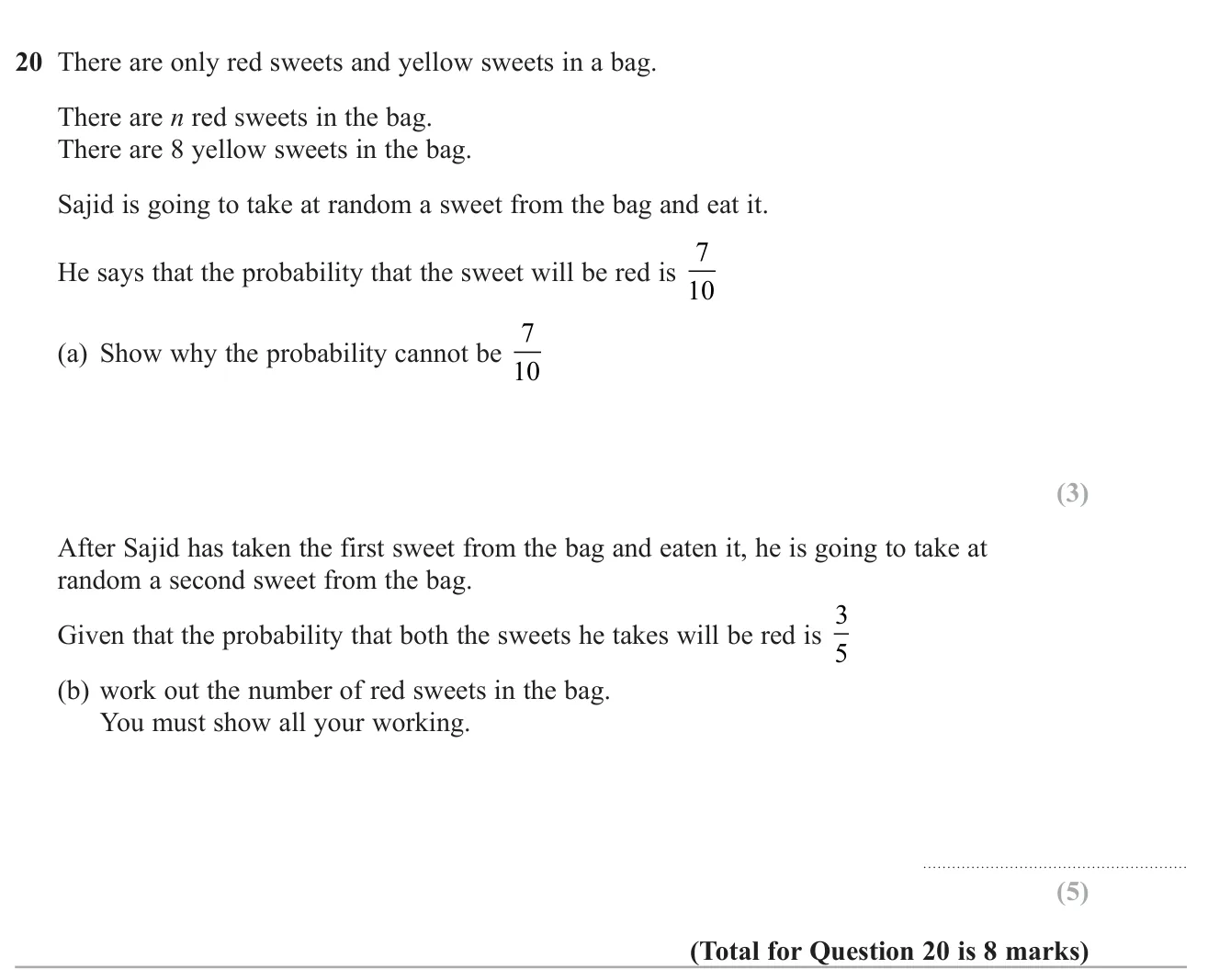
(a) If n n + 8 = 7 10 \frac{n}{n+8} = \frac{7}{10} n + 8 n = 10 7 n = 56 3 n = \frac{56}{3} n = 3 56 3 marks (b) 28 5 marks
Worked solution Checked against the mark scheme
(a) n n + 8 = 7 10 \frac{n}{n + 8} = \frac{7}{10} n + 8 n = 10 7 10 n = 7 n + 56 10n = 7n + 56 10 n = 7 n + 56 3 n = 56 3n = 56 3 n = 56 n = 18.67 n = 18.67 n = 18.67 7 10 \frac{7}{10} 10 7
(b) n n + 8 × n − 1 n + 7 = 3 5 \frac{n}{n+8} \times \frac{n-1}{n+7} = \frac{3}{5} n + 8 n × n + 7 n − 1 = 5 3
5 n ( n − 1 ) = 3 ( n + 8 ) ( n + 7 ) 5n(n - 1) = 3(n + 8)(n + 7) 5 n ( n − 1 ) = 3 ( n + 8 ) ( n + 7 )
5 n 2 − 5 n = 3 n 2 + 45 n + 168 5n^2 - 5n = 3n^2 + 45n + 168 5 n 2 − 5 n = 3 n 2 + 45 n + 168 n 2 − 25 n − 84 = 0 n^2 - 25n - 84 = 0 n 2 − 25 n − 84 = 0
( n − 28 ) ( n + 3 ) = 0 (n - 28)(n + 3) = 0 ( n − 28 ) ( n + 3 ) = 0 n = 28 n = 28 n = 28
Watch out: In (b), keeping the second denominator as n + 8 n + 8 n + 8
© Pearson Education Ltd. June 2023 Paper 3 (Higher, calculator), question 24.
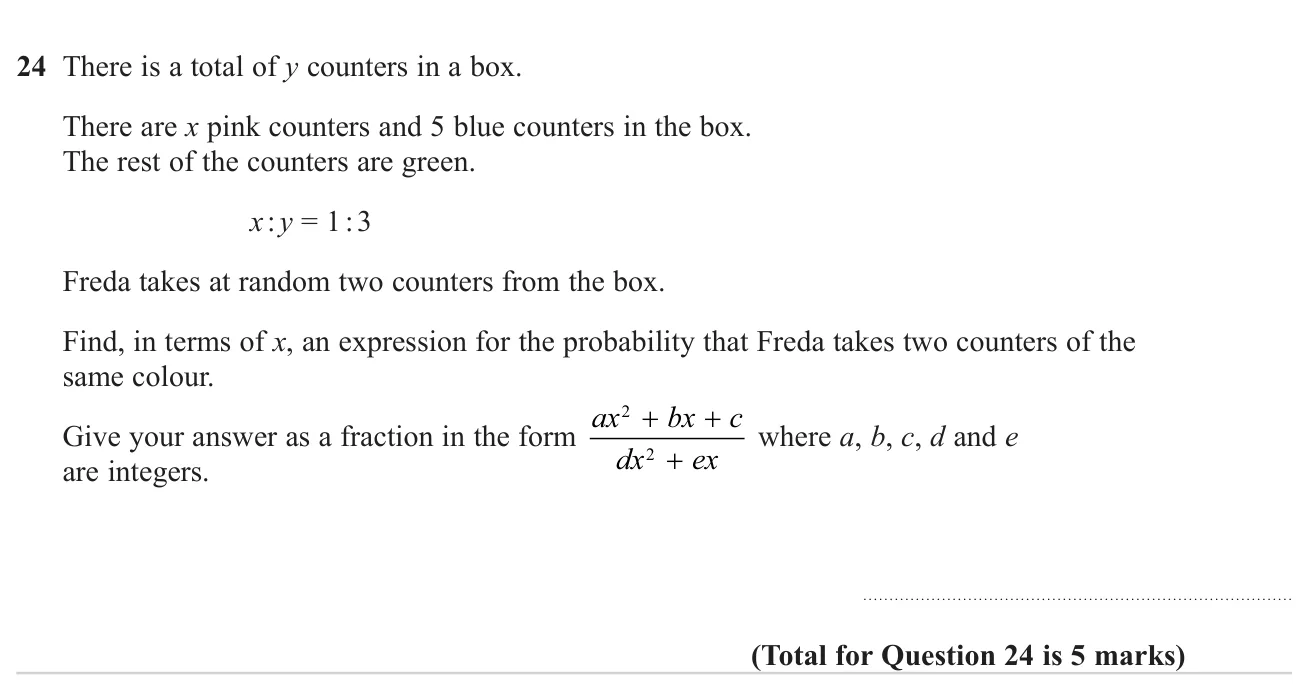
Answer 5 x 2 − 23 x + 50 9 x 2 − 3 x \frac{5x^2 - 23x + 50}{9x^2 - 3x} 9 x 2 − 3 x 5 x 2 − 23 x + 50 5 marks
Worked solution Checked against the mark scheme
y = 3 x y = 3x y = 3 x = 3 x − x − 5 = 2 x − 5 = 3x - x - 5 = 2x - 5 = 3 x − x − 5 = 2 x − 5
P(both pink) = x 3 x × x − 1 3 x − 1 = \dfrac{x}{3x} \times \dfrac{x-1}{3x-1} = 3 x x × 3 x − 1 x − 1
P(both blue) = 5 3 x × 4 3 x − 1 = \dfrac{5}{3x} \times \dfrac{4}{3x-1} = 3 x 5 × 3 x − 1 4
P(both green) = 2 x − 5 3 x × 2 x − 6 3 x − 1 = \dfrac{2x-5}{3x} \times \dfrac{2x-6}{3x-1} = 3 x 2 x − 5 × 3 x − 1 2 x − 6
Sum = x 2 − x + 20 + 4 x 2 − 22 x + 30 3 x ( 3 x − 1 ) = 5 x 2 − 23 x + 50 9 x 2 − 3 x = \dfrac{x^2 - x + 20 + 4x^2 - 22x + 30}{3x(3x-1)} = \dfrac{5x^2 - 23x + 50}{9x^2 - 3x} = 3 x ( 3 x − 1 ) x 2 − x + 20 + 4 x 2 − 22 x + 30 = 9 x 2 − 3 x 5 x 2 − 23 x + 50
Watch out: Not reducing the numbers on the second pick (treating it as with replacement).
© Pearson Education Ltd. Specimen Paper 1 (Higher, non-calculator), question 21.
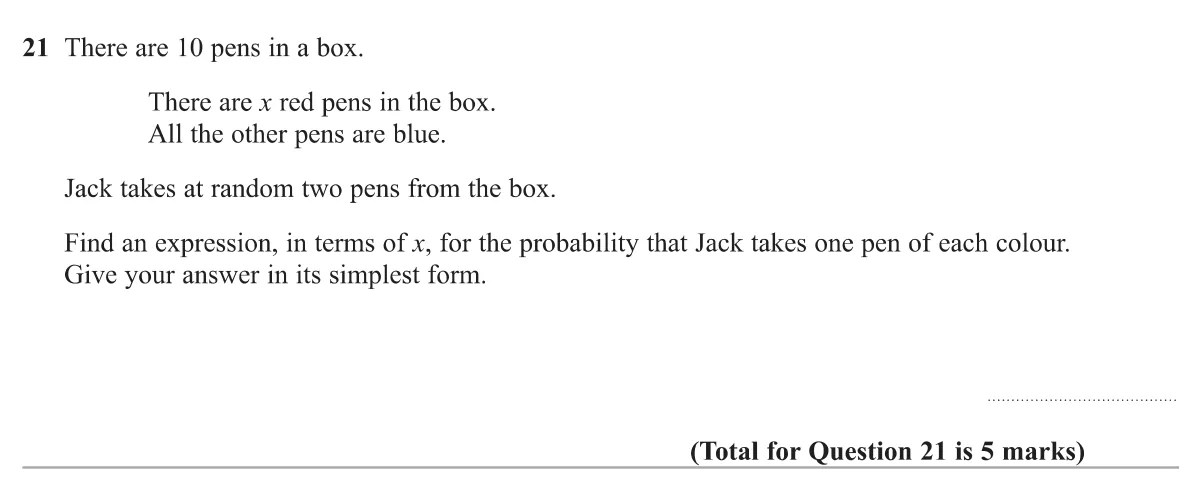
Answer 10 x − x 2 45 \frac{10x - x^2}{45} 45 10 x − x 2 5 marks
Worked solution Checked against the mark scheme
P(red then blue) = x 10 × 10 − x 9 = \frac{x}{10} \times \frac{10 - x}{9} = 10 x × 9 10 − x
P(blue then red) = 10 − x 10 × x 9 = \frac{10 - x}{10} \times \frac{x}{9} = 10 10 − x × 9 x
Add: 2 x ( 10 − x ) 90 = x ( 10 − x ) 45 = 10 x − x 2 45 \frac{2x(10 - x)}{90} = \frac{x(10 - x)}{45} = \frac{10x - x^2}{45} 90 2 x ( 10 − x ) = 45 x ( 10 − x ) = 45 10 x − x 2
Watch out: Using 10 as the denominator for the second pen, as if the first were replaced.
Also tested in these questions Their main topic is different, but part of each one tests this topic.