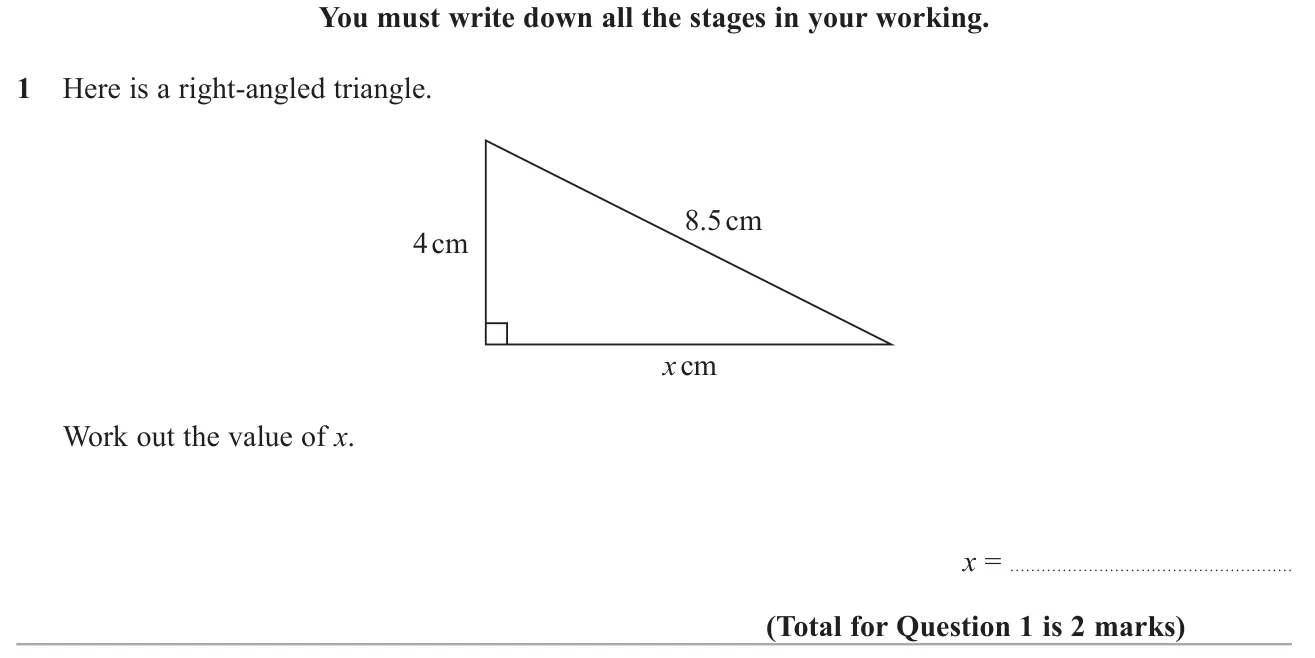
© Pearson Education Ltd. June 2022 Paper 3 (Higher, calculator), question 1.
Show answer
Worked solution Checked against the mark scheme
The hypotenuse is 8.5 cm.
x2=8.52−42=72.25−16=56.25
x=56.25=7.5
Watch out: Adding the squares instead of subtracting, giving about 9.39.
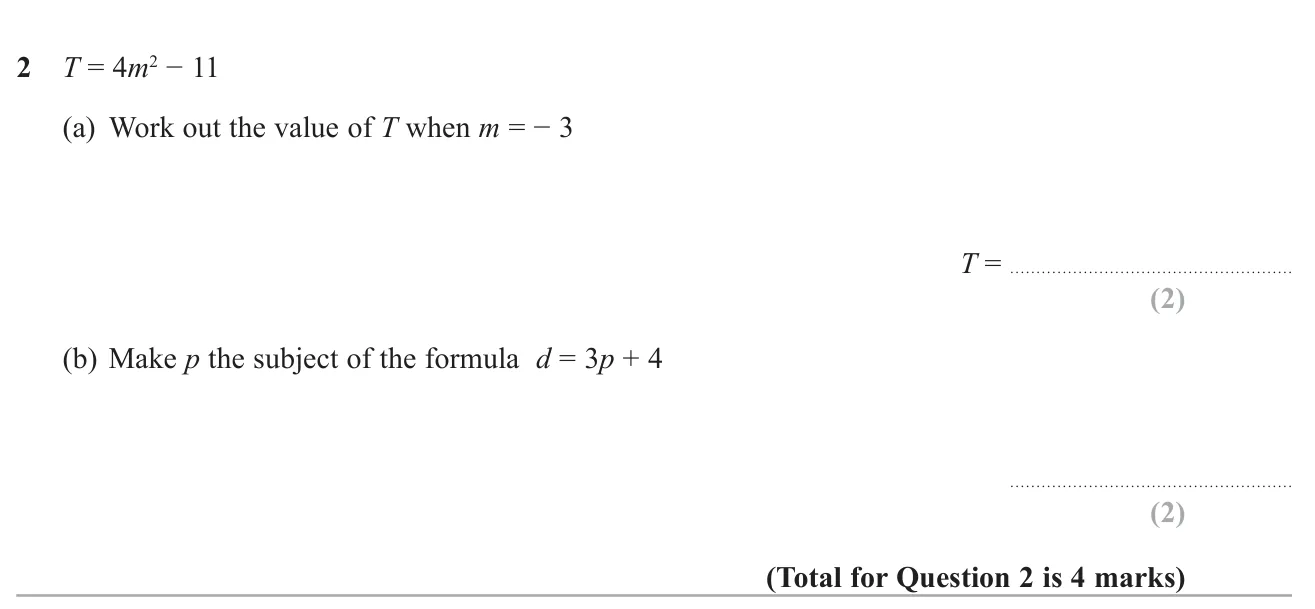
© Pearson Education Ltd. June 2022 Paper 3 (Higher, calculator), question 2.
Show answer
| (a) | T=25 | 2 marks |
|---|
| (b) | p=3d−4 | 2 marks |
|---|
Worked solution Checked against the mark scheme
(a) (−3)2=9, so T=4×9−11=36−11=25
(b) d=3p+4
Subtract 4: d−4=3p
Divide by 3: p=3d−4
Watch out: In (a) squaring 4×−3 to get 144, or using −9 for (−3)2.
Question 3
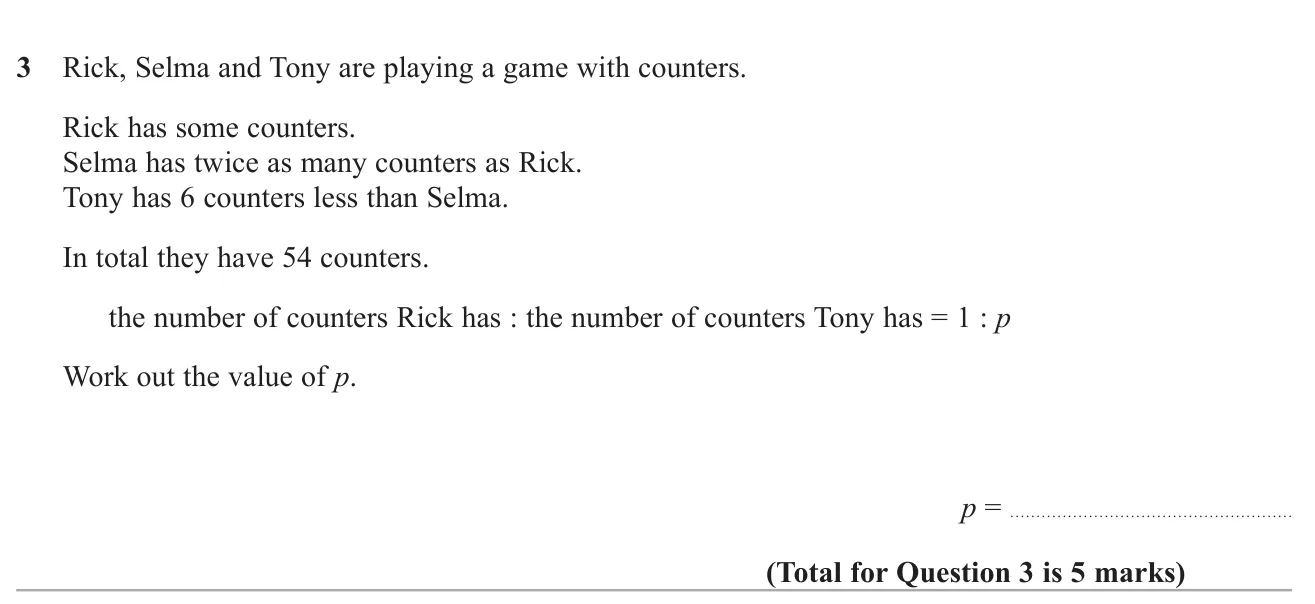
Ratio5 marksGrade 5CalculatorOn both tiers © Pearson Education Ltd. June 2022 Paper 3 (Higher, calculator), question 3.
Show answer
Worked solution Checked against the mark scheme
Let Rick have n. Selma has 2n, Tony has 2n−6.
n+2n+2n−6=54⇒5n=60⇒n=12
Tony has 24−6=18
12:18=1:1.5, so p=1.5
Watch out: Using Selma's counters instead of Tony's in the ratio.
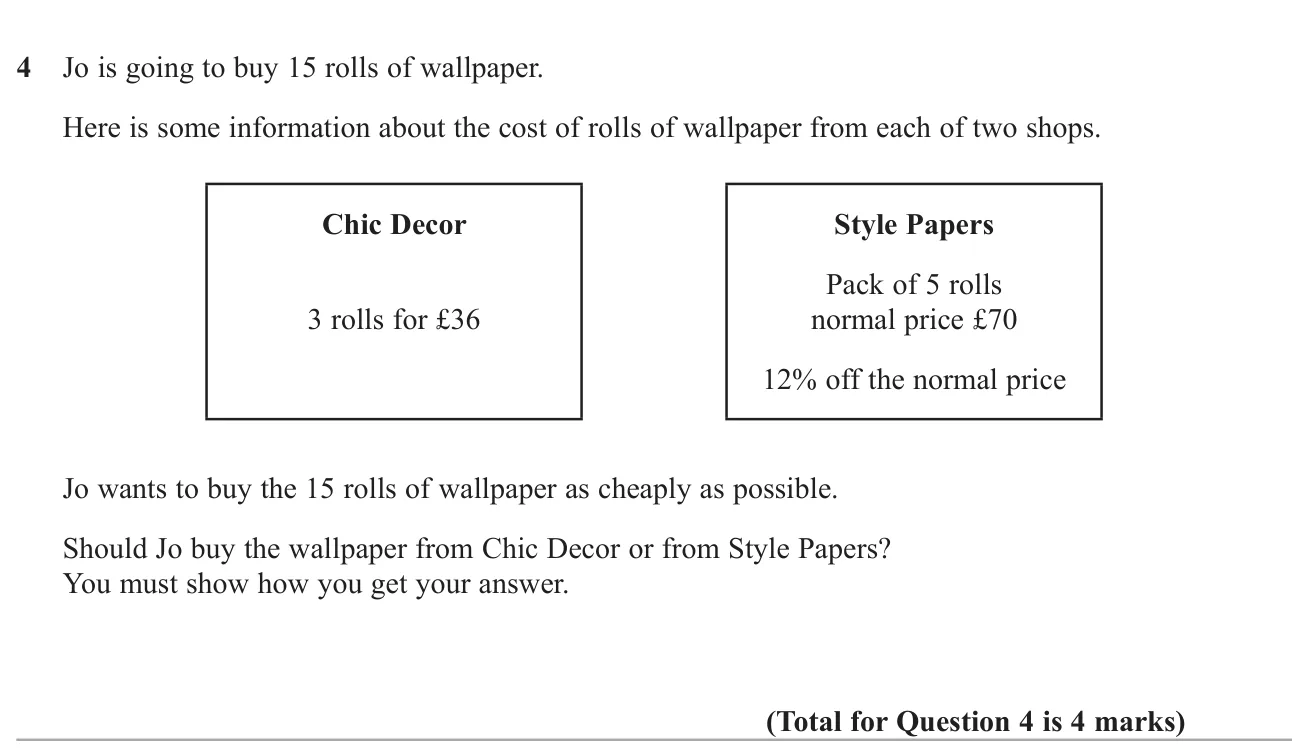
© Pearson Education Ltd. June 2022 Paper 3 (Higher, calculator), question 4.
Show answer
| Answer | Chic Decor (£180 compared with £184.80) | 4 marks |
|---|
Worked solution Checked against the mark scheme
Chic Decor: 15÷3=5 lots of £36, so 5×36=£180
Style Papers: 3×70=£210, then 210×0.88=£184.80
£180 < £184.80, so buy from Chic Decor.
Watch out: Taking 12% off only one pack, or finding 12% but not subtracting it.
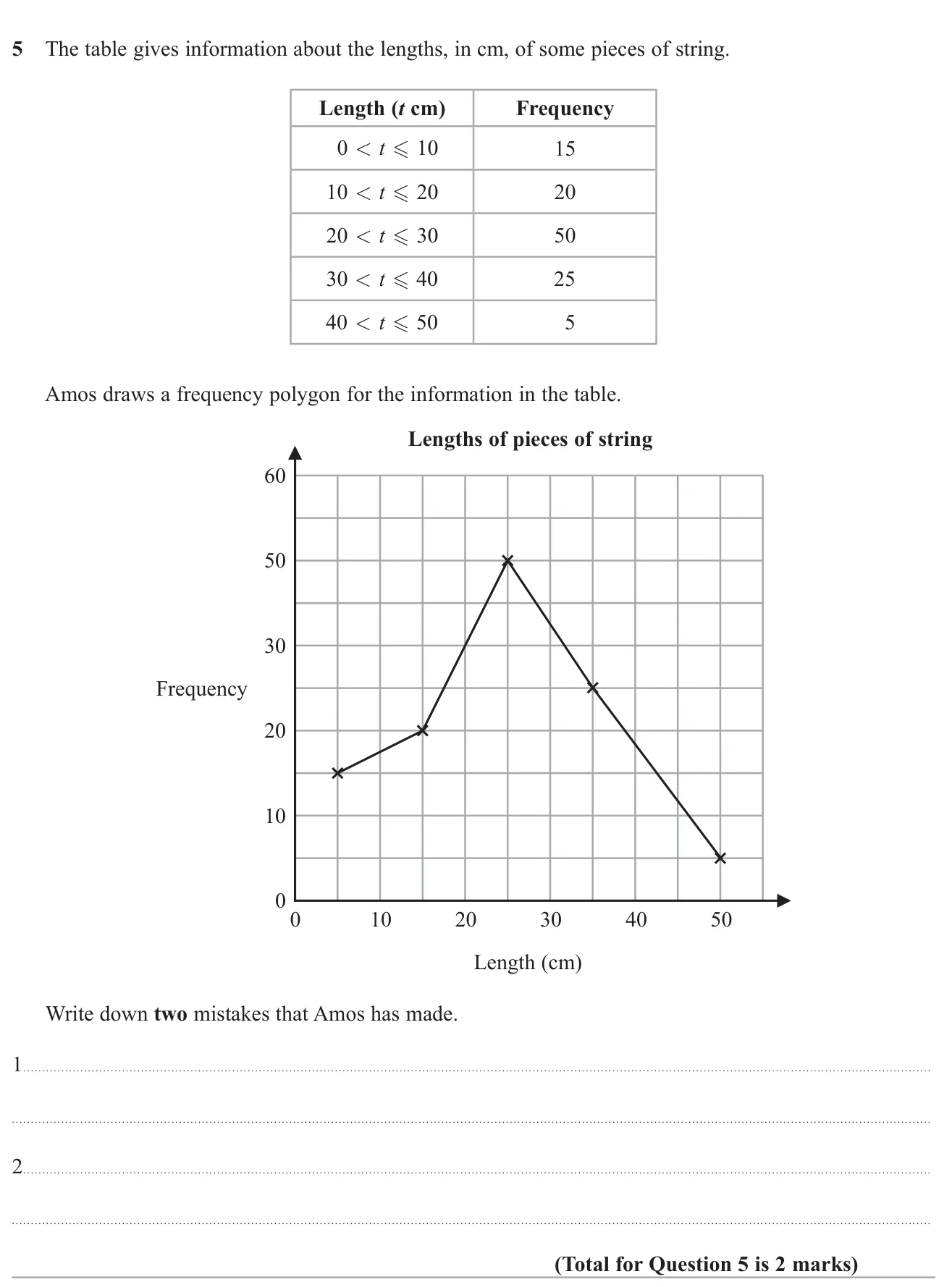
© Pearson Education Ltd. June 2022 Paper 3 (Higher, calculator), question 5.
Show answer
| Answer | The vertical scale misses 40 (not evenly spaced); the last point is plotted at 50 instead of the midpoint 45 | 2 marks |
|---|
Worked solution Checked against the mark scheme
Look at the frequency axis: it goes 30 then 50, so 40 is missing and the scale is not even.
Points should be at class midpoints (5, 15, 25, 35, 45). The last point is at (50, 5) but should be at (45, 5).
Watch out: Saying the polygon should start at the origin, which is not a mistake.
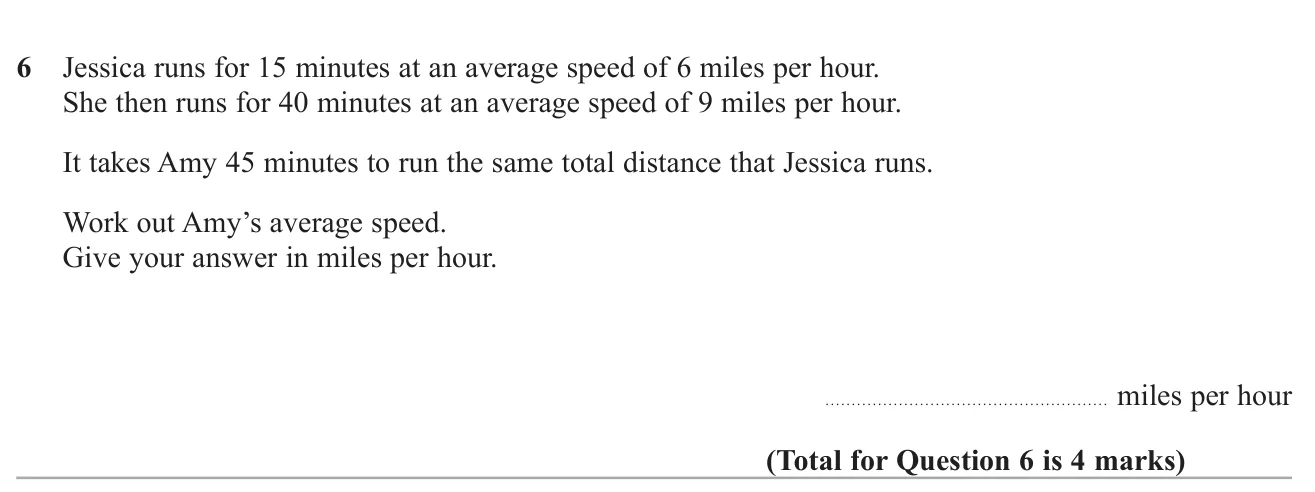
© Pearson Education Ltd. June 2022 Paper 3 (Higher, calculator), question 6.
Show answer
Worked solution Checked against the mark scheme
Stage 1: 6×6015=1.5 miles
Stage 2: 9×6040=6 miles
Total = 7.5 miles
Amy: 7.5÷0.75=10 mph
Watch out: Using 45 hours instead of 0.75 hours, or averaging the two speeds.
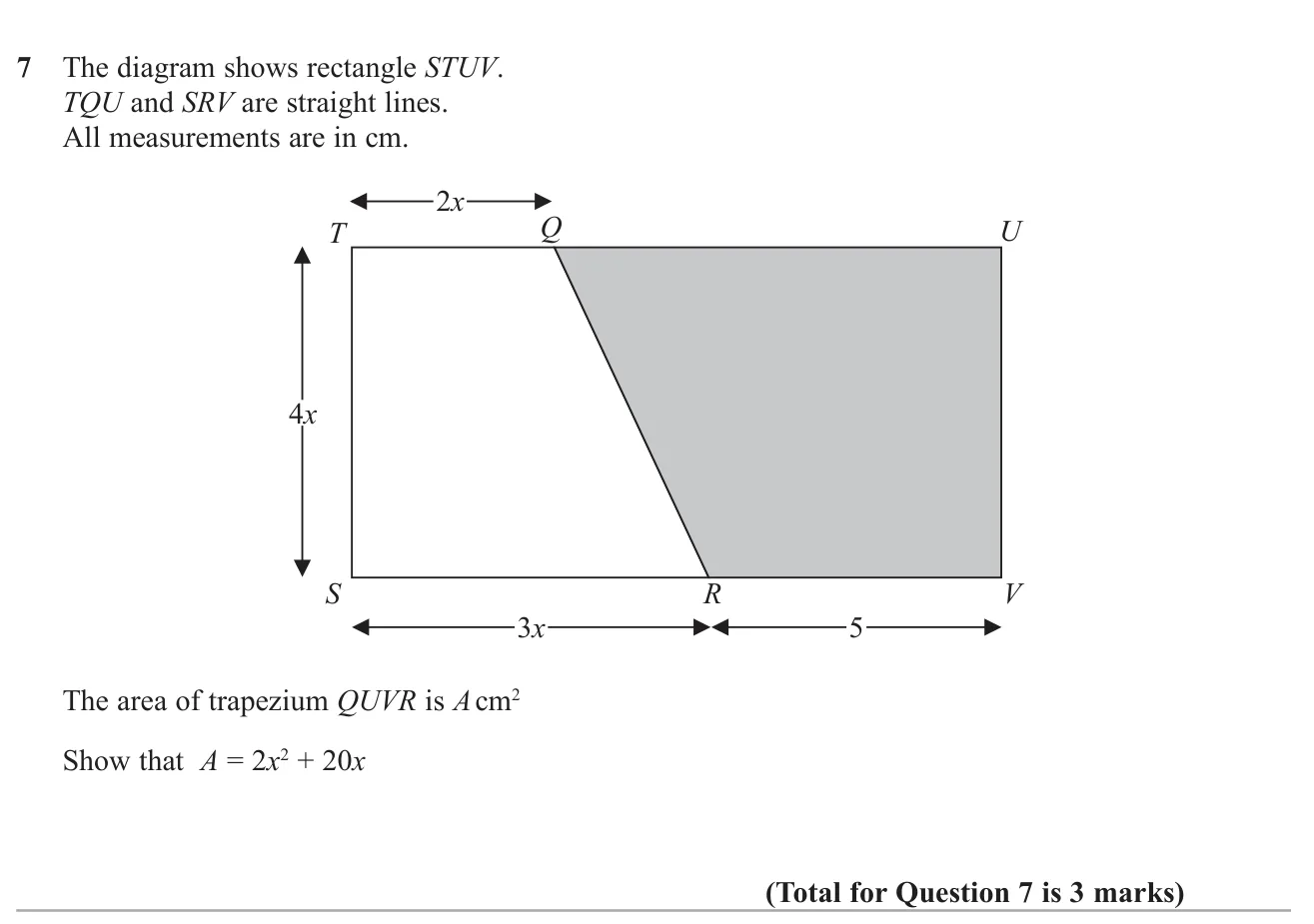
© Pearson Education Ltd. June 2022 Paper 3 (Higher, calculator), question 7.
Show answer
| Answer | A=2x2+20x shown | 3 marks |
|---|
Worked solution Checked against the mark scheme
QU=(3x+5)−2x=x+5 and RV=5; the height is 4x.
A=21(QU+RV)×4x=21(x+10)×4x
A=2x(x+10)=2x2+20x
Watch out: Using 3x+5 for the top side QU instead of x+5.
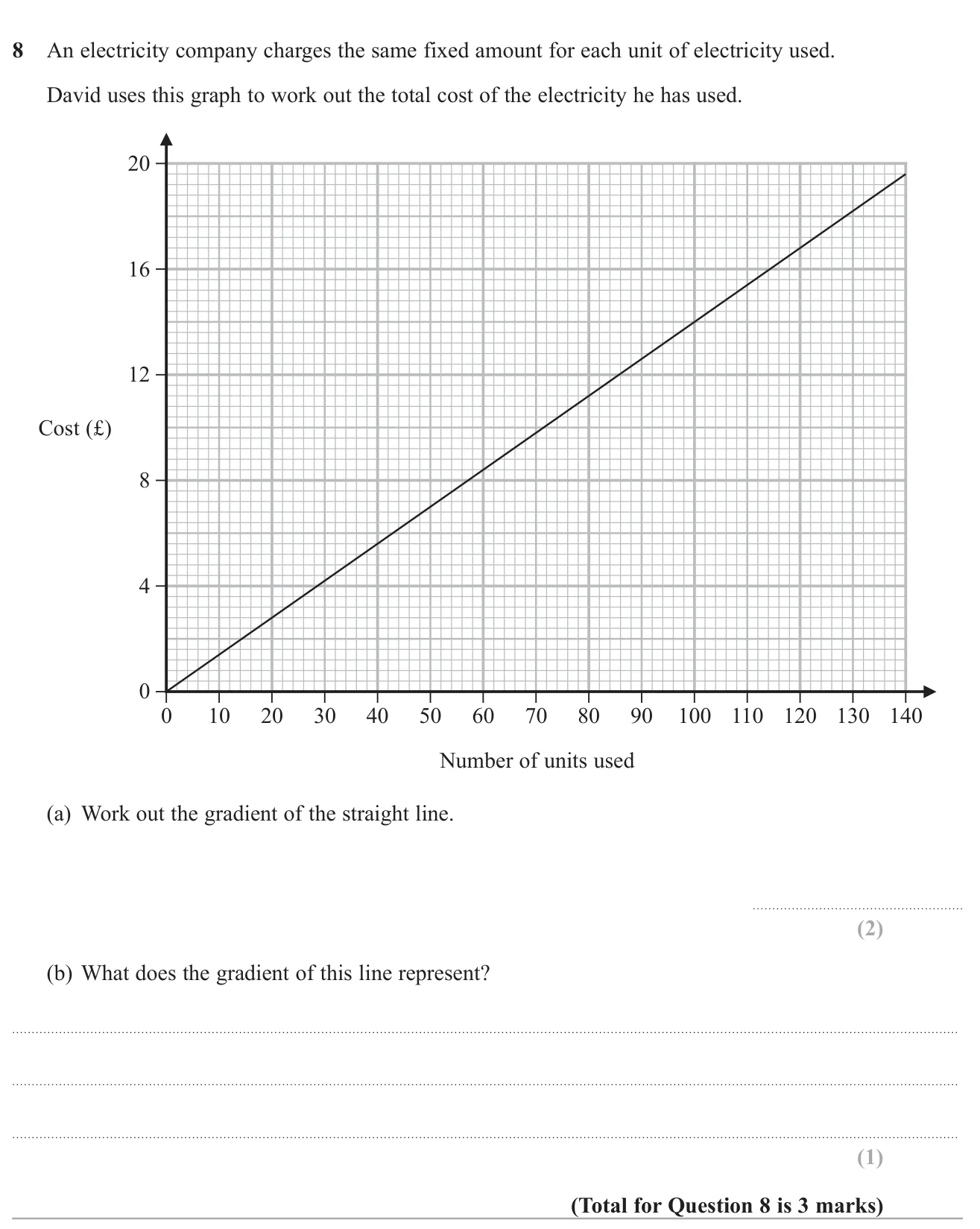
© Pearson Education Ltd. June 2022 Paper 3 (Higher, calculator), question 8.
Show answer
| (a) | 0.14 | 2 marks |
|---|
| (b) | The cost of each unit of electricity (£0.14, i.e. 14p per unit) | 1 mark |
|---|
Worked solution Checked against the mark scheme
(a) The line passes through (0,0) and (100,14).
Gradient =10014=0.14
(b) The gradient is pounds per unit, so it is the price of one unit of electricity: 14p.
Watch out: In (b), saying only that it shows how steep the line is, without linking it to cost per unit.
© Pearson Education Ltd. June 2022 Paper 3 (Higher, calculator), question 9.
Show answer
| (a) | 1060 | 3 marks |
|---|
| (b) | He should multiply the powers, 50×2=100, giving 12100, not square the 50 | 1 mark |
|---|
Worked solution Checked against the mark scheme
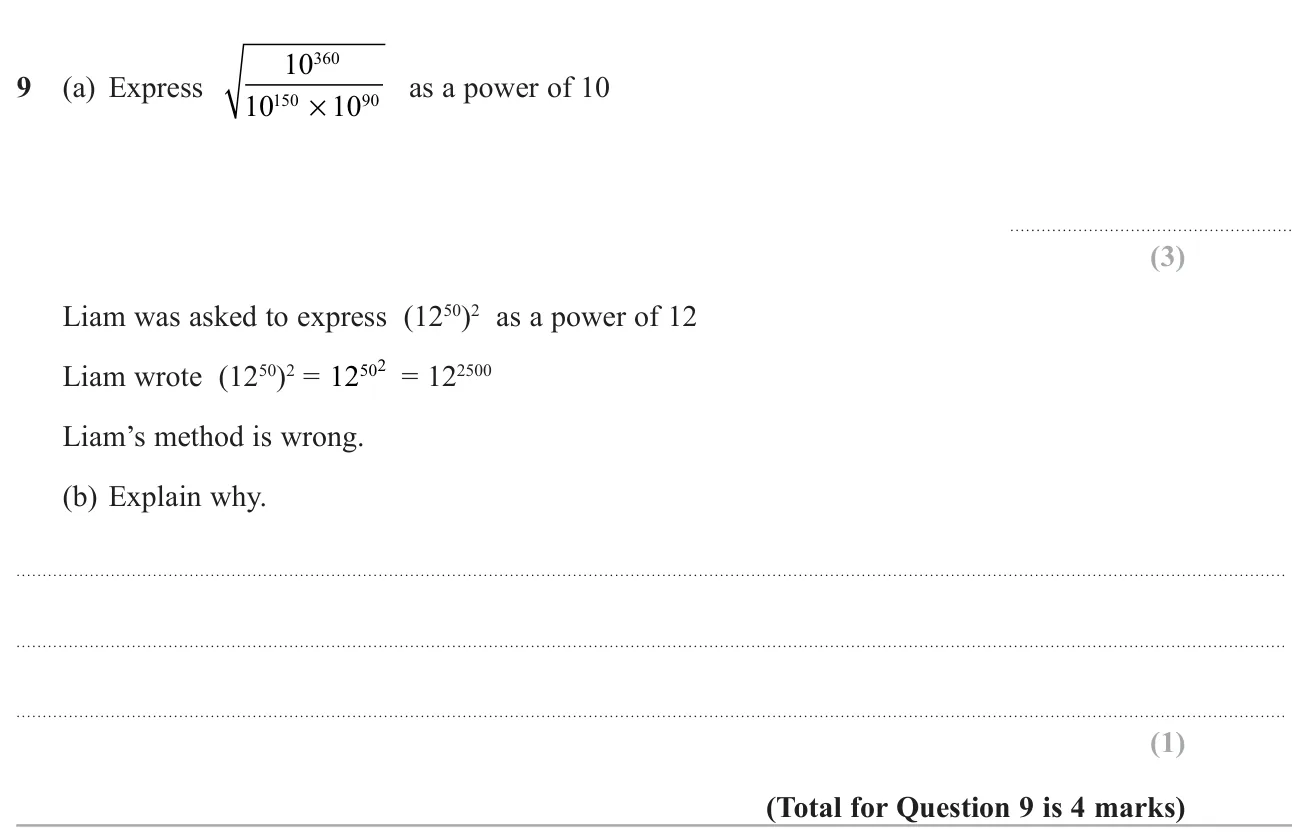
(a) 10150×1090=10240
10360÷10240=10120
10120=1060
(b) For a power of a power you multiply the indices: (1250)2=12100. Liam squared 50 instead.
Watch out: In (a), halving only the numerator's power before dividing, or taking the square root of 120 instead of halving it.
© Pearson Education Ltd. June 2022 Paper 3 (Higher, calculator), question 10.
Show answer
| Answer | £24000 | 3 marks |
|---|
Worked solution Checked against the mark scheme
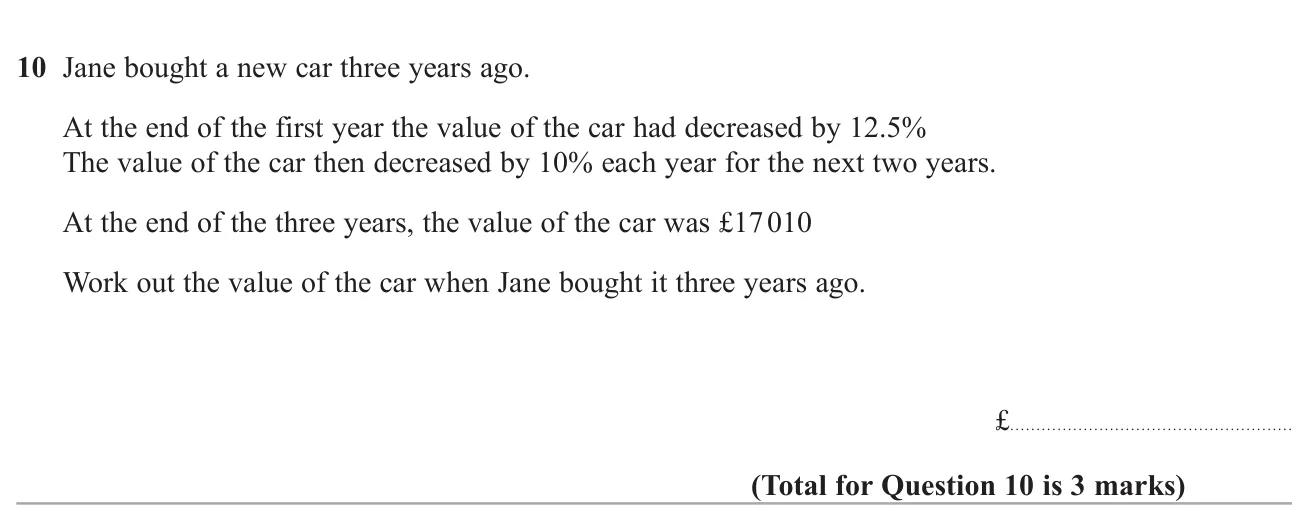
Multiplier after 3 years: 0.875×0.9×0.9=0.70875
Original value =17010÷0.70875=£24000
Watch out: Adding the percentages (12.5 + 10 + 10 = 32.5%) or increasing £17 010 by those percentages.
© Pearson Education Ltd. June 2022 Paper 3 (Higher, calculator), question 11.
Show answer
Worked solution Checked against the mark scheme
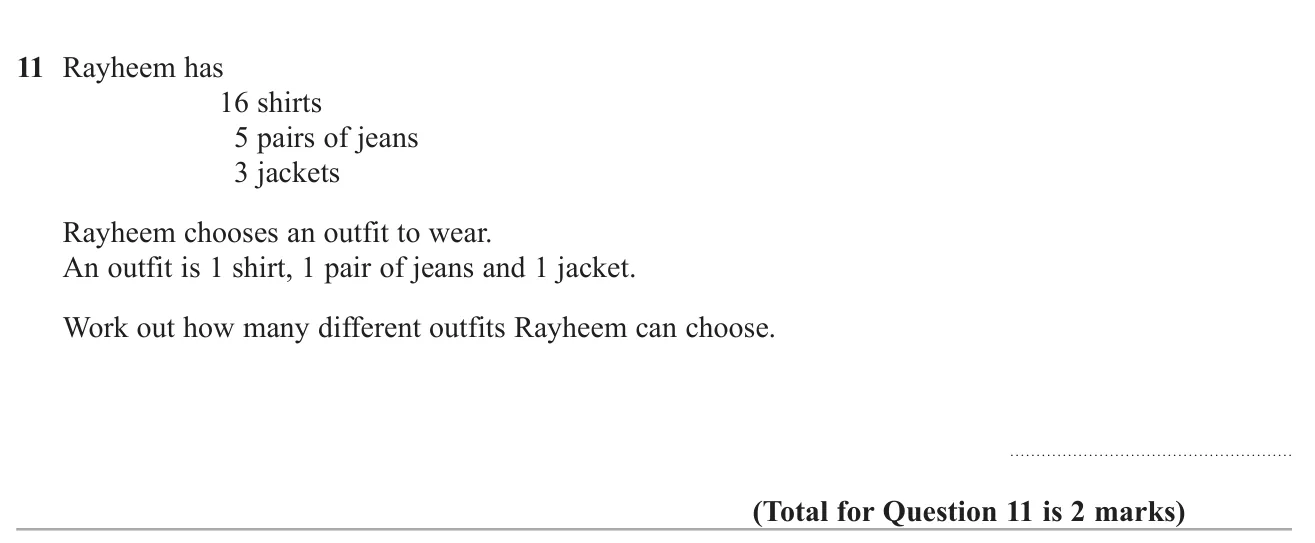
Each choice can go with every other choice, so multiply:
16×5×3=240
Watch out: Adding the numbers to get 24.
© Pearson Education Ltd. June 2022 Paper 3 (Higher, calculator), question 12.
Show answer
| Answer | 23.4 cm | 3 marks |
|---|
Worked solution Checked against the mark scheme
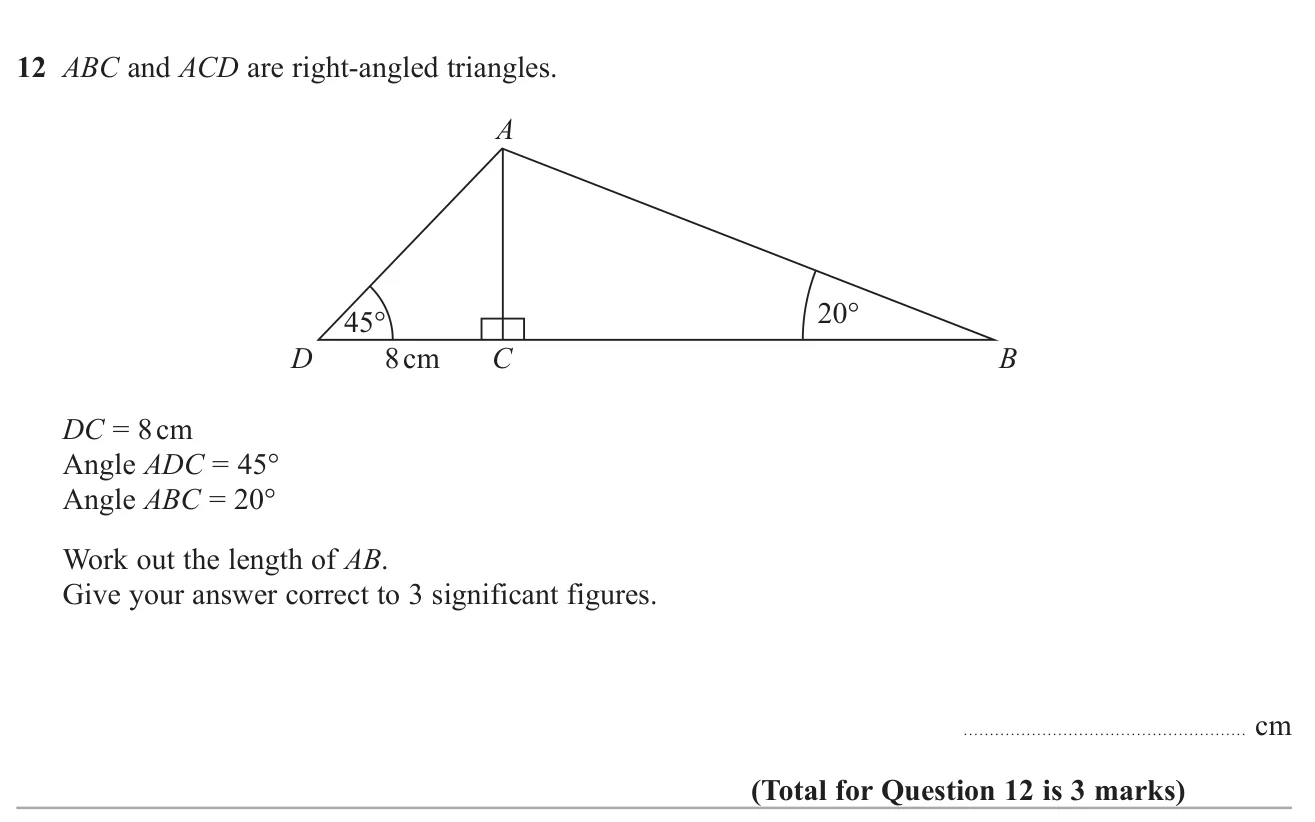
In triangle ACD, tan45∘=8AC, so AC=8 cm.
In triangle ABC, AC is opposite the 20∘ angle and AB is the hypotenuse:
AB=sin20∘8=23.39…≈23.4 cm
Watch out: Using tan 20° instead of sin 20°, which finds BC rather than AB.
© Pearson Education Ltd. June 2022 Paper 3 (Higher, calculator), question 13.
Show answer
| Answer | (−14) | 3 marks |
|---|
Worked solution Checked against the mark scheme
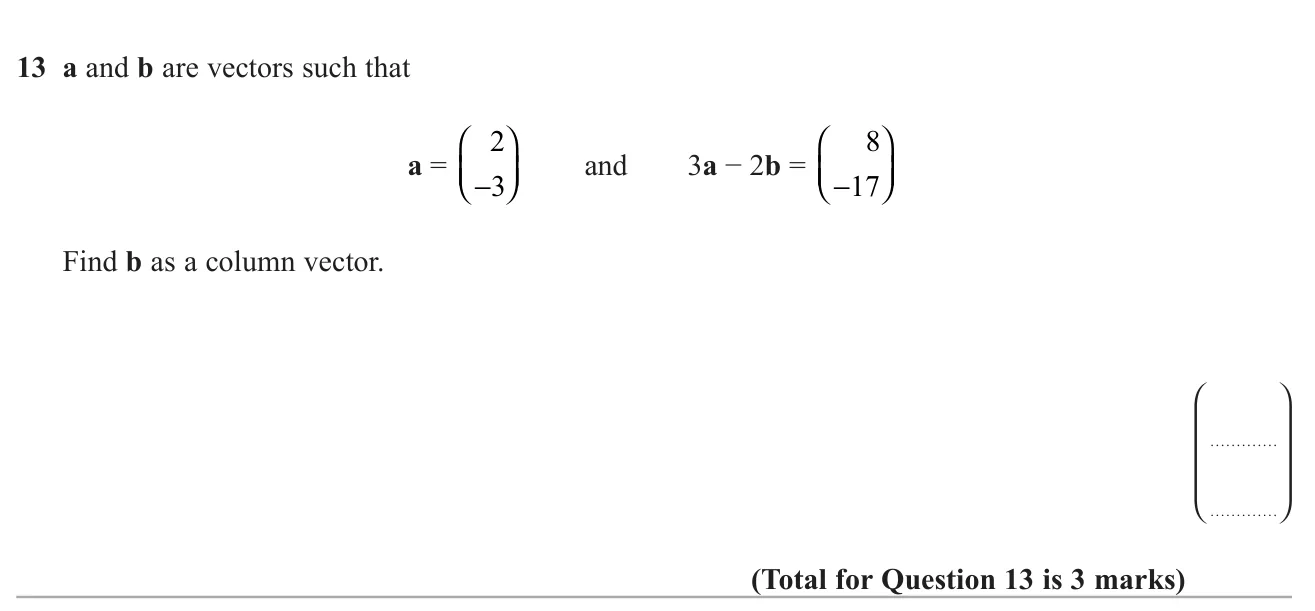
3a=(6−9)
2b=3a−(8−17)=(−28)
b=(−14)
Watch out: Sign error when rearranging, giving (1, −4).
© Pearson Education Ltd. June 2022 Paper 3 (Higher, calculator), question 14.
Show answer
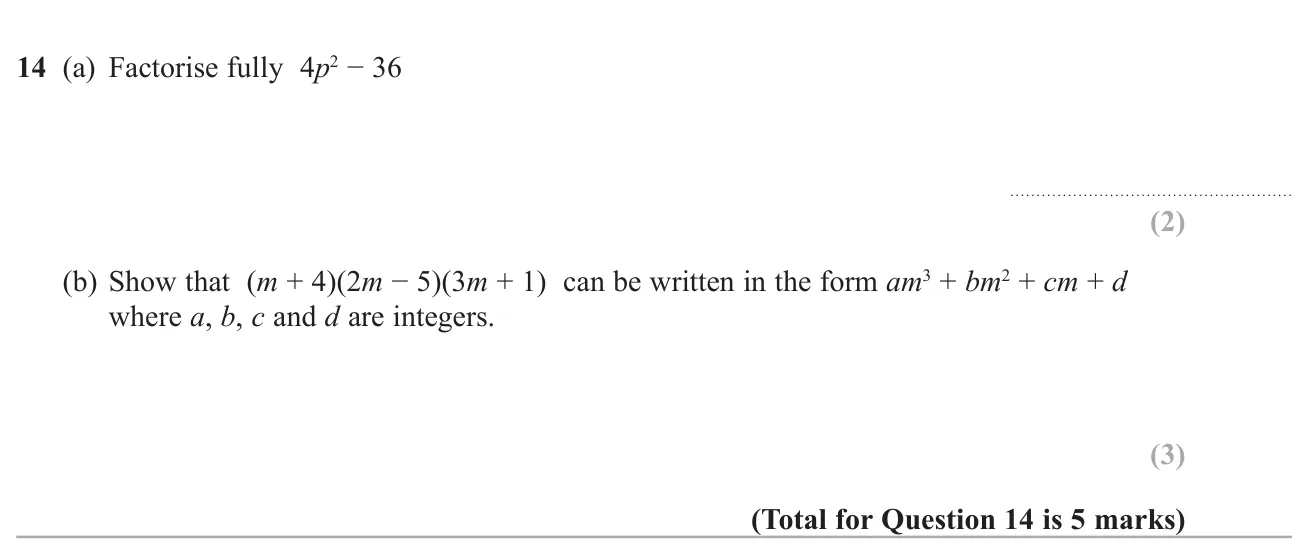
| (a) | 4(p−3)(p+3) | 2 marks |
|---|
| (b) | 6m3+11m2−57m−20 | 3 marks |
|---|
Worked solution Checked against the mark scheme
(a) 4p2−36=4(p2−9)=4(p−3)(p+3)
(b) (m+4)(2m−5)=2m2+3m−20
(2m2+3m−20)(3m+1)=6m3+2m2+9m2+3m−60m−20
=6m3+11m2−57m−20
Watch out: In (a), stopping at 4(p² − 9) without factorising fully.
© Pearson Education Ltd. June 2022 Paper 3 (Higher, calculator), question 15.
Show answer
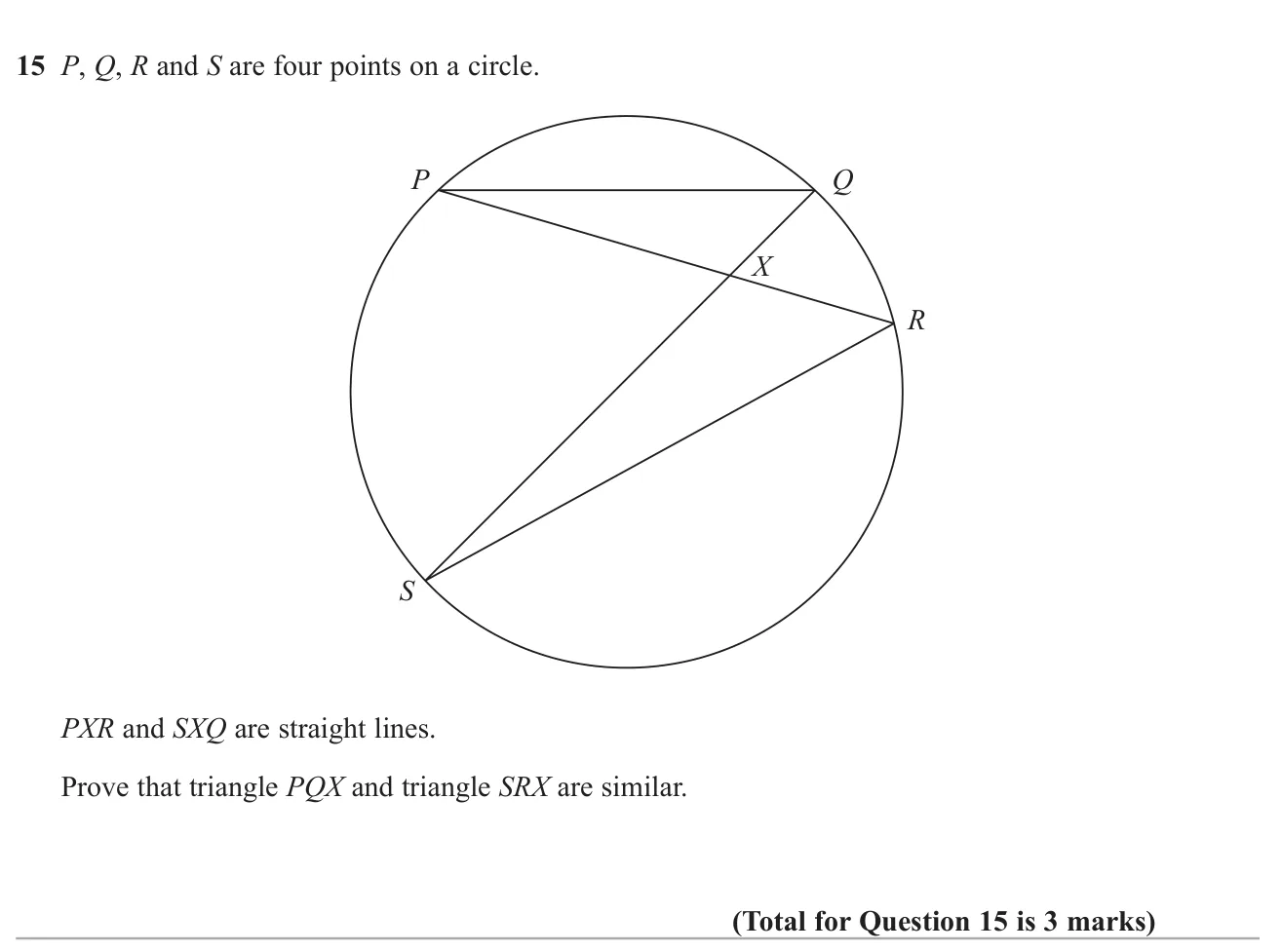
| Answer | Angle PQX = angle SRX (same segment); angle QPX = angle RSX (same segment); angle PXQ = angle SXR (vertically opposite); all three angles equal, so similar | 3 marks |
|---|
Worked solution Checked against the mark scheme
Angles PQS and PRS stand on the same arc PS, so angle PQX = angle SRX (angles in the same segment).
Angles QPR and QSR stand on arc QR, so angle QPX = angle RSX (angles in the same segment).
Angle PXQ = angle SXR (vertically opposite).
All three pairs of angles are equal, so the triangles are similar.
Watch out: Stating equal angles without naming the circle theorem.
© Pearson Education Ltd. June 2022 Paper 3 (Higher, calculator), question 16.
Show answer
| Answer | 17.4 | 3 marks |
|---|
Worked solution Checked against the mark scheme
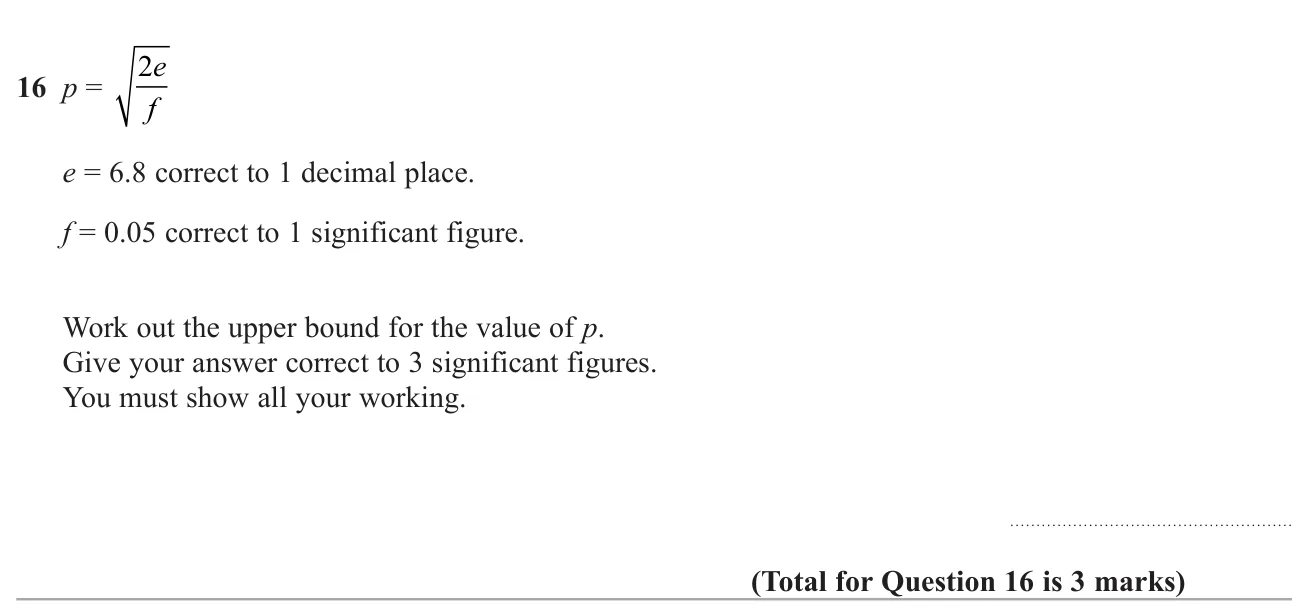
Bounds: 6.75≤e<6.85 and 0.045≤f<0.055
For the largest p, make the top big and the bottom small:
p=0.0452×6.85=304.44…=17.448…≈17.4
Watch out: Dividing by the upper bound of f, which gives the smaller value.
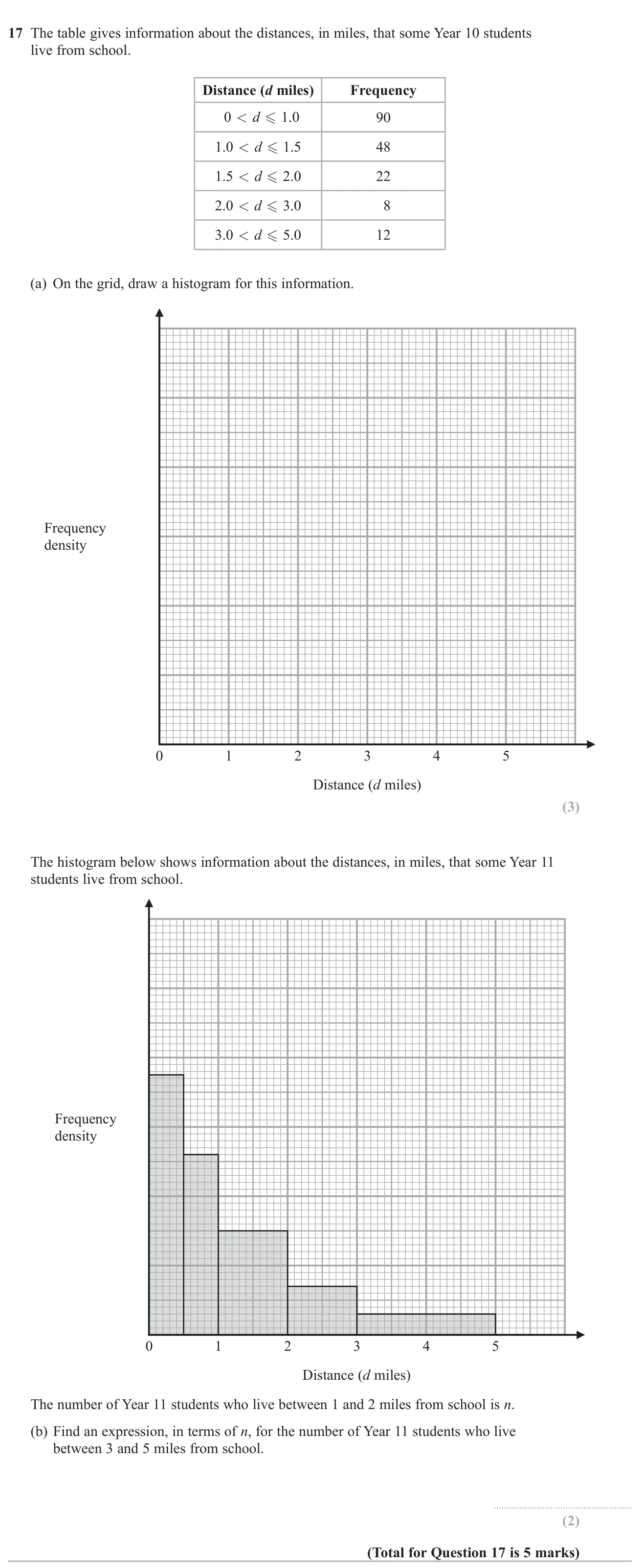
© Pearson Education Ltd. June 2022 Paper 3 (Higher, calculator), question 17.
Show answer
| (a) | Bars with frequency densities 90, 96, 44, 8 and 6 over the correct class widths | 3 marks |
|---|
| (b) | 0.4n | 2 marks |
|---|
Worked solution Checked against the mark scheme
(a) Frequency density = frequency ÷ class width:
90÷1=90, 48÷0.5=96, 22÷0.5=44, 8÷1=8, 12÷2=6
(b) On the grid, the 1–2 bar is 5 times as tall as the 3–5 bar, but the 3–5 bar is twice as wide.
Area ratio =5×1:1×2=5:2
So the number is 52n=0.4n
Watch out: Drawing bar heights equal to the frequencies instead of the frequency densities.
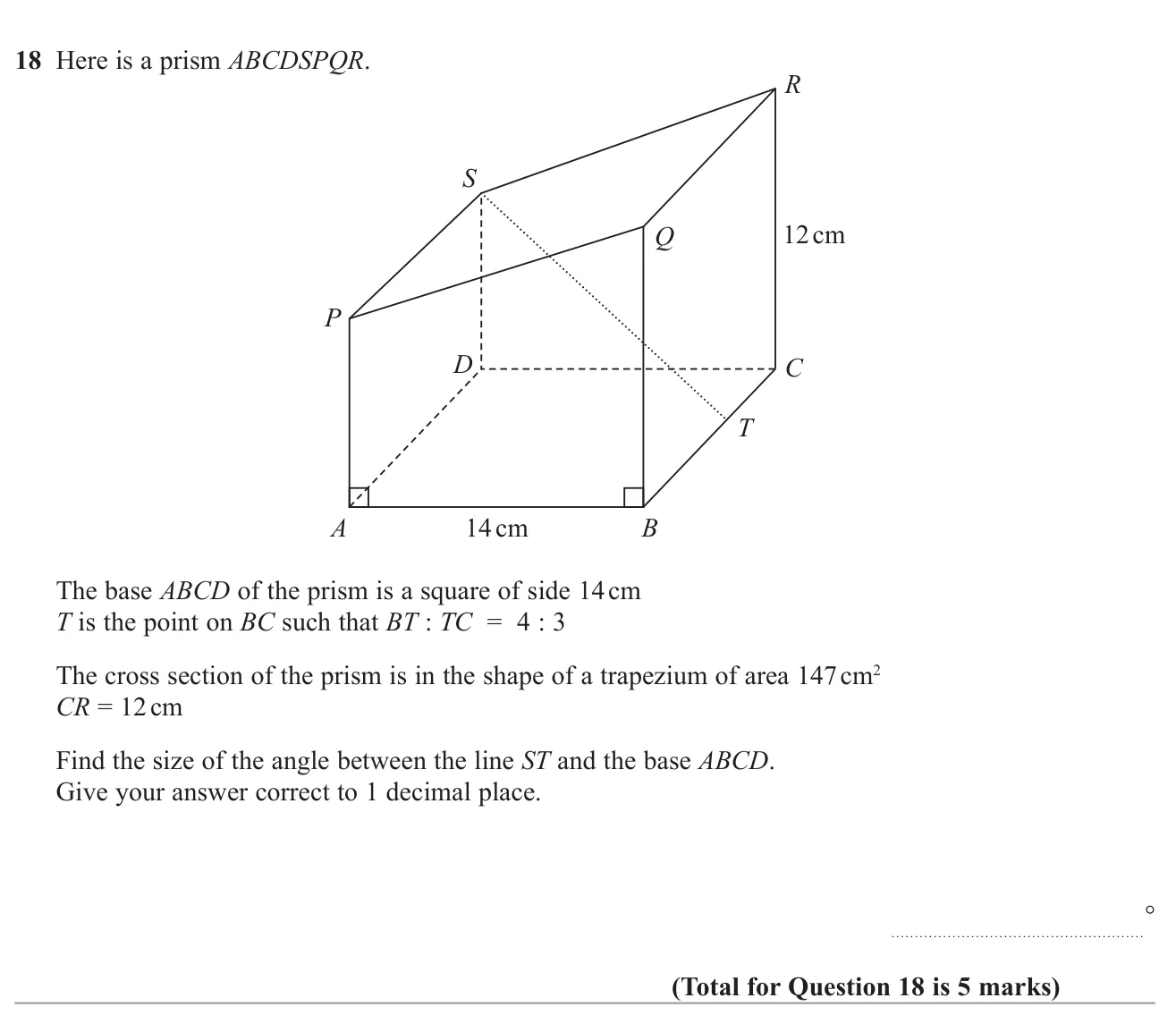
© Pearson Education Ltd. June 2022 Paper 3 (Higher, calculator), question 18.
Show answer
| Answer | 30.6∘ | 5 marks |
|---|
Worked solution Checked against the mark scheme
TC=14×73=6 cm
TD=142+62=232=15.23… cm
Trapezium: 21(SD+12)×14=147⇒SD=9 cm
Angle =tan−1(15.23…9)=30.6∘
Watch out: Using TC or BT alone as the horizontal distance instead of TD.
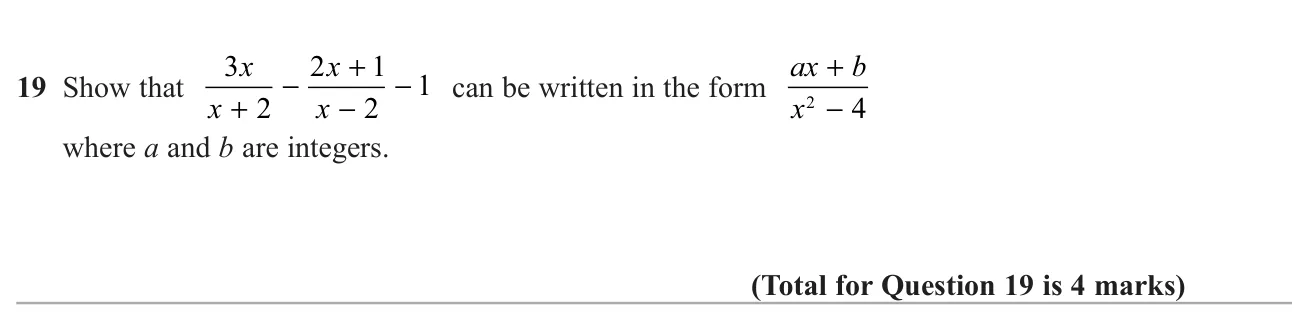
© Pearson Education Ltd. June 2022 Paper 3 (Higher, calculator), question 19.
Show answer
| Answer | x2−4−11x+2, so a=−11, b=2 | 4 marks |
|---|
Worked solution Checked against the mark scheme
Common denominator (x+2)(x−2)=x2−4
x2−43x(x−2)−(2x+1)(x+2)−(x2−4)
Numerator: 3x2−6x−(2x2+5x+2)−x2+4=−11x+2
So the expression is x2−4−11x+2
Watch out: Not distributing the minus sign across (2x+1)(x+2).
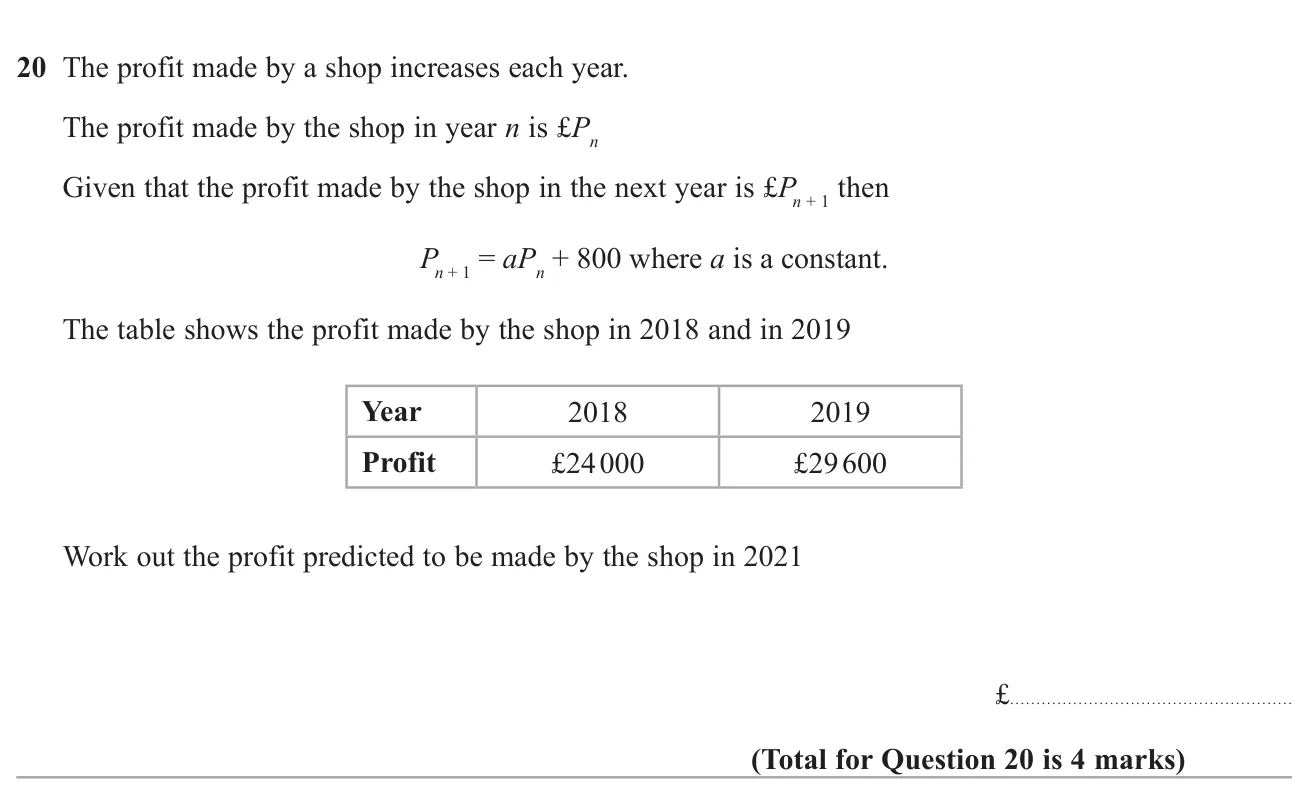
© Pearson Education Ltd. June 2022 Paper 3 (Higher, calculator), question 20.
Show answer
| Answer | £44384 | 4 marks |
|---|
Worked solution Checked against the mark scheme
29600=24000a+800⇒a=2400028800=1.2
2020: 1.2×29600+800=36320
2021: 1.2×36320+800=£44384
Watch out: Stopping at 2020 (£36 320).
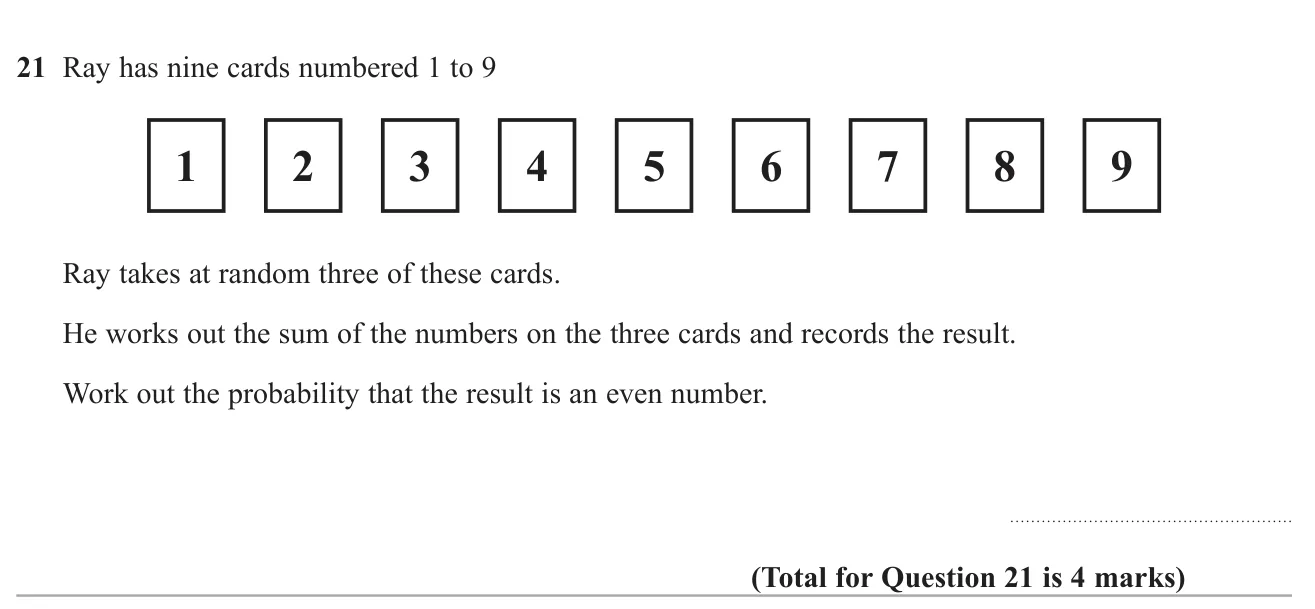
© Pearson Education Ltd. June 2022 Paper 3 (Higher, calculator), question 21.
Show answer
| Answer | 2111 | 4 marks |
|---|
Worked solution Checked against the mark scheme
There are 4 even and 5 odd cards. The sum is even for EEE or one even and two odd.
EEE: 94×83×72=50424
One even, two odd (3 orders): 3×94×85×74=504240
Total =504264=2111
Watch out: Treating the draws as with replacement, giving 364/729.
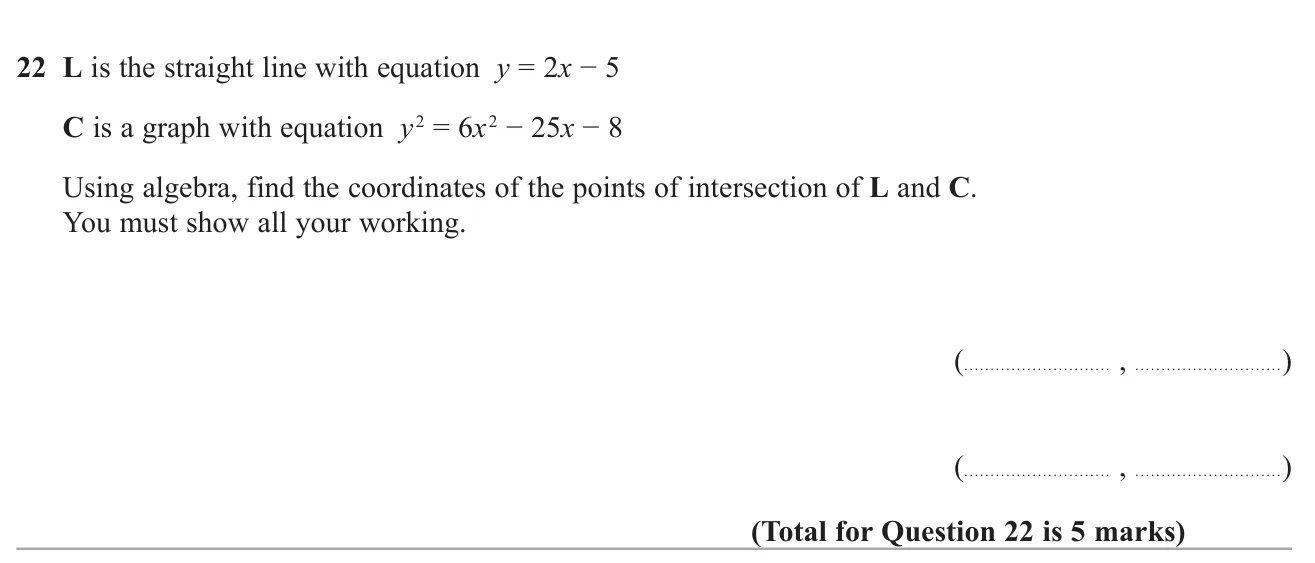
© Pearson Education Ltd. June 2022 Paper 3 (Higher, calculator), question 22.
Show answer
| Answer | (−3,−11) and (5.5,6) | 5 marks |
|---|
Worked solution Checked against the mark scheme
Substitute y=2x−5: (2x−5)2=6x2−25x−8
4x2−20x+25=6x2−25x−8
2x2−5x−33=0⇒(2x−11)(x+3)=0
x=5.5⇒y=6; x=−3⇒y=−11
Watch out: Expanding (2x−5)2 as 4x2+25.
Finished the paper?
Add up your marks for all three papers and see what grade that would have been.