Edexcel GCSE Maths · 1MA1

June 2024 Paper 1 Higher

Non-calculator · 23 questions · 80 marks · 1 hour 30 minutes. Try each question on paper, then press "Show answer".

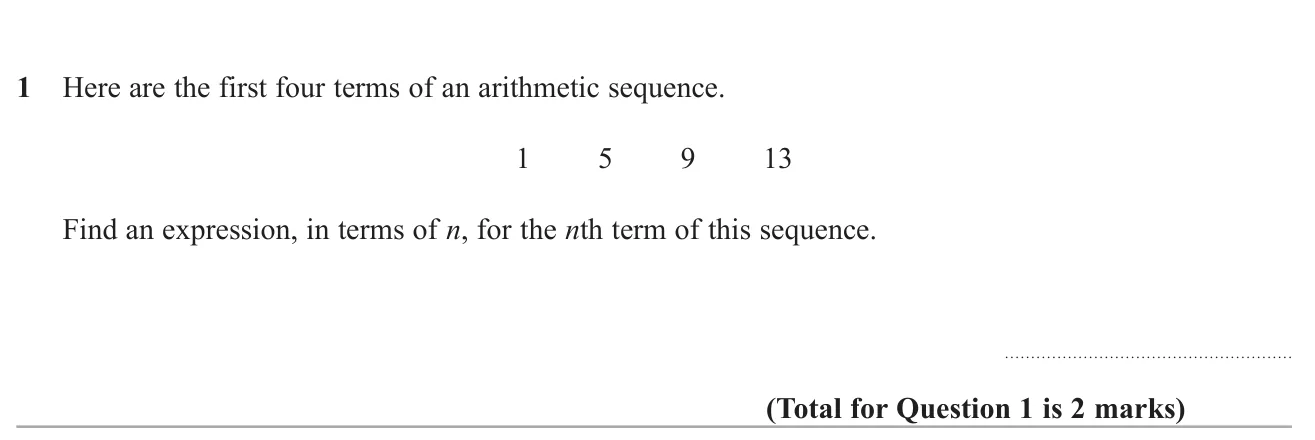
Question 1

Sequences and the nth term2 marksGrade 4No calculatorOn both tiers
Find the nth term of an arithmetic sequence.

© Pearson Education Ltd. June 2024 Paper 1 (Higher, non-calculator), question 1.

Show answer
Answer4n−34n - 32 marks

Worked solution Checked against the mark scheme

The terms go up by 4, so start with 4n4n.

4n4n gives 4, 8, 12, ... Each term is 3 less, so the nth term is 4n−34n - 3.

Watch out: Writing n + 4.
Question 2

Fractions3 marksGrade 4No calculatorOn both tiers
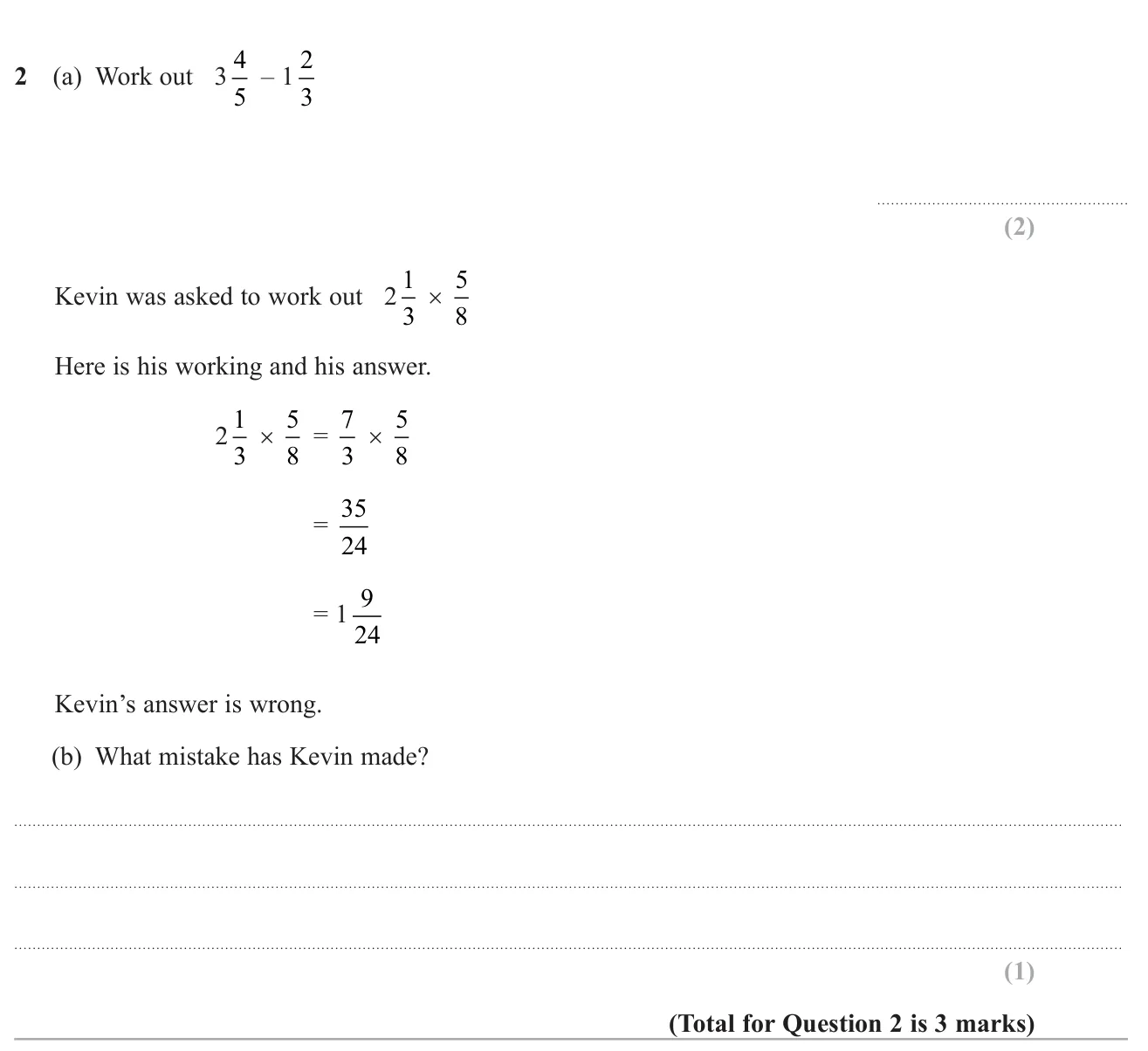
Subtract mixed numbers and spot the error in a worked multiplication of fractions.

© Pearson Education Ltd. June 2024 Paper 1 (Higher, non-calculator), question 2.

Show answer
(a)22152\frac{2}{15}2 marks
(b)He converted 3524\frac{35}{24} wrongly: it should be 111241\frac{11}{24}, not 19241\frac{9}{24}1 mark

Worked solution Checked against the mark scheme

(a) 345−123=5715−2515=3215=22153\frac{4}{5} - 1\frac{2}{3} = \frac{57}{15} - \frac{25}{15} = \frac{32}{15} = 2\frac{2}{15}

(b) 35−24=1135 - 24 = 11, so 3524=11124\frac{35}{24} = 1\frac{11}{24}. Kevin wrote 9 instead of 11 in the numerator.

Watch out: In (a), subtracting numerators and denominators separately.

Question 3

Area and perimeter5 marksGrade 4No calculatorOn both tiers
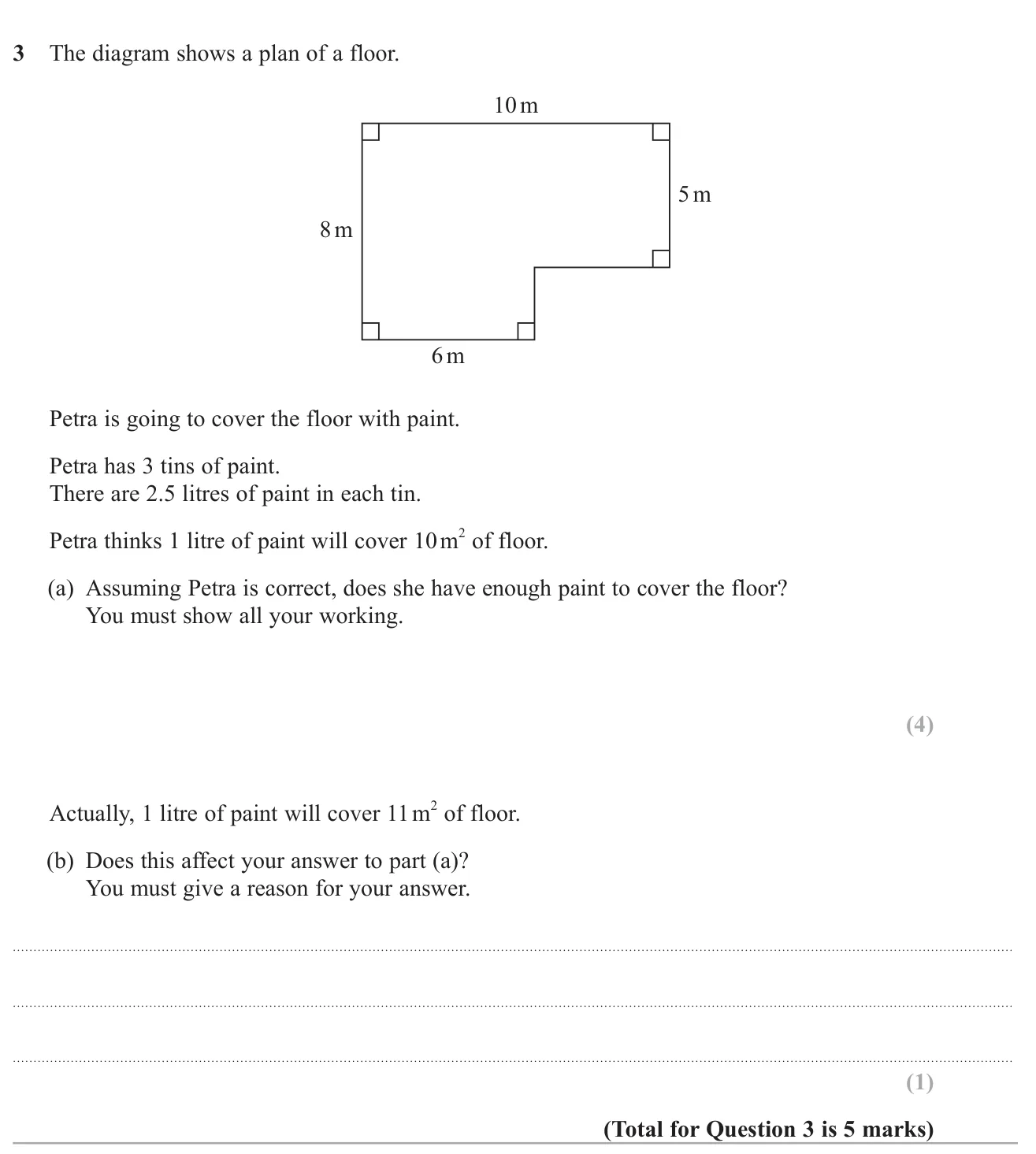
Find the area of an L-shaped floor and decide whether three tins of paint are enough, then consider a better coverage rate.

© Pearson Education Ltd. June 2024 Paper 1 (Higher, non-calculator), question 3.

Show answer
(a)Yes: area 68 m268\text{ m}^2 and the paint covers 75 m275\text{ m}^24 marks
(b)No effect: each litre covers more, so she still has enough1 mark

Worked solution Checked against the mark scheme

(a) Area =10×8−4×3=80−12=68 m2= 10 \times 8 - 4 \times 3 = 80 - 12 = 68\text{ m}^2

Paint: 3×2.5=7.53 \times 2.5 = 7.5 litres, covering 7.5×10=75 m27.5 \times 10 = 75\text{ m}^2

75>6875 > 68, so yes, she has enough.

(b) With 11 m² per litre it covers 82.5 m282.5\text{ m}^2, even more, so the answer does not change.

Watch out: Multiplying 10 × 8 and forgetting to remove the cut-out corner.

Question 4

Venn diagrams and sets3 marksGrade 4No calculatorOn both tiers
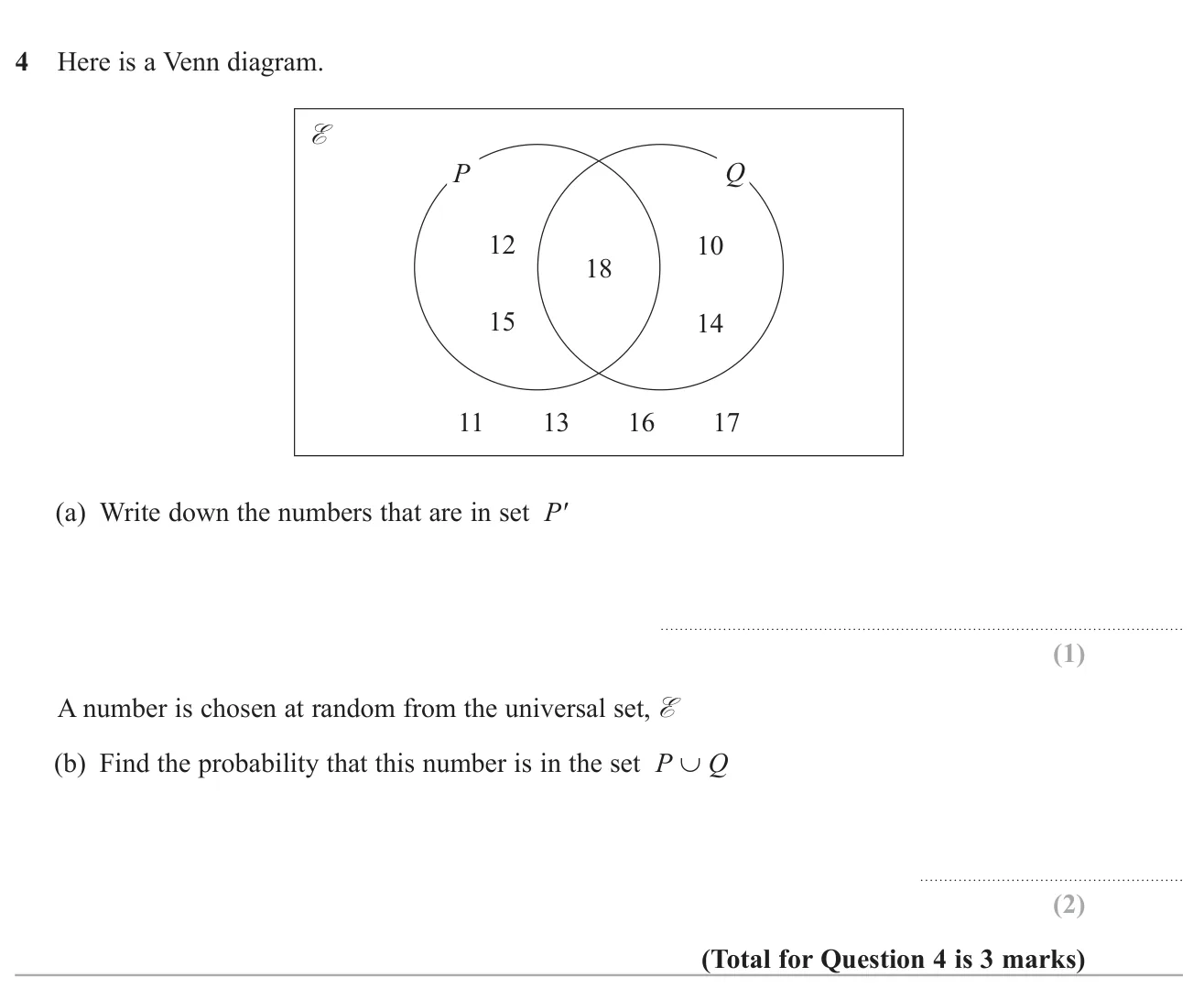
Read a set complement from a Venn diagram and find the probability of the union of two sets.

© Pearson Education Ltd. June 2024 Paper 1 (Higher, non-calculator), question 4.

Show answer
(a)10,11,13,14,16,1710, 11, 13, 14, 16, 171 mark
(b)59\frac{5}{9}2 marks

Worked solution Checked against the mark scheme

(a) P′P' is everything not in PP: 10,11,13,14,16,1710, 11, 13, 14, 16, 17

(b) P∪Q={10,12,14,15,18}P \cup Q = \{10, 12, 14, 15, 18\}, which is 5 of the 9 numbers.

Probability =59= \frac{5}{9}

Watch out: Leaving out the numbers outside both circles in (a), or only counting the overlap in (b).

Question 5

Rounding and estimation4 marksGrade 4No calculatorOn both tiers
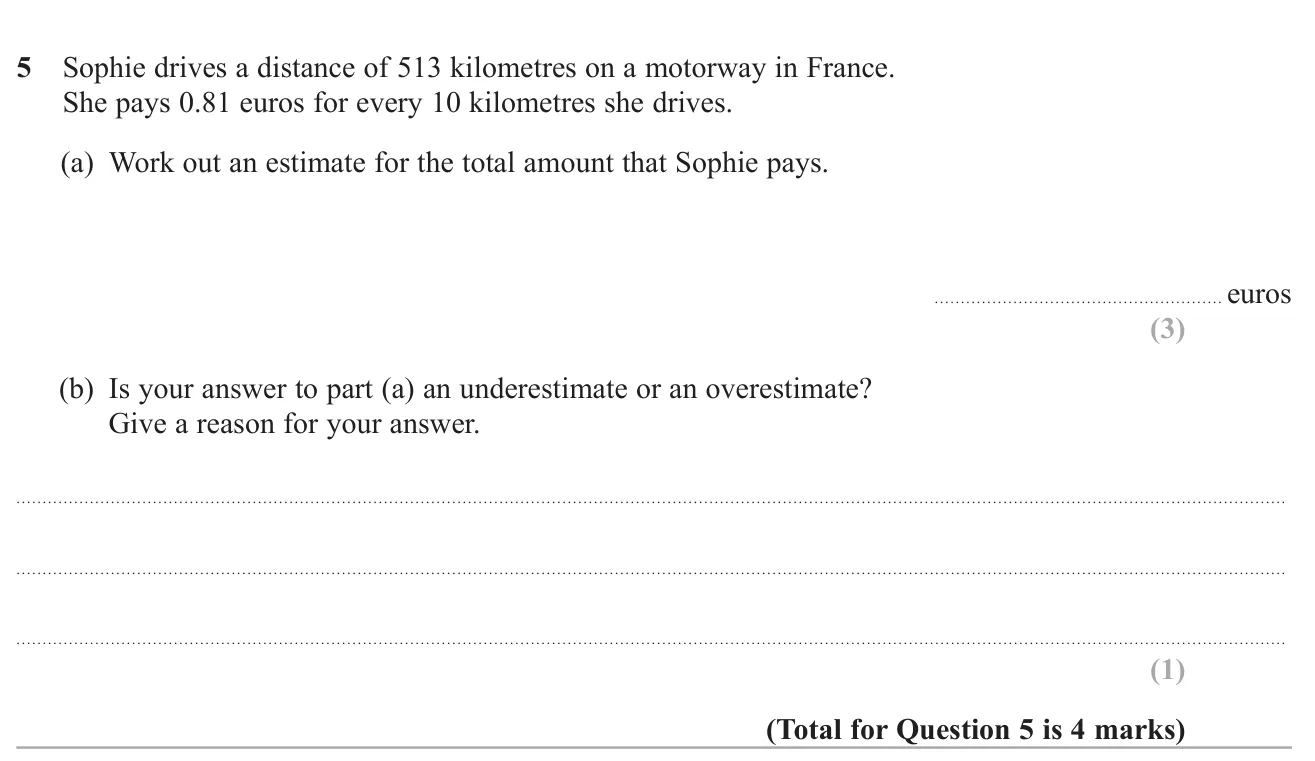
Estimate the cost of a motorway journey by rounding, then say if it is an under- or overestimate.

© Pearson Education Ltd. June 2024 Paper 1 (Higher, non-calculator), question 5.

Show answer
(a)About 4040 euros (e.g. 500÷10×0.8500 \div 10 \times 0.8)3 marks
(b)Underestimate, because both numbers were rounded down1 mark

Worked solution Checked against the mark scheme

(a) Round: 513≈500513 \approx 500 km and 0.81≈0.80.81 \approx 0.8 euros.

500÷10=50500 \div 10 = 50 lots of 10 km, 50×0.8=4050 \times 0.8 = 40 euros.

(b) Underestimate: both values were rounded down.

Watch out: Rounding 0.81 to 1, which the mark scheme does not accept for the accuracy mark.

Question 6

Coordinates and straight-line graphs4 marksGrade 5No calculatorOn both tiers
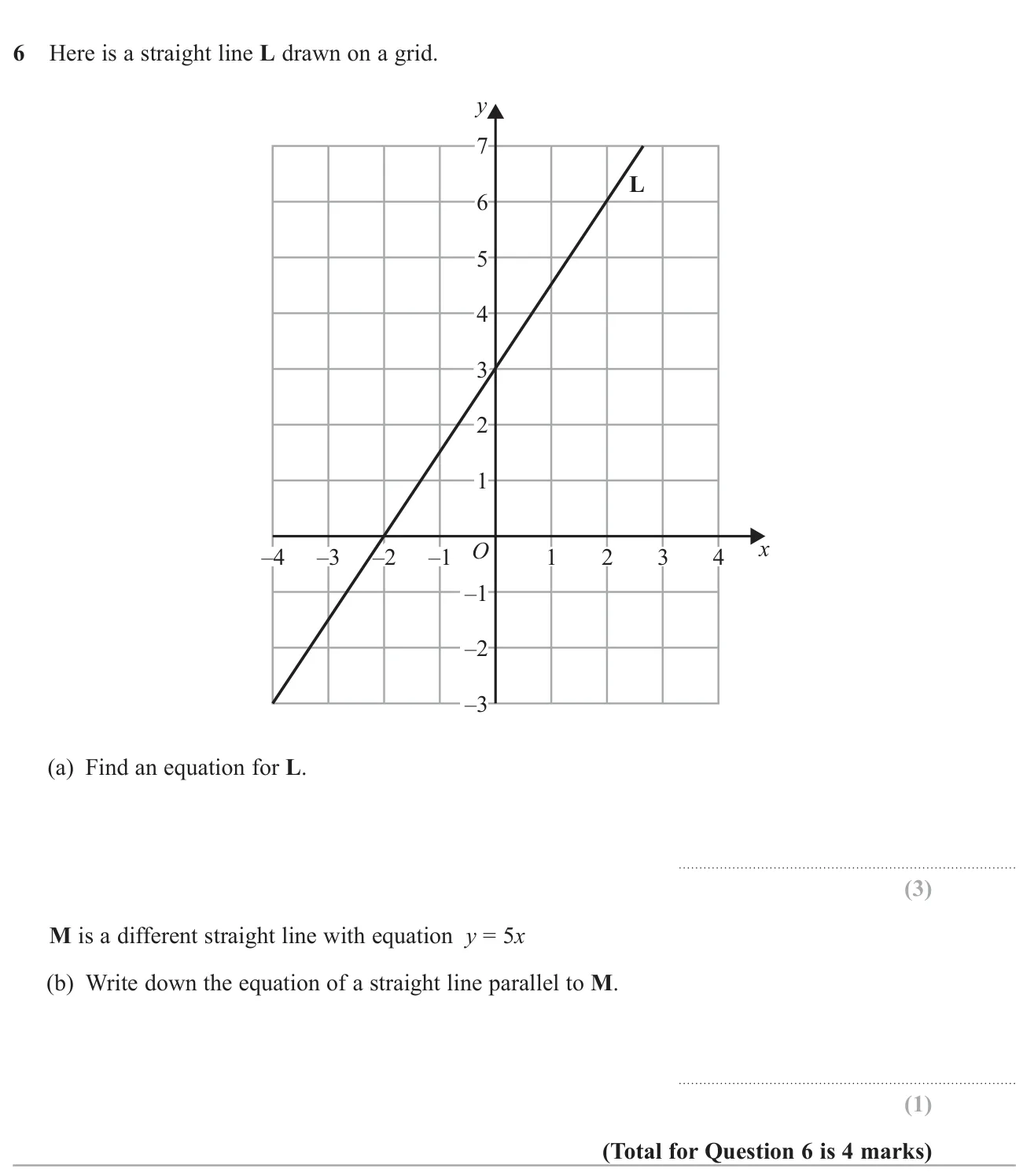
Find the equation of a straight line from a graph and write an equation of a line parallel to another.

© Pearson Education Ltd. June 2024 Paper 1 (Higher, non-calculator), question 6.

Show answer
(a)y=32x+3y = \frac{3}{2}x + 33 marks
(b)e.g. y=5x+1y = 5x + 11 mark

Worked solution Checked against the mark scheme

(a) The line crosses the yy-axis at 3.

From (0,3)(0, 3) to (2,6)(2, 6): gradient =6−32−0=32= \frac{6-3}{2-0} = \frac{3}{2}

y=32x+3y = \frac{3}{2}x + 3

(b) Parallel lines have the same gradient, e.g. y=5x+1y = 5x + 1.

Watch out: Working out the gradient as change in x over change in y (2/3).

Question 7

Ratio5 marksGrade 5No calculatorOn both tiers
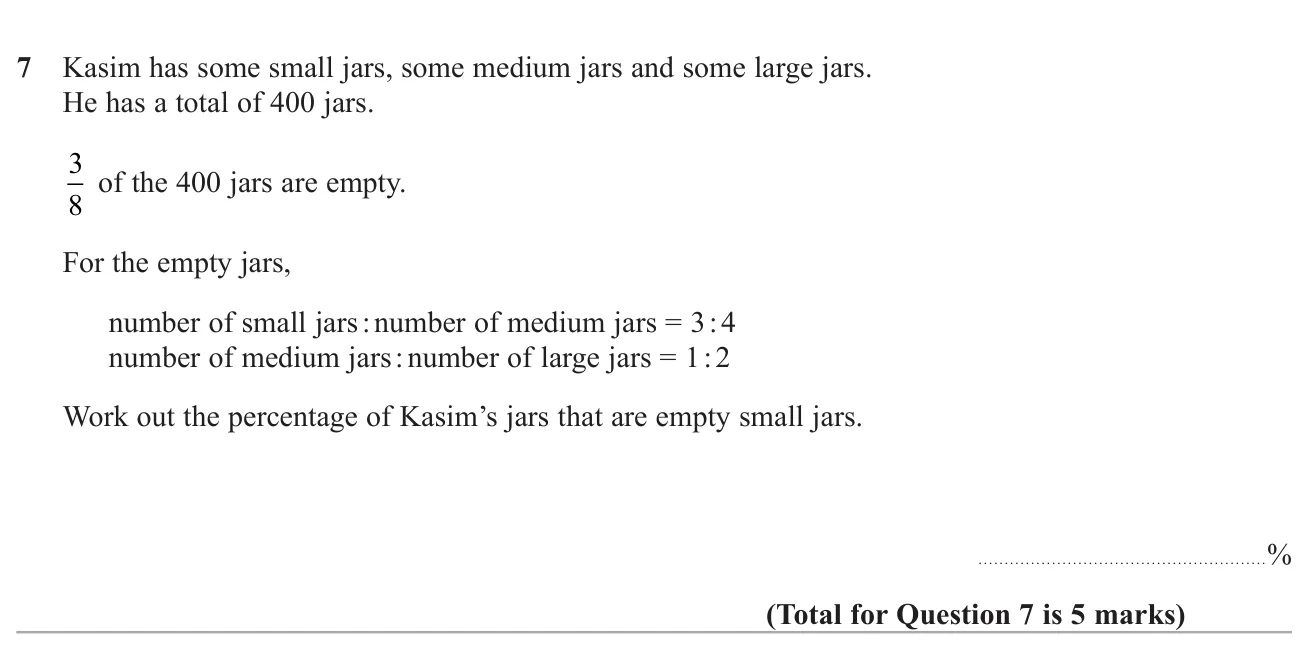
Use a fraction and two linked ratios to find what percentage of all jars are empty small jars.

© Pearson Education Ltd. June 2024 Paper 1 (Higher, non-calculator), question 7.

Show answer
Answer7.5%7.5\%5 marks

Worked solution Checked against the mark scheme

Empty jars: 38×400=150\frac{3}{8} \times 400 = 150

S : M =3:4= 3 : 4 and M : L =1:2=4:8= 1 : 2 = 4 : 8, so S : M : L =3:4:8= 3 : 4 : 8

Small empty: 315×150=30\frac{3}{15} \times 150 = 30

Percentage: 30400×100=7.5%\frac{30}{400} \times 100 = 7.5\%

Watch out: Giving the percentage of the empty jars (20%) instead of all 400 jars.

Question 8

Averages and spread3 marksGrade 4No calculator
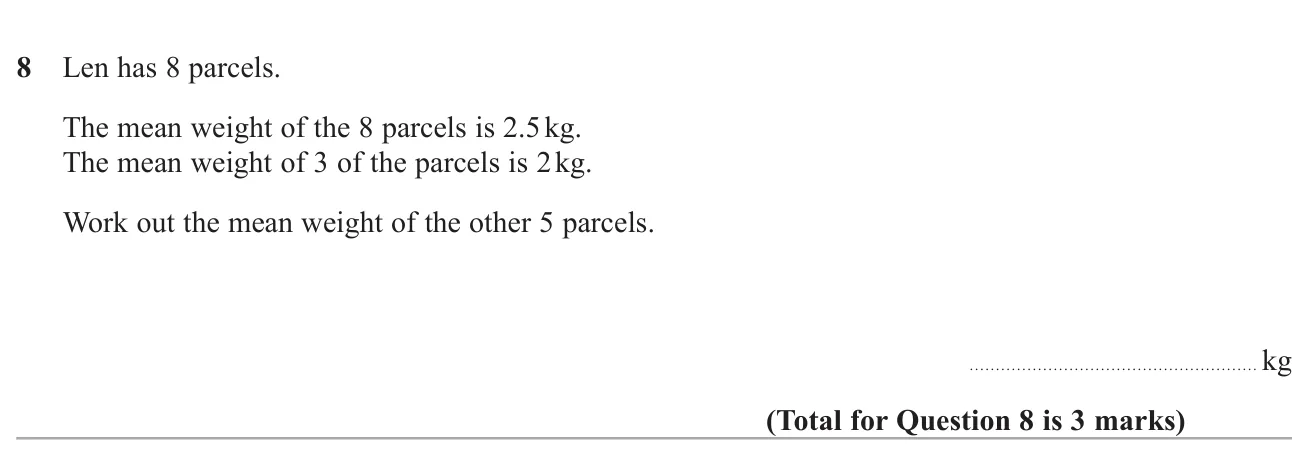
Use the overall mean and the mean of three items to find the mean of the other five.

© Pearson Education Ltd. June 2024 Paper 1 (Higher, non-calculator), question 8.

Show answer
Answer2.8 kg3 marks

Worked solution Checked against the mark scheme

Total weight of 8 parcels: 8×2.5=208 \times 2.5 = 20 kg

Total of the 3 parcels: 3×2=63 \times 2 = 6 kg

The other 5 weigh 20−6=1420 - 6 = 14 kg, so their mean is 14÷5=2.814 \div 5 = 2.8 kg

Watch out: Working with the means directly, e.g. (2.5×2−2)(2.5 \times 2 - 2), instead of the totals.

Question 9

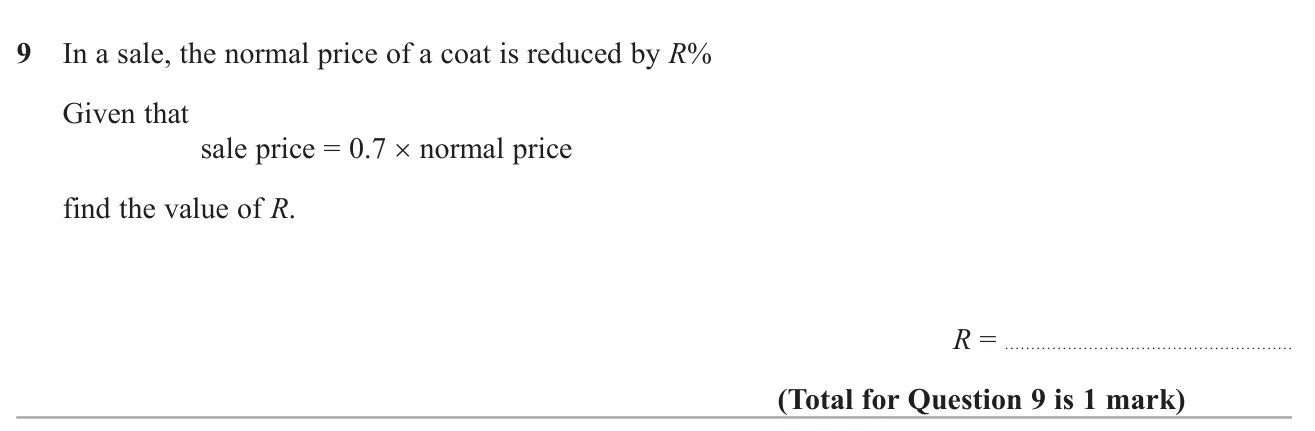
Find the percentage reduction when a sale price is 0.7 of the normal price.

© Pearson Education Ltd. June 2024 Paper 1 (Higher, non-calculator), question 9.

Show answer
AnswerR=30R = 301 mark

Worked solution Checked against the mark scheme

A multiplier of 0.7 means the sale price is 70% of the normal price.

The reduction is 100%−70%=30%100\% - 70\% = 30\%, so R=30R = 30

Watch out: Giving R=70R = 70, the percentage paid rather than the reduction.

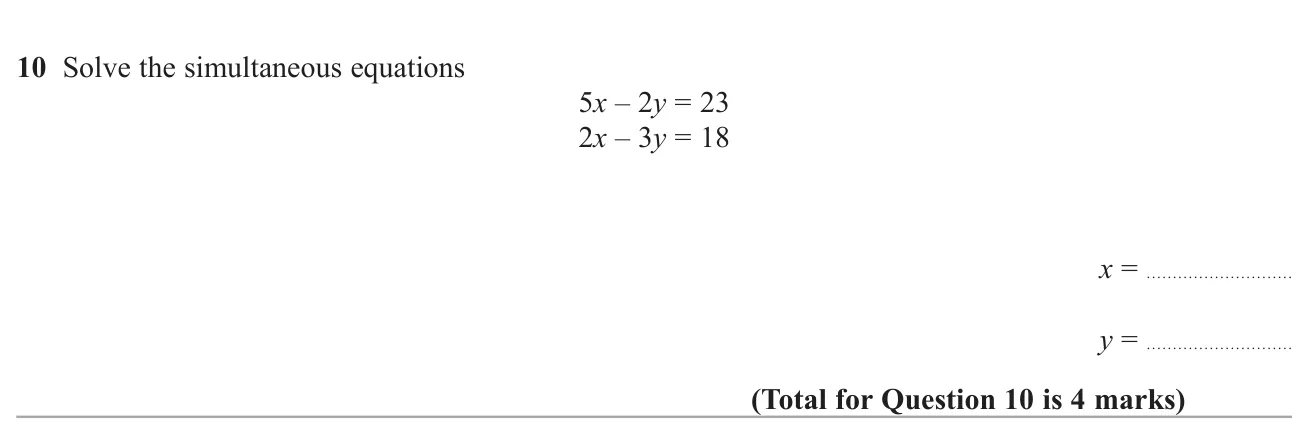
Question 10

Simultaneous equations4 marksGrade 5No calculator
Solve a pair of linear simultaneous equations.

© Pearson Education Ltd. June 2024 Paper 1 (Higher, non-calculator), question 10.

Show answer
Answerx=3, y=−4x = 3,\ y = -44 marks

Worked solution Checked against the mark scheme

Multiply the first equation by 3 and the second by 2:

15x−6y=6915x - 6y = 69 and 4x−6y=364x - 6y = 36

Subtract: 11x=3311x = 33, so x=3x = 3

Substitute: 5(3)−2y=23⇒−2y=8⇒y=−45(3) - 2y = 23 \Rightarrow -2y = 8 \Rightarrow y = -4

Watch out: Adding instead of subtracting when the yy terms have the same sign.

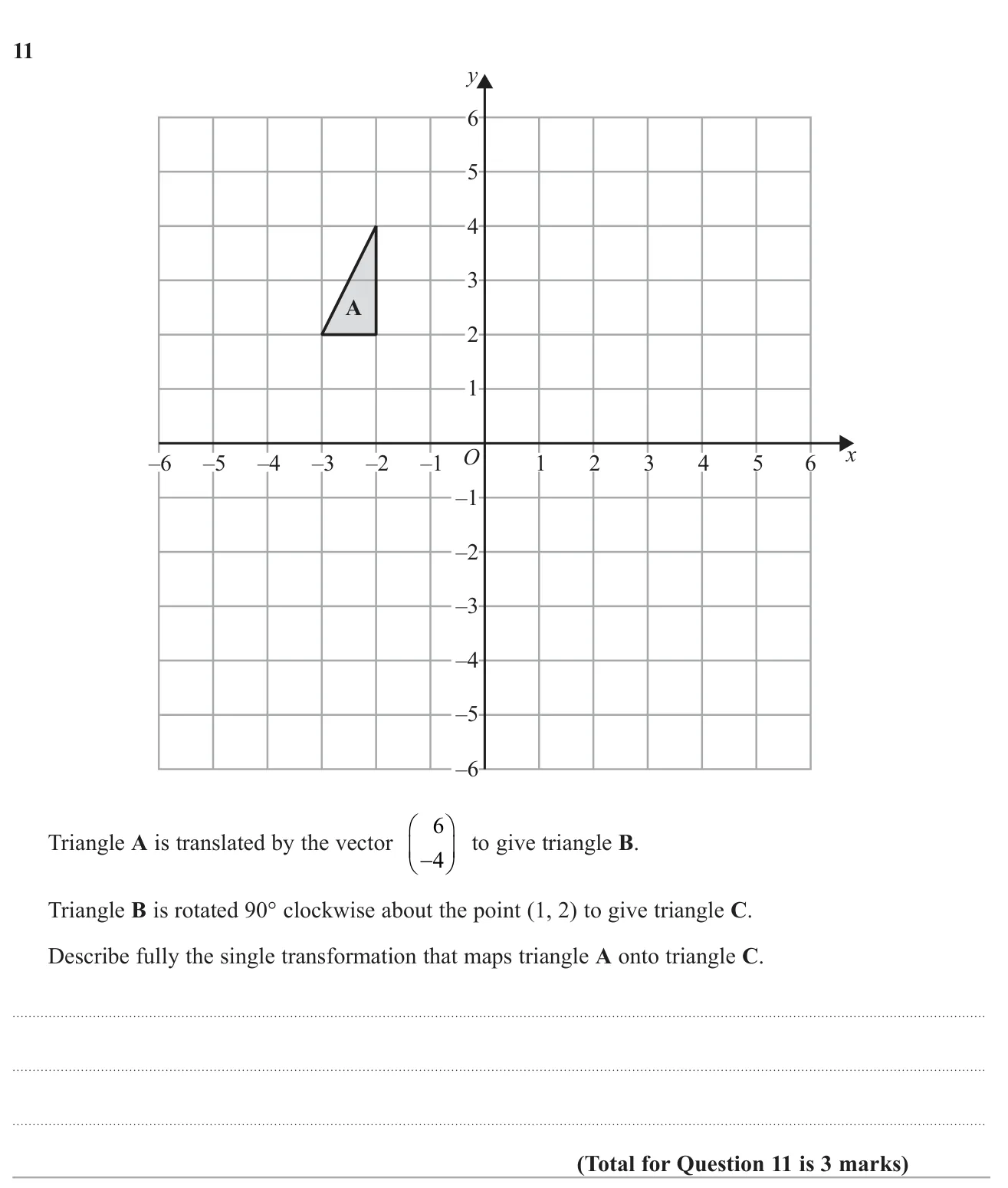
Question 11

Transformations3 marksGrade 7No calculator
Translate then rotate a triangle, and describe the single transformation that has the same effect.

© Pearson Education Ltd. June 2024 Paper 1 (Higher, non-calculator), question 11.

Show answer
AnswerRotation 90∘90^\circ clockwise about (−4,1)(-4, 1)3 marks

Worked solution Checked against the mark scheme

A has vertices (−3,2),(−2,2),(−2,4)(-3, 2), (-2, 2), (-2, 4).

Translate by (6−4)\binom{6}{-4}: B is (3,−2),(4,−2),(4,0)(3, -2), (4, -2), (4, 0).

Rotate B 90∘90^\circ clockwise about (1,2)(1, 2): C is (−3,0),(−3,−1),(−1,−1)(-3, 0), (-3, -1), (-1, -1).

Comparing A and C, C is A turned 90∘90^\circ clockwise; tracing paper or perpendicular bisectors give the centre (−4,1)(-4, 1).

Single transformation: **rotation 90∘90^\circ clockwise about (−4,1)(-4, 1)**

Watch out: Describing it as two transformations, or leaving out the centre of rotation.

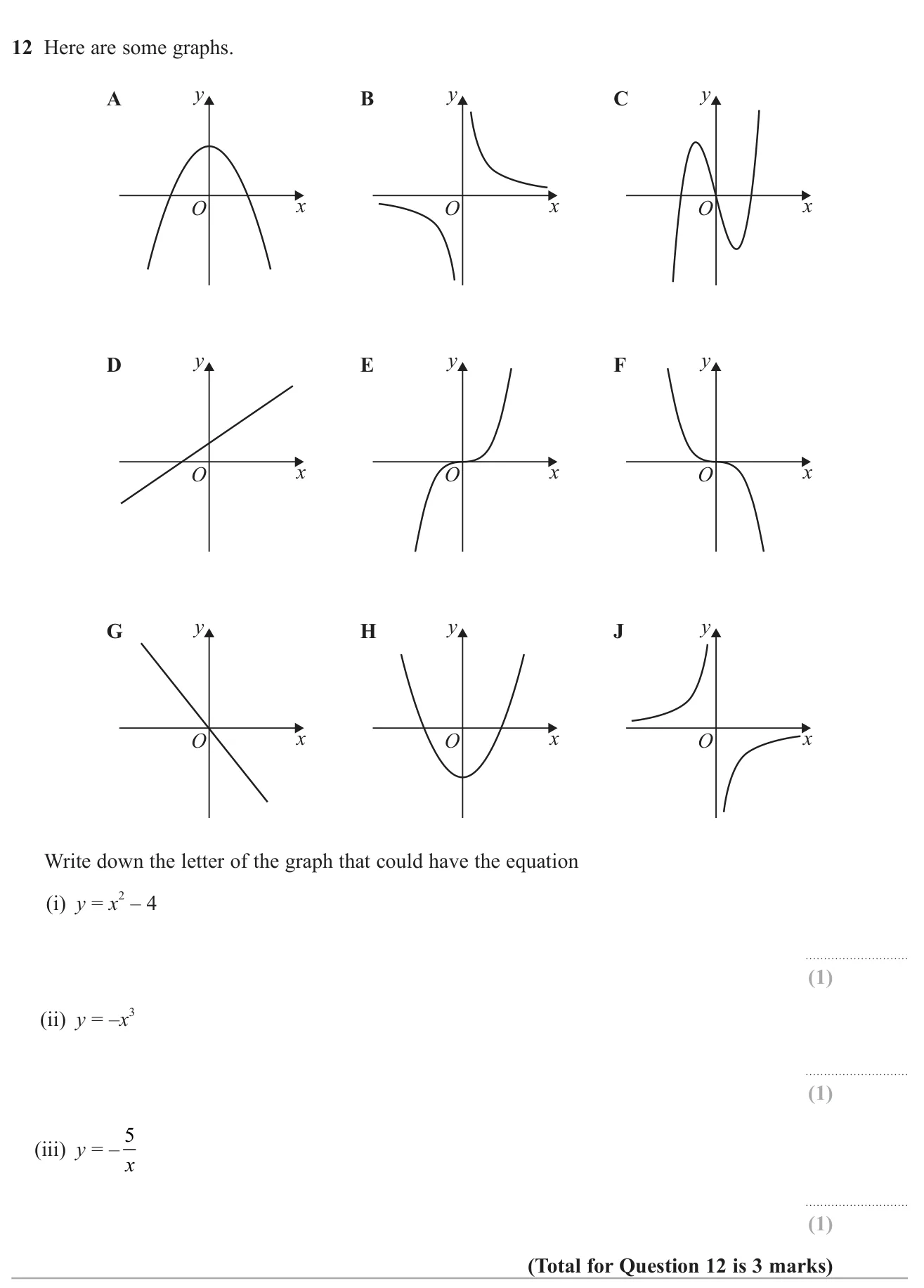
Question 12

Match three equations (a quadratic, a negative cubic and a negative reciprocal) to their sketch graphs.

© Pearson Education Ltd. June 2024 Paper 1 (Higher, non-calculator), question 12.

Show answer
((i))H1 mark
((ii))F1 mark
((iii))J1 mark

Worked solution Checked against the mark scheme

(i) y=x2−4y = x^2 - 4 is a U-shaped parabola crossing the yy-axis at −4-4: H

(ii) y=−x3y = -x^3 is a cubic that falls from top left to bottom right through the origin: F

(iii) y=−5xy = -\frac{5}{x} is a reciprocal graph in the second and fourth quadrants: J

Watch out: Choosing B for y=−5xy = -\frac{5}{x}, forgetting the negative sign flips it into the other quadrants.

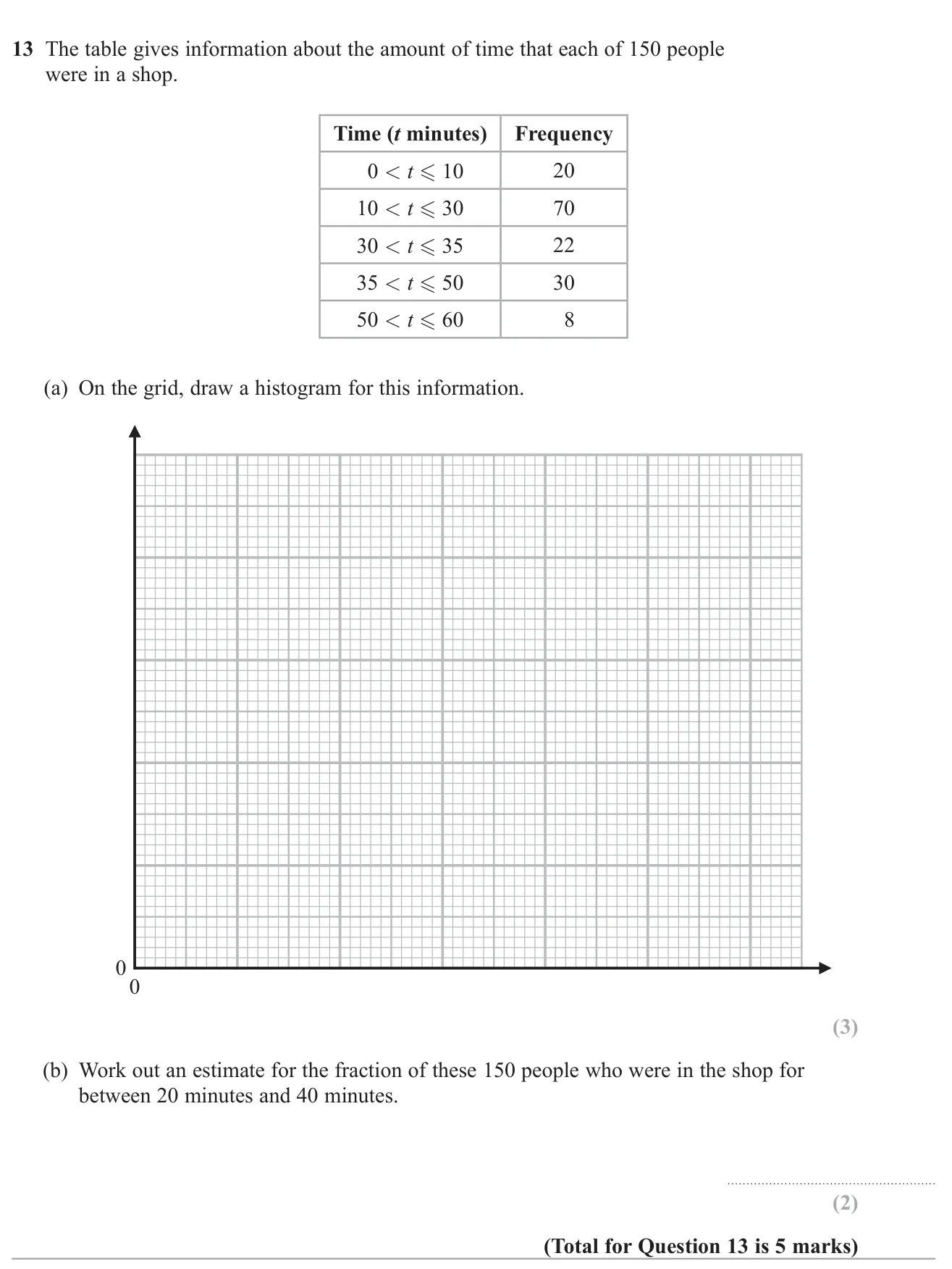
Question 13

Histograms5 marksGrade 7No calculator
Draw a histogram from a grouped frequency table and use it to estimate the fraction of people in a time interval.

© Pearson Education Ltd. June 2024 Paper 1 (Higher, non-calculator), question 13.

Show answer
(a)Histogram with frequency densities 2, 3.5, 4.4, 2, 0.83 marks
(b)67150\frac{67}{150}2 marks

Worked solution Checked against the mark scheme

(a) Frequency density = frequency ÷ class width:

20÷10=220 \div 10 = 2, 70÷20=3.570 \div 20 = 3.5, 22÷5=4.422 \div 5 = 4.4, 30÷15=230 \div 15 = 2, 8÷10=0.88 \div 10 = 0.8

Draw bars of these heights with no gaps; label the vertical axis 'frequency density'.

(b) 20 to 30: half of 70 = 35; 30 to 35: 22; 35 to 40: 515\frac{5}{15} of 30 = 10

Total =35+22+10=67= 35 + 22 + 10 = 67, so the fraction is 67150\frac{67}{150}

Watch out: Plotting frequency instead of frequency density on the vertical axis.

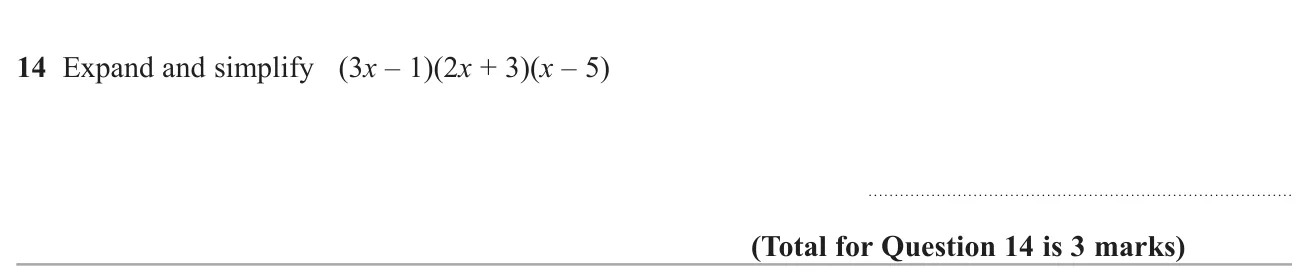
Question 14

Expanding brackets and simplifying3 marksGrade 6No calculator
Expand and simplify the product of three linear brackets.

© Pearson Education Ltd. June 2024 Paper 1 (Higher, non-calculator), question 14.

Show answer
Answer6x3−23x2−38x+156x^3 - 23x^2 - 38x + 153 marks

Worked solution Checked against the mark scheme

(3x−1)(2x+3)=6x2+9x−2x−3=6x2+7x−3(3x - 1)(2x + 3) = 6x^2 + 9x - 2x - 3 = 6x^2 + 7x - 3

(6x2+7x−3)(x−5)=6x3−30x2+7x2−35x−3x+15(6x^2 + 7x - 3)(x - 5) = 6x^3 - 30x^2 + 7x^2 - 35x - 3x + 15

=6x3−23x2−38x+15= 6x^3 - 23x^2 - 38x + 15

Watch out: Sign errors when multiplying by −5-5, especially −3×−5=+15-3 \times -5 = +15.

Question 15

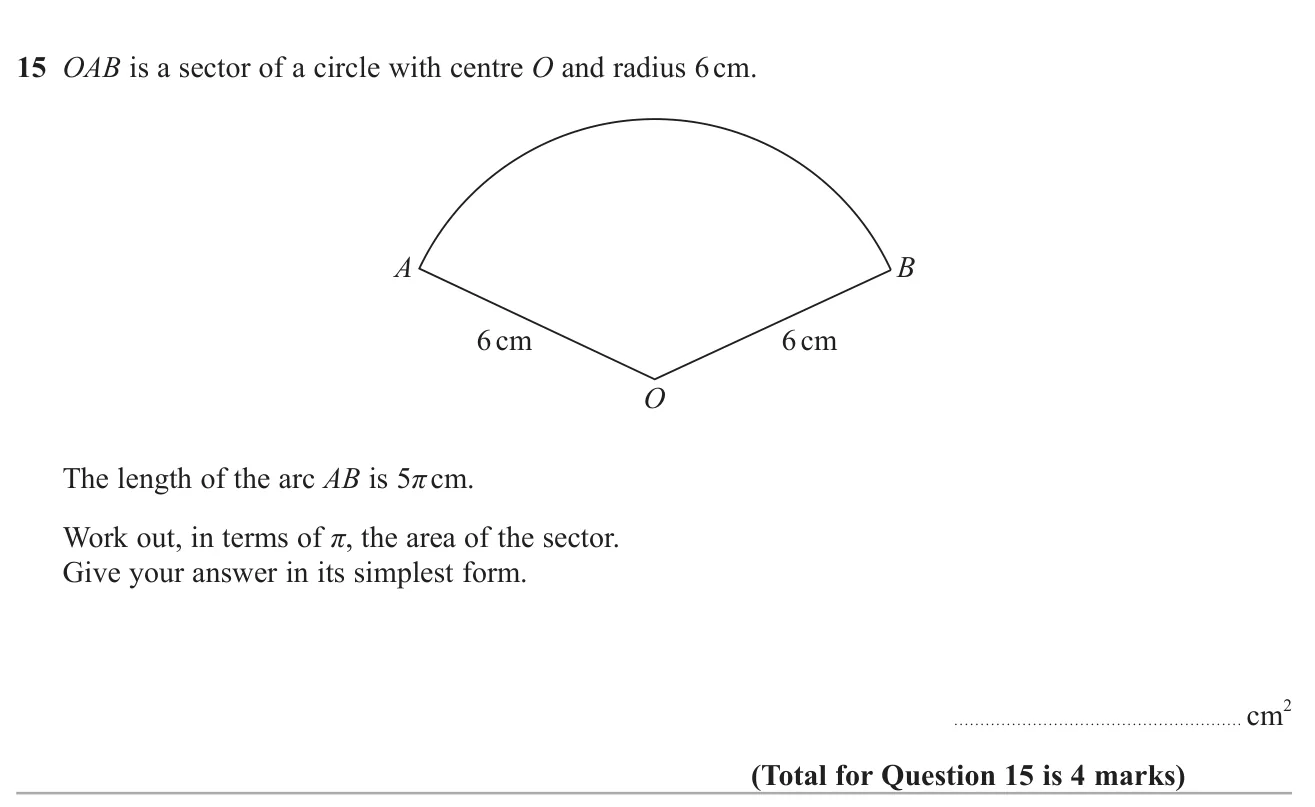
Arcs and sectors4 marksGrade 7No calculator
Given the radius and arc length of a sector, find its area in terms of pi.

© Pearson Education Ltd. June 2024 Paper 1 (Higher, non-calculator), question 15.

Show answer
Answer15π cm215\pi\text{ cm}^24 marks

Worked solution Checked against the mark scheme

Full circumference =2π×6=12π= 2\pi \times 6 = 12\pi

Fraction of the circle: 5π12π=512\frac{5\pi}{12\pi} = \frac{5}{12} (angle =150∘= 150^\circ)

Full area =π×62=36π= \pi \times 6^2 = 36\pi

Sector area =512×36π=15π cm2= \frac{5}{12} \times 36\pi = 15\pi\text{ cm}^2

Watch out: Using πr2\pi r^2 with the arc length instead of finding the fraction of the circle first.

Question 16

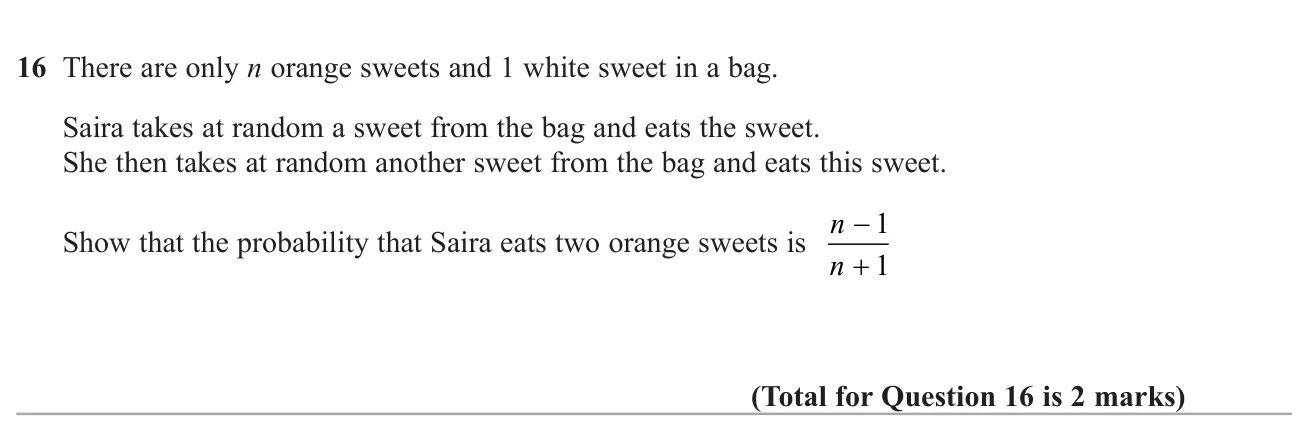
Probability scale and basic probability2 marksGrade 7No calculator
Prove an algebraic expression for the probability of picking two orange sweets without replacement.

© Pearson Education Ltd. June 2024 Paper 1 (Higher, non-calculator), question 16.

Show answer
AnswerShown: nn+1×n−1n=n−1n+1\frac{n}{n+1} \times \frac{n-1}{n} = \frac{n-1}{n+1}2 marks

Worked solution Checked against the mark scheme

There are n+1n + 1 sweets, nn of them orange.

P(first orange) =nn+1= \frac{n}{n+1}

After eating one, there are nn sweets left and n−1n - 1 are orange: P(second orange) =n−1n= \frac{n-1}{n}

P(both orange) =nn+1×n−1n=n−1n+1= \frac{n}{n+1} \times \frac{n-1}{n} = \frac{n-1}{n+1}

Watch out: Forgetting the sweet is eaten, so using nn+1\frac{n}{n+1} for both picks.

Question 17

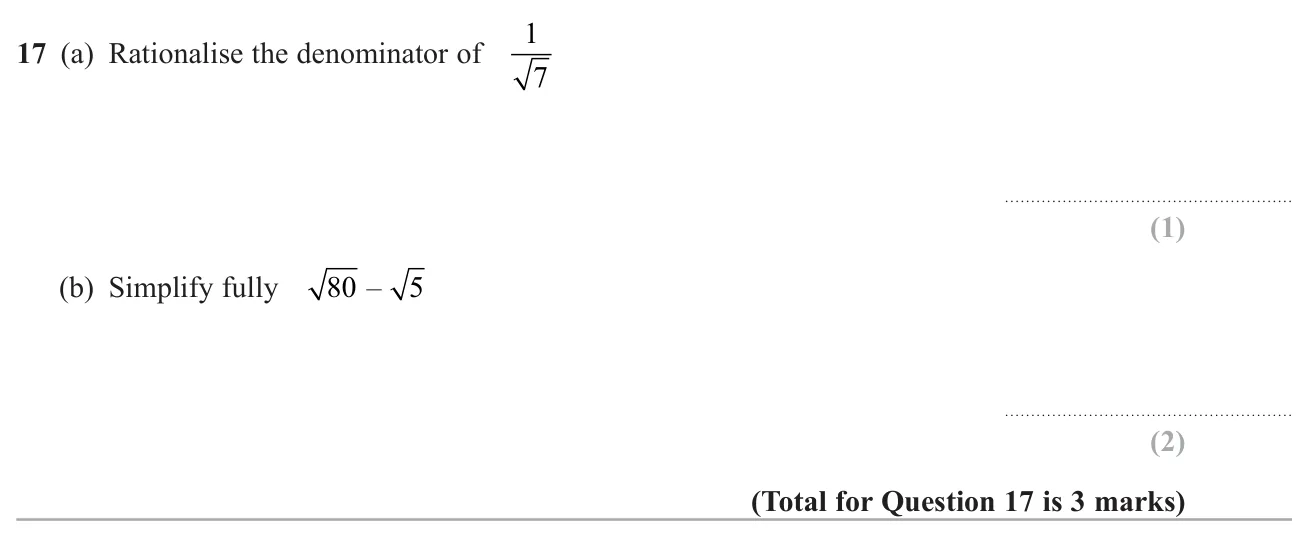
Surds3 marksGrade 7No calculator
Rationalise the denominator of 1 over root 7, and simplify a difference of surds.

© Pearson Education Ltd. June 2024 Paper 1 (Higher, non-calculator), question 17.

Show answer
(a)77\frac{\sqrt{7}}{7}1 mark
(b)353\sqrt{5}2 marks

Worked solution Checked against the mark scheme

(a) Multiply top and bottom by 7\sqrt{7}: 17×77=77\frac{1}{\sqrt{7}} \times \frac{\sqrt{7}}{\sqrt{7}} = \frac{\sqrt{7}}{7}

(b) 80=16×5=45\sqrt{80} = \sqrt{16 \times 5} = 4\sqrt{5}

45−5=354\sqrt{5} - \sqrt{5} = 3\sqrt{5}

Watch out: Writing 80−5=75\sqrt{80} - \sqrt{5} = \sqrt{75}.

Question 18

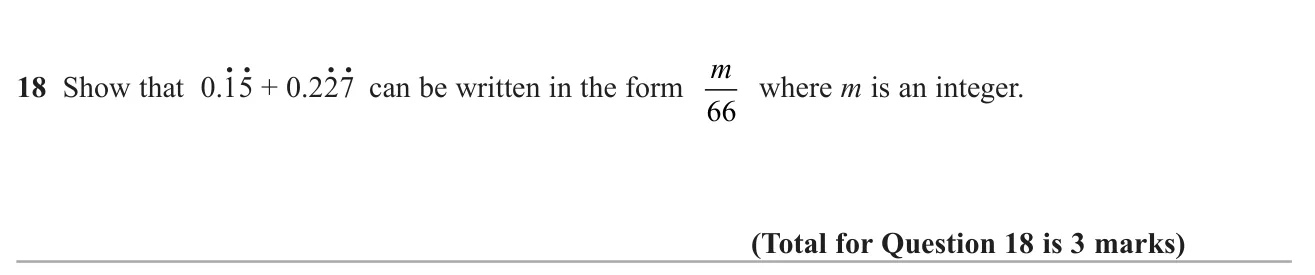
Convert two recurring decimals to fractions and show their sum has denominator 66.

© Pearson Education Ltd. June 2024 Paper 1 (Higher, non-calculator), question 18.

Show answer
AnswerShown: 0.1˙5˙+0.22˙7˙=25660.\dot{1}\dot{5} + 0.2\dot{2}\dot{7} = \frac{25}{66}3 marks

Worked solution Checked against the mark scheme

Let a=0.151515…a = 0.151515\ldots: 100a−a=15100a - a = 15, so a=1599=533a = \frac{15}{99} = \frac{5}{33}

Let b=0.2272727…b = 0.2272727\ldots: 1000b−10b=227.27…−2.27…=2251000b - 10b = 227.27\ldots - 2.27\ldots = 225, so b=225990=522b = \frac{225}{990} = \frac{5}{22}

533+522=1066+1566=2566\frac{5}{33} + \frac{5}{22} = \frac{10}{66} + \frac{15}{66} = \frac{25}{66}, so m=25m = 25

Watch out: Treating 0.22˙7˙0.2\dot{2}\dot{7} as 0.2˙7˙0.\dot{2}\dot{7} and using 100b−b100b - b.

Question 19

Similar shapes3 marksGrade 9No calculator
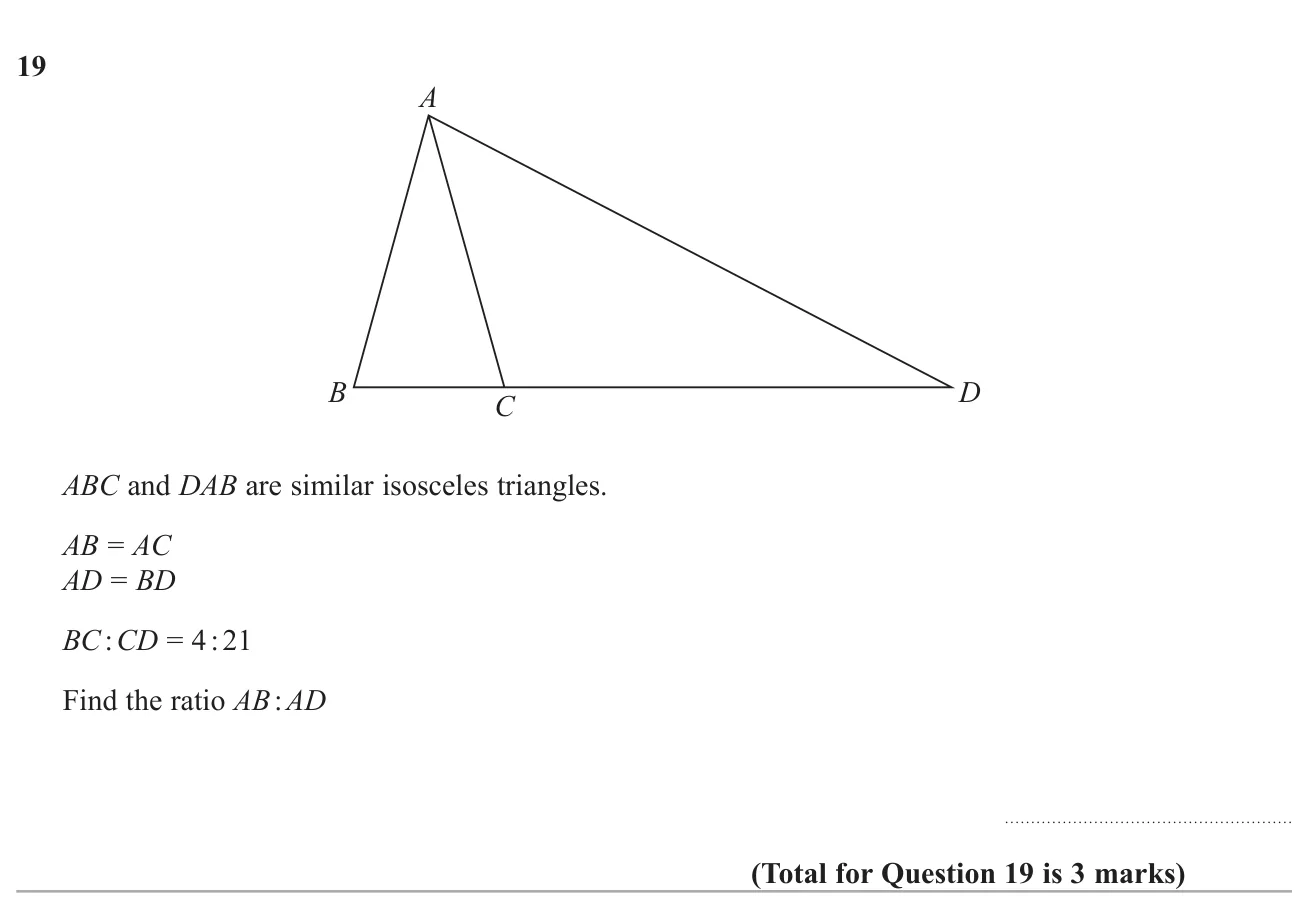
Use two similar isosceles triangles sharing a side to find the ratio of two side lengths.

© Pearson Education Ltd. June 2024 Paper 1 (Higher, non-calculator), question 19.

Show answer
Answer2:52 : 53 marks

Worked solution Checked against the mark scheme

Let BC=4BC = 4 and CD=21CD = 21, so BD=25BD = 25 and AD=BD=25AD = BD = 25.

Triangles ABC and DAB are similar, so ABBC=DBAB\frac{AB}{BC} = \frac{DB}{AB}

AB2=4×25=100AB^2 = 4 \times 25 = 100, so AB=10AB = 10

AB:AD=10:25=2:5AB : AD = 10 : 25 = 2 : 5

Watch out: Matching the wrong sides of the similar triangles, e.g. setting ABAD=421\frac{AB}{AD} = \frac{4}{21}.

Question 20

Powers, roots and indices3 marksGrade 8No calculator
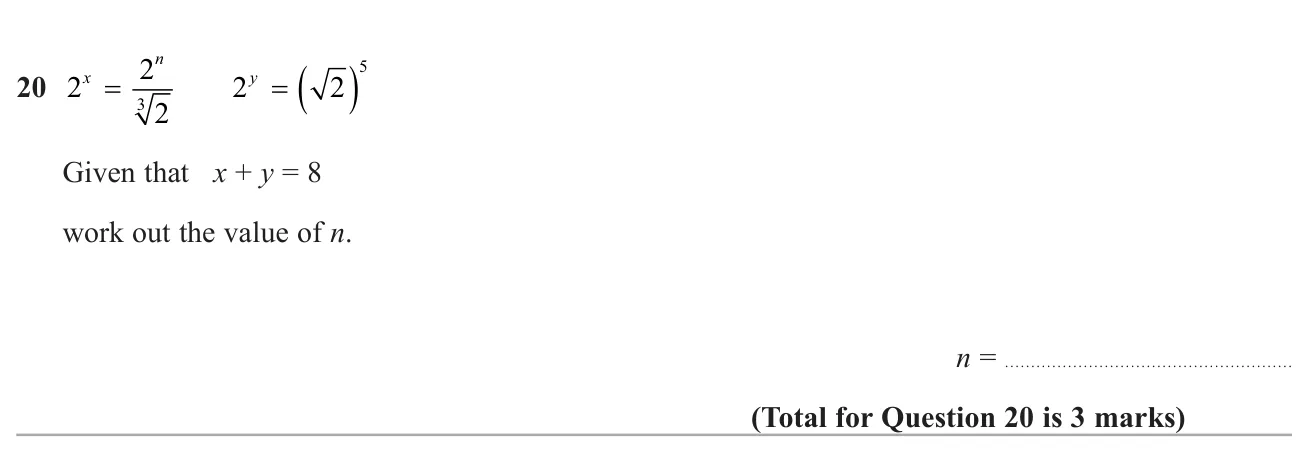
Use index laws with a cube root and a power of root 2 to find an unknown power.

© Pearson Education Ltd. June 2024 Paper 1 (Higher, non-calculator), question 20.

Show answer
Answern=356n = \frac{35}{6} (or 5565\frac{5}{6})3 marks

Worked solution Checked against the mark scheme

23=213\sqrt[3]{2} = 2^{\frac{1}{3}}, so 2x=2n−132^x = 2^{n - \frac{1}{3}} and x=n−13x = n - \frac{1}{3}

(2)5=(212)5=252(\sqrt{2})^5 = (2^{\frac{1}{2}})^5 = 2^{\frac{5}{2}}, so y=52y = \frac{5}{2}

n−13+52=8n - \frac{1}{3} + \frac{5}{2} = 8

n=8+13−52=356n = 8 + \frac{1}{3} - \frac{5}{2} = \frac{35}{6}

Watch out: Treating (2)5(\sqrt{2})^5 as 2152^{\frac{1}{5}} or 2102^{10}.

Question 21

Volume and surface area5 marksGrade 8No calculator
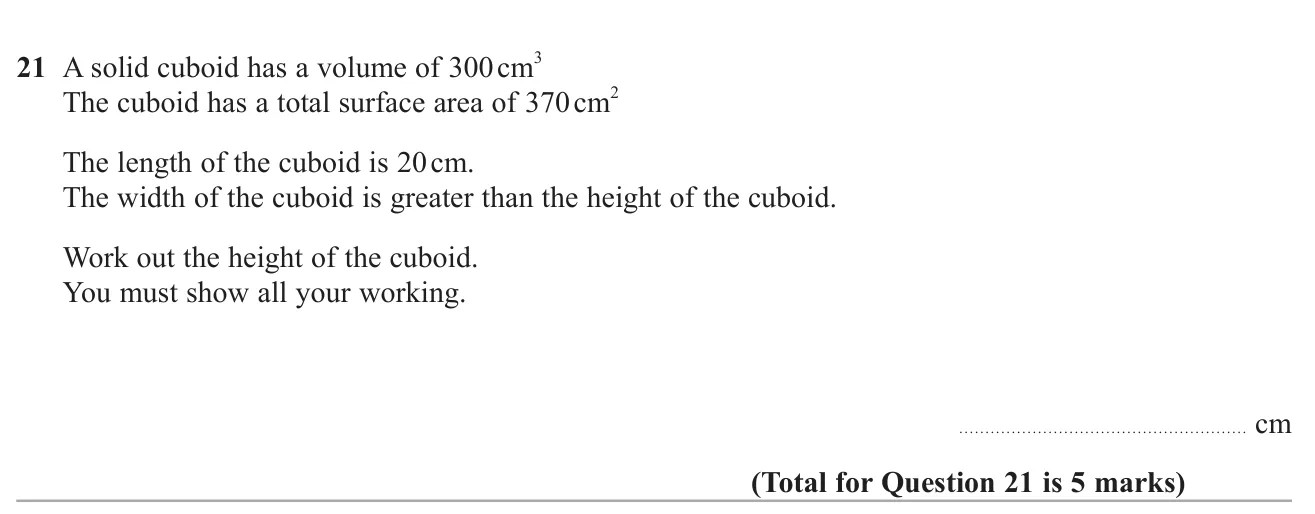
Use the volume and surface area of a cuboid to form and solve a quadratic for its height.

© Pearson Education Ltd. June 2024 Paper 1 (Higher, non-calculator), question 21.

Show answer
Answer2.5 cm2.5\text{ cm}5 marks

Worked solution Checked against the mark scheme

Volume: 20wh=30020wh = 300, so wh=15wh = 15

Surface area: 2(20w+20h+wh)=370⇒40w+40h+30=370⇒w+h=8.52(20w + 20h + wh) = 370 \Rightarrow 40w + 40h + 30 = 370 \Rightarrow w + h = 8.5

Substitute w=15hw = \frac{15}{h}: 15h+h=8.5⇒2h2−17h+30=0\frac{15}{h} + h = 8.5 \Rightarrow 2h^2 - 17h + 30 = 0

(2h−5)(h−6)=0(2h - 5)(h - 6) = 0, so h=2.5h = 2.5 or 66

The width is greater than the height, so h=2.5h = 2.5 cm (and w=6w = 6 cm)

Watch out: Choosing h=6h = 6 and ignoring the condition that the width is greater than the height.

Question 22

Pythagoras and trigonometry4 marksGrade 7No calculator
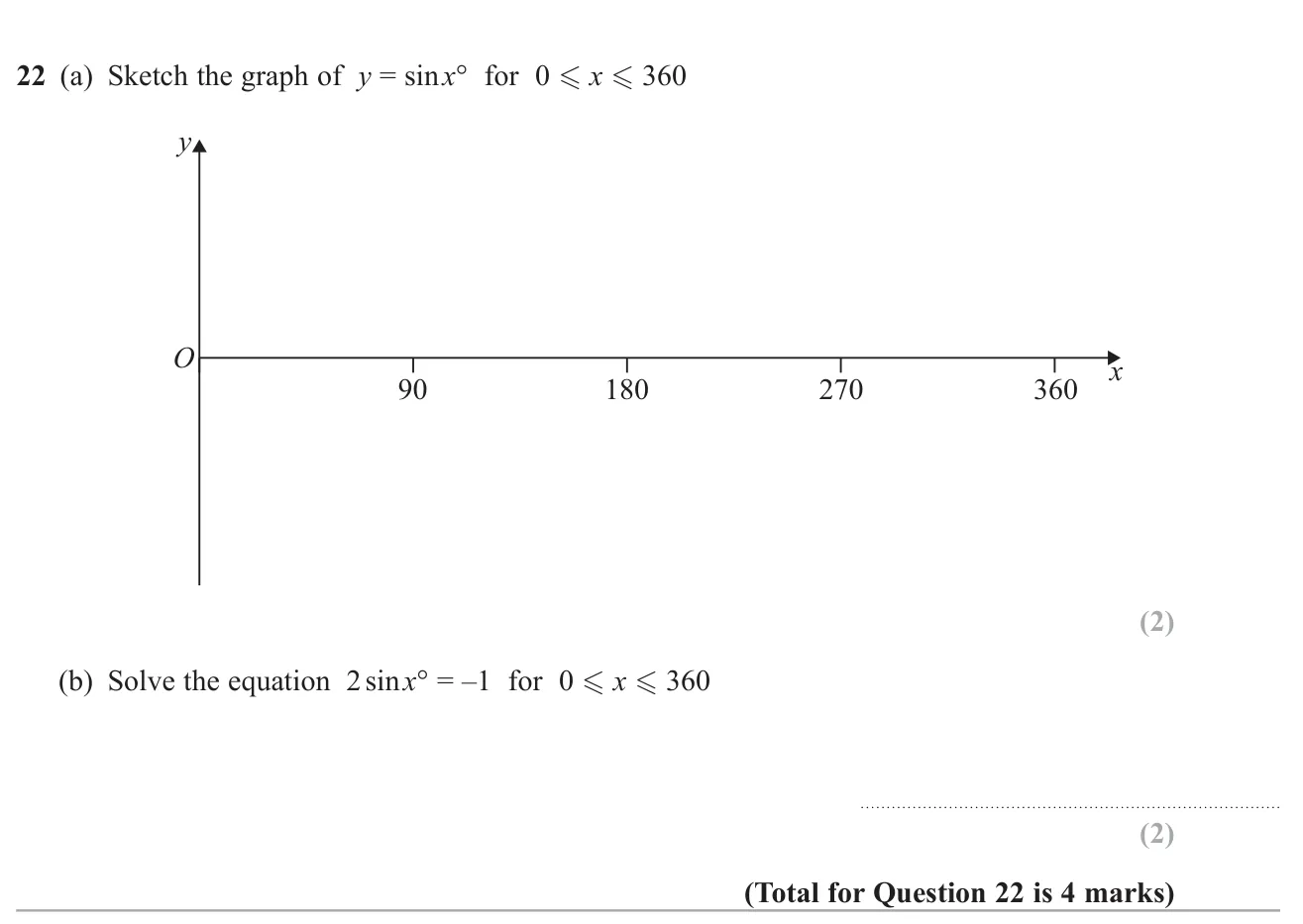
Sketch y = sin x for one full turn and solve a simple trigonometric equation.

© Pearson Education Ltd. June 2024 Paper 1 (Higher, non-calculator), question 22.

Show answer
(a)Sketch of y=sin⁡xy = \sin x from 0 to 360, through (0,0),(90,1),(180,0),(270,−1),(360,0)(0,0), (90,1), (180,0), (270,-1), (360,0)2 marks
(b)x=210, 330x = 210,\ 3302 marks

Worked solution Checked against the mark scheme

(a) Start at 0, rise to a maximum of 1 at 90∘90^\circ, back to 0 at 180∘180^\circ, down to −1-1 at 270∘270^\circ and back to 0 at 360∘360^\circ.

(b) sin⁡x=−12\sin x = -\frac{1}{2}. Since sin⁡30∘=12\sin 30^\circ = \frac{1}{2}, the negative values are below the axis:

x=180+30=210x = 180 + 30 = 210 and x=360−30=330x = 360 - 30 = 330

Watch out: Giving x=−30x = -30 or only one solution.

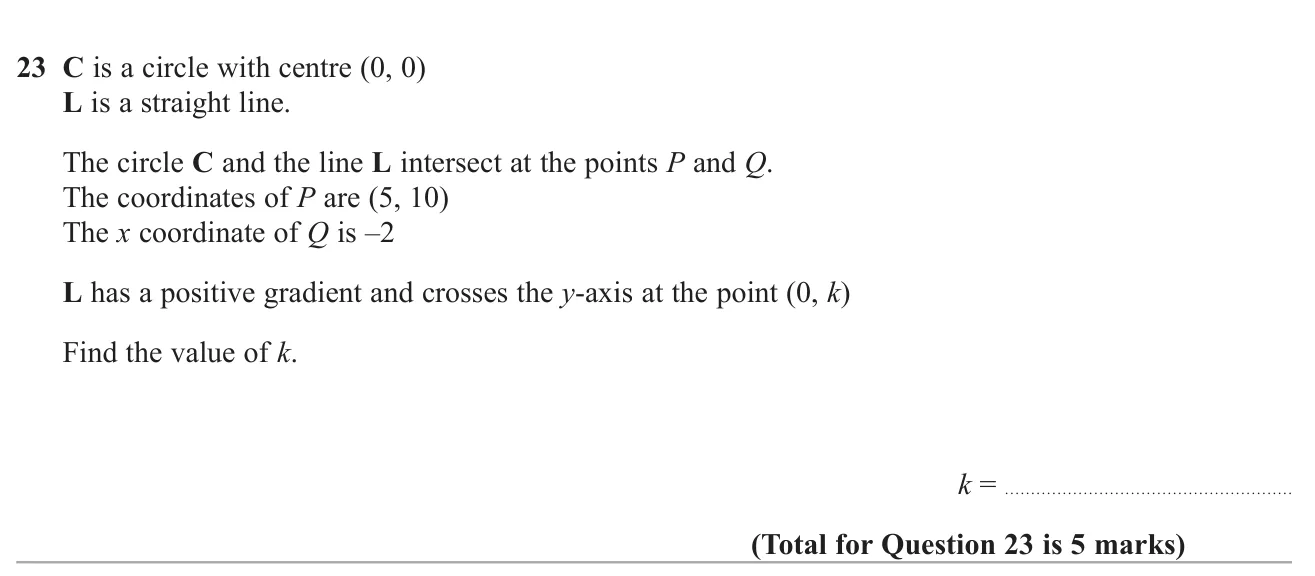
Question 23

Equation of a circle5 marksGrade 9No calculator
Use a circle through a given point and a line through two points on it to find the line's y-intercept.

© Pearson Education Ltd. June 2024 Paper 1 (Higher, non-calculator), question 23.

Show answer
Answerk=−5k = -55 marks

Worked solution Checked against the mark scheme

Radius2=52+102=125^2 = 5^2 + 10^2 = 125, so C is x2+y2=125x^2 + y^2 = 125

At Q, (−2)2+y2=125⇒y2=121⇒y=±11(-2)^2 + y^2 = 125 \Rightarrow y^2 = 121 \Rightarrow y = \pm 11

The gradient of L is positive, so Q is (−2,−11)(-2, -11) (using (−2,11)(-2, 11) gives a negative gradient).

Gradient =10−(−11)5−(−2)=217=3= \frac{10 - (-11)}{5 - (-2)} = \frac{21}{7} = 3

10=3(5)+k⇒k=−510 = 3(5) + k \Rightarrow k = -5

Watch out: Taking y=11y = 11 for Q without checking the gradient is positive.

Finished the paper?

Add up your marks for all three papers and see what grade that would have been.