Edexcel GCSE Maths · 1MA1

June 2024 Paper 2 Higher

Calculator · 22 questions · 80 marks · 1 hour 30 minutes. Try each question on paper, then press "Show answer".

Question 1

Pythagoras and trigonometry2 marksGrade 4CalculatorOn both tiers
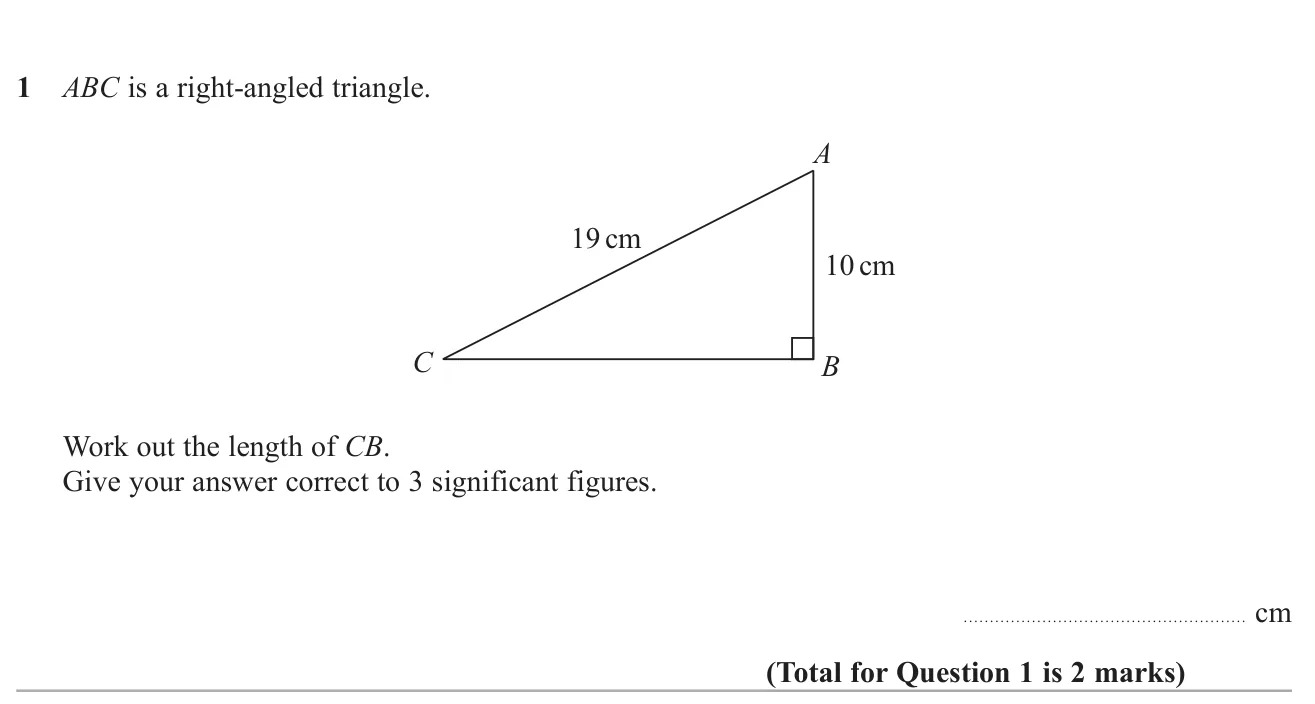
Use Pythagoras' theorem to find a shorter side of a right-angled triangle.

© Pearson Education Ltd. June 2024 Paper 2 (Higher, calculator), question 1.

Show answer
Answer16.216.2 cm (accept 16.1 to 16.2)2 marks

Worked solution Checked against the mark scheme

19 cm is the hypotenuse.

CB2=192−102=361−100=261CB^2 = 19^2 - 10^2 = 361 - 100 = 261

CB=261=16.155…≈16.2CB = \sqrt{261} = 16.155\ldots \approx 16.2 cm

Watch out: Adding the squares (461=21.5\sqrt{461} = 21.5) instead of subtracting.
Question 2

Factors, multiples and primes3 marksGrade 4CalculatorOn both tiers
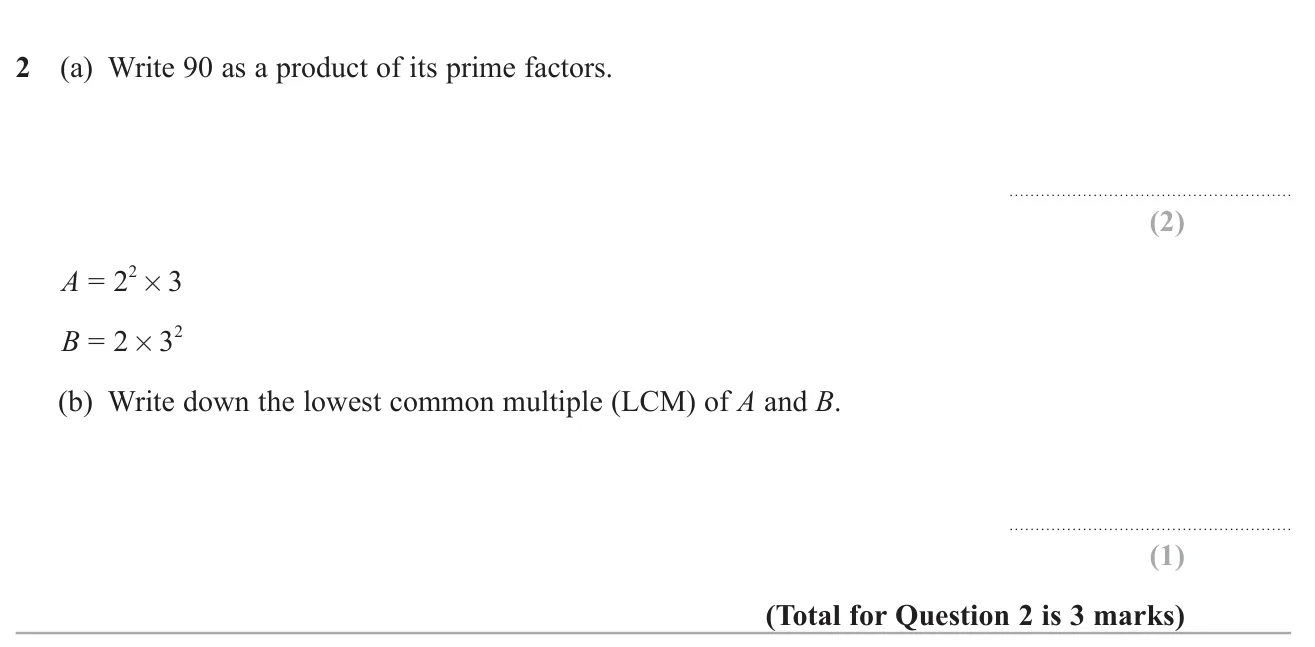
Write a number as a product of primes, and find the LCM of two numbers given in index form.

© Pearson Education Ltd. June 2024 Paper 2 (Higher, calculator), question 2.

Show answer
(a)2×32×52 \times 3^2 \times 52 marks
(b)36361 mark

Worked solution Checked against the mark scheme

(a) 90=2×45=2×3×15=2×3×3×5=2×32×590 = 2 \times 45 = 2 \times 3 \times 15 = 2 \times 3 \times 3 \times 5 = 2 \times 3^2 \times 5

(b) A=22×3=12A = 2^2 \times 3 = 12, B=2×32=18B = 2 \times 3^2 = 18.

LCM uses the highest power of each prime: 22×32=362^2 \times 3^2 = 36

Watch out: Listing the primes 2, 3, 5 without repeats, or giving the HCF (6) in part (b).

Question 3

Direct and inverse proportion2 marksGrade 4CalculatorOn both tiers
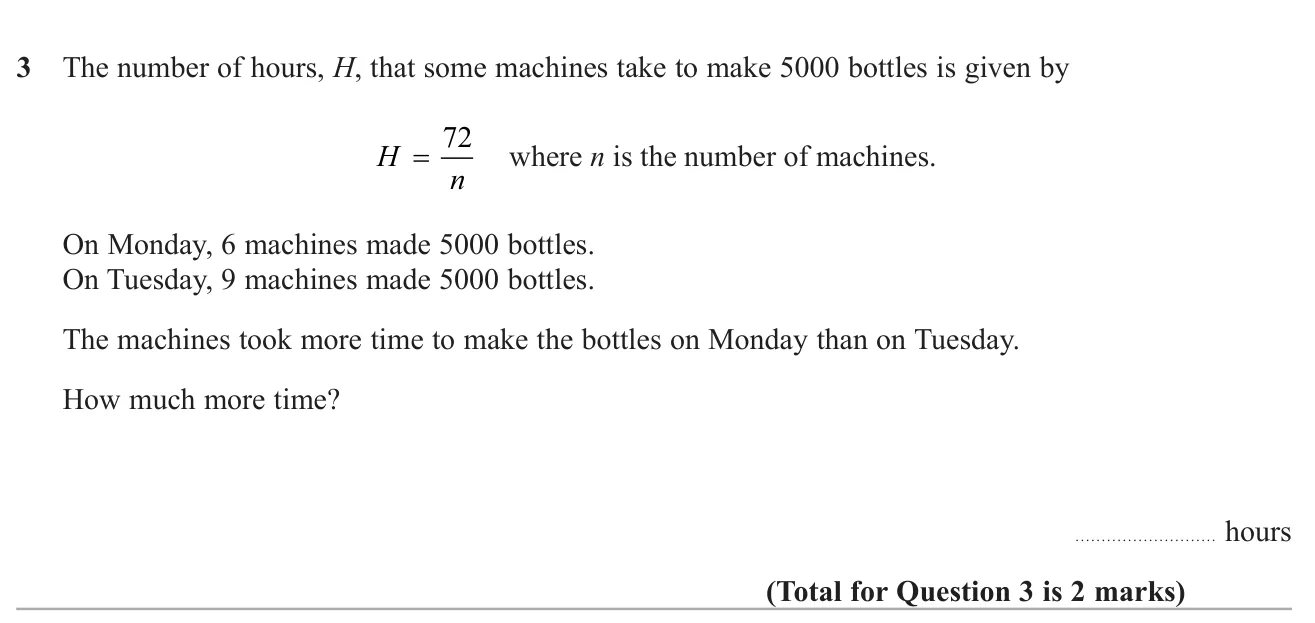
Use a formula for time taken by a number of machines to find the difference in hours between two days.

© Pearson Education Ltd. June 2024 Paper 2 (Higher, calculator), question 3.

Show answer
Answer44 hours2 marks

Worked solution Checked against the mark scheme

The formula is H=72nH = \dfrac{72}{n}.

Monday: 72÷6=1272 \div 6 = 12 hours

Tuesday: 72÷9=872 \div 9 = 8 hours

Difference =12−8=4= 12 - 8 = 4 hours

Watch out: Working out 72÷(9−6)=2472 \div (9 - 6) = 24.

Question 4

Probability scale and basic probability4 marksGrade 5CalculatorOn both tiers
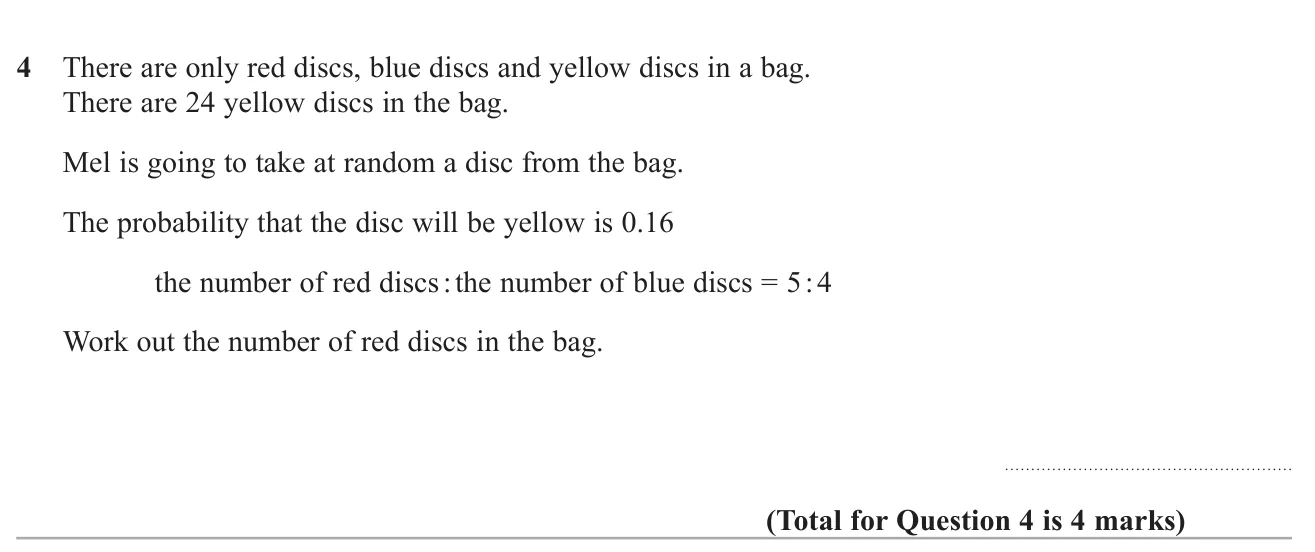
Use a probability to find the total number of discs, then share the rest in a ratio to find the red ones.

© Pearson Education Ltd. June 2024 Paper 2 (Higher, calculator), question 4.

Show answer
Answer70704 marks

Worked solution Checked against the mark scheme

Total discs =24÷0.16=150= 24 \div 0.16 = 150

Red and blue =150−24=126= 150 - 24 = 126

One part =126÷(5+4)=14= 126 \div (5 + 4) = 14

Red =5×14=70= 5 \times 14 = 70

Watch out: Sharing 150 (instead of 126) in the ratio 5 : 4.

Question 5

Quadratic graphs6 marksGrade 4CalculatorOn both tiers
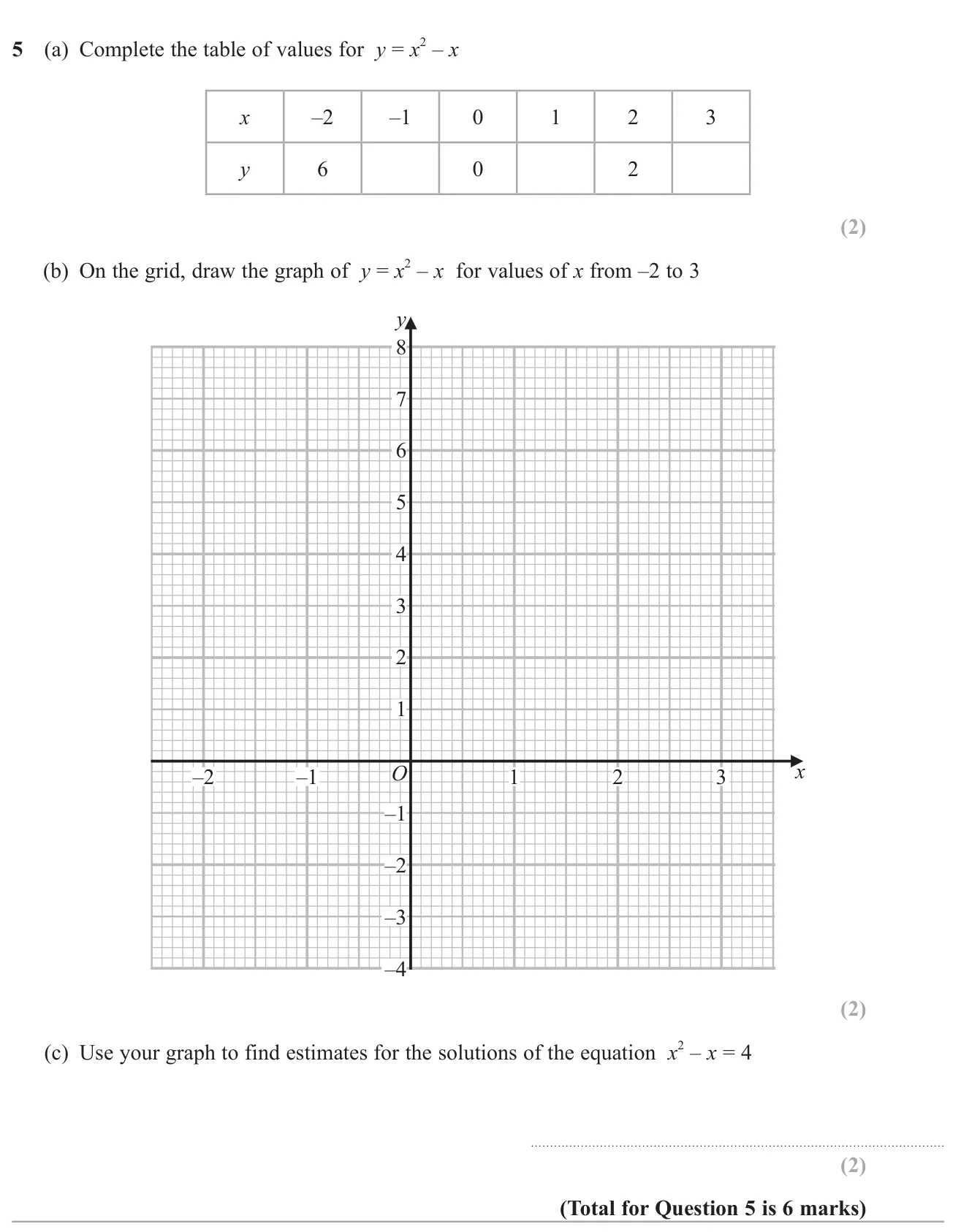
Complete a table for a quadratic, draw its graph and use it to estimate solutions of an equation.

© Pearson Education Ltd. June 2024 Paper 2 (Higher, calculator), question 5.

Show answer
(a)yy values: 6, 2, 0, 0, 2, 66,\ 2,\ 0,\ 0,\ 2,\ 6 (missing: 22 at x=−1x=-1, 00 at x=1x=1, 66 at x=3x=3)2 marks
(b)Smooth U-shaped curve through the points2 marks
(c)x≈−1.6x \approx -1.6 and x≈2.6x \approx 2.6 (accept −1.7-1.7 to −1.5-1.5 and 2.52.5 to 2.72.7)2 marks

Worked solution Checked against the mark scheme

(a) x=−1x = -1: 1+1=21 + 1 = 2. x=1x = 1: 1−1=01 - 1 = 0. x=3x = 3: 9−3=69 - 3 = 6.

(b) Plot (−2,6),(−1,2),(0,0),(1,0),(2,2),(3,6)(-2,6), (-1,2), (0,0), (1,0), (2,2), (3,6) and join with a smooth curve.

(c) Draw y=4y = 4 and read where it crosses the curve: x≈−1.6x \approx -1.6 and x≈2.6x \approx 2.6.

Watch out: Working out (−1)2−(−1)(-1)^2 - (-1) as 0 instead of 2.

Question 6

Sharing in a ratio4 marksGrade 5CalculatorOn both tiers
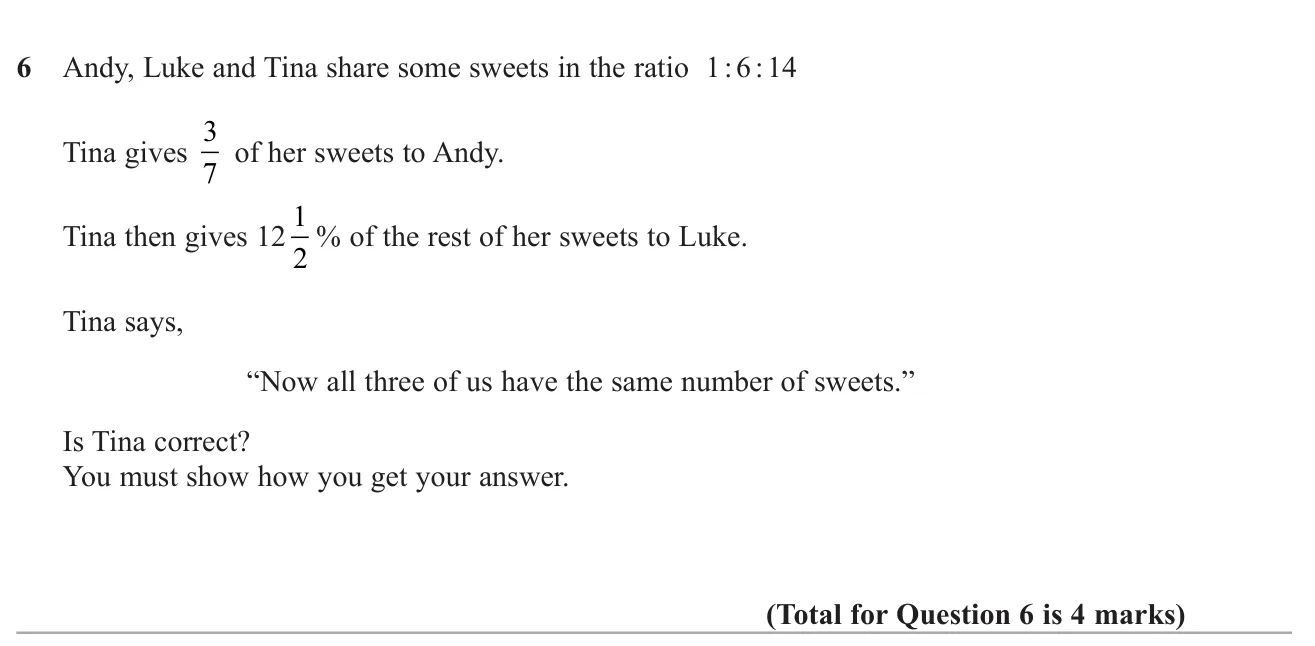
Share sweets in a ratio, apply a fraction and a percentage transfer, and check if everyone ends up equal.

© Pearson Education Ltd. June 2024 Paper 2 (Higher, calculator), question 6.

Show answer
AnswerYes: each person ends with the same amount (e.g. 7 : 7 : 7 per 21 parts, or 147 each out of 441)4 marks

Worked solution Checked against the mark scheme

Take the shares as 1:6:141 : 6 : 14 parts (21 parts).

Tina gives Andy 37×14=6\frac{3}{7} \times 14 = 6. Now Andy =7= 7, Tina =8= 8.

Tina gives Luke 12.5%12.5\% of 8=18 = 1. Now Luke =7= 7, Tina =7= 7.

Final: Andy 7, Luke 7, Tina 7 parts, so Tina is correct.

Watch out: Taking 12.5% of Tina's original share instead of what remains.

Question 7

Angle facts and parallel lines4 marksGrade 5CalculatorOn both tiers
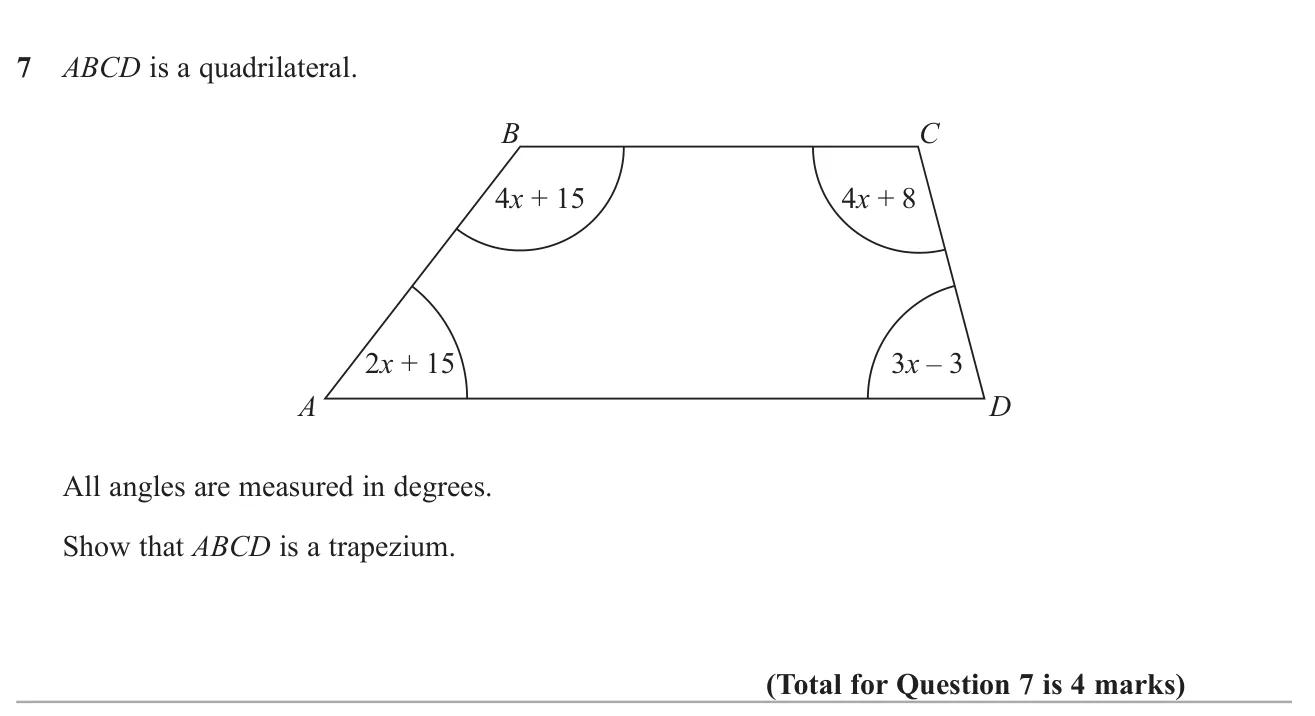
Use the angle sum of a quadrilateral with algebraic angles to show one pair of sides is parallel.

© Pearson Education Ltd. June 2024 Paper 2 (Higher, calculator), question 7.

Show answer
Answerx=25x = 25, giving A+B=65∘+115∘=180∘A + B = 65^\circ + 115^\circ = 180^\circ so ADAD is parallel to BCBC (co-interior angles)4 marks

Worked solution Checked against the mark scheme

Angles in a quadrilateral add to 360∘360^\circ:

(2x+15)+(4x+15)+(4x+8)+(3x−3)=360(2x+15) + (4x+15) + (4x+8) + (3x-3) = 360

13x+35=360⇒x=2513x + 35 = 360 \Rightarrow x = 25

A=65∘A = 65^\circ, B=115∘B = 115^\circ, so A+B=180∘A + B = 180^\circ.

Co-interior angles add to 180∘180^\circ, so ADAD is parallel to BCBC and ABCDABCD is a trapezium.

Watch out: Finding xx but not showing a pair of angles adds to 180° with a reason.

Question 8

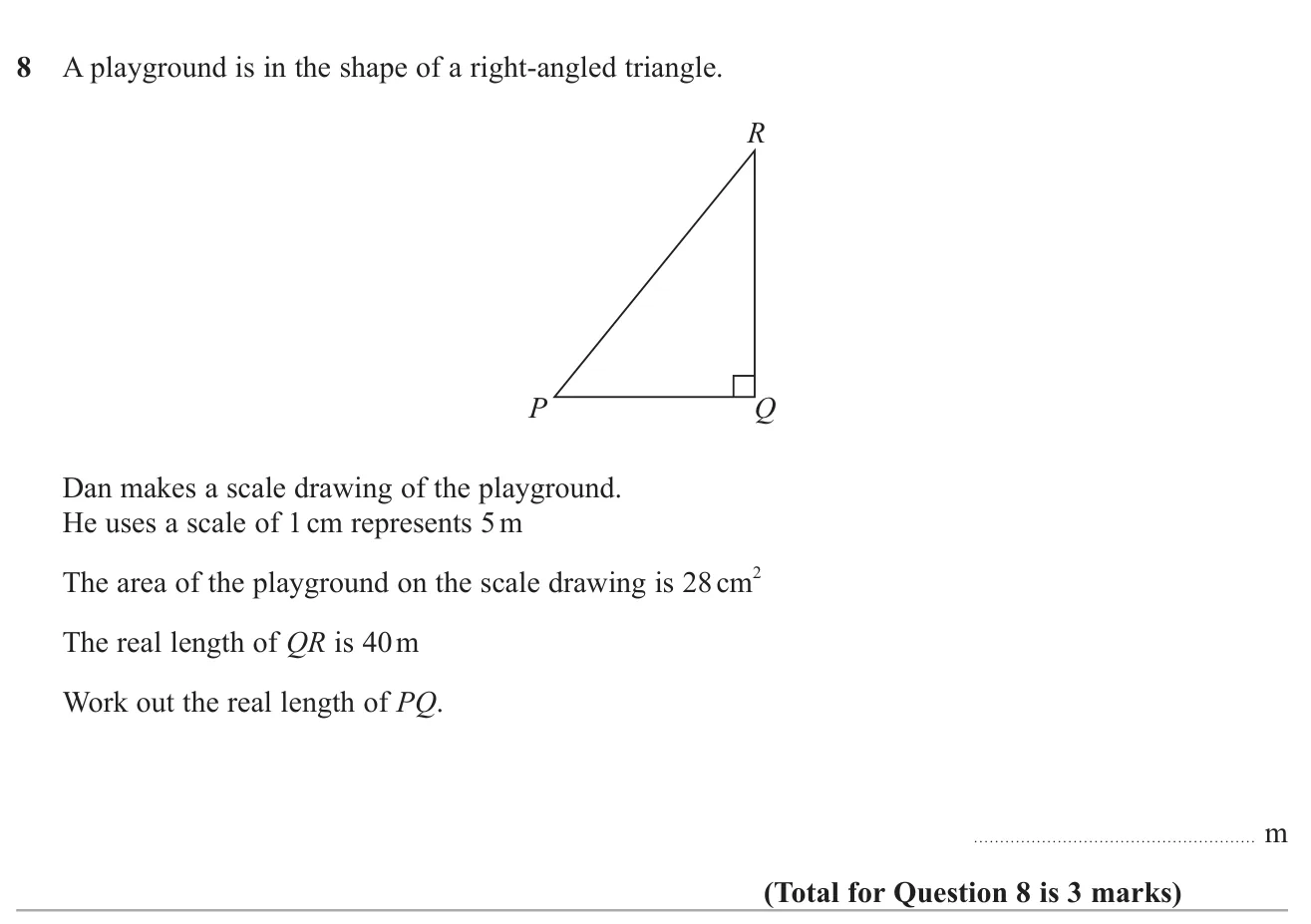
Use a scale drawing's area and one real side of a right-angled triangle to find another real side.

© Pearson Education Ltd. June 2024 Paper 2 (Higher, calculator), question 8.

Show answer
Answer3535 m3 marks

Worked solution Checked against the mark scheme

On the drawing, QR=40÷5=8QR = 40 \div 5 = 8 cm.

Area =12×PQ×8=28= \frac12 \times PQ \times 8 = 28, so PQ=7PQ = 7 cm on the drawing.

Real length =7×5=35= 7 \times 5 = 35 m.

Watch out: Scaling the area by 5 instead of 52=255^2 = 25 when converting between real and drawing areas.

Question 9

Error intervals and bounds2 marksGrade 5Calculator
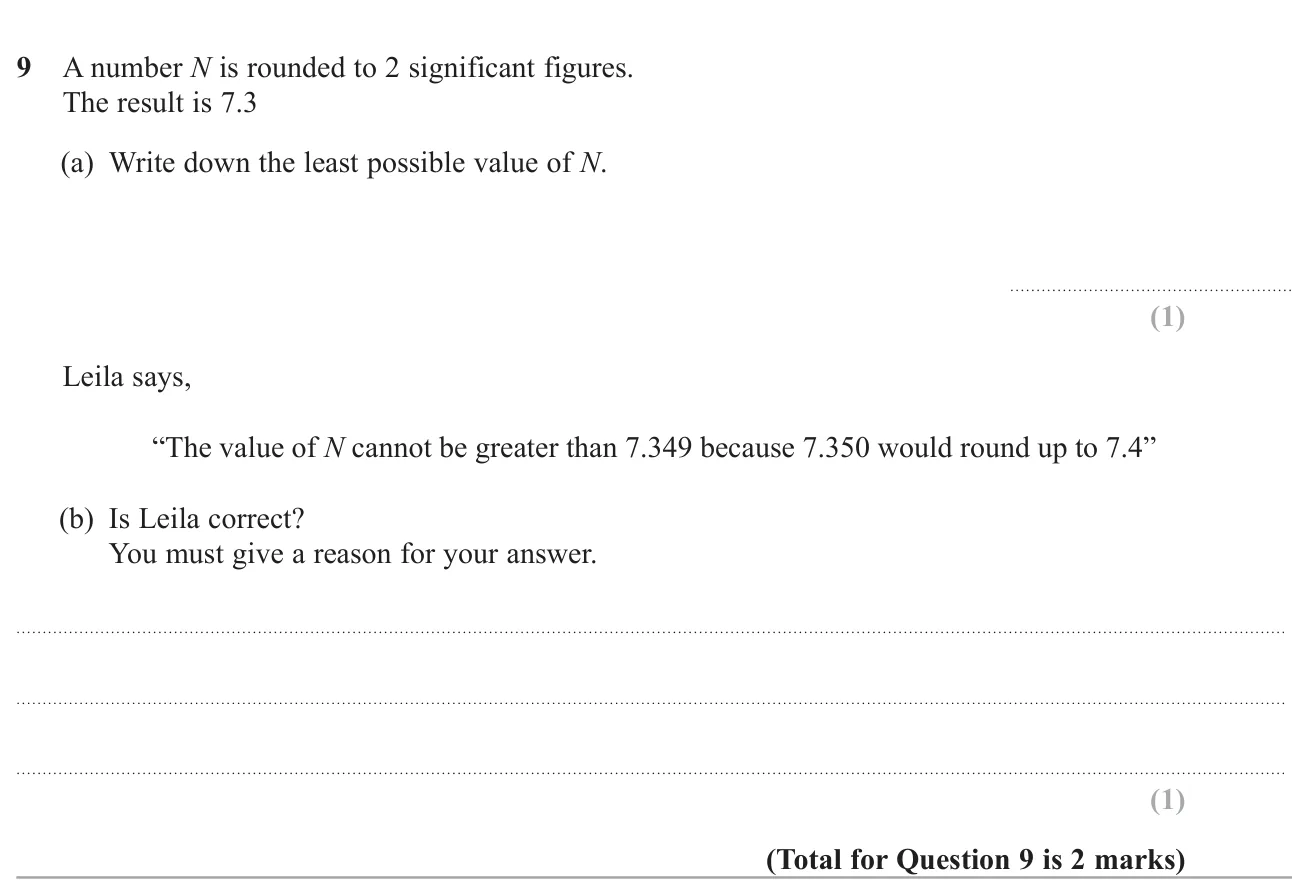
Find the lower bound of a number rounded to 2 significant figures and judge a claim about its upper limit.

© Pearson Education Ltd. June 2024 Paper 2 (Higher, calculator), question 9.

Show answer
(a)7.257.251 mark
(b)No, e.g. NN could be 7.3495, which is greater than 7.349 but still rounds to 7.31 mark

Worked solution Checked against the mark scheme

(a) Numbers that round to 7.3 (2 s.f.) are from 7.25 up to (not including) 7.35, so the least value is 7.257.25.

(b) No. Values such as 7.3495 are bigger than 7.349 but still round to 7.3; NN can be any value below 7.35.

Watch out: Giving 7.2 or 7.29 as the least value.

Question 10

Pythagoras and trigonometry3 marksGrade 6Calculator
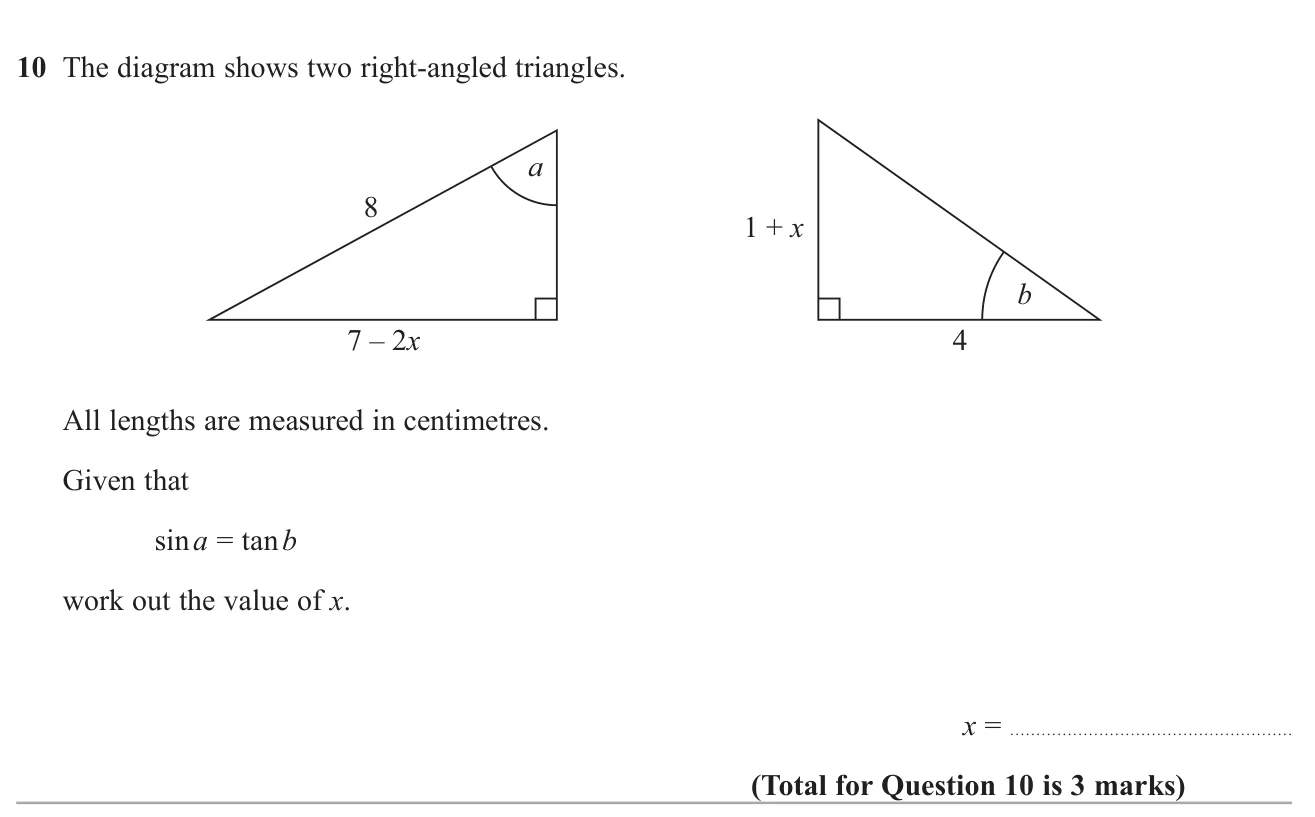
Set sine of one angle equal to tangent of another in two right-angled triangles with algebraic sides and solve for x.

© Pearson Education Ltd. June 2024 Paper 2 (Higher, calculator), question 10.

Show answer
Answerx=1.25x = 1.253 marks

Worked solution Checked against the mark scheme

sin⁡a=opphyp=7−2x8\sin a = \dfrac{\text{opp}}{\text{hyp}} = \dfrac{7-2x}{8} and tan⁡b=oppadj=1+x4\tan b = \dfrac{\text{opp}}{\text{adj}} = \dfrac{1+x}{4}

7−2x8=1+x4⇒7−2x=2+2x⇒4x=5⇒x=1.25\dfrac{7-2x}{8} = \dfrac{1+x}{4} \Rightarrow 7-2x = 2+2x \Rightarrow 4x = 5 \Rightarrow x = 1.25

Watch out: Using the wrong side for opposite in either triangle.

Question 11

Cumulative frequency7 marksGrade 6Calculator
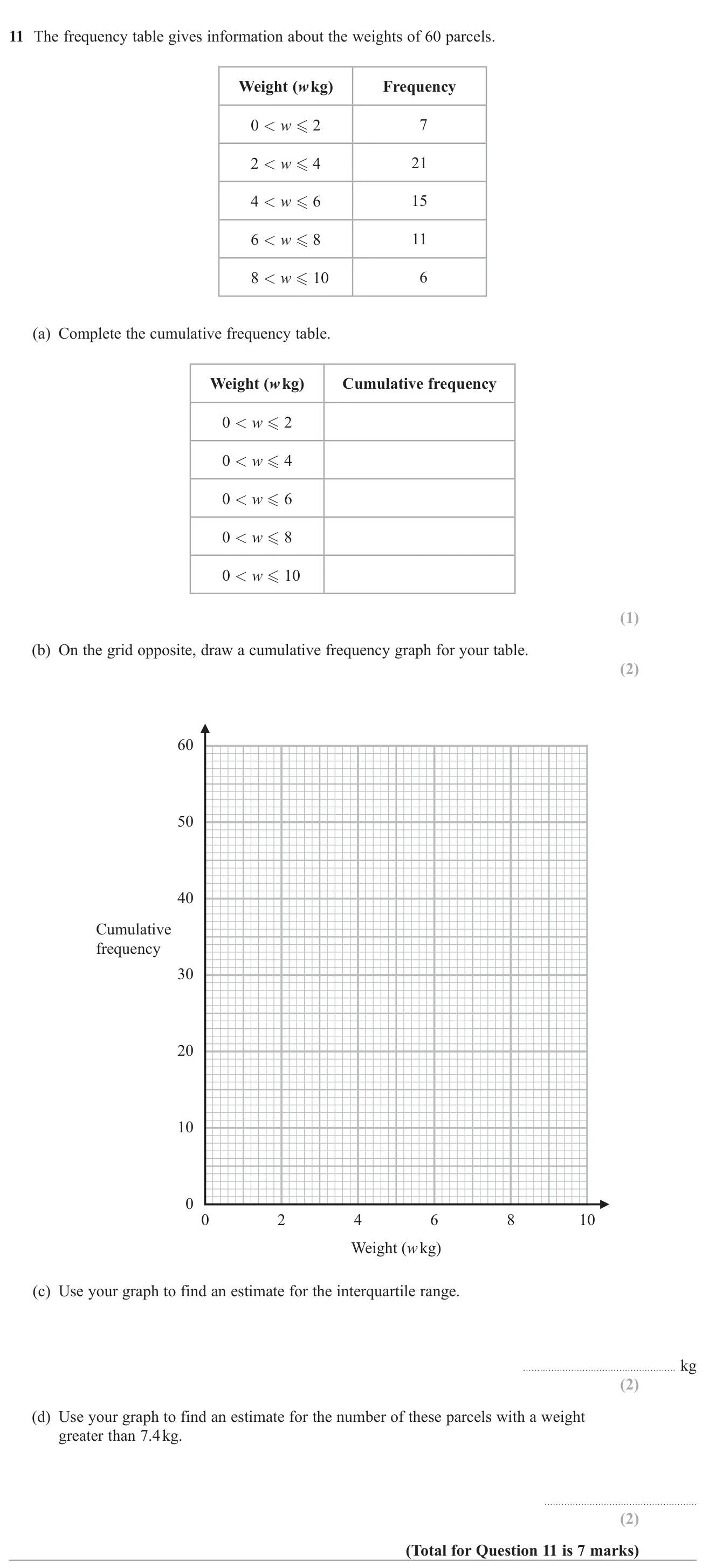
Complete a cumulative frequency table, draw the graph, estimate the interquartile range and count values above a given weight.

© Pearson Education Ltd. June 2024 Paper 2 (Higher, calculator), question 11.

Show answer
(a)7,28,43,54,607, 28, 43, 54, 601 mark
(b)Cumulative frequency curve through (2,7),(4,28),(6,43),(8,54),(10,60)(2,7),(4,28),(6,43),(8,54),(10,60)2 marks
(c)About 3.73.7 kg (accept 3.4 to 4)2 marks
(d)About 88 (accept 7 to 10)2 marks

Worked solution Checked against the mark scheme

(a) Running totals: 7,7+21=28,43,54,607, 7+21=28, 43, 54, 60.

(b) Plot at the upper ends of each class, (2,7),(4,28),(6,43),(8,54),(10,60)(2,7),(4,28),(6,43),(8,54),(10,60), and join with a smooth curve.

(c) LQ at cf 15 is about 2.7 kg; UQ at cf 45 is about 6.3 kg. IQR ≈6.3−2.7=3.6\approx 6.3 - 2.7 = 3.6 kg.

(d) At 7.4 kg the cf is about 51, so 60−51≈960 - 51 \approx 9 parcels.

Watch out: Plotting cumulative frequencies at the midpoints of the classes instead of the upper boundaries.

Question 12

Direct and inverse proportion4 marksGrade 6Calculator
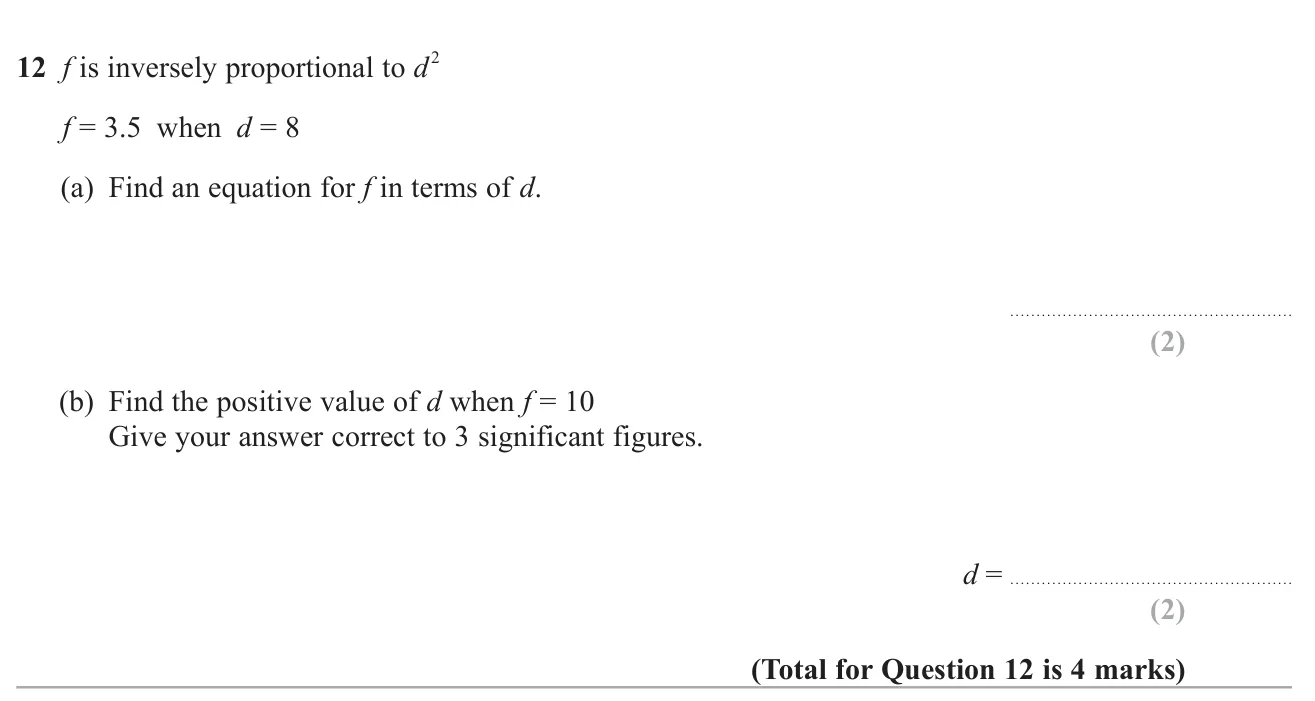
Find the equation for an inverse proportion to a square, then use it to find d for a given f.

© Pearson Education Ltd. June 2024 Paper 2 (Higher, calculator), question 12.

Show answer
(a)f=224d2f = \dfrac{224}{d^2}2 marks
(b)d=4.73d = 4.732 marks

Worked solution Checked against the mark scheme

(a) f=kd2f = \dfrac{k}{d^2}. With f=3.5,d=8f = 3.5, d = 8: k=3.5×64=224k = 3.5 \times 64 = 224, so f=224d2f = \dfrac{224}{d^2}.

(b) 10=224d2⇒d2=22.4⇒d=22.4=4.7310 = \dfrac{224}{d^2} \Rightarrow d^2 = 22.4 \Rightarrow d = \sqrt{22.4} = 4.73 (3 s.f.)

Watch out: Using f=kdf = \frac{k}{d} (forgetting the square) so k=28k = 28.

Question 13

Inequalities3 marksGrade 6Calculator
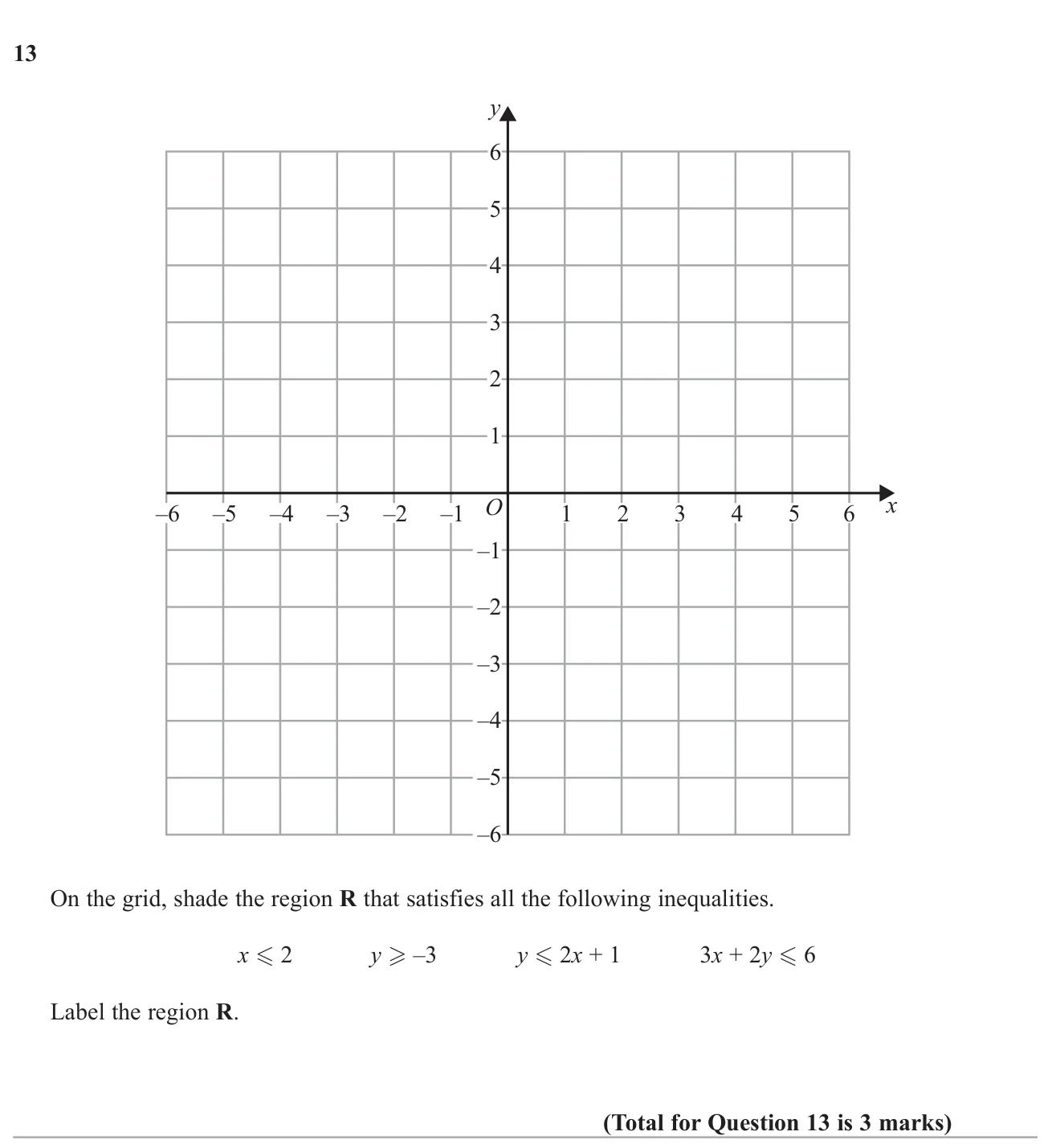
Shade the region on a grid that satisfies four linear inequalities.

© Pearson Education Ltd. June 2024 Paper 2 (Higher, calculator), question 13.

Show answer
AnswerRegion bounded by x=2x = 2, y=−3y = -3, y=2x+1y = 2x + 1 and 3x+2y=63x + 2y = 6, correctly labelled R3 marks

Worked solution Checked against the mark scheme

Draw the four lines: x=2x = 2 (vertical), y=−3y = -3 (horizontal), y=2x+1y = 2x + 1 (through (0,1)(0,1), gradient 2) and 3x+2y=63x + 2y = 6 (through (0,3)(0,3) and (2,0)(2,0)).

The region is left of x=2x=2, above y=−3y=-3, below y=2x+1y=2x+1 and below 3x+2y=63x+2y=6.

The region is a quadrilateral with corners (−2,−3)(-2,-3), (47,157)(\tfrac47, \tfrac{15}{7}), (2,0)(2, 0) and (2,−3)(2,-3). Shade it and label it R.

Watch out: Shading the wrong side of y=2x+1y = 2x + 1, or drawing 3x+2y=63x + 2y = 6 through the wrong intercepts.

Question 14

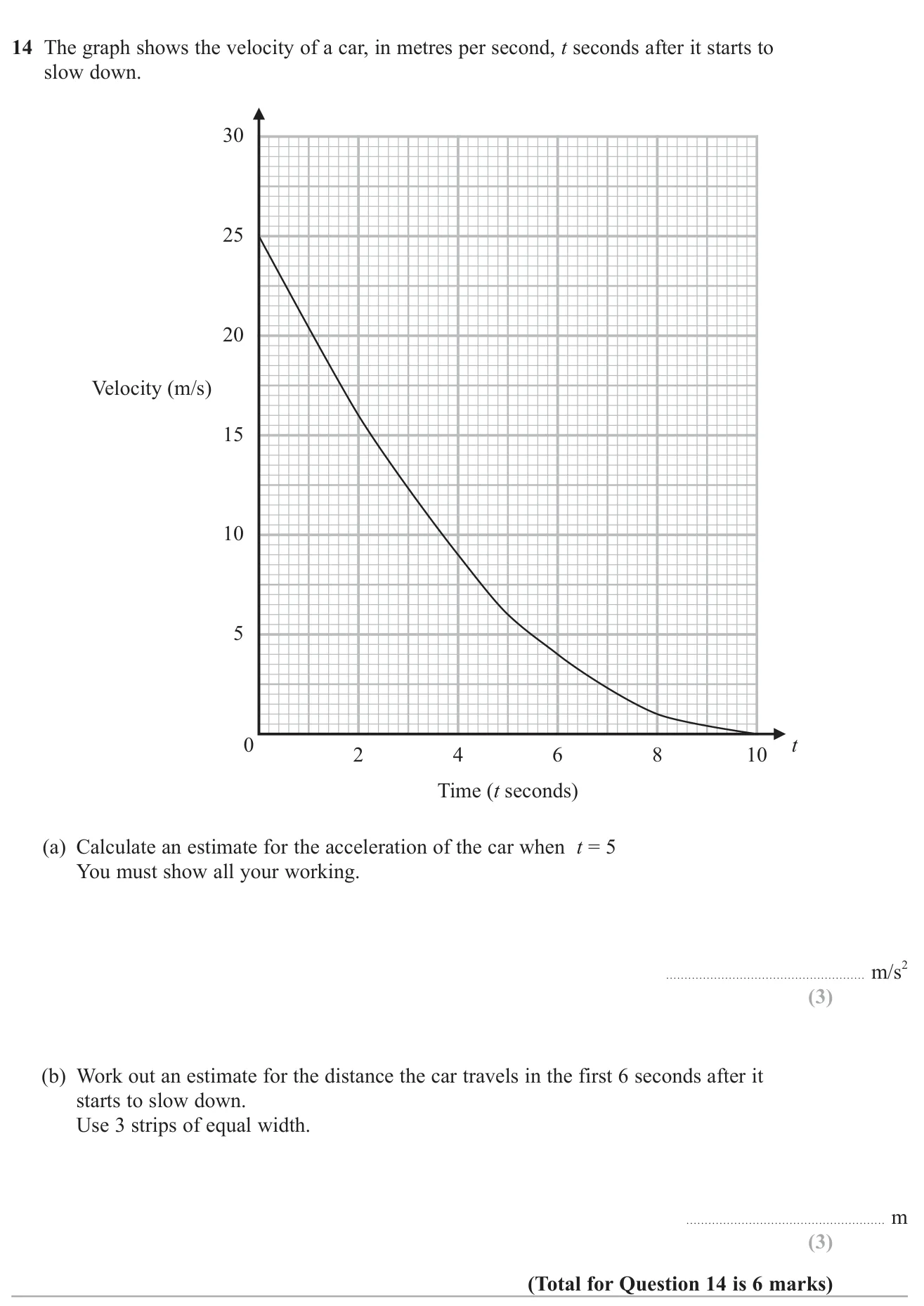
Estimate a car's deceleration from a tangent on a velocity-time graph and the distance travelled using three trapezium strips.

© Pearson Education Ltd. June 2024 Paper 2 (Higher, calculator), question 14.

Show answer
(a)About −2.5-2.5 m/s² (accept −2.0-2.0 to −2.8-2.8)3 marks
(b)7979 m3 marks

Worked solution Checked against the mark scheme

(a) Draw a tangent to the curve at t=5t = 5. For example it drops about 10 m/s over 4 seconds, so gradient ≈−10÷4=−2.5\approx -10 \div 4 = -2.5 m/s².

(b) Readings: v(0)=25,v(2)=16,v(4)=9,v(6)=4v(0)=25, v(2)=16, v(4)=9, v(6)=4. Three trapezia of width 2:

12×2×(25+16)+12×2×(16+9)+12×2×(9+4)=41+25+13=79\frac12 \times 2 \times (25+16) + \frac12 \times 2 \times (16+9) + \frac12 \times 2 \times (9+4) = 41 + 25 + 13 = 79 m

Watch out: Joining two points on the curve (a chord) instead of drawing a tangent, or forgetting the negative sign for deceleration.

Question 15

Surds2 marksGrade 7Calculator
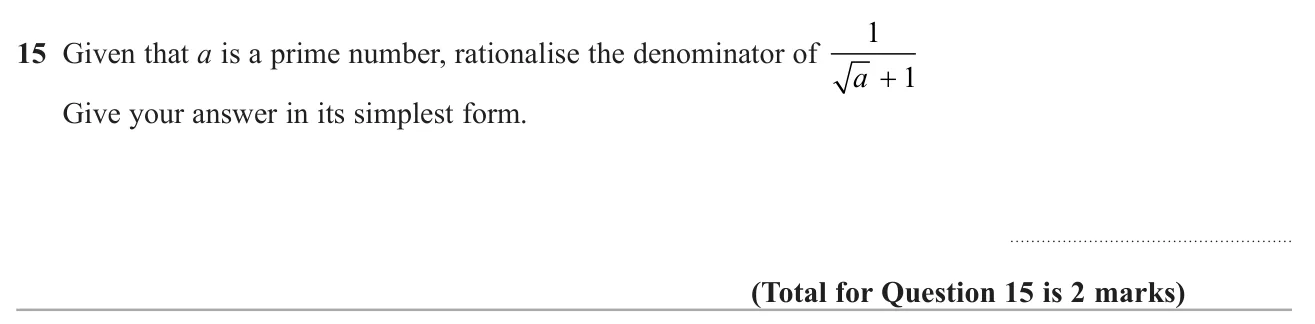
Rationalise the denominator of 1 over (root a plus 1), where a is prime.

© Pearson Education Ltd. June 2024 Paper 2 (Higher, calculator), question 15.

Show answer
Answera−1a−1\dfrac{\sqrt a - 1}{a - 1}2 marks

Worked solution Checked against the mark scheme

Multiply top and bottom by a−1\sqrt a - 1:

1a+1×a−1a−1=a−1a−1\dfrac{1}{\sqrt a + 1} \times \dfrac{\sqrt a - 1}{\sqrt a - 1} = \dfrac{\sqrt a - 1}{a - 1}

Watch out: Multiplying by a+1\sqrt a + 1 or by a\sqrt a, which does not remove the surd.

Question 16

Inequalities2 marksGrade 7Calculator
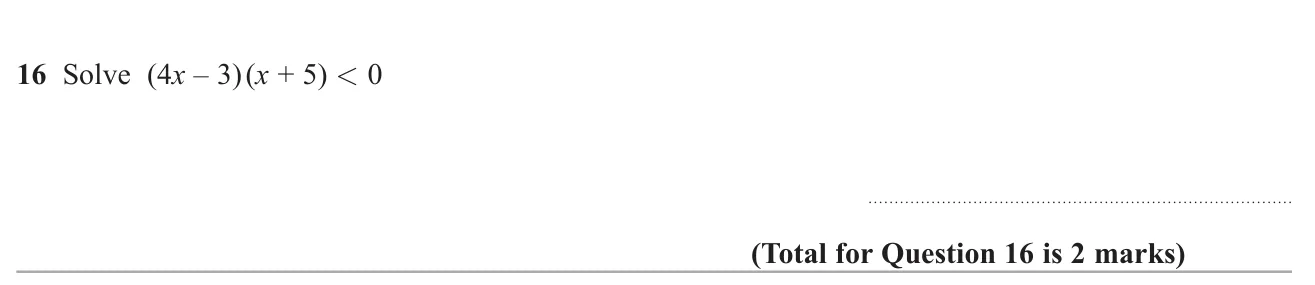
Solve a quadratic inequality given in factorised form.

© Pearson Education Ltd. June 2024 Paper 2 (Higher, calculator), question 16.

Show answer
Answer−5<x<34-5 < x < \tfrac342 marks

Worked solution Checked against the mark scheme

Critical values: 4x−3=0⇒x=344x - 3 = 0 \Rightarrow x = \frac34 and x+5=0⇒x=−5x + 5 = 0 \Rightarrow x = -5.

The product is negative between the roots (the graph is a U shape below the axis there).

So −5<x<34-5 < x < \frac34.

Watch out: Giving the outside region (x<−5x < -5 or x>34x > \frac34) or x<34x < \frac34 only.

Question 17

Similar shapes4 marksGrade 8Calculator
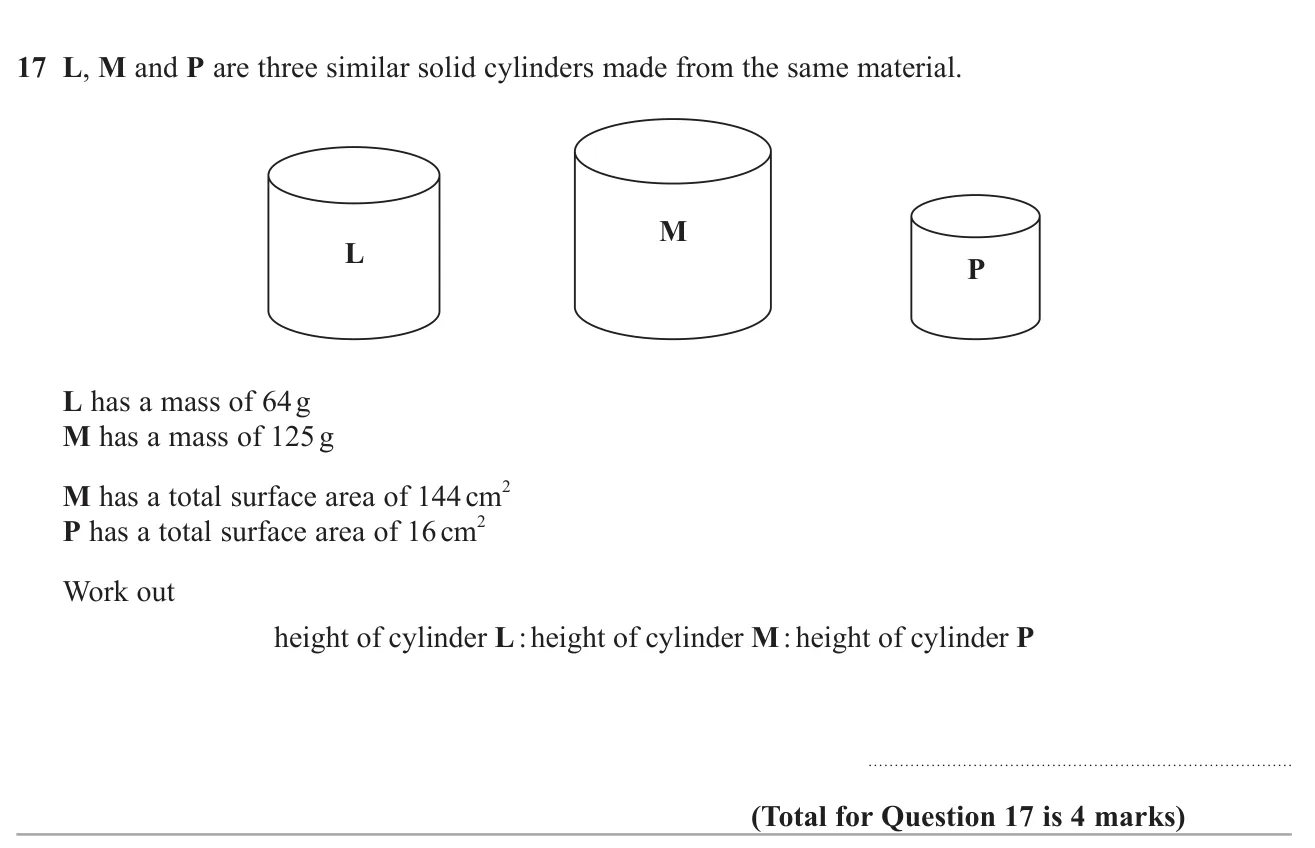
Use masses and surface areas of similar cylinders to find the ratio of their three heights.

© Pearson Education Ltd. June 2024 Paper 2 (Higher, calculator), question 17.

Show answer
Answer12:15:512 : 15 : 54 marks

Worked solution Checked against the mark scheme

Mass is proportional to volume, so height ratio L : M =643:1253=4:5= \sqrt[3]{64} : \sqrt[3]{125} = 4 : 5.

Area ratio M : P =144:16= 144 : 16, so height ratio =144:16=12:4=3:1= \sqrt{144} : \sqrt{16} = 12 : 4 = 3 : 1.

Make M the same: 4:5=12:154:5 = 12:15 and 3:1=15:53:1 = 15:5.

So L : M : P =12:15:5= 12 : 15 : 5.

Watch out: Using the mass or area ratios directly as length ratios without taking cube or square roots.

Question 18

Tree diagrams and combined events5 marksGrade 8Calculator
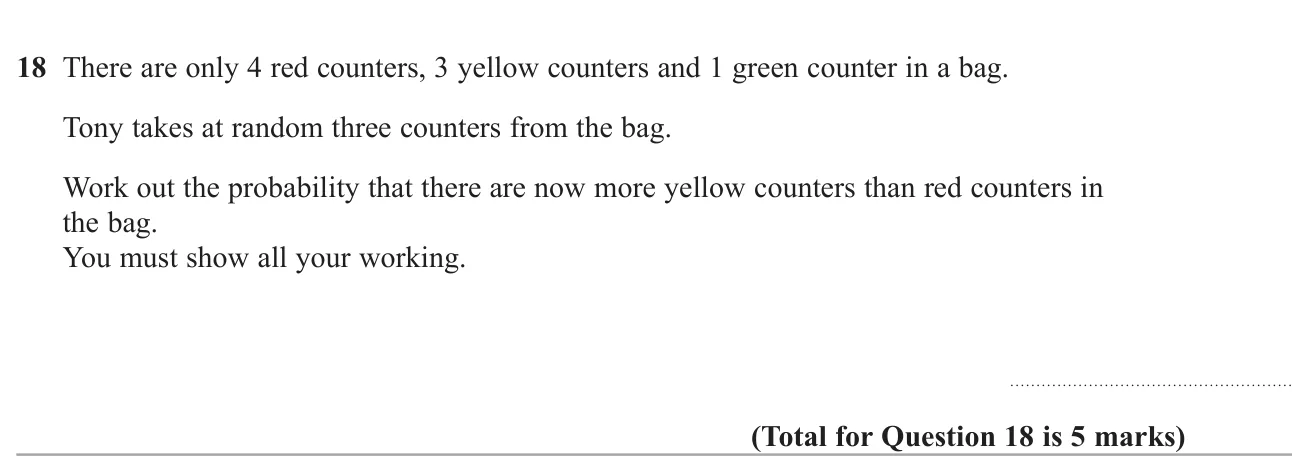
Find the probability that, after three counters are taken without replacement, more yellow than red counters remain.

© Pearson Education Ltd. June 2024 Paper 2 (Higher, calculator), question 18.

Show answer
Answer528\dfrac{5}{28} (accept 0.178 or 0.18, 17.9% or 18%)5 marks

Worked solution Checked against the mark scheme

Start: 4 red, 3 yellow, 1 green. More yellow than red remain only if Tony takes 3 red, or 2 red and the green.

P(RRR)=48×37×26=24336P(RRR) = \frac48 \times \frac37 \times \frac26 = \frac{24}{336}

P(2 red, 1 green)=3×48×37×16=36336P(\text{2 red, 1 green}) = 3 \times \frac48 \times \frac37 \times \frac16 = \frac{36}{336}

Total =60336=528= \frac{60}{336} = \frac{5}{28}

Watch out: Only counting one order of red, red, green instead of all three orders, or missing the RRR case.

Question 19

Vectors5 marksGrade 9Calculator
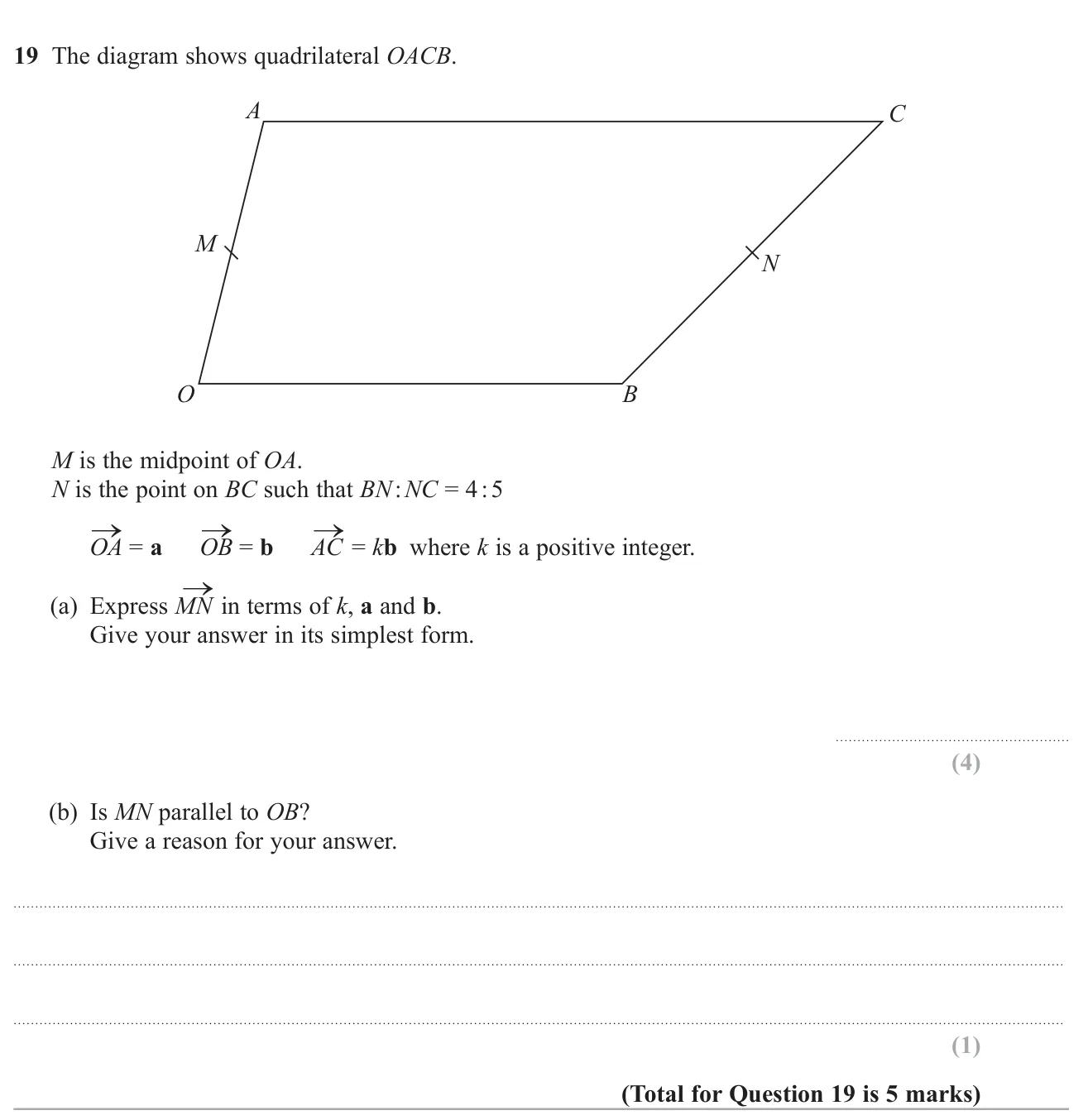
Express a vector in a quadrilateral in terms of k, a and b, then decide whether it is parallel to OB.

© Pearson Education Ltd. June 2024 Paper 2 (Higher, calculator), question 19.

Show answer
(a)MN→=118(8kb+10b−a)\overrightarrow{MN} = \dfrac{1}{18}\left(8k\mathbf b + 10\mathbf b - \mathbf a\right)4 marks
(b)No, because MN→\overrightarrow{MN} has an a\mathbf a component so it is not a multiple of b\mathbf b1 mark

Worked solution Checked against the mark scheme

(a) BC→=−b+a+kb\overrightarrow{BC} = -\mathbf b + \mathbf a + k\mathbf b, so CN→=59CB→=59(b−a−kb)\overrightarrow{CN} = \frac59\overrightarrow{CB} = \frac59(\mathbf b - \mathbf a - k\mathbf b).

MN→=12a+kb+59(b−a−kb)=−118a+4k+59b=118(8kb+10b−a)\overrightarrow{MN} = \frac12\mathbf a + k\mathbf b + \frac59(\mathbf b - \mathbf a - k\mathbf b) = -\frac1{18}\mathbf a + \frac{4k+5}{9}\mathbf b = \frac1{18}(8k\mathbf b + 10\mathbf b - \mathbf a)

(b) No: MN→\overrightarrow{MN} contains −118a-\frac1{18}\mathbf a, so it is not a multiple of b=OB→\mathbf b = \overrightarrow{OB}.

Watch out: Using 49\frac49 of CB→\overrightarrow{CB} for CN→\overrightarrow{CN} (mixing up which part of the ratio is next to C).

Question 20

Completing the square3 marksGrade 7Calculator
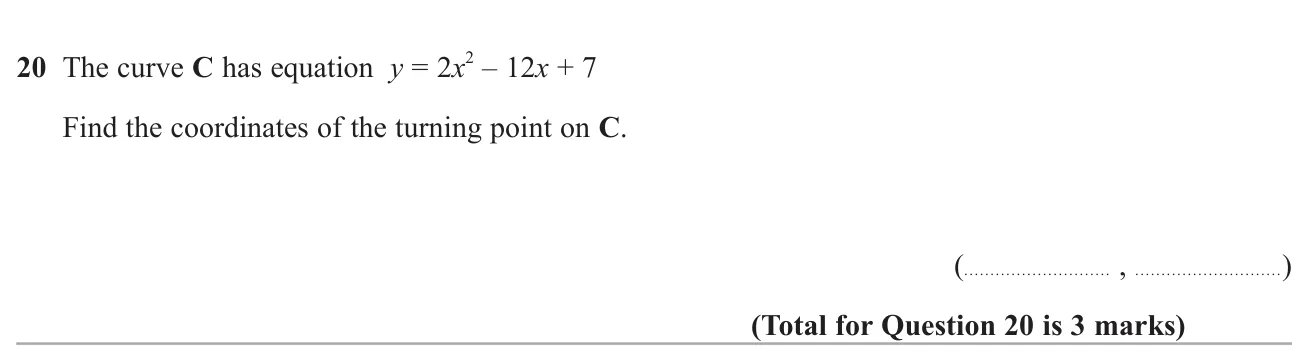
Find the coordinates of the turning point of a quadratic curve.

© Pearson Education Ltd. June 2024 Paper 2 (Higher, calculator), question 20.

Show answer
Answer(3,−11)(3, -11)3 marks

Worked solution Checked against the mark scheme

y=2x2−12x+7=2(x2−6x)+7=2[(x−3)2−9]+7=2(x−3)2−11y = 2x^2 - 12x + 7 = 2(x^2 - 6x) + 7 = 2[(x-3)^2 - 9] + 7 = 2(x-3)^2 - 11

The minimum is when x=3x = 3, giving y=−11y = -11.

Turning point: (3,−11)(3, -11)

Watch out: Forgetting to multiply the −9-9 by 2, giving (3,−2)(3, -2).

Question 21

Graph transformations2 marksGrade 8Calculator
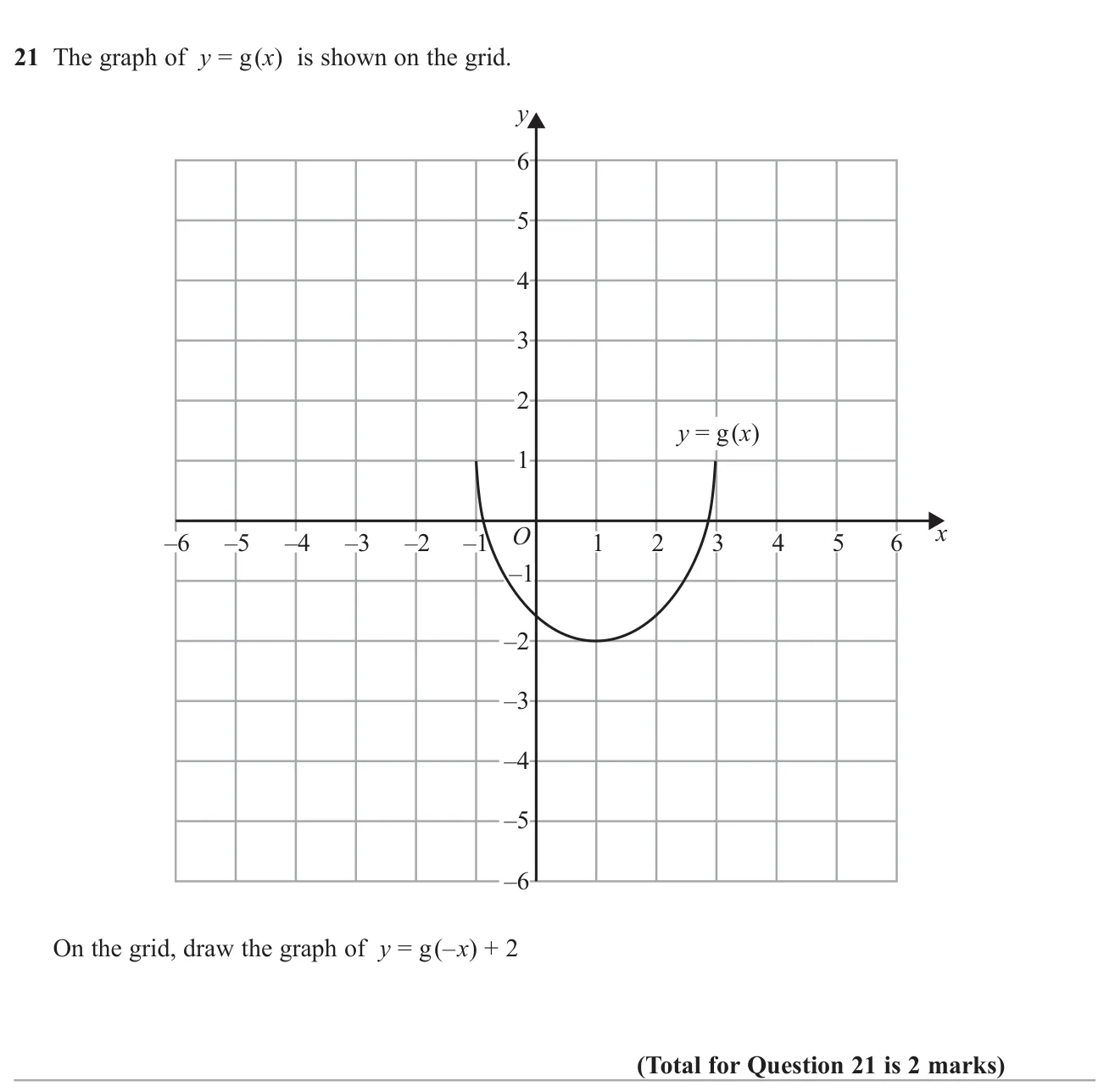
Draw the graph of g(-x) + 2 from a given curve y = g(x).

© Pearson Education Ltd. June 2024 Paper 2 (Higher, calculator), question 21.

Show answer
AnswerThe curve reflected in the yy-axis and moved up 2: through (1,3)(1,3), (−1,0)(-1,0) and (−3,3)(-3,3)2 marks

Worked solution Checked against the mark scheme

g(−x)g(-x) reflects the curve in the yy-axis; +2+2 then moves it up 2 units.

Key points: (−1,1)→(1,3)(-1,1) \to (1,3), (1,−2)→(−1,0)(1,-2) \to (-1,0), (3,1)→(−3,3)(3,1) \to (-3,3).

Draw the U-shaped curve through these points, minimum at (−1,0)(-1, 0).

Watch out: Reflecting in the xx-axis instead of the yy-axis, or moving 2 units horizontally.

Question 22

Circle theorems4 marksGrade 8Calculator
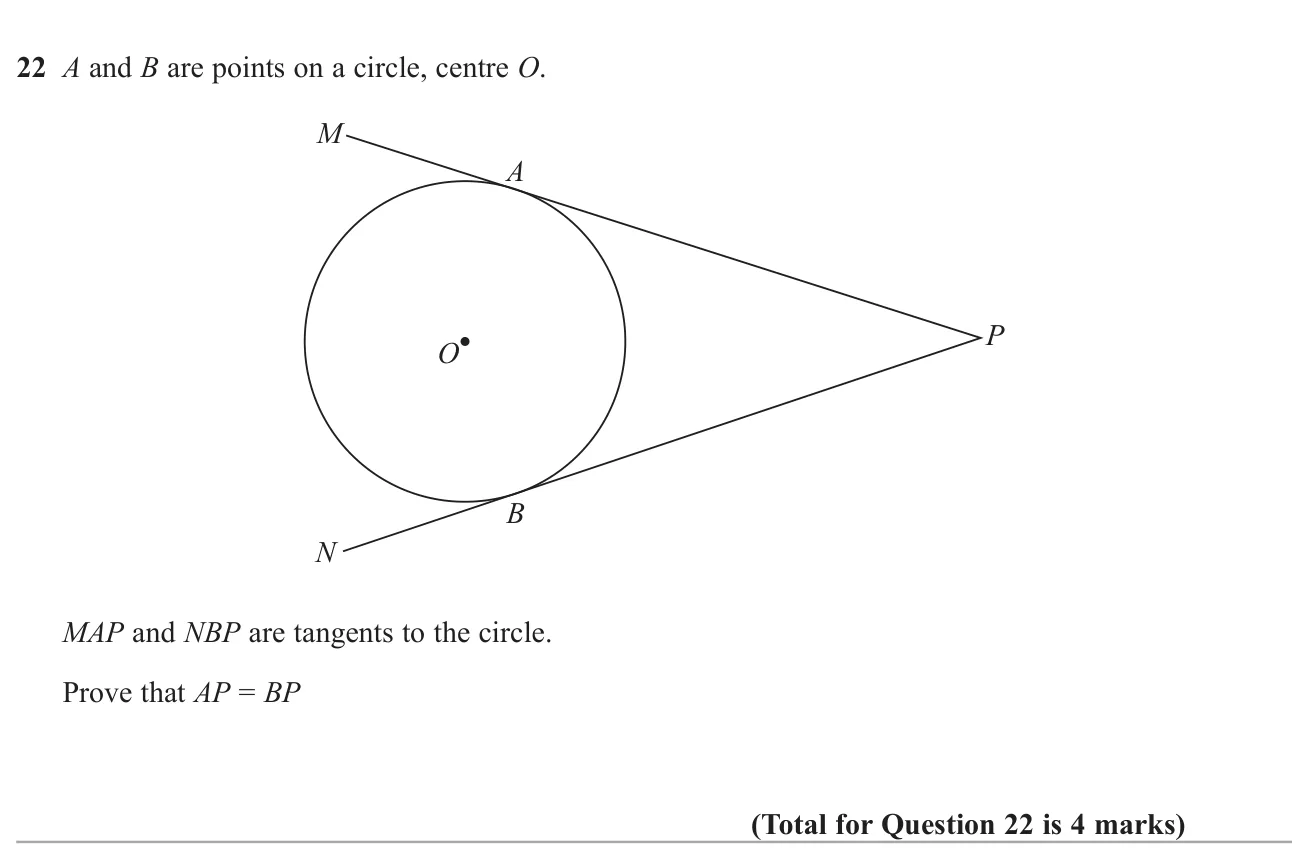
Prove that two tangents drawn to a circle from the same external point are equal in length.

© Pearson Education Ltd. June 2024 Paper 2 (Higher, calculator), question 22.

Show answer
AnswerProof via congruent triangles OAP and OBP (RHS), with reasons4 marks

Worked solution Checked against the mark scheme

Join OA, OB and OP.

∠OAP=∠OBP=90∘\angle OAP = \angle OBP = 90^\circ (a tangent is perpendicular to the radius).

OA=OBOA = OB (both radii) and OPOP is common.

So triangles OAPOAP and OBPOBP are congruent (RHS), hence AP=BPAP = BP. (Or: AP2=OP2−OA2=OP2−OB2=BP2AP^2 = OP^2 - OA^2 = OP^2 - OB^2 = BP^2.)

Watch out: Using the result 'tangents from a point are equal', which is what is being proved.

Finished the paper?

Add up your marks for all three papers and see what grade that would have been.