Algebra

Identities and algebraic proof

8 past-paper questions, easiest first. Try each one, then reveal the answer.

Foundation & HigherNo Foundation-paper questions yet

Revision guide by The Full Marks

Identities and algebraic proof: what you need to know

An algebraic proof shows something is true for every number, not just the ones you try. Foundation questions ask you to show two expressions are equal; Higher questions ask you to prove facts about odd, even and consecutive numbers.

Foundation students need identities and showing expressions are equivalent; proofs about odd, even and consecutive numbers are mainly Higher.

Key facts

  • An equation is true for some values; an identity (≡\equiv) is true for all values.
  • Any integer: nn. Even: 2n2n. Odd: 2n+12n + 1. Consecutive: nn, n+1n + 1, n+2n + 2.
  • Consecutive even numbers: 2n2n and 2n+22n + 2. Consecutive odd numbers: 2n+12n + 1 and 2n+32n + 3. Any two odd numbers: 2m+12m + 1 and 2n+12n + 1 (different letters).
  • To show something is even, write it as 2×2 \times (an integer); a multiple of 8 as 8×8 \times (an integer).

Showing an identity

  1. Start with the more complicated side.
  2. Expand and simplify until it looks exactly like the other side.

Writing a proof (Higher)

  1. Write the numbers algebraically, e.g. 2n+12n + 1 for an odd number.
  2. Form the expression the question describes, then expand and simplify.
  3. Factorise to show the required form, e.g. 8(…)+28(\ldots) + 2.
  4. Finish with a sentence explaining what this proves.

Worked examples

Example 1 Foundation · grade 4

Show that 3(2x+4)−2(x−1)≡4x+143(2x + 4) - 2(x - 1) \equiv 4x + 14

Show the solution

Start with the left-hand side.
3(2x+4)=6x+123(2x + 4) = 6x + 12
−2(x−1)=−2x+2-2(x - 1) = -2x + 2
6x+12−2x+2=4x+146x + 12 - 2x + 2 = 4x + 14, which is the right-hand side, so the identity is true.

Example 2 Higher · grade 7

Prove that the sum of the squares of any two consecutive odd numbers is always 2 more than a multiple of 8.

Show the solution

Let the numbers be 2n+12n + 1 and 2n+32n + 3.
(2n+1)2=4n2+4n+1(2n + 1)^2 = 4n^2 + 4n + 1
(2n+3)2=4n2+12n+9(2n + 3)^2 = 4n^2 + 12n + 9
Sum: 8n2+16n+108n^2 + 16n + 10
=8(n2+2n+1)+2= 8(n^2 + 2n + 1) + 2
8(n2+2n+1)8(n^2 + 2n + 1) is a multiple of 8, so the sum is always 2 more than a multiple of 8.

Common mistakes

  • Testing a few numbers. Examples never prove a statement is always true.
  • Using nn and n+2n + 2 for two odd numbers; they might both be even. Use 2n+12n + 1 and 2n+32n + 3.
  • Sign errors when subtracting a squared bracket: put it in brackets before expanding.
  • Stopping too early, e.g. at 4(2n2+…)4(2n^2 + \ldots) when a multiple of 8 is needed. Keep factorising, or explain why the bracket is even.

Exam tips

  • The final mark is for the conclusion, so write a sentence linking your algebra to the statement.
  • Show the factorised form, such as 8(…)8(\ldots), rather than just saying the terms divide by 8.

Questions people ask

How do you write an odd number in algebra?

Use 2n+12n + 1, where nn is any integer. An even number is 2n2n.

What is the difference between an equation and an identity?

An equation is only true for particular values, like 2x=102x = 10. An identity is true for every value, like 2(x+5)≡2x+102(x + 5) \equiv 2x + 10.

Can I prove something by trying examples?

No. Examples can show a statement is false, but a proof needs algebra that works for every number.

Exam questions: Identities and algebraic proof (8, easiest first)

Identities and algebraic proof2 marksGrade 6No calculatorHigher
June 2019 · Paper 1 Higher · Q13
Prove that subtracting an integer from its square always gives an even number.

© Pearson Education Ltd. June 2019 Paper 1 (Higher, non-calculator), question 13.

Show answer
Answern2−n=n(n−1)n^2 - n = n(n-1), a product of two consecutive integers, one of which is even, so it is always even2 marks

Worked solution Checked against the mark scheme

n2−n=n(n−1)n^2 - n = n(n - 1)

nn and n−1n - 1 are consecutive integers, so one of them is even.

An even number times any integer is even, so n2−nn^2 - n is never odd.

Watch out: Testing a few values of n instead of giving a general argument.
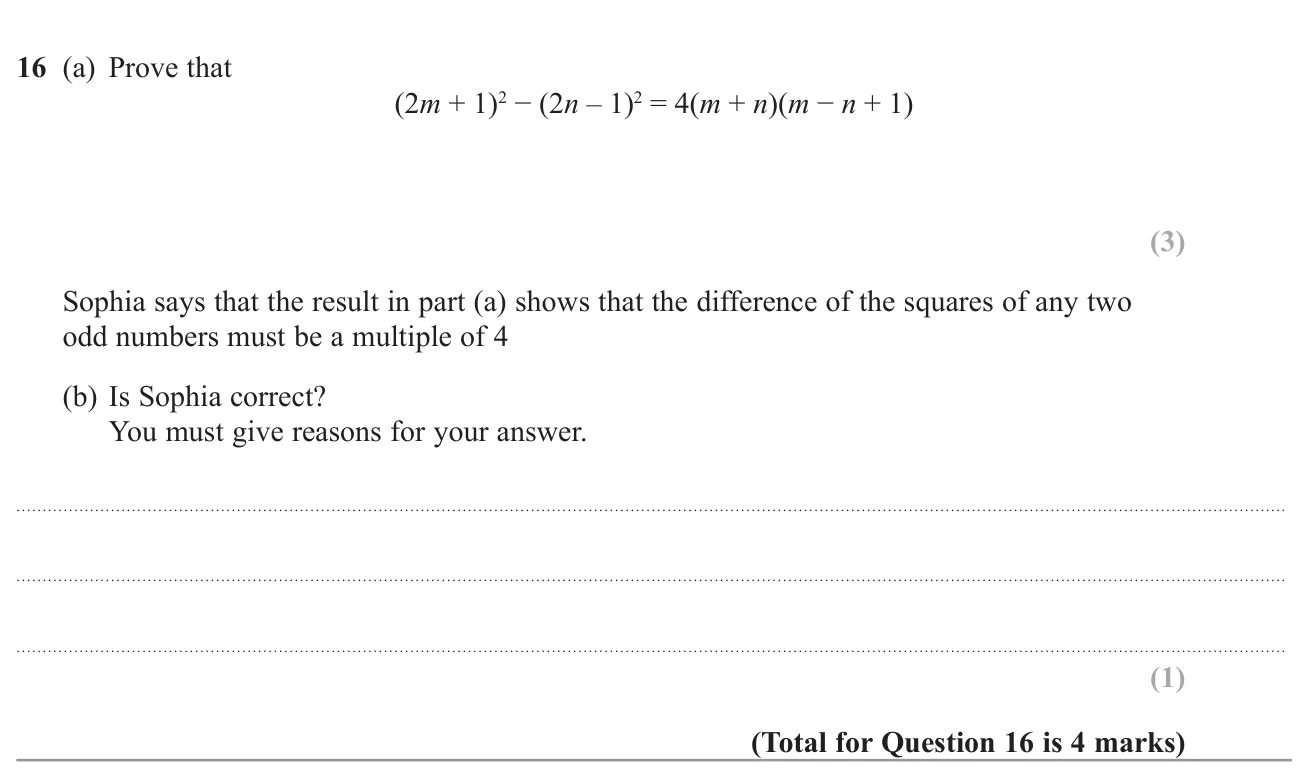
Identities and algebraic proof4 marksGrade 7No calculatorHigher
November 2022 · Paper 1 Higher · Q16
Prove an algebraic identity for the difference of two squared expressions, then judge a claim about odd numbers that follows from it.

© Pearson Education Ltd. November 2022 Paper 1 (Higher, non-calculator), question 16.

Show answer
(a)Proof that both sides are equal3 marks
(b)Yes: 2m+12m + 1 and 2n−12n - 1 are any odd numbers, and the right-hand side has a factor of 41 mark

Worked solution Checked against the mark scheme

(a) (2m+1)2−(2n−1)2=4m2+4m+1−(4n2−4n+1)(2m + 1)^2 - (2n - 1)^2 = 4m^2 + 4m + 1 - (4n^2 - 4n + 1)

=4m2−4n2+4m+4n=4[(m+n)(m−n)+(m+n)]= 4m^2 - 4n^2 + 4m + 4n = 4[(m + n)(m - n) + (m + n)]

=4(m+n)(m−n+1)= 4(m + n)(m - n + 1)

(b) Yes. 2m+12m + 1 and 2n−12n - 1 stand for any odd numbers, and the result has a factor of 4, so it is always a multiple of 4.

Watch out: Getting the sign of the constant wrong when subtracting (2n−1)2(2n - 1)^2.

Identities and algebraic proof3 marksGrade 7CalculatorHigher
November 2019 · Paper 3 Higher · Q15
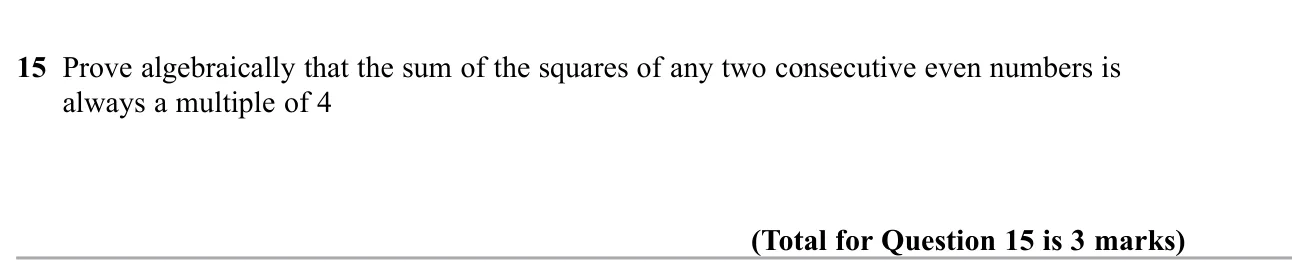
Prove with algebra that two consecutive even numbers squared and added always give a multiple of 4.

© Pearson Education Ltd. November 2019 Paper 3 (Higher, calculator), question 15.

Show answer
Answer(2n)2+(2n+2)2=4(2n2+2n+1)(2n)^2 + (2n+2)^2 = 4(2n^2 + 2n + 1), a multiple of 43 marks

Worked solution Checked against the mark scheme

Let the numbers be 2n2n and 2n+22n + 2.

(2n)2+(2n+2)2=4n2+4n2+8n+4=8n2+8n+4(2n)^2 + (2n + 2)^2 = 4n^2 + 4n^2 + 8n + 4 = 8n^2 + 8n + 4

=4(2n2+2n+1)= 4(2n^2 + 2n + 1)

2n2+2n+12n^2 + 2n + 1 is an integer, so the sum is a multiple of 4.

Watch out: Using nn and n+2n + 2, which need not be even.

Identities and algebraic proof4 marksGrade 7No calculatorHigher
June 2018 · Paper 1 Higher · Q12
Prove algebraically that squaring any odd number gives one more than a multiple of 4.

© Pearson Education Ltd. June 2018 Paper 1 (Higher, non-calculator), question 12.

Show answer
Answer(2n+1)2=4n2+4n+1=4(n2+n)+1(2n+1)^2 = 4n^2 + 4n + 1 = 4(n^2 + n) + 14 marks

Worked solution Checked against the mark scheme

Let an odd number be 2n+12n + 1, where nn is an integer.

(2n+1)2=4n2+4n+1=4(n2+n)+1(2n + 1)^2 = 4n^2 + 4n + 1 = 4(n^2 + n) + 1

4(n2+n)4(n^2 + n) is a multiple of 4, so the square is 1 more than a multiple of 4.

Watch out: Checking a few numbers instead of using algebra, or writing the odd number as n+1n + 1.

Identities and algebraic proof3 marksGrade 7CalculatorHigher
November 2018 · Paper 3 Higher · Q15
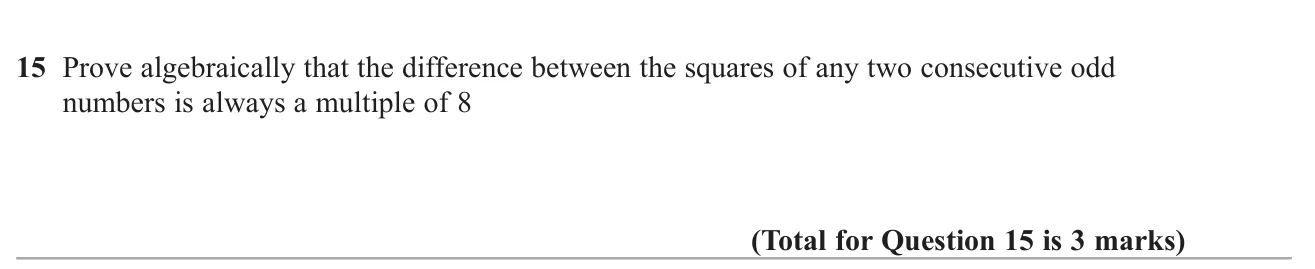
Prove that the difference of the squares of two consecutive odd numbers is always a multiple of 8.

© Pearson Education Ltd. November 2018 Paper 3 (Higher, calculator), question 15.

Show answer
Answer(2n+1)2−(2n−1)2=8n(2n+1)^2 - (2n-1)^2 = 8n, a multiple of 83 marks

Worked solution Checked against the mark scheme

Let the odd numbers be 2n−12n - 1 and 2n+12n + 1, where nn is an integer.

(2n+1)2−(2n−1)2=(4n2+4n+1)−(4n2−4n+1)(2n+1)^2 - (2n-1)^2 = (4n^2 + 4n + 1) - (4n^2 - 4n + 1)

=8n= 8n

8n8n is 8 times an integer, so it is always a multiple of 8.

Watch out: Using nn and n+2n + 2, which are not always odd.

Identities and algebraic proof4 marksGrade 7No calculatorHigher
Specimen · Paper 1 Higher · Q20
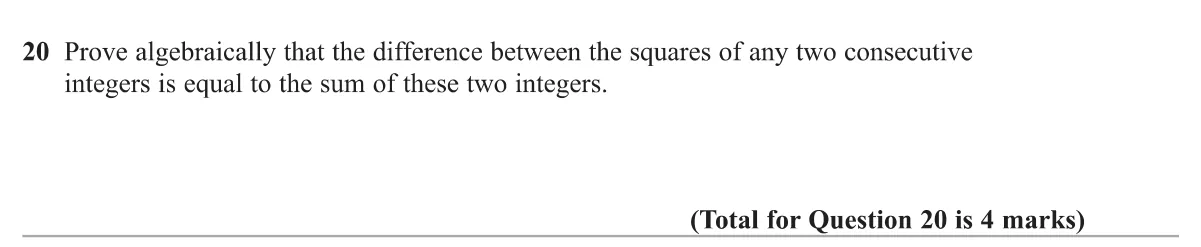
Prove algebraically that the difference of the squares of two consecutive integers equals their sum.

© Pearson Education Ltd. Specimen Paper 1 (Higher, non-calculator), question 20.

Show answer
Answer(n+1)2−n2=2n+1=n+(n+1)(n + 1)^2 - n^2 = 2n + 1 = n + (n + 1)4 marks

Worked solution Checked against the mark scheme

Let the integers be nn and n+1n + 1.

Difference of squares: (n+1)2−n2=n2+2n+1−n2=2n+1(n + 1)^2 - n^2 = n^2 + 2n + 1 - n^2 = 2n + 1

Sum: n+(n+1)=2n+1n + (n + 1) = 2n + 1

Both equal 2n+12n + 1, so the statement is true for any two consecutive integers.

Watch out: Checking a few numerical examples instead of giving an algebraic proof.

Identities and algebraic proof3 marksGrade 8CalculatorHigher
June 2023 · Paper 3 Higher · Q13
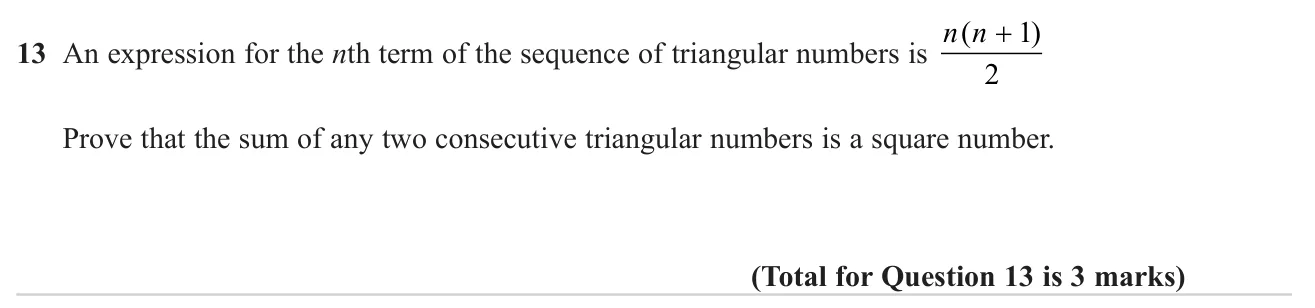
Prove algebraically that adding two consecutive triangular numbers always gives a square.

© Pearson Education Ltd. June 2023 Paper 3 (Higher, calculator), question 13.

Show answer
Answern(n+1)2+(n+1)(n+2)2=(n+1)2\frac{n(n+1)}{2} + \frac{(n+1)(n+2)}{2} = (n+1)^23 marks

Worked solution Checked against the mark scheme

The next triangular number is (n+1)(n+2)2\dfrac{(n+1)(n+2)}{2}.

Sum: n(n+1)+(n+1)(n+2)2=(n+1)(n+n+2)2\dfrac{n(n+1) + (n+1)(n+2)}{2} = \dfrac{(n+1)(n + n + 2)}{2}

=(n+1)(2n+2)2=(n+1)(n+1)=(n+1)2= \dfrac{(n+1)(2n+2)}{2} = (n+1)(n+1) = (n+1)^2

This is a square number for every nn.

Watch out: Checking a few numerical examples instead of giving a general algebraic proof.

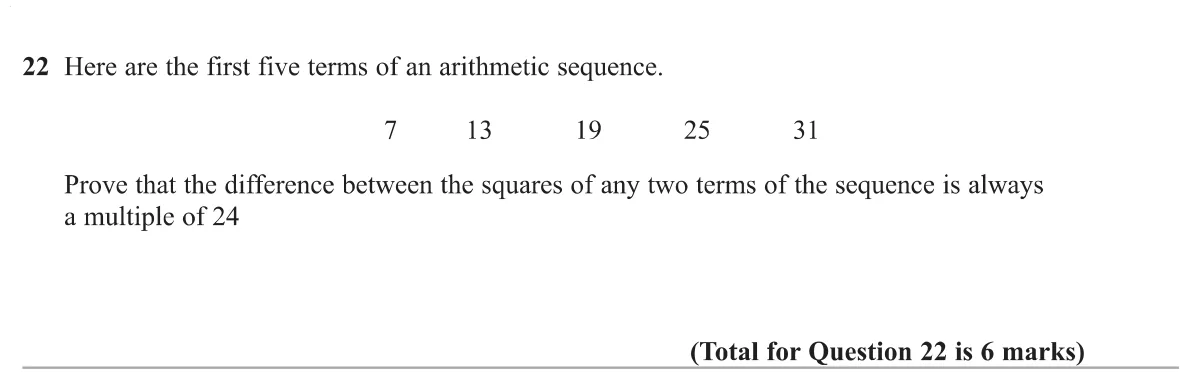
Identities and algebraic proof6 marksGrade 9CalculatorHigher
Specimen · Paper 3 Higher · Q22
Prove that the difference between the squares of any two terms of a given arithmetic sequence is always a multiple of 24.

© Pearson Education Ltd. Specimen Paper 3 (Higher, calculator), question 22.

Show answer
AnswerTerms are 6n+16n + 1; (6a+1)2−(6b+1)2=12(a−b)(3(a+b)+1)(6a+1)^2 - (6b+1)^2 = 12(a - b)(3(a + b) + 1), and (a−b)(3(a+b)+1)(a - b)(3(a + b) + 1) is always even, so the difference is a multiple of 246 marks

Worked solution Checked against the mark scheme

The nnth term is 6n+16n + 1. Take two terms 6a+16a + 1 and 6b+16b + 1.

(6a+1)2−(6b+1)2=36a2+12a−36b2−12b(6a + 1)^2 - (6b + 1)^2 = 36a^2 + 12a - 36b^2 - 12b

=12(3a2−3b2+a−b)=12(a−b)(3a+3b+1)= 12(3a^2 - 3b^2 + a - b) = 12(a - b)(3a + 3b + 1)

If aa and bb are both odd or both even, a−ba - b is even.

If one is odd and one even, a+ba + b is odd, so 3(a+b)3(a + b) is odd and 3(a+b)+13(a + b) + 1 is even.

Either way (a−b)(3a+3b+1)(a - b)(3a + 3b + 1) is even, so the difference is 12×12 \times even =24k= 24k: a multiple of 24.

Watch out: Stopping at a multiple of 12 without showing the other factor is even.

Also tested in these questions

Their main topic is different, but part of each one tests this topic.