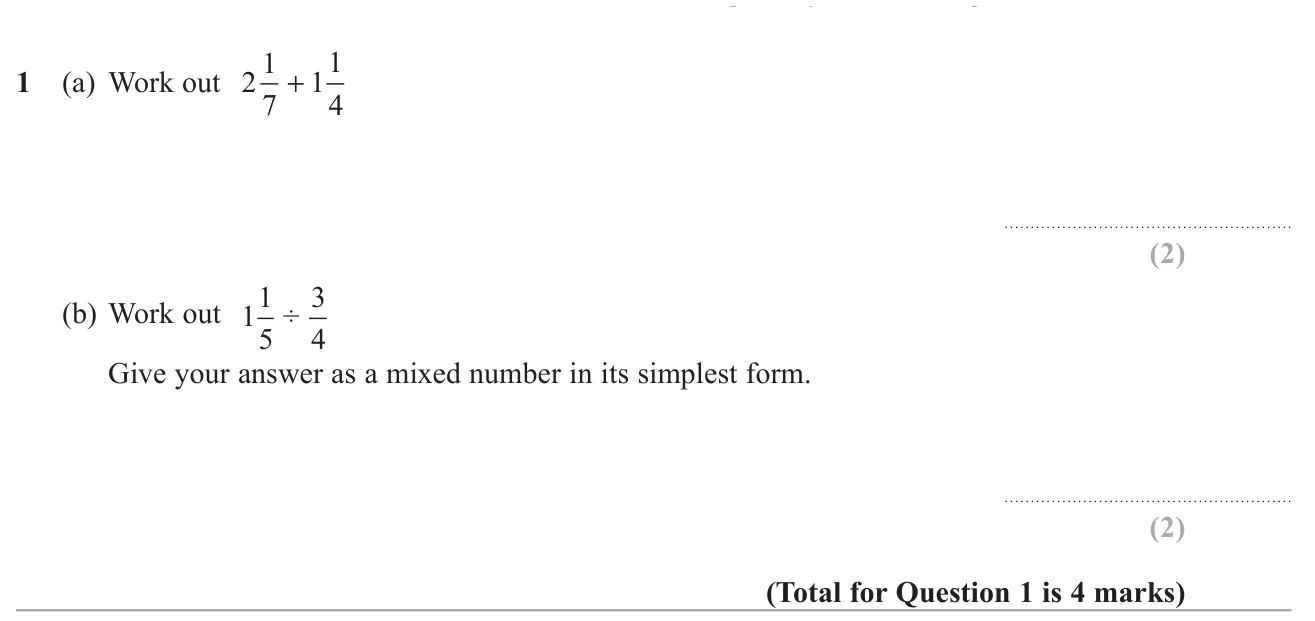
Question 1
Fractions4 marksGrade 4No calculatorOn both tiers © Pearson Education Ltd. June 2018 Paper 1 (Higher, non-calculator), question 1.
Show answer
| (a) | 32811 | 2 marks |
|---|
| (b) | 153 | 2 marks |
|---|
Worked solution Checked against the mark scheme
(a) Whole numbers: 2+1=3. Fractions: 71+41=284+287=2811
Answer 32811
(b) 151=56, then 56×34=1524=58=153
Watch out: In (b), dividing without flipping the second fraction.
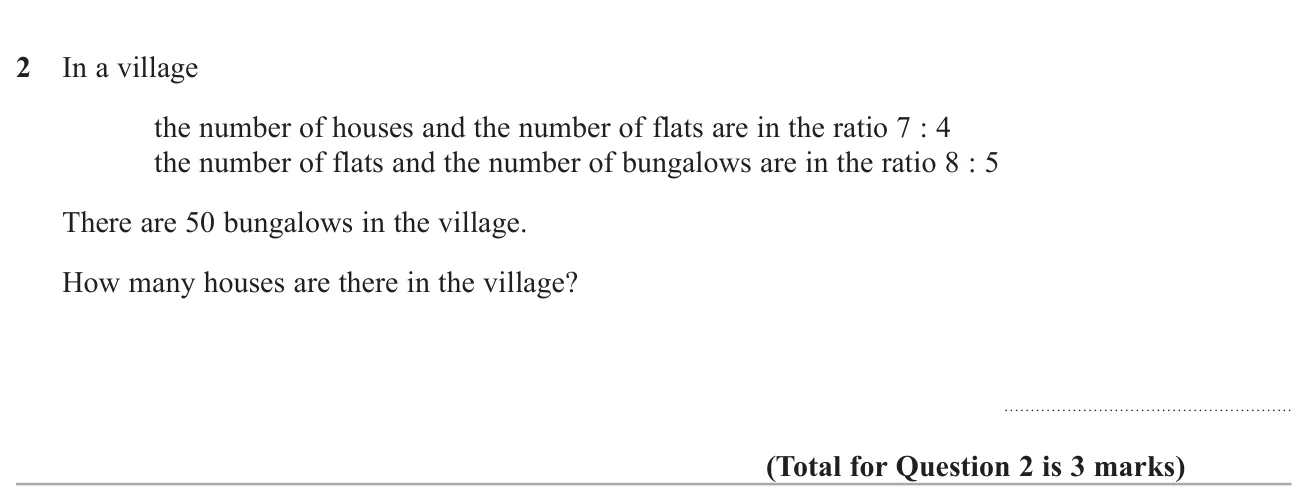
Question 2
Ratio3 marksGrade 5No calculator © Pearson Education Ltd. June 2018 Paper 1 (Higher, non-calculator), question 2.
Show answer
Worked solution Checked against the mark scheme
Make the flats match: houses : flats =7:4=14:8, so houses : flats : bungalows =14:8:5.
5 parts =50, so 1 part =10.
Houses =14×10=140
Watch out: Adding the ratios without matching the flats term.
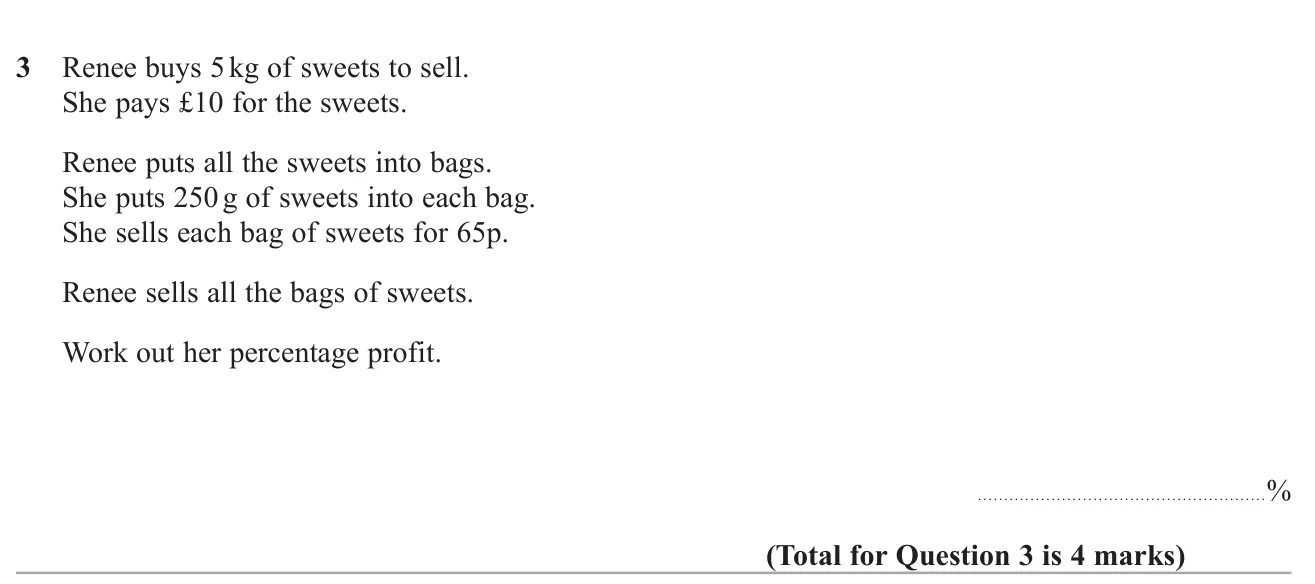
© Pearson Education Ltd. June 2018 Paper 1 (Higher, non-calculator), question 3.
Show answer
Worked solution Checked against the mark scheme
5 kg=5000 g, so there are 5000÷250=20 bags.
Takings: 20×£0.65=£13
Profit =£13−£10=£3
Percentage profit =103×100=30%
Watch out: Giving 130%, the takings as a percentage of the cost, rather than the profit.
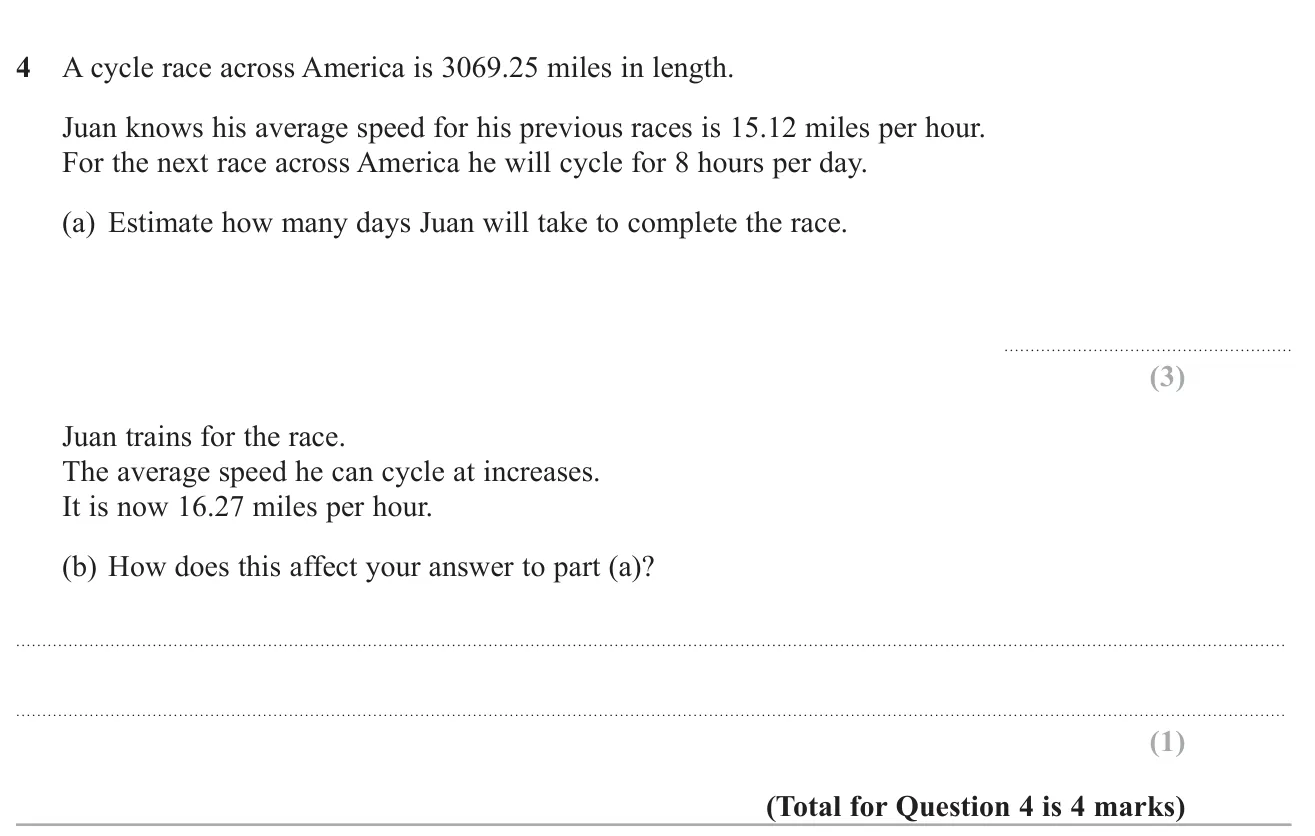
© Pearson Education Ltd. June 2018 Paper 1 (Higher, non-calculator), question 4.
Show answer
| (a) | about 25 days (e.g. 3000÷15÷8) | 3 marks |
|---|
| (b) | Fewer days would be needed (or no change if the speed still rounds to the same value) | 1 mark |
|---|
Worked solution Checked against the mark scheme
(a) Round: distance ≈3000 miles, speed ≈15 mph.
Hours ≈3000÷15=200
Days ≈200÷8=25
(b) He rides faster, so each day covers more miles and the race takes fewer days.
Watch out: Using the exact figures instead of rounding, so no estimate is shown.
© Pearson Education Ltd. June 2018 Paper 1 (Higher, non-calculator), question 5.
Show answer
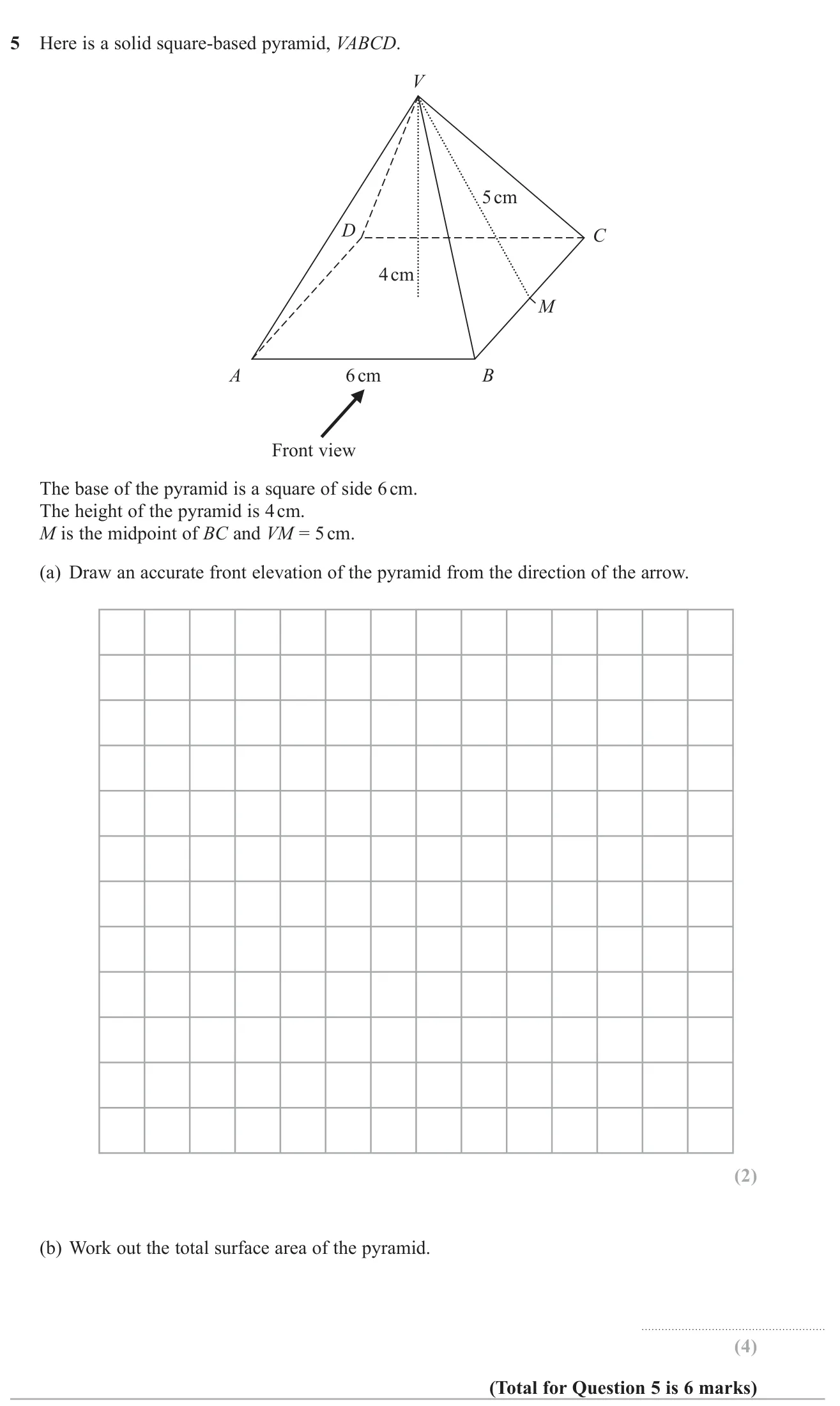
| (a) | An isosceles triangle with base 6 cm and height 4 cm | 2 marks |
|---|
| (b) | 96 cm2 | 4 marks |
|---|
Worked solution Checked against the mark scheme
(a) From the front you see a triangle: base 6 cm, height 4 cm, apex above the middle of the base.
(b) Each sloping face is a triangle with base 6 and slant height 5: 21×6×5=15 cm2
Base =6×6=36 cm2
Total =4×15+36=96 cm2
Watch out: Using the vertical height 4 cm instead of the slant height 5 cm for the triangles (giving 84).
© Pearson Education Ltd. June 2018 Paper 1 (Higher, non-calculator), question 6.
Show answer
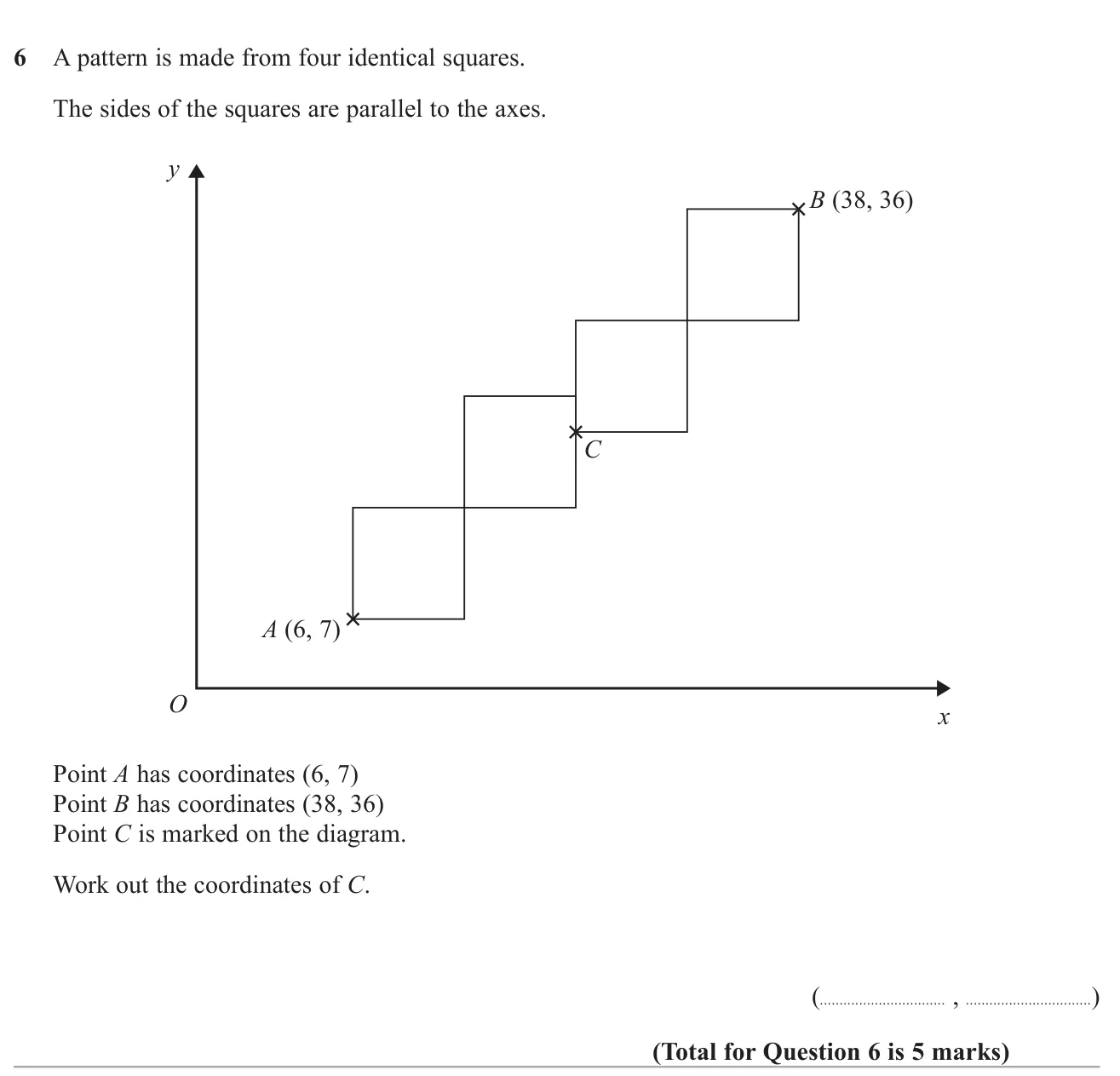
| Answer | (22,20) | 5 marks |
|---|
Worked solution Checked against the mark scheme
Total width =38−6=32. The four squares sit side by side across, so each side is 32÷4=8.
C is two squares to the right of A: x=6+2×8=22
C is two squares below the top of B: y=36−2×8=20
So C is (22,20).
Watch out: Dividing the height 29 by 4, but the squares overlap vertically so that does not give the side length.
© Pearson Education Ltd. June 2018 Paper 1 (Higher, non-calculator), question 7.
Show answer
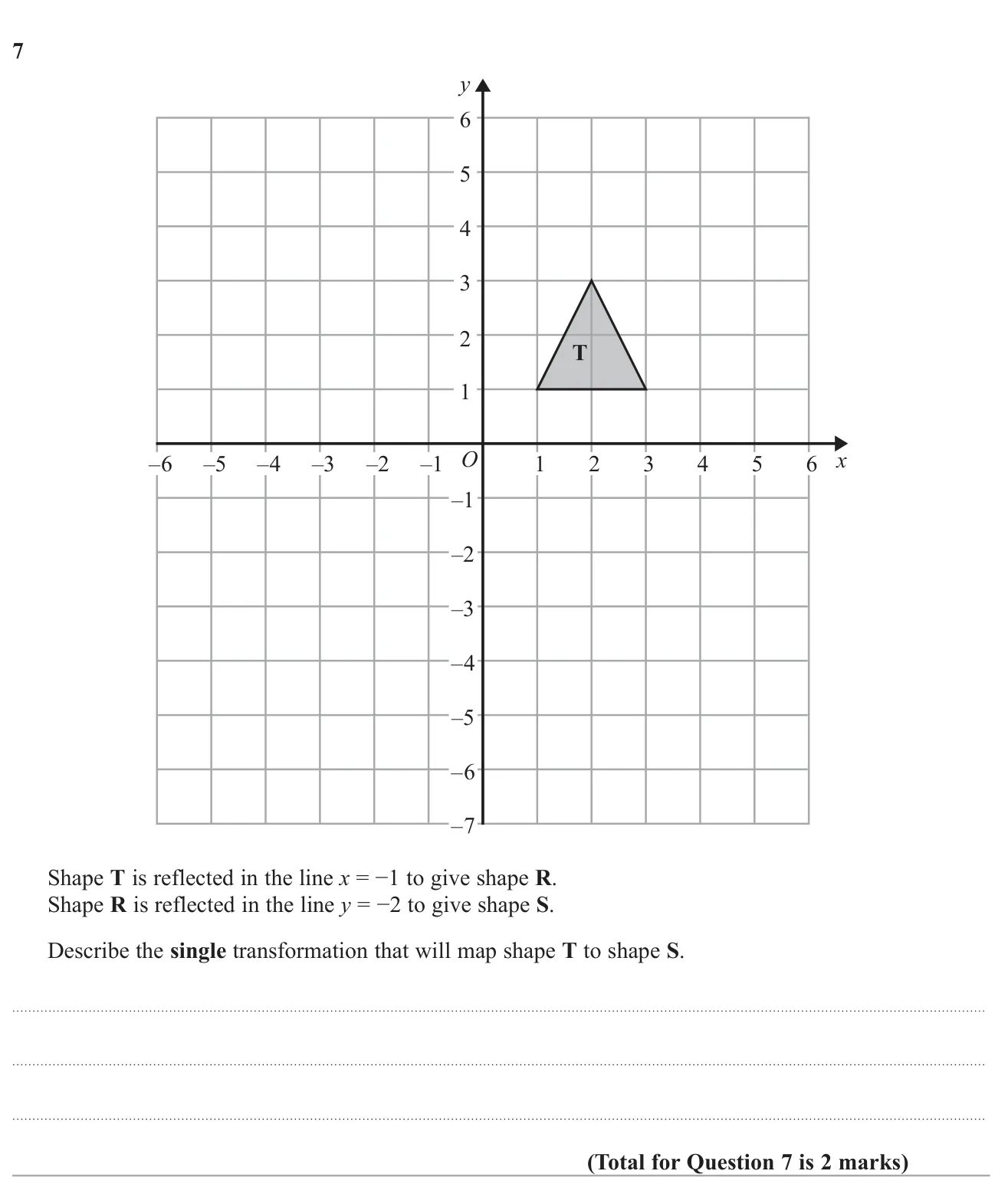
| Answer | Rotation 180∘ about (−1,−2) (or enlargement, scale factor −1, centre (−1,−2)) | 2 marks |
|---|
Worked solution Checked against the mark scheme
Reflect T in x=−1 to get R, then reflect R in y=−2 to get S.
Two reflections in perpendicular lines make a half turn about the point where the lines cross.
The lines meet at (−1,−2), so T to S is a rotation of 180∘ about (−1,−2).
Watch out: Describing two transformations, or writing 'half turn' without the angle and centre.
© Pearson Education Ltd. June 2018 Paper 1 (Higher, non-calculator), question 8.
Show answer
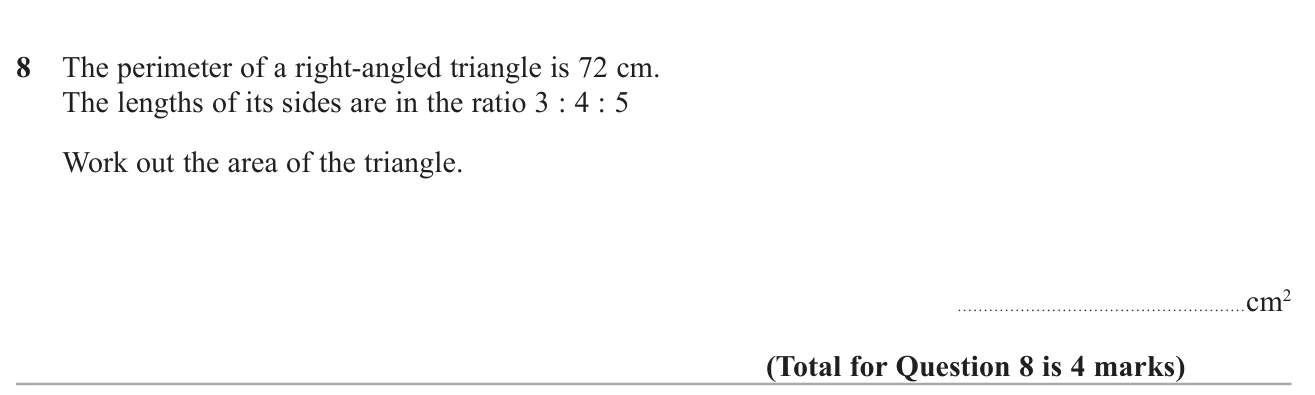
| Answer | 216 cm2 | 4 marks |
|---|
Worked solution Checked against the mark scheme
3+4+5=12 parts, so 1 part =72÷12=6 cm.
Sides: 18, 24 and 30 cm. The right angle is between 18 and 24.
Area =21×18×24=216 cm2
Watch out: Using the hypotenuse (30 cm) as the base or height.
© Pearson Education Ltd. June 2018 Paper 1 (Higher, non-calculator), question 9.
Show answer
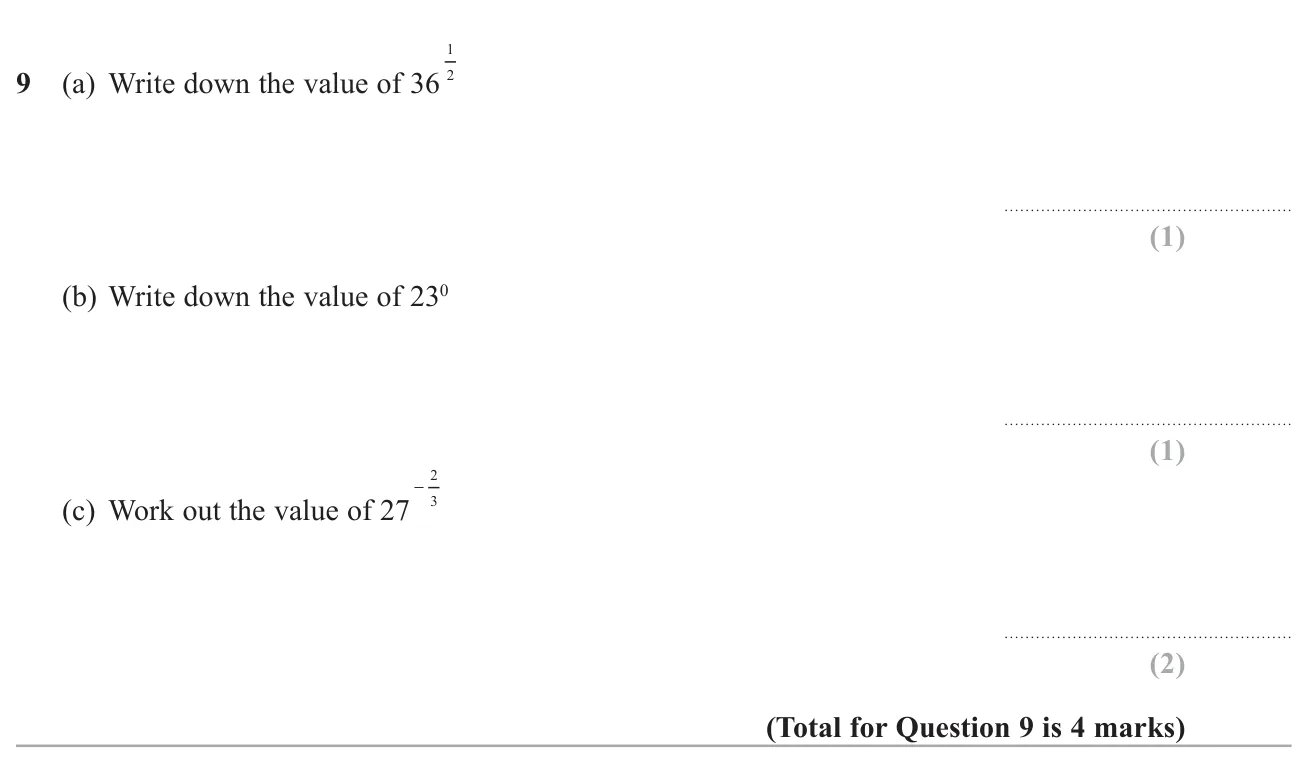
| (a) | 6 | 1 mark |
|---|
| (b) | 1 | 1 mark |
|---|
| (c) | 91 | 2 marks |
|---|
Worked solution Checked against the mark scheme
(a) 3621=36=6
(b) Any non-zero number to the power 0 is 1, so 20=1
(c) 27−32=27321=(327)21=321=91
Watch out: Writing 20=0 or 20=2.
© Pearson Education Ltd. June 2018 Paper 1 (Higher, non-calculator), question 10.
Show answer
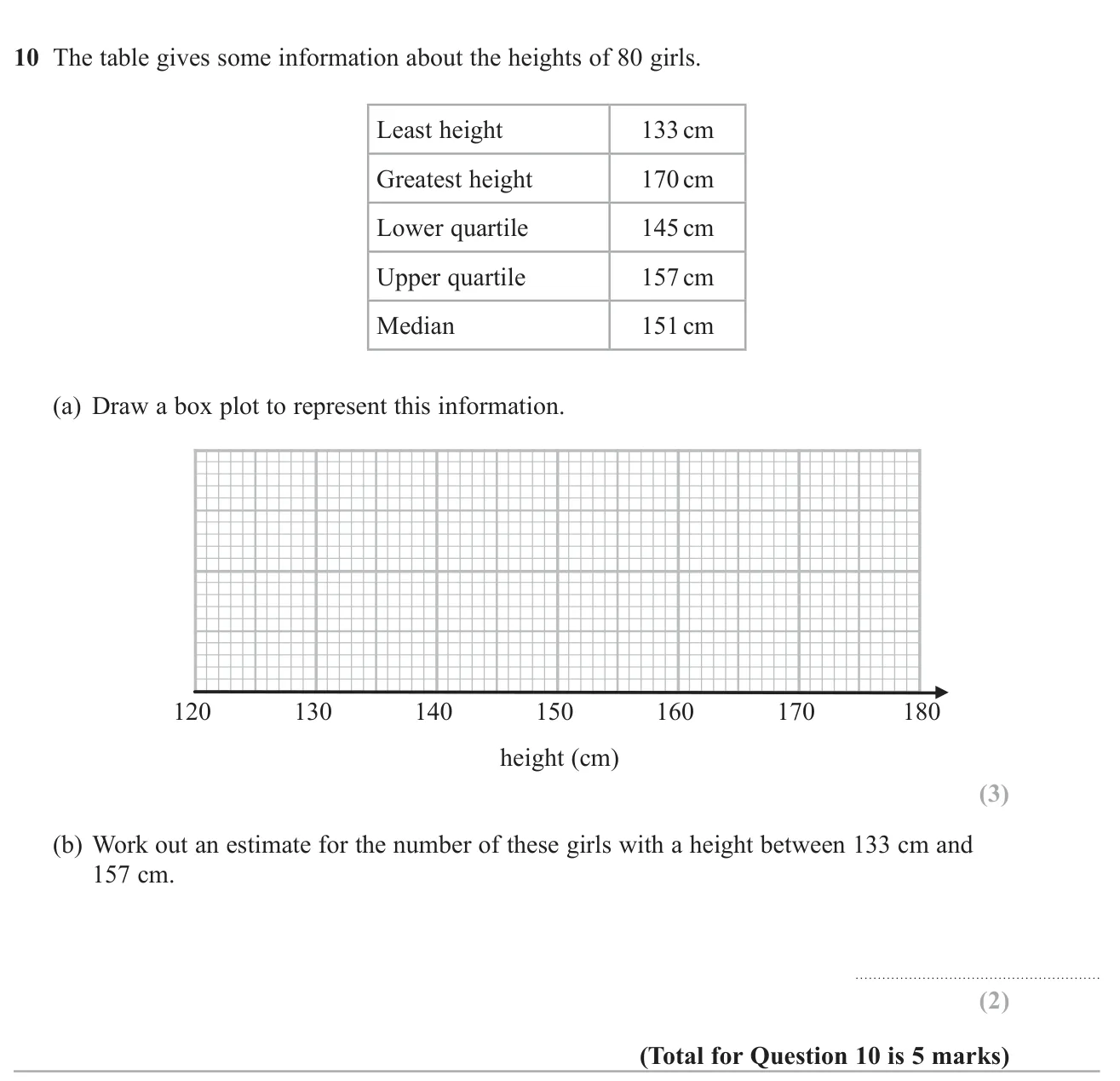
| (a) | Box plot: whiskers to 133 and 170, box from 145 to 157, median line at 151 | 3 marks |
|---|
| (b) | 60 | 2 marks |
|---|
Worked solution Checked against the mark scheme
(a) Draw whiskers from 133 to 145 and from 157 to 170; draw a box from 145 to 157 with a line at 151.
(b) From the minimum to the upper quartile covers three quarters of the data.
43×80=60 girls
Watch out: In (b), using the heights themselves (157 − 133) instead of the quartile proportions.
© Pearson Education Ltd. June 2018 Paper 1 (Higher, non-calculator), question 11.
Show answer
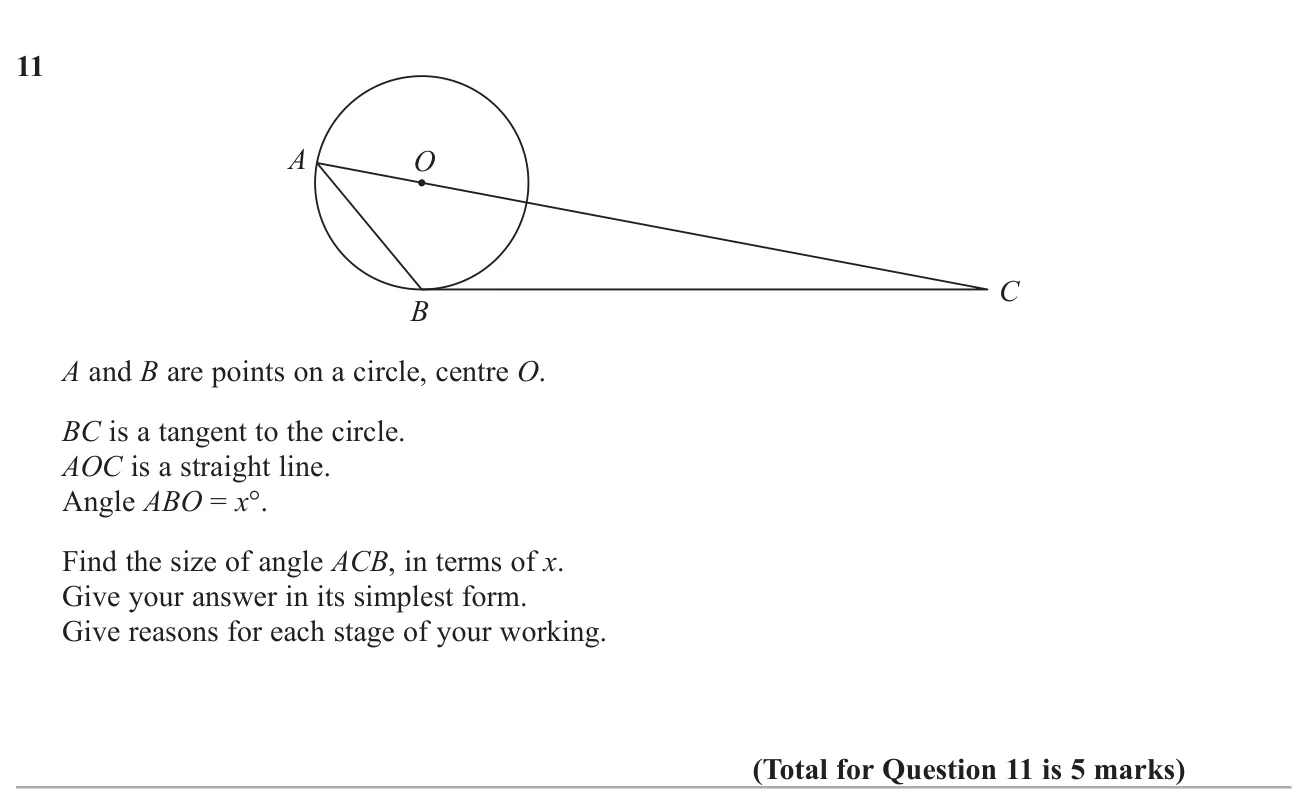
| Answer | 90−2x | 5 marks |
|---|
Worked solution Checked against the mark scheme
OA=OB (radii), so triangle OAB is isosceles: angle BAO=x (base angles of an isosceles triangle are equal).
Angle OBC=90∘ (a tangent meets a radius at 90∘), so angle ABC=90+x.
In triangle ABC the angles add to 180∘: angle ACB=180−x−(90+x)=90−2x
Watch out: Stating the answer without the reasons, or giving vague reasons such as 'isosceles' without saying which angles are equal.
© Pearson Education Ltd. June 2018 Paper 1 (Higher, non-calculator), question 12.
Show answer
| Answer | (2n+1)2=4n2+4n+1=4(n2+n)+1 | 4 marks |
|---|
Worked solution Checked against the mark scheme
Let an odd number be 2n+1, where n is an integer.
(2n+1)2=4n2+4n+1=4(n2+n)+1
4(n2+n) is a multiple of 4, so the square is 1 more than a multiple of 4.
Watch out: Checking a few numbers instead of using algebra, or writing the odd number as n+1.
Question 13
Surds3 marksGrade 7No calculator © Pearson Education Ltd. June 2018 Paper 1 (Higher, non-calculator), question 13.
Show answer
Worked solution Checked against the mark scheme
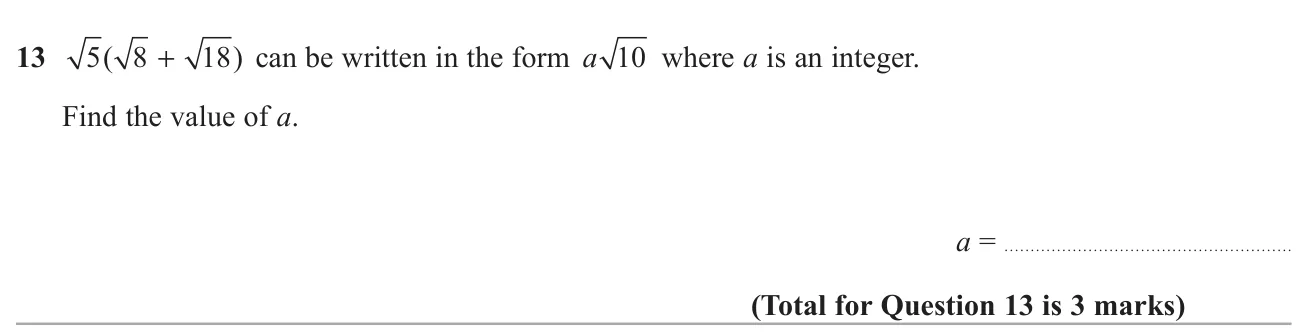
8=22 and 18=32, so 8+18=52
5×52=510
So a=5
Watch out: Adding the numbers under the roots: 8+18=26.
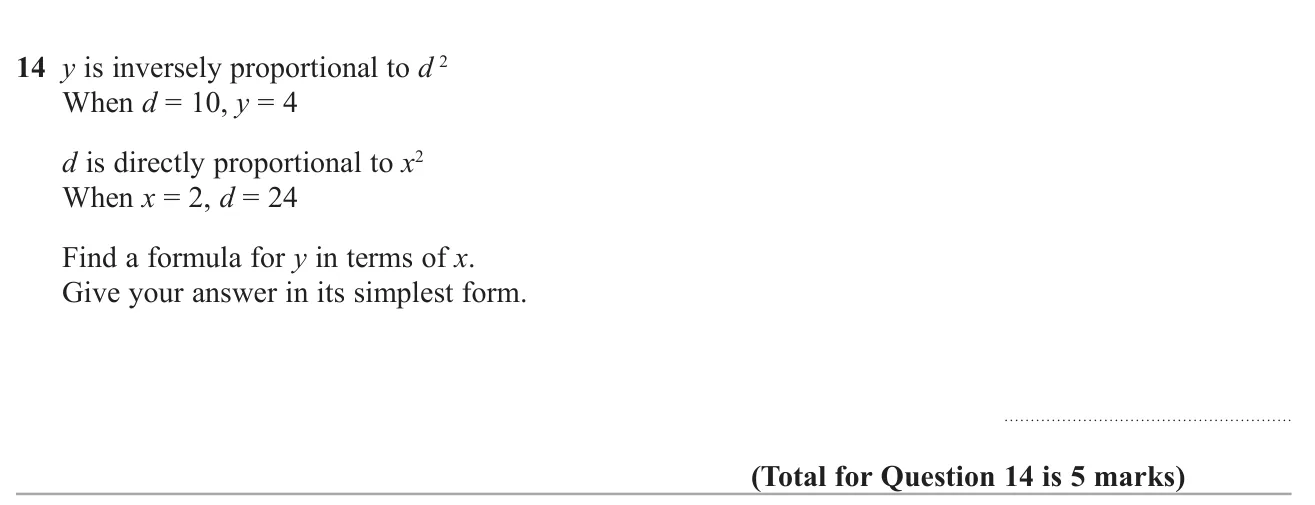
© Pearson Education Ltd. June 2018 Paper 1 (Higher, non-calculator), question 14.
Show answer
| Answer | y=9x4100 | 5 marks |
|---|
Worked solution Checked against the mark scheme
y=d2K: 4=100K, so K=400
d=kx2: 24=k×4, so k=6 and d=6x2
y=(6x2)2400=36x4400=9x4100
Watch out: Squaring 6x2 as 6x4 instead of 36x4.
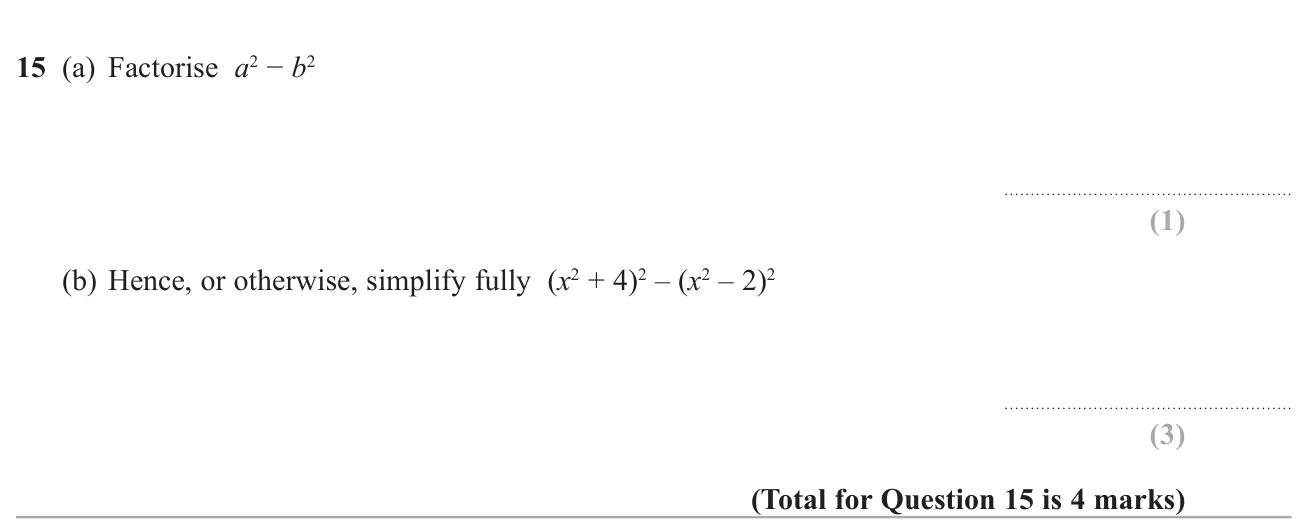
© Pearson Education Ltd. June 2018 Paper 1 (Higher, non-calculator), question 15.
Show answer
| (a) | (a−b)(a+b) | 1 mark |
|---|
| (b) | 12(x2+1) | 3 marks |
|---|
Worked solution Checked against the mark scheme
(a) a2−b2=(a−b)(a+b)
(b) Let a=x2+4 and b=x2−2.
a+b=2x2+2 and a−b=6
(a+b)(a−b)=6(2x2+2)=12x2+12=12(x2+1)
Watch out: Not changing the sign of the −2 when subtracting the second bracket.
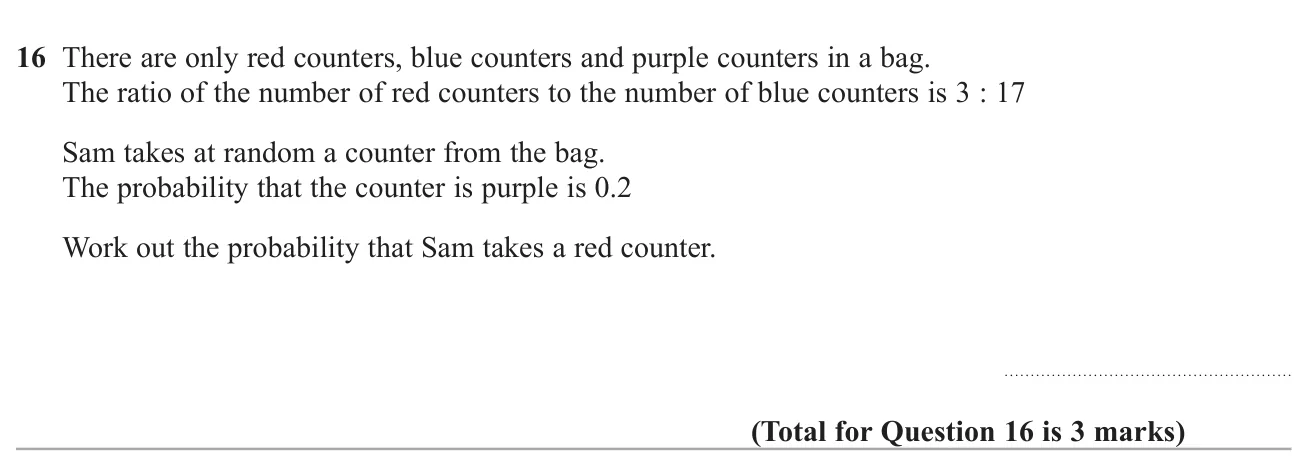
© Pearson Education Ltd. June 2018 Paper 1 (Higher, non-calculator), question 16.
Show answer
Worked solution Checked against the mark scheme
Red or blue: 1−0.2=0.8
Red : blue =3:17, so 20 parts share 0.8, and 1 part =0.8÷20=0.04
P(red) =3×0.04=0.12
Watch out: Giving 203, forgetting that purple takes 0.2 of the probability.
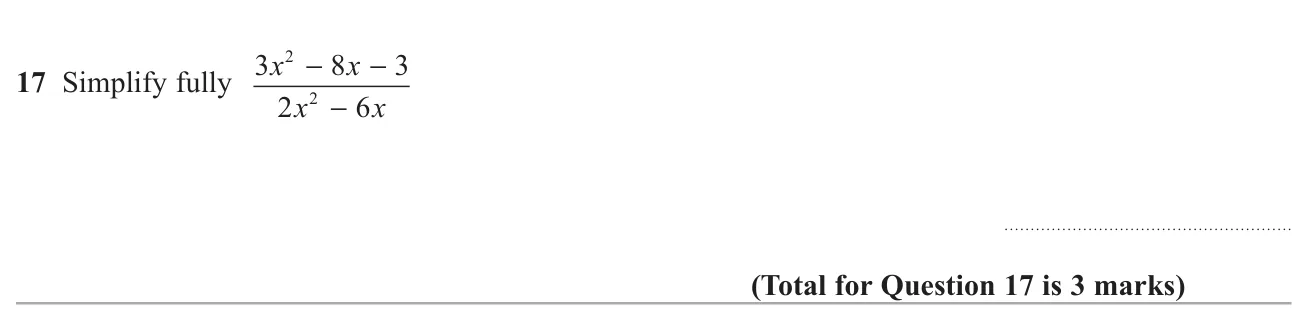
© Pearson Education Ltd. June 2018 Paper 1 (Higher, non-calculator), question 17.
Show answer
| Answer | 2x3x+1 | 3 marks |
|---|
Worked solution Checked against the mark scheme
Numerator: 3x2−8x−3=(3x+1)(x−3)
Denominator: 2x2−6x=2x(x−3)
Cancel (x−3): 2x3x+1
Watch out: Cancelling single terms such as the x2 before factorising.
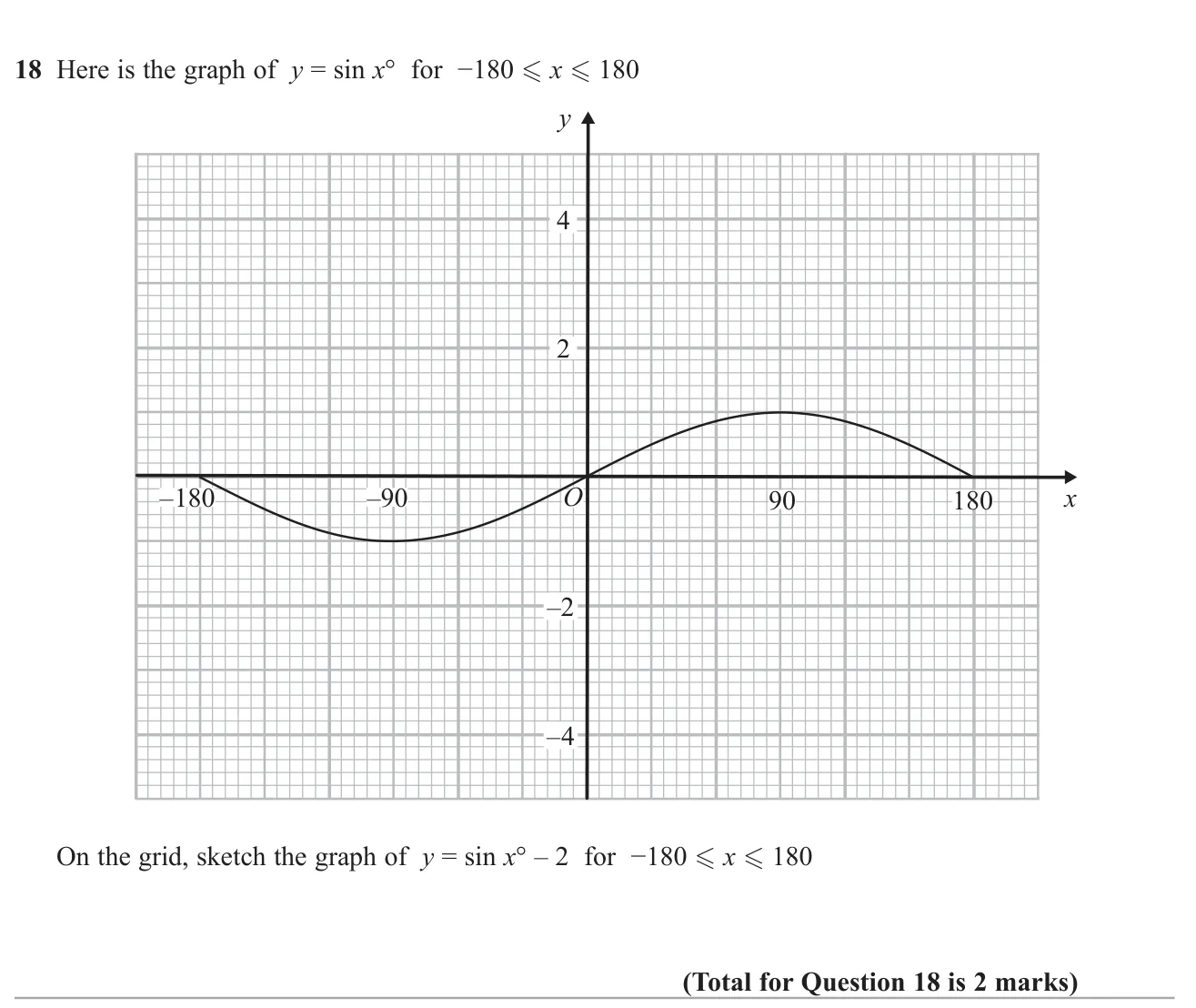
© Pearson Education Ltd. June 2018 Paper 1 (Higher, non-calculator), question 18.
Show answer
| Answer | The sine curve moved down 2, through (−180,−2), (−90,−3), (0,−2), (90,−1), (180,−2) | 2 marks |
|---|
Worked solution Checked against the mark scheme
Subtracting 2 moves every point of y=sinx down by 2.
Key points: (−180,−2), (−90,−3), (0,−2), (90,−1), (180,−2)
Join them with a smooth wave.
Watch out: Moving the graph 2 to the left or right instead of down.
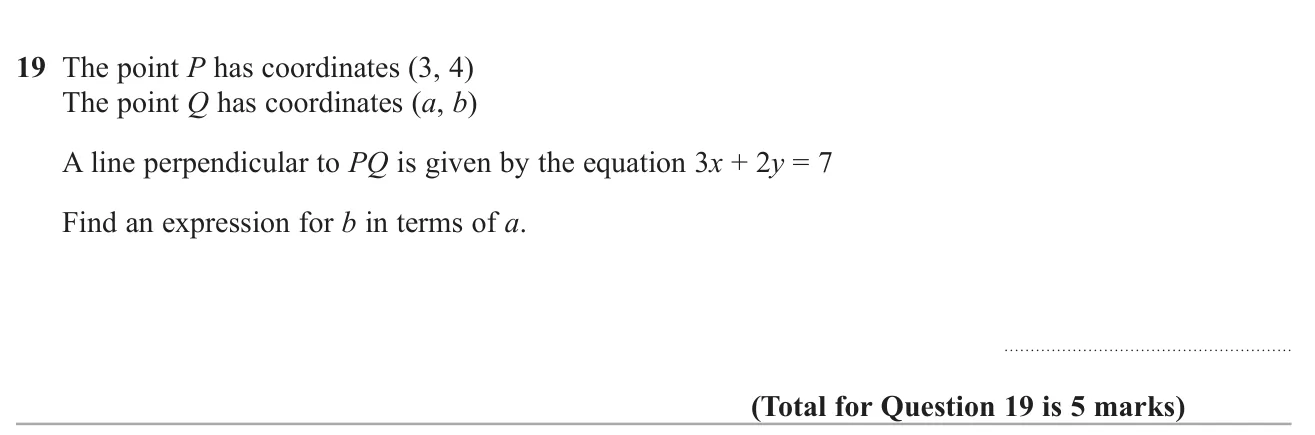
© Pearson Education Ltd. June 2018 Paper 1 (Higher, non-calculator), question 19.
Show answer
| Answer | b=32a+2 | 5 marks |
|---|
Worked solution Checked against the mark scheme
3x+2y=7⇒y=−23x+27, gradient −23
PQ is perpendicular, so its gradient is 32
a−3b−4=32⇒b−4=32(a−3)=32a−2
b=32a+2
Watch out: Taking the gradient as 3 (reading the x coefficient) instead of rearranging for y.
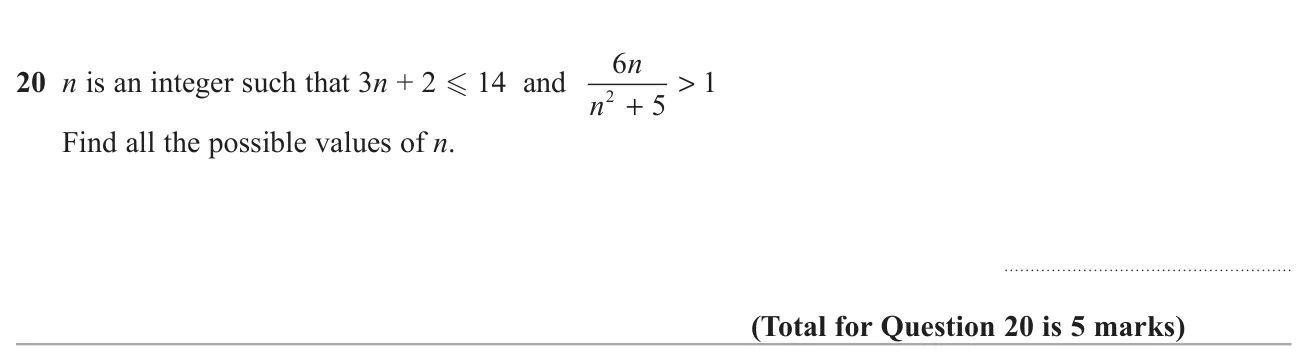
© Pearson Education Ltd. June 2018 Paper 1 (Higher, non-calculator), question 20.
Show answer
Worked solution Checked against the mark scheme
3n+2≤14⇒3n≤12⇒n≤4
n2+5 is always positive, so n2+56n>1⇒6n>n2+5⇒n2−6n+5<0
(n−1)(n−5)<0⇒1<n<5
Both together: 1<n≤4, so n=2,3,4
Watch out: Including n=1, where the fraction equals 1 exactly, not more than 1.
Finished the paper?
Add up your marks for all three papers and see what grade that would have been.