Edexcel GCSE Maths · 1MA1

November 2018 Paper 3 Higher

Calculator · 20 questions · 80 marks · 1 hour 30 minutes. Try each question on paper, then press "Show answer".

Question 1

Rounding and estimation3 marksGrade 3CalculatorOn both tiers
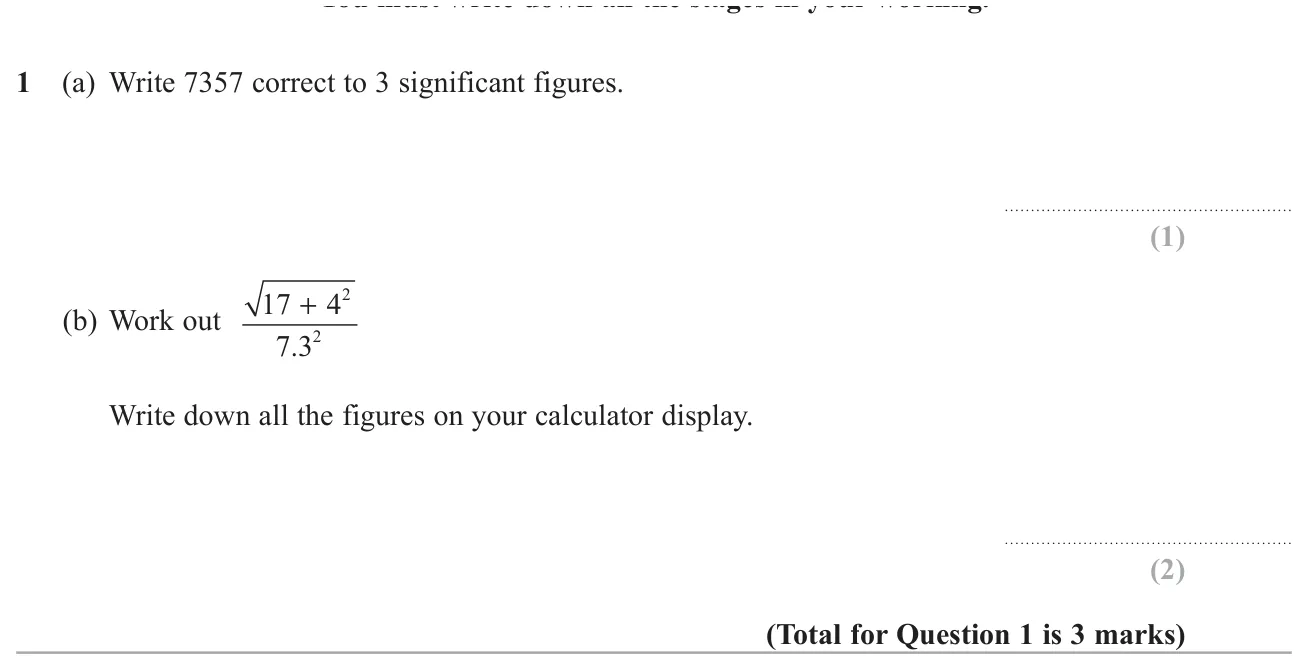
Round a number to 3 significant figures and evaluate a calculation with a square root and powers on a calculator.

© Pearson Education Ltd. November 2018 Paper 3 (Higher, calculator), question 1.

Show answer
(a)736073601 mark
(b)0.10779813560.10779813562 marks

Worked solution Checked against the mark scheme

(a) The 4th figure is 7, so round up: 7357→73607357 \to 7360

(b) Top: 17+16=33=5.7445…\sqrt{17 + 16} = \sqrt{33} = 5.7445\ldots

Bottom: 7.32=53.297.3^2 = 53.29

5.7445…÷53.29=0.10779813565.7445\ldots \div 53.29 = 0.1077981356

Watch out: In (a), writing 736 and losing the place value.
Question 2

Percentage change and reverse percentages3 marksGrade 4CalculatorOn both tiers
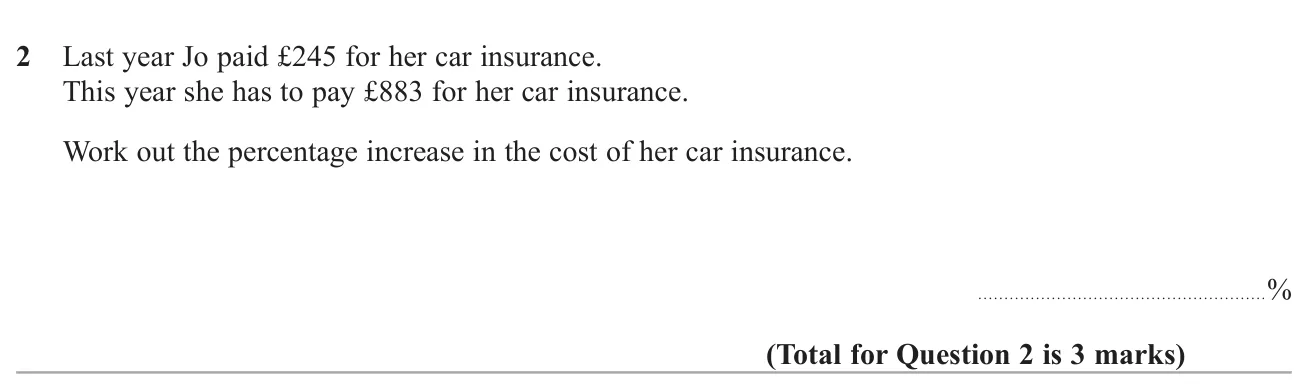
Work out a percentage increase between two yearly costs.

© Pearson Education Ltd. November 2018 Paper 3 (Higher, calculator), question 2.

Show answer
Answer260.4%260.4\%3 marks

Worked solution Checked against the mark scheme

Increase: 883−245=638883 - 245 = 638

Percentage increase: 638245×100=260.4%\frac{638}{245} \times 100 = 260.4\%

Watch out: Dividing by the new price (883) instead of the original.

Question 3

Quadratic graphs5 marksGrade 4CalculatorOn both tiers
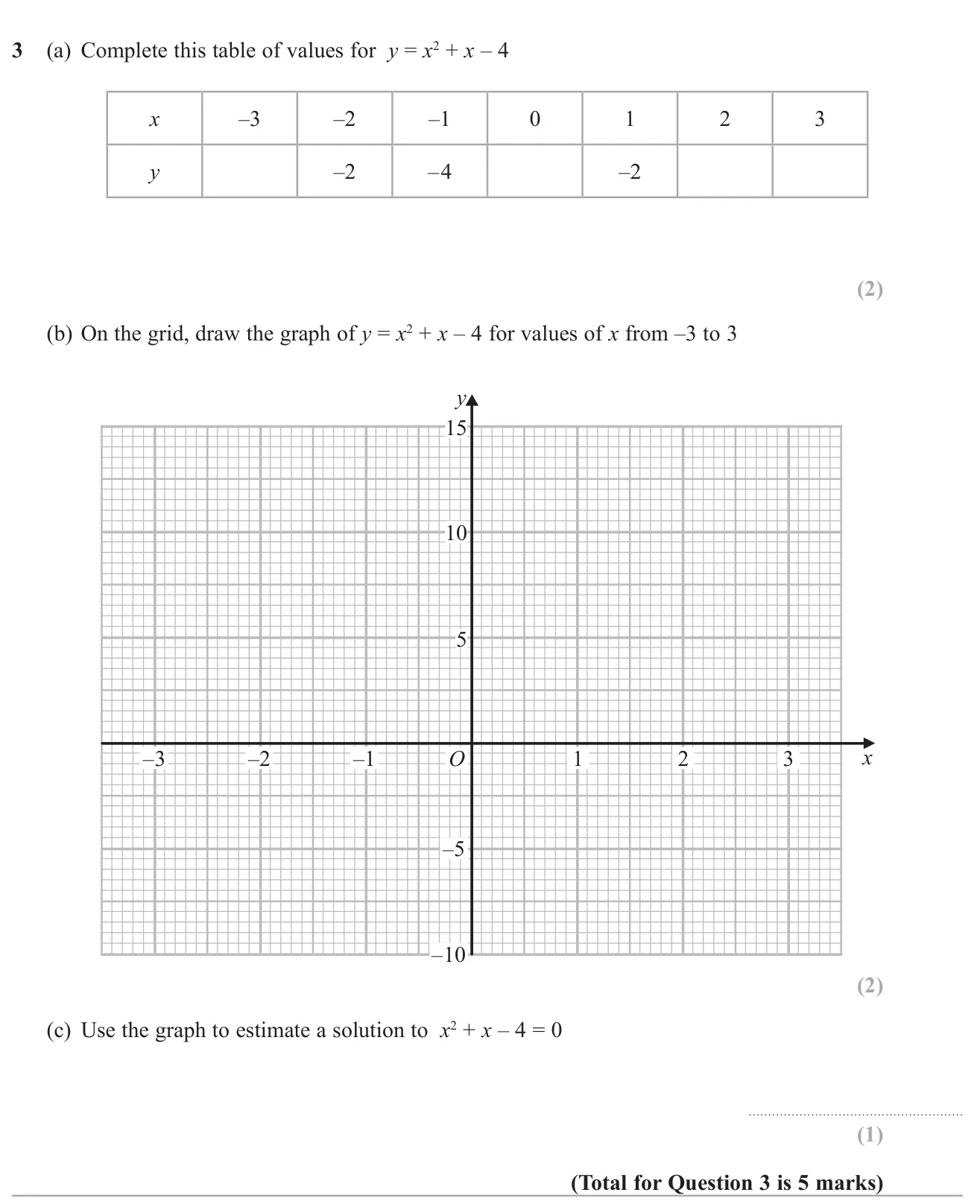
Complete a table of values for a quadratic, draw its graph and use it to estimate a root.

© Pearson Education Ltd. November 2018 Paper 3 (Higher, calculator), question 3.

Show answer
(a)2,−4,2,82, -4, 2, 8 (for x=−3,−1,2,3x = -3, -1, 2, 3)2 marks
(b)Smooth U-shaped curve through the points2 marks
(c)x≈1.6x \approx 1.6 or x≈−2.6x \approx -2.61 mark

Worked solution Checked against the mark scheme

(a) x=−3x = -3: 9−3−4=29 - 3 - 4 = 2; x=−1x = -1: 1−1−4=−41 - 1 - 4 = -4; x=2x = 2: 4+2−4=24 + 2 - 4 = 2; x=3x = 3: 9+3−4=89 + 3 - 4 = 8

(b) Plot all seven points and join with a smooth curve, dipping just below −4-4 between x=−1x = -1 and x=0x = 0.

(c) The roots are where the curve crosses the xx-axis: about 1.61.6 or −2.6-2.6

Watch out: In (a), working out −32-3^2 as −9-9.

Question 4

Averages and spread6 marksGrade 4CalculatorOn both tiers
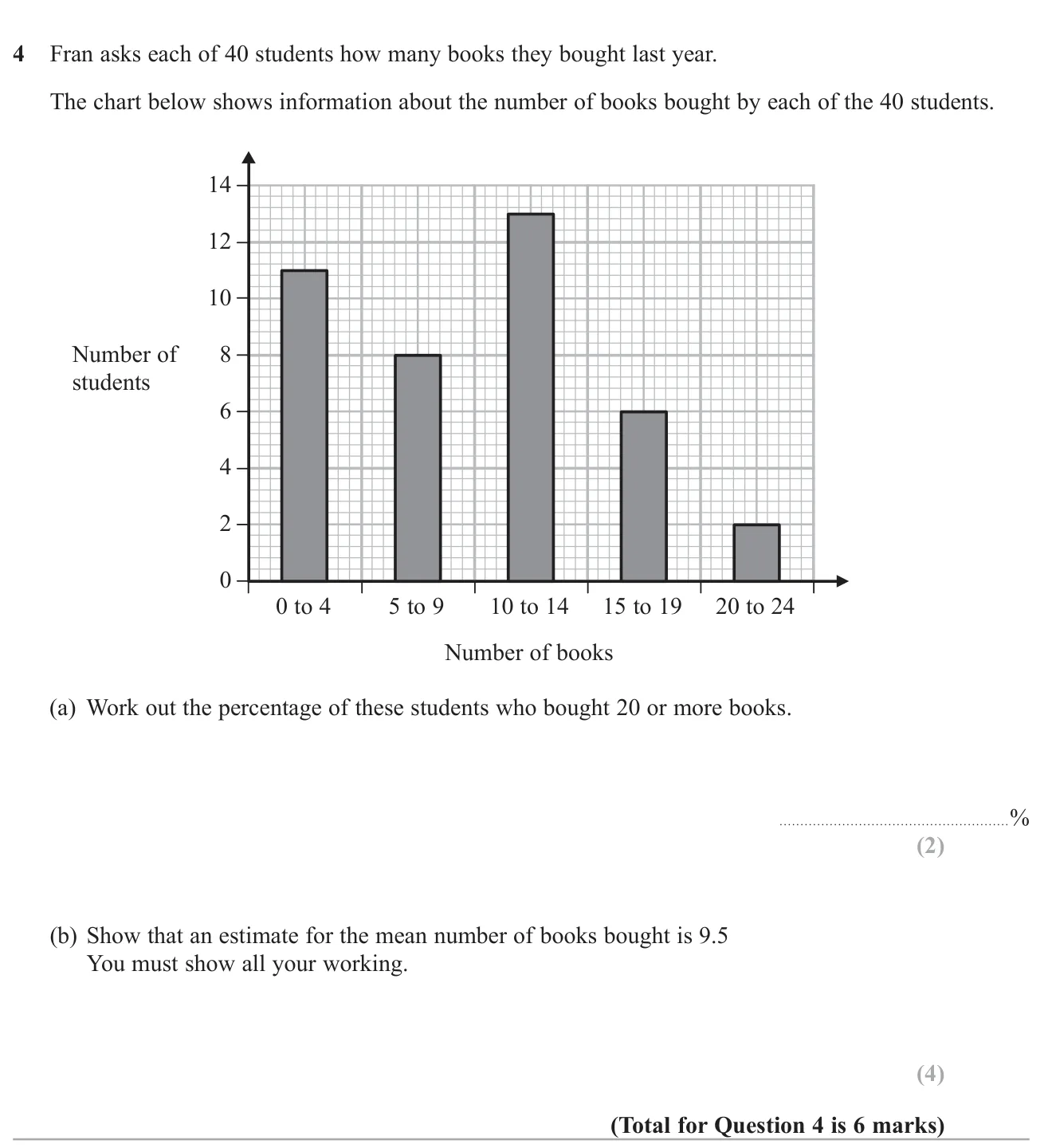
Read a grouped bar chart to find a percentage, then show an estimate of the mean from grouped data.

© Pearson Education Ltd. November 2018 Paper 3 (Higher, calculator), question 4.

Show answer
(a)5%5\%2 marks
(b)380÷40=9.5380 \div 40 = 9.54 marks

Worked solution Checked against the mark scheme

(a) 2 students bought 20 to 24 books: 240×100=5%\frac{2}{40} \times 100 = 5\%

(b) Frequencies 11, 8, 13, 6, 2 and midpoints 2, 7, 12, 17, 22

11×2+8×7+13×12+6×17+2×22=22+56+156+102+44=38011 \times 2 + 8 \times 7 + 13 \times 12 + 6 \times 17 + 2 \times 22 = 22 + 56 + 156 + 102 + 44 = 380

Mean ≈380÷40=9.5\approx 380 \div 40 = 9.5

Watch out: Dividing the total by 5 (the number of groups) instead of 40.

Question 5

Speed, density and pressure4 marksGrade 4CalculatorOn both tiers
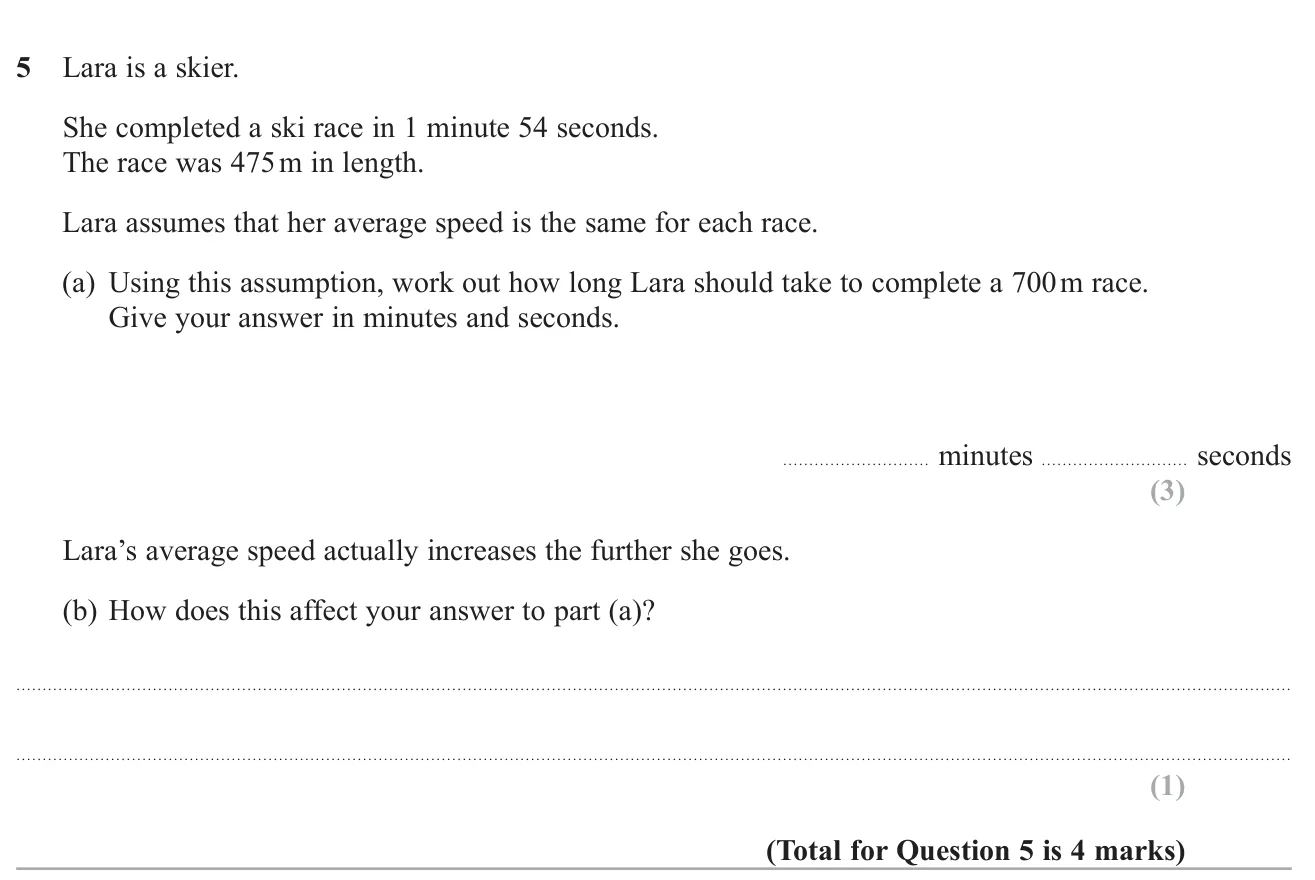
Scale a race time up to a longer distance at the same speed, then say how rising speed affects that answer.

© Pearson Education Ltd. November 2018 Paper 3 (Higher, calculator), question 5.

Show answer
(a)2 minutes 48 seconds3 marks
(b)It would take less time than the answer to (a)1 mark

Worked solution Checked against the mark scheme

(a) 1 min 54 s =114= 114 s

Time =700475×114=168= \frac{700}{475} \times 114 = 168 s

168168 s =2= 2 minutes 4848 seconds

(b) If she speeds up over a longer race, she will finish more quickly, so the real time is less than 2 min 48 s.

Watch out: Treating 1 minute 54 seconds as 1.54 minutes.

Question 6

Pythagoras and trigonometry4 marksGrade 5CalculatorOn both tiers
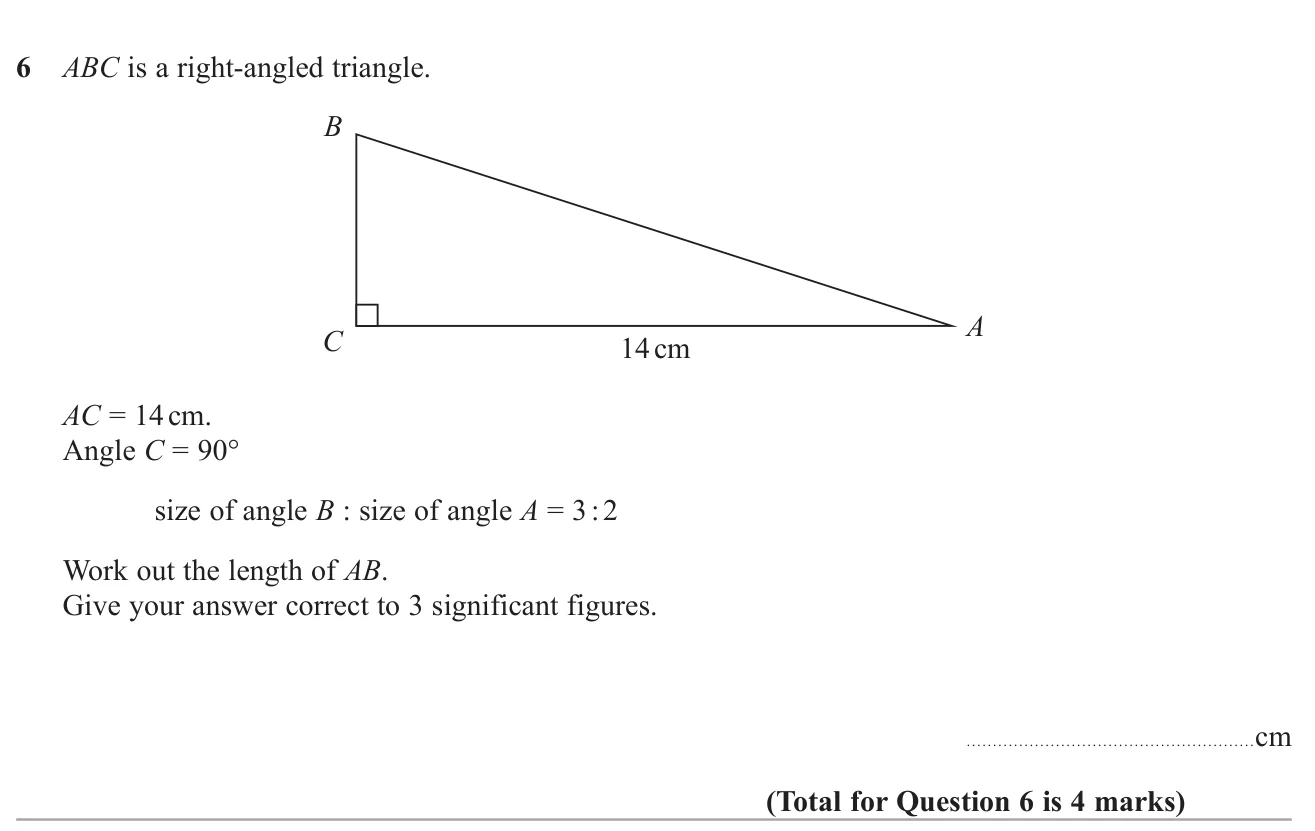
Use an angle ratio in a right-angled triangle to find the angles, then use trigonometry to find the hypotenuse.

© Pearson Education Ltd. November 2018 Paper 3 (Higher, calculator), question 6.

Show answer
Answer17.317.3 cm4 marks

Worked solution Checked against the mark scheme

Angles A and B share 180−90=90°180 - 90 = 90° in the ratio 3:23 : 2 (B : A)

One part =90÷5=18°= 90 \div 5 = 18°, so A=36°A = 36° and B=54°B = 54°

AC is next to angle A and AB is the hypotenuse: cos⁡36°=14AB\cos 36° = \frac{14}{AB}

AB=14cos⁡36°=17.3AB = \frac{14}{\cos 36°} = 17.3 cm

Watch out: Giving A the larger angle, 54°, and getting 24.1 cm.

Question 7

Charts, graphs and time series2 marksGrade 4Calculator
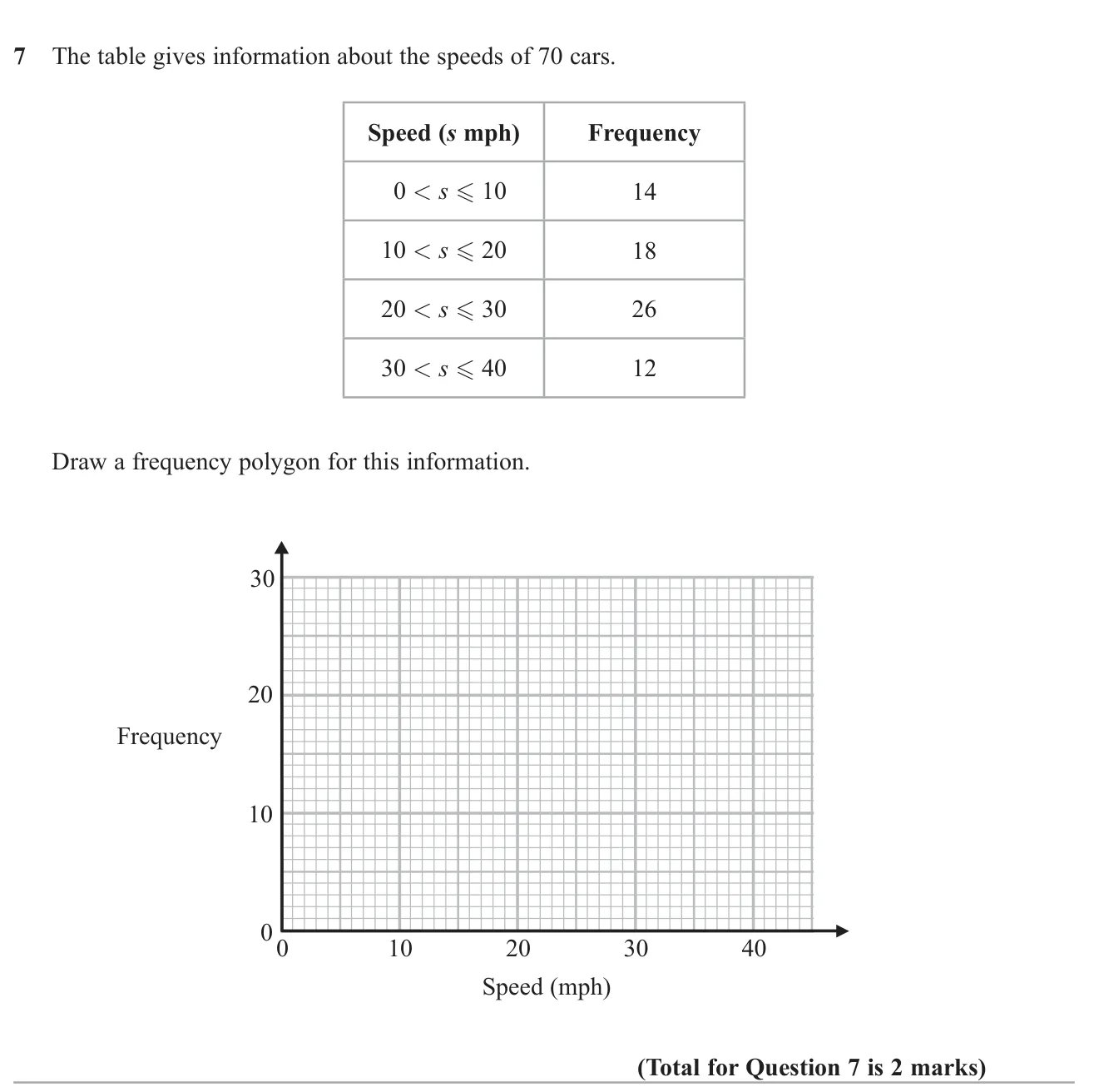
Draw a frequency polygon from a grouped frequency table of car speeds.

© Pearson Education Ltd. November 2018 Paper 3 (Higher, calculator), question 7.

Show answer
AnswerPoints at (5,14),(15,18),(25,26),(35,12)(5, 14), (15, 18), (25, 26), (35, 12) joined with straight lines2 marks

Worked solution Checked against the mark scheme

Plot each frequency above the middle of its class: 5, 15, 25 and 35.

Points: (5,14)(5, 14), (15,18)(15, 18), (25,26)(25, 26), (35,12)(35, 12)

Join them in order with straight lines. Do not join the last point back to the first.

Watch out: Plotting at the ends of the classes (10, 20, 30, 40) instead of the midpoints.

Question 8

Volume and surface area5 marksGrade 6Calculator
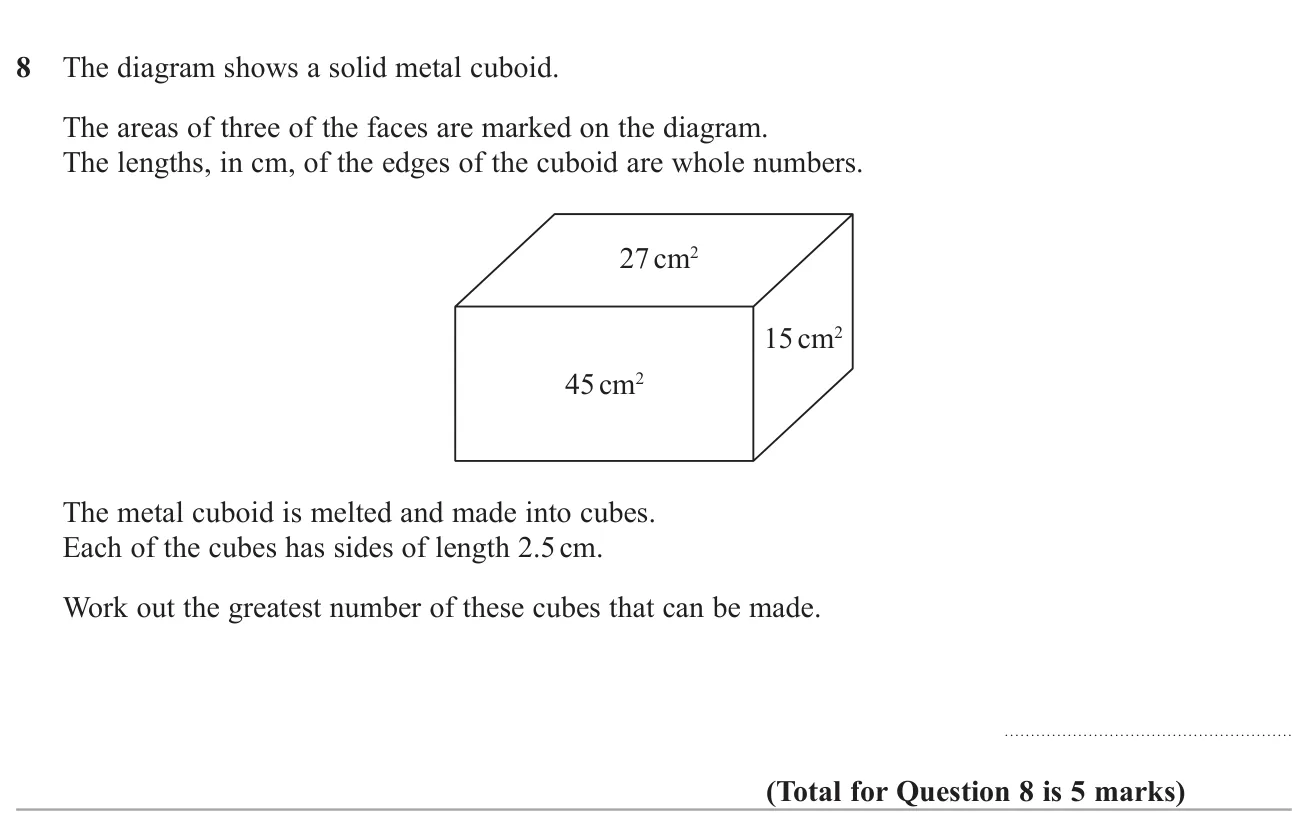
Find the whole-number edges of a cuboid from its face areas, then work out how many small cubes its melted volume would make.

© Pearson Education Ltd. November 2018 Paper 3 (Higher, calculator), question 8.

Show answer
Answer885 marks

Worked solution Checked against the mark scheme

Face areas 15, 27, 45 need edges with pair products 15, 27, 45: the edges are 3, 5 and 9 cm.

Volume of cuboid =3×5×9=135= 3 \times 5 \times 9 = 135 cm3^3

Volume of one cube =2.53=15.625= 2.5^3 = 15.625 cm3^3

135÷15.625=8.64135 \div 15.625 = 8.64, so at most 8 whole cubes.

Watch out: Rounding 8.64 up to 9.

Question 9

Expanding brackets and simplifying8 marksGrade 7Calculator
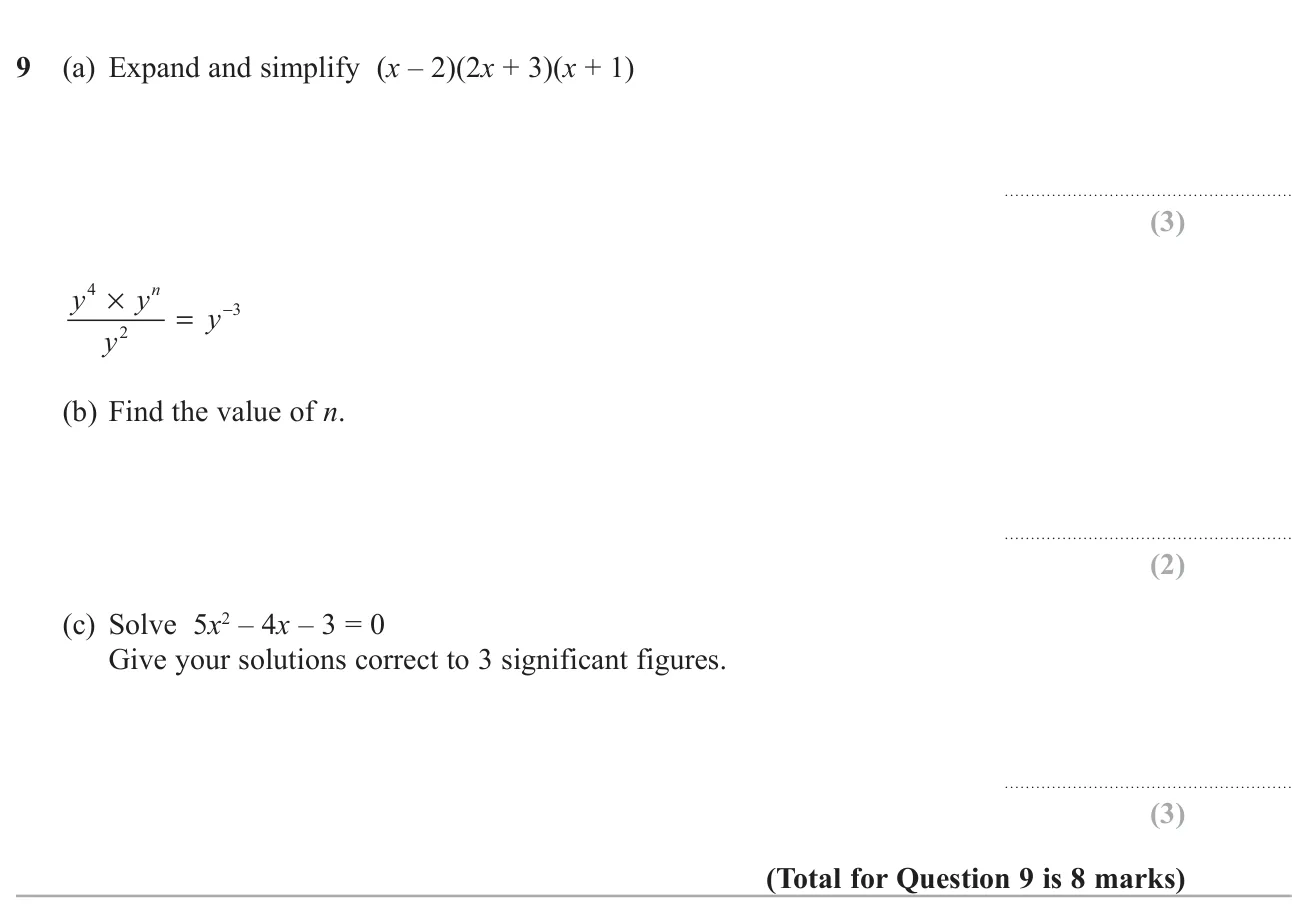
Expand a product of three brackets, find a missing power using index laws, and solve a quadratic with the formula.

© Pearson Education Ltd. November 2018 Paper 3 (Higher, calculator), question 9.

Show answer
(a)2x3+x2−7x−62x^3 + x^2 - 7x - 63 marks
(b)n=−5n = -52 marks
(c)x=1.27x = 1.27 or x=−0.472x = -0.4723 marks

Worked solution Checked against the mark scheme

(a) (x−2)(2x+3)=2x2−x−6(x - 2)(2x + 3) = 2x^2 - x - 6

(2x2−x−6)(x+1)=2x3+2x2−x2−x−6x−6=2x3+x2−7x−6(2x^2 - x - 6)(x + 1) = 2x^3 + 2x^2 - x^2 - x - 6x - 6 = 2x^3 + x^2 - 7x - 6

(b) 4+n−2=−34 + n - 2 = -3, so n=−5n = -5

(c) x=4±16+6010=4±7610x = \frac{4 \pm \sqrt{16 + 60}}{10} = \frac{4 \pm \sqrt{76}}{10}, so x=1.27x = 1.27 or x=−0.472x = -0.472

Watch out: In (c), using −42=−16-4^2 = -16 inside the square root.

Question 10

Functions4 marksGrade 7Calculator
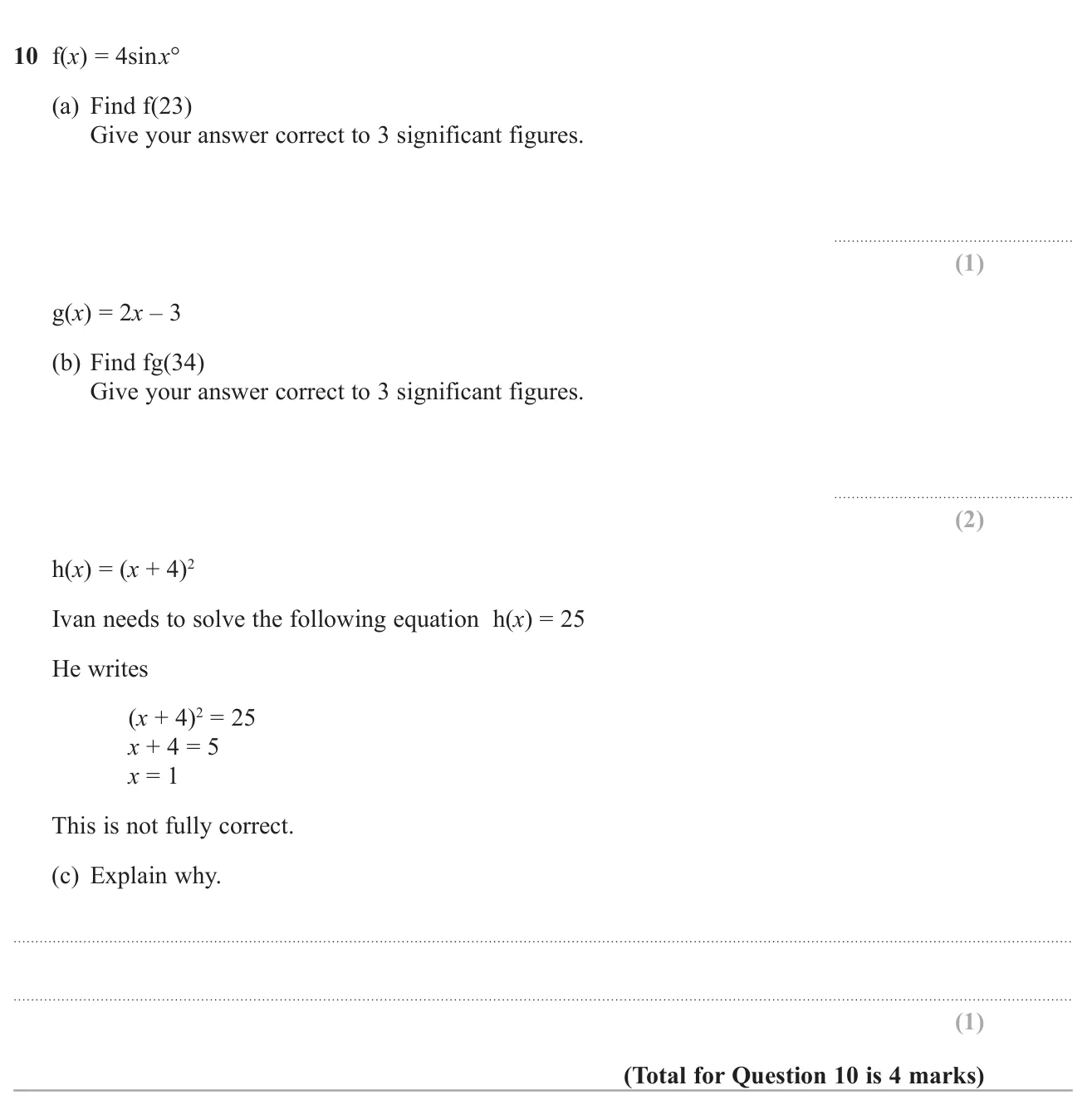
Evaluate a trig function and a composite function, and explain the missing solution when square-rooting both sides of an equation.

© Pearson Education Ltd. November 2018 Paper 3 (Higher, calculator), question 10.

Show answer
(a)1.561.561 mark
(b)3.633.632 marks
(c)He ignored the negative square root: x+4=−5x + 4 = -5 also works, giving x=−9x = -91 mark

Worked solution Checked against the mark scheme

(a) f(23)=4sin⁡23°=1.56f(23) = 4\sin 23° = 1.56

(b) g(34)=2×34−3=65g(34) = 2 \times 34 - 3 = 65, then f(65)=4sin⁡65°=3.63f(65) = 4\sin 65° = 3.63

(c) 2525 has two square roots, 55 and −5-5. So x+4=−5x + 4 = -5 is also possible, giving a second answer x=−9x = -9.

Watch out: In (b), working out f first and then g (doing gf instead of fg).

Question 11

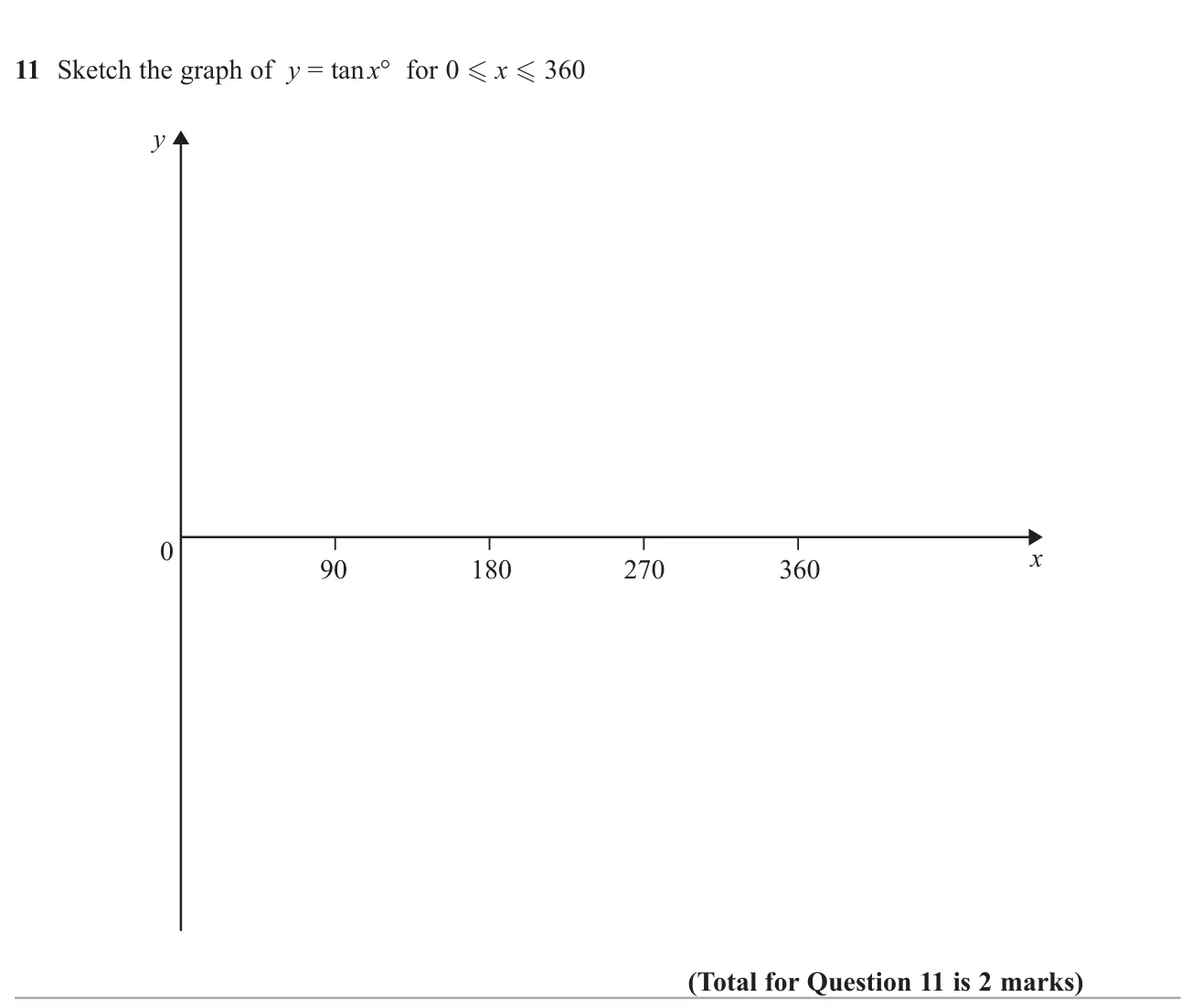
Sketch the tangent graph between 0° and 360°.

© Pearson Education Ltd. November 2018 Paper 3 (Higher, calculator), question 11.

Show answer
AnswerCurve through (0,0),(180,0),(360,0)(0,0), (180,0), (360,0) with asymptotes at x=90x = 90 and x=270x = 2702 marks

Worked solution Checked against the mark scheme

tan⁡x°\tan x° is 0 at 0°, 180° and 360°.

It rises towards +∞+\infty as xx approaches 90° and 270°, and comes up from −∞-\infty just after them.

Draw vertical dashed asymptotes at 90 and 270, and three increasing branches through (0,0)(0,0), (180,0)(180,0), (360,0)(360,0).

Watch out: Drawing a wave shape like sine with no asymptotes.

Question 12

Pythagoras and trigonometry4 marksGrade 7Calculator
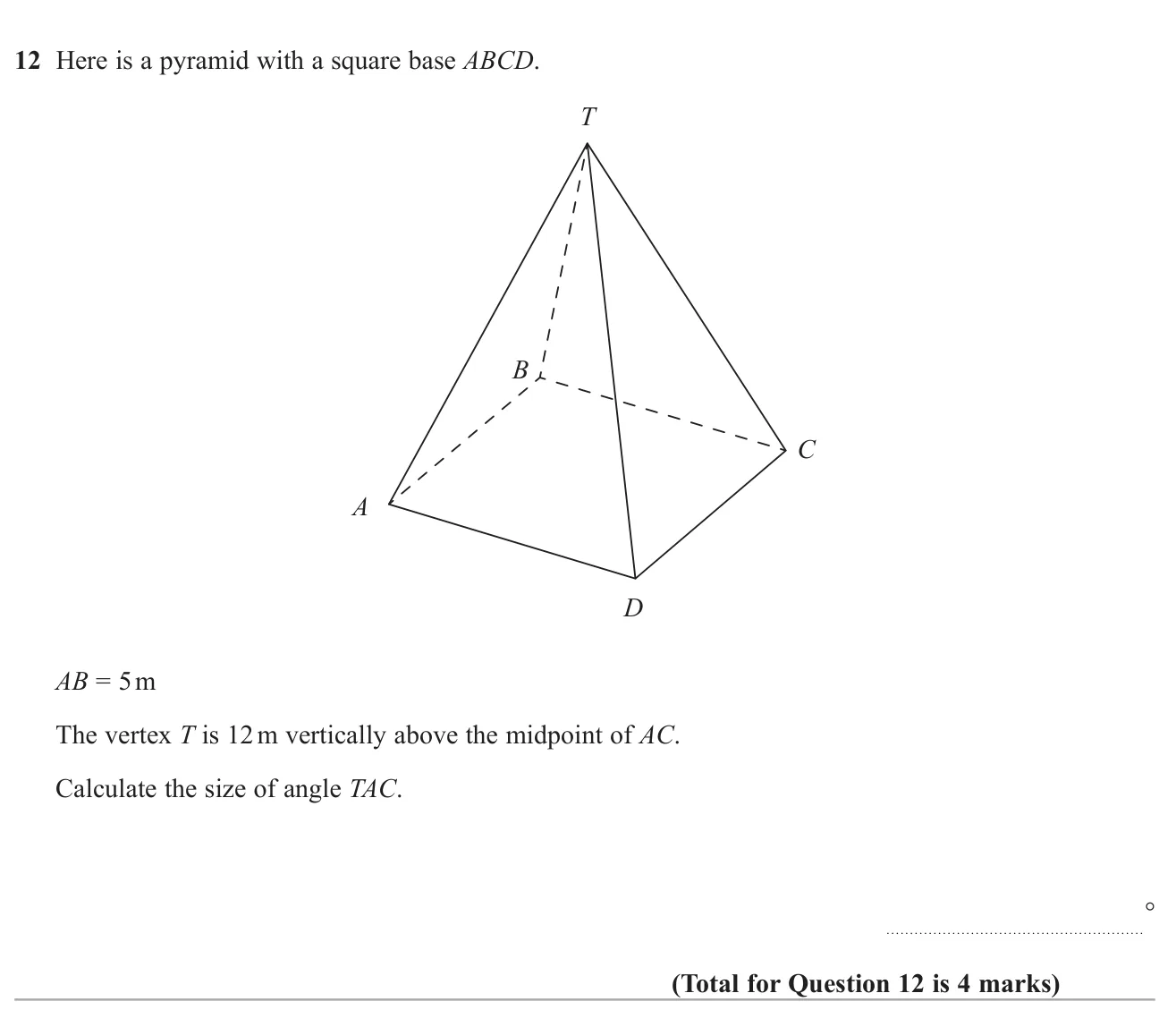
Find the angle between a sloping edge and the base diagonal of a square-based pyramid.

© Pearson Education Ltd. November 2018 Paper 3 (Higher, calculator), question 12.

Show answer
Answer73.6°73.6°4 marks

Worked solution Checked against the mark scheme

Diagonal AC=52+52=50=7.071AC = \sqrt{5^2 + 5^2} = \sqrt{50} = 7.071 m, so half of it is 3.5363.536 m.

The triangle from A to the centre to T is right-angled:

tan⁡TAC=123.536\tan TAC = \frac{12}{3.536}

TAC=tan⁡−1(3.394)=73.6°TAC = \tan^{-1}(3.394) = 73.6°

Watch out: Using the full diagonal (7.07 m) instead of half of it.

Question 13

Compound interest, growth and decay2 marksGrade 6Calculator
Use a recurrence rule for a population to find the number of animals two years later.

© Pearson Education Ltd. November 2018 Paper 3 (Higher, calculator), question 13.

Show answer
Answer4084082 marks

Worked solution Checked against the mark scheme

P1=400P_1 = 400

P2=1.01×400=404P_2 = 1.01 \times 400 = 404

P3=1.01×404=408.04P_3 = 1.01 \times 404 = 408.04, so about 408408 animals.

Watch out: Applying the multiplier three times and getting 412.

Question 14

Direct and inverse proportion3 marksGrade 7Calculator
Show a value using inverse proportion to the cube of a variable.

© Pearson Education Ltd. November 2018 Paper 3 (Higher, calculator), question 14.

Show answer
Answery=44a38a3=5.5y = \frac{44a^3}{8a^3} = 5.53 marks

Worked solution Checked against the mark scheme

y=kx3y = \frac{k}{x^3}

44=ka344 = \frac{k}{a^3}, so k=44a3k = 44a^3

When x=2ax = 2a: y=44a3(2a)3=44a38a3=5.5y = \frac{44a^3}{(2a)^3} = \frac{44a^3}{8a^3} = 5.5

Watch out: Writing (2a)3=2a3(2a)^3 = 2a^3 instead of 8a38a^3.

Question 15

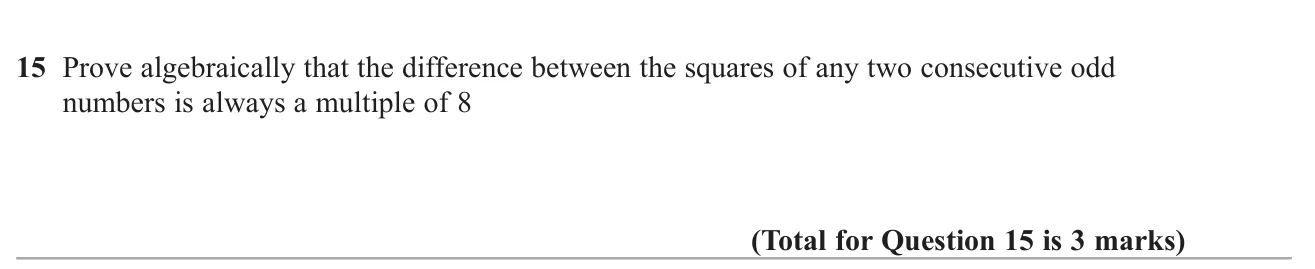
Identities and algebraic proof3 marksGrade 7Calculator
Prove that the difference of the squares of two consecutive odd numbers is always a multiple of 8.

© Pearson Education Ltd. November 2018 Paper 3 (Higher, calculator), question 15.

Show answer
Answer(2n+1)2−(2n−1)2=8n(2n+1)^2 - (2n-1)^2 = 8n, a multiple of 83 marks

Worked solution Checked against the mark scheme

Let the odd numbers be 2n−12n - 1 and 2n+12n + 1, where nn is an integer.

(2n+1)2−(2n−1)2=(4n2+4n+1)−(4n2−4n+1)(2n+1)^2 - (2n-1)^2 = (4n^2 + 4n + 1) - (4n^2 - 4n + 1)

=8n= 8n

8n8n is 8 times an integer, so it is always a multiple of 8.

Watch out: Using nn and n+2n + 2, which are not always odd.

Question 16

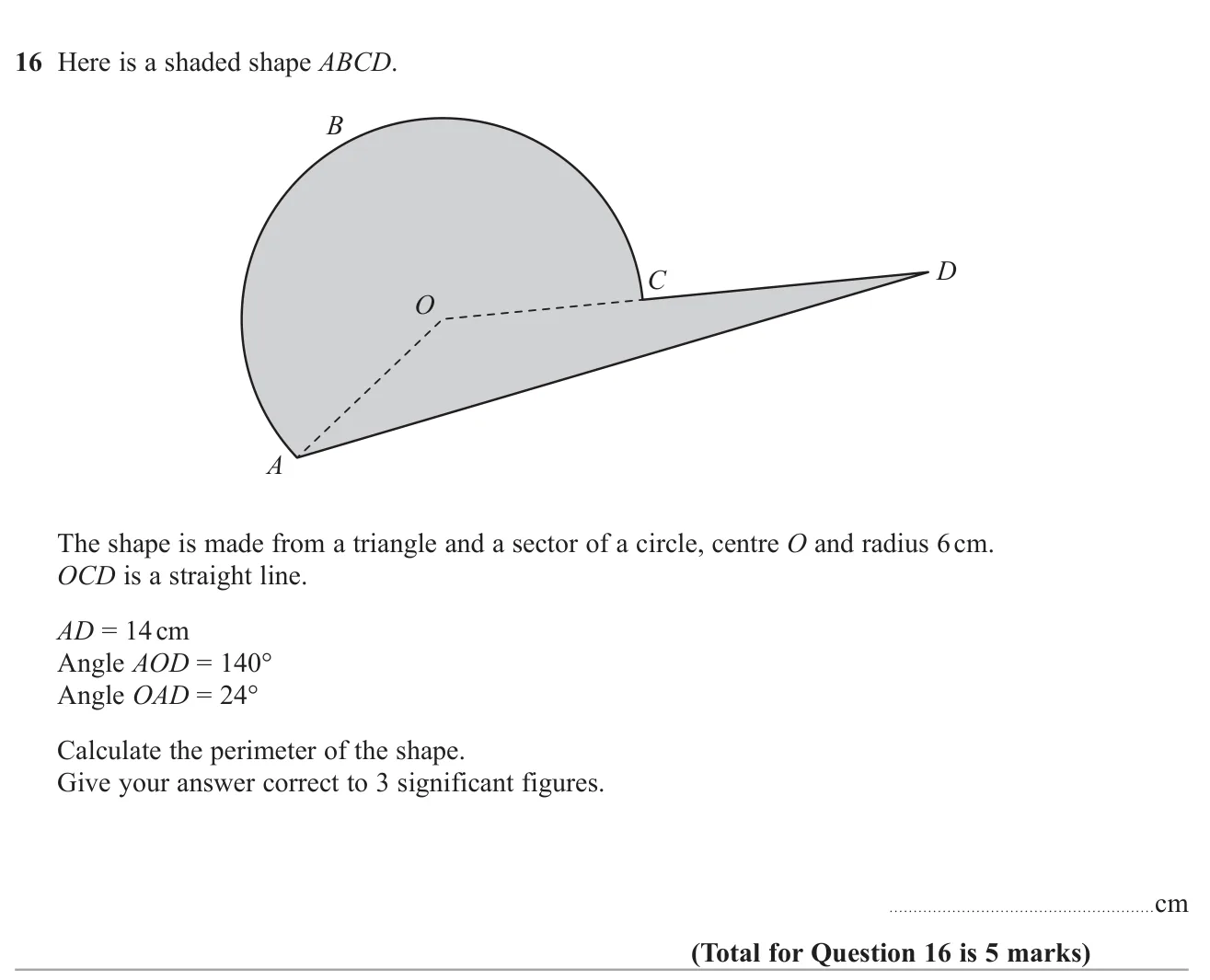
Find the perimeter of a shape made of a triangle and a major sector, using the sine rule for a missing side.

© Pearson Education Ltd. November 2018 Paper 3 (Higher, calculator), question 16.

Show answer
Answer39.939.9 cm5 marks

Worked solution Checked against the mark scheme

The sector's outer arc uses 360−140=220°360 - 140 = 220°:

Arc =220360×2π×6=23.04= \frac{220}{360} \times 2\pi \times 6 = 23.04 cm

Sine rule in triangle AOD: ODsin⁡24°=14sin⁡140°\frac{OD}{\sin 24°} = \frac{14}{\sin 140°}, so OD=8.859OD = 8.859 cm

CD=OD−6=2.859CD = OD - 6 = 2.859 cm

Perimeter =23.04+14+2.859=39.9= 23.04 + 14 + 2.859 = 39.9 cm

Watch out: Using the 140° minor arc instead of the 220° major arc.

Question 17

Histograms5 marksGrade 7Calculator
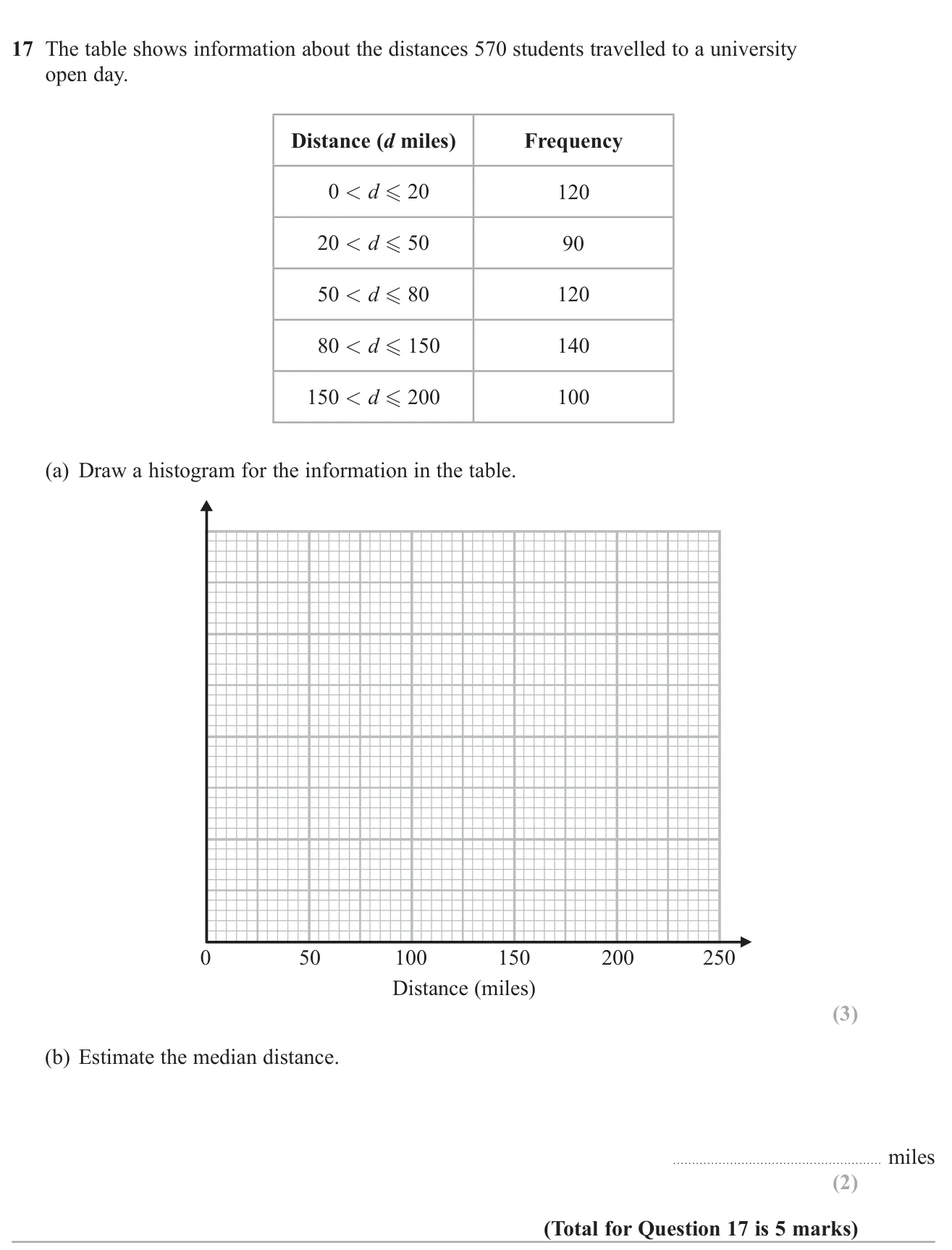
Draw a histogram from unequal class widths and estimate the median distance.

© Pearson Education Ltd. November 2018 Paper 3 (Higher, calculator), question 17.

Show answer
(a)Bars with frequency densities 6,3,4,2,26, 3, 4, 2, 23 marks
(b)About 6969 miles (accept 66 to 71)2 marks

Worked solution Checked against the mark scheme

(a) Frequency density = frequency ÷ class width:

120÷20=6120 \div 20 = 6, 90÷30=390 \div 30 = 3, 120÷30=4120 \div 30 = 4, 140÷70=2140 \div 70 = 2, 100÷50=2100 \div 50 = 2

(b) The median is the 285285th value. 120+90=210120 + 90 = 210, so it is 7575 into the 50–80 class.

50+75120×30=68.75≈6950 + \frac{75}{120} \times 30 = 68.75 \approx 69 miles

Watch out: Plotting frequency instead of frequency density on the vertical axis.

Question 18

Error intervals and bounds5 marksGrade 8Calculator
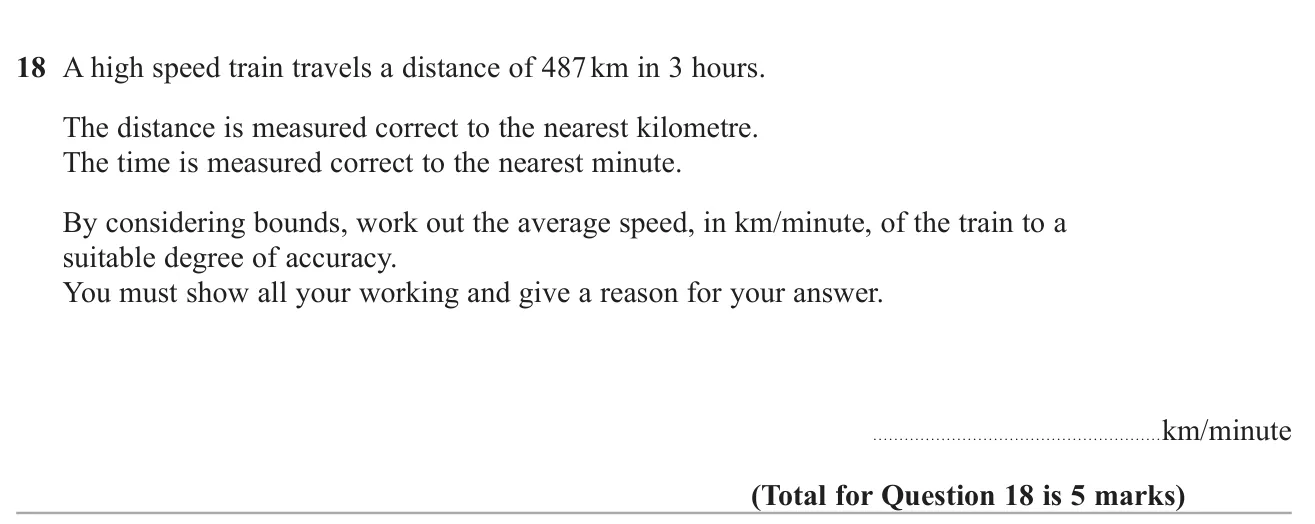
Use upper and lower bounds of distance and time to find the train's average speed to a justified accuracy.

© Pearson Education Ltd. November 2018 Paper 3 (Higher, calculator), question 18.

Show answer
Answer2.72.7 km/minute, because both bounds round to 2.75 marks

Worked solution Checked against the mark scheme

Time: 3 hours =180= 180 minutes, bounds 179.5179.5 and 180.5180.5.

Distance bounds: 486.5486.5 and 487.5487.5 km.

Upper bound of speed =487.5179.5=2.7158…= \frac{487.5}{179.5} = 2.7158\ldots

Lower bound of speed =486.5180.5=2.6953…= \frac{486.5}{180.5} = 2.6953\ldots

Both round to 2.72.7 (1 d.p.) so the speed is 2.72.7 km/minute.

Watch out: Dividing upper distance by upper time for the upper bound.

Question 19

Simultaneous equations5 marksGrade 8Calculator
Solve a pair of simultaneous equations where one is quadratic.

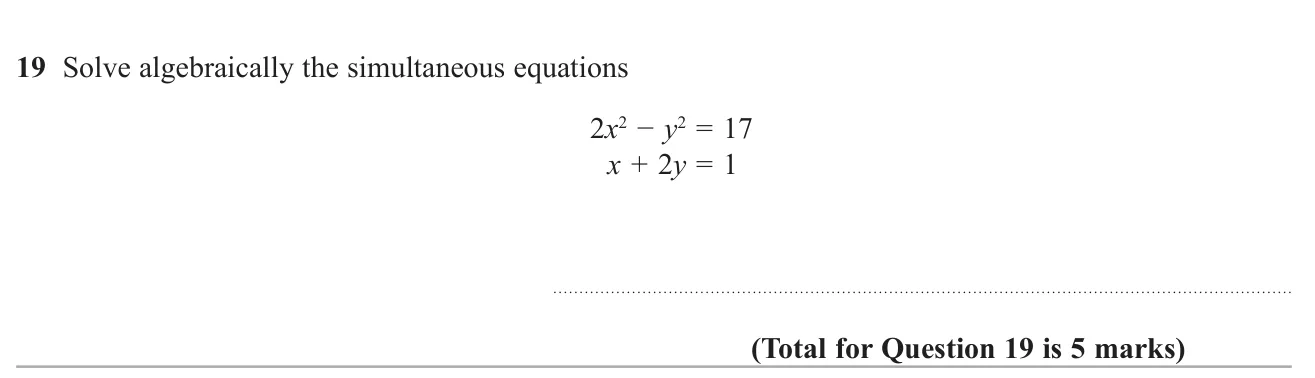
© Pearson Education Ltd. November 2018 Paper 3 (Higher, calculator), question 19.

Show answer
Answerx=3,y=−1x = 3, y = -1 and x=−237,y=157x = -\frac{23}{7}, y = \frac{15}{7}5 marks

Worked solution Checked against the mark scheme

From the linear equation: x=1−2yx = 1 - 2y

2(1−2y)2−y2=172(1 - 2y)^2 - y^2 = 17

2−8y+8y2−y2=17⇒7y2−8y−15=02 - 8y + 8y^2 - y^2 = 17 \Rightarrow 7y^2 - 8y - 15 = 0

(7y−15)(y+1)=0(7y - 15)(y + 1) = 0, so y=157y = \frac{15}{7} or y=−1y = -1

y=−1y = -1: x=3x = 3. y=157\quad y = \frac{15}{7}: x=1−307=−237x = 1 - \frac{30}{7} = -\frac{23}{7}

Watch out: Expanding (1−2y)2(1 - 2y)^2 as 1+4y21 + 4y^2.

Question 20

Transformations2 marksGrade 8Calculator
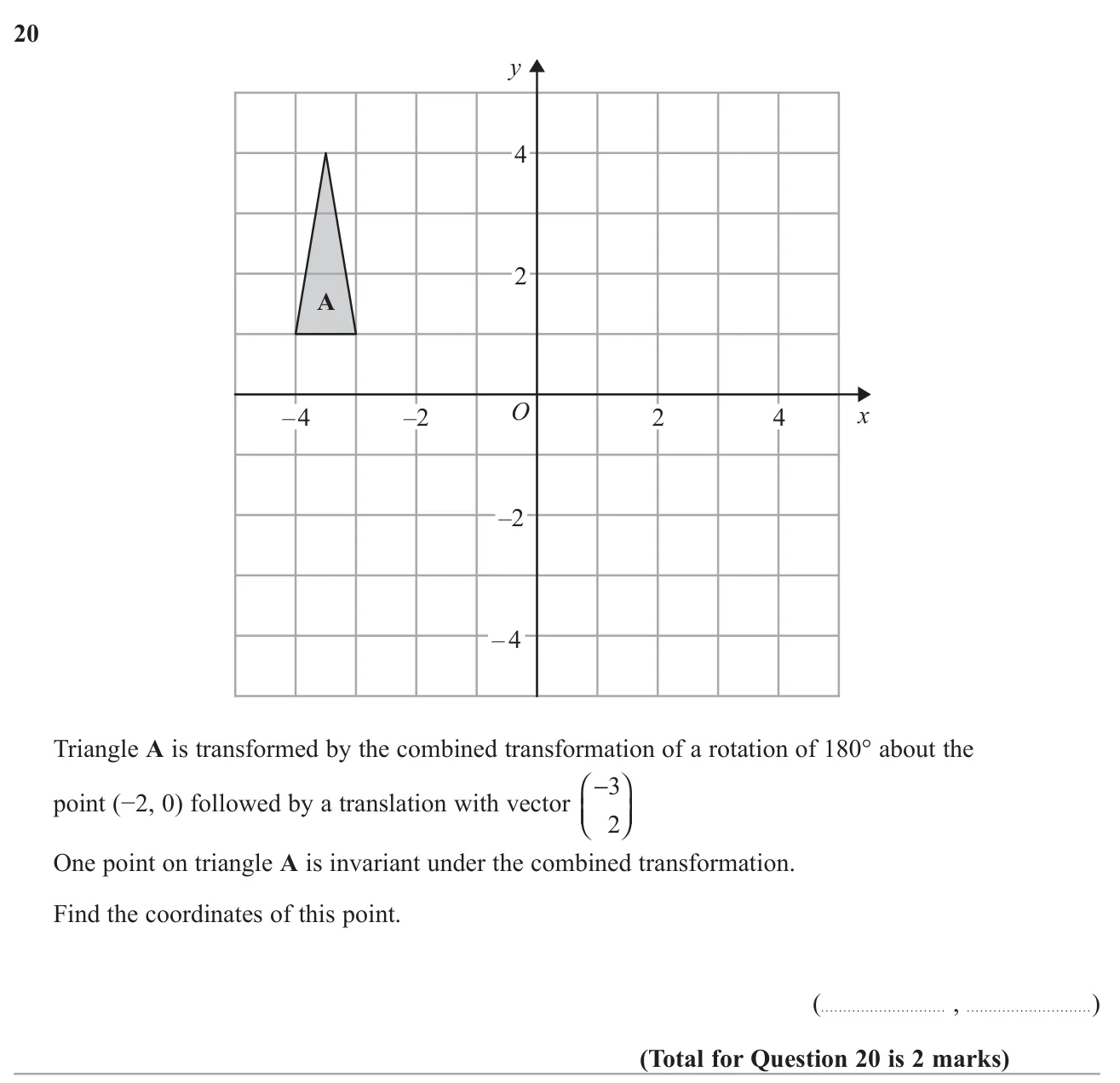
Find the point of a triangle that ends up where it started after a half-turn followed by a translation.

© Pearson Education Ltd. November 2018 Paper 3 (Higher, calculator), question 20.

Show answer
Answer(−3.5,1)(-3.5, 1)2 marks

Worked solution Checked against the mark scheme

Triangle A has corners (−4,1)(-4, 1), (−3,1)(-3, 1), (−3.5,4)(-3.5, 4).

Rotating 180° about (−2,0)(-2, 0) sends (x,y)(x, y) to (−4−x,−y)(-4 - x, -y). Then translating by (−32)\binom{-3}{2} gives (−7−x,2−y)(-7 - x, 2 - y).

The corners go to (−3,1)(-3, 1), (−4,1)(-4, 1), (−3.5,−2)(-3.5, -2). The base maps onto itself reversed, so its midpoint stays put.

Check: −7−(−3.5)=−3.5-7 - (-3.5) = -3.5 and 2−1=12 - 1 = 1, so the point is (−3.5,1)(-3.5, 1).

Watch out: Rotating about the origin instead of (−2,0)(-2, 0).

Finished the paper?

Add up your marks for all three papers and see what grade that would have been.