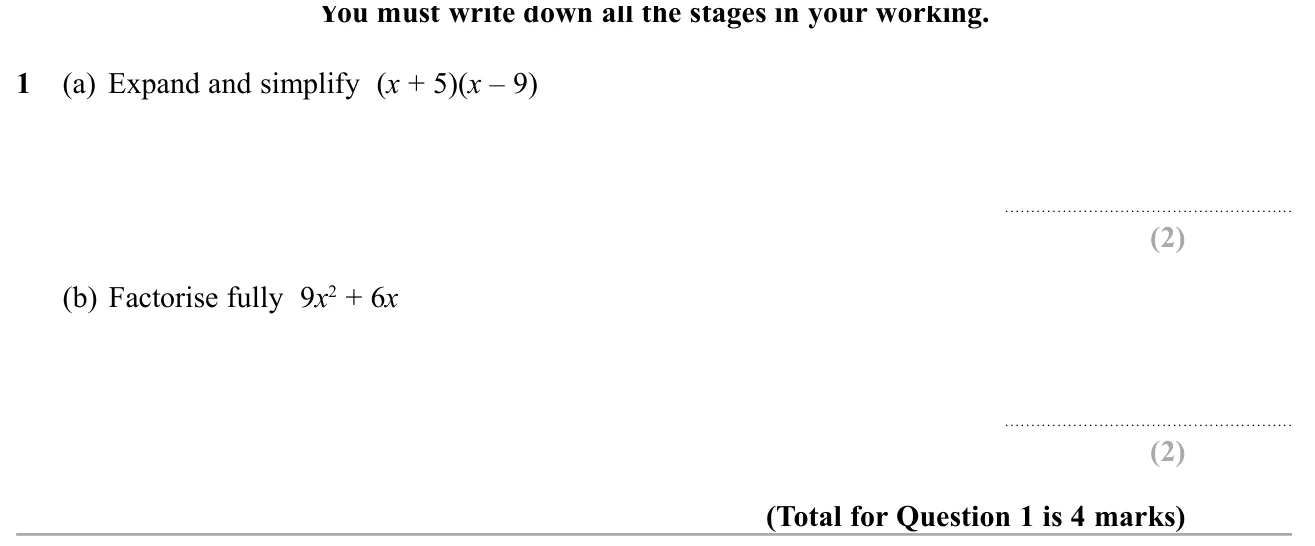
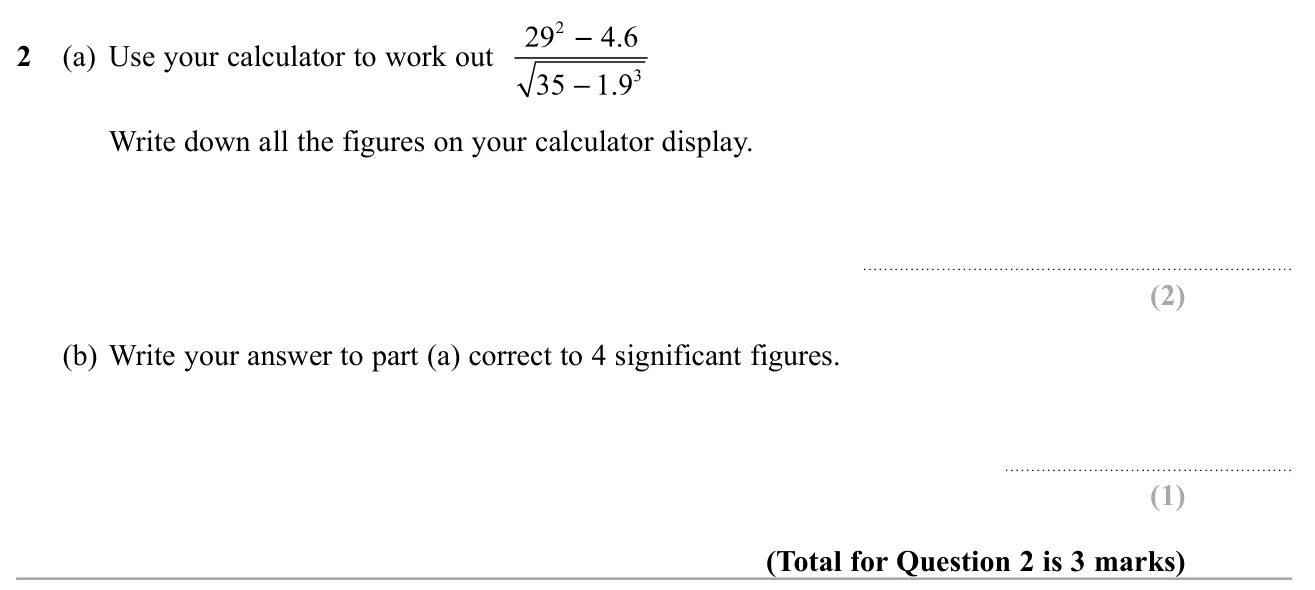
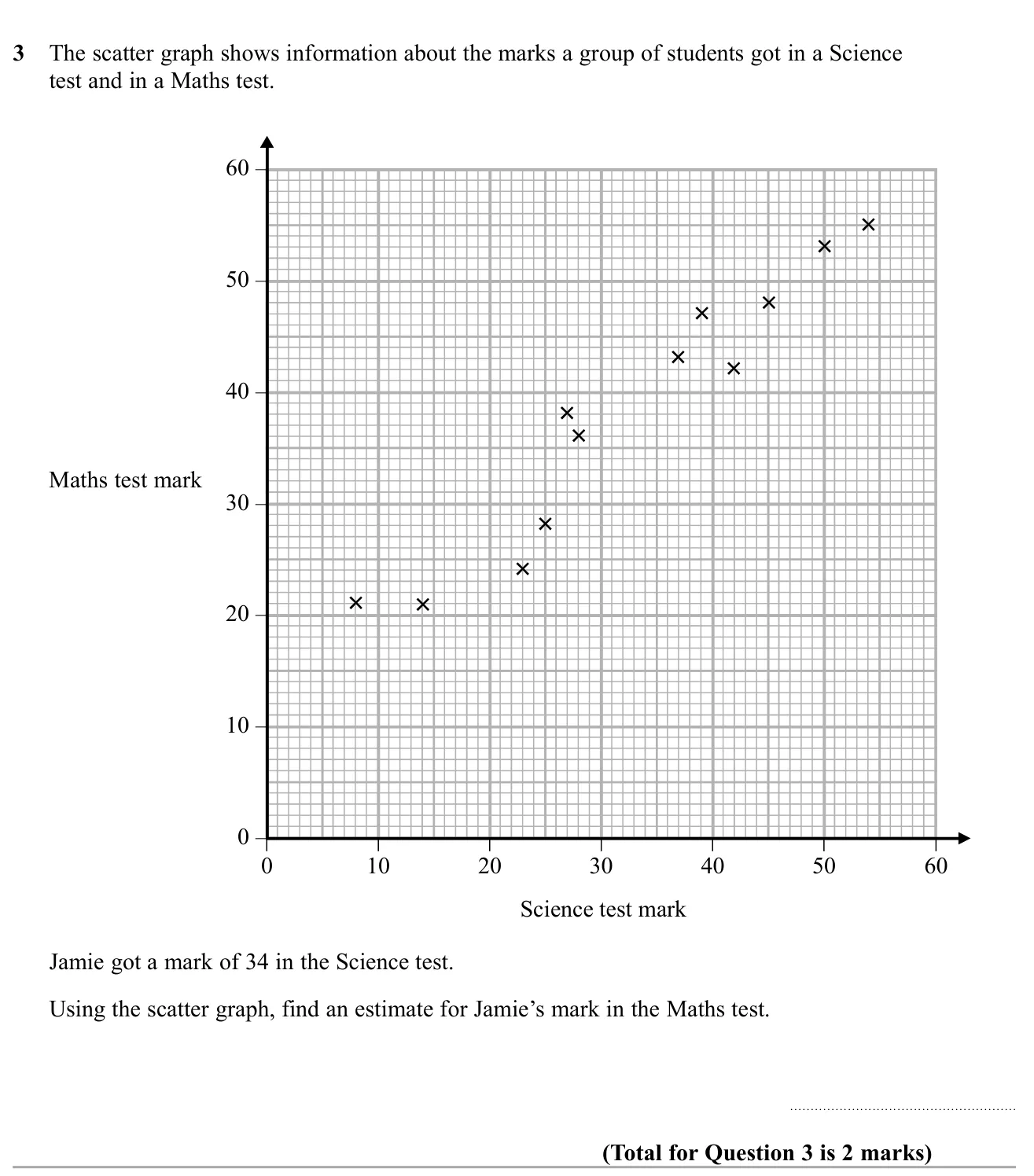
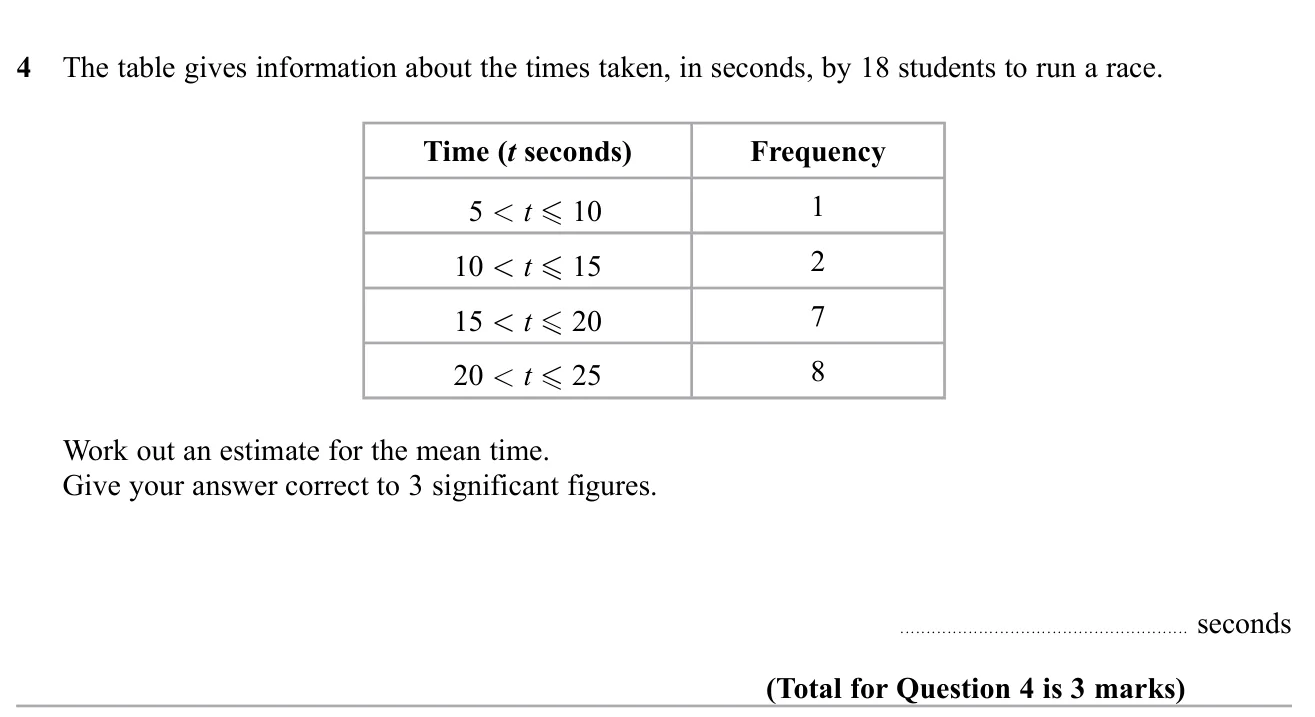
© Pearson Education Ltd. November 2019 Paper 3 (Higher, calculator), question 1.
Show answer
| (a) | x2−4x−45 | 2 marks |
|---|
| (b) | 3x(3x+2) | 2 marks |
|---|
Worked solution Checked against the mark scheme
(a) x×x=x2, x×(−9)=−9x, 5×x=5x, 5×(−9)=−45
x2−9x+5x−45=x2−4x−45
(b) The highest common factor of 9x2 and 6x is 3x: 3x(3x+2)
Watch out: In (b), only taking out 3 to get 3(3x2+2x).
© Pearson Education Ltd. November 2019 Paper 3 (Higher, calculator), question 2.
Show answer
| (a) | 157.668255... | 2 marks |
|---|
| (b) | 157.7 | 1 mark |
|---|
Worked solution Checked against the mark scheme
(a) Top: 292−4.6=836.4. Bottom: 35−6.859=28.141=5.30481...
836.4÷5.30481...=157.668255...
(b) The 4th significant figure is 6 and the next digit is 6, so round up: 157.7
Watch out: Typing it in without brackets so the calculator only divides 4.6 by the root.
© Pearson Education Ltd. November 2019 Paper 3 (Higher, calculator), question 3.
Show answer
| Answer | About 40 (35 to 42 accepted) | 2 marks |
|---|
Worked solution Checked against the mark scheme
Draw a line of best fit through the middle of the crosses.
Go up from 34 on the Science axis to the line, then across to the Maths axis. This reads about 40.
Watch out: Reading off a single nearby cross instead of using a line of best fit.
© Pearson Education Ltd. November 2019 Paper 3 (Higher, calculator), question 4.
Show answer
| Answer | 18.6 seconds | 3 marks |
|---|
Worked solution Checked against the mark scheme
Midpoints: 7.5, 12.5, 17.5, 22.5
∑fx=7.5+25+122.5+180=335
Mean ≈335÷18=18.61...=18.6 seconds
Watch out: Dividing by 4 (the number of classes) instead of 18.
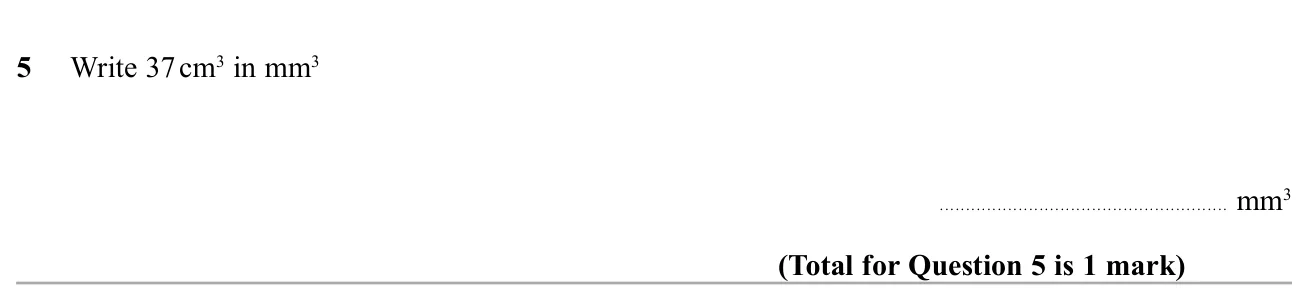
© Pearson Education Ltd. November 2019 Paper 3 (Higher, calculator), question 5.
Show answer
Worked solution Checked against the mark scheme
1 cm =10 mm, so 1 cm3=10×10×10=1000 mm3.
37×1000=37000 mm3
Watch out: Multiplying by 10 to get 370.
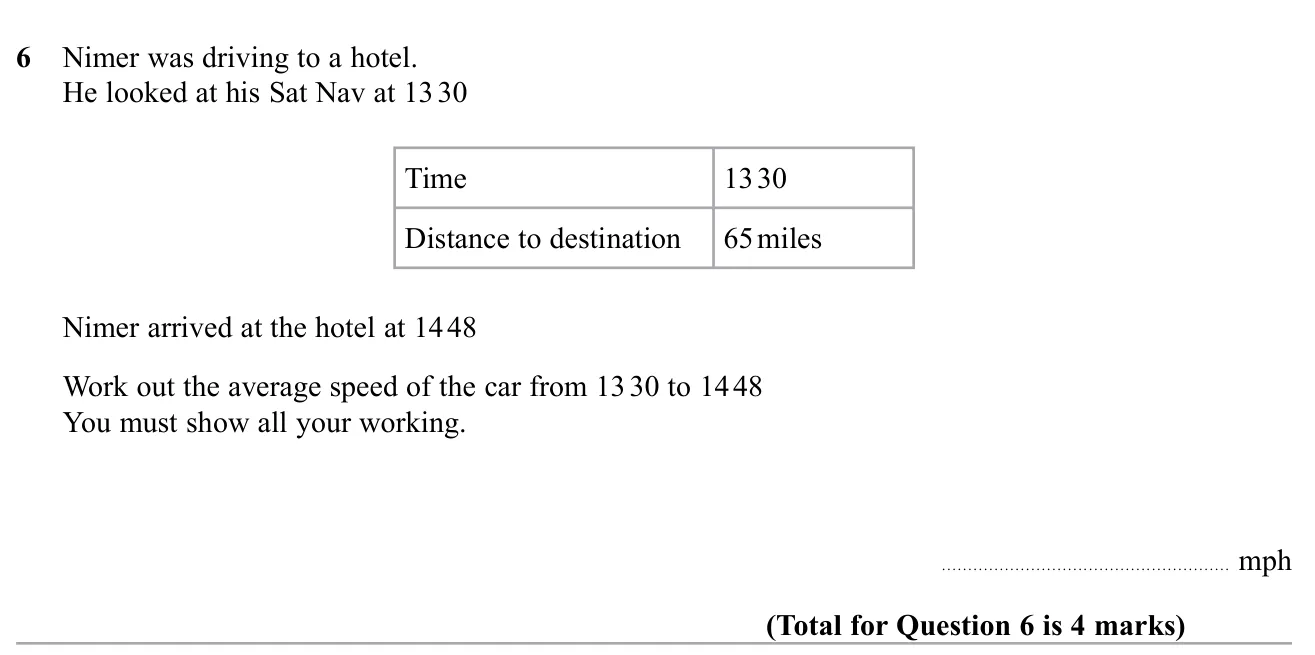
© Pearson Education Ltd. November 2019 Paper 3 (Higher, calculator), question 6.
Show answer
Worked solution Checked against the mark scheme
Time: 13 30 to 14 48 is 1 hour 18 minutes =78 minutes.
In hours: 78÷60=1.3
Speed =65÷1.3=50 mph
Watch out: Using 1.18 hours for 1 hour 18 minutes.
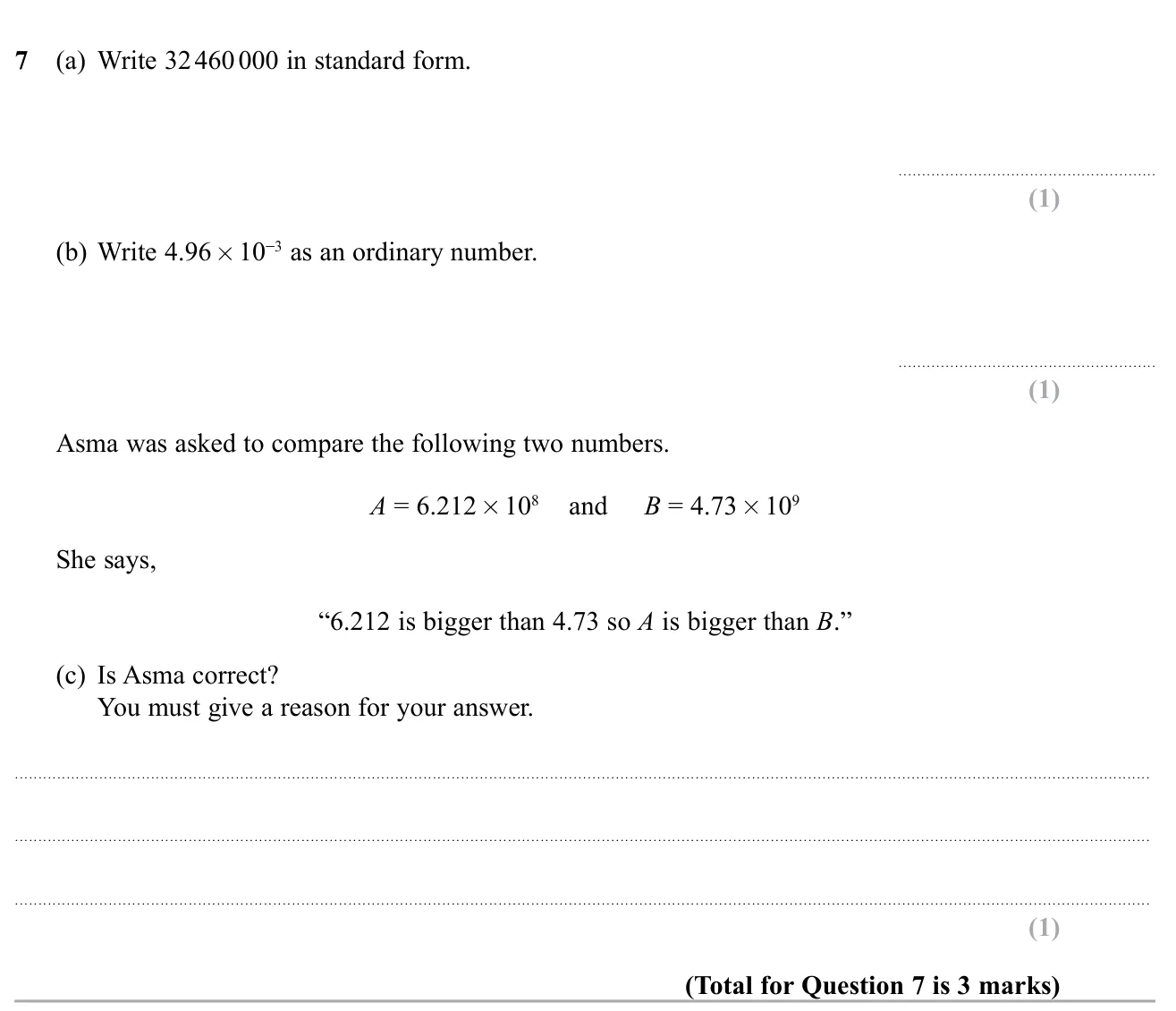
© Pearson Education Ltd. November 2019 Paper 3 (Higher, calculator), question 7.
Show answer
| (a) | 3.246×10⁷ | 1 mark |
|---|
| (b) | 0.00496 | 1 mark |
|---|
| (c) | No: 109 is ten times 108, so B is larger | 1 mark |
|---|
Worked solution Checked against the mark scheme
(a) Put the decimal point after the first digit: 3.246. It moves 7 places, so 3.246×10⁷.
(b) Move the point 3 places left: 0.00496
(c) No. A=621200000 and B=4730000000, so B is bigger. Compare the powers first.
Watch out: In (b), moving the point the wrong way to get 4960.
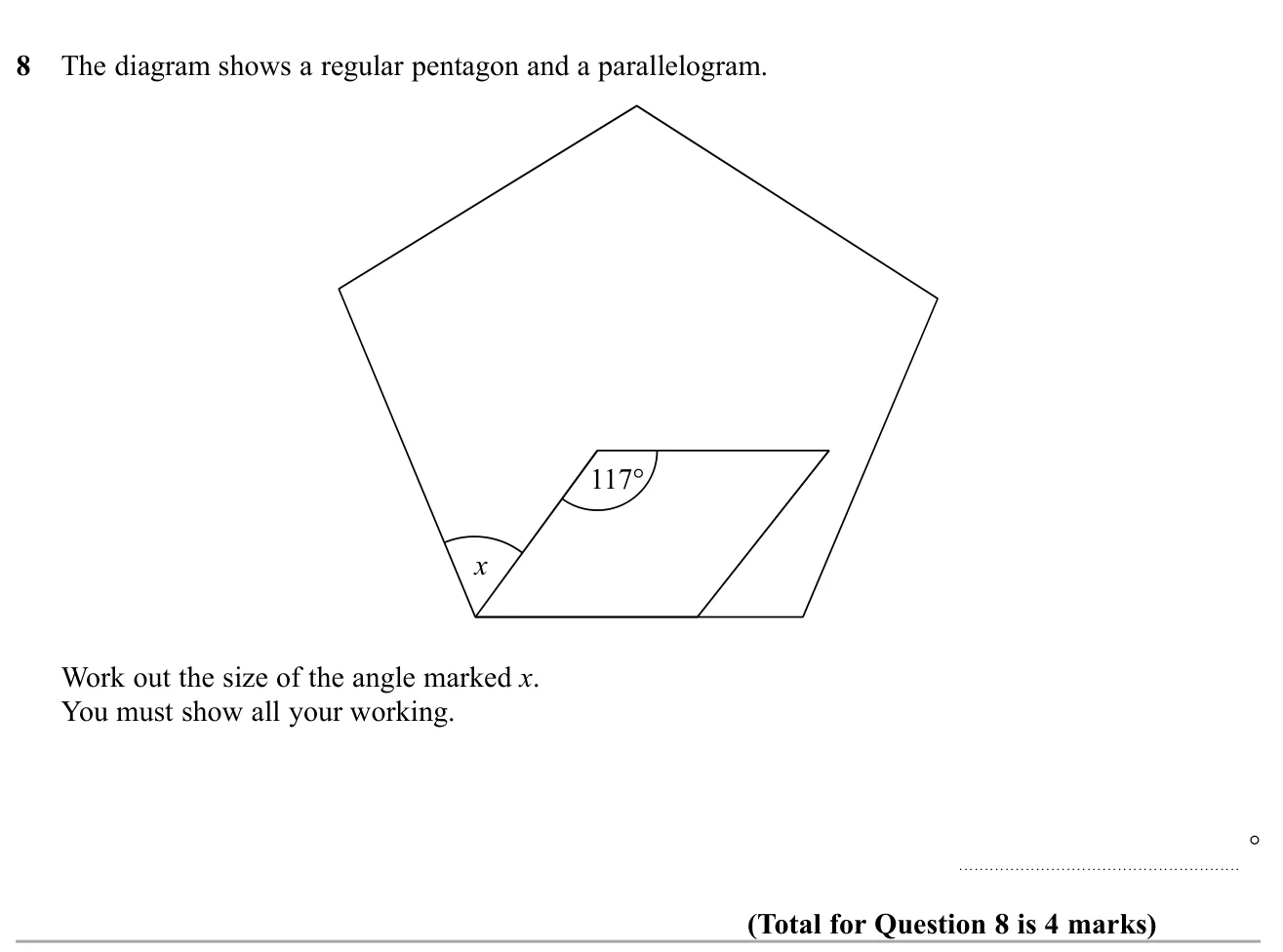
© Pearson Education Ltd. November 2019 Paper 3 (Higher, calculator), question 8.
Show answer
Worked solution Checked against the mark scheme
Co-interior angles in the parallelogram add to 180°: 180−117=63°
Interior angle of a regular pentagon: (5−2)×180÷5=108°
x=108−63=45°
Watch out: Using 72° (the exterior angle) as the pentagon's interior angle.
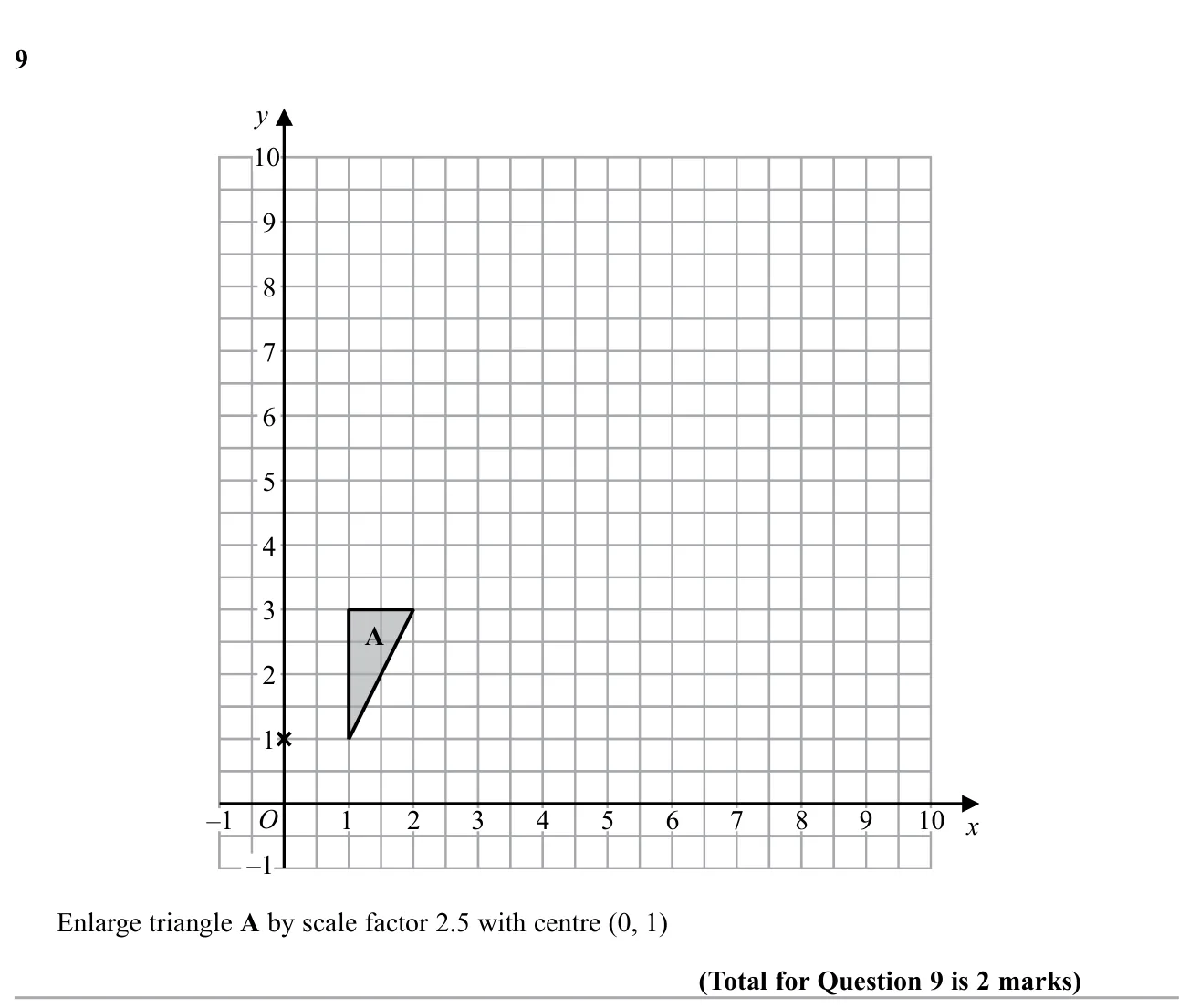
© Pearson Education Ltd. November 2019 Paper 3 (Higher, calculator), question 9.
Show answer
| Answer | Triangle with vertices (2.5,1), (2.5,6) and (5,6) | 2 marks |
|---|
Worked solution Checked against the mark scheme
Centre (0,1). Triangle A has vertices (1,1), (1,3) and (2,3).
From the centre, these are (1,0), (1,2) and (2,2) away. Multiply by 2.5: (2.5,0), (2.5,5), (5,5).
Add back to the centre: (2.5,1), (2.5,6), (5,6).
Watch out: Measuring from the origin instead of from (0,1).
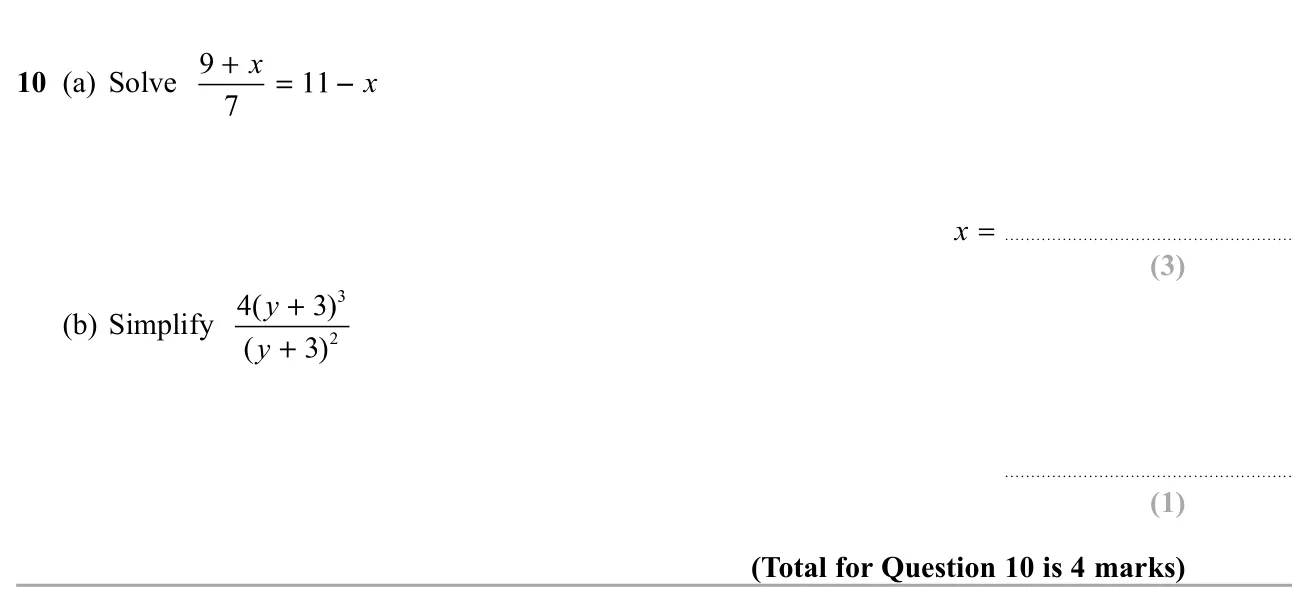
© Pearson Education Ltd. November 2019 Paper 3 (Higher, calculator), question 10.
Show answer
| (a) | x=8.5 | 3 marks |
|---|
| (b) | 4(y+3) | 1 mark |
|---|
Worked solution Checked against the mark scheme
(a) 9+x=7(11−x)=77−7x
8x=68, so x=8.5
(b) Cancel (y+3)2 from top and bottom: (y+3)24(y+3)3=4(y+3)
Watch out: In (a), multiplying only the 11 by 7 and not the x.
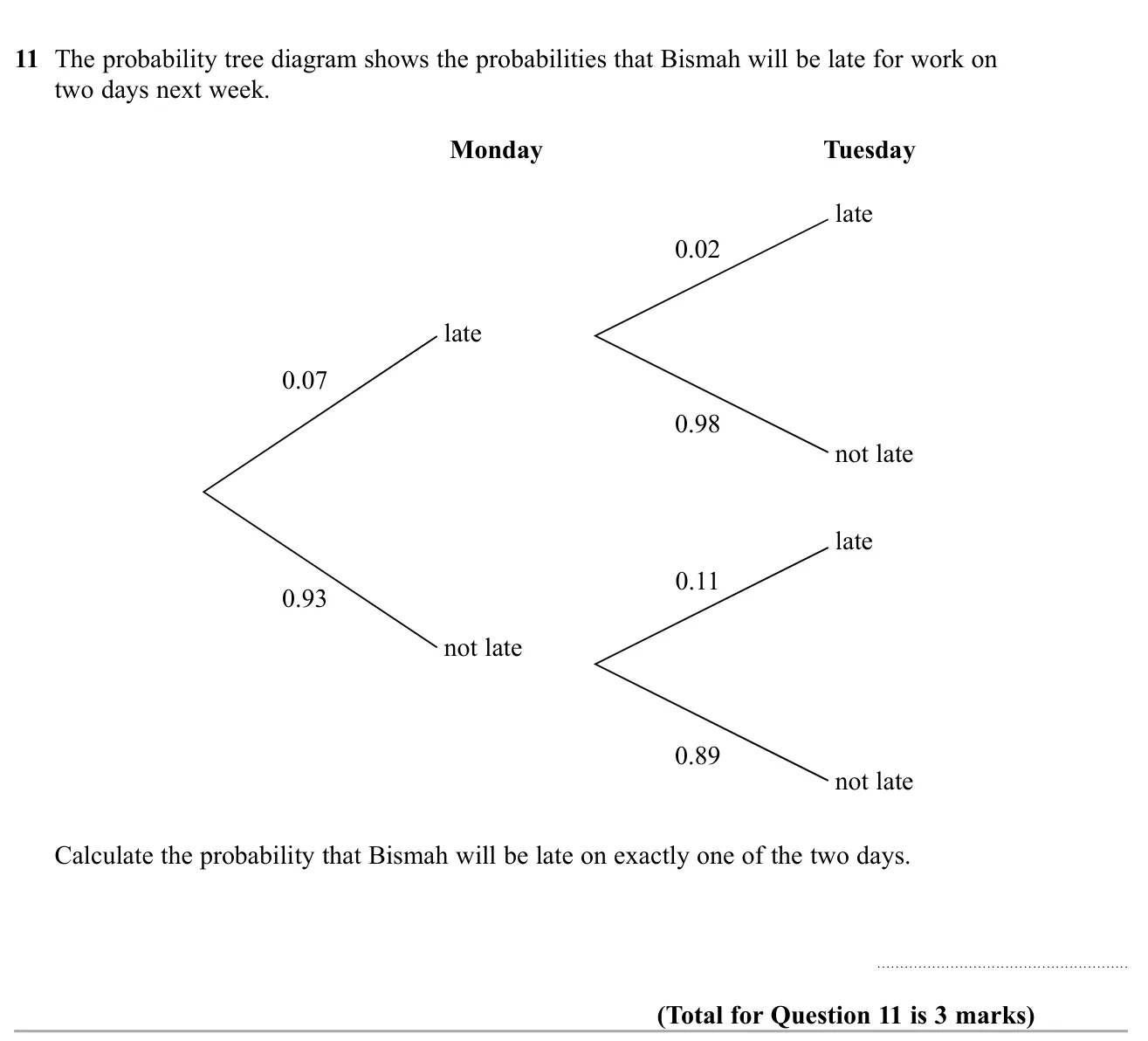
© Pearson Education Ltd. November 2019 Paper 3 (Higher, calculator), question 11.
Show answer
| Answer | 0.1709 | 3 marks |
|---|
Worked solution Checked against the mark scheme
Late Monday, not Tuesday: 0.07×0.98=0.0686
Not late Monday, late Tuesday: 0.93×0.11=0.1023
0.0686+0.1023=0.1709
Watch out: Only working out one of the two routes.
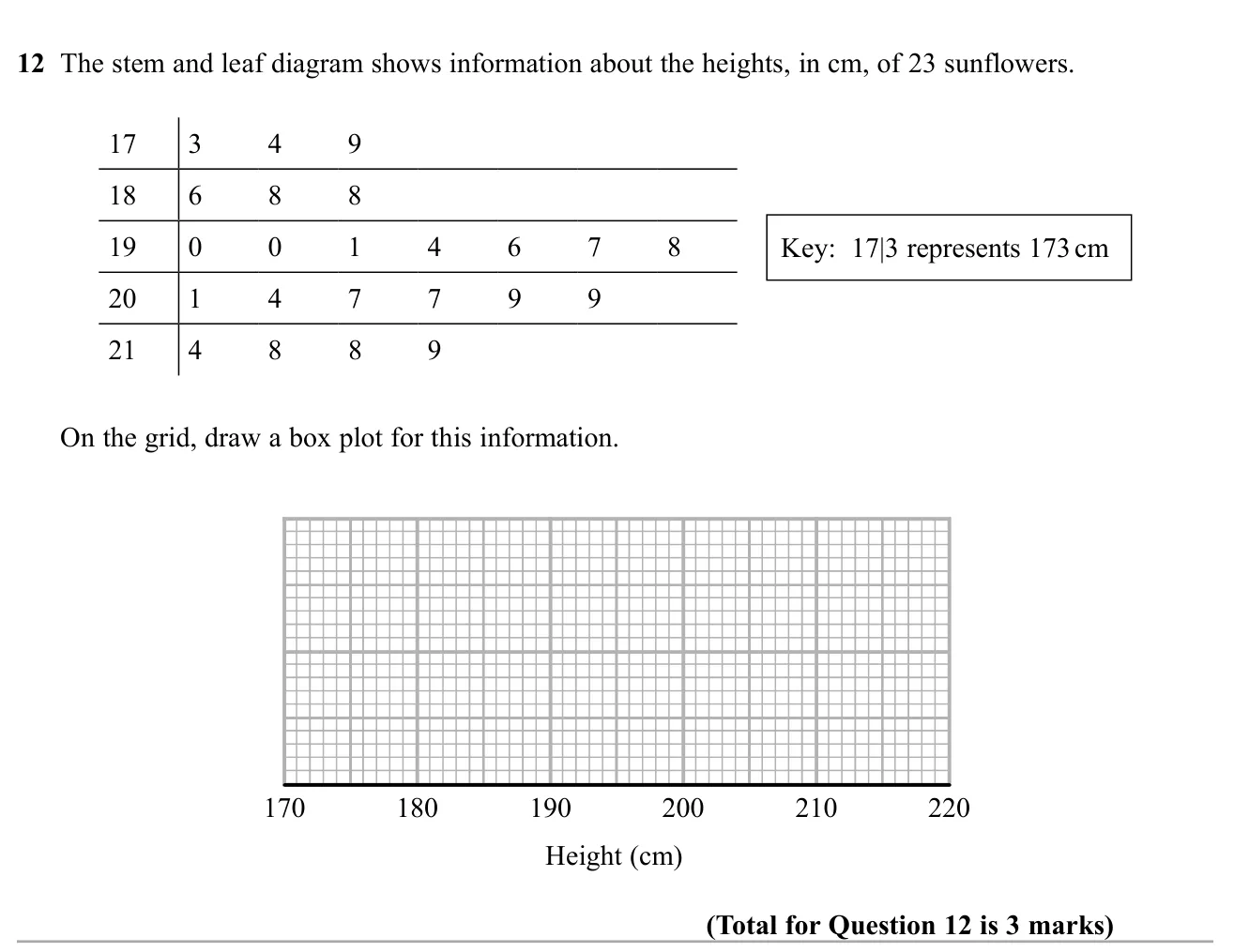
© Pearson Education Ltd. November 2019 Paper 3 (Higher, calculator), question 12.
Show answer
| Answer | Box plot with min 173, LQ 188, median 197, UQ 209, max 219 | 3 marks |
|---|
Worked solution Checked against the mark scheme
There are 23 values, so the median is the 12th: 197 cm.
LQ is the 6th value: 188 cm. UQ is the 18th value: 209 cm.
Smallest 173 cm, largest 219 cm.
Draw the box from 188 to 209 with a line at 197, and whiskers to 173 and 219.
Watch out: Using n÷4 positions wrongly, e.g. taking the 5th or 6th value inconsistently for the quartiles.
© Pearson Education Ltd. November 2019 Paper 3 (Higher, calculator), question 13.
Show answer
Worked solution Checked against the mark scheme
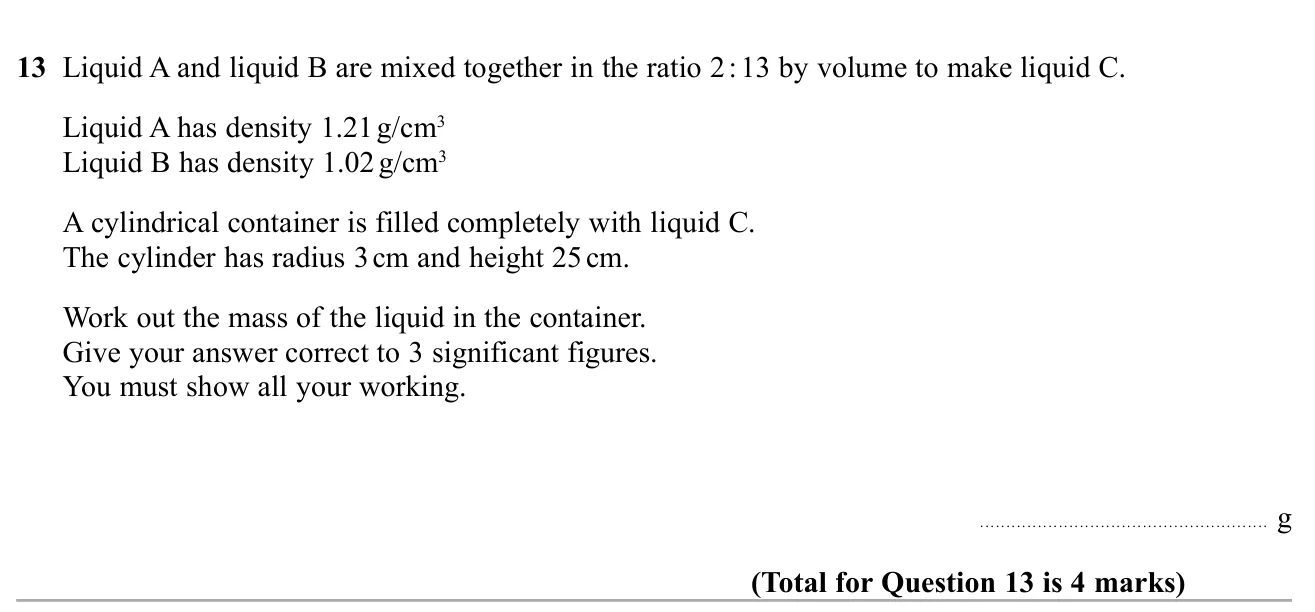
Volume =π×32×25=225π=706.86 cm³
A: 152×225π=30π cm³, mass =30π×1.21=114.04 g
B: 1513×225π=195π cm³, mass =195π×1.02=624.86 g
Total =738.90...≈739 g
Watch out: Averaging the two densities instead of weighting them by the ratio.
Question 14
Ratio4 marksGrade 7Calculator © Pearson Education Ltd. November 2019 Paper 3 (Higher, calculator), question 14.
Show answer
| Answer | 2013 | 4 marks |
|---|
Worked solution Checked against the mark scheme
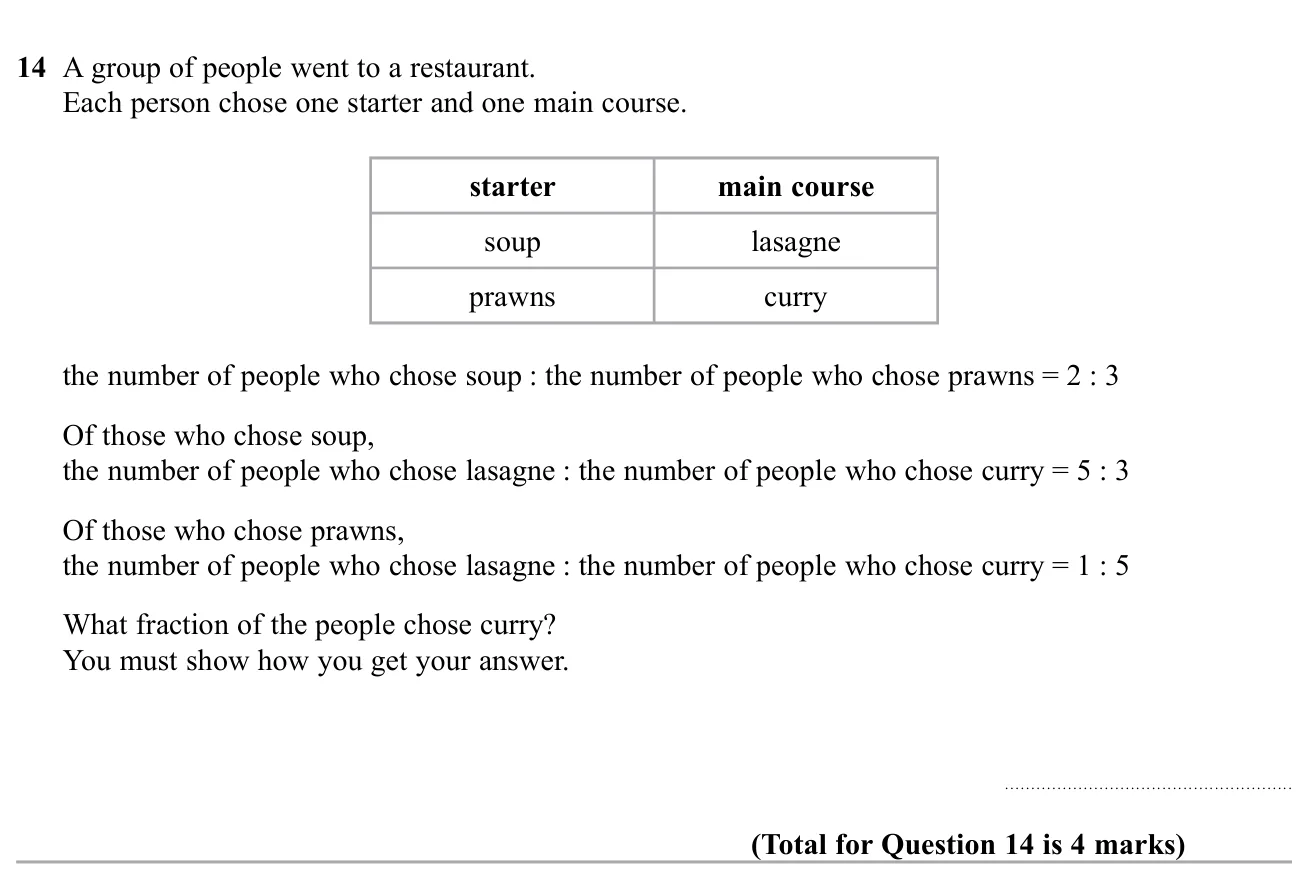
Soup =52, prawns =53
Soup then curry: 52×83=203
Prawns then curry: 53×65=21
Curry total =203+2010=2013
Watch out: Using 53 instead of 83 for curry among soup-eaters.
© Pearson Education Ltd. November 2019 Paper 3 (Higher, calculator), question 15.
Show answer
| Answer | (2n)2+(2n+2)2=4(2n2+2n+1), a multiple of 4 | 3 marks |
|---|
Worked solution Checked against the mark scheme
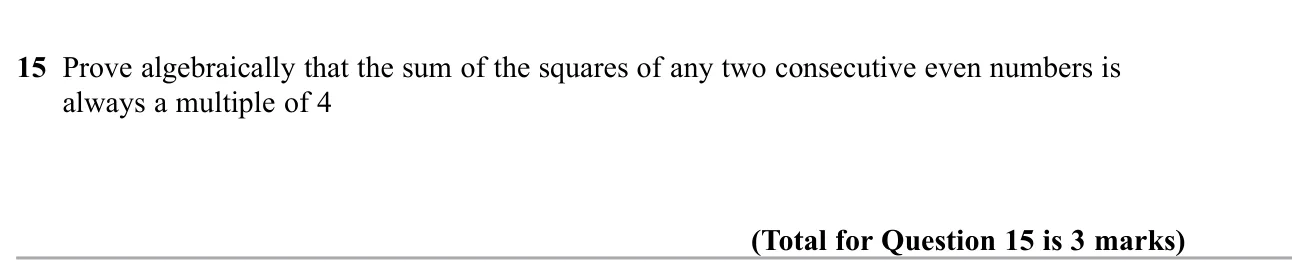
Let the numbers be 2n and 2n+2.
(2n)2+(2n+2)2=4n2+4n2+8n+4=8n2+8n+4
=4(2n2+2n+1)
2n2+2n+1 is an integer, so the sum is a multiple of 4.
Watch out: Using n and n+2, which need not be even.
© Pearson Education Ltd. November 2019 Paper 3 (Higher, calculator), question 16.
Show answer
| Answer | x=−7.5 | 3 marks |
|---|
Worked solution Checked against the mark scheme
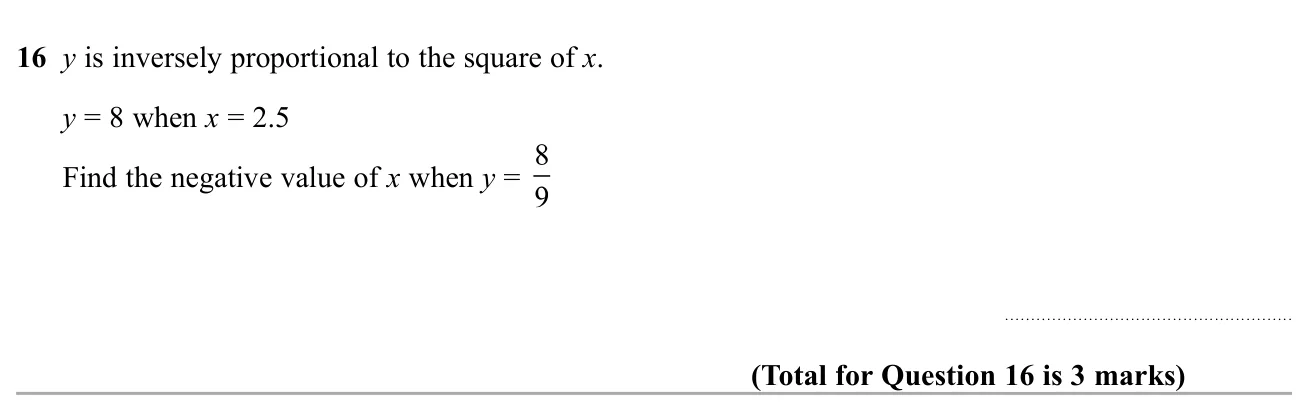
y=x2k, so 8=2.52k and k=8×6.25=50
When y=98: x2=50÷98=56.25
x=±7.5, so the negative value is −7.5
Watch out: Using y=k/x instead of k/x2.
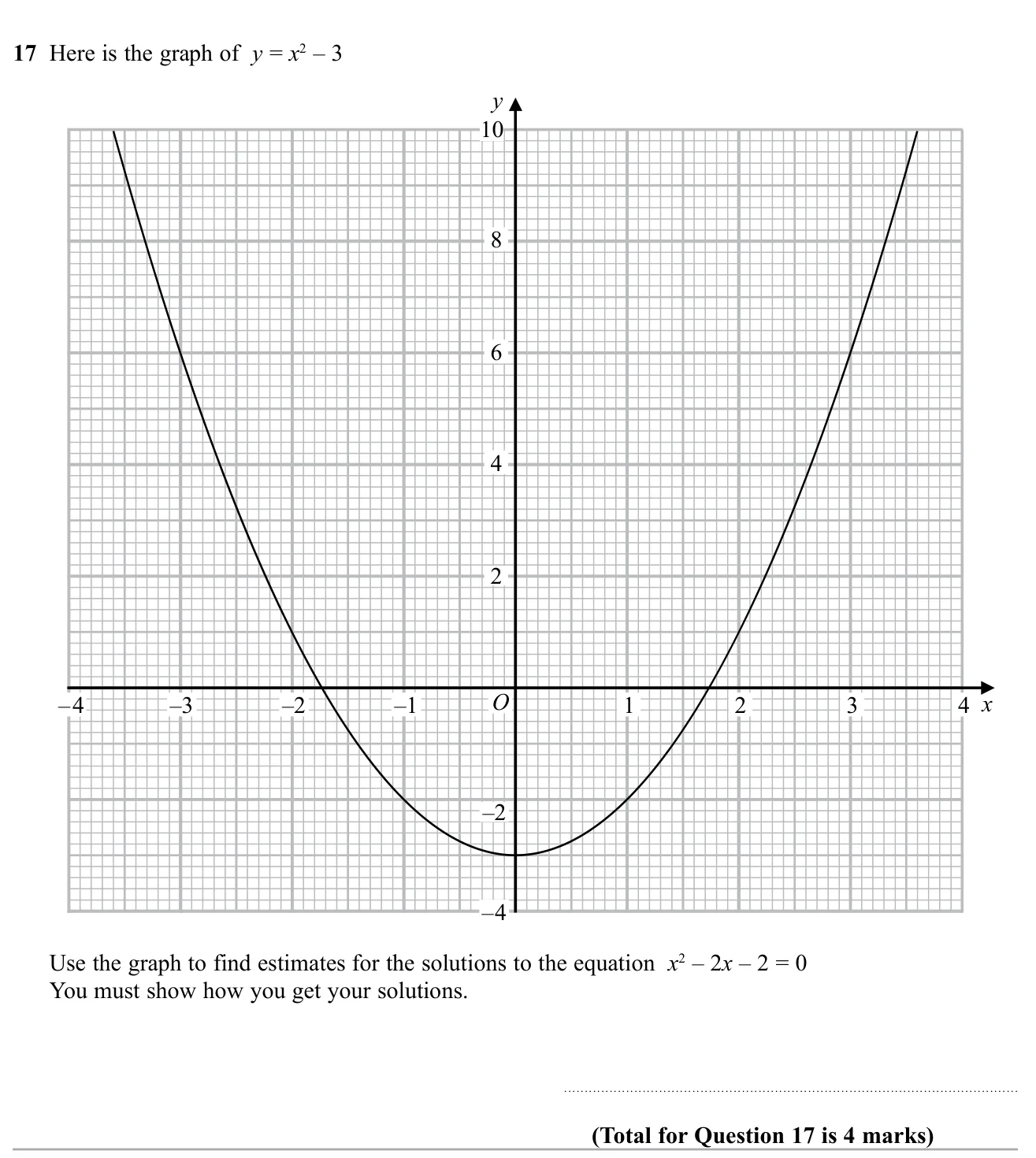
© Pearson Education Ltd. November 2019 Paper 3 (Higher, calculator), question 17.
Show answer
| Answer | x≈2.7 and x≈−0.7 | 4 marks |
|---|
Worked solution Checked against the mark scheme
x2−2x−2=0 is the same as x2−3=2x−1.
Draw y=2x−1 on the graph of y=x2−3.
The line and curve cross at about x=2.7 and x=−0.7.
Watch out: Drawing y=2x+1 instead of y=2x−1.
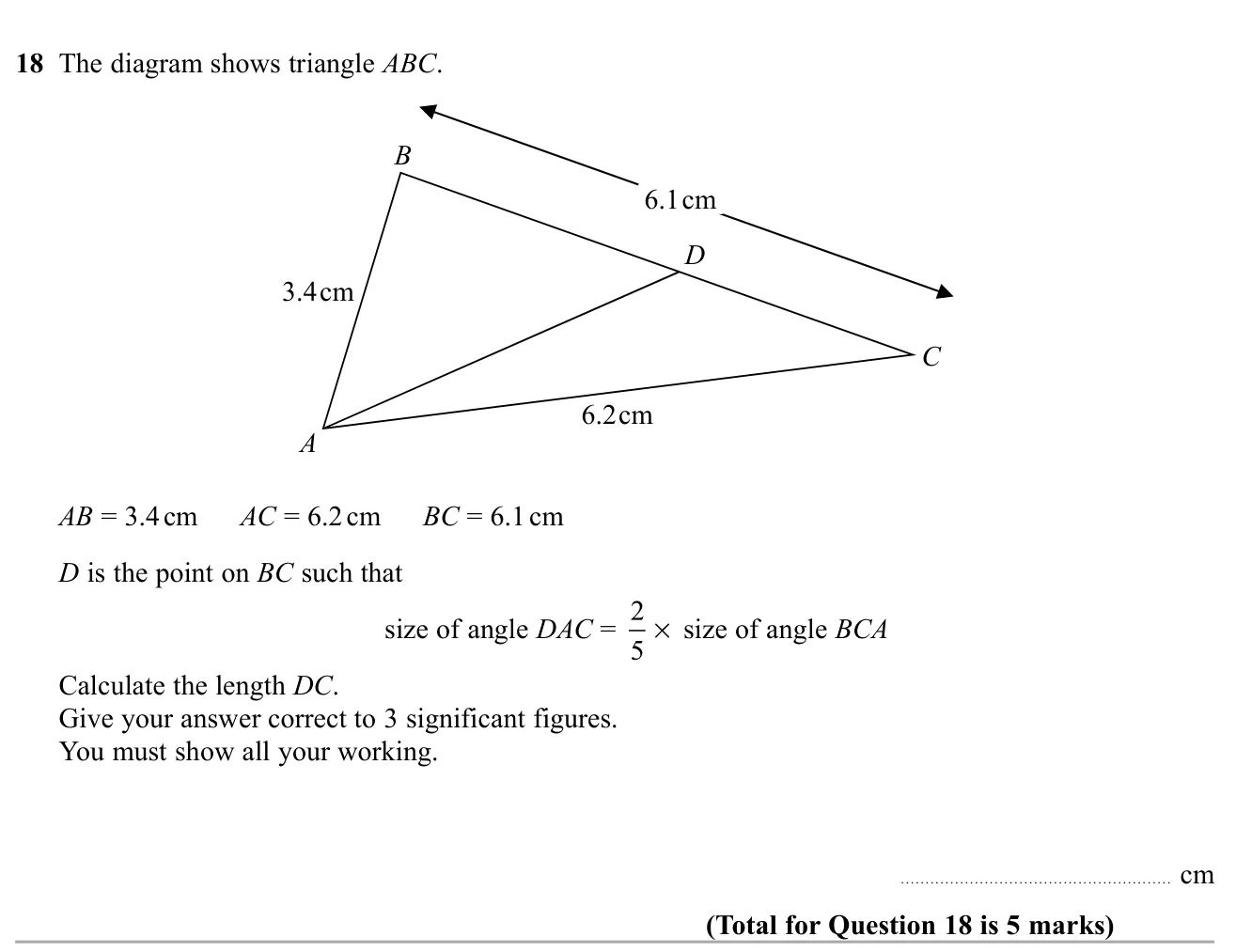
© Pearson Education Ltd. November 2019 Paper 3 (Higher, calculator), question 18.
Show answer
| Answer | 1.95 cm | 5 marks |
|---|
Worked solution Checked against the mark scheme
Cosine rule: cosC=2×6.1×6.26.12+6.22−3.42, so C=32.08°
Angle DAC =52×32.08=12.83°
Angle ADC =180−32.08−12.83=135.09°
Sine rule: DC=sin135.09°6.2sin12.83°=1.95 cm
Watch out: Using 6.1 cm (BC) as the side opposite angle ADC instead of AC.
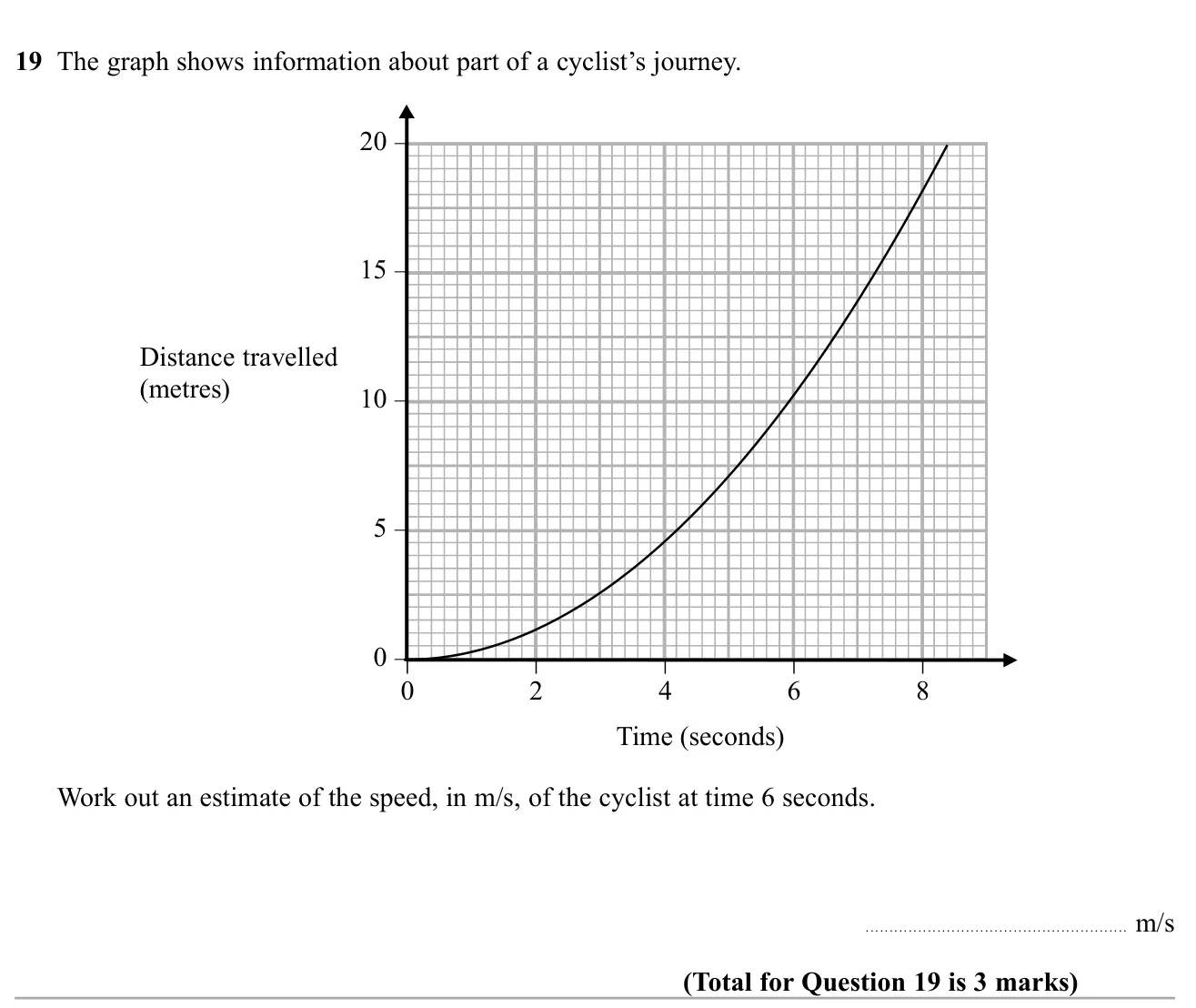
© Pearson Education Ltd. November 2019 Paper 3 (Higher, calculator), question 19.
Show answer
| Answer | About 3.4 m/s (3.05 to 3.7) | 3 marks |
|---|
Worked solution Checked against the mark scheme
Draw a tangent touching the curve at t=6 (where the distance is about 10 m).
Pick two points on the tangent, e.g. it rises about 20 m over about 5.8 s.
Speed =20÷5.8≈3.4 m/s
Watch out: Dividing 10 by 6 (average speed from the start) instead of using a tangent.
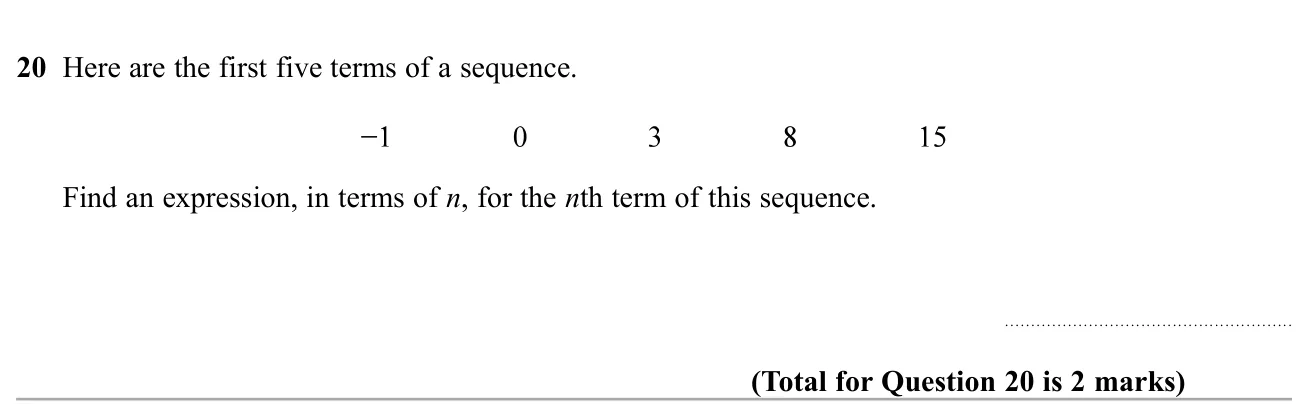
© Pearson Education Ltd. November 2019 Paper 3 (Higher, calculator), question 20.
Show answer
| Answer | n2−2n | 2 marks |
|---|
Worked solution Checked against the mark scheme
First differences: 1, 3, 5, 7. Second difference 2, so start with n2: 1, 4, 9, 16, 25.
Sequence minus n2: −2, −4, −6, −8, −10, which is −2n.
nth term =n2−2n
Watch out: Giving 2n2 because the second difference is 2.
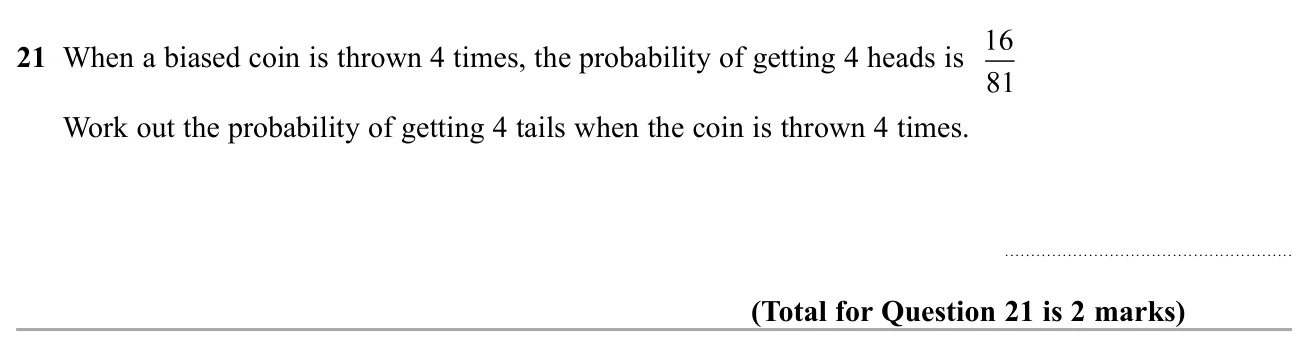
© Pearson Education Ltd. November 2019 Paper 3 (Higher, calculator), question 21.
Show answer
| Answer | 811 | 2 marks |
|---|
Worked solution Checked against the mark scheme
P(head)4=8116, so P(head) =48116=32
P(tail) =1−32=31
P(4 tails) =(31)4=811
Watch out: Working out 1−8116=8165.
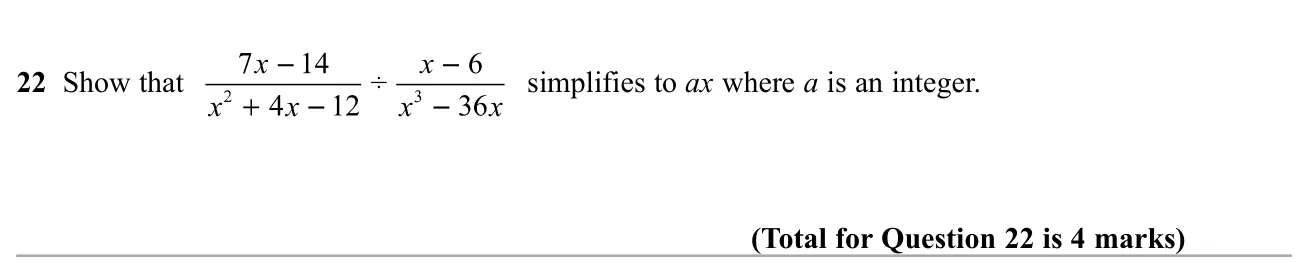
© Pearson Education Ltd. November 2019 Paper 3 (Higher, calculator), question 22.
Show answer
Worked solution Checked against the mark scheme
7x−14=7(x−2) and x2+4x−12=(x−2)(x+6)
x3−36x=x(x−6)(x+6)
(x−2)(x+6)7(x−2)×x−6x(x−6)(x+6)
Cancel (x−2), (x+6) and (x−6) to leave 7x, so a=7.
Watch out: Factorising x3−36x as x(x−6)2 or stopping at x(x2−36).
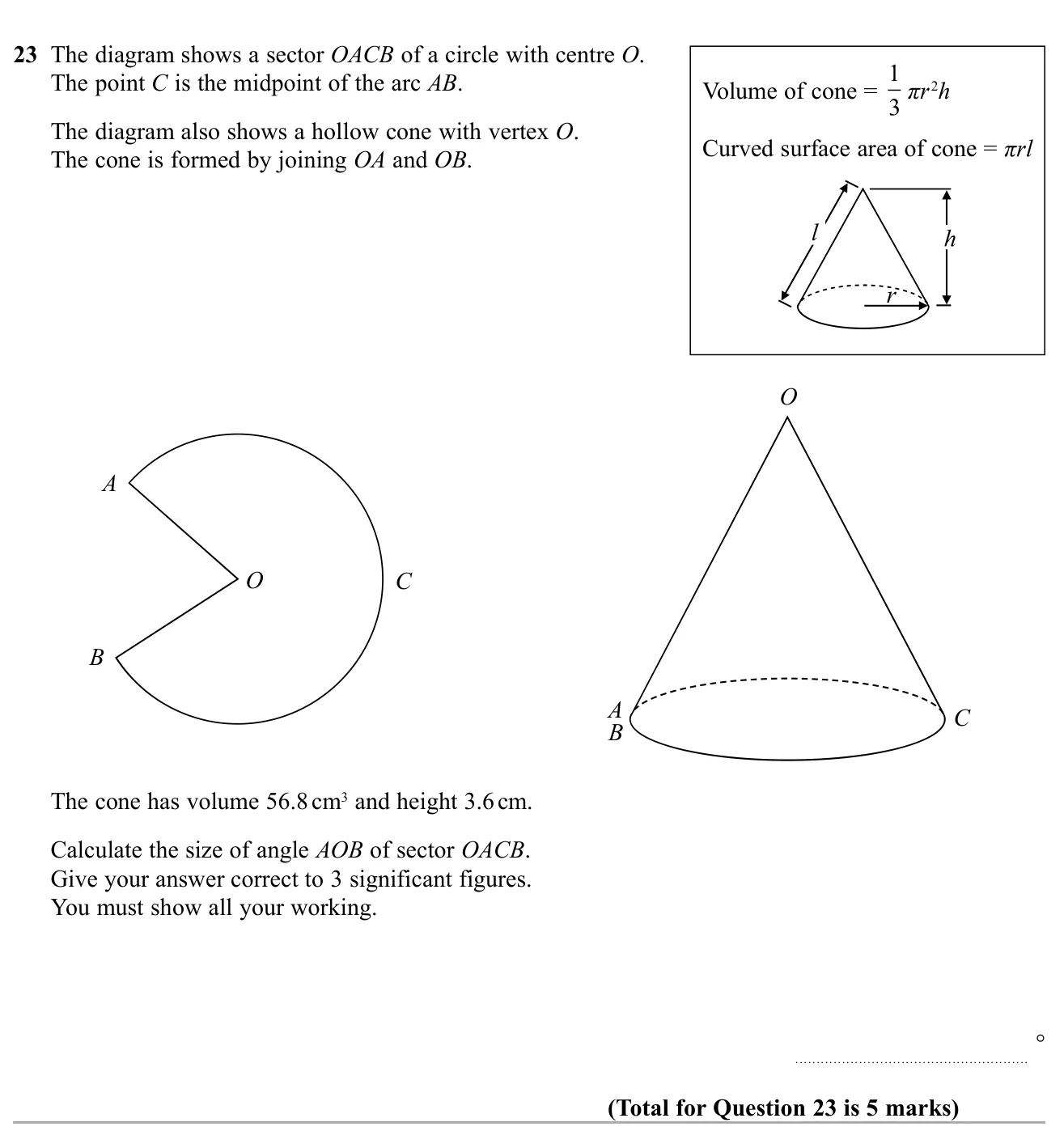
© Pearson Education Ltd. November 2019 Paper 3 (Higher, calculator), question 23.
Show answer
| Answer | 264° | 5 marks |
|---|
Worked solution Checked against the mark scheme
56.8=31πr2×3.6, so r2=1.2π56.8=15.07 and r=3.882 cm
Slant height l=3.8822+3.62=5.294 cm (the sector's radius)
Arc length = base circumference: 360θ×2πl=2πr
θ=360×lr=360×5.2943.882=264°
Watch out: Using the height 3.6 cm as the sector's radius instead of the slant height.
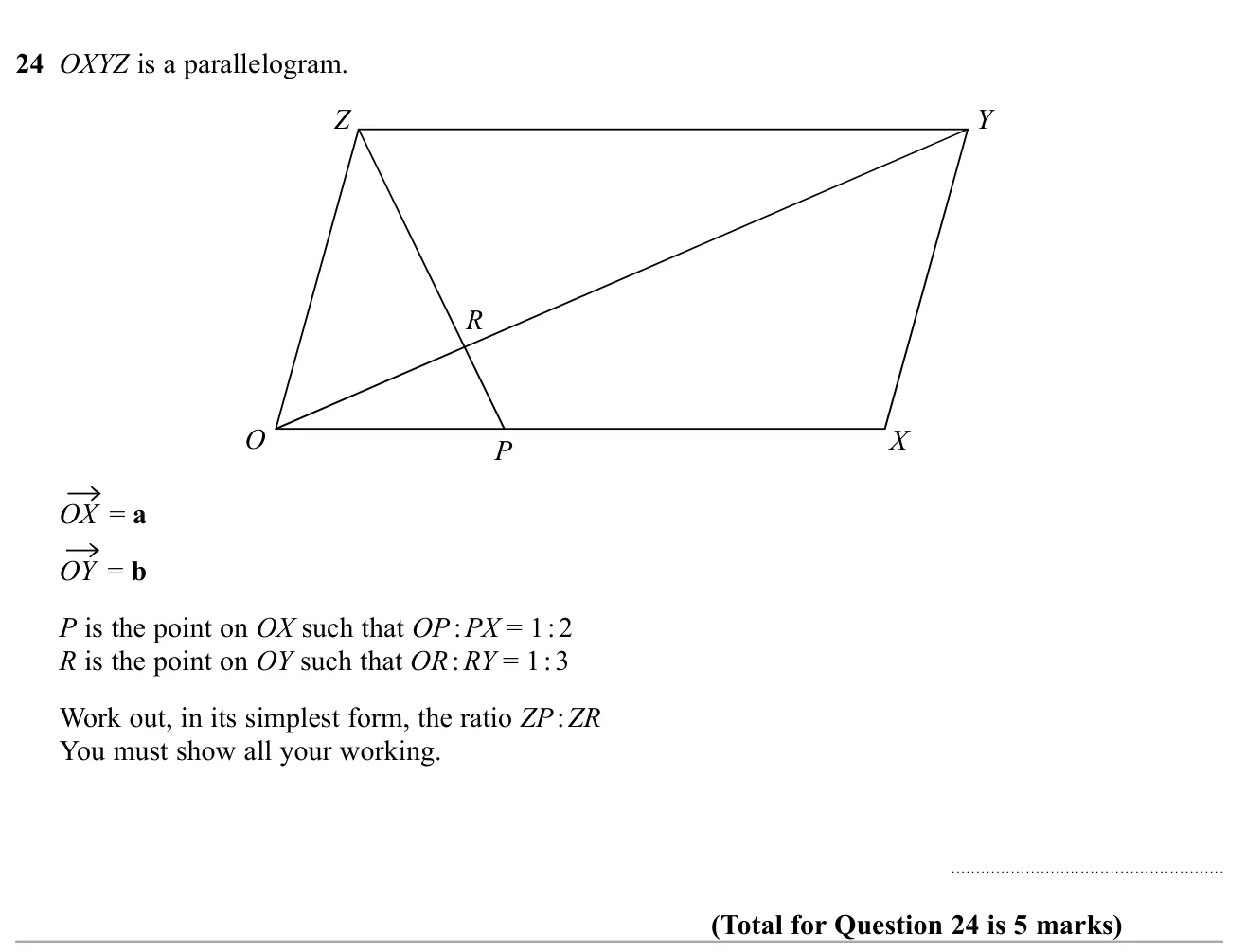
© Pearson Education Ltd. November 2019 Paper 3 (Higher, calculator), question 24.
Show answer
Worked solution Checked against the mark scheme
OZ=XY=b−a
ZP=31a−(b−a)=34a−b=34(a−43b)
ZR=41b−(b−a)=a−43b
So ZP=34ZR and ZP:ZR=4:3
Watch out: Taking OZ=b instead of b−a.
Finished the paper?
Add up your marks for all three papers and see what grade that would have been.