© Pearson Education Ltd. June 2019 Paper 1 (Higher, non-calculator), question 1.
Show answer
| (a) | red 0.4, yellow 0.4 | 2 marks |
|---|
| (b) | 60 | 2 marks |
|---|
Worked solution Checked against the mark scheme
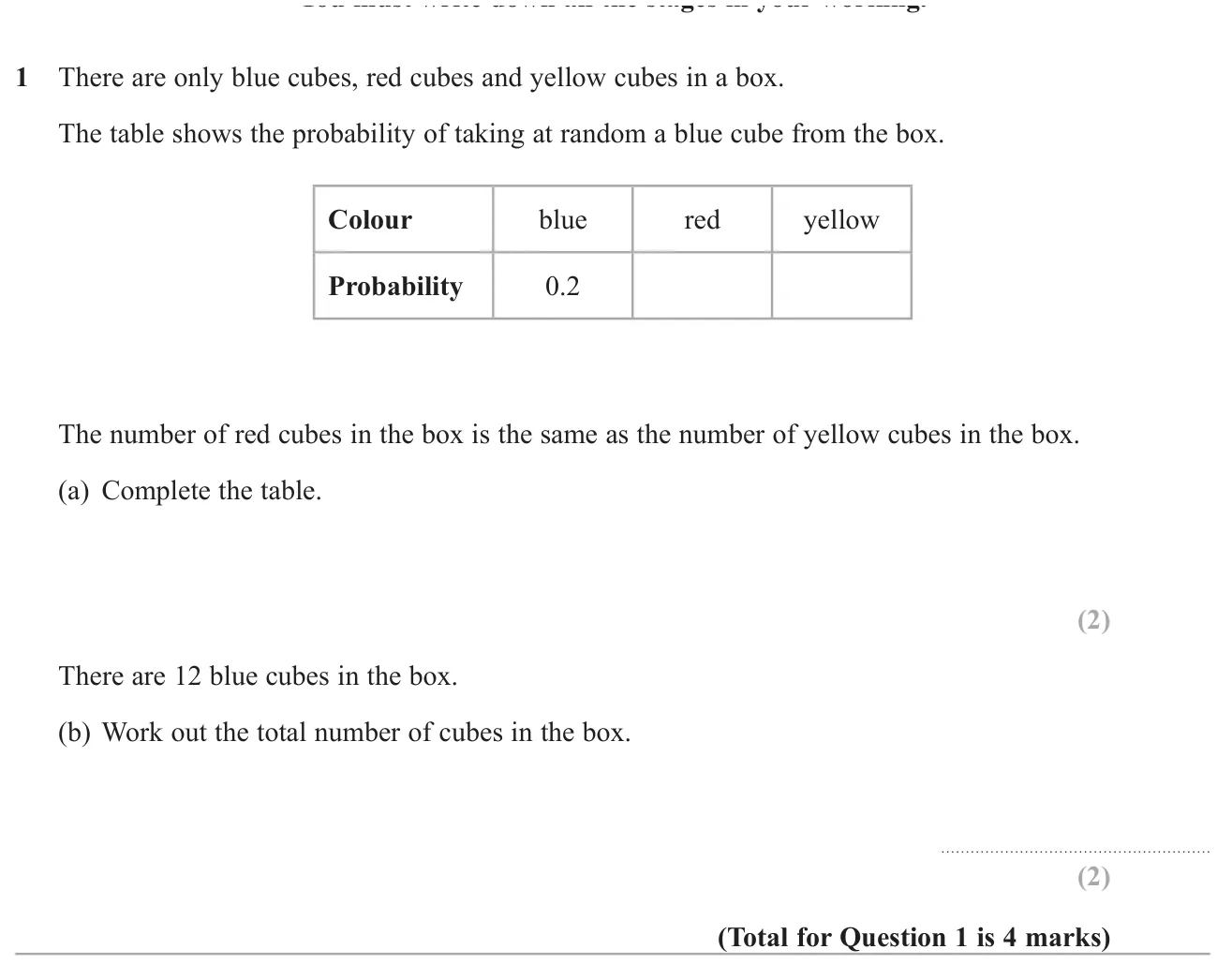
(a) Probabilities add to 1: 1−0.2=0.8
Red and yellow are equal: 0.8÷2=0.4 each.
(b) 0.2 of the cubes are blue, so 12÷0.2=60 cubes.
Watch out: In (b), multiplying 12×0.2.
© Pearson Education Ltd. June 2019 Paper 1 (Higher, non-calculator), question 2.
Show answer
| (a) | 600 g | 3 marks |
|---|
| (b) | 2 packs | 2 marks |
|---|
Worked solution Checked against the mark scheme
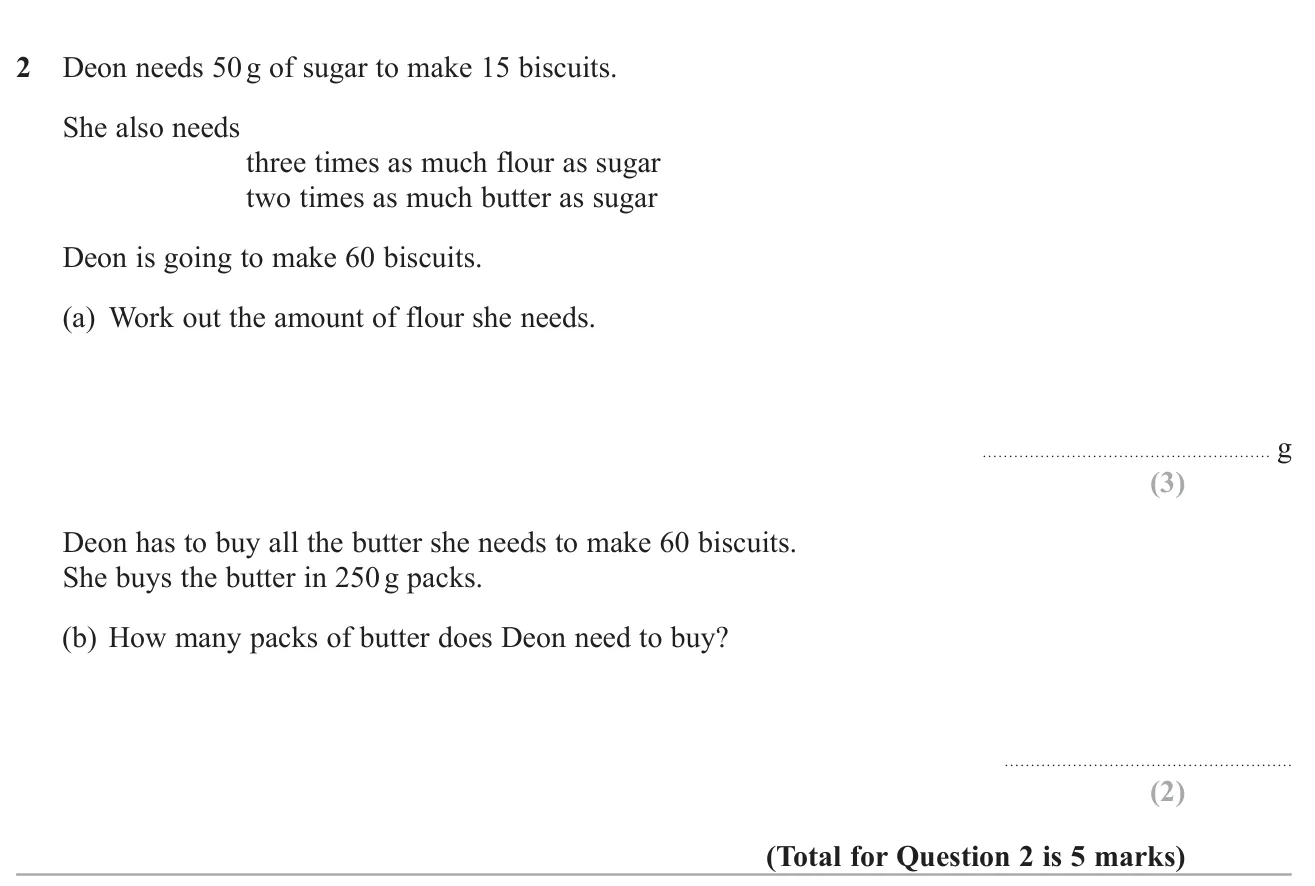
(a) 60÷15=4, so she needs 4×50=200 g of sugar.
Flour: 3×200=600 g
(b) Butter: 2×200=400 g
400÷250=1.6, so she must buy 2 packs.
Watch out: In (b), rounding 1.6 down to 1 pack.
© Pearson Education Ltd. June 2019 Paper 1 (Higher, non-calculator), question 3.
Show answer
Worked solution Checked against the mark scheme
72=23×32 and 90=2×32×5
Shared primes: 2×32=18
Watch out: Giving a common factor that is not the highest, such as 6 or 9.
© Pearson Education Ltd. June 2019 Paper 1 (Higher, non-calculator), question 4.
Show answer
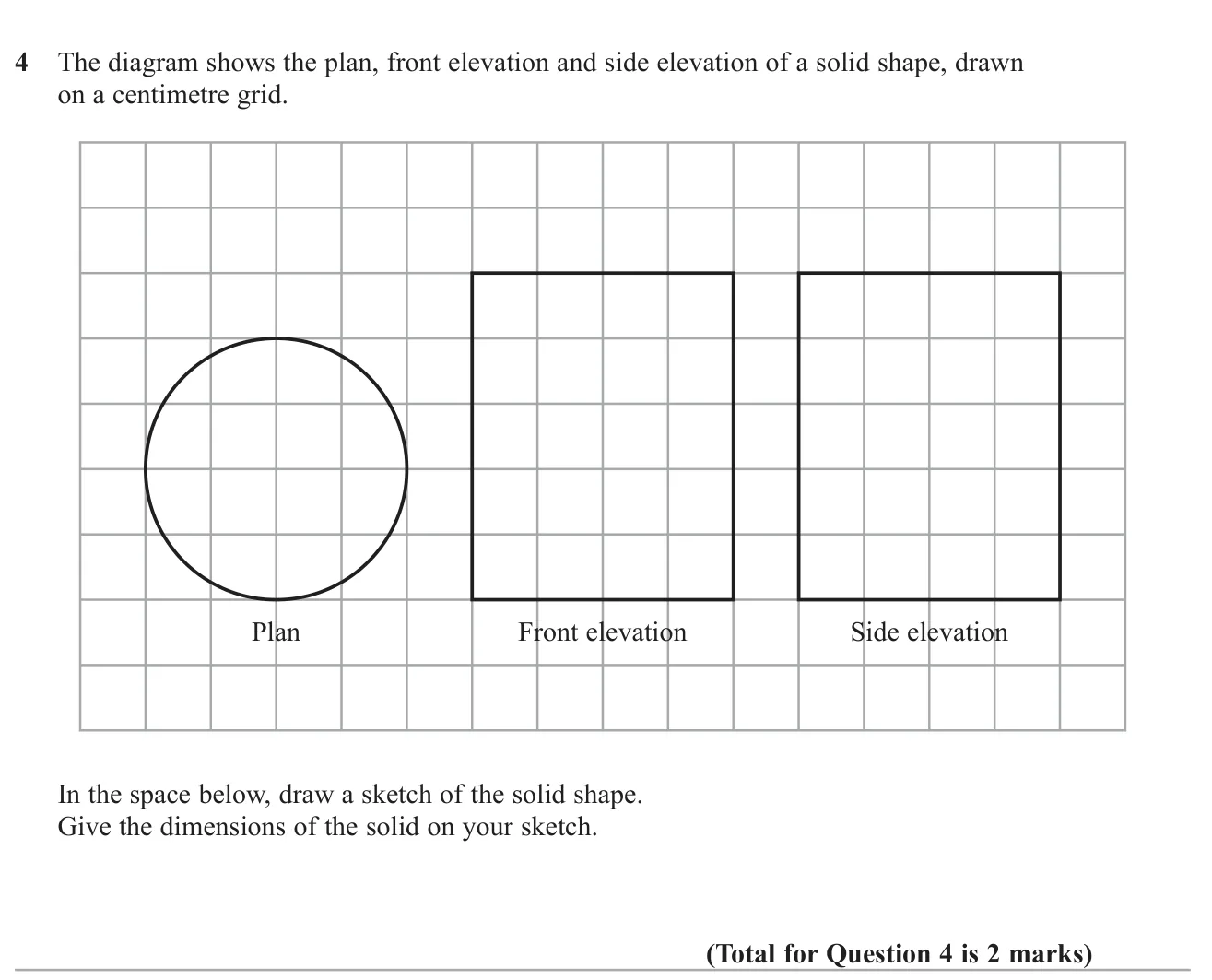
| Answer | Sketch of a cylinder, diameter 4 cm (radius 2 cm), height 5 cm | 2 marks |
|---|
Worked solution Checked against the mark scheme
The plan is a circle, so the solid is round when seen from above.
Both elevations are rectangles, so the solid is a cylinder.
From the grid: diameter 4 cm (radius 2 cm) and height 5 cm.
Watch out: Reading the grid wrongly and labelling the height as 4 cm.
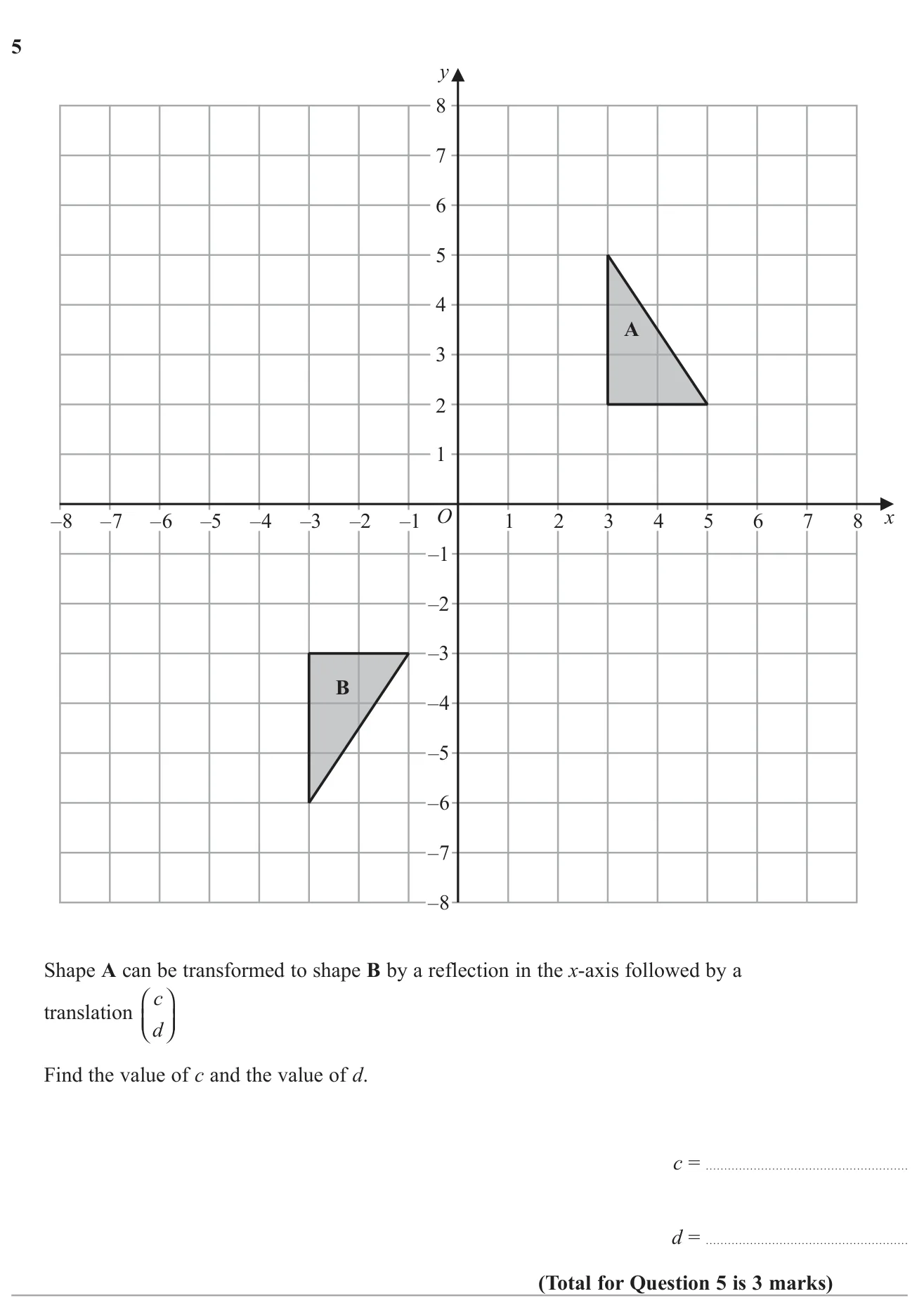
© Pearson Education Ltd. June 2019 Paper 1 (Higher, non-calculator), question 5.
Show answer
| Answer | c=−6, d=−1 | 3 marks |
|---|
Worked solution Checked against the mark scheme
Reflect A in the x-axis: (3,2)→(3,−2), (5,2)→(5,−2), (3,5)→(3,−5)
B has matching corners at (−3,−3), (−1,−3), (−3,−6).
Move from (3,−2) to (−3,−3): 6 left and 1 down.
So c=−6 and d=−1
Watch out: Swapping c and d, or reflecting in the y-axis.
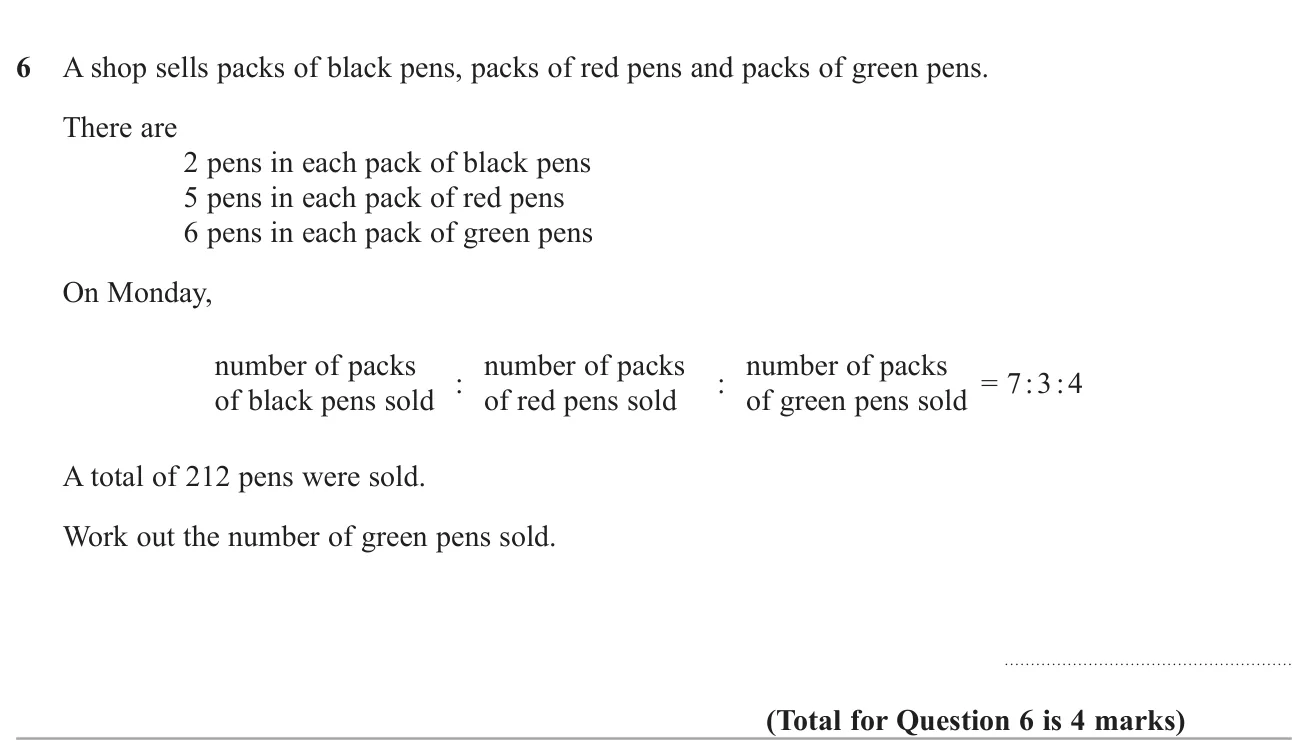
© Pearson Education Ltd. June 2019 Paper 1 (Higher, non-calculator), question 6.
Show answer
Worked solution Checked against the mark scheme
Pens in the ratio 7×2:3×5:4×6=14:15:24
Total parts =53, and 212÷53=4
Green pens =24×4=96
Watch out: Sharing 212 in the ratio 7 : 3 : 4 without allowing for pack sizes.
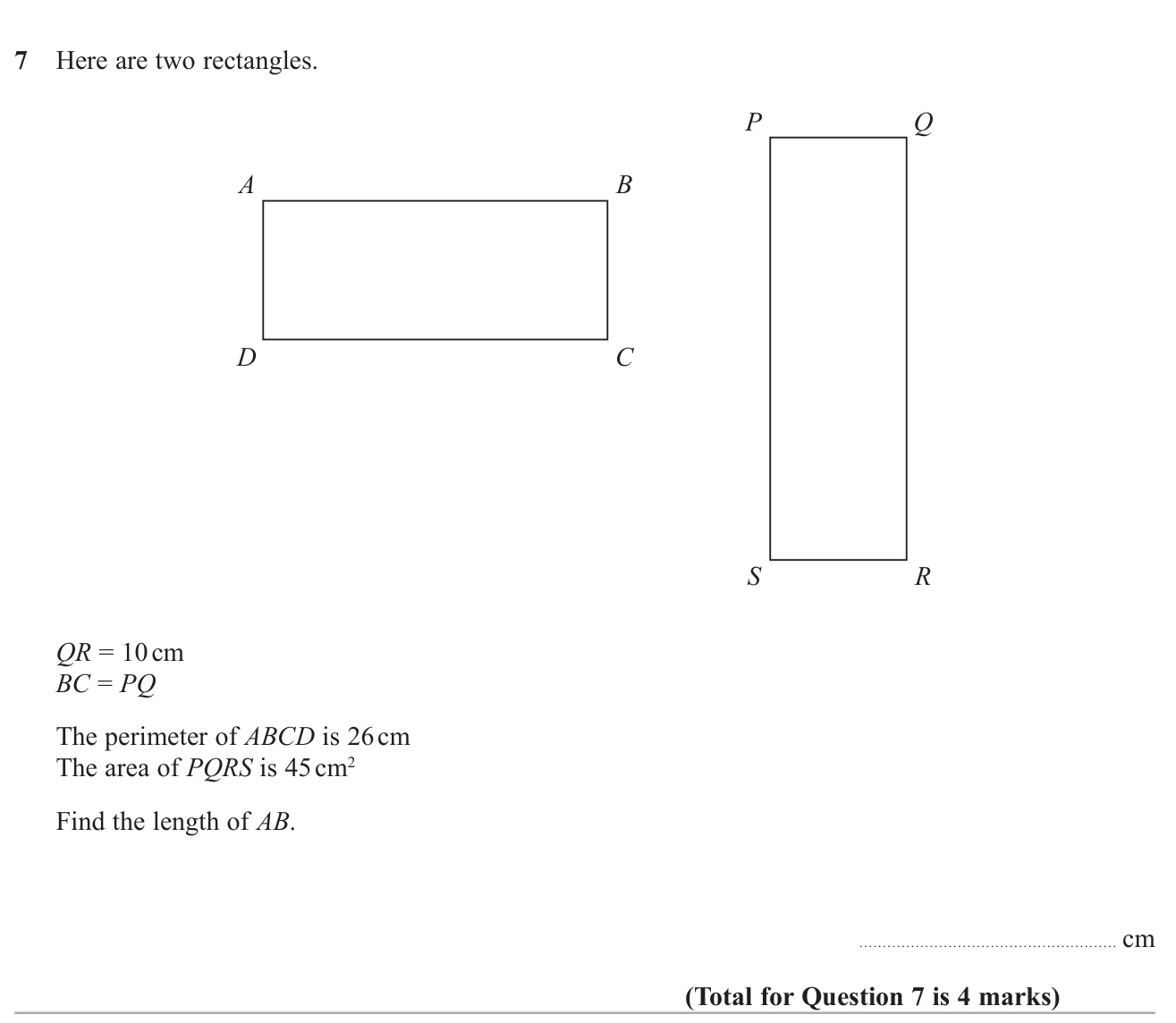
© Pearson Education Ltd. June 2019 Paper 1 (Higher, non-calculator), question 7.
Show answer
Worked solution Checked against the mark scheme
Area of PQRS: PQ×10=45, so PQ=4.5 cm, so BC=4.5 cm.
Perimeter of ABCD: 2×AB+2×4.5=26
2×AB=17, so AB=8.5 cm
Watch out: Subtracting only one 4.5 from 26, or forgetting to halve.
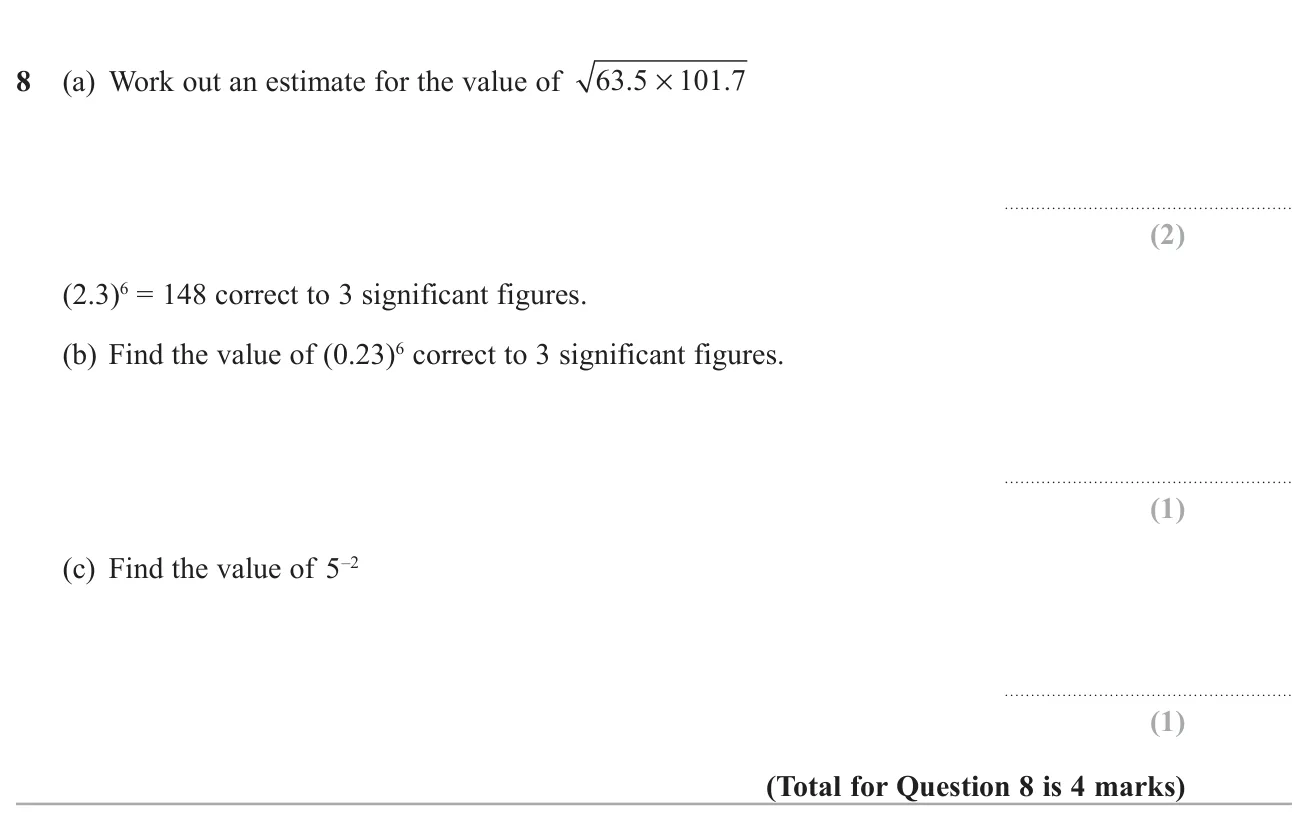
© Pearson Education Ltd. June 2019 Paper 1 (Higher, non-calculator), question 8.
Show answer
| (a) | 80 (accept 75 to 81) | 2 marks |
|---|
| (b) | 0.000148 | 1 mark |
|---|
| (c) | 251 | 1 mark |
|---|
Worked solution Checked against the mark scheme
(a) 63.5×101.7≈64×100=6400=80
(b) 0.23=2.3÷10, so (0.23)6=148÷106=0.000148
(c) 5−2=521=251
Watch out: In (c), giving −25 or −10 for 5−2.
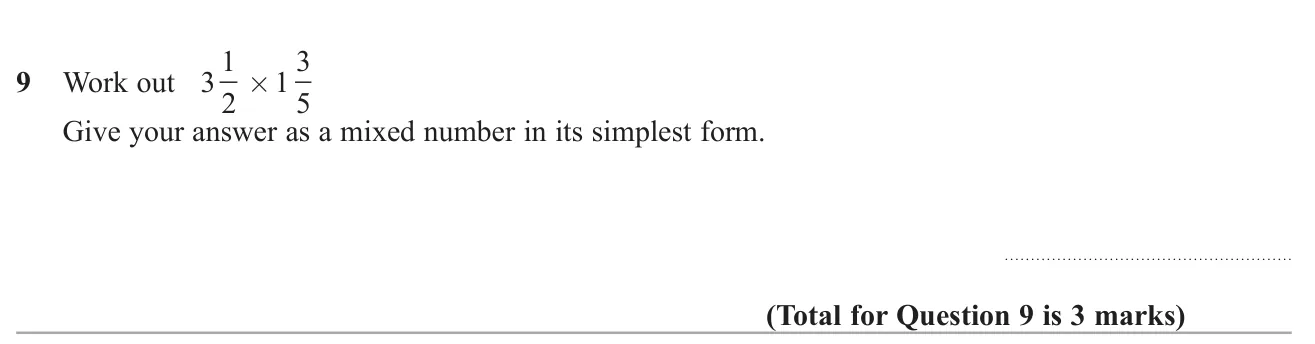
© Pearson Education Ltd. June 2019 Paper 1 (Higher, non-calculator), question 9.
Show answer
| Answer | 553 | 3 marks |
|---|
Worked solution Checked against the mark scheme
321=27 and 153=58
27×58=1056=528=553
Watch out: Multiplying the whole numbers and fractions separately to get 3103.
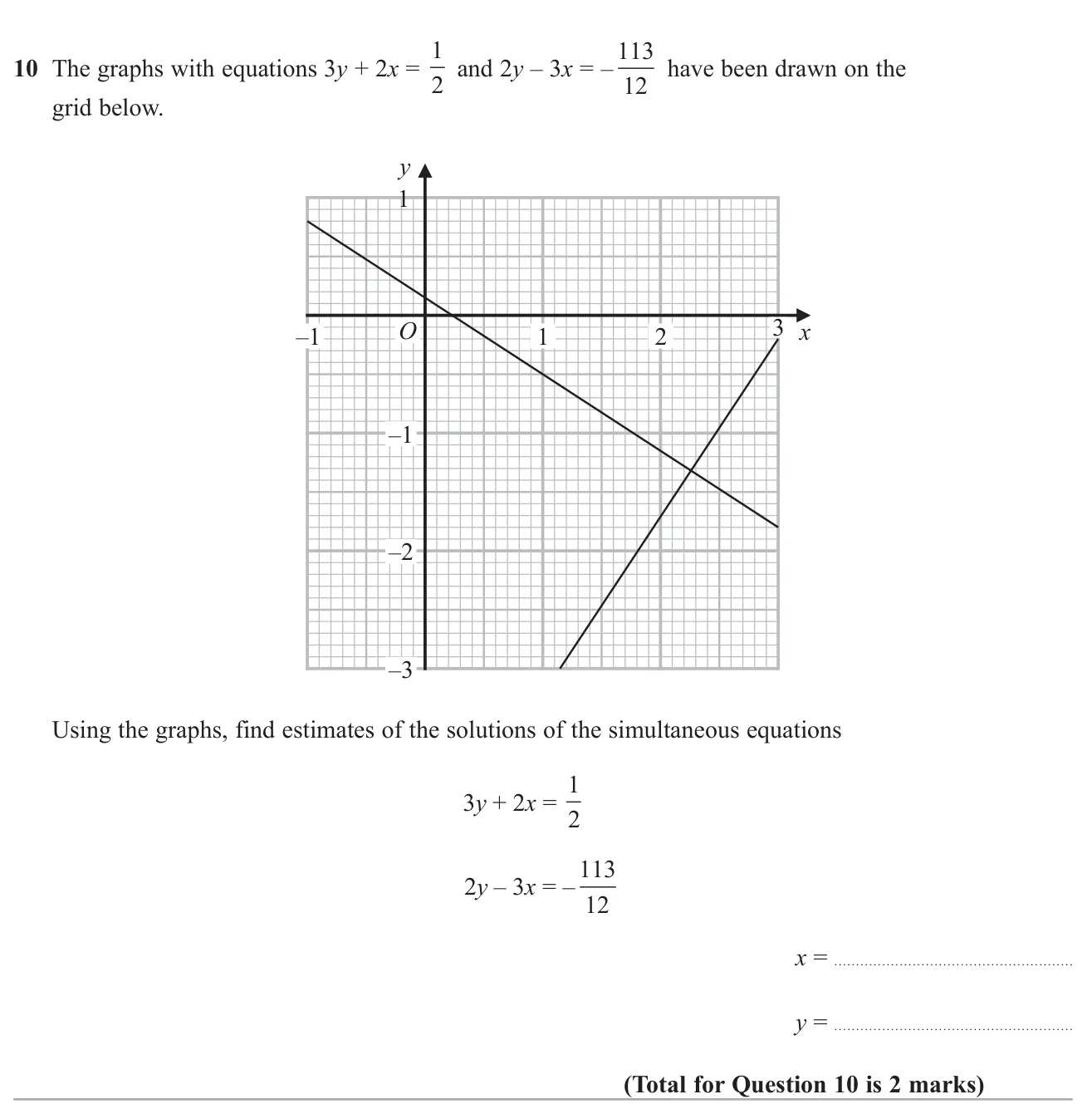
© Pearson Education Ltd. June 2019 Paper 1 (Higher, non-calculator), question 10.
Show answer
| Answer | x≈2.25, y≈−1.35 (x from 2.2 to 2.3, y from −1.3 to −1.4) | 2 marks |
|---|
Worked solution Checked against the mark scheme
The solution is where the two lines cross.
Reading the grid, they cross at about x=2.25 and y=−1.35.
(Solving exactly gives x=49 and y=−34.)
Watch out: Swapping the x and y values, or reading where a line meets an axis.
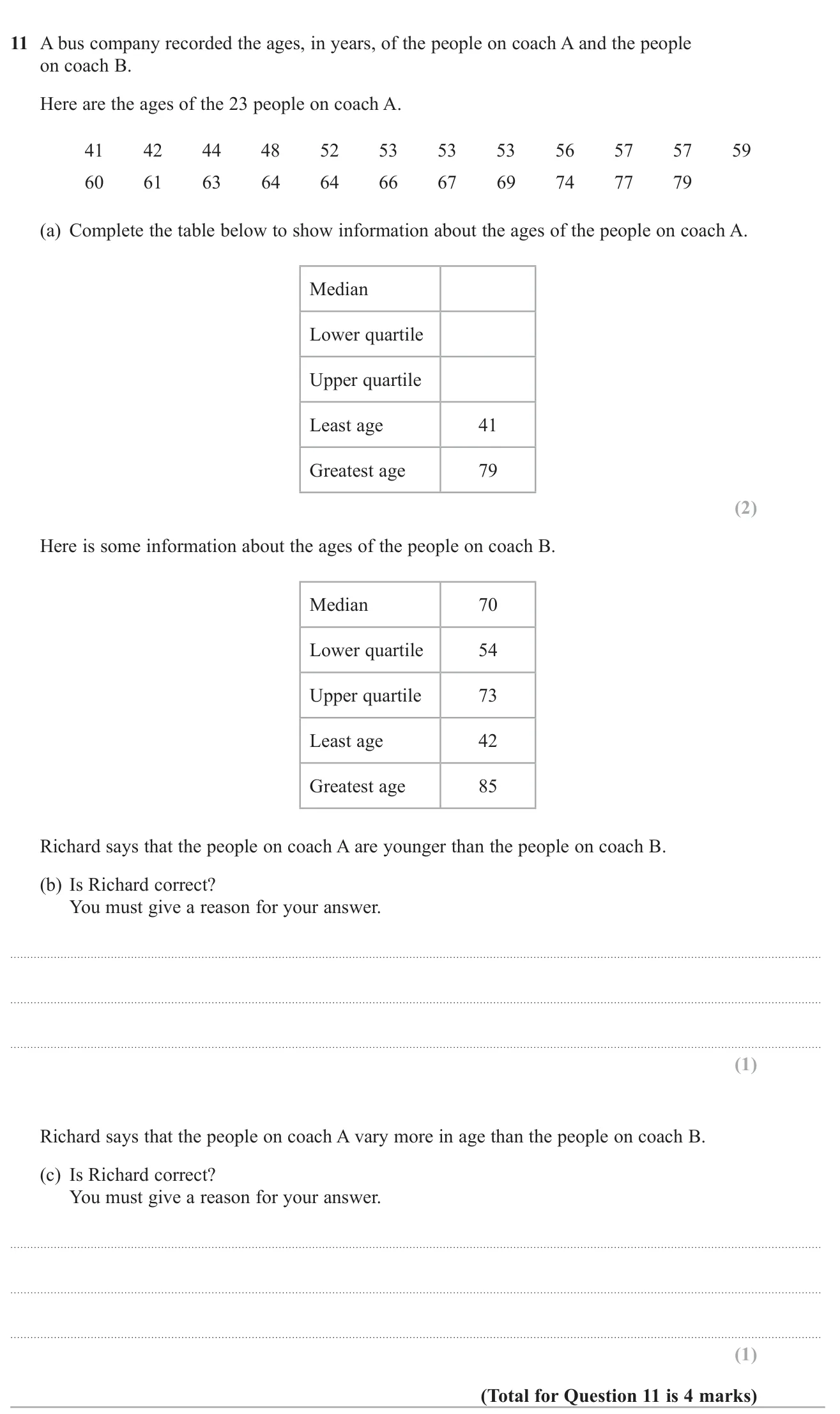
© Pearson Education Ltd. June 2019 Paper 1 (Higher, non-calculator), question 11.
Show answer
| (a) | Median 59, lower quartile 53, upper quartile 66 | 2 marks |
|---|
| (b) | Yes: the median for coach A (59) is lower than for coach B (70) | 1 mark |
|---|
| (c) | No: coach A has a smaller range (38 < 43) and a smaller interquartile range (13 < 19) | 1 mark |
|---|
Worked solution Checked against the mark scheme
(a) There are 23 ages, so the median is the 12th value: 59.
The lower quartile is the 6th value: 53. The upper quartile is the 18th value: 66.
(b) Coach A's median, 59, is below coach B's, 70, so yes.
(c) Range: A is 79−41=38, B is 85−42=43. IQR: A is 66−53=13, B is 73−54=19. Coach A varies less, so no.
Watch out: In (c), just quoting both ranges without saying which is bigger.
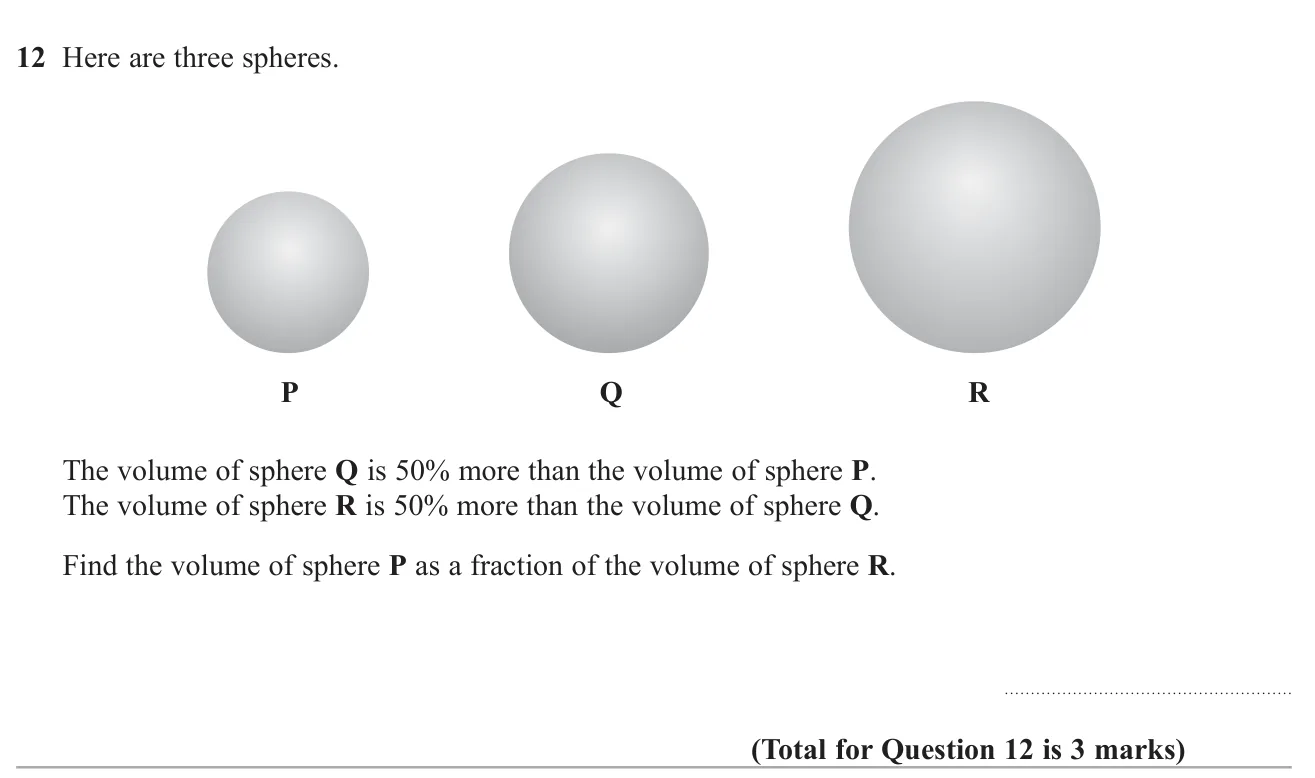
© Pearson Education Ltd. June 2019 Paper 1 (Higher, non-calculator), question 12.
Show answer
| Answer | 94 | 3 marks |
|---|
Worked solution Checked against the mark scheme
Q=1.5P and R=1.5Q=1.52P=2.25P
RP=2.251=94
Watch out: Adding the percentages to get a 100% increase and answering 21.
© Pearson Education Ltd. June 2019 Paper 1 (Higher, non-calculator), question 13.
Show answer
| Answer | n2−n=n(n−1), a product of two consecutive integers, one of which is even, so it is always even | 2 marks |
|---|
Worked solution Checked against the mark scheme
n2−n=n(n−1)
n and n−1 are consecutive integers, so one of them is even.
An even number times any integer is even, so n2−n is never odd.
Watch out: Testing a few values of n instead of giving a general argument.
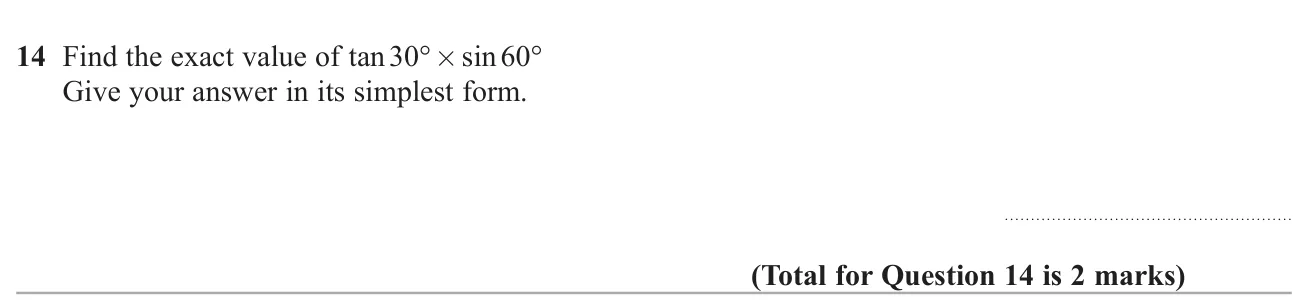
© Pearson Education Ltd. June 2019 Paper 1 (Higher, non-calculator), question 14.
Show answer
| Answer | 21 | 2 marks |
|---|
Worked solution Checked against the mark scheme
tan30∘=31 and sin60∘=23
31×23=21
Watch out: Using tan30∘=3.
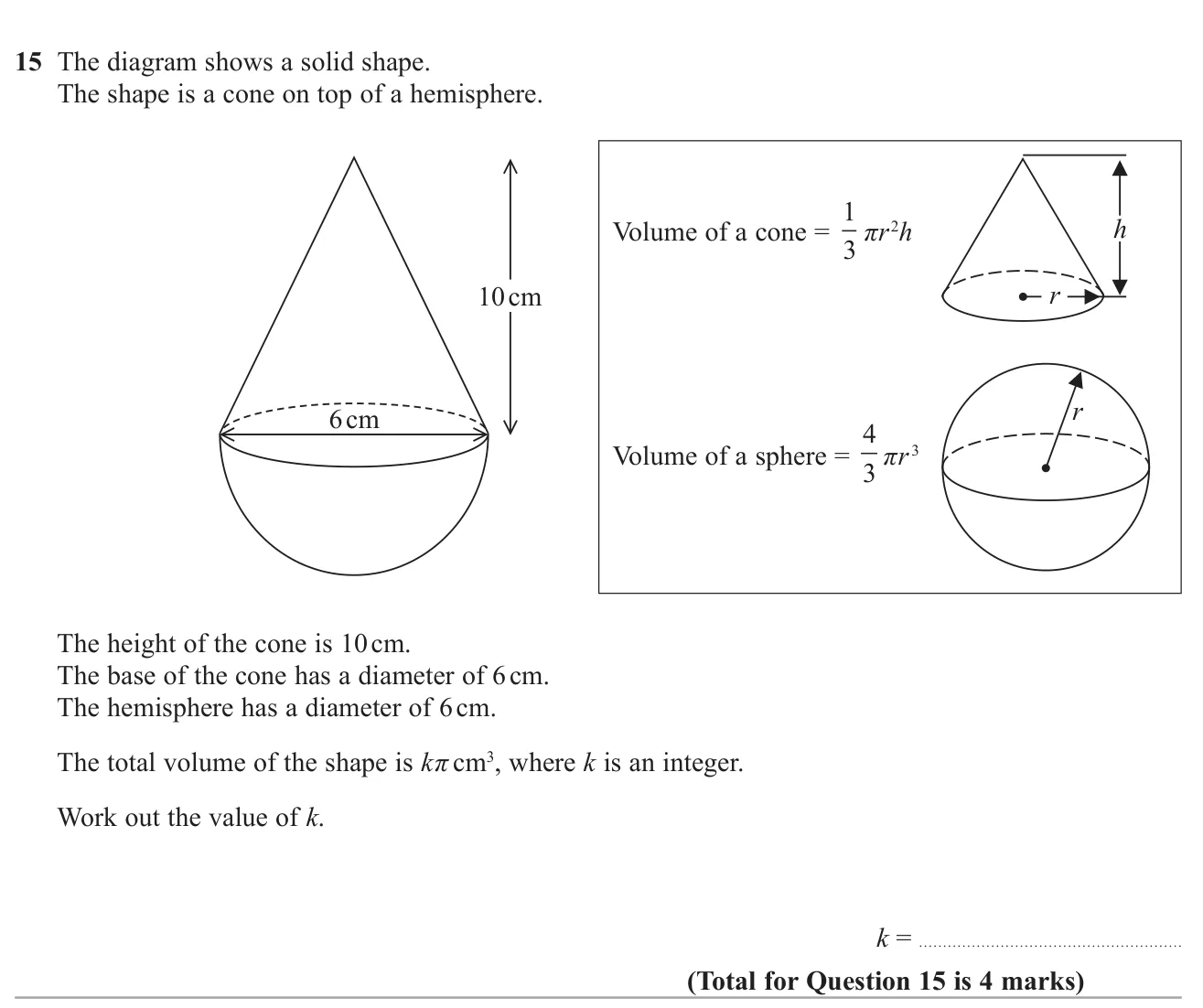
© Pearson Education Ltd. June 2019 Paper 1 (Higher, non-calculator), question 15.
Show answer
| Answer | k=48 | 4 marks |
|---|
Worked solution Checked against the mark scheme
Radius =6÷2=3 cm.
Cone: 31π×32×10=30π
Hemisphere: 21×34π×33=18π
Total =48π, so k=48.
Watch out: Using the full sphere, giving 30π+36π=66π, or using 6 as the radius.
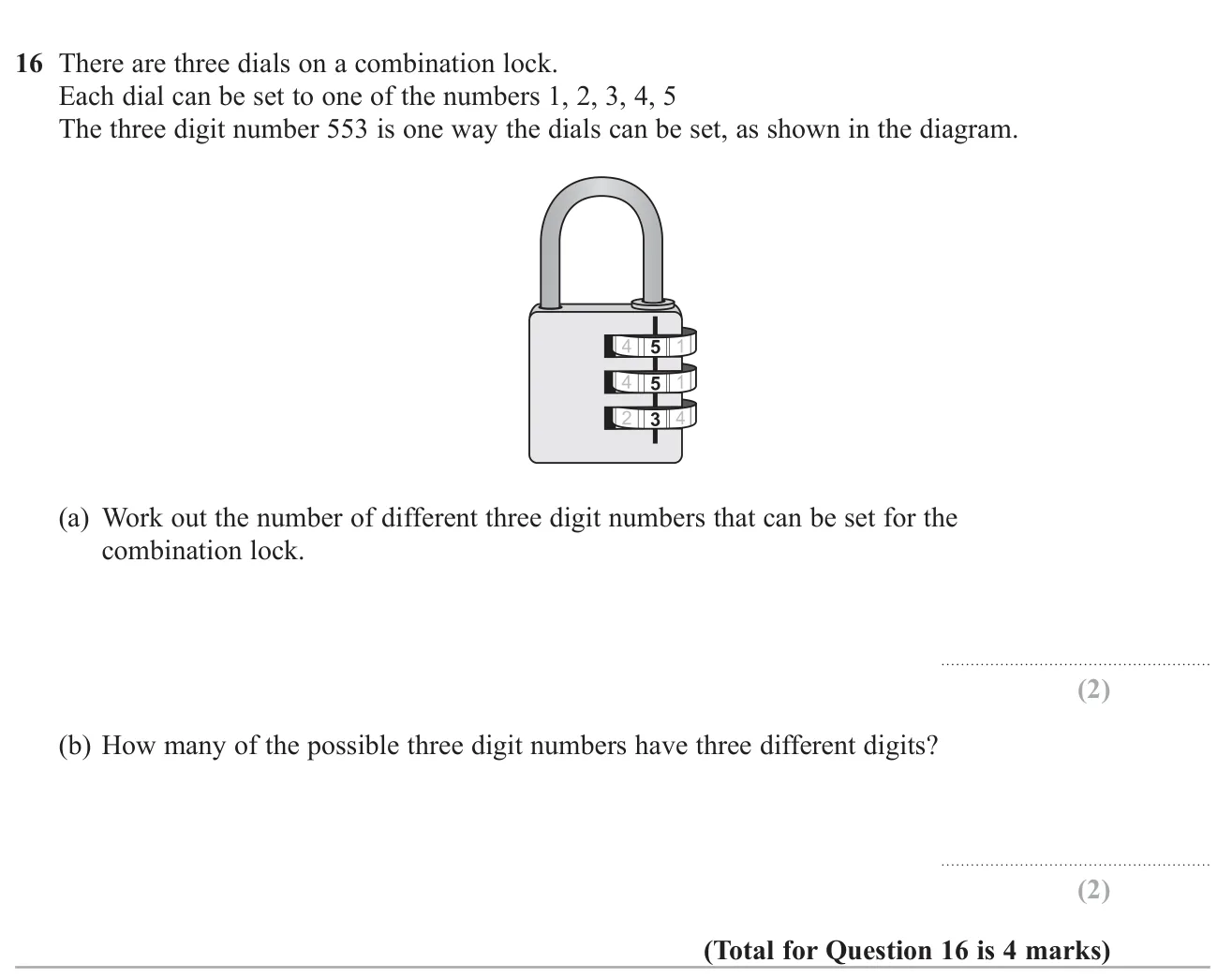
© Pearson Education Ltd. June 2019 Paper 1 (Higher, non-calculator), question 16.
Show answer
| (a) | 125 | 2 marks |
|---|
| (b) | 60 | 2 marks |
|---|
Worked solution Checked against the mark scheme
(a) Each dial has 5 choices: 5×5×5=125
(b) The first dial has 5 choices, the second 4 left, the third 3 left: 5×4×3=60
Watch out: Adding choices (5 + 5 + 5) instead of multiplying.
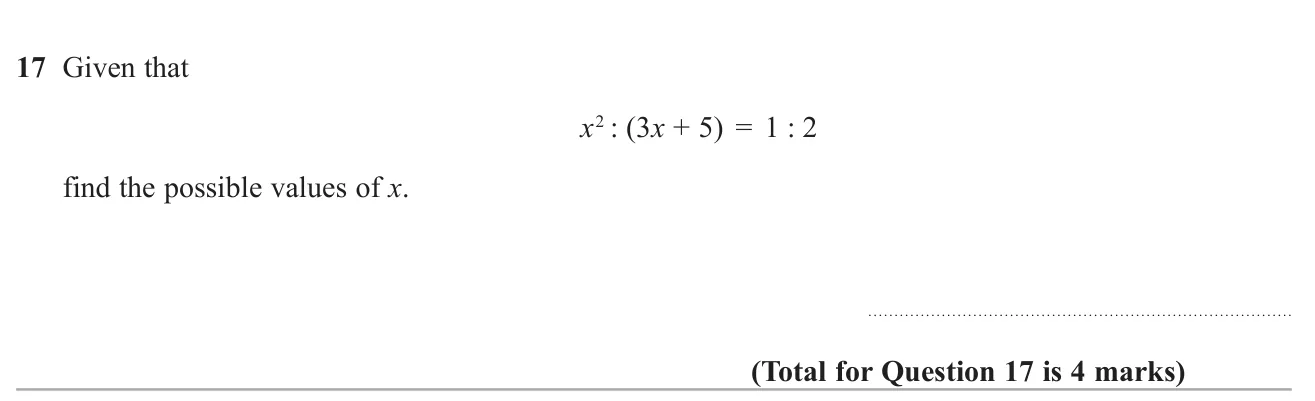
© Pearson Education Ltd. June 2019 Paper 1 (Higher, non-calculator), question 17.
Show answer
| Answer | x=−1 or x=2.5 | 4 marks |
|---|
Worked solution Checked against the mark scheme
3x+5x2=21, so 2x2=3x+5
2x2−3x−5=0
(2x−5)(x+1)=0
x=2.5 or x=−1
Watch out: Cross-multiplying the wrong way to get x2=2(3x+5).
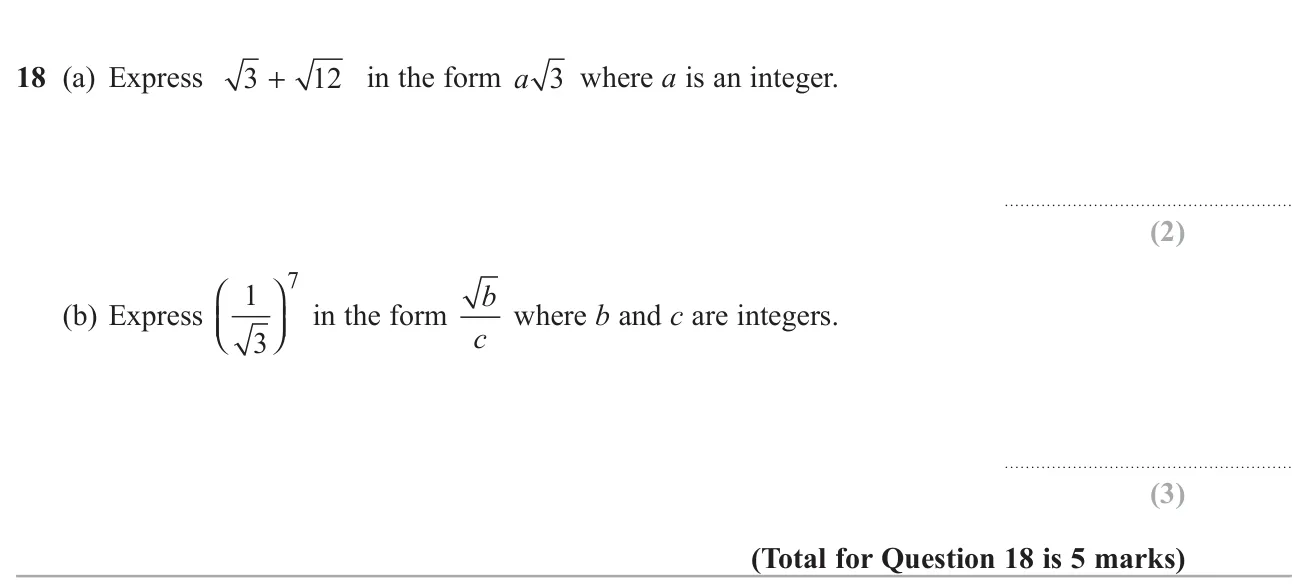
Question 18
Surds5 marksGrade 7No calculator © Pearson Education Ltd. June 2019 Paper 1 (Higher, non-calculator), question 18.
Show answer
| (a) | 33 | 2 marks |
|---|
| (b) | 813 | 3 marks |
|---|
Worked solution Checked against the mark scheme
(a) 12=4×3=23, so 3+23=33
(b) (3)7=(3)6×3=273
2731×33=813
Watch out: In (a), adding under the root to get 15.
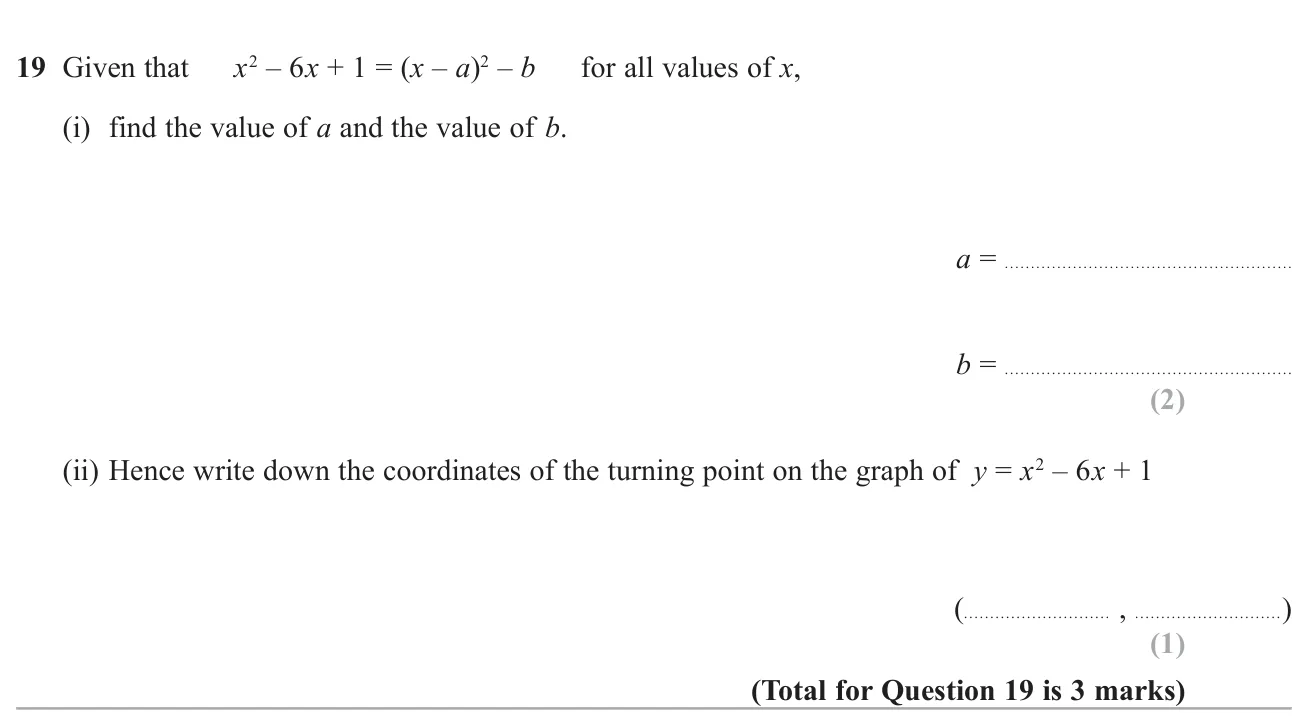
© Pearson Education Ltd. June 2019 Paper 1 (Higher, non-calculator), question 19.
Show answer
| ((i)) | a=3, b=8 | 2 marks |
|---|
| ((ii)) | (3,−8) | 1 mark |
|---|
Worked solution Checked against the mark scheme
(i) Halve −6 to get (x−3)2=x2−6x+9.
x2−6x+1=(x−3)2−9+1=(x−3)2−8, so a=3 and b=8.
(ii) The turning point is (a,−b)=(3,−8).
Watch out: Giving b=−8 or a turning point of (−3,−8).
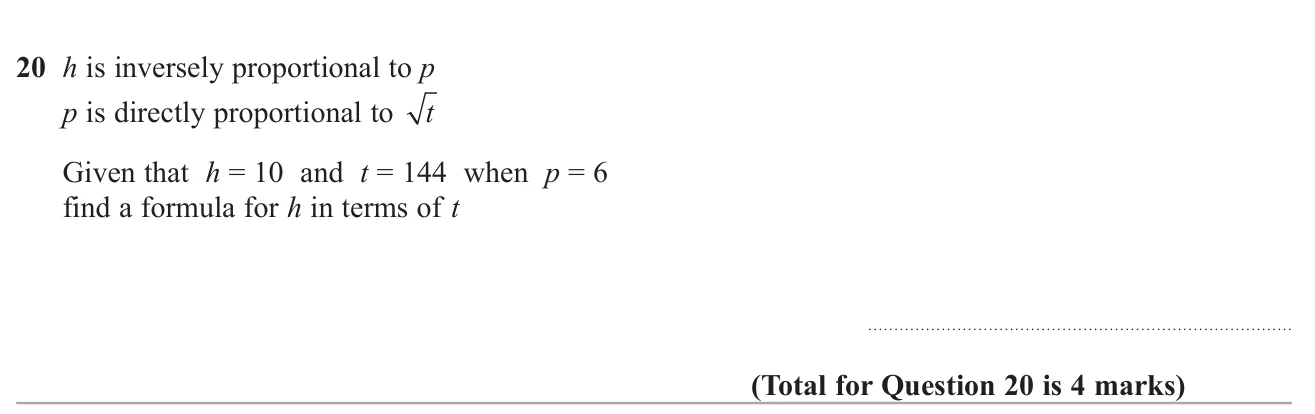
© Pearson Education Ltd. June 2019 Paper 1 (Higher, non-calculator), question 20.
Show answer
| Answer | h=t120 | 4 marks |
|---|
Worked solution Checked against the mark scheme
h=pk: 10=6k, so k=60
p=Kt: 6=K×12, so K=21
h=21t60=t120
Watch out: Using t instead of t in the direct proportion.
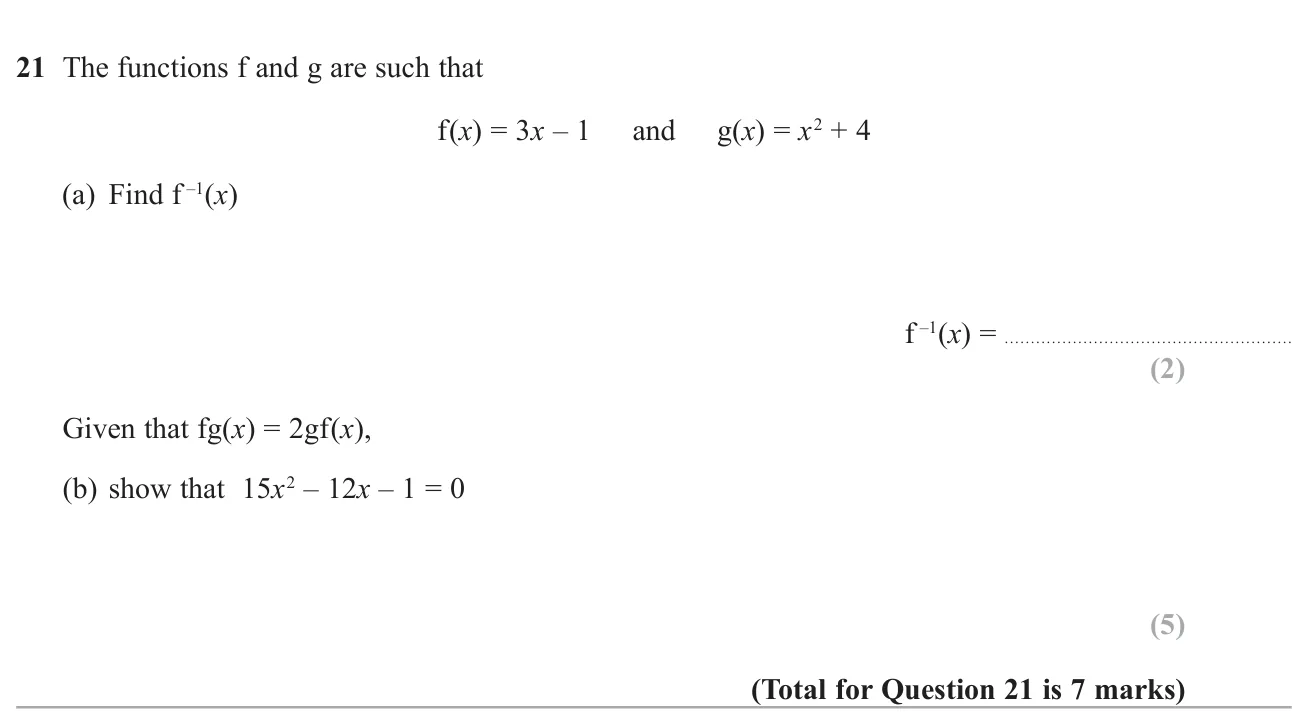
© Pearson Education Ltd. June 2019 Paper 1 (Higher, non-calculator), question 21.
Show answer
| (a) | 3x+1 | 2 marks |
|---|
| (b) | 15x2−12x−1=0 shown | 5 marks |
|---|
Worked solution Checked against the mark scheme
(a) y=3x−1⇒x=3y+1, so f−1(x)=3x+1
(b) fg(x)=3(x2+4)−1=3x2+11
gf(x)=(3x−1)2+4=9x2−6x+5
3x2+11=2(9x2−6x+5)=18x2−12x+10
0=15x2−12x−1
Watch out: Working out gf(x) when fg(x) is needed (applying the functions in the wrong order).
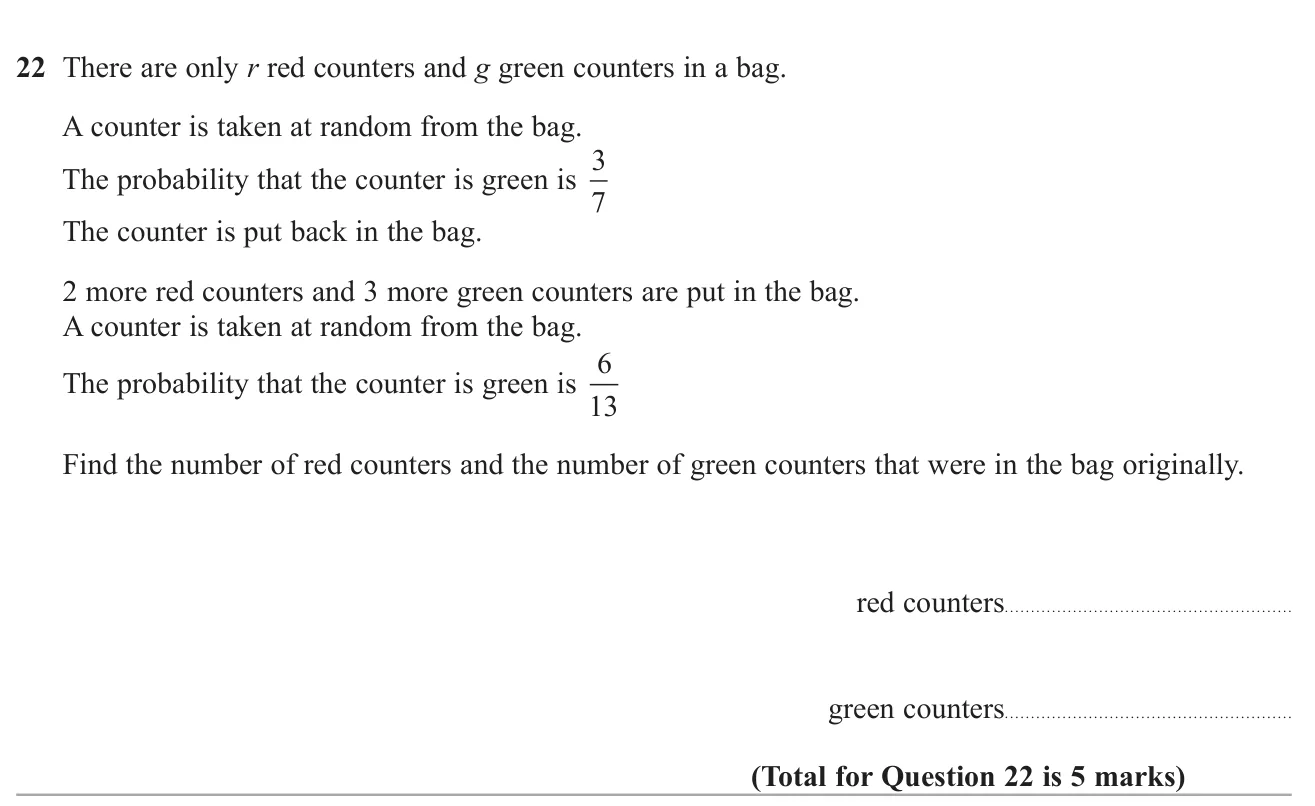
© Pearson Education Ltd. June 2019 Paper 1 (Higher, non-calculator), question 22.
Show answer
| Answer | 12 red and 9 green | 5 marks |
|---|
Worked solution Checked against the mark scheme
Green is 73, so g=3x and r=4x for some x.
After adding: 7x+53x+3=136
39x+39=42x+30, so 3x=9 and x=3.
Red =4×3=12, green =3×3=9.
Watch out: Adding 2 to the denominator only, forgetting the 3 extra green counters also increase the total.
Finished the paper?
Add up your marks for all three papers and see what grade that would have been.