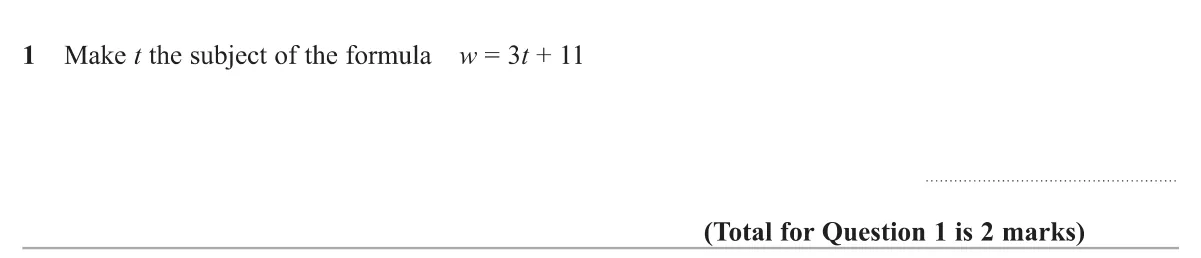
© Pearson Education Ltd. Specimen Paper 2 (Higher, calculator), question 1.
Answer t = w − 11 3 t = \frac{w - 11}{3} t = 3 w − 11 2 marks
Worked solution Checked against the mark scheme
Take 11 from both sides: 3 t = w − 11 3t = w - 11 3 t = w − 11
Divide both sides by 3: t = w − 11 3 t = \dfrac{w - 11}{3} t = 3 w − 11
Watch out: Writing t = w 3 − 11 t = \frac{w}{3} - 11 t = 3 w − 11
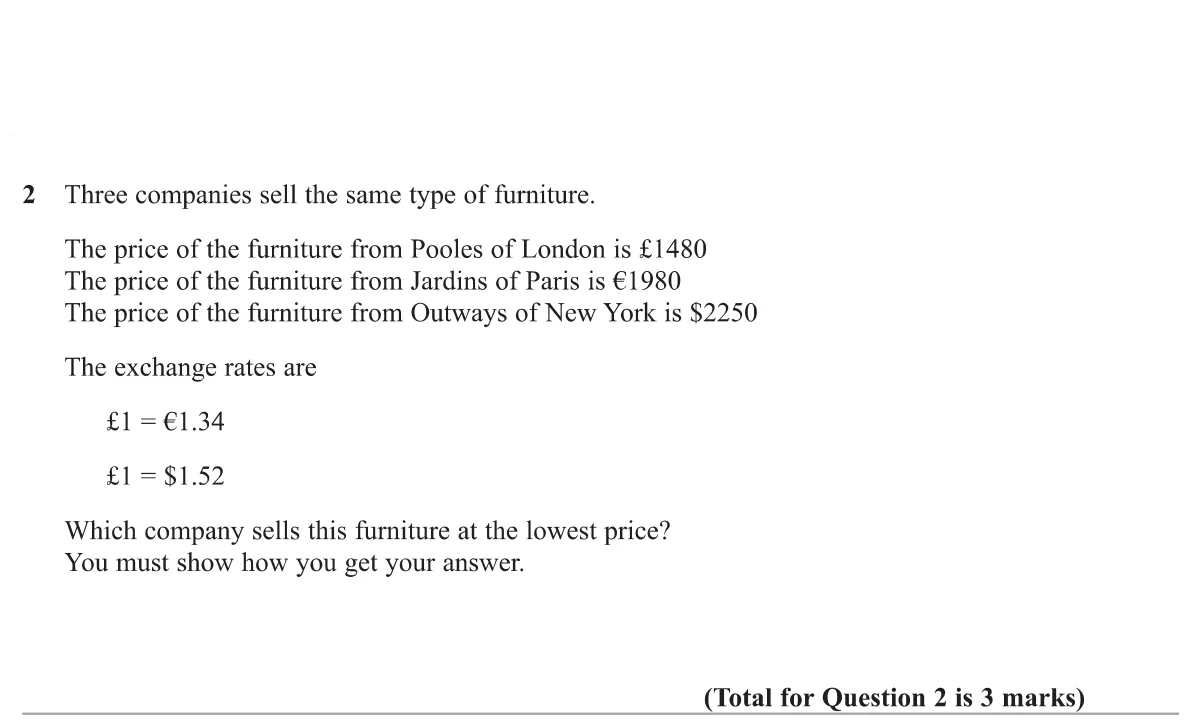
© Pearson Education Ltd. Specimen Paper 2 (Higher, calculator), question 2.
Answer Jardins of Paris (about £1477.61, against £1480 and about £1480.26) 3 marks
Worked solution Checked against the mark scheme
Put every price in pounds.
Paris: 1980 ÷ 1.34 = £ 1477.61 1980 \div 1.34 = £1477.61 1980 ÷ 1.34 = £1477.61
New York: 2250 ÷ 1.52 = £ 1480.26 2250 \div 1.52 = £1480.26 2250 ÷ 1.52 = £1480.26
London: £1480
The lowest is Jardins of Paris .
Watch out: Multiplying by the exchange rate instead of dividing when changing euros or dollars into pounds.
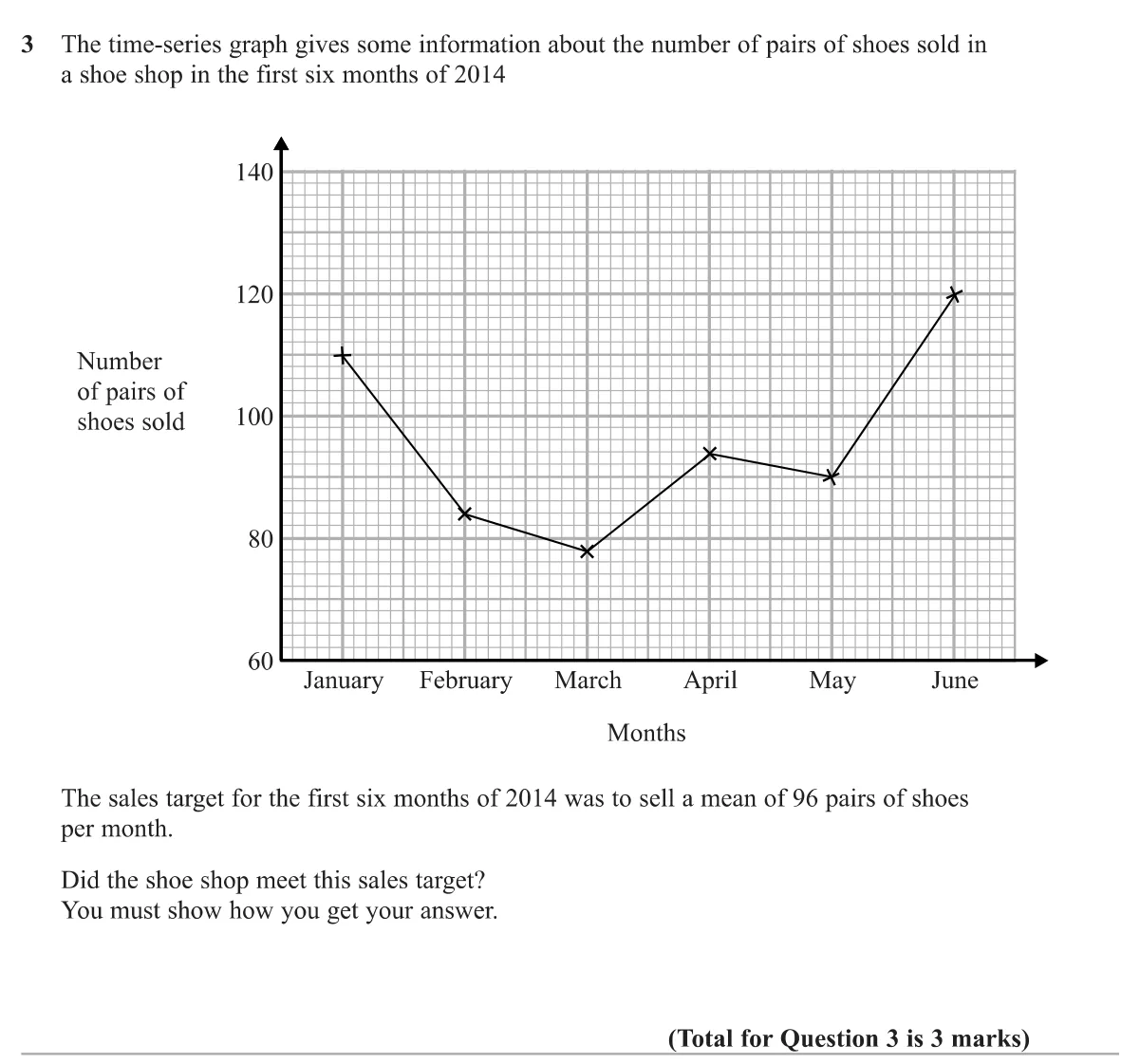
© Pearson Education Ltd. Specimen Paper 2 (Higher, calculator), question 3.
Answer Yes: the mean is 96, so the target was met 3 marks
Worked solution Checked against the mark scheme
Readings: 110, 84, 78, 94, 90, 120
Total = 576 = 576 = 576
Mean = 576 ÷ 6 = 96 = 576 \div 6 = 96 = 576 ÷ 6 = 96
The mean equals the target, so yes , the target was met.
Watch out: Misreading the vertical scale, where each small square is 2 pairs of shoes.
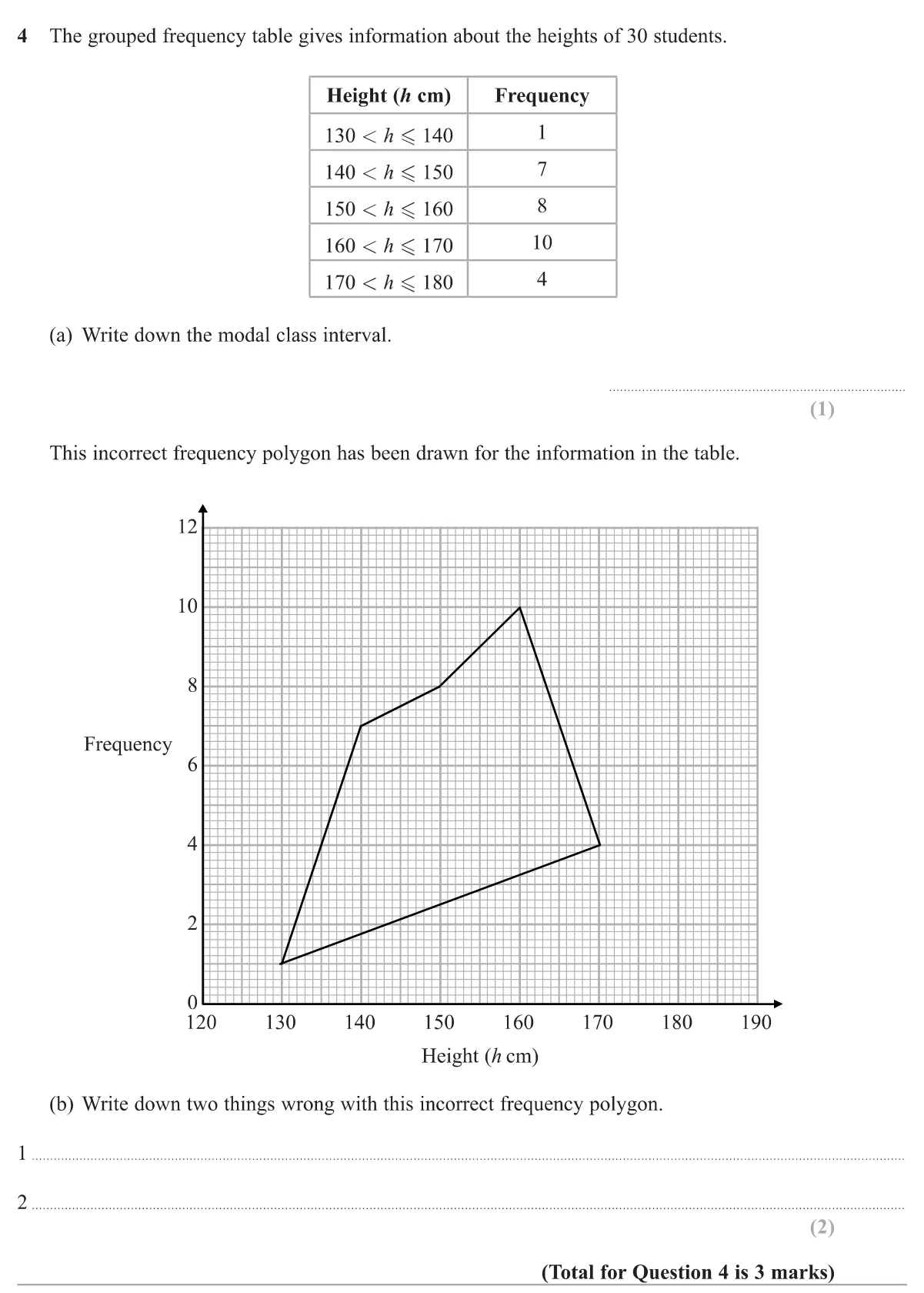
© Pearson Education Ltd. Specimen Paper 2 (Higher, calculator), question 4.
(a) 160 < h ≤ 170 160 < h \le 170 160 < h ≤ 170 1 mark (b) Points should be plotted at the midpoints of the intervals; the polygon should not be joined up (closed) from the last point back to the first 2 marks
Worked solution Checked against the mark scheme
(a) The largest frequency is 10, in the class 160 < h ≤ 170 160 < h \le 170 160 < h ≤ 170
(b) The points are plotted at the start of each class instead of at the midpoints (135, 145, …).
The last point has been joined back to the first, but a frequency polygon is not a closed shape.
Watch out: In (a), giving the frequency 10 instead of the class interval.
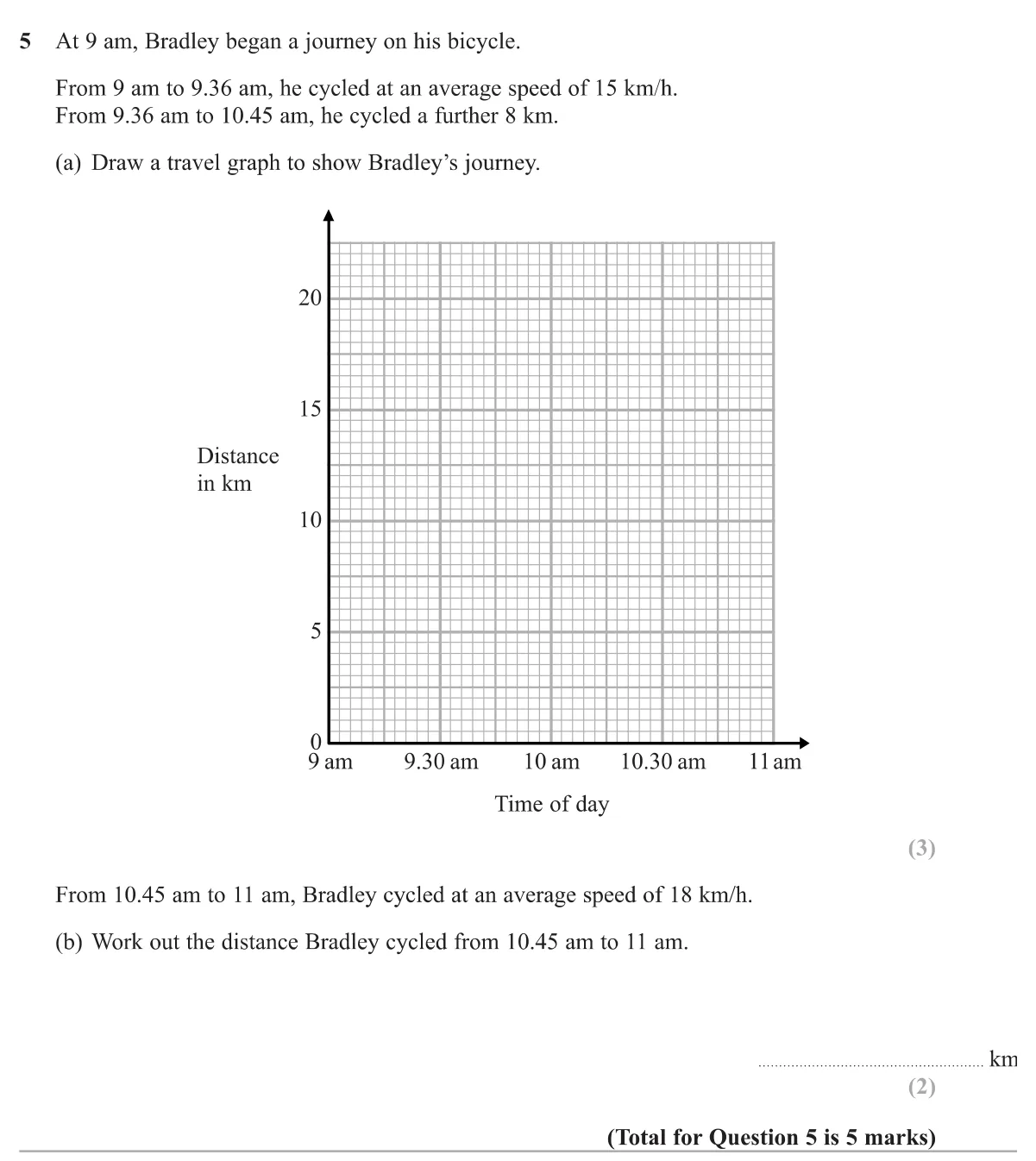
© Pearson Education Ltd. Specimen Paper 2 (Higher, calculator), question 5.
(a) Line from (9 am, 0) to (9.36 am, 9 km), then to (10.45 am, 17 km) 3 marks (b) 4.5 km 2 marks
Worked solution Checked against the mark scheme
(a) 36 minutes = 0.6 = 0.6 = 0.6 = 15 × 0.6 = 9 = 15 \times 0.6 = 9 = 15 × 0.6 = 9
Plot (9 am, 0) to (9.36 am, 9), then on to (10.45 am, 17).
(b) 15 minutes = 0.25 = 0.25 = 0.25
Distance = 18 × 0.25 = 4.5 = 18 \times 0.25 = 4.5 = 18 × 0.25 = 4.5
Watch out: Using 0.36 hours for 36 minutes.
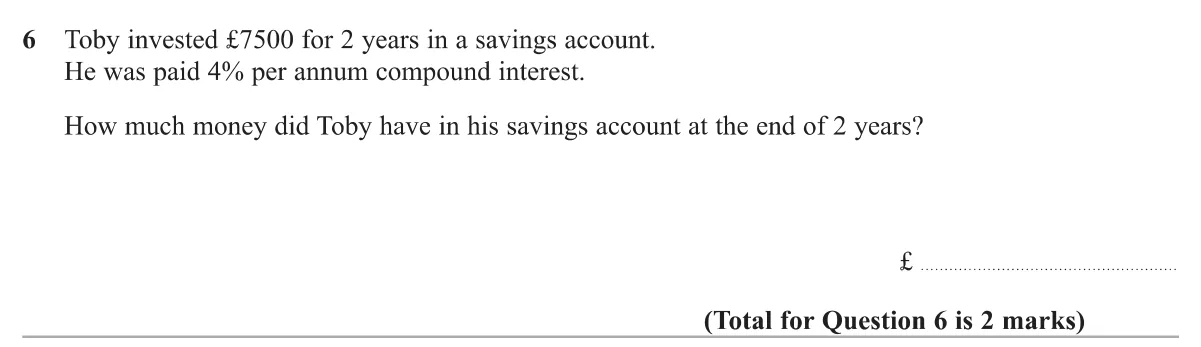
© Pearson Education Ltd. Specimen Paper 2 (Higher, calculator), question 6.
Worked solution Checked against the mark scheme
Multiplier for 4% growth: 1.04 1.04 1.04
7500 × 1.04 2 = 7500 × 1.0816 = £ 8112 7500 \times 1.04^2 = 7500 \times 1.0816 = £8112 7500 × 1.0 4 2 = 7500 × 1.0816 = £8112
Watch out: Using simple interest to get £8100.
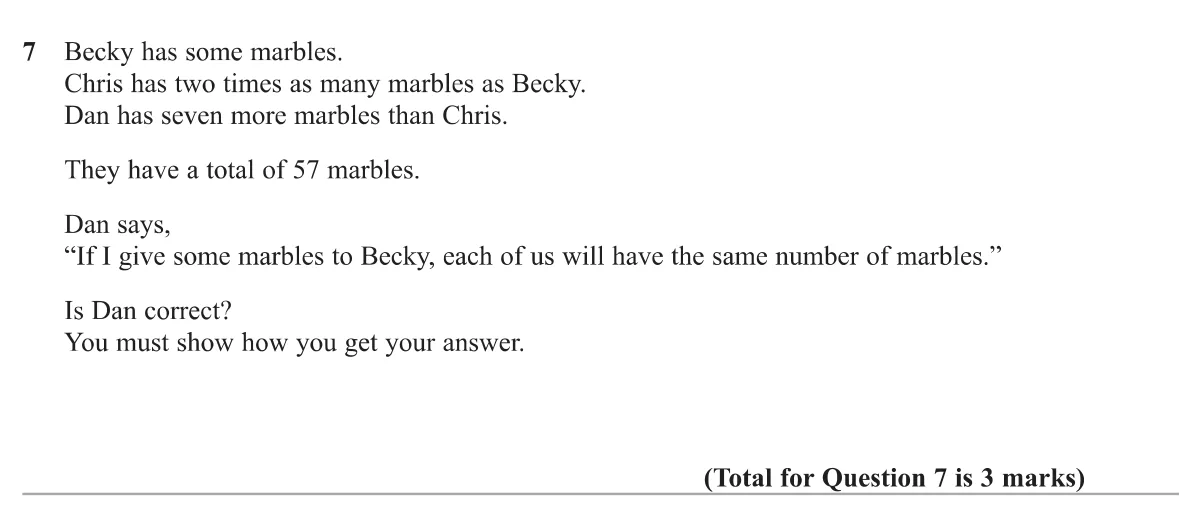
© Pearson Education Ltd. Specimen Paper 2 (Higher, calculator), question 7.
Answer No: Becky 10, Chris 20, Dan 27; Chris already has more than a third (19) 3 marks
Worked solution Checked against the mark scheme
Let Becky have x x x 2 x 2x 2 x 2 x + 7 2x + 7 2 x + 7
x + 2 x + 2 x + 7 = 57 x + 2x + 2x + 7 = 57 x + 2 x + 2 x + 7 = 57 5 x = 50 5x = 50 5 x = 50 x = 10 x = 10 x = 10
Becky 10, Chris 20, Dan 27
Equal shares would be 57 ÷ 3 = 19 57 \div 3 = 19 57 ÷ 3 = 19
Watch out: Forgetting that only Dan gives marbles away.
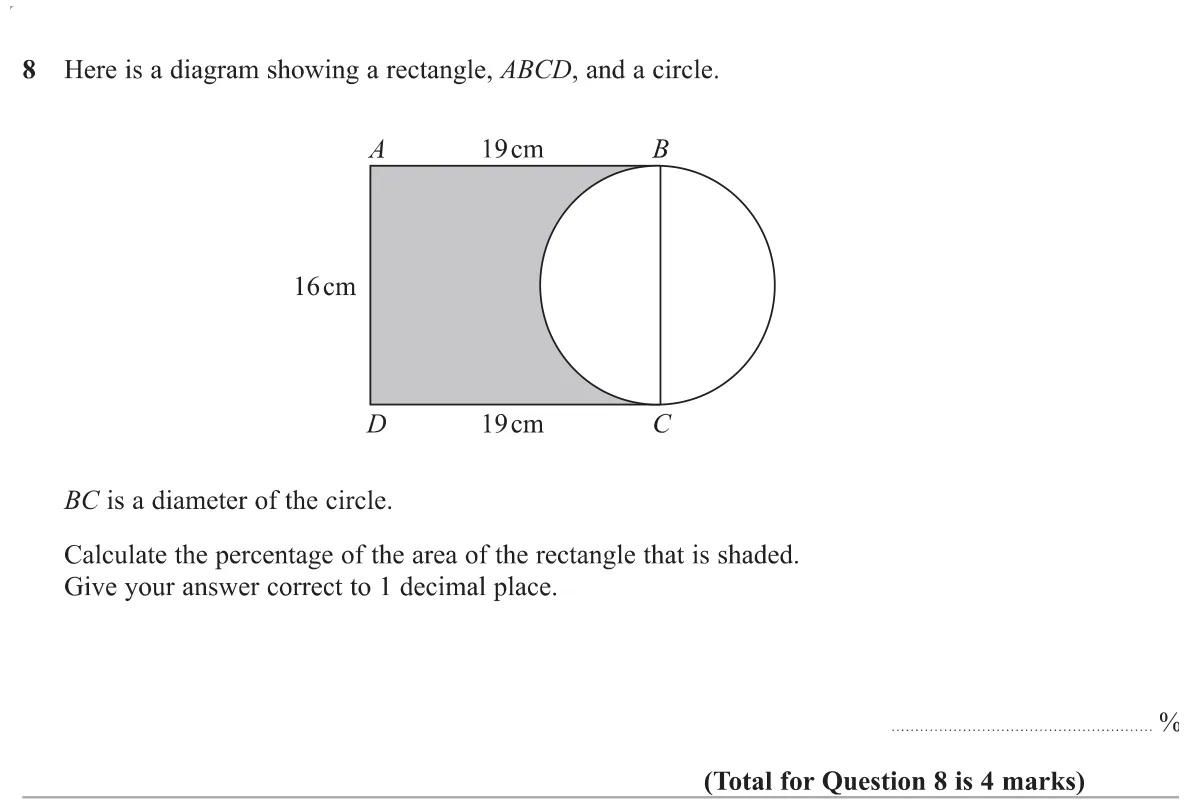
© Pearson Education Ltd. Specimen Paper 2 (Higher, calculator), question 8.
Worked solution Checked against the mark scheme
Rectangle: 19 × 16 = 304 19 \times 16 = 304 19 × 16 = 304
Radius = 8 = 8 = 8 = 1 2 π × 8 2 = 100.53 = \frac{1}{2} \pi \times 8^2 = 100.53 = 2 1 π × 8 2 = 100.53
Shaded = 304 − 100.53 = 203.47 = 304 - 100.53 = 203.47 = 304 − 100.53 = 203.47
203.47 304 × 100 = 66.9 % \frac{203.47}{304} \times 100 = 66.9\% 304 203.47 × 100 = 66.9%
Watch out: Taking away the whole circle instead of only the half inside the rectangle.
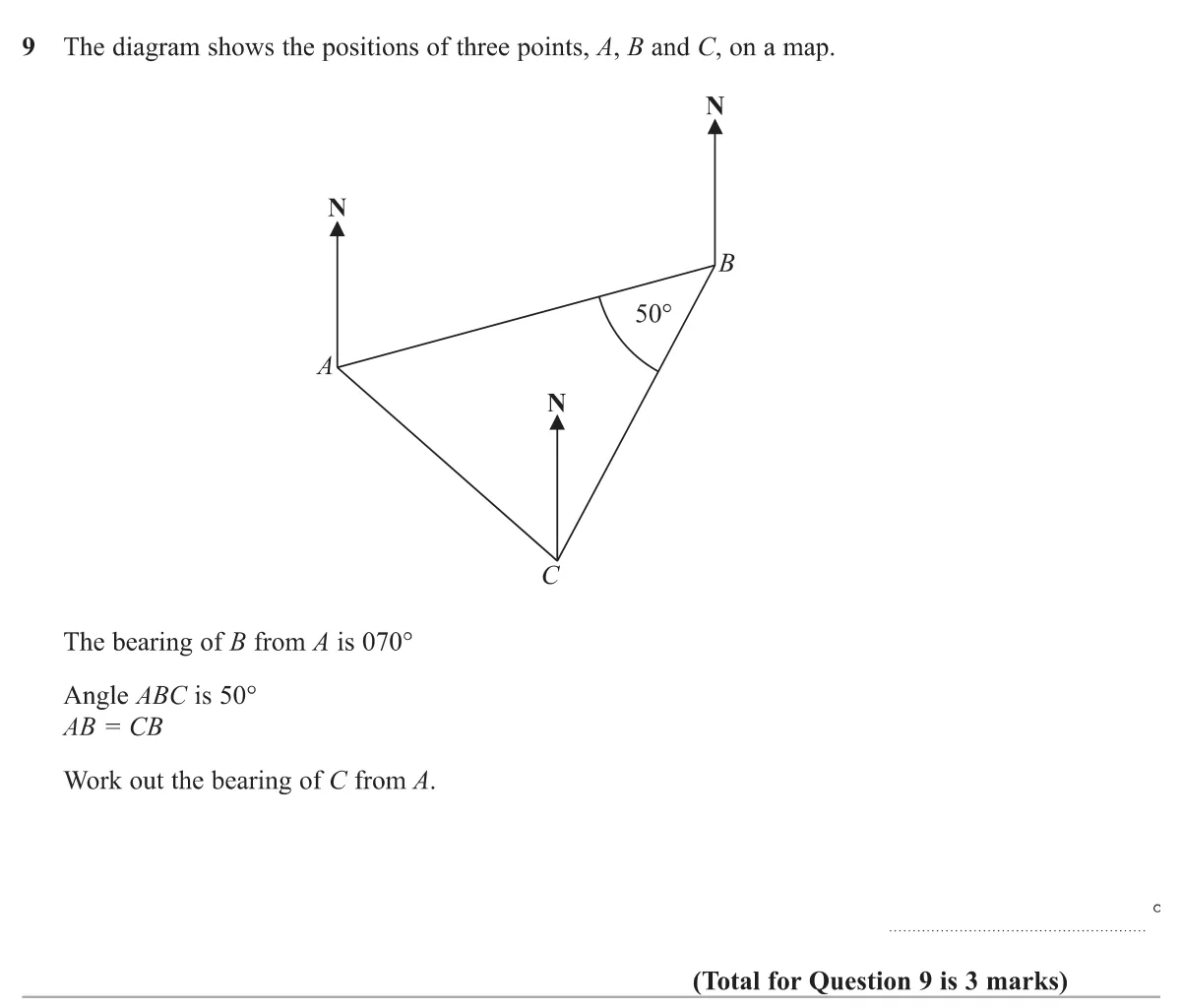
© Pearson Education Ltd. Specimen Paper 2 (Higher, calculator), question 9.
Worked solution Checked against the mark scheme
Triangle A B C ABC A B C A B = C B AB = CB A B = C B A A A C C C
∠ B A C = ( 180 − 50 ) ÷ 2 = 65 ° \angle BAC = (180 - 50) \div 2 = 65° ∠ B A C = ( 180 − 50 ) ÷ 2 = 65°
Bearing of C C C A A A = 70 + 65 = 135 ° = 70 + 65 = 135° = 70 + 65 = 135°
Watch out: Taking 65° as the bearing, forgetting to add the 70°.
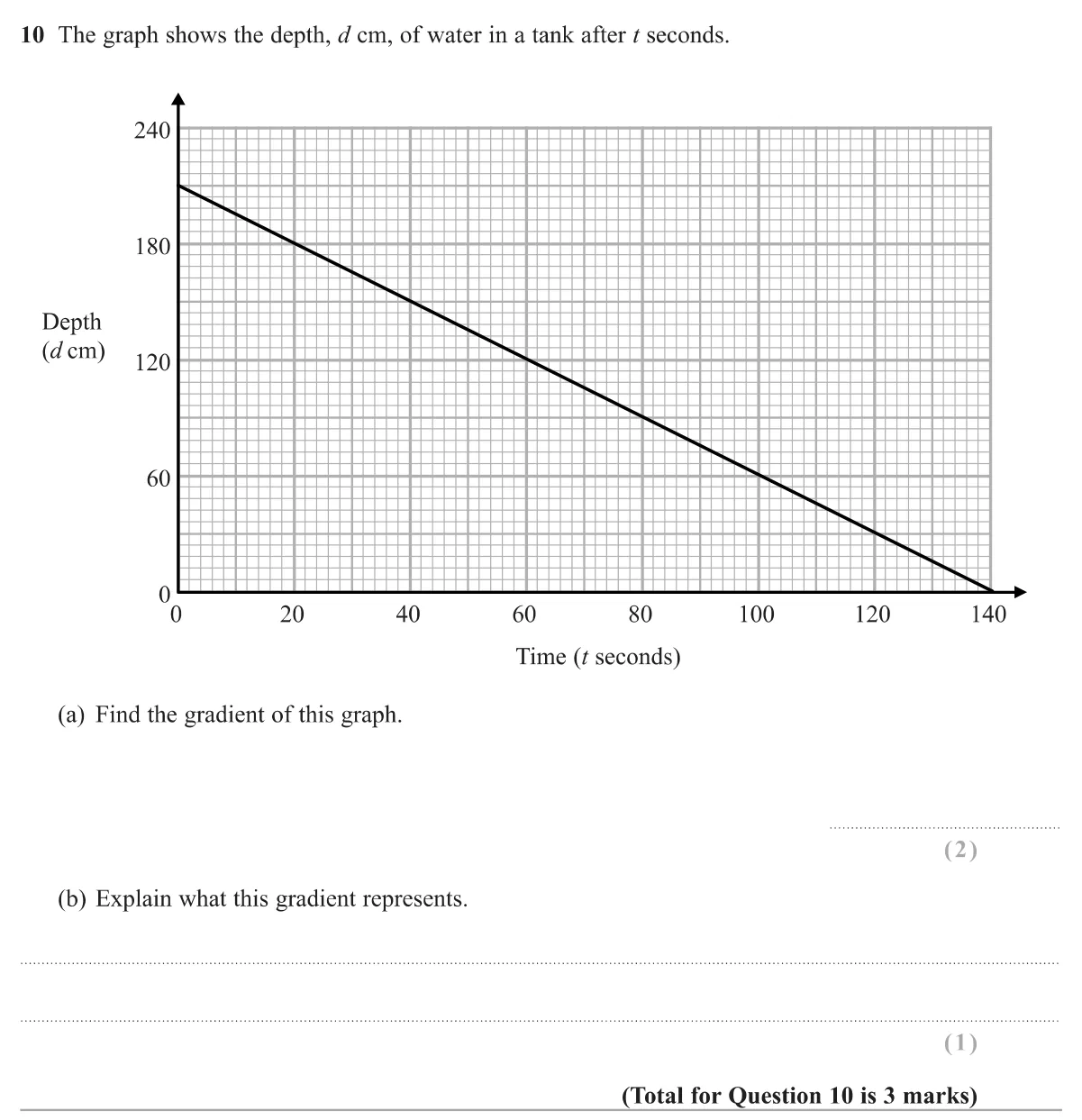
© Pearson Education Ltd. Specimen Paper 2 (Higher, calculator), question 10.
(a) − 1.5 -1.5 − 1.5 2 marks (b) The rate at which the depth of water falls: 1.5 cm per second 1 mark
Worked solution Checked against the mark scheme
(a) The line goes from (0, 210) to (140, 0).
Gradient = 0 − 210 140 − 0 = − 1.5 = \frac{0 - 210}{140 - 0} = -1.5 = 140 − 0 0 − 210 = − 1.5
(b) The depth of water goes down by 1.5 cm every second: it is the rate the tank is emptying.
Watch out: Giving 1.5 without the minus sign.
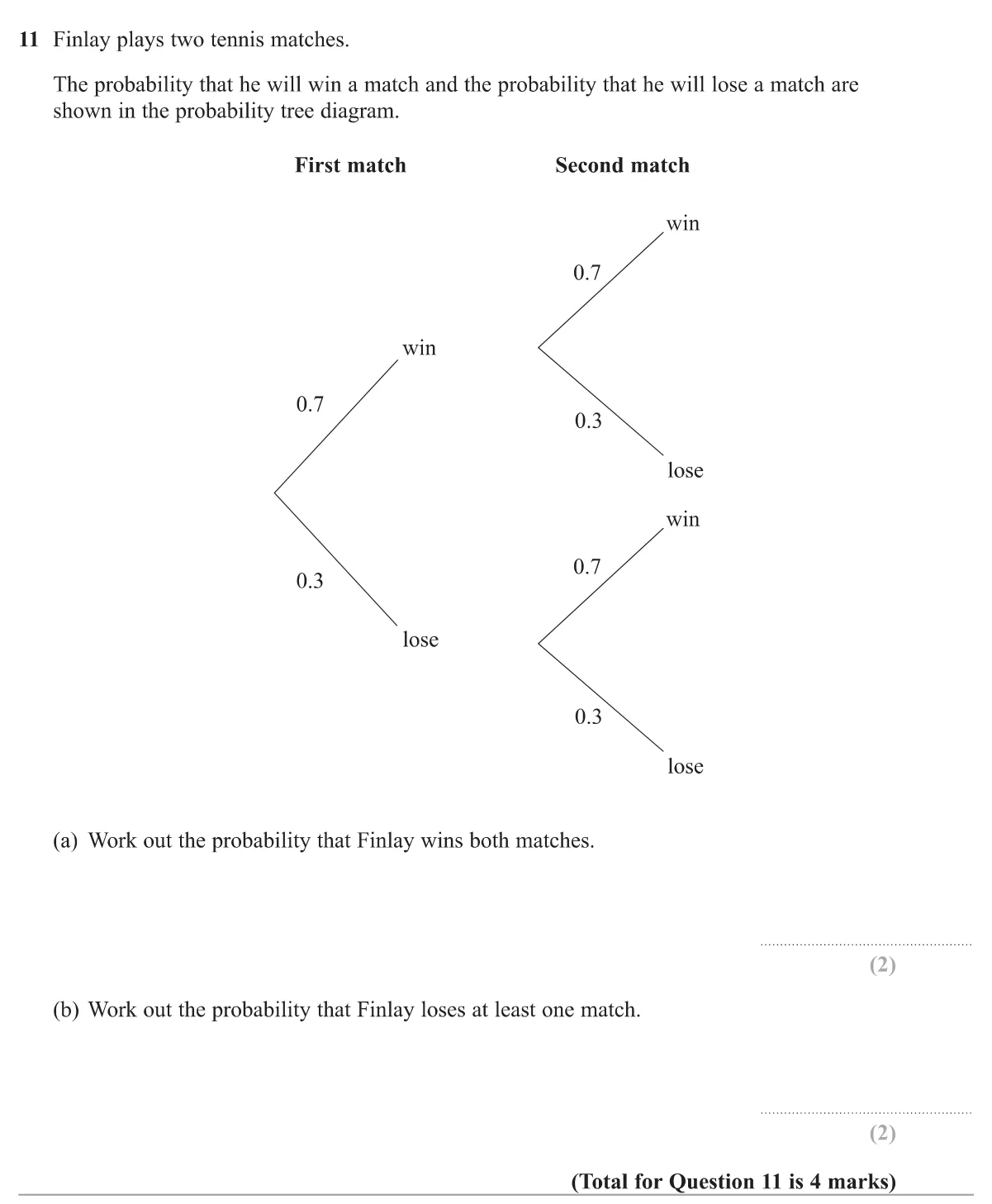
© Pearson Education Ltd. Specimen Paper 2 (Higher, calculator), question 11.
(a) 0.49 2 marks (b) 0.51 2 marks
Worked solution Checked against the mark scheme
(a) 0.7 × 0.7 = 0.49 0.7 \times 0.7 = 0.49 0.7 × 0.7 = 0.49
(b) Losing at least one is everything except winning both.
1 − 0.49 = 0.51 1 - 0.49 = 0.51 1 − 0.49 = 0.51
Watch out: In (a), adding 0.7 + 0.7 instead of multiplying.
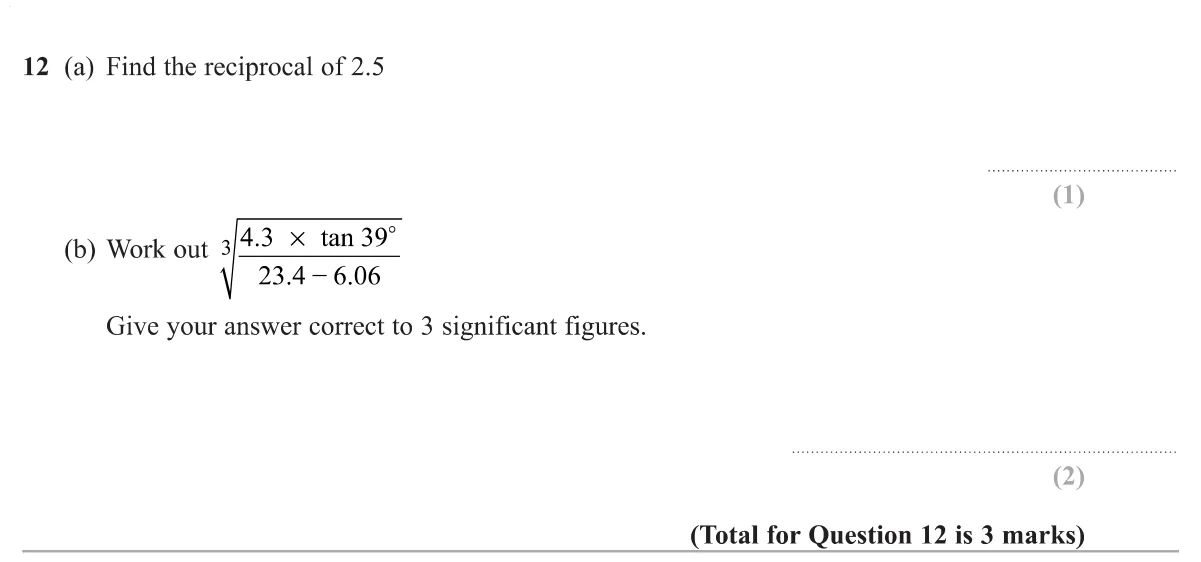
© Pearson Education Ltd. Specimen Paper 2 (Higher, calculator), question 12.
(a) 0.4 1 mark (b) 0.586 2 marks
Worked solution Checked against the mark scheme
(a) 1 ÷ 2.5 = 0.4 1 \div 2.5 = 0.4 1 ÷ 2.5 = 0.4
(b) Top: 4.3 × tan 39 ° = 3.4821 4.3 \times \tan 39° = 3.4821 4.3 × tan 39° = 3.4821
Bottom: 23.4 − 6.06 = 17.34 23.4 - 6.06 = 17.34 23.4 − 6.06 = 17.34
3.4821 ÷ 17.34 = 0.20081 3.4821 \div 17.34 = 0.20081 3.4821 ÷ 17.34 = 0.20081
0.20081 3 = 0.586 \sqrt[3]{0.20081} = 0.586 3 0.20081 = 0.586
Watch out: Calculator in radians mode, giving the wrong value for tan 39°.
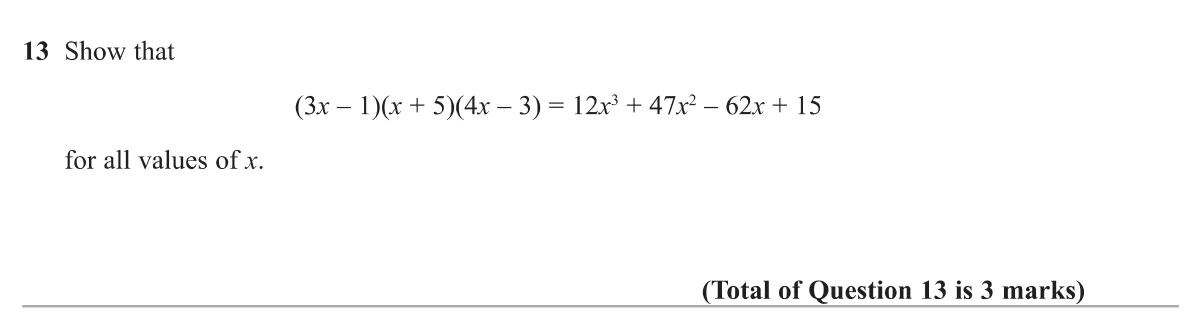
© Pearson Education Ltd. Specimen Paper 2 (Higher, calculator), question 13.
Answer Expansion gives 12 x 3 + 47 x 2 − 62 x + 15 12x^3 + 47x^2 - 62x + 15 12 x 3 + 47 x 2 − 62 x + 15 3 marks
Worked solution Checked against the mark scheme
( 3 x − 1 ) ( x + 5 ) = 3 x 2 + 15 x − x − 5 = 3 x 2 + 14 x − 5 (3x - 1)(x + 5) = 3x^2 + 15x - x - 5 = 3x^2 + 14x - 5 ( 3 x − 1 ) ( x + 5 ) = 3 x 2 + 15 x − x − 5 = 3 x 2 + 14 x − 5
( 3 x 2 + 14 x − 5 ) ( 4 x − 3 ) (3x^2 + 14x - 5)(4x - 3) ( 3 x 2 + 14 x − 5 ) ( 4 x − 3 )
= 12 x 3 − 9 x 2 + 56 x 2 − 42 x − 20 x + 15 = 12x^3 - 9x^2 + 56x^2 - 42x - 20x + 15 = 12 x 3 − 9 x 2 + 56 x 2 − 42 x − 20 x + 15
= 12 x 3 + 47 x 2 − 62 x + 15 = 12x^3 + 47x^2 - 62x + 15 = 12 x 3 + 47 x 2 − 62 x + 15
Watch out: Sign slip on − 5 × − 3 -5 \times -3 − 5 × − 3 − 15 -15 − 15
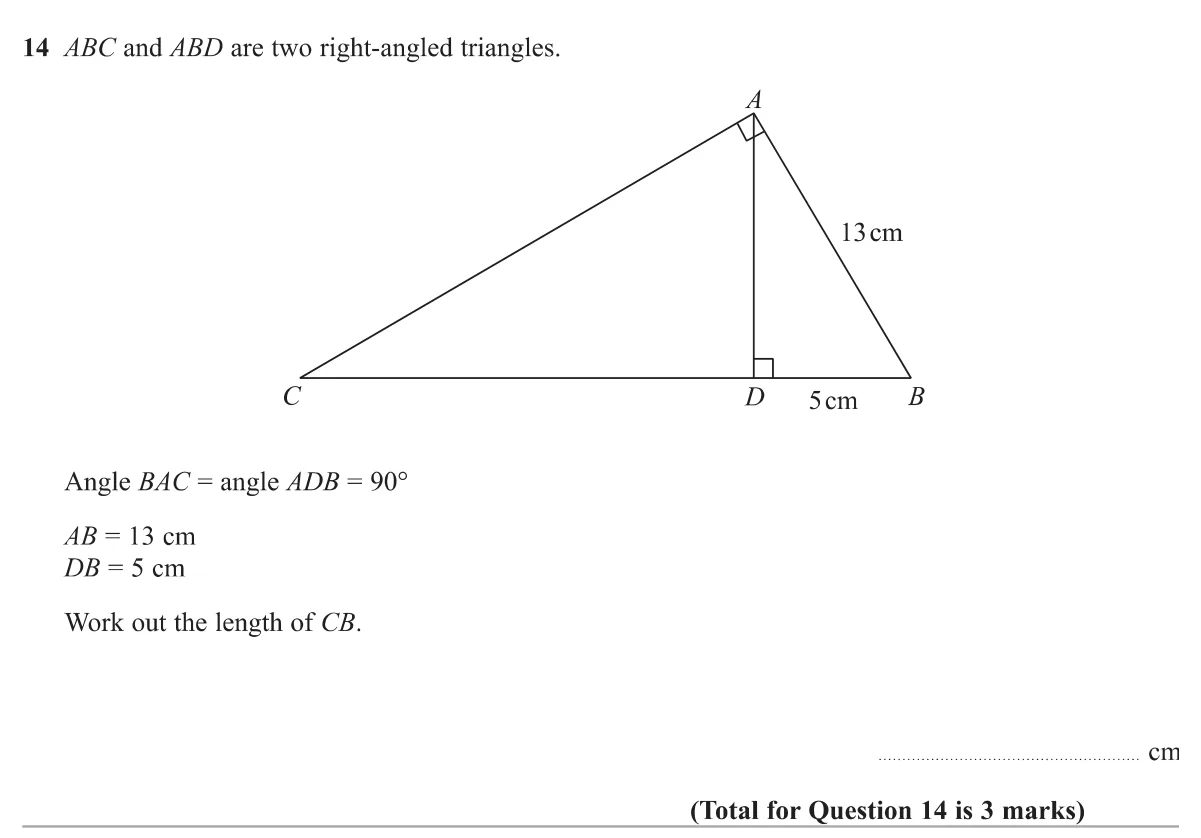
© Pearson Education Ltd. Specimen Paper 2 (Higher, calculator), question 14.
Worked solution Checked against the mark scheme
Triangles A B D ABD A B D C B A CBA C B A B B B
So C B A B = A B D B \frac{CB}{AB} = \frac{AB}{DB} A B C B = D B A B
C B = 13 × 13 5 = 169 5 = 33.8 CB = \frac{13 \times 13}{5} = \frac{169}{5} = 33.8 C B = 5 13 × 13 = 5 169 = 33.8
Watch out: Matching the wrong sides in the ratio, e.g. C B 13 = 5 13 \frac{CB}{13} = \frac{5}{13} 13 C B = 13 5
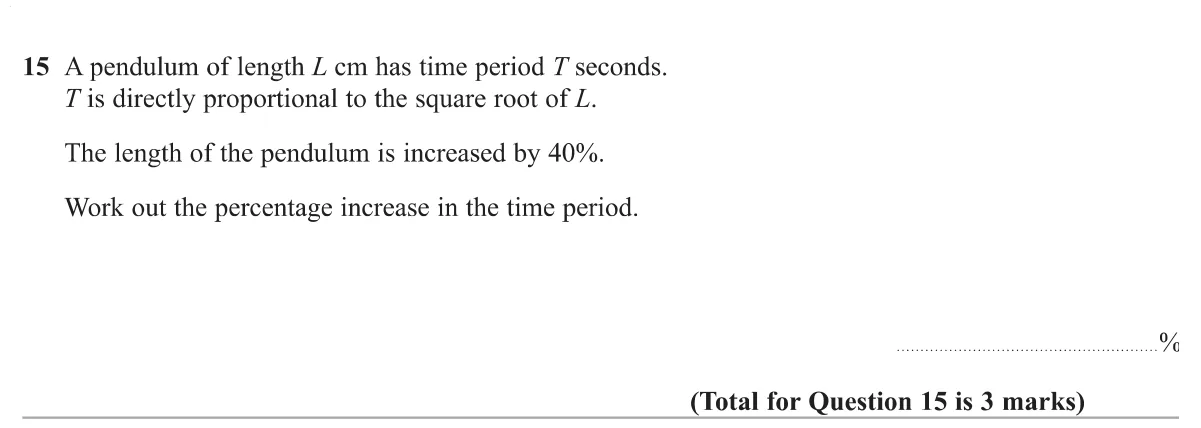
© Pearson Education Ltd. Specimen Paper 2 (Higher, calculator), question 15.
Worked solution Checked against the mark scheme
T = k L T = k\sqrt{L} T = k L
New length = 1.4 L = 1.4L = 1.4 L T = k 1.4 L = 1.4 × k L T = k\sqrt{1.4L} = \sqrt{1.4} \times k\sqrt{L} T = k 1.4 L = 1.4 × k L
1.4 = 1.1832 \sqrt{1.4} = 1.1832 1.4 = 1.1832
Increase = 18.3 % = 18.3\% = 18.3%
Watch out: Answering 40% or 20% (halving the percentage instead of using a square root).
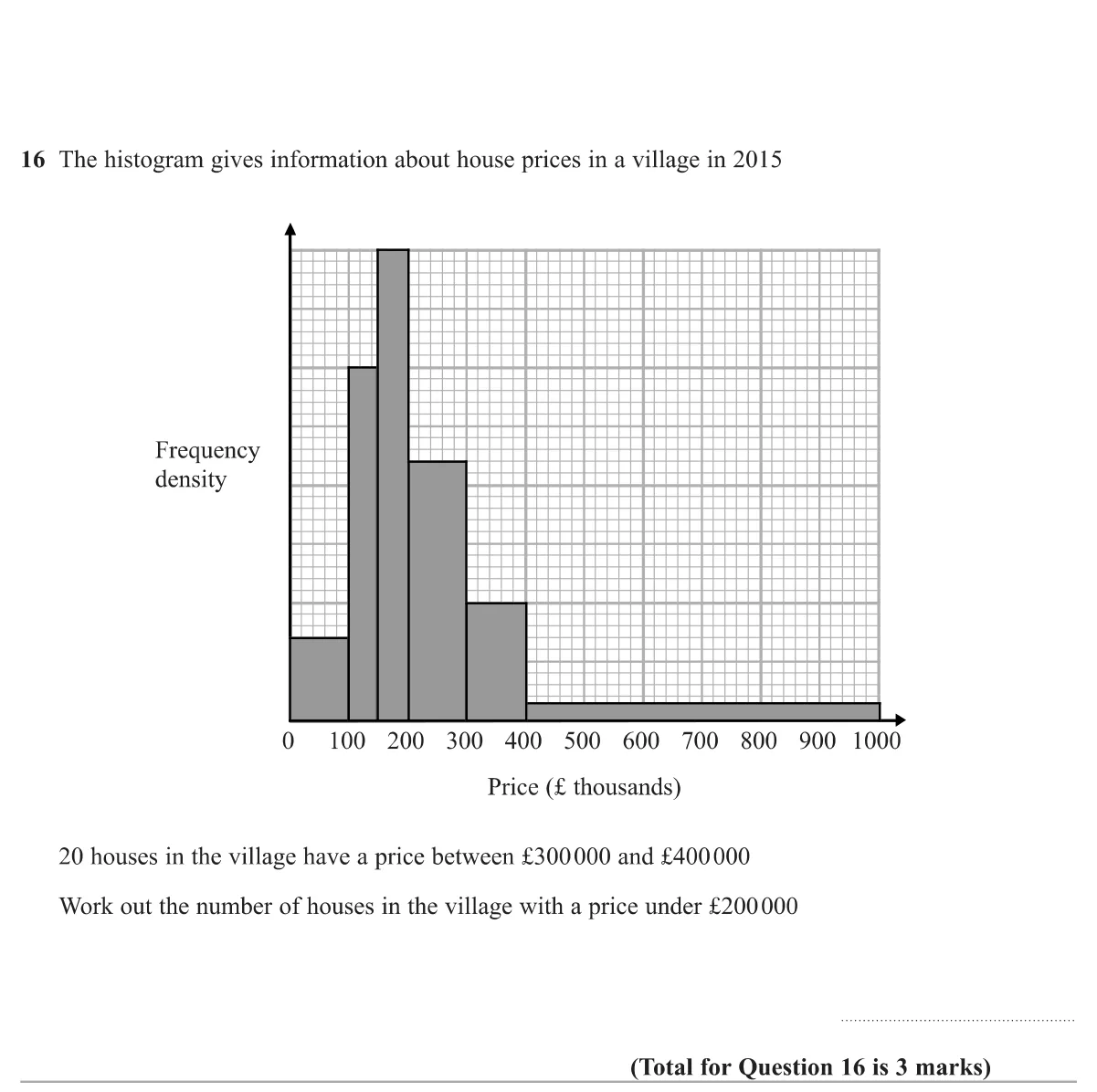
© Pearson Education Ltd. Specimen Paper 2 (Higher, calculator), question 16.
Worked solution Checked against the mark scheme
The £300k–£400k bar holds 20 houses over a width of 100, so its height stands for 0.2 per £1000.
That sets the scale: the bar is 2 large squares tall, so each large square up is 0.1.
0–100: 0.14 × 100 = 14 0.14 \times 100 = 14 0.14 × 100 = 14
100–150: 0.6 × 50 = 30 0.6 \times 50 = 30 0.6 × 50 = 30
150–200: 0.8 × 50 = 40 0.8 \times 50 = 40 0.8 × 50 = 40
Total = 14 + 30 + 40 = 84 = 14 + 30 + 40 = 84 = 14 + 30 + 40 = 84
Watch out: Reading bar heights as frequencies, ignoring the different bar widths.
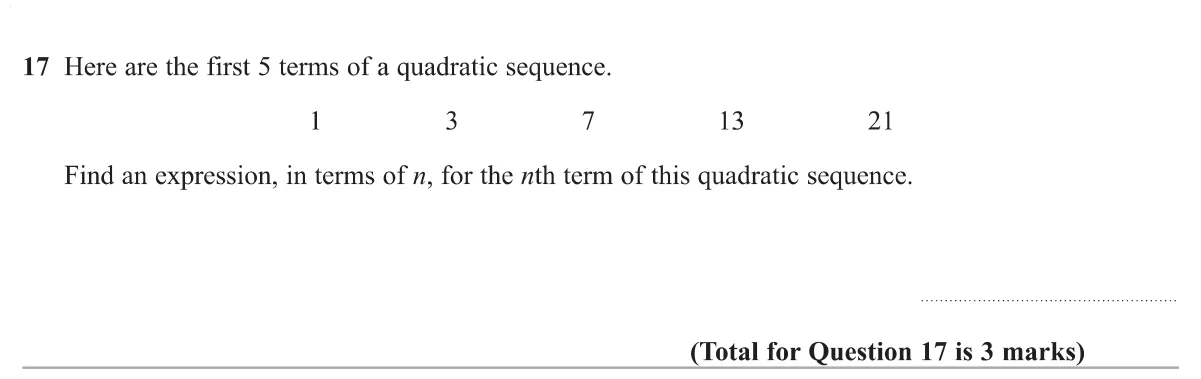
© Pearson Education Ltd. Specimen Paper 2 (Higher, calculator), question 17.
Answer n 2 − n + 1 n^2 - n + 1 n 2 − n + 1 3 marks
Worked solution Checked against the mark scheme
First differences: 2, 4, 6, 8; second difference 2, so start with n 2 n^2 n 2
n 2 n^2 n 2
Sequence minus n 2 n^2 n 2 − n + 1 -n + 1 − n + 1
nth term = n 2 − n + 1 = n^2 - n + 1 = n 2 − n + 1
Watch out: Using 2 n 2 2n^2 2 n 2
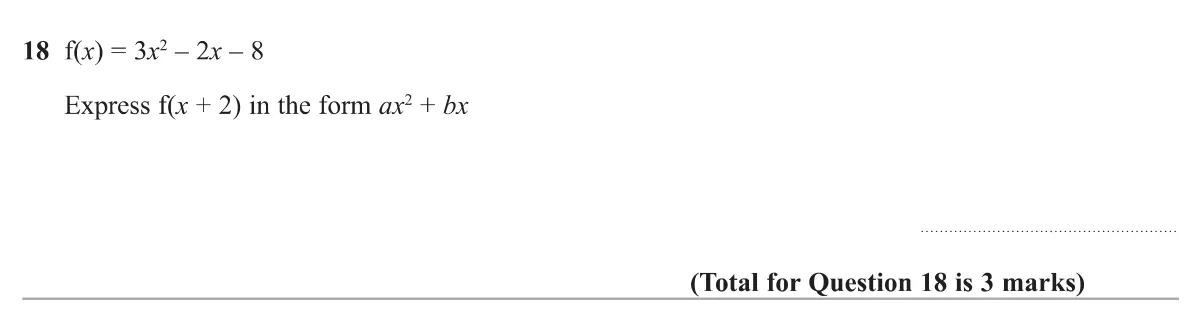
© Pearson Education Ltd. Specimen Paper 2 (Higher, calculator), question 18.
Answer 3 x 2 + 10 x 3x^2 + 10x 3 x 2 + 10 x 3 marks
Worked solution Checked against the mark scheme
f ( x + 2 ) = 3 ( x + 2 ) 2 − 2 ( x + 2 ) − 8 f(x + 2) = 3(x + 2)^2 - 2(x + 2) - 8 f ( x + 2 ) = 3 ( x + 2 ) 2 − 2 ( x + 2 ) − 8
= 3 ( x 2 + 4 x + 4 ) − 2 x − 4 − 8 = 3(x^2 + 4x + 4) - 2x - 4 - 8 = 3 ( x 2 + 4 x + 4 ) − 2 x − 4 − 8
= 3 x 2 + 12 x + 12 − 2 x − 12 = 3x^2 + 12x + 12 - 2x - 12 = 3 x 2 + 12 x + 12 − 2 x − 12
= 3 x 2 + 10 x = 3x^2 + 10x = 3 x 2 + 10 x
Watch out: Writing ( x + 2 ) 2 = x 2 + 4 (x + 2)^2 = x^2 + 4 ( x + 2 ) 2 = x 2 + 4
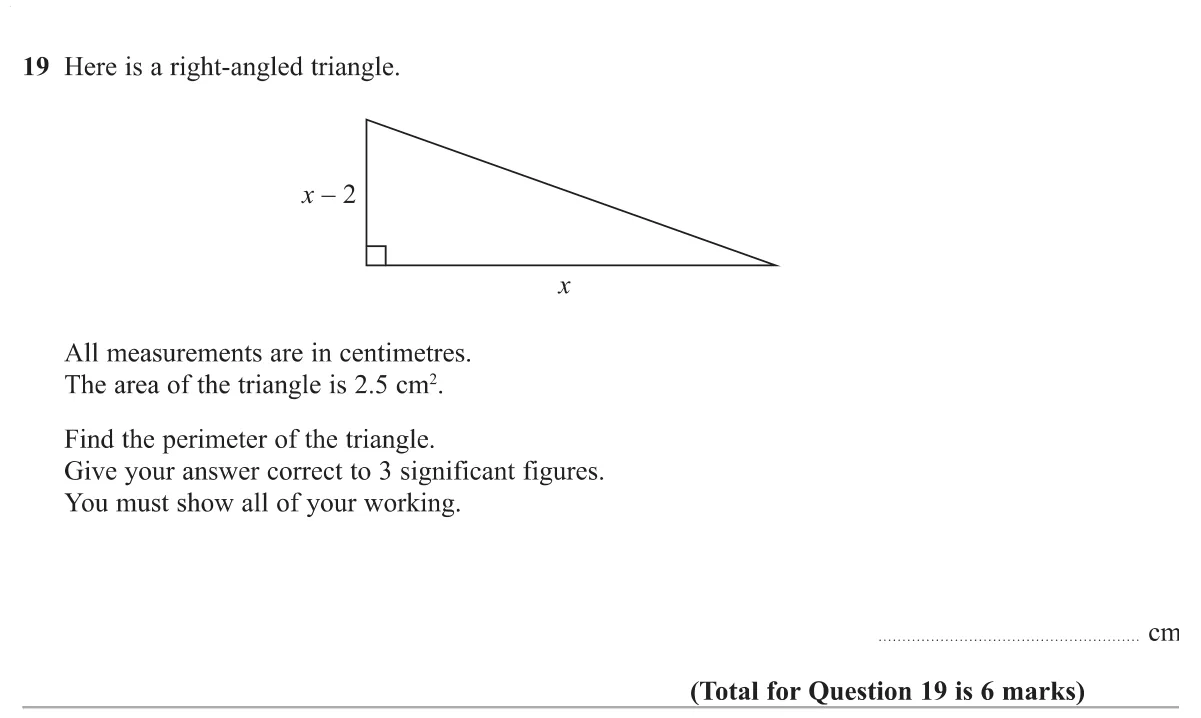
© Pearson Education Ltd. Specimen Paper 2 (Higher, calculator), question 19.
Worked solution Checked against the mark scheme
1 2 x ( x − 2 ) = 2.5 ⇒ x 2 − 2 x − 5 = 0 \frac{1}{2}x(x - 2) = 2.5 \Rightarrow x^2 - 2x - 5 = 0 2 1 x ( x − 2 ) = 2.5 ⇒ x 2 − 2 x − 5 = 0
x = 2 ± 4 + 20 2 = 1 ± 6 x = \frac{2 \pm \sqrt{4 + 20}}{2} = 1 \pm \sqrt{6} x = 2 2 ± 4 + 20 = 1 ± 6 x = 3.449 x = 3.449 x = 3.449
Sides: 3.449 and 1.449
Hypotenuse = 3.449 2 + 1.449 2 = 3.742 = \sqrt{3.449^2 + 1.449^2} = 3.742 = 3.44 9 2 + 1.44 9 2 = 3.742
Perimeter = 3.449 + 1.449 + 3.742 = 8.64 = 3.449 + 1.449 + 3.742 = 8.64 = 3.449 + 1.449 + 3.742 = 8.64
Watch out: Forgetting the ½ in the area of a triangle.
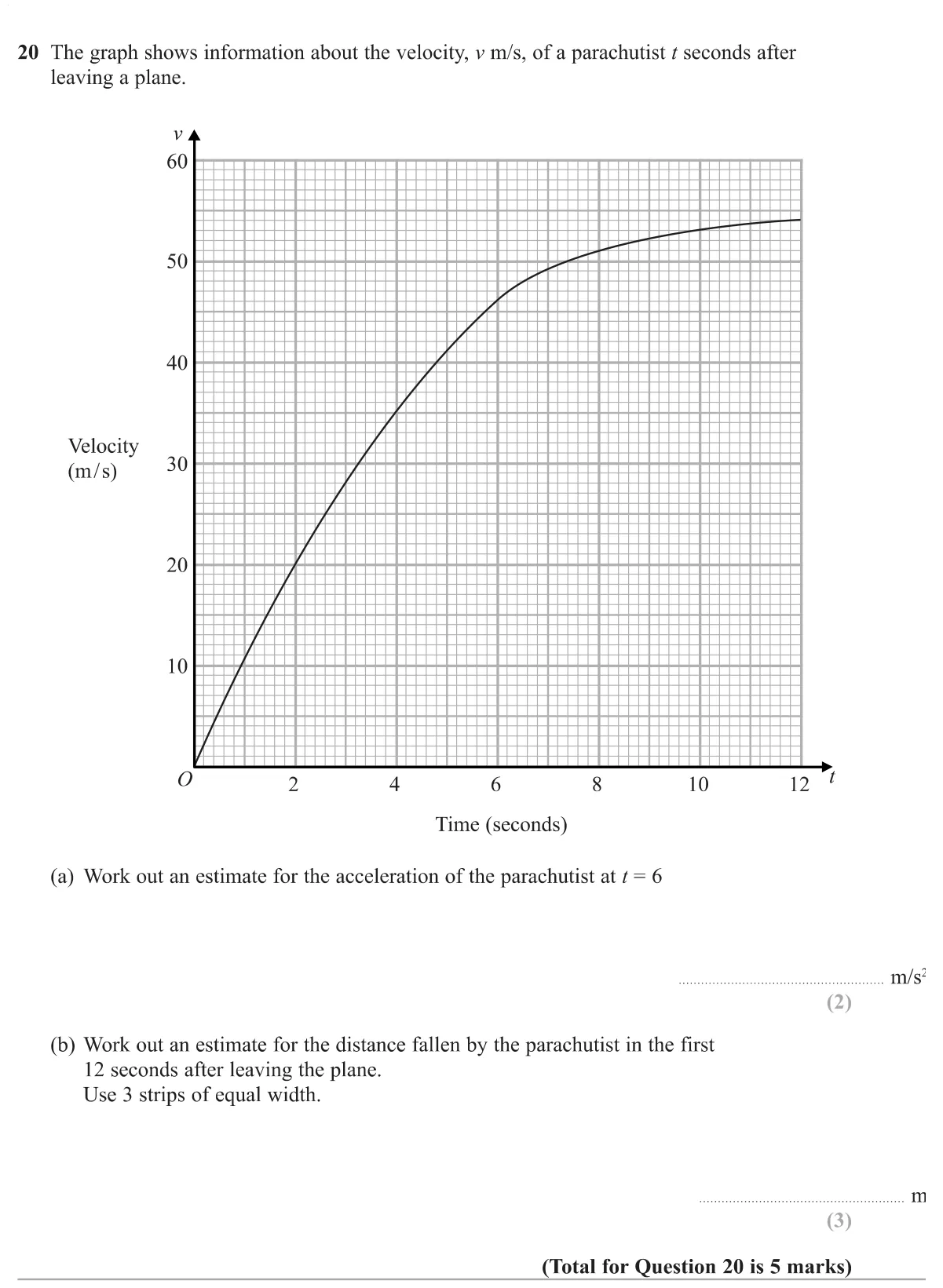
© Pearson Education Ltd. Specimen Paper 2 (Higher, calculator), question 20.
(a) Between 3 and 4 m/s² 2 marks (b) 452 m 3 marks
Worked solution Checked against the mark scheme
(a) Draw a tangent at t = 6 t = 6 t = 6 28 ÷ 8 = 3.5 28 \div 8 = 3.5 28 ÷ 8 = 3.5
(b) Strips of width 4: v ( 0 ) = 0 , v ( 4 ) = 35 , v ( 8 ) = 51 , v ( 12 ) = 54 v(0) = 0,\ v(4) = 35,\ v(8) = 51,\ v(12) = 54 v ( 0 ) = 0 , v ( 4 ) = 35 , v ( 8 ) = 51 , v ( 12 ) = 54
4 2 ( 0 + 35 ) = 70 \frac{4}{2}(0 + 35) = 70 2 4 ( 0 + 35 ) = 70
4 2 ( 35 + 51 ) = 172 \frac{4}{2}(35 + 51) = 172 2 4 ( 35 + 51 ) = 172
4 2 ( 51 + 54 ) = 210 \frac{4}{2}(51 + 54) = 210 2 4 ( 51 + 54 ) = 210
Total = 70 + 172 + 210 = 452 = 70 + 172 + 210 = 452 = 70 + 172 + 210 = 452
Watch out: In (a), using a chord from the origin to (6, 46) instead of a tangent.
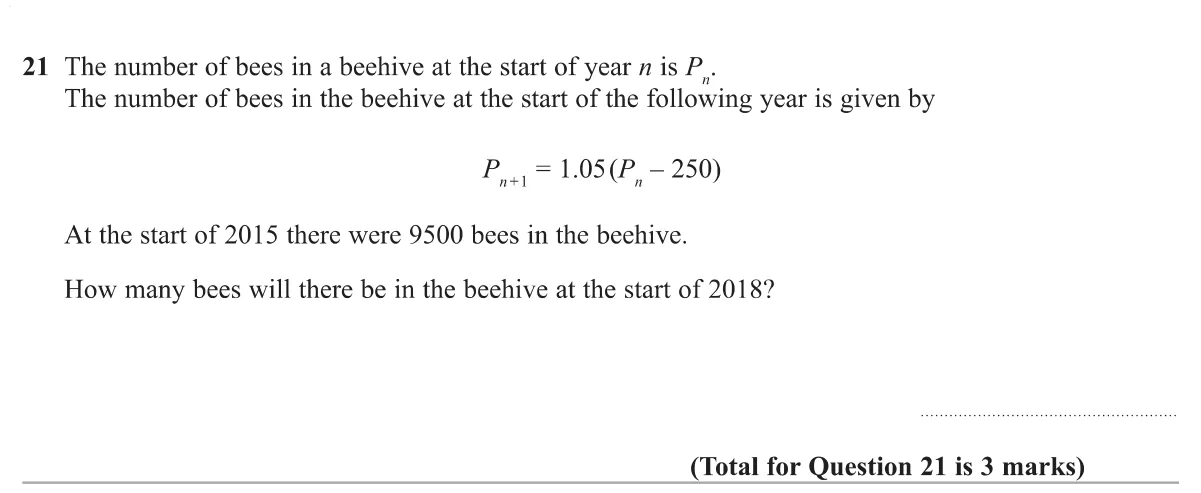
© Pearson Education Ltd. Specimen Paper 2 (Higher, calculator), question 21.
Answer 10170 (10169.9…, rounded or truncated) 3 marks
Worked solution Checked against the mark scheme
2016: 1.05 ( 9500 − 250 ) = 9712.5 1.05(9500 - 250) = 9712.5 1.05 ( 9500 − 250 ) = 9712.5
2017: 1.05 ( 9712.5 − 250 ) = 9935.625 1.05(9712.5 - 250) = 9935.625 1.05 ( 9712.5 − 250 ) = 9935.625
2018: 1.05 ( 9935.625 − 250 ) = 10169.90 … 1.05(9935.625 - 250) = 10169.90… 1.05 ( 9935.625 − 250 ) = 10169.90 …
About 10170 bees.
Watch out: Stopping after two steps (2017) instead of three.
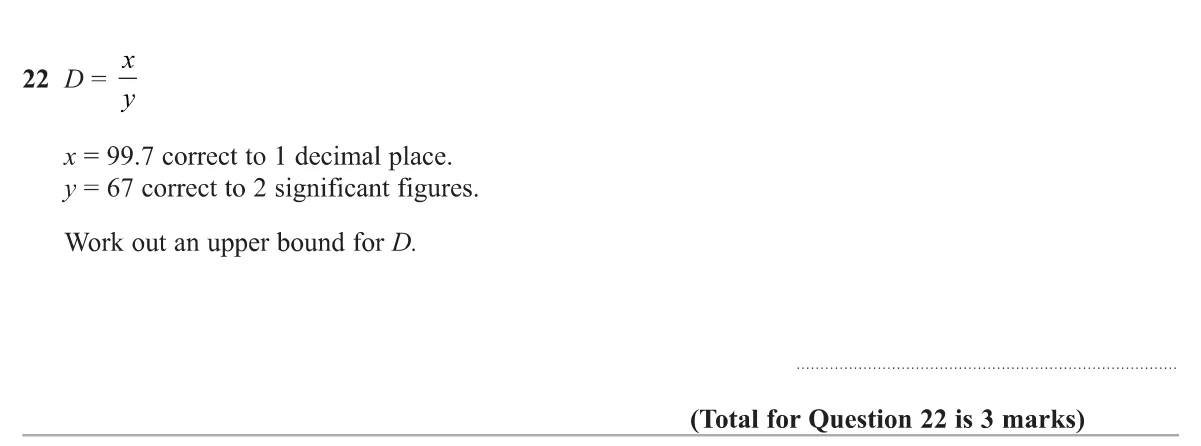
© Pearson Education Ltd. Specimen Paper 2 (Higher, calculator), question 22.
Worked solution Checked against the mark scheme
x x x
y = 67 y = 67 y = 67
Upper bound of D = 99.75 66.5 = 1.5 D = \frac{99.75}{66.5} = 1.5 D = 66.5 99.75 = 1.5
Watch out: Dividing the upper bound of x by the upper bound of y.
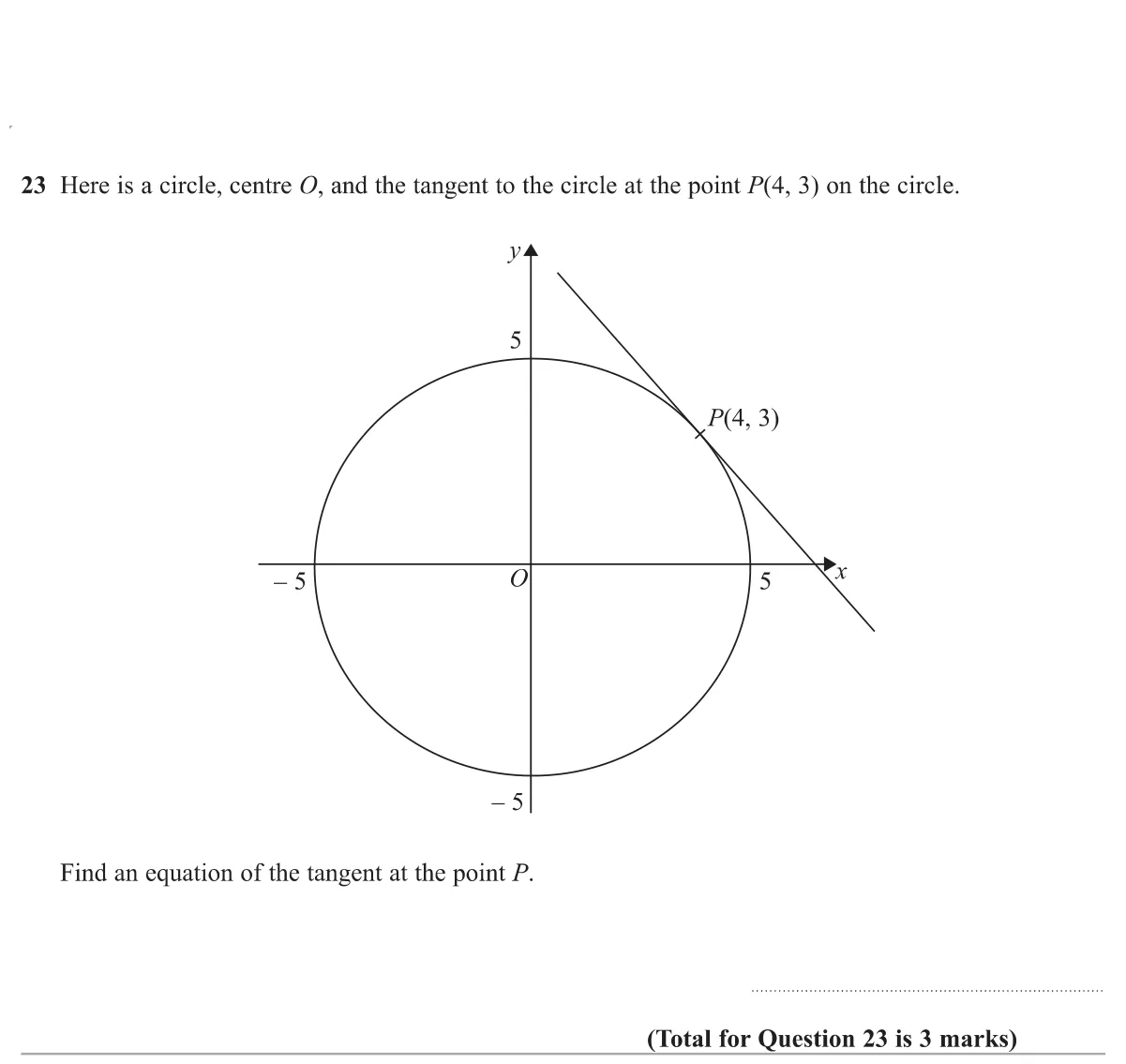
© Pearson Education Ltd. Specimen Paper 2 (Higher, calculator), question 23.
Answer y = − 4 3 x + 25 3 y = -\frac{4}{3}x + \frac{25}{3} y = − 3 4 x + 3 25 3 marks
Worked solution Checked against the mark scheme
Gradient of radius O P = 3 4 OP = \frac{3}{4} O P = 4 3
The tangent is perpendicular, so its gradient is − 4 3 -\frac{4}{3} − 3 4
3 = − 4 3 ( 4 ) + c ⇒ c = 25 3 3 = -\frac{4}{3}(4) + c \Rightarrow c = \frac{25}{3} 3 = − 3 4 ( 4 ) + c ⇒ c = 3 25
y = − 4 3 x + 25 3 y = -\frac{4}{3}x + \frac{25}{3} y = − 3 4 x + 3 25
Watch out: Using the radius gradient 3 4 \frac{3}{4} 4 3
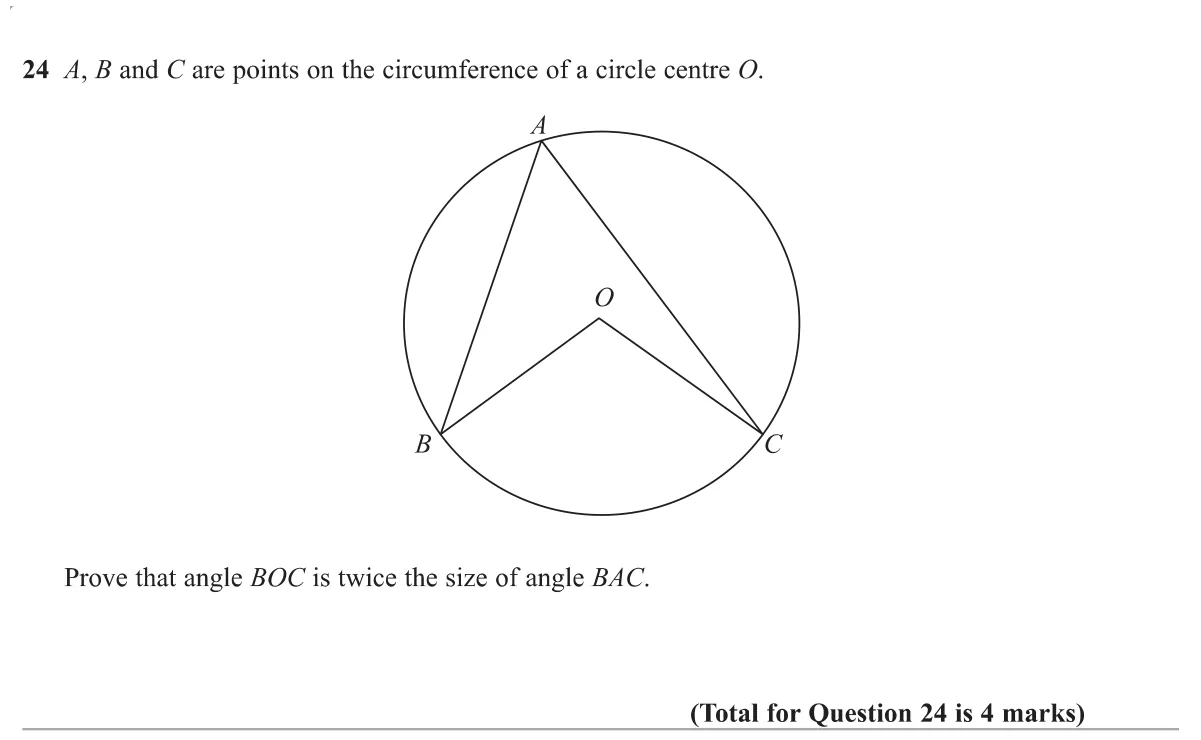
© Pearson Education Ltd. Specimen Paper 2 (Higher, calculator), question 24.
Answer Proof using the two isosceles triangles AOB and AOC 4 marks
Worked solution Checked against the mark scheme
Join A O AO A O D D D ∠ O A B = x \angle OAB = x ∠ O A B = x ∠ O A C = y \angle OAC = y ∠ O A C = y
O A = O B OA = OB O A = O B ∠ O B A = x \angle OBA = x ∠ O B A = x
Exterior angle of triangle A O B AOB A O B ∠ B O D = x + x = 2 x \angle BOD = x + x = 2x ∠ B O D = x + x = 2 x
Similarly ∠ C O D = 2 y \angle COD = 2y ∠ C O D = 2 y
∠ B O C = 2 x + 2 y = 2 ( x + y ) = 2 × ∠ B A C \angle BOC = 2x + 2y = 2(x + y) = 2 \times \angle BAC ∠ B O C = 2 x + 2 y = 2 ( x + y ) = 2 × ∠ B A C
Watch out: Giving no reasons (radii equal, isosceles base angles) for each step.
Finished the paper? Add up your marks for all three papers. Specimen papers were never sat, so they have no grade boundaries of their own, but the grade calculator shows what the same total earned in recent real exams, as a rough guide.