Edexcel GCSE Maths · 1MA1

June 2023 Paper 3 Higher

Calculator · 24 questions · 80 marks · 1 hour 30 minutes. Try each question on paper, then press "Show answer".

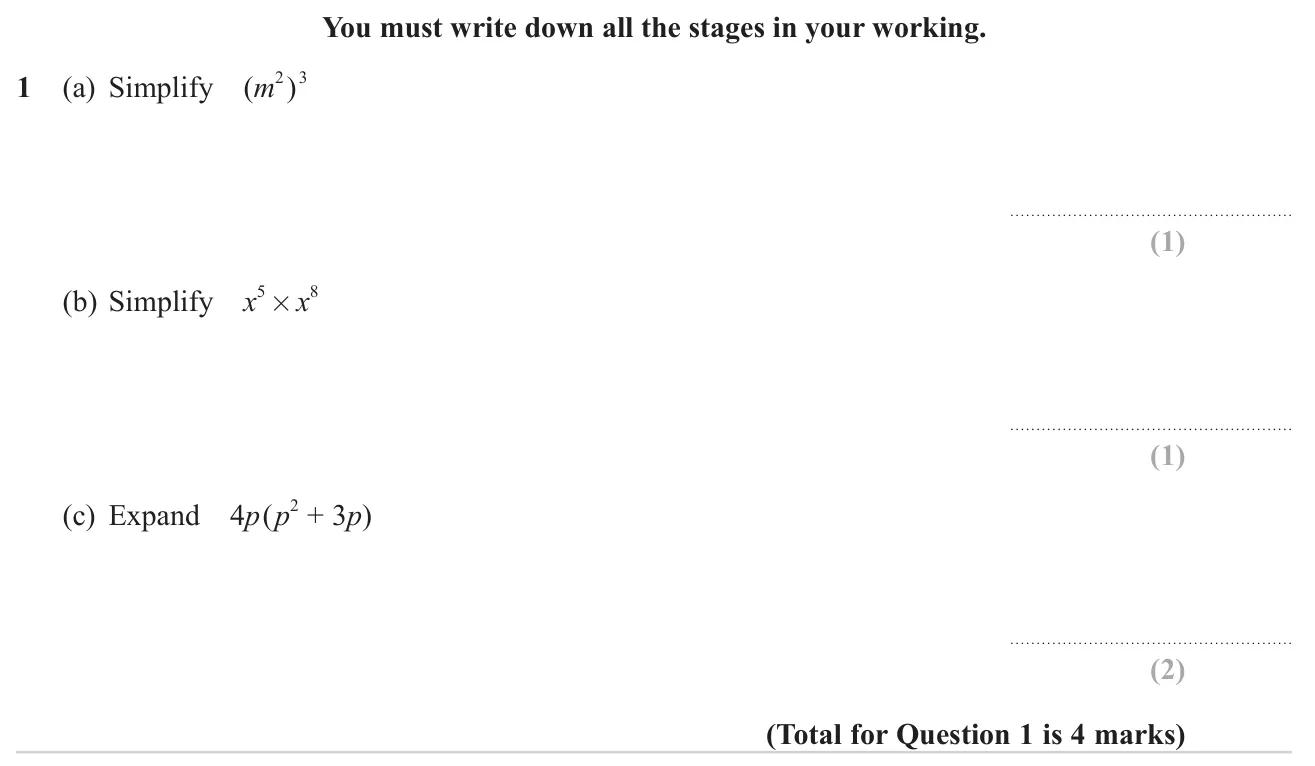
Question 1

Expanding brackets and simplifying4 marksGrade 4CalculatorOn both tiers
Simplify powers using index laws and expand a single bracket.

© Pearson Education Ltd. June 2023 Paper 3 (Higher, calculator), question 1.

Show answer
(a)m6m^61 mark
(b)x13x^{13}1 mark
(c)4p3+12p24p^3 + 12p^22 marks

Worked solution Checked against the mark scheme

(a) Multiply the powers: (m2)3=m2×3=m6(m^2)^3 = m^{2 \times 3} = m^6

(b) Add the powers: x5+8=x13x^{5+8} = x^{13}

(c) 4p×p2=4p34p \times p^2 = 4p^3 and 4p×3p=12p24p \times 3p = 12p^2, so 4p3+12p24p^3 + 12p^2

Watch out: In (a), adding the powers to get m5m^5.

Question 2

Percentages5 marksGrade 3CalculatorOn both tiers
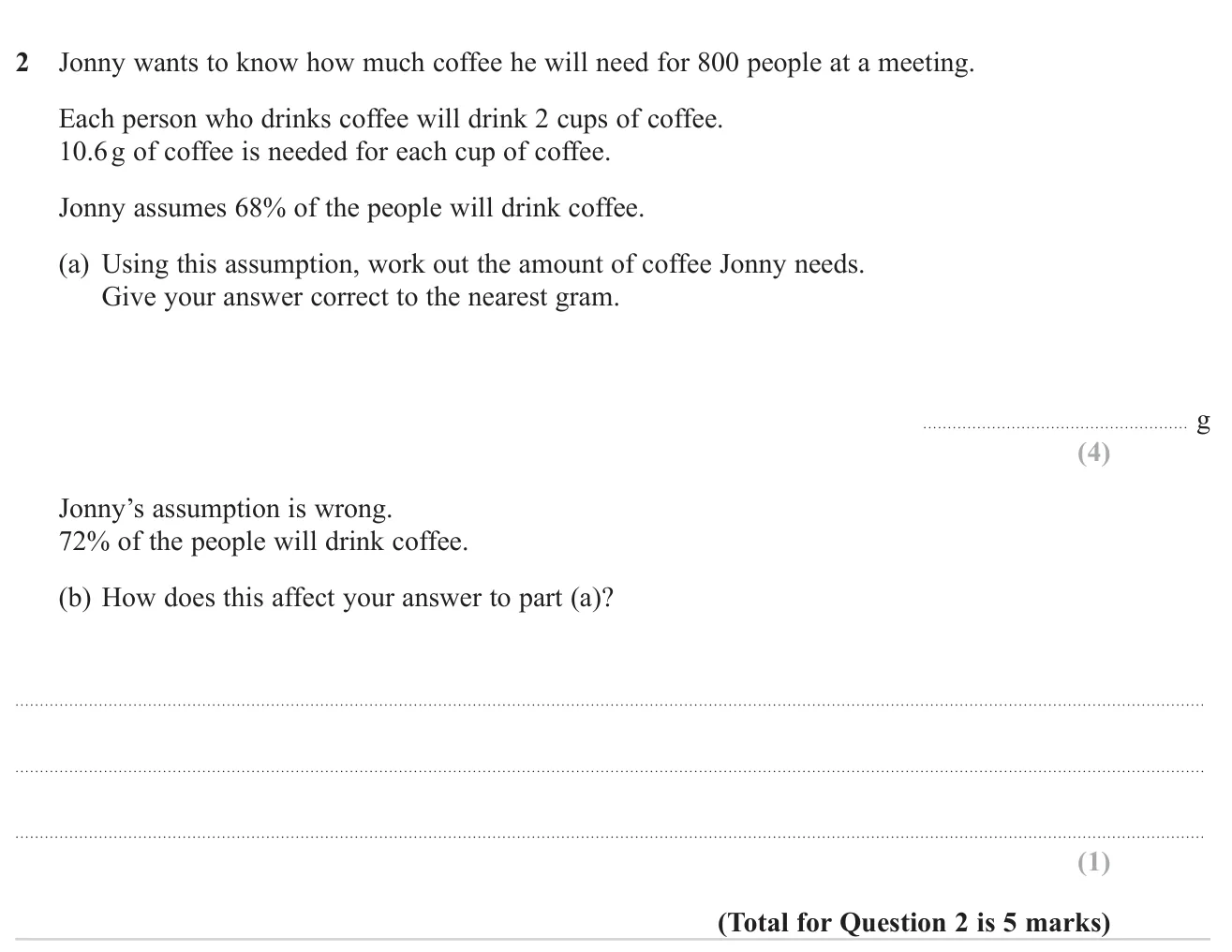
Use a percentage of people and amounts per cup to find the coffee needed, then say how a higher percentage changes it.

© Pearson Education Ltd. June 2023 Paper 3 (Higher, calculator), question 2.

Show answer
(a)115334 marks
(b)He will need more coffee1 mark

Worked solution Checked against the mark scheme

(a) 0.68×800=5440.68 \times 800 = 544 people

544×2=1088544 \times 2 = 1088 cups

1088×10.6=11532.81088 \times 10.6 = 11532.8, so 1153311533 g

(b) More people drink coffee, so he needs more than in (a).

Watch out: Forgetting that each person drinks two cups.

Question 3

Angle facts and parallel lines5 marksGrade 5CalculatorOn both tiers
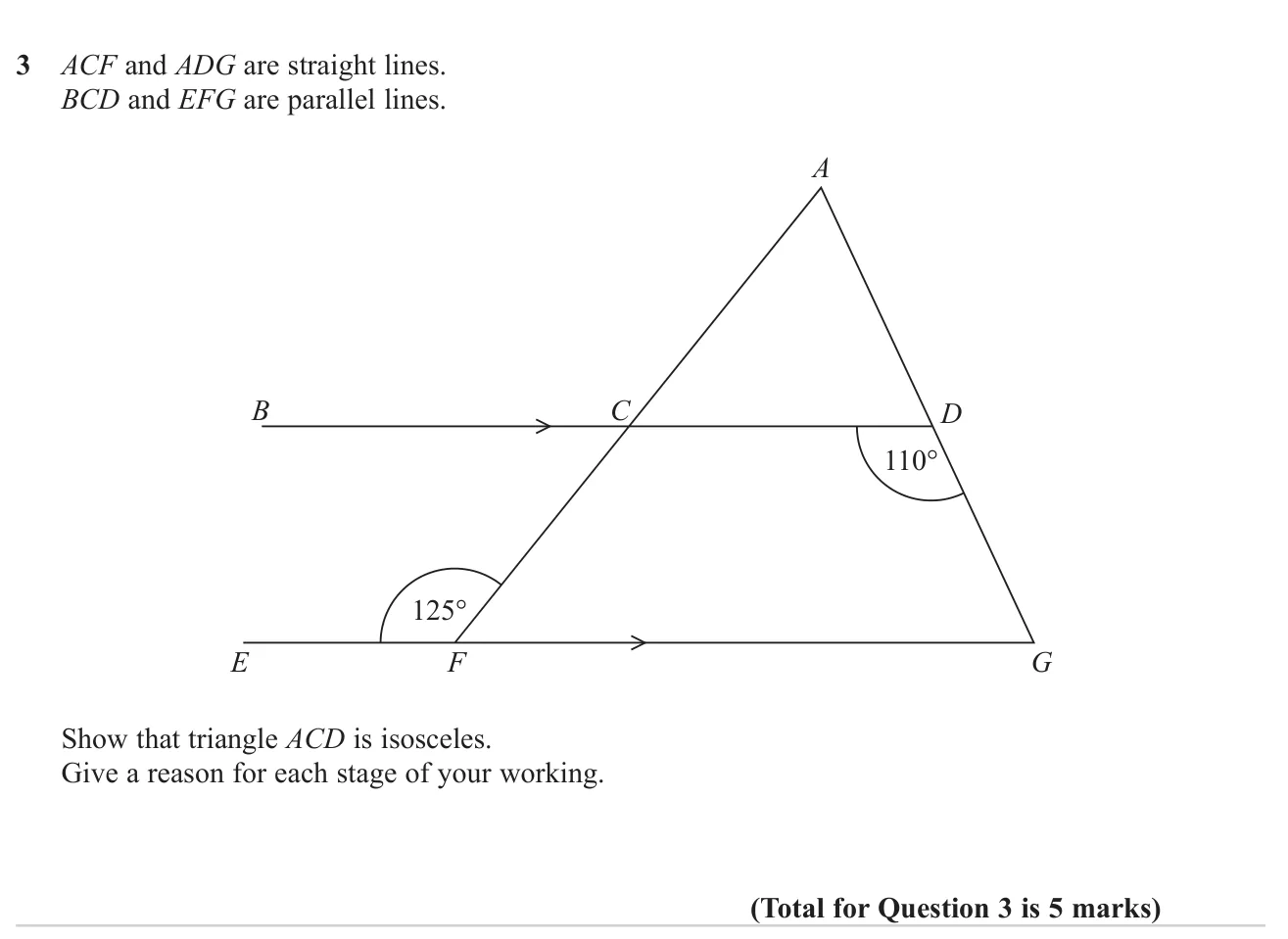
Prove a triangle is isosceles using parallel-line and triangle angle facts with reasons.

© Pearson Education Ltd. June 2023 Paper 3 (Higher, calculator), question 3.

Show answer
AnswerAngle ACD=55°ACD = 55° and angle CAD=55°CAD = 55°, so the triangle is isosceles5 marks

Worked solution Checked against the mark scheme

Angle CFG=180−125=55°CFG = 180 - 125 = 55° (angles on a straight line add to 180°).

Angle ACD=55°ACD = 55° (corresponding angles are equal).

Angle ADC=180−110=70°ADC = 180 - 110 = 70° (angles on a straight line).

Angle CAD=180−55−70=55°CAD = 180 - 55 - 70 = 55° (angles in a triangle add to 180°).

Two angles are equal, so triangle ACDACD is isosceles.

Watch out: Giving correct angles but no reasons, or saying 'Z angles' instead of alternate angles.

Question 4

Direct and inverse proportion2 marksGrade 4CalculatorOn both tiers
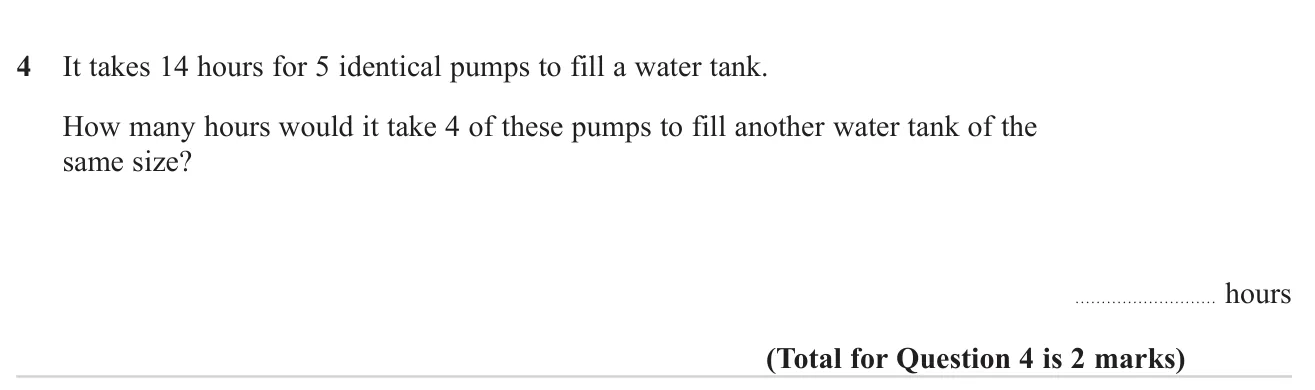
Use inverse proportion to find how long fewer pumps take to fill a tank.

© Pearson Education Ltd. June 2023 Paper 3 (Higher, calculator), question 4.

Show answer
Answer17.52 marks

Worked solution Checked against the mark scheme

Total work: 5×14=705 \times 14 = 70 pump-hours.

With 4 pumps: 70÷4=17.570 \div 4 = 17.5 hours

Watch out: Treating it as direct proportion and getting 11.2 hours.

Question 5

Factors, multiples and primes3 marksGrade 5CalculatorOn both tiers
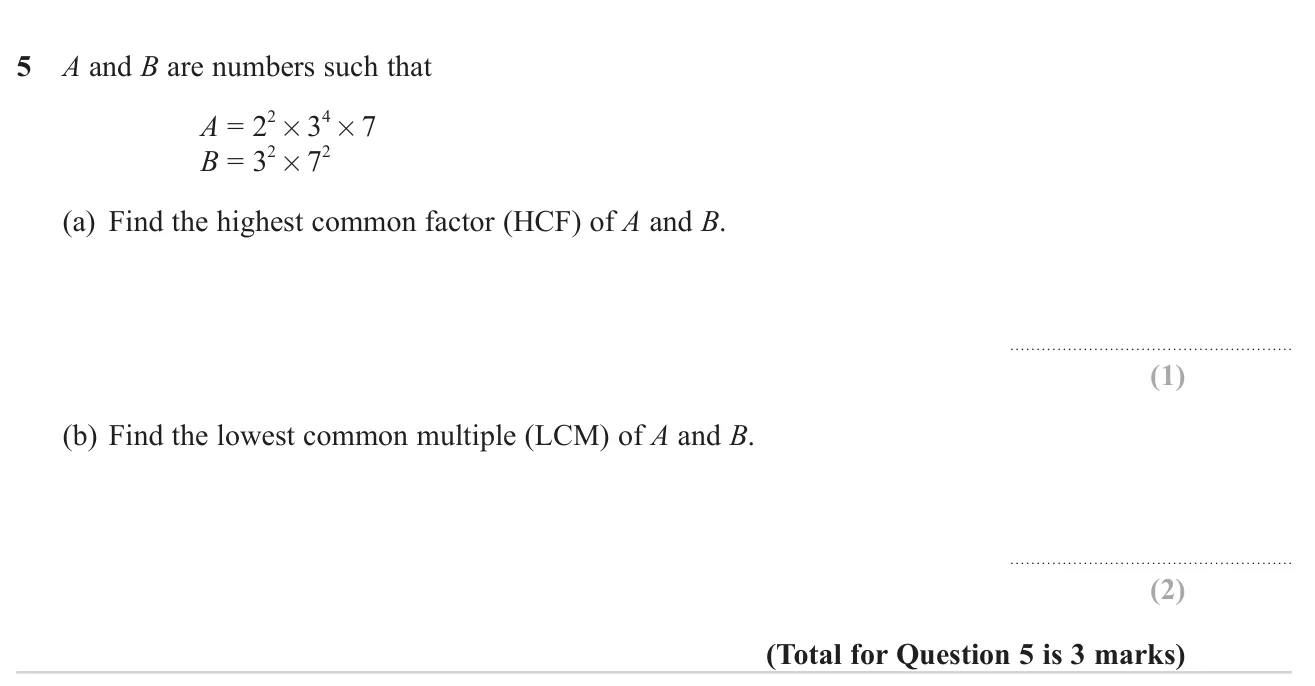
Find the HCF and LCM of two numbers given as products of prime powers.

© Pearson Education Ltd. June 2023 Paper 3 (Higher, calculator), question 5.

Show answer
(a)631 mark
(b)158762 marks

Worked solution Checked against the mark scheme

(a) Take the lowest power of each shared prime: 32×7=633^2 \times 7 = 63

(b) Take the highest power of every prime: 22×34×72=4×81×49=158762^2 \times 3^4 \times 7^2 = 4 \times 81 \times 49 = 15876

Watch out: Using the lower powers for the LCM, or giving A×BA \times B.

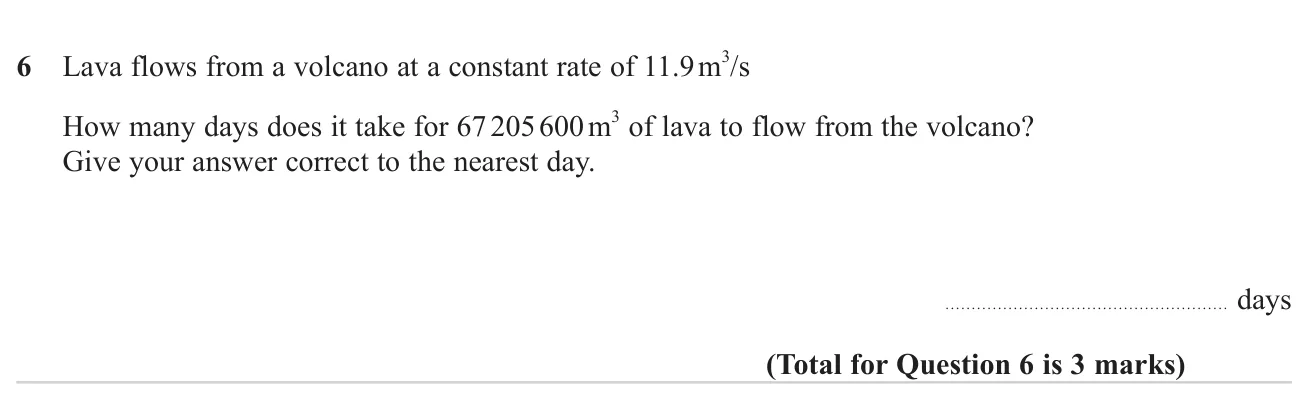
Question 6

Speed, density and pressure3 marksGrade 4CalculatorOn both tiers
Use a flow rate in cubic metres per second to find a time in days.

© Pearson Education Ltd. June 2023 Paper 3 (Higher, calculator), question 6.

Show answer
Answer653 marks

Worked solution Checked against the mark scheme

Seconds: 67 205 600÷11.9=5 647 529.4...67\,205\,600 \div 11.9 = 5\,647\,529.4...

Seconds in a day: 24×60×60=86 40024 \times 60 \times 60 = 86\,400

5 647 529.4÷86 400=65.36...5\,647\,529.4 \div 86\,400 = 65.36..., so 6565 days

Watch out: Dividing by 60 only once or twice instead of converting fully to days.

Question 7

Quadratic graphs2 marksGrade 4CalculatorOn both tiers
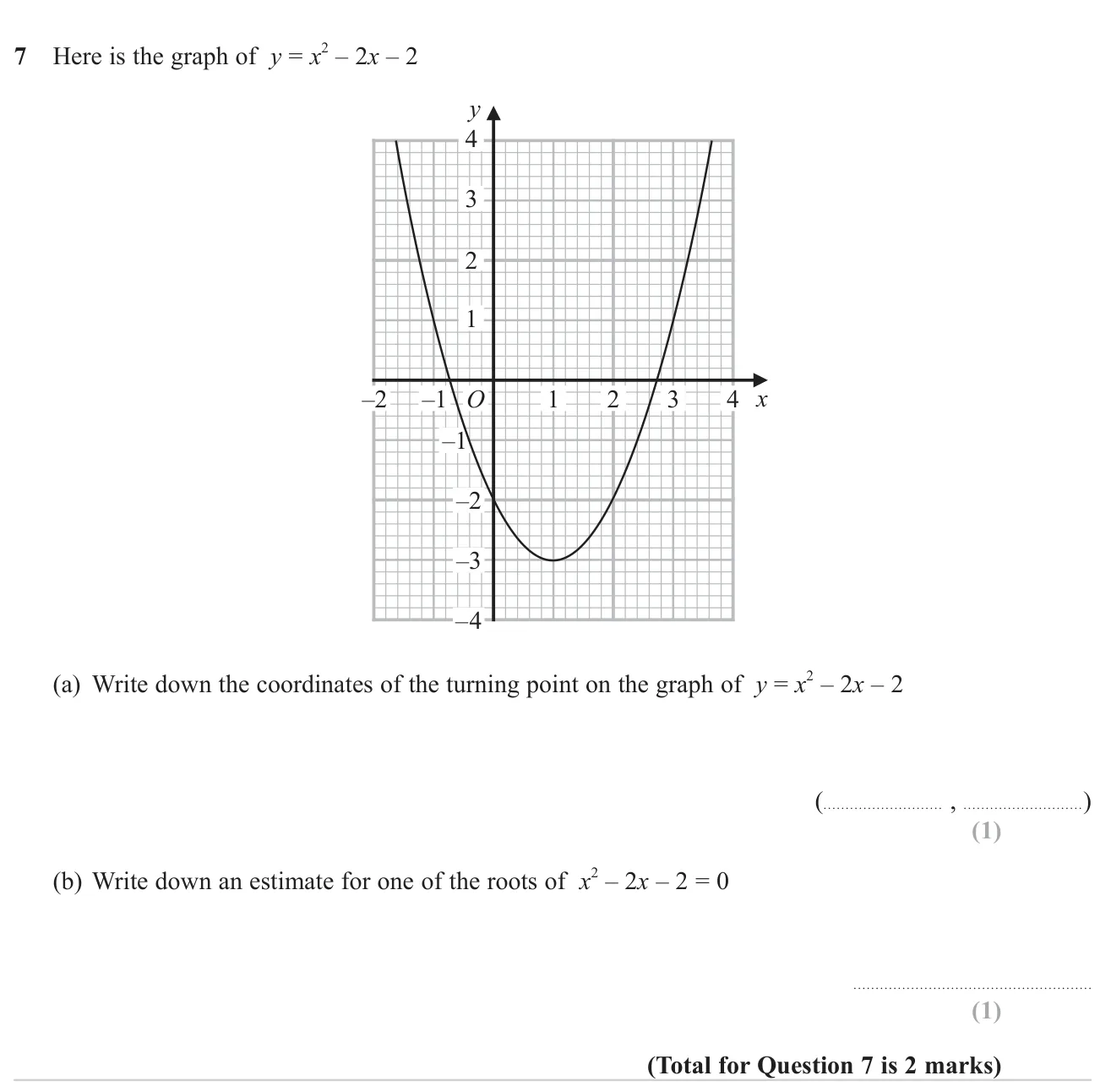
Read the turning point and estimate a root from the graph of a quadratic.

© Pearson Education Ltd. June 2023 Paper 3 (Higher, calculator), question 7.

Show answer
(a)(1,−3)(1, -3)1 mark
(b)−0.7-0.7 or 2.72.71 mark

Worked solution Checked against the mark scheme

(a) The lowest point of the curve is at (1,−3)(1, -3).

(b) The roots are where the curve crosses the xx-axis: about x=−0.7x = -0.7 or x=2.7x = 2.7.

Watch out: In (b), reading where the curve crosses the yy-axis (−2-2).

Question 8

Speed, density and pressure2 marksGrade 4CalculatorOn both tiers
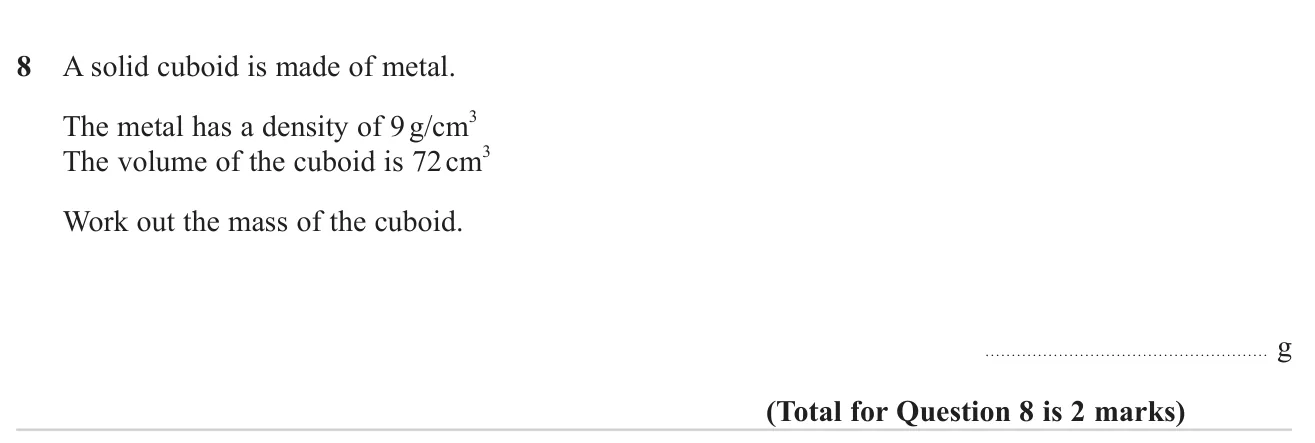
Use density and volume to find mass.

© Pearson Education Ltd. June 2023 Paper 3 (Higher, calculator), question 8.

Show answer
Answer6482 marks

Worked solution Checked against the mark scheme

Mass = density × volume

9×72=6489 \times 72 = 648 g

Watch out: Dividing 72 by 9 to get 8.

Question 9

Percentages2 marksGrade 5Calculator
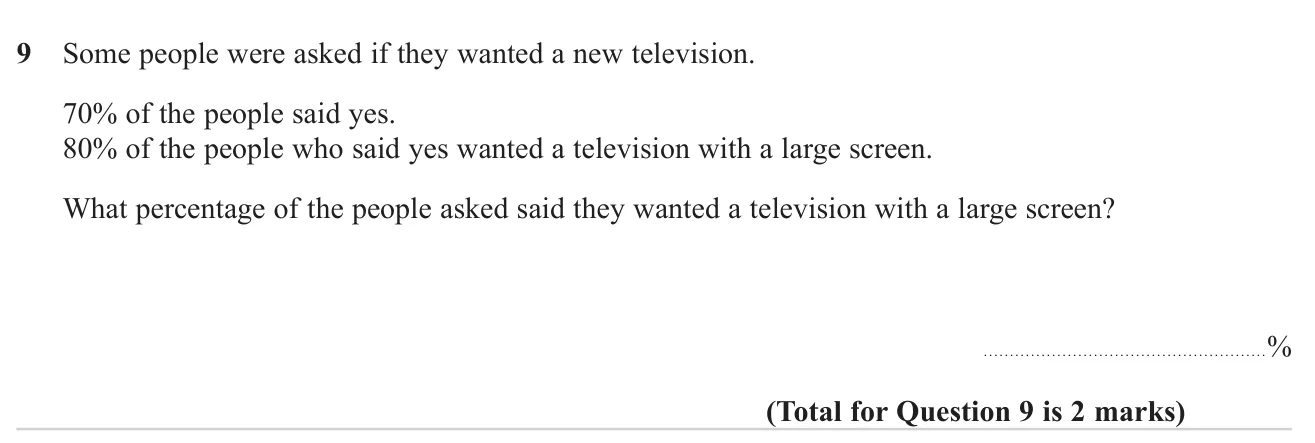
Find a percentage of a percentage to get the share of all people who want a large-screen television.

© Pearson Education Ltd. June 2023 Paper 3 (Higher, calculator), question 9.

Show answer
Answer56%2 marks

Worked solution Checked against the mark scheme

80%80\% of 70%=0.8×0.7=0.5670\% = 0.8 \times 0.7 = 0.56

So 56%56\% of the people asked.

Watch out: Subtracting or adding the percentages, e.g. 80−70=10%80 - 70 = 10\%.

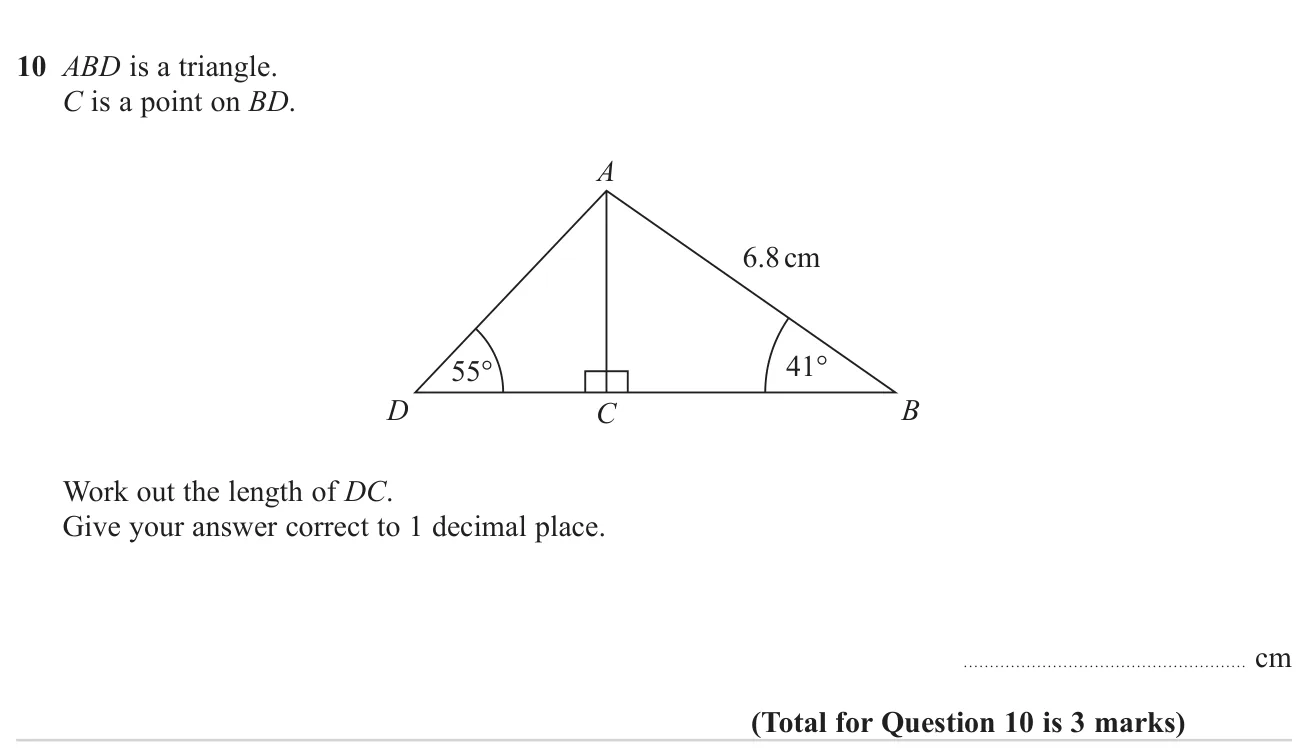
Question 10

Pythagoras and trigonometry3 marksGrade 6Calculator
Use right-angled trigonometry in two triangles sharing a height to find a length.

© Pearson Education Ltd. June 2023 Paper 3 (Higher, calculator), question 10.

Show answer
Answer3.1 cm3 marks

Worked solution Checked against the mark scheme

In triangle ABCABC: AC=6.8sin⁡41°=4.461...AC = 6.8 \sin 41° = 4.461... cm

In triangle ACDACD: tan⁡55°=ACDC\tan 55° = \dfrac{AC}{DC}

DC=4.461...tan⁡55°=3.12...DC = \dfrac{4.461...}{\tan 55°} = 3.12..., so DC=3.1DC = 3.1 cm

Watch out: Using cos 41° instead of sin 41° to find the vertical height AC.

Question 11

Box plots5 marksGrade 5Calculator
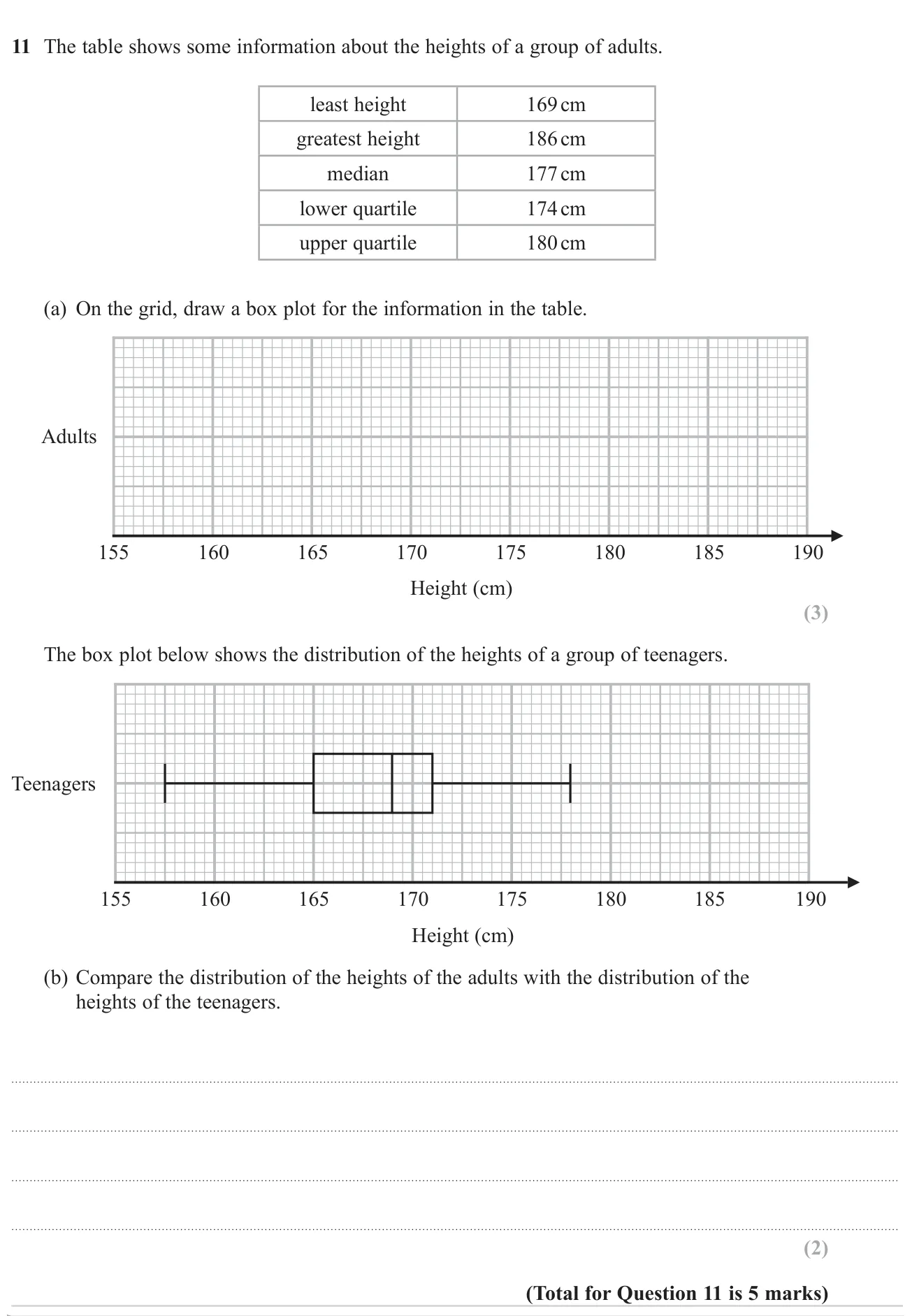
Draw a box plot from five summary values, then compare it with another group's box plot.

© Pearson Education Ltd. June 2023 Paper 3 (Higher, calculator), question 11.

Show answer
(a)Box plot with whiskers from 169 to 186, box from 174 to 180 and median line at 1773 marks
(b)Adults are taller on average (median 177 cm vs 169 cm); the IQRs are the same (6 cm) but the teenagers' range is larger (20.5 cm vs 17 cm)2 marks

Worked solution Checked against the mark scheme

(a) Plot the five values on the scale: whisker from 169 to 174, box from 174 to 180 with a line at 177, whisker from 180 to 186.

(b) Teenagers: median 169, IQR 171−165=6171 - 165 = 6, range 178−157.5=20.5178 - 157.5 = 20.5

Adults: median 177, IQR 180−174=6180 - 174 = 6, range 186−169=17186 - 169 = 17

The adults' median height is greater, so adults are generally taller. Both groups have the same IQR, so the middle half of heights is equally spread.

Watch out: Just quoting the medians and ranges without saying which is bigger, or not mentioning heights.

Question 12

Expanding brackets and simplifying3 marksGrade 6Calculator
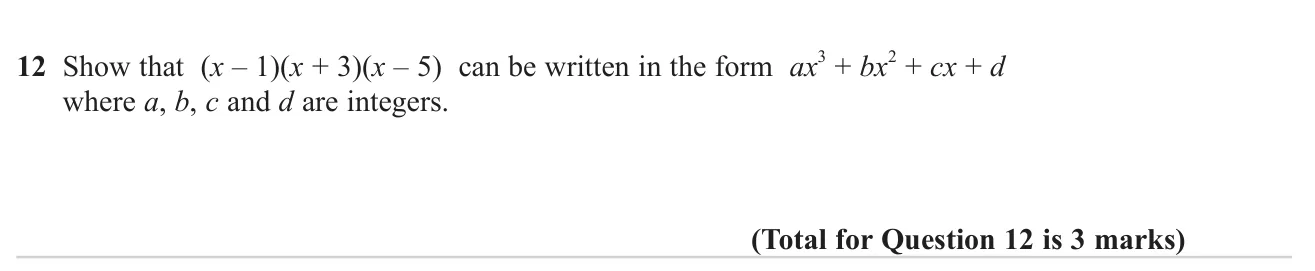
Expand the product of three linear brackets to get a cubic with integer coefficients.

© Pearson Education Ltd. June 2023 Paper 3 (Higher, calculator), question 12.

Show answer
Answerx3−3x2−13x+15x^3 - 3x^2 - 13x + 153 marks

Worked solution Checked against the mark scheme

(x−1)(x+3)=x2+3x−x−3=x2+2x−3(x-1)(x+3) = x^2 + 3x - x - 3 = x^2 + 2x - 3

(x2+2x−3)(x−5)=x3−5x2+2x2−10x−3x+15(x^2 + 2x - 3)(x - 5) = x^3 - 5x^2 + 2x^2 - 10x - 3x + 15

=x3−3x2−13x+15= x^3 - 3x^2 - 13x + 15, so a=1a = 1, b=−3b = -3, c=−13c = -13, d=15d = 15, all integers.

Watch out: Sign errors when multiplying the negative terms, such as −3×−5-3 \times -5.

Question 13

Identities and algebraic proof3 marksGrade 8Calculator
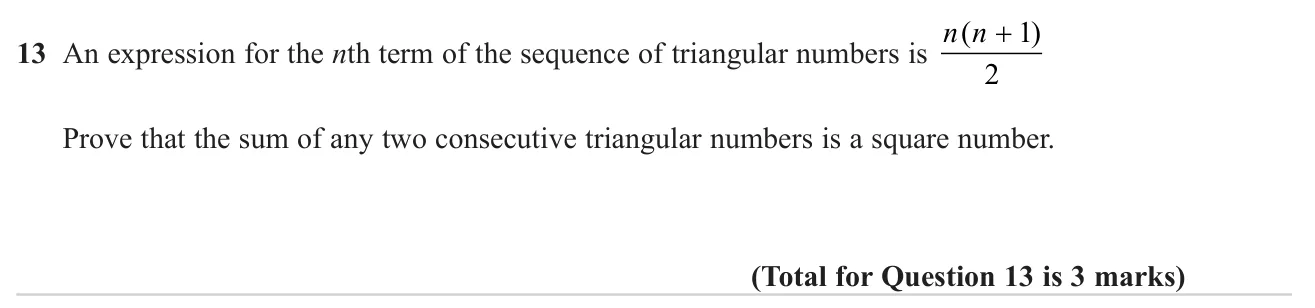
Prove algebraically that adding two consecutive triangular numbers always gives a square.

© Pearson Education Ltd. June 2023 Paper 3 (Higher, calculator), question 13.

Show answer
Answern(n+1)2+(n+1)(n+2)2=(n+1)2\frac{n(n+1)}{2} + \frac{(n+1)(n+2)}{2} = (n+1)^23 marks

Worked solution Checked against the mark scheme

The next triangular number is (n+1)(n+2)2\dfrac{(n+1)(n+2)}{2}.

Sum: n(n+1)+(n+1)(n+2)2=(n+1)(n+n+2)2\dfrac{n(n+1) + (n+1)(n+2)}{2} = \dfrac{(n+1)(n + n + 2)}{2}

=(n+1)(2n+2)2=(n+1)(n+1)=(n+1)2= \dfrac{(n+1)(2n+2)}{2} = (n+1)(n+1) = (n+1)^2

This is a square number for every nn.

Watch out: Checking a few numerical examples instead of giving a general algebraic proof.

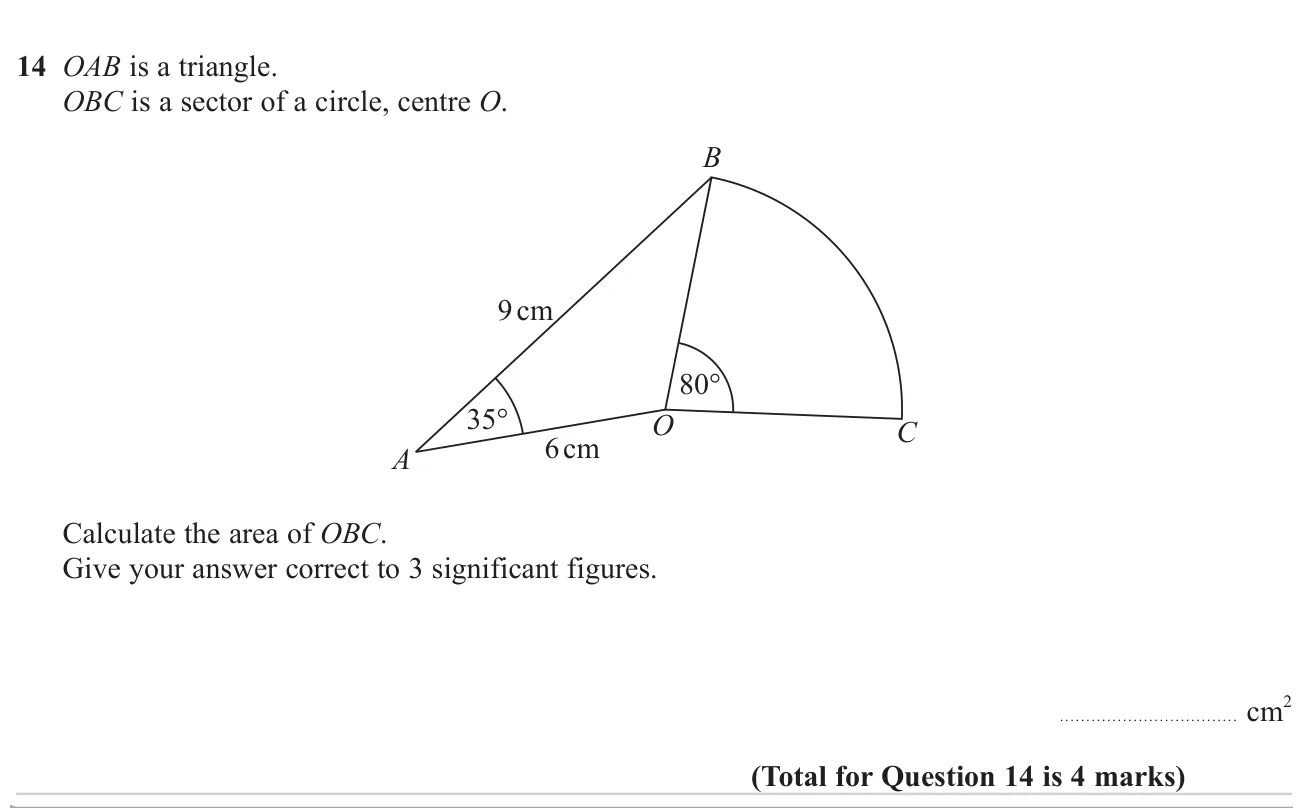
Question 14

Use the cosine rule to find a radius, then work out the area of a sector.

© Pearson Education Ltd. June 2023 Paper 3 (Higher, calculator), question 14.

Show answer
Answer19.9 cm²4 marks

Worked solution Checked against the mark scheme

Cosine rule: OB2=92+62−2×9×6cos⁡35°=28.53...OB^2 = 9^2 + 6^2 - 2 \times 9 \times 6 \cos 35° = 28.53...

OB=5.341...OB = 5.341... cm

Sector area =80360×π×28.53...=19.918...= \dfrac{80}{360} \times \pi \times 28.53... = 19.918...

=19.9= 19.9 cm² (3 s.f.)

Watch out: Working out 81+36−10881 + 36 - 108 before multiplying by cos⁡35°\cos 35°.

Question 15

Factorising3 marksGrade 7Calculator
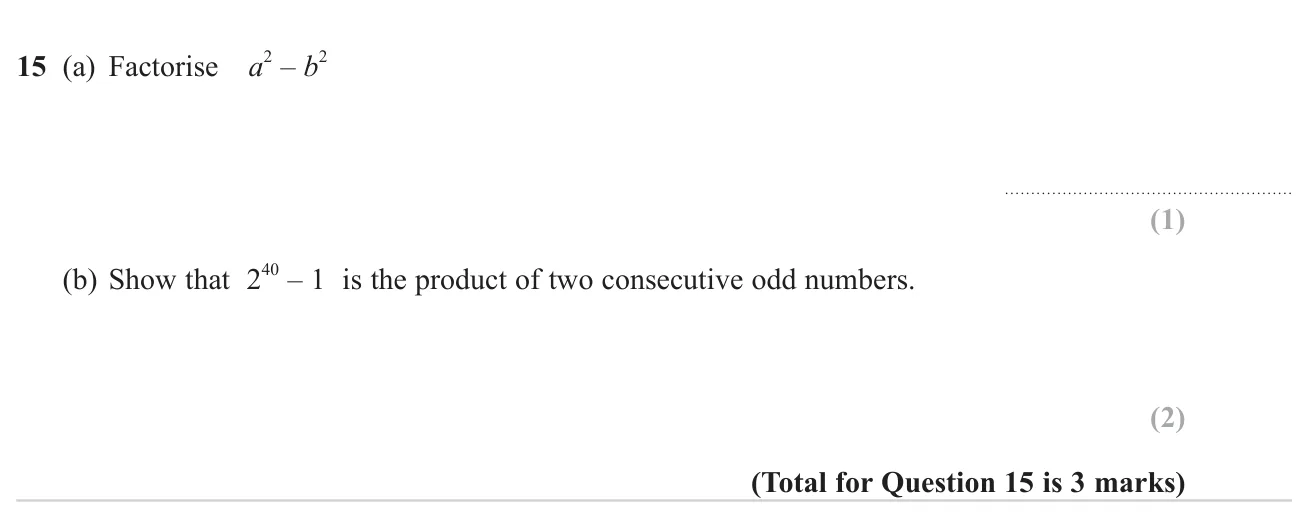
Factorise a difference of two squares, then use it to show that a power of 2 minus 1 is the product of two consecutive odd numbers.

© Pearson Education Ltd. June 2023 Paper 3 (Higher, calculator), question 15.

Show answer
(a)(a−b)(a+b)(a - b)(a + b)1 mark
(b)240−1=(220−1)(220+1)2^{40} - 1 = (2^{20} - 1)(2^{20} + 1); 2202^{20} is even, so both factors are odd and differ by 22 marks

Worked solution Checked against the mark scheme

(a) a2−b2=(a−b)(a+b)a^2 - b^2 = (a - b)(a + b)

(b) 240=(220)22^{40} = (2^{20})^2, so 240−1=(220−1)(220+1)2^{40} - 1 = (2^{20} - 1)(2^{20} + 1)

2202^{20} is even, so 220−12^{20} - 1 and 220+12^{20} + 1 are both odd, and they differ by 2, so they are consecutive odd numbers (1 048 5751\,048\,575 and 1 048 5771\,048\,577).

Watch out: In (b), factorising but not explaining why the two factors are odd and consecutive.

Question 16

Transformations2 marksGrade 8Calculator
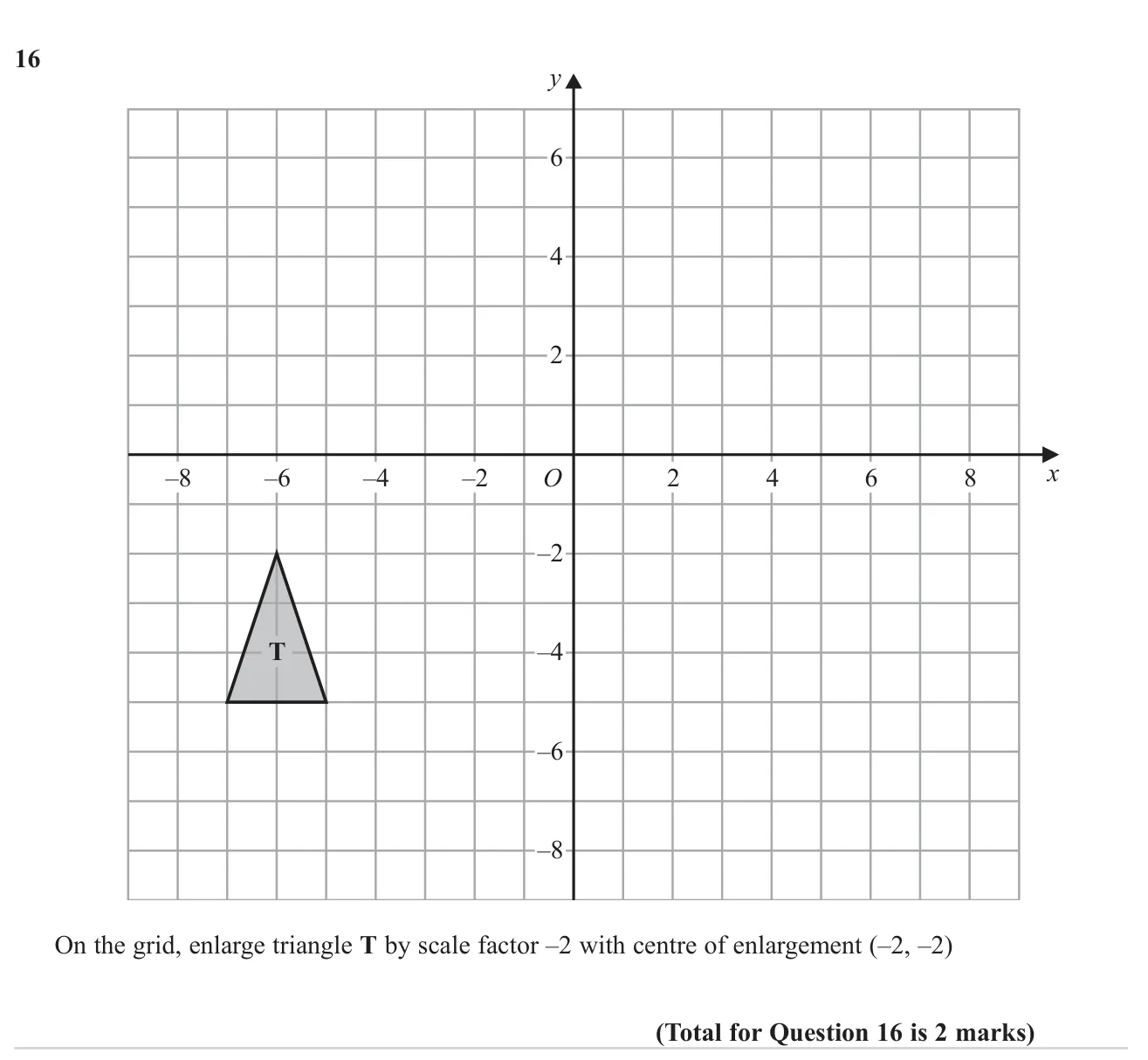
Enlarge a triangle on a grid by a negative scale factor about a given centre.

© Pearson Education Ltd. June 2023 Paper 3 (Higher, calculator), question 16.

Show answer
AnswerTriangle with vertices (6,−2)(6, -2), (4,4)(4, 4) and (8,4)(8, 4)2 marks

Worked solution Checked against the mark scheme

Triangle T has vertices (−6,−2)(-6, -2), (−7,−5)(-7, -5), (−5,−5)(-5, -5).

From the centre (−2,−2)(-2, -2) each vertex is (−4,0)(-4, 0), (−5,−3)(-5, -3), (−3,−3)(-3, -3) away.

Multiply by −2-2: (8,0)(8, 0), (10,6)(10, 6), (6,6)(6, 6).

Add back to the centre: (6,−2)(6, -2), (8,4)(8, 4), (4,4)(4, 4). The image is upside down and twice the size.

Watch out: Enlarging by +2+2 so the image is on the same side of the centre and not inverted.

Question 17

Gradients and rates of change4 marksGrade 7Calculator
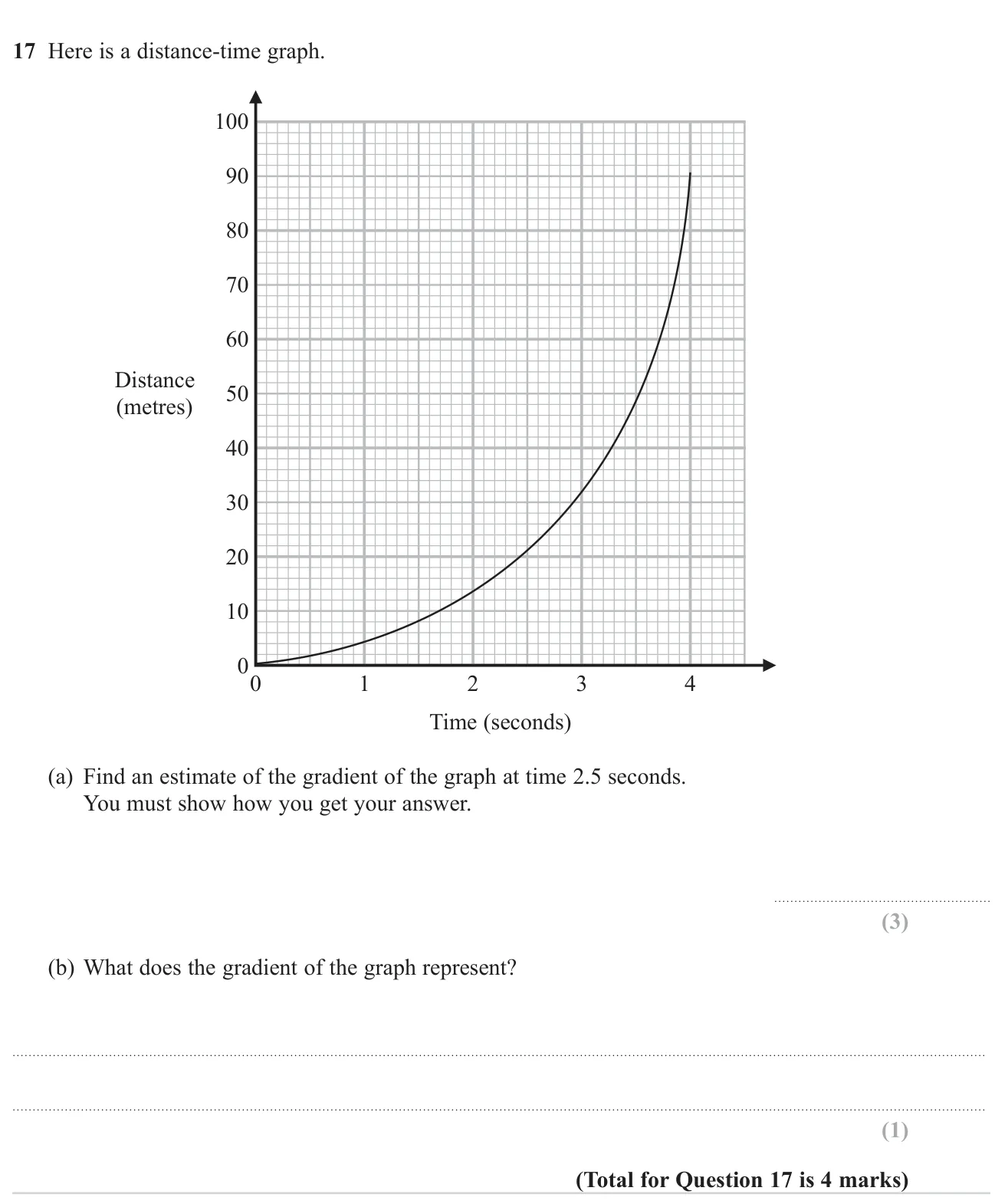
Draw a tangent to a distance-time curve to estimate its gradient, and say what the gradient means.

© Pearson Education Ltd. June 2023 Paper 3 (Higher, calculator), question 17.

Show answer
(a)About 18 (accept 16.5 to 19.5)3 marks
(b)The speed (in m/s) at that time1 mark

Worked solution Checked against the mark scheme

(a) Draw a straight line touching the curve at t=2.5t = 2.5 (where the distance is about 21 m).

Pick two points on the tangent, e.g. (1.4,0)(1.4, 0) and (4,48)(4, 48).

Gradient =48−04−1.4≈18= \dfrac{48 - 0}{4 - 1.4} \approx 18

(b) Distance ÷ time is speed, so the gradient is the speed at 2.5 seconds, about 18 m/s.

Watch out: Using a chord between two points on the curve instead of a tangent, or reading the distance at 2.5 s.

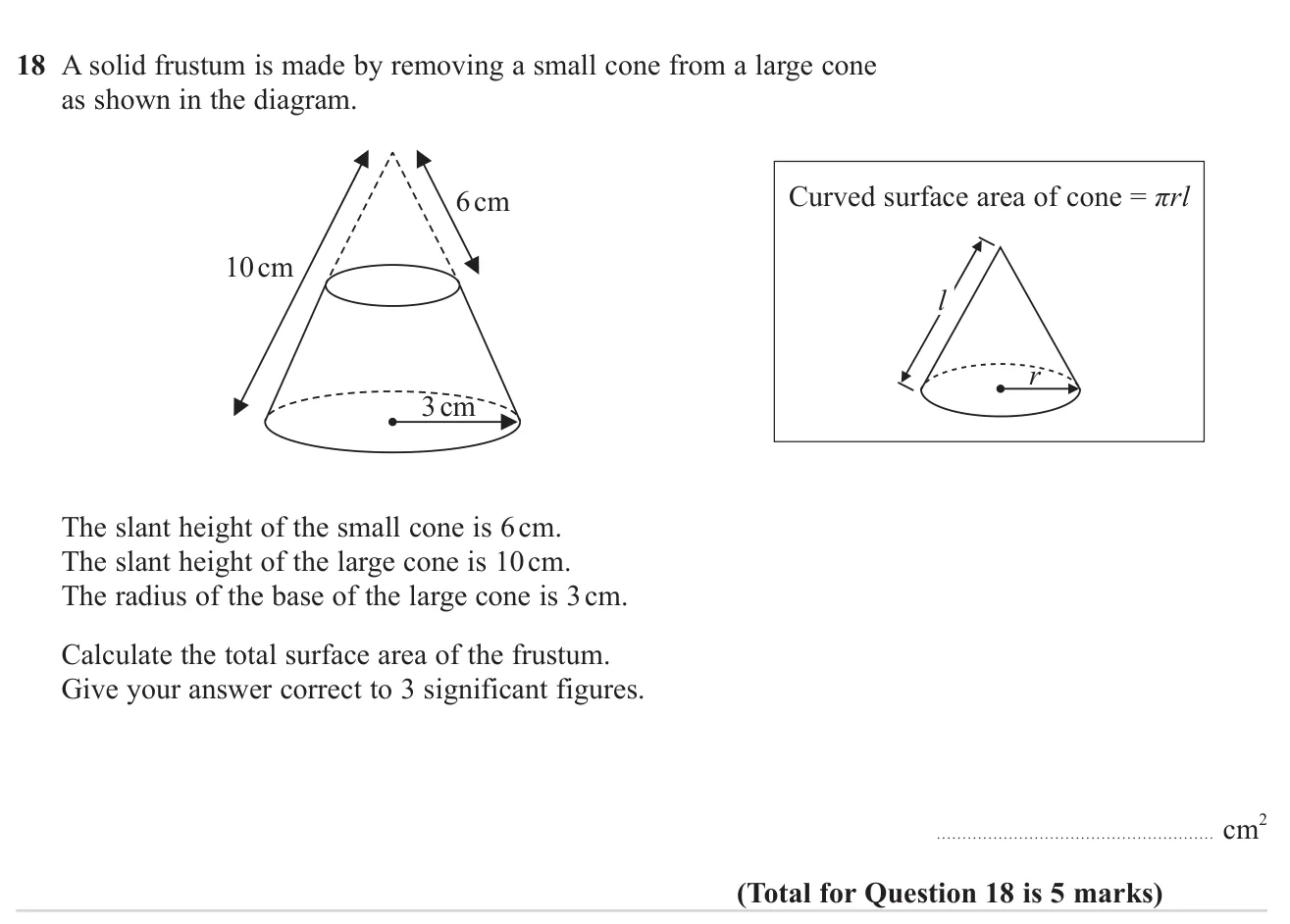
Question 18

Volume and surface area5 marksGrade 8Calculator
Use similar cones to find the top radius of a frustum, then work out its total surface area.

© Pearson Education Ltd. June 2023 Paper 3 (Higher, calculator), question 18.

Show answer
Answer98.8 cm²5 marks

Worked solution Checked against the mark scheme

Small cone radius: 610×3=1.8\dfrac{6}{10} \times 3 = 1.8 cm

Curved area of frustum =π×3×10−π×1.8×6=19.2π=60.3...= \pi \times 3 \times 10 - \pi \times 1.8 \times 6 = 19.2\pi = 60.3...

Bottom circle: π×32=9π\pi \times 3^2 = 9\pi; top circle: π×1.82=3.24π\pi \times 1.8^2 = 3.24\pi

Total =(19.2+9+3.24)π=31.44π=98.77...= (19.2 + 9 + 3.24)\pi = 31.44\pi = 98.77..., so 98.898.8 cm²

Watch out: Forgetting one of the two circular faces, often the top one.

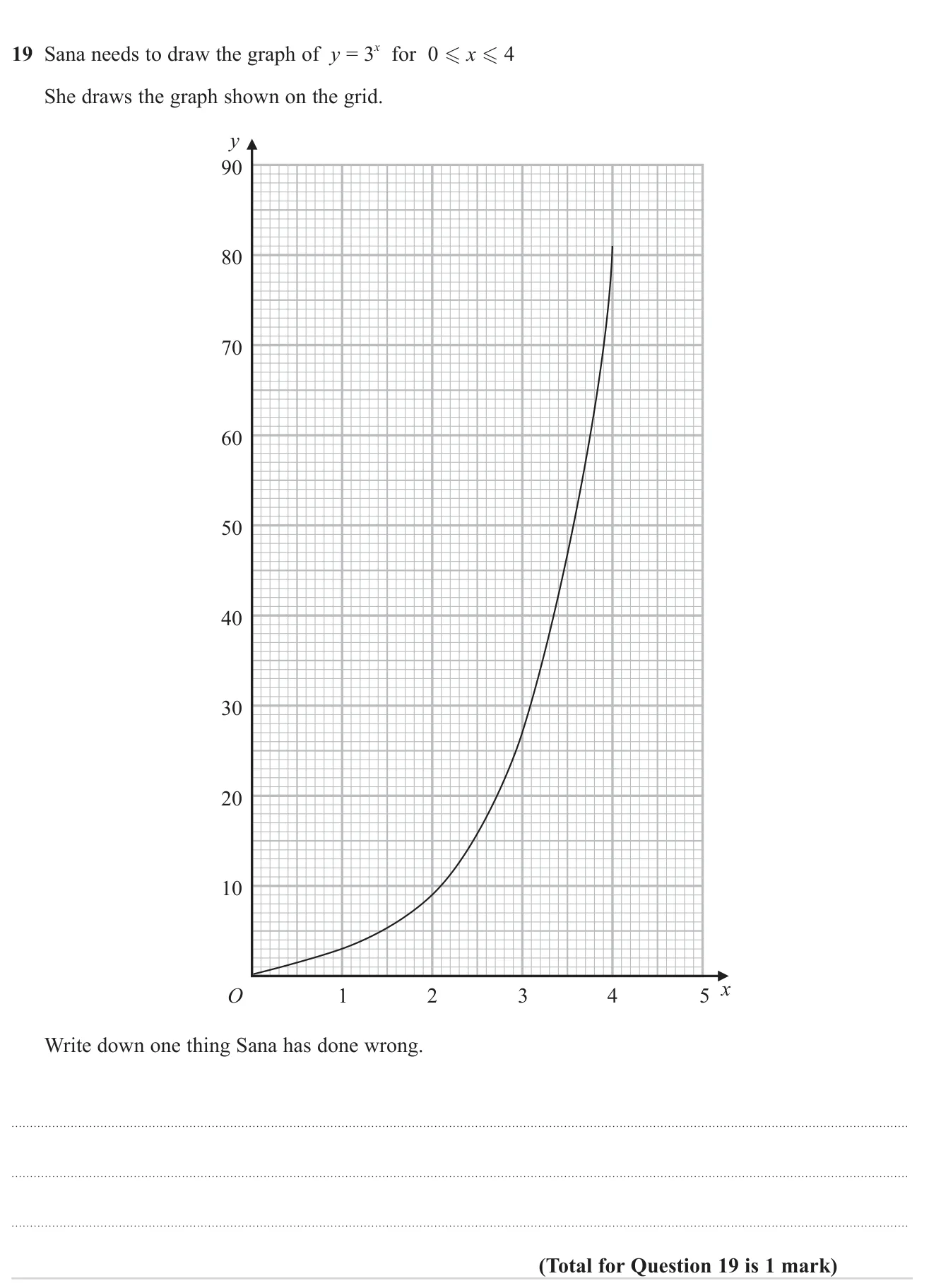
Question 19

Spot the mistake in a sketch of an exponential graph.

© Pearson Education Ltd. June 2023 Paper 3 (Higher, calculator), question 19.

Show answer
AnswerThe graph should cross the yy-axis at (0,1)(0, 1), not start at the origin, because 30=13^0 = 11 mark

Worked solution Checked against the mark scheme

When x=0x = 0, y=30=1y = 3^0 = 1.

Sana's curve starts at (0,0)(0, 0), so it is wrong there: it should start at (0,1)(0, 1).

Watch out: Saying the graph is 'drawn wrong' without saying what is wrong.

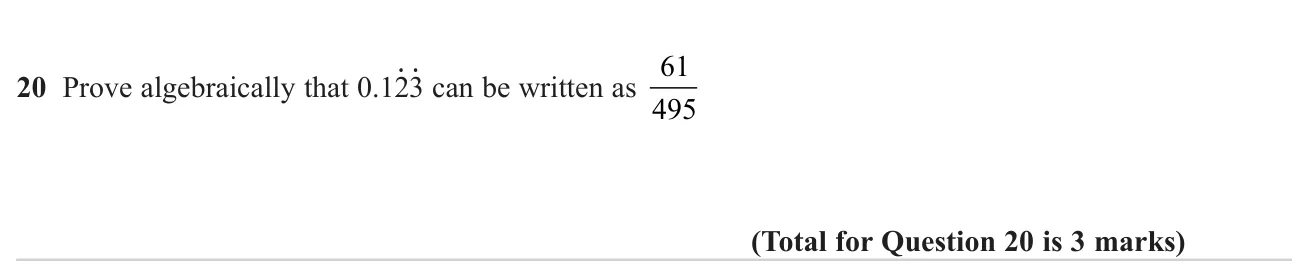
Question 20

Prove that a recurring decimal is equal to a given fraction.

© Pearson Education Ltd. June 2023 Paper 3 (Higher, calculator), question 20.

Show answer
Answer0.12˙3˙=614950.1\dot{2}\dot{3} = \frac{61}{495}3 marks

Worked solution Checked against the mark scheme

Let x=0.1232323...x = 0.1232323...

10x=1.232323...10x = 1.232323... and 1000x=123.232323...1000x = 123.232323...

1000x−10x=1221000x - 10x = 122, so 990x=122990x = 122

x=122990=61495x = \dfrac{122}{990} = \dfrac{61}{495}

Watch out: Subtracting multiples that don't cancel the recurring part, e.g. 100x−x100x - x without handling the non-recurring 1.

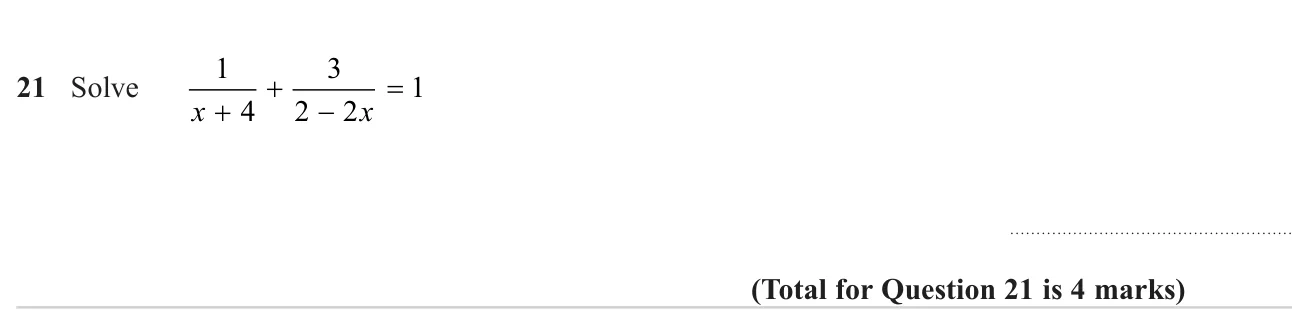
Question 21

Algebraic fractions4 marksGrade 8Calculator
Solve an equation with two algebraic fractions by clearing denominators and solving the resulting quadratic.

© Pearson Education Ltd. June 2023 Paper 3 (Higher, calculator), question 21.

Show answer
Answerx=−2x = -2 or x=−32x = -\frac{3}{2}4 marks

Worked solution Checked against the mark scheme

Multiply every term by (x+4)(2−2x)(x + 4)(2 - 2x):

(2−2x)+3(x+4)=(x+4)(2−2x)(2 - 2x) + 3(x + 4) = (x + 4)(2 - 2x)

x+14=−2x2−6x+8x + 14 = -2x^2 - 6x + 8

2x2+7x+6=02x^2 + 7x + 6 = 0

(2x+3)(x+2)=0(2x + 3)(x + 2) = 0, so x=−32x = -\frac{3}{2} or x=−2x = -2

Watch out: Forgetting to multiply the right-hand side 1 by both denominators.

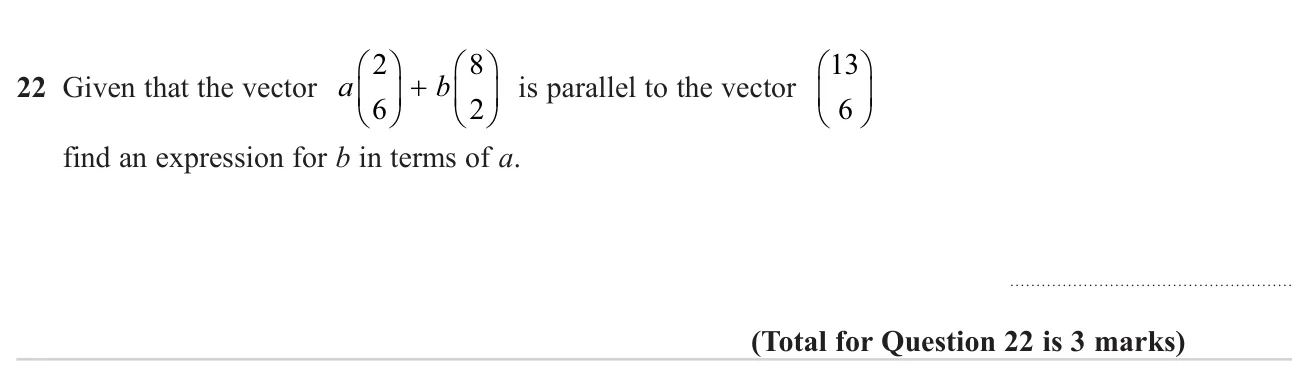
Question 22

Vectors3 marksGrade 8Calculator
Use the condition for parallel vectors to find a relationship between two unknown coefficients.

© Pearson Education Ltd. June 2023 Paper 3 (Higher, calculator), question 22.

Show answer
Answerb=3ab = 3a3 marks

Worked solution Checked against the mark scheme

Parallel means a(26)+b(82)=k(136)a\begin{pmatrix}2\\6\end{pmatrix} + b\begin{pmatrix}8\\2\end{pmatrix} = k\begin{pmatrix}13\\6\end{pmatrix}

2a+8b=13k2a + 8b = 13k and 6a+2b=6k6a + 2b = 6k, so k=a+b3k = a + \frac{b}{3}

2a+8b=13a+13b32a + 8b = 13a + \frac{13b}{3}

11b3=11a\frac{11b}{3} = 11a, so b=3ab = 3a

Watch out: Setting the combined vector equal to (136)\begin{pmatrix}13\\6\end{pmatrix} exactly and stopping with numbers instead of a relationship.

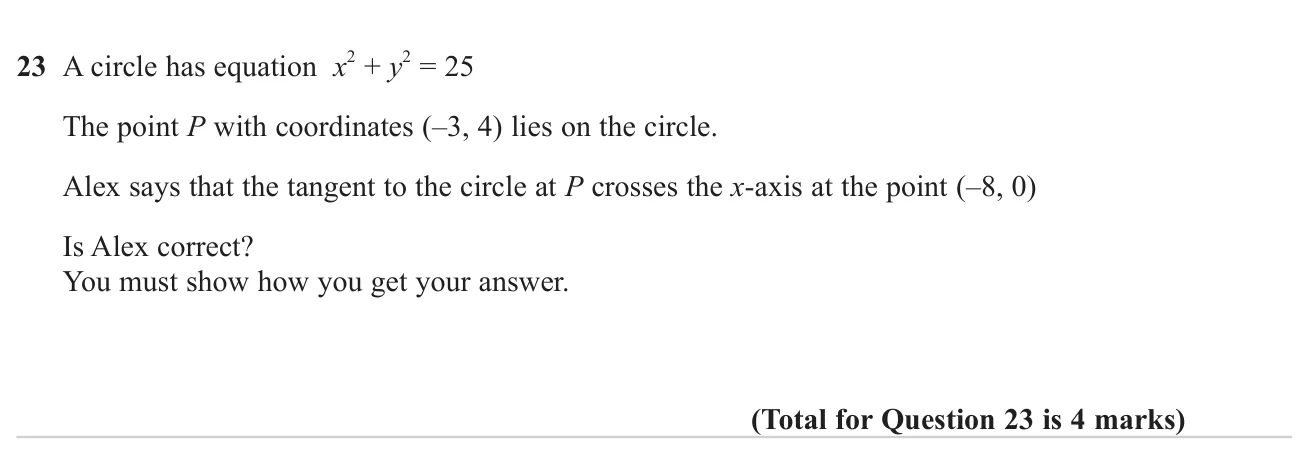
Question 23

Equation of a circle4 marksGrade 8Calculator
Decide whether the tangent to a circle at a given point passes through a stated point on the x-axis.

© Pearson Education Ltd. June 2023 Paper 3 (Higher, calculator), question 23.

Show answer
AnswerNo: the tangent is y=34x+254y = \frac{3}{4}x + \frac{25}{4}, which meets the xx-axis at (−253,0)(-\frac{25}{3}, 0), not (−8,0)(-8, 0)4 marks

Worked solution Checked against the mark scheme

Gradient of radius OP=4−3=−43OP = \dfrac{4}{-3} = -\dfrac{4}{3}

Tangent is perpendicular, so its gradient is 34\dfrac{3}{4}.

Tangent: y−4=34(x+3)y - 4 = \frac{3}{4}(x + 3), so y=34x+254y = \frac{3}{4}x + \frac{25}{4}

At x=−8x = -8: y=−6+254=14≠0y = -6 + \frac{25}{4} = \frac{1}{4} \neq 0

So the tangent does not pass through (−8,0)(-8, 0): Alex is wrong.

Watch out: Using the gradient of the radius instead of its negative reciprocal.

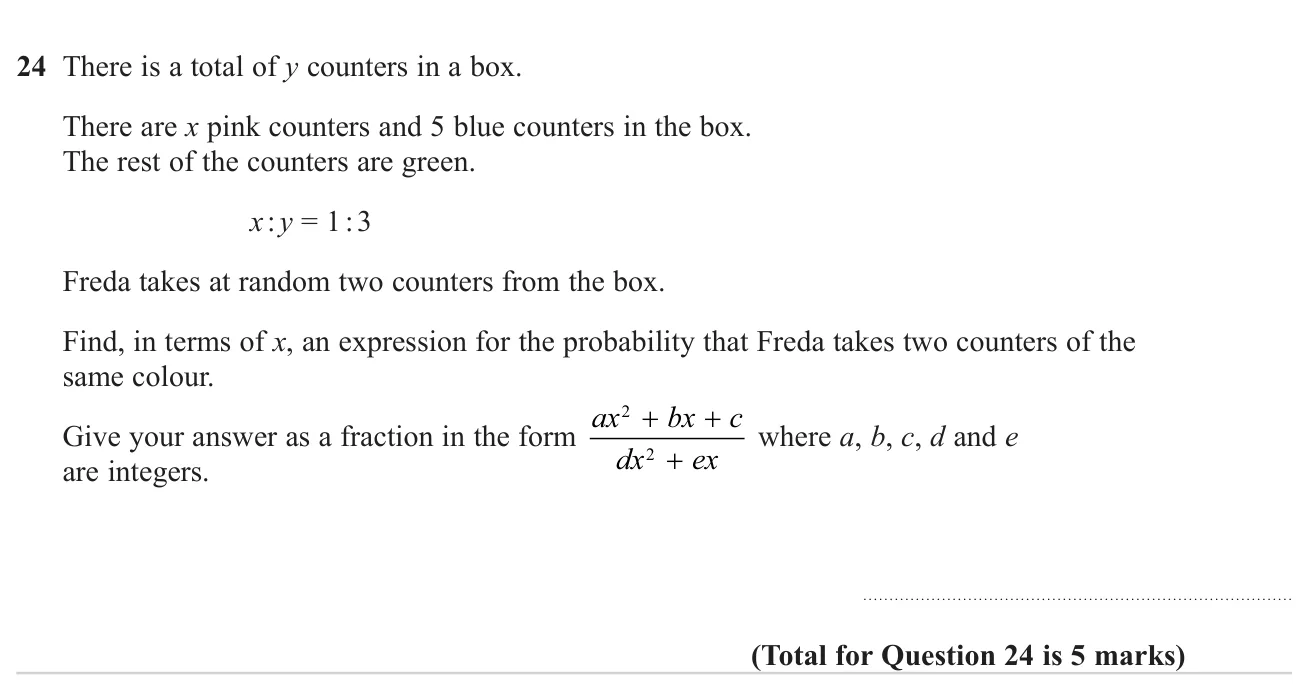
Question 24

Tree diagrams and combined events5 marksGrade 9Calculator
Find an algebraic probability of picking two counters of the same colour without replacement, using a ratio to write everything in one variable.

© Pearson Education Ltd. June 2023 Paper 3 (Higher, calculator), question 24.

Show answer
Answer5x2−23x+509x2−3x\frac{5x^2 - 23x + 50}{9x^2 - 3x}5 marks

Worked solution Checked against the mark scheme

y=3xy = 3x, so green =3x−x−5=2x−5= 3x - x - 5 = 2x - 5

P(both pink) =x3x×x−13x−1= \dfrac{x}{3x} \times \dfrac{x-1}{3x-1}

P(both blue) =53x×43x−1= \dfrac{5}{3x} \times \dfrac{4}{3x-1}

P(both green) =2x−53x×2x−63x−1= \dfrac{2x-5}{3x} \times \dfrac{2x-6}{3x-1}

Sum =x2−x+20+4x2−22x+303x(3x−1)=5x2−23x+509x2−3x= \dfrac{x^2 - x + 20 + 4x^2 - 22x + 30}{3x(3x-1)} = \dfrac{5x^2 - 23x + 50}{9x^2 - 3x}

Watch out: Not reducing the numbers on the second pick (treating it as with replacement).

Finished the paper?

Add up your marks for all three papers and see what grade that would have been.