Revision guide by The Full Marks
Functions: what you need to know A function takes an input, does something to it and gives an output. Foundation questions use number machines and word formulae; Higher questions use function notation, inverse functions and composite functions, which are usually aimed at grades 7–8.
Foundation students need number machines and simple input–output functions; function notation, inverse and composite functions are Higher only.
Key facts f ( x ) = 3 x − 2 f(x) = 3x - 2 f ( x ) = 3 x − 2 f ( 4 ) f(4) f ( 4 ) f ( 4 ) = 10 f(4) = 10 f ( 4 ) = 10 The inverse f − 1 ( x ) f^{-1}(x) f − 1 ( x ) f f f f g ( x ) fg(x) f g ( x ) g g g f f f f g ( x ) = f ( g ( x ) ) fg(x) = f(g(x)) f g ( x ) = f ( g ( x )) For the inverse of a composite, such as ( f g ) − 1 ( x ) (fg)^{-1}(x) ( f g ) − 1 ( x ) f g ( x ) fg(x) f g ( x ) f ( x ) = 3 x − 2 f(x) = 3x - 2 f ( x ) = 3 x − 2 h ( x ) = x + 5 h(x) = x + 5 h ( x ) = x + 5 f h ( x ) = 3 x + 13 fh(x) = 3x + 13 f h ( x ) = 3 x + 13 ( f h ) − 1 ( x ) = x − 13 3 (fh)^{-1}(x) = \frac{x - 13}{3} ( f h ) − 1 ( x ) = 3 x − 13 To find f ( x + 2 ) f(x + 2) f ( x + 2 ) x x x f f f ( x + 2 ) (x + 2) ( x + 2 ) To go backwards through a number machine, do the inverse operations in reverse order. Finding an inverse function (Higher) Write y = f ( x ) y = f(x) y = f ( x ) Rearrange to make x x x Replace y y y x x x f − 1 ( x ) = … f^{-1}(x) = \ldots f − 1 ( x ) = … Finding a composite function (Higher) For f g ( x ) fg(x) f g ( x ) f ( … ) f(\ldots) f ( … ) g ( x ) g(x) g ( x ) Replace every x x x f f f g ( x ) g(x) g ( x ) Worked examples Example 1 Foundation · grade 2
A number machine does: input → × 3 → − 7 → \rightarrow \times 3 \rightarrow -7 \rightarrow → × 3 → − 7 →
Show the solution (a) 6 × 3 = 18 6 \times 3 = 18 6 × 3 = 18 18 − 7 = 11 18 - 7 = 11 18 − 7 = 11 32 + 7 = 39 32 + 7 = 39 32 + 7 = 39 39 ÷ 3 = 13 39 \div 3 = 13 39 ÷ 3 = 13
Example 2 Higher · grade 7
f ( x ) = 3 x − 2 f(x) = 3x - 2 f ( x ) = 3 x − 2 g ( x ) = x 2 + 1 g(x) = x^2 + 1 g ( x ) = x 2 + 1 f − 1 ( x ) f^{-1}(x) f − 1 ( x ) f g ( 2 ) fg(2) f g ( 2 ) f g ( x ) fg(x) f g ( x ) f g ( x ) = 28 fg(x) = 28 f g ( x ) = 28
Show the solution (a) y = 3 x − 2 y = 3x - 2 y = 3 x − 2 y + 2 = 3 x y + 2 = 3x y + 2 = 3 x x = y + 2 3 x = \frac{y + 2}{3} x = 3 y + 2 f − 1 ( x ) = x + 2 3 f^{-1}(x) = \frac{x + 2}{3} f − 1 ( x ) = 3 x + 2 g g g g ( 2 ) = 2 2 + 1 = 5 g(2) = 2^2 + 1 = 5 g ( 2 ) = 2 2 + 1 = 5 f ( 5 ) = 3 × 5 − 2 = 13 f(5) = 3 \times 5 - 2 = 13 f ( 5 ) = 3 × 5 − 2 = 13 f g ( x ) = 3 ( x 2 + 1 ) − 2 = 3 x 2 + 1 fg(x) = 3(x^2 + 1) - 2 = 3x^2 + 1 f g ( x ) = 3 ( x 2 + 1 ) − 2 = 3 x 2 + 1 3 x 2 + 1 = 28 3x^2 + 1 = 28 3 x 2 + 1 = 28 3 x 2 = 27 3x^2 = 27 3 x 2 = 27 x 2 = 9 x^2 = 9 x 2 = 9 x = 3 x = 3 x = 3 x = − 3 x = -3 x = − 3
Common mistakes Doing a composite in the wrong order: f g ( x ) fg(x) f g ( x ) g g g x x x Undoing a number machine in the wrong order: reverse the order as well as the operations. Thinking f − 1 ( x ) f^{-1}(x) f − 1 ( x ) 1 f ( x ) \frac{1}{f(x)} f ( x ) 1 Writing ( x + 2 ) 2 (x + 2)^2 ( x + 2 ) 2 x 2 + 4 x^2 + 4 x 2 + 4 ( x + 2 ) 2 = x 2 + 4 x + 4 (x + 2)^2 = x^2 + 4x + 4 ( x + 2 ) 2 = x 2 + 4 x + 4 Exam tips Write your final inverse as f − 1 ( x ) = … f^{-1}(x) = \ldots f − 1 ( x ) = … x x x y y y Check an inverse by putting a number through f f f f − 1 f^{-1} f − 1 To find f − 1 ( a ) f^{-1}(a) f − 1 ( a ) a a a f − 1 ( x ) f^{-1}(x) f − 1 ( x ) f ( x ) = a f(x) = a f ( x ) = a Questions people ask What is a composite function? It is two functions applied one after the other. f g ( x ) fg(x) f g ( x ) g g g f f f
How do you find an inverse function? Write y = f ( x ) y = f(x) y = f ( x ) x x x y y y x x x f − 1 ( x ) f^{-1}(x) f − 1 ( x )
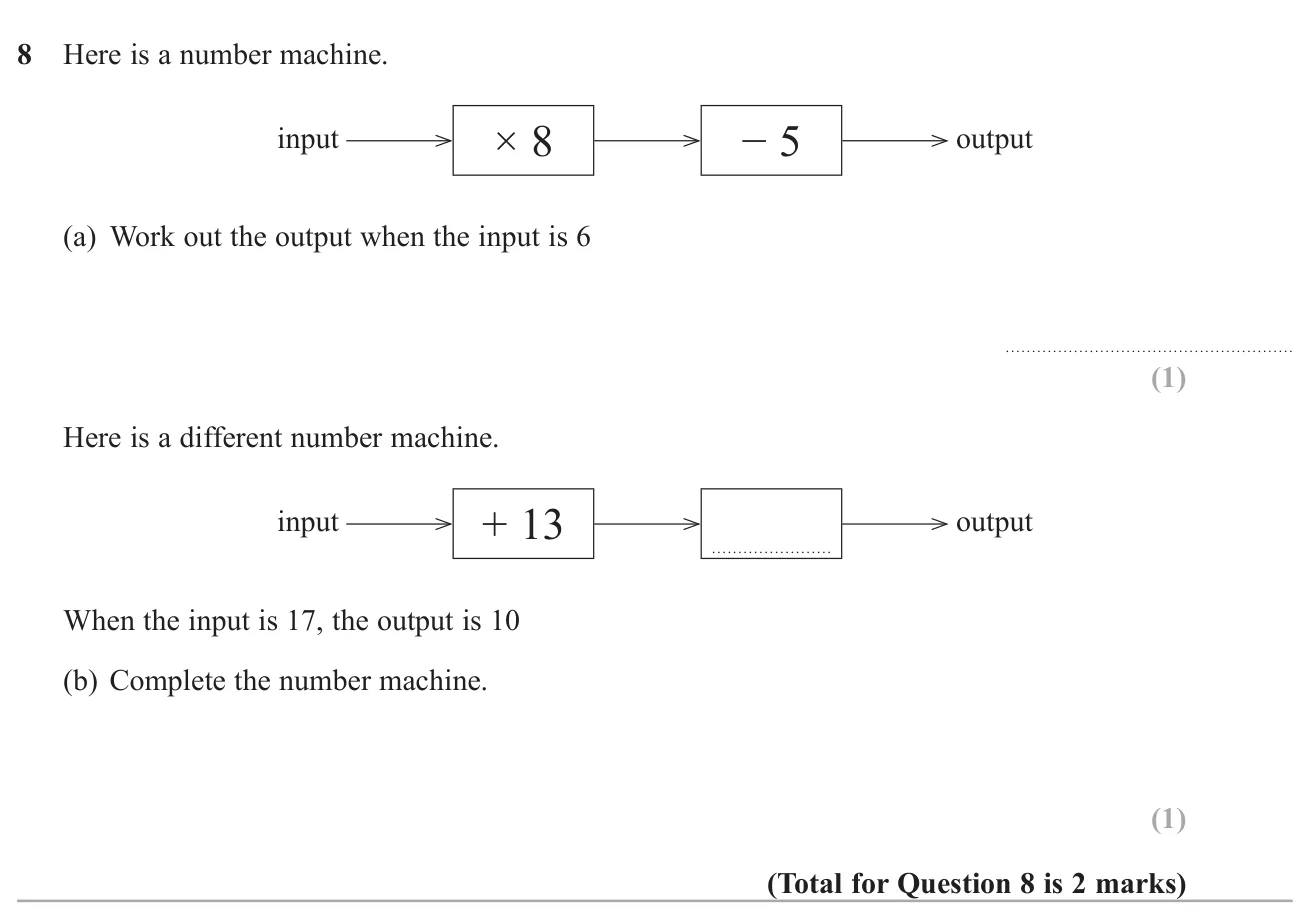
Exam questions: Functions (21, easiest first) © Pearson Education Ltd. November 2019 Paper 2 (Foundation, calculator), question 8.
(a) 43 1 mark (b) ÷ 3 \div 3 ÷ 3 − 20 -20 − 20 1 mark
Worked solution Checked against the mark scheme
(a) 6 × 8 = 48 6 \times 8 = 48 6 × 8 = 48 48 − 5 = 43 48 - 5 = 43 48 − 5 = 43
(b) After the first box: 17 + 13 = 30 17 + 13 = 30 17 + 13 = 30
The second box must turn 30 into 10: 30 ÷ 3 = 10 30 \div 3 = 10 30 ÷ 3 = 10 30 − 20 = 10 30 - 20 = 10 30 − 20 = 10
So the missing box is ÷ 3 \div 3 ÷ 3 − 20 -20 − 20
Watch out: Doing the operations in the wrong order in (a), giving 8.
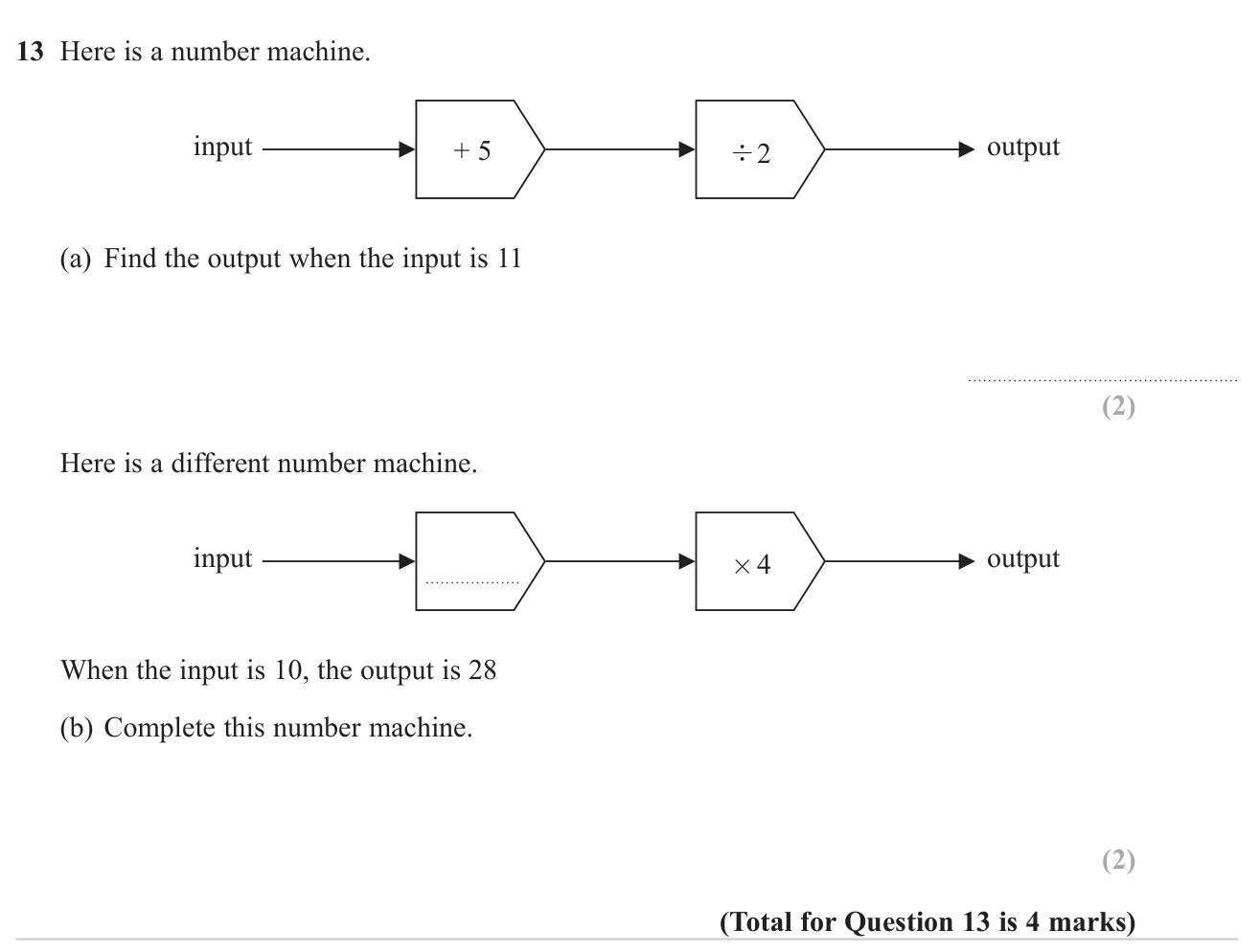
© Pearson Education Ltd. November 2024 Paper 1 (Foundation, non-calculator), question 13.
(a) 8 8 8 2 marks (b) − 3 -3 − 3 × 0.7 \times 0.7 × 0.7 2 marks
Worked solution Checked against the mark scheme
(a) 11 + 5 = 16 11 + 5 = 16 11 + 5 = 16 16 ÷ 2 = 8 16 \div 2 = 8 16 ÷ 2 = 8
(b) Work backwards from the output: 28 ÷ 4 = 7 28 \div 4 = 7 28 ÷ 4 = 7
The first box turns 10 into 7, so it is − 3 -3 − 3 × 0.7 \times 0.7 × 0.7
Watch out: In (b), writing −12 by applying ×4 first.
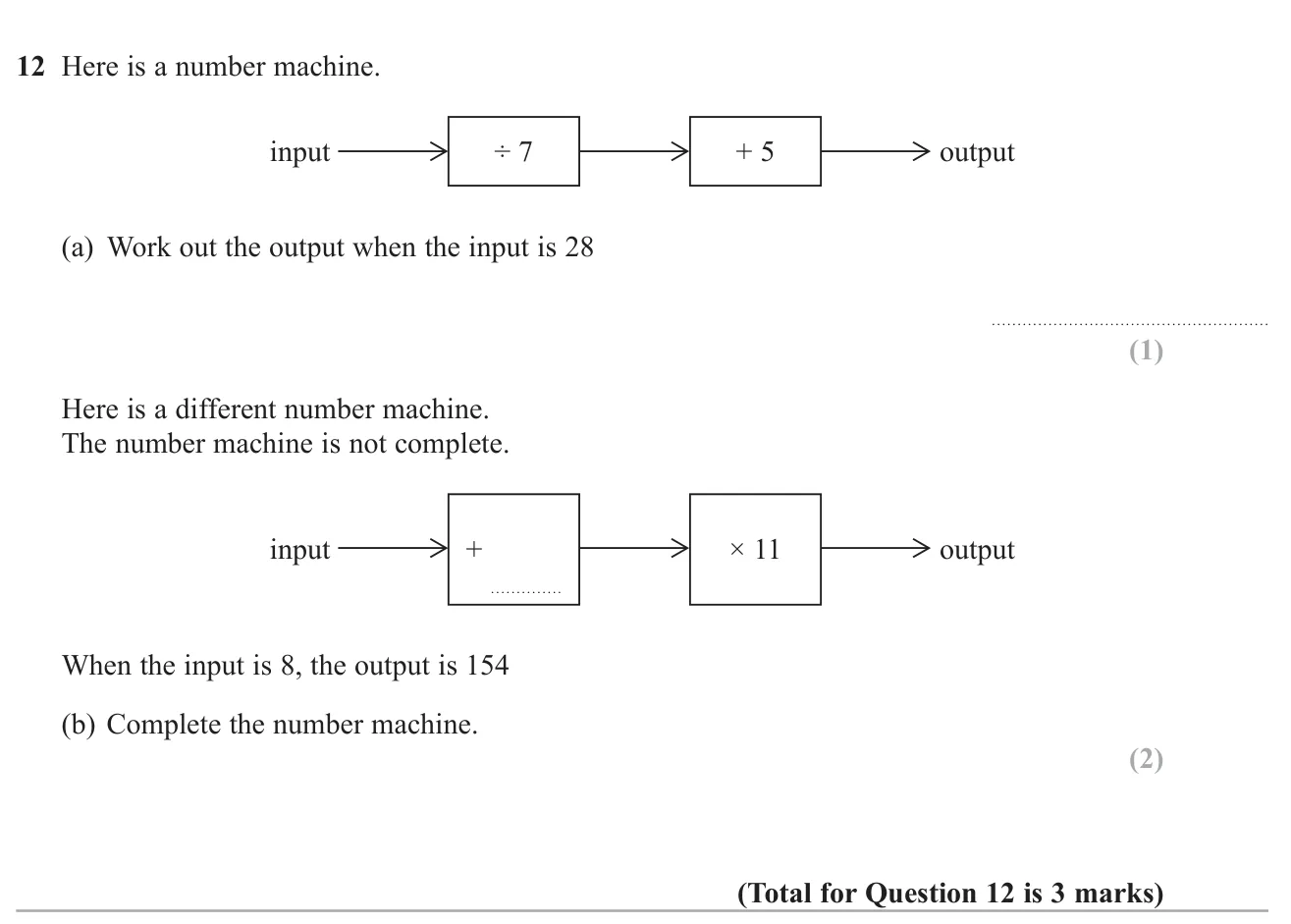
© Pearson Education Ltd. June 2022 Paper 2 (Foundation, calculator), question 12.
(a) 9 1 mark (b) + 6 +6 + 6 2 marks
Worked solution Checked against the mark scheme
(a) 28 ÷ 7 = 4 28 \div 7 = 4 28 ÷ 7 = 4 4 + 5 = 9 4 + 5 = 9 4 + 5 = 9
(b) Work backwards from 154: 154 ÷ 11 = 14 154 \div 11 = 14 154 ÷ 11 = 14
The missing step turns 8 into 14, so it is + 6 +6 + 6
Watch out: In (b), doing 154 − 8 154 - 8 154 − 8
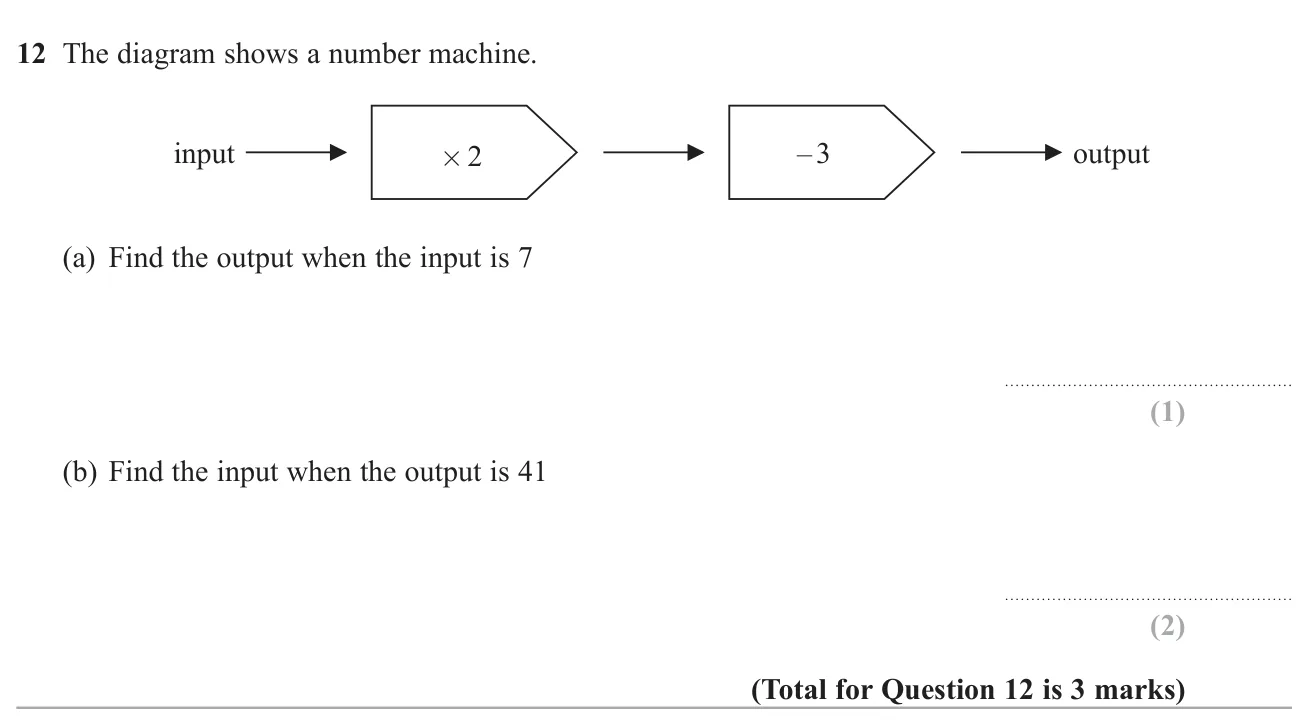
© Pearson Education Ltd. November 2020 Paper 1 (Foundation, non-calculator), question 12.
Worked solution Checked against the mark scheme
(a) 7 × 2 = 14 7 \times 2 = 14 7 × 2 = 14 14 − 3 = 11 14 - 3 = 11 14 − 3 = 11
(b) Work backwards with inverses: 41 + 3 = 44 41 + 3 = 44 41 + 3 = 44 44 ÷ 2 = 22 44 \div 2 = 22 44 ÷ 2 = 22
Watch out: In (b) doing the inverses in the wrong order: 41 ÷ 2 + 3 41 \div 2 + 3 41 ÷ 2 + 3
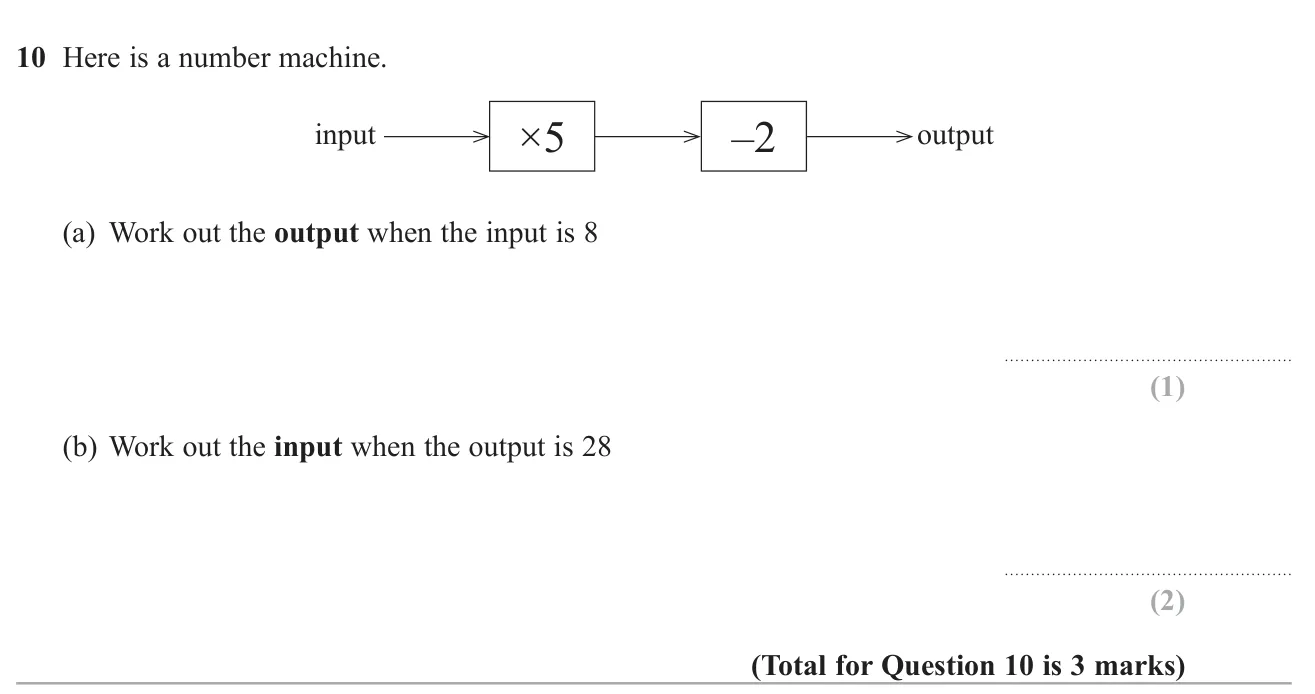
© Pearson Education Ltd. November 2018 Paper 2 (Foundation, calculator), question 10.
Worked solution Checked against the mark scheme
(a) 8 × 5 = 40 8 \times 5 = 40 8 × 5 = 40 40 − 2 = 38 40 - 2 = 38 40 − 2 = 38
(b) Work backwards: 28 + 2 = 30 28 + 2 = 30 28 + 2 = 30 30 ÷ 5 = 6 30 \div 5 = 6 30 ÷ 5 = 6
Watch out: In (b), doing the inverses in the wrong order.
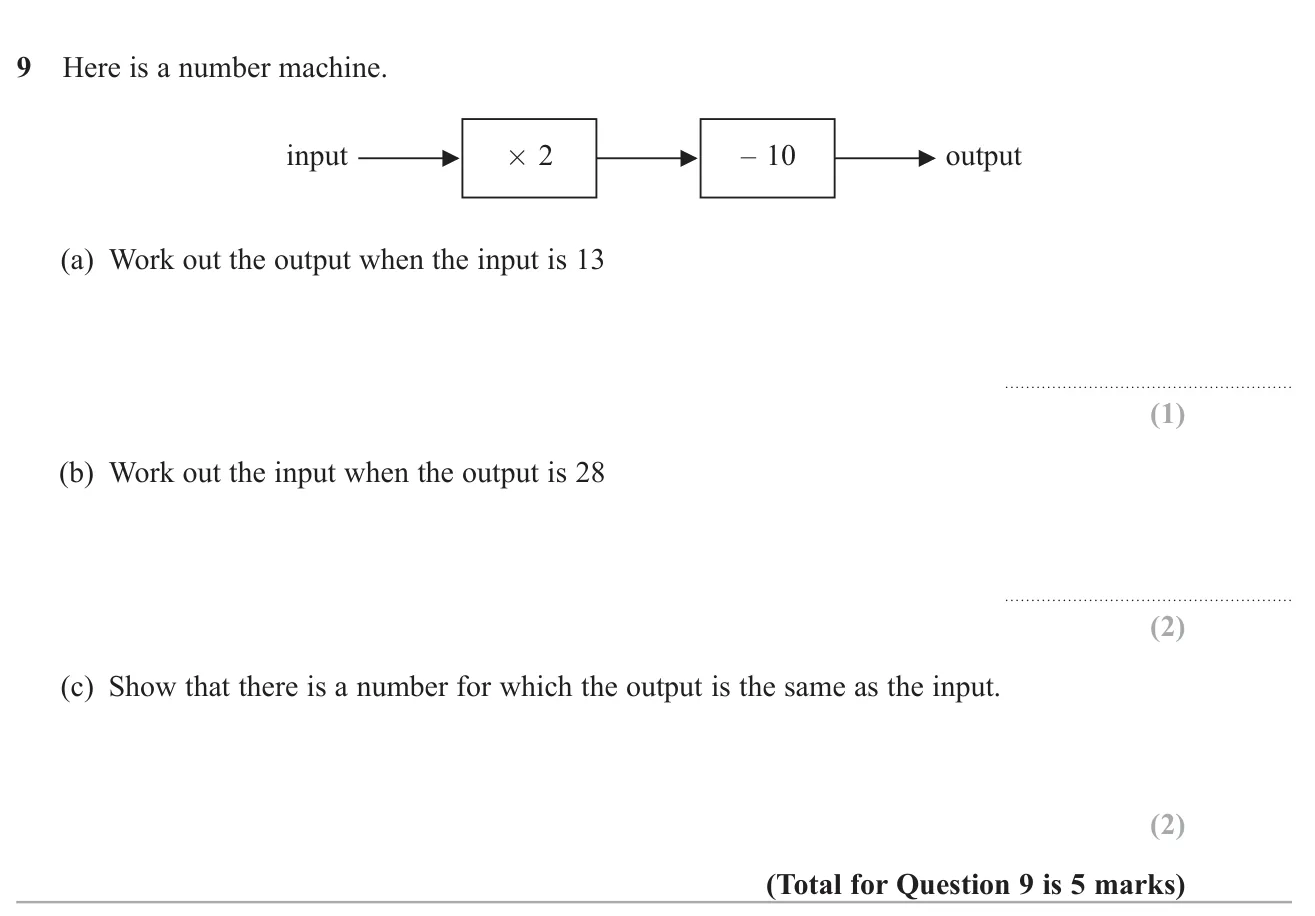
© Pearson Education Ltd. June 2024 Paper 1 (Foundation, non-calculator), question 9.
(a) 16 16 16 1 mark (b) 19 19 19 2 marks (c) An input of 10 gives 10 × 2 − 10 = 10 10\times2-10=10 10 × 2 − 10 = 10 2 marks
Worked solution Checked against the mark scheme
(a) 13 × 2 = 26 13 \times 2 = 26 13 × 2 = 26 26 − 10 = 16 26 - 10 = 16 26 − 10 = 16
(b) Work backwards: 28 + 10 = 38 28 + 10 = 38 28 + 10 = 38 38 ÷ 2 = 19 38 \div 2 = 19 38 ÷ 2 = 19
(c) Solve 2 x − 10 = x 2x - 10 = x 2 x − 10 = x x = 10 x = 10 x = 10 10 × 2 = 20 10 \times 2 = 20 10 × 2 = 20 20 − 10 = 10 20 - 10 = 10 20 − 10 = 10
Watch out: In (b), doing the inverse operations in the wrong order (28 ÷ 2 + 10 = 24).
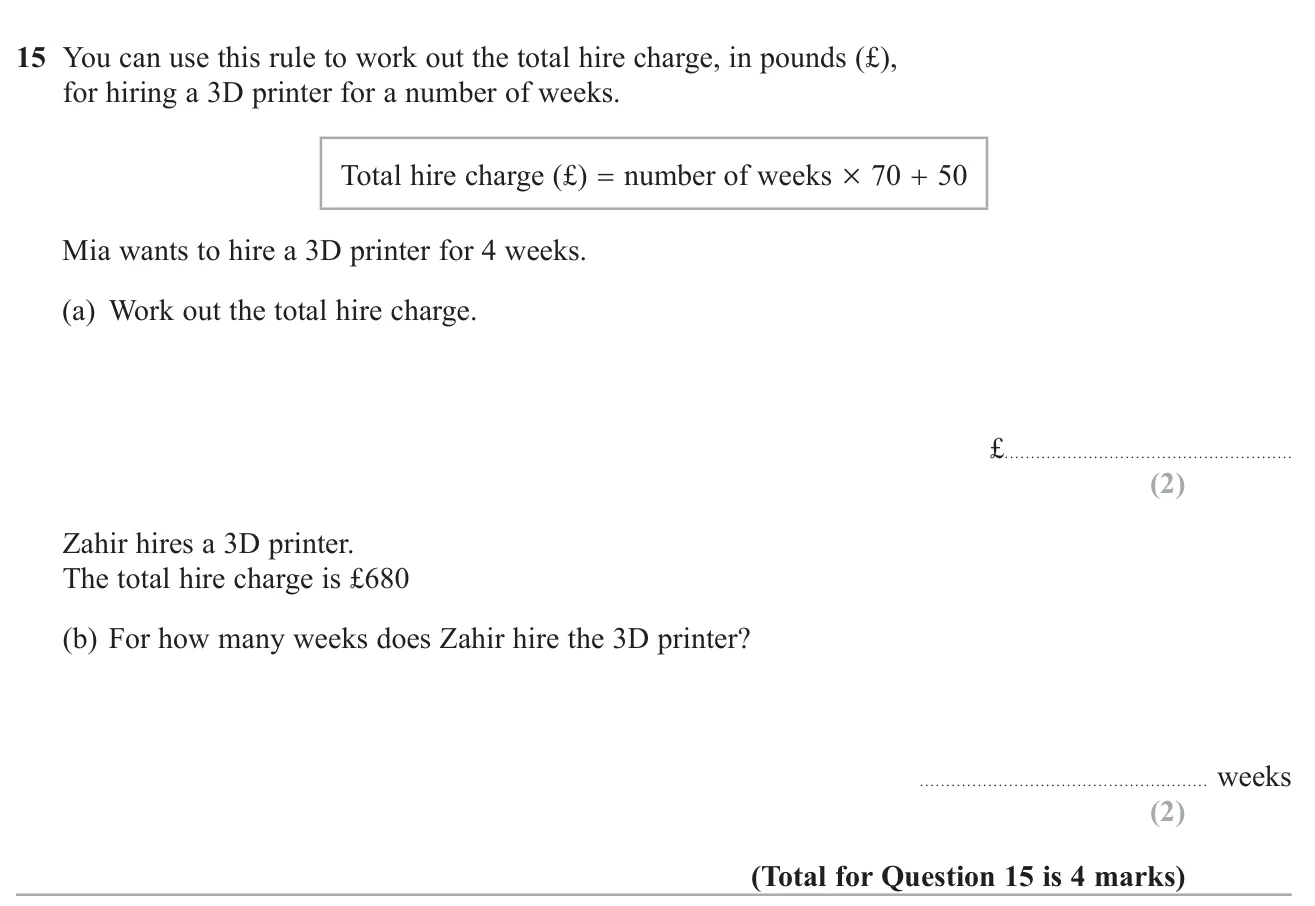
© Pearson Education Ltd. June 2019 Paper 3 (Foundation, calculator), question 15.
(a) £330 2 marks (b) 9 2 marks
Worked solution Checked against the mark scheme
(a) 4 × 70 + 50 = 280 + 50 = £ 330 4 \times 70 + 50 = 280 + 50 = £330 4 × 70 + 50 = 280 + 50 = £330
(b) Undo the rule: 680 − 50 = 630 680 - 50 = 630 680 − 50 = 630 630 ÷ 70 = 9 630 \div 70 = 9 630 ÷ 70 = 9
Watch out: In (a), working out 4 × (70 + 50) = 480.
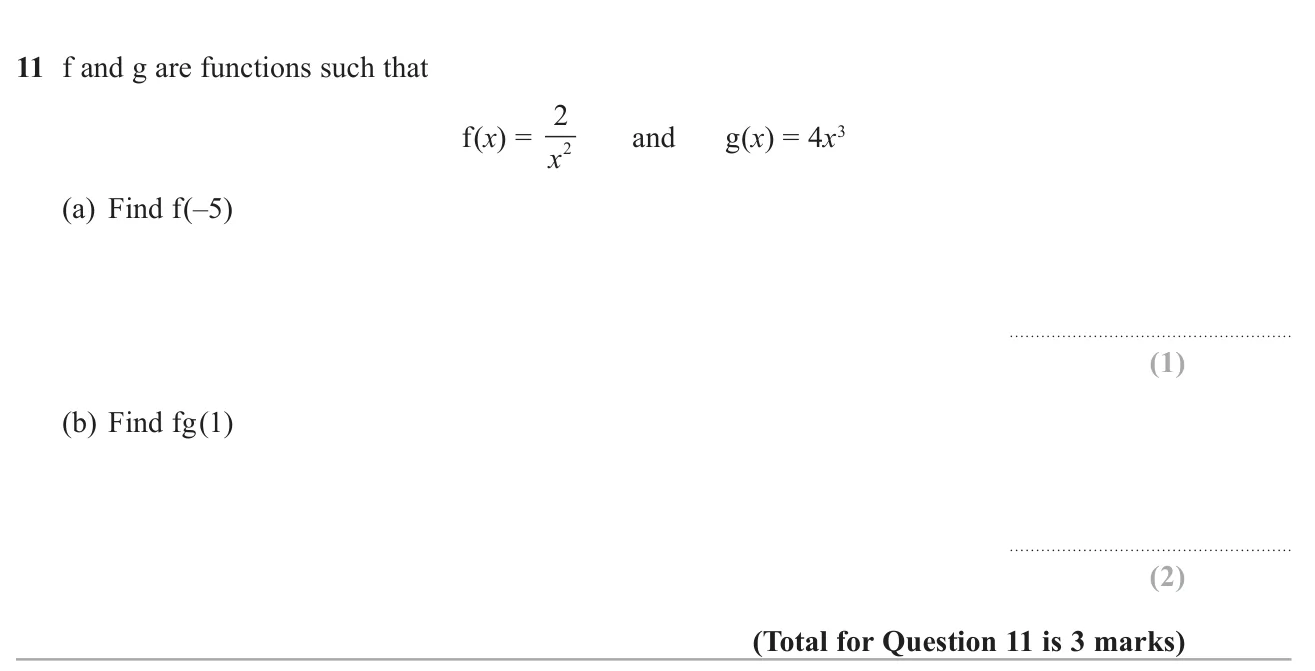
© Pearson Education Ltd. June 2018 Paper 2 (Higher, calculator), question 11.
(a) 2 25 \frac{2}{25} 25 2 1 mark (b) 1 8 \frac{1}{8} 8 1 2 marks
Worked solution Checked against the mark scheme
f ( x ) = 2 x 2 f(x) = \frac{2}{x^2} f ( x ) = x 2 2 g ( x ) = 4 x 3 g(x) = 4x^3 g ( x ) = 4 x 3
(a) f ( − 5 ) = 2 ( − 5 ) 2 = 2 25 f(-5) = \frac{2}{(-5)^2} = \frac{2}{25} f ( − 5 ) = ( − 5 ) 2 2 = 25 2
(b) g ( 1 ) = 4 g(1) = 4 g ( 1 ) = 4 f ( 4 ) = 2 16 = 1 8 f(4) = \frac{2}{16} = \frac{1}{8} f ( 4 ) = 16 2 = 8 1
Watch out: In (b), working out f first and then g, i.e. doing gf(1).
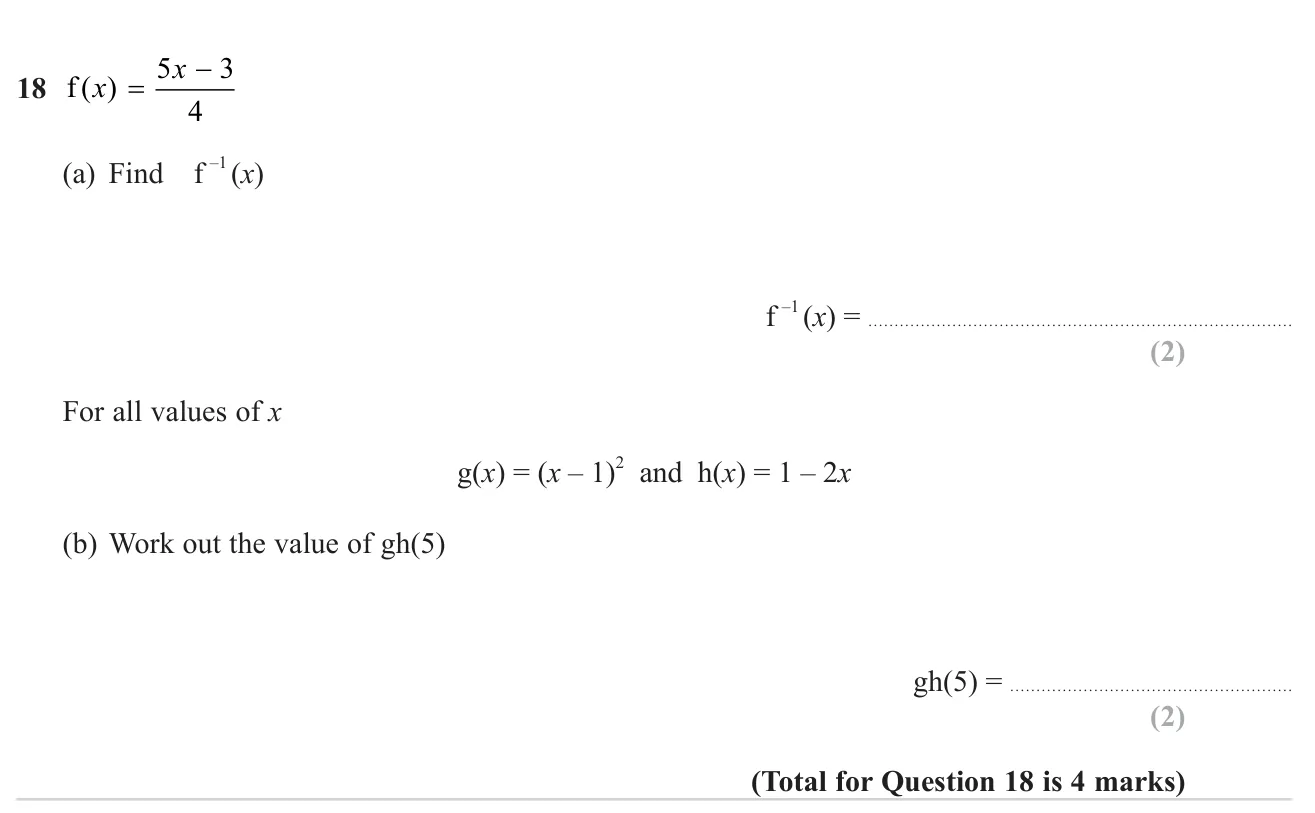
© Pearson Education Ltd. November 2024 Paper 1 (Higher, non-calculator), question 18.
(a) 4 x + 3 5 \frac{4x + 3}{5} 5 4 x + 3 2 marks (b) 100 100 100 2 marks
Worked solution Checked against the mark scheme
(a) Let y = 5 x − 3 4 y = \frac{5x - 3}{4} y = 4 5 x − 3 4 y = 5 x − 3 4y = 5x - 3 4 y = 5 x − 3 5 x = 4 y + 3 5x = 4y + 3 5 x = 4 y + 3 x = 4 y + 3 5 x = \frac{4y + 3}{5} x = 5 4 y + 3
So f − 1 ( x ) = 4 x + 3 5 f^{-1}(x) = \frac{4x + 3}{5} f − 1 ( x ) = 5 4 x + 3
(b) h ( 5 ) = 1 − 10 = − 9 h(5) = 1 - 10 = -9 h ( 5 ) = 1 − 10 = − 9
g ( − 9 ) = ( − 9 − 1 ) 2 = 100 g(-9) = (-9 - 1)^2 = 100 g ( − 9 ) = ( − 9 − 1 ) 2 = 100
Watch out: In (b), working out h(g(5)) instead of g(h(5)).
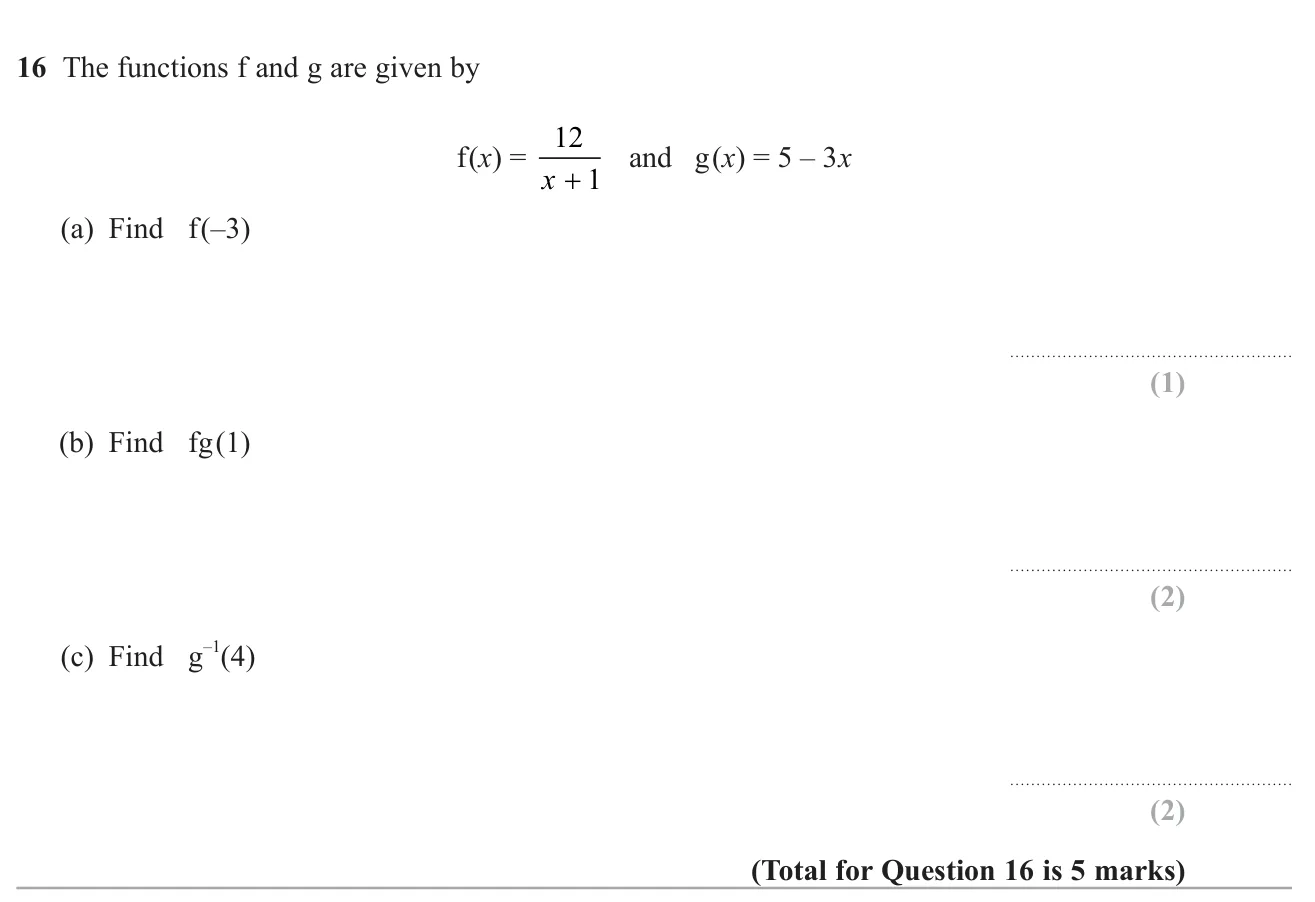
© Pearson Education Ltd. June 2024 Paper 3 (Higher, calculator), question 16.
(a) − 6 -6 − 6 1 mark (b) 4 4 4 2 marks (c) 1 3 \frac13 3 1 2 marks
Worked solution Checked against the mark scheme
f ( x ) = 12 x + 1 f(x) = \dfrac{12}{x+1} f ( x ) = x + 1 12 g ( x ) = 5 − 3 x g(x) = 5 - 3x g ( x ) = 5 − 3 x
(a) f ( − 3 ) = 12 − 2 = − 6 f(-3) = \dfrac{12}{-2} = -6 f ( − 3 ) = − 2 12 = − 6
(b) g ( 1 ) = 2 g(1) = 2 g ( 1 ) = 2 f g ( 1 ) = f ( 2 ) = 12 3 = 4 fg(1) = f(2) = \dfrac{12}{3} = 4 f g ( 1 ) = f ( 2 ) = 3 12 = 4
(c) Solve 5 − 3 x = 4 5 - 3x = 4 5 − 3 x = 4 x = 1 3 x = \frac13 x = 3 1
Watch out: In (b), working out f first then g (i.e. gf(1)).
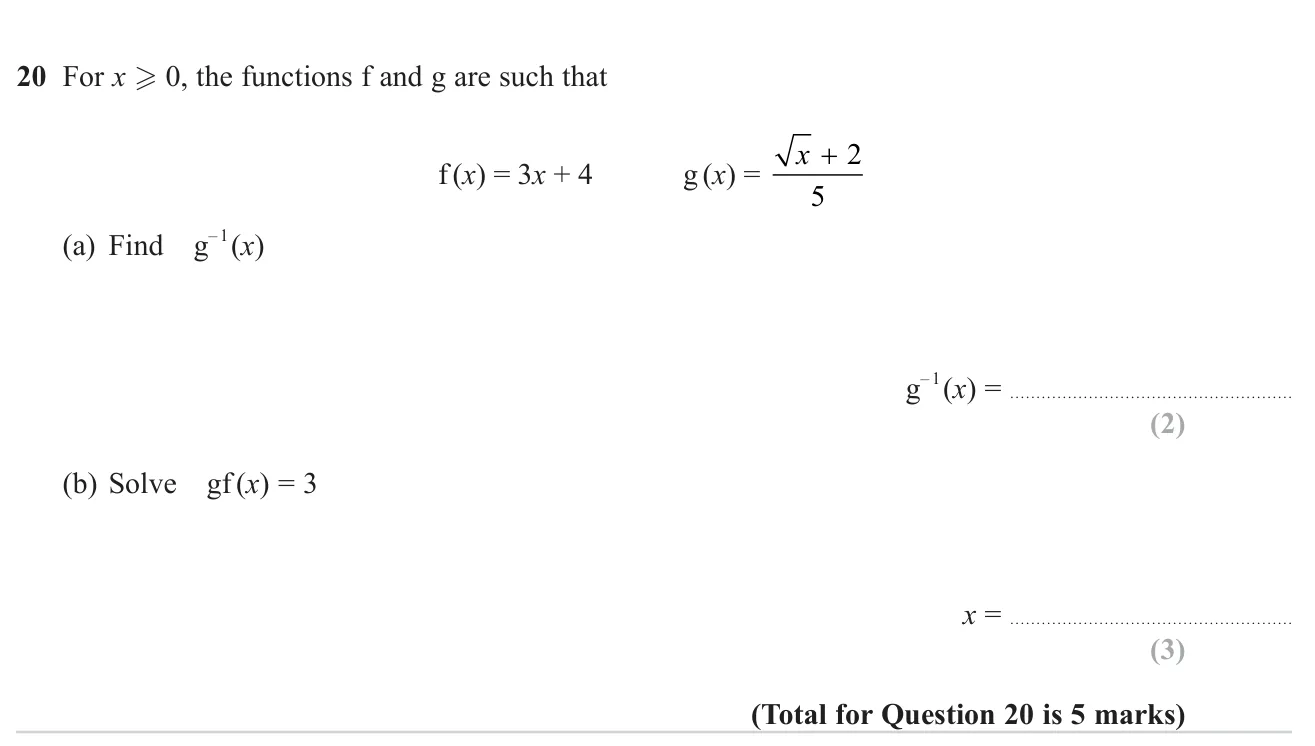
© Pearson Education Ltd. June 2023 Paper 1 (Higher, non-calculator), question 20.
(a) ( 5 x − 2 ) 2 (5x - 2)^2 ( 5 x − 2 ) 2 2 marks (b) x = 55 x = 55 x = 55 3 marks
Worked solution Checked against the mark scheme
(a) Let y = x + 2 5 y = \frac{\sqrt{x} + 2}{5} y = 5 x + 2 5 y = x + 2 5y = \sqrt{x} + 2 5 y = x + 2 x = 5 y − 2 \sqrt{x} = 5y - 2 x = 5 y − 2 x = ( 5 y − 2 ) 2 x = (5y - 2)^2 x = ( 5 y − 2 ) 2
g − 1 ( x ) = ( 5 x − 2 ) 2 g^{-1}(x) = (5x - 2)^2 g − 1 ( x ) = ( 5 x − 2 ) 2
(b) g f ( x ) = 3 gf(x) = 3 g f ( x ) = 3 f ( x ) = g − 1 ( 3 ) = ( 15 − 2 ) 2 = 169 f(x) = g^{-1}(3) = (15 - 2)^2 = 169 f ( x ) = g − 1 ( 3 ) = ( 15 − 2 ) 2 = 169
3 x + 4 = 169 3x + 4 = 169 3 x + 4 = 169 3 x = 165 3x = 165 3 x = 165 x = 55 x = 55 x = 55
Watch out: Applying the functions in the wrong order (working out fg instead of gf).
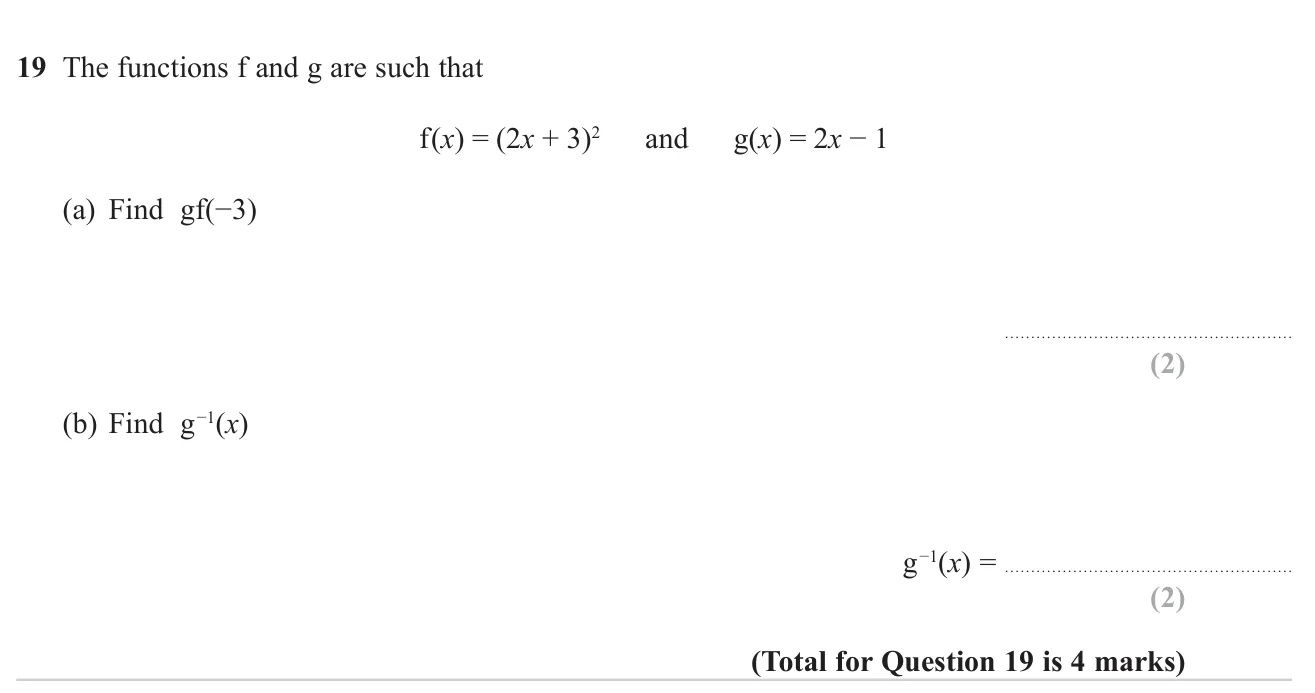
© Pearson Education Ltd. November 2023 Paper 2 (Higher, calculator), question 19.
(a) 17 17 17 2 marks (b) x + 1 2 \frac{x + 1}{2} 2 x + 1 2 marks
Worked solution Checked against the mark scheme
(a) f ( − 3 ) = ( 2 ( − 3 ) + 3 ) 2 = ( − 3 ) 2 = 9 f(-3) = (2(-3) + 3)^2 = (-3)^2 = 9 f ( − 3 ) = ( 2 ( − 3 ) + 3 ) 2 = ( − 3 ) 2 = 9 g ( 9 ) = 2 × 9 − 1 = 17 g(9) = 2 \times 9 - 1 = 17 g ( 9 ) = 2 × 9 − 1 = 17
(b) Let y = 2 x − 1 y = 2x - 1 y = 2 x − 1 y + 1 = 2 x y + 1 = 2x y + 1 = 2 x x = y + 1 2 x = \frac{y + 1}{2} x = 2 y + 1
g − 1 ( x ) = x + 1 2 g^{-1}(x) = \frac{x + 1}{2} g − 1 ( x ) = 2 x + 1
Watch out: In (a), working out fg(−3) instead of gf(−3).
© Pearson Education Ltd. June 2022 Paper 2 (Higher, calculator), question 19.
(a) 3 3 3 1 mark (b) 2 x 3 + 5 \frac{2}{x^3 + 5} x 3 + 5 2 3 marks
Worked solution Checked against the mark scheme
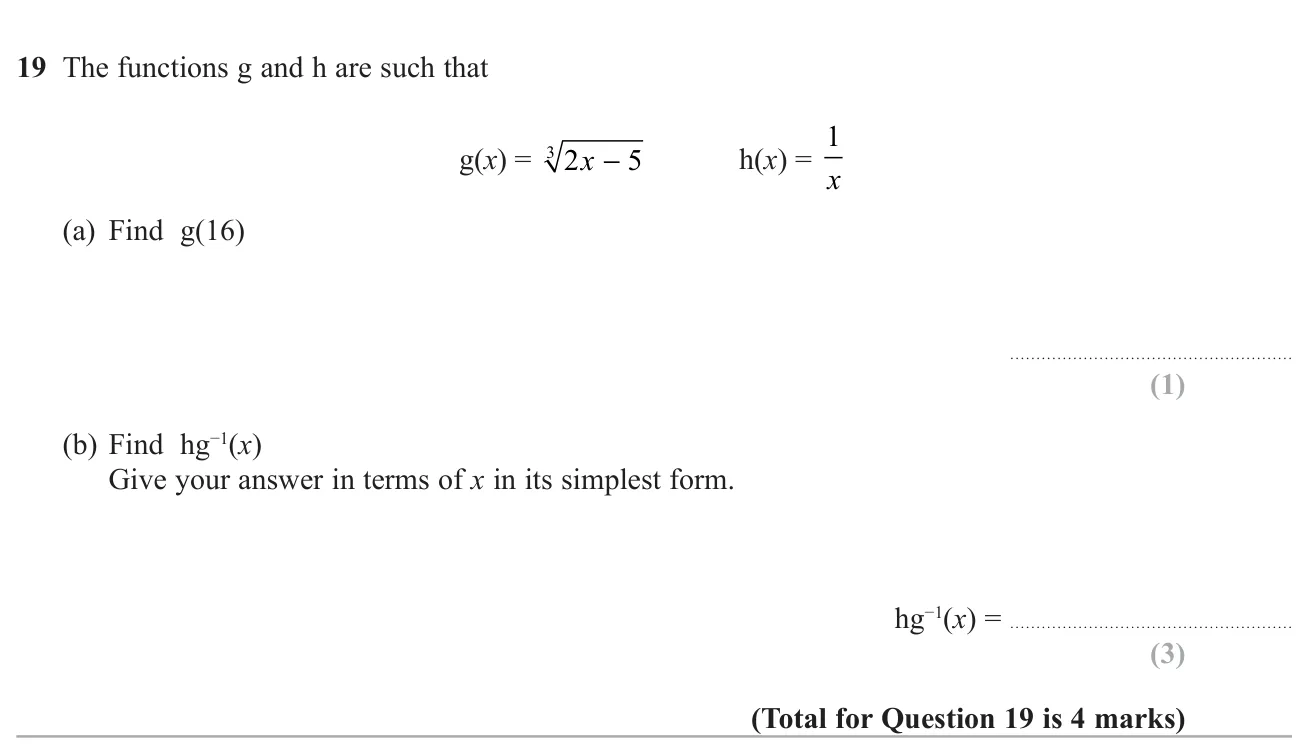
(a) g ( 16 ) = 32 − 5 3 = 27 3 = 3 g(16) = \sqrt[3]{32 - 5} = \sqrt[3]{27} = 3 g ( 16 ) = 3 32 − 5 = 3 27 = 3
(b) Let y = 2 x − 5 3 y = \sqrt[3]{2x - 5} y = 3 2 x − 5 y 3 = 2 x − 5 y^3 = 2x - 5 y 3 = 2 x − 5 x = y 3 + 5 2 x = \frac{y^3 + 5}{2} x = 2 y 3 + 5
g − 1 ( x ) = x 3 + 5 2 g^{-1}(x) = \frac{x^3 + 5}{2} g − 1 ( x ) = 2 x 3 + 5
h g − 1 ( x ) = 1 x 3 + 5 2 = 2 x 3 + 5 hg^{-1}(x) = \frac{1}{\frac{x^3 + 5}{2}} = \frac{2}{x^3 + 5} h g − 1 ( x ) = 2 x 3 + 5 1 = x 3 + 5 2
Watch out: Doing g⁻¹ of h instead of h of g⁻¹.
© Pearson Education Ltd. November 2020 Paper 1 (Higher, non-calculator), question 19.
(a) 33 1 mark (b) 27 2 marks (c) 1 2 \frac{1}{2} 2 1 2 marks
Worked solution Checked against the mark scheme
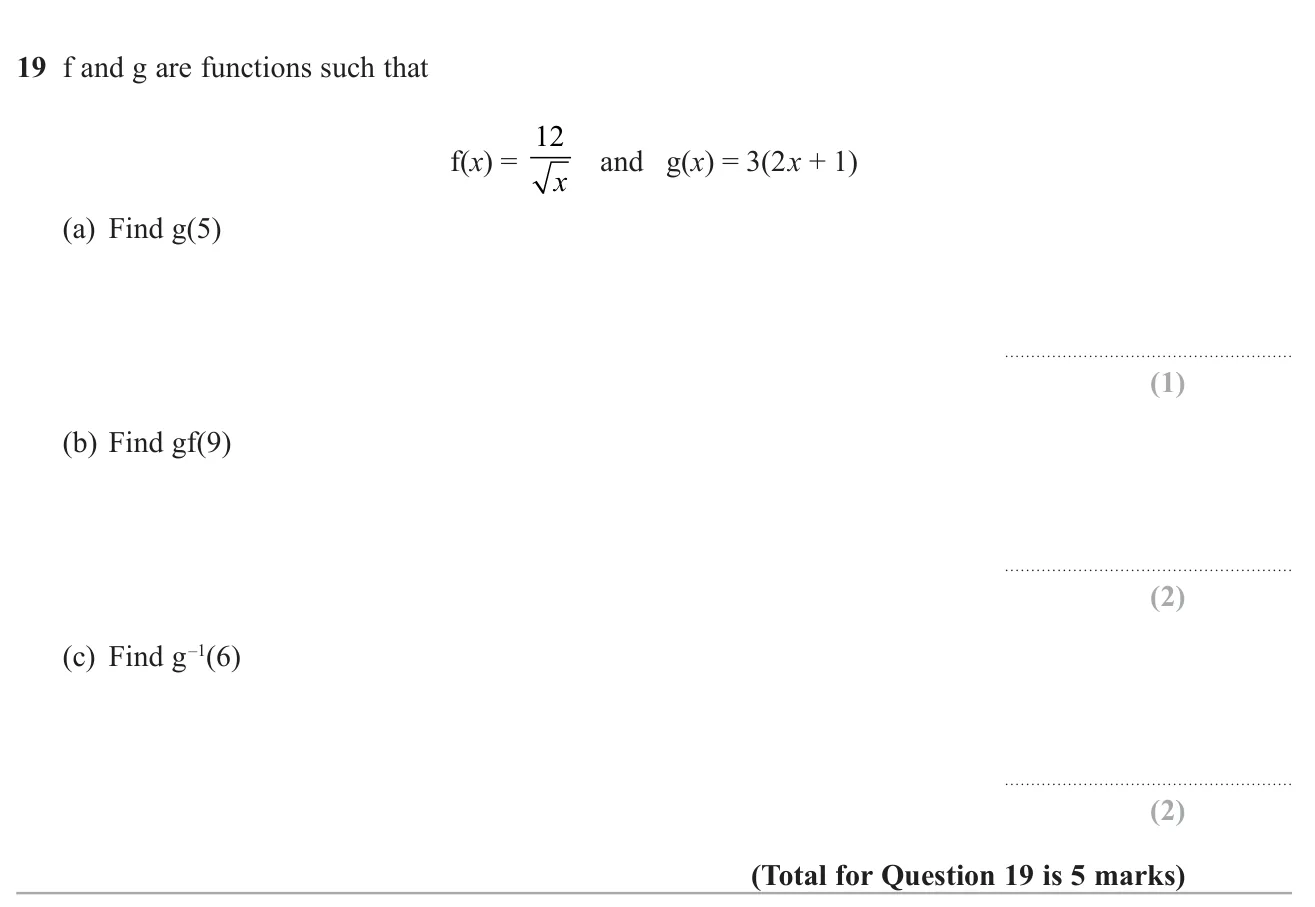
(a) g ( 5 ) = 3 ( 2 × 5 + 1 ) = 3 × 11 = 33 g(5) = 3(2 \times 5 + 1) = 3 \times 11 = 33 g ( 5 ) = 3 ( 2 × 5 + 1 ) = 3 × 11 = 33
(b) f ( 9 ) = 12 9 = 4 f(9) = \frac{12}{\sqrt{9}} = 4 f ( 9 ) = 9 12 = 4 g ( 4 ) = 3 ( 9 ) = 27 g(4) = 3(9) = 27 g ( 4 ) = 3 ( 9 ) = 27
(c) Solve 3 ( 2 x + 1 ) = 6 3(2x + 1) = 6 3 ( 2 x + 1 ) = 6 2 x + 1 = 2 2x + 1 = 2 2 x + 1 = 2 x = 1 2 x = \frac{1}{2} x = 2 1
Watch out: In (b), working out f(g(9)) instead of g(f(9)).
© Pearson Education Ltd. June 2019 Paper 1 (Higher, non-calculator), question 21.
(a) x + 1 3 \frac{x + 1}{3} 3 x + 1 2 marks (b) 15 x 2 − 12 x − 1 = 0 15x^2 - 12x - 1 = 0 15 x 2 − 12 x − 1 = 0 5 marks
Worked solution Checked against the mark scheme
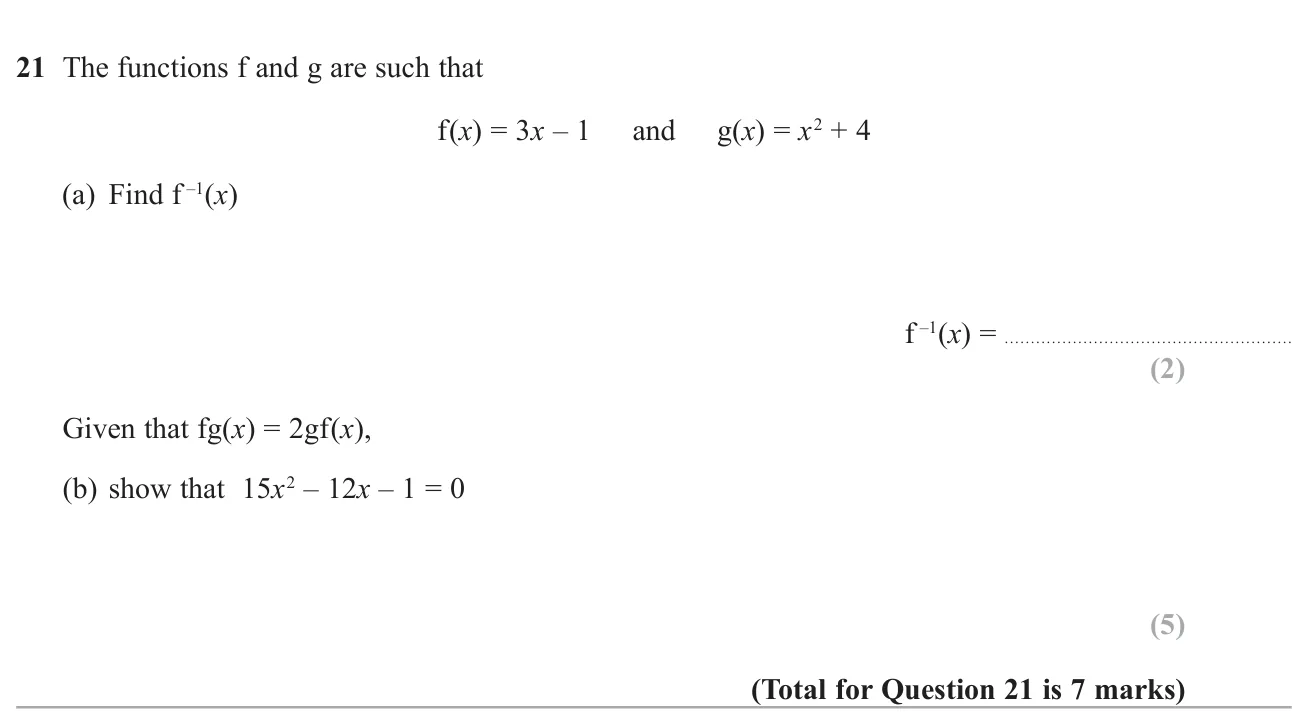
(a) y = 3 x − 1 ⇒ x = y + 1 3 y = 3x - 1 \Rightarrow x = \frac{y + 1}{3} y = 3 x − 1 ⇒ x = 3 y + 1 f − 1 ( x ) = x + 1 3 f^{-1}(x) = \frac{x + 1}{3} f − 1 ( x ) = 3 x + 1
(b) f g ( x ) = 3 ( x 2 + 4 ) − 1 = 3 x 2 + 11 fg(x) = 3(x^2 + 4) - 1 = 3x^2 + 11 f g ( x ) = 3 ( x 2 + 4 ) − 1 = 3 x 2 + 11
g f ( x ) = ( 3 x − 1 ) 2 + 4 = 9 x 2 − 6 x + 5 gf(x) = (3x - 1)^2 + 4 = 9x^2 - 6x + 5 g f ( x ) = ( 3 x − 1 ) 2 + 4 = 9 x 2 − 6 x + 5
3 x 2 + 11 = 2 ( 9 x 2 − 6 x + 5 ) = 18 x 2 − 12 x + 10 3x^2 + 11 = 2(9x^2 - 6x + 5) = 18x^2 - 12x + 10 3 x 2 + 11 = 2 ( 9 x 2 − 6 x + 5 ) = 18 x 2 − 12 x + 10
0 = 15 x 2 − 12 x − 1 0 = 15x^2 - 12x - 1 0 = 15 x 2 − 12 x − 1
Watch out: Working out gf(x) when fg(x) is needed (applying the functions in the wrong order).
© Pearson Education Ltd. November 2019 Paper 1 (Higher, non-calculator), question 18.
(a) f ( 3 ) = 2 × 27 − 4 = 50 f(3) = 2 \times 27 - 4 = 50 f ( 3 ) = 2 × 27 − 4 = 50 f − 1 ( 50 ) = 3 f^{-1}(50) = 3 f − 1 ( 50 ) = 3 2 marks (b) x = − 1 x = -1 x = − 1 x = 2.5 x = 2.5 x = 2.5 4 marks
Worked solution Checked against the mark scheme
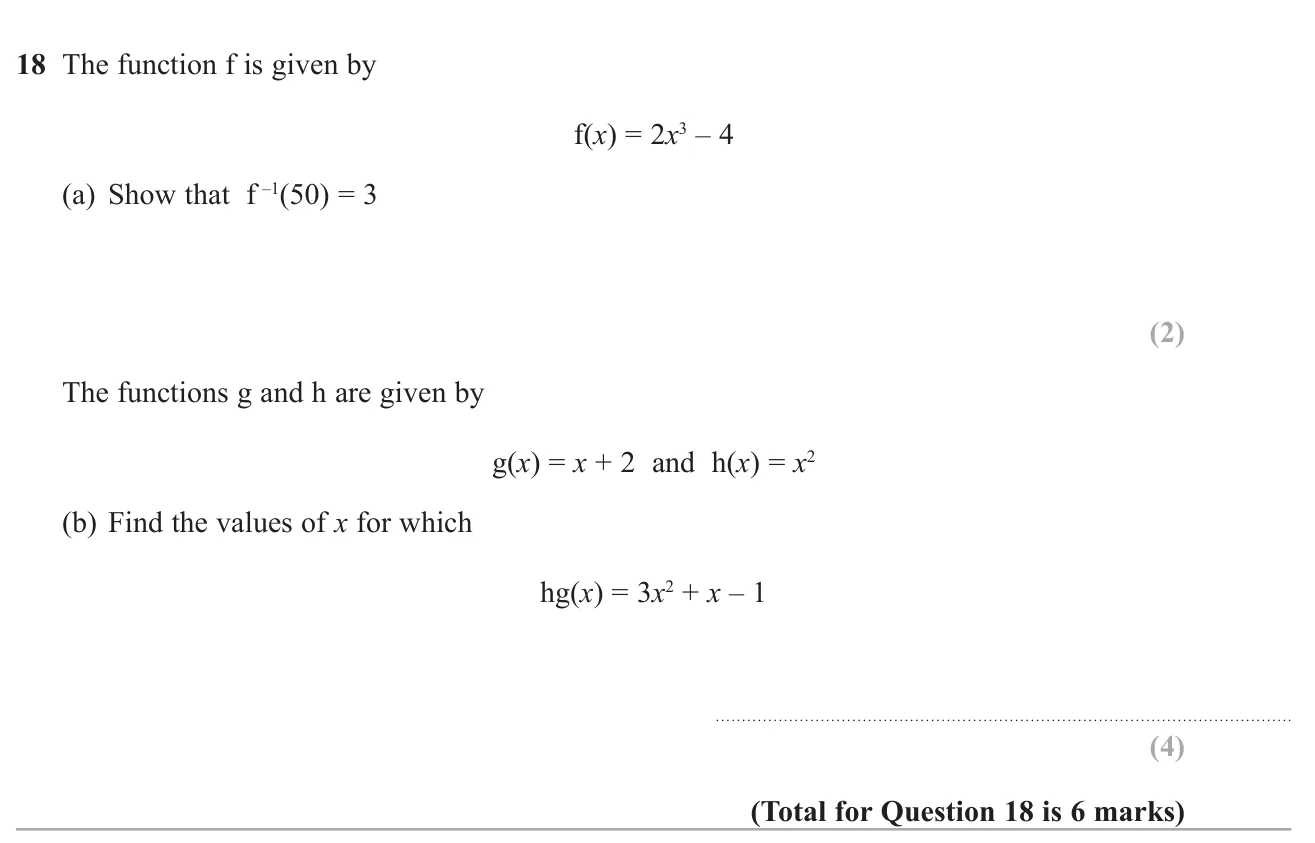
(a) f ( 3 ) = 2 × 3 3 − 4 = 54 − 4 = 50 f(3) = 2 \times 3^3 - 4 = 54 - 4 = 50 f ( 3 ) = 2 × 3 3 − 4 = 54 − 4 = 50 f − 1 ( 50 ) = 3 f^{-1}(50) = 3 f − 1 ( 50 ) = 3
(b) h g ( x ) = ( x + 2 ) 2 = x 2 + 4 x + 4 hg(x) = (x+2)^2 = x^2 + 4x + 4 h g ( x ) = ( x + 2 ) 2 = x 2 + 4 x + 4
x 2 + 4 x + 4 = 3 x 2 + x − 1 x^2 + 4x + 4 = 3x^2 + x - 1 x 2 + 4 x + 4 = 3 x 2 + x − 1
0 = 2 x 2 − 3 x − 5 = ( 2 x − 5 ) ( x + 1 ) 0 = 2x^2 - 3x - 5 = (2x - 5)(x + 1) 0 = 2 x 2 − 3 x − 5 = ( 2 x − 5 ) ( x + 1 )
x = 2.5 x = 2.5 x = 2.5 x = − 1 x = -1 x = − 1
Watch out: Finding gh(x) = x² + 2 instead of hg(x).
© Pearson Education Ltd. November 2018 Paper 1 (Higher, non-calculator), question 19.
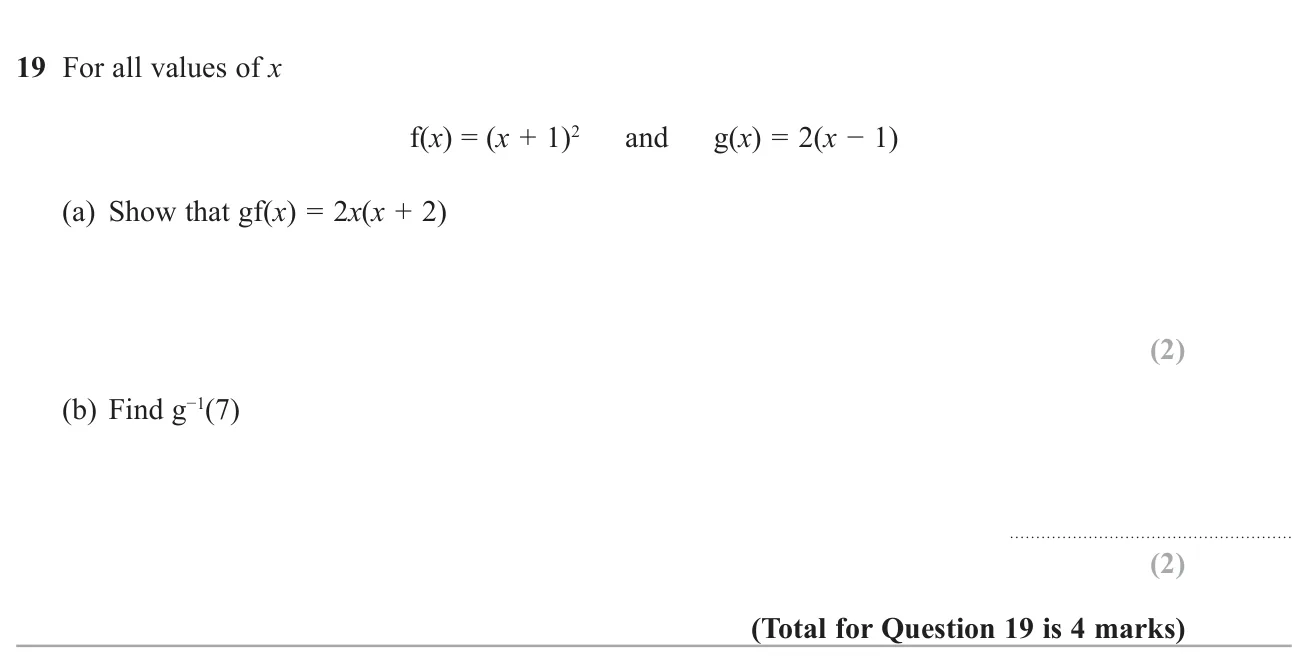
(a) g f ( x ) = 2 ( ( x + 1 ) 2 − 1 ) = 2 ( x 2 + 2 x ) = 2 x ( x + 2 ) gf(x) = 2((x+1)^2 - 1) = 2(x^2 + 2x) = 2x(x+2) g f ( x ) = 2 (( x + 1 ) 2 − 1 ) = 2 ( x 2 + 2 x ) = 2 x ( x + 2 ) 2 marks (b) 4.5 4.5 4.5 2 marks
Worked solution Checked against the mark scheme
(a) g f ( x ) = g ( ( x + 1 ) 2 ) = 2 ( ( x + 1 ) 2 − 1 ) gf(x) = g\big((x+1)^2\big) = 2\big((x+1)^2 - 1\big) g f ( x ) = g ( ( x + 1 ) 2 ) = 2 ( ( x + 1 ) 2 − 1 )
= 2 ( x 2 + 2 x + 1 − 1 ) = 2 ( x 2 + 2 x ) = 2 x ( x + 2 ) = 2(x^2 + 2x + 1 - 1) = 2(x^2 + 2x) = 2x(x + 2) = 2 ( x 2 + 2 x + 1 − 1 ) = 2 ( x 2 + 2 x ) = 2 x ( x + 2 )
(b) Solve g ( x ) = 7 g(x) = 7 g ( x ) = 7 2 ( x − 1 ) = 7 2(x - 1) = 7 2 ( x − 1 ) = 7 x − 1 = 3.5 x - 1 = 3.5 x − 1 = 3.5 x = 4.5 x = 4.5 x = 4.5
Watch out: Working out f g ( x ) fg(x) f g ( x ) g f ( x ) gf(x) g f ( x )
© Pearson Education Ltd. November 2018 Paper 3 (Higher, calculator), question 10.
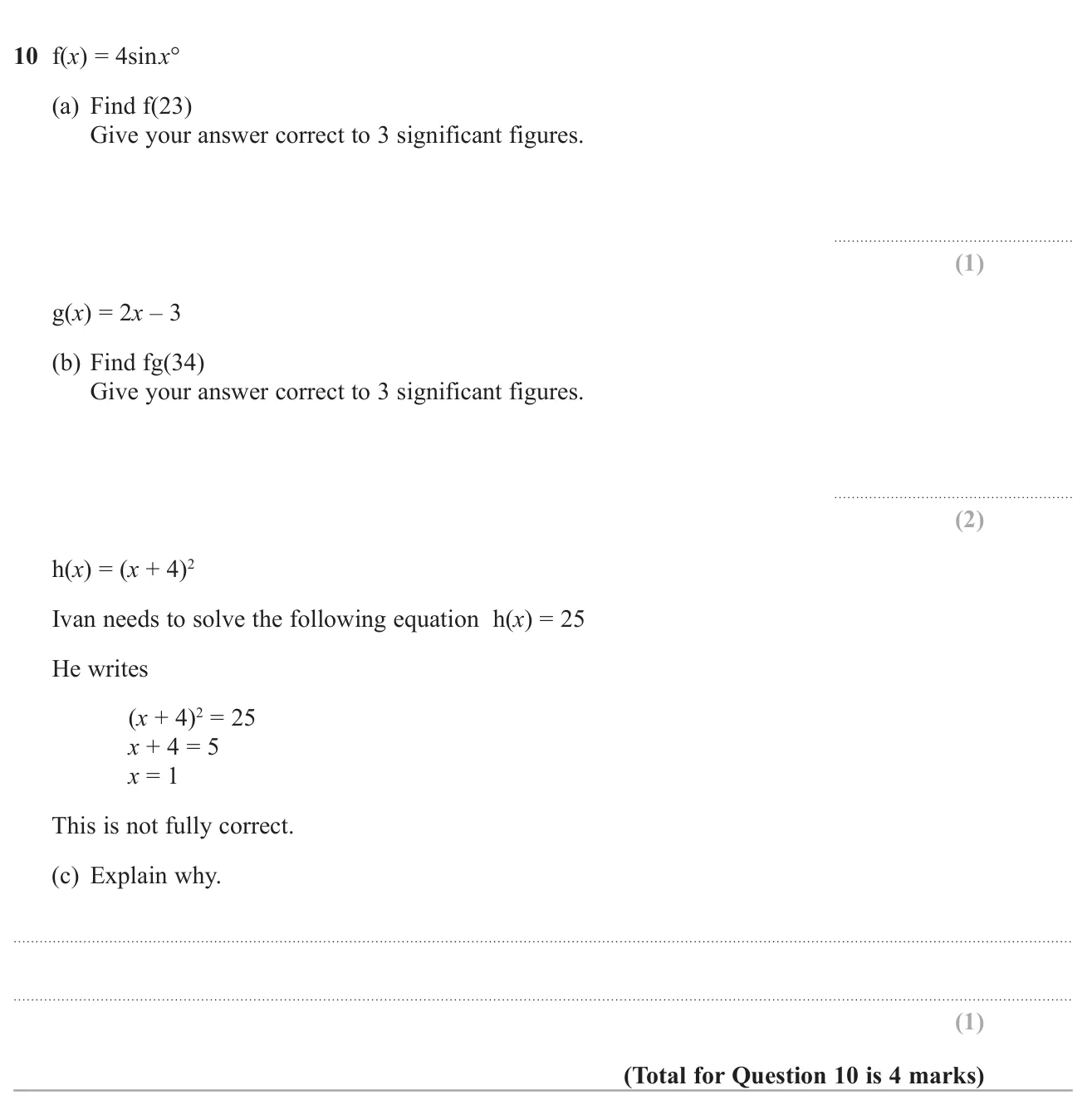
(a) 1.56 1.56 1.56 1 mark (b) 3.63 3.63 3.63 2 marks (c) He ignored the negative square root: x + 4 = − 5 x + 4 = -5 x + 4 = − 5 x = − 9 x = -9 x = − 9 1 mark
Worked solution Checked against the mark scheme
(a) f ( 23 ) = 4 sin 23 ° = 1.56 f(23) = 4\sin 23° = 1.56 f ( 23 ) = 4 sin 23° = 1.56
(b) g ( 34 ) = 2 × 34 − 3 = 65 g(34) = 2 \times 34 - 3 = 65 g ( 34 ) = 2 × 34 − 3 = 65 f ( 65 ) = 4 sin 65 ° = 3.63 f(65) = 4\sin 65° = 3.63 f ( 65 ) = 4 sin 65° = 3.63
(c) 25 25 25 5 5 5 − 5 -5 − 5 x + 4 = − 5 x + 4 = -5 x + 4 = − 5 x = − 9 x = -9 x = − 9
Watch out: In (b), working out f first and then g (doing gf instead of fg).
© Pearson Education Ltd. Specimen Paper 2 (Higher, calculator), question 18.
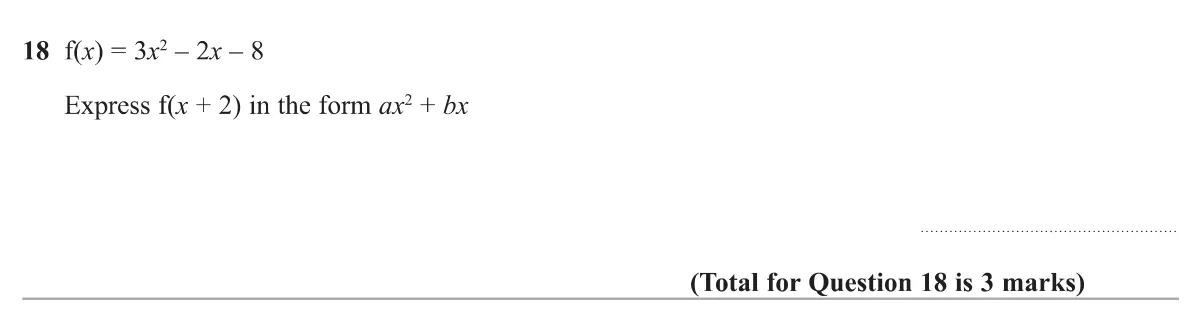
Answer 3 x 2 + 10 x 3x^2 + 10x 3 x 2 + 10 x 3 marks
Worked solution Checked against the mark scheme
f ( x + 2 ) = 3 ( x + 2 ) 2 − 2 ( x + 2 ) − 8 f(x + 2) = 3(x + 2)^2 - 2(x + 2) - 8 f ( x + 2 ) = 3 ( x + 2 ) 2 − 2 ( x + 2 ) − 8
= 3 ( x 2 + 4 x + 4 ) − 2 x − 4 − 8 = 3(x^2 + 4x + 4) - 2x - 4 - 8 = 3 ( x 2 + 4 x + 4 ) − 2 x − 4 − 8
= 3 x 2 + 12 x + 12 − 2 x − 12 = 3x^2 + 12x + 12 - 2x - 12 = 3 x 2 + 12 x + 12 − 2 x − 12
= 3 x 2 + 10 x = 3x^2 + 10x = 3 x 2 + 10 x
Watch out: Writing ( x + 2 ) 2 = x 2 + 4 (x + 2)^2 = x^2 + 4 ( x + 2 ) 2 = x 2 + 4
© Pearson Education Ltd. November 2022 Paper 2 (Higher, calculator), question 22.
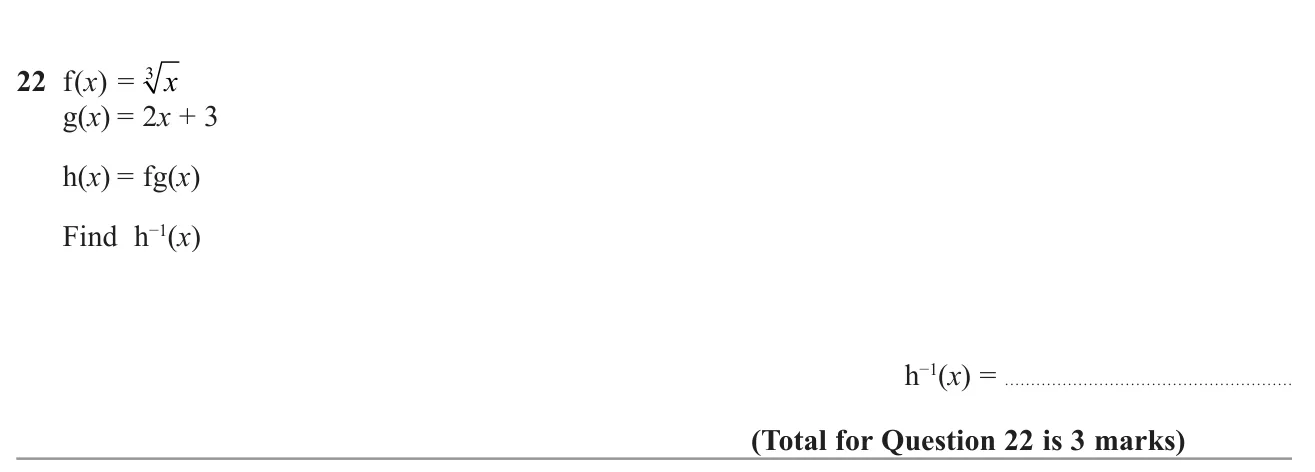
Answer h − 1 ( x ) = x 3 − 3 2 h^{-1}(x) = \frac{x^3 - 3}{2} h − 1 ( x ) = 2 x 3 − 3 3 marks
Worked solution Checked against the mark scheme
h ( x ) = f ( g ( x ) ) = 2 x + 3 3 h(x) = f(g(x)) = \sqrt[3]{2x + 3} h ( x ) = f ( g ( x )) = 3 2 x + 3
Let y = 2 x + 3 3 y = \sqrt[3]{2x + 3} y = 3 2 x + 3 y 3 = 2 x + 3 y^3 = 2x + 3 y 3 = 2 x + 3 x = y 3 − 3 2 x = \frac{y^3 - 3}{2} x = 2 y 3 − 3
h − 1 ( x ) = x 3 − 3 2 h^{-1}(x) = \frac{x^3 - 3}{2} h − 1 ( x ) = 2 x 3 − 3
Watch out: Doing g first and f second the wrong way, i.e. finding g(f(x)).
© Pearson Education Ltd. November 2021 Paper 1 (Higher, non-calculator), question 21.
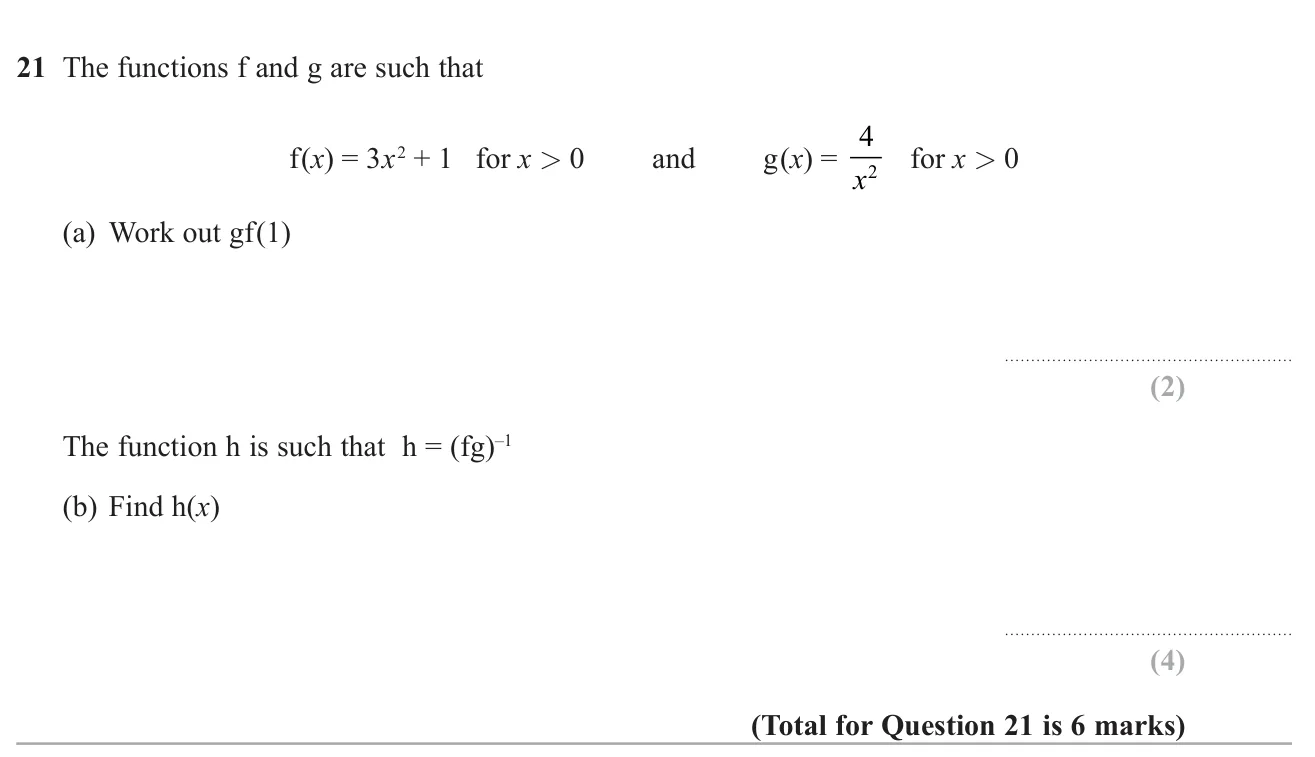
(a) 1 4 \frac{1}{4} 4 1 2 marks (b) h ( x ) = 48 x − 1 4 h(x) = \sqrt[4]{\frac{48}{x - 1}} h ( x ) = 4 x − 1 48 4 marks
Worked solution Checked against the mark scheme
(a) f ( 1 ) = 3 + 1 = 4 f(1) = 3 + 1 = 4 f ( 1 ) = 3 + 1 = 4 g ( 4 ) = 4 16 = 1 4 g(4) = \frac{4}{16} = \frac{1}{4} g ( 4 ) = 16 4 = 4 1
(b) f g ( x ) = 3 ( 4 x 2 ) 2 + 1 = 48 x 4 + 1 fg(x) = 3\left(\frac{4}{x^2}\right)^2 + 1 = \frac{48}{x^4} + 1 f g ( x ) = 3 ( x 2 4 ) 2 + 1 = x 4 48 + 1
Let y = 48 x 4 + 1 y = \frac{48}{x^4} + 1 y = x 4 48 + 1 x 4 = 48 y − 1 x^4 = \frac{48}{y - 1} x 4 = y − 1 48
h ( x ) = 48 x − 1 4 h(x) = \sqrt[4]{\frac{48}{x - 1}} h ( x ) = 4 x − 1 48
Watch out: Working out fg the wrong way round, i.e. finding gf(x) instead.
Also tested in these questions Their main topic is different, but part of each one tests this topic.