© Pearson Education Ltd. Specimen Paper 1 (Higher, non-calculator), question 1.
Worked solution Checked against the mark scheme
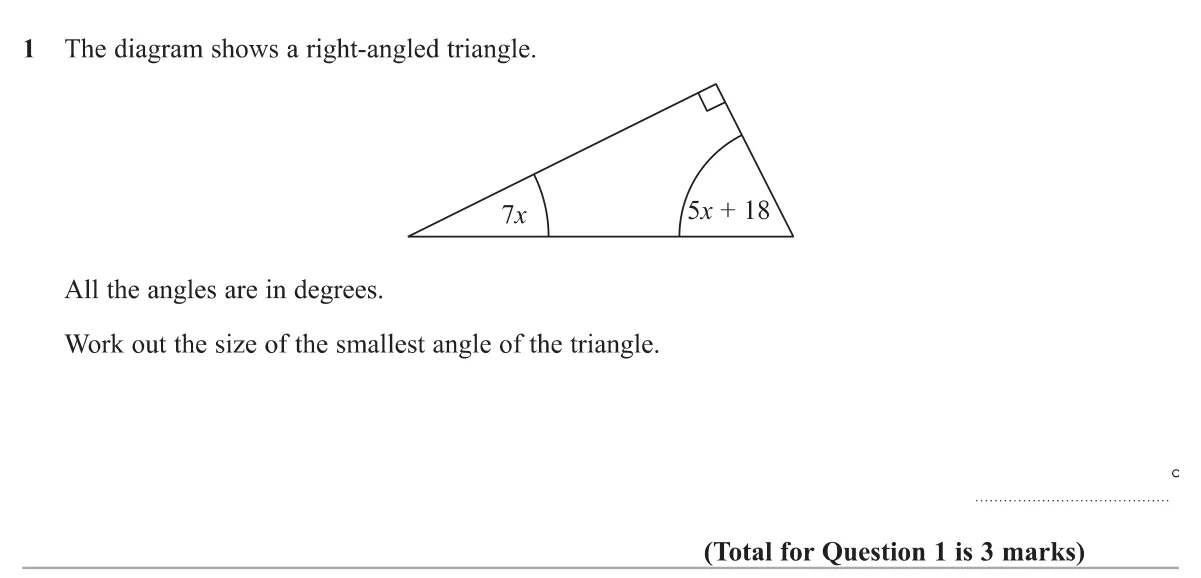
The two marked angles add up to 90 ° 90° 90°
7 x + 5 x + 18 = 90 7x + 5x + 18 = 90 7 x + 5 x + 18 = 90 12 x = 72 12x = 72 12 x = 72 x = 6 x = 6 x = 6
The angles are 7 × 6 = 42 ° 7 \times 6 = 42° 7 × 6 = 42° 5 × 6 + 18 = 48 ° 5 \times 6 + 18 = 48° 5 × 6 + 18 = 48° 90 ° 90° 90° 42 ° 42° 42°
Watch out: Setting the angles equal to 180 and forgetting the right angle, or giving x = 6 x = 6 x = 6
© Pearson Education Ltd. Specimen Paper 1 (Higher, non-calculator), question 2.
Worked solution Checked against the mark scheme
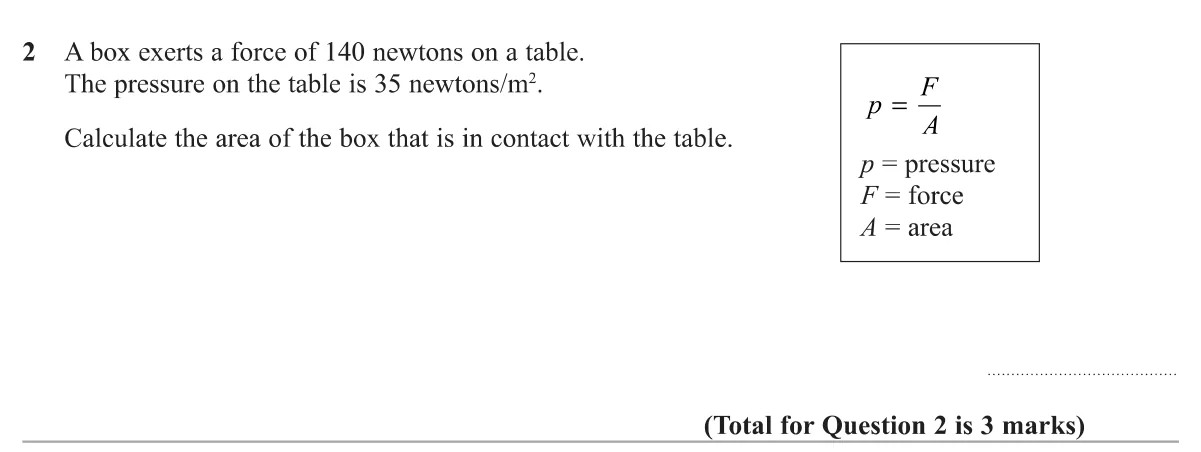
Rearrange p = F A p = \frac{F}{A} p = A F A = F p A = \frac{F}{p} A = p F
A = 140 35 = 4 A = \frac{140}{35} = 4 A = 35 140 = 4
The area is 4 4 4
Watch out: Multiplying 140 by 35 instead of dividing, or leaving out the units.
© Pearson Education Ltd. Specimen Paper 1 (Higher, non-calculator), question 3.
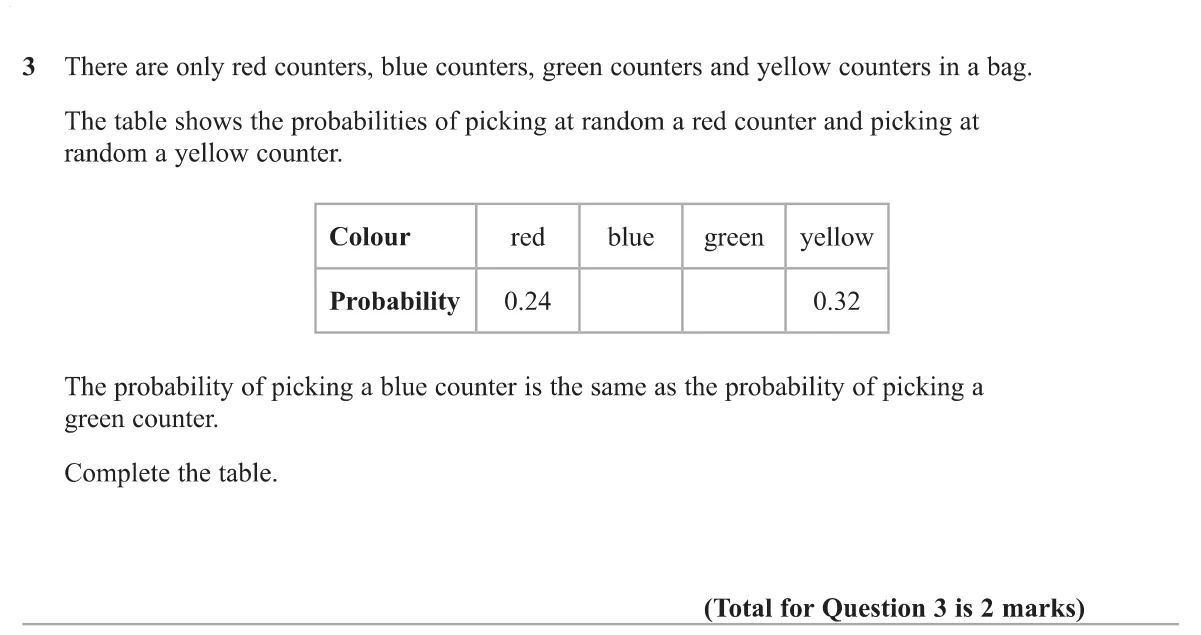
Answer blue 0.22 0.22 0.22 0.22 0.22 0.22 2 marks
Worked solution Checked against the mark scheme
The probabilities add up to 1.
1 − 0.24 − 0.32 = 0.44 1 - 0.24 - 0.32 = 0.44 1 − 0.24 − 0.32 = 0.44
Blue and green share this equally: 0.44 ÷ 2 = 0.22 0.44 \div 2 = 0.22 0.44 ÷ 2 = 0.22
Watch out: Writing 0.44 in both boxes without halving it.
© Pearson Education Ltd. Specimen Paper 1 (Higher, non-calculator), question 4.
Worked solution Checked against the mark scheme
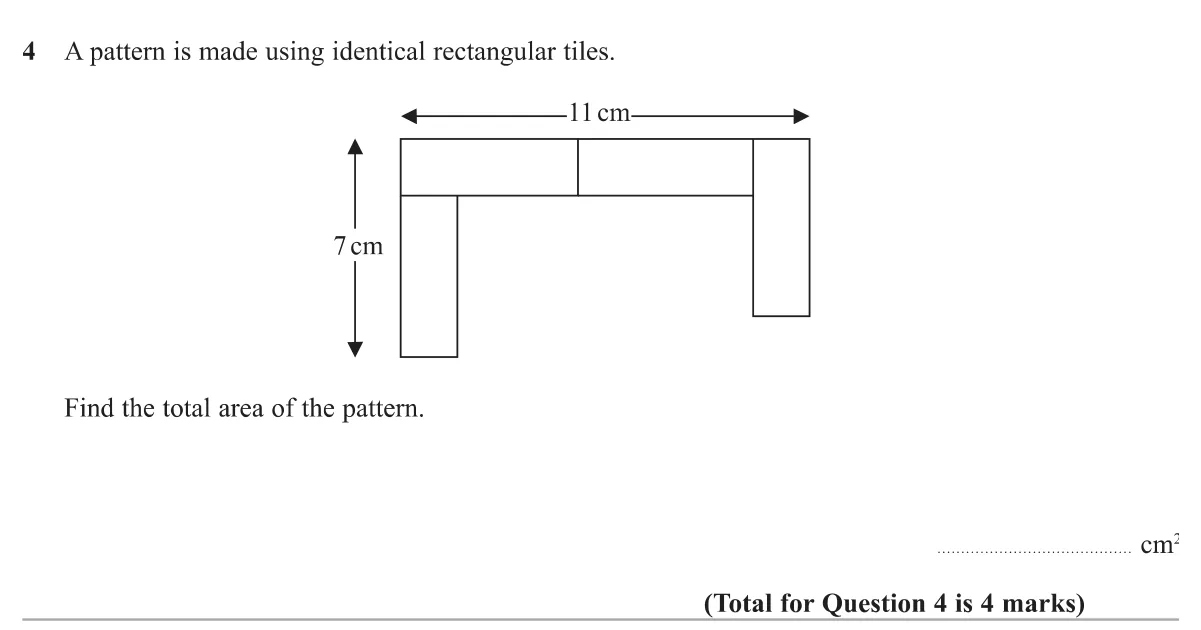
Let each tile be l l l w w w
Across the top: 2 l + w = 11 2l + w = 11 2 l + w = 11 l + w = 7 l + w = 7 l + w = 7
Subtracting gives l = 4 l = 4 l = 4 w = 3 w = 3 w = 3
There are 4 tiles, each 4 × 3 = 12 4 \times 3 = 12 4 × 3 = 12 4 × 12 = 48 4 \times 12 = 48 4 × 12 = 48
Watch out: Multiplying 11 by 7 to get 77 as if the pattern were a full rectangle.
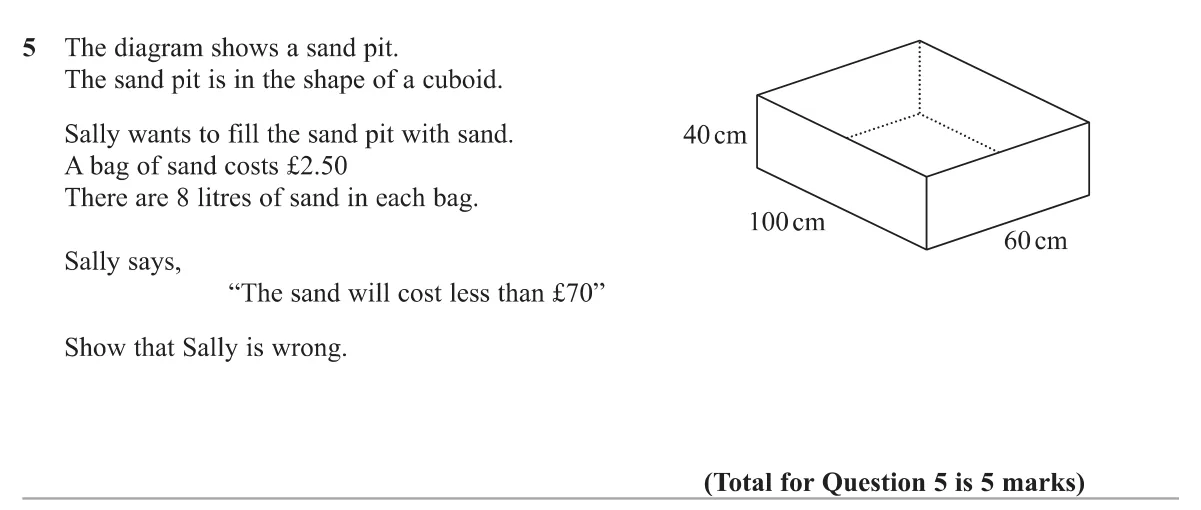
© Pearson Education Ltd. Specimen Paper 1 (Higher, non-calculator), question 5.
Answer Volume 240000 240000 240000 = 240 = 240 = 240 £ 75 £75 £75 5 marks
Worked solution Checked against the mark scheme
Volume = 100 × 60 × 40 = 240000 = 100 \times 60 \times 40 = 240000 = 100 × 60 × 40 = 240000
1 1 1 = 1000 = 1000 = 1000 240 240 240
Bags: 240 ÷ 8 = 30 240 \div 8 = 30 240 ÷ 8 = 30
Cost: 30 × £ 2.50 = £ 75 30 \times £2.50 = £75 30 × £2.50 = £75
Watch out: Using 1 litre = 100 cm³, or adding the dimensions instead of multiplying.
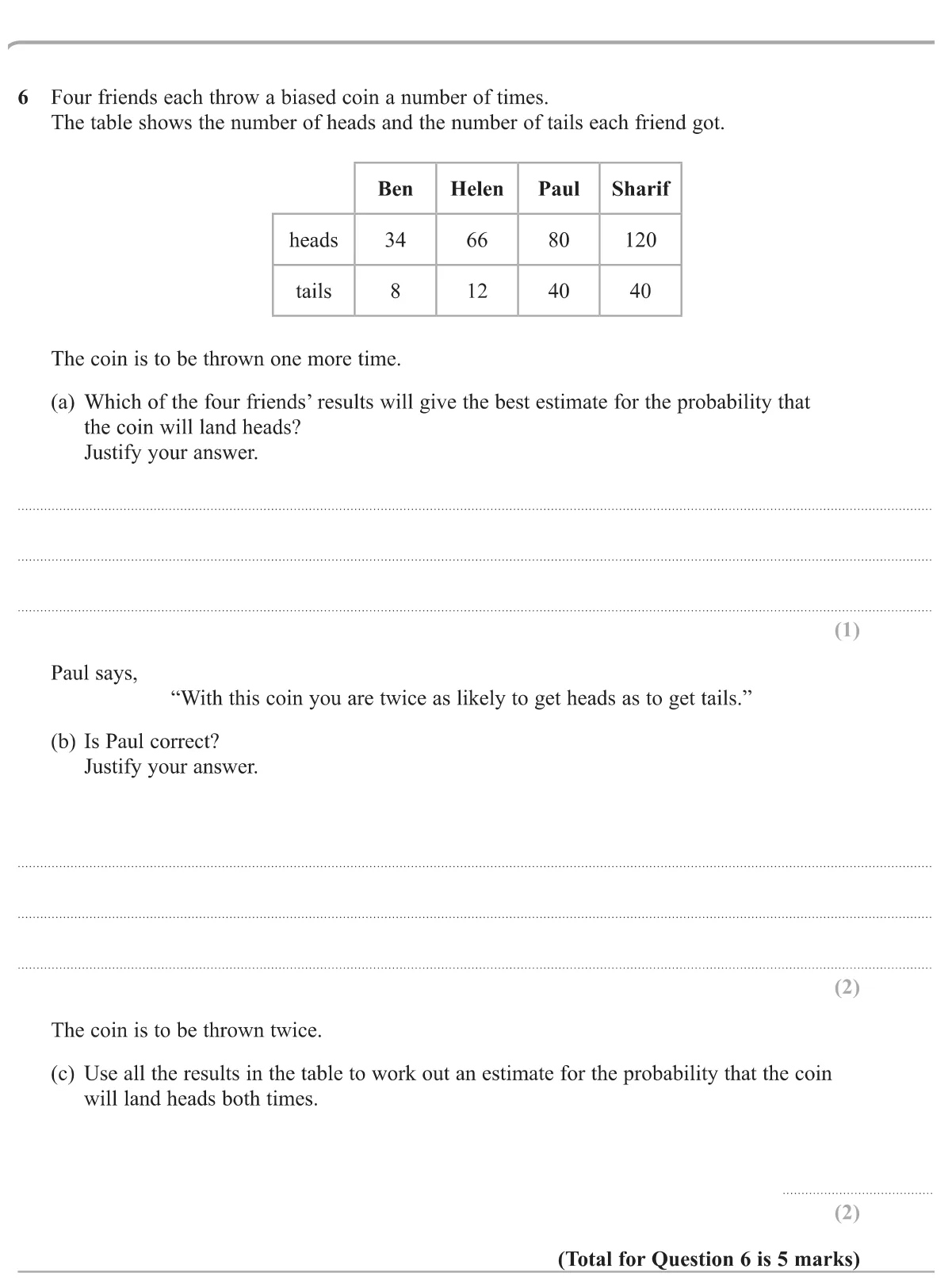
© Pearson Education Ltd. Specimen Paper 1 (Higher, non-calculator), question 6.
(a) Sharif, because he threw the coin the most times 1 mark (b) No: over all the results heads is 3 times as likely as tails (300 heads, 100 tails); only Paul's own results give 2 to 1 2 marks (c) 9 16 \frac{9}{16} 16 9 2 marks
Worked solution Checked against the mark scheme
(a) Sharif threw the coin 160 times, more than anyone else, so his results are the most reliable.
(b) Altogether there were 300 heads and 100 tails, a ratio of 3 : 1. Heads is about three times as likely, not twice, so Paul is wrong.
(c) P(heads) ≈ 300 400 = 3 4 \approx \frac{300}{400} = \frac{3}{4} ≈ 400 300 = 4 3
P(two heads) = 3 4 × 3 4 = 9 16 = \frac{3}{4} \times \frac{3}{4} = \frac{9}{16} = 4 3 × 4 3 = 16 9
Watch out: In (c), adding the probabilities instead of multiplying them.
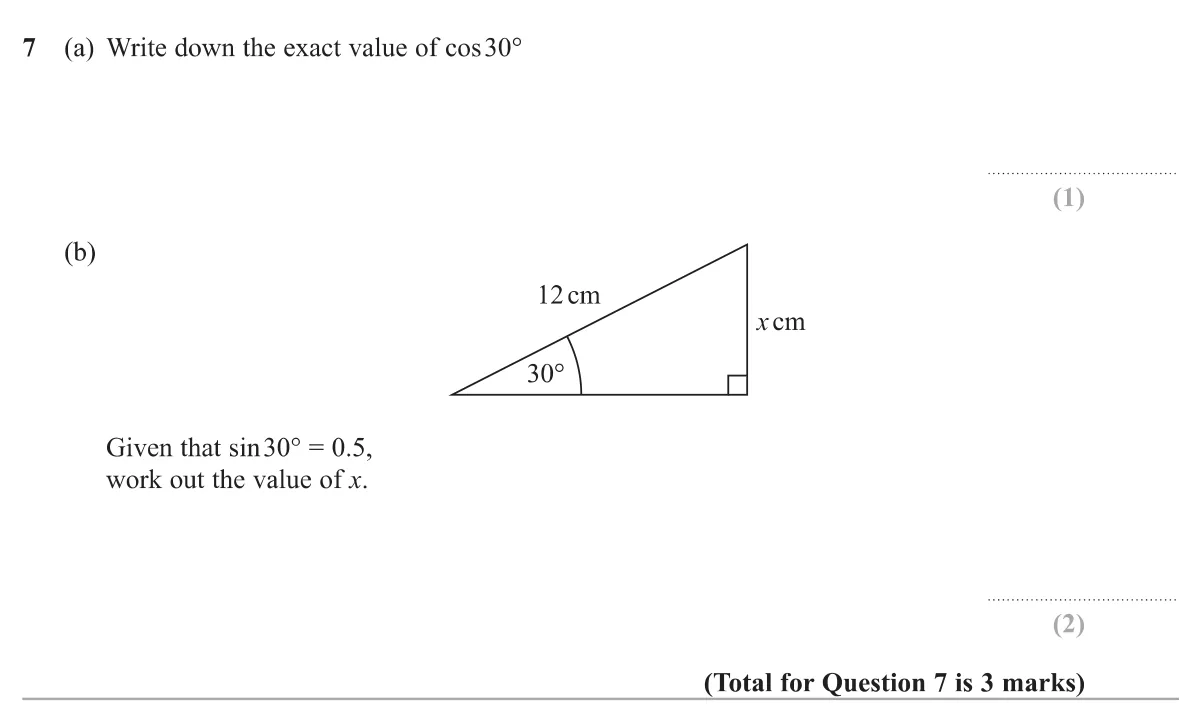
© Pearson Education Ltd. Specimen Paper 1 (Higher, non-calculator), question 7.
(a) 3 2 \frac{\sqrt{3}}{2} 2 3 1 mark (b) 6 6 6 2 marks
Worked solution Checked against the mark scheme
(a) cos 30 ° = 3 2 \cos 30° = \frac{\sqrt{3}}{2} cos 30° = 2 3
(b) x x x 30 ° 30° 30°
sin 30 ° = x 12 \sin 30° = \frac{x}{12} sin 30° = 12 x x = 12 × 0.5 = 6 x = 12 \times 0.5 = 6 x = 12 × 0.5 = 6
Watch out: Using cos instead of sin in (b), or writing 1 2 \frac{1}{2} 2 1
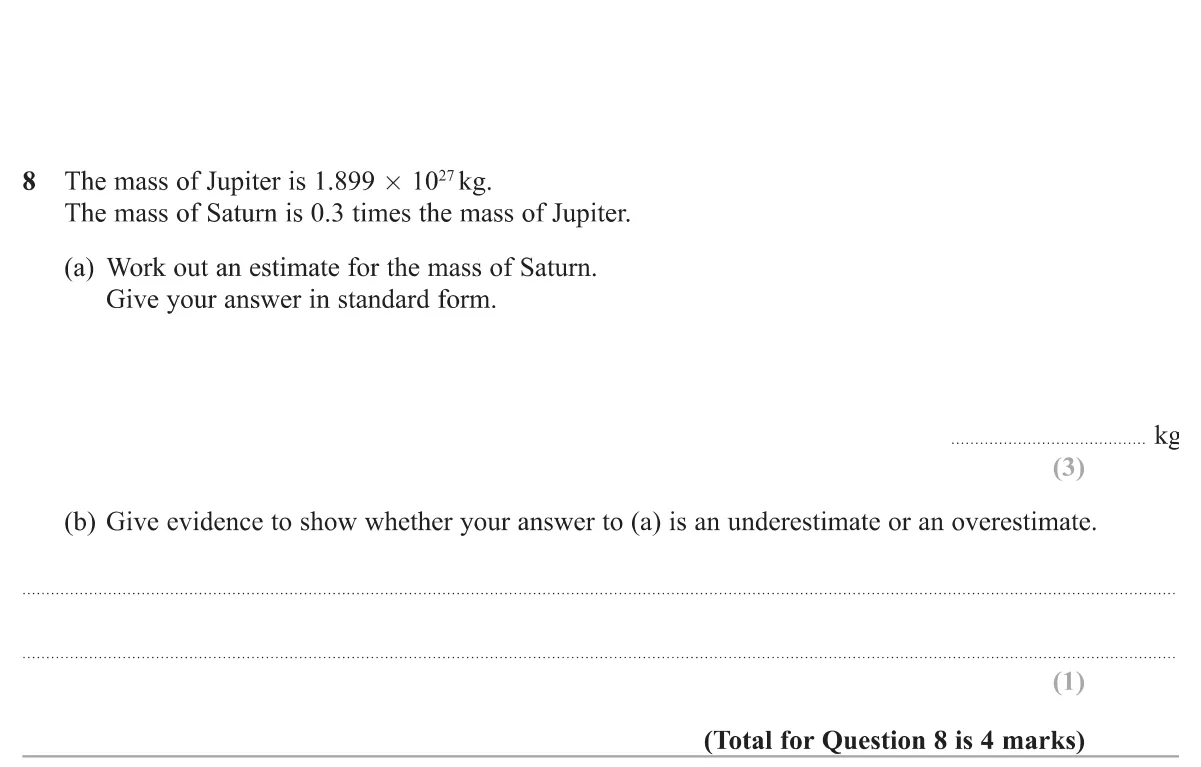
© Pearson Education Ltd. Specimen Paper 1 (Higher, non-calculator), question 8.
(a) Between 5.7 × 10 26 5.7 \times 10^{26} 5.7 × 1 0 26 6 × 10 26 6 \times 10^{26} 6 × 1 0 26 3 marks (b) Overestimate, because 1.899 was rounded up 1 mark
Worked solution Checked against the mark scheme
(a) Round 1.899 1.899 1.899 2 2 2 2 × 10 27 × 0.3 = 0.6 × 10 27 = 6 × 10 26 2 \times 10^{27} \times 0.3 = 0.6 \times 10^{27} = 6 \times 10^{26} 2 × 1 0 27 × 0.3 = 0.6 × 1 0 27 = 6 × 1 0 26
(b) 1.899 1.899 1.899 2 2 2
Watch out: Writing 0.6 × 10 27 0.6 \times 10^{27} 0.6 × 1 0 27
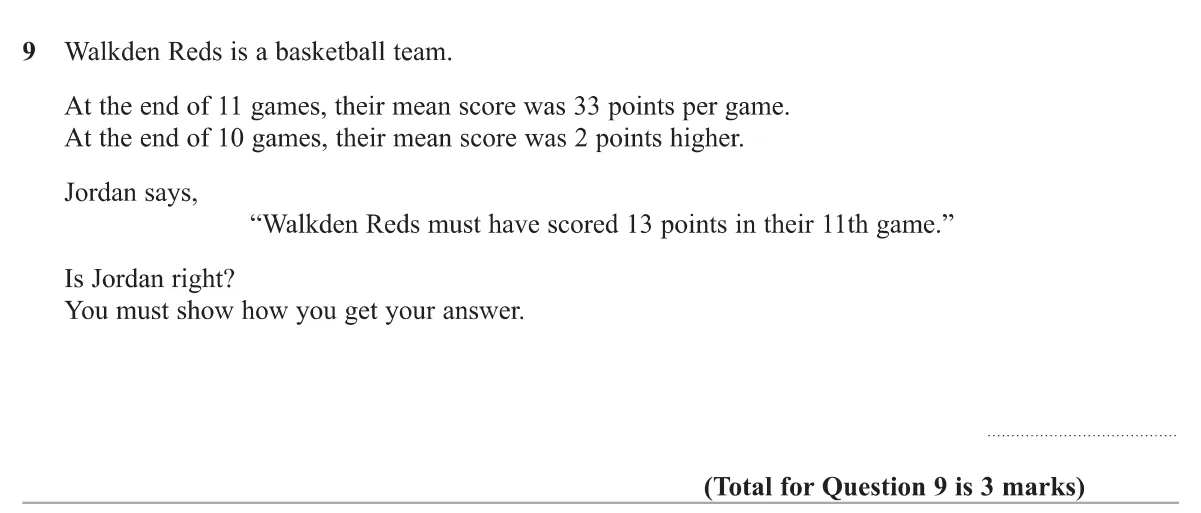
© Pearson Education Ltd. Specimen Paper 1 (Higher, non-calculator), question 9.
Answer Yes: 363 − 350 = 13 363 - 350 = 13 363 − 350 = 13 3 marks
Worked solution Checked against the mark scheme
Total after 11 games: 33 × 11 = 363 33 \times 11 = 363 33 × 11 = 363
Mean after 10 games was 35 35 35 35 × 10 = 350 35 \times 10 = 350 35 × 10 = 350
11th game: 363 − 350 = 13 363 - 350 = 13 363 − 350 = 13
Watch out: Taking the mean after 10 games as 31 (2 lower instead of 2 higher).
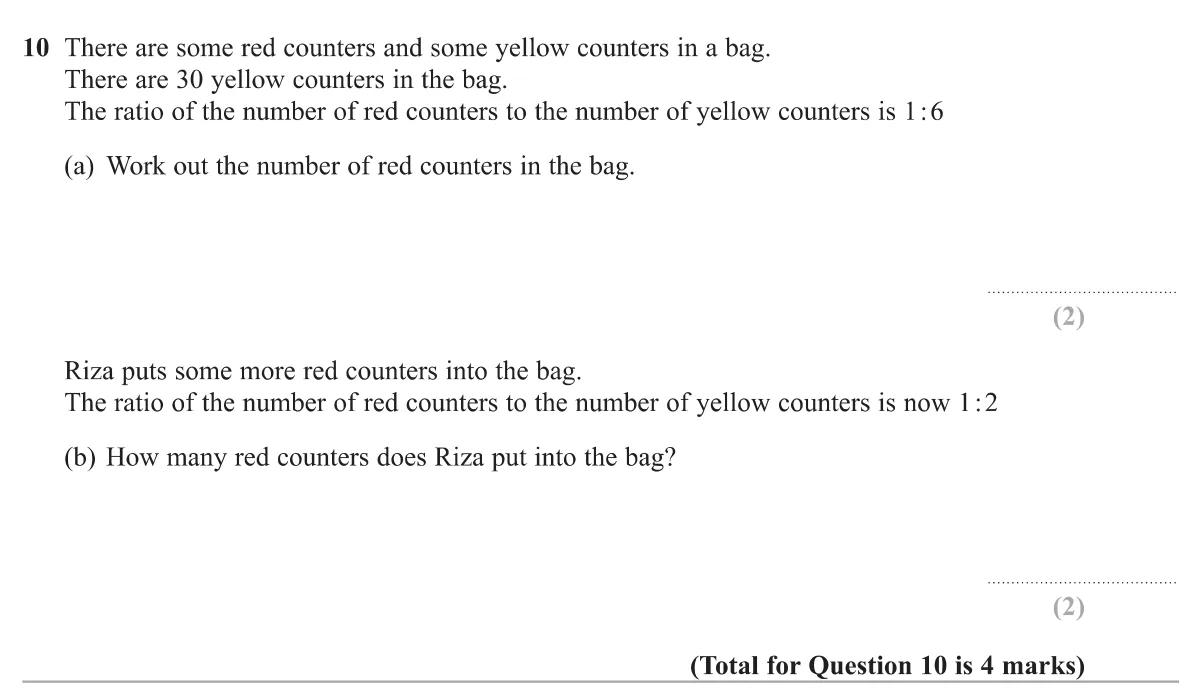
Question 10 Ratio 4 marks Grade 4 No calculator © Pearson Education Ltd. Specimen Paper 1 (Higher, non-calculator), question 10.
(a) 5 5 5 2 marks (b) 10 10 10 2 marks
Worked solution Checked against the mark scheme
(a) 30 ÷ 6 = 5 30 \div 6 = 5 30 ÷ 6 = 5
(b) For 1 : 2 with 30 yellow, there must be 30 ÷ 2 = 15 30 \div 2 = 15 30 ÷ 2 = 15
15 − 5 = 10 15 - 5 = 10 15 − 5 = 10
Watch out: In (b), giving 15 (the new total) instead of the number added.
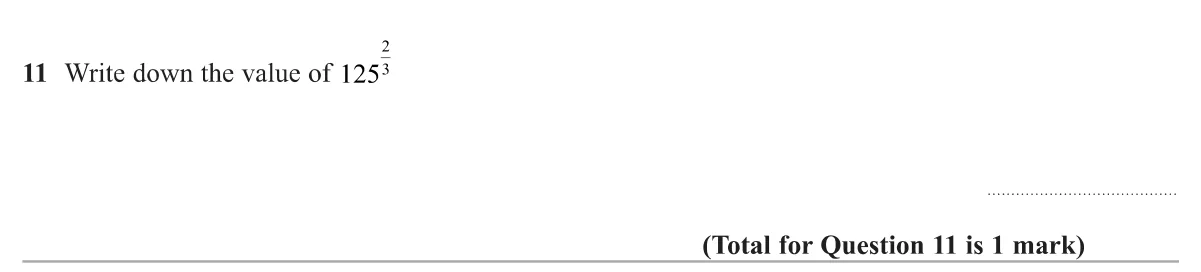
© Pearson Education Ltd. Specimen Paper 1 (Higher, non-calculator), question 11.
Worked solution Checked against the mark scheme
The denominator 3 means cube root: 125 3 = 5 \sqrt[3]{125} = 5 3 125 = 5
The numerator 2 means square: 5 2 = 25 5^2 = 25 5 2 = 25
Watch out: Multiplying 125 by 2 3 \frac{2}{3} 3 2
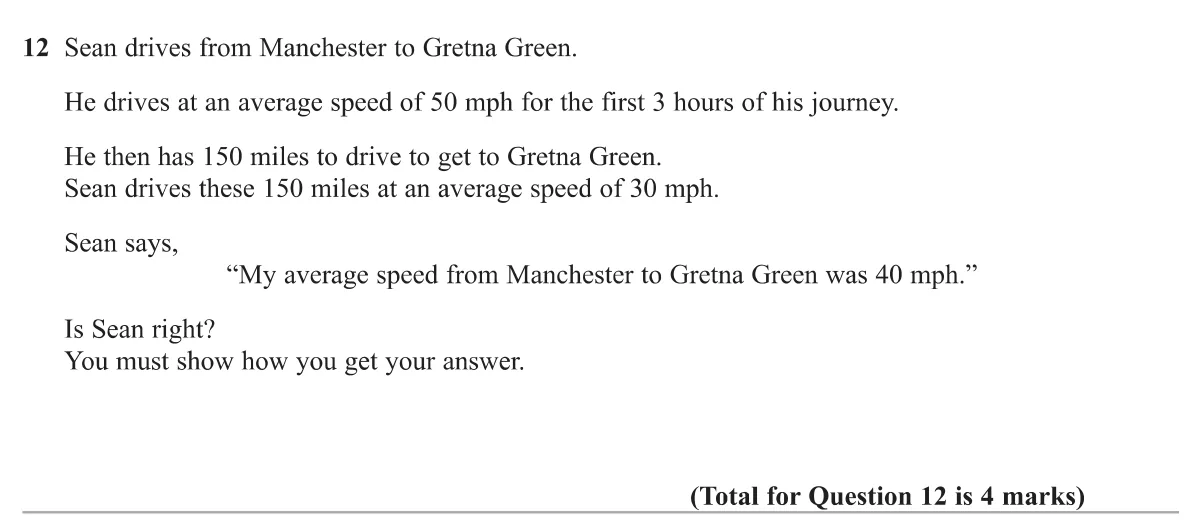
© Pearson Education Ltd. Specimen Paper 1 (Higher, non-calculator), question 12.
Answer No: the average speed is 37.5 37.5 37.5 4 marks
Worked solution Checked against the mark scheme
First part: 50 × 3 = 150 50 \times 3 = 150 50 × 3 = 150
Second part: 150 ÷ 30 = 5 150 \div 30 = 5 150 ÷ 30 = 5
Total: 300 300 300 8 8 8
Average speed = 300 ÷ 8 = 37.5 = 300 \div 8 = 37.5 = 300 ÷ 8 = 37.5
Watch out: Averaging the two speeds to get 40 mph.
© Pearson Education Ltd. Specimen Paper 1 (Higher, non-calculator), question 13.
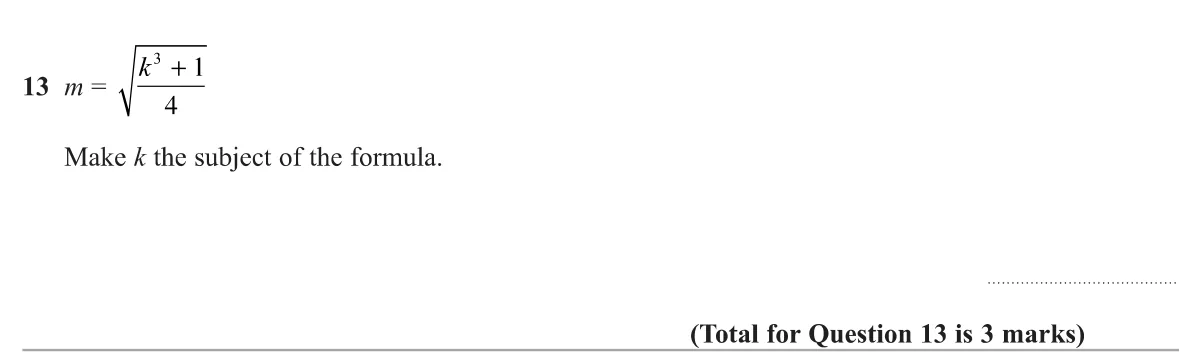
Answer k = 4 m 2 − 1 3 k = \sqrt[3]{4m^2 - 1} k = 3 4 m 2 − 1 3 marks
Worked solution Checked against the mark scheme
Square both sides: m 2 = k 3 + 1 4 m^2 = \frac{k^3 + 1}{4} m 2 = 4 k 3 + 1
Multiply by 4: 4 m 2 = k 3 + 1 4m^2 = k^3 + 1 4 m 2 = k 3 + 1
Subtract 1: k 3 = 4 m 2 − 1 k^3 = 4m^2 - 1 k 3 = 4 m 2 − 1
Cube root: k = 4 m 2 − 1 3 k = \sqrt[3]{4m^2 - 1} k = 3 4 m 2 − 1
Watch out: Taking the square root instead of squaring to remove the root sign.
© Pearson Education Ltd. Specimen Paper 1 (Higher, non-calculator), question 14.
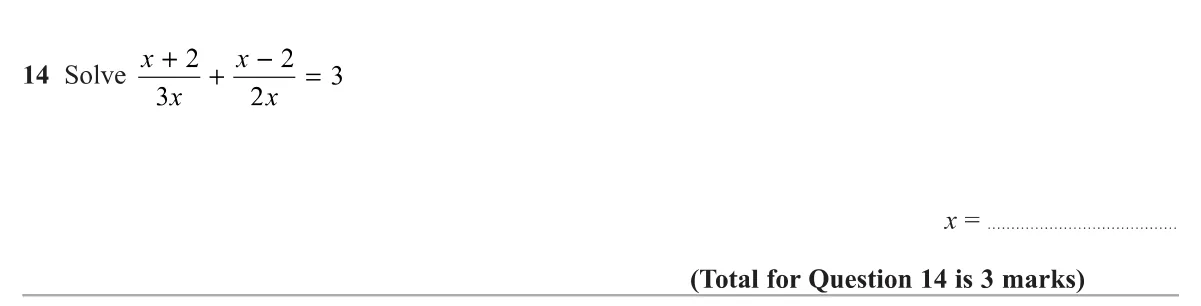
Answer x = − 2 13 x = -\frac{2}{13} x = − 13 2 3 marks
Worked solution Checked against the mark scheme
Multiply every term by 6 x 6x 6 x
2 ( x + 2 ) + 3 ( x − 2 ) = 18 x 2(x + 2) + 3(x - 2) = 18x 2 ( x + 2 ) + 3 ( x − 2 ) = 18 x
2 x + 4 + 3 x − 6 = 18 x 2x + 4 + 3x - 6 = 18x 2 x + 4 + 3 x − 6 = 18 x
5 x − 2 = 18 x 5x - 2 = 18x 5 x − 2 = 18 x − 2 = 13 x -2 = 13x − 2 = 13 x x = − 2 13 x = -\frac{2}{13} x = − 13 2
Watch out: Forgetting to multiply the 3 on the right by 6 x 6x 6 x
© Pearson Education Ltd. Specimen Paper 1 (Higher, non-calculator), question 15.
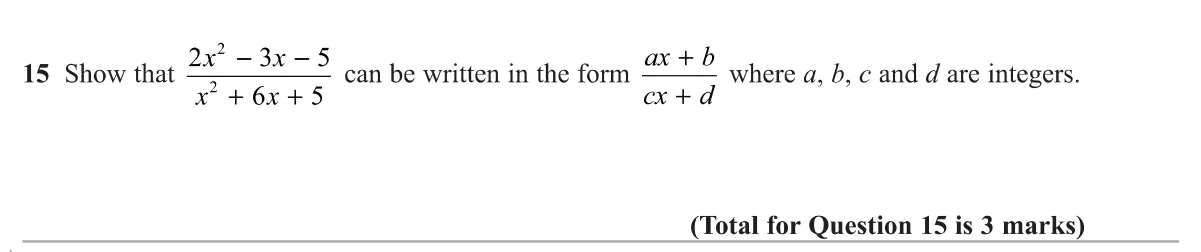
Answer 2 x − 5 x + 5 \frac{2x - 5}{x + 5} x + 5 2 x − 5 3 marks
Worked solution Checked against the mark scheme
Numerator: 2 x 2 − 3 x − 5 = ( 2 x − 5 ) ( x + 1 ) 2x^2 - 3x - 5 = (2x - 5)(x + 1) 2 x 2 − 3 x − 5 = ( 2 x − 5 ) ( x + 1 )
Denominator: x 2 + 6 x + 5 = ( x + 5 ) ( x + 1 ) x^2 + 6x + 5 = (x + 5)(x + 1) x 2 + 6 x + 5 = ( x + 5 ) ( x + 1 )
Cancel the common factor ( x + 1 ) (x + 1) ( x + 1 )
2 x − 5 x + 5 \frac{2x - 5}{x + 5} x + 5 2 x − 5 a = 2 a = 2 a = 2 b = − 5 b = -5 b = − 5 c = 1 c = 1 c = 1 d = 5 d = 5 d = 5
Watch out: Cancelling the x 2 x^2 x 2
© Pearson Education Ltd. Specimen Paper 1 (Higher, non-calculator), question 16.
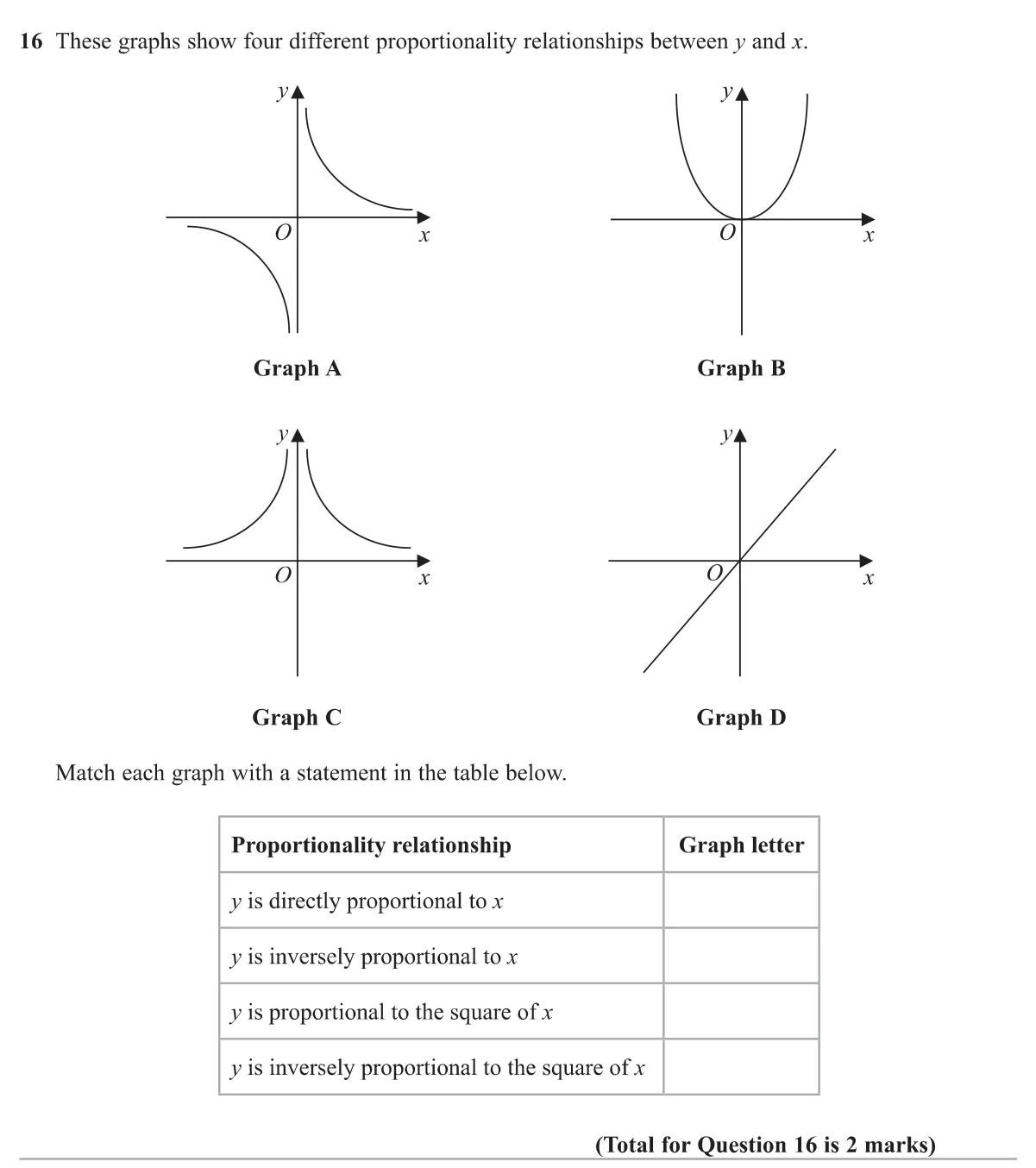
Answer Direct: D; inverse: A; square: B; inverse square: C 2 marks
Worked solution Checked against the mark scheme
Direct proportion is a straight line through the origin: D .
Inverse proportion y = k x y = \frac{k}{x} y = x k A .
y = k x 2 y = kx^2 y = k x 2 B .
y = k x 2 y = \frac{k}{x^2} y = x 2 k x x x C .
Watch out: Mixing up graphs A and C.
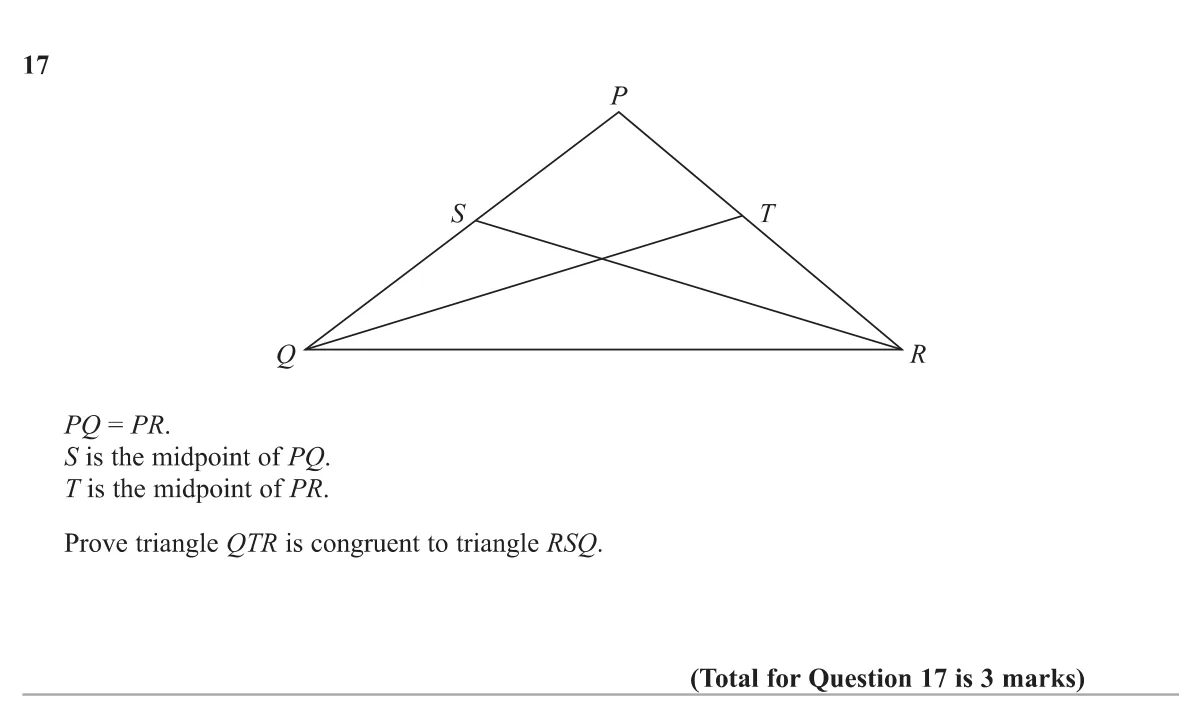
© Pearson Education Ltd. Specimen Paper 1 (Higher, non-calculator), question 17.
Answer Congruent by SAS: Q R QR QR P Q R PQR P QR P R Q PRQ P R Q Q S = R T QS = RT QS = R T 3 marks
Worked solution Checked against the mark scheme
P Q = P R PQ = PR P Q = P R P Q R PQR P QR S Q R SQR S QR T R Q TRQ T R Q
S S S T T T Q S = 1 2 P Q = 1 2 P R = R T QS = \frac{1}{2}PQ = \frac{1}{2}PR = RT QS = 2 1 P Q = 2 1 P R = R T
Q R QR QR
So triangles Q T R QTR QT R R S Q RSQ R S Q
Watch out: Stating the sides and angle are equal without giving reasons.
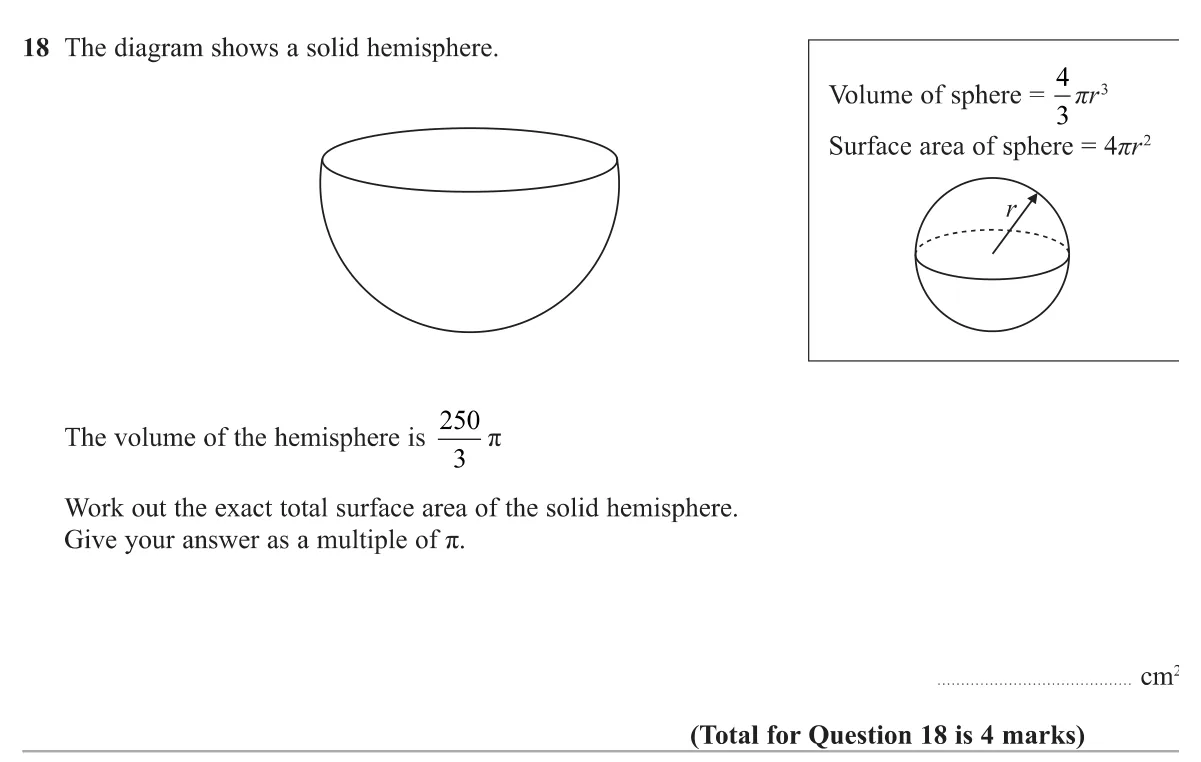
© Pearson Education Ltd. Specimen Paper 1 (Higher, non-calculator), question 18.
Answer 75 π 75\pi 75 π 4 marks
Worked solution Checked against the mark scheme
Hemisphere volume: 2 3 π r 3 = 250 3 π \frac{2}{3}\pi r^3 = \frac{250}{3}\pi 3 2 π r 3 = 3 250 π r 3 = 125 r^3 = 125 r 3 = 125 r = 5 r = 5 r = 5
Curved surface: 1 2 × 4 π × 5 2 = 50 π \frac{1}{2} \times 4\pi \times 5^2 = 50\pi 2 1 × 4 π × 5 2 = 50 π
Flat face: π × 5 2 = 25 π \pi \times 5^2 = 25\pi π × 5 2 = 25 π
Total: 50 π + 25 π = 75 π 50\pi + 25\pi = 75\pi 50 π + 25 π = 75 π
Watch out: Forgetting to include the flat circular face.
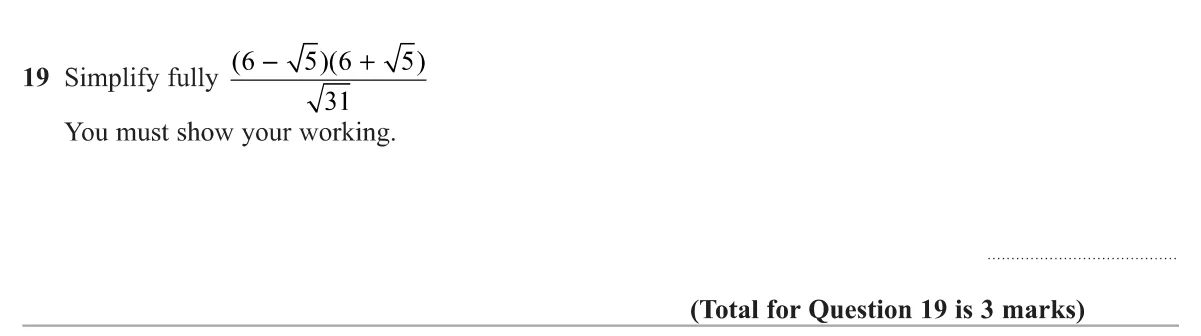
Question 19 Surds 3 marks Grade 8 No calculator © Pearson Education Ltd. Specimen Paper 1 (Higher, non-calculator), question 19.
Answer 31 \sqrt{31} 31 3 marks
Worked solution Checked against the mark scheme
Expand the numerator: ( 6 − 5 ) ( 6 + 5 ) = 36 + 6 5 − 6 5 − 5 = 31 (6 - \sqrt{5})(6 + \sqrt{5}) = 36 + 6\sqrt{5} - 6\sqrt{5} - 5 = 31 ( 6 − 5 ) ( 6 + 5 ) = 36 + 6 5 − 6 5 − 5 = 31
So the expression is 31 31 \frac{31}{\sqrt{31}} 31 31
Multiply top and bottom by 31 \sqrt{31} 31 31 31 31 = 31 \frac{31\sqrt{31}}{31} = \sqrt{31} 31 31 31 = 31
Watch out: Expanding to 36 − 5 5 36 - 5\sqrt{5} 36 − 5 5 36 + 5 36 + 5 36 + 5
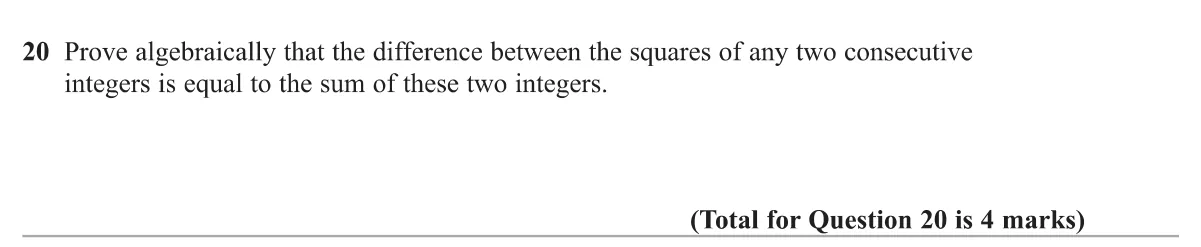
© Pearson Education Ltd. Specimen Paper 1 (Higher, non-calculator), question 20.
Answer ( n + 1 ) 2 − n 2 = 2 n + 1 = n + ( n + 1 ) (n + 1)^2 - n^2 = 2n + 1 = n + (n + 1) ( n + 1 ) 2 − n 2 = 2 n + 1 = n + ( n + 1 ) 4 marks
Worked solution Checked against the mark scheme
Let the integers be n n n n + 1 n + 1 n + 1
Difference of squares: ( n + 1 ) 2 − n 2 = n 2 + 2 n + 1 − n 2 = 2 n + 1 (n + 1)^2 - n^2 = n^2 + 2n + 1 - n^2 = 2n + 1 ( n + 1 ) 2 − n 2 = n 2 + 2 n + 1 − n 2 = 2 n + 1
Sum: n + ( n + 1 ) = 2 n + 1 n + (n + 1) = 2n + 1 n + ( n + 1 ) = 2 n + 1
Both equal 2 n + 1 2n + 1 2 n + 1
Watch out: Checking a few numerical examples instead of giving an algebraic proof.
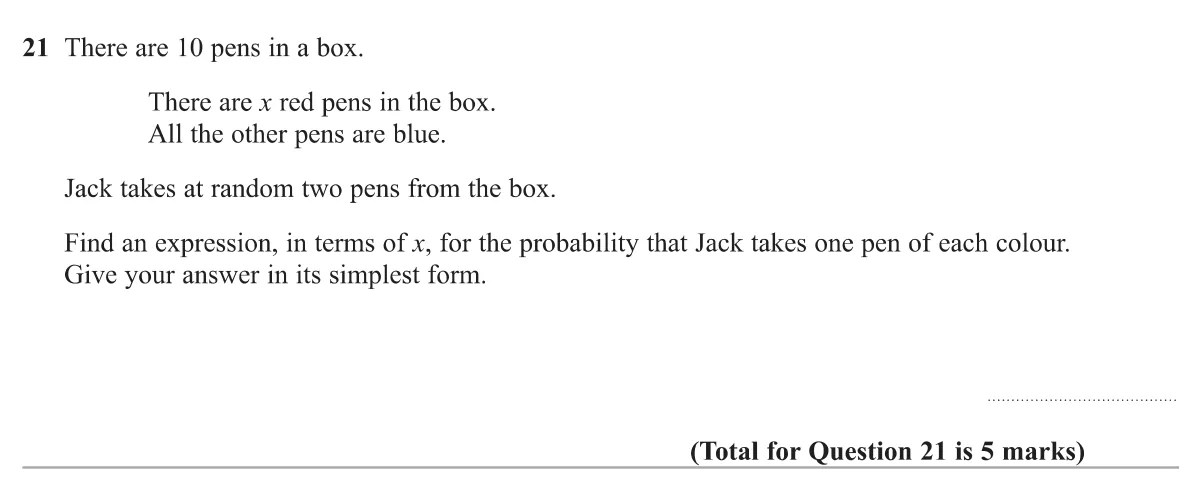
© Pearson Education Ltd. Specimen Paper 1 (Higher, non-calculator), question 21.
Answer 10 x − x 2 45 \frac{10x - x^2}{45} 45 10 x − x 2 5 marks
Worked solution Checked against the mark scheme
P(red then blue) = x 10 × 10 − x 9 = \frac{x}{10} \times \frac{10 - x}{9} = 10 x × 9 10 − x
P(blue then red) = 10 − x 10 × x 9 = \frac{10 - x}{10} \times \frac{x}{9} = 10 10 − x × 9 x
Add: 2 x ( 10 − x ) 90 = x ( 10 − x ) 45 = 10 x − x 2 45 \frac{2x(10 - x)}{90} = \frac{x(10 - x)}{45} = \frac{10x - x^2}{45} 90 2 x ( 10 − x ) = 45 x ( 10 − x ) = 45 10 x − x 2
Watch out: Using 10 as the denominator for the second pen, as if the first were replaced.
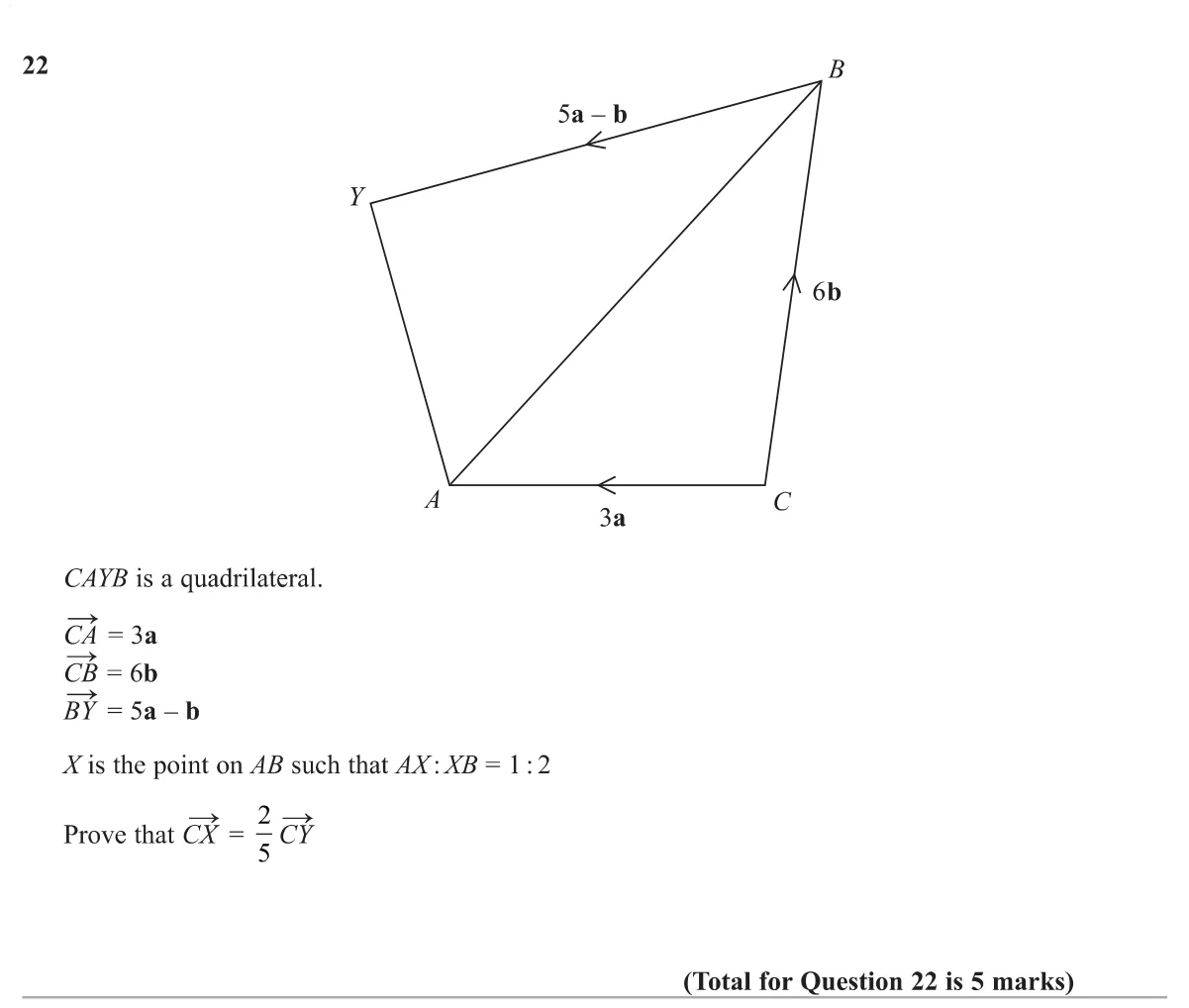
© Pearson Education Ltd. Specimen Paper 1 (Higher, non-calculator), question 22.
Answer C X → = 2 a + 2 b = 2 5 ( 5 a + 5 b ) = 2 5 C Y → \overrightarrow{CX} = 2\mathbf{a} + 2\mathbf{b} = \frac{2}{5}(5\mathbf{a} + 5\mathbf{b}) = \frac{2}{5}\overrightarrow{CY} C X = 2 a + 2 b = 5 2 ( 5 a + 5 b ) = 5 2 C Y 5 marks
Worked solution Checked against the mark scheme
A B → = − 3 a + 6 b \overrightarrow{AB} = -3\mathbf{a} + 6\mathbf{b} A B = − 3 a + 6 b
A X → = 1 3 A B → = − a + 2 b \overrightarrow{AX} = \frac{1}{3}\overrightarrow{AB} = -\mathbf{a} + 2\mathbf{b} A X = 3 1 A B = − a + 2 b
C X → = 3 a + ( − a + 2 b ) = 2 a + 2 b \overrightarrow{CX} = 3\mathbf{a} + (-\mathbf{a} + 2\mathbf{b}) = 2\mathbf{a} + 2\mathbf{b} C X = 3 a + ( − a + 2 b ) = 2 a + 2 b
C Y → = 6 b + 5 a − b = 5 a + 5 b \overrightarrow{CY} = 6\mathbf{b} + 5\mathbf{a} - \mathbf{b} = 5\mathbf{a} + 5\mathbf{b} C Y = 6 b + 5 a − b = 5 a + 5 b
2 5 C Y → = 2 a + 2 b = C X → \frac{2}{5}\overrightarrow{CY} = 2\mathbf{a} + 2\mathbf{b} = \overrightarrow{CX} 5 2 C Y = 2 a + 2 b = C X
Watch out: Taking A X → \overrightarrow{AX} A X A B → \overrightarrow{AB} A B
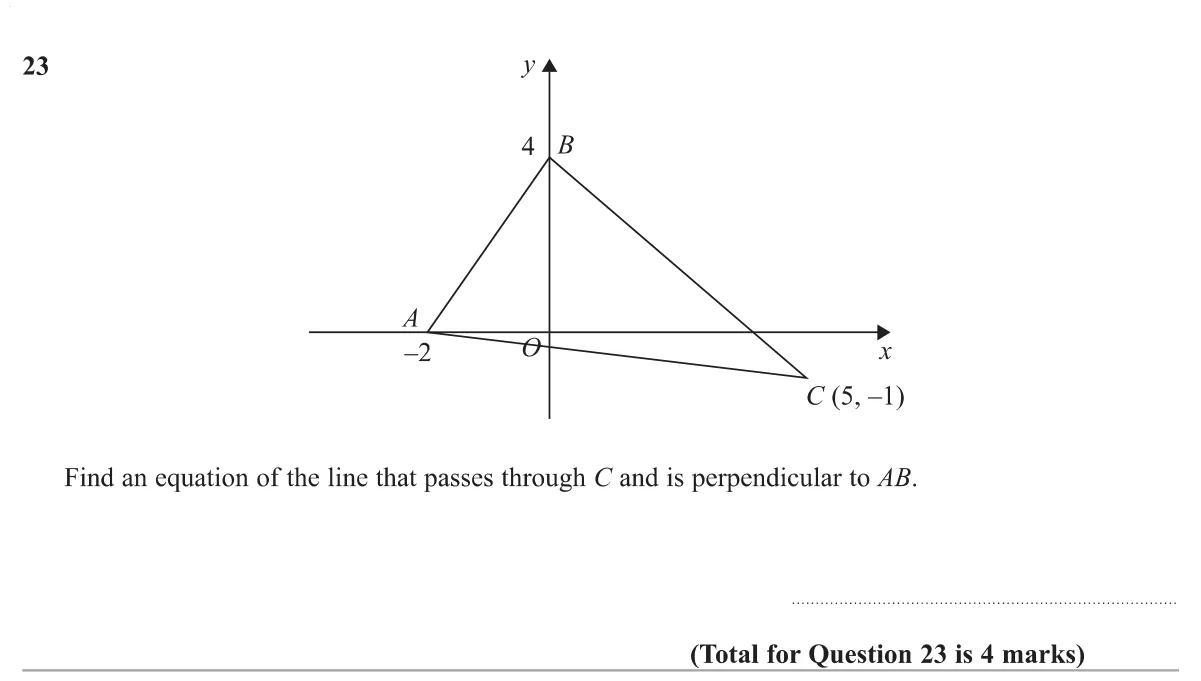
© Pearson Education Ltd. Specimen Paper 1 (Higher, non-calculator), question 23.
Answer y = − 1 2 x + 3 2 y = -\frac{1}{2}x + \frac{3}{2} y = − 2 1 x + 2 3 4 marks
Worked solution Checked against the mark scheme
A A A ( − 2 , 0 ) (-2, 0) ( − 2 , 0 ) B B B ( 0 , 4 ) (0, 4) ( 0 , 4 ) A B = 4 2 = 2 AB = \frac{4}{2} = 2 A B = 2 4 = 2
Perpendicular gradient = − 1 2 = -\frac{1}{2} = − 2 1
Through C ( 5 , − 1 ) C(5, -1) C ( 5 , − 1 ) − 1 = − 1 2 ( 5 ) + c -1 = -\frac{1}{2}(5) + c − 1 = − 2 1 ( 5 ) + c c = 3 2 c = \frac{3}{2} c = 2 3
y = − 1 2 x + 3 2 y = -\frac{1}{2}x + \frac{3}{2} y = − 2 1 x + 2 3
Watch out: Using gradient 1 2 \frac{1}{2} 2 1 − 2 -2 − 2
Finished the paper? Add up your marks for all three papers. Specimen papers were never sat, so they have no grade boundaries of their own, but the grade calculator shows what the same total earned in recent real exams, as a rough guide.