Algebra

Completing the square

10 past-paper questions, easiest first. Try each one, then reveal the answer.

Higher only

Revision guide by The Full Marks

Completing the square: what you need to know

Completing the square rewrites a quadratic as (x+p)2+q(x + p)^2 + q. In that form you can read the turning point straight off, which is why it appears in grade 7–8 questions about sketching curves.

Key facts

  • x2+bx+c=(x+b2)2−(b2)2+cx^2 + bx + c = \left(x + \frac{b}{2}\right)^2 - \left(\frac{b}{2}\right)^2 + c
  • The turning point of y=(x+p)2+qy = (x + p)^2 + q is (−p,q)(-p, q): change the sign inside the bracket only.
  • For a(x+p)2+qa(x + p)^2 + q the turning point is still (−p,q)(-p, q). It is a minimum if aa is positive and a maximum if aa is negative.
  • If the x2x^2 term has a coefficient (even −1-1), take it out of the x2x^2 and xx terms first: 2x2+12x=2(x2+6x)2x^2 + 12x = 2(x^2 + 6x).
  • To solve (x+p)2+q=0(x + p)^2 + q = 0, rearrange to (x+p)2=−q(x + p)^2 = -q and square root both sides, remembering ±\pm: e.g. (x+3)2=5(x + 3)^2 = 5 gives x=−3±5x = -3 \pm \sqrt{5}.

Completing the square

  1. If needed, factor out the coefficient of x2x^2 from the x2x^2 and xx terms.
  2. Halve the coefficient of xx and write (x+half)2(x + \text{half})^2.
  3. Subtract the square of that half (multiplied by any factor you took out).
  4. Tidy up the constants.

Worked examples

Example 1 Higher · grade 7

Write x2−6x+11x^2 - 6x + 11 in the form (x−a)2+b(x - a)^2 + b, and give the turning point of y=x2−6x+11y = x^2 - 6x + 11.

Show the solution

Half of −6-6 is −3-3: (x−3)2=x2−6x+9(x - 3)^2 = x^2 - 6x + 9
x2−6x+11=(x−3)2−9+11=(x−3)2+2x^2 - 6x + 11 = (x - 3)^2 - 9 + 11 = (x - 3)^2 + 2
Turning point: (3,2)(3, 2)

Example 2 Higher · grade 8

Write 2x2+12x+52x^2 + 12x + 5 in the form a(x+b)2+ca(x + b)^2 + c and find the turning point of its graph.

Show the solution

Factor 2 from the xx terms: 2(x2+6x)+52(x^2 + 6x) + 5
x2+6x=(x+3)2−9x^2 + 6x = (x + 3)^2 - 9
2[(x+3)2−9]+5=2(x+3)2−18+52[(x + 3)^2 - 9] + 5 = 2(x + 3)^2 - 18 + 5
=2(x+3)2−13= 2(x + 3)^2 - 13
Turning point: (−3,−13)(-3, -13)

Example 3 Higher · grade 8

Find the turning point of y=3+8x−2x2y = 3 + 8x - 2x^2 and say whether it is a maximum or a minimum.

Show the solution

Rewrite in order: y=−2x2+8x+3y = -2x^2 + 8x + 3
Factor −2-2 from the xx terms: −2(x2−4x)+3-2(x^2 - 4x) + 3
x2−4x=(x−2)2−4x^2 - 4x = (x - 2)^2 - 4
−2[(x−2)2−4]+3=−2(x−2)2+8+3-2[(x - 2)^2 - 4] + 3 = -2(x - 2)^2 + 8 + 3
=−2(x−2)2+11= -2(x - 2)^2 + 11
Turning point (2,11)(2, 11). The x2x^2 coefficient is negative, so it is a maximum.

Common mistakes

  • Getting the sign of the turning point wrong: (x+3)2−13(x + 3)^2 - 13 gives x=−3x = -3, not 33.
  • Forgetting to multiply the subtracted square by the factor taken out: in 2[(x+3)2−9]2[(x + 3)^2 - 9] the −9-9 becomes −18-18, and in −2[(x−2)2−4]-2[(x - 2)^2 - 4] the −4-4 becomes +8+8.
  • Adding the square instead of subtracting it.

Exam tips

  • Expand your completed-square form to check it matches the original quadratic.
  • If a question says 'hence' find the turning point, read it from your completed square rather than starting again.

Questions people ask

How do you complete the square?

Halve the coefficient of xx, write (x+half)2(x + \text{half})^2, then subtract the half squared and add the original constant.

How do you find the turning point from completing the square?

For (x+p)2+q(x + p)^2 + q, the turning point is (−p,q)(-p, q). Change the sign of the number in the bracket; keep the sign of the number outside.

Exam questions: Completing the square (10, easiest first)

Completing the square3 marksGrade 7CalculatorHigher
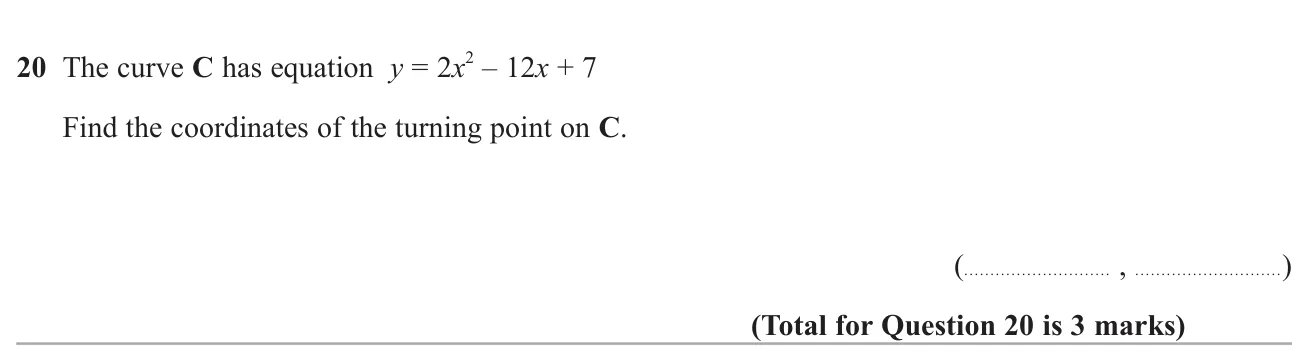
June 2024 · Paper 2 Higher · Q20
Find the coordinates of the turning point of a quadratic curve.

© Pearson Education Ltd. June 2024 Paper 2 (Higher, calculator), question 20.

Show answer
Answer(3,−11)(3, -11)3 marks

Worked solution Checked against the mark scheme

y=2x2−12x+7=2(x2−6x)+7=2[(x−3)2−9]+7=2(x−3)2−11y = 2x^2 - 12x + 7 = 2(x^2 - 6x) + 7 = 2[(x-3)^2 - 9] + 7 = 2(x-3)^2 - 11

The minimum is when x=3x = 3, giving y=−11y = -11.

Turning point: (3,−11)(3, -11)

Watch out: Forgetting to multiply the −9-9 by 2, giving (3,−2)(3, -2).

Completing the square7 marksGrade 7CalculatorHigher
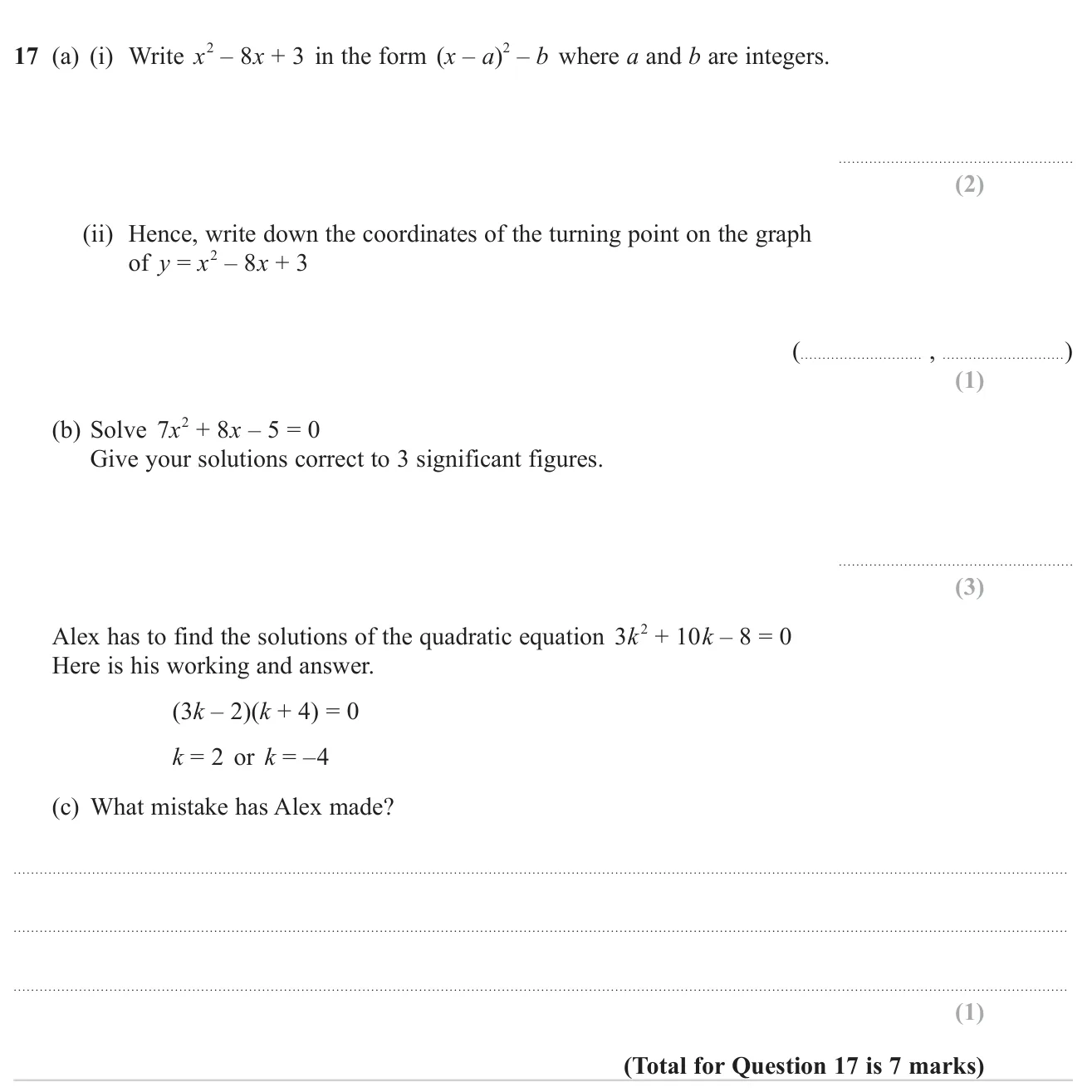
November 2023 · Paper 3 Higher · Q17
Complete the square and state the turning point, solve a quadratic with the formula, and spot an error in factorised solutions.

© Pearson Education Ltd. November 2023 Paper 3 (Higher, calculator), question 17.

Show answer
(a(i))(x−4)2−13(x - 4)^2 - 132 marks
(a(ii))(4,−13)(4, -13)1 mark
(b)x=0.449x = 0.449 or x=−1.59x = -1.593 marks
(c)He ignored the 3: from 3k−2=03k - 2 = 0 the solution is k=23k = \frac{2}{3}, not 21 mark

Worked solution Checked against the mark scheme

(a)(i) x2−8x+3=(x−4)2−16+3=(x−4)2−13x^2 - 8x + 3 = (x - 4)^2 - 16 + 3 = (x - 4)^2 - 13

(ii) Turning point (4,−13)(4, -13)

(b) x=−8±82−4(7)(−5)2(7)=−8±20414x = \dfrac{-8 \pm \sqrt{8^2 - 4(7)(-5)}}{2(7)} = \dfrac{-8 \pm \sqrt{204}}{14}

x=0.449x = 0.449 or x=−1.59x = -1.59 (3 s.f.)

(c) 3k−2=03k - 2 = 0 gives k=23k = \frac{2}{3}. Alex forgot to divide by 3.

Watch out: In (a)(ii), giving the turning point as (−4, −13).

Completing the square3 marksGrade 7CalculatorHigher
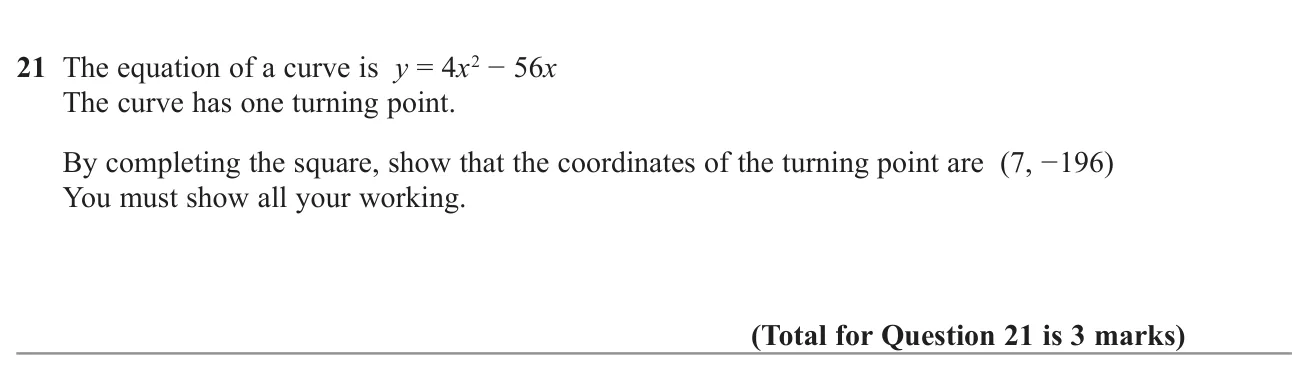
November 2022 · Paper 3 Higher · Q21
Complete the square to confirm the coordinates of a quadratic's turning point.

© Pearson Education Ltd. November 2022 Paper 3 (Higher, calculator), question 21.

Show answer
Answery=4(x−7)2−196y = 4(x - 7)^2 - 196, so the turning point is (7,−196)(7, -196)3 marks

Worked solution Checked against the mark scheme

y=4(x2−14x)y = 4(x^2 - 14x)

x2−14x=(x−7)2−49x^2 - 14x = (x - 7)^2 - 49

y=4((x−7)2−49)=4(x−7)2−196y = 4\left((x - 7)^2 - 49\right) = 4(x - 7)^2 - 196

The minimum is when x−7=0x - 7 = 0, so the turning point is (7,−196)(7, -196)

Watch out: Forgetting to multiply the −49-49 by 4.

Completing the square1 markGrade 7CalculatorHigher
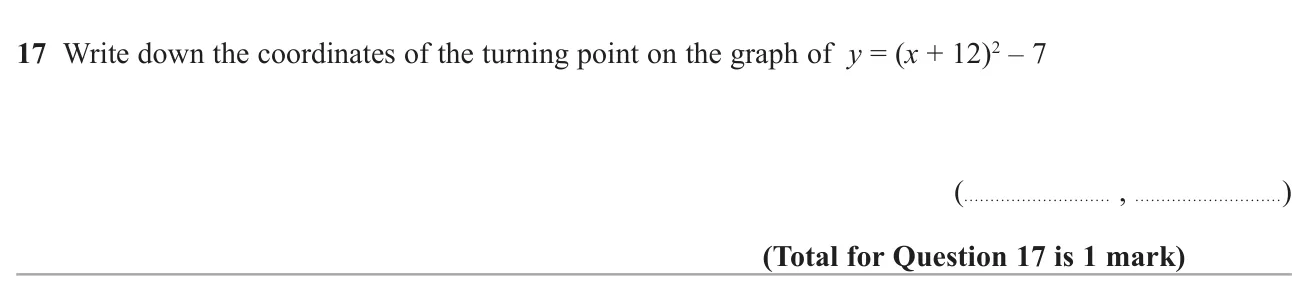
November 2020 · Paper 2 Higher · Q17
State the turning point of a quadratic graph given in completed-square form.

© Pearson Education Ltd. November 2020 Paper 2 (Higher, calculator), question 17.

Show answer
Answer(−12,−7)(-12, -7)1 mark

Worked solution Checked against the mark scheme

For y=(x+a)2+by = (x + a)^2 + b the turning point is (−a,b)(-a, b).

Here a=12a = 12 and b=−7b = -7, so the turning point is (−12,−7)(-12, -7).

Watch out: Giving (12,−7)(12, -7) by not changing the sign of the 12.

Completing the square3 marksGrade 7No calculatorHigher
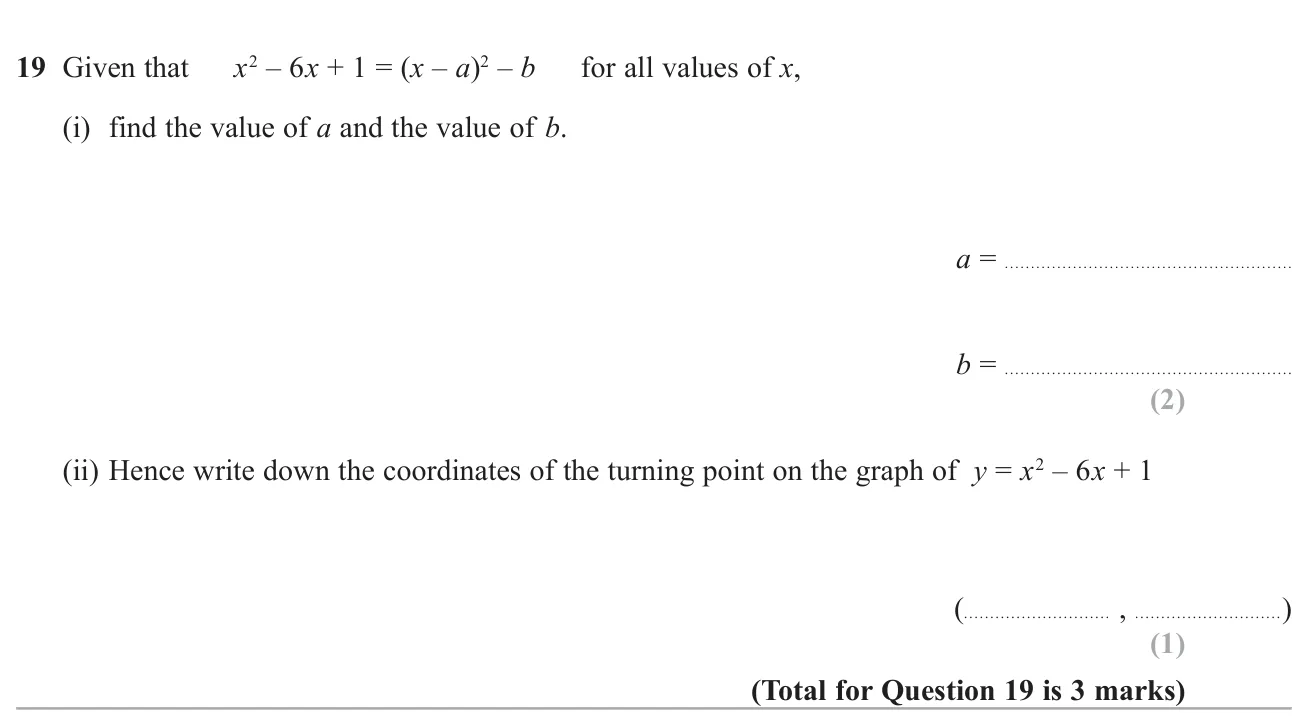
June 2019 · Paper 1 Higher · Q19
Complete the square on a quadratic, then use it to state the turning point of its graph.

© Pearson Education Ltd. June 2019 Paper 1 (Higher, non-calculator), question 19.

Show answer
((i))a=3, b=8a = 3,\ b = 82 marks
((ii))(3,−8)(3, -8)1 mark

Worked solution Checked against the mark scheme

(i) Halve −6-6 to get (x−3)2=x2−6x+9(x - 3)^2 = x^2 - 6x + 9.

x2−6x+1=(x−3)2−9+1=(x−3)2−8x^2 - 6x + 1 = (x - 3)^2 - 9 + 1 = (x - 3)^2 - 8, so a=3a = 3 and b=8b = 8.

(ii) The turning point is (a,−b)=(3,−8)(a, -b) = (3, -8).

Watch out: Giving b=−8b = -8 or a turning point of (−3,−8)(-3, -8).

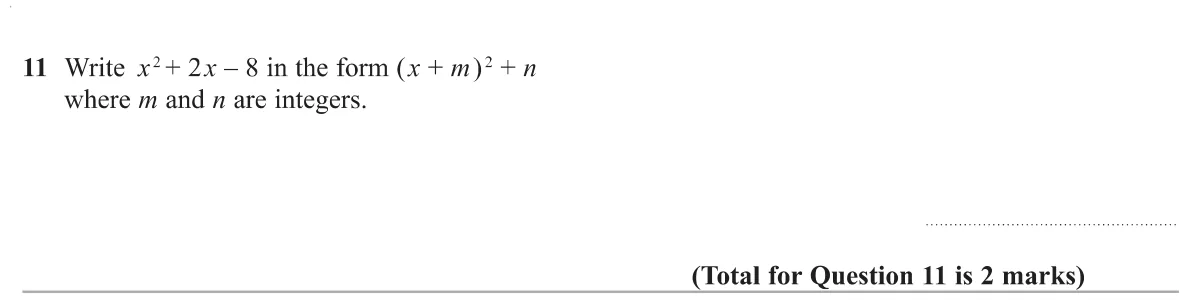
Completing the square2 marksGrade 7CalculatorHigher
Specimen · Paper 3 Higher · Q11
Complete the square on a quadratic expression to write it in the form (x + m)² + n.

© Pearson Education Ltd. Specimen Paper 3 (Higher, calculator), question 11.

Show answer
Answer(x+1)2−9(x + 1)^2 - 92 marks

Worked solution Checked against the mark scheme

Halve the xx coefficient: x2+2x=(x+1)2−1x^2 + 2x = (x + 1)^2 - 1

So x2+2x−8=(x+1)2−1−8=(x+1)2−9x^2 + 2x - 8 = (x + 1)^2 - 1 - 8 = (x + 1)^2 - 9

m=1m = 1, n=−9n = -9

Watch out: Writing (x + 1)² − 8, forgetting to subtract the 1.

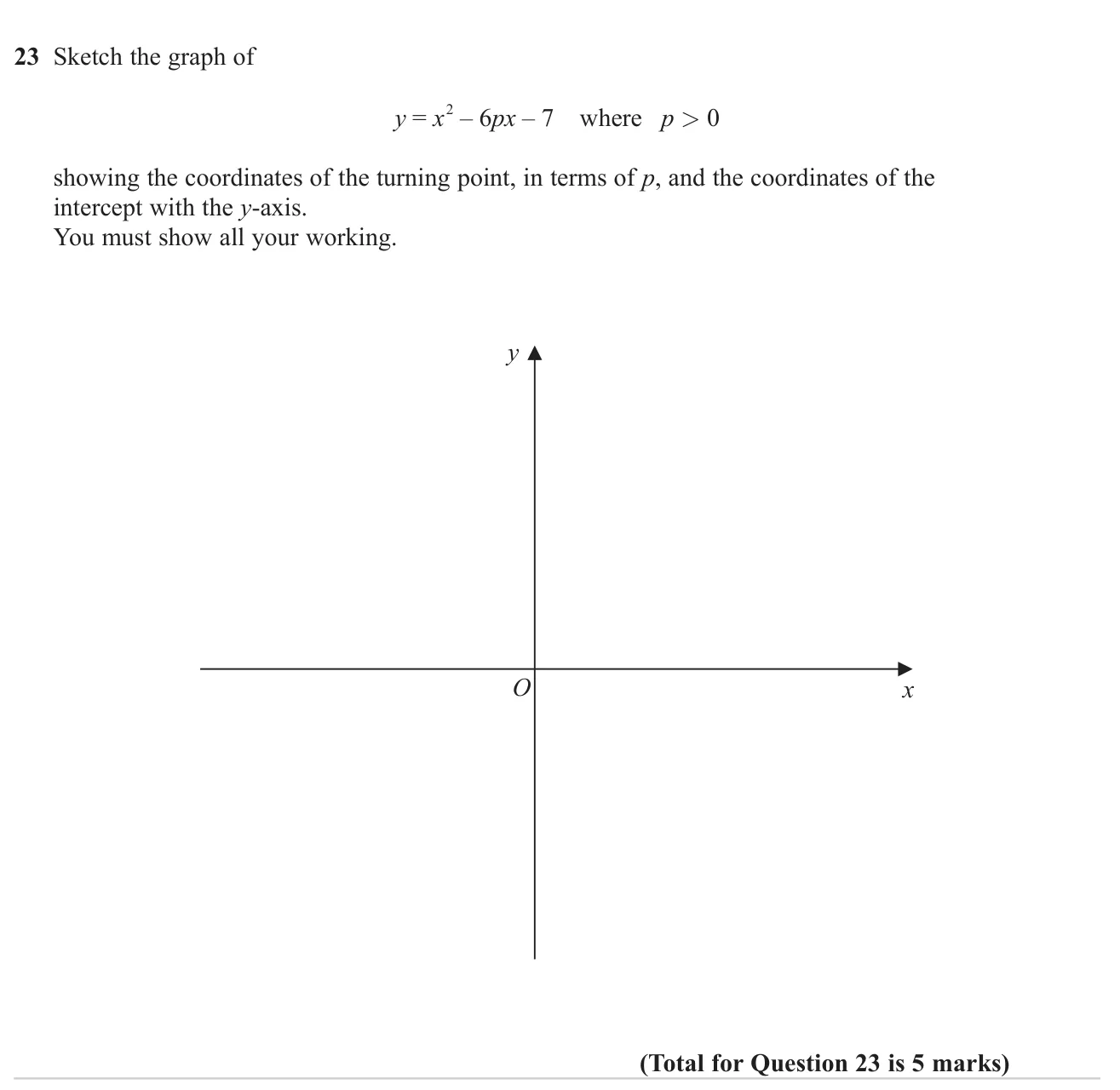
Completing the square5 marksGrade 8CalculatorHigher
November 2024 · Paper 3 Higher · Q23
Complete the square to find the turning point of a quadratic involving a constant p, then sketch it with its y-intercept.

© Pearson Education Ltd. November 2024 Paper 3 (Higher, calculator), question 23.

Show answer
AnswerU-shaped curve with minimum at (3p, −9p2−7)(3p,\ -9p^2 - 7) in the fourth quadrant and y-intercept (0,−7)(0, -7)5 marks

Worked solution Checked against the mark scheme

y=x2−6px−7=(x−3p)2−9p2−7y = x^2 - 6px - 7 = (x - 3p)^2 - 9p^2 - 7

Turning point (minimum): (3p, −9p2−7)(3p,\ -9p^2 - 7)

When x=0x = 0, y=−7y = -7, so the y-intercept is (0,−7)(0, -7).

Since p>0p > 0, 3p>03p > 0 and −9p2−7<0-9p^2 - 7 < 0: the minimum is in the fourth quadrant. Sketch a U-shape through (0,−7)(0, -7) with its lowest point there.

Watch out: Writing the turning point as (−3p, ...) by getting the sign in the bracket wrong.

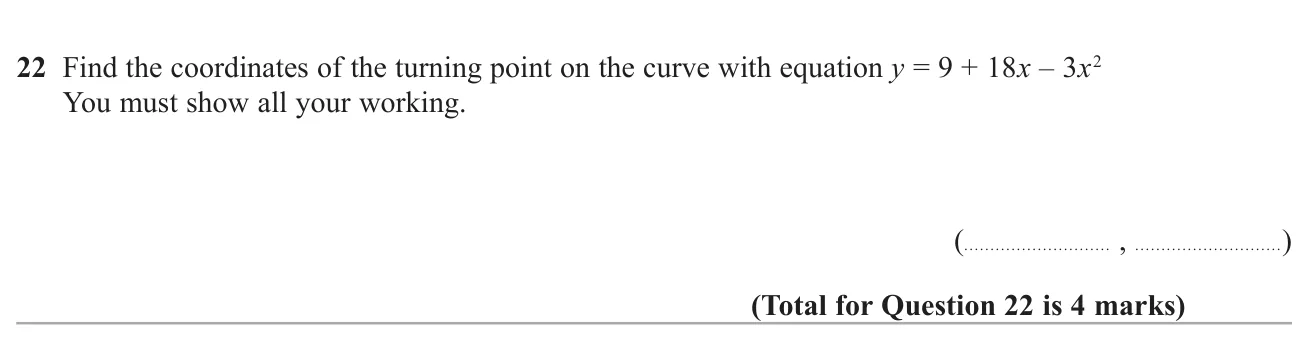
Completing the square4 marksGrade 8No calculatorHigher
November 2021 · Paper 1 Higher · Q22
Complete the square on a quadratic with a negative squared term to find its turning point.

© Pearson Education Ltd. November 2021 Paper 1 (Higher, non-calculator), question 22.

Show answer
Answer(3,36)(3, 36)4 marks

Worked solution Checked against the mark scheme

y=−3x2+18x+9=−3(x2−6x)+9y = -3x^2 + 18x + 9 = -3(x^2 - 6x) + 9

=−3[(x−3)2−9]+9= -3[(x - 3)^2 - 9] + 9

=−3(x−3)2+27+9=−3(x−3)2+36= -3(x - 3)^2 + 27 + 9 = -3(x - 3)^2 + 36

Turning point: (3,36)(3, 36)

Watch out: Forgetting to multiply the −9-9 by −3-3, giving (3,0)(3, 0).

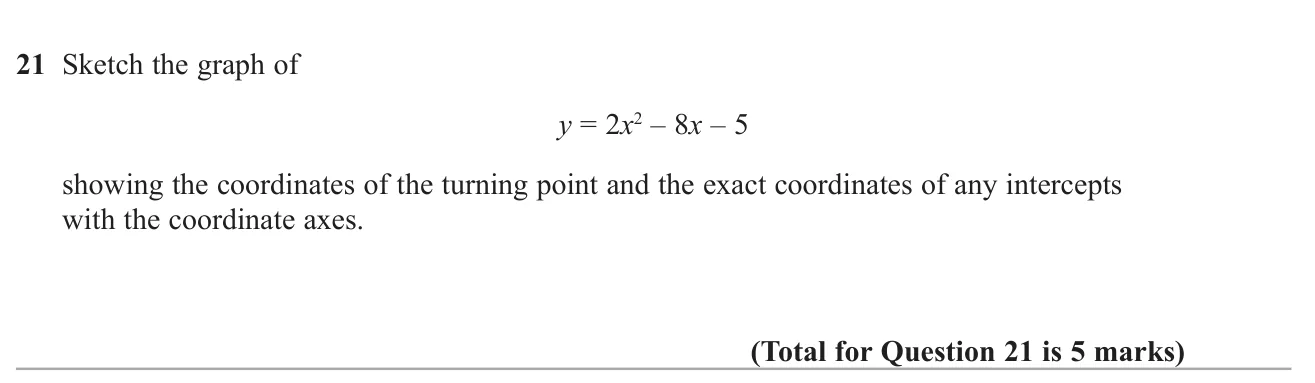
Completing the square5 marksGrade 8No calculatorHigher
November 2019 · Paper 1 Higher · Q21
Sketch a quadratic curve, labelling its turning point and the exact points where it meets the axes.

© Pearson Education Ltd. November 2019 Paper 1 (Higher, non-calculator), question 21.

Show answer
AnswerU-shaped curve with turning point (2,−13)(2, -13), yy-intercept (0,−5)(0, -5) and xx-intercepts (2±132,0)\left(2 \pm \sqrt{\frac{13}{2}}, 0\right)5 marks

Worked solution Checked against the mark scheme

yy-intercept: x=0x = 0 gives y=−5y = -5

Complete the square: 2x2−8x−5=2(x−2)2−8−5=2(x−2)2−132x^2 - 8x - 5 = 2(x - 2)^2 - 8 - 5 = 2(x-2)^2 - 13

Turning point: (2,−13)(2, -13)

xx-intercepts: 2(x−2)2=13⇒x=2±1322(x-2)^2 = 13 \Rightarrow x = 2 \pm \sqrt{\frac{13}{2}}

Sketch a U shape through these points.

Watch out: Forgetting to take out the factor of 2 before completing the square, giving (x − 4)².

Completing the square4 marksGrade 8No calculatorHigher
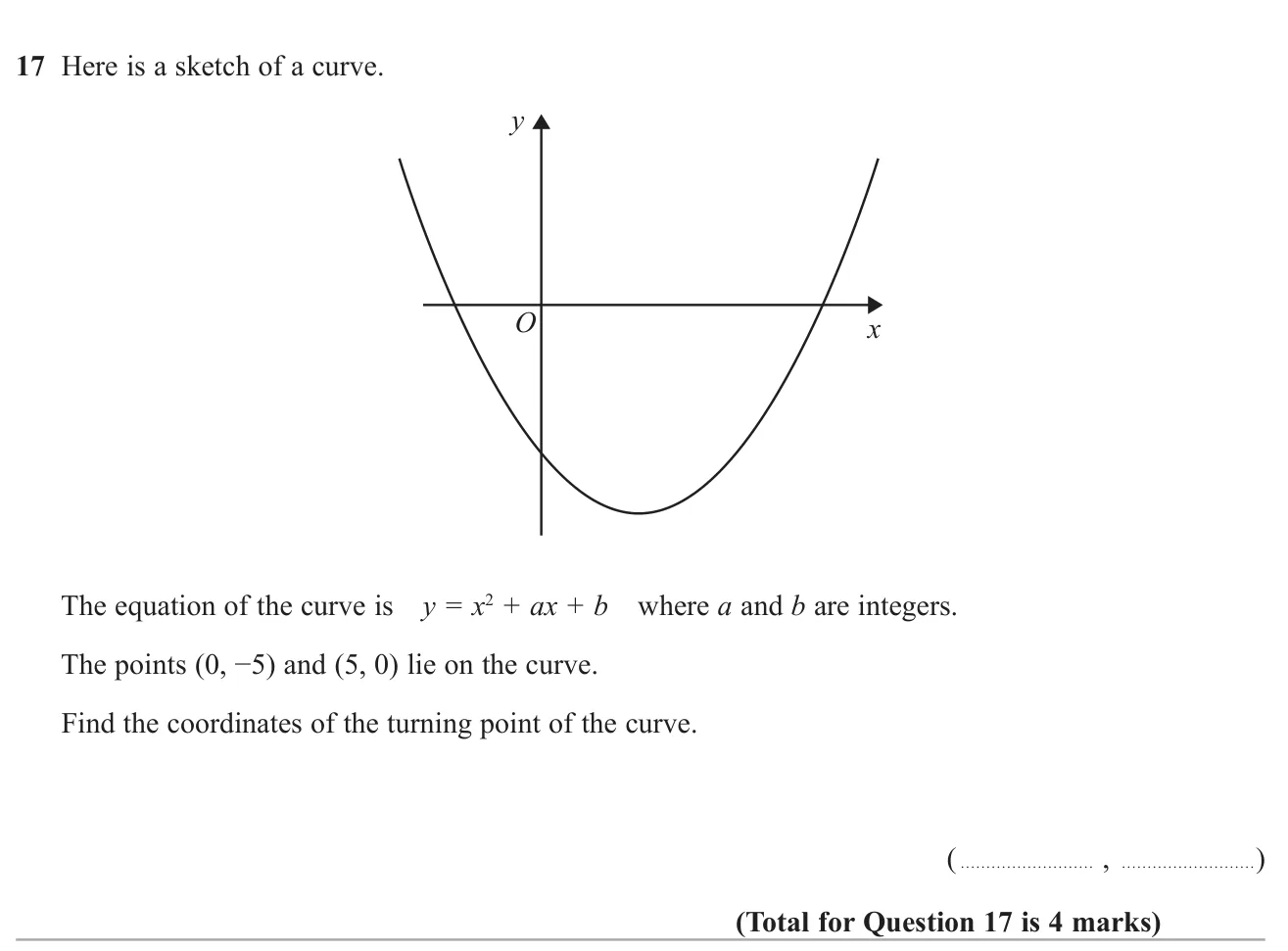
November 2018 · Paper 1 Higher · Q17
Use two points on a quadratic curve to find its equation, then find its turning point.

© Pearson Education Ltd. November 2018 Paper 1 (Higher, non-calculator), question 17.

Show answer
Answer(2,−9)(2, -9)4 marks

Worked solution Checked against the mark scheme

At (0,−5)(0, -5): b=−5b = -5

At (5,0)(5, 0): 0=25+5a−50 = 25 + 5a - 5, so a=−4a = -4

y=x2−4x−5=(x−2)2−9y = x^2 - 4x - 5 = (x - 2)^2 - 9

Turning point: (2,−9)(2, -9)

Watch out: Getting the sign of the x-coordinate wrong when completing the square.