Question 1
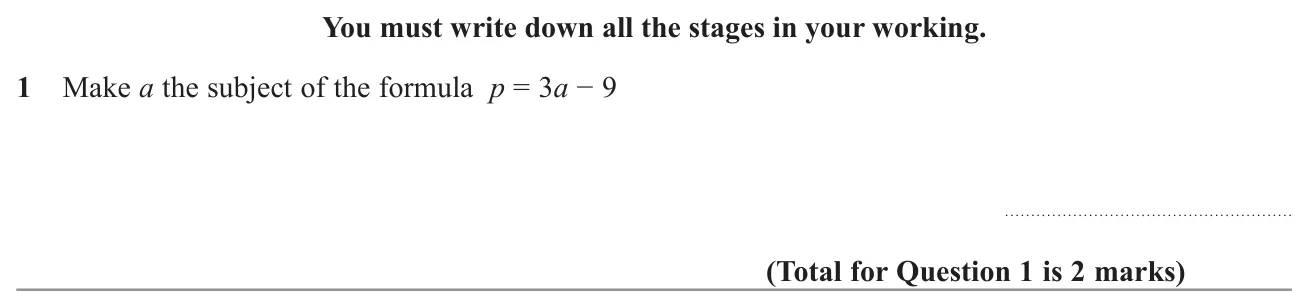
© Pearson Education Ltd. November 2022 Paper 3 (Higher, calculator), question 1.
Show answer
| Answer | 2 marks |
|---|
Worked solution Checked against the mark scheme
Add 9:
Divide by 3:
Watch out: Writing without brackets.
Edexcel GCSE Maths · 1MA1
Calculator · 26 questions · 80 marks · 1 hour 30 minutes. Try each question on paper, then press "Show answer".
© Pearson Education Ltd. November 2022 Paper 3 (Higher, calculator), question 1.
| Answer | 2 marks |
|---|
Worked solution Checked against the mark scheme
Add 9:
Divide by 3:
Watch out: Writing without brackets.
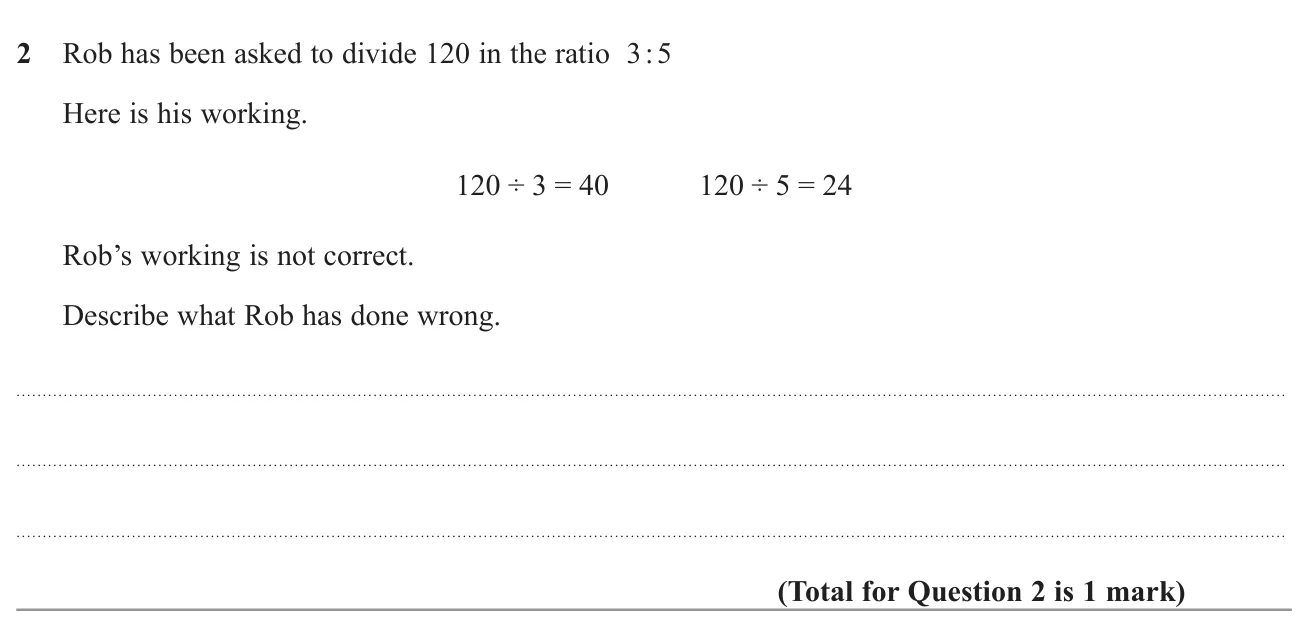
© Pearson Education Ltd. November 2022 Paper 3 (Higher, calculator), question 2.
| Answer | He should add the parts (3 + 5 = 8) and divide 120 by 8, not by 3 and by 5 | 1 mark |
|---|
Worked solution Checked against the mark scheme
The ratio 3 : 5 has parts.
One part , giving and .
Rob divided by 3 and by 5 separately instead of by 8.
Watch out: Just giving the correct answer (45 : 75) without saying what went wrong.
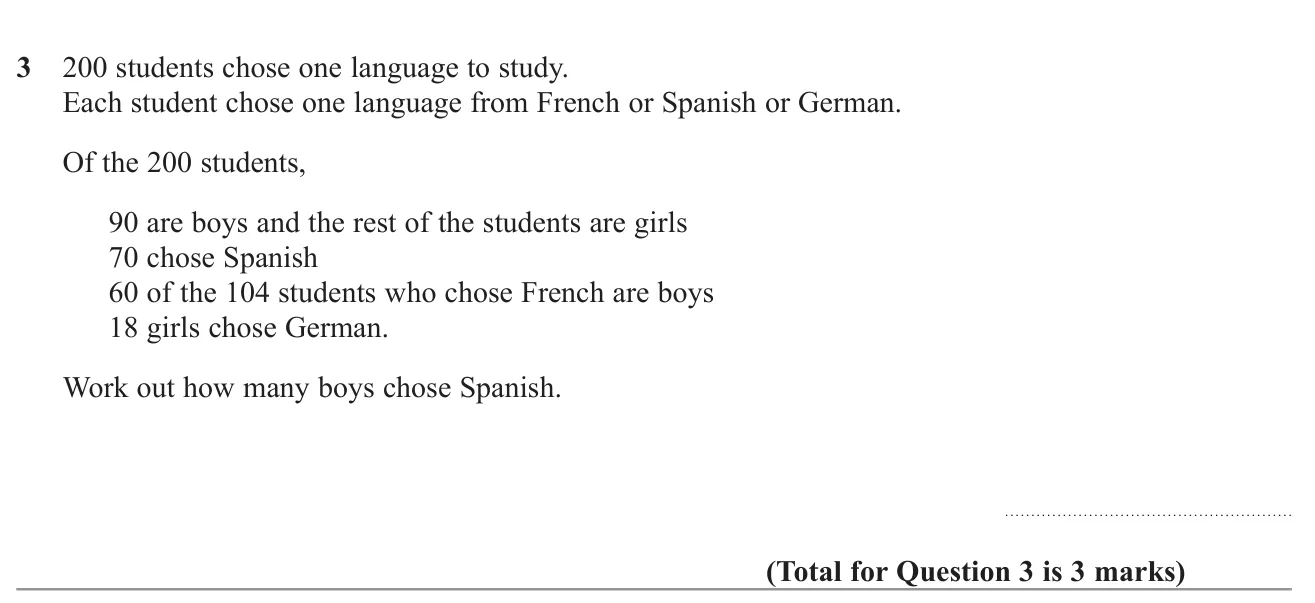
© Pearson Education Ltd. November 2022 Paper 3 (Higher, calculator), question 3.
| Answer | 22 | 3 marks |
|---|
Worked solution Checked against the mark scheme
German: , so boys choosing German
Boys: 90, of which 60 chose French and 8 chose German.
Boys choosing Spanish
Watch out: Forgetting to subtract the girls who chose German from the German total.
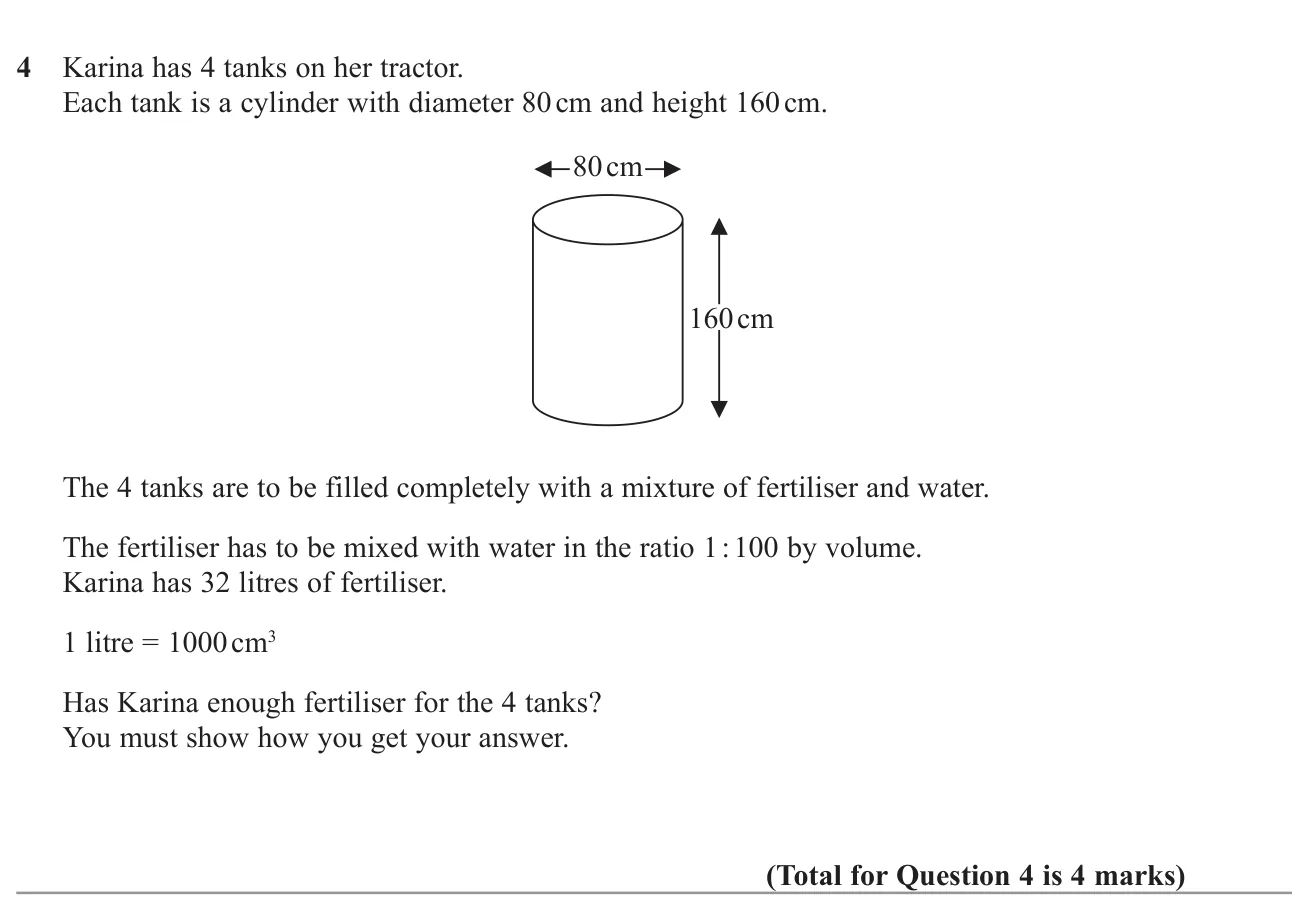
© Pearson Education Ltd. November 2022 Paper 3 (Higher, calculator), question 4.
| Answer | Yes: about 31.85 litres of fertiliser are needed and she has 32 | 4 marks |
|---|
Worked solution Checked against the mark scheme
One tank:
Four tanks: litres
Fertiliser is 1 part in 101: litres
, so yes, she has enough.
Watch out: Dividing by 100 instead of 101, or using the diameter as the radius.
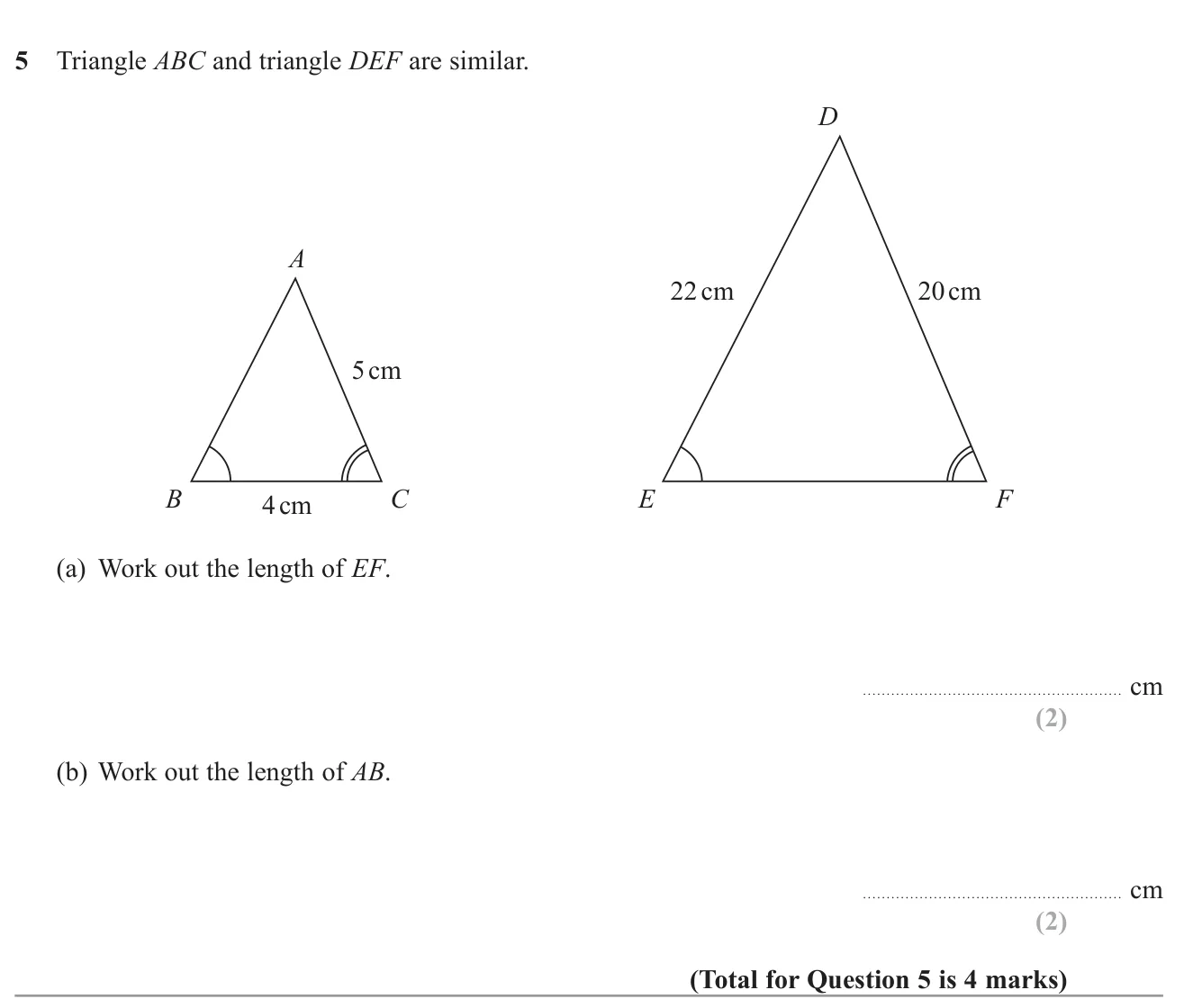
© Pearson Education Ltd. November 2022 Paper 3 (Higher, calculator), question 5.
| (a) | 16 cm | 2 marks |
|---|---|---|
| (b) | 5.5 cm | 2 marks |
Worked solution Checked against the mark scheme
AC = 5 matches DF = 20, so the scale factor is .
(a) EF matches BC: cm
(b) AB matches DE: cm
Watch out: Matching the wrong sides, e.g. pairing 5 cm with 22 cm.
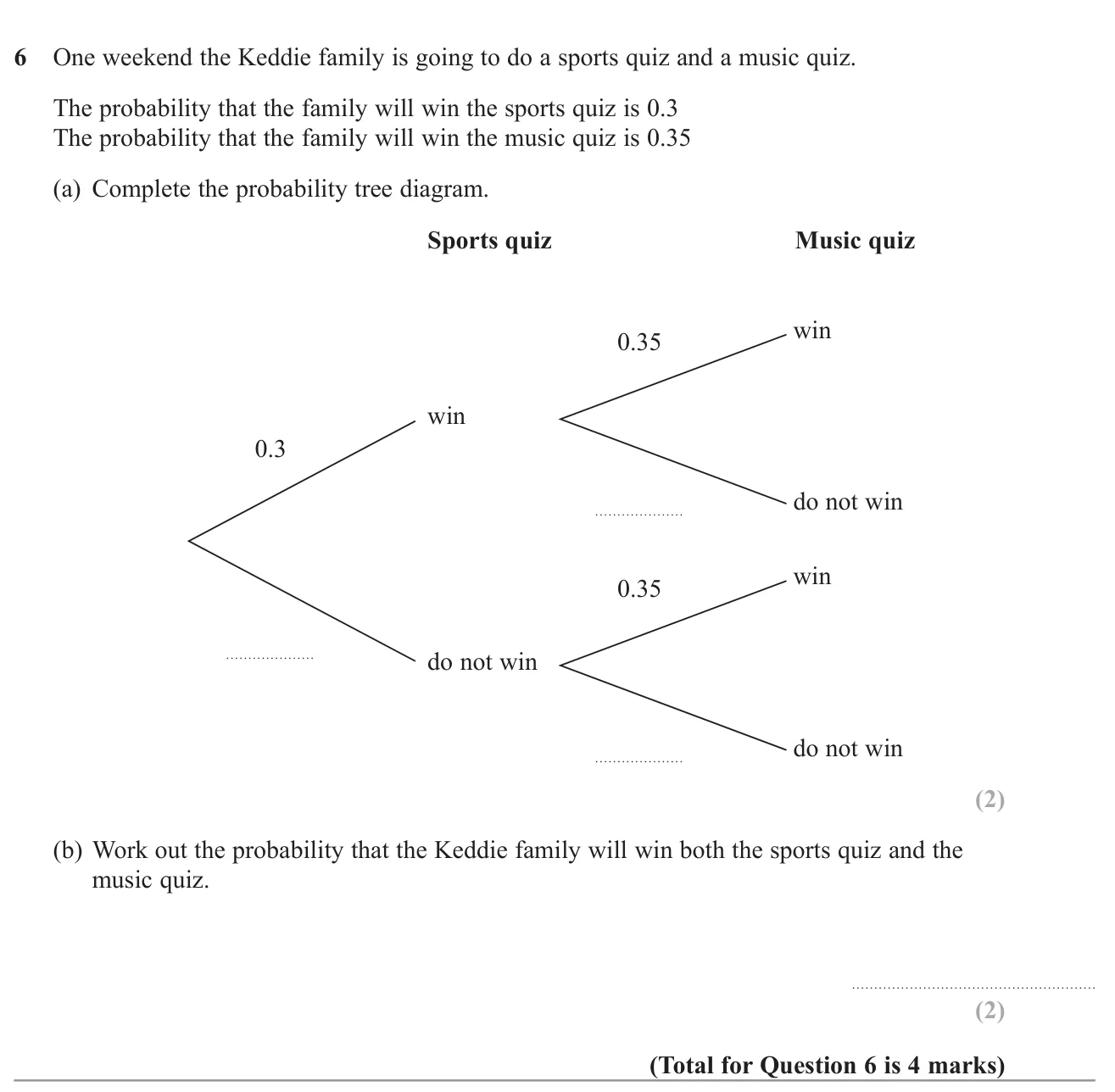
© Pearson Education Ltd. November 2022 Paper 3 (Higher, calculator), question 6.
| (a) | 0.7 on the first branch; 0.65 on both second 'do not win' branches | 2 marks |
|---|---|---|
| (b) | 0.105 | 2 marks |
Worked solution Checked against the mark scheme
(a) Not winning the sports quiz: . Not winning the music quiz: on both pairs of branches.
(b)
Watch out: Adding the probabilities (0.65) instead of multiplying.
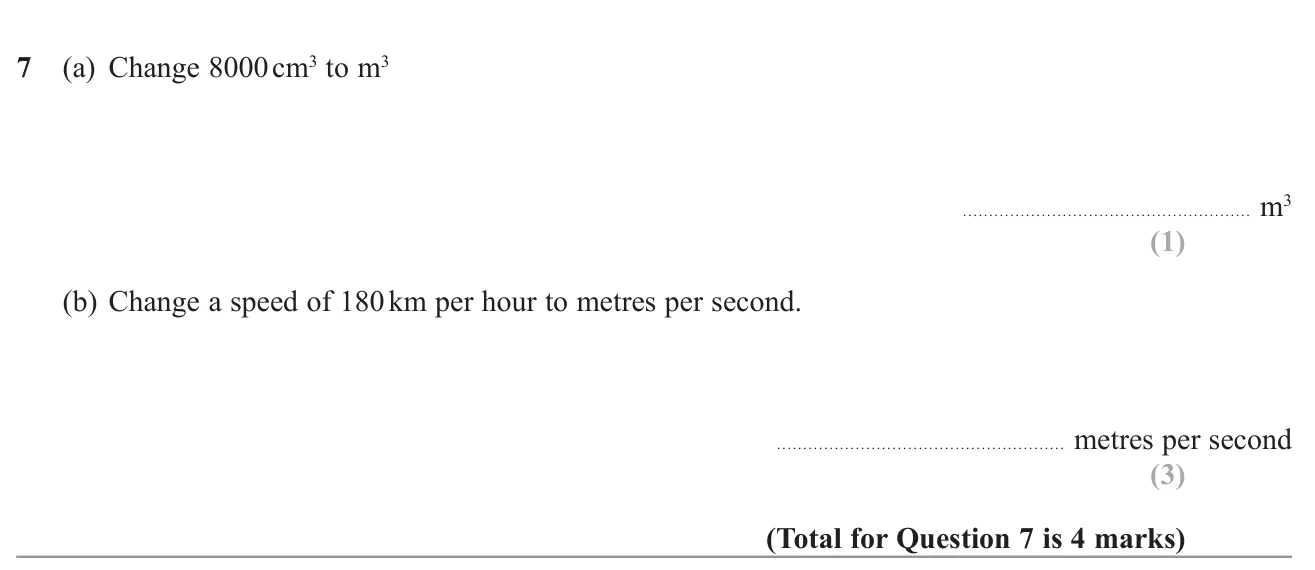
© Pearson Education Ltd. November 2022 Paper 3 (Higher, calculator), question 7.
| (a) | 0.008 m³ | 1 mark |
|---|---|---|
| (b) | 50 m/s | 3 marks |
Worked solution Checked against the mark scheme
(a) , so
(b) km m, and 1 hour s
m/s
Watch out: Dividing by 100 in (a) instead of by 1 000 000.
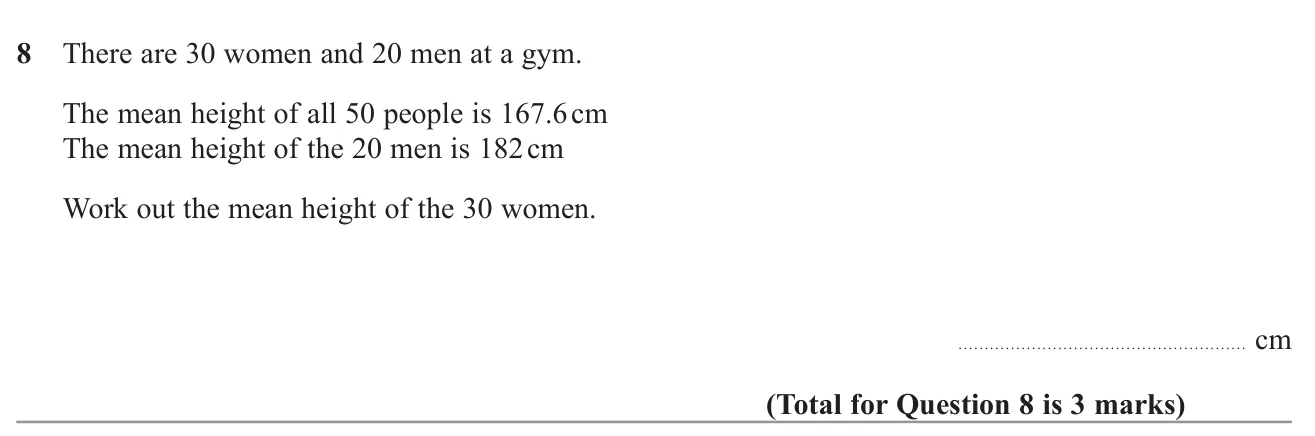
© Pearson Education Ltd. November 2022 Paper 3 (Higher, calculator), question 8.
| Answer | 158 cm | 3 marks |
|---|
Worked solution Checked against the mark scheme
Total for everyone: cm
Total for men: cm
Women: cm
Watch out: Averaging the two means, e.g. working out .
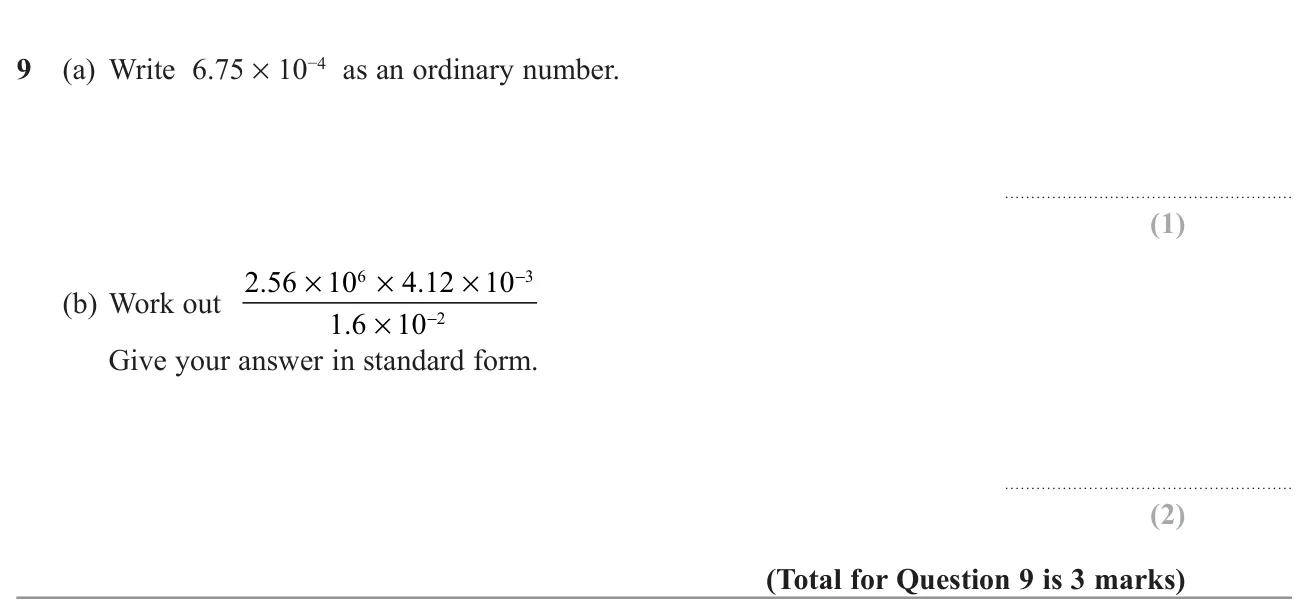
© Pearson Education Ltd. November 2022 Paper 3 (Higher, calculator), question 9.
| (a) | 0.000675 | 1 mark |
|---|---|---|
| (b) | 2 marks |
Worked solution Checked against the mark scheme
(a) Move the decimal point 4 places left: 0.000675
(b)
Watch out: Leaving the answer as 659 200 or as .
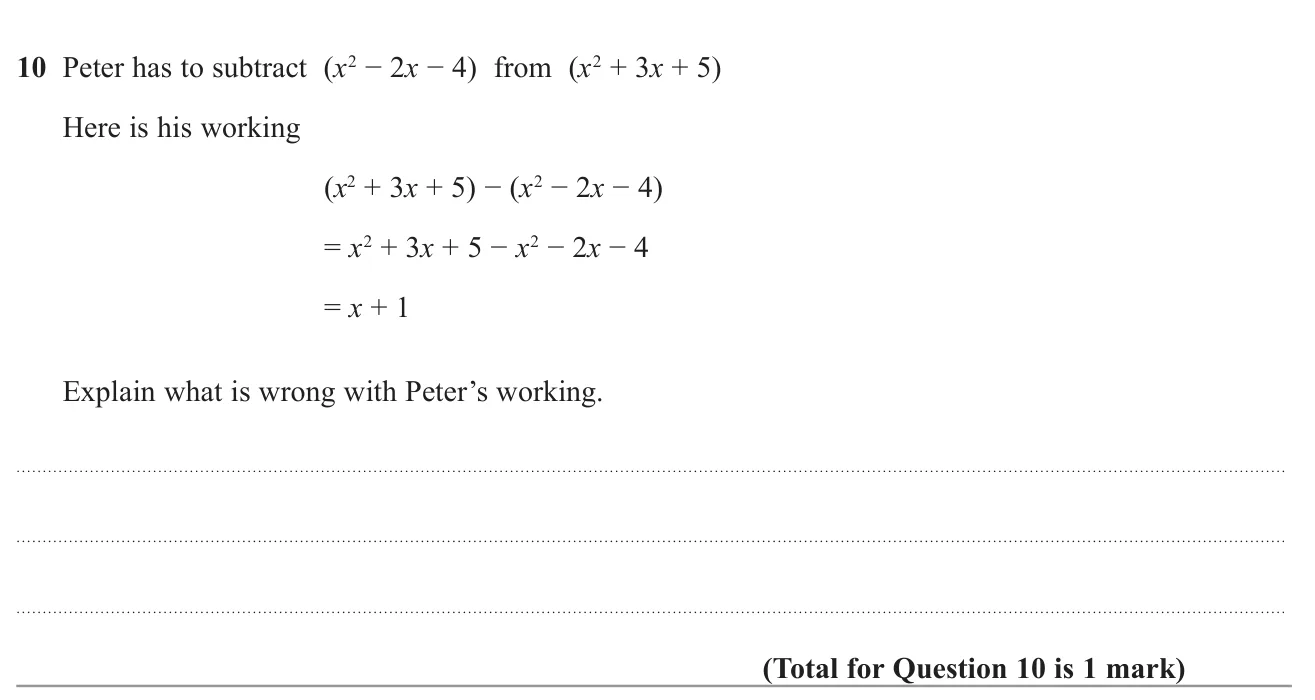
© Pearson Education Ltd. November 2022 Paper 3 (Higher, calculator), question 10.
| Answer | When removing the second bracket the signs should change: it should be , giving | 1 mark |
|---|
Worked solution Checked against the mark scheme
Subtracting a bracket changes the sign of every term inside it:
So the answer should be . Peter kept .
Watch out: Only changing the sign of the first term inside the bracket.
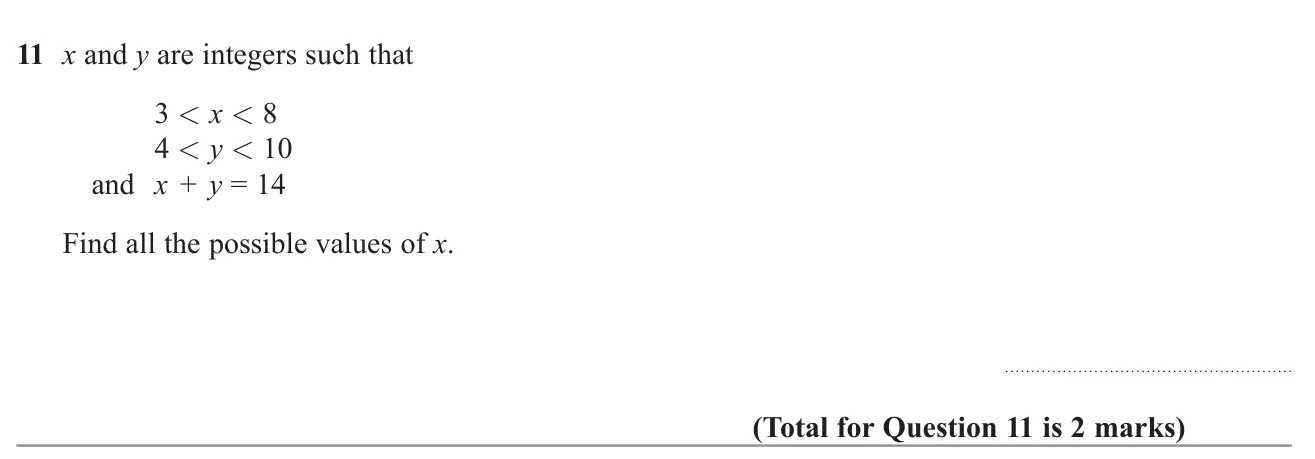
© Pearson Education Ltd. November 2022 Paper 3 (Higher, calculator), question 11.
| Answer | 5, 6, 7 | 2 marks |
|---|
Worked solution Checked against the mark scheme
Possible x: 4, 5, 6, 7. Possible y: 5, 6, 7, 8, 9
: x = 4 gives y = 10 (not allowed); x = 5, 6, 7 give y = 9, 8, 7 (all allowed)
So x = 5, 6 or 7
Watch out: Including 4, or including the endpoints 3 and 8 from the strict inequalities.
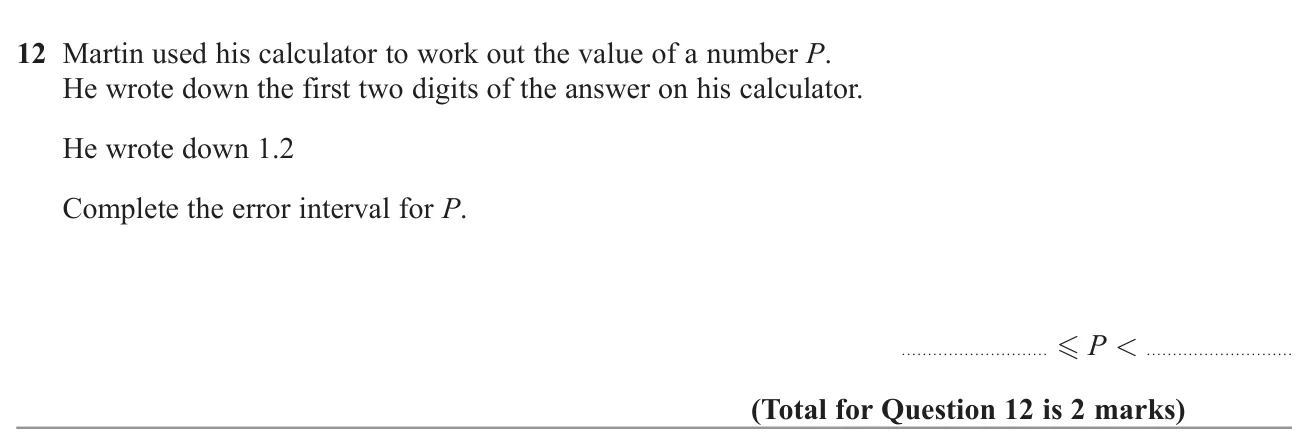
© Pearson Education Ltd. November 2022 Paper 3 (Higher, calculator), question 12.
| Answer | 2 marks |
|---|
Worked solution Checked against the mark scheme
Martin wrote down the first two digits, so he truncated rather than rounded.
Any number from 1.2 up to (but not including) 1.3 would show as 1.2
Watch out: Treating it as rounding and giving .
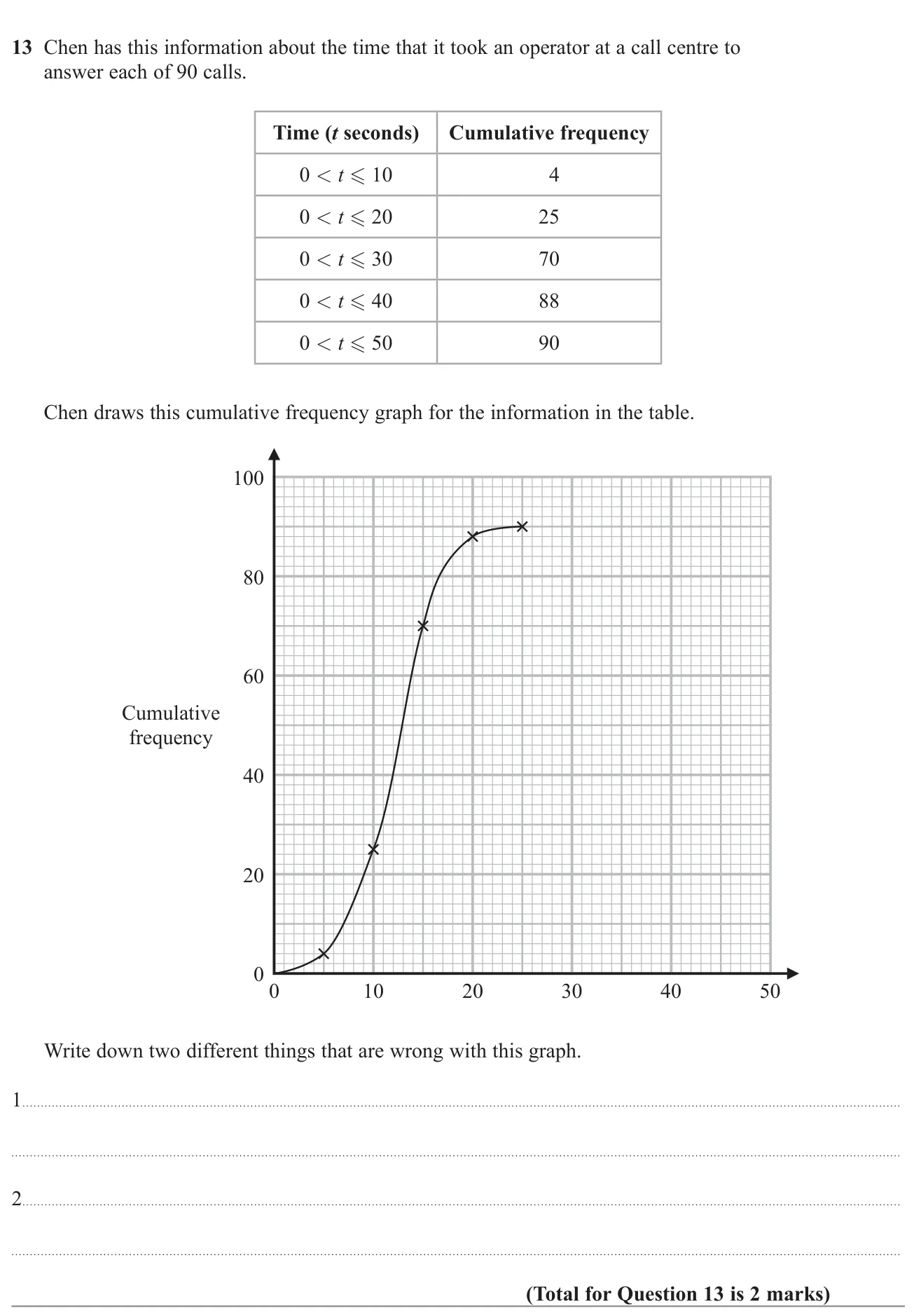
© Pearson Education Ltd. November 2022 Paper 3 (Higher, calculator), question 13.
| Answer | 1. The horizontal axis has no label. 2. The points are plotted at the middle of each class instead of at the upper end | 2 marks |
|---|
Worked solution Checked against the mark scheme
Check the axes: the time axis has no label (it should say time in seconds).
Check the points: cumulative frequency is plotted at the upper end of each class (10, 20, 30, …), but these are plotted at 5, 15, 25, …
Watch out: Saying the curve should be joined with straight lines, which is not wrong.
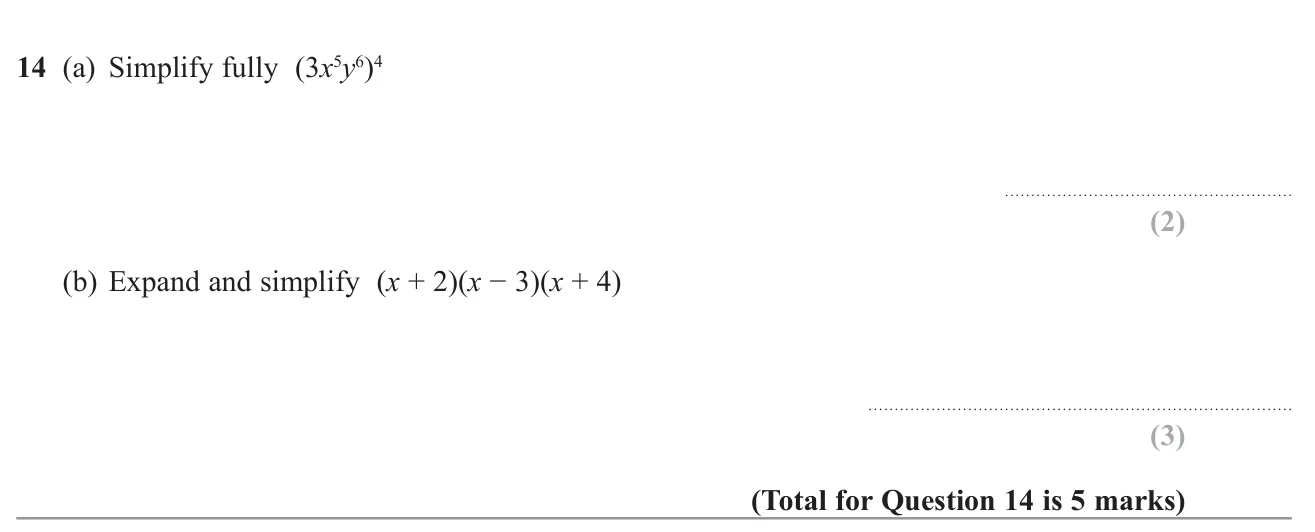
© Pearson Education Ltd. November 2022 Paper 3 (Higher, calculator), question 14.
| (a) | 2 marks | |
|---|---|---|
| (b) | 3 marks |
Worked solution Checked against the mark scheme
(a) , , , so
(b)
Watch out: In (a), adding the powers () or leaving 3 as .
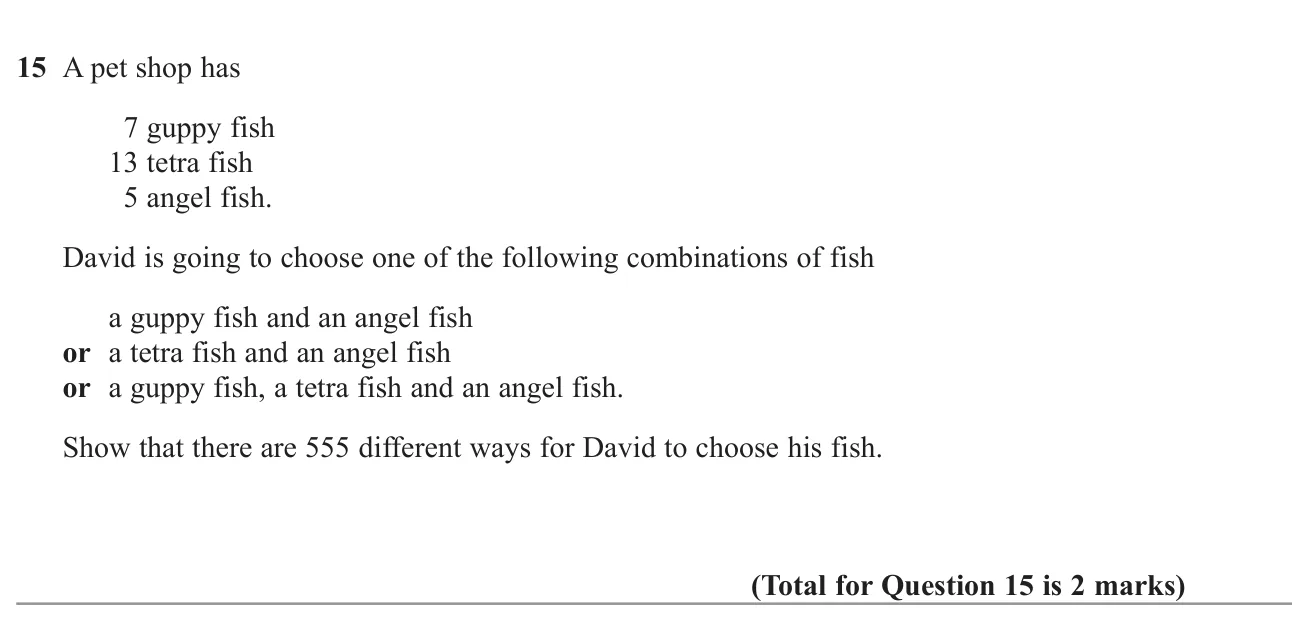
© Pearson Education Ltd. November 2022 Paper 3 (Higher, calculator), question 15.
| Answer | 2 marks |
|---|
Worked solution Checked against the mark scheme
Guppy and angel:
Tetra and angel:
Guppy, tetra and angel:
Total:
Watch out: Adding the numbers of fish instead of multiplying them.
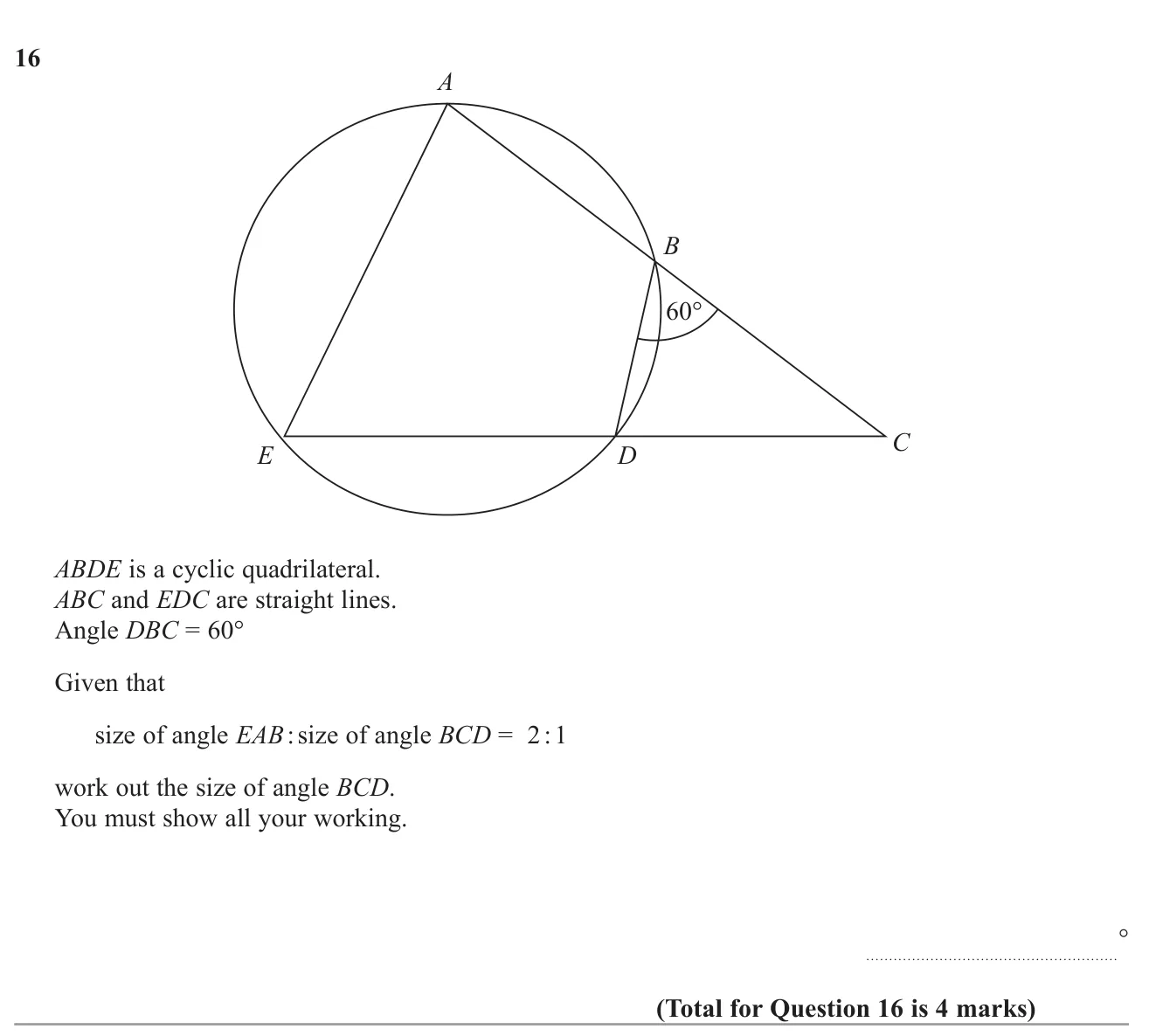
© Pearson Education Ltd. November 2022 Paper 3 (Higher, calculator), question 16.
| Answer | 4 marks |
|---|
Worked solution Checked against the mark scheme
Let angle , so angle .
Opposite angles of a cyclic quadrilateral add to , so angle , and angle (angles on a straight line).
Triangle : , so and
Watch out: Assuming angle BDC equals angle DBC without a reason.
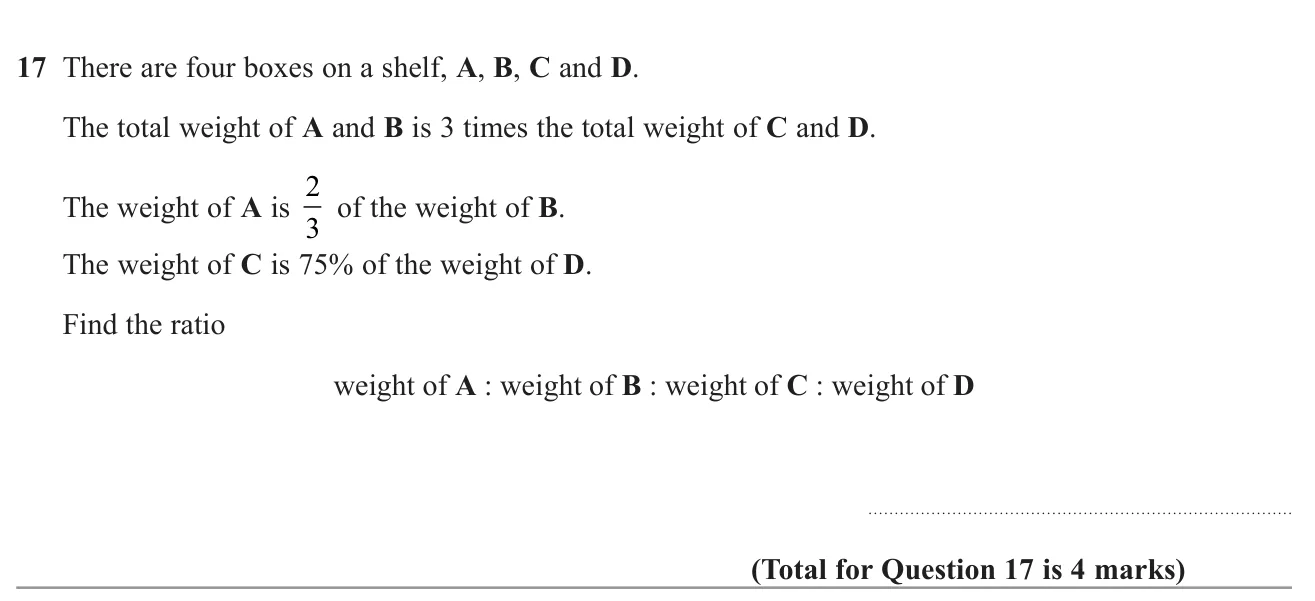
© Pearson Education Ltd. November 2022 Paper 3 (Higher, calculator), question 17.
| Answer | 42 : 63 : 15 : 20 | 4 marks |
|---|
Worked solution Checked against the mark scheme
and (75% = )
Let , , , . Then , so : take ,
Check:
Watch out: Writing C : D as 75 : 100 and not scaling both pairs so the 3-times rule holds.
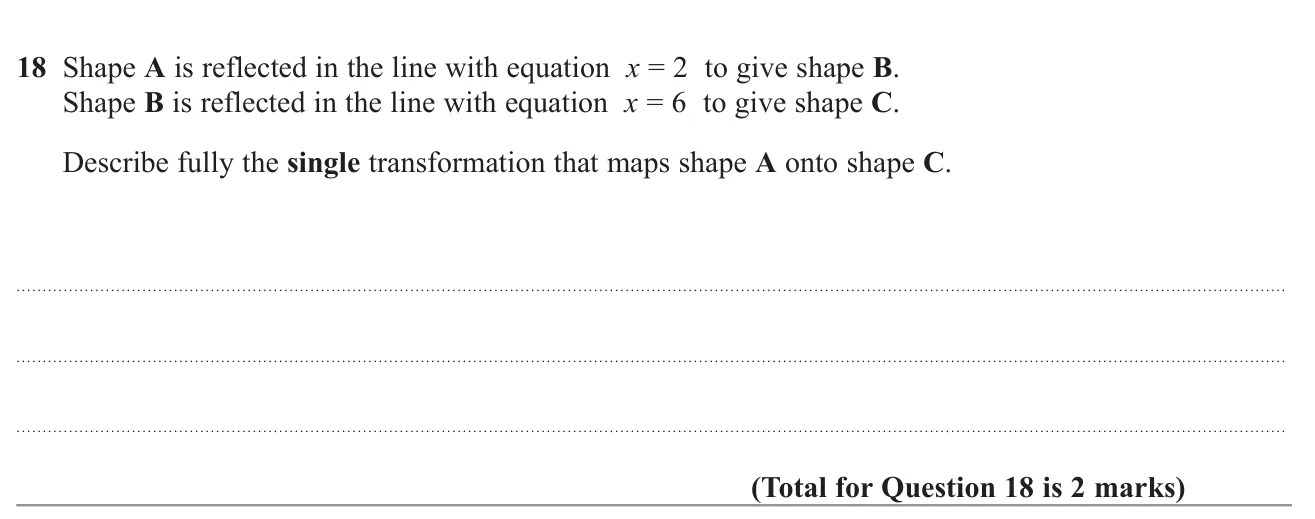
© Pearson Education Ltd. November 2022 Paper 3 (Higher, calculator), question 18.
| Answer | Translation by | 2 marks |
|---|
Worked solution Checked against the mark scheme
Reflecting in two parallel lines gives a translation.
The distance moved is twice the gap between the lines: units to the right.
Translation by
Watch out: Giving the vector as , the gap between the lines.
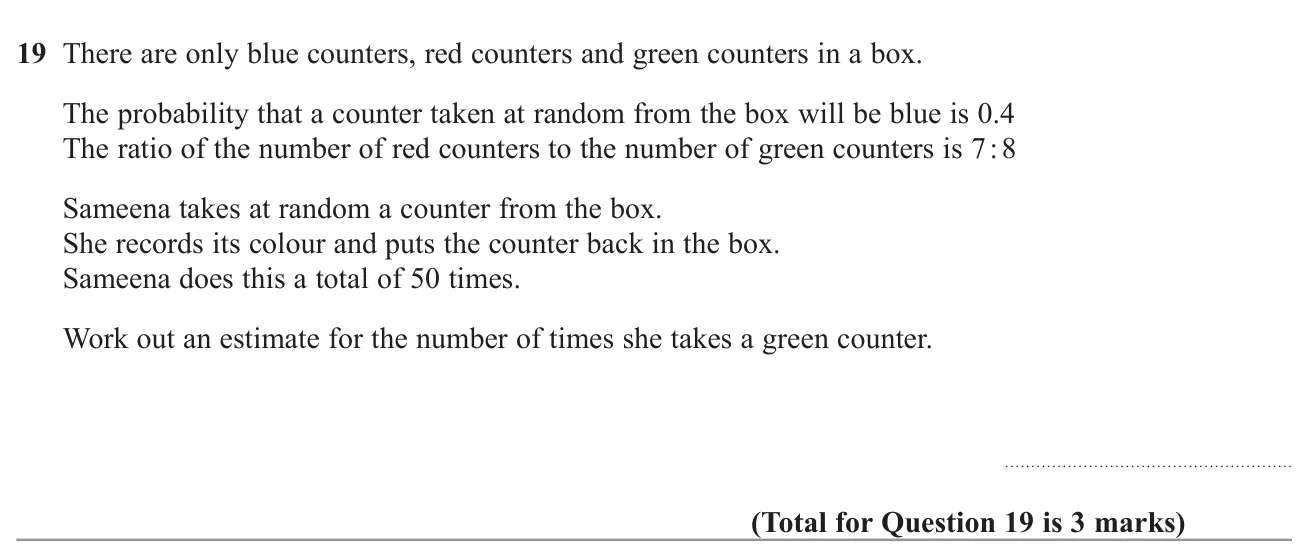
© Pearson Education Ltd. November 2022 Paper 3 (Higher, calculator), question 19.
| Answer | 16 | 3 marks |
|---|
Worked solution Checked against the mark scheme
P(red or green)
Green is of that:
Expected greens:
Watch out: Using or of the whole box, ignoring the blue counters.
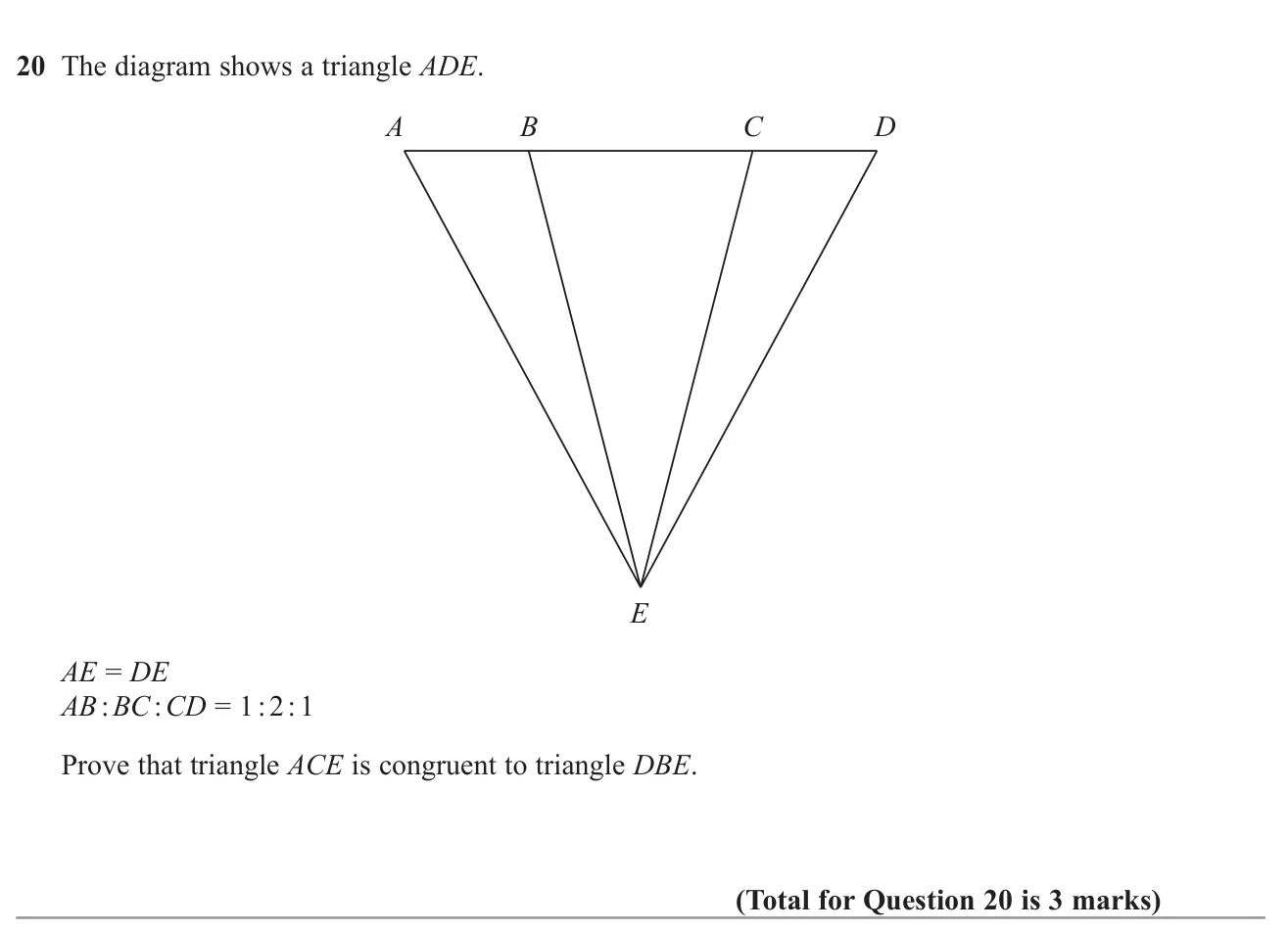
© Pearson Education Ltd. November 2022 Paper 3 (Higher, calculator), question 20.
| Answer | Congruent by SAS: , angle = angle , | 3 marks |
|---|
Worked solution Checked against the mark scheme
(given).
Triangle is isosceles, so angle = angle (base angles).
Using the ratio, parts and parts, so .
Two sides and the included angle match, so the triangles are congruent (SAS).
Watch out: Using AAA, which does not prove congruence.
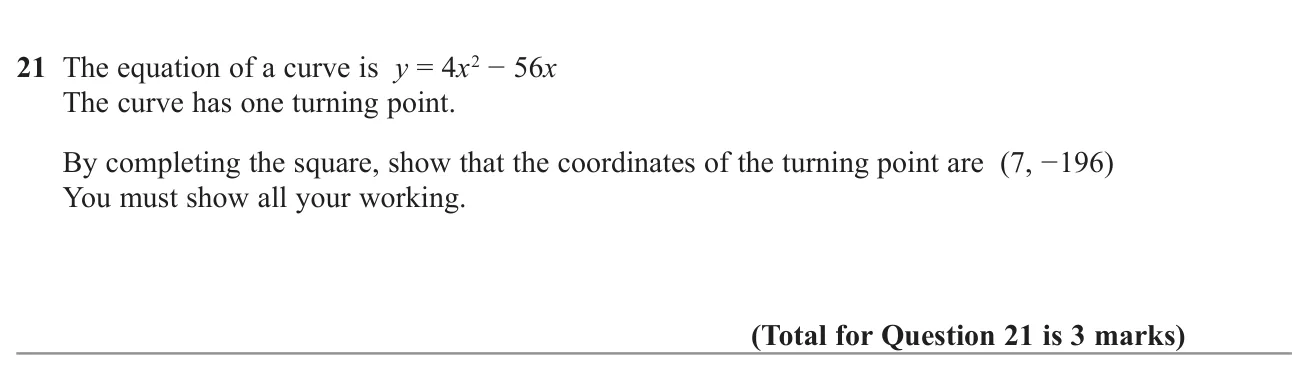
© Pearson Education Ltd. November 2022 Paper 3 (Higher, calculator), question 21.
| Answer | , so the turning point is | 3 marks |
|---|
Worked solution Checked against the mark scheme
The minimum is when , so the turning point is
Watch out: Forgetting to multiply the by 4.
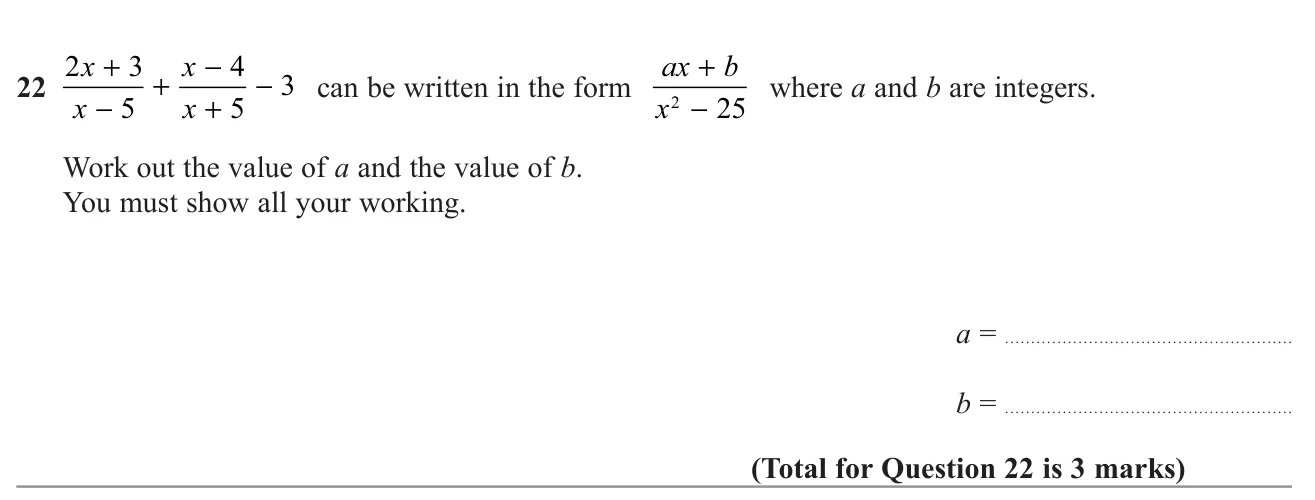
© Pearson Education Ltd. November 2022 Paper 3 (Higher, calculator), question 22.
| Answer | , | 3 marks |
|---|
Worked solution Checked against the mark scheme
Common denominator:
Numerator:
So and
Watch out: Writing as over 1 without multiplying it by .
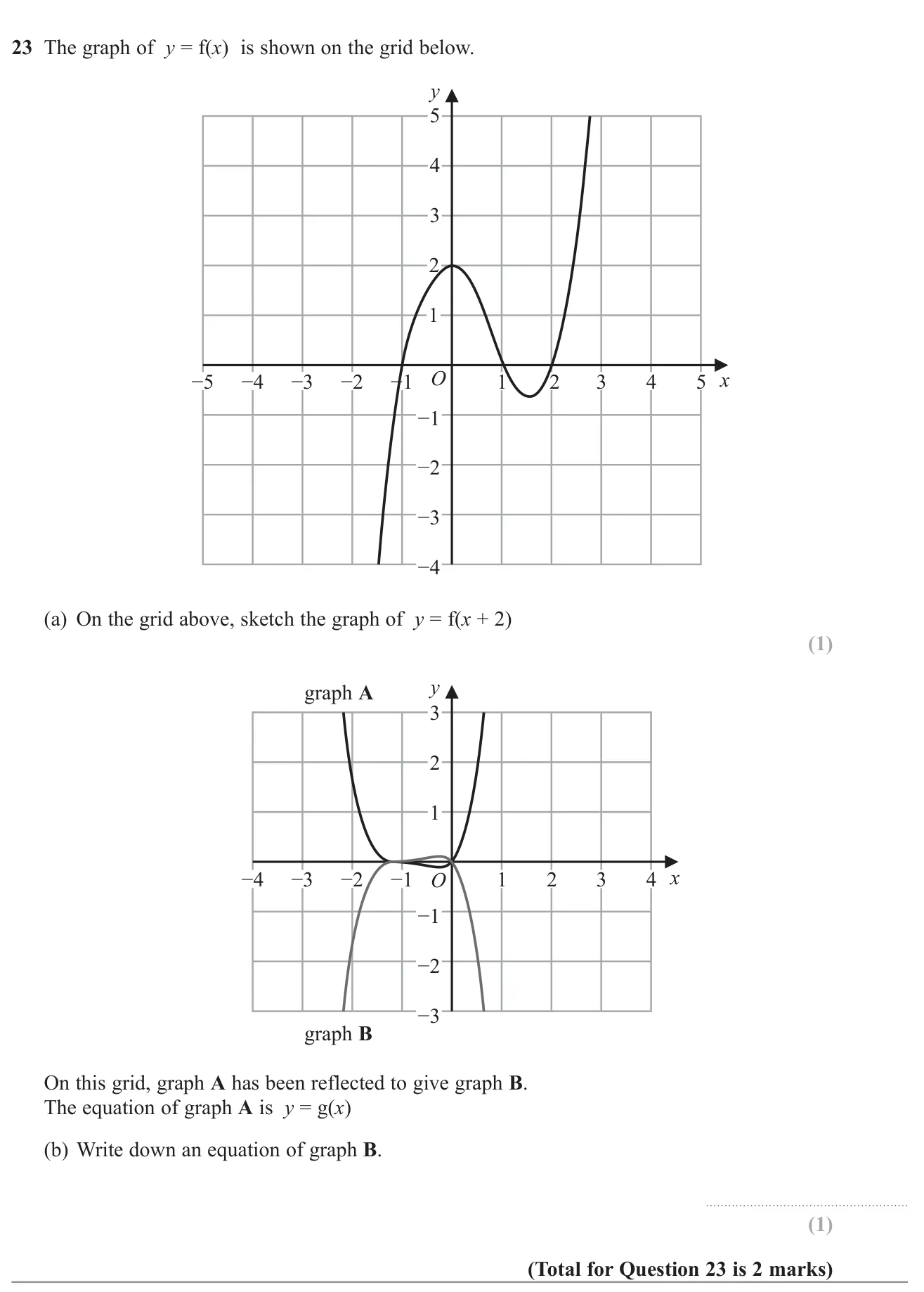
© Pearson Education Ltd. November 2022 Paper 3 (Higher, calculator), question 23.
| (a) | The curve moved 2 units left: crossing the x-axis at , and , with a maximum at | 1 mark |
|---|---|---|
| (b) | 1 mark |
Worked solution Checked against the mark scheme
(a) moves the graph 2 units to the left. The roots become and the peak at moves to .
(b) Graph B is graph A flipped in the x-axis, so each y-value changes sign:
Watch out: In (a), moving the graph 2 units to the right.
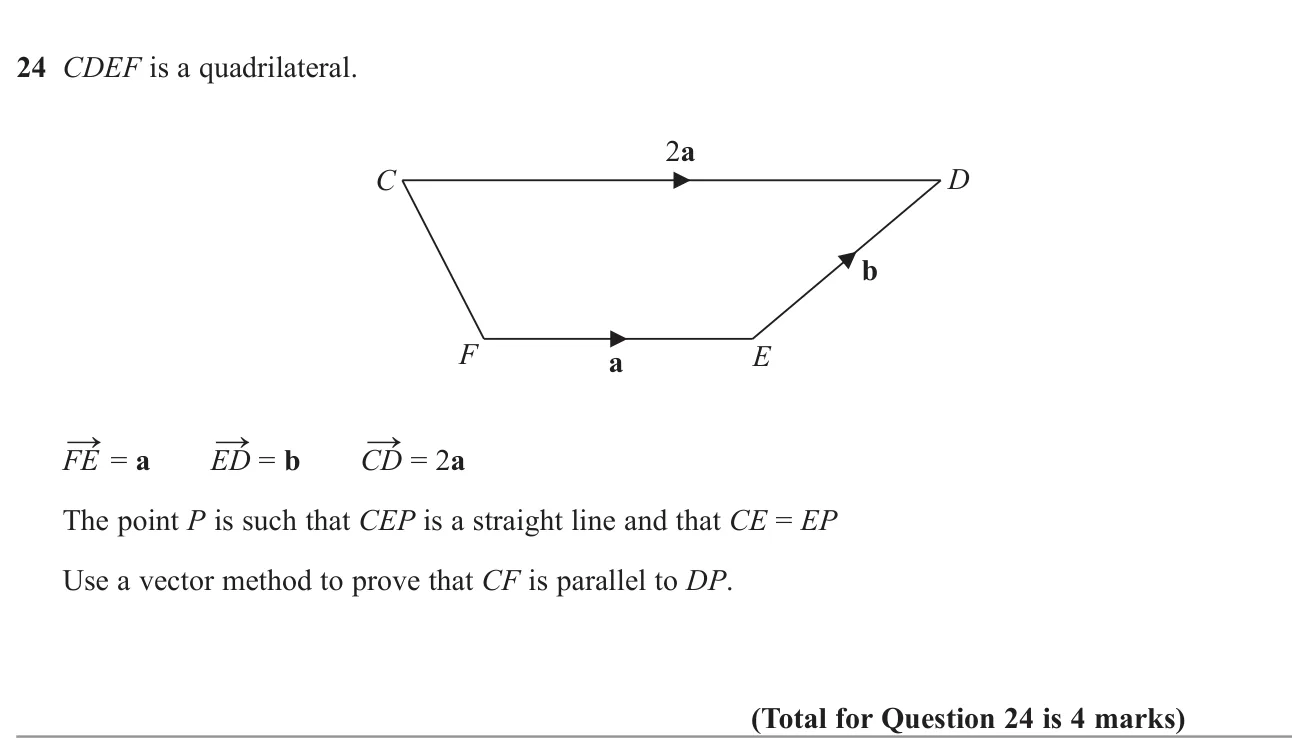
© Pearson Education Ltd. November 2022 Paper 3 (Higher, calculator), question 24.
| Answer | and , so they are parallel | 4 marks |
|---|
Worked solution Checked against the mark scheme
, so
, so CF is parallel to DP
Watch out: Getting the sign wrong on (it is ).
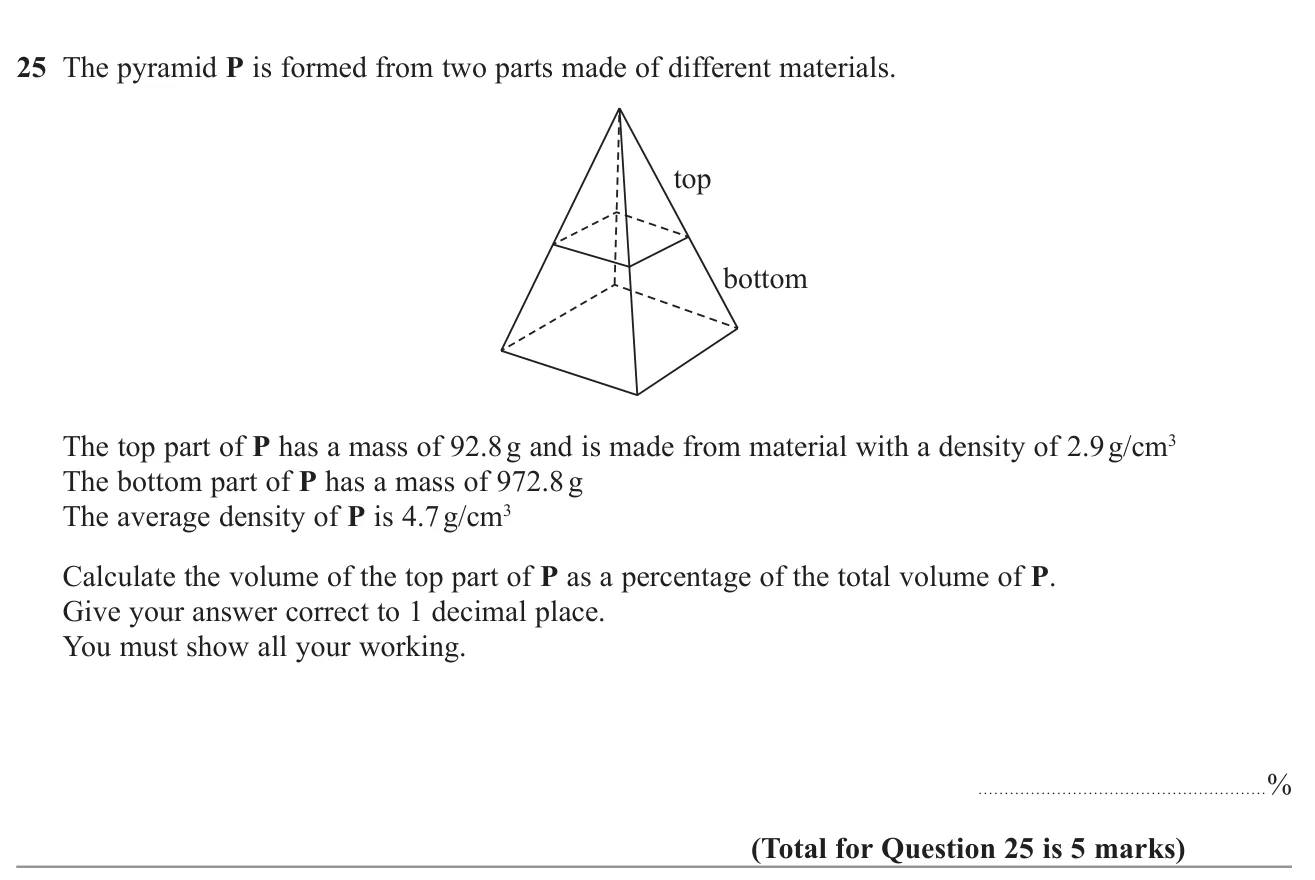
© Pearson Education Ltd. November 2022 Paper 3 (Higher, calculator), question 25.
| Answer | 14.1% | 5 marks |
|---|
Worked solution Checked against the mark scheme
Top volume:
Total mass: g
Total volume:
Percentage:
Watch out: Using only the bottom part's mass with the average density.
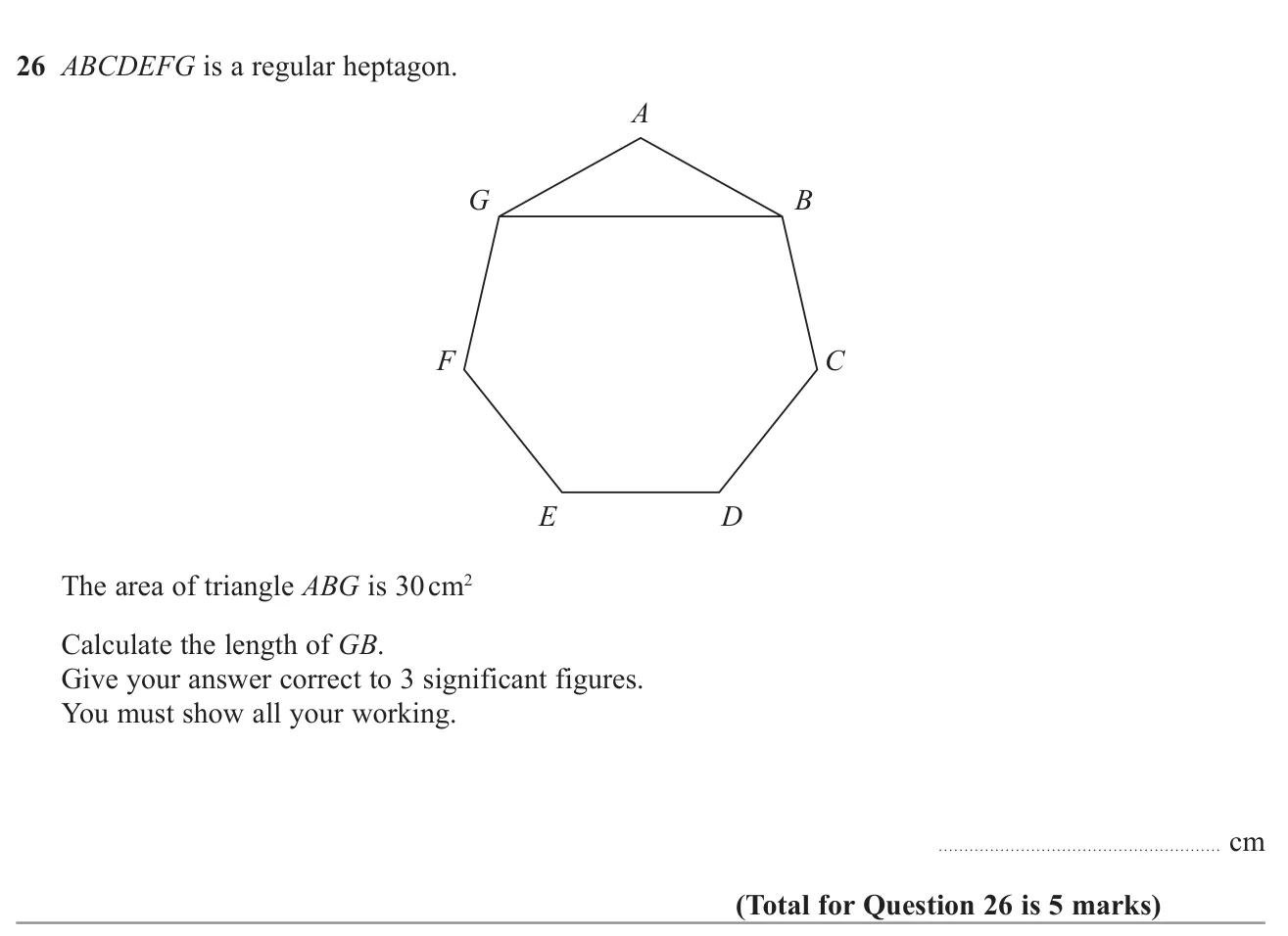
© Pearson Education Ltd. November 2022 Paper 3 (Higher, calculator), question 26.
| Answer | 15.8 cm | 5 marks |
|---|
Worked solution Checked against the mark scheme
Interior angle:
Area: , so cm
Cosine rule:
cm
Watch out: Using the exterior angle (51.4°) in the area formula.
Add up your marks for all three papers and see what grade that would have been.