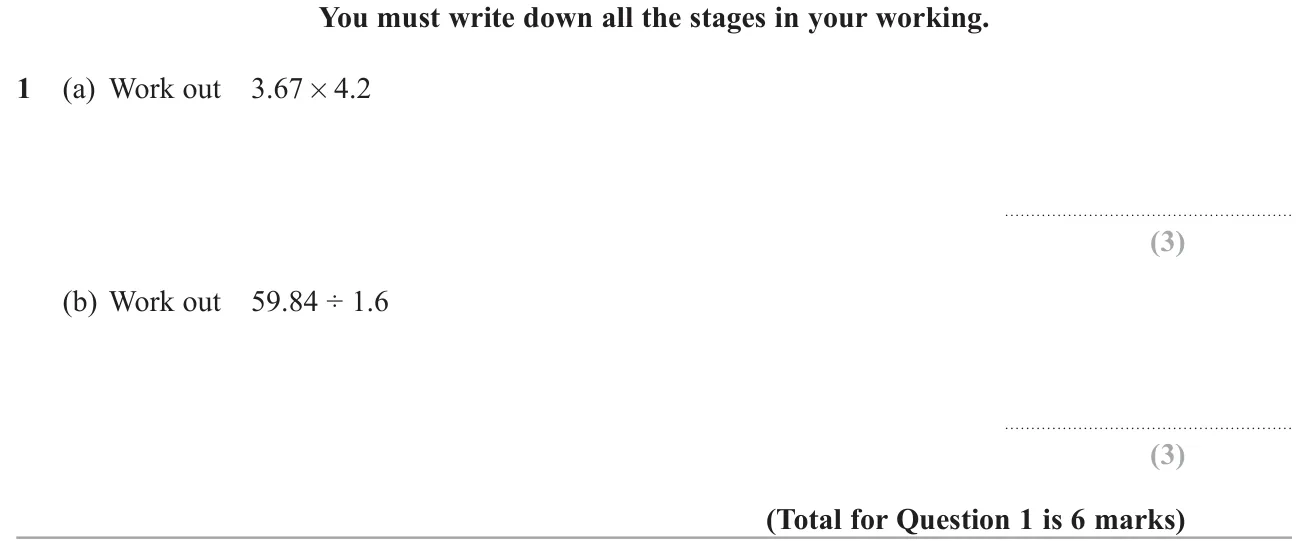
© Pearson Education Ltd. November 2021 Paper 1 (Higher, non-calculator), question 1.
(a) 15.414 15.414 15.414 3 marks (b) 37.4 37.4 37.4 3 marks
Worked solution Checked against the mark scheme
(a) 367 × 42 = 14680 + 734 = 15414 367 \times 42 = 14680 + 734 = 15414 367 × 42 = 14680 + 734 = 15414 3.67 × 4.2 = 15.414 3.67 \times 4.2 = 15.414 3.67 × 4.2 = 15.414
(b) Multiply both by 10: 598.4 ÷ 16 598.4 \div 16 598.4 ÷ 16
598.4 ÷ 16 = 37.4 598.4 \div 16 = 37.4 598.4 ÷ 16 = 37.4 16 × 37 = 592 16 \times 37 = 592 16 × 37 = 592 6.4 ÷ 16 = 0.4 6.4 \div 16 = 0.4 6.4 ÷ 16 = 0.4
Watch out: Placing the decimal point wrongly, e.g. 154.14.
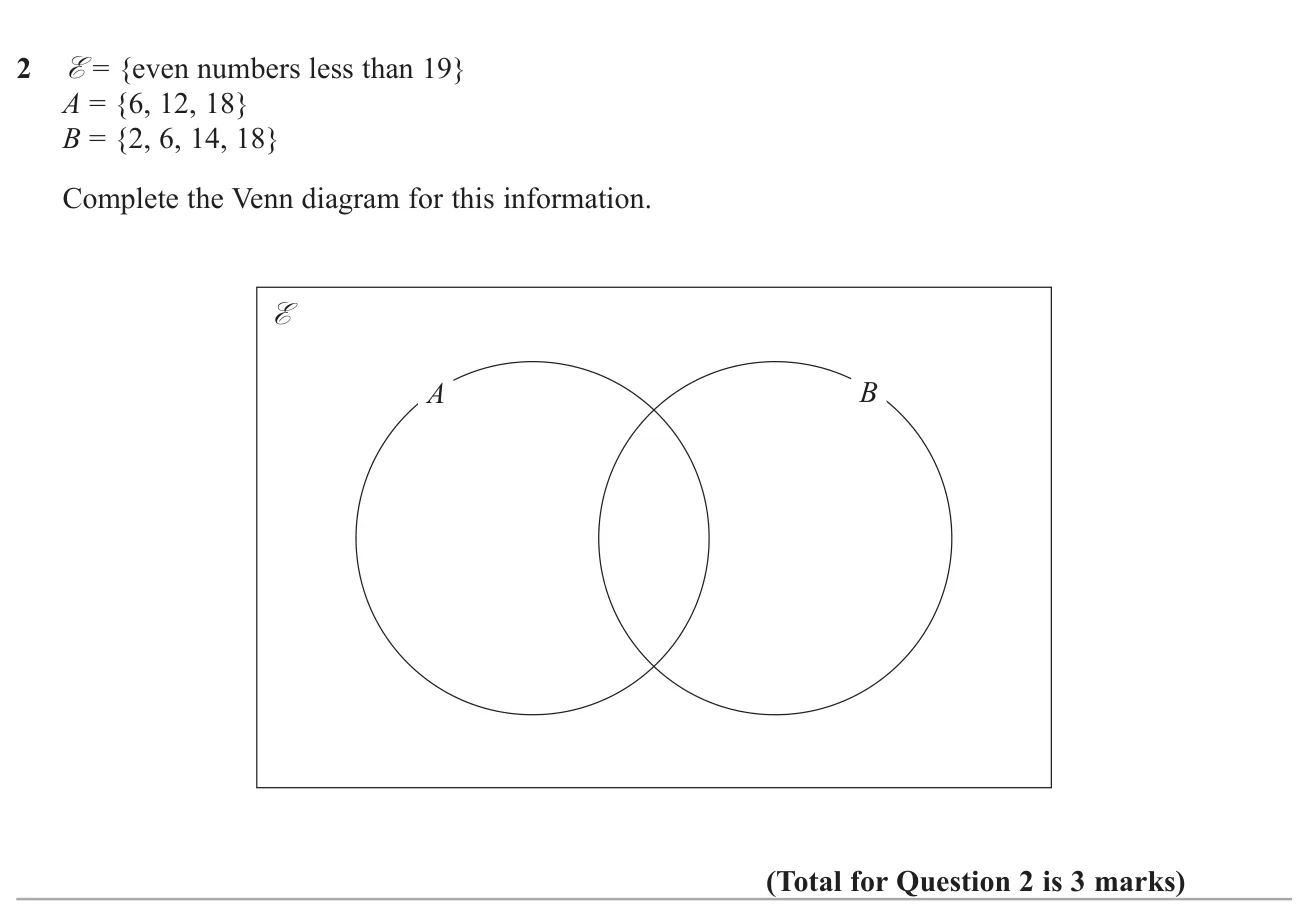
© Pearson Education Ltd. November 2021 Paper 1 (Higher, non-calculator), question 2.
Answer Overlap: 6, 18; A only: 12; B only: 2, 14; outside: 4, 8, 10, 16 3 marks
Worked solution Checked against the mark scheme
E = { 2 , 4 , 6 , 8 , 10 , 12 , 14 , 16 , 18 } \mathcal{E} = \{2, 4, 6, 8, 10, 12, 14, 16, 18\} E = { 2 , 4 , 6 , 8 , 10 , 12 , 14 , 16 , 18 }
In both A and B: 6, 18
A only: 12. B only: 2, 14
In neither: 4, 8, 10, 16
Watch out: Leaving out the numbers outside both circles, or including 0 or 20.
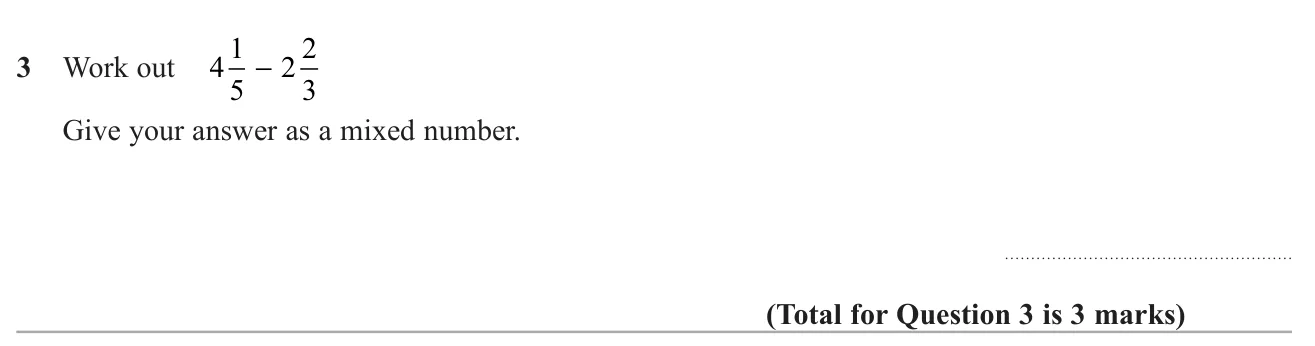
Question 3 Fractions 3 marks Grade 4 No calculator On both tiers © Pearson Education Ltd. November 2021 Paper 1 (Higher, non-calculator), question 3.
Answer 1 8 15 1\frac{8}{15} 1 15 8 3 marks
Worked solution Checked against the mark scheme
4 1 5 = 21 5 = 63 15 4\frac{1}{5} = \frac{21}{5} = \frac{63}{15} 4 5 1 = 5 21 = 15 63 2 2 3 = 8 3 = 40 15 2\frac{2}{3} = \frac{8}{3} = \frac{40}{15} 2 3 2 = 3 8 = 15 40
63 15 − 40 15 = 23 15 = 1 8 15 \frac{63}{15} - \frac{40}{15} = \frac{23}{15} = 1\frac{8}{15} 15 63 − 15 40 = 15 23 = 1 15 8
Watch out: Subtracting whole numbers and fractions separately and getting 2 − 7 15 2 - \frac{7}{15} 2 − 15 7
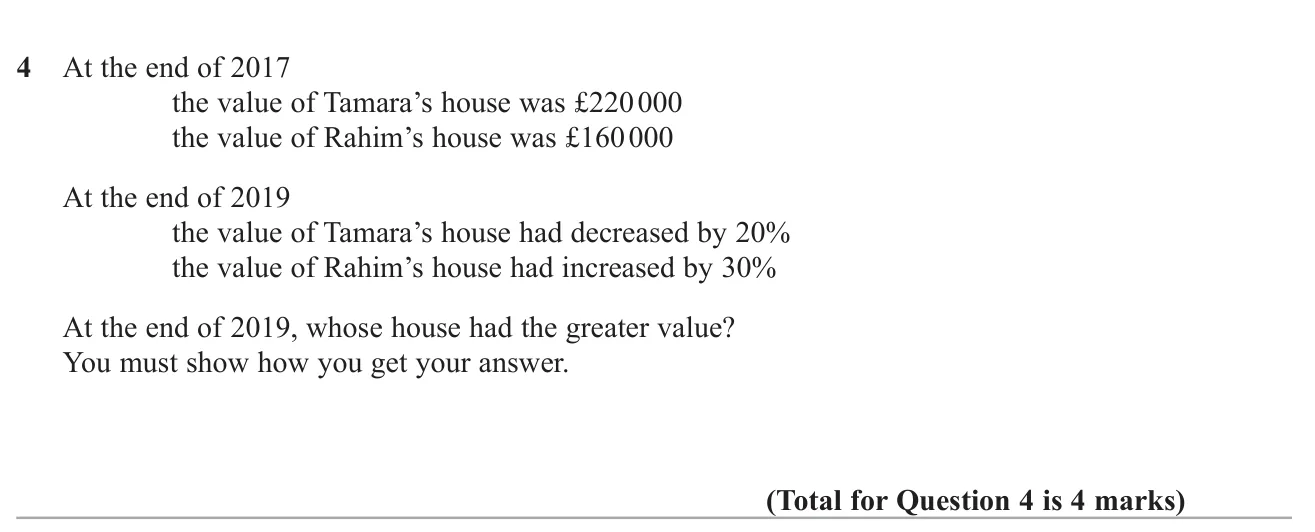
© Pearson Education Ltd. November 2021 Paper 1 (Higher, non-calculator), question 4.
Answer Rahim's: £208 000 compared with Tamara's £176 000 4 marks
Worked solution Checked against the mark scheme
Tamara: 220 000 × 0.8 = £ 176 000 220\,000 \times 0.8 = £176\,000 220 000 × 0.8 = £176 000
Rahim: 160 000 × 1.3 = £ 208 000 160\,000 \times 1.3 = £208\,000 160 000 × 1.3 = £208 000
208 000 > 176 000 208\,000 > 176\,000 208 000 > 176 000 Rahim's house has the greater value.
Watch out: Finding only the change (44 000 and 48 000) and comparing those.
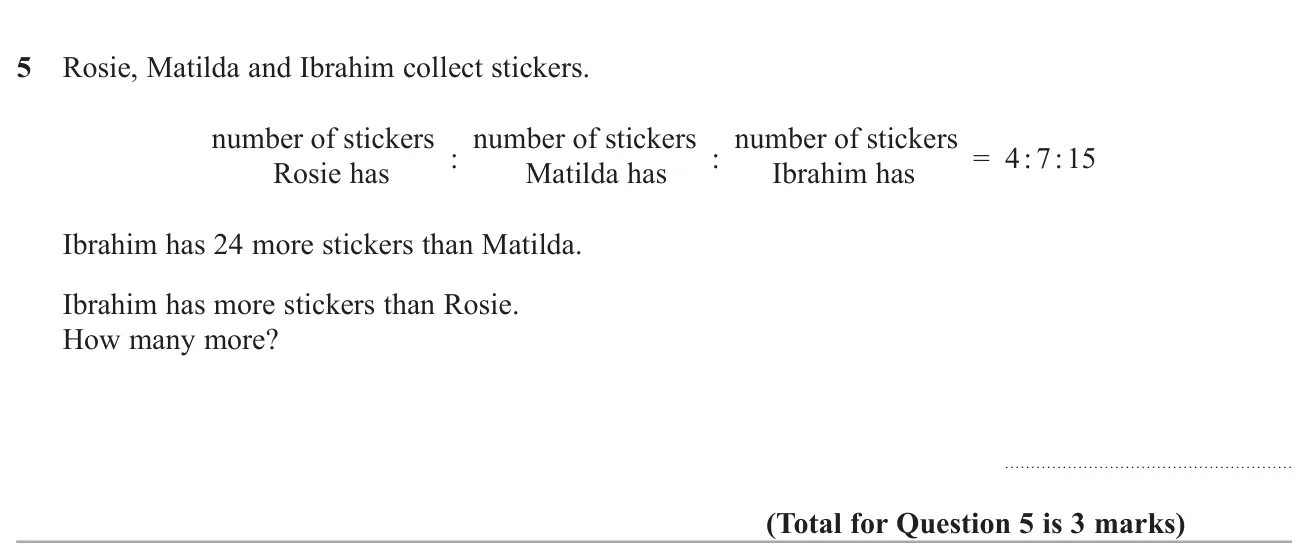
© Pearson Education Ltd. November 2021 Paper 1 (Higher, non-calculator), question 5.
Worked solution Checked against the mark scheme
Ibrahim minus Matilda: 15 − 7 = 8 15 - 7 = 8 15 − 7 = 8 = 24 = 24 = 24 = 3 = 3 = 3
Ibrahim minus Rosie: 15 − 4 = 11 15 - 4 = 11 15 − 4 = 11
11 × 3 = 33 11 \times 3 = 33 11 × 3 = 33
Watch out: Dividing 24 by 26, the total number of parts.
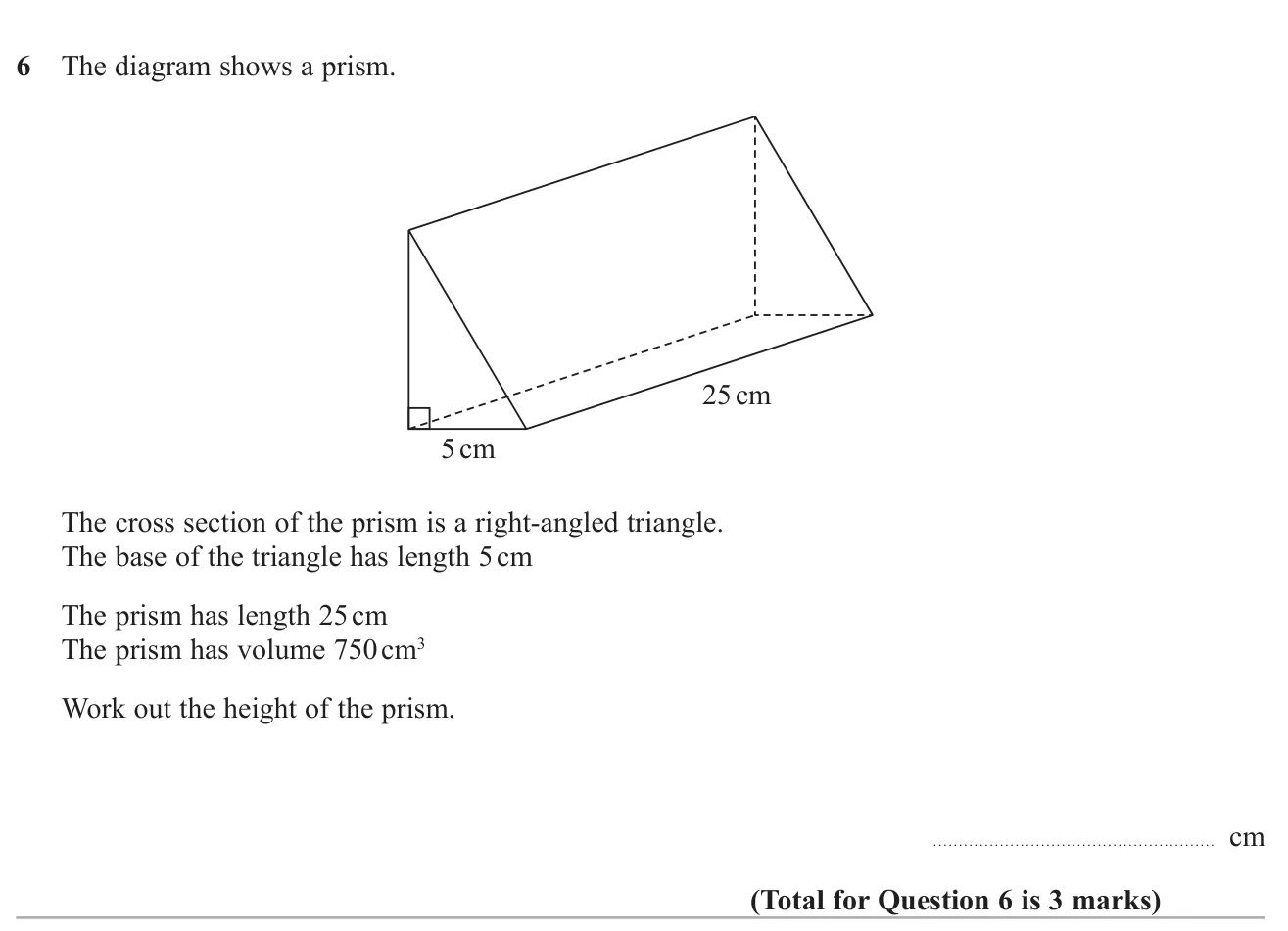
© Pearson Education Ltd. November 2021 Paper 1 (Higher, non-calculator), question 6.
Worked solution Checked against the mark scheme
Cross-section area: 750 ÷ 25 = 30 750 \div 25 = 30 750 ÷ 25 = 30
Triangle area: 1 2 × 5 × h = 30 \frac{1}{2} \times 5 \times h = 30 2 1 × 5 × h = 30
2.5 h = 30 2.5h = 30 2.5 h = 30 h = 12 h = 12 h = 12
Watch out: Forgetting the half in the triangle area and getting 6.
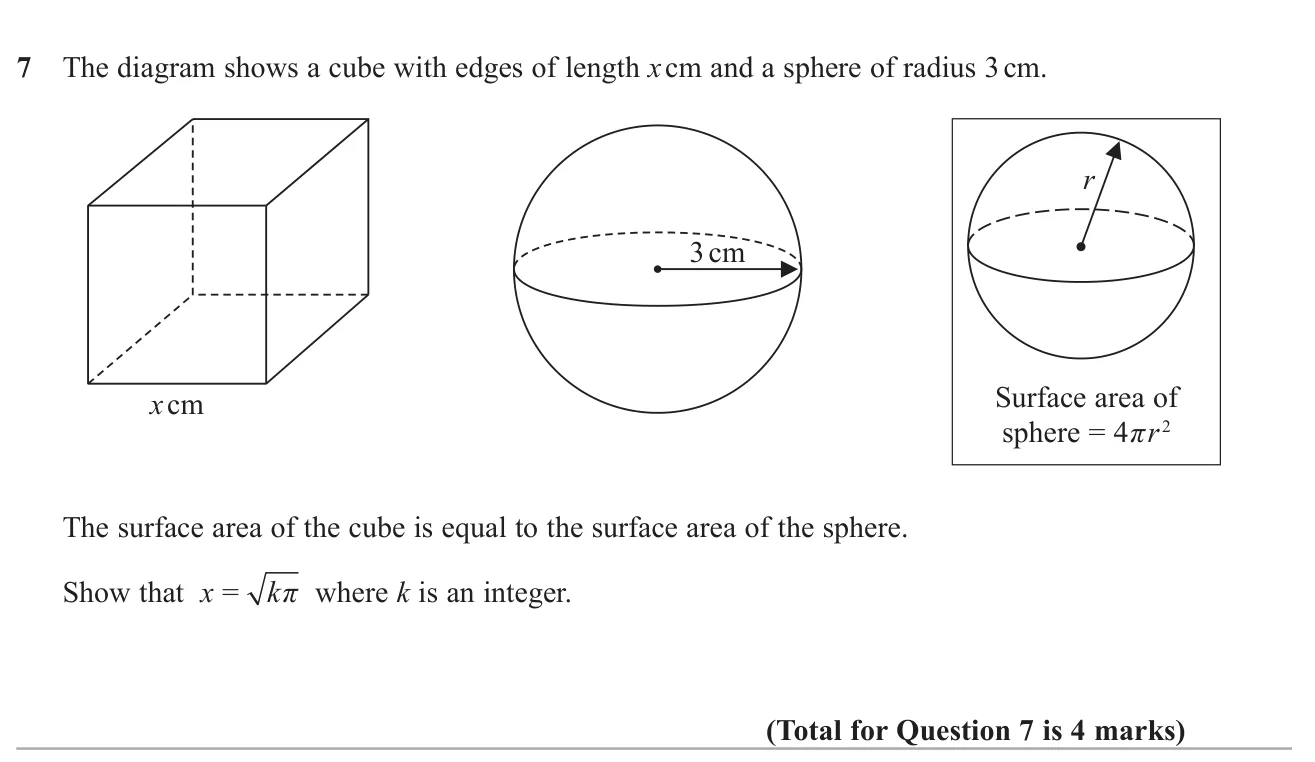
© Pearson Education Ltd. November 2021 Paper 1 (Higher, non-calculator), question 7.
Answer 6 x 2 = 36 π 6x^2 = 36\pi 6 x 2 = 36 π x = 6 π x = \sqrt{6\pi} x = 6 π k = 6 k = 6 k = 6 4 marks
Worked solution Checked against the mark scheme
Cube surface area: 6 x 2 6x^2 6 x 2
Sphere surface area: 4 π × 3 2 = 36 π 4\pi \times 3^2 = 36\pi 4 π × 3 2 = 36 π
6 x 2 = 36 π 6x^2 = 36\pi 6 x 2 = 36 π
x 2 = 6 π x^2 = 6\pi x 2 = 6 π
x = 6 π x = \sqrt{6\pi} x = 6 π k = 6 k = 6 k = 6
Watch out: Using only one face of the cube, x 2 = 36 π x^2 = 36\pi x 2 = 36 π
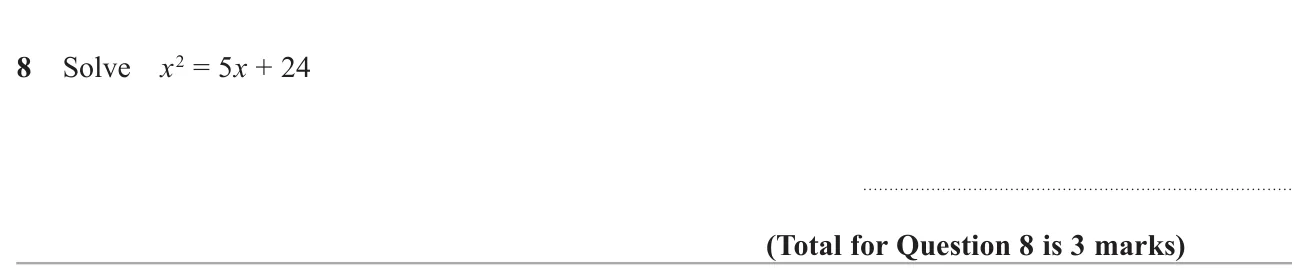
© Pearson Education Ltd. November 2021 Paper 1 (Higher, non-calculator), question 8.
Answer x = 8 x = 8 x = 8 x = − 3 x = -3 x = − 3 3 marks
Worked solution Checked against the mark scheme
x 2 − 5 x − 24 = 0 x^2 - 5x - 24 = 0 x 2 − 5 x − 24 = 0
Find two numbers that multiply to − 24 -24 − 24 − 5 -5 − 5 − 8 -8 − 8 3 3 3
( x − 8 ) ( x + 3 ) = 0 (x - 8)(x + 3) = 0 ( x − 8 ) ( x + 3 ) = 0
x = 8 x = 8 x = 8 x = − 3 x = -3 x = − 3
Watch out: Getting the signs the wrong way round and writing − 8 -8 − 8
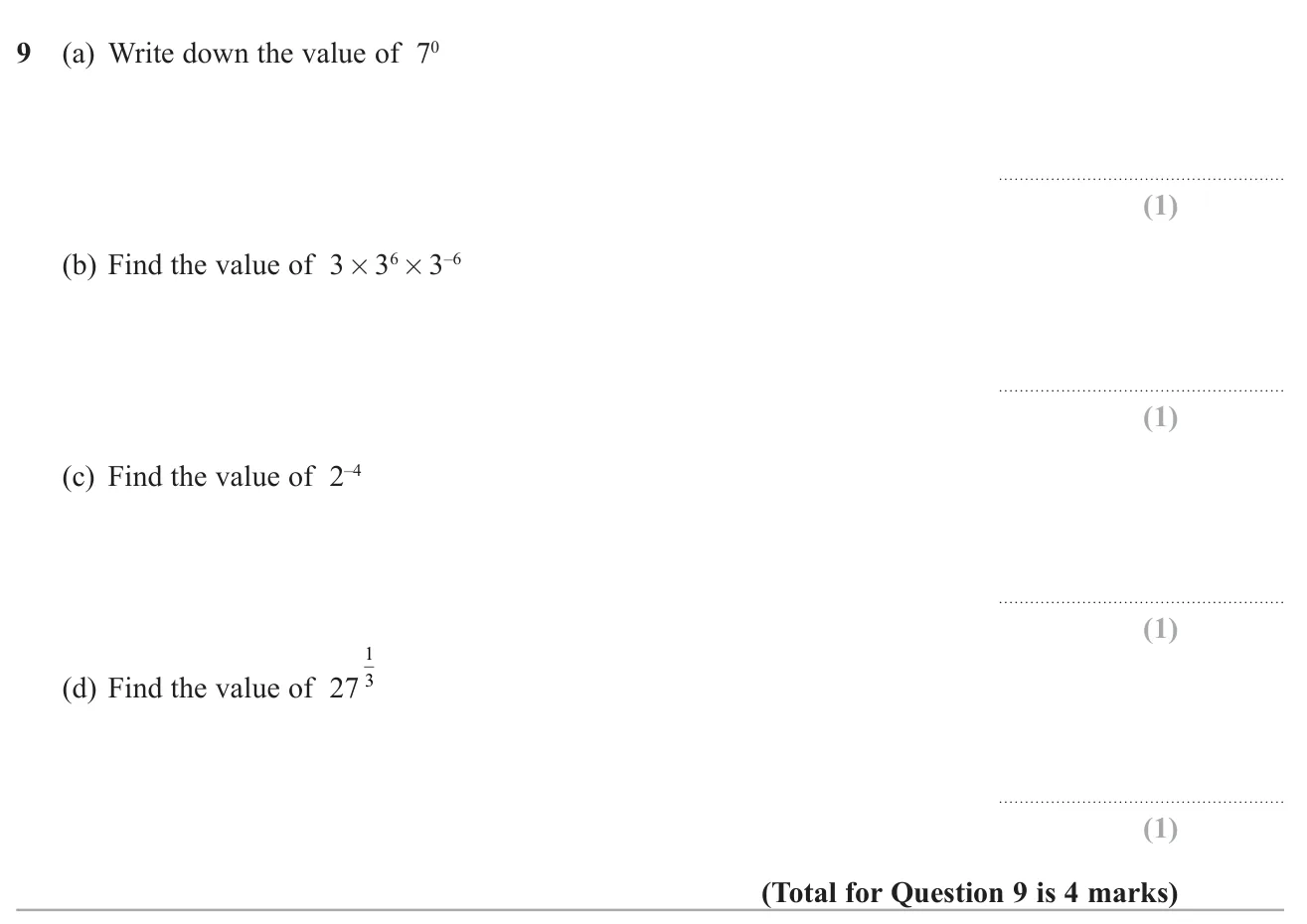
© Pearson Education Ltd. November 2021 Paper 1 (Higher, non-calculator), question 9.
(a) 1 1 1 1 mark (b) 3 3 3 1 mark (c) 1 16 \frac{1}{16} 16 1 1 mark (d) 3 3 3 1 mark
Worked solution Checked against the mark scheme
(a) Anything (except 0) to the power 0 is 1, so 7 0 = 1 7^0 = 1 7 0 = 1
(b) 3 6 × 3 − 6 = 3 0 = 1 3^6 \times 3^{-6} = 3^0 = 1 3 6 × 3 − 6 = 3 0 = 1 3 × 1 = 3 3 \times 1 = 3 3 × 1 = 3
(c) 2 − 4 = 1 2 4 = 1 16 2^{-4} = \frac{1}{2^4} = \frac{1}{16} 2 − 4 = 2 4 1 = 16 1
(d) 27 1 3 = 27 3 = 3 27^{\frac{1}{3}} = \sqrt[3]{27} = 3 2 7 3 1 = 3 27 = 3
Watch out: Writing 7 0 = 0 7^0 = 0 7 0 = 0 2 − 4 = − 16 2^{-4} = -16 2 − 4 = − 16
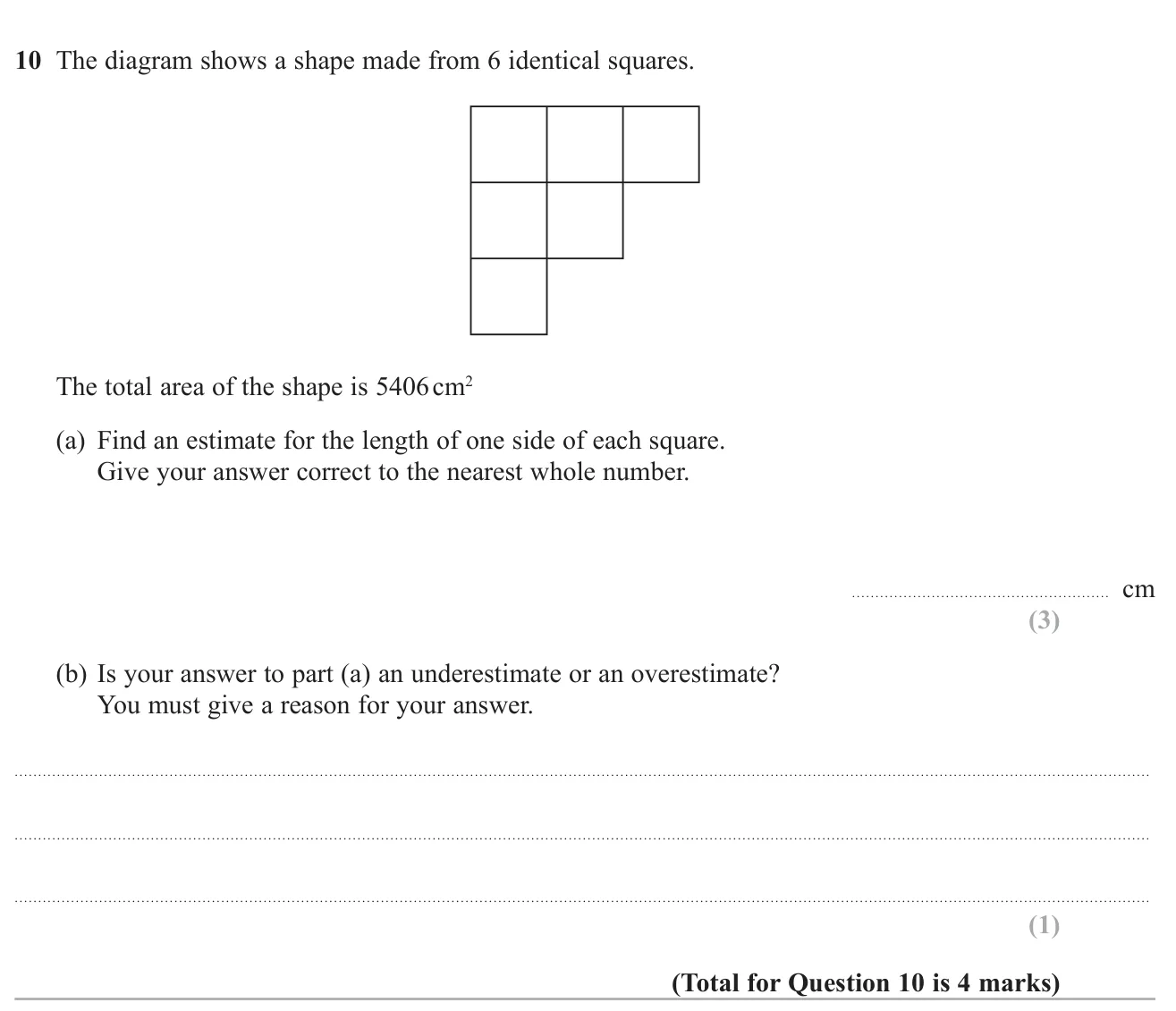
© Pearson Education Ltd. November 2021 Paper 1 (Higher, non-calculator), question 10.
(a) 30 30 30 3 marks (b) Underestimate, because the total area was rounded down (5406 to 5400) 1 mark
Worked solution Checked against the mark scheme
(a) Round 5406 to 5400. One square: 5400 ÷ 6 = 900 cm 2 5400 \div 6 = 900\text{ cm}^2 5400 ÷ 6 = 900 cm 2
Side = 900 = 30 = \sqrt{900} = 30 = 900 = 30
(b) Underestimate : 5406 was rounded down to 5400, so each square's area and side were made slightly smaller than they really are.
Watch out: Forgetting to square root and giving 900 as the side length.
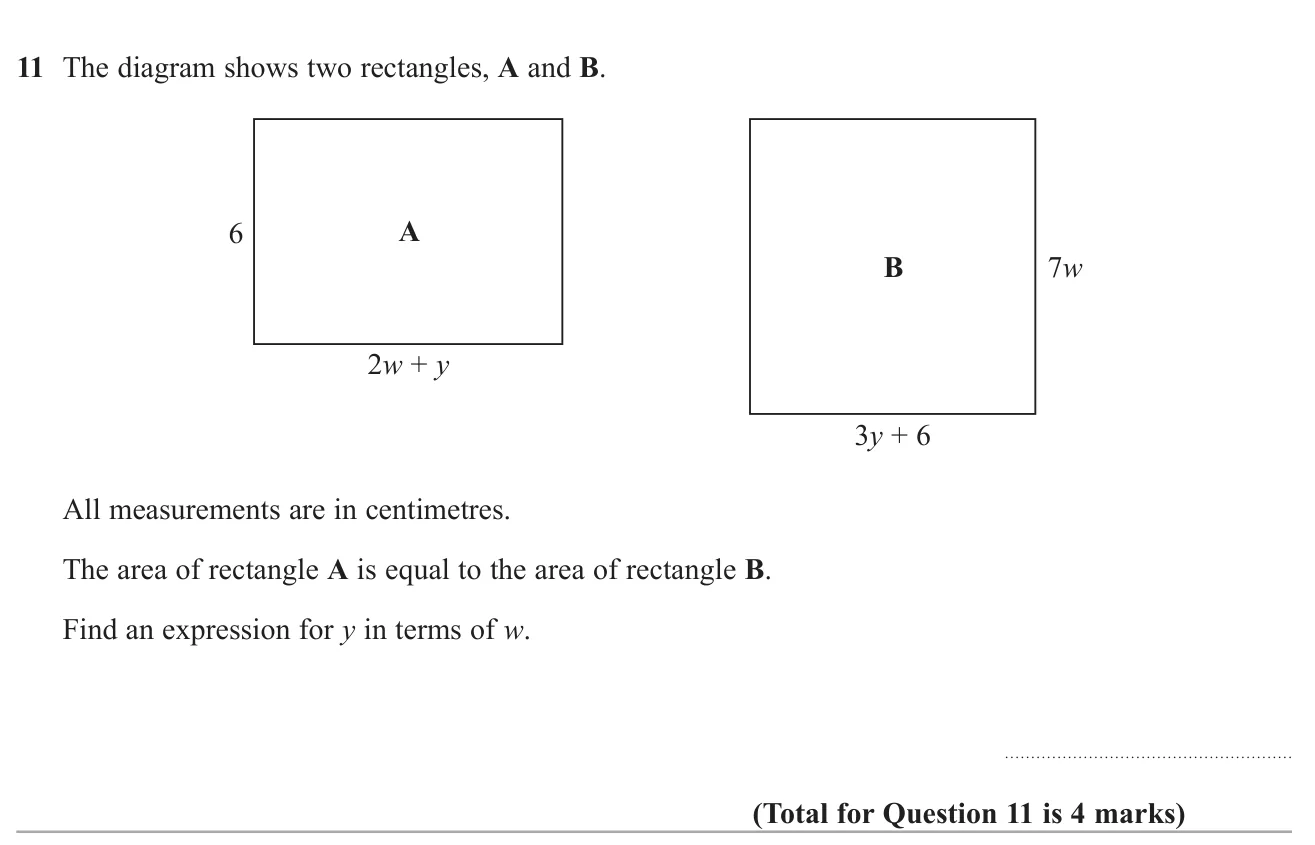
© Pearson Education Ltd. November 2021 Paper 1 (Higher, non-calculator), question 11.
Answer y = 30 w 6 − 21 w y = \frac{30w}{6 - 21w} y = 6 − 21 w 30 w 4 marks
Worked solution Checked against the mark scheme
6 ( 2 w + y ) = 7 w ( 3 y + 6 ) 6(2w + y) = 7w(3y + 6) 6 ( 2 w + y ) = 7 w ( 3 y + 6 )
12 w + 6 y = 21 w y + 42 w 12w + 6y = 21wy + 42w 12 w + 6 y = 21 w y + 42 w
6 y − 21 w y = 30 w 6y - 21wy = 30w 6 y − 21 w y = 30 w
y ( 6 − 21 w ) = 30 w y(6 - 21w) = 30w y ( 6 − 21 w ) = 30 w
y = 30 w 6 − 21 w y = \frac{30w}{6 - 21w} y = 6 − 21 w 30 w 10 w 2 − 7 w \frac{10w}{2 - 7w} 2 − 7 w 10 w
Watch out: Not factorising out y y y y y y
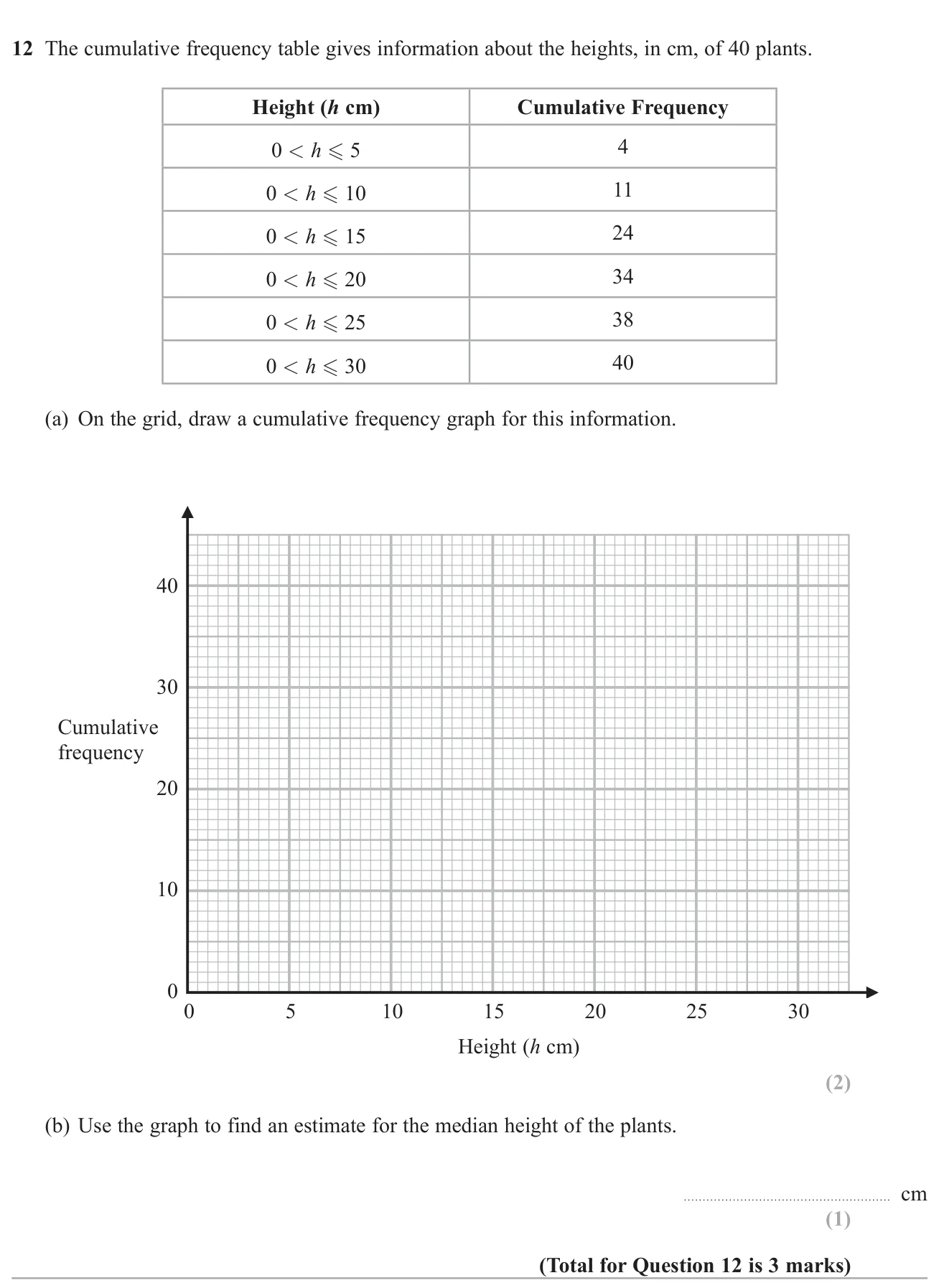
© Pearson Education Ltd. November 2021 Paper 1 (Higher, non-calculator), question 12.
(a) Points (5, 4), (10, 11), (15, 24), (20, 34), (25, 38), (30, 40) joined with a smooth curve or straight lines 2 marks (b) Between 13 13 13 14 14 14 1 mark
Worked solution Checked against the mark scheme
(a) Plot each cumulative frequency at the upper end of its interval: (5, 4), (10, 11), (15, 24), (20, 34), (25, 38), (30, 40). Start at (0, 0) and join with a smooth curve.
(b) The median is at half of 40, which is 20. Read across from 20 to the curve and down: about 13.5 13.5 13.5
Watch out: Plotting points at the midpoints of the intervals instead of the upper ends.
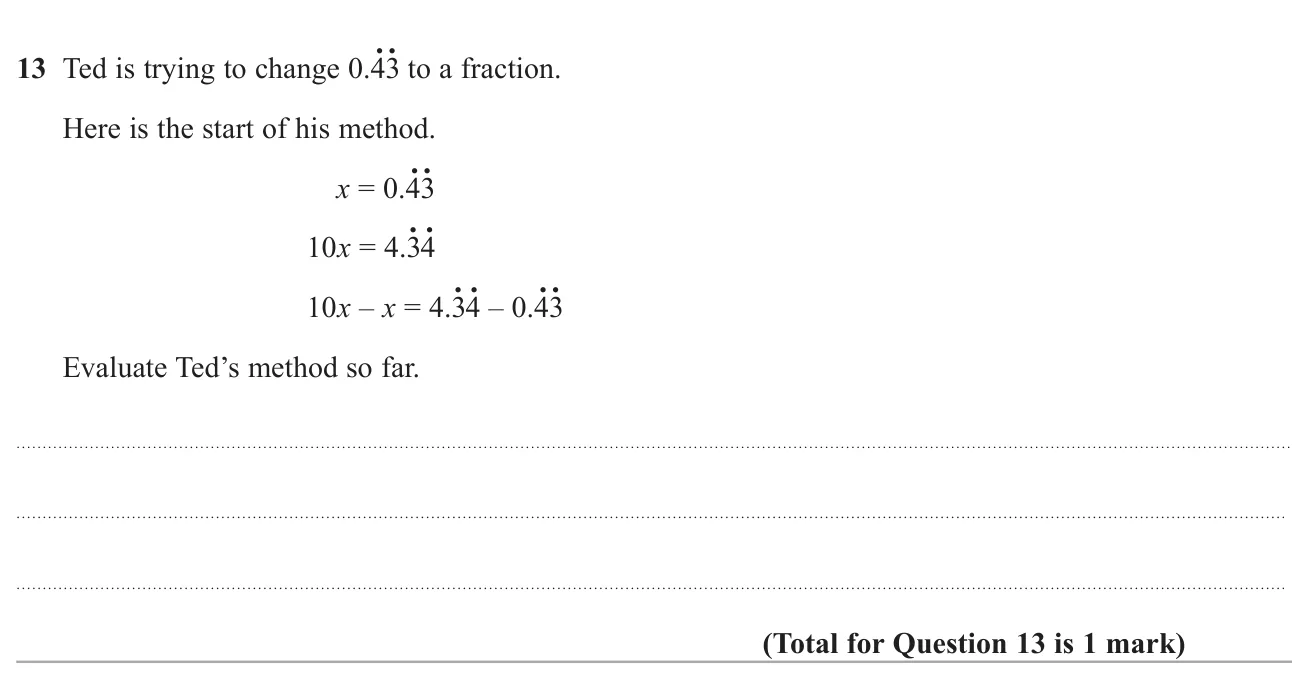
© Pearson Education Ltd. November 2021 Paper 1 (Higher, non-calculator), question 13.
Answer He should have used 100 x 100x 100 x 10 x 10x 10 x 1 mark
Worked solution Checked against the mark scheme
In 0. 4 ˙ 3 ˙ 0.\dot{4}\dot{3} 0. 4 ˙ 3 ˙
10 x = 4.3434... 10x = 4.3434... 10 x = 4.3434... x = 0.4343... x = 0.4343... x = 0.4343...
He should use 100 x = 43. 4 ˙ 3 ˙ 100x = 43.\dot{4}\dot{3} 100 x = 43. 4 ˙ 3 ˙ 99 x = 43 99x = 43 99 x = 43 x = 43 99 x = \frac{43}{99} x = 99 43
Watch out: Just saying 'it is wrong' without explaining why.
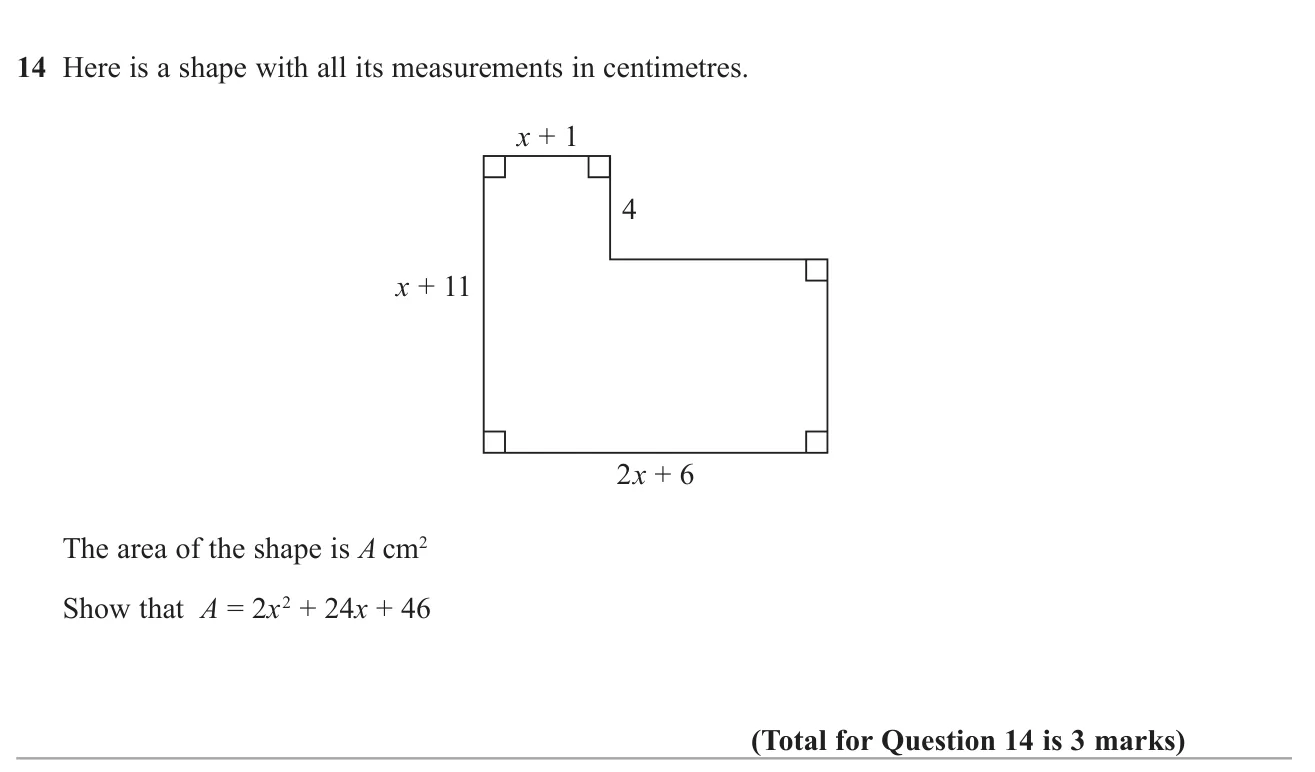
© Pearson Education Ltd. November 2021 Paper 1 (Higher, non-calculator), question 14.
Answer A = 2 x 2 + 24 x + 46 A = 2x^2 + 24x + 46 A = 2 x 2 + 24 x + 46 3 marks
Worked solution Checked against the mark scheme
Split into a top rectangle ( x + 1 ) (x + 1) ( x + 1 ) 4 4 4 ( 2 x + 6 ) (2x + 6) ( 2 x + 6 ) ( x + 11 ) − 4 = x + 7 (x + 11) - 4 = x + 7 ( x + 11 ) − 4 = x + 7
Top: 4 ( x + 1 ) = 4 x + 4 4(x + 1) = 4x + 4 4 ( x + 1 ) = 4 x + 4
Bottom: ( 2 x + 6 ) ( x + 7 ) = 2 x 2 + 14 x + 6 x + 42 = 2 x 2 + 20 x + 42 (2x + 6)(x + 7) = 2x^2 + 14x + 6x + 42 = 2x^2 + 20x + 42 ( 2 x + 6 ) ( x + 7 ) = 2 x 2 + 14 x + 6 x + 42 = 2 x 2 + 20 x + 42
A = 2 x 2 + 24 x + 46 A = 2x^2 + 24x + 46 A = 2 x 2 + 24 x + 46
Watch out: Using x + 11 x + 11 x + 11
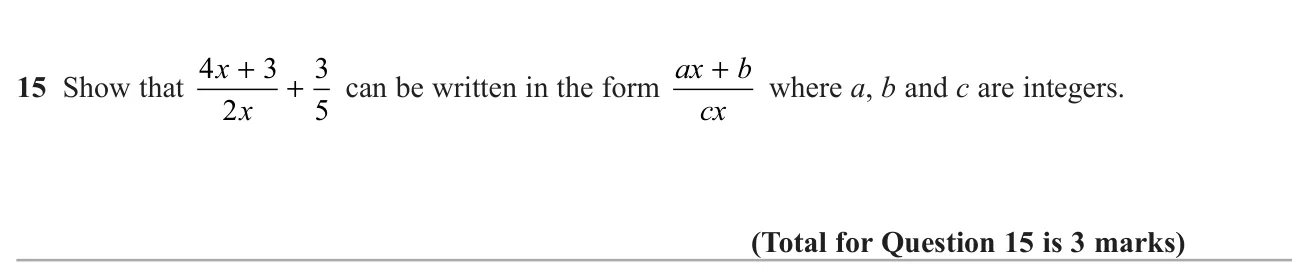
© Pearson Education Ltd. November 2021 Paper 1 (Higher, non-calculator), question 15.
Answer 26 x + 15 10 x \frac{26x + 15}{10x} 10 x 26 x + 15 3 marks
Worked solution Checked against the mark scheme
Common denominator 10 x 10x 10 x
4 x + 3 2 x = 5 ( 4 x + 3 ) 10 x = 20 x + 15 10 x \frac{4x + 3}{2x} = \frac{5(4x + 3)}{10x} = \frac{20x + 15}{10x} 2 x 4 x + 3 = 10 x 5 ( 4 x + 3 ) = 10 x 20 x + 15 3 5 = 6 x 10 x \frac{3}{5} = \frac{6x}{10x} 5 3 = 10 x 6 x
Add: 20 x + 15 + 6 x 10 x = 26 x + 15 10 x \frac{20x + 15 + 6x}{10x} = \frac{26x + 15}{10x} 10 x 20 x + 15 + 6 x = 10 x 26 x + 15
So a = 26 a = 26 a = 26 b = 15 b = 15 b = 15 c = 10 c = 10 c = 10
Watch out: Adding numerators and denominators directly to get 4 x + 6 2 x + 5 \frac{4x + 6}{2x + 5} 2 x + 5 4 x + 6
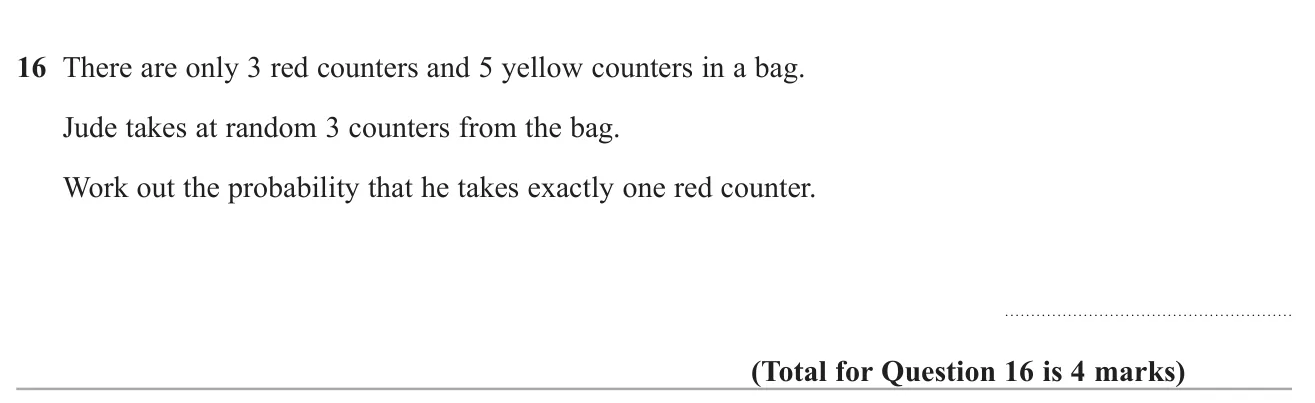
© Pearson Education Ltd. November 2021 Paper 1 (Higher, non-calculator), question 16.
Answer 15 28 \frac{15}{28} 28 15 4 marks
Worked solution Checked against the mark scheme
One order (red, yellow, yellow): 3 8 × 5 7 × 4 6 = 60 336 \frac{3}{8} \times \frac{5}{7} \times \frac{4}{6} = \frac{60}{336} 8 3 × 7 5 × 6 4 = 336 60
The red can come first, second or third, and each order gives the same product.
3 × 60 336 = 180 336 = 15 28 3 \times \frac{60}{336} = \frac{180}{336} = \frac{15}{28} 3 × 336 60 = 336 180 = 28 15
Watch out: Replacing the counters (using eighths each time), which gives 225 512 \frac{225}{512} 512 225
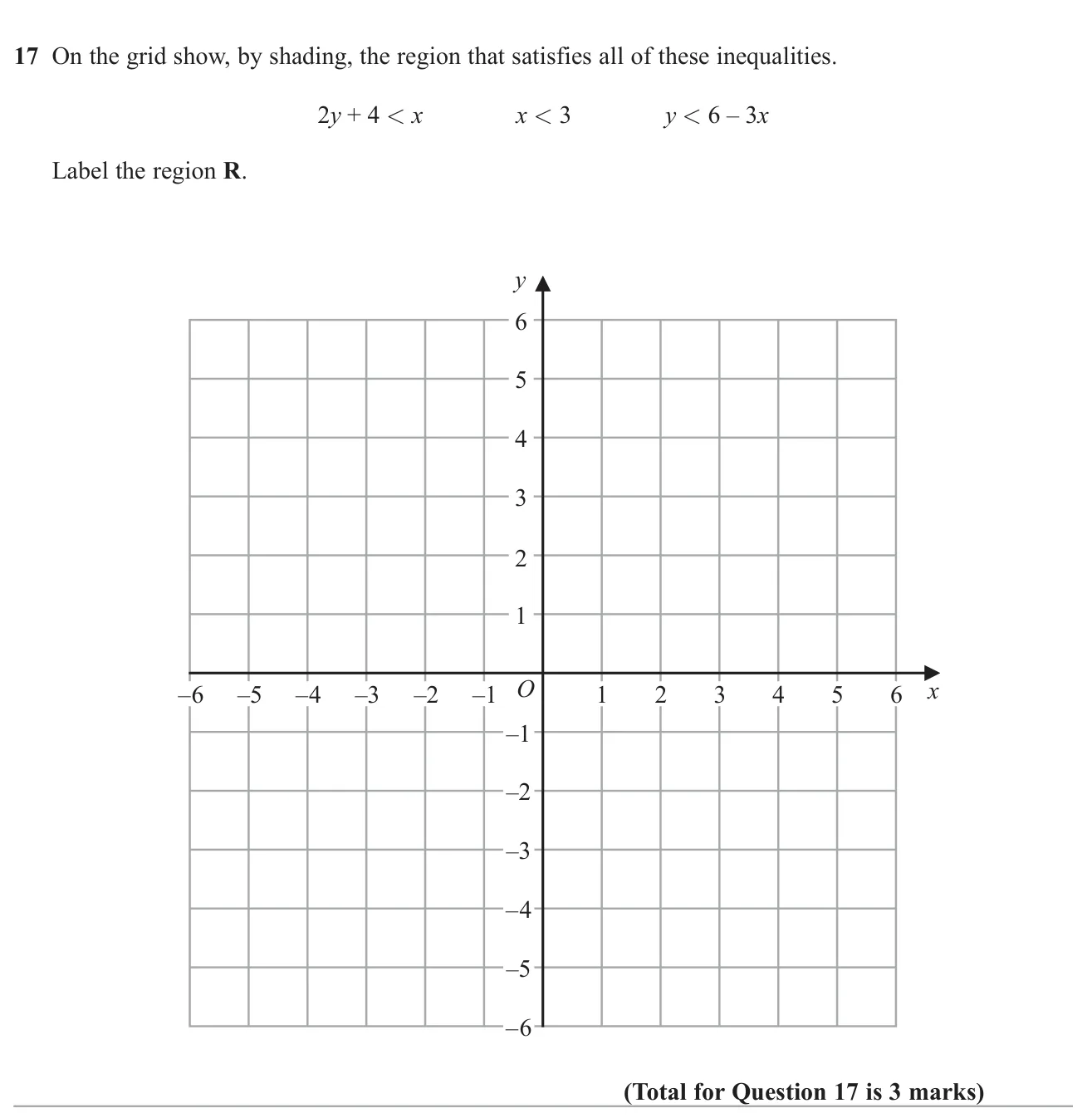
© Pearson Education Ltd. November 2021 Paper 1 (Higher, non-calculator), question 17.
Answer Region labelled R that lies below y = 1 2 x − 2 y = \frac{1}{2}x - 2 y = 2 1 x − 2 y = 6 − 3 x y = 6 - 3x y = 6 − 3 x x = 3 x = 3 x = 3 3 marks
Worked solution Checked against the mark scheme
Draw x = 2 y + 4 x = 2y + 4 x = 2 y + 4 y = 1 2 x − 2 y = \frac{1}{2}x - 2 y = 2 1 x − 2
Draw x = 3 x = 3 x = 3 y = 6 − 3 x y = 6 - 3x y = 6 − 3 x
2 y + 4 < x 2y + 4 < x 2 y + 4 < x x < 3 x < 3 x < 3 x = 3 x = 3 x = 3 y < 6 − 3 x y < 6 - 3x y < 6 − 3 x
The two sloping lines cross at about ( 2.3 , − 0.9 ) (2.3, -0.9) ( 2.3 , − 0.9 ) y = 6 − 3 x y = 6 - 3x y = 6 − 3 x x = 3 x = 3 x = 3 ( 3 , − 3 ) (3, -3) ( 3 , − 3 ) x = 3 x = 3 x = 3
Watch out: Shading the wrong side of 2 y + 4 < x 2y + 4 < x 2 y + 4 < x y < . . . y < ... y < ...
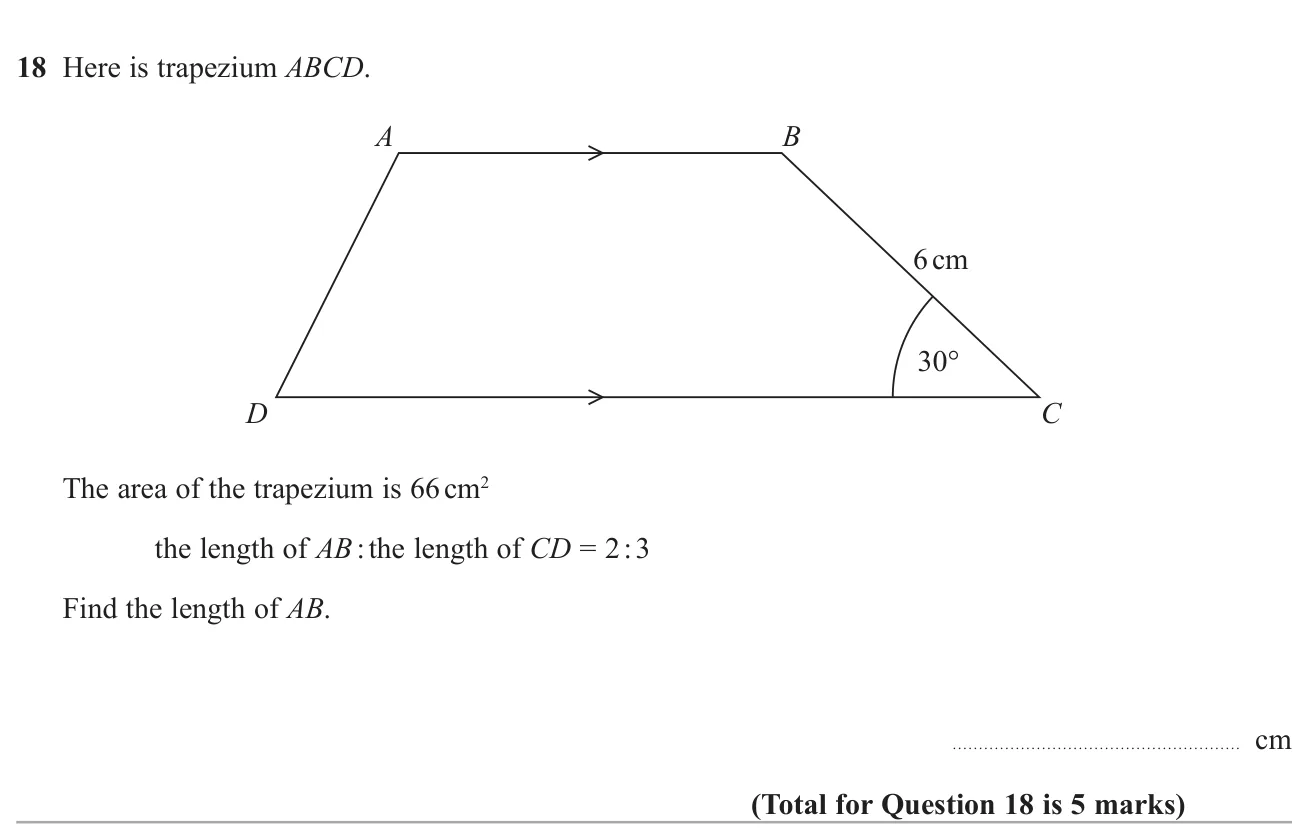
© Pearson Education Ltd. November 2021 Paper 1 (Higher, non-calculator), question 18.
Answer 17.6 17.6 17.6 5 marks
Worked solution Checked against the mark scheme
Height = 6 sin 30 ∘ = 6 × 1 2 = 3 = 6 \sin 30^\circ = 6 \times \frac{1}{2} = 3 = 6 sin 3 0 ∘ = 6 × 2 1 = 3
Area: 1 2 ( A B + C D ) × 3 = 66 \frac{1}{2}(AB + CD) \times 3 = 66 2 1 ( A B + C D ) × 3 = 66 A B + C D = 44 AB + CD = 44 A B + C D = 44
A B : C D = 2 : 3 AB : CD = 2 : 3 A B : C D = 2 : 3 A B = 2 5 × 44 = 17.6 AB = \frac{2}{5} \times 44 = 17.6 A B = 5 2 × 44 = 17.6
Watch out: Using 6 cm as the height instead of finding the perpendicular height.
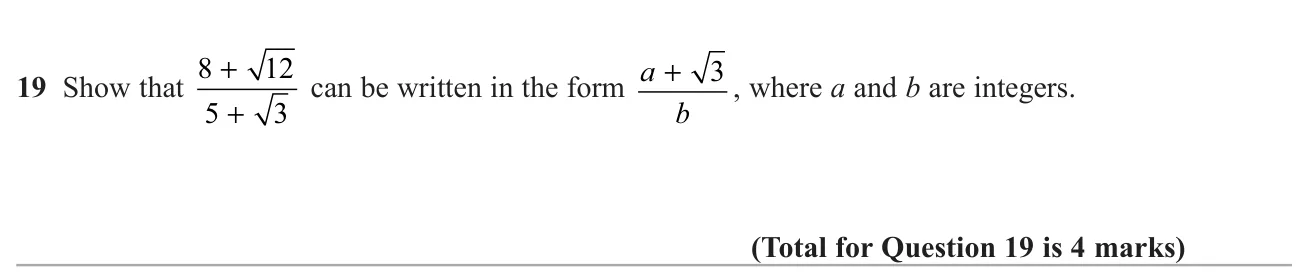
Question 19 Surds 4 marks Grade 8 No calculator © Pearson Education Ltd. November 2021 Paper 1 (Higher, non-calculator), question 19.
Answer 17 + 3 11 \frac{17 + \sqrt{3}}{11} 11 17 + 3 4 marks
Worked solution Checked against the mark scheme
12 = 2 3 \sqrt{12} = 2\sqrt{3} 12 = 2 3
Multiply top and bottom by 5 − 3 5 - \sqrt{3} 5 − 3
Top: ( 8 + 2 3 ) ( 5 − 3 ) = 40 − 8 3 + 10 3 − 6 = 34 + 2 3 (8 + 2\sqrt{3})(5 - \sqrt{3}) = 40 - 8\sqrt{3} + 10\sqrt{3} - 6 = 34 + 2\sqrt{3} ( 8 + 2 3 ) ( 5 − 3 ) = 40 − 8 3 + 10 3 − 6 = 34 + 2 3
Bottom: 25 − 3 = 22 25 - 3 = 22 25 − 3 = 22
34 + 2 3 22 = 17 + 3 11 \frac{34 + 2\sqrt{3}}{22} = \frac{17 + \sqrt{3}}{11} 22 34 + 2 3 = 11 17 + 3
Watch out: Getting 2 3 × 3 = 2 3 2\sqrt{3} \times \sqrt{3} = 2\sqrt{3} 2 3 × 3 = 2 3
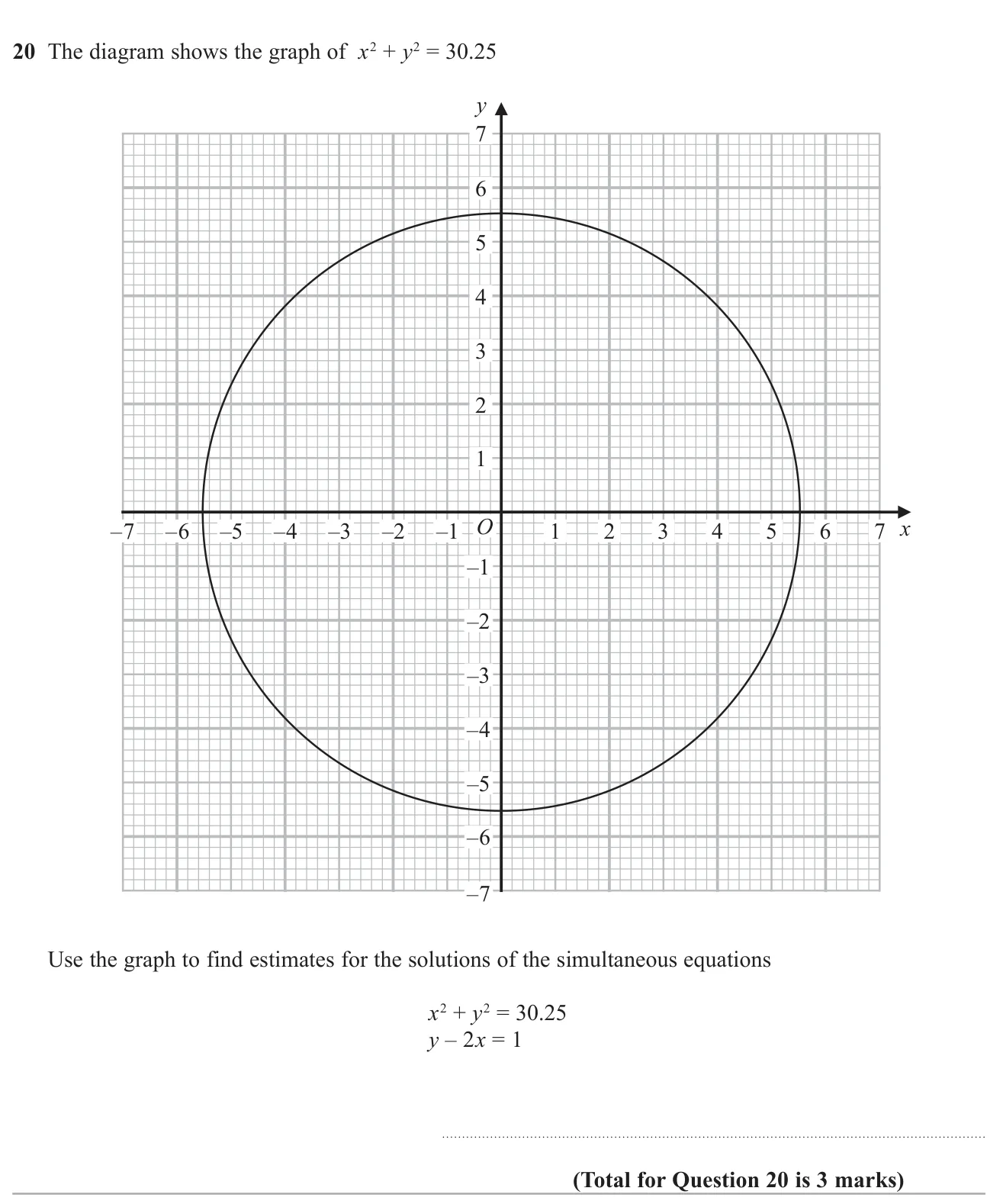
© Pearson Education Ltd. November 2021 Paper 1 (Higher, non-calculator), question 20.
Answer x ≈ 2.1 , y ≈ 5.1 x \approx 2.1, y \approx 5.1 x ≈ 2.1 , y ≈ 5.1 x ≈ − 2.9 , y ≈ − 4.7 x \approx -2.9, y \approx -4.7 x ≈ − 2.9 , y ≈ − 4.7 3 marks
Worked solution Checked against the mark scheme
Rearrange: y = 2 x + 1 y = 2x + 1 y = 2 x + 1
Read off where it crosses the circle:
x ≈ 2.1 , y ≈ 5.1 x \approx 2.1, y \approx 5.1 x ≈ 2.1 , y ≈ 5.1
x ≈ − 2.9 , y ≈ − 4.7 x \approx -2.9, y \approx -4.7 x ≈ − 2.9 , y ≈ − 4.7
Watch out: Drawing y = x + 1 y = x + 1 y = x + 1
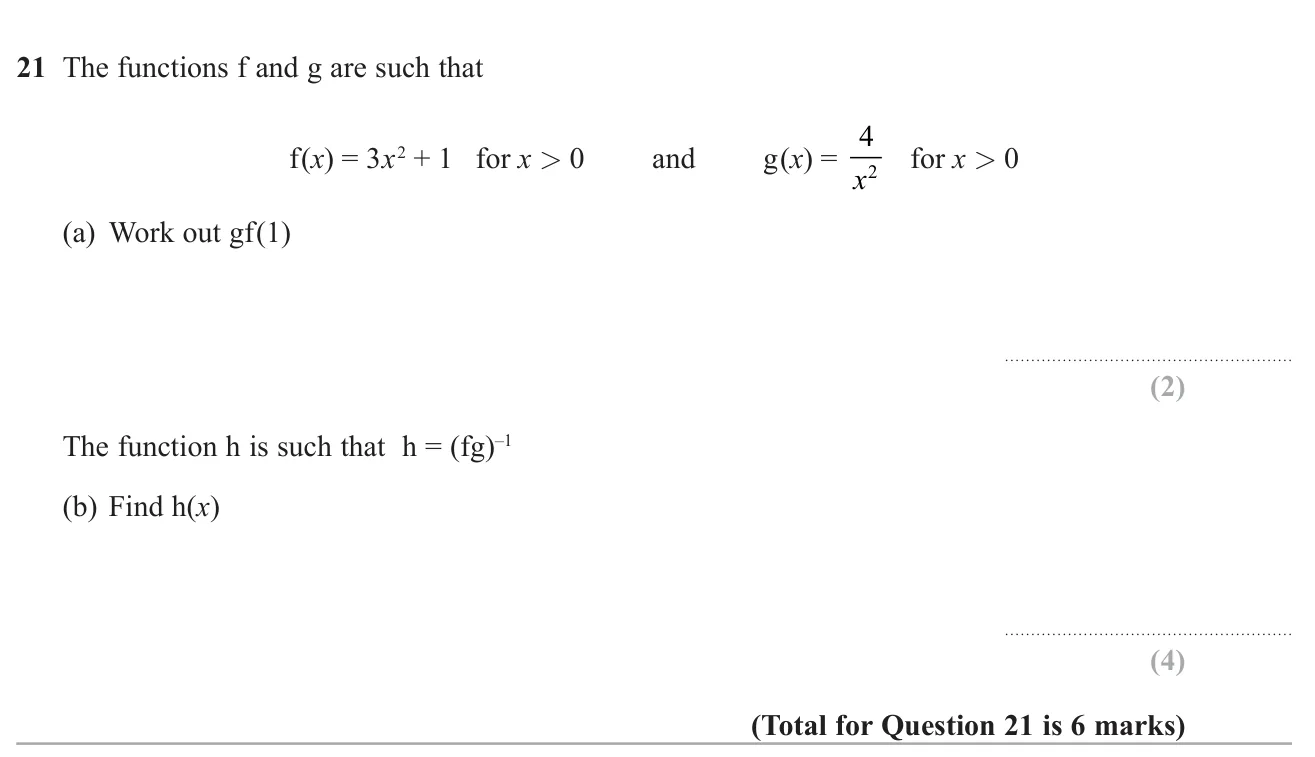
© Pearson Education Ltd. November 2021 Paper 1 (Higher, non-calculator), question 21.
(a) 1 4 \frac{1}{4} 4 1 2 marks (b) h ( x ) = 48 x − 1 4 h(x) = \sqrt[4]{\frac{48}{x - 1}} h ( x ) = 4 x − 1 48 4 marks
Worked solution Checked against the mark scheme
(a) f ( 1 ) = 3 + 1 = 4 f(1) = 3 + 1 = 4 f ( 1 ) = 3 + 1 = 4 g ( 4 ) = 4 16 = 1 4 g(4) = \frac{4}{16} = \frac{1}{4} g ( 4 ) = 16 4 = 4 1
(b) f g ( x ) = 3 ( 4 x 2 ) 2 + 1 = 48 x 4 + 1 fg(x) = 3\left(\frac{4}{x^2}\right)^2 + 1 = \frac{48}{x^4} + 1 f g ( x ) = 3 ( x 2 4 ) 2 + 1 = x 4 48 + 1
Let y = 48 x 4 + 1 y = \frac{48}{x^4} + 1 y = x 4 48 + 1 x 4 = 48 y − 1 x^4 = \frac{48}{y - 1} x 4 = y − 1 48
h ( x ) = 48 x − 1 4 h(x) = \sqrt[4]{\frac{48}{x - 1}} h ( x ) = 4 x − 1 48
Watch out: Working out fg the wrong way round, i.e. finding gf(x) instead.
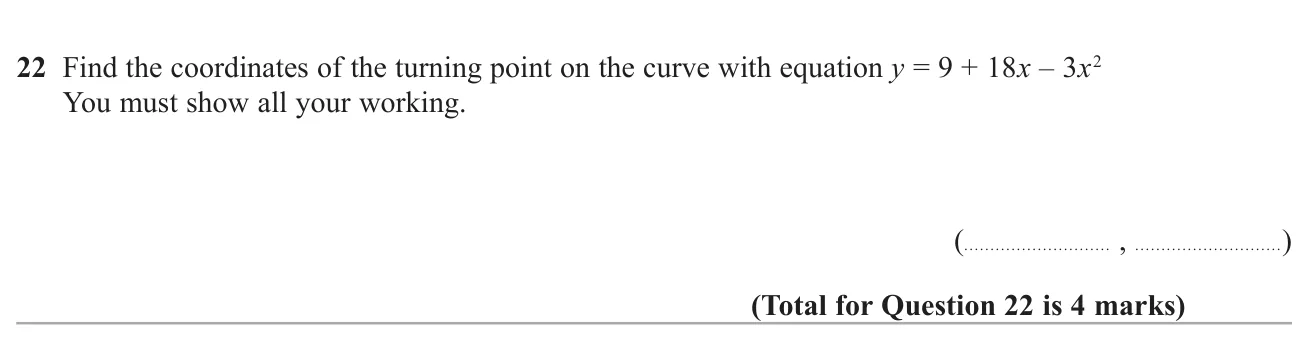
© Pearson Education Ltd. November 2021 Paper 1 (Higher, non-calculator), question 22.
Answer ( 3 , 36 ) (3, 36) ( 3 , 36 ) 4 marks
Worked solution Checked against the mark scheme
y = − 3 x 2 + 18 x + 9 = − 3 ( x 2 − 6 x ) + 9 y = -3x^2 + 18x + 9 = -3(x^2 - 6x) + 9 y = − 3 x 2 + 18 x + 9 = − 3 ( x 2 − 6 x ) + 9
= − 3 [ ( x − 3 ) 2 − 9 ] + 9 = -3[(x - 3)^2 - 9] + 9 = − 3 [( x − 3 ) 2 − 9 ] + 9
= − 3 ( x − 3 ) 2 + 27 + 9 = − 3 ( x − 3 ) 2 + 36 = -3(x - 3)^2 + 27 + 9 = -3(x - 3)^2 + 36 = − 3 ( x − 3 ) 2 + 27 + 9 = − 3 ( x − 3 ) 2 + 36
Turning point: ( 3 , 36 ) (3, 36) ( 3 , 36 )
Watch out: Forgetting to multiply the − 9 -9 − 9 − 3 -3 − 3 ( 3 , 0 ) (3, 0) ( 3 , 0 )
Finished the paper? Add up your marks for all three papers and see what grade that would have been.