Question 1
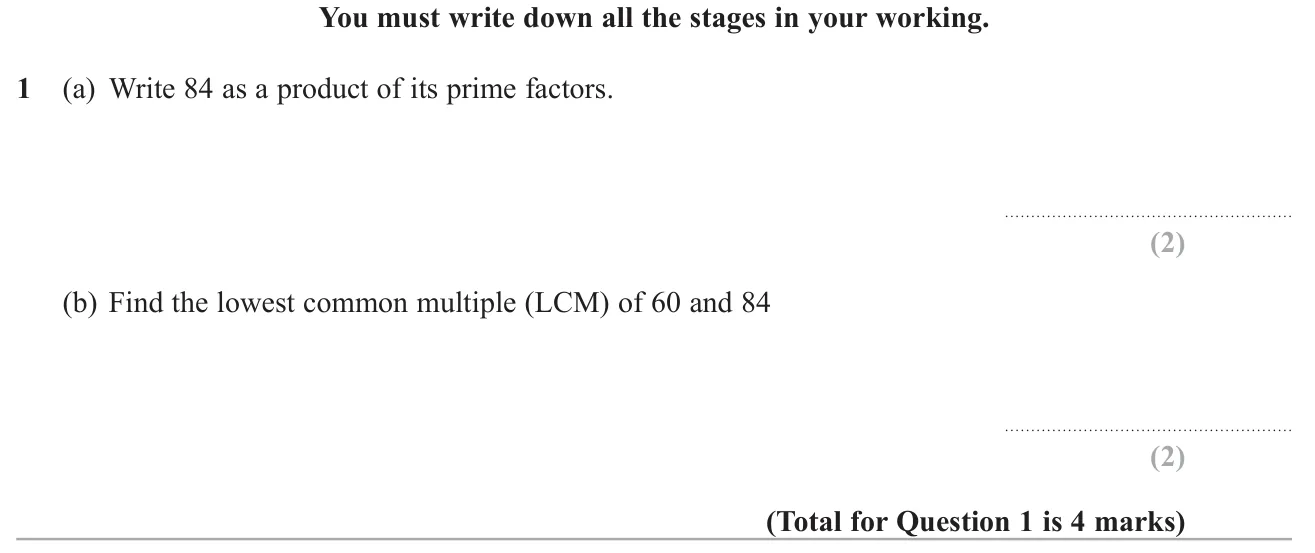
© Pearson Education Ltd. November 2020 Paper 2 (Higher, calculator), question 1.
Show answer
| (a) | 2 marks | |
|---|---|---|
| (b) | 420 | 2 marks |
Worked solution Checked against the mark scheme
(a)
(b) and
LCM
Watch out: In (b), multiplying 60 × 84 = 5040.
Edexcel GCSE Maths · 1MA1
Calculator · 22 questions · 80 marks · 1 hour 30 minutes. Try each question on paper, then press "Show answer".
© Pearson Education Ltd. November 2020 Paper 2 (Higher, calculator), question 1.
| (a) | 2 marks | |
|---|---|---|
| (b) | 420 | 2 marks |
Worked solution Checked against the mark scheme
(a)
(b) and
LCM
Watch out: In (b), multiplying 60 × 84 = 5040.
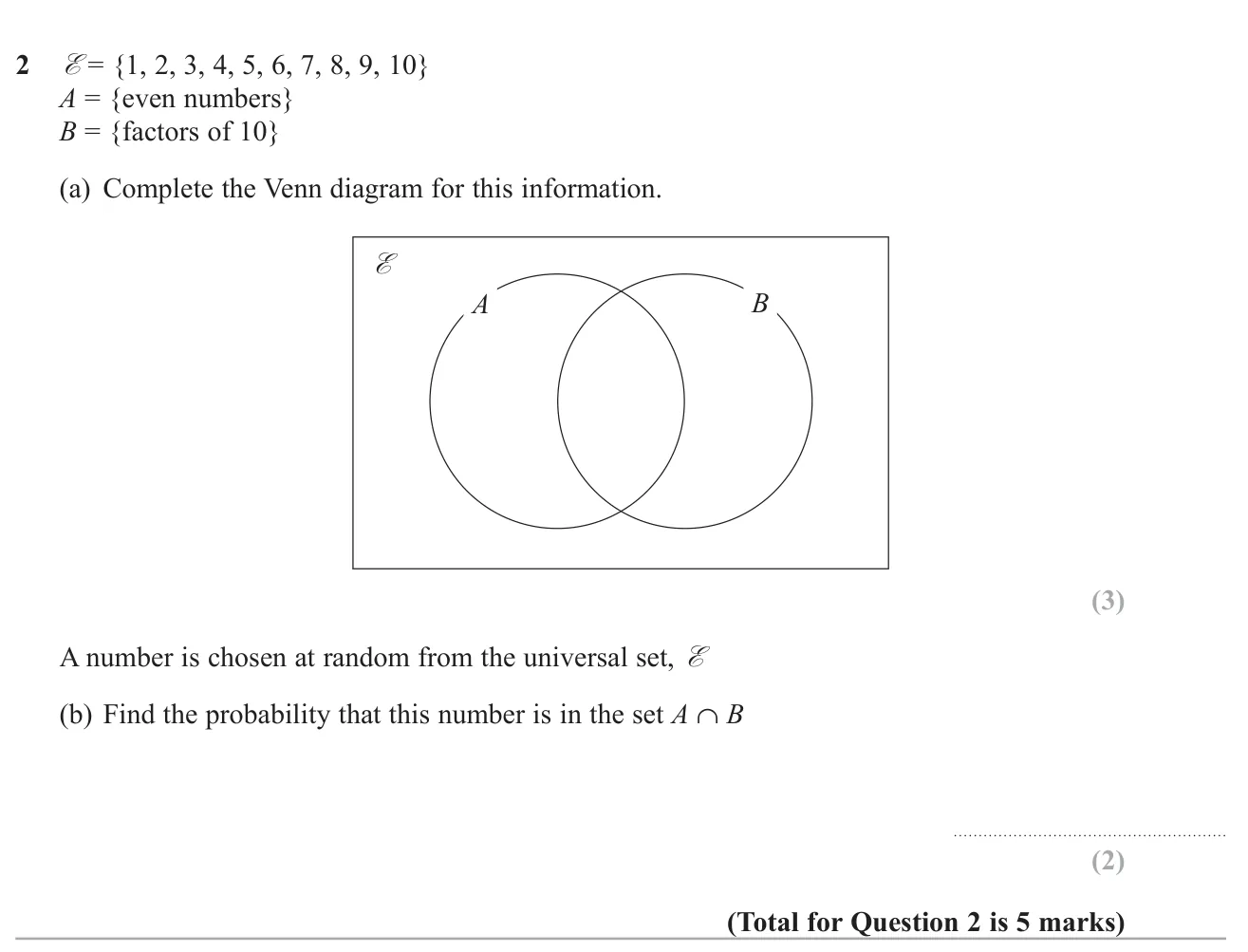
© Pearson Education Ltd. November 2020 Paper 2 (Higher, calculator), question 2.
| (a) | only: 4, 6, 8; : 2, 10; only: 1, 5; outside: 3, 7, 9 | 3 marks |
|---|---|---|
| (b) | 2 marks |
Worked solution Checked against the mark scheme
(a) Even: 2, 4, 6, 8, 10. Factors of 10: 1, 2, 5, 10.
Both: 2, 10. Only : 4, 6, 8. Only : 1, 5. Neither: 3, 7, 9.
(b) has 2 of the 10 numbers, so the probability is .
Watch out: Forgetting that 1 and 10 are factors of 10.
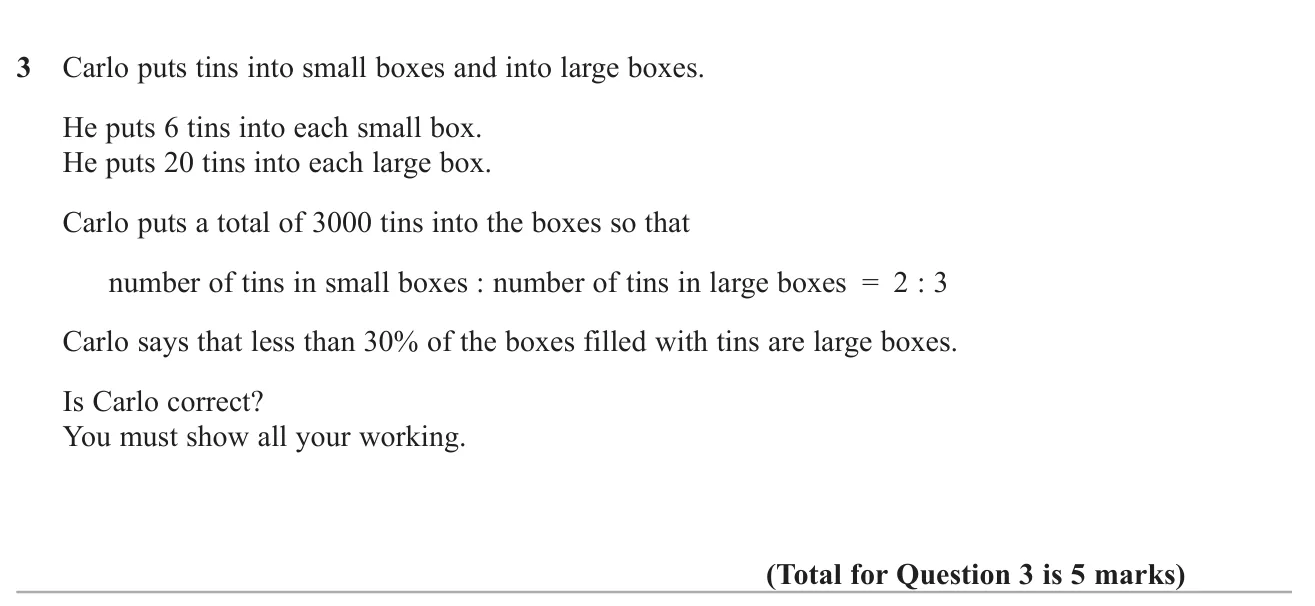
© Pearson Education Ltd. November 2020 Paper 2 (Higher, calculator), question 3.
| Answer | No: 90 of 290 boxes are large, which is about 31% | 5 marks |
|---|
Worked solution Checked against the mark scheme
One part: tins.
Small boxes: tins, boxes.
Large boxes: tins, boxes.
, which is more than 30%, so Carlo is not correct.
Watch out: Using the tin ratio (60% large) instead of the number of boxes.
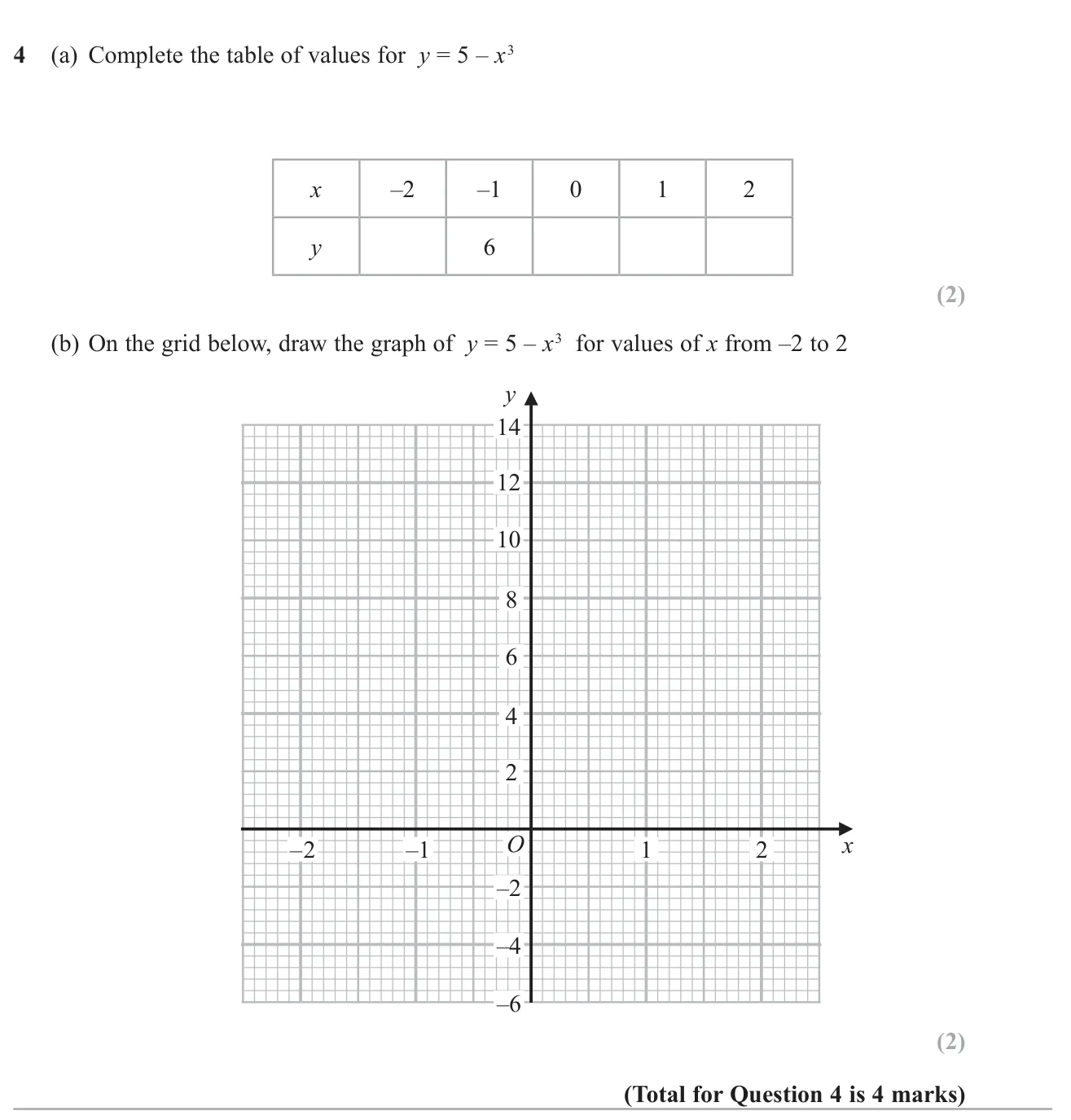
© Pearson Education Ltd. November 2020 Paper 2 (Higher, calculator), question 4.
| (a) | 13, 5, 4, (for ) | 2 marks |
|---|---|---|
| (b) | Smooth curve through , , , , | 2 marks |
Worked solution Checked against the mark scheme
(a) : ; : ; : ; :
(b) Plot the five points and join them with a smooth curve, not straight lines.
Watch out: Working out as and getting instead of 13.
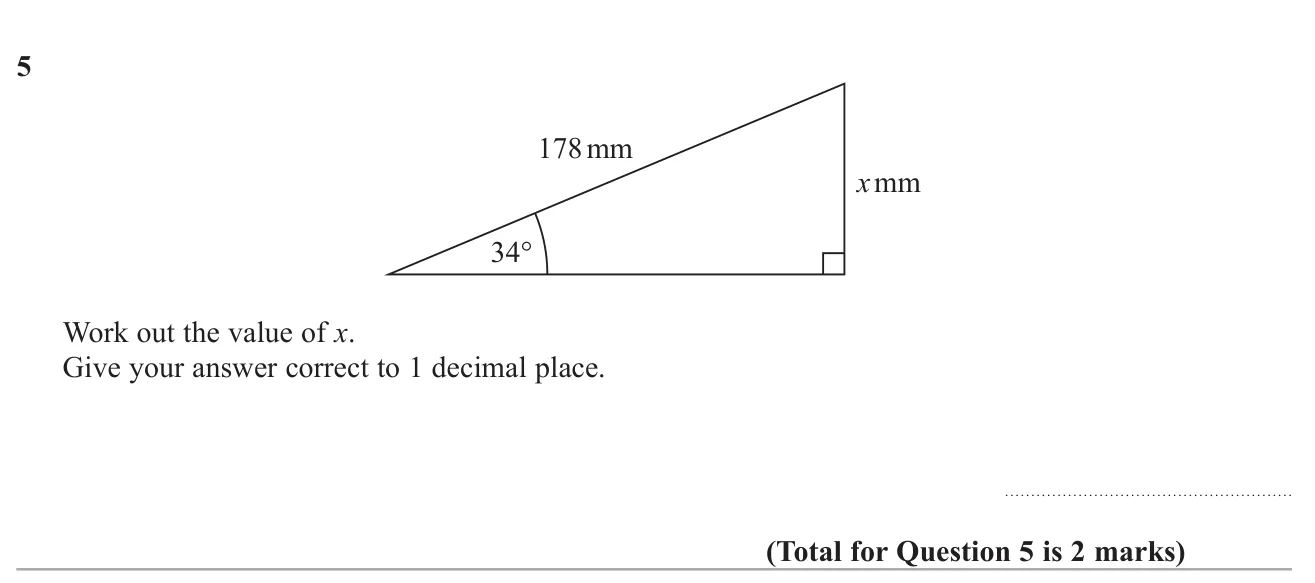
© Pearson Education Ltd. November 2020 Paper 2 (Higher, calculator), question 5.
| Answer | 99.5 | 2 marks |
|---|
Worked solution Checked against the mark scheme
is opposite and 178 is the hypotenuse, so use sine.
mm (1 d.p.)
Watch out: Using cosine and getting 147.6.
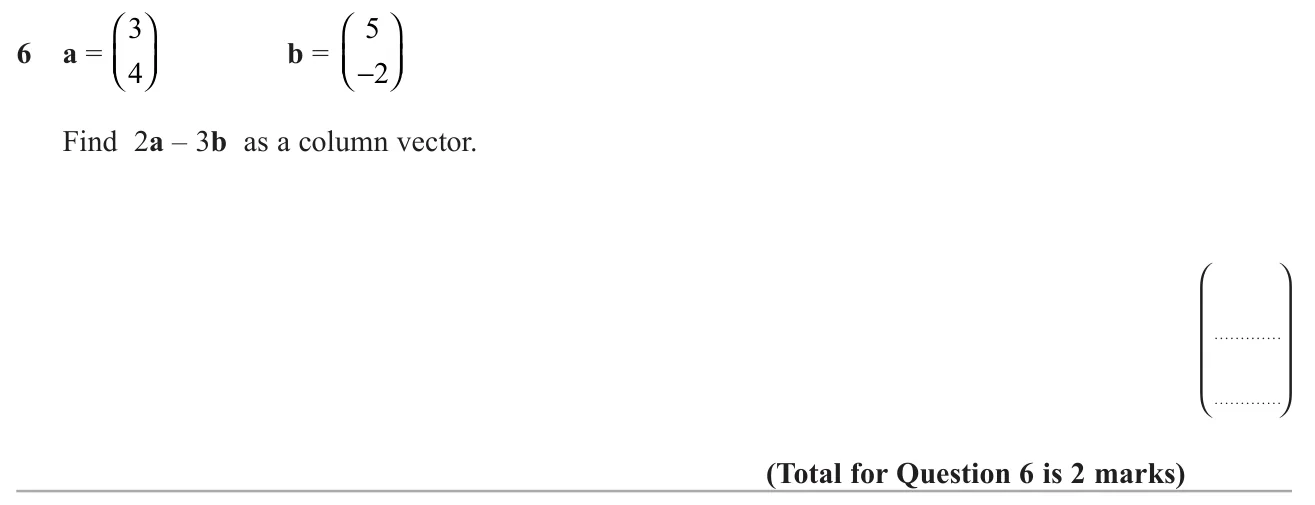
© Pearson Education Ltd. November 2020 Paper 2 (Higher, calculator), question 6.
| Answer | 2 marks |
|---|
Worked solution Checked against the mark scheme
,
Watch out: Getting 2 for the bottom entry by subtracting wrongly.
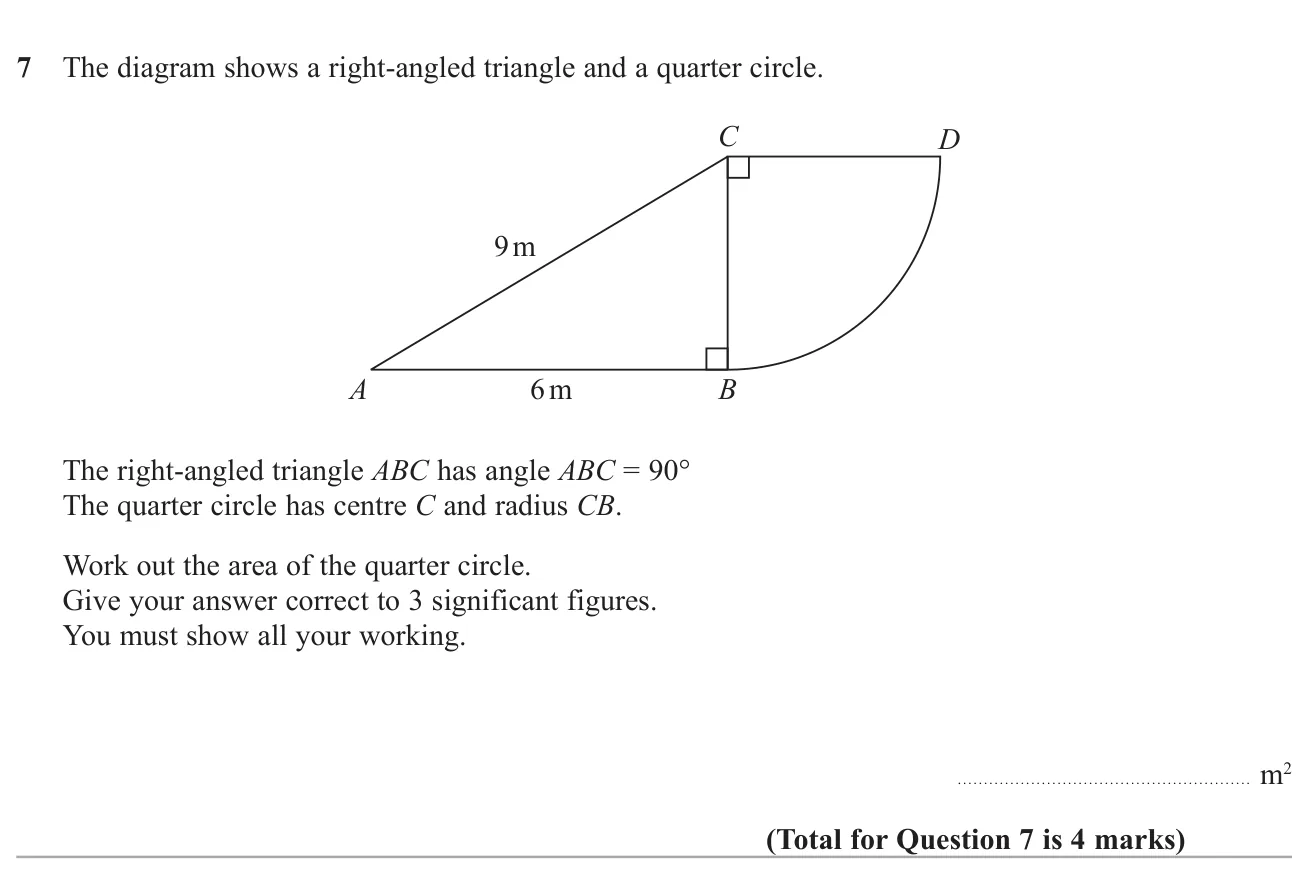
© Pearson Education Ltd. November 2020 Paper 2 (Higher, calculator), question 7.
| Answer | 35.3 | 4 marks |
|---|
Worked solution Checked against the mark scheme
, so
Quarter circle area
(3 s.f.)
Watch out: Adding the squares () instead of subtracting.
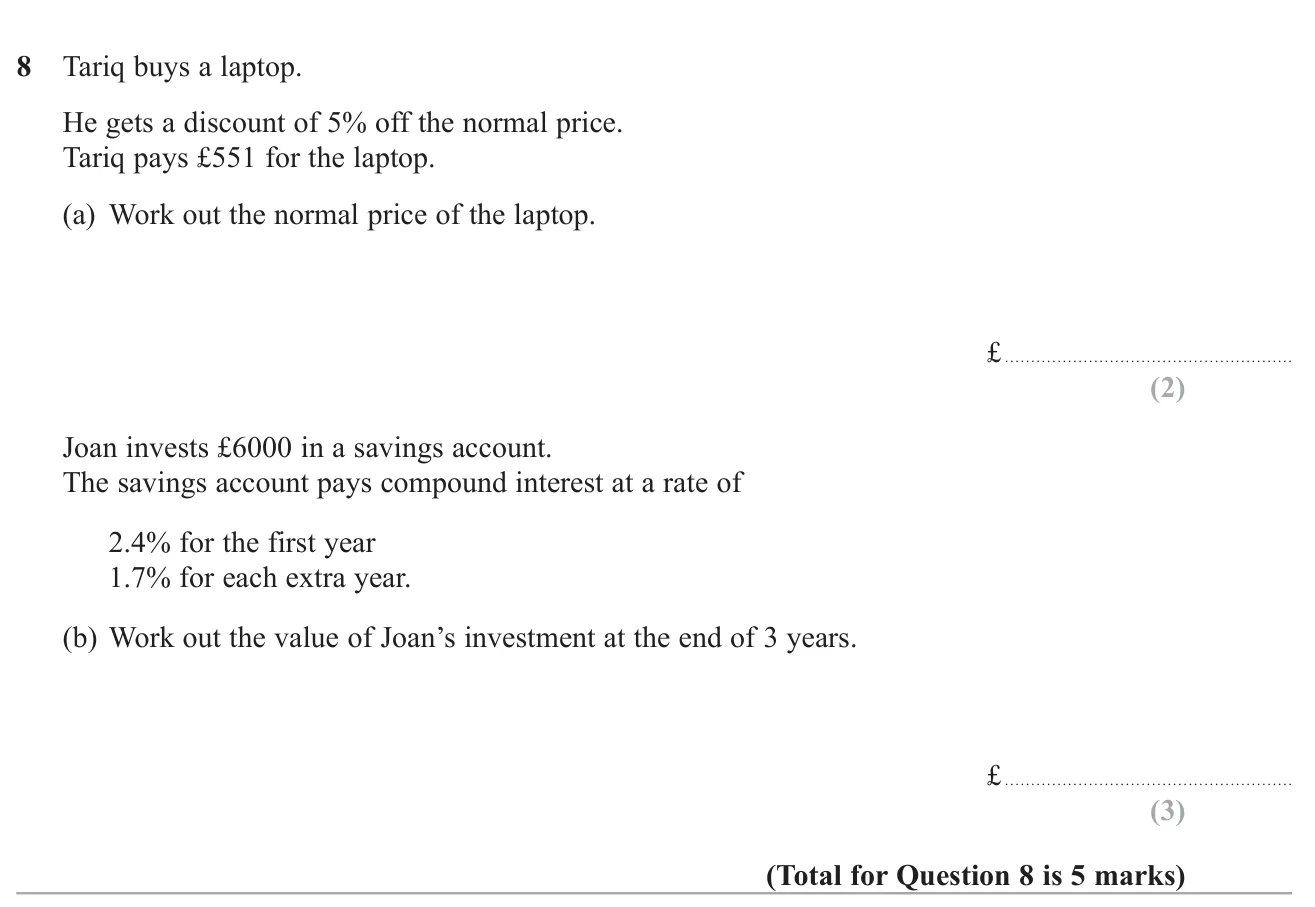
© Pearson Education Ltd. November 2020 Paper 2 (Higher, calculator), question 8.
| (a) | £580 | 2 marks |
|---|---|---|
| (b) | £6354.67 | 3 marks |
Worked solution Checked against the mark scheme
(a) £551 is 95% of the normal price: , so £580.
(b) After year 1: .
Years 2 and 3: .
The investment is worth £6354.67.
Watch out: In (a), finding 5% of £551 and adding it on, giving £578.55.
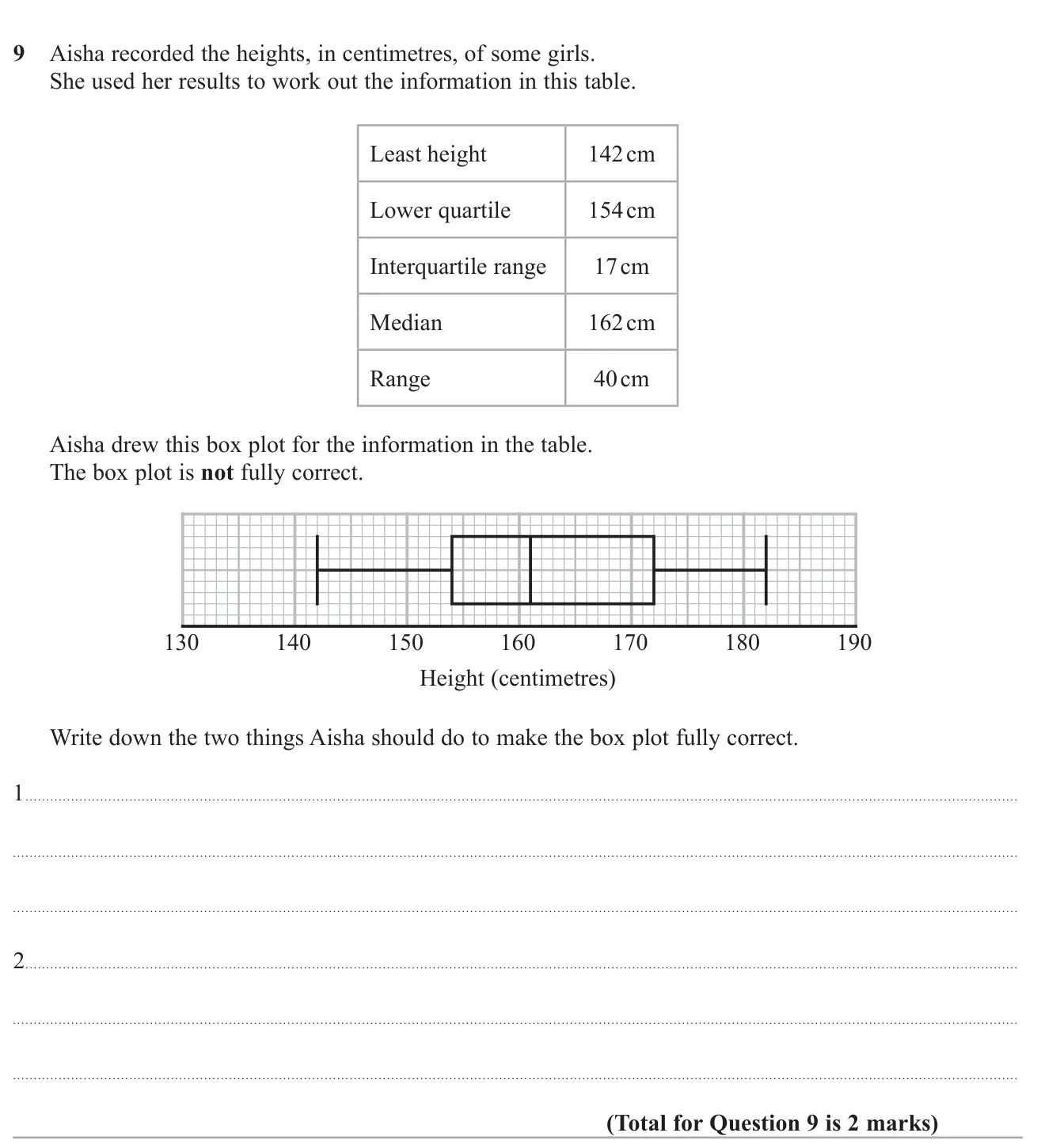
© Pearson Education Ltd. November 2020 Paper 2 (Higher, calculator), question 9.
| Answer | Move the median to 162 cm (it is drawn at 161) and move the upper quartile to 171 cm (it is drawn at 172) | 2 marks |
|---|
Worked solution Checked against the mark scheme
Check each value against the table.
Least height 142 and lower quartile 154 are plotted correctly. Greatest height , which is correct.
Median should be 162, but it is drawn at 161.
Upper quartile , but it is drawn at 172.
So she should move the median line to 162 and the right end of the box to 171.
Watch out: Just saying the median is wrong without giving the correct value.
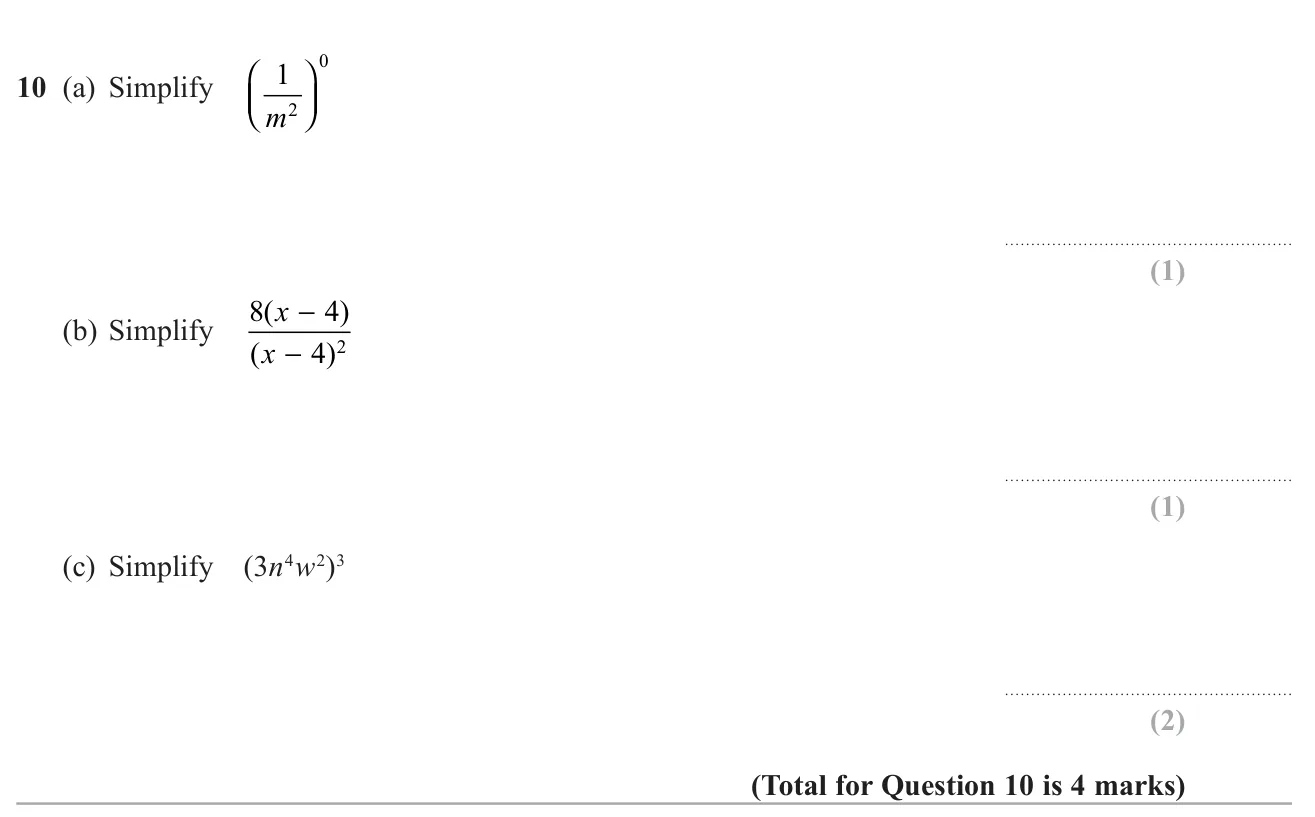
© Pearson Education Ltd. November 2020 Paper 2 (Higher, calculator), question 10.
| (a) | 1 | 1 mark |
|---|---|---|
| (b) | 1 mark | |
| (c) | 2 marks |
Worked solution Checked against the mark scheme
(a) Anything (non-zero) to the power 0 is 1.
(b) Cancel one factor of from top and bottom: .
(c) Cube each part: , , , giving .
Watch out: In (c), writing instead of , or adding powers to get .
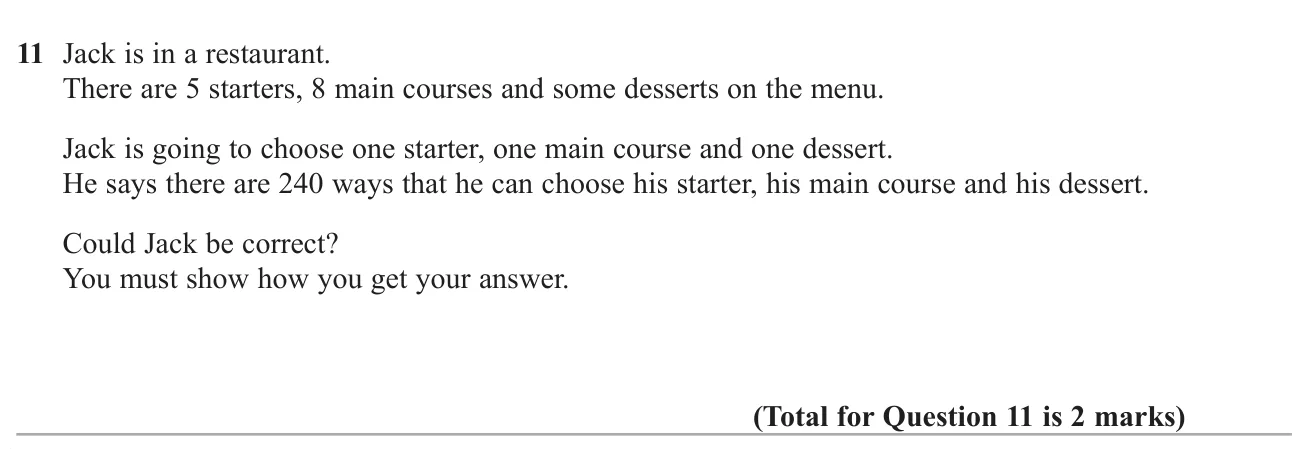
© Pearson Education Ltd. November 2020 Paper 2 (Higher, calculator), question 11.
| Answer | Yes, if there are 6 desserts () | 2 marks |
|---|
Worked solution Checked against the mark scheme
Starter and main combinations: .
, which is a whole number.
So Jack could be correct, if there are 6 desserts.
Watch out: Adding the numbers of choices instead of multiplying them.
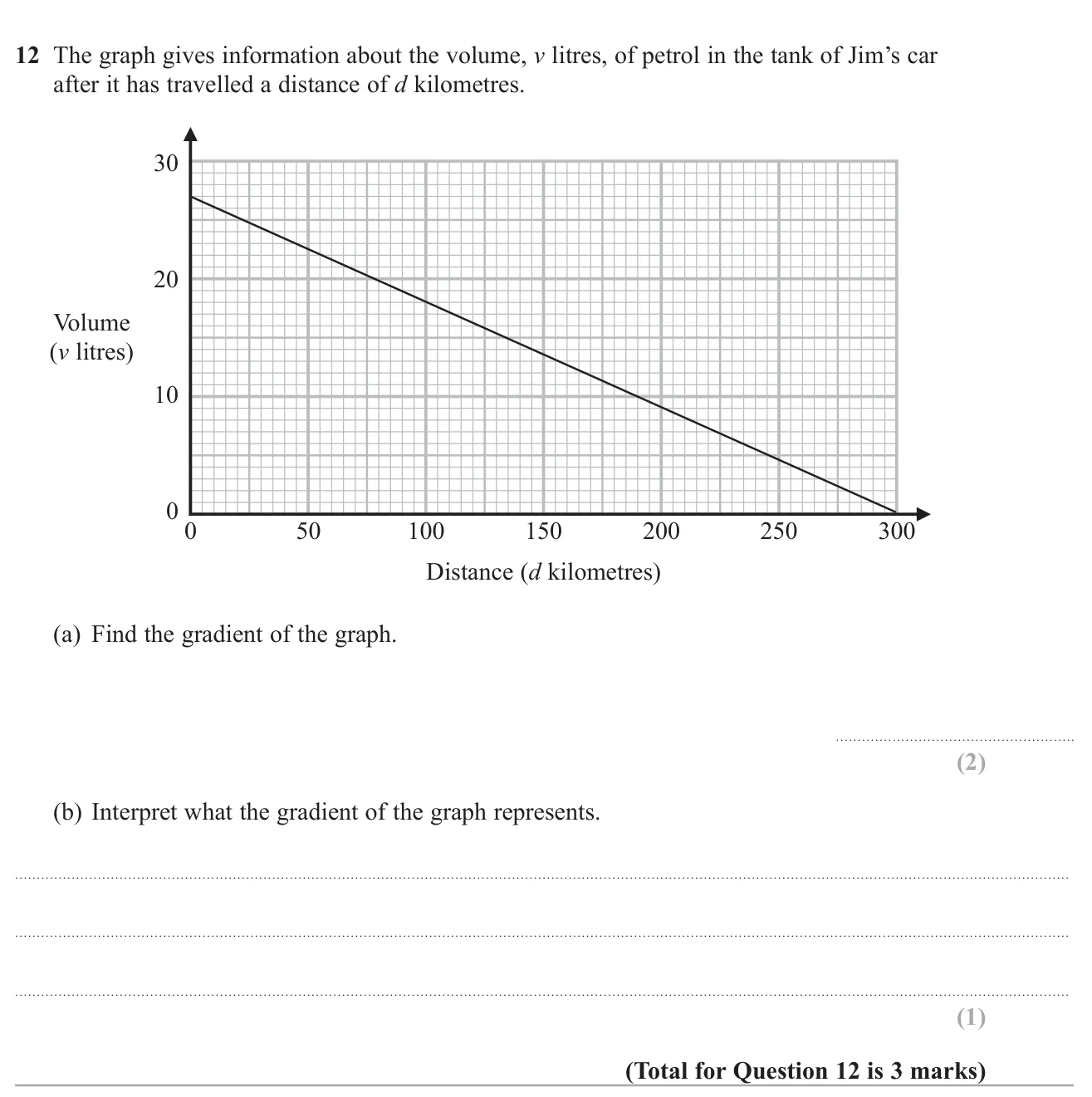
© Pearson Education Ltd. November 2020 Paper 2 (Higher, calculator), question 12.
| (a) | 2 marks | |
|---|---|---|
| (b) | The petrol used per kilometre travelled (0.09 litres per km) | 1 mark |
Worked solution Checked against the mark scheme
(a) The line starts at 27 litres when and reaches 0 litres at .
Gradient .
(b) The car uses 0.09 litres of petrol for each kilometre it travels (the rate of fuel consumption).
Watch out: Leaving out the negative sign, or writing the gradient as distance over volume.
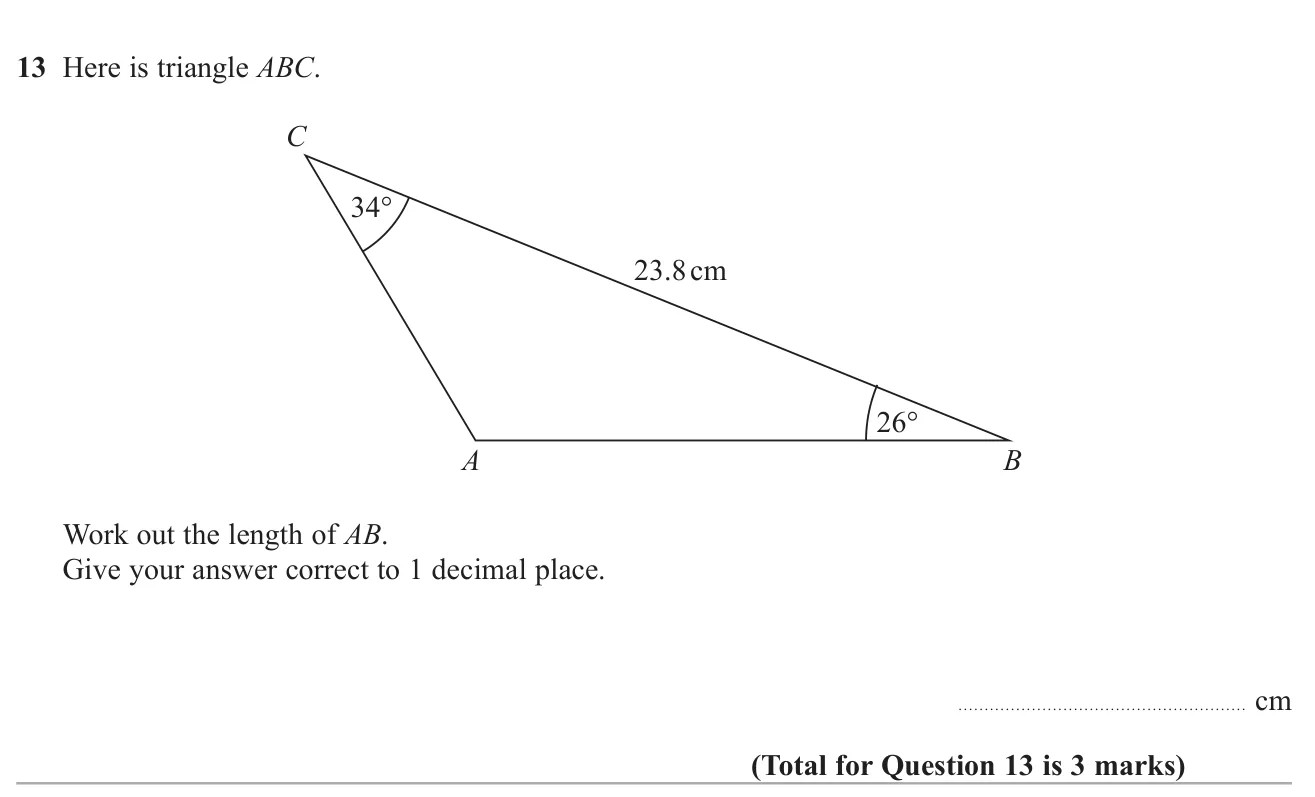
© Pearson Education Ltd. November 2020 Paper 2 (Higher, calculator), question 13.
| Answer | 15.4 | 3 marks |
|---|
Worked solution Checked against the mark scheme
Angle , which is opposite the 23.8 cm side.
cm (1 d.p.)
Watch out: Pairing 23.8 cm with 26° or 34° instead of the opposite angle, 120°.
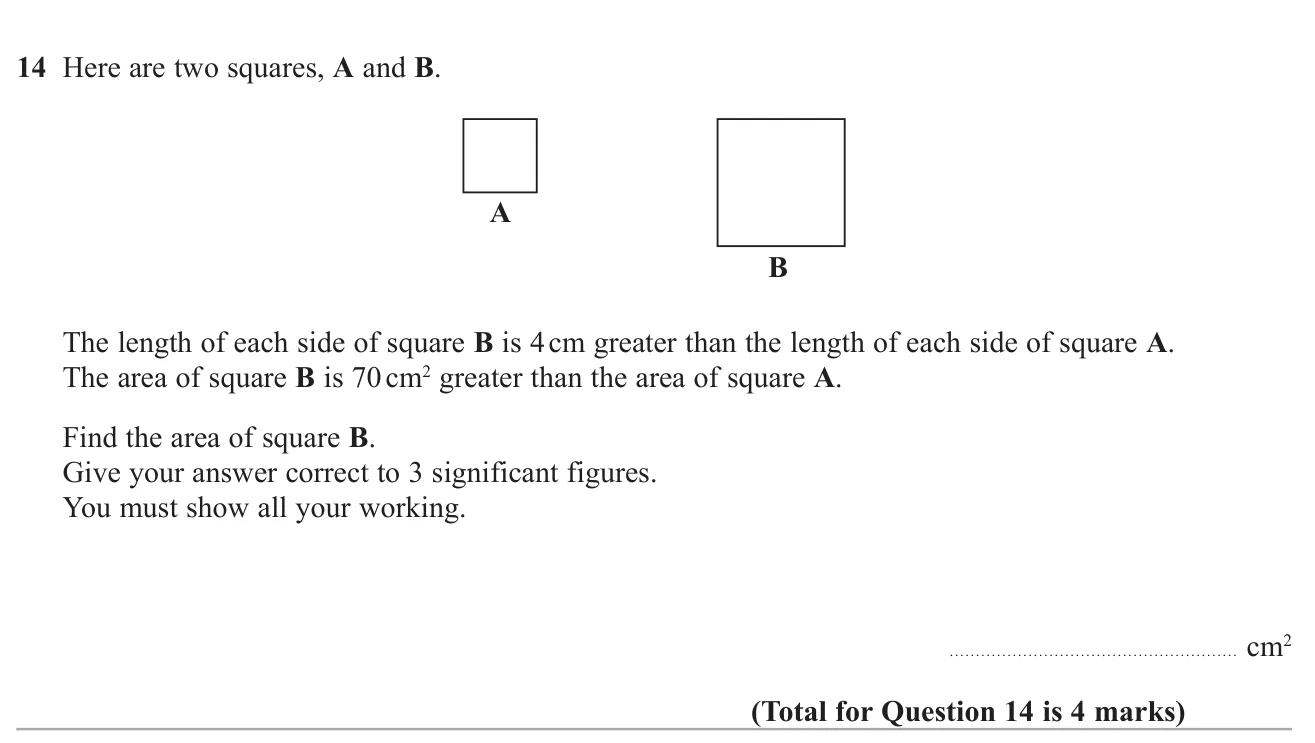
© Pearson Education Ltd. November 2020 Paper 2 (Higher, calculator), question 14.
| Answer | 116 | 4 marks |
|---|
Worked solution Checked against the mark scheme
Let square A have side cm, so square B has side .
, so and .
Side of B cm, so area .
Area of B cm² (3 s.f.)
Watch out: Expanding as .
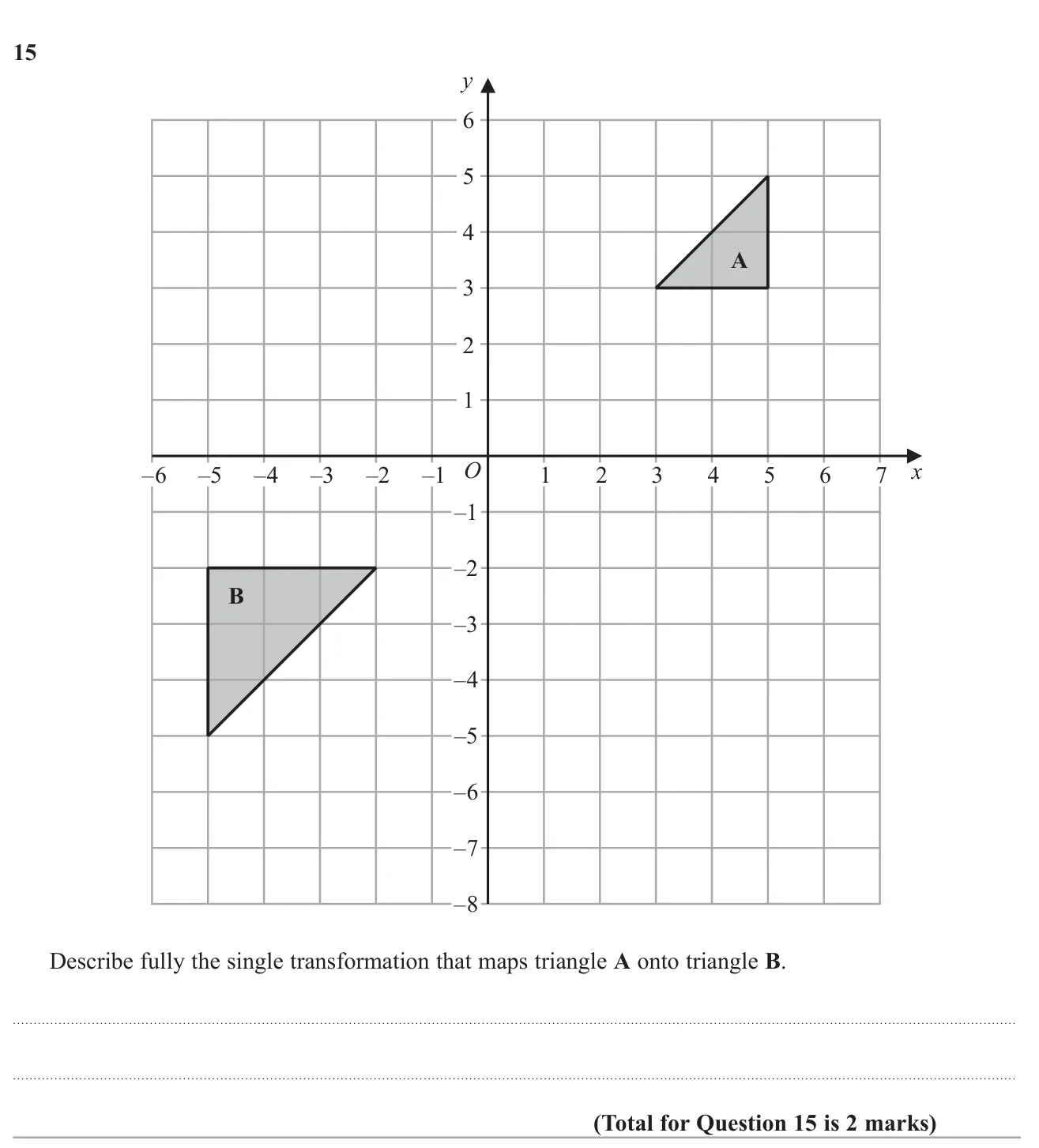
© Pearson Education Ltd. November 2020 Paper 2 (Higher, calculator), question 15.
| Answer | Enlargement, scale factor , centre | 2 marks |
|---|
Worked solution Checked against the mark scheme
B is upside down and on the opposite side, and its sides are longer: A's short sides are 2, B's are 3. So it is an enlargement with scale factor .
Join matching corners, e.g. to and to . The lines cross at .
Enlargement, scale factor , centre .
Watch out: Calling it a rotation of 180°, which ignores the change in size.
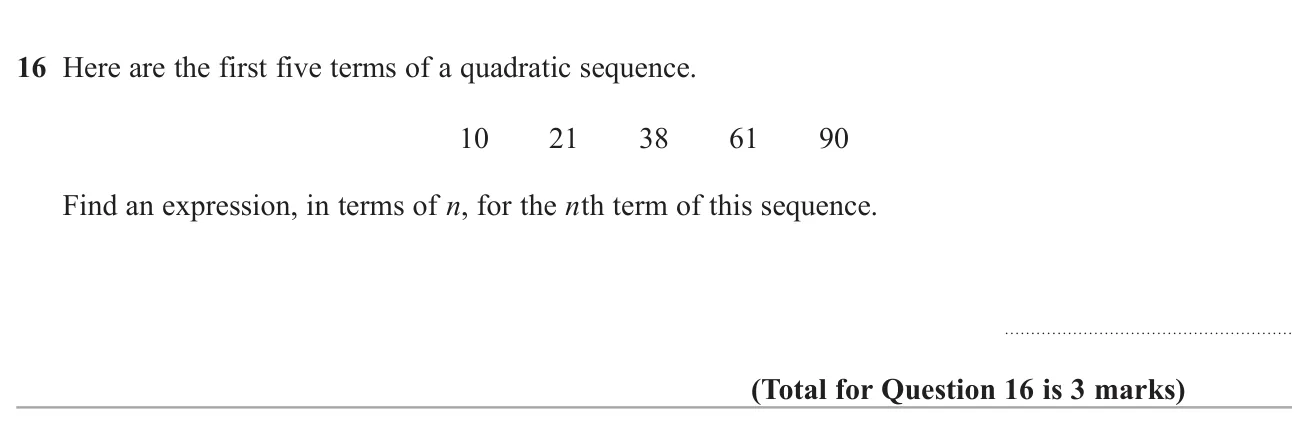
© Pearson Education Ltd. November 2020 Paper 2 (Higher, calculator), question 16.
| Answer | 3 marks |
|---|
Worked solution Checked against the mark scheme
First differences: 11, 17, 23, 29. Second differences: 6, so the term is .
Subtract (3, 12, 27, 48, 75): leaves 7, 9, 11, 13, 15, which is .
nth term .
Watch out: Using 6n² from the second difference without halving it.
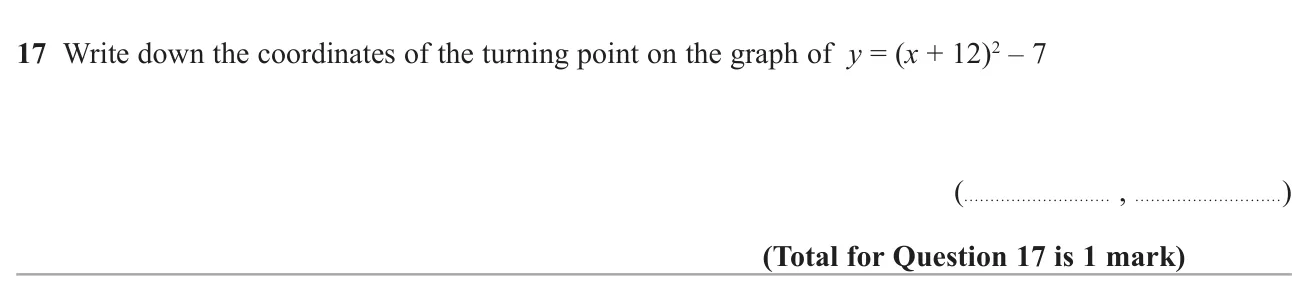
© Pearson Education Ltd. November 2020 Paper 2 (Higher, calculator), question 17.
| Answer | 1 mark |
|---|
Worked solution Checked against the mark scheme
For the turning point is .
Here and , so the turning point is .
Watch out: Giving by not changing the sign of the 12.
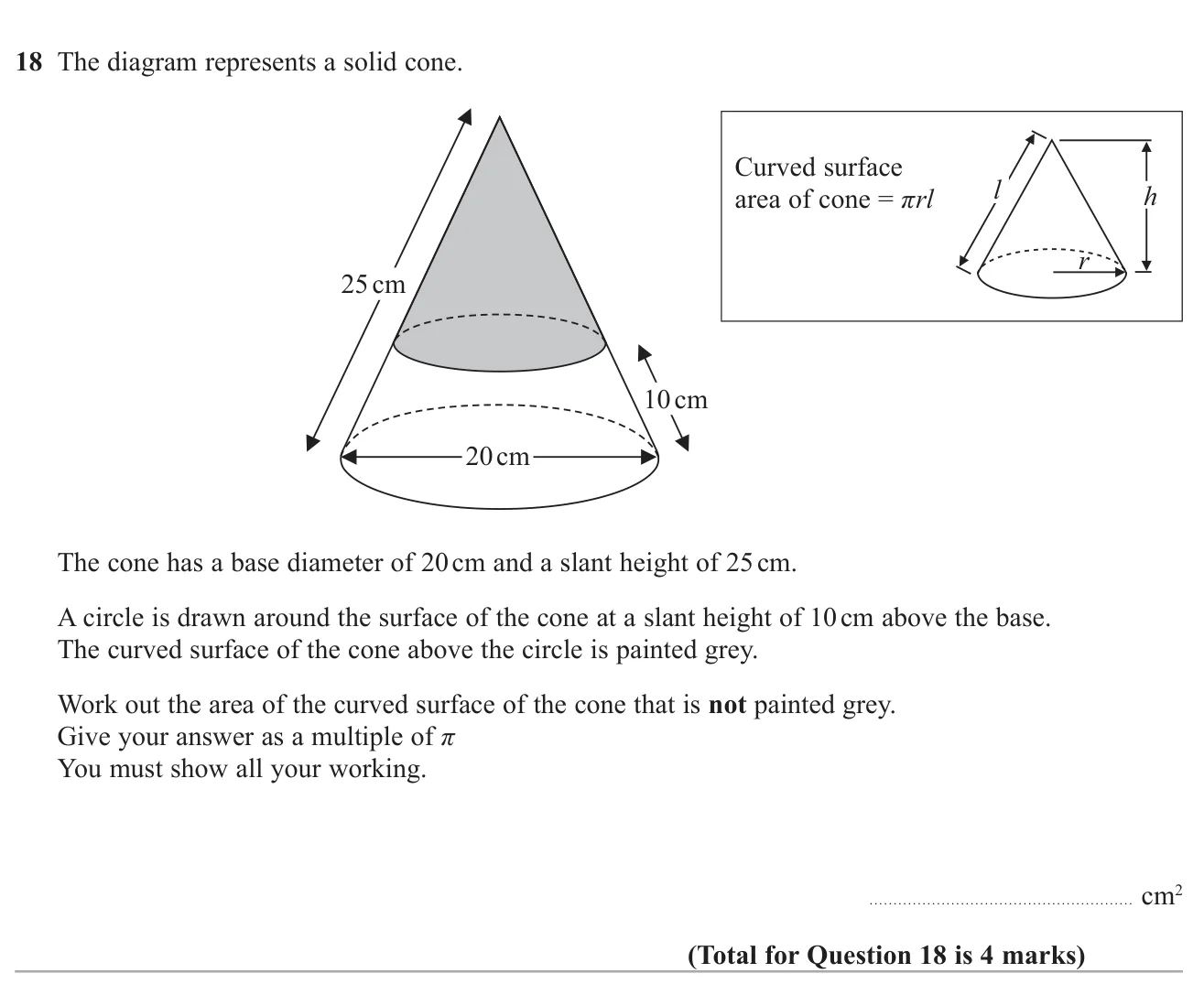
© Pearson Education Ltd. November 2020 Paper 2 (Higher, calculator), question 18.
| Answer | 4 marks |
|---|
Worked solution Checked against the mark scheme
Whole cone: , , so curved surface area .
The grey part is a smaller similar cone with slant height .
Its radius is , so its area is .
Unpainted area cm².
Watch out: Using a slant height of 10 for the grey cone instead of 15.
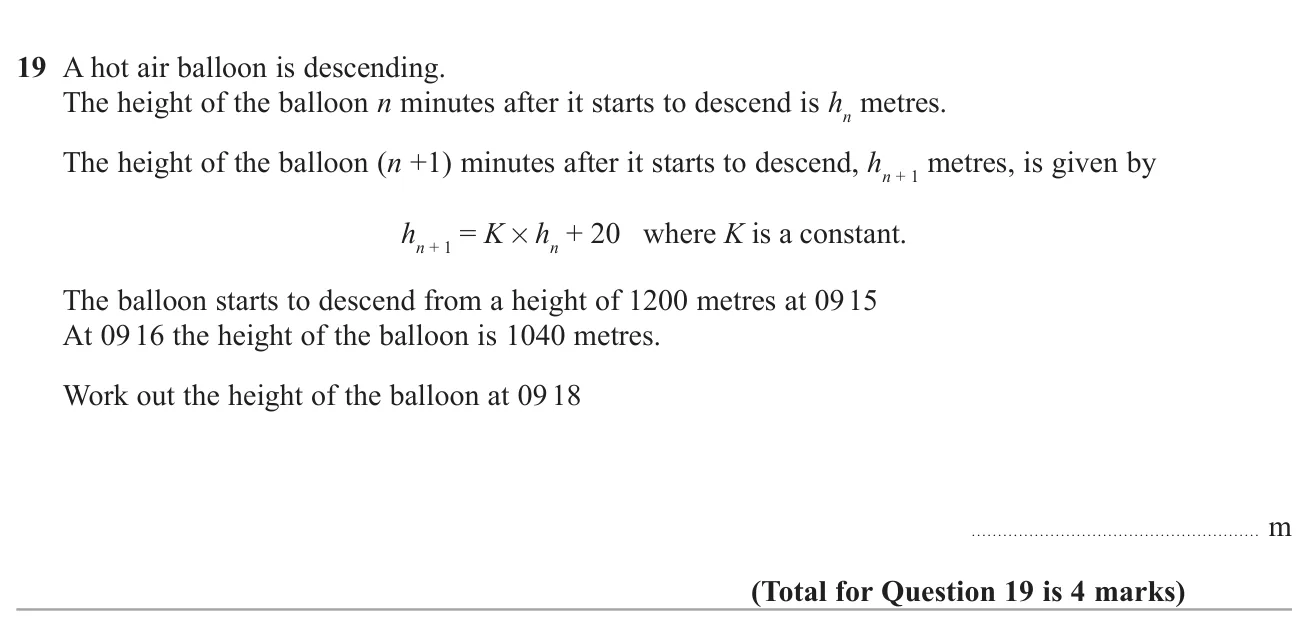
© Pearson Education Ltd. November 2020 Paper 2 (Higher, calculator), question 19.
| Answer | 788.4 m | 4 marks |
|---|
Worked solution Checked against the mark scheme
, so .
At 09 17: .
At 09 18: m.
Watch out: Applying the rule only once, or three times, by miscounting the minutes.
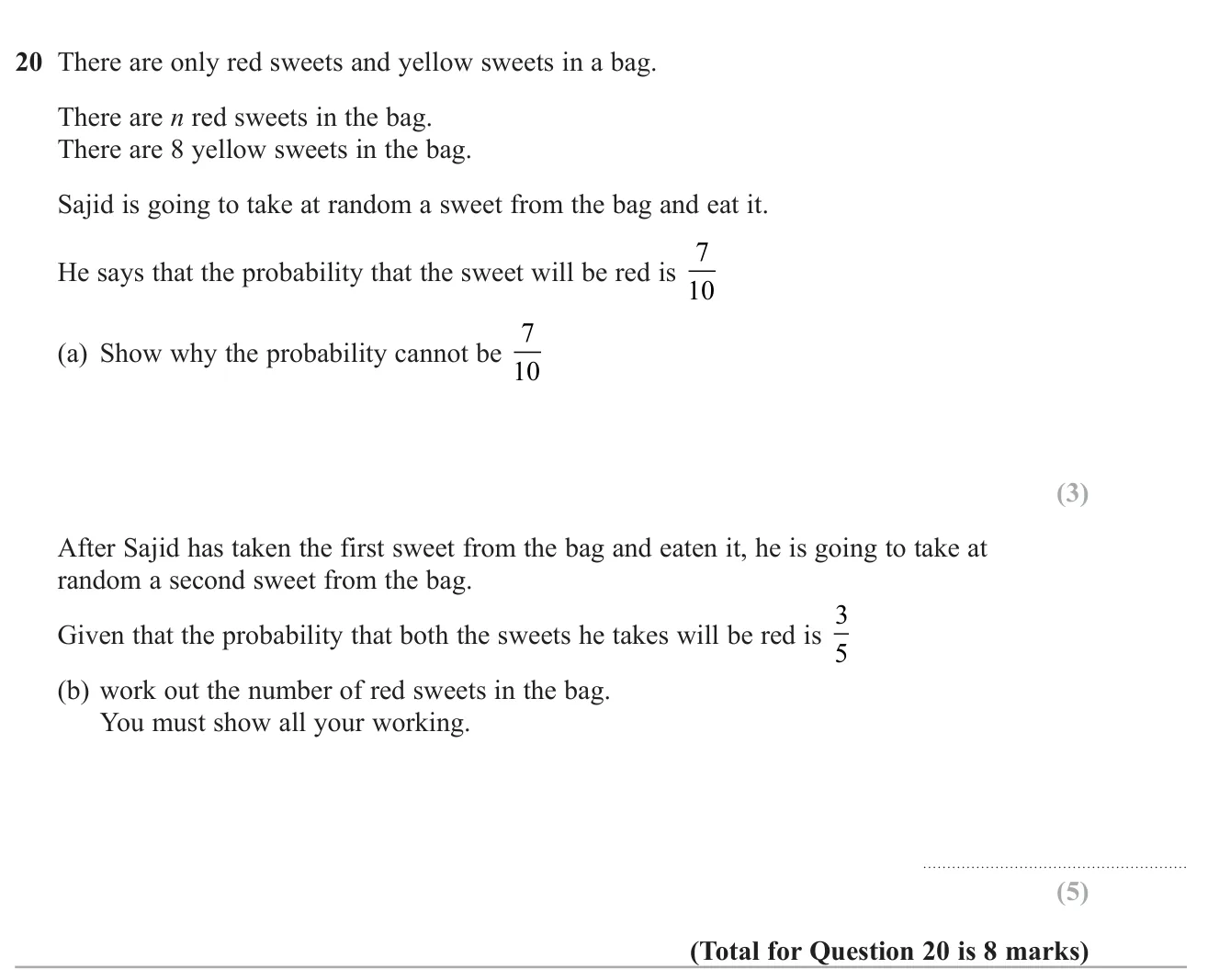
© Pearson Education Ltd. November 2020 Paper 2 (Higher, calculator), question 20.
| (a) | If then , which is not a whole number | 3 marks |
|---|---|---|
| (b) | 28 | 5 marks |
Worked solution Checked against the mark scheme
(a) gives , so and , not a whole number. So the probability cannot be .
(b)
, so .
, so (it cannot be negative).
Watch out: In (b), keeping the second denominator as as if the first sweet were replaced.
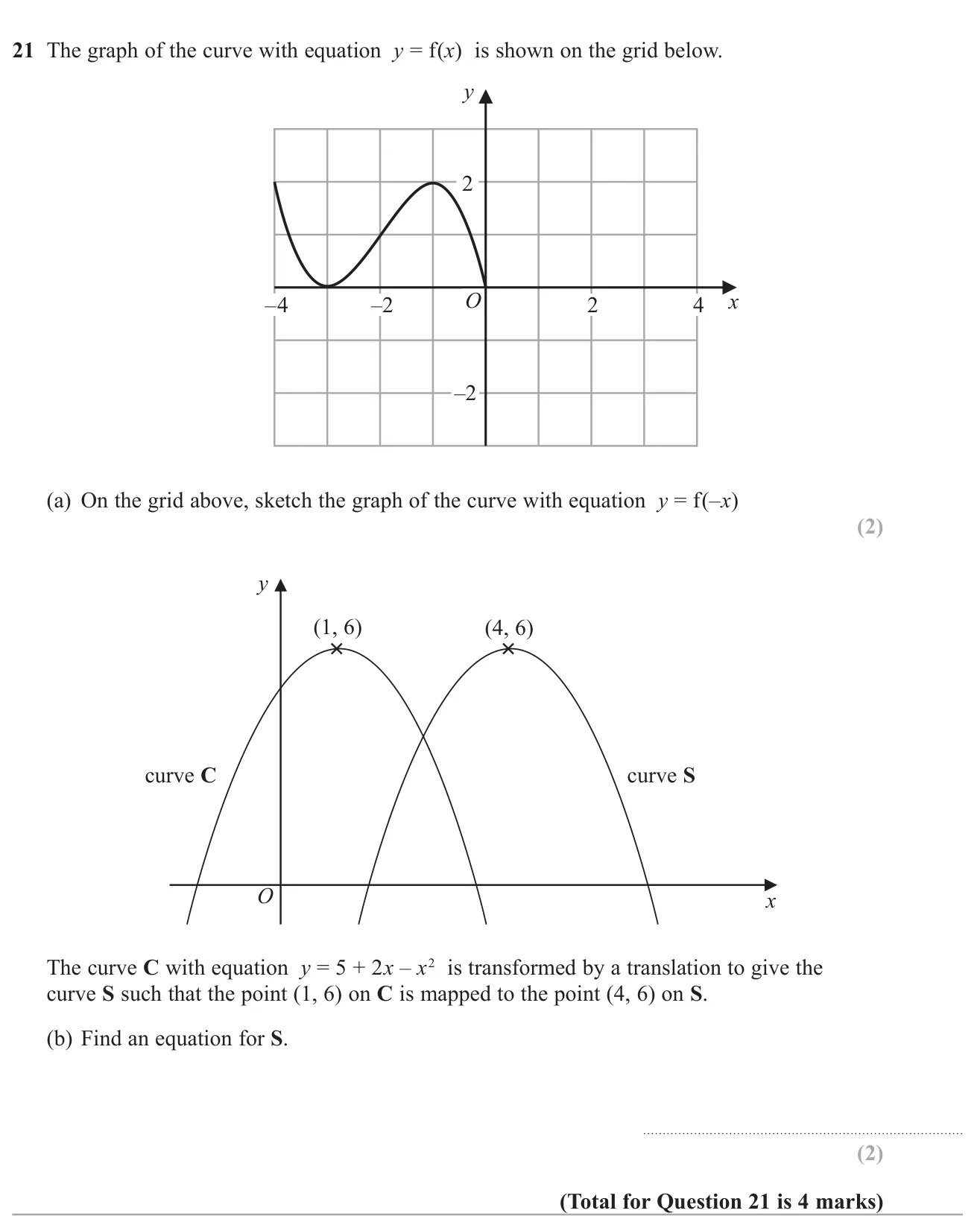
© Pearson Education Ltd. November 2020 Paper 2 (Higher, calculator), question 21.
| (a) | The curve reflected in the -axis, through , , , , | 2 marks |
|---|---|---|
| (b) | 2 marks |
Worked solution Checked against the mark scheme
(a) reflects the curve in the -axis: each point moves to . So , , , become , , , .
(b) The curve moves 3 to the right, so replace with :
which simplifies to .
Watch out: Replacing with for a shift to the right.
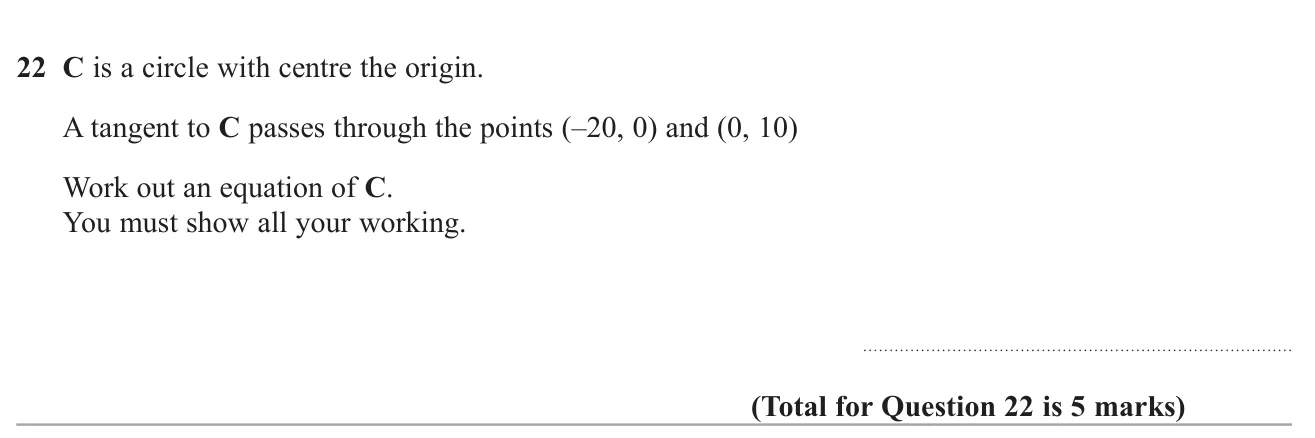
© Pearson Education Ltd. November 2020 Paper 2 (Higher, calculator), question 22.
| Answer | 5 marks |
|---|
Worked solution Checked against the mark scheme
Tangent gradient , so the tangent is .
The radius to the point of contact is perpendicular, gradient , through the origin: .
gives , .
, so the circle is .
Watch out: Taking the radius as the distance from the origin to one of the given points (e.g. 20).
Add up your marks for all three papers and see what grade that would have been.