Algebra

Cubic, reciprocal, exponential and trig graphs

13 past-paper questions, easiest first. Try each one, then reveal the answer.

Foundation & Higher5 of 13 from Foundation papers

Revision guide by The Full Marks

Cubic, reciprocal, exponential and trig graphs: what you need to know

Each type of equation makes a graph with its own shape. Know the shapes and you can match equations to sketches, spot errors in a table of values and sketch curves quickly.

Foundation needs lines, quadratics, simple cubics and y=1xy = \frac{1}{x}; exponential and trig graphs are Higher only.

Key facts

  • Linear: a straight line. Quadratic: a U shape (upside down if the x2x^2 term is negative).
  • Cubic y=x3y = x^3: an S shape through the origin, rising from bottom left to top right. y=−x3y = -x^3 is flipped. A cubic such as y=x3−3xy = x^3 - 3x has the same overall direction but with a bump in the middle.
  • Reciprocal y=1xy = \frac{1}{x}: two separate curves, in the top-right and bottom-left quadrants, that never touch the axes. y=−1xy = -\frac{1}{x} is in the top-left and bottom-right.
  • Higher: exponential y=kxy = k^x passes through (0,1)(0, 1) and never touches the xx-axis. It rises steeply if k>1k > 1 and falls if 0<k<10 < k < 1.
  • Higher: y=sin⁡xy = \sin x and y=cos⁡xy = \cos x are waves between −1-1 and 11, repeating every 360°360°. sin⁡x\sin x starts at (0,0)(0, 0) and peaks at (90,1)(90, 1); cos⁡x\cos x starts at (0,1)(0, 1) and is lowest at (180,−1)(180, -1). y=tan⁡xy = \tan x repeats every 180°180°, with asymptotes at x=90°,270°,…x = 90°, 270°, \ldots

Plotting a curve from a table of values

  1. Substitute each xx value, putting negatives in brackets.
  2. Plot the points and join them with a smooth curve, not straight lines. Recheck any point that looks out of line.

Matching an equation to a sketch

  1. Look at the highest power of xx: 1 is a straight line, 2 is a U, 3 is an S. 1x\frac{1}{x} has two separate pieces. If xx is in the power, as in 2x2^x, it is exponential.
  2. A negative in front flips the shape. Check one point, such as the yy-intercept or x=1x = 1.

Worked examples

Example 1 Foundation · grade 4

Complete a table of values for y=x3−2xy = x^3 - 2x for x=−2,−1,0,1,2x = -2, -1, 0, 1, 2.

Show the solution

x=−2x = -2: (−2)3−2(−2)=−8+4=−4(-2)^3 - 2(-2) = -8 + 4 = -4
x=−1x = -1: −1+2=1-1 + 2 = 1
x=0x = 0: 00
x=1x = 1: 1−2=−11 - 2 = -1
x=2x = 2: 8−4=48 - 4 = 4
The yy values are −4,1,0,−1,4-4, 1, 0, -1, 4.

Example 2 Higher · grade 6

A curve has equation y=2xy = 2^x. (a) Where does it cross the yy-axis? (b) Find xx when y=32y = 32. (c) What happens to yy as xx becomes very negative?

Show the solution

(a) When x=0x = 0, y=20=1y = 2^0 = 1, so it crosses at (0,1)(0, 1).
(b) 25=322^5 = 32, so x=5x = 5.
(c) For example 2−3=182^{-3} = \frac{1}{8}. yy gets closer to 0 but never reaches it.

Common mistakes

  • Working out (−2)3(-2)^3 as 88 instead of −8-8. Use brackets on your calculator.
  • Mixing up y=x3y = x^3 and y=−x3y = -x^3, or y=1xy = \frac{1}{x} and y=−1xy = -\frac{1}{x}. Test a point such as x=1x = 1.
  • Drawing y=tan⁡xy = \tan x as a wave like sin⁡x\sin x. It has vertical asymptotes.

Exam tips

  • Sketches are marked on the right shape and the key points, so label them: (0,1)(0, 1) for an exponential, or where a trig graph crosses the axes and reaches 11 and −1-1.
  • If asked what is wrong with a sketch, say exactly what is wrong, for example 'an exponential graph should never cross the xx-axis'.

Questions people ask

What does a cubic graph look like?

An S shape: y=x3y = x^3 rises from bottom left to top right, flattening at the origin.

Does an exponential graph ever cross the x-axis?

No. For y=kxy = k^x with k>0k > 0, yy is always positive, so the curve never touches the xx-axis.

Exam questions: Cubic, reciprocal, exponential and trig graphs (13, easiest first)

Cubic, reciprocal, exponential and trig graphs2 marksGrade 4No calculatorOn both tiers
November 2020 · Paper 1 Foundation · Q22
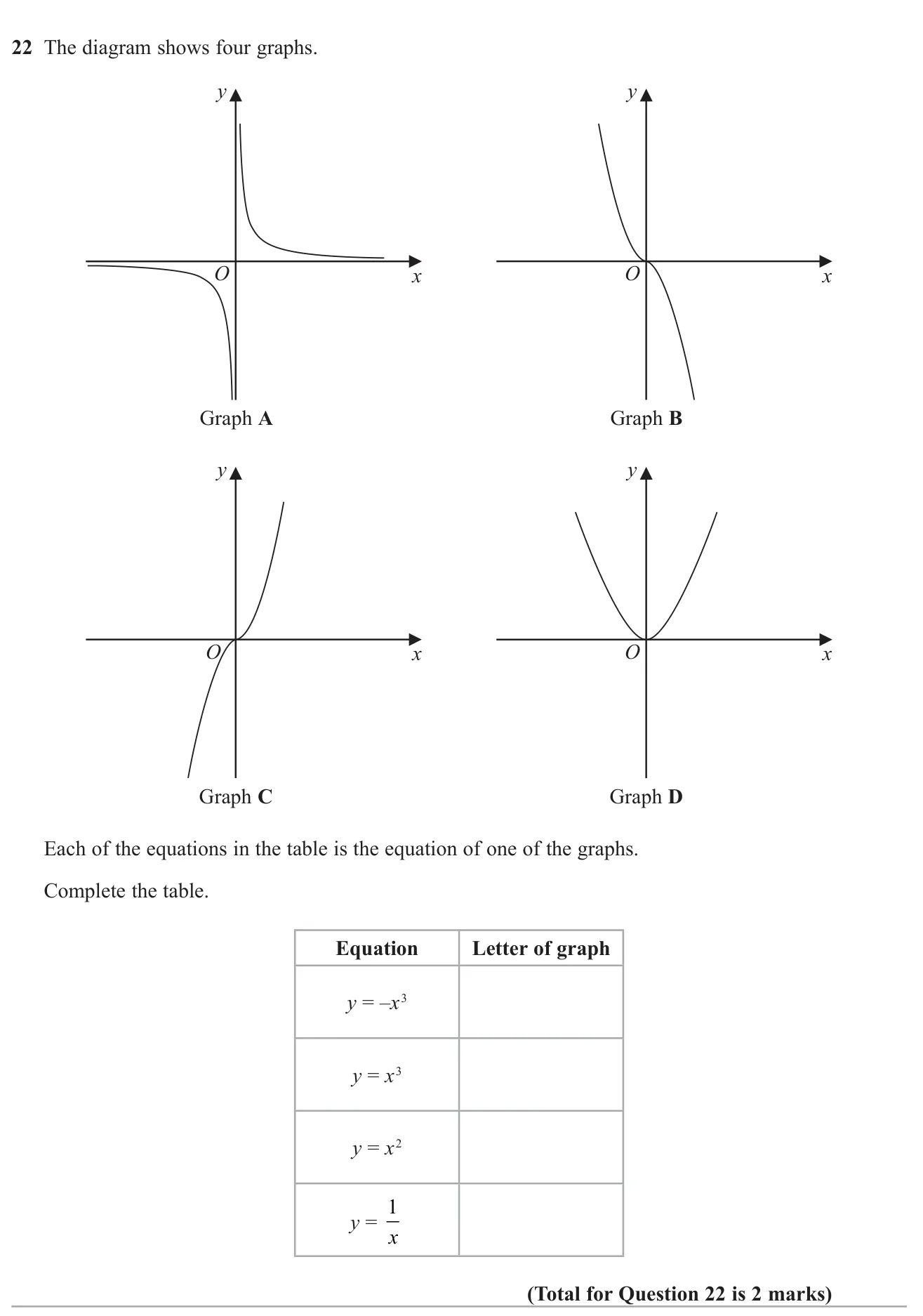
Match four equations (two cubics, a quadratic and a reciprocal) to their sketch graphs.

© Pearson Education Ltd. November 2020 Paper 1 (Foundation, non-calculator), question 22.

Show answer
Answery=−x3y=-x^3: B; y=x3y=x^3: C; y=x2y=x^2: D; y=1xy=\frac{1}{x}: A2 marks

Worked solution Checked against the mark scheme

y=x2y = x^2 is the U shape: D.

y=1xy = \frac{1}{x} has two separate branches and never touches the axes: A.

y=x3y = x^3 rises from bottom left to top right: C.

y=−x3y = -x^3 is its reflection, falling from top left: B.

Watch out: Mixing up y=x3y = x^3 and y=−x3y = -x^3.

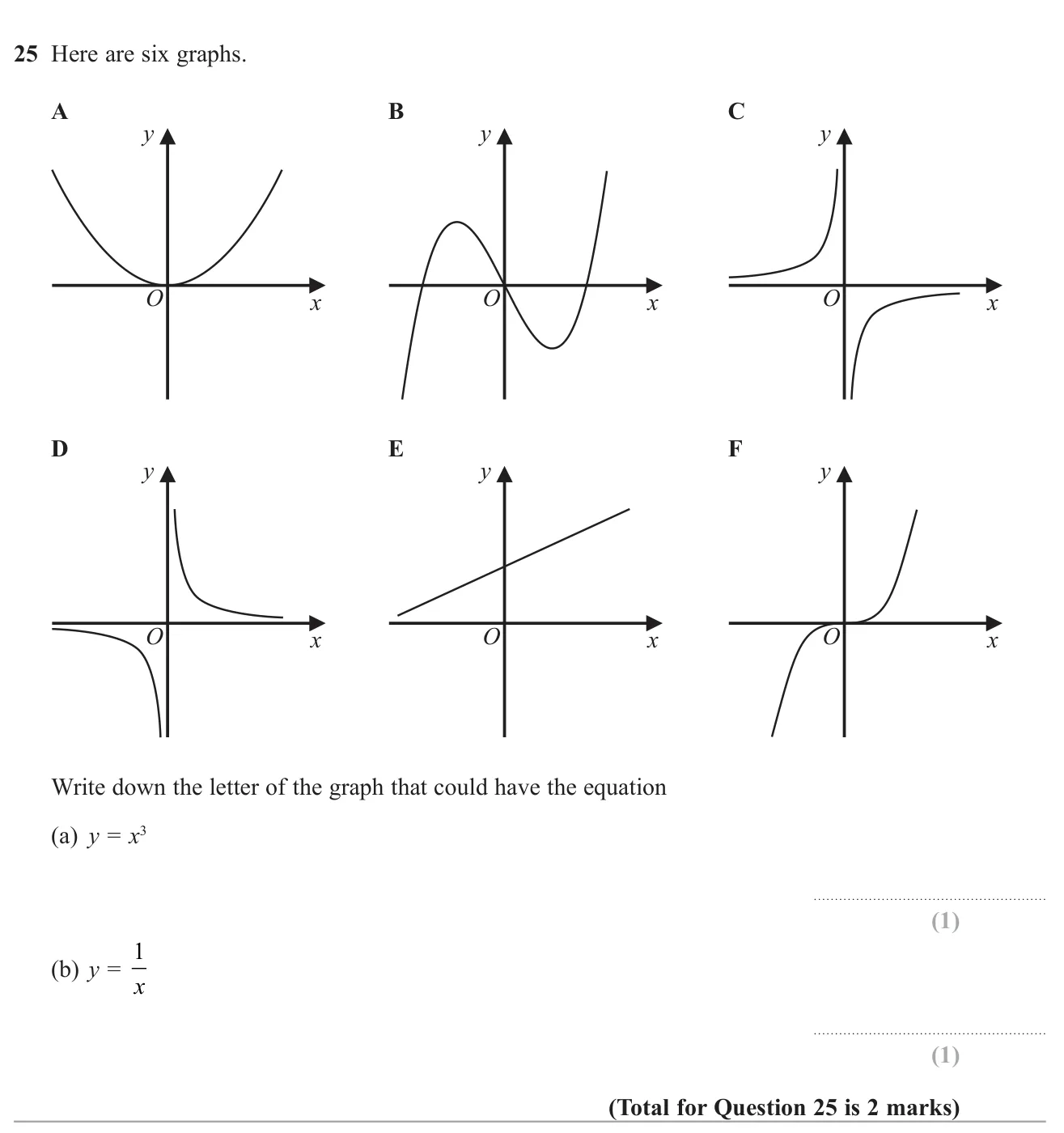
Cubic, reciprocal, exponential and trig graphs2 marksGrade 4CalculatorOn both tiers
November 2019 · Paper 2 Foundation · Q25
Match cubic and reciprocal equations to their sketch graphs.

© Pearson Education Ltd. November 2019 Paper 2 (Foundation, calculator), question 25.

Show answer
(a)F1 mark
(b)D1 mark

Worked solution Checked against the mark scheme

(a) y=x3y = x^3 passes through the origin, is negative for negative xx and rises steeply: graph F.

(b) y=1xy = \frac{1}{x} never touches the axes, with branches in the top-right and bottom-left: graph D.

Watch out: Choosing B for y=x3y = x^3 (that is x3−kxx^3 - kx) or C for 1/x1/x (that is −1/x-1/x).

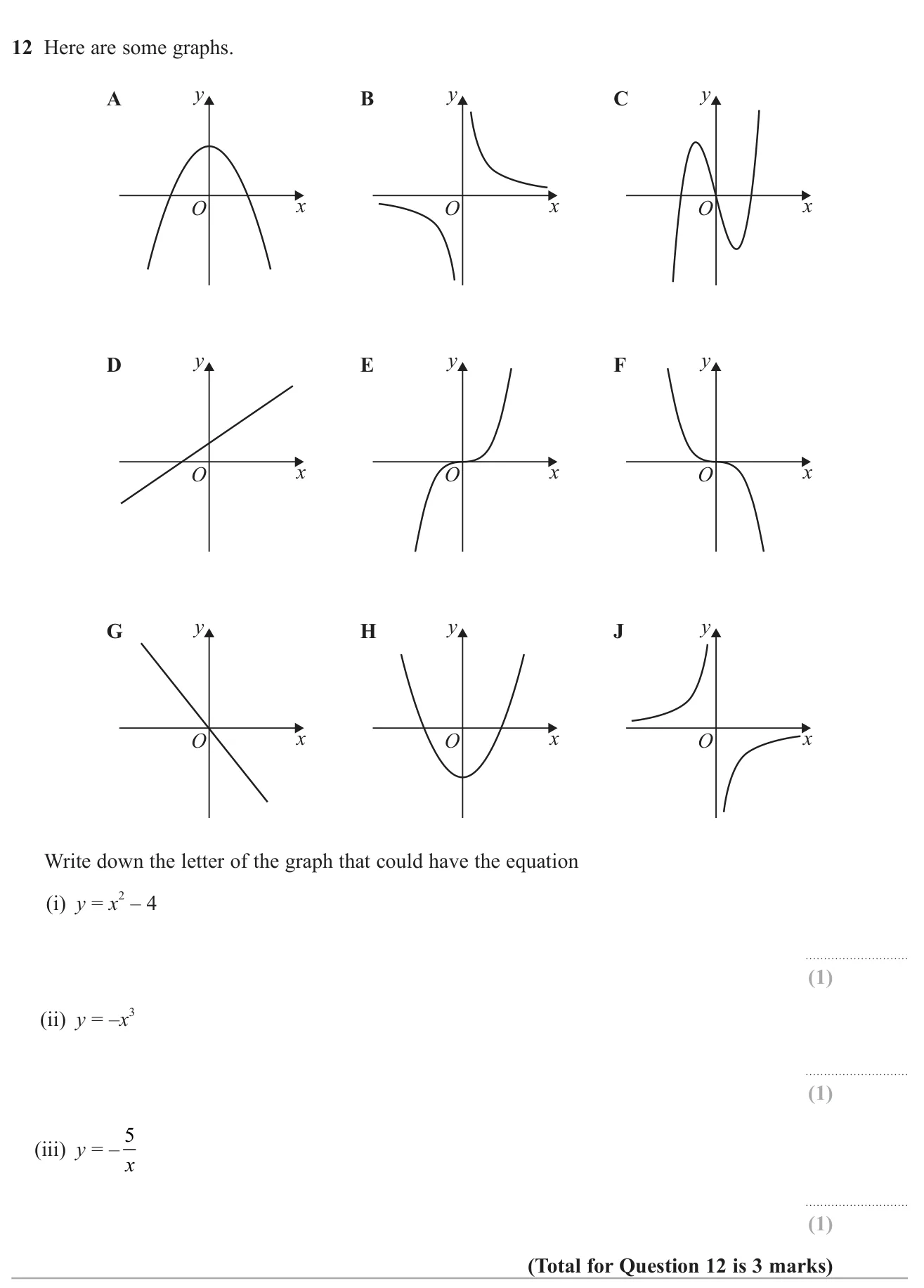
Cubic, reciprocal, exponential and trig graphs3 marksGrade 5No calculatorHigher
June 2024 · Paper 1 Higher · Q12
Match three equations (a quadratic, a negative cubic and a negative reciprocal) to their sketch graphs.

© Pearson Education Ltd. June 2024 Paper 1 (Higher, non-calculator), question 12.

Show answer
((i))H1 mark
((ii))F1 mark
((iii))J1 mark

Worked solution Checked against the mark scheme

(i) y=x2−4y = x^2 - 4 is a U-shaped parabola crossing the yy-axis at −4-4: H

(ii) y=−x3y = -x^3 is a cubic that falls from top left to bottom right through the origin: F

(iii) y=−5xy = -\frac{5}{x} is a reciprocal graph in the second and fourth quadrants: J

Watch out: Choosing B for y=−5xy = -\frac{5}{x}, forgetting the negative sign flips it into the other quadrants.

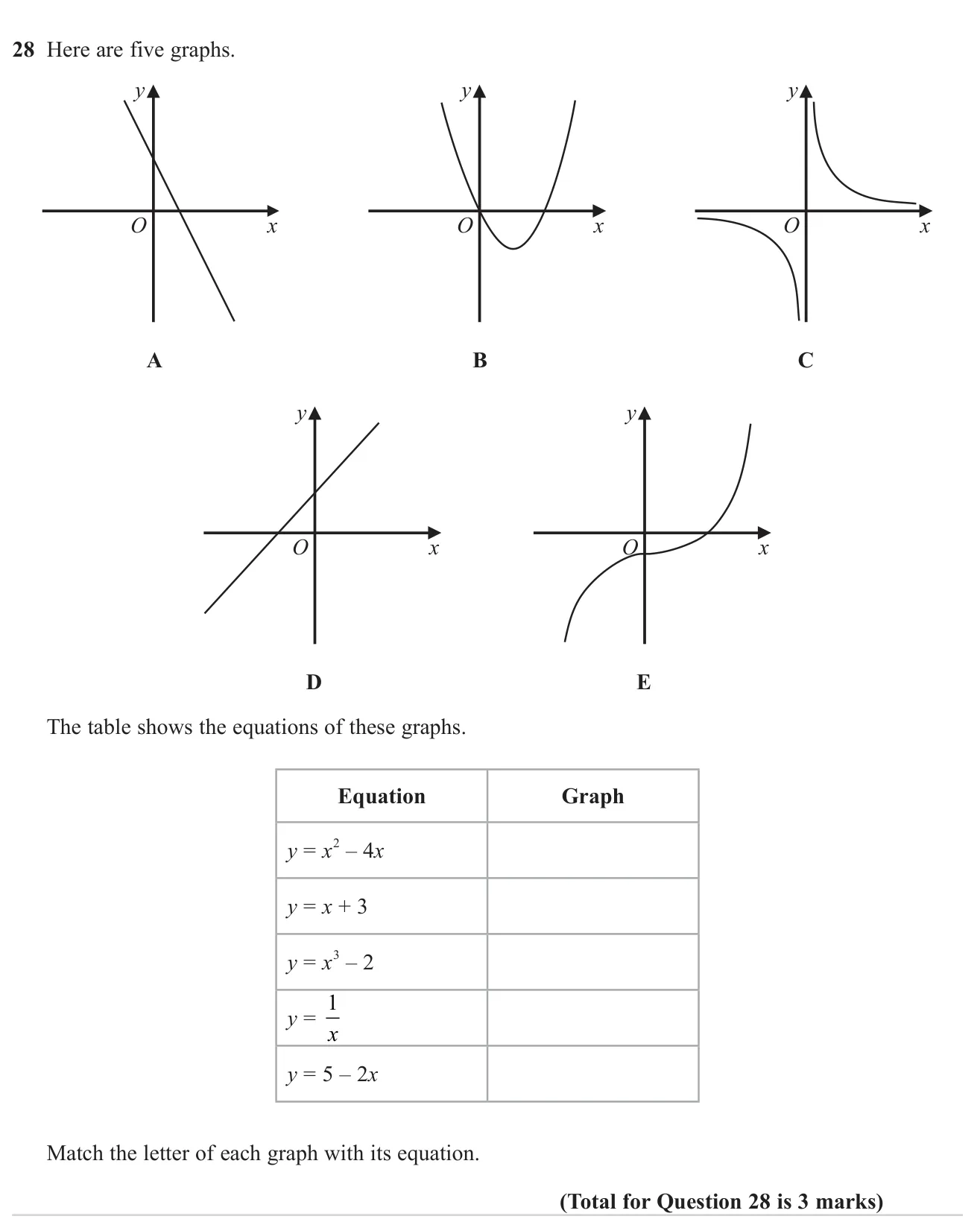
Cubic, reciprocal, exponential and trig graphs3 marksGrade 5CalculatorFoundation
June 2023 · Paper 2 Foundation · Q28
Match five sketch graphs to their equations: straight lines, a quadratic, a cubic and a reciprocal.

© Pearson Education Ltd. June 2023 Paper 2 (Foundation, calculator), question 28.

Show answer
Answery=x2−4xy = x^2 - 4x: B; y=x+3y = x + 3: D; y=x3−2y = x^3 - 2: E; y=1xy = \frac{1}{x}: C; y=5−2xy = 5 - 2x: A3 marks

Worked solution Checked against the mark scheme

y=x2−4xy = x^2 - 4x is a U-shaped curve through the origin: B

y=x+3y = x + 3 slopes up and crosses the yy-axis above O: D

y=x3−2y = x^3 - 2 is the S-shaped cubic: E

y=1xy = \frac{1}{x} has two separate branches: C

y=5−2xy = 5 - 2x slopes down: A

Watch out: Mixing up the two straight lines by ignoring the sign of the gradient.

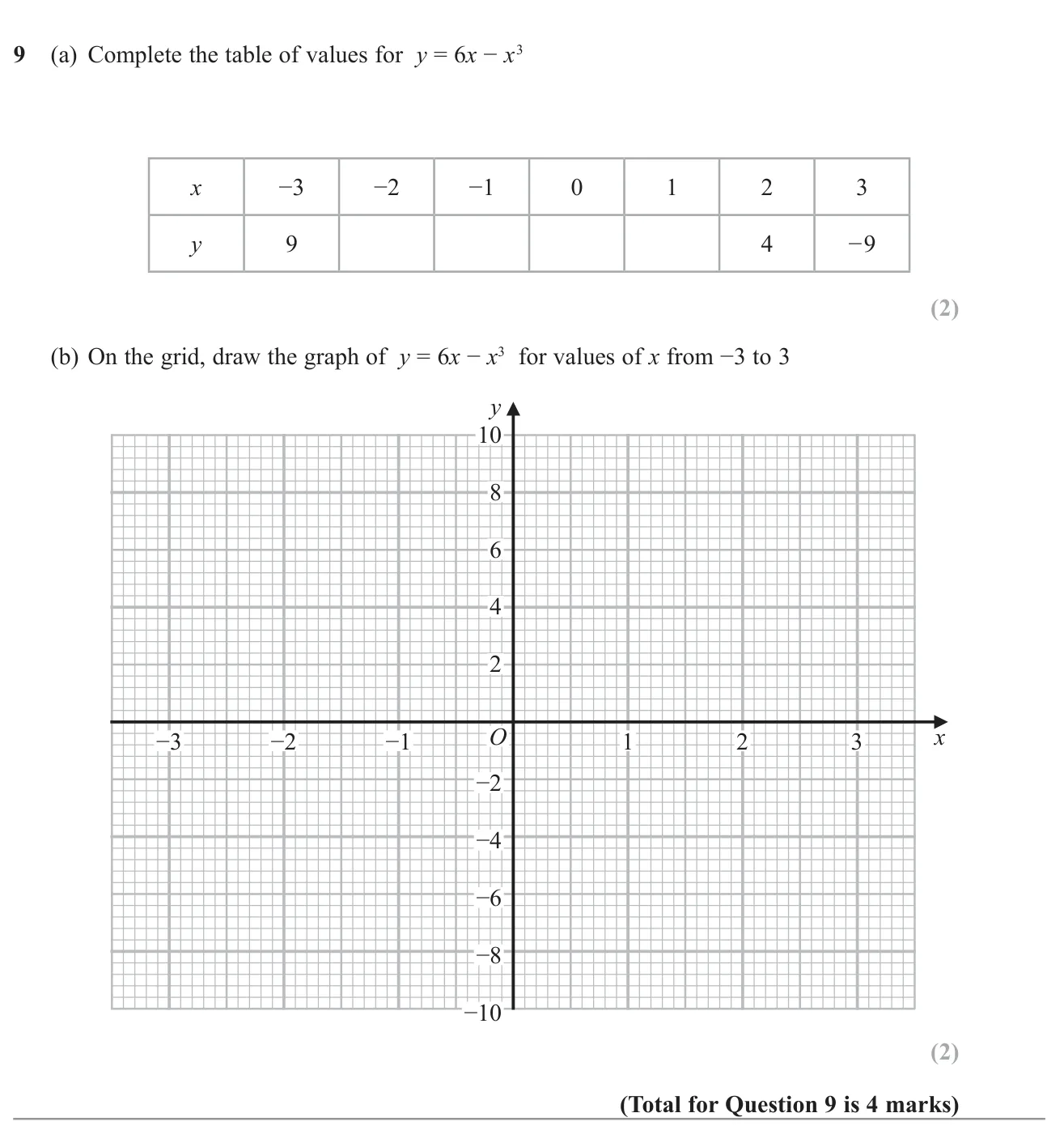
Cubic, reciprocal, exponential and trig graphs4 marksGrade 5No calculatorHigher
November 2022 · Paper 1 Higher · Q9
Fill in a table of values for a cubic function and plot its graph.

© Pearson Education Ltd. November 2022 Paper 1 (Higher, non-calculator), question 9.

Show answer
(a)−4,−5,0,5-4, -5, 0, 5 (for x=−2,−1,0,1x = -2, -1, 0, 1)2 marks
(b)Smooth cubic curve through the plotted points2 marks

Worked solution Checked against the mark scheme

(a) x=−2x = -2: 6(−2)−(−2)3=−12+8=−46(-2) - (-2)^3 = -12 + 8 = -4

x=−1x = -1: −6+1=−5-6 + 1 = -5; x=0x = 0: 00; x=1x = 1: 6−1=56 - 1 = 5

(b) Plot (−3,9),(−2,−4),(−1,−5),(0,0),(1,5),(2,4),(3,−9)(-3, 9), (-2, -4), (-1, -5), (0, 0), (1, 5), (2, 4), (3, -9) and join with a smooth curve.

Watch out: Treating −(−2)3-(-2)^3 as −8-8 instead of +8+8.

Cubic, reciprocal, exponential and trig graphs2 marksGrade 5CalculatorFoundation
November 2021 · Paper 3 Foundation · Q28
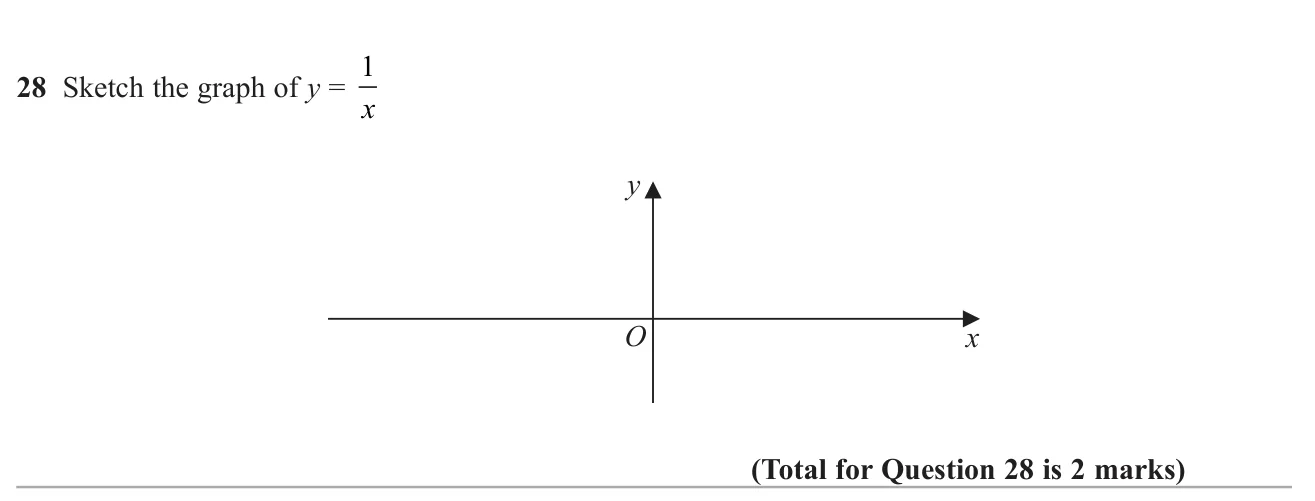
Sketch the reciprocal graph on a set of axes.

© Pearson Education Ltd. November 2021 Paper 3 (Foundation, calculator), question 28.

Show answer
AnswerTwo curves, one in the first quadrant and one in the third, each approaching both axes without touching2 marks

Worked solution Checked against the mark scheme

For positive xx, yy is positive and gets smaller as xx grows, so draw a curve in the top-right quadrant.

For negative xx, yy is negative, so draw the matching curve in the bottom-left quadrant.

The curves get close to the axes but never touch them, and there is no point at x=0x = 0.

Watch out: Drawing a straight line, or letting the curves cross the axes.

Cubic, reciprocal, exponential and trig graphs4 marksGrade 5CalculatorOn both tiers
November 2020 · Paper 2 Foundation · Q24
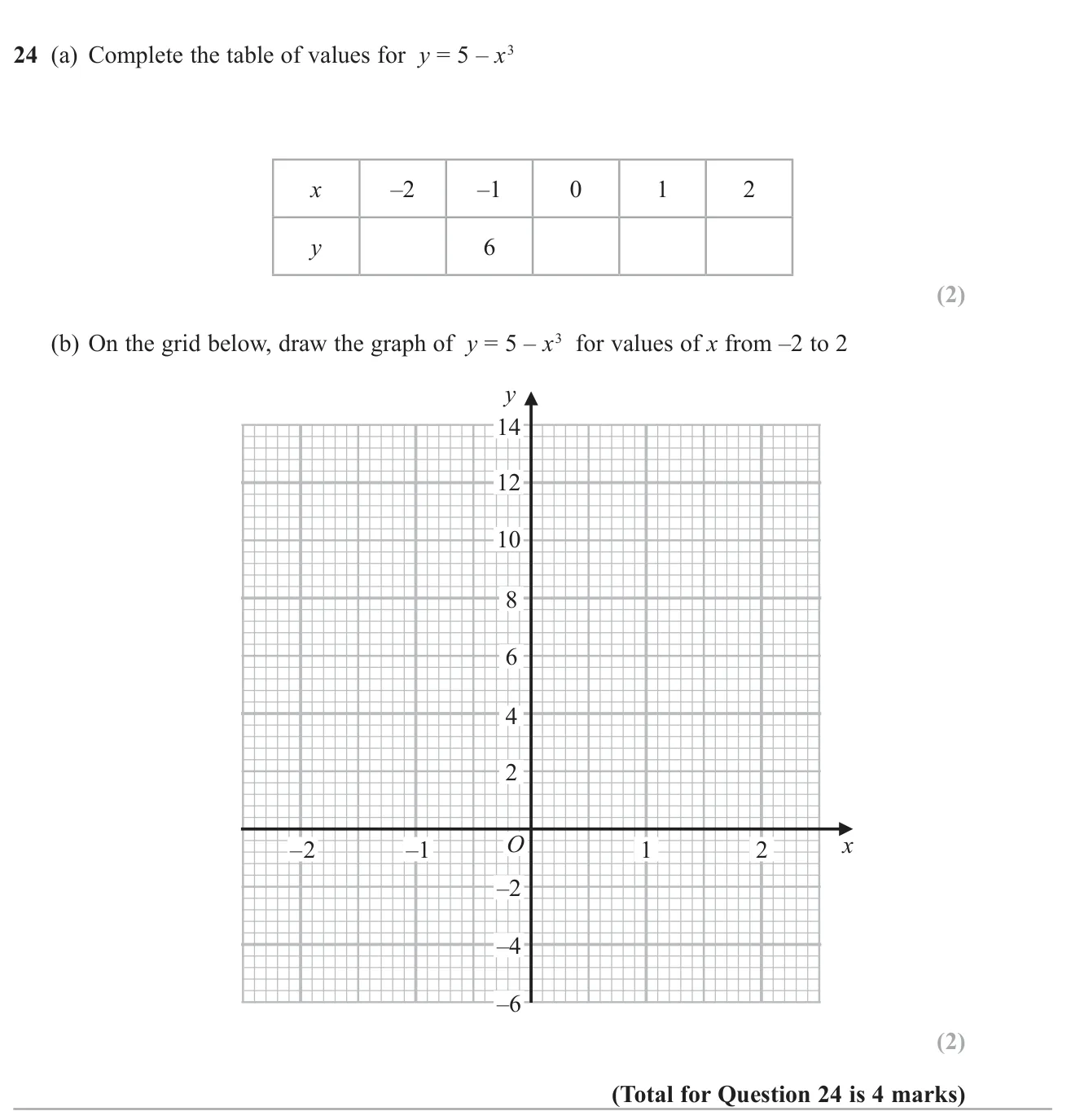
Complete a table of values for a cubic graph and plot the curve.

© Pearson Education Ltd. November 2020 Paper 2 (Foundation, calculator), question 24.

Show answer
(a)13, 5, 4, −3-3 (for x=−2,0,1,2x = -2, 0, 1, 2)2 marks
(b)Smooth curve through (−2,13)(-2, 13), (−1,6)(-1, 6), (0,5)(0, 5), (1,4)(1, 4), (2,−3)(2, -3)2 marks

Worked solution Checked against the mark scheme

(a) x=−2x = -2: 5−(−8)=135 - (-8) = 13; x=0x = 0: 55; x=1x = 1: 5−1=45 - 1 = 4; x=2x = 2: 5−8=−35 - 8 = -3

(b) Plot the five points and join them with a smooth curve, not straight lines.

Watch out: Working out (−2)3(-2)^3 as +8+8 and getting −3-3 instead of 13.

June 2023 · Paper 3 Higher · Q19
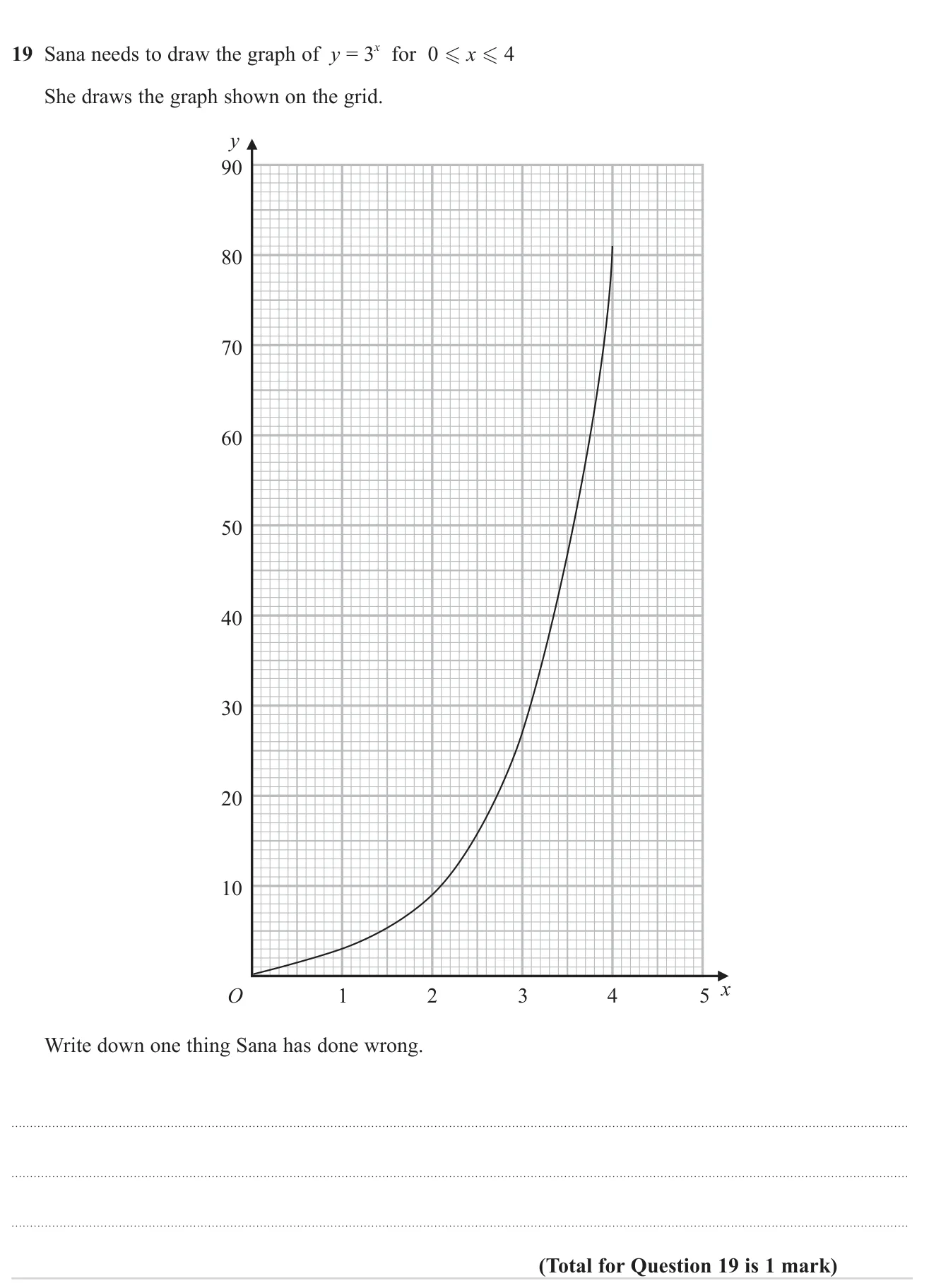
Spot the mistake in a sketch of an exponential graph.

© Pearson Education Ltd. June 2023 Paper 3 (Higher, calculator), question 19.

Show answer
AnswerThe graph should cross the yy-axis at (0,1)(0, 1), not start at the origin, because 30=13^0 = 11 mark

Worked solution Checked against the mark scheme

When x=0x = 0, y=30=1y = 3^0 = 1.

Sana's curve starts at (0,0)(0, 0), so it is wrong there: it should start at (0,1)(0, 1).

Watch out: Saying the graph is 'drawn wrong' without saying what is wrong.

Cubic, reciprocal, exponential and trig graphs2 marksGrade 6No calculatorHigher
November 2022 · Paper 1 Higher · Q21
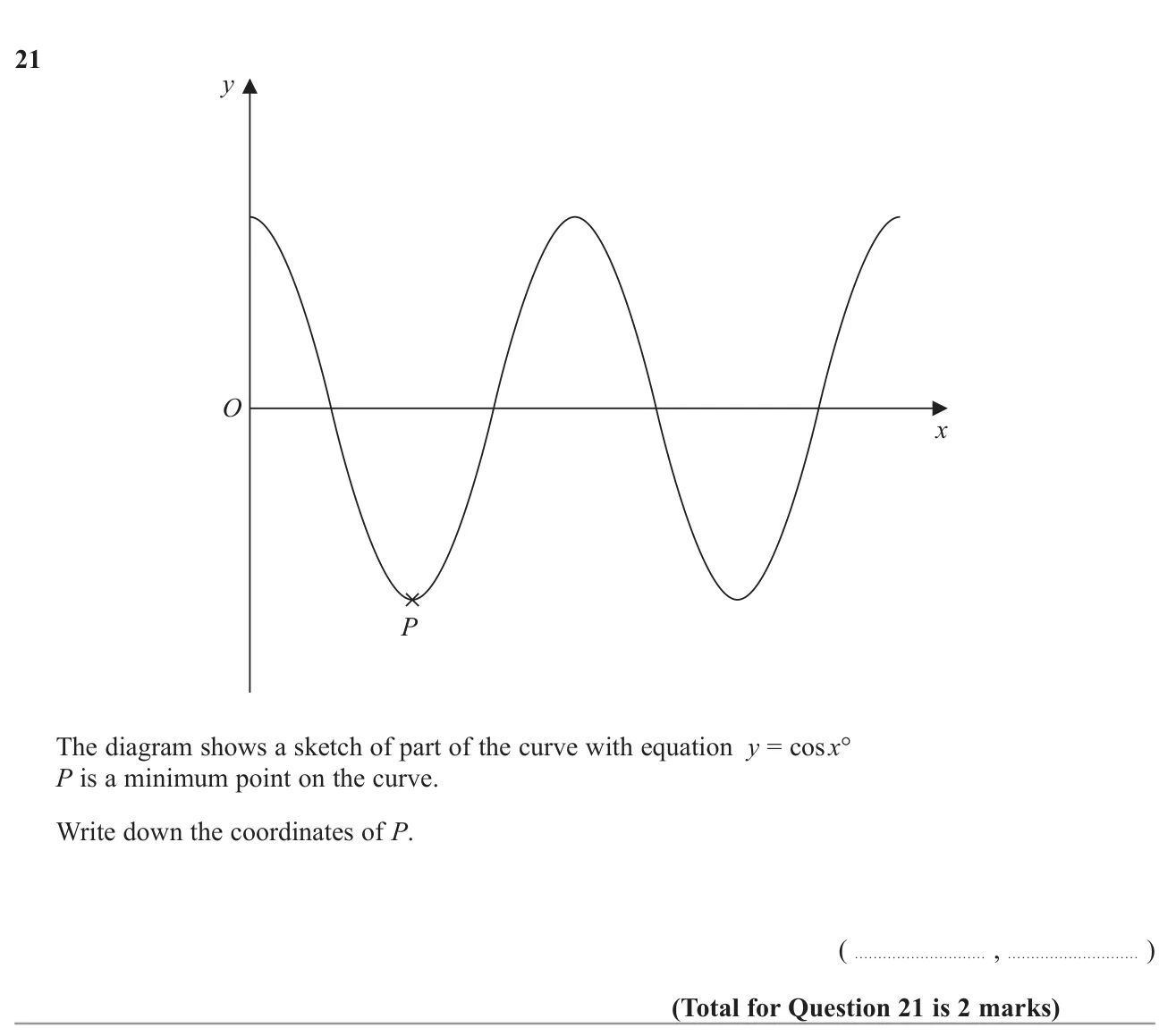
Give the coordinates of the lowest point on a sketch of the cosine graph.

© Pearson Education Ltd. November 2022 Paper 1 (Higher, non-calculator), question 21.

Show answer
Answer(180,−1)(180, -1)2 marks

Worked solution Checked against the mark scheme

The cosine graph starts at (0,1)(0, 1) and falls to its lowest value of −1-1 at x=180°x = 180°.

So P=(180,−1)P = (180, -1)

Watch out: Swapping the coordinates to (−1,180)(-1, 180).

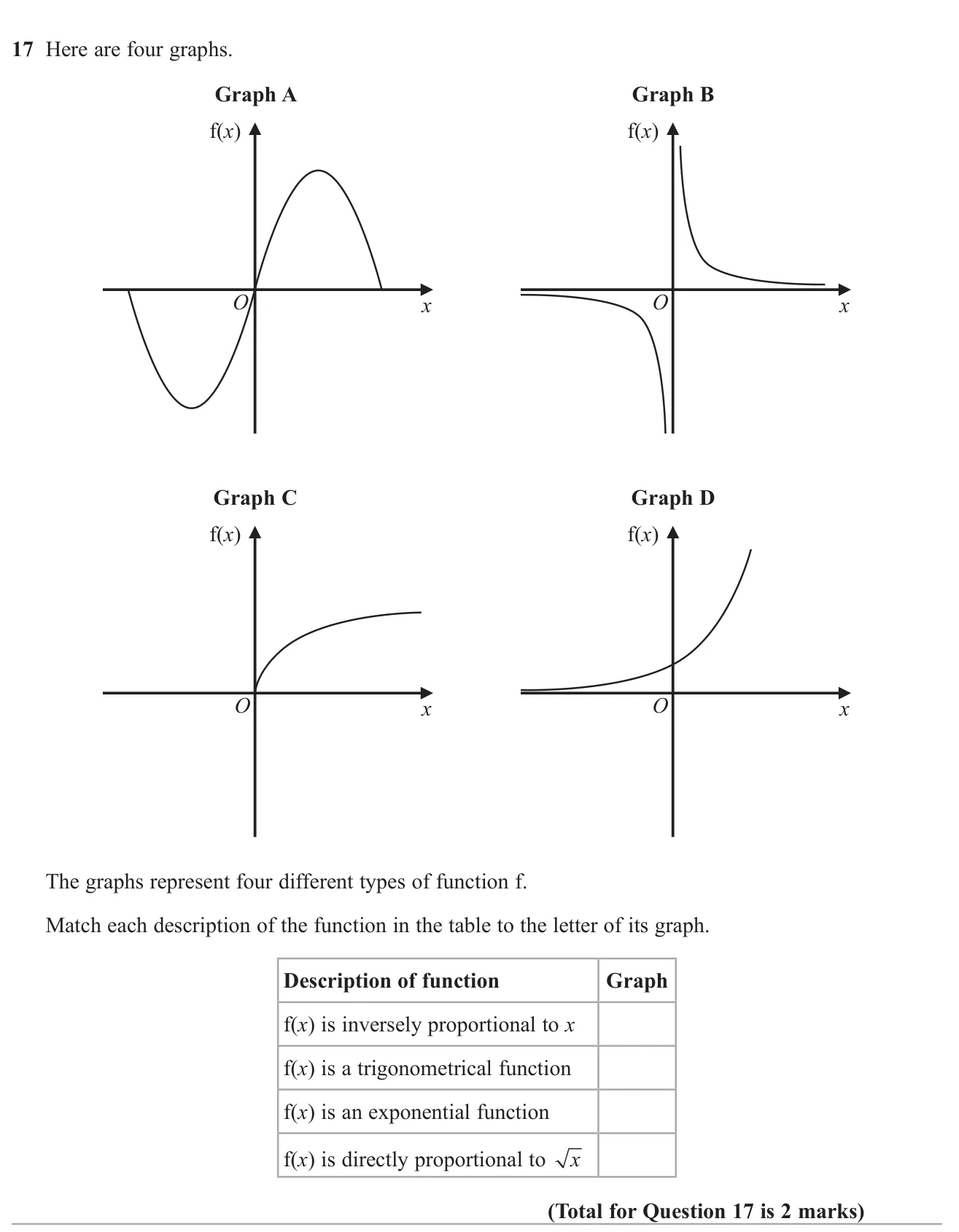
June 2019 · Paper 3 Higher · Q17
Match four sketched graphs to inverse, trigonometric, exponential and square-root proportion functions.

© Pearson Education Ltd. June 2019 Paper 3 (Higher, calculator), question 17.

Show answer
AnswerInverse: B; trigonometric: A; exponential: D; proportional to x\sqrt{x}: C2 marks

Worked solution Checked against the mark scheme

- f(x)∝1xf(x) \propto \frac{1}{x}: two branches that never touch the axes, B.
- Trigonometric: a wave through OO, A.
- Exponential: flat on the left, cuts the yy-axis above 0 and shoots up, D.
- f(x)∝xf(x) \propto \sqrt{x}: starts at OO and rises more and more slowly, C.

Watch out: Swapping C and D, as both curves rise.

Cubic, reciprocal, exponential and trig graphs3 marksGrade 7No calculatorHigher
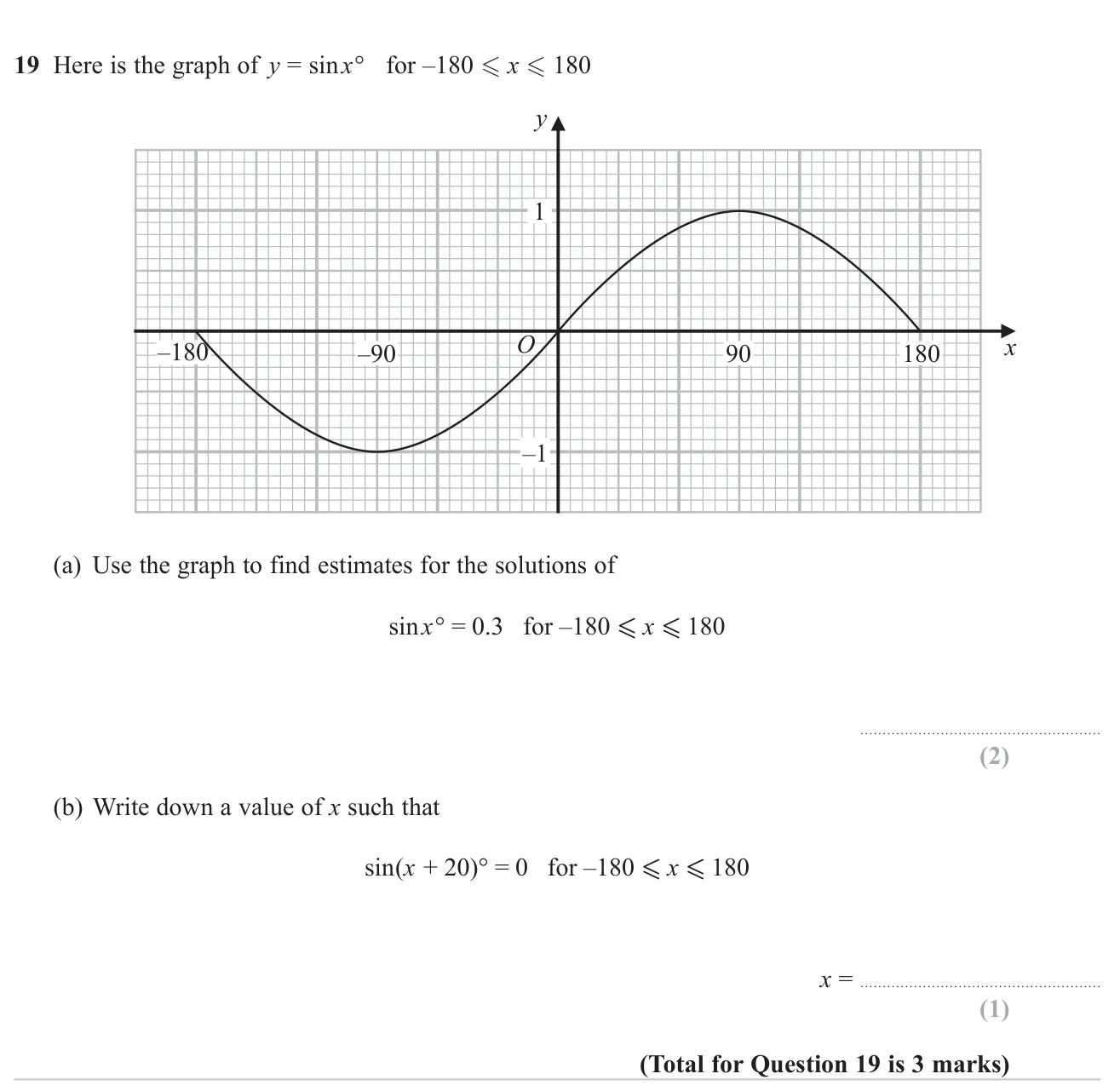
November 2023 · Paper 1 Higher · Q19
Read solutions of a sine equation from its graph and find an angle where a shifted sine is zero.

© Pearson Education Ltd. November 2023 Paper 1 (Higher, non-calculator), question 19.

Show answer
(a)x≈18x \approx 18 and x≈162x \approx 1622 marks
(b)−20-20 or 1601601 mark

Worked solution Checked against the mark scheme

(a) Draw y=0.3y = 0.3 across the graph. It meets the curve twice, at about x=18x = 18 and x=180−18=162x = 180 - 18 = 162.

(b) sin⁡θ=0\sin\theta = 0 when θ=0\theta = 0 or 180180. So x+20=0x + 20 = 0 gives x=−20x = -20 (or x+20=180x + 20 = 180 gives x=160x = 160).

Watch out: Finding only one solution in (a), missing the symmetry about x = 90.

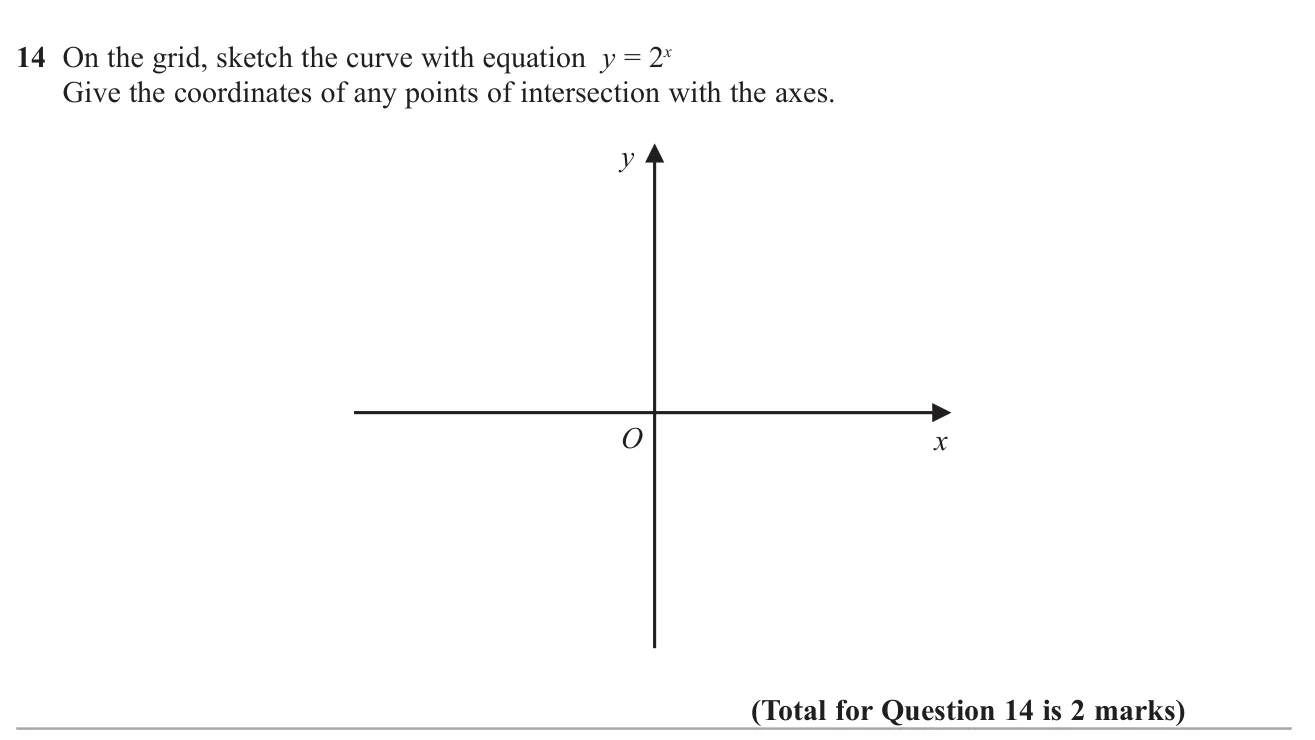
November 2018 · Paper 2 Higher · Q14
Sketch an exponential curve and mark where it meets the axes.

© Pearson Education Ltd. November 2018 Paper 2 (Higher, calculator), question 14.

Show answer
AnswerIncreasing exponential curve, above the x-axis for negative x, crossing the y-axis at (0,1)(0, 1)2 marks

Worked solution Checked against the mark scheme

2x2^x is always positive, so the curve never touches the x-axis.

When x=0x = 0, y=20=1y = 2^0 = 1, so it crosses the y-axis at (0,1)(0, 1).

It gets close to the x-axis on the left and rises ever more steeply on the right.

Watch out: Drawing the curve crossing the x-axis or passing through the origin.

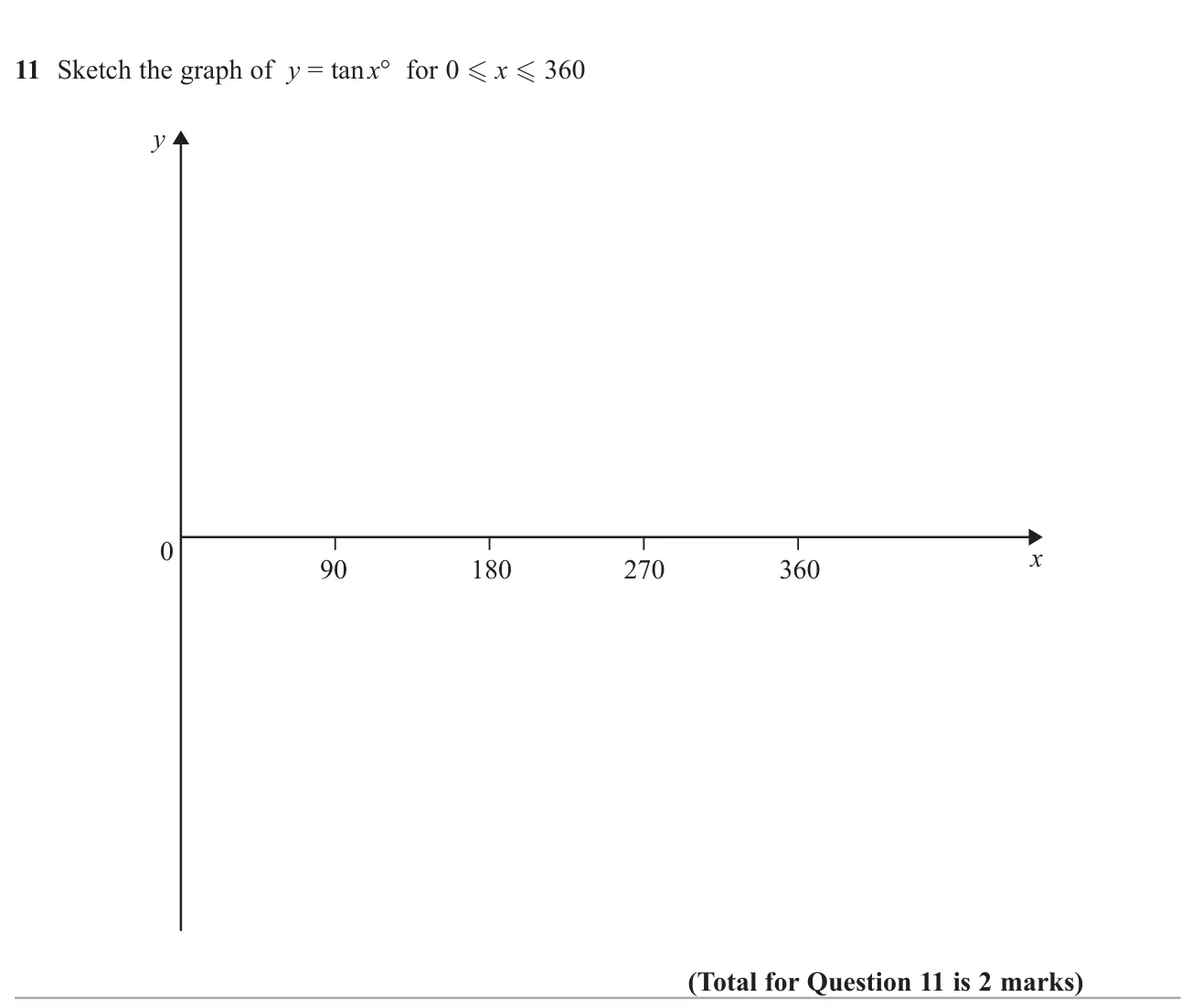
November 2018 · Paper 3 Higher · Q11
Sketch the tangent graph between 0° and 360°.

© Pearson Education Ltd. November 2018 Paper 3 (Higher, calculator), question 11.

Show answer
AnswerCurve through (0,0),(180,0),(360,0)(0,0), (180,0), (360,0) with asymptotes at x=90x = 90 and x=270x = 2702 marks

Worked solution Checked against the mark scheme

tan⁡x°\tan x° is 0 at 0°, 180° and 360°.

It rises towards +∞+\infty as xx approaches 90° and 270°, and comes up from −∞-\infty just after them.

Draw vertical dashed asymptotes at 90 and 270, and three increasing branches through (0,0)(0,0), (180,0)(180,0), (360,0)(360,0).

Watch out: Drawing a wave shape like sine with no asymptotes.

Also tested in these questions

Their main topic is different, but part of each one tests this topic.