Algebra

Quadratic graphs

12 past-paper questions, easiest first. Try each one, then reveal the answer.

Foundation & Higher11 of 12 from Foundation papers

Revision guide by The Full Marks

Quadratic graphs: what you need to know

A quadratic graph, such as y=x2−2x−3y = x^2 - 2x - 3, is a smooth U-shaped curve called a parabola. Exam questions ask you to complete a table, draw the curve and read off its roots, turning point and yy-intercept.

Both tiers need this topic, including reading where the curve meets a horizontal line y=ky = k; drawing a sloping straight line to solve a different equation from the same curve normally appears only on Higher papers.

Key facts

  • If the x2x^2 term is positive the curve is U-shaped; if negative it is upside down (∩).
  • Roots are where the curve crosses the xx-axis (y=0y = 0). The yy-intercept is where x=0x = 0.
  • The turning point is the lowest (or highest) point. It lies on the line of symmetry, halfway between the roots when there are two.
  • You can find the roots algebraically by factorising and setting each bracket to 0.

Drawing a quadratic graph

  1. Complete the table, putting negative xx values in brackets, e.g. (−2)2=4(-2)^2 = 4.
  2. Plot each point accurately.
  3. Join them with one smooth curve, not straight lines, and keep the bottom rounded.

Finding key points algebraically

  1. Roots: factorise and solve =0= 0.
  2. yy-intercept: the constant term.
  3. Turning point: xx is halfway between the roots; substitute to find yy.

Worked examples

Example 1 Foundation · grade 4

Here is part of a table of values for y=x2−2x−3y = x^2 - 2x - 3: when x=0,1,2,3,4x = 0, 1, 2, 3, 4, y=−3,−4,−3,0,5y = -3, -4, -3, 0, 5. (a) Find yy when x=−2x = -2 and when x=−1x = -1. (b) Use the table to write down the roots and the turning point of the graph.

Show the solution

(a) x=−2x = -2: (−2)2−2(−2)−3=4+4−3=5(-2)^2 - 2(-2) - 3 = 4 + 4 - 3 = 5
x=−1x = -1: (−1)2−2(−1)−3=1+2−3=0(-1)^2 - 2(-1) - 3 = 1 + 2 - 3 = 0
(b) y=0y = 0 when x=−1x = -1 and x=3x = 3, so the roots are x=−1x = -1 and x=3x = 3.
y=−3y = -3 at both x=0x = 0 and x=2x = 2, so the line of symmetry is x=1x = 1.
The turning point is (1,−4)(1, -4).

Example 2 Foundation · grade 5

Without drawing, find the roots, yy-intercept and turning point of y=x2+2x−8y = x^2 + 2x - 8.

Show the solution

Factorise: (x+4)(x−2)=0(x + 4)(x - 2) = 0, so the roots are x=−4x = -4 and x=2x = 2.
yy-intercept: −8-8, so (0,−8)(0, -8)
Turning point x=−4+22=−1x = \frac{-4 + 2}{2} = -1
y=(−1)2+2(−1)−8=−9y = (-1)^2 + 2(-1) - 8 = -9
Turning point (−1,−9)(-1, -9)

Common mistakes

  • Working out (−1)2(-1)^2 as −1-1. A negative number squared is positive; on a calculator, use brackets.
  • Getting the sign of −2x-2x wrong for negative xx: when x=−2x = -2, −2x=−2×(−2)=+4-2x = -2 \times (-2) = +4.
  • Giving the yy-intercept when asked for roots. Roots are on the xx-axis.
  • Joining the points with straight lines or a flat bottom. Draw one smooth curve; if a point is out of line with the curve, recheck it in the table.

Exam tips

  • Roots read from a graph are estimates, so answers within a small range of the true value get the marks.
  • To solve an equation like x2−2x−3=2x^2 - 2x - 3 = 2 from the graph, read the xx values where the curve meets the line y=2y = 2.

Questions people ask

What are the roots of a quadratic graph?

They are the xx values where the curve crosses the xx-axis. They are the solutions of the equation y=0y = 0.

How do you find the turning point of a quadratic?

Read the lowest or highest point from the graph. Algebraically, its xx value is halfway between the roots; Higher students can also complete the square.

Exam questions: Quadratic graphs (12, easiest first)

Quadratic graphs4 marksGrade 4CalculatorOn both tiers
November 2024 · Paper 2 Foundation · Q24
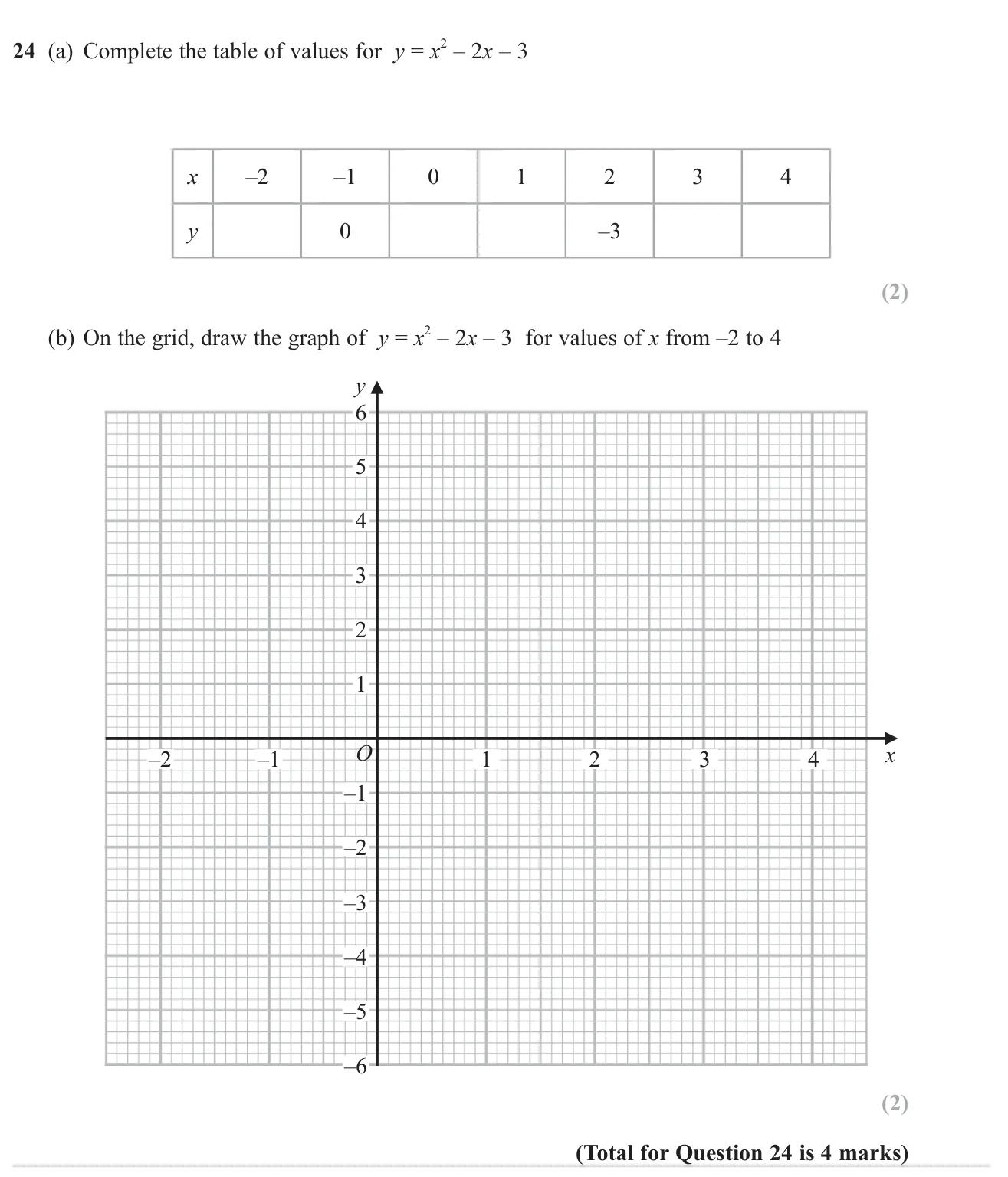
Complete a table of values for a quadratic and draw its graph.

© Pearson Education Ltd. November 2024 Paper 2 (Foundation, calculator), question 24.

Show answer
(a)5,−3,−4,0,55, -3, -4, 0, 5 (for x=−2,0,1,3,4x = -2, 0, 1, 3, 4)2 marks
(b)Smooth U-shaped curve through the points2 marks

Worked solution Checked against the mark scheme

(a) x=−2x = -2: 4+4−3=54 + 4 - 3 = 5; x=0x = 0: −3-3; x=1x = 1: 1−2−3=−41 - 2 - 3 = -4; x=3x = 3: 9−6−3=09 - 6 - 3 = 0; x=4x = 4: 16−8−3=516 - 8 - 3 = 5.

(b) Plot (−2,5),(−1,0),(0,−3),(1,−4),(2,−3),(3,0),(4,5)(-2, 5), (-1, 0), (0, -3), (1, -4), (2, -3), (3, 0), (4, 5) and join them with a smooth curve.

Watch out: Working out (−2)2(-2)^2 as −4-4, or joining the points with straight lines.
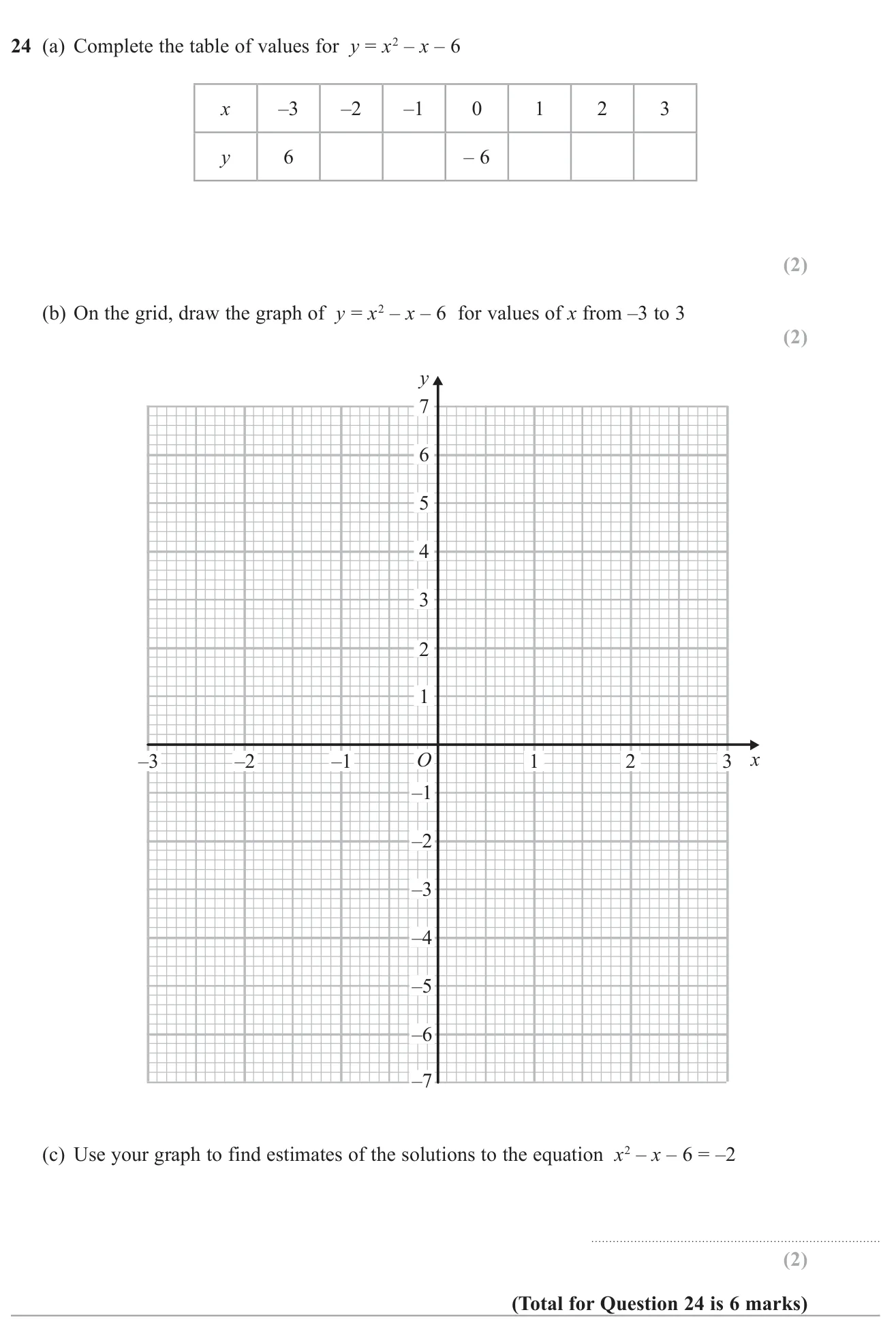
Quadratic graphs6 marksGrade 4CalculatorOn both tiers
June 2024 · Paper 2 Foundation · Q24
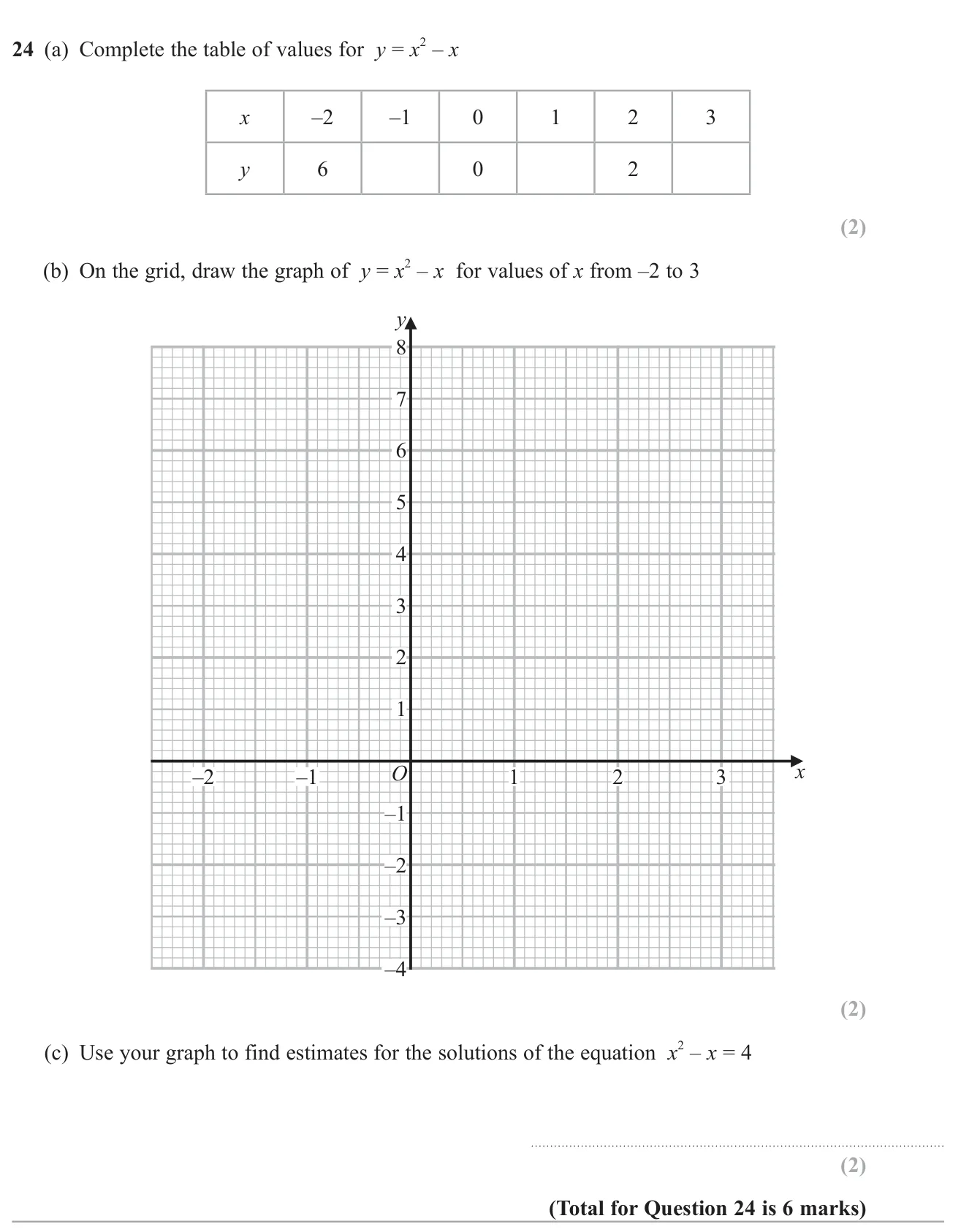
Complete a table for a quadratic, draw its graph and use it to estimate solutions of an equation.

© Pearson Education Ltd. June 2024 Paper 2 (Foundation, calculator), question 24.

Show answer
(a)yy values: 6, 2, 0, 0, 2, 66,\ 2,\ 0,\ 0,\ 2,\ 6 (missing: 22 at x=−1x=-1, 00 at x=1x=1, 66 at x=3x=3)2 marks
(b)Smooth U-shaped curve through the points2 marks
(c)x≈−1.6x \approx -1.6 and x≈2.6x \approx 2.6 (accept −1.7-1.7 to −1.5-1.5 and 2.52.5 to 2.72.7)2 marks

Worked solution Checked against the mark scheme

(a) x=−1x = -1: 1+1=21 + 1 = 2. x=1x = 1: 1−1=01 - 1 = 0. x=3x = 3: 9−3=69 - 3 = 6.

(b) Plot (−2,6),(−1,2),(0,0),(1,0),(2,2),(3,6)(-2,6), (-1,2), (0,0), (1,0), (2,2), (3,6) and join with a smooth curve.

(c) Draw y=4y = 4 and read where it crosses the curve: x≈−1.6x \approx -1.6 and x≈2.6x \approx 2.6.

Watch out: Working out (−1)2−(−1)(-1)^2 - (-1) as 0 instead of 2.

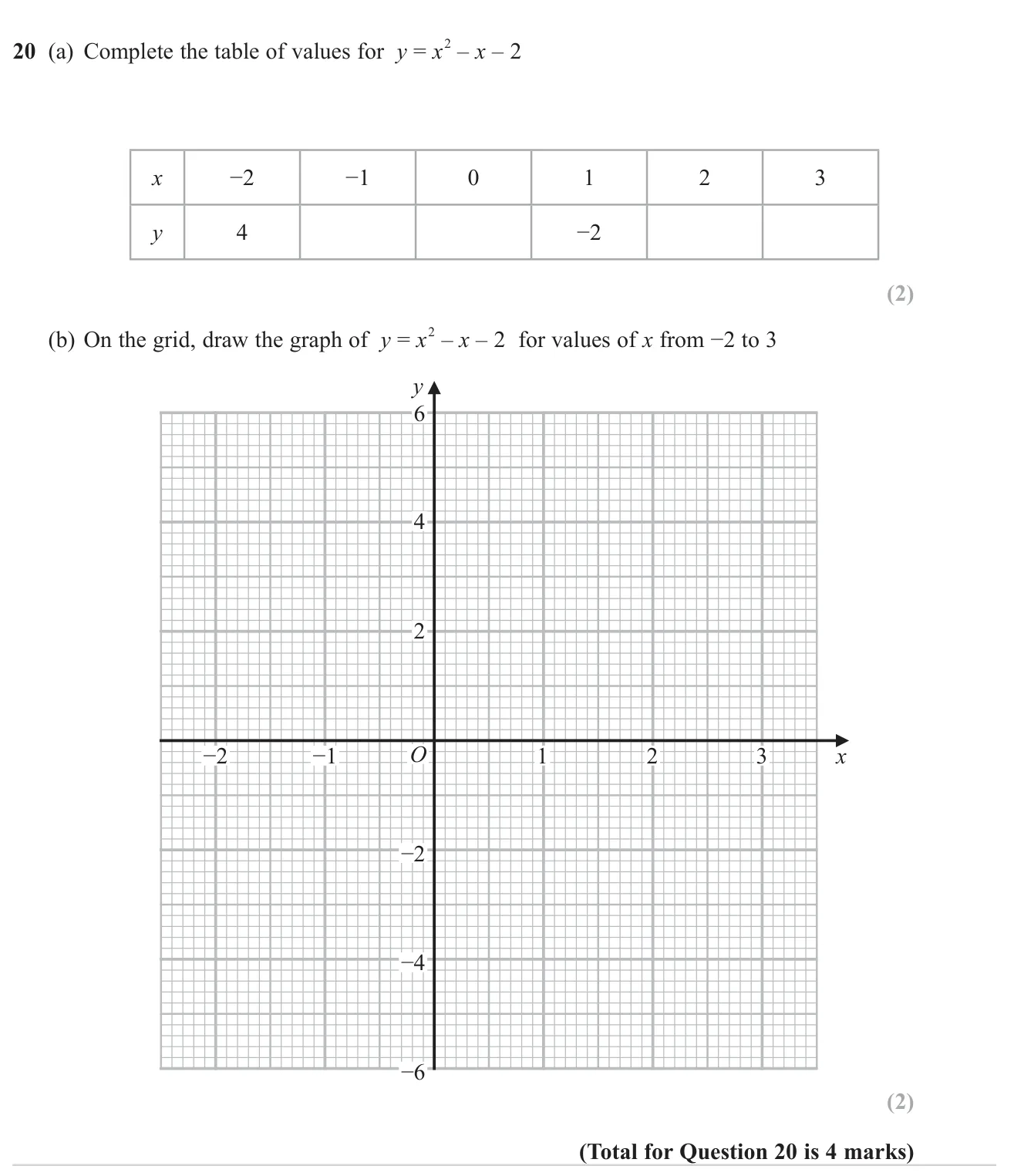
Quadratic graphs4 marksGrade 4CalculatorFoundation
November 2023 · Paper 2 Foundation · Q20
Complete a table of values for a quadratic and draw its graph.

© Pearson Education Ltd. November 2023 Paper 2 (Foundation, calculator), question 20.

Show answer
(a)0,−2,0,40, -2, 0, 4 (for x=−1,0,2,3x = -1, 0, 2, 3)2 marks
(b)A smooth U-shaped curve through (−2,4),(−1,0),(0,−2),(1,−2),(2,0),(3,4)(-2,4), (-1,0), (0,-2), (1,-2), (2,0), (3,4)2 marks

Worked solution Checked against the mark scheme

(a) Substitute each xx into x2−x−2x^2 - x - 2:

x=−1x = -1: 1+1−2=01 + 1 - 2 = 0; x=0x = 0: −2-2; x=2x = 2: 4−2−2=04 - 2 - 2 = 0; x=3x = 3: 9−3−2=49 - 3 - 2 = 4

(b) Plot the six points and join them with a smooth curve. The lowest point is between x=0x = 0 and x=1x = 1, just below −2-2.

Watch out: Working out (−1)2(-1)^2 as −1-1, giving the wrong value at x=−1x = -1.

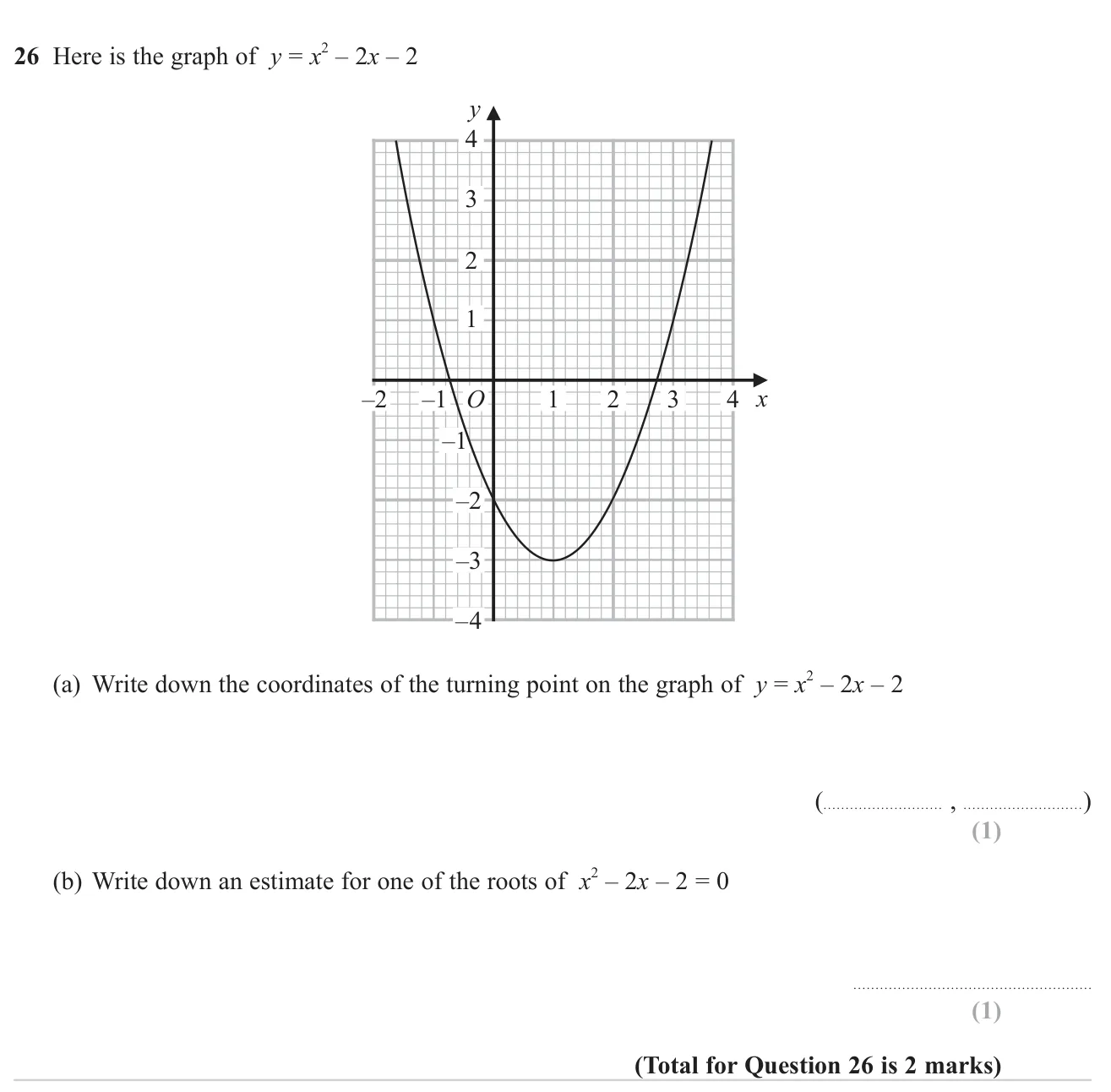
Quadratic graphs2 marksGrade 4CalculatorOn both tiers
June 2023 · Paper 3 Foundation · Q26
Read the turning point and estimate a root from the graph of a quadratic.

© Pearson Education Ltd. June 2023 Paper 3 (Foundation, calculator), question 26.

Show answer
(a)(1,−3)(1, -3)1 mark
(b)−0.7-0.7 or 2.72.71 mark

Worked solution Checked against the mark scheme

(a) The lowest point of the curve is at (1,−3)(1, -3).

(b) The roots are where the curve crosses the xx-axis: about x=−0.7x = -0.7 or x=2.7x = 2.7.

Watch out: In (b), reading where the curve crosses the yy-axis (−2-2).

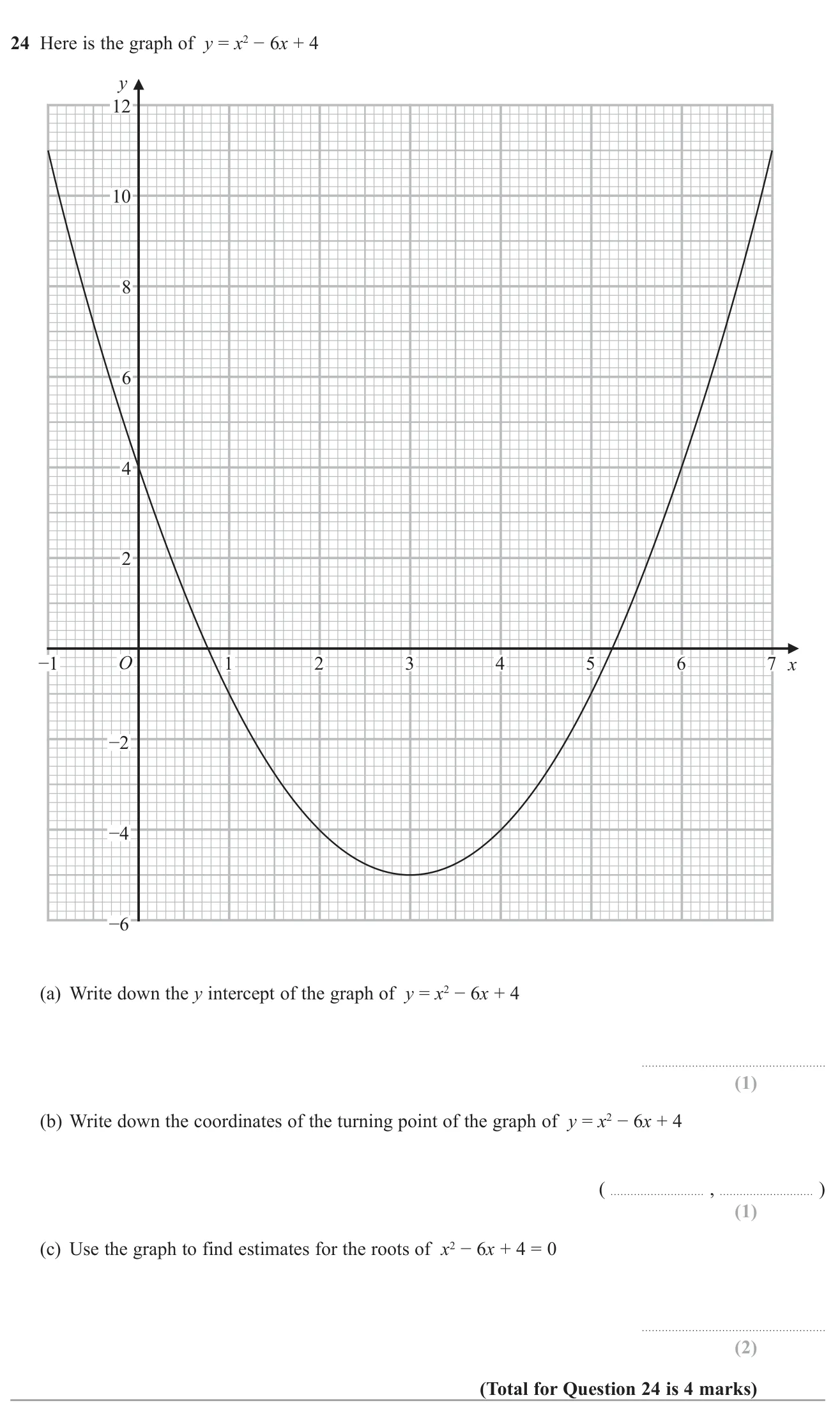
Quadratic graphs4 marksGrade 4CalculatorOn both tiers
November 2022 · Paper 2 Foundation · Q24
Read the y-intercept, turning point and approximate roots from the graph of a quadratic.

© Pearson Education Ltd. November 2022 Paper 2 (Foundation, calculator), question 24.

Show answer
(a)41 mark
(b)(3,−5)(3, -5)1 mark
(c)x≈0.8x \approx 0.8 and x≈5.2x \approx 5.22 marks

Worked solution Checked against the mark scheme

(a) The curve crosses the y-axis where x=0x = 0: y=4y = 4.

(b) The lowest point is at (3,−5)(3, -5).

(c) Read where the curve crosses the x-axis: about x=0.8x = 0.8 and x=5.2x = 5.2.

Watch out: Giving the roots as coordinates on the y-axis.

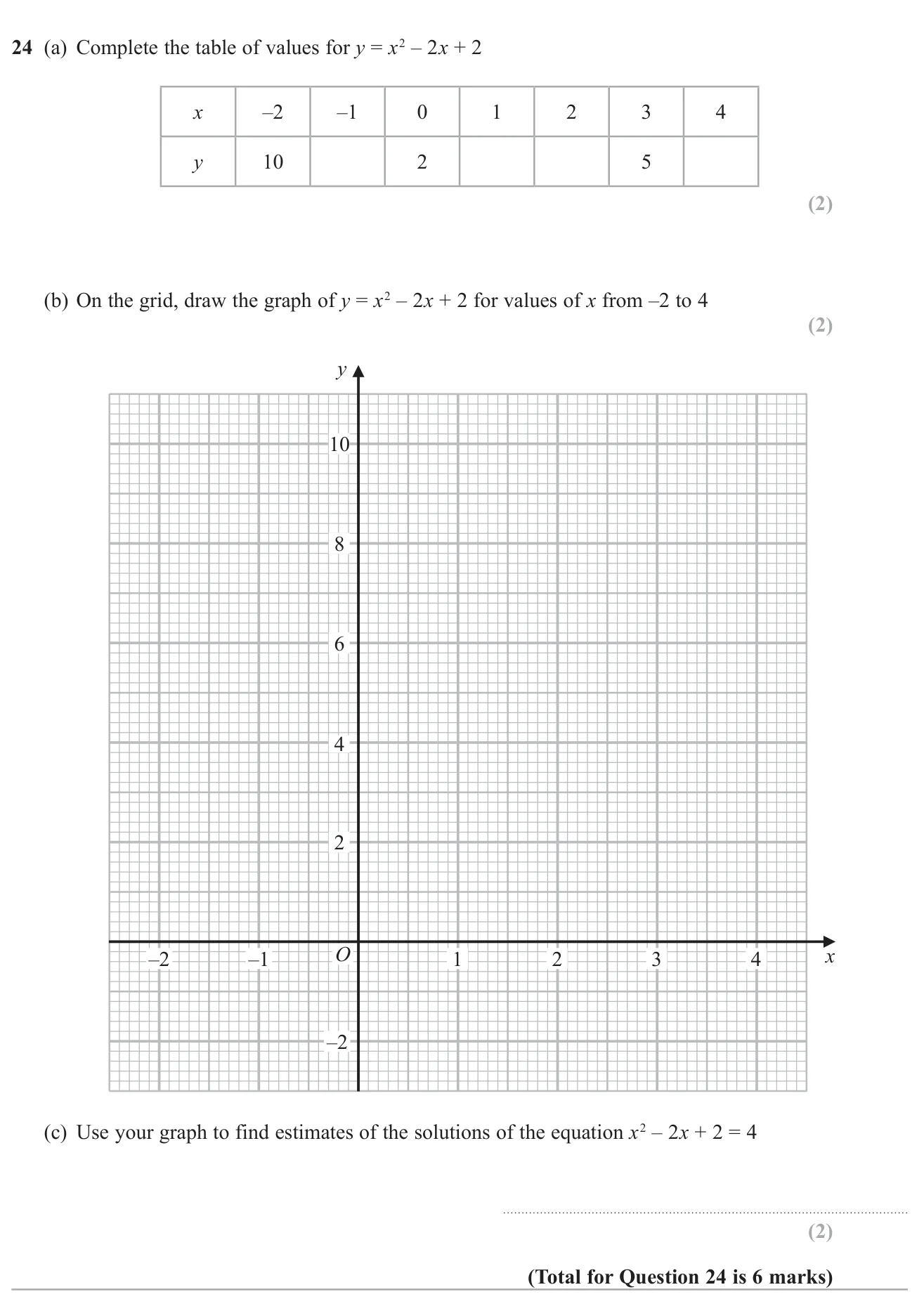
Quadratic graphs6 marksGrade 4CalculatorOn both tiers
November 2021 · Paper 2 Foundation · Q24
Complete a table for a quadratic, draw its graph and use the graph to solve a quadratic equation.

© Pearson Education Ltd. November 2021 Paper 2 (Foundation, calculator), question 24.

Show answer
(a)5, 1, 2, 102 marks
(b)A smooth curve through the plotted points2 marks
(c)x≈−0.7x \approx -0.7 and x≈2.7x \approx 2.72 marks

Worked solution Checked against the mark scheme

(a) x=−1x=-1: 1+2+2=51 + 2 + 2 = 5. x=1x=1: 1−2+2=11 - 2 + 2 = 1. x=2x=2: 4−4+2=24 - 4 + 2 = 2. x=4x=4: 16−8+2=1016 - 8 + 2 = 10.

(b) Plot (−2,10),(−1,5),(0,2),(1,1),(2,2),(3,5),(4,10)(-2,10), (-1,5), (0,2), (1,1), (2,2), (3,5), (4,10) and join with a smooth curve.

(c) Draw the line y=4y = 4. It crosses the curve at about x=−0.7x = -0.7 and x=2.7x = 2.7.

Watch out: Working out (−1)2(-1)^2 as −1-1.

Quadratic graphs6 marksGrade 4CalculatorOn both tiers
June 2018 · Paper 2 Foundation · Q24
Complete a table for a quadratic, plot its graph and use it to estimate solutions of an equation.

© Pearson Education Ltd. June 2018 Paper 2 (Foundation, calculator), question 24.

Show answer
(a)0,−4,−6,−4,00, -4, -6, -4, 0 (for x=−2,−1,1,2,3x = -2, -1, 1, 2, 3)2 marks
(b)Smooth U-shaped curve through the points2 marks
(c)x≈2.6x \approx 2.6 and x≈−1.6x \approx -1.62 marks

Worked solution Checked against the mark scheme

(a) e.g. x=−2x = -2: 4+2−6=04 + 2 - 6 = 0; x=1x = 1: 1−1−6=−61 - 1 - 6 = -6; x=2x = 2: 4−2−6=−44 - 2 - 6 = -4

(b) Plot (−3,6),(−2,0),(−1,−4),(0,−6),(1,−6),(2,−4),(3,0)(-3, 6), (-2, 0), (-1, -4), (0, -6), (1, -6), (2, -4), (3, 0) and join with a smooth curve.

(c) Draw the line y=−2y = -2 and read off where it crosses the curve: x≈2.6x \approx 2.6 and x≈−1.6x \approx -1.6

Watch out: In (a), working out −x-x wrongly for negative xx, e.g. (−2)2−(−2)=2(-2)^2 - (-2) = 2.

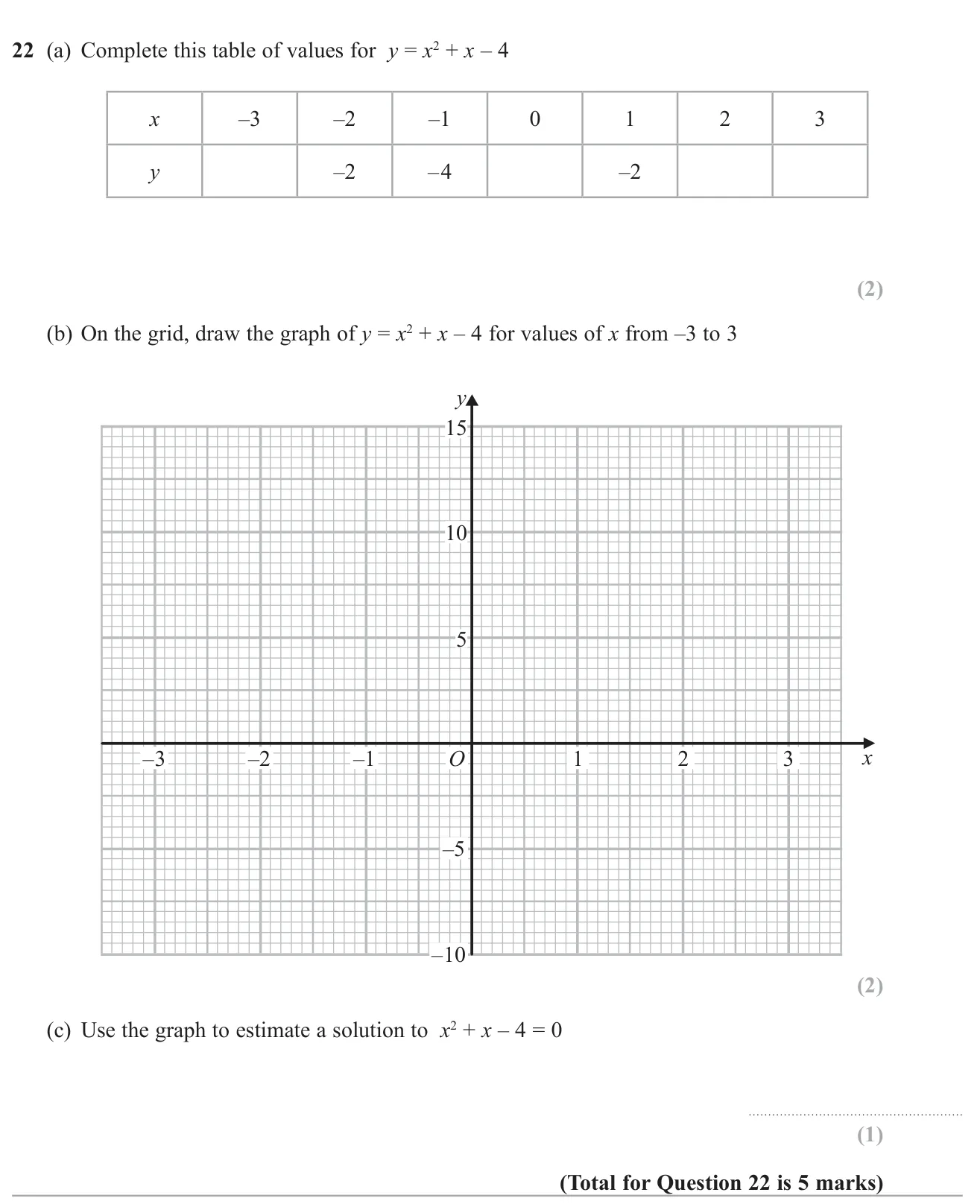
Quadratic graphs5 marksGrade 4CalculatorOn both tiers
November 2018 · Paper 3 Foundation · Q22
Complete a table of values for a quadratic, draw its graph and use it to estimate a root.

© Pearson Education Ltd. November 2018 Paper 3 (Foundation, calculator), question 22.

Show answer
(a)2,−4,2,82, -4, 2, 8 (for x=−3,−1,2,3x = -3, -1, 2, 3)2 marks
(b)Smooth U-shaped curve through the points2 marks
(c)x≈1.6x \approx 1.6 or x≈−2.6x \approx -2.61 mark

Worked solution Checked against the mark scheme

(a) x=−3x = -3: 9−3−4=29 - 3 - 4 = 2; x=−1x = -1: 1−1−4=−41 - 1 - 4 = -4; x=2x = 2: 4+2−4=24 + 2 - 4 = 2; x=3x = 3: 9+3−4=89 + 3 - 4 = 8

(b) Plot all seven points and join with a smooth curve, dipping just below −4-4 between x=−1x = -1 and x=0x = 0.

(c) The roots are where the curve crosses the xx-axis: about 1.61.6 or −2.6-2.6

Watch out: In (a), working out −32-3^2 as −9-9.

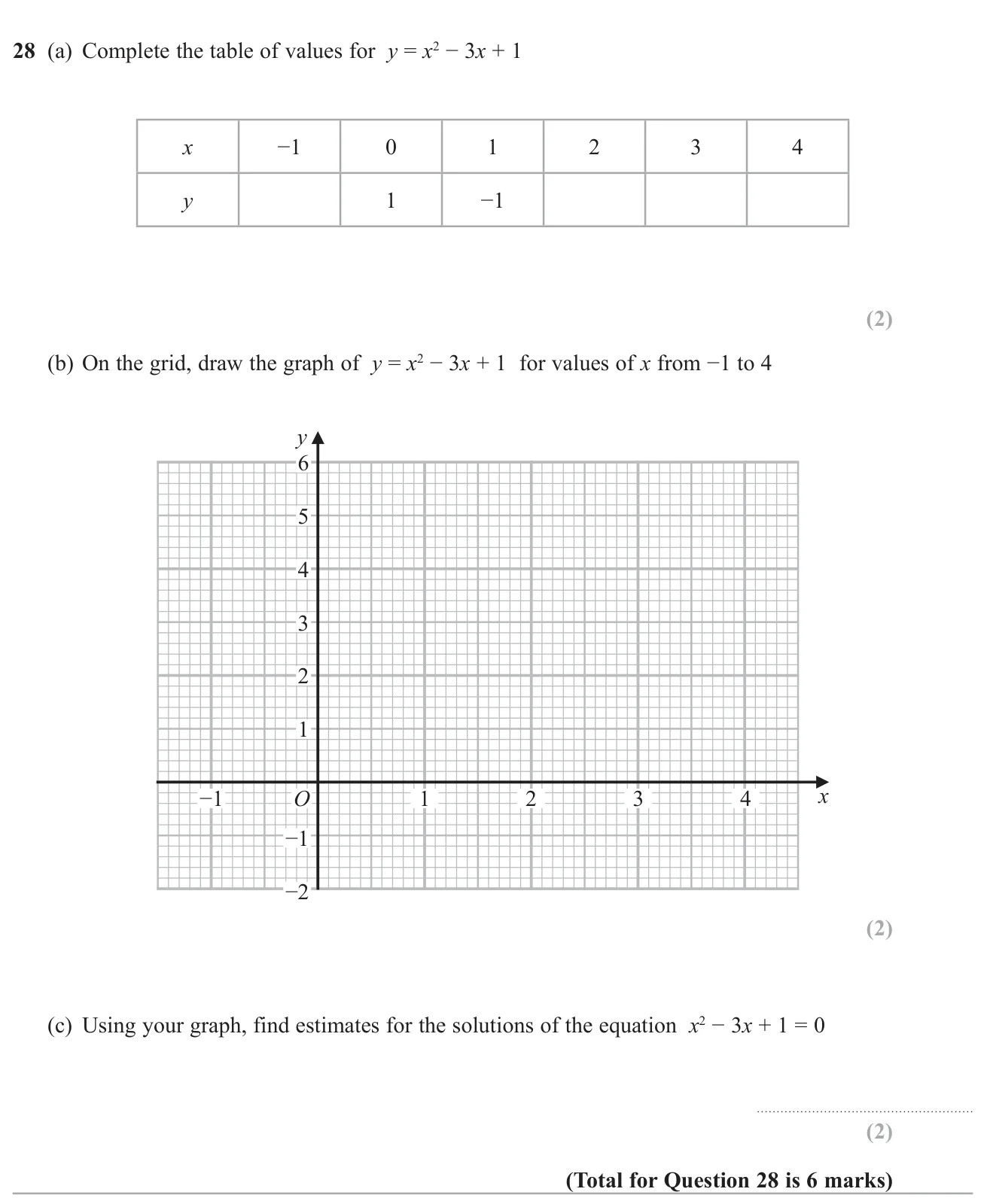
Quadratic graphs6 marksGrade 5No calculatorOn both tiers
June 2022 · Paper 1 Foundation · Q28
Complete a table of values for a quadratic, plot its graph, and read off where it crosses the x-axis.

© Pearson Education Ltd. June 2022 Paper 1 (Foundation, non-calculator), question 28.

Show answer
(a)5, −1, 1, 5 (for x = −1, 2, 3, 4)2 marks
(b)Smooth U-shaped curve through the plotted points2 marks
(c)x≈0.4x \approx 0.4 and x≈2.6x \approx 2.62 marks

Worked solution Checked against the mark scheme

(a) x=−1x = -1: 1+3+1=51 + 3 + 1 = 5; x=2x = 2: 4−6+1=−14 - 6 + 1 = -1; x=3x = 3: 9−9+1=19 - 9 + 1 = 1; x=4x = 4: 16−12+1=516 - 12 + 1 = 5

(b) Plot (−1,5),(0,1),(1,−1),(2,−1),(3,1),(4,5)(-1,5), (0,1), (1,-1), (2,-1), (3,1), (4,5) and join with a smooth curve.

(c) The curve crosses y=0y = 0 at about x=0.4x = 0.4 and x=2.6x = 2.6

Watch out: Working out (−1)2(-1)^2 as −1-1, giving the wrong value at x = −1.

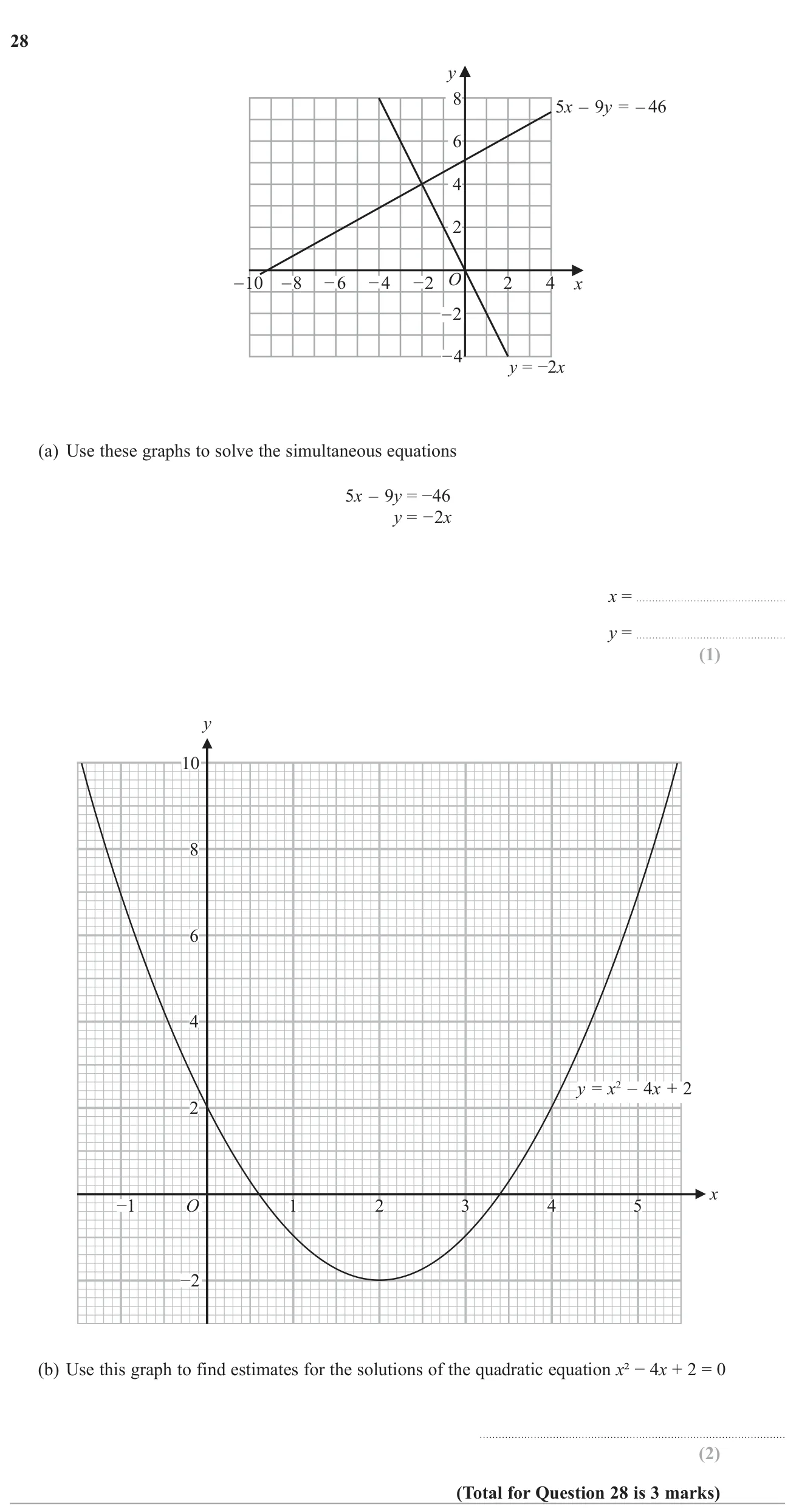
Quadratic graphs3 marksGrade 5CalculatorOn both tiers
November 2020 · Paper 3 Foundation · Q28
Read the solution of simultaneous equations from the intersection of two lines, and estimate the roots of a quadratic from its graph.

© Pearson Education Ltd. November 2020 Paper 3 (Foundation, calculator), question 28.

Show answer
(a)x=−2x = -2, y=4y = 41 mark
(b)x≈0.6x \approx 0.6 and x≈3.4x \approx 3.4 (accept 0.55 to 0.65 and 3.35 to 3.45)2 marks

Worked solution Checked against the mark scheme

(a) The lines cross at (−2,4)(-2, 4), so x=−2x = -2, y=4y = 4.

Check: 5(−2)−9(4)=−465(-2) - 9(4) = -46 ✓

(b) Read where the curve meets the xx-axis: x≈0.6x \approx 0.6 and x≈3.4x \approx 3.4

Watch out: In (b), reading where the curve crosses the yy-axis (2).

Quadratic graphs3 marksGrade 5No calculatorFoundation
June 2019 · Paper 1 Foundation · Q29
Read the turning point and the roots of a quadratic from its graph.

© Pearson Education Ltd. June 2019 Paper 1 (Foundation, non-calculator), question 29.

Show answer
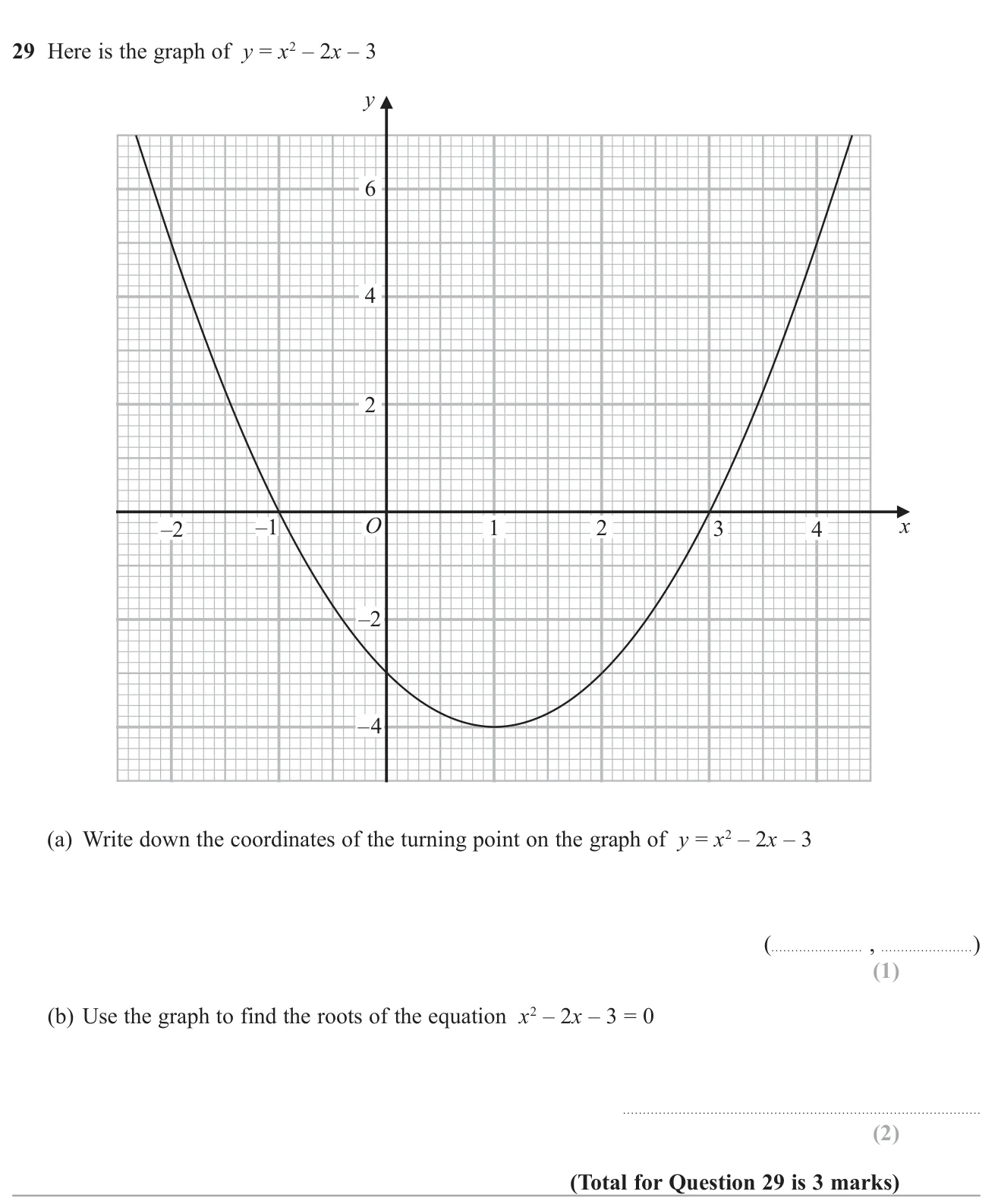
(a)(1,−4)(1, -4)1 mark
(b)x=−1x = -1 and x=3x = 32 marks

Worked solution Checked against the mark scheme

(a) The lowest point of the curve is at (1,−4)(1, -4).

(b) The roots are where the curve crosses the xx-axis (y=0y = 0): x=−1x = -1 and x=3x = 3.

Check: (−1)2−2(−1)−3=0(-1)^2 - 2(-1) - 3 = 0 and 32−6−3=03^2 - 6 - 3 = 0

Watch out: Giving the yy-intercept, −3-3, as a root.

Quadratic graphs4 marksGrade 8CalculatorHigher
November 2019 · Paper 3 Higher · Q17
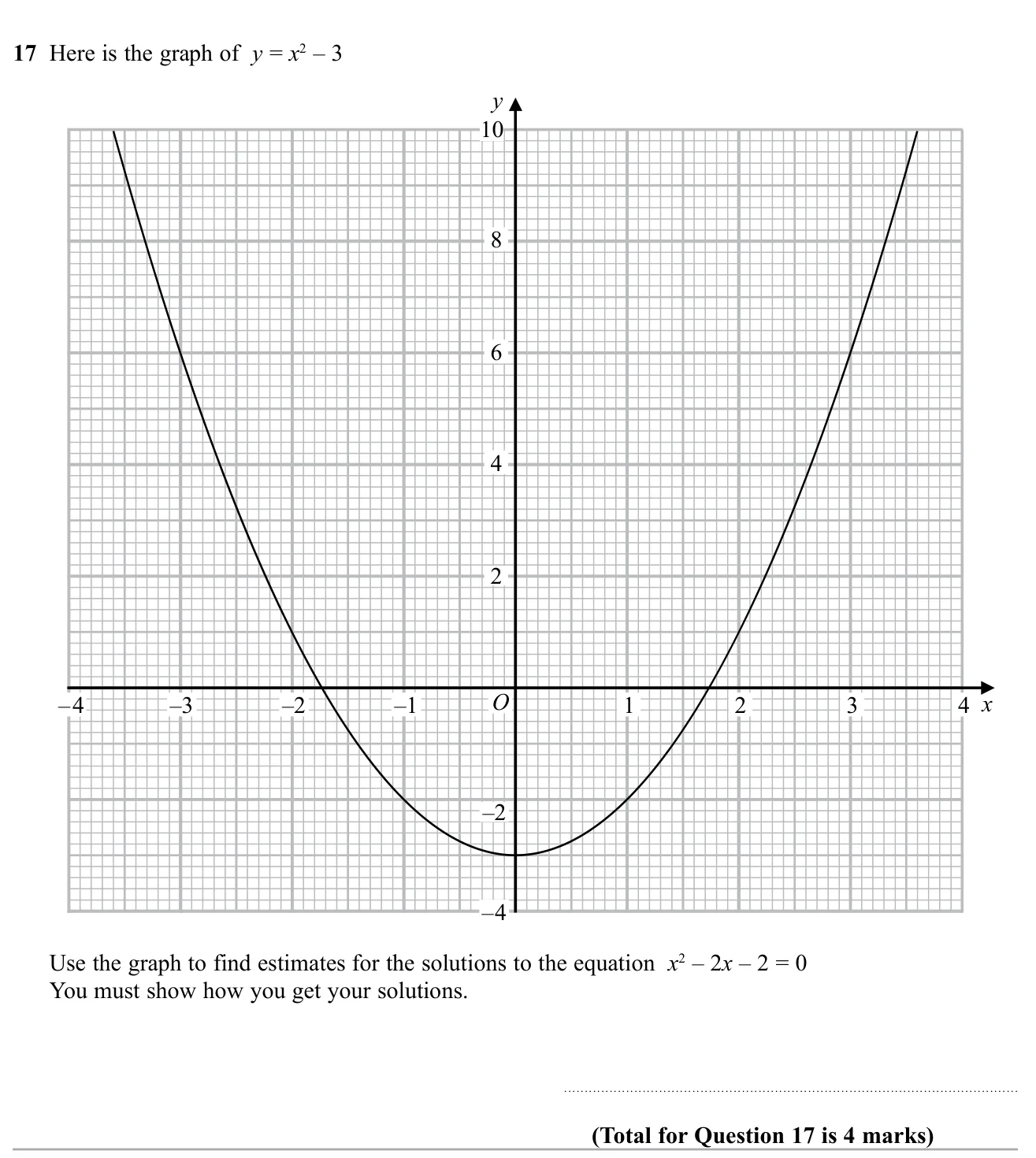
Draw a suitable straight line on a given quadratic graph to estimate the roots of a different quadratic equation.

© Pearson Education Ltd. November 2019 Paper 3 (Higher, calculator), question 17.

Show answer
Answerx≈2.7x \approx 2.7 and x≈−0.7x \approx -0.74 marks

Worked solution Checked against the mark scheme

x2−2x−2=0x^2 - 2x - 2 = 0 is the same as x2−3=2x−1x^2 - 3 = 2x - 1.

Draw y=2x−1y = 2x - 1 on the graph of y=x2−3y = x^2 - 3.

The line and curve cross at about x=2.7x = 2.7 and x=−0.7x = -0.7.

Watch out: Drawing y=2x+1y = 2x + 1 instead of y=2x−1y = 2x - 1.

Also tested in these questions

Their main topic is different, but part of each one tests this topic.