Edexcel GCSE Maths · 1MA1

November 2023 Paper 3 Higher

Calculator · 24 questions · 80 marks · 1 hour 30 minutes. Try each question on paper, then press "Show answer".

Question 1

Standard form2 marksGrade 4CalculatorOn both tiers
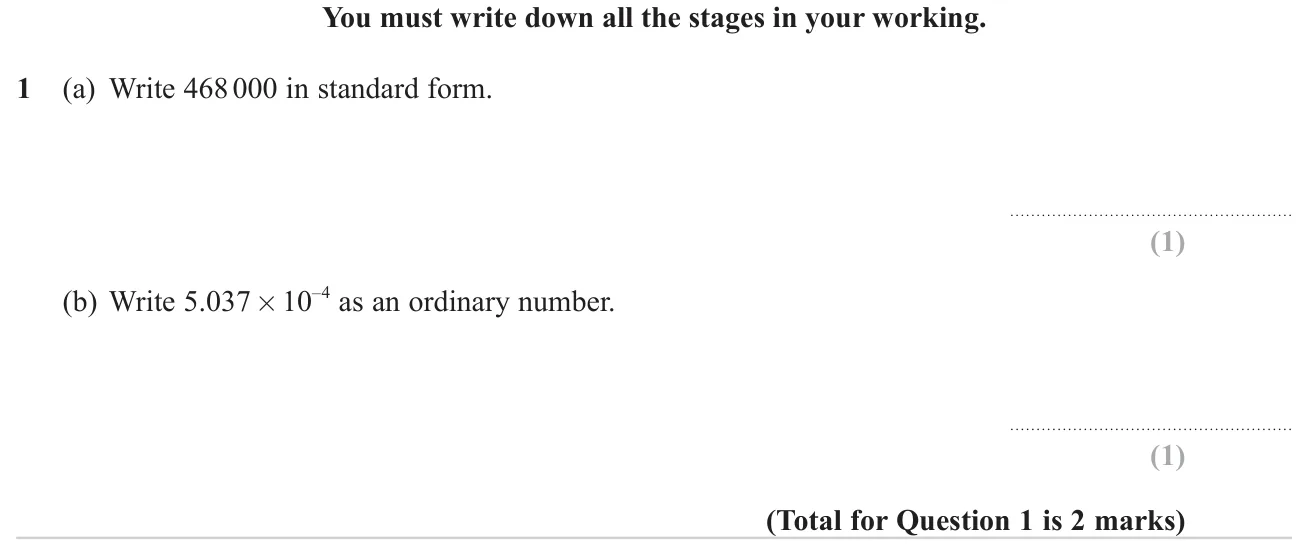
Convert between ordinary numbers and standard form.

© Pearson Education Ltd. November 2023 Paper 3 (Higher, calculator), question 1.

Show answer
(a)4.68×1054.68 \times 10^51 mark
(b)0.000 503 71 mark

Worked solution Checked against the mark scheme

(a) Put the decimal point after the first digit: 4.68. The point moves 5 places, so 4.68×1054.68 \times 10^5.

(b) A power of −4-4 means move the point 4 places left: 0.00050370.0005037

Watch out: In (b), moving the point the wrong way, giving 50 370.
Question 2

Relative frequency and expected outcomes2 marksGrade 3CalculatorOn both tiers
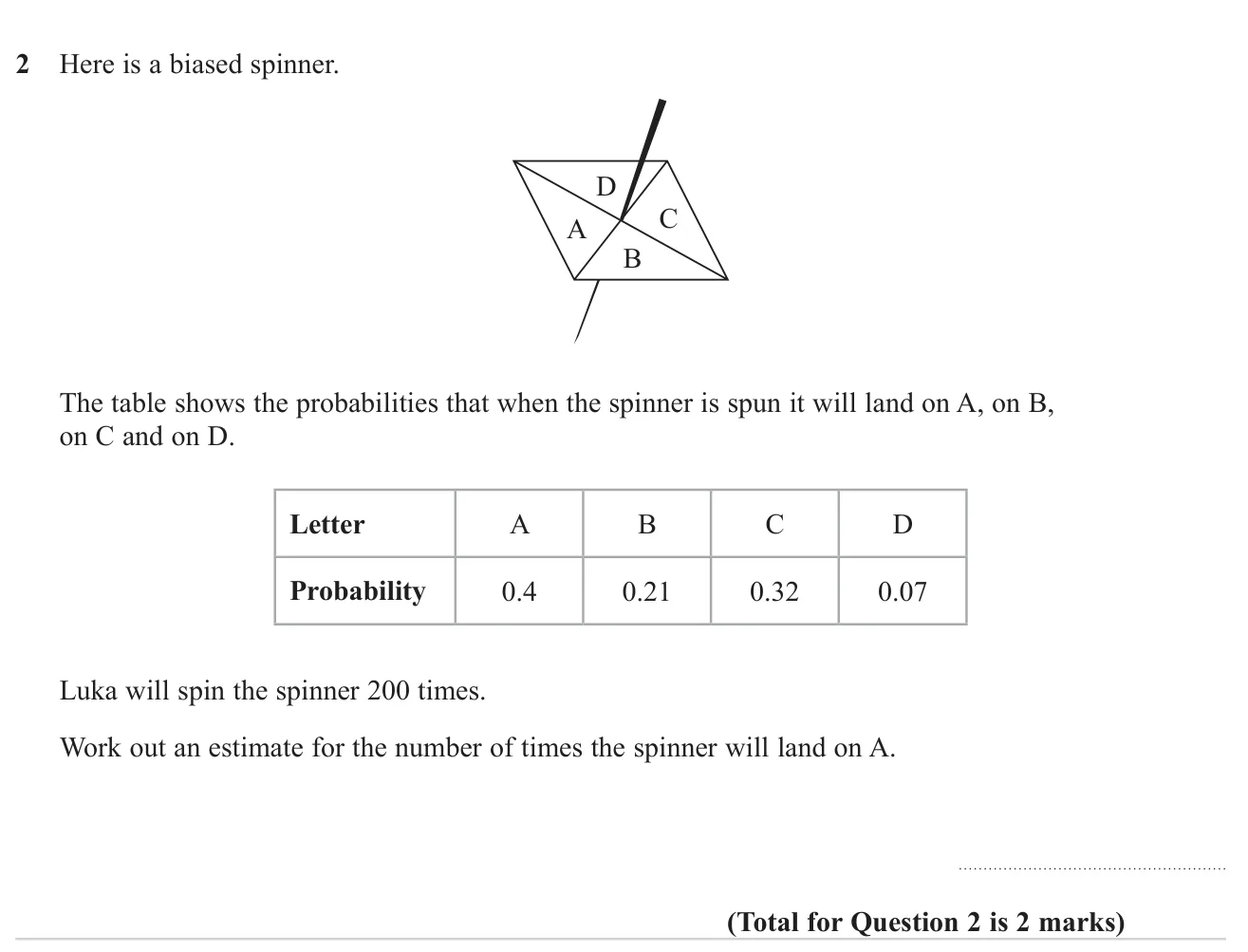
Estimate how often a biased spinner lands on one letter over many spins.

© Pearson Education Ltd. November 2023 Paper 3 (Higher, calculator), question 2.

Show answer
Answer802 marks

Worked solution Checked against the mark scheme

Expected number == probability × number of spins

0.4×200=800.4 \times 200 = 80

Watch out: Giving the answer as a probability, 80/200.

Question 3

Averages and spread4 marksGrade 4CalculatorOn both tiers
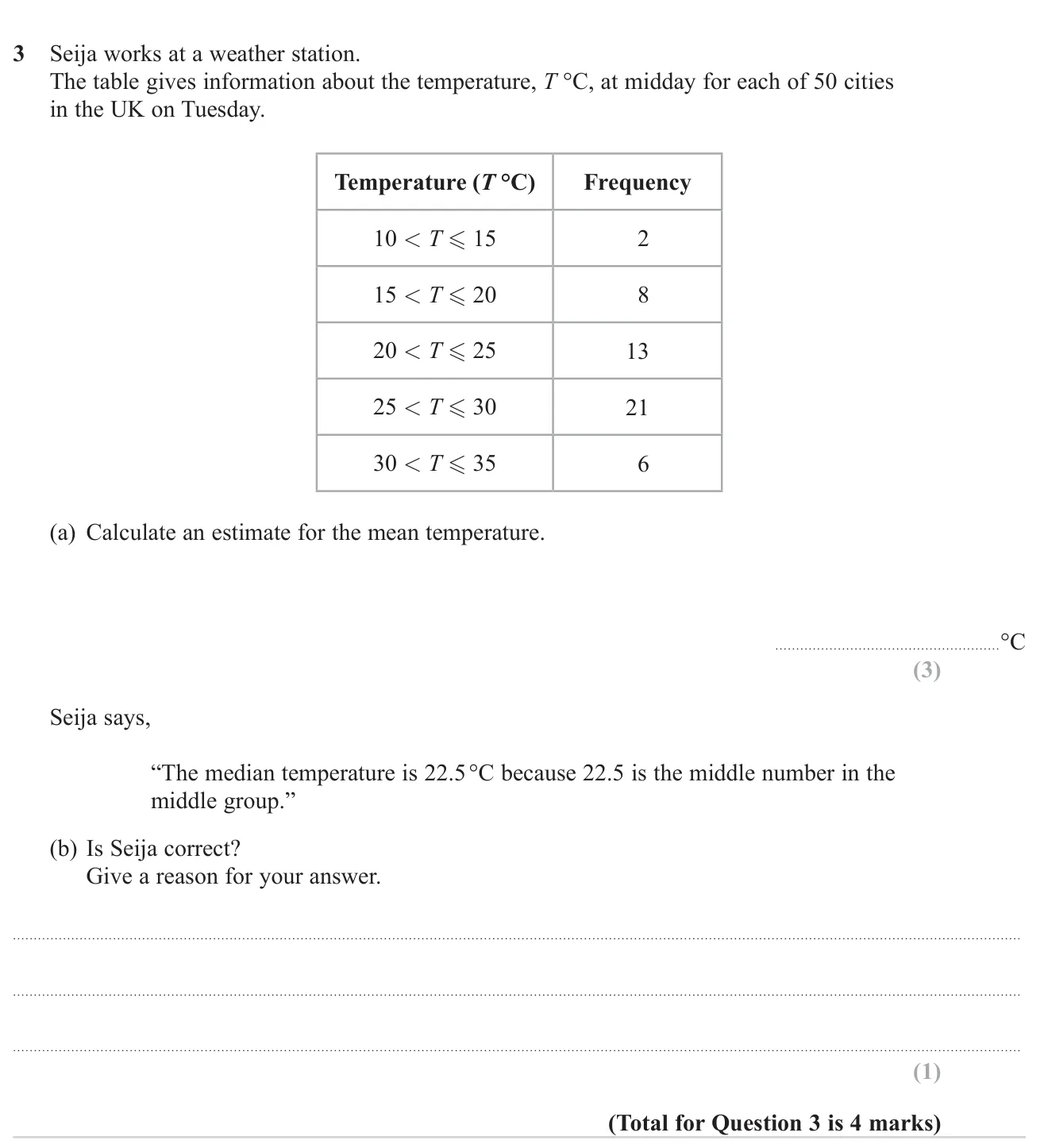
Estimate the mean from a grouped frequency table and judge a claim about the median.

© Pearson Education Ltd. November 2023 Paper 3 (Higher, calculator), question 3.

Show answer
(a)24.6 °C3 marks
(b)No: the median is the 25th–26th value, which lies in the 25 < T ≤ 30 group1 mark

Worked solution Checked against the mark scheme

(a) Midpoints 12.5, 17.5, 22.5, 27.5, 32.5.

∑fx=25+140+292.5+577.5+195=1230\sum fx = 25 + 140 + 292.5 + 577.5 + 195 = 1230

Mean ≈1230÷50=24.6\approx 1230 \div 50 = 24.6 °C

(b) No. The median is about the 25.5th value. 2+8+13=232 + 8 + 13 = 23, so it is in the 25<T≤3025 < T \le 30 group, not the middle group.

Watch out: In (a), dividing by 5 (the number of groups) instead of 50.

Question 4

Inequalities4 marksGrade 4CalculatorOn both tiers
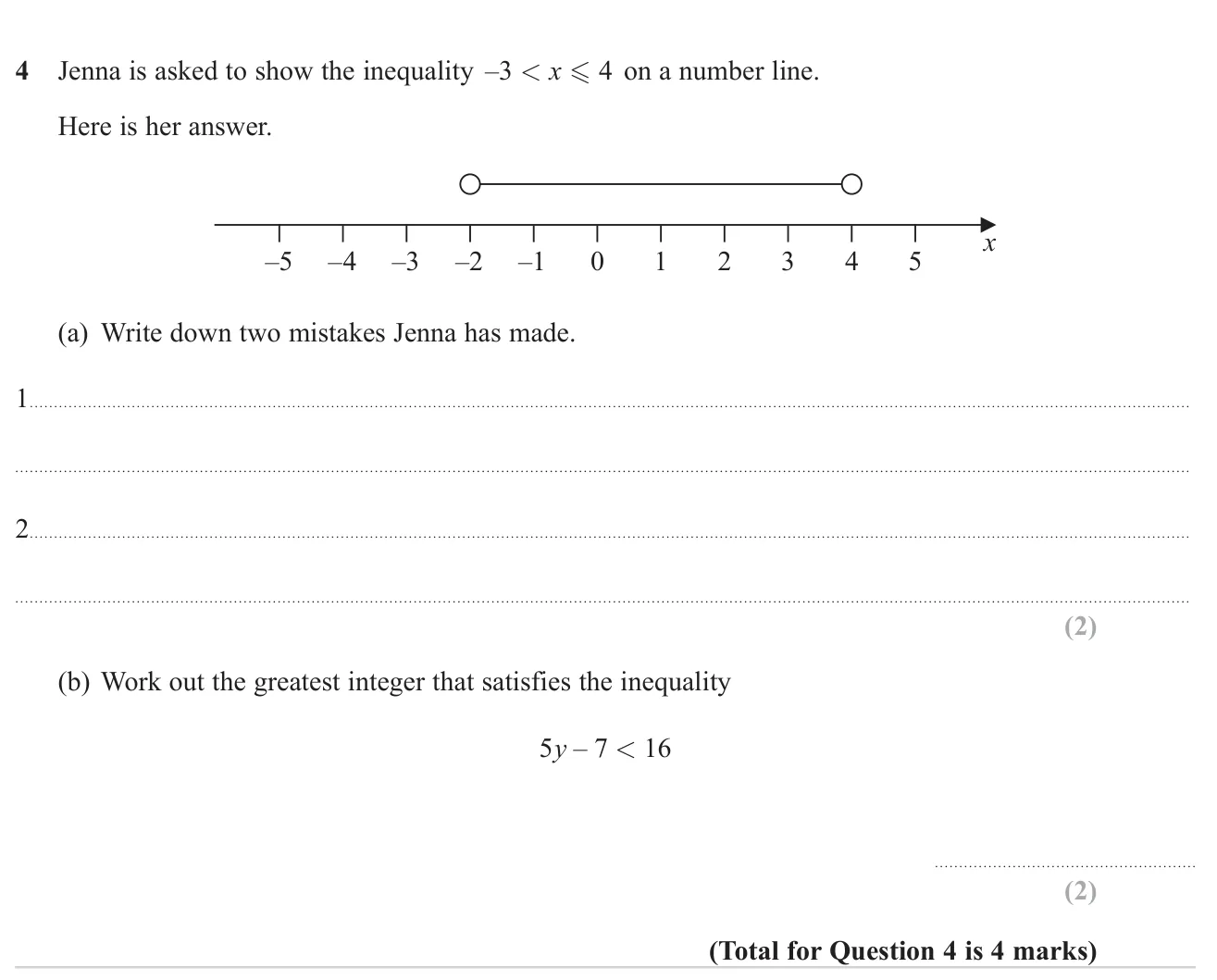
Spot two errors on a number line showing an inequality, and find the largest integer satisfying a linear inequality.

© Pearson Education Ltd. November 2023 Paper 3 (Higher, calculator), question 4.

Show answer
(a)Her line starts at −2-2 instead of −3-3 (there should be an open circle at −3-3), and the circle at 44 should be filled in2 marks
(b)442 marks

Worked solution Checked against the mark scheme

(a) −3<x-3 < x means xx is bigger than −3-3 but not equal to it, so the line should start at −3-3 with an open circle. Jenna started her line at −2-2.

x≤4x \le 4 includes 4, so the circle at 4 should be filled in. Jenna drew an open circle there.

(b) 5y−7<165y - 7 < 16

5y<235y < 23, so y<4.6y < 4.6

The greatest integer less than 4.6 is 4.

Watch out: In (b), giving 5 by rounding 4.6 up.

Question 5

Factors, multiples and primes3 marksGrade 4CalculatorOn both tiers
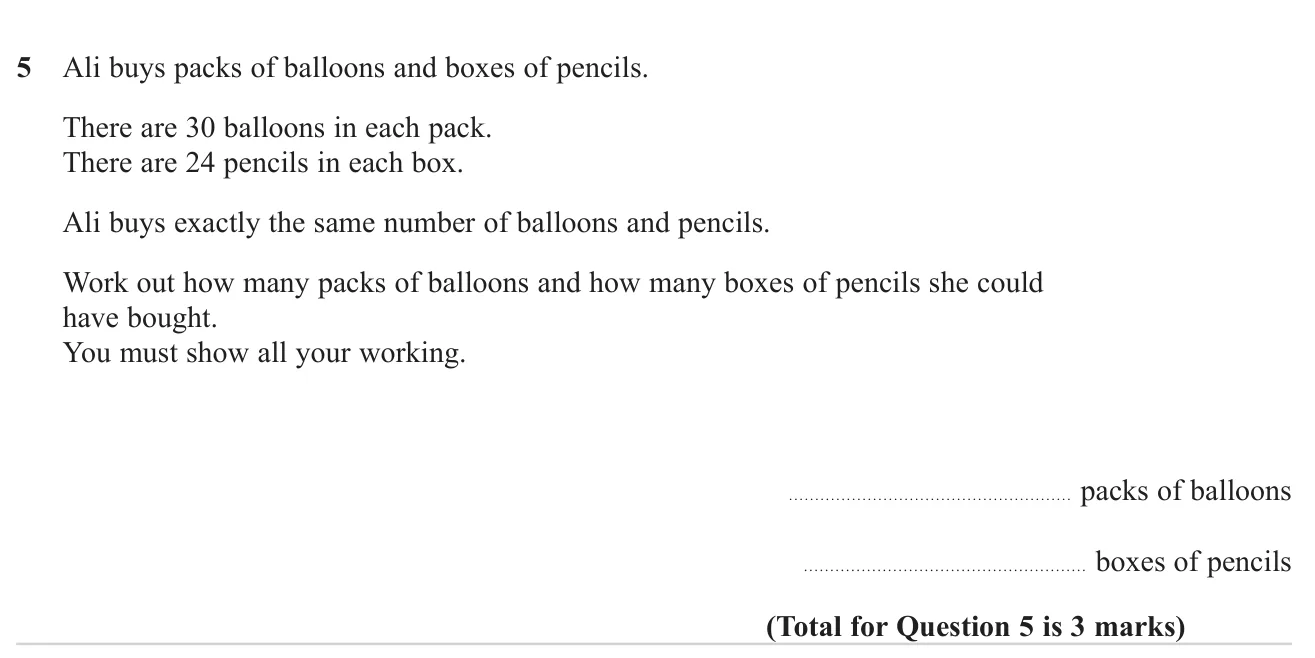
Use common multiples to find how many packs of two items give equal totals.

© Pearson Education Ltd. November 2023 Paper 3 (Higher, calculator), question 5.

Show answer
Answer4 packs of balloons and 5 boxes of pencils (or any multiple, e.g. 8 and 10)3 marks

Worked solution Checked against the mark scheme

Multiples of 30: 30, 60, 90, 120

Multiples of 24: 24, 48, 72, 96, 120

LCM =120= 120, so 120÷30=4120 \div 30 = 4 packs and 120÷24=5120 \div 24 = 5 boxes.

Watch out: Swapping the answers round, 5 packs and 4 boxes.

Question 6

Direct and inverse proportion2 marksGrade 4CalculatorOn both tiers
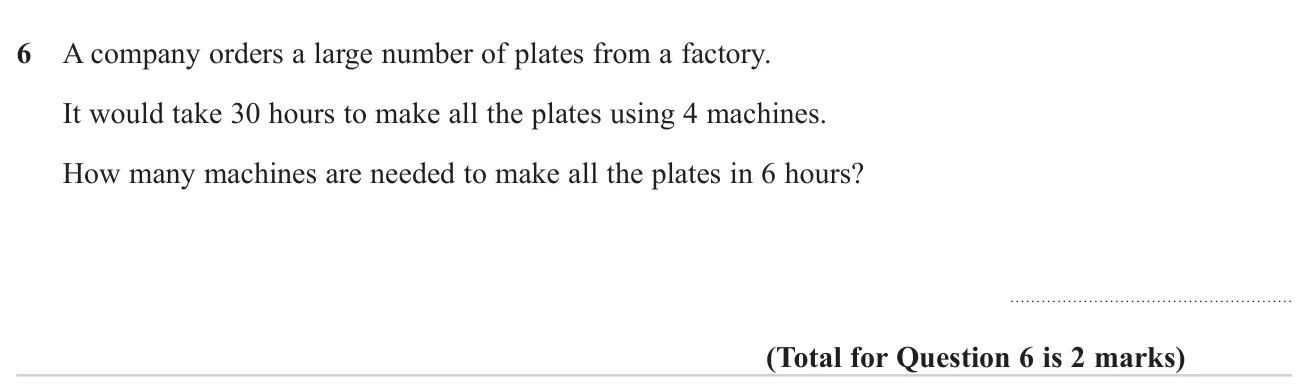
Use inverse proportion to find how many machines finish a job in less time.

© Pearson Education Ltd. November 2023 Paper 3 (Higher, calculator), question 6.

Show answer
Answer202 marks

Worked solution Checked against the mark scheme

Total work =30×4=120= 30 \times 4 = 120 machine-hours.

In 6 hours: 120÷6=20120 \div 6 = 20 machines.

Watch out: Treating it as direct proportion and getting 0.8.

Question 7

Speed, density and pressure3 marksGrade 4CalculatorOn both tiers
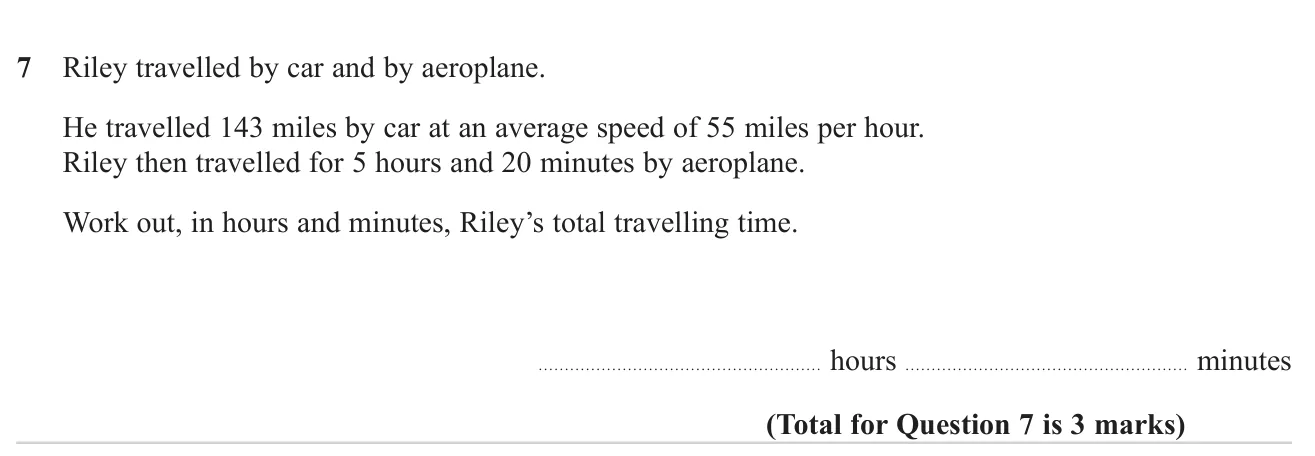
Find total journey time from a car leg using speed and a flight time.

© Pearson Education Ltd. November 2023 Paper 3 (Higher, calculator), question 7.

Show answer
Answer7 hours 56 minutes3 marks

Worked solution Checked against the mark scheme

Car time =143÷55=2.6= 143 \div 55 = 2.6 hours =2= 2 hours 36 minutes (0.6×60=360.6 \times 60 = 36).

Total =2= 2 h 36 min +5+ 5 h 20 min =7= 7 hours 56 minutes

Watch out: Reading 2.6 hours as 2 hours 60 minutes.

Question 8

Speed, density and pressure3 marksGrade 5CalculatorOn both tiers
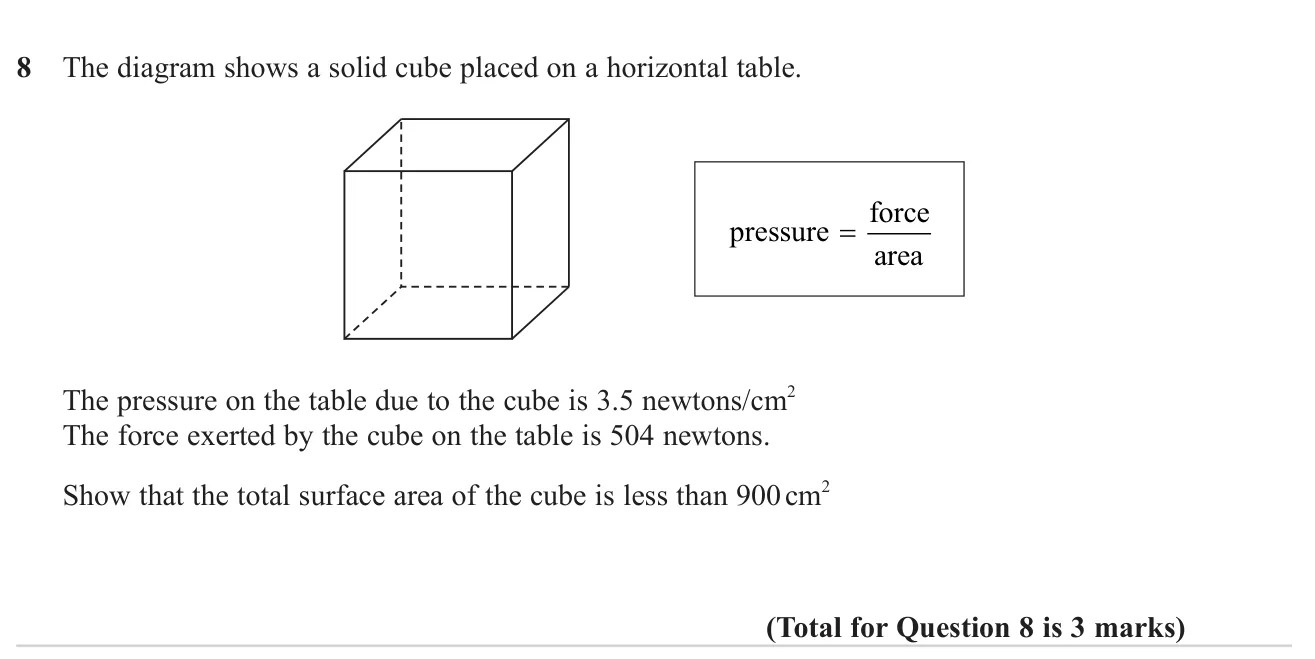
Use pressure, force and area to show a cube's surface area is under a given value.

© Pearson Education Ltd. November 2023 Paper 3 (Higher, calculator), question 8.

Show answer
AnswerFace area 144 cm², so surface area 864<900864 < 900 cm²3 marks

Worked solution Checked against the mark scheme

Area of face on the table =force÷pressure=504÷3.5=144= \text{force} \div \text{pressure} = 504 \div 3.5 = 144 cm²

A cube has 6 equal faces: 6×144=8646 \times 144 = 864 cm²

864<900864 < 900, so the surface area is less than 900 cm².

Watch out: Multiplying force by pressure instead of dividing.

Question 9

Coordinates and straight-line graphs3 marksGrade 5CalculatorOn both tiers
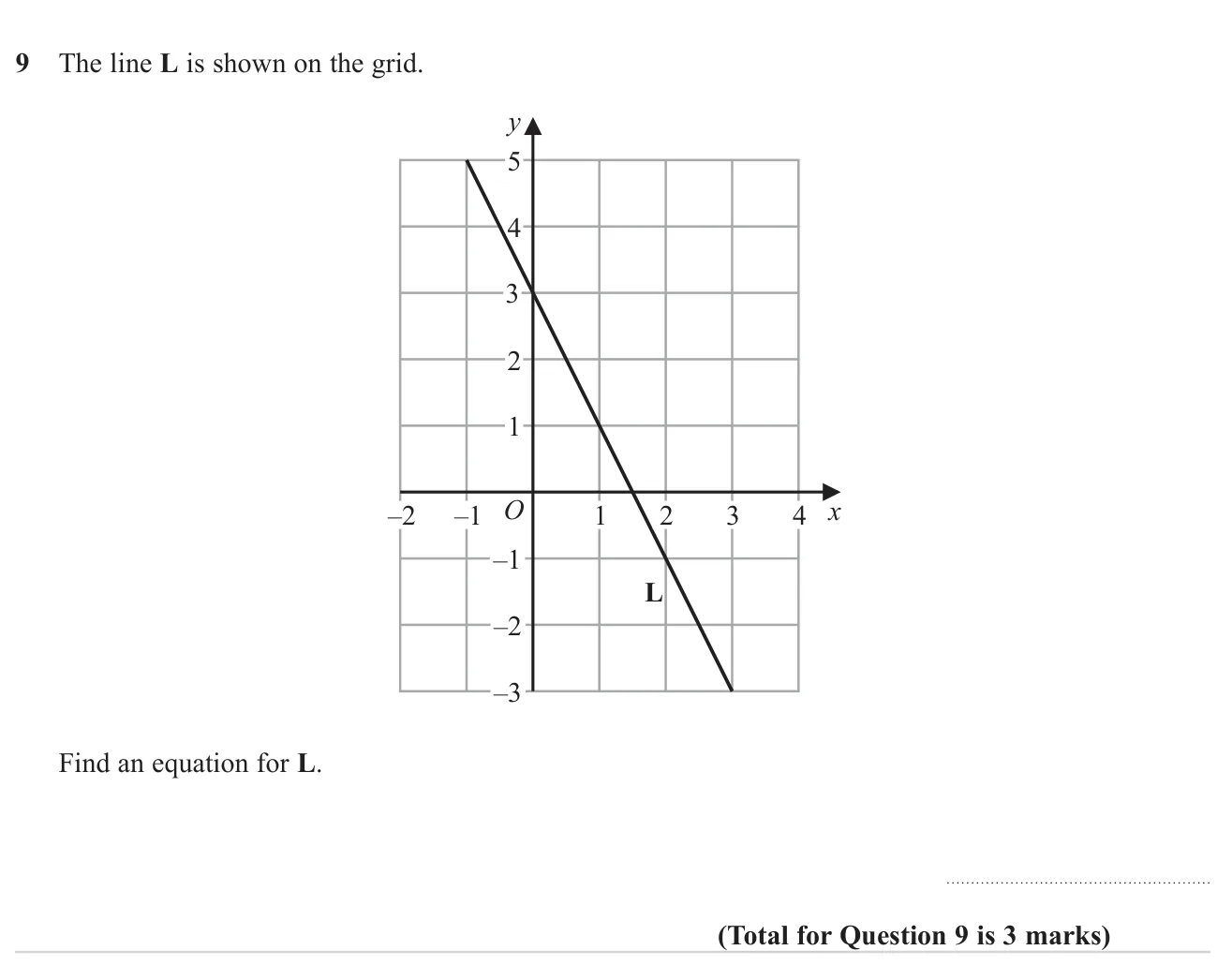
Find the equation of a straight line drawn on a coordinate grid.

© Pearson Education Ltd. November 2023 Paper 3 (Higher, calculator), question 9.

Show answer
Answery=−2x+3y = -2x + 33 marks

Worked solution Checked against the mark scheme

The line crosses the yy-axis at 3, so c=3c = 3.

From (0, 3) to (1, 1): down 2 for every 1 across, so gradient =−2= -2.

Equation: y=−2x+3y = -2x + 3

Watch out: Getting the gradient as +2 because the sign is missed.

Question 10

Formulae and changing the subject3 marksGrade 5Calculator
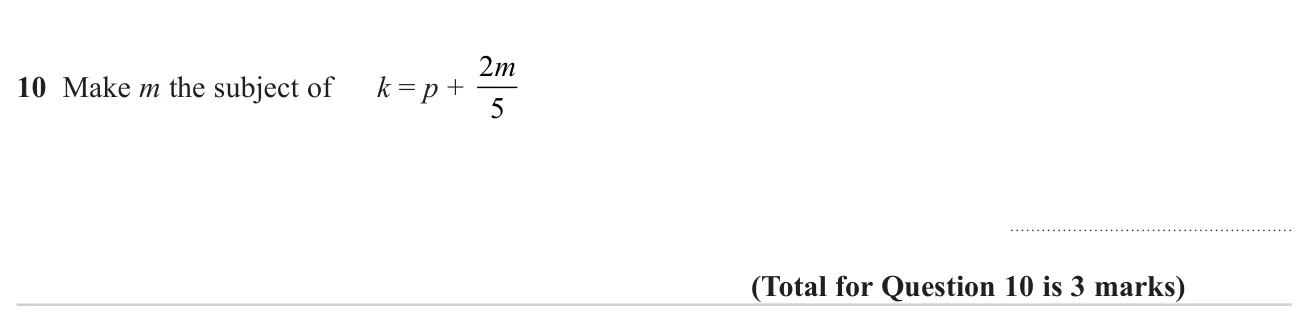
Rearrange a formula with a fractional term to make m the subject.

© Pearson Education Ltd. November 2023 Paper 3 (Higher, calculator), question 10.

Show answer
Answerm=5(k−p)2m = \dfrac{5(k - p)}{2}3 marks

Worked solution Checked against the mark scheme

k=p+2m5k = p + \dfrac{2m}{5}

Subtract pp: k−p=2m5k - p = \dfrac{2m}{5}

Multiply by 5: 5(k−p)=2m5(k - p) = 2m

Divide by 2: m=5(k−p)2m = \dfrac{5(k - p)}{2}

Watch out: Multiplying only k by 5 and not p, giving 5k − p = 2m.

Question 11

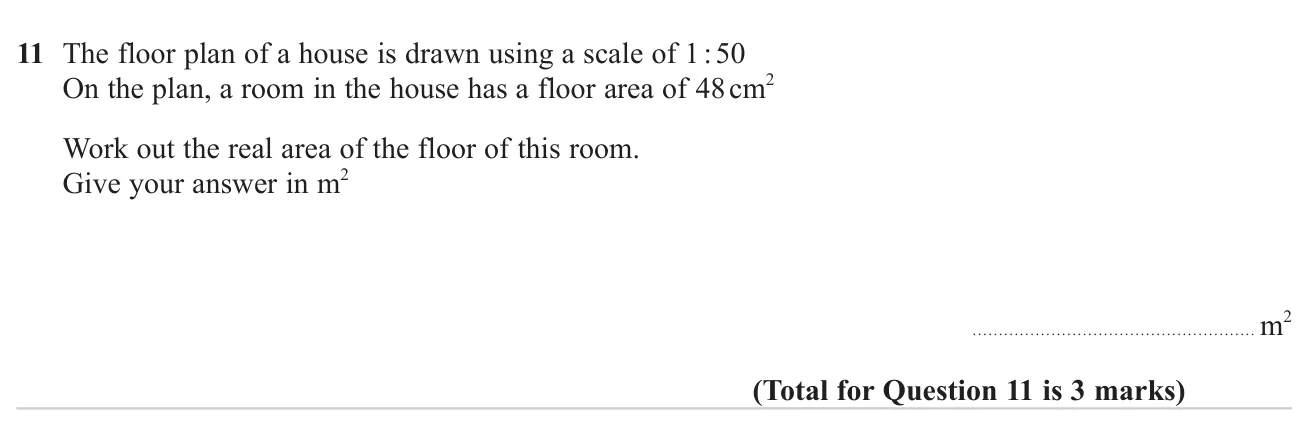
Use a scale to convert an area on a plan into a real area in square metres.

© Pearson Education Ltd. November 2023 Paper 3 (Higher, calculator), question 11.

Show answer
Answer12123 marks

Worked solution Checked against the mark scheme

Length scale factor 50, so area scale factor 502=250050^2 = 2500.

Real area =48×2500=120 000 cm2= 48 \times 2500 = 120\,000\text{ cm}^2

1 m2=10 000 cm21\text{ m}^2 = 10\,000\text{ cm}^2, so 120 000÷10 000=12 m2120\,000 \div 10\,000 = 12\text{ m}^2

Watch out: Multiplying by 50 instead of 50², or dividing by 100 instead of 10 000 to convert to square metres.

Question 12

Arcs and sectors2 marksGrade 6Calculator
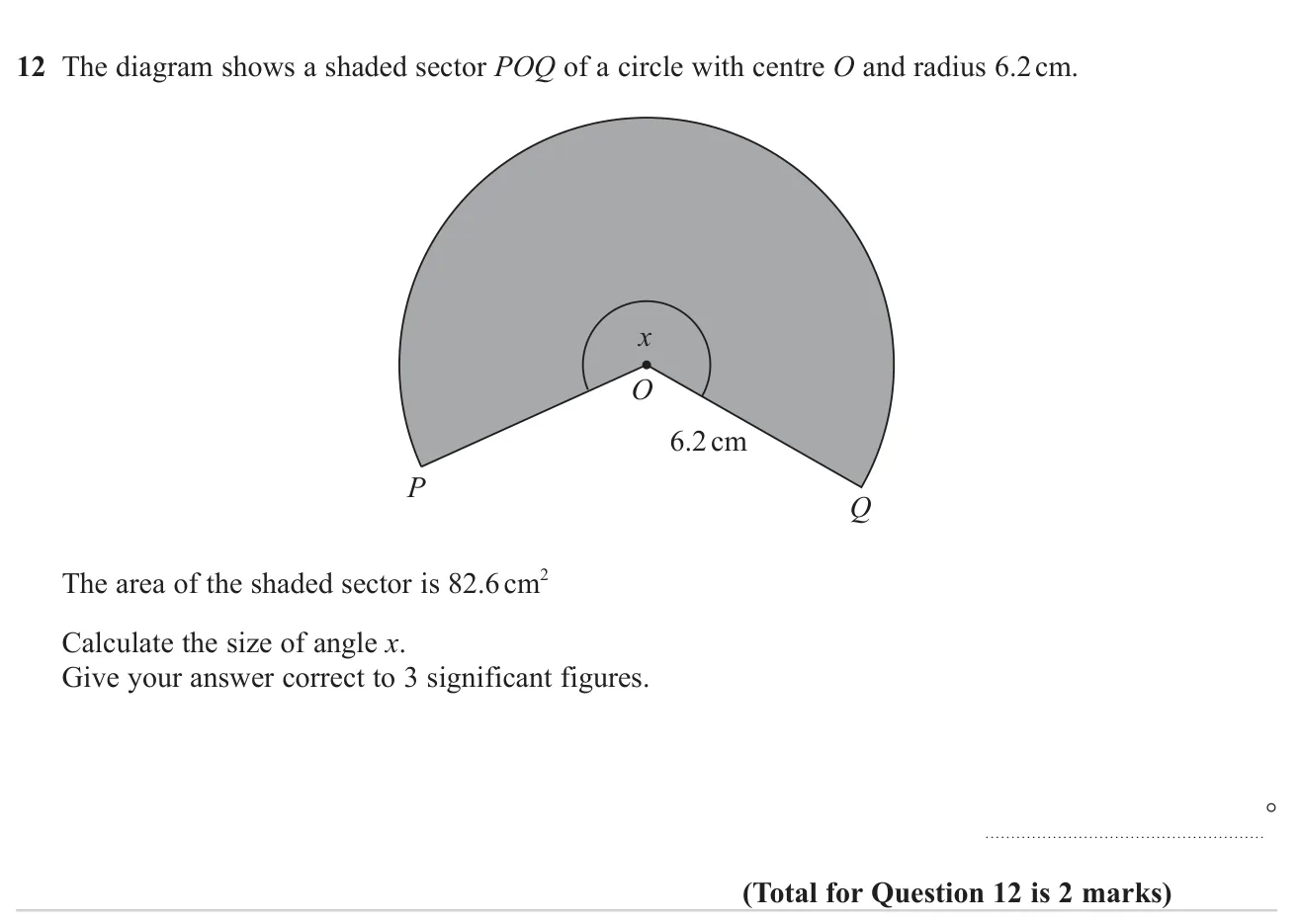
Find the angle of a reflex sector given its area and the radius of the circle.

© Pearson Education Ltd. November 2023 Paper 3 (Higher, calculator), question 12.

Show answer
Answer246°246° (246 to 247)2 marks

Worked solution Checked against the mark scheme

x360×π×6.22=82.6\dfrac{x}{360} \times \pi \times 6.2^2 = 82.6

x=82.6×360π×6.22=29 736120.76...=246.2...x = \dfrac{82.6 \times 360}{\pi \times 6.2^2} = \dfrac{29\,736}{120.76...} = 246.2...

x=246°x = 246° (3 s.f.)

Watch out: Using the formula for arc length, or using the diameter instead of the radius.

Question 13

Cumulative frequency6 marksGrade 5Calculator
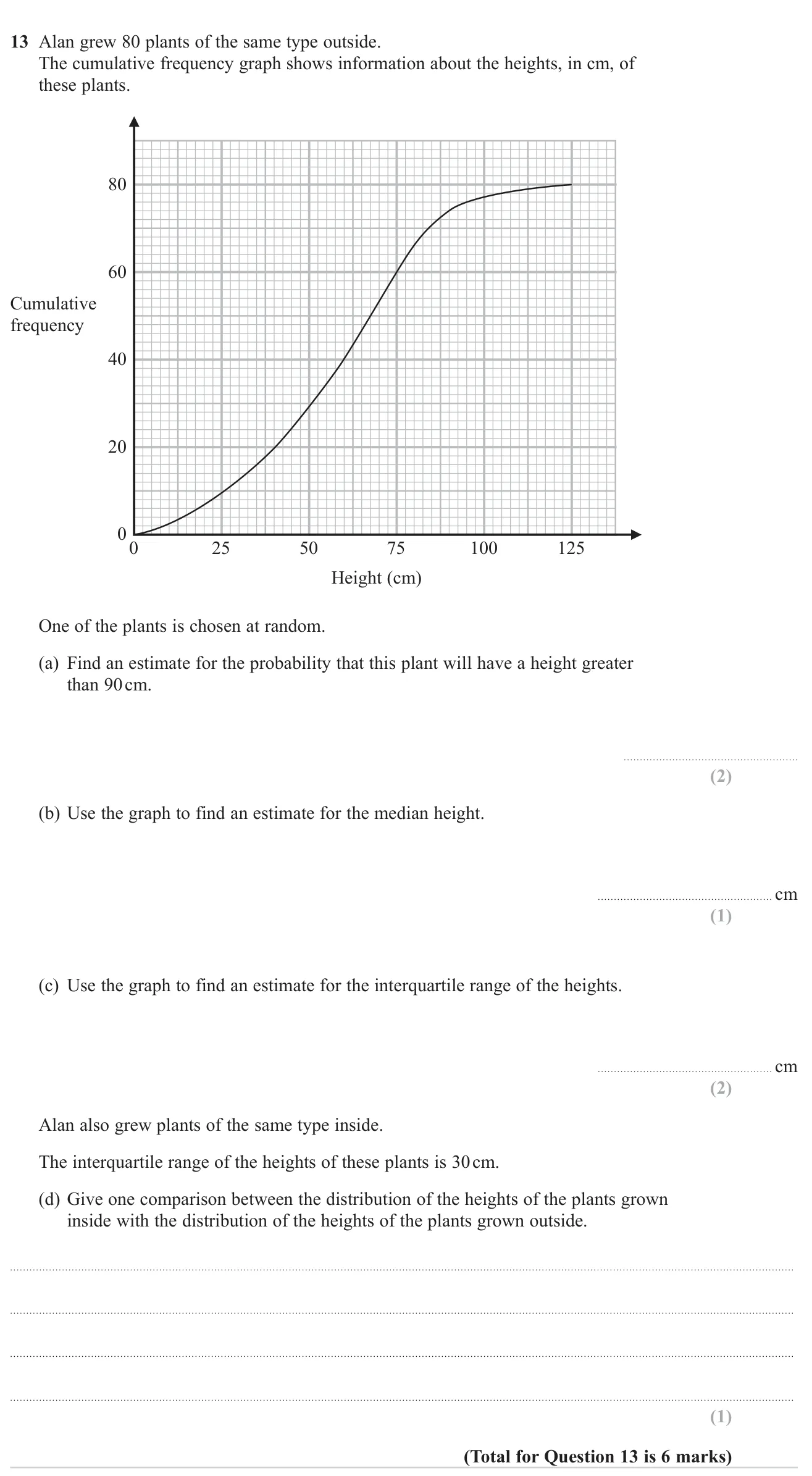
Read a cumulative frequency graph to estimate a probability, the median and the interquartile range, then compare spreads.

© Pearson Education Ltd. November 2023 Paper 3 (Higher, calculator), question 13.

Show answer
(a)680\frac{6}{80} (accept 580\frac{5}{80})2 marks
(b)6060 cm1 mark
(c)3535 cm2 marks
(d)The heights of the plants grown outside are more spread out (IQR 35 cm compared with 30 cm)1 mark

Worked solution Checked against the mark scheme

(a) At 90 cm the cumulative frequency is about 74, so 80−74=680 - 74 = 6 plants are taller. Probability ≈680\approx \frac{6}{80}.

(b) Median at 80÷2=4080 \div 2 = 40th plant: about 60 cm.

(c) LQ (20th plant) ≈40\approx 40 cm, UQ (60th plant) ≈75\approx 75 cm. IQR =75−40=35= 75 - 40 = 35 cm.

(d) 35>3035 > 30, so the heights of the outside plants are more varied than those grown inside.

Watch out: In (a), giving 74/80, the probability of being 90 cm or shorter.

Question 14

Sequences and the nth term2 marksGrade 7Calculator
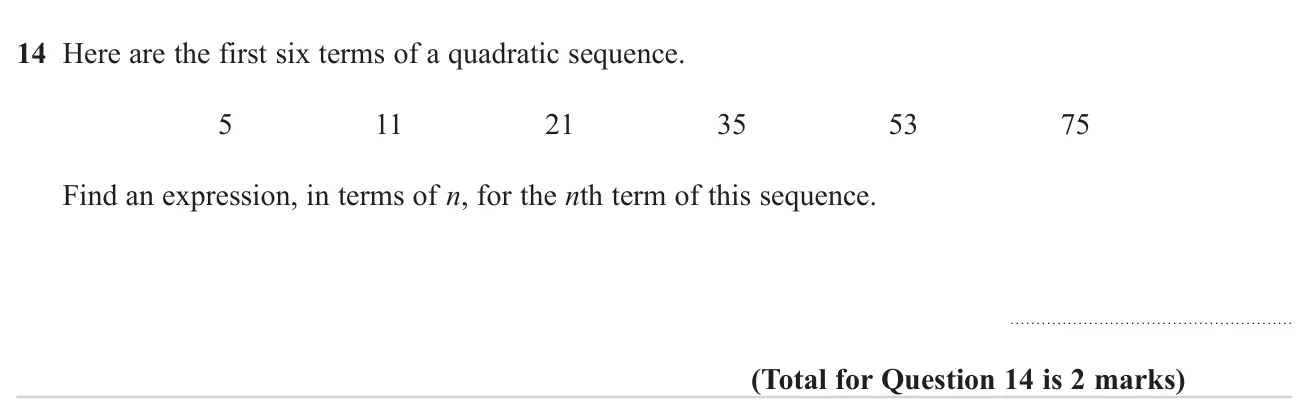
Find the nth term of a quadratic sequence.

© Pearson Education Ltd. November 2023 Paper 3 (Higher, calculator), question 14.

Show answer
Answer2n2+32n^2 + 32 marks

Worked solution Checked against the mark scheme

First differences: 6, 10, 14, 18, 22. Second difference: 4, so the sequence starts 2n22n^2.

2n22n^2: 2, 8, 18, 32, ...

Sequence minus 2n22n^2: 3, 3, 3, 3, ... so the nth term is 2n2+32n^2 + 3.

Watch out: Using the second difference itself and writing 4n².

Question 15

Similar shapes2 marksGrade 6Calculator
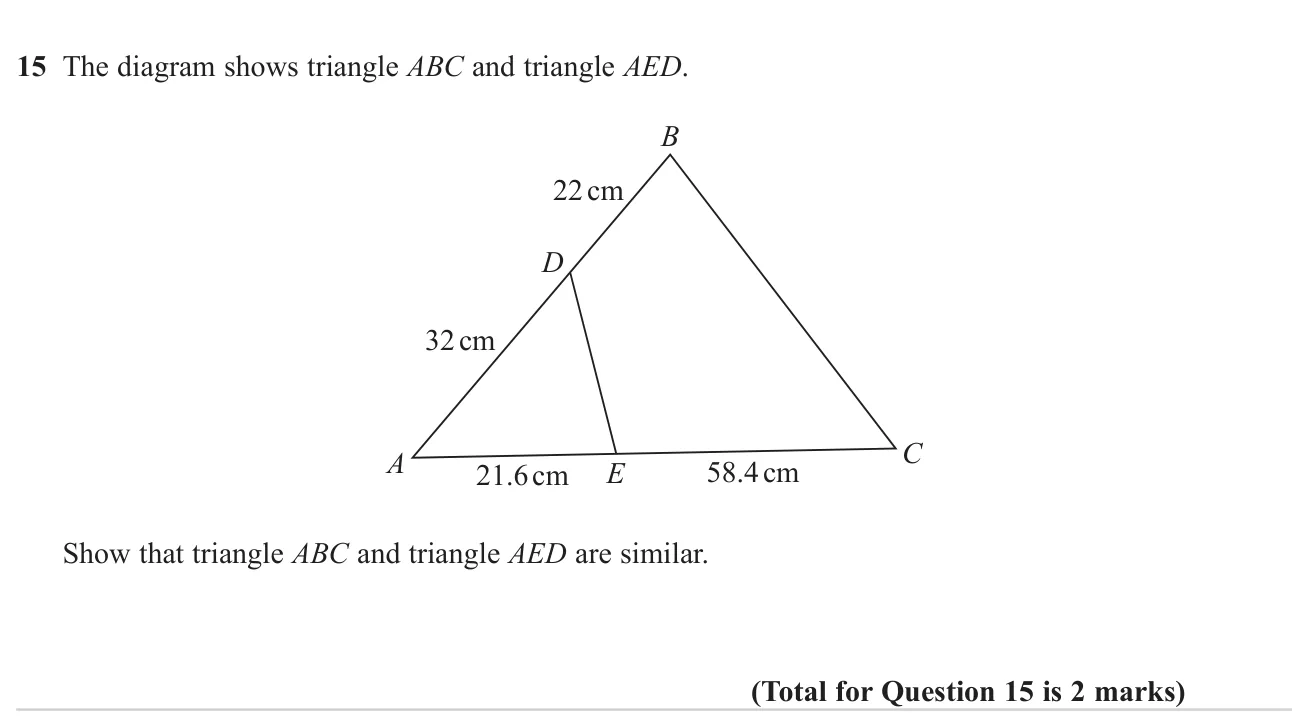
Show that two triangles sharing an angle are similar by comparing ratios of corresponding sides.

© Pearson Education Ltd. November 2023 Paper 3 (Higher, calculator), question 15.

Show answer
AnswerACAD=8032=2.5\frac{AC}{AD} = \frac{80}{32} = 2.5 and ABAE=5421.6=2.5\frac{AB}{AE} = \frac{54}{21.6} = 2.5, with angle AA shared2 marks

Worked solution Checked against the mark scheme

AC=21.6+58.4=80AC = 21.6 + 58.4 = 80 cm and AB=32+22=54AB = 32 + 22 = 54 cm.

In triangle AEDAED, AD=32AD = 32 matches AC=80AC = 80, and AE=21.6AE = 21.6 matches AB=54AB = 54.

80÷32=2.580 \div 32 = 2.5 and 54÷21.6=2.554 \div 21.6 = 2.5

The ratios are equal and angle AA is common, so the triangles are similar.

Watch out: Matching AD with AB and AE with AC, which gives different ratios.

Question 16

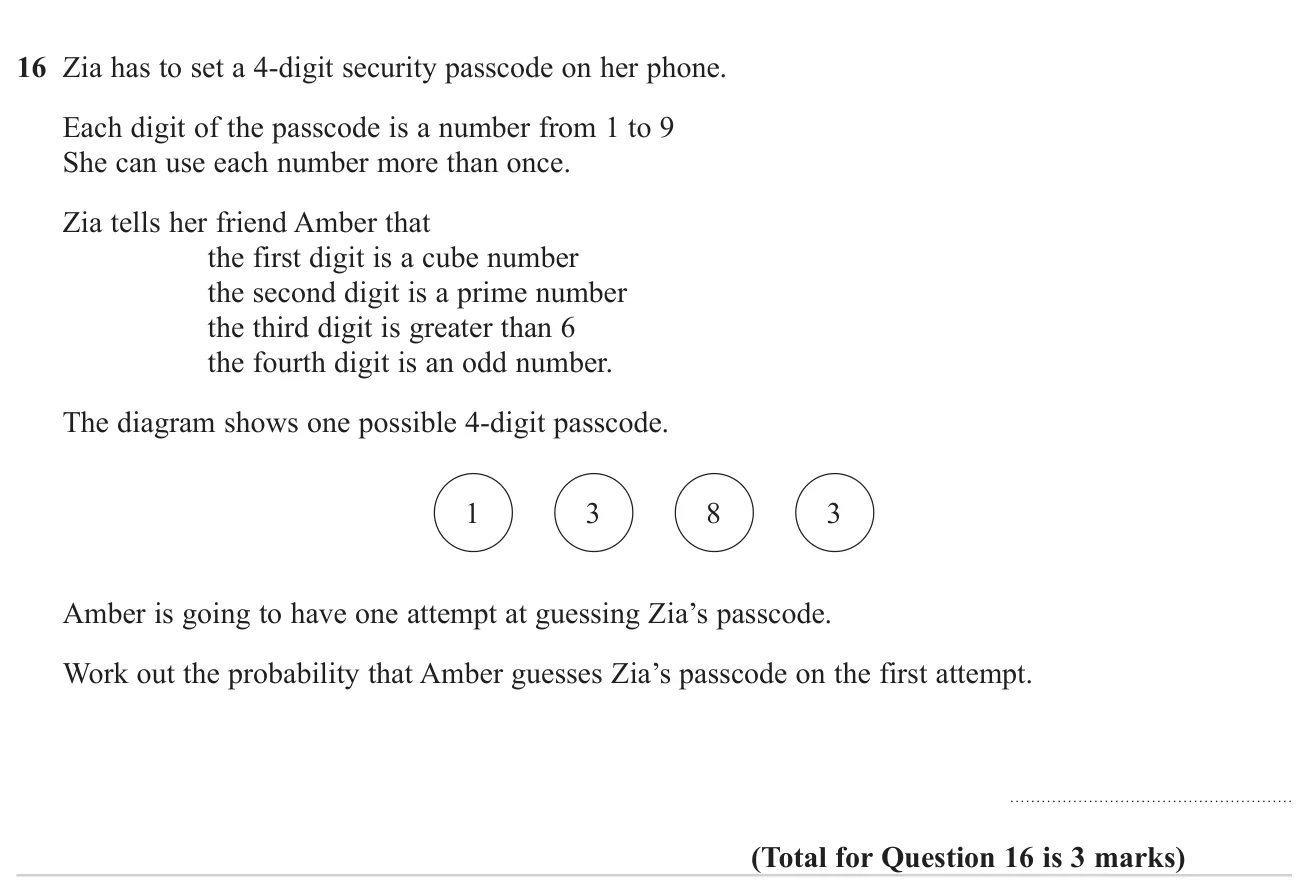
Count the possible four-digit passcodes meeting conditions on each digit and find the probability of guessing it first time.

© Pearson Education Ltd. November 2023 Paper 3 (Higher, calculator), question 16.

Show answer
Answer1120\frac{1}{120}3 marks

Worked solution Checked against the mark scheme

Options for each digit (1 to 9):

- cube: 1, 8 → 2
- prime: 2, 3, 5, 7 → 4
- greater than 6: 7, 8, 9 → 3
- odd: 1, 3, 5, 7, 9 → 5

Number of passcodes =2×4×3×5=120= 2 \times 4 \times 3 \times 5 = 120

Probability =1120= \frac{1}{120}

Watch out: Forgetting that 1 is a cube number, or counting 1 as prime.

Question 17

Completing the square7 marksGrade 7Calculator
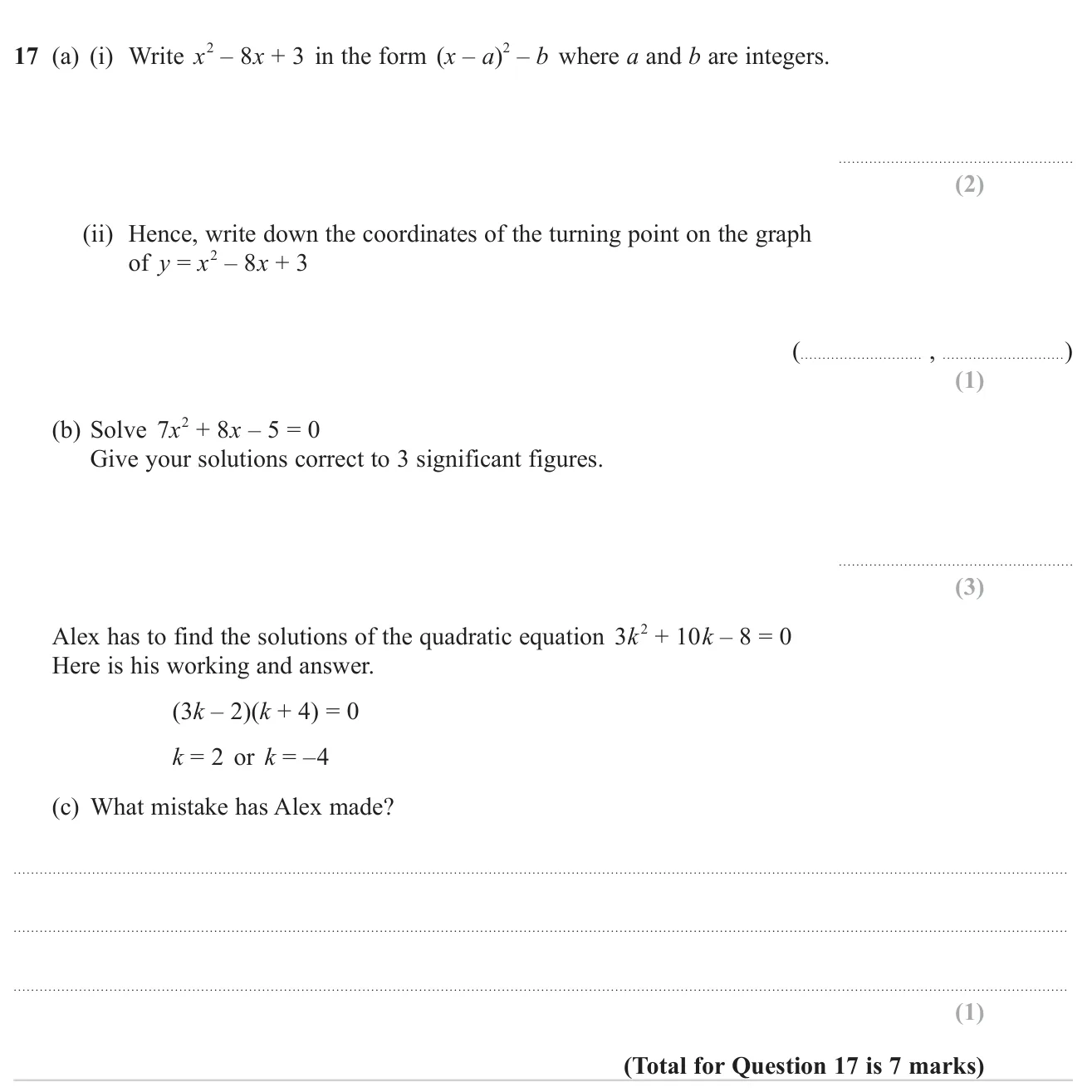
Complete the square and state the turning point, solve a quadratic with the formula, and spot an error in factorised solutions.

© Pearson Education Ltd. November 2023 Paper 3 (Higher, calculator), question 17.

Show answer
(a(i))(x−4)2−13(x - 4)^2 - 132 marks
(a(ii))(4,−13)(4, -13)1 mark
(b)x=0.449x = 0.449 or x=−1.59x = -1.593 marks
(c)He ignored the 3: from 3k−2=03k - 2 = 0 the solution is k=23k = \frac{2}{3}, not 21 mark

Worked solution Checked against the mark scheme

(a)(i) x2−8x+3=(x−4)2−16+3=(x−4)2−13x^2 - 8x + 3 = (x - 4)^2 - 16 + 3 = (x - 4)^2 - 13

(ii) Turning point (4,−13)(4, -13)

(b) x=−8±82−4(7)(−5)2(7)=−8±20414x = \dfrac{-8 \pm \sqrt{8^2 - 4(7)(-5)}}{2(7)} = \dfrac{-8 \pm \sqrt{204}}{14}

x=0.449x = 0.449 or x=−1.59x = -1.59 (3 s.f.)

(c) 3k−2=03k - 2 = 0 gives k=23k = \frac{2}{3}. Alex forgot to divide by 3.

Watch out: In (a)(ii), giving the turning point as (−4, −13).

Question 18

Transformations3 marksGrade 8Calculator
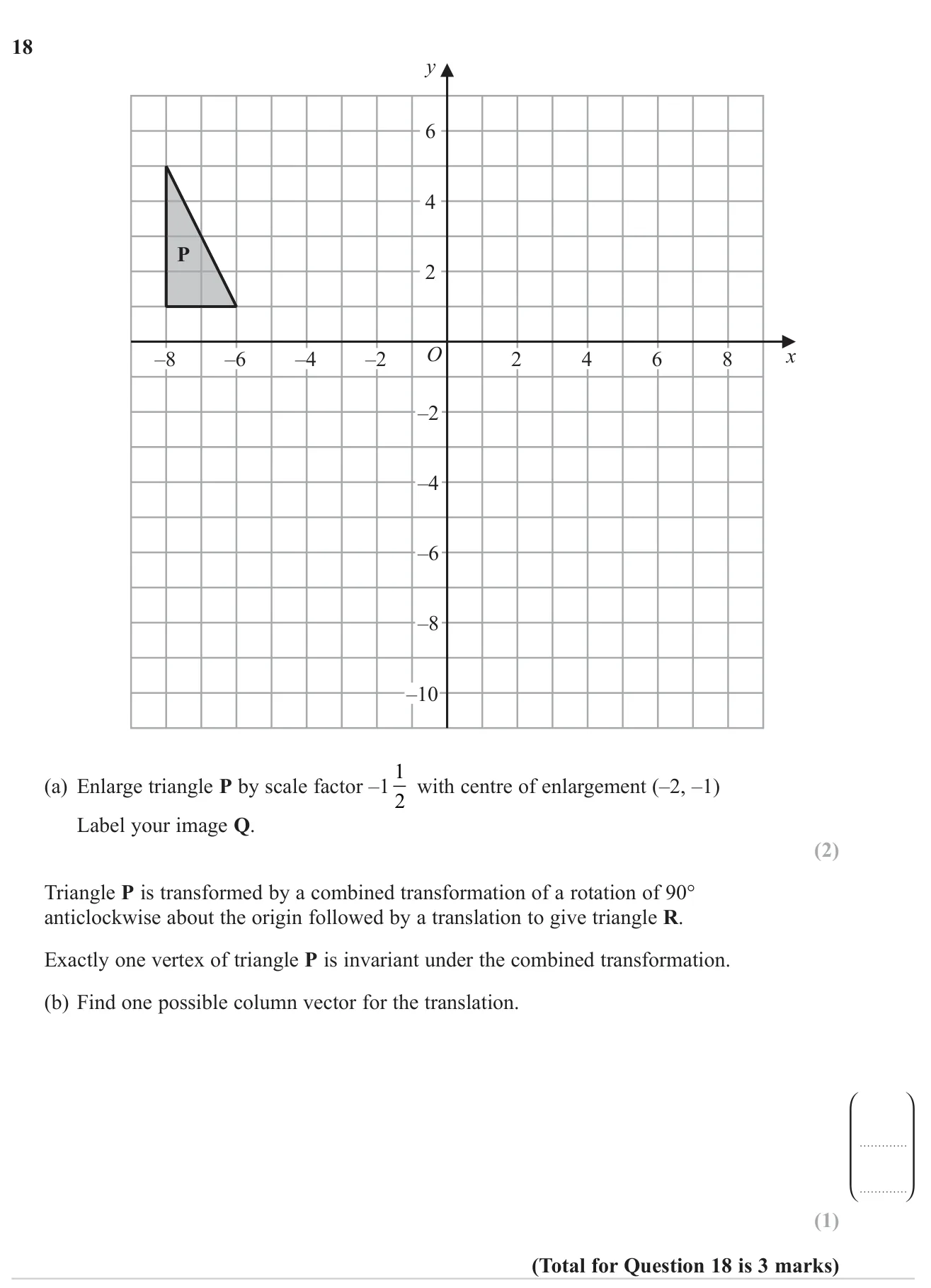
Enlarge a triangle by a negative fractional scale factor about a point, then find a translation that keeps one vertex fixed after a rotation.

© Pearson Education Ltd. November 2023 Paper 3 (Higher, calculator), question 18.

Show answer
(a)Triangle QQ with vertices (7,−4)(7, -4), (7,−10)(7, -10) and (4,−4)(4, -4)2 marks
(b)(−79)\begin{pmatrix} -7 \\ 9 \end{pmatrix} (or (−57)\begin{pmatrix} -5 \\ 7 \end{pmatrix} or (−313)\begin{pmatrix} -3 \\ 13 \end{pmatrix})1 mark

Worked solution Checked against the mark scheme

(a) PP has vertices (−8,1)(-8, 1), (−8,5)(-8, 5), (−6,1)(-6, 1). From the centre (−2,−1)(-2, -1) these are (−6,2)(-6, 2), (−6,6)(-6, 6), (−4,2)(-4, 2) away.

Multiply by −1.5-1.5: (9,−3)(9, -3), (9,−9)(9, -9), (6,−3)(6, -3). Add back to (−2,−1)(-2, -1): QQ is (7,−4)(7, -4), (7,−10)(7, -10), (4,−4)(4, -4).

(b) Rotating 90°90° anticlockwise about OO sends (x,y)(x, y) to (−y,x)(-y, x), so (−8,1)→(−1,−8)(-8, 1) \to (-1, -8).

To send it back to (−8,1)(-8, 1), translate by (−79)\begin{pmatrix} -7 \\ 9 \end{pmatrix}.

Watch out: Placing the image on the same side of the centre, ignoring the negative sign of the scale factor.

Question 19

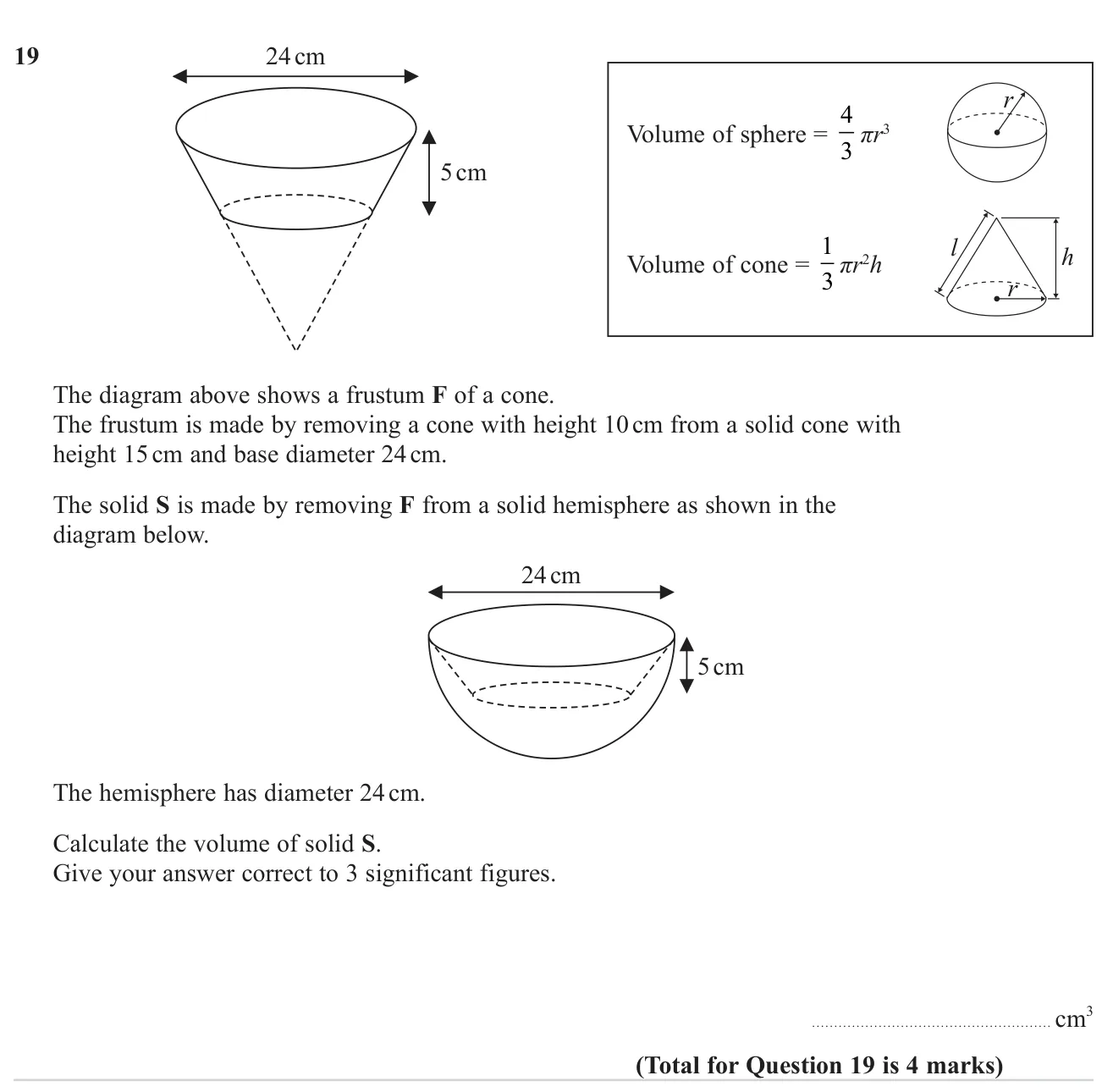
Volume and surface area4 marksGrade 7Calculator
Find the volume of a hemisphere with a frustum of a cone removed, working out the frustum from two similar cones.

© Pearson Education Ltd. November 2023 Paper 3 (Higher, calculator), question 19.

Show answer
Answer2030 cm32030\text{ cm}^3 (2026 to 2030)4 marks

Worked solution Checked against the mark scheme

Small cone: height 10 is 23\frac{2}{3} of 15, so its radius is 23×12=8\frac{2}{3} \times 12 = 8 cm.

Large cone =13π(122)(15)=720π= \frac{1}{3}\pi(12^2)(15) = 720\pi; small cone =13π(82)(10)=6403π= \frac{1}{3}\pi(8^2)(10) = \frac{640}{3}\pi

Frustum =720π−6403π=15203π= 720\pi - \frac{640}{3}\pi = \frac{1520}{3}\pi

Hemisphere =23π(123)=1152π= \frac{2}{3}\pi(12^3) = 1152\pi

S=1152π−15203π=2027.37...≈2030 cm3S = 1152\pi - \frac{1520}{3}\pi = 2027.37... \approx 2030\text{ cm}^3

Watch out: Using the diameter 24 as the radius, or using a full sphere instead of a hemisphere.

Question 20

Graph transformations3 marksGrade 8Calculator
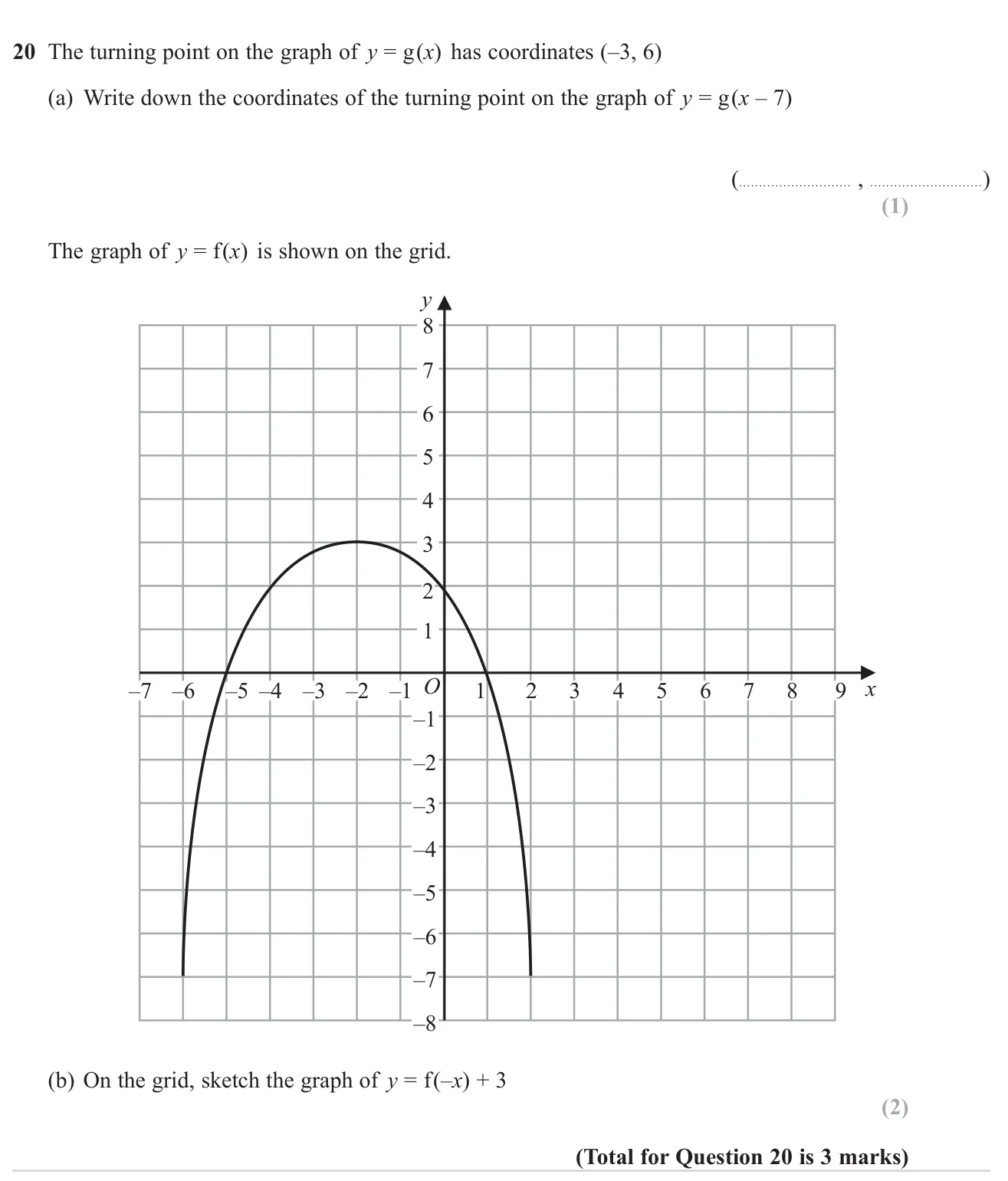
Give the turning point after a horizontal translation of a graph, and sketch a reflected and shifted version of a curve.

© Pearson Education Ltd. November 2023 Paper 3 (Higher, calculator), question 20.

Show answer
(a)(4,6)(4, 6)1 mark
(b)Curve with maximum (2,6)(2, 6) and end points (−2,−4)(-2, -4) and (6,−4)(6, -4)2 marks

Worked solution Checked against the mark scheme

(a) g(x−7)g(x - 7) moves the graph 7 to the right: (−3+7,6)=(4,6)(-3 + 7, 6) = (4, 6).

(b) f(−x)f(-x) reflects the curve in the yy-axis: maximum (−2,3)→(2,3)(-2, 3) \to (2, 3), ends (−6,−7)→(6,−7)(-6, -7) \to (6, -7) and (2,−7)→(−2,−7)(2, -7) \to (-2, -7).

+3+3 moves it up 3: maximum (2,6)(2, 6), ends (6,−4)(6, -4) and (−2,−4)(-2, -4).

Watch out: In (a), moving the turning point 7 to the left, giving (−10, 6).

Question 21

Circle theorems4 marksGrade 7Calculator
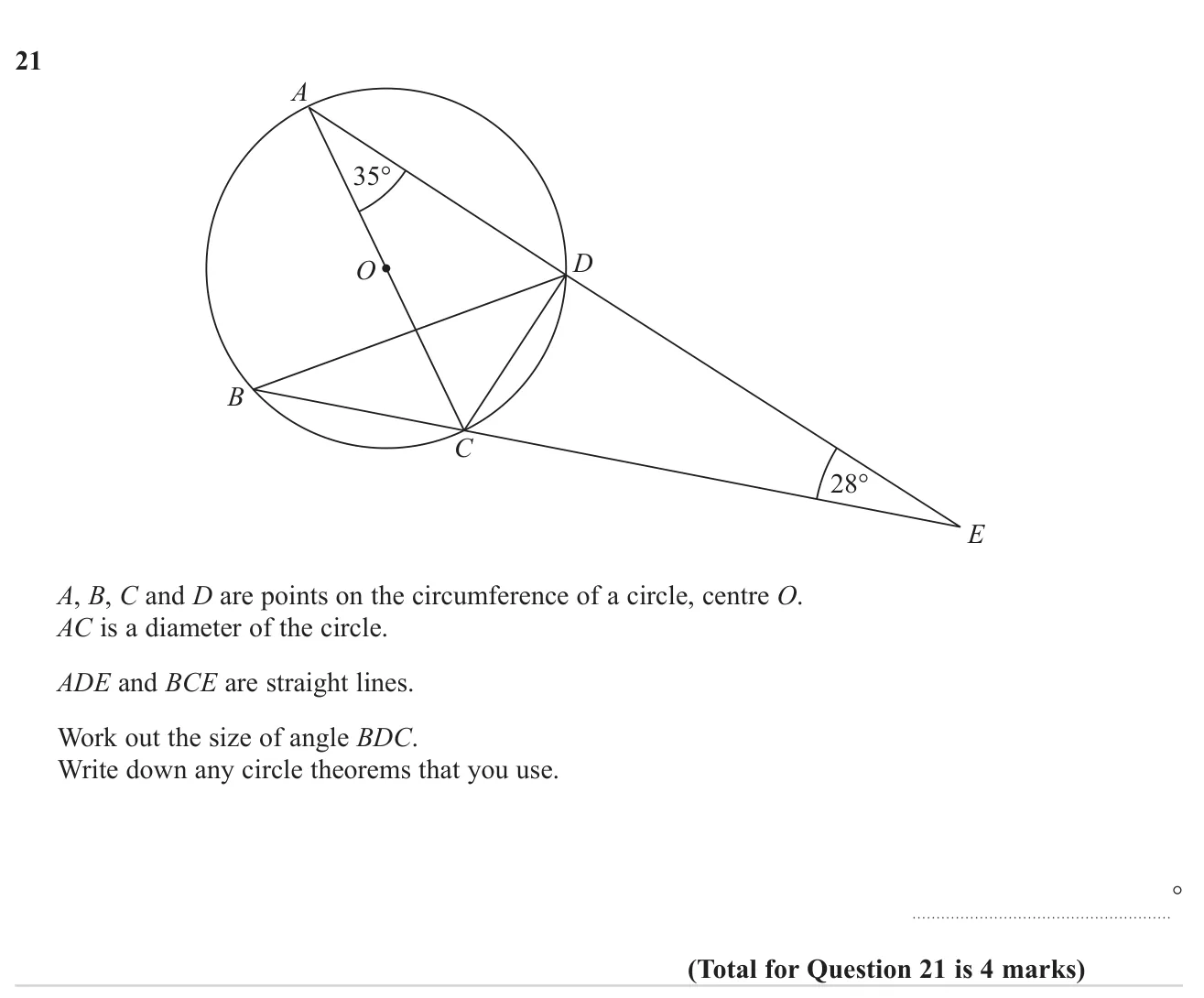
Use circle theorems and triangle angle facts to find an angle in a diagram with a diameter and lines meeting outside the circle.

© Pearson Education Ltd. November 2023 Paper 3 (Higher, calculator), question 21.

Show answer
Answer27°27°4 marks

Worked solution Checked against the mark scheme

Angle CBD=CBD = angle CAD=35°CAD = 35° (angles in the same segment are equal).

In triangle BDEBDE: angle BDE=180−35−28=117°BDE = 180 - 35 - 28 = 117°.

Angle ADC=90°ADC = 90° (angle in a semicircle), so angle CDE=180−90=90°CDE = 180 - 90 = 90°.

Angle BDC=117−90=27°BDC = 117 - 90 = 27°

Watch out: Not stating the circle theorems, which loses the communication mark.

Question 22

Error intervals and bounds4 marksGrade 8Calculator
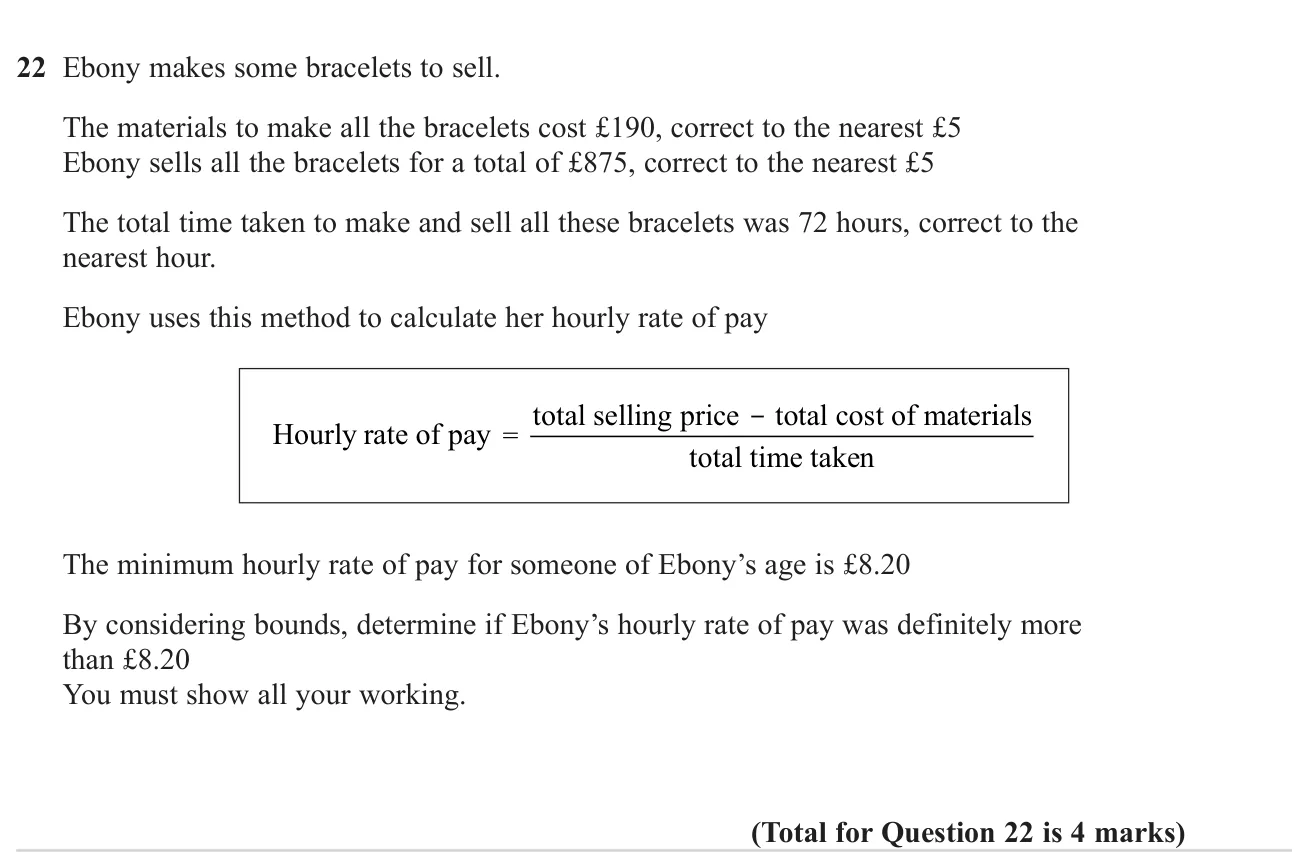
Use upper and lower bounds of rounded costs, takings and time to decide whether an hourly rate is definitely above a minimum wage.

© Pearson Education Ltd. November 2023 Paper 3 (Higher, calculator), question 22.

Show answer
AnswerLower bound of the rate =872.5−192.572.5=£9.379...= \frac{872.5 - 192.5}{72.5} = £9.379..., which is more than £8.20, so yes4 marks

Worked solution Checked against the mark scheme

To find the least possible rate, use the smallest takings, the largest costs and the longest time.

Takings LB =872.5= 872.5, costs UB =192.5= 192.5, time UB =72.5= 72.5

LB of rate =872.5−192.572.5=68072.5=9.379...= \dfrac{872.5 - 192.5}{72.5} = \dfrac{680}{72.5} = 9.379...

Even the lowest possible rate, £9.379..., is more than £8.20, so her hourly rate was definitely more than £8.20.

Watch out: Using the lower bound of the cost or of the time, which makes the rate too high.

Question 23

Ratio4 marksGrade 8Calculator
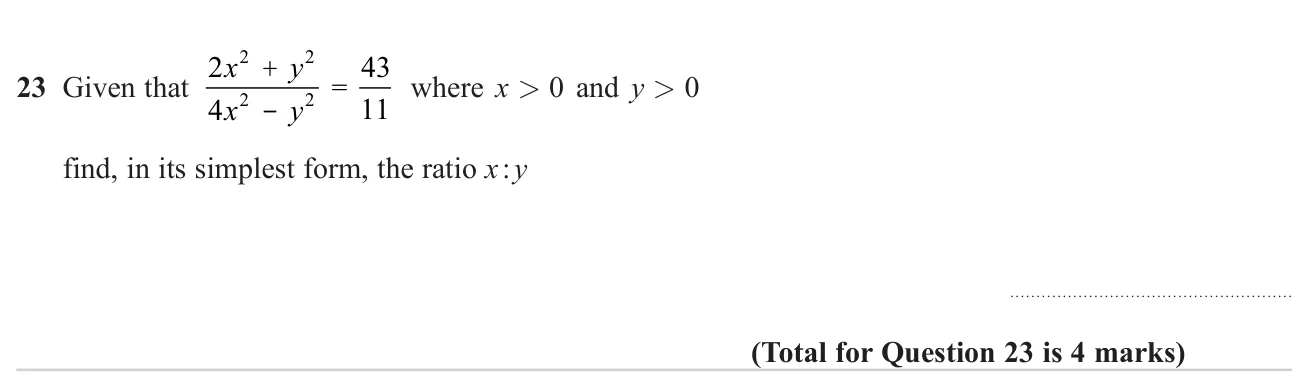
Solve an equation of algebraic fractions in x squared and y squared to find the ratio x to y in its simplest form.

© Pearson Education Ltd. November 2023 Paper 3 (Higher, calculator), question 23.

Show answer
Answer3:53 : 54 marks

Worked solution Checked against the mark scheme

11(2x2+y2)=43(4x2−y2)11(2x^2 + y^2) = 43(4x^2 - y^2)

22x2+11y2=172x2−43y222x^2 + 11y^2 = 172x^2 - 43y^2

54y2=150x254y^2 = 150x^2, so x2y2=54150=925\dfrac{x^2}{y^2} = \dfrac{54}{150} = \dfrac{9}{25}

xx and yy are positive, so xy=35\dfrac{x}{y} = \dfrac{3}{5} and x:y=3:5x : y = 3 : 5

Watch out: Giving the ratio upside down as 5 : 3, or leaving it as 9 : 25.

Question 24

Pythagoras and trigonometry4 marksGrade 8Calculator
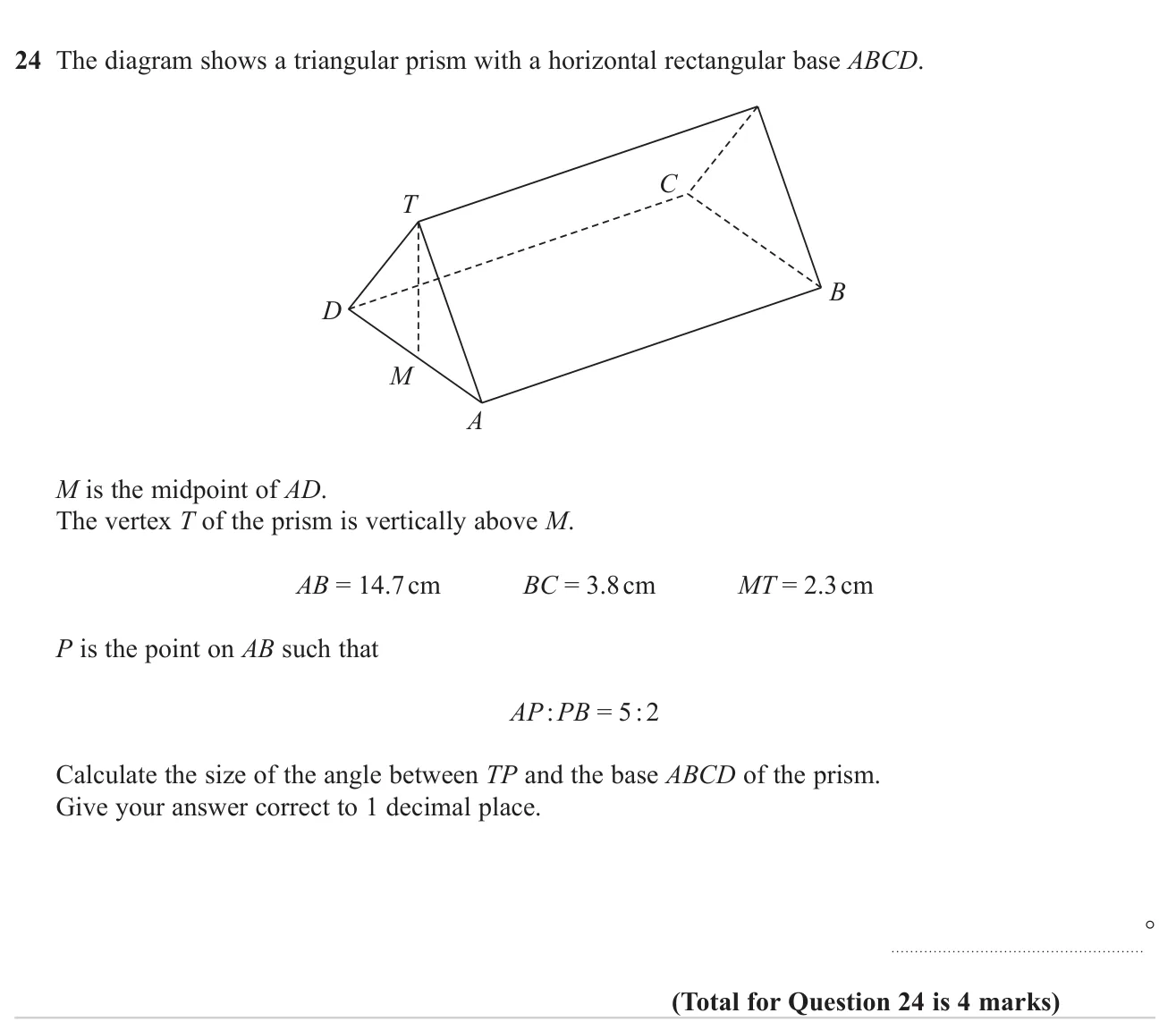
Find the angle between a sloping line and the horizontal base of a triangular prism using Pythagoras and trigonometry in 3D.

© Pearson Education Ltd. November 2023 Paper 3 (Higher, calculator), question 24.

Show answer
Answer12.2°12.2° (12.1 to 12.2)4 marks

Worked solution Checked against the mark scheme

AP=57×14.7=10.5AP = \frac{5}{7} \times 14.7 = 10.5 cm and AM=3.8÷2=1.9AM = 3.8 \div 2 = 1.9 cm.

Angle MAP=90°MAP = 90°, so MP=10.52+1.92=10.67...MP = \sqrt{10.5^2 + 1.9^2} = 10.67... cm

T is above M, so the angle is TPMTPM:

tan⁡TPM=2.310.67...\tan TPM = \dfrac{2.3}{10.67...}, so angle =12.16...°≈12.2°= 12.16...° \approx 12.2°

Watch out: Using AP instead of MP as the horizontal side of the right-angled triangle.

Finished the paper?

Add up your marks for all three papers and see what grade that would have been.