© Pearson Education Ltd. November 2019 Paper 1 (Higher, non-calculator), question 1.
Answer 1080 1080 1080 3 marks
Worked solution Checked against the mark scheme
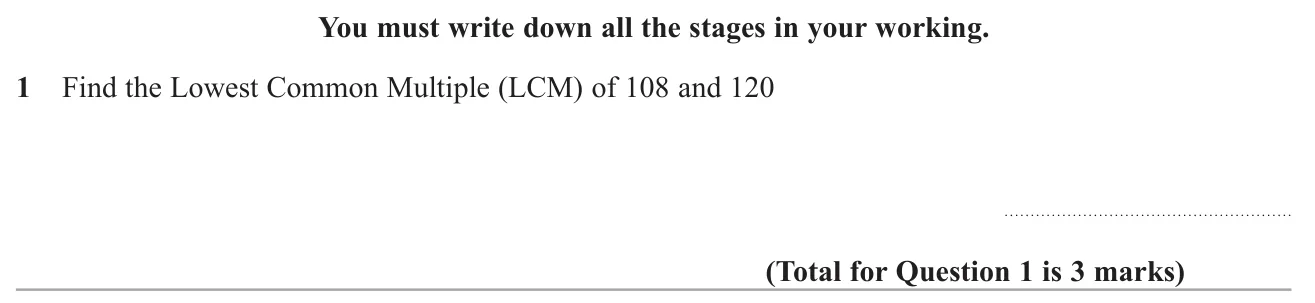
108 = 2 2 × 3 3 108 = 2^2 \times 3^3 108 = 2 2 × 3 3
120 = 2 3 × 3 × 5 120 = 2^3 \times 3 \times 5 120 = 2 3 × 3 × 5
Take the highest power of each prime:
LCM = 2 3 × 3 3 × 5 = 8 × 27 × 5 = 1080 = 2^3 \times 3^3 \times 5 = 8 \times 27 \times 5 = 1080 = 2 3 × 3 3 × 5 = 8 × 27 × 5 = 1080
Watch out: Multiplying the numbers (12960), which is a common multiple but not the lowest.
Question 2 Ratio 4 marks Grade 5 No calculator On both tiers © Pearson Education Ltd. November 2019 Paper 1 (Higher, non-calculator), question 2.
Worked solution Checked against the mark scheme
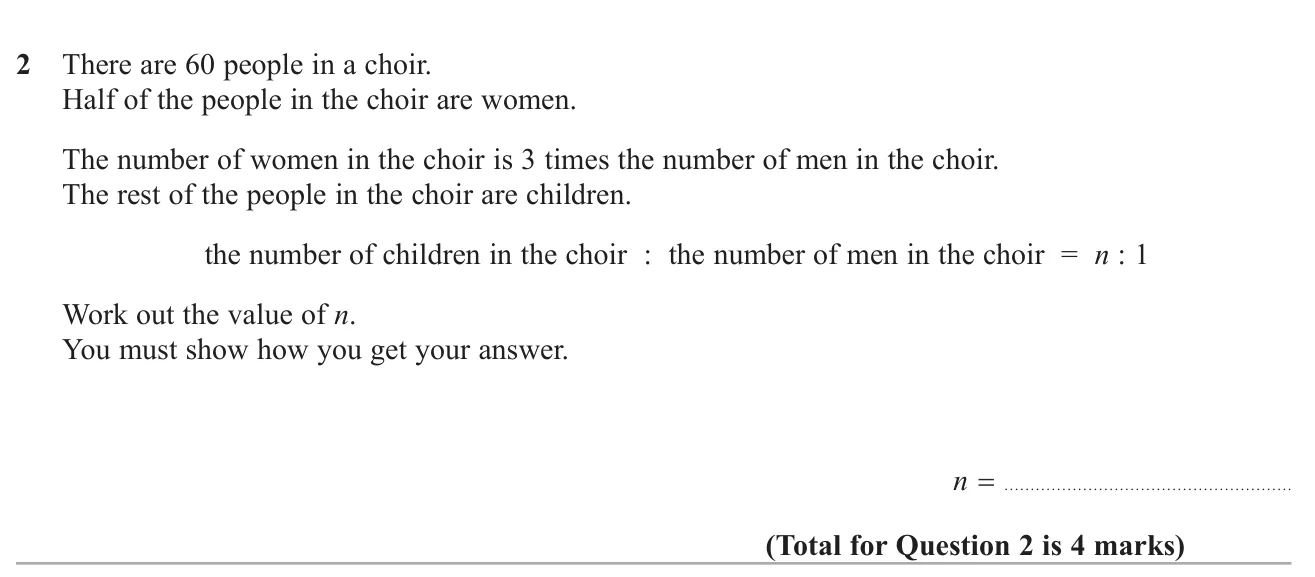
Women: 60 ÷ 2 = 30 60 \div 2 = 30 60 ÷ 2 = 30
Men: 30 ÷ 3 = 10 30 \div 3 = 10 30 ÷ 3 = 10
Children: 60 − 30 − 10 = 20 60 - 30 - 10 = 20 60 − 30 − 10 = 20
Children : men = 20 : 10 = 2 : 1 = 20 : 10 = 2 : 1 = 20 : 10 = 2 : 1 n = 2 n = 2 n = 2
Watch out: Taking children as a third of 60 without working out the men first.
Question 3 Fractions 3 marks Grade 5 No calculator On both tiers © Pearson Education Ltd. November 2019 Paper 1 (Higher, non-calculator), question 3.
Answer 2 1 3 2\frac{1}{3} 2 3 1 3 marks
Worked solution Checked against the mark scheme
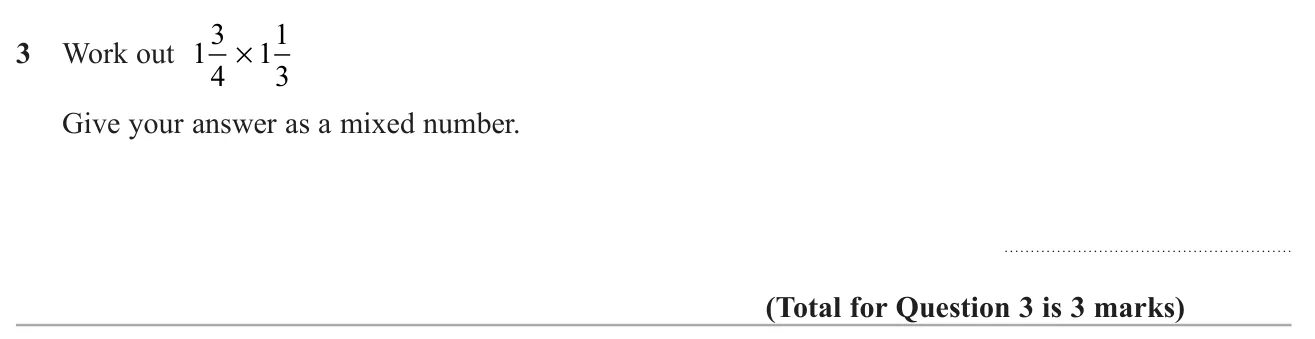
1 3 4 = 7 4 1\frac{3}{4} = \frac{7}{4} 1 4 3 = 4 7 1 1 3 = 4 3 1\frac{1}{3} = \frac{4}{3} 1 3 1 = 3 4
7 4 × 4 3 = 28 12 = 7 3 = 2 1 3 \frac{7}{4} \times \frac{4}{3} = \frac{28}{12} = \frac{7}{3} = 2\frac{1}{3} 4 7 × 3 4 = 12 28 = 3 7 = 2 3 1
Watch out: Multiplying the whole numbers and fractions separately to get 1 1/4.
© Pearson Education Ltd. November 2019 Paper 1 (Higher, non-calculator), question 4.
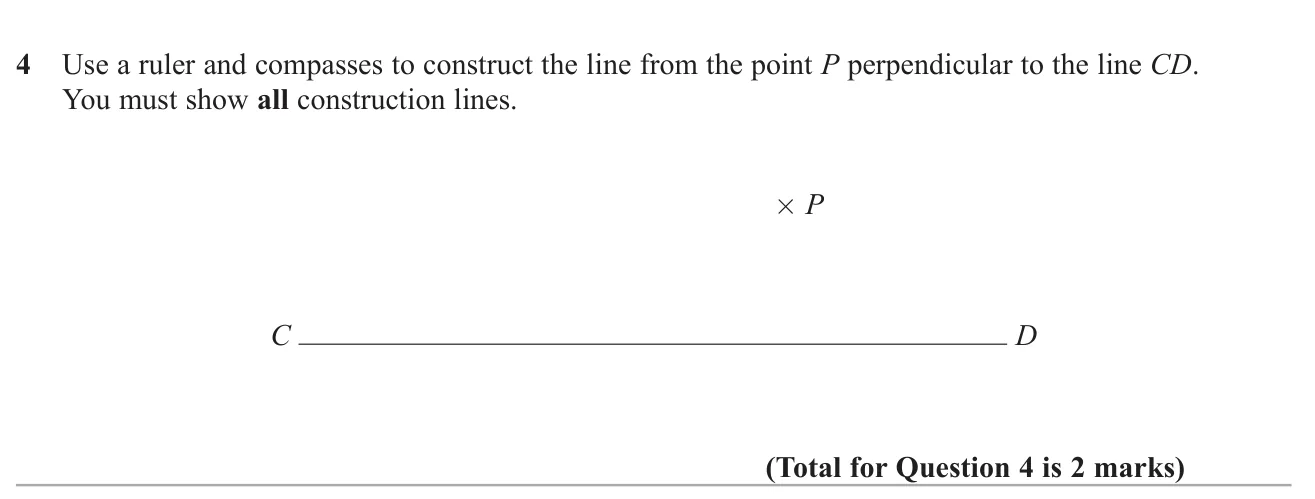
Answer Perpendicular from P P P C D CD C D 2 marks
Worked solution Checked against the mark scheme
1. With centre P P P C D CD C D C D CD C D P P P C D CD C D
Leave all arcs showing.
Watch out: Drawing the line by eye with a protractor and no arcs.
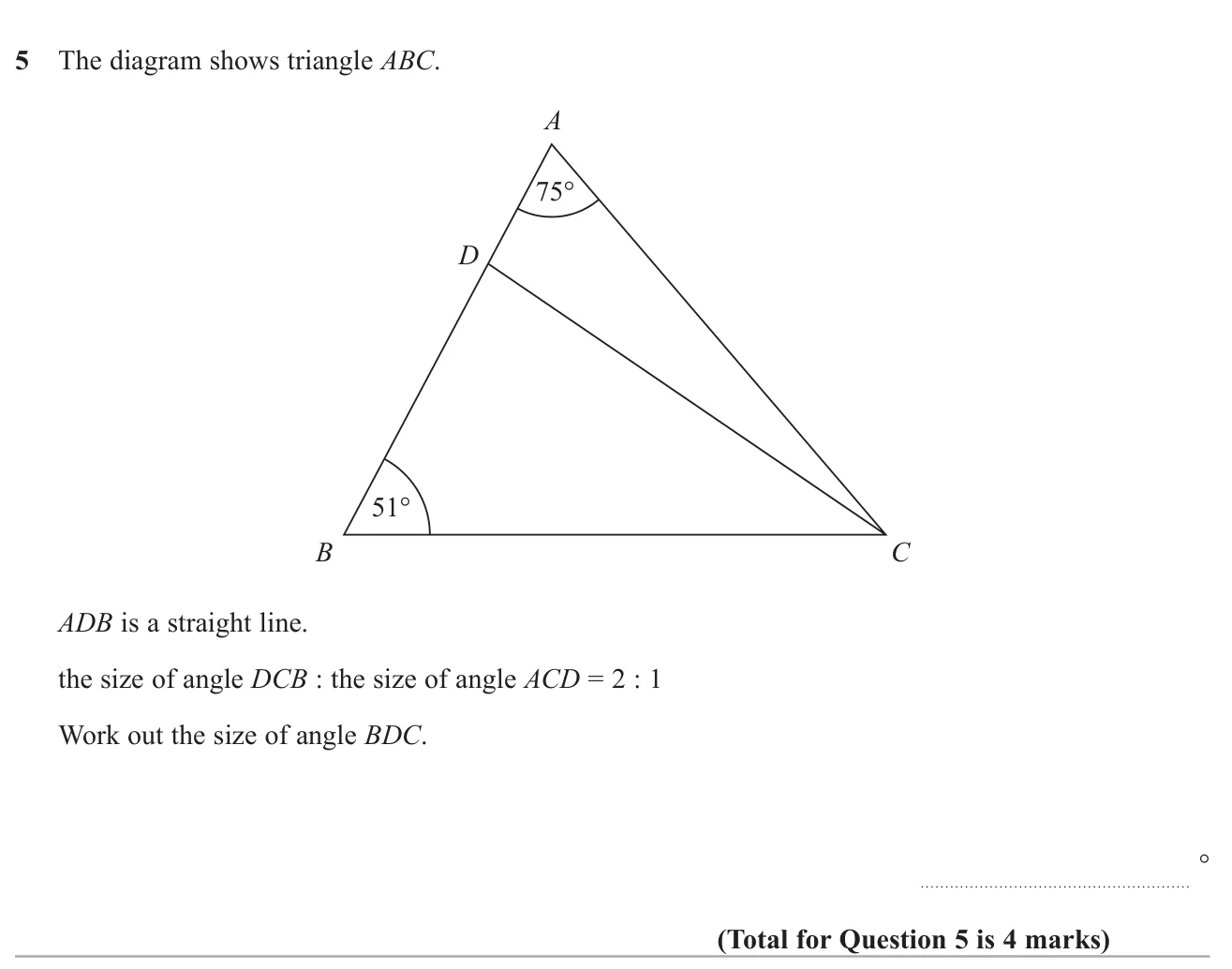
© Pearson Education Ltd. November 2019 Paper 1 (Higher, non-calculator), question 5.
Worked solution Checked against the mark scheme
Angle A C B = 180 − 75 − 51 = 54 ° ACB = 180 - 75 - 51 = 54° A C B = 180 − 75 − 51 = 54°
Split 54 in the ratio 2 : 1: one part = 54 ÷ 3 = 18 ° = 54 \div 3 = 18° = 54 ÷ 3 = 18°
So A C D = 18 ° ACD = 18° A C D = 18° D C B = 36 ° DCB = 36° D C B = 36°
In triangle B D C BDC B D C B D C = 180 − 51 − 36 = 93 ° BDC = 180 - 51 - 36 = 93° B D C = 180 − 51 − 36 = 93°
Watch out: Giving angle ADC (87°) instead of angle BDC.
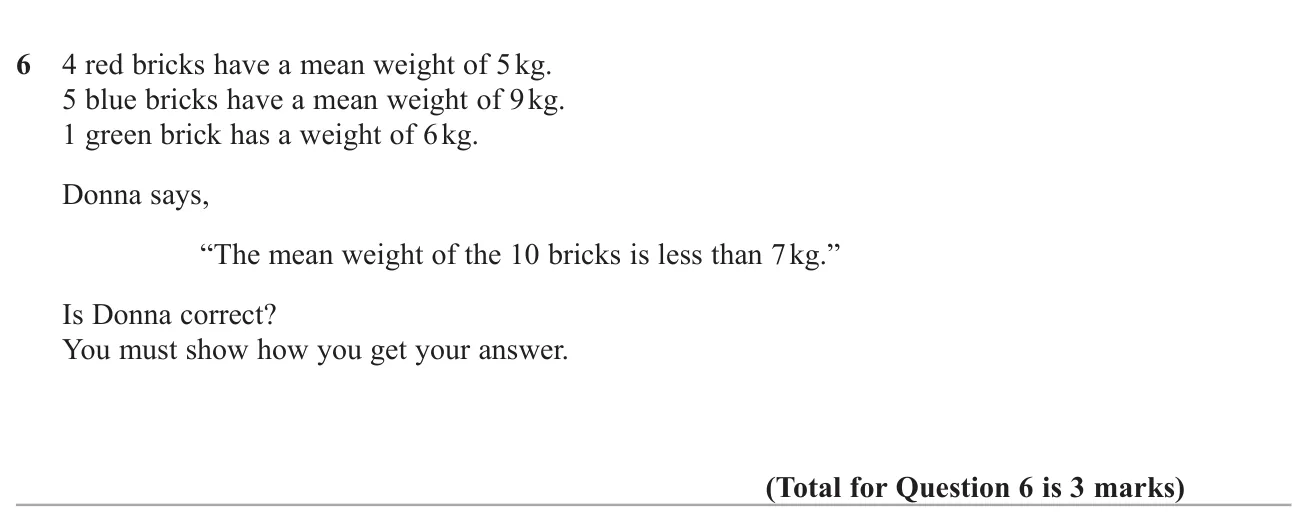
© Pearson Education Ltd. November 2019 Paper 1 (Higher, non-calculator), question 6.
Answer No: the mean is 7.1 kg 3 marks
Worked solution Checked against the mark scheme
Red: 4 × 5 = 20 4 \times 5 = 20 4 × 5 = 20
Blue: 5 × 9 = 45 5 \times 9 = 45 5 × 9 = 45
Total = 20 + 45 + 6 = 71 = 20 + 45 + 6 = 71 = 20 + 45 + 6 = 71
Mean = 71 ÷ 10 = 7.1 = 71 \div 10 = 7.1 = 71 ÷ 10 = 7.1
7.1 > 7 7.1 > 7 7.1 > 7 not correct.
Watch out: Averaging the three means (5, 9 and 6) instead of using totals.
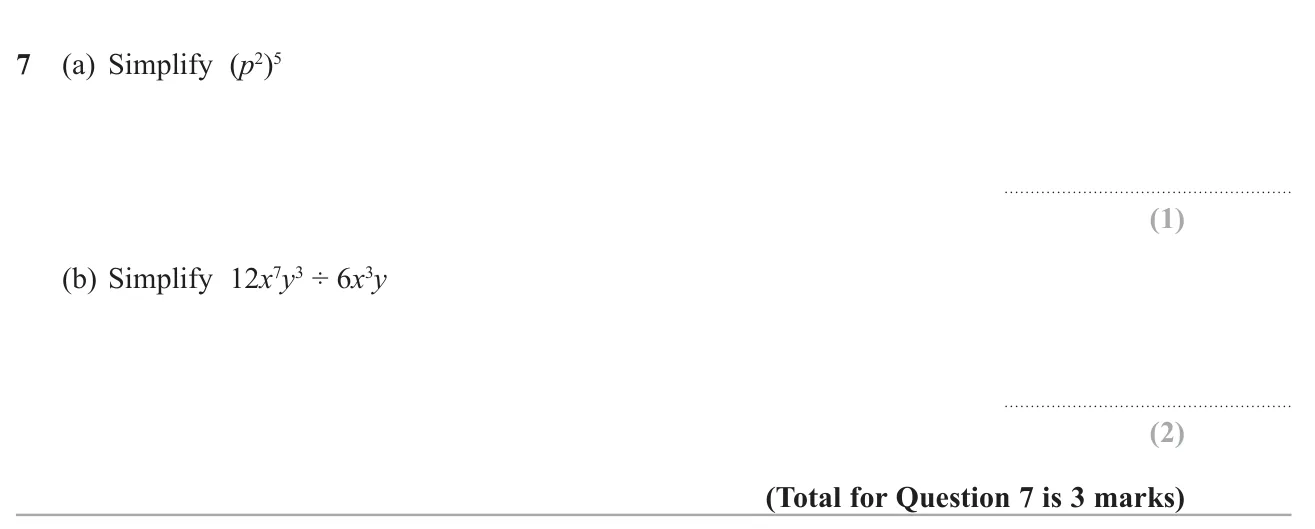
© Pearson Education Ltd. November 2019 Paper 1 (Higher, non-calculator), question 7.
(a) p 10 p^{10} p 10 1 mark (b) 2 x 4 y 2 2x^4y^2 2 x 4 y 2 2 marks
Worked solution Checked against the mark scheme
(a) Multiply the powers: ( p 2 ) 5 = p 2 × 5 = p 10 (p^2)^5 = p^{2 \times 5} = p^{10} ( p 2 ) 5 = p 2 × 5 = p 10
(b) Divide the numbers and subtract the powers:
12 ÷ 6 = 2 12 \div 6 = 2 12 ÷ 6 = 2 x 7 − 3 = x 4 x^{7-3} = x^4 x 7 − 3 = x 4 y 3 − 1 = y 2 y^{3-1} = y^2 y 3 − 1 = y 2
Answer: 2 x 4 y 2 2x^4y^2 2 x 4 y 2
Watch out: Adding the powers in (a) to get p 7 p^7 p 7
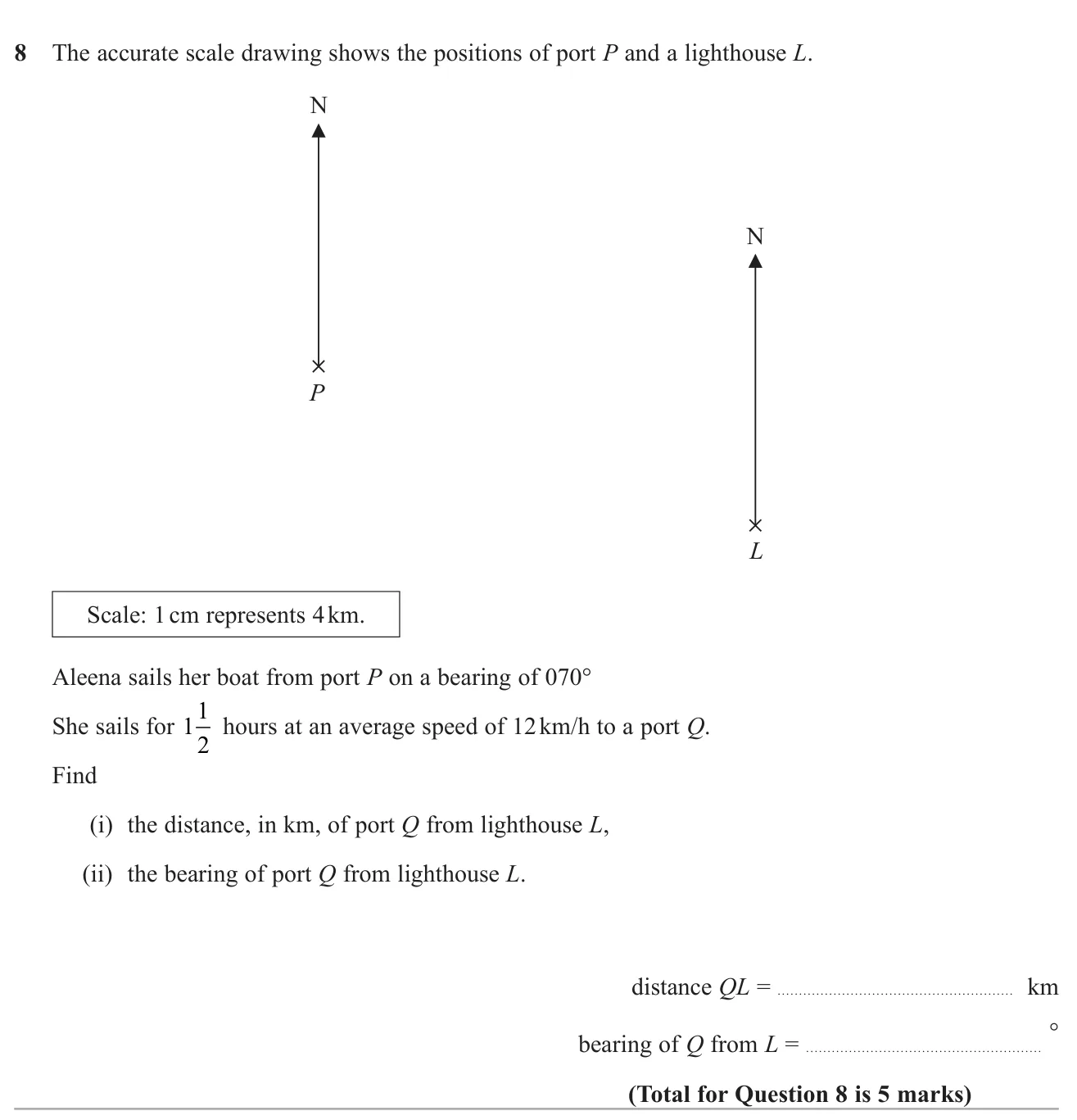
© Pearson Education Ltd. November 2019 Paper 1 (Higher, non-calculator), question 8.
((i)) Distance in the range 20 20 20 23 23 23 4 marks ((ii)) Bearing in the range 317 ° 317° 317° 330 ° 330° 330° 1 mark
Worked solution Checked against the mark scheme
Distance P Q = 12 × 1.5 = 18 PQ = 12 \times 1.5 = 18 P Q = 12 × 1.5 = 18
On the drawing: 18 ÷ 4 = 4.5 18 \div 4 = 4.5 18 ÷ 4 = 4.5
From P P P 70 ° 70° 70° Q Q Q
(i) Measure Q L QL Q L
(ii) At L L L Q Q Q 317 ° 317° 317° 330 ° 330° 330°
Watch out: Measuring the bearing anticlockwise from north.
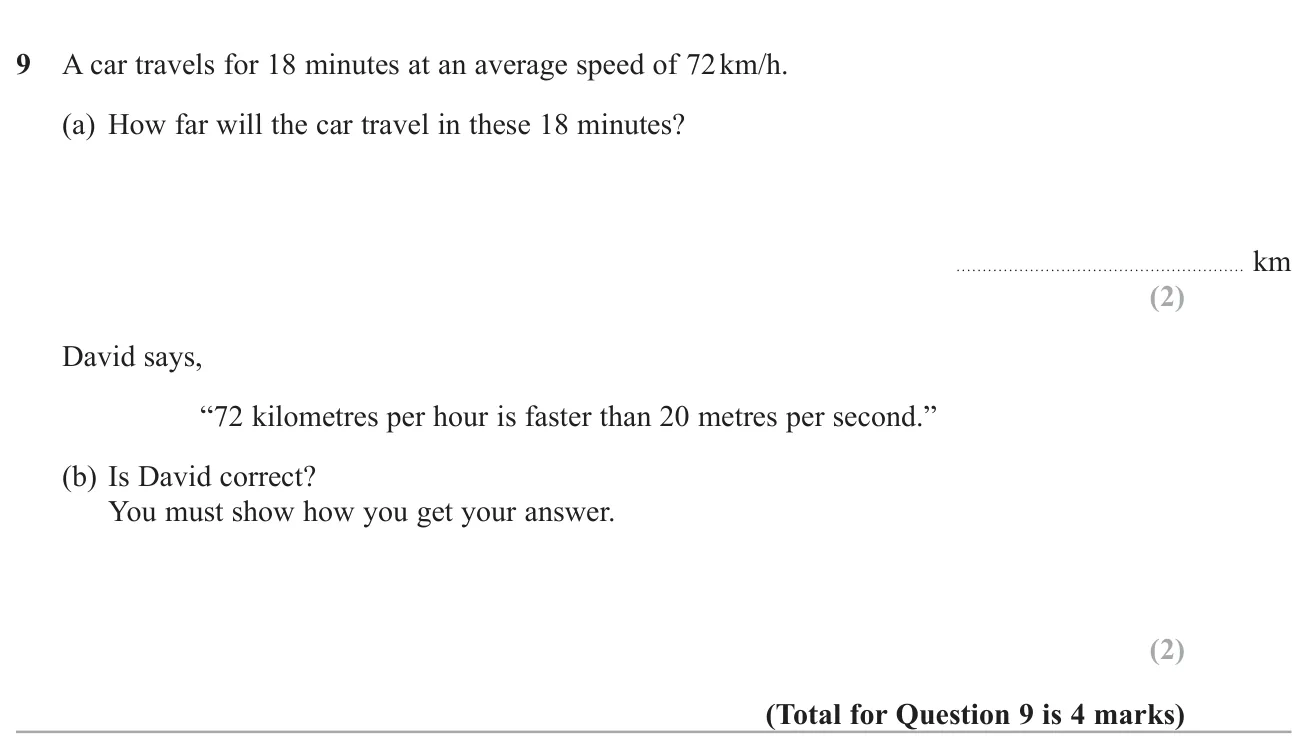
© Pearson Education Ltd. November 2019 Paper 1 (Higher, non-calculator), question 9.
(a) 21.6 21.6 21.6 2 marks (b) No: 72 km/h is exactly 20 m/s 2 marks
Worked solution Checked against the mark scheme
(a) 18 minutes = 18 60 = 0.3 = \frac{18}{60} = 0.3 = 60 18 = 0.3
Distance = 72 × 0.3 = 21.6 = 72 \times 0.3 = 21.6 = 72 × 0.3 = 21.6
(b) 72 72 72 = 72 000 = 72\,000 = 72 000 3600 3600 3600
72 000 ÷ 3600 = 20 72\,000 \div 3600 = 20 72 000 ÷ 3600 = 20 not correct.
Watch out: Using 18 as the time in hours, or dividing by 60 twice.
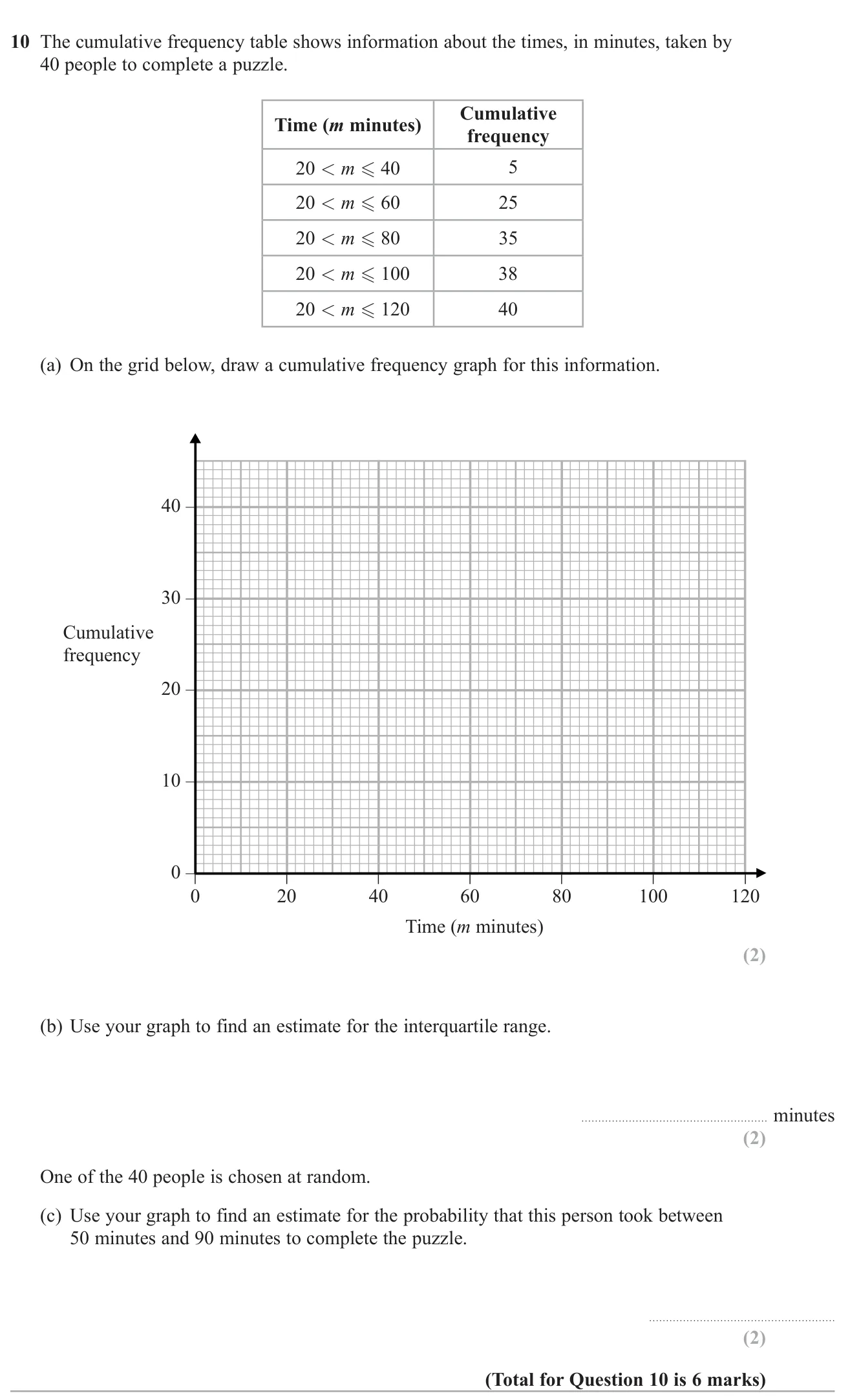
© Pearson Education Ltd. November 2019 Paper 1 (Higher, non-calculator), question 10.
(a) Graph through (40, 5), (60, 25), (80, 35), (100, 38), (120, 40) 2 marks (b) About 25 minutes (21 to 28) 2 marks (c) About 21.5 40 \frac{21.5}{40} 40 21.5 19 40 \frac{19}{40} 40 19 24 40 \frac{24}{40} 40 24 2 marks
Worked solution Checked against the mark scheme
(a) Plot each cumulative frequency at the end of its interval and join with a smooth curve or straight lines, starting at (20, 0).
(b) LQ at c f = 10 cf = 10 c f = 10 c f = 30 cf = 30 c f = 30
IQR ≈ 70 − 45 = 25 \approx 70 - 45 = 25 ≈ 70 − 45 = 25
(c) At 90: c f ≈ 36.5 cf \approx 36.5 c f ≈ 36.5 c f ≈ 15 cf \approx 15 c f ≈ 15
36.5 − 15 = 21.5 36.5 - 15 = 21.5 36.5 − 15 = 21.5 ≈ 21.5 40 ≈ 0.54 \approx \frac{21.5}{40} \approx 0.54 ≈ 40 21.5 ≈ 0.54
Watch out: Plotting points at the middle of each interval instead of the upper end.
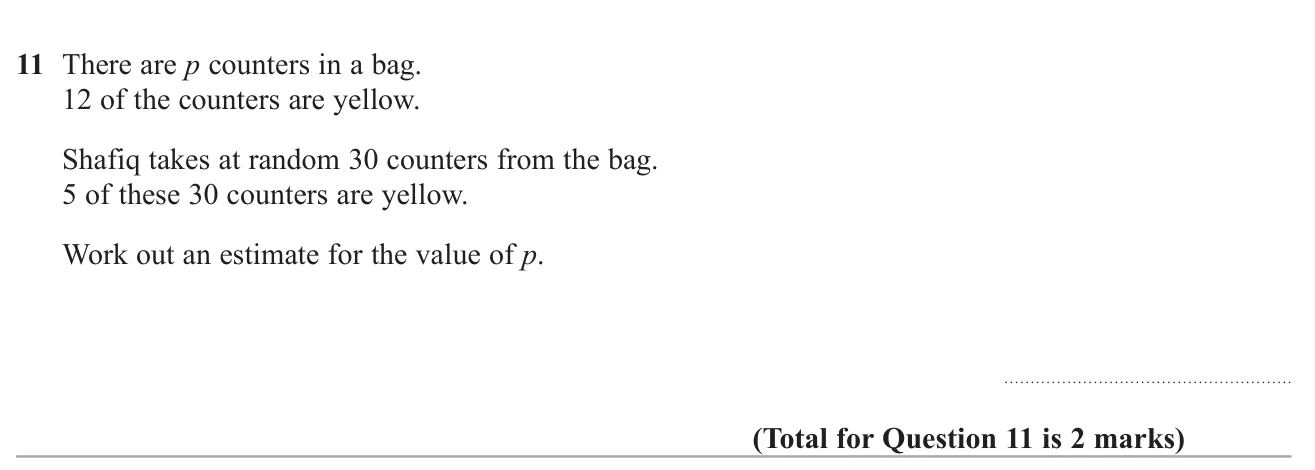
Question 11 Ratio 2 marks Grade 5 No calculator © Pearson Education Ltd. November 2019 Paper 1 (Higher, non-calculator), question 11.
Worked solution Checked against the mark scheme
In the sample, 5 30 = 1 6 \frac{5}{30} = \frac{1}{6} 30 5 = 6 1
So 12 yellow counters is about 1 6 \frac{1}{6} 6 1
p ≈ 12 × 6 = 72 p \approx 12 \times 6 = 72 p ≈ 12 × 6 = 72
Watch out: Working out 30 ÷ 5 × 5 or adding 12 to 30.
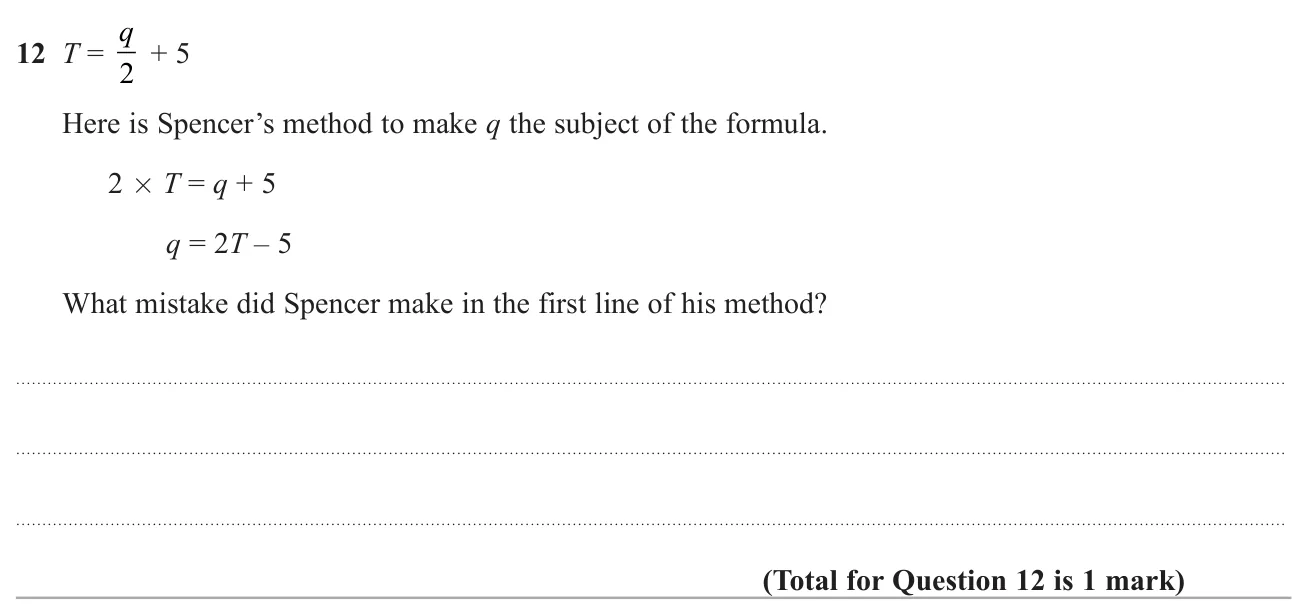
© Pearson Education Ltd. November 2019 Paper 1 (Higher, non-calculator), question 12.
Answer He only doubled q 2 \frac{q}{2} 2 q T T T 5 5 5 2 T = q + 10 2T = q + 10 2 T = q + 10 1 mark
Worked solution Checked against the mark scheme
Multiplying both sides by 2 means every term is doubled:
2 T = q + 10 2T = q + 10 2 T = q + 10
Spencer left the 5 as 5. The correct result is q = 2 T − 10 q = 2T - 10 q = 2 T − 10
Watch out: Saying only that he should have subtracted 5 first, without saying what was wrong.
© Pearson Education Ltd. November 2019 Paper 1 (Higher, non-calculator), question 13.
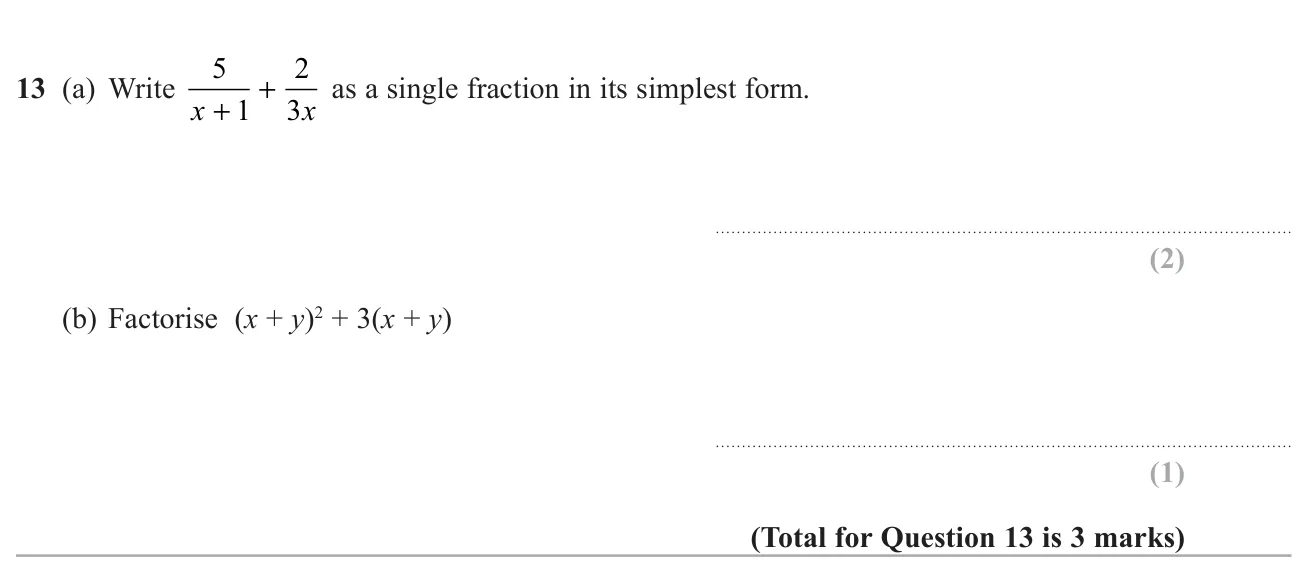
(a) 17 x + 2 3 x ( x + 1 ) \frac{17x+2}{3x(x+1)} 3 x ( x + 1 ) 17 x + 2 2 marks (b) ( x + y ) ( x + y + 3 ) (x+y)(x+y+3) ( x + y ) ( x + y + 3 ) 1 mark
Worked solution Checked against the mark scheme
(a) Common denominator 3 x ( x + 1 ) 3x(x+1) 3 x ( x + 1 )
5 × 3 x 3 x ( x + 1 ) + 2 ( x + 1 ) 3 x ( x + 1 ) = 15 x + 2 x + 2 3 x ( x + 1 ) = 17 x + 2 3 x ( x + 1 ) \frac{5 \times 3x}{3x(x+1)} + \frac{2(x+1)}{3x(x+1)} = \frac{15x + 2x + 2}{3x(x+1)} = \frac{17x+2}{3x(x+1)} 3 x ( x + 1 ) 5 × 3 x + 3 x ( x + 1 ) 2 ( x + 1 ) = 3 x ( x + 1 ) 15 x + 2 x + 2 = 3 x ( x + 1 ) 17 x + 2
(b) ( x + y ) (x+y) ( x + y )
( x + y ) 2 + 3 ( x + y ) = ( x + y ) ( x + y + 3 ) (x+y)^2 + 3(x+y) = (x+y)(x+y+3) ( x + y ) 2 + 3 ( x + y ) = ( x + y ) ( x + y + 3 )
Watch out: In (a), adding numerators and denominators to get 7/(4x+1).
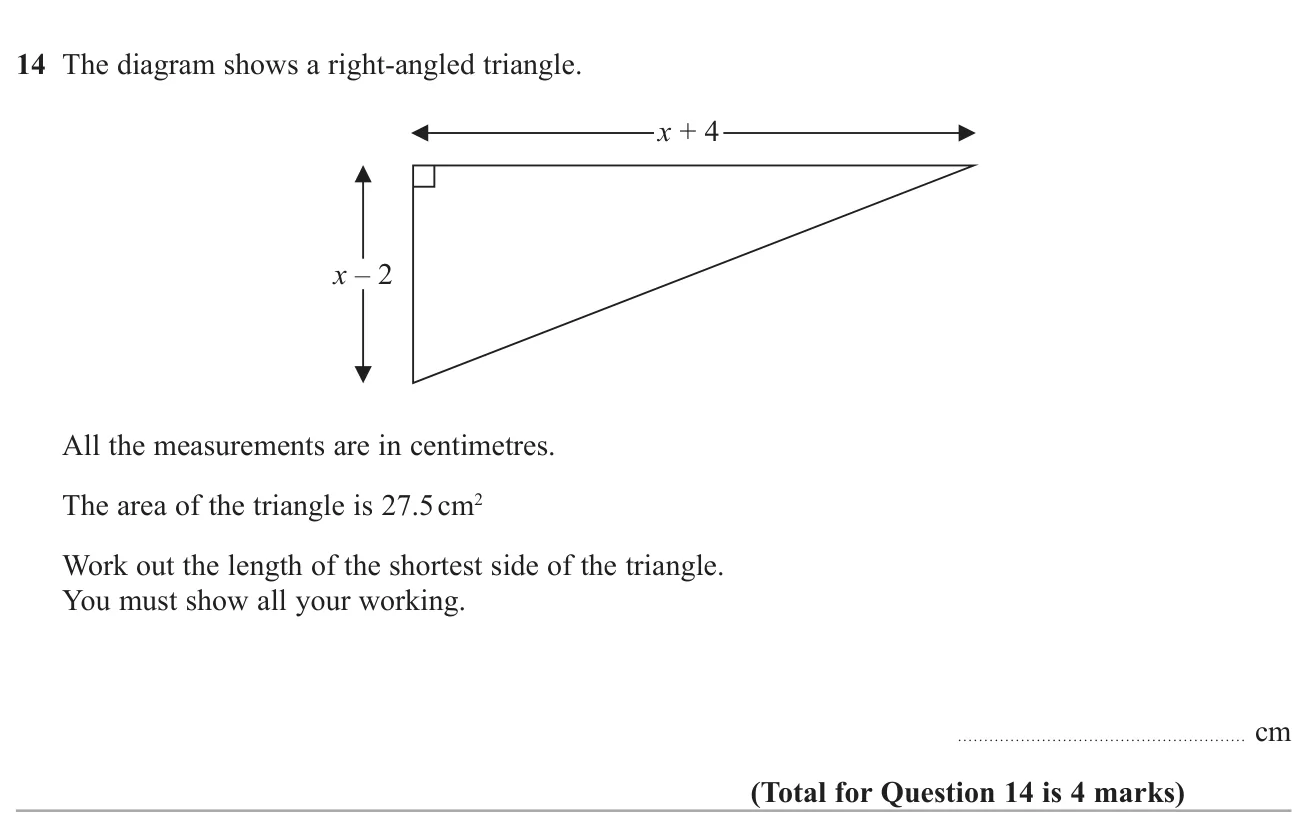
© Pearson Education Ltd. November 2019 Paper 1 (Higher, non-calculator), question 14.
Worked solution Checked against the mark scheme
1 2 ( x + 4 ) ( x − 2 ) = 27.5 \frac{1}{2}(x+4)(x-2) = 27.5 2 1 ( x + 4 ) ( x − 2 ) = 27.5
( x + 4 ) ( x − 2 ) = 55 ⇒ x 2 + 2 x − 8 = 55 (x+4)(x-2) = 55 \Rightarrow x^2 + 2x - 8 = 55 ( x + 4 ) ( x − 2 ) = 55 ⇒ x 2 + 2 x − 8 = 55
x 2 + 2 x − 63 = 0 ⇒ ( x + 9 ) ( x − 7 ) = 0 x^2 + 2x - 63 = 0 \Rightarrow (x+9)(x-7) = 0 x 2 + 2 x − 63 = 0 ⇒ ( x + 9 ) ( x − 7 ) = 0
Lengths are positive, so x = 7 x = 7 x = 7
Shortest side = x − 2 = 5 = x - 2 = 5 = x − 2 = 5
Watch out: Giving x = 7 as the answer instead of the side length.
© Pearson Education Ltd. November 2019 Paper 1 (Higher, non-calculator), question 15.
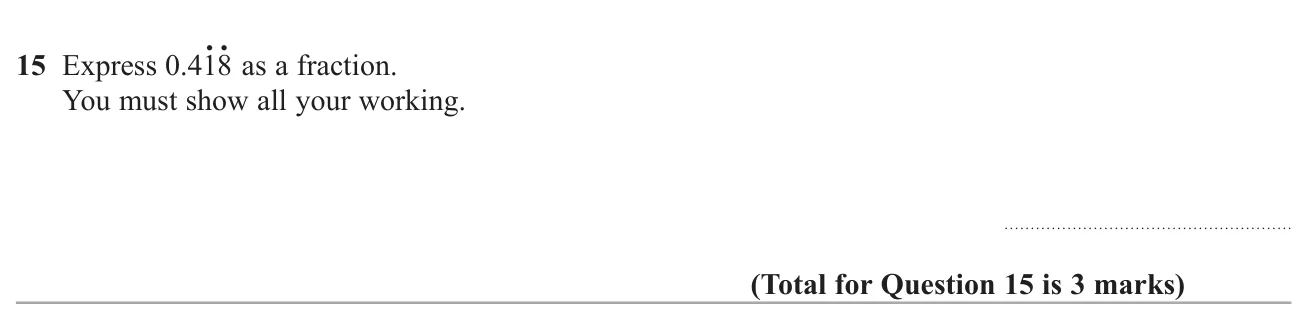
Answer 23 55 \frac{23}{55} 55 23 3 marks
Worked solution Checked against the mark scheme
Let x = 0.4181818 … x = 0.4181818\ldots x = 0.4181818 …
1000 x = 418.181818 … 1000x = 418.181818\ldots 1000 x = 418.181818 … 10 x = 4.181818 … 10x = 4.181818\ldots 10 x = 4.181818 …
990 x = 414 990x = 414 990 x = 414
x = 414 990 = 23 55 x = \frac{414}{990} = \frac{23}{55} x = 990 414 = 55 23
Watch out: Multiplying by 100 once and subtracting from x in a way that leaves a recurring remainder.
Question 16 Surds 5 marks Grade 8 No calculator © Pearson Education Ltd. November 2019 Paper 1 (Higher, non-calculator), question 16.
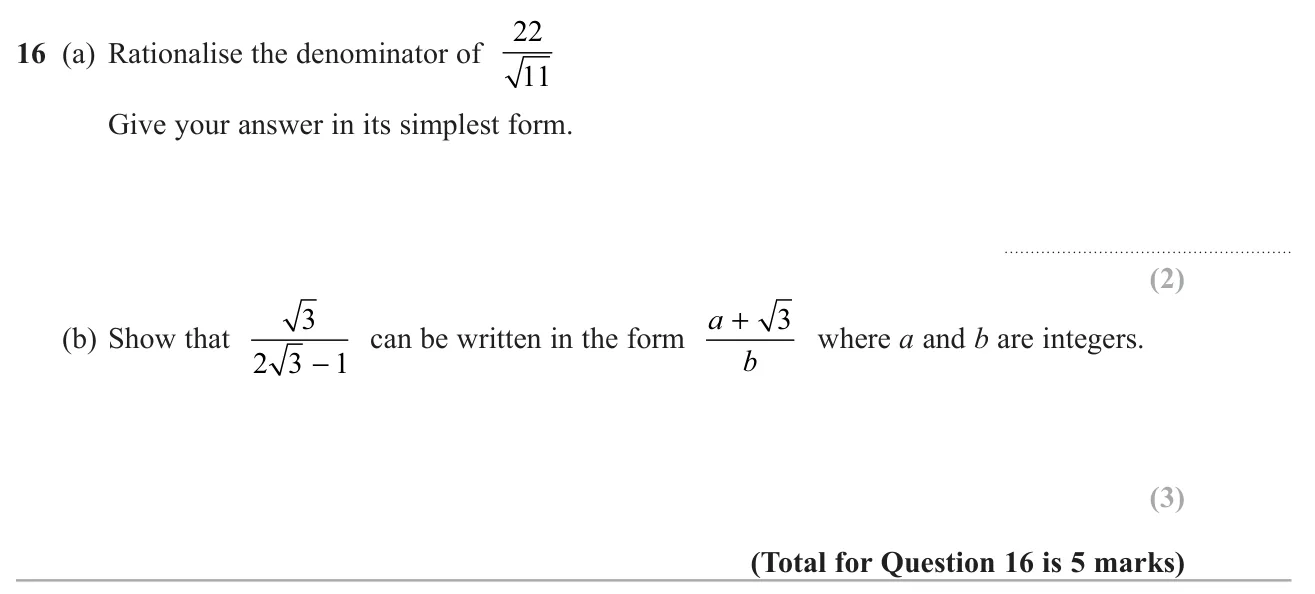
(a) 2 11 2\sqrt{11} 2 11 2 marks (b) 6 + 3 11 \frac{6+\sqrt{3}}{11} 11 6 + 3 a = 6 a = 6 a = 6 b = 11 b = 11 b = 11 3 marks
Worked solution Checked against the mark scheme
(a) 22 11 × 11 11 = 22 11 11 = 2 11 \frac{22}{\sqrt{11}} \times \frac{\sqrt{11}}{\sqrt{11}} = \frac{22\sqrt{11}}{11} = 2\sqrt{11} 11 22 × 11 11 = 11 22 11 = 2 11
(b) Multiply by 2 3 + 1 2 3 + 1 \frac{2\sqrt{3}+1}{2\sqrt{3}+1} 2 3 + 1 2 3 + 1
Top: 3 ( 2 3 + 1 ) = 6 + 3 \sqrt{3}(2\sqrt{3}+1) = 6 + \sqrt{3} 3 ( 2 3 + 1 ) = 6 + 3
Bottom: ( 2 3 ) 2 − 1 2 = 12 − 1 = 11 (2\sqrt{3})^2 - 1^2 = 12 - 1 = 11 ( 2 3 ) 2 − 1 2 = 12 − 1 = 11
So it equals 6 + 3 11 \frac{6+\sqrt{3}}{11} 11 6 + 3 a = 6 a = 6 a = 6 b = 11 b = 11 b = 11
Watch out: In (b), multiplying by 2√3 − 1 instead of 2√3 + 1.
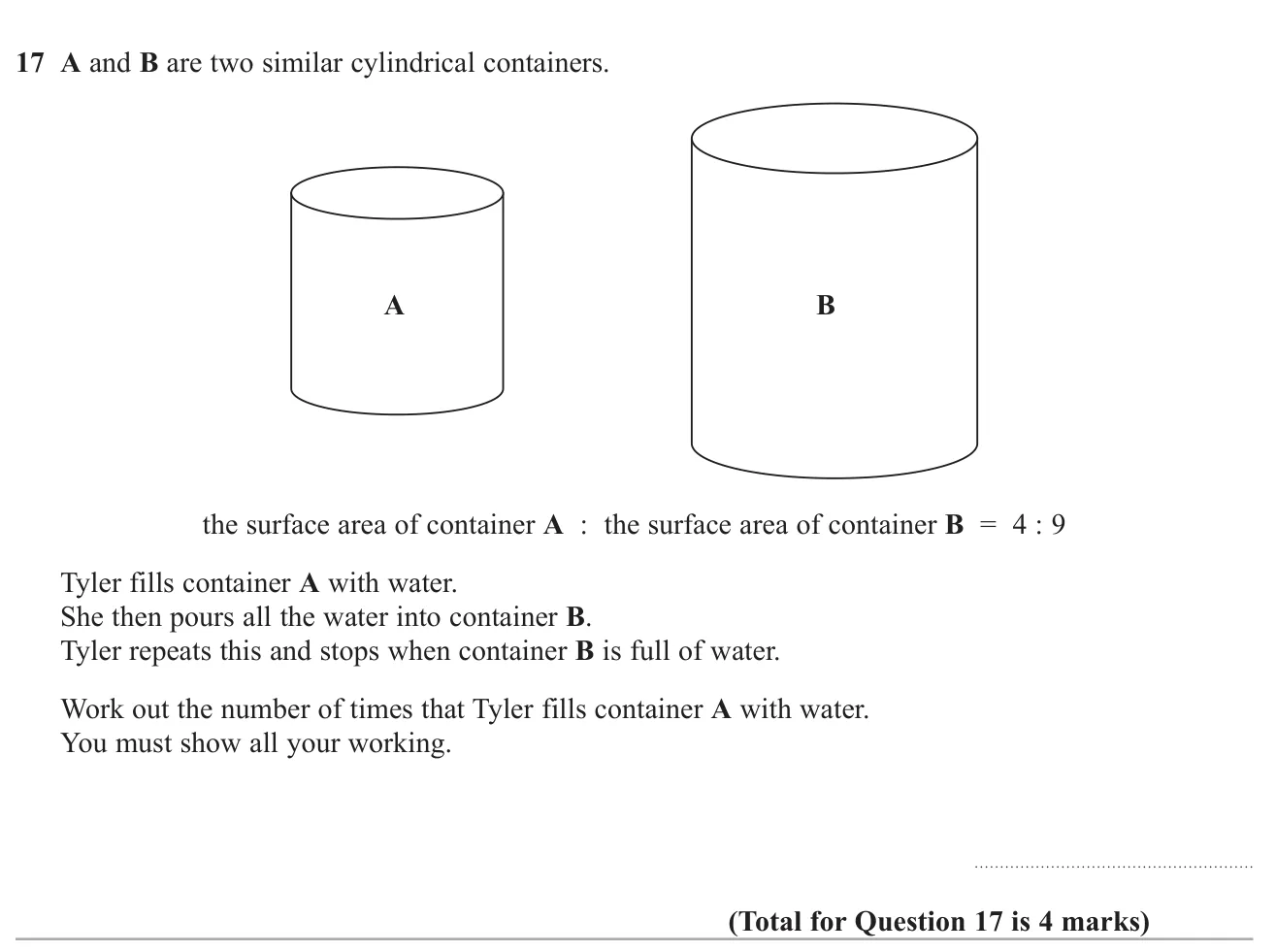
© Pearson Education Ltd. November 2019 Paper 1 (Higher, non-calculator), question 17.
Worked solution Checked against the mark scheme
Area ratio 4 : 9 4 : 9 4 : 9 4 : 9 = 2 : 3 \sqrt{4} : \sqrt{9} = 2 : 3 4 : 9 = 2 : 3
Volume ratio 2 3 : 3 3 = 8 : 27 2^3 : 3^3 = 8 : 27 2 3 : 3 3 = 8 : 27
27 ÷ 8 = 3.375 27 \div 8 = 3.375 27 ÷ 8 = 3.375
Three fills are not enough, so Tyler fills A 4 times.
Watch out: Using the area ratio for volume (9 ÷ 4 = 2.25, so 3 fills).
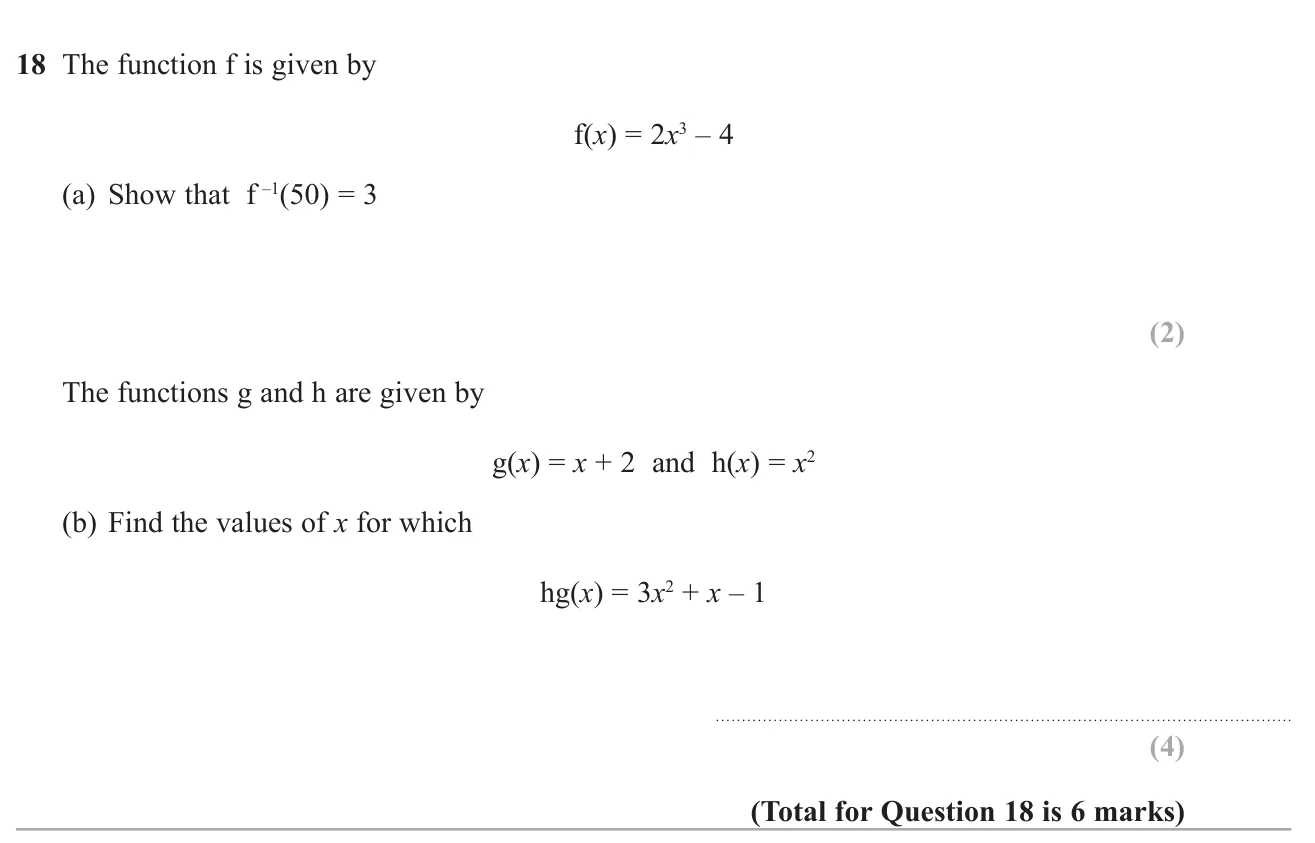
© Pearson Education Ltd. November 2019 Paper 1 (Higher, non-calculator), question 18.
(a) f ( 3 ) = 2 × 27 − 4 = 50 f(3) = 2 \times 27 - 4 = 50 f ( 3 ) = 2 × 27 − 4 = 50 f − 1 ( 50 ) = 3 f^{-1}(50) = 3 f − 1 ( 50 ) = 3 2 marks (b) x = − 1 x = -1 x = − 1 x = 2.5 x = 2.5 x = 2.5 4 marks
Worked solution Checked against the mark scheme
(a) f ( 3 ) = 2 × 3 3 − 4 = 54 − 4 = 50 f(3) = 2 \times 3^3 - 4 = 54 - 4 = 50 f ( 3 ) = 2 × 3 3 − 4 = 54 − 4 = 50 f − 1 ( 50 ) = 3 f^{-1}(50) = 3 f − 1 ( 50 ) = 3
(b) h g ( x ) = ( x + 2 ) 2 = x 2 + 4 x + 4 hg(x) = (x+2)^2 = x^2 + 4x + 4 h g ( x ) = ( x + 2 ) 2 = x 2 + 4 x + 4
x 2 + 4 x + 4 = 3 x 2 + x − 1 x^2 + 4x + 4 = 3x^2 + x - 1 x 2 + 4 x + 4 = 3 x 2 + x − 1
0 = 2 x 2 − 3 x − 5 = ( 2 x − 5 ) ( x + 1 ) 0 = 2x^2 - 3x - 5 = (2x - 5)(x + 1) 0 = 2 x 2 − 3 x − 5 = ( 2 x − 5 ) ( x + 1 )
x = 2.5 x = 2.5 x = 2.5 x = − 1 x = -1 x = − 1
Watch out: Finding gh(x) = x² + 2 instead of hg(x).
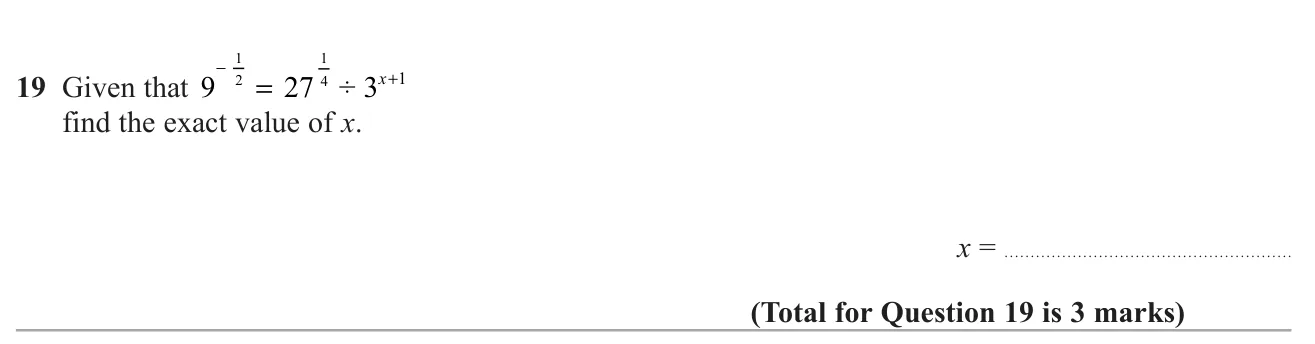
© Pearson Education Ltd. November 2019 Paper 1 (Higher, non-calculator), question 19.
Answer x = 3 4 x = \frac{3}{4} x = 4 3 3 marks
Worked solution Checked against the mark scheme
9 − 1 2 = 3 − 1 9^{-\frac{1}{2}} = 3^{-1} 9 − 2 1 = 3 − 1 27 1 4 = 3 3 4 27^{\frac{1}{4}} = 3^{\frac{3}{4}} 2 7 4 1 = 3 4 3
3 − 1 = 3 3 4 − ( x + 1 ) 3^{-1} = 3^{\frac{3}{4} - (x+1)} 3 − 1 = 3 4 3 − ( x + 1 )
− 1 = 3 4 − x − 1 -1 = \frac{3}{4} - x - 1 − 1 = 4 3 − x − 1
x = 3 4 x = \frac{3}{4} x = 4 3
Watch out: Treating 9−½ as −3.
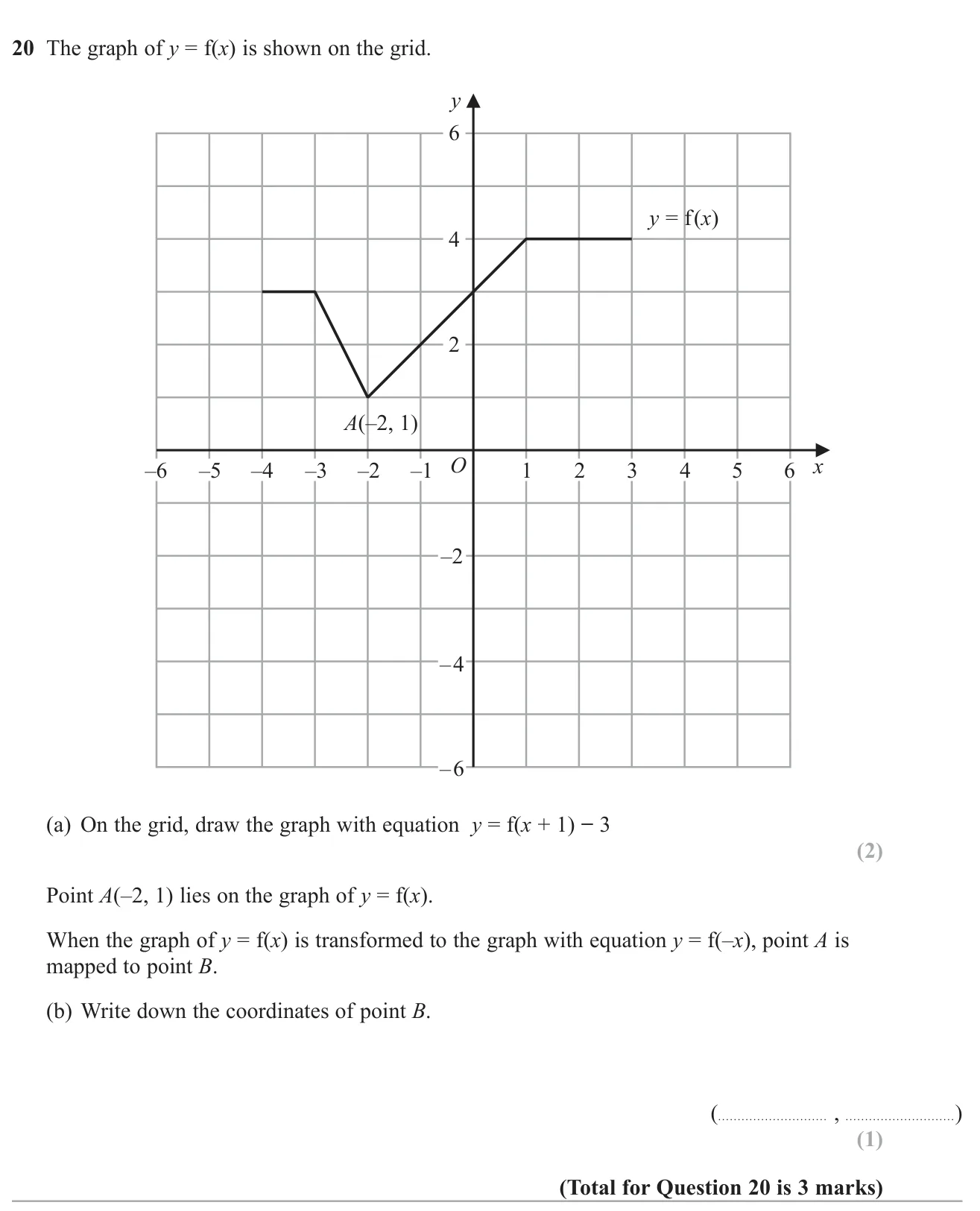
© Pearson Education Ltd. November 2019 Paper 1 (Higher, non-calculator), question 20.
(a) The graph moved 1 left and 3 down 2 marks (b) ( 2 , 1 ) (2, 1) ( 2 , 1 ) 1 mark
Worked solution Checked against the mark scheme
(a) f ( x + 1 ) f(x+1) f ( x + 1 ) − 3 -3 − 3
So each corner moves by ( − 1 − 3 ) \begin{pmatrix}-1\\-3\end{pmatrix} ( − 1 − 3 ) ( − 2 , 1 ) → ( − 3 , − 2 ) (-2, 1) \to (-3, -2) ( − 2 , 1 ) → ( − 3 , − 2 ) ( 1 , 4 ) → ( 0 , 1 ) (1, 4) \to (0, 1) ( 1 , 4 ) → ( 0 , 1 )
(b) f ( − x ) f(-x) f ( − x ) y y y x x x B = ( 2 , 1 ) B = (2, 1) B = ( 2 , 1 )
Watch out: Moving the graph 1 unit right for f(x + 1).
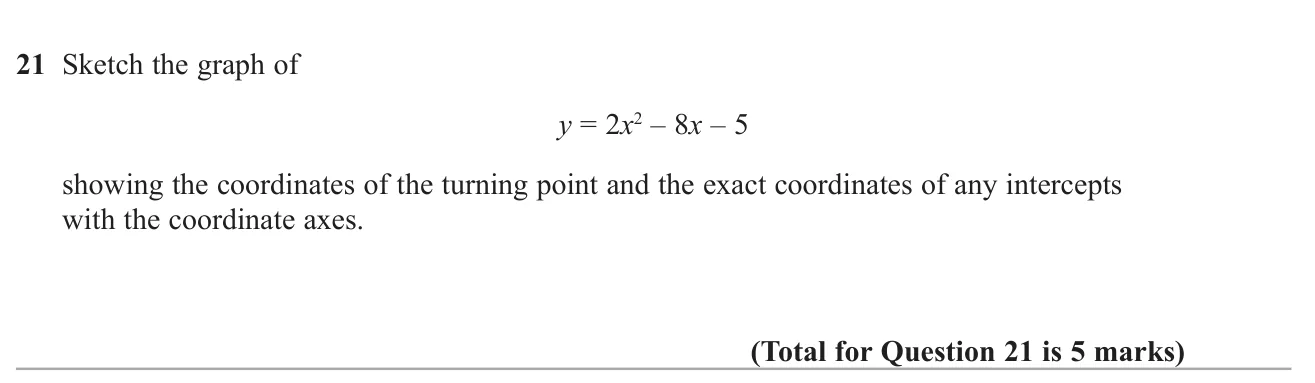
© Pearson Education Ltd. November 2019 Paper 1 (Higher, non-calculator), question 21.
Answer U-shaped curve with turning point ( 2 , − 13 ) (2, -13) ( 2 , − 13 ) y y y ( 0 , − 5 ) (0, -5) ( 0 , − 5 ) x x x ( 2 ± 13 2 , 0 ) \left(2 \pm \sqrt{\frac{13}{2}}, 0\right) ( 2 ± 2 13 , 0 ) 5 marks
Worked solution Checked against the mark scheme
y y y x = 0 x = 0 x = 0 y = − 5 y = -5 y = − 5
Complete the square: 2 x 2 − 8 x − 5 = 2 ( x − 2 ) 2 − 8 − 5 = 2 ( x − 2 ) 2 − 13 2x^2 - 8x - 5 = 2(x - 2)^2 - 8 - 5 = 2(x-2)^2 - 13 2 x 2 − 8 x − 5 = 2 ( x − 2 ) 2 − 8 − 5 = 2 ( x − 2 ) 2 − 13
Turning point: ( 2 , − 13 ) (2, -13) ( 2 , − 13 )
x x x 2 ( x − 2 ) 2 = 13 ⇒ x = 2 ± 13 2 2(x-2)^2 = 13 \Rightarrow x = 2 \pm \sqrt{\frac{13}{2}} 2 ( x − 2 ) 2 = 13 ⇒ x = 2 ± 2 13
Sketch a U shape through these points.
Watch out: Forgetting to take out the factor of 2 before completing the square, giving (x − 4)².
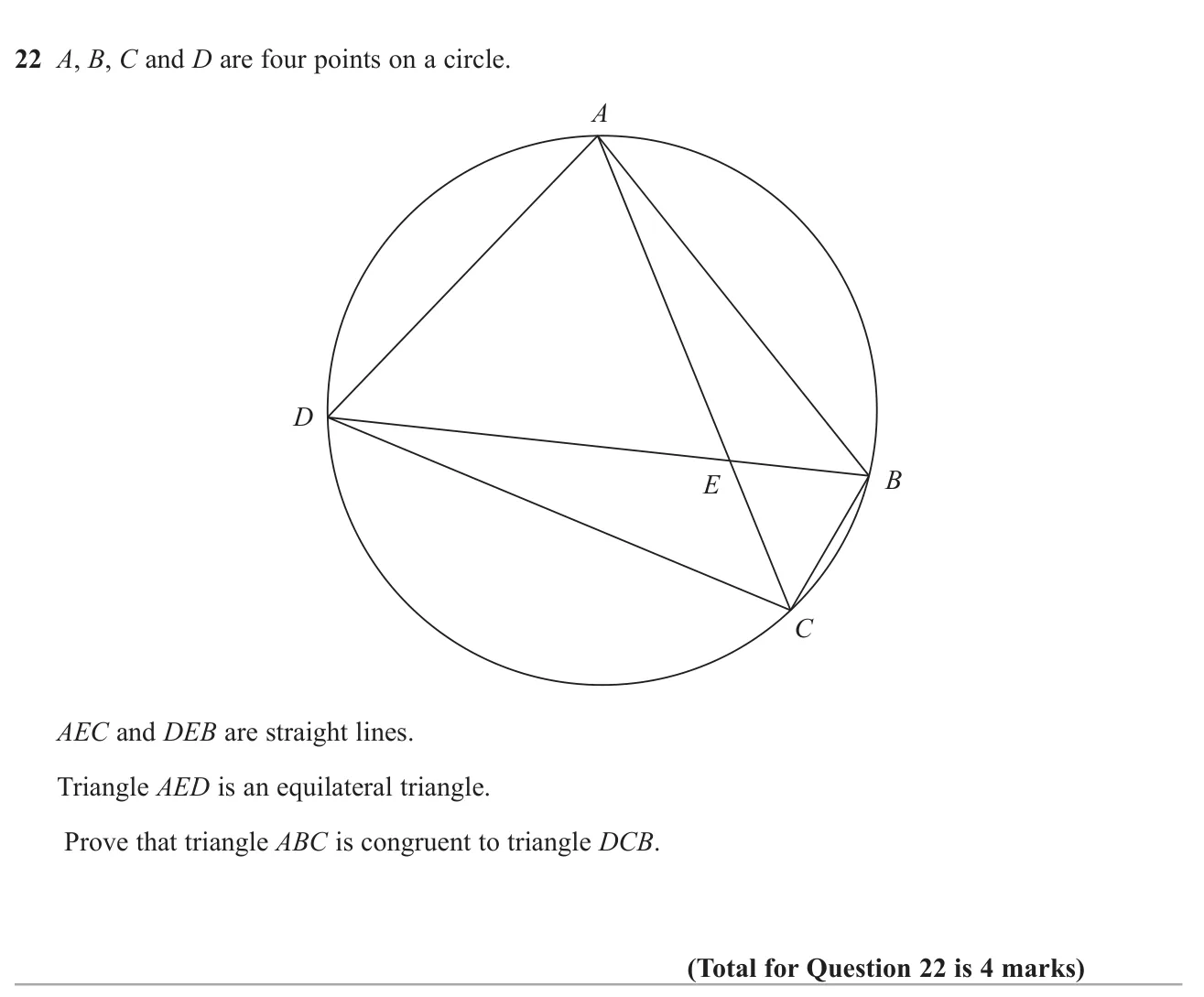
© Pearson Education Ltd. November 2019 Paper 1 (Higher, non-calculator), question 22.
Answer Proof using angles in the same segment and a congruence condition (ASA, SAS or AAS) 4 marks
Worked solution Checked against the mark scheme
Triangle A E D AED A E D 60 ° 60° 60°
∠ A C B = ∠ A D B = 60 ° \angle ACB = \angle ADB = 60° ∠ A C B = ∠ A D B = 60° ∠ D B C = ∠ D A C = 60 ° \angle DBC = \angle DAC = 60° ∠ D B C = ∠ D A C = 60°
So triangle B E C BEC B E C ∠ A C B = ∠ D B C \angle ACB = \angle DBC ∠ A C B = ∠ D B C
A C = A E + E C = D E + E B = D B AC = AE + EC = DE + EB = DB A C = A E + E C = D E + E B = D B
B C BC B C
So triangles A B C ABC A B C D C B DCB D C B
Watch out: Stating equal angles without giving the circle-theorem reason.
Finished the paper? Add up your marks for all three papers and see what grade that would have been.