Geometry and measures

3D shapes, plans and elevations

10 past-paper questions, easiest first. Try each one, then reveal the answer.

Foundation & HigherAll 10 from Foundation papers

Revision guide by The Full Marks

3D shapes, plans and elevations: what you need to know

This topic is about describing solids: counting faces, edges and vertices, and drawing what a solid looks like from above (the plan) and from the front and side (the elevations). The questions are short but easy marks to drop through careless counting or drawing the wrong view.

Key facts

  • A face is a flat surface, an edge is where two faces meet, and a vertex is a corner.
  • Cube and cuboid: 6 faces, 12 edges, 8 vertices. Triangular prism: 5 faces, 9 edges, 6 vertices.
  • Square-based pyramid: 5 faces, 8 edges, 5 vertices. A cylinder has 2 flat faces, 1 curved surface and 2 curved edges; a cone has 1 flat face, 1 curved surface, 1 curved edge and 1 vertex; a sphere has 1 curved surface and no edges or vertices.
  • A prism has the same cross-section all the way through. A pyramid comes to a point (the apex).
  • For shapes with flat faces: faces ++ vertices −- edges =2= 2. Use it to check your counts.
  • Plan = view from above. Front elevation = view from the front. Side elevation = view from the side.

Drawing plans and elevations

  1. Decide which direction you are looking from; the arrow on the diagram tells you.
  2. Imagine the solid squashed flat from that direction and draw the outline, using the real measurements on the grid.
  3. Draw a line wherever there is an edge you would see, such as the ridge of a roof or where two levels meet.
  4. Label lengths if the question asks for them.

Sketching a solid from its plan and elevations

  1. Use the front elevation for the shape of the front face and the plan for the depth.
  2. Read every length carefully from the grid, counting squares rather than guessing.
  3. Sketch the solid in 3D (isometric paper if given) and label its length, width and height.

Worked examples

Example 1 Foundation · grade 1

How many faces, edges and vertices does a square-based pyramid have?

Show the solution

Faces: 11 square base +4+ 4 triangles =5= 5
Edges: 44 round the base +4+ 4 up to the top =8= 8
Vertices: 44 on the base +1+ 1 at the top =5= 5
Check: 5+5−8=25 + 5 - 8 = 2 ✓

Example 2 Foundation · grade 4

A cylinder has radius 33 cm and height 88 cm. It stands upright on its circular base. Describe its plan and its front elevation, with measurements.

Show the solution

From above you see the circular top.
Plan: a circle of radius 33 cm.
From the front you see the full width (the diameter) and the height.
Front elevation: a rectangle 66 cm wide and 88 cm tall.

Common mistakes

  • Mixing up edges and vertices, or counting only the edges you can see in the picture.
  • Drawing the front elevation again when the side elevation was asked for.
  • Leaving out internal lines, such as the ridge line on the plan of a triangular prism or the sloping edges that meet at the top on the plan of a pyramid.
  • Misreading the grid, so a length on the sketch is one square out. Count the squares twice.

Exam tips

  • Use a ruler and the grid squares exactly; plans and elevations on a grid must be drawn to the correct size.
  • When sketching a solid from its plan and elevations, label the lengths; a correct shape with missing or wrong lengths may not get full marks.

Questions people ask

What is the difference between a plan and an elevation?

A plan is the view looking straight down from above. An elevation is the view from the front or the side, looking horizontally.

How many edges does a triangular prism have?

A triangular prism has 99 edges: 33 on each triangular end and 33 joining the ends. It has 55 faces and 66 vertices.

Exam questions: 3D shapes, plans and elevations (10, easiest first)

3D shapes, plans and elevations2 marksGrade 1CalculatorFoundation
November 2023 · Paper 2 Foundation · Q7
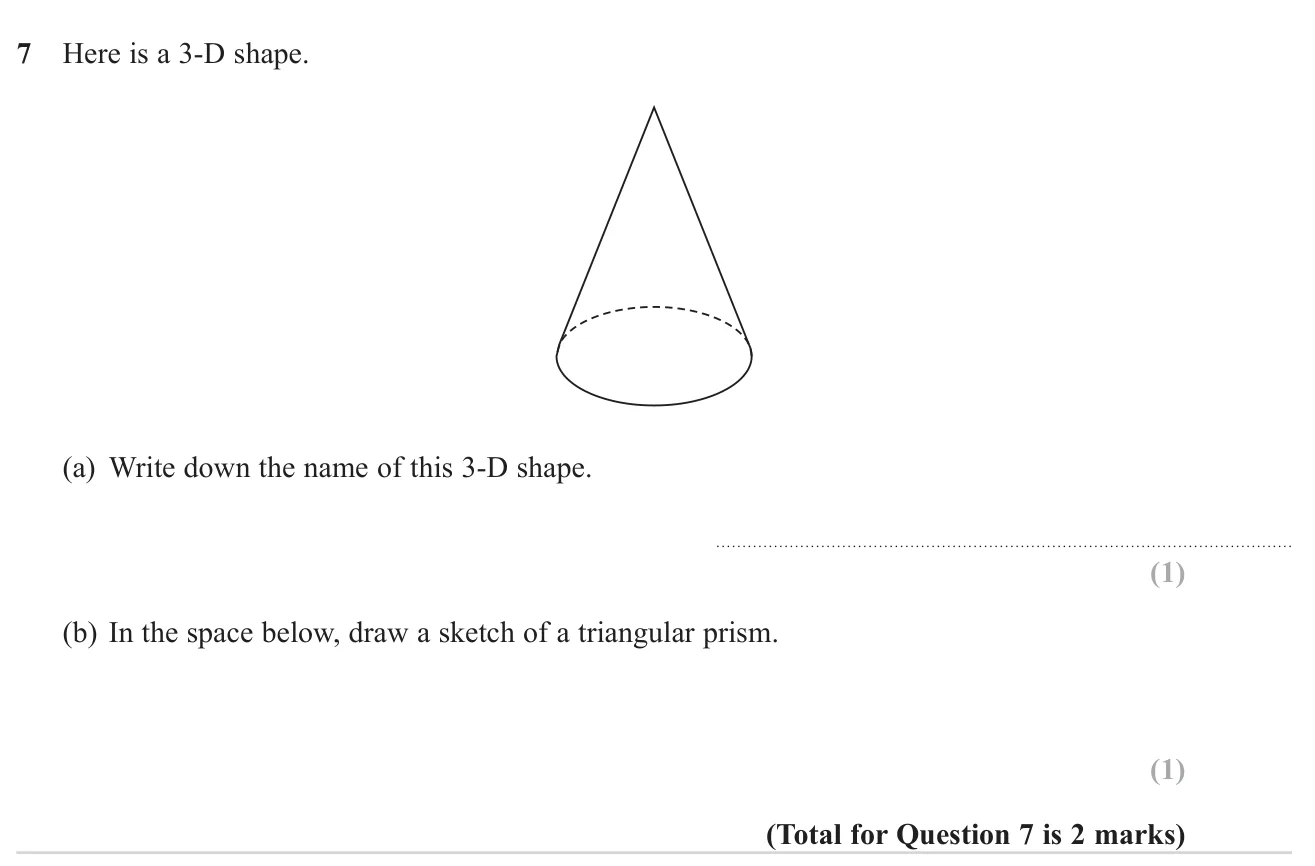
Name a pictured solid and sketch a triangular prism.

© Pearson Education Ltd. November 2023 Paper 2 (Foundation, calculator), question 7.

Show answer
(a)Cone1 mark
(b)A sketch of a prism with two triangular ends joined by three rectangular faces1 mark

Worked solution Checked against the mark scheme

(a) The solid has a circular base and comes to a point at the top, so it is a cone.

(b) Draw a triangle, draw an identical triangle slightly across and up from it, then join matching corners with three parallel lines.

Watch out: In (b), drawing a square-based pyramid or a flat triangle.
3D shapes, plans and elevations2 marksGrade 1CalculatorFoundation
June 2022 · Paper 3 Foundation · Q9
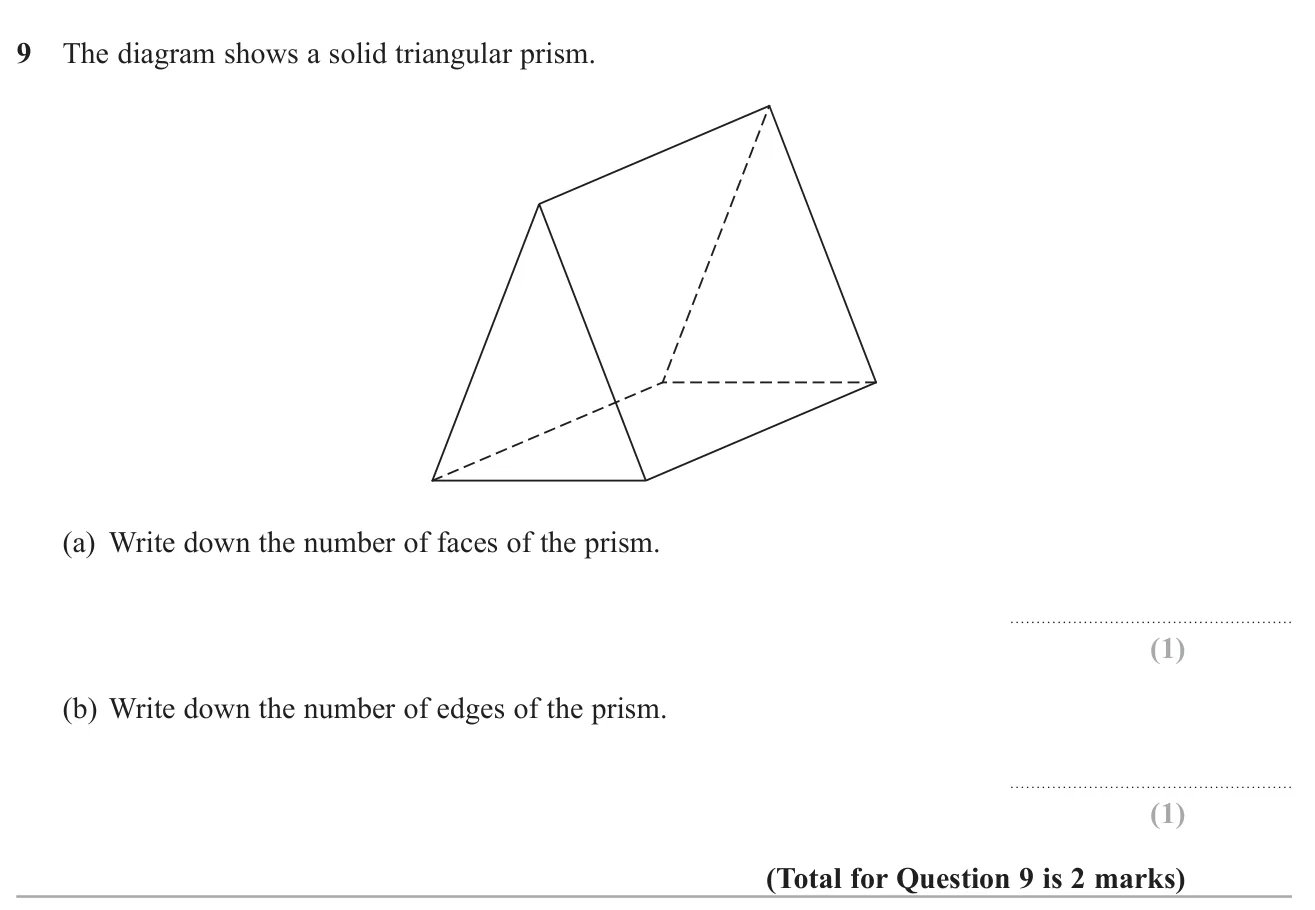
Count the faces and the edges of a triangular prism.

© Pearson Education Ltd. June 2022 Paper 3 (Foundation, calculator), question 9.

Show answer
(a)51 mark
(b)91 mark

Worked solution Checked against the mark scheme

(a) Two triangular ends plus three rectangular sides: 2+3=52 + 3 = 5 faces.

(b) Each triangle has 3 edges and three more join the triangles: 3+3+3=93 + 3 + 3 = 9 edges.

Watch out: Counting vertices (6) instead of edges.

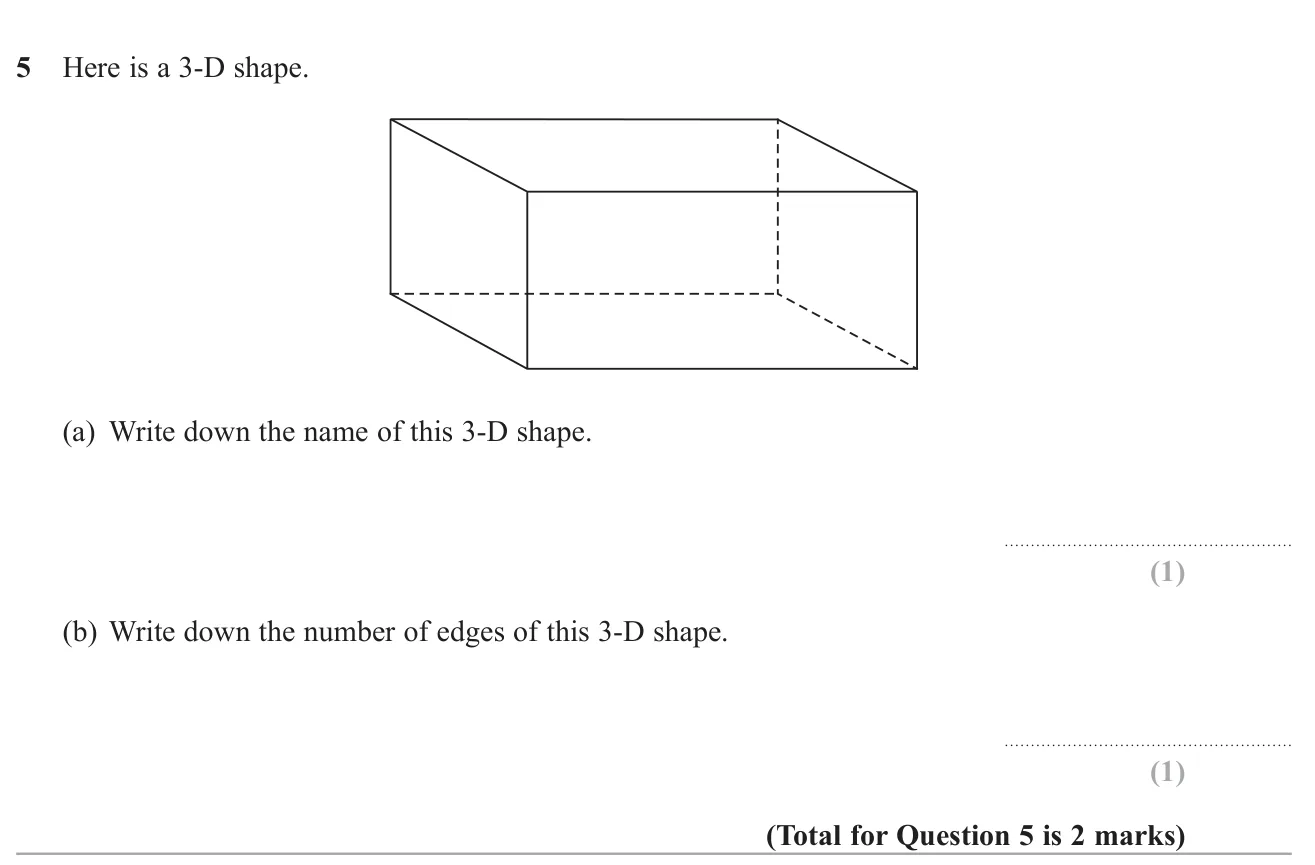
3D shapes, plans and elevations2 marksGrade 1CalculatorFoundation
November 2018 · Paper 3 Foundation · Q5
Name a pictured 3-D solid and count its edges.

© Pearson Education Ltd. November 2018 Paper 3 (Foundation, calculator), question 5.

Show answer
(a)Cuboid1 mark
(b)12121 mark

Worked solution Checked against the mark scheme

(a) Six rectangular faces, so it is a cuboid.

(b) 4 edges on the top, 4 on the bottom and 4 upright edges: 4+4+4=124 + 4 + 4 = 12

Watch out: Counting only the edges that can be seen, or confusing edges with vertices (8).

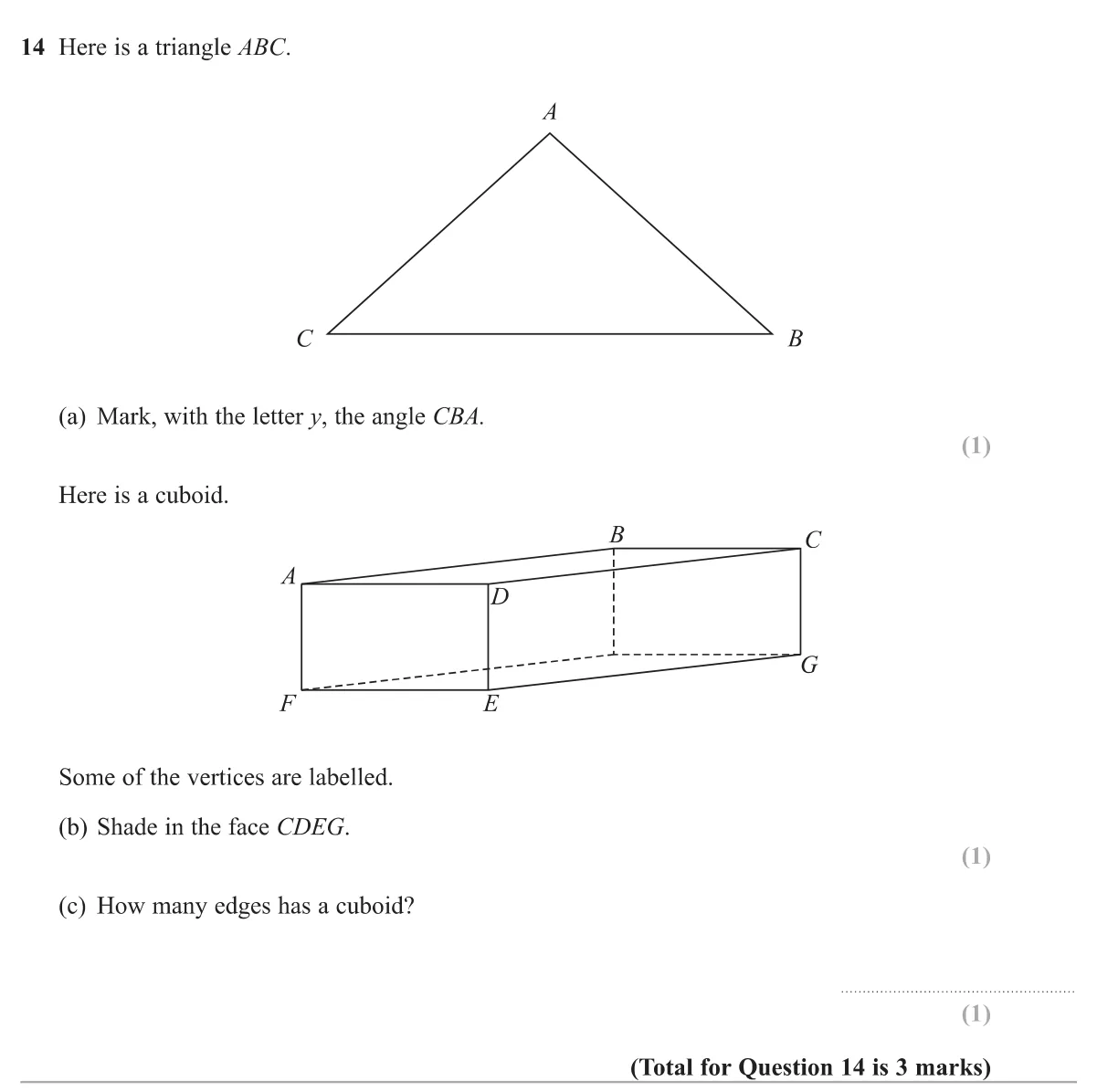
3D shapes, plans and elevations3 marksGrade 1CalculatorFoundation
Specimen · Paper 3 Foundation · Q14
Label an angle in a triangle using three-letter notation, shade a named face of a cuboid and state how many edges a cuboid has.

© Pearson Education Ltd. Specimen Paper 3 (Foundation, calculator), question 14.

Show answer
(a)The angle at B, between BC and BA, marked y1 mark
(b)Face CDEG shaded: the long face on the right, between edge DE and edge CG1 mark
(c)121 mark

Worked solution Checked against the mark scheme

(a) In angle CBA the middle letter, B, is where the angle is. Mark y inside the triangle at B.

(b) Find the four corners C, D, E and G and shade the face they enclose.

(c) A cuboid has 4 edges on top, 4 on the bottom and 4 upright: 4+4+4=124 + 4 + 4 = 12.

Watch out: In (a), marking the angle at C or A instead of the middle letter B.

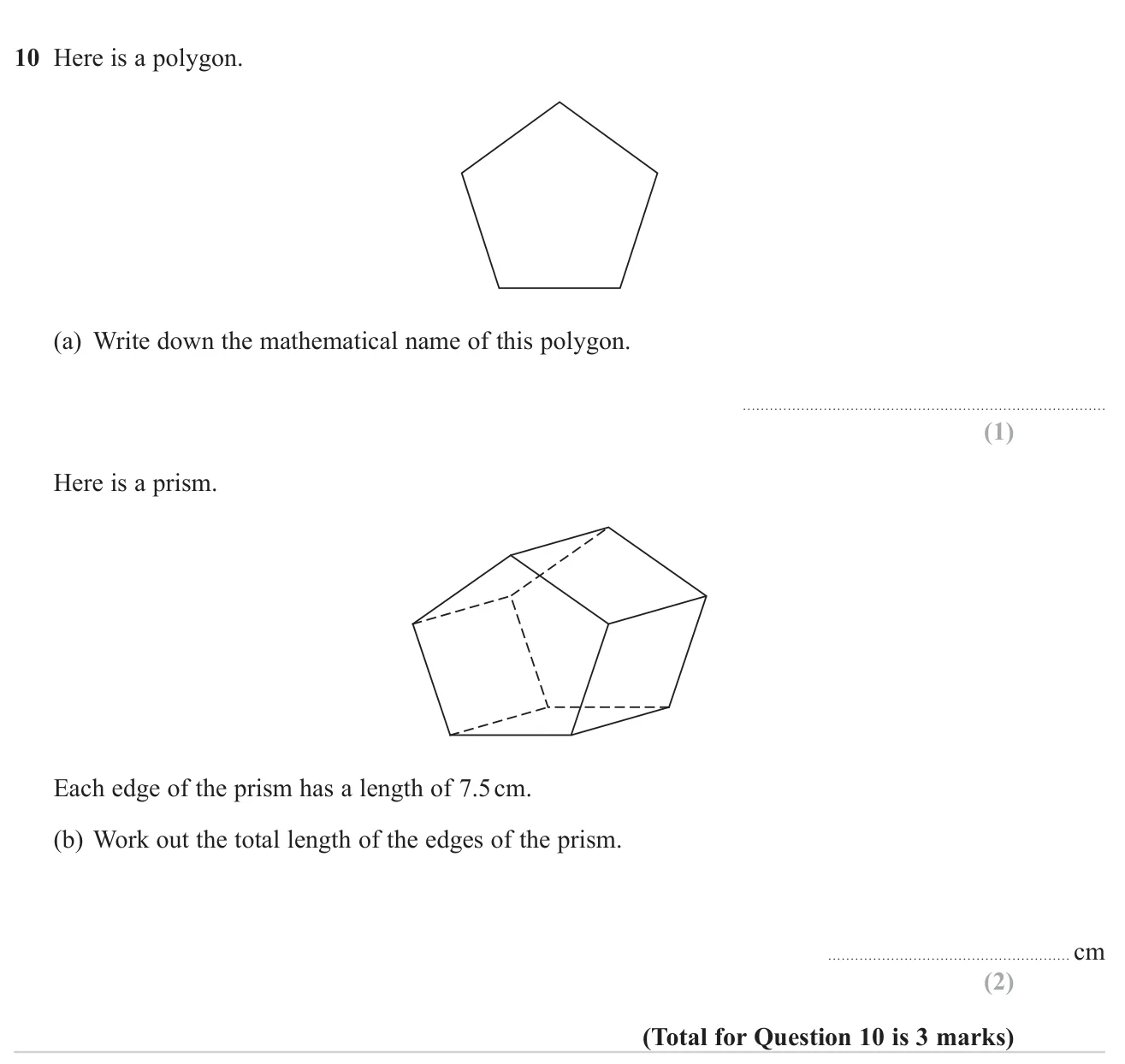
3D shapes, plans and elevations3 marksGrade 2CalculatorFoundation
November 2023 · Paper 3 Foundation · Q10
Name a five-sided polygon and find the total edge length of a pentagonal prism.

© Pearson Education Ltd. November 2023 Paper 3 (Foundation, calculator), question 10.

Show answer
(a)Pentagon1 mark
(b)112.5 cm2 marks

Worked solution Checked against the mark scheme

(a) It has 5 sides, so it is a pentagon.

(b) A pentagonal prism has 5+5+5=155 + 5 + 5 = 15 edges (two pentagons plus 5 joining edges).

Total length =15×7.5=112.5= 15 \times 7.5 = 112.5 cm

Watch out: Counting only the edges you can see, or only 10 edges.

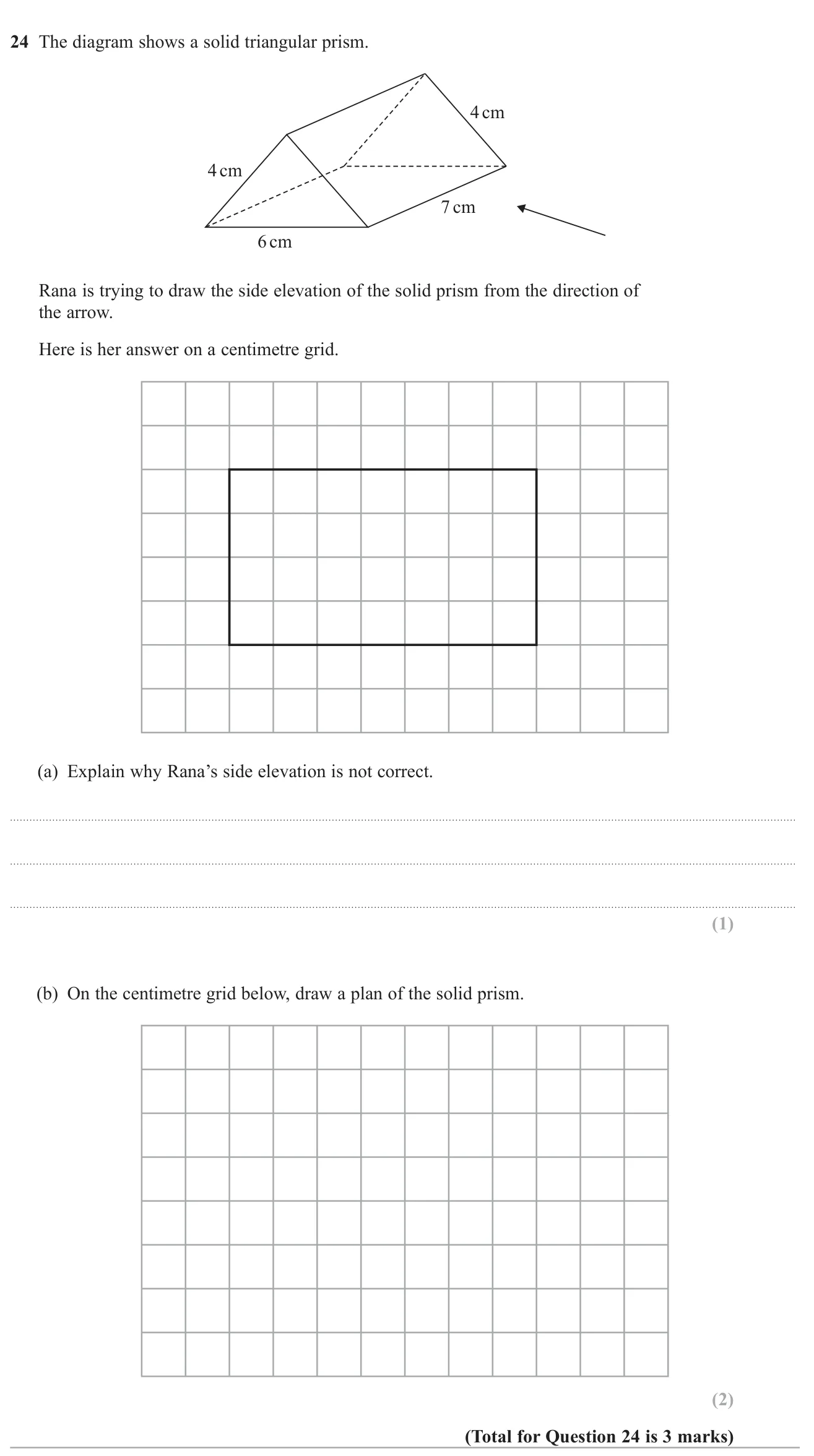
3D shapes, plans and elevations3 marksGrade 4CalculatorOn both tiers
June 2024 · Paper 3 Foundation · Q24
Explain why a side elevation of a triangular prism is wrong and draw its plan.

© Pearson Education Ltd. June 2024 Paper 3 (Foundation, calculator), question 24.

Show answer
(a)The height should be less than 4 cm (the perpendicular height, 7≈2.6\sqrt7 \approx 2.6 cm), not the 4 cm sloping edge1 mark
(b)A 7 cm by 6 cm rectangle with a line parallel to the 7 cm sides through the middle (3 cm from each side)2 marks

Worked solution Checked against the mark scheme

(a) Rana drew a 7 cm by 4 cm rectangle. The 4 cm sides of the triangle slope, so the prism is not 4 cm tall. Its height is 42−32=7≈2.6\sqrt{4^2 - 3^2} = \sqrt7 \approx 2.6 cm.

(b) From above you see the 6 cm by 7 cm base. The top edge (ridge) is above the middle of the 6 cm side, so draw a 7 cm by 6 cm rectangle with a line along its length 3 cm from each long side.

Watch out: Leaving out the ridge line in the plan.

3D shapes, plans and elevations3 marksGrade 4CalculatorFoundation
November 2023 · Paper 3 Foundation · Q19
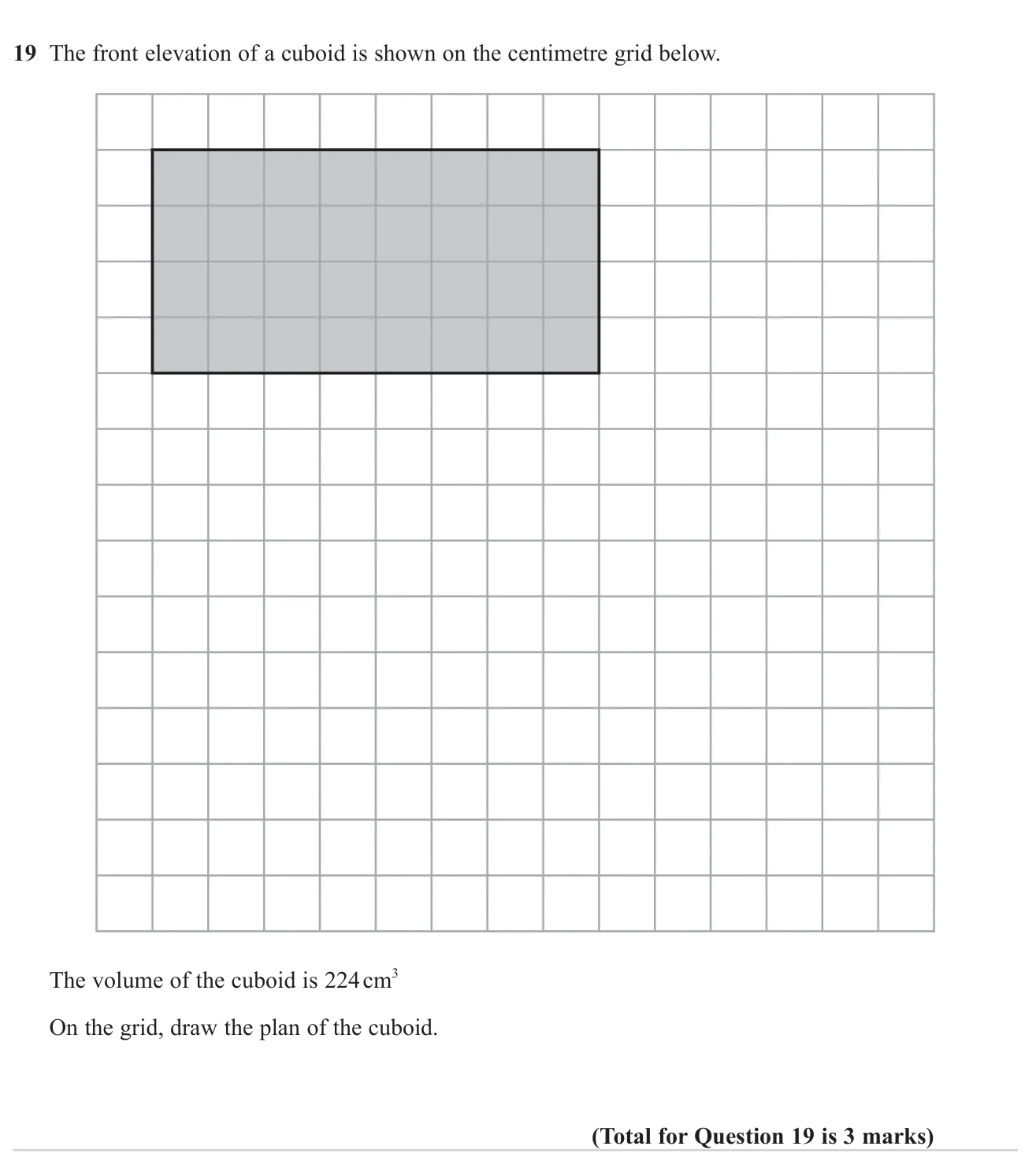
Draw the plan view of a cuboid from its front elevation and its volume.

© Pearson Education Ltd. November 2023 Paper 3 (Foundation, calculator), question 19.

Show answer
AnswerA rectangle 8 cm by 7 cm3 marks

Worked solution Checked against the mark scheme

From the elevation the cuboid is 8 cm long and 4 cm high.

Depth =224÷(8×4)=7= 224 \div (8 \times 4) = 7 cm

The plan (view from above) is length × depth: draw a rectangle 8 cm by 7 cm.

Watch out: Drawing the plan as 8 by 4, copying the front elevation.

3D shapes, plans and elevations2 marksGrade 4CalculatorOn both tiers
November 2022 · Paper 2 Foundation · Q19
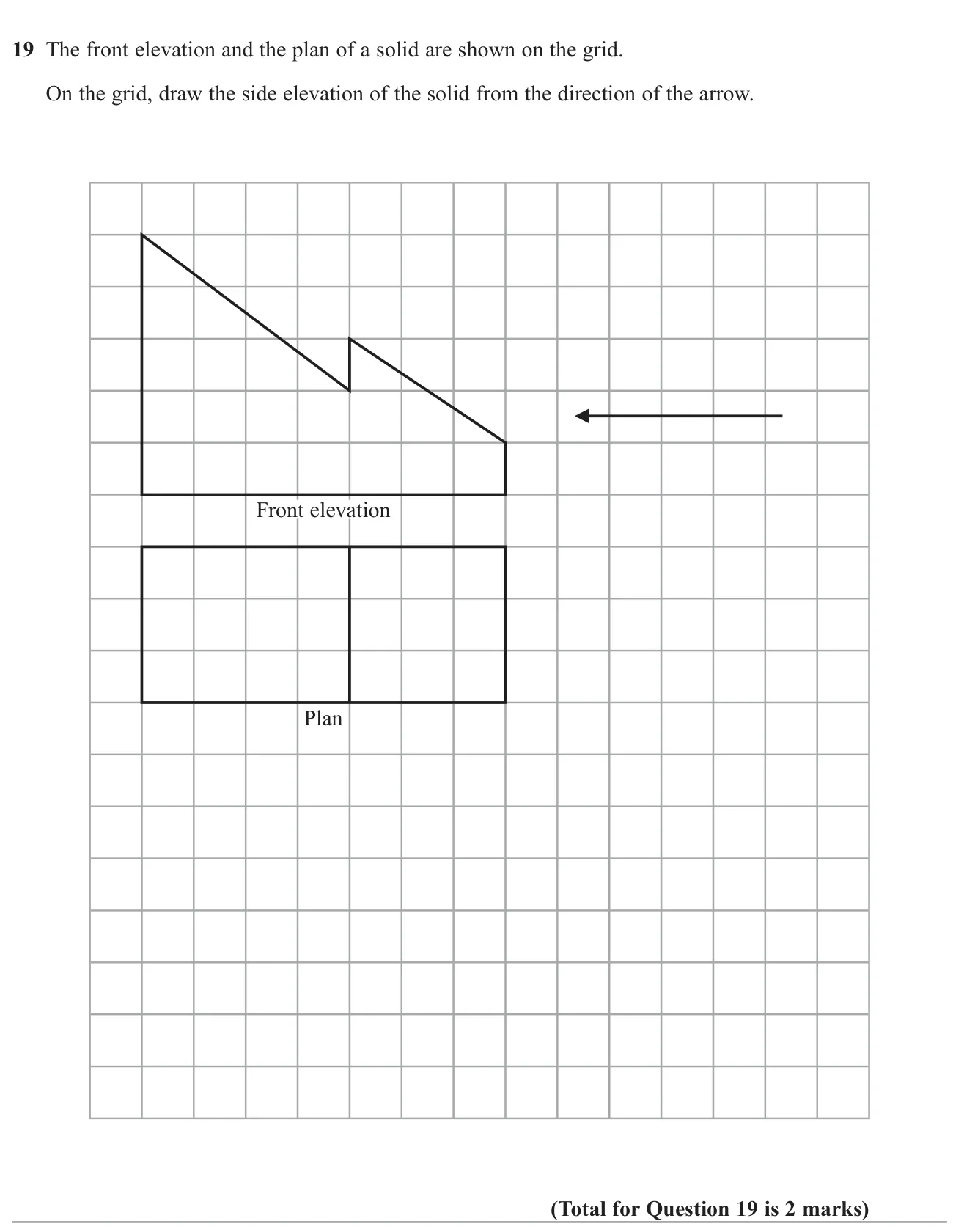
Draw the side elevation of a solid from its front elevation and plan.

© Pearson Education Ltd. November 2022 Paper 2 (Foundation, calculator), question 19.

Show answer
AnswerA rectangle 3 squares wide and 5 squares high2 marks

Worked solution Checked against the mark scheme

Viewed from the right, the width comes from the depth of the plan (3 squares) and the height from the tallest point of the front elevation (5 squares).

Draw a rectangle 3 wide and 5 high. Visible edges where the sloping faces meet appear as horizontal lines across it.

Watch out: Drawing the front elevation again instead of the side view.

3D shapes, plans and elevations2 marksGrade 4CalculatorFoundation
November 2020 · Paper 3 Foundation · Q22
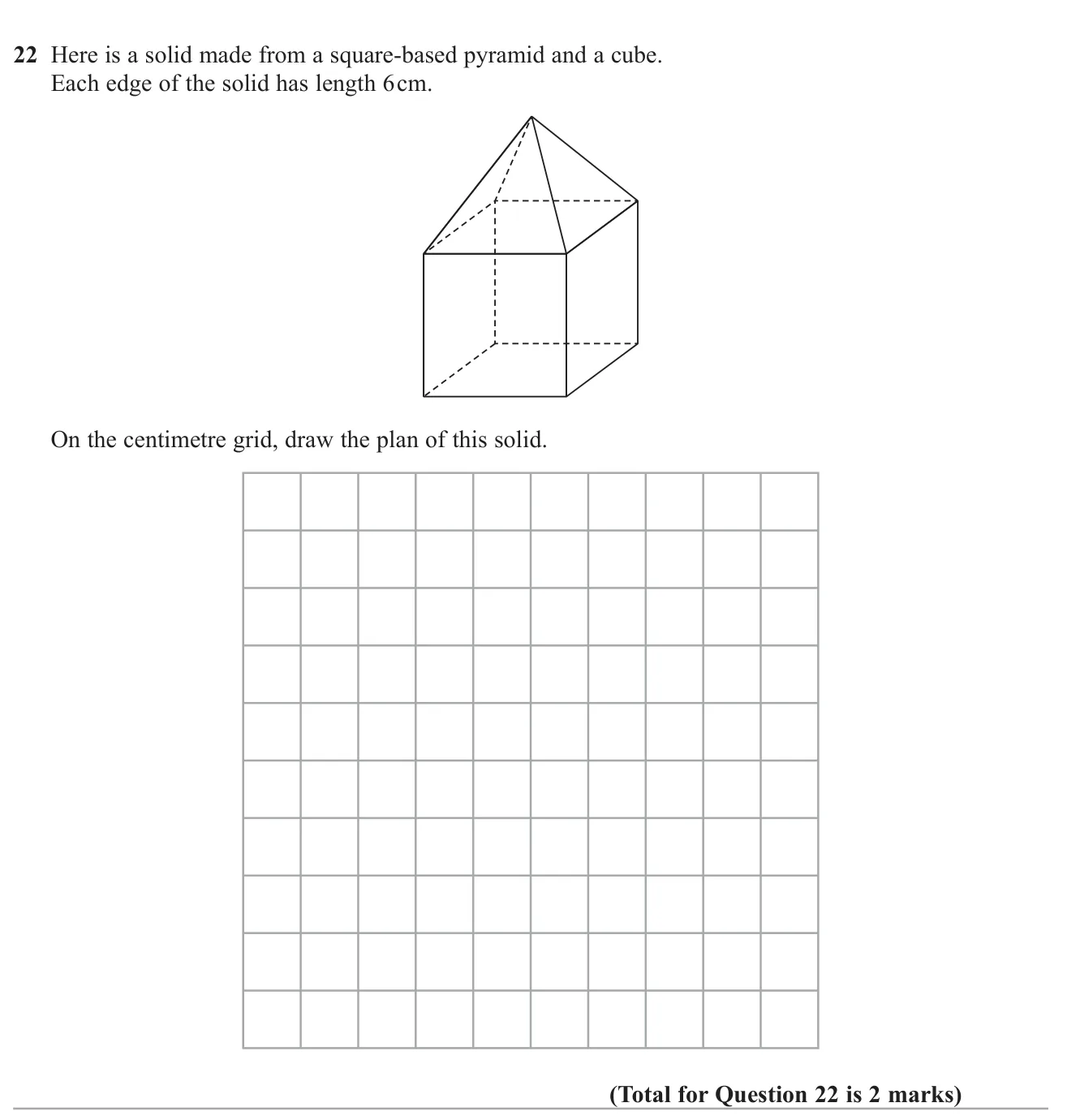
Draw the plan view of a solid made from a pyramid sitting on a cube.

© Pearson Education Ltd. November 2020 Paper 3 (Foundation, calculator), question 22.

Show answer
AnswerA 6 cm square with both diagonals drawn2 marks

Worked solution Checked against the mark scheme

From above you see the square top of the cube, 6 cm by 6 cm.

The pyramid's sloping edges meet at the centre, so draw both diagonals of the square.

Watch out: Drawing a front elevation (a triangle on a square).

3D shapes, plans and elevations2 marksGrade 4No calculatorOn both tiers
June 2019 · Paper 1 Foundation · Q25
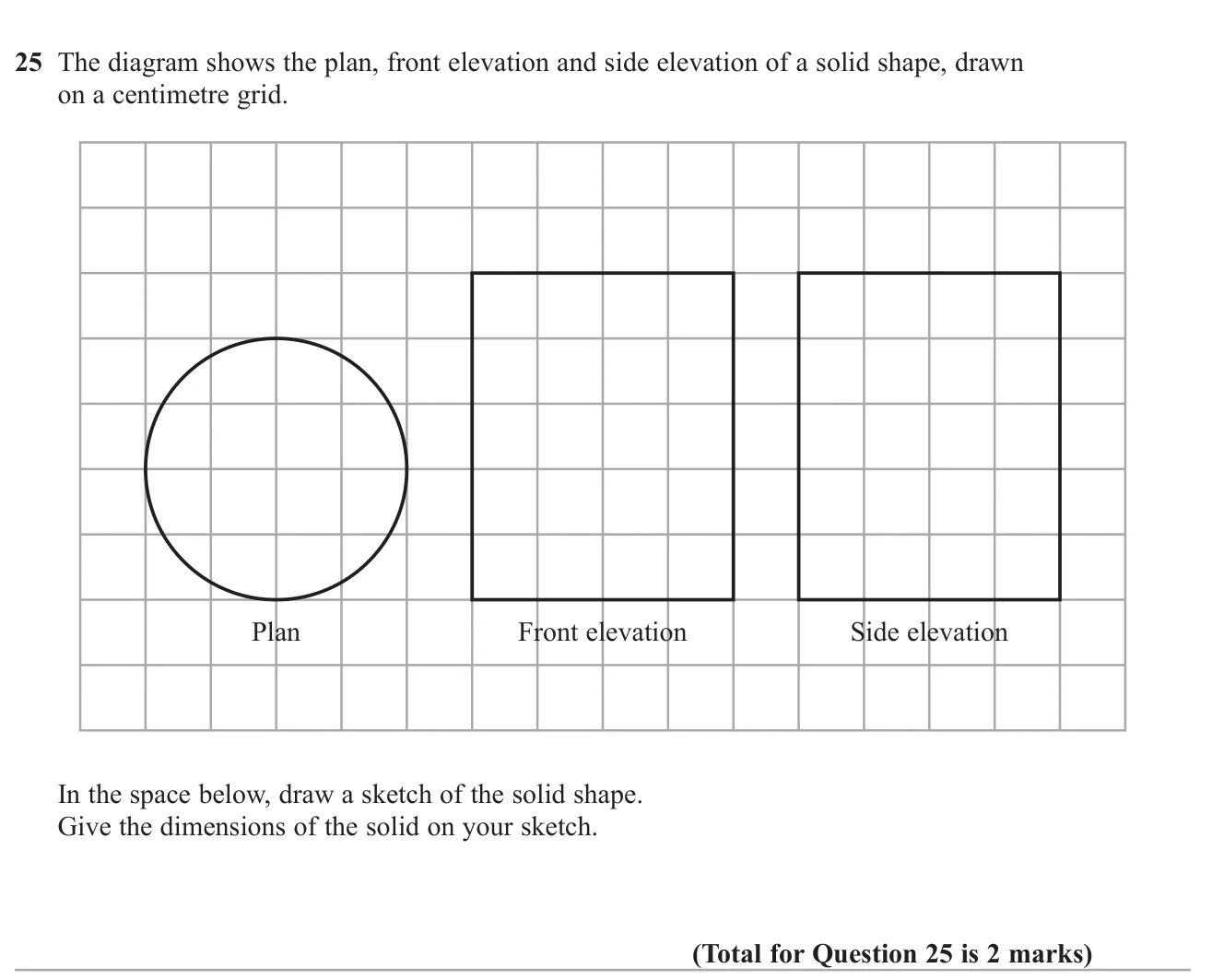
Sketch the 3D solid shown by a plan and two elevations, labelling its measurements.

© Pearson Education Ltd. June 2019 Paper 1 (Foundation, non-calculator), question 25.

Show answer
AnswerSketch of a cylinder, diameter 4 cm (radius 2 cm), height 5 cm2 marks

Worked solution Checked against the mark scheme

The plan is a circle, so the solid is round when seen from above.

Both elevations are rectangles, so the solid is a cylinder.

From the grid: diameter 4 cm (radius 2 cm) and height 5 cm.

Watch out: Reading the grid wrongly and labelling the height as 4 cm.

Also tested in these questions

Their main topic is different, but part of each one tests this topic.