Question 1
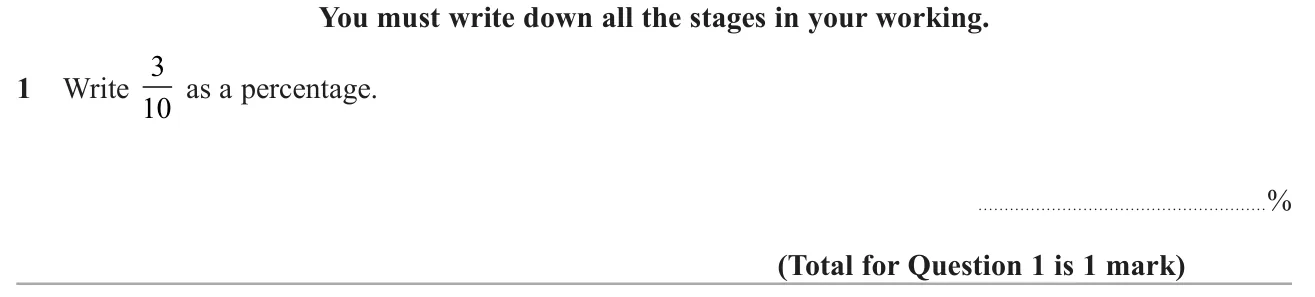
© Pearson Education Ltd. November 2021 Paper 1 (Foundation, non-calculator), question 1.
Show answer
| Answer | 1 mark |
|---|
Worked solution Checked against the mark scheme
Percent means out of 100.
Watch out: Writing 3% or 0.3.
Edexcel GCSE Maths · 1MA1
Non-calculator · 28 questions · 80 marks · 1 hour 30 minutes. Try each question on paper, then press "Show answer".
© Pearson Education Ltd. November 2021 Paper 1 (Foundation, non-calculator), question 1.
| Answer | 1 mark |
|---|
Worked solution Checked against the mark scheme
Percent means out of 100.
Watch out: Writing 3% or 0.3.
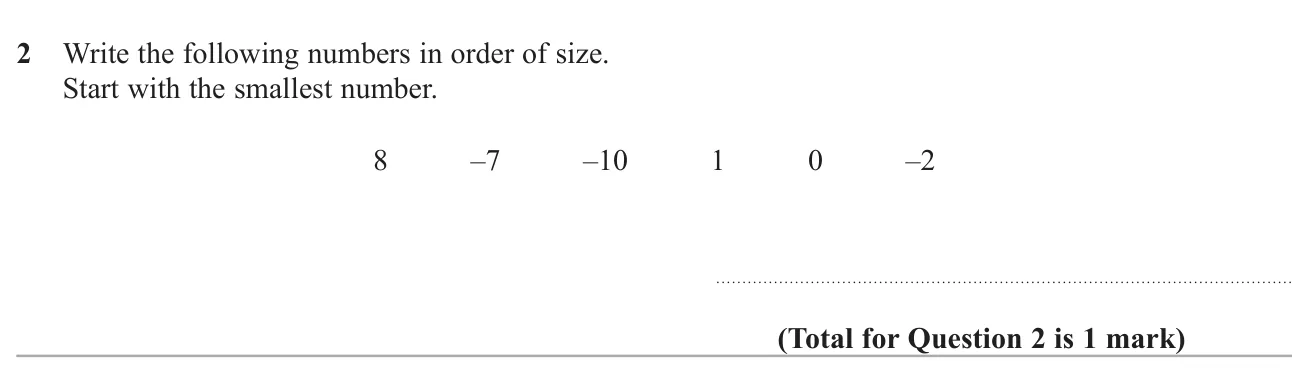
© Pearson Education Ltd. November 2021 Paper 1 (Foundation, non-calculator), question 2.
| Answer | 1 mark |
|---|
Worked solution Checked against the mark scheme
The most negative number is the smallest.
Negatives: , then , then .
Order:
Watch out: Treating as smaller than because 2 is less than 7.
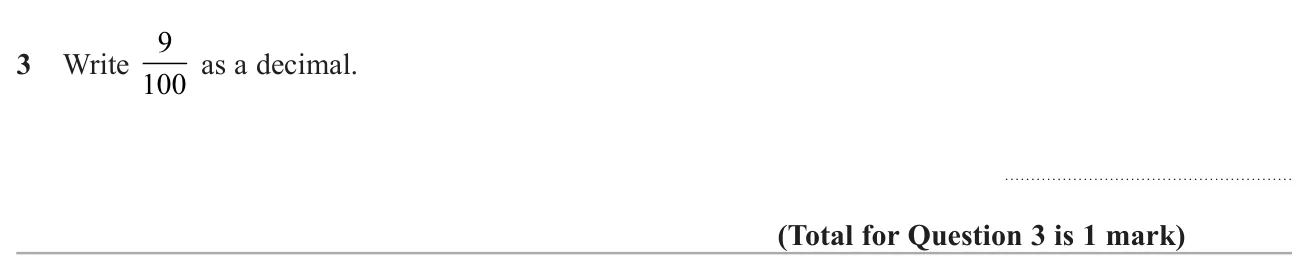
© Pearson Education Ltd. November 2021 Paper 1 (Foundation, non-calculator), question 3.
| Answer | 1 mark |
|---|
Worked solution Checked against the mark scheme
Hundredths are the second decimal place.
Watch out: Writing 0.9, which is nine tenths.

© Pearson Education Ltd. November 2021 Paper 1 (Foundation, non-calculator), question 4.
| Answer | 1 mark |
|---|
Worked solution Checked against the mark scheme
327 lies between 320 and 330.
The units digit is 7, which is 5 or more, so round up: .
Watch out: Rounding down to 320.
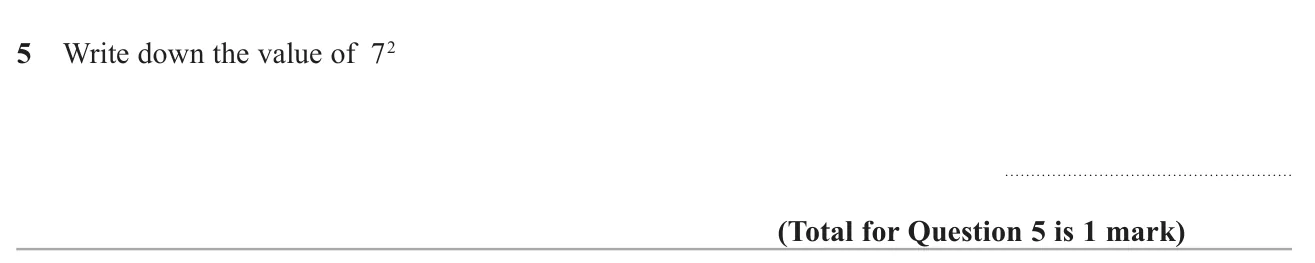
© Pearson Education Ltd. November 2021 Paper 1 (Foundation, non-calculator), question 5.
| Answer | 1 mark |
|---|
Worked solution Checked against the mark scheme
Watch out: Doubling instead of squaring to get 14.
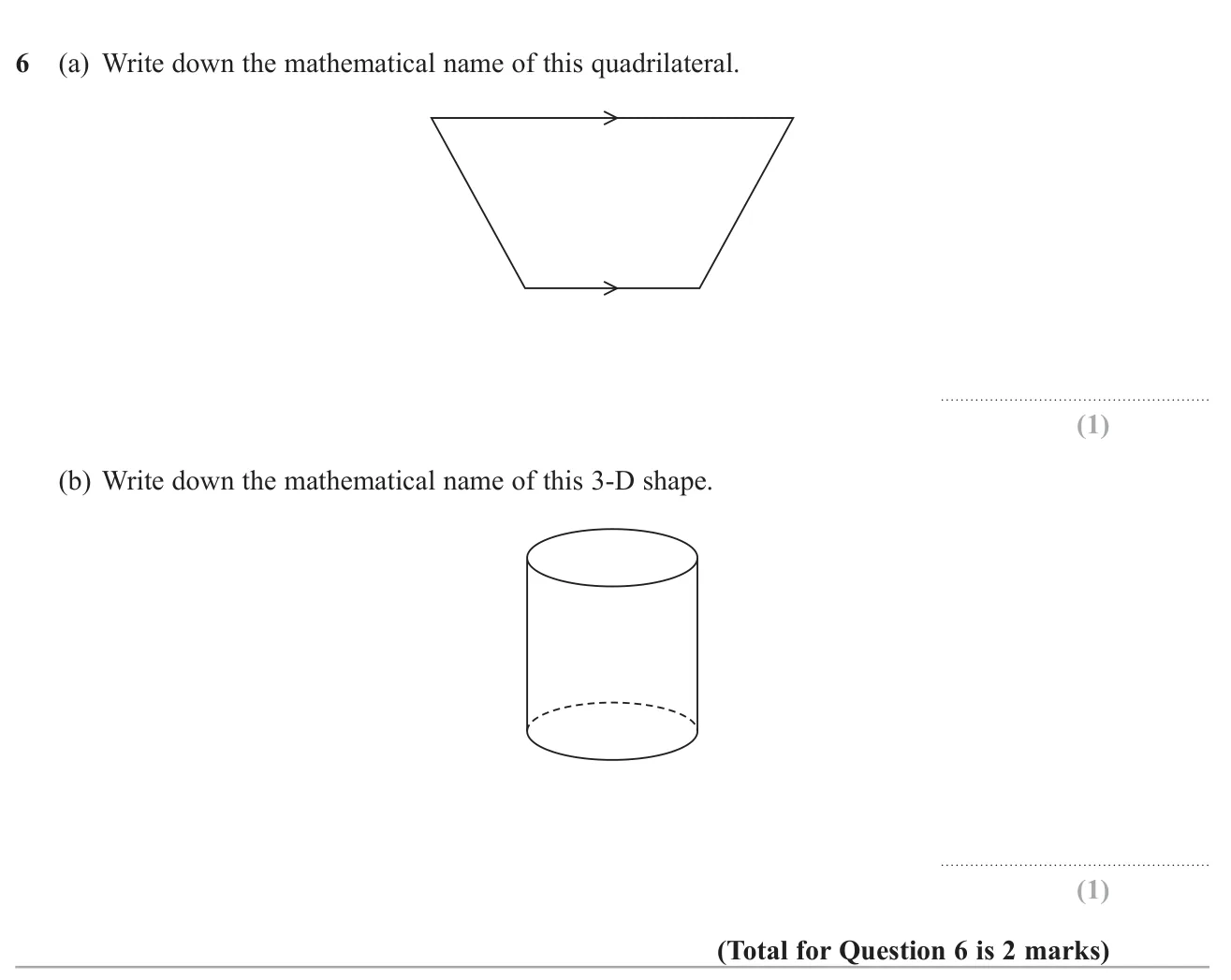
© Pearson Education Ltd. November 2021 Paper 1 (Foundation, non-calculator), question 6.
| (a) | Trapezium | 1 mark |
|---|---|---|
| (b) | Cylinder | 1 mark |
Worked solution Checked against the mark scheme
(a) The arrows show exactly one pair of parallel sides, so it is a trapezium.
(b) A solid with two equal circular faces joined by a curved surface is a cylinder.
Watch out: Calling the trapezium a parallelogram.
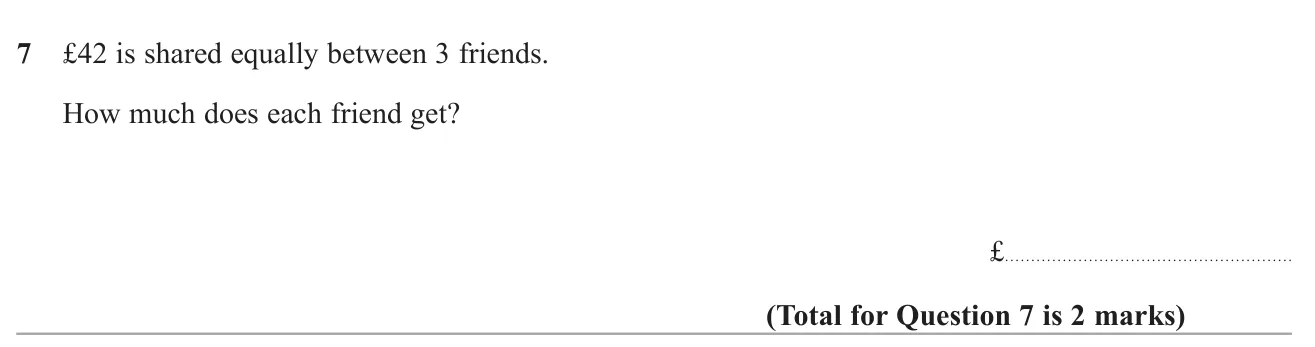
© Pearson Education Ltd. November 2021 Paper 1 (Foundation, non-calculator), question 7.
| Answer | 2 marks |
|---|
Worked solution Checked against the mark scheme
Share equally means divide.
Watch out: Multiplying by 3 instead of dividing.
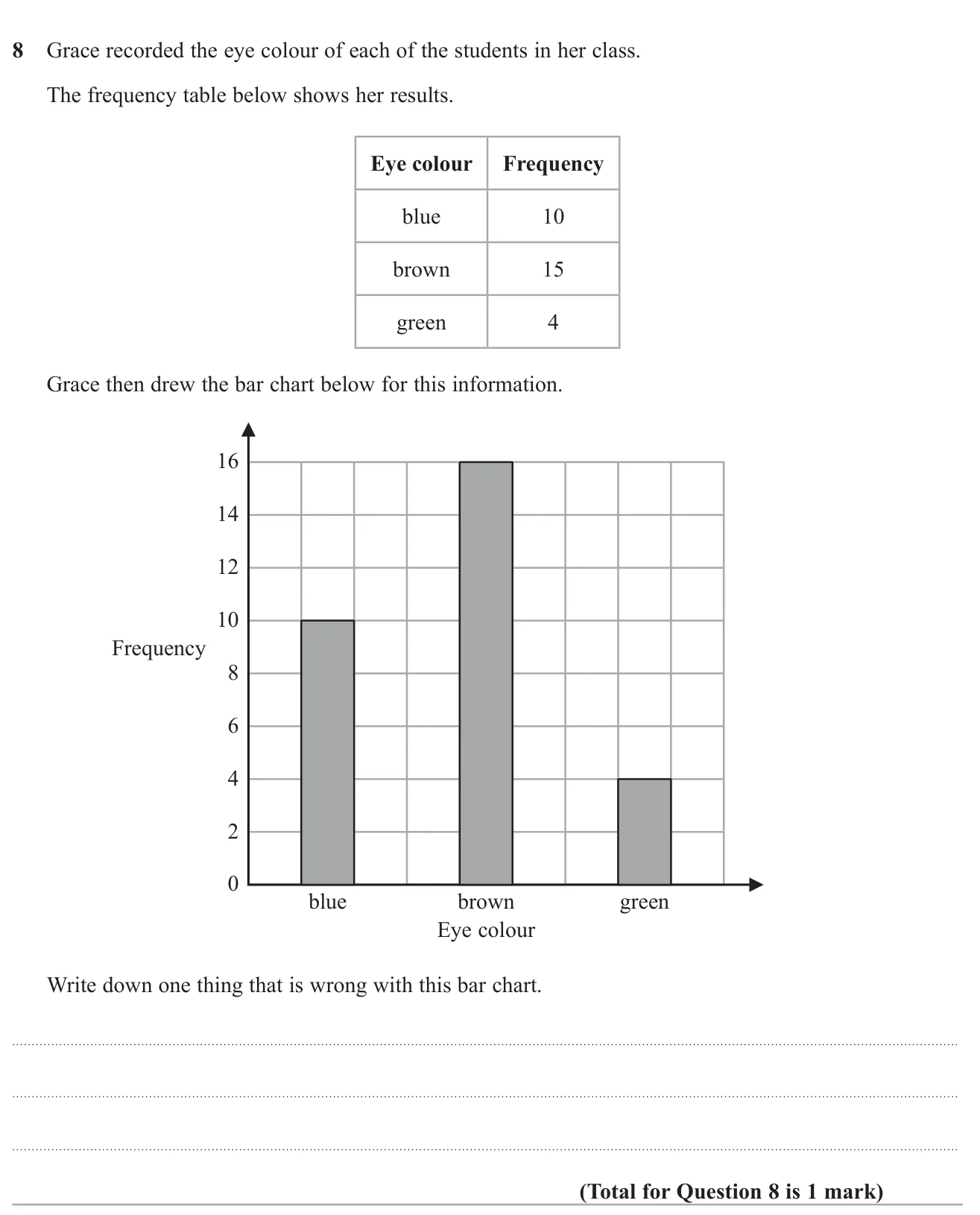
© Pearson Education Ltd. November 2021 Paper 1 (Foundation, non-calculator), question 8.
| Answer | The bar for brown goes up to 16 but should go up to 15 | 1 mark |
|---|
Worked solution Checked against the mark scheme
Check each bar against the table.
Blue: 10 and 10. Green: 4 and 4. Brown: the table says 15 but the bar reaches 16.
So the brown bar is one too tall.
Watch out: Commenting on the gaps or a missing title, which are not errors here.
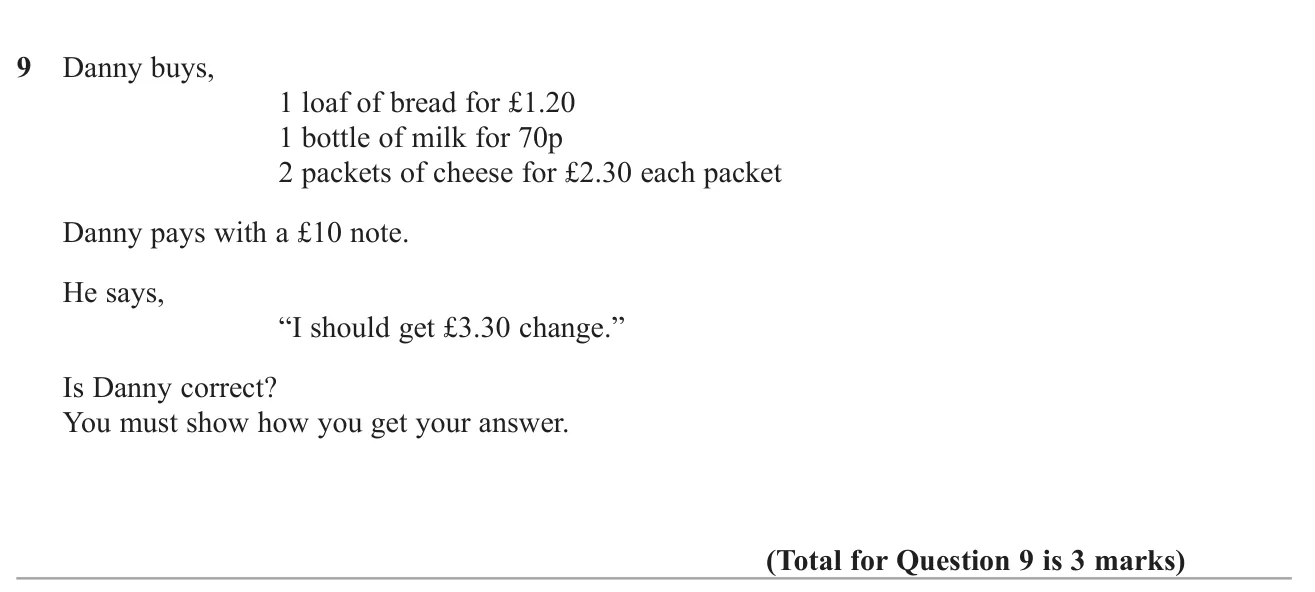
© Pearson Education Ltd. November 2021 Paper 1 (Foundation, non-calculator), question 9.
| Answer | No: the change should be £3.50 (total £6.50) | 3 marks |
|---|
Worked solution Checked against the mark scheme
Cheese:
Total:
Change:
Danny should get £3.50, so he is not correct.
Watch out: Counting only one packet of cheese.
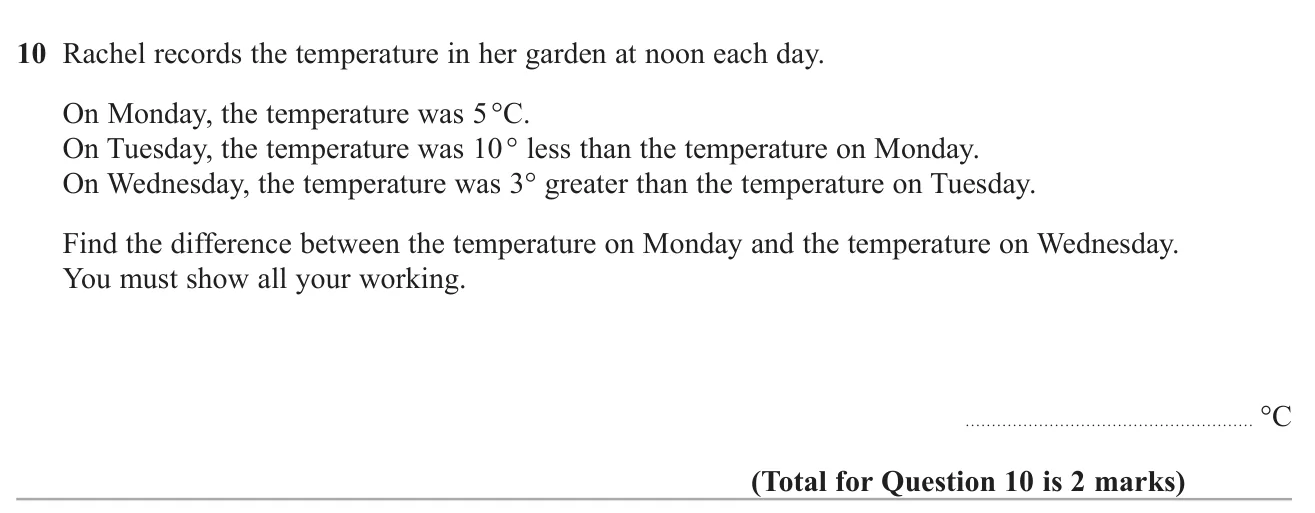
© Pearson Education Ltd. November 2021 Paper 1 (Foundation, non-calculator), question 10.
| Answer | °C | 2 marks |
|---|
Worked solution Checked against the mark scheme
Monday: °C
Tuesday: °C
Wednesday: °C
Difference: °C
Watch out: Giving the Wednesday temperature, −2, as the answer.
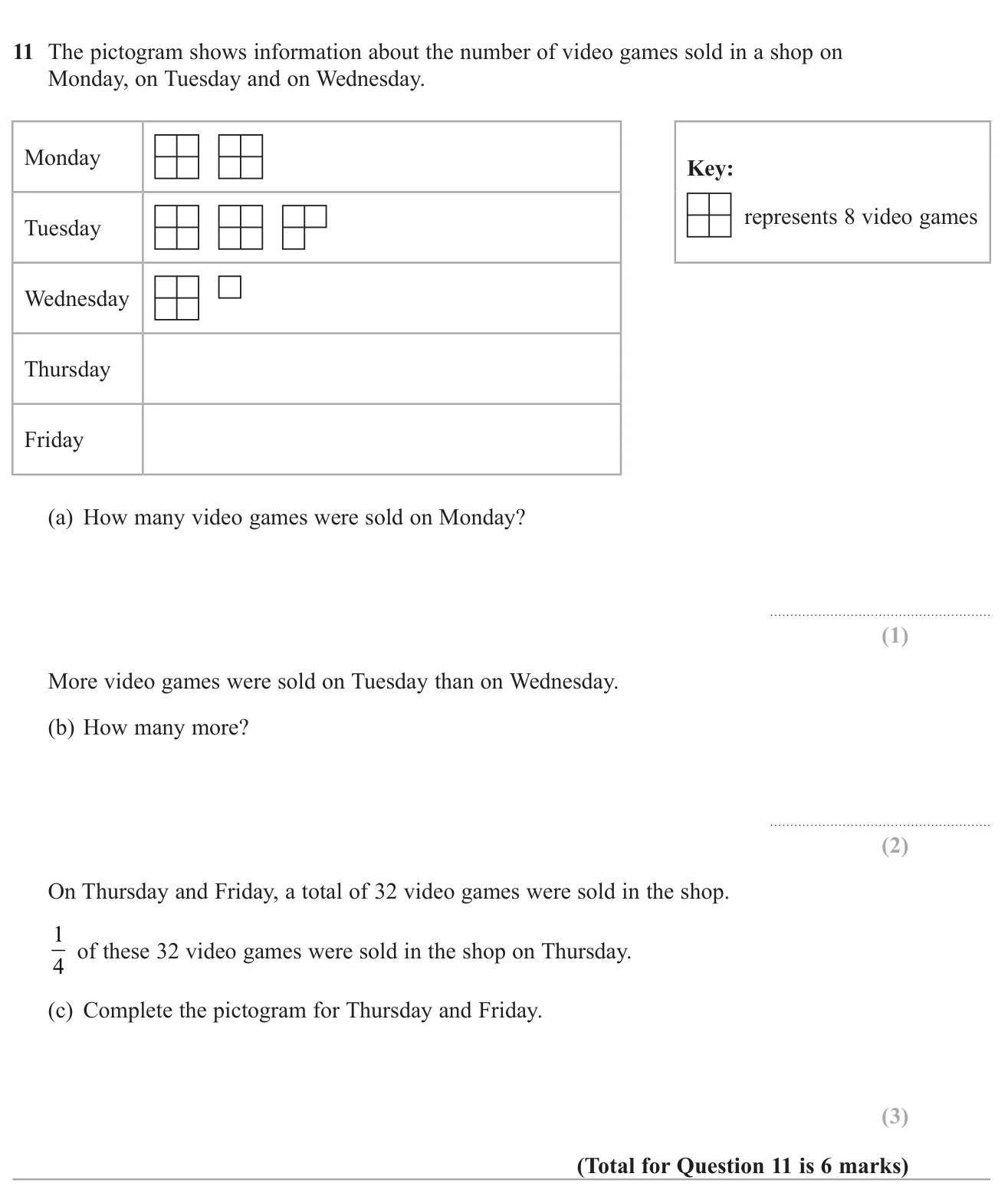
© Pearson Education Ltd. November 2021 Paper 1 (Foundation, non-calculator), question 11.
| (a) | 1 mark | |
|---|---|---|
| (b) | 2 marks | |
| (c) | Thursday: 1 whole symbol (8); Friday: 3 whole symbols (24) | 3 marks |
Worked solution Checked against the mark scheme
Each symbol is 8 games, so a quarter symbol is 2.
(a) Monday has 2 symbols:
(b) Tuesday: . Wednesday: . Difference:
(c) Thursday: , so draw 1 symbol. Friday: , so draw 3 symbols.
Watch out: Counting each part-symbol as a whole symbol.
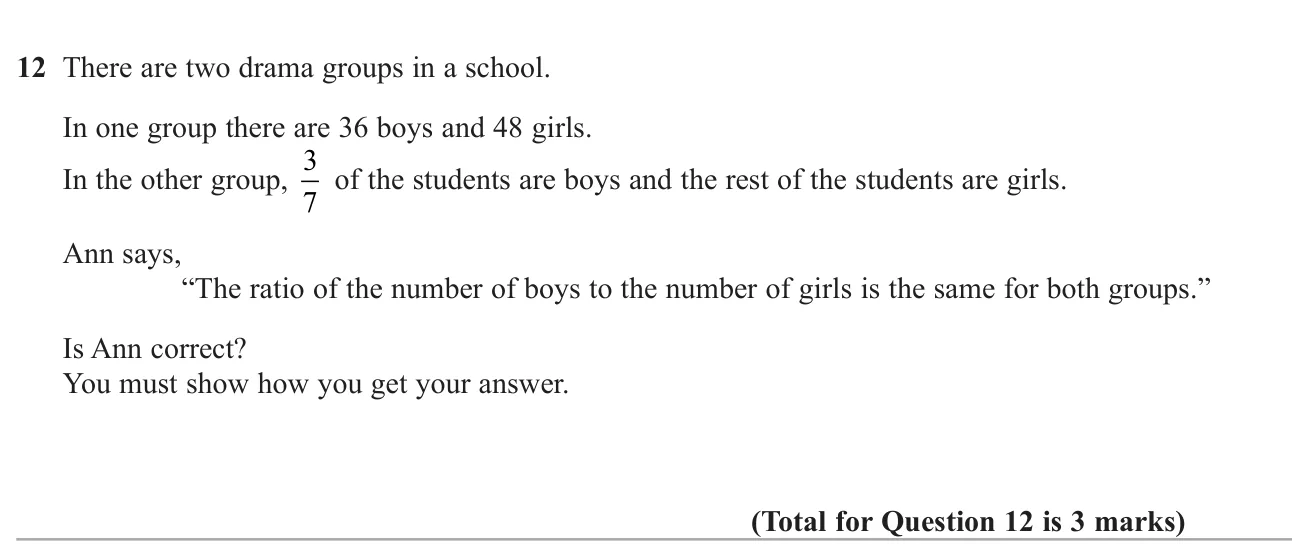
© Pearson Education Ltd. November 2021 Paper 1 (Foundation, non-calculator), question 12.
| Answer | Yes: both ratios simplify to | 3 marks |
|---|
Worked solution Checked against the mark scheme
Group 1: . Divide both by 12 to get .
Group 2: are boys, so are girls. Boys : girls .
Both are , so Ann is correct.
Watch out: Comparing 3 : 7 with 3 : 4, confusing a part-to-whole fraction with a part-to-part ratio.
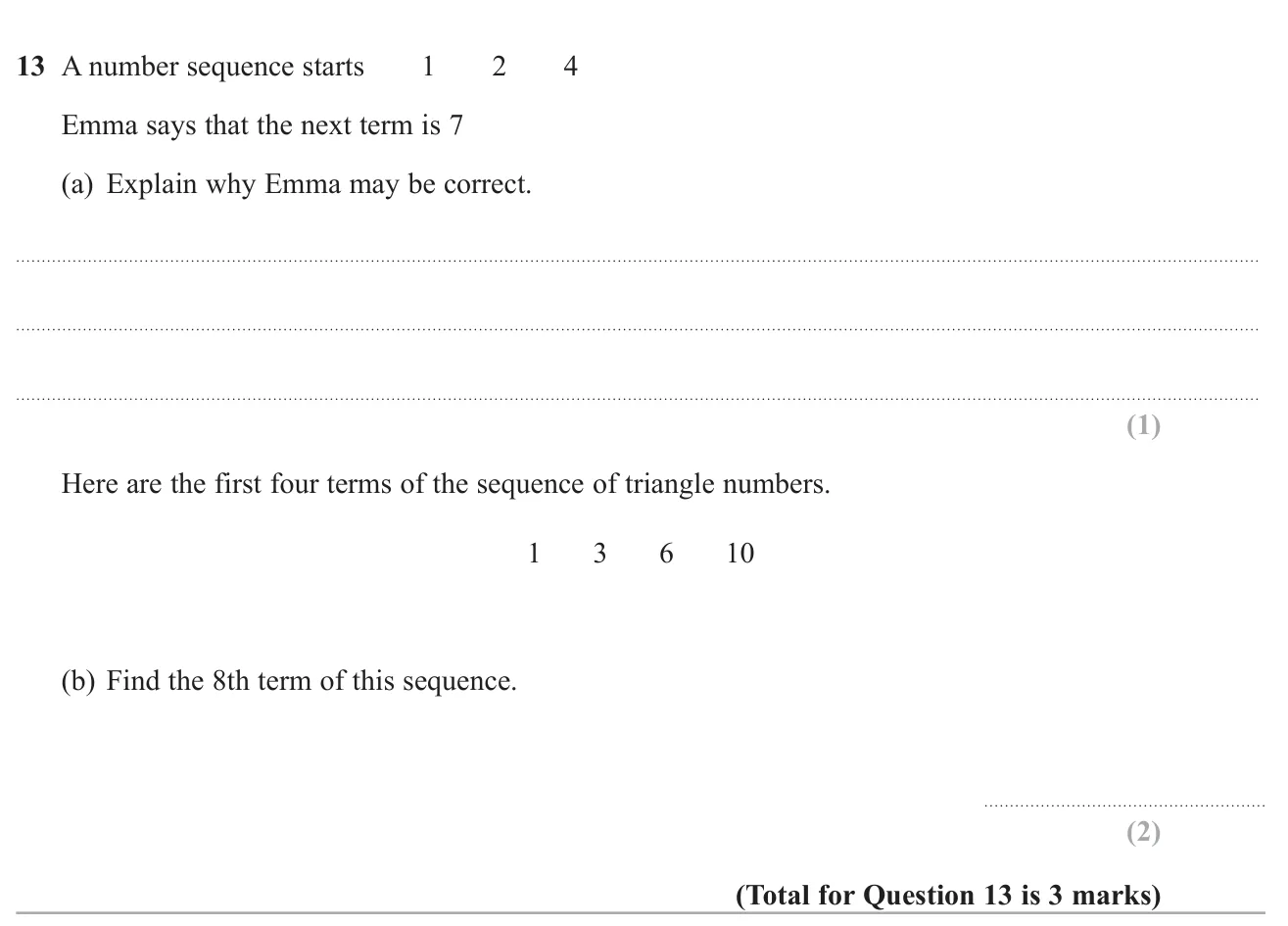
© Pearson Education Ltd. November 2021 Paper 1 (Foundation, non-calculator), question 13.
| (a) | The differences go up by one each time: , so | 1 mark |
|---|---|---|
| (b) | 2 marks |
Worked solution Checked against the mark scheme
(a) is , is , so the next step could be : .
(b) The gaps grow by 1: , , , .
The 8th term is .
Watch out: In (b), stopping at the 7th term, 28.
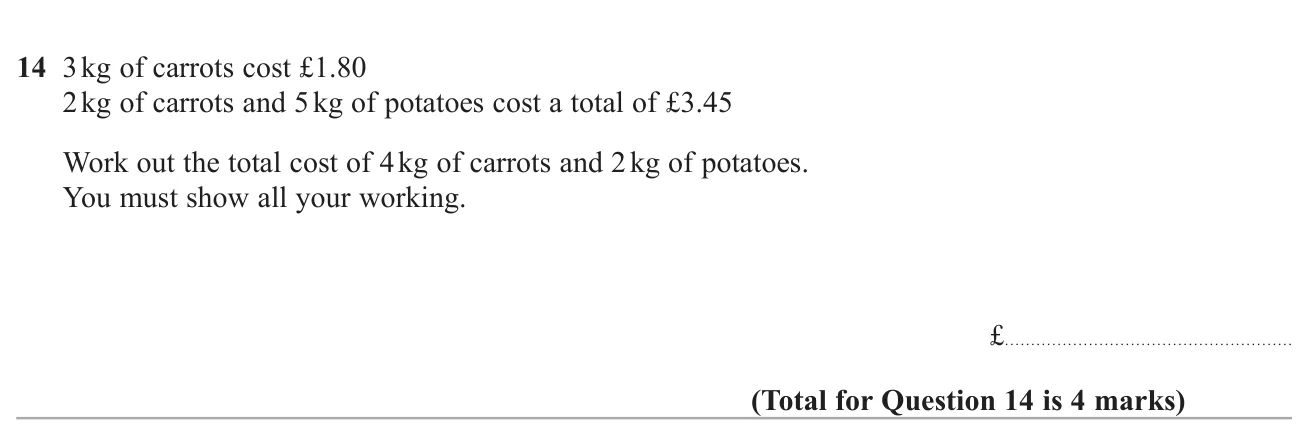
© Pearson Education Ltd. November 2021 Paper 1 (Foundation, non-calculator), question 14.
| Answer | 4 marks |
|---|
Worked solution Checked against the mark scheme
Carrots: per kg
2 kg carrots cost , so 5 kg potatoes cost
Potatoes: per kg
Total:
Watch out: Forgetting to subtract the carrots before dividing £3.45 by 5.
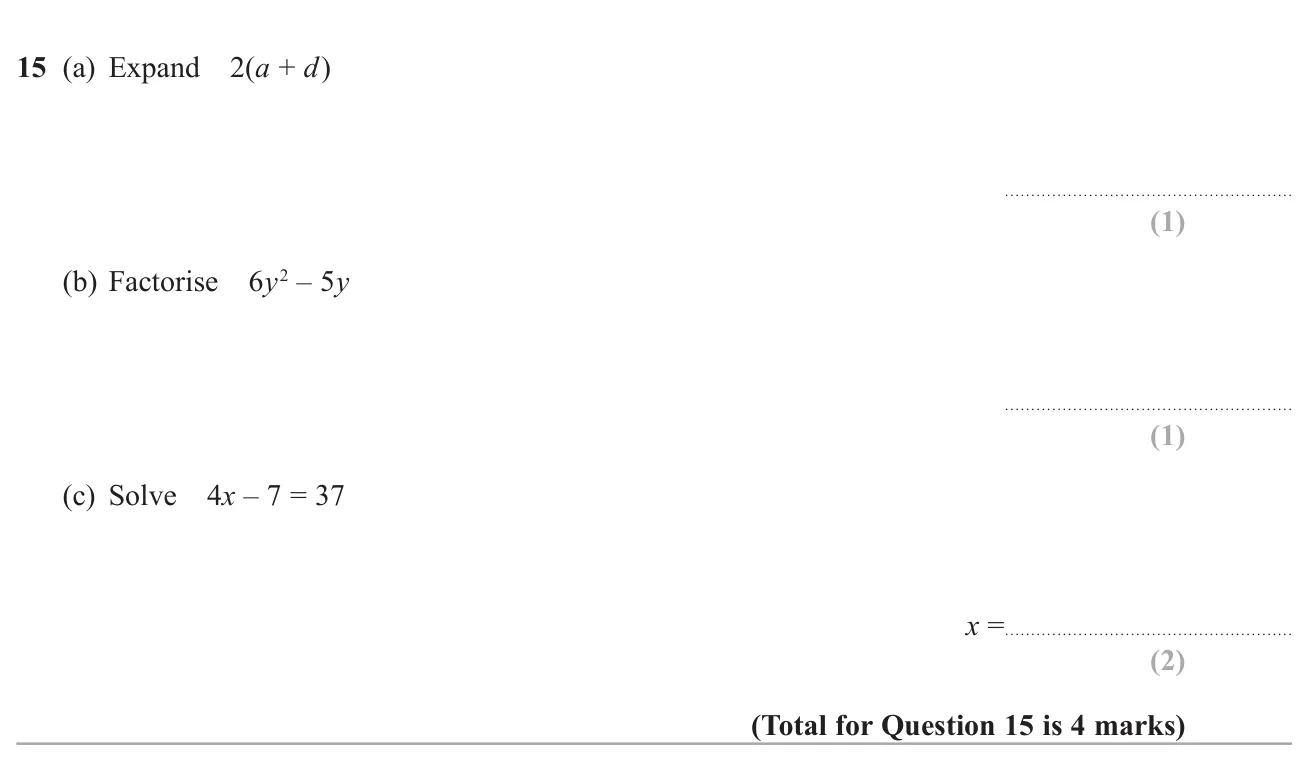
© Pearson Education Ltd. November 2021 Paper 1 (Foundation, non-calculator), question 15.
| (a) | 1 mark | |
|---|---|---|
| (b) | 1 mark | |
| (c) | 2 marks |
Worked solution Checked against the mark scheme
(a) Multiply each term by 2:
(b) Both terms contain :
(c)
Watch out: In (c), subtracting 7 instead of adding it, giving .
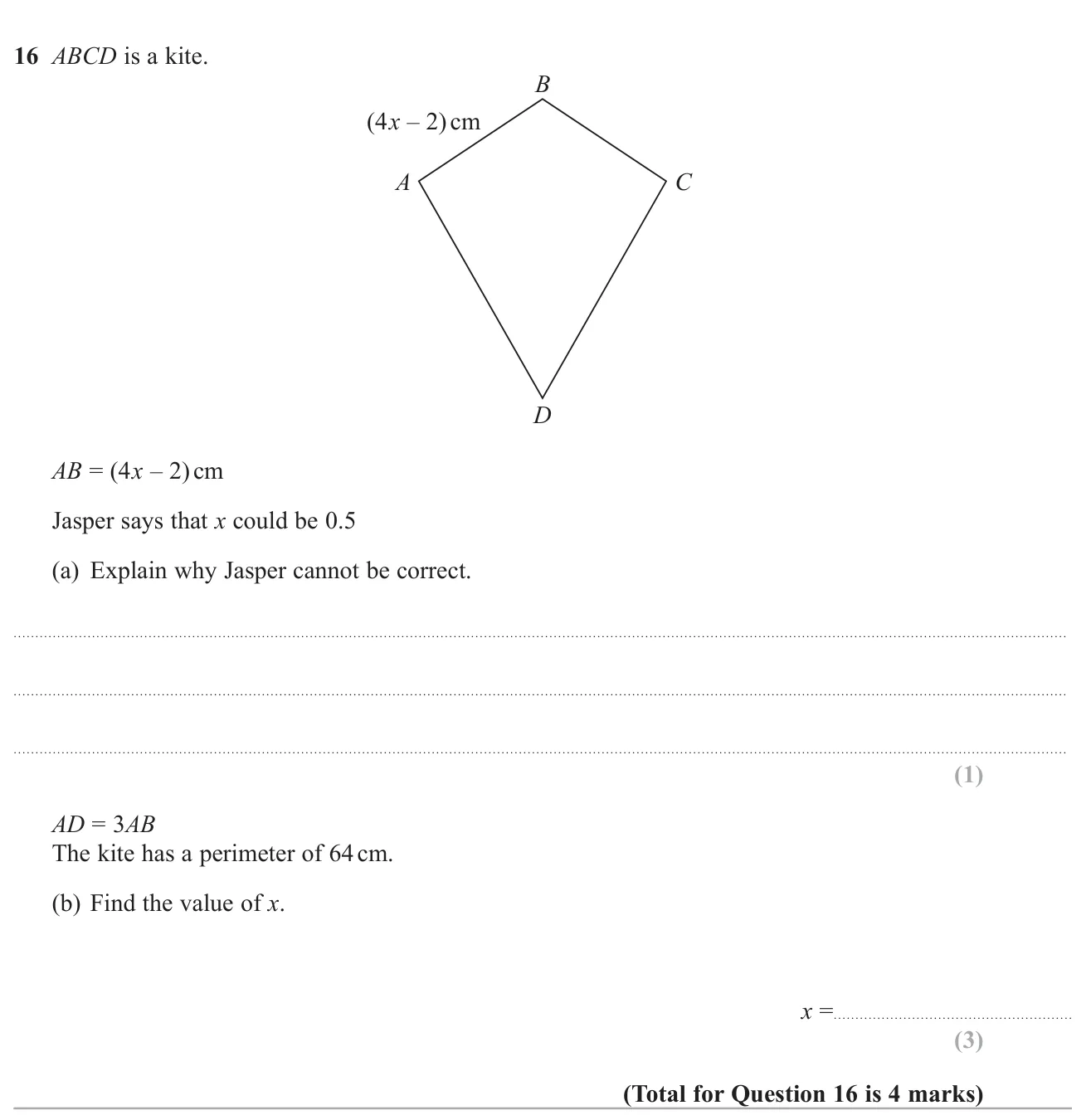
© Pearson Education Ltd. November 2021 Paper 1 (Foundation, non-calculator), question 16.
| (a) | If then , and a side cannot have length 0 | 1 mark |
|---|---|---|
| (b) | 3 marks |
Worked solution Checked against the mark scheme
(a) , so AB would be 0 cm, which is impossible.
(b) A kite has two pairs of equal sides, so the perimeter is .
, so .
, so and
Watch out: In (b), using only one AB and one AD (4AB = 64).
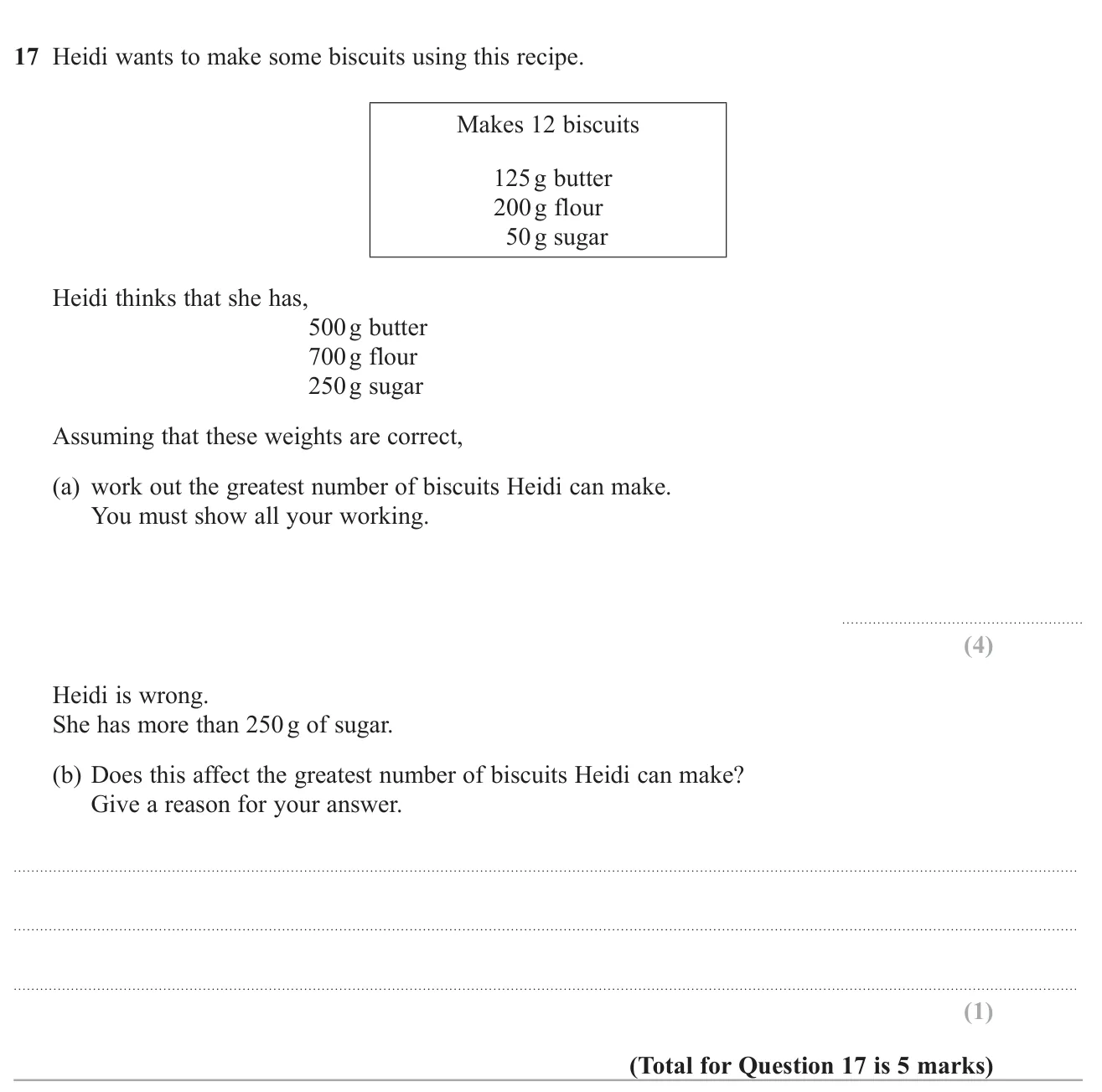
© Pearson Education Ltd. November 2021 Paper 1 (Foundation, non-calculator), question 17.
| (a) | 4 marks | |
|---|---|---|
| (b) | No, because flour is the ingredient that limits how many can be made | 1 mark |
Worked solution Checked against the mark scheme
(a) Batches each ingredient allows (12 biscuits per batch):
Butter: . Flour: . Sugar:
Flour runs out first: biscuits.
(b) No. Flour is the limit, so extra sugar makes no difference.
Watch out: Rounding 3.5 batches down to 3 and answering 36.
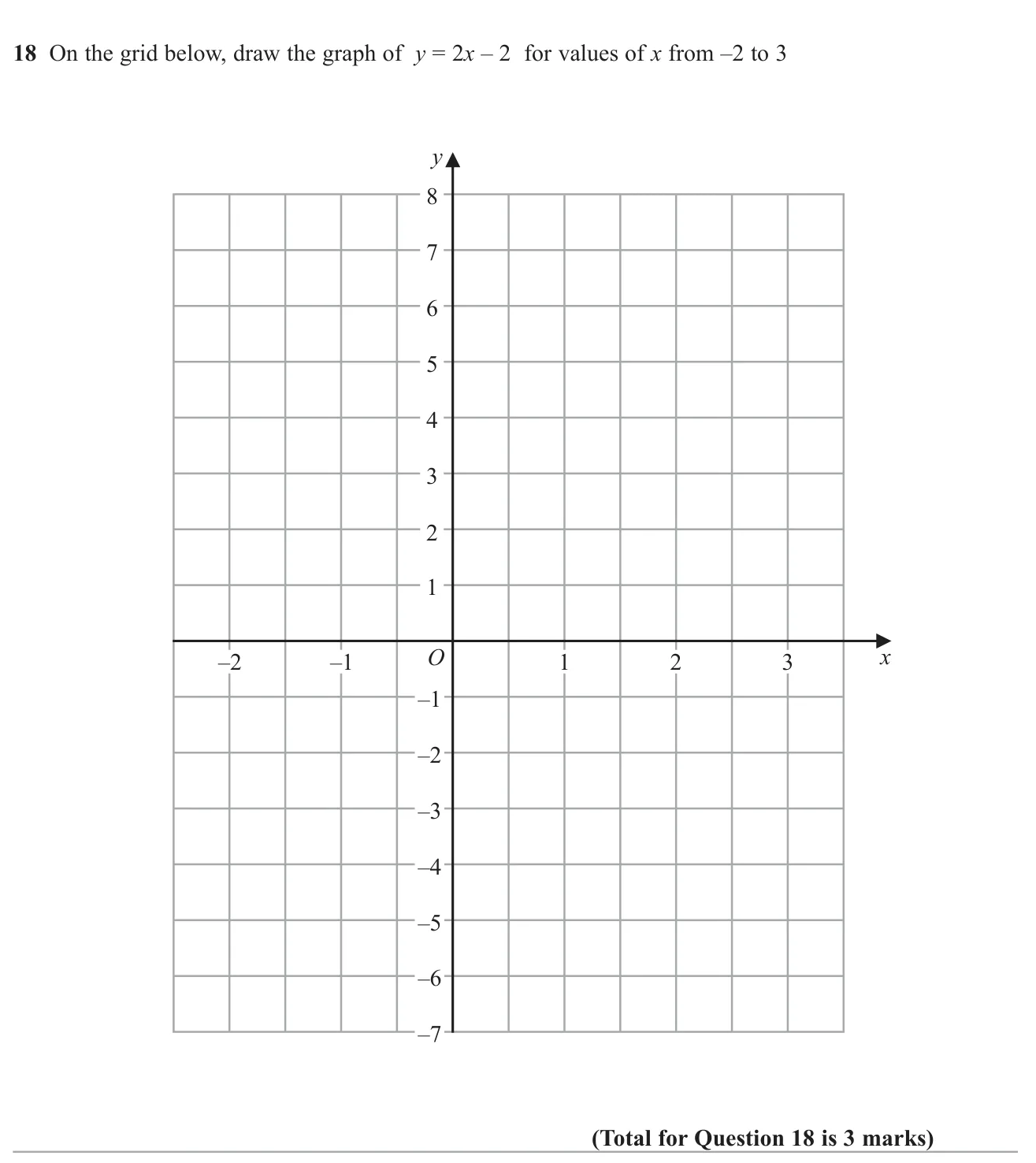
© Pearson Education Ltd. November 2021 Paper 1 (Foundation, non-calculator), question 18.
| Answer | Straight line through and | 3 marks |
|---|
Worked solution Checked against the mark scheme
Make a table using :
| | −2 | −1 | 0 | 1 | 2 | 3 |
|---|---|---|---|---|---|---|
| | −6 | −4 | −2 | 0 | 2 | 4 |
Plot the points and join them with a ruler from to .
Watch out: Working out wrongly for negative x, e.g. getting −2 at x = −2.
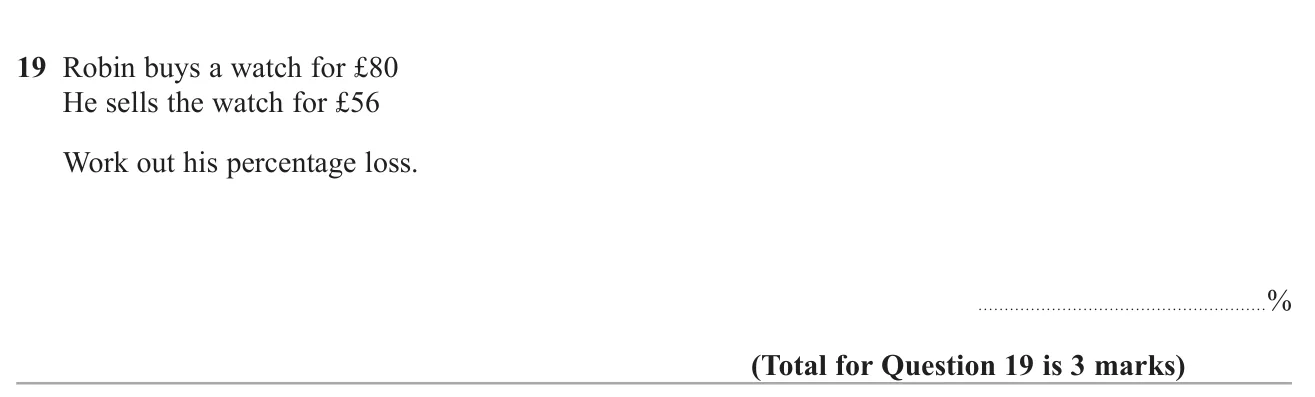
© Pearson Education Ltd. November 2021 Paper 1 (Foundation, non-calculator), question 19.
| Answer | % | 3 marks |
|---|
Worked solution Checked against the mark scheme
Loss:
Percentage loss:
Watch out: Dividing by 56 instead of the original price, 80.
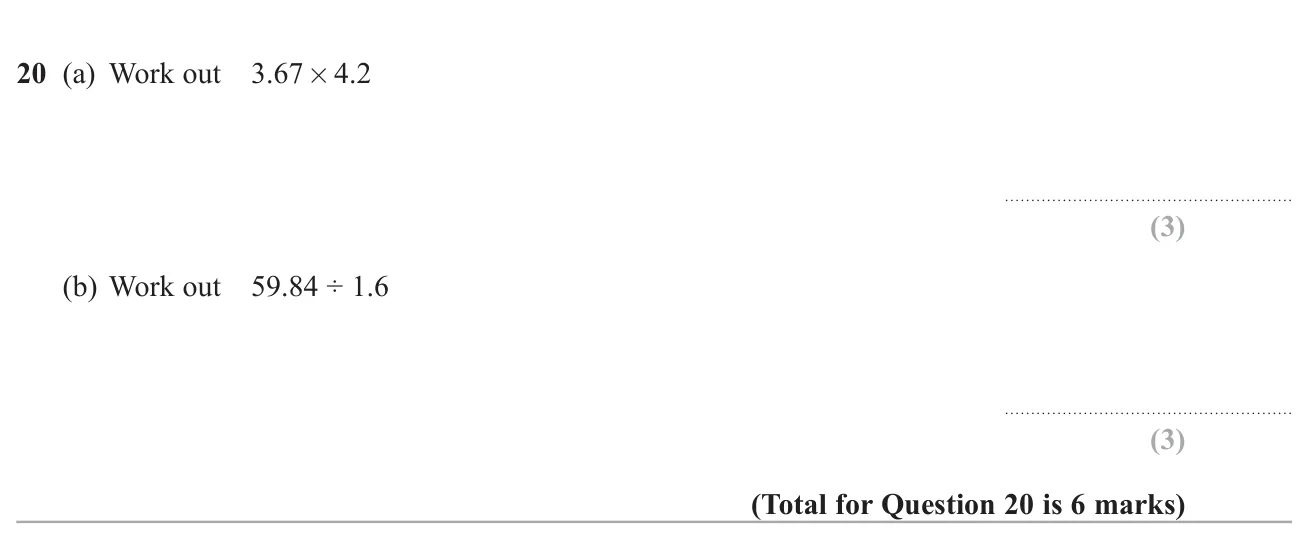
© Pearson Education Ltd. November 2021 Paper 1 (Foundation, non-calculator), question 20.
| (a) | 3 marks | |
|---|---|---|
| (b) | 3 marks |
Worked solution Checked against the mark scheme
(a) . There are 3 decimal places in total, so
(b) Multiply both by 10:
(since and )
Watch out: Placing the decimal point wrongly, e.g. 154.14.
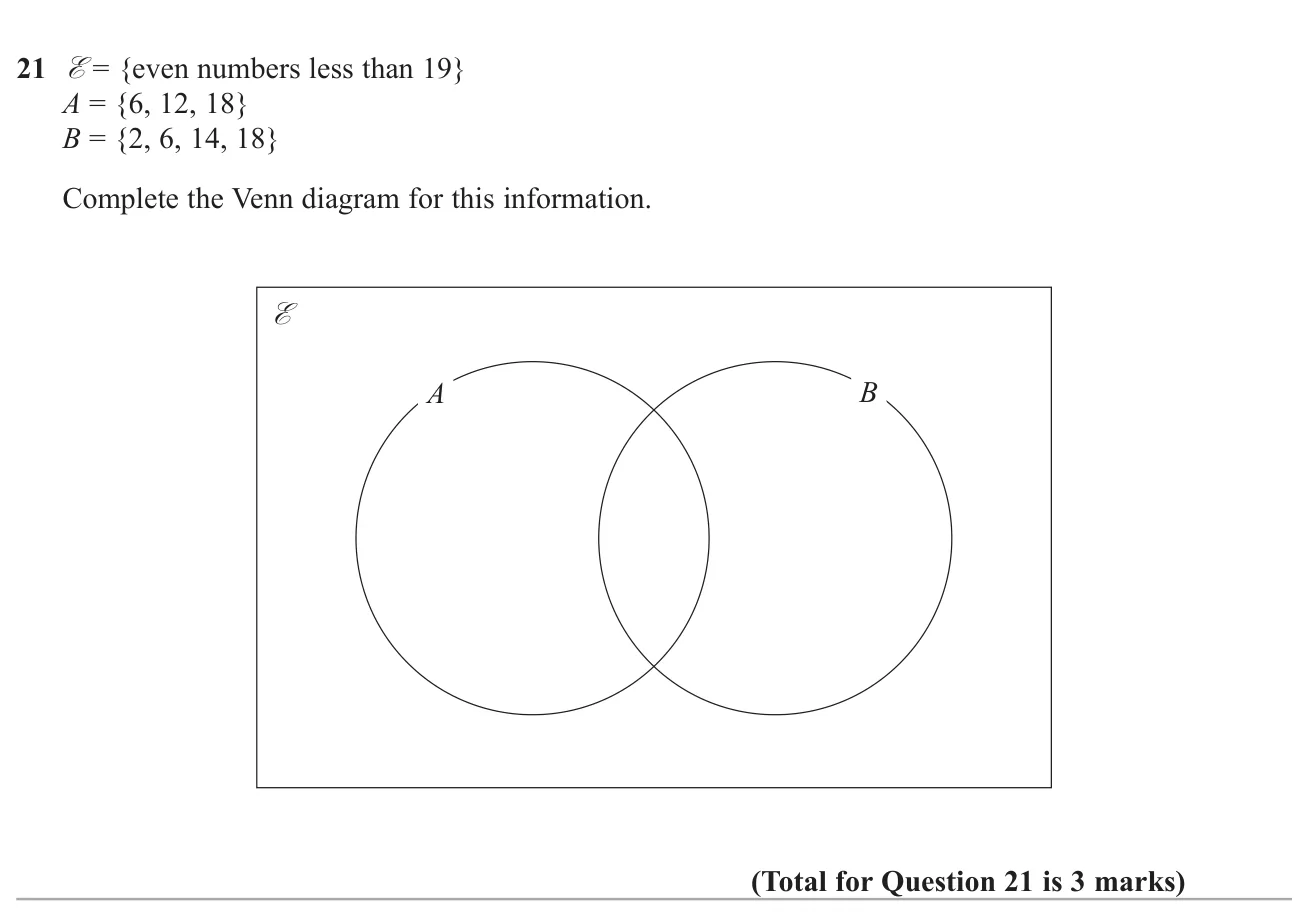
© Pearson Education Ltd. November 2021 Paper 1 (Foundation, non-calculator), question 21.
| Answer | Overlap: 6, 18; A only: 12; B only: 2, 14; outside: 4, 8, 10, 16 | 3 marks |
|---|
Worked solution Checked against the mark scheme
In both A and B: 6, 18
A only: 12. B only: 2, 14
In neither: 4, 8, 10, 16
Watch out: Leaving out the numbers outside both circles, or including 0 or 20.
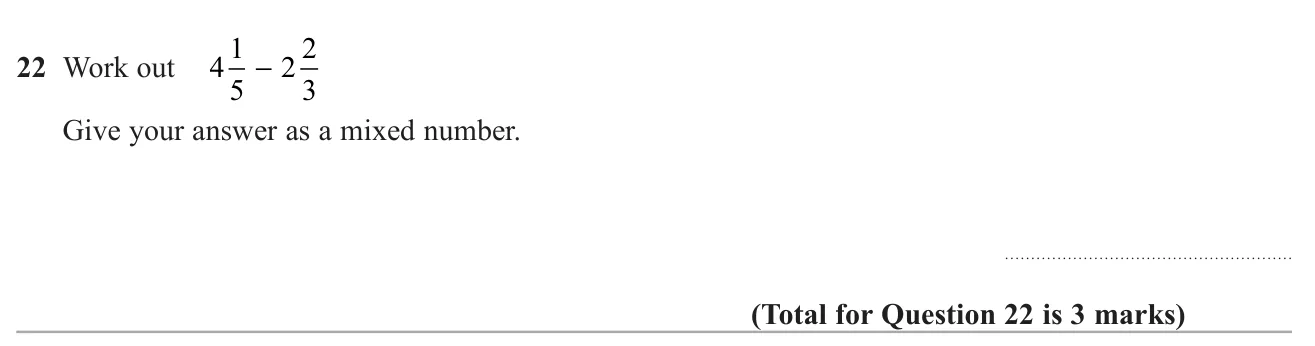
© Pearson Education Ltd. November 2021 Paper 1 (Foundation, non-calculator), question 22.
| Answer | 3 marks |
|---|
Worked solution Checked against the mark scheme
and
Watch out: Subtracting whole numbers and fractions separately and getting wrong.
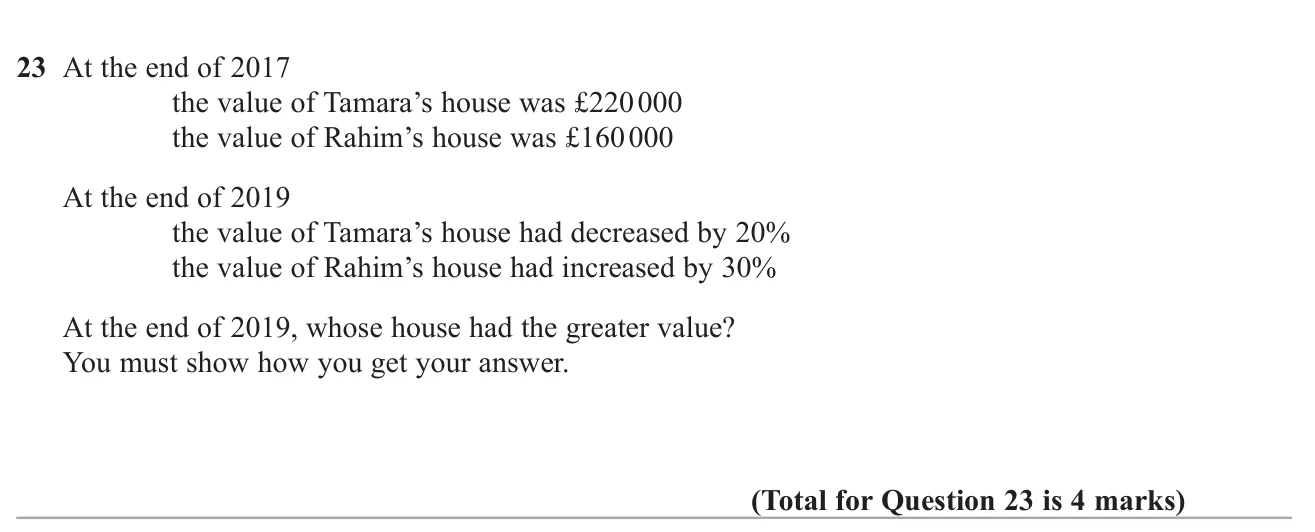
© Pearson Education Ltd. November 2021 Paper 1 (Foundation, non-calculator), question 23.
| Answer | Rahim's: £208 000 compared with Tamara's £176 000 | 4 marks |
|---|
Worked solution Checked against the mark scheme
Tamara:
Rahim:
, so Rahim's house has the greater value.
Watch out: Finding only the change (44 000 and 48 000) and comparing those.
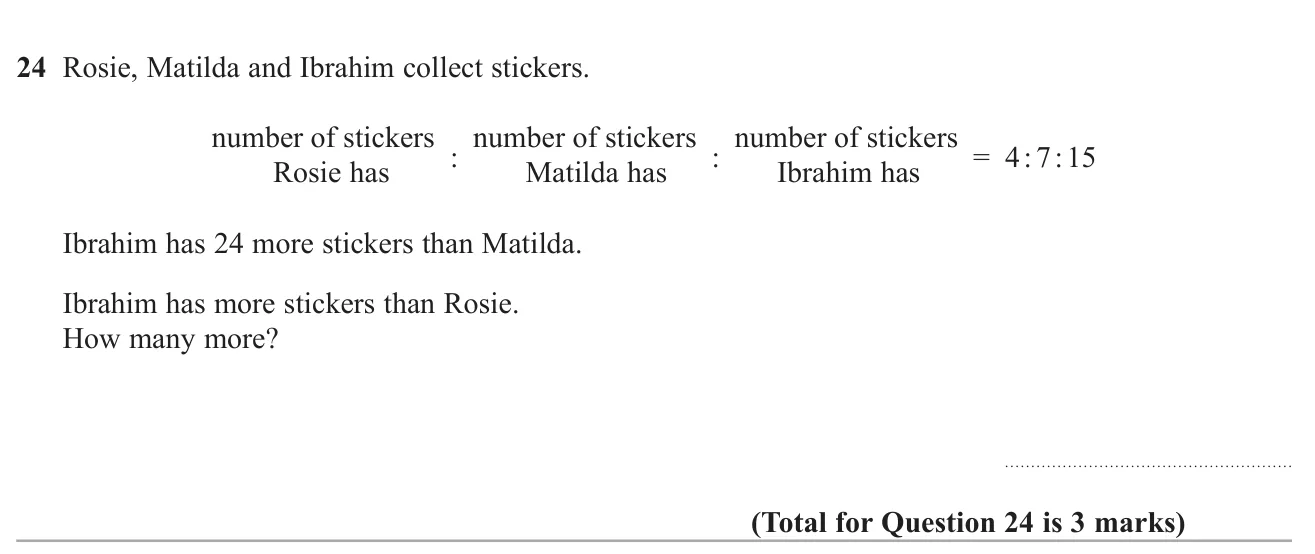
© Pearson Education Ltd. November 2021 Paper 1 (Foundation, non-calculator), question 24.
| Answer | 3 marks |
|---|
Worked solution Checked against the mark scheme
Ibrahim minus Matilda: parts , so 1 part .
Ibrahim minus Rosie: parts.
Watch out: Dividing 24 by 26, the total number of parts.
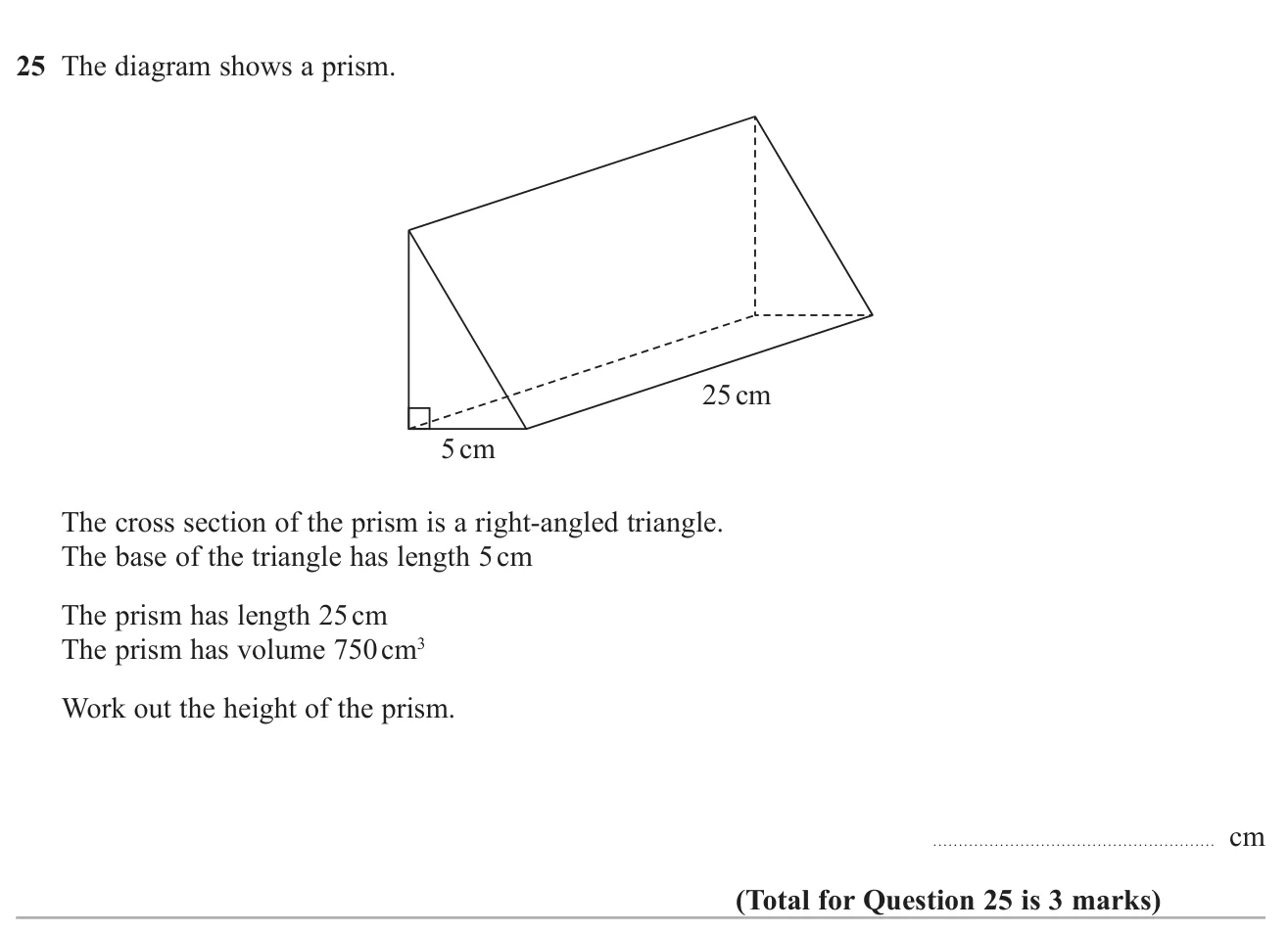
© Pearson Education Ltd. November 2021 Paper 1 (Foundation, non-calculator), question 25.
| Answer | cm | 3 marks |
|---|
Worked solution Checked against the mark scheme
Cross-section area: cm²
Triangle area:
, so cm
Watch out: Forgetting the half in the triangle area and getting 6.
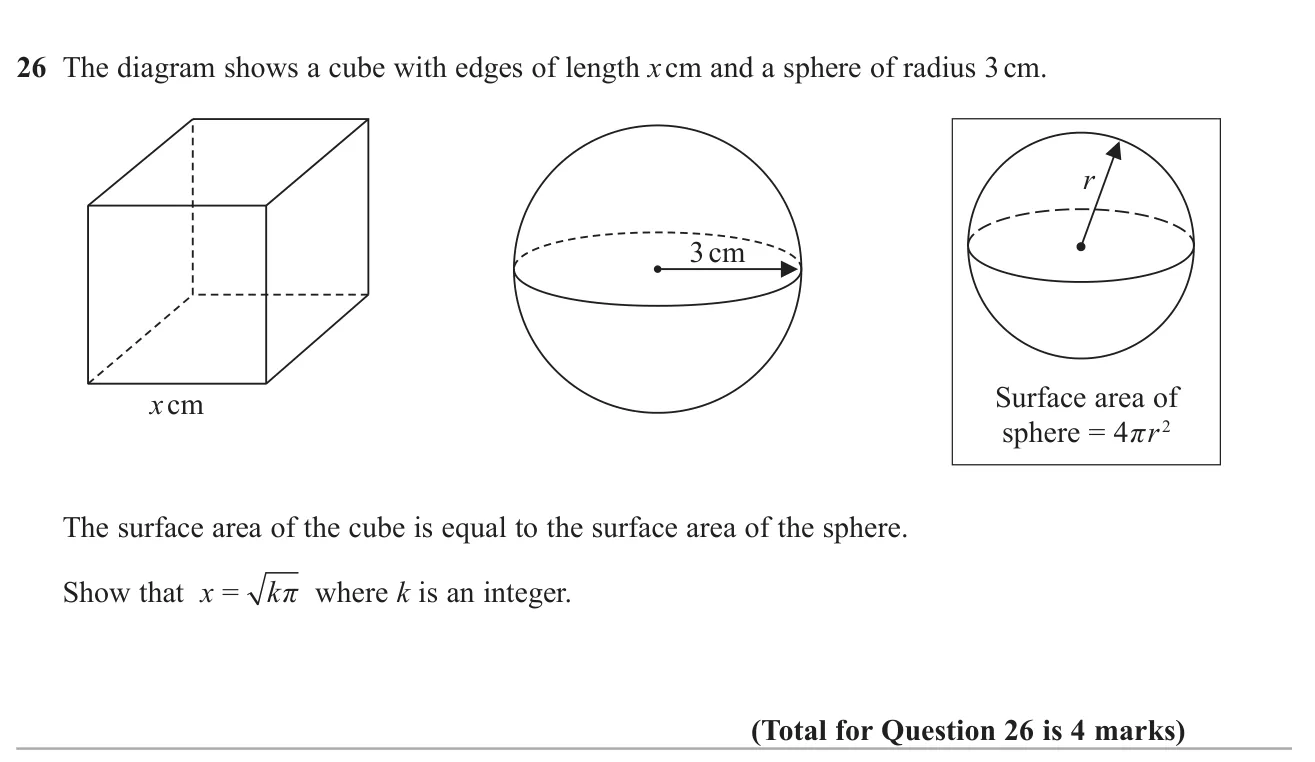
© Pearson Education Ltd. November 2021 Paper 1 (Foundation, non-calculator), question 26.
| Answer | , so () | 4 marks |
|---|
Worked solution Checked against the mark scheme
Cube surface area:
Sphere surface area:
, so , an integer.
Watch out: Using only one face of the cube, .
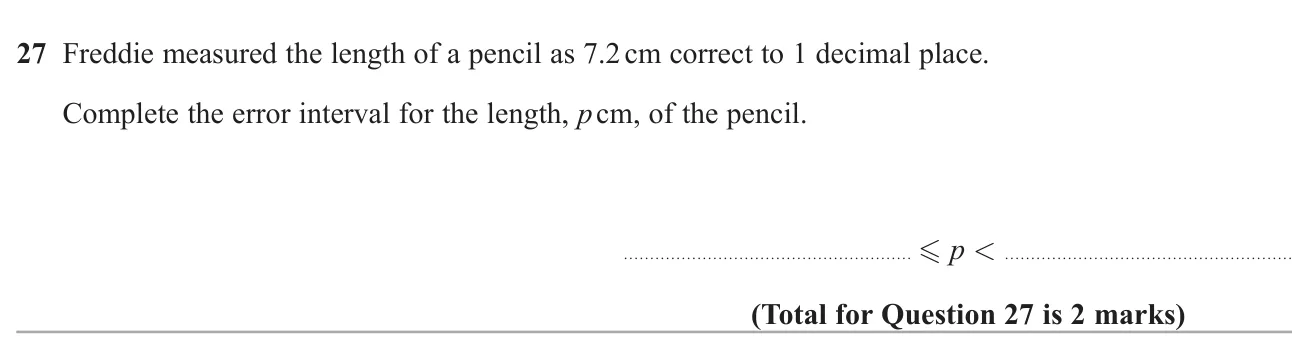
© Pearson Education Ltd. November 2021 Paper 1 (Foundation, non-calculator), question 27.
| Answer | 2 marks |
|---|
Worked solution Checked against the mark scheme
To 1 decimal place, the length could be up to half of 0.1 either side.
and
Watch out: Using 7.1 and 7.3 as the bounds.
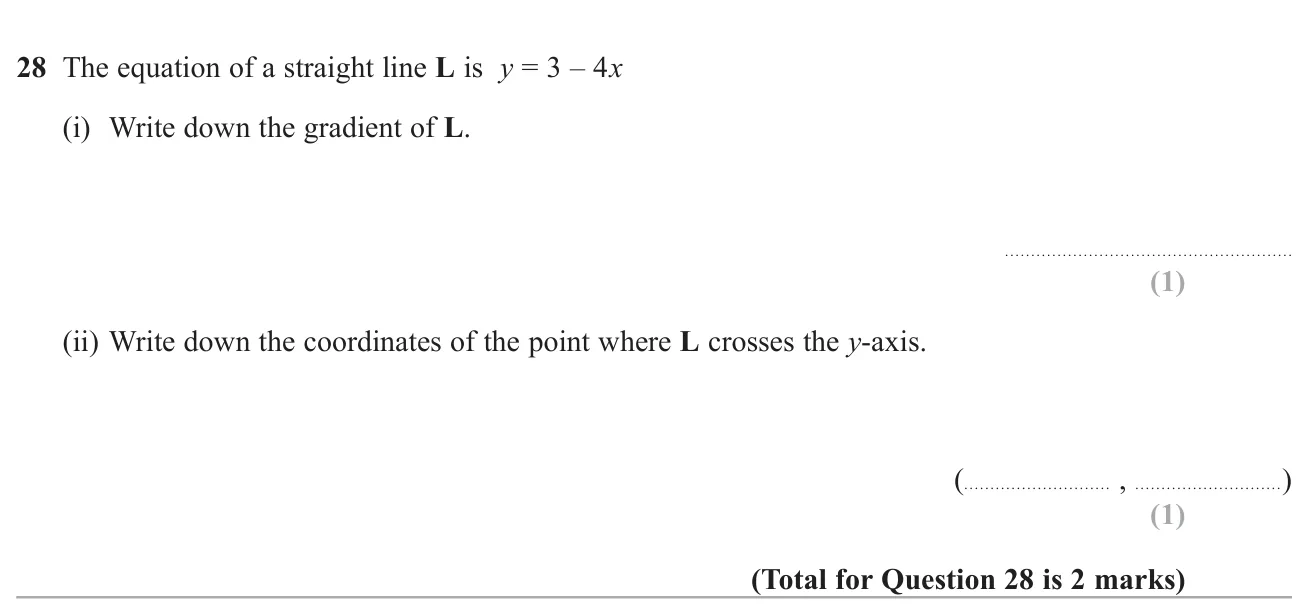
© Pearson Education Ltd. November 2021 Paper 1 (Foundation, non-calculator), question 28.
| (i) | 1 mark | |
|---|---|---|
| (ii) | 1 mark |
Worked solution Checked against the mark scheme
Rewrite as , which is .
(i) Gradient
(ii) The intercept , so it crosses at
Watch out: Giving the gradient as 3 because it comes first.
Add up your marks for all three papers and see what grade that would have been.