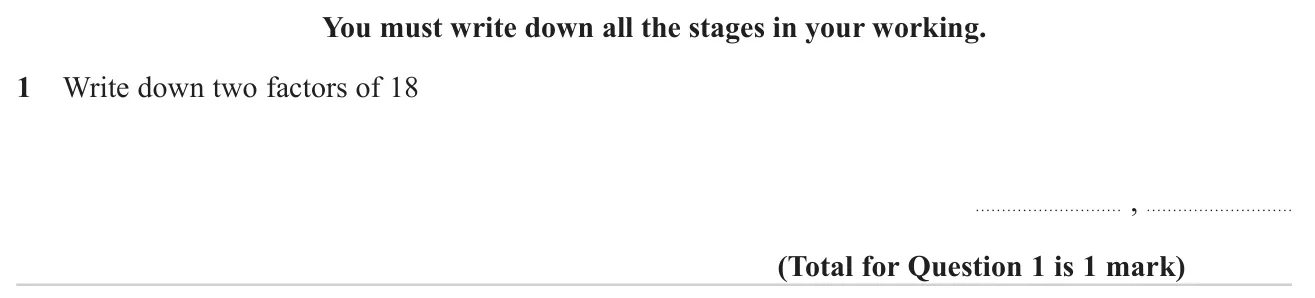
© Pearson Education Ltd. November 2023 Paper 2 (Foundation, calculator), question 1.
Show answer
| Answer | Any two of 1, 2, 3, 6, 9, 18 | 1 mark |
|---|
Worked solution Checked against the mark scheme
Factor pairs of 18: 1×18, 2×9, 3×6.
So the factors are 1, 2, 3, 6, 9 and 18. Any two of these, e.g. 2 and 9.
Watch out: Giving multiples of 18 such as 36 instead of factors.
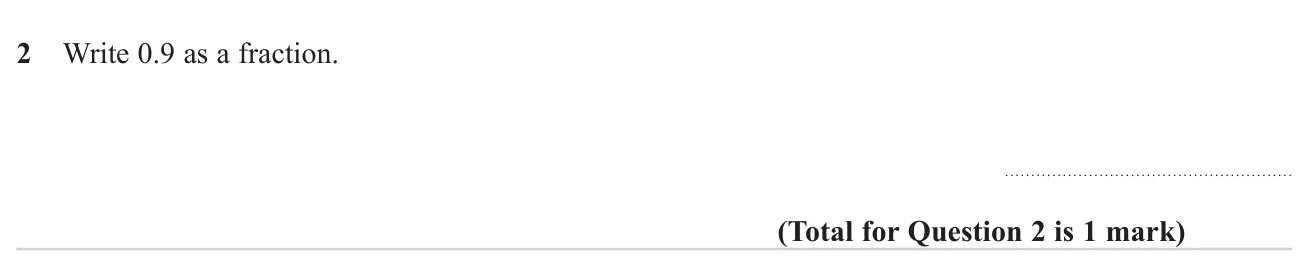
© Pearson Education Ltd. November 2023 Paper 2 (Foundation, calculator), question 2.
Show answer
| Answer | 109 | 1 mark |
|---|
Worked solution Checked against the mark scheme
The 9 is in the tenths column, so 0.9=109.
Watch out: Writing 1009 or 91.
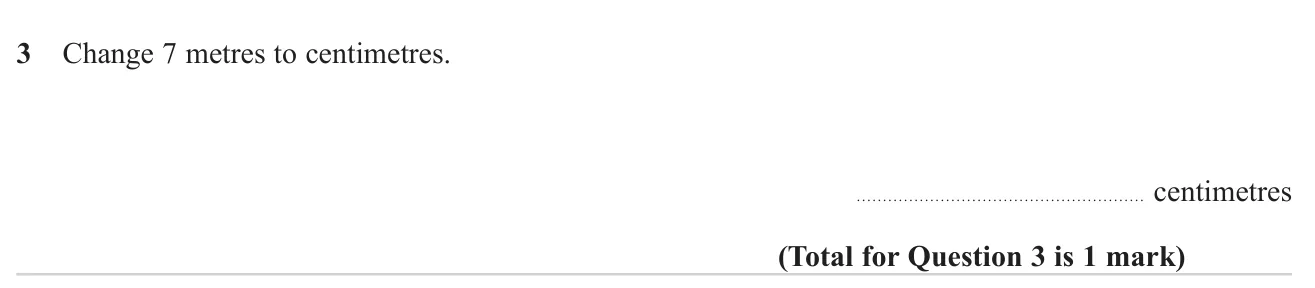
© Pearson Education Ltd. November 2023 Paper 2 (Foundation, calculator), question 3.
Show answer
Worked solution Checked against the mark scheme
There are 100 cm in 1 m.
7×100=700 cm
Watch out: Multiplying by 10 or 1000 instead of 100.
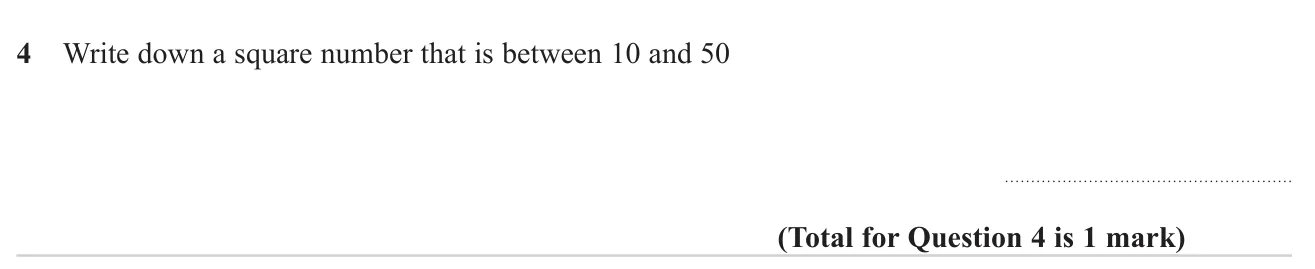
© Pearson Education Ltd. November 2023 Paper 2 (Foundation, calculator), question 4.
Show answer
| Answer | Any one of 16, 25, 36, 49 | 1 mark |
|---|
Worked solution Checked against the mark scheme
Square the whole numbers: 42=16, 52=25, 62=36, 72=49.
Any of these works, e.g. 25.
Watch out: Giving 4 or 5, the square roots, rather than the squares.
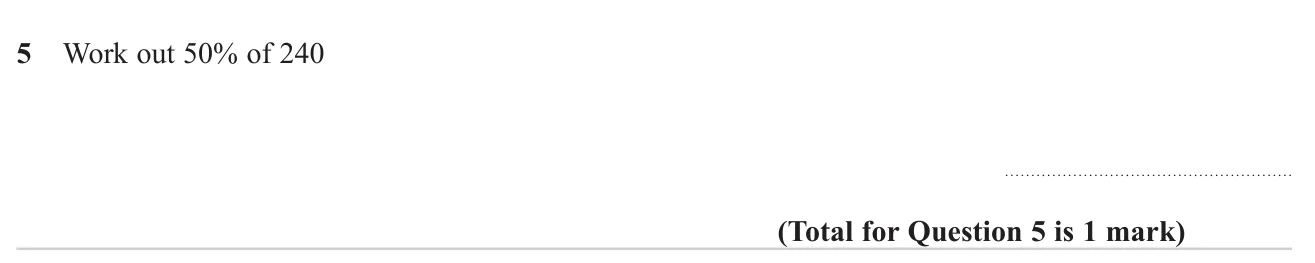
© Pearson Education Ltd. November 2023 Paper 2 (Foundation, calculator), question 5.
Show answer
Worked solution Checked against the mark scheme
50% means half.
240÷2=120
Watch out: Dividing by 50 instead of halving.
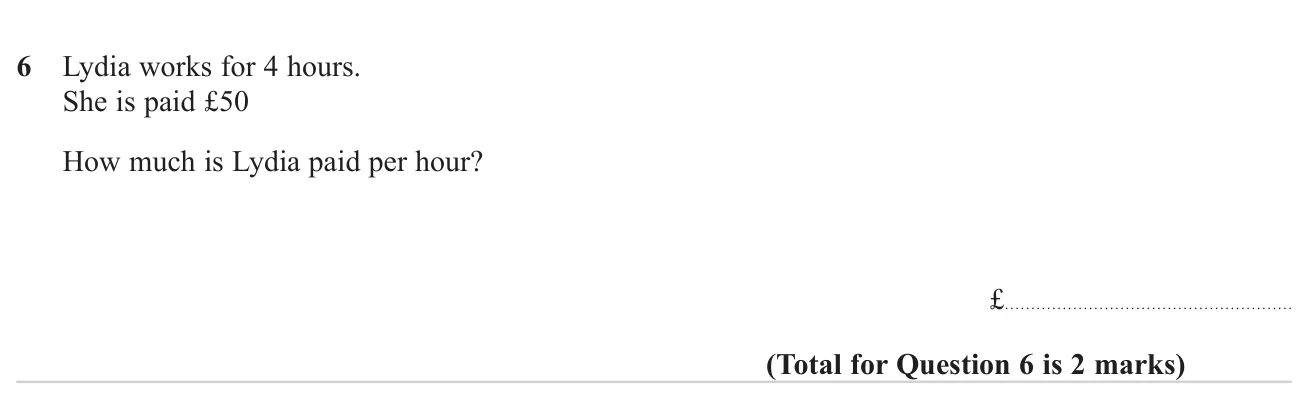
© Pearson Education Ltd. November 2023 Paper 2 (Foundation, calculator), question 6.
Show answer
Worked solution Checked against the mark scheme
Pay per hour = total pay ÷ hours
50÷4=12.5, so £12.50 per hour.
Watch out: Writing £12.5 is fine, but multiplying 50 by 4 to get 200 is not.
© Pearson Education Ltd. November 2023 Paper 2 (Foundation, calculator), question 7.
Show answer
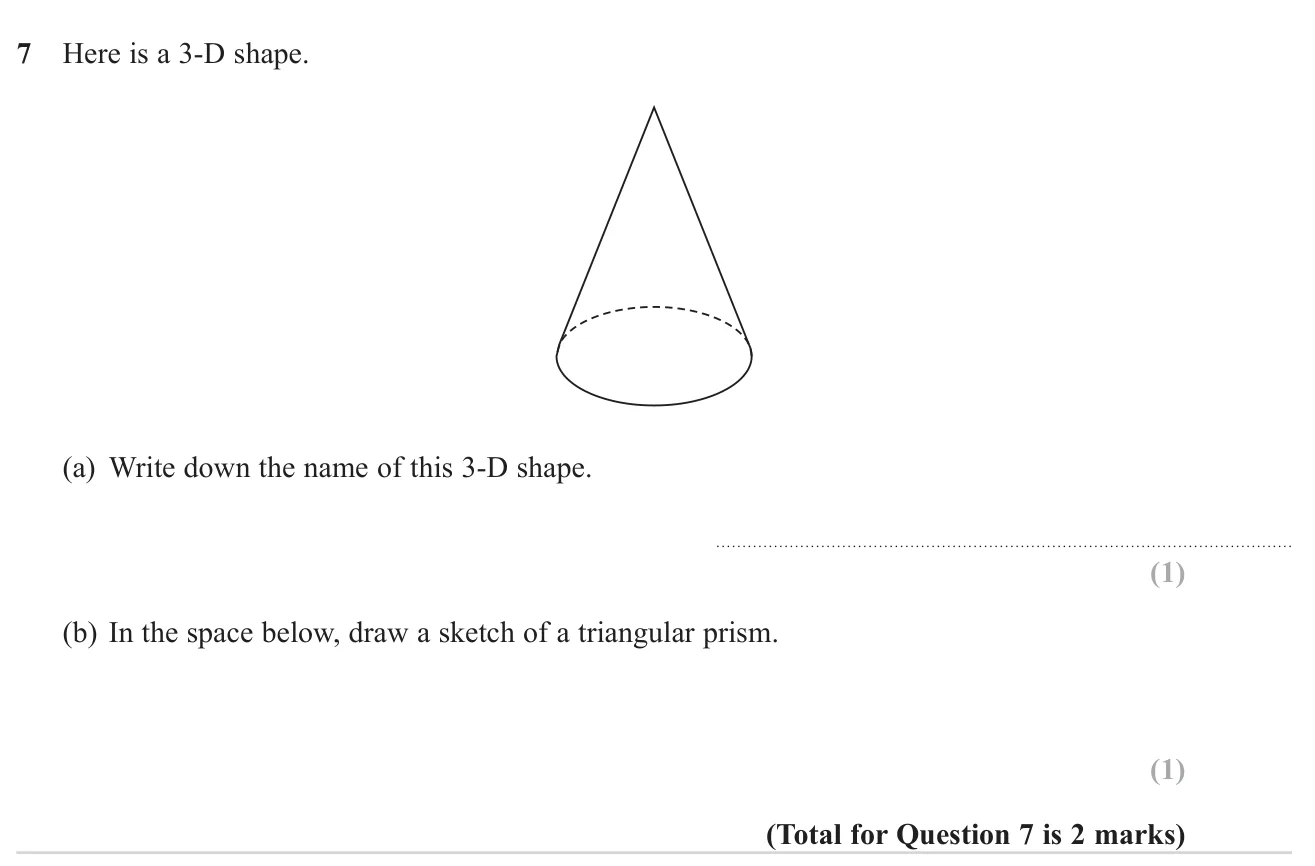
| (a) | Cone | 1 mark |
|---|
| (b) | A sketch of a prism with two triangular ends joined by three rectangular faces | 1 mark |
|---|
Worked solution Checked against the mark scheme
(a) The solid has a circular base and comes to a point at the top, so it is a cone.
(b) Draw a triangle, draw an identical triangle slightly across and up from it, then join matching corners with three parallel lines.
Watch out: In (b), drawing a square-based pyramid or a flat triangle.
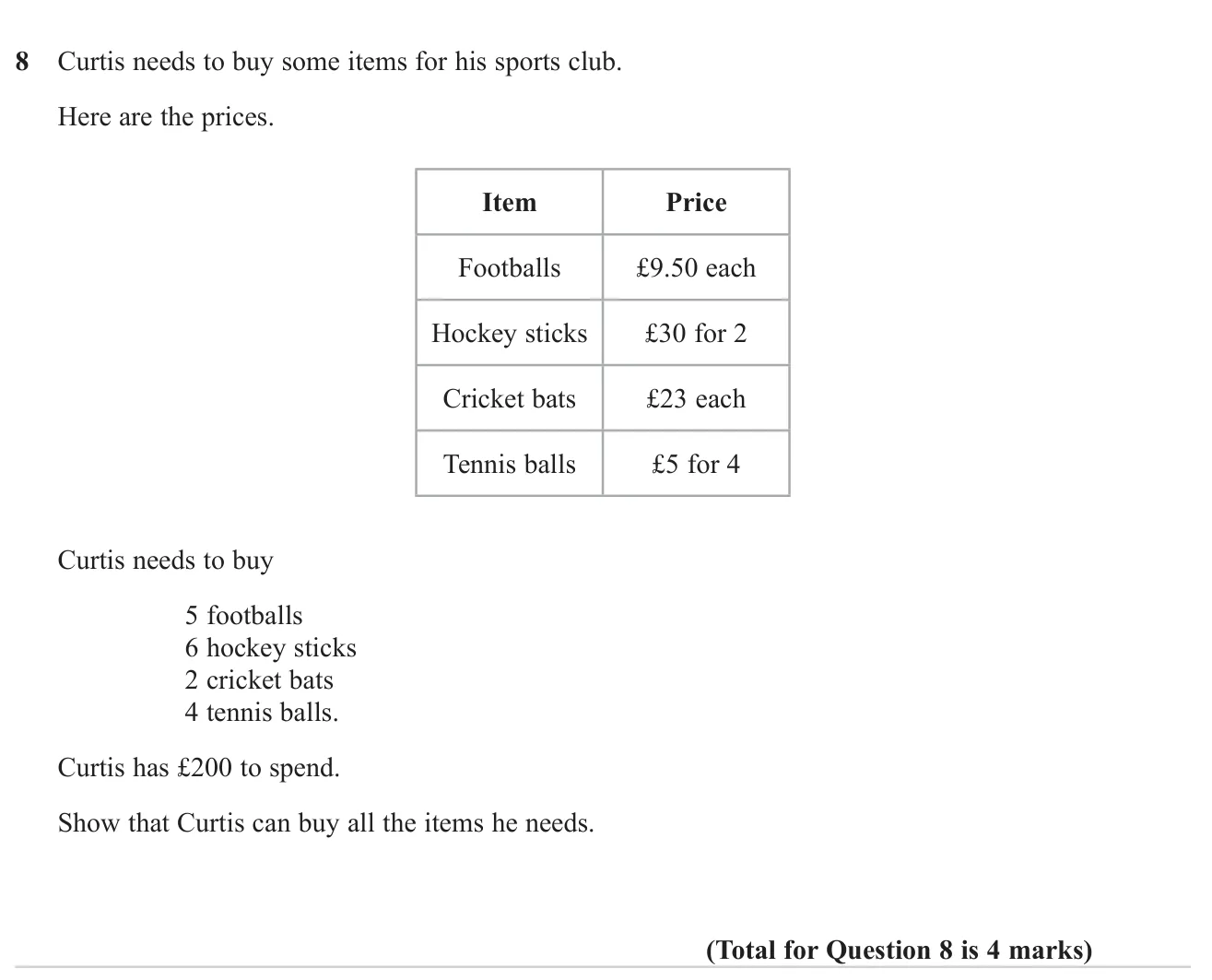
© Pearson Education Ltd. November 2023 Paper 2 (Foundation, calculator), question 8.
Show answer
| Answer | Total cost £188.50, which is less than £200 (or £11.50 left) | 4 marks |
|---|
Worked solution Checked against the mark scheme
Footballs: 5×9.50=47.50
Hockey sticks: 6 sticks is 3 lots of 2, so 3×30=90
Cricket bats: 2×23=46
Tennis balls: 4 balls cost 5
Total =47.50+90+46+5=£188.50, which is less than £200, so he can buy everything.
Watch out: Paying £30 for each hockey stick instead of £30 for every two.
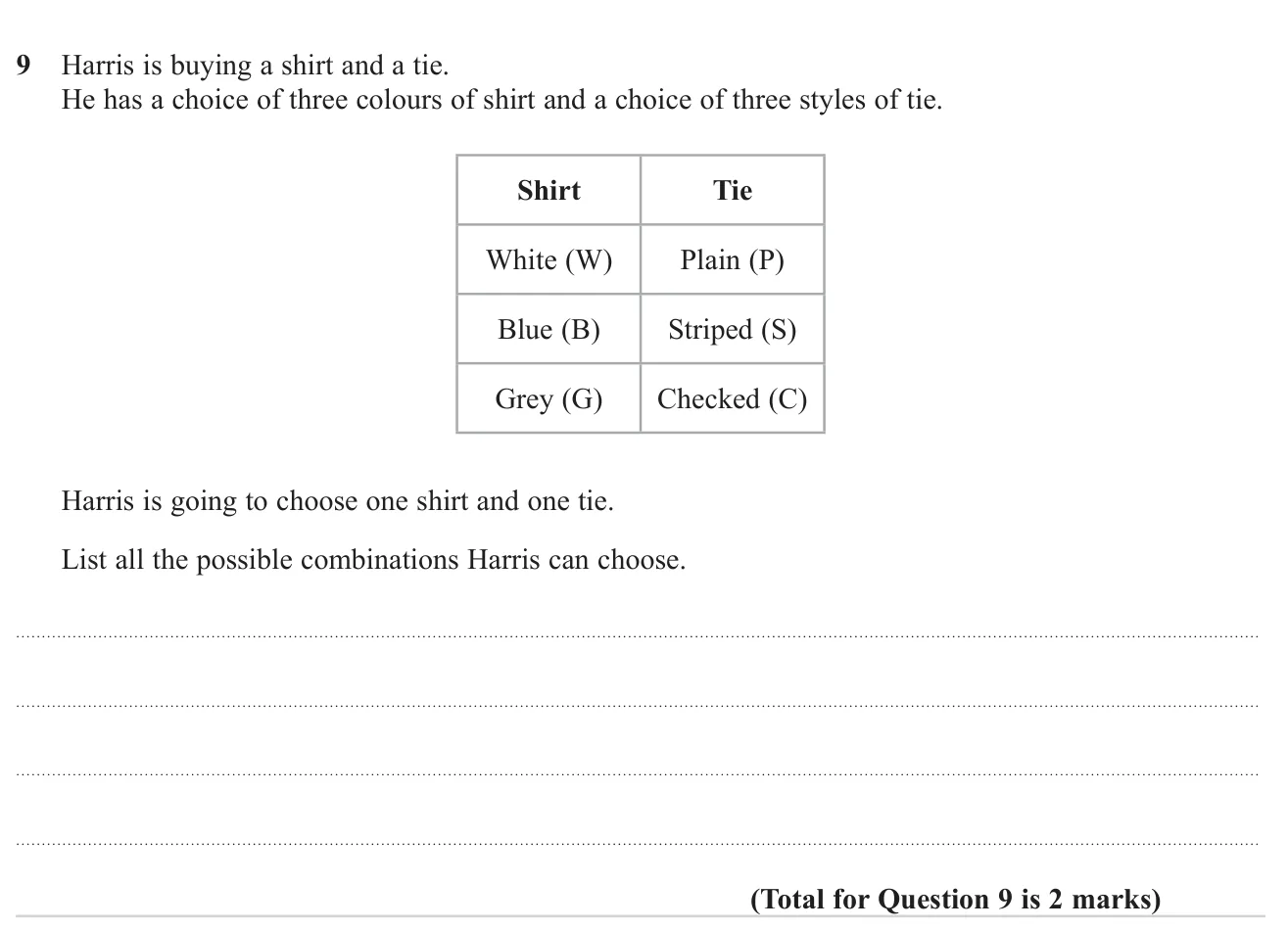
© Pearson Education Ltd. November 2023 Paper 2 (Foundation, calculator), question 9.
Show answer
| Answer | WP, WS, WC, BP, BS, BC, GP, GS, GC | 2 marks |
|---|
Worked solution Checked against the mark scheme
Work systematically: fix the shirt, then go through the ties.
White: WP, WS, WC
Blue: BP, BS, BC
Grey: GP, GS, GC
That is 3×3=9 combinations.
Watch out: Missing combinations by not listing in order.
Question 10
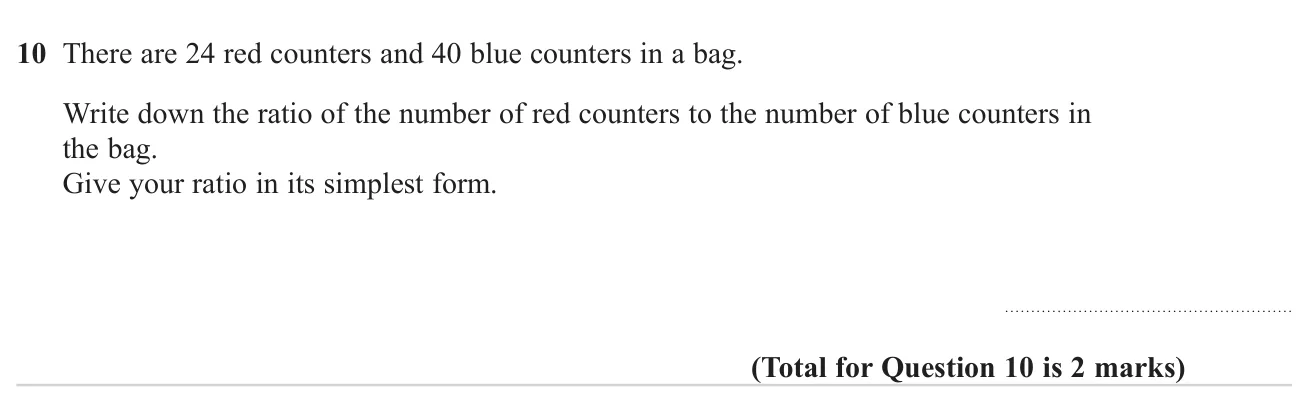
Ratio2 marksGrade 2Calculator © Pearson Education Ltd. November 2023 Paper 2 (Foundation, calculator), question 10.
Show answer
Worked solution Checked against the mark scheme
Red : blue =24:40
The highest common factor of 24 and 40 is 8.
24÷8=3 and 40÷8=5, so the ratio is 3:5.
Watch out: Writing the ratio the wrong way round as 5 : 3.
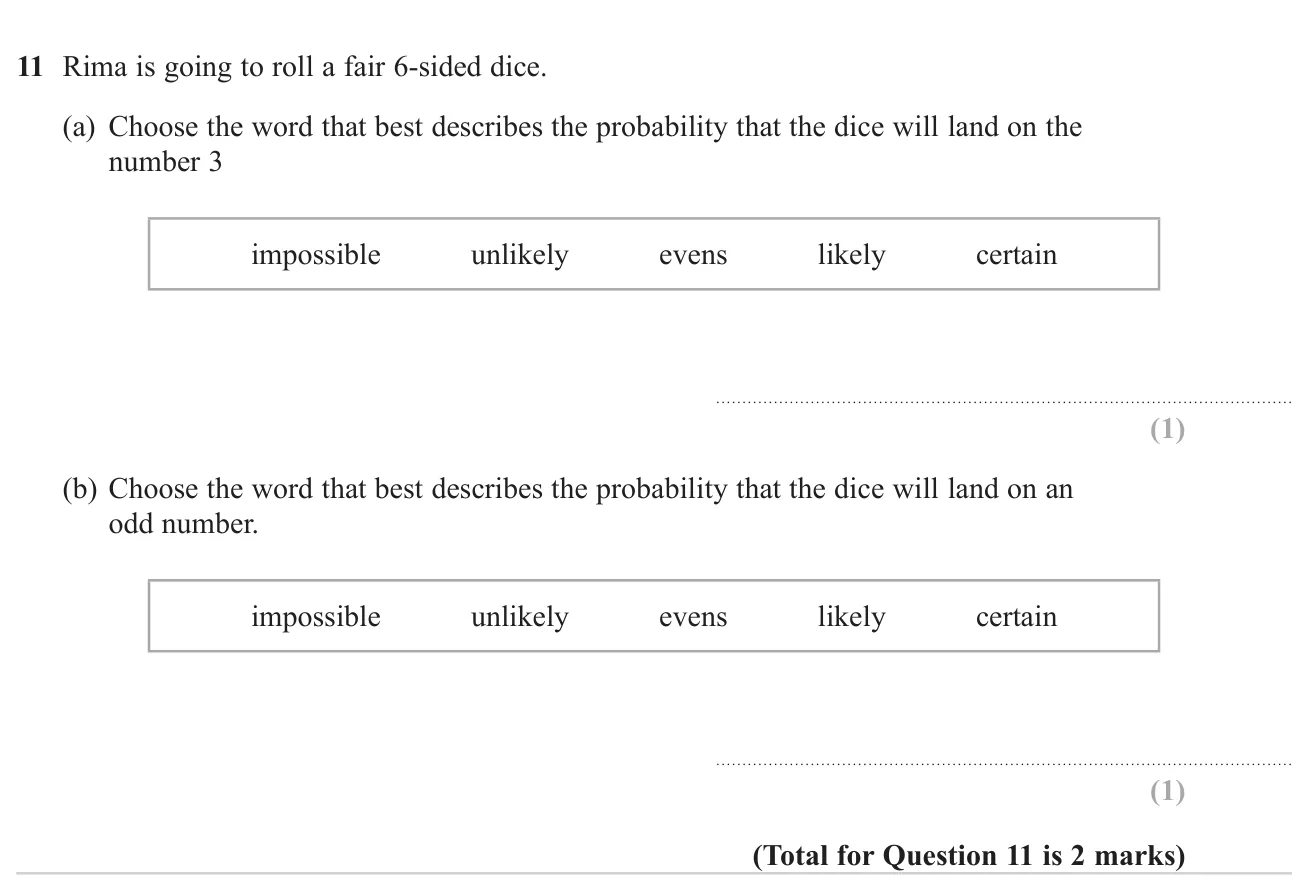
© Pearson Education Ltd. November 2023 Paper 2 (Foundation, calculator), question 11.
Show answer
| (a) | Unlikely | 1 mark |
|---|
| (b) | Evens | 1 mark |
|---|
Worked solution Checked against the mark scheme
(a) Only 1 of the 6 faces is a 3, so the probability is 61: unlikely.
(b) The odd numbers are 1, 3 and 5, so 3 out of 6, which is 21: evens.
Watch out: Calling a 1 in 6 chance impossible.
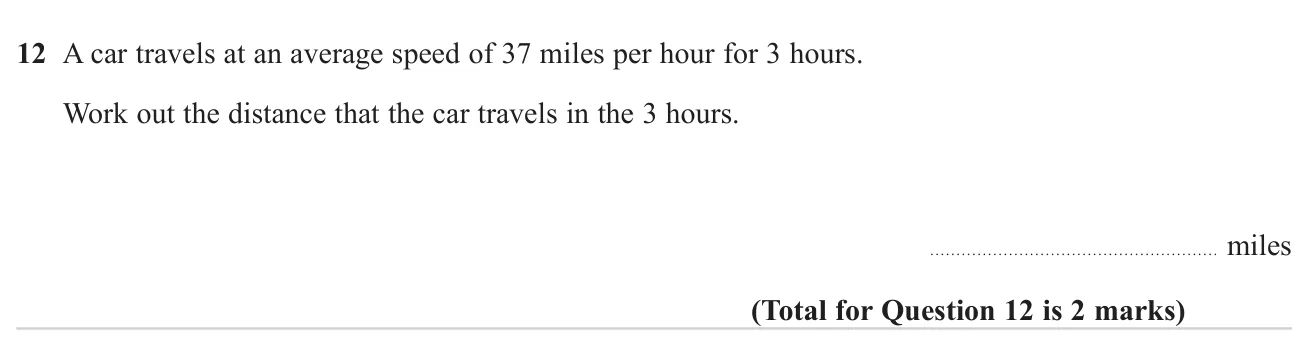
© Pearson Education Ltd. November 2023 Paper 2 (Foundation, calculator), question 12.
Show answer
Worked solution Checked against the mark scheme
Distance = speed × time
37×3=111 miles
Watch out: Dividing 37 by 3 instead of multiplying.
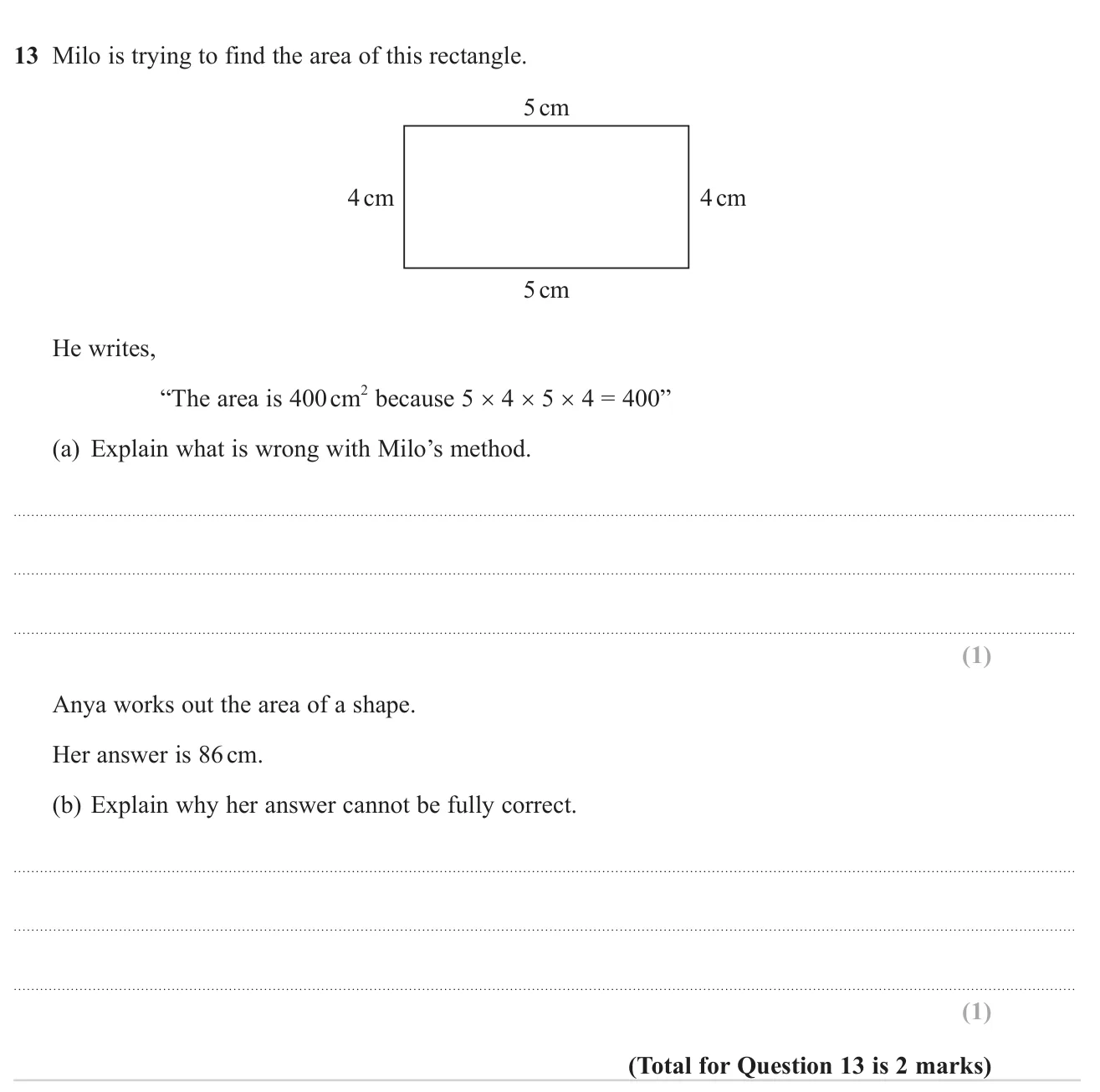
© Pearson Education Ltd. November 2023 Paper 2 (Foundation, calculator), question 13.
Show answer
| (a) | He should only multiply length by width once: 5×4=20 cm2 | 1 mark |
|---|
| (b) | Area must be in square units, e.g. cm², not cm | 1 mark |
|---|
Worked solution Checked against the mark scheme
(a) Area of a rectangle = length × width =5×4=20 cm2. Milo multiplied all four side lengths together, which uses each measurement twice.
(b) Area is measured in square units. An answer in cm is a length, so it should be in cm2.
Watch out: In (a), saying he should have added the sides, which gives the perimeter, not the area.
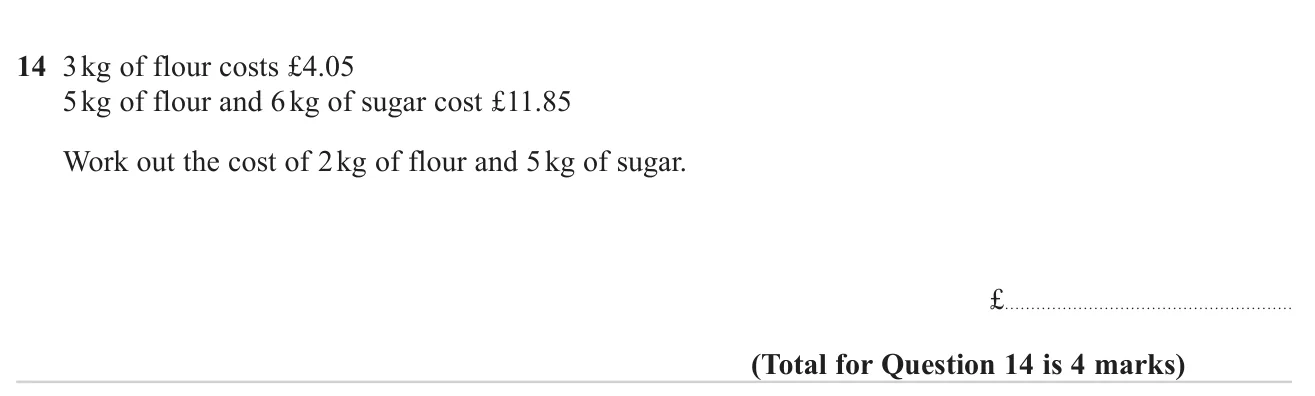
© Pearson Education Ltd. November 2023 Paper 2 (Foundation, calculator), question 14.
Show answer
Worked solution Checked against the mark scheme
1 kg flour: 4.05÷3=1.35
5 kg flour: 5×1.35=6.75, so 6 kg sugar costs 11.85−6.75=5.10
1 kg sugar: 5.10÷6=0.85
2 kg flour + 5 kg sugar =2×1.35+5×0.85=2.70+4.25=£6.95
Watch out: Dividing £11.85 by 11 as if flour and sugar cost the same per kilogram.
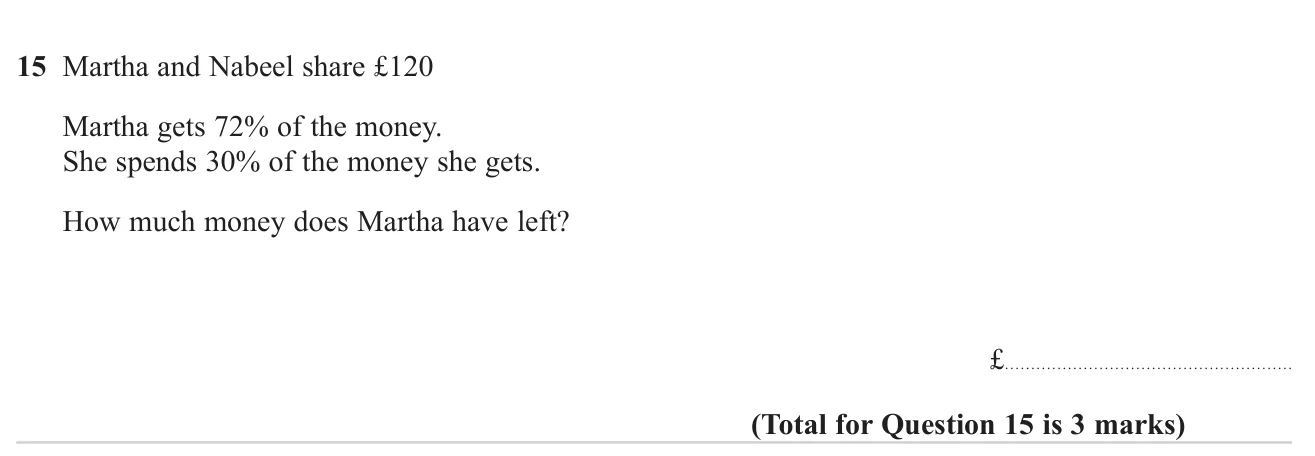
© Pearson Education Ltd. November 2023 Paper 2 (Foundation, calculator), question 15.
Show answer
Worked solution Checked against the mark scheme
Martha's share: 0.72×120=86.40
She keeps 100%−30%=70% of it.
0.7×86.40=£60.48
Watch out: Giving £25.92, the amount she spends, rather than what is left.
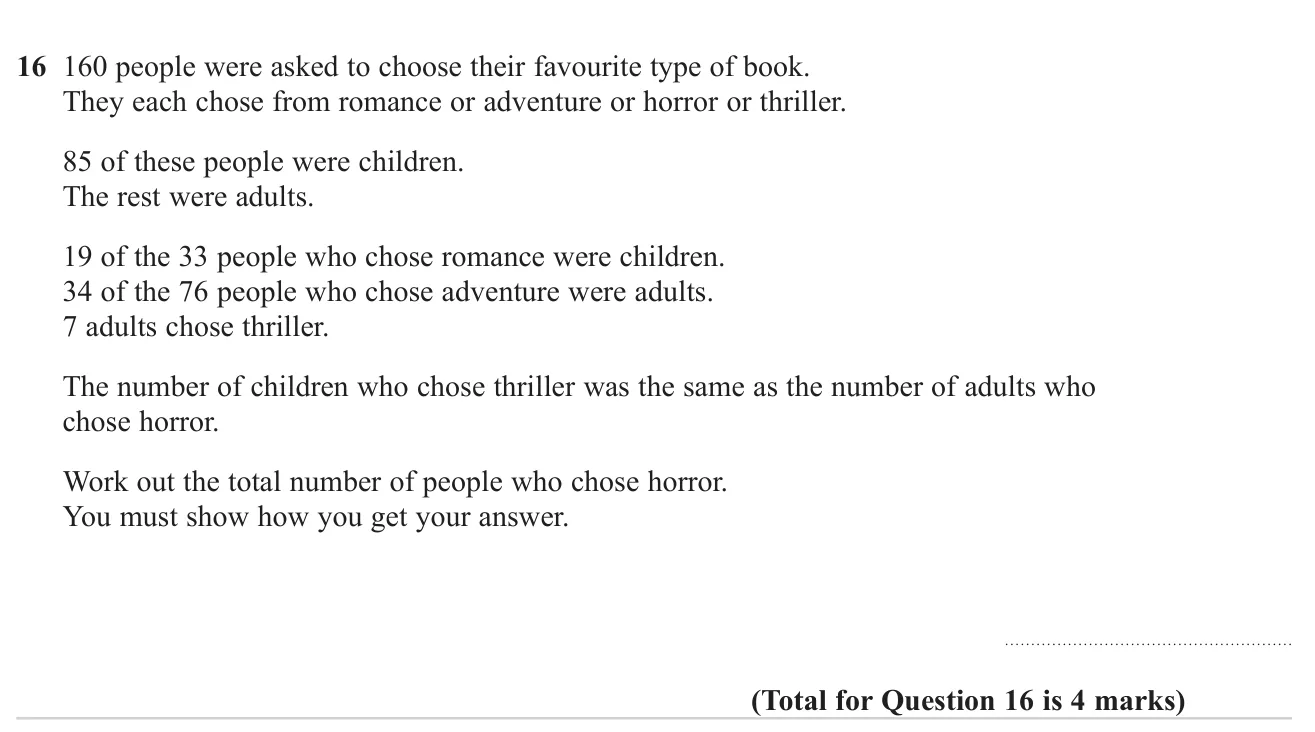
© Pearson Education Ltd. November 2023 Paper 2 (Foundation, calculator), question 16.
Show answer
Worked solution Checked against the mark scheme
Adults: 160−85=75. Adult romance: 33−19=14. Child adventure: 76−34=42.
Adult horror: 75−14−34−7=20, so 20 children chose thriller.
Child horror: 85−19−42−20=4
Total horror: 20+4=24
Watch out: Forgetting that the number of children choosing thriller equals the adult horror number.
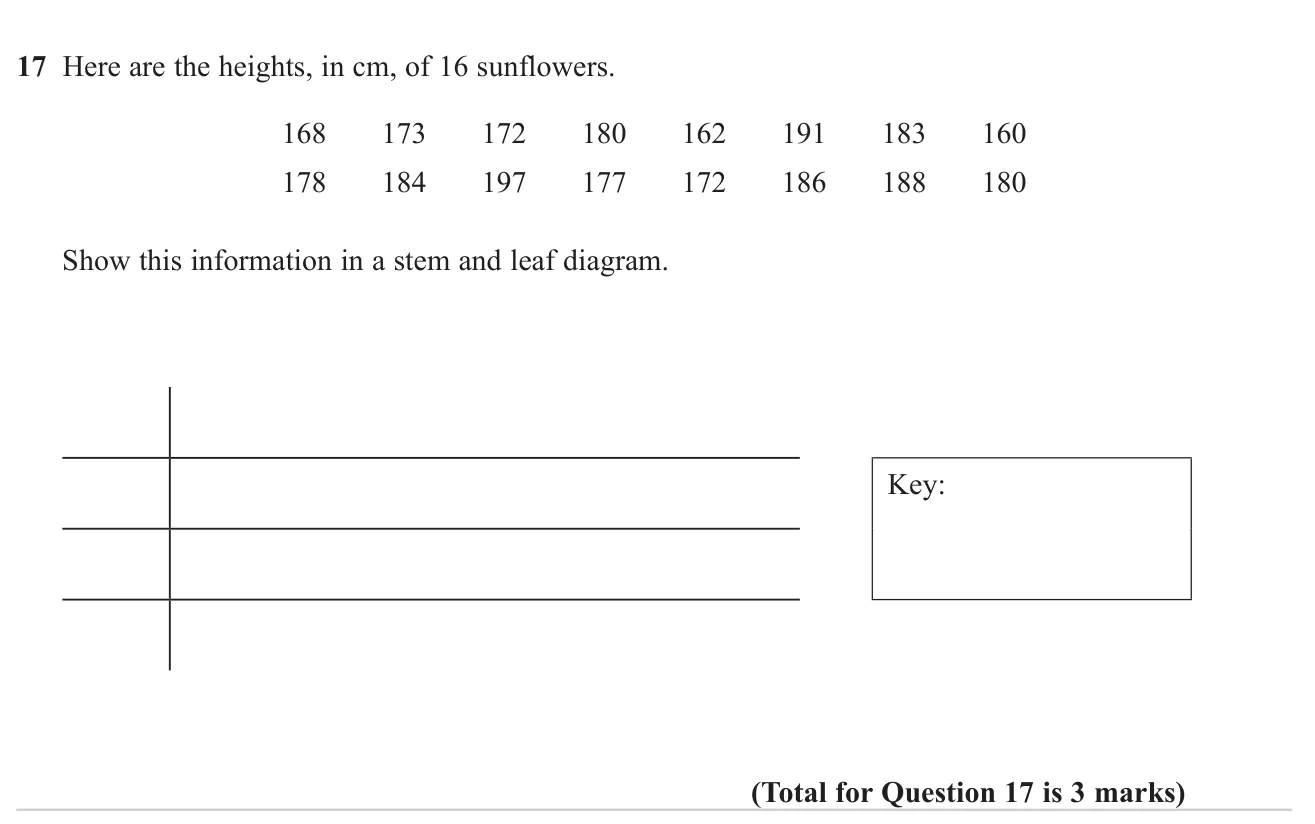
© Pearson Education Ltd. November 2023 Paper 2 (Foundation, calculator), question 17.
Show answer
| Answer | 16 | 0 2 8; 17 | 2 2 3 7 8; 18 | 0 0 3 4 6 8; 19 | 1 7; Key: 16 | 0 means 160 cm | 3 marks |
|---|
Worked solution Checked against the mark scheme
Use the tens-and-hundreds digits as the stem (16, 17, 18, 19) and the units as leaves.
16 | 0 2 8
17 | 2 2 3 7 8
18 | 0 0 3 4 6 8
19 | 1 7
Key: 16 | 0 means 160 cm. Check there are 16 leaves in total.
Watch out: Leaving the leaves out of order or forgetting the key.
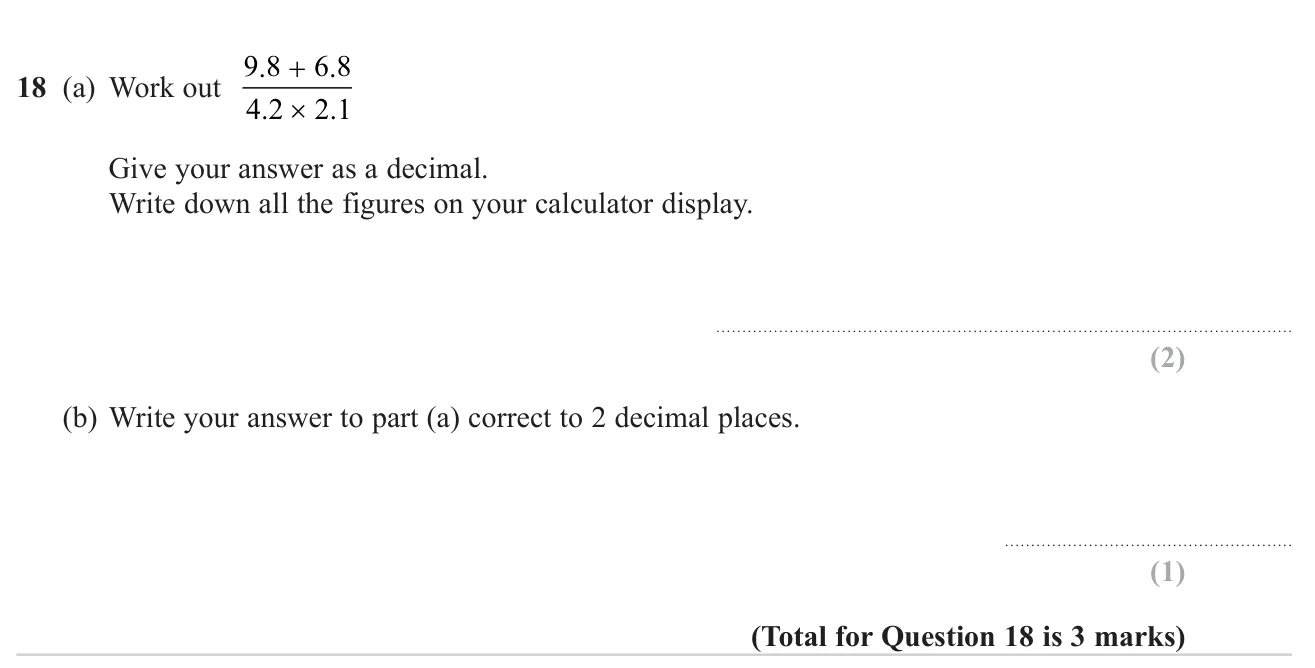
© Pearson Education Ltd. November 2023 Paper 2 (Foundation, calculator), question 18.
Show answer
| (a) | 1.882086168… | 2 marks |
|---|
| (b) | 1.88 | 1 mark |
|---|
Worked solution Checked against the mark scheme
(a) Top: 9.8+6.8=16.6. Bottom: 4.2×2.1=8.82
16.6÷8.82=1.882086168…
(b) The third decimal place is 2, so round down: 1.88
Watch out: Typing it in without brackets, so only 6.8 is divided by 4.2 × 2.1.
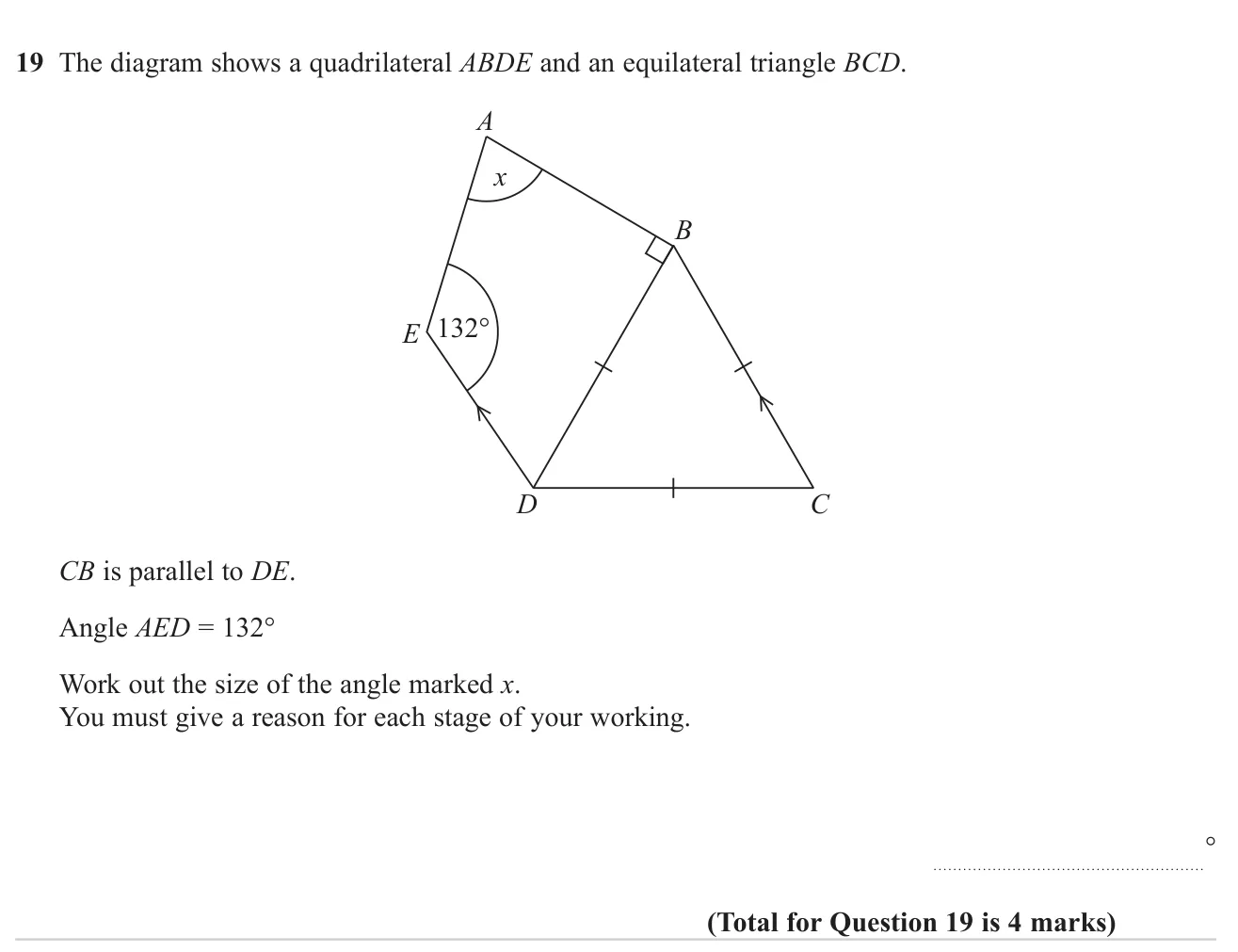
© Pearson Education Ltd. November 2023 Paper 2 (Foundation, calculator), question 19.
Show answer
| Answer | x=78° | 4 marks |
|---|
Worked solution Checked against the mark scheme
Triangle BCD is equilateral, so angle DBC=60° (angles in an equilateral triangle are equal).
Angle BDE=60° (alternate angles are equal, since CB is parallel to DE).
Angle ABD=90° (marked right angle).
Angles in a quadrilateral add up to 360°: x=360−90−60−132=78°
Watch out: Giving reasons like 'Z angles' instead of 'alternate angles are equal'.
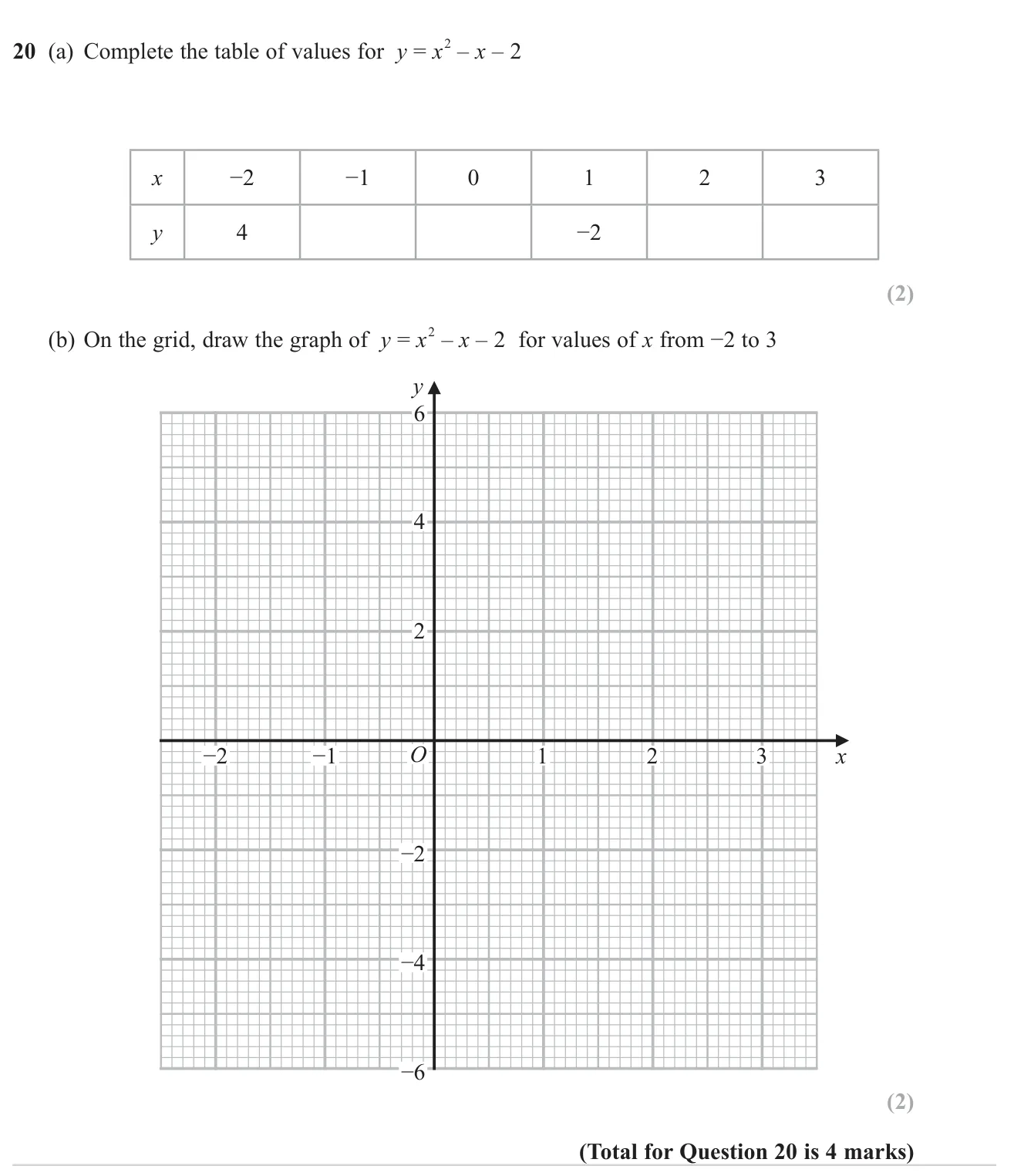
© Pearson Education Ltd. November 2023 Paper 2 (Foundation, calculator), question 20.
Show answer
| (a) | 0,−2,0,4 (for x=−1,0,2,3) | 2 marks |
|---|
| (b) | A smooth U-shaped curve through (−2,4),(−1,0),(0,−2),(1,−2),(2,0),(3,4) | 2 marks |
|---|
Worked solution Checked against the mark scheme
(a) Substitute each x into x2−x−2:
x=−1: 1+1−2=0; x=0: −2; x=2: 4−2−2=0; x=3: 9−3−2=4
(b) Plot the six points and join them with a smooth curve. The lowest point is between x=0 and x=1, just below −2.
Watch out: Working out (−1)2 as −1, giving the wrong value at x=−1.
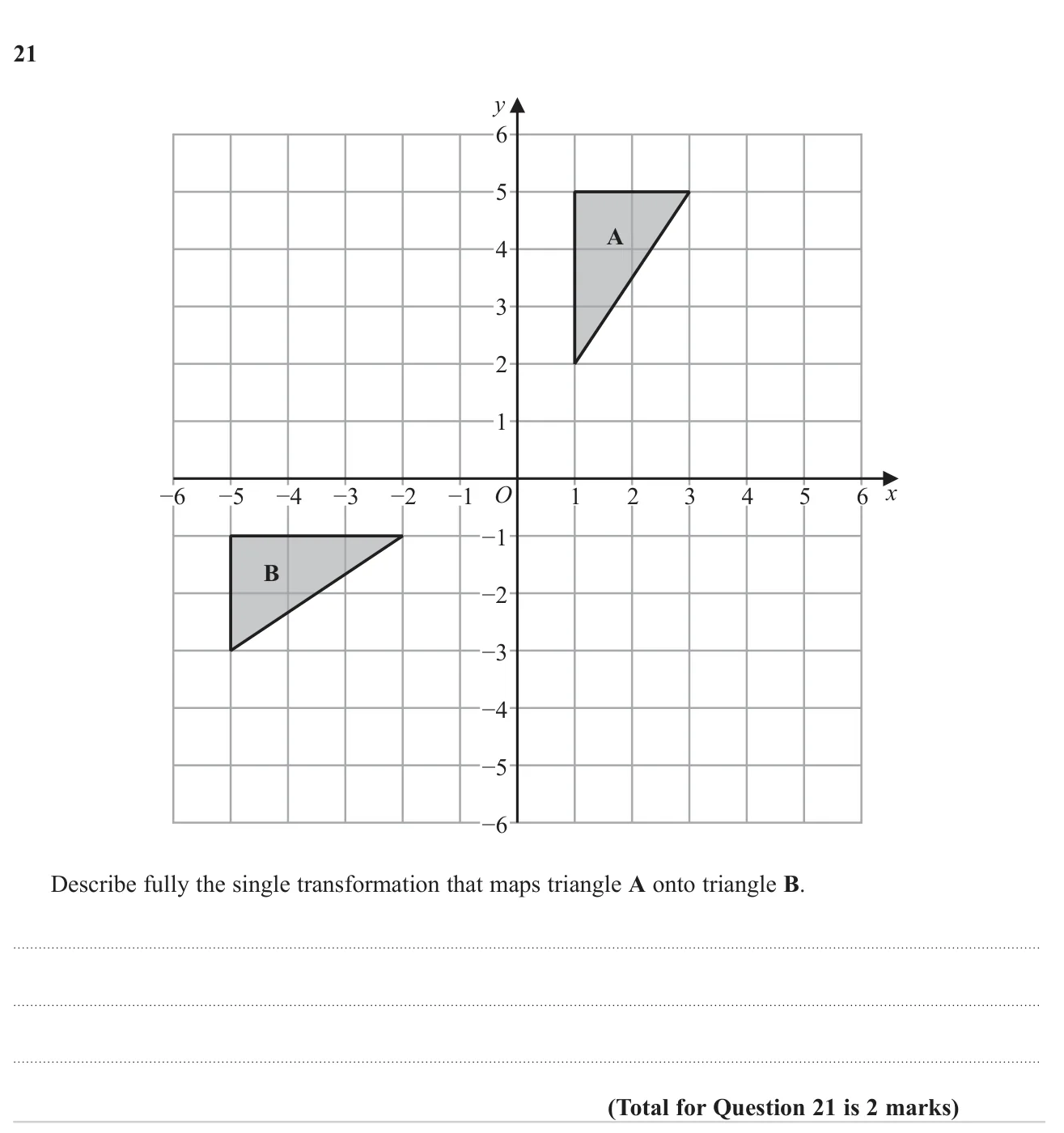
© Pearson Education Ltd. November 2023 Paper 2 (Foundation, calculator), question 21.
Show answer
| Answer | Reflection in the line y=−x | 2 marks |
|---|
Worked solution Checked against the mark scheme
Corners of A: (1,5),(3,5),(1,2). Corners of B: (−5,−1),(−5,−3),(−2,−1).
Each point (a,b) goes to (−b,−a), which is a reflection.
The mirror line is y=−x, so the answer is **reflection in the line y=−x**.
Watch out: Calling it a rotation of 180° or using the line y = x.
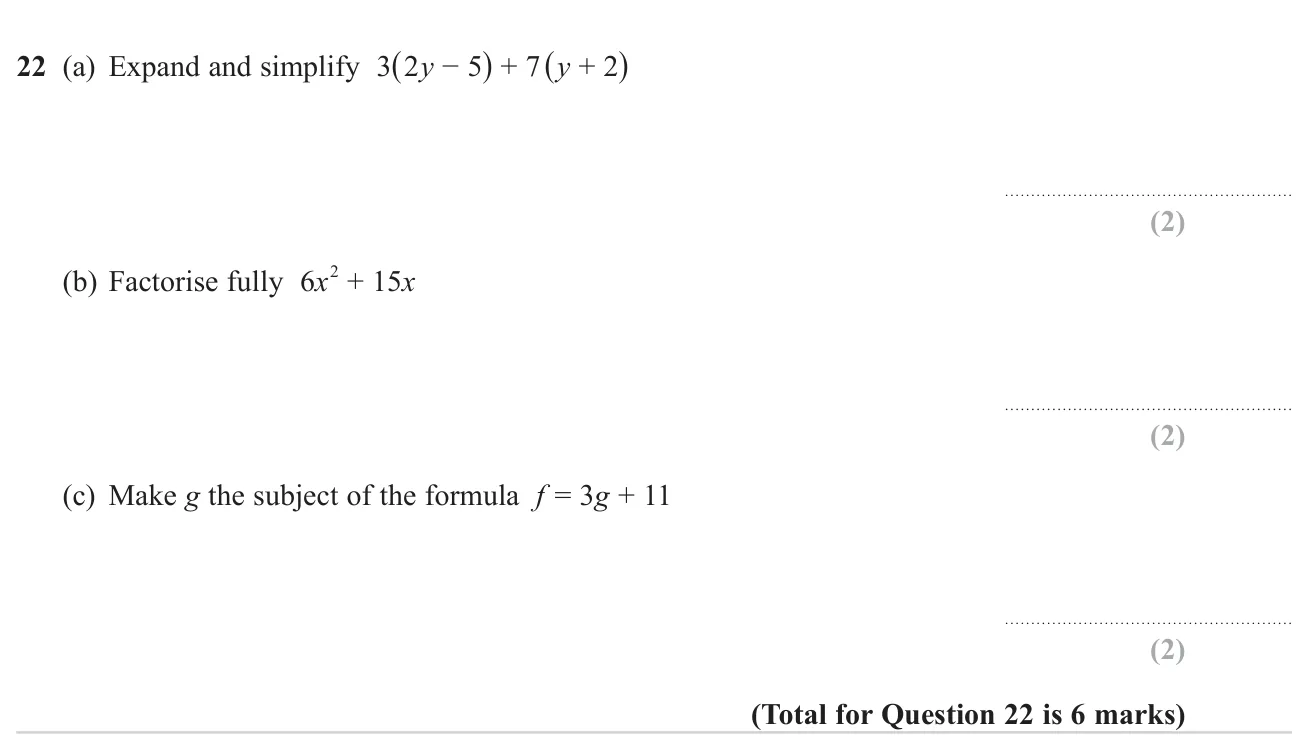
© Pearson Education Ltd. November 2023 Paper 2 (Foundation, calculator), question 22.
Show answer
| (a) | 13y−1 | 2 marks |
|---|
| (b) | 3x(2x+5) | 2 marks |
|---|
| (c) | g=3f−11 | 2 marks |
|---|
Worked solution Checked against the mark scheme
(a) 6y−15+7y+14=13y−1
(b) The HCF of 6x2 and 15x is 3x: 6x2+15x=3x(2x+5)
(c) f−11=3g, so g=3f−11
Watch out: In (b), taking out only 3 or only x, so the answer is not fully factorised.
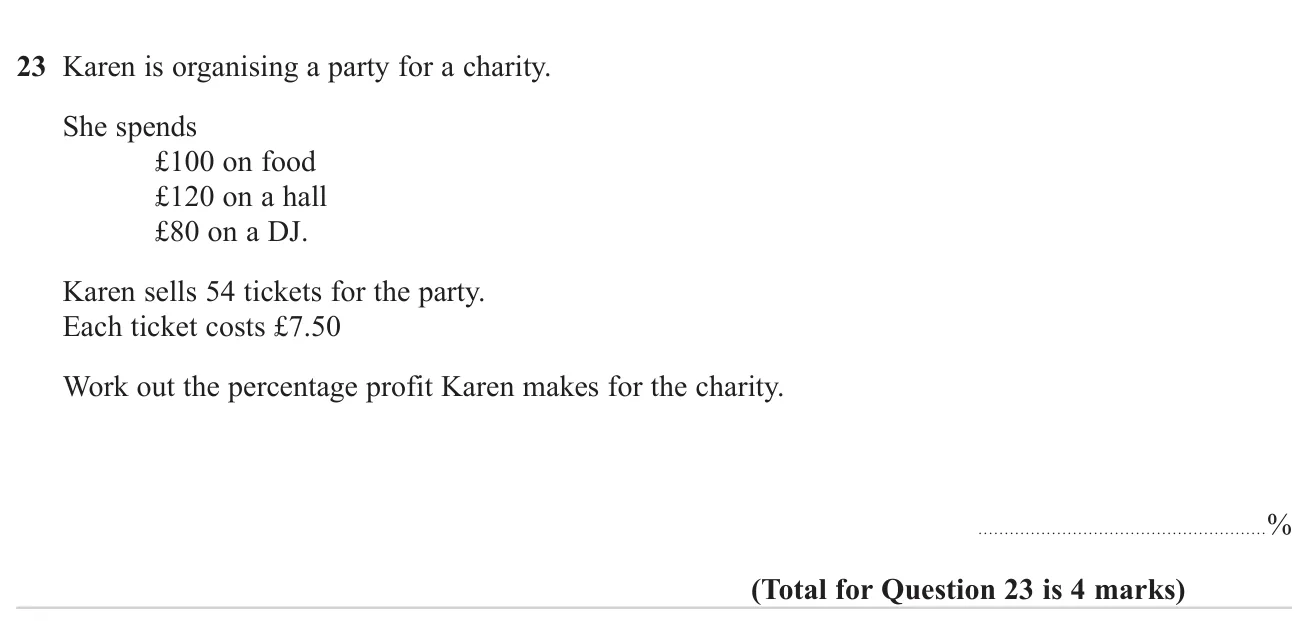
© Pearson Education Ltd. November 2023 Paper 2 (Foundation, calculator), question 23.
Show answer
Worked solution Checked against the mark scheme
Income: 54×7.50=£405
Costs: 100+120+80=£300
Profit: 405−300=£105
Percentage profit =300105×100=35%
Watch out: Dividing the profit by the income (405) instead of the costs.
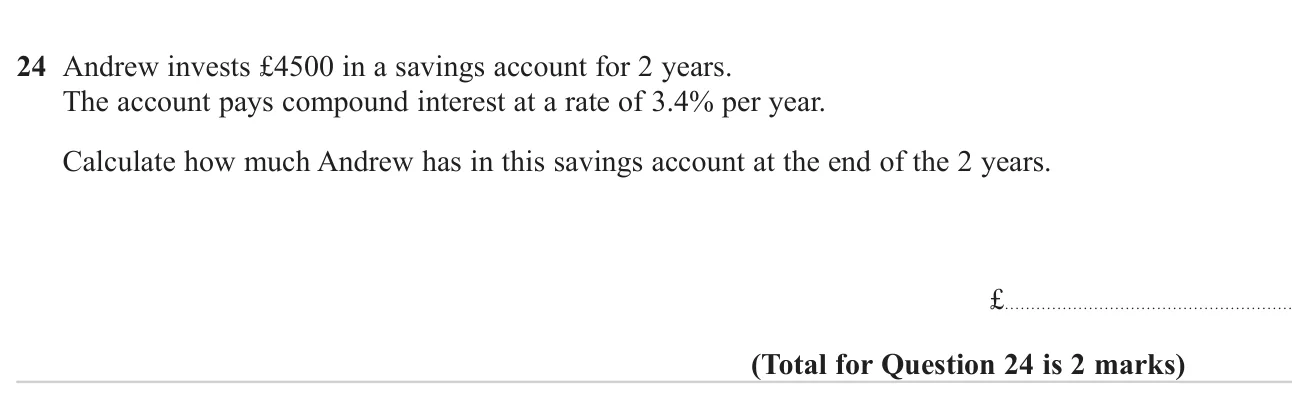
© Pearson Education Ltd. November 2023 Paper 2 (Foundation, calculator), question 24.
Show answer
Worked solution Checked against the mark scheme
Multiplier for 3.4% interest: 1.034
4500×1.0342=4811.202, so £4811.20
Watch out: Using simple interest to get £4806.
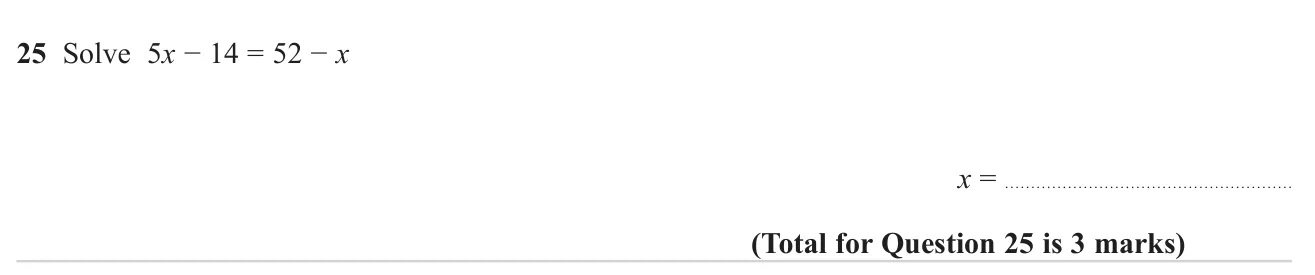
© Pearson Education Ltd. November 2023 Paper 2 (Foundation, calculator), question 25.
Show answer
| Answer | x=11 | 3 marks |
|---|
Worked solution Checked against the mark scheme
Add x to both sides: 6x−14=52
Add 14 to both sides: 6x=66
x=11
Watch out: Subtracting x instead of adding it, giving 4x.
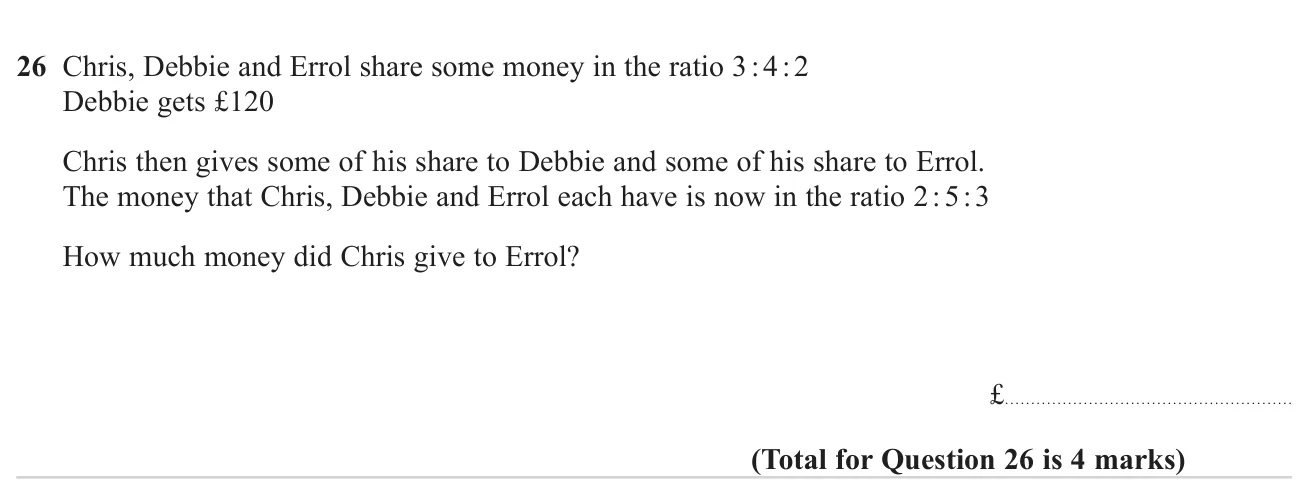
© Pearson Education Ltd. November 2023 Paper 2 (Foundation, calculator), question 26.
Show answer
Worked solution Checked against the mark scheme
Debbie has 4 parts =120, so 1 part =30 and the total is 9×30=270.
At first Errol has 2×30=60.
New ratio has 2+5+3=10 parts, so 1 part =27 and Errol now has 3×27=81.
Chris gave Errol 81−60=£21
Watch out: Assuming Debbie still has £120 after the change.
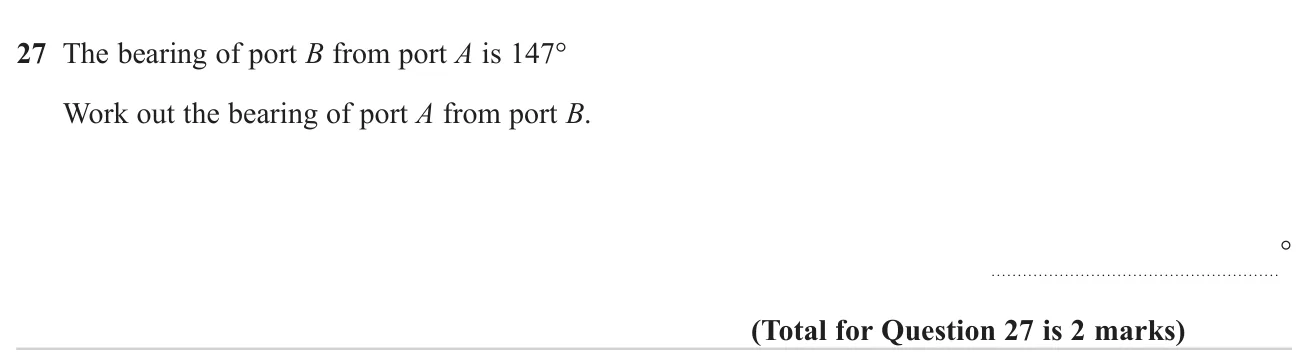
© Pearson Education Ltd. November 2023 Paper 2 (Foundation, calculator), question 27.
Show answer
Worked solution Checked against the mark scheme
The return bearing differs by 180°.
147+180=327°
Watch out: Subtracting from 360 to give 213°.
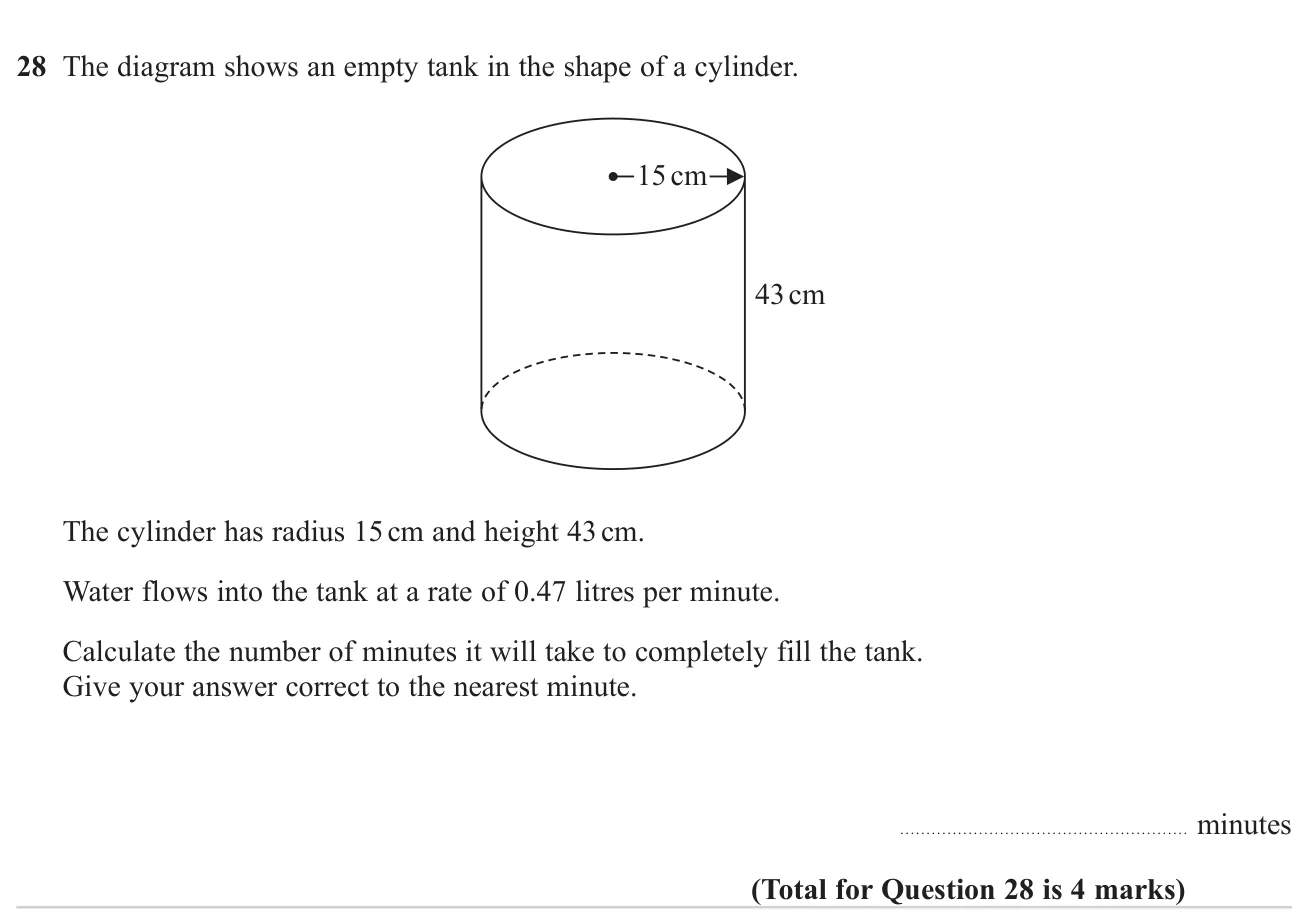
© Pearson Education Ltd. November 2023 Paper 2 (Foundation, calculator), question 28.
Show answer
Worked solution Checked against the mark scheme
Volume =π×152×43=30394.9… cm3
1000 cm3=1 litre, so this is 30.3949… litres.
Time =30.3949÷0.47=64.67…, so 65 minutes
Watch out: Forgetting to convert cm³ to litres.
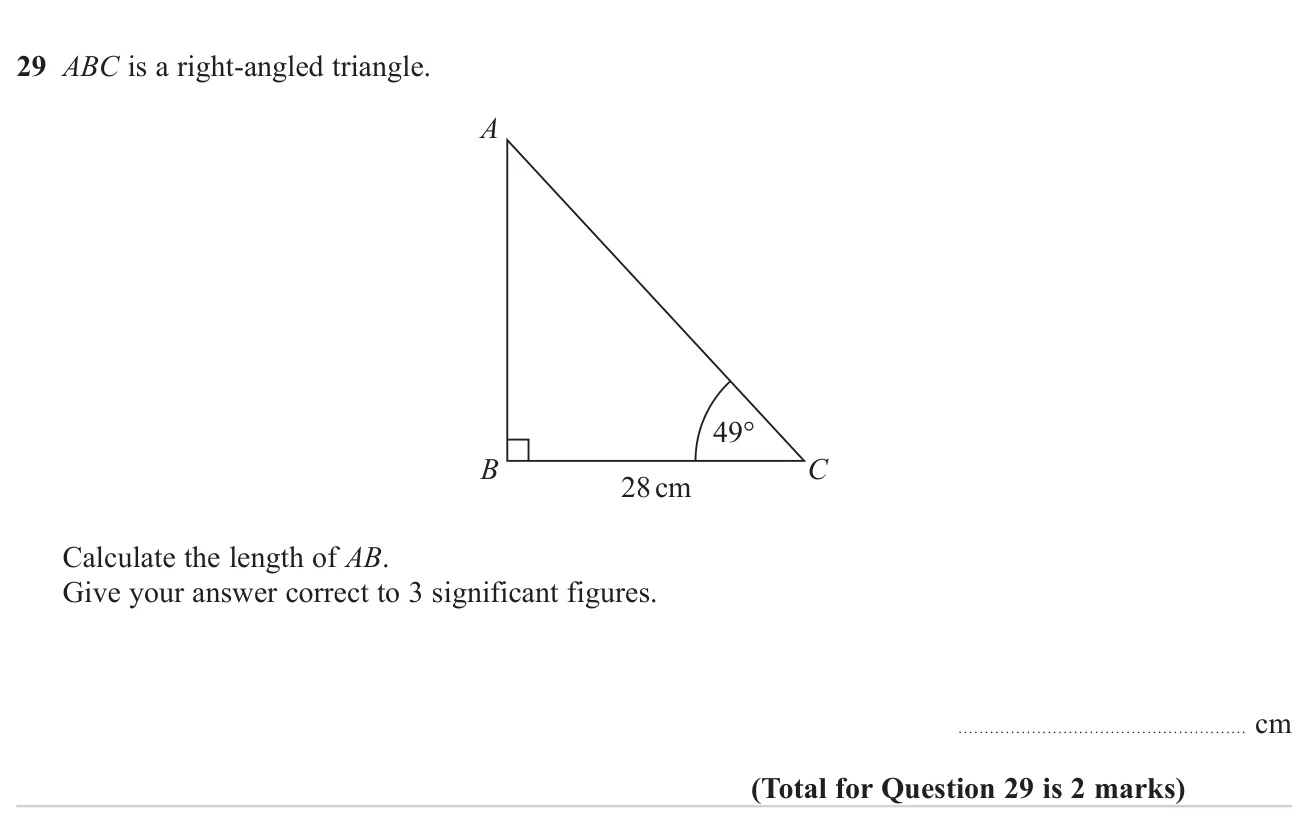
© Pearson Education Ltd. November 2023 Paper 2 (Foundation, calculator), question 29.
Show answer
Worked solution Checked against the mark scheme
AB is opposite the 49° angle and BC (28 cm) is adjacent, so use tan.
AB=28×tan49°=32.21…
So AB=32.2 cm (3 s.f.)
Watch out: Using sin or cos instead of tan.
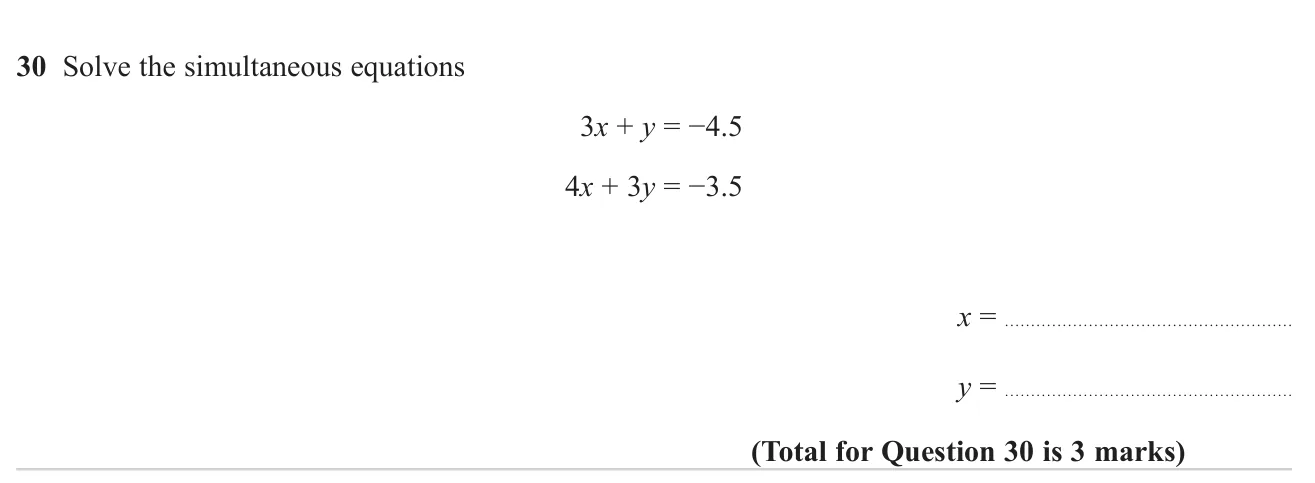
© Pearson Education Ltd. November 2023 Paper 2 (Foundation, calculator), question 30.
Show answer
| Answer | x=−2, y=1.5 | 3 marks |
|---|
Worked solution Checked against the mark scheme
Multiply the first equation by 3: 9x+3y=−13.5
Subtract the second: 5x=−10, so x=−2
Substitute: 3(−2)+y=−4.5, so y=1.5
Watch out: Getting the sign wrong when subtracting negative numbers.
Finished the paper?
Add up your marks for all three papers and see what grade that would have been.