Revision guide by The Full Marks
Volume and surface area: what you need to know Volume is the space inside a solid, and surface area is the total area of its outside. Questions on both tiers use cuboids, prisms, cylinders, pyramids, cones and spheres; Higher papers add harder composite solids and frustums, often with answers in terms of π \pi π
Both tiers need cuboids, prisms, cylinders, pyramids, cones and spheres; the harder composite and frustum questions appear mostly on Higher papers.
Key facts Prism (including a cuboid): volume = = = × \times × Cylinder: V = π r 2 h V = \pi r^2 h V = π r 2 h = 2 π r h = 2\pi r h = 2 π r h = 2 π r 2 + 2 π r h = 2\pi r^2 + 2\pi r h = 2 π r 2 + 2 π r h Pyramid: V = 1 3 × V = \frac{1}{3} \times V = 3 1 × × \times × V = 1 3 π r 2 h V = \frac{1}{3}\pi r^2 h V = 3 1 π r 2 h = π r l = \pi r l = π r l l l l Sphere: V = 4 3 π r 3 V = \frac{4}{3}\pi r^3 V = 3 4 π r 3 = 4 π r 2 = 4\pi r^2 = 4 π r 2 1 1 1 3 = 1 ^3 = 1 3 = 1 1000 1000 1000 3 = 1 ^3 = 1 3 = 1 1 1 1 3 = 1 000 000 ^3 = 1\,000\,000 3 = 1 000 000 3 ^3 3 Surface area List every face or surface of the solid (a net can help). Find the area of each one; use the slant height, not the vertical height, for cones and pyramid triangles. Add them. Include flat faces such as a cone's base or a solid hemisphere's circle; leave out any faces that are joined together or open. Composite solids Split the solid into shapes you know (for example a cone on a hemisphere). Find each volume and add them, or subtract a hole. A frustum is a large cone with a smaller, similar cone cut off the top: frustum volume = = = − - − If the answer should be 'in terms of π \pi π π \pi π Working backwards from a volume Substitute what you know into the formula. Rearrange to get r 2 r^2 r 2 r 3 r^3 r 3 h h h Square root or cube root if needed. For example, 4 3 π r 3 = 288 π \frac{4}{3}\pi r^3 = 288\pi 3 4 π r 3 = 288 π r 3 = 216 r^3 = 216 r 3 = 216 r = 6 r = 6 r = 6 Worked examples Example 1 Foundation · grade 4
A cylindrical water tank has radius 4 4 4 10 10 10
Show the solution V = π r 2 h V = \pi r^2 h V = π r 2 h = π × 4 2 × 10 = \pi \times 4^2 \times 10 = π × 4 2 × 10 = 160 π = 502.65 … = 160\pi = 502.65\ldots = 160 π = 502.65 … V = 503 V = 503 V = 503 3 ^3 3
Example 2 Higher · grade 7
A toy is made from a cone on top of a hemisphere. Both have radius 3 3 3 4 4 4 π \pi π
Show the solution Cone volume = 1 3 π × 3 2 × 4 = 12 π = \frac{1}{3}\pi \times 3^2 \times 4 = 12\pi = 3 1 π × 3 2 × 4 = 12 π = 1 2 × 4 3 π × 3 3 = 18 π = \frac{1}{2} \times \frac{4}{3}\pi \times 3^3 = 18\pi = 2 1 × 3 4 π × 3 3 = 18 π = 30 π = 30\pi = 30 π 3 ^3 3 l = 3 2 + 4 2 = 5 l = \sqrt{3^2 + 4^2} = 5 l = 3 2 + 4 2 = 5 = π × 3 × 5 = 15 π = \pi \times 3 \times 5 = 15\pi = π × 3 × 5 = 15 π = 1 2 × 4 π × 3 2 = 18 π = \frac{1}{2} \times 4\pi \times 3^2 = 18\pi = 2 1 × 4 π × 3 2 = 18 π = 33 π = 33\pi = 33 π 2 ^2 2
Common mistakes Using the diameter as the radius. Halve it first. Using the vertical height instead of the slant height for the curved surface of a cone. Using a whole sphere when the shape is a hemisphere, or mixing cm and m without converting. Leaving out a flat face in a total surface area, such as the circular base of a cone or one end of a closed cylinder. Exam tips When you need the formulae for a cone or sphere they are given in the question. Learn the cuboid, prism, cylinder and pyramid formulae. Don't round until the final answer; rounded middle values can push you outside the accepted range. Questions people ask How do you work out the volume of a cylinder? Find the area of the circle (π r 2 \pi r^2 π r 2 V = π r 2 h V = \pi r^2 h V = π r 2 h
What is the difference between volume and surface area? Volume measures the space inside a solid, in cubic units such as cm3 ^3 3 2 ^2 2
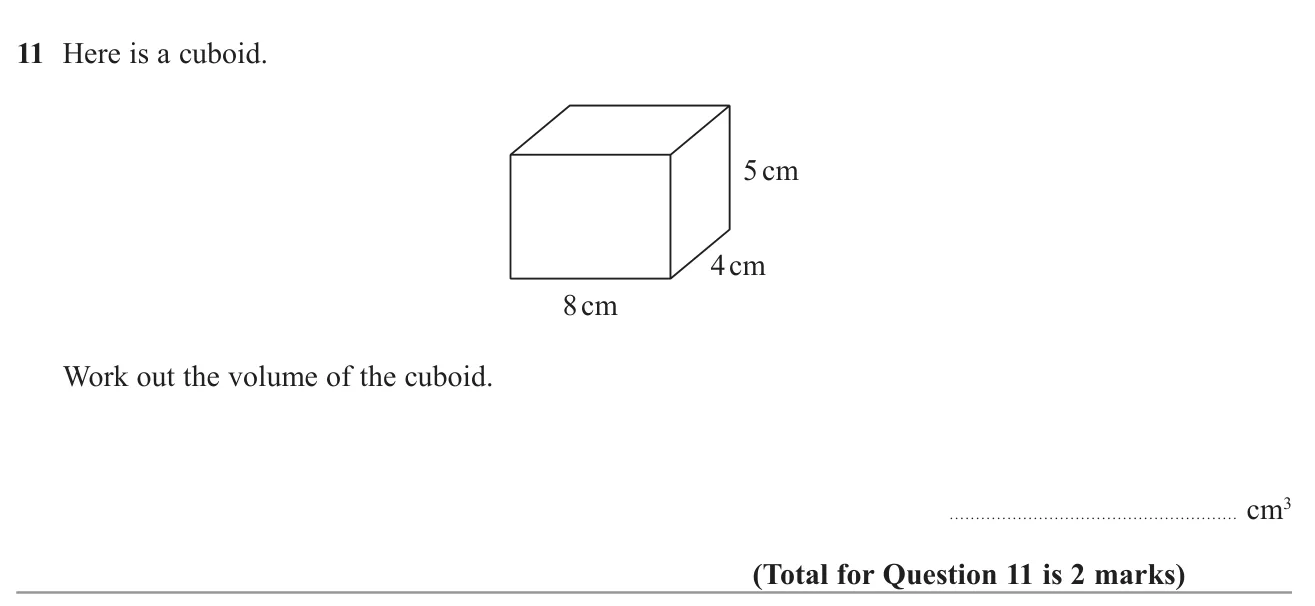
Exam questions: Volume and surface area (36, easiest first) © Pearson Education Ltd. November 2022 Paper 3 (Foundation, calculator), question 11.
Worked solution Checked against the mark scheme
Volume = 8 × 5 × 4 = 160 cm 3 = 8 \times 5 \times 4 = 160\text{ cm}^3 = 8 × 5 × 4 = 160 cm 3
Watch out: Adding the lengths or finding surface area instead.
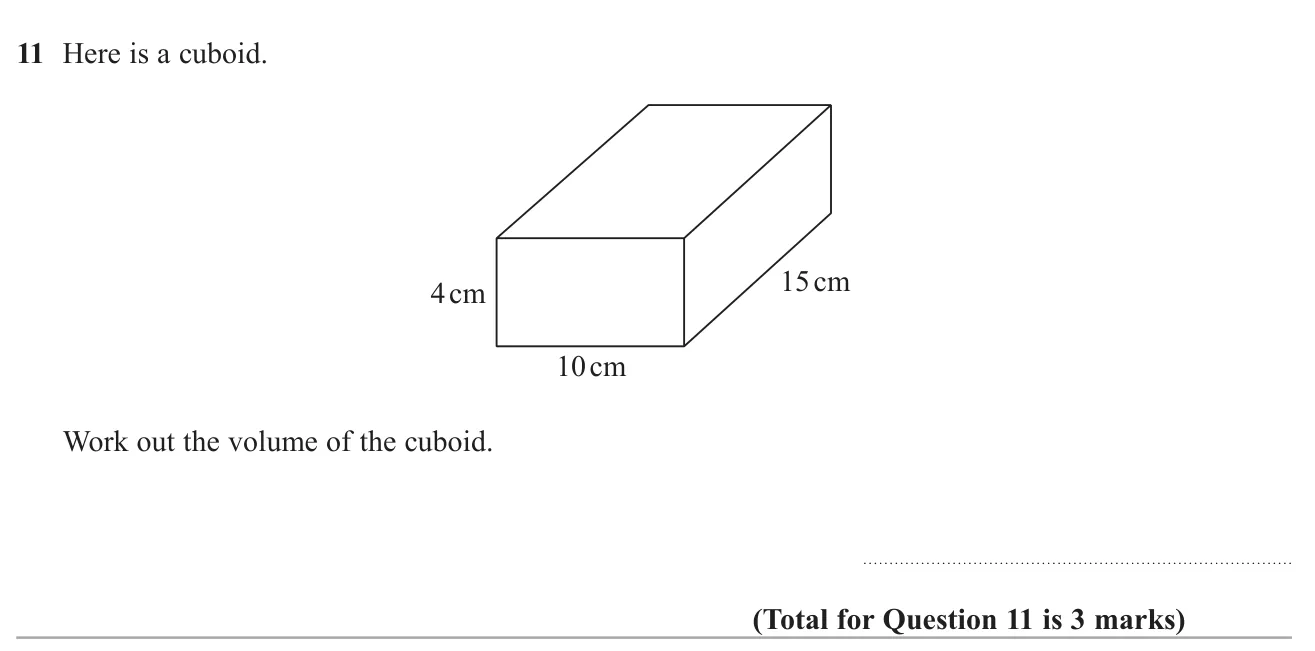
© Pearson Education Ltd. November 2020 Paper 2 (Foundation, calculator), question 11.
Answer 600 cm 3 600\text{ cm}^3 600 cm 3 3 marks
Worked solution Checked against the mark scheme
Volume = length × width × height
= 15 × 10 × 4 = 600 = 15 \times 10 \times 4 = 600 = 15 × 10 × 4 = 600
Answer: 600 cm 3 600\text{ cm}^3 600 cm 3
Watch out: Adding the lengths, or giving the units as cm².
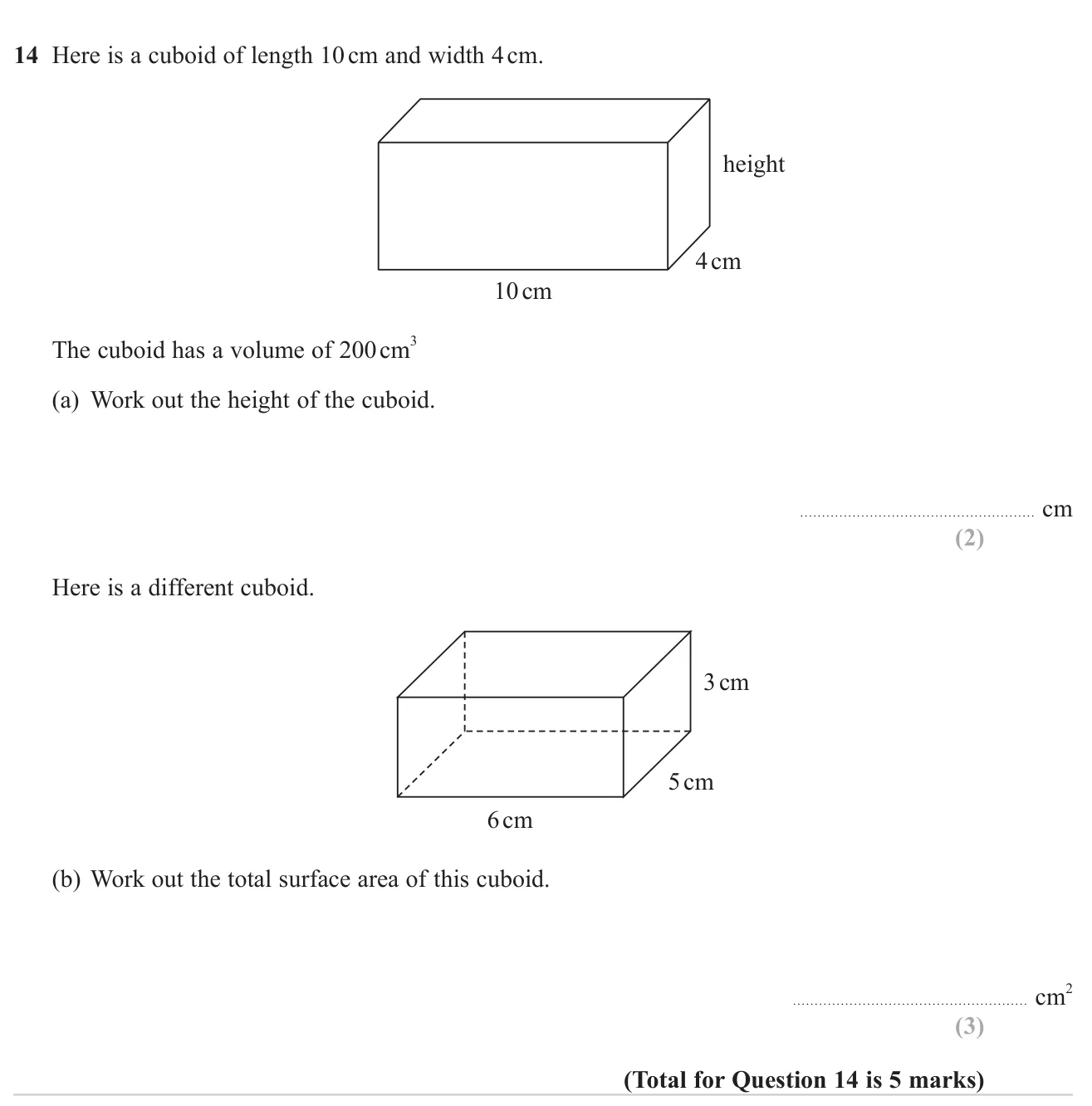
© Pearson Education Ltd. November 2024 Paper 1 (Foundation, non-calculator), question 14.
(a) 5 5 5 2 marks (b) 126 126 126 3 marks
Worked solution Checked against the mark scheme
(a) Base area = 10 × 4 = 40 = 10 \times 4 = 40 = 10 × 4 = 40 = 200 ÷ 40 = 5 = 200 \div 40 = 5 = 200 ÷ 40 = 5
(b) Faces: 6 × 5 = 30 6 \times 5 = 30 6 × 5 = 30 6 × 3 = 18 6 \times 3 = 18 6 × 3 = 18 5 × 3 = 15 5 \times 3 = 15 5 × 3 = 15
Each appears twice: 2 ( 30 + 18 + 15 ) = 126 2(30 + 18 + 15) = 126 2 ( 30 + 18 + 15 ) = 126
Watch out: In (b), working out the volume (90) instead.
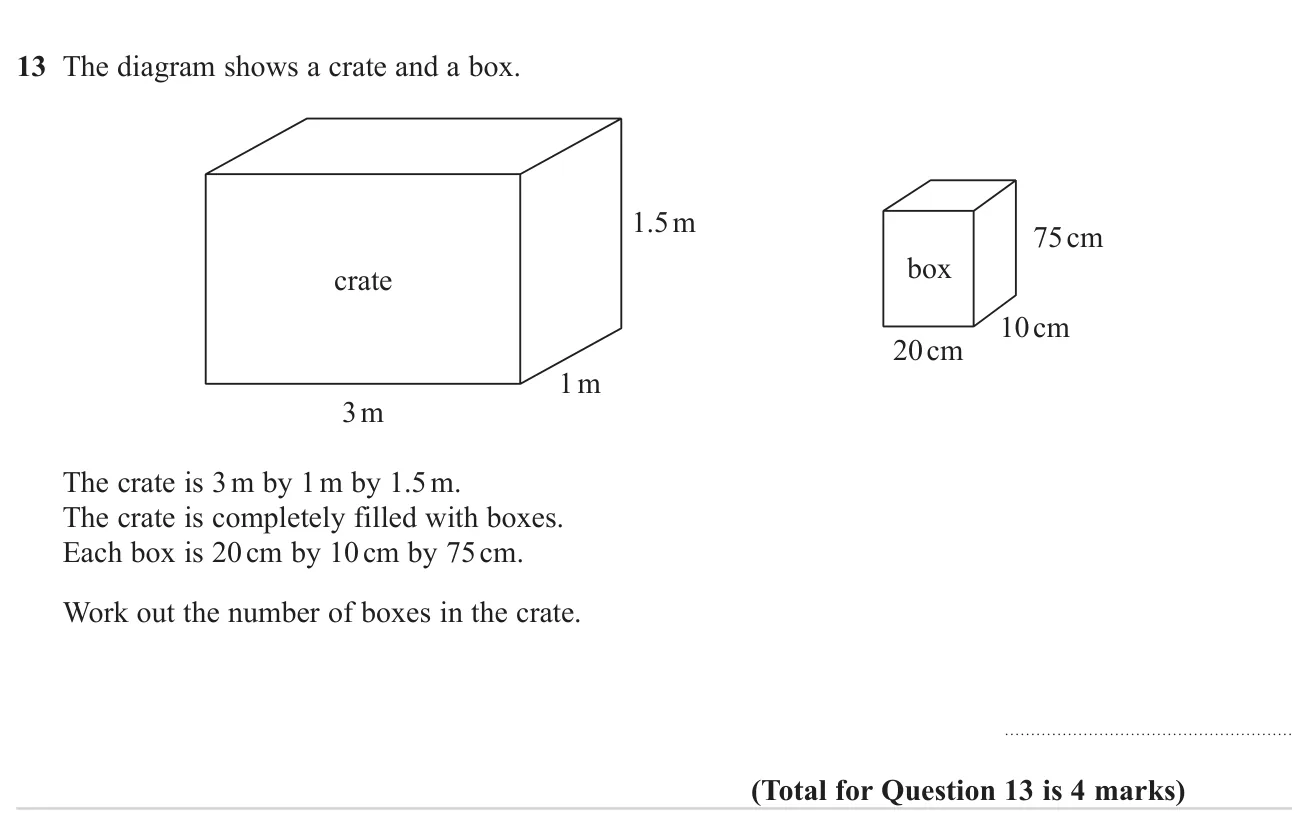
© Pearson Education Ltd. November 2024 Paper 3 (Foundation, calculator), question 13.
Worked solution Checked against the mark scheme
Crate in cm: 300 × 100 × 150 300 \times 100 \times 150 300 × 100 × 150
300 ÷ 20 = 15 300 \div 20 = 15 300 ÷ 20 = 15 100 ÷ 10 = 10 100 \div 10 = 10 100 ÷ 10 = 10 150 ÷ 75 = 2 150 \div 75 = 2 150 ÷ 75 = 2
Boxes: 15 × 10 × 2 = 300 15 \times 10 \times 2 = 300 15 × 10 × 2 = 300
(Check with volumes: 4 500 000 cm 3 ÷ 15 000 cm 3 = 300 4\,500\,000 \text{ cm}^3 \div 15\,000 \text{ cm}^3 = 300 4 500 000 cm 3 ÷ 15 000 cm 3 = 300
Watch out: Mixing metres and centimetres without converting.
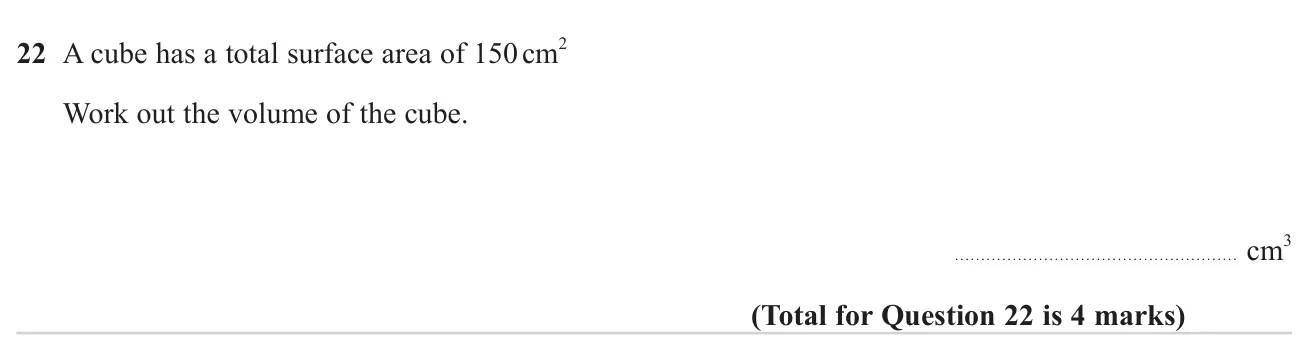
© Pearson Education Ltd. June 2023 Paper 1 (Foundation, non-calculator), question 22.
Worked solution Checked against the mark scheme
A cube has 6 equal faces: 150 ÷ 6 = 25 150 \div 6 = 25 150 ÷ 6 = 25
Edge length: 25 = 5 \sqrt{25} = 5 25 = 5
Volume: 5 × 5 × 5 = 125 5 \times 5 \times 5 = 125 5 × 5 × 5 = 125
Watch out: Dividing by 4 or cube-rooting 150.
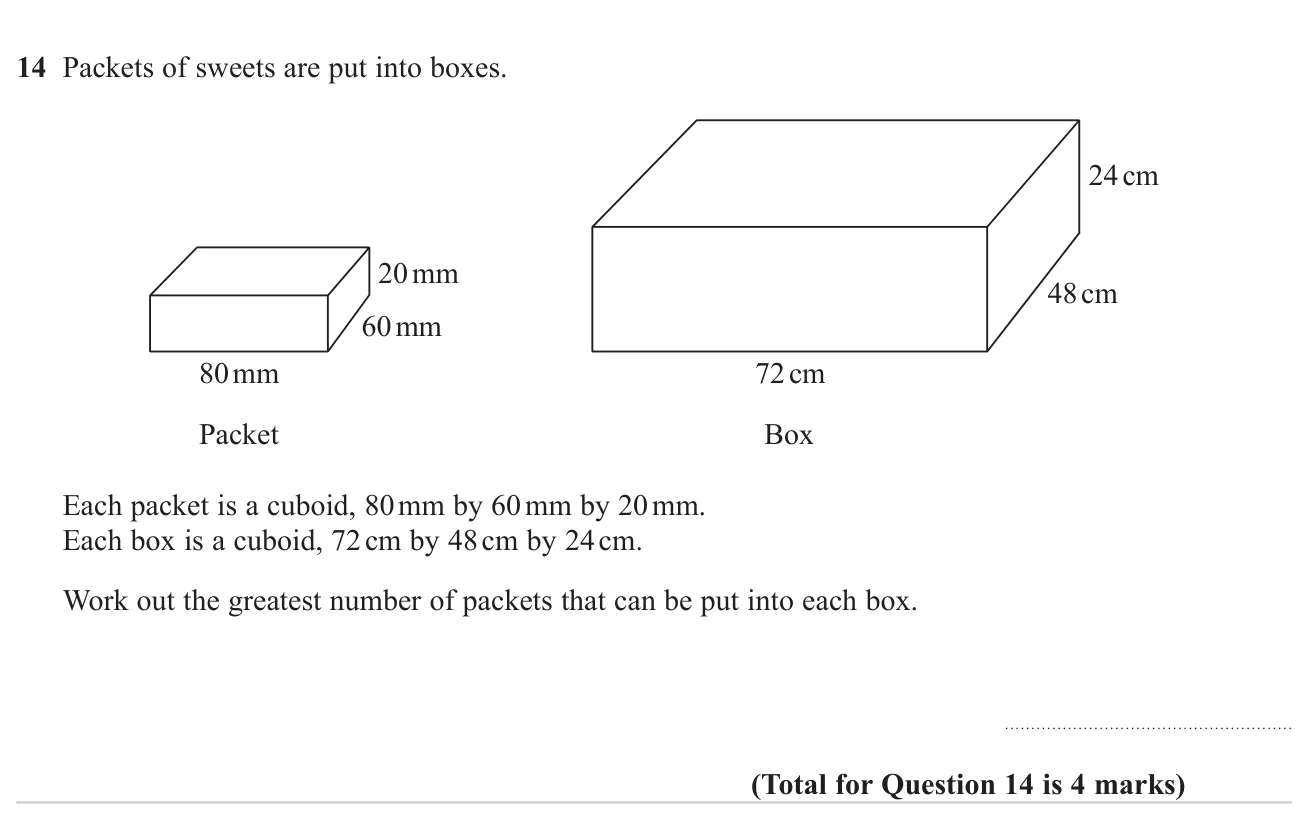
© Pearson Education Ltd. June 2023 Paper 2 (Foundation, calculator), question 14.
Worked solution Checked against the mark scheme
Change the packet to cm: 8 cm by 6 cm by 2 cm.
Along each edge: 72 ÷ 8 = 9 72 \div 8 = 9 72 ÷ 8 = 9 48 ÷ 6 = 8 48 \div 6 = 8 48 ÷ 6 = 8 24 ÷ 2 = 12 24 \div 2 = 12 24 ÷ 2 = 12
9 × 8 × 12 = 864 9 \times 8 \times 12 = 864 9 × 8 × 12 = 864
(Check: 82944 ÷ 96 = 864 82944 \div 96 = 864 82944 ÷ 96 = 864
Watch out: Not converting mm to cm, or mixing units in the division.
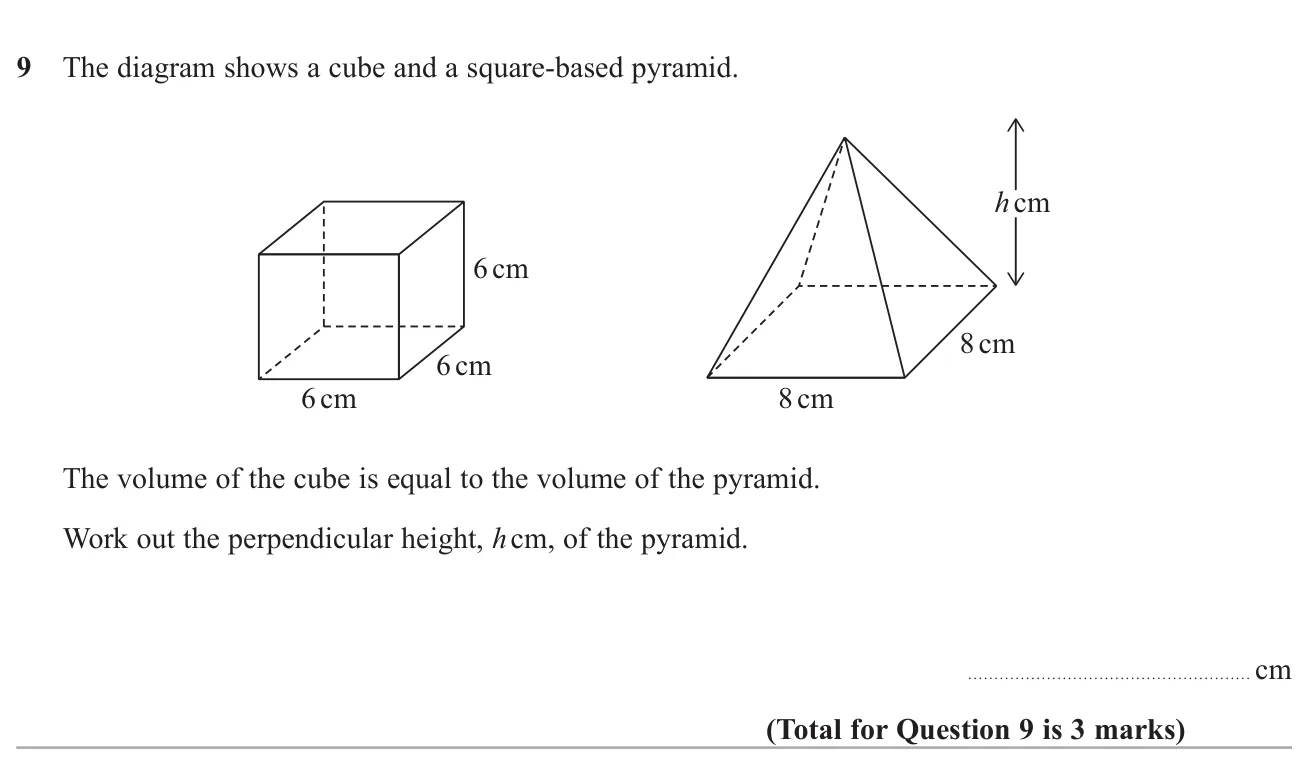
© Pearson Education Ltd. June 2024 Paper 3 (Higher, calculator), question 9.
Answer 10.125 10.125 10.125 3 marks
Worked solution Checked against the mark scheme
Cube: 6 3 = 216 6^3 = 216 6 3 = 216
Pyramid: 1 3 × 8 × 8 × h = 64 3 h \frac13 \times 8 \times 8 \times h = \frac{64}{3}h 3 1 × 8 × 8 × h = 3 64 h
64 3 h = 216 ⇒ h = 216 × 3 64 = 10.125 \frac{64}{3}h = 216 \Rightarrow h = \dfrac{216 \times 3}{64} = 10.125 3 64 h = 216 ⇒ h = 64 216 × 3 = 10.125
Watch out: Forgetting the 1 3 \frac13 3 1 h = 3.375 h = 3.375 h = 3.375
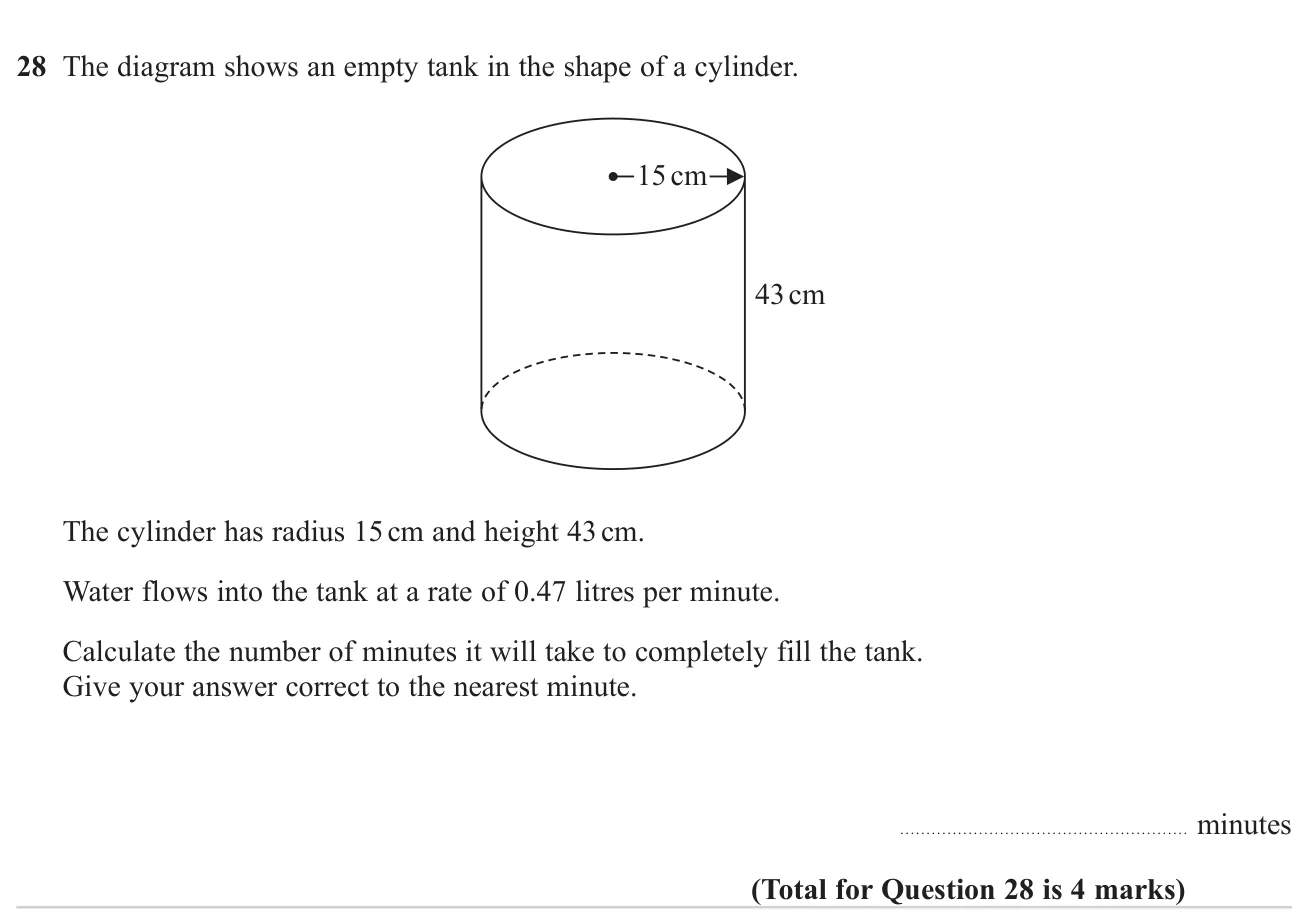
© Pearson Education Ltd. November 2023 Paper 2 (Foundation, calculator), question 28.
Worked solution Checked against the mark scheme
Volume = π × 15 2 × 43 = 30 394.9 … cm 3 = \pi \times 15^2 \times 43 = 30\,394.9\ldots\text{ cm}^3 = π × 1 5 2 × 43 = 30 394.9 … cm 3
1000 cm 3 = 1 1000\text{ cm}^3 = 1 1000 cm 3 = 1 30.3949 … 30.3949\ldots 30.3949 …
Time = 30.3949 ÷ 0.47 = 64.67 … = 30.3949 \div 0.47 = 64.67\ldots = 30.3949 ÷ 0.47 = 64.67 … 65 minutes
Watch out: Forgetting to convert cm³ to litres.
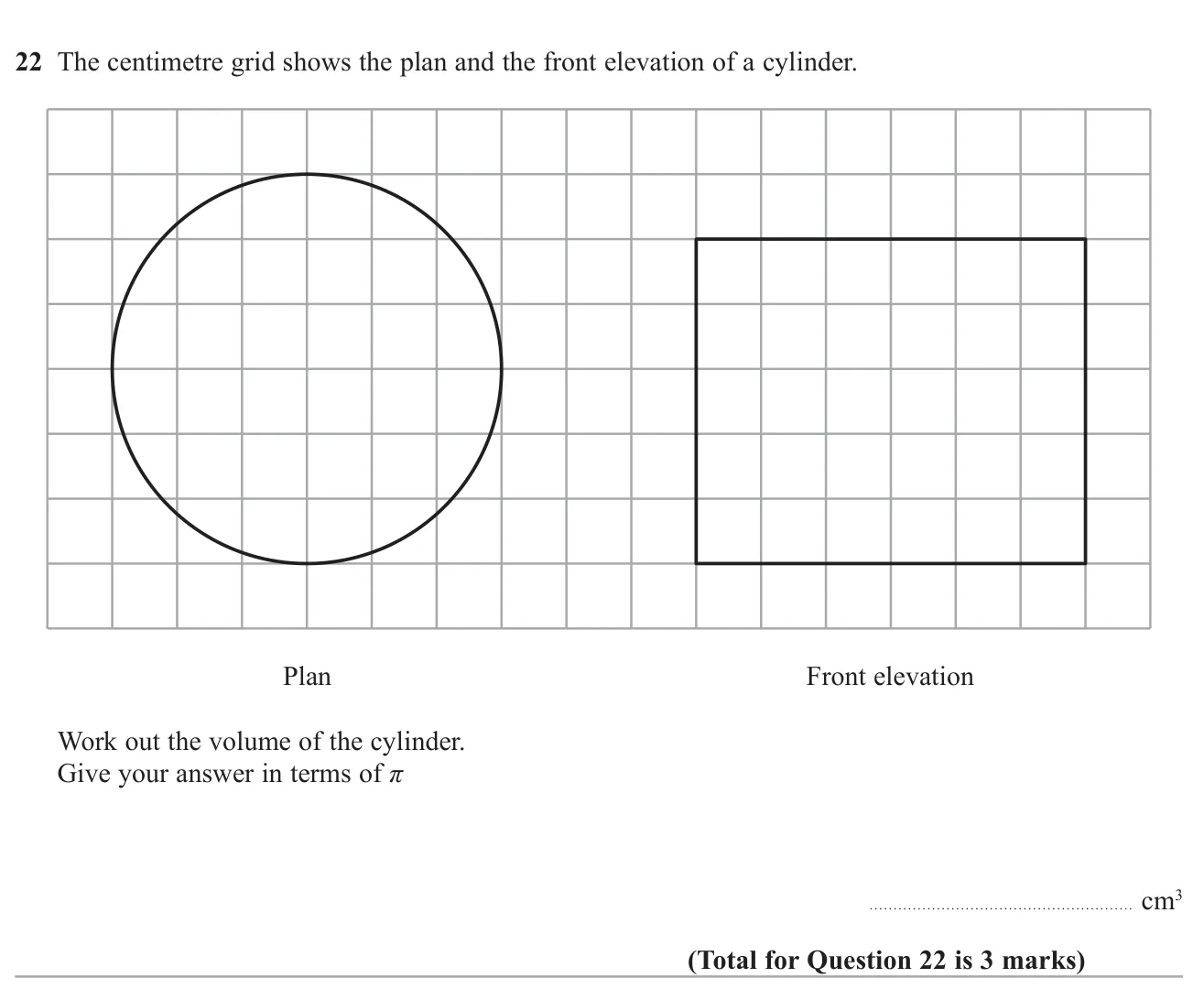
© Pearson Education Ltd. June 2022 Paper 1 (Foundation, non-calculator), question 22.
Worked solution Checked against the mark scheme
The plan is a circle 6 cm across, so the radius is 3 cm.
The front elevation is 5 cm tall, so the height is 5 cm.
V = π r 2 h = π × 3 2 × 5 = 45 π V = \pi r^2 h = \pi \times 3^2 \times 5 = 45\pi V = π r 2 h = π × 3 2 × 5 = 45 π
Watch out: Using the diameter 6 as the radius, giving 180π.
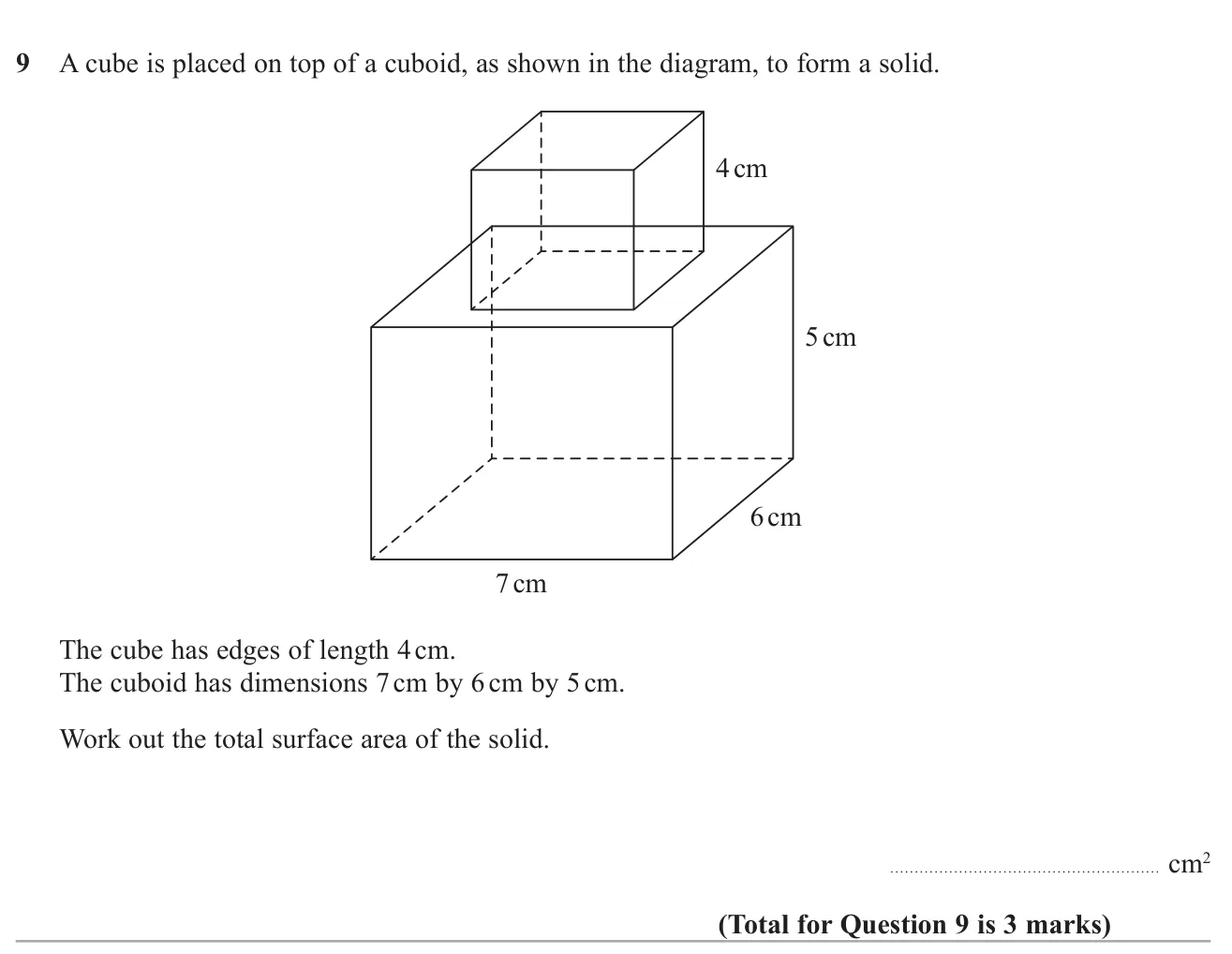
© Pearson Education Ltd. June 2022 Paper 1 (Higher, non-calculator), question 9.
Worked solution Checked against the mark scheme
Cuboid faces: 2 ( 7 × 5 ) + 2 ( 6 × 5 ) + 2 ( 7 × 6 ) = 70 + 60 + 84 = 214 2(7\times5) + 2(6\times5) + 2(7\times6) = 70 + 60 + 84 = 214 2 ( 7 × 5 ) + 2 ( 6 × 5 ) + 2 ( 7 × 6 ) = 70 + 60 + 84 = 214
Cube faces: 6 × 16 = 96 6 \times 16 = 96 6 × 16 = 96
The join hides one 4 × 4 4 \times 4 4 × 4 214 + 96 − 2 × 16 = 278 cm 2 214 + 96 - 2 \times 16 = 278\text{ cm}^2 214 + 96 − 2 × 16 = 278 cm 2
Watch out: Adding the two separate surface areas (310) without removing the two hidden 16 cm² faces.
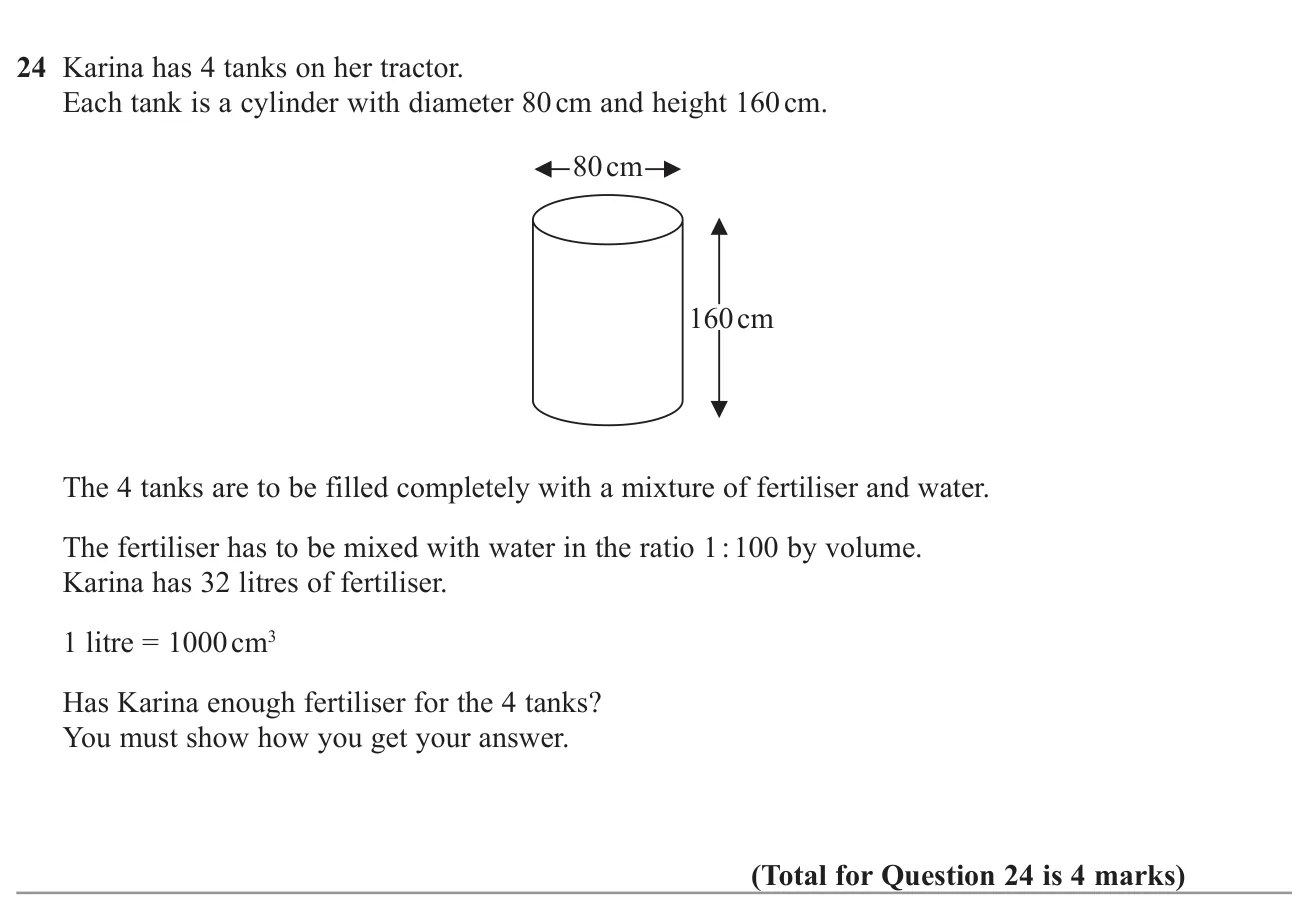
© Pearson Education Ltd. November 2022 Paper 3 (Foundation, calculator), question 24.
Answer Yes: about 31.85 litres of fertiliser are needed and she has 32 4 marks
Worked solution Checked against the mark scheme
One tank: π × 40 2 × 160 ≈ 804 248 cm 3 \pi \times 40^2 \times 160 \approx 804\,248\text{ cm}^3 π × 4 0 2 × 160 ≈ 804 248 cm 3
Four tanks: ≈ 3 216 991 cm 3 ≈ 3217 \approx 3\,216\,991\text{ cm}^3 \approx 3217 ≈ 3 216 991 cm 3 ≈ 3217
Fertiliser is 1 part in 101: 3217 ÷ 101 ≈ 31.85 3217 \div 101 \approx 31.85 3217 ÷ 101 ≈ 31.85
31.85 < 32 31.85 < 32 31.85 < 32 yes , she has enough.
Watch out: Dividing by 100 instead of 101, or using the diameter as the radius.
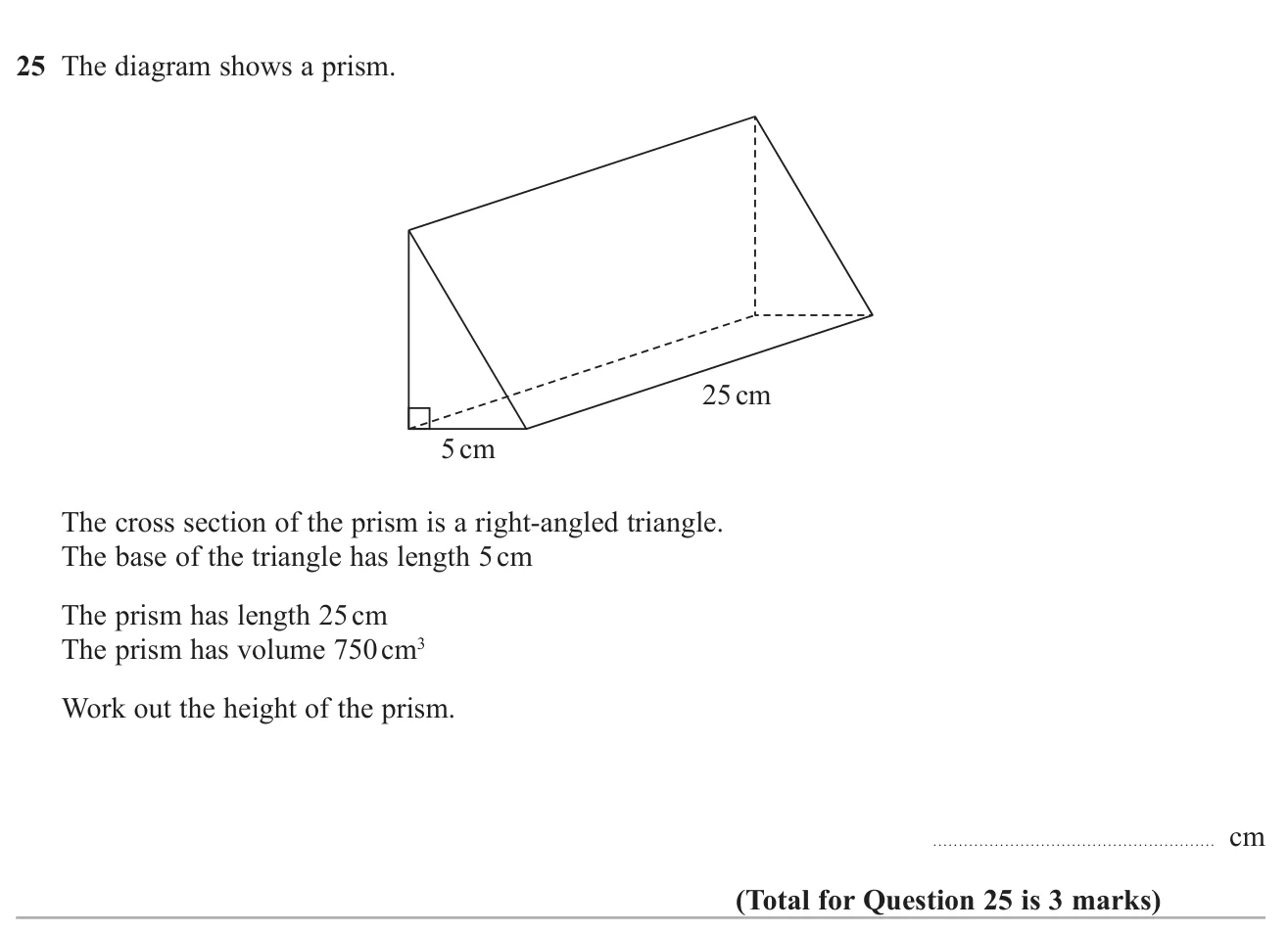
© Pearson Education Ltd. November 2021 Paper 1 (Foundation, non-calculator), question 25.
Worked solution Checked against the mark scheme
Cross-section area: 750 ÷ 25 = 30 750 \div 25 = 30 750 ÷ 25 = 30
Triangle area: 1 2 × 5 × h = 30 \frac{1}{2} \times 5 \times h = 30 2 1 × 5 × h = 30
2.5 h = 30 2.5h = 30 2.5 h = 30 h = 12 h = 12 h = 12
Watch out: Forgetting the half in the triangle area and getting 6.
© Pearson Education Ltd. November 2021 Paper 1 (Foundation, non-calculator), question 26.
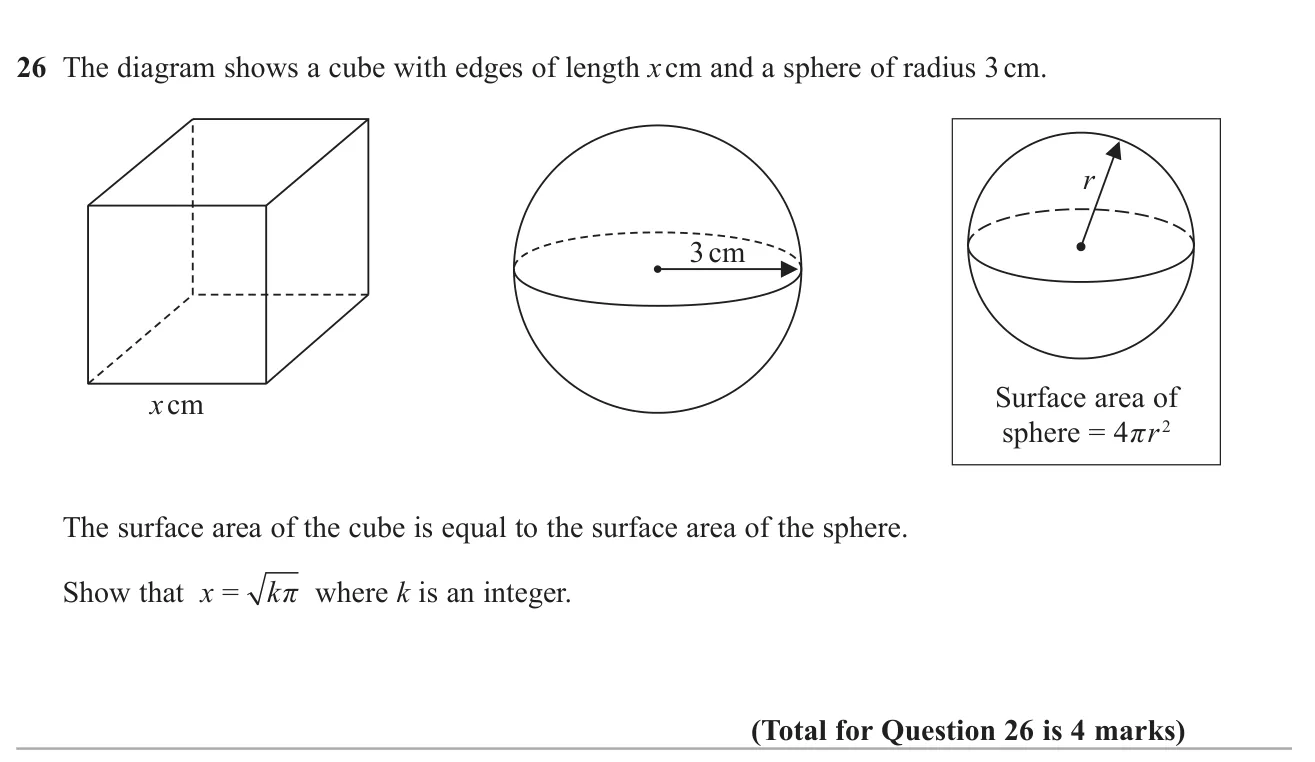
Answer 6 x 2 = 36 π 6x^2 = 36\pi 6 x 2 = 36 π x = 6 π x = \sqrt{6\pi} x = 6 π k = 6 k = 6 k = 6 4 marks
Worked solution Checked against the mark scheme
Cube surface area: 6 x 2 6x^2 6 x 2
Sphere surface area: 4 π × 3 2 = 36 π 4\pi \times 3^2 = 36\pi 4 π × 3 2 = 36 π
6 x 2 = 36 π 6x^2 = 36\pi 6 x 2 = 36 π
x 2 = 6 π x^2 = 6\pi x 2 = 6 π
x = 6 π x = \sqrt{6\pi} x = 6 π k = 6 k = 6 k = 6
Watch out: Using only one face of the cube, x 2 = 36 π x^2 = 36\pi x 2 = 36 π
© Pearson Education Ltd. November 2019 Paper 2 (Foundation, calculator), question 29.
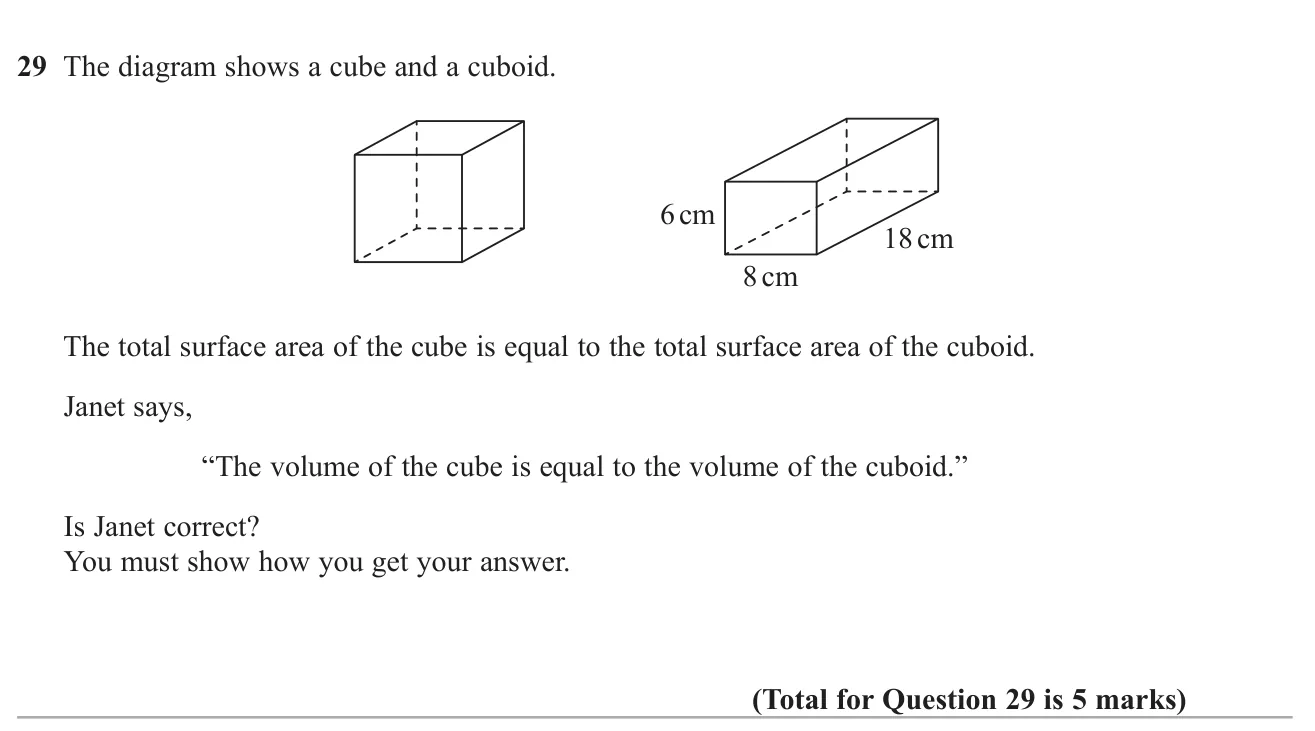
Answer No: cube volume 1000 cm³, cuboid volume 864 cm³ 5 marks
Worked solution Checked against the mark scheme
Cuboid surface area: 2 ( 6 × 8 + 6 × 18 + 8 × 18 ) = 2 ( 48 + 108 + 144 ) = 600 cm 2 2(6\times8 + 6\times18 + 8\times18) = 2(48+108+144) = 600\text{ cm}^2 2 ( 6 × 8 + 6 × 18 + 8 × 18 ) = 2 ( 48 + 108 + 144 ) = 600 cm 2
Each cube face: 600 ÷ 6 = 100 600 \div 6 = 100 600 ÷ 6 = 100 100 = 10 \sqrt{100} = 10 100 = 10
Cube volume = 10 3 = 1000 cm 3 = 10^3 = 1000\text{ cm}^3 = 1 0 3 = 1000 cm 3 = 6 × 8 × 18 = 864 cm 3 = 6 \times 8 \times 18 = 864\text{ cm}^3 = 6 × 8 × 18 = 864 cm 3
1000 ≠ 864 1000 \ne 864 1000 = 864 not correct.
Watch out: Only adding three faces of the cuboid (300) instead of all six.
© Pearson Education Ltd. June 2019 Paper 2 (Foundation, calculator), question 23.
Worked solution Checked against the mark scheme
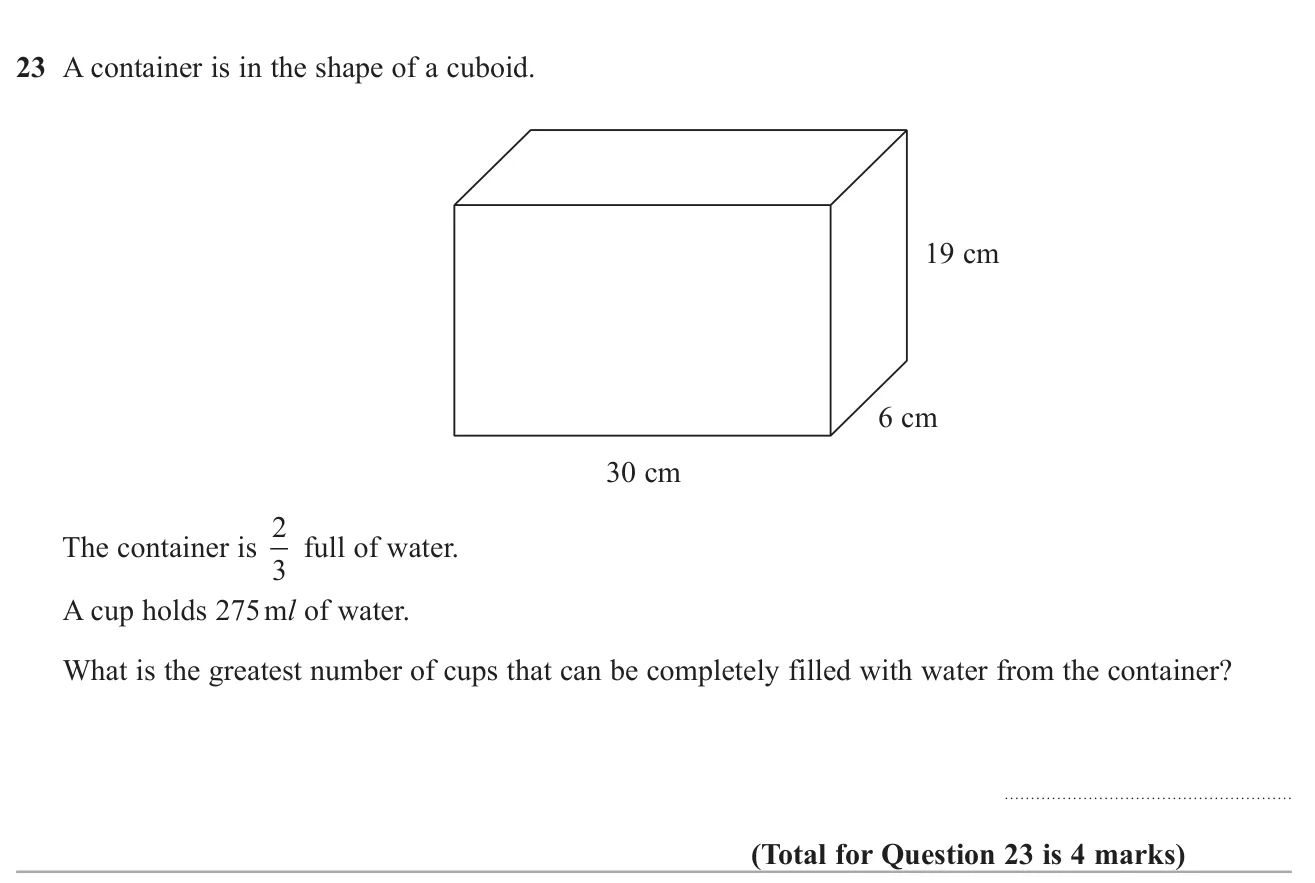
Volume = 30 × 19 × 6 = 3420 cm 3 = 30 \times 19 \times 6 = 3420\text{ cm}^3 = 30 × 19 × 6 = 3420 cm 3
Water = 2 3 × 3420 = 2280 cm 3 = 2280 ml = \frac{2}{3} \times 3420 = 2280\text{ cm}^3 = 2280\text{ ml} = 3 2 × 3420 = 2280 cm 3 = 2280 ml
2280 ÷ 275 = 8.29... 2280 \div 275 = 8.29... 2280 ÷ 275 = 8.29...
Only 8 cups can be completely filled.
Watch out: Rounding 8.29 up to 9 cups.
© Pearson Education Ltd. June 2019 Paper 3 (Foundation, calculator), question 29.
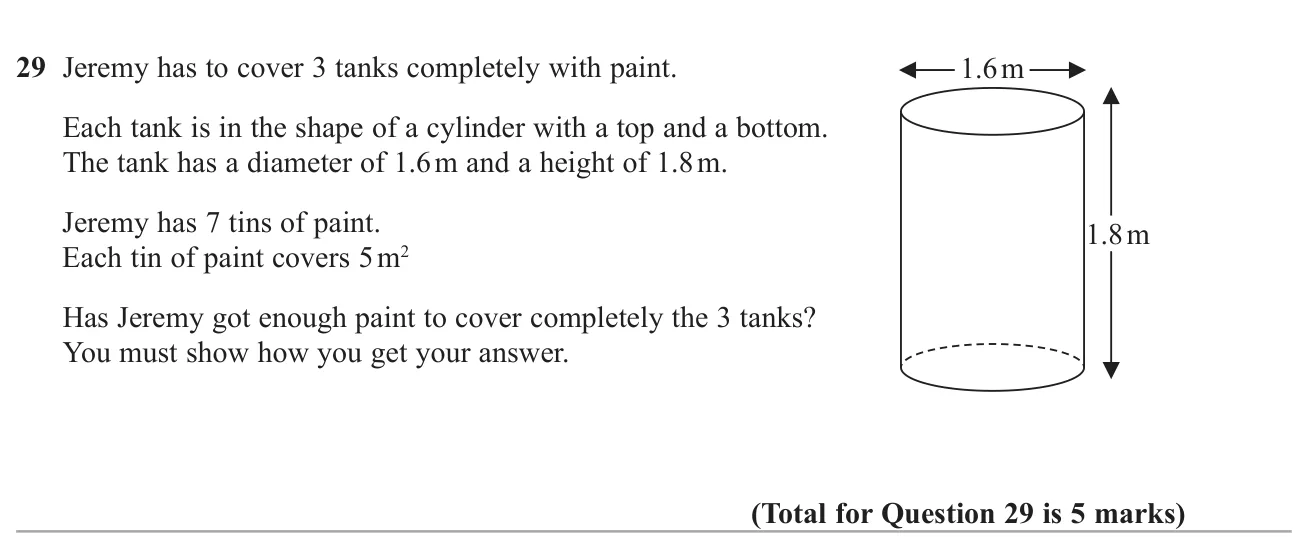
Answer No: total area about 39.2 m 2 39.2\text{ m}^2 39.2 m 2 35 m 2 35\text{ m}^2 35 m 2 5 marks
Worked solution Checked against the mark scheme
Radius = 0.8 = 0.8 = 0.8
Top and bottom: 2 × π × 0.8 2 = 4.021... 2 \times \pi \times 0.8^2 = 4.021... 2 × π × 0. 8 2 = 4.021...
Curved surface: 2 × π × 0.8 × 1.8 = 9.047... 2 \times \pi \times 0.8 \times 1.8 = 9.047... 2 × π × 0.8 × 1.8 = 9.047...
One tank: 13.069... 13.069... 13.069... 39.21 39.21 39.21
Paint covers 7 × 5 = 35 7 \times 5 = 35 7 × 5 = 35 < 39.21 < 39.21 < 39.21 No , he does not have enough.
Watch out: Using the diameter 1.6 as the radius, or leaving out the top or bottom.
© Pearson Education Ltd. June 2018 Paper 1 (Foundation, non-calculator), question 23.
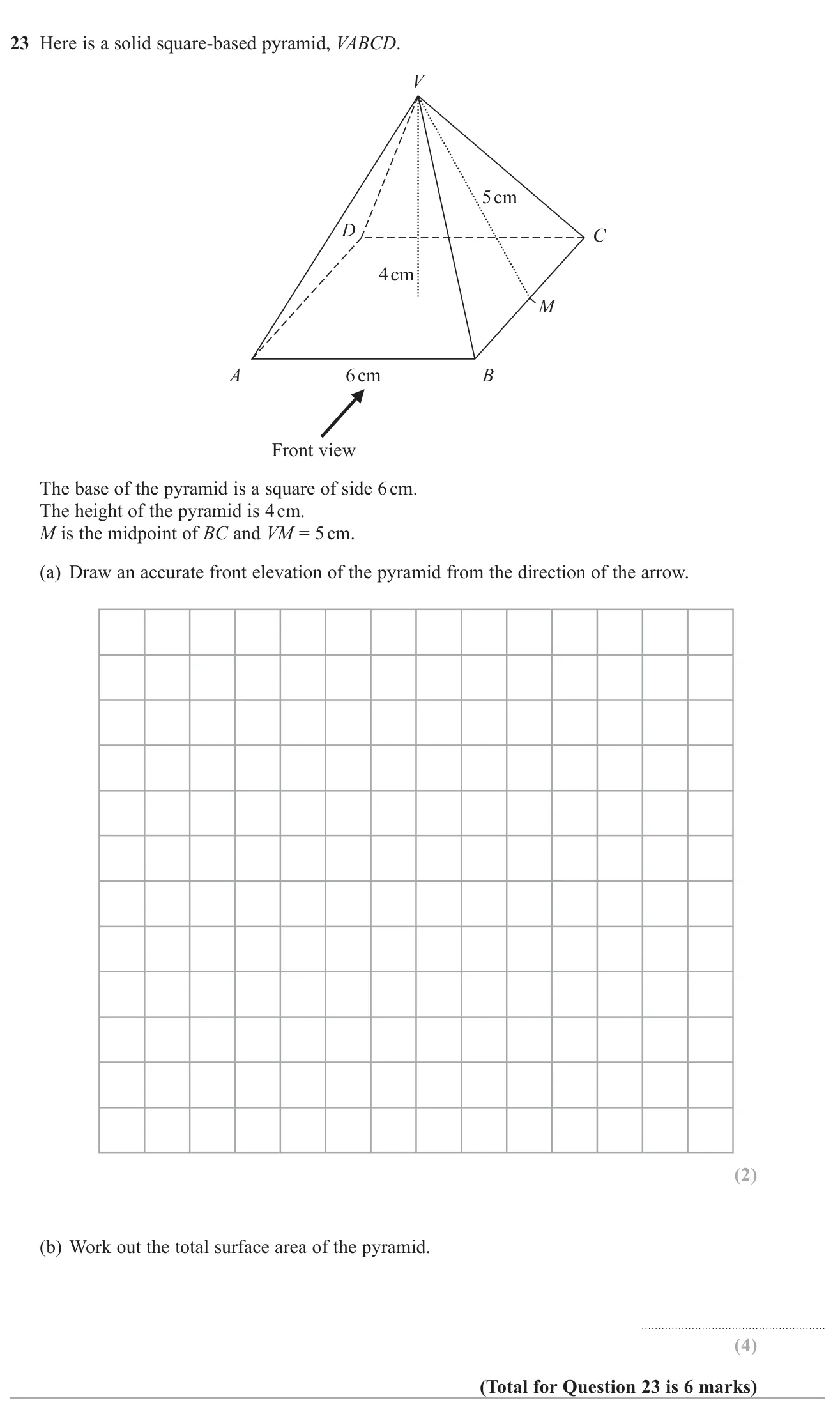
(a) Isosceles triangle, base 6 cm, height 4 cm 2 marks (b) 96 cm 2 96\text{ cm}^2 96 cm 2 4 marks
Worked solution Checked against the mark scheme
(a) From the front you see a triangle: base 6 cm, height 4 cm, apex above the middle of the base.
(b) Each sloping face: 1 2 × 6 × 5 = 15 cm 2 \frac{1}{2} \times 6 \times 5 = 15\text{ cm}^2 2 1 × 6 × 5 = 15 cm 2
Four faces: 4 × 15 = 60 4 \times 15 = 60 4 × 15 = 60 6 × 6 = 36 6 \times 6 = 36 6 × 6 = 36
Total = 60 + 36 = 96 cm 2 = 60 + 36 = 96\text{ cm}^2 = 60 + 36 = 96 cm 2
Watch out: Using the vertical height 4 cm instead of the slant height 5 cm for the triangles (giving 84).
© Pearson Education Ltd. June 2018 Paper 1 (Higher, non-calculator), question 5.
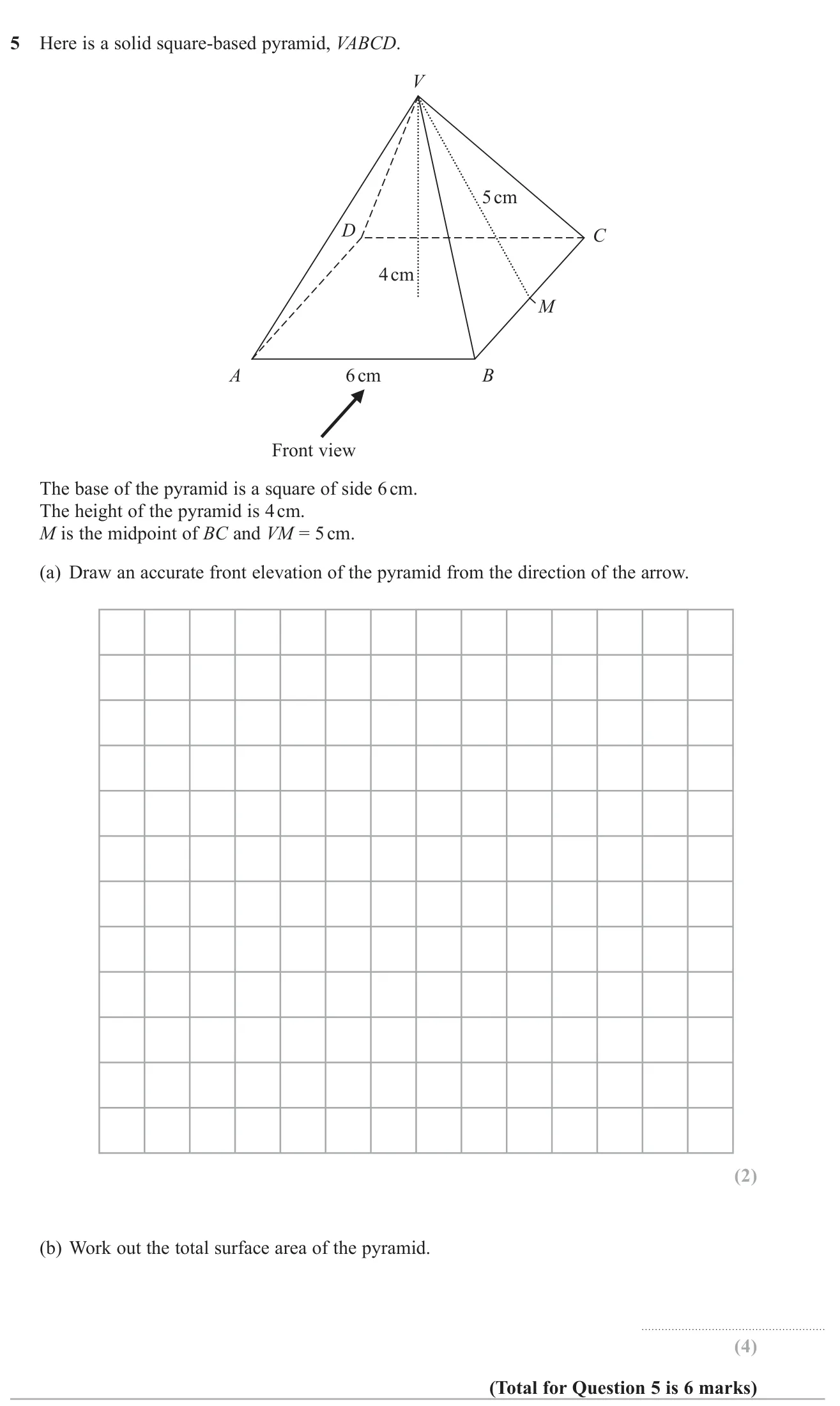
(a) An isosceles triangle with base 6 cm and height 4 cm 2 marks (b) 96 cm 2 96\text{ cm}^2 96 cm 2 4 marks
Worked solution Checked against the mark scheme
(a) From the front you see a triangle: base 6 cm, height 4 cm, apex above the middle of the base.
(b) Each sloping face is a triangle with base 6 and slant height 5: 1 2 × 6 × 5 = 15 cm 2 \frac{1}{2} \times 6 \times 5 = 15\text{ cm}^2 2 1 × 6 × 5 = 15 cm 2
Base = 6 × 6 = 36 cm 2 = 6 \times 6 = 36\text{ cm}^2 = 6 × 6 = 36 cm 2
Total = 4 × 15 + 36 = 96 cm 2 = 4 \times 15 + 36 = 96\text{ cm}^2 = 4 × 15 + 36 = 96 cm 2
Watch out: Using the vertical height 4 cm instead of the slant height 5 cm for the triangles (giving 84).
© Pearson Education Ltd. June 2018 Paper 2 (Foundation, calculator), question 26.
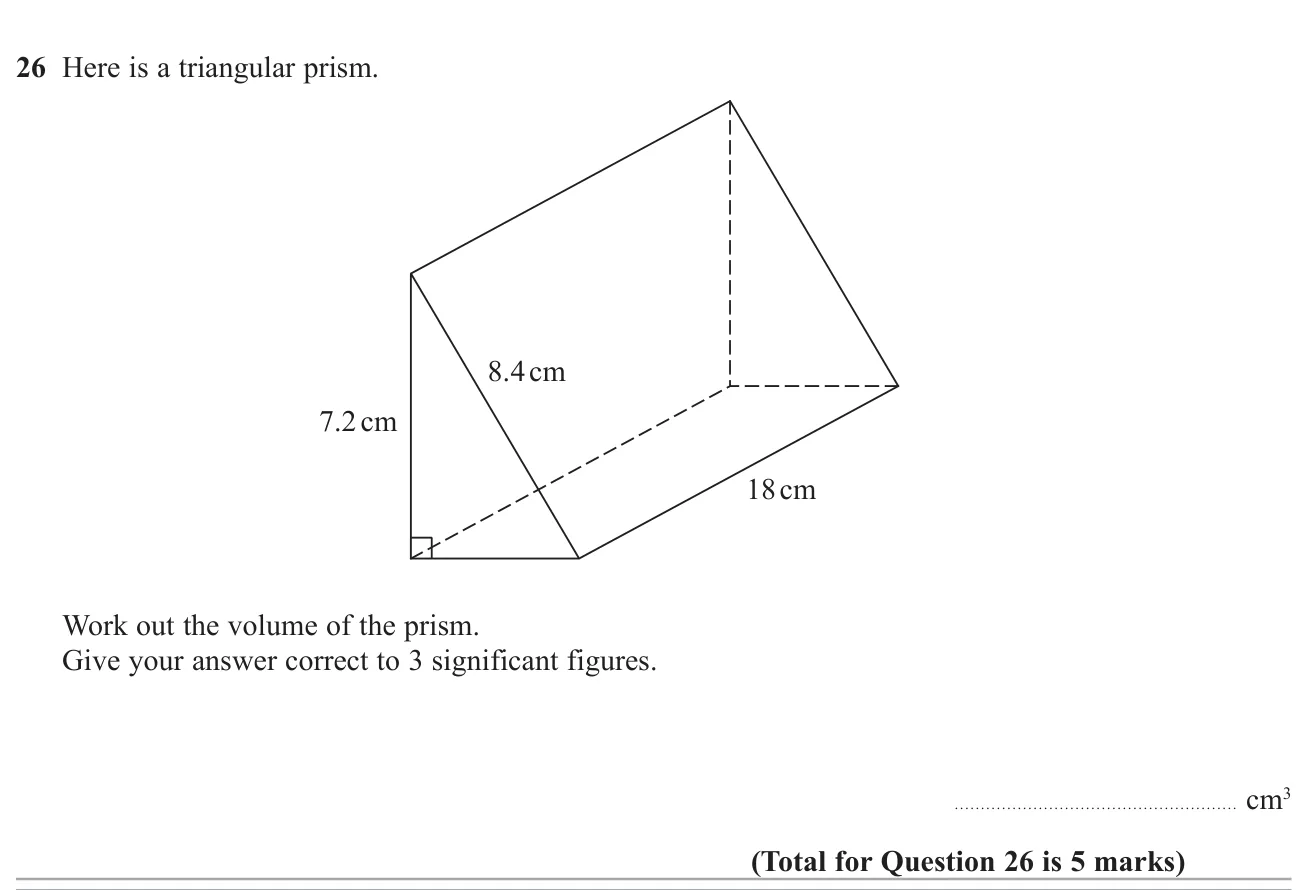
Answer 280 280 280 5 marks
Worked solution Checked against the mark scheme
Base of triangle: 8.4 2 − 7.2 2 = 18.72 = 4.327 \sqrt{8.4^2 - 7.2^2} = \sqrt{18.72} = 4.327 8. 4 2 − 7. 2 2 = 18.72 = 4.327
Triangle area: 1 2 × 4.327 × 7.2 = 15.58 \frac{1}{2} \times 4.327 \times 7.2 = 15.58 2 1 × 4.327 × 7.2 = 15.58
Volume: 15.58 × 18 = 280.4 ≈ 280 15.58 \times 18 = 280.4 \approx 280 15.58 × 18 = 280.4 ≈ 280
Watch out: Adding the squares instead of subtracting, or forgetting to halve.
© Pearson Education Ltd. Specimen Paper 1 (Foundation, non-calculator), question 24.
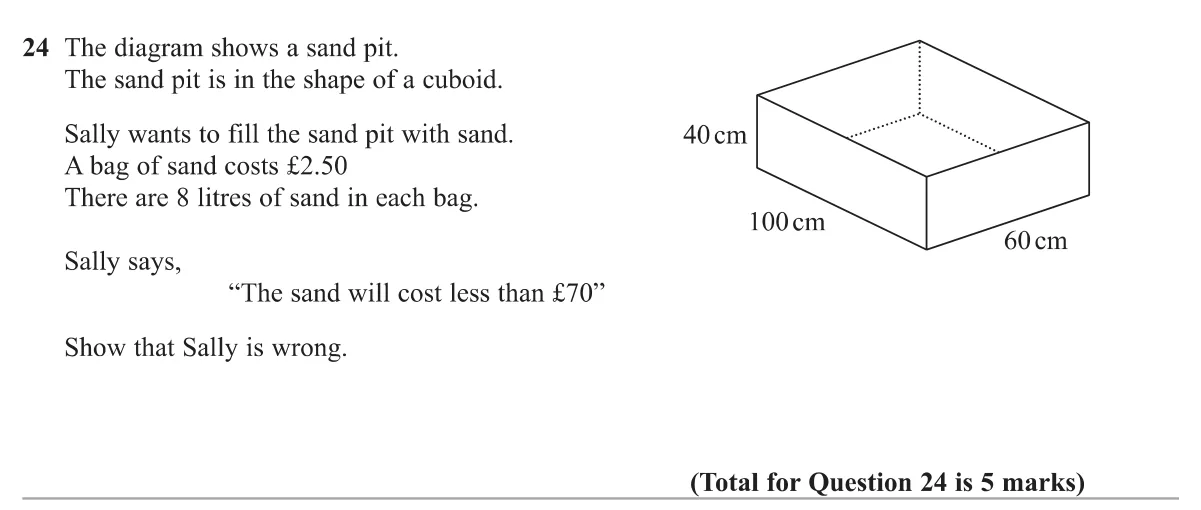
Answer Volume 240000 240000 240000 = 240 = 240 = 240 £ 75 £75 £75 5 marks
Worked solution Checked against the mark scheme
Volume = 100 × 60 × 40 = 240000 = 100 \times 60 \times 40 = 240000 = 100 × 60 × 40 = 240000
1 1 1 = 1000 = 1000 = 1000 240 240 240
Bags: 240 ÷ 8 = 30 240 \div 8 = 30 240 ÷ 8 = 30
Cost: 30 × £ 2.50 = £ 75 30 \times £2.50 = £75 30 × £2.50 = £75
Watch out: Using 1 litre = 100 cm³, or adding the dimensions instead of multiplying.
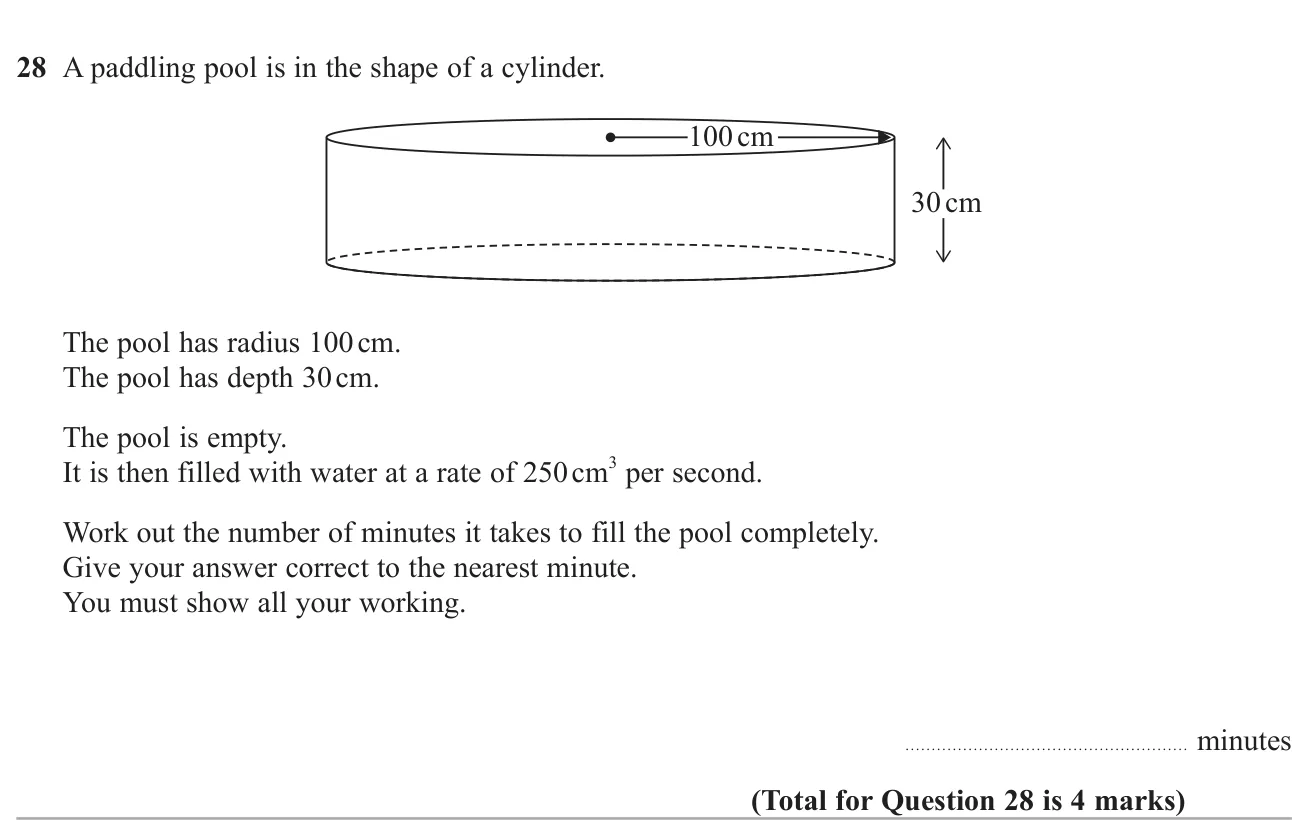
© Pearson Education Ltd. June 2024 Paper 3 (Foundation, calculator), question 28.
Answer 63 63 63 4 marks
Worked solution Checked against the mark scheme
Volume = π r 2 h = π × 100 2 × 30 = 942 478 = \pi r^2 h = \pi \times 100^2 \times 30 = 942\,478 = π r 2 h = π × 10 0 2 × 30 = 942 478
Time = 942 478 ÷ 250 = 3769.9 = 942\,478 \div 250 = 3769.9 = 942 478 ÷ 250 = 3769.9
3769.9 ÷ 60 = 62.8 3769.9 \div 60 = 62.8 3769.9 ÷ 60 = 62.8 63 63 63
Watch out: Using the diameter or forgetting to square the radius; or giving the time in seconds.
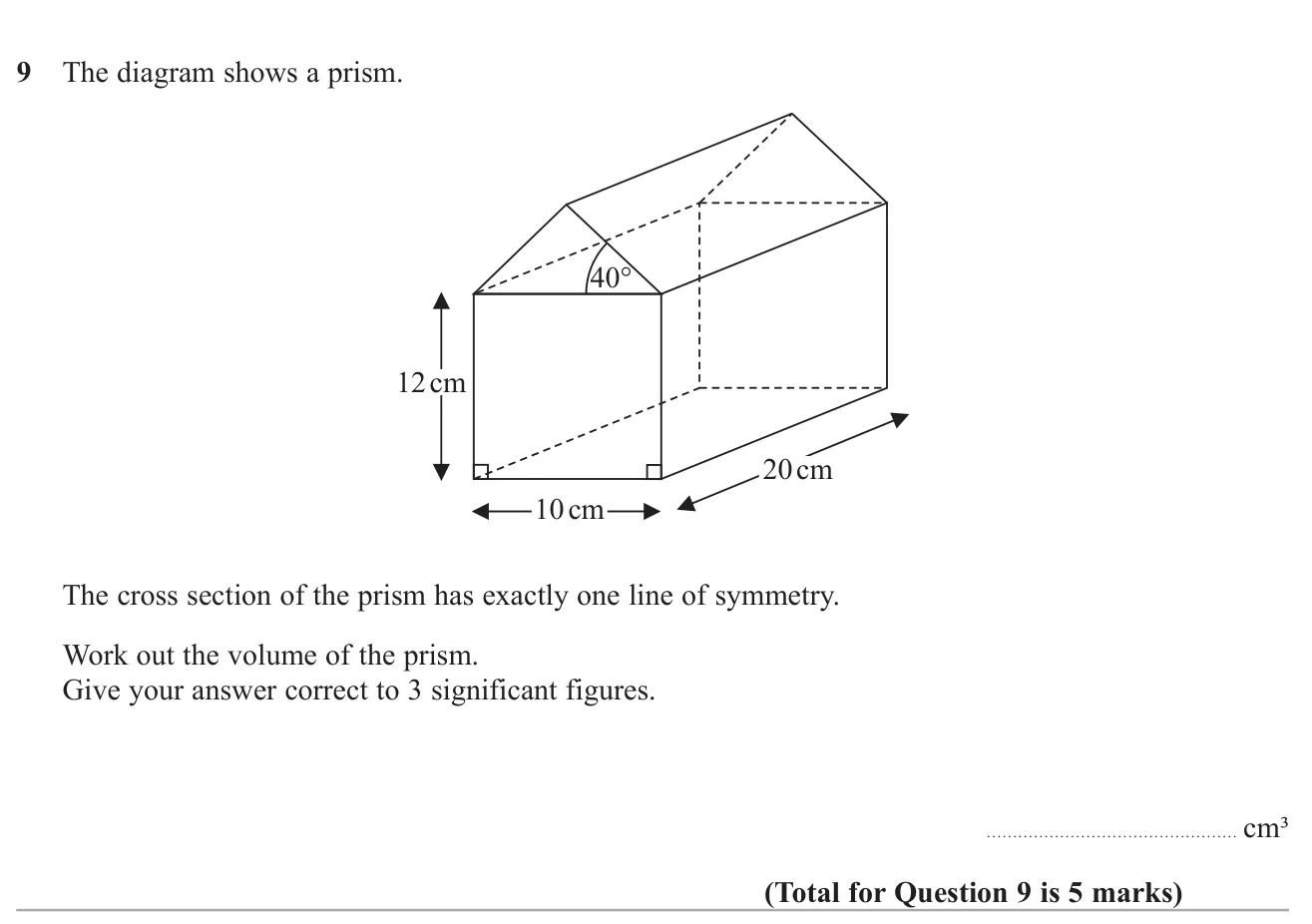
© Pearson Education Ltd. November 2020 Paper 3 (Higher, calculator), question 9.
Answer 2820 2820 2820 5 marks
Worked solution Checked against the mark scheme
The triangle is isosceles, so split it into two right-angled triangles with base 5 5 5
Height h = 5 tan 40 ∘ ≈ 4.195 h = 5\tan 40^\circ \approx 4.195 h = 5 tan 4 0 ∘ ≈ 4.195
Cross-section = 10 × 12 + 1 2 × 10 × 4.195 ≈ 140.98 = 10 \times 12 + \frac{1}{2} \times 10 \times 4.195 \approx 140.98 = 10 × 12 + 2 1 × 10 × 4.195 ≈ 140.98
Volume = 140.98 × 20 ≈ 2819.5 ≈ 2820 = 140.98 \times 20 \approx 2819.5 \approx 2820 = 140.98 × 20 ≈ 2819.5 ≈ 2820
Watch out: Treating 40° as the apex angle or using 10 instead of 5 as the base of the right-angled triangle.
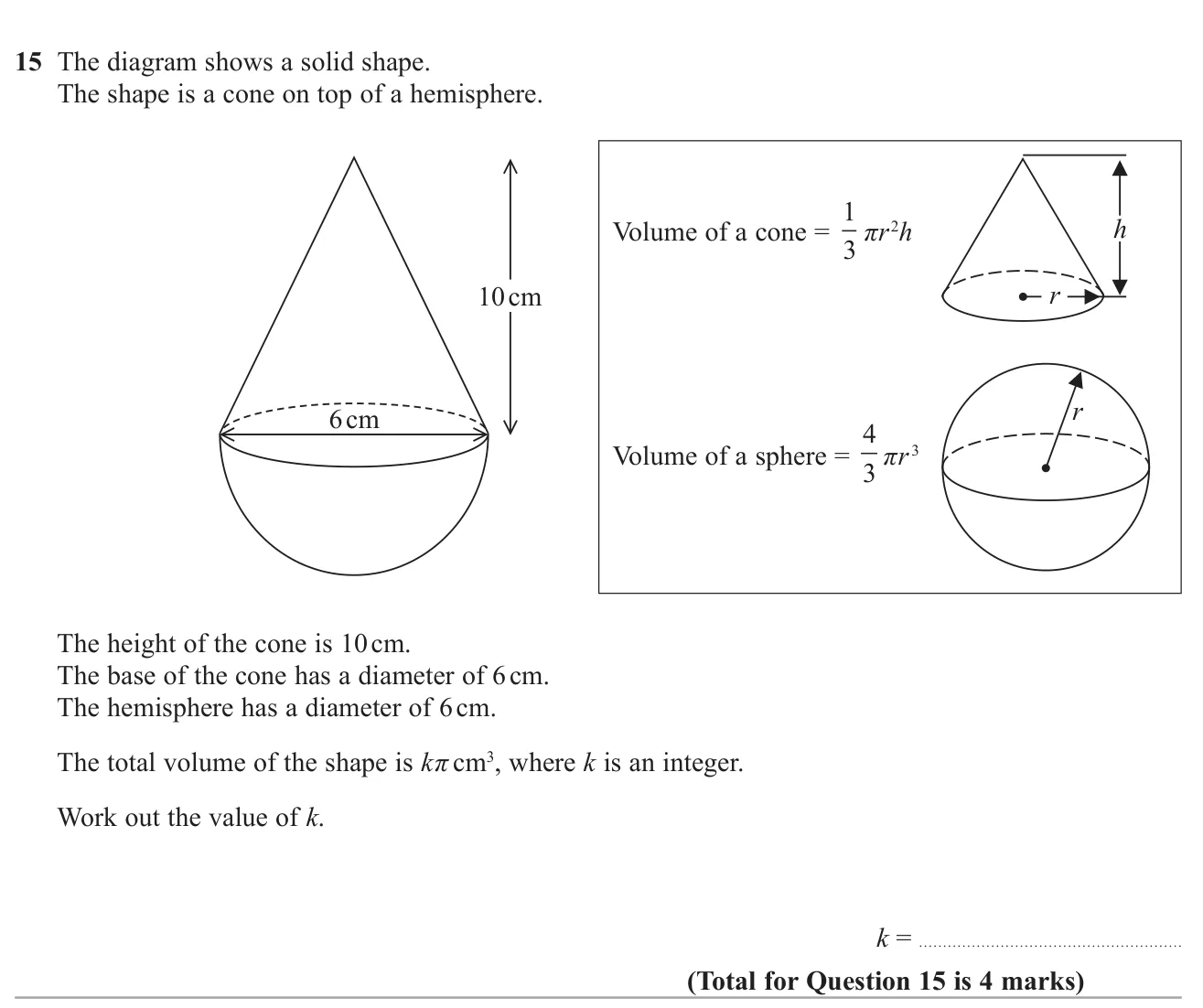
© Pearson Education Ltd. June 2019 Paper 1 (Higher, non-calculator), question 15.
Answer k = 48 k = 48 k = 48 4 marks
Worked solution Checked against the mark scheme
Radius = 6 ÷ 2 = 3 = 6 \div 2 = 3 = 6 ÷ 2 = 3
Cone: 1 3 π × 3 2 × 10 = 30 π \frac{1}{3} \pi \times 3^2 \times 10 = 30\pi 3 1 π × 3 2 × 10 = 30 π
Hemisphere: 1 2 × 4 3 π × 3 3 = 18 π \frac{1}{2} \times \frac{4}{3} \pi \times 3^3 = 18\pi 2 1 × 3 4 π × 3 3 = 18 π
Total = 48 π = 48\pi = 48 π k = 48 k = 48 k = 48
Watch out: Using the full sphere, giving 30 π + 36 π = 66 π 30\pi + 36\pi = 66\pi 30 π + 36 π = 66 π
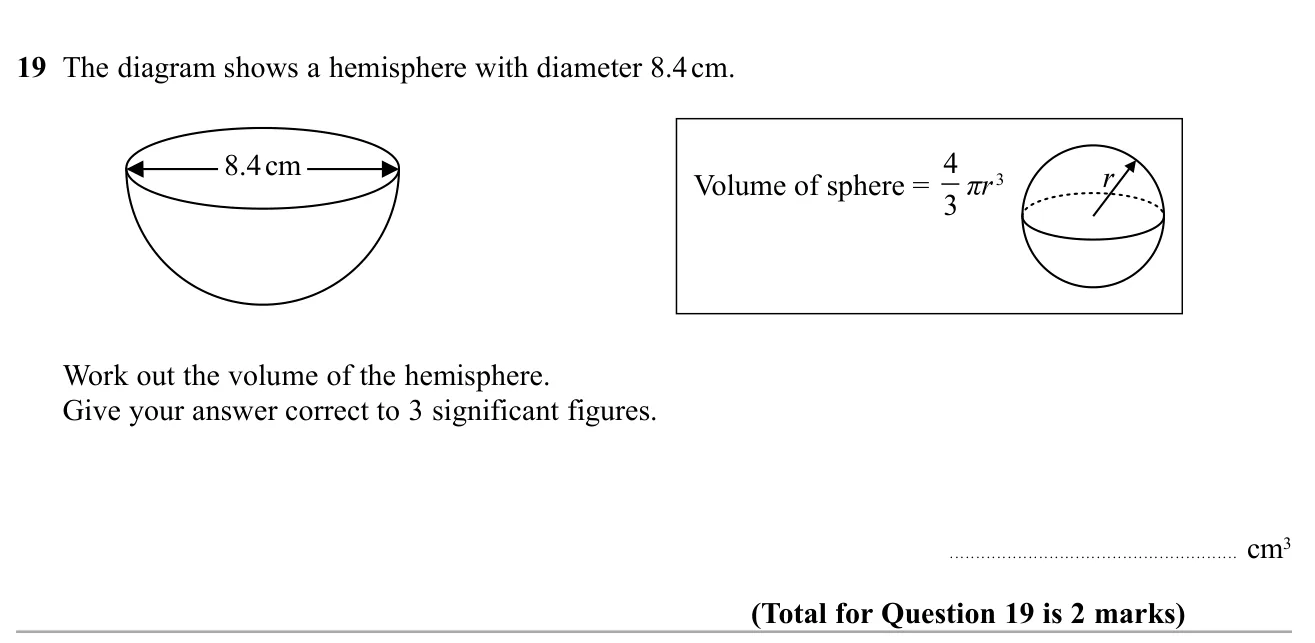
© Pearson Education Ltd. November 2019 Paper 2 (Higher, calculator), question 19.
Answer 155 cm 3 155\text{ cm}^3 155 cm 3 2 marks
Worked solution Checked against the mark scheme
Radius = 8.4 ÷ 2 = 4.2 = 8.4 \div 2 = 4.2 = 8.4 ÷ 2 = 4.2
Volume = 1 2 × 4 3 π × 4.2 3 = 155.17... = \frac{1}{2} \times \frac{4}{3}\pi \times 4.2^3 = 155.17... = 2 1 × 3 4 π × 4. 2 3 = 155.17...
= 155 cm 3 = 155\text{ cm}^3 = 155 cm 3
Watch out: Using the diameter 8.4 as the radius.
© Pearson Education Ltd. November 2018 Paper 3 (Higher, calculator), question 8.
Worked solution Checked against the mark scheme
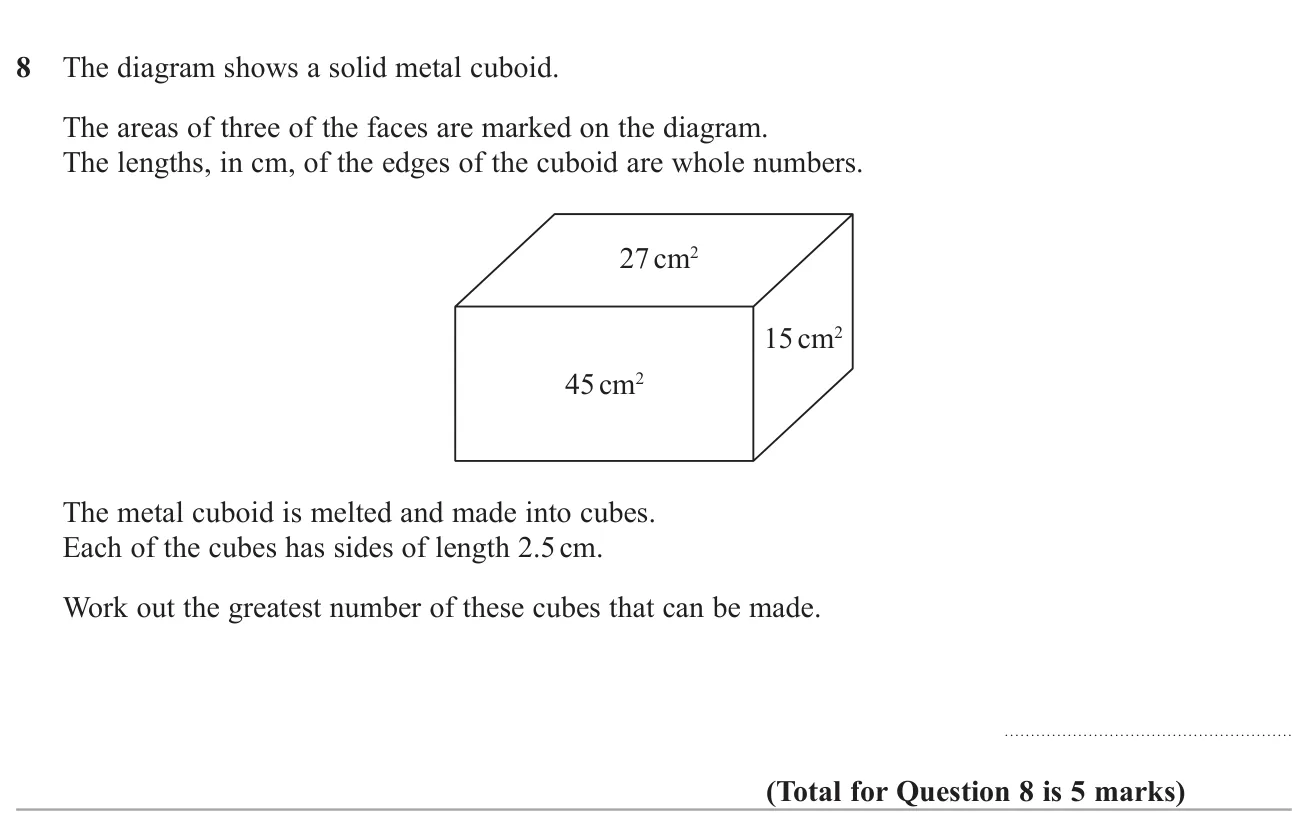
Face areas 15, 27, 45 need edges with pair products 15, 27, 45: the edges are 3, 5 and 9 cm.
Volume of cuboid = 3 × 5 × 9 = 135 = 3 \times 5 \times 9 = 135 = 3 × 5 × 9 = 135 3 ^3 3
Volume of one cube = 2.5 3 = 15.625 = 2.5^3 = 15.625 = 2. 5 3 = 15.625 3 ^3 3
135 ÷ 15.625 = 8.64 135 \div 15.625 = 8.64 135 ÷ 15.625 = 8.64
Watch out: Rounding 8.64 up to 9.
© Pearson Education Ltd. November 2024 Paper 3 (Higher, calculator), question 19.
Worked solution Checked against the mark scheme
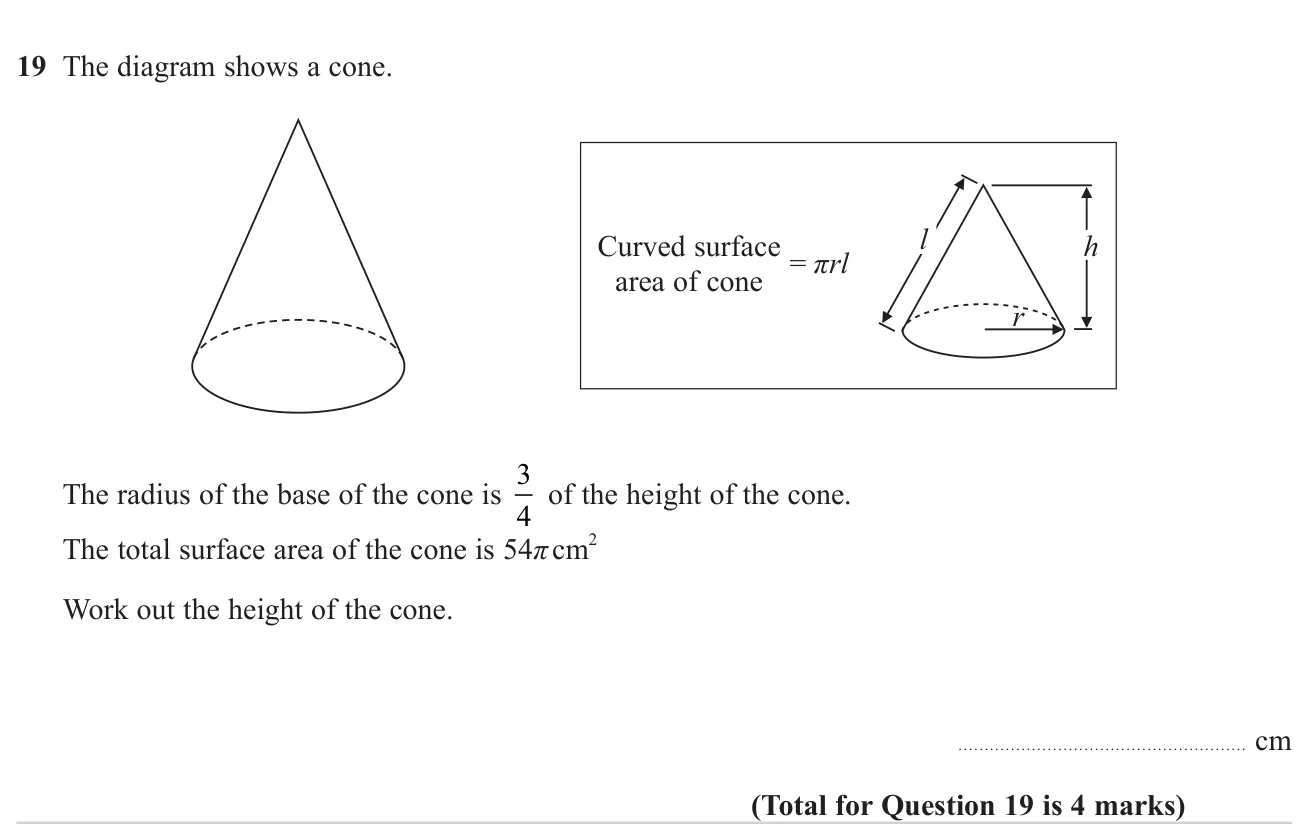
Let height = h = h = h r = 3 4 h r = \frac{3}{4}h r = 4 3 h
l = h 2 + 9 16 h 2 = 5 4 h l = \sqrt{h^2 + \frac{9}{16}h^2} = \frac{5}{4}h l = h 2 + 16 9 h 2 = 4 5 h
Total area = π r l + π r 2 = π ( 15 16 h 2 + 9 16 h 2 ) = 24 16 π h 2 = \pi r l + \pi r^2 = \pi\left(\frac{15}{16}h^2 + \frac{9}{16}h^2\right) = \frac{24}{16}\pi h^2 = π r l + π r 2 = π ( 16 15 h 2 + 16 9 h 2 ) = 16 24 π h 2
3 2 h 2 = 54 ⇒ h 2 = 36 ⇒ h = 6 \frac{3}{2}h^2 = 54 \Rightarrow h^2 = 36 \Rightarrow h = 6 2 3 h 2 = 54 ⇒ h 2 = 36 ⇒ h = 6
Watch out: Leaving out the circular base when finding the total surface area.
© Pearson Education Ltd. November 2023 Paper 3 (Higher, calculator), question 19.
Answer 2030 cm 3 2030\text{ cm}^3 2030 cm 3 4 marks
Worked solution Checked against the mark scheme
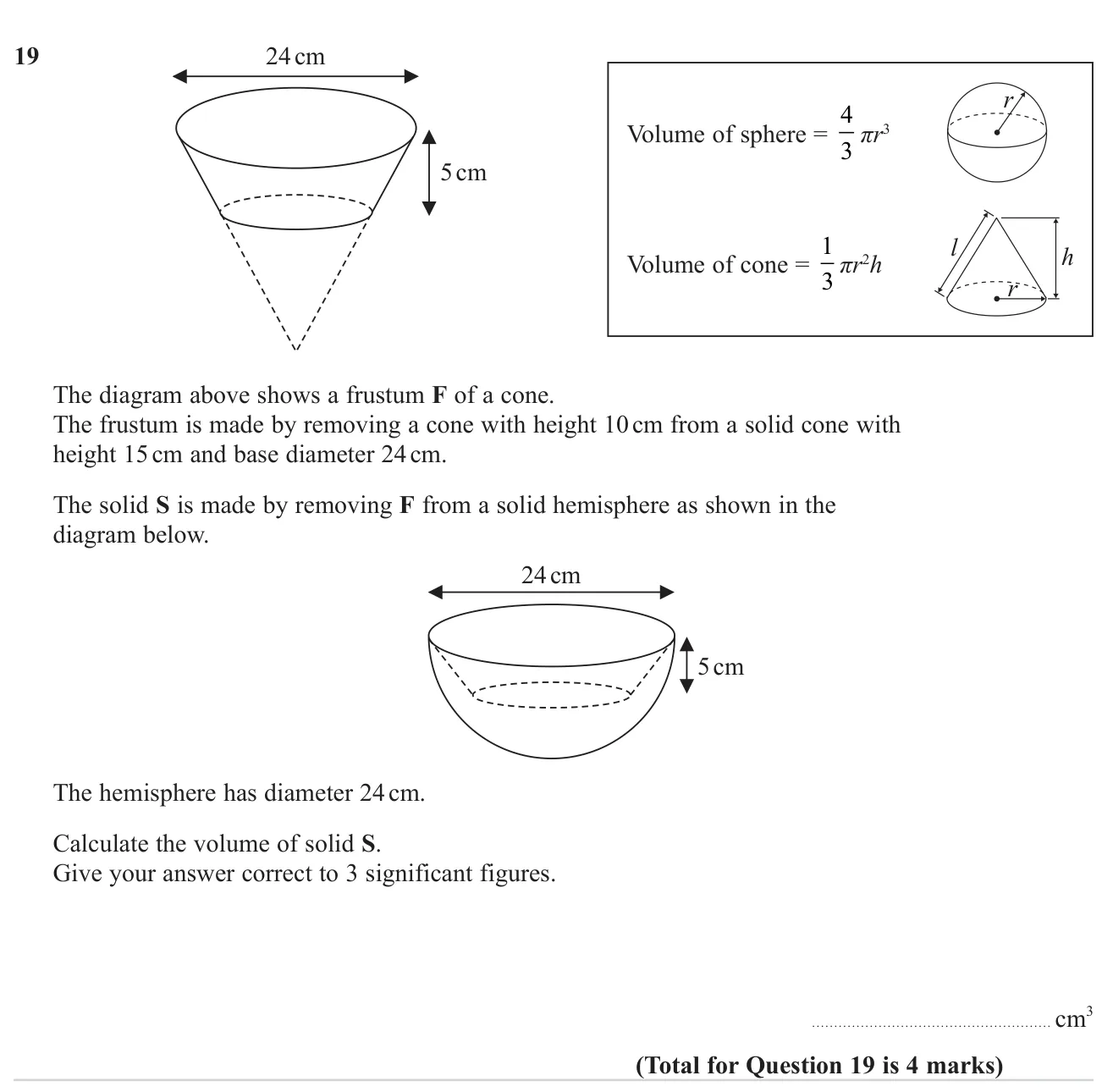
Small cone: height 10 is 2 3 \frac{2}{3} 3 2 2 3 × 12 = 8 \frac{2}{3} \times 12 = 8 3 2 × 12 = 8
Large cone = 1 3 π ( 12 2 ) ( 15 ) = 720 π = \frac{1}{3}\pi(12^2)(15) = 720\pi = 3 1 π ( 1 2 2 ) ( 15 ) = 720 π = 1 3 π ( 8 2 ) ( 10 ) = 640 3 π = \frac{1}{3}\pi(8^2)(10) = \frac{640}{3}\pi = 3 1 π ( 8 2 ) ( 10 ) = 3 640 π
Frustum = 720 π − 640 3 π = 1520 3 π = 720\pi - \frac{640}{3}\pi = \frac{1520}{3}\pi = 720 π − 3 640 π = 3 1520 π
Hemisphere = 2 3 π ( 12 3 ) = 1152 π = \frac{2}{3}\pi(12^3) = 1152\pi = 3 2 π ( 1 2 3 ) = 1152 π
S = 1152 π − 1520 3 π = 2027.37... ≈ 2030 cm 3 S = 1152\pi - \frac{1520}{3}\pi = 2027.37... \approx 2030\text{ cm}^3 S = 1152 π − 3 1520 π = 2027.37... ≈ 2030 cm 3
Watch out: Using the diameter 24 as the radius, or using a full sphere instead of a hemisphere.
© Pearson Education Ltd. June 2022 Paper 2 (Higher, calculator), question 17.
(a) y = 25.9 y = 25.9 y = 25.9 4 marks (b) The height y y y 1 mark
Worked solution Checked against the mark scheme
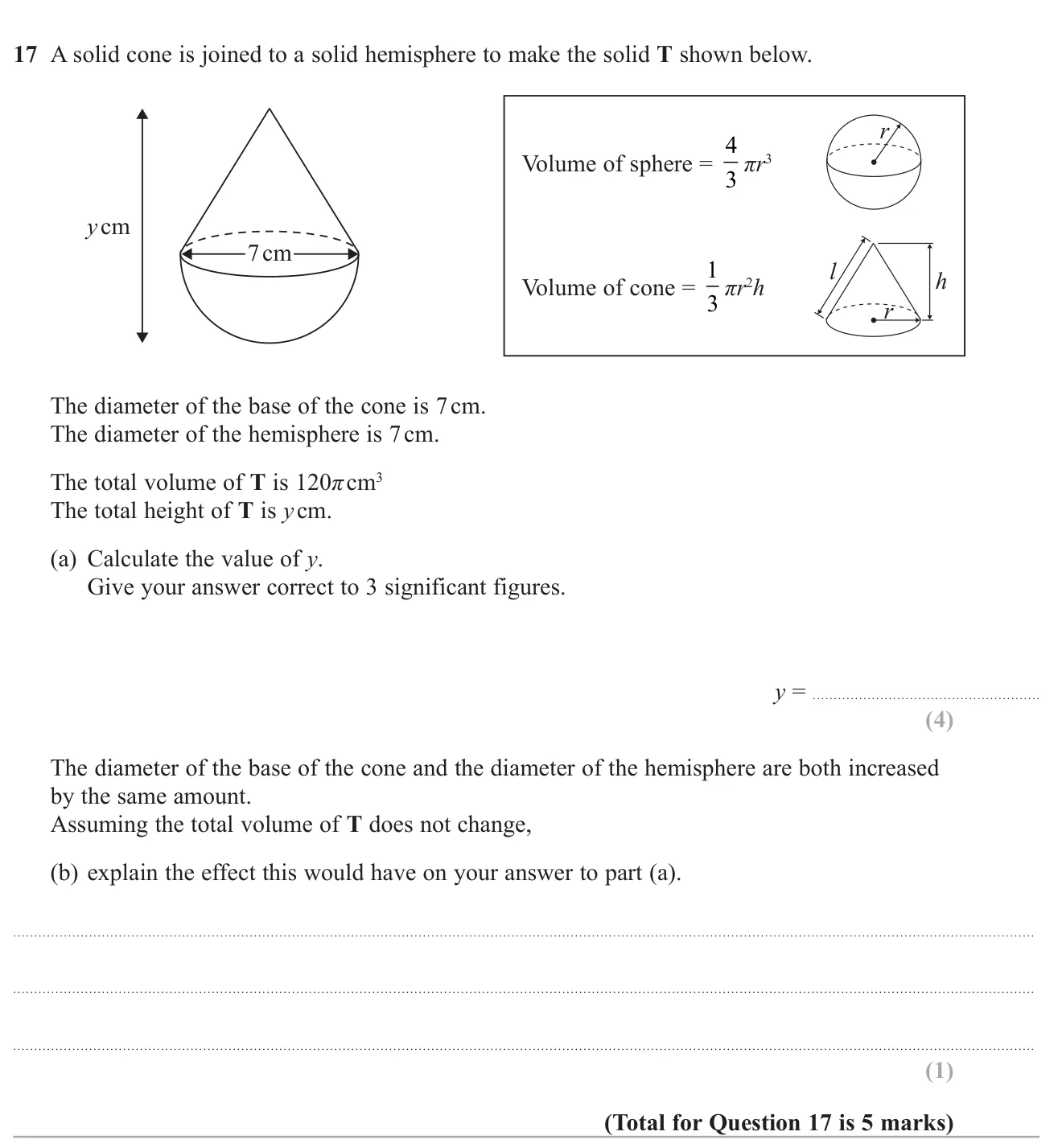
(a) Radius = 3.5 = 3.5 = 3.5 2 3 π ( 3.5 ) 3 = 28.583... π \frac{2}{3}\pi(3.5)^3 = 28.583...\pi 3 2 π ( 3.5 ) 3 = 28.583... π
Cone volume = 120 π − 28.583... π = 91.416... π = 120\pi - 28.583...\pi = 91.416...\pi = 120 π − 28.583... π = 91.416... π
1 3 π ( 3.5 ) 2 h = 91.416... π \frac{1}{3}\pi(3.5)^2 h = 91.416...\pi 3 1 π ( 3.5 ) 2 h = 91.416... π h = 91.416... ÷ 4.0833... = 22.387... h = 91.416... \div 4.0833... = 22.387... h = 91.416... ÷ 4.0833... = 22.387...
y = h + 3.5 = 25.887... y = h + 3.5 = 25.887... y = h + 3.5 = 25.887... y = 25.9 y = 25.9 y = 25.9
(b) With a wider base the same volume needs less height, so y y y
Watch out: Forgetting to add the hemisphere's radius, giving 22.4 (the mark scheme gives a special case of 3 marks for this).
© Pearson Education Ltd. June 2018 Paper 2 (Higher, calculator), question 19.
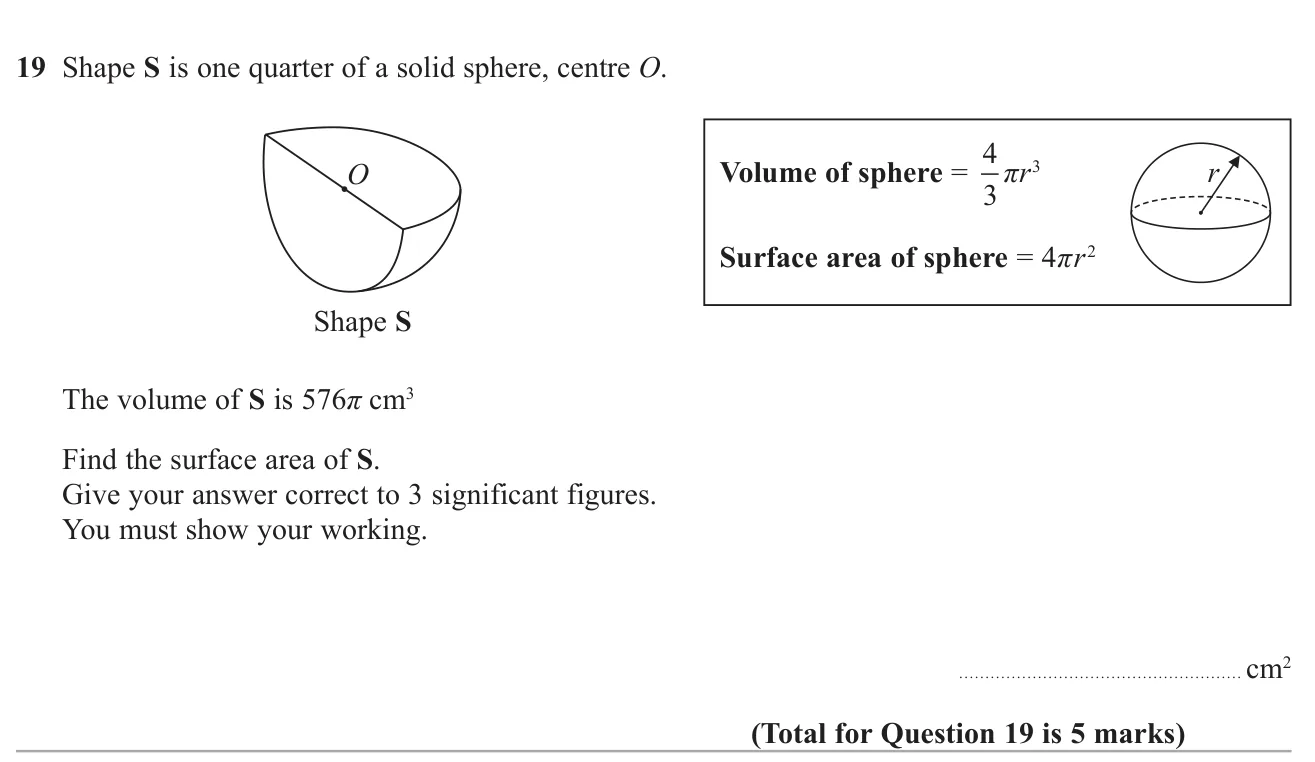
Answer 905 cm 2 905\text{ cm}^2 905 cm 2 288 π 288\pi 288 π 5 marks
Worked solution Checked against the mark scheme
1 4 × 4 3 π r 3 = 576 π \frac{1}{4} \times \frac{4}{3}\pi r^3 = 576\pi 4 1 × 3 4 π r 3 = 576 π r 3 = 1728 r^3 = 1728 r 3 = 1728 r = 12 r = 12 r = 12
Curved part: 1 4 × 4 π × 12 2 = 144 π \frac{1}{4} \times 4\pi \times 12^2 = 144\pi 4 1 × 4 π × 1 2 2 = 144 π
Two flat semicircles: 2 × 1 2 π × 12 2 = 144 π 2 \times \frac{1}{2}\pi \times 12^2 = 144\pi 2 × 2 1 π × 1 2 2 = 144 π
Total = 288 π = 904.8 ≈ 905 cm 2 = 288\pi = 904.8 \approx 905\text{ cm}^2 = 288 π = 904.8 ≈ 905 cm 2
Watch out: Forgetting the two flat semicircular faces, giving 452 cm².
© Pearson Education Ltd. Specimen Paper 1 (Higher, non-calculator), question 18.
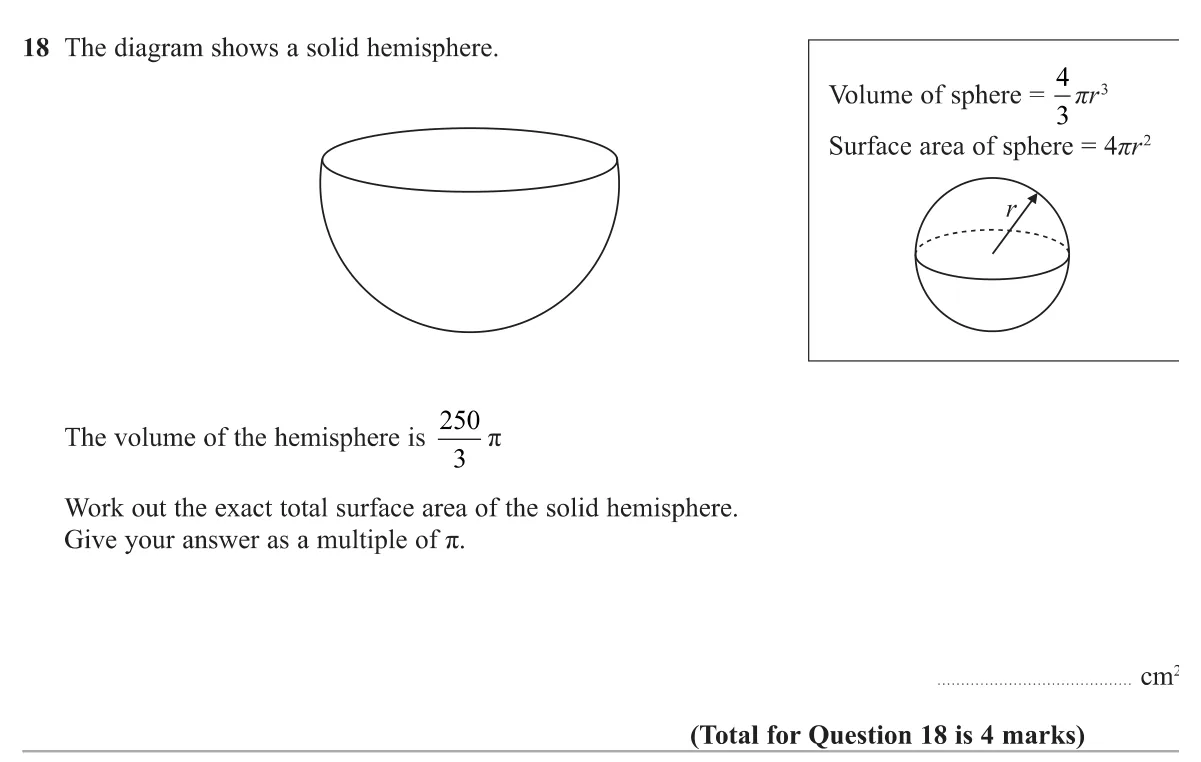
Answer 75 π 75\pi 75 π 4 marks
Worked solution Checked against the mark scheme
Hemisphere volume: 2 3 π r 3 = 250 3 π \frac{2}{3}\pi r^3 = \frac{250}{3}\pi 3 2 π r 3 = 3 250 π r 3 = 125 r^3 = 125 r 3 = 125 r = 5 r = 5 r = 5
Curved surface: 1 2 × 4 π × 5 2 = 50 π \frac{1}{2} \times 4\pi \times 5^2 = 50\pi 2 1 × 4 π × 5 2 = 50 π
Flat face: π × 5 2 = 25 π \pi \times 5^2 = 25\pi π × 5 2 = 25 π
Total: 50 π + 25 π = 75 π 50\pi + 25\pi = 75\pi 50 π + 25 π = 75 π
Watch out: Forgetting to include the flat circular face.
© Pearson Education Ltd. June 2024 Paper 1 (Higher, non-calculator), question 21.
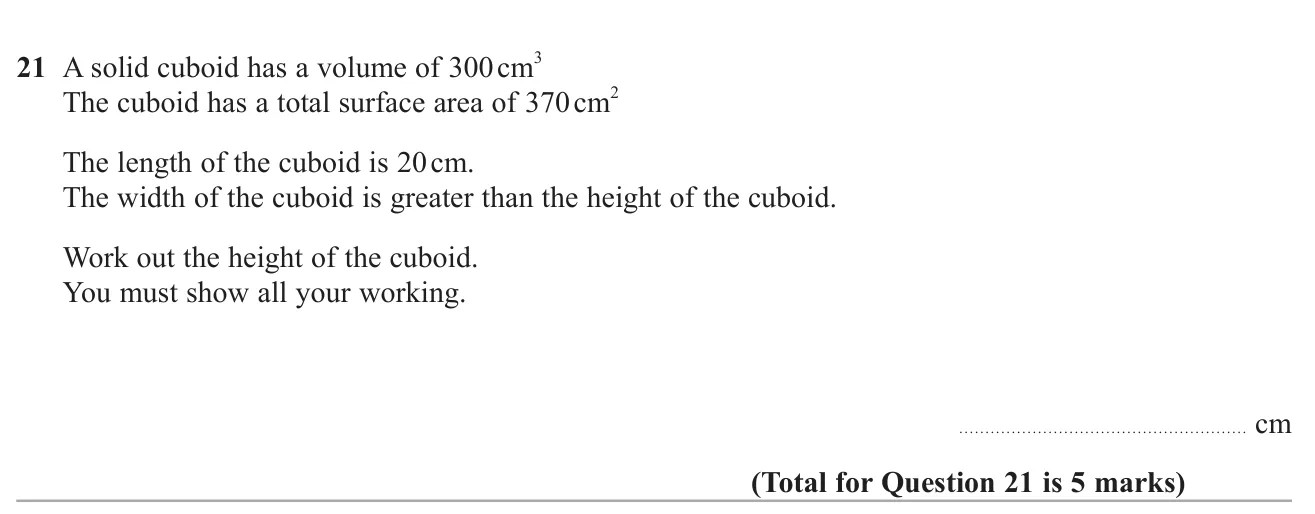
Answer 2.5 cm 2.5\text{ cm} 2.5 cm 5 marks
Worked solution Checked against the mark scheme
Volume: 20 w h = 300 20wh = 300 20 w h = 300 w h = 15 wh = 15 w h = 15
Surface area: 2 ( 20 w + 20 h + w h ) = 370 ⇒ 40 w + 40 h + 30 = 370 ⇒ w + h = 8.5 2(20w + 20h + wh) = 370 \Rightarrow 40w + 40h + 30 = 370 \Rightarrow w + h = 8.5 2 ( 20 w + 20 h + w h ) = 370 ⇒ 40 w + 40 h + 30 = 370 ⇒ w + h = 8.5
Substitute w = 15 h w = \frac{15}{h} w = h 15 15 h + h = 8.5 ⇒ 2 h 2 − 17 h + 30 = 0 \frac{15}{h} + h = 8.5 \Rightarrow 2h^2 - 17h + 30 = 0 h 15 + h = 8.5 ⇒ 2 h 2 − 17 h + 30 = 0
( 2 h − 5 ) ( h − 6 ) = 0 (2h - 5)(h - 6) = 0 ( 2 h − 5 ) ( h − 6 ) = 0 h = 2.5 h = 2.5 h = 2.5 6 6 6
The width is greater than the height, so h = 2.5 h = 2.5 h = 2.5 w = 6 w = 6 w = 6
Watch out: Choosing h = 6 h = 6 h = 6
© Pearson Education Ltd. June 2023 Paper 3 (Higher, calculator), question 18.
Worked solution Checked against the mark scheme
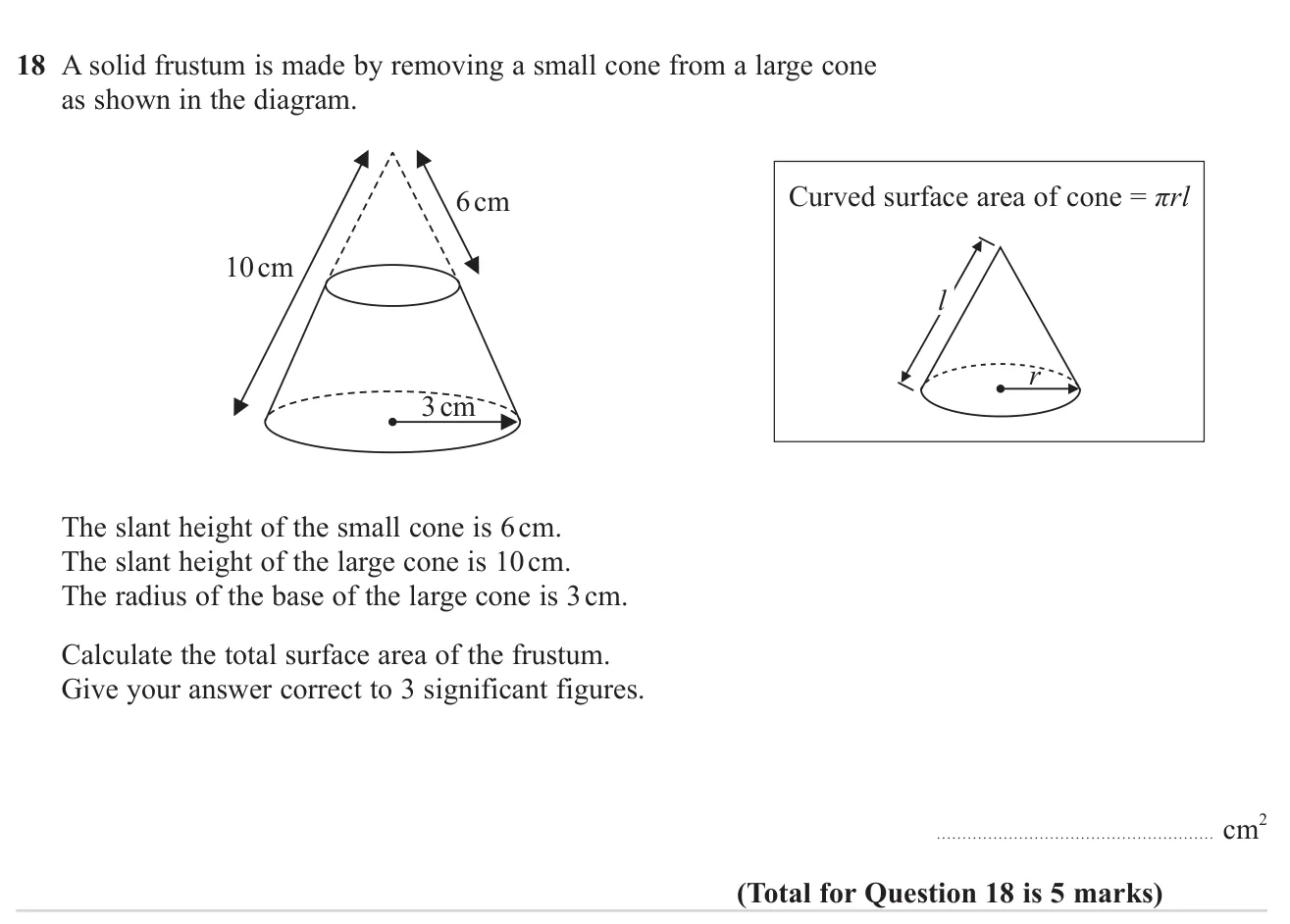
Small cone radius: 6 10 × 3 = 1.8 \dfrac{6}{10} \times 3 = 1.8 10 6 × 3 = 1.8
Curved area of frustum = π × 3 × 10 − π × 1.8 × 6 = 19.2 π = 60.3... = \pi \times 3 \times 10 - \pi \times 1.8 \times 6 = 19.2\pi = 60.3... = π × 3 × 10 − π × 1.8 × 6 = 19.2 π = 60.3...
Bottom circle: π × 3 2 = 9 π \pi \times 3^2 = 9\pi π × 3 2 = 9 π π × 1.8 2 = 3.24 π \pi \times 1.8^2 = 3.24\pi π × 1. 8 2 = 3.24 π
Total = ( 19.2 + 9 + 3.24 ) π = 31.44 π = 98.77... = (19.2 + 9 + 3.24)\pi = 31.44\pi = 98.77... = ( 19.2 + 9 + 3.24 ) π = 31.44 π = 98.77... 98.8 98.8 98.8
Watch out: Forgetting one of the two circular faces, often the top one.
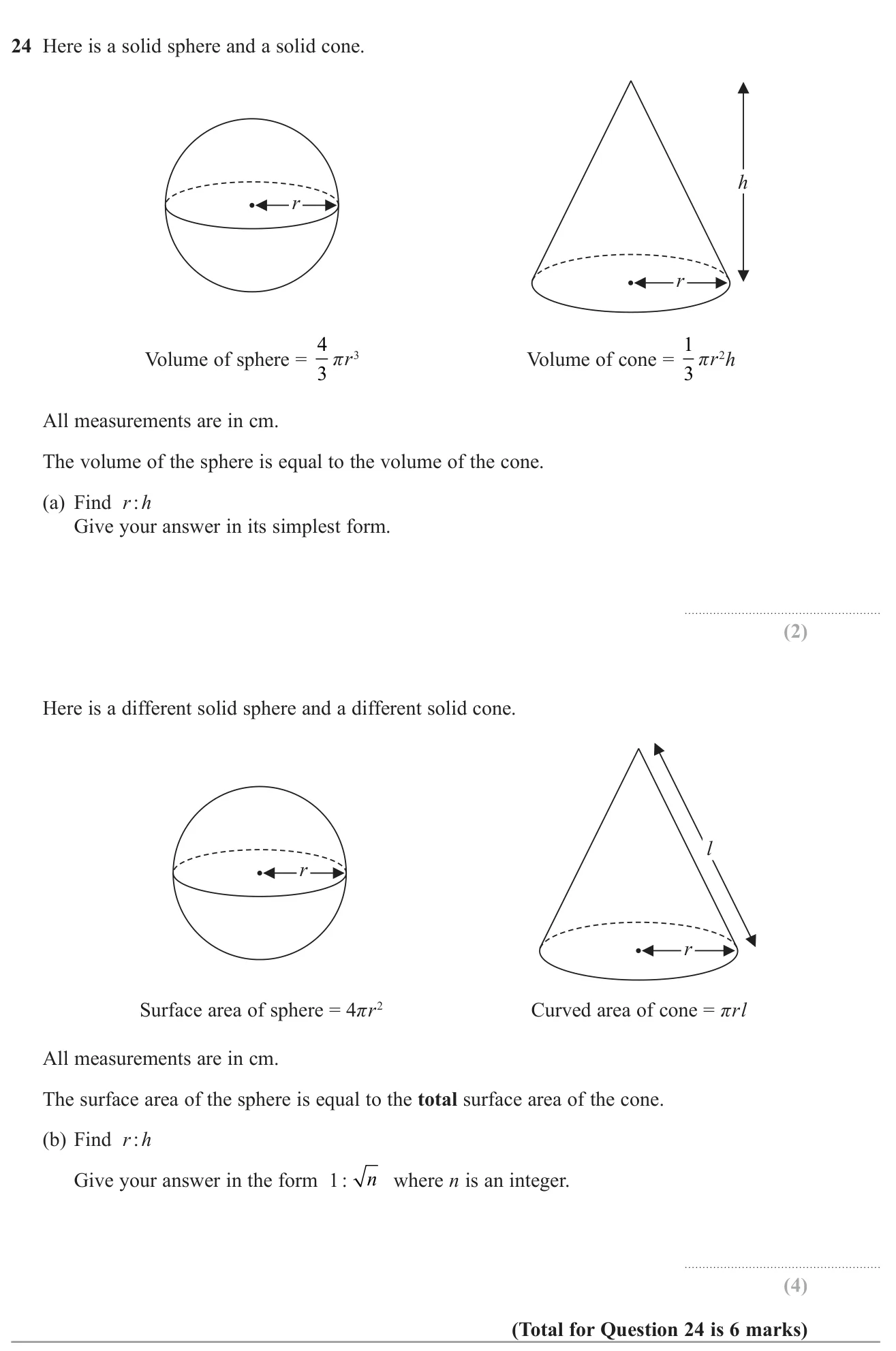
© Pearson Education Ltd. November 2022 Paper 1 (Higher, non-calculator), question 24.
(a) 1 : 4 1 : 4 1 : 4 2 marks (b) 1 : 8 1 : \sqrt{8} 1 : 8 4 marks
Worked solution Checked against the mark scheme
(a) 4 3 π r 3 = 1 3 π r 2 h ⇒ 4 r = h \frac{4}{3}\pi r^3 = \frac{1}{3}\pi r^2 h \Rightarrow 4r = h 3 4 π r 3 = 3 1 π r 2 h ⇒ 4 r = h r : h = 1 : 4 r : h = 1 : 4 r : h = 1 : 4
(b) 4 π r 2 = π r 2 + π r l ⇒ 3 r = l 4\pi r^2 = \pi r^2 + \pi r l \Rightarrow 3r = l 4 π r 2 = π r 2 + π r l ⇒ 3 r = l
l 2 = r 2 + h 2 ⇒ 9 r 2 = r 2 + h 2 ⇒ h 2 = 8 r 2 l^2 = r^2 + h^2 \Rightarrow 9r^2 = r^2 + h^2 \Rightarrow h^2 = 8r^2 l 2 = r 2 + h 2 ⇒ 9 r 2 = r 2 + h 2 ⇒ h 2 = 8 r 2
h = 8 r h = \sqrt{8}\,r h = 8 r r : h = 1 : 8 r : h = 1 : \sqrt{8} r : h = 1 : 8
Watch out: In (b), forgetting to include the circular base of the cone.
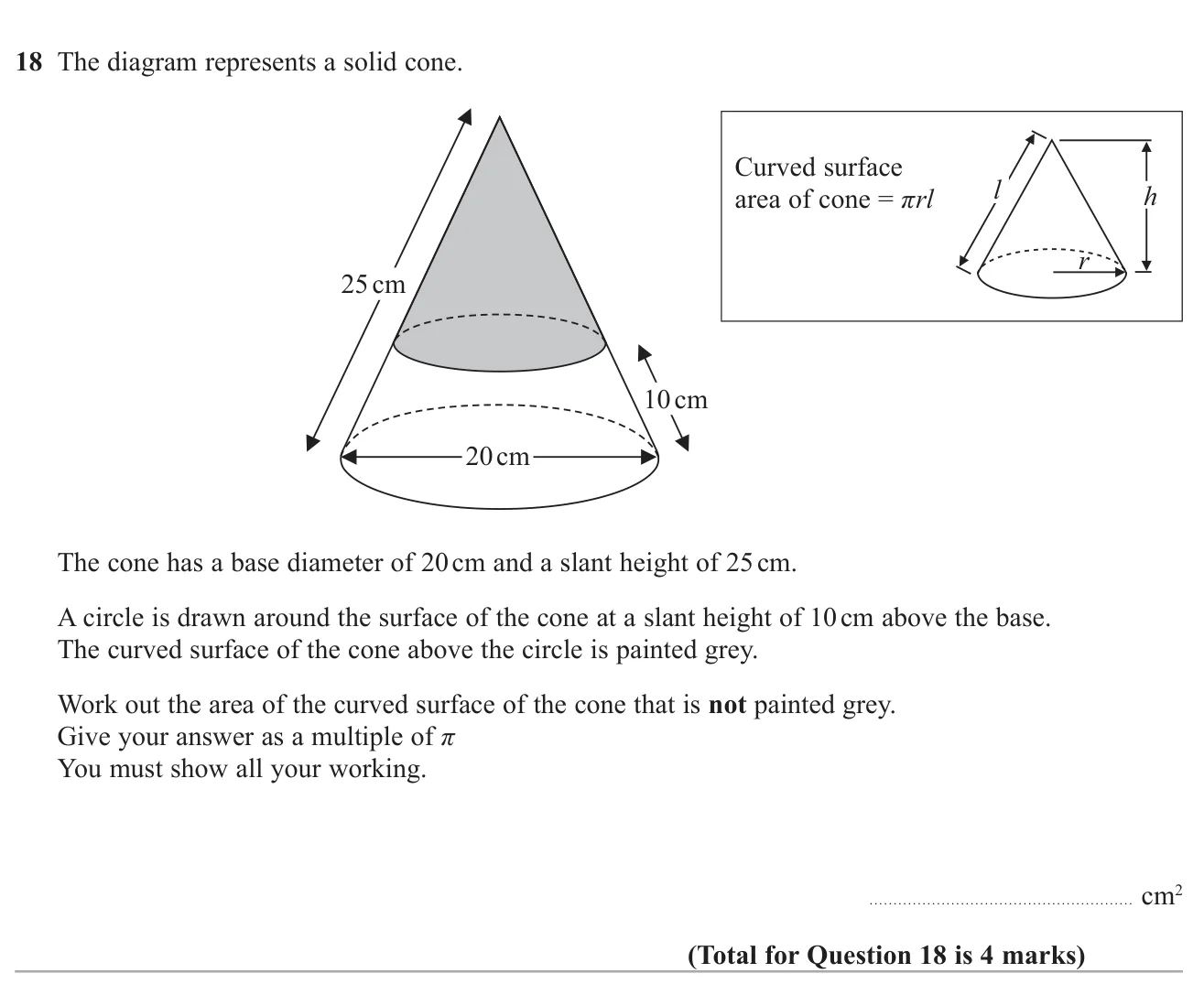
© Pearson Education Ltd. November 2020 Paper 2 (Higher, calculator), question 18.
Answer 160 π 160\pi 160 π 4 marks
Worked solution Checked against the mark scheme
Whole cone: r = 10 r = 10 r = 10 l = 25 l = 25 l = 25 = π × 10 × 25 = 250 π = \pi \times 10 \times 25 = 250\pi = π × 10 × 25 = 250 π
The grey part is a smaller similar cone with slant height 25 − 10 = 15 25 - 10 = 15 25 − 10 = 15
Its radius is 10 × 15 25 = 6 10 \times \frac{15}{25} = 6 10 × 25 15 = 6 π × 6 × 15 = 90 π \pi \times 6 \times 15 = 90\pi π × 6 × 15 = 90 π
Unpainted area = 250 π − 90 π = 160 π = 250\pi - 90\pi = 160\pi = 250 π − 90 π = 160 π
Watch out: Using a slant height of 10 for the grey cone instead of 15.
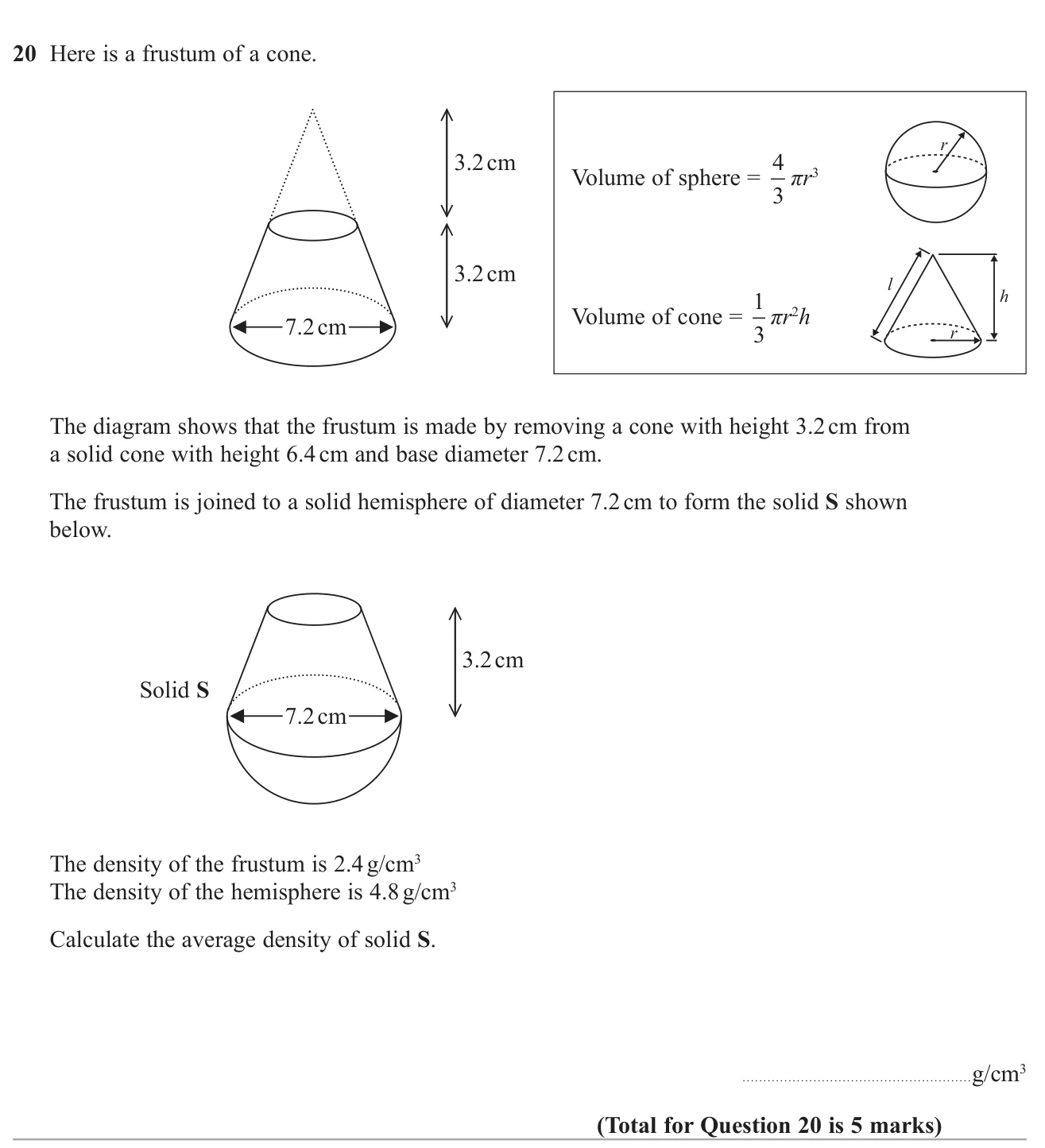
© Pearson Education Ltd. November 2018 Paper 2 (Higher, calculator), question 20.
Answer 3.75 3.75 3.75 5 marks
Worked solution Checked against the mark scheme
Frustum = 1 3 π ( 3.6 ) 2 ( 6.4 ) − 1 3 π ( 1.8 ) 2 ( 3.2 ) = 76.00 = \frac{1}{3}\pi(3.6)^2(6.4) - \frac{1}{3}\pi(1.8)^2(3.2) = 76.00 = 3 1 π ( 3.6 ) 2 ( 6.4 ) − 3 1 π ( 1.8 ) 2 ( 3.2 ) = 76.00
Hemisphere = 2 3 π ( 3.6 ) 3 = 97.72 = \frac{2}{3}\pi(3.6)^3 = 97.72 = 3 2 π ( 3.6 ) 3 = 97.72
Mass = 76.00 × 2.4 + 97.72 × 4.8 = 182.40 + 469.04 = 651.44 = 76.00 \times 2.4 + 97.72 \times 4.8 = 182.40 + 469.04 = 651.44 = 76.00 × 2.4 + 97.72 × 4.8 = 182.40 + 469.04 = 651.44
Density = 651.44 173.72 = 3.75 = \frac{651.44}{173.72} = 3.75 = 173.72 651.44 = 3.75
Watch out: Averaging the two densities (3.6) instead of using total mass over total volume.
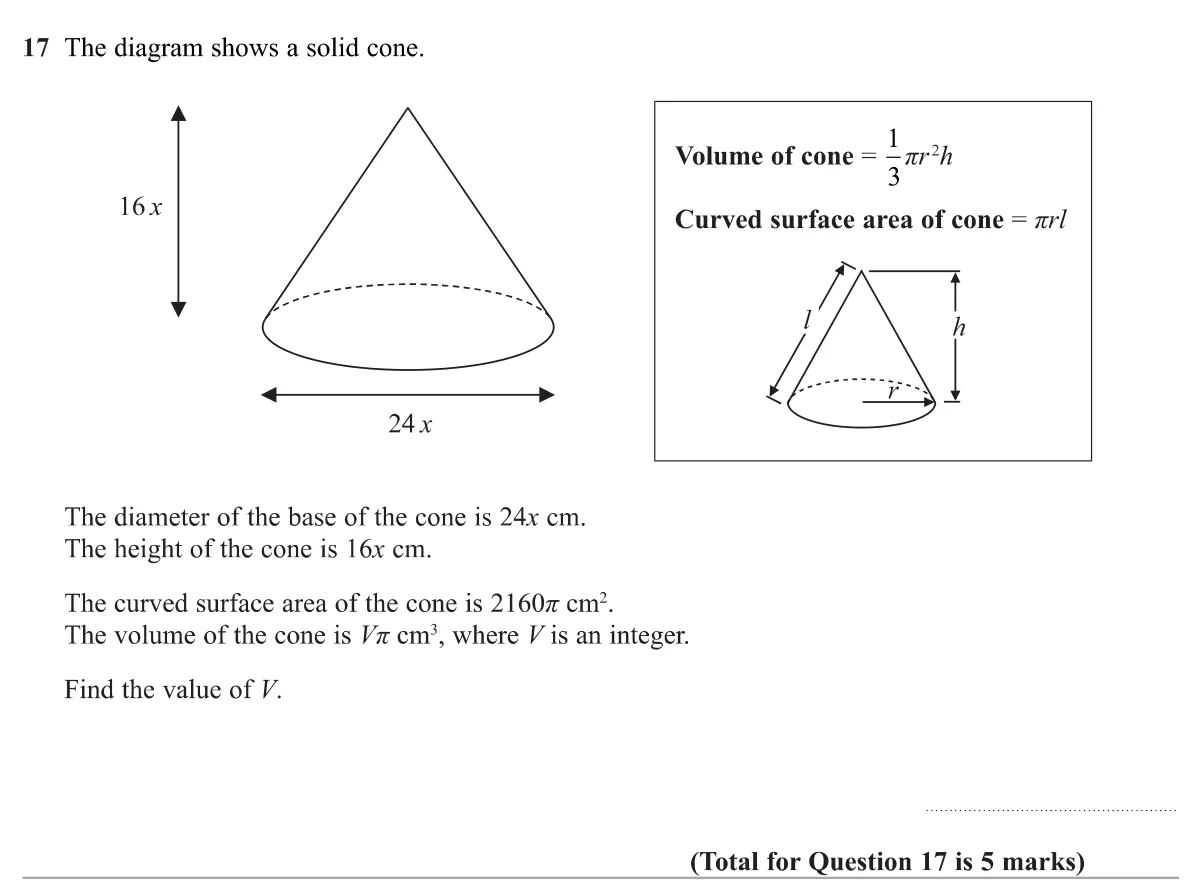
© Pearson Education Ltd. Specimen Paper 3 (Higher, calculator), question 17.
Answer V = 20 736 V = 20\,736 V = 20 736 5 marks
Worked solution Checked against the mark scheme
Radius = 12 x = 12x = 12 x = 16 x = 16x = 16 x l = ( 12 x ) 2 + ( 16 x ) 2 = 20 x l = \sqrt{(12x)^2 + (16x)^2} = 20x l = ( 12 x ) 2 + ( 16 x ) 2 = 20 x
Curved surface area: π × 12 x × 20 x = 240 x 2 π = 2160 π \pi \times 12x \times 20x = 240x^2\pi = 2160\pi π × 12 x × 20 x = 240 x 2 π = 2160 π x 2 = 9 x^2 = 9 x 2 = 9 x = 3 x = 3 x = 3
So r = 36 r = 36 r = 36 h = 48 h = 48 h = 48
Volume = 1 3 π × 36 2 × 48 = 20 736 π = \frac{1}{3}\pi \times 36^2 \times 48 = 20\,736\pi = 3 1 π × 3 6 2 × 48 = 20 736 π V = 20 736 V = 20\,736 V = 20 736
Watch out: Using the diameter 24x as the radius.
Also tested in these questions Their main topic is different, but part of each one tests this topic.
November 2024 · Paper 2 Higher · Q12 : Equate the masses of a steel cylinder and a brass cube using densities to find the cube's side length.November 2024 · Paper 2 Foundation · Q26 : Use equal sides and a perimeter to find the side lengths of an isosceles triangle, then its area.November 2024 · Paper 2 Foundation · Q28 : Find the density of a solid cylinder from its dimensions and mass.November 2024 · Paper 3 Higher · Q13 : Use similar triangles to find a missing length and then the area of a trapezium.June 2024 · Paper 2 Higher · Q8 : Use a scale drawing's area and one real side of a right-angled triangle to find another real side.November 2023 · Paper 3 Foundation · Q19 : Draw the plan view of a cuboid from its front elevation and its volume.November 2023 · Paper 3 Foundation · Q27 : Use pressure, force and area to show a cube's surface area is under a given value.November 2023 · Paper 3 Foundation · Q29 : Find the circumference of the circle through the corners of a square.June 2023 · Paper 1 Higher · Q16 : Given a fraction of a sphere's surface area, find its diameter as a simplified surd.June 2023 · Paper 1 Foundation · Q27 : Find the pressure a cylinder exerts using its volume, height and force.June 2023 · Paper 2 Foundation · Q24 : Form and solve an equation using the areas of a triangle and a rectangle with algebraic sides.November 2022 · Paper 1 Foundation · Q16 : Form and solve an equation from the perimeter of a quadrilateral with algebraic sides, then find one side.November 2022 · Paper 2 Foundation · Q21 : Find the area of a garden made of two rectangles, a triangle and a quarter circle, then the cost of enough bags of seed.June 2022 · Paper 1 Foundation · Q29 : Find the densities of two cubes from their side lengths and masses and write them as a simplified ratio.November 2021 · Paper 1 Higher · Q14 : Split an L-shape with algebraic side lengths into rectangles and show its area gives a given quadratic.November 2021 · Paper 1 Higher · Q18 : Use trigonometry to find the height of a trapezium, then use its area and the ratio of its parallel sides to find the shorter side.November 2021 · Paper 3 Foundation · Q27 : Find the area of a segment cut off a quarter circle by a chord.November 2020 · Paper 1 Foundation · Q27 : Find the base area of a prism from its volume and height, then use the pressure formula to find the force.November 2020 · Paper 2 Foundation · Q27 : Use Pythagoras to find a radius, then find the area of a quarter circle to 3 significant figures.November 2020 · Paper 3 Foundation · Q29 : Find the mass of a triangular prism from its dimensions and density.November 2019 · Paper 1 Higher · Q14 : Form and solve a quadratic from the area of a right-angled triangle to find its shortest side.November 2019 · Paper 3 Higher · Q13 : Find the mass of a cylinder filled with two liquids mixed in a ratio, using their densities.November 2019 · Paper 3 Higher · Q23 : Find the reflex angle of a sector that folds into a cone of given volume and height.June 2019 · Paper 1 Foundation · Q20 : Find what percentage of a larger square's area is taken up by half of a smaller square with half its side length.June 2019 · Paper 2 Foundation · Q15 : Find the grass area of a rectangular garden when a percentage of it is flowers.November 2018 · Paper 1 Foundation · Q26 : Show that a shaded region between a quarter circle and a semicircle is π/8 of a square.November 2018 · Paper 3 Foundation · Q17 : Form an equation for the perimeter of a symmetrical pentagon with algebraic sides, then solve it.June 2018 · Paper 1 Higher · Q8 : Share a triangle's perimeter in the ratio 3 : 4 : 5 and find its area.June 2018 · Paper 3 Foundation · Q17 : Form and solve an equation from the area of a right-angled isosceles triangle with sides in terms of x.Specimen · Paper 1 Foundation · Q15 : Use a scale plan to find the real size of a floor and decide whether 150 boards are enough to cover it.Specimen · Paper 2 Foundation · Q28 : Use Pythagoras to find a slanted side of a trapezium, then find the area of a square with the same perimeter.Specimen · Paper 3 Higher · Q12 : Use the space diagonal of a cuboid with 3D Pythagoras to find the missing edge, then the volume.