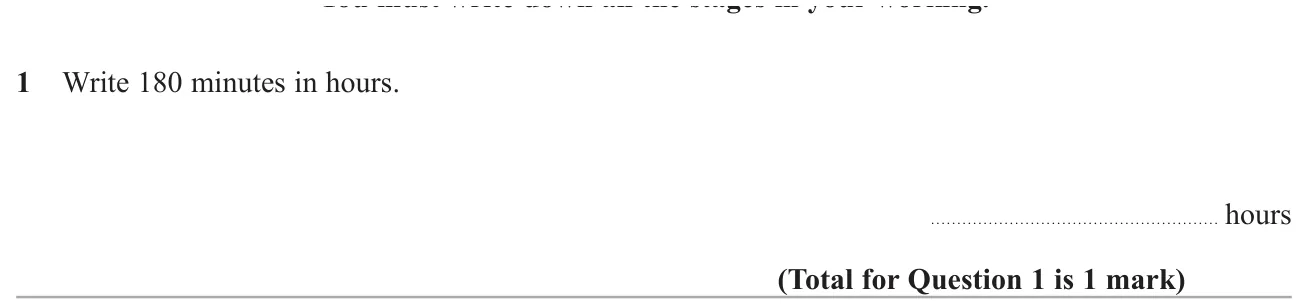
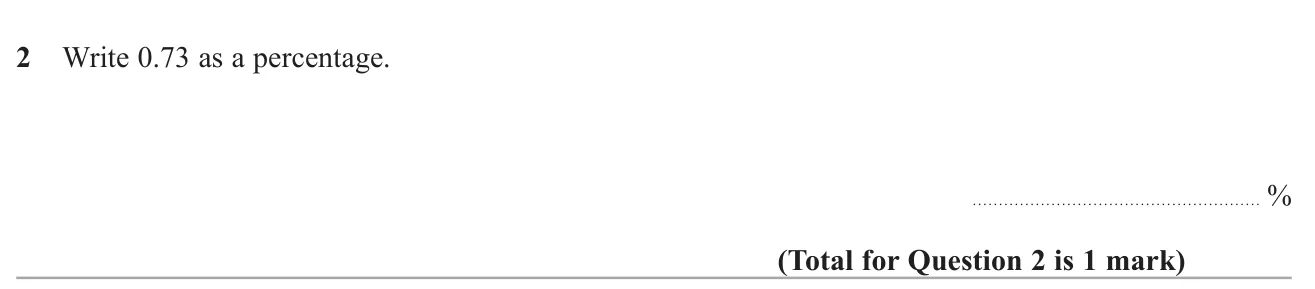
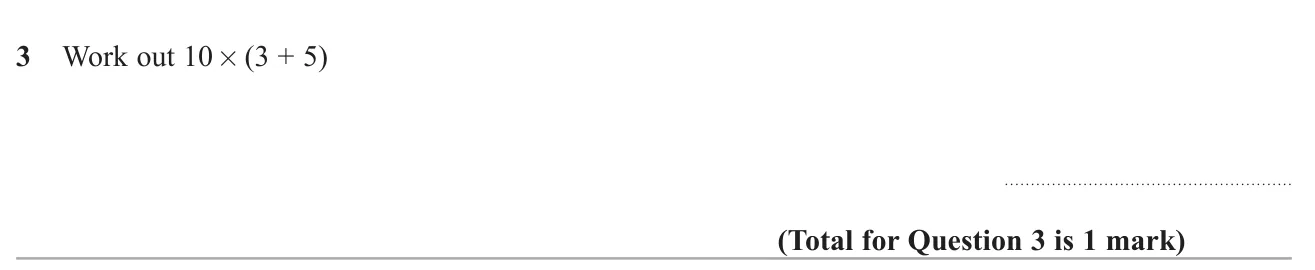
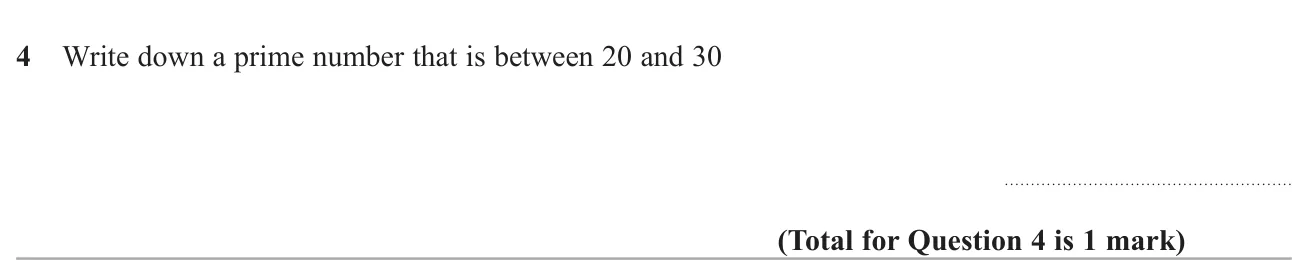
© Pearson Education Ltd. June 2019 Paper 1 (Foundation, non-calculator), question 1.
Worked solution Checked against the mark scheme
There are 60 minutes in an hour.
180 ÷ 60 = 3 180 \div 60 = 3 180 ÷ 60 = 3
Watch out: Dividing by 100 instead of 60.
© Pearson Education Ltd. June 2019 Paper 1 (Foundation, non-calculator), question 2.
Worked solution Checked against the mark scheme
Multiply by 100 to turn a decimal into a percentage.
0.73 × 100 = 73 % 0.73 \times 100 = 73\% 0.73 × 100 = 73%
Watch out: Writing 0.73% or 7.3%.
© Pearson Education Ltd. June 2019 Paper 1 (Foundation, non-calculator), question 3.
Worked solution Checked against the mark scheme
Work out the bracket first: 3 + 5 = 8 3 + 5 = 8 3 + 5 = 8
Then 10 × 8 = 80 10 \times 8 = 80 10 × 8 = 80
Watch out: Doing 10 × 3 10 \times 3 10 × 3
© Pearson Education Ltd. June 2019 Paper 1 (Foundation, non-calculator), question 4.
Worked solution Checked against the mark scheme
Check each odd number from 21 to 29.
21 = 3 × 7, 25 = 5 × 5, 27 = 3 × 9, so these are not prime.
23 and 29 have no factors other than 1 and themselves, so either is correct.
Watch out: Choosing 21 or 27, which are odd but not prime.
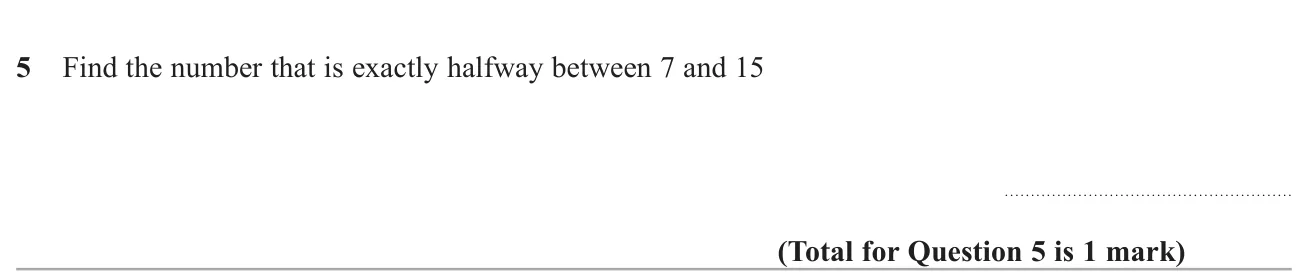
© Pearson Education Ltd. June 2019 Paper 1 (Foundation, non-calculator), question 5.
Worked solution Checked against the mark scheme
Add the numbers and halve: ( 7 + 15 ) ÷ 2 = 22 ÷ 2 = 11 (7 + 15) \div 2 = 22 \div 2 = 11 ( 7 + 15 ) ÷ 2 = 22 ÷ 2 = 11
Watch out: Halving the difference (4) and giving that as the answer.
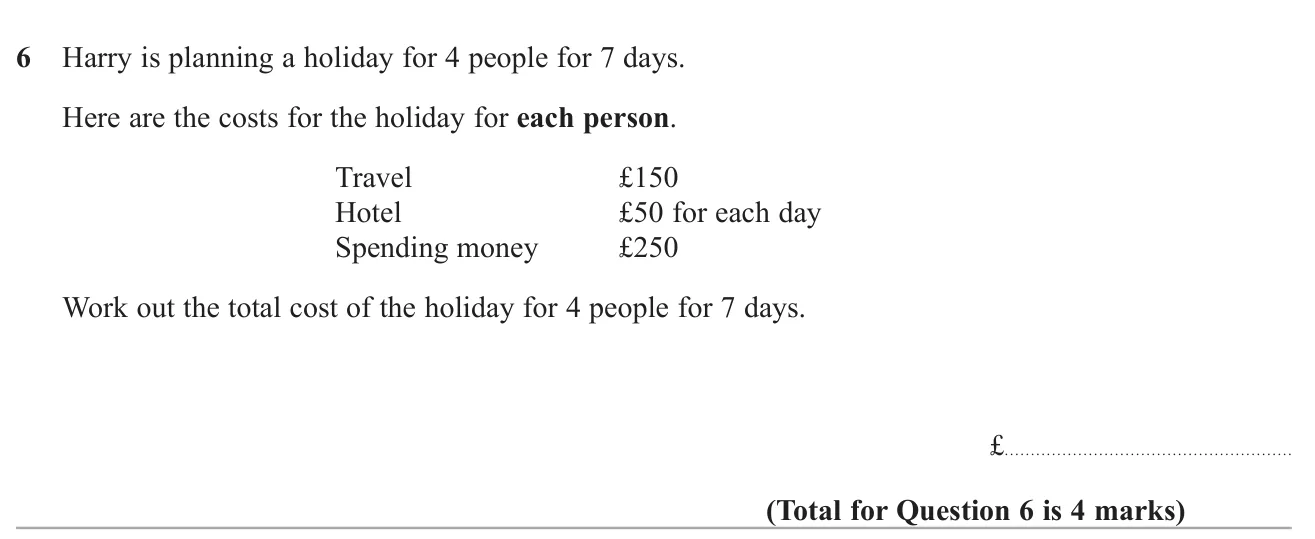
© Pearson Education Ltd. June 2019 Paper 1 (Foundation, non-calculator), question 6.
Worked solution Checked against the mark scheme
Hotel for one person: 7 × £ 50 = £ 350 7 \times £50 = £350 7 × £50 = £350
Cost for one person: £ 150 + £ 350 + £ 250 = £ 750 £150 + £350 + £250 = £750 £150 + £350 + £250 = £750
For 4 people: 4 × £ 750 = £ 3000 4 \times £750 = £3000 4 × £750 = £3000
Watch out: Charging the hotel for one day only, or forgetting to multiply by 4 people.
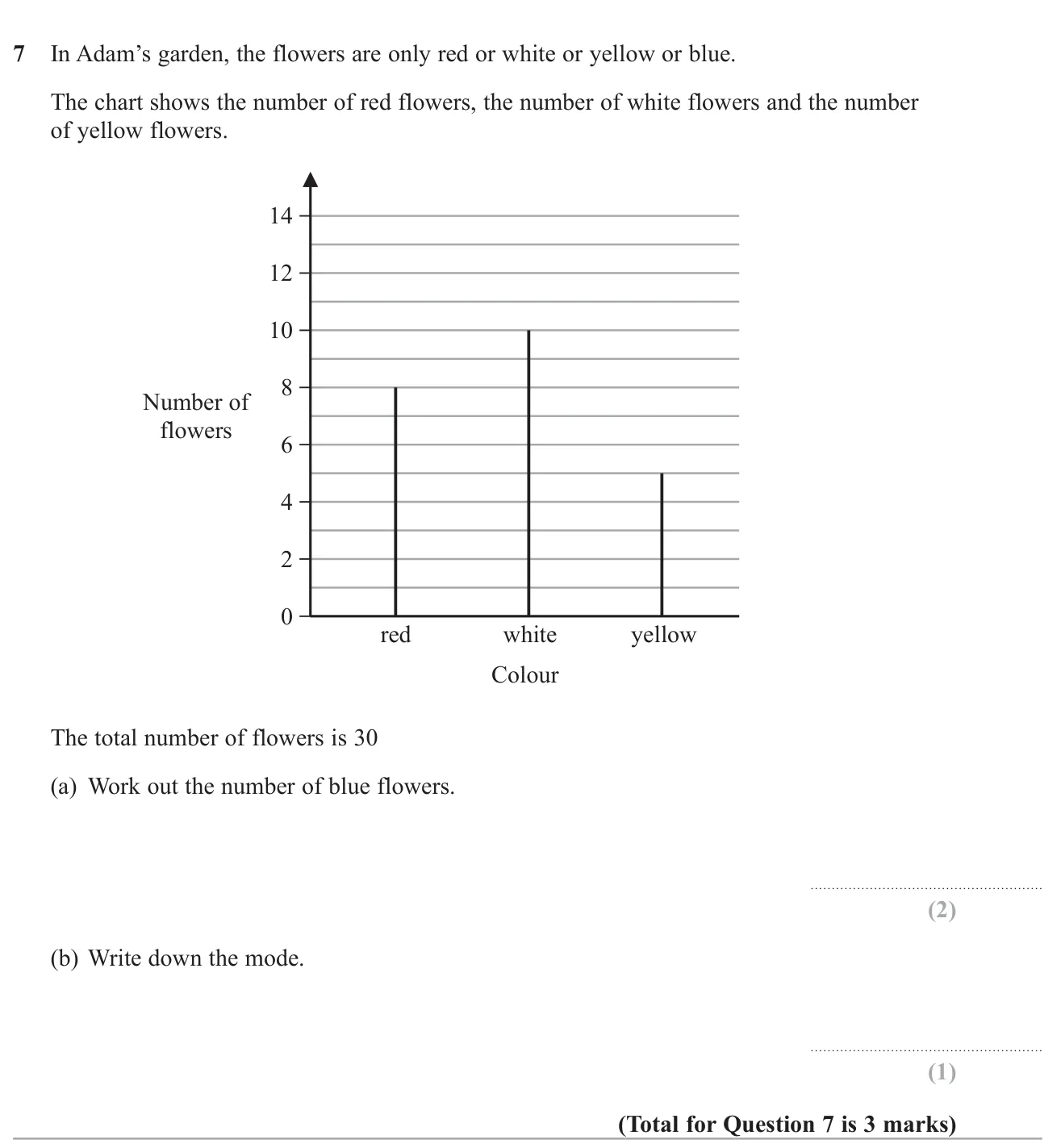
© Pearson Education Ltd. June 2019 Paper 1 (Foundation, non-calculator), question 7.
(a) 7 2 marks (b) white 1 mark
Worked solution Checked against the mark scheme
(a) From the chart: red 8, white 10, yellow 5.
Blue = 30 − 8 − 10 − 5 = 7 = 30 - 8 - 10 - 5 = 7 = 30 − 8 − 10 − 5 = 7
(b) White has the most flowers (10), so the mode is white.
Watch out: Giving the mode as the number 10 rather than the colour.
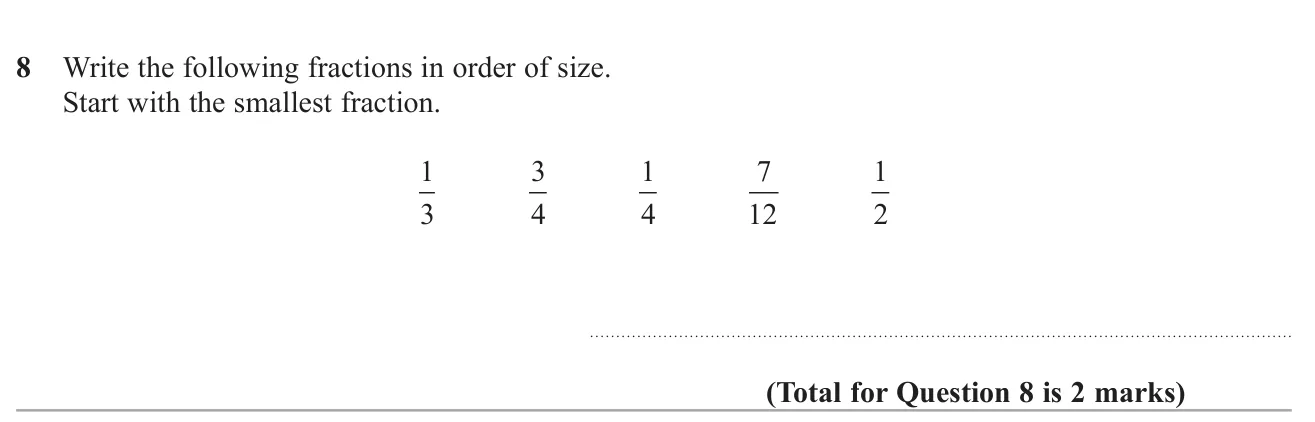
© Pearson Education Ltd. June 2019 Paper 1 (Foundation, non-calculator), question 8.
Answer 1 4 , 1 3 , 1 2 , 7 12 , 3 4 \frac{1}{4}, \frac{1}{3}, \frac{1}{2}, \frac{7}{12}, \frac{3}{4} 4 1 , 3 1 , 2 1 , 12 7 , 4 3 2 marks
Worked solution Checked against the mark scheme
Write each with denominator 12:
1 3 = 4 12 \frac{1}{3} = \frac{4}{12} 3 1 = 12 4 3 4 = 9 12 \frac{3}{4} = \frac{9}{12} 4 3 = 12 9 1 4 = 3 12 \frac{1}{4} = \frac{3}{12} 4 1 = 12 3 7 12 \frac{7}{12} 12 7 1 2 = 6 12 \frac{1}{2} = \frac{6}{12} 2 1 = 12 6
Order: 3 12 , 4 12 , 6 12 , 7 12 , 9 12 \frac{3}{12}, \frac{4}{12}, \frac{6}{12}, \frac{7}{12}, \frac{9}{12} 12 3 , 12 4 , 12 6 , 12 7 , 12 9 1 4 , 1 3 , 1 2 , 7 12 , 3 4 \frac{1}{4}, \frac{1}{3}, \frac{1}{2}, \frac{7}{12}, \frac{3}{4} 4 1 , 3 1 , 2 1 , 12 7 , 4 3
Watch out: Thinking a bigger denominator means a bigger fraction.
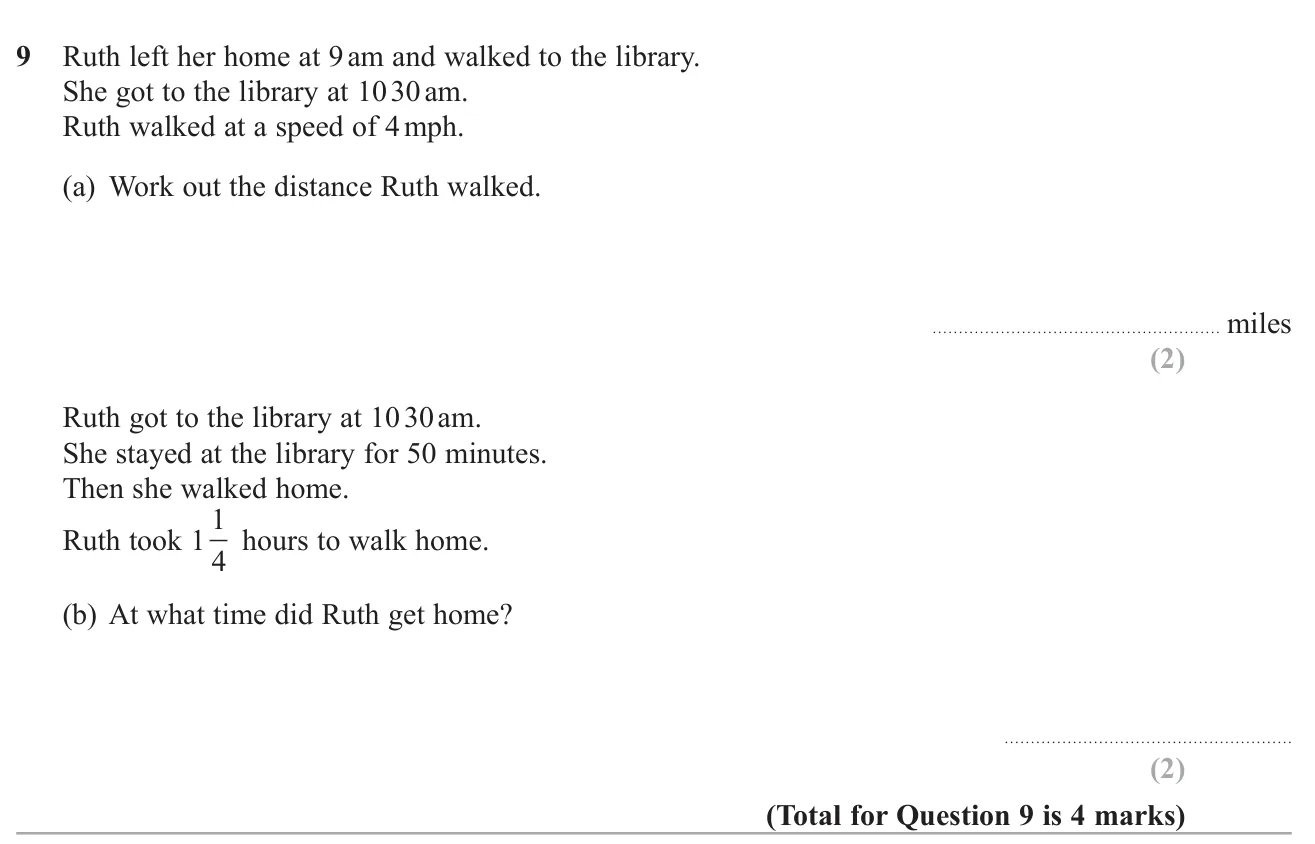
© Pearson Education Ltd. June 2019 Paper 1 (Foundation, non-calculator), question 9.
(a) 6 miles 2 marks (b) 12 35 pm 2 marks
Worked solution Checked against the mark scheme
(a) 9 am to 10 30 am is 1.5 hours.
Distance = 4 × 1.5 = 6 = 4 \times 1.5 = 6 = 4 × 1.5 = 6
(b) Leaves library: 10 30 + 50 min = 11 20 am
1 1 4 1\frac{1}{4} 1 4 1
Watch out: Treating 1 hour 30 minutes as 1.3 hours, or 1 1 4 1\frac{1}{4} 1 4 1
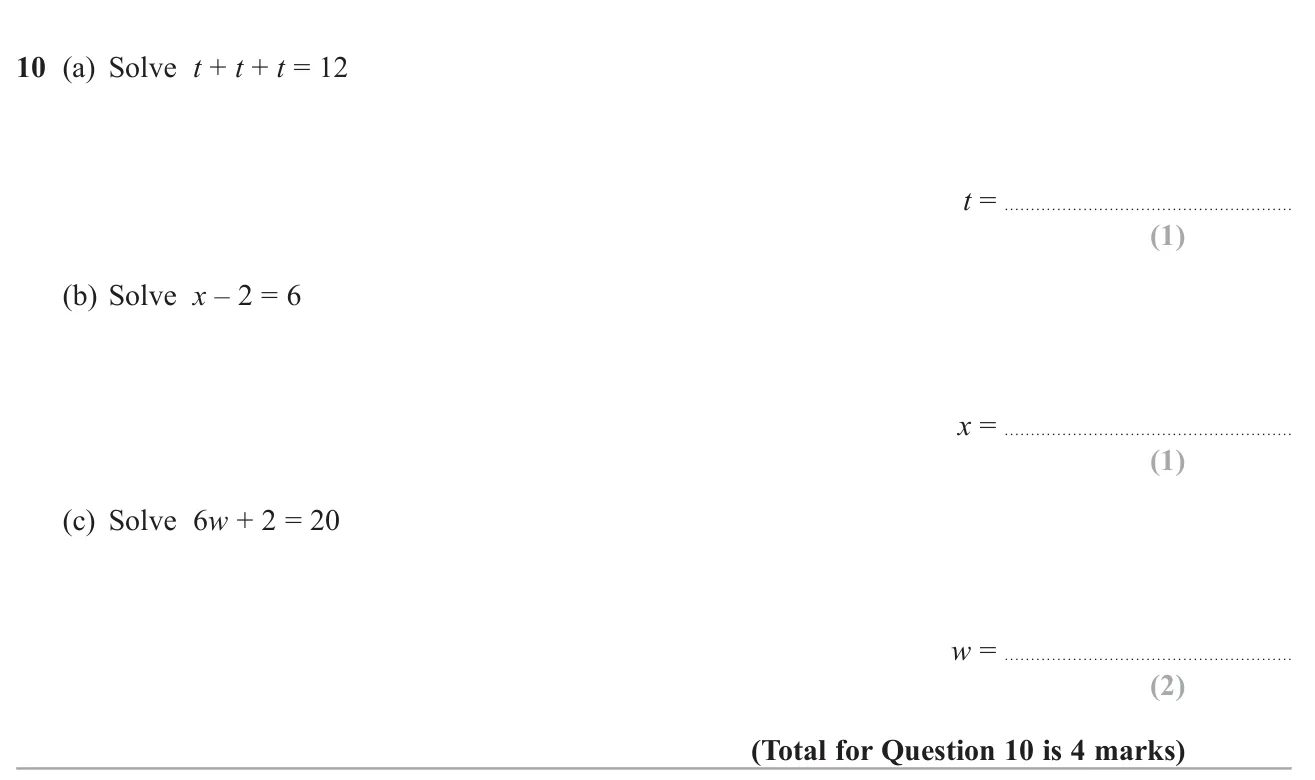
© Pearson Education Ltd. June 2019 Paper 1 (Foundation, non-calculator), question 10.
(a) t = 4 t = 4 t = 4 1 mark (b) x = 8 x = 8 x = 8 1 mark (c) w = 3 w = 3 w = 3 2 marks
Worked solution Checked against the mark scheme
(a) 3 t = 12 3t = 12 3 t = 12 t = 4 t = 4 t = 4
(b) Add 2 to both sides: x = 8 x = 8 x = 8
(c) 6 w + 2 = 20 6w + 2 = 20 6 w + 2 = 20
6 w = 18 6w = 18 6 w = 18
w = 3 w = 3 w = 3
Watch out: In (b), subtracting 2 instead of adding and getting 4.
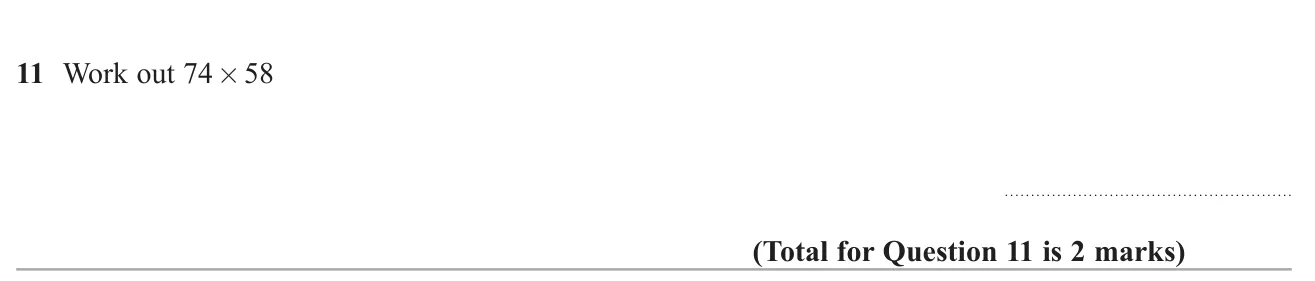
© Pearson Education Ltd. June 2019 Paper 1 (Foundation, non-calculator), question 11.
Worked solution Checked against the mark scheme
Grid method:
70 × 50 = 3500 70 \times 50 = 3500 70 × 50 = 3500 70 × 8 = 560 70 \times 8 = 560 70 × 8 = 560 4 × 50 = 200 4 \times 50 = 200 4 × 50 = 200 4 × 8 = 32 4 \times 8 = 32 4 × 8 = 32
3500 + 560 + 200 + 32 = 4292 3500 + 560 + 200 + 32 = 4292 3500 + 560 + 200 + 32 = 4292
Watch out: Forgetting the place-value zero in the second row of long multiplication.
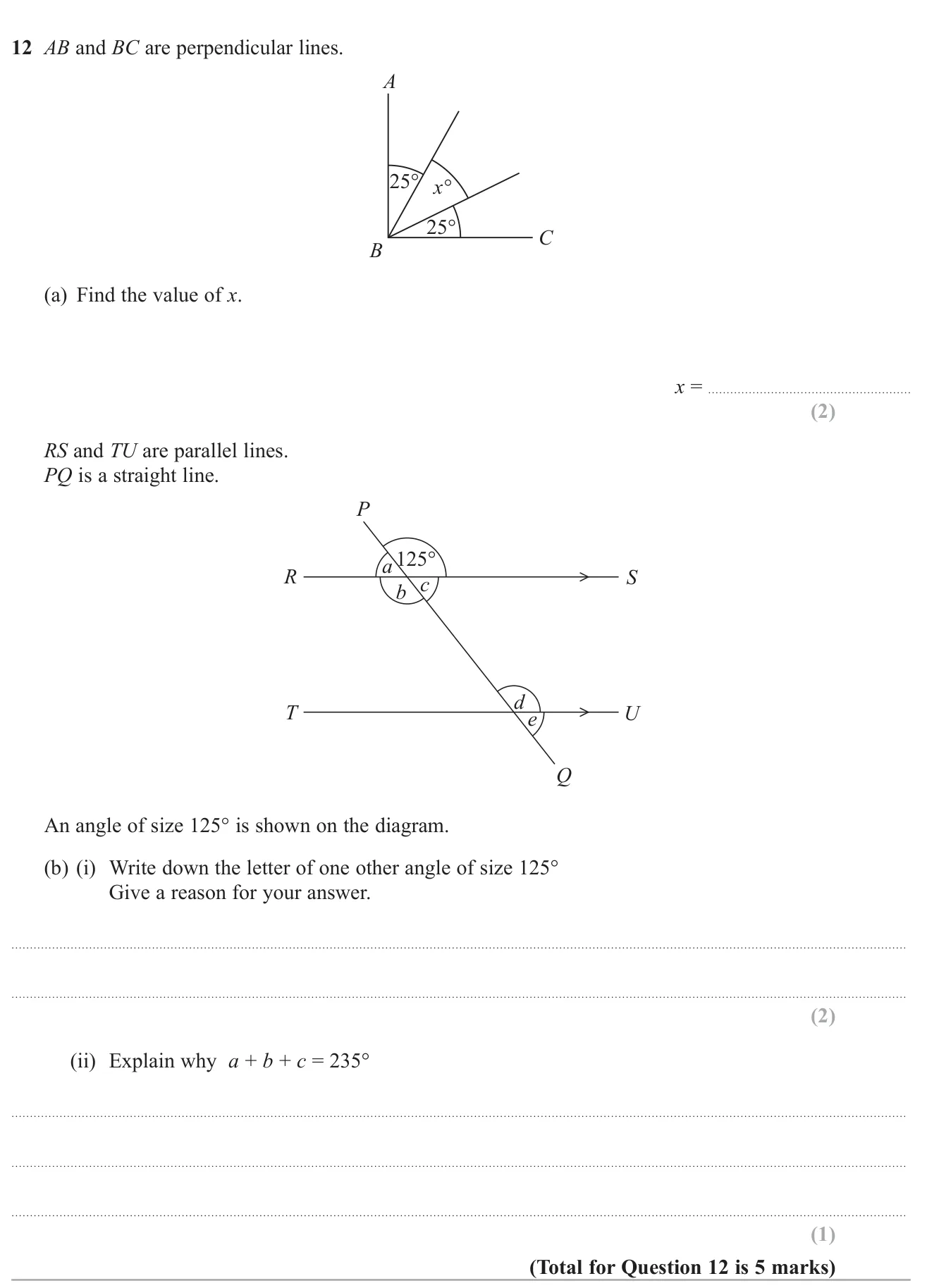
© Pearson Education Ltd. June 2019 Paper 1 (Foundation, non-calculator), question 12.
(a) x = 40 x = 40 x = 40 2 marks (b(i)) b b b d d d 2 marks (b(ii)) a a a b b b c c c a + b + c = 360 − 125 = 235 ° a + b + c = 360 - 125 = 235° a + b + c = 360 − 125 = 235° 1 mark
Worked solution Checked against the mark scheme
(a) The angle at B is a right angle, so x = 90 − 25 − 25 = 40 x = 90 - 25 - 25 = 40 x = 90 − 25 − 25 = 40
(b)(i) b = 125 ° b = 125° b = 125° d = 125 ° d = 125° d = 125°
(ii) Angles around a point add up to 360 ° 360° 360° a + b + c = 360 − 125 = 235 ° a + b + c = 360 - 125 = 235° a + b + c = 360 − 125 = 235°
Watch out: Giving a reason with the wrong angle fact, e.g. calling corresponding angles alternate.
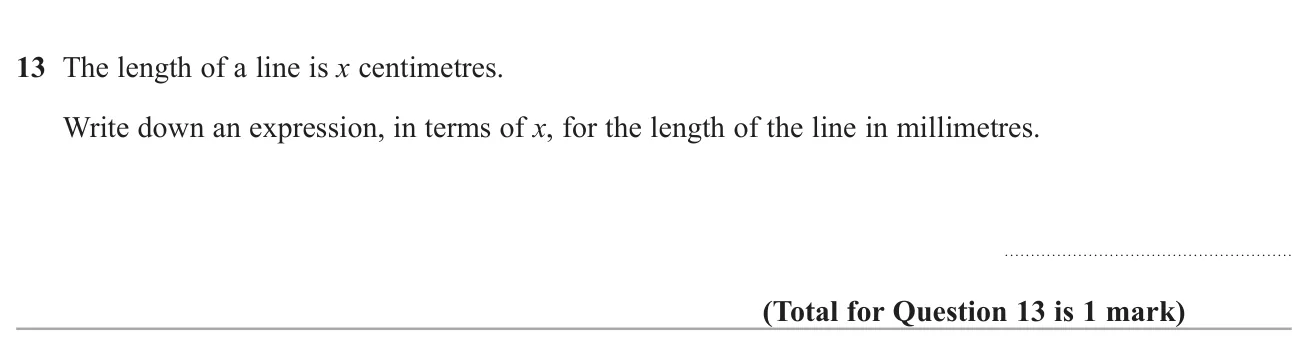
© Pearson Education Ltd. June 2019 Paper 1 (Foundation, non-calculator), question 13.
Worked solution Checked against the mark scheme
There are 10 mm in 1 cm, so x x x 10 x 10x 10 x
Watch out: Writing x + 10 x + 10 x + 10 x ÷ 10 x \div 10 x ÷ 10
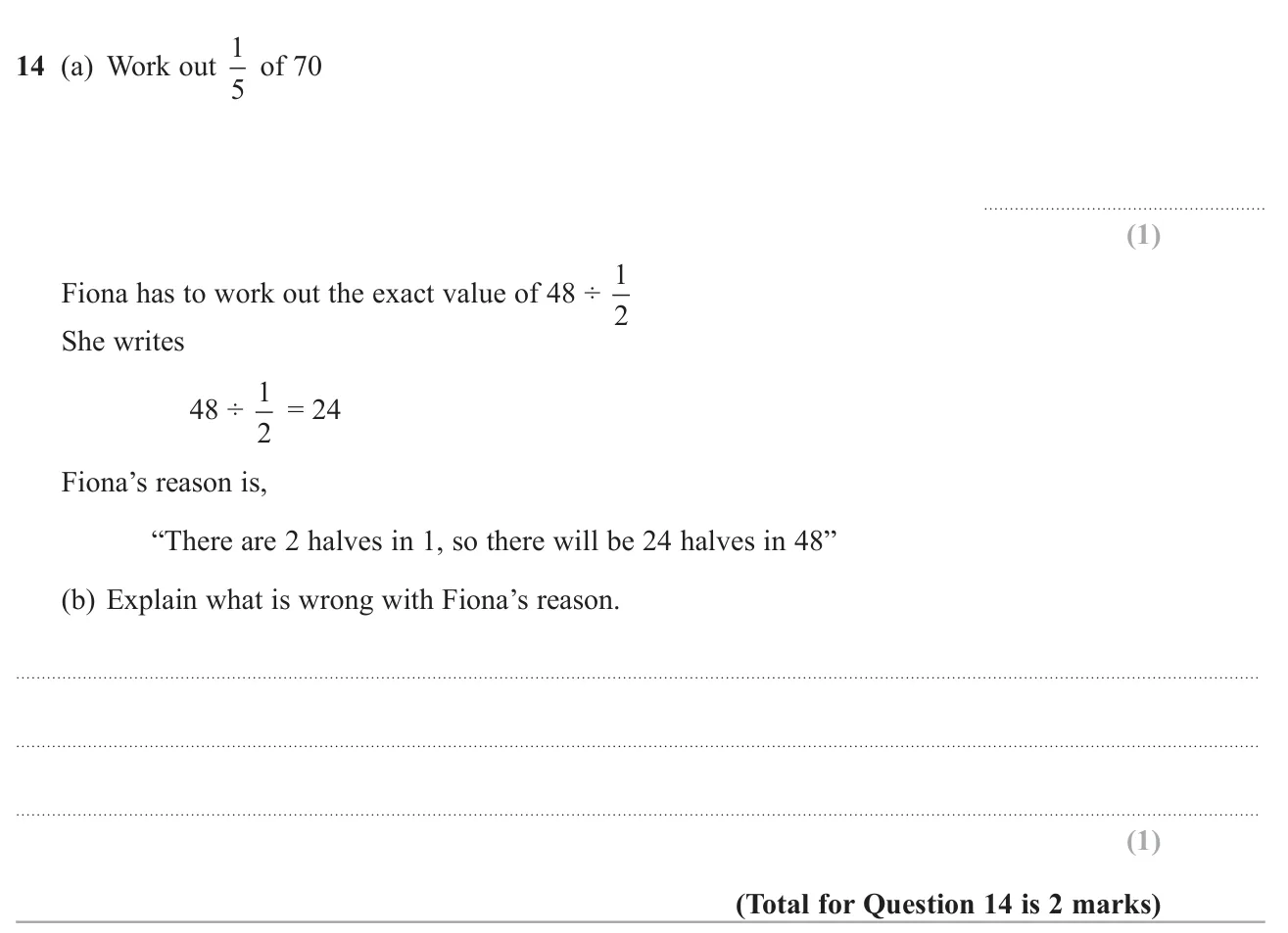
© Pearson Education Ltd. June 2019 Paper 1 (Foundation, non-calculator), question 14.
(a) 14 1 mark (b) She halved 48 instead of multiplying by 2; there are 96 halves in 48 1 mark
Worked solution Checked against the mark scheme
(a) 70 ÷ 5 = 14 70 \div 5 = 14 70 ÷ 5 = 14
(b) Each whole contains 2 halves, so 48 wholes contain 48 × 2 = 96 48 \times 2 = 96 48 × 2 = 96 1 2 \frac{1}{2} 2 1
Watch out: Thinking that dividing by a half means halving.
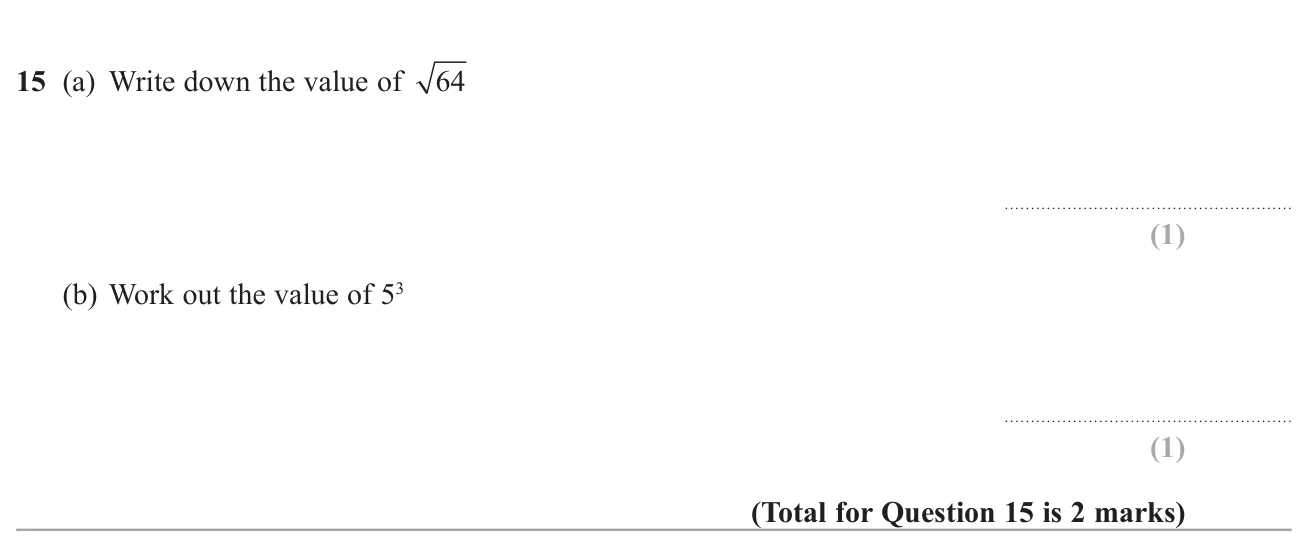
© Pearson Education Ltd. June 2019 Paper 1 (Foundation, non-calculator), question 15.
Worked solution Checked against the mark scheme
(a) 8 × 8 = 64 8 \times 8 = 64 8 × 8 = 64 64 = 8 \sqrt{64} = 8 64 = 8
(b) 5 3 = 5 × 5 × 5 = 25 × 5 = 125 5^3 = 5 \times 5 \times 5 = 25 \times 5 = 125 5 3 = 5 × 5 × 5 = 25 × 5 = 125
Watch out: In (b), working out 5 × 3 = 15 5 \times 3 = 15 5 × 3 = 15
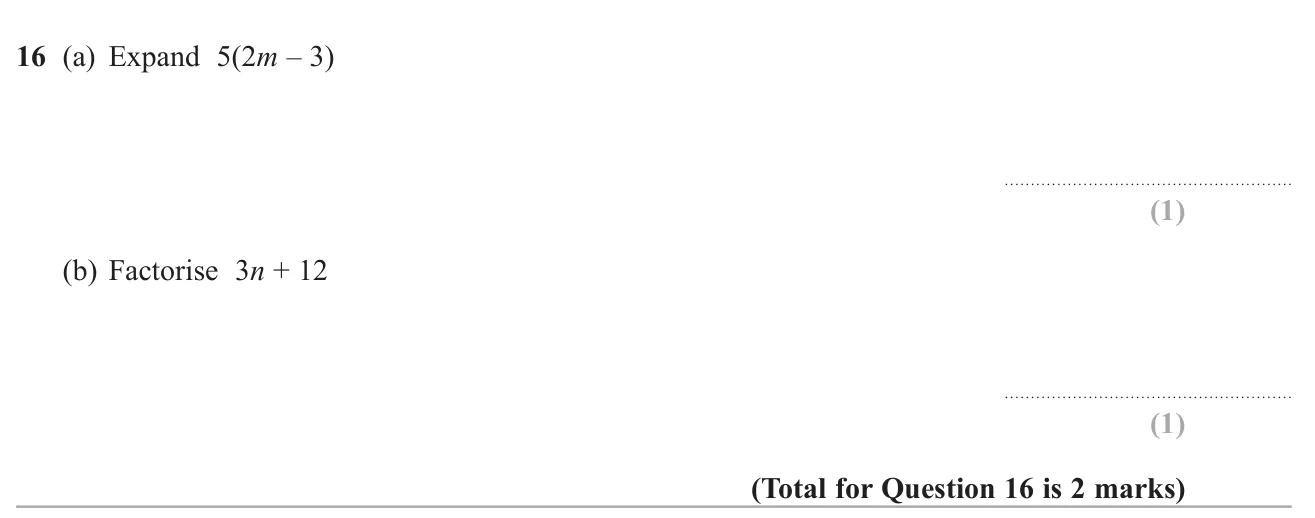
© Pearson Education Ltd. June 2019 Paper 1 (Foundation, non-calculator), question 16.
(a) 10 m − 15 10m - 15 10 m − 15 1 mark (b) 3 ( n + 4 ) 3(n + 4) 3 ( n + 4 ) 1 mark
Worked solution Checked against the mark scheme
(a) 5 × 2 m = 10 m 5 \times 2m = 10m 5 × 2 m = 10 m 5 × ( − 3 ) = − 15 5 \times (-3) = -15 5 × ( − 3 ) = − 15 10 m − 15 10m - 15 10 m − 15
(b) 3 is a factor of both terms: 3 n + 12 = 3 ( n + 4 ) 3n + 12 = 3(n + 4) 3 n + 12 = 3 ( n + 4 )
Watch out: In (a), multiplying only the first term: 10 m − 3 10m - 3 10 m − 3
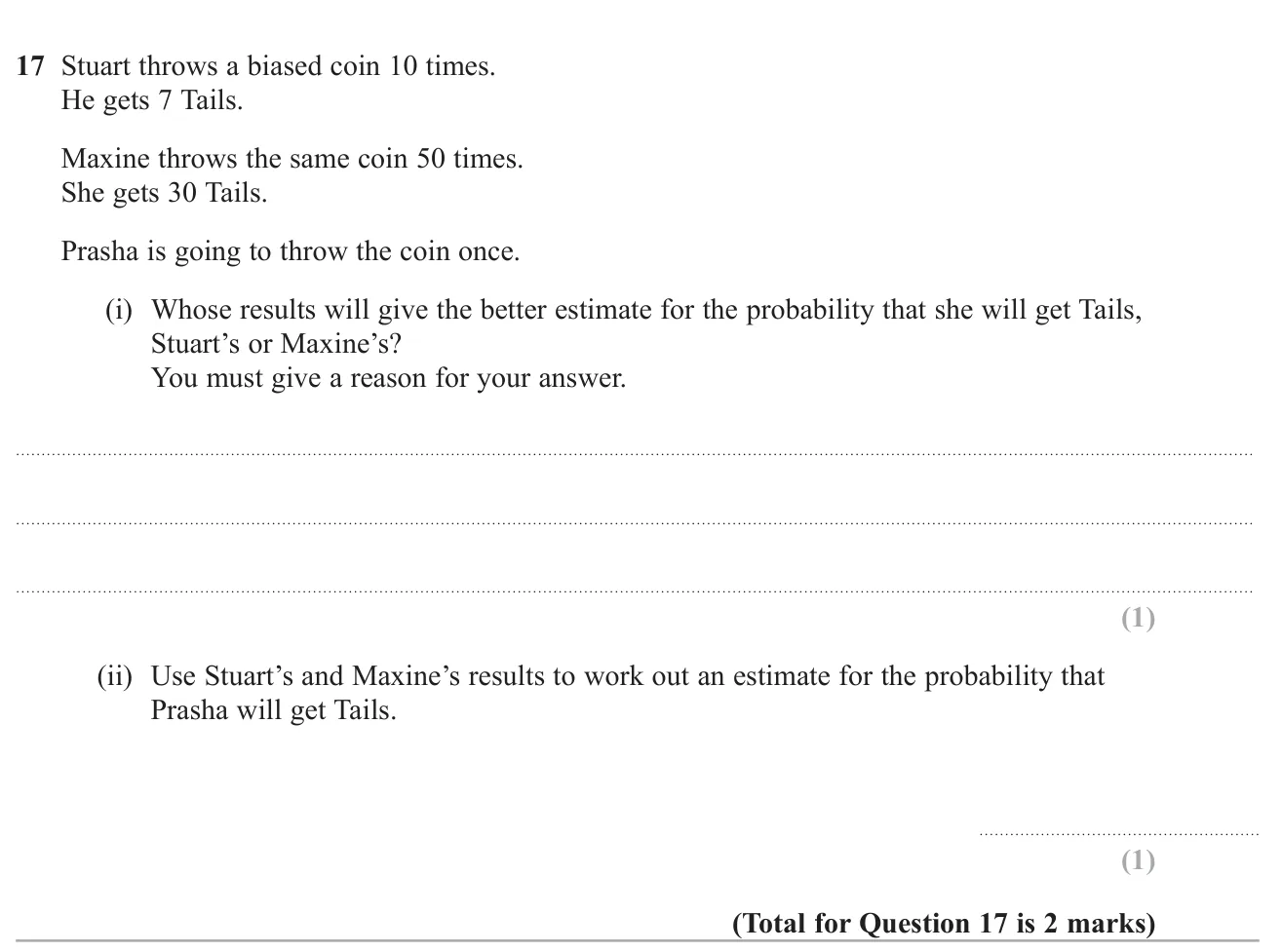
© Pearson Education Ltd. June 2019 Paper 1 (Foundation, non-calculator), question 17.
((i)) Maxine, because she threw the coin more times 1 mark ((ii)) 37 60 \frac{37}{60} 60 37 1 mark
Worked solution Checked against the mark scheme
(i) Maxine: she made more throws (50 against 10), and more trials give a more reliable estimate.
(ii) Combine all the results: 7 + 30 = 37 7 + 30 = 37 7 + 30 = 37 10 + 50 = 60 10 + 50 = 60 10 + 50 = 60
Estimate = 37 60 = \frac{37}{60} = 60 37
Watch out: In (ii), averaging the two fractions 7 10 \frac{7}{10} 10 7 30 50 \frac{30}{50} 50 30
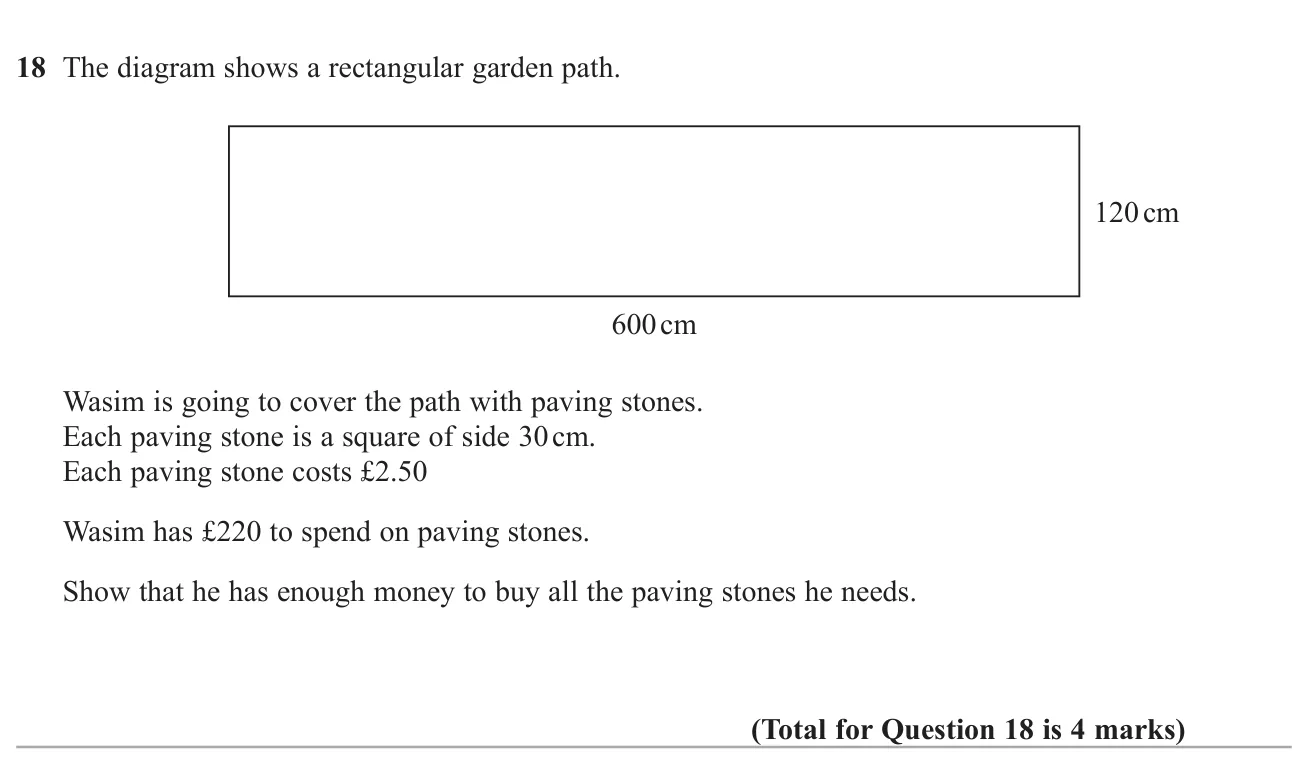
© Pearson Education Ltd. June 2019 Paper 1 (Foundation, non-calculator), question 18.
Answer 80 stones cost £200, which is less than £220 (or 88 stones affordable against 80 needed) 4 marks
Worked solution Checked against the mark scheme
Along the length: 600 ÷ 30 = 20 600 \div 30 = 20 600 ÷ 30 = 20
Across the width: 120 ÷ 30 = 4 120 \div 30 = 4 120 ÷ 30 = 4
Number needed: 20 × 4 = 80 20 \times 4 = 80 20 × 4 = 80
Cost: 80 × £ 2.50 = £ 200 80 \times £2.50 = £200 80 × £2.50 = £200
£ 200 < £ 220 £200 < £220 £200 < £220
Watch out: Using the perimeter of the path instead of its area.
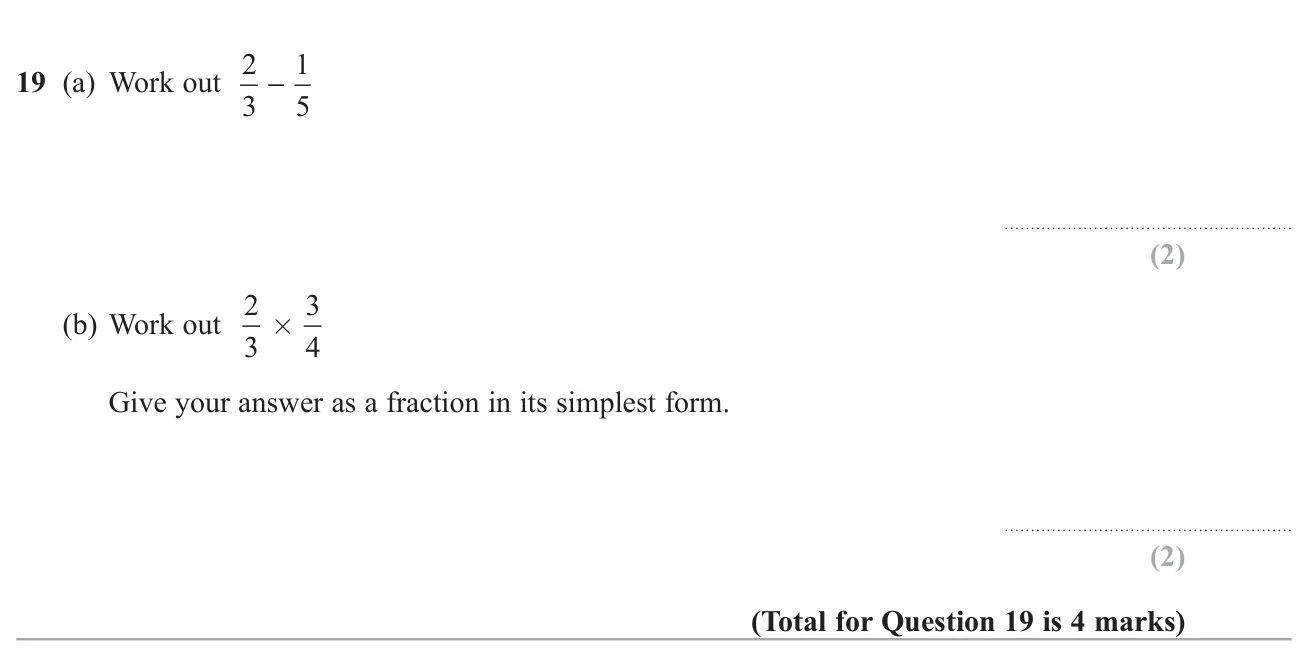
© Pearson Education Ltd. June 2019 Paper 1 (Foundation, non-calculator), question 19.
(a) 7 15 \frac{7}{15} 15 7 2 marks (b) 1 2 \frac{1}{2} 2 1 2 marks
Worked solution Checked against the mark scheme
(a) 2 3 − 1 5 = 10 15 − 3 15 = 7 15 \frac{2}{3} - \frac{1}{5} = \frac{10}{15} - \frac{3}{15} = \frac{7}{15} 3 2 − 5 1 = 15 10 − 15 3 = 15 7
(b) 2 3 × 3 4 = 6 12 = 1 2 \frac{2}{3} \times \frac{3}{4} = \frac{6}{12} = \frac{1}{2} 3 2 × 4 3 = 12 6 = 2 1
Watch out: In (a), subtracting tops and bottoms separately to get 1 − 2 \frac{1}{-2} − 2 1
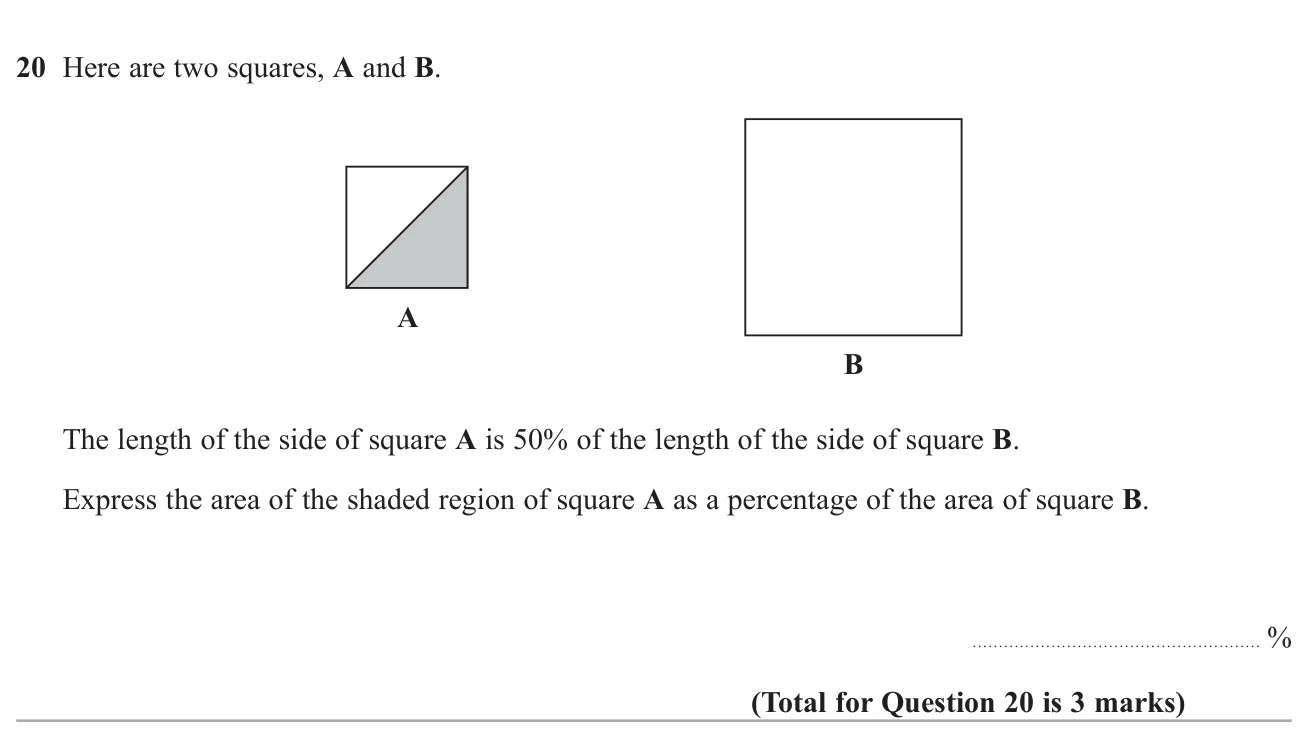
© Pearson Education Ltd. June 2019 Paper 1 (Foundation, non-calculator), question 20.
Worked solution Checked against the mark scheme
Let B have side 2, so A has side 1.
Area of B = 4 = 4 = 4 = 1 = 1 = 1
The diagonal halves A, so the shaded part = 1 2 = \frac{1}{2} = 2 1
0.5 4 × 100 = 12.5 % \frac{0.5}{4} \times 100 = 12.5\% 4 0.5 × 100 = 12.5%
Watch out: Thinking half the side means half the area, giving 25%.
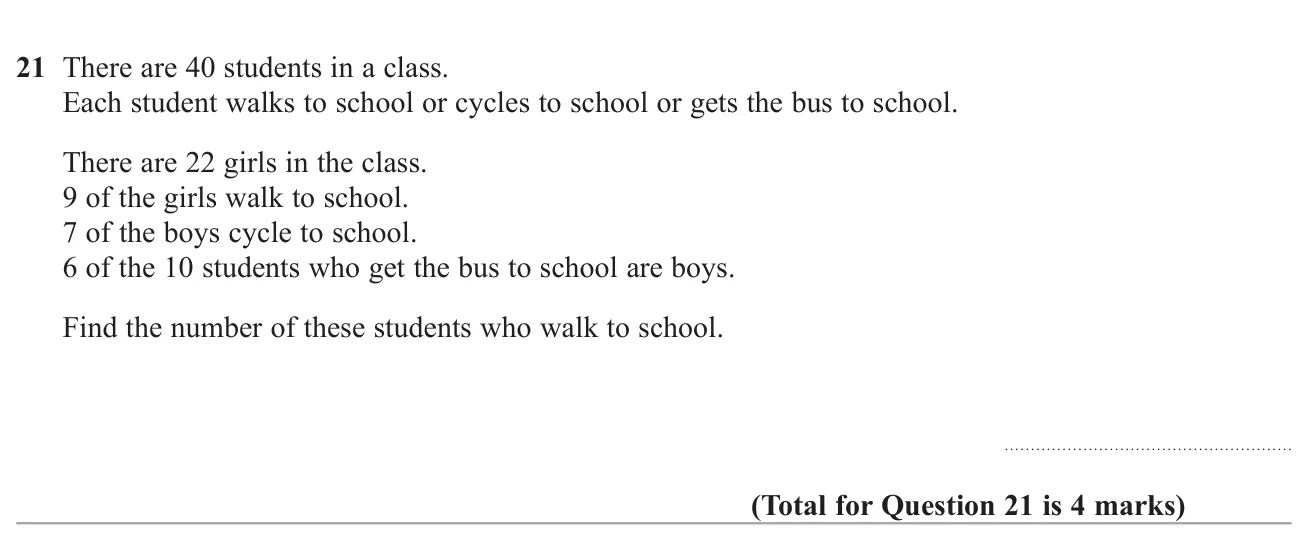
© Pearson Education Ltd. June 2019 Paper 1 (Foundation, non-calculator), question 21.
Worked solution Checked against the mark scheme
Boys: 40 − 22 = 18 40 - 22 = 18 40 − 22 = 18
Girls on the bus: 10 − 6 = 4 10 - 6 = 4 10 − 6 = 4
Boys who walk: 18 − 7 − 6 = 5 18 - 7 - 6 = 5 18 − 7 − 6 = 5
Students who walk: 5 + 9 = 14 5 + 9 = 14 5 + 9 = 14
Watch out: Forgetting to find the boys who walk and giving 9.
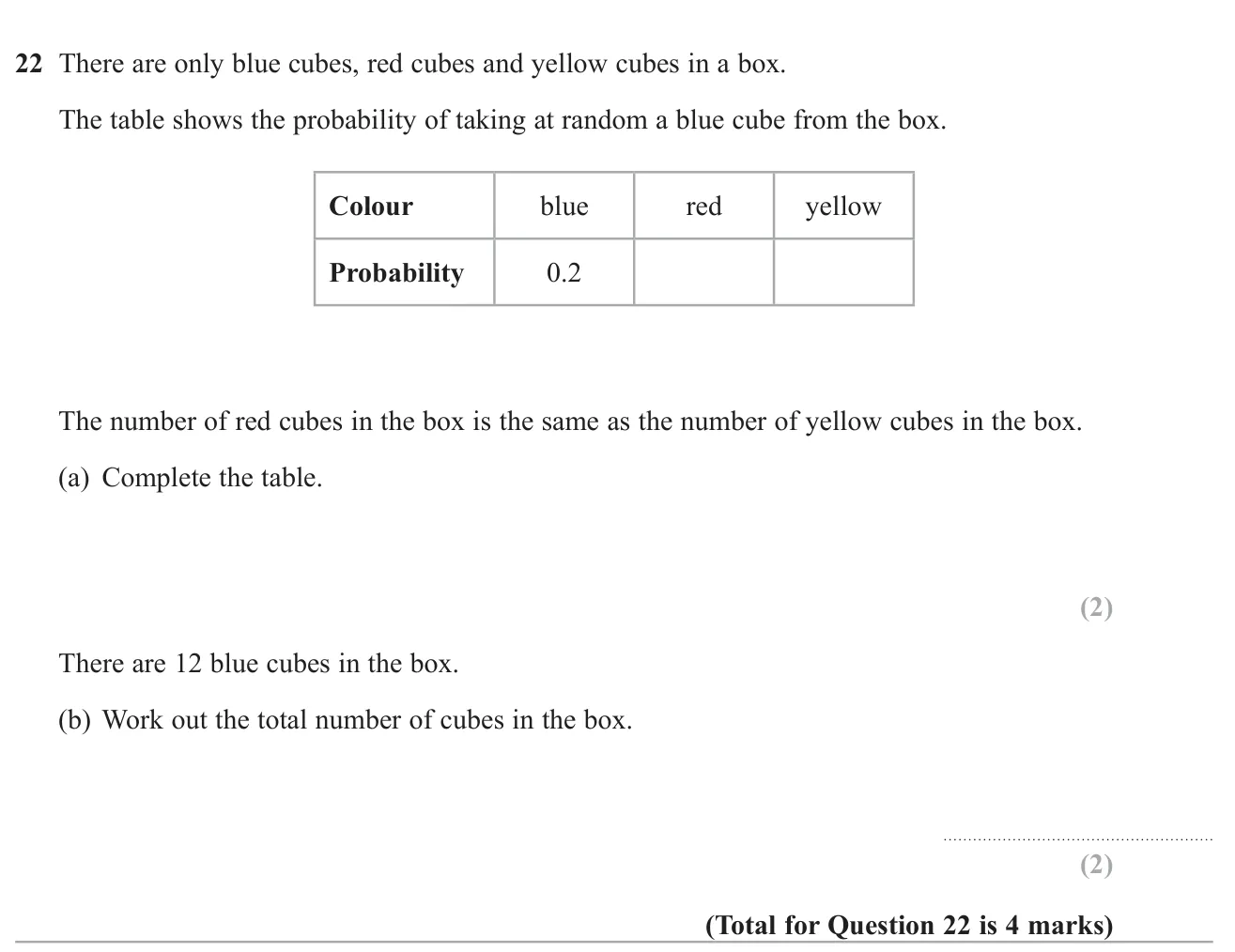
© Pearson Education Ltd. June 2019 Paper 1 (Foundation, non-calculator), question 22.
(a) red 0.4, yellow 0.4 2 marks (b) 60 2 marks
Worked solution Checked against the mark scheme
(a) Probabilities add to 1: 1 − 0.2 = 0.8 1 - 0.2 = 0.8 1 − 0.2 = 0.8
Red and yellow are equal: 0.8 ÷ 2 = 0.4 0.8 \div 2 = 0.4 0.8 ÷ 2 = 0.4
(b) 0.2 of the cubes are blue, so 12 ÷ 0.2 = 60 12 \div 0.2 = 60 12 ÷ 0.2 = 60
Watch out: In (b), multiplying 12 × 0.2 12 \times 0.2 12 × 0.2
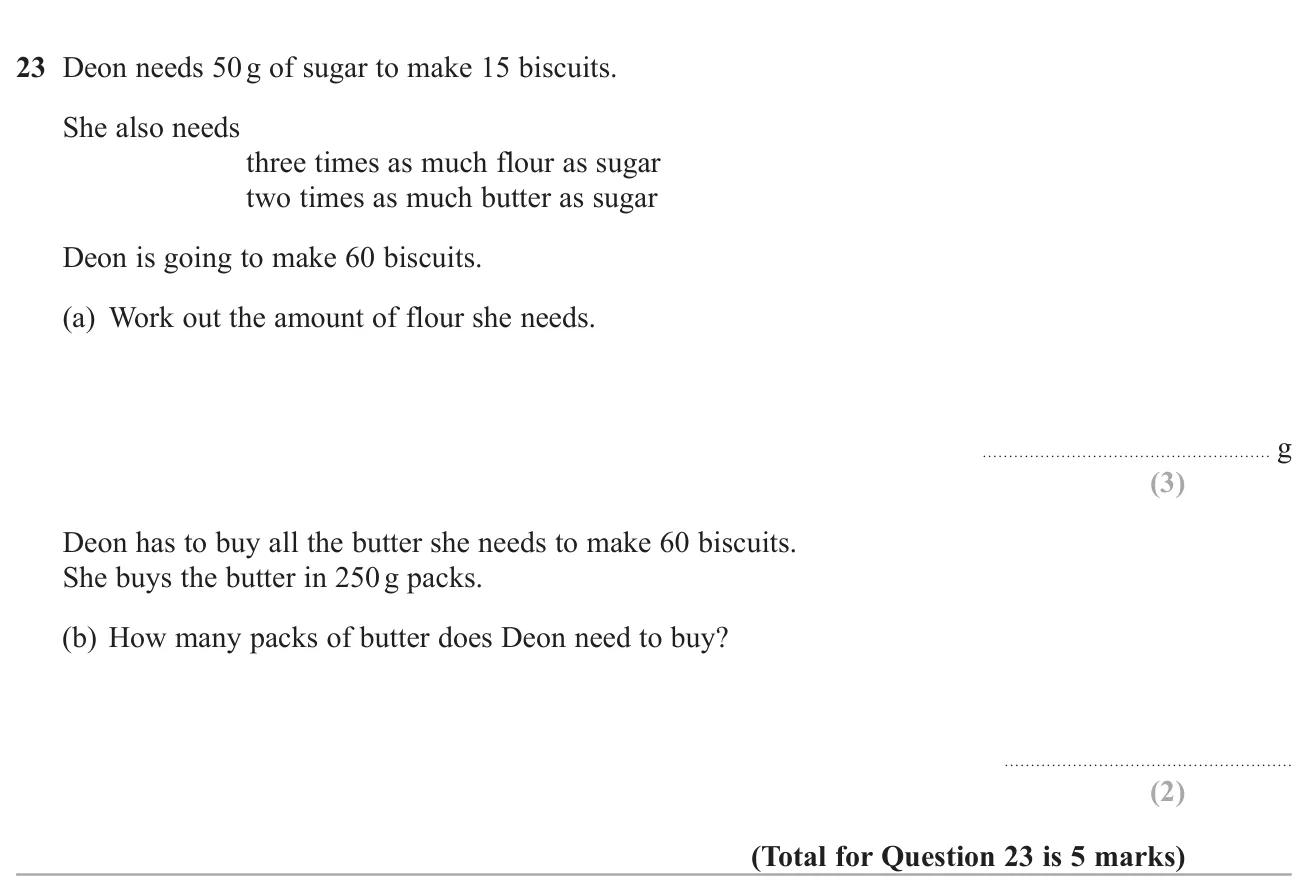
© Pearson Education Ltd. June 2019 Paper 1 (Foundation, non-calculator), question 23.
(a) 600 g 3 marks (b) 2 packs 2 marks
Worked solution Checked against the mark scheme
(a) 60 ÷ 15 = 4 60 \div 15 = 4 60 ÷ 15 = 4 4 × 50 = 200 4 \times 50 = 200 4 × 50 = 200
Flour: 3 × 200 = 600 3 \times 200 = 600 3 × 200 = 600
(b) Butter: 2 × 200 = 400 2 \times 200 = 400 2 × 200 = 400
400 ÷ 250 = 1.6 400 \div 250 = 1.6 400 ÷ 250 = 1.6
Watch out: In (b), rounding 1.6 down to 1 pack.
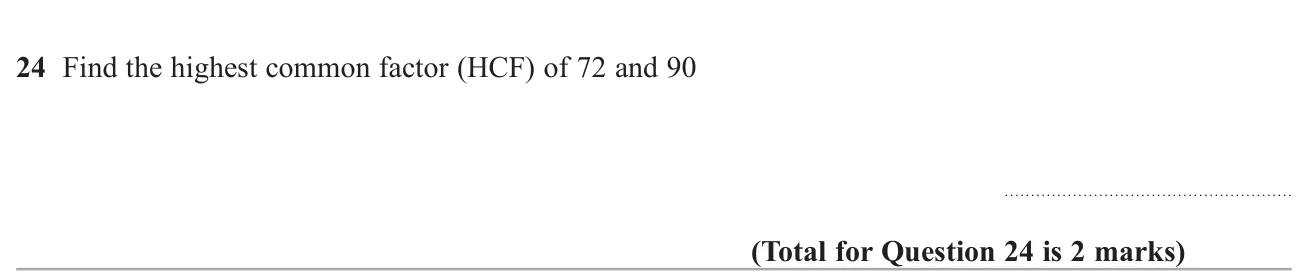
© Pearson Education Ltd. June 2019 Paper 1 (Foundation, non-calculator), question 24.
Worked solution Checked against the mark scheme
72 = 2 3 × 3 2 72 = 2^3 \times 3^2 72 = 2 3 × 3 2 90 = 2 × 3 2 × 5 90 = 2 \times 3^2 \times 5 90 = 2 × 3 2 × 5
Shared primes: 2 × 3 2 = 18 2 \times 3^2 = 18 2 × 3 2 = 18
Watch out: Giving a common factor that is not the highest, such as 6 or 9.
© Pearson Education Ltd. June 2019 Paper 1 (Foundation, non-calculator), question 25.
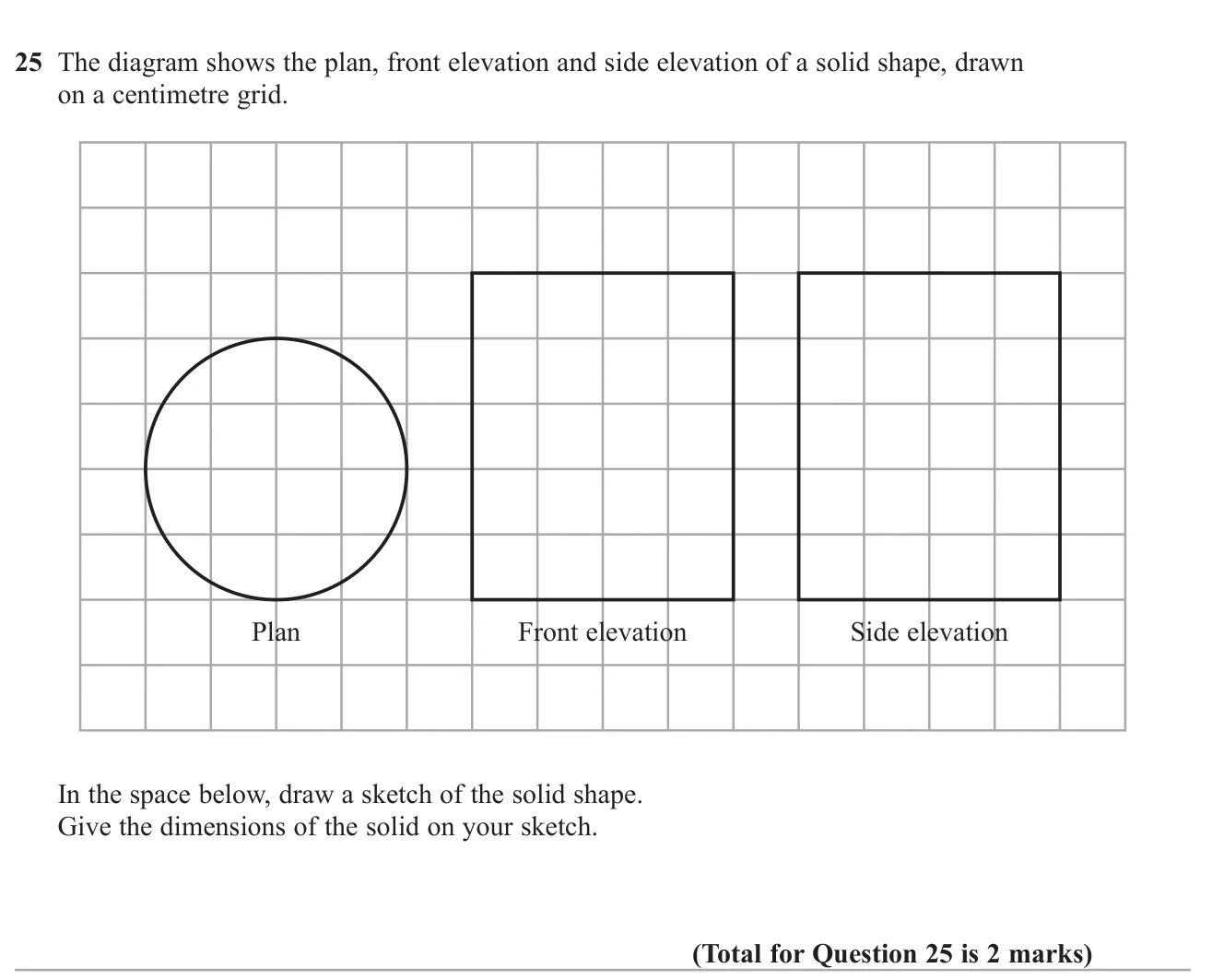
Answer Sketch of a cylinder, diameter 4 cm (radius 2 cm), height 5 cm 2 marks
Worked solution Checked against the mark scheme
The plan is a circle, so the solid is round when seen from above.
Both elevations are rectangles, so the solid is a cylinder.
From the grid: diameter 4 cm (radius 2 cm) and height 5 cm.
Watch out: Reading the grid wrongly and labelling the height as 4 cm.
© Pearson Education Ltd. June 2019 Paper 1 (Foundation, non-calculator), question 26.
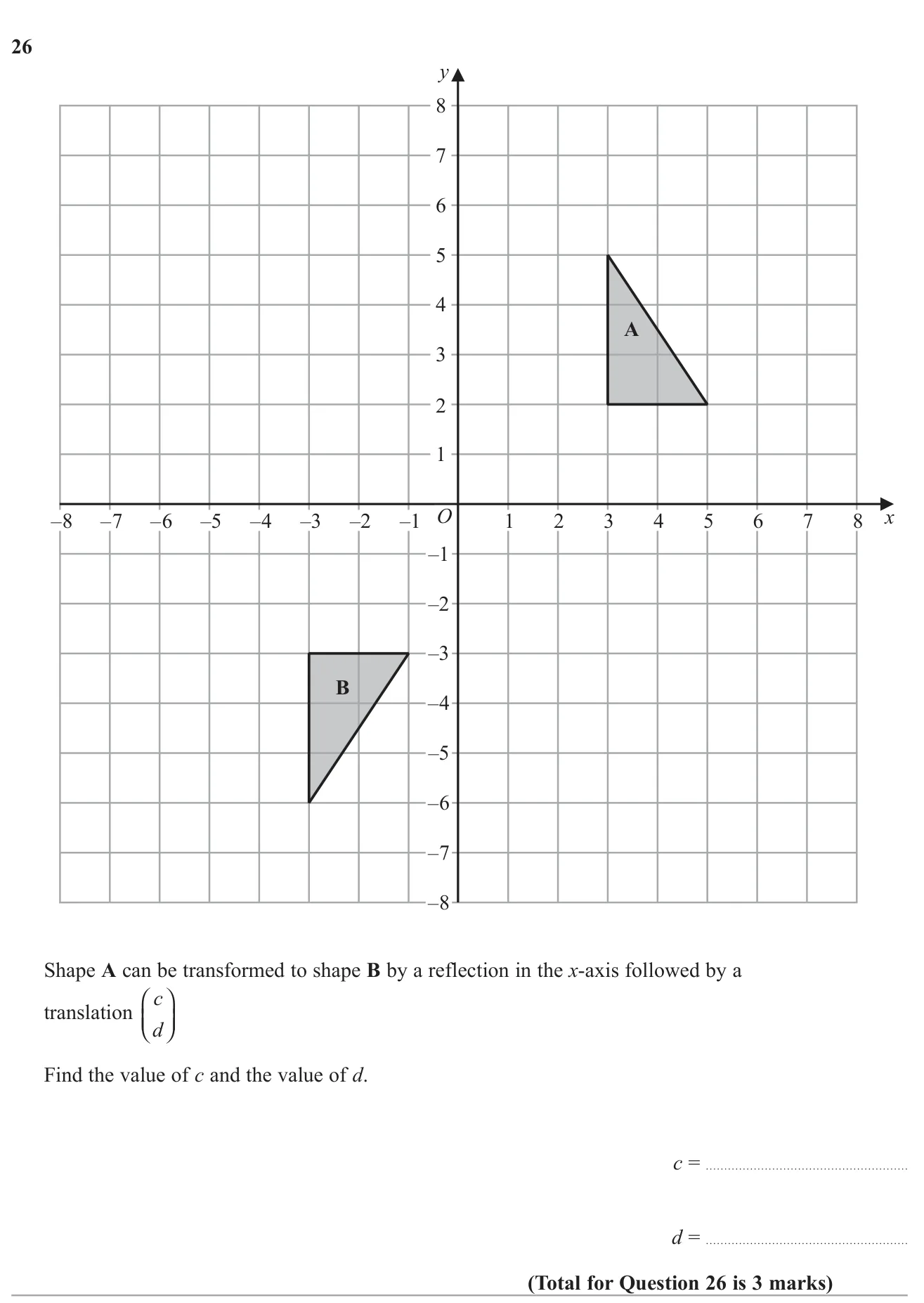
Answer c = − 6 c = -6 c = − 6 d = − 1 d = -1 d = − 1 3 marks
Worked solution Checked against the mark scheme
Reflect A in the x x x ( 3 , 2 ) → ( 3 , − 2 ) (3, 2) \to (3, -2) ( 3 , 2 ) → ( 3 , − 2 ) ( 5 , 2 ) → ( 5 , − 2 ) (5, 2) \to (5, -2) ( 5 , 2 ) → ( 5 , − 2 ) ( 3 , 5 ) → ( 3 , − 5 ) (3, 5) \to (3, -5) ( 3 , 5 ) → ( 3 , − 5 )
B has matching corners at ( − 3 , − 3 ) (-3, -3) ( − 3 , − 3 ) ( − 1 , − 3 ) (-1, -3) ( − 1 , − 3 ) ( − 3 , − 6 ) (-3, -6) ( − 3 , − 6 )
Move from ( 3 , − 2 ) (3, -2) ( 3 , − 2 ) ( − 3 , − 3 ) (-3, -3) ( − 3 , − 3 )
So c = − 6 c = -6 c = − 6 d = − 1 d = -1 d = − 1
Watch out: Swapping c and d, or reflecting in the y-axis.
© Pearson Education Ltd. June 2019 Paper 1 (Foundation, non-calculator), question 27.
Worked solution Checked against the mark scheme
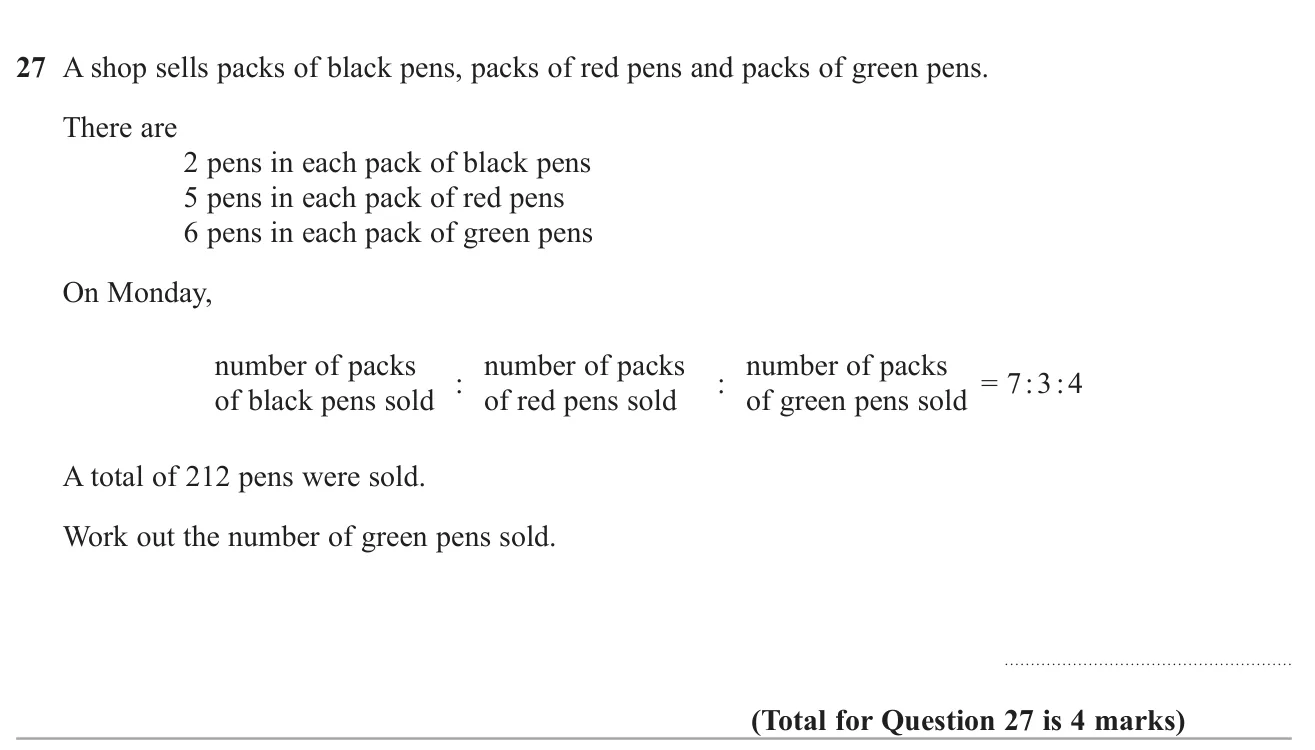
Pens in the ratio 7 × 2 : 3 × 5 : 4 × 6 = 14 : 15 : 24 7 \times 2 : 3 \times 5 : 4 \times 6 = 14 : 15 : 24 7 × 2 : 3 × 5 : 4 × 6 = 14 : 15 : 24
Total parts = 53 = 53 = 53 212 ÷ 53 = 4 212 \div 53 = 4 212 ÷ 53 = 4
Green pens = 24 × 4 = 96 = 24 \times 4 = 96 = 24 × 4 = 96
Watch out: Sharing 212 in the ratio 7 : 3 : 4 without allowing for pack sizes.
© Pearson Education Ltd. June 2019 Paper 1 (Foundation, non-calculator), question 28.
Worked solution Checked against the mark scheme
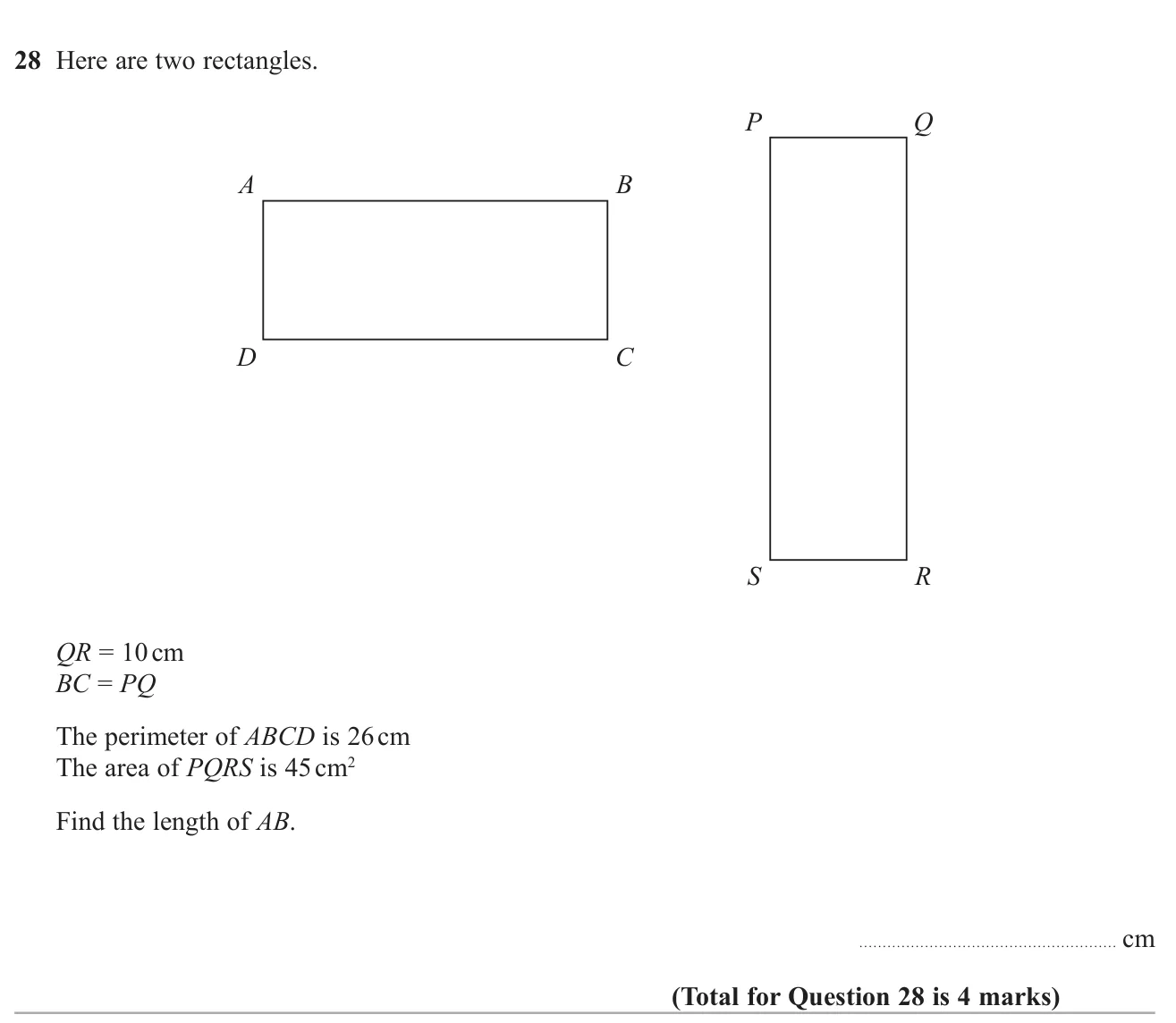
Area of PQRS: P Q × 10 = 45 PQ \times 10 = 45 P Q × 10 = 45 P Q = 4.5 PQ = 4.5 P Q = 4.5 B C = 4.5 BC = 4.5 B C = 4.5
Perimeter of ABCD: 2 × A B + 2 × 4.5 = 26 2 \times AB + 2 \times 4.5 = 26 2 × A B + 2 × 4.5 = 26
2 × A B = 17 2 \times AB = 17 2 × A B = 17 A B = 8.5 AB = 8.5 A B = 8.5
Watch out: Subtracting only one 4.5 from 26, or forgetting to halve.
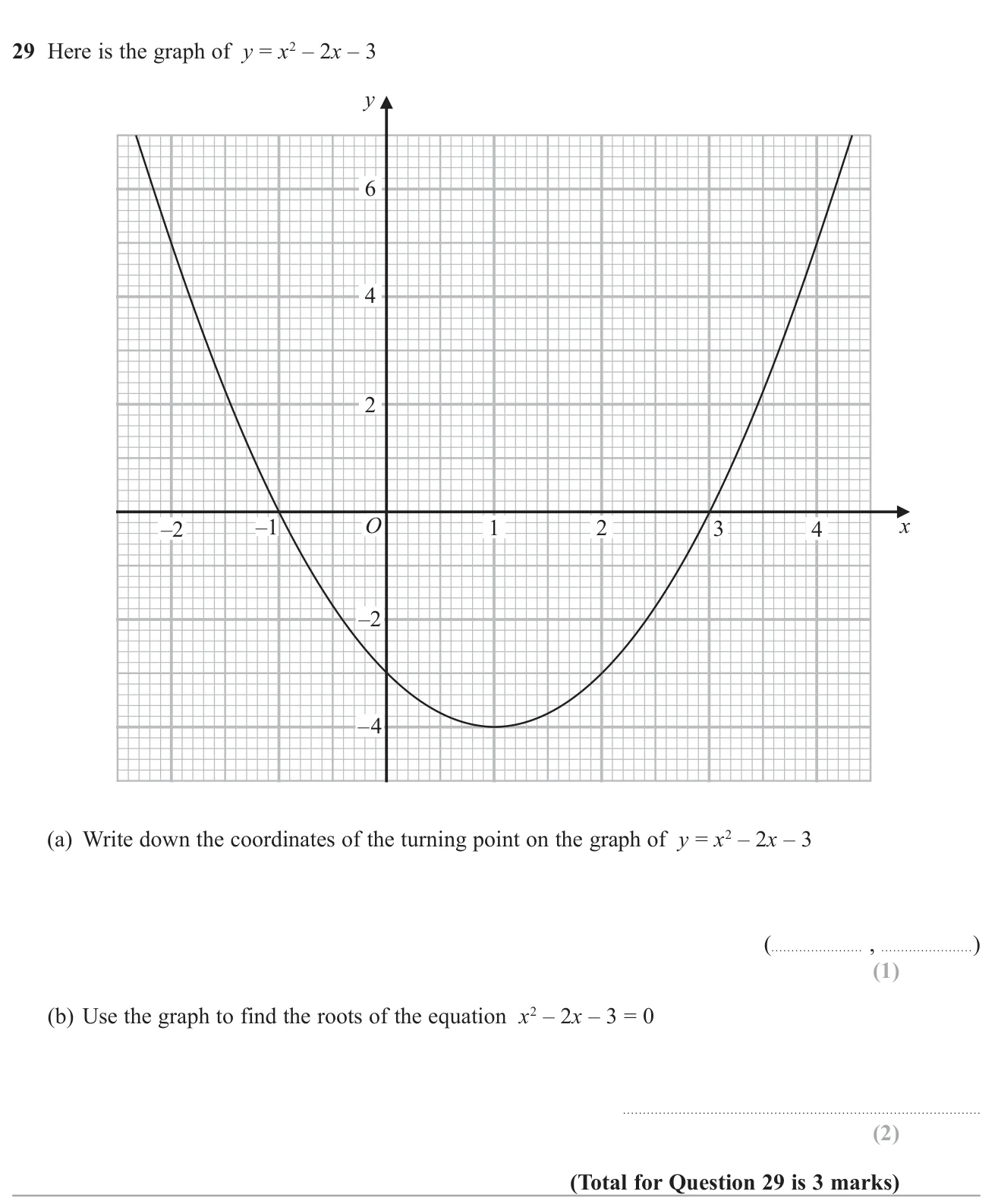
© Pearson Education Ltd. June 2019 Paper 1 (Foundation, non-calculator), question 29.
(a) ( 1 , − 4 ) (1, -4) ( 1 , − 4 ) 1 mark (b) x = − 1 x = -1 x = − 1 x = 3 x = 3 x = 3 2 marks
Worked solution Checked against the mark scheme
(a) The lowest point of the curve is at ( 1 , − 4 ) (1, -4) ( 1 , − 4 )
(b) The roots are where the curve crosses the x x x y = 0 y = 0 y = 0 x = − 1 x = -1 x = − 1 x = 3 x = 3 x = 3
Check: ( − 1 ) 2 − 2 ( − 1 ) − 3 = 0 (-1)^2 - 2(-1) - 3 = 0 ( − 1 ) 2 − 2 ( − 1 ) − 3 = 0 3 2 − 6 − 3 = 0 3^2 - 6 - 3 = 0 3 2 − 6 − 3 = 0
Watch out: Giving the y y y − 3 -3 − 3
Finished the paper? Add up your marks for all three papers and see what grade that would have been.